Category Archives: Numbers

Numbers 11:4-6,10-16,24-29 – Crying for attention in all the wrong ways

The rabble among them had a strong craving; and the Israelites also wept again, and said, “If only we had meat to eat! We remember the fish we used to eat in Egypt for nothing, the cucumbers, the melons, the leeks, the onions, and the garlic; but now our strength is dried up, and there is nothing at all but this manna to look at.”

Moses heard the people weeping throughout their families, all at the entrances of their tents. Then the Lord became very angry, and Moses was displeased. So Moses said to the Lord, “Why have you treated your servant so badly? Why have I not found favor in your sight, that you lay the burden of all this people on me? Did I conceive all this people? Did I give birth to them, that you should say to me, ‘Carry them in your bosom, as a nurse carries a sucking child,’ to the land that you promised on oath to their ancestors? Where am I to get meat to give to all this people? For they come weeping to me and say, ‘Give us meat to eat!’ I am not able to carry all this people alone, for they are too heavy for me. If this is the way you are going to treat me, put me to death at once—if I have found favor in your sight—and do not let me see my misery.”

So the Lord said to Moses, “Gather for me seventy of the elders of Israel, whom you know to be the elders of the people and officers over them; bring them to the tent of meeting, and have them take their place there with you.

So Moses went out and told the people the words of the Lord; and he gathered seventy elders of the people, and placed them all around the tent. Then the Lord came down in the cloud and spoke to him, and took some of the spirit that was on him and put it on the seventy elders; and when the spirit rested upon them, they prophesied. But they did not do so again.

Two men remained in the camp, one named Eldad, and the other named Medad, and the spirit rested on them; they were among those registered, but they had not gone out to the tent, and so they prophesied in the camp. And a young man ran and told Moses, “Eldad and Medad are prophesying in the camp.” And Joshua son of Nun, the assistant of Moses, one of his chosen men, said, “My lord Moses, stop them!” But Moses said to him, “Are you jealous for my sake? Would that all the Lord’s people were prophets, and that the Lord would put his spirit on them!”

———————————————————————————————————-

This is an optional Old Testament selection from the Episcopal Lectionary for the Nineteenth Sunday after Pentecost, Year B 2018. In the numbering system that lists each Sunday in an ordinal fashion, this Sunday is referred to as Proper 21. If chosen, it will next be read aloud in an Episcopal church by a reader on Sunday September 30, 2018. It is important because it tells how God gets angry hearing the complaints of His children when they do not get what they want. God promised to deliver what they so wanted; but before He did so He filled seventy elders with the Holy Spirit, so they prophesied the truth of the LORD. This is a lesson that confirms God hears the prayers of His believers, while also being a lesson to be careful what one asks of God.

This is a long reading selection; it is only half of a longer story. I recommend everyone read the whole chapter here. The whole story gives one a view of how God and Moses were tired of the complaining that was going on. In verse four, the translation above shows: “The rabble among them had a strong craving; and the Israelites also wept again, and said, “If only we had meat to eat!” The literal can also state: “And the mixed multitude who were among them had yielded to cravings — and again so wept the sons of Israel and said , who will give us to eat meat ?”

This says the “rabble” (a valid translation of “wə·hā·sap̄·sup̄”) is only part of the whole “collection” of people. As a “mixed multitude,” one can assume there were people complaining loudly in each of the twelve tribes. Not everyone was complaining, but no one could escape the cries of lament.  Whatever percentage that “rabble” amounted to be in numbers (assuming it was a minority), it was their crying and weeping that ignited all of the “sons of Israel” to follow the lead of complainers.

It was like in the nursery of a day care facility, when one baby starts crying, soon all the babies join in. They were crying to be fed; but the babies were no longer satisfied with mother’s milk (manna on the dew). They wanted meat to eat, along with fresh vegetables, which were not available in the wilderness.

In the first three verses of Numbers 11 (not read aloud), the complaints angered Yahweh so much that He burned the outskirts of the camp. This might have been because people were going beyond the boundaries where the manna fell, in search of some other type of food (including forbidden meats). It might also have been because some on the outer fringes were where some children of Israel were running away from camp, attempting to go back to Egypt. Perhaps, God was making sure the Israelites knew where the nation of Israel’s temporary border was, since the Promise of a reward seemed to be the only reason many were ‘tagging along’?  Whatever the reason for God using fire to burn the earth, this is the context from which the “rabble” was moaning and groaning more loudly.

We then read that Moses became aware of the loud cried of complaints coming from the tents of the Israelites. Here, Moses complains to God (another time of several), referring to the Israelites as infants, with him expected to be their mother. This should be read as Moses being the wife of God, with his complaints being those of a wife to a husband.  Being the only adult in a house of demanding babies was frazzling to Moses and not only did the crying become contagious but so too did the anger God felt.

When God told Moses, “Gather for me seventy of the elders of Israel, whom you know to be the elders of the people and officers over them,” this amounts to 5 or 6 elders per tribe. What is not read (from verse twenty-one) is that Moses wondered how God was going to feed six hundred thousand “men on foot,” meaning there were probably a minimum of one million total Israelites, counting men, women and children. That means seventy elders were to be chosen, where each was a leader of about ten thousand people.

The vastness of this number has to be seen in the light of God promising to answer their complaints of no meat by sending in quail, so many that every Israelite would eat meat for a whole month (a lunar month of 28 days), “until [the meat] was coming out of their nostrils, becoming loathsome to them.” (Numbers 11:20)  To gorge a million people each day, that would mean at least two million quail would fly into the wilderness camp and land, to be killed each day!  They covered the entire camp two cubits deep (three feet)!  There were so many the birds had to be taken and eaten, just to make room for more the next day!

By realizing that, the calling of seventy elders to the tent of meeting was not a ‘sweet meet’, so God could try to pep up His priests or some “hang in there,” “attaboys.”  Remember that all had agreed to the Covenant, so being in the wilderness and eating manna was part of that contract.  If you have ever heard the term used that indicates a serious discussion (a reprimand) as a “Come to Jesus meeting,” then you can grasp how God was calling for a “come to Moses meeting,” with God’s cloud of smoke billowing angrily in view.

We then read, “Then the Lord came down in the cloud and spoke to [Moses], and took some of the spirit that was on [Moses] and put it on the seventy elders; and when the spirit rested upon them, they prophesied.” What is not explained fully is what they prophesied, knowing that “to prophesy” means: “To reveal or foretell (something, esp a future event) by or as if by divine inspiration.” [Collins English Dictionary – Complete and Unabridged, 12th Edition 2014]

This was not God impressing seventy Israelite men with His powers to make one dance wildly while singing unintelligible gobbledygook, like speaking in the tongues of fools. It was God showing those leaders the future that cry babying and endless bellyaching was about to bring upon a million Israelites. Since Moses telling them not to worry was not enough, the Holy Spirit on Moses was brushed onto seventy guys so they could see the light of truth that was coming their way.

“They said we’re going the wrong way. How do they know where we are going?”

We are then told, “They did not do so again,” meaning that was the only time those straw bosses would stand in the sandals of Moses and see the responsibility that a Saint bears, as opposed to some diaper crapping baby … the one that controls the overall mood of a nursery filled with about ten thousand babies. One time seeing what was coming was all they would need. The truth they were shown coming was enough to burn an indelible mark of spiritual reckoning in their minds. Call it an epiphany, if you will.  Afterwards, they would wish never to have an ominous future be shown them again.

THAT is the true meaning of a “come to Jesus meeting” … and once is all one ever needs.

When it is written about Eldad and Medad, their names should be understood, as naming them was for that reason. The Hebrew word “eldod” means “God has loved” and “yadid” means “beloved.” Thus, two did not go to the tent of meeting as ordered, choosing instead to remain in the general camp because of “love.”  That hint should remind the reader that Numbers 11 began with the complaints of those who had “strong cravings,” having “yielded” to cravings of desire.

Those two elders were then singled out as not going to surround the tent of meeting with the other sixty-eight on the list of those summoned. Either their love of God had kept them from complaining, so they felt it was a mistake to be called to be scolded; or, they were defiant in their love of complaining to God, refusing to be told to leave the camp. Whatever the case, God chose them to scare the bejebbers out of the Israelites in the camp by prophesying among the common folk, not at the sacred place of the tabernacle and tent of meeting.

[Personally, I like to see them as like an omen of prophets who would be forced to prophesy outside the confines of Jerusalem’s Temple.  That makes them rebels with a cause for God.]

By reading, “A young man ran and told Moses, ‘Eldad and Medad are prophesying in the camp.’ And Joshua son of Nun, the assistant of Moses, one of his chosen men, said, ‘My lord Moses, stop them!’” we see the shock and awe that their prophesying had. Those two were wildly speaking in understandable language, which the common Israelites heard and became immediately frightened to hear them.  Their message was so frightening that even Joshua was scared that two wild and crazy guys running amok and crying out what the future portends could cause a million people to stampede like wile wildebeests.

Moses seems to have gotten a chuckle out of it all, by responding to Joshua, saying “Are you jealous for my sake? Would that all the Lord’s people were prophets, and that the Lord would put his spirit on them!” Moses told Joshua (then a young devotee), “Do not worry is someone else speaks prophecy as I do.  It is always a good thing when a prophet of the Lord speaks the truth.”

[It is worthwhile to remember the Gospel lesson in Mark 9, where John of Zebedee told Jesus that he and the other disciples saw someone casting out demons in the name of Jesus, so they tried to stop him, because he was not a follower.  Jesus said, “He who is not against us is for us.”  Eldad and Medad were not speaking against God.  They were His agents in camp, speaking the truth of God.]

In terms of Moses being the wife of God, with Joshua his teen son who is trying to help mom take care of the babies that are crying, Moses spoke of a relieved mother.  His words said the same as that of a satisfied wife who has spent a full day telling disorderly children.  The prophecy, “Wait until your Father comes home and gets out the belt!” had had little effect.  Now, the quails were coming home to roost (so to speak).

[For those of you who have never experienced corporal punishment, it is at the root of Proverb that says, “Whoever spares the rod hates their children, but the one who loves their children is careful to discipline them.” (Proverbs 13:24)]

We do not read all the gory details of what Eldad and Medad were prophesying, but it follows that the quail came in such large numbers and the Israelites could not walk without gathering them up and preparing them to eat. The meat of the quail would get stuck in their teeth, which began a plague in the camp. That led to the deaths of those who “yielded to cravings.” The dead were then buried there. So many died and were buried that the place was named “Kibroth Hattaavah,” which means “graves of desire.”

[Please see the reason of a baby crying because it is teething.  This is a natural development in a baby’s body.  Teeth are necessary for chewing solid foods. That symbolism is why the quail meat became stuck in the teeth of the Israelites.  Their cries of desire to be fed meat would become the downfall of those who began that “teething” complaint for solid food, no longer satisfied with manna from heaven.]

As an optional Old Testament reading for the nineteenth Sunday after Pentecost, when one’s personal ministry for the LORD should be underway – one should have grown up and learned to stop complaining about one’s desires not being met by God – the message here is that cold chill that runs down one’s back when one realizes one just made a huge mistake. There is no way out of the punishment in the future, because one has a whipping’ coming and it will not be pretty.

As I was preparing to write this, I was distracted by the atrocity that was a slanderous claim made by a questionable woman, against a Supreme Court nominee. A hearing was held that was like a three ring circus [four when you count the sexual abuse lawyer as a side act]. The woman making claims of sexual misconduct [call it whatever you will] were clearly motivated by political reasons, with no evidence produced that would ever be upheld in a court of law.  One political party approved the reputation of one man to be smeared, just to buy time, hoping the future will bring them their cravings for power returned.  They were teething for the meat of America, which comes from control of the government.

The whole affair played out like the crybaby Israelites raising a stink about wanting fish, cucumbers, melons, leeks, onions, and garlic, like they once enjoyed back in Egypt. Egypt was the warm, fuzzy feelings of a prior administration, having forgotten that service to Yahweh means getting off one’s knees and stop bowing to the leaders of a nation.  Rather than a bunch of rubes being pulled out into the wilderness by God and His wives Moses, Aaron, and Joshua, this was a bunch of crybaby Democrats who were remembering the times past, when they controlled the House and Senate.

The whole nursery was wailing!

Certainly, the government established by the Constitution of the United States of America is not to be compared with Moses and the Laws given to him by God. The people of America are not priests that have been chosen by the One God [Yahweh]; they have been promised nothing. While the Congress is an equally inept group of elders [most appearing to be over seventy years of age, judging by the wrinkles], and the citizens of the U.S. of A. are a collection of people, divided into mixed multitudes [paid by some mega-billionaire, here or there, to be called either Democrat or Republican], there is nothing about America that compares to the Israelites in the wilderness … other than their dirty diapers, red faces, crocodile tears and leather lungs of desire.

If this country were to be truly Christian [ha ha ha ha … a Theocracy!] it would have to have the same “Come to Jesus meeting” as this story tells. There would have to be leaders screaming, “We are going to die if we do not change!,” causing great fear in the populace.

Then, those one-time prophets would be judged by all the philosophers, statisticians, atheists, and Baptists as actually being true prophets, because those prophecies of coming doom and gloom would have all come true exactly as foretold. So many people would have to die to prove a Prophecy of God that they would have to rename the United States of America the “Dead Zone” or “Graveyard of Doubters.”

[Aside: The actual purpose of prophecy is to: 1.) Listen; 2.) Believe; 3.) Perform Acts of Faith to Change; 4.) Avert the Foretold Disaster; and 5.) Prophesy … that the disaster is still actively in the future, if the changes fall apart and revert to the ways that brought the first Prophet to prophesy.  Thus, a true prophet’s prophecy might not come true IF people actually follow steps 1, 2, and 3 above.]

I imagine news of those deaths befalling Americans would further embolden America’s enemies, causing them to keep piling on the death. Remember, God would not be protecting us 350-million sinners, just because we called ourselves Christian. The moral of this story in Numbers 11 is God gets angry listening to the prayers of those who say they will follow His Laws and then wallow in sin, crying, “I’m dirty again daddy!”

Watching the hearings on television today made me sick to my stomach. It is hard to defend America as a Christian nation, when a man [at least publicly professing] said to be a life-long Christian had so much filth thrown on him by politicians who want to glorify their rank with the epitaph on their tombstones that says, “I kept it legal to kill fetuses … to tear asunder what God had joined together.”

God really does not care if America is just another pagan nation, like so many others on this planet. God does not care is governments reflect the evil hearts of the people.  God has not become angered by the desires and cravings of Americans, so God has not scorched the earth on the outskirts of the United States of America as if saying, “This is My turf!  It is sacred ground.  Take off your sandals of selfishness!”  Instead, God chooses those who willfully leave that insanity behind them and submit to the Will of the Lord.  God chooses those who choose Him and understand the wilderness is symbolic of self-sacrifice.  However, I think God gets mighty angry at those who say, “I love God!” and then do nothing that bears that claim up with verifiable evidence.

It seems to me to be “Every man to himself!” Sorry ladies. Let me add, “Every woman for herself!” too. We are all about self, not self-sacrifice for a higher goal. Half the people cheer one political party, while jeering the other.  The other half does the same thing in reverse.  Where are Eldad and Medad … the lovers of God?

I am sure there are small pockets of families that try to live righteous lives, somewhere in the world; but it seems less likely that the sell-out God demands is impossible to be found in a place where an I-Pod is in every hand, chips are implanted in stiff necks, and barcodes are tattooed on the wrists of people claiming to be Christians.  Being “Made in the U.S.A.” is no longer a birthright of righteousness, but a mockery of God.

God help us all. The zombie reality is here.

In-Depth Pentecost Sunday Reading Explanations – Part 2 of 5 (Numbers 11 & 1 Corinthians 12)

The optional readings are the following:

Numbers 11:24-30

Moses went out and told the people the words of the Lord; and he gathered seventy elders of the people, and placed them all around the tent. Then the Lord came down in the cloud and spoke to him, and took some of the spirit that was on him and put it on the seventy elders; and when the spirit rested upon them, they prophesied. But they did not do so again.

Two men remained in the camp, one named Eldad, and the other named Medad, and the spirit rested on them; they were among those registered, but they had not gone out to the tent, and so they prophesied in the camp. And a young man ran and told Moses, “Eldad and Medad are prophesying in the camp.” And Joshua son of Nun, the assistant of Moses, one of his chosen men, said, “My lord Moses, stop them!” But Moses said to him, “Are you jealous for my sake? Would that all the Lord’s people were prophets, and that the Lord would put his spirit on them!” And Moses and the elders of Israel returned to the camp.

And:

1 Corinthians 12:3b-13

No one can say “Jesus is Lord” except by the Holy Spirit. Now there are varieties of gifts, but the same Spirit; and there are varieties of services, but the same Lord; and there are varieties of activities, but it is the same God who activates all of them in everyone. To each is given the manifestation of the Spirit for the common good. To one is given through the Spirit the utterance of wisdom, and to another the utterance of knowledge according to the same Spirit, to another faith by the same Spirit, to another gifts of healing by the one Spirit, to another the working of miracles, to another prophecy, to another the discernment of spirits, to another various kinds of tongues, to another the interpretation of tongues. All these are activated by one and the same Spirit, who allots to each one individually just as the Spirit chooses.

For just as the body is one and has many members, and all the members of the body, though many, are one body, so it is with Christ. For in the one Spirit we were all baptized into one body– Jews or Greeks, slaves or free– and we were all made to drink of one Spirit.

In reality, the Hebrew word for “words” and “told” is of the same root (“dabar”). This means the verse states that “Moses came out and the words of the Lord were spoken to the people.” This is the exact same circumstances as Peter and the others “coming out of the upper room and speaking the words of Yahweh to the pilgrims.” This assumes that the connection Moses had with God is the same as the connection Jesus had, in the sense that both men readily could “speak” for God.

When one reads, “Then the Lord came down in the cloud,” the root Hebrew word translated as “came down” is “yarad.” That word means “to descend,” but because the reference is to Yahweh (“the Lord”), the meaning is altered to a “divine manifestation” form of descent.

In this regard, the word also has a meaning that is relative to water, being “to sink,” which makes this easier to see how God baptized with the Holy Spirit. (Brown-Driver-Briggs) The Greek word for “baptize” is “baptizó,” which means “to dip, sink.” (Strong’s) Thus, the Hebrew word for “a cloud” (“anan”) can also mean “a heavy mist,” where God cannot be limited to some physical “cloud,” as God is much greater that anything as limiting as a physical anything. This means the verse can be read as saying, “The Lord manifested a baptism of His Holy Spirit, which is cloaked in invisibility.” This is then similar in the onset of the Holy Spirit in the upper room of Acts 2.

When God had Moses choose seventy elder and have them surround the tabernacle, the multiplicity of that number is relative to the multiplicity of twelve-plus in the Acts 2 story of Pentecost. The two (Eldad and Medad, whose names both are related to “love”) are similar to the three thousand who received the Holy Spirit from those in the upper room. The Holy Spirit was not in some small, tabernacle-sized cloud, but everywhere.  God knew where those chosen to receive the Spirit were located.

The fear of Eldad and Medad prophesying in the camps was akin to the fear the Temple elite would have had about Jewish pilgrims prophesying on their own, separate from their influence.  It is like the fear of a COVID19 pandemic, broadcast 24/7 on the news.

We are told that the seventy elders prophesied, but they “did not do so again.” This reflects the same limitation that had been set upon Jesus’ disciples (the twelve and the seventy-two), who were sent out in ministry with similar limited talents. They got a taste for what God offered to his devoted priests; but devotion requires absolute self-sacrifice in order to serve God completely.

When Joshua pleaded with Moses, “My lord Moses, stop them!” only for Moses to say, “Would that all the Lord’s people were prophets, and that the Lord would put his spirit on them!” This says that all true priests are given the Holy Spirit permanently when Jesus is resurrected as the Christ within a body of flesh and its soul.

When the Holy Spirit is present within, there is no need for Moses to have to act like a parent of countless children that always bellyache and cry. This story in Numbers is vital for today’s Christians to see they are living like the Israelites, the majority of who did not get this taste of the Holy Spirit and knowing the truth momentarily.  The flocks (tribes or camps) depended on their elders to come back and prophesy to them. This means understanding the writings of the Holy Bible as being prophecies that need the Holy Spirit of God to discover the hidden truth they hold.

This reading has modern applications that need to be openly discussed. As Christians following a leader into the wilderness, where trust is less the option of survival (Salvation) than the option of being ‘left behind’ in the place we were before (lives of sin that we want gone), Christians today are camped well away from the tabernacle. Christians are divided into “camps” called “denominations,” rather than “tribes.” The elders chosen to get a taste of God are our would-be spiritual leaders: priests, ministers, pastors, preachers, bishops, and even cardinals and popes. Christians hear how those “elders” were called to go get special training from Moses (i.e.: Jesus), but the only time in their lives when they truly prophesied was around the tabernacle, in the presence of God, which means they could never duplicate that experience of knowing the truth when back in their home camps. This says back then, just as today, and just as when the Pharisees, Sadducees and temple scribes ran the business of religion, the people never have a leader (“elder”) surround them with the invisible mist of a spiritual baptism, like what happened on Pentecost Sunday.

The name “Eldad” means “God Has Loved” and “Medad” simply means “Beloved.” They are named because they represent God’s LOVE that comes from those who speak for God, just as Jesus spoke what the Father told him to say. Eldad and Medad were Apostles or Saints, like Peter and the twelve, like those Saints who have been known to walk among the people speaking the truth of Holy Scripture. The fear that existed then is just as real today, and anyone who speaks the truth of God WITHOUT A DIPLOMA ON THE WALL AND A PAYSTUB FROM SOME OFFICIAL ORGANIZATION THAT IS A DENOMINATION IN THE BUSINESS OF CHRISTIANITY makes the people cry out like babies, “Make him or her stop!”

When Moses told Joshua son of Nun (whose name means “Yah is Salvation – son of Fish”), “If only ALL would be like Eldad and Medad,” the same failure existed when Jesus walked the planet.  The same failure exists today. God’s wish is that believers stop professing belief and start prophesying the truth. When Christians gather in mindless herds, more to be fed than to listen to a shepherd speak, none are filled with God’s Holy Spirit and none are ACTING like Jesus or ACTING like Jesus reborn in Saints. Because no one is hearing the truth being told, no one is marveling at the presence of God in the written Word. Everyone is happy doing nothing, which is a deadly sin in itself.

In Hebrew, the root word that states “to prophesy” is “naba.” According to Brown-Driver-Briggs, the word primarily means: “prophesy under influence of divine spirit: a. in the ecstatic state, with song.”

This means David wrote his songs while in a state of prophecy. It means all of the Torah was written with the same “influence of divine spirit,” where the truth is the presence of God within, allowing one to see through the Christ Mind.

Every one of those seventy elders were God incarnate, for as long as God allowed them the taste of the truth. It is not good enough to listen to lame sermons about political agendas or sales pitches for a church, when the need for the truth is the ONLY REASON FOR RELIGION.

When Jesus said, “A prophet is not a prophet in his home town,” that was God speaking the truth about how much easier it is to kill the messenger, than it is to listen and believe, where believing leads one to likewise become a messenger of God’s truth.

That is what Paul wrote. If you want to be pagan, be pagan; but, know that it is a curse set upon oneself to claim JESUS is with one, when that is not the truth.

When that is understood, then one can complete the verse with knowledge, realizing importantly [from “kai”] that “no one can say, “Lord JESUS,” if not made HOLY by God’s Spirit of Jesus Christ.

That, my friends, is Paul writing about the sad state that Christianity is in today. The VAST MAJORITY of ‘Christians’ are blasphemers, simply because they do not love God with ALL THEIR HEARTS, SOULS, and MINDS, thereby being only in their names (selfishness), not that of Jesus Christ.

In the Acts reading, Peter ended that reading by stating (from Joel 2:32), “Then everyone who calls on the name of the Lord shall be saved.” Peter spoke (one could imagine) Hebrew or Aramaic Yiddish, which was then translated (divinely) by Luke, so all the multi-national Jewish pilgrims would understand what Joel said and what Peter meant.

In the Hebrew text is written (transliterated), “kōl ’ă·šer- yiq·rā bə·šêm Yah·weh yim·mā·lêṭ,” where “bə·šêm Yah·weh” translates as “on the name Yahweh.” The root word of “bə·šêm” is “shem,” which means “a name.” Still, the Word of God goes beyond simple meaning, where simple minds cannot go.

One is an “Anathema JESUS” claimer when one thinks “calling upon the name Yahweh” is read like saying, “calling upon the name of a pet.” To think “I can call God and/or Jesus Christ, like they are my pets and I am their master” is insanity!  One has cursed oneself by thinking he, she, or it can call upon God or His Son, simply by speaking words.

The Hebrew word “shem” does mean “name,” but there is more to that, which means usage needs to be understood. According to Brown-Driver-Briggs, the word “shem” refers to a “reputation.” They state it also means, “especially as giving a man kind of posthumous life, especially in his sons.” They then add that the word means “name, as designation of God,” which means not a designation of someone lesser than God. They then state, “hence, of place of worship.” All of this usage says ANYTIME SOMEONE SAYS “the name of (in the context of Holy Scripture), it means one has been reborn as a Son of God, bearing His Holy name JESUS, as designated by God the Father, such that the presence of His Son within a human body of flesh makes that body of flesh a temple unto the Lord.”

It must be realized that Paul wrote a letter because of a COMMON MISCONCEPTION about what “in the name of Jesus Christ” means. Paul was clearing this matter up; but, as can be seen today, two thousand years later, that point has not been preached.

The reason is the preachers are hired hands and do not take the time to talk to God, while pondering Scripture. They are too busy watching CNN and preparing their next politically satisfying Sunday oration, cursing themselves for pretending to be gods on earth.

In the rest of the reading from Paul’s letter addresses his statements in verses four through six: “Now there are varieties of gifts, but the same Spirit; and there are varieties of services, but the same Lord; and there are varieties of activities, but it is the same God who activates all of them in everyone.”

This says that all of the “gifts” of the Holy Spirit come from God. In the Hebrew of Joel, where the translation is “Lord,” the word written is “Yahweh,” which is God (not “elohim”). The Greek word for “Lord” is “Kyrios,” which means, “Lord” and/or “Master.” The word can be seen and read as an indication of a “King.”

Knowing God (Yahweh) was the King of Israel and knowing Jesus said his kingdom is not of this world, God is the “Lord” and “JESUS” (Paul wrote all-caps) is the “name of Yahweh” in the flesh, as His Son. The Holy Spirit is the realm of the “spiritual” (Paul’s 12:1a), where the Spirit has brought a body of flesh from the realm of the material (the unholy) and made it Holy.  This is different from the breath of life (a soul spirit), which makes human being walk and talk and think they are almighty … BUT NOT HOLY.

This means the “gifts” of the Spirit, the Lord, and God are all from the same source – the spiritual – as the Trinity manifested on the earth. The body of flesh is where all spiritual gifts emanate, as the Son is the ONLY part that contains physical matter. Still, for that matter to house God, the Holy Spirit, and be the Son, it must be made HOLY.

Holy is (from the Greek word “Hagiō”) that which makes one be “set apart by God,” meaning it is part of the world made “sacred,” being different in the world. The test of human bodies of flesh sitting in pews or preaching from podiums is if they ANY of the “gifts” of which Paul wrote.

Since most score a zero in this regard, they are simply of the world, not set apart by God as sacred. Since God neither owns, operates, or endorses any seminaries “in the world,” none of them have been “set apart as holy by God.”  So, God is not a commodity given as gifts to paying students.

The Greek words “charismatōn” and “charismata” are both translated as “gifts.”  They come from the root “charisma,” which means, “a gift of grace, a free gift” (Strong’s definition) and “an undeserved favor” (Strong’s usage).

This means “gifts” are not “presents, bonuses, or boons” (the meaning of the Greek word “dóra”), but special talents given by God as a “gift of God’s goodwill,” which is spiritual.

The list created by Paul (divinely inspired) is this:

1. “logos sophias” – divine utterance of insight.
2. “logos gnōseōs” – divine utterance of knowledge.
3. “pistis” – faith.
4. “charismata iamatōn” – gifts of healing.
5. “energēmata dynameōn” – effecting miracles.
6. “prophēteia” – prophecy.
7. “diakriseis pneumatōn” – judging spirits.
8. “gené glōssōn” – family languages.
9. “hermēneia glōssōn” – interpreting languages.

When each of these “talents” are analyzed, ask yourself, “How did any or all of these talents (“gifts of grace”) get displayed by Peter and the eleven on Pentecost Sunday?”

I say all of them were displayed.

You just have to know how to read between the lines, as if you were a Jew in Jerusalem on that day.

You have to be a witness to what flowed like God coming down in a mist and surrounding the tabernacle that was the Essene Quarter of Jerusalem.

You have to know the feel of God’s hand touching you – a feeling that is largely absent in today’s watered down version of Christianity.

You have to realize that about three thousand souls were baptized by the presence of God and His Son that day, with that maybe not being only a portion of all who witnessed the event.

[Next is Part III]

Numbers 21:4-9 – Seeing your own soul hanging dead on a pole

From Mount Hor the Israelites set out by the way to the Red Sea, to go around the land of Edom; but the people became impatient on the way. The people spoke against God and against Moses, “Why have you brought us up out of Egypt to die in the wilderness? For there is no food and no water, and we detest this miserable food.” Then the Lord sent poisonous serpents among the people, and they bit the people, so that many Israelites died. The people came to Moses and said, “We have sinned by speaking against the Lord and against you; pray to the Lord to take away the serpents from us.” So Moses prayed for the people. And the Lord said to Moses, “Make a poisonous serpent, and set it on a pole; and everyone who is bitten shall look at it and live.” So Moses made a serpent of bronze, and put it upon a pole; and whenever a serpent bit someone, that person would look at the serpent of bronze and live.

——————–

This is the Old Testament reading selection for the fourth Sunday in Lent, Year B, according to the lectionary for the Episcopal Church. It is read aloud along with Psalm 107, which sings: “He gathered them out of the lands; from the east and from the west, from the north and from the south. Some were fools and took to rebellious ways; they were afflicted because of their sins.” It also precedes the Epistle selection from Ephesians, where Paul wrote: “You were dead through the trespasses and sins in which you once lived, following the course of this world, following the ruler of the power of the air, the spirit that is now at work among those who are disobedient.” Finally, it accompanies the Gospel selection from John, when Jesus said to Nicodemus, “For God so loved the world that he gave his only Son, so that everyone who believes in him may not perish but may have eternal life.”

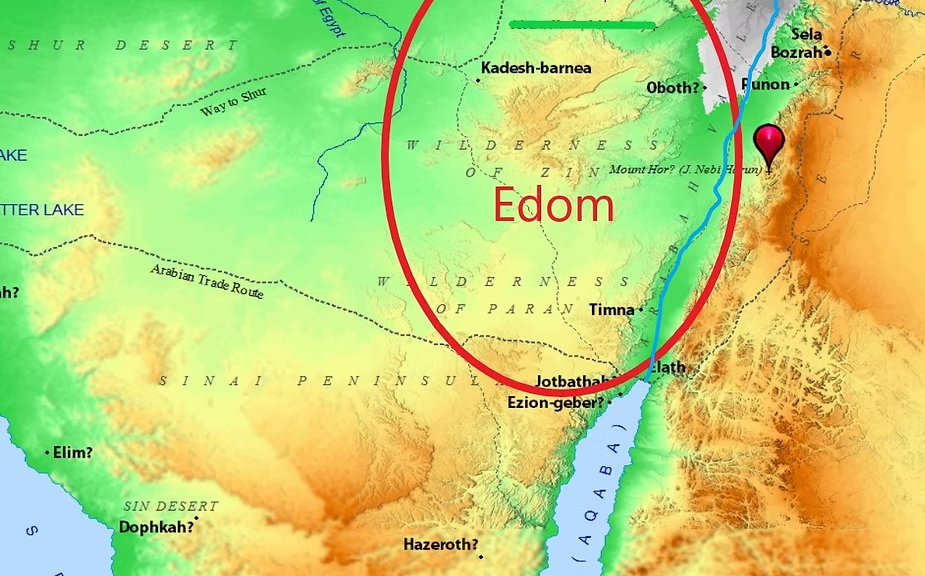
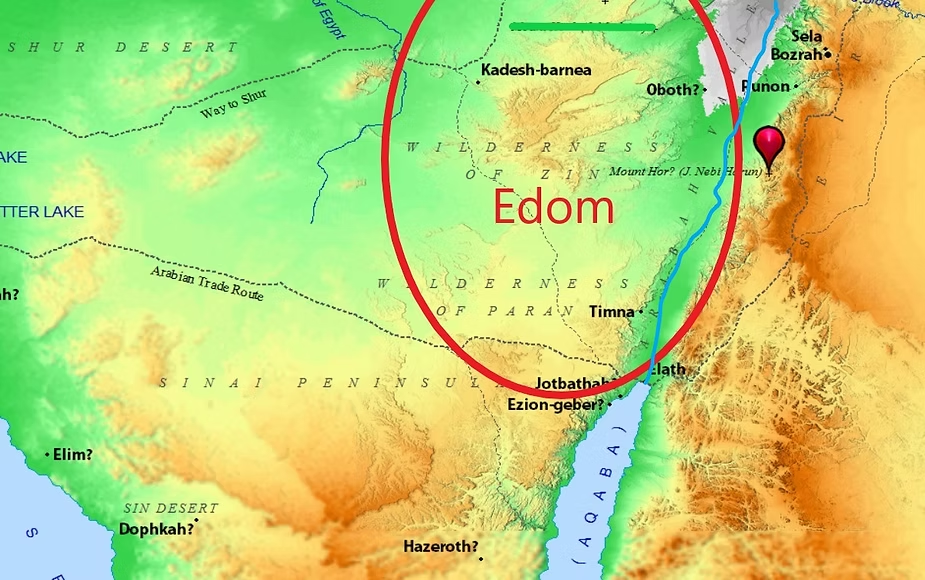
It can help to realize the logistics of that which is stated in verse 4. Mount Hor is east of the Jordan River, in modern Jordan’s southwestern quadrant. The mountain range it is in runs parallel to the river, south from where it leaves the Dead Sea bodies of water. The Hebrew word translated as “Red” actually says “reeds,” so that reflects the narrow point between the main portion of the Dead Sea [north] and that to its south. This is an area known to have reeds, as the water does not cover the land deeply there.

This area of the Dead Sea is to the north of the land of Edom, which was what is today southern Israel, from the Jordan River and to the west, with it also spread on the eastern shore of the Jordan. Thus, the placement in Mount Hor was to the east of that eastern border of Edom, forcing the Israelites to travel through rugged terrain going north, As such, one can imagine the mountainous terrain became a struggle for them.

Roughly presented

The Hebrew words translated as “the people became impatient” are “wat·tiq·ṣar ne·p̄eš- hā·‘ām,” rooted in “qatsar nephesh am.” The key word left out of the translation stems from “nephesh,” which means “soul.” This means the text says, “the soul of the people became short.” The meanings of “qutsar” include “cut down, much discouraged, reaper, harvestman, mourn and loathe” (Strong’s Exhaustive Concordance), such that the best essence from this one should take is the eternal souls [married to Yahweh] suddenly wanted to “cut off” that relationship, killing their commitment to God. To say this is “impatience” is putting it too mildly.

To best grasp this meaning, one needs to recall the lesson of the third Sunday in Lent, where Exodus 20 was shown to begin with the words “waydabber elohim” – “and the gods spoke.” With the Ten Commandments seen as the wedding vows God prepared, they were not spoken by human flesh, but by the “gods” giving life to that flesh. Those “gods” are now identified as “souls” in Numbers [“ne·p̄eš- hā“].

Recalling that language from Exodus can then be seen echoed in Numbers, when verse 5 begins, “waydabber hā·‘ām bê·lō·hîm.” Where the NRSV translates this as saying, “and spoke the people against God,” in reality it says, “and spoke the people against gods,” which can only be their souls. It says the people spoke as the people, refusing to be led by souls in marriage to Yahweh. Thus, they next spoke “against Moses,” as he was the one who officiated the marriage of their souls to God, as His priest. The negative of “against” says the flesh of the people spoke up for themselves, angry that leading the pious life was too difficult and too painful.

This aspect of the flesh complaining about their souls being always following the lead of Moses, with the Promised Land always remaining a place that takes more work to obtain, the flesh began saying it only had so much time for wandering, before flesh dies [being mortal]. This can be seen in their question posed: “Why have you brought us up out of Egypt to die in the wilderness?” In that question, the mortality of their flesh [not their souls] is not so much a surprise necessity for all human beings, as much as it is about having been taken away from fun places [Egypt], where the flesh can [seemingly] die happy. Their bodies of flesh complained about dying in a place barren of fun things to do. In that question, the word “wilderness” [“midbar”] should be read as meaning “an uninhabited land” (Brown-Driver-Briggs), such that while they were there, they had no life to speak of.

To confirm their complaint was less about the physical strength their bodies of flesh needed, in order to walk in mountainous terrain, their focus was no “bread” [“lechem”] and no “water” [“mayim”], which was not so much a complaint about not having basic life sustaining necessities, as much as it was a statement that they missed the variety of foods and drinks they had given up, when they left Egypt, following Moses. The key to understanding this as such comes from the next complaint that came in the same breath.

When the NRSV translates their complaint as if saying, “For there is no food and no water, and we detest this miserable food,” the word “food” is repeated, which is important to look closer to see just what is said. Also, when the translation simply says “we,” it gives the impression that a bunch of complaining Israelites were throwing another of their rebellious tantrums. However, the Hebrew written for the last segment where “food” is repeated does not say that.

What is written is actually two segments, each consisting of two combined words: “wə·nap̄·šê·nū qā·ṣāh , bal·le·ḥem haq·qə·lō·qêl .” In the first segment the word “nephesh” is repeated, such that “wə·nap̄·šê·nū” says, “and our souls.” This is followed by “qā·ṣāh,” which is similar to the prior use of “qutsar,” because the word used here also means “loathe.” This means the previous statement of “cut down souls of the people” is now clarified as meaning “loathe souls of the people,” because here the statement following no bread or water says, “and souls loathe.” Following a comma that is not transferred into the translation is the statement “bread this worthless,” where “bê·lō·hîm” [from “lechem”] is “bread.”

This becomes significant when the use of “our souls loathe this worthless bread,” where the comma becomes a pause before they spit that out. By saying their bodies of flesh were tired of the same ole “bread and water,” with none of the variety of Egypt given to them as a form of pleasure [like a carnal sin], the “worthless bread those souls loathe” is manna. This says manna was not physical food [the first “le·ḥem”] for nourishing a body of flesh, but spiritual food [the second “bal·le·ḥem”] for nourishing the soul. Therefore, the Israelites’ souls were complaining “against gods” that had to follow Moses and digest manna from heaven, in order not to complain about all the pain and suffering of a wilderness test.

With this seen, verse 6 is translated to state, “Then the Lord sent poisonous serpents among the people, and they bit the people, so that many Israelites died.” This translation shows three segments of words, but the Hebrew shows four, as:

“so sent Yahweh the people” , [“way·šal·laḥ Yah-weh bā·‘ām,”]

“serpents fiery serpents” , [“êṯ-han·nə·ḥā·šîm haś·śə·rā·p̄îm,”]

“and they bit the people” [“way·naš·šə·ḵū ’eṯ-hā·‘ām;”]

“and died” . [“way·yā·māṯ”]

In the first segment of words, the verb “sent” [“shalach”] is read as if Yahweh heard the complaining of the Israelites and their souls, so He becomes the sender. However, if one realizes the previous verse says what the people’s souls spoke against Moses [and thereby Yahweh], it becomes them who did the sending of that message to “Yahweh,” seen because this separate segment of words only identifies the two ends of the message as being “Yahweh” and “the people,” not what is “sent.”

The root words in the second segment of words are “nachash,” meaning “serpent,” and “saraph,” also meaning “serpent,” but used as “fiery serpent.” To translate this simply as “fiery serpents” is wrong and misses the importance of repetition in “serpents.” Because it is the “elohim” who sent this message of loathing to Moses [which Yahweh heard], those souls spoke as influenced by the wisest and craftiest of all animals in Eden, who had been cast out for influencing the sins done by Adam [man] and Eve [wife]. Therefore, the face worn by the Israelites was no longer that of Yahweh [the First Commandment in their wedding vows], but that of the “serpent” Satan, who had penetrated their Big Brains.

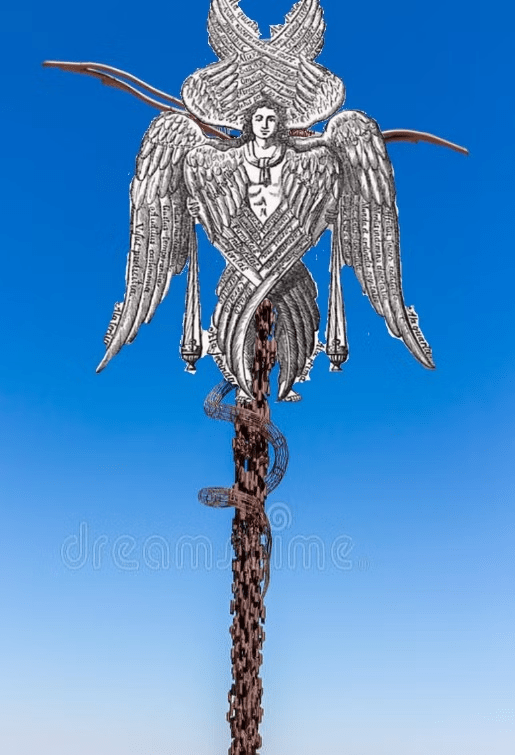
The repetition of “serpents” that are “fiery serpents” needs to be seen also on the level of immortality, where the Hebrew word “saraph” [singular number] means “seraphim” [plural number], who were “beings originally mythically conceived with serpents’ bodies, represented as majestic beings with six wings, and human hands and voices.” (Brown-Driver-Briggs) By realizing that, the second segment of words identifies “serpent-influenced seraphim,” which are “elohim” cast out of Heaven, forever contained in the physical realm.

Seeing how the first two segments of words identify how the souls of the Israelites became engaged [so to speak] with the evil whispers of a “divorce attorney” that advised them to complain and point out all wrong Yahweh was causing them, as grounds for divorce, it was they who brought about the “serpents sent,” which were “poisonous.” It was their souls that became poisoned by this evil influence [a sin to turn away from Yahweh and wear the face of other elohim], so their complaint about being led into the wilderness to die became the truth of a “self-fulfilling prophecy.” The serpent deity they were bowing down before then brought out his pet “fiery serpents,” who did what they knew to do, which was to “bite people and kill them” with poison.

The purpose of death was to release the souls from their bodies of flesh, which Satan would then claim as his possessions, no longer the wives of Yahweh. We then read that “many Israelites” suffered death, which was caused by the “serpents.” Knowing this was due to themselves, and not some punishment meted by Yahweh, we read: “The people came to Moses and said, “We have sinned by speaking against [Yahweh] and against you.” This becomes a confession of sins made before a divine priest of Yahweh, who they asked, “pray to [Yahweh] to take away the serpents from us.”

Here, it is vital to see their petition to “take away the serpents from us” was not asking God to kill all the snakes, which were causing them death. The admission that “we have sinned” says they realized their souls had become influenced by evil, so those who died had become the souls divorced from Yahweh and married to Satan. Those in that same condition of sinning, through “speaking against Yahweh” and His most divine priest, knew their souls would also be sold into slavery to the devil, if the snakes they had allowed themselves to become a plight to them were not removed from access to them. Therefore, “Moses prayed for the people” to be saved by God, meaning he begged God to take back their souls as His wives.

Yahweh heard the prayers of His priest Moses and responded to his prayers, telling Moses, “Make a poisonous serpent, and set it on a pole; and everyone who is bitten shall look at it and live.” This translation appears as three separate segments of words, thereby representing three stages of acts being required, for the salvation of the Israelite souls to be met. However, the Hebrew states this in four stages, including a very important word that has been omitted from the NRSV translation. Thus, it becomes helpful to look at what Yahweh actually said to Moses.

The segments appear as this (literally translated into English):

  1. “make a likeness of a seraph” ,
  2. “and set it on a standard”
  3. “and it shall be that” ,
  4. “everyone who is bitten” ,
  5. “and when he looks at it and he shall live” .

When the first segment says, “make,” the Hebrew adds “to you” [“lə·ḵā”]. This (basically) untranslatable addition should be seen as Moses being told to “make” what he thought “seraphim” [“śā·rāp̄”] looked like. He was not told to go catch a snake or kill one. He was told to make himself appear as a deity sacrificed unto Yahweh.

Here, it becomes important to realize last Sunday’s interpretation of the Ten Commandments [Exodus 20], where the marriage vows to Yahweh [spoke by one’s soul] included: “You shall not make for yourself an idol, whether in the form of anything that is in heaven above, or that is on the earth beneath, or that is in the water under the earth.” This means that Yahweh told Moses to break this covenant purposefully, to set an example of what a marriage commitment to God means – figuratively [because an immortal seraph could not be caught or killed].

When the second segment of words has Yahweh telling Moses to take his image of a seraph and “set it on a standard,” or “a pole, ensign, signal, sign” (Strong’s usage), the intent is to place the likeness of a seraph on an instrument that will raise the image up high. This then becomes a continuation of the marriage vows agreement God sent Moses to the Israelites with, which explained not making idols by saying, “You shall not bow down to them or worship them.” By having an idol raised high, one must stand and look upward [not bow down before or submit one’s being unto] in order to see it.

See this as Moses raising a likeness of himself, as a Saint of God, whose body was like all the Israelites – mortal.

The one word that has been omitted from the NRSV translation comes after this instruction to place the image on a pole, with the word separated by hyphen, making it an extension of this order by Yahweh. The word is “wə·hā·yāh,” which translates as “and it shall be that” or “and it shall come to pass.” The separation makes it importantly known that an image of a seraph atop a standard becomes a prophecy of oneself in marriage to Yahweh. Looking upon it will come to represent just what bowing down before another “elohim” and worshiping it will mean to one’s soul. It says to the soul seeking redemption from sins, sacrifice the soul of you to God in marriage or your soul will eternally find it sentenced to death, one body of life after another. Marry Yahweh or the god you see yourself as will forever be imprisoned on a stake for all to see the worthless reward that comes from not marrying one’s soul [and staying married] to Yahweh. “That will come to pass.”

From that important distinction, projected by an icon, will be a reflection of what one must not become [a little-g god lifeless on a sign post], the fourth segment of words becomes the stage where the symbol becomes the cure, as it is what “everyone who is bitten” by self-importance and the influence of evil to sin, causing them to reject marriage to Yahweh must look upon. One must stand up [arise and awaken] and lift up one’s eyes [raise up one’s stake], so one sees the outcome of living to please a body of flesh that most certainly will die. Because an “elohim” is lifeless on a pole, one’s soul will gain nothing more than the same return to a body of flesh, always complaining about not getting more of what one wants in the world.

By seeing this image of oneself, as a soul always trapped within a body, where death becomes repetitious, one is able to see one’s life of suffering is nothing, when compared to endless lives of suffering. By looking upwards to see the reflection of one’s soul mounted forever on a pole, one will realize service to Yahweh, no matter how much one’s flesh might suffer and strain, is the path that frees one from falling down and becoming the prey of Satan.

When this reading ends by stating, “So Moses made a serpent of bronze, and put it upon a pole; and whenever a serpent bit someone, that person would look at the serpent of bronze and live,” two points need to be realized. First, it says Moses did as the Lord told him. Even though Yahweh told him to do something that was against the marriage vows, it was not a sin to do whatever God told him to do. As such, “make” and “made” [forms of “asah”] is a command from the master to the subject, so nothing “done” on the command of Yahweh can ever be a sin. This becomes a lesson that confirms how Jesus said God within one’s heart will inscribe the Law on the walls there, meaning an external Law could have people wonder “Should I make an image, when I said I would not?” making them do nothing out of fear of breaking a Commandment. The order to “make” and Moses having then “made,” according to what God said, means God was in his heart.

Second, the use of “bronze” or “copper” is important as Moses made the image of an eternal “seraph” [singular of “seraphim”] out of a metal of low value, which lasts much longer than wood, where the metal can catch the light of the sun and become an attraction to the eyes. Bronze [or copper] becomes a color that is symbolic of the earth, nature and that which comes from the ground. (Colorology.com) Because, as a metal, it reflects lasting strength, durability and sturdiness as a functional element, it became the metal of choice by Moses to symbolize a fallen god, forever trapped in the earth. As a most common metal, usually an alloy of copper mixed with tin, it shows just how lowly a soul is when attempting to call oneself a god. Thus, Moses erected a metal and wood icon that symbolized a soul giving life to that which is dead and will always return to that state of being.

As a reading selection for the season of Lent, it must be seen that this says all souls who hear the proposal of Yahweh for marriage and accept it, but then find the ways of righteousness are difficult to travel, the Israelites had struggled for decades following Moses. Trying to will oneself to be righteous is impossible, because that misuse of willpower comes with few perks that are offered a soul by the material realm. Struggling to do something not truly desired says the lesson is clearly saying a soul alone cannot make the journey to eternal salvation without God. The lures of a sinful world will always become a distraction if one’s soul is not divinely committed to serve God, as was Moses. It says it is always the easy way out to blame God and blame those who serve God as His saints, than it is to keep one’s head [thus face] bowed down in subservience, always saying, “You know, Lord” when God speaks to one. [This shines new light on what being “blameless” is really about.]

This particular reading says the wilderness experience that comes from a marriage to God’s Holy Spirit is longer than forty days. In hindsight, from our modern perspective, we find it difficult to fathom forty years that the Israelites followed the lead of Moses. For Lent to be some imaginary concept of self-sacrifice, forty days becomes a reflection of a child playing church, not a soul making a commitment of marriage to Yahweh. Our complaint is more than “no food and no water” for forty days, as it is the ungrateful attitude that “I” will force myself to do without one excess of addiction, which is only one of the plethora of lustful desires available in the social environment of one’s own personal “Egypt.” A Lenten season not seen as the anniversary of one’s soul’s marriage to God, lasting until the end of one’s physical life on earth, when one’s soul is released forever to be with Yahweh, is nothing more than a game being played.

When every reading in the church lectionary ever presented must call upon oneself to see what oneself needs to see, in order to correct the mistakes of one’s own life [one’s sins confessed, begging God for absolution], this reading from Numbers calls everyone claiming to be “Christian” to see just how much one’s soul is complaining to Yahweh, “I detest having to eat this spiritual food you send from heaven.” One has to ask oneself, seriously, “Do I put any real effort into reading the divine texts prepared for my soul’s salvation, so I begin to see clearly how the divine texts are speaking loudly to me and telling me what God expects from me?”

The answer to that question, to anyone who embarks on a forty day camping trip without cigarettes of chocolate bars [whatever trivial sin one admits to], is “no.” By not taking the time to read Scripture and listen to what God tells you it means, says your soul loathes consuming that spiritual food sent to you. Sporadically listening to sermons on Sundays is far from a commitment that looks for daily consumption of spiritual food. [Spiritual food is not wafers handed out by priests at a church’s altar rail.] Whenever the thought of “Bible studies” makes you want to complain to God [and the authors of the divine texts who were the true priests of Yahweh], you then are telling God, “I prefer wearing my face, as a little-g god, rather than put on God’s face and suffer the ups and down of a mountainous terrain, in order to reach the Promised Land [i.e.: not any land on earth].”

The lesson for this Lent is then look upon yourself as a seraph on a pole, because you have been bitten by the poisonous snakes of a modern world of lusts and pleasures.

Numbers 11:4-6, 10-16, 24-29 – No more frat parties!

The rabble among them had a strong craving; and the Israelites also wept again, and said, “If only we had meat to eat! We remember the fish we used to eat in Egypt for nothing, the cucumbers, the melons, the leeks, the onions, and the garlic; but now our strength is dried up, and there is nothing at all but this manna to look at.”

Moses heard the people weeping throughout their families, all at the entrances of their tents. Then Yahweh became very angry, and Moses was displeased. So Moses said to Yahweh, “Why have you treated your servant so badly? Why have I not found favor in your sight, that you lay the burden of all this people on me? Did I conceive all this people? Did I give birth to them, that you should say to me, ‘Carry them in your bosom, as a nurse carries a sucking child,’ to the land that you promised on oath to their ancestors? Where am I to get meat to give to all this people? For they come weeping to me and say, ‘Give us meat to eat!’ I am not able to carry all this people alone, for they are too heavy for me. If this is the way you are going to treat me, put me to death at once—if I have found favor in your sight—and do not let me see my misery.”

So Yahweh said to Moses, “Gather for me seventy of the elders of Israel, whom you know to be the elders of the people and officers over them; bring them to the tent of meeting, and have them take their place there with you.

So Moses went out and told the people the words of Yahweh; and he gathered seventy elders of the people, and placed them all around the tent. Then Yahweh came down in the cloud and spoke to him, and took some of the spirit that was on him and put it on the seventy elders; and when the spirit rested upon them, they prophesied. But they did not do so again.

Two men remained in the camp, one named Eldad, and the other named Medad, and the spirit rested on them; they were among those registered, but they had not gone out to the tent, and so they prophesied in the camp. And a young man ran and told Moses, “Eldad and Medad are prophesying in the camp.” And Joshua son of Nun, the assistant of Moses, one of his chosen men, said, “adoni Moses, stop them!” But Moses said to him, “Are you jealous for my sake? Would that all Yahweh people were prophets, and that Yahweh would put his spirit on them!”

——————–

This is the Track 2 optional “Old Testament” reading that can be chosen over a reading from Esther 7 & 9, on the eighteenth Sunday after Pentecost [Proper 21], Year B, according to the lectionary for the Episcopal Church. If this option is chosen, then it will be paired with a partial reading from Psalm 14, which sings, “The law of Yahweh is perfect and revives the soul; the testimony of Yahweh is sure and gives wisdom to the innocent.” Those will precede an Epistle reading from James, where the Apostle wrote, “Are any cheerful? They should sing songs of praise.” All will accompany the Gospel reading from Mark, where Jesus told his disciples, “If any of you put a stumbling block before one of these little ones who believe in me, it would be better for you if a great millstone were hung around your neck and you were thrown into the sea.”

I published my views on the whole reading the last time it came up in the lectionary cycle [2018]. That commentary can be read by searching this site. The last five verses were also read on Pentecost Sunday [2020], with those views [plus those on an Epistle reading] also can be read by searching this site. As my prior observations still hold merit, I invite readers to read those offerings and compare them to what I offer here today. I welcome comments, questions, suggestions and correction, at all times.

First of all, in 2018 I was not pointing out how Moses had written “Yahweh” every time he referred to what the translators like to call “Lord.” I now see how such an address must be seen as like some early American Christian immigrants, when a married couple would address one another as “Husband” or “Wife,” never by their actual names. If one were to be comfortable doing that in today’s society, where marriage simply means ‘sex object that one is willing to take a gamble on,’ calling a spouse by a generic title would be smooth. One would never have to learn a name, as “Husband” or “Wife” would be a ‘fill-in-the-blank’ generic for ‘spouse of the year.’ In the case of “Yahweh” versus “Lord,” there are many “lords” who run the lives of human souls: Money, Sex, Drugs, and Rock-n-roll [a.k.a. Idolatry of Entertainers]. To reduce “Yahweh” to a generic name means that can raise the question, “Which “lord” are we talking about?” Such a question shows just how lame one’s faith is, based on a soul worshiping “self” as “Lord,” not ever considering any need to marry one’s soul to “Yahweh,” in order to earn eternal salvation Therefore, in the above translation, one will see that I have placed in bold type the reality of what was written in the Hebrew text.

[Logic point: If you are going to call Yahweh “Lord,” why not call Moses “the man”?]

In verses 4-6, the concept of how long the Israelites had been wandering with Moses and Aaron [and the Tabernacle with the Ark and the Covenant, thereby Yahweh] needs to be realized. To spend forty years away from the hustle and bustle of the ‘big city’ has to be seen as the children of Israel needing two generations to pass, simply to rid their minds of their addictions to worldly lusts, and become strengthened by Spiritual marriage. These verses say those brains were still resistant to a divine marriage between their souls and Yahweh’s Spirit. This is even when Moses was so Anointed by that Spirit that his face glowed so brightly it scared the people. This means these verses should be read [as all between Exodus and Joshua] as though the first true seminary had been created, with Moses the Head Master, Aaron the Head Priest, the Tabernacle the place of worship on campus. All the Israelites must be seen as the students [who signed up, were admitted, and who paid the fees of admission]. The elders can then be seen as the ‘senior class.’

Boohoo. We remember when we were young and stupid and we want to be that again! Boohoo.

The Torah is not to be read simply as a history book. The Holy Bible is a living text that has to be seen more as a reflection on all history; so, the waywardness of the Israelites reflects upon the waywardness of human beings always. In the comparison to a seminary, many are placed purposefully away from metropolis environments, where students are then forced to apply their study skills to the mastery of whatever degree program they have entered. The students of seminaries might be older in years on earth (many with prior degrees from colleges or universities), so they are re-entering the educational environment to be retrained in how to work for a religious organization. When they graduate and take jobs as hired hands in those religious organizations, they then apply the same education they learned onto their flocks. Still, the return to a university setting immediately brings back the child that wants to play, more than work and study. Because most students do as little as possible and see a learning environment as a playground to escape and party wildly, the complaints found in verse 4-6 must be read as an age-old statement of the students always saying, “When will this school life be over, so we can go back to being like we were before!?!?”

One must want to be there voluntarily; and even when there seriously, the presence of one crying baby in the nursery makes all the babies begin to cry.

When one realizes the truth of becoming a child of Yahweh, where “Israelite” means “One Who Retains God,” where “el” is less about naming Yahweh and more about saying one is an “elohim,” this is always the point of religion. A religion is not meant to be a place to go sit and learn some stuff, then party hardy when not in a desk or pew, because it is meant to be a lifestyle that one never strays from. That commitment is why marriage is the only way one’s soul can lead a body of flesh to not always want the fun things, never wanting to do the sacrificial things. Marriage of a soul to Yahweh brings inner rejoicing; and, ministry in pairs means two will share plenty of good times together. Those good times come from helping others see that light of truth, which is not found in the things the world loves to flash before our eyes.

This is why everyone who claims to be a Christian must see himself or herself as Moses, who regularly is in communication with Yahweh [not some generic lord]. Aaron is one’s partner in ministry. Thus, when we read, “Then Yahweh became very angry, and Moses was displeased,” that should say YOU are displeased when people claiming to be Christians are bellyaching: “Woe is me. I am a homosexual and if I engage in same sex with another, I am judged as bad. I call myself Christian, so I should be forgiven all my sins because I believe that is why Jesus died.” Such arguments are why it is hard to be truly religious today, when there still is as “weeping throughout their families, all at the entrances of their tents,” because poor babies missed “the cucumbers, the melons, the leeks, the onions, and the garlic” that used to make sinful life so much fun.

The children of Israel [remember, that is a name that means “He Retains God”] were in Moses’ seminary by choice. All the rest of the world was not there. The rest of the world was allowed by Yahweh to remain where it was; so, anyone who wants to sin and feel okay with sin needs to rejoin the rest of the world and stop pretending to be something chosen by God. The meaning of “He Retains God” says one’s soul has married Yahweh and taken on His name. Whatever one did before that sacred union [when all human beings know sin up close and personal] ceases to be, from then on, for eternity [souls never die]. Heaven is not divided into sections, where the gays are over there and the murderers in that place, with Saints getting the preferred housing. Heaven is the presence of Yahweh, and sin is not allowed where Yahweh is.

A true Christian, as one whose soul is just as Anointed as was Moses’ [a true Christ], should hear himself or herself saying to Yahweh, “They [the souls failing Yahweh] come weeping to me and say, ‘Give us meat to eat!’ [meaning, “Allow us to sin as before!] I am not able to carry all this people alone, for they are too heavy for me.” That says Moses knew all he could do was be Jesus reborn [thousands of years before Jesus was born] and demonstrate true faith before others, so they too could be like Moses [Jesus reborn]. Other than that, there is nothing more one can do. Each soul has to save itself; and “Jesus” means “Yah[weh] Will Save.” It is up to each individual to marry Yahweh, become His wife, and let Him impregnate one’s soul [“Receive the Spirit”], so one’s soul gives rise to the soul of Jesus resurrected [regardless of where on history’s timeline one is].

Now, this reading is an optional selection because the Gospel reading from Mark tells of disciples coming to Jesus, saying they saw someone they did not know casting out demons in the name of Jesus. Here, Joshua son of Nun came to Moses saying basically the same thing: “adoni Moses, stop them!” In that, I have restored the Hebrew text that has erroneously translated as if Joshua said, “My lord Moses.” The word “adoni” is like the world “elohim,” in the sense it says Moses was married with Yahweh, so he was one of His “lords” on earth, possessed divinely by Yahweh’s Spirit. Joshua was a strong guy, who easily could have killed Eldad and Medad, keeping them from prophesying in the camp as freewheelers, not part of the secluded party of prophesying that was going on by Moses. That says others can be touched – they were seniors in the seminary after all, so they had learned a few things – without having to be standing by Moses [or Jesus] for Yahweh’s hand to touch them. That says, if one wants to know Yahweh through marriage, one does not need to be blessed by some university professor. One needs to apply to the school of Divine Marriage and pay the tuition that opens one’s heart to receiving His Spirit. It is more rewarding than a sheepskin to hang on the wall in an office, afforded one by an employer.

As an optional Track 2 reading chosen over the Esther 7 reading, one needs to see how the grumbling that angered Yahweh in ‘Moses’ school for freed Israelites’ is the same as Yahweh being angered at the thoughts of Haman, who prepared a gallows to hang Mordechai and all the other Jews in Susa. Moses could have easily killed enough Israelites, so that those left alive would have said, “Okay. We get your point! We believe!” However, that does little to lean souls towards saying, “Yes,” to Yahweh’s marriage proposal. On the other hand, give them a taste of the Spirit, so they run amok in divine ministry [a real frat party at a seminary], frightening others like Moses without his veil on, that sends a stronger message to others. To have King Ahasuerus kill Haman and establish a day of recognition for that event says, “Evil was defeated today.” That is like Yahweh’s Spirit falling on the two who did not attend the meeting as instructed; so, Eldad and Medad learned just how wrong their souls had been, in the same way Haman’s did when hung to death on his own device built.

As a reading to be read aloud on the eighteenth Sunday after Pentecost, when one’s own personal ministry for Yahweh should already be well underway, the lesson to receive is the realization that complaining about the way the world is does nothing of value. The material universe is the only place that sin can exist; so, sin cannot be stopped here. The only world that matters is the fleshy body that surrounds a soul – yourself [a “self” equals a “soul”]. One must sacrifice one’s own soul, so all the delights of a world that can only offer sins and death [then reincarnation or hell, for the losers] are willingly denied. One needs to be cut loose from one’s addictions of the past and let Jesus be reborn within.

With Jesus living within one’s fleshy body, he will then become the “Lord” of that tabernacle, who reads all applications from the world that want to pollute a true seminary. Jesus reborn will reject all outside influences from admission, if they have no value being in one’s life. Having never known what past addictions had called, one’s soul is no longer lusting for what was, therefore no longer complaining. That is what true ministry for Yahweh means. You live like Jesus reborn, not worrying about what used to be. Everything is then rejoicing about what has come and will always remain.