Category Archives: Philippians

Philippians 1:21-30 – Dying of self is spiritual gain from living as Jesus reborn [Sixteenth Sunday after Pentecost]

“To me, living is Christ and dying is gain. If I am to live in the flesh, that means fruitful labor for me; and I do not know which I prefer. I am hard pressed between the two: my desire is to depart and be with Christ, for that is far better; but to remain in the flesh is more necessary for you. Since I am convinced of this, I know that I will remain and continue with all of you for your progress and joy in faith, so that I may share abundantly in your boasting in Christ Jesus when I come to you again.

Only, live your life in a manner worthy of the gospel of Christ, so that, whether I come and see you or am absent and hear about you, I will know that you are standing firm in one spirit, striving side by side with one mind for the faith of the gospel, and are in no way intimidated by your opponents. For them this is evidence of their destruction, but of your salvation. And this is God’s doing. For he has graciously granted you the privilege not only of believing in Christ, but of suffering for him as well– since you are having the same struggle that you saw I had and now hear that I still have.”

——————————————————————————————————-

This is the epistle reading from the Episcopal Lectionary, Proper 20, Year A, the sixteenth Sunday after Pentecost. It will next be read aloud in church on Sunday, September 24, 2017. This reading is important because it addresses the struggles that come with being Christian.

A powerful verse in this reading is number 24, which states: “But to remain in the flesh is more necessary for you.” It isn’t supposed to be you live like a common human being and then get to go to heaven.  In order to get your soul released from reincarnating into a sinful world, you have to “remain in the flesh” while serving God first.  This states the core purpose of a true Christian, which is not for self-aggrandizement, but to wholly be a servant to God. This is what Paul meant by stating he was, “living is Christ.”

That servitude to God, proved by living a Christ-led life, is why Paul said, “That means fruitful labor for me.”  “Fruitful labor” means the work that is involved in planting and sowing, so that an “abundance” of Christians develop, ripen, and mature. [The Gospel reading for Proper 20 is the Parable of the Laborers in the Vineyard, so this reading fits that theme.]

Remember how God instructed animal man and animal woman (not the two individuals who would be made on the seventh day, a.k.a. Adam and Eve), “Be fruitful and increase in number.” (Genesis 1:28) That was an instruction to beasts with big brains to reproduce more bodies that live in the flesh. Paul, speaking for God via the Holy Spirit, with the Christ Mind, was saying that a true Christian reproduces other Christians, increasing their numbers. Thus, Paul’s labor was spreading the seed of the Holy Spirit.

Christians that miss how Paul was writing to them (and everyone who reads Paul’s words) and do not likewise feel a strong urge to do “fruitful labor,” they need to question if their “alive [as] Christ.” Living [as] Christ [or another “Alive Christ”] means more than simply believing Jesus of Nazareth was the promised Messiah, who lived, died, was resurrected, and then floated away into heaven.

Living in Christ [or being “Christ Alive”] means you have lived in the flesh, but then you died of ego, becoming reborn as a brand new reproduction of baby Jesus (in your flesh). Your brain is what goes floating away into the cloud formed around you, which is the Mind of Christ.

Living is Christ means you gave up living as YOU. That means YOUR death [transition, change] represents “dying is gain.” Mortal death comes when God decides (other than suicide), but figurative death comes when humans decide to choose to serve God.  Life stops being about “Me! Me! Me!” as one is thus reborn as Jesus was – a laborer of God for others. Living is Christ … from that point on.

Living as you is what common human beings do, with every you always seeking to please selfish desires. Because human beings are social creatures, with strong urges to eat, drink, and reproduce [carnal pleasures], the requirements of societal living mean every you has (at some point in time) to be somewhat “giving,” so that others will enjoy your company. That measure of generosity has to be viewed as selfish sacrifice, because you give in order to receive what it is YOU want.  It is like giving to a charity in September and then amazingly having the receipt the next April to deduct on the income taxes.

“Your boasting in Christ Jesus” does not mean you drive a car with a Christian fish on the rear bumper or a decal for the Church you attend in the rear window. It is not exclaimed proudly by your wearing a cross pendant around your neck, for others to see. It is not proven because you “like” and “share” memes on Facebook that say, “share if you love Jesus.”

That is living as YOU, which is like carrying around a Jesus Christ fan club membership card in your wallet or purse. YOU cannot boast in Christ Jesus if you have never once reproduced Christ in another human being.

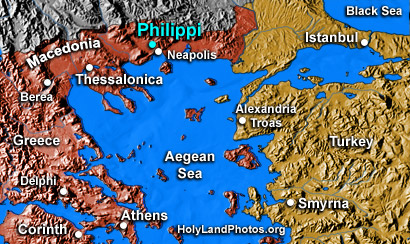
Paul was writing to Christians in Philippi, a city in eastern Macedonia. As Christians, they had received the Holy Spirit due to Paul’s fruitful labors there. Paul wrote to them afterwards as a continuation of those labors. Thus, Paul was taking the time to speak to others, some of whom he would never meet personally (in the flesh) again, to care for the fruits he had brought forth.

Paul stated that when he wrote: “Live your life in a manner worthy of the gospel of Christ, so that, whether I come and see you or am absent and hear about you, I will know that you are standing firm in one spirit, striving side by side with one mind for the faith of the gospel, and are in no way intimidated by your opponents.”  Communicating – one Christian to another or others – is fruitful labor, a labor of love.

“A manner of life worthy of the gospel of Christ” means to live like Jesus lived, leading disciples to God and not being intimidated by any opponents. Being “firm in one spirit” means to not be divided, unable to decide if you should act like Jesus today or act like YOU once more. “Striving side by side with one mind” means your little brain standing behind the Mind of Christ, understanding everything that Mind reveals to you.

In more simple words, Paul told the Philippians (and you), “Remember to live by the Holy Spirit.”

To hear Paul speaking to YOU, it is important to understand just why YOU have such a hard time “letting go” and having faith that the world cannot harm the soul giving life to your flesh. A lifetime of struggles has made all adults wary of the promises of the world. Many have learned that YOU must take what YOU want, because nobody else will give YOU anything. The world is where survival goes to the fittest and only the strong get anywhere of value.

That fleshy YOU has been “intimidated.” YOUR “opponents” are those like YOU, who see religion as a trick that fleeces sheep for profit, while selling belief in the invisible. YOU are distracted by those opponents of Jesus Christ.

YOU do not want to be fooled by life again; but you know you need a warm security blanket to hold onto, just to keep being YOU. So, you go to church and you privately tell people you are Christian; but YOU have a hard time fully grasping what that really means, because it is YOU who keeps Christ a separate entity that you could never match.  He lives outside of YOU.  Jesus Christ was the Son of God and YOU could never make that claim.

I have said it before (many times), but I will say it again. YOU have to marry into wealth, where “wealth” means “eternal life.” YOU do that by marrying God (not Jesus … Roman Catholic nuns do that).

Marriage to God is how one stands “firm in one spirit, striving side by side with one mind for the faith of the gospel.” Forget all the “equality” stuff that buzzes in a human brain, where women have careers and men do housework. That is more of that distraction that is the opponent that must be destroyed.

Marriage to God means: 1.) One has a deep love for God, which is recognized and accepted through a proposal of marriage. 2.) God is the master of the union with the one to whom He is betrothed, who is totally subservient to God. 3.) God is the husband, a word that means the one who brings forth offspring, with the human being the wife (regardless of physical gender), meaning the womb in which God creates. 3.) The consummation of the marriage bears fruit through the Mind of Christ being born, with the human body caring totally for the needs of that “baby Jesus,” as its mother (regardless of physical gender).

The union is the point where the physical and the Spiritual become One.  It is like the 0-point on a graph.  That 0-point is where God resides – in the heart.  The symbol of holy matrimony is the cross.

Vertical is the physical. Horizontal is the Spiritual. They meet at the heart when married to God.

What Paul wrote in this selection supports this conclusion I have made, as it is representative of his stating: “progress and joy in faith, so that I may share abundantly in your boasting in Christ Jesus.” A true Christian has “progressed” in his or her love of God (the husband), leading to the “joy” that the birth of the Christ Mind brings, greatly expanding one’s “faith.” As Paul was also married to God and had been blessed with the birth of the Christ Mind, he “shares” as a brother to this newborn of the same Father. Brothers and Sisters (depending on gender) “Living as Christ.” Together, all reproductions of Jesus Christ represent an “abundance” of duplicates, all who can “boast in Christ Jesus.”

The Greek word that is translated as “boasting” is “kauchēma.” According to Strong’s cognate of this word, it means: “boasting, focusing on the results of exulting/boasting (note the -ma suffix). This boasting (exulting) is always positive when it is in the Lord, and always negative when based on self.”* This usage by Paul, in the context of “progress” and “joy in Christ Jesus” is then better translated as “exulting,” as such receipt of the Holy Spirit is a triumphal success.

The element of suffering that Paul referred to, which is aligned with the struggles the Philippians had witnessed Paul have, and he knew they faced, can now be seen like birth pangs. The symbolic or metaphoric meaning of “birth pangs” is “Difficulty or turmoil associated with a development or transition.”** Paul is then stating the obvious, which is the joy of giving birth to a new YOU – a true Christian – will always come with tests that will bring aches and pains. Like Paul, YOU will survive this transitional stage and be elated with the new development within your being.

God will be in the delivery room holding your hand, “striving side by side with one mind” to guide you through all that this test brings. That is the fruitful labor that is required first, so all the work to come afterwards will be a piece of cake.

* Helps Word Studies, copyright © 1987, 2011 by Helps Ministries, Inc.

** Fair use.

Philippians 2:1-13 – All saints share the same Christ Mind as brothers in the name of Jesus [Seventeenth Sunday after Pentecost]

If then there is any encouragement in Christ, any consolation from love, any sharing in the Spirit, any compassion and sympathy, make my joy complete: be of the same mind, having the same love, being in full accord and of one mind. Do nothing from selfish ambition or conceit, but in humility regard others as better than yourselves. Let each of you look not to your own interests, but to the interests of others. Let the same mind be in you that was in Christ Jesus, who, though he was in the form of God, did not regard equality with God as something to be exploited, but emptied himself, taking the form of a slave, being born in human likeness. And being found in human form, he humbled himself and became obedient to the point of death– even death on a cross. Therefore God also highly exalted him and gave him the name that is above every name, so that at the name of Jesus every knee should bend, in heaven and on earth and under the earth, and every tongue should confess that Jesus Christ is Lord, to the glory of God the Father.

Therefore, my beloved, just as you have always obeyed me, not only in my presence, but much more now in my absence, work out your own salvation with fear and trembling; for it is God who is at work in you, enabling you both to will and to work for his good pleasure.

——————————————————————————————————–

This is the Epistle reading from the Episcopal Lectionary for Year A, Proper 21, the seventeenth Sunday after Pentecost. It will next be read aloud in church on Sunday, October 1, 2017. It is important because Paul tells how true Christians are resurrections of Jesus Christ.

If one goes to the BibleGateway.com website and looks up this selection, you are offered some of those summary headings I have talked about before. For the New International Version, the two segments in the presentation above each have a heading. The first part says, “Imitating Christ’s Humility,” with the second part entitled, “Do Everything Without Grumbling.” For the New American Standard Bible, the whole reading is under the heading, “Be Like Christ.”

That NASB heading sounds an awful like the old (I’m dating myself now) “Be like Mike” commercials for Gatorade. Mike was Michael Jordan. Of course, nobody drank Gatorade and became Michael Jordan. Certainly, lots of players of all ages and all skills drank Gatorade, like Michael Jordan did (at least for the commercials), and many of those played basketball in all types of basketball courts, indoors and outdoors; but none other than Michael Jordan was ever Mike (the person dunking basketballs in the Gatorade commercials).

Do the people at the New American Standard Bible think God wants a lot of pretend Jesuses being as bad at ministry as those who thought drinking Gatorade would make them soar down the lane with a basketball held high before a slam dunk?

If they really do, they should slip a few bucks to the Gatorade advertisers and ask permission to begin a “Be like Christ” campaign. They could sell Nike Jesus sandals and Under Armour Jesus robes, and for the kids some costume Jesus wig-beard head gear. Somebody would get rich; but they would get the exact same result as Gatorade got … still only one Christ, and he (like all superstars promoted on TV) cannot be duplicated … only imitated (as implied by the NIV heading).

When someone reads (or hears read) this excerpt of Paul’s letter to the Philippians and then preaches that it means, “Dear brothers and sisters, it is imperative to live your lives like Jesus did,” one ends up with a world exactly like we have surrounding us today. It is a world that is lost and has little hope of finding itself.  After all, who knows how to live like Jesus?

I’m sure there are many who think, “Today’s times are so different than those back then.  I bet Jesus would be different if alive today.”

Reading that into the message from Paul – who was an Apostle, a Saint, a Christian – is to be a chirstian like the vast majority of Westerners who have called themselves that since Constantine reorganized a Spiritual movement into a business plan for an Empire. Today’s Christians are more creations of the Church of Rome than Apostles, as that Church routinely read Latin verses to people who could barely read, much less understand Latin, while telling their captive audiences, “Just do as we say, not as we do” (mostly).

It begat the mindset that has one pondering, “What would Jesus do?” when confronted with life’s decisions.

Certainly, those who ponder like that – and make the right decisions and live a good life of sacrifice – are headed in the right direction; but that direction, invariably, leads to a plateau, with high mountains that must be climbed still well in the distance. It represents a return to the same state of life that was for Jews in Judea and Galilee, who were plateaued believers in God when Jesus and followers were walking the land. The Jews then were people who were trying to ponder, “What did Moses tell us to do?” but people who were unable to make all the sacrifices and good life choices (consistently) the Law said to do.

And were miserable then, just as many are today.

“Forgive me God. I go to church but nobody ever tells me how to stop sinning.”

There is a statement of faith openly recited in Episcopal churches each week (and other brands of churches), which is labeled “the Nicene Creed.” There is a variation of that, known as “the Apostle’s Creed,” where an “Apostle” should be defined as “a Saint,” with a “Creed” being defined as, “A formal statement of religious belief; a confession of faith.”

It is a statement that is supposed to be read aloud only by Saints, as the true Church is an exclusive body (although it welcomes seekers of truth).  Both Creeds are confessions of faith that all true Christians fully understand. This is especially understood when Saints say, “He [Jesus Christ, God’s only Son, our Lord] will come again to judge the living and the dead.” The Nicene Creed varies that to state, “He will come again in glory to judge the living and the dead, and his kingdom will have no end.”

What a true Apostle realizes – knows – when he or she makes that public confession of faith is what Paul wrote in this selection of his letter to the Christians of Philippi. While the ordinary – do as I say and not as I do – Christian is asked, “What does that mean … will return again?” they smile and say, “Shhhhhh! We don’t talk about Judgement Day or the End Times in church.”

That implies, “That is what those evangelicals do.”  It fosters an “Us vs. Them” mentality.  It represents divided brains and not One Mind in Christ.

Such views totally miss the point of how Jesus Ascended on the 49th day and “came again” the next day (the 50th day – Pentecost). The spread of true Christianity meant an exponential return of Christ, with 3,000 filled with the Holy Spirit because the Mind of Christ opened that many eyes, ears, and hearts that day.  That spread was why Paul had to write letters to those in his wake, telling them to, “Keep up the good works.”

But, that rapid spread of true Christianity was slowed by those who dreamed of empires.

The Day of Pentecost was when eleven disciples (and close family of Jesus who were in the upstairs room) were filled with the Holy Spirit and became multiple New reproductions of Jesus of Nazareth, in possession of the same Christ Mind. At that time, those Apostles were judged by Jesus Christ as being worthy of climbing those distant mountains – the boundaries of mortal death – thus gaining eternal life.  The disciples-turned-to-Apostles began living at that point.

Their bodies became the “kingdom” of God, with the Christ Mind being the right hand of the LORD within them.  They bowed down to Christ Jesus, so each human body’s soul would forevermore serve God.

When Paul wrote, “Be of the same mind, having the same love, being in full accord and of one mind,” he was saying, “You cannot keep your big brain and try to figure out what God and Christ want you to do, when the love in your heart is for self and the brain in your head keeps trying to ask, “What would Jesus do?”

You cannot be like Christ, when you like being you more.

And darn it, we like being us.

When Paul then wrote, “Let the same mind be in you that was in Christ Jesus,” we have to remember that Jesus’s name was not “Christ.” The statements of faith that say, “[Jesus] was conceived by the power of the Holy Spirit and born of the Virgin Mary. He suffered under Pontius Pilate, was crucified, died, and was buried,” all acknowledge that Jesus was a human body, just like all of us are. What made Jesus the promised Messiah was the presence of a Messianic Mind, coming from God, via the Holy Spirit.

The same process came upon the followers of Jesus on Pentecost, when they too became with “the same mind that was in Christ Jesus.”  With tongues like fire they became Christ Peter, Christ James of Zebedee, Christ John of Zebedee, etc., etc. They suddenly became filled with the same mind.

This is why Paul wrote, “Therefore God also highly exalted him and gave him the name that is above every name,” which is “Christ,” or the name-title as the “Messiah.” That title is greater than any title ever held by any human rulers; but it is a title that human beings, like Jesus, can gain.

This means that when Paul wrote, “So that at the name of Jesus every knee should bend,” all true Christians are to bend a knee to Jesus, by sacrificing their own name, being knighted as Christ Jesus reborn.  You must sacrifice your brain to the service of the Christ Mind.  Your brain is not capable of figuring out what Jesus would do.

“Every tongue should confess that Jesus Christ is Lord, to the glory of God the Father,” is stated in the Apostle’s Creed where it says, “We believe in the Holy Spirit, the Lord, the giver of life, who proceeds from the Father and the Son.  With the Father and the Son he is worshiped and glorified.” Still, “every tongue” in every Apostle stops saying, “I think this is what Jesus would have us do,” as those tongues wag to an ego-driven brain.

An Apostle’s tongue speaks as Jesus spoke, and as Peter spoke with the other ten, when they all spoke to the crowds of pilgrims in Jerusalem. They spoke what God told them to say, which is why Jesus repeatedly said, “For I did not speak on my own, but the Father who sent me commanded me to say all that I have spoken.” (John 12:49)

Jesus of Nazareth, born in Bethlehem to a Virgin Mother, as a mortal human being, was never quoted in the Gospels, because his tongue confessed that his being the Christ was due to the LORD, with all glory going to God the Father.  The answer to the question, “What would Jesus say?” is “Jesus would say, ‘You know, LORD.”‘  That is what those with the Christ Mind always say.

This devotion is why Paul encouraged the Christians of Philippi to “work out your own salvation.” You will not save your soul by eavesdropping and overhearing someone say, “You know, I’ve been thinking about what Jesus would want us to do, and that is ….” You cannot be like Christ by repeating what the Apostles Matthew, Mark, Luke and John said Jesus said. You have to do as Jesus did. You have to work for God in order to be saved by the Christ Mind.

This means “to will and to work for his good pleasure” is a statement that only God’s will can guide one’s actions. One does the work of Christ, for his good pleasure, which means one is reborn as Jesus, led only by God, through the Christ Mind. This is why the Acts of Jesus are called Gospels, and the Acts of the Apostles is the first book that follows those four. All of the letters written are also Acts of Apostles, as it is the work of Christ that does “nothing from selfish ambition or conceit, but in humility regard others as better than yourselves. Let each of you look not to your own interests, but to the interests of others.”

Scene from the 1980 movie The Resurrection.

There are no words that can tell one how to be filled with the Holy Spirit and gain the Mind of Christ. If words could make that happen, then just do this: “If you want to be perfect, go, sell what you have and give to the poor, and you will have treasure in heaven; and come, follow Me.” (Matthew 19:21)  Too many read those words and start looking down at the footsteps of Jesus, trying hard to place their foot in the same prints. You do not follow Jesus by walking behind his legacy. You follow Jesus by being another Jesus Christ; and that requires happily working for others.

Next!

Philippians 3:4-14 – Confidence in the flesh offers little towards faith from the Spirit [Eighteenth Sunday after Pentecost]

“If anyone else has reason to be confident in the flesh, I have more: circumcised on the eighth day, a member of the people of Israel, of the tribe of Benjamin, a Hebrew born of Hebrews; as to the law, a Pharisee; as to zeal, a persecutor of the church; as to righteousness under the law, blameless.

Yet whatever gains I had, these I have come to regard as loss because of Christ. More than that, I regard everything as loss because of the surpassing value of knowing Christ Jesus my Lord. For his sake I have suffered the loss of all things, and I regard them as rubbish, in order that I may gain Christ and be found in him, not having a righteousness of my own that comes from the law, but one that comes through faith in Christ, the righteousness from God based on faith. I want to know Christ and the power of his resurrection and the sharing of his sufferings by becoming like him in his death, if somehow I may attain the resurrection from the dead.

Not that I have already obtained this or have already reached the goal; but I press on to make it my own, because Christ Jesus has made me his own. Beloved, I do not consider that I have made it my own; but this one thing I do: forgetting what lies behind and straining forward to what lies ahead, I press on toward the goal for the prize of the heavenly call of God in Christ Jesus.”

——————————————————————————————————–

This is the Epistle selection from the Episcopal Lectionary for Year A, Proper 22, the eighteenth Sunday after Pentecost. It will next be read aloud in church on Sunday, October 8, 2017. It is an important message from Paul, an Apostle and Saint, that says nothing of this world is worth sacrificing one’s soul for.

When Paul wrote, “If anyone else has reason to be confident in the flesh, I have more,” he wrote of the false assurances one thinks one has because of following the orders of Man (those in religious robes). When Paul then went on to make statements about his devotion as a Jew – a member in the “God’s Chosen People Club” – this should be taken (in our modern “Christian” times) as though Paul spoke for you.

Imagine Paul knows you as he knew himself. See him writing as if he knows your claims of the flesh.  A generic statement of your accomplishments might go like this:

“I was placed in a silver bowl full of holy water as an infant, sprinkled by a man (or woman) in a robe, and then placed in a cradle in the church nursery. I earned all gold stars at children’s church (Sunday school). Today I am an adult member of the church with the largest membership in the United States of America. I am a devout follower of the most highly recognized televangelist (or syndicated televised minister or local pastor whose Sunday service is telecast). I also graduated from a school with a revered seminary program (gaining a Bachelor of Arts degree, not a Master of Divinity). I am a regular attendee at my church on Sunday mornings (when not vacationing), with a plaque bearing my parent’s names on the sill of a stained glass window and everyone knows which pew my family sits on. I assist in the setting up chairs in the room where adult Sunday School is held (and sometime putting the chairs back). I am a devoted ten-percent tither, who also donates to multiple national charities. To top that off, I have been certified to assist the priest (or preacher) on the altar, as well as read aloud in church on occasion.”

Paul would say about you, as he said about himself: “As to righteousness under the law, [you are] blameless.”

Still, such resumes do nothing to gain entrance into Heaven, because it is lacking the most important qualification – humility. When Paul wrote about all the boxes he had checked off for righteousness, saying, “Yet whatever gains I had, these I have come to regard as loss because of Christ,” he was blind to what really counted.

If you remember, Paul was named Saul, when he was seen by the people who take notice of such things as being a devoted Pharisee in the service of the Temple of Jerusalem. The “I” was all important to Saul.  Thus he implied, “I was “circumcised of the eighth day.” I was “a member of the people of Israel, of the tribe of Benjamin, a Hebrew born of Hebrews.” I was “a Pharisee.” I was “a persecutor of the church” (Christians). I was “blameless,” because I was somebody important.”

Saul lost his I-sight after encountering the Spirit of Jesus Christ and then became Paul. Can you hear his new Paulian voice saying, “I have come to regard [that] loss because of Christ.”

The presence of the Christ Mind changed him forever, as he lost the I that Saul’s ego was.

“I regard everything as loss because of the surpassing value of knowing Christ Jesus my Lord,” is a statement by a reborn Christ Jesus, named Paul.  That new name comes from the Latin adjective “paulus,” meaning “little or small.” That name symbolizes how such a proud, important, big-ego man lost all that he was, becoming most humble … a little man, as far as his self was concerned.

When Paul went on to write that his change meant he “suffered the loss of all things,” this says big egos are attracted to grand examples of God’s favor surrounding them. So many see worldly success as a sign of God’s approval to the way so many are living.  But, as Jesus told the young rich Pharisee in Matthew 19:21, “Go, sell your possessions and give to the poor … and then come, follow me,” big egos walk away sad, with heads hung down.

Their brains think, “Give up all things? I can’t do that.”

When Paul then wrote that righteousness “comes through faith in Christ, the righteousness from God based on faith,” one has to realize that “faith” can never be rewarded with “things.” True “faith” is belief in intangibles. When “things” come to those who check all the boxes that look good on a resume, their reward of “things” negates a heavenly reward.

When the brain is blind to spiritual rewards, it works just as hard as one of true “faith” does, but all the work done goes to reward self, in just one temporal life. Those works are “confidence in the flesh,” rather than confidence in God.

Righteousness is the intangible reward for true faith, because the presence of the Christ Mind supports the soul, as faith motivating the flesh.  The brain stops plotting what the flesh can do to bring even greater reward in “things.”  The Christ Mind uses that flesh to find more souls who need to see the light … they are motivated to fish for men’s souls.

For Paul to write, “I want to know Christ and the power of his resurrection and the sharing of his sufferings by becoming like him in his death, if somehow I may attain the resurrection from the dead,” this is THE desire for righteousness. Paul’s desire should be mirrored by all Christians.

All Christians want to know Christ, where knowledge is the Christ Mind within (not written in some book or on the pages of some sermon). The “power of his resurrection” is when one changes and is born anew as Christ Jesus. To feel one’s self “sharing his suffering,” one is walking in the footsteps of Jesus AS Jesus reborn, attracting souls and opposition. Thus, one has become “like him in his death,” by sacrificing one’s own self, like changing from Saul to Paul.

That says it is a requirement for everyone – Changing from (your name here) to another who is filled with the Holy Spirit of God, gaining a righteous name (“in the name of Christ Jesus”). The desire has to be there first, for you and all who want to gain the right to Heaven, in order “to attain the resurrection from the dead.”

If you look around you, you will find many souls born of death, simply by being in mortal bodies. They are born to die, over and over again, as eternal souls continually trapped in new bodies of flesh, which can only surround them until death returns. To “attain the resurrection from the dead,” your soul has to be released from this material world cycle.

Only righteousness brings that freedom.

By Paul writing, “Not that I have already obtained this [resurrection from the dead] or have already reached the goal [Heaven]; but I press on to make it my own,” he knew that Apostles are the ones who Satan most tries to lure back into the dead. Satan tempted Jesus in the Wilderness with wealth, fame, and worldly glory; but Jesus told Satan where to go.

The life of a Saint means one of tests and more tests, so one has to press on. The Holy Spirit makes that work be seen as happiness, amid denials of pleasure and the acceptance of suffering.

You cannot make it through the righteousness obstacle course alone. You need Christ Jesus making you his own, just as he made Paul his. That is why the I has to die.  Your ego’s death means God in your heart and Christ leading your thoughts.  Your body becomes another Trinity.  So, although you look alone, you are with good company.

That is why a promising resume cannot be written in the present, as everything in the past has to be forgotten. Straining forward is not the stuff that wins smiles from V.I.P.’s looking for new managers and partners, as suffering means the loss of all one’s old material world references.

The only writing that matters will be a headstone in a pauper’s field that says, “Here lies a fool who gave up everything for others.”

The Fool card symbolizes innocence with faith. Eyes to heaven about to take a leap of faith. He is not concerned about what happens next, as all he knows is, “I can no longer stay here.”

That is the kind of resume God likes. It is the kind that attains “the goal for the prize of the heavenly call of God in Christ Jesus.” And, if you are really good at gaining righteousness, people whose lives crossed your righteous path will write honorable words about the you who you became, when you changed, after you’ve gone to heaven.

Philippians 4:1-9 – Some saints might be hot and others cold, depending on the Spirit [Nineteenth Sunday after Pentecost]

My brothers and sisters, whom I love and long for, my joy and crown, stand firm in the Lord in this way, my beloved.

I urge Euodia and I urge Syntyche to be of the same mind in the Lord. Yes, and I ask you also, my loyal companion, help these women, for they have struggled beside me in the work of the gospel, together with Clement and the rest of my co-workers, whose names are in the book of life.

Rejoice in the Lord always; again I will say, Rejoice. Let your gentleness be known to everyone. The Lord is near. Do not worry about anything, but in everything by prayer and supplication with thanksgiving let your requests be made known to God. And the peace of God, which surpasses all understanding, will guard your hearts and your minds in Christ Jesus.

Finally, beloved, whatever is true, whatever is honorable, whatever is just, whatever is pure, whatever is pleasing, whatever is commendable, if there is any excellence and if there is anything worthy of praise, think about these things. Keep on doing the things that you have learned and received and heard and seen in me, and the God of peace will be with you.

——————————————————————————————————–

This is the Epistle selection from the Episcopal Lectionary for Year A, Proper 23, the nineteenth Sunday after Pentecost. It will next be read aloud in church on Sunday, October 15, 2017. It is important because Paul made a call for Apostles to be steadfast in their support of one another, making it a point to mention the role women played in assisting in the spread of the early church.

Chapter 4 of Paul’s letter to the Christians of Philippi is the end of that epistle of encouragement. By beginning his closing statements with, “My brothers and sisters, whom I love and long for, my joy and crown, stand firm in the Lord in this way, my beloved,” he was stating their closeness in Spiritual relationship. They were all, sender and receivers, “firm in the Lord” as true Christians, filled with a deep love of God, gifted the Christ Mind, via the Holy Spirit of God. This statement of closing says the love of God produces a love within, which is so strong it generates a desire for others to seek their own inner strength of love. They are brothers and sisters as born from the same love that comes from the Father.

When Paul named three people of the church in Philippi, to whom the whole of the epistle was written, those three (a number that is symbolic of initial completion, as representative of the Trinity) were in need of special attention. To recommend that the two women “be of the same mind in the Lord,” says they were still struggling to let go of their egos fully. That could have then been a statement of those two having opposite agendas for the Lord, thus making it difficult for one to fully support the other. Clement then became the one man that both women loved and respected, so he could mediate the differences between the two women. Therefore, Paul was asking all to leave their egos behind and follow the one mind of Christ, as that represents a strengthening of their faith.

On a symbolic level, the names of those mentioned have meanings. A name (then) was given as a parent’s blessing to a child, as a prayer to the Lord. A name then reflects a parent’s wish upon the life of the child, which the child then knows to live up to. Euodia means “Good Road” or “(Have a) Good Trip.” It can be used to denote “Success!” or “Good Luck!” Syntyche means “Great Fortune” (Good or Bad Fortune), but can also mean “Accident” or “Happy Event.” Clement means “Calm or Peaceful or Tranquil.”

Given these name meaning, for Paul to write: “They have struggled beside me in the work of the gospel, together with Clement and the rest of my co-workers,” the intent is less to say those people were actually with Paul in his travels; but the purpose was to show how they were remembered by the meanings of their names, as Paul struggled in his evangelism. Paul needed to find the “good road” to travel, so he had “a nice trip” spreading the Gospel. He was having the “good fortune” of encountering people of all walks in life (some good and some bad), with each meeting yielding the “happy event” of another soul led to Christ. Those people met Paul seemingly by “accident.” Still, through his travels, Paul longed for those friends in Christ that he had to leave behind. Therefore, he struggled with that heartfelt pain, by remaining “calm” and at “peace” in the Lord.  Paul reached out to the other disciples of Christ, with true love and affection … that of brotherhood.

The remainder of this letter touched on the traits characterized by the presence of the Holy Spirit. Those become the measuring sticks that show one’s growth in spiritual love. Those traits are: 1.) “Rejoice in the Lord,” as your heart leads your brain; 2.) “Gentleness,” which means one is considerate of others; 3.) “Do not worry,” because fears only come in the absence of God’s love; 4.) “Prayer and thanksgiving,” which is staying in touch with the Lord’s presence within; 5.) “The peace of the Lord,” which is letting the Christ Mind lead your actions; and 6.) Be a model of Christ Jesus, which means all truth, honor, justice, pleasure, and commendation that comes to you is due to his presence within.

n this closing chapter of Paul’s letter to the Philippians, the message that should be taken today is Love. Paul is doing (naturally) what Jesus said to do: “A new command I give you: Love one another. As I have loved you, so you must love one another.” (John 13:34) Jesus said that to his disciples at the Passover Seder meal (the Last Supper), and should not be read as a general “love everyone” message. This is known by the subsequent verse, which says, “By this everyone will know that you are my disciples, if you love one another.” Therefore, Paul was doing as Jesus would have him do, from his heart and soul.

Paul loved his brothers and sisters, and everyone knows that Paul was a disciple of Jesus Christ because of the love he showed in his travels and follow-up letters. It is a commandment given by God, through His Son, and is therefore not an option.  To be Christian is to support all Christians with love and acceptance.

What Christians do not read in the books of the Holy Bible are the letters written back to Paul. Paul might have received letters from Euodia, Syntyche, and Clement while traveling, which he responded to in this letter’s closing statements. The same answer spoke to all three.

The point is a true Christian does not shun other Christians. Love is not a silent emotion. Love throws its arms around its brothers and sisters in Christ; and when physical touch is impossible, love throws its arms around its brothers and sisters in Christ through communications and prayers.

It is not the confessions of the disciples that proves they have obeyed this final commandment of Jesus Christ. Jesus gave that command as he was telling the eleven that one would betray him. Judas Iscariot stood as a symbol of Christians without true faith.  As such, many will confess they believe in Christ, but not all will join together in unity and steadfastness, as some will sneak out in betrayal.

The measure of success is then the love one expresses to other Christians – the Acts of the Apostles.  And that love is known by God , as He knows the heart quite well.

Love comes from the heart, where the throne of God rests. Are you of one mind, which means God sits upon that throne in you – making you his kingdom? Or, do you keep God from ruling over you, because there are so many other Christians who promote agendas in opposition to yours?

Philippians 2:5-11 – Paul’s song of self-sacrifice

Let the same mind be in you that was in Christ Jesus,

who, though he was in the form of God,

did not regard equality with God

as something to be exploited,

but emptied himself,

taking the form of a slave,

being born in human likeness.

And being found in human form,

he humbled himself

and became obedient to the point of death–

even death on a cross.

Therefore God also highly exalted him

and gave him the name

that is above every name,

so that at the name of Jesus

every knee should bend,

in heaven and on earth and under the earth,

and every tongue should confess

that Jesus Christ is Lord,

to the glory of God the Father.

——————–

This is the Epistle selection for reading aloud on Palm Sunday, Year B, according to the lectionary of the Episcopal Church. With an outdoor service held first, when palm leaves are passed out to all in attendance and readings spoken, called the Liturgy of the Palm, the congregation is then solemnly led inside, where the regular service is called Liturgy of the Word. This particular selection from Philippians will be read in all three years of the lectionary cycle (A,B, and C), but due to the length of the Palm Sunday service [aka Passion Sunday] nothing will be said about these words at those times. However, these verses will also be read on two other occasions in the church calendar [neither during a set Sunday service], with it being possible little will ever be said about these verses and less heard.

It becomes important to point out that the letter to the Christians of Philippi is only four chapters in length. In that whole, it is only here in these verses found in chapter 2 that the text changes from prose to song. Just as David wrote psalms and many of the prophets would write lyrics of psalms, all inspired by Yahweh, it is worthwhile to see God’s voice singing from the pen of Paul. This makes this selection a good match for the song presented in Isaiah 50, as well as Psalm 31.

These seven verses begin by singing, “Let the same mind be in you that was in Christ Jesus.” The NRSV and the NIV list a heading for these verses [plus the prior four] that says, “Imitating Christ’s Humility.” The NASB has a heading that says, “Be like Christ.” The BibleHub Interlinear heads these specific verses as “The Attitude of Christ,” which they list similar verbiage can be found in Isaiah 52:13-15. All of this “imitating,” being “like” and an “attitude of” says one person – one soul – one spirit – known as “Jesus Christ” – is worthy of mimicry. That is a false message to receive.

All of these ‘titles’ are missing the truth of what Paul was, himself, as a writer of divine Scripture. He was reborn “in the name of Christ Jesus,” such that Paul was a soul married to Yahweh who had become the resurrection of Jesus, because Paul had received the Christ Mind. Paul was not imitation. Paul was not being like Christ; and, Paul had not developed an “attitude” of mimicry. Paul sang as Saul, who had been transformed from a selfish Christian hater into a Son of man, doing exactly as Yahweh guided him to do. Paul then exemplified a continuation of what Jesus had done, as another Jesus reborn.

In this regard, I find it worthwhile to know what the first four verses of this chapter in Paul’s letter to the Christians of Philippi say, keeping in mind that Paul wrote letters of support to others he had come in contact with, those who had been transformed just as he had been. Paul was not promoting Christians pretend being like Jesus, while secretly sinning as they always had done before. Paul wrote his letters so those who had been reborn as Christ, in the name of Jesus, encouraging them to stay in that state of being, never to fall prey to the world’s attacks. Thus, here are the first four verses that lead to this song:

“Therefore if there is any encouragement in Christ, if any consolation of love, if any fellowship of the Spirit, if any affection and compassion, make my joy complete by being of the same mind, maintaining the same love, united in spirit, intent on one purpose. Do nothing from selfishness or empty conceit, but with humility consider one another as more important than yourselves; do not merely look out for your own personal interests, but also for the interests of others.”

In that, Paul began by listing the conditions for being “in Christ” [“en Christō”], where the preposition “en” means one’s soul has entered into Yahweh’s Holy Spirit, so one is “with” the presence of God Almighty. That state of being is called “Christ,” which means being an “Anointed one.” When Paul wrote the word “Christ” alone, that was not him naming the human flesh known as “Jesus.” Paul was writing to true Christians, telling them the conditions (the “if”) for that most divine presence “within,” was realized by becoming God’s “Christ.”

That is then repeated in verse 5, by Paul writing, “Let the same mind be in you that was in Christ Jesus” [“en Christō Iēsou”]. By adding “Jesus” [“Iēsou”], after “Christ,” that separate word then identifies all who have been reborn as a “Son of man” [regardless of human gender]. Just as Saul changed his name to Paul [a name that means “Small”], all who become “Anointed ones” bring on the name “Jesus.”

The conditions for being “in Christ” are: love, fellowship of the Spirit, affection and compassion … intent on one purpose. The “fellowship of the Spirit,” where “Spirit” [“Pneumatos”] is capitalized, thus bearing the importance of the “Holy Spirit,” says the “if” is all souls in Philippi have married Yahweh, thereby made “in Christ.” As a collection of true Christians, they would all share a fellowship is translated from “koinōnia,” meaning “sharing in that commonly held.” That held in common was the Holy “Spirit.” The “affection and compassion” is then towards one another, so all stay together “intent on one purpose.” That purpose is to bring other seekers to also be “in Christ.”

The state of being that is “in Christ” is then said to be “selfless,” meaning a soul surrendered in submission to God’s Will [marriage to Yahweh]. By not making this sacrifice, one remains a flawed human being, one which is filled with “empty conceit [“kenodoxian” – “vanity or empty pride”], not filled with God’s Holy Spirit. The unity of Christians [“fellowship”] means never attempting to rise above the others, which was the flaw of the Pharisees, Sadducees, and Temple elite, all of whom had no humility and saw other Jews as beings of lesser material value. They cared nothing for others, meaning the sole intent of Christianity was as a unified presence of God, as His Sons of man [all reproductions of Jesus, not pretenders] for the purpose of saving souls and bringing those souls to join with them, as all “in Christ.”

If one does not know this is why Paul wrote so many letters, then one will not be able to understand much of what Paul wrote. Being “in Christ” becomes like his verse 5 says, “Let the same mind be in you.” That “mind” [“phroneite”] means one must not try to think like Jesus thought, from imaginations of what Jesus must have thought, because thinking is a function of a human brain, which all humans have.

The word translated as “the same mind” means, “to have understanding” and to “judge” (Strong’s), from an “inner perspective (insight) that shows itself in corresponding, outward behavior.” (HELPS Word-studies) This is the Christ Mind and being in possession of that [only possible as a gift of Yahweh to a wife – a soul merged with His Holy Spirit] means one will become “in the name of Jesus,” just as Jesus lived for Yahweh through the Christ [“Anointed”] “mind.”

It is also worthwhile to note the footnote that appears in the NRSV translation online [BibleGateway]. Next to the translation “was” [“that was in Christ”] is a footnote that states, “that you have in Christ.” This, in reality, is focusing on the translation of the Greek word “kai.”

The Greek of verse 5 states, “Touto phroneite en hymin ho kai en ChristōIēsou.” The use of “kai,” as I have pointed out many times before [in other writings] is as a marker word that shows importance to follow. Rather than be translated as a simple conjunction, kai acts to separate a segment of words for emphasis. As such, the literal translation here says, “This [that stated in verses 1-4, the conditions “if”] let mind be in you this kai in Christ Jesus.” Therefore, Paul said let the same mind that makes one Christ Jesus be in you, making you [importantly marked] be “in Christ Jesus” also.

When Paul then sang the words of verse 6, “who, though he was in the form of God, did not regard equality with God,” this then becomes a statement that oneself, also “in Christ” as “Jesus” reborn,” not think being Anointed makes one a god on earth. Paul [who never knew Jesus personally] said Jesus not once claimed to be God incarnate. That is a powerful verse to understand.

It is a common misconception for Christian churches today, all denominations, to believe that Jesus was God incarnate. Seeing Jesus as a deity makes Jesus unobtainable by mere human beings. Thinking Jesus of Nazareth bore the name “Jesus Christ,” such that the name “Christ” can only refer to the god Jesus, makes Jesus as lofty as was Julius Caesar, a so-called divine ruler in the flesh. However, Jesus never claimed to be God, as he always said he was a “Son of man.” That recognition is what Paul is pointing out here; so, one reborn as Jesus does not equate to being God incarnate, but only another Son of man, led by the Father.

To expand on that, Paul then sang in verse 7: “but emptied himself, taking the form of a slave, being born in human likeness.” The exception [“alla” = “but, however”] is then “himself emptied” [as written “heauton ekenōsen”]. When “self” is understood to mean one’s “soul” [lower-p pneuma], then an “emptied soul” means the sacrifice of the soul unto Yahweh. A “self” is then the breath of life that animates human flesh. The aspect of “emptied” means Jesus “deprived himself” or “rendered void himself,” which does not mean Jesus killed his life in the flesh. It means his soul submitted, willingly and lovingly, to Yahweh, as His wife, making his flesh no longer serve the will of the soul [which can become inverted to the flesh controlling the soul – Big Brain Syndrome].

The flesh of Jesus, void of self-ego and self-will, was alive still, but under the control of Yahweh. It was through this self-sacrifice that Yahweh was able to be “born into a human,” making that human become the likeness of God [not God in flesh]. This condition of Jesus is then the condition Yahweh sets for all who will “follow Jesus,” in his name. None will ever be gods on earth; all will serve God totally: with all their hearts, all their souls, and all their minds.

It was this self-sacrifice and servitude that then led Paul to sing in verse 8, “And being found in human form, he humbled himself and became obedient to the point of death — even death on a cross.”

This begins with the word “kai,” so it is important that one understands how Yahweh was “found in human form.” It was then that presence within the flesh of Jesus [his soul merged with the Holy Spirit] that forced Jesus to humble himself, meaning Jesus the man was nothing, because Yahweh was everything about his being. That sacrifice of self-will says that Jesus’ submission to the Will of Yahweh led him to be so obedient that he completely died of self – “death” [“thanatou”]. Still, that spiritual death of self-ego would lead to his physical death upon a Roman cross.

In that last statement, about the “cross,” the Greek needs further examination to grasp the full meaning that is intended to come from those words. Paul wrote, “thanatou de staurou,” which can literally translate as “death now a raised stake.” The repeating of the word “death,” with a comma mark in between [“thanatou , thanatou”] means the spiritual death of self [self-will, self-ego, self-importance] was then being explained as not being physical “death,” because the meaning of “death” then took on the meaning of [from “de” meaning, “moreover, indeed now . . . , on top of this . . . , next . .] becoming spiritually “a raised stake” [the common meaning of “staurou”].

A raised stake is what vineyard owners place in the ground for their grapevines, as a strong upright pole that will support vine grown and heavy clusters of grapes hanging from them. The growers make the stakes they post be strong, so the vine will not fall to the ground and produce bad fruit. Jesus’ sacrifice [spiritual death as a Son of man] made him become spiritually a raised stake in the ground [a Son of man]. As such, the good fruit of the vine can come from his ‘blood’ and kept in a state of worthiness, until ripe to be picked.

In verse 9, Paul then sang these words: “Therefore God also highly exalted him and gave him the name that is above every name”. This begins with the capitalized word “Dio,” meaning “wherefore, on which account, therefore” (Strong’s Usage), so the importance is as a connection of this “death now a raised stake.” That state of being is then pointed towards this verse, with “Dio” followed by a comma mark of separation and the word “kai,” denoting that death now a raised stake is importantly “this God him highly exalted.”

The importance that must be gained is “death now a raised stake” means “Yahweh” having been raised, where the spiritual elevation of a soul is due to the presence of God (“Theos”). It is that elevated state of being, brought about by the death of self, that a body of flesh becomes “highly exalted” (“hyperypsōsen”). This means Jesus was a Son of man, because of self-sacrifice unto God.

The second half of this verse is begun with the word “kai,” which says it is important to realize that “Jesus” was “given” to this model of self-sacrifice. Because God had Gabriel tell Mary his Son’s name was to be Jesus, that says it is a God-given name. The meaning of the name “Jesus” says, “Yah[weh] Will Save” or “Yah[weh] Saves.” That becomes “the name that is above every name,” such that whether one’s parents gave one a name like “Tom,” “Dick,” or “Harriett,” those names apply to a soul alone in the flesh, one that has yet to be Saved By Yahweh. As such, once one has become just like was Jesus, so one’s soul has married Yahweh and one has become His Anointed, then one will also assume the name that is above all other names – “Yahweh Saves.”

With this truth stated, Paul then sang in verse 10: “so that at the name of Jesus every knee should bend, in heaven and on earth and under the earth”. Here, another common mistake is made by churches, who then teach their congregations to worship Jesus Christ, as if “Christ” was the last name of “Jesus.” Preachers teach members of their churches to expect Jesus to come and save them in the “Rapture.” They worship Jesus as a god, which is not what his name states.

The name “Jesus” states that “Yahweh Will Save,” which means the man named Jesus was Saved By Yahweh, not some demigod. Jesus certainly did not save himself, as he was not an equal to God. Therefore, every knee shall bend in worship to Yahweh [not Jesus].

When Paul wrote, “in heaven and on earth and under the earth,” this is the realm of the Universe, which is the Creation of Yahweh. Jesus was not the one who created the Universe. Jesus was the model for all whose knees shall bend to Yahweh – the Creator. Jesus was, from day one, totally committed to serving Yahweh, as his soul was married to God’s Holy Spirit at birth in the flesh.

Finally, in this song of Paul to the Christians in Philippi, his verse 11 sings, “and every tongue should confess that Jesus Christ is Lord, to the glory of God the Father.” This too begins with the word “kai,” indicating importance in realizing that “every tongue should confess that,” where “that” refers to the previous statement: “every knee should bend” to God the Creator.

In the use of the Greek word “ glossa,” which translates a “tongue,” this becomes a multi-leveled intention, which goes beyond the physical, meaning more than advice to believers that they should profess faith in God. The word expands to mean “language,” such that everyone on earth “should confess” to Yahweh – those of all tongues. That speaks of the spread of Christianity around the globe. Still, on a most divine level, “tongue” means everyone should sacrifice his or her self-will, so each holy wife’s “tongue” will then speak the Word of God.

At this point, it is important to notice the multiple uses of the conditional, which has been translated as what one “should” do. Verses 10 and 11 each tell what one “should” do: “should bow” [“kampsē”] and “should confess” [“exomologēsētai”]. This condition relates back to the beginning, when Paul set up the “ifs” of being “in Christ.” All of this means it is based on the condition of self-surrender to the Will of God.

Yahweh is not going to come demanding someone become His wife. Jesus is not going to fly down from heaven on a white horse, lopping the heads off of people who do not bow down and take his name. Everything becomes the responsibility of the seeker. When one is not seeking salvation from Yahweh, one will not bend a knee to God, nor will one confess surrender of one’s soul to Yahweh.

When verse 11 ends with the presentation as shown above: “Jesus Christ is Lord, to the glory of God the Father,” the reality of what appears in the written text is absolutely missed. The Greek, according to the BibleHub Interlinear presentation, shows all-capital letters spelling out “LORD JESUS CHRIST” [“KYRIOS IĒSOUS CHRISTOS”], followed by a comma mark and the words “eis doxan Theou Patros.” Clearly, for all who have ever been in some Internet chat room, all-caps should be read as yelling or speaking loudly. Capitalization in Scripture means importance. Therefore, all-caps must be understood as most definitely read this as having divine meaning.

Those last words say, “to glory God Father.” In that word “doxan” [“glory”] is intended to read as “the unspoken manifestation of God.” (HELPS Word-studies) By reading that into that word, the repetition of “god” (via implication of meaning) makes “God” (written) be then stated to be the “Father.” By the capitalization of “Patros,” this conclusion to verse 11 says [MOST IMPORTANTLY], all confession of truth can only come when one’s soul has allowed Yahweh to be one’s “LORD.” Upon that transformation does one become reborn as “JESUS.” This is then the model offspring that is allowed one, having become the “ANOINTED ONE.”

It is then from that conditional transformation that one has become “the unspoken manifestation of God,” the Son of man, and the child of Yahweh. From that lineage, one assumes a name that is above whatever one the flesh is known by [for Paul it was Saul]. In that transition to being “in the name of Jesus Christ,” one becomes related by spiritual “blood” to Jesus, another “Son” of the “Father” [regardless of human gender].

This reading from Paul will never be interpreted in a church for seekers to realize. No priest or pastor will stand before a flock of paying customers and tell them about a condition that makes it up to them to choose: sit in a pew and be judged for doing nothing about becoming Jesus reborn [wasting spirit]; or, get up and go some place where Scripture can unfold as deeply meaningful. The former means reject Yahweh, with the later meaning says one is willing to do the necessary work … alone … in order to find a deep spiritual uplifting that will convince one’s soul that one self-sacrifice is the only way to salvation.

I am writing this interpretation as one who has left the pew. I write as one led by the Holy Spirit to assist any readers seeking the truth. I put it out as the tongue of Yahweh having been placed in the world for your benefit.

This reading will be read aloud in Episcopal Churches along with so much else that the vast majority of Episcopalians – priests and lay people alike – will not have any time to ponder the meaning of any of the words heard read aloud. They only have a pittance of time set aside for such things as going to church and pretending to be Christians. Bible study has become something only the elderly attend, if at all. That becomes a reflection of truth, being a statement of selfishness, which Paul warned about in a verse not read aloud today.

Paul wrote in his third verse, “Do nothing from selfish ambition or conceit, but in humility regard others as better than yourselves.” The “selfish ambition” of today’s false Christians have is the pretense of being saved by Jesus. This “conceit” is thinking the quickie way to religion is the best way, making them ridicule other religions that put more time into explaining the meaning of the Word [even if they do so wrongly], because they believe the less said the better [fewer mistakes].

It is this lack of teaching that leads a spiritual movement, begun by Jesus and expanded by Saints reborn in the name of Jesus Christ, to become degraded to the point of being a perfect reflection of what not to be – the system of the Temples of Jerusalem. What Paul wrote is so poorly misunderstood that it appears the only message that got through is “Do nothing.”

Philippians 1:3-11 – Capitalized importance

I thank my God every time I remember you, constantly praying with joy in every one of my prayers for all of you, because of your sharing in the gospel from the first day until now. I am confident of this, that the one who began a good work among you will bring it to completion by the day of Jesus Christ [of Jesus]. [Just as] It it is right for me to think this way about all of you, because you hold me in your heart, for all of you share in God’s grace with me, both in my imprisonment and in the defense and confirmation of the gospel. For God is my witness, how I long for all of you with the compassion of Christ [of] Jesus. And this is my prayer, that your love may overflow more and more with knowledge and full insight to help you to determine what is best, so that in the day of Christ you may be pure and blameless, having produced the harvest of righteousness that comes through [of] Jesus [of] Christ for the glory and praise of God.

——————–

This is the Epistle selection to be read aloud on the second Sunday of Advent, Year C, according to the lectionary for the Episcopal Church. This reading will follow two of three other possible readings: Baruch 5 or Malachi 3; and, Canticle 16. Those readings will include these quotes: “see your children gathered from west and east at the word of the Holy One, rejoicing that God has remembered them;” “he is like a refiner’s fire and like fullers’ soap; he will sit as a refiner and purifier of silver, and he will purify the descendants of Levi and refine them like gold and silver, until they present offerings to Yahweh in righteousness;” and “In the tender compassion of our God the dawn from on high shall break upon us, To shine on those who dwell in darkness and the shadow of death.” All will accompany the Gospel selection from Luke, where it is written: “The word of God came to John son of Zechariah in the wilderness. He went into all the region around the Jordan, proclaiming a baptism of repentance for the forgiveness of sins.”

At first glance, these nine verses of Paul’s letter to the Christians of Philippi is little more than the initial greeting of someone who passed through town some time back, wanting to have everyone know how much Paul missed being around them. It is far from that; but the art of translating Greek to English makes it harder to discern the truth contained in the Greek, because the letter was written in the divine language of Yahweh, using Greek as His tool. In these nine verses are five period marks, which make it appear to be five long-winded sentences. In reality it is twenty series of word segments, each of which becomes its own ‘sentence,’ according to the Word of Yahweh. Those segments are broken apart by commas, periods, verse transition, and a semi-colon, with one ‘sentence’ being one capitalized word … a word the NRSV ignored completely in translation.

In the above NRSV translation, it should be noted where some words were not translated [the genitive forms of names, which mean “of” must be added]. I have placed the omitted words in brackets. The omitted word has verse seven begin erroneously with “It is right,” when the capitalization of “it” is wrong. I have amended that to show the truth of that written. Also, in verse six, the NRSV has changed the order of “of Christ of Jesus” to show “of Jesus Christ.” That is wrong, so I have stricken out the misplaced “Jesus” and replaced it in the proper position, in brackets.

As I did recently for another seemingly benign Epistle reading of Paul’s, one where I had done an in-depth dissection of the reading three years prior, I added a new slant on the reading, where I only addressed the capitalized words written in those verses. That showed the divinity of what Paul wrote, as it is obvious that Yahweh led Paul with foresight, so what Paul wrote made deep sense, while what Paul wrote in capitalized words equally made profound sense. It would be too time consuming for Paul to write letters and try to accomplish that feat alone. The message sent in capitalized words is Yahweh speaking doubly through one of His prophets. The bold type above denotes the capitalized words in this text, which I will next present as the interpretation of this reading.

In addition to this to follow, one of the capitalized words is “Kai,” which is a marker word. The NRSV translation above denotes this word simply as a capitalized “And,” which begins a new ‘sentence’ [it follows a period mark]. It is my strong opinion that the word “kai,” in all its presentations, does not need translation at all. It should simply be seen as a place where Yahweh had His prophet signal “importance to follow this word “kai.”’ This means a capitalized “Kai” denotes great importance to follow. Because these nine verses present the word “kai” seven times, including the one capitalized version, I will then add interpretation of the five segments of words that are either begun or include the word “kai.”

There are thirteen capitalized words in the nine verses of this this reading. Ten of those words are forms of “God [Theos], Christ [Christos], and Jesus [Iésous]. The other three capitalized words include “Kai” and two other words that begin ‘sentences,’ each following a period mark. While this can seem to be the simplicity of syntax, where the first word of a sentence is always capitalized, verse seven ends with a period mark, but verse eight begins with the lower-case word “martys” [“μάρτυς”], which shows that normal syntax is not the same as divine syntax – the language of Yahweh.

Each capitalized word is listed by the verse it appears written in, with the verse numbers in bold type. Please note that there are no capitalized words found in verses 4 and 5. Also note the groupings of three: Three singular words set apart from three words stated multiple times. Of those three stated multiple times, “Christou [Χριστοῦ]” is found four times and “Iēsou [Ἰησοῦ]” three times, all presented with exactly the same spelling. The word for “God,” however, is stated three ways, as “Theō [Θεῷ],” “Theos [Θεός],” and “Theou [Θεοῦ],” each differently.

One can see this presence of the number three being repeated in words as mere coincidence; or, one can see this as another sign of divine inspiration being present. The symbolism of three, as far as Christianity is concerned, is the Trinity. The Trinity, simply stated, means the union of Father, Son, and Holy Spirit. This can now be seen as “God [Theos],” “Jesus [Iésous],” and “Christ [Christos].” That becomes significant, as most Christians today refer to “Jesus Christ” as if that were his first and last names. People commonly refer to “Christ,” when their minds are picturing Jesus. When they call Jesus “Christ,” that gives the impression that Jesus is the only “Christ,” when the word is Greek [christos] for “anointed one.” When capitalized, it takes on a divine level of mean, where the “Anointment” comes from Yahweh. Yahweh can “Anoint” as many as He pleases, with David being a prime example of one who was “Anointed” [a “Christ”].

Here is the list of thirteen capitalized words:

3. Eucharistō [Εὐχαριστῶ] – I Thank

Theō [Θεῷ] – God

6. Christou [Χριστοῦ] – of Christ, of Anointed

Iēsou [Ἰησοῦ] – of Jesus

7. Kathōs [Καθώς] – Just as, Seeing as, According as

8. Theos [Θεός] – God

Christou [Χριστοῦ] – of Christ, of Anointed

Iēsou [Ἰησοῦ] – of Jesus

9. Kai [Καὶ] – [Importantly]

10. Christou [Χριστοῦ] – of Christ, of Anointed

11. Iēsou [Ἰησοῦ]– of Jesus

Christou [Χριστοῦ] – of Christ, of Anointed

Theou [Θεοῦ] – of God

As I did previously, these words can be set in an order as a series of statement, such as: “I Thank God of Anointed of Jesus Just as God of Anointed of Jesus Kai of Anointed of Jesus of Anointed of God.” These can then be ‘punctuated’ by the numbering of the verses they appear in, such as: “I Thank God – – – – of Anointed of Jesus – – Just as – – God of Anointed of Jesus – – Kai – – of Anointed – – of Jesus of Anointed of God.”

By removing the influence to think of “Christ” as another name for Jesus, listing all translations for “Christou” as “of Anointed,” one is free to see how oneself can then become that soul “Anointed.” When oneself is seen as Yahweh speaking through him or her (as would the true Christians of Philippi), the first person singular “I” of “Eucharistō” has oneself saying, “I Thank God.” When the word “Eucharistō” is realized to come from “eucharistos” (“thankful, grateful”), from which the term “Eucharist” comes, these thirteen capitalized words becomes the truth of Holy Communion stated. That means by saying these words one has eaten the bread [Scripture] and drank from the cup [Received the Spirit in divine marriage]. Then, a soul can truly say, “I Thank God … as being one of His Anointed from my soul receiving the resurrection of Jesus with it … According to … the same God who makes all disciples be also of Anointed of Jesus … this Most Importantly … makes me of those Anointed in kind … all alike are the truth of the Trinity – of Jesus of Anointed of God.”

Again, it is easy to decline to accept this as being the overview of the intent from Paul in these nine verses. This certainly is not taught in churches or seminaries. Therefore, it can be taken or left alone. I offer it as my observation to the reader here.

As for the seven placements of “kai” in this reading selection, those segments containing that marker of importance can then be pieced together as a capsule of the important elements to be taken from this reading. Listed below are the seven, coming from four verses. Each verse is divided into sections, based on the presence of punctuation marks within a verse, with the first section listed as “a” and all subsequent sections having the next letter applied to the verse number. This is the Greek text parsed as such:

7e kai en tē apologia kai bebaiōsei tou euangeliou ,

9a Kai touto proseuchomai ,

9c eti mallon kai mallon perisseuē en epignōsei kai pasē aisthēsei ,

10b hina ēte epignōsei kai aproskopoi eis hēmeran Christou ,

11b eis doxan kai epainon Theou .

This then translates to say:

7e importantly in this thought-out response importantly validated of anyone good news ,

9a Most importantly here I pray ,

9c remain more importantly more to overflow in discernment importantly every kind of

understanding ,

10b in order that you might exist pure importantly not causing to stumble towards time of

Anointed ,

11b towards renown importantly approval of God .

When everything is seen to be that important to be known from this portion of Paul’s letter to the Philippians, each “kai” can be removed and dashes shown. The verse changes can then be read as comma marks. This means Paul wrote this to be importantly known: “in this thought-out response – validated of anyone good news, here I pray – remain more – more to overflow in discernment – every kind of understanding, in order that you might exist pure – not causing to stumble towards time of Anointed, towards renown – approval of God.”

Likewise, this is how divine Scripture can be seen as divine, because no human being has the ability to create writings that has this flexibility of meaning built in. Only Yahweh could lead a prophet to write on this level of profoundness. Still, I leave it up to the readers to accept it or reject it.

As a reading selection chosen for the second Sunday of Advent, when one’s soul is beginning to feel the kick inside that says one is close to a divine presence that no one else can experience in the same way, the outward appearance of Paul’s words to the Philippians is, “Ho hum.” It is like someone telling you, “I’m pregnant,” and you understand what that means, but cannot fully relate to all the inner sensations that fill one with joy. For one to have that experience as know what Paul meant, one has to be there with Paul. One needs to be divinely raised [the capitalized statements] and one needs to feel how important that is.

Philippians 4:4-7 – The duality of Yahweh and Son, God and the Lord, Jesus and a Christ

Rejoice in the Lord always; again I will say, Rejoice. Let your gentleness be known to everyone. The Lord is near. Do not worry about anything, but in everything by prayer and supplication with thanksgiving let your requests be made known to God. And the peace of God, which surpasses all understanding, will guard your hearts and your minds in Christ Jesus.

——————–

This is the Epistle reading to be read aloud on the third Sunday of Advent, Year C, according to the lectionary for the Episcopal Church. It will follow a singing of Zephaniah’s song from his final chapter. Two verses sing, “Yahweh has taken away the judgments against you, he has turned away your enemies. The king of Israel, Yahweh, is in your midst; you shall fear disaster no more.” That song will be followed by Isaiah’s first song, from his twelfth chapter [called Canticle 9 by the Episcopal Church], which sings in part: “Surely, it is el who saves me; I will trust in him and not be afraid. For the Lord is my stronghold and my sure defense, and he will be my Savior.” All will accompany the Gospel reading from Luke, where John the Baptist told followers, “Bear fruits worthy of repentance. Do not begin to say to yourselves, ‘We have Abraham as our ancestor’; for I tell you, God is able from these stones to raise up children to Abraham. Even now the ax is lying at the root of the trees; every tree therefore that does not bear good fruit is cut down and thrown into the fire.”

This reading is included in a longer reading presented in Year A’s Ordinary after Pentecost season [Proper 23]. I wrote about these verses in 2017 and posted those views on my website at that time. A link to that commentary is here. Feel free to read those views, which are placed within a greater context that the vacuum of this parsing for Advent. It is for that reason I will re-address these verses now.

In these four verses, I want to point out the words that are found repeated. They are “Rejoice” [“Chairete” and “chairete”], “the Lord” [“Kyriō” and “Kyrios”] and “God” [“Theon” and “Theou”]. All of those words repeated are capitalized, with the exception of “chairete” being in the lower-case. The reading ends with two other capitalized words, which are “Christ” [“Christō”] and “Jesus [“Iēsou”]. I want to point out that “Christ” is another way of Paul saying “God” and “Jesus” is another way of him stating the name of “the Lord.”

The two spellings of “Chairete” and “chairete” can then be seen also as being representative of “God” (the capitalized spelling gives it a divine level of meaning), with the lower-case spelling then equating with Jesus, as the Son is not the equivalent to God, being limited to a soul in flesh. Still, “Rejoice in the Lord” becomes a divinely elevated statement about the presence “in” one’s being (soul-flesh) that makes one become “the Lord,” because of Yahweh bringing “in” that heavenly level of “Rejoicing.” Thus, when Paul then said, “again I say , rejoice,” with an exclamation point, this becomes a statement about the Saint having been made able to “rejoice,” due to the presence of Yahweh’s Spirit, making one “rejoice” as Jesus reborn.

While the NRSV realized the genitive case of “Theou” and actually translated it correctly as “of God,” this means the possessive is Paul pointing out how “peace” is only truly possible through the possession “of God.” This possession follows one’s “prayer and supplication with thanksgiving,” which become one’s “requests be made known to God.” There, the Greek word “gnōrizesthō” – “let be made known” – has to be seen as prayers to become divinely married to Yahweh – soul to Spirit – wo ‘knowledge’ is not casual, but through submission of self. It is a request to be possessed by God, so become ”of God.”

While that recognition of possession is seen in “Theou,” the NRSV ignores the same genitive case spelling of “Jesus,” as “Iēsou.” To translate this simply as “Jesus,” Paul would have written “Iésous.” The Greek spelling “Ἰησοῦ” (“Iēsou”) is the genitive case spelling of “Ἰησοῦς” (“Iésous”), meaning that Paul actually wrote “in Christ of Jesus.” That is not the same as him writing “in Christ Jesus,” as that could easily be indicative of Jesus’ name being ‘Jesus Christ,’ which it is not. By writing “Iēsou,” being “in Christ” – from “Christō” meaning “Anointed by Yahweh” [as divinely elevated by capitalization] – that “Anointment” makes one become “of Jesus,” where his soul is resurrected within one’s soul (thus the flesh it animates), making that soul-flesh become Jesus-possessed.

The reason this parsed down reading is read aloud on the third Sunday of Advent is because the celebration (“Rejoicing”) of an anticipated delivery “of Jesus” in one’s being is expected to come. One is called to be one with Yahweh (“God”) and know His “peace” as one’s own. This is so beyond “understanding” that it can only be told as “Rejoice.” One’s “heart” is one’s soul [“kardias” means “inner self,” with a “self” equating with a “soul”], so Yahweh’s presence writes the Law upon one’s “heart” through His Son Jesus. To receive Jesus – one’s inner child to be born – one must be “Anointed” by Yahweh (“God”), as His Son, with His Spirit poured out upon one’s soul from marriage.

Philippians 3:17-4:1 – Keeping the enemies of the cross at bay, as a Christ

[17] Brothers and sisters, join in imitating me, and observe those who live according to the example you have in us. [18] For many live as enemies of the cross of Christ; I have often told you of them, and now I tell you even with tears. [19] Their end is destruction; their god is the belly; and their glory is in their shame; their minds are set on earthly things. [20] But our citizenship is in heaven, and it is from there that we are expecting a Savior, the Lord Jesus Christ. [21] He will transform the body of our humiliation that it may be conformed to the body of his glory, by the power that also enables him to make all things subject to himself.

—–

[1] Therefore, my brothers and sisters, whom I love and long for, my joy and crown, stand firm in the Lord in this way, my beloved.

——————–

This is the Epistle selection to be read aloud on the second Sunday in Lent, Year C, according to the lectionary for the Episcopal Church. This will follow an Old Testament reading from Genesis 15, where it is written: “[Yahweh] said to [Abram], “Bring me a heifer three years old, a female goat three years old, a ram three years old, a turtledove, and a young pigeon.” That will be followed by a singing of Psalm 27, where David wrote: “Show me your way, Yahweh, lead me on a level path, because of my enemies. Deliver me not into the hand of my adversaries, for false witnesses have risen up against me, and also those who speak malice.” All readings will accompany one from Luke’s Gospel, where Jesus told the fearful, “How often have I desired to gather your children together as a hen gathers her brood under her wings, and you were not willing! See, your house is left to you. And I tell you, you will not see me until the time comes when you say, ‘Blessed is the one who comes in the name of the Lord.’”

I have inserted the verse numbers above, in order to clearly mark those transition points. I have also indicated where there is a change of chapters, as that is a significant transition point that must be realized. I also have stricken through the verbiage that panders to the modern concept of ‘women’s rights,’ where the churches of Christianity have seen the manufacture of unwritten text as a ‘better business practice,’ seeing how the old church ladies feel tickled when they suddenly [after decades of only hearing “brothers” be read aloud] hear power to the females! being given through the addition of “and sisters” to the aforementioned “brothers.”

Please, I will ask all menfolk to skip down a paragraph, as this paragraph is solely for women. Girls, you are too young; so, you can go play outside with the boys. This is only for those who seek to destroy humanity through philosophy that loves to rub human private parts. With only the church ladies left, listen to this and listen well: There is nothing about Holy Scripture that is about rubbing anything physical. Everything is divinely written by those souls who have married themselves to Yahweh, becoming in His name, which for Christians means being reborn as Jesus. The marriage of a soul to Yahweh brings on His Spirit, which floods all around one’s soul, being His Anointment, which in Greek is termed being a “Christ.” So, Scripture is about Yahweh elohim, who are all in the name of Yahweh – Israel – or in the name of Jesus; and … ladies … this includes you too. Because there is nothing written that places greater importance on a penis, thereby lesser importance on a vagina, the only thing that matters is a soul … and souls have no private parts. Angels have no need (thus no ability) to reproduce. So, whenever I speak of a soul marrying Yahweh and taking on His name, that means all the menfolk AND all the womenfolk too … because all are non-gendered souls … and those souls are ALL called “brides” and “wives” of Yahweh, with that having absolutely nothing to do with genitalia, of any kind. Menfolk and womenfolk alike have souls that are expected to marry Yahweh and give rebirth to His Son. Because Paul was so reborn, and he wrote to ALL souls in Philippi that likewise had been reborn as Jesus [and we all know that would include menfolk and womenfolk], he was not referring to their genitalia having been married to Yahweh, but their souls. Thus ALL were “brothers,” which included womenfolk. As long as that is clear, then we can all re-gather and read on like responsible CHRISTians.

Welcome back everyone, now on to the lesson Paul teaches us today. As the Baptists love to say: “Turn in your Bibles to ….” now, it is time to turn-in the translation above, as in put it to rest and do not read it. You cannot expect it to tell you the truth of that written. The ‘Epistles’ are all more greatly difficult to grasp, due to the divine verbiage all are written in. They do not focus on telling a story, which is the ease found in the four Gospels and Acts. They are explaining the truth, which can only be understood by those filled with the same Spirit that led the writers of the ‘Epistles’ to explain ‘in tongues.’ The sad thing Christianity faces is multiple denominations, based on how poorly false prophets interpret these letters. That is reflected in idiots finding reason to amend “brothers” to “brothers and sisters.” Rather than be led by the Spirit to understand “brothers,” they make stuff up, so they hear the ‘ka-ching’ in the offering plates.

The first verse does not place important focus on “brothers,” as the first word written by Paul is a capitalized Symmimētai.” As such, that capitalization places divine importance in understanding what “Joint imitator” means. The same word can be translated as “Fellow imitator” or “Co-imitator.” That makes this one word be a focus on “Joint,” where that means: “shared, held, or made by two or more people, parties, or organizations together.” The word “imitator” is then defined as meaning, “a person who copies the behavior or actions of another.” When the two are put together as one word AND the divine elevation of meaning means to be Spiritually “Joined” together – two as one – the one being “imitated” is Jesus.

That defines “brothers.” Sisters imitate women, not Jesus; so, to be blind to how a woman can imitate Jesus is to not be Christian. It is being worldly, where bodies of flesh are all-important; and, Spirituality means nothing.

Paul was not addressing a ‘menfolk only’ group of Philippians, as he was addressing the known fact that Paul had left behind those who were souls married to Yahweh, in which the soul of Jesus had resurrected within those souls. So, (like Paul) all were “imitators” of Jesus, having all “Joined” together as one soul-body [in both human sexes], so all were “Joined imitators” of Jesus [in both human sexes], so ALL were “brothers” … as all being Jesus reborn.

Before Paul wrote the separated word “brothers” [from “adelphoi” being within comma marks], he followed “Symmimētai” with “mou ginesthe,” which translates as “of myself am born.” The Greek word “ginesthe” is the second-person plural form of “ginomai,” meaning “to come into being, to happen, to become,” implying in usage, “I come into being, am born, become, come about, happen.” This means Paul wrote this: “Joint imitators in possession like my soul [a “self” is a “soul”] yours are born.” The second-person plural goes beyond Paul writing about himself [his single soul], but to all the “yous” [males and females with souls] to whom he wrote in Philippi, as (like Paul) they too had been “born anew,” “Joint imitators” of Jesus, thereby ALL “brothers” in that name, referring to souls, not sex organs.

In a religious society (as were the Jews of old), a man marries a woman to make a family. All the modern perversions of ‘marriage’ were shunned back then. Thus, a man took a wife, so together they could bring forth children to raise to be good Jews. The educational process of the Torah and the other holy writings were taught at home, by the father primarily, but the mother was not some ‘left out of the loop’ meaningless body (a slave without any say). If a man found Paul and was seeking understanding of his religion, once he would be filled with the Spirit of divine marriage, he would certainly pass that on to his wife and children. To assume “brothers” means ‘and sisters’ is correct in ordinary terms, when both men and women went to a synagogue and came home empty-headed, from not having been taught how to understand Scripture and apply that knowledge to life. However, Paul was referring only to those who had found this Spirit, knowing possession by the Spirit cannot keep it from being spread to others.

This recognition, following the comma that set “adelphoi” apart from that written to follow, Paul then wrote the word “kai,” which is the marker word that denotes importance to follow. Then, following that marker word, Paul wrote “take heed those in this manner conducting their lives” [from “skopeite tous houtō peripatountas”]. The importance of that segment of words says it was most “obvious” to “those” in Philippi, because they “regarded attentively” how much “the manner in which they conducted their lives” had changed. The knew the truth of Paul’s written words; so, when he then added in the last segment of words in verse seventeen: “according to the manner in which your possession models that of us,” that said Paul knew how they had changed, because they had changed “in the same manner” as had Paul, Silas, and whoever else had traveled to Philippi with him in ministry.

In verse eighteen, Paul placed two long dashes within the text, which takes a simple statement and expands on the first part of the simple statement, before making the second part of the simple statement be made. The literal translation of his Greek into English is as follows:

“many indeed are conducting their lives — those who I often told you of, at this instant now kai weeping I mention — these hated ones of this of stake of this of Anointment ,

In this, it is vital to grasp how the Greek word “Christos” is NOT the ‘last name of Jesus.’ I have translated it as “Anointment” to show the true intent of “Christ.” The word “christos,” spelled in the lower-case, means to be smeared with grease or oil, usually by some priest or other official, where being “anointed” is a public recognition of favor granted by an organization. The capitalization raises the word to a divine level of meaning, where it is Yahweh who “Anoints.” That becomes an outpouring of His Spirit upon a soul. The lower-case goes on physical skin (usually that of a forehead), whereas the upper-case is wholly Spiritual. While Jesus was a soul made by the hand of Yahweh [as Adam, the purposeful Yahweh elohim to save ordinary souls of human beings], Jesus was then “THE Christ,” intended to be resurrected within every soul finding its way back to Yahweh (via divine union). The soul of Jesus is resurrected [the “Joint imitators” club] in them ALL, so those are “Anointed” by Yahweh, thus a “Christ” … and that comes along with the rebirth of the Son named Jesus.

In this statement, where Paul wept as he wrote of the Saints (or Apostles) who were “conducting their lives” (or “walking”) as Jesus in ministry again, they were those of whom Jesus spoke. When he said to deny self (sacrifice your soul) and pick up your cross and follow me, Jesus said that before he was crucified; and, nobody he told that to imagined Jesus ever being nailed to a crucifix. They all imagined a “stake” [the true meaning of “stauros”] as those wooden crosses found in vineyards, which kept the grapevines up off the ground, so wild animals would not destroy the fruit of the vine. When Paul wrote “these hated ones of this of stake,” he spoke of the rejection of Apostles by Jews who rejected Jesus (as the Messiah, as having risen from death). Thus, in addition to the rejection of Christians by Jews, they were the “enemies” of Christians and rejecters of Yahweh’s “Anointment.”

Anchor those stakes to keep them raised.

This is then followed in verse nineteen, where Paul wrote: “of which this an end eternal ruin , of which this god this the inner man , kai this praise inside this shame of their souls , those these worldly thinkers .” Here, Paul was stating that all souls that reject divine marriage to Yahweh, refusing to become His “Anointed” ones, refusing to be reborn as His Son, their futures held “eternal ruin” and their “end.” When Paul then clarified that he was not talking about the death of their bodies of flesh as their “end,” but their souls – the confirmation of this is stated as a lower-case “theos” or a ‘little-g’ “god.” The reference to an “end” of “eternal ruin” was relative to their souls: hearts; inner man as a soul; even though the word “koilia” can also mean “abdomen, belly, or stomach. All of that physicality is internal and unseen; but it refers to that which makes things appear to be alive.

The importance that comes from self-worship [oneself seen as an “god,” thus eternally important] is what “shames their souls” [from “autōn” being the Genitive third-person plural for of “yourselves,” with a “self” equating to a “soul”]. To “shame” a soul means to bring upon it “disgrace,” which is a rejection by Yahweh. This “disgrace” is due to being ‘Big Brains,’ where religion has been reduced to some debatable form of philosophy; and “worldly thinkers” are the ones who think, “If I change “brothers” to be “brothers and sisters,” then more women will put the church in their wills, leaving it all to our philosophical organization!”

Verse twenty is then begun by the capitalized word “Hēmōn,” which is the Genitive first-person plural form of “Egó,” which means “I.” The capitalization take the many who claim “Self” as über alles to a divinely elevated statement that is “Self-sacrifice.” To modify many individual “I”s to “Us” says the collective has found a divine source that unifies all as one. That collective experience had led Paul to spread this concept to the true Christians of Philippi. The Genitive capitalization then states the possession of their egos by Yahweh, so He and His Son were collectively divinely elevated to be the Spirits that prevailed “Of us.” This becomes a counter to the lower-case spelling of “theos,” as Paul was saying they were all the possessions “of Yahweh.”

Paul then followed that initial capitalized word with four subsequent capitalized words, all of which support this understanding of “Hēmōn” as meaning all true Christians are “Of Yahweh.” The verse literally translates to state: “Of us indeed this commonwealth within heavens it is in possession , from out of which kai the Savior we are eagerly awaiting , the Lord this Jesus this Christ ,” Here, each soul unites as “brothers” in a relationship with the Father, through willingly subjecting oneself to being a possession in marriage, which then leads to a Spiritual possession by the Son. That is the truth of Christianity, where all true members are “Of Yahweh” through being “Joint imitators” in the same in divine union. As such, they all share “citizenship” or a “commonwealth” by being “Anointed” by Yahweh. The use of “heavens” must be read as the same Spiritual presence in many, so each “heavenly” possession becomes “heavens” of possession.

When Paul then wrote, “from out of which,” leading to another use of the word “kai,” he stated the importance of this divine possession was “Salvation.” That was the ‘birth’ of a “Savior,” who came “from out of” this divine union, “which” is “Of Yahweh.” To call that divine possession “the Savior,” one must remember that the name “Jesus” means “Yah[weh] Saves.” Thus, from the name of Jesus possessing one’s soul and flesh that makes his presence be the “Savior.” When Paul said this presence was who “we are eagerly awaiting,” this is less about some promise … like the anxiety experienced by a child on Christmas eve … and more about the ministry that comes. There, “awaiting” takes on the meaning of service. It is this eagerness that has the Savior make commands, which are eagerly awaited, so one can then act on those commands. One is eager to comply with those orders.

In the last segment of three capitalized words, all are divinely elevated to mean “the Savior” has become “the Lord” over one’s soul-body entity. Whereas the ordinary soul animating one’s flesh is the born “lord” over that flesh, that relationship changes over time. The flesh become the “master” that the soul then serves. That becomes the worldly trap that souls become stuck in, with escape seeming highly unlikely. When “the Savior” has come to rescue a soul from that slavery to the sinful ways of the flesh, it is “the Savior” that takes over as being one’s “Lord.” The name of that “Lord” is known as “Jesus,” which means “Yahweh Saves.” This Salvation is the plan of Yahweh, as “Jesus” is the resurrected soul of Adam, Yahweh’s only hand-made Son, who was created as a Yahweh elohim for the purpose of saving souls. That means Adam-Jesus was Anointed by Yahweh as His elohim, His Son, whose soul would then be “Anointed” upon other souls that would marry Yahweh and receive His Spirit, then becoming His Son reborn. As such, all who become “Jesus” resurrected will become “this Christ” that his soul enjoys.

The last verse of chapter three (verse twenty-one) then literally translates to say, “that will transfigure this body of this of spiritual abasement of us , conformed to this body of this of praise of itself , according to this working of this empowering oneself kai to put oneself into subjection to himself this all .” Here, Paul used the same word that described the “transfiguration” of Jesus before Peter, James and John, where it was not Jesus who “transfigured,” but his disciples. One must be divinely elevated from the standard entrapment of “spiritual abasement” or the “humiliation” coming from the guilt of sins, so one changes and “conforms” to a righteous way of living [“the manner one conducts his or her life”]. From submitting one’s soul to Yahweh and being reborn as His Son, then one will internally be “praising” this presence within, which brings “Salvation.” The “workings” of this presence is one’s ministry, as Paul and the Philippians were doing. All have the “power” of Yahweh, through His Son within them, so they were “enabled” to “transfigure” from simple sinner to Yahweh elohim [angels born into flesh], as adonay [teachers] of Yahweh. Everything demands total “subjection” to the Will of Yahweh, so one’s egos must be killed in self-sacrifice.

At this point, the call is to overlap this written at the end of chapter three, with the first verse of chapter four. The first word of this verse is a capitalized “Hōste,” which becomes a divinely elevated conjunction, as “So as to, So then, or Therefore.” That gives the impression that this word joins this verse to that verse ending chapter three. The divine elevation joins the final chapter of Paul’s letter to the Christians of Philippi to everything written prior (which includes that at the end of chapter three). Still, as a stand-alone word of divinely elevated importance, the word reflects Yahweh speaking through Paul’s writing, so this use as “Therefore” says there are “Consequences” that must be realized through Paul’s writings. This then leads to the rest of verse one, which is as follows:

“Therefore , brothers possessed like me , beloved kai greatly desired , delight kai that which surrounds possessing like me , in this manner persevere within the Lord , beloved .

In this, twice Paul wrote the Genitive (possessive) form of “egó,” which is “mou.” Rather than translate this simply as “of me,” one needs to realize that which is “of Paul” is his soul being the possession of Yahweh. As such, Paul had subjected himself [a “self” is a “soul”] to Yahweh, in divine marriage. The “ego” of Saul died and Paul was the reborn Son, possessed by the soul of Jesus. That made Paul a “Christ,” when Jesus became his “Lord.” As such, “of me” is shown as “possessed like me,” which was the relationship that created “brothers” [which included both males and females in Philippi], who had done like Paul and become “possessions of Yahweh.”

Twice Paul also wrote the word “agapētoi,” with each presentation being set alone to discern. Every time the word “love” is brought up in the Epistles, it refers to divine “love.” As a “beloved,” one can read that as “betrothed,” where “love” is what brings about the promise of “marriage,” with the word “betrothed” then relating “love” with “truth.” Paul is saying that Yahweh’s “Love” will fill one’s soul with the truth that becomes like a rapture of divine ecstasy.

The two used of “kai” show the importance of understanding divine possession to be “greatly desired” [from “epipothētoi”], which says Yahweh “misses” one’s soul and seeks to woo it back to Him. That relates to being “beloved.” The second “kai” tells of the importance of “that which surrounds, “ which is the outpouring of Spirit coming from Yahweh, which is His Anointment of a soul. It envelops a soul, covering it, so that presence becomes one’s refuge and protection. That security becomes a “delight” to behold [from “chara,” also meaning “joy” and “gladness”]. The use of “persevere” [from “stēkete,” also meaning “stand firm”] says one’s soul is in a permanent marriage, which means eternal life is the promise of divine union, based on Love.

As the Epistle reading selection for the second Sunday in Lent, one should see how Paul warns of the test that comes from those who are the enemies of the stake that hold up the good fruit of the vine from vermin. Because a “stake” or “stauros” is an implement that needs to be maintained by the vineyard worker, it is imperative to make sure the “stake” is always kept upright, especially after rains moisten the soil and the growth of fruit makes the “stake” be top-heavy. If one does not do the work involved in keeping the “cross” upright [and Jesus said, “you must lift up your cross” or keep it raised and upright], then one will fail the temptations of the devil. Those who fail the test will find Judgement not what they hoped it would be, as eternal ruin is not a happy ending. The key to a successful Lent is total subjection in divine marriage [not one simple sin given up]; and, then letting one’s soul find Jesus’ soul has resurrected within one’s own soul, becoming one’s “Lord.” Jesus is Lord when one has become a “Christ” of Yahweh.

Philippians 3:4b-14 – Cutting away your flesh spiritually, so you can be a place of Christ of Jesus

If anyone else has reason to be confident in the flesh, I have more: circumcised on the eighth day, a member of the people of Israel, of the tribe of Benjamin, a Hebrew born of Hebrews; as to the law, a Pharisee; as to zeal, a persecutor of the church; as to righteousness under the law, blameless.

Yet whatever gains I had, these I have come to regard as loss because of Christ. More than that, I regard everything as loss because of the surpassing value of knowing Christ Jesus my Lord. For his sake I have suffered the loss of all things, and I regard them as rubbish, in order that I may gain Christ and be found in him, not having a righteousness of my own that comes from the law, but one that comes through faith in Christ, the righteousness from God based on faith. I want to know Christ and the power of his resurrection and the sharing of his sufferings by becoming like him in his death, if somehow I may attain the resurrection from the dead.

Not that I have already obtained this or have already reached the goal; but I press on to make it my own, because Christ Jesus has made me his own. Beloved, I do not consider that I have made it my own; but this one thing I do: forgetting what lies behind and straining forward to what lies ahead, I press on toward the goal for the prize of the heavenly call of God in Christ Jesus.

——————–

This is the Epistle selection to be read aloud on the fifth Sunday in Lent, Year B, according to the lectionary for the Episcopal Church. It will follow an Old Testament reading from Isaiah, which tells of Yahweh saying, “I give water in the wilderness, rivers in the desert, to give drink to my chosen people, the people whom I formed for myself so that they might declare my praise.” That will be followed by a singing of Psalm 126, where David wrote: “Those who go out weeping, carrying the seed, will come again with joy, shouldering their sheaves.” All will accompany a Gospel reading from John, where Judas Iscariot asked Jesus, “Why was this perfume not sold for three hundred denarii and the money given to the poor?”

The beginning of this reading takes place in the middle of verse four. That has it lose the context established in the three-plus verses Paul wrote before. When he is shown to say, “circumcised on the eighth day,” this follows his having said, “Beware of the dogs, beware of the evil workers, beware of those who mutilate the flesh! For it is we who are the circumcision, who worship in the Spirit of God”. (Philippians 3:2-3a, NRSV) From having that context, to now read “circumcised on the eighth day” is a statement of the true rite practiced by Jews (descendants of Abraham, Isaac, and Jacob). This is then stated as a contrast for the meaning of the Greek word “katatomēn,” which has been translated as “mutilation of the flesh” in the second verse. Paul then wrote the Greek word “peritomē,” the same word as used in verse four here, which translates as “circumcision.” The element of the “eighth day” must be seen as an incision performed on a newborn infant, by a kohen or priest; and, it is not something done by “dogs” [from “kynas,” used in verse two, meaning those who “mutilate the flesh”], who perform such things as female “mutilation,” to prevent females from having sexual pleasures, done at an older age in life. Thus, Paul stating he was “circumcised on the eighth day” says he was not some heathen or Gentile who had practices that “mutilated,” as he instead was a certifiable Jew.

Is it the eighth day already?

Still, for Paul to say this after saying that “it is we who are the circumcision,” this says Jews who mark their babies by physical incisions – as a member of a religious race-sect-class – is no different than the rites Christians do to their infants (christening). A male Jew being visibly marked as a Jew by circumcisions is not what identifies a soul that is married to Yahweh and serves Him absolutely. Likewise, a Christian anointed with baptismal water – ladled over its forehead by a priest (in the same way a kohen carefully incises a male child’s penis) – does not mark a soul as Yahweh’s. In verse two (which is not read aloud, thus not realized for this reading), Paul was saying only divine “circumcision” did such marking; and, true “circumcision” means those “who in the Spirit of God worshiping kai boasting in Christ Jesus kai not in flesh having put confidence” [Literal translation of the Greek text]. This says the truth of “circumcision” is the permanent (not temporary) marking of a soul as Yahweh’s possession.

This means that the beginning focus that comes, from Paul writing, “If anyone else has reason to be confident in the flesh, I have more,” says there were few who could say they were more Jewish than was Paul. As a physical specimen of Judaism, Paul had checked off all the means by which Jews were measured. He was “circumcised on the eighth day, a member of the people of Israel, of the tribe of Benjamin, a Hebrew born of Hebrews; as to the law, a Pharisee.” That was not Paul bragging that he was more Jewish than any other Jew; it was Paul inferring that some told Gentiles that conversion to Judaism meant a “mutilation” at an adult age of life. Such acts (performed by “dogs”) could do nothing to alter a soul through the flesh. Thus, Paul was born a Jew and had a lineage of blood that made it possible for him (unlike converted Gentiles) to claim he was more a Jew.

In the string of evidence Paul listed, it is important to realize the meaning behind the capitalized words used: Israel, Benjamin, Hebrew-Hebrews, and Pharisee. The word “Israel” should identify one “Who Retains God,” where the “el” of “Israel” does not mean one who believes in Yahweh. The true meaning says a soul has become one of His elohim (which would be “Who Retains Yahweh as one of His elohim. ). Benjamin is a name that states, “Son of the Right Hand” or “Son of the South.” This was the name given to Jacob’s youngest son, as his beloved wife Rachel died after giving birth to Benjamin. Rachel called her son “Son of Sorrow” (“benoni”), but Jacob immediately changed it. Jerusalem would be assigned to the land given to the Tribe of Benjamin, so there is a duality that comes from that center of Judaism: it sorrows Yahweh that His children worship property more than Him; and, the true soul of Israel is found in His Son that is at His Right Hand. That dual nature says the “nation” or “people” of “Israel” is misconstrued as being land (physical or flesh) and not a spirit (soul married to Yahweh). It says a city becomes the crown jewel of a religion and not a collective soul of people who serve Yahweh as His elohim.

When Paul then wrote to the Christians in Philippi, “Hebraios ex Hebraiōn,” or “Hebrew of Hebrews,” this is only read incorrectly as Jews being called “Hebrews.” That name would be because they spoke the language of “Hebrew.” That is the surface meaning, which belies the deeper element that is the truth of capitalization (a divine elevation in meaning). This word means “Passing Over,” which is a word first used to denote Abraham as of divine lineage, relative to Noah. Not everyone related to Noah was divinely elevated to an equal status as Noah. Abraham was one who was said to be a “Hebrew,” because his soul had “Passed Over” as a true descendant spiritually, having come from Noah’s great-grandson (of Shem’s line) “Eber.” Thus, “Hebrew” is relative to the name “Eber.” This name is “connected to the crossing over and the beyond” (Wikipedia), which is soul related … not of the flesh lineage. Thus, for Paul to say, “Hebrew of Hebrews,” this says the man named Saul spoke a language that was taught to Jews to speak; and, the duality says Jews are not given an ability to be “Passed Over” by birth into a body of flesh.

When Paul then said, “according to the law , Pharisee,” that identified the sect of Judaic religion – the philosophy he had held as a Jew – which was that which “Expounded, Divided,” and applied “Science” [the meaning of “Pharisees”] to “the law.” This sect is considered to be of the “Persian School,” which takes an intellectual approach to religion; thus, “Scientists” implies they gain “knowledge through observation.” What you see is what you get; therefore, the Pharisees were literalists when the interpreted the scriptures, especially those of Mosaic Law, which made them only know separate bits of information, without caring how the parts all worked within one grand whole. So, Paul made the claim to the Jewish and Gentile Christians in Philippi that he had been one of the ruling class of Jews – those who (as Herodians) had assumed primary control of the Temple, thus the main philosophy that governed modern (at that time) Judaism.

With that resume stated, Paul then added (in verse six), “as to zeal, a persecutor of the church; as to righteousness under the law, blameless.” That became a waiver from the Temple to judge all Jews within the confines of their “assemblies” or “congregations.” Here, the use of “ekklēsian” gives the wrong impression, when translated as “church.” There was no “Church” (a capitalized phenomenon, like Christianity is known for today), as what Paul was stating he had been given authority to enact was “persecution” of all Jews who gathered together, where the normal place gathered on a Sabbath was in a synagogue, a building designed for such gatherings. In the times of Jesus’ ministry, we commonly read of there being Pharisees in the synagogues where Jesus taught, who would confront him over his philosophies. Saul was then one of the Temple ‘police,’ who had been granted permission to “pursue” anyone not ‘getting with the program’ the Temple carefully crafted. While Paul (as Saul) did that, nothing he did was deemed a sin, based on “the law” being interpreted by “Pharisees.”

When verse seven then shows Paul writing, “Yet whatever gains I had, these I have come to regard as loss because of Christ,” that gives the false impression that someone external to Paul (named “Christ,’ like the nickname of Jesus) came by and changed Saul’s mind about all the things he thought were “gains,” changing his mind to see what should be thought of as “loss.” Here is the first of six uses of “Christ,” with three of those uses “Christou,” meaning “of Christ,” where possession by “Christ” means “Christ” is a state pf self-being, not anything external. The word written by Paul that aligns with “gains” is “hēgēmai,” which means “I have thought, have supposed, have considered,” to the point that Saul’s mind was so set on his “righteousness” being because of his bloodline (his flesh) that his brain “led” him to think it was a “gain” to “persecute” anyone, while thinking himself to be “blameless.” It was the “Anointment” by Yahweh – the truth of the Greek word “Christo” – that had the soul of Paul know his brain was at the root of all his evils. So, just as he had set this up by writing (his unread comments) about the “dogs of mutilation,” as those who are “evil workers,” the “loss” Paul realized through the presence of Yahweh’s Spirit (the onset of “the Christ”) was that Saul was one of those he warned against. Saul changed his name when he saw how evil he had been, because of his becoming a “Christ.”

In verse eight, Paul wrote that his ability to determine everything about himself that he had deemed worthwhile was not because of “surpassing this knowledge” or “rising above this doctrine” [from “hyperechon tēs gnōseōs”] that came over his brain, as “this wisdom of Christ of Jesus of this of Lord of me”. Here, again, there is a series of capitalized words that appear to be names, with “Christ Jesus” read as one name, as if written on some teacher’s roll log, as “Christ, Jesus.” This becomes where a series of words written in the Genitive case need to be seen as important (from capitalization) elevations of divine meaning that states possession.

Paul can then be seen to speak about “this wisdom, knowing, knowledge, doctrine” (from “gnōseōs”) that is “above” (from “hyperechon” means “rise above, hold above, superior”) his prior ability to think (from “hēgēmai”). This divine elevation is “wisdom” comes to him “of Christ,” or due to the possession by Yahweh’s Spirit over his soul – “of Christ.” This ‘wisdom” can then be related to the soul “of Jesus” having been resurrected within Paul’s soul, because Paul’s soul had married Yahweh’s Spirit, making that resurrection possible. When one can then see the presence “of Jesus” in Paul, such that Jesus was likewise “of Christ,” as the “Anointed” Son of Yahweh, the words “Christ Jesus” say (while still being separately important) that Paul was no longer Saul, because “of Christ of Jesus” being reborn in his body of flesh; so, Paul became Jesus reborn spiritually. Thus, it is “of this” combination resurrection-rebirth that the soul of Saul was no longer the ‘lord” over his flesh (which includes his brain); but the soul “of Jesus” had taken over “of this,” becoming “of Lord” over the new Paul. Paul no longer thought how he should act, as he took commands from his new “Lord Jesus,” who is the epitome “of Christ.” Therefore, “of Jesus of this of Lord of me” is how Paul then identified, knowing everything he once valued was now a shame (calling it “refuse” or “rubbish” – “skybala”) that caused him to change names.

When verse nine then is show beginning to say, “and be found in him,” this makes another false misrepresentation, which projects “of Christ of Jesus of this of Lord of me” as an external “him.” While the Greek word “autō” is a masculine, third-person pronoun, it is also in the possessive. It does not need to be translated as “of him,” as the pronoun equally means “self,” as an indication “of the same.” This means that Paul wrote, “kai heurethō autō,” which importantly says, “I should be found within him,” where this says Paul is “within” the presence “of Christ of Jesus of this of Lord of me,” so all are to be “found within [me] the same.” One for all and all for one.

For Paul to then say this inner presence made it clear to him “not having a righteousness of my own,” as that was only possible by having become reborn as Jesus, “of Christ,” that said memorizing quotes from scripture could never bring one “righteousness.” That says no Jews, nor any Christians today, who think they are going to heaven, because they are “blameless” under “the law” are in for a rude awakening; and, that awakening can only come from marrying Yahweh and giving rebirth to His Son. Therefore, Paul said, “that comes through faith in Christ, the righteousness from God based on faith.”

To speak of faith (from “pisteōs”), where the root word means “faith, faithfulness,” while implying “belief, trust, confidence; fidelity,” the truth of faith is stated as being “of Christ” (from “Christou”). When one’s brain has been removed from all sense of superiority, the kind that makes oneself think one is capable of interpreting “the law,” that discarding of intelligence means one’s soul has gained the blind faith of guided wisdom. One then knows without thinking. To lower oneself from faith to belief is the mistake Paul knew Saul suffered from. All who think they know what Jesus would do, if he was to come back as “Jesus Christ,” judging the world, then surely he would see how much belief they had in him, while never once thinking one must be the same reborn. Saul suffered from false beliefs; but Paul was saved by the faith that came “of Christ” – Yahweh’s “Anointment.”

The NRSV translates verse ten this way: “I want to know Christ and the power of his resurrection and the sharing of his sufferings by becoming like him in his death.” This, once more, makes it appear that Paul wanted to “know” an external entity called “Christ,” with all the words speaking of “resurrection” and “death” bringing up images of Easter Sunday, so the “Christ” must be Jesus. Please do not read this verse that way. Here is what Paul wrote: “of this [faith] to know of the same kai this strength of this resurrection of the same , kai [this] fellowship [of this] sufferings of the same , fashioned self according to this death of the same .” In this series of segments, each ends with the Greek word “autou,” which has been translated as “of the same.” Therefore, everything stated by Paul in verse ten must be seen as his identity having become “of the same” as what is known to be “of Jesus.”

In verse ten there are two uses of “kai,” which is a marker word that states importance to follow that word. In the first use, Paul followed a statement about “faith” being relative to being “the same” as Jesus, having become reborn in his name. That then is importantly indicating “this strength” or “this power-ability” to “know faith” comes from the “resurrection” of the soul of Jesus within Paul’s soul. Then, after a comma mark making a pause to reflect on that thought, Paul next importantly stated there was a “fellowship” that incorporated two souls in one body of flesh; and, that made Paul fully aware of all the “sufferings” Jesus felt, while in his own flesh. This must be seen as “the same sufferings,” not some imaginations of what it must have been like (a function of the brain to think), but knowing how Jesus suffered. Then, that knowledge (coming from the wisdom of faith) meant that Saul figuratively became hung on a cross “to die in the same” way. Saul’s “death” meant Jesus could be born again in another body of flesh, which was then renamed Paul, in his honor.

In verse eleven, Paul says it was from his own death of self-ego and self-worth that the soul of Jesus had been “resurrected” in his flesh. The death was not physical, but the removal of his dependency on the flesh – his brain. Once that blockage to divine marriage was removed – the death of Saul – then his soul could experience the outpouring of Yahweh’s Spirit – divine marriage via the “Christ” or “Anointment” – and receive the Spirit of “resurrection,” where the seed of Yahweh’s Son was planted within Paul’s soul. That is the truth behind the translation that says, “if somehow I may attain the resurrection from the dead.” The “if” is the condition of self-sacrifice – “death” – which is “the manner in which” or the “how?” that transformation is possible. Saul had to make the decision. It was not made for him by anyone but himself. His decision was so he “might attain the resurrection” of Jesus’ soul, which was made available for all true Christians by his physical “death,” but for that “resurrection” to meet the preconditions, Saul had to die first, to welcome in the Son of Yahweh.

Verse twelve begins with the capitalized word “Ouch,” which means “Not.” The divine elevation of this word means Paul is stating what is “Not” Yahweh’s purpose in having married with his soul and given rise to His Son in Paul’s soul. The “Not” is then a statement that Paul’s focus on his “already having obtained resurrection” and his “already having been perfected” by the presence of Jesus and the Christ. Once he reached that state of being, the conditional “if” applied to others. Saul would have found such powers brought on by the divine marriage of Yahweh’s Spirit and seen it as reason to flaunt his piety like never before. That was “Not” why Paul was “obtained” and “perfected” by Yahweh. It was for entering ministry so others could seek “to lay hold of that which Paul had laid hold of.” That was why Paul “obtained resurrection” and was “perfected” in the Christ: to lead others to become “of Christ of Jesus.”

In the NRSV socialist translation that begins verse thirteen, they have succumbed to societal pressures and taken the poor old ladies of the world (who men have traumatized … or persecuted as a Soul … for centuries) and transformed divine scripture, so “brothers” now sweetly adds “and sisters.” It comes across so patronizing that it reads as if there should be a footnote that says, “There, there, now ladies. You can see that we speak for Jesus, who (if he were translating the Holy Bible today, then we know he) would say “brothers and sisters.” Now, please remember the Church when you die; so, we will get the bulk of your estate for including you in this erroneous translation.”

To think in terms of men and women is to think in terms of the flesh. Paul, having just said he was in ministry to lead others to be the same as him – dead of self and resurrected in Spirit, reborn as the Son of Yahweh – he was writing to souls in both human sexes that had benefited from Paul’s ministry. Because they had all similarly died of self-will and self-ego, so all had likewise been reborn as Jesus, all “Anointed” by Yahweh as His Sons, the divinely led word that Paul wrote (in Greek) was “adelphoi,” which means “brothers.” Of course, all the flesh loving sinners leading the Churches today want to stroke every penis and every vagina and tell everyone their sins are fine with them, as long as they give to their coffers. When one is wallowing on the plane of fleshy sins, then one disregards the truth of scripture …. as often as possible.

Because Paul addressed all souls who were his “brothers” in “Christ,” all souls led by the masculinity “of Jesus,” Paul then said, “I myself not do consider to have taken hold” [from “egō emauton ou logizomai kateilēphenai”]. That is not Paul speaking, it is Jesus writing those words, which say the “ego” [“I”] and “myself” [where a “self” equals a “soul”] are nothing [“no, not”]. As “brothers” [not boys and girls, ladies and gentlemen, brothers and sisters] each and all must “not consider to have taken hold” of that old lord over one’s body of flesh. If one starts referring to being a “sister,” then one’s own “I myself” has been “considered to have hold” over one’s identity. The “death” that brings about the “resurrection of Jesus” in one’s soul means the “I myself” is “not” to be “considered” anymore.

Where the NRSV translates Paul writing in verse thirteen: “but this one thing I do: forgetting what lies behind and straining forward to what lies ahead,” this too needs an adjustment through a literal translation. The literal says, “one now : they indeed behind overlooking , they now in front of stretching forward .” Here, the first two words say oneness has been achieved, through the sacrifice of a soul in marriage to Yahweh. As two souls (with Jesus resurrected), the souls of those sacrificed (“they”) take a submissive position – “behind” – where the host soul is now “overlooking” the control given to “Lord Jesus,” watching how his presence commands one’s body to act. Then, those souls who have found this position (“they”) wear a face that is different than the one physically displayed by Jesus of Nazareth, so that new face of the flesh is “in front of,” identifying with the control of Jesus making one’s flesh be “stretching forward” or “straining after” all that he commands.

In the last verse of this reading (fourteen), the NRSV shows Paul writing, “I press on toward the goal for the prize of the heavenly call of God in Christ Jesus.” This literally says, “according to mark I pursue towards this prize of this above summoning of this of God within Christ Jesus .” Rather than make this be again externalized, as if Paul heard some “heavenly call of God” out in the distance, which drove him to seek where it was coming from, the truth says Paul is referring to the commands of Jesus within his soul. He was confirming that stated in verse thirteen. So, the “mark aimed for” or the “goal” of Paul was his ever “stretching forward,” to do as he was led to act, with his own soul hoping the desired result (of winning souls to Yahweh) will come. The “prize” is found by those who heed the message Paul took to them, on command of Jesus; so, the “prize achieved (the mark hit) was to whom he wrote in Philippi – more true Christians. Together, all knew the “prize” “of God,” which was “within Christ Jesus.”

As the Epistle selection to be read aloud on the fifth Sunday in Lent, when the test of commitment to Yahweh is ongoing in one’s life, the lesson here has Paul speaking of the dangers of being misled into believing one’s soul is safe and secure, by external religious standards, as measured by philosophers. We are all asked to see ourselves as Saul, who thought he was the best human being possible, when he was a total failure in the eyes of God. The religions of Judaism and Christianity are both fallen far from their target goals, which is to bring lost souls to find the need to marry Yahweh and be saved … as His Son reborn. As the last Sunday in Lent, when one is about to embark on a path of ministry (should one pass the Lenten test), one needs to know self-sacrifice for a higher cause. None of this is about self. It is all about sacrifice of self, so Yahweh can use your body of flesh to resurrect His Son on earth, to seek lost souls to save.

Philippians 2:5-11 – This is important to understand

[5] Let the same mind be in you that was in Christ Jesus,

[6] who, though he was in the form of God,

did not regard equality with God

[7] as something to be exploited,

but emptied himself,

taking the form of a slave,

being born in human likeness.

[8] And being found in human form,

he humbled himself

and became obedient to the point of death–

even death on a cross.

[9] Therefore God also highly exalted him

and gave him the name

that is above every name,

[10] so that at the name of Jesus

every knee should bend,

in heaven and on earth and under the earth,

[11] and every tongue should confess

that Jesus Christ is Lord,

to the glory of God the Father.

——————–

This is the Epistle selection to be read aloud, along with two thousand, five hundred sixty three other words of scripture (Old Testament, Psalm and Gospel), on the day called “Passion Sunday.” This Word Count total does not include the “Palm Sunday” readings done outside a nave (a Gospel and processionary Psalm), while holding palm spears. Due to the excessive amount of readings collected for one day [Moses warned the children of Yahweh not to collect more manna than could be consumed in one day [unless it was a Friday, when two days’ worth could be gathered], it will turn to maggots and mush, being all pomp and circumstance – a ‘photo op.’ However, it is entertaining and the people do love a show. They come out from under their rocks for Sundays when they do not have to listen to some sinner pretend to know a thing or two about righteousness (at least the clothes the righteous wear).

In March 2021 I posted a commentary on Philippians 2 that can be searched here. I will let that stand for what I still believe should be found in these verses. However, as divine Scripture is so marvelous that it always has a way of shining new truths unseen before, I will add a couple of nuggets of insight for this posting (maybe new, maybe not, as it is hard to remember thirty minutes ago, much less three years back in time).

Do I just go home after a service with no sermon and do nothing? Or, do I take some responsibility to do something on my own, as I go forward?

The first verse of this selection from Paul’s letter to the true Christians he helped usher into that state of being says what must be grasped firmly, in order to have a true clue about what Paul meant … in any of his letters sent to true Christians everywhere [those able to read his words]. The Greek words he wrote are these: “Touto phroneite en hymin ho kai en Christō Iēsou”. In that are three capitalized words; and, all capitalized word in divine Greek Scripture bear an elevated state of meaning, relative to Yahweh. Then, there is one use of the word “kai,” which is a marker word that does not get read as “and,” but as a direction to look for importance to follow.

The capitalized word “Touto” takes it to an elevated state that is beyond a simple “this.” It is a word that points back to that which had just been said (written in verse four, but unread here), which the NRSV shows saying: “Let each of you look not to your own interests, but to the interests of others.” That means “This” is referring to self-sacrifice, such that in a Spiritual marriage of one’s soul to Yahweh, it is not simply (“this”) for one’s benefit alone. It is, instead (“This”) to be “to the interest of others,” so “you have understanding, think, judge, observe, and care for” [the meaning of “phroneite”]. “This” is not something natural to a normal human being of the selfish world, which takes great delight in “looking to your own self-interests.” As such, “This” is divinely elevated to have come “within your souls this,” which is read from the Greek words “en hymin ho.” There, “hymin” is normally translated simply as “your,” as the possessive pronoun written in the second-person plural; but when “This” is relative to Yahweh’s presence, which only deals with souls, “your” becomes “yourselves,” with a “self” understood to be a “soul.” Therefore, “This” divine ability to not be selfish means “your souls” have achieved “this,” when Yahweh’s Spirit is “within” one [not far, far away, externally, seeing heaven as in outer space].

Following the use of “kai,” Paul then explained what “within” means [from “en”]. He said “This” leading to “this” [from “Touto” and “ho”] is “within” [“en”] because one’s soul has been “Anointed” by Yahweh’s Spirit [the truth of “Christō”]. “This” is a most divine presence that comes upon one’s soul after that soul has submitted to Yahweh in holy union. The presence of Yahweh – becoming a ”Christ” – means all the selfishness of a sinful world has been washed away from one’s soul, so one’s filthy ass soul has become squeaky clean. That means the onset of a “Christ” [Yahweh’s “Anointment”] clears the way for one’s weak ass soul to be joined with His Son’s soul – two souls in one body of flesh. Once “Jesus” is resurrected “within” one’s soul, then his divine soul takes the place of one’s weak ass soul [the lord over its flesh, until the flesh has a revolt of lusts and turns a soul into its earthly slave] into flesh led by a most holy “Lord” [as seen in verse eleven].

The rest of this selection from Paul’s letter (presented as a song of praise) says oneself – one’s soul – steps to the rear and lets Jesus take over. The meaning of the name “Jesus” is “Yahweh Saves.” Without Jesus becoming one’s “Lord” of the flesh, one will always be sinning, because one’s soul is so weak and powerless to tell the flesh, “No!” The flesh bows down to the soul of Jesus, just as demon spirits would flee the bodies they possessed, when Jesus came near (during his physical ministry one earth). When one has been reborn as Jesus, then one can have the same effect on others; as long as one realizes that has nothing to do with glorifying one’s sorry ass. “This” divine possession is only so Yahweh can send His Son into a body of flesh to minister to others again.

As a selected Epistle reading on Passion Sunday, when nothing will ever be said about these important verses on that day. Fortunately, these same verses (within Philippians 2:1-13) will be read on the Proper 21 Sunday, in the Year A. So, at least there is a chance someone might pontificate some social politics and condemn his or her soul by using the name “Jesus Christ” as why social politics is so important. That is more maggot mush; so, please do not eat that crap. It is vital that one’s soul understand what Paul wrote. He wrote the same things over and over again, all truth, all meant for your soul to realize. The realization comes from taking more than one Sunday every year in devotion to Yahweh and becoming His Son reborn (regardless of what sex organ your body of flesh has).

Side Note: I had an elderly gentleman in a church Bible Studies class once ask the question, “Certainly nobody here thinks he or she is Jesus, do they?” This elderly man was a regular contributor to that church; so, being Jesus was never to be (in his mind). Going “to heaven” was all about sending money in regularly to that church and having a spot claimed in a pew, with pillows and tissues marking that spot as one’s.

The truth of this path to Yahweh is it is wrong. Upon the Judgment that comes from death, when a soul stands naked, colorless, moneyless, and wearing the face of self, not Jesus as one’s spiritual Lord, the cold realization is just how wrong it is to think “Certainly nobody here can be Jesus.” This is because, before Yahweh, He will say, “Nice try. The answer to your question is this: Every soul to be saved must be Jesus reborn. Now, this next life I will take away all your money, so you cannot buy pillows and boxes of tissues; so, you will know you must come back as My Son reborn. Sound good to you?”

This is when all shivering souls respond, “You know, Yahweh.”

Take this and realize the truth:

“They will come with weeping; they will pray as I bring them back. I will lead them beside streams of water on a level path where they will not stumble, because I am Israel’s father, and Ephraim is my firstborn son.” (Jeremiah 31:9, NIV)

The name “Ephraim” means: “Two-fold Increase; Doubly Fruitful.”

Ephraim was a son of Joseph. He was a twin born with Manasseh, where Manasseh was born first. Ephraim was blessed by Joseph, not Manasseh, in the same way Jacob was the second-born twin with Esau, whom Isaac blessed. For Joseph to name his son “Doubly Fruitful,” he realized that when a second baby popped out of Asenath’s womb. Therefore, for Yahweh to speak through Jeremiah and say, “I am Israel’s father, and Two-fold Increase is my firstborn son, it means this:

Adam was the firstborn Son of Yahweh. Adam is the soul that was returned by Yahweh into the baby Gabriel announced to Mary, whom he told, “You shall name the baby Jesus. “Jesus” means “YAH Saves” or “YAH Will Save.” This says the soul of Adam (called Yahweh elohim in Genesis 2) is the firstborn of Yahweh, who is the father of Israel.

The name “Israel” means “He Retains God” or “God Is Upright.” “Israel” was the name bestowed upon Jacob, after his sorry ass wrestled with his sinner soul all night long, finally telling his sinner soul, “Get behind me Satan!” For winning that wrestling match, Jacob became “Israel,” as his “Doubly Fruitful” name – his Spiritual name – for having been reborn with the soul of Yahweh’s “firstborn son” – Adam.

To be “Two-fold Increase,” one’s sinner soul must be washed pure by the Anointment of Yahweh (made “Christos“), at which time one’s once sinner soul is joined by the soul of Adam, who now goes by the name “Jesus,” because “YAH Has Saved” a soul, as being given a Lord within, who will not allow a cleansed soul to every become dirty again. This means one lives righteously or “Upright As God.”

This is then divine possession, or a “guiding spirit of good,” called eudaimonia by the Greeks, which means the call of lost souls it to become Jesus resurrected within one’s flesh, as the Son of Yahweh reborn. Anything short of that is not a soul “Saved by YAH.” (Not “Jesus”).