Category Archives: Psalms

Psalm 52 – Protected from souls that love evil by an inner elohim

1 You tyrant, why do you boast of wickedness *

against el all day long?

2 You plot ruin; your tongue is like a sharpened razor, *

O worker of deception.

3 You love evil more than good *

and lying more than speaking the truth. Selah

4 You love all words that hurt, *

O you deceitful tongue.

5 Oh, that el would demolish you utterly, *

topple you, and snatch you from your dwelling, and root you out of the land of the living! Selah

6 The righteous shall see and tremble, *

and they shall laugh at him, saying,

7 “This is the one who did not take elohim for a refuge, *

but trusted in great wealth and relied upon wickedness.”

8 But I am like a green olive tree in the house elohim; *

I trust in the mercy elohim for ever and ever.

9 I will give you thanks for what you have done *

and declare the goodness of your Name in the presence of the godly.

——————–

Above, you should take note that the masculine singular noun “el” is written twice, in verses one and five. The masculine plural noun “elohim” is written three times in verses, once in verse seven, and twice in verse eight. Go ask your elementary school English teacher how both the singular (“el”) and the plural (“elohim”) can be translated as “godly [lower-case], God, God, God and God [all upper-case]. After sitting in the time out corner, facing the wall for an hour, you should come to the realization that the above translation [provided by the NRSV] is bogus crap. David’s words are so misunderstood from personal agendas, the truth cannot shine forth for standardized English translation programs that (at best) only produce paraphrases.

Entirely missing from what is written by David in his first verse is the setup that says [literally translated into English], “coming from he who is preeminent [Yahweh] , a divine instruction to beloved [David] . when came in ׀ full of fear [Doeg] a son ruddy [implication of Esau, as Edomite] and he boldly stated to asked for [Saul] and said to him ; has entered beloved [David] into dwelling brother of the king [Ahimelech] .” When this Psalm 52 is recognized to be an accompaniment to the Track 1 Old Testament reading from Amos 8, where he repeatedly spoke of being shown visions and hearing the voice of Yahweh, through his being personally possessed by adonay, to forget that and overlook David saying this Psalm is like that shown Amos – “coming from he who is preeminent, a divine instruction to beloved,” that misses the Spiritual connection that is Yahweh’s “loved one,” where David (like Amos) was a soul married to Yahweh, out of “love.” To ignore the meaning behind the names written is to be like a standardized translation service.
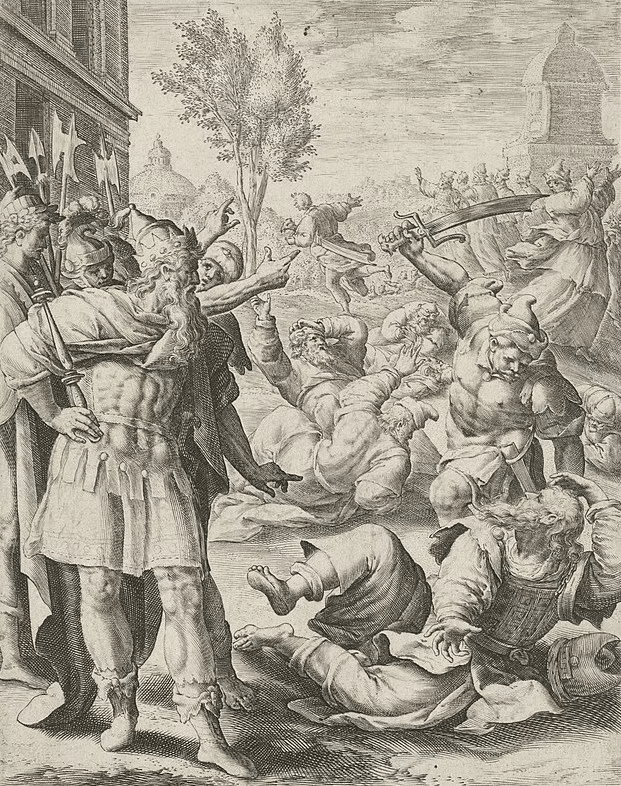
The Day of Doeg

The translation of verse one above then begins, where the literal English translation says, “how do you shine with evil as mighty ; goodness el , all the days .” In that, the principles of “shine” and “the days” should be understood as symbolic of the moon and the sun. To pretend that a reflection of the “sun” off a material surface [the flesh] shows one’s “might” or “strength,” while being obviously led to do “evil” or “bad” deeds, always comes to naught, when the sun’s rays of life go dark [at death]. There is no “might” or “strength” to be found in a dead body of flesh. The sun, however, “always produces the light of day,” which is the “goodness” of Yahweh [His “el” within] that is true “might” and “strength.” The Hebrew words that translate as “all the days” then must be read as saying the soul married to Yahweh [possessed by adonay – stated here as “el”] has the “might” and “strength” of eternal life.

Verse two then literally translates into English singing, “evil desire it will invent your tongue ; like a sheath sharp , making treachery .” In this, the intent of “desire” is read as “in a bad sense,” thus the “desire” is for self, not others. In order to suit one’s personal “desires,” one will “calculate” what one says, so one’s “tongue” speaks like the serpent did to Eve, thinking itself to be the craftiest of the animals in the flesh. Like the serpent, who is always caught and exposed to the truth, one’s “tongue” becomes like the “sheath” held by a priest of the Tabernacle [a Levite in David’s time], who cuts the throat of sheep to be burned in sacrifice. While certainly not a lamb inspected to be without blemish – as one of this nature is “making treachery” – the “knife” comes to all animals in the flesh. When Judgment before Yahweh comes, it will be one’s own unwashed sins that will be the instrument of “destruction” that soul faces.

In verses three and four, David was divinely led to speak of “love,” beginning both verses with “you love” (from “’ā·haḇ·tā”). For all the people wearing robes and chains with crosses in today’s modern version of Christianity, they all run around wildly spewing out words of “love.” These two verses of David point the finger at them, making them be the same people that existed in David’s time, where he wrote, “you love evil more than good.” This speaks of human emotions, where “love” connects the brain to the heart to the groin, touching all places where pains and pleasures are mistaken as “love.” None of those ideas about “love” come close to the truth that is Yahweh’s “love.” David was not referring to Yahweh’s “love” in these two verses.

Verse three fully sings [in English translation], “you love evil more than good ; falseness ׀ rather than speaking righteousness .” David then wrote “selah,” which says this judgment is not his own. It is a “lifted up” judgment, from the “exaltation” of Yahweh speaking through his hand. The placement of a vertical bar must be read as a place of pause, where every “lie” told comes with a soul being told the “right” way is not to be “false.” Jumping to “deceit” after this inner warning makes one’s judgment be “rightful” punishment by Yahweh. The statement “more than good” says all the good one does is flushed down the drain by all the “evil” one does … no matter what the percentages of deeds is.

Verse four then literally sings in English: “you love all speech devouring , tongue treachery .” Here, the repeated use of “tongue” and treachery” matches that of verse two. Here, Yahweh told David that evil souls “love” telling lies, even though they destroy their souls while doing so. Ask Joe Biden and Bill Clinton (all politicians) how they can only lie, even when the world knows they are lying. It is this “tongue treachery” that will be their own words that cut their throats at Judgment.

In verse five we find another use of “el,” which brings up a clarification of Yahweh telling David to write, “you love evil more than good.” As I stated prior with the name of David meaning “Beloved,” that name usage was an “instruction” coming from the “preeminence” of Yahweh that stated a divine marriage, where the soul of David united with the Spirit of Yahweh, so His “love” means that union of marriage. Such a divine marriage then resurrected the Yahweh elohim that is His Son’s soul. In Genesis 1 is written “elohim” thirty-two times, with every one of those uses denoting an angel, spirit, or law of physics, such that all who were created by the plan of Yahweh [unnamed in Genesis 1] were “elohim” not a Son of Yahweh. Thus, an “el” can be a spirit that either helps one [leads one to do good] or hinders one [leads one to do evil]. These are the demon spirits that possess souls, which need to be casting out. However, it is “love of evil more than good” that marries a soul to Satan’s minions. This is brought out in verse five.

Verse five then literally translates into English as singing: “moreover el will pull you down enduringly it will take you away and pull you out of your tabernacle ; and uproot you from the flesh of the living .” This verse is also one where David added “selah,” meaning this is an “exalted” promise from Yahweh. At every place where the second-person is used – as “you” – this should be read as “your soul,” as there is no “you” without that animating the dead “flesh” that surrounds “you.” The ”tabernacle” should be read as one’s commitment to Yahweh, as one of those who sided with David’s lead [where verse one indicates this Psalm 52 was when Saul was king], the “tabernacle” is one’s flesh with a soul led by elohim [adonay]. The use of “uprooting you from the earth” has been changed by me to show “earth” as “flesh.” The removal of a soul from a “tabernacle” is due to the soul falling in “love” with the “el” that pleases the “flesh;” and, the taking away from “the living” means a Judgment for sins that will prevent eternal salvation of the soul.

It is with verse six that the divine inspiration brought to David by Yahweh changes, going from those souls alone in their flesh [selfish] and those souls married to demon spirits to those souls like David’s – married to Yahweh and possessed by His elohim. The whole of verse six then literally translates into English, singing, “and they will see those righteous and fear , and above it they will laugh .” In this, it is the souls that “love evil” and “love words that devour” will encounter those souls who are divinely possessed and led to live righteous lived. That will be seen as souls saved; so, those evil souls will feel the cold chill run down them, fearing their judgment coming at death. Because those they encounter will be elevated spiritually by Yahweh’s Spirit having merged with their souls, cleaning them forever with a divine Baptism, they will hear the voice of an inner Lord, which leads them to “laugh” in the face of the wicked.

In verse seven, David was led to write [literally translated into English], “behold! the man , not set elohim , his strength and his trust in abundance of his riches .” In this, the words “behold! the man,” where the root Hebrew word for “man” is “geber,” not “adam.” This makes those souls in flesh, ruled by demons, and those souls in flesh, ruled by elohim, equals in their outer coverings that qualify them both as “man.” Each sees the other physically, with the souls of the wicked sensing the “righteousness” of those whose souls are not like theirs. Those souls who have not married Yahweh and become “set” or “placed” with a possessing elohim [to mark a wife in His name], they will judge the success of others by the amount of things of material value they possess. Their fear comes from realizing the rich and poor, alike, never take any material possessions with them when they die. That means all laughs from being rich, materially over the poor, turns into mourns, when the souls led to righteousness by their elohim get the last laugh.

In verse eight, David was divinely inspired to sing [translated literally into English], “but I like an olive tree green in the house elohim ; I trust in the goodness elohim forever and ever .” In this, the two first-person [“I”] statements must be viewed as a lack of self-identity, such that a soul in flesh married to Yahweh has sacrificed all sense of selfishness. This make the first-person identified by the “elohim” within a host soul, where “I” becomes a statement of that divine soul’s control over a host soul and its flesh [an adonay – Lord]. This makes the metaphor of an “olive tree,” which is “fresh” and “green,” be a statement of forever youth, where the elohim leads one to continuously produce good fruits. The “house” is then the framework of one’s body of flesh, where the fruits put forth are the ministry led by the elohim within. The use of “trust” is then based on a close, inner, personal experience, which makes “trust” be synonymous with true faith. The ministry [willing servitude] for “goodness” will not be until one reaches retirement age, when one can rest on all the riches false ministry brings to false shepherds, because ministry is for saving other souls. Once one’s own soul has been saved for an eternity, nothing more of a reward is possible.

In the final verse, the literal English translation has David singing, “I will praise you forever for you have produced ; and I will wait for your name that for good , in sight of your saints .” Here, again, the first-person is the identification of the inner elohim that leads a wife-soul of Yahweh to do acts of goodness. This means the “praise” [rooted in the verb meaning “to throw, cast”] is the elohim casting out the voice of Yahweh through His servant’s lips. The “praise” done by the wife-soul is then an echo of this; just as David’s Psalms of praise were the echoes of his divine inspirations, heard first within. These inner insights are the commands a submitted and devoted soul then follows in his or her flesh, so the good fruits are “produced.” The “name” of the elohim is today Jesus; so, each wife-soul married to Yahweh [in His name] will be reborn “in the name of Jesus – a Christ” Anointed by the Father, so divine patience keeps one from knee-jerk acts of sin. It is the inner presence of elohim within one’s soul that makes all works and deeds be seen as saintly by others; but the true “saint” is unseen, as the soul of Jesus resurrected within the soul-flesh of an apostle [male and/or female].

As the companion Psalm for the Track 1 Old Testament reading selection from Amos 8, one needs to see the opposite principles of souls who marry Yahweh [like did Amos and David], versus souls who resist such a commitment and fall prey to the influences of the world, becoming sinners. This is divine insight that came to David, while the powerful Saul [the King of Israel] sought to kill David. David knew the world was filled with souls married to demon spirits. Saul and Doeg the Edomite were two souls that loved evil more than goodness. The same world exists today, where all who seek to be like David must find the protection of Yahweh’s elohim, in order to escape the forces of evil.

This Psalm 52 then paints a picture of the divine protection Amos had as a true prophet of Yahweh, which protected him from the sword of Jeroboam. Today’s governments in Christian nations run roughshod over the churches, such as the perceived threat of COVID19 forced churches to cease operations. Saul and Doeg the Edomite are alive and well in the reincarnated bodies of modern politicians and false priests, whose soul have been sold for riches. Still, the prophecy sings, “and will see the righteous and fear”. The “righteous” these days do not wear robes and stand out as obvious – to be killed by an angry king, led by evil influences. Instead, they find refuge “in the house of the king’s brother,” which is metaphor for the twin souls within David’s “house” of flesh – his subservient soul, led by his inner king – Adam-Jesus – his elohim.

Footnotes:

A glossary needs to be present to understand “love” and “beloved.”

el – an individual eternal spirit, which includes a soul alone inhabiting a body of flesh

elohim – the joining of two (or more) el within a body of flesh: one soul el + one (or more) possessing el

Yahweh elohim – the Son of Yahweh called “Adam” (Man), Job (He Who Returns), and/or Jesus (YAH Saves)

love (aheb) – human emotions that ebb and flow like th moon changes shapes, based on the earth blocking the sun’s light

love of Yahweh – (aheb Yahweh eloheka) an el possessed divinely by the Yahweh el, to make a Beloved elohim in the flesh

adon – an individual lord, such that the soul el is the lord over its body of flesh

adonay – the joining of two (or more) el within a body of flesh, where the possessing el becomes the lord over that soul and its flesh

Psalm 15 – The question of which souls will invite Yahweh into their tent

1 Yahweh, who may dwell in your tabernacle? *

who may abide upon your holy hill?

2 Whoever leads a blameless life and does what is right, *

who speaks the truth from his heart.

3 There is no guile upon his tongue; he does no evil to his friend; *

he does not heap contempt upon his neighbor.

4 In his sight the wicked is rejected, *

but he honors those who fear Yahweh.

5 [4] He has sworn to do no wrong *

and does not take back his word.

6 [5] He does not give his money in hope of gain, *

nor does he take a bribe against the innocent.

7 [5] Whoever does these things *

shall never be overthrown.

——————–

There are only five verses in Psalm 15. The NRSV confirms this. The Episcopal Church has taken it upon itself to change divine Scripture to meet whatever hidden agenda that have. They forget that Jesus says “Woe to those who run around changing things to suit their selfish needs.” [Not even one little dot over an i of one little cross of a t is allowed.] Also, twice the proper name “Yahweh” is written, which the NRSV [and all other translation services] mutate as “Lord.” These corrections have been made above.

In verse one David poses two questions. The first asks, “Yahweh who he will sojourn to your tent?” Here, the key word in translation is “yā·ḡūr,” which is rooted in the verb “guwr.” That word meant “to sojourn,” but the NRSV shows it as “may dwell.” To grasp the meaning of “sojourn,” rather than change the text to suit a personal agenda, it is important to recall the story of Laban being sent by Abraham to his homeland to find a wife for Isaac. That was a “temporary stay, which involved a trip from one place to another, then back. The return trip with Rebekah, was to enter into the “tent” of Sarah, where Isaac and Rebekah officially became married. From this story, one should see David being led divinely to ask, “Whose soul has been sent for by Yahweh, to agree to return and enter the tabernacle of holiness that marries a soul to Yahweh?”

The follow-up question then asks, “who he will dwell in mountain your sacredness?” Here, the Hebrew word “yiš·kōn” is written, which is rooted in the verb “shakan,” meaning “to settle down, abide, dwell.” The metaphor for Yahweh is “the mountain,” which denotes great size and lasting strength. The word translated as “sacredness” also mean “apartness,” where Yahweh is not “sacred.” His ”tabernacle” demands one’s soul be “apart” from its flesh’s influence [self-sacrifice in divine marriage, taking on the name of Yahweh], thereby led by an inner elohim that leads a soul-wife in the flesh to act righteously. In the use of “he will sojourn” and “he will dwell,” both constructs utilize the third-person masculine singular, where the masculine denotes an eternal spirit-angel-soul. This designation of “he” is then not gender specific to any flesh whatsoever, as no flesh can ever enter “the tabernacle of Yahweh.”

When this is seen, the focus placed on “apartments” and “sacredness” is then stated in verse two, as “him walking complete and him acting righteousness ; and speaks the truth , in his inner being .” Here, it is vital to understand that no human being – a soul animating a body of flesh – can will oneself [one’s soul] to ignore the worldly influences upon a body of flesh made from the earth [dust and clay]. The soul must attain the apartness of the flesh, which can only come from marrying the soul to Yahweh. That marriage brings forth an outpouring of His Spirit upon one’s soul, which bring this “sacredness” and ability to no longer sin. That then brings about the resurrection of Yahweh’s Son [Adam-Jesus] within one’s soul [twin souls, like Esau and Jacob in Rebekah’s womb]. The soul of Adam-Jesus then becomes the Lord over the soul and its body of flesh, forevermore forbidding it from sinning again. This is the “inner man” who “speaks the truth” and makes one “complete” [the meaning of “peace” – Hebrew “eiréné,” which properly means “wholeness”]. When a soul is joined with the soul of Yahweh elohim [Adam-Jesus], then it is found “walking righteously.” This makes “sacredness” be the equivalent of a Saint in the name of Jesus.

In verse three David was inspired to write [in literal English], “not he who slanders ׀ with his tongue , not he acts to his companion evil ; and a disgrace , not does he raise up against those near .” Here, the third-person masculine singular is stated four times, meaning this is not talking about a soul in a body of flesh [the feminine that marries eternal spirits – masculine]. This is then making a profound statement about the other type of marriage, where a soul becomes joined with a demon spirit. The vertical bar after “not he slanders” must be read as a point of pause, from which a soul is offered divine marriage to Yahweh and rejects it. Following the vertical bar is said, with his tongue,” which is a physical part of a body of flesh; however, the third-person masculine singular says rejecting divine marriage to Yahweh can then make a demon possess a soul and use the “tongue” of its minion as its voice. Rather than “speaking the truth,” a soul demonically possessed will speak lies. When I have translated “companion” and “those near,” the NRSV translates “friends” and “neighbor.”

When “lə·rê·‘ê·hū” (rooted in “rea”) is seen to mean “friend, companion, fellow” in the third-person masculine singular, this is a demon spirit in “companionship” with a soul, as both are of masculine essence as eternal entities. This becomes the key point that Jesus made about “Who is my neighbor?” where one has the choice to “slander” Yahweh or receive Him as His wife-soul. A demon spirt in possession of a soul will make its “companion” host “act evil.” The soul will be “disgraced” by the sins of the flesh it has become filthy from. A demonically led soul in the flesh will “lift up” its views against righteous living, by defending evil deeds as god-given [as humans, not true elohim] rights.

In the fourth verse written by David (which the Episcopal Church shows as verses four and five), mistranslation can become reason to see “those who fear Yahweh” as a statement that is not made. The whole of this verse is David singing out about the dangers that come from rejecting Yahweh and fearing submission to His guidance. The literal English translation of the whole of verse four states: “him despising ׀ in his eyes him rejecting and those fearful Yahweh he will become burdensome ; he swears to be evil , and not does change .

After the first statement made by a masculine singular participle that says, “he despising” is placed a vertical bar of pause. Another way of reading “despising” is “being careless.” This says a soul in the flesh will be warned by an inner voice (sub conscience) that tells one it is dangerous to proceed the way outer influences are leading. The third-person masculine singular construct that follows by indicating “in his eyes,” which is the soul possessing a body of flesh influenced by the physical sense of sight. To then “reject” the warning sent by a guardian angel is to “reject” Yahweh. This joins one’s soul-flesh with all “those fearful” of submission of self, to be totally controlled by Yahweh [Baptized clean of past sins and sent an inner Yahweh elohim to become one’s Lord]. This means “rejecting and being fearful of Yahweh” will make one’s soul become “burdened” or “weighed down” by a demon possessor. That becomes a demonic marriage, where one’s soul “swears” an oath to Satan, “to be evil.” Once such an “evil” marriage is made [a pact with the devil signed by one’s soul], then there is no hope for that soul to be saved from eternal damnation.

In the fifth verse, which the Episcopal Church presents as verses six and seven, the whole translates into literal English saying, “his money ׀ not he does put as his usury and a present above clean , not does he take his acting these , not will be shaken forever .” Here, the first word is the third-person masculine singular, where the soul has been sold into slavery. The “money” or “silver” received is the flesh; and, Satan may find bringing plenty of temporal profits into the soul-flesh as justifiable for making the soul sell itself so cheaply. A vertical bar of pause then makes one focus on the dowry paid to a husband by a daughter to be taken in marriage. No such payments are made to Satan – no “interest” or “usury” will make this arrangement pay greater rewards in the long run [eternity]. There is no payments made on one’s debts of past sins, nor future prevention of such debts incurred. The soul-flesh sold to Satan will then be found “acting” as Satan demands (like a puppet on a string), because everything promised is the illusion of the material realm. Nothing seen as a gain will remain when the flesh returned to the world of death and the soul is left to pay for mistakes made in a lost life.

As the accompanying Psalm to the Track 2 Old Testament reading from Genesis, where Abraham encountered the Trinity of Yahweh and invited that divine presence within his “tabernacle” [his flesh], this is David painting a clear picture of the dangers that happen to those lost souls who ask, “Yahweh who he will sojourn to your tent?” Those who question this offering of divine union (as opposed to demonic possession) are those Satan preys upon: those despising self-sacrifice, rejecting His proposal for divine marriage, fearing Yahweh would make life less fruitful for their financial portfolio. This is the danger the world so easily falls prey to. It is a bottomless pit one’s soul fall into.

Psalm 85 – Singing about a divine union

1 You have been gracious to your land, Yahweh, *

you have restored the good fortune of Jacob.

2 You have forgiven the iniquity of your people *

and blotted out all their sins. Selah

3 You have withdrawn all your fury *

and turned yourself from your wrathful indignation.

4 Restore us then, elohe our Savior; *

let your anger depart from us.

5 Will you be displeased with us forever? *

will you prolong your anger from age to age?

6 Will you not give us life again, *

that your people may rejoice in you?

7 Show us your mercy, Yahweh, *

and grant us your salvation.

8 I will listen to what the ha-el Yahweh is saying, *

for he is speaking peace to his faithful people and to those who turn their hearts to him.

9 Truly, his salvation is very near to those who fear him, *

that his glory may dwell in our land.

10 Mercy and truth have met together; *

righteousness and peace have kissed each other.

11 Truth shall spring up from the earth, *

and righteousness shall look down from heaven.

12 Yahweh will indeed grant prosperity, *

and our land will yield its increase.

13 Righteousness shall go before him, *

and peace shall be a pathway for his feet.

——————–

This is one of the eleven psalms identified as “of the sons of Korah.” Despite all the thought about who the “sons of Korah” were [not singings in the Tabernacle], we are told in Numbers 16 that a rebellion against Moses and Aaron, led by Korah (Moses’ cousin) was quelled by the earth opening up and swallowing the rebels. In Numbers 26:11 we are told, “the sons of Korah did not die.” This does not mean they survived unscathed from Yahweh’s punishment. It means they became eternal soul that live underground. This means the “sons of Korah” are protectors of the underground tunnel system beneath the Tabernacle-Temple. In Jerusalem, this was the fortress of the Jebusites.

Verse 1: “you have been favorable Yahweh to your flesh ; you have returned captives [captives] (supplanters) .” There is little about the “earth” or the “land” that Yahweh “favors.” He only “favors” souls that have become “captives” of their own “flesh.” The repeating of the Hebrew word “shebuth”(“šə·ḇîṯ”), with the first stated in song, with the second enclosed in brackets – thus a silent statement about the soul within the “flesh” – says the “favor” shown to the “flesh” comes when the “captive” souls are shown the “favor” known by “Jacob,” which is the promise of eternal salvation, after the lusts of material gains [evil “favors”] have been ”overturned” or “turned back.”

Verse 2: “you have uplifted the guilt of your people ; you have covered all their sins . Selah” This furthers the “favor” of “Yahweh,” speaking of His presence in the second-person masculine singular. It can only be by Yahweh’s Baptism of Spirit that the “guilt” of “sins” can be “uplifted,” “carried away,” of “forgiven.” To ensure no further “sins” can reach into those souls of Yahweh’s “people,” His Spirit has “covered” them in a protection of His presence.

Verse 3: “you have removed all your overflow ; you have returned , with the burning anger on your face .” Following the verse two singing of the removal of sins, verse three then places focus on the “exaltation” or “uplifting” [the meaning of “selah”] that represents. David sang that Yahweh “removed all” sin, not just the worst, while “all” says His “people” can only be totally and completely cleansed by the Baptism of His Spirit. Just as verse one sang about the “returning of captives,” it is that “removal of all sins” that makes it possible for a soul to rejoin Yahweh. That reunion is a divine marriage, which must include a bathing by His Spirit.

While the Hebrew word “ebrah” [“‘eḇ·rā·ṯe·ḵā”] means “arrogance, fury,” with “overflow” being used mostly as a statement of uncontrolled emotions (“anger”), this says one’s own soul turns one away from Yahweh, so the “wrath” of the world makes one’s soul vulnerable to physical abuse. It also says Yahweh does nothing to stop souls from sinning; but He will not accept any soul that has the ”arrogance” to think he or she can retain some personal sins, without punishment. Yahweh’s Baptism that cleans a soul of past sins says Yahweh will not tolerate the filth of the world in any way, shape or form clinging to a soul He takes as one of His wives. To have then “returned” to a pristine state of being – guiltless and upright – oneself then projects a “face” of “burning anger” against ever returning to a life of sin. The “face” a saved soul wears is that of Yahweh [First Commandment]; and, that “face” terrifies demon spirits and minions of Satan.

Verse 4: “and return us elohe of our salvation ; and break your anger with us .” Once more the theme of “return” is sung by David, where a “return to be one with Yahweh” is now said to be the “return of an elohim” in each soul. The “elohe of salvation” is “Jesus,” where that name means “Yah[weh] Saves.” The presence of that inner soul, joined with one’s lost soul, brings the completion of wholeness, which was missing when a soul was released into a new body of flesh, at birth. This is then less about the “anger” of Yahweh, as much as it is the “anger” His people find from not receiving His benefit, due to their sins. Once a soul has “returned to Yahweh,” then only His love can be felt; and, His love comes into one’s soul through the “elohe of salvation.”

Verse 5: “forever will you be angry with us ; will you continue your face , to dwelling with all the generation .” Here, the use of “forever” (“hal·‘ō·w·lām”) is better stated as “to the ends of time.” Again, there is no “anger” in Yahweh, as that can only be found in souls in bodies of flesh that reject a return to Yahweh, through submission in divine marriage. David is singing that this “anger” will be felt for as long as it takes for a soul to realize its need to return and be one with Him. The “face” of Yahweh is eternal and unchanging. Unless a soul in the flesh submits self-identity (one’s own “face” over bowing down and wearing the “face” of Yahweh) completely unto Yahweh [one’s Husband in divine union], then one’s own “face” will flare at the “nostrils” from self-caused “anger.” The element of “dwelling” (from “lə·ḏōr,” also meaning “to period, to generation”) says the “elohe of salvation” must dwell within one’s soul, in order for that soul to be a wife of Yahweh and the mother of His Son reborn. The “generation” (a repeat of “dor” in the masculine singular) is then the ministry in service to Yahweh, as His Son reborn, so others can find this “generation dwelling” within their souls.

Verse 6: “not you will return you will live in us ; that your people , it will rejoice in you .” This is David saying that to be married to Yahweh is “not” for a temporary period of time, as a soul’s “return” to be one with Him is forever lasting. One’s soul in the flesh is facing death; but to be rejoined divinely – one’s soul to Yahweh’s Spirit – means His eternal “life” will be the promise that lasts beyond the death of one’s flesh. This “life” is the promise offered to all “the people” whose souls submit to Yahweh [true sons of Israel]. It is the inner presence of Yahweh’s “life” – which comes from the soul of His Son being resurrected within one’s cleansed soul – that will “rejoice” within, as one’s Lord, causing the soul-flesh to follow that lead and also “rejoice.” It is the “gladness” of salvation, with the promise of eternal life receive.

Verse 7: “let us see Yahweh your goodness ; and your salvation , give to us . Here, for David to sing to “see,” this is less about physical sight and more about the ability to understand the truth. This came during David’s time from being led by an inner “elohe of salvation,” as well as understanding the scrolls of the Torah. Today this equates to a soul being able “to see” the truth written in Scripture. It is from this ability “to see” that one realizes no human beings could ever devise writings of such profound depth, as they could only come from “Yahweh.” This is the truth of the “goodness” that a soul receives from “Yahweh.” That “goodness” is then stated as “your salvation,” which (again) states “Jesus,” which means “Yah[weh] Saves.” The “goodness” of “Yahweh” is known through His Son’s resurrection in the flesh. This is the “gift” of the Spirit and the Son, which is the harvest of commitment to Yahweh in divine marriage.

To understand verses eight through thirteen, read this posting for the seventh Sunday after Pentecost, Year B, when the Track 2 Psalm accompaniment then is Psalm 85:8-13. The message is still the same, as I entitled that posting from 2021 Restoration through holy matrimony. Please click on the link to read what I posted a year prior, as it is still applicable today.

As a companion reading to the Track 1 Old Testament reading from Hosea, this clearly sings praises to a divine marriage. The physical impression given by the Hosea reading is Yahweh forcing Hosea to belittle himself and go marry a whore, to have daughters he despised. That story must be read from a spiritual perspective, where Hosea’s soul became an “elohe of salvation” that was sent into the wicked people of the Northern Kingdom. Hosea then transmitted the Spirit into one who found “Completion” [the meaning of “Gomer”], who then was reborn in the name of Jezreel. That resurrection of the “elohe of salvation” within Jezreel would bring forth the “face of anger” and “wrath” that would prove to the failed nation named Israel that they “Not Would Find Mercy,” because they were “Not My People.” Those were born of the inner elohim in Jezreel, so Yahweh did not give birth to those concepts, nor name them. This Psalm 85 sings of what it takes to transform from a soul sold into prostitution in the world, while calling oneself a believer in God and Jesus. One’s soul must make all these changes to fine eternal salvation – be reborn as Jesus.

Psalm 138 – The same song sung four times in celebration of personal ministry

1 I will give thanks to you, O Lord, with my whole heart; *

before elohim I will sing your praise.

2 I will bow down toward your holy temple and praise your Name, *

because of your love and faithfulness;

3 [2] For you have glorified your Name *

and your word above all things.

4 [3] When I called, you answered me; *

you increased my strength within me.

5 [4] All the kings of the earth will praise you, Yahweh *

when they have heard the words of your mouth.

6 [5] They will sing of the ways of Yahweh, *

that great is the glory of Yahweh.

7 [6] Though Yahweh be high, he cares for the lowly; *

he perceives the haughty from afar.

8 [7] Though I walk in the midst of trouble, you keep me safe; *

you stretch forth your hand against the fury of my enemies; your right hand shall save me.

9 [8] Yahweh will make good his purpose for me; *

Yahweh, your love endures forever; do not abandon the works of your hands.

——————–

I have written about this Psalm 138 twice before, both times within the past year (2021). The first time was in response to this reading selection being assigned as part of the Proper 5, Year B Ordinary after Pentecost season; and, the second time when it is the reading selection for the second Sunday after the Epiphany, in this Year C. This Psalm 138 is obviously selected for public singing later this Ordinary after Pentecost season (Year C), as a Proper 12 Sunday offering. Finally, it is a choice to be sung on the Proper 16 Sunday, during the Ordinary after Pentecost season in Year A. Being found a reading selection in each of the Ordinary after Pentecost seasons and during Year C Ordinary after the Epiphany season, that multiplicity shows this Psalm 138 as important to grasp, relative to one’s personal ministry.

Same Psalm played yet again!

I have published the following two commentaries about this Psalm 138. I recommend anyone who seeks to see what David meant to read both of them, then compare the two. The links to these commentaries are as follows:

Giving thanks to Yahweh with one’s whole heart – Proper 5 Year B

Smacking down the enemy of self with the right hand of God – Epiphany 5 Year C

I will not add anything new to my prior comments at this time. However, please take not of the presence of “elohim” in verse one. It has been translated as “the gods” (in the lower-case), with a non-existent “O Lord” [the assumption of “Yahweh”] being written. That “O Lord” has been stricken from the text. There are then six direct namings of “Yahweh,” which appear in bold type. All of these have been incorrectly mutated into “O Lord” or “the Lord,” both variations diminishing the value of the name told to Moses, when he asked the presence of Yahweh, “Which ‘god’s name’ shall I say sent me?” By asking that question silently says, “There are so many “lords” (“gods”) to name, which one are you?” Finally, the Episcopal Church has altered this Psalm 138 from its eight true verses into nine. The correct verse numbers are listed in bold type, between brackets.

Psalm 107:1-9, 43 – The path to redemption

1 Give thanks to Yahweh, for he is good, *

and his mercy endures forever.

2 Let all those whom Yahweh has redeemed proclaim *

that he redeemed them from the hand of the foe.

3 He gathered them out of the lands; *

from the east and from the west, from the north and from the south.

4 Some wandered in desert wastes; *

they found no way to a city where they might dwell.

5 They were hungry and thirsty; *

their spirits languished within them.

6 Then they cried to Yahweh in their trouble, *

and he delivered them from their distress.

7 He put their feet on a straight path *

to go to a city where they might dwell.

8 Let them give thanks to Yahweh for his mercy *

and the wonders he does for his children.

9 For he satisfies the thirsty *

and fills the hungry with good things.

43 Whoever is wise will ponder these things, *

and consider well the mercies of Yahweh.

——————–

In the above translation by the NRSV, I have reinstated the name “Yahweh,” which was written five times by David, in these ten selected verses. This repetitiveness is confirming that David’s soul was married to Yahweh, so he knew His name personally. To call “Yahweh” by His name means to be in a spiritual relationship with His Spirit. David was “anointed” by Samuel (made a “mashiach”), while Yahweh poured out His Spirit upon David’s soul, forever making him be “Anointed” (a “Messiah” or “Christ”). To be so Anointed means one can call Yahweh by His preferred name (rather than be minimalized as “the Lord”).

When David sang in verse one, “give thanks to Yahweh for he is good,” this says David was joined to His, because only one who knows Yahweh can know “he is good.” This is why Jesus asked the young, rich ruler how he knew Jesus was “good.” Jesus told him, “Only God is good.” This said Jesus knew the young, rich ruler did not know Yahweh personally, therefore he did not know “good.” Without knowing Yahweh (by name), he could not assume Jesus was “good;” and, that said the young, rich ruler did not know Jesus either.

When David sang about Yahweh’s “mercy endures forever,” this speaks of the blessing of eternal life that comes to a soul that has married Yahweh. The Hebrew word translated as “mercy” actually means “goodness, kindness.” This speaks louder as the “foreverness” of salvation, as once a soul is united with Yahweh in marriage it then becomes merged with the essence of Yahweh – that forever brought on by the resurrection of Yahweh’s Son’s soul with one’s soul – which is the ”goodness” and “kindness” of divine possession.

Verse two repeats the verb “redeemed,” which shows the “goodness” of Yahweh comes from all past debts being paid. The debt of sin is washed clean by the Baptism of Yahweh’s Spirit; and, this is the marriage that makes a soul in its flesh become His wife (regardless of human gender). This means “the hand of the foe” is Satan, who is the enemy of all souls. It is a marriage of a lost soul to Satan that leads a soul in the flesh to build up a debt that must be repaid before death. Otherwise, the payment of sins will be either reincarnation of eternal damnation.

When verse two is understood to be placing focus on the trappings of evil being “the foe” or “the enemy,” verse three then makes it clear that the influence of Satan on souls in the flesh is everywhere. The root word that begins this verse is “erets,” which means “earth, land,” should be read metaphorically, such that human flesh is made of “the earth.” There is no place on “the earth” that is more conducive for lusts and sins. This verse is saying that wherever souls in habit “the flesh,” they will be drawn by the guilt of sins to find Yahweh for redemption.

Verse four then speaks of those souls that will be more apt to seek Yahweh. They will be those who “wander into the desolate wilderness” or “desert wastes.” This speaks of a dryness of soul, which seeks ever-living waters to be refreshed. On the other hand, it is the “cities” that create the “excitement” (the Hebrew word “iyr” means both) that leads the flesh to desire pleasures that are morally denied. When one’s soul remains moist from Satan’s rewards of the material realm, the souls are less inclined to seek spiritual nourishment.

Verse five then sings of hunger and thirst, where this is spiritual needs, not physical desires. A soul “faints” or a “spirit languishes” in an environment that finds no solace from religious teachings. When one’s soul is seeking the bread of heaven to feed one’s mind and the blood of Christ [not Jesus – the Spirit of Yahweh] to course through one’s flesh – and everlasting waters that never need replenishing – that flowing from the Spirit being one with one’s soul – then one’s soul will seek Yahweh to fill that void.

Verse six then names “Yahweh” as the one a deprived soul turns to. When a soul cries out to His name in seriousness, then He hears one’s pleas for help and will not deny them. That help comes one bite at a time and one drop at a time, with each drop leading one to seek more.

Verse seven then says those who have been fed spiritual food and given spiritual drink to nourish their souls, they must be led to a place where other lost souls are also seeking help. This sings of the need for ministry in the name of Yahweh. This means that a soul has married Yahweh and given rebirth to His Son’s soul (Adam-Jesus), so that Lord over one’s flesh will keep one from being distracted by the lures of a place of “excitement,” remaining sin free. This becomes the model upon which other souls in bodies of flesh can look to.

In verse eight is found the NRSV translating “children” incorrectly. The literal Hebrew states “sons of men,” from “liḇ·nê ’ā·ḏām.” As can be seen, this can also say “sons of Adam,” since that is the Hebrew word written in Genesis 2, where Adam is named. To be a “son of Adam,” one’s soul has to have the soul of Adam resurrected within it, which is the soul of Jesus [a name meaning “Yah[weh] Saves.” The “wonderful works” or “wonders” done by these reborn “sons of men” are those in ministry, as Saints, each reborn as Jesus, each a “Son of Yahweh.”

Verse nine is then singing praise to these holy men (and women) going out in ministry “feeding the hungry and giving drink to the thirsty.” To then jump ahead to the last verse in this song of David, verse forty-three says this is only possible after a soul has sought Yahweh and served Him as His disciple. Once one has proved one’s worth to Him, Yahweh will marry His wife-souls through divine Baptism of His Spirit. This brings about the rebirth of His Son Adam (a. k. a. Jesus), who becomes a soul in the flesh’s Lord, leading each into ministry as Adam-Jesus resurrected in new flesh.

As a companion song to the Hosea 11 reading, where Yahweh sang through His prophet about the cities on the plains that were destroyed by their own neglect [not Yahweh], this song sings of the influence of “cities” on the flesh of human souls. Only when one has been given an inner protector – a Lord of divine origin – can one not be distracted by the “excitement” these places of mixed souls. The “cities” are like the world, which is a “sea” of souls that must be caught by the Saints of Yahweh. Otherwise, they will be caught by demon spirits and enslaved.

Psalm 49:1-11 – The wise die just like the dull and stupid perish

1 Hear this, all you peoples; hearken, all you who dwell in the world, *

[2] you of high degree and low, rich and poor together.

2 [3] My mouth shall speak of wisdom, *

and my heart shall meditate on understanding.

3 [4] I will incline my ear to a proverb *

and set forth my riddle upon the harp.

4 [5] Why should I be afraid in evil days, *

when the wickedness of those at my heels surrounds me,

5 [6] The wickedness of those who put their trust in their goods, *

and boast of their great riches?

6 [7] We can never ransom ourselves, *

or deliver to lelohim the price of our life;

7 [8] For the ransom of our life is so great, *

that we should never have enough to pay it,

8 [9] In order to live for ever and ever, *

and never see the grave.

9 [10] For we see that the wise die also; like the dull and stupid they perish *

and leave their wealth to those who come after them.

10 [11] Their graves shall be their homes for ever, their dwelling places from generation to generation, *

though they call the lands after their own names.

11 [12] Even though honored, they cannot live forever; *

they are like the beasts that perish.

——————–

This is another of the Psalms of David that sings an ode to the “sons of Korah,” who did evil, were cent beneath the earth but never died. This introduction lets one know that there should be found some focus on evil, which acts as the “sons of Korah” acted against Moses and Aaron.

In verse one, the declaration for “all people … who dwell in the world” must not be seen as some global announcement that what follows is important for everyone to realize. If one does not understand that “all people” are souls in bodies of flesh, where it is that soul that “dwells in the body” that has a limited “duration” [alternate translation of “ḥā·leḏ”], then one will not see all the verses that follow as speaking of the salvation of that soul, in one’s “lifetime” [accepted implication of “ḥā·leḏ”].

The verse presented above as the continuation of verse one is actually verse two. The paraphrase above completely misses the truth of that stated. Verse two sings of “my son Adam also son man”. The two are “together.” It combines the “rich” and the “poor.” This is a statement that the importance that “all people … who dwell” in bodies of temporal flesh must know is divine possession. One’s soul is incomplete without the soul of Adam [a.k.a. Jesus] merged within one’s soul, becoming its Lord. This duality is only possible after one’s soul has married Yahweh, becoming His Spiritual wife, in whose soul is resurrected His Son’s soul.

Verse three becomes the key verse that makes this Psalm 49 be a companion to the Track 2 selections from Ecclesiastes. In that Book of Wisdom, Solomon wrote of “wisdom” being an exercise that brought “despair” to the “heart” – one’s “inner man” or “soul.” In verse three, David is singing that divine possession by Adam’s soul will make one’s “mouth speak wisdom,” while “meditation in one’s heart will bring understanding” of that “wisdom.” The “understanding” was stated by Solomon as the “works of Adam for wisdom, knowledge, and skills.” The word translated as “understanding” also implies “skill.”

In verse four, David sang of “inclining a proverb,” where this means his mind will be able to “stretch out” the meaning of a “parable,” so it is fully understood. It is this inner understanding that will then become the lyrics of his divinely inspired songs, where David was told to write words with multiple translations possible, where the “riddle” is being led to see the truth intended. This would then be placed to music on the “harp.” Like many songs where the lyrics lead one to thing they sing one meaning, the truth is a hidden meaning that requires deeper thought.

In verse five the actual translation has David asking, “what will I fear in the days of evil?” Rather than seeing this as “evil days,” the aspect of “in the days” must be realized as the time when the light of truth [Solomon’s “toil in the sun”] shines brightly. Evil can only exist in the world, but it is “feared” due to its darkness or the absence of light [Solomon’s “night”]. The question is then relative to being able to see the evil that exists and not be influenced by its tricks and ploys. This ability to see evil as it is keeps its “iniquity surrounding the feet,” not the head or heart.

Verse six then points out the lures of evil, which is measured in material objects and things. Those who “put their trust in their wealth” – be it coins, power of position, the support of men paid to do one’s battles, et al – will have no such assistance accompany their souls to, where only souls and spirits are allowed. This element of “trust” is then misplaced beliefs, which fall well short of true faith. When Yahweh is the only one who will hear what values their soul brought with them to Judgment, bragging about riches left behind will be strikes against one’s soul.

Verse seven is then David setting the foundation of Jesus telling the parable about poor Lazarus and the rich man. The soul of the rich man made requests to Father Abraham to send Lazarus to warn his brothers to change their ways; but that request was denied. In this verse, where David said, “brother not to redeem or ransom nor give the elohim as payment,” says one who has married Yahweh and become a soul resurrected with Yahweh’s Son (his “brother” within) cannot save anyone else, simply by having oneself been saved by his or her Yahweh elohim. In this way, believing in Jesus as most holy will do nothing to save one’s soul, because one’s soul must be reborn as Jesus, so one’s soul goes to Judgment before Yahweh as His Son. Seeing physical Jesus as a form of wealth or a valuable coin to hang around one’s neck while alive in the flesh will mean that external Jesus will be left behind, just like coins of gold or silver.

Verse eight says the “cost for redemption” is high. Saying what one has been told to say (a vow of belief, without the personal experience that generates true faith) is a lazy approach to salvation. It speaks out of one side of the mouth, while the other side still speaks as a filthy sinner. This verse says the price of “redemption” is the complete cessation of evil deeds; and, that can only be done by one’s soul having married Yahweh and had His Son’s soul resurrected within one’s soul. It is that personal experience of Adam-Jesus – as one’s Lord over the soul in flesh – that creates true faith, which ceases all deeds of evil forevermore.

Verse nine then confirms that this ceasing is evil deeds, as the amount of evil deeds still in need of redemption at the time of death is how one’s soul will be judged. Without a saving soul [“Jesus” means “Yah[weh] Saves”] to erase all debts of sin from the soul, itself an eternal entity that will live on forever, a filthy dirty soul will be judged as unworthy of eternal life with Yahweh. It will then be judged to return to the “pit,” where that is metaphor for the “grave” of death, where the “grave” or “pit” is a hole in the earth [metaphor for “flesh”]. An eternal soul will then be returned to the earth – the realm of dead matter – until it becomes so sinful it is eternally condemned or it finds the only escape from the prison of “the pit” is marriage to Yahweh and doing the deeds of goodness, as the Son of Yahweh reborn.

In verse ten, David uses the same “wise men” and “fools” as did Solomon in Ecclesiastes, where David saw both as failures, whose souls were sold for “wealth” that others would inherit when they died. Solomon say the “wise” as the elite of the earth, who gained that physical status by worshiping the goddess of wisdom. He saw a soul that would reject worship to an earthly elohim [a demon spirit] as the ”fool,” but either way the view was from the perspective of the demon, who did not know which soul would be available next. All would die. Therefore, David sang of the fleeting nature of a worldly existence; so, to not do the deeds necessary to escape “the pit,” whether “wise man” of “fool,” the results were the same.

Verse eleven then can be seen as an deeper view of “the pit” or “the grave.” It is a reflection of the earth, of which a body of flesh is made. David wrote (literally translated into English): “their inward parts their houses,” which must be read as metaphor for a soul (“inward parts”) being “housed” in a body of flesh or in heaven (the “house” of Yahweh, where a room is prepared). To then say this arrangement is “forever” says a soul has to decide which “house” it will choose – either hell (“the pit” of earth) or heaven (the spiritual realm of Yahweh). To then sing “their dwelling places for all generations they call after their own names on land,” says it all depends on whose “name” they will choose in spiritual marriage. The Hebrew word translating as “and all generations” means self-“generations,” not a statement of lineage. This then projects a repetition of reincarnations (re-“generations”) into the dust and clay of “the ground.” The “name” of importance is self or the elohim that will lord over one’s soul, leading it to do evil deeds. Only by marrying Yahweh and taking His “name” in divine union, becoming the “name” of His Son resurrected can one choose to be “dwelling” in a spiritual eternity of love with Yahweh.

Verse twelve then sings that a “man without honor will perish like the animals,” which can also be read as “a man with honor does not perish like the animals” (an enigmatic statement). The key to reading this is to determine what emphasis the “not” takes hold of. Both are true. One says a soul has become an “honor” to Yahweh, as His wife, giving rebirth to His Son’s soul. That “honor” will bring everlasting life, where the soul will never “perish.” On the other hand, the “not” is a rejection of that “honor,” so one’s soul is nothing more than a “beast” of the field, due to live and die, then repeat … forever.

Psalm 50:1-8, 23-24 – He has called flesh to the light of truth forever

1 elohim Yahweh has spoken; *

he has called the earth from the rising of the sun to its setting.

2 Out of Zion, perfect in its beauty, *

God reveals himself in glory.

3 elohenu will come and will not keep silence; *

before him there is a consuming flame, and round about him a raging storm.

4 He calls the heavens and the earth from above *

to witness the judgment of his people.

5 “Gather before me my loyal followers, *

those who have made a covenant with me and sealed it with sacrifice.”

6 Let the heavens declare the rightness of his cause; *

for elohim himself is judge he. Selah.

7 Hear, O my people, and I will speak: “O Israel, I will bear witness against you; *

for elohim eloheka I am God, your God.

8 I do not accuse you because of your sacrifices; *

your offerings are always before me.

—–

23 [22] Consider this well, you who forget elowah, *

lest I rend you and there be none to deliver you.

24 [23] Whoever offers me the sacrifice of thanksgiving honors me; *

but to those who keep in my way will I show the salvation of elohim.”

——————–

The introduction of verse one [not read] says, “a psalm of gatherer el,” where the use of “el” means one whose soul has married Yahweh (like David’s), who then gathers other souls to do the same. This “el” is not a worldly spirit or soul, but instead David sang of it being “elohim Yahweh.” That means being divinely possessed by the soul of Yahweh’s Son – Adam (a.k.a. Jesus). The role of a priest of Yahweh is to assemble other souls to be the same as their teacher or master. To do that, one’s inner “el” must be Yahweh’s Son resurrected.

In seeing David as the “gatherer el” that led the people to live up to the meaning of the name “Israel” – as those “Who Retained elohim Yahweh” within their souls – the people were “gathered” to serve Yahweh as planned, when Moses delivered them to Canaan and Joshua led them in. Thus, what is stated in the remainder of verse one should be seen as singing: “the elohim Yahweh [the soul of Adam] has spoken and called the flesh [symbolic of “earth”] ; to the rising of the light of truth [symbolic of “sun”] until death [symbolic of “it goes down”]. This says that once souls have been gathered, then they will always be saved, due to the protection of the “elohim Yahweh” that has been resurrected within each of their souls.

In verse two, one needs to understand the meaning behind the name “Zion.” That meaning is “Dry Place, Sign Post, Tradition; Fortress,” depending on the Hebrew or Arabic translation. I see this primarily as “Dry Place,” which means the marriage of a soul to Yahweh’s Spirit must be done from total obedience and submission to His Will. One’s opinions are set aside, making one’s soul become void of self-emotions, thereby “Dry.” It is from this positioning that Yahweh becomes the underground flow of living waters that makes a soul in its flesh flourish spiritually. This then brings about the perfection of Yahweh and the beauty of His Son’s soul within. This inner presence is the “elohim” that “shines forth” the light of truth.

When verse three begins by singing “will come our elohim,” the Hebrew word translated as “will come” can equally say “will enter.” This has to be seen as an “entrance” within one’s soul; and, it cannot be seen as a nearness that is external. Because David possessed the “gatherer el,” the plural possessive pronoun “our” says all who were true children of Israel” were those who collectively (and individually) were inwardly possessed by the same “elohim” of Yahweh (His Son’s soul resurrected in each and all).

When this statement of equal possession is seen – divine marriage to Yahweh – it is this presence that leads to ministry, where “not will keep silent” says each will become a teacher that will lead other souls to likewise marry their souls to Yahweh. This becomes the model of parents who are truly Israelites teaching their children to become like themselves. When silence takes hold, no one teaches the truth and no one learns the truth. The roots of silence come from self-importance failing to teach total submission to the Will of Yahweh; but that self will be destroyed by the fire of the Spirit, when a soul is Baptized clean, so the proof of one’s mettle is done.

In verse four, the metaphor of “from the heavens to the earth” must be seen as “from the spiritual [the soul within] to the flesh,” where the physical body is led by the guidance of Yahweh, His Spirit and the Son reborn. This means the inner “heaven” of Yahweh is also where the inner “heaven” of the Son is merged with the inner “heaven” of the soul (which is eternal). These three combine to be the plural number of “heavens.” When Yahweh is not thought to be in outer space or far beyond oneself (where a “self” is one’s “soul”), it make Yahweh be in the Son reborn, who ministers to the people physically (face-to-face) and spiritually (soul-to-soul), so “that he may judge his people.”

Verse five begins with a construct formed from the Hebrew word “asaph,” which means “gatherer.” This verse then sings, “gather together to me all my saints,” which is the truth of a minister in the flesh. The soul born into flesh will become possessed by the soul of Yahweh’s Son (Adam-Jesus), whereby the flesh will become a new vehicle in which the Son of God will move. This is the truth of being “Holy, Sacred, Set apart by God, and a Saint.” It is like how Yahweh told Moses to remove his sandals because he stood on holy ground. That “holy ground” was not near a burning bush in Midian, it was the flesh of Moses having become possessed by Yahweh’s Spirit. The “covenant made with me” is the marriage agreement that says a soul in the flesh will forevermore do the Will of Yahweh, as His wife-soul. That “sacrifice” is the complete submission of a wife to her Husband, becoming the sacrifice of self-name, so one’s soul takes on the name of Yahweh – Israel – and His Son – Adam-Jesus.

When verse six then says, “and let the heavens declare his righteousness ; for elohim,” there is a vertical bar placed (“׀”) which is missed in translation. Here, again, the use of “heavens” must be seen as inward spirituality that speaks in ministry, as a Saint or Priest of Yahweh. the use of “righteousness” is only possible by the inner presence of the soul of Yahweh’s Son, where two “heavens” (souls) combine as one. This state of “righteousness” is attributed solely “to elohim,” which comes from Yahweh. The vertical bar forces one to pause and reflect on that inner presence being absolutely necessary. Beyond the vertical bar is written “judge he,” which can also translate as “govern he.” This says the “elohim” has become one’s Lord over the soul and its flesh. This, again, is how “righteousness” comes to a prior sinner. The verse then ends with “selah,” which means “exalted.” It is the truth of one’s Lord within that will prove to be a soul’s exaltation in the judgment of Yahweh.

In verse seven David repeated “elohim,” by ending the verse singing, “elohim your elohim I am.” This should be heard as David singing about the Trinity, where “elohim” means the soul of Yahweh’s Son (Adam-Jesus), with “your elohim” being one’s soul born into a body of flesh. That means “elohim your elohim” is a merger of two souls in one, with Yahweh’s “elohim” being “your elohim’s” Lord. That Lord becomes the voice of Yahweh within one’s soul, such that Yahweh is “I Am,” within the whole.

That ending is led by Yahweh singing through David, “hear my people and I will speak , Israel [Who Retains the elohim of Yahweh] and I will be called to testify against you ;” This says the presence of Yahweh within allows those who truly Retain the el of Yahweh, as those souls gathered by David’s el, they will be able to hear the voice of Yahweh within, through the Son’s “elohim.” This will be the voice heard in ministry, as a Saint hearing the words of Yahweh through the inner Lord that is the Son reborn, which says the only way to hear the truth for oneself is to deny oneself and submit fully to Yahweh in divine marriage. That holy union brings about the Trinity within one body of flesh.

Verse eight is then a direct link to the Track 1 Old Testament reading from Isaiah, where David wrote the same thing as Isaiah, when both were speaking of Yahweh’s expectations of His children (His Sons reborn). Here, David sang of Yahweh saying, “not for your sacrifices I will rebuke you ; or your burnt offering in front of me continually”. In that, the “sacrifices” must be made of one’s soul, which means “not for your sacrifices” speaks the negative of a self-centered soul refusing (“not”) to “sacrifice” self to Yahweh. That refusal to marry Yahweh will lead to a “rebuke” of one’s soul (much like the lack of approval for Cain’s offering of burnt fruits and vegetables). These are the “burnt offerings” of animals, done by priests of the tabernacle, which does not please Yahweh. Yahweh made that clear in Isaiah’s song. The deeper meaning of “in front of me continually” is to put on the ”face” of Yahweh, through divine union and shining His Son as one’s Lord, or one’s “face before” Yahweh [the First Commandment]. When this is done, it is through a divine union that lasts forever, not just from each new moon for a new year to the nest new year’s feasts.

In the verses between verse eight and the last two verses of Psalm 50, the Episcopal Church has obviously changed the numbering, such that they present the true verses twenty-two and twenty-three as twenty-three and twenty-four. The NRSV shows Psalm 50 as only having twenty-three verses; so, I have stricken through the Episcopal Church verse numbers and corrected them to show the truth.

Verse twenty-two states: “discern now that you who forget elohim Yahweh ; lest I will tear in pieces , and none to be delivered .” This speaks of all souls who reject marrying Yahweh and receiving His Spirit and giving rebirth to His Son’s soul within their own soul. The word “discern” calls upon those who worship self, through the Big Brain, to determine why that Big Brain could not recognize the All-Knowing Mind of Yahweh, which becomes one’s inner source in one’s heart and soul. The fleshy organ atop one’s head cannot last for eternity; so, it cannot fathom life beyond the grave. Worship of a Big Brain will lead to one being “torn to pieces,” where death will “ender” one’s flesh separated from one’s soul. When that happens, the Big Brain will turn to much, then dust, and it will how no power “to deliver” a soul to eternal life. Salvation flows through one’s heart and soul, not through one’s mental processes in the head.

With that statement made about what will happen if one does not remember to seek salvation, the final verse ends on a happy note. It begins by singing, “whoever offers praise,” where the truth of “praise” (or better, “thanksgiving”) is it comes from the soul that has been led as its Lord-soul to “praise” Yahweh. That personal experience of Yahweh, through His Son’s soul one with one’s soul, leads the host soul to offer the most sincere “thanksgiving” possible, because it is based on the promise of eternal life having been gained. There can be no better “praise” than knowing salvation of one’s soul has been assured; and, that promise has come from a complete sacrifice out of love for Yahweh. A soul who has not come to know Yahweh personally cannot truly offer such “praise.”

The verse then continues by singing, “he will honor my soul and appoint him journey ; I will see him , salvation elohim .” In this, the word “honor” or “glory” can only come to a host soul through the resurrection of Yahweh’s Son becoming one with a host soul. The soul of Adam is this “glorification” made. That will the Lord over one’s soul in the flesh, who will be “appointed” by Yahweh and who will then “appoint” one’s soul on a “journey” or “path” of righteousness. The “road” to ministry is as the Son of Yahweh reborn in the flesh. When one’s flesh has transformed into a Saint, one “will see” and one “will show” others that the Son of God walks the face of the earth, leading seekers to the light of truth. This source of “thanksgiving” is then the “elohim of salvation,” who Christians know by the name of “Jesus.” That name means “Yah[weh] Saves,” so Jesus is the “elohim of salvation” from Yahweh.

Psalm 33:12-22 – Being made in the name of God

12 Happy is the nation whose Yahweh elohaw! *

happy the people he has chosen to be his own!

13 Yahweh looks down from heaven, *

and beholds all the people in the world sons of Adam.

14 From where he sits enthroned he turns his gaze *

on all who dwell on the earth.

15 He fashions all the hearts of them *

and understands all their works.

16 There is no king that can be saved by a mighty army; *

a strong man is not delivered by his great strength.

17 The horse is a vain hope for deliverance; *

for all its strength it cannot save.

18 Behold, the eye of Yahweh is upon those who fear him, *

on those who wait upon his love,

19 To pluck their lives from death, *

and to feed them in time of famine.

20 Our soul waits for Yahweh; *

he is our help and our shield.

21 Indeed, our heart rejoices in him, *

for in his holy Name we put our trust.

22 Let your loving-kindness, Yahweh, be upon us, *

as we have put our trust in you.

——————–

In verse twelve, twice Hebrew words are written that can either translates as “nation” or “people.” Since the word “nation” is synonymous with a territory, land, or region of the earth, that makes “nation” (void of its “people”) be a lifeless entity. A lifeless entity has no soul and is dead; thus, nations change names and affiliations when new “people” occupy that place. Yahweh, as a non-material entity – THE deity of all gods, souls, spirits and angels – will only be involved with “people,” who have souls. This means “elohaw” is a plural number statement of the “Yahweh elohim” that are those souls who have married Him, being Anointed in Baptism by His Spirit. Thus, the reality of translation, where above it says, “to be his own” (“lə·na·ḥă·lāh lōw”) actually translated to say “to be his possession.” That speaks of a divine “possession” (as His “property, inheritance” – “nachalah”), which means divine marriage of their souls to Him, as Husband and wife-souls. This is what makes “people blessed” or “happy.” They have been divinely “possessed” by Yahweh elohim.

In verse thirteen, it is easy to get lost in the anthropomorphism of David’s writing, so we think of Yahweh as some guy down the road, who has a physical body like ours and eyes that peek out the window to see what is going on over at our place. The spirituality of this verse says: “from souls looks Yahweh”, where Yahweh is the Creator of all souls; so, Yahweh is extended into the material universe in bodies that are His, sent as His eyes in physical form. It is through all humanity that Yahweh “sees.” This is in “all” souls; but those who know that Yahweh is watching through them (as David knew), they are the “sons of Adam.” This places a name on the “Yahweh elohim” that possesses a wife-soul, through whom Yahweh “sees” and reveals the truth to be shown in ministry.

In verse fourteen, David sings, ”from an established place of his dwelling,” where that must be seen as not all life with souls, but only those who have invited Yahweh into their hearts and souls, to live with them forevermore. Yahweh gives life into inanimate matter, which is an extension of Him wherever life on earth exists; but Yahweh “dwells in an established place” where He has married a soul as His wife. It is from within those Saints that Yahweh “looks” for seekers of truth, which should be “all” souls that are “inhabiting” matter of the ‘earth,” which becomes the flesh of a soul’s body. The lost souls should all be seeking to be possessed by Yahweh elohim, so those who have received His Son’s soul are “looking” for those wanting to be saved.

In verse fifteen, David sings, “he forms unitedly their hearts,” which is not only a statement of “formation” through divine union, but more directed to say all “hearts, minds, inner men [souls]” are “united” by being of one Mind. That oneness comes from all being “united” with the soul of Yahweh’s only Son – Adam-Jesus. When a soul marries Yahweh, that soul is where the soul of Adam-Jesus is resurrected; so, two souls are together in one body of flesh. This is the meaning of the name Ephraim, which means “Doubly Fruitful.” The soul of Adam-Jesus then becomes the Lord over the host soul and its flesh, leading it down a path of righteousness, as a minister for others to find. This is then the meaning of David singing, “he discerns” and then “unto all their works” and deeds.

Relative to these ministers of Yahweh, verse sixteen sings, “nothing the king delivered by the multitude of an army ; one strong , not is saved by great strength .” This says that eternal salvation of a soul can only come from the guidance of one possessed by Yahweh elohim. No souls can be “saved by a king’s army.” None can be “saved” by one man’s “strength,” such as David stood as one to face Goliath. It was not the boy David that possessed “might” physical ability, as that was Goliath. David stood as one soul possessed by Yahweh, thus not afraid of Philistine kings or their champion. No one’s soul can be “saved by great strength,” which means oneself has no power to defeat death and gain eternal salvation. Therefore, all have to submit to Yahweh and admit “I am nothing without You.”

In verse seventeen, David sings of the “disappointment horse for salvation ; and by abundance its strength , not will it deliver .” The element of a “horse,” where the root word means “swallow, swift,” has to be seen as a greater advantage for military exercises, such that the cavalry was a “swift” element of attack and chariots were the advanced military machinery in David’s time. Still, the strength shown by a beast of swiftness will not allow one to outrun or fight off death. Judgment will still be awaiting.

In verse eighteen, David wrote, “behold! eye Yahweh into those who fear him.” This does not sing about Yahweh keeping an eye on sinners, because sinner fear everything in the material world (including demon spirits), when they should only fear Yahweh. This means those who fear Yahweh will received the “eye of Yahweh,” in order to see the truth in the world. Thus, David sang to conclude this verse: “into those who wait in his goodness.” Those who “fear Yahweh” and “wait” on His needs will receive the “goodness” or “kindness” that is His Son’s soul resurrected in their souls.

This inner presence is then explained poetically in verse nineteen, where David wrote, “to snatch away their soul from death.” As a soul is an eternal spirit, impossible to die, the only “death” is that of the flesh; but it is the flesh that desires and lusts for the offerings of the material world, enslaving a soul to covet such things. When that flesh dies, if a soul has not received the Son of Yahweh (“Jesus” means “Yah Saves”), then the “death” of the body of flesh brings Judgment that cannot allow an eternal soul to remain in the spiritual realm of Yahweh. This means “death” is the repeated incarceration of a soul in a body of matter that was dead before receiving a soul and will return to “death” eventually. In the “snatching away” or “deliverance from death,” the presence of Yahweh’s Spirit and His Son’s soul “will keep souls alive from famine.” There, “alive” means to remain an eternal spirit that is free from the constraints of the flesh – assured eternal life. The “famine” is an external lack of spiritual food being offered by false priests and unholy rulers. That “famine” is avoided because spiritual nourishment is supplied within, in such abundance that the Saint is seen out into ministry to feed those souls suffering from “famine.”

In verse twenty, David then sings of the wonders of salvation, where “our soul awaits Yahweh”. This says one’s soul has been promised eternal life beyond the death of the flesh. The word “wait” can also be understood as a word of servitude, where the time from receiving the promise of salvation, one’s soul in its body of flesh will “wait” on the needs of Yahweh. Thus, David then sang, “our help and our shield he.” This is the protection of a Saint, where to “help” Yahweh, a soul must have His “help.” This comes as a “shield” against the influences of evil that are prevalent in the world of ministry. This says the guarantee of salvation means the inner soul of Yahweh’s Son will be with our souls, deflecting all evil attempts to steal a soul away from Yahweh.

In verse twenty-one David sang, “for in him will rejoice our heart,” where the Hebrew word translated as “heart” means also “inner man [soul], mind, and will.” In verse fifteen David used the same root in construct, saying “he fashions their hearts,” but now he is saying one’s soul has already been shaped into that of a Saint, so it is the union of a soul with Yahweh and His Son’s soul that makes that be “our heart.” That source of “rejoicing” comes from the soul of Adam-Jesus leading one’s praise of Yahweh. This then led David to sing, “when in name his sacredness we have trusted.” The element of “in name” means marriage to Yahweh, so a host soul in a body of flesh takes on the “name” of His Son, with “Jesus” meaning “Yah Saves.” When one is “in the name” of Yahweh, as His Son reborn, then one is married to Yahweh and His wife-soul. All wives take on the “name” of their husbands; and, the same “name” change occurs in a divinely spiritual manner. The element of “trust” says one’s soul has found true faith, which comes from the personal experience of the Son of God being one with their souls.

In the last verse, David sings, “let be your goodness Yahweh upon us ; your who we wait in you.” This says one has become a Saint, with the “goodness” of His Son’s soul “upon us.” The relative pronoun “your” says one has become the possession of Yahweh, as His dutiful servant. That leads one to “wait in you.” This says a host soul has taken the ‘backseat’ position, while Yahweh’s Son’s soul guides us into ministry, in his name. By being “in you,” David is stating the truth that the Trinity exists in each saved soul, where three have become one, all together “within” Yahweh’s love.

Psalm 80:1-2, 8-18 – The good vine of Israel

1 Hear, O Shepherd of Israel, leading Joseph like a flock; *

shine forth, you that are enthroned upon the cherubim.

2 In the presence of Ephraim, Benjamin, and Manasseh, *

stir up your strength and come to help us.

—–

8 You have brought a vine out of Egypt; *

you cast out the nations people and planted it.

9 You prepared the ground for it; *

it took root and filled the land.

10 The mountains were covered by its shadow *

and the towering cedar trees by its boughs.

11 You stretched out its tendrils to the Sea *

and its branches to the River.

12 Why have you broken down its wall, *

so that all who pass by pluck off its grapes?

13 The wild boar of the forest has ravaged it, *

and the beasts of the field have grazed upon it.

14 Turn now, elohim of hosts, look down from heaven; behold and tend this vine; *

[15] preserve what your right hand has planted.

15 [16] They burn it with fire like rubbish; *

at the rebuke of your countenance let them perish.

16 [17] Let your hand be upon the man of your right hand, *

the son of man you have made so strong for yourself.

17 [18] And so will we never turn away from you; *

give us life, that we may call upon your Name.

18 [19] Restore us, Yahweh elohim of hosts; *

show the light of your countenance, and we shall be saved.

——————–

Unread, but stated in verse one is David’s announcement this is a psalm of Asaph, which is Hebrew for a Gatherer. As a priest of Yahweh, purified by the Anointment of His Spirit and possessed by the resurrected soul of Yahweh’s Son – Adam-Jesus – David was the “Gatherer” of souls that would be taught to marry their souls to Yahweh also and become His Sons reborn. This makes David’ Psalm 80 be a statement of him being a tower in the midst of the vineyard, as Yahweh sang through Isaiah in the Track 1 Old Testament reading selection.

In verse one (that read aloud), David wrote “shepherd of Israel,” with a vertical bar following that, indicating a point of rest and reflection. When “Israel” is understood to mean “Who Retains el,” where “el” is the Yahweh elohim that is the Son of Yahweh’s soul resurrected within all who can truly claim the name “Israel,” then it is Adam-Jesus who is this “shepherd” – or the one who “pastures” Yahweh’s flock.

The name “Joseph” means “Increaser” or “May He Add,” which is an indication that the “shepherd” is the one gathering the people (the “flock”), so they can “hear” and “listen” to the teachings of the “gatherer.” This then will “increase” the flock, just as David transformed the nation that demanded a king and chose Saul into true representations of “Israel.” David, as the Son of Yahweh reborn, was the “shepherd of Israel,” who led by example and taught through his psalms the Spirit of Yahweh, which invited bridesmaids to offer their souls to Him.

When verse one ends by singing of “the cherubim shine forth,” this says the “Increaser” has placed the souls of the true Israelites atop the Ark of the Covenant, where those marriage vows are sealed within the walls of their hearts [inner men]. The presence of Yahweh is between those “Increased” Spiritually, so each becomes the “shepherd” reborn, to teach their children to marry their souls to Yahweh.

When verse two then begins by singing, “before Ephraim,” this too has a vertical bar after it, forcing the reader to pause and reflect on that meaning. The first Hebrew written – “lip̄·nê” – means “face,” as a construct of “panim.” This says that those who “shine forth” as the Sons of Yahweh will wear only the “face” of Yahweh “before” their own “face.” This states the first Commandment, which is locked within the walls of their souls. The name “Ephraim” then must be understood to mean “Doubly Fruitful,” where the duality states the presence of Adam-Jesus’ soul within each true Israelite’s soul. Two souls existing in one body of flesh represents a most divine possession, with the soul of Adam-Jesus becoming the Lord over each host soul and its flesh. This must be grasped in verse two.

The name “Benjamin” means “Son Of The Right Hand,” with Manasseh meaning “Forgetting, Evaporating.” This then makes verse two sing, “face twofold ׀ Son of the Right Hand Forgetting , it awakens your strength , and it comes to save us .” This says each true “Israel” has the soul of Adam-Jesus as its Lord, with the host soul “forgetting” or “evaporating” so that divine soul is welcomed as Lord. When the soul of Adam-Jesus is one’s Lord, then all the strength of Yahweh is at his command in one’s flesh. This was how David defeated Goliath, evaded Saul, and led a people to righteous ways for decades. Each soul became “awake” as vigilant and on guard against evil. These ways of righteousness will then “save our souls” eternally, with the name “Jesus” meaning “Yah Saves.”

Psalm 80 is the companion to Isaiah 1 because the selected verses read above sign of the same vineyard theme. When Yahweh inspired David to sing of “a vine out of Egypt” in verse eight, this is the same as Yahweh singing through Isaiah about “choice vines that would bear good fruit.” When David wrote, “you have brought , you have cast out the people and planted (the vineyard),” this is the same as Yahweh singing through Isaiah about “he dug it and cleared it of stones, and planted it with choice vines.”

The meaning of David singing in verse nine, “your prepared for it ; and caused it to take deep root”, is the promise made with Abram that his inheritors would be as countless as the stars. The “preparation” was the role model that was Abram, who would teach his son Isaac to marry his soul to Yahweh and be the resurrection of His Son Adam-Jesus. The root that was Isaac split when Esau was the firstborn male, who would be choked off from being a root that would weaken a “choice vine” and make ot less strong. Even the twin root that was Jacob had to be ‘struck by lightning,’ so it would do as Abram and Isaac, transforming to the root of Israel. This preparation would then require the son of Jacob (thought to have been killed by wild animals – Joseph) to spend the time like a tower in the vineyard that was in Egypt, developing the vine towards Yahweh’s demands of “choice.” It would then be the ‘children of Israel’ (not Jacob) that would be led by Moses to be supplanted in a prepared new land.

In verses ten and eleven, Yahweh inspired David to sing of the spread of the vines that bore good fruit, with them being spread to the sea to the river and as mighty as cedar tree branches. This is the people brought into Canaan by Joshua, who told them all to serve Yahweh like he was committed to do, or serve some lesser gods. The choice was to be a fallen vine that laid on the ground, or one that was raised by the cross of Adam-Jesus’ soul, which would serve Yahweh as His Son reborn.

Verses twelve and thirteen then are a vision shown to David, which was a mirror image of the times of Isaiah (and all times soul fail to serve Yahweh and become His Son resurrected Doubly Fruitful). Here, David sang of the hedges being trampled down and the wild boar consuming the fruit, in the same way that Yahweh sang through Isaiah: “I will remove its hedge, and it shall be devoured; I will break down its wall, and it shall be trampled down.” This state can be seen as existing when Saul proved to be a false king of the people and David the Beloved hero was hunted like a wild animal. David would not be caught, because he was protected divinely.

In verses fourteen and fifteen, David sang of a prayer for restoration, through repentance, where the “elohim of hosts would return” to the people’s hearts and souls. This would happen when David became the King of Israel, after Saul and his heir were dead. David would unit the kingdom and remove all the fallen stakes in the vineyard. However, David was mortal; and, all mortals are bound to die. This means it is up to the fruit of the vine to return the “elohim of hosts,” so the vine remains upright and bearing good fruit. The advent of Christianity, after Yahweh sent Jesus into the vineyard that had again become downtrodden and wasted, would be like a new tower built in the vineyard.

Verse sixteen sings of that returned state of destruction. That is parallel to Yahweh singing through Isaiah about letting the vineyard be destroyed and allowed to turn to briars and thorns, followed by a desert without rainfall.

Verse seventeen then is Yahweh inspiring David to foresee the coming of Jesus, who would Yahweh’s “hand upon the man of His right hand.” Not only would Jesus be this single “man,” but his death would release his soul to be reborn into each and ever “son of Adam” that would be a Saint in the name of Jesus. Again, the name “Jesus” means “Yah Saves.”

Verse eighteen then sings of a return of soul to marrying Yahweh, as that is the meaning of David singing, “and upon your name we will call.” One calls upon the “name” of Yahweh by taking on His “name” in marriage, as a wife-soul divinely wed. That divine union then leads to the immediate resurrection of His Son’s soul in his wife-soul, so Ephraim is reborn. One will then be led into ministry in “the name of Jesus,” as the Son of Yahweh reborn.

Verse nineteen then acts as a prayer of repentance, seeking “restoration,” so a lost soul can wear “the face of Yahweh elohim – the Adam-Jesus soul that reflects the face of God. With that divine soul within, a host soul then “shines” the light of truth that comes from one’s inner Lord. This “shine” can then be seen depicted in art as a halo over the head of a Saint.

Psalm 82 – Being a guiding light to keep souls off the rocks

1 elohim takes his stand in the council of heaven congregation el; *

he gives judgment in the midst of elohim:

2 “How long will you judge unjustly, *

and show favor to the wicked? selah

3 Save the weak and the orphan; *

defend the humble and needy;

4 Rescue the weak and the poor; *

deliver them from the power of the wicked.

5 They do not know, neither do they understand; they go about in darkness; *

all the foundations of the earth are shaken.

6 Now I say to you, ‘You are elohim, *

and all of you children sons of elyown;

7 Nevertheless, you shall die like mortals, *

and fall like any prince.'”

8 Arise, elohim, and rule the earth, *

for you shall take all nations for your own.

——————–

Not stated in this reading is the information stated first in verse one that says this is a “psalm of Asaph,” where the Hebrew word “asaph” means “gatherer.” In total, David wrote twelve psalms that were identified as “psalms of the gatherer.” Last Sunday, when Psalm 50 was sung, that is one of the twelve identified as a “psalm of the gatherer.” On this Sunday, the Track 1 accompanying Psalm 80 is another of those twelve. Now, as the companion psalm to the Track 2 Old Testament selection from Jeremiah 23, we read of another “psalm of the gatherer.” In the ordinary season after Pentecost, when souls should have become married to Yahweh’s Spirit, resurrecting the soul of His Son within each of their souls, the purpose now must be seen as ministry, where other lost souls are gathered, so they too can be saved by that divine union and commitment to Yahweh, as His Son reborn.

In verse one, the NRSV has translated “ba·‘ă·ḏaṯ-’êl” as saying, “council of heaven.” That misses the point of this being a “psalm of the gathered,” such that “council of heaven” conjures up visions of a bunch of high hat popes gathering in some Mediterranean Sea resort, in order to plan their trip to heaven. The literal translation says “in the congregation of el,” where the singular “el” is a statement of a collective of souls married to Yahweh, having received His Spirit, along with the resurrection of His “elohim” Son, so that “gathered” is a “congregation” of souls all devoted totally to one “god,” whose name is Yahweh.

Before David wrote of the “congregation of Yahweh elohim,” he began by singing, “elohim,” which is actually connected to the introduction that fully says, “a psalm of the gatherer elohim.” This says David was possessed by Yahweh, as His wife-soul, which had joined with the soul of Adam-Jesus, becoming his Lord. It was then through the presence of David’s Yahweh elohim soul that David acted as the minister who “gathered” the souls of the people who followed David. Just as Jesus told his disciples, “Follow me,” so too did David (as Jesus reborn) tell his disciples the same thing. The instruction was not to do what I command as king, but to marry your souls to Yahweh, in the same way that I have. Thus, the “gatherer elohim” had led the people to truly be a “congregation of el” – each a single soul married to Yahweh and reborn as His Son – which is the only way a nation of people can become sacred and set apart by Yahweh.

The ending words of verse one then says, “among elohim he judges.” This says that the “congregation of el,” where every one of the people could truly become named “Israel” – he and she “Who Retains el” as Yahweh’s wife-soul – had Yahweh “among” them, through His Son’s soul elohim, which became the Lord of each and every one, so Yahweh and Jesus “judged” their lives so they lived righteously.

This state of being is not a guarantee to last forever, simply because flesh can only live for so long, before it dies and releases a soul to the reward of eternal life. It is then up to those “gathered in congregations of el” to raise children – each who is given a soul of its own to rule its flesh – so those children’s souls also make the same decision as their parents, to marry Yahweh, receive His Spirit and be souls resurrected with the soul of Adam-Jesus to Lord them to righteousness. That caveat is then why verse two sings, “until when you will judge unjustly , and your faces to the wicked , show partiality .” This says the “congregation of el” will only be possessed by the divine “elohim” of Yahweh (His Son) after a divine union and commitment of total subjection to Yahweh. The souls of the children will invariably be led to be possessed by lesser “elohim,” who are not a “congregation of el.” Instead, those souls will “judge unjustly” towards Yahweh, choosing to marry their souls to Satan’s demons of sin. The Hebrew word “ū·p̄ə·nê” has been translated above (NRSV) as “show favorably,” when the word is rooted in “panim,” meaning “faces.” Those souls judging unjustly will show “faces” worn that serve lesser gods. Those lesser gods worship sinful things of the world, not spiritual commitments for eternal life.

When those children then rise to positions of power, after their Yahweh elohim possessed parents die in the flesh, then those corrupted souls will rule over the people as “gatherers” of those who allow sins, showing “partiality” to worldly ways. David ended this verse by singing, “selah,” which means “exalted” or “to lift up.” This says Yahweh has deemed this way as natural; and, that means one must know sins before one can truly subject to Yahweh from repentance and be saved from one’s unjust judgments and partiality to wickedness.

In verse three, it is easy to hear David sing, “defend the poor and the fatherless” or (NRSV) “save the weak and the orphaned,” but the words written actually mean “govern the needy and the fatherless.” When one has just heard a verse singing about wickedness and bad judgment, the aspect of “govern” has nothing to do with physical laws forcing one’s will on others. The “wicked” do that. This means “govern” is a statement of spiritual guidance to those soul that are spiritually “weak” and “poor.” Those souls are “fatherless” or “orphaned” from Yahweh – the Spiritual Father of His Sons reborn – and “needy” in the sense of being lost soul without eternal salvation gained. This is then a verse singing about the objective of ministry, born into souls who have the Son of Yahweh as their Lord. Thus, the ending words of this verse say, “to the afflicted and those in need do righteousness.” This means to be shining examples of those who had sinned and had then been saved, who were led to righteousness by a divine inner Lord.

Verse four sings of the responsibility of those saved souls, as David wrote: “they will escape the poor and needy ; from the hand of the wicked they will be delivered .” Here, their ministry and leading by examples, teaching the truth of Scripture, those who will have become spiritually “poor and needy” will have sought the truth and heard it from a minister in the name of Adam-Jesus, the Sons of Yahweh reborn. By receiving the truth and seeing the truth for themselves, those lost souls will be returned to the fold and become true Israelites – souls “Who Retain the el of Yahweh.”

In verse five, David sings of the inability for any lost soul to save itself from eternal condemnation. The literal translation sings, “not do they know,” with a vertical bar (“׀”) placed as a signal to stop and contemplate the brains ability to think of ways to save a self-soul. With that contemplation made, the rest of the verse sings, “not do they understand , in darkness they walk about ; they are shaken , all the foundations of the earth .” In this, the “foundations of the earth” should be read as metaphor for “all the leaders of the flesh,” who are the souls breathed out from Yahweh into every living creature. Those who rise to the top tier in civilization, as kings and queens, high priests and priests, who lead the masses, “they do not know” anything of value that will save a soul.

For as much as they have figured out how to cheat and steal from those who allow them power and influence, they cannot save their own souls, much less the souls of anyone else. They read Scripture, but “they do not understand” the truth it contains. This is because their Big Brains “walk about in the darkness” that is rejection of divine marriage to Yahweh, so His Son can come and lead them to true knowledge and a life of righteousness from that. This “darkness” is how they sense “they do not know” how to save their own souls, “nor do they understand” how to approach Yahweh with repentance. All of the “foundations” of a physical world cannot lead a brain to understanding the truth. Only true ministers reborn as Adam-Jesus can bring that divine knowledge forth.

In verse six, David sang about this source of divine knowledge, which he knew firsthand from the experience of having had Yahweh’s Spirit poured out upon his soul. David was inspired to write his psalms by this Spirit of truth within him. It spoke to him, singing “I speak elohim you many ; and sons of elyown all of you .” In this, David wrote “elohim,” which refers to the Yahweh elohim that is the soul of Yahweh’s handmade Son – Adam (a.k.a. Jesus – “Yah Saves”). The Hebrew word “elyown” is typically read as “Most High,” as a reference to Yahweh, as “God.” The reality (the truth) of “elyown” is the “highest” a soul in the flesh can achieve is to become merged (the resurrection within one’s soul) with the Son of Yahweh – receive the Spirit of a Yahweh elohim. The plural number of “elohim” (plural of “el”) then means Yahweh made His Son’s soul (the elohim of Adam-Jesus) to multiply and merge with the souls of many wife-souls that marry Yahweh and receive His Spirit (as did David). Those man then become the multiplicity of one Son of Yahweh, as the “sons of elyown.” All are “sons” because the spiritual realm is the masculinity of Yahweh – the Father – and His Son. Thus, males and females will have the “foundations of their flesh shaken,” realizing both sons and daughters of physical fathers and mothers all have souls born only of Yahweh. All the “children” of Yahweh as His sons reborn in their eternal souls.

Verse seven then sings the truth of the reason it is souls, not flesh, that is saved. David was inspired to sing, “surely like Adam you will die ; and like one of the princes you will fall .” This says that the “most high” – the “elyown” handmade by Yahweh, as His Yahweh elohim made to become the “highest” of two souls merged together in one body of flesh – a true Ephraim, being Doubly Fruitful – the physical fall of Adam (and Eve) from Eden was to become the same as those who possessed souls Yahweh’s Son would save. Adam (and Jesus like him) had to die in the flesh, even though both were born (or made by the hand of Yahweh) as eternal heroes – THE Saint soul. Thus, every soul who repents and sincerely does the work of Yahweh, rejecting the influences of the worldly domain, they will receive the Spirit upon their souls and their flesh will be reborn as the “prince” of Yahweh – His “elyown” resurrected in the flesh of a wife-soul. Even those “princes” must face death of their flesh, as did Adam and Jesus. Still, the presence of that “elyown” as e “elohim” within a human being, that soul-body will serve the remainder of his or her life as a Saint, taking the message of Yahweh’s truth out into the world, so lost seeker souls can be found.

As a psalm of the gatherer, this Psalm 82 ends with this lesson taught to those gathered to become as David was, not as one lost and rejecting marriage to Yahweh. David sings, “arise elohim govern the flesh ; for you will be taken as a possession to all of the people .” Here, the command says to “stand up” through the power of Yahweh’s “elohim” that has been poured out upon one’s soul, for the purpose of not only “governing” that single soul-flesh, but to “govern” all who need divine guidance to see the truth of Scripture for themselves. When the Hebrew word “nachal” (in transliterated construct as “ṯin·ḥal”) is translated as “inherit,” one misses the truth of the word meaning “to get or take as a possession.” This means to “inherit” the kingdom of God, a soul does not need to be born a Jew. Instead, a soul must become “possessed” by Yahweh, as His wife, who then is where His Son’s soul is resurrected. That “arising” within one’s soul becomes the “inheritance” that a Saint take to “the people,” so all seekers can get their share of the “inheritance” Yahweh promised to His “sons.”