Category Archives: Psalms

Psalm 22:1-15 – Oh how my soul has forsaken my flesh

1 eli, eli, why have you forsaken me? *

and are so far from my cry

and from the words of my distress?

2 elohay, I cry in the daytime, but you do not answer; *

by night as well, but I find no rest.

3 Yet you are the Holy One, *

enthroned upon the praises of Israel.

4 Our forefathers put their trust in you; *

they trusted, and you delivered them.

5 They cried out to you and were delivered; *

they trusted in you and were not put to shame.

6 But as for me, I am a worm and no man, *

scorned by all and despised by the people.

7 All who see me laugh me to scorn; *

they curl their lips and wag their heads, saying,

8 “He trusted in Yahweh; let him deliver him; *

let him rescue him, if he delights in him.”

9 Yet you are he who took me out of the womb, *

and kept me safe upon my mother’s breast.

10 I have been entrusted to you ever since I was born; *

you were eli when I was still in my mother’s womb.

11 Be not far from me, for trouble is near, *

and there is none to help.

12 Many young bulls encircle me; *

strong bulls of Bashan surround me.

13 They open wide their jaws at me, *

like a ravening and a roaring lion.

14 I am poured out like water;

all my bones are out of joint; *

my heart within my breast is melting wax.

15 My mouth is dried out like a pot-sherd;

my tongue sticks to the roof of my mouth; *

and you have laid me in the dust of the grave.

——————–

This is the accompanying Psalm for the Track 1 Old Testament reading from Job 23. It will be read aloud in unison or sung by a cantor on the twentieth Sunday after Pentecost [Proper 23], Year B, according to the lectionary for the Episcopal Church. It will follow Job saying, “Would he contend with me in the greatness of his power? No; but he would give heed to me.” This pai will precede a reading from Hebrews, where Paul wrote, “Let us therefore approach the throne of grace with boldness, so that we may receive mercy and find grace to help in time of need.” All will accompany the Gospel reading from Mark, where Jesus said, “How hard it will be for those who have wealth to enter the kingdom of God!”

This Psalm was begun by Jesus as he died on the cross, according to Matthew 27:46. Matthew recorded that Jesus sang out the Hebrew that begins verse one, not writing in Greek what Jesus cried out. It is a known Psalm to Jews, so they would have recognized those words as Psalm 22; and, they would not have heard them as Jesus blaming Yahweh. In Matthew 27:47, he wrote, “When some of those standing there heard this, they said, “He’s calling Elijah.”

In the Abarim Publications Biblical Dictionary they write this:

“In names אל (‘el) usually refers to אלהים (‘elohim), that is Elohim, or God, also known as אלה (‘eloah). In English, the words ‘God’ and ‘god’ exclusively refer to the deity but in Hebrew the words אל (‘l) and אלה (‘lh) are far more common and may express approach and negation, acts of wailing and pointing, and may even mean oak or terebinth.”

That explanation is found on their page that states the meaning of the name “Elijah.” That meaning is said to be “Yah[weh] Is God.” Thus, those near the cross as Jesus was about to die heard him begin a known Psalm, where David’s use of “eli” was not clearly known, as to what “eli” meant; but after Elijah had come and ascended, he was expected to come back. The verse told in Matthew’s Gospel tell of them holding up a sponge soaked in vinegar to Jesus’ lips, saying, “Now leave him alone. Let’s see if Elijah comes to save him.” By saying Jews heard “eli” and did not know what that meant, means Christians and Jews now read that word and (like Abarim Publications said: “In English, the words ‘God’ and ‘god’ exclusively refer to the deity” – wrongly) have no clue as to what it truly means.

In these fifteen verses of Psalm 22, you will note where I returned the English mistranslations from “my God” to the Hebrew written: eli, eli, elohay, and eli. None of these words should bring about a capitalized word that would indicate “Yahweh.” David knew Yahweh as his One God, and the true God of Israel; and, he wrote the name Yahweh in verse eight. A focus on a complaint against Yahweh is not what David wrote here in his song; and, that must be seen as why these verses from Psalm 22 are the companion reading to Job 23, where Job likewise made pleas about forsakenness.

When Abarim Publications states, “In names אל (‘el) usually refers to אלהים (‘elohim),” the truth in that says “el” is a singular “god” [or “angel, spirit”], from the “elohim” or many “gods” [or “angels, spirits”]. When one realizes the eternal qualities of an “el,” they are no different than those of a “soul.” This means a “soul” is the “god” of one’s body of flesh. A “soul” is “ruach” from Yahweh, as the “breath, life, spirit” that animates dead matter, which is given by Yahweh at birth and returned to Yahweh at death. For a “soul” to remain with Yahweh after death, it has to have married Him prior; and, such a divine marriage means a life of service in the flesh, prior to death. Without that divine marriage, a human being is no different than the animals of the world, who live, die, and repeat, using the same souls reincarnated. Because Jesus cried out the beginning verse to Psalm 22, he knew death was near.

When one realizes that “eli” is a modification of the word “el,” so it states the possessive [in Greek it would be the genitive case], the word states, “my god.” It is vital to realize that one (a human being’s soul) cannot possess Yahweh. Only Yahweh can possess a soul. In all such cases, the name of Yahweh would be stated, as “Yahweh elohim.” The possessive is then a statement of one’s own soul, as saying, “god of me.” Thus, David began Psalm 22 with the cries about his own soul having misled him away from Yahweh, causing himself to be forsaken. David was possibly channeling the soul of Job, who cried out in Job 23 about his own soul having done something that caused Yahweh to forsake him. Jesus sang that verse because, like Job, Jesus’ time of death was a test of the truth of his divine soul.

Now, when the element of being an “elohim” is seen as a higher level of possession, by Yahweh (or a demon), to cry out “my god, my god, why have you forsaken me?” is not an expectation that a soul has turned away from serving its flesh – it cannot do that. A spiritual possessor is then who the cry is made to. In the story of Job, he was a “blameless and upright man,” not because he was a ‘righteous dude’ [a Ferris Buehler’s Day Off line], but because Yahweh had married his soul and made him become one of Yahweh’s elohim – an angel in the flesh. During his time of pain and agony, when Satan attacked his commitment to Yahweh, Yahweh had become a silent presence within Job’s soul-flesh being. As a truly righteous man, Job counted on that inner link, which was how he communicated to Yahweh directly. While Satan had the power to test Job, Job’s “el” had indeed forsaken him. David sang about that testing in song, divinely led to feel the pain and agony of being lost, while knowing one is married to Yahweh and totally committed to that marriage and its vows. Jesus, likewise, knew he could not count on any divine assistance as he died, as death was his test, while Yahweh had forbid Satan from killing Job and releasing his soul.
In David’s song writing experiences, it is vital to see that he was not writing his ideas from the top of his head. He was divinely inspired to write meaningful and lasting songs, which were his legacy, more than his role as the King of Israel. In Psalm 22, it can be seen that David was divinely led to see the distant past and the distant future, knowing the truth of emotions felt by both Job and Jesus. As such, this should not be seen as a life story of David, as that would be too narrow-minded and specific to be why Yahweh would inspire David to write these words. One can assume, because Jesus had yet to be born and the Book of Job was known by David, that David was prophetically writing while seeing a past event he knew of. David would have fully understood the pains of both Job and Jesus, as he was likewise a Yahweh elohim, who knew the fear of losing the presence of Yahweh within. As such, all readers of this Psalm forever should feel the pain and agony of losing touch with Yahweh, knowing life is worthless without His presence and His comforting Word.

When this is seen, the verses of Psalm 22 are rather clear in their statements about oneself [a “self” equals a “soul”] not being able to communicate with Yahweh like before. This is a song that can only be understood by a wife of Yahweh, as a soul that has known the power and comfort from His presence within one’s being; but now that presence seems to have left. That sensation is a test of one’s faith.

Verse one then asks oneself what happened to the inner voice that answered prayers and provided guidance.

Verse two uses “elohay,” which takes the plural “elohim” and uses it “with first-person singular personal pronoun as possessor.” This is again a statement of “my god,” which repeats “eli” as the inner guide. Here, the timing of day and night means the inner whispers of silent prayers and the expectation of divinely inspired dreams have stopped.

Verse three sings of the “elohim” that possess all in Israel – those who retain Yahweh as an el – which is the only reason the people can consider themselves “holy” [from “qadosh”], thereby saints.

Verse four sings of the “trust” [from “batach”] that has been throughout the history of Moses leading the Israelites out of Egypt. Such “trust” can only come from maintenance of the marriage vows, which are those of the Covenant stated by Yahweh.

Verse five then sings of the wives of Yahweh crying out [from “zaaq”] for help and being “delivered” [from “malat”], which means the cries came from times of sin, when souls realized they had turned away from Yahweh. To cry out was then an act of repentance.

Verse six then speaks of the root of evil, which turns a soul away from Yahweh. This form of “elohim” is a “worm,” which finds a way into the inner reaches of one’s soul, influencing it to sin. This is the ‘reproach” [from “cherpah”] that the people “despise” [from “bazah”].

Verse seven then sings of the visible evidence of sin, as an outer manifestation of an inner spirit. The sores that covered the body of Job was seen in that way; and, this speaks of why the Jews would likewise reject lepers, the lame, the mute, the blind, and those of all imperfections of body.

In verse eight, David uses the name “Yahweh,” saying Job was “committed” [from “galal”] in marriage to Yahweh. In this verse comes the reason some Jews said to let Elijah come save Jesus. This verse is sung in ridicule for those who as perceived to be sinners, because of their outer appearances.

Verse nine then sings metaphorically of the ways that material things become the surrogate “elohim” that act as signs that Yahweh is caring for His children. In this, the promise of a land of milk and honey can be seen as the “sugar teat” that the land became, after the child was deliver from the womb of the wilderness. Still, the land is not the truth of Yahweh, as the truth of Yahweh is Spiritual.

Verse ten then sings of the “god” [from “eli”] that is the inner soul having been reborn, as a possession of the divine Spirit. It says the soul has become the “mother” [from “em”] of an “el” within, which makes Yahweh the Father of that inner “god.”

Verse eleven then sings of the dependence on that inner “el,” which is the “god of me” [from “eli”]. It is the inner voice that answers prayers when troubles arise and comforts one with an inner strength. It is the voice that leads one to a life of righteousness.

Verse twelve then sings of the influences of outer els or the pagan “gods” that were depicted as “bulls” [from “par”]. These are those who pray to the false gods of Ba’al.

Verse thirteen then sings of the inner “god” becoming as fearsome as a “lion” [from “ari”], when it meets pagans and false idols. This brings out condemnations, which erupt as “raging roars” [from “taraph shaag”].

Verse fourteen then sings of the fluidity of one’s being, when one’s emotions erupt uncontrollably. They flood outward. This then causes the body to tremble and the heart (the center of courage) to melt. To react to outer influences is to distract one’s soul from the inner truth that is a soul married to Yahweh.

Verse fifteen then sings of the strength that comes from being stable, rather than emotional. Rather than flowing freely like water, one becomes like a dry river bed. The voice becomes mute, as the “tongue clings to the jaw.” This means oneself has to cease trying to project onto others, what only Yahweh can brings within their souls. This verse then sings of the death of the self-ego, so the soul no longer tries to command its own being.

As the companion reading for the Job offering, to be sung aloud on the twentieth Sunday after Pentecost, when one’s own personal ministry for Yahweh should already be well underway, the lesson is to realize the “god” of one’s flesh is one’s soul. That soul can just as easily (if not easier) marry a demon spirit and become led by the lures of things in the material realm. When one has surrounded oneself with worldly powers, then one will find how quickly they fail one in times of trouble. The lesson is to find the sacrifice of one’s soul to Yahweh, which demands much word maintaining the vows of the Law. That is merely the first step, as one must die of self-ego and submit one’s soul fully to Yahweh. One must become one of His wives, as the “god of me” will be an inner voice that leads one to righteousness. The lesson is to be prepared to be tested in this commitment to Him.


Psalm 90:12-17 – When in doubt, make things up and pretend that helps

2 So teach us to number our days *

that we may apply our hearts to wisdom.

13 Return, Yahweh; how long will you tarry? *

be gracious to your servants.

14 Satisfy us by your loving-kindness in the morning; *

so shall we rejoice and be glad all the days of our life.

15 Make us glad by the measure of the days that you afflicted us *

and the years in which we suffered adversity.

16 Show your servants your works *

and your splendor to their children.

17 May the graciousness of adonay elohenu be upon us; *

prosper the work of our hands;

prosper our handiwork.

——————–

This is the accompanying Psalm to the Track 2 Old Testament reading selection from Amos. If a church is one this track, then this will be read aloud in unison or sung by a cantor on the twentieth Sunday after Pentecost [Proper 23], Year B, according to the lectionary for the Episcopal Church. The Amos reading says, “For I know how many are your transgressions, and how great are your sins — you who afflict the righteous, who take a bribe, and push aside the needy in the gate.” That pair will precede a reading from Hebrews, where Paul wrote, “Before him no creature is hidden, but all are naked and laid bare to the eyes of the one to whom we must render an account.” All will accompany the Gospel reading from Mark, where it is written: “Jesus, looking at [the young, rich man], loved him and said, “You lack one thing; go, sell what you own, and give the money to the poor, and you will have treasure in heaven; then come, follow me.” When he heard this, he was shocked and went away grieving, for he had many possessions.”

In the above selected verses (the last six of this Psalm), you will note where I restored the written text of David. In verse thirteen the English translation said “the Lord,” when in reality David named “Yahweh” specifically, not some generic god. Also, in verse seventeen, the English translation says, “the Lord our God,” when the reality is David wrote “adonay elohim.” Now, ask yourself, “How is it possible for “Yahweh” to be transformed into “the Lord,” when “adonay” is shown exactly the same?” It is wrong. So, I have restored the Hebrew written in that verse as well.

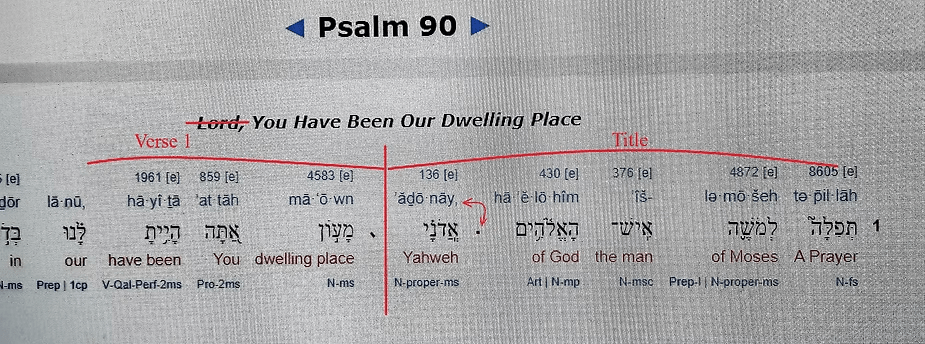
The title of Psalm 90, as given by translation services, often takes what David wrote in verse one, which is not read as part of the song. Examples of this would be instructions to the “chief musician,” or a statement about the psalm being dedicated to the “sons of Korah.” This particular Psalm has punctuation that is ignored in how the NRSV states: “God’s Eternity and Human Frailty; A Prayer of Moses, the man of God.” In that, the title is a creation of the NRSV, based on the verbiage in the song. When they place in the ‘title,’ “A Prayer of Moses, the man of God,” this comes from what David wrote in verse one. However, that is not all that David wrote for that title.

In verse one, prior to what is considered to be the song lyrics of verse one, is this [in transliterated Hebrew]: “tə·p̄il·lāh lə·mō·šeh ’îš- hā·’ĕ·lō·hîm ’ă·ḏō·nāy ,” which translates literally into English saying, “a prayer of Moses man haelohim adonay”. The Hebrew words “haelohim adonay” are the reverse of that written in verse seventeen: “adonay elohenu.” What the NRSV has done is ignore the fact that there is no comma mark at the end of “haelohim,” choosing to make believe one should be there, because they do not understand how David could write, “A Prayer of Moses man of elohim adonay.” They should translate that (according to the cheat sheet about how to translate “elohim” and “adonay” in the singular, rather than the plural) as “A Prayer of Moses man of God Lord.” Because that sounds funny, they take “adonay” and pretend it is the first word of verse one, translating that as saying, “Lord, you have been our dwelling place in all generations.” None of that is said by David.

The reality of what David wrote as the precursor to verse one is this [my capitalizations, as Hebrew has no capital letters]: “A Prayer of Moses man of saints lords.” This takes the word “elohim” and recognizes that as a statement of a divinely possessed person. Moses was not just some really cool guy who did some stuff, like calling him a “man of God” would imply. A “man of God” could be a title given to any priest or “man of the cloth,” including all the pedophile priest of the Roman Catholic Church, before they have been outed as such. Anyone who claims to be a ‘believer of God’ can also take on the title “man of God.” It is meaningless. To then add “lords” to that [the confusion the translators into English face, which forces them to ignore marks of direction and make things up] means one needs to understand “lords” is a statement that all “elohim” serve Yahweh as His wives [souls married to His Spirit], but all wives of Yahweh [“elohim”] are then sent out into ministry to lead others to also be Yahweh’s wives [souls married to His Spirit]. As such, those “elohim” will become the teachers of others, as divine “lords.” In all cases, Yahweh is the Lord who rules over each individual wife [body of flesh animated by a soul], so both “elohim” and “adonay” imply those of divine possession. However, both “elohim” and “adonay” can be demonically possessed; so, the naming of Yahweh must be indicated as who Lords over one’s soul. [“Yahweh” is found written by David in verse thirteen.]

In the Ordinary time after Pentecost, Year A, the first verse of Psalm 90 is read on two occasions [Proper 25 and Proper 28]. On both those occasions the title is not mentioned, with verse one beginning with the word “Lord.” This, as I have proved, is not written and makes it appear that Moses [who was told the name of Yahweh by Yahweh] would offer a prayer to a generic “Lord.” In reality, verse one states [literally translated into English from the Hebrew text], “dwelling place you have been ours , dwelling and dwelling .

Here, the Hebrew word “maon” is used to denote “dwelling place,” which can also say “habitation, dwelling.” Then, after the comma mark, the word “dor” is repeated [as “bedor” and “wador”], where the meaning each time is “dwelling, period, generation.” This says David began this song by saying Moses took the children of Jacob and transformed them [those who entered the Promised Land] all into “elohim adonay” as the priests of Yahweh whose souls “dwelled in Yahweh, from generation to generation … always.” The only truth of an “Israelite” is one “Who Retains God,” as an “elohim adonay.”

When one understand that theme statement, which states the basic premise of this Psalm 90, one can then leap-frog over the first eleven verses and jump right into verse twelve, knowing this is a song that acts as “a prayer of Moses, who was the main “god of Yahweh” over a band of “gods of Yahweh,” who would become the “lords” teaching how to be “gods of Yahweh” in the world. With that understood, here is a verse-by-verse breakdown of the rest of Psalm 90.

Verse twelve says, “to appoint our days set upright aware ; that we may gain a mind of wisdom .” As “a prayer of Moses,” which David wrote through divine insight, connecting to the same source of “wisdom” as was both his and Moses’ to know, this prays that all the “days” of one’s life that “count” are those when one is learning how to live righteously from Yahweh; and, in turn, one is “teaching” others how to live likewise. This is the life of an “elohim,” and the teacher that makes one an “adonay.” Everything comes from the “Mind of Yahweh,” which is only accessible by His wives [souls married to His Spirit].

Verse thirteen then literally sings, “return Yahweh until when ; and be sorry , upon you slaves .” As a soul in a body of flesh in the earthly realm, a soul being eternal means it will “return” to be one with “Yahweh” at death, when the soul is released. That is a time of Judgment, when how a soul lived during its time on earth will determine how the future will be ruled to be. Only when a soul “returns to Yahweh” while in the flesh, “until when” death will come, can it be freed from a sentence [self-imposed] that says, “Return to earth and try again.” Thus, to be married to Yahweh means to repent and “be sorry” for one’s past sins. Then one accepts that an “elohim adonay” is a willing “slave” to the Will of Yahweh, for the Promise of Salvation [the true Promised Land].

Verse fourteen then literally sings in English, “us to be satisfied with the dawning of goodness ; that we may joyfully sing and be glad , all our days .” This says that the promise of Salvation brings about the energy of first light in the “morning,” when the sleep of death is shaken off. The light of truth is rising above one’s head, to light one’s path of righteousness. The light of “day” is the truth of heaven, so a soul still in the flesh wants to always sing songs of praise to Yahweh, knowing His presence within. One realizes heaven is wherever Yahweh is; so, heaven is being an “elohim” of His. This is not temporary, as is a “day” in the physical realm, where the revolutions of the earth cause day to turn to night. Instead, the presence of Yahweh within makes it “always day” to the wives of Yahweh.

Verse fifteen then literally sings in English, “make us glad for the days you have afflicted us ; the years , we have seen evil .” This sings that true praise, coming from knowing Salvation, can only come from a personal perspective of having lived a life of sin and then know those sins have been erased through divine marriage. This says the “years” of one’s history with sin are no longer the misery of daily regrets. By having personally “seen evil,” one knows how close one’s soul had come to eternal damnation. Yahweh lets one see the errors of one’s ways, so true repentance is the first step towards Redemption. The promise of Salvation makes one sing with gladness, in all one’s remaining “years” in the flesh.

Verse sixteen then literally sings in English, “let see in your servants your work ; and your honor , upon the children .” This sings of the ministry for Yahweh that all His “elohim” have sworn [the vows of the Covenant] to maintain. The Mind of Yahweh leads one to see the path of righteousness, which becomes the “work of servitude.” All of that “work” is done in “honor” of Yahweh. When “the children” are seen as the “work” done, the reality is the “sons” created through ministry, with all of them being new souls married to Yahweh. Each of the “elohim” will give birth to a possessing soul [in the name of Yahweh – “Jesus” – “Yah[weh] Will Save”]. That is the “Son” of Yahweh resurrected in all His children.

Verse seventeen then literally sings in English, “and become the pleasantness of lords of us gods of you , and upon us the work of our hands set above ; and the work of our hands , to be certain .” From having ended verse sixteen with the element of “children” being those to whom Yahweh is “upon,” this is now stated in the final verse of this “prayer of Moses” as a state of being that will “become the pleasantness [or beauty] of “adonay elohenu,” which is the multiplicity of “lords of us gods,” who are all the servants of Yahweh. It is this servitude that is twice stated, as “upon the work of our hands.” In that, “our hands” can be stated as “the hands of us,” which is a reflection of the plurality of “adonay elohenu,” who are “lords of our self-souls married to Yahweh.” Again, the word “adonay” means “lords,” which is the work assigned to “elohim,” which is ministry – “the work of our hands.” That ministry is directed by Yahweh and manifests exactly as it did in Moses, who was the prototypical “man of elohim adonay.”

As the accompanying Psalm to the reading from Amos, who was another example of “a man elohim adonay,” one who spoke the Word of Yahweh to the leaders that called themselves Israelites. They saw themselves as sons of a God none of them knew personally; and, that is the reason Amos did the “work” of Yahweh, as one of His “hands” on earth. Everything David sang about, as “a prayer of Moses,” the prayers of an “elohim adonay,” Amos did. All the Saints of Jesus were “elohim adonay,” who taught us children the lessons of faith and commitment. Because we are blinded by English translations that keep our leaders from knowing an “elohim adonay” when one comes up and says, “You have it all wrong,” people calling themselves holy still kill the messengers, just as they did in ancient Israel. That is always a sign that a society is headed for ruin. The reason is nobody will be transforming into “the pleasantness of the adonay elohenu,” for which David prayed, in the name of Moses.

When this song of praise is read loudly on the twentieth Sunday after Pentecost, when one’s own personal ministry for Yahweh should already be well underway, the lesson is to take the time to look at what it is you say you believe, when your eyes have been purposefully blinded from birth, by those who pretend to lead you to heaven. One needs to see these are the “years” of one’s life when one is “seeing evil” and doing nothing to remove the regrets of sins. The lesson is to [once again, as evermore in Scripture] to marry one’s soul to Yahweh and become His “elohim,” with the intent on being one who “lords” others to the same state of commitment. [Be a good shepherd.] To marry Yahweh, one first needs to love Him, and true love means doing everything that attracts Yahweh to your soul. That means looking at what He said through all his “elohim adonay.” That would be a wonderful first step towards true love.

Psalm 104:1-9, 25, 37b – Kneels my soul to Yahweh

1 Bless Yahweh, O my soul; *

Yahweh elohay, how excellent is your greatness!

you are clothed with majesty and splendor.

2 You wrap yourself with light as with a cloak *

and spread out the heavens like a curtain.

3 You lay the beams of your chambers in the waters above; *

you make the clouds your chariot;

you ride on the wings of the wind.

4 You make the winds your messengers *

and flames of fire your servants.

5 You have set the earth upon its foundations, *

so that it never shall move at any time.

6 You covered it with the Deep as with a mantle; *

the waters stood higher than the mountains.

7 At your rebuke they fled; *

at the voice of your thunder they hastened away.

8 They went up into the hills and down to the valleys beneath, *

to the places you had appointed for them.

9 You set the limits that they should not pass; *

they shall not again cover the earth.

25 [24] Yahweh, how manifold are your works! *

in wisdom you have made them all;

the earth is full of your creatures.

37b [35b] (Bless my soul with Yahweh) Hallelujah!

——————–

This is the accompanying Psalm for the Track 1 path for a church that will be read aloud in unison or sung by a cantor on the twenty-first Sunday after Pentecost [Proper 24], Year B, according to the lectionary for the Episcopal Church. It will follow a reading from Job 38, where Yahweh responds to Job, saying “Gird up your loins like a man, I will question you, and you shall declare to me.” This set will precede a reading from Hebrews, where Paul wrote, “So also Christ did not glorify himself in becoming a high priest, but was appointed by the one who said to him, “You are my Son, today I have begotten you”; as he says also in another place, “You are a priest forever, according to the order of Melchizedek.” All will accompany the Gospel reading from Mark, where Jesus said to his disciples, “You know that among the Gentiles those whom they recognize as their rulers lord it over them, and their great ones are tyrants over them. But it is not so among you.”

In the above English translation presented by the Episcopal Church, you will notice how I have replaced with bold type the proper name “Yahweh.” Three times in these selected verses the error has been made in translating the name Yahweh with “the Lord,” reducing the significance of His name to a generality. I have restored that truth. Also, in verse one is found the word “elohay,” which translates as “us gods,” not “my God.” That translation is wrong and misleading one away from asking, “What does elohay mean?” Further, the NRSV [supposedly the source of the Episcopal Church’s translation] shows Psalm 104 with a total of thirty-five verses. The Episcopal Church has then misnumbered what the NRSV shows as verse twenty-four and verse thirty-five, as “25” and “37b.” I have restores the proper verse numbers, in brackets. Finally, Verse thirty-five ends by repeating what verse one begins with: “Bless my soul with Yahweh,” but they want to ignore that repetition and simply use the last two words written by David: “hal·lū-yah.” I have added the omitted repetition, placed in parentheses.

You might notice that the literal English translation that I have placed in verse thirty-five (in parentheses) is not the same as the same words translated by the NRSV, in verse one. To read, “Bless the Lord, O my soul; the Lord my God, how excellent is your greatness,” sounds like David (the author) or you (the reader) are really the special one in this verse. That special state is because you can whistle Yahweh over, like a dog, and tell Him, “Bless my soul. That’s a good boy. It is so wonderful for me to have a good pet God at my command.” This is (minimally) confusing, because American Christians love every crack in the armor to falsely pretend to honor a God they cannot see and have no true relationship with.

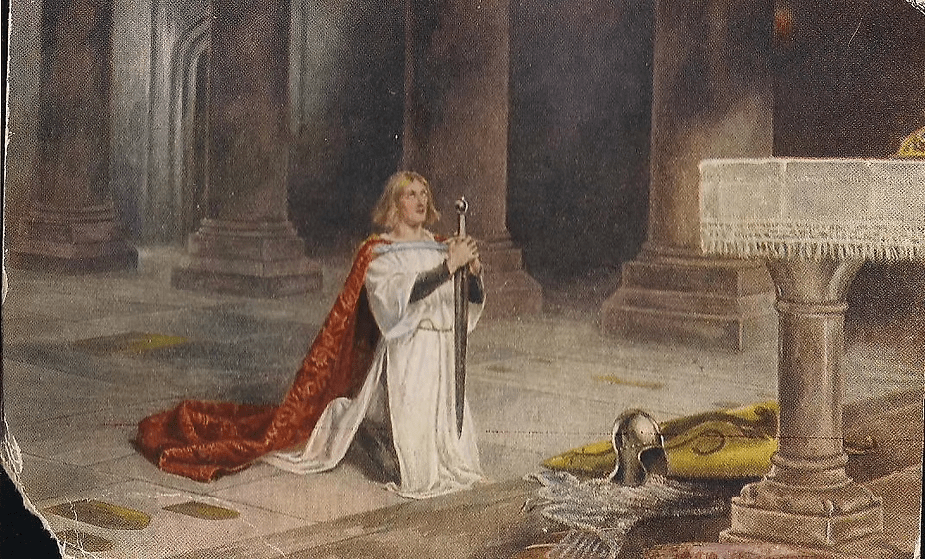
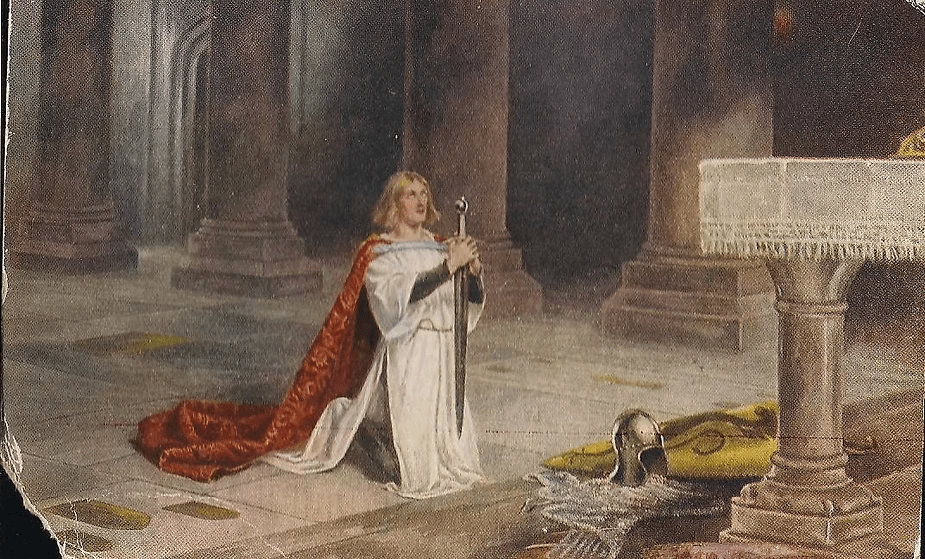
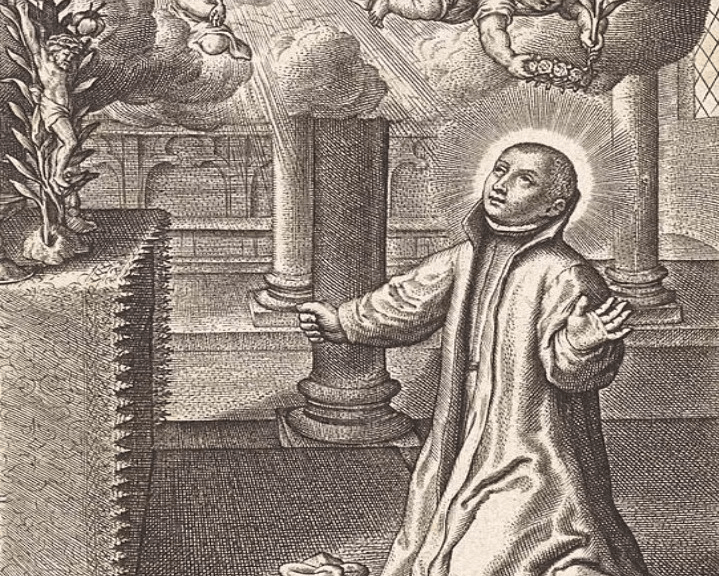
Verse one literally translates into English saying this: “kneels my soul , to Yahweh Yahweh gods of me you become great very ; majesty and splendor you clothe me .” In this, the Hebrew word that begins the verse is “barak,” which means “to kneel, bless.” To translate it as “to kneel,” one sees that this is a “soul” taking a position of subservience, such as a knight would kneel before his king. This means “bless” is a request from obedience and servitude, so one bows down in submission first, in order to be “blessed.” It is not human flesh that is kneeling or being blessed. It is “my soul” or the “soul of me.” The first two words are then a prayer by David, which must be uttered by all who love Yahweh.

As Paul wrote, “Put on the full armor of God, so that you can take your stand against the devil’s schemes.”

The name “Yahweh” is stated in back-to-back words. The first connects to the One to whom a soul seeks blessing. “Yahweh” is the name a human being (soul in flesh) kneels at the altar of marriage with, where all souls in human flesh are the brides of Yahweh, bowing down in a solemn act of union. The “blessing” that comes from that marriage is the name Yahweh. When married, a soul does not run around showing everyone his or her ring (a halo), saying, “I am now Mrs. Lord.” The soul proclaims “Yahweh.” Anything less says a soul has never been to the altar and “knelt one’s soul” down before “Yahweh.”

The second use of “Yahweh” leads to the Hebrew word “elohay,” which is a possessive use of “elohim,” which is plural in number and means “gods” [certainly not God, in the singular, upper case]. The possessive says “Yahweh” has many “gods” who serve Him in marriage, where the “elohim” are His creations: angels, spirits, and souls; but they are those “elohim” who serve only “Yahweh,” not the fallen “elohim” (angels), who love to play games with souls in human flesh. Thus, the meaning of “Yahweh elohay” is one’s soul has married into a great family of divine creatures, all of who have taken on the name “Yahweh” as His wives, so “Yahweh’s gods” are those to whom one’s “soul” has joined (“of me I am one”).

This marriage of a “soul” to the Spirit of “Yahweh” is how one then knows (from personal experience) that “Yahweh is great.” The Hebrew word rooted in what David wrote here is “gadal,” which means “to grow up, become great.” Because Yahweh cannot be bigger than He already is [Yahweh is EVERYTHING], then it is only one’s “soul” that can experience such “growth” of “greatness.” One’s soul does not become itself “great,” but it has become merged with a “greatness” that makes one’s soul feel minute and insignificant. This is why one stays kneeled before “Yahweh,” serving His Will in any way He commands.

The final segment of words in the first verse then speaks of how a “soul” feels the “greatness” of “Yahweh” wholly encompassing it. It brings on “honor” and “majesty” that did not exist when simply a soul giving life to a body of death. It is this sense of “splendor” that the metaphor becomes a soul’s “clothing.” This is the truth of being in the name of “Yahweh,” as His presence brings on the robes of righteousness and that clothing keeps one from wanting to ‘run outside and play in the dirt,’ like a foolish child. It brings on the sense of royalty that is the responsibility to live according to the marriage vows, which are generally termed “the Covenant.”

Verse two then expands on this holy clothing. David sang, “which cover with light like a garment ; which stretches out spiritually like a curtain .” The use of “light” means one’s righteous ways can be seen, but the source of the “light” is unseen. Thus, the translation of “shamayim” should not be read like the “light” of the “heavens,” where the earth’s sun shines and other stars twinkle; but the word means “spirituality” that penetrates through walls and is ever-present. The “curtain” becomes the unseen presence of Yahweh’s Spirit, which has become one with one’s soul.

Verse three then sings literally, “his encounters are like in the waters , his roof chamber makes the nebulosity of clouds his chariot ; who comes upon the wings of the spirit .” Because the last word of this verse is “ruach,” meaning “spirit,” everything is relative to that marriage to a soul. It comes on like an outpouring of water. This is why baptism is associated with a cleansing by water, but it is purely Spirit. The head is the “roof chamber” of one’s body of flesh, where one’s brain connects the body of flesh to the soul’s commands. The Spirit of Yahweh is like a cloud that cannot be seen, but is completely known to be. This makes one’s body of flesh become the “chariot” in which Yahweh moves on the earth. When “wings” is applied to this, it should be seen as a supporting statement about an “elohim” being an angel; but “wings” are metaphor for the merger of soul with Spirit, as one of Yahweh’s angels in the flesh. Christians know this as the presence of Jesus’ soul within one’s being, which gives one his “wings” of ministry.

Verse four then repeats “rauch,” saying, “which his messengers spirits ; his servants blazes of fire .” In this, the Hebrew word for “messengers” is the same that says “angels,” as a “malak” is an “angel” of Yahweh who becomes His “messenger” on the earth. The word that translates as “servants” is the same that means “ministers,” where “sharath” is a statement of “ministry,” as Yahweh’s “messengers.”

Verse five then sings literally, “added earth above the foundations ; not it should be shaken , futurity and perpetuity .” While it is easy to see these Hebrew words and think of the greatness of Yahweh during the Creation, as “You have set the earth upon its foundations, so that it never shall move at any time,” that is meaningless drool. The “addition” to the “earth” is the marriage of the Spirit to the flesh of a human being. This raises that “flesh above the foundations” that were its prior self-entity. This divine union is then not possible to be “shaken” loose, where a soul in marriage is able to divorce Yahweh. Marriage of this divinity is forever, beyond the soul’s animation of dead matter (“futurity) and through all eternity (“perpetuity”).

David then sang literally in verse six, “with the sea a garment you covered it ; above the mountains stood the waters .” This appears to be David recounting the Great Flood, when all the “earth” was under the “waters” of the oceans and “seas.” This is speaking metaphorically of the baptism of the earth by water, which was the only time such a cleansing by water would take place. The metaphor of water is the emotional state of being, from which love is one totally misunderstood by human brains. The metaphor David used from the Noah theme was telling how Yahweh elohim are those who are totally engulfed by His Spiritual presence, so much that if one was a “hill” or one was a “mountain” among men, one is unable to break the surface of Yahweh’s “raiment.” One bows down before that immense greatness.

In verse seven the Hebrew then literally translates into English as, “from your rebuke they escaped ; from the sound of your thunder , they hurried away .” This verse needs to be seen as having applications to the accompanying Gospel (Mark 10:35-45), as James and John, sons of Zebedee, were known as the “sons of thunder” (“Boanerges”). This would be because they were big and burly (formerly fishermen) and could intimidate others with a fierce look. Here, David is saying Yahweh is much greater than the most powerful of earth (kings and rulers). Those are who Yahweh causes to tremble and run. When seen as demonic elohim trying to steal a soul, this sings of those souls who “escaped” damnation, because they turned away from evil elohim. Thus, the “sound of Yahweh’s thunder” is as booming as Jesus telling Satan, “Away from me, Satan! For it is written: ‘Worship the Lord your God, and serve him only.’” There is no evil spirit that will challenge Yahweh for a soul.

In verse eight, David returned to the “mountains that the “waters” had “stood above.” [Verse six.] Following the “rebuking” of the evil elohim, we see that souls have “ascended above the mountains and descended into the valleys ; into the place you established for them .” Here, the lesson taught by Jesus in Mark’s Gospel reading – “whoever wishes to be first among you must be slave of all” – the highs and lows of life says the “place established” by Yahweh for “them” is their souls. It is the soul that becomes heaven, due to the presence of Yahweh. So, regardless of what the world throws before one, a soul has been promised eternal life beyond the physical realm.

David then literally sings in verse nine (in English), “a boundary you have set not that they might pass over ; not that they may return , to cover the earth .” In this verse, David sang divinely of the duality that is first a “boundary” that determines who “might go beyond.” It then refers to those who earn the right to Salvation and those who do not. In this, the root of the Hebrew word “abar” is written [transliterated as “ya·‘ă·ḇō·rūn”], with this word meaning “Passover.” This become the “boundary” that is “death,” where physical “death” is the separation of a soul from its body of flesh. To “Passover” to eternal life, a soul must have been married to Yahweh prior to death and a servant of His in ministry prior to death. Those who have met this “Passover” requirement gain eternal life; but those who do not meet the demands, they will be recycled: reincarnation – same soul, different body of flesh.

This then leads to the two segments following the semi-colon, where those souls that “not may return” to be One with Yahweh will then be those who “to cover the earth.” Again, the word “earth” expands beyond dust and dirt, meaning the physical cells that grow and form into bodies of flesh, maintained by Yahweh and a soul of living breath. Of course, the Exodus story of the “Passover” says a soul must wear the blood of the sacrificial lamb around its doorframe, in order to avoid the angel of death [Yahweh elohim]. Christians know this as the blood of Jesus; and, that means to “Passover” one must have married a soul to Yahweh [be an Israelite] and then be reborn in the name of His Son Jesus, so one’s own physical blood becomes the blood of Jesus. Still, the use of blood becomes metaphor for the Spirit, which is the inundation of waters that encompasses one’s soul.

Here the Episcopal Church leaps forward to what the NRSV shows is clearly verse twenty-four [not twenty-five]. In that verse David literally sang (in English translation), “how many your deeds Yahweh them all in wisdom you have made ; is full of the earth , your acquisitions .” In this, it is imperative to realize that nothing happening on the physical plane is done by Yahweh. Yahweh created elohim to make all that is not the pure Spirit of Yahweh. Thus, all “deeds” or “works” done in the world are those coming from the “wisdom of Yahweh,” which comes through those souls in the flesh who do His Will [His elohim]. That is the meaning of the word “acquisitions,” which means those souls “possessed” by Yahweh’s Spirit.

This is then where the Episcopal Church jumps to the last two words of the Hebrew text, converting them to the misunderstood word “Hallelujah!” The two words are combined as “hal·lū-yah,” where “hallu” means “praise” and “yah” is an abbreviated form of “Yahweh.” Thus, the word means “give Yahweh praise!. That praise is owed to Him by souls who have found Redemption and Salvation.

This is why I also add the repetition of the beginning words from verse one, which sings, “kneel my soul to Yahweh.” This is the submission of one’s soul to the only way to find eternal life returned to one’s soul, no longer having to be recycled through reincarnation. Thus, a soul “gives Yahweh praise” because He has accepted one’s soul in marriage, both kneeling together at His most Holy Altar. [Realize a soul has no sexual identification. It is a wife because it is within a body of matter, which reflects the feminine or receptive state of existence.]

As the accompany Psalm to the Track 1 reading from Job 38, where Yahweh responds to His servant Job, Yahweh spoke to Job as a happy Father, knowing Job had passed the test allowed by Yahweh, which made it possible for Satan and his elohim to challenge the marriage commitment between Job’s soul and Yahweh. Job 38 is then Yahweh speaking to His wife in the same way that David knew Yahweh speaking to his soul. This is why knowing the proper name Yahweh is so important. It states the name of one’s Husband in marriage, the One whose name one takes in that transaction, so Yahweh becomes much more than some “lord.”

As a reading for the twenty-first Sunday after Pentecost, when one’s own personal ministry for Yahweh should already be well underway, the lesson here is to see the truth of “Yahweh elohay.” One needs to see the plurality of many “gods” [Saints] who are in the name of “Yahweh,” with one’s own soul expected to become one as well. Yahweh must be seen as so “great” that His Spirit could encompass every soul on earth; if they would all open their hearts to His love and “kneel down before Him” in submission and marriage. The lesson is to see the truth of “ministry,” which can only come when one has been Anointed by Yahweh’s Spirit and sent out into the world as His servant-messenger-angel. The lesson to realize is no good can come from pretending to be a servant of Yahweh, when one refuses to say His proper name, because one worships Jesus as a god, replacing Yahweh as one’s elohim. Jesus is the servant sent by Yahweh into His wives, so one can minister to the world as a true extension of Yahweh, as a soul that has indeed passed over.

Psalm 91:9-16 – Knowing the name Yahweh

9 Because you have made Yahweh your refuge, *

and the Most High your habitation,

10 There shall no evil happen to you, *

neither shall any plague come near your dwelling.

11 For he shall give his angels charge over you, *

to keep you in all your ways.

12 They shall bear you in their hands, *

lest you dash your foot against a stone.

13 You shall tread upon the lion and adder; *

you shall trample the young lion and the serpent under your feet.

14 Because he is bound to me in love,

therefore will I deliver him; *

I will protect him, because he knows my Name.

15 He shall call upon me, and I will answer him; *

I am with him in trouble;

I will rescue him and bring him to honor.

16 With long life will I satisfy him, *

and show him my salvation.

——————–

This is the companion Psalm to the Track 2 Old Testament reading from Isaiah 53, where the prophet wrote, “like a lamb that is led to the slaughter, and like a sheep that before its shearers is silent, so he did not open his mouth.” This song will be read aloud in unison or sung by a cantor on the twenty-first Sunday after Pentecost [Proper 24], Year B, according to the lectionary for the Episcopal Church. The pair will precede a reading from Hebrews, where Paul wrote, “[Jesus] learned obedience through what he suffered; and having been made perfect, he became the source of eternal salvation for all who obey him, having been designated by God a high priest according to the order of Melchizedek.”

This is the second half of Psalm 91. The first half will be read (six verses) during the Ordinary after Pentecost season in Year C. You will notice how I have restores the proper name written by David – “Yahweh” – replacing the poor substitute that says “the Lord.” In verse two, there is another mention of the proper name “Yahweh,” with a later word in the verse that is “elohay,” which means “gods of me” or “my gods.” This is a signal that David knew the difference between one particular God – Yahweh – and the One of many “gods.” And, he knew that those who served Yahweh were His “gods,” as souls married to His Spirit, becoming extensions of Him on earth. This should already be realized by the time one reads verse nine; so, I have filled you in on what the reader needs to know for this song of praise to make sense: One needs to be one of Yahweh’s elohim.

Verse nine literally translates into English from the Hebrew as stating, “when you Yahweh my shelter ; the highest , have set your dwelling place .” This sings of marriage to Yahweh. To have Yahweh as one’s shelter or refuge, one has then submitted to His Will by agreeing to His terms of marriage – the Covenant. To think that Yahweh will be some form of protection otherwise means to think Yahweh is one’s bought and paid for bodyguard, who comes whenever you whistle for Him. That is the lowest way of thinking about Yahweh [seen by those who call Him “the Lord,” not His name – because it is not his or her name through marriage]. The “highest” is how one’s soul has been elevated through divine marriage, which is how Yahweh is one’s “shelter.” When David sang of Yahweh dwelling in him, he knew the presence of Yahweh within, as one of His elohim.

Verse ten then literally translates to say, “not shall encounter towards evil ; any plague not shall come near your tabernacle .” In this verse, David is continuing praise for one whose soul has become one with Yahweh and the “shelter” that affords one’s soul. That soul will not be approached by evil elohim, trying to steal that soul for Satan. The presence of Yahweh’s Spirit will be known by those “evil” elohim as being off limits. When the story of Job tells of a “plague” placed upon his skin, that was allowed by Yahweh. Satan had complained that Job had a “hedge” that kept evil away, which Yahweh lowered in that case; but the soul where Yahweh resides becomes His Tabernacle (within a body of flesh) and no pox will come near that spiritual residence. This is not a guarantee against physical ailments, as it only is insurance that the soul will never again be led to take its body towards sin.

Verse eleven literally translate to sing, “when his angels he will command over you ; to preserve you in all his manners .” Here, if one can find it within oneself to believe in “angels,” which comes from the Hebrew word “malak,” a word that truly means “messengers,” then one must believe the elohim are the same. If one believes Yahweh has the great power to Create “gods,” then one can see the eternity of a soul as a “god,” which “lords” over one body of flesh. David is then saying that one’s soul, once committed to Yahweh in marriage, will be given elohim as his or her assistants, in the same way that Jesus said he would send an Advocate. This is not some book or idol to keep in one’s home or on one’s body, as some lucky charm. It is the presence of Yahweh coming into possession of His wives, via divine spirits in His name. It is this presence that makes one capable of righteousness.

Verse twelve can then be read as singing, “above hands they shall lift you up ; lest you strike a stone with your foot .” In this, the preposition “above, over, upon” (from “al”) becomes a statement of elevated assistance, which is just like we read in Matthew 4:11b, “angels came [to Jesus after he was tested by Satan] kai were ministering to him.” To be “lifted” means the same as reading Job was an “upright man.” That does not say Job stood up on his own two feet. It says to be divine, as a saint, a soul has to be “raised” by heavenly “hands.” The use of “eben,” as a “stone” in one’s walk path, is actually metaphor for the “stone” tablets that have the Covenant inscribed on them (etched in stone by Yahweh). The “foot” is metaphor for sin (a body in touch with the earth), so David sang that one’s path (one of righteousness) is raised off the level of a sinner, so no sins will be possible.

Verse thirteen then sings literally: “above the lion and venomous serpent you shall tread ; you shall trample the young lion and the sea monster .” In this, two pairs or similar words are repeated. The Hebrew word “shachal” means “lion,” which is a beast that symbolizes courage. It is then stated as “kephir,” which says “young lion,” which becomes a symbol of restless energy, or uncontrolled violence. In the beginning is written “pethen,” which is a venomous serpent, thought to be a “cobra.” This then symbolizes a quick strike capability, with deadly consequences. This word is then offset by the use of “tannin,” which is a “serpent, dragon, sea monster.” The symbolism here is the Leviathan, which is the elohim that lurks within a sea of souls on the earthly plane. Thus, with all of this seen, David was singing that all of Yahweh’s elohim, as souls married to Yahweh and assisted by His angel elohim, become more powerful than a courageous lion and more agile than a cobra; so, this elevated position acts as a restraint that keeps one from falling as prey to the acts of youthful exuberance and soul-condemning acts where a soul is sold to a demon spirit (the metaphor of a “sea monster”).

Verse fourteen then sings literally, “when I have been attached by love therefore I will escape ; set upon the most high , that to know name .” In a verse that sings of “love” (from “chashaq”) and “name” (from “shem”), this sings of a theme where a wife (a soul) taking on the name of her Husband (Yahweh). The “escape” (from “palat”) is both the trappings of Satan while in a body of flesh [the rising above the “lion and cobra”] and the soul’s freedom to eternal life after death. Marriage to Yahweh means no more reincarnations and having to start all over again, trying to find one’s way to loving Yahweh and saying “Yes” to His proposal for marriage. Once one has made that divine commitment, then one’s soul become “highest” one can be,

Verse fifteen then sings literally in English, “he shall call and I shall answer , with him I am in trouble ; I will withdraw with honor .” This is David singing about the servitude of a wife of Yahweh. It says a soul is in touch with His voice; so, when He calls, His wives will respond. The Hebrew words “‘im·mōw-’ā·nō·ḵî” (from “im anoki”) say, “with I.” That becomes a statement that says: when a soul is married to Yahweh, then the “I” (or “ego”) becomes the sacrifice. One’s ego is the source of all “troubles,” but when Yahweh becomes one’s “I” (in His name), then all troubles are nothing to fear. In these cases, a Son of man (males and females included here) will be sent into places of “trouble,” with no fears. Therefore, when one’s ego has “withdrawn” (from “chalats”), it then becomes a saint, with all “honor” given to Yahweh.

Verse sixteen then literally sings in English: “long days I will satisfy him ; and regard him , my salvation .” The Hebrew words “orek yamim” literally state “long days.” The essence of “long” is eternity, for as “long” as it lasts, which is forever. The plural of “yom” then places focus on the light of “day,” where there is no darkness. Heaven is where only the light of “day” exists, as there is no earth to rotate and turn away from the light of Yahweh. This means for one to reach that heavenly state of being, one’s soul will have “satisfied” the Will of Yahweh, so that soul has been allowed that wonderful state of existence. The root Hebrew word “raah” is translated as “regard,” when it literally means “to see.” This means one has become an angel of Yahweh who “sees” His light and sings eternal praises to His graciousness. Those praises are due to it being for “my salvation,” which is the Judgment of a soul that has married Yahweh and passed all the tests of the worldly plane.

As the accompanying Psalm to Isaiah’s song praising Yahweh’s protection over the innocent who serve Him, defeating evil, the lesson here is to become married to Yahweh in soul. One needs to take on His name, which is “Jesus” – a name that means “Yahweh Saves.” The only way a soul finds “my salvation” is through subservience to Yahweh, serving Him as His Son resurrected within one’s flesh. In the period after Pentecost, which is a season when ministry for Yahweh should have begun, in repentance for redemption towards salvation, one should be the truth embodied for others to see. Nobody wants to hear one’s opinion what one thinks Jesus would say. All seekers need to hear Jesus speak to them, so they desire to be Jesus speaking to others also. This song of praise celebrates all souls who take those steps in divine sacrifice.

Psalm 34:1-8, (19-22) – Kneeling at the altar of divine marriage

1 I will bless Yahweh at all times; *

his praise shall ever be in my mouth.

2 I will glory in Yahweh; *

let the humble hear and rejoice.

3 Proclaim with me the greatness of Yahweh; *

let us exalt his Name together.

4 I sought Yahweh, and he answered me *

and delivered me out of all my terror.

5 Look upon him and be radiant, *

and let not your faces be ashamed.

6 I called in my affliction and Yahweh heard me *

and saved me from all my troubles.

7 The angel of Yahweh encompasses those who fear him, *

and he will deliver them.

8 Taste and see that Yahweh is good; *

happy are they who trust in him!

19 [Many are the troubles of the righteous, *

but Yahweh will deliver him out of them all.

20 He will keep safe all his bones; *

not one of them shall be broken.

21 Evil shall slay the wicked, *

and those who hate the righteous will be punished.

22 Yahweh ransoms the life of his servants, *

and none will be punished who trust in him.]

——————–

This is the Track 1 accompanying Psalm that will be read aloud in unison or sung by a cantor on the twenty-second Sunday after Pentecost [Proper 25], Year B, according to the lectionary for the Episcopal Church. It will follow a reading from Job 42, where we are told, “The Lord blessed the latter days of Job more than his beginning; and he had fourteen thousand sheep, six thousand camels, a thousand yoke of oxen, and a thousand donkeys. He also had seven sons and three daughters.” That pair will precede a reading from Hebrews, where Paul wrote, “Consequently [Jesus] is able for all time to save those who approach God through him, since he always lives to make intercession for them.” All will accompany the Gospel reading from Mark, where we read, “The blind man [Bartimaeus] said to [Jesus], “My teacher, let me see again.” Jesus said to him, “Go; your faith has made you well.” Immediately he regained his sight and followed him on the way.

This Psalm is read in part several times in the lectionary cycle. In three consecutive Sunday that were Proper 14, 15, and 16 this Year B cycle all twenty-two verses were sung aloud. I wrote about the meaning of the verses at those times, relating them to the accompanying Old Testament readings for those Sundays. I posted my observations on verses 1-8 last July; and that article can be read by searching this site. I also wrote about the ‘optional’ verses for this twenty-second Sunday, which were included in the commentary I presented about verses 15-22. That was made public last July and that article also can be read by searching this site. Because the verses have all been explained, their truth is constant; however, the application of that truth is modified when applied to different bases. Therefore, I will now add some insight that makes this song of praise fit the theme of Job 42.

In the twenty-two verses of Psalm 34, there are sixteen times the proper name Yahweh was sung in praise, Each time the NRSV (following the model of all other translators) modified this name of David’s specific God, in whom his soul was in a loving relationship, as “the Lord.” If one calls oneself a Christian, but calls Yahweh “the Lord,” then one is lying. The reason is the truth of the identifying word “Christian” is one’s soul has been personally Anointed by Yahweh, which (by definition of the Greek) means one is a “Christ.” Yahweh can Anoint as many souls as Yahweh sees fit. Yahweh does not Anoint the souls of translation service, because they have none. So, protocol has a translation service bow down and translate “Yahweh” as “the Lord.” To admit a translation service is “the Lord” over you, causing your soul to repeat what they write, then you worship a lesser “god” than Yahweh. Nothing of merit will come from Scripture by the wise and the intelligent, who are not souls married to Yahweh (as was David), so reading “the Lord” will keep the blind always leading the blind … heading towards the pit.

It is also worthy to recall that this whole song written by David is identified as: “A Psalm of David when he pretended madness before Abimelech ; and who drove him away ; and he departed.” This is then a song about David being on the run (with his soldiers loyal to him) from Saul, when David entered the sacred tabernacle in Nob and asked the high priest to give him the showbread to feed his men. Abimelech is a name that means “My Father Is King.” There is confusion as to the actual name of the priest at Nob being Ahimelech, which means “My Brother Is King.” The twist on the name written by David changed Ahimelech to Abimelech because Yahweh (the Father) possessed His servant (who was a brother of Israel, with David) and led him to do as David requested, as the showbread was placed before Yahweh (on the Ark), for His benefit. That ‘bread of heaven’ was then given to David to feed his men with spiritual food in the form of fresh bread (it was always kept hot and fresh by the presence of Yahweh, like fresh baked), so they could continue their evasion of Saul and his army. As a side not, Ahimelech and eighty-six priests in Nob would be executed by Saul, for having helped David elude him. That makes Ahimelech be himself and his priests willing sacrifices to Yahweh for the higher cause of serving Yahweh as the Father and King, not Saul.

The lyrics of this song then praise this sacrifice, which was injustice at the hand of Saul. As an accompanying song of praise to the tests of Job, where he was unjustly tested by Satan, having done no sins that deserved painful sores all over his body, Ahimelech and his fellow servants of Yahweh were promised their souls would be cared for. Thus each verse can now be read in the light of a soul’s protection, more than the comfort of one’s human flesh.

Verse one says all souls married to Yahweh will be identified as those who “kneel before Yahweh at all times.” The Hebrew word “barak” not only means “bless,” but also “to kneel.” This is the position a soul takes in the marriage ceremony, when one’s soul is joined with Yahweh’s Spirit. That marriage then has the Word of Yahweh always coming from one’s mouth. Job spoke that way.

Verse two then sings praise for Yahweh is due to one’s sense of gladness within, which is worthy of boasting, so others will desire to be the same. This has nothing to do with self, as one’s soul is humble, in submission to Yahweh. Still, His presence will make one shout with delight. Job spoke that way.

Verse three then sings of the greatness that a single soul takes on in marriage to the divine. This is then the elevated state of being that a wife realizes, when a soul and Yahweh share the same name in marriage. That name is “Jesus,” which means “Yah[weh] Saves.” Job spoke that way.

Verse four then sings about one’s soul having sought Yahweh, leading Him to find one and establish mutual love that two will share. Job knew that love of Yahweh.

Verse five then sings about the surrender of the face of self-ego, as to wear that in the presence of one’s most holy Husband brings shame upon one’s soul. Job wore the face of Yahweh, which means it radiated as did that of Moses [the face of Yahweh glows like a halo].

Verse six then sings that every soul in a body of flesh is a poor man. All the riches of the physical realm are nothing more than the illusion of life, because when the body of flesh can no longer support a soul, all things are left behind. Those souls who realize this become seekers and cry out for Yahweh to save them. Job knew those shouts quite well.

Verse seven then sings about the “angel of Yahweh” that surrounds one’s soul-flesh. This is what makes one a Yahweh elohim, as the “angel” is the merger of Yahweh’s Spirit, which brings about the resurrection of His Son with one’s soul. It is the “angel” Jesus that says one’s price for redemption has been paid and delivered. Job 42 tells of that delivery that rewarded Job forevermore.

Verse eight then sings of the personal experience of Yahweh, which is the “taste” a soul has from His Spirit. It is this personal soul experience that brings true faith. It is that faith that allows one to trust that one’s soul has been forever saved, allowing one to enter ministry without fear. Job had this faith.

The optional verses then skip down to verse nineteen, which sings about the many afflictions that come to the righteous. Those who serve Satan are souls he no longer has to worry about leaving him, so their lives appear free of hindrances. It is the righteous, who like Job are souls married to Yahweh, who are tested in their faith. It is that faith in Yahweh that delivers them a passing grade for putting up with Satan’s unjust afflictions. Job knew that salvation.

Verse twenty then sings as a prophecy of Jesus, who had no broken bones in his persecution before death. The word translated as “bones” is [transliterated] “‘aṣ·mō·ṯāw,” stemming from “etsem,” meaning “bone, substance, self.” This means the “self” must be seen as a “soul,” where no souls joined with Yahweh in marriage will ever have that union “broken.” While the body of flesh (which includes “bones”) might find all kinds of punishments unfairly, that “self” as spirit in “substance” will never be separated or torn asunder. Once a soul is married to Yahweh, it will never find divorce possible – nor will it want to divorce. Job knew this, despite all the pains he suffered in his test of faith.

Verse twenty-one then sings of the triumph of the righteous over evil. Just as Jesus told Satan, “Away from me, Satan!,” the power of Yahweh is known by all demon spirits and evil forces. They cannot tread upon holy ground, and one’s soul-body is such earth given life magnified. Job was “blameless and upright,” who “feared elohim [demon spirits] and turned away from evil. That says evil was turned away by Yahweh within his being.

Verse twenty-two then sings of redemption, which is when one’s soul has paid all the costs of being placed in a body of flesh, in the material realm, and tempted by Satan to turn away from Yahweh. All souls released by Yahweh’s breath, set as the animating factor in death that awaits, it is usual for a soul to become dirtied by the sins of the flesh. The price to pay for those sins is repentance, which truly comes from the sacrifice of oneself [one’s soul], in submission to serving Yahweh as His wife [regardless of human gender], so one will then be tested in that sincerity of repentance. None of those souls will be returned to start over again in the flesh. All will be redeemed, with the rewards of eternal life being far greater than anything the world can offer. Job’s story tells of that wonderful return on investment.

As a standard Psalm in the Episcopal lectionary schedule, this heading must always be remembered when it comes up, partially or in whole. The aspect of Abimelech says one must be a servant of the Father, having received His high priest Jesus to guide one through all persecutions. Abimelech, as Ahimelech, would sacrifice his life in that service, allowing David to feed his soldiers the spiritual food they needed. Jesus likewise sacrificed his life in the flesh, so his soul could return into those in service like Abimelech. Job was (in my mind) the Son of Yahweh after being banished from Eden, for the purpose of being tested as the first high priest who would reflect My Father is King.

As a reading for the twenty-second Sunday after Pentecost, when one’s own personal ministry for Yahweh should already be well underway, the lesson here is to establish a close, personal relationship with Yahweh. That begins by not referring to Him as “the Lord.” Yahweh can only become one’s true “Lord” after divine marriage, when a soul is made one with His Spirit. That cannot take place when your soul has not taken steps to be on a ‘first name basis’ with Yahweh. Being able to say His name means one is “in the name of Yahweh,” which is “Jesus.” Ministry can only be done right by Jesus having been reborn within one’s soul, which is the purpose of marriage.

Psalm 126 – The streams of the Negev

1 When Yahweh restored the fortunes of Zion, *

then were we like those who dream.

2 Then was our mouth filled with laughter, *

and our tongue with shouts of joy.

3 [2] Then they said among the nations, *

Yahweh has done great things for them.”

4 [3] Yahweh has done great things for us, *

and we are glad indeed.

5 [4] Restore our fortunes, Yahweh, *

like the watercourses of the Negev.

6 [5] Those who sowed with tears *

will reap with songs of joy.

7 [6] Those who go out weeping, carrying the seed, *

will come again with joy, shouldering their sheaves.

——————–

This is the companion reading to the Track 2 Old Testament selection, which will be read aloud in unison or sung by a cantor on the twenty-second Sunday after Pentecost [Proper 25], Year B, according to the lectionary for the Episcopal Church. It will follow a reading from Jeremiah 31, where Yahweh said to the prophet: “With weeping they shall come, and with consolations I will lead them back, I will let them walk by brooks of water, in a straight path in which they shall not stumble.” That set will precede a reading from Hebrews, where Paul wrote, “For it was fitting that we should have such a high priest, holy, blameless, undefiled, separated from sinners, and exalted above the heavens.” All will accompany the Gospel reading from Mark, where it is written: “Jesus and his disciples came to Jericho. As he and his disciples and a large crowd were leaving Jericho, Bartimaeus son of Timaeus, a blind beggar, was sitting by the roadside.”

This song of praise for the promise of restoration is one of the “songs of ascent,” which means it would have been sung by Israelites as they walked up the steps of Mount Ophel, in the City of David, to the place where the Tabernacle had been set up. It is a six verse song; but for some unknown reason the Episcopal Church has divided the second verse into two verses, making it appear to be seven verses. The NRSV (the source of the Episcopal Church’s translations) shows this psalm as being six verses. Therefore, I have placed the real verse numbers in brackets; and, I will refer to the proper verse number in my interpretations.

In the translations by the NRSV (and presumably others), four times the proper name Yahweh was written by David and all times the translation is shown as “Lord.” There would be no generic “lord” who would “restore the fortunes of Zion.” It was not some generic “lord” who “has done great things for us and them.” The only legitimate excuse for degrading the name of Yahweh to a generic “lord” is to make it appear that Christians are not Jews and Yahweh is the name of the “God of Israel.” That is a confession of a soul’s failure to realize that to be “in the name of” Yahweh means to be both married spiritually to Him (as His wife) and to be the mother of His resurrected Son, who name is Jesus. The name “Jesus” means “Yah[weh] Saves.” Therefore, to be “in the name of Jesus” means to be in the name of Yahweh … not in the name of some generic lord.

Verse one is poorly translated, as there is nothing written that says “restored the fortunes.” That written is [transliterated] “bə·šūḇ Yah·weh ’eṯ-šî·ḇaṯ,” from the roots “shub and shibah,” which say “return, brought back … captivity.” As a song of David, when there was no known “captivity” that the Israelites knew, other than that as the slaves of Egypt, the meaning of “Zion” becomes key towards understanding this verse.

The name “Zion” means “fortress.” When one realizes the City of David was formerly the “fortress” of the Jebusites, which were peoples who lived underground and had never been defeated by any leader of Israel, with an agreement signed by Abraham never to attack Jesus from underground, the use here denotes marriage to Yahweh. David symbolically married the Israelites to Yahweh when he took the “fortress” as his own and joined it with the Ark of the Covenant [and Tabernacle]. By doing so (at the command of Yahweh), David “returned” the Israelites to “Yahweh’s captivity,” relative to them being His slaves replacing the servants of His that were the Jebusites.

The remainder of verse one then explains: “we were like those who dream.” In that, the Hebrew words “hayah” and “chalam” better translate as “we became like those who are strong,” with that being an indication of those who “recover” and are “healthy.” This is David singing about the taking of Zion as the enslavement of all future Israelites (and thus Jews, and thus Christians) to serve Yahweh as His wives. That state of service is “like those who dream,” where a soul is as real is a dream, with neither being able to be pointed to as proof that dreams or souls exist. It is this “return to captivity” that is like the Israelites were in Egypt, when they had become “captives of Yahweh,” their most holy Husband. Marriage of their souls to Him meant the captivity of His possession or ownership, so Yahweh was the King of each Israelite (not David or any other human lord) and expected to serve Him absolutely. All of this responsibility is because the protectors of the land promised to the Israelites – the Jebusites – had been removed from having any power to govern or administer to the people, after David took their “fortress” and made “Zion” his capital city.

As the first verse of this song, it acts as the theme statement that all subsequent verses support. This makes it imperative to realize that David’s Israel had no fortunes prior that could be restored. The only true fortune each Israelite had was his or her soul. This means the name “Israelites” was not relative to the name of land on the planet Earth, but a statement about the souls of those who had Yahweh-assisted power to keep that land, because they each were “Those Who Retained Yahweh,” as His “elohim.” The Jebusites were earthly “elohim” who served Yahweh and protected the people after Moses led them to enter Canaan. Their souls were yo-yos between commitment to the Law and infidelity to that commitment; so, the Jebusites played a role in the placement of Judges. When David became the final Judge of Israel, the responsibility “returned Yahweh captivity to the fortress” that was each individual body of flesh, animated by a soul.

In verse two, the literal translation of the Hebrew into English has it say, “then was filled with laughter our mouth and our tongue with singing at that time they said among the nations ; great things Yahweh has done with these .” This has to be seen as the joy that comes from being a Yahweh elohim, when one’s soul feels the elation of union with His Spirit. One wants to laugh and play while singing loudly. This came when the people entered the Promised Land and were seen as one collection of people who shared the same purpose in life. They were truly a nation unto Yahweh, unlike any other nation on earth. Yahweh was their King, because all were subservient to His Will. When that presence led the people, great things occurred.

Verse three then literally translates to state: “great things Yahweh has done for us , we are glad .” Here, David is repeating the second half of verse two, which says all things great done by Israelites are the deeds of Yahweh, not human beings alone. All that Israel accomplished once in the Promised Land was due to Yahweh, with His assistant elohim helping in the overthrow of enemies. It is, therefore, that success led by Yahweh that makes David repeat the gladness in the hearts of all Israelites, as they all Retained Yahweh, each an el in His name.

Verse four then contains two words written in parentheses and brackets, which are “[šə·ḇū·ṯê·nū]“ and “(šə·ḇî·ṯê·nū),” repeating the “return to captivity” that was stated in verse one. The brackets indicate the past “captivity” in Egypt, with the parentheses representing an unseen or hidden “captivity” as the Sons of Yahweh, His elohim. Thus, the symbolism of a “return to captivity” is reflected in “as the streams in the Negev,” which is the “dry place” [another meaning of “Zion”] that is semidesert. Thus, the return of Yahweh captivity is like the dry earth seeks the rain, so when it comes it carves out a path that the water desires to take.

The metaphor of the Negev should be seen as would happen much later in history, when Ezekiel was a prophet of Yahweh and was asked, “Mortal, can these dry bones life?” The “valley of dry bones” can be seen reflected in the picture below. Dry bones are nothing but earth, void of the animation that comes from the temporary life of a soul. More than a soul being symbolic of the “streams” that run through the dry bones and then dry up, returning the bones to a dry state again [symbolic of incarnation and reincarnation], the outpouring that comes from a return to Yahweh’s captivity is eternal life, which never dries up. Thus, Yahweh told Ezekiel to prophesy to the dry bones so they would reach that eternal state of being.

Verse five then literally translates into English to say, “those who scatter seeds in tears in joy shall reap .” This means the ministry of a true Israelite, who sows the seeds of commitment to Yahweh to his and her family, so the children grow to maturity with the same set of values, learning to have faith in Yahweh. This means the tears sown will be the necessary cutting of the apron strings from the children, so they enter the world as adult bodies of flesh with a soul that is still unmarried to Yahweh. The tears will be from their sins, coming from breaking the promises of their parents, as Yahweh elohim. The joy comes when the lessons scattered onto dry bones take root and grow when the rain of love for Yahweh brings a flood of emotion in return. This is when the children will mature as the first fruits each season; and, Israel – a nation of people in service to Yahweh – will reap the benefits of that ongoing harvest.

Verse six then literally translates into English as: “walking he goes forth and weeping carrying a bag of seed to come and come again with rejoicing ; carrying his sheaves .” This states the expectations that come from teaching your children to love Yahweh and become His brides, generation after generation. The Hebrew that translates as “bag of seed” [“me·šeḵ-haz·zā·ra‘”] can equally translate as “trail of offspring.” This is David singing of the truth of an Israelite, as Yahweh elohim who continuously plant the seeds of priesthood for Yahweh, so the dry bones of the earth can be returned souls to Yahweh, without the pains and agonies of eternal reincarnations. The “rejoicing” comes when souls have married Yahweh and told the true Promised Land is Salvation and a return to Eden.

As a song of praise to be sung on the twenty-second Sunday after Pentecost, when one’s own personal ministry for Yahweh should already be well underway, the lesson is that of verse one: Return to Yahweh through captivity as His priests of servitude. The ministry of a true Christian today is no different that it was when David was the final Judge of Israel and wrote prophetic songs for souls to know and love. A false shepherd in modern times pretends to care about everyone in the world, while stepping all over the children that watch and learn, “Do as I say, not as I do.” If the children are led astray by such planters of doubt, then how can they lead a flock to find Yahweh in marriage? They will reap sheaves of weeds. That is dry bones saying the holy water of Yahweh is global warning and causing destruction of a natural environment where lizards and snakes love the dry wilderness. They see only the physical, never the spiritual. Israel split and fell just as has Christianity, because the priests of Yahweh have lost their way. Marriage to Yahweh and becoming His elohim [angles in the flesh, or Saints] is the only way to harvest a crop that isn’t only weeds.

Psalm 146 – Praising Yahweh as a reflection on Naomi and Ruth

1 Hallelujah! [Praise Yah!]

Praise Yahweh, O my soul! *

[2] I will praise Yahweh as long as I live;

I will sing praises lelohay while I have my being.

2 [3] Put not your trust in rulers, nor in any child of earth, *

for there is no help in them.

3 [4] When they breathe their last, they return to earth, *

and in that day their thoughts perish.

4 [5] Happy are they who have se-el of Jacob for their help! *

whose hope is in Yahweh elohaw;

5 [6] Who made heaven and earth, the seas, and all that is in them; *

who keeps his promise for ever;

6 [7] Who gives justice to those who are oppressed, *

and food to those who hunger.

7 [8] Yahweh sets the prisoners free;

Yahweh opens the eyes of the blind; *

Yahweh lifts up those who are bowed down;

8 [9] Yahweh loves the righteous;

Yahweh cares for the stranger; *

he sustains the orphan and widow,

but frustrates the way of the wicked.

9 [10] Yahweh shall reign forever, *

elohayik, O Zion, throughout all generations.

Hallelujah! [Praise Yah!]

——————–

This is the accompanying song of praise that will follow the Track 1 Old Testament reading from Ruth. It will be read aloud in unison or sung by a cantor on the twenty-third Sunday after Pentecost [Proper 26], Year B, according to the lectionary for the Episcopal Church. The Ruth reading will include this: “Naomi said, “Turn back, my daughters, why will you go with me? Do I still have sons in my womb that they may become your husbands? Turn back, my daughters, go your way, for I am too old to have a husband.” The Track 1 pair will precede a reading from Hebrews, where Paul wrote, “For if the blood of goats and bulls, with the sprinkling of the ashes of a heifer, sanctifies those who have been defiled so that their flesh is purified, how much more will the blood of Christ.” All will accompany a reading from Mark, where it is written: “[A scribe] asked [Jesus], “Which commandment is the first of all?” Jesus answered, “The first is, ‘Hear, O Israel: the Lord our God, the Lord is one; you shall love the Lord your God with all your heart, and with all your soul, and with all your mind, and with all your strength.’

I wrote of this Psalm and posted those views this past August, during the fifteenth Sunday after Pentecost [Proper 18], so those interpretations are still valid. You can search this site for my view on Psalm 146. At that time is was on the Track 2 path for a church. Here, it is on the Track 1 schedule; so, this ensures this song of praise will be read during the Year B Ordinary after Pentecost season, one time or the other. Because what I wrote then is still applicable, I will only add now how this song fits the Old Testament selection for Ruth, and show how it also fits the Hebrews and Mark readings.

On the fifteenth Sunday after Pentecost [Proper 18], Psalm 146 accompanied a reading from Isaiah 35, which is a song that sings, “Be strong. Do not fear.” As such, that theme of standing tall in difficult times can be seen as reflected in the theme of Ruth. Naomi had suffered greatly by the losses of her husband and two sons, meaning she was left as a poor widow woman, who had no one in the material world who was responsible for her care and providing for her needs. Both Isaiah and Ruth are stories of difficult times being faced, which happens to all of mankind, from time to time.

While the NRSV does not make it clear that Naomi spoke the name “Yahweh,” she did. When we read, “she had heard in the country of Moab that Yahweh had considered his people and given them food,” that speaks of her commitment to Yahweh in this time of need. When we read of Naomi telling her daughters-in-law, “May Yahweh deal kindly with you, as you have dealt with the dead and with me. Yahweh grant that you may find security, each of you in the house of your husband,” that speaks of her blessing passed from her love of Yahweh to her surviving family, which were then free to find their own humans to provide them security. Those hidden uses of “Yahweh” say Naomi “praised Yah,” the meaning of the Hebrew word “Hallelujah.”

In this song of praise there are found these words written: “lelohay, elohaw, and elohayik,” in addition to “se-el.” All of these uses by David have been transformed into “to my God, their God, your God, and the God,” none of which are truthful translations. The first three listed by me are forms of the plural word “gods,” clearly not in the singular; and, none bears the importance of capitalization, because each reference is to a soul in a human body of flesh, none of who equate to Yahweh Himself – God. The plural is a statement of Yahweh’s ability to marry souls in the flesh and transform them into His gods on earth, which can be understood as Saints. When one then reads “se-el,” this should be seen as one soul [that of Jacob], which worshipped self, before being transformed and renamed – as Israel – a name meaning an el Who Retained Yahweh. All of this must be seen now as being applicable to the state of being within Naomi, as she was a Yahweh elohim; and, it was that marriage of her soul to Yahweh that spilled outward from her, which adhered to the seeker who was Ruth. Just as Isaiah sang to keep the faith, Ruth found the inner joy of her soul having also married Yahweh, so she too became an elohim” like Naomi.

This means every verse of David’s song praising Yahweh can be applied to the story of Ruth. Naomi was suffering physically, due to the famine and the deaths of those close to her, but as long as her soul kept her body alive, that life was time to praise Yahweh, not wallow in self-pity.

The husband and two sons of Naomi can be seen as “princes,” with their names telling a story within a story, which is all metaphor for the religions and subdivision of Christianity. All have died, but her trust was not in organizations. She praised Yahweh only, within her soul.

The deaths from famine led many souls to depart from their flesh. Naomi knew the deaths personally. The return of spirits speaks of reincarnation, which means nothing has been lost. Yahweh’s plan is never affected by such changing states in the material realm. Death is a part of nature.

The blessing of the soul of Jacob [“se-el Yaaqob”], so he became an elohim of Yahweh [“Yah-weh elohaw”] was the same state of marriage Naomi’s soul had experienced. It is the state of being that leads a soul to praise Yahweh. It is how all should be. Thus, it was how Ruth became.

These transformations are then seen in the same light as the Creation. David sang praise not for the air, earth and sea, with all creatures within, but he sang praise for the souls [the “heaven” within] that brings life to a world of matter. In the same way, Yahweh has the power to create a soul in a body of flesh [a “se-el”] into a Yahweh elohim, which is a higher “heaven” within one’s being. When Ruth ends with a song of Ruth, so “When Naomi saw that she was determined to go with her, she said no more to her,” that sings of Ruth being created anew.

In the times of famine, as Naomi and Ruth experienced, David sang of the spiritual food that takes away the hungers that come from reliance on the material for survival. The conditions of the world, such as drought, becomes the limits that imprison all bodies of flesh, forcing them to accept those conditions, move somewhere else or die. It is spiritual food from Yahweh that Naomi fed from, which was then shared with Ruth. David sang praises for this freedom given by Yahweh.

David then sang about the love of Yahweh for His servants [wives]. Their eyes are opened to the truth of life eternal. Naomi’s eyes could see this, although it is not possible for physically suffering humans to see. This inner sight leads a soul to bow down before Yahweh, which means kneeling at the marriage altar, so one’s soul can be united with Yahweh. Naomi said she was too old to attract a human husband and too old to bear sons, which was the main attraction females had in marriage. Naomi was able to see her eternal youth, as a soul, which Yahweh saw as worthy of divine marriage. Ruth can then be seen as the child of her souls’ righteous state of being, brought upon her by Yahweh.

David sang in verse nine of what would be the story told in Ruth. His words singing, “Yahweh watches over the strangers , the fatherless and widow he relieves , but the way of the wicked he turns upside down,” this sings of Naomi and Ruth, whereas Orpah [whose name means “neck”] symbolizes those with stiff necks, or stubborn self-absorbed people, will turn away from Yahweh and find misery.

As an accompanying Psalm to be sung happily on the twenty-third Sunday after Pentecost, when one’s own personal ministry for Yahweh should already be well underway, the lesson is again to look within during times of trouble and find faith through praise of Yahweh. This says one’s soul should already be married to Yahweh, so faith is that inner spiritual food that sustains one through hard times. This song of praise should be seen as fully supporting the Gospel reading, where Jesus answered the scribe by saying the foremost law is to love Yahweh totally and unconditionally. From that connection of love, all else follows in kind. To be a minister of Yahweh means to sing praises to Yahweh, so others will likewise feel the Spirit that is within you and cling to that Spirit, until it is theirs as well. Ministry is about passing on the Spirit so others can be saved; and, the world is always in times of famine, so a true minister will share his or her spiritual food so others can find eternal life.

Psalm 119:1-8 – A song for Aleph, with the Law step one

Happy are they whose way is blameless, *

who walk in the law of Yahweh!

2 Happy are they who observe his decrees *

and seek him with all their hearts!

3 Who never do any wrong, *

but always walk in his ways.

4 You laid down your commandments, *

that we should fully keep them.

5 Oh, that my ways were made so direct *

that I might keep your statutes!

6 Then I should not be put to shame, *

when I regard all your commandments.

7 I will thank you with an unfeigned heart, *

when I have learned your righteous judgments.

8 I will keep your statutes; *

do not utterly forsake me.

——————–

This is the accompanying Psalm that will happily be read in unison or sung aloud by a cantor on the twenty-third Sunday after Pentecost [Proper 26], Year B, according to the lectionary for the Episcopal Church. It will follow a reading from Deuteronomy, where Moses told the people [without the errors of translation in the way], “Hear, you who have been reborn as those Who Retain Yahweh as His extensions on earth [Saints or Angels in the flesh]: Yahweh is the creator of us as His gods [Saints or Angels], Yahweh alone.” This set that is designated for churches on the Track 2 path will precede a reading from Hebrews, where Paul wrote [adjusted to match the truth of the written text], “Christ came as a high priest of the good who have arrived, through the greater and perfect tabernacle not made by human hands.” All will accompany the Gospel reading from Mark, where Jesus heard a scribe give him a good answer about the foremost law, saying, “You are not far from the kingdom of God.”

It is worthwhile to realize that Psalm 119 is 176 verses long. This length then sets eight verses for each of the twenty-two letters of the Hebrew alphabet. These first eight verses are then assigned to the letter “Aleph.”

The Episcopal Church will set aside eight groups of these verses for reading over eleven Sundays and the day designated for “St Simon & St Jude.” These eight verses will also be assigned for reading on two Sundays in Year A, designated for “Epiphany 6” and “Proper 1.” While every verse is not given attention by the Church, this preponderance of attention shows that Psalm 119 is an important song of David.

Repeated in these first verses are the words translated as “law, decrees, ways, commandments (twice), statutes (twice), and judgements” [from “torah, edah, derek, tsavah, choq, mitsvah, mishpat, and choq”] While some of these translations into English are off the mark, the whole creates a strong theme that is the Law brought to the Israelites from Yahweh, for them to agree to be His people. That amounts to a marriage contract between Yahweh and each soul within all the human bodies of flesh that were the descendants of Jacob. Therefore, it is appropriate that this Psalm selection accompany an Old Testament selection that is Moses quoting elements of their marriage vows.

Verse one literally translates into English, saying “happiness the complete in the distance ; who come , in the direction of Yahweh .” While this can be translated to infer “walking,” that physical act is less meaningful than “to come.” While it can be translated “a way” of the “blameless” is traveled by walking, the greater impact says “the complete,” in the sense that being “blameless” means one has become united with Yahweh, so a cycle of return has been “completed.” It represents the “soundness” of being one, rather than being separate. Thus, a “way” or a “path” means more concisely “in the direction of Yahweh.” Here, the Hebrew word “torah” is translated as “direction,” more than “the law.” As a marriage agreement between a soul and Yahweh, one submits self-will so one is “directed” in how to act, do, go, and be. This needs to be seen as the truth of what Moses said, as recorded in Deuteronomy six.

Because verse two also begins with the same Hebrew word that has been translated as “blessedness” or “happiness,” this sense of elation should be realized as a state of joy being presence. This should then be related to the joy of marriage, where a wife [males and female bodies surrounding a soul] welcomes being given away to her Husband. This makes “happiness” be the time of celebration when one has been transformed by taking on the name of one’s Husband. It also says the union is out of love and welcomed. It says one’s desires for union have been met, making one’s soul be happy.

Verse two then literally translates into English as saying, “happiness those who guard his witness , with whole heart seek him .” In the translation “guard his witness,” this can also say, “keep his testimonies.” The meaning is a state of vigilance that makes listening to the inner voice be always on guard, as one seeks to make Yahweh happy, while pleasing Him brings oneself happiness. The “testimonies” are the marriage vows [the Covenant], but when those are all written within the walls of one’s heart [one’s soul], then one has personal witness to when a law comes up in one’s life path, hearing the divine voice of Yahweh leading one to always do the right thing.

Verse three then translates into English saying, “also not they make unrighteousness ; in his manner they go .” Here, it is easy to turn this around and say “they do not walk with iniquities,” which is true; but the focus on themselves making a point of not sinning is better stated as “not they make unrighteousness.” That becomes a willing desire to please Yahweh, with His divine assistance in the ways one acts being based on that desire to be righteous. Together “they go,” where the same word earlier translated as “who come,” means the marriage of a soul with divine Spirit is the plural number that “goes” forth. That duality is then multiplied by the number of Israelites “going” the same way.

Verse four then says literally in English, “you have given charge your precepts , to preserve diligently .” In this, “given charge” can equally mean “your commandments,” which says one’s soul is “ordered” to act righteously. A better translation, based on knowing love and marriage is the desire to please one another, is “given charge your precepts,” where the “general rules that guide behavior” are decisions of agreement that these rules are best. With those laws written on the walls of one’s soul, the soul then “diligently” acts within those parameters of agreement, so the Covenant between a soul and Yahweh are preserved. This is not to be seen as an order to go against one’s will, as acts of compliance. The acts are from common ownership of the values the rules set stand for.

Verse five is then seen to say, “oh that were firm my ways , to keep your prescriptions !” Here, again, the delight is seen in the exclamation point at the end of the verse. David is singing of the wonder that one’s brain is no longer distraught in having to decide what to do and what not to do. Because the Covenant with Yahweh makes “firm” the course to take, one loves letting Yahweh lead one always to make the right decisions. This path is always prescribed by the Mind of Yahweh overriding one’s fleshy brain.

Verse six then sings, “at that time not I would be ashamed ; when I look , towards all your commandments .” The word translated as “at that time” (or “then”) is a statement of whenever the potential to sin comes to one’s place, inviting one to make an error of judgment. When one’s soul is not married to Yahweh, one easily becomes tricked, thus one afterwards feels shame from one’s sinful acts and deeds. The word translating as “when I look” is then a statement of having been given clear vision to see sin coming and know not to be tricked into shaming one’s soul. This inner vision is then directed “towards all” times in life (post-marriage with Yahweh), because one is then led totally by Yahweh’s Covenant.

Verse seven then sings, “I will cast out uprightness of inner self ; when I exercise in , judgments your rightness .” This becomes a statement of one becoming a model of Yahweh within, which is the truth of the Frist Commandment – I will wear the face of no other gods before your face – as one becomes a reflection of Yahweh in the flesh. Wearing that holy face makes one act righteously, which become the daily “exercises” of Yahweh’s ways in His wives. It will be those acts of righteousness that will be how one’s soul will be judged after the soul is released from its flesh.

Verse eight then sings, “your statutes I will keep ; not to leave me up to force .” This says that once a soul has married Yahweh it will not be swayed to break any marriage vows. The Covenant will gladly be maintained for the rest of one’s life. This is the meaning of the second segment of words, which speaks of death as “up to force” or “until abundance.” That speaks of when a soul is freed of the limitations of the physical realm and can truly become one with the All-Powerful Yahweh in Spirit.

As the companion Psalm to the reading of Moses telling the Israelites to love Yahweh totally, David wrote a divinely inspired song of praise to the Law that seals one in marriage to Yahweh. When sung on the twenty-third Sunday after Pentecost, when one’s own personal ministry for Yahweh should already be well underway, the lesson here is to find happiness in the proposal for marriage. If one does not know the delight of this song for the aleph letter, then one must prepare as a bridesmaid [regardless of one’s human gender] and do all the work that keeps a light burning brightly for Yahweh to come take your soul in marriage. The oil that keeps the light burning is one’s efforts to let Yahweh see your love for Him. Study of Scripture is one way that He enjoys watching. So many Christians these days have little time to put oil in their lamps, meaning when darkness comes they sin, thinking no one can see or feel their shame. They like to huddle with other sinners who change the laws to suit their needs. They will be left behind, never finding the pleasure of marrying their souls to Yahweh. As a song for aleph, the law becomes the first step of many steps one’s soul must take.

Psalm 127 – Building a house unto Yahweh

1 [1] Unless Yahweh builds the house, *

their labor is in vain who build it.

2 [1] Unless Yahweh watches over the city, *

in vain the watchman keeps his vigil.

3 [2] It is in vain that you rise so early and go to bed so late; *

vain, too, to eat the bread of toil,

for he gives to his beloved sleep.

4 [3] Children are a heritage from Yahweh, *

and the fruit of the womb is a gift.

5 [4] Like arrows in the hand of a warrior *

are the children of one’s youth.

6 [5] Happy is the man who has his quiver full of them! *

he shall not be put to shame

when he contends with his enemies in the gate.

——————–

This is the accompanying Psalm to the Track 1 Old Testament reading from Ruth. It will be read aloud in unison or sung by a cantor on the twenty-fourth Sunday after Pentecost [Proper 27], Year B, if an individual church is on the Track 1 path, according to the lectionary for the Episcopal Church. The Ruth reading will say, “When [Boaz and Ruth] came together, Yahweh made her conceive, and she bore a son.” That pair will precede a reading from Hebrews, where Paul wrote, “[Jesus] has appeared once for all at the end of the age to remove sin by the sacrifice of himself.” All will then accompany the Gospel reading from Mark, where it is written, “Then he called his disciples and said to them, “Truly I tell you, this poor widow has put in more than all those who are contributing to the treasury. For all of them have contributed out of their abundance; but she out of her poverty has put in everything she had, all she had to live on.”

Omitted from this Psalm 127 is the announcement at the beginning of verses one that says, “This is a ‘Song of ascents of Solomon.’” It should then be realized to not be a song of David. This is worth knowing, as in three places the proper name “Yahweh” is written [all mistranslated as “the Lord”], with Solomon not known [from his Wisdoms or Proverbs] to write “Yahweh” often. One can then assume this song was written by the boy king, before the Tabernacle was replaced by the grand Temple of Solomon, when the Ark and the Covenant was moved. As a “song of ascent” this song would have been sung by the faithful slowly proceeding up the steps leading to the “House” of Yahweh, wherever that was at the time sung.

In this Psalm 127, the NRSV clearly shows it as being five verses in length. The Episcopal Church, however, has modified this so they make it be a six-verse song. I have placed the name “Yahweh” in bold text. Additionally, I have placed the proper numbering of the verses in bold text, within brackets. I will refer to those numbers in the following interpretation.

In verse one, where it says, “Unless Yahweh builds the house,” the Hebrew word translated as “house” if “bayith.” That word most typically states a “dwelling place,” but on a broader sense it means a “family of descendants,” as those of one central relationship to one another. In this sense, Solomon was making a statement about the nation of peoples called Israel, of which he was the king. In essence, his wisdom stated it to be an accepted truth that without the “House” of Israel being created by Yahweh, the lasting ability of that nation of peoples would be nill. This means Solomon knew Israel was doomed to failure, if it did not have Yahweh as the “builder” of each and every Israelite, including himself.

As an accompanying Psalm to the story of Ruth, one needs to see how what Solomon wrote was mirrored in that story. When it is stated that Boaz and Ruth “came together,” the truth of the Hebrew written says, “when he went into her.” This clearly states the reality of sexual intercourse; but the metaphor of “entering into” must be seen as the greater statement. A soul is already within a body of flesh; but when a soul marries Yahweh, then Yahweh entering into one’s soul. This is how a “house” to Yahweh is built. Thus, when the story of Ruth then follows by stating, “Yahweh made her conceive, and she bore a son,” that states the truth that Yahweh is the builder. The “house” He built was “the son,” which reflects the Trinity that makes a “house” built by “Yahweh” be truly Holy.

The Ruth story ends by saying that the “son” who was built was named “Obed,” which means “Servant, Slave.” This says the true “house” of Yahweh is one where all family within that “house” is subservient to Yahweh. Yahweh becomes their King. The story of Ruth says Obed would lead to David, so David became a “Son” of this “house,” who was the “Beloved” of Yahweh. Solomon was not a replacement to Yahweh. Thus, a house built by a human king was prophesied by Solomon as bound to failure. The story of Ruth’s fourth chapter follows the famine that existed during the times of judges, when Israel (as a nation of peoples) had cheated on Yahweh and turned away from His Covenant – the agreement of the marriage of their souls to Him. All the down times of Israel were due to having human builders of that “house.”

When verse one continues this theme of being without Yahweh, we see how a soul married to Yahweh has a watcher who protects the “house” from unwanted influences. This has to be seen as the metaphor of the marriage between Boaz and Ruth, which made Naomi so happy. The son born became the watchman sent by Yahweh to protect the city of Bethlehem. When the elders would later go to Samuel and demand a king, to be like other nations, those other nations were not built by Yahweh’s hand. The capital cities were incapable of rejecting invading influences, which would ultimately destroy them from within.

In verse two, the element of “sleep” must be realized as being metaphor for death. To say Yahweh “gives his beloved sleep,” this means a soul in love with Yahweh has submitted itself unto Him, having died of self-importance. As such, that soul no longer needs to keep a vigil over one’s ways. Vanity comes from trying to be smart enough to rise up early and stay awake late, in order to prevent evil from entering into one’s “house.” Only through the sacrifice of “self” [a “self” equals a “soul”] to Yahweh can one enjoy a peaceful life, without worry that evil will overtake one’s “house.”

In verse three, the connection to Ruth is stated in “Children are a heritage from Yahweh, and the fruit of the womb is a gift.” It must be realized that the story of Ruth says, “Yahweh made her conceive.” This is also a statement that Yahweh controls barrenness as necessary; and, at all times He develops the fetus in the womb. It is not the hand of the mother that creates a body of flesh that will receive the breath of life [“ruach”]. The theme of barrenness in the Holy Bible says human beings are incapable of making life. Yahweh is the Creator. Without His hand in play, nothing is sacred. This means Yahweh must enter into one’s soul, in order to build a life cleansed from sins, making one able to bear good fruit.

Verse four then sings, “Like arrows in the hand of a warrior are the children of one’s youth.” This restates the message of Moses to the Israelites, before they took possession of the Promised Land [when they entered into that “house”], which was to teach their children’s children’s children. This means the watchman is the renewal of vigilance through offspring, all made by the hand of Yahweh. The war is against evil, so the souls breathed into flesh built by the hand of Yahweh becomes the arrows that shoot straight and defend the “house” from attackers [the story of Satan going to war with Job].

Verse five then sings, “Happy is the man who has his quiver full of them! he shall not be put to shame when he contends with his enemies in the gate.” This, again, restates the message of Moses to the Israelites, to have many children [be fruitful and multiply] and then teach them to save their souls, through marriage to Yahweh [when adult influences abound]. To have many children who are slaves or servants to Yahweh is truly a blessing. The shame those children of one’s youth prevent is that brought on by the acts of sin. Those warriors will shoot down all efforts by Satan to possess a soul and lead it astray. Well-trained children will prevent that failure, so a “house” will not collapse into ruin.

The story of Ruth began with the failures to uphold the Covenant, when the times of judges means forty years of waywardness, followed by the righting of the ship by a judge sent to be the warrior against evil. The marriage of Boaz and Ruth symbolized the beginning of forty years in service to Yahweh again. Still, after Jesse brought forth David into Israel, the elders were again leading the peoples to ruin. David would become the last judge of Israel, the last child born to defend the people at the gates, so evil was kept away. Everything then boils down to the realization that only the children can defeat evil, as did young David. The longer one goes in life, the weaker one becomes; so, the children are to be raised to take one’s place. This is why Naomi placed the son Obed to her bosom and nursed him. She was teaching Obed the ways of the righteous.

As a song of praise to be sung loudly on the twenty-fourth Sunday after Pentecost, when one’s own personal ministry for Yahweh should already be well underway, the lesson here is to raise one’s children to be submissive to Yahweh. That is a wonderful plan, if one’s parents had married their souls to Yahweh and drew your soul to their bosom and nursed you on moral values. The reality is we are in one great long downturn away from Yahweh. Evil is not only at the gates of the “house” of Christianity, it is the Trojan Horse that has entered the “house” and infected the body of flesh. The COVID19 fears are symbolic of this loss of faith. The religion of Jesus has collapsed into ruin, in the same way Israel and Judah fell in disgrace and shame. The salvation of the land demands individuals submit their souls to Yahweh and go to sleep and stop being the whores of society that cannot stop petting their cell phones as their god. They cannot stop checking their investments for imaginary gains of wealth, none of which will ever leave this material realm.

As the season after Pentecost approaches a close, it is time to realize there are no children defending the walls of a “house” built by Yahweh. We are headed to destruction and enslavement by overlords, thinking the whole time everything is okay. Now is the time to repent and submit totally in service to Yahweh. Otherwise, an eternity of misery will be in one’s future. Ask Solomon. He knew how vain it was to expect anything lasting, without the builder being Yahweh.

Psalm 146 – Same song, Elijah verse

1 Hallelujah! [Praise Yah!]

Praise Yahweh, O my soul! *

[2] I will praise Yahweh as long as I live;

I will sing praises lelohay while I have my being.

2 [3] Put not your trust in rulers, nor in any child of earth, *

for there is no help in them.

3 [4] When they breathe their last, they return to earth, *

and in that day their thoughts perish.

4 [5] Happy are they who have se-el of Jacob for their help! *

whose hope is in Yahweh elohaw;

5 [6] Who made heaven and earth, the seas, and all that is in them; *

who keeps his promise for ever;

6 [7] Who gives justice to those who are oppressed, *

and food to those who hunger.

7 [8] Yahweh sets the prisoners free;

Yahweh opens the eyes of the blind; *

Yahweh lifts up those who are bowed down;

8 [9] Yahweh loves the righteous;

Yahweh cares for the stranger; *

he sustains the orphan and widow,

but frustrates the way of the wicked.

9 [10] Yahweh shall reign forever, *

elohayik, O Zion, throughout all generations.

Hallelujah! [Praise Yah!]

————————-

This is the accompanying Psalm that will be read aloud in unison or sung by a cantor, if an individual church is following the Track 2 path set for the Ordinary after Pentecost season. As a Track 2 accompaniment, it will follow the reading from First Kings, where it is written: “Elijah said to [the widow woman], “Do not be afraid; go and do as you have said; but first make me a little cake of it and bring it to me, and afterwards make something for yourself and your son. For thus says Yahweh elohe of Israel: The jar of meal will not be emptied and the jug of oil will not fail until the day that the Lord sends rain on the earth.” That pair will precede a reading from Hebrews, where Paul wrote, “Christ, having been offered once to bear the sins of many, will appear a second time, not to deal with sin, but to save those who are eagerly waiting for him.” All will accompany the Gospel reading from Mark, where the Apostle wrote: “[The scribes] devour widows’ houses and for the sake of appearance say long prayers. They will receive the greater condemnation.”

Psalm 146, as I have stated before, is an important Psalm of David. In the Year B schedule, it is read on the fifteenth, the twenty-sixth and the twenty-seventh Sundays after Pentecost [Proper numbering]. It is also read twice in the Year B schedule, and partially once in Year A. As this is Proper 27, this same Psalm 146 was read last Sunday. The difference is last week it was Track 1, while now (and on Proper 15) it is Track 2. All of the changes made in the above text were presented the two times before, so nothing has changed there. The only difference now is this same Psalm of praise is applied to the story of Elijah and the widow woman who Yahweh promised would provide for Elijah.

When this is seen as an accompaniment for First Kings seventeen, this is the first chapter where Elijah is mentioned in the Holy Bible. While Elijah is identified as “Elijah the Tishbite,” a name that says “Elijah the Returnee,” it should be seen that Elijah was a judge returned to Israel, at a time when famine was great upon the land. Seeing this in that Old Testament reading makes it clear that David was prophesying by song about all who were judges [as was David] and prophets [as was Elijah], because all would have their souls married to Yahweh and praise Him mightily. This is relative to the first and last words of this song being “Hallelujah!” which means, “Praise Yah!”

In verse two the aspect of “life” or “living,” from the transliterated “bə·ḥay·yāy,” meaning “while I live,” sings praise to the eternal life promised a soul by divine marriage. It is this presence of Yahweh within, One with one’s soul, that makes a soul be experiencing the eternity of heaven while in a body of flesh. Because one is giving life to such dead matter, one has become one of Yahweh’s elohim. Thus, David sang the same praise as would Elijah, where the Hebrew word “lelohay” says “to my [being one of the] elohim.” The “my” becomes a statement of divine possession, which means a soul has fully submitting itself [a “self” is a “soul”] to Yahweh. Thus, “while I have my being” is a statement that says one will serve Yahweh as one of His elohim “for as long as my soul inhabits a body of flesh.” This must be seen as how Elijah could hear the voice of Yahweh speak to him, telling him to go to Zarephath.

Verse three then sings, “not to put your trust in nobility,” because those are only “sons of man,” not immortal or divinely married to Yahweh. In First Kings, Elijah confronted Ahab in the third year of drought. Ahab seems at times to see the divinity of Elijah, but his position as king and his marriage to Jezebel kept him from listening to Elijah. Ahab was merely a “son of man,” who would die in time, leaving no lasting legacy of merit. Thus, those who do not have souls possessed by Yahweh are unable to do anything more then shuffle matter around, usually only in ways that are only beneficial to themselves (temporarily).

Verse four then sings of reincarnation, when “departs” one from his or her body of flesh. Then the “spirit” or “soul” [“ruach”] “returns to the earth,” where “earth” equates to more flesh to be born. David sang this return ends any “plans” that might have been put in place prior to death. Keep in mind here how the Egyptians believed their nobility could return and pick up where they left off. In the case of Elijah, he died under a broom tree and then returned in the same body, without any need for mummification or special priestly chants or embalming fluids. Jesus did the same. This shows how David was led to see reincarnation as not being something mortals can control. Only souls married to Yahweh can return, as He sees fit.

Verse five then sings of those who have followed in the steps of Jacob, who wrestled with himself [a “self” equals a “soul”] and defeated the demon possessing spirit within him. His victory meant his soul was renamed “Israel” [a name meaning “He Who Retains Yahweh – as one of His elolhim”]. Thus, David sang the reward was the “hope” that comes from being one of “Yahweh’s elohim.” David was one, as a judge of the people of Israel [also named king], and so was Elijah.

Verse six then sings of Genesis 1, where thirty-two times is written that “elohim” made everything. The lack of Moses naming “Yahweh” in Genesis 1 was purposeful, as the “elohim” who made everything in the material realm were first created by Yahweh, in order to do the acts of His plan. This verse does not play directly into the Elijah story; but, Elijah, like David and all Yahweh elohim, are the creations of Yahweh. The “elohim” do not create divine wives of Yahweh; although they are the ones who demonically possess human souls, as Jacob knew.

Verse seven then makes a direct link to the First Kings story, where the famine in effect when Elijah was sent by Yahweh relates to the widow woman and her son being “hungry.” While “food” was scarce, the same word [“lechem”] means “bread.” This becomes metaphor for spiritual “bread,” which symbolizes the famine that was under the reign of Ahab and Jezebel. When David sang Yahweh “gives freedom to the prisoners,” this is the story of Elijah meeting the widow woman, who was picking up sticks to burn and make her and her son’s last meal. They were prepared to die and then release their souls from the prison of the flesh and the earthly realm. Elijah was sent by Yahweh to meet her needs, as her soul was one of Yahweh’s faithful.

Verse eight then sings of the “blind,” where this is less about not having physical sight, and more about refusing to see the lures of the material realm as the carrots on a stick or bait on a hook that attempts to steal souls for Satan. They are “blind” because their eyes are looking down, while they are “bowed down in worship of Yahweh.” This is metaphor for those who submit their souls in marriage to Yahweh, which is why David sang of “love.” It is that marriage that makes one be “righteous;” and, Elijah and the widow woman were in this classification of people.

Verse nine then sings of the rescue of the widow woman and her son, which tightly fits the story of Elijah in 1 Kings 17. As for the “wicked,” whose “ways will be turned upside down,” that will be found in the priests of Ba’al, who were imported by Jezebel and Ahab. Because Elijah would put them to shame and then death, Ahab and Jezebel swore to have Elijah killed. That did not work out the way they expected.

Verse ten then sings of the righteous being the ones who will always praise Yahweh and make sure His presence on earth is maintained through a line of “elohim.” Elijah would pass this Spirit onto Elisha, who Elijah would go find and tell. This verse sings praise for the lineage that keep judges remaining on earth to fight Satan.

As a Psalm that will be sung on the twenty-fourth Sunday after Pentecost, when one’s own personal ministry for Yahweh should already be well underway, the lesson is the same as before, when this Psalm of praise has been sung. It sings of faith that comes from a soul being married to Yahweh and acting as His servants on earth. This is the purity of ministry, which is not a position of nobility, where someone is from a bloodline of wealthy who go to the best schools and wear the finest robes after graduation from the most elite seminaries (after multiple degree of education prior). Elijah, like David, was a true teacher because his soul praised Yahweh by doing whatever He led him to say and do.