
Category Archives: Revelations

Revelation 1:4b-8 – See! He is coming after clouds

Grace to you and peace from him who is and who was and who is to come, and from the seven spirits who are before his throne, and from Jesus Christ, the faithful witness, the firstborn of the dead, and the ruler of the kings of the earth.

To him who loves us and freed us from our sins by his blood, and made us to be a kingdom, priests serving his God and Father, to him be glory and dominion forever and ever. Amen.

Look! He is coming with the clouds;

every eye will see him,

even those who pierced him;

and on his account all the tribes of the earth will wail.

So it is to be. Amen.

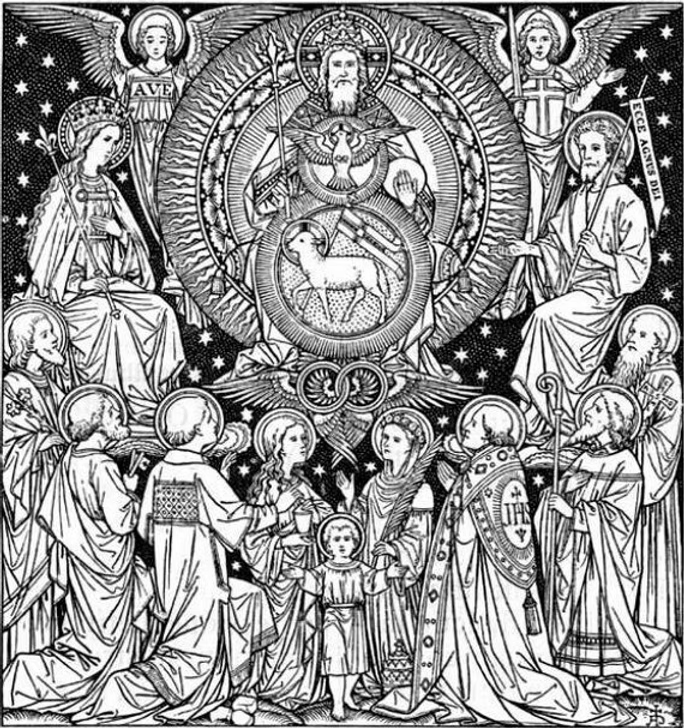
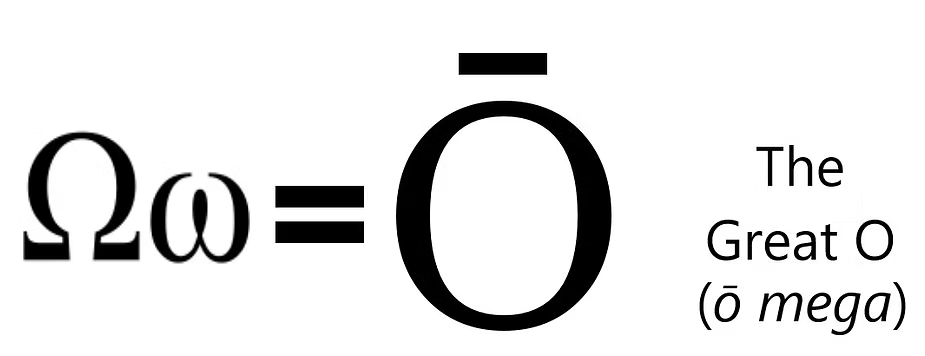
“I am the Alpha and the Omega,” says the Lord God, who is and who was and who is to come, the Almighty.

———————————————————————————————————-

This is the Epistle selection from the Episcopal Lectionary for the Twenty-seventh Sunday after Pentecost, Year B 2018, which is the Last Sunday after Pentecost. In the numbering system that lists each Sunday in an ordinal fashion, this Sunday would be referred to as Proper 29, but it is called “Christ the King Sunday.” It will next be read aloud in an Episcopal church by a reader on Sunday November 25, 2018. It is important because it is the Apostle John [the Beloved, not of Zebedee] speaking of the coming of Jesus Christ, about to be introduced to the seven churches of Asia. This reading begins a most ominous book that strikes so much fear in Christian ministers that they often refuse to preach about the End Times message this introduction leads to.

First of all, let me remind the reader that this reading selection is the Epistle of John. John was filled with the Holy Spirit, and like all other Epistle writers, wrote in the language of God, which is difficult for simple translators to grasp. This means the reading shown above is a paraphrase of what was actually written and needs a literal translation to accompany it, so one can catch where the translation read aloud becomes misleading. To avert that, I will present this short reading in segmented format, with each segment determined by punctuation marks (real or imagined).

Second, I would like to remind the reader that my abilities in reading holy texts originated when I began to understand the holy prophet Nostradamus. The ‘rules’ that I follow here [in all Biblical readings, but in particular with the Epistles of the Apostles] are based on those I was shown in the writing style of Nostradamus. I mention this now because there is a significant reflection of the presentation of heavenly language [that which appears earthly, but is invisible when paraphrase takes place] that John used in these five verses that is strikingly similar to that used by Nostradamus. I will point that out.
Third, this selected reading begins in the middle of verse four, following a colon mark. A colon [by standards of punctuation that are modern and may not have been standard at the time of original writing – thus imagined rather than real] introduces language that follows that will clarify a previous statement, usually by listing examples or explanation. By separating this selection form the preceding verbiage, some intent is lost in translation. To overcome that confusion, I will make some references to what was written prior to this reading [from John 1:1-4a].

Before I can present the segmented literal translation, based on the Bible Hub Interlinear translation and alternative possibilities of translation, I need to explain the comparison to the writings of Nostradamus. I will say that there is no arguing that the essence of Nostradamus’ The Prophecies and The Apocalypse of John is similar in they both present messages of doom and gloom, which has both classified as having written of the End Times. That general assessment is based on paraphrased translations, which may or may not be accurate.

What most people do not realize about Nostradamus is he wrote two letters that have been included in all books representing The Prophecies following the death of Nostradamus [1566]. One is the “Preface” and the other is his letter to King Henry II of France. Both are “epistles,” and they explain what can be found as the intent for all the poems of prophecy that make up The Prophecies.
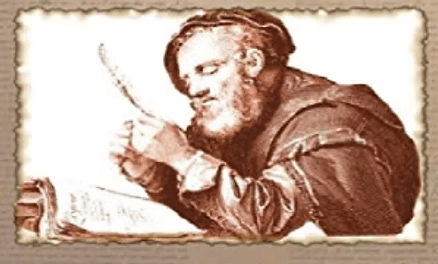
In an analysis of both of Nostradamus’ epistles, one finds there are very few period marks, which makes it appear he was very long-winded, writing very confusing “sentences,” filled with many commas and other marks [like colons]. Amid all that length are a great many ampersands (&), which are commonly shown in paraphrase as “and.” Often, a comma will precede an ampersand, as “,&”. This is bad grammar written in a mark and a symbol, where a comma implies the use of “and,” and an ampersand implies the use of “and,” so the result reads as “and and.”

In my segmented translations of the letter of Nostradamus, I have found that an ampersand must be read as a mark of separation, such that the symbol that implies “and” begins a new segmented line. In the cases where Nostradamus would use an ampersand between two words, without a comma present, it was to indicate a symmetry between that stated prior and that stated following. That also acted to join two concepts together as one, but for that union to be understood, one had to first understand each of two parts fully. To do that, one part would end a segment, with the ampersand beginning the next segment, followed by the symmetrical word. This means every ampersand is not simply a shortcut “and,” but rather the symbol for “and” means the reader is signaled to pause and reflect deeply on how to read the verbiage that surrounds an ampersand.

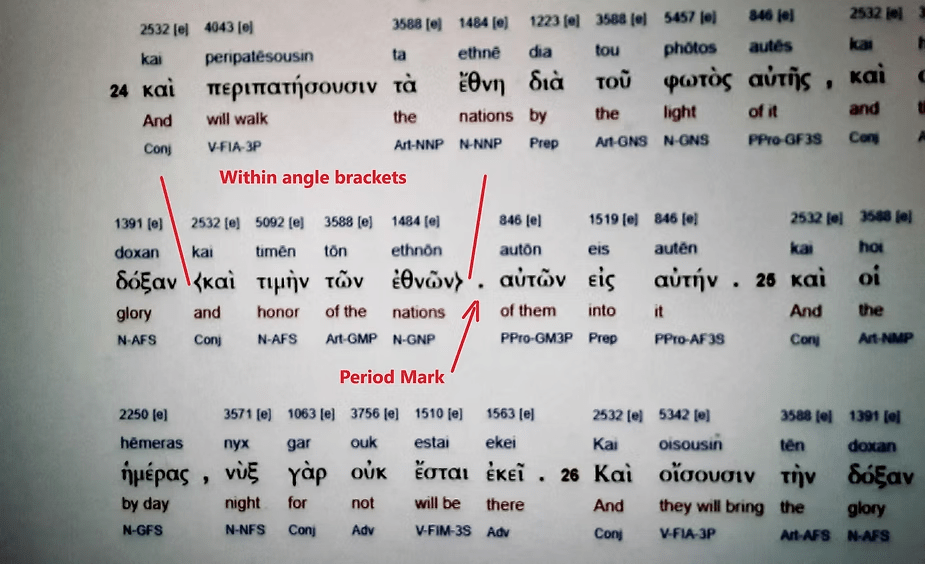
In this reading from John’s Revelation, there are no ampersand symbols. However, there are seventeen uses of the Greek word “kai,” which commonly translates as “and.” When one reads Biblical Scripture, one often finds this repetition, and all the ands are completely overlooked, seen as nothing but just another bullet point on an endless list of things said. We miss the power of one word being repeated, due to our haste; we so desire to get to the point quickly we fail to see the forest for the trees.

Of the seventeen uses of “kai” written in these five verses, eight follow a comma mark. Eight appear amid a segment, joining two words as one, but where symmetry should be given thought. Finally, there is one “kai” following a double-dash [em dash], which should be seen as similar to following a comma. In the segmented literal translation below, I have placed “kai” at the head of a segment of words, either a whole segment or a subset segment. I have not translated “kai” as “and.”

The Strong’s Concordance says the Greek word “kai” is a conjunction, meaning, “and, even, also, namely.” On the same page that links this word to the Bible Hub information, they state that the “NASB” [New American Standard Bible] shows this Greek word’s “translations” as an assortment of viable options. Those are: “accompanied (1), actually (2), after (2), again (1), again* (1), along (4), also (535), although (1), although* (1), besides* (1), both (37), both* (1), certainly (1), continue (1), either (2), else (1), even (132), forty-six* (1), if (1), including (1), indeed (20), indeed* (2), just (3), likewise (1), more* (2), moving about freely* (1), nor (4), now (2), only (2), only* (1), or (11), same (1), so (30), than (2), than* (4), then (105), though (1), though* (6), together (1), too (34), until (1), very (3), well (13), when (7), whether (1), while (1), whose* (1), without* (4), yet (9).” [NAS Exhaustive Concordance of the Bible with Hebrew-Aramaic and Greek Dictionaries]

The numbers in parentheses are the occurrences of that translation. The asterisks are not footnoted, but one can assume there might be debate about those translations. It is important to realize that “kai” is “the most common NT conjunction, used over 9,000 times” [HELPS-Word studies], meaning the most common translation is as “and.”  Therefore, the list above shows the exceptions to that common translation.

With that stated, I have not translated “kai” as a word that is limited in translation, denying other possibilities to be realized. Instead, I present it in its Greek spelling, so it is more like a symbol that implies “and” but is more [like Nostradamus used ampersands]. With this option now visible, I welcome you to read these five verses of John’s Revelation, while seeing “kai” as a time to pause and reflect on the importance of what has been said before and how an important transition is being made to that stated next.

Revelation 1

4b. Grace to you
          kai peace from him being
          kai who was
kai who is coming ,
kai from the seven Spirits that in the presence of the throne of him  ,
5. kai from Jesus Christ  ,
who witness [martyr] those who faithful  ,
those firstborn of the dead
          kai one ruler of the kings of the earth  .
Followers loving us
kai releasing us from the sins of us through the blood of him 
6. kai he has made us a kingdom  ,
priests all God
          kai Father of him 
to him this glory  ,
kai followers dominion into these ages  .
truly  .
7. behold!  ,
he is coming after this clouds  ,
kai will see him every eye  ,
kai those who him pierced  ,
kai will lament because of him all those races of the earth  .
certainly  !
truly  !
8. I am all Alpha
kai all Omega  ,
beginning
          kai end  ,
says the Lord one God  ,
one being  ,
kai who was  ,
kai who is coming  ,
one Almighty  .

Before beginning to understand the beginning of this reading, where verse four above is following a lead in from verse four that has been omitted, one should know what context was stated prior. Verse four begins by stating “John” as a one-word statement that identifies the writer of this epistle, but the capitalization is more than stating a proper name.

“John” is the translation of “Ioannes,” which has been adapted to “Joannes.” The meaning of that name is “God Has Been Gracious.” It is then that important Grace that is being told by the angel of Jesus Christ, “To those seven churches to those in all Asia.” This is to whom “Grace” is sent in a letter.

It is worthwhile to realize that verse four-A repeats the word “tais,” with the first one capitalized – the first word after the comma following “Ioannes.” I have translated both words as meaning “to those,” with “To those” having the importance of implying “God Has Been Gracious To those” who had been touched by John’s “Grace” from God. Those of the seven churches were then those who passed the truth of the Holy Spirit onto “all of Asia.” Therefore, “Grace to you” means all true Christians that had spread across the face of Asia, beyond the places in Greek Turkey [its modern name], eastward.

Verse three then plays into this aspect of “John,” who was the Evangelist that served the Lord by ministering to Jews and Gentiles, as an Apostle of Christ. When broken down into segments of words, it reads as such:

3. Blessed followers reading  ,
kai those hearing the words of this prophecy  ,
kai observing the things in it having been written  ;
those because opportunity close  .

This says that “Grace to you” is a “Blessing” from God to all “followers” (from “ho”) of Jesus Christ [like John], who walk in the footsteps of Jesus of Nazareth, having been reborn of the Christ. Those with that important “Blessing” will benefit from “reading” this epistle, where the Greek word “anaginōskōn” implies “discernment” (from the root “anaginóskó”) of the words read. That ability to “know certainly” comes from having been “Blessed” with the Christ Mind.

Next, one finds two segments that have been created with a comma leading to the word “kai.” To read “and” at those places lessens one’s ability to see the importance of a symbolic word that says, “and understand this.” One who is “Blessed” is given ears that hear the insight of the Holy Spirit, saying “Look closely here.” Look at how the “truth is being revealed” (from “prophēteias”) Then, look at how one should “observe the [hidden] things [that are] in it having been written.”

The Greek word “tērountes” means “observing,” but it is seeing what has been “kept intact” through a “guarded” way of “preserving” what has been written from being understood by those not “Blessed.” It is “those” (from “ho”) who understand the “opportunity” (from “kairos”) that comes from “close” inspection of the Word that is hidden in the words.

It is important to grasp that insight, especially when one wants to be responsible for a true prophecy of God, sent through Apostles. This is the purpose of God’s “Grace” – to be one of “those” who have seized the “opportunity” [the “time and season”] to be “near” or “close” to God.

Verse four-B then tells that God’s “Grace” bring “peace of mind” to those who have sacrificed their self-egos in subjection to God. This “well-being” comes “from him being” the replacement. This is the Christ Mind, which is born with the birth of Jesus Christ within one’s “being.”

The word translated as “being” is “ōn,” which is derived from “eimi,” meaning “I am, I exist.” While this can mistakenly be read as a statement of what “is,” in the present tense, that overlooks the value of having sacrificed an old state of “being” for what now “is,” through Christ. Jesus of Nazareth is “who was” the Christ alone, in his human flesh; but the sacrifice of that flesh and blood for others is then “who is coming,” where “erchomenos” is the present participle that “is” “coming” into Apostles and Saints.

The segment of words that follows a comma mark and begins with “kai” then places important focus on Jesus Christ being “from the seven Spirits,” where “Spirits” is capitalized. As one entity of two words – “seven Spirits” (from “hepta Pneumatōn”) – this is reference to Isaiah 11:2-3, which states: “The Spirit of the LORD shall rest upon him, the Spirit of wisdom and understanding, the Spirit of counsel and might, the Spirit of knowledge and of the fear of the LORD, and He will delight in the fear of the Lord.”[1]  As such, Jesus Christ is:

1. “The Spirit of the LORD,” meaning he is the Christ of God.

2. “the Spirit of wisdom,” means the Mind of Christ.

3. “[the spirit of] understanding,” means having the ability to discern Scripture.

4. “the Spirit of counsel,” meaning the role of a teacher.

5. “[the spirit of] might,” meaning the strength to withstand persecution.

6. “the Spirit of knowledge,” meaning the ability to know the hearts and minds of others.

7. “[the spirit] of the fear of the LORD,” meaning no sins or threats can influence.

All of this is made available to the servants who have been “Blessed” with the “Grace” of God, to be reborn as Jesus Christ. They all kneel before “the throne of him,” whose “presence” is within one’s heart, mind, and soul. That throne belongs to God. Those who have the presences of God in their flesh [as a soul in union with the Holy Spirit] will be at the throne of God as Jesus Christ, the right hand of God resurrected.

Verse five begins with the importance of that rebirth of Jesus Christ. The Greek word “martys” then says an Apostle or Saint becomes a “witness,” as “followers” (from “ho”) who were disciples of Jesus of Nazareth who became Jesus Christ reborn. They are therefore “faithful followers” (from “ho pistos”). Those first Saints were then the “firstborn of the dead,” where “firstborn” (from “prōtotokos”) means they were the “elders” of Christianity. They had been the “first reborn” as the Christ, having sacrificed their self-egos that kept them bonded to a mortal cycle of death. They were the first to break that cycle of reincarnation and sin.

The subset segment is then as symmetrical connection of “firstborn of the dead” AND “the one ruler of the kings.” The implication is the “firstborn” were initially twelve, with all twelve having the same ruler.
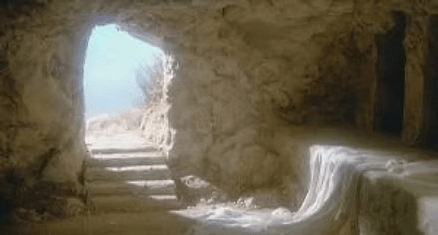
The Greek word “archōn” means “ruler, governor, leader, or authority.” It should not be read as “king,” because Jesus Christ is not only the ruler of Apostles [as their “governor” or “prince”], but also the same to the “kings of the earth” [a bloodline of European kings that would surface centuries after].

That last segment ended with the first period mark of this reading. The segments of verse five had focused on Jesus Christ. Now, there is a transition to the “Followers,” where the capitalized Greek word “” is written. “” has the same translation possibilities as “ho,” where “followers” is a viable translation to “the [one].” Either way, the importance conveyed by capitalization refers back to the “kings of the earth,” who will be “loving us,” who are the “firstborn” Christians.

The Greek word “lysanti” is translated as “releasing,” from the root word “luó,” but it is reference to the future when Christianity would be “unbound” from the Middle East and Eastern Europe, as a persecuted minority. Remember, the letter was written to the seven churches of Asia. The “sins” (from “hamartiōn”) being “released” are not wicked things done, but the “faults” seen in them by Eastern Jews. The rejection of Jesus by Jews [their own “blood”] would be soothed by the coming of Christian kings that would rise from the holy blood of Jesus of Nazareth.

The double-dash [also called an “em dash”] is not an often used punctuation in language. It is used today as a replacement for a comma, parentheses, or a colon. Because this extended hyphen ends verse five and a second is found amid verse six, one should see the two as marks that set aside the next two segments and the ensuing subset segment as a large aside [use of parentheses], which would act as a clarification of this element of “us through the blood of him.”

Verse six then makes one realize that the spread of Christianity is the “kingdom” John referred to. This is then where the “blood” (from “haimati”) of Christ is both the human sacrifice of him body and blood, “releasing” his soul so his Spirit could be in the “blood” of his “Followers.” That spiritual “blood” was then guarded by the physical “blood” of kings.

This physical bloodline plainly says Jesus of Nazareth had a child. That child was John the Evangelist [John the Beloved]. John, in turn had a daughter that traveled to Europe with Mary Magdalene, Mary Salome, Mary of Cleopas, and Joseph of Arimathea (see Saintes-Maries-de-la-Mer), which is the stuff of lore known as the Sang Real (Royal Blood).
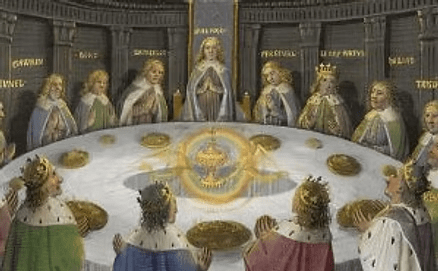
This then leads to another symmetrical arrangement where this “kingdom” of Christianity would be both “priests all God” AND “Father of him [“in Christ”].” While it is easy to read “God and Father of him,” that redundancy really makes little sense. However, when one see how this is a prophecy of future times, when there will be Christian “kings of the earth” and “kingdoms releasing” Christianity to grow, the “priests all God” are the kings of Europe [royalty] and their subjects, AND the “Father in him” is a Roman pope. Remember, John is writing a letter to the seven churches and all Asia, where each church will suffer future failures. Rather than see a limitation in this prophecy of John as just the seven villages in Greek Turkey, one can see the “Father in him” as the failure coming that involves the Church of Rome.

This then says, “to him this glory,” where the Greek word “doxa” not only states the generic state of ‘glory,” but also the “honor” and “renown” that this spiritual and physical bloodline will bring. Europe would become a place known as a bastion of Christianity. Additionally, the European “followers” of Christ would find “dominion” [“power, strength” from “kratos”] as Christian nations. As John was writing around 90 C.E., that coming strength that glorified Jesus Christ would last “towards” (from “eis”) the time when “ages” (from “aiōnas”) meet. The Age of Pisces [Jesus’s age] will last until the Age of Aquarius [age of knowledge and technology], which could come any time now.

As we often end a prayer with the word “amēn,” the word means, “verily” or “truly.” At the end of a verse, it can be read as, “so let it be.” It is important to note that the word follows the second period mark, and also ends with the third period mark, which makes “amen” a stand-alone sentence.

Verse seven begins with the important one-word statement, which in Greek is the capitalized “Idou.” The translation read aloud adds an exclamation point, which is perfectly allowed. Still, this important word is followed by a comma, which cannot replace that mark; it simply highlights how a mark of punctuation is simply a symbol that tells one how to read Scripture. The word itself implying it be spoken emphatically means the comma is separating that word from the next, placing focus on just that. “Idou” says, “Look!” “Behold!” or “See!” Following a one-word statement that says, “So let it be,” the shout is to “Wake up!” “Behold what will be!”

Following verse six telling of the vast spread of Christianity, John’s cry to “See!” he said “he is coming” (from “erchetai” – third person singular future), which indicates Jesus will come into the Apostles that will lead that expansion. This will be “after” (from “meta”) the timing of John’s epistle, as he wrote a prophecy. The Apostles of John’s day (the “firstborn”) will lay the foundation of that which “will be coming after” them.

John’s use of “clouds” is then not a literal descent of Jesus coming in the future from “clouds” (from “nephelōn”), but the emotion of Christianity will fall like rain from the sky, flooding the “kingdoms” with belief. This emotion will lead to Jesus seeing through the eyes of God’s faithful, so the presence of true Christians will allow “every eye” to “see” (remember this verse began with “Behold!”) Jesus Christ in those who have been reborn as him.

[Let me add that it used to be a common mistake to find the astrological sign Aquarius stated to be a Water Sign.  This is because Aquarius [in Latin] means “Water-bearer” or “Water-carrier.”  Aquarius is actually an Air Sign, such that “clouds” are water vapors in the sky.  In terms of “after,” the Age of Aquarius will “be coming after” the Age of Pisces.]

When John wrote, “those who pierced [Jesus],” those were Romans. The soldiers of Rome nailed his hands and feet to a cross. A Roman guard pierced Jesus’ side with a spear, to see if he was dead. The Romans were seen to be the ones who would “Behold!” the emotion of repentance foremost. It will be from their sorrow that the Church of Rome will align with the “kings of the earth” and spread Christianity to “all those races of the earth” that the Holy Roman Empire will spread.

John then emphatically stated, “certainly!” (from “nai,” which also says, “yes!”). That was an emphatic “assurance” this future would come. He then, again, added, “amen,” this time adding another exclamation point. John shouted, “So let it be!” It will “truly” come! And, it has come, as the truth be told.

Verse eight begins with “I am,” which presents the capitalized word “Egō” and the lower-case word “eimi.” In actuality, the word “eimi” alone says, “I am” or “I exist,” as an expression of the Greek infinitive “to be.” The capitalized “Egō” means (importantly) “Myself,” as an emphatic statement of “Me.” However, John is not the true author of this epistle, as he was being told what to write by the Holy Spirit of Jesus Christ. Jesus Christ had thus become the “Ego” of John, with John having sacrificed his self-ego to the Lord. Therefore verse eight begins by saying, “from a most holy Ego am I.”

This is then linked to the simple word “to,” a variation of the Greek word “ho,” which could state “followers,” as has been used prior. That plural indication of one type of people that are associated to “the one” can now appear as one claim for “all” followers of Christ. This means “Alpha” (a capitalized word of importance) becomes a word pointing focus on the “firstborn,” as alpha is the first letter in the Greek alphabet.

John then importantly spoke as a sacrificed self-ego that allowed “all” Christians to become the “Ego” of Jesus Christ, who spoke for God the Father, again in human flesh. One must remember YHWH means, “I Am That I Am.” Such an “Ego” brings the Mind of God as what “I am” Christians say.

The symmetry of “Alpha” AND “Omega” (another capitalized word of importance) is then separated into the focus that will be set on future Christians, who will be the last of a line. Since omega is the last letter of the Greek alphabet, it is then importantly representative of those who will come last. This means it cannot be God who is “Alpha and Omega,” because God has no beginning and no end. God is always, forever and eternal. Jesus Christ is an Age of Man, the one that calls for self-sacrifice for a higher, Spiritual goal.

That Age of Christ then has “beginning” AND “end,” another symmetrical arrangement of principles that must be understood individually. The “beginning” of God’s Christ goes back to God creating His Son, who most know as “Adam.” Adam is thus the “Alpha,” who was the first Son of God, the only Son made as Man. Jesus is then the “Omega,” as the “end” of that line of holy men who would reincarnate as God’s individual servants, sent to lead the children of God. Jesus is not the “end” entity as a human of flesh and bones, because his “end” became the exponential spread of that “last” Son into all who would duplicate that “end.”

All who will be duplicates of Jesus Christ, from “beginning and end,” “say the Lord [is] one God.” That is the commonality of all Christians, as they have within them the “Master” in Christ, who serves only “one God.” This is not done from a perspective of God being external, as determined by one’s self-ego, or human brain. It is known by the Mind of Christ, which comes from “being one” with God, through the marriage of the soul with the Holy Spirit. That sacrifice is possible when one realizes what “one was.” One can then commit to God so a marriage “will be coming.” The marriage is the union of “one” with the “Almighty.”

As the epistle selection for the last Sunday after Pentecost, also known as Christ the King Sunday, when one’s own personal ministry for the LORD should be well underway – one should realize that one is of the Omega class of Christians, nearing the end of an age – the message here is obviously misunderstood by most people. The message is to understand prophecy as a real warning to “Behold!” danger is at hand, because one’s soul is at risk. Stop looking up in the sky for something to happen in the clouds, when the cloud is one’s own confusion and distractions from self-indulgence.

In the Acts of the Apostles says:

You will receive power when the Holy Spirit comes on you; and you will be my witnesses in Jerusalem, and in all Judea and Samaria, and to the ends of the earth.” After he said this, he was taken up before their very eyes, and a cloud hid him from their sight. They were looking intently up into the sky as he was going, when suddenly two men dressed in white stood beside them. “Men of Galilee,” they said, “why do you stand here looking into the sky? This same Jesus, who has been taken from you into heaven, will come back in the same way you have seen him go into heaven.” (Acts 1:8-11)

That same way was disappearing in “a cloud” that “hid him from their sight.” “See!” with your hearts, minds and souls. He has come in the same way, reappearing invisibly in Apostles and Saints. He returned the very next day [Pentecost, which happened to be a Sunday]. He has been here since that “Alpha” day in the “beginning.” “Why do you stand here looking into the sky?”

Who were those “two men dressed in white”? Well, they could have been the appearance of the constellation Gemini, which are the twins Castor and Pollux. That tells one the eve of Pentecost was during the time when the sun traverses Gemini, between late May and mid-June. Still, it could be Moses and Elijah, who Peter, James, and John of Zebedee saw with Jesus on the high mountain.

The point of this reading being public on a day that recognizes Christ the King is it paraphrases Scripture so it places Christians inside a cloud of confusion. God is the King. God is the Christ. Jesus is the Son of God, as God’s right hand reaching down to earth and filling human souls with the desire to please God, as did His Son Jesus Christ. It is now up to each individual to stop looking into the sky for Jesus to come save us. We need to become a cloud of love for God and let the rain of God’s love fall upon our souls.

We fear or are thrilled by the thought [a human ego minimal power] of John telling of the End Times to come.  That means people pour over documents, trying to find evidence of when this prophesied end will come … all for personal glory and profit.  Others refuse to “Look!” at the Revelation, because it frightens the paying members of a congregation.  No one has eyes that can see Jesus has long returned.  Had he not, there would be no pews for Christians to sit in.

John’s introduction of a holy prophecy points the loving finger at us today, who claim to be Christian but struggle to know just what that means.  We do not read today what each of the seven churches have failed to do, but failure is what all have done.  We are at the end of an age of man, when the time of Jesus Christ will collapse, caved in by the trinkets of invention.  You probably hold one in your hand now, or it is within easy grabbing distance.

These five verses [six including verse three] are pointing to our responsibility.  The time has come to bow down before the throne of God and commit our souls to His service.  God must be realized as one’s true King.  One’s only hope is to be knighted as the Son of God, the Prince of Peace.  We must hear from the clouds of emotion, a most holy voice say, “Rise Sir Christ, and serve your King with honor.”

[1] Some contend that Paul’s seven gifts of the Holy Spirit could be the “seven Spirits,” but the Holy Spirit is one Spirit, not seven.

#Acts1811 #Isaiah1123 #Revelation138
Luke 16:19-31: The Rich Man and Lazarus

Luke 16:19-31

19 “There was a rich man who was dressed in purple and fine linen and lived in luxury every day. 20 At his gate was laid a beggar named Lazarus, covered with sores 21 and longing to eat what fell from the rich man’s table. Even the dogs came and licked his sores.

22 “The time came when the beggar died and the angels carried him to Abraham’s side. The rich man also died and was buried. 23 In Hades, where he was in torment, he looked up and saw Abraham far away, with Lazarus by his side. 24 So he called to him, ‘Father Abraham, have pity on me and send Lazarus to dip the tip of his finger in water and cool my tongue, because I am in agony in this fire.’

25 “But Abraham replied, ‘Son, remember that in your lifetime you received your good things, while Lazarus received bad things, but now he is comforted here and you are in agony. 26 And besides all this, between us and you a great chasm has been set in place, so that those who want to go from here to you cannot, nor can anyone cross over from there to us.’

27 “He answered, ‘Then I beg you, father, send Lazarus to my family, 28 for I have five brothers. Let him warn them, so that they will not also come to this place of torment.’

29 “Abraham replied, ‘They have Moses and the Prophets; let them listen to them.’

30 “‘No, father Abraham,’ he said, ‘but if someone from the dead goes to them, they will repent.’

31 “He said to him, ‘If they do not listen to Moses and the Prophets, they will not be convinced even if someone rises from the dead.’”

———————————————————

FOREWORD: This is a rather long explanation of a well-known Biblical story.  It is a rather simple (seeming to be) story of a repeated lesson that warns the wealthy believers in Yahweh, while giving solace to the poor of faith.  It is so seemingly simple to grasp that it is easy to ‘ho-hum’ it and just yawn.  I was led to look at it deeper than I had before and was surprised to see what is sweetly hidden in the verbiage that makes this lesson told by Jesus take on a fresh appearance.

Recently, my writing on a book had me researching the mythology behind the names of the planets.  What I learned about Pluto was very interesting, which is most befitting the discovery of that orb (since downgraded to a dwarf planet or planetoid).  Pluto was discovered in 1930, with the element plutonium discovered in 1934, and produced and isolated in 1940, named as an honor to the discovery of a new planet.  Pluto became the symbolic dawning of the nuclear age.  The same Greek word from which “Pluto” comes is the same word from which comes “rich man” in this reading (and others of similar focus).

One important thing I found in this reading is relative to each of the characters being named, when it appears only Lazarus stands out.  The name Lazarus is representative of a class of people, making the “rich man” also be representative of the same.  Therefore, we are all today either one or the other.  As such, I write this in-depth explanation for all who might want to know this.  Still, it is less for the Christians that sit in pews and more for the ones who will stand before the pewples.  My hope is they will give this lesson the proper attention it deserves.

————————————————————-

The Greek text of this lesson taught by Jesus, recounted by Mother Mary to the doctor Luke, begins with a statement about each of two men. Both are identified as “certain,” from the Greek word “tis.” This identifies each man as known individually, while identifying two who were associated with many like them. Their “certainty” is what bonds two of opposite status levels together in this story.  As a lesson taught by Jesus to the Jews of Galilee, that use of “certain” then spoke of specific members from their religious group. Therefore, the two men identified in verses nineteen and twenty were not people of uncertain religious beliefs, as each adhered to the principles of Mosaic Law.  Being Jewish was “certain” of both men.

The second man is identified as “certain,” with this further specified as “named Lazarus,” from the Greek words “onomati Lazaros.” The mistake that is made in reading those two words that way comes from thinking one man was named Lazarus, which eliminates other symbolic meaning. That not only ignores the meaning behind the name, but it disconnects all later students from relating to the characters of this story.  Reading that there was a “man named Lazarus” into a teaching by Jesus leads all who read these words or hear them read aloud in a church and think, “Well this is about somebody long ago, “named Lazarus,” who I have no affinity with.”  The mistake comes from not seeing oneself as “Lazarus.”

The truth that Jesus spoke to a Jewish audience bears deep meaning to all Christians also.  Christians are supposed to be founded in the principles of Mosaic Law … at least those commonly termed “the Ten Commandments” … but are truly supposed to be seeking to be reborn as Jesus Christ. When one reading this lesson realizes that Jesus spoke in metaphor about Christians today (those who are supposed to be “in the name of Jesus Christ”), then understanding the meaning behind that name “Lazarus” is most important.

The name “Lazarus” (Greek spelling “Lazaros”) is “the Hellenized version of the Hebrew name אלעזר, Eleazar.” (Abarim Publications) The name is then like “El-azarus.” The Hebrew meaning of the root name is then “God Has Helped” or “Helped Of God.” (same Abarim Publications source)

The capitalization should then not be read as simply stating a proper name (a syntactical rule of the English language that misleads, taking one away from the importance of the meaning behind a name), but a significantly important word of meaning, which identifies more than one human being.  “Lazarus” is intended to be one character of parable that reflects upon a whole class of faithful that are like “Lazarus.”

This means the capitalized word “Lazaros” is making two statements.  First, it is stating the importance of the One God (El) in all who believe in Yahweh.  Second, it is stating the importance of all who are “named” as “certain,” being relative to a specific religious set of beliefs commanded by El. That name is then a statement of all who see the value of the Laws of God, through Moses, as worthy of complete commitment and submission.  Therefore, “Lazarus” is not naming one person but naming all Jews and Christians who “God Has Helped.”

When one has become comfortable overcoming that limitation of the word “Lazaros” and understand how the capitalization makes this lesson be pointed at every Jew and Christian who believes in Yahweh, the question should be, “Then why is Lazarus (one who God Has Helped) identified in the translation as a “beggar”?

It is important to read these verses (or have them read aloud in one’s presence) and question, “I feel like I have been helped by God, because I am a successful person; so why is one Helped Of God laid at a gate as a beggar?”

One needs to ponder, “If I am truly helped by the One God, how am I reflective of one who is covered in sores?”

The reasoning should be to find out who oneself identifies with in this teaching, as Jesus was not only speaking to a group of Jews in Galilee when he gave this lesson.  The reasoning should be to see Jesus speaking to everyone who will read his words forevermore.  The reasoning should be to understand what one has overlooked in the past, as a student called again to listen to a lesson with a more mature mind.

First of all, verse twenty begins by stating the Greek word “ptōchos,” a word that is not capitalized. English syntax calls for the first word in a sentence be capitalized, but Biblical Greek text is following divine syntactical rules. The word “ptōchos” translates as “poor, destitute, spiritually poor, either in a good sense (humble devout persons) or bad.” (Strong’s) The lack of capitalization says (silently) that poverty is not an important issue.  The lack of material wealth is not an issue for any whom God Has Helped. As this story (eventually) tells of “Lazarus” going to Heaven, one should assume the identification is to one who is “a humble devout person,” whose “poor” status does not deter God from having his needs met, as a devoted servant. The result of one “Helped Of God” is one is “poor” due to a lack of material needs.

HELPS Word-studies states, relative to Jesus’ usage of “ptōchos,” the word’s usage acts as an assumption of a reduction in physical stature, which leaves one a beggar.  They state: “ptōxós (from ptōssō, [meaning] “to crouch or cower like a beggar”) – properly [means], bent over; (figuratively) deeply destitute, completely lacking resources (earthly wealth) – i.e. helpless as a beggar. (ptōxós) relates to “the pauper rather than the mere peasant, the extreme opposite of the rich.”’

This word’s usage has led translators to paraphrase what Jesus said, making his words be twisted, creating a misleading visual by saying Lazarus “was laid a beggar.”  In reality, those who belong to the class of people “God Has Helped” are “bent over” to Yahweh, subservient to His Will.  They are “lacking earthly wealth” that simply keeps them from identifying with the materially “rich.”  IF there are any sores visible on their bodies, the sores signify the admission of their sins, which places them prostrate before the gate of Heaven, begging for forgiveness from God.

Knowing this about the identification of one “God Has Helped” makes not seeing Lazarus as a beggar easier to fathom. The descriptive term that makes this lesson of Jesus more powerful says that the person identified as Lazarus was the “extreme opposite of [one who was deemed] rich.” [HELPS Word-studies]  Seeing a lame beggar covered in sores as helpless, reduced to seeking crumbs (metaphor for alms for the poor) for survival, makes it quite difficult to grasp the evil of a “rich man.”  It almost excuses being rich today, while caring little about how many poor people there are in the world, as if with the attitude, “They should pray to God more.”

Understanding that verse twenty is Jesus setting up a lesson where the one “Helped Of God” is the “extreme opposite of the rich” means looking closer at verse nineteen is important. The literal translation of that verse states, “A man now certain existed rich  , and he was clothed in purple  and  fine linen  ,  making good cheer every day in splendor.” This verse has three segments of words, set off by the presence of comma marks.  It is important not to erase this punctuation (whether it is imagined or real), as it keeps one from paraphrasing what was written.  Paraphrase is a trick of human language, but it is the application of syntax not spoken by Jesus.

I have found that wherever the Greek word “kai” (typically translated as “and”) appears it should be read as a statement of importance to come (that which is stated next), rather than as simply stating “and.” English syntax frowns on placing “and” and a comma mark together, so when we see “, and” above this concept that “kai” is written-spoken as a mark of importance to come is supported.  Strong’s Concordance states that “kai” is written in the New Testament 9079 times.  That repetition should be viewed as more significant than simply being a sttutering use of “and,” like “oh yeah, add this.”

The comma mark separates like a conjunctive word (“and”), while the word “kai” acts as a signal of importance to follow. This non-translation of “kai” as a conjunction (which finds many are deleted from translation, due to redundancy) also means that where it is written “purple and fine linen” there are two statements made.  By simply stating “and” (the trick of syntax again), the mind quickly computes “fine purple linen,” missing the importance of “purple.”  The word translated as “fine linen” is a separately important description that follows the symbolism of the word translated as “purple.”  The word “kai” says, “See the separate elements, “purple” followed by “fine linen.”

When one read verse twenty previously and found that “certain” was followed by “named Lazarus,” where “Lazaros” was less about the name of a specific person but an identification of all devout believers in the One God (and all to come), the parallel should be seen in verse nineteen. There, the word “certain” is followed by the Greek word “plousios,” which has been translated as “rich man.” This should be seen as a parallel ‘name’, just as is “Lazarus.”

The word “plousios” is defined as meaning, “rich, abounding in, wealthy; subst: a rich man.” (Strong’s)  This says that the translation as “rich man” is a substitute for the true meaning.  Realizing that means “plousios” is how this “certain man” is ‘named’, which separates him from all uncertain wealthy people, misses that he, like “Lazaros,” is named “Plousios,” without the importance of capitalization.

HELPS Word-studies adds to this understanding of usage as such: “ploúsios (an adjective, derived from 4149 /ploútos, “abundance”) – properly, fully resourced; rich (filled), by having God’s “muchness” – i.e. His abundance that comes from receiving His provisions (material and spiritual riches) through faith (4102 /pístis).” This is another way that seemingly justifies seeing value in the “rich man,” as his wealth is assumed to be due to his “faith.” That assumption allows one to wrongfully think, “rich duds on the outside correlates to a wealth of inner goodness.”

This later assumption of “God’s muchness,” which includes “material riches” must be seen as not fitting the set-up that is opposite the lack of material concerns sought by one “God Has Helped.” Yahweh, as the One God, does not help His believers become materially “rich,” making this lesson demand seeing that truth.  Despite the mega-churches that have ‘slick Willy’ preachers in thousand dollar suits that only preach, “Jesus wants you to be rich,” that is a lie that does not match what this lesson by Jesus teaches.

It is better to remember what Jesus said to his disciples later in his ministry.  Then he said, “Truly I tell you, it is hard for someone who is rich [“plousios“] to enter the kingdom of heaven. Again I tell you, it is easier for a camel to go through the eye of a needle than for someone who is rich [‘plousion‘] to enter the kingdom of God.” (Matthew 19:23-24)  Jesus said that after he told a young man [one who owned lots of possessions] how to be assured of going to heaven.  The young man walked away sadly, after being told following the Law was (of course) required, but the key to getting to heaven was this: “If you want to be perfect, go, sell your possessions and [“kai“] give to the poor [“ptōchois“] ,  and [“kai] you will have treasure in heaven. Then [“kai” translated as a capitalized “Then”] come, follow me.” (Matthew 19:21)

It becomes important to see how the “certain man” of verse nineteen is then given the name of “plusious” (lower-case of insignificance), just as the “certain man” of verse twenty was “named Lazarus.” The lack of capitalization is then a statement of the lack of importance that Jesus gave to all believers who (exactly like the rich men of Jerusalem and Galilee when he taught) place wealth as a statement of their piety. This makes the substitute translation of “rich man” realize another substitute implication, as an identifying name – both for an individual and a group of Jews [and Christians].

The Romans named their god of the underworld Pluto, because Pluto was a form of “plusious.”  Pluto’s etymology, according to the Wikipedia article “Pluto (mythology)” is: “Plūtō (genitive Plūtōnis) is the Latinized form of the Greek Plouton. Pluto’s Roman equivalent is Dis Pater, whose name is most often taken to mean “Rich Father” and is perhaps a direct translation of Plouton.” The Romans revered that lesser god as the god of abundance (and with abundance comes power and influence). The equivalent Greek god was named Hades, who was not revered in any way by the Greeks. However, the Romans saw the underworld as where the riches of the world came from, as mineral rich ores that were mined from under the earth’s surface.

By seeing this in verse nineteen, Jesus gave the rich man the extreme opposite name to “God Has Helped,” as being one specifically who the god of the underworld has helped.  Verse nineteen can be read as naming an individual Jew named Pluto (or Shepha or Mamónas), if there is only one man named Lazarus.  The two men, or those Jews and Christians who are just like one of those two men, claim to be believers in Yahweh, but the verse nineteen group prays to two gods, while those of the second group pray to One God.

This awareness means that it was abundance that enabled the “certain man” of verse nineteen to be “clothed with purple.” The Greek word “porphyran” is a color that represents “power or wealth.” (Strong’s) Purple is the color of the robes of kings, because they wield the power and wealth of nations of people, whose “certainty” is a nationality, more than religious beliefs. To wear that color was a statement of royal status.  More importantly, it was a Self-assumed state of power and influence, as no Jews in Galilee or Judea were truly of royalty.

At the time that Jesus taught this lesson, the “certain” Jews of Jerusalem had the power and wealth of the Second Temple that allowed them to pretend to be royalty.  The fall of Israel and Judah was due to having followed their human kings to ruin.  The were no kings in Jerusalem after Herod the Great died, and Herod owed his royal dynasty to his Roman masters that placed him in power.  As the Roman Emperor sought to pacify the Jews of Jerusalem, by letting them think they ran a city state within the province of Judea, that region was placed under a governor from Rome, after Herod the Great died.  After their return from exile in Babylon, the ruling class Jews of the Temple had forgotten that God should be their King.

This means the use of “enedidysketo porphyrin” (“he was clothed in purple”) is a statement that one who claimed to be a Jew (today a Christian or believer in Jesus Christ) was “putting on airs.” He (and all like him) “was clothed in” the invisible robes of Self-importance, based solely on how much wealth one had amassed (at the expense of others). The extreme opposite view that fits this segment of words is “putting on the clothes of righteousness.” Righteous is not the view one should have, when reading what Jesus said identifying the one as “rich” (“pluto“).

Evidence in this regard comes from the Apocalypse of John, who wrote of righteous clothing in two verses. He wrote, “But you have a few people in Sardis who have not soiled their garments; and they will walk with me in white [not purple], for they are worthy.” (Revelations 3:4) John also wrote, “It was given to her to clothe herself in fine linen, bright and clean; for the fine linen is [metaphor for] the righteous acts of the saints.” (Revelations 19:8) Isaiah also wrote of righteous clothing (Isaiah 11:5; 59:17; 61:10; and 64:6), and Zechariah 3:4 also spoke of this. David wrote, “Let your priests be clothed with righteousness, And let your godly ones sing for joy” (Psalm 132:9).  That was a statement that those of “certain” faith, who served in the Tabernacle.  Those priests would wear the sacred garments of the servants of Yahweh, not the garments of kings.

The use of “kai” says that simply dying common clothing the color “purple” was not all the abundant ones did.  They enhanced that signal of royalty greatly by adding that color to “fine linen,” which could have been “purple” or any other color when purchased. The Greek word used by Jesus is “bysson,” which [according to HELPS Word-studies] means, “fine linen, i.e. a very expensive (sought-after) form of linen – “a specific species of Egyptian flax or linen made from it that is very costly, delicate.” (J. Thayer).”

This means that in addition to putting on the clothes of self-glorification, rather than the clothes of righteousness, the people who were like this “certain man” always made sure people could tell their status by the clothes they wore, knowing their fabric was imported. This is like men and women today that wear expensive suits that clearly say, “I am powerful.” It reflects an inner drive that forces one to selfishly live up to the English saying: “You have to spend money to make money.”  More money must be reinvested in self-appearances and airs.

The comma then leads to the final segment of words that add detail to this acting like royalty that separates oneself from the common class of people by dressing in finery, all because one is of a “certain” faith. The Greek states “euphrainomenos kath’ hēmeran lamprōs,” which literally translates as “making good cheer every day in splendor.” This says, basically, the abundance of one’s position of wealth has made them “feast” (“euphrainomenos “) twenty-four-seven (“kath’ hēmeran“) on the finest of everything (“lamprōs“).

This makes the sum of verse nineteen be about one’s opulence, which is a sign of one’s decadence caused by wealth.  That means that if Yahweh has initially given one abundance, then it was as a test of faith.  Jesus told the young rich Pharisee how to pass that test and be “perfect.”  However, he walked away sad, reflecting how most rich Jews (and Christians today ) fail to deal with “abundance” properly.  The projection of self-worth, while ignoring the “poor,” is an imperfect state of being that keeps one from heaven.

When one has a firm grasp of verse nineteen being about everyone of Judaic-Christian values (who believe in Jesus Christ’s lessons), it points to those who misjudge wealth as God’s blessing for them to rule the world. When one can see how “Lazaros” is a powerful statement of true Christians that have been filled with God’s Holy Spirit and been reborn as Jesus Christ (bearing his name as “God Has Helped”), then it is easy to see how verse twenty needs some translation adjustments, so that those who are the extreme opposites of the rich are not seen as crippled beggars.

Verse twenty’s Greek states two segments, separated by one comma mark: “ebeblēto pros ton pylōna autos  ,  heilkōmenos.” That can literally say about “God Has Helped” that one of His faithful “was thrown to outsiders porch same  ,  being full of sores.”  This is because “ebeblēto” (from the root “balló“) means, “to throw, cast,” in a stronger sense than “laid” implies (somewhat) “with care” or “gently.”  The Greek word “pylōna” refers to “a large gate; a gateway, porch, vestibule,” meaning something more significant than a private gate to a country villa on a dirt road.  It implies an entrance to a palace, which fits the royal motif.

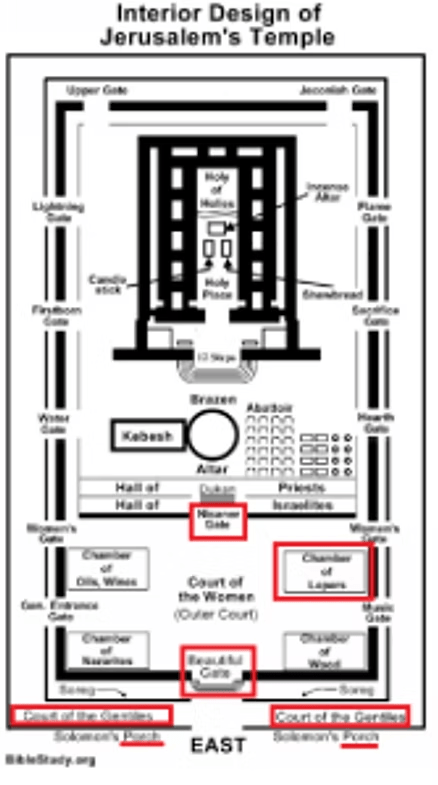
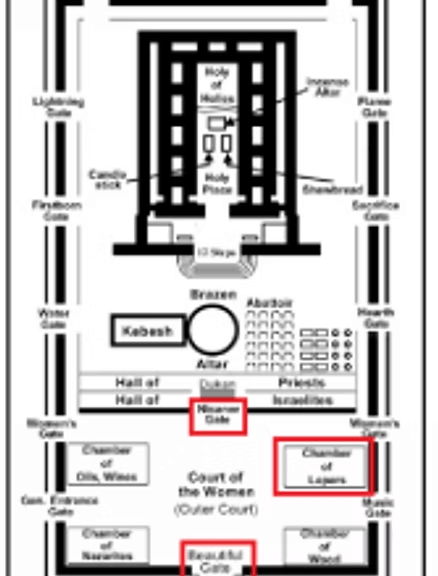
When “pylōna,” is realized to translate as “a large gate; a gateway, porch, vestibule,” then this word should be seen as representing Herod’s Temple – a fixture of Jerusalem.  It then is a statement that this “certain poor man” of Jewish faith was denied access to the inner courts, deemed too poor to gather along with well-to-do Jews.

The Greek word “ton” simply translates as “the,” but NASB (New American Standard Bible) lists three times it translates as “outsiders,” and four times as “others.” The implication is then creating the imagery of one being “cast” or “thrown” outside the Temple proper, to the Court of the Gentiles, which was beyond the Beautiful Gate and near Solomon’s Porch.

Following the separation from a comma mark, the Greek word “heilkōmenos” states the one exception to this general banishment. If one was “covered in sores,” then one could gain access to the Court of Lepers, in the general area of the Women’s Court, not far from the Nicanor Gate.  Still, it would be better to stand outside the temple with “outsiders,” even if the rich and powerful saw that association with Gentiles as sores covering one’s body.

When verse twenty-one begins by stating “kai,” this is again signaling a level of importance that is relative to “longing.” The Greek word “epithymōn” means “desiring,” usually in a negative sense of lustful wanting or longing; but it also means “setting one’s heart on,” where the heart is the seat of the soul. As one “named God Has Helped,” one can make the assumption that that soul’s heart is pure, in this case. Therefore, “to be fed” (from “chortasthēnai“) is less a reference to physical food, and more a statement of needing one’s heart be fed with spiritual food.

The Greek word “chortasthēnai” bears the meaning, “to be satisfied, filled,” where there is an emptiness that needs filling or satisfaction, but that does not necessarily mean in one’s belly.  To desire such nourishment “to fall from the table of the rich man” is a statement of lack from the “rich man,” rather than plenty that is shared.  Since no one places a “table” (“trapezēs“) in one’s ‘driveway’ by a “gate,” Lazarus was never able to see the “table” of the wealthy.  That Greek word, when associated with money, implies a “money-changing or business” “table,” from which Lazarus was denied.

This means that those who pretend to be holy (based on abundance of wealth) and wear fancy clothes rather than priestly robes rarely (if ever) produce morsels of insight that nourish the souls of the faithful.  Still, the sequence of words actually states (from the Greek), “from that falling from the table away from the table of the rich man,” where the Greek word “piptontōn” equally states, “falling under (as under condemnation)” and “falling prostrate.”  This is then not waiting for food to fall from a dinner table, but “falling down” from having been outcast (“falling under” the decrees of royal priests) and praying to God (“falling prostrate”) outside the Temple gate.

The translation that has verse twenty-one concluding with the statement, “Even the dogs came and licked his sores,” needs refining. The new sentence is confusing, as the word for “dogs” (“kynes“) implies “scavenging canines,” who ran wild and were disdained by the citizens.  For Lazarus to be portrayed as a lame beggar that was hungry for crumbs to keep him alive, one would assume a stray dog would likewise compete with him for any crumbs.  To lick his wounds, after stealing his crumbs, would be like adding insult to injury.  However, this segment of words is poorly translated.

Following a semi-colon mark (absent in the translation above) is the word of exception “alla.” That means “but” or “however,” such that there is a caveat being stated by Jesus, one that is relative to this “falling from the table of the wealthy.”  After notice of an exception comes the Greek word “kai” again, which prepares one for an important statement to follow. That statement comes in three segments, which literally can say: “but kai outsiders dogs  ,  coming  ,  were licking clean this wounds the same.”

The exception is then pointing to the importance of “ta kynes,” or “the dogs.” It is the presence of “kai” that alerts the reader to look for meaning that is greater than a simple article (a, an, or the).  In this regard, the word “ta” is another that typically translates as “the,” but the NASB lists the same translation options as “outsiders” or “others” (seen for the Greek word “ton“).  This way of seeing that translation working here, where “ta” is identified as important, means that “outsiders” become the Gentiles that were also barred from the tables inside the Temple.  This makes “dogs,” the literal translation of “kynes,” refer to the figurative translation of the word, so “dogs” is a statement (importantly) of the way the elite Jews viewed Gentiles.

The one-word statement next, following a comma mark, is “coming.”  This is then relative to those who were not Jews, but came to the Temple just to stand outside.  This would have been Samaritans and Greeks, or any of the scattered Israelites who had become mixed blood, while still believing in the God of their ancestors who were Israelites. It would be outside the Temple that teachers (like Jesus, and later his Apostles) would offer insight about Scripture. The Gentiles came for those morsels falling from the table, rather than hoping to get inside where nothing of importance was ever said. Thus, being among those who were seeking to find God, whether Jew or Gentile, all “were licking the wound” of banishment, exile, and rejection for past sins unforgiven.  That is especially true for those of great faith, as not being able to join with those of “the same” stated religious beliefs (the “certain”) is hurtful.

The aspect of “covered in sores” and dogs licking “sores” is what makes it seem that some man named Lazarus was a leper and a poor beggar (perhaps lame too). In the times of Jesus, people like that would have been banned from holy spaces and blamed for their physical plights.  “Sores” were seen as outward projections of imperfections stemming from one’s inner being, which were then deemed as evidence of sins.

The Greek root word “helkos” means “a wound, a sore, an ulcer,” often used to denote a “(festering) sore.” (Strong’s) Still, the one-word statement that assumes one person was “full of sores” can also allow for the assumption that one was treated like a leper, when the only ‘sores’ that covered his body were from the honest wear and tear a poor man of values earns from hard labors.

When invisible “sores” are angers that fester within one’s soul, due to unfair treatment at the hands of the rich and powerful (with no recourse other than suck it up and bear it), there is no doubt a faithful follower of Yahweh would be falling prostrate before God asking for forgiveness and strength to continue.  Job was an upright man who suffered mightily from sores he did not deserve.  Job fell prostrate before the Lord, as he blamed himself for not knowing what sins he did to bring about his plight.  Never was Job found blaming God for his plight (although others advised him to do so).

It is very important to see this lesson of Jesus from the perspective of two who have been placed on God’s scales of judgment. God would judge both men (just as God judges all human beings), based on each individual’s faith as “certain men” who claimed to serve Yahweh.  They would not be judged by how much wealth and abundance one had or who had physical maladies that others saw as evidence of sins.  God’s judgment is based on souls that have no flesh to drape with finery and no flesh to ooze from sores.

This becomes quite evident after both have died. God’s judgment found the one who professed faith in Him (a “certain man”), but lived only to satisfy himself and deny others, as being worthy of entering an eternity of suffering. The one who served God (a “certain man”) and was identified as “God Has Helped” (“Lazarus”) was “carried away by the angels,” taken to the embrace of Abraham in the spiritual realm. The one who most pew-sitting Christians today would root for (as many see themselves in that man), would be the one to go to a burning place.

This is where one must understand that Jesus was not teaching about two imaginary individual characters.  He was speaking instead with metaphor, of all who were identified as Jews, which has evolved today to the present state where it includes all who identify as Christians.  Jesus told of the fate of everyone who claims to be devoted to Yahweh.  His lesson says: Be rewarded in the material world by the joy of fleeting riches, and know the soul will suffer in the afterlife; or, be assured that the soul will be rewarded in the spiritual world by eternal bliss, after momentary suffering in a world that is careless.

This lesson is no different than when Jesus said, “No one can serve two masters. Either you will hate the one and love the other, or you will be devoted to the one and despise the other. You cannot serve both God and money.” (Matthew 6:24)  The word for “money” is “mamónas,” which many have translated as the personified deity Mammon.  The lower case can make that statement, as Mammon was a lesser god, not close to earning  the distinction of personification, where capitalization states important.  Still, so many worship “money” as their god, when that “love of money” means a hatred of Yahweh (regardless of what their tongues say).

[“For the love of money is a root of all kinds of evil. Some people, eager for money, have wandered from the faith and pierced themselves with many griefs.” (1 Timothy 6:10)]

It is again at this point of death that the ‘rich man’ is identified by the Greek word “plusios,” as Jesus said, “Died next  kai this plusios  kai  was buried.” The same words identify what appears to be an unnamed entity that bears the same name as everyone who serves the god of abundance, who the Romans called Pluto. It becomes important to read “plusios ” as one would read “mamónas,‘ where the lower case reflects the inferiority of the god they are named after.  Thus, Jesus said, “Died next  *  this servant of abundance  *  was buried (i.e.: placed in the ground and covered with earth).”

This is then a powerful statement about the god of the underworld. Hades, according to the Greeks, hated those who attempted to escape the eternity of his unseen realm.  Hades would find those who escaped to the surface and bring them back.  The god of the Underworld is why it is so poetically stated, “ashes to ashes, dust to dust,” during funeral rites.  The human body is said to now be worth one U.S. dollar, based on the breakdown of elements it contains.  As little as that is worth in currency, you still cannot take anything you own with you when you die.

The Greek name of the god of the underworld is Hades, whose name means “the Unseen.” The Greeks paid as little attention as possible on this god, whom they loathed. Their ignorance, countered by the Roman’s adoration of Pluto as a god of abundance from within the earth (i.e.: iron, salt, gold, silver, copper, tin, etc.), left the name Hades relegated to being the name of the realm he ruled. The Underworld became synonymous with Hades.

[Although there is no Hebrew or Israelite mythology, the equivalent master of the Underworld would be the fallen angel that was cast within the Earth for going against God.  There is the name Azazel, one of the fallen angels written of by Enoch, but Christians prefer the name Lucifer or Satan.  Some Hebrews spoke of Beelzebub.  They all share common threads with Hades and Pluto.]

By understanding this mythological ‘history’, then see how Jesus said one who worshipped Pluto in life died and was promptly placed back into the earth (interment underground, either in a tomb hewn into rock, or a six foot deep hole dug into soil), as the rightful property of his god. Jesus said next (in verse 23), “kai en tō hadē,” which very capably states, “kai in the realm of the one Hades.”

[Notice how “hadē” is written in the lower case, but loves to be capitalized in translation?]

Neither “plusios” nor “hadē” is given the respect of capitalization, because those ‘proper names’ are worthy of lower case identification (as lesser gods); but the lesson of Jesus here is: All who worship Pluto (the god of abundance, wealth, riches, and opulence) will find their souls going to Hell (Pluto’s realm), where their god Hades reigns. This is regardless of what came out of their mouths when in the flesh, which made them “certain” as believers in Yahweh.

When the one identified as Lazarus died, his body of flesh was not carried by angles to the bosom of Abraham. His flesh was returned to the earth (give unto Pluto what is Pluto’s).  The burial of his flesh is inconsequential, as his flesh had no value to him, nor anyone God Has Helped.  It was the soul of one whom God Has Helped that spiritual messengers lifted away. The implication is that Lazarus lived in the spiritual real while trapped in his body, having sacrificed his life in the flesh to serve God [like an Apostle or Saint].  This makes Lazarus like the Lazarus Jesus raised (his brother-in-law), who was then another soul living in the spiritual realm within a body of flesh that had been sacrificed to serve the Lord.  When Jesus was resurrected, he too was a living Spirit in a dead and worthless body of flesh.

That identifies all who serve Yahweh in the flesh and suffer momentarily (twenty to sixty human years are like a split second in eternity) from the disrespect of the souls whose worship of Pluto (a.k.a. Mammon), who are treated as ‘second class’ or ‘lepers’ of society, as being “named Lazarus.” All who earn that name, especially those reborn in the name of Jesus Christ, are quite capable of withstanding the suffering of a material world, where the lures of riches no longer are appealing to them. They abstain from taking any more than is necessary to serve Yahweh with strength, meaning they refuse to sell their souls for temporary comfort.

[Joseph of Arimathea was a “rich man,” but he used his wealth to support God’s ministry in Jesus.  He did not love money; he loved Yahweh.  God rewarded him with money to use supporting God’s Apostles.  Had he given all his wealth to those in the name of Jesus Christ, then God would know to trust him with renewed wealth, as an eternal flow of living waters flowing from the earth.  This would be as opposed to the efforts required to dig riches from the Underworld.]

The soul of the “rich man” is immediately found unable to withstand an existence that has discomfort, to the point of torment. Fresh from a life in the flesh, where those like Lazarus saw his pretense of royalty and felt the finery of his imported clothing, that soul called out for his fellow “certain man” to serve him with a drop of water placed on the tip of his burning tongue. His soul was so used to living a life of decadence to the max, once removed from a physical body it screamed out for pity, when his former ears ignored the pleas for help that other living beings made to him daily. The karmic reward is shown as being that souls who worship lesser gods in the flesh will find no relief for their souls once removed from that flesh.

Finding that hard lesson too late, the soul that was the property of Hades begged that the one who God Has Helped show mercy on the wealthy brothers he left behind (who probably were even wealthier then, after their brother had died). He wanted Lazarus to go appear as a ghost to warn them of the fate that awaited them. However, Abraham said there would be no ghosts sent to those who serve the god of wealth and abundance; they have Moses and the prophets to guide them, because they profess to be “certain men.”  Faith is based on a promise of future gains, not gains realized in the present. They would have to earn their way to the good place, as had “Lazarus.”

The lesson is one that speaks of everything one needs to serve the Lord.  That need is Spiritual, not material.  This is repeatedly written in the Holy texts. This lesson by Jesus is another in a long line of lessons that repeatedly say, “Love the Lord with all your heart, all you soul, and all your mind.” There is even a Charles Dickens novel that tells the rich to be warned against selfishness.

The problem now is, as it has always been, the souls who pray to “god” for wealth and get it will always make the mistake of thinking the “god” they prayed to was Yahweh.  The sad reality is they are praying to Pluto; and Pluto will pay any price in material goods, knowing nothing material will ever be lost from this world. Hades is a hateful god that has claims on every soul in the flesh; and the only way to escape his realm is through Jesus Christ. Then one’s soul will be carried away to eternal bliss by angels.

Revelation 7:9-17 – Before the throne of God

After this I, John, looked, and there was a great multitude that no one could count, from every nation, from all tribes and peoples and languages, standing before the throne and before the Lamb, robed in white, with palm branches in their hands. They cried out in a loud voice, saying, “Salvation belongs to our God who is seated on the throne, and to the Lamb!” And all the angels stood around the throne and around the elders and the four living creatures, and they fell on their faces before the throne and worshiped God, singing, 

“Amen! Blessing and glory and wisdom and thanksgiving and honor and power and might be to our God forever and ever! Amen.” 

Then one of the elders addressed me, saying, “Who are these, robed in white, and where have they come from?” I said to him, “Sir, you are the one that knows.” Then he said to me, “These are they who have come out of the great ordeal; they have washed their robes and made them white in the blood of the Lamb.  “For this reason they are before the throne of God, and worship him day and night within his temple, and the one who is seated on the throne will shelter them.  They will hunger no more, and thirst no more; the sun will not strike them, nor any scorching heat; for the Lamb at the center of the throne will be their shepherd, and he will guide them to springs of the water of life, and God will wipe away every tear from their eyes.”

——————–

This is the designated “First Lesson” presented by a reader, en lieu of the place normally held for the “Old Testament” reading.  It is the purposeful selection because it will be read aloud on All Saints Day.  It will next be read on Sunday, November 1, 2020.  That date will represent the twenty-sixth Sunday after Pentecost.

It is important to realize that All Saints Day is always November 1, with All Souls Day always being on November 2.  Those recognized Church events do not usually fall on a Sunday, so the Sundays that are neither November 1 or 2 (the closest Sunday to them, post-Halloween) becomes a combo-Sunday for Saints and souls.

Every living human being has a soul.  Not every living human being is a Saint.  According to the Wikipedia article entitled “All Soul’ Day” the distinction between the two is officially stated.  They report this: “In the Catholic Church, “the faithful” refers specifically to baptized Catholics; “all souls” commemorates the church penitent of souls in Purgatory, whereas “all saints” commemorates the church triumphant of saints in Heaven.”

While “Purgatory” is from the imaginations of men wearing religious robes over their flesh animated by a soul and not a real place [ask the reincarnations of Pharisees who believed in Sheol], their assessment is still worthwhile, simply because it states a belief that souls are denied “Heaven,” while saints are not.  This should be realized as why the Episcopal Church sets aside a special Sunday in the middle of the Ordinary season after Pentecost, for the express purpose of recognizing the backbone of any true Church is its Saints.

This means every reading selected is meant to convey this importance.  Whoever ran the Church long ago and established the lectionary schedule first, he or she was certainly filled with the Holy Spirit – therefore a Saint.  The goal of ALL Christians is to be a Saint.  Anything short of true sainthood is failure and failure is rewarded with the imaginary place the Roman Catholics call “Purgatory” [and long gone Pharisees called Sheol].  All Saints Day is designed so sheeples don’t lie on their deathbeds and feel the tap of an angel on their soul, hearing a voice saying, “Time to come out the vaginal opening and try again.  Maybe the next seventy human years will make it easier to realize being a Saint is much better than being just another soul.” 

This is where the original Church was not some organization that hired people to run a business, but a gathering of Saints and those who wanted to become the same.  Just to use the example of the educational system, where “teachers” are expected to graduate students, not expected to forever see the same failures back in their classroom, year after year; a true church is expected to graduates Saints.  Since that system has been replaced with souls who are not teaching other souls to be Saints [it takes one to graduate one, as there is no other way to that end], the same people sit in pews year after year, thinking their soul is going to heaven.

Please, take this as me simply stating my opinion and nothing more.  Prove me wrong by reading what I will present about Revelation 7:9-17 and then go to your church of choice and see a reader pleading with you as he or she reads the words of John [his first letter is also scheduled to be read], as a Saint speaking with the same power as had Peter and the eleven on Pentecost Sunday.  Then, listen to the priest read great emotional feeling into the Beatitudes [Matthew 5:1-12].  Hear his or her sermon that says the blood of Jesus Christ flows within, so a Saint is truly standing in your midst.  If that is your experience, then you should be ready to go spread the Gospel message to others after church.

I wish you the best and pray there are Saints about everywhere.

This reading is very deep.  All Scripture has the same power of depth, but the writings of the Apostles [i.e.: Saints] cannot be read quickly and simply.  It is the expansive nature of the Holy Spirit guiding their minds to write the most meaningful words that come from the Mind of Christ, direct from God.

I will now present the above reading in a new format, one I have used here before [often with Paul’s letters], so it should be seen that a whole day could be spent reading, discerning, and discussing this reading.  A whole day [the purpose of the Sabbath, which God intended to be twenty-four hours of prayerful recognition of God and His Word] could be spent just on Revelation 7:9-17.  It is so important because it is John writing of his experience with God and His Saints.  That says John is explaining what God said to him, to tell others what it takes to be a Saint.  Please keep that in mind as you read this new format.

For anyone who has read my posting here regularly, you will know that I say the Greek use of “kai” is not the common conjunction “and” being stated.  It is a marker word that signals the reader to sit up and take notice, because everything that follows the word “kai” is most important to remember.  In this presentation, notice there are twenty-nine uses of the word “kai,” both capitalized (extra importance noted to follow) and lower case, with some in the middle of a line (not following a comma mark or semi-colon).

This is a literal translation, so no liberties are taken to not translate some words (prepositions deemed not translatable), nor use the most common translation (those shown by the NRSV), when there is a better choice to use.  I translate literally, based on the case of the written text [shown in the Biblehub.com reproduction of the Greek], so I only capitalize what was capitalized, without exception [even though Biblehub will imply “Him” as meaning God or Christ, when “him” is written].  I maintain all punctuation as shown in the Greek text, without exception. 

Keep in mind that John was out of body at the time of his experience, which means he had entered the spiritual realm.  He wrote while possessed by God’s Holy Spirit [he might even have been blind at the time his Apocalypse was written, so it was orally transmitted to another human writer], so every word reflects the truth of Jesus Christ within John’s vision.

A classic story of how to become a Saint. A king possesses God on the throne within. Removing the sword from that stone is easy with God’s presence within – as one chosen by God for marriage.  Possess the sword and possess the right to be king. However, a king without a sword is a land without a king.

I feel it is most important for each individual see him or her as called to do as John did and have a conversation with God.  Knowing that “the throne of God” is not in some magical place, like in outer space or in the clouds, but in your hearts; you provide the seat upon which God sits, in your heart.  You are therefore called to be “the Lamb,” which means you are expected to sacrifice your soul on the altar at the temple that is you, as an offering to God that is pleasing [the sacrifice of marriage].  A soul cannot also be a Saint.  It is one or the other.  Since you already have a soul, you need to realize that soul serves your flesh and not God, until your soul changes [“You cannot serve two masters.].  Please, read this slowly and meditate on what John’s word say to you.

9

After these things I looked  ,

kai  behold  ,

a multitude great  ,

which to number it no one was able  ,

out of every nation  ,

kai  tribes  ,

kai  peoples  ,

kai  tongues  ,

standing before the throne  kai  before the Lamb  ,

having been clothed with robes white  ,

kai  palm branches in the hands of them  .

10

kai  they were crying aloud in a voice great  ,

saying  This salvation thereupon God of us  ,

thereupon sitting on the throne  ,

kai  thereupon Lamb  !

11

Kai  all them angels made to stand around the throne  ,

kai  the elders  ,

kai  the four living creatures  ,

kai  they prostrated before the throne the faces of them  ,

kai  worshiped thereupon God  ,

12

saying  ,

Truly  !

this praise  ,

kai  this renown  ,

kai  this wisdom  ,

kai  this gratitude  ,

kai  this honor  ,

kai  this ability  ,

kai  this strength  ,

thereupon God of us  ,

to the ages of the ages  !

13

Kai  spoke one from out of the elders  ,

saying to me  ,

These this having been clothed with the robes the white  ,

who are they  ,

kai from where have they come  ?

14

Kai   I said to him  ,

Lord of me  ,

you know  .

Kai  he said to me  ,

These are them coming out of the affliction of the widest sense  ,

kai  they have washed the robes of them  kai made white them in the blood of the Lamb  .

15

because of this  ,

They are before this throne this of God  ,

kai  serve him day  kai  night in thereupon temple of him  ;

kai  he sitting on the throne will have his tabernacle over them  .

16

not they will hunger anymore  ,

neither will they thirst anymore  ,

neither none shall fail above them the sun  ,

nor any kind of burning heat  ;

17

because this the Lamb in the center of the throne will shepherd them  ,

he will lead them to the living fountains of waters  ,

kai  will wipe away every tear from the eyes of them  .

Just as an aside, the Episcopal Church only places importance on John’s Revelation in a limited capacity.  According the Reverse Lectionary for the Episcopal Lectionary, reading from Revelation come most frequently during the Easter season, when not on All Saints Day. This connection becomes important to see as a statement (without words) that points out how Easter is less about remembering the death and resurrection of Jesus each year and more about it marking the death of a soul in the flesh and resurrection of Jesus Christ in a Saint, in a way that is deeply personal to a true Saint every year, even though the date of personal transfiguration is different for each Saint.

The readings selected from John’s Revelation for church reading only come from chapters 1, 5, 7, 12 and 21.  To me, that avoidance says the Church is afraid of the nerves touched when an unprepared soul [a priest] is trying to avoid an End Times theme, while preaching to potential donors.  Instead, a true church [anywhere two or more are gathered as Saints] should be teaching the Word, no matter what the Word says about the common failures that make it routine for souls not to become Saints.  Certainly, that downfall has been ongoing for quite some time, to the point that few Saints still hang out in church buildings.

Now, let me briefly go through this very deep reading.  What I am about to offer is by no means everything that could be said.  It is what popped into my mind as I re-read the Biblehub.com Interlinear version of Revelation 7, looking for the “kai“s.  I wrote notes on a Word document, which I could copy and paste at the end here.  You might want to print the following on a sheet of paper (or two) and then re-read the new format presentation, glancing at the notes offered here.  I will do this according to the “kai” number – 1 through 29.  

1 – the importance of seeing in a way you had never seen things before.

2 – the importance that Saints are not limited to any one race of people.

3 – the importance that Saints are not limited to characteristics that define “people” – men-women; rich-poor; well-sick.

4 – the importance that Saints are given an ability to speak in the divine language of God.

5 – the importance of the word “before” (“enōpion”), where the flesh is before the throne that is within oneself; but the face worn is your flesh that is before what is underlying, hiding from view the Lamb – Jesus Christ.  That signifies one’s sacrifice of self to be reborn in that name.

6 – the importance that one become the fruit of the vine or the branches that bear fruit (dates from a palm).  The fruit of the Lord comes from the work of His servants … His holy hands.

7 – the importance that Saints do not hide Christ under a basket.  They cannot be stopped from crying out with joy.

8 – the Greek word “” translates as a conjunction as “then, thereupon,” meaning “kai” marks the importance of having become the “Lamb,” as “thereupon” the Lamb has come to one.

9 – capitalized “Kai” shows the great importance ALL Saints become the “angels” of the Lord, where the word “angeloi” means “messengers.”

10 – the importance of understanding that Saints become the leaders of all churches – “the elders.”

11 – the importance of knowing a Saint becomes the foundation of a church [the symbolism of “four”], which turns dead flesh into “living creatures.”  The use of “four” says Jesus Christ is the cornerstone of a Saint.

12 – the importance of knowing a Saint must prostrate oneself to become the throne of God by sacrifice of self-ego.  A “face” not raised (lowered) means the face of God is worn by a Saint.

13 – the importance of knowing a Saint totally worships God and nothing less.

14 – the importance of knowing the “praise” a Saint gives to God recognizes His being their source of “renown.”

15 – also the source of their wisdom coming from the Christ Mind.

16 – also a Saint gives God all credit, with great gratitude.

17 – all the “honor” of being a Saint comes posthumously, as persecution and rejection comes with the “price” paid by a wife of God, as recognition as righteousness can only be seen in hindsight by common souls.

18 – all “abilities” possessed by a Saint come from God.

19 – all “powers” possessed by a Saint is God’s Holy Spirit flowing through a servant.

20 – a capitalized “Kai” states the great importance of letting the “elder” within (Jesus Christ) do all the speaking, just as Jesus only spoke what the Father told him to speak.

21 – the importance of realizing a Saint was once a sinner, just as all who are not Saints.

22 – a capitalized “Kai” states the great importance that a line of communication is held by a Saint and Jesus Christ, where understanding is taught, with one always speaking with understanding.

23 – a capitalized “Kai” states the great importance of knowing a Saint does the speaking of Jesus Christ, as a vehicle of God.

24 – the importance of knowing a Saint is “washed” through baptism of the Holy Spirit.

25 – the importance of knowing a Saint is made pure through baptism, never again to be soiled by sin.

26 – the importance of knowing a Saint serves God as the light brought to the world (the “day”).

27 – the importance of knowing a Saint has found the death of “night” by self-sacrifice, becoming the temple of the Lord.

28 – the importance of knowing a Saint has been led to eternal life (“living waters”) by Jesus Christ.

29 – the importance of knowing that a Saint has had all the tears of sins and human failures to serve God totally have all been “wiped away,” when one has become a Saint.

I hope you also read the article that I posted some time back about the Beatitudes.  I felt called to write deeply about Matthew 5:1-12 when it was not a scheduled reading.  Before I realized that reading was the Gospel selection for All Saints Day, I read the Beatitudes with new eyes.  I saw the repetition of “Blessed” as being Jesus’ way [speaking for God] of stating the various “blessings” he named can only come from having become a Saint.  I have not re-read that article, but I recall I transformed every place where is read “Blessing to those” as saying something like “A Saint is those.”  Check it out.

Again, All Saints Day is a mega-important day that should be realized.  It comes the day after All Saints Eve, also called All Hallows Eve or Halloween.  I know people who dedicate many hours of their time, putting much energy into decorating their houses, preparing for trick or treaters, and dressing up themselves in costumes.  In essence, they are making their worship be (symbolically) to the charade of life, where dead souls walk in human flesh that seems to be alive, but is not.  From all that effort to be able to tell the world, “I love the sin of zombies and ghouls,” how many have any time to deeply study the lessons of All Saints Day?

How many of you will spend the majority of All Saints Day pondering what it takes to become a Saint?

All Saints Day is not fantasy or wishful thinking.  It is about your soul being told the End Times story of your fate.  Saints exist for the purpose of carrying serious messages from God to the world … near (family) and far (beyond across the street).  They all say: “Hear!  Believe!  Act! Only Saints get to Heaven!  Unrighteous souls get recycled back to the earthly plane!  That is an important message sent by God to you!”

If you reject a Saint’s message, they go into the streets and declare, “The kingdom of God has come near!”  Then, once your soul has left your deathbed (if you make a Saint give you that warning), the scales of justice will ask your soul to remember the times you rejected God’s messengers.  AND your soul will have perfect memory of them all.  All souls know the judgement of God is fair, as all the gnashing of teeth in the outer darkness is self-caused.

And that is why I hold the opinion that Christianity has become as lost as the blind leading the blind can get lost.  The hole they will eventually stumble into is called a grave.  For all the avoidance of the End Times, everybody has an end time coming.  It should not matter if one dies individually, due to accident, old age, disease, or disgust with living.  Likewise, it should not matter if one is vaporized instantly, along with millions of other souls in the same vicinity, from some nuclear holocaust.  Death is death and there is no safety in numbers.  Death always means one soul leaves one body of flesh.  Matter is constantly changing its state of being; so losing a soul means nothing to clay.  A soul is immortal and cannot die; but to stay on the earthly plane it needs fresh clay.  Still, a souls knows it must change spiritually, before God kisses its spiritual cheek and sends it into reincarnation, which means a soul is aware of the need to kick its addiction to flesh.  

So, if you want to avoid the Purgatory that will be created when mankind has finally found a way to destroy the entire planet, when returning wayward souls will no longer be able to get lost in the beauty of a paradise made by God’s Hand, only able to find an immortal soul wandering a destroyed environment … the reality of Purgatory will be where zombies are souls returning to animate some nuked-out carcass of death.  Dragging a dead body around for eternity becomes a soul crying out for someone to blow its dead brain away!  If being a Saint in this life is too boring or too hard, well then just imagine that scenario!  

HAPPY HALLOWEEN!   TRICK?  OR TREAT?

Revelation 1:4b-8 – The Law of Judgment

Grace to you and peace from him who is and who was and who is to come, and from the seven spirits who are before his throne, and from Jesus Christ, the faithful witness, the firstborn of the dead, and the ruler of the kings of the earth.

To him who loves us and freed us from our sins by his blood, and made us to be a kingdom, priests serving his God and Father, to him be glory and dominion forever and ever. Amen.

Look! He is coming with the clouds; every eye will see him,

even those who pierced him; and on his account all the tribes of the earth will wail.

So it is to be. Amen.

“I am the Alpha and the Omega,” says the Lord God, who is and who was and who is to come, the Almighty.


This is the Epistle selection to be read aloud on the twenty-sixth Sunday after Pentecost, also called the Last Sunday or Christ the King Sunday [Proper 29], Year B, according to the lectionary for the Episcopal Church. It will follow one of two parings of Old Testament and Psalms, either a Track 1 or Track 2 set, depending on the predetermined path an individual church has set upon. The Track 1 course offers a reading from Second Samuel, which is David’s last song. There he wrote, “The el of Israel has spoken, the rock of Israel has said to me: One who rules over people justly, ruling in the fear of elohim”. That will be accompanied by Psalm 132, where he sang, “Yahweh has sworn an oath to David; in truth, he will not break it: “A son, the fruit of your body will I set upon your throne.” The Track 2 pair will present a reading from Daniel, where his vision said, “I saw one like a human being coming with the clouds of heaven. And he came to the Ancient One and was presented before him.” That will be accompanied by a singing of Psalm 93, which sings, “Ever since the world began, your throne has been established; you are from everlasting.” All will accompany the Gospel reading from John, where Jesus told Pilate, “You say that I am a king. For this I was born, and for this I came into the world, to testify to the truth. Everyone who belongs to the truth listens to my voice.”

I have written quite deeply about this reading. I give a basic explanation as how I came to be able to read Scripture and see the truth of that written. I welcome everyone to read my background there, which I will not go into now. That commentary can be found at this link. Because I have discerned these five verses most deeply – segment by segment – I will not repeat those observations at this time. Instead, I will place a broader focus on this selection and show how it fits in with the other readings presented on the last Sunday after Pentecost, the ‘end times’ for Year B’s ordinary season.

One thing that I must point out is the translation that reads “Jesus Christ.” The Greek written is “Iēsou Christou,” which should not be translated as if John wrote the first and last name of Jesus. The Greek form that would say “Christ” is “Christos.” The form “Christou” is the genitive form of Christos, with the genitive case expressing possession. This means John wrote, “Jesus of Christ.” That is a statement that Jesus was possessed by Yahweh, as one “Anointed” divinely. The Greek word “christos” means: “anointed; messiah,” where “messiah” is an English variation of the Hebrew word “mashiach,” which means the exact same thing: “anointed.” The capitalization must then be seen as a divine level of importance placed on “Anointment,” which means by Yahweh. The man named “Jesus” was then “one of” all those souls who had likewise been “Anointed” by Yahweh; and, David was one who was so “Anointed.”

It is also important to point out that the word translated as “spirits” [“seven spirits”] is written “Pneumatōn,” where the capitalization has been erased in translation. Again, the capitalization must be seen and understood as a divinely elevated state of “spirit,” which makes it be the spiritual oil of Anointment, as Yahweh’s “Spirit.” The number “seven” (as I wrote about last week) has to do with the “completion, perfection, and rest” of a cycle. Thus, when the “perfection Spirit” is before the throne of Yahweh, it is importantly [use of “kai”] that which is displayed in Jesus, who was “of the Anointment” by that “perfect Spirit.”

The plural number of “Spirits” must be seen as all who appear before the throne of Yahweh in Judgement. It those are truly reflecting the “completion Spirits,” of those souls united as one with Yahweh, as “perfected Spirits,” those cleansed of all past sins through submission in divine marriage; and those “Spirits able to rest” knowing their service to Yahweh had been done, they all become the souls of the “faithful,” or those who have displayed the “obedience” of union and the “loyalty” of servitude [all uses of “pistos”]. This is because those souls, formerly in bodies of flesh, prior to death, are “witnesses” [from “martys”], where that denotes a personal experience as Jesus reborn within their souls, with all having that presence as the “Christs of” Yahweh.

This then reverts back to the segment that says, “kai from Jesus of the Anointed,” such that the “perfected Spirits” will all have been resurrection of “Jesus” [a name that means “Yah[weh] Will Save”], where that soul possessing one’s own soul [two souls in one body of flesh] is what makes all be “of Anointment” from Yahweh. This presence of the soul of Jesus, in union with one’s own soul [like twins] then makes belief to transform into true “faith,” which obediently allows the soul of Jesus to rule over one’s body of flesh [divine possession], all of which is personally witnessed by the host soul, experiences through the eyes and ears of its flesh.

When John wrote “firstborn of the dead” [“prōtotokos tōn nekrōn”], the use of “firstborn” must be seen as the Passover demands, which Moses said would bring Yahweh as the angel of death, so all firstborn males of families not marked by the blood of the sacrificial lamb would die. The “firstborn” would also be the demand of those so marked, where their firstborn male children were to be dedicated to serve Yahweh as a priest [Samuel is an example of this sacrifice of the “firstborn”]. The element of “dead” must be seen as what a soul in a body of flesh is marked by, as the body of flesh is like the doorway to the soul within. When that body of flesh dies, then the soul is released for Judgement, where it then stands before the throne of Yahweh. To be the “firstborn of the dead,” then one is covered in the blood of Jesus – the sacrificial lamb – so one’s soul is spared the repeat of death, which is Judgment of reincarnation [or worse].

The point I want to make now is the beginning what says, “him who is and who was and who is to come” and the end that says, “who is and who was and who is to come” repeats the eternal way of Judgment. All souls stand before the throne of Yahweh after release from their bodies of flesh. All will be judged as to whether or not those souls married Yahweh, received His Spirit and gave birth to His Son Jesus. The only way to secure Salvation is to follow this path; as it has been this way from the beginning, and will be that way until the end. To see John’s Revelation as a future thing to worry about is wrong. The future is always one’s own pending death and whether or not one has sought Yahweh in marriage, to become Jesus reborn and live a righteous life that earns Salvation.

When this reading is paired with David’s last song before his death, one needs to see that theme of a soul being released for Judgment. In the verse of his song [2 Samuel 23:3] that is translated to say “the rock of Israel,” the “rock” needs to be read as the “cornerstone” that becomes set in place, which ensures “Israel” means one “Who Retains Yahweh,” as one of His elohim. To be a Yahweh elohim is to be a soul married to Yahweh’s Spirit; and, to have the “rock” that makes this stay put, that is being resurrected as Jesus.

In David’s last three verses [5-7], his focus is on those who reject marriage to Yahweh, so their souls have become the “firstborn” who do not escape the Judgment of Yahweh, so they will be made to die again. David’s metaphor for them was “thorns,” which choke the desire to become saved by righteousness out of them and others surrounding them. This echoes the words of John, who wrote, “even those who pierced him; and on his account all the tribes of the earth will wail.”

In the Daniel reading, the first two verses speak of the Judgment Yahweh made against the evil spirits, who were not “seven Spirits,” but instead the elohim of the first six days of Creation. I see those verses as the Judgment against Satan [or Lucifer, or Azael], who was the beast that antagonized mankind, despite the commands of Yahweh. While Satan was cast into the inner darkness of the earth, the other three beasts were stripped of their abilities to attack humanity; but they could lure human souls to desire worldly things, possessing them demonically as being what those souls sought. This, again, matches the piercing and wailing of which John wrote.

As for the last two verses of Daniel, which are clear metaphor of the coming of Jesus, John’s metaphor matches well with this being all souls who stand before the throne of Judgment, after having welcomed the soul of Jesus coming from heaven, becoming a human being again in the flesh of another. It is that new body of flesh that becomes the kingdom of Jesus, the soul of a high priest merged with one obedient to Yahweh’s Will.

When John wrote in his Gospel of Jesus telling Pilate, “My kingdom is not from this world,” that means Jesus is not a king of matter or as a soul itself in a body of flesh. Jesus would die, so his soul stood before the throne of Yahweh and was judged as pure. With that Judgment, the soul of Jesus would be the soul sent to all souls who would receive Salvation, from the beginning to the times of Judgement, to the End Times, with all deaths of humans in flesh being the same repeatedly.

As the Epistle reading to be read aloud on the last Sunday after Pentecost, when one’s own personal ministry for Yahweh should already be well underway, the lesson is to let Jesus be one’s King, which means one’s soul must submit to Yahweh in loving marriage, so Jesus can come into one’s soul, as the Anointment of Yahweh upon His beloved. This is not only a guarantee of Salvation at Judgement, but the day one begins to serve Yahweh as His Son resurrected in the flesh. Ministry is how others are led to Salvation; and, one’s actions in life will be known when one’s soul stands before Yahweh to be judged.

Revelations 1:4-8 – He is coming with the clouds

[4] John to the seven churches that are in Asia: Grace to you and peace from him who is and who was and who is to come, and from the seven spirits who are before his throne, [5] and from Jesus Christ, the faithful witness, the firstborn of the dead, and the ruler of the kings of the earth.

To him who loves us and freed us from our sins by his blood, [6] and made us to be a kingdom, priests serving his God and Father, to him be glory and dominion forever and ever. Amen.

[7] Look! He is coming with the clouds; every eye will see him, even those who pierced him; and on his account all the tribes of the earth will wail. So it is to be. Amen. [8] “I am the Alpha and the Omega,” says the Lord God, who is and who was and who is to come, the Almighty.

——————–

This is the “New Testament” reading selection to be read aloud on the second Sunday of Easter, Year C. It will follow a “First Lesson” from Acts, where we read: “When the temple police had brought the apostles, they had them stand before the council. The high priest questioned them, saying, “We gave you strict orders not to teach in this name, yet here you have filled Jerusalem with your teaching and you are determined to bring this man’s blood on us.” That will be followed by either a singing of Psalm 118 or Psalm 150. Psalm 118 will include the verse that sings, “Blessed is he who comes in the name of Yahweh; we bless you from the house of Yahweh.” Psalm 150 sings, “Praise him for his mighty acts; praise him for his excellent greatness.” All will accompany a Gospel reading from John, where the prophet wrote: “Jesus said to them again, “Peace be with you. As the Father has sent me, so I send you.” When he had said this, he breathed on them and said to them, “Receive the Holy Spirit.”

I wrote briefly about this in 2021, when the reading came up during the season of Pentecost. That commentary can be accessed by doing a search here of the reading name and number. In 2018, I wrote more deeply, similar to the depth I have written today. I believe today’s analysis is better. This commentary is a most deep breakdown of what is truly written. I feel anyone who is a true seeker will delve into what I have written here, even though it is going to great lengths explaining five verses. However, if you want to read the older version, it also can be accessed via a search here.

The above translation is a poor paraphrase. For that reason, I have placed the verse numbers in bold (within brackets), so my corrections will be more clearly seen. Verse four contains five capitalized words, which states them all being divinely elevated in meaning, with only three capitalized words displayed in verse four above. The truth written in verse four is this:

Iōannēs , Tais hepta ekklēsiais tais en tē Asia : Charis hymin kai eirēnē apo ho ōn kai ho ēn kai ho erchomenos , kai apo tōn hepta Pneumatōn ha enōpion tou thronou autou ,

This is four segments that make statements, with the third segment divided into four parts, with the last three important to grasp (due to the use of the word “kai”). The fourth segment is also important to grasp, due to another use of “kai” beginning it. Each segment needs to be understood, before linking that understanding to the next segment.

The first segment is a one-word statement, with that one word the capitalized “Iōannēs,” stating, “John.” Here, the divine elevation rises above a man (the son of Jesus in the flesh), to the true meaning behind the name. The meaning says, “Yah Is Gracious” or “Yah Has Been Gracious.” The abbreviation that says “Yah” means “Yahweh.” Thus, just as Yahweh was gracious when he sent the soul of the precursor to Jesus (in John the Baptizer), He was gracious when He sent the soul of Jesus. That means Yahweh was gracious when he sent John the Beloved. This has to be firmly grasped here.

Following that one-word statement, the second segment begins with the capitalized word “Tias,” which is the Dative feminine plural form of “ho,” which is divinely elevated to say, “To these.” In this segment there is a second use of “tias,” which is not capitalized. There, the same translation applies; but the divine elevation must be seen as “Yahweh” having been “Gracious To these,” which are souls in the flesh of human beings, like John. Thus, “To these” is a segment addressing Saints and Apostles, who would be the first wave of true Christians. Then, the second “to these” refers to those not being true Christians, because they reject “Yahweh Being Gracious” to them.

Connecting verbiage “To these” says “seven” is a number of importance. That number must be seen as relative to the “Rest” or “Completion” of the Seven Days of Creation. As such, “To these seven” means true rest has come. That means Apostles and Saints have been souls reaching the state of being that completes them, making them Saved through Jesus (a name that means “Yah Saves”). Those true Christians (Anointed ones by Yahweh’s Spirit) are the true “assemblies” that have found “Yahweh to be gracious,” thereby “These” who will be resting in congregations, called “churches.”

Here is where the second “tais” tells those true Christians assembled to address “to these,” who are not true Christians yet, the “rest assemblies comes to these in this Asia.” Here, “Asia” is a capitalized word. That capitalization takes it beyond the simple name of an earthly continent. The meaning behind the name raises it divinely to mean, “Place Of Healing” or “Place Of Ascent.” When “Place of Ascent” is read as the meaning, Yahweh told John the Beloved (speaking to him from within, as the soul of Jesus having been reborn in John’s soul), write “to these” who have yet to find me “Ascended” within their souls. This means the words of John have little (if anything) to do with “seven churches in Asia,” as physical buildings where people gathered as Jews to worship. In general, “Asia” meant the “East,” which was from where the Sun rose and “Ascended” in the sky. When that is applied divinely to one’s soul, then “Asia” means a true Apostle-Saint will lead seekers to find the Son “Rising” within their souls.

The third segment then begins with the capitalized “Charis,” which the NRSV shows capitalized as “Grace.” They make this out like a greeting, as if John was writing a blessing upon all who would read his words. The word means (ordinarily – in the lower-case): “(a) grace, as a gift or blessing brought to man by Jesus Christ, (b) favor, (c) gratitude, thanks, (d) a favor, kindness.” (Strong’s) Because this follows a colon mark, after the capitalized “Asia,” this is stating “Yahweh Is Gracious” in the “Raising” of His Son in the dead of souls (led by bodies of flesh); so, to experience that “Place Of Ascension” within one’s soul leads to a divinely elevated “Favor” to one’s soul. That “Favor” is the promise of eternal life. That divine promise is made “to yourselves” (from “hymin” being a Dative possessive personal pronoun, second-person plural), where “yourselves” must be seen as relative to “your souls.”

This leads to the first of three internal uses of “kai” (internal to this third segment), where importance is placed on the “peace” or “rest” that takes one “away from this existing” that is not yet filled with Yahweh’s Graciousness. To receive the Spirit is to receive the “Favor” that brings one’s soul (“yourselves”) “rest.” That completes one’s soul, so it can join the “assemblage” that has achieved the state of “seven.” The word “ōn” must be read as the present participle of “eimi,” meaning “I am, I exist,” such that one’s “existing” is as a living soul in a dead body of flesh. Here, the call is to elevate one’s soul to a state of “being” that is assured eternal life.

Next comes the second use of “kai” in this third segment, showing the importance of “this existed.” Here, the same focus is place on a form of “eimi,” now in the Imperfect Indicative third-person singular, as “this was.” The importance is a call to make one’s present state of “being,” or the way one now “exists,” be to walk “away from” that, leaving the past of sin behind. The importance of the “was” is the past if forgiven, when one’s soul has achieved “rest” and completion with Yahweh’s Grace.”

Next comes the third use of “kai” in this segment, showing importance placed on “this to be coming.” This says the three states of importance deal with the past, present, and the future. When the whole of this third segment is seen to be the importance of all times, the “Favor” that brings “rest” upon “your souls” is eternal life. What is, what was, and what will be says Yahweh’s Graciousness is forever.

A comma mark then sets off the third segment from the fourth, with another use of “kai” beginning this segment, showing more importance that must be grasped. Here, the importance points out that “away from this seven of Spirits that before the face of of this of throne of himself”. In this, the last three words are written in the Genitive case, meaning possession is stated. Following the capitalization of “Pneumatōn,” itself written in the Genitive, meaning “of Spirits,” this important segment says a state of “rest” (the symbolism of “seven”) comes when one’s soul (“yourselves”) has come into union (divine marriage) with Yahweh’s “Spirit,” so two “Spirits” exist as one. When that state of completion has been reached, then one’s soul wears the face of Yahweh “before the face of” self. This state of being (“of this”) is due to divine possession; so, one’s soul has become the possession of Yahweh, where His “throne” is now seated in one’s heart and soul. The final word – “autou” – then becomes a statement that one and Yahweh are “the same,” because one’s soul is possessed “of himself.” This is due to one’s bowing down one’s face of self in submission to Yahweh’s Graciousness,” wearing His face before one’s face. That states willing compliance to the First Commandment.

From looking at the numbering of verse five I have placed above, one can see how the verse begins after a comma mark and extends beyond a period mark, going to a point that reaches the word “and” in the next ‘sentence.’ This verse begins with another use of the word “kai,” meaning the ending of verse four (saying one’s soul has been possessed by Yahweh) now importantly says, “away from of Jesus of Christ”. This says the completion that brings the “Favor” of “rest” from a soul being possessed by Yahweh has been taken “away from,” where marriage is leaving one’s parents and cleaving to one’s Husband. That transformation importantly leads to the state “of Jesus,” where that capitalized name means “Yah Saves.” That state of Salvation means one’s soul has become “Anointed” by Yahweh – one of His “Christs.” One is possessed “of the Christ” that comes with His Spirit (the “rest Spirits” joined).

There are two subsequent segments that follow this most Holy transformation of self-identity. Those two segments state this, in the Greek text:

ho martys ho pistos , ho prōtotokos tōn nekrōn kai ho archon tōn basileōn tēs gēs .

Here, the first segment says, “this witness this faith.” That follows an important statement about having transformed (been taken “away from” self) into “Jesus,” which can only occur by divine union with Yahweh’s Spirit, where the pouring out of His “Spirit” upon one’s soul makes one become a “Christ.” To be reborn as “Jesus,” one must be a “Christ.” Now, John is stating “this” state is personally “witnessed.” It is not something someone has been told to believe in. Thus, when one knows Jesus and knows the Anointment of Yahweh, one goes beyond simple belief, to ‘this faithful” and “this reliable.” That is a segment that says one has become capable of understanding what an Apostles-Saint wrote, because one has likewise become an Apostle-Saint.

When the next segment that begins by stating “this firstborn,” that in itself implies a rebirth. The “firstborn” soul of Salvation is Adam, who came back named as “Jesus” (Yahweh Saves). The coming of ‘this firstborn” is “of this” (a possessive state) “dead.” Here, the word “nekrōn” also says “lifeless,” which means a soul in a mortal body of flesh is bound to die, so it is “dead” and “lifeless” unless Yahweh Saves it, granting it eternal life.

Here, an internal use of “kai’ then announces the importance of grasping “this ruler of this of kings of this of earth.” In that multiple uses of the Genitive showing possession (“of”), “this firstborn” is the Yahweh elohim created by Yahweh on the seventh day, which was the “firstborn” priest sent to mankind to teach there was a Yahweh to return one’s soul to, with the Biblical story leading to Yahweh sending this same soul (having been sent many times prior) as “this firstborn” who would be deemed “this ruler of this of kings.” When Jesus told Pilate his kingdom was not of this realm, his equivalent of “rulership” and “king-like” state is when he becomes the Lord over a soul and its body of flesh. Here, “of earth” must be understood to mean “of flesh,” as a body of flesh is made of matter that comes from the earth.

With that segment ending with a period mark, a new series of statements are made next. The first segment begins with the capitalized “,” which must be seen as parallel in divine elevation to the prior “Tais,” with the difference now being the Dative masculine singular, versus the Dative feminine plural. The same divine focus is on another, where the singular number is addressing a soul now ruled by the presence of “Jesus” as one’s King. Thus, “To this one” is found a state that is “loving us.” That then brings up another use of “kai,” where “loving us” is importantly said to be “releasing us from out of those of sins of us within this blood of himself”. This does not infer that Jesus’ death, where his “blood” was spilled (from lashings and a crown of thorn), so we could be saved. Because Jesus is one possessing another soul (“of us,” shows a soul, the Spirit, and the soul of Jesus resurrected is a plural state of “us”), in that soul’s body of flesh, the “blood” flowing through that body of flesh, pumped through the heart where the throne of Yahweh is seated, that “blood” becomes possessed by the soul of Jesus, making that be “this blood of himself.” When one is saved by the “blood of Christ,” one’s soul has married Yahweh’s Spirit, one has become a personal “witness” of that presence, one has been reborn as “this firstborn;” and, one’s past “sins” are no longer possessing one’s soul.

Verse six does not actually follow a comma mark. Instead, the BibleHub Interlinear shows a long dash. This is called an “em dash,” and it indicates a “break in thought or sentence structure, to introduce a phrase added for emphasis, definition, or explanation, or to separate two clauses.” This ‘punctuation’ is followed by another em dash, after two segments are stated, with the remainder of the verse then two additional segment, ending with a period mark, followed by a one-word ‘sentence” – “amen.” The whole of this verse is written as such:

“— kai epoiēsen hēmas basileian , hiereis tō Theō kai Patri autou — autō hē doxa , kai to kratos eis tou aiōnas tōn aiōnōn . amen .

Following verse five ending by speaking of “this blood of himself,” the em dash separates two segments relative to that, with the first segment introduced by “kai,” showing the importance of “he has made of us a kingdom”. This says one’s soul-body is the realm of Yahweh the King, where His Son reigns as His right hand that is stretched into the earth (body). Previously, one’s soul was the little ‘lord’ over its flesh, until sins took possession and enslaved that, making the flesh become the ‘lord’ over the soul The work of “making” “of us a kingdom” says the work of Spiritual transformation has been done. The new clause is explaining how “this blood of him” has become such.

The second segment of this inset between two em dashes says, “priests to this God kai Father of him”. That clarifies that the King is Yahweh, meaning one’s soul is therefore becomes elevated from sinner to Saint. That saintliness then requires a priest to enter and serve in that temple of Yahweh, with Jesus’ role being that of one’s High Priest. Thus, the “kingdom” where Jesus rules is the temple that serves Yahweh. The insertion of a “kai” then says importantly that all in the temple (a body of flesh) serve Yahweh as His Son. This is the relationship that can only come from divine union, where being the “priests to this God” allows one to being in a relationship that calls Yahweh “Father.” Yahweh is the “Father of him” whose soul has become where Jesus’ soul has resurrected. One’s soul then becomes a “brother” to Jesus, so Yahweh is also one’s “Father.”

Following the second em dash, John wrote, “to himself this honor,” where the Greek word “doxa” is normally translated as “glory.” This is one of those confusing words, because few can answer the question, “What does “glory” mean? Whose “glory”?” When the double em dash is seen as creating something like an inset, explaining “this blood of him,” the reference here “to him” (from “autō”) relates back to that presence of “Jesus.” As such, the “opinion (always good in NT), praise, honor, glory,” including “renown, the unspoken manifestation of God, splendor” (Strong’s optional translations for “doxa”). These are reflections on Jesus having been reborn within one’s soul-flesh. While others will look at someone and remark about the great deeds one accomplished (read the Book of Acts), all “credit” is due Jesus within one’s soul.

This is then separated by a comma mark and followed with the word “kai,” showing the importance that is said to be “this strength into ages of the ages.” This says the “dominion” (alternate translation of “kratos”) that has Jesus one with one’s soul while in the flesh will last forever (the meaning of “ages of the ages”). An “age” is roughly twenty-five hundred years, as measured by the earth’s rotation and the precession of the planets along the elliptic. (An entire set of “ages” is twenty-six thousand years). Rather than think a soul that is forever one with Jesus just lounges forever, sipping cool drinks, it is most likely one will be sent back into the world as an angel in solid form or another divine reincarnation (like Jesus and John the Baptist).

When this ends with a period mark, followed by the one-word sentence, “amen,” the meaning of “amen” must be realized. The word means “truly.” As such, everything said prior is affirmed as being the truth. This comes from John as one resurrected as Jesus, who spoke as Jesus spoke: only speaking the truth.

Verse seven then begins with a capitalized “Idou,” which is a divinely elevated one-word statement (followed by a comma’s separation) that says, “Behold!” or “Look!” When this capitalization is seen, knowing a divine elevation takes this “Seeing” beyond that done by eyes connected to a brain (all fleshy parts). The one-word statement says, “See!” with your soul. This directly relates back to the use of “martys” in verse five, where being a “witness” to the soul “of Jesus” and being a “witness” to being “of Christ” is not a personal “testimony” that “I see Jesus and I see Christ with my own eyes!” The capitalization of “Behold!” says, “Let Jesus open the ‘eyes’ of your soul, so you can “See” the truth shine forth.”

See your soul as one of the cherubim on top, with Jesus the other. The ark is your body of flesh. See the light above? That is the “cloud” of Yahweh coming.

Following the comma mark, John was led to write, “he is coming in company with of these of clouds”. This segment of words, following “Behold!” makes it seem as if Jesus is going to be riding a cloud in the sky and come floating down to earth (someday, nobody knows when). The Genitive case stating the possessive (“of”) and the plural number says there are many times Jesus (“he will be coming,” when “it” can equally apply) will be experienced (“Behold!”) as “of these” whose souls will find “he will be coming” in resurrection within. Because this is a spiritual “Beholding!” then “of clouds” means his “coming” will be “clouded” and unseen physically.

John then followed this prophecy of the return of Jesus (many times over – past, present, future) will be confirmed in three segments, each beginning with the word “kai,” showing each segment is important to grasp. These three segments are shown in the Greek as follows:

kai opsetai auton pas ophthalmos , kai hoitines auton exekentēsan , kai kopsontai ep’ auton pasai hai phylai tēs gēs . nai ! amen .

The first important segment says, “he will see of himself all mind’s eye.” This use of “ophthalmos” gives the impression that one will “Behold!” by the use of one’s “eyes.” However, it is the presence of Jesus “coming in a cloud” that ‘will see himself,” where “auton” means “his soul,” while also meaning “the same.” As such, Jesus “will see everything” relative to the soul he possesses (“himself”), as a possessing soul (“himself”). Here, Strong’s says “ophthalmos” has an intended meaning in usage (figurative) to be “the mind’s eye.” This is how Jesus can see “everything,” which becomes a statement of the “All-seeing Eye of God.” Jesus brings that field of vision into a soul in the flesh.

Following a comma mark separating the second expectation, another important statement is made. Here, John wrote, “those whosoever possess him pierced through.” This gives the impression that one will see Jesus and (like doubting Thomas) see the pierce wound in his side. This is not the meaning, as an example of Jesus “coming in a cloud.” The meaning of “pierced through” says the soul of Jesus will become one with one’s host soul. To be “pierced through” means to have Jesus’ soul resurrected within one’s own soul. The selectivity of the relative pronoun in the Nominative plural (“hoitines”) says this will not be experienced by everyone. It is “whosoever,” which means there will have been first a marriage of one’s soul to Yahweh; so, that marriage (a Spiritual Baptism that washes away all past sins) will make one’s soul be a Virgin womb (a Christ) in which the soul of Jesus can be reborn. Again, the use of “auton” means “himself,” where that applies two ways (host and Son resurrected), so the word can be translated as ‘the same,” because one is “the same” in the other.

In the third important segment that needs to be grasped (following another comma mark of separation), John wrote: “he will cut (off) against himself all those tribes of this of earth.” Here, the Greek word “phylai” translates either as “clans” or “tribes,” but also meaning “races of people.” This relates to the Greek word “kopsontai ep’” or “cut off against” “all” past relationships in the world (“of the earth”). When “of earth” is remembered to earlier mean “of the flesh,” this says one will “cut off against all physical ties,” because not everyone will be Jesus reborn. The “races of people” or “tribes” means the Jews were less likely to “cut ties” with family, if one important family member would not marry his or her soul to Yahweh. That ‘weak link’ cannot be allowed to weaken one’s rebirth as Jesus. All who worship ‘blood’ (or skin color) over Yahweh will not be members of the “he came in a cloud to me club.”

When John placed a period mark after that third segment, he then wrote a one-word statement, which he marked with exclamation. That one word is “nai,” meaning “yes” or “certainly.” This says there will be no question about any of this stated. It will be. The exclamation says being of the “blood of Christ” will be much better than being of any ‘blood’ relative to a ‘tribe” or “race of people.” This was then followed by the one-word statement, “amen,” which again says everything written is the “truth.”

In verse eight, the first word is a capitalized “Egō,” which is the Nominative first-person singular possessive pronoun “I.” Because this word is capitalized, “I” becomes divinely elevated to become a statement of possession by Yahweh – “I AM.” Jesus is the soul created by Yahweh – the “Yahweh elohim” of Genesis 2 (Adam). That soul is not an equivalent to Yahweh, as another identifying God (another “I”), as it is the Son of Yahweh, who speaks for the Father. Thus, when John then wrote, “I exist this Alpha,” where “Alpha” is another capitalized word that is divinely elevated, the meaning is Yahweh “IS,” with Adam-Jesus His creation that is His “Firstborn.” Yahweh speaks through the Son. When Jesus is in possession of a soul (as that soul’s new identity – “I”), that possession makes that soul of Jesus “First” (“Alpha”), as the Lord over the host soul and its flesh.

When John then followed “Alpha” with the word “kai,” that says it is also important to grasp “this O,” where a capitalize letter (called “Omega”) is divinely elevated to mean not only the last letter of the Greek alphabet, but the shape of a circle. The circle becomes a symbol of the wedding ring that states an eternally existing relationship of love is importantly “this.” While the letter can be read as stating “Omega,” this means the “Last” relationship one will ever have will be with Yahweh’s Spirit and His Son’s soul being one with one’s birth soul. The quest for a soul to return and be one with Yahweh is now complete. The “Circle” no longer has any gaps, as is depicted in the Greek letter “Ὦ”. Jesus completes this “Great O,” so a soul can know “rest” (“seven”).

Once that statement has been completed, following another comma mark, John wrote what appears as an aside, due to the next three words being written within brackets. That text is this: “{archē kai telos},: which says, “{beginning kai end}”. When this aside is affixed to the use of an “O” and not an “Ὦ,” then John is not explaining “Alpha kai O” as meaning “beginning kai end,” as much as he is explaining the Circle as forever joining the “beginning and the end, at any point within the Circle. Thus, the aside is a statement about the foreverness of a divine union.

Following a comma mark after the bracketed words (which the NRSV does not place in their translation, because they toss asides aside), John identified who is saying these words in verse eight. He wrote this:

legei Kyrios ho Theos , ho ōn , kai ho ēn , kai ho erchomenos , ho Pantokratōr .

The first segment here translates as, “he says Lord this God.” The third-person singular allows for either “it” or “he” that speaks. The capitalization of “Lord” divinely elevates the meaning to the controlling soul of a body of flesh, where the “Lord” is the possessing soul of Jesus. Still, that Son does not “speak” for “himself” (as “he” or “it” possessing greatness that is worthy of speech), but as “this God,” who is Yahweh, the Father. Thus, everything said by Jesus through one’s soul was the words sent by God, through the Son. Here, it is imperative to see all honor goes to Yahweh.

Following the comma’s mark of separation, John wrote, “this existing,” which reflects back on the statement of “I exist” (from “Egō eimi,” or “I I am”). There can be no “being” without Yahweh. All souls come from Yahweh, giving animated life to dead flesh (matter-dust-clay). Thus, a “self” is a “soul,” and a “soul” is an “existence.” Only those souls who marry Yahweh will be able to come to this dawning, which says “this existing” (oneself) serves God, through His Son.

Another comma mark then sets up a final use of “kia” (in this selection), where the importance is now stated to be focus on “this coming,” which is then “this Almighty.” Here, John is saying that all the hype about waiting until some mythical ‘end of the world’ for seeing Jesus “coming in a cloud,” that “coming” is “this” one just stated. When Jesus begins speaking for the Father within one’s soul-flesh, then “this coming” has come. That is then relative to the capitalized “Pantokratōr,” which is a divinely elevated statement that says Yahweh can do whatever He wants to do, whenever He wants to do it, because He is the “Almighty.” For anyone to translate these words so they imply that Jesus will come a second time in some unknown future, after Yahweh created Adam-Jesus as a Yahweh elohim to save the world, that concept is taking away the Savior Yahweh created and then sent to save souls. This means translators are blind to the “Almighty” being able to send His Son into Apostles and Saints MANY TIMES, beginning on the famous Pentecost Sunday.

This reading has been purposefully selected for reading during the Easter season (second Sunday of). The Easter season has mandatory readings from The Acts of the Apostles, because one does not Act as an Apostle unless one has been resurrected as Jesus, a Christ in the name of Yahweh (Israel). Everything read during the Easter season is designed for one to see the depth of meaning that leads one to see instructions being given to true Christians to Act, from divine possession (not a selfish mind that likes to fool people). This reading from John says that Jesus comes spiritually (“the clouds”). He comes to possess and speak as one’s “Lord.” He comes to speak for “God.” When Jesus speaks through one’s soul-flesh, that soul-flesh is then doing the Acts of an Apostle or Saint. There is no Salvation without fully understanding what John wrote here; and, what John wrote here is completely misunderstood by those who love making a dollar leading souls to ruin, in the name of some church.

Revelations 5:11-14 – Living creatures reborn as the Lamb

I looked, and I heard the voice of many angels surrounding the throne and the living creatures and the elders; they numbered myriads of myriads and thousands of thousands, singing with full voice,

“Worthy is the Lamb that was slaughtered to receive power and wealth and wisdom and might and honor and glory and blessing!”

Then I heard every creature in heaven and on earth and under the earth and in the sea, and all that is in them, singing,

“To the one seated on the throne and to the Lamb be blessing and honor and glory and might forever and ever!”

And the four living creatures said, “Amen!” And the elders fell down and worshiped.

——————–

This is the Epistle selection that will be read aloud on the third Sunday of Easter, Year C, according to the lectionary for the Episcopal Church. It will follow a “First Lesson” that is a mandatory reading from Acts. In Acts 9 we read, “Ananias answered, “Lord, I have heard from many about this man, how much evil he has done to your saints in Jerusalem; and here he has authority from the chief priests to bind all who invoke your name.” But the Lord said to him, “Go, for he is an instrument whom I have chosen to bring my name before Gentiles and kings and before the people of Israel;” That will be followed by a singing of Psalm 30, where David wrote, “Sing to the Lord, you servants of his; give thanks for the remembrance of his holiness.” All readings today will accompany the Gospel of John, which says: “Jesus said to them, “Come and have breakfast.” Now none of the disciples dared to ask him, “Who are you?” because they knew it was the Lord. Jesus came and took the bread and gave it to them, and did the same with the fish. This was now the third time that Jesus appeared to the disciples after he was raised from the dead.”

When Revelation is read, it is vital to understand it as a divine vision or dream. That which John wrote is not physical, but spiritual. It is the metaphor that must be understood. In the verses before these selected four verses, John wrote of the “seven seals” that kept the “scroll” from being read. The “Lamb” came to open the scroll and read it. This led all the “elders” (“twenty four”) to fall down before the Lamb and sing, “Worthy are you to take the scroll , kai to open the seals.” This means the ability of “completion” (metaphor for “seven”) is to understand Biblical Scripture (“scroll” is “biblion”) by breaking the “code” or “divine syntax” of Scripture, where “seals” (“sphragidas”) means “proofs.” The way one does that is by allowing the “throne” of Yahweh be in one’s heart (or soul), so the “Lamb” can be resurrected (His “right hand” extension into the world) in one’s soul-flesh. those are who fill the “golden bowls” with the “incense” of their “prayers” – “saints” in the name of the “Lamb.”

This becomes the Easter season theme of resurrection. John did not write some metaphor of the end of the world. He wrote explanations for Christianity that had taken place when he wrote; and, that past and present history would extend into the future, as long as the “Lamb” is to be reborn into “saints” (from “hagiōn”). This concept needs to be held when reading these four verses.

Verse eleven begins with a capitalized use of “Kai,” which is followed by a one-word statement: “eidon.” That is the first-person Aorist Indicative form of “horaó,” so the meaning says, “I saw, looked upon, experienced, perceived, discerned, or I was made aware.” HELPS Word-studies says of this word: “properly, see, often with metaphorical meaning: “to see with the mind” (i.e. spiritually see), i.e. perceive (with inward spiritual perception).” Because Revelation must be understood as a vison of metaphors, the best translation (made most important to grasp by a capitalized “Kai”) says, “I perceived” or “I discerned.”

That major importance of discernment or perception is then followed by five more uses of the word “kai” (in the lower case), where those denote important elements of this vision beheld by John. Those five are stated as this (with a semi-colon placed after the third segment, making the final two important elements be a separate but related part of this whole stated in verse eleven):

kai I heard sound of messengers [angels] of many encircled of this of throne ,

kai of these of living beings ,

kai of these of maturity in seasoned judgment [elders] ;

kai it existed this number of themselves myriads [ten thousands] of myriads ,

kai thousands of thousands .

From discerning “angels” as “messengers,” whose heart centers (their souls) are “encircled” (rather than “around”) “of this of throne,” the meaning is these “angels” are the “saints” of the earth. All of them have Yahweh within their souls; so, all of them are His “messengers” upon the earth. By not translating “zōōn” as “living creatures,” where that use of “creatures” takes away from the key meaning that is “alive” or “living” (as opposed to being “creatures” of death), the root meaning of “zoon” is “something alive.” This must be seen as a statement of those human beings that have earned eternal salvation, thus are made “alive” in the flesh (life animating matter that is dead). This gaining of “life” in the flesh means those “messengers” are “elders,” which means they have “matured in seasoned judgment,” which can be seen now as having “matured in Christ,” which is the “Anointment” of Yahweh, who sits on the “throne” that “surrounds” all of these “angel messengers.” Following the semi-colon, the two important statements say John “discerned” the number of these was (in essence) too many to put a fixed “number” on. This is a statement of the profound growth experienced by true Christianity, where all were “Anointed” by Yahweh. However, the second segment here is only one-tenth as much as the first segment, which shows a great decline in those “numbers.” That shows a rise, followed by a steep fall. That fall would be why Jesus spoke to John and had him have this divine vision.

Verse twelve then follows the “myriads” and “thousands” as creating a “sound” that “calls out” (“says”) “loudly”, “Worthy he exists this Lamb this having been slaughtered , to receive this power kai abundance kai insight kai strength kai honor kai renown kai blessing !” Within this are six uses of “kai,” with each one showing the importance of the soul of Jesus (the “Lamb”) having been placed (“he exists”) within the souls of those singing “loudly.” The capitalization of “Axion,” meaning “of Weight, of Worth, Worthy,” is a repeating of its use of “Axios”in verse nine (not read today), where the “Lamb” was deemed “Worthy” to take the “scroll” and “open the seven seals.” Now, this use says the “saints” have become “Worthy” from being the rebirth (“he exists”) of Jesus (“the Lamb”), making all “saints” have the traits importantly listed, which makes them sing loudly in praise.

Verse thirteen then also begins with a capitalized “Kai,” showing another major statement of importance to grasp. This that must be understood says, “every created thing which within this spiritual [heaven]”. Here, the word “ktisma” clearly states “creature,” furthering the use of “zōōn,” where focus was placed on “living creations.” The translation as “created things” removes the spectacle of a “creature” and makes it be stated as “created things,” which are all the creations of Yahweh. To then make it be most important to grasp this is relative to “heaven,” that should be read as the “spiritual” that is giving life to “creatures. This reference to “heaven” is then a major statement that all “things” with “life” “within” has a soul, given to it by Yahweh.

This powerful statement then follows with four internal uses of “kai” (in the lower-case), which makes important statements about all which possess souls. They are then stated as follows:

kai on the basis of of this earth ,

kai underneath of this of earth ,

kai on the basis of of this of sea < exists > ,

kai these within of themselves all ,

In the first two important segments, the use of “earth” must be read as “flesh.” This is the “earth” that is most able to animate as “living,” as opposed to dirt and rock. This means the first important segment is placing focus on the presence of “heaven” or a “soul” in “flesh.” The second segment than makes one be aware that the “soul” is not visible, as is the “flesh,” because it is “underneath” it. This becomes metaphor for a “soul” being the “underlying” source of “life,” which is unseen and undetected or provable by science. In the third segment, the use of “of sea” becomes metaphor for the flow of life that engulfs the “earth.” The “sea” (as a reference to water) becomes symbolic for the emotional states that come from “being” alive. When the word “estin” is found placed within angle brackets it is a silent statement that life “exists” as a “sea” that ebbs and flows. In David’s psalms that tell of the Leviathan, it existed in the “sea,” as metaphor for the Spirit that possesses humanity, either as a good entity or bad (either way an elohim). The angle brackets show this hidden nature of “elohim” in the “sea.”

It is then from this “sea,” which is metaphor for the “myriads” and “thousands,” who then were “heard” by John’s soul “calling out” the next song of praise. Following a colon mark, the following is said:

“To this dwelling on the basis of this throne , to this Lamb , this blessing kai this honor kai this renown kai this strength unto these ages of this of ages .

Here, the “saints” are singing praise for having Yahweh “seated” within their souls, where His “throne” makes Yahweh be the King of all. As such, the body of flesh becomes a temple, where the “throne” is the Ark of the Covenant, which represents the marriage vows sworn in divine union. With the body becoming a temple, Jesus (“this Lamb”) is given the role as High Priest, which makes him become “Lord” over one’s soul-body, who obeys his commands. This presence is the ”blessing,” which makes one created as “alive” by Yahweh be the “blessing” of sainthood. This is an “honor” given always to Yahweh, with the “renown” being in His name in marriage [“Israel”], while also in the name of Jesus Christ” [“Yahweh Save through Anointment”]. The “strength unto these ages of this of ages” is the promise of eternal life, through total submission of one’s soul to Yahweh.

Verse fourteen also begins with a capitalized “Kai,” making it be of major importance to grasp. Here, that great importance is placed on “the four living beings they kept saying”. Here, the number “four” (which was stated previously in verses six and eight [unread today]) must be seen as being symbolic of a solid foundation. This means Yahweh being seated within one’s soul, with His Son (“this Lamb”) the Lord of one’s flesh, that has made one be a “living creature” that is “alive in being,” so it is impossible for that union to ever be broken. Thus, those saved souls forever said, “Amen,” which means that spoke the “Truth.”

Following a period mark after “Amen,” John wrote another “kai” (in the lower-case), which shows importance needing to be read from “these matured men having seasoned judgment they fell prostrate kai worshiped .” The importance here says all who will become “alive” with eternal life, therefore being ministers of Yahweh, as His Son, they will project as “matured [in Christ] men [and women, all reborn as the Son] possessing seasoned judgment [Baptized by Yahweh’s Spirit].” This is so because they submitted their souls to Yahweh in totality, allowing themselves (a “self” is a “soul”) to be totally possessed by Him and resurrected as His Son’s soul in one’s soul. That is the meaning of them “falling prostrate,” because their self-will and self-egos all died – “fell down.” They “worshipped,” which means they gave all honor and praise to Yahweh for having saved their souls.

Unstated in the above text is an ‘aside,’ which is a final statement made in verse fourteen, which is enclosed in brackets. This segment of words translated into English as follows:

[ to the living upon these ages of these of ages . ]

This unstated aloud statement becomes insight that says these four verses will always state the truth about what frees a soul from the bondage to death that comes from being eternally recycled back into bodies of flesh [back to the “earth”] that will always die and start all over again. For as long as souls exist on the earth in “living creatures,” the “saints” will be sent to lead the lost to be found. One’s soul can only become a “living being” through sacrifice of self to Yahweh and totally submitting to Him in divine union. Only when “the Lamb” is resurrected within one’s soul, so the “scroll” can be taken and the “seals broken,” will the truth be exposed that gives one faith, along with the promise of eternal life.

As the Epistle reading during the third Sunday of Easter, when the theme of Jesus being raised from the dead has to be seen in each individual soul seeking eternal life [more than Jesus being saved alone], John’s Revelation must be seen as speaking of the truth of this meaning. Readings from Revelation are found in each of the six Sundays of Easter, in Year C. This says John did not write about some nebulous ‘End Times’ that can always be far away and never now. Everyone has an “end time” that is called death, which is known because a soul is placed in mortal flesh. These four verses, pulled from the fifth chapter of Revelation, says all must be married to Yahweh, with His “throne” within one’s heart and soul (love and marriage), which brings about “the Lamb,” who was “slaughtered” as a sacrificial Lamb, so his soul could be raised in the dead flesh of others. This will make one a “saint,” who will then be one of the “messengers” of Yahweh, spreading the Word known to be true by the Son. An inability to read these four verses as stating the truth above says one is not yet a “living creature.” One still needs to be raised from the dead.

Revelation 7:9-17 – Standing before the face of the throne, wearing the face of the Lamb

I looked, and there was a great multitude that no one could count, from every nation, from all tribes and peoples and languages, standing before the throne and before the Lamb, robed in white, with palm branches in their hands. They cried out in a loud voice, saying,

“Salvation belongs to our God who is seated on the throne, and to the Lamb!”

And all the angels stood around the throne and around the elders and the four living creatures, and they fell on their faces before the throne and worshiped God, singing,

“Amen! Blessing and glory and wisdom and thanksgiving and honor and power and might be to our God forever and ever! Amen.”

Then one of the elders addressed me, saying, “Who are these, robed in white, and where have they come from?” I said to him, “Sir, you are the one that knows.” Then he said to me, “These are they who have come out of the great ordeal; they have washed their robes and made them white in the blood of the Lamb.

For this reason they are before the throne of God,

and worship him day and night within his temple,

and the one who is seated on the throne will shelter them.

They will hunger no more, and thirst no more;

the sun will not strike them,

nor any scorching heat;

for the Lamb at the center of the throne will be their shepherd,

and he will guide them to springs of the water of life,

and God will wipe away every tear from their eyes.”

——————–

I wrote about this reading when it was a selection for All-Saints Day, in 2020. I went deeply into the meaning offered by this selection, pointing out how Revelation is a standard fare during the Easter season and All-Saints Day. I recommend readers view that commentary at this link here. I will take a different view of this reading from the Easter perspective at this time.

This reading from John’s Revelation needs to sound similar to the vision Isaiah wrote of, in Isaiah 6:1-8. In that vison, Isaiah saw “adonay” – “lords” – “above a throne” that was the vacated seat of Uzziah. Isaiah saw seraphim, who had covered their faces with two of their wings. While this angelic presence included all spirits who claimed allegiance to Yahweh, the question raised was who would take the throne of Judah and which angels would support that reign. Isaiah saw himself as a sinner; but one seraph touched his lips with a coal from the altar fire, purifying his soul. When the question was raised, “Who shall we send? “ Isaiah say, “Here I am. Send me.” He was then commissioned to advise the throne of Judah as a prophet.

While the two visions differ in details, they both must be seen as having immediate impact on the world, where John was not shown a vision that would hold off until the end of the world. There can be no ‘End Times’ nonsense applied to this reading. John saw souls that were totally committed to Yahweh, and thereby were one with the Lamb, who is the soul of Jesus. In verse nine, where the NRSV shows it saying, “with palm branches in their hands,” the reality of the Greek shows this is not a good translation.

The Greek written says: “kai phoinikes en tais chersin autōn .” The word “phoinikes” (“φοίνικες” and pronounced “phoenix”) says “palm trees,” which are fully living plants. The same word in Greek can be found to indicate Phoenicians, where the root of that name implies something to do with date palms (not dead branches cut from them). The name is also said to have a relationship with the color purple – a sign of royalty, thus valuable.

When this segment of words is seen to begin with the word “kai,” indicating it is important to firmly grasp the meaning and intent, to translate it as “palm trees within these hands themselves,” one can see within their souls (“themselves”) was a growing plant (like a vine), one that denoted a royal hue. This was “within” their beings. As such, each was a “hand” of Yahweh and the Lamb. To see imagery that has people holding palm branches must be seen as the danger this vision warned against. When a living growth becomes a severed (dead) branch, then no one has bowed down in submission to Yahweh, nor the Lamb.

When these living souls all cry out, “Salvation belongs to our God who is seated on the throne, and to the Lamb!” that says “Salvation” is the promise. However, the Greek text does not present the word “salvation” as a capitalized word (“sōtēria”). Instead, a capitalized “” preceded that word, which shows divinely elevated “This” as being that which delivers souls to this state of being saved. “This” is then Yahweh and His sending the Lamb to them.

When the translation above shows, “they fell on their faces before the throne,” the Greek text shows, “epesan enōpion tou thronou epi ta prosōpa autōn,” which literally translates to state: “they fell prostrate before the face of this of throne upon these faces of themselves”. It is vital to see this segment of words as stating absolute submission to Yahweh, where the first commandment (the marriage vows a soul must agree to) says, “You shall not wear the face of any lesser gods before my face.” That says the face of self is a face that must bow down and “fall prostrate before the face of of this of throne.” The Genitive (possessive) case then says, the bowing down of one’s own “face” then allows one to stand around the throne, wearing the face of Yahweh. This is the symbolism of marriage, when one’s own name and identity is forever given away. The face one wears to the world (as a wife) is that of one’s husband. When Yahweh is that Holy Husband, then one wears His face to the world. This is then the “face” of righteousness. When the face of Jesus (the Lamb) is part of that submission, that face leads one to wear the face of Yahweh. Again, “autōn” is a statement of “their souls” (“themselves”), where it is souls wearing this face, not physical bodies.

Just as the soul of Isaiah was taken into conversation with the divine, so too was John in his vision. When we read, “Then one of the elders addressed me, saying, “Who are these, robed in white, and where have they come from?” I said to him, “Sir, you are the one that knows.” This must be seen as the spiritual entity who questions each and every soul sent forth by Yahweh, asking, “Do you know how to sing praises about salvation?” When this spirit is identified as one of the “elders” (“presbyterōn”), which means that soul was “matured with seasoned judgment” – meaning “experienced” with the Spirit, wearing the face of Yahweh and the Lamb – this projects the need in the physical realm to have Apostles and Saints. While being filled with the Spirit makes one’s soul be guided by a Yahweh elohim, the question posed by the “elder” came from an “adonay” or “teacher.” This is the soul of Jesus speaking to the soul of John. Therefore, John responded by saying, “Kyrie mou,” or “Lord of me.” When he said that, the question came from within John’s soul, from Jesus’ soul being his “Lord.” All “elders” have been reborn as Jesus.

When this “elder” is then shown to tell John’s soul, “These are they who have come out of the great ordeal,” the Greek text written here says this: “Houtoi eisin hoi erchomenoi ek tēs thlipseōs tēs megalēs”. That literally translates to say, “These they exist those coming from out of of this of persecution of this of great”. In this, the Genitive (possessive) case must be applied to the last four words, where the possession has to be understood as divine. To see “of this” repeated (“tēs”), “this” is the possession by Yahweh that refers back to the capitalized “These” (“Houtoi”). “These” are all the souls surrounding the throne and the Lamb, who sing praises of salvation. Because the number of “These” is too many to count (from early in verse nine), that confirms a divine possession that is “of great” or “of exceedingly high” numbers. This leaves the words “erchomenoi ek” and “thlipseōs” – “coming from out of” “of persecution” – to be understood.

The word “coming” has to be seen as souls arriving before the throne for the first time. This word should be read as these souls having been raised from the dead, where death is the trap of a soul in a physical body of flesh, existing in the material realm. Just as Isaiah and John had visions of the spiritual realm, while still alive in their bodies of flesh, the word “coming” means “arrival” before the throne, after having sacrificed their self-will and self-ego to serve Yahweh and be reborn as the Lamb. By understanding that, the “persecution” has to be seen as the temptations to sin that bombard a soul while in the flesh. The same word (“thlipseōs”) can be translated as “tribulation,” which takes on some ‘End Times’ air that is difficult to grasp. The meaning of “tribulation” is (simply stated) “a trying experience.” This says a soul sent into a body of flesh has been placed into a realm where pain and suffering is commonplace. To escape from that worldly condition, a soul must marry Yahweh and be resurrected as His Son.

When the “elder” then said, “they have washed their robes and made them white in the blood of the Lamb,” the “robes” (“stolas”) becomes metaphor for their souls having led lives in sinful bodies of flesh. The use of “white” implies “purity,” which makes a body of flesh become virginal, becoming synonymous with a “chaste” state of being (a virgin). It is then into that washed clean (the Baptism of the Spirit) state of being that the “blood” relationship makes one both the mother and the brother of Jesus resurrected. To be the ”blood of the Lamb” is to be Jesus reborn in the flesh, his soul one with one’s own soul. That presence in one’s soul then allows that soul to be “coming” before the throne and the Lamb, saved and freed from the “tribulations” of worldly existence.

When we read, “For this reason they are before the throne of God,” here again is the word “enōpion” mean “before the face of,” where one’s soul can only come before the throne of Yahweh wearing His face.

When we read, “worship him day and night within his temple,” there is only the light of truth in the spiritual realm of Yahweh. Thus, “day and night” designates a worldly presence, with day being the light of truth that guides one during the darkness of a world that produces tribulations. The “temple” is one’s body of flesh, so one’s “worship” is obedience to the guidance of the soul of Jesus within.

When we read, “the one who is seated on the throne will shelter them,” the spiritual ‘place’ of the “throne” is within one’s heart center, which aligns with one’s soul. This is the meaning of the Arthurian saying, “the king and the kingdom are one.” Heaven is not some distant place to find outside of one’s being, because it is always within. To seek Yahweh is to seek within one’s soul. Thus, the “throne” is at a place within that needs total spiritual submission from everything physical, in order to be able to find. Once found, the “shelter” is the Spirit that surrounds one, making one be Anointed (a Christ) by Yahweh.

When we read, “They will hunger no more, and thirst no more,” this is an unending supply of spiritual food (manna from heaven) and ever-living waters that replenish one’s soul. The element of “thirst” is a desire for cleansing of past sins.

When we read, “the sun will not strike them,” this needs further examination. The Greek text written here is this: “oude mē pesē ep’ autous ho hēlios,” which literally states: “not lest they shall fall on the basis of their souls (“themselves”) this sunlight”. From having just said one’s soul will no longer find “hunger” for spiritual food or “thirst” for redemption, the continuation then says, “neither not they shall fall.” Here, “to fall” means to fail Yahweh or go against (alternate translation of “ep’”) the Lord of “their souls” – Jesus. Thus, this is a promise that “sunlight” will never be denied them. While the physical realm has night and day, the “sun” of Jesus’ truth will always be shining within.

To then have this followed by John writing, “nor any scorching heat,” this actually says, “nor any burning” (from “oude pan kauma”). This is then saying none will be dead limbs or unproductive vines that get trimmed away and cast into the fire. Salvation keeps all souls producing as the good fruit of the vine that is Jesus the Lamb and Yahweh on the throne.

When we then read, “for the Lamb at the center of the throne will be their shepherd,” this places the focus of this reading (on Good Shepherd Sunday) on David having sung, “Yahweh is my shepherd.” From marrying Yahweh one will become His possession, as one of His flock. Yahweh will then send His Son (just as Jesse sent David) to shepherd that flock. The Lamb does not sit on the throne. Yahweh does. Jesus is at the right hand, where souls become the living vines that become his hands. This is how the sheep know the voice of Jesus.

When John wrote, “he will guide them to springs of the water of life,” this is as David wrote, “he leads me beside still waters.” This is the ever-living waters of purity, which replenishes one’s soul forever.

When this reading ends with John writing, “God will wipe away every tear from their eyes,” it is important to realize “God” or Yahweh is the source of all goodness. There can be no “good” shepherd without Yahweh. Jesus is the Lamb, so the sheep will identify with him as the one sacrificed to save their souls from death. All tears come from realizing the mortality of life in a body of flesh. Those tears are wiped away when salvation has been gained. That promise of eternal life comes from the complete submission of one’s soul to Yahweh. Once saved, then the Lamb will be sent to protect Yahweh’s possession.

As a reading on Good Shepherd Sunday, it is vital to know Yahweh is one’s shepherd. Jesus is the Lamb sent by Yahweh to watch over His flock. Modern Christians read David’s Psalm 23 and see artist renderings of Jesus watching over a flock. Their minds soon think David claimed Jesus was his shepherd, when David never knew the inner soul of the Christ by that name. There can be nothing “good” without the presence of God within. A “Good Shepherd” comes from Yahweh’s love for His flock. As the Lamb, Jesus is possessed by Yahweh. Jesus is the soul of Adam, made by the hand of Yahweh – a Yahweh elohim – a creation to be the “Good Shepherd.” It is vital to know that the way it works is not being allowed to be a black sheep that always comes baaahing, “Forgive me,” so one can then resume being a sinful soul. One must fully submit one’s soul to Yahweh, before one can ever begin to expect Jesus to come watch over your soul. The reason John’s Revelation is feared is people know how much fun it is being a dirty little sheep, afraid to be found and then scrubbed clean spiritually. To be that means forevermore commitment. One must agree to the terms of marriage; and, the first rule is to always bow down before Yahweh, only standing before the throne when one wears His face. Selfish sheep refuse to do that. Thus, the ‘End Times’ are not pleasant to think about.

Revelation 21:1-6 – A new soul in a new body as a new place Teaching Peace

I saw a new heaven and a new earth; for the first heaven and the first earth had passed away, and the sea was no more. And I saw the holy city, the new Jerusalem, coming down out of heaven from God, prepared as a bride adorned for her husband. And I heard a loud voice from the throne saying,

“See, the home of God is among mortals.

He will dwell with them as their God;

they will be his peoples,

and God himself will be with them;

he will wipe every tear from their eyes.

Death will be no more;

mourning and crying and pain will be no more,

for the first things have passed away.”

And the one who was seated on the throne said, “See, I am making all things new.” Also he said, “Write this, for these words are trustworthy and true.” Then he said to me, “It is done! I am the Alpha and the Omega, the beginning and the end. To the thirsty I will give water as a gift from the spring of the water of life.”

——————–

This is the Epistle selection that will be read aloud on the fifth Sunday of Easter, Year C, according to the lectionary for the Episcopal Church. It will be preceded by a mandatory reading from Acts (during the Easter season), which tells of Peter explaining to other true Christians in Jerusalem why he went to a centurion’s house and stayed with him. We read, “They praised God, saying, “Then God has given even to the Gentiles the repentance that leads to life.” That will be followed by a singing of Psalm 148, which places strong focus on praising Yahweh, as David wrote: “Praise him, all you angels of his; praise him, all his host.” All readings will accompany the Gospel selection from John, where is written of Jesus telling his disciples: “Little children, I am with you only a little longer. You will look for me; and as I said to the Jews so now I say to you, ‘Where I am going, you cannot come.’ I give you a new commandment, that you love one another. Just as I have loved you, you also should love one another.”

The first word of this chapter is a capitalized “Kai,” which means most important information is about to be conveyed. That great importance then leads to the Greek word “eidon,” which is the first-person singular Aorist Active Indicative form of “horaó,” which means “to see, perceive, attend to,” implying in usage “I see, look upon, experience, perceive, discern, beware.” Because this verb is directly linked to a capitalized “Kai,” it should be read as itself capitalized, thereby divinely raised in meaning. Thus, we should read that John (the first-person) “Experienced” or “Perceived” a vision that was divinely inspired. This means what John “saw” was not with his physical eyes [John was ninety and blind], but “Perceived” through the Mind of Christ. This is most important to grasp.

When this is understood to be a spiritual vision seen by the ‘mind’s eye,’ it is like a dream, where nothing seen is real, in the physical sense. Daniel was known for his ability to interpret dreams, and the field of psychology employs people who study the symbolic meaning of things “Perceived” in dreams. This means John’s use of “heaven, earth, and sea” are not to be taken literally, but metaphorically. The metaphor of “heaven” is “spiritual life,” like angels and souls. The metaphor for “earth” is a physical body of “flesh,” but also an entity of life on the material plane. The metaphor for “sea” is the collection of all souls and spirits that inhabit human flesh in the worldly plane.

By seeing that symbolism, the element of “new” (“kainos”) is a statement relative to the use of “first” (“prótos”). The Greek word “kainos” means “fresh, new, unused, novel,” where this does not mean a separate “heaven” or “earth,” but a previous state of “heaven” and “earth” that existed before each was made “fresh.” This should be seen like a house needing a “fresh” coating of paint. The house is not torn down and a new one rebuilt (“new”), just because the old paint has faded or chipped. It is then this older version (which is still the same structure as before, only “renewed”) – the “first” – having been changed. When the suggestion of house painting is maintained, the “sea” importantly (from “kai”) becomes a statement that says all houses in the world are subject to having the paint fade and chip, being in need of “refreshment.” To see this “new” leads to “no more” being subject to this degraded state of being, the “new spirit , kai new body” (where the use of “kai” signals importance to the “body new”) is the presence of most divine Spirit that forever lifts one to a permanent higher state of being.

Verse two is introduced by another use of “kai,” showing importance needs to also be applied, to realize the truth of “this city this holy.” After that statement of importance, the capitalized “Jerusalem” is stated, which is said to also be “new.” Again, as a vision or dream, John is not detailing a physical “city of Jerusalem.” Following verse one saying an important “sea” will “exist no longer,” the importance of “this city” (from “tēn polin”) is better understood by seeing this a focus placed on the “inhabitants of a city,” who had previously been the “first soul kai first body” (metaphor of “ouranos” and “”) rising from a “sea” of souls. The “new souls kai new bodies” will elevate from that “sea” that is “no more” and become the “inhabitants of a city” that is “holy.” It is not a “sea” that disappears and exists “no more,” but the presence in that “sea” by those of “new spirit kai new flesh” that are “no more” part of that “sea.”

Again, as John’s vision is only dealing with those “souls new,” having become the soul of Jesus reborn into their bodies of “flesh,” the “city” becomes synonymous with Christianity, rather than some place on a world map. The capitalization of “Jerusalem” then divinely elevates that ‘name’ to represent the meaning behind the ‘name,’ which is “Teaching Peace.” Therefore, this “new” aspect of “Teaching Peace” becomes the purpose of Christianity; and, this is unlike the failure of the Jews, who worshipped their temple in a “city” by the name of “Jerusalem,” while never elevating their souls and bodies to serve Yahweh, teaching peace to the world. That “Jerusalem” and those souls of Jews remain part of the “sea,” as unchanged souls in unchanged bodies of flesh.”

After making that important series of statements, John then wrote more of his vision, where the rest of verse two can literally be translated into English saying (giving particular note to those words written in the Genitive case), “descending from out of of this of heaven away from of this of God , having been made ready like as a bride having been decorated this husband of herself .” In this, the element of “descending” or “coming down” must be seen as the soul bowing before the throne, which was read in John’s imagery the Sunday prior. This means all humanity (males and females) must submit their souls to Yahweh in complete and total sacrifice of self to Him in divine marriage. The aspect of “from out of of this of heaven” must be once again read as “heaven” equals the spiritual essence, which is the soul of all bowing down before Yahweh. Prior to this, all souls in bodies of flesh were self-important, as life breath given “away from of this of God.” One must “come down” from that almighty self position, “being prepared” or “made ready” to sacrifice self for a much higher reward (eternal life). Once one is ‘engaged’ to Yahweh, one’s lifestyle becomes “decorated” or “adorned” with the blessing of “this husband,” which is to be Yahweh. The use of “herself” must be read as “her soul,” which is how all souls trapped within human flesh take on the feminine essence (males and females); so, the marriage is not physical, but spiritual. All souls in the flesh uniting with Yahweh’s Spirit become His brides, thus all ‘her souls.’ This is the meaning of the metaphor that John “saw.”

Verse three then is another that begins with a capitalized “Kai,” which again denotes much importance needs to be grasped from that which follows. Here, the great importance comes from John “hearing,” as opposed to what he divinely “saw” in verses one and two. This auditory presence must also be understood as being heard by John’s soul, rather than his physical ears. John then identified it as “a voice great,” which was emanating “from out of of this of throne”. The “throne” (stated in the possessive case) is within John’s soul, so this “of throne” possessed John, allowing his soul to “hear a voice” speaking to him. This, of course, is the “voice” of Yahweh, who is enthroned within John’s soul. The “voice” of God then says (literally translated into English):

“Behold! , this tabernacle of this of God with this of mankind , kai he will dwell with themselves , kai themselves laity of himself will exist , kai himself this God with themselves he will exist [ of themselves god ] .

This is five segments of a statement “heard” by John’s soul. The first is a capitalized “Behold!” (“Idou”), which is a command from God to “Listen” and “See” the truth of His Word. The second segment then places focus on “this tabernacle,” which is the soul-body entity that was John (and all who hear the voice of Yahweh forevermore). Everyone who is “human” (a soul trapped in a body of flesh) that “Hears this great voice” has become “a dwelling place of God.” The third segment is introduced by the word “kai,” making it important to grasp. Here, Yahweh says “he will dwell,” where the third-person form of “skénoó” (meaning “tabernacle, tent, dwelling place”) says “he” is both Yahweh’s Spirit, but also His Son Jesus. Jesus will be sent into one’s soul-body “tabernacle” to become its High Priest. Yahweh remains the King on the “throne.” The fourth segment of words is also introduced by the word “kai,” showing importance must be grasped in Yahweh next saying, “all souls [“themselves”] where the Son of God is High Priest [the “tabernacle”] will then become the peoples [“laity”] of his soul’s resurrection [“himself”],” so those soul in the flesh “will exist” as Jesus reborn. The final segment of words is another begun with the word “kai,” showing importance to grasp in Yahweh saying, “Jesus [“himself”] is “this God,” as the extension of Yahweh sent onto the material plane; and, the extension of the Father in the Son will “exist with their souls” [“themselves”]. This means Jesus and Yahweh “will exist” in the world.

Where the final two words are enclosed in brackets [a silent statement, unseen but present], the lower case spelling of “theos” says “god,” which in Hebrew would be “el.” This then says “of their souls” [“themselves”] will be resurrected the Yahweh elohim that is Adam-Jesus, to be the Lord over each soul-body that is a wife to Yahweh.

In verse four, two uses of “kai” begin two segments, the first of which says this presence of Yahweh’s Spirit and His Son as High Priest will cease all forms of sadness, which comes from the guilt of sins. All “tears will be wiped from the eyes” of those who bemoan a sinful past, knowing it is impossible to gain eternal life with such a history. The “tears wiped” will come with the outpouring of Spirit that will wash one’s soul forever clean. That repentance will then lead to the second important element, which is no longer having to worry about “death.” When John wrote “all former things will pass away,” those former things are incarnations of a soul into dead matter that will always die again [being mortal] through reincarnation (unless Baptized by the Spirit). This is the importance of eternal salvation, following redemption of sins.

Verse five is another begun by a capitalized “Kai,” showing there is great importance to find in this verse, as that “said” by “this” voice that emanates from “sitting upon this throne” within the hearer (John’s soul and other souls like John’s). That “said” is again prefaced by a capitalized “Behold!,” stating one’s soul must perceive this. That to behold then says, “new I make all,” where we are returned to the use of “kainos” seen in verses one and two. This is most important to know, because this “new” state of being cannot exist without the presence of Yahweh.

At that point of this speaking, John inserted a comma mark and another use of “kai,” showing this following “said” is also separately important to understand. The “great voice said,” “(you have) Written,” which is a capitalized “Grapson,” meaning “Write, Writing, Written.” Because this is written in the second-person singular Aorist Imperative Active voice, it is less a command for John to “Write” and more an important statement that John is there before the throne of Yahweh, seeing visions and hearing a great voice, because of that which he personally (2nd person) had to lead him there – “Scripture.” Thus, Yahweh added, “because these [books of Scripture] these [souls] (are the) words (leading those) faithful”. Yahweh then stated importantly (from use of a “kai”), “(these words) true exist.” This says the words “Written” are from saints, like John, who “Hear the voice of Yahweh” and “Write” the “truth” for others to discern. Still, that “truth” is not fully revealed until a soul has married Yahweh and become reborn as His Son. Then the truth is known to a wife-saint, to take into ministry as Jesus reborn.

In verse six, the voice of Yahweh is then directed to John (and individually to all who “Hear”). The voice of Yahweh then says, “He is born!” This is a capitalized “Gegonan,” which is the third-person Perfect Indicative form of the word “ginomai,” meaning “to come into being, to happen, to become,” implying “to be born.” As a capitalized word of divine elevation in meaning, this speaks of one’s resurrection as Jesus, whose soul “Becomes” one with a host soul. This means John was told he was “Reborn” as Jesus.

Following that exclamation by Yahweh to John, the following was said, where the placement of brackets does not show in standard translations. The following Greek was written by John:

egō [ eimi ] to Alpha kaito Ō , hē archē kai to telos . egō tō dipsōntidōsō ek tēs pēgēs tou hydatos tēs zōēs dōrean .

These three segments (divided into five parts) literally translates to state:

“I [ exist ] this Alpha kai this ‘great Circle’ [symbol, not word] , this beginning kai this closure . I this to thirsting will give from out of of this of fountain of this of water of this of life as a gift .

In the beginning, where “egō” is separated from “eimi” by brackets, this says the “I” of self (one’s soul identity) will be submerged (the use of brackets), so the only “I” of importance that “exists” is Yahweh, through His Son Jesus (one’s Lord). This is then two joined as one, where the “egō” is Jesus – “this Alpha,” or “First” and “Foremost” Lord.

That addition makes two be joined as a “great Circle,” which is the meaning of the word “Omega” (which is not written, as only the symbol is marked by John). Without this addition of two in one, the symbol of capitalized omega in the Greek letting is not a completed circle, but an open at the bottom symbol (Ὦ). The English transliteration of this symbol makes the “Circle” be depicted fully enclosed” (“Ō“). This means the “kai” of importance is the completion of the “great Circle.” That is then restated as “this beginning kai this closure,” where the Greek word “telos” properly means, “consummation (the end-goal, purpose), such as closure with all its results.” (HELPS Word-studies)

Following a period mark, the final statement made by Yahweh to John (and all today who “Hear” His voice) says, “I (Yahweh) will give” this closure to the great Circle “to those thirsting” for the “truth” of “Scripture.” This means the presence of Jesus’ soul within will become a “fountain” of “living waters” of understanding, so the “truth” will overflow from one’s soul into the cups of other seekers of the “truth,” which will be the “gift” that leads one into ministry, in the name of Jesus – as a Christ reborn.

As Revelation is a standard book for the Year C season of Easter, when the message is Jesus’ resurrection so others can be raised from the dead, the Revelation is all about such divine marriage and resurrection within one’s soul. The lesson here is to be in a position of faith, from seeking the truth. When one is presented the “truth” that is “Written,” so that eye-opening “new” state of meaning leads one’s soul to search further, Yahweh will know one’s heart and make His “gifts” of truth available for the seekers. Here, one must realize that being raised from the dead is not as simple as thinking, “I think I will be raised from the dead by being a Christian today.” One has to become “adorned” with the lessons learned, taught by Yahweh’s Scripture, so one sacrifices self to become the bride of Yahweh. There can be no resurrection of Jesus’ soul before one’s filthy past has been washed clean by His Spirit. That comes in marriage, where one’s soul forevermore sacrifices self to serve Yahweh. That is the first lesson that has to be realized. Until one is sent Jesus within one’s soul, to shepherd your soul-body as one of Yahweh’s sheep (wife-souls), one is still a open-bottom omega, where sins of the past need to be erased, replaced by the soul of Jesus.

Revelations 21:10, 22-22:5 – Visions of divine possession

[21:10] In the spirit the angel carried me away to a great, high mountain and showed me the holy city Jerusalem coming down out of heaven from God.

[21:22] I saw no temple in the city, for its temple is the Lord God the Almighty and the Lamb. [21:23] And the city has no need of sun or moon to shine on it, for the glory of God is its light, and its lamp is the Lamb. [21:24] The nations will walk by its light, and the kings of the earth will bring their glory into it. [21:25] Its gates will never be shut by day– and there will be no night there. [21:26] People will bring into it the glory and the honor of the nations. [21:27] But nothing unclean will enter it, nor anyone who practices abomination or falsehood, but only those who are written in the Lamb’s book of life.

[22:1] Then the angel showed me the river of the water of life, bright as crystal, flowing from the throne of God and of the Lamb [22:2] through the middle of the street of the city. On either side of the river is the tree of life with its twelve kinds of fruit, producing its fruit each month; and the leaves of the tree are for the healing of the nations. [22:3] Nothing accursed will be found there anymore. But the throne of God and of the Lamb will be in it, and his servants will worship him; [22:4] they will see his face, and his name will be on their foreheads. [22:5] And there will be no more night; they need no light of lamp or sun, for the Lord God will be their light, and they will reign forever and ever.

——————–

This is the Easter season Epistle reading from Revelation, which will be read aloud on the sixth Sunday of Easter, Year C, according to the lectionary for the Episcopal Church. This will follow a mandatory Easter reading from Acts, where we read, “On the sabbath day we went outside the gate by the river, where we supposed there was a place of prayer; and we sat down and spoke to the women who had gathered there. A certain woman named Lydia, a worshiper of God, was listening to us”. That will precede a singing of Psalm 87, where David wrote: “Let your ways be known upon earth, your saving health among all nations.” All will accompany a Gospel reading from John, either from his fourteenth chapter or his fifth chapter. From the fourteenth we read: “Jesus said to Judas (not Iscariot), “Those who love me will keep my word, and my Father will love them, and we will come to them and make our home with them. Whoever does not love me does not keep my words; and the word that you hear is not mine, but is from the Father who sent me.” In John’s fifth chapter he wrote, “Jesus said to [the lame man at the pool of Bethesda], “Stand up, take your mat and walk.” At once the man was made well, and he took up his mat and began to walk. Now that day was a sabbath.”

The prior Sunday the Revelation reading was verses one through six, of chapter twenty-one. Today we begin by reading verse ten; but then we skip over lots of verbiage that details the new “holy city of Jerusalem.” As that metaphor [remember this is a divine vision witnessed by John’s soul, not his physical eyes] is so difficult it would be easy for script writers for productions of Ancient Aliens to twist everything into so vision of John being taken aboard some flying saucer, it is best not to delve into those verses in a church. Priests had a hard enough time dealing with any reading from Revelation; so, do not expect any Episcopal priest to spend thirty seconds talking about anything coming from these readings – which are the mandatory Epistle for the Year C Easter season.

In every divine vision had by any apostle-saint-prophet in the Holy Bible, it is most vital to understand nothing is detail physically. Everything is as physical as if dreaming you found a treasure chest filled with solid gold coins and ingots. Even if you dreamed you put your sweaty little hands all over the gold and exclaimed, “Mine! All mine!” when you wake up you find absolutely nothing you dreamed is in your bed. Therefore, everything detailed by John is not to be taken literally, as physical descriptions. Instead, everything is to be taken as metaphor for something spiritual, which can only be described in physical terms, which pea brains can understand.

To begin to understand verse ten, one must know what is written in verse nine. There, John wrote, “Kai came one of the seven angels.” This must be understood symbolically as an “elohim” [read Psalm 67 for this], where the number “seven” is symbolic for the final inner presence that brings “rest” and “completion.” With that understood, John then said this inner Spirit (or soul of Jesus) said to John’s soul, “Come [a capitalized word of divine importance] , I will teach your soul [“you” or “yourself”] this bride , this wife of this of Lamb .” That says John’s soul had married Yahweh, received His Spirit, became His “bride” and “wife,” to whom was born “of this of Lamb,” which is the soul of Jesus. Thus, by translating the Hebrew “deixō” as “I will teach” (a viable translation, according to Strong’s usage), the following word “Jerusalem,” which means “Teaching Peace,” will make more sense.

In verse ten is a usage of “edeixen,” which is a third-person singular, Aorist Indicative Active form of the same root as “deixō” (which is written in the first-person Future Indicative Active) – “deiknumi.” This says what was told to come (future) has now come, with John’s soul “having been carried away within Spirit.” Rather than be physically taken out of his physical body, the soul of John delved deep “within” (from “en”) his soul, due to it being married to Yahweh’s “Spirit.” This vision of inward awareness then allows one to fathom “a mountain great” as a fixture of Yahweh’s, which is divinely “high” or “elevated.” Because there can be no possibility of a “city” deep within one’s soul, that word needs to be realized as meaning “the inhabitants” that are of the same kind, where “city” should be grasped as meaning “a lifestyle.” This was then the “assembly” of all like souls who had been deemed “holy, sacred, set apart by Yahweh” (“hagian”); and, the title for such an “assembly of inhabitant souls” was “Jerusalem,” a name that means “Teaching Peace.” Because this word is capitalized, it is divinely elevated to be the meaning behind the name, which is what the soul of John was “taught” this “city” stood for.

When this collection of inhabitant souls are then known to be the ones “Teaching Peace,” this is then sensed by John’s soul as “descending out of of this spirit [“heaven”] away from of this of God”. This says “descending is being placed on the physical plane of the earth, in order to take knowledge of Yahweh’s possession to the souls that are still lost and have not been “Taught Peace.” This is that which is stated in verse ten. This becomes a divine statement (in vision terminology) that Christianity is the ‘new Jerusalem,’ which is only “inhabited” by souls married to Yahweh, having all been reborn as His Son – “the one” of the “angels” [“elohim”] representing “completion,” as a creation of Yahweh. A soul that has not met these heavenly requirements has not been “carried away” in divine marriage, to the “mountain great and lofty.” Without having reached that “height,” one’s soul cannot see the truth of Christianity as it being the saved “Teaching Peace” to the unsaved.

When the strange metaphor that follows is skipped over, one comes to verse twenty-two, which literally translates as saying, “Kai [another capitalized signal word of great importance to follow] temple (or “sanctuary”) not I saw within to itself”. This is not a statement that John was looking at a physical city named Jerusalem. John saw that of the “descended,” where souls gather in a sea of souls, all lost, in need of being caught by fishermen of souls (Apostles and Saints). What John was allowed to understand was how none in the sea of souls had made his or her soul in a body of flesh be a “tabernacle-temple-sanctuary” where Yahweh’s throne was in the midst, with the Lamb in the center of that throne. The Greek word “autē” is the third-person Dative Feminine personal pronoun that translates as “it” or “itself,” where ‘self’ equates to a ‘soul.’ Thus, what John was shown was a sea of souls (all feminine unengaged bride-souls), which had not received “one of the seven angels” [Yahweh elohim – Jesus] as Lord of “itself.”

Following a semi-colon mark, where there followed a separate but related statement to this lack of divine possession [“descended” can then be seen as “the dead in need of raising”], John confirmed this lack as being without “a Lord,” or “God,” or “the Almighty” presence of the divine, so no one “existed” as “a sanctuary-tabernacle-temple,” therefore none was led by “the Lamb.” All of those capitalized words state an absence (from “not” in the first statement) of the divine possession that brings a soul salvation.

When this verse is seen as a prophecy shown to John’s soul, of the reality on the physical plane, the absence or lack of John being shown a “temple” is not his soul being shown a fallen Jerusalem, after the Second Temple had been destroyed. It was a prophecy of times when a building would not be where the truth would pour forth. An example of this can then be seen in the Acts reading, where Paul had a vision to go to Macedonia, where he stayed in a fortress without a synagogue. He left the gates of that place and walked to a river, which was where Jews (and possibly others) gathered to pray. There was no need for a “temple” being there, as Paul was himself the “temple” raised to serve Yahweh and His Son. This is another way to read verse twenty-two.

Verse twenty-three then is the soul of John being taught by his Spiritual union with the soul of Jesus that Christianity means no need for an external source of light. The “sun” is the light of truth always; so, reading the Holy Bible becomes the symbolic meaning for the “sun.” Other written matter, that which is less clear and more obscure (including all writings held as divine by many religions on the earth), they symbolize the lesser light of the “moon,” which has no inner source of light. The moon merely reflects thoughts sourced in truly divine material, having not been written from a true prophet, saint, or apostle, whose source was Yahweh and Jesus (His Son resurrected within a soul). This is stated following a semi-colon, where John wrote: “this indeed renown this of God giving light their souls [“themselves”] , this lamp of their souls [“themselves”] this Lamb .” All of the light of truth comes to Apostles-Saints-Prophets from within their possessed [Genitive case “of themselves”] souls.

Verse twenty-four then says, “kai [important to know] will walk this the peoples on account of of this of light of their souls [“themselves”] ,” where “will walk” is the Future Indicative Active use of “peripateó,” which means “will conduct a life” or “will live.” (Strong’s usage) This means “walking” is “on account of” a soul having been possessed [the Genitive case usage] and led to the “paths of righteousness.” The Genitive that says, “of this of life of their souls” says it is the inner light of Yahweh and Jesus that leads true servant-wives (and mothers, as divinely married to Yahweh, being where His Son’s soul is resurrected) from an inner “light” of truth. When one has that inner light, one does not go to a building (a “temple”) to hear opinions on religions by hired hands and false shepherds. One goes out as the source of the truth for seekers thirsting for salvation to consume. Thus, true Christianity is only priests of Yahweh, led by the light of Jesus within.

In the translation of the first segment in verse twenty-four, the Greek word “ethnē” has been translated as “the peoples.” The tendency is to translate this as “the nations,” but there can be no “nations” without “the peoples” that are unified as one. This leads to John marking separation with a comma, to then write importantly (use of “kai”) of “these kings of this of earth they bring forth this renown”, where the repeating of “doxan” reflects back to the “renown” (from “doxa”) written in verse twenty-three (“this indeed renown this of God giving light their souls”). In “kings of this of earth,” this should not be interpreted as those “rulers of nations of people,” but John speaking metaphorically of each individual soul within “the peoples.” Each soul is “this ruler of this of earth,” where “of earth” means a soul encased in a body of flesh. Each soul then rules over his or her body of flesh; but as that ruler, each soul will have submitted its rule to Yahweh and His Son Jesus. It is this submission that “brings forth this renown,” which is the presence of Yahweh and Jesus.

In the middle of this segment of word, not clearly represented by the NRSV translation above, is John writing something like an aside (more like a divine whisper), which is enclosed within angle brackets. That written is like this: “<kai timēn tōn ethnōn> .” This importantly states (use of “kai”) that “the perceived value of this of the peoples.” The Greek word “timēn” can equally state “the price” or “the perceived honor,” which becomes a hidden statement that sacrifice has been made for this transformation of “these peoples.” As it is enclosed in angle brackets, it is a decision made by the “kings” or “rulers” of “the people” who “bring forth” this “honor” of Yahweh and Jesus upon their souls [“themselves”] willingly. The “price perceived” to receive this divine “renown” is servitude to a higher power, in exchange for eternal salvation of their souls.

It is then after a period mark, which denotes a complete statement has been made, when John then completed this verse twenty-four by adding: “of their souls [“themselves”] into one’s soul [“it” or “itself”] .” This is a separate statement that says “the kings” and “the peoples” are all souls that willingly allow the divine possession {Genitive case – “of their souls”] within [“into”] the Spirit of Yahweh, allowing for His Son’s soul to resurrect “into” a host soul.

In verse twenty-five, John literally wrote this: “kai these passageways of one’s soul [“itself”] not lest shall be shut of day , night indeed not will exist there .” This importantly says the opening to a soul that (as the gate to many souls) is the presence of Jesus, who said, “I am the gate for the sheep.” (John 10:7) That opening, where “pulón” meant the “the passage which led from the street through the front part of the house to the inner court” (HELPS Word-studies), is the protection a soul uses to prevent unwanted entrances. Once one’s soul surrendered access to the inner self (soul), then Jesus takes residence as that protection that only allows in that which is wanted. That allowed in is the light of truth (“day”), so the lost ways of “night” will no longer “exist there.”

Verse twenty-six then states what will be allowed within each soul, where the Greek word “oisousin” follows a capitalized use of “Kai,” showing great importance must be seen in that “to bear, carry, bring forth.” The third-person plural Aorist Indicative Active says Jesus being their “gate” “will bring forth” in “their souls” the “renown” that has been stated as Yahweh, twice before. When the word is also seen as related to meaning “to conduct,” this essence becomes a reflection that the “paths of righteousness” will be that “brought forth,” as the way one “conducts” his or her life.

Following that which will be allowed within, John added another use of “kai,” marking it important to understand that “this value of these peoples into one’s soul [“oneself” or “itself”].” Here, the repeat of “timēn” usage (as in verse twenty-four) says the “price” one’s soul pays for this new protective “gate” is submission to the Will of Yahweh and His demand for a righteous lifestyle.

Verse twenty-seven then confirms this state of righteousness is the intent, as John wrote, “kai not lest shall enter into one’s soul [“itself” or “oneself”] all unclean”. When the concept of souls is understood, the aspect of “entrance” has to be seen in the same level of spirits. That which is “common” or “defiling,” as “unclean,” are demonic spirits that brings the need for a protective wall surrounding all souls. The whispers of sin come from demon spirits; and, human beings are quite capable of being tricked into opening the “gates” that let demon spirits possess souls. When a soul has become married to Yahweh, cleansed of demon spirits by His Spirit, then the ”gate” becomes His Son’s soul, which forever forbids demon spirits from “entering” one’s soul.

This concept is clarified in the subsequent segment, which includes two uses of “kai,” showing importance to behold. John wrote here: “kai this causing abomination [or detestable acts] kai untruth”. Here, the two important elements of demon spirits means they lead souls (become their lords) to do “detestable acts” that break the Laws of Yahweh. They do this by spreading “lies,” meaning they become “false shepherds” over souls, teaching souls to follow “false religions.”

This led to the final segment of this verse and this chapter, as John wrote: “if not those having been written within this book of this of life of this Lamb .” This begins with a conditional “if,” which is saying souls without the protection of Jesus as their “gate” then cannot prevent possession by demon spirits, as this assurance against will “not” be. It is most important to realize that “this book” is Revelation, which is the vision shown to John by Jesus (his protective “gate”). It is wrong to read this segment as saying, “those who are written in the Lamb’s book of life.” It is wrong because divine possession is implied through the final words being written in the Genitive case, as “of this of life of this Lamb.” The Revelation tells of the souls who marry Yahweh and are resurrection wombs for His Son’s soul. Those who meet this condition (“if”) are then the souls receiving eternal “life.” That “value” comes at the “price” of servitude to Yahweh, with His Son becoming one’s Lord. This makes one’s soul be one of Yahweh’s sheep, whose Good Shepherd is the Lamb; and, Jesus will prevent all thieves from sneaking into a soul and killing it with “abominations and lies.”

At this point the reading flips over to the beginning of chapter twenty-two. A new chapter means an entirely new vein of thought, again as a new vision shown to John. When he wrote, “Kai [great importance to follow] he showed my soul [“me” or “myself”] a river of water of life”, this must also be seen as metaphor and not a physical stream. The metaphor of “a river” is an endless flowing, which is sourced from within, at high places. To state “of water,” the Genitive says one’s soul is “of Spirit,” which is the breath coming from Yahweh at birth. The esoteric meaning “of water” is that which is emotional in nature, which is always changing course to the path of least resistance and changing states due to the environment. This says being in possession of a soul is “of water of life,” which flows like “a river” from Yahweh (the high and hidden source) into the flow of mortality.

For John to then state this “river” was “clear as a crystal,” that speaks of the unseen soul that has the power “of life” as its inherent nature, which lies dormant unless the source of that power is called upon. The source of that power is then said to be “flowing from out of of this throne of this of God kai of this Lamb .” Here, the Genitive case states covertly the divine possession of the “crystal of life” that all souls can call upon.

In verse two, where the NRSV shows that John wrote, “through the middle of the street of the city,” there is no word used to denote a “city.” This becomes misleading, forcing minds to recall the use of “city” in chapter twenty-one, so they relate chapter twenty-two as a continuation of that line of thought. In reality, John wrote this: “within to midst of this of wide road of one’s soul [“it” or “itself”] kai of this of river .” When one reads “within to midst,” this must be read as within one’s soul, which is that “flowing from out of of this throne of this of God kai of this Lamb”. To say the soul flows as “a wide road,” where the tendency to translate plateias as “street,” which leads the NRSV to imply “streets” are in cities, the “wide road” is the length of one’s soul in a mortal state of existence. This “width” is then including all the times the same soul has died physically of flesh, but then been reincarnated. This is like a river seeming to disappear, when it has merely taken the least path of resistance and become an underground stream, to resurface elsewhere. The importance [from use of “kai”] is the continued “flowing” “of this of river.”

To then place a comma and write “on this side kai from that place,” verifies this coming and going of the “river of life” that is a soul. Still, it becomes metaphor for there always being two sides to the “flow,” one to the left and one to the right. When the “kai” states the importance of “from that place,” where “ekeithen” is the source that is Yahweh , “on this side” is John stating where true Christians spring forth. Following a comma of separation, John then wrote “tree of life,” which says the ”river flowing on this side,” importantly from the source of Yahweh, waters the “tree of life,” which can only be seen by souls allowed into Eden.

In the remaining segments of verse two, the number “twelve” is important to realize mystically. The numerology of the number “twelve” is a higher octave of the number “three,” where 12 => 1 + 2 = 3. A three represents initial completion, which is mortal life (birth, life, death). A “twelve” is then reflective of a higher state of life, as one who serves Yahweh – the source of all life. Thus, the twelve months equate to one season of life, with “fruits” produced each month being due to one’s divine elevation into service to Yahweh. There is no cessation of “fruit” production, once a soul has married Yahweh, as John becomes a reflection of “fruit” produced when he was ninety, blind, and imprisoned on a remote island. Each Apostle then becomes a ‘tree of life,” such that the “leaves” it produces being the Word of Yahweh sprung forth to heal the souls of the lost.

Verse three then literally states, “Kai [great importance to follow] every curse not there will exist further .” This relates back to John having said in verse twenty-seven of chapter twenty-one, “kai not lest shall enter into one’s soul [“itself” or “oneself”] all unclean”. When a soul finds the living waters flowing that bring forth the tree of life, the inner sanctum of Eden (heaven on earth) will be a place where nothing is allowed that is an “accursed thing.” Nothing of a “destructive” nature is allowed near this holy sanctuary. This is deep within the soul, not a physical place.

Following the period mark of that complete statement, John then added in verse three: “kai [importance to follow] this throne of this of God kai of this of Lamb to one’s soul [“itself”] will exist , kai [more importance to follow] these slave of himself [God and the Lamb] they will serve to himself [God and the Lamb] .” This says the “flowing river of life” that earns one’s soul eternal life [from the “tree of life”] will produce the ‘fruits” and the “leaves” that come forth by Yahweh and Jesus, given to His wife-servants, who are the Apostles-Saints-Prophets risen by the soul of Jesus. All willingly and lovingly serve God and the Lamb, because they “exist” as eternal souls in service – the “price” a soul pays for eternal life.

Verse four then literally states, “kai [importance to follow] they will experience this face of himself (God) , kai [more importance to follow] this name of him (God) upon of this of foreheads of their souls [“themselves”] .” This says that all souls who have submitted to Yahweh in divine marriage, receiving His Spirit and the soul of Jesus resurrected within their souls, they importantly will all bow down before Yahweh and receive His “face” to wear, in replacement to their own souls. Once this is done, then importantly they will take on “the name of him,” which is “Israel” – meaning “Who Retains Yahweh as His elohim.” Once reborn as Jesus, his name will be “upon the foreheads of their souls,” so the names of their prior bodies of flesh will be replaced by the “name” of Jesus, who will become the Lord of those souls.

In verse five John then wrote: “kai [importance to follow] night not there will exist further , not they possess need of light of a lamp kai [more importance to follow] of light of sun , because Lord this God he will give light upon their souls [“themselves”] , kai [more importance to follow] they will reign as kings unto these ages of these of ages .” This is restating that said prior, in verse twenty-three of chapter twenty-one. It is the promise of divine “enlightenment” to a soul, so it will be eternally saved and forever be led by Yahweh and His Son, “ruling as the kings” of all saintly souls.

As the Epistle selection from Revelation in the Year C Easter season, one has to see the meaning relative to souls being raised from the dead. John was not given a vision of the End Times. That can only be true when one sees how each individual soul – at all possible times forevermore – has an End Time that will literally be a mortal death, but also be figuratively as the willing sacrifice of self to Yahweh, so one’s soul can be reborn as His Son Jesus. This vision details that willing sacrifice, which then becomes a soul’s ‘End Time,’ for selling itself to demons and the lies and abominations they bring to souls. This is presented as a vision of a “city” what is in reality the true “inhabitants” of Christianity. This is a way of life, not a religion. Its only “temple” is each individual soul and its body of flesh. This lesson should lead all who think sitting in a church pew will save their souls to experience a cold shiver run down their spines. This reading says there is a price to pay for salvation, as the true value of being cleansed of past sins demands a new “gate” be installed and willing servitude that brings the fruits of the tree of life so others can be led likewise.

Revelation 22:12-14,16-17,20-21 – DO NOT REMOVE ANYTHING, or else

At the end of the visions I, John, heard these words:

[12] “See, I am coming soon; my reward is with me, to repay according to everyone’s work. [13] I am the Alpha and the Omega Ὦ, the first and the last, the beginning and the end.”

[14] Blessed are those who wash their robes, so that they will have the right to the tree of life and may enter the city by the gates.

[deleted verse fifteen]

[16] “It is I, Jesus, who sent my angel to you with this testimony for the churches. I am the root and the descendant of David, the bright morning star.”

[17] The Spirit and the bride say, “Come.”

And let everyone who hears say, “Come.”

And let everyone who is thirsty come.

Let anyone who wishes take the water of life as a gift.

[deleted verses eighteen and nineteen]

[20] The one who testifies to these things says, “Surely I am coming soon.”

Amen. Come, Lord Jesus!

[21] The grace of the Lord Jesus be with all the saints. Amen.

——————–

This is the Year C Epistle selection that all come from Revelation, which will be read aloud on the seventh Sunday of Easter, according to the lectionary for the Episcopal Church. The readings for this day will begin with a mandatory Acts reading, where we learn: “A slave girl who had a spirit of divination and brought her owners a great deal of money by fortune-telling. While she followed Paul and us, she would cry out, “These men are slaves of the Most High God, who proclaim to you a way of salvation.” She kept doing this for many days. But Paul, very much annoyed, turned and said to the spirit, “I order you in the name of Jesus Christ to come out of her.” And it came out that very hour.”

That will be followed by a singing of Psalm 97, where David wrote, “Yahweh loves those who hate evil; he preserves the lives of his saints and delivers them from the hand of the wicked.”

All will accompany the Gospel selection from John, where the prophet wrote of Jesus praying, “Righteous Father, the world does not know you, but I know you; and these know that you have sent me. I made your name known to them, and I will make it known, so that the love with which you have loved me may be in them, and I in them.”

In the above presentation, one will see there are omitted verses [three]. Rather than have expected regular attendees to realize the Year C lectionary features Revelation as the Epistle selections each Sunday, where everyone has been keeping abreast of John writing about his divine vision, the Episcopal Church has found need to make up a pretend verse that says, “At the end of the visions I, John, heard these words.” That is not written. In verse eight [not read aloud by a priest, nor listed as a verse that will be read] is written [NRSV]: “I, John, am the one who heard and saw these things. And when I heard and saw them, I fell down to worship at the feet of the angel who showed them to me.” The Church chose not to read that verse wholly.

In verse eight, John says, “I fell down to worship before the feet of this angel [Jesus, as a Yahweh elohim] of this showing me these (visions).” That says John’s was worshiping an “elohim,” not the Creator of all, including His elohim (the soul giving his flesh life). So, in verse nine, the angel [Jesus] tells John, “Look upon (me) not, [because] I am a fellow servant of you, kai of all brothers of you [apostles-saints – m & f] , kai of all keeping these words of this of this book – of this to God worship !” That says Jesus is sent by Yahweh to His servants, which makes Jesus a servant in the same manner as all apostles and saints. It says: Do not worship apostles and saints; and, Do not worship Jesus. The exclamation point makes it be very clearly stated: Worship God! [Yahweh]

In verse ten, Jesus (the angel) tells John “Not to seal this book.” This prophecy is to be known by all. Thus, one can read between the lines and hear Jesus saying, “When you parse out verses to read in buildings of worship, make sure you do not omit anything that is important [and it is all important].” Then Jesus (the angel) said, “The time indeed near exists,” meaning the time to know what this book of divine visions and divine words reveal [an Apocalypse] is always when they should be understood and acted upon. So, Jesus (the angel) told John, in verse eleven:

“this being unrighteous, let him (or her) be unrighteous still ; kai this being defiled, let him (or her) be defiled still ; kai this being righteous, righteousness let him (or her) practice still ; kai this set apart by God , let him (or her) be set apart by God still .

This means this book, when read, most likely will not be understood by those who are not divinely possessed. Being a sinner and freely reading this book will not save their souls. Likewise, being an apostle or saint and understanding what this book truly says will not change one’s soul from be possessed … by knowing what John wrote means. The apostles and saints will be sent to find the seekers of truth and tell them the meaning of other Scripture; and, then it will be up to those souls to decide which path their bodies of flesh will walk: unrighteousness or righteousness.

In verse twelve, the angel (Jesus) is speaking the Word of Yahweh. He first says importantly (via capitalization of “Idou”), “Behold!” This says open your mind’s eye (a soul’s vision) and “See!” the truth that is known. When the voice spoke in the first-person, adding “I AM” to “coming quickly,” this is not about Jesus coming, but Judgment “coming” to all mortals; and, that always comes faster than a soul in the flesh would like. This then links back to Jesus (the angel) having said, “The time indeed near exists.” [Verse ten] So, when that time of Judgment comes, the ”reward” or “punishment” (“misthos” means the same thing, as “payment for work done”) that will come, measured by who had the soul of Jesus “of me with of myself” (a “self” equals a “soul”). Those souls married to Yahweh and reborn as His Son Jesus will be led to do the works [remember the Easter season is when lessons from Acts are read] that will gain Judgement of eternal life [a reward, not a punishment].

This is where Jesus (the angel) repeated what was said in Revelation 21:5 (the Epistle selection for the fifth Sunday of Easter, Year C), where “Alpha” is spelled out, but the symbol for omega is written (capitalized, as “Ω”). The Greek letter is open at the bottom, which reflects where sin enters the soul-body. Jesus, as the Alpha completes the meaning of “omega,” which is a word that says “great [“mega”] O.” A great “O” is a completed circle. So, Jesus completes us; and, the Greek word “telos” properly means: “consummation (the end-goal, purpose), such as closure with all its results.” [HELPS Word-studies] As the “end times,” when every mortal human will face the death of a body of flesh, when its soul is judged, one should want to be judged for having already figuratively died of self, married Yahweh in submission to His Will, and been the soul where the soul of Jesus has been resurrected. That presence of Jesus keeps a soul-flesh from reverting back to a sinful way of life. That presence of Jesus within defines one as an apostle-saint.

Now, in verses fourteen and fifteen, Jesus (the angel) summed up this “reward” or “punishment” phase of Judgment. In verse fourteen, John wrote the capitalized word “Makarioi,” which is a word of divine elevation, meaning “Blessed.” Matthew wrote that word nine times in his fifth chapter, when remembering what Jesus said on the mount by the sea. Many people use the Latin equivalent word, and call Matthew 5:3-12 the “Beatitudes.” In reality, what “Makarioi” is divinely elevated to say is: This marks a Saint, or One Set Apart by Yahweh. That is the capitalized meaning of “Blessed.” So, verse fourteen says “Saints” are those “washing the robes of their souls” [that makes the flesh be metaphorically a robe]. They are the ones who live righteously [led by the soul of Jesus only, no shortcuts possible]. They are the ones fed the fruit from the “tree of life;” so, they are the souls that pass through the ‘Jesus gate,’ as the flock of Yahweh, into the “city” that is Christianity [those Teaching Peace as Jesus reborn].

When verse fifteen is omitted, this would be when Dana Carvey could resurrect his SNL days and become “church lady” again, saying, “Isn’t that special.” It begs the question, “What about those who don’t get a good Judgement Day grade? Church lady would ask, “What about those who go to S A T A N?”

Verse fifteen is omitted. It says, “without these dogs , kai these poisoners , kai these fornicators , kai these murderers , kai these idol worshipers , kai all loving kai making lies .” Obviously, nobody sitting aloft on the altar stage in a priestly chair situated cozily in an Episcopal Church wants to have this be read aloud. None of the hired hands or false shepherds want to take the chance that a parishioner might actually listen and hear Yahweh telling John, in a divine auditory experience, this verse that is contrary to who has their robes washed clean by Jesus. That is because it would not take much to prompt someone actually listening to ask, “Isn’t that you priest?” Therefore, the Church has decided it is best to cut this verse out.

When one immerses oneself in readings from divine Scripture, it is easy to get the feel that the whole world is hunky-dory and everyone is headed the same direction. Reading from Revelation and getting the image in one’s mind of so many angels and saints standing around the throne and the Lamb makes it seem that every soul goes to heaven when it dies. The reality, when one wakes from that daydream, is for every saint or apostle that walks the earth as a TRUE CHRISTIAN there are myriads more that wallow in sin like hogs in mud. The entire point of true Christianity [the “city” without a temple, where all inhabitants are Jesus reborn, as tabernacles of the throne, reborn by the Lamb] is to lead seekers to become Jesus sent out into ministry in the flesh again and again. When a denominated group of religious philosophers call themselves “Christian” and only plan on leading sheeples into the pews, where they can be fleeced to pay the mortgage of buildings and insurance benefits for hired hands … with nobody ever taught the truth of the Word … well then … there are a lot more sinners in the world [headed to bad Judgements] than there are saints. Deleting that truth as a serious warning is just an example of what Jesus (the angel) meant when he told John, “Leave the book unsealed. The trash will burn itself as trash. The sheep will be saved, as always.”

In verse sixteen, the literal English that translates from the Greek text is this: “I , Jesus , am sent this angel of me to bear witness to your soul [“you” or “yourself”] these on the basis of these assemblies . I exist this root kai this offspring of David , this star this bright this dawning light .” In this are two ‘sentences,’ or complete statements. The first is begun by a capitalized “Egō,” which is divinely elevated to be a statement of Yahweh being the “self” that is then named “Jesus.” When “Jesus” is stated separately and capitalized, it must be read as a statement that says “Yahweh Saves.” The conversation to this point was last on Judgment and Salvation, so this verse says the “I” of Yahweh Judges, with His favor given to those He Saved in the name of His Son. The second statement begins with a lower-case “egō,” followed by “eimi,” which says “I am” or “I exist,” where the lower-case is the soul of Jesus being the Lord over the soul-flesh of all Yahweh’s wife-souls. As such, Yahweh “exists” as “Jesus” in apostles-saints; and, Jesus is “this angel sent to bear witness to your soul” that Jesus is Yahweh incarnate in true Christians. Those are the “assemblies” [a.k.a. “churches”] that are so-called [Christian] because of this divine presence sent by Yahweh, as His Anointed to receive His Son – all are Baptized with the Spirit as Christs. All are then Jesus reborn. The “assemblies testify” to that truth of soul-being – “Jesus exists” in all of their souls.

In the second sentence, Jesus said he was “this root,” which is the vine through which the Spirit of the Father flows, reaching all the branches, being the impetus to produce good fruit. When John placed “kai,” as a signal to see importance to follow, the good fruit of the vine can then be seen as “this offspring,” meaning “fruit.” In that, the word translating as “root” can also translate as “shoot” or “sprout.” This means the possessive case stating “of David” means the capitalization of that name forces one to see the divine elevation coming through the meaning behind the name, which is “Beloved.” The good fruit of the “root” of Yahweh is the love of Yahweh, which flows through His Son and into his apostles-saints. This can then be seen as the “tree of life,” where the presence of Jesus within becomes the “star” that brings life to the physical world. That life comes from the “light” is shines forth. The “brightness” of the sun (the only “star” that matters to the Earth) shines through the good fruit, so seekers can ‘see the light’ and have the “dawning” of salvation come over them. When they see the light shone by apostles and saints, they can submit their souls to Yahweh, as all before them have done. When no one ever rises from a pew in a building with mortgage payments and hired hands to pay, then no light of Jesus is shining upon their souls. They then never leave as good fruit produced by a priest, minister, or preacher who is a soul alone in a body of flesh, unaware of what the book of life says. The blind leading the blind will always end up in pits.

To make sure Jesus was telling John about a divine marriage of souls to Yahweh (each individually wed), verse seventeen has Jesus say, “Kai [great importance to follow] this Spirit kai this bride speak , Come ! kai this hearing , let him (or her) say , Come ! kai this thirsting let him (or her) come ; this desiring , let him (or her) receive water of life freely .” The use of “kai” between “Spirit” and “bride” says the ”Spirit” does not speak outside of a soul that possesses a body of flesh. Since all mortals are of feminine essence (souls in bodies that are males and females) then the “Spirit” (meaning Yahweh) must marry a soul in human flesh. That divine union allows the voice of Yahweh to be heard, which is inviting all souls in bodies of flesh to also marry His “Spirit.” The key words here (introduced by the word “kai”) are “dipsōn” [“thirsting”] and “thelōn” [“desiring”]. Yahweh is not interested in any soul that is looking for free samples in the grocery store. To drink freely of “living waters,” those which maintain the Baptism of the “Spirit,” one must be a seeker who loves the idea of submission of self to Yahweh, in order to be risen from the dead as His Son Jesus reborn.

In my main reference source [BibleHub Interlinear], verses eighteen through twenty-one are headed with this notice: “Nothing May Be Added.” The NRSV places no such heading beyond its heading before verse eight, which says the rest of the chapter tells the “Epilogue and Benediction.” When you leave out three verses here, there is no need to remind anyone, “Oh yeah! Jesus said do not add anything or subtract [another word for “omit”] anything.” He said if you add anything then whoever does that will bring plagues upon their souls. Anyone who subtracts anything will lose their name being added to the tree of life. So, rather than spoil all the fun of a soul leaving its dead body of flesh and finding out it is plagued and marked as dead limbs to be thrown into the fire, I will leave it up to the readers to check out what is written, which the Episcopal Church has subtracted from your ‘daily bread’ on this last Sunday of Easter.

Verses twenty and twenty-one say, if one is a witness to the presence of Jesus within, then one will shout out “Yes!” to all written here in John’s Revelation. One will say, “It is the truth!” [the meaning of “Amen”] They look forward to death, so they say, “I AM (is) coming quickly. Come, Lord Jesus!” … and lead me to Yahweh, as my “Lord.” In verse twenty-one, where we read [NRSV], “The grace of the Lord Jesus be with all the saints,” the actual text says, “Hē charis tou Kyriou Iēsou (Christou) meta pantōn <hagiōn . Amēn > .” If you look closely, you will notice the “Christou” is in parentheses, as an aside, which is seen as optional text [another subtraction of what is written here]. Because it is in parentheses the NRSV does not translate “Christ” in this last verse. The reality is the parentheses separates that capitalized possessive word from “Jesus,” so it is not meant to be read as his ‘last name.’ As an aside, it says all who have “Jesus” as the “Lord” over their souls are (separately and equally) “Christs.”

The Genitive case (the possessive) is also not clearly shown in this translation. It literally says, “This” [the “coming of Lord Jesus”] is by “grace of Lord of Jesus (of Christ) with all.” Then, there are angle brackets separating “saints” (or “sacred ones”) from a period mark, still within a set of angle brackets. This word is then silently stated. This means “all” who are shown “grace” – the “grace” presented by Yahweh – are each one “Anointed” by Him (thus “of Christ”). Yahweh sends “Lord Jesus,” so he will “come Lord Jesus.” To whom he goes, those will be “saints,” but the caveat is none will know it while alive in a body of flesh. Saints Act first; and, then they are Beatified posthumously, never considering themselves anything more than servant-wives of Yahweh, reborn as His Son. Then, still within the silence of a statement unspoken, “Amen” repeats, “This is the truth.”

As a standard Revelation selection for the seventh Sunday of Easter (Year C), when the season places focus on souls in bodies of flesh being raised from the dead (mortal condemnation of reincarnation, if not saved by Jesus), this is a great example of why so many calling themselves “Christian” will find their souls gathered at each’s own personal Judgment Day and placed in with all the goats (not the sheep). None of them will have a clue what they did to deserve being given a failing grade; but that will be due to them bowing down and worshiping their priest, minister, or preacher (add in rabbis too), who told them everything they wanted to hear [none of it true]. Maybe they bowed down before a cross with dead Jesus on it, hanging on the wall of a church? They did not read this book, which says, “Do not worship Jesus. Worship God!” One worships God by being His loving wife in a divine union of soul to Spirit (see the references to “Saints). Eternal salvation is based on Acts, which means more than getting fanny blisters from sitting on the same spot in the same pew for a lifetime. Acts means being filled with the soul of Jesus and taking your body of flesh on the road in ministry, letting seekers find the truth flowing from your lips (Jesus speaking through you!). That puts your soul in the sheep group at Judgment Day, but you will not know what you did to deserve that either. That is because your self will have long ago been sacrificed at the altar to Yahweh. Your works will have kept you too busy to count your blessings [or read your press clippings].