Category Archives: Romans

Romans 8:22-27 – Have you ever read such things?

We know that the whole creation has been groaning in labor pains until now; and not only the creation, but we ourselves, who have the first fruits of the Spirit, groan inwardly while we wait for adoption, the redemption of our bodies. For in hope we were saved. Now hope that is seen is not hope. For who hopes for what is seen? But if we hope for what we do not see, we wait for it with patience.

Likewise the Spirit helps us in our weakness; for we do not know how to pray as we ought, but that very Spirit intercedes with sighs too deep for words. And God, who searches the heart, knows what is the mind of the Spirit, because the Spirit intercedes for the saints according to the will of God.

——————–

This is the optional New Testament reading for Pentecost Sunday, Year B, according to the lectionary of the Episcopal Church. It will be read aloud if the mandatory Acts 2 reading is chosen over the possibility of Ezekiel 37, as the First Lesson. In that case, the Acts will present this verse: “All of them were filled with the Holy Spirit and began to speak in other languages, as the Spirit gave them ability.” A selection from Psalm 104 will then follow, where David sang, “You give it to them; they gather it; you open your hand, and they are filled with good things.” This reading from Romans will then precede a Gospel of John reading, where Jesus is shown to say, “When the Spirit of truth comes, he will guide you into all the truth; for he will not speak on his own, but will speak whatever he hears.”

In 2018, I wrote and posted about this reading. The same words were interpreted then, so the same interpretation holds true today still. I welcome you to read that commentary by searching this site for the title: Romans 8:22-27 – Groaning in labor pains. Still, every time Scripture is pondered deeply, new revelations rise to be seen. It is from that new view that I will again interpret this reading of Paul’s words.

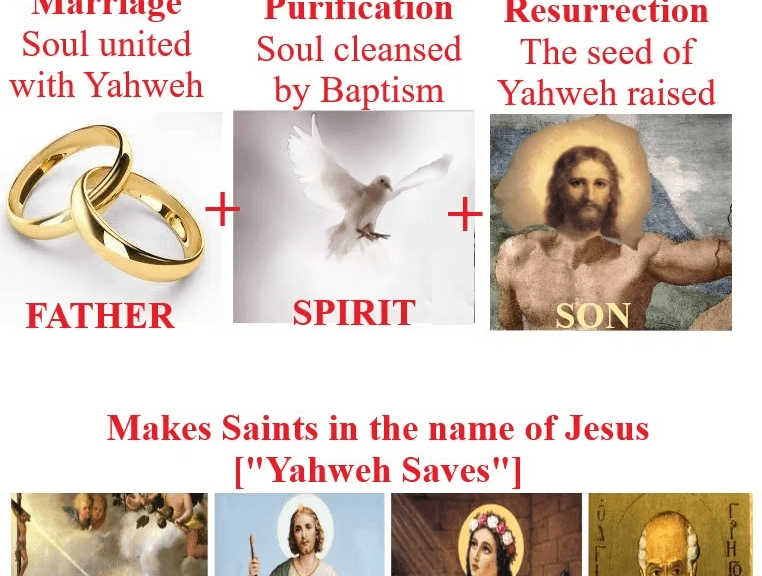
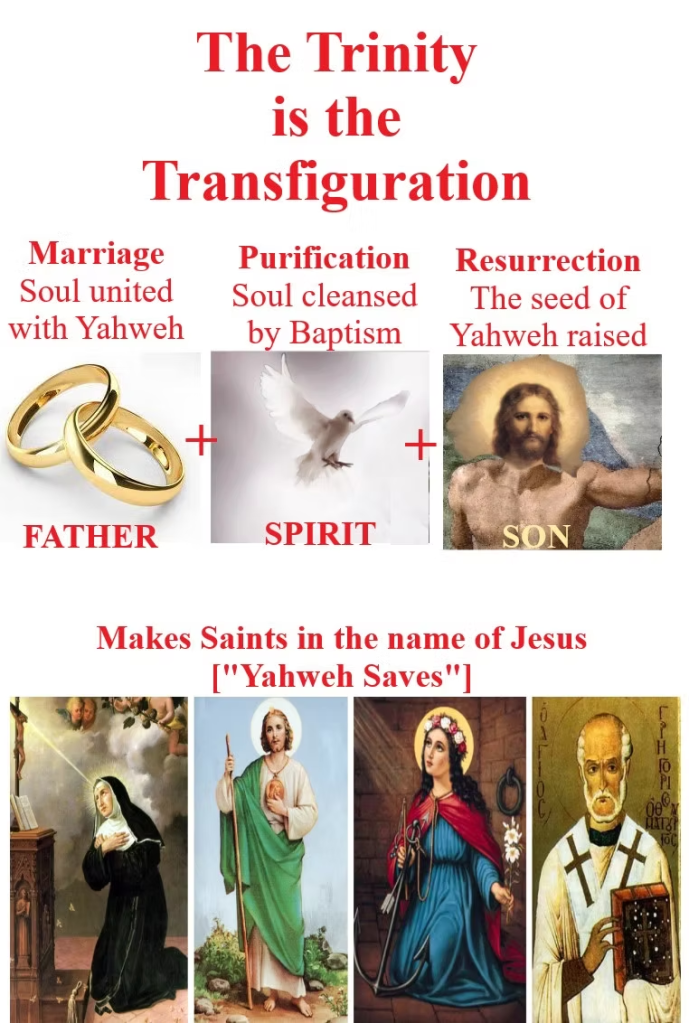
I will add to the above statement that the interpretation I presented in 2018 went fairly close to what the New Revised Standard Version translation shows [that read aloud]. It is from that acceptance of standard transformation of divine text into somewhat understandable English that I now veer away from. All of the Epistle selections were written by Saints, which means their souls had married Yahweh, becoming His submissive wives, who then gave birth [rebirth or resurrection] to His Son Jesus within their bodies of flesh. As divine persons, they all wrote in the divine language of Yahweh, which can only be understood when Jesus has been reborn within. This is the truth of “speaking in tongues,” which Acts 2:3-4 tells. Therefore, this interpretation takes a fresh look at what was truly written and brings forth the amazing depth that is contained in Paul’s words [spoken to him by God], which are not discernable in the NRSV presentation.

In this selection, verse 22 begins with the capitalized Greek word “Oidamen,” which is rooted in the verb “eidó,” meaning “be aware, behold, consider, perceive” (Strong’s Definition), adding in application “I know, remember, appreciate.” (Strong’s Usage) The form written is the first person plural active indicative, which is “used only in certain past tenses; properly, to see (literally or figuratively); by implication, (in the perfect tense only) to know.” This means the plural number is the reason for capitalization, as the plural simply means many have been elevated divinely to a state of knowledge, which can only be known through accessing the Godhead or the Christ Mind. Without seeing this written through capitalization, one misses the divinity of verse 22 saying, “Knowledge is ours indeed because all this creature laments jointly kai suffering in painful and laborious efforts together until of this just now.”

The NRSV translation makes it seem that “the Creation” is an event that has long “been groaning in labor pains” to give birth to something that Paul says “now” has come. While that is true, to some degree, it misses the mark by translating “ktisis” as “creation.” The same word can mean “creature.” It should be read as that, as man is little more than a “creature,” like a lost sheep.

The context missing is Paul having written that same word three times prior, once each in in verses 19, 20, and 21. In verse 21 Paul wrote, “the creation itself will be set free from its bondage to decay and will obtain the freedom of the glory of the children of God.” [NRSV] This makes it easier to see “the creation” as a “self” [meaning “soul”] that is in “bondage” relative to mortality [“decay”], as a child seeking to be “of God.” This says, “Knowledge coming from God is what all mortals are born without; and, it is the commonality of lament and suffering that drives one to seek Yahweh.”

The NRSV then translates verse 23 as saying, “and not only the creation, but we ourselves, who have the first fruits of the Spirit, groan inwardly while we wait for adoption, the redemption of our bodies.” This is where confusion is added to confusion, leading readers of all the Epistles to be continuously dumbfounded and lost. The implication here in this verse says “the creation,” when that is not written in the text. It is an addition by paraphrase, based on a misguided assumption that a word written prior must now be added, when it is not [I call that ‘playing god’]. In reality this verse is complex and must be broken into segments and carefully contemplated.

The whole of verse 23 has this Greek text: “ou monon de , alla kaiautoi , tēn aparchēn tou Pneumatos echontes , hēmeis kaiautoi en heautois stenazomen , huiothesian apekdechomenoi , tēn apolytrōsin sōmatos hēmōn .” This is six segments of words and each must be understood separately, before one can jump to another. The marks of separation cannot be erased and the words cannot be rearranged or mixed as one sees fit. The separation of segments are God-given, which means they cannot be combined in paraphrase, without weakening the truth, or even destroying it. This means each segment will be discerned separately now.

The first segment literally translates to say, “not alone on top of this.” After ending verse 22 with the change in a “creature” that had been long lamenting and painfully suffering with desire to know how to please Yahweh; that had come … as “now” [from “nyn” not “de”]. This means the change now that differs from the long struggle is one becoming “not alone.” The small Greek word “de” can translate as “now,” but not as an adverb of time. It is a conjunction that says, “on top of, next, after, or indeed now.” (HELPS Word-studies) Therefore, Paul is saying the change in self means companionship of some kind. It is hard to be led to that conclusion by a translation that says, “and not only the creation.” [NRSV]

The second segment is two words divided by the marker word “kai.” The first word, “alla,” has been translated by the NRSV as “but,” when that translation plays no role of fluency [as a conjunction] when placed before another conjunction [“kai,” which the NRSV ignores]. Because the prior segment has alluded to more than one [“not alone”], the more viable translation is “on the other hand” or “otherwise,” as “alla” is the neuter plural of “állos,” meaning “other.” That designation, as “on the other hand” is relative to “not alone on top of this” and leads to the important marker word [“kai“] that says “self” must be seen as importantly different, as “ourselves” have changed. The NRSV weak translation – “but we ourselves” – needs to be tossed.

Seeing this state of “self” [which means “soul”] having changed, so a soul is “no” longer “alone,” the third segment of words literally translate to say, “which the beginning of a sacrifice of this Spirit possessing.” Here, the aspect of “first fruits” has been replaced by the root meaning, which is “sacrifice.”

Following an important statement about “self” [a soul], it is that “which” is no longer “alone.” The word translated as “first fruits” [“aparchēn”] is said to mean, “the beginning of a sacrifice, i.e. the first fruit” (Strong’s Definition), where the usage is said to be: “the first-fruits, the earliest crop of the year, hence also metaphor, for example, of the earliest converts in a district; there is evidence in favor of rendering in some passages merely by: sacrifice, gift.” (Strong’s Usage) When the simple translation of “sacrifice” is used, the segment says, “which sacrifice of this Spirit possessing,” where it is clear to see Paul saying the lack of understanding [“knowing of God”] is “now” relative to a divine possession [“echontes” meaning “having, holding, possessing”]. Again, the confused translation of the NRSV – “who have the first fruits of the Spirit” – makes no sense, other than to sense something about the Apostles somehow being “first fruits.”

To insert a point here now that is relative to faith, as far as Christianity is concerned, there are many places in Biblical text where demonic possession is presented. Jesus was known to routinely cast out demon spirit that had possessed Jews who needed help casting them out. Jesus sent out intern disciples with the power to cast out some demon spirits in his name. Christians will go to the mat defending Jesus, stating belief that demons spirits do exist. Evil deeds are often blamed on demons within [multiple personality disorder is what it is called these days]. Roman Catholic priests [some] are trained in exorcisms, which is some ritual way of casting out a demon spirit. With all of that faith in Scripture, why does all that disappear when it comes time to admit being filled with a Spirit that makes one Holy and Sacred, Set apart by God? Why is that not the same joining of a soul, with a divine Spirit that equally “possesses” a soul? In this regard, I advise those of true faith to read this Wikipedia article called “Eudaimonia.” This is something that pre-existed Christianity and explains what Paul is saying here.

Seeing divine possession as being what Paul said keeps a “self” [“soul”] “not alone,” the fourth segment of words is another that includes the marker word of importance – “kai.” This literally translates to say, “we kai ourselves with itself compressed internally and unexpressed.” The NRSV has reduced what was written [because that program is blind to divine translation] to simply “groan inwardly.”

In this, the pronoun “hēmeis” means “we, us, our,” but all are forms of “being,” as forms of “egó.” The plural has to be seen as applying to each individual “self” [“soul”], while projecting to “selves” as being further in the plural. Thus “we” is for all individually, so one soul becomes “we,” due to possession by the Spirit of Yahweh [holy matrimony]. Because of the marker word “kai” immediately following “we,” this word stands alone and must be seen as marked separately from that coming next.

This understanding is then emphasized [“kia” usage] importantly as “ourselves with [or in] itself.” Here, the Greek word “stenazomen” becomes confusing as it typically translates as “groaning” [flashback to “labor pains,” as the same root word is involved here and there]; but the word comes from “stenós,” meaning “compressed, constricted.” Thus, Paul is saying the expanse of God’s knowledge is a strain on a human brain to comprehend; so, it is best to allow its presence to be compressed within one’s being [“eimi”], without expressing its presence.

The fifth segment of words literally translates as, “sonship eagerly awaiting.” The Greek word “huiothesian” is properly translated as “sonship,” meaning placement within a family of means [royalty]. Because of that, the word is often translated as “adoption as a son,” because females would not be adopted, instead married. It is important to realize this male designation of “sonship” means that Yahweh is masculine, as is all of the Spirit realm [that heavenly]. Everything material [in the physical realm] is feminine in essence. Jesus was then the “Son of man” because of the Spirit within him [a Holy creature]. Had Jesus been born into a female body, that body would still be an “adopted son,” because Spirit is masculine essence.

The Greek word “apekdechomenoi” translates as “eagerly expecting, looking for, or awaiting,” such that it is patience with desire. Following a segment telling of a compression of Spirit within one’s soul, the adoption is that of Jesus to be resurrected. This says there is more to come, after a soul has married Yahweh’s Spirit. The consummation of that union brings about the son adopted.

Finally, the sixth segment of words literally translates as: “who setting free of this body of us.” Here, the Greek word “apolytrōsin” translates as “redemption,” but the word actually means “a release effected by payment of ransom.” (Strong’s Definition) In that, the word properly translates as “redemption,” with the caveat being: “buying back from, re-purchasing (winning back) what was previously forfeited (lost).” (HELPS Word-studies) This then says the “eagerly awaited” resurrection of Jesus within is the sacrifice one must make in order to be redeemed and earn eternal life for a soul – one released from the bondage of reincarnation. A soul [“self”] is no longer married to a physical body [life after life reincarnations] once Jesus has been resurrected within one’s flesh, one with one’s soul.

Hopefully, the breakdown I have just presented for verse 23 can be seen as very specific and thorough. After reading what the Greek actually means, to then read the above NRSV translation that says, “and not only the creation, but we ourselves, who have the first fruits of the Spirit, groan inwardly while we wait for adoption, the redemption of our bodies,” it can then make sense. Still, without that realization of what Paul wrote to the Christians of Rome, one scratches one’s head and asks, “What was the other optional reading in place of Romans 8?”

This reading becomes a sermon in itself, as it perfectly fits [all Epistles do] the theme of Acts 2:1-21, in the sense that “speaking in tongues” is about explaining words written, which even those fluent in Greek could not figure out … completely … as souls alone. Verse 23 is an example that needs to be shouted from the rooftop, explaining what it truly means, so those who are seeking the truth can receive Yahweh’s Spirit and be made Set apart by Yahweh [Holy, Sacred, Saintly].

Verse 24 then literally translates to say: “which indeed confidence we were rescued ; trust on top of this being discerned , not exists expectation ; that indeed perceives why what ,
he believes ?” That compares to the NRSV above, which translates: “For in hope we were saved. Now hope that is seen is not hope. For who hopes for what is seen?”

Here, again, the NRSV has created three sentences, when the presence of two semi-colons shows that is possible; but all thoughts are relative to one central theme. The three sentences do not show breaks in the second and third ‘sentences,’ such that they become two segments each, joining everything together as one. That makes it more difficult to see precisely what Paul intended.

In the three ‘sentences’ created by the NRSV, the word hope is repeated [four times]. The Greek words translated as “hope” [or using “hope”] are “elpidi,” “elpis” (twice), and “elpizei.” There, the last word is rooted in “elpizó.” That word means, “to expect, to hope (for)” (Strong’s Definition), with it usage stated to be “I hope, hope for, expect, trust.” The other three Greek words are rooted in “elpis,” which is defined and used as “expectation, hope, trust, confidence.” (Strong’s) Because “hope” is one of those nebulous words that everyone understands, but nobody can accurately define what it means [religiously], I have used the viability of substitution to insert “confidence, trust, expectation, and believes” [“believes” viable according to Wiktionary] into the translations. All can be summed up as relative to “hopes and expectations,” but my translation leads a human brain to better discern the intent.

These five segments, divided into three lines of thought on the same theme, can now be set up in this manner:

  1. [Jesus reborn within one’s body, bringing the promise of redemption …] That presence is “which indeed confidence we were rescued.” In that, the Greek word “esōthēmen” has been translated as “we were rescued,” but it can also state, “we were saved” “we were healed,” or “we were preserved.” Because the presence of Jesus within is known, the element of “hope” is not such an iffy condition, but one of “confidence.”
  2. [Relative to this introduction of “confidence, hope, expectation, trust” …] “trust on top of this being discerned.” Here, the Greek word “de” is translated as “on top of this,” but it can be “moreover, indeed now, or next” [HELPS Word-studies]. I used “on top of this” because the presence of Jesus’ soul supersedes one’s own “self” [“soul”], because it is “not alone.” Jesus’ soul takes the “top” position, as “Lord” of one’s body of flesh. This “possession” is willingly allowed, because of “trust, confidence, hope, and expectation” that the Christ Mind is that then “being discerned.” In that, the Greek word “blepomenē” is the present participle, as “looking, seeing, perceiving, or discerning.” This says one’s human brain is able to “discern” divinely, in a supernatural way, based on the “trust” coming from divine possession.
  3. This then leads to the second part of this second line of thought, which adds: “not exists expectation.” There, the Greek word “estin” is a word translated as “is,” but “is” is a statement of “being” or “existence.” This says the joint possession of one body of flesh by two souls – one dominant, one submissive – says the submissive soul does “not exist” in an outward way as before. The saved soul sets no “expectations,” so it does not pray or hope to be given what it wants [selfishly]. Thus, the whole of ‘sentence’ two is “trust in the Spirit does not come from personal expectations.”
  4. [Relative to the “trust that has divinely come upon one’s soul and body, such that one’s soul has totally bowed down before Yahweh, allowing His Son to guide one’s acts …] “that indeed perceives why what.” In that, the Greek word “blepei” is a repeating of the prior ‘sentence’s’ “blepomenē,” where “discernment” is now translated as “perception.” All is relative to what the Christ Mind runs through a human brain, so the submissive “self” [“soul”] becomes fully aware (“sees”) everything one’s body of flesh is led to do [acts]. As such, the combination of two words saying the same thing [“tis ti” – with both meaning, “who, which, what, why”] means the “self” understands [“perceives”] the answer to all the questions – the “what” and “why.”
  5. This then leads to the addition that is simply one word in Greek – “elpizei.” This is one of the forms of “hope” used, but it is stated in the “third-person singular present active indicative,” which BibleHub translates as “does he hope for.” This one word then leads to a question mark. The question mark implies the whole of verse 24 is a question, which the NRSV translates only the third ‘sentence’ as: “For who hopes for what is seen?” The question can now be seen as relative to the one word, which demands closer scrutiny into what “elpizei” means. According to Wiktionary, “elpízō” means: “to hope for, to look for, expect.” That site then subdivides those “hopes” and “expectations” as being relative to being “of evils,” “with present infinitive,” and “with dative.” Because the form written is the third person singular present active infinitive, the category “with present infinitive” leads one to see a translation relative to: “to think, deem, suppose, believe.” Therefore, the question, stemming from a Spirit within that “perceives why what” one asks, “what does he believe?” or “why does he believe?” That becomes the question. The question centers on one’s faith, more than the casual way people say they “I believe.”

This is then explained in verse 25, which the NRSV translates as saying, “But if we hope for what we do not see, we wait for it with patience.” The literal Greek translation is this: “forasmuch as next , which not we see we expect , on account of patience we eagerly await.”

From a question that asks about the source of one’s beliefs, verse 25 then begins with the scenario that is relative to what comes “next” [from “de”], or “moreover, indeed now, on top of this.” [HELPS Word-studies] Beliefs are not based on hopes for what will come next, based on beliefs memorized or externally held; but rather from a confidence that knows what will come. One knows personally “why” it will come “what” will be a necessary next step. This is “not” a set expectation by “us, ours or we,” which are the submissive souls stepping aside so the soul of Jesus will make us do what it righteous. Having set no such personal expectations, the only expectations are then based on what and why one believes, which is that it will be what it will be. That knowledge creates a sense of excitement [eagerness] that cannot the future be rushed. One is led to “wait and see,” knowing whatever comes it will be what is best.

The Greek word “hypomonēs” is translated as “patience,” but the word equally means, “a remaining behind, a patient enduring” (Strong’s Definition), and “endurance, steadfastness, patient waiting for.” (Strong’s Usage) The intent by Paul says one’s soul has willingly stepped aside [remaining behind] as a statement of faith, so it eagerly awaits what the soul of Jesus within will bring ‘next.”

Verse 26 is then translated by the NRSV to say, “Likewise the Spirit helps us in our weakness; for we do not know how to pray as we ought, but that very Spirit intercedes with sighs too deep for words.” In reality, the Greek text needs insight to see the capitalization of the first word – “Hōsautōs” – where “Likewise” needs to be read with divine elevation.

The Greek word actually means, “in like manner, likewise, just so.” (Strong’s Usage) A divine elevation means the soul-body divinely possessed now acts “In like manner” to Jesus of Nazareth. This becomes the divinity of faith that being a true Christian is all about. One eagerly awaits what Jesus will do next, because Jesus is acting in one’s body of flesh. This “Likewise” presence is in countless others who have married their souls to Yahweh, so His Son could resurrect within them as well. This divine repetition of being “Just so” is due to [literally] “the Spirit joins to help the weakness of us.” The “weakness of us” is the inability of a soul alone to bring about a righteous state of being, thereby being prone to the failures of sin. The “Spirit” comes from a soul sacrificing itself when it submits to Yahweh in marriage.

The literal words that follow a semi-colon that follows the first segment of words in verse 26 translate as: “that for which we should offer prayers for according as what is proper.” In this segment of words there is no reference to “not,” which the NRSV has pulled forward from the subsequent segment. The weakness of our individual souls is assisted by the presence of the “Spirit” [see Jesus’ references to “the Advocate”], such that one then acts “Likewise” to Jesus and “prays for what is proper” [or “how to pray as we ought”].

The following segment of words is simply translated as “not we know” or “not we are aware of” or “not we remember.” The use of “not” is relative only to what one’s “self” or “soul” knows – which is nothing, as it has become submissive. Jesus prays for us, once his presence is within, because our prayers alone would be useless if dwelled upon by our human brains. Prayers are released once they have been sent and forgotten. When a soul alone prays, it dwells on a need for proof God heard what we want, so much that the prayer is not released; all the while, God knows all needs. Jesus knows how to pray properly.

The segment of words that then follows that admission by Paul that our souls know nothing is where he wrote [literally translated]: “on the other hand self [soul] which Spirit makes petitions.” Here, the use of “auto” [meaning “self; he, she, it; the same”] must be seen as the adjoining “self” [“soul”] that makes one’s own soul be “not alone.” Paul is now explaining that prayers of intercession are only generated by the “Spirit” within one’s “self” [“soul”]. This becomes inaudible and not sensed by physical means. It is how Jesus could do little more than tell people in need of help, “Go. Your faith has made you well.” It was the “Spirit” within Jesus that prayed for others silently.

That is confirmed in the last segment of verse 26, which literally translates to say, “with groanings inexpressible.” Here, the word “stenagmois” relates one back to the “labor pains,” which was the compression inwardly and unexpressed presence of Yahweh’s Spirit – All-Knowing pressed into a brain that knows nothing of value otherwise. Those now are the deep Spiritual feelings for the agonies suffered by others, those of faith. Therefore, miracle healings come without words needing to be uttered. The Greek word “alalētois” translates as “unutterable, that baffles words, unexpressed.” (Strong’s Usage)

Verse 27 is then translated by the NRSV as saying, “And God, who searches the heart, knows what is the mind of the Spirit, because the Spirit intercedes for the saints according to the will of God.” That presents a four-piece segmentation of words. In reality, Paul only broke these words into three segments. The literal translation states: “that on top of this searching those inner souls perceives what this thought of the Spirit , because sent down from God ,
he intercedes for the sake of those set apart by God .

This says first: The Jesus soul on top of a submissive saved soul is always diligently alert for lost souls seeking to be found and their cries are heard by the Spirit of Yahweh. Second, Paul said: The soul of Jesus inside the flesh of a self-body receives orders, where to go and who to help, sent by the Father; and, as the Son, he goes where sent. Third, Paul wrote: The Jesus soul acts for the sake of those who are seeking to be made holy; and, those made holy by the Spirit go to where that Spirit can be passed on.

As a reading possibility on the Day of Pentecost [Christian style], this reading says Christianity is a ministry of those reborn as Jesus, also the Christ reborn. It is a collection of Saints, none of who claim that title. All souls are submissive to the Will of Yahweh, for the purpose of serving Him as His Son resurrected, for the guarantee of eternal life after the body falls away. This reading from Paul’s letter to the Christians of Rome is an example of speaking in tongues, which a true Christian possesses, as Jesus reborn.


Romans 8:12-17 – Being a child of God demands self-sacrifice

So then, brothers and sisters [adelphoi brothers only], we are debtors, not to the flesh, to live according to the flesh– for if you live according to the flesh, you will die; but if by the Spirit you put to death the deeds of the body, you will live. For all who are led by the Spirit of God are children of God. For you did not receive a spirit of slavery to fall back into fear, but you have received a spirit of adoption. When we cry, “Abba! Father!” it is that very Spirit bearing witness with our spirit that we are children of God, and if children, then heirs, heirs of God and joint heirs with Christ– if, in fact, we suffer with him so that we may also be glorified with him.

——————–

This is the Epistle selection for Trinity Sunday, Year B, according to the lectionary for the Episcopal Church. It will follow the Old Testament selection from Isaiah, which says: “Then I heard the voice of the Lord saying, “Whom shall I send, and who will go for us?” And I said, “Here am I; send me!’” That will lead to the singing of Psalm 29, where David wrote: “The Lord shall give strength to his people; the Lord shall give his people the blessing of peace.” This reading will accompany the Gospel reading from John, where Jesus said, “And just as Moses lifted up the serpent in the wilderness, so must the Son of Man be lifted up, that whoever believes in him may have eternal life.”

Last Sunday – Pentecost – the optional “New Testament” was from Romans 8, verses 22 to 27. The translation into English was so bad, it was nearly impossible to listen to it be read aloud and come away with any idea about its meaning. I did an in-depth analysis of the Greek text and a remarkable reading appeared, full of life and truth. I said it was an example of what “speaking in tongues” was all about. This reading selection is so much clearer to grasp, it is funny to see that reading and this reading coming from the same chapter of the same epistle. Still, as Paul did not change course as to the purpose of his letter [stating the same thing twice, differently], the Christians churches today refuse to understand what Paul wrote here, which is vividly clearly stated.

The problem with modern translations is evident in verse twelve, where the words read aloud say, “brothers and sisters.” This was not written. The word written is “adelphoi,” which means “brothers.” On top of that, it is one word separated by comma marks, so it is an important one-word statement. The word is a masculine noun in Greek. While it is possible to expand the translation to say “member of the same religious community, especially a fellow-Christian” (Strong’s Usage), it still is masculine.

As a stand-alone statement, one needs to realize Yahweh wrote that word using the hand of Paul. To change a Word of Yahweh is heresy. Jesus said, “For truly I say to you, until heaven and earth pass away, not the smallest letter or stroke of a letter shall pass from the Law, until all is accomplished!” The same philosophy should apply to all Scripture.

The curse modern churches have to deal with these day [if not always] is women make up the majority of those who sit in the pews. They are the gender most delighted by the pageantry of church services [especially the music]. For as little as males contribute to churches [other than money], the women have married their churches, putting more effort in to being a ‘church lady’ than being a wife to their husband. A ‘church lady’ definitely is not married to Yahweh. That means few these days are marrying their souls to Yahweh and few these days are being reborn as Jesus – the Son of Yahweh.

The only reason for Paul to only address “brothers” was Yahweh and the Spiritual realm of heaven is positive-masculine-light, while all made of matter is negative-feminine-darkness. This means Paul was addressing all who had been reborn as Jesus, their souls Anointed ones of Yahweh. So, even the females in Rome who would read Paul’s epistle were Sons of Yahweh, brothers in Jesus. [Not of Jesus, in Jesus.]

When churches pander to paying customers and not work to deliver the message of Yahweh [an Apostle is a Messenger], sent through His prophets [all Scripture], they then reduce themselves to being hired hands [or worse] and they keep lost souls lost. Under such ineptitude in pastoring a flock, no one is led to get up out of a pew and enter ministry, filled with Yahweh’s Spirit, made Saints, appointed as new Christs in the name of Jesus. Whenever that is not happening, then churches are an impediment to salvation, not an assistant to that.

That aspect of being lost and then being found is stated by Paul, when he wrote “debtors we are.” Paul and other true Christians were indebted to Yahweh for having been accepted in marriage, as their souls had been promised eternal life. That promise is their debt, as it does not come with a “Just sit in a pew and I’ll do all the work” card. The debt a soul owes Yahweh for the promise of Salvation is devoted service. Service means entering ministry – the point of the longest season of the Ecclesiastical Calendar – Ordinary time after Pentecost.

As a debt, ministry is an expectation, not an option. The option is either the salvation of a soul or the freedom to serve oneself and come back again in a next life. Reincarnation is a ‘been there, done that’ all souls know. Over eons, it gets old. All souls know past failures; and, all souls know it is a gamble to roll the dice and see what will come next, because all souls know the next incarnation might not have all the luxuries one has enjoyed in this failed life.

When Paul wrote, “not to the flesh,” that says humanity is not indebted to Yahweh for having breathed in the breath of life [a soul]. Being born in the physical realm is actually one’s sentence from the failures of a life before. Because souls are eternal [like Yahweh, having come from Him], they must have flesh in which to exist, if their eternal souls have become dirtied by a past life in the flesh.

While Yahweh is the Father and Jesus is the Son and all that is heavenly is masculine, the soul is neuter gender, having to adjust to life in new bodies of flesh, which can be male or female, but always negative-feminine-darkness. Thus, a soul takes on the femininity of the flesh [matter], regardless of the human necessity for opposite sexes. Souls have no need to mate, but flesh does; because so many souls keep failing to return to Yahweh. There is no debt for being placed in a physical prison for a lifetime. However, that lifetime is when one should be working towards ‘earning freedom.’

That is the meaning of Paul writing, “to live according to the flesh.” The literal translation of the Greek says, “of this according to flesh to live.” The word “tou” [not translated] says “of this,” which reflects back on the debt of the flesh. The part that then adds “according to the flesh to live” is a statement that the debt has nothing to do with being in a body of flesh and calling that being “alive.” The soul is always “alive,” as matter [flesh] is always dead, such that a soul animating flesh gives the impression of dead matter having “life.” That description of “life” comes with no debt owed, as that is debt being paid for past soul failures.

Verse 13 then furthers this by saying, “for if you live according to the flesh, you will die.” Here, the literal translation rephrases this, as “if indeed according to flesh you live , you are about to die.” The nuisance of this says calling the flesh “living” means the neuter soul has become controlled by the feminine matter that a soul has animated. This can be attributed to the fleshy brain, which is a most complicated computer that receives influences from all spiritual sources. When Satan gains control over a soul, it has used the lures of sin [the worldly pleasures] as a way to convince the soul that the flesh equates to “life.” It does not, as matter [flesh] is dead without a soul, thus it is called “mortal life,” meaning the flesh concept of “life” “will die.”

The second half of verse 13 [following a semi-colon] says, “but if by the Spirit you put to death the deeds of the body , you will live.” In that, “Spirit” [as a capitalized word] is not written. The actual Greek states “pneumati,” which refers to the “soul,” which is the “ruach” from Yahweh [with “ruach” meaning “breath, wind, spirit]. Thus, in essence, Paul said this: “If you put to death the influences of the flesh over the soul , then you will live.” This means the self-ego [a fleshy brain sense of self-importance] must die, in order for the soul to be marriage material [with soul] for Yahweh. Such a self-sacrifice must be made first, to be considered for such a divine union [holy matrimony].

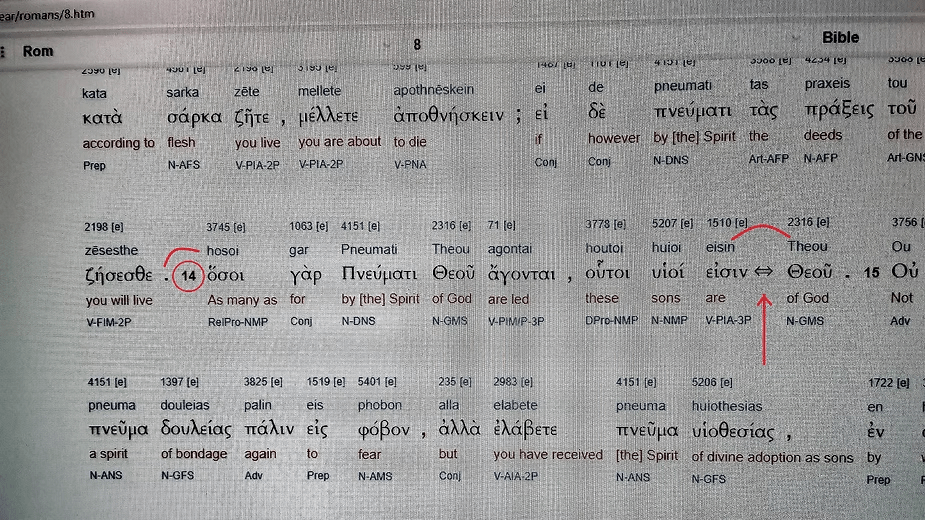
It is then in verse 14 that Paul capitalized “Pneumati Theou,” which means marriage to Yahweh and the union of “His Spirit” with one’s “soul” [lower-case “pneumati”]. Knowing that can only happen if one has “put to death the deeds of the flesh,” Paul then wrote [according to the NRSV]: “For all who are led by the Spirit of God are children of God.” Herein lies another ugly snake of translation, where the self- patronizing churches of modern Christianity take the Greek word “huioi” – which clearly states “sons” – and transform it into the uselessness of “children.”

This is not so much ignorance, as it is a complete lack of understanding the masculinity of divine Spirit, which means there is no one alive in Spirit in the places that now translate the Holy Bible. The churches have no Spirit in their hired hands, so [in fear of running off some old ladies with lots of inheritance monies to will to a church organization] they pander to worldly sex organs, not souls.

According to Strong’s, the word “huios” [singular number] translates as “son, descendant.” That means a translation as “descendants” would be somewhat more acceptable, with the caveat being “male descendants.” According to HELPS Word-studies, this is written about “huios“: “hyiós – properly, a son (by birth or adoption); (figuratively) anyone sharing the same nature as their Father.” When one’s soul [“spirit”] has joined with the “Spirit of God” [“Pneumati Theou – Yahweh’s Spirit], then one becomes a “descendant” that “shares the nature of the Father:” i.e.: a son. This is most important to grasp.

The literal translation of the Greek text of verse 14 says, “as many as Spirit of God are brought , these sons are”. There, “agontai” can translate as “are led, are guided, or are carried.” This is reference to marriage, where a bride is “led” down the aisle and given away by her biological father, given wholly to her new husband as the rightful owner. [I feel sorry for any feminists who are disturbed by that thought.] Once “carried away” by Yahweh, the new Husband of a soul [“spirit”], “these sons are.” In that statement, “eisin” is a statement of “being, “ as “are,” but the intent of that word is to say those souls have changed possession.

It is here that a mathematical symbol is inserted in the Greek text, which is a symbol that cannot be translated by translators; so, they ignore it. The symbol is called a left right arrow, which looks like this: ⇔. The symbol appears between two elements that are true, as “if true [to the left] then true [to the right]. It equally applies to statements that are false; but the point is to state the truth being equal. The two words this symbols appears between are: “eisin” and “Theou.” Thus, the change occurring to a soul [“spirit”] says the truth of “being” [“are”] is the truth “of God.” There, the genitive case says the changed “being” has become that “of God,” therefore that soul has been divinely possessed.

As for the explanation that “a son” is either by “birth or adoption,” Paul then wrote in verse 15 [NRSV]: “For you did not receive a spirit of slavery to fall back into fear, but you have received a spirit of adoption.” In that, twice the lower-case “spirit” is used, which means “soul.” In understanding this double statement of “spirit,” it helps to realize the purpose of marriage.

The purpose of marriage is not to legally have sex, to legally play together, to impressively show each other off to friends and family [like the modern concept of marriage has degenerated into]. Marriage is all about having babies. The marriage of kings would bring about witnesses to the consummation of that union, because the purpose was to have a womb generate a male heir. The etymology of the word “husband” means to be the head of a family [household], which means more than two.

The literal translation of verse 15 must address how it beginning with a capitalized “Ou,” which becomes an important statement of what is “Not.” It then says, “Not indeed you have taken hold of spirit of slavery again towards fear.” That segment of words says a human being has already received a “soul” [“spirit”] that is the slave to a body of flesh. That has already taken place, so marriage will not bring that condition about again. Yahweh, that soul’s [“spirit’s”] new Husband, is not going to impregnate that soul with another lost soul [“spirit”]. That would put two lost souls in one body of mortal flesh, so twice the fear of death would arise. That is Not the purpose of divine union [holy matrimony of Spirit and spirit].

The second half of verse 15 then literally says, “on the other hand you have received spirit of adoption as sons.” Here, the NRSV has conveniently omitted the “of sons” [from “huiothesias”] part. That matches its ineptitudes earlier [“brothers and sisters” and “children”]. Here, the “receipt of spirit” has to remind all Christians how the resurrected Jesus appeared to his disciples and “breathed upon them, saying ‘Receive Spirit Holy.’” Jesus appeared as a “spirit” [his “soul” appeared and spoke], so the “spirit” his disciples “received” was his. Even the women of Jesus “received his spirit” so they too were “adopted as sons” of Yahweh, as Jesus reborn within them.

This element of being Jesus reborn was the theme of the seven week [eight Sundays] Easter season. One was supposed to already be married to Yahweh [spirit to Spirit], so the little baby Jesus soul could arise in one’s flesh. The Easter season was all about being comfortable being Jesus reborn in one’s flesh, beside [but leading] one’s soul, as “brothers” in Spirit. Ministry cannot begin until that transformation has occurred and the truth says “I am ⇔ of God.”

Verse 15 then ends by saying, “When we cry, “Abba! Father!” That means only those “adopted as sons” can call Yahweh “Abba!” It says only those who have received the soul [“spirit”] of Jesus can likewise call Yahweh “Father!” One who has not been “adopted as sons” by Yahweh, because one’s soul still hides snugly within its flesh, fearing sacrifice of self and a commitment to servitude to Yahweh as His wife, reborn as His Son Jesus, those have absolutely no right to call Yahweh their Father. Their only father such souls can claim is the man who made a deposit within his wife’s womb, which Yahweh formed into your flesh, before breathing your soul into that prison you refuse to give up. Calling oneself “Christian” does not make Yahweh one’s Father. Only idiots think God is the Father to Red Chinese and Communist Russians [i.e.: all atheists]. One has to marry Yahweh [a commitment of soul], so one can be reborn in the name of Jesus Christ, in order to be adopted as a son of Yahweh – one’s Father.

Verse 16 then states [NRSV]: “it is that very Spirit bearing witness with our spirit that we are children of God.” Here, the Greek word “tekna” is written by Paul, which does translate as “children.” Still, this misses the truth contained in the words written by Paul. To begin, he wrote “auto,” which translates as “self.” The meaning must be realized as referencing a “soul” [a “self”] and not the body of flesh it animates. The body of flesh is either the son or daughter of a human father. It is the “soul” that must be “adopted as the son.”

Next, the literal translation says, “soul this Spirit bears witness with the spirit of us because we are children of God.” That says the marriage between a “soul” and Yahweh is “soul this Spirit.” By becoming one with Yahweh – as His wife – one “bears witness.” This must be seen as giving birth from that divine union, where the truth of “symmartyrei” is it says, “bears witness together with” [Strong’s], where the union of a Husband and a wife “bears” a child that becomes “witness” to that union.

This is then the meaning of the Apostles saying they “bear witness to the resurrection of Jesus,” because Jesus was reborn within each of them, from the union of their souls to Yahweh. That says Jesus reborn is “the spirit of us,” where “spirit” means the “soul” of Jesus having resurrected alongside [but reigning over] one’s soul. As such, all who are created by this Spiritual nature are “children of God,” as “adopted sons.”

This then leads to the last verse in this reading selection, which is translated to state [NRSV]: “and if children, then heirs, heirs of God and joint heirs with Christ– if, in fact, we suffer with him so that we may also be glorified with him.” The Greek text here includes two uses of “kai,” which designates importance to two words written. The NRSV translation does not know to recognize “kai” in that way, so it is best to literally translate that now.

This begins with a conditional statement: “if now children.” This is an implication as one of the “children of God,” which ended verse 16. The “if” condition says “Not” everyone will have been “adopted as sons” by marriage to Yahweh. The conditional says the decision to marry Yahweh is left up to each individual soul, with the freedom to be the “children” of earthly fathers then given.

Following a comma mark of separation, Paul wrote the word “kai,” which then places significant importance on the word “heirs.” The implication of the “if” is then “heirs,” but the importance of “heirs” is elevated, above that of worldly “heirs.” As an “inheritor,” it is worthwhile to realize the ancient tradition of firstborn males being sole inheritors of a father’s estate, which included inheriting the responsibility of the family of that father’s household [as a husband]. This should be seen as a divine birthright, but one that is completely dependent on the “if” one decides to be reality. The inheritance of the Father [who will never die] is His Son. This is then stated in the following segment of words, which say: “inheritors truly of God.”

This then leads to a next segment that begins with the word “synklēronomoi,” which means “joint-participants,” as “co-inheritors” or “joint heirs.” While this can only be possible from a soul joining with the Spirit of Yahweh, the “joint-participants” become the reality of divine possession, where there are two “souls” [“spirits”] possessing the same body of flesh. Both are inheritors of the divine guidance of Yahweh. One is the host soul and one is the soul of Jesus. Since Jesus is the Son of man, so too does the host “soul” inherit that title. Thus, both are “joint-participants now of Christ.”

This selection is given the title by BibleHub as “Heirs with Christ.” This reflects the refusal of Christians to accept any responsibility that comes from being oneself a “Christ” of Yahweh. It sets an expectation that Jesus will adopt those who profess to believe he is the Son of God, so all a Christian has to do is wait for Jesus to die again and let the lawyers come bearing free stuff. It sounds like the last name of Jesus was “Christ.” It sounds like the nickname Christians give to Jesus is “Christ.” All this belittles Yahweh, as if He has not choice in the matter of designating who, what, how many and why a soul other than Jesus of Nazareth [born in Bethlehem] can ever be “the Christ.”

Yes, there is only one Jesus and Jesus is “the Christ,” as the one prophesied [the Messiah], but those word “Christ” [“Christos“] mean “Anointed one.” Yahweh has the power to Anoint whomever He pleases; thank you very much for recognizing that power. Therefore, EVERY APOSTLE-SAINT THAT EVER LIVED – has been, is, and will forever be “the Anointed ones” of Yahweh, ALL REBORN AS JESUS … ALL THE CHRIST.

At that point, Paul wrote: “if indeed [another conditional] we sympathize together.” That means one’s soul “suffers” along with the soul of Jesus. Being the Son of man is hard work, albeit wonderful work. This is how all of the disciples, who had received the soul of Jesus in them, could see the wounds of Jesus in their own flesh. They could witness Jesus resurrected because it was a resurrection within their own bodies of flesh, where they sympathetically could experience the crucifixion personally. It is that personal experience that transforms belief into true faith. It is how someone centuries later could witness the resurrection of Jesus, as a Saint adopted as the son of Yahweh … long after Jesus was born, lived, died, resurrected and ascended.

The final segment of words includes the second use of “kai,” stating: “in order that kai we may be glorified together.” The importance shines light on the conditional [as “may be”], such that the order of transformation demands sacrifice first. Just as Jesus had to die, “in order that” his soul could be inherited by a wife of the Father, so too must the host soul “die of self” to make all the “suffering together” bond two souls. Thus, it is only as two “spirits” in one body of flesh that two “may be glorified together” by Yahweh, the Father.

As the Epistle selection for Trinity Sunday, this has to be seen as the perfect match for Jesus talking to Nicodemus about being reborn from above. It makes bonehead Nicodemus out to be the one who ordered the NRSV to strike out all references to “sons” and “brothers,” because his view of religion is so failed it is wicked. This selection clearly says what needs to happen, if one is going to run around calling God the Father, when one has never considered sacrificing self-ego in order to serve Yahweh. Christians tremble at the thought of calling God Yahweh. Get over yourselves!

Romans 10:8b-13 – Please do not mistake faith for belief

[8b] “The word is near you, on your lips and in your heart” (that is, the word of faith that we proclaim); [9] because if you confess with your lips that Jesus is Lord and believe in your heart that God raised him from the dead, you will be saved. [10] For one believes with the heart and so is justified, and one confesses with the mouth and so is saved. [11] The scripture says, “No one who believes in him will be put to shame.” [12] For there is no distinction between Jew and Greek; the same Lord is Lord of all and is generous to all who call on him. [13] For, “Everyone who calls on the name of the Lord shall be saved.”

——————–

This is the Epistle selection to be read aloud on the first Sunday in Lent, Year C, according to the lectionary for the Episcopal Church. It will follow a reading from Deuteronomy, where Moses gave instructions to remember the gathering of the first fruits each year. There he wrote, “When the priest takes the basket from your hand and sets it down before the altar of Yahweh eloheka, you shall make this response before Yahweh eloheka:” … “Yahweh brought us out of Egypt with a mighty hand and an outstretched arm, with a terrifying display of power, and with signs and wonders; and he brought us into this place and gave us this land, a land flowing with milk and honey.” That will precede a singing of Psalm 91, where David wrote: “He shall say to Yahweh, “You are my refuge and my stronghold, eloheka in whom I put my trust.”’ All will accompany the Gospel reading from Luke, where Jesus was tested in the wilderness. There we read, “Jesus answered [the devil], “It is said, ‘Do not put the Lord your God to the test.'” When the devil had finished every test, he departed from him until an opportune time.”

This short selection for Paul’s letter to the Roman makes many Christians think salvation comes with no sever testing. It makes it seem like pretending to give up one little sinful pleasure for forty days each year will grant one an eternity of bliss in heaven, with God and Jesus. All of this is a misconstrued concept, where these verses written by Paul are translated so preachers can teach that false expectation. The fact that these verses are to be read aloud on the first Sunday in Lent says Paul wrote about what one needs to know, in order to pass that test with flying colors.

Missing from this reading is choice little tidbits that lead up to this selection, such as Paul writing in verse two, “I can testify that they have a zeal for God, but it is not enlightened.” [NRSV] That, certainly, referred to the Jews, especially those of the Temple in Jerusalem, to whom Paul (as Saul) had fallen into that “zeal for God,” which was a drive not inspired by divine wisdom [“epignōsin” means “knowledge, discernment”]. He then said that lack of true understanding what God had told them (through divine Scripture) was “being ignorant of the righteousness that comes from God, and seeking to establish their own, they have not submitted to God’s righteousness.” [verse 3, NRSV] That says that Scripture is written for the purpose of making people become “righteous,” not zealots. When Paul wrote “of God righteousness,” that means “ignorance” is removed by being led to understanding by God; and, that means being divinely possessed by God: a Yahweh elohim, reborn as Jesus. The state of “righteousness” cannot be achieved without that presence of God within one’s tiny brain. When people have not married their souls to Yahweh, they often will bend over backwards trying to make up for their lack of knowledge through overzealous acts of stupidity … in the name of God.

That lead-in needs to be known, before anyone can stand in a pulpit and toss out “Get to Heaven Free” cards. Those ignorant masses then wander into the wilderness, expecting to be passed quickly – like put into some suspended animation capsule in some sic-fi movie, awakened when the devil has already come and gone. The sad reality is: Thinking one is saved by belief that Jesus died for my sins is some slick Willie bamboozlement that leads to broken hearts and souls afire in damnation.

In verse four is a most important statement by Paul. The NRSV translates this as saying, “For Christ is the end of the law so that there may be righteousness for everyone who believes,” but that needs some adjustment in translation. The Greek text is as follows: “telos gar nomou Christos , eis dikaiosynēn panti tō pisteuonti .” That literally translates to state: “the principal purpose indeed of law Christ , into righteousness to all this having faith in .” That needs to be firmly understood.

The only capitalized word in that verse is “Christos,” which is a divinely elevated statement of “Anointment.” This means Yahweh is the one who “Anoints” a soul as His wife-servant [a Yahweh elohim]. The word “Christos” is not the last name of Jesus of Nazareth … although Jesus was certainly “the Christ,” “Anointed” by the Father. Thus, Paul said, “the principal purpose of law” is to be “Anointed” by Yahweh; and, that says the “principal purpose of law” cannot be accomplished, unless one has become a “Christ,” “Anointed” by the Father.

This then leads to the core word found in the six verses selected for reading on the first Sunday in Lent, which is “pisteōs,” which can be read as “faith, belief, trust, confidence; fidelity, faithfulness.” The primary meaning is as “faith,” which is an elevated form of “belief.” The two are not the same thing, as “faith” is from personal knowledge and “belief” is from no experience, other than being told what to believe. Thus, the “principal purpose of law” is to be “Anointed” by Yahweh, and then enter “into” a state of being where “righteousness” is a divinely led personal experience. Once there, “everything” one does is understood to be from “having faith” in the “law,” as guided within through personal “Anointment” by Yahweh.

Now, none of this is read today; but one should be expected to understand how Paul began this by stating, “The word is near you, on your lips and in your heart.” That comes with an aside [within parentheses], saying, “that is, the word of faith that we proclaim.” This needs to be understood, as well.

The NRSV places quotation marks around “The word is near you, on your lips and in your heart.” This is because that is written in Deuteronomy 30, as “Now, the word is very near to you; it is in your mouth and in your heart for you to observe.” (Deuteronomy 30:14, NRSV) In that verse from Moses, twelve times prior to verse fourteen is stated “Yahweh eloheka,” which means “Yahweh your gods” – meaning the elohim possessed by Yahweh. In verse eight, Moses told the Israelites, “and you will come back , and obey the voice Yahweh , and do all this his commandments which I command you today .” This becomes relative to verse fourteen saying, “for near you the word muchness ; in your mouth and in your heart that you may do it .” That demands one realize exactly what Paul wrote in Greek.

Paul capitalized the first word of this quote, by writing “Engys,´which means “Near.” This becomes a divinely elevated word only by realizing this “Nearness” comes from Yahweh’s presence within. When Paul then combined the two words “rhema estin,” which says, “spoken word is,” the meaning of “estin” [“I am, exist”] becomes the “existence” of the “spoken word,” which comes from that Spirit that is “Near.” That then places the “spoken word in your mouth and in your heart.” There, the Greek word “kardia” is metaphor for the “soul,” as the word means “mind, character, inner self, will, intention, center.” Thus, Paul was clarifying what Moses said, as that state of divine possession is what becomes the “principal purpose of law.” It is that inner presence that brings about the “Christ,” so understanding makes a soul have the law written upon its “heart and mind.”

That quote from Moses is a “law,” which then was stated by Paul as being “the word of faith that we proclaim.” That takes the word “pisteōs” and directly connects it to this divine state of “Near,” where “faith” is knowing the presence of Yahweh within, not reading words of law from a scroll (or Christian Bible translated into English). When Paul said “we proclaim” [“kēryssomen”], that means the “preaching” of the meaning of the “spoken word” … as it is meant to be known … is the proof that says one has become “Anointed” by Yahweh (a “Christ,” therefore one of many, who are likewise truly “Christians”). This means Paul identified true ministers and priests of Christianity as being those possessed by Yahweh; and, that was what separated them from the ignorant zealots who liked to wear fancy robes and high hats, while carrying ornate staffs in their hands … hoping no one would ever question their inability to understand Scripture as it was meant to be understood [proof one is not a Christ].

In verse nine, the mention of “Jesus” (a capitalized word), following the word “Christ” (a repeated capitalized word), the NRSV ignores the order of the words written and translates the verse as saying: “because if you confess with your lips that Jesus is Lord and believe in your heart that God raised him from the dead, you will be saved.” This is totally misleading and needs close inspection of the Greek.

Paul wrote, “homologēsēs,” which has been translated as “you confess.” While that can be a valid translation, it makes it appear that one needs to come clean and admit something. The truth of the word’s meaning is this: “to speak the same, to agree.” According to WORDS Help-studies, “homologéō (from 3674 /homoú, “together” and 3004 /légō, “speak to a conclusion”) – properly [means], to voice the same conclusion, i.e. agree (“confess”); to profess (confess) because in full agreement; to align with (endorse).” This says Paul was saying “if you speak the same” … which then says from your “mouth,” which has been “Anointed” by Yahweh … then “you speak the same as Jesus.” This is because the “Nearness” of Yahweh has brought forth within one’s soul the resurrection of His Son, who then takes the place of one’s soul (a lower-case “lord”), to become the divinely elevated “Lord” over one’s soul-body entity. Thus, a soul “Lorded” by “Jesus” will open its “mouth” and “speak the same” as would “Jesus.”

Now, I know there are so-called Christians who would shit themselves over the thought that anyone other than Jesus could ever be Jesus. However, Paul wrote that here in verse nine; and, he quoted Moses reminding the Israelites how they all “spoke the same” as Moses had taught them – to also be married in soul-Spirit to Yahweh, so He spoke through them. Paul was saying this is the way that proves being a Yahweh elohim AND it has always been this way. To be a “Christ” means to be reborn as “Jesus” and let his soul become one’s “Lord.” It is impossible to understand the law otherwise – always was, always is, and always will be.

In verse nine, Paul added that “faith” comes from Jesus being “in the heart of you,” which means one with one’s soul. He wrote, “Theos auton ēgeiren,” which says, “God the same raised,” where “the same” (which also can say “self,” with a “self” always being a “soul”) is the soul of Jesus being “raised.” Paul then added, “from out of dead,” but that needs to be understood as one of those double-edged swords that cuts two ways. It says Jesus’ “dead body” or “corpse” released his soul, so it could be “raised” in another soul-body of flesh. Still, one needs to grasp that being only a soul in a body of flesh means a soul is renting time in what will be a “corpse” one day; so, not being a soul married to Yahweh (giving rebirth to His Son) means one is a “dead” man walking (or woman). So, the resurrection of the soul of Jesus (“the same raised from out of dead”) means the gift of eternal life, given by that “Anointment” by the Father. That is how “one will be saved.” One is saved by Yahweh; and, the name “Jesus” means “Yah[weh] Will Save.”

Verse ten repeats that “having faith” is relative to the presence of “Jesus,” as one’s “Lord,” who must be in one’s “heart” – the “soul.” The name of “Jesus” means “Yah[weh] Will Save,” thus being reborn as “Jesus” in one’s soul means one’s soul “will be saved.” That presence leads a soul-body to live in “righteousness,” and the “spoken word” that comes from one’s “mouth” will be “spoken the same as” Jesus, which will be for the purpose of spreading the message of “salvation.” Thus, verse ten says being Jesus reborn is for the purpose of Yahweh Saving others, just as one has been saved.

Verse eleven then shows Paul quoting another verse of Scripture, as the NRSV states: “The scripture says, “No one who believes in him will be put to shame.” That “scripture” is Isaiah 45:17, which the NRSV translates as this (with my corrections in bold type): “But Israel is saved by Yahweh with everlasting salvation; you shall not be put to shame or confounded to all eternity.” In that, the name “Israel” must be understood as having the divine meaning (as a capitalized word) that identifies one “Who Retains Yahweh as one of His elohim.” The name “Israel” is then stating the “Near” relationship posed by Moses (clarified by Paul with capitalization), which is then the relationship of a soul with Yahweh that “saves with everlasting salvation.” This means “salvation” is the avoidance of “shame,” making Paul’s use of “pisteuōn” say, “no one having faith in him will be put to shame.” The words “having faith in him” are (in Greek): “pisteuōn ep’ autō,” pronounce “in him” so it should be understood as equally implying “upon self.” That, seeing a “self” as a “soul,” says being “Israel” makes one’s soul be “saved by Yahweh,” so one’s “faith” comes from being one with him, “the same.”

Simply by seeing how divine text presents words with so much expanse of meaning (none of which can be shrugged off as unimportant, because the syntax of some human language cannot possibly address all meaning of all words) that one must be joined with the Godhead, just to understand that which is written. It is not a simple matter of translation, as the Jews of Herod’s Temple (the scribes) were quite fluent in Hebrew, while not having one iota of divine insight that allowed their brains to see the truth. Compound that with some scholars (i.e.: scribes) that take Hebrew and Greek and paraphrase that into English; and, one can see how far away from the truth one is led, when walking as a soul alone in a body of flesh, unmarried Spiritually to Yahweh (the source of all the written Word).

In verse twelve, where Paul is shown to write, “For there is no distinction between Jew and Greek; the same Lord is Lord of all and is generous to all who call on him” [NRSV], that says all souls are the same, no matter what religious beliefs their fleshy brains have been taught to believe. Once a soul has been led to the truth of the word, “that spoken the same as Jesus,” then all souls will seek to marry Yahweh and become “Anointed” by His Spiritual presence (which comes with the rebirth of His Son Jesus within one’s soul). Whoever seeks this marriage and resurrection will then sacrifice one’s soul (as the lord over its body of flesh), so the soul of Jesus will become “the same Lord” that walked in the flesh, as Jesus of Nazareth, becoming “the Lord of all” souls who marry the Father, giving rebirth to the Son.

Verse thirteen then ends this selection as Paul saying, “For, “Everyone who calls on the name of the Lord shall be saved.” The general heading of a soul married to Yahweh’s Spirit is “Yahweh elohim.” The “name” given to all “Who Retain Yahweh as one of His elohim” is “Israel.” To be able to “call upon that name” means one’s soul has married Yahweh; but to “call upon the name” Jesus – which means “Yah[weh] Saves – those souls “shall be saved.” It requires having been made a “Christ” – “Anointed” by Yahweh’s Spirit and presence within – so one can then give birth to Jesus (his soul’s resurrection in one’s soul). When Jesus is reborn in one’s soul, the soul of Jesus becomes one’s “Lord.” That holy soul will lead one to live “righteously” – as a Saint – which means teaching the word spoken the same as Jesus, so others can be saved.

When this reading is fully understood, it must now be seen in the light of the first Sunday in Lent. The purpose of the law is to become Anointed, so one’s soul-flesh will continue the ministry of the Son, sent by the Father, so all can be saved. In order to begin that ministry, one must be tested in the wilderness. This test should be one looked forward to, not one feared or seen as too much self-sacrifice to make a soul happy. The test is to make sure one is qualified to preach the word as Jesus. Otherwise, one will stand before a bunch of people saying, “For a few bucks I will say whatever you want me to say,” because one has no true knowledge of Scripture.

Romans 8:14-17 – So clear, yet so misunderstood

All who are led by the Spirit of God are children of God. For you did not receive a spirit of slavery to fall back into fear, but you have received a spirit of adoption. When we cry, “Abba! Father!” it is that very Spirit bearing witness with our spirit that we are children of God, and if children, then heirs, heirs of God and joint heirs with Christ– if, in fact, we suffer with him so that we may also be glorified with him.

——————–

This is the optional New Testament reading choice, if Acts 2 is read as the First Lesson on Pentecost Sunday, Year C, according to the lectionary for the Episcopal Church. It will follow the Acts reading, where it is written that Peter told the crowd of pilgrims, “This is what was spoken through the prophet Joel: `In the last days it will be, God declares, that I will pour out my Spirit upon all flesh, and your sons and your daughters shall prophesy”. That will be followed by a singing of Psalm 104, where David wrote: “You send forth your Spirit, and they are created; and so you renew the face of the earth. May the glory of Yahweh endure forever; may Yahweh rejoice in all his works.” All will accompany the Gospel reading from John, where at the final Seder meal for Jesus he told his disciples, “If you love me, you will keep my commandments. And I will ask the Father, and he will give you another Advocate, to be with you forever. This is the Spirit of truth, whom the world cannot receive, because it neither sees him nor knows him. You know him, because he abides with you, and he will be in you.”’

These verses are included within the whole selected for public reading on Trinity Sunday, in Year B. I wrote about Romans 8:12-17 and published that commentary in 2021. That posting is named “Being a child of God demands self-sacrifice” and can be accessed by clicking on the link. Today, I will address just these verses set aside for reading on Pentecost Sunday, Year C.

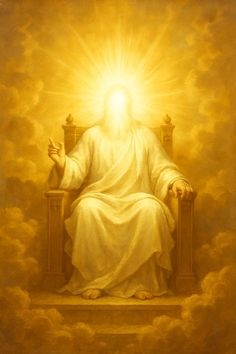
Yahweh is within. His radiance is his face on a Saint, as Jesus resurrected.

Because the NRSV translation above is a paraphrase that takes a preconceived idea and supports that agenda, making it difficult for a casual reader to discern the truth by oneself, I will do literal translations of these four verses. You will notice how verse fourteen follows a period mark that ended verse thirteen, making verse fourteen become a new statement of thought. However, the first word of verse fourteen is not capitalized. This shows that the rules of syntax (from which preconceived paraphrases come) are to be discarded, so a divine syntax shows importance to be found in every capitalized word (in the Greek text).

Verse fourteen states in the Greek:

hosoi gar Pneumati Theou agontai , houtoi huioi eisin Theou .

Please take note of the presence of a left-right arrow (⇔), which is a mathematical symbol that states, “if true to the left, then true to the right.” Thus, this symbol of truth being written in words says, “eisin” is equal to “Theou,” when all tests of truth are made. This becomes an unstated statement, which the NRSV cannot tell (or prefers not to).

The translation of verse fourteen is this:

“how many indeed to Spirit of God (they) are guided , these sons (they) exist of God .

This rather simple statement says the test of truth is relative to “how man indeed” are those souls that “exist truly of God”. This does not include everyone, simply because all souls are the “breath” (a lower-case “pneumati”) “of God,” placed within their bodies of flesh at birth. Those are then “sons” (lower-case) and daughters of man, born of human parents. This makes the test of the truth of the left-right arrow be a soul (lower-case “breath”) having been raised by the “Spirit” (capitalized, thus having a divinely elevated meaning, relative to Yahweh). The soul must “indeed” go “to Spirit” and have receive the “Spirit of God,” so that inner presence (not something told them by some external source) makes each “be guided, led, carried, or brought” by that “Spirit of God.” Not everyone is so “guided,” therefore the first word poses this to be the variable, as “how many” is “indeed” to be determined by a test of truth.

The Greek word written by Paul that has been poorly translated as “children” is “huioi,” which is the plural form of “huois,” meaning “a son.” It is possible to expand the scope of this word’s usage to “a descendant,” which is relative to a bloodline of human beings; but “children” is nothing more than some male-dominated theological philosophers getting together and coming up with the agenda that says, “Hey guys. You know most men have stopped following Christian religions because we are so obviously fakes; but we still have the women in the fold, thanks to letting women become priests. So, what say we change all the text that we do not understand about the masculine spiritual plane to “sons and daughters,” “brothers and sisters,” and generically “children”? Sound good to you guys?”

The reason Paul wrote “sons of God” is because the “how many indeed” that survive the test of truth are those who are ALL Jesus resurrections in new bodies of flesh (be them male or female). So, since ALL are tested to be true as Jesus reborn, then ALL are “sons of God,” ALL are Jesuses reborn (a male Spiritual entity). But, then, it takes a soul who passes the test of truth to know that and teach that to other souls.

Now, there is reason for the NRSV to be influenced to see “huioi … Theou” and pull “children” out. This is because verse sixteen says, “tekna Theou,” which does translate as “children of God.” Still, “tekna” does not “children” make out of “huioi.” The word “tekna” will be written in verse seventeen, but not directly connected to “Theou.” All of that is putting the cart before the horse; and, it does not speak as passing a test of truth, when one makes up bad translations for divine text.

Verse fifteen is then written as this:

Ou gar elabete pneuma douleias palin eis phobon , alla elabete pneuma huiothesias , en hō krazomen , Abba ! ho Patēr !

In that, the words “elabete pneuma” are repeated, where “pneuma” is written in the lower-case, so it is not a reference to the capitalized “Pnumati”. Those two words say, “you have received a spirit,” where the lower-case can be understood as a soul, which is the “breath” or “spirit” of life, in an otherwise scoop of dead matter (clay, dust, cells, etcetera). By realizing that, the whole of verse fifteen translates literally to state:

“Not indeed you have received a spirit of slavery once more into something to fear , but you have received a spirit of adoption [of sons into a divine family] , within which we scream out , this Abba ! this Father !

The first word in this verse is capitalized (following the period mark that ended verse fourteen), but the capitalization of “Not” is divinely elevated to be a statement of what “Not” a spiritual presence is (one making one truthfully “exist” as a “son of God”). Here, the “Not” leads to “a spirit received” again being placed in possession (from the Genitive case stating first “of slavery” and second “of adoption”). The “Not” is then a divinely elevated statement that says “sons of God” (when truth be told) are “Not” possessed by lesser “spirits,” such as we read last Sunday about the “spirit Python,” and we read today in David’s Psalm 104 of the “spirit of the Leviathan.” A demonic “spirit” would most certainly “enslave” a soul to sinful acts; but the girl told of in Acts was a “slave” to a lesser “spirit” than Yahweh’s “Spirit.” Those lesser (lower-case) ‘spirits” cause the souls they possess great “fears.”

Now, the possessive case of the Greek word “huiothesias” (from “huiothesia”) says one is “of adoption” spiritually. The root word is defined as “adoption,” implying “adoption as a son into the divine family.” (Strong’s Usage) HELPS Word-studies adds, “properly, sonship (legally made a son); adoption.” When the word “sons” is then seen as gender specific for this “adoption,” the reason is girls would not be “adopted.” They would be married, as a state of possession that is ownership. Girls would become the wives of the men possessing them; but boys would be adopted, becoming “sons” of the men possessing them. While that is a physical world definition, when Paul was writing about “spirits,” his second segment in verse fifteen is then pointing out a soul (“a spirit of adoption”) would be possessed as “a son,” which is then a statement of the resurrection within that soul by the Son of Yahweh – Adam-Jesus. When that “adoption into the family” is made, then the “sons existing truthfully of God” are reborn as the Son of Yahweh, who we Christians call Jesus.

Now, this “spirit of adoption” is one’s soul. A soul is “a spirit.” The soul in a body of flesh is feminine, thus not adoptable. A soul in a body of flesh becomes a girl (feminine essence, brought on by the body of flesh, where the earth is feminine essence), which must marry Yahweh. That divine union brings forth His “Spirit” (capitalized “Pneumati”) and that “Spirit” then possesses the soul and the flesh, cleaning them so all sins are removed. Once the cleansing has taken place, then the soul becomes opened to receive the soul of the Son of Yahweh. Since souls are masculine essence (everlasting), the presence of Jesus’ soul in a married soul makes that soul be “adopted as a son,” to match the spiritual gender of Jesus. This means one’s soul is first a wife (a girlie girl), before it becomes a “son of God” (a manly man). All gender in the spiritual realm is masculine, therefore it penetrates into the femininity of the material realm, which received in order to reproduce life.

It is then this sudden change within one’s soul, where one personally knows Yahweh as Jesus reborn; and, that immediately leads the soul of Jesus to “cry out, Abba!” This identification as Jesus reborn, where one’s soul is one with the Son of Yahweh, makes one’s soul also “scream out,” from first awareness of this divine relationship – a brother of Jesus (regardless of what physical sex organ the body of flesh possesses) and a “son of Yahweh.” One’s own soul cries out with Jesus, saying, “Father!”

In verse sixteen, Paul then tied these two concepts together. His Greek states this:

auto to Pneuma symmartyreitō pneumati hēmōn hoti semen tekna Theou .

In this, the Greek words “auto” and “hēmōn” are similar, in the fact that each becomes a statement of a soul or souls, such that “self” or “oneself” (in the singular) and “a multitude of “I”s or “us” is relative to the life “breath” that comes from a “spirit” animating dead matter. Thus, it is important to see the live souls involved as the true focus of this verse. It can literally be translated in that regard to say this:

“one’s soul this Spirit [divinely capitalized, as of Yahweh] (itself) testifies together with this spirit (lower-case, ordinary soul) of our souls [ourselves] because we exist children of God .

In this, the capitalized “Spirit” can only be known by a lower-case “spirit” (a “soul”), in order for it to “testify” or be a “witness” of that presence “together with” it, so two are one. The Greek word “summartureó” means “to testify or bear witness with,” implying “I bear witness together with.” (Strong’s) This must be seen as personal experience, so it is in no way hearsay evidence presented. This relates back to the left-right arrow, where the test of truth is personal experience, where knowledge makes one verifiable as a “witness.” It is not being told to believe something, when the only personal experience one has is with the one telling one to believe. To be able to “bear witness with” the “Spirit,” one must be a soul married to Yahweh, having received His “Spirit” in divine Baptism, so one has FAITH enough to “testify together with” that “Spirit.” This is what it means to be an Apostle (a word meaning “messenger,” where the message brought forth is the truth of Yahweh, from the Son).

This is then the proof that two joined as one are the “children of God,” “because we exist” two as one. Following the oneness of one’s soul with Yahweh’s “Spirit,” one’s soul then gives birth to the Son (the purpose of marriage is to make a child). Because this is a Spiritual marriage, the child born is the soul of Jesus resurrected in one’s soul. This rebirth in one’s soul is what makes one be a “son of God.” So, many souls all reborn as the same Jesus makes them all able to “testify together with our souls, because we exists as the children of God” … all named Jesus. All are the “sons of God.”

This then led Paul to write verse seventeen, where the Greek he wrote is this:

ei de tekna , kai klēronomoi ,klēronomoi men Theou , synklēronomoi de Christou , eiper sympaschomen , hina kai syndoxasthōmen .

This literally translates to state:

“for as much as now children , heirs , heirs truly of God , co-inheritors now of Christ , if so we suffer together with , so that kai we may be joined approvingly .

Having ended verse sixteen telling that the union of the “Spirit” with the “spirit” (that is one’s soul) is what establishes the relationship that allows a soul to call Yahweh “Father.” As such, being “children of God” means one inherits eternal life. This can only come through this divine union and oneness. This becomes the truth of the left-right arrow being confirmed, when Paul wrote “heirs truly of God.” Only when one’s soul is possessed by Yahweh (the Genitive case “Theou”) can one inherit salvation.

When Paul wrote of being “co-inheritors now of Christ,” the Genitive case applied to “Christou” says one is possessed by Yahweh, which is evidenced by His “Spirit,” which is only given to His wife-souls. The word “Christ” is NOT the last name of Jesus. The word “Christ” is NOT singular because Yahweh is limited to one “Christ” (by some idiot human being that thinks that nonsense). David was a “Christ,” although the Hebrew word written in First Samuel says he was a “Messiah” (English translation of the Hebrew “mashiach,” with capitalization implied in English). The whole world could be “Christs,” if Yahweh so chose, Him having found all souls willing to marry Him and submit fully to His Will. What Paul is saying here is all who are truly resurrections of the Jesus soul in theirs, becoming “children of God” as Jesus reborn in all, those individually are granted salvation (the name “Jesus” means “Yahweh Saves”). Thus, as “co-inheritors of salvation, through Jesus,” each will have been “Anointed” (the meaning of “Christ”) by Yahweh, as His Son reborn.

In the Greek word “eiper,” which means “if perhaps,” implying “if indeed, if so,” while properly meaning “if it be so,” “if really,” “if indeed,” “if after all (since)” [Strong’s and HELPS Word-studies], the truth is confirmed when “we suffer together with” Jesus. Just as Jesus died on the cross to release his soul to resurrect in the souls of others [the Easter theme of being raised from the dead], so too does a soul have to equally “suffer death” and get “buried” in the past. There is no one who knows the truth written by Paul that says, “Jesus died on the cross so your sins can be redeemed.” Jesus died, so too do every other soul in flesh have to die of self-ego, so the death allows the soul of Jesus to resurrect within it. Dying of self-ego is necessary to submit one’s soul to Yahweh and be washed clean of all past sins by His “Spirit.” When Jesus comes into a cleansed soul, it will be as the new Lord over that dead soul and flesh, leading it to righteousness, so there will be no returning to sinful ways.

In the Gospels telling of Jesus suddenly appearing in the upper room, in their midst when the door was locked, that tells of the soul of Jesus suddenly appearing within each soul present in that room. Because Jesus had just died on a cross and had wounds that proved who he was, his soul amid each of the other souls caused them to likewise suffer as he had, so their bodies of flesh projected the same wounds Jesus’ body had. When they saw the nail holes in his hands, they saw them in their own hands. Likewise, the pierced side wound was present in each body of flesh in whom the soul of Jesus suddenly appeared. We are told by an angel, “Do not look for Jesus in an empty tomb, as he is risen.” Similarly, Jesus told the Sadducees that Yahweh “is a God of the living, not of the dead.” So, to suffer with Jesus is to known his wounds in one’s own flesh.

When Paul then wrote “so that,” that says one willingly submits oneself to the suffering of death … as one used to be … so the soul of Jesus can then be “joined approvingly” for eternity. The Greek word “syndoxasthōmen” matches the conditional of “for as much as” or “if,” by saying “one may join in approving” or “be glorified together.” In the use of the word “glorify,” this means to take on the “love” of Yahweh that was built into the Son. This says only a soul filled with the “glory” of Jesus will be judged by Yahweh as worthy of His heavenly realm. Thus, Yahweh approves a soul and the soul approves the presence of Jesus’ soul; and all live together happily forever and ever.

As an alternate reading selection, which will also be read in another season (so, not a one shot deal), the Easter purpose for this selection is to show Paul writing clearly what is required for salvation. One’s soul must be raised from the dead and possessed by Yahweh and His Son Jesus. There is no getting into heaven alone, through will-power. While the NRSV has translated these four verses so generically that no one will be led to self-sacrifice because of what they say was written, it is up to each individual soul to care about salvation, enough to take more than the three minutes the modern attention span is for religious studies and see for yourself what these verses say TO YOU! You are the one who will pay the price for doing nothing, based on others telling you, “It’s okay. I do nothing too. Jesus died for my sins. I believe that.” What’s another eighty year’s worth of repeating life in a new body of flesh to find out the truth?

Romans 5:1-5 – Paul explaining the Trinity in five verses

Since we are justified by faith, we have peace with God through our Lord Jesus Christ, through whom we have obtained access to this grace in which we stand; and we boast in our hope of sharing the glory of God. And not only that, but we also boast in our sufferings, knowing that suffering produces endurance, and endurance produces character, and character produces hope, and hope does not disappoint us, because God’s love has been poured into our hearts through the Holy Spirit that has been given to us.

——————–

This is the Epistle selection that will be read aloud on Trinity Sunday, Year C, according to the lectionary for the Episcopal Church. It will follow a reading from Proverbs 8, where Solomon wrote: “when he marked out the foundations of the earth, then I was beside him, like a master worker; and I was daily his delight, rejoicing before him always”. That will precede either a singing of Psalm 8 or Canticle 13. If Psalm 8 is chosen, then the words of David will be heard, which sing: “What is man that you should be mindful of him? the son of man that you should seek him out? You have made him but little lower than the angels; you adorn him with glory and honor”. If Canticle 13 is selected for singing, then we will hear sung, “Glory to you, Father, Son, and Holy Spirit; we will praise you and highly exalt you forever.” All will accompany the Gospel selection from John, where Jesus told his disciples, “All that the Father has is mine. For this reason I said that he will take what is mine and declare it to you.”

In the above NRSV translation, confusing words are found. Words like “justified,” “peace,” “grace” and “hope” are all nebulous and can mean different things to different people. The translation becomes so generalized that is sounds like a dream that can never be real or personally realized so the words are fully understood. I find this is due to the above translation being a paraphrase that focuses on making Paul seem like he was writing about some agenda that Jesus was the ‘cat’s meow’ for all to go along with. Such words become things nicely marked in a Bible or printed on cards, placed in one’s wallet or purse, to be pulled out and read for momentary comfort. These words, however, are well chosen for reading on Trinity Sunday because they speak of the divine possession that makes a soul be a personal witness to the Father, Son, and Spirit, where Spirit needs to be understood as synonymous with the word “Christ.” That is the Baptismal purification that must take place, before the Father and the Son can be enthroned within one’s soul.

Rather than simply read the beauty of the NRSV translation (and oooh and aaah like a schoolgirl), I have literally translated these five verses, using English terms that make the mind be opened to the reality of what Paul wrote. In his words, the Genitive case is used several times, where the possession that says “of” is regularly omitted from the translations read aloud in churches. Please reread these verses above and compare them to those translations below. To assist the reader, as to where the Genitive case should be seen, I have placed an underline to those words.

1. “Righteous us having been made therefore from out of of faith , wholeness we possess advantageous for this God , on account of of this of Lord of our souls of Jesus of Christ ,

2. “on account of of whom kai this access we possess to this to faith into this kindness this within to whom we make a stand ; kai we boast on the basis of to expectation of this of honor of this of God .

3. “Not alone now , on the other hand kai we boast within to these to persecutions , remembering that this tribulation , endurance brings out ;

4. “this now steadfastness , tried ; this now approved character , expectation .

5. “this now expectation not to bring to shame , becausethis love of God has been poured out within to these to inner selves of our souls because of of Spirit of Sacred , of this of having been placed to our souls .

On Trinity Sunday, where the importance of this must be understood to be known personally, where divine possession makes a soul be a witness to this divine presence within, rather than to think one can see the spiritual with physical eyes or figure the spiritual out with a fleshy brain, the Genitive case is placing the foundation of divine possession in the words written by Paul. To discard them is to miss the truth that he told.

As to verse one, it begins with a capitalized “Dikaiōthentes,” which means it bears a divinely elevated meaning that must be examined closely. The NRSV over simplifies (incorrectly) this as “Since we are justified,” with the capitalization placed on “Since.” The form written states the Aorist Participle, such that it makes a statement of a past event in the present tense, where “having been” is a part of the translation into English. Then, the root verb (“dikaioó”) is the Nominative Masculine Plural, where the plural number applies to many Roman Christians (“us” or “we”), to whom Paul addressed with this word. The verb means, “to show to be righteous, declare righteous,” implying in usage “I make righteous, defend the cause of, plead for the righteousness (innocence) of, acquit, justify; hence: I regard as righteous.” (Strong’s) When all this is considered, the divinely elevated meaning of this word says, “Righteous us having been made,” where the divine elevation says this was not self-made or self-willed ‘good living.’ The source of “Righteousness” is Yahweh. This must be grasped firmly.

The Greek words “oun ek” translate as “therefore from out of,” with the same words also capable of being translated as saying, “then from.” In that regard, “ek” implies “from” as movement “from the interior outwards.” (Strong’s) This movement is then spiritual in nature (of Yahweh’s doing), therefore related to the souls of those to whom Paul wrote. This leads to the word “pisteōs,” which is the Genitive form of “pistis,” meaning “of faith” or “of faithfulness.” (Strong’s) Therefore, the initial purpose of Paul’s words address a state of divine “Righteousness” that all true Christians know, which has come from within outwards, such that the true source of “Righteousness” is personal knowledge within one’s soul, where the truth of “faith” is founded. Because “pisteōs” is in the Genitive form, the possession of Yahweh is what transforms “trust, belief, and confidence” (that which is outwardly motivated) into the true personal experience within one’s being. That makes “faith” become a knowledge “of Yahweh” [from His possession].

The second segment of verse one begins with the Greek word “eirēnēn,” which is routinely translated as “peace.” While “peace” is one of those words (like “grace, love” and “glory”) that demands a layperson enroll into some theological program that trains one in paragraphs of definition for those simple words, the truth of the meaning is this: The word means, “one, peace, quietness, rest,” implying in usage “peace, peace of mind; invocation of peace a common Jewish farewell, in the Hebraistic sense of the health (welfare) of an individual.” (Strong’s) HELPS Word-studies explains the proper meaning as: “wholeness, i.e. when all essential parts are joined together.” For as little as Christians know “peace,” they have a much better ability to grasp “wholeness,” especially when readings leading up to the Ordinary after Pentecost season point to the resurrection of Jesus’ soul within one’s soul being the definition of what “wholeness” is. Seeing that, that same presence is then the truth of “peace,” where “peace” is a statement of Jesus’ soul resurrected within one’s own soul (bringing “peace” within).

To confirm that meaning of “eirēnēn,” Paul next wrote the Greek words “pros ton Theon,” which translate into English as, “advantageous for” or “towards this God.” That says the “wholeness” that had been missing prior to “us having been made Righteous” was that which took a soul “towards this God.” This makes it an “advantage” for the unsaved soul, when it has become saved by coming “towards this God,” with “this God towards” one’s soul in return. The two had been separated, so the “advantage” for a soul comes from a return “towards this God.” In contrast, away from this God would be lives of sinners, not those “having been made Righteous.”

In the third segment of words in verse one, five of six words are written in the Genitive case, meaning Paul delved deeply into explaining the divine possession that is the source “of faith,” which brings a soul to a state of “wholeness.” Here, he wrote “dia,” which says, “through, on account of, or because of,” where HELPS Word-studies explains this word’s intent is to mean, “across (to the other side), back-and-forth to go all the way through, “successfully across” (“thoroughly”).” Thus, the reason (“because of”) one make it “advantageous for” one’s soul, as stated prior, is “on account of of this of Lord of our souls of Jesus of Christ.” That says “of this” (“tou”) is that stated prior – “made Righteous of faith” – now is “of Lord.” Here, the lower-case spelling of “kyriou” is a statement of a soul being its own ”lord” over its body of flesh (and soul); but the divine elevation “of Lord” means the presence of a Yahweh-sent soul of His Son, who comes “advantageously” for the feminine soul-wife to become its new “Lord.”

To ensure one knows the meaning “of Lord” is that, Paul then wrote “of our souls,” where the Greek word written is “hēmōn,” which is written in the first-person plural – matching the plural of “Dikaiōthentes” and “echomen.” The word typically translates as “of us,” but can equally say “of ourselves.” In that case, “ourselves” becomes a statement about “our souls,” as the only thing bringing life to flesh (a “self”) is its soul. More than being a “Lord” over one’s flesh, where arguments could ensue about the self-soul not liking the restrictions of a “Lord” soul, the “Lord” must have complete authority over both self-soul and its body of flesh. So, by it being in possession “of Lord of our souls,” the soul of Jesus is the “Master” in charge of “making one Righteous,” making one become “whole.”

Paul the named who this “of Lord” is, as it is being in the possession “of Jesus,” where one’s soul becomes Jesus reborn … in his name. That name is applied to the soul-flesh possessed, in a similar way that a soul takes on the name of the Husband – Yahweh – becoming one “Who Retains Yahweh (as one of His elohim)” [“Israel”]. To become “of Jesus” means one has become an Apostle reborn in that name. In order to become that – a possession “of Jesus” – one’s soul must also have become totally cleansed of all past sins. This is the marriage of a soul to Yahweh, which brings about the cleansed state “of Christ,” which is the possession of Yahweh, Baptized by His Spirit. To become “of Christ” means a soul is made into a Virgin womb (the feminine essence of a soul in the flesh), into which the soul “of Jesus” is implanted. Thus, the whole of verse one is Paul reminding his fellow Christians in Rome of their transformations into “Righteous” Apostles, made “of faith.” That transformation did not by Paul handing out instructions to believe, as being “of faith” means being “of personal experience.” That means each of their souls had been made “whole” by divine marriage to Yahweh (through His “Spirit”), making them possess “of Lord of their souls Jesus, of Christ.”

Following a comma at the end of verse one, verse two then repeats the Greek word “dia,” such that the “through, on account of, or because of” stated in verse two as “on account of of this of Lord of our souls of Jesus of Christ” is further stated in verse two. Here, the reason (“because of”) is relative to the “of whom” that are involved (from “hou” being the Genitive masculine singular form of “who, which, what, that”) in this divine possession. This focus is then stated to be important (from the word “kai” written) to denote the feminine gender usage of words saying “this access” or “this coming to,” which says the divine possession enters (or penetrates) the soul, not the other way around. It is then said to be “we are possessed to this to faith into.” Here, Paul is laying the groundwork for explaining “faith” is “brought to” one’s soul, such that it becomes “faith” once “into” one’s soul. This says “faith” is importantly a result of divine possession, meaning “beliefs” fall short of that personal experience.

Here, Paul wrote “this favor,” where he wrote the word “charin,” a word normally translated as “grace.” The feminine gender of “charin” says it is the soul that receives such a state, with the root word meaning “favor” and “kindness.” This must be seen as a gift that “comes into” a soul, resulting in “faith.” Paul then wrote, “this within to whom we make a stand.” In this, the Greek word “hestēkamen” is another in the series of first-person plural verbs, where Paul says all true Christians are made to “stand firm” or be “steadfast” in their “faith.” The positioning of “standing” is opposed to lying down, which mimics sleep; and sleep is metaphor for death. By saying “we make a stand,” Paul said “we have been raised from the dead.” By seeing this presence as a “favor” “brought into” them, there is nothing that can ever weaken that “faith brought.” The “kindness” bestowed to a soul is knowing Yahweh’s Spirit personally; and, that allows one to know Salvation of a soul means defeating death.

Following a semi-colon that divides verse two into two separate statements, Paul again wrote a “kai” which introduces this second relative statement as being important to grasp. The first word following that marker word is another in the first-person plural, which now places focus on “boasting.” Paul then said, “we boast on the basis of to expectation.” In that, the Greek word “elpidi” is written, which is normally translated [in the Dative] as “to hope.” Because “hope” is another of those vague terms that people often misunderstand, to see the truth be expressed as “to expectation,” this takes away the weakness of “to hope” and lays this importance on the realization that divine possession is not some ‘iffy’ sense of being, but instead a fixed set of “expectations” that one knowingly faces, when divinely possessed.

The ”expectation” that comes “to” one’s soul is then stated to be “of this of honor of this of God.” Here, again, the Genitive case points out the possession involved, where one’s soul-body is given the ‘expectation” that divine possession means a state “of honor” has come. In that, the Greek word “doxēs” is written, which ordinarily would be translated (properly) as stating “of glory.” Once again, such a word brings a sense of nebulosity that is difficult for laypeople to define. I have posted in prior commentaries that the truth of “glory” is the love of Yahweh that fills the soul of Jesus. One cannot possibly begin to define that love of Yahweh; but one can experience that love as the “glory” of divine possession. As such, the word also means “renown,” which means one takes on “the name of Jesus,” above and beyond one’s own name. The word also means “honor,” such that it is easier to grasp the importance of maintaining the “honor” bestowed upon a soul, by the presence within “of Jesus.” This is the truth “of glory.”

When Paul then finished verse two by saying “of honor” was “of this of God,” that says Adam-Jesus is His Son, who was made by His hands. That “Yahweh elohim” made in Genesis 2 was made for the purpose of being sent onto the earth plane as the first Apostle in the name of Yahweh. The purpose was to save lost souls, so the name told to Mary by the angel Gabriel said, His name will be “Jesus.” That “renown” says “Yahweh Saves.” Thus, this coming “of glory of God” is His Son, in whom the love of Yahweh is permanently affixed.

Verse three follows a period mark that ends verse two, beginning with the capitalized Greek word “Ou,” which means “Not.” This negative word is divinely elevated to the spiritual level, so when the words that follow it say, “alone now,” this highlights “alone” as a soul by itself in a body of flesh. That is “Not” the makeup of an Apostle. The soul is possessed by this “of glory [Jesus] of God [Yahweh], so a Trinity exists along with the host soul, which is “No longer alone now.”

Following a comma mark of separation, the next segment make a one-word statement that often is translated as “but,” from the Greek “alla.” Because “but” has no meaning as a one-word statement, the word is found to also mean, “on the other hand,” which indicates multiplicity (of hands), which becomes “the other” that possesses a lone soul. This is then followed by the word “kai,” which says it is important to place focus on the Greek verb (once more) that is stated in the first-person plural, meaning “we boast.“ This is the multiple Christians of Rome that Paul addressed, repeating his prior usage (in verse two), where Paul also importantly introduced “we boast on the basis of to expectation of this of honor of this of God.” Now, Paul importantly adds: “we boast within these persecutions.”

When Paul was named Saul, he persecuted those Jews who claimed to do feats in the name of Jesus of Christ, without understanding what that meant. As Paul, he regularly faced persecutions; and, the true Christians of Rome were persecuted just like was Paul. [See in the history book where it talks about Christians being fed to the lions in the arena.] The importance says “we are able to hold our heads up high within these persecutions [or “tribulations”], because their souls are “Not alone,” but “on the other hand” they had the strength of Jesus reborn within each of their souls.

Following a comma mark of separation, the next segment says, “we are knowing that this affliction [of “persecution” or “tribulation”] , steadfastness produces”. This says that the presence of Jesus within gives a soul the strength to “endure” all pains and sufferings that come because one has been transformed into Jesus in a new body of flesh. This says that “perseverance” is “produced,” which means anyone who says “Jesus died on the cross for your sins; so, you don’t have to suffer” is full of complete ignorance. Paul set forth the “expectation of faith” that being made “Righteous” – as Jesus reborn – means Jesus will be persecuted to death countless times over again, involving many different bodies of flesh in which his soul is resurrected. Every Christian killed in Roman arenas, for the delight of Roman entertainment, was Jesus killed all over again. When a soul has a soul that has ‘been there, done that’ to count on for strength, then all punishments short of death are just ‘practice runs.’

Paul then followed a semi-colon at the end of verse three to change to a new direction in verse four, while remaining on the theme of “persecution.” There, Paul wrote, “this now perseverance , character ; this now character ; expectation”. In this, Paul referred to the “steadfastness” that comes from “perseverance.” Each event of “persecution” is a test, just like a school class regularly tests the students for what they have learned. The test that are not the final exams are what build the truth of one’s “character.” The Greek word translated as “character” is “dokimé,” which means “(the process or result of) trial, proving, approval,” implying in usage “trial, proof; tried, approved character.” (Strong’s) Once one has been “tested,” one knows what “to expect,” therefore one’s “faith” is “tested” regularly; and, that becomes the “expectation.” To get a passing grade (an “approved character”), then one must be “tested” or ‘thrown into the fire,’ so one’s metal is proved.

Again, the typical translation of “elpis” is as “hope.” The word “hope” is too weak to be “tested.” The link of “hope” can only be to “belief.” When one “believes” in a school and one “believes” in “tests,” that is because one has seen such external to oneself, while not actually being a student enrolled in a school. To suddenly be cast into an educational setting, when one is not prepared to do the work that is necessary (to be “tested”), then it does not matter how much “belief” in “tests” one has, or how much “hope” one has of not failing. To “hope” for miracles, without doing any work, is useless. Thus, James wrote, “Faith without works is dead” [where “dead” is about the missing Trinity of salvation, ensuring “death” will come]. When one is in over one’s head (a soul alone with a Big Brain), then “hopes” will be dashed; and, when that happens, “beliefs” are shattered. Therefore, “faith” is the personal experience of readiness, where “testing” is the “expectation;” and, when that is the “expectation,” then the “character” will respond to the demands of the “persecution” and succeed (with help, “knowing one is Not alone”).

Following a period mark at the end of verse four, Paul then began verse five by advancing this notion that separates “belief” from “faith.” His first segment says, “this now expectation not we bring to shame”. In that, rather than the first-person plural, Paul wrote “kataischynei” in the third-person singular, where each individual knew the personal “expectation” that he or she (collectively a “we” as those true Christians) “not to bring shame.” This is “not” about “shame” to the Trinity possessing everyone individually, but “shame” on self, which is the state of being that is sinful, including full of doubts. When the word “elpis” is translated as “hope,” rather than “expectation,” then the “not” (“ou”) becomes linked to “hope,” where a lack of “faith” (wishful thinking only) will always lead to a state of “shame.” It is Paul writing that “beliefs” leading to “hope” are useless, as “shame” becomes one’s way of life. Only when one has the personal experience within can the collective know that “not we bring to shame” our souls.

In the next segment, Paul identified that the soul of Jesus is why “not we bring to shame.” He was created by Yahweh for the purpose of saving souls. In that creation, His personal touch passed into flesh (immortal hero-like when made) the love of Yahweh into the “Yahweh elohim” that became the soul of Adam-Jesus. Whenever that soul has been resurrected within a previously lost soul, Paul wrote: “because this love of God has been poured out within these inner selves of our souls through Spirit Holy”. This explains how one’s previously lost soul – which knows nothing but “shame brought upon self” – will “not” repeat that misery, “because” of Yahweh’s “love” having been “poured out within each soul”. This is the divine marriage of a soul to Yahweh, with His “Spirit” being a soul’s Baptism that removes all past “shames.” The “inner selves” or “hearts” (from “kardias”) connect to the Greek word “hēmōn” (again), where the Genitive case, first-person possessive pronoun normally translates simply as “us” or “we.” However, as I explained before, the word also means “ourselves,” where “selves” relates to “souls,” meaning “we” or “us” is a statement of the life that animates dead flesh; and, that is what truly is one’s “inner self” or “heart.”

The ”outpouring of love” must be seen as the necessary connection from which all marriages are formed. Without “love” for Yahweh – shown by acts of submission to His Will and efforts to maintain the oil in one’s lamp that leads one’s life lawfully (willing self not to sin, because of knowing the Law) . Without one’s love poured out to Yahweh, there will be no “outpouring of His love” in return, when the time for divine the marriage should take place. The “outpouring” from Yahweh is first the “Spirit” that Baptizes a soul, removing all past “shames.” That prepares a new wife-soul to be penetrated ‘on the wedding night’ with the seed of Yahweh’s true “love,” which is His Son. This is a love of God that cannot be compared to any physically led emotions. Being purely Spiritual, this becomes the difference between “belief” and “faith.” The “love of God” is too deep to explain in words, to fully teach others what that “expectation” is like. It must be experienced. It must come from the divine union of a soul with “God, Spirit, and Son” – the Trinity of “God’s love” in one’s soul.

The two words ending the second segment are both capitalized: “Pneumatos Hagiou.” It is wrong to read that as one word, as “Holy Spirit.” The Genitive case shows both equally as possessing a soul, such that “of Spirit” means the marriage of a soul to Yahweh. It is His “Spirit” that is outpoured in divine Baptism. The capitalization of each word means they are each divinely elevated in meaning, as from Yahweh … individually and separately. The purpose of Yahweh’s Baptism (which must come first) is to make a soul become “Holy” or “Sacred” or “Set apart by God.” It is not the “Spirit” that is “Holy,” as that becomes a lowly imbecile (soul-flesh peon) judging Yahweh, when its nose should always be touching the ground, in submission to Yahweh, knowing it is too lowly to look up and show its face. “Hagiou” is a statement about one’s soul having been forever changed. It is the return to a pure state of existence, as when one was breathed as life into dead matter (at birth), so one can return to Yahweh in the same state one was in when one departed Yahweh. It is in this “Saintly” state of being that Yahweh has prepared one’s soul-flesh to be reborn as His Son, who will walk in new bodies of flesh as the “Saint” he was made to be. Thus, the truth of the Trinity is it is the threesome, Father, Son and Spirit, with the fourth being the soul-body that has been transformed into a “Saint.”

Paul then ended verse five by writing, “of this of having been placed to our souls.” Here, the Genitive case states (as that stated prior) there being a divine possession of one’s soul-body. The word “of this” (“tou”) refers back to “love of God” entering a soul “through of Spirit of Sacred”. When the Greek word “dothentos” is seen as the singular, becoming a statement of each individual soul of the ‘Christian’ collective (“we” or “us”), the word’s meaning as “to give,” is better read as the implication in usage of “I offer, put, place.” Each soul has not been “given” the right to be deemed “Set apart by God,” but all have been “offered” that opportunity, because Yahweh has sent His “Saint Spirit” into the world, so His Son can teach seekers the truth of Salvation. That “offering” must then be acted upon. Knowing there exist schools in the world does nothing for one’s education, if one does not enroll in a school, for the purpose of becoming educated. Thus, the registration requirements say one must first apply to Yahweh. Once one has been accepted, then He will “place” His Trinity into one’s soul; so, the end result will always be His Son Jesus reborn into ministry in the material realm.

As an Epistle selection to be read aloud on Trinity Sunday, which is the first Sunday after Pentecost, signaling when priests of Yahweh are sent out into ministry as His Son reborn, that cannot happen without a soul-body having had “placed” the Trinity of Father, Sun, Spirit, making one be a Saint, Set apart by God. Paul wrote to the true Christians of Rome, knowing they were ALL exactly in the same state of Salvation as he was. Going out into ministry is hard work. That is why so many who call themselves ‘Christians’ laze about in pews for a lifetime, rarely doing anything to show a love of Yahweh [a name they do not know]. Instead, they wallow in the idolatry [a shameful existence] that loves a church building, a church denomination, or the priests therein – all for the wrong reasons. None of that will ever save one soul. Only the Trinity brings Salvation of a soul; so, sitting in the same pew for ninety years – having done none of the works of a Saint – means getting this wasted life over with, so you can receive your failing grade (or less than passing) in Judgment and return in new baby flesh, to start all over again. Hopefully, one will find a true priest of Yahweh to lead you to do the acts of faith, rather than the works of shame.