Category Archives: Song of Solomon

Song of Solomon 2:8-13 – Adoration of the bride

The voice of my beloved!

Look, he comes,

leaping upon the mountains,

bounding over the hills.

My beloved is like a gazelle

or a young stag.

Look, there he stands

behind our wall,

gazing in at the windows,

looking through the lattice.

My beloved speaks and says to me:

“Arise, my love, my fair one,

and come away;

for now the winter is past,

the rain is over and gone.

The flowers appear on the earth;

the time of singing has come,

and the voice of the turtledove

is heard in our land.

The fig tree puts forth its figs,

and the vines are in blossom;

they give forth fragrance.

Arise, my love, my fair one,

and come away.”

———————————————————————————————————-

This is an optional Old Testament selection from the Episcopal Lectionary for the Fifteenth Sunday after Pentecost, Year B 2018. In the numbering system that lists each Sunday in an ordinal fashion, this Sunday is referred to as Proper 17. If chosen, it will next be read aloud in an Episcopal church by a reader on Sunday September 2, 2018. It is important because it sings of God’s proposal to a potential bride. As it was written by King Solomon, human gender is insignificant when God is the bridegroom calling to His lover.

This is a song of love; but although it brings forth the sensuality of the love between a man and a woman, where the union of marriage and the sensation of carnal touch is heavily implied by Solomon (known asto be a lover of women), it is a holy love song. The songs of Solomon go beyond the physical plane and elevate to a highly spiritual level.

In the Bible Hub Interlinear presentation of the second chapter of Solomon’s love songs they list break points, stating this poem as a duet, between “Solomon” and “The Bride,” with verses 8-13 listed as “The Bride’s Adoration.” However, one must refocus one’s eyesight and see it instead as words of love spoken between God and Solomon, which means this song is applicable to all who fall in love with God and accept His proposal of union.

I will make some observations of the poetry of this song, taken from the translation above and also the literal from the Interlinear version.

“The voice of my beloved  !” is the inner voice of God, whose whispers of insight act as flashes of the light of inspiration that are signs of His love, in courtship with a human soul.

The word “hin·nêh,” which is translated as “Behold !,” is used three time (in verses 8, 9, and 11), where it is not the eyes that physically see, but the presence of God’s love that is “now” and “surely” felt. “Behold !” is then a one-word statement of an important and overwhelming feeling … an uplifting emotion.

“he comes leaping on the mountains  skipping on the hills  .” says that God suddenly comes into one’s being, through the heart, making one reach figurative height of joy, as if one rises to the top of the world and then roller coasters to ripples of thrill and excitement.

“my beloved is like a gazelle [roe] or a young stag [hart]  .” says the presence of God within brings the sense of “beauty” (the implication of “liṣ·ḇî,” or “gazelle”). The “young stag” or “deer/hart” is the youthfulness of male energy. The presence of the love of God can be seen penetrating one’s being, with one’s soul receiving that Spirit.

“Behold  !” is again a one-word statement of an important feeling that follows the hearts piercing by the presence of God’s love. This can be read as the ecstasy that comes from being filled with God’s Holy Spirit.
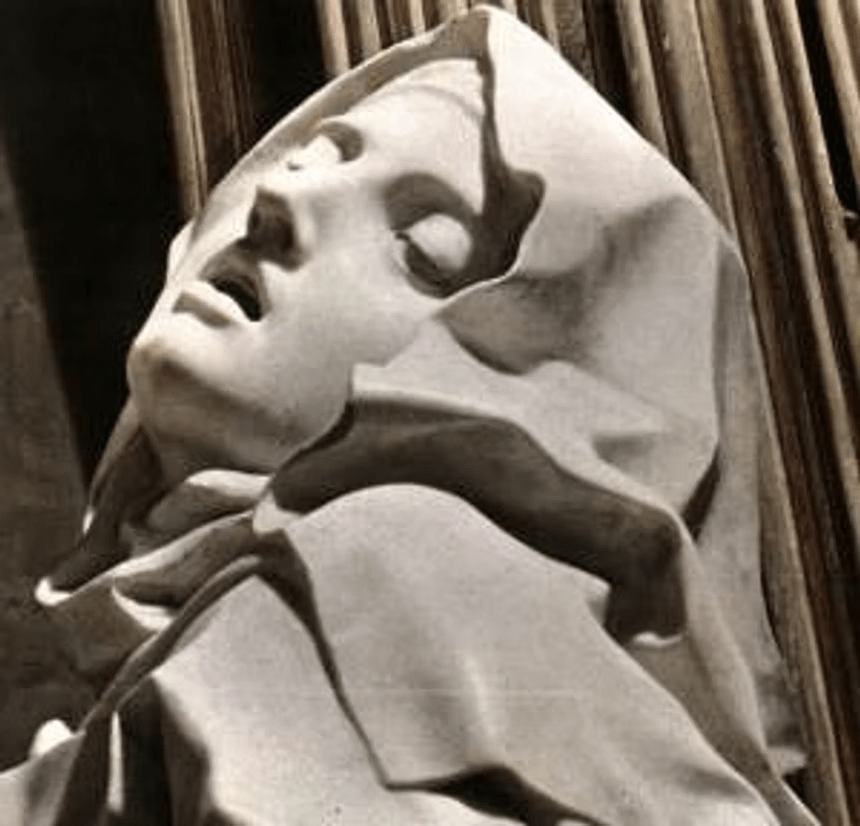
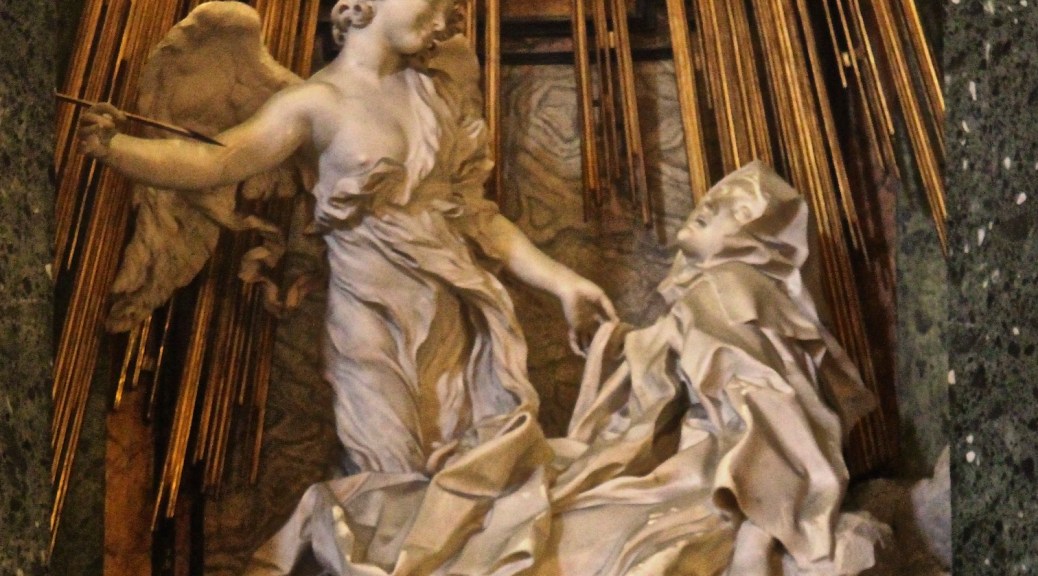
Saint Teresa of Avila experienced the ecstasy of beholding an angel of God piercing the walls of her heart with a golden spear.  It is not a rapture possible only for women.

“he stands behind our wall  ,  he looks forth at the windows  ,  showing himself through the lattice  .” This series of lyrics sing of God’s presence within one’s being, where “our wall” uses the plural possessive pronoun with “wall” (“kā·ṯə·lê·nū” for “kothel”). The “wall” is then one heart shared by two, in one body shared by two. The “windows” (plural number in the first person) are then the eyes of that body, which refers one to Matthew 6:22, where Jesus spoke during his sermon on the mount, “the eye is the lamp of the body.” This lamp, which shines light within one’s being, also then acts as a beacon to others, shining “through the lattice,” giving rise to the phrase, “the eyes are the windows to the soul.” This means one’s marriage to God allows one to be the vehicle through which God is present among others.

“spoke  ,  and my beloved said to me rise up  ,  to me love  ,  my fair one  ,  and to come away  .” The pause inflections (commas) place more emphasis on the voice of God heard within one’s mind. The one-word statement, “spoke” (“anah”), means, “sing, shout, testify, and announce,” where one is filled with the awe and joy of truth. God speaks through His brides.  This voice says “rise up,” where “qū·mî” means to “awaken” to a new life, where one also “stands” as God “stands behind our wall.” This rise is due to one’s acceptance of God’s love, brought about by opening one’s heart to God, from love shown Him. One stands in the light of God’s “fair one” or “beauty” (from “yapheh”) as the “gazelle” reflected in one’s being and presence. One then “walks” in the ways of the LORD.

“because  ,  behold  ,  [the death of] winter is past  ,  the rain is gone over  .” When one walks in the ways of the LORD, the cause is known to be one’s submission to God’s Will. One is able to “behold” changes in oneself that were unknown before. One has awoken from the slumber of mortal death and been reborn into eternal salvation. The tears of regret and sorrows of past mistakes have been washed away by a baptism (holy downpour) by the Holy Spirit. The fears of death have been removed from one’s soul.

“the flowers appear in the land – the time of singing [as birds] has come  ,  and the voice of the turtledove is heard in our land  .” The union with God has brought about the newness of spring, where a flower is the onset of new fruit. One’s heart is like a nest of hatchlings, filled with songs to be fed by the Father. The turtledove (from “tor”) is symbolic of the birds released by Noah, who returned with the message that the flood was over and new birth was at hand. The first four gifts sung of in The Twelve Days of Christmas are birds (partridge, doves, hens, and canaries), such that birds sing from the heights, like angels have wings. Therefore, “the voice of the dove is heard in our land” is the presence of new Saints, whose births come from their love of God.

“the fig tree puts forth her green figs  and the vine the tender grape give a [pleasant] smell  .” The Saint is like a green fig, as the new fruit of the tree of eternal life. The Saint is the continuation of God’s love, who radiates goodness that is attractive to others.

“arise  ,  come away  .” The call of a Saint speaks the voice of God to other potential brides. A Saint calls those who are asleep in mortal death to awaken and rise up. The call is to stand and walk in the ways of the LORD also.

“my love  ,  my fair one  ,  come .” God speaks through His brides. The call is to “be His.” The proposal is passed on through His Saints. It becomes personal and individual when one takes the steps that “come” to God’s love.

As an optional Old Testament selection for the fifteenth Sunday after Pentecost, when one’s personal ministry for the LORD should be underway – one has married God and become His bride Saint – the message is to open one’s heart and fall in love with God. This message goes beyond the sensuality of human love, such that one needs to have one’s eyes opened to a proposal made that has been rejected from ignorance.

In ancient times, like those of King Solomon, it would have been simpler to fall in love with the God of Israel, because there was no Jesus born into the world at that time. Today, knowing all about Jesus – being Christians – it seems the call is to be lovers of Jesus Christ, not God. It seems there is a tendency to see the God of the Old Testament as too harsh and too old to marry; but Jesus is young and appealing.

In the Roman Catholic Church (minimally), nuns are supposed to be married to Jesus. Priests are not seen as brides-to-be of God, but reflections of God, called “Father.” Female priests, of Christian churches that allow such recognition of women, are called “Mother,” where that is a human gender application to the “Father.” God has been replaced by those who pray to Jesus as their god.
Jesus of Nazareth loved God. He referred to God as his Father, which was a direct familial relationship he had, making that reference be more personal than the Old Testament presentation of God as the Father of all Creation. Jesus called himself the Son of Man, where “Adam” was the Hebraic word for “Man.” Jesus was the Son of God reincarnated, bearing the soul of Adam. The Jews, on the other hand, saw themselves as the sons of Abraham, Isaac, and Jacob, as those men were their fathers.  They heard Jesus speak of the Father and knew he meant God, but they did not see him as God’s son.  They recognized Joseph as the father of Jesus.

One has to realize that Jesus loved God because his soul was the bride that was married to God. Adam and God had become One, because of a heartfelt love for one another. As Husband (God) and wife (Adam), their union had created Jesus, who was in the flesh because he was born of a woman; but Jesus was the offspring of his soul’s love with the Father. Marrying God meant Jesus could be born of Adam.

Solomon wrote a sensual love song that was prophetic of this union that would produce Jesus, while also being prophetic of this union bringing forth countless resurrection of Jesus Christ.  Just as Adam’s soul married God, all of our souls are welcomed to accept the same proposal.  Acceptance means a cleansing of sin and a new life of complete righteousness.  That can only come from God’s forgiveness and submission to follow God’s guidance.  From that cleansing by God’s Holy Spirit, one receives the blessing of being with child – being reborn as Jesus Christ.

If one loves Jesus Christ, without being Jesus Christ reborn, one is rejecting the husband’s love, dreaming of a baby that will never be reborn within. Jesus of Nazareth is the model of what comes to those who love God and accept His proposal for marriage. Marriage to God means a union that can never be broken. It is a purity of love that begets the Christ Mind within one’s flesh and blood.

One cannot be a Father without surrendering completely to God. One cannot be a Mother when all brides of God have no human gender differentiation, with all God’s wives giving birth to the masculinity of Jesus Christ – in the Father as the Father is in him. To marry Jesus as a female devotee, one becomes a priestess in a pagan temple.  The builders of that temple is then to whom one’s service is committed … not to God.  All of these acts that are believed to be praising the Son of God is idolatry and denies one’s love from God.

Jesus said, “No man can serve two masters: for either he will hate the one, and love the other; or else he will hold to the one, and despise the other.” (Matthew 6:24)  There is only one master – Yahweh – the LORD. Jesus Christ is the result of loving only the LORD. Jesus Christ is the outward sign of inner grace that comes from being one with God. To love the outer and hate the inner is to serve self, pretending to be God.

The Songs of Solomon have a strong sensual appeal that arouses the sexual appetite, because man should be fruitful and multiply. Human marriage and the making of children should be a reflection of the love God allows through the pleasures of union. Humans experience pleasure in sexual encounters, unlike animals that mate instinctively. However, the higher meaning of Solomon’s love songs is to find pleasure in a personal relationship with God Almighty.  One arises above the physical sense of love to the spiritual.

The call is a proposal of holy matrimony. The call is to be fruitful and bring forth Jesus Christ, so others can be fed spiritually.

“Arise, my love, my fair one, and come away.”

Song of Solomon 2:8-13 – The Bride’s Adoration

The voice of my beloved!

Look, he comes,

leaping upon the mountains,

bounding over the hills.

My beloved is like a gazelle

or a young stag.

Look, there he stands

behind our wall,

gazing in at the windows,

looking through the lattice.

My beloved speaks and says to me:

“Arise, my love, my fair one,

and come away;

for now the winter is past,

the rain is over and gone.

The flowers appear on the earth;

the time of singing has come,

and the voice of the turtledove

is heard in our land.

The fig tree puts forth its figs,

and the vines are in blossom;

they give forth fragrance.

Arise, my love, my fair one,

and come away.”

——————–

This is the Track 1 Old Testament reading option for the fourteenth Sunday after Pentecost [Proper 17], Year B, according to the lectionary for the Episcopal Church. If selected, this song will be paired with verses picked from Psalm 45, which sings, “My heart is stirring with a noble song; let me recite what I have fashioned for the king; my tongue shall be the pen of a skilled writer.” Both will precede the Epistle selection from James, where he wrote, “In fulfillment of his own purpose he gave us birth by the word of truth, so that we would become a kind of first fruits of his creatures.” All will accompany the Gospel reading from Mark, where Jesus said, “It is from within, from the human heart, that evil intentions come: fornication, theft, murder, adultery, avarice, wickedness, deceit, licentiousness, envy, slander, pride, folly. All these evil things come from within, and they defile a person.”

I wrote about this and published my opinions in 2018. That article can be found on this website by searching the reading name and number. I welcome all to read those observations, which I stand behind today, as I read this song of love not as the seductions of a man and a woman, but as a soul and Yahweh. The comments I crafted in 2018 take a view of this song as if Solomon was divinely inspired by Yahweh. While I think less of Solomon these days, I still see that divinity; but I give less credit to Solomon today. Therefore, I will not rehash what I said in 2018, instead adding a broader view of the whole now.

I want to repeat my views that have consistently been presented about marriage to Yahweh. This has nothing to do with the physical, as divine marriage only is possible between the eternal. The body of flesh is temporal and bound to die. The death of a body of flesh is merely the death of matter no longer being able to sustain the life force that a soul provides. When new life is seen with the birth of a baby, there is nothing actually new. Ask any scientist and they will tell you that everything that existed in Creation still exists today, only in changed states. Thus, a baby is recycled matter and a soul is likewise recycled spirit. Yahweh is the provider of the spirit of life – the “ruach” or “breath, spirit, wind” – which animates matter, giving it the appearance of life. However, the soul is life, the body of flesh is death, and because a soul can either be repeated through reincarnation or elevate back into the heavenly realm as a return to Yahweh, the soul takes on a neutral gender.

The call to marry Yahweh is made to souls so they can escape the recycling of reincarnation. The promise of eternal life means to return to the true place of living, rather than be returned to a body of flesh that has to start over as a newborn and spend years growing and developing, only to grow to the point that the resources of dead matter can no longer sustain a habitat for a living soul. A return to that state of life in dead matter equates to being born dead. That is a return to the realm of death, as opposed to being returned to the realm of true life.

The duality of life and death can then be seen reflected in the duality of the spiritual and the material. This duality is present in a soul within a body of flesh. This duality is expressed in the bodies of flesh being either masculine or feminine. The duality of human sexuality is for the purpose of regeneration of bodies of flesh, which will then provide a home for a spirit of life. In the same way, the spiritual is a projection of the masculine, with the material being a projection of the feminine. As such, when I talk about a marriage to Yahweh, this means a soul in a body of flesh has taken on the essence of femininity because a neuter gender soul has taken on the feminine essence of a body of flesh, regardless of the human gender that body of flesh possesses. All souls in human flesh are then feminine, as brides-to-be for the masculine Yahweh Spirit.

This concept of metaphysics should be simple enough to grasp, but because human beings live in a world that makes it difficult to contemplate the unseen, life takes on the roles of masculine and feminine, based on the birth gender. When religious material is seen in terms of appearing to favor the masculine, the difficulty that comes from disassociating that gender reference from human genitalia creates a world of males dominating females and females who scheme against males from a pretense of subjection. There really is nothing about divine literature that gives greater preference to males, still kings are greater than queens and women have long had little voice in public. Children are the neuter gender, which makes a soul like a child that has to decide what it will be when it grows up.

In the story of Solomon the past two Sundays, he encountered Yahweh in a dream. Solomon was a child king, so he was a neuter gender soul in a masculine body of flesh, which was of feminine essence, being made of dead matter. Yahweh asked the young Solomon, “’ĕ·lō·hîm šə·’al māh ’et·ten-lāḵ,” which says, “elohim ask what shall I give you.” In that question, the Jews assist the Christians in translating “elohim” as a statement of “God” asking the question, “What can I give to you.” That mistranslation keeps both Christians and Jews from recognizing Yahweh would not speak to a child about material gifts. Yahweh addressed the neuter elohim Solomon as a soul that needed marriage to the divine, simply because Solomon had risen to become the King of Israel, which was a nation of God’s chosen people.

The question pertained to the actions of a pertinent brat, one who had broken the laws of high places and burned incense and offered animal sacrifices. Solomon made those actions when he was not a Levite or a high priest. The actions of Solomon meant Yahweh spoke to him in a dream like He spoke to Cain, when his countenance was low, counseling his soul to get up spiritually. When Solomon heard the voice as if it was God coming to serve little boy king Solomon, he began to spout egotistical crap, causing Yahweh to step back and let Satan [“adonay”] be the one who was delighted to hear Solomon wanted to eat the fruit of knowledge of good and evil. Thus, “elohim” stated Solomon’s neuter soul would reject marriage to Yahweh and become married to Satan.

I bring all this up because we are now given a song of love written by a soul that had become enslaved by Satan. This means the author of this love song should not be seen as worthy of praise. The good contained in the words put down in writing comes from Yahweh, not from the brain of Solomon. In fact, one can assume that the brain of Solomon was thinking how much more the ladies would be attracted to him, because of how well his brain could think of words to write that would make the women all swoon and then strip naked before him. This is how the divine works of Yahweh manifest. This is a double-edged sword, which cuts sensually into the lusts of material pleasures, along with the realities of male domination and female submission, while also being metaphor for the soul’s submission to Yahweh.

In this later sense, Satan must be seen as a creation of Yahweh, as a elohim that must submit to the Will of Yahweh. When a third of the angels of heaven rebelled, that is a human myth, as Yahweh made elohim that would act in lustful ways for the material Creation and be forever sent to only manifest within that realm. The serpent was one of these who was present in the divine realm of Eden. The serpent is metaphor for the elohim that can possess all souls who reject Yahweh. So, even when they have that possession under their godly control, they still must step aside and allow Yahweh access. This means a soul demonically possessed can be freed from that oppression, allowing that soul to then marry Yahweh. Therefore, even though Solomon was demonically possessed, his soul could be inspired divinely to write words that not only satisfied his egotistical lusts, but also serve the needs of Yahweh.

The selected verses of this song – 8 to 13 – are said to be the voice of the bride, as “The Bride’s Adoration,” with other verses attributed to the voice of “Solomon.” When the influence of Yahweh is seen, the voice of the bride is relative to all human beings on earth, regardless of their human gender. That means the voice of Solomon is then that of Yahweh. The theme of marriage is clearly seen in the repetition of the word translated as “beloved” [“dod”]. This means marriage is not arranged or forced upon any soul. It sings about the desire to be possessed totally by Yahweh, completely submissive to His Will.

The adoration of the bride must come from a child’s eyes, where love equates to trust. A virgin soul is an elohim unmarried to a greater Spirit. It is when one’s heart and soul want to be one with the Father forever.

In these modern times, when the perversities of humankind have corrupted many of the leaders of the churches purporting to serve Yahweh, such love can be seen as reflected in this song. Human love is unnecessary for a sexual relationship to take form, although the pleasures of the flesh can easily be mistaken for love. The institution of marriage, which solely means the union of a man’s sperm into a woman’s egg [which is guided by the hand of Yahweh], has become an demonic elohim of worship, where the bodies of human flesh are altars where human gender are sacrificed, with Satan putting his blessing on all animalistic unions. The story of Jonathan’s love of David, as brotherly soul mates [not homosexuals wallowing in the gutter of human lusts] is how divine texts can be twisted in perverted ways to make Satan happy. All references to “love” and “heart” are divinely elevated to mean a soul’s desire for salvation leads a soul to seek to do everything possible to please the only entity that can make that happen.

Again, as to the specifics of this song, I refer one back to what I wrote in 2018. I no longer feel the need for human gender pleasures of the flesh. I no longer seek to find inspiration that leads my soul to Yahweh from that relative to Solomon. I leave that up to the younger generations to experience.

As for an optional Old Testament reading for the fourteenth Sunday after Pentecost, when one’s own personal ministry for Yahweh should already be well underway, the lesson of this song of love is only one’s soul experiencing the love of Yahweh. That love rises well beyond the limitations of human flesh. The love that comes from divine marriage of a soul to Yahweh’s Spirit cannot be measured in physical terms. The terms used by Solomon have to be metaphor, because it is impossible to specifically state what divine love is. Ministry without this love is empty and will find no suitors. The lesson of this song is to preach the Word of Yahweh [which is unknown by human brains], so the souls of others will be awakened to this Word and their hearts opened to receive that Spirit.