This reading is scheduled as Proper 25, Year C. The text is as follows:
Jesus told this parable to some who trusted in themselves that they were righteous and regarded others with contempt: “Two men went up to the temple to pray, one a Pharisee and the other a tax collector. The Pharisee, standing by himself, was praying thus, `God, I thank you that I am not like other people: thieves, rogues, adulterers, or even like this tax collector. I fast twice a week; I give a tenth of all my income.’ But the tax collector, standing far off, would not even look up to heaven, but was beating his breast and saying, `God, be merciful to me, a sinner!’ I tell you, this man went down to his home justified rather than the other; for all who exalt themselves will be humbled, but all who humble themselves will be exalted.”
———-
This passage from Luke is known generally as The Pharisee and the Publican. The Publican is also known as a “tax collector.” It is a story that everyone should know.
It seems to be hard to get the meaning of Jesus pointing this out “to some who trusted in themselves that they were righteous and regarded others with contempt.” I can’t tell you how many times a sermon is laser pointed towards the poor old tax collector and how “this man went home justified rather than the other.” The stress that is put on this parable falls on the humility angle.
Well, that misses the point of Jesus telling this to a select group. Guess what group that would be? It would be a group of Pharisees, or Sadducees, or even the priests of the Temple.
That is why the Pharisee is standing there saying how glad he is like he is and not like losers, like that tax collector over there. He is just like those in the group Jesus is telling a parable to.
The tax collector is no saint. He is filthy with sin and he knows it. He beats his chest with anguish over his inability to stop sinning. He is just like you and me, as long as you feel guilty for not always being the best you can be. We have a prayer in the book for us to read aloud each week, which says, “Forgive me God for I have sinned yet again. Still can’t get through a week without doing something wrong. Sorry.”
Sure, we who go to church and get on our knees and beg for forgiveness. Then we can go home justified, because we have humbled ourselves. BUT … to be justified and then go sin again is inexcusable. You cannot get to Heaven with sin all over you. So, we repeat the cycle, with nothing new ever happening.
Adam fell from grace for less sin than we do in a week’s time. What makes anyone think they can get to Heaven when they are not justified? Jesus did not come saying, “Look guys, try your best to do what I do, but if you makes some errors, no big whoop. It’s okay.” Jesus said you do not go to the Father’s house with the dirt of sin on you.
So, guess why the Pharisees are the focus of this parable? Give up?
The Pharisees are the ones that have the responsibility of placing the people like the Publican on the road to righteousness. Rather than stand around thanking God for their comfy lives, they should be teaching the sinners how not to sin, if only by being examples of Apostles and Saints, as Jesus models.
The Pharisee in the Temple, as far as any parable about a Pharisee goes, is symbolic of a rabbi or priest. He is in this parable because he represents a leader. He is the shepherd. The tax collector represents the flock.
Symbols are the meaning, not the reality of one Pharisee and one tax collector. Two represents the duality of a church. One is the head, one is the body. Can you see that depicted in the picture above?
Literally, one thinks Jesus is telling how a Pharisee was being loud so everyone can overhear him saying, “God, I thank you that I am not like other people: thieves, rogues, adulterers, or even like this tax collector. I fast twice a week; I give a tenth of all my income.” No! He is speaking so everyone can hear. The hear him because he is the leader speaking to them, their preacher, their trusted teacher.
Instead of being the good shepherd, he is calling out sinners as if he is not one, giving the impression that he is righteous. Simply by wearing a fancy robe or a shiny new suit and power tie, the one standing up before a congregation and talking out loud is assumed to be honest, pure, offering a helping hand.
Jesus is making this point because the whole problem the Israelites had, the reason why they lost the land God gave them, the reason they were under Roman domination in Jerusalem was the spiritual leaders of the Jews were not teaching the people HOW to WANT to live by the Law. Sure, they taught the Law, but they used that knowledge to throw it in the faces of the sheep that had no clue how to save themselves.
Jesus was in town to change things. He called the Pharisees out time and time again. He ate dinner with a tax collector, but that was not condoning sin, it was challenging the Pharisees. Jesus was not sent by God to justify sin. He was sent to teach people how to receive the spirit of the Law, and how to open their hearts to welcome the Holy Spirit. That wasn’t happening, so the people were always sinning, and always feeling guilty. Some took advantage of the guilty.
The reason this parable is so powerful and why it must be understood properly today is Christianity has become the dead vine that the Temple of Jerusalem was. Once upon a time in the land of Christianity the Apostles taught new Apostles. Saints bred new Saints. Then everything ground to a halt and it magically turned back into the Pharisee and the Publican in the church building.
Humility is good. However, humility is impossible to maintain by will power. A mantra like, “I will be Christian. I will be Christian. I will be Christian.” will not cut it. You have to receive the spirit of the Law. You have to be able to see the true meaning of the lessons. You have to teach others this and let others teach you more. Then, you have to let the Holy Spirit overwhelm you and take control over your actions.
———-
As an Episcopalian, whose wife was an Episcopalian priest, I was able to make contact with human beings in that Church organization that I ordinarily would have to make an appointment to see and have just cause for seeing one of those high-ranking officials. My wife followed many on her Facebook page and would read their views on the lessons of Scripture. After my wife passed to the other side, I monitored Facebook sermons posted, to see if everyone was on the ‘same page’ as I was. This was more important during the COVID19 year(s), when the government takeover of churches drove the faithful (should I asy faithless) away in droves. When this reading came up in the cycle (October 26, 2022), I read a sermon posted by a bishop on his webpage, which my wife was a follower of. His sermon was basically a ‘cut and paste,’ ‘same ol same ol’ of the humility lesson, which misses the deeper purpose for Jesus pointing this whole situation out to his disciples. Certainly, the poor old sinned Publican was the obvious scapegoat, but what about the Pharisee? What was he further away from salvation.
I was moved to sent this bishop an email about his sermon. I did not know him other than by title, He did not know me at all. I asked him if he had ever seen himself as the Pharisee, writing sermons as if he were closer to God, whille all the pewples were so sinful they were the ones who should practice humiity. I asked why all sermons focus on blaming the sheep for being lost, when it is the shepherd’s role to gather them and take them to shelter.
He actually responded to my email. He said (I paraphrase), “Everybody has their own way of reading Scripture.”
Hmmmm. And everybody needs to hear your opinion why?
The Gospel reading for October 2, 2016 (Twentieth Sunday after Pentecost, Proper 22) was from Luke (17:5-10). The reading stated:
“The apostles said to the Lord, “Increase our faith!” The Lord replied, “If you had faith the size of a mustard seed, you could say to this mulberry tree, `Be uprooted and planted in the sea,’ and it would obey you.
“Who among you would say to your slave who has just come in from plowing or tending sheep in the field, `Come here at once and take your place at the table’? Would you not rather say to him, `Prepare supper for me, put on your apron and serve me while I eat and drink; later you may eat and drink’? Do you thank the slave for doing what was commanded? So you also, when you have done all that you were ordered to do, say, `We are worthless slaves; we have done only what we ought to have done!’”
While many people hear or read the words “mustard seed” and think in terms of itty-bitty small, they confuse this reading with Matthew 13:33. There, Jesus was quoted as saying, “Though it [a mustard seed] is the smallest of all seeds, yet when it grows, it is the largest of garden plants and becomes a tree, so that the birds come and perch in its branches.” The mistaken thought comes from applying that growth of a physical seed into a large tree, as if Jesus implied that in the reading from Luke. Therefore, when people hear or read this reference to a mustard seed by Luke, people imagine a seed that needs to grow, in order to fulfill the statement, “You could say to this mulberry tree, `Be uprooted and planted in the sea,’ and it would obey you.”
That is wrong to think.
One cannot go to the garden store and buy a bag of faith seeds. In Luke’s verses, Jesus was stating that faith cannot be grown or increased in size. The use of mustard seeds is metaphoric, such that the reference is to say, “If you had but one iota of faith, you could work miracles.”
The disciples had told Jesus, “Increase our faith!”, which must be seen as a braggart saying, “I have faith, but I want more!” Jesus replied, in essence, “You have no faith. Not even one iota. Not even the amount that would match the minuscule size of a mustard seed.”
When Jesus said, “If you had faith the size of a mustard seed, you could say to this mulberry tree, `Be uprooted and planted in the sea,’ and it would obey you.’” then remember when Jesus saw a fig tree that did not produce fruit. Jesus said to the tree, “May you never bear fruit again!” (Matthew 21:19b) He was also remember to have said, “May no one ever eat fruit from you again,” by Mark’s Gospel (Mark 11:14b). Immediately, the tree withered before the disciples, prompting them to ask, “How did the fig tree wither so quickly?” (Matthew 21:20b)
Matthew then wrote, “Jesus replied, “Truly I tell you, if you have faith and do not doubt, not only can you do what was done to the fig tree, but also you can say to this mountain, ‘Go, throw yourself into the sea,’ and it will be done.’” That is the same thing as Jesus saying, “If you had faith the size of a mustard seed, you could say to this mulberry tree, `Be uprooted and planted in the sea,’ and it would obey you.” Therefore, “faith the size of a mustard seed” is equal to “faith without doubt.”
The disciples who followed Jesus had doubts, thus they had no true faith. All Jews who believed in the Law of Moses had doubts, because they sinned. Because the Jews had produced the fruit of maintaining an education system for religious principles, they were not ordered, “May no one ever eat fruit from you again,” such that Judaism would wither and die. Still, they had no real faith, simply from memorizing what they were told to memorize. Therefore, when Peter jumped out of the boat and attempted to walk on water, because he saw Jesus walking on water, he sank because he doubted, prompting Jesus to say, “Oh you of little faith, why did you doubt?” (Matthew 14:31b)
Jesus told his disciples, “You of little faith, why are you talking among yourselves about having no bread?” (Matthew 16:6) He further said to them, “You of little faith, why are you so afraid?” (Matthew 8:26) when they were on the Sea of Galilee and a storm came up, threatening to sink them. The point is clear: Jesus was one who did have a mustard seed’s worth of faith, such that he had faith in God with no doubt and no fear. The disciples, who called themselves the followers of Jesus – his disciples – they had zero faith, because they still doubted and feared, regardless of how many rules they followed.
As Christians today, we are no better than the disciples were then. We follow Jesus because we feel safe with him around. We think it will make Jesus happy if we do a few things that make it seem as if we have faith, to the point that we think we actually have faith. But, then we feel bad because we cannot heal the sick or cast out demons, so we demand of Jesus, “Increase our faith!”
We fail to see how Jesus did “Jesus-type” things when he only needed a mustard seed size amount of faith in God to do them. In actuality, faith with no doubt in God means a human with a soul is all God needs for God to work miracles through one of faith. If Jesus had demanded that God increase his faith, Jesus would have asked to be God. To ask to be God is to admit one is full of doubt and fear. To simply have faith, as small as one iota, that is all one needs to be God, as a servant through whom God works.
This is then the purpose of the story Jesus told the disciples, about a master and a slave. Jesus asked who among the disciples would treat a slave as an equal, if they were the slave’s master. A slave can never aspire to anything more than to meet a master’s expectations. Therefore, the disciples had asked Jesus to make them the equal of God, their master, when they were unworthy of taking a seat at that table of privilege. Jesus said, “When you have done all that you were ordered to do, say, `We are worthless slaves; we have done only what we ought to have done!’” That is an admission of service to God, which is true faith.
By understanding that seeking more faith is an admission of no faith, telling those whose faith is full of doubts and fears, “If you only have a mustard seed’s worth of faith, then planting it in good soil will make that faith grow as big as a tree that birds and squirrels can find a home in” is misleading. It leads those of “little faith” away from gaining “one iota of true faith.” To serve God as an Apostle, whose mind is led by Christ – full of faith without doubt – then the message should be to tell people to gain the fundamentals from which true faith comes.
The Greek word for “faith” is “pistis.” The word stems from “peithô” meaning, “persuade, be persuaded,” with “pistis” properly meaning, “persuasion (be persuaded, come to trust); faith.” One does not have faith in anything without knowledge of that thing first taught to one. Thus, knowledge of God is what faith in God comes from.
The knowledge of God the Jews had was the Law of Moses, the psalms of praise, and the warnings of the prophets. Still, that knowledge had brought forth only a few who had true faith (those who are referenced in the books we read in the Old Testament). Jesus was sent by God to make that prior knowledge reach maturity and fulfillment, so the stories of Jesus would elicit more who would come forth and have true faith. However, no one gets to sit at the table with the master as a reward for being a slave on earth, as Jesus was sent to show the world how to become a slave for God. All reward comes from attaining heaven, which is why the Kingdom of Jesus was never meant to be of this world; and we are asked to be reborn as Jesus the slave to God.
If you are a slave to God, then you spend 24/7 in contact with the Lord. You read Scripture and ponder its meaning daily, through prayer. You hear the whispers of Jesus telling you the answers you need for the enrichment of faith, as your mustard seed’s amount of faith that makes you Jesus reborn. You then go out and plow the fields and tend the sheep, by letting that awareness given to you be known by others seeking to find faith. Then, when that work is done, you prepare a meal for the Lord, which is the bread of your body and the wine of your blood, as a duplication of Jesus Christ. When God has been fed by your servitude, then you may find your needs met – salvation.
At no time are you able to maintain that iota of faith, if you go asking, “Please, sir, may I have some more?” That is when there are too many chiefs and not enough Indians.
The following is a reading from the Episcopal Lectionary for the Second Sunday after the Epiphany.
John 1:29-42
“John [the Baptizer] saw Jesus coming toward him and declared, “Here is the Lamb of God who takes away the sin of the world! This is he of whom I said, ‘After me comes a man who ranks ahead of me because he was before me.’ I myself did not know him; but I came baptizing with water for this reason, that he might be revealed to Israel.” And John testified, “I saw the Spirit descending from heaven like a dove, and it remained on him. I myself did not know him, but the one who sent me to baptize with water said to me, ‘He on whom you see the Spirit descend and remain is the one who baptizes with the Holy Spirit.’ And I myself have seen and have testified that this is the Son of God.”
The next day John again was standing with two of his disciples, and as he watched Jesus walk by, he exclaimed, “Look, here is the Lamb of God!” The two disciples heard him say this, and they followed Jesus. When Jesus turned and saw them following, he said to them, “What are you looking for?” They said to him, “Rabbi” (which translated means Teacher), “where are you staying?” He said to them, “Come and see.” They came and saw where he was staying, and they remained with him that day. It was about four o’clock in the afternoon. One of the two who heard John speak and followed him was Andrew, Simon Peter’s brother. He first found his brother Simon and said to him, “We have found the Messiah” (which is translated Anointed). He brought Simon to Jesus, who looked at him and said, “You are Simon son of John. You are to be called Cephas” (which is translated Peter).”
Here are some things to consider about this reading:
When John the Baptist said, “I myself did not know him,” there should be an understanding that John was the cousin of Jesus. They were 6 months apart in age, so prior to John the Baptist dressing in animal skins and eating locusts and honey in the wilderness, John and Jesus played together as children at family gatherings. John knew Jesus, but John did not know Jesus as the Messiah.
In this first chapter of John’s Gospel there is no indication that John the Baptist baptized Jesus at all. We only know what he told the Pharisees who came to ask him why he baptized with water (or anything for that matter), if he was not the Messiah (Christ). John then said there was one who was greater than he, whom he had seen the Holy Spirit set upon. The next day he identified Jesus as the Lamb of God. This means John was symbolically baptizing with water at Bethany beyond the Jordan the day before. It is in Matthew (chapter 3) that we read that John baptized Jesus, with this being the same day that John announced Jesus as the Lamb of God, the next day after John addressed the Pharisees.
When John the Baptist said, “I saw the Spirit descending from heaven like a dove, and it remained on him,” where “him” was the relative known to John as Jesus of Nazareth, son of Joseph the carpenter, the key word to realize is “remained.” The Greek word written by John the Apostle is “emeinen,” which is a form of the verb “menó,” meaning “to stay, abide, remain, await, continue, endure, and live.” As such, the Holy Spirit was perceived to be as a light shining down from the sky like the fluttering of wings, as one can see in a dove landing. For this light of holiness to “remain” on the one known as Jesus, it states that Jesus had an aura or halo surrounding him, one which would not leave his being. It lived with him, as Jesus and the Holy Spirit were forever to be one.
To grasp this difference, from Jesus the boy grown into a man, the relative of John the Baptizer, remember how many amazing feats (while naturally explained) are perceived by witnesses (including those receiving sudden powers that amaze) as from a higher power. These instances do come upon people, in many places at many times, but they do not remain as a sudden power eternally possessed by those who were seen to perform amazing feats. Those can be interpreted as the presence of the Holy Spirit for a temporary use; so once that purpose is fulfilled, the ability to claim the Holy Spirit’s presence is lost. Certainly, that one-time presence will cause those who have that experience to seek it permanently. This is why John made the proclamation the next day when he saw Jesus walk past: “Look, here is the Lamb of God!” The Holy Spirit could still be perceived by John in Jesus.
Now, this view of Jesus being filled with the Holy Spirit is fairly easy for Christians to grasp. That which is less graspable is the concept that Jesus was not constantly filled with the Holy Spirit, such that his cousin could not perceive the halo of the Holy Spirit constantly surrounding him prior to his coming to the Jordan River. While conceived to fill holy and saintly missions in life, and although Jesus was constantly pious and in communication with God, he was like all children – not quite ready for “prime time,” with lessons still to be learned. What may be most difficult to grasp is how Jesus had to do the work of God first, proving his love, devotion and commitment to God as his Father. He was ready to be permanently rewarded for his devotion when John baptized him in the Jordan River that day.
This means it is worthwhile to understand why John would then say, “And I myself have seen and have testified that this is the Son of God.” The Greek word “Huios” (which is capitalized) means, “Son,” also means (according to Strong’s) “hyiós – properly, a son (by birth or adoption); (figuratively) anyone sharing the same nature as their Father. For the believer, becoming a son of God begins with being reborn (adopted) by the heavenly Father – through Christ (the work of the eternal Son).” This means John is identifying Jesus as “one sharing the same nature” of God, because the Holy Spirit of God has remained in Jesus.
Only from this constant presence of God within one’s being – as it was with Jesus – can one “baptize with the Holy Spirit.” John baptized with physical water, but God baptized Jesus with the presence of Himself, meaning His Holy Spirit then became a permanent extension of God on the earthly plane – for the purpose of touching others and cleansing them of their sins. Because God baptized Jesus with His presence, Jesus could then pass this presence on to others – seen in the miracles attributed to Jesus. Still, since only God can baptize with His Spirit, it was God’s miracles projected through the Son Jesus.
From this calling of Jesus the Son of God after his baptism, to the next day referring to Jesus as the “Lamb of God,” there is a purpose in this change. The Greek word “Amnos” (also capitalized) means “Lamb,” but infers “a lamb (as a type of innocence, and with sacrificial connotation)).” The point of this reference is to state (emphatically via capitalization) that being identified as a “Sacrifice to God” is how one becomes the “Son of God.” Jesus “Sacrificed” his self-ego so that the Holy Spirit of God could be one with him, with the halo’s shine projecting this holy presence of God. This was a statement that Jesus was no longer a mere human being, but a most holy priest of God. John was a mere human being (albeit a pious one), who could only symbolically cleanse Jews of their sins with water. Had Jesus maintained his own self-ego, he would be another John the baptizer with water. However, after becoming a “Sacrifice to God,” God could baptize others with His Holy Spirit, through his being that Sacrificial Lamb.
Because John announced that God spoke to him, saying, “He on whom you see the Spirit descend and remain is the one who baptizes with the Holy Spirit” (which was Jesus), two of John’s disciples began to follow the “Sacrificial Lamb of God.” When Jesus turned and saw those disciples walking behind him along the road, his asking, “What do you seek?” (or “What are you looking for?”), they responded by saying the words, “where you abide.” Modern translations have applied a question mark to those words, largely due to the word “where” implying a question; but the reply can be also read as the disciples saying they sought the same Holy Spirit within them as that which abode in Jesus. They sought to be “where you stay” holy, or “where the Holy Spirit remains.”
Here, it is vital to grasp that the answer the disciples gave proposed the Greek word “meneis,” which is a form of the same word we discussed earlier, when the Holy Spirit descended like a dove and remained or abode with Jesus. That word spoken by John was “emeinen,” with both words rooted in the same “menó.” This means the disciples were not looking to follow Jesus to find out where he lived in Galilee, but they were looking for a “Rabbi” or “Teacher,” who would teach them how to forever receive the Holy Spirit and have it live within them, just as John said it was living within Jesus.
In response to the disciples, we read how Jesus simply said, “Come and see.” This has been used in modern times as an advertising ploy (especially for seminaries, using an exclamation point) as a command to witness the beauty of a place, as if Jesus living in Nazareth was so phenomenal that the disciples had to see for themselves how beautiful a home he had. Certainly, that is not the point of what Jesus said, which means the point of what the disciples asked (as to why they would then follow Jesus and not John the Baptist) had nothing to do with a town, region, or building of the world. They wanted to know how the halo remained with Jesus, so Jesus invited them to “Come and see” for themselves what the presence of the Holy Spirit was like.
The Greek word “Erchesthe” (again capitalized) written by John means, “Come,” but it also implies an arrival, an entering, an expectation, and/or a growth that follows the act of “Coming.” It is not so much a command or order to “Follow me,” as much as it is a promise for what will happen if the work of a Sacrificial Lamb is repeated. Then, one will experience the answer to their question.
To this regard, John wrote the future tense form of the word “horaó” – “opsesthe” – which is stating that more than physical sight will be the result of walking in the footsteps of Jesus. The word horáō implies: “to properly, see, often with metaphorical meaning: “to see with the mind” (i.e. spiritually see), i.e. perceive (with inward spiritual perception).” [Strong’s word 3708.] This means that Jesus basically said, “If you arrive to the state of the Holy Spirit upon you, then you will have the insight of the Mind of Christ … just like I have.”
Following this exchange and the deeper meaning it conveys, we then read John write, “They came and saw where he was staying, and they remained with him that day. It was about four o’clock in the afternoon.” This, like those just prior, is a literal statement of specific time, relative to the event that occurred two thousand years ago. Knowing that the disciples walked to Nazareth with Jesus and staying overnight, before leaving him around four in the afternoon does little to expand one’s faith in God. This is because the literal limits the word of God and blinds those who have little faith from seeing the depth of truth that literal words present.
The most literal translation of John 1:39b (according to Bible Hub’s Interlinear projection of the Greek in two forms, and the word-by-word translation into English) says:
“They went so and saw where he abides and with him they stayed the day that the hour it was about tenth.”
Beyond a literal statement of Jesus and a couple of disciples (who actually lived in Galilee) walking back to the region in which they all lived, and telling what happened over a two-day period, this statement becomes a jump into the future that was known to John. It is even prophetic, in the sense that all disciples who have ever “arrived and seen where Jesus remained” have been equally filled with God’s Holy Spirit and given the Mind of Christ. This says that Andrew and Simon Peter would indeed be filled with the Holy Spirit and would also see with the Mind of Christ, once they would have that holiness of God remain with them on a future specific day. (We know this day as the Pentecost.)
The “ten o’clock hour” is called by the Jews “the fourth hour” (fourth hour past 6:00 AM). Because John wrote “about the tenth,” this can be an allusion to Acts 2, when Peter proclaimed to the pilgrims that the disciples were not drunk, because it is only “the third hour” (9:00 AM). Further, because John wrote the Greek word “dekatē,” which infers “the tenth part” (rather than 10:00 AM), which implies “the first part,” which becomes a general indication of a morning hour (24/10=2.4 hours after sunrise, or 8:25 AM). Therefore, “about the tenth” would truly be a statement if the specific time were 9:45 AM or 8:25 AM, as both would match Acts 2 with John 1:39b.
This becomes an important indication of when the Holy Spirit descends onto His chosen servants, who are chosen due to proven devotion. It does not occur at night time, but during the day. To say that the tenth hour is the time of day, the indication is when the sun is high in the sky, when light abounds. More than a simple statement of when the disciples left Jesus in his home in Nazareth (a true statement as well), the Word of God is certainly not limited to a simple understanding.
Finally, when Simon Peter is called by Andrew (his brother) and told that they had found the Messiah in Jesus of Nazareth, Simon Peter went to see Jesus. This says that Andrew lived in Galilee and Peter had not traveled to Bethany beyond the Jordan, as a disciple of John the Baptist. His brother had, and Andrew had heard John the Baptist make his proclamation of Jesus being filled with the Holy Spirit, as well as calling him the Lamb of God. Andrew has been one who likewise saw the presence (aura) surrounding Jesus, so he told this to his brother with conviction. Still, Simon Peter had to see this presence for himself.
When Jesus made his announcement that Simon would be called Peter (Cephas, meaning Rock), he addressed Simon as the “son of John” (in Greek, “ huios Iōannou”). Some have made this read as “Jonah,” which is another form of the name John. As Simon Peter was probably older than both Jesus and John the Baptist, it would be an impossibility that Simon Peter was an actual “son” of the Baptist. However, the use of “son” does not point to Jesus knowing who the father of Simon was, as if the Holy Spirit led him to know Jonah was Simon’s father.
The use of “huios” is to be understood more as an “attendant” of John, which makes a disciple be the “attendant” of a leader or teacher. This means Jesus identified Simon as one who was devoted to John the Baptist, as was Andrew and a second disciple (probably Phillip). This becomes the model for all subsequent Christian churches, where a rabbi is replaced with a father-figure priest, with all underlings referred to as “my son.” It becomes a statement of a Father-son, Teacher-student relationship, more than the physical lineage of Simon to the father who sired him.
It should be noted that Jesus did not refer to his disciples as his sons, while he regularly referred to himself as the Son of the Father. In John 13:33, Jesus referred to his disciples as “little children,” which was a term of endearment; but the implication is no one should be devoted to serving a human father, as a son. Instead, we are to all become sons of God, through the Holy Spirit rewarding a servant with the Mind of Christ (which can only come through realizing Jesus Christ offers us the way to “Come and see”).
Let me add one point that I see as the most mistaken part of this reading, which comes from John the Baptist saying, “Here is the Lamb of God who takes away the sin of the world!” So many people wrongly believe that because Jesus was born and because Jesus was holy his mere presence in the world meant the washing of all believers of their sins. This is wrong and not what John said.
John pointed out “Here is the Sacrificial Lamb,” which is a model for all who wish to be disciples that will likewise be replicas of Jesus, having the Holy Spirit lite upon theme and remain. When John then said it is “God who takes away the sins of the world,” this tells how one (like Jesus) turns away from being an ego-driven sinner, in a world that is pure sin waiting to happen (any volunteers?). It says that Jesus made the sacrifice to serve God, just as an innocent Lamb allows its blood to be spilled for the benefit of others. It is the presence of God in such Lambs that washes away sins in a real way. The Blood of Christ must be painted upon each doorway to each faithful human’s soul, so that the Sacrificial Lamb’s act will make the angel of [mortal] death pass over and spare that firstborn, Son of God. That is the baptism of the Holy Spirit, which comes from God and IS God living within one of His servants … like Jesus and all his Apostles and Saints. The statement then says: “You (and only You) are responsible for washing Your worldly sins away, which is possible through the sacrifice of your self-ego, a devotion to God, and a dedication to innocence and purity.
Having a bobble-head Jesus on the dashboard of your car does nothing towards forgiving your sins.
Moses said, “See, I have set before you today life and prosperity, death and adversity. If you obey the commandments of the Lord your God that I am commanding you today, by loving the Lord your God, walking in his ways, and observing his commandments, decrees, and ordinances, then you shall live and become numerous, and the Lord your God will bless you in the land that you are entering to possess. But if your heart turns away and you do not hear, but are led astray to bow down to other gods and serve them, I declare to you today that you shall perish; you shall not live long in the land that you are crossing the Jordan to enter and possess. I call heaven and earth to witness against you today that I have set before you life and death, blessings and curses. Choose life so that you and your descendants may live, loving the Lord your God, obeying him, and holding fast to him; for that means life to you and length of days, so that you may live in the land that the Lord swore to give to your ancestors, to Abraham, to Isaac, and to Jacob.”
In this reading, understand how Moses said, “See, I have set before you today life and prosperity” – and then followed that up with details.
The details come in his saying: “If you obey the commandments of the Lord your God that I am commanding you today, by loving the Lord your God, walking in his ways, and observing his commandments, decrees, and ordinances, then you shall live and become numerous, and the Lord your God will bless you in the land that you are entering to possess.”
To support that, Moses then stated: “I call heaven and earth to witness against you today that I have set before you life,” from which to choose. This is then stated to be a “blessing,” as from “life” comes “prosperity.”
That “blessing” becomes a reward for the choice to serve God. Thus, Moses then said: “Choose life so that you and your descendants may live, loving the Lord your God, obeying him, and holding fast to him; for that means life to you and length of days, so that you may live in the land that the Lord swore to give to your ancestors, to Abraham, to Isaac, and to Jacob.”
When Moses spoke of the alternate choice – “death and adversity” – he implied that was a natural end, from a failure to choose “life.”
This was then detailed in his saying: “But if your heart turns away and you do not hear, but are led astray to bow down to other gods and serve them, I declare to you today that you shall perish; you shall not live long in the land that you are crossing the Jordan to enter and possess.” It is natural to serve what your heart seeks. It requires a seeker to choose “life” through God, as opposed to natural “death” as a mortal.
Moses then said he had warned about choosing “death” and the “curses” that choice brings.
This reading from Deuteronomy … about the choice between life and death … has to be understood in greater terms that physical life in a body of flesh (“life”) and the release of an eternal soul upon the end of usability in that material form (“death”). The meaning of “life” in this reading is as eternal life, in the presence of God, which is a spiritual “life.” This means that “death” is the opposite of that spiritual “life,” as the presence of an eternal soul in a body of flesh that is limited in its ability to support “life.” Thus, a soul born into a human form is bound to “death” through the simple fact of mortality.
The result of “death” is reincarnation. An eternal soul that has proved to be unworthy of spiritual “life” – to remain one with God – is returned to the plane of that soul’s choice. As such, a material “life” can be assured of another bodily “death,” unless that soul is led to “life” as a reborn Christ. Moses was pointing this out, albeit in “between the lines” form.
When one then analyzes the requirements of choosing “life,” the acts of obedience, love, following a path set by God (not self), the chosen “life” follows steadfast rules. Thus, the reward is said to be: “then you shall live and become numerous.” This reward has nothing to do with physical lineage, although it is easy to become distracted by the promise made by God to the Israelites – the direct descendants of Abraham, Isaac and Jacob.
The reward has wholly to do with the presence of the Holy Spirit, which is the only way one can fulfill all the aforementioned requirements. When one is filled with the Holy Spirit, then one has “life” “to live” and one “becomes numerous” through the lineage of passing on the Holy Spirit to others. One filled with God’s Holy Spirit is for the purpose of exponential increase of God’s presence in others. Therefore, “living in the land” sworn to those named Biblical patriarchs is much more than being a land on the other side of the Jordan, where Canaan (to be named Israel) was, but heaven.
It is so important to realize that Abraham, Isaac, and Jacob were not typical human beings, whose power, wealth, and influence came from being acute businessmen. True. They profited greatly in the world; but they were, above all other titles held, High Priests who recognized and served the One God – YAHWEH. Abraham begat Isaac, and Isaac begat Jacob; but Abraham also begat Ishmael and Isaac also begat Esau, neither of whom were descendants who walked the path of the LORD.
Likewise, Adam begat Cain and Abel [Abel was the soul that became Seth], where one was true to Adam’s priestly heritage of serving the One God, while the other served as a priest to a lesser god. All those forgotten characters of lineage were human beings who served worldly gods and matter not in the thread of Holy Spirit that is the Holy Bible. Therefore, physical heritage has nothing to do with the promise of Moses, as the only lineage of merit is that of being a descendant of God [a Son of God], through the presence of God’s Holy Spirit.
In this same sense of physical heritage, Jacob begat twelve sons, with Joseph being the only true priestly follower of Isaac. Joseph was hated by his brothers and sold into slavery in Egypt. Joseph’s “life” as a High Priest, filled by the Holy Spirit, was shown in his abilities to prophesy. He rose to advise the Pharaoh in a position of importance. Like Elisha’s request of Elijah: “Give me a double portion of your spirit,” Joseph would receive a double share of the land of Canaan, through his sons Manasseh and Ephraim who were adopted by Jacob. Still, Jacob would give the blessing of his right hand to the younger Ephraim, instead of the elder Manasseh, because Jacob (Israel) saw Ephraim becoming greater than his older brother. This greatness must be seen as in priestly measure.
Because of the choices Moses offered the Israelites – the descendants of Jacob [Israel] – the “life” or “death” options can be seen as paralleled to the “captivity” in Egypt and the “freedom” of a Promised Land. The “bondage” is not to a land or a ruler, but to the worldly domain, where many gods demand our obedience and allegiance. This means the “freedom” found in a new land – where the Israelites continuously rebelled and complained about the restrictions of their Covenant – has little to do with ownership of property in this world offering “freedom.” The offer of “freedom” is from the “death” that is associated with a mortal life, such that “freedom” can only be the immortality of a soul allowed to retain spiritual oneness with God.
The harsh environment that Egypt had become for the Israelites symbolizes the harshness of human conditions: the loss of childhood dreams to adult realities, the slavery to work in order to pay the price for life on earth, and the ravages of old age on a body. There is no “freedom” from life on earth – no Emancipation Proclamation that can ever be mandated in writing – that can free human beings from the slavery that one finds in a human body of flesh … one that is always demanding servitude to mortal needs. It is the realization of the idiom: Death and Taxes. This projects the certainties of mortal existence.
It is important, above all other points of perspective, to see that the Israelites never lost their lusts for human ways. They longed for the pleasures of a worldly existence, which were hoped for as islands of respite in an environment of punishment and persecution. The benefits of “life” in Egypt, just like the perceived benefits of “life” in Canaan, were seen as better to enjoy when physical “life” on earth was the same as the “life” in other nations. This is the fault of Esau, who sold his birthright for a bowl of savory stew.
Moses never promised the rewards of heaven to any soul that would sacrifice eternal “life” for a pause in the pains of human suffering. Thus, the chosen ones were not simply human beings, but those who heard the words spoken by Moses and knew his promise of true “life” meant a lifelong servitude to God – the “death” of a dependency on “death.” Just like “death” and taxes, heaven cannot be gained without hard labors.
This is why the Jews (as a race) have no claim to being God’s Chosen People. The rejection of Jesus of Nazareth as the promised Messiah, by those who call themselves non-Christian Jews, means they chose “death” and a return to mortality. They chose not God, preferring to serve lesser gods than YAHWEH: Mammon, Baal, Satan; gods of war, philosophies, and politics, who relish in their misguided servants’ zeal for sins like the theft of lands, the misuse of mortal powers of influence, and the hoarding of material wealth. Those not filled with the true Holy Spirit serve material ways and human rewards, all which are represented by the many gods of “death,” who are as dead as the religions they pretend to represent.
It is not for God to choose people, but for people to choose God. This is the stipulation of the Covenant that all human beings find as the promise made to them equally: “Obey the commandments of the Lord your God that I am commanding you today, by loving the Lord your God, walking in his ways, and observing his commandments, decrees, and ordinances.” All who make the Lord their only God, so they can call upon Him as “My Lord,” they are the ones who can be seen as God’s chosen people, because those people choose obedience to God, as servants only to their God.
These commitments can only be met by the power of God in one’s heart, through a marriage to God, from deep love. This means more than observing the mentality of words. It means the sacrifice of self to a husband, where God is that husband. The child of that union then becomes the Mind of Christ, where one becomes “dead” as a self-ego of human mortality and reborn as a new Jesus in the world. All who are without Christ refuse to make this commitment, as self is more important than sacrifice and servitude.
Only when one experiences the “death” of mortal life, which is “life” defined by “death,” can one begin to see the benefit of eternal “life” in the new Promised Land. With the marriage to God resulting in the rebirth of Jesus Christ, “then you shall live and become numerous, and the Lord your God will bless you in the land that you are entering to possess.” “Life” never grows old and always rejoices in the vitality of birth. With God in one’s heart, the soul leaps with joy within its worldly body, like a fetus growing to maturity in the womb.
In that regard where Moses spoke, “entering the land to be possessed,” the mortal body becomes that land. In Biblical history, a wildly flowing Jordan River would be made stopped and dry by the Ark of the Covenant, carried by the priests of the twelve tribes (following the death of Moses, led by Joshua). This is how the Holy Spirit’s presence reverses the flow of worldly mortality. The changes in that crossing also symbolizes the baptism of Jesus, as the water of the Jordan could not wash away sin from purified people. Physical water backed away as the dove of the Holy Spirit descended upon him, so Jesus entered the realm of God and God entered into Jesus, via His Holy Spirit. Thus, the Lord says to all His High Priests, “This is my Son in whom I am well pleased.”
Moses directed his words to the Israelites before they purified themselves and crossed over. God put those words in Moses’ mouth for your eyes to read and your heart to hear. God is well pleased by a new bride who sacrifices “death” for eternal “life.”
Because my Katrina Pearls website is no longer a place to store notes for Sunday readings, I post these notes here now. I am placing the reading text, followed by my views on that meaning. There is no sermon formed from these notes; and the Psalm is not interpreted today – Year A RCL, February 5, 2017.
Matthew 5:13-20
Jesus said, “You are the salt of the earth; but if salt has lost its taste, how can its saltiness be restored? It is no longer good for anything, but is thrown out and trampled under foot.
“You are the light of the world. A city built on a hill cannot be hid. No one after lighting a lamp puts it under the bushel basket, but on the lampstand, and it gives light to all in the house. In the same way, let your light shine before others, so that they may see your good works and give glory to your Father in heaven.
“Do not think that I have come to abolish the law or the prophets; I have come not to abolish but to fulfill. For truly I tell you, until heaven and earth pass away, not one letter, not one stroke of a letter, will pass from the law until all is accomplished. Therefore, whoever breaks one of the least of these commandments, and teaches others to do the same, will be called least in the kingdom of heaven; but whoever does them and teaches them will be called great in the kingdom of heaven. For I tell you, unless your righteousness exceeds that of the scribes and Pharisees, you will never enter the kingdom of heaven.”
———————————————————————————————————-
Salt is a mineral that is mined from the earth. It is the residue of dried seas. Salt is sodium chloride, with salt being formed when an acid and a base are neutralized in a chemical reaction. The evaporation of water results in salt. This makes water act as the “taste” Jesus referred to; and the “taste” is what ocean fish thrive on. Salt without water is what fish are preserved in. This makes human beings symbolic of fish.
Water is symbolic of life, which means the “taste” of life is rooted in the emotions experienced by humans, as water symbolizes the fluidity of emotions. Life has ups and down, is always changing, never static. Death is stasis life. A life that has become tasteless … void of emotions … “is no longer good for anything.”
A life without emotions is a state of death. Like ashes to ashes, dust to dust, so too is salt to earth. Just as water evaporating from seawater leaves salt residue that forms underground, so too does a human body enter a tomb or grave. Dead bodies are “thrown out” by burial and “trampled underfoot” by those who still have a “taste” for life above ground.
Lost “saltiness” is restored by newness of life. A soul returns to a new body that is lit by the water of emotions. Life is then a torch of light for all others (who are lit by life) to witness. A “city” is a collection of torches, which beacons brightly to the world. A “city built on a hill” is an elevation towards heaven, such that the collection of torches join together as a beacon for God.
God is the source of life, where the “taste” of life is for contact with that divine presence. God’s divine presence becomes the source of raised emotions that beacon others to feel God in the same way. One devoted to God is then a lamp for God, who stands tall and “lets one’s light shine before others, so that they may see God’s good works in others and give glory to God the Father in heaven.”
When Jesus then said, “Do not think that I have come to abolish the law or the prophets; I have come not to abolish but to fulfill,” this is a statement of the evolution of life on earth, which not only has the physical laws of nature but also the spiritual “taste” of prophets. This means the “law” is not only those passed on to the Israelites by Moses, but also the rules that have forever existed that govern life. One such “law” states, “Thou doth not achieve a college degree without first taking many courses and passed many exams.” By Jesus saying, “Do not think that I have come to abolish the law,” he meant, “Do not expect a get to heaven free card by simply stating a belief that Jesus was-is-will always be the Son of God.” That, in turn, says, “Do not think that I have come to abolish the prophets” means, “Do not think you get to heaven without graduating with a degree in Sainthood.”
When Jesus said, “Whoever breaks one of the least of these commandments, and teaches others to do the same, will be called least in the kingdom of heaven,” he was speaking directly to Jews, who were the descendants of Abraham, Isaac and Jacob (Israel). This means the laws of Moses were the laws of God, which establish the degree program and criteria for becoming a Saint for God on earth. Those laws allow one to become a shining light to the world, with Jesus telling Saints to gather as one Church that elevates the earthly realm closer to God and heaven. Still, the leaders of the Jewish temple were rewriting laws to suit their needs; and the same errors of brainyism exist to this day. Anyone speaking from self-aggrandizement (academic acclaim) is making up laws to suit one’s needs, making one not a graduate of the Sainthood program, but an utter failure in the eyes of God … the “least in the kingdom of heaven.” Sure, they are part of the kingdom of Jews, but drop-outs as far as being “tastes” of heaven on earth.
In contrast, Jesus saying, “Whoever does them [adherence to the laws of Moses, as written] and teaches them [speaks from the wisdom of the Holy Spirit, not seminary intellect] will be called great in the kingdom of heaven,” means the laws can only be understood perfectly by God. The loss of saltiness found in dead human beings [dead in Spirit] is rejuvenated by the water that is the emotions of the Holy Spirit yielding one the Christ mind. That is life whose taste is elevated to a righteous state [Sainthood].
Just as the scholars of Jerusalem – the scribes and Pharisees – were failing God and changing laws to suit their personal agendas, so too is anyone of the cloth today [including the lamb’s wool worn by wolves and the fine hats and robes worn by scholastic clergy]. Jesus promised then and the promise still holds fast today: “You will never enter the kingdom of heaven” by making up your own laws, as if think you know what God meant way back then. To assume times have changed so drastically, now versus then, that “surely” God meant for me to adjust His Word to fit a modern desire of the flesh, is to assume you will be going to heaven, when you have become tasteless salt, ready to be trampled underfoot.
1 Corinthians 2:1-16
When I came to you, brothers and sisters, I did not come proclaiming the mystery of God to you in lofty words or wisdom. For I decided to know nothing among you except Jesus Christ, and him crucified. And I came to you in weakness and in fear and in much trembling. My speech and my proclamation were not with plausible words of wisdom, but with a demonstration of the Spirit and of power, so that your faith might rest not on human wisdom but on the power of God.
Yet among the mature we do speak wisdom, though it is not a wisdom of this age or of the rulers of this age, who are doomed to perish. But we speak God’s wisdom, secret and hidden, which God decreed before the ages for our glory. None of the rulers of this age understood this; for if they had, they would not have crucified the Lord of glory. But, as it is written,
“What no eye has seen, nor ear heard, nor the human heart conceived, what God has prepared for those who love him”—
these things God has revealed to us through the Spirit; for the Spirit searches everything, even the depths of God. For what human being knows what is truly human except the human spirit that is within? So also no one comprehends what is truly God’s except the Spirit of God. Now we have received not the spirit of the world, but the Spirit that is from God, so that we may understand the gifts bestowed on us by God. And we speak of these things in words not taught by human wisdom but taught by the Spirit, interpreting spiritual things to those who are spiritual.
Those who are unspiritual do not receive the gifts of God’s Spirit, for they are foolishness to them, and they are unable to understand them because they are spiritually discerned. Those who are spiritual discern all things, and they are themselves subject to no one else’s scrutiny.
“For who has known the mind of the Lord so as to instruct him?”
But we have the mind of Christ.
———————————————————————————————————-
When Paul said, “I did not come proclaiming the mystery of God to you in lofty words or wisdom,” he was stating his lack of formal training as a temple priest. In modern terms, it means “I do not come speaking detailed history of my religious education at an esteemed university.” By stating, “I decided to know nothing among you except Jesus Christ,” Paul meant he only spoke what the mind of Christ told him. Thus, “him crucified” was not only Jesus, but the man once known as Saul, who also had been executed in order to be resurrected as Christ. As such, Paul spoke the “words of wisdom” that demonstrated his being “of the Spirit and of power” to speak so wisely. Apostles can only speak with that holy power, which has the effect of calling others to the same (as opposed to making them feel inferior in knowledge).
When Paul said, “I came to you in weakness and in fear and in much trembling,” this is exactly how weak a mortal human is without the power of God, no matter how bold or wise one is able to project. Others who are just as weak can be fooled, but Paul transformed the Corinthians to whom he spoke, so that they too became filled with the Holy Spirit and heard his words and understood. Thus, Paul spoke of the “mature” who “speak wisdom” from years of experience, but more so of those who have become “mature of wisdom through the Christ mind.” The mature of age are “doomed to perish” because man without God is mortal. Therefore, an ageless maturity is the soul spending an eternity of life in heaven, with God.
When Paul said, “We speak God’s wisdom, secret and hidden,” this says all who are filled with the Holy Spirit understand the meaning of all they have been taught to learn, but questioned the meaning. The true meaning of God’s wisdom, spoken through the prophets who wrote all the books of the Holy Bible, is understood through the gift of understanding prophesy, via the Holy Spirit. To understand means for the purpose of speaking that meaning to others, so they can have an epiphany of understanding also. This wisdom is secret and hidden from those who call themselves rulers, so they will never be able to understand as long as they aspire for human heights and not eternal life.
When Paul quoted the verse, “What no eye has seen, nor ear heard, nor the human heart conceived, what God has prepared for those who love him,” the quote comes from Isaiah 64:5. Isaiah wrote, “For from days of old they have not heard or perceived by ear, Nor has the eye seen a God besides You, Who acts in behalf of the one who waits for Him.” [NASB] The difference found in the two speaking the same idea is the wisdom of the Holy Spirit in Paul interpreting Isaiah. It is not a failure of his brain to remember Hebrew text.
The Hebrew word “חָכָה” (“chakah”) is the root verb of “לִמְחַכֵּה־” (“lim-ḥak-kêh-”), meaning “to wait,” and fully translated as “in behalf of the one who waits.” While it is clear that “to wait” means to have patience, to tarry, to await, and to desire or long for, the deeper meaning is to serve, as one who waits on the needs of a master or customer. By seeing this, it is easier to see Paul speaking of “the one who waits for God” as “what God has prepared for those who love him.” This means one does not “wait” for God to come serve one’s human wants and desires. Instead, one shows love of God by “acts” of love for God. When “God” is “besides You,” then one becomes one with God, via the Holy Spirit, so God “acts in behalf of one who waits for God.” One’s actions that wait for God are inspired by God within, through love. No human eyes or ears or hearts can experience God without this servitude.
The human eyes, ears and heart cannot see beyond human abilities, but when the Holy Spirit is sent by God to make the waiting (servitude) take one beyond human capabilities, then “the Spirit searches everything, even the depths of God.” A new set of eyes and ears have supernatural powers, with God seated in the heart of the human’s body, which goes beyond the function of a human organ called a heart. That “heart” is the soul, which God breathes into a dusty form, giving it life on the earthly plane. Thus, Paul questioned the Saints of Corinth, “For what human being knows what is truly human except the human spirit that is within?” Without a life soul, the clay of a body is not human at all. This means the soul of God within a human is the heart that must realize a love and devotion for God, from whom the soul comes and to whom all honor and glory should be given, as a human is nothing more than a captive extension of God that should be seeking rescue by God, to return to God again.
When Paul then stated, “So also no one comprehends what is truly God’s except the Spirit of God,” this is the founding principle of atheism and all philosophies that lead souls away from God. Because the soul is unseen, it cannot be comprehended as an extension of God’s. We cover it with flesh that becomes ego. We believe we give life to ourselves. Thus, we search for higher answers to questions that are most difficult to understand, but no human brain can ever produce comprehension … only confusion. This is why Paul’s letters are so difficult for most people to grasp. Only when accompanied by the wisdom of the Holy Spirit can the answers spring forth.
This is the stated by Paul, when he wrote, “Those who are unspiritual do not receive the gifts of God’s Spirit, for they are foolishness to them.” All human beings have the spirit of life, given by God to a body formed in a womb by God, but a soul’s spirit does not make one “spiritual.” Only the Holy Spirit does that, which is begun by Apostle-Saints explaining the words of the books of the Holy Bible (prophesying prophecy), so that seekers can get the taste of spirituality. This is how old salt regains the flavor of eternal life. Still, religion does not fill one with the Holy Spirit, which is when “the gifts of God’s Spirit” makes one a Saint that acts as a torch by whom others can be led to God. The “unspiritual” are then those – pagans and atheists – who see Christianity as “foolishness.”
The difference between spirituality and the lack thereof is the presence of God’s wisdom leading an individual. Just as the eyes, ears, and heart are human organs that serve human needs, the human brain functions as the control center for human activities. The human brain is programmed by the soul, which never sleeps, so the brain controls all of the internal workings of the human body. This means the human brain is the root cause of all strengths and weaknesses possessed by a living human body. Without the soul the body has no reason to think beyond basic human needs: food, shelter, clothing, companionship, etc. It is the human mind that aspires beyond the most immediate needs, as endeavors of problem solving and enhancement of one’s conditions: present and future. However, the mind of Man is as flawed as is the body and organs of a human being: it can only lead to death as the conclusion.
When Paul wrote, “Those who are spiritual discern all things, and they are themselves subject to no one else’s scrutiny,” his reference to the spiritual was the spirituality of the Holy Spirit in a Saint. In this regard, Paul again quoted Isaiah (Isaiah 40:13), who wrote: “Who has directed the Spirit of the LORD, Or as His counselor has informed Him?” Paul wrote, from the Holy Spirit, “For who has known the mind of the Lord so as to instruct him?” This calls the “Spirit of the LORD” (Isaiah) “the mind of the Lord” (Paul). The whole essence of being filled with the Holy Spirit is to receive the same mind that oversaw the being that was Jesus … that was Abraham … that was Adam (et al). The same “instructor” filled all those Patriarchs of the past, just as it filled all the Apostles who followed Jesus, and just as it has filled all Apostle-Saints since. Paul summed it up to Saints who understood: “We have the mind of Christ.” The “mind of Christ” is the rebirth of holiness in a physical body, yielding eyes that see, ears that hear, and a heart that loves God from every cell of one’s being. That holiness serves the One God (YAHWEH) as an evangelist, a minister, and a pastor that opens the eys, ears, and hearts of others who seek eternal reward, realizing there will be gifts to achieve that goal, but hard word and ultimate dedication is required.
The hardest work is sacrificing the ego of You and losing that unspiritual dependency on human organs.
Isaiah 58:1-12
Shout out, do not hold back! Lift up your voice like a trumpet! Announce to my people their rebellion, to the house of Jacob their sins. Yet day after day they seek me and delight to know my ways, as if they were a nation that practiced righteousness and did not forsake the ordinance of their God; they ask of me righteous judgments, they delight to draw near to God. “Why do we fast, but you do not see? Why humble ourselves, but you do not notice?” Look, you serve your own interest on your fast day, and oppress all your workers. Look, you fast only to quarrel and to fight and to strike with a wicked fist. Such fasting as you do today will not make your voice heard on high. Is such the fast that I choose, a day to humble oneself? Is it to bow down the head like a bulrush, and to lie in sackcloth and ashes? Will you call this a fast, a day acceptable to the Lord?
Is not this the fast that I choose: to loose the bonds of injustice, to undo the thongs of the yoke, to let the oppressed go free, and to break every yoke? Is it not to share your bread with the hungry, and bring the homeless poor into your house; when you see the naked, to cover them, and not to hide yourself from your own kin? Then your light shall break forth like the dawn, and your healing shall spring up quickly; your vindicator shall go before you, the glory of the Lord shall be your rear guard. Then you shall call, and the Lord will answer; you shall cry for help, and he will say, Here I am.
If you remove the yoke from among you, the pointing of the finger, the speaking of evil, if you offer your food to the hungry and satisfy the needs of the afflicted, then your light shall rise in the darkness and your gloom be like the noonday. The Lord will guide you continually, and satisfy your needs in parched places, and make your bones strong; and you shall be like a watered garden, like a spring of water, whose waters never fail. Your ancient ruins shall be rebuilt; you shall raise up the foundations of many generations; you shall be called the repairer of the breach, the restorer of streets to live in.
———————————————————————————————————-
In this song of Isaiah the feel is to question why those who profess belief in the One God (YAHWEH) always seem to moan and groan about life being so unfair and unequal. Fasting does not seem to make things better. Isaiah says what Jesus said in Matthew 5:13-20, as if you follow the ways of the Lord and regain the taste of life from the Holy Spirit, “Then your light shall break forth like the dawn, and your healing shall spring up quickly; your vindicator shall go before you, the glory of the Lord shall be your rear guard.” It fulfills the prophecy of Isaiah’s song when Jesus says, “You are the light of the world.” That state will always be fulfilled when, “You shall call, and the Lord will answer; you shall cry for help, and he will say, Here I am.”
God says, “Here I am,” because YOU have received God within YOU. Home is where the heart is and God is where the heart desires Him.
For Isaiah to sing: “If you remove the yoke from among you, the pointing of the finger, the speaking of evil, if you offer your food to the hungry and satisfy the needs of the afflicted, then your light shall rise in the darkness and your gloom be like the noonday.” You are the torch of God on earth, just as Jesus was, able to do what Isaiah knew was possible to do … with the power of the Holy Spirit moving YOU beyond simply learning some things and moaning and groaning when nothing changes.
The work of a Saint is ALWAYS hard. It is impossible work without God’s help. Therefore, Isaiah wrote: “The Lord will guide you continually, and satisfy your needs in parched places, and make your bones strong.” Just as God asked Ezekiel, “Mortal, can these dried bones live?” The answer is not from a brain that has died and become tasteless salt. The answer is, “You know,” because YOU ceased trying to know the mind of God with a frail human brain. God has brought YOU from salt to saltwater and new life. Therefore, Isaiah wrote, “you shall be like a watered garden, like a spring of water, whose waters never fail. Your ancient ruins shall be rebuilt; you shall raise up the foundations of many generations; you shall be called the repairer of the breach, the restorer of streets to live in.”
2 Speak to all the congregation of the people of Israel and say to them: You shall be holy, for I the Lord your God am holy.
9-18 When you reap the harvest of your land, you shall not reap to the very edges of your field, or gather the gleanings of your harvest. You shall not strip your vineyard bare, or gather the fallen grapes of your vineyard; you shall leave them for the poor and the alien: I am the Lord your God.
You shall not steal; you shall not deal falsely; and you shall not lie to one another. And you shall not swear falsely by my name, profaning the name of your God: I am the Lord.
You shall not defraud your neighbor; you shall not steal; and you shall not keep for yourself the wages of a laborer until morning. You shall not revile the deaf or put a stumbling block before the blind; you shall fear your God: I am the Lord.
You shall not render an unjust judgment; you shall not be partial to the poor or defer to the great: with justice you shall judge your neighbor. You shall not go around as a slanderer among your people, and you shall not profit by the blood of your neighbor: I am the Lord.
You shall not hate in your heart anyone of your kin; you shall reprove your neighbor, or you will incur guilt yourself. You shall not take vengeance or bear a grudge against any of your people, but you shall love your neighbor as yourself: I am the Lord.
In verse two, it is most important to understand that God did not tell Moses to inform all the Israelites that they were holy because God had chosen them as followers. God is laying down the foremost law – the Commandment that says, “If you follow me, then you must be holy. You must be a Saint, because you reflect the presence of the LORD on earth. Because God (YAHWEH) is holy, then only priests who are as holy as God can call him or herself “God’s chosen people.” God chooses which human beings His Holy Spirit will fill … AND … that is based on the application of God’s laws, which were given to Moses to pass on to those who were in the ‘priests-for-the-One-God’ congregation.
Verses nine through eighteen are then some of those laws that become prerequisites for Sainthood. You shall not be a greedy human being, one who takes everything possible as a priest and hoards it to one’s self. You only possess that which you have worked for and earned, so you do not take that which is not yours, which someone else may or may not have worked hard to acquire. If you are poor and take some grapes or wheat from the outer edges of a rich man’s field, then that is not stealing.
The law says you do not cheat and swindle people because you know how to take advantage of people who easily trust others. This is stealing, which furthers the greediness of what one already has taken from the earth. This means people like Bernie Madoff and Donald Trump, who have been caught making a profit off their taking advantage of others, are not worthy of calling themselves God’s chosen people.
The aspect of lying is a strong determiner of one’s holiness, as Jesus only told the truth, because God is truth. God exposes liars. Dealing falsely with someone means lying to them. The opposite of false is true. When God told Moses, “You shall not swear falsely by my name, profaning the name of your God,” the meaning is to lie to someone and “swear by God the lie is the truth.” To make such a clam is to speak profanely, thus promoting lies in the name of holiness is the definition of “profanity,” as it is blasphemous speech.
In the laws of God, through Moses and Jesus, the use of “neighbor” has been grossly misunderstood. In Moses’ case, he was giving laws to a cloistered group of people, all of whom were related to Jacob, descended from one of his sons. Simply because these “relatives” were so many in number, they were strangers to a large extent, such that marriage to distant cousins was accepted (and preferred, to keep it “all in the family”). Therefore, the prior commandments not to defraud or lie to “one another” were intended to be a condition between friends and close relatives.
That meant “Your neighbor” was one of those strangers who lived nearby. Those became the hired hands and those stricken by infirmities (deafness and blindness). God made it clear that you will be judged by how you treat those in the same “religion” or “race” as yourself. A poor judgment was to be feared, at all costs, because condemnation meant being “excommunicated” from God and outcast as a regular sinful human being, not chosen by God.
Speaking of God’s judgment, Moses went on to state, “You shall not render an unjust judgment; you shall not be partial to the poor or defer to the great: with justice you shall judge your neighbor.” To only render just judgment, to be impartial to those fortunes are higher or lower than yours, and to judge those of the same blood fairly and justly, one needs some very good guidance. That comes directly from God, through the presence of His Holy Spirit. Thus, a saintly priest for YAHWEH shall not do anything contrary to just judgment (and just judgment does not mean turned a blind eye to the sins of one’s neighbors and not calling another priest out for not doing what God wants).
To say you should not slander “among your people,” the word that translates as “slanderer” is also translatable as “talebearer.” In modern legal definition, “slander” means: “Oral communication of false and malicious statements that damage the reputation of another.” In general, it is “A false and malicious statement or report about someone.” As a “talebearer” the reference is to the spreading of gossip and innuendos. Therefore, the meaning is less in legal terms, where one’s abilities to profit off some secret dealings that people close to that person might intuit as unsavory and talk about it to others (without proof). The meaning is wholly relative to a priest who is to be filled with God’s Holy Spirit, where knowledge goes well beyond intuition. A priest has no need to talk the secret dealings of others who also call themselves priests to YAHWEH (among your people), as God knows their sinful deeds and so do they (from guilt). As one who is to be holy, one needs to leave the rumor mill alone; but advise others from wisdom, which will protect the innocent by holy insight, not fear from tales unproved.
When God then added, “you shall not profit by the blood of your neighbor,” this can equally translate as, “you shall not stand [or act] against the life of your neighbor.” [NASB] Whereas the word “blood” is read as meaning “life,” as “lifeblood” being spilt, leading to death, the pairing of this law with the act of slander means a priest of the One God is not to talk in ways that lead the death of another priest. The translation of “profit” then hints at a purpose for taking a “stand,” or “acting” (via slander and tale bearing) against one’s own people (another priest). There can be no profit for any priest going against this law, only loss in terms of spiritual reward.
When Moses was told to command, “You shall not hate in your heart anyone of your kin,” there are translations that state “kin” as “brother.” The broader meaning beyond a “relative” is “countrymen,” where this is another reference to the lineage of the Israelites. They are commanded not to hate “fellows” in religion or race. By omission, they are not commanded to not hate anyone. Remember that the heart is the seat of God within each individual priest. By that relationship, where all the Israelites were “kin” of God (all Sons of God via the Holy Spirit), to hate another whose heart held YAHWEH means to hate God. That hate is forbidden. Evil, on the other hand, whose god Satan lurks in the hearts of many men and obviously so, should be expected to feel emotions like hatred, if God’s Spirit moves one to that state. If two of God’s priests differ on how they react to evil, God does not give a priest whose heart is not filled with hatred about evil to hate another priest whose heart is so moved to hate evil.
This means that the amendment to this law states, “You shall reprove your neighbor, or you will incur guilt yourself.” This means that a priest whose heart does not hate evil (for reasons God has chosen, from within that priest), they are to “reprove” or “argue” the “reason” for another’s hatred, in order to bring the other away from hatred, through understanding what all hatred does to one’s spirit. If one does not take this approach, then one is affected by the mood of a “fellow” priest, so one’s hatred of evil makes another hate evil as if it were that fellow. Two hates do not a holy one make. As such, a failure to address hatred by way of God-led discussion will lead one to the same guilt as projected upon another.
Finally, as far as this reading allows, God told Moses to command: “You shall not take vengeance or bear a grudge against any of your people, but you shall love your neighbor as yourself.” Again, vengeance and grudges are to be determined by God’s will, and many times God commanded his priest to take vengeance upon evildoers and God complained loudly against those who had promised God their faith, but turned away from God. This means vengeance and grudges are the Lord’s, and the Lord will use His faithful to carry out His will. Us mere priests must not start thinking we are God and ordering retribution, based on grudges, especially towards other priests (any of your people). That becomes an extension of hatred in one’s heart directed towards one of God’s own.
This means that the “arguing” ordered before, to address hatred in another priest, must be done as an “act” of “love.” Again, “your neighbor” is one whom a priest lives among, with that neighborhood being other priests, but those who are not necessarily blood kin or directly descended from a family’s blood. A “neighbor” is not anyone else of a different religion or race. In terms of Christians, who have lived in increasing melting pot nations for millennia, a neighborhood can consist of many different branches of Christianity, as well as religions that differ greatly from faith in YAHWEH or belief in Jesus of Nazareth as the Messiah. God is not making a commandment to Moses for the Israelites to love the Ammonites, Midianites, Moabites, or Philistines. Those enemies lived in the same lands as the Israelites would settle, but each had separate “neighborhoods.” Therefore, Christians are not commanded to love those who hate Christians by living among them and accepting their ways. Jesus said to love you enemies, and to do that you allow your enemies to be filled with hatred for you, but at a distance that respects their right to not be Christians. You love by allowing others to choose to love God … or not. You love them by letting them make that decision. Meanwhile, you are to love fellow Christians as the Christians you are.
Psalm 119:33-40
33 Teach me, O Lord, the way of your statutes, *
and I shall keep it to the end.
34 Give me understanding, and I shall keep your law; *
I shall keep it with all my heart.
35 Make me go in the path of your commandments, *
for that is my desire.
36 Incline my heart to your decrees *
and not to unjust gain.
37 Turn my eyes from watching what is worthless; *
This song of praise focuses on the Mosaic Law. David begins by asking God for His direct assistance in “teaching” the path of those laws in a real life, so David could maintain a righteous life until death. That help from God is then explained as “understanding,” which does not come from the brain interpreting the written or oral Word, but from the Lord being loved and seated in one’s heart (a marriage to God via the Holy Spirit).
This love of God is then explained as “my desire,” which commands David to do as God wishes (like a wife obeys her husband).Thus, David sang longingly, “Incline my heart to your decrees.” When one is completely committed to serving the Lord (like a wife to God) then one is free from worldly distractions. All that can be seen as a worldly “gain” is just reward for service rendered, just as a husband provides for his wife or wives. All that the world offers (beyond needs) is “worthless to watch.”
When David wrote this song that prays for God to show him the way, his prayers were answered by Jesus Christ. To end by singing, “Behold, I long for your commandments; in your righteousness preserve my life,” the laws of Leviticus are expanded in meaning by Jesus and Paul, which is rooted in love. From holy love comes holy wisdom, so one can then lead others to be preserved in life – eternally.
——————–
1 Corinthians 3:10-11, 16-23
According to the grace of God given to me, like a skilled master builder I laid a foundation, and someone else is building on it. Each builder must choose with care how to build on it. For no one can lay any foundation other than the one that has been laid; that foundation is Jesus Christ.
Do you not know that you are God’s temple and that God’s Spirit dwells in you? If anyone destroys God’s temple, God will destroy that person. For God’s temple is holy, and you are that temple.
Do not deceive yourselves. If you think that you are wise in this age, you should become fools so that you may become wise. For the wisdom of this world is foolishness with God. For it is written,
“He catches the wise in their craftiness,”
and again,
“The Lord knows the thoughts of the wise,
that they are futile.”
So let no one boast about human leaders. For all things are yours, whether Paul or Apollos or Cephas or the world or life or death or the present or the future– all belong to you, and you belong to Christ, and Christ belongs to God.
When Paul wrote to the Christians of Corinth (who were equally filled with the Holy Spirit, from having heard the Gospel of Christ from him), “like a skilled master builder I laid a foundation, and someone else is building on it,” the foundation was that onset of the Holy Spirit. When Paul then added, “that foundation is Jesus Christ,” he said that he and every other true Christian were based in the holiness that was the same as that which made Jesus the Messiah. ALL SAINTS are (as their underlying foundation – their cornerstone) the rebirth of Jesus Christ. From that foundation, “each builder must choose with care how to build on it, for no one can lay any foundation other than the one that has been laid.” No one is or can be anyone other than that resurrection of Jesus, with the Christ mind.
Thus, Paul’s question, “Do you not know that you are God’s temple and that God’s Spirit dwells in you?” is rhetorical to another who is equally a Saint and filled with God’s presence. The body of a Saint is the temple, with God’s throne seated in the heart of the Saint. God only dwells in those who welcome God with love, believing in Jesus as the way to God.
When Paul wrote, “If anyone destroys God’s temple, God will destroy that person,” the point is at the root of why Paul wrote letters to Christians he had touched with God’s Holy Spirit and the knowledge of Christ. His letters warned (in a friendly compassionate manner) that the presence of the Holy Spirit is not gift from God that makes life easy and comfortable. Because of the struggles that Saints encounter typically, some may be influenced to turn away from God, for a moment of ease; but turning away for more than an occasional minor sin will destroy that holy seat in one’s heart, evicting God from one’s being. Without God, the promise of eternal life is destroyed. A human being with aspirations to be a Saint cannot serve two gods. It is one or the other: God or earth.
In relation to this choice that one makes (and to which God reciprocates), the holy gift of wisdom, coming through the Christ mind, is understood by the human brain (God’s physical gift from which mortal life is maintained). This wisdom must always be received as insight from God and not one’s own personal powers of observation and discernment. Without God’s influence, a human being is nothing more than a fool. Therefore, admission of how lame one’s brain is, when compared to the Christ mind, means admitting one’s abilities to know something wise has nothing to do with a simple brain.
Paul then quoted Job (Job 5:13), where Job wrote, “He captures the wise by their own shrewdness, And the advice of the cunning is quickly thwarted.” Paul then quoted David (Psalm 94:11), whose psalm sings, “The LORD knows all human plans; he knows that they are futile.” Therefore, Paul’s holy wisdom is pointing out to the Saints of Corinth to be careful not to think you can sneak anything past God, through a cunning brain that sees how easy it is to make others think what one wants them to think. God exposes these cheats, so they will eventually be known as fools of no value.
Those who demand beliefs and trusts be put in human beings are those who “boast about human leaders.” We see this every day in the politics of government. When God is seated in one’s heart center, then the only leader of merit is God. The Christ mind will point out ALL the flaws of those who boast of human wisdom and powers of influence. Paul was a leader to the Christians of Corinth, but they need not boast of Paul, because a Saint has the same lone leader as Paul – God. The resurrection of one body – Jesus Christ – is the proven result of God as one’s leader within. The only one who matters in one’s future, in the world and beyond, in life and in death, is God … not some human being who makes promises that he or she cannot deliver.
——————–
Matthew 5:38-48
Jesus said, “You have heard that it was said, ‘An eye for an eye and a tooth for a tooth.’ But I say to you, Do not resist an evildoer. But if anyone strikes you on the right cheek, turn the other also; and if anyone wants to sue you and take your coat, give your cloak as well; and if anyone forces you to go one mile, go also the second mile. Give to everyone who begs from you, and do not refuse anyone who wants to borrow from you.
“You have heard that it was said, ‘You shall love your neighbor and hate your enemy.’ But I say to you, Love your enemies and pray for those who persecute you, so that you may be children of your Father in heaven; for he makes his sun rise on the evil and on the good, and sends rain on the righteous and on the unrighteous. For if you love those who love you, what reward do you have? Do not even the tax collectors do the same? And if you greet only your brothers and sisters, what more are you doing than others? Do not even the Gentiles do the same? Be perfect, therefore, as your heavenly Father is perfect.”
When Jesus said, “You have heard that it was said, ‘An eye for an eye and a tooth for a tooth,’ this is misunderstood as Hammurabi’s Code (who ruled over what is now Iran), but is actually a reference (to Jews) to a partial law of Moses. It is one verse of four, found in Exodus 21:22-25, which is Exodus 21:24. That verse completely says: “eye for eye, tooth for tooth, hand for hand, foot for foot,” so Jesus was Jesus was saying part of a verse, to spur the memories of Jews who had been taught to memorize the Mosaic Law. It was like him saying, “I say ‘eye for eye, tooth for tooth’ and you say … “(fill in the blank).”
If one is fully able to fill in the blanks before and after Jesus’ queue, one then will realize that Exodus 21:22 states, “If men struggle with each other and strike a woman with child so that she gives birth prematurely, yet there is no injury, he shall surely be fined as the woman’s husband may demand of him, and he shall pay as the judges decide.” The initial aspect that one must grasp, which then directly relates to turning one’s cheek, is “if men struggle” and fight one another. While verse 22 states a “whew, no harm done to the pregnant woman because her baby came out unharmed,” verse 23 says, “But if there is any further injury, then you shall appoint as a penalty life for life.” This says (through implication) that if the woman dies in childbirth, or if the baby is born and dies, then death shall be the punishment to the one wrongly striking a pregnant woman – not for striking her husband and killing him in a fight.
When Jesus said, “An eye for an eye and a tooth for a tooth,” this is the damage done to the woman and/or child, although babies are not born with teeth. When there is also consideration for “hand for hand and foot for foot,” with verse 25 ending with “burn for burn, bruise for bruise, and wound for wound,” the implication is a husband of a pregnant wife would be due compensation (equal justice) for injuries wrongfully inflicted on his property – the wife and baby. This is the only place in the Holy Bible’s Old Testament where such a law is stated. Because it deals with men quarreling (with those men known to be the segregated men of the twelve tribes of Israel (to become the descendants known as Jews), it is not a reference made by Jesus about Jews fighting Romans … or anyone other than one another, those of the same religion and race. Therefore, Jesus, who sat on the mount by the eastern shore of the Sea of Galilee, spoke to his Jewish followers, disciples, and pilgrims in Galilee for the Passover and Shavuot festivals. The Hammurabi Code is more applicable to Persians, with that transferring to anyone seeking revenge.
From this perspective that Jesus was not speaking to the whole wide world about not fighting, but only to those who had chosen YAHWEH as their God and by following Jesus to hear his Sermon on the Mount sought to be good priest serving that God, Jesus was giving an understanding of how one avoids God’s Judgment in the end by avoiding the court system, where men interpret laws wrongly on a daily basis. To avoid having your pregnant wife injured as a result of YOUR fight with ANOTHER PRIEST FOR YAHWEH, just don’t fight at all. Stay away from evildoers to begin with, because the same as a Jew not being allowed to fight a pagan is that touching them with a fist makes you as heathen as they are. If you are urged to come to blows with another Jew, it takes two to tango with evil. Stay out of the court of law entirely, such that if someone tries to sue you for the shirt off your back, then give it to him prior to having to go to court.
When Jesus said, “If anyone forces you to go one mile, go also the second mile,” that is the story of Jacob. He bargained with Laban for the right to marry his younger daughter Rachel, only to be given his elder daughter Leah. Rather than take Laban into some court to settle that dispute, he repeated the bargain so he could win the woman he desired. Jesus made that reference because a priest for the One God desires heaven for the labors; but if heaven on earth is not the reward given first – only fleeting phases of happiness – keep working for the second reward. In this way one is begging the Lord for a handout, which makes one a spiritual beggar. Therefore, do not turn away from those of your own kind whose hand comes out to you for a help or reward.
The saying stated by Jesus, “You shall love your neighbor and hate your enemy,” is not a direct quote from Mosaic Law. Moses did speak for God when he said “Love you neighbor as yourself,” where “neighbor” was a commandment to Levites (Leviticus 19:18), which mean the Israelites were to live among other Israelites, not to mix with those of differing customs and religions. Thus a “neighbor” was one of the same commitment to the One God and not just anyone who lives down the street (in the non-Jewish or mixed community).
The addition now is Jesus saying, “You have heard it said, ‘hate your neighbor’,” where that was those Roman soldiers who lived close, so they could control the dominions of the Emperor of Rome. The Jews of Jesus’ day – in particular the Zealots and rebellious Jewish cliques [those seeking a warrior Messiah from God] – were trying to convince all Jews to lay down their lives to retake Jerusalem [and Judea] for them, as the Promised Land still owed. It was about this new message that Jesus then spoke.
When Jesus then said to those Jewish listeners, “I say to you, Love your enemies and pray for those who persecute you, so that you may be children of your Father in heaven,” it is vital to understand the Greek infinitive verb “agapaó,” which translates as “to love.” “Love” is a word that everyone recognizes, but when asked to define “love,” they stammer and become limited with the meanings of that emotion. Strong’s states “agapaó” can be used in a context that means, “I love, wish well to, take pleasure in, long for; denotes the love of reason, esteem.” Further, their help for understanding Biblical uses of Greek words says, “With the believer, 25 /agapáō (“to love”) means actively doing what the Lord prefers, with Him (by His power and direction).” Since Jesus only spoke what God meant (and never what Jesus the man thought up), “To love one’s enemies” simply means to see your enemy as yourself. Just as you have beliefs and faith in your God, so too do others feel devotion to their god(s). You can then “love” you enemies by wishing your enemies well in their devotion to a different god. You express that “love” through separation – giving your enemy the space they need to not be confronted by you and your differences. You are “actively doing what the Lord prefers” (“loving God”) by staying focused on your love of God, rather than splitting your focus between love and hate.
Just as Jesus did not mean the world should give up fighting, because “eye for an eye, tooth for tooth” is the need for judgment for those who fight and cause injury, fighting as a part of combat training or a ritual for manhood, with all pregnant women far, far away, was a natural necessity for a nation of people. Such preparation is due to knowing one nation means another nation that can profit from destroying that one nation. Enemies are as natural as is fighting is, but the enemy is loved by allowing another nation to exist, without doing anything that promotes or compounds a natural dislike for differences, as sticking your tongue out and yelling, “Na, na, na, na, na. We are better than you,” leads dislike to become hatred.
When Jesus then said good priests for the One God should “pray for those who persecute you, so that you may be children of your Father in heaven,” the meaning is a good priest is not a Saint by praying for selfish things. To pray for an enemy means you are asking God to enlighten one’s persecutors to the sins they are committing. Resisting persecution will only cause more persecution in return. But to accept persecution and demonstrate to the persecutors that one is willing to suffer without fighting back, means one is serving God by believing God has the power to bring strong guilt to those who bear evildoing responsibilities. Such sacrifice is what makes one a child of heaven.
When Jesus explained that God “makes his sun rise on the evil and on the good,” one should see how “his sun” is the illumination and enlightenment of truth. The truth is true in all cases, both to liars and the truthful – so the truth rises on evil and good. When Jesus then said that God “sends rain on the righteous and on the unrighteous,” one should see “rain” as the waters of emotion, such that “tears” fall like rain on all mankind, both those who do evil and those who do good. One’s “rain” falls like tears of sorrow, while the other’s “rain” falls like tears of joy. These “rains” come from the prayers of the faithful for the persecutors.
When Jesus ended this segment of words by saying, “For if you love those who love you, what reward do you have? Do not even the tax collectors do the same? And if you greet only your brothers and sisters, what more are you doing than others? Do not even the Gentiles do the same? Be perfect, therefore, as your heavenly Father is perfect,” the point was for true priests for the One God to go beyond self-serving acts and act for others. This (we now know, from the Apostles letters) means being filled with the Holy Spirit. From that perspective of knowledge (like that held by Jesus), Judaism goes beyond all other religions in the world. From the abilities to withstand persecution given by the power of God, the enemies of the world can be led to the light and rain of YAHWEH.
These are my notes on the Episcopal Lectionary readings for February 26, 2017, Year A. Due to the option of two psalms, there are no notes on either in this report. However, the option of Psalm 99 offers these verses that fit well with the Old Testament, Epistle and Gospel readings that do follow:
6 Moses and Aaron among his priests,
and Samuel among those who call upon his Name, *
they called upon the Lord, and he answered them.
7 He spoke to them out of the pillar of cloud; *
they kept his testimonies and the decree that he gave them.
A most general summation for this Sunday – the last one in the Epiphany season – is “Transfiguration Sunday.”
Exodus 24:12-18
The Lord said to Moses, “Come up to me on the mountain, and wait there; and I will give you the tablets of stone, with the law and the commandment, which I have written for their instruction.” So Moses set out with his assistant Joshua, and Moses went up into the mountain of God. To the elders he had said, “Wait here for us, until we come to you again; for Aaron and Hur are with you; whoever has a dispute may go to them.”
Then Moses went up on the mountain, and the cloud covered the mountain. The glory of the Lord settled on Mount Sinai, and the cloud covered it for six days; on the seventh day he called to Moses out of the cloud. Now the appearance of the glory of the Lord was like a devouring fire on the top of the mountain in the sight of the people of Israel. Moses entered the cloud, and went up on the mountain. Moses was on the mountain for forty days and forty nights.
———————————————————————————————————-
Realizing that the Lord was speaking, and understanding that God never makes small talk, one should be able to see that the command, “Come up to me on the mountain, and wait there” is more than Him saying, “You know where my office is Moses. Just make yourself comfortable there and I’ll be able to meet you when my other business is taken care of.” There is meaning to the command to Moses, just as there is meaning to everyone who reads those words.
“Come” is a commandment to “Approach” God. It is not up to God to come to us. Instead, it is up to us to demonstrate our desire to act in ways that put us closer and in touch with God. Realizing that, the Hebrew word written is “‘ă-lêh,” which is fully translated as “Come up.” The root verb “alah” means “to go up; approach; arise, ascend, climb and went.” The essence of “up” and “climb” is to take actions that elevate one’s soul, as opposed to those that lower it, which is how one goes about “Coming” to the Lord (“Come up to me”).
When we read the word “mountain,” it is easy to see the majesty of high, snow-covered peaks, and imagine Zeus on Mount Olympus, as if God actually lives on a mountain somewhere (the Sinai?). That is not the meaning we should grasp. Near where I grew up was a well-known mountain – Stone Mountain. As kids we were taken there on outings, where climbing the mountain was part of the fun. There was a hiking trail that made the trek mostly a casual stroll. Then, as one neared the top, one had to basically crawl upward on one’s hands and knees, until the top leveled out and standing erect was possible. The climb up was fun, as long as one was young enough to handle the stress of making the final yards of elevation. As a tourist attraction, where people too old came to see the view from atop the mountain, there was installed a sky lift; but that had been a modern luxury, which afforded owners to haul up the building materials to erect a building of shops and meeting rooms, to which the sky lift would end and tourists could enjoy without all the physical demands of climbing up a mountain. The point then, which was made to Moses, is that God will meet with him after he has gone through the struggles of climbing up to God.
When God then said to Moses, “Wait there” – at the top of the mountain – the command was to not do something for God simply because you want God to give you what you want in return. To wait at the ascent means to enjoy the presence of that elevation – see the vista and feel the breeze. One needs to love satisfying God, as realizing how much self-sacrifice (from “climbing up to the Lord”) leaves one in awe from that elevated state, as looking down and seeing just how minuscule human life appears from your perspective makes it more special to know that God has a plan for those who serve Him.
The Hebrew word “weh-yêh” (from the root “hayah“) has been translated as “and wait” or “and remain,” but it is a modification of the root verb “hayah,” which means, “to fall out, come to pass, become, or be.” From this realization, the view of “waiting” after “coming up on the mountain” is now a statement to “ascend to new heights and be.” The following word says to “be there,” where “there” is in that state of elevated spirit. It says that “come up” is a command to face the task of a “mountain” of obstacles, so that once overcome one has “come there.”
For this effort to elevate one’s being, God promised a gift, saying: “I will give you the tablets of stone, with the law and the commandment, which I have written for their instruction.” In this promise to Moses (which is a promise to all who will become Saints and Apostles of Christ – then and today), the Hebrew words “lu-ḥōṯ hā-’e-ḇen” are translated as “tablets of stone.” This has given the impression of granite tablets, in which God had etched Hebraic words.
In actuality, the Hebrew word “eben” (which means “a stone”) is also found used in the Old Testament to denote both “cornerstones” and “gemstones.” In this regard, Strong’s lists the possibility of the specific gemstone, “lapis lazuli” (“blue stone”) as a translation of “eben.” This makes sense because a gemstone is a receptor of energy (and even granite with quartz and marble are similarly energy receptors), which makes tablets prepared by God reflect a greater value than simply as rock tablets. In addition, Exodus 24, prior to verse 12, tells of God giving the laws to Moses, which Moses wrote down, before making a blood sacrifice upon the altar, as a commitment by the Israelites to honor those laws. Therefore, going to the top of the mountain, as an ascension of the leader of the Israelites, was to receive a special gift of very deep powers. A stone like lapis luzuli then becomes a more apt image of this gift from God to Moses, for the people below him.
According to the website Crystal Vaults, and which prompts from a Google search of “lapis lazuli meaning,” one finds: “Lapis Laluzi is one of the most sought after stones in use since man’s history began. Its deep, celestial blue remains the symbol of royalty and honor, gods and power, spirit and vision. It is a universal symbol of wisdom and truth. … Its name comes from the Latin lapis, “stone,” and the Persian lazhuward, “blue.”’
Without any confirmation of God having presented Moses with tablets of precious stone, the website Healing Crystals for you says, “Lapis Lazuli stones resonate with the vibration of truth and enlightenment, and are powerful intense blue stones for opening the third eye and stimulating the pineal gland.”
That site goes on to state, “Lapis Lazuli is a useful stone to wear as it is said to relieve anger and negative thoughts, as well as easing frustrations causing the anger. They resonate with the energy of the inner king or queen, and are historically stones of royalty, and this crystal also helps to balance the male and female aspects of your personality.”
It is this value that is seen in crystal stones (which were also placed in the high priest of the tabernacle’s breastplate) that become an unseen power that surrounds a human being, just as God’s presence does the same. Still, such a gift does not manifest within and around one, until one has reached heights of spirit and has then remained in that state. Therefore, to see the “tablets of stone, with the law and the commandment, which [God had] written for [the priests of God’s] instruction,” can be read as two separate items – Stone symbols and the written Law.
Since God had already recited “the law and the commandments” to Moses, and since Moses and the people had already ritually sacrificed a bull to seal their covenant with the Lord, to now read that “God had written for their instruction” can mean both the words written by Moses (from God’s dictation) AND a less discernible form of “writing” that is contained within the esoteric properties of crystal stone.
In Exodus 31:18 one reads, “When [God] had finished speaking with [Moses] upon Mount Sinai, [God] gave Moses the two tablets of the testimony, tablets of stone, written by the finger of God,” one needs to understand a human’s need to use anthropomorphic descriptions for God. The “finger of God” would not mean a physical etching into stone by a cloud touching gemstone, as much as it would be a direction commanded by God. God figuratively pointed to the stone and caused its formation in the rock of Mount Sinai to have marks of significance in them. Naturally formed stones (supernaturally inscribed) might well have been produced long before Moses reached the top of Mt. Sinai, as an All-Knowing God would not wait for Moses to arrive to make tablets of stone. This means Moses might have had to break them free and rub them to a polished smoothness.
This means it could be possible that one simple mark (among many other simple marks) could have been found in the stone, which acted as a symbol for one law dictated to Moses that he had written. All marks equally applied to those laws written, with the origin of Hebraic script connected to those marks (a scholastic theory not of my origin). From pondering the stones, the deeper meanings of the law would then fill one’s mind, from the Holy Spirit. Such a projection would leave the stones with the capability of being like modern computer chips: able to store vast amounts of words in each stone given to Moses, rather than limit God to ten commandments and a promise to honor God as His priests.
To see this intent then makes it easy to see how God would tell Ezekiel, “And I will put my Spirit in you and move you to follow my decrees and be careful to keep my laws.” (Ezekiel 36:27) It shows how God told Jeremiah, “This is the covenant I will make with the people of Israel after that time,” declares the LORD. “I will put my law in their minds and write it on their hearts. I will be their God, and they will be my people.” (Jeremiah 31:33) It is also how Isaiah was told by God, “As for me, this is my covenant with them,” says the LORD. “My Spirit, who is on you, will not depart from you, and my words that I have put in your mouth will always be on your lips, on the lips of your children and on the lips of their descendants–from this time on and forever,” says the LORD.” (Isaiah 59:21) Because the “tablets of stone” were to be placed inside the Ark of the Covenant the intent was less to read the stones, and more to feel the spirit of the stones being among the people.
Such a view means that aspiring to great heights in service to the Lord AND remaining in that state of subservience will bring about the presence of the Holy Spirit as the reward for that service. That gift of understanding the laws will then be passed along to those who have yet to climb up the mountain to God and wait there. The Holy Spirit makes explaining that which is written “for their instruction” possible to be passed on … by Saints and Apostles, those empowered by God’s gifts.
In respect of God telling His prophets that understanding the laws will be written within the priests of YAHWEH, instead of in some external form where brevity would be demanded, the aspect of “stone” must be seen as the physical presence of the laws. Rather than some granite monument in the courtyard of a local courthouse, the “stones” that will become the source of those laws are indeed the priests themselves [Jesus telling Peter he would be the Rock of his Church, with “peter” meaning “stone”]. Living Stones inspired by the Holy Spirit. This makes the “tablets of stone” be the physical presence of God in his servants (via the Holy Spirit), which was the Covenant between God and the Israelites, spoken through Moses. Thus, “the law and the commandment, which I have written for their instruction,” was initially Moses, Aaron, Joshua, and Hur (et al), but would become every judge and prophet of Israel to later come, as well as Jesus Christ and all of his Apostles and Saints.
This means that one verse (Exodus 24:12), which seems so mundane and little more than a simple statement of Jewish history, is as deep and broad in meaning as is everything coming from the voice of God. This relates the power of the spiritual law, which then is contrasted with the remainder of the reading, which points to the common law of men arguing amongst themselves.
Prior to this reading, Exodus 24:9-10 states, “Then Moses went up with Aaron, Nadab and Abihu, and seventy of the elders of Israel, and they saw the God of Israel; and under His feet there appeared to be a pavement of sapphire, as clear as the sky itself.” Verse 11 then goes on to explain how none of them were stricken dead for having glimpsed God, with a celebratory feast taking place instead. The point of that says the elders and the named men were dedicated servants of God, meaning they would teach their tribe members to honor God and the Covenant. From the names mentioned: Nadab’s name means, “Willing, Volunteer, or Generous.” Abihu’s name means “Father is He.” Joshua’s name means “YAHWEH is Salvation.” Aaron’s name means “Bright” or “Very High.” Hur’s name means, “White” or “Splendor,” all are indicators of devotion, purity, and subservience.
When the translation says, “under His feet there appeared to be a pavement of sapphire, as clear as the sky itself,” the Hebrew words “kə-ma-‘ă-śêh liḇ-naṯ has-sap-pîr” can also state, “[was] a work of transparent lapis lazuli,” where the word “has-sap-pîr” seems to imply a blue sapphire. This then can also indicate (by translation options), “bones of heaven transparent,” more than “as clear of the sky itself.” The meaning of “bones” (which Bible Hub translates as “the essence”) is then an indication of the framework that represents the foundation upon which God stands (in heaven). Those “bones” represent the “body” that is God’s laws. When one is in touch with God, then the meanings of the laws become transparent and clearly understood.
The eating and drinking (“and they ate and drank” – Exodus 24:11b) is then no different than the sacraments consumed in celebration of having come in touch with God, through His Holy Spirit. Therefore, the judges left in the encampment below, after Moses and Joshua went up the mountain to meet God, were quite capable of fairly ruling in matters of dispute, based on their names reflecting the nature of their spirit. That was a reassuring message left by Moses, as he would be gone for an extended period of time.
Still, it should be seen that “legal matters” (the alternate translation of “disputes”) are only found on the low level of life, which are at the base of the mountain of God. Those “disputes” were based on the written law God had dictated to Moses, so sins could be identified; but identification of sins is only a first step, intended to elicit guilt and begging for pardon from God – the ultimate Judge. That self-judgment is more valuable than any profit gained from pointing out the sins of others.
When we then read, “Then Moses went up on the mountain, and the cloud covered the mountain. The glory of the Lord settled on Mount Sinai, and the cloud covered it for six days; on the seventh day he called to Moses out of the cloud.” The “cloud” is a “heavy mist,” as a fog around elevated ground. It should be easily recognizable how a “fog” or “cloud” is an indication of obscurity and nebulousness. A “cloud” points to conditions where clarity is sought. This cloud is then called “kə-ḇō-wḏ-Yah-weh,” meaning “glorious YAHWEH.” That means the confusion about the written law is “the glory of the LORD.” It is written from the mind of God, such that what seems simple and shallow is actually boundlessly deep and most meaningful.
The element of “six days” is then relative to the number of days that God created the world, so six days is symbolic of a week of work. For humans, the rise and fall of the sun six times means 144 hours applying the laws of God in a worldly existence. The “seventh day” is then the day YAHWEH made holy, when He made Adam holy, as the first priest to serve God on earth. Moses was called on the seventh day because he was made holy. Therefore, when we read, “[God] called to Moses out of the cloud,” this is no different that God speaking to Jesus when he was in the Jordan River, saying “You are my Son, whom I love; with you I am well pleased.” All who apply the laws of God daily are filled with the Holy Spirit and recognized as Sons and Daughters of God … those humans who please Him.
In the ancient world there were seen four basic elements: earth, water, air and fire. Every time there is a mention of something that fits one of these four elemental states, there is a deeper symbolic meaning to consider. When we read, “Now the appearance of the glory of the Lord was like a devouring fire on the top of the mountain in the sight of the people of Israel,” this makes a statement that sees “fire” as a burning and harmful element. That view of “fire” was at the base of the mountain, far away from a perspective of understanding. Remember how Moses first encountered the Lord when he saw a burning bush that was not consumed by the fire. This is the symbolic fire of inspiration.
Inspiration is dangerous because it causes people to act, often with a lack of experience or knowledge. Having acted and been burned means people fear the heat that comes from being inspired. However, Moses entered into this cloud of inspiration and remained there for forty days and forty nights. This is a statement that Moses was being filled with the knowledge of God, which is so obscure to lesser human beings. This was Moses receiving the Mind of Christ, only it became the Mind of Moses then, with both linking equally to the Godhead.
The forty days and forty nights is then the symbolic time one spends in the wilderness, learning to be tested by the Almighty. Numerologically (relative to the divinity of numbers), 40 is equal to a 4, as 4+0=4. The number 4 is relative to foundations. The day is when the light of the sun abounds. Likewise, night is when the light of the sun is absent from the earth. Thus, Moses spent time understanding the foundation of light, and an equal time understanding the foundation of darkness. That equates to a full understanding of right (light) and wrong (darkness), which is the purpose of laws.
***
2 Peter 1:16-21
We did not follow cleverly devised myths when we made known to you the power and coming of our Lord Jesus Christ, but we had been eyewitnesses of his majesty. For he received honor and glory from God the Father when that voice was conveyed to him by the Majestic Glory, saying, “This is my Son, my Beloved, with whom I am well pleased.” We ourselves heard this voice come from heaven, while we were with him on the holy mountain.
So we have the prophetic message more fully confirmed. You will do well to be attentive to this as to a lamp shining in a dark place, until the day dawns and the morning star rises in your hearts. First of all you must understand this, that no prophecy of scripture is a matter of one’s own interpretation, because no prophecy ever came by human will, but men and women moved by the Holy Spirit spoke from God.
———————————————————————————————————-
When Peter stated, “We did not follow cleverly devised myths when we made known to you the power and coming of our Lord Jesus Christ,” it must be understood that a “myth” is a tale from antiquity that can never be proved. Thus, Peter was saying that everything about Jesus Christ is the truth and not made up or memories passed along with embellishments. To avow that his story was “not cleverly devised” is to say that there is nothing about the story of Jesus Christ that will profit him or the other Apostles in a worldly manner. There were religious scam artists back then, which is a problem more so today. Churches with leaders who promote a “get rich with Jesus” agenda (available to all congregation members at a cost) are those that have been “cleverly devised.” Neither Peter nor his fellow Apostles and Saints had the latest, greatest clothes, cars, nor homes that projected to potential lambs just how well God had treated them, because of their ‘Jesus story’.
For Peter to say, “We had been eyewitnesses of his majesty,” this personal testimony would only be possible for one like Peter, who was a disciple of Jesus and aided him in his ministry. Because he was there with Jesus in the flesh, Peter and fellows were “eyewitnesses” to many of the miracles that Jesus performed in their presence. His use of “majesty” can also be read as “divine glory” and “divine greatness,” which is a term often applied to kingly rulers. The term is used to denote that presence of God within that leader, rather than to be a statement of landholdings or wealth. Thus, Jesus is referred to as Christ the King, because of his “majesty.”
Peter’s writing, “For he received honor and glory from God the Father when that voice was conveyed to him by the Majestic Glory, saying, “This is my Son, my Beloved, with whom I am well pleased,”’ this is a testimony about Jesus’ receipt of that divinity (via the Holy Spirit). Peter witnessed this divine glory with his own eyes and ears on Mount Hermon (along with James and John of Zebedee). Matthew wrote of hearing God say the same thing (Matthew 3:17), after Jesus was baptized by John the Baptist in the Jordan. Luke also recounted this voice of God saying the same thing (Luke 3:22). Peter was also present at that baptism of the Holy Spirit, but he might not have heard that voice of God then. It could have been like when Jesus foretold of his coming death, of which John wrote (John 12:28-30): “Father, glorify Your name.” Then a voice came out of heaven: “I have both glorified it, and will glorify it again.” So the crowd of people who stood by and heard it were saying that it had thundered; others were saying, “An angel has spoken to Him.” Jesus answered and said, “This voice has not come for My sake, but for your sakes.”
Those who hear the voice of God speaking are close to receiving the Holy Spirit. When Peter was on the “holy mountain” and God spoke after Peter’s eyes led him to see the bright white and ghostly images of Moses and Elijah with Jesus, God then commanded, “Listen to him!” Listening to Jesus means advancing to the point of receiving the Spirit, which brings one the Christ mind of understanding. Therefore, Peter wrote, “So we have the prophetic message more fully confirmed.” An Apostle, like Jesus, is able to confirm all that had been written in the holy books as coming directly from God to prophets. With the Christ mind comes full understanding.
This is then what led Peter to state, “You will do well to be attentive to this as to a lamp shining in a dark place, until the day dawns and the morning star rises in your hearts.” To know the text of the Torah, or to know the children’s Sunday school stories, leaves one in a dark place – as far as being able to defend one’s religious beliefs to one who doubts them. Even more dark is the constant influences to sin that overtake one who has not “fully confirmed” the meaning of God’s Word. A “lamp shining in a dark place” is the teaching of an Apostle, just as Peter learned from Jesus.
When “the day dawns and the morning star rises in your hearts,” then the disciple has received the Holy Spirit and the Christ mind, to become that lamp in the darkness for others. Further, the “morning star” is actually the planet Venus, which symbolizes love, beauty and aesthetics. Therefore, we should focus on the flame of truth until we are fully enlightened and the love of God fills our hearts.
This then led Peter to shine some light from the lamp that he was, saying “First of all you must understand this, that no prophecy of scripture is a matter of one’s own interpretation, because no prophecy ever came by human will, but men and women moved by the Holy Spirit spoke from God.” This says that those who bend the meaning of Scripture to meet the modern wants and desires (“one’s own interpretation”) will be wrong. This is what I call “the Big Brain Syndrome,” where scholars research and look for relics and historic documentation that proves the occurrence of a scene and storyline, while repeating the brainiac thoughts of those past as proper reason in discernment. No matter how profound their conclusions may be, if done alone – without the assistance of God’s mind – then “no prophecy ever came by human will.” This means the topics of abortion, death penalties, and human sexuality are most often passed off as “myth,” using Jesus as the reason their brains come to support sinful existence (which is ever present and cannot be justified simply because it has always existed).
The truth can only be known when “men and women moved by the Holy Spirit spoke from God.” That does not seek to justify personal views of the earthly realm and life amidst both beauty and sin. That only seeks to serve God as Christ reborn, which makes one a lamp in the darkness of a sinful world. An Apostle cannot remove the darkness and fill it with light alone. Only the Holy Spirit can do that.
***
Matthew 17:1-9
Six days later, Jesus took with him Peter and James and his brother John and led them up a high mountain, by themselves. And he was transfigured before them, and his face shone like the sun, and his clothes became dazzling white. Suddenly there appeared to them Moses and Elijah, talking with him. Then Peter said to Jesus, “Lord, it is good for us to be here; if you wish, I will make three dwellings here, one for you, one for Moses, and one for Elijah.” While he was still speaking, suddenly a bright cloud overshadowed them, and from the cloud a voice said, “This is my Son, the Beloved; with him I am well pleased; listen to him!” When the disciples heard this, they fell to the ground and were overcome by fear. But Jesus came and touched them, saying, “Get up and do not be afraid.” And when they looked up, they saw no one except Jesus himself alone.
As they were coming down the mountain, Jesus ordered them, “Tell no one about the vision until after the Son of Man has been raised from the dead.”
———————————————————————————————————-
From having read Exodus and Moses with Joshua working for six days in the cloud of God to reach the top of the mountain, we see the same number of days related to Jesus’ ascent on the holy (“high”) mountain. After six days Jesus was “transfigured before them.” This is the same as Moses being called by God into the cloud on the seventh day – the day recognized as holy. One can now make the assumption that Jesus was transfigured on a Sabbath, as was Moses. God does not do things haphazardly or by happenstance. Everything has purpose.
The Greek word “metamorphoó,” which is the root of the word written (“metemorphōthē”), means “to transform.” Strong’s adds this helpful analysis of the word: “3339 metamorphóō (from 3326 /metá, “change after being with” and 3445 /morphóō, “changing form in keeping with inner reality”) – properly, transformed after being with; transfigured.” [My highlights and underline.] This means that on the seventh day of the ascent upon the high mountain – after six days of effort – Jesus was in the cloud, with God. In that transformed condition, he reflected godliness: “his face shone like the sun, and his clothes became dazzling white.”
When we then read, “Suddenly there appeared to them Moses and Elijah, talking with him,” the point is a projection into heaven, where time on a linear plane dissolves. The soul that was within the body named Jesus (of Nazareth, born of a woman in Bethlehem) was the same soul as filled the bodies known as Moses and Elijah. This glimpse can only be seen when one realizes the holy thread throughout the books of the Holy Bible is souls reincarnated and those born of a holy line that loves God deeply and serves Him with all their souls.
When Christians believe the ‘three-in-one’ concept of Father-Son-Holy Spirit, one misses the Trinity of the Christ mind being in Moses-Elijah-Jesus. Each of those three figures was transfigured by the presence of God after being with Him, just as each was separately a ‘three-in-one’. Still, there can be no limit to how many human beings can become the Son, in whom God is very pleased, as all Apostles and Saints are likewise transformed by the Father’s extension of His Holy Spirit to a reborn Son. That resurrection always brings with it the Christ mind, as well as a brightly shining face and gleaming white clothes of purity.
When Matthew quoted God as what Peter said he had heard, the element of “Listen to him!” must be known to be a command from God to YOU. Because we cannot be an eyewitness to Jesus, as were Peter and Matthew, we can still listen to the voice of God, which was what Jesus was preaching. From the text of the holy scriptures God speaks to us through the words Jesus was remembered to have said. Too often we look to others to tell us what the meaning is; and if another is a Saint, they will guide up correctly. However, there are far more wolves in sheep’s clothing (bad shepherds) who will lead us the wrong way; and that is why we each are responsible to listening to our hearts, which will lead our brains. It takes practice hearing what physical ears miss.
We then read Matthew recount the reaction of the disciples after hearing God’s voice commanding them: “When the disciples heard this, they fell to the ground and were overcome by fear.” It is a scary thought to have – that we need to pay attention and hear, then act too. Our legs get rubbery when the idea is to learn, because you are expected to do this soon. We fall to the ground and cry like babies; but Jesus says, “Get up and do not be afraid.” Listen to that and believe you are not alone. Do not be afraid to serve God. That is why, after the disciples looked up, only Jesus was there. All the ghostly images and loud heavenly voices were gone. With the Christ mind, there will only be Jesus there with the devoted disciple, at all times and places, after one has seen and heard the divine.
When the group was leaving Mount Hermon to rejoin the others, Jesus told them to be silent about what they had experienced on the high mountain, until Jesus has died and been resurrected. While Jesus had spoken about his having to face death, the concept of being raised from the dead would have flown completely over the heads of any normal Jews (or Romans or Greeks, et al). Peter had rebuked Jesus for speaking of being punished to death, at which point Jesus said, “Satan, get behind me!” (Matthew 16:21-23) However, as the saying goes, “Seeing is believing.” Peter, James and his brother John saw Moses and Elijah raised from the dead, as real as Jesus. Still, without the Christ mind within them to fully understand their vision, Jesus was telling them to be silent until they had the wisdom of the Holy Spirit to speak about what they had seen.
In this reading, Paul asks the question: “Do you not know that all of us who have been baptized into Christ Jesus have been baptized into His death?” I realize that the words of Paul are not easy to understand; but think about what “baptized into His death” says.
The root Greek word “baptizó” is recognizable as “baptize,” but let us examine the true meaning of that word. According to Strong’s Concordance, the basic definition says, “I dip, sink.” The literal meaning is said to be: “I dip, submerge, but specifically of ceremonial dipping; I baptize.” That means the religious mind takes a word of basic meaning and elevates it to a ceremonial title, such that “baptize” means, “I baptize.” It assumes everyone knows that is a ceremonious sinking underwater, just as John the Baptizer did to Jews in the Jordan River.
That is part of the reason Paul is so difficult to grasp. He wrote in basic terms that are interpreted by the later mind – those who possess the Big Brain of Hindsight – as having greater than basic meaning. Paul somehow transforms from being just a normal guy that is filled with the Holy Spirit to suddenly being a pope, dressed in the finest papal robe and tiara, holding a golden scepter and silver staff. Simple Paul speaks on such a high level that the majority of normal folk whisper to one another, “This is over my head. Thank God we have priests who know what Paul meant.”
Consider the same words written by Paul in ‘ordinary guy’ language: “Do you not know that all of us who have been submerged into Christ Jesus have been sunk into His death?”
First of all, Paul spoke as if his question could not be misunderstood by asking, “Do you not know?” He spoke to those who would easily understand what his words meant. Thus, he began chapter six with the question: “Should we continue in sin in order that grace may abound?”
That leads one to “grace” being another word that the Big Brain thinks it knows, but goes too far beyond a meaning easily defined by the ordinary Joe. The Greek word translated as “grace” is “charis,” which is defined in simple-to-understand terms like “favor, gratitude, thanks, and kindness.” The higher meaning is then: “a gift or blessing brought to man by Jesus Christ.”
Paul said that being submerged into Christ Jesus means our little brains have gone under the control of the Christ mind, so we act just as did Jesus. The favor of that presence … the blessing brought … is Salvation. Salvation means we have been washed clean of our past sins AND that gift means everyone who understands Paul readily agrees that going back to sin would mean rejecting that holy presence … that grace from God. No one who has submerged into Christ Jesus would return to the old ways, bobbing like a Big Brain float on the surface of the water, unable to sink.
This brings out the most confusing part, where Paul added, “all of us … were baptized into his [Jesus’] death.” We know Jesus died for our sins, but we think that means Jesus suffered death and was buried, so we can all go on sinning. All we have to do is realize when we have sinned (like reciting the Confession of Sins aloud together) and ask God for forgiveness. However, that is not the meaning of “we were sunk into his death,” after having been “submerged into Christ.”
Paul goes on to explain: “Our old self was crucified with him so that the body of sin might be destroyed, and we might no longer be enslaved to sin. For whoever has died is freed from sin.” To have ourselves also be crucified, so we too die alongside Jesus, such that “whoever has died is freed from sin,” these are concepts the uninitiated struggle to grasp. Confusion is how a Big Brain attaches baptism to death.
Certainly, human beings are not fish and cannot survive in a submerged state, when water is the element of submersion. If someone were to hold a human being underwater for more than ten minutes, that human being would drown and be dead. In that way, someone could be washed clean of sins by being executed via baptism by water … the ritual where someone dunks a willing participant’s head underwater. If Christians were killed in that act of willing sacrifice, then Judaism and Christianity would be celebrated in cemeteries, rather than synagogues and churches, with priests and pastors in prison for murder.
Realizing how this means “baptism” has absolutely nothing to do with submersion in water seems so difficult for Christians to grasp. It becomes like Consuela, the maid on Family Guy: “Baptism no water. That’s nice. I dunk clean now.”
Priests call christening with water sprinkles a sacrament, while pastors who dunk congregation members in industrial baptismal pools or go down to the local river to do it; both are making their followers believe baptism by water is the cat’s meow. This is even though John the Baptizer said, “I dip you in water. The one after me will submerge you with the Holy Spirit and fire.” Getting wet does not make a Christian “baptized into his [Jesus’] death.”
When Paul then wrote, “We have been united with him in a death like his” … because all Apostles can equally say, “Our old self was crucified with him” … think about what that means.
The Greek word “anthrōpos” was written by Paul and translated into the word “self.” The Greek word actually means “man” (parallel to the Hebrew “adam”), inferring then “human, mankind,” with the contextual reference there being the body of flesh that holds a soul within. A body without a soul is nothing more than dust or clay – matter without the spirit of life. When the English definition of “self” is then understood to mean, “The total, essential, or particular being of a person; the individual,” as well as “one’s consciousness of one’s own being or identity; the ego,” and “the distinct individuality or identity of a person or thing,” “self” or “man” is that part of a Christian-being that must suffer a death like Jesus.
Christians are expected to have already experienced that death, stated by Paul, if they can truly say they have received the gift of the Holy Spirit. The “spirit of life” (man with self) is not the same as “the Holy Spirit.” Thus, the true sacramental baptism cannot be given by a priest or pastor, as they can only symbolically mimic what God’s presence (His gift) in a human being is like. This is seen in each of the Seven Sacraments of the Universal Church.
Baptism through the Holy Spirit is like being submerged in the water of God in Christ. Confirmation through the Holy Spirit is like being able to explain why one wants to be with others of like Mind (the Mind of Christ). That Mind fills Saints with all knowledge of the prophecies of Holy Scriptures, knowledge coming from being filled with the blood of Christ, via the Holy Spirit (not seminaries). Such understanding is then symbolized by the Eucharistic ritual of bread and wine, as the body of words that leads a disciple to be filled with the blood of Jesus – God’s Son. Confession by the Holy Spirit is the admission of sins past, made with the power and promise of never sinning again. The Healing of the Sick is a talent given to those who have the Holy Spirit, thus becoming a reproduction of Jesus Christ, with God’s healing touch the gift given. The Holy Orders of ordination means each Apostle is a Saint, as the rebirth of Jesus Christ, who then repeats a ministry that goes to others for the purpose of passing that Spirit on (as Paul did to the Christians of Rome). They preach the truth via the Holy Spirit, so the kingdom of heaven goes to them (not vice versa). Finally, Marriage is human, when on the human level of two uniting for the physical reproduction of offspring. However, marriage by the Holy Spirit comes when a human being sacrifices self (subservience), in order to become the bride of God. That holy union produces the offspring that is a reborn Jesus Christ, into the human form that has died of ego (self).
When Paul wrote, “The death he [Jesus] died, he died to sin, once for all,” Paul meant Jesus suffered in the death of his physical body only one time. The “once for all” part of that statement of truth does not mean no one else has to die. It means that, like Jesus dying only once before his resurrection, those who will pick up their crosses and follow, “in a death like his,” also only have to die once. Jesus died physically so we can die figuratively, of self. The Apostles all died in that manner, even though they were then likewise persecuted to physical death, similar to that imposed on Jesus. That “pre-death” death is necessary, because it is the ego that will easily be tricked into following sin and make one lower his or her stake (cross) to the ground (no longer lifted up). Thus, the ego must die, so that “we will also live with him,” as him reborn.
So, as Paul wrote, “You must consider yourselves dead to sin and alive to God in Christ Jesus.” The Romans to whom Paul wrote were not trainees. They were Jews who believed the prophecy of a Messiah. They were Jews who believed Paul’s conviction that Jesus of Nazareth was indeed their Christ. Still, they were not believers in Paul. They were alive to God through a deep love in their hearts and a willingness to be subservient to their most holy husband. They were alive to God in Jesus Christ as the deaths of their egos allowed them to be reborn versions of the Savior … just as Paul was.
All this means you don’t need to worry about the way the world is heading, praying to God to save the world of the sin that has taken over. That prayer can only find the “tag, you’re it” response. The world is the mother of all sin, thus (as matter/dust) humans are all born of sin. Jesus had died on a cross and ascended into heaven, but his absence meant his disciples would carry the torch of Christ Jesus, leading others to the kingdom of heaven, where sin does not exist. Paul too was tagged; but his imprisonment did not mean Christianity would die on the vine, because Paul spread the Gospel to thousands of new Jesus Christs. The stakes have been kept high, so the vine can bear good fruit … until today.
Today, as always, maintenance in the vineyard is necessary, so the wild grapes of sin are kept out. Test yourself: Can you fluently understand Paul? Or, do you need it explained to you? Is it clear as mud? Or, is it crystal clear … clear as day?
Jesus went out of the house and sat beside the sea. Such great crowds gathered around him that he got into a boat and sat there, while the whole crowd stood on the beach. And he told them many things in parables, saying: “Listen! A sower went out to sow. And as he sowed, some seeds fell on the path, and the birds came and ate them up. Other seeds fell on rocky ground, where they did not have much soil, and they sprang up quickly, since they had no depth of soil. But when the sun rose, they were scorched; and since they had no root, they withered away. Other seeds fell among thorns, and the thorns grew up and choked them. Other seeds fell on good soil and brought forth grain, some a hundredfold, some sixty, some thirty. Let anyone with ears listen!”
“Hear then the parable of the sower. When anyone hears the word of the kingdom and does not understand it, the evil one comes and snatches away what is sown in the heart; this is what was sown on the path. As for what was sown on rocky ground, this is the one who hears the word and immediately receives it with joy; yet such a person has no root, but endures only for a while, and when trouble or persecution arises on account of the word, that person immediately falls away. As for what was sown among thorns, this is the one who hears the word, but the cares of the world and the lure of wealth choke the word, and it yields nothing. But as for what was sown on good soil, this is the one who hears the word and understands it, who indeed bears fruit and yields, in one case a hundredfold, in another sixty, and in another thirty.”
—————————————————————————————————-
Here, in this pared down reading, a valuable conversation between Jesus and his disciples is omitted. They questioned why Jesus spoke in parables to the ignorant masses, because everything Jesus told those crowds flew well over their heads. The disciples understood the meaning (usually), but they wondered why Jesus did not speak in easy to understand language.
Jesus told his disciple that they had been allowed to understand by a higher power, due to their devotion to Jesus and his message. Paul explained that ability to understand as such: “You are in the Spirit, since the Spirit of God dwells in you.” (Romans 8:9a) Jesus told them, “Blessed are your eyes, because they see; and your ears, because they hear.” (Matthew 13:16) This means a test of one’s being “in the Spirit” is how well one understands Scripture – Torah, Psalms, Prophets, and Jesus parables.
When Matthew wrote, “Such great crowds gathered around [Jesus] that he got into a boat and sat there, while the whole crowd stood on the beach,” can you see the symbolism of a boat in Christianity? With Jesus sitting in a boat, was he not symbolizing how he promised to turn his disciples (James and John of Zebedee) into “fishers of men”? Do you realize the “bark of Saint Peter” is the symbol of a ship as the Church of Rome? Do you understand that the “nave” of a church is designed to symbolize the inside of a ship (upside down)?
Notice who is doing the rowing of the boat.
Jesus explained to his disciple by quoting Isaiah 6:10, where God told his prophet:
“For the heart of this people has become dull, With their ears they scarcely hear, And they have closed their eyes, Otherwise they would see with their eyes, Hear with their ears, And understand with their heart and return, And I would heal them.” (Matthew 13:15)
The model that modern Christianity has adopted, which attempts to mirror the ministry of Jesus, is the trained disciples taking Jesus’ place in the boat, speaking in parables to the ignorant masses on the beach. This model is further reflected in how the “pulpit” is (by definition) “a raised platform in the bow of a fishing boat or whaler.” Of course, the pews become the white sandy beaches of a seacoast, where sermons drift over the listeners like warm and salty ocean breezes and the words sound as comforting as seagulls cawing overhead. The water becomes the barrier that keeps the masses from trying to act like a sea captain.
A “sermon” today becomes like a parable, when all listeners are expected to interpret metaphor, catchy phrases, and the life experiences of a priest-pastor-minister as comparisons to Biblical stories. Too often, an oration (12 minutes or 1.5 hours) is boldly spoken as if everything read aloud in church is being explained as it was intended to be understood. However, many sermons come across like someone saying, “I’m thinking of a number between 1 and 10,” or “1 and a million” – depending on the complexity of the sermon. It seems I frequently come up with the wrong number, or I get lost contemplating the values of only a couple of numbers in the range, before the sermon is over.
Whoops … another sermon flew over my head.
In a reading like the one from Matthew above, it seems clear to me that Jesus is testing the abilities of the masses to understand – without explanation. I imagine how then is like now; and I imagine when Jesus finished telling the Parable of the Sower, he rowed to shore and stood there shaking the hands of all the masses as they passed by. I imagine Jesus would hear things like this:
“Nice sermon rabbi,” says one.
“Thanks. What did the parable of the sower mean to you?” asks Jesus.
“Makes me want to go home and do some gardening,” is the reply, with a smile.
“Hmmm,” ponders Jesus, before asking, “Would you mind speaking from the boat to the masses next Sabbath?”
“Oh no, rabbi!” Jesus is told. “I could never do what you are doing. Besides, we love you being there for us. We love the imagery of your parables.”
The reason I imagine that today is because priests-pastors-ministers today read Paul and think Paul wrote to the ignorant masses, just like Jesus attracted. That assumes everyone sitting in the pews is filled with the Holy Spirit, because Paul would say some confusing things and then abruptly say, “But you are not in the flesh; you are in the Spirit, since the Spirit of God dwells in you.”
Yes!!! Thank yo brother Paul. I needed to hear that!
I knew I was saved! Thank you Jesus!
How often have you head a reading in church and thought, “Oh no. I hope I won’t be pointed out as a sinner in church today,” only to have the priest-pastor-minister kindly say, “But I’m not talking about anyone here today, because we are all filled with the Holy Spirit’?
Whew. That was close.
The news flash is this: Christianity is not about selfish contentment through absolution by berobed speakers. Christians are not filled with the Holy Spirit by eating wafers, sipping wine, or having their political persuasions stroked by the words of a sermon.
A Christian is Christ in a body that does not look like Jesus; but a Christian is Jesus reborn, through the Christ. This is what Paul said, when he wrote: “Anyone who does not have the Spirit of Christ does not belong to him. But if Christ is in you, though the body is dead because of sin, the Spirit is life because of righteousness.”
You see, Paul was writing to those who were all filled with the Holy Spirit, so he could abruptly say, “But you are not in the flesh; you are in the Spirit, since the Spirit of God dwells in you.”
The crux of the matter is that being a Christian has absolutely nothing to do with what someone says or surmises, based on what someone believes. A Christian’s body is no longer ruled by sin … PERIOD. There is no need to recite a confession of sin, when one is truly a Christian. The actions of a Christian are only righteous. Therefore, a Christian is a Saint.
To be a Saint, one does the same things Jesus did. You go into the boat and preach to the ignorant masses. You teach those who believe you are a manifestation of the Christ to also be Saints. You pass onto those disciples, through their faith, a holy allowance to understand God’s Word. You understand that a refusal to welcome a test, in particular as to meaning of Scripture, means you are not a Christ, but one of the ignorant masses.
It is the either-or principle. The only gray matter in-between comes from being drawn to be near a Saint. However, since gawking and rubbernecking are common amongst the ignorant masses, just because they have eyes and ears does not mean they have a mind that can make sense of righteousness.
The ignorant masses represent every place where seeds of thought, like those being sown by Jesus in his parables, land and take root. The crack in rocks, where the seed grows into joy … for a short time … quickly fades away when the heat is on.
When they have to stand up to protesters at the state capitol, when the atheists are demanding laws that protect their rights, while trampling on the rights of the religious, they run away. Those parts of the ignorant masses that take root amongst thorns are those who are pathological sinners, looking for someone to accept their filthy selves as is, without demands for them to change. This is not merely the drug addicts and hookers, but also the pushers and pimps of all industries, who make a living using people so they can be rich. They only appear to grow when they think they have been washed clean of sin, simply by the fact Jesus came into the world 2,000 years ago. However, they quickly run away from all calls to righteousness, when sin becomes opportunity to do as one pleases.
The good soil can be in the crowd of ignorant masses. After all, that is where the disciples came from. Despite the allowances given to them they were still fairly dense, to much of what Jesus said to them. At the last Seder meal, they were asking Jesus to tell them the address for his Father, because it dawned on them that Jesus never told them what town God lived in. When Jesus was arrested and executed, all those brave disciples were trying their best to blend in with the ignorant masses. Still, they were good soil, because they had been tilled and prepared to give strong root to the seeds of thought Jesus gave them … through the Christ Mind from the Holy Spirit.
When those seeds of thought took root, the eleven grew into Saints. They were the first Christians, as Christ first returned in each of them, the day after he Ascended. By 10:00 AM on Pentecost Day, Christ returned in 3,000 others who were parts of the ignorant masses, but they were willing to be educated as to the meaning of that they worked so hard studying. So much of it seemed like questions without answers, because they were led by those whose roots were in bad soil.
What was then is still the way of today. People want a religion that is simple and easy. They want parables explained to them, so they do not have to figure anything out. If someone has told them what they want to hear and they happily go about thinking they are going to heaven (filthy with the sins they think are washed clean), only to have someone speak to them from the holy boat offshore:
“The kingdom of heaven has come near. Repent and follow Jesus,” the Saint says.
“I don’t believe you,” they shout. “If it says I am going the wrong way, then why doesn’t it say that in the Bible, or why didn’t some priest-pastor-minister tell me before?”
That is when you knock the dust off you sandals and say, “Have a nice life.” Then walk away.
P.S.
As far as parables go, you do known why Jesus told the disciple to do that when rejected by Jews who did not want to hear about permanent repentance being a requirement for entrance into heaven, right?
The ignorant masses are ignorant to anything beyond this world. They work so hard getting what they have gotten that they never want to hear anyone tell them, “You must give all that up and take a leap of faith.”
So, when they tell a Saint, “Scram!” it is polite to make sure the Saint does not walk away and take anything that the ignorant have sold their soul for … not even the dust from their doorstep. Leave it. They own it. The ignorant masses deserve everything this world has to offer them.
“The Lord said to Moses and Aaron in the land of Egypt: This month shall mark for you the beginning of months; it shall be the first month of the year for you. Tell the whole congregation of Israel that on the tenth of this month they are to take a lamb for each family, a lamb for each household. If a household is too small for a whole lamb, it shall join its closest neighbor in obtaining one; the lamb shall be divided in proportion to the number of people who eat of it. Your lamb shall be without blemish, a year-old male; you may take it from the sheep or from the goats. You shall keep it until the fourteenth day of this month; then the whole assembled congregation of Israel shall slaughter it at twilight. They shall take some of the blood and put it on the two doorposts and the lintel of the houses in which they eat it. They shall eat the lamb that same night; they shall eat it roasted over the fire with unleavened bread and bitter herbs. Do not eat any of it raw or boiled in water, but roasted over the fire, with its head, legs, and inner organs. You shall let none of it remain until the morning; anything that remains until the morning you shall burn. This is how you shall eat it: your loins girded, your sandals on your feet, and your staff in your hand; and you shall eat it hurriedly. It is the passover of the Lord. For I will pass through the land of Egypt that night, and I will strike down every firstborn in the land of Egypt, both human beings and animals; on all the gods of Egypt I will execute judgments: I am the Lord. The blood shall be a sign for you on the houses where you live: when I see the blood, I will pass over you, and no plague shall destroy you when I strike the land of Egypt.
This day shall be a day of remembrance for you. You shall celebrate it as a festival to the Lord; throughout your generations you shall observe it as a perpetual ordinance.”
——————–
This is the Old Testament reading for Proper 18, the fourteenth Sunday after Pentecost. It will be read aloud on Sunday, September 10, 2017. It is a story all adult Christians have heard many times, as it is the most important element of the book Exodus.
While few Christians observe the “perpetual ordinance” of the Passover (reason for this reading being spotlighted deep into the Ordinary Time calendar) and devout Jews recreate the meal ordered by God, symbolically, the sacrifice of young livestock (enough to feed millions) dwindled after the fall of the second Temple of Jerusalem. The smearing of goat or sheep blood on doorways appears to be a once-in-a-lifetime practice, because (after all) the freed Israelites did not have fixed housing in the wilderness of the Sinai. However, the element of blood has been replaced by the ceremonial cups of wine that are ritually consumed during the Seder meal.
Remember how Jesus referred to the Seder matzo as his body and the cup of wine as his blood? The cup of wine he referred to was the third ceremonial cup of wine, called the Kos Shlishi, which follows the Bareich (Grace after Meals). This third cup (poured before the blessing (Birkat Hamazon) is commonly called the Cup of Blessing.
In the Tarot, the 3 of Cups symbolizes reason to celebrate.
Therefore, the symbolism Jesus was pointing out was: A.) He was the unblemished sacrificial lamb, symbolized by unleavened bread; and B.) His blood must be smeared on the doorway of one’s soul, symbolized as alcoholic wine (not unfermented grape juice) being consumed that then circulates through the blood system, so when it reaches the heart one enters an altered state of being.
When Moses wrote what the LORD commanded of the Israelites – “This day shall be a day of remembrance for you. You shall celebrate it as a festival to the Lord; throughout your generations you shall observe it as a perpetual ordinance.” – the focus placed on a “day” of “remembrance,” which is then seen as the calendar date the Israelites escaped death, the deeper purpose of this command is missed. Missing that deeper meaning means one misses the deeper meaning of the new covenant Jesus presented.
Christians may or may not feel an obligation to follow an order given by God to the Israelites. Christians may hate Jews because they think they denied Jesus of Nazareth as their Messiah. Jews may feel they are blessed by God because they ritualistically follow an order by God, through Moses; and Jews may believe that blessing remains intact, regardless of how most of them today are still waiting for that promised savior to come.
The reality is that nobody gets to heaven because they eat unleavened bread (matzo or wafers) or they drink commemorative wine (Mogen David, not Welch’s). The deeper meaning of all Scripture is found by looking beyond the physical meaning and realizing a personal relationship with God. God is speaking directly to YOU in all stories in the Holy Bible (Torah, Psalms, Prophets, Gospels, and letters from the Apostles). Therefore, YOU have to hear God telling the same instruction He told to Moses: “This day shall be a day of remembrance for YOU. YOU shall celebrate it as a festival to the Lord; throughout YOUR generations YOU shall observe it as a perpetual ordinance.”
Because YOU (Christian or Jew) are not an Israelite in Egypt thousands of years ago, and YOU probably do not own any sheep or goats, much less know how to properly inspect one for blemishes or butcher one, YOU can only read God speaking those words to YOU symbolically. Jesus Christ is YOUR sacrificial lamb and YOUR human body is the home for YOUR soul. YOU will only escape the cycle of death that life on the mortal plane is when you stop making you (little tiny letters) the god (little tiny letters) of God’s soul.
Eternal death is the repeating of life in one physical body after another physical body, all temporal in their presence, while always seeing the Earth as your personal play world, with heaven little more than an idyllic dream world. Death is then reincarnation, where each human life is a repeated incarnation that leads to another physical end. It is like a record player reaching the end of a record and then beginning to play the same tunes again, only ceasing when one stops the record player from playing and takes the record off the turntable.
That breaking of the record, so to speak, can only occur when YOUR soul becomes protected by the Blood of Christ.
You are not filled with the Blood of Christ by professing faith and only eating wafers and drinking a sip of priest-blessed wine. When you have been reborn as Jesus Christ, then “YOU shall celebrate it as a festival to the Lord.” The “day of remembrance” is when YOU stopped serving you (little tiny letters) and began serving God … as did Jesus of Nazareth from birth. This means YOUR Passover, from the reincarnation of death to eternal life, is a festival celebrated every day!
That day is like YOUR wedding day, when YOU married God, giving birth to the Christ Mind within YOU.
In the Tarot, the 4 of Wands symbolizes a wedding and the celebration that stability brings.
After that day, you are not just married one day each year, or for an hour each (or some) Sundays (or Saturdays), YOU are filled with the Holy Spirit forevermore.
At which point you act like God has set YOU free from you (little tiny letters).
I just thought it was important to point this out.
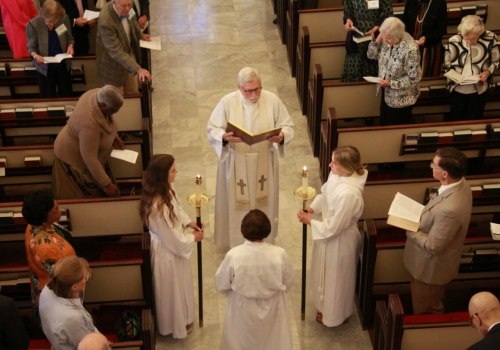
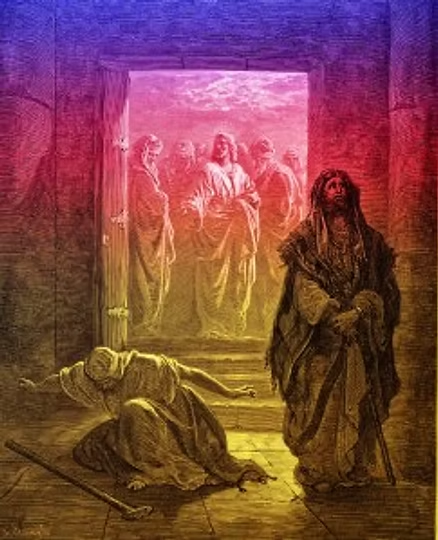

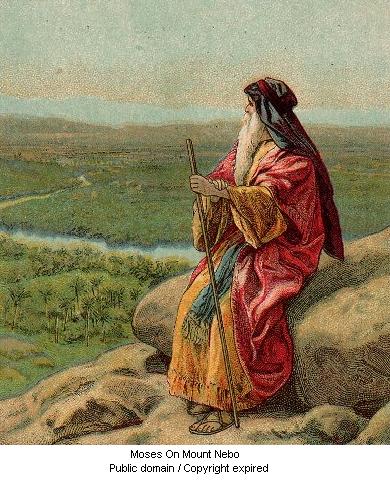



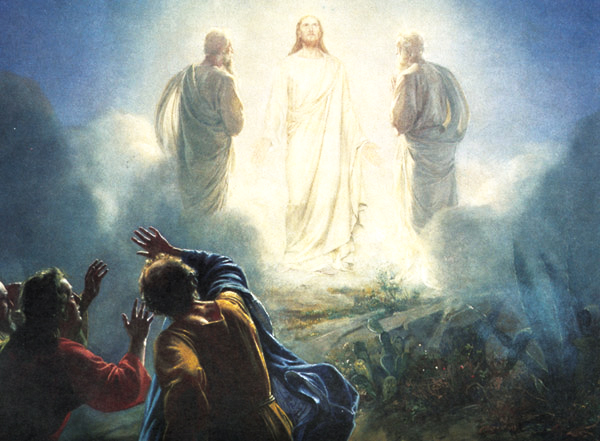
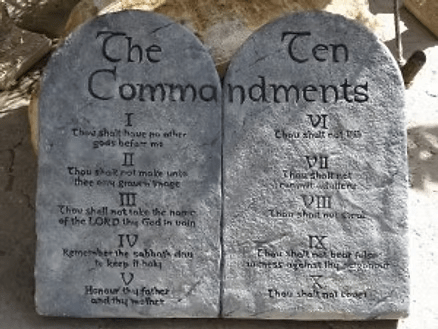




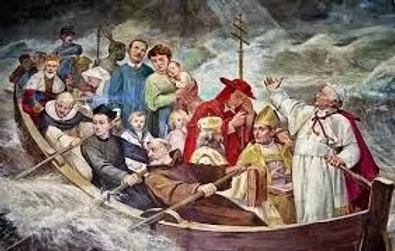



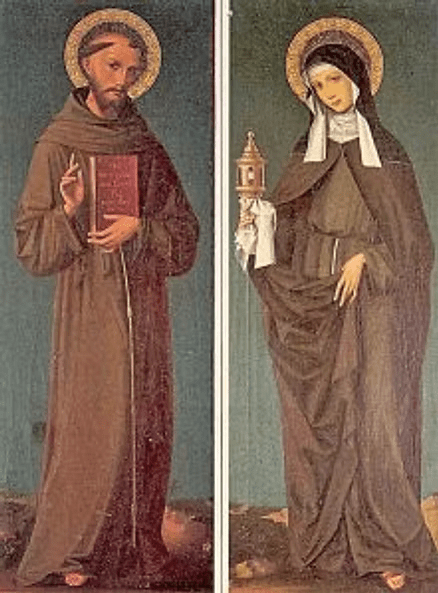

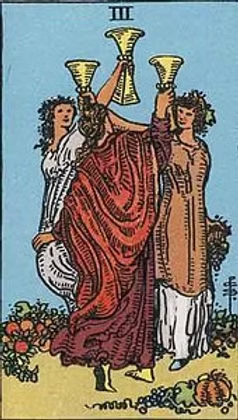

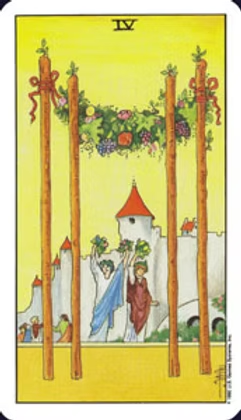
 Explaining the Readings