Category Archives: Teaching

John 15:26-27; John 16:4b-15 – The Spirit of truth brings sainthood

Jesus said to his disciples, “When the Advocate comes, whom I will send to you from the Father, the Spirit of truth who comes from the Father, he will testify on my behalf. You also are to testify because you have been with me from the beginning.

“I did not say these things to you from the beginning, because I was with you. But now I am going to him who sent me; yet none of you asks me, ‘Where are you going?’ But because I have said these things to you, sorrow has filled your hearts. Nevertheless I tell you the truth: it is to your advantage that I go away, for if I do not go away, the Advocate will not come to you; but if I go, I will send him to you. And when he comes, he will prove the world wrong about sin and righteousness and judgment: about sin, because they do not believe in me; about righteousness, because I am going to the Father and you will see me no longer; about judgment, because the ruler of this world has been condemned.

“I still have many things to say to you, but you cannot bear them now. When the Spirit of truth comes, he will guide you into all the truth; for he will not speak on his own, but will speak whatever he hears, and he will declare to you the things that are to come. He will glorify me, because he will take what is mine and declare it to you. All that the Father has is mine. For this reason I said that he will take what is mine and declare it to you.

——————————————————————————–

This is the Gospel selection from the Episcopal Lectionary for Pentecost Sunday, Year B 2018. It will next be read aloud in church by a priest on Sunday, May 20, 2018. This is important as it tells how Jesus perfectly prophesied the coming of the Holy Spirit into his devoted disciples, telling them how they would become the extensions of Jesus Christ in this world.

When reading John’s chapters fifteen, sixteen, and seventeen, it is always important to realize that Jesus was addressing his adult male disciples (which included Peter and Matthew). Jesus was addressing them about important matters that were soon to come into their lives, after Jesus had left them; but none of these conversations were recorded by either Mark (Peter’s story) or Matthew. The reason is that their minds were clouded by Seder wine; and as it was late into the night watch, they were too weary to properly focus on what Jesus was saying. John, on the other hand, had nothing impairing his abilities to concentrate on his master’s every word, because John was too young to drink alcoholic beverages.  Thus, we read those chapters from John’s Gospel because they are lessons intended for the disciples that would later in history … hundreds and thousands of years later.

All of the flesh and blood disciples of Jesus of Nazareth would come to realize (if not remember) the lessons of that Passover night, recorded by John. They are true words spoken, recalled by John as “the Spirit of truth.” None of the disciples would counter anything written by John, as what John recorded came true.  That Spirit is then the Holy Spirit that was prophesied by Jesus to come.

We read in the next-to-last verse of John’s chapter sixteen of the coming of “the Advocate.” In Greek the word written is “Paraklētos,” which is capitalized and may be recognized by some as the Christian term “Paraclete.” That term is sometimes used to name the Holy Spirit.  The word being capitalized in Greek gives it a sense of importance, such as a proper name allows.  Still, the word means, “(a) an advocate, intercessor, (b) a consoler, comforter, helper.” The Greeks used it as inferring a need for legal assistance.  However, the root etymology, from “para-“ and “klē-,” shows the formation of the word intended to say, “a call to the side of” or “to summon support.”

This means Jesus was using this title as a statement that the Holy Spirit was “Invoked by call.”  The word’s use implies a special need, such that a Paraclete would not a natural phenomenon that would come to support everyone.  Still, as Advocate, where the implication is an external assistant (like a lawyer at trial) allows for the name to become tarnished … as “Devil’s Advocate” … making that choice of translation be somewhat misleading.

While the second segment of words that follow “When the Advocate comes” can indeed translate to say, “whom I will send to you from the Father,” I want you to place on your “Amphibological glasses” on and read that next segments slightly askew.  The word “amphibological” means “double meaning,” which is a ploy in language, most often an intent to mislead, such that “amphibological” is a term used in Logic to point to a flaw of reasoning.  However, when the Spirit of truth is the language of God, intended “amphibological” language is by design a prompt to see the multiplicity that divine words contain.

The Greek text reads, “hon egō pempsō hymin para tou Patros.”  That literally can state, “that ego will send to you from the Father.” There is a double meaning stated here, which is intended, but overlooked.  It is overlooked because “egō” is Greek that is properly translated as “I,” being a standard reference to Jesus, in quote.  Still, missing the Jungian concept of “ego” as God’s intent, as God speaking through Jesus and John, relates to missing the intent that the “I” of Jesus would become the “ego” of the disciples.  It states doubly how the disciples will speak as Jesus, becoming his “egō.”

This statement, when read this way, says “When my ego is sent from the Father,” so it is “when I am sent from the Father,” then “I am the Advocate” called to support you.  It might take a couple to times looking at the Greek in English translation to see this appear.  However, it is vital to understand that Jesus Christ is the legal assistant called to one’s side, which is not external but internal.

Rather than see the Holy Spirit as an individual and separate entity, the word “hon” is better when not read as “whom,” but as the Nominative relative pronoun “that.”  Not only does that translation make “egō” be read as a new definition of “Paraklētos” (“that” just stated), but it eliminates all the masculine pronouns that will follow in translation (where “whom” leads to “he”).  All those uses of “he” as an identification of the “Paraclete” are better understood when read as “that” presence.

This means the “ego” sent from the Father then will be the same “ego” as that which filled Jesus of Nazareth, through the Holy Spirit.  The ‘ego” of Jesus of Nazareth (the “I” of Jesus) had been subverted so Jesus only spoke for the Father (not self).  Thus, the “ego” in Jesus was the Christ Mind. Without the Christ Mind, we are all just egos running hither and yon, going nowhere without a gifted guide leading us. The Christ Mind is then the “summoned support” that the Father sends to all His Saints.

This new “ego” “sent from the Father” is then further identified as “the Spirit of truth,” where the capitalized “Pneuma” can also translate as “Breath.”

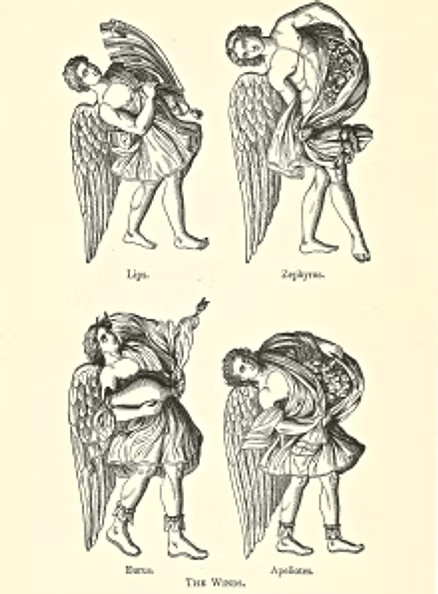
On a day in the liturgy when the disciples were filled with the Holy Spirit, it came upon them “like the rush of a violent wind.” Another term that can represent “Pneuma” is “Wind,” where the capitalization shows a higher level of consideration that goes beyond the physical movement that is sensed as “wind.” When Acts says this “Wind” had a “sound like a violent rush,” it was the “sound” of the “Breath” that took total control of the disciples, changing them into Saints. That was indeed the “Breath of truth” that Jesus foretold would come to his disciples.

Again, the use of “he” is misleading when one is assuming “the Advocate” is a male entity sent by Jesus from the Father. The Greek word “ekeînos” actually means “that one” or “that thing,” such that in the first person Nominative it means “that,” as reference to something just stated. As such, reading how “that” comes from “the Father,” this is sent by the male Spirit known as God. God is not the presence of a “he,” but an extension of God – “that thing.”  As the “ego” of Jesus Christ being “that thing sent from the Father,” this is how all Christians become the Sons of God, regardless of one’s human gender. Thus, “that” male “ego” of Jesus Christ “will testify on [Jesus’] behalf.”  This is then stating Jesus will be reborn in a disciple, whose own “ego” has been sacrificed to the Father. The testimony that will come is from the “Spirit of truth” says there will be a duplication of “that” held by Jesus of Nazareth.

The final segments that make up verse 27 say (literally, in English from the Greek), “and you moreover bear witness  ,  because from the beginning with me you are.” The separation, by comma pause, forces one to see this saying more than, “You also are to testify because you have been with me from the beginning.”

The power comes from seeing Jesus prophesying to his disciples how they would “bear witness” to this presence of a new “ego” that “will be sent from the Father,” which is the Christ Mind, the same Mind that Jesus Christ possessed. It does not come from Jesus, but from God, to those who will testify for God, as did Jesus of Nazareth. The Apostles would testify to that through their Epistles, and through their ministries. This then means that once a new Saint has seen the light of a new “beginning with Jesus” has started, it will be like one has always been in that state. That new” beginning with” Jesus will forevermore define who they are, as their being will no longer be who they were.

That foundation, coming from the last two verses of John’s chapter fifteen must be grasped as a state of being that is understood, prior to the lessons taught to the disciples [you the reader] in chapter sixteen. The change from one chapter to the next must be realized as purposeful, meaning John did not run out of blank page to write on, so he started a new page and numbered it “16.” A chapter break is more significant than a break for pause (comma, semi-colon, colon, double-dash, etc.) and a break concluding a string of thoughts (a period mark).

This break should be seen as movement of the group, after they left the upper room. Chapter fourteen ended with John saying Jesus told them, “Come now, let us leave.” That more than likely meant to leave the upstairs room, to the streets of the Essenes Quarter of Jerusalem, where they mixed and mingled with other Jews doing the same as they did [a tradition of the Seder]. In that setting, Jesus spoke the lessons of chapter fifteen to his disciples, who were too drunk to remember. Therefore, it is likely that the lessons of chapter sixteen took place as the group left the city and exited to the Mount of Olives (which was really a hill with olive trees, overlooking the Hinnom Valley). Outside the Essenes Gate these lessons could have been told, prior to Jesus and John going off alone, when Jesus prayed (John 17).

The beginning of John’s chapter sixteen is a warning given by Jesus, about the coming deaths that all the disciples would face. They would come in the face of persecution and rejection, the same that Jesus had faced. As Jesus ended this prophecy, he used language that is similar to that which ended chapter fifteen, saying, “I did not say these things to you from the beginning, because I was with you.”   The intent was Jesus had not forewarned his followers of extreme persecution, because he would be the focus of what the disciples would witness. His intent was his physical presence would protect them; but that physical presence was about to come to an end.  However, the words, “to you from the beginning not I spoke” (from Greek “eipon” meaning “to speak, say”) are now used to continue the thought, “from the beginning with me you are.”

When Jesus then told his disciples, “Now I go to the [one] having sent me,” that was a statement that Jesus of Nazareth had been sent the Holy Spirit, which comes from the Father. The Holy Spirit is all that is allowed in heaven, as it is “that thing” surrounding God. Thus, Jesus’ soul was baptized by the Holy Spirit and given eternal life with the Father. Jesus’ “ego” was subservient to the Spirit of truth, which came from God; so Jesus could go to the Father because his soul had been cleansed by the Holy Spirit.

When Jesus then added to his statement about leaving, “And none of you ask me, Where are you going?” this means his disciples knew that Jesus had foretold his death was coming, in a most horrible manner. Still, the reason none of them asked where Jesus was going is none of the disciples had any understanding of heaven and eternal life. They all assumed (as the Pharisees had taught) all souls went to Sheol (a form of Hades – the underworld) – good and bad; or they believed a soul died when the physical body died (as taught by the Sadducees) – there was no eternal afterlife.
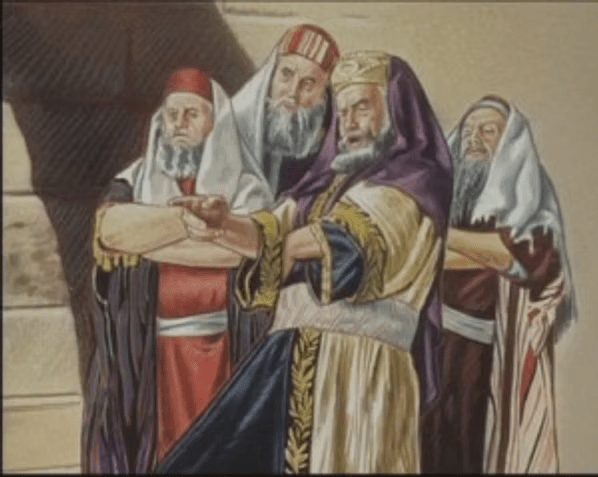
Fools! When we die we will go to the great lounge in the underworld, where we will rule like kings.

Not long before, Jesus had said, “If you had known me, you would have known my Father also; from now on you know Him, and have seen Him.” A drunken Philip replied, “Lord, show us the Father and that will be enough for us.” That response says the only concept of being that was held by the disciples was the here and now. With Jesus telling them he was going to die, there was no reason to ask where his body would be buried. They would see his tomb and know, “Here lies Jesus of Nazareth.”  With that as their expectation, none of them asked “Where are you going Jesus?”

It was that prophesied death that Jesus said “sorrow has filled your hearts.” The use of “heart” goes beyond the metaphor of one’s emotional center being weighed down with feelings of remorse and pain (“sorrow”). Instead, Jesus was pointing out how the blood being pumped through their physical bodies, by the physical organ that regulated life in human beings, was infused with “grief” and “affliction.” Rather than the “Spirit of truth” running through them, they had the spirit of uncertainty and doubt.  The disciples did not know where Jesus was going, nor care to ask where, because they had not yet drank from the cup of eternal life.  That would come and be when their sorrow would be replaced by the happiness and joy that comes from a marriage to the One God.  Then, the Holy Spirit would course throughout them.

That happiness would be relative to the presence of the Advocate Jesus had told his disciples about, not long before. By saying, “I tell you the truth,” Jesus repeated how the Spirit of truth was in him, as it would be to come in them. Jesus then said truthfully, “It is to your advantage that I go away, for if I do not go away, the Advocate will not come to you; but if I go, I will send him to you.” Here, Jesus did not repeat the first person singular “egō,” but a form of the verb “pempó” that implied that, as “I will send.”

The verb can also mean, “I will transmit, I will permit to go, and I will put forth.” When the masculine pronoun “him” is not read as the translation of “auton,” this promise projects “the same” or “self,” with the Advocate only capable of coming from God. This means Jesus saying, “If I die” (from Greek “poreuthō”), then “I will permit same (or self) with you.” This does not mean Jesus will give God an order to send one Holy Spirit to one disciple, but the freeing of the Christ Spirit from Jesus would allow that Spirit of truth to be multiplied many times over. Each new Saint would then replicate the Christ Mind of Jesus of Nazareth, replacing an old ego.

Verse 8, again, does not make a specific reference to a male (“he”) that “comes,” but rather states, “Having come.” This is the present participle state that continues the past into the present. Because Jesus was the embodiment of the Holy Spirit and Christ Mind, that Spirit of truth was not awaited, as it had already come. “Having come,” it will never leave again.

A translation that implies “when” makes the future of “coming” conditional, such that there is no certainty as to the circumstances being met for a “coming.” However, “having come,” “that” presence “will convict the world concerning sin.” This was the truth being stated that was the ministry of Jesus of Nazareth, where the Gospels tell how Jesus pointed out the guilt and exposed the sin of those who acted blameless and sin free (the elites of Judaism).

Beyond defining “sin,” Jesus said the Christ Mind would make clear the meaning of “righteousness” and “judgment,” where each are separate phases a soul confronts when on the material plane. Jesus then explained these by saying, “about sin, because they do not believe in me; about righteousness, because I am going to the Father and you will see me no longer; about judgment, because the ruler of this world has been condemned.”

As to “sin” being exposed as the rejection of Jesus, this is certainly a reflection on the ruling Jews, stretching from the Temple’s Sanhedrin, the Sadducees and Pharisees, to the rabbis of synagogues throughout Galilee and Judea. However, to limit “sin” to only those few who did not have faith, trust, or belief on Jesus as the Messiah is wrong. The scope of “sin” is placed on the whole world, a world that would deny Jesus as the Son of God and the “ego” necessary for resisting all “sin.”

The word “peri” is translated as “about,” such that it precedes each of the three categories Jesus said would be exposed. The translation as “about” is weak, as the word also means “concerning.” “Concerning” is a word that evokes the element of “concern” that should be realized. The word “peri” is often used with its intent being to denote “conditions” and “circumstances” that allow something to be seen in a certain light. As such, “sin” is conditional to the intent behind an act, more than the act itself.

This is how the act of killing a human being is not the same as an act of murder, simply because a life was taken. Both acts can be deemed a “sin,” but killing might be justified (based on the circumstances and conditions), whereas murder is always against a Law of God – a “sin.” Therefore, the word “peri” is not a casual word that casts a blanket of generality over “sin, righteousness, and judgment.”  It establishes a perimeter of circumstance concerning those distinctions.

This means “concerning righteousness” is conditional on one’s acceptance of Jesus Christ, as he has prophesied he (as “the Advocate”) was coming to his disciples. In the sense of Judaism, Jesus saw that dogmatic religion was the external measure of sinfulness and righteousness, based on how well one observed the Laws of Moses. This is what set the Temple leaders on a level of self-perceived righteousness, simply because they had the power to project sin upon others, while overlooking their own flaws and moral shortcomings.
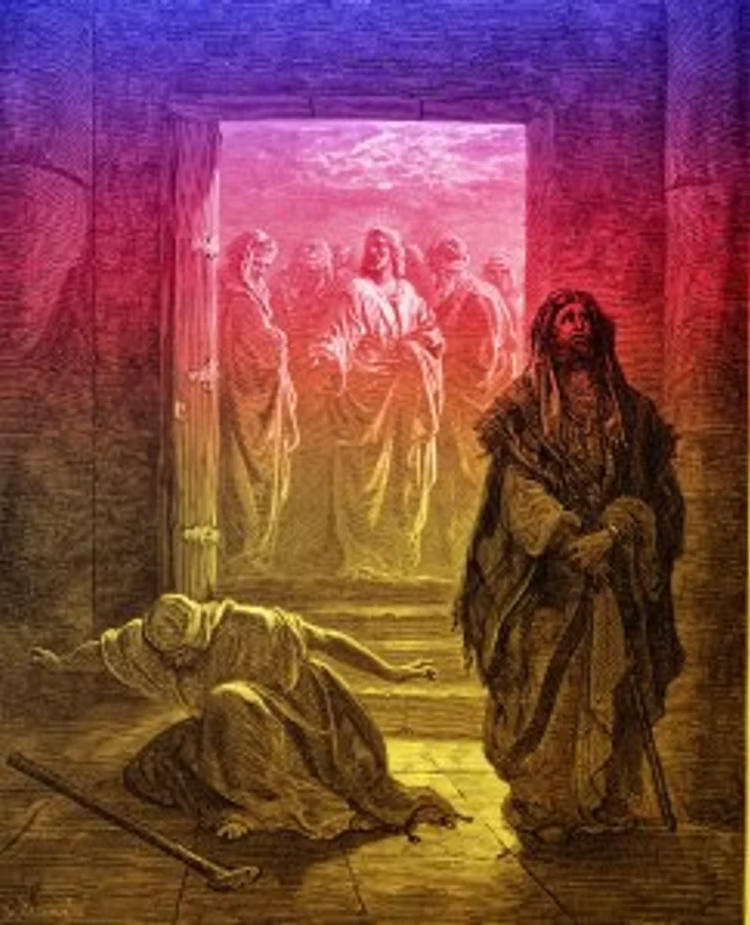
Jesus said, “I tell you that this man [publican], rather than the other [Pharisee], went home justified before God. For all those who exalt themselves will be humbled, and those who humble themselves will be exalted.”

As a rejection of Jesus was done by trying to pin the “sins” of blasphemy (by implying he was the Messiah) and being a law-breaker (by healing on the Sabbath), it was the “sin” of their lies (plotting to murder Jesus of Nazareth) that took their image of “righteousness” and exposed it for what it was. The Spirit of truth showed those leaders as false prophets and bad shepherds, incapable of righteousness.  They rejected the Spirit of truth.

Still, it is too easy to just project the title of sinner on the Jews, as the Gentile Romans probably had no qualms about killing someone who had beliefs that differed from theirs. Just like the Temple schemers, the Romans loved to use the pretense of law as justifications for their many acts of sin. Many of the Roman Empire’s acts were sins in the eyes of the LORD, regardless of how legal they were proclaimed, or holy unto their pagan (dead) gods.

This same state of “sin” projects on Americans today, as its multi-cultural mix has pagan Gentiles, Jews, and those professing Christianity as their religion all rejecting Jesus as the Christ. The laws of the land are based on a lack of consistent internal moral values.  The point of what Jesus said to his disciples is that “righteousness” can only be found in those who accept the Holy Spirit – the Advocate Christ Mind – and become reborn as Jesus Christ.  Therefore, the “legal assistance” needed is a mindset that always, automatically, follows God’s Law, without question.

Seeing this in that light, the perspective of “judgment” falls as a product of one’s designation as either sinner or Saint. Jesus said “judgment” was exposed “because the ruler of this world has been condemned.” That “ruler” is Satan, but the placement of human beings into positions of rule always (over time) leads the development of sinful little mini-devils, the sons and daughters of Lucifer.

In many examples of rulers (Nero, Caligula, Attila the Hun, Napoleon, Hitler, Stalin, Mao, Saddam Hussein, Gadhafi, Putin, Kim Jong Un, Pol Pot, et al etc., on and on, past-present-future), the soul having been sold into eternal damnation produces tyrants of despicable character. The rejection of Jesus as the Son of God within one’s being means taking a position of influence (for personal gain) as a good idea.

When is a job promotion not self-promotion? Didn’t Hitler start out as a failed corporal in the military who had washed out of art school?

The warning then becomes the test of one’s ability to rule over others AND still obey the Will of God, speaking from the Spirit of truth, while others plot your demise. Judgment then becomes the reward of righteousness, where heaven is for Jesus Christ and those reborn as him and hell is for those who serve Evil, with those in between getting recycled back into the worldly process again (reincarnation).

When we next read of Jesus saying to his disciples, “I still have many things to say to you, but you cannot bear them now,” this goes well beyond their mental capacities being lessened by their drunken and tired states. This statement is mirrored in John’s verse in his final chapter (John 21:25), which says, “Jesus did many other things as well. If every one of them were written down, I suppose that even the whole world would not have room for the books that would be written.”

That says the tiny brains that human beings place so much value in are incapable of knowing the Mind of God. The disciples then are like everyone breathing air today, in the sense that it is impossible for someone who has rejected becoming Jesus Christ reborn to know anything more than a brain has been finely tuned to recall (maybe 4.7% of its capacity?). To know the Spirit of truth, one must be in possession of a brain that hides in a recessed corner of one’s being [ego hideout], listening to one’s own mouth speaking righteousness that one’s own brain did not think up … all the while knowing, “That’s Jesus speaking! And I understand his words fully!”

This is what Jesus meant when he said, “When the Spirit of truth comes, that will guide you into all the truth; for you will not speak on your own, but [the Spirit] will speak whatever that hears, and that will declare to you the things that are to come.” This is the meaning of Ezekiel being told by God, “prophesy to the Breath.” It is what Paul wrote to the Roman Jews speaking of, when he wrote, “God, who searches the heart, knows what is the mind of the Spirit, because the Spirit intercedes for the saints according to the will of God.” Paul was a Saint who never personally knew Jesus of Nazareth; but Jesus foresaw Saints walking the earth in his name.  Jesus prophesied the coming of Saints like Paul and like his disciples – then and now.

Jesus then said, “That (rather than “He”) will glorify me, because that (rather than “he”) will take what is mine and declare it to you.” Again, the Holy Spirit is God, who is the complete essence of masculinity and maleness, but Jesus did not speak of the Holy Spirit an entity, but an arm of the LORD. The Spirit of truth is a oneness with God that envelops a human and its soul.

This means God touched His Son with His arm, making Jesus of Nazareth righteous. The soul of the Son of Man was baptized by the Holy Spirit and Jesus became God incarnate on the earth plane. God has the power to be incarnated in ALL humanity, but ALL humanity would have to want it, seek it, and prove that desire.  In the same way that touch from God is what “glorified” Jesus, as he was “honored” through God, God was “bestowing” His powers into human flesh. That presence was then prophesied as coming upon the disciples of Jesus [you the reader], who would then “take what was his” (the name Jesus Christ) and “declare it to you.” A Saint is then one in the name of Jesus Christ.

The tradition of marriage is a wife takes on the name of the husband. Marriage to God means one takes on the name Christ.

Jesus then concluded this part of his lesson to his disciples by saying, “All that the Father has is mine. For this reason I said that he will take what is mine and declare it to you.” This states the union of human being with God being reborn, just as it was the state of Jesus of Nazareth. The two would become inseparable, as one. The unity that binds the ether of God to the matter of flesh is the soul washed clean of sin, which occurs when one is baptized by the Holy Spirit.

As Jesus of Nazareth was a Saint, so too will all who were to be reborn as him, after his holy soul was released to return in others. A Saint is therefore the reality of the Trinity, as Father, Son and Holy Spirit in one being. All Saints will have the same powers made available to them, so that sin will be defeated, righteousness will be gained, and one’s judgment will be life everlasting. One just has to become Jesus Christ reborn.

As the Gospel reading for Pentecost Sunday, the message is to receive the Holy Spirit and serve the LORD as did Jesus of Nazareth. The Day of Pentecost marks the ordination of saintly priests into the world, just as Peter stood on Pentecost with the other eleven Saints and they all spoke the Spirit of truth. They prophesied to the Breath, which overcame them like a sudden rush of sound coming from their tongues.

The call is to see oneself as having been in a drunken stupor so far in life, so that Jesus has always seemed to be speaking these things to others.  We sit and listen, but we never hear Scripture as a message to be personally focused. One has not heard the Spirit of truth speaking as a motivation for oneself to act – to receive the Spirit and become Jesus Christ reborn.  the reason is sorrow has filled one’s hearts. Sorrow is the affliction of thinking, “I’m not worthy.”

While not read in the selected verses today, the greatest fear is knowing the warning of death that awaits disciples who commit to God. Persecution is the fear of thinking, “What will others say, if I suddenly start acting righteous and more holy?” That fear is typical. It comes from the whispers of Satan, who rules this domain and wants all human beings to remain dried bones, with no holy blood flowing through their veins.

Pentecost is the day when Moses brought down the Law from Mount Sinai. It meant fifty days had passed since the Israelites left Egypt, having that much time to see the miracles God had surrounded and protected His people with. Just as the Israelites were not forced to commit to the Covenant then (quite a few idol worshipers were driven out and killed), there is no hard and fast rule that says, “You must be a Saint.” Just know that refusal means out-casting oneself.

It isn’t even a decision that one can make without God.  Eternal salvation is a reward of complete commitment to God.

The comparison I see is that Pentecost is graduation day. Time has gone by and effort has been put forth to reach that point of transition. One goes from being a student to being a worker. Of course, going back to school for more degrees might keep one from actually applying a degree in the real world and actually earning a living; but what happens when all the student debt comes due and one has no way of paying back all the loans?

We all have to “grow up” sometime.

This Gospel reading is like a professor telling a class of graduates, who are all too drunk from celebrating to really pay attention, what their futures will be like. Just like the disciples, who were ready to lay down and go to sleep, forgetting the purpose of staying vigilant was to “watch and pray you do not fall into temptation,” the world has a way of casting a spell over the best intentions and making open eyes close.  Work is always the next step, no matter which way one goes.  That is why the Gospels lead to “The Acts of the Apostles.

The lesson today will be remember later. It might take years of hard work and experience to realize the lesson, but realize it one will. Realization comes by either recalling what saved one’s life, or by regretting not following good advice given long before.  This lesson will be heard.

Acts 2:1-21 – The Feast of Fifty Days

When the day of Pentecost had come, the disciples were all together in one place. And suddenly from heaven there came a sound like the rush of a violent wind, and it filled the entire house where they were sitting. Divided tongues, as of fire, appeared among them, and a tongue rested on each of them. All of them were filled with the Holy Spirit and began to speak in other languages, as the Spirit gave them ability.

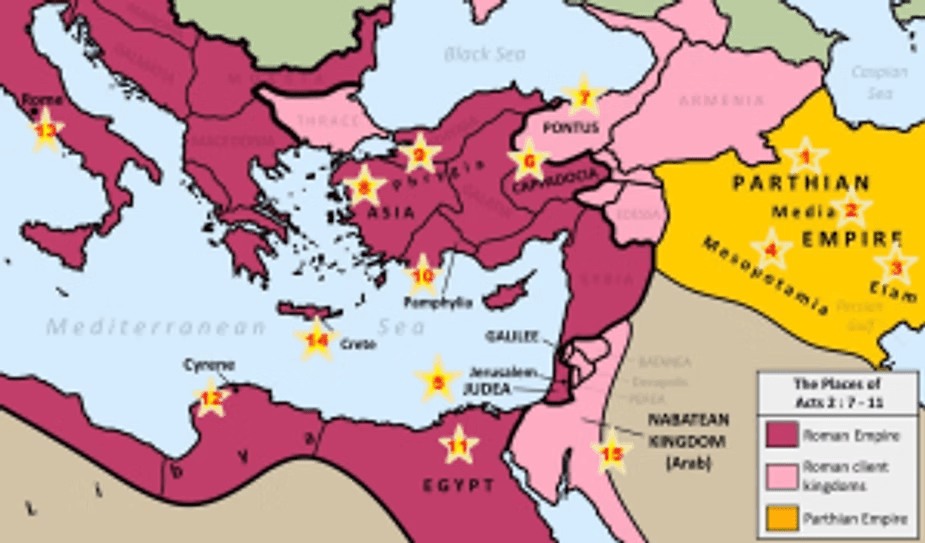
Now there were devout Jews from every nation under heaven living in Jerusalem. And at this sound the crowd gathered and was bewildered, because each one heard them speaking in the native language of each. Amazed and astonished, they asked, “Are not all these who are speaking Galileans? And how is it that we hear, each of us, in our own native language? Parthians, Medes, Elamites, and residents of Mesopotamia, Judea and Cappadocia, Pontus and Asia, Phrygia and Pamphylia, Egypt and the parts of Libya belonging to Cyrene, and visitors from Rome, both Jews and proselytes, Cretans and Arabs– in our own languages we hear them speaking about God’s deeds of power.” All were amazed and perplexed, saying to one another, “What does this mean?” But others sneered and said, “They are filled with new wine.”

But Peter, standing with the eleven, raised his voice and addressed them, “Men of Judea and all who live in Jerusalem, let this be known to you, and listen to what I say. Indeed, these are not drunk, as you suppose, for it is only nine o’clock in the morning. No, this is what was spoken through the prophet Joel:

`In the last days it will be, God declares,

that I will pour out my Spirit upon all flesh,

and your sons and your daughters shall prophesy,

and your young men shall see visions,

and your old men shall dream dreams.

Even upon my slaves, both men and women,

in those days I will pour out my Spirit;

and they shall prophesy.

And I will show portents in the heaven above

and signs on the earth below,

blood, and fire, and smoky mist.

The sun shall be turned to darkness

and the moon to blood,

before the coming of the Lord’s great and glorious day.

Then everyone who calls on the name of the Lord shall be saved.’ ”

——————————————————————————–

This is the fairly fixed reading that can be chosen as either the Old Testament selection or the Epistle selection for Pentecost Sunday, Year B 2018. The full reading is optional in Year A and Year C, making it a fixture reading for Pentecost Sunday.  Either way it may be selected, it would next be read aloud in church by a reader on Sunday, May 20, 2018. It is important as it tells of the disciples’ transformation into Apostles and Saints, when the Holy Spirit flowed strongly through each of them on the first day of the week that was Pentecost (the Fiftieth Day), marking the Festival of Weeks (Shavuot). It is important because it tells how the Saints of Christ do not speak of their own accord, but by the Will of God. The truth spoken by an Apostle is then fulfilled by the prophecy made by Joel, where that prophecy needs closer examination.

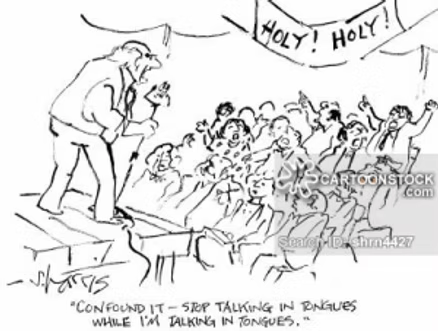
I was raised (from nursery cradle to fifteen) in an Assemblies of God church. That denomination is under the general umbrella of Christianity that is called “Pentecostal.” I was into my fifties when I learned that “Pentecost” is Greek, meaning “Fiftieth Day.” My assumption prior to that (as I do not recall ever having “Pentecostal” defined to me) was that “Pentecost” meant “speaking in tongues,” as that was a tenet of the Pentecostal branches of Christianity.

Now, I see my assumption (from being told “Pentecostal” means the belief in “speaking in tongues”) was somewhat of an oxymoron.  It must be, since one of the tongues not spoken appears, quite obviously, to be Greek. Otherwise, that branch of Christianity would be better named if there was no inference to being “Fiftieth Day related,” from “Pentecost-al.”  A more suitable name would be “Glossaipyros-al” (from the Greek “glōssaiand “pyros“), meaning “Tongues of fire related.”

The very first verse in this reading states, “When the day of Pentecost had come.” That demands one understand what the “day of Pentecost” is, as its mere mention states it was a significant day. It demands that one know the Israelites were commanded to forever observe three holy days with feasts (festivals). The three are: Pesach (Passover), Shavuot (Weeks [a.k.a. Pentecost]), and Sukkot (Booths). Each festival attaches a number of days of recognition to each of those specified days.

The Hebrew word “Shavuot” means “Weeks,” such that there were seven full weeks that took place after the Israelites escaped Pharaoh, until Moses came down with the sacred tablets. Forty of those days were spent encamped at the base of Mount Horeb, while Moses was on the mount with God.  The Covenant was then made on the fiftieth day (7X7=49, 49+1=50), after Moses came down with the sacred Tablets.

The festival that denoted the end of that counting of weeks was probably named Pentecost because of Greek rule over Jerusalem (following the Persians, prior to the Romans), as a translation of the statement of “fifty days” in Leviticus 23:16. If not, the Greek came after the Apostles spread into Greece and began writing Gospels and Epistles, where that became the translation for the Aramaic that spoke of the Feast of Fifty Days. Regardless of the etymology of “Pentecost,” there was nothing at all that would have predicted to Peter or the other eleven, “Pentecost is tomorrow, so get ready to start speaking in tongues guys.”

Realizing that, when we next read, “the disciples were all together in one place,” the only certainty of where that “place” was located was in Jerusalem, as stated in verse five (“eis Ierousalēm katoikountes” – “in Jerusalem dwelling”). We can assume that the specific place where they were all together was the same “upper room,” where they had shared the Passover Seder meal with Jesus.

This assumption comes from Acts 1:13, where the disciples had returned after the ascension of Jesus Christ. We read there, (“eisēlthon eis to hyperōon”) “they had entered into the upper room,” which is a statement of the same “upper room” prior.   Due to the influx of pilgrims seeking rooms in and around Jerusalem, for Jesus (after his resurrection) to remain in the Essenes Quarter with his disciples for forty days (most likely in unrecognizable form), the room could be retained and he could teach his disciples the meaning of the future that was coming.  As his Ascension was on a Sabbath, on the hill with olive trees (Mount Olivet) just outside the Essenes Gate, the disciples were within the limits on their walking distance (a Sabbath’s day walk – which is roughly a half-mile outside the city walls).  That evidence implies the disciples went back in the same “house” (from Greek “oikon” in verse two) they had remained in for forty-nine days, then preparing for the Temple ceremony for Shavuot.

When we read, “Now there were devout Jews from every nation under heaven living in Jerusalem” (literally translated as, “in Jerusalem dwelling”), this is a statement of the importance of Shavuot. As a commanded event that was fifty days later than the Passover events (an eight day festival), those pilgrims in Jerusalem were not coming from the airport, having just flown into town. The distances stated by the naming of places the pilgrims had come from says they all came for the Passover and stayed some place near Jerusalem for about two months. After that stay, they could return home.

Fourteen places are named, but with twelve Apostles it is probable that a couple of nations shared a common language.

That distance means a traveler would have secured a place to stay (a “dwelling”) while near Jerusalem for two months. This could be “living” with relatives who still lived there, or it could mean staying in inns, or it could mean staying in “travel parks,” where groups of travelers all pitched tents and roped off donkeys and camels, within a reasonable distance from Jerusalem.

Keep in mind that Jesus fed a multitude of five thousand adult males (meaning perhaps a total of as many as eleven thousand, including men, women, and children).  Those were largely pilgrims who were preparing for the Passover Festival (John 6:4 – “The Jewish Passover Festival was near.”). Matthew wrote of Jesus feeding the same five thousand (Matthew 14:13-21), but then wrote of Jesus later feeding four thousand (Matthew 15:29-39).  The implication is the timing of the second miracle was prior to the Pentecost Festival.  That means those “living in Jerusalem” were many, all of whom had been there since prior to the Passover; and this swell of people there took place every year (maybe not with the exact same people), because it was a commanded observance.

It is worthwhile to note that the ritual observances demanded by God, through Moses, as stated in the Torah (Exodus, Leviticus, Deuteronomy, and Numbers), were not maintained over the centuries. Once the Kingdom of Israel divided, the people were not led to understand the reasoning behind their Covenant, such that the fall of Israel and Judah was seen as rooted in this noncompliance. There was not always a Temple with priests to offer sacrifices, and some see the efforts begun while in captivity in Babylon was an attempt by the captive Jews to relearning what rituals had been forgotten.  Because the Law had been forgotten, the exilic Jews (the Levitical priestly descendants) saw adherence to the Law as all important; and that included observing the commanded festivals.

In the reverse view, after the destruction of the Second Temple and the scattering of the Israelite people around the world (mirroring the spread of Christianity), there has again come a disconnect by Jews and Christians, relative to understanding the reasoning behind the Covenant and the new Covenant with Jesus Christ. Jews go through the motions of rituals without realizing the Messiah has come; and Christians have no grasp of the rituals that bring them into a Covenant with God. Everyone has changed the rules to fit their personal needs, rather than feeling the purpose of God demanding ritual feasts forever be maintained by ALL His chosen priests (thus a “New Covenant” that has been added to THE Covenant).

This lost sense of knowing why God wanted His people to observe the Passover and then fifty days later a festival of farmers taking their marked (with reeds) first fruits (grains) of harvest to the Temple for blessing, amid throngs of cheering Jews was the background setting to the story of Acts 2:1-21 (and 22-41). The people from all the nations listed were milling about during the morning of Pentecost, waiting for someone to finish a prayer and a rite, announcing the close of festivities so everyone could go home … finally.

Their devotion had led them there, seeking more; but so many Jews were looking for some greater reward, more than simply being God’s chosen people.  They prayed for something to happen that would make their devotion be more than routine obligation.  The scene of Acts 2 opens with that ripeness for receiving the Spirit.  Rather than grains and fruits (and cheese blintzes) being the reward of the First Fruits, the pilgrims themselves were about to be blessed as a good harvest.

Knowing this setting, all of the streets in Jerusalem would have been packed. All the pilgrims would have flowed in through every gate, as their customary way of ceremoniously renewing their vows to serve Yahweh.  Then, suddenly, “Came a sound like the rush of a violent wind.”

Imagine how people interviewed on the news after a trailer park has been destroyed by a tornado say, “It sounded like a freight train coming.” If they had freight trains back in ancient days, then maybe we would read here, “Came the sound like a freight train.” Not only did the ancients not have freight trains, but they had no machines that made loud noises that would be similar to any man-made noise. It must have sounded like a tornado, but those weather events are rare in the Middle East, including Israel.  Such a loud noise was totally unexpected, because even rain is scarce in the area during May and June each year (the time between Passover and Pentecost).

Still, this was so loud it filled the entire house and the noise spread outside.  It was so noticeable that it made the people in the streets stop and take notice. They all looked at the house where the disciples of Jesus were staying.

“What in the name of God could that loud noise be?” the pilgrims all asked.

Then, once they had stopped in their path, they looked hard and listened intently. They heard many men speaking loudly in many foreign languages (the real meaning of “speaking in tongues”); and everyone in the street heard some strange man speaking his own native language.

Then the men inside the house came outside.  Some might have gone into the street, while some might have gone out on a rooftop-terrace.  Once the men were seen – still speaking fluently in many different languages – they looked like Galileans.  That means they looked somewhat foreign to the big city, as they probably were not in refined dress, not looking dapper.  They might have had on funny hats or had their hair wild and un-braided.  Whatever the case, they certainly were seen as not being men of the world and high culture.

Still, that source of sound coming from the least of Jews was not reason for the pilgrims to return to the din of street movement.  We read that the pilgrims were all “Amazed and astonished.”

It is most important to realize that these foreign visitors to Jerusalem were not “amazed and astonished” because they heard rubes from Galilee saying things like, “Hello. Can you tell me where the hotel is? This is beautiful weather we are having, do you not agree?” as if they were automatically filled with the ability to speak a conversational language learned from Babble, Rosetta Stone, or The Idiot’s Guide to Mastering Foreign Languages.

The new Apostles were not babbling incoherently, using distinguishable languages recognized by the pilgrim Jews. They were preaching the meaning of Scripture (Torah, Psalms, and Prophets), which were lessons heard for the first time, leading the pilgrims to be “amazed and astonished.”  The fact that each pilgrim heard those lessons in his native tongue means there was no language barrier to overcome – no struggles with Hebrew, no need for translation, no idioms, sayings, or slang terms to overcome – as the multinational visitors heard clearly what no rabbi or high priest had ever told them before.

And that was coming from Galileans!

When we read how some said, “In our own languages we hear them speaking about God’s deeds of power,” that speaks of the power of God flowing from the mouths of His servants, explaining the hidden meaning that had never been exposed. That is why they “all were amazed.”  Still, they were also “perplexed.”

That state of wonder (amazement), followed by confusion and doubt (perplexity) means their hearts and minds had opened a crack, towards belief in the Apostles; but then their natural brain-driven reaction was to slam shut a protective shell of disbelief over the chance of human vulnerability.  Something wasn’t right!  They had to slam a harness around those hearts and minds.

We read how they began “saying to one another, ‘What does this mean?’”

Their brains began whirring, thinking about how Galilean fishermen, small town lawyers, former tax collectors, and general riff-raff Jews could be bedazzling and filling those international globetrotters with sudden wonder, speaking the truth so clearly … in foreign languages?

Then we read, “But others sneered and said, ‘They are filled with new wine.’”

This has to be seen as an explanation offered from the crowd, about how simple Jews could be speaking such deep levels of interpretation of Scripture. Being “filled with new wine” meant there were known past examples of how a drunken state could remove inhibitions in the brain, allowing people to utter thoughts freely, with surprising insight. The intent of such an explanation would be akin to thinking they might be speaking good ideas now, but wait until the influence of alcohol wears off and they return to being bumpkins, not remembering what they said while drunk.

Still, to have someone shout out, “They are filled with new wine” is the Holy Spirit already circulating around the crowd, influencing them to receive the messages spoken by Apostles.

Just fifty days earlier, Jesus had offered a prayer of thanks over the third ceremonious cup of Seder wine (the Redemption Cup), saying, “Drink from this, all of you. This is my blood of the covenant, which is poured out for many for the forgiveness of sins.” (Matthew 26:27-28) When Jesus then added, “I tell you, I will not drink from this fruit of the vine from now on until that day when I drink it new with you in my Father’s kingdom,” Jesus spoke prophecy that was then coming true.  It was that day. Jesus Christ had been reborn within his disciples, so they spoke as if “drunk with the new wine” of the Holy Spirit and Jesus was there with them … in the kingdom of Sainthood.

In this regard, Peter did not deny that he and his eleven brothers in Christ were drunk. Instead, he said, “Indeed, these are not drunk, as you suppose.” They were drunk, but in a way that was not imagined by the pilgrims.  They were drunk with the holy blood of Jesus Christ, through HOLY SPIRITS.

New wine (Greek “Gleukous”) is also called sweet wine, which is unfermented grape juice. It is a non-alcoholic beverage in that case, which might have been consumed by the disciples for breakfast. It would be a drink for the whole family to consume, and for adults to drink at any other time, when drinking spirits would be inappropriate. However, new wine can ferment unexpectedly and become alcoholic, causing one to drink it and unexpectedly get drunk. This is why Peter explained, “not … these are drunkards” (“methyousin”), where the denial was they were “not … intoxicated by wine.”

This was then spoken to the crowd by Peter, with the translation reading: “Peter, standing with the eleven, raised his voice and addressed them.” The better translation says, “Peter with the eleven  , lifted up the voice of him and spoke forth to them.”  This says more than Peter just began speaking in a loud voice, as the loud sound that attracted the crowd had come from the wind-like roar of the Apostles speaking loudly in foreign languages.

The Greek word “epēren,” which is translated as “raised” or “lifted up,” should be seen on a deeper level.  Peter and all the other Apostles were speaking loud enough to be clearly heard at some distance, but more importantly their voices were “exalted,” having been “raised” spiritually, as their words were “lifted up” divinely. This means that they all spoke from the Holy Spirit.  With “raised voice” Peter and the other eleven were having the Spirit of the LORD poured out through them. Thus Peter used the example of prophecy, coming from Joel 2:28-32.

It is so important to see how Peter was not simply explaining intellectually, using words that explained what he and the other Apostles were doing. Peter was not speaking from his brain when he implied that he and the gang were fulfilling the prophecy of Joel. That would not be “with raised voice,” but human words of reason.

Instead, Peter quoted Joel because the Father spoke those words for him to recite. It was not rote memorization being accessed within his country-bumpkin brain that Peter (et al) was speaking. Everything Peter and the eleven spoke came from the Mind of Christ, brought upon them by the Holy Spirit, which included the quote from the Prophet Joel.

When Joel was led by the Holy Spirit to write, “In the last days it will be, God declares,” it must be realized that the Greek word “eschatais” (from the root word “eschatos”) means “last, at the last, till the end, and finally.” This is the root word for the theological word “eschatology,” which places focus on “the end of the world or of humankind.” As such, some can read Joel and project what he prophesied is still to come, at that fearsome, grizzly end of the world that always seems just around the corner of present time.

However, as Peter was quoting then, well into the future of Joel’s prophecy, as Peter spoke it was the last days, and God was declaring through ordinary folk.

God then spoke the words of Joel, through Peter: “I will pour out my Spirit upon all flesh, and your sons and your daughters shall prophesy, and your young men shall see visions, and your old men shall dream dreams. Even upon my slaves, both men and women, in those days I will pour out my Spirit; and they shall prophesy.”

Peter and the other eleven Apostles were sons prophesying. They were seeing the truth of Scripture – the visions of Joseph, Solomon, and Daniel, the dreams of Ezekiel and Isaiah, and the slaves that were Ruth and Ester and Amos and Joel. The prophecies of old stories had been fulfilled in the man known as Jesus of Nazareth. The Old Testament’s prophecies were at last revealed. They were exposed as clearly as the light of the day time hours makes seeing possible.

When God then proclaimed through Peter, “And I will show portents in the heaven above and signs on the earth below, blood, and fire, and smoky mist. The sun shall be turned to darkness and the moon to blood, before the coming of the Lord’s great and glorious day,” had not all that just recently been witnessed by those pilgrim who had been in and around Jerusalem, since the Passover Festival that began seven Sabbaths prior?

Had not Jesus produced “portends,” which means “miracles” and “wonders” for the Jews (and others) to witness?

Had the people not questioned if he had been sent from heaven as the Messiah?

Had Jesus not made clear that he had been sent only to the “blood” that was the remnant of the Israelites known as the Jews?

Had Jesus not set a fire under the Jews that both followed him and saw him as a threat?

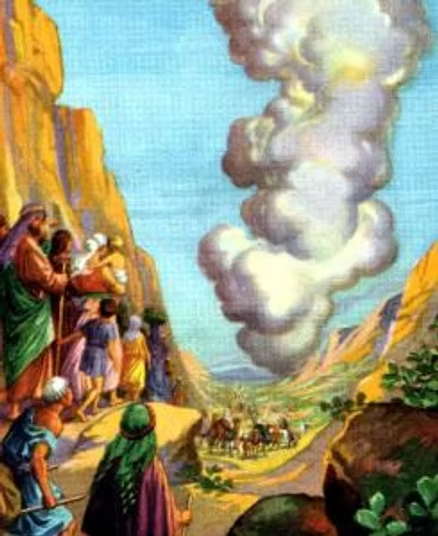
Did Jesus not appear to be the human equivalent to the daytime pillar of smoke that guided the Israelites through the wilderness of the Sinai?

Was not Jesus the proclaimed Son of Man, as the representation of the sun – the light of truth; and had that light not been darkened by his crucifixion? Did the sky not go dark in the middle of the day for three hours, as Jesus of Nazareth hung on a cross dying? Did the ever waxing and waning moon – symbolic of emotions overrunning one’s personality – not stand before Pilate, screaming, “Crucify him” to bloodcurdling levels?

Peter reciting Joel’s line, “Before the coming of the Lord’s great and glorious day,” was God’s way of announcing, “Today is the Lord’s great and glorious day!” God was announcing the return of His Son, Jesus Christ, returned the day after his ascension in all of his followers.

For all who look for the End of the World, as far as Christian theology is concerned, it was delayed coming by the presence of Saints in the name of Jesus Christ on that day of Pentecost. It continues to be averted as long as Jesus Christ exists in the world, via Saints filled with God’s Holy Spirit.

As far as this reading selection goes, Peter ended the prophecy of Joel by God pouring out of his mouth, “Then everyone who calls on the name of the Lord shall be saved.” On a city of Jerusalem street that was filled mostly with Jews, but Roman converts (proselytes) and Arabs as well, the use of the word “everyone” (Greek “pas”) must be seen as the first sign that Saints were called to serve “all,” as messengers of Salvation.

Peter himself did not know he should welcome Gentiles until later; but in the reading that continues (but not read aloud today), we learn that three thousand souls were baptized by the Holy Spirit that Pentecost.  Three thousand souls were then added to the number of Saints in the name of Jesus Christ. Those three thousand would return to their nations and begin a worldwide spread of Christianity.  While not stated, all of the fourteen named nations of peoples had converts that day, all filled with the Holy Spirit, each calling upon the name Yahweh, as Jesus Christ reborn.

As the one reading in the Christian liturgy that is consistently read on Pentecost Sunday, it is vital to have one’s eyes opened to the realization that none of the twelve men speaking in foreign languages that day had any lessons or experiences in learning those languages prior.  Likewise, Ezekiel had no prior experience prophesying to dried bones; but he did as God commanded.  Thus, speaking in tongues, as a miracle of foreign languages, is not the lesson presented in Acts 2.  Neither is the end of the world the lesson to be taken from Joel 2, as if babbling fools can point to some future date as when Jesus will return with vengeance.  The lesson is God speaking universally so all can hear and understand.

There is absolutely no one who is going to have his or her soul baptized by the Holy Spirit and be saved, given eternal life, because they hear someone speaking nonsense, uttering noises that no one can understand. Salvation does not come by learning to fake speaking in foreign tongues or pretending to know what gibberish means.  The brain plays no role in salvation, as it can only hinder that goal.

The miracle of Pentecost was speaking from the Spirit of truth, which Jesus prophesied in the Gospel reading from John 15-16.

The lesson of Pentecost is twofold. One, it is to hear the truth of the texts of the Holy Bible and understand them. Understanding comes from the Holy Spirit, not a book read, a course taken, or someone else’s interpretation that one is incapable of personally owning and defending. Two, it is the beginning of the end times of the old you. The selfish days of ignorance are over – ended forever.

Pentecost represents the end times of the release from bondage, when the Covenant with God is agreed on. It is when time spent learning has reached the point of teaching, such that one can only sit in a pew for so long, before realizing the Lord’s great and glorious day has dawned within oneself. Then it is time to go preach – prophesy to the breath – so that other can have the same chance for a personal experience with Salvation.

The lesson of Joel’s prophecy is not limited to the fulfillment that occurred the day after Jesus ascended into heaven.  The experiences of Peter and brothers in Christ was the beginning of this prophecy’s fulfillment.  It is fulfilled every time a disciple makes this transition.  All of the trials and tribulations from one’s own denial of God, Christ, and the Holy Spirit within oneself points to a new last days, as the end of a sinner’s ways and the beginning of a Saint’s service to God, as Jesus Christ reborn.

In this way Peter was speaking to the readers who would eternally be called to God’s Word.  Just as Joel wrote of all the coming sons and daughters of God, the spirit will always be poured out upon desiring flesh.  Just as Peter passed along the flow of the Spirit of truth, so do all God’s Saints.

#FestivalofWeeks #Matthew141321 #Shavuot #Lordsgreatandgloriousday #tonguesoffire #newwine #pillarofsmoke #Acts2121 #fiftiethday #speakingintongues #Acts113 #Acts22241 #Joel22832 #Matthew152939 #John64

Isaiah 6:1-8 – An ordinary leap of faith

In the year that King Uzziah died, I saw the Lord sitting on a throne, high and lofty; and the hem of his robe filled the temple. Seraphs were in attendance above him; each had six wings: with two they covered their faces, and with two they covered their feet, and with two they flew. And one called to another and said:

“Holy, holy, holy is the Lord of hosts;
the whole earth is full of his glory.”

The pivots on the thresholds shook at the voices of those who called, and the house filled with smoke. And I said: “Woe is me! I am lost, for I am a man of unclean lips, and I live among a people of unclean lips; yet my eyes have seen the King, the Lord of hosts!”

Then one of the seraphs flew to me, holding a live coal that had been taken from the altar with a pair of tongs. The seraph touched my mouth with it and said: “Now that this has touched your lips, your guilt has departed and your sin is blotted out.” Then I heard the voice of the Lord saying, “Whom shall I send, and who will go for us?” And I said, “Here am I; send me!”

——————————————————————————–

This is the Old Testament selection from the Episcopal Lectionary for the First Sunday after Pentecost, Year B 2018. This day in the lectionary schedule is also known as Trinity Sunday.  It will next be read aloud in church by a reader on Sunday, May 27, 2018.  It is important as Isaiah was a “major prophet” of Judah, who had a vision of God in this story. In the vision, Isaiah was purified by fire and volunteered to serve the LORD as His holy messenger. This is the same purification and commitment that all Saints are called to fulfill, when they serve God in the name of Jesus Christ.

This reading is a holy vision that Isaiah experienced.  In the first verse of this reading, Isaiah wrote that the vision is timed as being “the year that King Uzziah died.”  This means it is important to understand the history of King Uzziah.

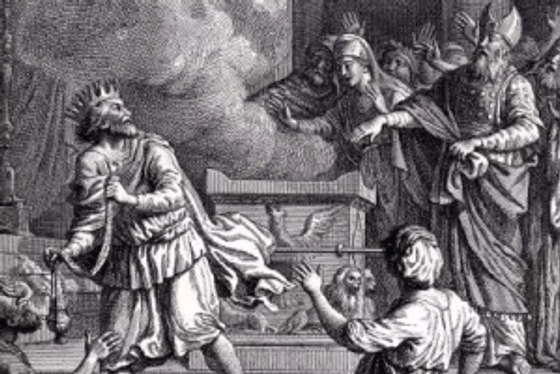
Uzziah’s death came roughly eleven years after he was stricken with leprosy by God.  As leprosy was a visible sign of sin to the Israelites of Judah, Uzziah was forced into a house-arrest exile.  Still a king, he became an absent co-ruler, with his son Jotham promoted to king to run the affairs of the government. Uzziah’s leprosy was punishment from God, due to his entering the Temple of Solomon to burn incense, which was forbidden to all but the Temple priests. An earthquake occurred, splitting open the Temple walls, where the sunlight came in and struck Uzziah on the face, immediately giving him leprosy.

History always likes to apply new standards to old actions. I doubt Uzziah entered the Holy of Holies wearing a crown (as shown) to swing an incense burner (in hand). I believe he tried to light incense on the Golden Altar (depicted with smoke).

The history of Uzziah says that he was one of Judah’s (including unified Israel) greatest kings, as far as bringing prosperity to his nation.  The punishment that befell a king says that no human is above the Laws of God. Thus, Uzziah is symbolic of all Israel, in that sense, where the gifts of holiness were plentiful, but one cannot degrade into self-piety, forgetting that God is always the one and only true king, or one will find just how mortal all human beings are.

King Uzziah, when seen in a dream, has to be seen as an extension of the readers (individually a reflection of you and me). Isaiah, himself, had to feel the sin of Uzziah as if they were his own. Thus, we are all mortals who rule over the Kingdom of Self. It is within that temple of self that we can begin to think the possessions having come to us have been by our own doings; so we think we have the right to offer incense that will be burned in our honor, not God’s.

This makes the symbolism of leprosy be less about physical deformities, and more about how it projects the sinful state of one’s soul.  The truth of our sins are fully known (even if denied), which causes us to hide our inner beings from public view. Therefore, the dual rulership of Uzziah and Jotham can then be seen as symbolic of the id and the ego, using Jungian terms.  “In the year that Uzziah died” is then a statement of the death of the ego, where the soul (the id) finds judgment.

It becomes important to see the personal relationship with God that is demanded in this vision. Rather than seeing it through the eyes of the prophet Isaiah, see it as God presenting a vision to you, through the prophet Isaiah. The purpose is to see the promise of this vision, where sins are forgiven; but to see that, one must understand the mortality and judgment of a king of Judah, one who sat on a throne (shared or alone) for over fifty years, is reflective of one’s own.  For Uzziah, forty-plus years of good acts were followed by eleven years of seclusion.  He had to see God as the true king. God is who we all must serve; and that is the call of ministry required for the first Sunday after Pentecost.

We read how Isaiah (the reader) “saw the Lord sitting on a throne, high and lofty; and the hem of his robe filled the temple.” God is the true King. His throne is one’s heart. God’s temple is one’s body. God’s holy robe flows over every square inch, each nook and cranny, all cells and vessels of one’s body.  This makes God’s robe be symbolic of the Holy Spirit.

If the likes of King Uzziah are not high enough or important enough to claim superiority to God, no mortal can aspire to immortality. Only through God, as His obedient servants, can eternal life be possible.  The self-king must die so that God can take control of His realm.

This is where the symbolism of Seraphs (or Seraphim) comes into the vision. They are the attendants of God. While the Hebrew states “seraphim” in the plural, the word following infers the singular, not as “in attendance,” but as “it stood” or simply “standing” (Hebrew: “‘ō·mə·ḏîm”). This “standing,” implying “upright,” is not so much “above” God (who is so “high and lofty” only the “hem of his robe” is clearly seen), but the “Seraphim” is “standing upright,” reaching or aspiring to go “upward” (Hebrew: “mim·ma·‘al”). As such, the “Seraphs” are symbolic of the immortal souls that attend to God’s needs.

The Seraphim are seen as angels in Judaic and Christian theology. These angels are one of several mentioned in holy texts, and some are seen as higher and lower in ranking. The Hebrew word “mal’ákh” is commonly used to identify an “angel,” but the word itself means “messenger,” and can be used in identifying both human and divine entities. While there are some who say a “Malakim” is a separate distinction of angel, with a “Seraphim” being another and an “Elohim” one more (among ten total?), these differences are man-made presumptions and not rock-solid certainties.

On a symbolic level, souls are angelic, with their standing upright and reaching upward being those who are in service to the LORD. Alternately, some angels would sink and strive to shun God (those who serve Satan).  This means the day of judgment is when souls are assigned an immortal realm (heaven or hell), or when they are determined to return to the physical plane.  Yahweh, the One God, does this judging.

In this vision shown Isaiah, I see the plural of Seraphs as a statement that many souls have been assigned to serve the needs of Yahweh.  In that regard, each individual soul will have been baptized by the Holy Spirit, making it purified of all human sins.  Purification of a soul makes one of many Seraphs that serve the LORD exclusively. However, the point of Isaiah’s vision is on the rebirth of a soul in its same host body, rather than the soul becoming heavenly.

This means a purified soul is still within a human body.   This results in a Saint or Apostle of Christ being born from the ashes of the old. This aligns this reading to the Gospel lesson from John, where Jesus told Nicodemus about such a rebirth.  Jesus Christ, as the entity that sits at the right hand of God, is then the highest of all angels who serve the One God. Therefore, a Saint is a messenger of the LORD that comes in the name of Jesus Christ.

This leads to the importance of the number six, which is shown in the number of wings that a Seraph has.  The terminology of “wings” can be seen as the instruments of flight, from which elevation is allowed. Seraphs wings are said to be used thus: “With two they covered their faces, and with two they covered their feet, and with two they flew.”  This makes their ability to fly be relative only to one-third of their wings.

There can be a parallel made between the seven gifts of the Holy Spirit, where each gift is given by God, relative to the individual’s abilities to receive more than one gift. There are said to be seven gifts of the Holy Spirit: wisdom, intellect, counsel, fortitude, science, piety, and fear of the Lord. As such, the one gift of the Holy Spirit that all human Seraphs is the sainthood of the body, with the other six gifts being additional wings by which one can serve God’s needs. These can then be subdivided into face (wisdom, intellect, piety) and feet (counsel, science, fortitude) uses, where the heart is filled only with fear of the LORD (not wanting to fail Him).

This is not the clear focus of the number of six wings in the vision of Isaiah, but wings should be taken as meaning more than feathery appendages.

The symmetry of Da Vinci’s Man incorporated into the symmetry of Divine Man.

I invite you to read the insights found on the website linked here, which states several symbolic aspects that are relative to the number six. There are other opinions on the symbolism of this number, but as a perfect number (a mathematical designation) it can be seen as two (duality – left-right; up-down; inside-outside, good-evil, etc.) times three (Trinity – Father, Son, and Holy Ghost). From that perspective, one duality of wings cover the face (the ego of self), while another duality of wings cover the feet (the filth of sin).  The covering of human flaws by the gifts of the Holy Spirit then allows the third duality of wings to raise one above both the hindrances to righteousness that emanate from a soul’s the attachment to a physical body and the influences of the earth. Therefore, the perfection of six wings is symbolic of what allows a soul to attend to the needs of God, as His messenger, standing upright among humanity.

In that respect of righteous placement, the Seraphs then sing in unison the song of Sanctus.

Interestingly, in the Interlinear translations of Isaiah 6:3, from the Bible Hub website, shows the triple repeating of “qā·ḏō·wōš” (well-known as “holy, holy, holy”) as “Holy – of Holies holy.” That places the holiness of God above all mortals who are seen as sanctified, as well as any who are divine immortals, as all are of subservient status. This means the song sung by the Seraphs addresses this supreme deity as the one to who all praise should go. The LORD is the King, the ruler of an army (“host”) of messengers, both mortal (Saints) and immortal (heavenly Angels).

When we see how Isaiah did not quite hear the Christian version of the Sanctus being sung, as only the “earth is full of his glory,” that becomes a statement about the Seraphs (Seraphim). They are of the world, so they are singing in unison about God’s glory shining through their whole beings.  This is the view painted of heaven, where a sea of souls sing the same praise to God (Revelations 4:8).

It is then because of this awareness of being worldly, yet witnessing the heavenly, that Isaiah said, “Woe is me!” His woe was due to knowing how anyone of the earth that sees the LORD must die (from Exodus 33:18-20). By knowing the history of King Uzziah, we see the posts of the doors (“pivots of the thresholds”) were shaking as a repeating of the earthquake that split open the Temple. The smoke the filled the house is then the incense burned by the mortal Uzziah, which brought God’s punishment upon him.  The “woe” Isaiah felt was due to a sin committed in God’s holy Temple.

Isaiah cried out, “I am lost, for I am a man of unclean lips, and I live among a people of unclean lips; yet my eyes have seen the King, the Lord of hosts!” The word “unclean” is representative of the state of leprosy, which was a mark of sin.  Just as King Uzziah died as sole King of Judah when he was stricken with leprosy, retreating to his house until his body would die eleven years later, Isaiah was fearful of the death of his ego. Having seen the Lord of hosts, his ego would likewise be too marred to be seen in public. His ego would have to be kept in secret until the death of his body later.

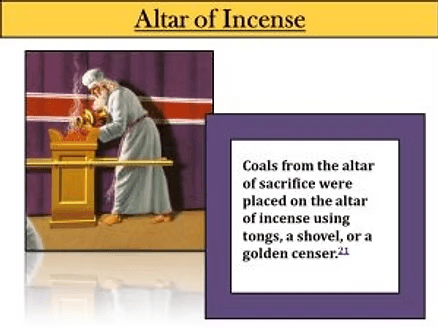
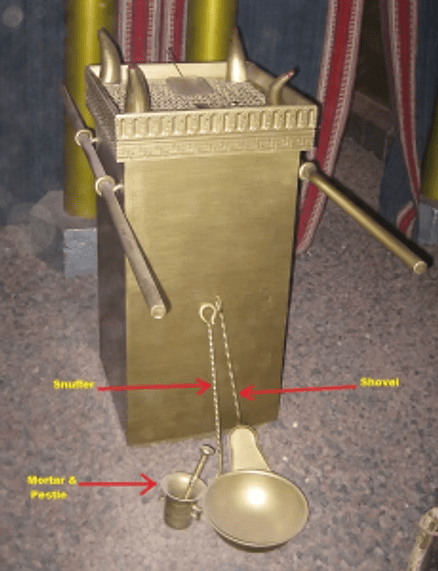
The redemption comes when we next read: “Then one of the seraphs flew to me, holding a live coal that had been taken from the altar with a pair of tongs. “One of the seraphs” should be seen as the divinity of the Holy Spirit, the messenger Angel of God, which is sent to a Saint. The word translated as “tongs” (Hebrew: “bə·mel·qa·ḥa·yim”) is better grasped as an incense “snuffer,” which was an altar tool would be used to extinguish lit candles. One should assume “the altar” is one of two in the Temple of Solomon, most likely from the Golden Altar, or the altar of incense.

Altar of Incense Coals from the altar of sacrifice were placed on the altar of incense using tongs, a shovel, or a golden censer.21.
According to the Wikipedia article on “Altar (Bible),” the Rabbis said this about the burning of incense in the Temple:

“This was the part of the temple service that was most beloved by God (Zohar I 130:A). The burning of the incense was symbolic of the prayer of the people rising up to God (Psalm 141:2; Revelation 5:8; 8:3-4). The offering of incense had to take place after the sacrifice, because only after the atonement could communion with God take place. After the offering of incense, the Kohenim (priests) pronounced the Priestly Blessing upon the people.”

Incense was burned in the Temple every morning and evening.  Morning is symbolic of birth.  Evening is symbolic of death.

In the vision of Isaiah, the Seraph then removed a “live coal” or red-hot, burning coal from the altar of burnt offering, which would have then been placed in the altar of incense (the Golden Altar) to burn the holy incense. The burning coal, having come from both altars, is then representative of the death of oneself (sacrifice), followed by an atonement of sins. The ember is the result of oneself having been sacrificed to God in order to produce a holy fragrance in the smoking incense. This then makes the “live coal” be one prepared as an “inner sin offering,” done during the Day of Atonement (Yom Kippur).

By understanding the purification of sins that came with the “live coal,” where the aspect of heat is indicative of life, as opposed to a cold coal, without an inner burn that is dead (thus not necessary to pick up with an altar tool) we next read Isaiah report: “The seraph touched my mouth with [the live coal] and said: “Now that this has touched your lips, your guilt has departed and your sin is blotted out.” By Isaiah saying, “sin is blotted out,” that is confirmation of a ceremonious rite of atonement. Still, touching the “lips” must be seen as symbolically stating one’s voice has been made pure.

This becomes a statement of one being a prophet, as a Saint, who can only speak the truth of God. This is itself a prophecy of Jesus Christ, as the Christ Mind could only speak from the Spirit of truth.  Still, as the woe felt by Isaiah was stated as, “I am lost, for I am a man of unclean lips, and I live among a people of unclean lips,” the world is a place where sins are projected by the philosophies of mankind.  It is necessary to have Saints in the world who can counter the lies told.  Jesus said of this, “It is not what enters into the mouth that defiles the man, but what proceeds out of the mouth, this defiles the man.” (Matthew 15:11)

The vision ends with Isaiah writing, “Then I heard the voice of the Lord saying, “Whom shall I send, and who will go for us?” And I said, “Here am I; send me!”’ This is God’s call to all His Saints to prophesy to the breath of truth, so that others can be led to God.  Saints follow the same sequence of progressions, from sinner, to fear of guilt, to absolution of sins, to servant of God, which makes one holy. Importantly, the call is not to be atoned of sins, but to go out into ministry for the LORD. When Isaiah heard himself say, “Here am I; send me!” this is the voice of the Messiah, the Son of God, of which Isaiah was one.

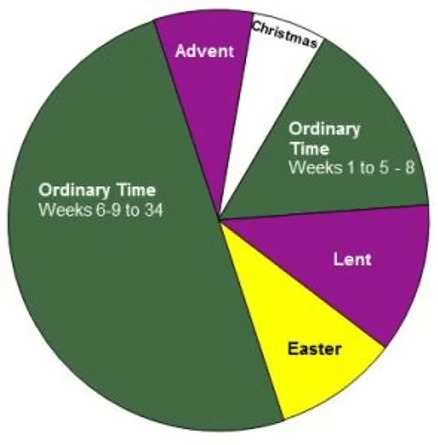
As a reading for the First Sunday after Pentecost, where Pentecost ended the Easter season, this is the beginning of two periods in the Liturgical Calendar known as Ordinary Time.

As this graph clearly shows, Ordinary Time fills the majority of a year’s time. While it may be that this period is named for the word “ordinal,” such that each week is numbered as a series of lessons that follow an event (after the Epiphany or after Pentecost), this Ordinary Time that follows Pentecost should be seen as being most applicable to the Ecclesiastical definition for “ordinary,” where ordination into ministry is the loudest message coming from the readings each Sunday. In this case, the call from God, “Whom shall I send, and who will go for us?” are questions that ask, “Who is prepared to serve Me?” When one answers God’s call by saying, “Here am I; send me!” then one begins to serve the LORD through ministry.

The two separate Ordinary Time periods can be seen as parallel to the Gospel commissions.  The first came when Jesus sent his disciples out in the Great Commission, when he was still living.  The greatest commission, thus the True Commission, began when disciples morphed into Apostles, when they were reborn as Jesus Christ. The disciples were allowed to do miracles and be messengers that proclaimed, “The kingdom of God has come near.”  They did that while Jesus of Nazareth was present in the flesh, as their rabbi and guide. The Apostles were given the gifts of the Holy Spirit, which minimally included the Mind of Christ and the Spirit of truth, where Jesus lives within their being, guiding them spiritually.

The point of those assignments given by God, through His Son, is you must serve the LORD. Before you can serve Him, you must prove your commitment – your marriage to God, receiving His love. Then you have to go places you might be unwelcome and perform some tasks you never knew were possible. However, that is the meaning of faith – you cannot walk on water if you never try. You have to take a leap of faith.

#Coaltothelips #Sanctus #Seraphs #Isaiah618 #GoldenAltar #KingUzziah

Romans 8:12-17 – Heirs of God and joint heirs with Jesus as the Anointed

So then, brothers and sisters, we are debtors, not to the flesh, to live according to the flesh– for if you live according to the flesh, you will die; but if by the Spirit you put to death the deeds of the body, you will live. For all who are led by the Spirit of God are children of God. For you did not receive a spirit of slavery to fall back into fear, but you have received a spirit of adoption. When we cry, “Abba! Father!” it is that very Spirit bearing witness with our spirit that we are children of God, and if children, then heirs, heirs of God and joint heirs with Christ– if, in fact, we suffer with him so that we may also be glorified with him.

——————————————————————————–

This is the Epistle selection from the Episcopal Lectionary for the First Sunday after Pentecost, Year B 2018. This day in the lectionary schedule is also known as Trinity Sunday. It will next be read aloud in church by a reader on Sunday, May 27, 2018. It is important as Paul wrote of the debt all human beings owe to the Father, which has to be understood as beyond the time we spend on earth in the flesh.

Again, it is modern paraphrasing that identifies “sisters” in the above translation. Paul wrote, “Ara oun , adelphoi  ,” which says, “So then  ,  brothers”.  This states the result of (“So then”) what Paul had stated prior (Romans 8:1-11), with that now being “brothers.”  Because one has to believe that Paul wrote divinely (not just as some ordinary guy), every word he wrote has divine purpose, which should not be overlooked.  Therefore, “brothers” must be understood, rather than slap “sisters” to that word.

The word “adelphoi ” is set alone by commas, placing importance on its meaning.  It is a stand-alone statement of “brotherhood,” as “brothers” or “brethren.” The word “adelphoi ” says nothing about “sisters.” The Greek word “adelphé” means “sister” and “adelfés” says “sisters.” The exclusivity of women is NOT the point of what Paul wrote.  It should be read as a word similar to “mankind,” which includes all human beings under one heading.

By placing commas around the plural form of the word “brother”, Paul was placing emphasis on the relationship ALL Christians share. Both men and women are “brothers”, as “Sons of God”, because they ALL have been reborn as Jesus Christ. By adding the word “sisters,” the glaring differences between males and females is entered into the interpretation erroneously.

It is unnecessary, as ALL Christians are the wives of God (regardless of human gender), just as ALL Christians are reborn as the Son of God (regardless of human gender), making ALL Christians be brothers of the same Father.  One must get beyond the modern training that gender be given equal status, because that is only a distraction away from the truth.

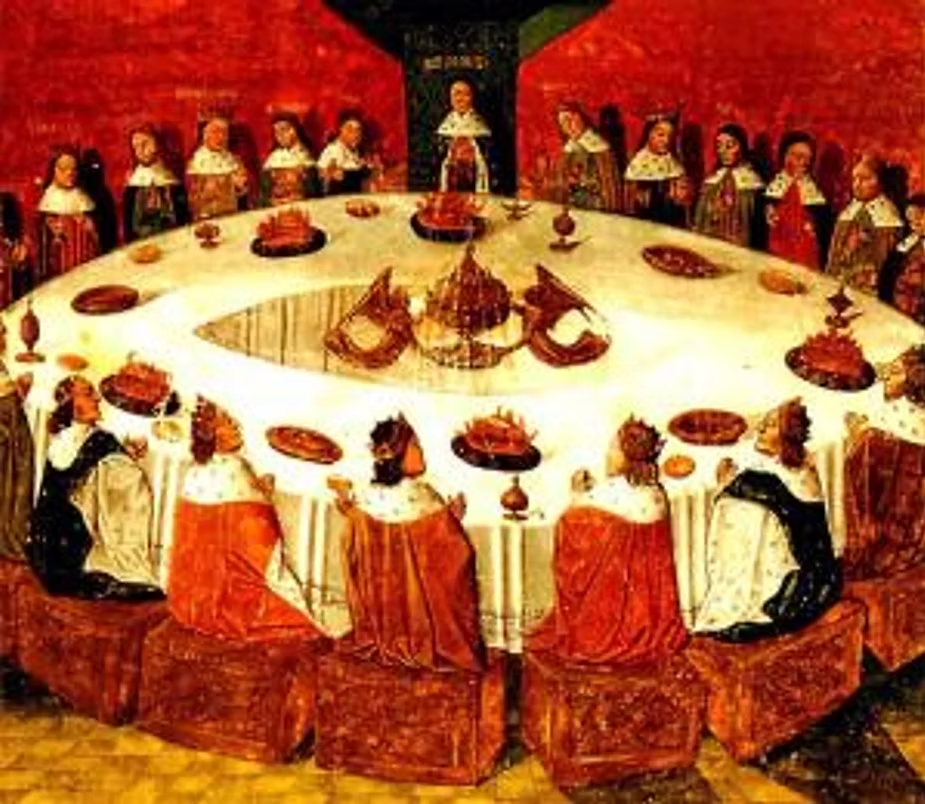
The same qualifications for a knight of the round table are the same for a Saint.

Seeing “brothers” as ALL who are related spiritually, one should then see this familial relationship with the Father as being what makes one a debtor. Thus, following the pause of a comma after “brothers,” this becomes stated as “we are debtors” (literally “debtors we are”).  This makes “debt” be relative to this announcement of “brothers.”

From that realization, Paul discounted how “brothers” were “not to the flesh.”  From this statement, one must grasp how it is the “flesh” that differentiates a man from a woman.  Thus, it is the “flesh” that separates “brothers” from sisters. This statement says (in essence): “Do not mistake “brothers” as saying “brothers and sisters,” because the debt owed has nothing to do with one’s sexuality on the earthly plane.

When Paul wrote, “If you live according to the flesh, you will die,” this was reference to all mortal human beings, who come in the shapes and forms of men and women, males and females. The only reason souls are incarnated (reincarnated) in different shapes and forms is to reproduce. Souls cannot reproduce souls, as souls are immortal, thus asexual by nature. The flesh reproduces so souls can be reincarnated.

To put that in gender terms, souls are masculine “energy,” while bodies (regardless of human gender) are feminine “energy.” God can be seen as masculine, as the Father, whereas the Earth is called a Mother.  In this sense, my use of “energy” should be seen as non-physical, but a compatibility, such as is positive and negative.  It is similar to the notion that opposites are attracted to one another, as compliments.

Thus, the feminine flesh of a baby (regardless of human gender) is penetrated by the masculine soul.  The flesh of the baby receives that breath of life.  The soul’s asexuality then aligns with the human gender, based on the flesh.  This union then stimulates an innate drive to procreate. That innate drive is a need of the flesh, because the flesh knows it is temporal and must reproduce to continue the possibility of life returning to the worldly plane, as returning souls need flesh to inhabit.

The aspect of “the Spirit,” as translated in verse 13, where we read, “If by the Spirit you put to death the deeds of the body, you will live,” is inaccurate.  The Greek actually shows “pneumati” in the lower case (“πνεύματι”). This is then a reference to “the breath” of life, which is the entrance of a “soul” into a form of flesh. A “spirit” that is a soul is eternal; but a returning soul into a form of flesh is not commonly holy.  There are exceptions, such as Jesus, born of a woman.

Verse 13 is also divided by commas, where the better translation can make this lack of holiness more evident.  Literally, the verse states, “If however the breath (wind, soul spirit)  the deeds of the body you put to death  you will live.” This is not a statement of God’s reward to a soul of eternal life, but a promise of reincarnation to a soul.  Reincarnation is a new “breath of life” in human form.  Still, that “spirit” of life brings about the opportunity to achieve eternal life – IF the normal deeds (normal “doings, acts, functions”) of a body of flesh lead an eternal soul to lose its host body (a mortal death).  If a soul directs its body wisely, then it will be reborn into a new body of flesh (i.e.: a newborn baby).

The condition (the “IF”) is then based on the soul somewhat controlling the actions of a body. This admits there will be sins accrued that will prevent the reward of everlasting return to the Father, but enough good deeds will have been done to warrant another chance on the physical plane.  It is just as do not punish a first grader to hard labor in the fields for failing to make the grades that would allow it to go to the second grade.  We also do not graduate straight A first graders to the college level.  This is a mirror of how much is required to be one with God again.  However, should the soul allow the body (by evil influence) to earn itself eternal damnation, then the soul will not find new life in human form. This is the proverbial “Hell.”

When Paul then wrote, “For all who are led by the Spirit of God are children of God,” the capitalized version of “Pneumati” was written (“Πνεύματι”). This is then a reference to those of humanity who are led by the Holy Spirit. The translation of verse 14 shown above, as using the neuter gender word “children,” actually states “huioi,” which means “sons.” The proper translation here then supports the initial claim of being “brothers,” as now the presence of the Spirit  makes one be identified as “son of God.”

This parental relationship with God is then stated as a relationship that reproduces the Son, Jesus Christ.  This masculine association also means the “Spirit,” which is masculine in nature, has caused this relationship to be. Since this masculinity is asexual, there is no sexuality implied by being “sons of God.” Spirits and souls have existed from the Creation and have no need (no ability whatsoever, for that matter) to reproduce.  This is, again, the masculine “energy” of Spirituality being within the feminine “energy” that is a human body.

Angels are neither male of female, in the sense that human beings are. Angels have no sex organs, which includes breasts that would only have a human purpose, such as to nurse babies.

It is then important to see how there is no capitalization of the word “spirit” in verse 15, where we read above it stating, “For you did not receive a spirit of slavery to fall back into fear, but you have received a spirit of adoption.” When one realizes the difference between the “spirit” of life (God’s breathing an eternal soul into flesh) and the “Spirit of God” (the Holy Spirit), then one can see how this translation is saying the renewing of a soul into flesh, giving that flesh life, is not done by God so that the soul will enter into a state of “slavery,” which is an addiction of the flesh to sin.

The reborn soul (reborn into new flesh) is meant to lead the flesh to serve God, not to “fall back into fear,” where “slavery” is to Satan and his material realm. Instead, a soul, as an extension of God that needs redemption to return to God, is placed back into new flesh so it can lead the flesh to “receive a spirit of adoption.” One is adopted by God when one is reborn anew (the transformation of the same soul in the same flesh) as Jesus Christ.

One is not adopted prior to birth into the flesh.  One is adopted after one has lived enough life to understand sin and experience guilt from sin.  Then one has to petition for adoption by repentance for the sins one feels remorse from.

That represents a spiritual change within, which means one’s whole being (soul in flesh) opens to God, through acts of repentance.  One becomes active in learning the messages of holy Scripture.  When one has proved to God one’s sincerity for seeking atonement, the love of God will enter one’s being.  The result of that union brings about a reproduction of the Son of God, so one is truly in the name of Jesus Christ.  True Christians are then those who become the “brothers” of all other Saints on earth (regardless of human gender). Until that transformation takes place, one is “a spirit to slavery” that all human beings are, since the soul is a slave to the flesh, just as the flesh is a slave to the soul.

Human beings are slaves to mortality. The only way to break those chains is through Jesus Christ.

Where Paul wrote about “you have received a spirit of adoption,” here again is an overlooked statement about “brothers” and “sons.”  The Greek actually states “elabete pneuma huiothesias,” where the literal translation says, “you have taken hold of (or received) the spirit [lower case] of adoption as sons.”  The implication of divine adoption can be read into this, but not as total adoption, as the sons of God.  The lower case “spirit” is a statement that one’s soul has “received” or “taken hold of” the ways of righteousness, as far as one can do good alone.  This is how one shows oneself worthy to progress to that point of being “adopted as a son” of God.

Still, the form of the word making the statement about adoption is masculine, thus more properly translated as “adoption of sons.”  This can be seen as how God saw the disciples of Jesus of Nazareth, prior to their official recognition as sons of God on Pentecost Sunday, the day after Jesus ascended to the Father.  While The Acts of the Apostles places focus on the male disciples becoming “adopted sons of God,” it still must be assumed that women (such as Mother Mary, Mary Magdalene, Mary of Cleopas, and other females in the crowds who received the Spirit) were also adopted “sons.” Their female human gender was not a limitation on their adoption worthiness.

Paul then wrote, “When we cry, “Abba! Father!” it is that very Spirit bearing witness with our spirit that we are children of God.”  Here, both the capitalized and lower case versions of “pneuma” are used. That says that the Holy Spirit has made entrance into one’s soul (one’s spirit), causing a thrill of awareness overcome one’s being, such that it knows (“bearing witness”) the Father is in one’s heart center.

By saying “with our spirit,” this is the baptism of one’s soul by the Holy Spirit’s presence, so both become one. When that happens, all baptized souls become the “children of God,” where “children” is the correct translation, from the Greek “tekna.” The use of “children” comes with the understanding of asexuality, since both human genders are equally incapable of reproduction, therefore “children” is a word deemed neuter gender. The word “children” then also implies a lack of adult mentality, where “children” are dependent on the Father for learning.

The aspect of mentality is then found in Paul writing, “and if children, then heirs, heirs of God and joint heirs with Christ.” It says that the “children of God,” as “sons of God,” will inherit the knowledge of God, which comes through the Mind of Christ. It then lets one realize that this awareness that comes from being “children of God,” “inheriting” the Mind of God’s Son, allowing Christians to become “brothers” in Christ (regardless of human gender) is to realize the debts of sins being washed clean by the Holy Spirit then makes one in debt to the grace of God.

The Mind of Christ frees our spirits from thinking we are slaves to a mortal body that will die. The Mind of Christ frees our spirits from the fears of a mortal existence. The Mind of Christ is the realization that we are indeed “heirs” to the same Holy Spirit that was made man by God and sent into the world as Jesus of Nazareth.

This selection then ends with Paul writing, “If, in fact, we suffer with him so that we may also be glorified with him,” which again poses a conditional requirement.  This tells how one knows that one’s “spirit” has indeed been “led by the Spirit of God.” IF that condition has been met, then “we suffer with him.”  The word “sumpaschó” means “I suffer together with,” but this is synonymous with “sympathize.”  This means one suffers by knowing so many in the world are still blind to being adopted by God.

The Greek word “sympaschomen” states “we suffer together with,” which implies the Spirit of God, as one being with Jesus Christ. This says that the Mind of Christ is what enables one to withstand the suffering that causes others to lament.  Personally, one knows the same agony that one faces when denying the pleasures and comforts offered by a sinful world. Still, that experience of suffering is what proved oneself as worthy for adoption by God.

The bond of togetherness – one’s soul spirit with the baptism from the Holy Spirit having brought about the Mind of Christ – is what brings one the “glory of being together with” (“sundoxazó”) Jesus Christ. This is how one can claim to be in the name of Jesus Christ. This is also how ALL who are likewise baptized by the Holy Spirit are “brothers” in Christ, where ALL SAINTS also share the same “glory [from being] together with” Jesus.

As a reading selection for the First Sunday after Pentecost, where the ministry of Apostles has begun, symbolically having taken its first step, we must then see how this is called Trinity Sunday because the Father, Holy Spirit, and Son have been reignited in a soul. All who have this Trinity within them are then “brothers” as having been reborn as Jesus Christ.  Christians are those who have truly become the adopted sons of God (regardless of human gender).

This is the message of the accompanying Gospel reading from John, where Jesus of Nazareth tried to explain this necessary requirement for salvation to Nicodemus, only to see how easy it is to deny this message. The first step of ministry leads to many others, where the “glory of being with Jesus Christ” does not stop with one soul being saved – one’s own. Christian souls are saved for the purpose of sending Jesus Christ into the world, as one with oneself, to save others. The brotherhood of Christianity goes well beyond the limitations and divisions of mortal life on earth, where men and women are called to serve the LORD as His Son.

John 3:1-17 – Being born of water and Spirit

There was a Pharisee named Nicodemus, a leader of the Jews. He came to Jesus by night and said to him, “Rabbi, we know that you are a teacher who has come from God; for no one can do these signs that you do apart from the presence of God.” Jesus answered him, “Very truly, I tell you, no one can see the kingdom of God without being born from above.” Nicodemus said to him, “How can anyone be born after having grown old? Can one enter a second time into the mother’s womb and be born?” Jesus answered, “Very truly, I tell you, no one can enter the kingdom of God without being born of water and Spirit. What is born of the flesh is flesh, and what is born of the Spirit is spirit. Do not be astonished that I said to you, ‘You must be born from above.’ The wind blows where it chooses, and you hear the sound of it, but you do not know where it comes from or where it goes. So it is with everyone who is born of the Spirit.” Nicodemus said to him, “How can these things be?” Jesus answered him, “Are you a teacher of Israel, and yet you do not understand these things?

“Very truly, I tell you, we speak of what we know and testify to what we have seen; yet you do not receive our testimony. If I have told you about earthly things and you do not believe, how can you believe if I tell you about heavenly things? No one has ascended into heaven except the one who descended from heaven, the Son of Man. And just as Moses lifted up the serpent in the wilderness, so must the Son of Man be lifted up, that whoever believes in him may have eternal life.

“For God so loved the world that he gave his only Son, so that everyone who believes in him may not perish but may have eternal life.

“Indeed, God did not send the Son into the world to condemn the world, but in order that the world might be saved through him.”

——————————————————————————–

This is the Gospel selection from the Episcopal Lectionary for the First Sunday after Pentecost, Year B 2018. This Sunday is also known as Trinity Sunday. This selection will next be read aloud in church by a priest on Sunday, May 27, 2018. This is important because Jesus explained the requirement of being reborn from above, having been baptized by the “water” of the Holy Spirit.

In this reading, the setting should be realized. It is not stated specifically, but it can be deduced from clues in the text.  John’s second chapter ended by John writing how Jesus had just spent the first Passover Festival of his ministry in Jerusalem. Jesus had made a scene by overturning the vendors’ tables; and when he was questioned about what authority he had to do such a thing, Jesus said, if the Temple were to be destroyed, he could raise it again in three days.

During that week, Jesus then displayed signs that drew believers to him; and it was those acts that made Jesus stand out as a new rabbi with an an ability to get attention; and that was what drew “a leader of the Jews” to visit Jesus.

Where Nicodemus encountered Jesus is not clearly stated.  Due to the high ranking that Nicodemus held, it can be assumed that this meeting was private, rather than public.  As it occurred at night, and Nicodemus came to Jesus, it makes sense that the encounter took place at a house or lodge.  Since Jesus lived in Galilee, the assumption can be that the visit would be in or near Jerusalem, since the Passover had just ended and Nicodemus was a leader of the Jews because of his Temple connections.

An additional background element worth noting is that Jesus’ first Passover Festival as a rabbi did not have the accompaniment of twelve disciples. John wrote in his first chapter that Andrew, Simon-Peter, Phillip and Nathanael had followed Jesus. Matthew and Mark tell how James and John of Zebedee had been added as disciples. Still, none of the other Gospel writers tell of this first episode of Jesus overturning the vendors’ tables, which implies their presence in Jerusalem for that Passover Festival was less organized, or Jesus had instructed those six to maintain a distance from him.  This makes John’s presence stand out.

The lack of other disciples being mentioned in Jesus’ first Passover Festival, or other mentioning his acts then, becomes evidence that John was not a disciple of Jesus. We can see this by grasping the big picture that joins all the Gospels. John witnessed Jesus’ first disciples after John the Baptizer had baptized Jesus, but John did not name himself as a disciple. John made no mention of James or another John, nor a relationship with a man named Zebedee. John wrote of the wedding at Cana, saying the disciples of Jesus attended with him, which sets John apart from that designation.  Now, we see how no other Gospels tell this story of Nicodemus, with John being the only one to name Nicodemus. By John writing of this encounter that Jesus had with Nicodemus, when no others did, that shows Nicodemus avoided being seen meeting with Jesus, and adult, male disciples could be called legally as witnesses, should Jesus prove to be an inciter of rebelliousness.  For John to be a witness says John was not an adult, thus no threat as a voice that could be heard.
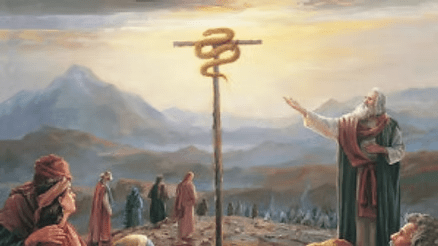
It is important to note that John wrote how an important Pharisee named Nicodemus “came to Jesus by night.” This implies several things that can go unseen. Seeing the unseen requires putting oneself in the Gospel story, seeing the story unfold as a natural event, rather than a supernatural, fantasy-like imagination. This story did not happen in a vacuum, as it is in chronological sequence with the surrounding text written by John. It happened in real life, where seeing oneself as a first century Jew, not a twenty-first century Big Brain, allows the unwritten reality become visible.

First, this encounter between Nicodemus and Jesus happened after the Passover Festival (an eight-day event) had ended. We know this timing because John’s second chapter ended with that event, stating “Now while he was in Jerusalem at the Passover Festival, many people saw the signs he was performing and believed in his name.” (John 2:23) The chronology then follows with this event, putting Nicodemus in a meeting with Jesus.  This says Jesus was still in or near Jerusalem.

Second, as a Galilean living in Capernaum (Matthew 4:13), Jesus would have been lodged somewhere near Jerusalem for the Passover week. One could assume he stayed with Mary Magdalene, her sister Martha, and her brother Lazarus, who lived in a house in Bethany. Bethany is only fifteen furlongs (“less than two miles”) from Jerusalem (John 11:18).

Third, because Nicodemus would not have known where Jesus would have been staying, as an unknown person prior and especially as just one man among so many Pilgrims in Jerusalem that would remain close until Pentecost. Jesus’ attraction was as a new “Rabbi” teaching at Jerusalem’s Temple, one who caused the Temple leaders to want to know more about him. Therefore, this means Nicodemus was assigned to follow Jesus to his place of lodging, after the Passover week was over.

Fourth, for a Pharisee to travel at “night,” such travel could be dangerous; but the Greek word “nyktos” does not necessarily mean darkness, such as after sunset. The Hebrew clock refers to “night” as the hours between 6:00 PM and 6:00 AM. The sun is still giving light to the earth at 6:00 PM in the spring.  The Passover Festival (always between 15 Nissan and 21 Nissan), is sometime between mid-April and mid-May, depending on the year, with spring occurring on March 20-21.  The days last longer than the nights, once spring arrives.  This means Nicodemus followed Jesus while it was early evening (technical “night”) and sunlight was still out.

Fifth, to have a “ruler of the Jews” to “come to Jesus,” the motivation was not personal, but business related. The eyes of all Jewish leaders would have been on this newcomer, because Jesus was attracting large crowds and displaying signs of divine powers.  One can then assume that Nicodemus was sent to visit Jesus, in a private rather than public place, for the purpose of recruiting Jesus (so to speak) to the philosophical ideology of the Pharisees and other “rulers of the Jews.”

Sixth, Nicodemus came “by night,” which means he followed Jesus and John “by night,” which says such late travel had reason. Rather than say Nicodemus was sneaking around under the cover of darkness, like a thief, one should assume a leader of the Jews would not risk anyone identifying him in that scenario. It makes more sense to see how Nicodemus walked with other Jews along a well-traveled road, as a typical exit from the holy city to lodging places.  This exodus being normal at night says it meant the last day of the Passover Festival was on a Shabbat, such that travelling 2 miles would have been forbidden by Jewish law on that day. Therefore, Jesus and John departed Jerusalem for the 2 mile walk to Bethany around 6:05 PM, when it technically began Sunday, the first day of the week.  This means that Nicodemus followed Jesus and John as if routinely traveling, to see where they were going.

Finally, John was inside this setting, meaning he was staying in the same place as Jesus.  The disciples would have separate places to go, each having made his own lodging arrangements.  With Jesus going to Bethany to lodge, this says John was a relative of Jesus.  This would then imply that Mary, Martha and Lazarus were also relatives of Jesus, with none of them deemed disciples. John had traveled with Jesus prior to the start of his ministry and witnessed the selection of four of Jesus’ disciples because he was related to Jesus and traveling with Jesus naturally. This means John saw Jesus as his teacher (“Rabbi”), just as did Mary Magdalene and the others in Bethany did, but not because John and the others sought to follow the Messiah. John referred to himself and the other relatives as “the one who Jesus loved.” This was because Jesus hugged and kissed his family as a personal way of displaying familial love. That was different from the teacher-student relationship that Jesus had with his disciples and other followers.

By having this sense of the surroundings and timing of a visit by an important Pharisee, one can completely understand why Nicodemus said, “Rabbi, we know that you are a teacher who has come from God; for no one can do these signs that you do apart from the presence of God.”  That greeting meant Jesus’ first Passover Festival was complete and it impressed those who watched his every move.

To understand how Jesus heard those words, it is important to know John had written prior (in Chapter 2), “Jesus would not entrust himself to [the many people who believed in Jesus he had encountered in Jerusalem], for he knew all people. He did not need any testimony about mankind, for he knew what was in each person.” (John 2:24-25) This says Jesus had leaders and pilgrims who had expressed recognition of his powers over the eight days of the festival, but he was not letting any of that go to his head.

Now, a chosen delegate of the Sanhedrin had again praised Jesus as sent by God.  Rather than Jesus answering, “Why thank you,” to Nicodemus, we should intuit that Jesus “knew what was in” Nicodemus, knowing his words of praise were empty and void of true meaning. Because Jesus knew Nicodemus was himself not from God and only knew tricks that amazed common Jews with supposed acts approved by God, as if presented with “the presence of God,” Jesus pointed out a truth that he knew.

Jesus said in reply, “Very truly, I tell you, no one can see the kingdom of God without being born from above.” That meant Jesus had just told Nicodemus, “You wouldn’t recognize true righteousness if God stood directly before your eyes, in human form.”

To see the kingdom of God means to see spiritually, which cannot be done with physical eyesight. To see spiritually means letting one’s brain-fed ego melt away, so a divine Mind leads one’s vision. That means being reborn via the Holy Spirit. That becomes the only way one can truthfully say one knows Jesus had been sent by God, regardless of what words and feats he had been witnessed saying and doing. That divinity also allows one to see clear through the facades of those who pretended to be holy; and Nicodemus was reeking of the worldly success that comes from selling religion for personal gain. There was not any righteousness in Nicodemus.

When we then read how “Nicodemus said to [Jesus], “How can anyone be born after having grown old? Can one enter a second time into the mother’s womb and be born?” this is a classic example of how people still today reject this concept of needing to be “born from above.”

Nicodemus’ response shows how people read the literal word (or a foreign language translation of the original text) and latch hold of one preconception of meaning, totally disregarding any other sense of meaning. Nicodemus heard the word that translates as “being born” (from the root Greek word “gennaó”) and then could only understand that word as meaning, “enter a second time into the mother’s womb.”

This is a classic example of Big Brain Syndrome.  It is how so many English-speaking Christians only know of the English translations read aloud in church or read in a personal Holy Bible owned.  Few realize the multiple varieties of translations and the differences, other than the “ye” and “thou” of King James’ English is now “you” (singular) and “you” (plural).  God forbid anyone suggest, “You know, the Greek (or Hebrew) can also say something else.”  The Big Brain screams, “The why didn’t the Biblical writer say that?!?!”

In my mind, Nicodemus was an intellectual, who studied Mosaic Law and knew it backwards and forwards. For all he thought he knew, he knew nothing of true value. He only knew enough to refuse to know more.  Thus, he was trying to show his intellect to Jesus, not to prove how smart he was, but to belittle the intellect of Jesus.

It was this high view of himself that had made Nicodemus a wealthy Pharisee and leader of the Jews. Here was this Jesus fellow, a newcomer (and obviously not upper crust, having come from Galilee), spouting off about being “born from above,” which Nicodemus thought meant being born of the upper class. Once one is born into a lower class (the one of one’s parents), one could not be rebirthed by one’s mother into a higher class of Jews.

In this intellectual way that Nicodemus knew, I see him as a parallel character to Judas Iscariot.  From the discovery of the Gospel of Judas, we learn that he was also an intellectual, one who debated religion and philosophy with Jesus.

Nicodemus, like Judas, was more interested in picking Jesus’ brain than actually listening to what Jesus had to say.  This attraction to the Big Brain might actually be a clue about the contact Judas had with the Sanhedrin, when he finally decided to betray Jesus.  His liaison may well have been Nicodemus, although that is not stated as fact.

In order to see how Nicodemus responded to Jesus by hearing on a fixated level, unable to comprehend what Jesus said, look at how modern Christians show the same errors of reason. Pentecostals read that the disciples became capable of “speaking in tongues” on the Day of Pentecost, so they think “Pentecost” means “speaking in tongues.” Still, on a much grander scale, Christians read and state belief in John the Baptist saying, “I baptize with water, but one will come after me who will baptize with the Holy Spirit.” They read those words and translate spiritual matters in physical terms.

So many Christians think water is the only way that baptism (a word that literally means, “dunking under water”) can only be with physical water, so holy baptism must mean by a priest, using blessed water. John the Baptizer was a holy priest, even though he was not a Temple priest AND he said baptism by physical water only offered a temporary cleansing of sins.  Physical water cannot offer eternal cleansing. This is precisely how Nicodemus heard what Jesus said, when he spoke of being “born with water and Spirit,” so Nicodemus needs to be seen as a reflection of all modern Christians who think they know some stuff, when the need to shut up and listen to what Jesus says.

This is why Jesus then responded to Nicodemus by saying, “Very truly, I tell you, no one can enter the kingdom of God without being born of water and Spirit. What is born of the flesh is flesh, and what is born of the Spirit is spirit. Do not be astonished that I said to you, ‘You must be born from above.’” Let’s break that down slowly.

1. “Very truly, I tell you, no one can enter the kingdom of God without being born of water and Spirit” is a statement of truth. It means Jesus spoke from the Father, not from a human brain.
2. The Greek states this in reverse order, with a comma separating it, as: “if not anyone is born of water and Spirit  ,  not is he able to enter into the kingdom of God.” This use of “water” means being emotionally moved to seek God in one’s life. Water is one of the four basic elements of life, esoterically speaking, where the fluidity of water is reflective of the changing state of emotions.

Because love is an emotion, the use by Jesus here is saying one cannot enter heaven without the love of God within one’s heart. This means marriage to God, and becoming a bride to God. The power of “water” cleansing one’s soul means one’s self-ego must be emotionally scrubbed from one’s being, making one cleansed by the water of emotion that makes one subservience to God’s Will.
3. The conjunction “and” (“kai”) means “in addition to” water, the soul must be “born again” through the Holy “Spirit.” Because the “water” of emotions is a sensation of the soul within the human flesh, it is physically connected.  That physicality must then be enhanced by divine spirituality.
4. The soul can only be cleansed by the presence of God touching it, which comes ethereally via the Holy Spirit. Once that soul change occurs, one is no longer banished from entering the kingdom of heaven. Thus, Jesus just told Nicodemus what soul salvation required.
5. When Jesus then said, “What is born of the flesh is flesh,” the use of “flesh” (Greek “sarx”) means “materially” or “born of this world.” This is a statement that a soul born into a body of flesh is made one with the material and physical, not the spiritual. It also means that washing a body of flesh with physical water has no lasting effect, as the flesh will always get dirty again. That implication is that a soul born into flesh cannot keep its flesh from sinning, because of the flesh keeps being influenced by the physical world.  As the body goes, so too does the soul go.
6. By saying, “what is born of the Spirit is spirit,” it is important to know how the literal Greek contains a comma, stating, “that having been born of the Spirit (capitalized “Πνεύματος”)  is spirit (lower case “πνεῦμά”).” Because the soul is the “spirit” (lower case), it is then the “spirit” of the “flesh” that is transformed by “having been born of the Spirit” (capitalized). This presence (birth or rebirth transformation) of the Holy Spirit then enters the soul being (Greek word “estin” as “is”), so one’s soul spirit is one with the Holy Spirit.
7. Jesus then mocked Nicodemus by saying, “Do not be astonished” (from the Greek word “thaumasēs”), as Jesus knew the soul of Nicodemus and knew Nicodemus was mocking his use of “born from above.” Jesus repeated, “You must be born from above,” where “Dei” is an addition that is capitalized, thus emphasizing “It is necessary, inevitable, duty, and proper” to be “born from above,” as there is no other way to see the kingdom of God.

With those statements understood, Jesus then said, “The wind blows where it chooses, and you hear the sound of it, but you do not know where it comes from or where it goes. So it is with everyone who is born of the Spirit.”

Here it is very important to grasp how “wind” comes from the exact same word (“pneuma”) that was used in the previous segment of words that are translated as “spirit is.” “Wind” is the same as “breath.”  Both “wind” and “spirit” are the same, as is “breath” and “spirit.”  This means both words state an unseen forces of movement. This means that some will read this and think of the physical movement of air molecules, where the rotation of the earth and the formation of clouds (weather patterns) are based on prevailing “winds” that circulate around the globe. In computer models today, we can track and predict where the “wind blows,” to some degree of accuracy, but this is not what Jesus meant by using those terms.

The Greek word “pnei” is translated as “blows,” but can just as equally say “breathes.”  The Greek notion of the Four Winds (North, South, East, and West) was they were controlled by the gods, as entities that could not be foreseen.

As the “breath” of God that controls climate, the implication was humans can only know God has acted (by “sounds”), but humans cannot know those acts before hand nor explain sudden happenings as evidence of God.  Therefore, the confusion ears like those possessed by Nicodemus hear, “the wind blows,” while the intent of Jesus was to say “the spirit breathes.”  One is intellect, while the other is faith.

This statement by Jesus can then be read on two levels, one where the soul spirit is led by the enticements of the world, so that it is said, “a rolling stone gathers no moss.” Nicodemus would have thought he was impervious to such winds of change, as he was firmly attached to the Law. However, Nicodemus was moved by the winds of thought that would overcome the Sanhedrin, so the sounds they made were secret, so no one knew where their new laws came from.  It was the common Jews who were always rolling, gathering no understanding of Scripture “moss.”

Jesus, as the opposite of Nicodemus and the other rulers of the Jews, was also unable to control where the Father would send him. That was the meaning of “So it is with everyone who is born of the Spirit.” The inner voice of the Holy Spirit made sounds that no one else could hear, much less see where they were coming from. Jesus spoke from the Spirit when he encountered Nicodemus at his door, when he began speaking of being “born from above.”

When John recorded that Nicodemus questioned Jesus, asking, “How can these things be?” Jesus asked Nicodemus, “Are you a teacher of Israel, and yet you do not understand these things?”

We can laugh today at how Jesus turned the table on Nicodemus, but those laughs are a sign of having Big Brain Syndrome. People today slap Jesus on the back and think, “You go guy. Let him know how little he knows,” when Christians today are just as ignorant. Being Christian means one’s soul spirit is Spirit led. We should all be “teachers of Israel,” but are we?

Can you sit down with someone and explain the Holy Spirit convincingly, without knowing this Spirit personally? Can you explain what it means to be reborn, in ways that others can feel the truth in your words?

In this regard, Jesus then said to Nicodemus, “Very truly, I tell you, we speak of what we know and testify to what we have seen; yet you do not receive our testimony.”

Here, Jesus spoke in the first person singular when he said, “I say to you” (“legō soi”), and then he switched to the plural “we,” saying, “we know we speak,” and “we have seen, we bear witness to,” leading to his saying, “the witness of us.” This is not Jesus speaking for the many like him in the world, or of he and his six disciples to-date, or even of himself and young John.  Instead, Jesus was speaking for himself (“I”), who was “spirit” joined with “Spirit,” such that “we” meant Jesus and God, in union through the Holy Spirit. “US” is then the Trinity – Father, Son, and Holy Ghost – together in one.

When one is “born from above,” then one is joined with “higher” associates, speaking from divine wisdom.  Keep in mind how this lesson is taught on “Trinity Sunday.”

Jesus then continued to berate Nicodemus, saying, “If I have told you about earthly things and you do not believe, how can you believe if I tell you about heavenly things?”

The earthly comparison to “wind blows” could not be grasped by Nicodemus, as his brain was only geared to know what he had been taught to know, by his keepers in the Temple, who refused to hear any words that were outside the limits of the box they lived within (the Law, which made them rich and powerful). Nicodemus would not allow himself to see “born from above” as anything other than “born from a mother,” as leopards cannot change their spots. “Above,” to Nicodemus, meant wealth, power, influence, prestige, reputation, all of which was inherited from one’s parents. Nicodemus had nothing to gain and everything to lose by allowing himself to see “born from above” as being one with God, baptized by the Holy Spirit.

Nicodemus could not risk losing what he had worked so hard to gain.  Religion was a practice for him to use to his benefit.  If he personally knew the plurality of which Jesus spoke, he would have to cease being who he was.  Is this not the way things are today, for so many who use the church as a data base for financial networking?  Are Christians experiencing “we” as one with Jesus Christ?  Or, are Christians an “I” ego, who believes a Jesus bumper sticker that blesses them with wealth and power?

When Jesus said, “No one has ascended into heaven except the one who descended from heaven, the Son of Man,” this was not heard by Nicodemus as Jesus referring to himself as “born from above.” Keep in mind that Jesus was just beginning his ministry and was still just under three years away from his Ascension.  The Big Brain causes Christians to jump to that conclusion, knowing the end of the story while re-reading from the beginning.

Nicodemus did not hear those words that spoke of “ascended to heaven” by ears that knew Enoch ascended to heaven (“And God took Enoch” – Genesis 5:24) and how Nicodemus left the door open during the Seder meal for the possible return of Elijah, who ascended to heaven (“and Elijah went up by a whirlwind into heaven” – 2 Kings 2:11).  Nicodemus was not calculating in his brain how Jesus meant Jesus was the Son of God.

Nicodemus heard Jesus say (literally from the Greek), “No one has gone up into heaven   if not the one out of heaven having come down  ,  the son of mankind  ,  who is in heaven.” This made Nicodemus think several things:

1. The Pharisees believed there was a Sheol, which was where all souls went and hung out until the end of the world (with a couple of exceptions that were ignored). The souls of Jews could be redeemed by the Messiah at that time, who was prophesied to come. The Sadducees did not believe in heaven, hell, or Sheol, as they saw death as the end of everything that was relative to a soul.
2. God made Adam (Hebrew meaning “Man”) in heaven, as Adam and Eve could hear and know God as no mortal human can. God breathed life into clay (or dust), which was the truth of being “born from above.” Adam was a we, because he was one with God, in the Eden of earth, where God, Son, and the Holy Spirit dwelled together.
3. Adam was the Son of God who was made man, believed to be the father of all mankind. Nicodemus heard Jesus speak of this holy patriarch, who had no mother from which he was born.
4. When Jesus said Adam was “who is in heaven,” that was news to Nicodemus. Genesis 5:5 says, “So all the days that Adam lived were nine hundred and thirty years, and he died.” There was no statement of where Adam’s soul went after death.

Still, Jesus made a point that made philosophical sense to a man of intellect. Why would God not allow His Son back into heaven?

While Nicodemus was pondering that brain-teaser, Jesus then said, “And just as Moses lifted up the serpent in the wilderness, so must the Son of Man be lifted up, that whoever believes in him may have eternal life.”

That was a reference to Numbers 21:9, which says, “And Moses made a bronze serpent and set it on the standard; and it came about, that if a serpent bit any man, when he looked to the bronze serpent, he lived.”

Nicodemus did not realize that Jesus spoke in metaphor, where he was the model of righteousness (raised on a standard, not a cross), as the metal (bronze) of one’s soul having overcome the sins of a mortal being (poisonous snake bites), who would save countless souls from reincarnation or damnation. However, Nicodemus understood that the symbolism of having been bitten by a deadly poisonous snake and only having a bronze snake on a pole to look at for life, he might have had a twinkle of insight that one has to die of snake venom to be reborn as a truly righteous Israelite.

Since “everlasting life” was either Sheol or heaven, Nicodemus had to see the wilderness experience of his ancestors as symbolic of their being reborn, from slavery to freedom as God’s chosen people.  Did he not think Judaism had been reborn from the ashes of Judah and the exile in Babylon?  Did he not think Jews were given an everlasting life?

This reading selection then proceeds to the often quoted verse that is John 3:16. Jesus said to Nicodemus, “For God so loved the world that he gave his only Son, so that everyone who believes in him may not perish but may have eternal life.”

The context of this statement has to be seen hand-in-hand with the statements about Adam (the “Son of mankind”) and Moses (“the uplifted serpent of eternal salvation”). The plurality of we and us means “God’s only Son” is not limited to only one man. Jesus told that to Nicodemus, who thought only in terms of “I,” his ego, his being, his intellect and his power and wealth. To Nicodemus, Adam and Moses were long gone, idly standing in some imaginary place he had been taught to believe in – Sheol. How is that different than those today who think God sent the world Jesus, who died long ago and is some entity that is not only separate from us, but so special that we could never be so bold as think we could be reborn as the Son of Man?

The last verse in this reading is then, “Indeed, God did not send the Son into the world to condemn the world, but in order that the world might be saved through him.”

This is a most important statement about Adam, the original priest for the One God. Adam is known for having committed (along with Eve) the original sin. He and Eve were banished from the Garden of Eden (Heaven on Earth); but that was God’s plan. An all-knowing God could not have been so upset with His Son having sinned (unbeknownst to God), so that God would condemn Adam’s soul spirit to an eternity of roaming the world. No. God knew Adam would sin, so God would intentionally send him to Earth to begin religion that taught belief in God.

That says Adam was not the first Man, but the first priestly man. That was God’s plan for the world, out of love.  It means that Adam would beget a lineage of holy men (the history of the Holy Bible), leading to Adam’s soul returning in Jesus.  That planned reincarnation would be “in order that the world might be saved through him.”

As the Gospel reading lesson for the First Sunday after Pentecost, when the Apostles of Christ are to symbolically take the first steps in ministry, it illuminates the aspect of an Apostle being Ordained by God to preach. This freestyle approach, which does not come with diplomas, certifications, or documents of authorization, will cause the establishment hierarchy to follow such a priest and seek to employ him or her as a profitable asset to suit their needs, not God’s. They will always come to challenge and test one’s mettle; but they will come with complimentary words, such as, “We know that you are a teacher who has come from God.” The establishment challenges all who might rock their boats of piety, exposing them as being only memorizers of words and practitioners of manipulation, profiting from the ignorant remaining forever lost. Today’s lesson is to question the “rulers of the religious” as to who sent him or her into the world as a teacher of spiritual matters.

The First Sunday after Pentecost is identified as Trinity Sunday for a reason. Ministry in the name of Jesus Christ cannot begin without each and every Apostle having his or her soul cleansed by the Holy Spirit. That can only come after one has proved a love of Scriptural study and serious faith in prayer. The reward of such devoted commitment, where God knows one’s most secret, heartfelt motivations, is God’s love entering one’s being. Once baptized by God’s Holy Spirit, one rises from those waters seeing the dove of Christ settling upon one’s Mind. We too hear (regardless of human gender), “This is my Son in whom I am well pleased.”  At that time, one has been reborn as the Son of Man, Jesus Christ.

A priest for the One God can only be a walking, talking reflection of true righteousness, as the Trinity that was Jesus of Nazareth … that was Moses leading the Israelites … that was Adam before and after his time in Eden.  A priest for the One God must be born from above.

1 Samuel 3:1-20 – Hearing the call of ministry

Now the boy Samuel was ministering to the Lord under Eli. The word of the Lord was rare in those days; visions were not widespread.

At that time Eli, whose eyesight had begun to grow dim so that he could not see, was lying down in his room; the lamp of God had not yet gone out, and Samuel was lying down in the temple of the Lord, where the ark of God was. Then the Lord called, “Samuel! Samuel!” and he said, “Here I am!” and ran to Eli, and said, “Here I am, for you called me.” But he said, “I did not call; lie down again.” So he went and lay down. The Lord called again, “Samuel!” Samuel got up and went to Eli, and said, “Here I am, for you called me.” But he said, “I did not call, my son; lie down again.” Now Samuel did not yet know the Lord, and the word of the Lord had not yet been revealed to him. The Lord called Samuel again, a third time. And he got up and went to Eli, and said, “Here I am, for you called me.” Then Eli perceived that the Lord was calling the boy. Therefore Eli said to Samuel, “Go, lie down; and if he calls you, you shall say, ‘Speak, Lord, for your servant is listening.’” So Samuel went and lay down in his place.

Now the Lord came and stood there, calling as before, “Samuel! Samuel!” And Samuel said, “Speak, for your servant is listening.” [Then the Lord said to Samuel, “See, I am about to do something in Israel that will make both ears of anyone who hears of it tingle. On that day I will fulfill against Eli all that I have spoken concerning his house, from beginning to end. For I have told him that I am about to punish his house forever, for the iniquity that he knew, because his sons were blaspheming God, and he did not restrain them. Therefore I swear to the house of Eli that the iniquity of Eli’s house shall not be expiated by sacrifice or offering forever.”

Samuel lay there until morning; then he opened the doors of the house of the Lord. Samuel was afraid to tell the vision to Eli. But Eli called Samuel and said, “Samuel, my son.” He said, “Here I am.” Eli said, “What was it that he told you? Do not hide it from me. May God do so to you and more also, if you hide anything from me of all that he told you.” So Samuel told him everything and hid nothing from him. Then he said, “It is the Lord; let him do what seems good to him.”
As Samuel grew up, the Lord was with him and let none of his words fall to the ground. And all Israel from Dan to Beer-sheba knew that Samuel was a trustworthy prophet of the Lord.


——————————————————————————–

This is one of two Old Testament selections from the Episcopal Lectionary for the Second Sunday after Pentecost, Year B 2018.  The lessons of this Sunday are placed in a Proper Ordinary Time grouping, numbered Proper 4.  If chosen, this will next be read aloud by a reader on Sunday, June 3, 2018.  It is important because it tells how a servant of the LORD heard His call and answered, “Here I am.”  This is how all Saints respond to the call of ministry.

To begin this reading, we hear stated, “Now the boy Samuel was ministering to the Lord under Eli. The word of the Lord was rare in those days; visions were not widespread.”  This is important information that should not be overlooked.

It first of all states that “the boy Samuel was ministering to the Lord.”  Typically, children were not important enough to be named.  Samuel is named because this is a book that bears his name, which says that even as a youth, he “was ministering to the Lord.”

Samuel was a miracle birth, having been granted to his barren mother as the answer to her prayers.  The mother dedicated Samuel to serve God at birth, but kept him until he was weaned.  Then, she turned Samuel over to the high priest Eli.  Therefore, Samuel “was ministering to the LORD under Eli,” meaning Samuel was learning the religion of the Israelites and the One God.

Think of Samuel as an altar boy, in the purest sense.

Second, we are told that “The word of the Lord was rare in those days; visions were not widespread.”  This explains why Eli would not immediately understand why Samuel was coming to him as he slept, saying, “Here I am, for you called me.”  Eli twice told Samuel just to go back to bed, before telling him to reply to any further calls by saying, “Speak, Lord, for your servant is listening.”  That says hearing the voice of God speak was rare then, but a priest like Eli (whose “lamp of God had not yet gone out”) would eventually have it dawn on him that young Samuel was having an auditory hallucination (only he could hear the voice), which was not artificially onset (because of his young age he had not been drinking alcohol).  The third time Samuel came to Eli meant he understood this call to Samuel was of divine origin.

To experience “visions” (divine visual revelations), such as Moses seeing the burning bush that was not destroyed by the fire, was even rarer.  Dreams, such as Jacob’s ladder, when he saw angels going up and down, from heaven and earth, and Joseph’s ability to interpret dreams,  as well as Abraham, Isaac and Moses regularly hearing the voice of God guiding them, that ability had seemed lost.  Where it once was written as normal for the Patriarchs to hear the voice of God, that frequency dropped to only the select few.  Still, for those dedicated to ministry to the Lord, hearing the voice of God, seeing angels of the Lord, and having dreams with voices was not deemed a psychiatric disease or mental disability.  It was a sign of righteousness.

Let that sink in, as Christians who are deeply devoted to a church (the building and organization that maintains it) are just as likely to say, “The word of the Lord was rare in those days; visions were not widespread.”  The only times the news reports someone saying, “The voice of God told me” is after some gruesome murder or other act of violence.  We are just as trained in our brains to deny voices and visions as ever being divine.  Thus, we are models today of that synopsis set up in verse 1, because we find it most rare to hear a voice that is not human created.  That has been the circumstances for the most part since the Israelites were deposited in the Promised Land, continuing to this day.

It is not insignificant that Samuel heard the voice of God calling him three times, before Eli told him how to respond, should a fourth call occur.  Three is a mystical number, which is symbolic of initial completion.  In the Sacred Tarot, the Three of Cups represents celebration and achievement.

This is the accepted proposal of God’s love, as the celebration of engagement.  This is the promise of the Trinity.  Still, the Three of Wands projects the journey ahead still requires a road be traveled, before one reaches the end destination.  The three of Pentacles represents this is just the first recognition of work done, with more refinement required in the future.  Sadly, the Three of Sword represent the end of the old you, where heartbreaks of the past, over time to come, will no longer be the root cause of doubts and worry.  Samuel knowing to respond to God, not another human being, was such an initial accomplishment in his life.

The number four is symbolic of a foundation.  Following the celebration of engagement, the Four of Wands represent a marriage to be celebrated.  The Four of Cups offers the symbolism of answered prayers, where the world’s attractions have lost their gleam.  The Four of Swords represents the call to step back from ordinary activity, where rest and sleep is the loss of self.  Finally, the Four of Pentacles represents a new sense of values that one holds dearly onto, not ever wanting to lose.

The fourth time God called Samuel, Samuel responded to God’s voice. The two were married in Spirit.  Samuel’s soul had been made pure by God.  As His servant, God told Samuel a prophecy of punishment coming to Eli, should he not correct the evils of his sons.  This was a prophecy Eli knew, from his time in service to the Lord.  Another prophet had sternly warned Eli prior.

When we then read how Samuel laid in bed until morning, when “he opened the doors of the house of the Lord,” this states the ministry Samuel had under Eli.  He was an attendant of a building.  He had been given routine duties and responsibilities, which he accomplished without fail.  Young Samuel did as instructed, probably not seeing the symbolic nature of making “the house of the Lord” be open to those who sought the Lord.  Samuel himself the night before had opened the door of his heart to God, becoming a human house of the Lord.

When we read, “Samuel was afraid to tell the vision to Eli,” this is the apprehension one feels when one has to stop acting as an underling to the Man – the establishment with powers of influence – and begin acting as God’s servant.  When we read, “Eli said [to Samuel], “What was it that [the Lord] told you? Do not hide it from me. May God do so to you and more also, if you hide anything from me of all that he told you,” those were the words of a servant of God who knew he was due punishment.

Eli knew his sins and was ready to be punished, because he loved his sons too much to punish them for blaspheming God.  Eli had become blind to the truth.  Still, Eli was old and tired, but he did not want Samuel to suffer his same mistakes as he.  Eli demanded that Samuel tell the truth about what God had told him.  Samuel then spoke the whole truth, and Eli accepted that fate.

This becomes a parallel to how Christians today read the Holy Bible, hear a reader read Scripture aloud, or listen to a sermon that speaks to their hearts.  They hear the truth be told through prophecy.  They know punishment is theirs to come, if they do not listen, hear the voice of God speaking to them, and act appropriately to prevent that end.  Like Eli, Christians whisper to themselves, “I accept my fate, because I simply cannot make myself change.  I’m in too deep.”

This also becomes a statement about the priest’s role who is preaching the sermons about the readings from Scripture.  They have to be like Samuel and speak the truth, even if that truth hurts the ones listening.  A priest should be able to hear the voice of God speaking the truth about Scripture.  It is the responsibility of a priest to maintain the routine of the house of the Lord.  They do that by preaching the truth, even if the truth hurts someone.  Otherwise, it is as Eli said, “What was it that [God] told you? Do not hide it from [the congregation]. May God do so to you and more also, if you hide anything from [the congregation] of all that [God] told you.”

Sadly, the buildings of the Lord today are finding more and more apologists of sins.  They speak to congregations as Eli would speak to his evil sons.  A priest who appeases sinners, for whatever reason, becomes the embodiment of Eli.  He or she who speaks to sinful congregations and does “not restrain them,” then the Lord will likewise “swear to the house of [that church and/or denomination] that the iniquity of [that church’s priest’s] house shall not be expiated by sacrifice or offering forever.”

In other words, it will be just as God’s messenger had told Eli, “Those who honor me I will honor, but those who despise me will be disdained.” (1 Samuel 2:30d)  Any priest who takes a position of piety and uses that for selfish reasons (politically motivated these days) are committing blasphemy.  The call is to not be a wicked priest (like Eli’s sons Hophni and Phinehas), just as the call is not to be a lazy priest to blesses sins because of human blood ties.  The call is to be like Samuel and minister to the Lord under God.

Pope Hophni and Pope Phinehas?

As an Old Testament possible selection in the early stages of Ordinary Time (when we are called to move into ministry, leaving the crib of helplessness), we are to become Samuel.  To be Eli, who was a priest with two evil sons acting as priests, who would be cursed by God for doing nothing to cease the evil-doings of his sons (the dilemma of family blood coming before spiritual blood), we are just as guilty of ignoring the call of our religion.

Too often the challenge to one’s faith comes when one must decide to pick between serving God and serving family.  Too often we choose to offer our souls up to God as sacrifices for protecting the sins of family and friends.  Too often we act priestly, where that pretense does nothing of value, nothing that has one hearing God’s call to serve Him.  Being Eli then reflects how we have to actually accept that God does call his servants, even though we have only read about such things in books.  We have to become Eli before we can become Samuel; but we stand as the evil sons of Eli, if we do nothing, while claiming to be Christian.

At the end of the reading, where we read, “As Samuel grew up, the Lord was with him and let none of his words fall to the ground,” and “all … knew that Samuel was a trustworthy prophet of the Lord,” this is how we should aspire to be.  Do you realize that this Scripture reading is the word of the Lord?  Do you understand that they fall to the ground when you refuse to understand them AND explain that understanding to others?

Samuel was righteous for all Israel, not just himself and his fellows in the school of priests, the house of the Lord before there was a Temple in Jerusalem.  We too are called to serve others, not serve ourselves.  We are expected to respond, “Here I am.”  We are called to serve God, beyond a dedicated service that tells the leaders of the church buildings that honor God, “Here I am.”

The leaders of the churches today are much like Eli, having lost their ability to see and the inner drive to do more than lay down and sleep on duty.  They seek to be near holy objects, rather than become themselves holy objects – the arks of the Lord’s power; the commitment to learn the words of the Covenant, while enabled to maintain those laws.  At some point in time, our commitment as God’s servants to God’s buildings will be rewarded: either as a call for more money and more time donated to a church; or a call to stand before evil and tell it to stand down in the name of the Lord.

If one is listening through one’s heart, one will hear the voice calling.  The rewards of commitment that comes from one’s heart is a call to be God’s wife.  God wants to marry with your soul, baptizing it with the Holy Spirit.  Once that engagement is celebrated, the marriage makes one a reborn Samuel.  The rewards of having answered God’s proposal are great; but one will have to wait until one reaches the end of one’s time on earth to reap those rewards.

Deuteronomy 5:12-15 – When is the Sabbath anyway?

Observe the sabbath day and keep it holy, as the Lord your God commanded you. Six days you shall labor and do all your work. But the seventh day is a sabbath to the Lord your God; you shall not do any work—you, or your son or your daughter, or your male or female slave, or your ox or your donkey, or any of your livestock, or the resident alien in your towns, so that your male and female slave may rest as well as you. Remember that you were a slave in the land of Egypt, and the Lord your God brought you out from there with a mighty hand and an outstretched arm; therefore the Lord your God commanded you to keep the sabbath day.

——————————————————————————–

This is one of two Old Testament selections from the Episcopal Lectionary for the Second Sunday after Pentecost, Year B 2018. The lessons of this Sunday are placed in a Proper Ordinary Time grouping, numbered Proper 4. If chosen, this will next be read aloud by a reader on Sunday, June 3, 2018. It is important because it states the Commandment that the Sabbath day be maintained as a day to honor God exclusively.

Deuteronomy chapter five states what is affectionately called the Ten Commandments. More laws would come, but the ten were written in stone by God. Today’s reading is Commandment number four, which (in short) states, “Observe the sabbath day and keep it holy.”

While not read today, chapter five begins by Moses stating to the Israelites, “Hear, Israel, the decrees and laws I declare in your hearing today. Learn them and be sure to follow them. The Lord our God made a covenant with us at Horeb. It was not with our ancestors that the Lord made this covenant, but with us, with all of us who are alive here today.” (Deuteronomy 5:1-3) What that says is clear: The Ten Commandments and all the following laws are not made as a pact between the whole world and God.

This means the whole world can do as it wants relative to the sabbath day. The sabbath day is just a day, unless one has made a pact with the Lord.  One has to have been removed from the world’s ordinary human beings, “brought you out from there with a mighty hand and an outstretched arm,” leading one to commit wholly to God.  Only then can one grasp how the sabbath day is deemed holy.

If one understands the Hebrew calendar, the word “yom” means day. Every day of the week is then Yom fill in the number. Sunday is “Yom Rishon,” which means “Day First.” Thus, Sunday is the first day of the week.

If one looks at a calendar today, Sunday is listed above the far left-hand column, which is the first day position. That then shows Saturday as the seventh day, above the seventh column.

In Hebrew, the day Americans call Saturday is “Yom Shabbat,” or Day Seventh. Still, God never told the whole world to make a calendar with weeks that are seven days long.  Somehow, everyone just fell in line with this idea.

It is worthwhile to realize that there are seven orbs in our solar system that can be seen by the naked eye, which are luminaries (2) and planets (5). Uranus, Neptune, and Pluto require telescopes and computers to see, so they don’t get special attention.  However, the orbs of light did.

The Romans named each day of the week after those seven visible (mostly at night for the planets) orbs: Sunday for the Sun; Monday for the Moon; Tuesday for Mars; Wednesday for Mercury; Thursday for Jupiter; Friday for Venus; and Saturday for Saturn. All cultures seem to adhere to a seven-day week, but some begin the week with Sunday, some with Saturday, and others with Monday. This makes a “seventh day” become confusing, but the confusion allows Christians to call the first day of the week (Sunday shows in that position on the calendar) the Sabbath (seventh day).

This reading selection is optional because the Gospel selection is about some Pharisees complaining to Jesus about his disciples picking grains from the field to eat on a Shabbat. Jesus then told the Pharisees, “The sabbath was made for humankind, and not humankind for the sabbath.”

That says, in essence, the Sabbath Day is less about when it is marked on a calendar and more about it being marked in one’s heart. Thus, the truest meaning of “the Sabbath” is realized when one of humankind stops being one of a sinful world and begins shining the light of Jesus Christ forevermore. One becomes the Son, who was like the Sun, having said, “I am the light of the world.” (John 9:5)  This transformation makes one become like Sunday, at all times, once one truly agrees to the Covenant with God – which become one’s marriage vows with the Lord (true holy matrimony).

By understanding this Commandment on a level that places oneself in-line with the Creation, where the Israelites were descended from a six-day period of formulation that led them to a commitment to remain righteous (and each day in that Creation was deemed good), the Sabbath is representative of a continual state of being, rather than just one 24-hour period each week.

This is why the Covenant is not between “our ancestors,” “but with all of us who are alive here today.” Just as Moses stood alive before a group of Israelites who were alive, the same words apply to living, breathing Christians today.  By being alive, we stand before God, through the words of Moses, making this Covenant be forever renewed by all current human beings willing to make a commitment to uphold these same Commandments. However, we need to see how permanent righteousness still requires a twenty-four hour period of rest, just as God rested after His Creation.

When we read, “Six days you shall labor and do all your work. But the seventh day is a sabbath to the Lord your God; you shall not do any work,” that simply goes in one ear and out the other.

When God said, through Moses, “The seventh day is a Sabbath to the Lord your God,” that does not mean, “Set aside a couple of hours one day a week to go sit on wooden pews and listen to a sermon.” When God said, “Six days you shall labor and do all your work,” that includes normal chores that are in the “hunter-gatherer” category of maintaining life for a family, but is also demands extended study of holy documents, including prayer and teaching one’s children all they must know. Only by having labors of devotion to God, where work is giving thanks to God, can one find a Sabbath day as a day of rest, when no work is done.

Think of it as being employed as a priest, where six days of work means tending to one’s flock AND preparing for a Sabbath event. Keep in mind the Israelites were separated from the world to be God’s priests, not His pet humans.  The day of rest is then when one stands and opens one’s mouth, letting God do all the work of speaking.

To read, “You shall not do any work—you, or your son or your daughter, or your male or female slave, or your ox or your donkey, or any of your livestock, or the resident alien in your towns, so that your male and female slave may rest as well as you,” this says you must recognize how you do not control how other breathing human beings act. If you have done good work the six days prior, then you have surrounded yourself with others who respect your day of no work, even moving them to personally choose to make the same commitment to God as you have. It is hard labor forcing others to do what they do not want to do, so it always behooves one to work smarter, not harder. You draw more flies with honey, than with vinegar.

When God said, through Moses, “Remember that you were a slave in the land of Egypt, and the Lord your God brought you out from there with a mighty hand and an outstretched arm,” this says, “Remember when you were a human being of the world, a slave to the influences of evil.” That memory is the guilt held within of past sins, based on a calendar that has no recognition of God’s Sabbath day. Egypt stands for all governments that separate their laws from those commanded by God.

In America now, we recognize how one man’s Sabbath is Friday, while another man’s Sabbath is Saturday, and still another man’s Sabbath is Sunday. To make laws that accommodate all men, let no Sabbath be recognized as holy.

I remember back in the days of my youth there were “Blue Laws.” Most businesses were closed on Sunday, for the purpose of promoting Christians being afforded a day of worship and rest. Those businesses that were necessary to keep open were required to pay their employees extra money. Those laws were challenged in the courts by people who did not believe Sunday was their Sabbath day and they won. Say goodbye to government mandating holy days.

The point is not for an outside entity, including governments or employers, to force recognition of holiness on people. That is hard work and always results in more problems being created than any problems solved. This is why Moses said, “Therefore the Lord your God commanded you to keep the sabbath day.”

You are the one who determines when the Sabbath occurs. It all depends on how you feel about doing nothing that demands others recognize your right to rest and worship. It is how you take twenty-four hours happily serving God, just basking in the glory of His presence.  You cannot keep the sabbath day holy, if you have not come to be holy.

As an optional selection for the Second Sunday after Pentecost, when one’s personal ministry should be underway, the message here is to a total commitment to God. The Jews wrote all kinds of amendments to this law, determining how far one could walk outside the city limits, what was deemed work and not deemed work, what acts of cooking were permitted and which were not, and so on. That becomes the focus in the Gospel reading from mark.  However, rules and checklists have no bearing on the Sabbath, as the Sabbath IS Ministry.

The point of this reading from Deuteronomy 5 is to see it as an understanding that once God is in one’s heart, and the Christ Mind is within one’s brain, and the Holy Spirit has baptized one’s soul clean of sins, the Sabbath day is the remainder of one’s life.  You rest because you have done the work necessary to bring God into your being.  The Sabbath day is when your love is God’s love and it radiates as a beacon to others; and it takes no effort to do so.  Ministry to the Lord is not work.

Let that be a lesson to those who leave church after receiving the sacraments of bread and wine, not capable of staying another ten minutes in the same building with others who are partaking of holy food. They are just too busy to stay in church on a Sunday, because they have no clue about keeping the Sabbath day holy. Those people should just stay home in bed or go play golf or shop in the stores that are all open on Sunday.  The world, like Egypt and Las Vegas, is open for business twenty-four seven.

Some cities glorify themselves by saying, “We never sleep.” That says those cities do not recognize the Sabbath.

Being a slave of Egypt means work, work, work, with no days designated as holy. It is like always being stuck in God’s sixth day of Creation, refusing to make a commitment that means no more hustling for personal gains, no more beating one’s head against a pyramid trying to make others do what you want them to do. Ministry to the Lord means letting God do all the work through you. The self-ego takes a long nap.

2 Corinthians 4:5-12 – In the face of Jesus the Anointed

We do not proclaim ourselves; we proclaim Jesus Christ as Lord and ourselves as your slaves for Jesus’ sake. For it is the God who said, “Let light shine out of darkness,” who has shone in our hearts to give the light of the knowledge of the glory of God in the face of Jesus Christ.

But we have this treasure in clay jars, so that it may be made clear that this extraordinary power belongs to God and does not come from us. We are afflicted in every way, but not crushed; perplexed, but not driven to despair; persecuted, but not forsaken; struck down, but not destroyed; always carrying in the body the death of Jesus, so that the life of Jesus may also be made visible in our bodies. For while we live, we are always being given up to death for Jesus’ sake, so that the life of Jesus may be made visible in our mortal flesh. So death is at work in us, but life in you.

——————————————————————————–

This is the Epistle selection from the Episcopal Lectionary for the Second Sunday after Pentecost, Year B 2018. The lessons of this Sunday are placed in a Proper Ordinary Time grouping, numbered Proper 4. This will next be read aloud by a reader on Sunday, June 3, 2018. It is important because Paul explained how the fragile state of a mortal body can only find shatterproof strength from within: by God’s presence in one’s heart, and by the rebirth of Jesus Christ be visible in our mortal flesh.

When Paul wrote, “We do not proclaim ourselves,” that is a statement that all Apostles (no matter how many “we” will be) have died of ego. One cannot stand before a group of people and pretend to have some mystical power that makes oneself capable of casting out damnation on others, by calling upon “the name of Jesus Christ.”  When a person uses those words in public, one is proclaiming oneself as special.  One then proclaims so others will think one is able to call upon God and Christ, so the divine serves that one.

Plenty “faith healers” have put on grand acts that have profited those special hands handsomely.

True Apostles (to whom Paul wrote) “do not proclaim the self.”  If one “does not proclaim oneself,” then one has lost all claims to self. Therefore, Paul wrote, “We proclaim Jesus Christ as Lord and ourselves as your slaves for Jesus’ sake.”

To “proclaim Jesus Christ as Lord,” this says a Saint is in the name of Jesus Christ.  A Saint takes on that persona by Divine Will, not personal choice.  One serves God, just as His Son Jesus was totally subservient to the Father.  It is the Father that gives the name to the Son, not the other way around.

As such, that identification that proclaims Jesus Christ as Lord has replaced the name of oneself, although that name of the self is still attached to the physical body. The identity one claims is Jesus Christ, and that entity is readily identified as the “Lord” to whom one’s self-ego has surrendered. That surrender of self then makes one a “slave for Jesus.”

The word translated as “sake” is the Greek word “dia.” That word means, “successfully across” or “thoroughly,” where the implication says Apostles have “crossed over” to being Jesus reborn.  This must be understood as a statement of one’s ego stepping aside willingly, for “Jesus’ sake,” where the Christ Mind takes over.  The Spirit of Jesus Christ then uses one’s body to do the biding of the Father, as did Jesus of Nazareth.

Modern Americans may balk at the concept of slavery, and even to the outdated models of wives being subservient to their husbands.  Americans lash out harshly at the idea of slavery.  However, the reality is all human beings are slaves, who serve many masters.

The soul is imprisoned in a “clay jar”body, one that can only be freed from that captivity through death.  This means human beings are slaves to the world.  Freedom, as a concept, is well and fine but not a reality.  Freedom is an illusion.

Is one free to fly away from earth and go to heaven at will?  Or, does gravity on earth and the lack of oxygen and life supporting elements in the void of space not enslave us?  The laws of physics master over humanity.  Needing a job to afford to buy things makes one a slave to necessities.  Needing the comforts of others makes one a slave to relationships.  We are never free, but we hate the idea of slavery.

When one becomes the slave of God, with the Christ Mind putting one to work, then the soul has been given the promise of true freedom, which comes by slavery to God’s Will, not human wants and desires.

Paul then wrote, “For it is the God who said, “Let light shine out of darkness,” who has shone in our hearts to give the light of the knowledge of the glory of God in the face of Jesus Christ.”  That says Apostles have become married to God, whose love is then placed solidly in the hearts of His beloveds. Marriage is two joined as one, where God commands and His wife (a “clay jar” is always the one penetrated by the Spiritual) obeys.  This is willing slavery to the power of God’s love.

The light of that love then permeates their being and radiates outward from within. It beacons to those who do not know this love of God, whose lives are still blind to this light of salvation. It is this inner presence that brings forth the “knowledge of the glory of God,” which is the Christ Mind. Therefore, Saints all become “the face of Jesus Christ” in Spirit.

The metaphor of being “clay jars,” where the Greek words “ostrakinois skeuesin” may be better grasped as “earthen vessels,” says that human beings are no more than the matter that makes up a human body. The body is form that is fragile, just as are clay jars.  It is a soul that is poured into our “vessels” that gives them life. Still, one understands that a soul “does not come from us,” as “this extraordinary power belongs to God.”

The “treasure” within our “clay jars” is our souls, which are God’s creations. A soul is God’s breath of life into an “earthen vessel.”  Our souls are eternal forms, whereas human bodies are eternal as matter that cannot maintain a constant state.  Bodies change, while the soul remains the same.  A soul gives animation to material, where life allows for growth as well as deterioration.  Unfortunately, the earth of one’s clay tends to soil its gift from God.  Therefore, the soul needs cleansing, just as the body needs washing.

This then makes the “extraordinary power” that Paul wrote of become the presence of God’s Holy Spirit. This Holy Spirit is separate from the soul; and likewise, this Spirit also is not a power commanded by “earthen vessels” or “clay jars.” It is this power that protects the jar from being smashed by the forces of the world, which are the afflictions, perplexities, persecutions, and beatings that comes from a world that looks at a lowly “clay jar” and cannot see the presence of God within it.

The Holy Spirit does not mean escape from worldly punishment, but survival through it. Ordinary life, without the Holy Spirit, can result in the soul being reduced to sins, becoming worthy of punishment.  Souls are thus recycled or banished from heaven, based on how well they reject sinful influences.  The Holy Spirit is what brings eternal salvation to a soul.

It keeps one’s soul from being crushed under the weight of evil influences.  It saves one from fears, sensed as the dangers of losing material things.  It soothes the wounds to one’s soul, which come from the persecution and rejection of enemies, friends and family.  The Holy Spirit keeps one’s soul standing strong, after harsh strikes that come from those who see the pious as weak targets to hit. When one becomes Jesus Christ reborn, one is always attracting the same satanic hatred that seeks to punish every human form the Christ Minds fills; but a holy soul, like the one possessed by Jesus, does not quit in the face of trouble.

This is how an Apostle wears the face of Jesus Christ, even though one’s human face still rides high atop the human form. We make the face of Jesus be known by acting like him, from sincere motivations as servants of God.  Paul still wore the human face of Saul, but wore the face of Jesus Christ once he became Paul. As such, Paul wrote, “For while we live, we are always being given up to death for Jesus’ sake, so that the life of Jesus may be made visible in our mortal flesh.”  This projects the death of one’s self-ego, to be exchanged for the ego of Jesus of Nazareth – the Christ Mind.

Once this alter-ego becomes one with an Apostle (a Saint), the soul has been cleansed by the Holy Spirit, with God’s love coursing through the body – the blood of Christ. From then on “we will always be given up to death,” and our souls will have it no other way.  Our egos may return as simpletons, seen in bodies that drool and seem inept; but Apostles will always rise to righteous states when confronted with evil choices.  The face of Jesus will take on all challengers.

As the Epistle reading selection for the Second Sunday after Pentecost, when one’s personal ministry for the Lord should have begun, the message given by Paul is clear. Ministry is not something a soul in an earthen vessel can achieve alone. It requires divine assistance. Ministry to the Lord requires the sacrifice of self and the love of God within.

To be a Saint is to enter ministry through a leap of faith, not a certificate of study. Of course, God will know the works one will have done, and His gifts of the Holy Spirit will use one’s education and experiences to one’s advantage.  One’s special talents will be utilized accordingly.  Still, before one can save the world, one must save one’s own soul through the sacrifice of self.

Hold on Abe. No need to do a physical death. We’ll handle the sacrifice Spiritually.

This is why Paul wrote, “So death is at work in us, but life in you.” A literal translation says that better, as “So death in us works,” where the Greek word “energeitai” is translated as “works.” That states “death” is figurative, not permanent.  The “death” of one’s ego is what allows one to “accomplish” and be “operative” in ministry. One is free to do the “work” of God, when one is not slowed down by the fears and anxieties of one’s self-ego.

When one slaves from joy and delight, one is truly free.  It is then those “works,” through “death,” that leads to eternal “life to you.”  That reflects a ministry that comes to all who have died to be in the name of Jesus Christ.

Mark 2:23-3:6 – Being lord of the Sabbath

One sabbath Jesus and his disciples were going through the grainfields; and as they made their way his disciples began to pluck heads of grain. The Pharisees said to him, “Look, why are they doing what is not lawful on the sabbath?” And he said to them, “Have you never read what David did when he and his companions were hungry and in need of food? He entered the house of God, when Abiathar was high priest, and ate the bread of the Presence, which it is not lawful for any but the priests to eat, and he gave some to his companions.” Then he said to them, “The sabbath was made for humankind, and not humankind for the sabbath; so the Son of Man is lord even of the sabbath.”

Again he entered the synagogue, and a man was there who had a withered hand. They watched him to see whether he would cure him on the sabbath, so that they might accuse him. And he said to the man who had the withered hand, “Come forward.” Then he said to them, “Is it lawful to do good or to do harm on the sabbath, to save life or to kill?” But they were silent. He looked around at them with anger; he was grieved at their hardness of heart and said to the man, “Stretch out your hand.” He stretched it out, and his hand was restored. The Pharisees went out and immediately conspired with the Herodians against him, how to destroy him.

——————————————————————————–

This is the Gospel selection from the Episcopal Lectionary for the Second Sunday after Pentecost, Year B 2018. The lessons of this Sunday are placed in a Proper Ordinary Time grouping, numbered Proper 4. This will next be read aloud in a church by a priest on Sunday, June 3, 2018. It is important because Jesus gives a lesson that doing God’s work on the Sabbath is why God commanding the Sabbath day maintained as holy.

In this selected Gospel reading, we are presented two separate accounts of events, both of which occurred on a Sabbath. They are separate in time because one story ends Mark’s chapter two, with the next beginning his third chapter. By seeing how this separation places a week’s time (minimally) between one event and the next event, then that time can be seen as either being when nothing holy enough was done by Jesus (not worth writing about), or the disciples were not full-time (twenty-four seven) attendants of Jesus. If the latter is assumed, accepting that Jesus did holy things at all times (too many to record them all), then the space between events speaks about Jesus’ needs and those of the disciples.

As far as Jesus’ needs, he was a teacher, a “Rabbi” (“Rabboni” in Aramaic). His disciples and family loved Jesus; but life has a way of making everyone need space.  For as much as many children love their second grade teachers in elementary school, that love does not mean living with their teachers.

Likewise, there was a purposeful place and time for teacher and students to come together. Jesus needed disciples to teach. Rabbis were employed by Jews to teach, such that a synagogue was more a “school,” than a place of ritualistic worship.  That was a separate environment to the one Jesus had with his family (the ones Jesus loved and kissed on the lips). This separation explains why the books of the disciples (Matthew and Mark [for Simon Peter]) only occasionally told of the same events told by the family (John and Luke [for Mother Mary]).

The disciples needed someone to teach them; but the disciples all sought the Messiah to learn from, not anyone less. Therefore, the two were predestined to come together, as teacher and students. Still, Jesus did not teach students how to always require a teacher, as that would mean holding back on their lessons, leaving them always needing to learn more. Likewise, the students did not seek to learn from a master that would not graduate them into the world as self-sufficient teachers themselves.

This means that Jesus knew each of his disciples well, in the sense that a dedicated employer knows his or her employees. Most of the time they are together when there is work to be done (the Sabbath), but other times they travel together, with other times joining for special occasions. Jesus and his disciples would also spend separate time with their respective families, each in their homes. This separation would have been greater in the beginning of Jesus’ ministry, allowing the disciples more alone time. However, as Jesus began attracting large crowds during the “pilgrim seasons,” his disciples would be expected to be more in attendance of Jesus, as those encounters with the common Jews would greatly enhance their education of spiritual matters.  The students needed to witness all aspects of a religious teacher teaching religion.

With this background established, keep in mind how Mark is telling the story of Simon Peter. Peter was the disciple who sat on the front row in the classroom and always raised his hand to ask questions. He was like a “teacher’s pet,” in the sense that Peter acted as an NCO (Non-Commissioned Officer, more like a Corporal than a Sergeant) among the disciples.

He was expected to hand out the graded papers and tests for the teacher, which he gladly did. Still, whenever Peter thought his extra duties made him the greatest of the students, Jesus would scold Peter and let him know he still had a lot to learn. It is from those eyes that these two events were seen.

In this first scene, when Simon Peter recalled, “Jesus and his disciples were going through the grainfields,” that was a statement of their poverty. None of them were farmers, so none of the owned land or planted their own grain crops, from which they were then plucking “heads of grain” to eat. They were not breaking the law that said, “Thou shall not steal,” as the outer ten percent (notice that figure has become synonymous with standard tithing?) of one’s crops were for the poor to pick from. This says Jesus and his disciples were poor, thus able to lawfully pick from the outer fringes of grain fields. The law they were breaking was the work they did “plucking heads of grain.” Probably, they were hungry and eating raw grain, but they might also be storing some in their leather pouches, to make bread from later. Thus, it was their work that was deemed unlawful.

Another understanding that is revealed in the same verse that tells of Jesus and his disciples walking through fields of grain is that they were headed to a synagogue in Galilee. The lawful limits of travel on a Sabbath (roughly one-half mile outside of a city) would probably make wheat fields too far from Jerusalem for that to be the location. As Mark prior wrote about John’s disciples and Pharisees fasting (“Now John’s disciples and the Pharisees were fasting.” – Mark 2:18a), that was a statement of either Tisha B’Av[1] [the ninth day of Av[2], the fifth month], setting the timing in early August, or Yom Kippur [3], setting the timing of early fall (September-October), as it falls on the 10th day of the 7th month (Tishri [4]). This also has to be prior to the festival of Sukkot [beginning 15 Tishri], when the harvest would have removed all grains from the fields.  The period between Shavuot and Sukkot (spring and summer) was when one would be home in Galilee, not visiting Jerusalem.

Because the chapter three event begins by stating, “Again he entered the synagogue,” this means the fast mentioned prior was then identified as Tisha B’Av, such that the following week would not be a required pilgrimage period. This means the Pharisees referred to, in both events, were those in the same synagogue of Capernaum. However, as Capernaum was a city of about 1.500 people, it could well be there were multiple synagogues spread about, making one be closer to grain fields and another more urban.

The first location is assured as around Capernaum, by seeing how Mark’s Gospel told of Jesus calling upon Levi (Matthew) to be one of his disciples, which occurred prior to the event of John’s disciples fasting.  By Mark stating, “Once again Jesus went out beside the lake. A large crowd came to him, and he began to teach them” (Mark 2:13), the “lake” was the Sea of Tiberius in Galilee.  This then makes both synagogues be in the same area of Galilee.

When we read how Peter was close enough to hear the Pharisees complaints to Jesus, this shows the teacher-student relationship. Jesus was a Rabbi, as were the Pharisees. Thus, the teachers were talking amongst themselves. Simon Peter was close by Jesus, as his star pupil. One set of teachers were complaining to another about the lack of teaching (or the lack of testing what had been learned), by the obvious actions of one’s students.  They gave signs of having no idea they were breaking the laws of Moses. Jesus then responded as a teacher speaking to teachers, as students might not be aware of the details in the story of David.

Jesus said to the Pharisees, “Have you never read what David did when he and his companions were hungry and in need of food? He entered the house of God, when Abiathar was high priest, and ate the bread of the Presence, which it is not lawful for any but the priests to eat, and he gave some to his companions.” That was like a slap in the face, because the Pharisees knew full-well the details of David, the most revered ruler of Israel.

Prior to David being made king, but after he had been anointed by Samuel as God’s chosen one to replace Saul, David was deemed a common criminal and hunted by Saul’s soldiers. David often hid in the fields, but David had those who helped him avoid capture.  David’s story said he did worse than the acts of Jesus’ disciples had done on a Sabbath, so Jesus was asking the Pharisees, “What crime would you charge David with?”

Naturally, there was no criminal offense possible for God’s chosen ruler of the Israelites. Thus, Jesus (once again) shut the mouths of the ones who called themselves teachers of religion and Judaic history, yet suffered from selective blindness that allowed them to see only what they wanted to see. They were always so busy trying to find the faults in others that they could not see their own faults.

It was this failure in teachers that endangered the learning capabilities of their students. By standing so close to Jesus that Shabbat morning, Simon Peter learned, “The sabbath was made for humankind, and not humankind for the Sabbath.” That is not a lesson that could be found written anywhere in the Old Testament – stated that clearly – and it was a lesson that flew over the heads (the Big Brains) of the Pharisees. They had to think on that one for a while. However, two thousand years later the Rabbis of Israel still haven’t figured it out; but then neither have modern Christians.

I have found it very necessary to understand the root meaning of words as being most helpful in understanding why a word has been created. A word has to serve a purpose, beyond simply being a word. This means understanding the word “Shabbat” (as the root of Sabbath) is important, as it allows one insight into what Jesus just told the Pharisees. In that regard, and according to the article published that defines the word “Sabbath,” the website Bible Study Tools states:

“The origin of the Hebrew sabbat [שַׁבָּת‎] is uncertain, but it seems to have derived from the verb sabat, meaning to stop, to cease, or to keep.”

Please let that sink in before reading on.

<pause>

The very next statement in the article entitled “Sabbath,” says:

“Its theological meaning is rooted in God’s rest following the six days of creation (Gen 2:2-3).”

Using their assumption that “sabat” means “stop, cease, or to keep,” this becomes the explanation for why there are only seven days in a week. A week stops after seven days (Sabbath day), and a new week has to begin once that end has been met. This is because time rolls on.  However, this stop becomes the deep intent of what Jesus told the Pharisees.

For Jesus to say, “The sabbath was made for humankind, and not humankind for the Sabbath,” that can now be rephrased as, “The stop [God’s rest] was made for humankind, and not humankind for the stop [God’s rest].” That “end” is more important as a goal that has been set by God for mankind, more so than as some day at the end of the week that [“woe is me”] men and women have to honor, so the need has been sub-created by other men to create a checklist of dos and don’ts, by which Sabbath laws can be monitored.

In other words, Jesus just made the powerful statement that “the Sabbath” is when mankind stops living in a state of matter, with flecks of light and spots of darkness, part mineral, part vegetable, part animal and part human. It is then when mankind has reached the point of rest with God, because God has seen holiness and righteousness in mankind and deemed that good. It means Jesus just said David had reached a total state of being that made him be the Sabbath, so no laws of mankind could ever reduce him from that Spiritual oneness with the Lord.

The Pharisees were living as the lawyers of the Seventh day, teaching their students what time to show up for “church,” what to wear, and what to do and what not to do between 6:00 PM Friday and 6:00 PM on Saturday. Jesus, on the other hand, was teaching his students the Sabbath meant having the love of God in one’s heart, with a commitment made to serve God, so that whatever one does, at any time, on any day of a human week, is okay because God has rested with that servant, making that servant forever holy.

Once one stops being an ordinary thing of Creation and starts being righteous, then every day is the Seventh Day with God.

This is then how Jesus could add the clarifying statement that said, “the Son of Man is lord even of the Sabbath.” The literal Greek says this better in translation, such that Jesus actually said, “So then lord is the Son of humankind (from “anthrōpou”) also even of the week (from “sabbatou”).” Jesus was “the Son,” who was born of a woman, like all humankind. This means Jesus was “then lord” over the humankind part of himself, by virtue of his being led by the Will of God.  This “kingdom” was the domain of God at all times.

Rather than be “lord” over just one day – the seventh day of a week – Jesus, as the Son, was lord all seven days of a week. This is then not limited to only Jesus, as David also was the Son, by having been anointed by Samuel, chosen by God. David was also lord all seven days of the week.  So, he could enter the house of God and eat the bread of Presentation, and serve it to his followers, without ever breaking a law. Likewise, the disciples (not yet a full twelve, but all then and all who would later serve God in the same way) would be Sons, (including the female Apostles) being themselves lords (ruler over a Temple of flesh), who were chosen by God to be holy all seven days of every week.

In an article addressing this reading from Mark’s second chapter, Andries Van Niekerk published:

“The Jews, through their traditions, made man the servant of the Sabbath. They made Sabbath holiness the goal, and man the means to achieve this. But the Sabbath was created for man’s benefit. The Sabbath is the means and man’s welfare and happiness is the goal. For that reason human needs are always more important than the Sabbath,” (The Sabbath was made for man, “From Daniel to Revelation”: www.revelationbyjesuschrist.com)

I see this as a view that actually addresses this statement in verse 27, as an honest attempt to grasp why Jesus would make that statement. Most other websites offer minimal explanation of those words, instead skipping to next verse that makes it easier to be giving all honor and praise to Jesus, as “Lord of the Sabbath.” There is much that can be said in support of those interpretations; and Van Niekerk voiced similar views in his article. However, to see “man’s welfare and happiness as the goal” and “human needs” as the relevance of Jesus’ statement misses the point of one’s soul needing Salvation.

Salvation is one’s personal Sabbath.  It is the stop point of human needs, when God has deemed one holy.  Eternal life is no longer marked in calendars.

If Van Nierkerk is correct, then the Pharisees would have seen their welfare and happiness enhanced by the elimination of Jesus of Nazareth. Their human needs would be a thirst for unimpeded power and control over the lives of other Jews. For them to hear Jesus refer to the “Son of Man” and think that was anywhere close to saying “Son of God,” then that would be the blasphemy they sought. However, it was with ears that did not hear any capitalization applied to “lord” or “man” or “sabbath,” when they heard Jesus’ statements in verses 27 and 28.

The Pharisees most likely heard Jesus say, “The son of humankind [Adam?] is the ruler of even the seventh day.” This would have been heard by the same ears that had the clarification say, “The seventh day was because Adam was made [on the sixth day], and not about humankind for the sake of the seventh day.” Because that would have had no meaning to the Pharisees and was not anything that could be used against Jesus, they were left speechless. Being speechless meant they were disconnected from the truth of God’s Word.

Van Niekerk and other interpretations of this reading from Mark shows how easy it is for Christians to be likewise disconnected from the truth of God’s Word.  Just as the leaders of the Jews failed to offer meaningful interpretation of the Torah, Psalms, and Prophets, the same condition applies today.  The people search for answers, so people wanting to help feel obligated to learn that which confuses.  It never has been about how much knowledge your brain can store, as big brains always block out the truth that comes from connecting to God.

Again, to see this meaning in Jesus’ words requires one to stop thinking with the brain of a Pharisee and start hearing the message of Christ, where one is to start allowing God to control one’s mind and actions. Thinking that one only has to go to church for a couple of hours, for only one day a week (or less), is missing the point of all this Sabbath talk badly. Jesus did not allow himself to be nailed to a tree and die so all of mankind could play “children of the six days of Creation” 96.4% of the time (162 of the 168 hours in a week). God did not send His Son to be an excuse for sin – “Just say six ‘Hail Marys’ and then hold your breath for ten seconds, while clicking your heels together, and I forgive you,” says a priest.

The Pharisees obviously did not grasp the meaning of what Jesus told them because the very next Sabbath (one might assume the chronology to be a week later [5]) they were watching Jesus like hawks. They were in the synagogue with all eyes on Jesus, to see if he would do any work on the day that working was forbidden by Shabbat law. He might have confounded them when the Pharisees though the picking grains on the Seventh Day was work, by reminding them of the story of David; but they had another legal challenge up their tallits.

A tallit is worn by a Rabbi, like a shawl.

When we read, “a man was there who had a withered hand,” there is some degree of probability that the man was a plant, for the purpose of entrapping Jesus. He was truly crippled of hand; but ordinarily, Jews with visible physical abnormalities were deemed sinners, thus not allowed to worship with the normal Jews. He was allowed in as a trap for Jesus.  Because Simon Peter saw this man with the withered hand, the man was not trying to hide his hand from view. That means Jesus also saw this defect in the man, while also seeing the Pharisees watching and waiting for him to heal the man that they had let inside the synagogue.

In this story, which is also found in Luke’s and Matthew’s Gospels, Jesus should be seen as the invited reader and teacher of the scrolls. He would have been invited by the members of that synagogue in Capernaum, with the local Pharisees probably recommending his selection. Because we read that Jesus entered the synagogue, before calling to the man with the withered hand to, “Come forward,” Jesus entered after the synagogue had filled. As the one chosen to lead the Shabbat service, it is probable that Jesus was praying as the others assembled. His late entrance might then be seen as similar to the procession to the altar done in an Episcopal church (and others), where the priest enters last.

Once we read that the man with the withered had had reached the focal point of the synagogue, where the teacher would teach so all eyes could see, we read, “[Jesus] said to them, “Is it lawful to do good or to do harm on the sabbath, to save life or to kill?” The translation found in Luke 6:6 makes this be more clearly stated, as: “I ask you, which is lawful on the Sabbath: to do good or to do harm, to save life or to destroy it?”

That became the lesson Jesus would teach. The “them” he asked (as the teacher before students of the Torah) was everyone present.

Answers, based on scriptural evidence, would have been welcomed, as a Jewish synagogue is a place where questions and debate are signs of caring about living one’s religion. Some response would have been normal. Everyone knew the Torah was a book of question marks; and having the floor be opened up for comments was usually an invitation for many to speak at once. However, no one dared to speak up on this Sabbath, as “they were silent,” including the rabbis called Pharisees.

Christian churches I have attended over the years are likewise mute (save a few scattered “Amens” from time to time).  This biting on tongues is then a hidden lesson that needs to be learned.

When we then read Simon Peter’s assessment of the situation as “You could hear a pin drop” silence, telling Mark to write, “[Jesus] looked around at them with anger; he was grieved at their hardness of heart,” this was to everyone being silent. Jesus was angry at the lack of feeling in their hearts for the truth. Then, he was sorrowful for the same reason.  Their hearts were lifeless.

Such a response to a teacher’s question deserved the lesson that would then follow.  Jesus simply instructed the man with the withered hand to “Stretch out your hand.” That was the lesson in a nutshell.  His sermon was a command to a plant cripple to expose his malady.

Jesus’ question, “Is it lawful to do good or to do harm on the Sabbath?” was left for God to answer. Jesus’ question, “Is it lawful to save life or to kill on the Sabbath?” was likewise left up to God to answer. A synagogue filled with zipped shut mouths best be able to hear God answering with those cold, hard hearts, knowing the truth when it unfolded before their blind eyes, or they will feel like they went to learn some religion and got nothing in return.

This is not how lessons are taught in synagogues.

Without any assistant wearing a skimpy outfit with feather boas to distract the crowd, and without a wand in hand or any words saying, “Abracadabra,” we read, “He stretched it out, and his hand was restored.” God had answered the questions posed by Jesus. It was lawful to do good on the Sabbath, as God did good in healing the man’s withered hand. It was lawful to save life on the Sabbath, as God saved the man from being outcast from the teachings in the synagogue. The man’s life was saved because he could do good works with two good hands. He could do better works, works for the Lord, knowing God had answered Jesus’ questions when his hand was cured.

At least a few people knew what had happened; but none of them were Pharisees. We read, “The Pharisees went out and immediately conspired with the Herodians against [Jesus], how to destroy [Jesus].” Their plan was to convict Jesus for working on the Sabbath by doing miracle cures. Yet, Jesus did not touch the man with the withered hand. Jesus did not tell him to be cured. Jesus simply asked a question about what was lawful.

After ignorance prevailed, Jesus simply told the man to stretch out his hand.  That was a command any doctor would have made routinely, had a man with a withered hand showed up for a cure.  If the man’s withered hand could not be stretched out, the doctor would have said, “Well, there’s nothing more I can do. You will always have a withered hand.”  Some might question if that is really work, regardless of whatever bill is submitted.

The sad thing is this reading has a heading (some translation versions) that says, “Jesus heals on the Sabbath.” That is what the Pharisees ran off to tell the Herodians. In reality, Jesus did nothing to heal that day. He asked a question to the congregation, but the only one listening was God. God answered. God healed the man with the withered hand on a Sabbath. The fact that Jesus, the Son sent by God was there, asking the right questions, helped – for sure. However, God did the healing that day.

As the Gospels reading selection for the Second Sunday after Pentecost, when one’s personal ministry should be underway, the lesson is twofold. First, an Apostle is one who does not “save a date with Jesus” every Sunday. The question heard asked to YOU is, “Is it lawful to call Sunday the Sabbath, when Jews for Jesus still call Saturday the Sabbath?” Silence is the answer, quite frequently.  However, the truth is ALL SEVEN DAYS are the Sabbath, when one’s soul has been cleansed by the Holy Spirit.

So, it is lawful to call Sunday the Sabbath. To not be righteous all the other days and hours … that is where one breaks the law.

Second, one can assume Mary the mother of Jesus, Simon Peter, and a few more disciples living in Capernaum (James and John of Zebedee, Philip, Nathaniel, Andrew and the newcomer Levi [Matthew]) were there. All of them would be Saints in due time; but all of them kept their mouths shuts when asked a simple question of Sabbath law. They were as mute as were the Pharisees and the rest of the Jews in the synagogue that day. Even the lame man did not speak up; but he might have been thrown out for speaking, so he had an excuse.

All of the characters in every story told about Jesus are reflections of the reader.  Jesus is the last person one should think he or she models.  See the guilt first.

Thus, the lesson here says a ministry for the Lord cannot be silent.  One has to do more than whisper to yourself, “I think it is good Jesus,” when Jesus asks a question.  One cannot minister to the Lord if one is too afraid to stand up for Jesus. Silence places one hand-in-hand with the Pharisees, running away to plot to destroy Jesus.

We go about doing what we want to do – be that plucking heads of grain from the gain fields and eating them or taking them home with us or be that seeing answers that others cannot see, but doing nothing to speak up. Like the Pharisees, we want to cast down judgment on the wicked; but then we wet ourselves thinking someone might be watching our wicked deeds and cast down judgment on us.

You don’t have to worry about any of that if you just attract God with you desire to know Him better.  All you have to do is marry Him when he proposes; and then let the love of God produce a newborn baby Jesus in you, who will replace your ego.  With that accomplished, then go out and minister to the needs of others seeking eternal bliss.

When all that is on your side, you’re good to go.

———-

[1] Tisha B’Av is a day of sadness, which then marked the destruction of the Temple of Solomon by the Babylonians.

[2] Av is the fifth month, which is typically between late July and early August, which is when grains would be growing.

[3] Yom Kippur is the Day of Atonement and, when it falls on a Shabbat, it is the only Shabbat that calls for fasting.  Otherwise, fasting is forbidden on a Sabbath.

[4] Tishri is generally between September and October, which is the time of harvest.

[5] Matthew’s Gospel implies it could have been the same day (Matthew 12:9), but Luke says it was “On another Sabbath,” when Jesus “was teaching..” (Luke 6:6)

1 Samuel 8:4-11, [12-15], 16-20, [11:14-15] – Choosing a king to be like other nations

This reading also addresses the verses from 1 Samuel 11:14-15:

All the elders of Israel gathered together and came to Samuel at Ramah, and said to him, “You are old and your sons do not follow in your ways; appoint for us, then, a king to govern us, like other nations.” But the thing displeased Samuel when they said, “Give us a king to govern us.” Samuel prayed to the Lord, and the Lord said to Samuel, “Listen to the voice of the people in all that they say to you; for they have not rejected you, but they have rejected me from being king over them. Just as they have done to me, from the day I brought them up out of Egypt to this day, forsaking me and serving other gods, so also they are doing to you. Now then, listen to their voice; only—you shall solemnly warn them, and show them the ways of the king who shall reign over them.”

So Samuel reported all the words of the Lord to the people who were asking him for a king. He said, “These will be the ways of the king who will reign over you: he will take your sons and appoint them to his chariots and to be his horsemen, and to run before his chariots; and he will appoint for himself commanders of thousands and commanders of fifties, and some to plow his ground and to reap his harvest, and to make his implements of war and the equipment of his chariots. He will take your daughters to be perfumers and cooks and bakers. He will take the best of your fields and vineyards and olive orchards and give them to his courtiers. He will take one-tenth of your grain and of your vineyards and give it to his officers and his courtiers. He will take your male and female slaves, and the best of your cattle and donkeys, and put them to his work. He will take one-tenth of your flocks, and you shall be his slaves. And in that day you will cry out because of your king, whom you have chosen for yourselves; but the Lord will not answer you in that day.”

But the people refused to listen to the voice of Samuel; they said, “No! but we are determined to have a king over us, so that we also may be like other nations, and that our king may govern us and go out before us and fight our battles.”

Samuel said to the people, “Come, let us go to Gilgal and there renew the kingship.” So all the people went to Gilgal, and there they made Saul king before the Lord in Gilgal. There they sacrificed offerings of well-being before the Lord, and there Saul and all the Israelites rejoiced greatly.

——————————————————————————–

This is one of two optional Old Testament reading selections from the Episcopal Lectionary for the Third Sunday after Pentecost, Year B 2018. In the numbering system that lists each Sunday in an ordinal fashion, this Sunday is referred to as Proper 5. If chosen, this selection will next be read aloud in church by a reader on Sunday, June 10, 2018. It is important as it places focus on the human reluctance to connect to God directly, preferring to look to others to make that connection as their surrogates.

When we read, “All the elders of Israel gathered together and came to Samuel at Ramah, and said to him, “You are old and your sons do not follow in your ways; appoint for us, then, a king to govern us, like other nations,”’ two important aspects of priesthood are shown. Those two are not strengths of devotion, but weaknesses that had long been the reflection of the Israelites’ commitment to their agreement with the Lord. This then leads to a third recognition of priestly flaws, which caused the elders to demand a king.

Like other nations

First, by understanding that God chose the Israelites to become His priests, where each had sworn an oath to God (the Covenant), this transformation was not an “overnight success.” The symbolism of “all the elders” being gathered is a statement of length of service being the standard merit given to leaders of clans, or the twelve tribes of Israel. Because each tribe sent its oldest as those who spoke for the whole tribe, the element of individual responsibility was negated. The elders were not necessarily the most devoted to God, as His subservient priests, thereby becoming a potential weakest link.

When Samuel anointed young David to be the second King of Israel, it was after his seven older brothers had been taken before Samuel. Jesse, as well as Samuel, must have thought God sought the most handsome and most physically developed presented before an important prophet. David was not summoned to appear by his father, Jesse, as he was the youngest and was left to tend the sheep. That omission shows how youth was typically seen as a drawback to leadership, rather than an asset. However, God choosing David showed how purity is more important than looks and strength.

Second, when the elders made the claim, “You are old and your sons do not follow in your ways,” this is a statement that holy men did not pass on righteousness to their offspring. This was a statement made when Adam gave rise to Cain and Abel, where Cain did not share his father’s devotion to the Father. Adam, as the progenitor of the holy line of priests that are identified in the Holy Bible, began the true vine that led to Jesus and his Apostles. In between were many, many dead branches.

The commonality shared by the main characters found in the Biblical books is their spirits represented individuals who connect to God, not their immediate parents or direct heritage. Samuel was trained by Eli, who also had two sons who did not follow in Eli’s ways, although both professed to be priests to Yahweh. The same being said of Samuel would then be repeated in the sons of David and Solomon, whose offspring were unable to lead a nation of priests properly. This can then be seen as a need for each individual to have God as his or her King, with only a teacher that leads one to that connection being the outer influence. A teacher leads one to independence from the whole (groupthink), to help the whole; whereas a king commands obedient subservience, with no individuality recognized (beyond the royal family), as all are insignificant parts of the whole.

This is then the unclear third flaw being stated, where Samuel was the teacher of all of Israel. It was to him (not God) that all Israelites bowed down in reverence. The whole of Israel would trust in Samuel’s commands, just as the Israelites under Moses trusted his commandments. Whereas Moses would leave the tent of meeting with his face aglow, having faced God’s presence, Samuel did not have that physical attribute of God on his face, as he was not a seer.

Those teachers were most holy, but the Israelites saw them as like kings, who led them by speaking to God. Therefore, when the elders demanded of Samuel, “appoint for us, then, a king to govern us, like other nations,” they wanted a ruler like Samuel and Moses (teachers of God’s guidance). However, in their minds they sought an upgrade, as one who spoke to God but was all-powerful (like Pharaoh in Egypt).

Their naivety, even as elders of the people, was in thinking they knew what other nations had. As priests of YAHWEH, God was their King; and each Israelite must be subservient to His Will, with the elders teaching that need. Because Samuel was old, his time was limited. Because Samuel’s sons were flawed, they were like the elders in the sense they were all disconnected from God. When the leaders are disconnected, then the individual Israelites were too. They all suffered from a lack of commitment to their Covenant to their true King – I Am. The Book of Judges tells how they were human backsliders, until their misery and lamentations led them to realize their mistakes, repent and call upon God for salvation.

When we read that Samuel was displeased at hearing this request from the elders, it was not his displeasure from being told his sons were not good enough to guide Israel. Samuel knew his sons were a reflection of all the Israelites, where most people followed their individual material lusts, rather than seeking to know God personally. Samuel was displeased because the people were rejecting God by that request for a human king. This is why, “Samuel prayed to the Lord” for guidance; something the Israelite elders (and those of their tribes) had failed to do.

We then read the response of the Lord, who said to Samuel, “Listen to the voice of the people in all that they say to you; for they have not rejected you, but they have rejected me from being king over them.” By “listening to the voice of the people” Samuel could know their hearts and minds. Their words then exposed the truth about their motivations. While the elders had rejected Samuel’s sons as inheritors of his position as high priest and prophet, they adored Samuel and his works. Because the people were requesting that Samuel give them a king, to be like other nations, they were going to their surrogate “king.” Making this demand of Samuel meant the Israelite elders totally rejecting the concept of God, not once thinking Samuel was led by God. Had they believed that, then they would have listened to what Samuel said in reply.

The elders asked Samuel to “appoint,” as if he had the power to name a successor. The Hebrew word written her is “shaphat” (לְשָׁפְטֵ֑נוּ – “lə·šā·p̄ə·ṭê·nū”), which actually asked Samuel to decree as a judge (meaning “to judge, govern”). While judges had done okay for forty years here and forty years there, in between was always forty years of threats from other non-Israelite tribes and forty years of being forced to suffer. Like a king names his successor ahead of time, the Israelite elders wanted Samuel to do the same, as a judge of Israel.

The big brain powers of reason figured that a king would bring the stability of an all-powerful ruler, who would train his sons to replace him when he died. Again, this was the Egyptian model, not the model Moses taught the first Israelites; and it was breaking the first Commandment, not to place anyone higher in their minds than God. When God told Samuel, “They have rejected me from being king over them,” God saw them placing a human above God. That was a sign that the Israelites were memorizing words but not putting those memorized words into practice.

God then told Samuel, “Now then, listen to their voice; only—you shall solemnly warn them, and show them the ways of the king who shall reign over them.” The word “hā·‘êḏ tā·‘îḏ” (“הָעֵ֤ד תָּעִיד֙” – from “uwd uwd”), where “solemnly warn” or “admonish solemnly” says to make sure the Israelites know exactly what they are asking for. The people of other nations do not worship the One God, Yahweh, because the people of other nations were promised nothing to them, through their patriarchs. The relationship of being God’s chosen children was requested to be severed, with the Covenant made null and void. God told Samuel that this must be made clear the Israelites, as the expectations that come from being like the people of other nations had to be known.

After Samuel prayed to God, he went to the Israelite leaders and said as God had told him. Samuel said, “These will be the ways of the king who will reign over you: he will take your sons and appoint them to his chariots and to be his horsemen, and to run before his chariots; and he will appoint for himself commanders of thousands and commanders of fifties, and some to plow his ground and to reap his harvest, and to make his implements of war and the equipment of his chariots. He will take your daughters to be perfumers and cooks and bakers. He will take the best of your fields and vineyards and olive orchards and give them to his courtiers. He will take one-tenth of your grain and of your vineyards and give it to his officers and his courtiers. He will take your male and female slaves, and the best of your cattle and donkeys, and put them to his work. He will take one-tenth of your flocks, and you shall be his slaves. And in that day you will cry out because of your king, whom you have chosen for yourselves; but the Lord will not answer you in that day.”

At no time did Samuel say, “The Lord said,” as if Samuel was speaking as a messenger that did not believe the words he spoke. Samuel did not end that series of statements of truth by saying, “His words, not mine.” By not saying God told him this to tell the Israelites, he fully believed it; and his old age meant Samuel had encountered the reality of everything he said, from meeting others of other nations, who followed lesser gods. Samuel knew full well that God does not speak favorably of those who are “like other nations.”

The sour and bitter flavor of Samuel’s promise is that a king demands slavery. Every subject to a king is expected to do as the king says, whether that benefits the subject or not. The same conditions of a hard life cannot be avoided by having a human king or by remaining loyal to Yahweh as King. The earth is a place where the common people will always suffer. However, when God is one’s King there is a greater reward awaiting after this life; with a human king the only reward is reincarnation, coming back into a world of hurt.

The Israelite people thought their Covenant with God meant the reward of physical land, rather than a Spiritual Kingdom (Heaven). They had already received that reward and were suffering in the Promised Land of Canaan. Even though Samuel was their judge, who called upon God to save the people from the oppression of their neighbors, the Israelites could not feel free to take more and feel guilty less.

The Israelites, due to their Covenant with “I Am,” were not allowed to be fearful of their neighbors or their enemies, as would be under a human king. Humans are advised by fear, thus more prone to plan defenses and attacks. Human thought focuses on military strength, with the building of armies and storage of weaponry,. Once levels of strength are met, those mind begin plotting preemptive strikes as acts that project fear into those nearby – something God frowns on. The error of reason is violent strikes out only begin a reciprocal cycle of retaliation and retribution (violent strikes in), so the fear never ceases.

With God as one’s King, the enemy will fear the Lord of Israel, who destroys foreign kings and their armies, citizens, and livestock, as punishment for having acted out of fear of prosperous, peaceful people. The prophets of the One God expose the stupidity of the priests of dead gods. Unfortunately, the Israelites always had a hard time being good priests to the God they said they served. The Israelites feared losing the prosperity they had gained under Samuel, more than the hard work that earned it. So, they sought a human king that would protect them before loss, rather than afterwards.

That is why the elders heard the words of Samuel and replied, “No! but we are determined to have a king over us, so that we also may be like other nations, and that our king may govern us and go out before us and fight our battles.”

The leaders of the tribes knew they (personally, as leaders) would be called upon by a human king, one approved by their will, less than would the common members of the tribes they led. The leaders had wealth and power in their possession and did not want to risk losing it because of an unseen God and a aged holy man judge, who had no holy heir. The history of Israel was predicting a coming period of loss and lament, which the wealthy sought to prevent.

This is one of many examples of the Big Brain Syndrome, where thought, philosophy, and cunning (all based on fears) override faith, trust, and beliefs. It is the basis of the principle that says, “Be careful what you wish for. You might just get it.” It is a reflection of the phrase, “The best laid plans of mice and men often go awry.”

We’ll let you take some lands, but no more. Okay?

The jump in this story is then found in 1 Samuel 11, where the elders go with Samuel to Gilgal. There, Saul would be made King of Israel, and “all the Israelites greatly rejoiced.” That story did not turn out very well for Saul or his sons, as the Israelites were plagued by the Philistines and a giant named Goliath. Saul begged Samuel to bail him out of the messes he caused, but God would not listen to the prayers of people led by a human king.

As a reading selected (optional) for the third Sunday after Pentecost, when one’s personal ministry for God, as the rebirth of Jesus Christ within oneself, the message becomes clear. It forces one to question self. Am I a totally committed servant, like Samuel? Or, Am I a fearful human being who seeks a leader that will help protect my wealth, power, and influence, at the expense of others?

The message of this reading is a perfect match for the American lifestyles found today, where the political divisions in this nation call out to human beings that will promise the world, while delivering nothing. Every four years Gilgal becomes Washington, a city in the District of Columbia. The crowning of Saul becomes whatever human is sworn in as President of the United States of America. The celebration of the Israelites turns into the galas that the winning elite attend, rejoicing in their candidate’s victory. It does not matter who wins, as the same empty promises will always be the end result.

Just as Saul was killed and Israel eventually became a divided house that collapsed, so too with the United States of America fall into ruin and captivity. The model is the same for all who choose to be led like nations, rather than as individual servants living together, who all devoutly serve Yahweh. The lamentations of the people forced by kings into abject servitude and slavery are not limited to those sent into exile in Babylon. The question now, where the U.S.A. is divided between the Red states and the Blue states, the Democrats and the Republicans, the Clintons and the Trumps, is whether or not one’s faith has been handed over to kings that are liars and cheats, or given completely to the Lord, through Christ.

God is telling Americans the same lessons of service to kings that Samuel told the Israelites. It can be summed up simply as: “You’ve made your bed, now lie in it.”

For the lazy that expect the government to provide everything to them, a bed and rest might seem like a good freebie to look forward to. Unfortunately, this is symbolic of the “bed of rest” that is a grave to be buried in. By choosing not to serve God (look at the courts that strike down all laws from a Judeo-Christian foundation), Americans (as well as all nations with kings like ours) Americans have chosen death and reincarnation back into the same world of hurt that humans command. Nothing will get better and no changes will come, no matter how hard the church-goers pray aloud:

“For our President, for the leaders of the nations, and for all in authority, let us pray to the Lord.

Lord, have mercy.

God is not listening when one chooses to serve a leader, to be like other nations, when “Thou shall have no other gods before Me.”

In the same vein of thought, the accompanying Gospel selection for this Sunday has Jesus with his disciples inside a house, eating a meal and escaping a maddened crowd. People are shouting insults at Jesus, saying he is insane and possessed by Beelzebub. Worried, the mother of Jesus and his brothers come, calling for Jesus to come out. Jesus said, “Here are my mother and my brothers.”

We are who we choose to follow. We choose the crowd or we choose God. It is a decision that each individual must make, because when each one reaches the end of this life on earth, then no other soul but our own will be judged. There will be no safety in numbers when that day comes.