Category Archives: Teaching

Matthew 22:15-22 – Give back unto Caesar

The Pharisees went and plotted to entrap Jesus in what he said. So they sent their disciples to him, along with the Herodians, saying, “Teacher, we know that you are sincere, and teach the way of God in accordance with truth, and show deference to no one; for you do not regard people with partiality. Tell us, then, what you think. Is it lawful to pay taxes to the emperor, or not?” But Jesus, aware of their malice, said, “Why are you putting me to the test, you hypocrites? Show me the coin used for the tax.” And they brought him a denarius. Then he said to them, “Whose head is this, and whose title?” They answered, “The emperor’s.” Then he said to them, “Give therefore to the emperor the things that are the emperor’s, and to God the things that are God’s.” When they heard this, they were amazed; and they left him and went away.

——————–

This is the Gospel reading assigned by the Episcopal lectionary for public presentation during the Ordinary season after Pentecost, numbered ordinally in their Year A as Proper 24.  This will next be read aloud by a priest on Sunday, October 18, 202, which will be the Twentieth Sunday after Pentecost.

The simplest meaning of this reading is easy to discern.  There is nothing a human being owns, possesses or physically has that is of any concern to God.  The only thing a human being has that God expects returned to him is a soul.  Thus, Jesus set the expectation for all who claim to be devoted to God [YHWH]: God wants His soul back.

Of course, things are never as simple as they seem.

First off, Jesus was not speaking to Romans or anyone of pagan roots.  We read “The Pharisees went and plotted to entrap Jesus” and “So they sent out their disciples, along with the Herodians.”  From all that information, it is safe to say that Jesus was speaking to Jews; and, Jews considered themselves God’s chosen people.  In that sense, Jesus was not telling pagans they owed their souls to Yahweh.  He as telling that to priests that supposedly knew that already.

Second, the issue of paying a tax becomes important.  This was not something that came up haphazardly, as the leaders of Herod’s Temple [the Herodians were a sect that sided against the Pharisees and with the Sadducees] saw the taxes they paid to Caesar as taking away from their bottom line.  They most certainly would have contemplated getting out of paying that tax [after all they were lawyers, thus masters of deception], only to have some Roman boots come down on their Jewish necks, leading them to understand the tax to Rome is non-negotiable.  They had to pay something. 

Because the leaders of the Temple accepted that fact of life, they then made executive business decisions and added more tax burdens on the normal Jews.  That was the typical follower of Jesus.  The Pharisees (et al) figured Jesus would defend the poor Jews who had not only the weight of Rome on their shoulders, but also the weight of the Temple.  If Jesus was like those leaders of Jews (he was not), then they expected him to look for any way possible to save money and stay out of the poor house.

Now, it must be realized that Jesus was not just some really smart, quick-witted Jew.  He was exemplary what he told the “counsel” of plotters to do, who were amazed with that statement when they went away.  Jesus was a body of flesh, whose soul had been completely given to God [from before birth].  That means the soul of Jesus was married to the Holy Spirit of God.  From that union, the Christ Mind was how Jesus was so fast to give the right answer every time.  Jesus talked with God directly and God [being omniscient] knew all about how much the Temple clan loved their money … every denarius of it … and God knew [perhaps influenced them?] they would try to entrap Jesus with a tax question.

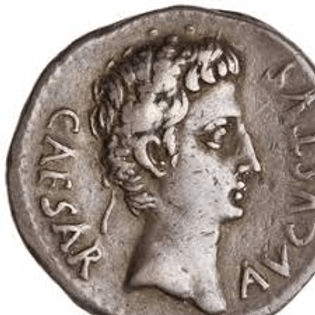
As far as the coin Jesus asked the counsel of plotters about, the Temple had its own coins in its treasury.  The Herodians would have known the Temple tax paid by all Jews was expected to be paid in half-shekels.  Some featured the face of Herod the Great, but by the time Jesus was answering their question, coins existed that featured Herod Antipas’ likeness.  While those were primarily silver coins, the Romans expected their payments to be converted into Roman coins, which featured Caesar.  Thus, the tax in question was not about what Jews owed for being Jewish, but what the Temple owed Rome for being allowed to exist; so “they brought him a denarius,” a Roman coin.
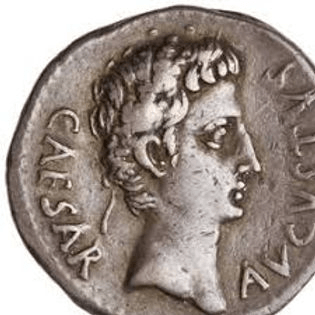
Relative to this, it becomes worthwhile to read what is written in Matthew 17:24-27.  There, Peter was approached by a tax collector and asked, “Doesn’t your master pay the temple tax?”  That was a two-drachma (“didrachma“) tax that the tax collectors got rich from collecting from the Jews [and thus tax collectors were hated for that].  After Peter went into the house of Jesus, Jesus asked him this question: “From whom do the kings of the earth collect duty and taxes—from their own children or from others?”  The answer was “others,” leading Jesus to say, “Then the children are exempt.”  That says the children of God owe no physical tax to Him; but, Jesus then told Peter to go catch a fish and look in its mouth.  There a four-drachma coin would be found, which would then be used to pay his and Jesus’ temple tax.

In that recount in Matthew’s Gospel, it is easy to hear Jesus tell Peter, “Go fish,” and assume that means he did as Jesus said and took the boat out on the Sea of Galilee, where he caught a net full of fish.  They even call a tilapia Saint Peter’s fish because that was likely what he would have caught there. 

That means a miracle happened when Peter took the first fish he caught, opened it mouth and found a four-drachma silver coin.  The reality is this: Jesus told his disciples who had been fishermen, “I will make you fishers of men.”  Thus, “Go fish” meant, “Go find another Jew who wants to serve God.”  It was then from that “mouth” that came such a coin; this was how the ministry of Jesus was supported through donations (requiring Judas be the treasurer).  Quite possibly, Peter ran and converted the tax collector and he was so thrilled he gave him the coin, along with words of thanks from his mouth.

By seeing that, it makes it easier for one to understand the scope of meaning behind Jesus saying, “Give back therefore all of Caesar to Caesar” (from the Greek “Apodote oun ta Kaisaros Kaisari “).  Besides seeing how poorly those words are translated by the Episcopal Church’s lectionary translation is [it is not the NASB or NIV], it is important to realize there are three capitalized words out of five words written.  Capitalization is unimportant to normal human beings, but in divine Scripture it is presented by God’s servants for a divine purpose.

In that regard, the capitalized Greek word “Apodote” importantly states more than presenting a gift, as the word “give” might imply.  It is a form of the root verb “apodidómi,” which means “to give up, give back, return, restore.” (Strong’s definition)  The implication is then (importantly stated) a statement saying, “What one has been given, one should give back all that is asked in return.”  The fact that Caesar’s image was stamped into precious metal says, “This coin is the property of Caesar, Emperor of the Roman Empire.”  If Caesar deems one of his empire owes him back, then one pays back what one owes.

This is then found stated (importantly) in the capitalized words “Kaisaros Kaisari.”  This is the genitive (possessive) noun followed by a complimentary noun, stating “of – to.”  The capitalization is then addressing the all-powerful title of “Caesar.”  The Emperor of Rome was a human god, one who owned not only all the precious metals of that empire, but everything and everyone within that realm of authority.  If Caesar gave an order, “Conscript soldiers and fight a war,” there was no one who could say, “No.”  Thus, the power of “of Caesar to Caesar” says refusal to honor the emperor’s command meant severe punishment.

The counsel of the Temple all stood in awe of the emperor of Rome.  Whatever Caesar said pay they paid.  They knew it was useless to try and buck that system, so they did as the almighty Caesar said to do.  They had plotted to kill Jesus and hoped this trick question would get them some evidence to go running to Pilate and squeal, “Jesus said not to pay the tax to Rome!”  However, God prepared Jesus to tell them, “Give everything that has made you wealthy men of the Temple back to Caesar.”

That is like Jesus knowing the Temple counsel had all sold their souls for a piece of the Roman Empire’s wealth.  As such, God spoke through Jesus telling them, “Buy back your souls from Caesar, so you can still have a soul to give back to me before you die.”
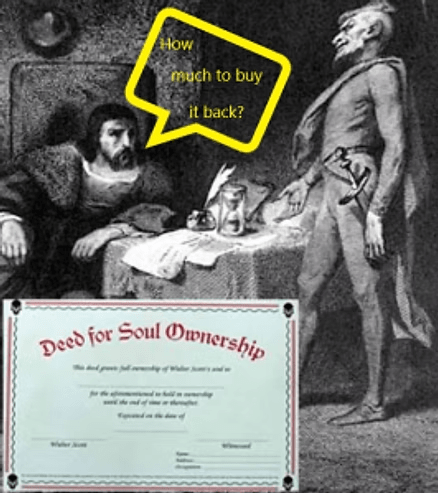
The Jewish leaders “were amazed” because what Jesus then said about giving to God what is God’s made a cold chill run down their backs (where normal people have spines).  The Greek word translated as “they were amazed” is “ethaumasan.”  While that can be one translation, HELPS Word-studies says this about the root verb: “thaumázō (from 2295 /thaúma, “a wonder, marvel”) – properly, wonder at, be amazed (marvel), i.e. astonished out of one’s senses; awestruck, “wondering very greatly” (Souter); to cause “wonder; . . . to regard with amazement, and with a suggestion of beginning to speculate on the matter”‘  It was a state of wonderment based on them realizing for the first time that they were anything but beholden to God, because if they were, then they owed an awful lot of back-taxes.

Those lying bags of dirt [euphemism for “bodies of flesh”] had just recently put on their finest “I am pious” robes and waltzed up to Jesus, saying “Teacher, we know that you are sincere, and teach the way of God in accordance with truth, and show deference to no one; for you do not regard people with partiality.” 

Not a one of them thought Jesus was a “Teacher” (from the capitalized “Didaskale“), especially since they were “disciples” of the Temple elite and had never been taught anything of merit about divine Scripture (the importance of capitalization here).  They lied when they said they knew Jesus was “sincere,” as the Greek word written (“alēthēs“) is a statement about one who speaks the “truth.”  They could not recognize the truth because they were too busy lying to see it with their own eyes.

Everyone of them knew that Jesus whipped them verbally every time they had encounters like this, because they were so blatantly evil-centered.  Some, undoubtedly, had seen Jesus overturn vendor tables at the same place they then stood, so they knew Jesus attacked those led by Satan whenever he saw evil raise its ugly head.  They were the ones who turned the pious cheek to those who called them out for being poor examples of God’s children and worse leaders of religious principles (like Jesus did), so they regularly walked away from confrontations … only to plot some retribution privately.

The words they had used to coax Jesus into their snare was then ringing in their ears as they walked away from Jesus, after he said, “Give back that of God to God.”  They must have realized their souls were more owned by Caesar than the God they swore by.

Certainly, this short Gospel reading is easy to see the meaning of, in terms of way back when.  Christians love to laugh and slap each other on the back, giving Jesus an imaginary fist bump, as if saying, “You told them Jesus!”  The sad fact is most Christians cannot see themselves in this Gospel story.

How many Christians pay homage to Jesus with platitudes, but then they turn around and sin?  In the last three generations (sixty years – since 1960), the Christians world has transformed greatly, away from the ways of the past.  The advent of technology has certainly aided the mindset that believes in the philosophy saying, “Progress shows up as change.”  This has happened so often in that past that change has restructured everything as a result.  Children of children’s children now believe, “If it once stood firm, it must be wrong, so tear it down and do the opposite.” 
The changes are way too many to list, but one clear change has been away from the ‘fire and brimstone’ preachers who tried to strike fear into the hearts of Christians so they would do good.  We now have community organizers and political hacks entering seminaries and being ordained as priests and ministers of flocks that are too busy texting to hear a sermon, much less care about any opinions on Scripture they might hear.  At least, not enough for that to have any positive effect. 

Christians have become the disciples of system that plots to overturn everything Jesus stood for.  The children of children who never knew Christianity the way it was now say to Jesus, “We know you defer to no one; for you are not partial to any; therefore, we can speak for you and say everyone is welcome in the Church, no matter how vile and repulsive they are.”

The churches of Christianity ask, “Is it lawful to pay taxes to the State, or not?”  But, the churches are not those of your grandparents.  The laws that kept churches exempt from taxation are now used to make anything with more than four people involved be declared a “religion,” simply to keep from paying taxes.  Cults spring up like mushrooms.  The third generation of children would much rather join a commune and worship some Eastern guru, rather than go to a church and find any form of restriction of lifestyle. 

While the media flaunts ridicule at organized religion [blame a lot of that on the Church of Rome and its endorsement of pedophile priests], they kneel down and praise the idols of political party.  Propaganda promotes Caesar over God, with Caesar now going by the name of Big Government.  The taxes paid today to the State is what Jesus said was owed to God; but when the soul has already been sold into the physical realm there is nothing left to return to God.

If this message is not seen in this Gospel reading, then there is nothing to gain.  Might as well go fishing on Sunday mornings.
Jeremiah 31:31-34 – I will make a new covenant

31 “The days are coming,” declares the Lord, “when I will make a new covenant with the people of Israel and with the people of Judah.

32 It will not be like the covenant I made with their ancestors when I took them by the hand to lead them out of Egypt, because they broke my covenant, though I was a husband to them,” declares the Lord.

33 “This is the covenant I will make with the people of Israel after that time,” declares the Lord.  “I will put my law in their minds and write it on their hearts.  I will be their God,
and they will be my people.

34 No longer will they teach their neighbor, or say to one another, ‘Know the Lord,’ because they will all know me, from the least of them to the greatest,” declares the Lord. For I will forgive their wickedness and will remember their sins no more.”

———————

This is a reading designated for the fifth Sunday in Lent, Year B, which will next be read aloud in an Episcopal church on Sunday March 21, 2021.  I write about this now because I recently heard the sermon of a Baptist minister (on television) and he referenced this reading while preaching about the prophecy of Malachi 3.  Verse 32 of Jeremiah 31 struck me as important enough to write about now.

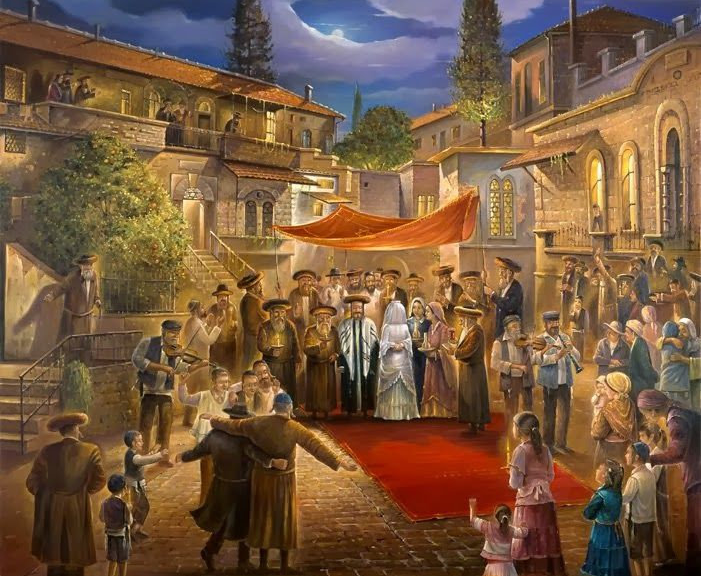
For anybody who has read my postings here, most of which are rather long, they will recognize that I have been saying how important it is to marry God.  Marriage to God comes from a devotion and desire to learn from Scripture and prove to God (in some way unique to each individual) that one truly wants to please the Lord.  That proof causes God to propose marriage, making one a bridesmaid (regardless of human gender).  Marriage comes when God’s Holy Spirit merges with one’s soul.  The product of that holy union (the most Holy Matrimony) is the rebirth of God’s Son (the resurrection of Jesus in the flesh of the one marrying God) and the reappearance of the Christ in the world (hopefully one of many).

When Jesus told the parable of the wedding banquet (Matthew 22:1-14), I explained that was God sending His Son out as a messenger to tell the Jews they were invited to finally marry God.  Verse 32 here in Jeremiah 31 says why God the King had to prepare a great feast to celebrate that marriage coming through at long last (when Jesus came).  It was to be the new covenant between God and His chosen people. 

God said through Jeremiah: “It will not be like the covenant I made with their ancestors when I took them by the hand to lead them out of Egypt, because they broke my covenant, though I was a husband to them,” declares the Lord.”

That says it was always the plan for the Israelites to – each and every one – marry God and become His Son.  That includes all the women too.  When God said He was “a husband to them,” that condition of relationship never got tossed away.  It is the only way to have God’s agreement “in their minds and written on their hearts.”

By God saying “I was a husband to them,” that statement says the children of Israel who followed Moses (another messenger of the Lord) were ALL His wives.  The expectation of a marriage to God [the wedding ceremony was at Mt. Sinai, with the honeymoon lasting nearly forty years] is complete submission to His will.  A husband not only takes a wife ‘to have and to hold [possess] from this day forward [forevermore]’ but that commitment means God was equally committed to loving and caring for His wife [males and females].

The purpose of marriage is a bond of exclusive togetherness.  The Israelites became God’s chosen people in the same manner a husband says to a bride-to-be, “I choose you.”  Being chosen marks the stomping on the glass, wrapped inside a napkin.  Being chosen means the acceptance of being chose.  Marriage is not about temporary togetherness.  It is about ‘until death do you part,’ but when the marriage is to God it is about dying of self.  Death then symbolizes the beginning that union, with physical death, when a soul is released from a body of flesh, being the time when the soul returns to be one with God.

Alas, since the old marriage agreement ended in adultery, therefore divorce for most of the Israelites and Judeans, God told Jeremiah, “I am a wealthy God.  I am a king.  I can afford many wives.  So tell them I will take them back, but only after they prove their willingness to commit from day one.”

Since then, everyone knows what happened to the Judeans and Israelites of Jeremiah’s day … they left a trail of tears into Assyria and Babylon.  It was collapse and ruin for them both.  The same thing happened to the Jews of Jesus’ day, after they killed the messengers of God – Jesus and his Apostles (just like in the parable of the wedding feast).  That leaves this prophecy still in effect for Christians, but Christians have to hear God speaking to them through Jeremiah, when he wrote: “I will be their God, and they will be my people.”

Christians have to realize what God meant when He said, “It will not be like the covenant I made with their ancestors when I took them by the hand to lead them out of Egypt, because they broke my covenant.”   That means Christians are spawned from the new covenant. They are ‘day one’ brides [males and females].  The covenant is the marriage proposal and acceptance thereof.  The taking by the hand is how an experienced husband takes a young bride and leads her through all the acts of marriage, which took place back then in a tent designed for making love.  A good spiritual wife learns how to please his-her God.  In return, a good husband never leaves His spiritual wives frustrated and wanting.  God took His Israelite brides by the hand and wrote down everything they had to do to please Him. 

Christians are not that naïve.  They have all been around the block before … quite a few times.  With ancestral roots that show family histories that have worshiped every god under the sun known to benefit mankind in some way, they are experienced ‘lovers.’  They heard about the many instructions Yahweh gave to His newbie wife and toss most of them away.  They coo in the ear of God, “Let’s just stick to Ten Commandments sweetheart.  I know what pleases a god.”  However, God has not married any of those like that, even when they are who claim to be having and beholding His Messianic presence.   

Christians – as the name implies – are already filled with God’s Holy Spirit and have given up their self-egos (the required sacrifice a bride makes, in order to take on the name of his-her husband) and been reborn as Jesus Christ.  That makes them “Christians.”  Thus, God said, “No longer will they teach their neighbor, or say to one another, ‘Know the Lord,’ because they will all know me, from the least of them to the greatest.”

A Christian who cannot say, “I know the Lord,” remembering the Biblical meaning of “to know,” means one is not truly a Christian.  To know the Lord is to have knowledge of Him within your flesh (the body of Christ).  It is to feel that holy presence flowing through one’s being (the blood of Christ).  One is a pagan whenever that knowledge is missing, much like is a fallen Jew today.  Pretenders get in the long line of those who refused the invitation of the messenger [i.e.: Jesus], who said, “Hey the king wants to marry you!  Put on your wedding gown and head over to the marriage tent.  There will be food and drink served afterwards!”

Pagans have better things to do (or at least they think so).  Christians only get to hear God whisper into their ears: “I will forgive your wickedness and will remember your sins no more.” 

Who could ask for more? 

God knows you were a filthy harlot before.  God knows you cheated on Him time and time again.  But, God knows a true heart is repentant and desiring a second chance at the total commitment of marriage.  God knows the truth of how much one wants past sins forever washed clean by His Holy Spirit.

That is the new covenant promise.  But, you have to be married to God to get that wedding present.  You have to be a Christian; not one of those sneaking into the feast without a wedding dress on.  Those only get booted out, with a whole lot of weeping and gnashing of teeth going on after that.

Exodus 33:17-23 – And the Lord said, “I know you by name.”

The Lord said to Moses, “I will do the very thing that you have asked; for you have found favor in my sight, and I know you by name.” Moses said, “Show me your glory, I pray.” And he said, “I will make all my goodness pass before you, and will proclaim before you the name, ‘The Lord’; and I will be gracious to whom I will be gracious, and will show mercy on whom I will show mercy. But,” he said, “you cannot see my face; for no one shall see me and live.” And the Lord continued, “See, there is a place by me where you shall stand on the rock; and while my glory passes by I will put you in a cleft of the rock, and I will cover you with my hand until I have passed by; then I will take away my hand, and you shall see my back; but my face shall not be seen.”

——————–

This is an excerpt from the Old Testament reading (Track 1) of Proper 24, Year A Ordinary after Pentecost season.  It will next be read aloud on Sunday, October 18, 2020.  That will mark the Twentieth Sunday after Pentecost, Year A.  These words were last read aloud in an Episcopal church (by a priest) on Sunday, October 22, 2017.

I wrote a deeper explanation of this reading and published it in 2017.  It deals with the Hebrew text and the concept that these words tell of Moses communicating with God in a dream state.  I stand by that interpretation and welcome all to do a search of that posting and read it.  However, I have narrowed the focus in this writing to just the Lord’s instructions to Moses, relative to being placed in a metaphorical condition that is in “the cleft of a rock.”

In this conversation it is worthwhile to remember the story found in 1 Kings 19, where Elijah hid in the rock (“a cave”) and then was told to stand in the cleft (“the mouth of the cave”) as the Lord was going to pass by.  Elijah did not see God, but then “came a still, small voice.”  That voice was Elijah’s, as he spoke in submission to God, letting God speak through his soul-mind-body being. 

That story is a repeating of this story of Moses, as both were on “Mount Horeb.” [Exodus 33:6 and 1 Kings 19:8]  That was not the same physical mountain, but a statement about  one’s being in a place of “Waste” (the meaning of “choreb” or “ḥō·rêḇ” – חֹרֵֽב).  Both Moses and Elijah went into a safe haven created by God’s presence, amid a world of waste or of no purpose without God. 

Likewise, Jesus went into the wilderness to be tested, where Satan took his soul “to a very high mountain,” showing Jesus the kingdoms of the world that could be his, if he bowed down and worshiped Satan.  The “very high mountain” means a “mountain” that was “lofty,” which is the same as Mount Horeb; as from there all the waste of human kingdoms that worship Satan could be seen.

In the above translation, we read God telling Moses, ” you have found favor in my sight.”  This is an important statement that ALL Christians must realize.  God told Moses that God saw the actions of Moses as worthy of the Lord’s “grace.”  We are not told of Moses spending days of mournful prayer to God, asking for God to give him this or make that possible for him.  Moses was not attempting to make God his servant by talking to God.  Thus, it was what God saw Moses do that brought God to tell him “divine favor” was the reward of a faithful servant who did as the Lord told him to do (not the other way around).

When God then said to Moses (again, using the NRSV translation), “I know you by name,” this is most important for Christians to realize the truth of meaning contained in those words.  When Americans look at their birth certificates and driver’s license, they will see their “Christian name.”  That term is defined as: “A name given to an individual that distinguishes him or her from other members of the same family and is used as an address of familiarity; a forename, especially one given at baptism.” [Google search result from Definitions from Oxford Languages]  The name “Moses” met the same definition standards; but the etymology of that name given says “Child Rescued From Drowning In Water.”  However, that is not the meaning of God saying “I know you by name.”

Each and every animated piece of human flesh does so because it is possessed by a soul, which comes from God.  This means the “family” root for all souls is Yahweh as the Father.  When human beings are born and they are raised to worship daddy and his name, then everyone kneels at the altar of flesh worship, denying their souls have a greater Father.  Moses had sacrificed his sinful flesh [he had murdered, thus he knew his flesh was condemned to die] in service to God the Father of his soul.  Moses was not simply begging God to forgive him.  Moses was paying penitence by sacrificing his self-ego in the flesh and doing whatever God told him to do.  It was, again, those actions of subservience to the Lord that Yahweh saw.  God knew the heart (and mind and soul) of Moses, and there was no longer a “Child Rescued From Drowning In Water” there.  God knew Moses was in the name of the Father, or in the name of God; and, every Christian is called to be known by God in the same way.

That is why God then said to Moses, “I will make all my goodness pass before you, and will proclaim before you the name, ‘The Lord.”  This does not mean God gave Moses the right to go around using the Lord’s name in vain, saying “In the name of God I command this or that!”  It says that the “goodness” will become God’s expression through Moses, meaning the fleshy body named Moses will then become God incarnate in that body of flesh. 

To grasp this, the word translated as “before” is “al,” which means “upon, above, over” (Strong’s Concordance) and “above, according to, after, as against, among, and, as, at.” (Strong’s Exhaustive Concordance) Further, the preposition is derived from the conjunction that means “high, upward,” with it added to the Hebrew word translated as “you” – “pā·ne·ḵā” (a word that actually means “face”). 

It says Moses would walk as God, with the face of God covering the human fleshy face of Moses.  That would become the glow that Moses had on his face, after leaving the tent of meeting, which so frightened the Israelites that they made Moses wear a veil over his face.  The “goodness of the Lord passed before Moses” as the face of God upon him.  Thus, Moses (like Jesus would do) spoke only the Word of God to the Israelites, proclaiming God’s messages because he had taken on the name of God.

When God said, “You cannot see my face; for no one shall see me and live,” that was a statement that a soul cannot see God with eyes of flesh.  To see God, one must leave the worldly realm and enter the spiritual realm.  Thus, when Moses looked into a reflecting pool or mirror [instruments of vanity], he saw his face staring back at him, not God’s.  That becomes a statement that demands a soul must sacrifice the false life of the worldly flesh [it is only temporal pseudo-life] and kill one’s self-ego, in order to find the true life of a Saint.  Moses, Elijah, Jesus, and his Apostles (et al) were in the Holy Bible because they surrendered their faces [death of self-ego] so they could wear the face of God.  A true Christian does the same.

When the translation states God as saying “See, there is a place by me where you shall stand on the rock,” the importance should be placed on “seeing” through the face of God.  The use of “rock” is then a statement of the solidity of one’s soul state of being, when one has become in the name of God [His Son, with Him the Father].  The “cleft of the rock” is then the bubble of protection God gives His Saints.

When God then told Moses, “I will cover you with my hand until I have passed by; then I will take away my hand, and you shall see my back; but my face shall not be seen,” this is the complete lack of self-awareness that a Saint has.  A magician has learned how to trick people with sleight of hand and use of smoke and mirrors as distractions.  The hand of God is the power of God to work miracles through an Apostle.  The one who has surrendered his flesh unto the Lord does not know what is taking place.  It is not the brain of a human or the acts of a human body that are in play.  Thus, the Son of God is never looking up procedures from the Handbook of God or trying to remember just how some incantation for turning water into wine goes.

In the Gospels, there are few times that Jesus did anything to heal someone.  Typically, all he did was tell someone their faith had healed them.  That is the hand of God covering a Son until the work of God has been done.  When that hand is removed, the only thing seen is the result of God’s work – another miracle done (without magic involved).

This then plays into the Gospel reading from Matthew 22:15-22, when Jesus said to give unto Caesar what is his, but give unto God that which is God’s.  Caesar represents living in the flesh.  The soul is the property of God, but it so loves to absorb the filth a body of flesh can wallow in that the lures of Satan’s world often makes a soul refuse to wear the face of the Lord.  That was the test Jesus passed; that is the test all Saints must likewise pass.  Therefore, when Jesus said to give back to God what God gave to your flesh at birth, the only way that can happen is to be like Moses and put on the face of God.

Leviticus 19:1-2 and 15-18 – A test of the Law

The Lord spoke to Moses, saying: Speak to all the congregation of the people of Israel and say to them: You shall be holy, for I the Lord your God am holy.

You shall not render an unjust judgment; you shall not be partial to the poor or defer to the great: with justice you shall judge your neighbor. You shall not go around as a slanderer among your people, and you shall not profit by the blood of your neighbor: I am the Lord. You shall not hate in your heart anyone of your kin; you shall reprove your neighbor, or you will incur guilt yourself. You shall not take vengeance or bear a grudge against any of your people, but you shall love your neighbor as yourself: I am the Lord.

——————–

This is s Track 2 selection that is an optional Old Testament reading for Proper 25, in the Year A Ordinary after Pentecost season.  Since this is the only time this reading will be read publicly, there is a good chance few will have ever hear these word read aloud.  The next time they can potentially be read in an Episcopal church will be Sunday, October 25, 2020.  That Sunday will be recognized as the Twenty-first Sunday after Pentecost.

The Episcopal Lectionary lists Leviticus 19:1-2 as officially part of this reading.  Those verse amount to “The Lord spoke to Moses, saying: Speak to all the congregation of the people of Israel and say to them: You shall be holy, for I the Lord your God am holy.”  The title given to this chapter by the New International Version (NIV) is “Various Laws.”  The New Revised Standard Version (NRSV) calls this chapter “Ritual and Moral Holiness.”  The New American Standard Bible (NASB) separates at verse 9, calling that the beginning of “Sundry Laws.”  Little attention is placed on verses 1 and 2.

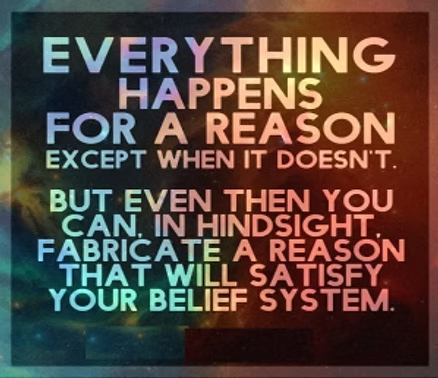
This brings to mind the directions given by a teacher on a test, which I saw posted on the Internet.  This is how I see Leviticus 19.

For the Episcopal Lectionary to choose only verses 15-18, or only four out of thirty-four (not counting verses 1-2), begs the question: Why bother?  The same question could have been asked by both students and parents, after some teacher failed all the people ready to take a test (pass or fail), who were just too eager to read instructions first.

The whole matter could be solved by simply reading Leviticus 19:1-2.  That says it all.  Nothing else needs to be said.  “The Lord spoke to Moses, saying: Speak to all the congregation of the people of Israel and say to them: You shall be holy, for I the Lord your God am holy.”  Do that then smile at Moses and say nothing to your neighbors.  They are all busy trying to memorize laws that should be written on their hearts and minds by God being within.

The first direction says, “You shall be holy.”  If you do not know how to be holy, then you fail the test.  Don’t waste your time reading stuff you will never  understand.  You might as well stand up and tell everyone, “I am not in the name of the Lord!”

When God then told Moses to tell His people, “I [am] the Lord your God” and “[I] am holy,” that makes an important statement that says a child of God (like Moses) must be married to God, so one’s soul has merged with God’s Holy Spirit.  That merger trumps a normal soul, which cannot be “holy” just by itself in a body of flesh, meaning the Holy Spirit is how one “shall be holy.” 

Notice also how “you shall be” is stating the “second-person masculine plural future of היה‎ (hayá)” and recognized how God knew the Israelites were nothing more than a rag-tag bunch of crowd followers that still had some learning to do.  However, they had proved some level of commitment, so God had proposed marriage through Moses; so that was certainly the expectation in the future.

If you have been keeping up with the Gospel readings that go along with this, the parable Jesus told of the wedding feast was explained as God making a new offer to those who would follow Jesus and marry God.  Those who had followed Moses kind of withered on the vine and died, in the sense that they divorced God, never really taking the steps necessary for being merged with His Holy Spirit.

Christianity began with the explosion created by the Apostles instantly being married to God, which immediately spread to three thousand more.  Then Constantine pumped the brake pedal and what we see today is a return to the days when the Israelites offspring (Jews) were still just engaged to God.  The question now is who is touching people with the Holy Spirit that is merged with their souls, so true Christians are growing like they once did?

In the story where the Episcopal priest went to Jesus and asked him, “Teacher, which is the most important law.”  Ha ha ha ha.  I meant the Pharisee.  The Episcopal priest would have already tossed everything from Leviticus 19, with the exception of those listed in the lectionary reading above.  I’m sure the Pharisee would have presented that question with the same tongue-in-cheek preconceived expectation: With so many laws, how can one be most important?

Jesus said, “Love the Lord your God with all your heart, soul, and mind.” (Matthew 22:37)  Since Jesus only said what the Father told him to say, that is the same as saying, “You shall be holy, for I the Lord your God am holy.”  That entails being so head over heels in love with God that you open up your soul for His Holy Spirit to penetrate and God becomes one with you. 

That means marriage to God is the most important law.  From that union, there is no need to memorize 613 laws.  With God in one’s heart, soul, and mind, the laws are etched within permanently.  Nothing needs to be looked up.  Whatever God says to do, THAT is the most important law at that time.

As for “you shall not render an unjust judgment,” then don’t do that.

As for “you shall not be partial to the poor or defer to the great,” then don’t do that either.

As for “with justice you shall judge your neighbor,” then certainly always do that.

As for “You shall not go around as a slanderer among your people, and you shall not profit by the blood of your neighbor,” those are also no brainers: don’t do that.

Why?  Because you can truthfully say, “I am the Lord.”  Or, as Jesus said, “I am in the Father as the Father is within me.”  Two in one, with only the Lord speaking.

 As far as being told “you shall not hate in your heart anyone of your kin,” once again – don’t do that.

When told “you shall reprove your neighbor, or you will incur guilt yourself,” by all means reprove sinners, so you will not become a sinner yourself.

Finally, when Moses had them write this down: “You shall not take vengeance or bear a grudge against any of your people, but you shall love your neighbor as yourself,” the law is set: do not take vengeance or bear a grudge.  Love your neighbor as yourself!

Why?  Because when one is married to God, then one can let God say through one’s mouth, “I am the Lord.”

Jesus did that when he told the Pharisee the same secondary law, from which everything else falls.  Love God by proving it – Marry Him!  Then love your neighbor because God is within you and wants to marry more.  When the love of God is within your soul, you want to love neighbors the same as God loves you. 

You just have to be married to God so you can say that truthfully. You have to be married to God to make it the truth.  So all you who chant a confession of sins every Sunday, saying “I have not loved my neighbors as myself,” STOP THAT!!!

Of course, the problem is not knowing what to do.  The problem is not doing what is right, good, and holy. 

We allow our society to render unfair judgments all the time. 

The rich (and from middle income and up is rich to the poor) hate the poor and bow down to celebrities, no matter how young and untested they are. 

Americans judge anyone and anything, especially neighbors. 

We slander any who get in our way. 

We profit from using heritage as a way to drain the life blood out of them (financially). 

We hate our own, if they follow behind a different political leader than the ones we like. 

We hate all sinners, but then turn around and sin ourselves. 

We find it extremely hard to love anyone other than SELF.

Why?  Because there are few Saints around.  Certainly, there are no Saints preaching in organizations called churches, temples and synagogues.  There are no Good Shepherds who can truthfully say, “I am the Lord.”

We could be, if we wanted to be.  But, when it pays more to memorize civil laws and take a bar exam to get a license to start making money making the laws of the land a complete farce.  Forget about marrying God, because all one’s rich friends would stop having anything to do with one.

The Pharisees were lawyers.  They made a great living from knowing all the laws.  They just could never figure out how to do anything the Lord wanted them to do.  After 70 A.D., being a lawyer was still the way to make a good living.  Being a lawyer today means breaking all of God’s laws; so anyone who is not holy is a lawyer of self-law.

So, don’t worry.  No one will read Leviticus 19 aloud in church.  No one will preach about it if it somehow does get read aloud.  There is nothing to start feeling all guilty about.

More education is about how to keep criminals out of punishement for big money than how to keep sinner out of eternal damnation.

Carry on as usual.

Matthew 22:34-46 – Whose son is the Christ?

When the Pharisees heard that Jesus had silenced the Sadducees, they gathered together, and one of them, a lawyer, asked him a question to test him. “Teacher, which commandment in the law is the greatest?” He said to him, “’You shall love the Lord your God with all your heart, and with all your soul, and with all your mind.’ This is the greatest and first commandment. And a second is like it: ‘You shall love your neighbor as yourself.’ On these two commandments hang all the law and the prophets.”

Now while the Pharisees were gathered together, Jesus asked them this question: “What do you think of the Messiah? Whose son is he?” They said to him, “The son of David.” He said to them, “How is it then that David by the Spirit calls him Lord, saying,

‘The Lord said to my Lord,
“Sit at my right hand,
until I put your enemies under your feet”’?

If David thus calls him Lord, how can he be his son?” No one was able to give him an answer, nor from that day did anyone dare to ask him any more questions.

——————–

This is the Gospel reading from the Episcopal Lectionary that is scheduled for public reading on Proper 25, Year A.  It will next be read aloud by a priest on Sunday, October 25, 2020.  In the numbering of the Ordinary selections, this reading will take place on the Twenty-first Sunday after Pentecost.  It was last read aloud in church on Sunday, October 29, 2017.

I offered an opinion on this reading, which I published on this site now, from back on October 10, 2017.  I stand behind those observations and welcome all to read that article.  What I want to do now is connect what Jesus told the Pharisees, in this inspection for blemishes (as the sacrificial lamb on display), with the Old Testament readings.  I have just recently published my views on Leviticus 19 (the Track 2 reading option), but the reading from Deuteronomy 34 (the death of Moses) also supports this Gospel selection well.

This means one must begin discerning Matthew 22:34-46 by understanding both of those readings.  For the Leviticus 19 reading (which, as a Track 2 offering, might never be chosen to read), one must firmly grasp how God told Moses to tell His people, “You must be holy, because I am holy.”  The only way to be holy is to be one with God, as was Moses and as was Jesus (and others like them).  Then, one must realize that God showed Moses all the land the Israelites would settle in (from east of Jericho), where the only way to see the whole nation of Israel [before it was a nation] was to be one with God.  From that understanding, to read that Joshua “was full of the spirit of wisdom, because Moses had laid his hands on him,” that was the ‘tag, you’re it’ passing on of God’s Holy Spirit, so Joshua was also one with God.

This has to be firmly grasped – AT ALL TIMES – because Christianity has fallen into the malaise of thinking it is not proper to think anyone other than Jesus can be the Christ, so everyone squats and laments all the evils in the world, while doing nothing but wait for Jesus to return.  Had God let Moses die and not allow him to pass the torch onto Joshua, then the Israelites would have stormed into Canaan demanding their land, only to be outright slaughtered for being idiots.  Likewise, if God had let Jesus die and not have allowed him to prepare the disciples to carry on his torch, nobody would be reading this article now or caring about anything divine as Christianity would have never been.

So, with that understood, let’s look at what Matthew 22:34-46 says.

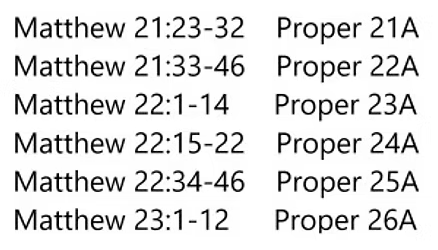
This reading begins by stating, “When the Pharisees heard that Jesus had silenced the Sadducees.”  Over the past few Sundays, Matthew 22 has been read and probably preached, beginning with the parable of the wedding banquet (1-14), followed by the tax to Caesar (15-22), to now this encounter with the Pharisees (34-46); but nothing has been said about the confrontation with the Sadducees.  Here’s why:

From the Episcopal Lectionary Reverse Lectionary search of Matthew.

The Episcopal Lectionary does not ever address this confrontation, as told by Matthew.  It is, however, addressed from Luke’s perspective (Luke 20:27-38), during the Ordinary after Pentecost season in Year C (Proper 27).  That means it should at least be mentioned here, so one does not start off lost, dazed and confused about what happened between Jesus and the Sadducees.

The Sadducees presented Jesus with a wild scenario about a woman who was married to seven Jewish men (one at a time), all brothers [a legal thing], with none ever having sired a male heir.  They wanted Jesus to fall into a trap about the afterlife (which they did not believe existed), asking him which man would be the husband of the wife in heaven.  Jesus sent them away whimpering, tails between their legs, by his saying, “God rules over the living, not the dead.”  Besides that being a question about heavenly marriage, it is important to know the zinger about God and truly being alive.  Knowing that helps when looking at this reading for Proper 25A.

So, when we see the Pharisees coming to Jesus to ask him what the most important law is he knew they also were up to no good.  Thus, when they asked their question, God spoke through Jesus, saying “You shall love the Lord your God with all your heart, and with all your soul, and with all your mind.”  That is not a law of Moses, but a reminder from God that states one’s expected way of life.  It says, “Let God tell you what is most important.”  (If you are living!)

Think about that for a moment, knowing the Sadducees had just muttered themselves back into their Temple lair after having asked some male-dominated question about who gets to claim a wife in heaven.  Imagine them asking Jesus, “Do wives even get to go to heaven, if they do nothing I tell them to do, the way I tell them to do it, here on earth?”  The audacity of thinking women must possess souls that will never go on ego trips and power quests!

In the same way Jesus told them how God is the God of the living, not of the dead, those idiots could not even feel the cold wet slap of reality hit them in the faces that said, “You are dead to God.  Wake up and live while you still have that chance!”  Waking up demands all the Jews (Sadducees and Pharisees especially) marry God.  It is best to marry one you love with all your heart, all your soul, and all you mind!

Marrying God, like the concept of marriage the Jews had, meant making all the necessary sacrifices of a bride.  To be God’s wives, they would have to accept they were as worthless as Jewish men saw women in ancient Jerusalem [a mindset that still prevails everywhere today].  Back then, a daughter had no say in who her father gave her to.  Love was never a factor in the process of engagement.  Marriage was the reality of commitment, with a wife committed to serving her husband (and vice versa); offspring were a natural expectation.  However, marrying God was such a foreign concept to the leaders of the Jews back then, the Pharisees were still planning on ruling heaven as they ruled Jerusalem.

If they wanted to get to heaven, they needed to accept the invitation to the wedding banquet, where they would marry God.  Their earthbound egos would give their souls away, where they would become the new daughter of God the Father. 

The debt their souls owed was to God, not some emperor.  To return a soul to God meant to marry Him and become His wife.  Marriage to God then meant being alive with the Holy Spirit, not dead (like was a soul sinning in a body of flesh). 

All of that meant the most important thing Jews had to do was stop thinking they were gods (that male-dominated ego speaking) and start realizing they were totally insignificant in the grand scheme of things.  To reach that point of awareness, the Jews had to “love God with all their hearts, minds, and souls.”

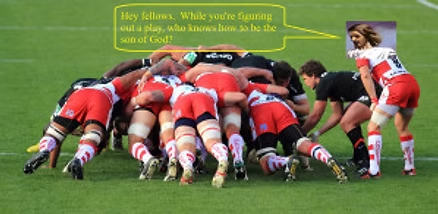
Now, when the reading states “the Pharisees were gathered together,” this has to be seen like some sporting match – a contest of strengths and skills, a battle of the big brains – where the last play failed miserably and it was time to regroup.  Like in a football game, they all huddled together to draw up another play in the dirt. 

That becomes a statement that yells, “Stop thinking!”  Just like you cannot know what the greatest commandment is, because as soon as you say one, you realize, “No!  Wait!  Try this one!” your Big Brain is smaller than a mustard seed, when compared to God’s omniscience.  Stop trying to outsmart God!  Gain access to the Godhead through marrying God’s Holy Spirit.

God then had Jesus ask those great brains of Jerusalem, “What do you think of the Messiah? Whose son is he?”  They immediately fell into his trap, simply because they thought they were so smart and Jesus was just a dumb rube from Nazareth.  They forgot all the times before their mouse trap plans failed, with them instead being snapped tight.  With a thud they fell into God’s snare, when they answered, “The son of David.”

They immediately gave that answer because they did not worship God.  They worshiped human power.  They had just showed Jesus a denarius with Julius Caesar’s image engraved on it, so they could have said, “The son of Caesar” and more honestly expressed their wish.  He was the ruler du jour; but they wanted to name a king that would give them the right to claim to be heirs of a kingdom.  In their pea-brains, they imagined the Kingdom of Judaism to be grander than the kingdom of heaven.  However, Jesus pointed out how flawed that idea was.

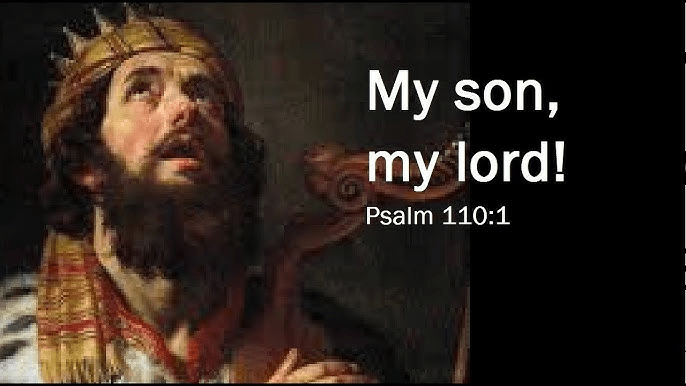
When Jesus asked them, “How is it then that David by the Spirit calls him Lord?”  The key term there is the capitalized word (in Greek) “Pneumati,” which is a statement of importance beyond normal “breath” or the “spirit” of kingly power (like a form of energy).  The capitalization says Matthew knew Jesus was speaking of the Holy Spirit being in David when he wrote psalms.  As such, Jesus said David was one with God, when he addressed God as “Lord.”

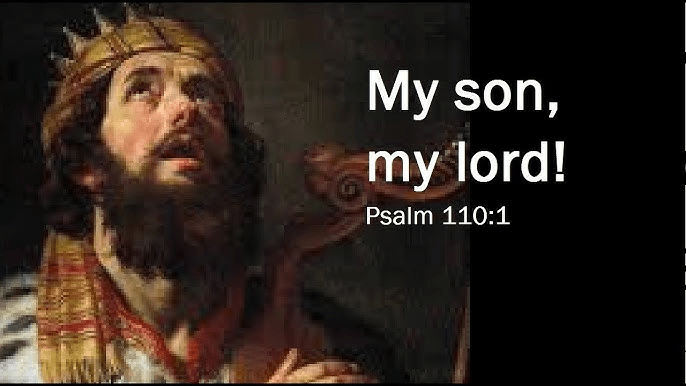
The element of “Lord” must be realized from the Hebrew of Psalm 110, verse 1, which Jesus quoted.  After introducing a new song written by David (in the “Spirit”), he wrote “Yahweh ladonai,” which personalizes “LORD of lords” [Yahweh adonai] to say “LORD of my lords.”  The point Jesus was making (as God speaking through him) was, “If the Messiah is expected to be the descendant of David, then why did David refer to Yahweh as LORD, and not Father?”  After all, David was the son of Jesse (not a king) and Solomon was the son of David’s sins, who reigned as his somewhat illegitimate heir (after Absalom was basically murdered by David’s general’s order).  That family tree had been reduced to a stump of rulers by the Babylonians.

Jesus [a descendant of David, by the way] then pointed out that for a son of David to be the expected Messiah, then David would himself have to be a son of God.  That totally befuddled the Pharisees, which proved their big brains were really just the brains of simpletons.  They walked away tight-lipped.

What is totally missed here is there is an answer to give.  When Jesus asked, “If David thus calls him Lord, how can he be his son?” the answer is: “If David sacrificed his self-ego, giving up his title and position as king to serve God, as his Father, then he would be a son of God.”  The Pharisees never could fathom anyone ever doing that.  What would be the point of ruling the world, if you could not become worldly rich in that process – even have great domineering powers, as men, over all women?  So, they walked away muttering like the Sadducees before them, looking for their place in darkness to hide.

The answer to Jesus’ question is found in the Deuteronomy reading, after Moses died.  We read that Joshua was the son of Nun.  That statement as to Joshua’s father is the only place in the Holy Bible where the name Nun is mentioned.  The name means “Fish” [“I will make you Nunneries of men?”].  That father named his son a name that means “Yahweh Is Salvation” (Joshua).  The name Jesus means “Yahweh Will Save.”  Still, Joshua being named as a son that was not Moses says God is the Father of all who will be the Messiah that brings Salvation to the people.

The Deuteronomy reading states, “Joshua was full of the spirit of wisdom, because Moses had laid his hands on him; and the Israelites obeyed him, doing as the Lord had commanded Moses.”  That says the Christ (Messiah) would never be the son of a human being, but the Son of God, which happens when someone with God within him or her touches another so the hands of God are laid upon him or her too.  That Messiah (Christ) is then (like Jesus) God incarnate in the flesh.  David was the son of God, when Israel regularly battled the evil presence surrounding them; but David failed God as a son when he let his power overtake his soul.  The nation then reflected both the times of righteousness and the times of sins shown by David and all their subsequent kings [and prior judges].

Of course, we Christians all know that Jesus asked that question knowing he was the Christ of God.  We giggle as the Pharisee walked away silent [flash back to the one not wearing a wedding gown being silent when the king asked him how he got in the banquet]; but Christians end this reading with silence, just like the Pharisees.  Christians are equally befuddled, because they all think the son of God can only be Jesus, forgetting all about Joshua being filled with God’s Holy Spirit, in the same way Moses was filled with it AND in the same way Jesus was filled with it AND in the same way ALL the Apostles were filled with it AND in the same way ALL true Saints recognized by Christianity have been filled with it.

Moses was reborn as Jesus Christ before God made holy flesh named Jesus.  Moses passed Jesus Christ onto Joshua.  David was the resurrection of Jesus Christ when he was a boy shepherd.  Jesus is the model for ALL flesh that is living, made so by marriage to God.  The Christ is the Mind of God leading anyone who bows down before God totally – submitting heart, brain and soul completely to Him, through love.

God cannot be limited.  Big Brains cannot tell God how many times Jesus Christ can be resurrected in another body of flesh that has married its soul to God.  The Pharisees and Sadducees were so narrowminded they thought God worked for them, kind of like the lazy workers that showed up to the pick grapes of the landowner, but then laid in the shade all day long, still expecting to be paid wages for doing nothing.

The ones who walk away from Jesus silently just cannot fathom the entire world can be sons of God, if God so chooses.  It all depends on God finding the recipients of His Holy Spirit and His Christ Mind as worthy brides to marry (like all the above named people – Moses, Joshua, David, Jesus – plus many more unnamed).  The question asked by Jesus goes to ALL Christians today: How can anyone be the son of God, if one calls God his or her Lord?

Come out of the darkness of your lairs.  You know the answer.  The answer is SACRIFICE OF SELF-EGO.

The answer is ACCEPT GOD’S INVITATION TO MARRY HIM.

The answer is STOP THINKING YOU KNOW MORE THAN GOD AND LET GOD LEAD YOU THROUGH LIFE.

Be the wife of God (regardless of human gender).  Love God with all your heart, soul, and mind.  Be submissive to the Will of your most holy Husband.  Give birth to His Son in your flesh, becoming the Son of God resurrected.  Call your Lord and Master by His relationship title – Father.  Touch others with your holiness, a righteous state that can only come from God.

As far as short memory spans go, it was just two Sundays prior that Jesus ended a parable by saying, “For many are called, but few are chosen.”  Those conditions fit the ancient scenario of Jerusalem, just as well as they fit the scenario today of a religion calling itself in the name of Christ, when there are so few of true Christians around.  Everybody is too busy taking care of self to let their egos give their flesh over to God in marriage; but that simply means they are dead of soul.  So, God is not their God.  He’s only the God of the living.

Revelation 7:9-17 – Before the throne of God

After this I, John, looked, and there was a great multitude that no one could count, from every nation, from all tribes and peoples and languages, standing before the throne and before the Lamb, robed in white, with palm branches in their hands. They cried out in a loud voice, saying, “Salvation belongs to our God who is seated on the throne, and to the Lamb!” And all the angels stood around the throne and around the elders and the four living creatures, and they fell on their faces before the throne and worshiped God, singing, 

“Amen! Blessing and glory and wisdom and thanksgiving and honor and power and might be to our God forever and ever! Amen.” 

Then one of the elders addressed me, saying, “Who are these, robed in white, and where have they come from?” I said to him, “Sir, you are the one that knows.” Then he said to me, “These are they who have come out of the great ordeal; they have washed their robes and made them white in the blood of the Lamb.  “For this reason they are before the throne of God, and worship him day and night within his temple, and the one who is seated on the throne will shelter them.  They will hunger no more, and thirst no more; the sun will not strike them, nor any scorching heat; for the Lamb at the center of the throne will be their shepherd, and he will guide them to springs of the water of life, and God will wipe away every tear from their eyes.”

——————–

This is the designated “First Lesson” presented by a reader, en lieu of the place normally held for the “Old Testament” reading.  It is the purposeful selection because it will be read aloud on All Saints Day.  It will next be read on Sunday, November 1, 2020.  That date will represent the twenty-sixth Sunday after Pentecost.

It is important to realize that All Saints Day is always November 1, with All Souls Day always being on November 2.  Those recognized Church events do not usually fall on a Sunday, so the Sundays that are neither November 1 or 2 (the closest Sunday to them, post-Halloween) becomes a combo-Sunday for Saints and souls.

Every living human being has a soul.  Not every living human being is a Saint.  According to the Wikipedia article entitled “All Soul’ Day” the distinction between the two is officially stated.  They report this: “In the Catholic Church, “the faithful” refers specifically to baptized Catholics; “all souls” commemorates the church penitent of souls in Purgatory, whereas “all saints” commemorates the church triumphant of saints in Heaven.”

While “Purgatory” is from the imaginations of men wearing religious robes over their flesh animated by a soul and not a real place [ask the reincarnations of Pharisees who believed in Sheol], their assessment is still worthwhile, simply because it states a belief that souls are denied “Heaven,” while saints are not.  This should be realized as why the Episcopal Church sets aside a special Sunday in the middle of the Ordinary season after Pentecost, for the express purpose of recognizing the backbone of any true Church is its Saints.

This means every reading selected is meant to convey this importance.  Whoever ran the Church long ago and established the lectionary schedule first, he or she was certainly filled with the Holy Spirit – therefore a Saint.  The goal of ALL Christians is to be a Saint.  Anything short of true sainthood is failure and failure is rewarded with the imaginary place the Roman Catholics call “Purgatory” [and long gone Pharisees called Sheol].  All Saints Day is designed so sheeples don’t lie on their deathbeds and feel the tap of an angel on their soul, hearing a voice saying, “Time to come out the vaginal opening and try again.  Maybe the next seventy human years will make it easier to realize being a Saint is much better than being just another soul.” 

This is where the original Church was not some organization that hired people to run a business, but a gathering of Saints and those who wanted to become the same.  Just to use the example of the educational system, where “teachers” are expected to graduate students, not expected to forever see the same failures back in their classroom, year after year; a true church is expected to graduates Saints.  Since that system has been replaced with souls who are not teaching other souls to be Saints [it takes one to graduate one, as there is no other way to that end], the same people sit in pews year after year, thinking their soul is going to heaven.

Please, take this as me simply stating my opinion and nothing more.  Prove me wrong by reading what I will present about Revelation 7:9-17 and then go to your church of choice and see a reader pleading with you as he or she reads the words of John [his first letter is also scheduled to be read], as a Saint speaking with the same power as had Peter and the eleven on Pentecost Sunday.  Then, listen to the priest read great emotional feeling into the Beatitudes [Matthew 5:1-12].  Hear his or her sermon that says the blood of Jesus Christ flows within, so a Saint is truly standing in your midst.  If that is your experience, then you should be ready to go spread the Gospel message to others after church.

I wish you the best and pray there are Saints about everywhere.

This reading is very deep.  All Scripture has the same power of depth, but the writings of the Apostles [i.e.: Saints] cannot be read quickly and simply.  It is the expansive nature of the Holy Spirit guiding their minds to write the most meaningful words that come from the Mind of Christ, direct from God.

I will now present the above reading in a new format, one I have used here before [often with Paul’s letters], so it should be seen that a whole day could be spent reading, discerning, and discussing this reading.  A whole day [the purpose of the Sabbath, which God intended to be twenty-four hours of prayerful recognition of God and His Word] could be spent just on Revelation 7:9-17.  It is so important because it is John writing of his experience with God and His Saints.  That says John is explaining what God said to him, to tell others what it takes to be a Saint.  Please keep that in mind as you read this new format.

For anyone who has read my posting here regularly, you will know that I say the Greek use of “kai” is not the common conjunction “and” being stated.  It is a marker word that signals the reader to sit up and take notice, because everything that follows the word “kai” is most important to remember.  In this presentation, notice there are twenty-nine uses of the word “kai,” both capitalized (extra importance noted to follow) and lower case, with some in the middle of a line (not following a comma mark or semi-colon).

This is a literal translation, so no liberties are taken to not translate some words (prepositions deemed not translatable), nor use the most common translation (those shown by the NRSV), when there is a better choice to use.  I translate literally, based on the case of the written text [shown in the Biblehub.com reproduction of the Greek], so I only capitalize what was capitalized, without exception [even though Biblehub will imply “Him” as meaning God or Christ, when “him” is written].  I maintain all punctuation as shown in the Greek text, without exception. 

Keep in mind that John was out of body at the time of his experience, which means he had entered the spiritual realm.  He wrote while possessed by God’s Holy Spirit [he might even have been blind at the time his Apocalypse was written, so it was orally transmitted to another human writer], so every word reflects the truth of Jesus Christ within John’s vision.

A classic story of how to become a Saint. A king possesses God on the throne within. Removing the sword from that stone is easy with God’s presence within – as one chosen by God for marriage.  Possess the sword and possess the right to be king. However, a king without a sword is a land without a king.

I feel it is most important for each individual see him or her as called to do as John did and have a conversation with God.  Knowing that “the throne of God” is not in some magical place, like in outer space or in the clouds, but in your hearts; you provide the seat upon which God sits, in your heart.  You are therefore called to be “the Lamb,” which means you are expected to sacrifice your soul on the altar at the temple that is you, as an offering to God that is pleasing [the sacrifice of marriage].  A soul cannot also be a Saint.  It is one or the other.  Since you already have a soul, you need to realize that soul serves your flesh and not God, until your soul changes [“You cannot serve two masters.].  Please, read this slowly and meditate on what John’s word say to you.

9

After these things I looked  ,

kai  behold  ,

a multitude great  ,

which to number it no one was able  ,

out of every nation  ,

kai  tribes  ,

kai  peoples  ,

kai  tongues  ,

standing before the throne  kai  before the Lamb  ,

having been clothed with robes white  ,

kai  palm branches in the hands of them  .

10

kai  they were crying aloud in a voice great  ,

saying  This salvation thereupon God of us  ,

thereupon sitting on the throne  ,

kai  thereupon Lamb  !

11

Kai  all them angels made to stand around the throne  ,

kai  the elders  ,

kai  the four living creatures  ,

kai  they prostrated before the throne the faces of them  ,

kai  worshiped thereupon God  ,

12

saying  ,

Truly  !

this praise  ,

kai  this renown  ,

kai  this wisdom  ,

kai  this gratitude  ,

kai  this honor  ,

kai  this ability  ,

kai  this strength  ,

thereupon God of us  ,

to the ages of the ages  !

13

Kai  spoke one from out of the elders  ,

saying to me  ,

These this having been clothed with the robes the white  ,

who are they  ,

kai from where have they come  ?

14

Kai   I said to him  ,

Lord of me  ,

you know  .

Kai  he said to me  ,

These are them coming out of the affliction of the widest sense  ,

kai  they have washed the robes of them  kai made white them in the blood of the Lamb  .

15

because of this  ,

They are before this throne this of God  ,

kai  serve him day  kai  night in thereupon temple of him  ;

kai  he sitting on the throne will have his tabernacle over them  .

16

not they will hunger anymore  ,

neither will they thirst anymore  ,

neither none shall fail above them the sun  ,

nor any kind of burning heat  ;

17

because this the Lamb in the center of the throne will shepherd them  ,

he will lead them to the living fountains of waters  ,

kai  will wipe away every tear from the eyes of them  .

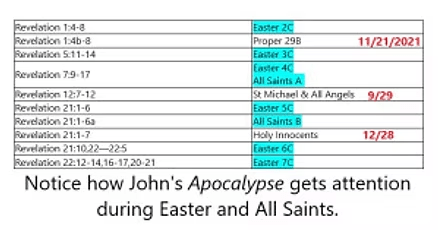
Just as an aside, the Episcopal Church only places importance on John’s Revelation in a limited capacity.  According the Reverse Lectionary for the Episcopal Lectionary, reading from Revelation come most frequently during the Easter season, when not on All Saints Day. This connection becomes important to see as a statement (without words) that points out how Easter is less about remembering the death and resurrection of Jesus each year and more about it marking the death of a soul in the flesh and resurrection of Jesus Christ in a Saint, in a way that is deeply personal to a true Saint every year, even though the date of personal transfiguration is different for each Saint.

The readings selected from John’s Revelation for church reading only come from chapters 1, 5, 7, 12 and 21.  To me, that avoidance says the Church is afraid of the nerves touched when an unprepared soul [a priest] is trying to avoid an End Times theme, while preaching to potential donors.  Instead, a true church [anywhere two or more are gathered as Saints] should be teaching the Word, no matter what the Word says about the common failures that make it routine for souls not to become Saints.  Certainly, that downfall has been ongoing for quite some time, to the point that few Saints still hang out in church buildings.

Now, let me briefly go through this very deep reading.  What I am about to offer is by no means everything that could be said.  It is what popped into my mind as I re-read the Biblehub.com Interlinear version of Revelation 7, looking for the “kai“s.  I wrote notes on a Word document, which I could copy and paste at the end here.  You might want to print the following on a sheet of paper (or two) and then re-read the new format presentation, glancing at the notes offered here.  I will do this according to the “kai” number – 1 through 29.  

1 – the importance of seeing in a way you had never seen things before.

2 – the importance that Saints are not limited to any one race of people.

3 – the importance that Saints are not limited to characteristics that define “people” – men-women; rich-poor; well-sick.

4 – the importance that Saints are given an ability to speak in the divine language of God.

5 – the importance of the word “before” (“enōpion”), where the flesh is before the throne that is within oneself; but the face worn is your flesh that is before what is underlying, hiding from view the Lamb – Jesus Christ.  That signifies one’s sacrifice of self to be reborn in that name.

6 – the importance that one become the fruit of the vine or the branches that bear fruit (dates from a palm).  The fruit of the Lord comes from the work of His servants … His holy hands.

7 – the importance that Saints do not hide Christ under a basket.  They cannot be stopped from crying out with joy.

8 – the Greek word “” translates as a conjunction as “then, thereupon,” meaning “kai” marks the importance of having become the “Lamb,” as “thereupon” the Lamb has come to one.

9 – capitalized “Kai” shows the great importance ALL Saints become the “angels” of the Lord, where the word “angeloi” means “messengers.”

10 – the importance of understanding that Saints become the leaders of all churches – “the elders.”

11 – the importance of knowing a Saint becomes the foundation of a church [the symbolism of “four”], which turns dead flesh into “living creatures.”  The use of “four” says Jesus Christ is the cornerstone of a Saint.

12 – the importance of knowing a Saint must prostrate oneself to become the throne of God by sacrifice of self-ego.  A “face” not raised (lowered) means the face of God is worn by a Saint.

13 – the importance of knowing a Saint totally worships God and nothing less.

14 – the importance of knowing the “praise” a Saint gives to God recognizes His being their source of “renown.”

15 – also the source of their wisdom coming from the Christ Mind.

16 – also a Saint gives God all credit, with great gratitude.

17 – all the “honor” of being a Saint comes posthumously, as persecution and rejection comes with the “price” paid by a wife of God, as recognition as righteousness can only be seen in hindsight by common souls.

18 – all “abilities” possessed by a Saint come from God.

19 – all “powers” possessed by a Saint is God’s Holy Spirit flowing through a servant.

20 – a capitalized “Kai” states the great importance of letting the “elder” within (Jesus Christ) do all the speaking, just as Jesus only spoke what the Father told him to speak.

21 – the importance of realizing a Saint was once a sinner, just as all who are not Saints.

22 – a capitalized “Kai” states the great importance that a line of communication is held by a Saint and Jesus Christ, where understanding is taught, with one always speaking with understanding.

23 – a capitalized “Kai” states the great importance of knowing a Saint does the speaking of Jesus Christ, as a vehicle of God.

24 – the importance of knowing a Saint is “washed” through baptism of the Holy Spirit.

25 – the importance of knowing a Saint is made pure through baptism, never again to be soiled by sin.

26 – the importance of knowing a Saint serves God as the light brought to the world (the “day”).

27 – the importance of knowing a Saint has found the death of “night” by self-sacrifice, becoming the temple of the Lord.

28 – the importance of knowing a Saint has been led to eternal life (“living waters”) by Jesus Christ.

29 – the importance of knowing that a Saint has had all the tears of sins and human failures to serve God totally have all been “wiped away,” when one has become a Saint.

I hope you also read the article that I posted some time back about the Beatitudes.  I felt called to write deeply about Matthew 5:1-12 when it was not a scheduled reading.  Before I realized that reading was the Gospel selection for All Saints Day, I read the Beatitudes with new eyes.  I saw the repetition of “Blessed” as being Jesus’ way [speaking for God] of stating the various “blessings” he named can only come from having become a Saint.  I have not re-read that article, but I recall I transformed every place where is read “Blessing to those” as saying something like “A Saint is those.”  Check it out.

Again, All Saints Day is a mega-important day that should be realized.  It comes the day after All Saints Eve, also called All Hallows Eve or Halloween.  I know people who dedicate many hours of their time, putting much energy into decorating their houses, preparing for trick or treaters, and dressing up themselves in costumes.  In essence, they are making their worship be (symbolically) to the charade of life, where dead souls walk in human flesh that seems to be alive, but is not.  From all that effort to be able to tell the world, “I love the sin of zombies and ghouls,” how many have any time to deeply study the lessons of All Saints Day?

How many of you will spend the majority of All Saints Day pondering what it takes to become a Saint?

All Saints Day is not fantasy or wishful thinking.  It is about your soul being told the End Times story of your fate.  Saints exist for the purpose of carrying serious messages from God to the world … near (family) and far (beyond across the street).  They all say: “Hear!  Believe!  Act! Only Saints get to Heaven!  Unrighteous souls get recycled back to the earthly plane!  That is an important message sent by God to you!”

If you reject a Saint’s message, they go into the streets and declare, “The kingdom of God has come near!”  Then, once your soul has left your deathbed (if you make a Saint give you that warning), the scales of justice will ask your soul to remember the times you rejected God’s messengers.  AND your soul will have perfect memory of them all.  All souls know the judgement of God is fair, as all the gnashing of teeth in the outer darkness is self-caused.

And that is why I hold the opinion that Christianity has become as lost as the blind leading the blind can get lost.  The hole they will eventually stumble into is called a grave.  For all the avoidance of the End Times, everybody has an end time coming.  It should not matter if one dies individually, due to accident, old age, disease, or disgust with living.  Likewise, it should not matter if one is vaporized instantly, along with millions of other souls in the same vicinity, from some nuclear holocaust.  Death is death and there is no safety in numbers.  Death always means one soul leaves one body of flesh.  Matter is constantly changing its state of being; so losing a soul means nothing to clay.  A soul is immortal and cannot die; but to stay on the earthly plane it needs fresh clay.  Still, a souls knows it must change spiritually, before God kisses its spiritual cheek and sends it into reincarnation, which means a soul is aware of the need to kick its addiction to flesh.  

So, if you want to avoid the Purgatory that will be created when mankind has finally found a way to destroy the entire planet, when returning wayward souls will no longer be able to get lost in the beauty of a paradise made by God’s Hand, only able to find an immortal soul wandering a destroyed environment … the reality of Purgatory will be where zombies are souls returning to animate some nuked-out carcass of death.  Dragging a dead body around for eternity becomes a soul crying out for someone to blow its dead brain away!  If being a Saint in this life is too boring or too hard, well then just imagine that scenario!  

HAPPY HALLOWEEN!   TRICK?  OR TREAT?

1 John 3:1-3 – The children of God the Father

See what love the Father has given us, that we should be called children of God; and that is what we are. The reason the world does not know us is that it did not know him. Beloved, we are God’s children now; what we will be has not yet been revealed. What we do know is this: when he is revealed, we will be like him, for we will see him as he is. And all who have this hope in him purify themselves, just as he is pure.

——————–

This is the Epistle reading selection for All Saints Day, Year A.  It will next be read aloud in an Episcopal church on Sunday, November 1, 2020.  It is important because John the Beloved is the John of Patmos, who also wrote The Apocalypse  (not John of Zebedee, or John the Apostle-Evangelist) and whose reading from Revelation 7 is paired with this reading from 1 John 3, as relative writings of what makes one a Saint.  On All Saints Day, it is important to know what a Saint says about becoming a Saint.

Because this is a writing of a Saint in epistle form.  All of the Epistles are deeply inspired words that come directly from God, via a Saint that has been reborn as Jesus Christ.  Paul, Peter, and John (et al) are representative of the return of Jesus , who comes Spiritually into a body of flesh.  They are thereby Jesus reborn, who likewise speak for the Father, as His Son.  This is what a Saint is and can only be.

This means John’s words that will be read aloud in churches around the world on All Saints Day should be read by one possessing God’s Holy Spirit, himself or herself also a Saint.  When divine words are read by divine flesh that accommodates the Holy Spirit, then the power of the words is imparted upon those listening and seeking to also become Saints.  This is the true purpose of a church that is truly Christian.

The above translation presented by the Episcopal Church is one prepared in English by the New Revised Standard Version (NRSV), which is not divinely inspired.  It is syntax inspired.  Therefore, the one who teaches the divine inspiration of John’s words must likewise have the power of the Holy Spirit allowing him or her to speak the truth, as a servant of God [not an organization that hires specifically educated employees to manage a franchised business].  That power recognizes the truth of what is written, which is clouded by the mist of human language.

Here is what John was divinely inspired to write, literally presented, maintaining all case and punctuation.  The words of God are never meant to be limited to one meaning, but rather to expand to all accepted translations possible.

Behold what love has given to us the Father  ,

in order that children of God we should be called  —-

kai  we are  !

on account of this  ,

the world not knows us  ,

because not it knew him  .

Beloved  ,

now then children of God are we  ,

kai  not yet has been revealed what we will be  .

we know that when he appears  ,

like him we will be  ,

for we will see him as he is  .

kai  everyone having this the hope this in him  ,

purifies himself  ,

just as that one pure is  .

In these three verses there are five capitalized words.  A mark ending a sentence does not predicate a capitalized word to follow.  As such, a capitalized word shows great importance, such as is found in two of the capitalized words “God” (“Theou“).  The other three are “Behold, Father, and Beloved.”

“Behold” is the importance of having one’s blinders removed, so one can “See” and “Experience” the presence of God.  The Greek word “Idete” also means, “to perceive, attend to,” with the understanding it is a statement of Seeing with the mind, as inward spiritual Perception.

“Father” is a major statement of relationship with God.  As human beings, all have physical fathers.  The name of the father is passed on to his children.  The common word ‘father’ says there is a genetic lineage that cannot be removed, regardless of how one feels about his or her paternal progenitor.  The power of “Pater” is it is an important statement that the “children of God” can truthfully call God their “Father,” because their souls have merged with God’s Holy Spirit, causing them to be reborn with a new “Father” in a divine manner.

“Beloved” is capitalized to denote the importance of divine Love, which can come only from God.  The word in its capitalized form is read by many to mean Jesus Christ.  This importance then says John’s letter is not a general misuse of all eyes that read his words are loved by God, but a powerful statement that his words can only be discerned by those who have been reborn as Jesus Christ and can “See” through the eyes of God.

When John wrote the marker word that indicates importance follows – “kai” – he emphasized that the true children of God are those who can sincerely call God their Father.  He then explained that the world cannot realize that relationship, because the world is not of that spiritual family, unable to know God as His children do.  It means a normal human being can meet a Saint and never be able to tell that person has been reborn as Jesus Christ, as the Son of God.  It means that if John the Beloved was to tell a normal human being, “Hello.  My name is John, but I gave up that identification.  Call me Jesus Christ,” then that normal human being would outright reject that Saint, in the same way that the rulers of Jerusalem outright rejected Jesus.

After John identified the children of God as those truly “Beloved,” he emphasized by writing “kai” – “not yet has been revealed what we will be.”  That importantly states that a Saint has sacrificed his or her self-ego, so no Big Brain is getting in the way of God’s lead.  One does not become a Saint because one has planned how high and might one will be in the world, once “I” have gained control of God.  A Saint has no ego invested in what one will do with God as his or her lackey – like one holds the power of God as a genie in a bottle.  A Saint becomes the epitome of the saying by Tennyson: “Ours not to reason why, ours but to do and die.”  A Saint does not propose a plan for God.  A Saint is an obedient wife and servant that waits for God’s command and then does as commanded … with great Love and affection.

  When John wrote, “like him we will be,” this is a statement of holiness.  A Saint lives as did Jesus – righteously and without sin.  When he added, “for we will see him as he is,” a Saint will look in the mirror and see how Jesus Christ looks exactly as one looks.  This means a Saint wears the face of God, because one has surrendered one’s self-ego.  A Saint has married God and taken on His name, as do all good wives.  The name of God in human flesh is Jesus Christ.  Saying “in the name of Jesus Christ” says one is a Saint, because to say that and not be a Saint is to break the Commandment and use the Lord’s name in vain.

When John then introduced verse three with the word “kai,” he stated the importance of “hope” in the world.  That “hope” is Salvation.  That “hope” is delivered to seeker through Saints.  A Saint means the presence of Jesus Christ, who is sent by God to offer the same opportunity to all who will receive His Spirit.  The “hope” is the marriage proposal sent by God’s servants to the world.  A Saint is one who accepts that proposal and puts on the wedding gown of righteousness.

That is understood by John writing, “purifies himself,” where the only option for becoming a wife of God is to be washed clean of all sins, which can only come through baptism by the Holy Spirit.  This spiritual cleansing replaces the blood of a human father with the blood of Christ.  The blood of Christ becomes the self has become the sacrificial Lamb of God, such that the blood of Jesus Christ has then filled one’s veins, like blood painted on the doorpost of oneself.  The angel of death has passed over one’s flesh, purifying a soul for eternal life in Heaven with God.

When John ended this reading by stating “just as that one pure is,” this is saying one’s soul is worthy of sitting at the right hand of God.  A Saint has receive the Holy Spirit and become saved by being forever changed by the presence of Jesus Christ.

This is why John 3:1-3 is selected to be read on All Saints Day.  It is imperative to hear the truth, so one’s heart can crack open and receive message sent by the Holy Spirit.

Matthew 25:1-13 – Virgins of Christ

Jesus said, “Then the kingdom of heaven will be like this. Ten bridesmaids took their lamps and went to meet the bridegroom. Five of them were foolish, and five were wise. When the foolish took their lamps, they took no oil with them; but the wise took flasks of oil with their lamps. As the bridegroom was delayed, all of them became drowsy and slept. But at midnight there was a shout, ‘Look! Here is the bridegroom! Come out to meet him.’ Then all those bridesmaids got up and trimmed their lamps. The foolish said to the wise, ‘Give us some of your oil, for our lamps are going out.’ But the wise replied, ‘No! there will not be enough for you and for us; you had better go to the dealers and buy some for yourselves.’ And while they went to buy it, the bridegroom came, and those who were ready went with him into the wedding banquet; and the door was shut. Later the other bridesmaids came also, saying, ‘Lord, lord, open to us.’ But he replied, ‘Truly I tell you, I do not know you.’ Keep awake therefore, for you know neither the day nor the hour.”

——————–

I addressed this reading that is scheduled as the Proper 27, Year A, Gospel reading in my 2017 interpretation.  I stand behind my words then and recommend any who are seekers to read them. 

This reading will next be read aloud in church by an Episcopal priest on Sunday, November 8, 2020.  That will constitute the twenty-third Sunday after Pentecost, the same ordinal number when read in 2017; but in 2014 it represented the twenty-second Sunday numbered after Pentecost.

In my analysis now, I want to focus on just a few aspects presented in this parable; but first I again must point out that Jesus spoke in parable about the proposal of marriage.  That is why this reading if sometimes called the Parable of the Ten Bridesmaids.  The picture I have attached to the heading of this article depicts ten young girls, or virgins, each holding a lamp.  When one reads “bridesmaid” or “virgin,” the first impression is of females.  Because it is parable, that notion should be dismissed.

Think of ten as one, where that is subdivided into two paths one can go towards being ‘engaged’ to marry Yahweh.

Knowing the focus is not set fully upon females, but all human beings, another mistake is commonly made.  The “bridegroom” is not Jesus, as the assumption generally is made.  The “bridegroom” should simply be seen as the complement of “bridesmaid,” such that a “bridegroom” is masculine essence [Spirit], while the “bridesmaid” is feminine essence [a soul in flesh].  Seeing that makes it easier to grasp the Greek word “nymphiou” as representative of the wife-to-be, whose husband-to-be is proposing to take the soul away from the flesh, like a daughter is given away in marriage.  A husband then gives the wife a new name to go by, which is symbolic of a soul having been named mortal but after marriage to God takes on the eternal name of Christ.

Human marriage, as an institution of Holy Matrimony, is all about having children [sorry homosexuals].  The physical act of sex after marriage is meant to bring about a child.  To royalty, a male heir is all important in marriages.  A child is the result of sperm and egg uniting, in a bond that can never be separated.  A new human body of flesh is given a soul by God’s grace.  God is therefore the true officiant of that marriage, as God is the Creator of all life on earth.  Spiritual marriage is all about being reborn as Jesus Christ, where soul and Holy Spirit unite and create an eternal bond that can never be parted.

Getting to that point of the most Holy Matrimony is why Jesus told this parable to his disciples.

In Matthew’s twenty-fourth chapter, the final day of inspection of the Paschal Lamb was completed.  The Sadducees and Pharisees had looked Jesus over closely and found no blemishes.  They made no encounters on the fourth day; so Jesus walked to the Mount of Olives with his followers, where he explained the Temple of Jerusalem would be destroyed.  In Matthew’s twenty-sixth chapter, we read of the plan made by “the chief priests and the elders of the people gathered in the palace of the high priest,” as to the butchering of that sacrificial Lamb of God.  Thus, in between, in Matthew’s twenty-fifth chapter, Jesus was speaking to those who expressed faith in him, with love and devotion. 

The disciples were not those who were clearly opposed to Jesus or completely unknowing of who Jesus was.  Thus, the disciples (who were all males) were like bridesmaids, promised the kingdom of heaven.  A question must have arose about that promise, which is what led Jesus to make a comparison between the two, in a series of parables then told.

In the twenty-fifth chapter of Matthew’s Gospel, Jesus spoke in metaphor.  Here, it was of “bridesmaids” [also known as “virgins”], some “wise” and some “foolish.”  Then, he would speak of a master with slaves that would be given “talents” in differing amounts, with all expected to be used to promote the master’s business [presumably a vineyard?].  Two of those slaves would be deemed “good and trustworthy,” while the third would be called a “wicked and lazy slave.”  Finally, Jesus spoke of the coming of the “son of man” (not capitalized – “huios tou anthrōpou“), when like a shepherd separates the sheep from the goats [which is done in the evening, before dark], so too would be the souls of the faithful be culled by Christ the king.  Then will be set those who “are blessed by my Father” (“the righteous”) at the “right hand” and the rest to the “left hand,” those who would end up being sent “away into eternal punishment.” 

All of what Jesus said to his disciples is read aloud in churches for all who claim to be Christians to hear today.  It is as meaningless to non-Christians today, as it would have been to the Temple leaders back then.  Bridesmaids (or virgins), slaves, and farm animals must be seen as possessions of an owner, where an owner has a special relationship with those he possesses.  One who is not a believer in God will not understand the metaphor in the correct manner.  Thus, Jesus spoke privately to those in relationship to him, to whom he was the master, but a master who loved his followers [like a husband to a wife and vice versa]; conversations he would not have had with anyone else.

All of this means that Christians, who are Jesus’ disciples today, supposedly in a close relationship of mutual love and affection, fall into one of two categories that will become evident when Judgment Day comes.  A Christian is either a wise or foolish bridesmaid, a good and trustworthy or wicked and lazy servant, or one blessed by the Father (a sheep) and promised heaven or one not blessed and destined for eternal damnation (a goat). 

Know that, when you ponder the meaning of these words. 

Realize that as Jesus spoke, Judas Iscariot was listening to them.  Understand that there was a good possibility that Judas did not have a clue that God was speaking through His Son about him, when the metaphor of foolish bridesmaids, wicked and lazy slaves, and selfish goats was spoken.  Judas would then be just like many so-called “Christians” who I know, those thinking their failures to fully commit to God are not failures at all.  They think that because they wear priestly garments or give regularly to a church organization. 

The soapbox of righteousness upon which  many so-called Christians stand can just as easily be toppled, as Judas would find; his noose of sins wrapped tight around his neck when his realization that Jesus was talking about him metaphorically dawned on him.  “What have I done?” snapped him to a dark place.

Jesus did not tell the parables remembered in Matthew 25 to his disciples because he was too naïve to think all his followers were faithful marriage partners.  God knows all and Jesus spoke for the Father, realizing not everyone calling themselves a follower of his was as promised.  “I do” to some means once the fun stops, then its time for ‘talking the talk and not walking the walk’.  God spoke through Jesus knowing that Judas was a lamp without extra oil, a wicked and lazy user of God-given talent that was intended to be used to lead others to God, and therefore a goat destined to be separated into the “Go to Hell” pile.  God knows the world is full of Judases.

If a cold shiver just went down your spine realizing that, then now is the time to hear the call to totally submit to marriage to God [meaning confessions of unfaithfulness cease forevermore].

With that sermon preached, see yourself as a bridesmaid, no matter what sex you are.  If you think because you have a penis you are exempt from that designation, then you just designated your sexless soul to condemnation.  Expect that soul to remain where it is – cast into the outer darkness that can never be a lamp that shines the light of truth into the world of death – destined to be reincarnated over and over, born to grow new teeth that will forever gnash when death comes a calling again.

A “bridesmaid” is a “virgin,” based on the meaning of the Greek word “parthenois.”  According to HELPS Word-studies, the intent of the word is “(figuratively) believers when they are pure (chaste).”  This is the distinction of one’s soul and not relative to anything of human flesh.  Chaste is as chaste does.  Chaste is then the wedding robes worn, which is metaphor for righteousness.

It is vital to realize that one being a “bridesmaid” has nothing to do with how often one has had sexual relations (or lusts thereof), which flow like the waters over Niagara Falls after boys and girls reach the human state of puberty.  Rather than think of a virgin in terms of whether or not one has had sexual relations with another human being, one should think in terms of souls entering flesh [the repetition of reincarnation].  In that sense, one should realize the eternity of a soul means it has ‘had sex’ with one body of flesh after another, ever since first separated from God Almighty to experience the illusion of the material plane.  Reincarnation should make one feel like a prostitute (regardless of human gender), because sexless souls give life to both genders of human beings (over epochs of time).

The ones who think they have been born into the wrong body in this life [who make foolish demands for third-party bathrooms] are simply still attached to their past life gender.  Therefore, being a “bridesmaid” or “virgin” means one has to accept the invitation of the king to attend the wedding banquet, for the first time.  If it is easier to commit under the guise of marrying the king’s son, that will still be a first experience.  In reality, it means marrying God and becoming His Son reborn, which is a Spiritual form of union.  It is a commitment to be chaste, for the purpose of getting off the reincarnation merry-go-round and returning to be one with God again.

When you understand that your soul is the “virgin” state of willingness to sacrifice self for a higher cause, one is then committed to God as a “slave” waiting for the master’s instruction, like a sheep brought into the fold of new shepherd, whose voice one must learn to heed.  One’s body of flesh (regardless of human gender) then becomes marked as “taken.”  That is the metaphor of putting on the wedding robes or carrying a lamp. 

The light produced by a lamp (“lampadas” means “lamp, torch, lantern”) is then akin to taking a talent of wealth and multiplying it (not burying it in the ground, or hiding a lamp under a bushel basket).  When Jesus said, “I am the light of the world. Whoever follows me will never walk in darkness, but will have the light of life,” (John 8:12) he is the light that shines from the lamp of one’s being [a rebirth essential].  Therefore, a true Christian is one who is a lamp of God, which give the light of His Son to the world as an identifying mark of one’s commitment to God through monogamous marriage. 

That commitment to marriage then leads one to wash one’s flesh free of sin [a ritual cleansing or baptism by water].  In Jewish laws, ritual cleansing was often done by women after sloughing off a wasted egg.  A mature woman was deemed a sinner that needed to be washed clean because she lost an egg, one given to her by God for the purpose of His making it a body for a returning soul.  As such, a “virgin” becomes representative of a new egg that is in place and ready to be impregnated by God’s Holy Spirit.  That is what makes a body of flesh be metaphor for an egg that needs to be transformed.  It also reflects how a lost opportunity for a soul in a body of flesh, which does not be an offering to God, is sloughed off through death, washed clean through reincarnation.  Therefore, men and women who fail to marry God during a lifetime both have ‘periods’ that represent failures that needs to be ritually cleansed. 

Because there are many who accept the messenger-delivered invitation to marriage, the parable of the wedding banquet told of one [a man] who arrived without putting on the robes of righteousness, the symbol of commitment to marriage.  Jesus had Judas sitting in his ‘banquet room’ on the hillside of the Mount of Olives who he knew was not dressed appropriately.  Likewise, Christianity has those who pretend to be lamps, but are really not.  Those can be described as false shepherds, hired hands, and those who are filthy with sin but love the idea of having to do nothing more than say “I believe” and get a free ticket to heaven.  They enter the banquet hall with expectations, but it soon becomes obvious they are not truly committed.  When God the king called that one man out, he called him “Friend,” which meant “Pretender.”

This is where the lamp oil comes into play.

According to HELPS Word-studies, the Greek word “elaion,” which typically means “olive oil” (Strong’s definition and usage), means “(figuratively) the indwelling (empowering) of the Holy Spirit.”  The same word literally means a physical oil and metaphorically means a spiritual essence.  It is the dual meaning of one word that makes the foolish bridesmaids be lamps with physical oil, whereas the wise bridesmaids are lamps filled with the Holy Spirit.  It is the duality that separates the wise from the foolish.

This separation (as with the good and trustworthy slaves, versus the wicked and lazy slaves; as well as the helpful sheep and the selfish goats) says the lamps with olive oil were only yielding the light of written words that were memorized: laws, songs, and soundbites of Scripture.  The lamps filled with the Holy Spirit were shining the light of truth: living according to the laws, constantly singing praises to the Lord, and teaching others the deeper meaning of Scripture every chance they had.  One was Big Brain foolish, while the other had the heartfelt wisdom of the love of God.  One group’s light was the flashiness of a con man and pretender (reflected light), while the others’ had the inner glow of Saints (a halo or Moses’ face of God).

Could it be that brides wear a veil to hide the face of God, like Moses did?

In the article I posted in 2017, I placed focus on the coming of the bridegroom in the middle of the night as being metaphor for one’s death and the transition of a soul from a body of flesh.  I will not repeat that here; but know that those lamps filled with God’s Holy Spirit are more than bridesmaids or virgins awaiting marriage, but they are bodies of flesh animated by souls that have already been merged with God, reborn as Jesus Christ – the true meaning of being Christian.  Those who are not so filled at the time of death, thus not already married to God [cue the soundbite of an Evangelical minister telling listeners to wait for the second return of Jesus], well their souls are told, “Honey, you got the wrong god.  I don’t know who you are.  I thought you married the world you live in.  See ya.” [door slam soundbite]

That means the ones who light their lamps with the olive oil of flimsy sermons, prepared by those who kneel at the altar of COVID19 fears and worship in the temple of plotting the demise of hated politicians, they never took the time to get filled with God’s Holy Spirit.  Being filled with the Holy Spirit is not an elective course offered in seminaries.  Being filled with God’s Holy Spirit can seem like the swoon of first love, but that feeling is fleeting, like when an injection of heroin dissipates.  Life has its ups and downs, but being filled with the Holy Spirit, reborn as Jesus Christ, is that something extra that always keeps God’s light of truth shining so others can see.

The Holy Spirit is then the difference of oil used by the lamps of the religious.  Anointing oils are physical (olive oil) and used symbolically, in place of the real thing.  A lamp, lantern, or torch produces physical light that is fueled by physical oil, but a spiritual lamp shines the light of truth that cannot be measured in photons, waves and rays.  The Holy Spirit is the extra fuel, carried in another “vessel” – the soul.  Carrying around a vessel filled with extra olive oil is difficult.  It is like trying to memorize the whole Bible, when it is much easier to just light the lamp on Sunday mornings at 7:00 and then snuff out the flame at noon (game time!).  That saves the physical oil for longer usage on one ‘tank.’

The foolish bridesmaid did not have their spiritual “vessel” (the Greek word “aggeion,” meaning “receptacle, flask” i.e.: body of flesh) with them when it got late into the night.  They did not know that meant their a need to sacrifice their self-egos so God could fill their soul vessels with the high octane Holy Spirit oil.  They oil cans used to store extra oil was left behind or empty [the fools!].  But then they were stuck seeing only the physical solutions to spiritual matters, which is the curse of fools, lazy souls, and those only trying to get more of the world for themselves.

The physical oil American Christians use for light today is petroleum based, as fuel.  American Christians often use their fuel to set ablaze the fire of Scripture.  They enjoy igniting that light as a weapon for sport.  Instead of rays of insight emitted from their human lamps, American Christians shoot flaming arrows of righteous condemnation wickedly at others [like the Pharisees did in Jesus’ time on earth].  It is one thing to run around shooting Biblical arrows at all you hate (friend or foe), proving “I know my Scripture!” (from a library of opinions in your study at home), but to be so free and easy with darts and stingers means you better have the real stuff in you [insight from the Holy Spirit], to back it all up.  Otherwise, when the arrows run out and the enemy [death] is at the doorstep, you best have smeared the blood of Christ over your doorpost or [to use a Lenny Bruce line], “You’re gonna die, kemosabe.”  [See what I said earlier about reincarnation.]

When Jesus told his disciples that the wise virgins told the foolish ones, “You had better go to the dealers and buy some for yourselves,” AND “they went to buy it,” think about that for a moment.  The fools actually went out in the middle of night, looking for someone to sell them spirituality.  They were foolish to the end, never once realizing that “you cannot buy your way into heaven!”  

Of course, the place one goes to buy the written law, the songs that make the toes tap to a melodic beat, and favorite Scriptural quotes is to a church building or to the person who runs one.  That is where some priest, minister, or preacher [rabbis too] will be found whittling down Holy Bible selected readings to a bitesize portions – about as big as a small, thin wafer, easily washed down by a sip of wine.  That sold [usually only available on Sundays] is the message that always says, “Don’t bother yourself with studying Scripture, just place an offering in the tray and go home knowing you are saved.”  Buying more of the watered down version of Christianity [baptisms with water sprinkled onto human babies] still will not get a soul to shine the light of truth.  Marrying a church building-organization-proprietor is not the same as marrying God Almighty.  You get what you pay for.  A vessel that is still empty of truly Holy Oil!  

——————–

Again, I want to say that I wrote about this reading in 2017.  The same meaning then is the same meaning now.  I have tried to add to that here and feel that I have.  However, at this time [2020] I feel a strong need to share this “extra oil” now with any and all who have personally known me, either from having been in the same school, church, or town, able to recognize me on sight, regardless of whether or not you having ever spoken a kind word to me.  

If you know me, then you knew my wife. 

My wife was alive in 2017, but she knew she was going to die from terminal cancer.  As I write this, the first anniversary of her death is approaching.  If you know me, then you know that my wife was an Episcopal priest, who was forced into disability retirement, due to her diagnosis.  My wife and I were married, not only as man and woman, but as souls that were fully and completely devoted to God.  Therefore, my wife and I were … and are still … married to God; our vessels always kept full and nearby.

This reading from Matthew 25:1-13 now sparks my “indwelling (empowering) of the Holy Spirit,” such that I am strongly feeling a need to share that my wife was a wise bridesmaid whose lamp was filled with the oil of the Holy Spirit.  She had an extra vessel that she always kept near her: when she went through discernment, when she went through seminary, when she went through ministry, and when she went through the darkness of impending death – meaning the known coming loss of family and friends [most who had already stayed far away]. 

Her lamp never stopped shining brightly.  When she heard the call, “Look! Here is the bridegroom! Come out to meet him,” I held her hand.  I gave her away to the bridegroom.  Her body has left this world, but her Holy Spirit has remained with me.

My wife’s most divine soul wants me to ask all you who know me, “Why do you think you are gods?” 

She wants to know how much the marketplace sells a “thank you Robert” for these days, because the price must be so high that casual “friends” cannot afford to give those away.  Why would anyone calling himself or herself Christian ever bury the talent of kindness, love, and caring?  Does the Parable of the Talents make you hear the voice of God (the master) calling you wicked and lazy slaves?  

Everyone my wife knew loved her.  They loved her to death, because she so freely gave of her Holy Spirit to ease the pains of others.  The “weak in spirit” flocked to her, to be touched by her light of truth; and she gave to them all as they needed. 

What did you give her in return?  The cancer of rejecting her husband, after her death? 

You are blind to how the cancer she got was because of you.  My wife died so you could have more time to commit to God, just as did Jesus.  “Lord, forgive them for they know not what they do.”  She would have it no other way.  It is what Saints do!

Over the past year, there have been a few who have ventured onto the thin ice of acknowledging that I exist in this world.  I appreciate those gestures of kindness.  It saddens my heart, however, to see these writings that I post here on WordPress, which I share with my wife’s MANY friends [I have only a few] on her Facebook account, rejected. 

I share the insight of the Holy Spirit in her name (with her approval spiritually) and in return we both see an absence of friendly response.  It signifies a silence that loudly screams “We loved your wife, not you!  We can’t stand you!  Kill her Facebook page and let us keep empty vessels, with only physical olive oil in our lamps.”

Kill the messenger is a most human response to a message unwanted.  And Jesus said, “A prophet is not a prophet in his hometown” because no mortal with a vessel empty of God’s Holy Spirit wants to hear anyone speaking as if he or she does have the Holy Spirit.  

Kill the messenger!

Just as my wife did not enter the priesthood to get accolades or to be showered with praises, I do not write interpretations of Scripture to be told how much my words are loved.  My wife and I both always spoke what the Father told us to speak, just as did Jesus.  The Father has us speak the words of truth because Christianity is filled with foolish bridesmaids, wicked and lazy slaves, and goats that do nothing that isn’t self-serving.  God never speaks through humans to make humans be recognized as gods on earth, because most will be crucified with persecution.

My wife presented herself to you as Mary the mother of Jesus; and you called her Mother out of respect for that presence.  Do you reject me because I speak here like an no-nonsense Father, one who knows it is best not to spoil the child? 

I use the rod of truth.  David told God “thy rod comforts me.”  The rod is not made to smash a clay pot that is flawed; but it can do that it need be.  The rod and the staff are tools of shepherding, to save those lost and keep evil wolves away. 

Does the truth of the Gospels hurt your feeling so much it turns your hearts to stone and your brains to hate? 

Are you Judas, planning to sell out anyone who no longer tells you what you want to hear for some pieces of silver?  How much do you sell your favoritism for?  What is the going rate for self-worth?

My wife and I were two sides of the same God.  She wore the smile, as I wear the frown.

God wears many faces.  Be careful which faces you slap, which faces you pity, and which faces you scorn.  Most certainly, lift up the veils that cover the faces of those you love and adore, so you can see the truth that hides underneath.  You never know whose face is hiding God and Jesus Christ beneath, just as you never know who wears the face of Satan. 

The most important face to be determined is yours.  You should wear the face of God, because to wear your own face means you are the god you worship.  That is an empty vessel with no truth of Christ within. 

To wear the face of God is to be truly Christian.  Then, if you reject a fellow Christian, there are protocols that must be taken: one to one; a small group to one; the whole assembly to one.  None of those steps call for silence and backstabbing rejection, first or last.

May the peace of the Lord always be with you, especially when your time of slumber comes; and it will come to all mortals.

#twentythirdSundayafterPentecost #Matthew26 #Matthew25113 #John812 #wiseandfoolishbridesmaids #tenvirginsparable #Matthew24 #Proper27YearA #Matthew25

Genesis 1:1-5 – In the beginning?

In the beginning when God [elohim] created the heavens and the earth, the earth was a formless void and darkness covered the face of the deep, while a wind from God [elohim] swept over the face of the waters. Then God [elohim] said, “Let there be light”; and there was light. And God [elohim] saw that the light was good; and God [elohim] separated the light from the darkness. God [elohim] called the light Day, and the darkness he called Night. And there was evening and there was morning, the first day.

———-

First of all, Genesis 1 lists the word elohim 32 times. It lists elohim four more times in the first verses of Genesis 2, before Genesis 2 states Yahweh elohim eleven times. This says Moses knew the difference between the pluran number elohim (“gods”) and the singular Yahweh, who created Man (adam) with a soul (el) and Yahweh Spirit (El), making Yahweh elohim. Thus, Genesis 1:1 says (via inference) Yahweh created “in the beginning gods” … to do His work of Creation in the physical.

The problem everyone has with this series of verses (and everything that follows them) is too much focus is placed on looking backwards in time, to some event that only half of educated adults these days (or less) believe happened the way this event is stated to have happened. After all, Moses told someone, “Memorize this and pass it along. Later we’ll plan to write it all down, when we find a place that has an office supply store selling papyrus, ink and quills.”

The doubters all say: “Moses was not there! How did he know anything?”

There is a saying that goes: As above, so below.

Memorize that. Write it down later and keep it in your purse or wallet.

That is the axiom for studies of the celestial bodies, as being metaphor for life on earth. Astrology was an art created by Yahweh, which Enoch was led to discover (Enoch did not die, like a Melchizedek). Still, the deeper truth is the voice of Yahweh (from above) manifests in saints in the physical realm (the below).

The reason Moses told Israelites what to memorize is this: everything he told them was a reflection of themselves. That makes everything he told them be a reflection of you and me. Of course, very few of them then, just like very few of us today, know how to see ourselves reflected in Scripture.

Can you see yourself as “a formless void,” with “darkness” covering your face?

As above, so below. As on paper, so inside your mind. As on the surface, so within unseen. As is visible human, so it invisible soul.

You are a creation that had a beginning when yo momma and yo daddy played adults together, before you were born. In that dark, moist void was millions of tiny sperms targeting one egg, as formless as you were at that time. Then it was God who allowed one particular sperm to penetrate the one egg and that became the moment: “Let there be light.”

And “there was light.” It was the first spark of union, one of many that would follow.

God called your formation “Good.” It was good because you had not yet learned how to fail God. You had not yet grown a brain, which would give you the power to extinguish your light and kill your goodness.

God put you into a sac that separated you from everything else that surrounded you. God then called your environment “Day,” and that outside the womb “Night.” God created you to be a light that would shine His truth upon the world. The world is where darkness abounds. That outside of your womb is in need to light shining upon it.

“Day” is where life exists, the wake state of being. “Night” is where death exists, the sleep state that reflects the absence of God. The place where there is an absence of God is where Satan reigns. Satan rules over the “Night.”

The “evening” of your first day of your creation was when one cell had been formed that would become you. The “morning” represents that one cell knowing (without a brain) it had been formed by the hand of God, for a purpose.

Now, it is easier to go history hunting and join a think tank that can maybe agree when your parents first did the dirty deed that would become you … the miserable wretch that you have become today. Many will argue the details, but there you sit. You are the evidence that it did happen, regardless of when the first step was taken. You cannot deny you had a big bang; but was there something before the big bang?

Was there you before there was you?

Questions, questions, and more questions.

All the answers can be known, if you remember what I taught you:

As above, so below.

Does “Reincarnation” ring any bells?

Maybe creation has been going on for an eternity!!!

Somebody turn on a light, for God’s sake!

———

Acts 19:1-7 – You call yourselves disciples?

While Apollos was in Corinth, Paul passed through the interior regions and came to Ephesus, where he found some disciples. He said to them, “Did you receive the Holy Spirit when you became believers?” They replied, “No, we have not even heard that there is a Holy Spirit.” Then he said, “Into what then were you baptized?” They answered, “Into John’s baptism.” Paul said, “John baptized with the baptism of repentance, telling the people to believe in the one who was to come after him, that is, in Jesus.” On hearing this, they were baptized in the name of the Lord Jesus. When Paul had laid his hands on them, the Holy Spirit came upon them, and they spoke in tongues and prophesied— altogether there were about twelve of them.

———-

Re-phrased, maybe this will ring a bell:

And a true Christian [Saint] asked, “Did you receive the Holy Spirit when you became believers?”

Those who call themselves Christians (of many different denominations) replied, “No, we have never been told there is a Holy Spirit that can be received or how to do that.”

Then the true Christian [Saint] said, “Into what then were you baptized? I ask simply because it is impossible to be a true Christian without receiving the Christ Spirit.”

They all answered, “Into a water baptism performed by someone wearing a robe that looked official.” [Some meaning they were received sprinkles on their foreheads as an infant, while others meant they had been dunked in an industrial-sized baptismal pool, with a heating element to make the water comfy.]

The true Christian [Saint] said, “Preachers, priests, pastors, and ministers of organizations that pay them to be employees of theirs baptize with water, in the pretense that water washes dirty bodies clean; and, that becomes symbolic of a baptism of repentance. Although an infant is pure and has never sinned, and most children under the age of twelve have committed no serious sins [nothing like filthy adults!], the symbolism of baptism tells people to believe in the one has to come after the preacher, priest, pastor or minister, that is, when one is reborn in the name of Jesus, as the Christ.”

———-

Where the story falls apart today is when it has to be re-phrased to state:

On hearing this from a true Saint of God, one who was reborn truly in the name of Jesus Christ and thus the physical embodiment of the resurrected Jesus, people calling themselves Christians were baptized in the name of the Lord Jesus.

When a true Saint lays his or her hands on such people professing to love God with all their hearts, all their minds, and all their souls, then the Holy Spirit will come upon them also; and, those newly risen reproductions of the Son of God (regardless of their human genders) will speak in the divine language of Scripture and explain what it means freely, as true preachers, priests, pastors and ministers of the true Church of Christ.

———-

Unfortunately, that does not happen. Certainly not in churches, especially when the Holy Spirit [contrary to what Oral Roberts would have one believe] is not transferred by people laying their hands on a radio, television, or computer monitor … where many church services are held in the Coronavirus era. A Saint does not actually have to lay hands on one, as much as a Saint has to demonstrate how being Jesus reborn is not only possible, but a requirement, as stated in Scripture.

Sadly, as of today’s true count, the whole number of true Saints in the world, who have the power to lay hands on fakers and make the Holy Spirit available to them is “altogether there about twelve of them.” No change it appears, in two thousand years [although the reality is the number went way up high, before guillotines and the love of gods like science, politics and philosophy made the number become rarer than bigfoot and UFO sightings.

And, on top of that, when one of the twelve opens his or her mouth to someone calling himself or herself a Christian, Christians these days act like Romans and Temple Jews, as they start preparing a cross onto which they will crucify Jesus once again, forever trying to reduce the number to eleven, calling a true Saint a Judas Iscariot.

And that is the moral of this story never yielding a new, true Christian today, like ot did so long ago.