Category Archives: Teaching

Jeremiah 31:31-34 – Sacrificing so a soul can know the Lord

The days are surely coming, says the Lord, when I will make a new covenant with the house of Israel and the house of Judah. It will not be like the covenant that I made with their ancestors when I took them by the hand to bring them out of the land of Egypt—a covenant that they broke, though I was their husband, says the Lord. But this is the covenant that I will make with the house of Israel after those days, says the Lord: I will put my law within them, and I will write it on their hearts; and I will be their God, and they shall be my people. No longer shall they teach one another, or say to each other, “Know the Lord,” for they shall all know me, from the least of them to the greatest, says the Lord; for I will forgive their iniquity, and remember their sin no more.

——————–

This is the Old Testament reading selection for the fifth Sunday in Lent, Year B, according to the lectionary for the Episcopal Church. It precedes Psalm 51, in which David sings, “Have mercy on me, O God, according to your loving-kindness; in your great compassion blot out my offenses.” An optional reading from David comes in Psalm 119, which sings, “Blessed are you, O Lord; instruct me in your statutes. With my lips will I recite all the judgments of your mouth.” It also is accompanied by the Epistle reading from Paul, to the Hebrew speaking Christians [Jews], saying “[Jesus] became the source of eternal salvation for all who obey him, having been designated by God a high priest according to the order of Melchizedek.” Finally, it is presented along with the Gospel reading from John, where Jesus said, “Those who love their life lose it, and those who hate their life in this world will keep it for eternal life.”

In this Year B season of Lent, a theme was developed over the first three Sundays, relative to covenants between Yahweh and Patriarchs: The covenant with Noah; The covenant with Abram; and then, the covenant given to Moses for the Israelites to agree with. Now, after a seeming absence of a covenant presented in the fourth Sunday’s lessons, we read here of a “new covenant” being promised by Yahweh, through the prophet Jeremiah, to “the house of Israel and the house of Judah.” This makes this new covenant expose an unseen and unstated covenant in the fourth Sunday in Lent’s Old Testament reading selection.

In the week four reading from Numbers, the focus was on an attempted divorce from the marriage the Israelites had accepted, by agreeing to the marriage vows called the Ten Commandments. The Israelites felt (after decades in the wilderness) a need to rebel and complain because their commitment was only verbal, not yet written on paper [although etched in stone by the finger of God]. In their saying “We do” to Yahweh, that then required them to consume daily spiritual bread from heaven, which assuaged their doubts and worries as conscripted wives of Yahweh. Their complaints meant a call for divorce; and Yahweh gave them the divorce they wanted, which became a “new covenant” of separation. However, no longer being married to Yahweh made them highly susceptible to the entrapments of death in a mortal realm, with no hope for their souls to find eternal life; and that led them back to the altar of marriage, as a second covenant [a restating of vows] between the Israelites and Yahweh.

Here, in Jeremiah’s prophecy, he becomes a reflection of Noah, Abram, and Moses, as the officiant bearing the proposal of marriage for others to agree to. It becomes important to now realize that the marriage between Yahweh and the Israelites was physical, in the sense that the covenant between a people and God was their promise to follow His Laws [those in stone], in return for God’s promise to deliver them physical land. The Promised Land, in that marriage, did not include the spiritual promise of eternal life; and, that is where the message in Numbers spoke of the first marriage between Yahweh and the souls of Israelites, which promised them to always have spiritual leaders like Moses.

By seeing how the Israelites continually, over hundreds of years, separated from God [divorce pending] and then remarried – to some sense in the physical – by the time Jeremiah was having a meeting with Yahweh, as a descendant of those Israelites who married Yahweh spiritually, little remained but a divorce to be finalized. Jeremiah was one of the exceptions [there were others] who was filled with God’s Holy Spirit; but the two factions of Yahweh’s former physical brides had split into two promised lands, one called Israel and one called Judah. Jeremiah was like a child caught in the middle, wanting the husband and wife to stay together, with the ‘mother lands’ ignoring his views. They had been too busy dividing up of the spoils of marriage, after their divorce from Yahweh; which is why Yahweh had Jeremiah point out, “a covenant that they broke.”

The divorce meant the ex-wives of Yahweh then took others as their husbands physically, such that (as second time around the block wives) they squandered their land titles by handing them over to people who did not know Yahweh as their husband, nor ever care to marry Him. Thus, when all future physical divorces took place, the peoples of Israel and Judah would be left as nothing more than penniless divorcees, in the physical sense. Neither the scattered Israelites nor the exiled Judeans held any rights to claim anything from a past marriage to Yahweh [long before] was still owed to them. That covenant was broken.

To put this in the perspective of the reading from Numbers 21, seeing the rebellious Israelites as divorcees having their way and the freedom to do whatever they pleased, they ran off on God. That act of divorce meant then took on all responsibilities for those ways and deeds.

The Israelites, still in the wilderness with Moses, found out being a divorcee was not all peaches and cream. They experienced pain, suffering and death, without soul salvation, so they saw the evil of those ways and deeds and repented, sincerely. Yahweh took them back, when He told Moses to suspend a seraph on a pole, which acted like an amendment to the Ten Commandments.

That became a repetitious process – divorce, the illusion of freedom, the reality of imprisonment in a world of sin, death, moaning and groaning, realization of guilt, repentance, and Yahweh taking them back. The Book of Judges is then read like a song book, with the same song with different verses, all singing about the short attention spans the Israelite people had towards commitment in marriage to Yahweh. By the time they begged for a king to lead them (rather than a prophet), it was if those people married one of the fiery serpents [seraphim] that guaranteed it was only a matter of time before the promise of eternal death and emotional loss would be realized.

This means that the only reason for a new covenant, “the covenant that [Yahweh] will make with the house of Israel after those days,” is because of those few who [like all the Prophets] had become the “Sons of man” [“liḇ·nê ’ā·ḏām” or “ben adam”], or children of Yahweh. Those Israelites who truly made a spiritual commitment to Yahweh, serving Him totally, had not been part of the divorce decree. Jeremiah was one; and as such they would become the future wives of Yahweh [where He would be “their husband”], therefore the “new covenant” called for wives that would only be saint-like and righteous; obedient and devoted.

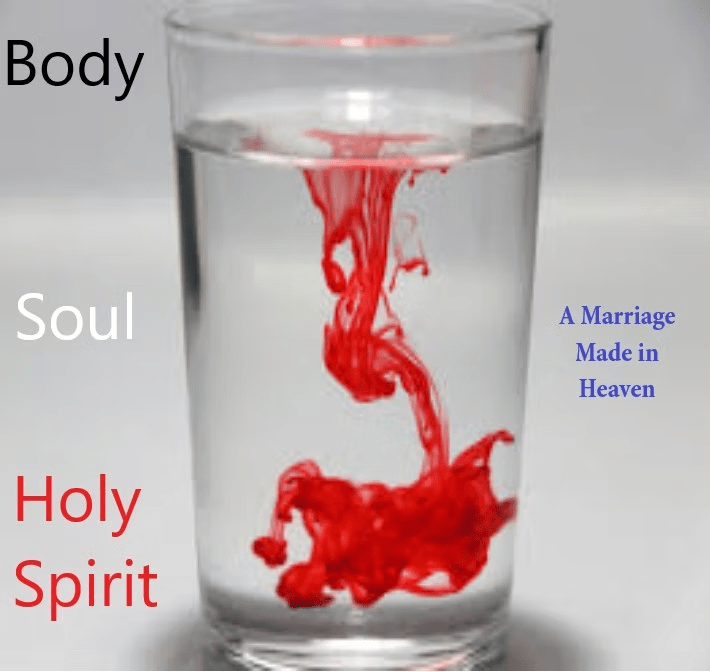
This means the “new covenant” would come with no material perks, dowries, or physical gifts exchanged. The only “land” involved would be the individual physical bodies of the bridesmaids of Yahweh [human gender irrelevant]. Those bodies would each become the temples unto the Lord [Yahweh]. Within that temple would be found the ‘Holy of Holies’, which is the heart.

While a physical body requires a physical heart, the spiritual heart becomes the soul. Just as a physical body is dead without a functioning physical heart, the human body is dead without a soul married to Yahweh – where death means the limits of mortality in bodies of flesh [reincarnation]. Therefore, when God had Jeremiah prophesy, “I will put my law within them, and I will write it on their hearts,” this is a promise of God’s Holy Spirit being merged with their souls, many times over.

This becomes the “new covenant,” where the Ten Commandments is recognized as the ‘first’ Covenant, or the ‘old testament.’ It says the “new” marriage agreement will not be like the past, as an external list of things to commit to, memorized with one’s brain [thereby easily forgotten]; but instead, it will be one where the commitment is not physical, but spiritual and thereby permanent. When one sees the “heart” as the soul that leads the flesh through life, when the soul is truly married to Yahweh, then the flesh is led through life righteously and saintly; obediently and devotedly. The body will then be led by a soul that is led by God [not an external judge or prophet, like Moses or Elijah].

When Yahweh then told Jeremiah to prophesy, “I will be their God, and they shall be my people,” this is no longer representative of a group of people that are collectively led by one prophet – like Moses, Samuel, Elijah, or Elisha [et al]. It is when each individual is married to Yahweh, such that many people like that become the people of God, all as His wives, all individually led by God’s Holy Spirit.

This is then how it comes to be that “No longer shall they teach one another, or say to each other, “Know the Lord,” for they shall all know me.”

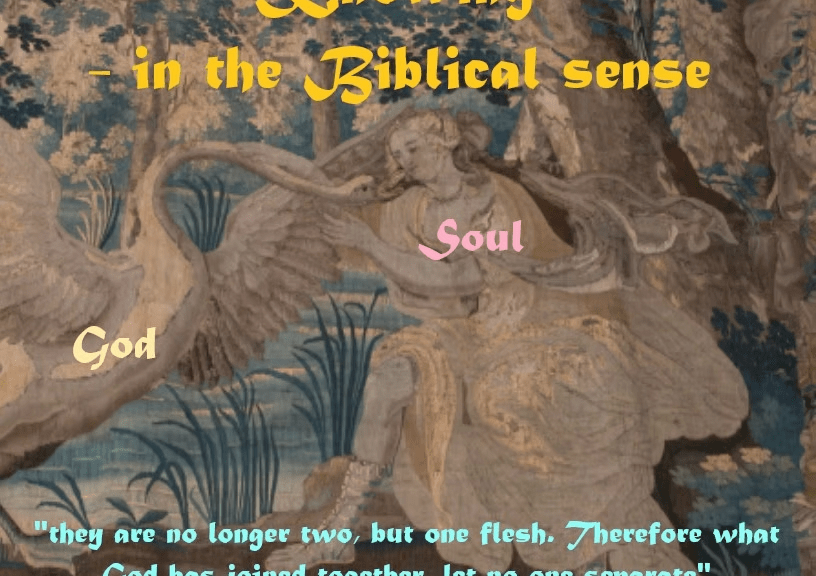
Here, the Hebrew word “yada” [“to know”] implies a learning process, where the Laws are taught by rabbis [teachers]. The element of “teaching” [from “lamad”] means the entire system of Judaism will be eliminated, as unnecessary in this “new covenant.” The reason is clearly stated as “they shall all know me,” where “yada” has to be seen as a personal experience of Yahweh, through spiritual insight and divine perception. In the same way that God spoke to Jeremiah and he was led to prophesy, so too would all those in the future, who would be individually married to God. Therefore, this makes “yada” also take on the ‘Biblical’ meaning of “to know” – “carnally, of sexual intercourse” (Brown-Driver-Briggs) – where the “intercourse” is God’s Holy Spirit penetrating one’s soul.
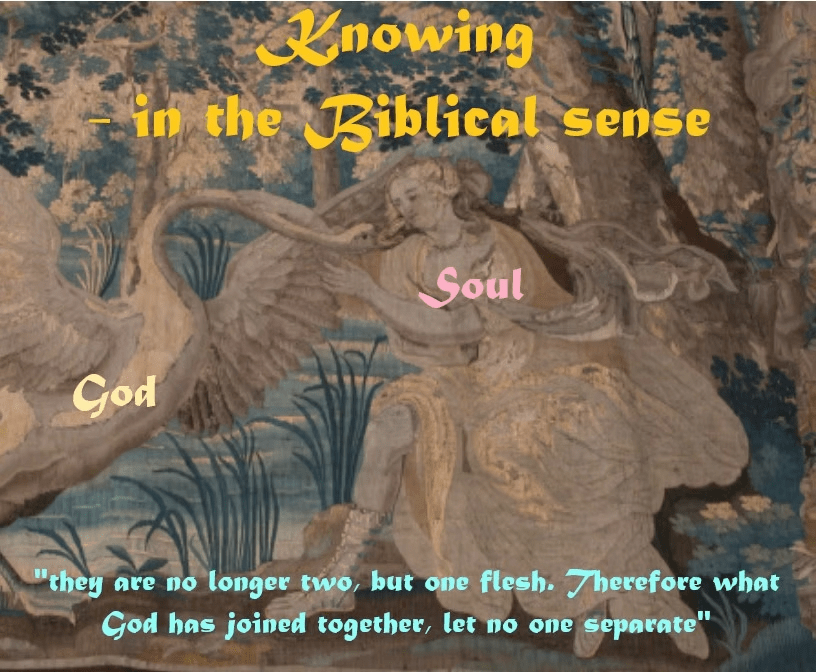
The difference between belief and faith is the same as that between bridesmaid and wife.

When Jeremiah then wrote of God saying, “from the least of them to the greatest, says the Lord,” this cannot be taken as if God was bragging about Him being greater than all the human wives He takes. By Yahweh saying, “from the least of them to the greatest,” this is a progression within one’s body of flesh, where all are “the least of them” human beings on planet earth. It does not matter which human beings, those not married to Yahweh, seem to be great – as kings, as priests of other gods, as pretty, athletic, and skillfully talented – because they are all the same, as worthless souls in mortal flesh, all bound to die and die repeated through reincarnation. The transformation that takes place in those souls who marry Yahweh is they all become righteous. They become raised in being, to those to be “the greatest.” From understanding this, Jeremiah then stated the reason one will know they are “the greatest” is by they way from their mouths speaks “the Lord” [“Yah-weh”].

When this reading from Jeremiah ends by God saying, “for I will forgive their iniquity, and remember their sin no more,” this is not stated as a promise to forgive sins forevermore. When the Hebrew “ki ’es·laḥ” [focus on “salach”] is translated as saying, “I will forgive,” it makes more sense when seeing “ki” as saying “when,” with the first-person state of being [“I”] following “says Yahweh.” Together, that makes the meaning become Jeremiah having Yahweh say, “when Yahweh … will forgive”.

The gross misunderstanding that Christians have today is God will forevermore forgive our sins, such that the Episcopal Church schedules a confession of sins every service it holds. That gives the impression that God will forgive sinners, forever and ever. That becomes a vital step in a Christian service, when the only ones attending are the bridesmaids of Yahweh, prepared to confess their sins before marriage of the souls to God’s Holy Spirit. That concept is negated when pewples proudly profess, “I am a cradle to grave Episcopalian!” Continuing to sin guarantees the grave part of that prophecy.

The only forgiveness of sins comes when a soul identifies with Yahweh [knows Him] and Yahweh then speaks for that soul forevermore. That means the soul has married God and become a saint. That transformation means all sins ceased when the marriage took place. Thus, all past sins will be forgotten, as wiped clean from the slate; but that means the slate for listing sins also is thrown away and forgotten, unnecessary forevermore.

As a reading selection for the season called Lent, when self-sacrifice is recognized as a necessary step in one’s elevation in the eyes of God, we are once again called to see self-sacrifice in terms of marriage. The “new covenant” is not a promise for forgiveness of sins, but a promise of eternal life for a soul, from having surrendered one’s lusts in the material realm. The killing of self-ego and self-will, so Yahweh can merge with a loving soul, means the beginning of a righteous way of life. A righteous way of life is impossible for a soul alone in a body of flesh because the world is too powerful of a distraction to simply will it away. Lent is a period for testing the strength of that new partnership [the carnal knowledge of faith].

It is important to realize that the “new covenant” became fulfilled through the arrival into the world by Jesus, but to think of Jesus in terms of Moses, who was a leader of a group, that is to revert Jesus’ “new covenant” to be like the old one. Since the old covenant permitted divorce, to think God will never divorce anyone who “believes” in Jesus [as the Christ] is not new. It becomes hypocritical, as well as selfish and egotistical. To be a soul alone in a body of flesh, wearing a silver cross around one’s neck [not married to Yahweh] is like saying out of one side of one’s mouth, “I believe in Jesus,” while telling oneself out of the other side, “I believe Jesus lets me keep doing every sin under the sun, if I repent.”

That is leaving God at the altar. Lent is not about practicing marriage to God, it is about living a life of righteousness, knowing God will always be one’s strength, there within one’s body of flesh, in one’s soul heart to lead you away from sin.
Hebrews 5:5-10 – Sacrificing to become a high priest in the order of Melchizedek

Christ did not glorify himself in becoming a high priest, but was appointed by the one who said to him,

“You are my Son, today I have begotten you”.

as he says also in another place,

“You are a priest forever, according to the order of Melchizedek.”

In the days of his flesh, Jesus offered up prayers and supplications, with loud cries and tears, to the one who was able to save him from death, and he was heard because of his reverent submission. Although he was a Son, he learned obedience through what he suffered; and having been made perfect, he became the source of eternal salvation for all who obey him, having been designated by God a high priest according to the order of Melchizedek.

——————–

This is the Epistle reading selection for the fifth Sunday in Lent, Year B, according to the lectionary for the Episcopal Church. This follows the Old Testament selection from Jeremiah, which has God say, “I will put my law within them, and I will write it on their hearts.” It can heard along with the verse from Psalm 51 that sings, “Create in me a clean heart, O God, and renew a right spirit within me,” or [if chosen] the verse from Psalm 119 that sings, “I treasure your promise in my heart, that I may not sin against you.” It then precedes the Gospel reading from John, where Jesus said, “Whoever serves me must follow me, and where I am, there will my servant be also.”

Let me first say that the authorship of this letter, sent to those whose official language is Hebrew [the Jews], is questioned by scholars. The letter does not state who wrote it, which leads some to think it was a woman teacher, named Priscilla, whose name was redacted because it was customary in those ancient times to not give women or children any credit, in a male dominated society. In that regard, I must say that the author of all books in the New Testament [the “new covenant” of which Jeremiah prophesied] were written by the same single source who inspired all authors of the Old Testament – Yahweh.

Let me then add to that statement of faith [not an opinion or belief] that Saul, the Jew born as a Roman citizen, who persecuted early Christians mercilessly, never personally met the man named Jesus. It could be possible that he was a pilgrim in Jerusalem when Jesus was tried and crucified, having seen that event as a public display of criminals being punished; but Saul did not know Jesus, as much as he knew how to mistreat those who had become transformed by God, becoming multiplications of Jesus Christs [Jews who became Christians].

In Acts 9:1-6, the man named Saul saw a flash of light, after which he heard a voice say to him, “Saul, Saul, why do you persecute me?” Saul then asked who was speaking to him and he was told, “I am Jesus, whom you are persecuting.” This was not a physical Jesus Saul encountered, but the voice of God identifying Himself by a name that means “Yahweh Will Save.” As such, Saul became blinded for three days and had to be led around, which becomes symbolic of how frail human bodies of flesh are, despite what rank in power and influence a human being thinks he or she is. When the flesh fails, then the soul becomes lost. Saul was saved by God sending Ananias, who was himself the resurrection of Jesus Christ, one of those reborn as Jesus that Saul was punishing. After Ananias “laid hands on Saul” he was filled with the Holy Spirit, becoming yet another reborn in the name of Jesus the Christ, prompting him to change his name to Paul.

As Paul, his soul had become married to Yahweh. As a wife of Yahweh [one of many], he became the one he had persecuted as Saul. That means God spoke to him, identifying Himself as the one who Saul would become, such that Saul was not so much persecuting souls who had been given eternal salvation, all as Jesus reborn, but Saul was persecuting his own soul by his sinful actions, in the name of Judaism. Therefore, had a woman named Priscilla written this text, sounding similar to, yet striking different than Paul, both would have been in the name of Jesus, both writing from the voice of God.

A letter from a woman would then become a perfect expression for the “new covenant” that called for all who would serve Yahweh to become His wives in marriage, giving birth to His Son Jesus – all becoming led by the Christ Mind – simply from the human perspective that the female gender is the only gender that can become a “wife.” [No apologies to homosexuals who pretend otherwise.] A letter from a woman who had become reborn as the “Son” of Yahweh would be a perfect choice by Yahweh, as a necessary one to be explaining how all men and women as the same as earthly bodies filthy from sin [the femininity of matter], must become submissive before God – the Supreme masculine Spirit – as His spiritual wives. A woman writing this letter would be appropriate as a teaching tool for all human genders, who together would become a church where all members were Christ [Christians].

With all that said, these six verses from the fifth chapter in this letter that scholars call a great piece of literature for Christianity makes it worthwhile to see how “Christ” is the first word presented in this translation. Roughly halfway through the name “Jesus” is presented. This presents the order that Paul regularly wrote – “Christ Jesus” – which is a divine reflection of the order of transformation within a human being: the Christ comes first, as a merger of a soul with God’s Holy Spirit [marriage]; then Jesus follows, as the rebirth of God’s Son within a new body of flesh.

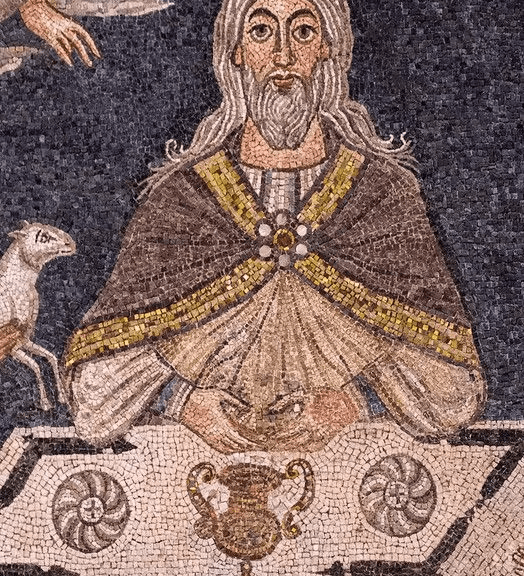
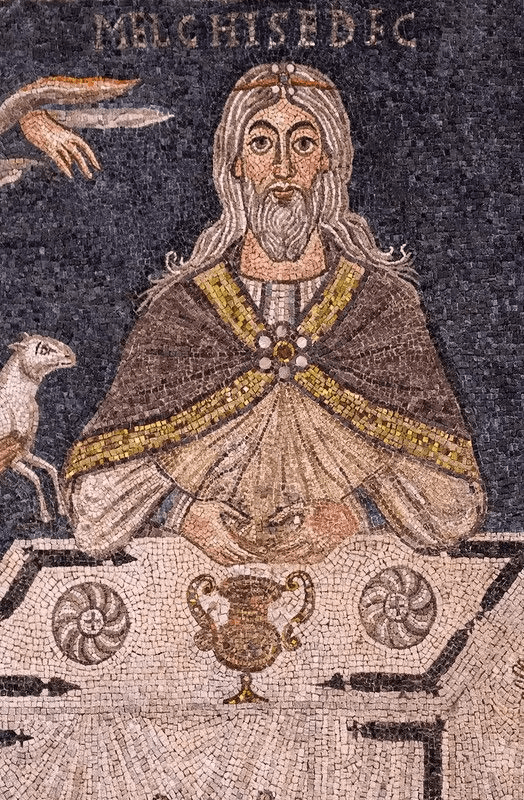
In these six verses, the word “Son” appears twice. That number is matched by the references to “Melchizedek.” In this, one needs to see the word “Son” as generic for one having been born of “the Father,” who is Yahweh – God. In contrast, “Melchizedek” is a specific name of a high priest and the king of Salem [the place later named Jerusalem], who never physically died. Melchizedek ascended into Heaven without experiencing death, as did Enoch and Elijah. Thus, these pairs of capitalized words need to reflect on all “Sons” generated by Yahweh [well within the omnipotent powers of Yahweh], all who will be made because a soul has married Yahweh’s Holy Spirit, meaning that soul will become like “Melchizedek,” having gained eternal life.

It is important to get into the semantics of close inspection of the written text, which is always different from translations into English [all versions]. To do this, I will take the translation above as presented as is first. When it accurately reflect what the Greek written states, I will explain the meaning from the translation above. However, where an inaccuracy becomes misleading, I will explain what is really stated. One such error occurs here in the first verse of this reading states, which says “Christ did not glorify himself in becoming a high priest, but was appointed by the one who said to him, “You are my Son, today I have begotten you.”

Here, it becomes most important to not make an erroneous assumption that “Christ” means “Jesus,” and nothing else. The capitalization makes the word have higher meaning, placing it on a divine level, such that the word itself is Greek for “anoint with olive oil.” The elevation in meaning is then one “Anointed” by God. This means the author is not making a statement of intellect about a misconception that the ‘last name’ of Jesus was “Christ.” This is a divine statement made by one who is also with the “Christ” Mind, from his or her soul having married God’s Holy Spirit. All who are joined as one with God [through His Holy Spirit] are to be seen as an “Anointed One” – the “Christ.” That is the only way the author can write anything about “the Christ,” as everything else becomes assumptions, based on what one has been taught externally.

Accepting that truth, we then read that this state of being is not a state brought upon oneself alone. The Greek word “heauton” is the masculine pronoun that identifies “himself,” where the masculine identifies the body of flesh [a human male body] and “self” identifies the neuter gender soul giving life to the body of flesh. The use of “edoxasen” as “glorify” can make it harder to grasp, as it can be misread as self-aggrandizement. By realizing the word as also meaning “bestowed,” one is then able to see the “Anointed” state of being surrounding a body-soul as not one “self-created” or brought about by one’s soul telling the brain, thinking: “I am now the Christ.”

The continuation then saying, “in becoming a high priest” [from “archierea” meaning “high or chief priest”], this identifies a manifestation of the “Christ” as being “a high priest.” This “Anointment” by Yahweh is for holy purposes. This title is also not something self-created, such that the high priest of the Temple of Jerusalem was one individual who was elected from the Sanhedrin. That process was an in-bred system of maintaining a family’s control over the politics of Jerusalem; still, through the election process it was recognized as not being a self-anointing to that title.

This means the truth of what God was saying through the saintly author makes “high” become an indication of divinity, such that the “priest” became a servant of Yahweh. This means the “Christ” anointment is not a self-generated state of being as a divine servant of God, as only God can make that assignment. It is an elevation to a “high” state of being, such that one becomes a “priest” of Yahweh. This makes one different Spiritually, not one enabled to apply for a position of leadership in a church organization.

The use of “appointment” is a creation of the translator, as this is not written. The Greek words written literally translate into English as stating, “on the other hand this having spoken with him : Son of me are you , I today have begotten you .” Rather than assume an “appointment” was made, as that would be how the Temple elected a human high priest [a Jew], “on the other hand” leads one to see a spiritual connection relative to the “Christ” [“Anointed one”]. Rather than read the aorist active participle [“having spoken”] as an announcement made that named only one “high priest,” the better way is to see the one who has become “Christ” is by seeing one “having spoken with him” – God. That identifies all who Yahweh speaks through – which then defines “Christ.”

This makes the quote stated – “You are my Son, today I have begotten you” – clearly as being God speaking; but the syntactical order of words, from translation, sounds much more individualistic when the statement “having spoken with” begins with a focus on “You.” The second person pronoun is stated in the indirect form, such that the correct way to phrase the Greek is as: “Son of me are you.” The capitalization of “Huios,” as a “Son speaking with” Yahweh becomes important through this distinction, which is God saying, “of me” means one has become my “Son” [regardless of one’s human gender, as souls are neuter gender]. This then becomes non-specific as “are you,” with “are” a statement of being [“ego“]. This then says “you” become the “Son” when Yahweh speaks “with you.”

When this statement is then followed by another, where Yahweh says, “I today have begotten you” [where “you” is properly placed at the end], this says the one who is the “Christ” was not, until God began to “speak with” the soul-body life form. A slightly different translation says, “I now have brought forth you.” In that statement, “you” was not the “Christ” and not a “high priest,” until “now.” The transformation is because Yahweh “brought forth” [a viable alternate translation to “have begotten”] that change.

This two-part statement is shown in quotation marks because it is clearly read as God talking, but the quotation marks make it appear that the author of Hebrews is using a known quote from Scripture. This is where the scholastic views of the epistle see it as an argument to Jews, who believed Jesus was the Messiah [the Anointed One], so they could sell other Jews in the same belief. This letter is then believed to have been intended for an ‘inner circle’ of Jewish Christian leaders, as a way of telling them where in Scripture they could go to teach other Jews: “You remember memorizing this verse?”

Many quotes do come from Scripture, with the one to follow coming from Psalm 110. However, nowhere in the Torah, the Psalms or the Prophets does God say, “You are my Son, today I have begotten you.” Some might see this as a lesson from Matthew 3:17, but I doubt anyone was carrying around a Holy Bible back then, especially one with a New Testament to refer to for quotes. Neither Paul nor Priscilla [et al] would be able to convince any educated Jew that God could have possibly spoken those words to Jesus, since neither knew Jesus directly.

This means the author would have ‘channeled’ Yahweh, as an imagined statement that God [Yahweh] would have said to Adam, in Genesis’ second chapter. It would be believable and convincing to believers that Jesus was just like Adam, thereby divinely made. It would be a quote by God that implied the soul of Adam was the same divine soul that brought life to Jesus. That would then imply that Adam was the “Christ” because the “Christ” is the Holy Spirit of God that becomes one with the souls of all who become married to Yahweh, being reborn as His “Son.”

From that, the author then wrote, “as he says also in another place.” This translation leads one to believe the coming quote from Psalm 110:4 means “another place” in Scripture. That sounds as if the reference coming is “another” like the former. Reading “another place” seems to be referencing the first quote as having come from Scripture also. Because the first quote is not a recognizable written verse in any divine text, this realization means one must understand the author writing what God said to His “Son” makes the word translating as “another place” necessary to be read differently.

Here, the Hebrew word “heterō” is translated as “another [place],” where “place” is an added assumption, not directly stated. In reality the word means, “(a) of two: another, a second, (b) other, different, (c) one’s neighbor.” (Strong’s Usage) When the (a) usage is seen as the intent, “another” means when God is also paired with a “different” [usage (b)] human being. Rather than another verse from the holy texts as the meaning, “another” is like “a neighbor” [usage (c)] of Adam.

From that, Psalm 110:1 begins by stating: “of David . a melody [psalm] uttered Yahweh to my lord .” This translation includes “Yah-weh la·ḏō·nî’ – “Yahweh adonai” as a connection made between Yahweh (God) and “Son” (“my lord”). That beginning to Psalm 110, leads to verse 4 as a confession of David that he is physically recording what Yahweh is speaking through him – musically and divine lyrically – because Yahweh is David’s lord. That becomes a confession by David that these words to follow are the product of a marriage between the soul of David (“la·ḏō·nî”) and Yahweh’s Holy Spirit. It is then introducing Psalm 110 as a song of love between God and a soul, together as one (Yahweh adonai).

Verse 4 then sings of David being a “Christ,” as also being a “Son,” such that Yahweh told him [and all who would sing the words of praise to Yahweh forever after], “You [are] a priest forever in the order of Melchizedek.”

David was the ruler of Jerusalem, just as Melchizedek held the same title in the same place; but Melchizedek was eternal, meaning God was telling that to David’s soul [“la·ḏō·nî”]. Because Yahweh did not tell that to David just to make David happy, it becomes a prophecy of all future souls who will likewise love God and serve him through a marriage of their souls to His Holy Spirit. Jesus would certainly be a fulfillment of that prophecy; but that by no means limits God to giving David a prophecy that is not still as valid in our modern times, as it was then and all times before and after. A truth is a truth forever and Yahweh adonai is a true state of being for all saints.

This is where the NRSV translation states, “In the days of his flesh, Jesus offered up prayers and supplications.” This too is now revealed as an assumption made by the translators, as the literal Greek actually states, “Who in the days of the flesh of him , prayers both kai supplications.” Nowhere is the name “Jesus” written.

The capitalization of “Hos” makes “Who” be a pronoun of importance that acts as an identifier. That important pronoun can only reflect back to Melchizedek, as being reflected in David’s soul. This then highlights the use of “te,” or “both,” so a soul leads a body of flesh to pray in unison.

The use of “kai” then marks the importance of “supplications,” which means “peace at hand,” where prayers then importantly lead to a peace of mind. That implies a peace coming through faith that one’s past sins have been forgiven. In the man known as Jesus, certainly there were “prayers,” but he had no sins to forgive “in the days of his flesh.” The author of Hebrews is then indicating “prayers” leading to “feeling of peace” are in one who was wayward and sought redemption. The “peace” comes to one who surrendered his or her soul, as an olive branch offered to Yahweh [the essence of “supplications”].

This is then seen further confirmed by the author adding, “with loud cries and tears, to the one who was able to save him from death, and he was heard because of his reverent submission.” The “prayers” are now said to have been from deep and painful entrapments caused by sinful acts, as an “outcry” or “screaming” for help. The “tears” are those offering sincerity, where the Greek untranslated by the NRSV adds “offered up,” thus the emotions of “prayers.”

The use of “death” is from knowing oneself is mortal and knowing one’s soul will be judged at that time for past actions in the flesh, asking Yahweh for salvation. Those pleas were then heard and accepted, known by Yahweh to have come from one’s heart-sou. God sees the sincerity of one offering his or her soul into “reverent submission” to Yahweh, with “reverent” a statement about “fear of God” and His judgment on his soul.

The translation above then states, “Although he was a Son, he learned obedience through what he suffered.” A better translation would take “kaiper ōn” [“although he”] and read it as “though being a Son,” where this designates a change that came after much praying and the offer of self-submission. The aspect of “learning” is more from knowing the past, as “learns from what he suffered.” That is separated (by comma), such that “obedience” stands alone as a statement of what came from self-awareness of sins past. Reflecting on what not to do is the motivation leading one to obey the will of Yahweh, not self. This becomes a clear reflection of a sinner with a bad past and not one born into the world to be without sin – Jesus.

This concept is then supported by the author writing, “having been made perfect, he became the source of eternal salvation for all who obey him.” The state of perfection, from the Greek word “teleiōtheis,” is a reflection on a past of imperfection that changed from having become an “obedient Son.” This means those changes force one to read, “he became the source of eternal salvation for all who obey him,” so the third person “he” is not one born of perfection (Jesus), but God (Yahweh). Yahweh is always the only “source of eternal salvation,” only made possible to those who obey the Will of God and not self-will.

Finally, the author said, “having been designated by God a high priest according to the order of Melchizedek.” This becomes a reflection of a saved soul becoming like Melchizedek, who never died, ascending to heaven through his divinity. This makes Melchizedek be the model of one possessing eternal life, which Jesus also possessed, from birth. This is then stating clearly how God is the One designating this release of one’s soul from all responsibilities to past sins, which then changes the soul of a human being into a “high priest,” whose temple becomes the body of flesh. As a “high priest” the soul leads one’s flesh exactly as did Jesus’ soul lead his flesh, such that Jesus will have been resurrected in every saved soul, reborn then into every saint’s body of flesh – all temples unto Yahweh.

Without a doubt, this interpretation that I have presented is not what the scholars have interpreted. The reason the world is such a sinful place (and the world is the only place where sin can exist) is it has a void of religious scholars teaching sinners how to be saints. Instead, scholars translate divine Scripture from biased preconceptions that mislead and promote more sins in a sinful world. To believe in Jesus as the Christ prevents sinners from seeing how this text from an Epistle [and all those written by Paul, and others] is teaching how Jesus as the model that all those of true faith will become. This can only come to be after realizing the flaws of one’s soul leading one’s body of flesh. That realization cries out sincerely, from the heart-soul of one’s being, asking Yahweh for eternal salvation. That can only be rewarded to those who submit their souls unto God.

Submission of a soul unto God is then a lesson of marriage to Yahweh. A soul-flesh being can become a bridesmaid for the Lord [Yahweh], engaged through having learned the lessons of past sins and entered into a period of testing that proves one’s soul sincerity. This becomes a period of prayers to God, as love letters sent to one’s fiancée. It is then the day of marriage – holy matrimony – when one changes in name and direction. One takes on the title of “high priest,” which means one makes offering unto the Lord, according to His decrees.

The sacrificial animal butchered by the high priest is oneself – a soul surrendered to Yahweh in marriage. As holding that name, one then enters an “order” or “rank” in the world of sin as a person in the flesh who is eternally saved. Salvation comes through the figurative death that represents the end of one’s self-ego and the beginning of one’s faithful servitude to God, with one’s soul forever entwined with God’s Holy Spirit.

Because Jesus was the Christ, made perfect when implanted into the womb of Mary (a virgin), who knew no sins of the flesh, the same rebirth comes from God’s presence with a human’s soul. Once one’s past sins have been washed clean, one becomes like the fertile womb of a virgin without sin, so God can impregnate a body of flesh with His Son, so all who become saints are resurrections of Jesus, all the Christ reborn.

The reason this reading is selected for presentation during the season of Lent, when self-sacrifice is understood as a necessary step in service to God, one must stop looking for Jesus Christ to come save oneself from the waywardness of a soul alone in the flesh. One needs to have already paid the price of obedience and done the acts of repentance that symbolize one keeping oil in one’s lamp at all times. The oil is that which God will use to Anoint one’s head.

The head is where the brain lies; and, a brain is controlled by the soul. When God pours holy oil upon one’s head at the marriage ceremony, then one has become the “Anointed One,” as His “Christ” reborn. This is the truth of a ‘religion’ known as “Christianity.” All members in that body of the material realm must be the wives of Yahweh. Foolish bridesmaids run out of oil when it is needed most, ‘missing the boat’ of marriage to Yahweh.

This then says Lent is the celebration of no longer having to think of ways to stop sinning. One no longer has to worry about, “How can I go forty days without doing this one act of self-gratitude?” Lent becomes the honeymoon one’s soul takes with Yahweh, before one gets down to the business of doing the Lord’s work in a sinful world. One must then give birth to Jesus and take on the Christ Mind as the Anointed One, so one can then go out into the world teaching God’s love, as the resurrection of Jesus in the flesh.

John 12:20-33 – Sacrificing from hatred of life in this world to gain eternal life

Now among those who went up to worship at the festival were some Greeks. They came to Philip, who was from Bethsaida in Galilee, and said to him, “Sir, we wish to see Jesus.” Philip went and told Andrew; then Andrew and Philip went and told Jesus. Jesus answered them, “The hour has come for the Son of Man to be glorified. Very truly, I tell you, unless a grain of wheat falls into the earth and dies, it remains just a single grain; but if it dies, it bears much fruit. Those who love their life lose it, and those who hate their life in this world will keep it for eternal life. Whoever serves me must follow me, and where I am, there will my servant be also. Whoever serves me, the Father will honor.

“Now my soul is troubled. And what should I say—‘Father, save me from this hour’? No, it is for this reason that I have come to this hour. Father, glorify your name.” Then a voice came from heaven, “I have glorified it, and I will glorify it again.” The crowd standing there heard it and said that it was thunder. Others said, “An angel has spoken to him.” Jesus answered, “This voice has come for your sake, not for mine. Now is the judgment of this world; now the ruler of this world will be driven out. And I, when I am lifted up from the earth, will draw all people to myself.” He said this to indicate the kind of death he was to die.

——————–

This is the Gospel reading selection for the fifth Sunday in Lent, Year B, according to the lectionary for the Episcopal Church. This follows a presentation from Jeremiah that prophesied a “new covenant” between God and the house of Israel. It also comes after a chosen psalm reading, either from Psalm 51, which sings, “Make me hear of joy and gladness, that the body you have broken may rejoice,” or Psalm 119, where the verse says, “I will meditate on your commandments and give attention to your ways.” Lastly, the reading from John is preceded by a reading from Hebrews, which tells of God saying, “You are my Son, today I have begotten you.”

In my opinion, this reading is somewhat enigmatic, in the sense that it begins with “some Greeks” wanting to “see Jesus,” and after Philip goes to Andrew the Greeks seem to fade away. The translation gives the impression that “Jesus answered them,” who were Philip and Andrew asking Jesus if he wanted to see “some Greeks.” I have been led to understand this from deeper insight, which is beyond the scope this Biblical commentary will allow. So, I will simply slip in an advertisement for a book that I offer on this website [katrinapearls.com].

In 2019, I wrote the chapters of the book entitled The Star of Bethlehem: The Timing of the Life of Jesus. I published it in September 2020. It was planned to be a book that presented a printed account of a six-week class I offered at my wife’s church, entitled “Astrology in the Holy Bible.” That class stemmed from my being led to realize the specific birth data for the birth of Jesus, from seeing Matthew 2 as an astrological statement, such that the “star of Bethlehem” was the sun’s placement in the zodiac. By knowing exactly when Jesus was born, his life could then be connected to known historic events, such as when “the festival” of this reading from John actually took place.

Before I realized anything about the star of Bethlehem, I had made a Lenten presentation at my wife’s church [a Wednesday night offering], when I detailed the timing of the last Passover Jesus attended, from entrance into Jerusalem until his resurrection. In that presentation, I told the attendees how each of the different Gospels dovetailed into one supportive story. As I began writing a book planned to be about one presentation, I began to add the other, as matching church presentations. I found need to incorporate both, so my dovetailing of the Gospels included this reading from John. Still, understanding the meaning of “some Greeks” came to me from another branch that my writings took me, while writing a book that became longer and longer than initially planned.

Because I began with the premise of an exact birthdate for Jesus known, I was led to ‘fill in the gaps’ that were the years of Jesus’ life, basically from his escaping into Egypt until beginning his ministry. That gap in time has historical documents available to explore, making that life be partially known; although none of those documents are recognized as canon. Still, it was from writing about ‘young Jesus’ that I was introduced to “some Greeks,” who would have been close friends with Jesus, from his younger days.

I freely admit that everything I wrote in The Star of Bethlehem was divinely inspired, as I was led to feel as if I was with Jesus throughout his lifetime, especially as it unfolded in the Gospels. I welcome discussion on the matter. For anyone who wishes to see what I wrote about this Gospel selection presented in the fifth week of Lent, the text of that book can be found on pages 217-219. Much became clear to me, which is why I wrote the book: so others will know what I was led to see. I offer this book for sale on this website at the lowest price possible; and, there will never be a profit made, because I have freely spent much more than can ever be returned making what God shows me available in print.

With that said, I will now address what the NRSV says John wrote.

These verse from John come after he wrote of Jesus’ triumphal entrance into Jerusalem, which then says “the festival” is the Passover. That event would certainly be an attraction to all Jews. This means “some Greeks” were pilgrims, descended either from the scattering of Israelites fallen to the Assyrians or Jews who went there after being freed from captivity in Babylon. These Greeks were of the same faith and religious practices, not Gentiles visiting Jerusalem ‘at a bad time’ for outsiders.

John went to the point of stating where Philip was from, saying: “[Some Greeks] came to Philip, who was from Bethsaida in Galilee.” The purpose of that place of origin says Philip was a recognizable disciple of Jesus, but none of the disciples went to the Passover festival [or any God-commanded festival] with Jesus. They each went with their own families and each made separate arrangements for where they would stay, near Jerusalem. Jesus was their leader – their rabbi or teacher – not close family; and the three festivals were for families to attend together. All of Jesus’ disciples had wives and children, as wells as others closely related of blood, whom “they loved.”

When John then said, “Philip went and told Andrew,” Andrew was the brother of Simon (called Peter). He also had family with him in Jerusalem for the Passover, having come there from an area near Bethsaida, also in Galilee. Philip and Andrew had been on the other side of the Jordan with Jesus, just prior to returning to Jerusalem for the Passover. So, their families most likely knew they would meet them there before the festival began, at the ‘usual places.’ What John wrote then speaks of Philip’s family staying near where Andrew’s family was staying.

For John to then say, “Andrew and Philip went and told Jesus,” this is separated by uses of the word “kai.” This usage means importance is denoted between each segment. It says, “some Greeks” went along with Philip to find Andrew. Once Andrew was found, “Philip went,” importantly stating he went back to where he was when found by “some Greeks.” Then, importantly, Andrew then led “some Greeks” to where Jesus was staying, in Bethany [along with Mary, Martha, and Lazarus and others]. It is then at this next use of “kai” that Andrew introduced “some Greeks” to Jesus, who then “told Jesus” why they wanted to see him. Here, the enigma is due to this meeting being one of old friends, old as from a time that is not told in the Gospels.

While it is not clearly stated, Peter had a close relationship with Jesus. Most likely his brother Andrew knew where Peter was staying, in Bethany, so Andrew would better be able to take “some Greeks” to where Peter was, with Jesus expected to be nearby. There should be no assumption that Jesus was being protected from seeing “some Greeks,” who asked “to see Jesus.” The precession is simply a ‘connect the dots’ way of John telling how “some Greek” arrived in Bethany to see Jesus. They did not know where to find Jesus, after he moved away from Nazareth.

This means when John wrote, “Jesus answered them,” that means Jesus was responding to “some Greeks” and not to either Philip or Andrew. They obviously had greetings they shared with Jesus, as old friends who had not seen each other in some time. When Jesus said, “The hour has come for the Son of Man to be glorified,” this translation does not take into account the importance of the capitalized Greek word “Elēlythen,” which means, “Has come.” This capitalization of that word acts to enhance its meaning, so it states the importance of timing, that relative to spiritual matters being at hand. This could even have a double meaning of divine significance, such that Jesus saw this visit by old friends as another sign to him, saying that trip to Jerusalem would be his last. The timing of an important event Jesus knew was coming is then accompanied by a surprise visit by old friends “Having come,” signifying the time surely “Has come.”

The element of “glorify” has nothing to do with Jesus being glorified; but instead, the will of the Father “bestowing” upon the world His grace. As such, the “hour” that “Has come” is relative to the time when Moses told the Israelites how to prevent their deaths from God’s passing over at night. The Greek word “hōra” equally means “a season” and “a particular time for doing something,” such that Exodus 12 begins with Yahweh telling Moses and Aaron all of the timing elements to happen, leading up to the God passing through and killing all the first born males who were not protected by the specific procedures God said to follow. This is then the “hour” of the Passover festival being a yearly event, when the “hour” of inspection and slaughter takes place, so the Israelites could glorify their doorposts with sacrificial blood and consume all of the flesh of a sacrificial lamb.

In that most important timing of “a season,” the first born male Israelites would be saved from death through the sacrifice of a lamb that met specific criteria. It was the death of inspected lambs that saved the first born males. Therefore, when Jesus told “some Greeks,” “Very truly, I tell you, unless a grain of wheat falls into the earth and dies, it remains just a single grain; but if it dies, it bears much fruit,” this was relative to the death of a sacrificial lamb. Jesus was saying to friends with divine insight that without that death of the sacrificial lamb, there would be no new life to come to the people of Israel.

While the metaphor of grains is vital to see, such that from one seed of wheat grows to become a plethora of new wheat, each with heads filled with grains, what is missed is the aspect of the first born males being relative to the “Son of man” [“Huios tou anthrōpou”]. Because it was the season that would be glorified by the salvation of the Passover of God, the grain that would have to die and be buried in the ground was not one of wheat, but one of the “Son of man.” The expected crop to come from that planting must be seen as many more “Sons of man,” each grown from the one sown, as a reproduction of that one. Therefore, the metaphor of the Passover saving the first born males, those born from the planting of the Son of man will not die when God’s judgment comes, as they will have averted death through the eternal life born into their souls, as “Sons of man.”

This becomes why Jesus then said, “Those who love their life lose it, and those who hate their life in this world will keep it for eternal life.” Here, it becomes worthwhile to realize that the Greek word “psychēn,” which does mean “life” (as “the breath of life”), better says “soul,” while also meaning “self.” This makes it easier to hear Jesus saying, “Whoever loves self will lose that identity upon death; but those who hate what “self” makes them do in this world and sacrifice “self” to God, they will retain “life” forevermore.”

Here, John recalled Jesus telling his Greek friends, “Whoever serves me must follow me, and where I am, there will my servant be also. Whoever serves me, the Father will honor.” In this, the Greek written that begins this series of statements is “ean emoi tis diakonē,” which presents a conditional situation, as “if me someone [anyone] serves.” One must realize the metaphor of a grain being planted, so reproductions are grown; where, just like wheat grains do not bring forth Bermuda grass, all born from the seed of the “Son of man” will be resurrections of God’s “Son.” The conditional [“if” from “ean“] has been ignored in translation, but the “if” then says “someone-anyone” being [the state of “I” from which comes “me”] born from the seed of the “Son of man” will then be Jesus reborn. It is a condition set that says only those born from that seed can become that. This is then not Jesus expecting others to serve him, as much as it says the seed of the “Son of man” plant means all other “Sons of man” will be servants, just like Jesus.

This is then the intent of “follow me,” as that does not set an expectation of a seed to stay in the ground or on the grown wheat plant [Jesus]. It sets the expectation that all other becoming “him” must likewise “follow” the path of growth he had taken. The life of a grain of wheat continually leads to the same repetition of a cycle: birth, growth, maturity, gathering, planting, death. Therefore, Jesus adding, “where I am, there will my servant be also,” says the two will be one, in the same flesh, as Jesus reborn.

Relative to the element of service, all who serve will do the bidding of Yahweh, through marriage of their souls to His Holy Spirit. This is how it was for Jesus, from birth. For someone-anyone to likewise serve God, their “birth” will be when their past sins have been wiped clean, so they can become like Jesus, as the Christ in the flesh. All of this makes God the source of all growth, just as Yahweh was the source of the first born Israelites escaping death during His Passover in Egypt.

Realizing that Jesus is still engaged with his Greek friends, who “Have come” to Jesus because of a divine purpose, Jesus then said to them, “Now my soul is troubled. And what should I say—‘Father, save me from this hour’? No, it is for this reason that I have come to this hour. Father, glorify your name.” In that statement, the confession that Jesus’ “soul “ was “troubled,” the same word translated as “soul” [“psychē“] here is the same root that which was earlier translated as “life” [“psychēn“]. The word meaning “troubled” also means “agitated” or “disturbed.” This says that Jesus was telling “some Greeks” details of his known coming death [“Has come”] that differs from his matter-of-fact way he told his disciples of his coming death [three times]; and, this becomes a clue that Jesus was very close to “some Greeks” that asked to see him. They certainly were not Jesus’ students nor were they fans seeking Jesus, being in need of healing. The way Jesus spoke to them is as if they “Had come” to Jesus as those who had previously died and been reborn as “Sons of man, as God sending Jesus some support from ‘equals’ in service to Him, to ease the soul of Jesus that was “troubled.”

In this conversation with his friends from his childhood, one can sense an understanding when Jesus rhetorically asked if he should beg to save his life, when his “soul” was guaranteed eternal life. Knowing this conversation took place where Jesus was staying, near Jerusalem, in Bethany, most likely Lazarus was there meeting the Greek friends of Jesus’ childhood and listening to what Jesus was saying. Lazarus most certainly would know, from firsthand experience, having suffering in the flesh to the point of death. Lazarus also knew it was worth it, after Jesus told his soul to come back out in the flesh of Lazarus. Most likely [as I explain in my book], at least one of the Greeks had likewise died and become re-animated in his once dead flesh. Therefore, Jesus said these things to people who could understand what he was about to face, unlike the disciples.

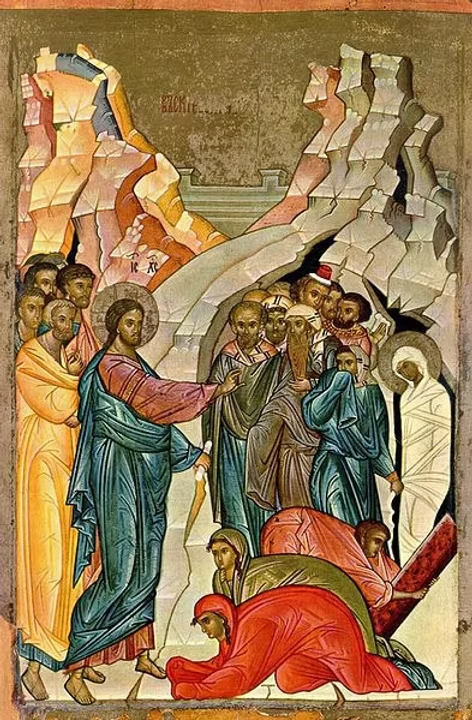
Lazarus, come out.

When John then wrote, “Then a voice came from heaven, “I have glorified it, and I will glorify it again,” this addresses this idea of others having died and been reborn in the same flesh. The returned life in Lazarus was not because Jesus said, “Come out.” It was because Yahweh granted those souls, including Jesus’, to experience what God can bestow upon souls in human flesh. It was Yahweh saying, I have raised these before you from death, and I will bestow the same grace of resurrection upon you after your sacrificial death.”

For John to hear the voice of God speaking says he was pure of heart. For him to add the aside, “The crowd standing there heard it and said that it was thunder. Others said, “An angel has spoken to him.” says not everyone present heard the voice of God speaking, at least not clearly. However, John, Lazarus and “some Greeks” heard the voice of God, because they knew God personally, having met Him through death and resurrection.

That says Jesus was not alone in the world without others who could support him in this final “hour” before his sacrifice of the flesh. This becomes more than some wild guess of mine, when one sees how Jesus then said, “This voice has come for your sake, not for mine.” They had been “glorified” by God. Jesus was next.

As for those present who did not clearly hear the voice of God, Jesus said to them, “Now is the judgment of this world; now the ruler of this world will be driven out.” In that, Jesus said his death would be not because of God, but because of the way the world judges human beings. This makes “the world” become that relative to Judaic law. The Judaic legal system had deteriorated into a cheap copy of all other systems of government in “the world.” It was not as Moses had led them when they first married God and became his wives. By realizing that, Jesus then said Judaism had become ruled by Satan [the ruler of the world], such that a religion claiming to serve only Yahweh had switched to serve “the world.” Thus, Judaism [the people ruling it] would be driven out [or “banished, cast out” – from “ekblēthēsetai exō”] as a religion no longer receiving God’s glorification. When Jesus would die physically, the power of the Jews to claim to be the children of God would also die, from self-inflicted wounds.

John then recalled Jesus saying, “And I, when I am lifted up from the earth, will draw all people to myself.” Here, the capitalization of “And” is not what was actually written, but the truth is an important statement is introduced [from “kagō” being a contraction of “kai ego”]. That importance repeats the conditional situation [“if,” not “when,” from “ean“], where all who become reborn “Sons of man” [those drawn to become Jesus] will replace the external worship of Law and become internally ruled by God, as His Sons reborn. That means Christianity [the truth of that word] will replace Judaism as that which identifies a true child of Yahweh.

When John then concluded this conversation between Jesus and his loved ones, including “some Greeks,” he wrote, “[Jesus] said this to indicate the kind of death he was to die.” That has absolutely nothing to do with John knowing Jesus would be whipped, humiliated, and nailed to a Roman crucifix. The kind of death that Jesus was speaking of is that relative to a sacrificial lamb, one that has to be inspected for four days, found without blemish. It says the blood of Jesus would be spilled, as an offering by which the souls of the first born “Son of man” could be spared death, rewarded with eternal life. That means the kind of death Jesus was foretelling was one of willing acceptance to his body being killed, like a seed naturally becomes buried in the ground, so that a continuation of life occurs. It was the kind of death that meant others could be saved.

As the Gospel selection to be read during the last week of the season called Lent, known for the necessity of self-sacrifice, one needs to go beyond simply hearing Jesus prophesying his own death. We need to hear Jesus promising us that he will be reborn into all who do the same self-sacrifice, to be resurrected into service to Yahweh. Rather than hear Jesus say his soul was troubled, so we feel sad for thinking he too had fears, we need to hear the promise of eternal life that comes from service to Yahweh.

The hidden message of this reading is “some Greeks,” who have to now be seen in the light of those who had made the ultimate sacrifice and had also been raised to the rebirth of life in the flesh. God had sent them to Jesus at his hour of need. This needs to be seen during the season of Lent as the promise that God will be there with one, after self-sacrifice in marriage to His Holy Spirit, so the wilderness experience will be when God’s voice says, “I have glorified this” to one’s soul.

Psalm 51:1-13 – Sacrificing oneself in marriage to Yahweh

1 Have mercy on me, O God, according to your loving-kindness; *

in your great compassion blot out my offenses.

2 Wash me through and through from my wickedness *

and cleanse me from my sin.

3 For I know my transgressions, *

and my sin is ever before me.

4 Against you only have I sinned *

and done what is evil in your sight.

5 And so you are justified when you speak *

and upright in your judgment.

6 Indeed, I have been wicked from my birth, *

a sinner from my mother’s womb.

7 For behold, you look for truth deep within me, *

and will make me understand wisdom secretly.

8 Purge me from my sin, and I shall be pure; *

wash me, and I shall be clean indeed.

9 Make me hear of joy and gladness, *

that the body you have broken may rejoice.

10 Hide your face from my sins *

and blot out all my iniquities.

11 Create in me a clean heart, O God, *

and renew a right spirit within me.

12 Cast me not away from your presence *

and take not your holy Spirit from me.

13 Give me the joy of your saving help again *

and sustain me with your bountiful Spirit.

——————–

This is the first choice for a Psalm reading for the fifth Sunday in Lent, Year B, according to the lectionary for the Episcopal Church. It follows a reading from Jeremiah, where we hear read, “says the Lord, … I will make a new covenant with the house of Israel and the house of Judah.” That precedes a reading from Hebrews, where it is written: “In the days of his flesh, Jesus offered up prayers and supplications.” The Gospel selection this song accompanies is from John, where Jesus said, “Whoever serves me must follow me, and where I am, there will my servant be also.”

This is a song of praise to Yahweh, sung from the perspective of one having realized the errors of one’s ways and thereby having been saved by the grace of God. In David’s first verse is recognized this salvation as being due to the “mercy” of Yahweh, “according to [His] loving-kindness.” The soul of David knows God by his soul feeling the “great compassion” that marriage to God’s Holy Spirit brings. That union is only possible after one’s past “offenses” have been erased [blotted out].

Verse 2 is then a statement of baptism by the Holy Spirit, where the Hebrew that states “wash me thoroughly” is set within brackets, preceded by the word not translated, “har·bêh.” That word becomes a signal that “much” is silently done that both washes clean oneself from one’s flesh; so, it is not simply physical but all-encompassing – heart, mind, and soul. The translation as “through and through” reflects a soul [“through”] within a body [“and through”], so all inclusive is this cleansing of past sins.

Saying “No!” to sin only happens when one has married God and become His Son reborn.

Verse 3 is then a statement of intellect, such that one’s soul has been placed in a state of shock or worry, so the brain has been enabled to understand the danger it has entered, through sinful acts. The words expressing “my sin is ever before me” says the physical world will never cease presenting lures to sin, just as it has done in the past. The mind has been able to discern how one’s soul is incapable of resisting the temptations to sin at all times. Therefore, the brain knows is will always sin if left without the help of Yahweh.

Verse 4 then states, “Against you only have I sinned and done what is evil in your sight.” This is an admission of one’s sins that are known to break the Covenant of marriage to Yahweh. By doing evils that are known to break that union, one is confessing to have turned one’s back to the Lord. A soul hides, as did Adam and Eve, to keep one’s evil deeds from being seen by Yahweh; but God sees all.

Verse 5 [actually a continuation of verse 4, in the Hebrew text] then advances this confession as a statement of mental awareness to one’s sins. It becomes an admission that the sins one has done have hurt more than oneself. By seeing that, one has ceased being the center of one’s universe. Standing outside oneself, one can then see the truth of the marriage vows established by Yahweh and understand “[Yahweh is] justified when [He] speak and upright in [His] judgment.” There are deep feelings expressed here.

Verse 6 [actually verse 5] is then a judgment of one’s mortality, as a body of flesh given life in a world that promotes sinful pleasures and selfishness. When David was inspired to admit, “Indeed, I have been wicked from my birth, a sinner from my mother’s womb,” this becomes the marvel of Jesus having been seeded into the Virgin Mary, making him not be the norm of children born into the world. The miracle is Jesus was born of a woman and not born as a sinner. Jesus reflects God incarnate in the flesh. All mortals must marry God and be reborn as Him incarnate in aged flesh. As innocent as babies and young children are, they are born mortals and thereby bound to sin before death.

Verse 7 [actually verse 6] is then singing praise for how one has been made aware of this mortal flaw. David singing, “For behold, you look for truth deep within me, and will make me understand wisdom secretly” speaks of the presence of God’s Holy Spirit, which not only knows what secrets have been hidden but also speaks the truth to one’s mind, elevating one’s knowledge to divine wisdom.

When David then sang in verse 8 [actually verse 7], “Purge me from my sin, and I shall be pure; wash me, and I shall be clean indeed,” the Hebrew refers to Yahweh as “hyssop,” which is a herb used in Jewish ritual of cleansing with water. The aspect of “purge” is then repeating a confession of sins done that must be washed away, in order to be made clean and pure. To use of “purge” says Yahweh is the only way possible for a soul to be made pure.

Verse 9 [actually verse 8] then makes this a song of praise, singing, “Make me hear of joy and gladness, that the body you have broken may rejoice.” The Hebrew here can actually be translated to say, “may rejoice the bones you have broken,” where “‘ă·ṣā·mō·wṯ” is written. The root word, etsem, means: “bone, substance, self.” This should then be read as a breaking of one’s soul controlling the deeds of the flesh, which becomes the joy, gladness, and rejoicing that reflects a marriage celebration and the ways of the self have been replaced by the ways of the Lord. Rejoicing is celebrating a rebirth, or being born from above.

Verse 10 [actually verse 9] then speaks of the breakage of self, where one’s own “face” then “hides” the “face” of Yahweh upon one’s own “face.” This speaks of the halo over one’s head, which is flesh invisibly wearing the face of God upon it. This is not singing praises that one will continue to turn away from God [one cannot wear any face other than God’s before Him], but instead praises how one’s past of sinning has ceased with marriage to God [wearing His face forevermore], so all self-generated iniquities have forever been blotted out.

Verse 11 [actually verse 10] then praises the presence of Yahweh within one’s heart, where “heart” becomes metaphor for a living body of flesh. The “heart” is what gives life to that body of flesh, thereby the “heart” is the soul. When one’s soul has married God, through a soul’s merger with God’s Holy Spirit, where the two become one flesh, then that presence means “a right spirit” has become oneself – one’s soul. The ‘renewal” means a wayward soul has been “repaired.” However, the Hebrew that says “Create in me a clean heart, O God,” actually is the soul begging to become an “elohim,” singing, “The inner me [heart], clean create in me gods [elohim] — and a steadfast spirit renew within me.” The plural of “gods” is then a recognition that one’s eternal soul is just one of many souls married to Yahweh, all then becoming His elohim – a God of gods.

In verse 12 [actually verse 11], David sings, “Cast me not away from your presence and take not your holy Spirit from me.” Here, the marriage to Yahweh is clearly announced as “wə·rū·aḥ qāḏ·šə·ḵā” [roots “ruach qodesh”], which can only be present from marriage. This is not a statement of request not to be divorced from God, but a praise that says a soul that has been joined forever with Yahweh cannot then be cast away. The sinful state-of-being prior to marriage was that “cast away” soul, or lost sheep; marriage means having been found and saved.

In the last verse [actually verse 12], David sings, “Give me the joy of your saving help again and sustain me with your bountiful Spirit.” Here, the key word of focus is “again,” as the Hebrew actually asks for “restoration.” The “joy” received, thus a gift from Yahweh, is salvation. When that gift has been received, then one is upheld by the Holy Spirit, so one’s soul no longer can fall from grace and wallow in a world of sin.

As a song of praise purposefully chosen to sing aloud during the final Sunday in the season called Lent, when self-sacrifice is an admitted necessity for salvation, this clearly paints a picture of that being the result of marriage to Yahweh. The season of Lent must be seen as a love story and not some unwanted task or dreaded sacrifice of something sinful still wanted. This psalm of David tells it like it is, there are only tow possibilities: a single soul always seeing its coming sins before it; or, a married soul that no longer has to worry about falling prey to the world’s temptations. It is this way that David’s song of praise sees marriage to Yahweh as a period of honeymoon when love abounds.

Psalm 119:9-16 – Sacrificing a whole heart to seek God

9 How shall a young man cleanse his way? *

By keeping to your words.

10 With my whole heart I seek you; *

let me not stray from your commandments.

11 I treasure your promise in my heart, *

that I may not sin against you.

12 Blessed are you, O Lord; *

instruct me in your statutes.

13 With my lips will I recite *

all the judgments of your mouth.

14 I have taken greater delight in the way of your decrees *

than in all manner of riches.

15 I will meditate on your commandments *

and give attention to your ways.

16 My delight is in your statutes; *

I will not forget your word.

——————–

This is an optional Psalm selection for the fifth Sunday in Lent, Year B, according to the lectionary for the Episcopal Church. This set of verses from Psalm 119 are only available to be read on this one day. Psalm 119 is 176 verses in length, as twenty-two sets of eight verses, each set corresponding to one of the twenty-two different letters in the Hebrew alphabet. The Episcopal Church lectionary allows for eight of these sets to be sung aloud during a service, with verses 1-8 and 33-40 each sung on multiple Sundays, while fourteen sets are never sung. Verses 9-16 are the second set of eight, thereby headed under the letter “Beth” [or “Bet”]. According to the website “Hebrew4Christians,” the letter Bet is actually the first letter of that alphabet, because Aleph is silent, representing Yahweh. That makes Bet represent Creation, when the world of matter began. The site also says Bet is “the house of Creation in sacrificial love,” making this selection from Psalm 119 fit the theme of Lent.

I believe the translation of verse 9 is incorrect as it does not clearly state the intent that comes from translating “naar” as “young man.” This makes one think of a young adult, anywhere from eighteen to thirty years of age. The better way to translate that word is as “lad” or “youth” or “a boy.” (Strong’s Usage). By seeing that, verse 9 then asks the question, “What can purify a child’s life path?” The answer is then (rather than “By keeping to your words”) is “By teaching him the ways of Yahweh” [the Laws memorized, but also demonstrated].

David was taught to be pure at a very early age, by his father Jesse. Once anointed, Samuel gave him sage advice. Still, learning has to be seen as coming from external influences, thus David sang, “With my whole heart I seek you; let me not stray from your commandments.” That becomes the answer to the question posed in verse 9, as it says teach a child to love Yahweh by teaching him to seek God, by talking to God. In that way the external laws become internalized, written on the heart center, which is the soul, due to love of God.

When David sings, “I treasure your promise in my heart,” this is a statement of love. The Hebrew word “tsaphan” is translated as “treasure,” but another translation is “hidden.”

That adds another dimension to love, such that it is an inner peace that is not openly displayed, like that of young lovers caught up in the physicality of acts commonly called “love.” To treasure the love of another, especially when the other is Yahweh, means one’s soul [the “heart”] holds an unseen treasure within, through marriage to God’s Holy Spirit. It is then that inner bond of love becomes the security of true love, which is faith and trust and knowing one loves pleasing the Lord with all one’s heart, mind, and soul.

In verse 12, David names “Yahweh” specifically, rather than read the generalization of “O Lord.” To sing that Yahweh is “blessed,” as the One God, becomes an understatement for the Most High. This should then be sung form one’s own heart, as a statement about knowing oneself is “blessed” in being, by having become Yahweh in name [as “you”]. It is then that personal blessing by Yahweh that instructs the body-soul in how to act, which are the “statutes” of righteousness. It is then that state of being that is “blessed,” justifying Yahweh’s presence within.

David then sings, in verse 13, about the blessing brought upon him by the presence of the Lord. He has become righteous and a prophet. Here, David sings of the sacrifice of self, so one’s own opinions become submissive to the Word of God that comes from one’s mouth. In this verse, the point is made that Yahweh does not take on a human wife [regardless of gender] because it is pretty or important among others. This state of marriage is not as if God wants the greatness of a mortal to be seen as a reflection of His greatness. This verse says God chooses to marry souls that willingly surrender to His Will, so that soul’s flesh will become the voice of God on earth, so others can be likewise saved.

Verse 14 then becomes David’s soul rejoicing because of the wealth of knowledge that flows through his body, all processed by his brain, so everything spoken by Yahweh makes sense. This is the presence of the Mind of Christ, where “Christ” says all who are married to Yahweh become His “Anointed One.” God knows all the questions the faithful pose, which have been generated by the widespread ignorance held by their religious leaders. When the Lord speaks the truth through one’s mouth, the brain possessed by a soul understands the vast capacity of knowledge the Christ Mind flows through one, which becomes filtered through a human organ for thought.

Because of this awe inspiring presence making one speak in ways others have never heard reasoned thought be expressed before – all being heard as truth and light shed on misunderstandings – the soul is then allowed to sit alone to ponder these revelations. It is this processing of the truth that one is transformed from simple believer into a prophet and saint, able to speak the truth of God to all seekers. This means contemplation expands into ministry, so others who are begging for help can be led into the same light and their own soul-sacrifice to Yahweh. A saint trusts that Yahweh will always speak the truth through one’s mouth, so others can be led to the light.

In the eighth and last verse in this set that praises marriage to Yahweh, David sings, “My delight is in your statutes; I will not forget your word.” This says the ways of righteousness are a delight to a soul, such that the body of flesh feels pleasure in ways no worldly addiction can ever bring. By never forgetting the statutes of God, those words have become ingrained in the soul and can never be erased. This becomes the delight of knowing one’s soul has been saved from the death of the flesh, having gained eternal life.

As an alternate song of David possible to be sung aloud during the final Sunday in the season we call Lent, it is clear to see it as a song of praise from one’s soul having come to know the Lord through marriage. The season of Lent is recognized as a mandatory sacrifice that must be made, in order to serve Yahweh. That servitude can only come from the complete sacrifice of self-ego, so one’s soul submits totally to the Will of God, merging the soul with His Holy Spirit. This psalm makes it clear that this transformation is worthy of rejoicing. It becomes the celebration of marriage, when children join to be come adults … then parents. Lent is a reflection of that cycle of commitment.

When Lent is seen as some partial willingness to please God, it diminishes the purpose of the period set aside as sacrificial by some Christians. Lent is a willing release of one’s soul to Yahweh, allowing Him to control one’s body of flesh forevermore. It represents a marriage of permanence, where vows of promise are made between a spiritual couple that never end. To see a forty day period that recognizes this sacrifice, it should be period that celebrates a blessed event in the past, like a most holy wedding anniversary remembrance. If it is seen as a new forty-day plan, so oneself can maintain control of one’s body [not God], then the meaning of Lent has been lost.

Mark 11:1-11 – Understanding Bethphage, a donkey colt, and palm branches

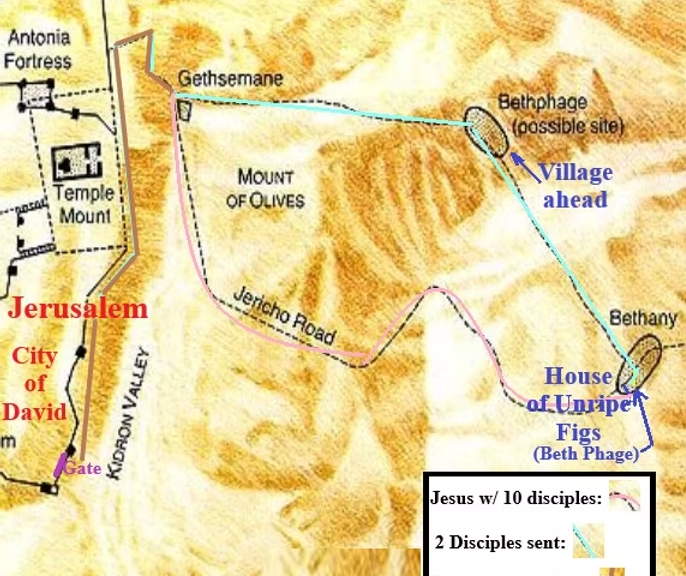
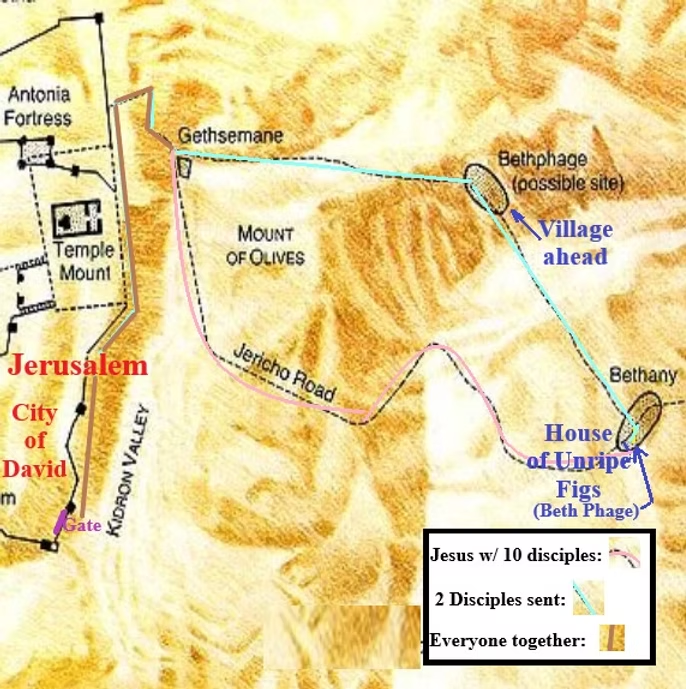
When they were approaching Jerusalem, at Bethphage and Bethany, near the Mount of Olives, Jesus sent two of his disciples and said to them, “Go into the village ahead of you, and immediately as you enter it, you will find tied there a colt that has never been ridden; untie it and bring it. If anyone says to you, ‘Why are you doing this?’ just say this, ‘The Lord needs it and will send it back here immediately.’” They went away and found a colt tied near a door, outside in the street. As they were untying it, some of the bystanders said to them, “What are you doing, untying the colt?” They told them what Jesus had said; and they allowed them to take it. Then they brought the colt to Jesus and threw their cloaks on it; and he sat on it. Many people spread their cloaks on the road, and others spread leafy branches that they had cut in the fields. Then those who went ahead and those who followed were shouting,

“Hosanna!

Blessed is the one who comes in the name of the Lord!

Blessed is the coming kingdom of our ancestor David!

Hosanna in the highest heaven!”

Then he entered Jerusalem and went into the temple; and when he had looked around at everything, as it was already late, he went out to Bethany with the twelve.

——————–

This is the outdoor [usually] reading selection [considered Track 1] for Palm Sunday [also called Passion Sunday], Year B, according to the lectionary for the Episcopal Church. This is the only time in the lectionary cycle that this selection will be read aloud. As a reading where the congregation gathers outside the nave, this is considered to be the Liturgy of the Palms.

It marks the triumphal entrance of Jesus into Jerusalem, riding a donkey colt, arriving for his final Passover. Because this outside reading is partnered with the usual indoor readings [Old Testament, Psalm, Epistle and Gospel], with the Gospel reading being a quite lengthy reading from Mark’s Gospel [either his chapters 14 & 15, or just chapter 15], so much will be presented of Scripture to the congregation, nothing of merit will be preached. With the Episcopal Church the organization that appreciates short sermons, most priests will simply say little more than, “I’ll let the emotion speak for itself.”

This attitude [biting off much more than one is willing to chew on … in 15 minutes] makes the theatrics of Palm Sunday become a major attraction for church members who rarely attend other services during the church year [Easter and Christmas being other times when people flood into the churches]. Perhaps, the lack of a sermon makes it easier for some to sit through this service. Therefore, for those who seriously seek education and guidance from a church, I feel it becomes important to understand what is divinely stated in this reading; otherwise, people will blindly believe that God wants dried palm branches to symbolize His Son in the flesh.

Because this reading is never deeply discussed, I myself have just now [as I prepared to write this] realized that the place named “Bethphage” is only listed three times in all the Holy Bible (according to Strong’s). The three are all relative to the same story told here in Mark 11, found in Matthew 21, and in Luke 19. In addition to that, when looking up a map to depict the locations of this reading and the others (done previously), I had seen notations that the place known as Bethphage was not clearly known. The map noted Bethphage as “possible site.” Now, as I look things up, I am led to have a better understanding of what is written.

I added some insight to the map I found.

The word “Bethphage” is actually two words in Jewish Palestinian Aramaic, which mean “House of Unripe figs” [“Bēth Paggē”]. (Wikipedia) This says to me now that “Bethphage” was not a town by that name, but a “house” that was located in Bethany. It was there that fruitful fig trees were numerous, possible even a fig farm, so to speak.

One of the things I have been led to realize about divine Scripture is it is perfection and cannot be changed by human brains. This means the order of the words is essential to read as ways to find deeper insight. In the order found here in Mark 11: Jerusalem is listed first, as the place the group would go to, for the Passover; Then, Jesus drew near to Bethphage; and third, The place Bethany is named. This order is telling a story that leaps over time and is not simply one instance.

With three Gospels telling of Bethphage, John’s Gospel is the only one not making this mention. In two of the three Gospels (Matthew and Mark), this story begins the chapter that follows that which tells of Jesus having stayed the night in Jericho, healing blind beggars. In Luke’s Gospel the same order exists, with chapter 19 beginning with Jesus meeting Zacchaeus in Jericho and then, while staying at his house overnight, Jesus told the parable of the ten minas. After that, Luke wrote of the triumphal entrance.

John, on the other hand tells of Jesus having been told of Lazarus’ illness, while he was on the other side of the Jordan, where he waited two days before going to Jericho, then spending the night there. John is the only Gospel writer who tells of Jesus going to Bethany and healing Lazarus, after he had been dead four days. John tells of the triumphal entrance [the Track 2 choice, instead of this reading from Mark 11], but begins his twelfth chapter telling: “six days before the Passover, came Jesus to Bethany,” where his feet were anointed by Mary Magdalene. John then wrote of a plot to kill Lazarus, before he wrote of the entrance into Jerusalem. All of this order adds depth to the whole of four Gospels, when they are dovetailed together as one history.

The Greek text of Mark 11 begins with this order of wording:

Kai hote engizousin eis Hierosolyma , eis Bēthphagē kai Bēthanian ,

In this, there are two segments of words, denoted by the presence of one comma mark. Beginning the first segment is the capitalized word “Kai,” which denotes major importance is made in the following words. That shines importance on the statement that says, “when they drew near to Jerusalem.” In that, the third person plural [“they”] refers to the whole group of disciples and followers of Jesus, all having come from the other side of the Jordan.

Following that important statement is then a comma mark that pauses that approach to Jerusalem, such that they had neared as far as “Bethphage.” This says Bethphage is a place of rest, before actually going into Jerusalem. It is here that another “kai” is found [lower-case], which then makes the important announcement that clarifies “Bethphage” as being in “Bethany,” as a “House” [“Beth”] there, known for its figs.

The importance of Bethany (from “kai“) can then be seen as where Jesus stayed without his disciples. The segment of words that say, “into Bethphage and Bethany” says “they” [the third person plural of the group from the other side of the Jordan] divided up, “into” two separate places, with both (importantly from “kai“) being in Bethany. The use of “kai” then speaks as a divine indication that Jesus stayed in Bethany at the house of Mary, Martha and Lazarus, while the other disciples and followers stayed on the fig orchard on another side of town.

This not only explains how no one but John wrote about the most remarkable miracle of Jesus raising Lazarus from death, but it also adds a clue that is relative to the Passover timing. While the news of Lazarus having died and been raised by Jesus certainly would have reached the group staying at the fig farm, God did not have anyone but John recall this miracle, because he was the only eyewitness to that event. As the only eyewitness to that astounding miracle says two things: 1.) Jesus’ disciples did not go with him to Bethany, where Mary, Martha, and Lazarus had a home; and, 2.) John was not a disciple of Jesus and had not been with Jesus on the other side of the Jordan, instead living with Mary, Martha, and Lazarus.

As far as Bethphage being a word that states importantly (through capitalization) “House of Unripe Figs,” that name for a place would become perfect symbolism for all the followers of Jesus, who at that point in time were the fruit of his vine, who were still in need of maturing to turn into good fruit. This name then says the group separated from Jesus and stayed at a place known for unripe fruit, which was metaphor for their spiritual state of being at that time.

This then also becomes an important statement (due to capitalization) that Bethphage was known for delivering to the Temple the first fruits of figs for the Passover, an omer amount [dry weight] picked in an unripe state. This gathering of unripe fruit would then sit in the Temple, along with other first fruits [including grains], which would be blessed on Shavuot, after a counting of fifty days [the meaning of Pentecost]. The first day of that counting takes place on the second day of the Passover festival [16 Nisan]. This symbolism says the disciples and other followers were the first fruits of Jesus, who would be delivered to the temple as unripe figs with his arrest, who would ripen as Apostles on Pentecost Sunday.

In the map that I have modified, one can see the Jericho road as tracking from Bethany due west, until it reaches the Mount of Olives and then tracks north. The place thought to be a possible location of Bethphage is then not the House of Unripe Figs, but the “village” Jesus sent two disciples to, so they could get a donkey colt that would be found tied up. By sending two disciples there, this says Jesus and the rest of his group went a different route. The only possible place for a village to be [with only two roads out of town] is then the one mistakenly thought to be Bethphage. That acts to confirm this theory, in my mind.

When Jesus told two of his disciples to go and untie a donkey colt that has never before been ridden, one can assume [just as when he told them to go prepare an upper room] that Jesus had a larger network of associates than just his disciples, followers and family. I believe Jesus was an Essene and other Essenes in and around Jerusalem, Judea and Galilee knew Jesus and discretely communicated with him, through messenger or by Jesus meeting with them, with nothing ever recorded and placed in a divine text of those meetings. As such [just like with an available upstairs room], Jesus and others were aware of what was soon to happen and prepared for that event, just as Jesus told them to be prepared.

In the written word of Mark, Jesus prepared his disciples to say, if asked why they were taking a donkey colt, the words “Hoti Ho Kyrios autou chreian echei,” or “Because This Lord has need of it.” While the voice of the spoken word does not denote capitalization by sound, “Because This Lord” is written as important via capitalization. The capitalization in text then explains how those words were designated signal words of preparation. It means Jesus told them precisely what to say if asked why they were taking a colt they did not own; so, “Because This Lord” becomes secret code that allows acceptance of what was taking place.

It says, with the capitalization of “Ho” (typically the article “the”), Jesus instructed them to say slowly, “Because … This … Lord,” where emphasis is placed on themselves (“This”) being “the Lord” in body, and in need of the colt, which would be returned. This becomes comparable to Jesus sending his disciples out into ministry [internship] with specific words to say [“Peace to this house” or “Has come near the kingdom of God”]. This means the two disciples spoke as “This Lord,” not just some stranger walking up.

By seeing how the map shows two routes merging at Gethsemane that would be the prearranged meet up point. That would be where the two disciples with a donkey colt joined to become one whole group again. This becomes symbolism that the entrance of Jesus into Jerusalem as a prophesied savior would begin at the same place that Jesus would be returned to Jerusalem as the sacrificial lamb that would become the truth of the savior prophesied. Jesus had prepared to enter Jerusalem just as the prophet Zechariah had foretold:

“Rejoice greatly, O daughter Zion! Shout aloud, O daughter Jerusalem! Lo, your king comes to you; triumphant and victorious is he, humble and riding on a donkey, on a colt, the foal of a donkey.” (Zechariah 9:9)

By riding on a donkey colt that had never been ridden before, Jesus was demonstrating how weak the rulers of Jerusalem were. They had no power over the Romans, just as the Judah of Zechariah had no way to defeat the Babylonians, who could not defeat the Persians. It means Jesus riding upon a donkey colt, parading before the leaders who overlooked from the Temple of Jerusalem, Jesus mimicked the weakness of the leaders of the Jews [those in the flesh]. As a dismal display of weakness, Jesus (in the flesh) was riding a donkey colt with no battle experience, with him wearing no armor. Still, the gall of doing that meant Jesus was more powerful than anything the Temple rulers could ever be.

This then fulfils the insult of Zechariah, who was divinely inspired to write:

“As for you also, because of the blood of my covenant with you, I will set your prisoners free from the waterless pit. Return to your stronghold, O prisoners of hope; today I declare that I will restore to you double.” (Zechariah 9:10-11)

That says the rulers of Jerusalem were justified to rule only by being blood relations to Yahweh’s ex-wife Israel. Following divorce from Yahweh [and subsequent losses of their lands], Jerusalem had become a cistern without any waters of emotion for Yahweh, as seen in the returning Jews fighting over control of a city and people related by blood. The Jews had become “prisoners of hope,” which was the prophecy of a coming Messiah. The hope was a warrior prince with magical abilities. However, that hope was dashed when the prophesied Messiah was said to be fulfilled by a single man riding a young donkey colt, without armor, nothing like the images their hopes relied upon.

The promise to “restore to you double” becomes metaphor for a double share of spirit [Elisha asking Elijah], where the king would be Yahweh, married to the souls of the hopeful. That tells the truth about the Messiah. He was prophesied to come in the frailty that is human flesh, while also being a prophecy that the Messiah can only return in the frailty of your human flesh [individually], after God marries one’s soul. The return will not be a one-to-one exchange [a lost David for a new David-like king] but a one-for-many exchange [one temple of stone for many temples of flesh].

To get the full scope of this picture of Jesus sitting atop a small donkey colt, never before forced to hold up the weight of an adult human male, Jesus is probably riding side-saddle too (so to speak), because he is wearing the robes of a rabbi (kinda like wearing a dress). That effeminate appearance is clearly designed to display the insult intended by Yahweh speaking through his prophet Zechariah, fully known by Jesus. Additionally, Jerusalem was filled with early-arriving Jews, so there were many outside the walls of Jerusalem, along the road overlooking the Kidron Valley. They would have all be educated to memorize Zechariah’s song, so they all burst out laughing at this miserable sight coming before their eyes. None of them [for the most part] had a clue who Jesus was; but one look at him meant sarcastic humor was readily being mimicked in real life, as if Don Quixote would suddenly appear to those having read Man of La Mancha.

While every Jew in Jerusalem that saw that scene knew the meaning of that prophecy, all had mostly given up hope of a Messiah ever truly coming to free them from their prison of emotionless Judaism, much less the domination of one world power after another who had taken over the land once known as Israel. The zealots of Judaism’s frustration created attempts that always ended up being paper warriors pretending to fight for Israel’s land back. All those “Messiahs” only found themselves charging figments of their imagination. All were as disgraced as was this image of Jesus on a small animal that was placed before them. Therefore, as a joke they began singing praises for their new king having finally arrived, after such a long wait.

This is where the symbolism of branches placed upon the road must be understood properly. They were laid before the donkey colt’s path, with Jesus also being fanned by them, like he was indeed a king. He was shaded by them, so he would not get too hot in the sun. All this mockery is missed by modern Christians, those never taught one iota about Judaism.

Where Mark wrote, “Many people spread their cloaks on the road, and others spread leafy branches that they had cut in the fields,” Matthew wrote, “A very large crowd spread their cloaks on the road, and others cut branches from the trees and spread them on the road.” Luke wrote, “As he rode along, people kept spreading their cloaks on the road,” with John writing, “So they took branches of palm trees and went out to meet him.” All are saying the same thing, with three telling of the symbolic act of spreading a cloak before a rider on a horse, and three telling about branches cut from [most likely] date palm trees. Christians ignore the element of cloaks [a statement of laziness] and place great value on dead palms [this reading is called “The Liturgy of the Palms”].

The element of cloaks, spread both on a donkey colt and then the ground before the donkey colt, has to be seen as symbolic of one saying, “I do not want you to get dirty.” In the case of Sir Walter Raleigh spreading his cloak over a mud puddle for Queen Elizabeth I [a myth], it was to keep her royal clothing from becoming soiled [as well as her tootsies in royal shoes]. The same prevention would be to keep Jesus from getting animal hairs or parasites on the beast from getting on him. As for cloaks and branches on the road, those would be to keep the animal from creating a cloud of dust that would dirty Jesus’ feet and robe. Thus, cloaks (and palm leaves to some extent) would keep a king from becoming dirtied, like were the common people. Certainly, none of them saw Jesus as a true king, so the cloaks placed in the dirt were already dirty from a pilgrim having travelled in dust for a day or more.

The symbolism that must be seen from both cloaks and palm branches being used is this: It kept Jesus from coming in contact with the earth. That says the Jewish pilgrims believed their Messiah, promised to them by Yahweh [supposedly their God], would be so holy that he should never be seen as human. Just as Caesar had told everyone he was a god and should be worshipped as such, the Jews were expecting the same kind of deity in a physical body. Simply from that point of view, a palm branch had the same effect as being a way to shield the common people from the glory of God on earth, becoming like the Israelites demanding Moses wear a veil to cover his glowing face, after having met with Yahweh.

A palm branch becomes akin to some form of a fan used by fan dancers, where the nudity of a deity must never be seen, only glimpsed from time to time. That symbolism becomes an admission that says, “Great! Our Messiah has come! Now, I can go back to doing what I was doing before, without worrying any more because our Messiah will do everything for us.” Many a Christian today has this attitude, and many a Christian leader has promoted that lackadaisical view that says, “All I have to do is say I believe. So what if I have never seen anything but palm branches. As long as I think Jesus is behind them, everything is going to be okay.”

As easy as it might be to see that symbolism, the deeper symbolism of Mark writing, “others spread leafy branches that they had cut in the fields” speaks of dead branches. Here, the Greek text actually states, “stibadas kopsantes ek tōn agrōn,” or “branches having been cut down from the fields.” This does not state that the Jewish pilgrims carried knives with them for the purpose of pruning trees. It says the farmers who owned the trees had done the cutting, with dead branches piled along the side of the road as trash, to be burned. The reason the branches would be cut from the field is as Jesus had said: “Whoever does not abide in me is thrown away like a branch and withers; such branches are gathered, thrown into the fire, and burned.” By realizing this, the use of palm branches to set on the path of Jesus says, “Wherever you are going, I am like a dead branch for your mighty donkey colt to walk over, because I certainly will be of no other use to you.”

Finally, skipping past the adulations of the Jewish expectations for a Saint of God [“Blessed in the name of the Lord”], a Saint in the line of David [“Blessed king like David”], the last verse begins by saying, “Kai he entered into Jerusalem , into the temple”.

Jesus entered Jerusalem through the gate of the lower city, the City of David, which had a long series of steps that led up Mount Zion, to the Temple atop Mount Moriah. Jesus entering the City of David would be symbolic that he indeed was of the lineage of David, also born in Bethlehem (although few realized that truth). That is the importance of the capitalized “Kai.” His going into the temple was not just to see if anyone wanted to pick a fight with him [like a pretend warrior prince would do]. It was to drop off the omer of unripe figs that had been gathered. In the temple Jesus placed first fruits of the field in Bethany with all the other first fruits dropped off at the temple. [There might have actually been a precession of Jesus’ disciples, each carrying an omer of unripe figs. This would satisfy the capitalization as an important House of Unripe figs – because so many were offered from that fig farm in Bethany.]

When verse 11 then states, “kai periblepsamenos panta , opse ēdē ousēs tēs horas” or (importantly) “having looked around at everything , late already being the hour,” this says Jesus looked at all the other first fruits offered, as well as looking to see if the vendors were still allowed inside the temple. He would have also inspected the processing of donations made to the treasury and looked at the cleanliness of that holy building. When the comma mark then leaps forward in time, “late” is a statement of it being after the three o’clock hour, therefore in the evening of day. The Jewish evening prayer would be at six, so Jesus probably preferred to pray then on the mount of Olives. Therefore the time would have indicated to Jesus (and the disciples, with other followers) that it was time to return to where they were staying in Bethany. That included those staying at Bethphage.

Because no sermon will ever be preached outside an Episcopal church on Palm Sunday, there is no need to associate this reading with a day that somehow falls in the season of Lent, with Sundays not counting, so it is of no consequence worth discussing. The travesty of Palm Sunday is it promotes worship of a system that refuses to become reborn as Jesus, with the Christ Mind being the result of marriage of one’s soul to Yahweh. Instead of being a church lead by individuals who have experienced that rebirth and know the joy in their souls to be servants of God, seeking the lost and showing them how to be found [the original reality of “Christianity”], all churches of Christianity now pander to raking in the cash and handing out trinkets that act as if they have the right to promise any soul other than their own is saved. Christianity has become the Temple and its Sanhedrin, all seeking to kill Jesus, because he is bad for business.

The act of handing out palm branches on Palm Sunday says, as presented here in Mark: refuse to commit to God, because you think He is too aloof to ever be close to. The act of saving those palm “used” branches, to be burned [as a normal act done to trash, not a holy act of sacrifice – see Cain for that lesson], so the ashes that burning creates can then be smudged on someone’s forehead [along with some oil added] means the church promotes its members walking around marked as dead to God. Handing out dead branches and marking members by the ashes of burnt rubbish, all symbols of someone who bears no fruit, is a bad sign

If it were children pretending to be priests, simply because they went to church and liked the activities of children’s church, without having a clue why the adults go to church, all the ignorance of children could be smiled upon. “Look at them playing church. Isn’t that sweet and cute!” However, to see adults taking the same ignorance of children and promoting it as the meaning of a religion is absurd and an insult to Yahweh.

It is in that vein of ignorance that this reading from Mark [et al] has to be read: as an insult back to organized religion [Judaic then, all Judeo-Christian today]. An insult was prophesied because God did not send a little-g god in the flesh to be some external king that all can spread cloaks and palm branches out to keep him away. God sent His Son to show all humanity how important it is to become another Son of Yahweh [regardless of one’s human gender].

Note:

I wrote this in another article about this Palm Sunday liturgy and it is necessary to grasp that no tree (no plant that produces fruit) only produces green (unripe) fruit. All fruit is initially unripe; but, given time, it will not only ripen and be the tastiest it can be, it will rot if not eaten, falling off the tree to the ground where seeds will take root. Thus, Bethphage – the House of Unripe Figs – is a statement about gathering green, unripe figs. It is impossible for a fig farm to only produce green figs that never ripen.

Isaiah 50:4-9a – The liturgy of adonai Yahweh – God is my lord

The Lord God has given me

the tongue of a teacher,

that I may know how to sustain

the weary with a word.

Morning by morning he wakens–

wakens my ear

to listen as those who are taught.

The Lord God has opened my ear,

and I was not rebellious,

I did not turn backward.

I gave my back to those who struck me,

and my cheeks to those who pulled out the beard;

I did not hide my face

from insult and spitting.

The Lord God helps me;

therefore I have not been disgraced;

therefore I have set my face like flint,

and I know that I shall not be put to shame;

he who vindicates me is near.

Who will contend with me?

Let us stand up together.

Who are my adversaries?

Let them confront me.

It is the Lord God who helps me;

who will declare me guilty?

——————–

This is the Old Testament selection for the indoor service on Palm Sunday, Year B, according to the lectionary for the Episcopal Church. With an outdoor service held first, when palm leaves are passed out to all in attendance (called the Liturgy of the Palm), the congregation is then solemnly led inside, where the regular service is called Liturgy of the Word. This particular selection from Isaiah will be read in all three years of the lectionary cycle (A,B, and C). Due to the length of the Palm Sunday service [aka Passion Sunday] (outdoor and indoor) means nothing will be said about these words from Isaiah at those times. However, these verses will also be read on two other occasions in the church calendar, with it being possible they will be then be explained in a sermon. the best chance for that happening will be during the Ordinary time after Pentecost, Proper 19-B service.

The name of the book this reading comes from is “Isaiah,” but as is the case with religious scholars (it appears), teaching doubt at every turn is best to keep educators employed, always needing someone to teach “church history” and other tricks of dogma. Doubt weakens the faith of seekers. Here, the ones with the larger brains have figured out that this chapter [number 50] falls under the heading “Deutero-Isaiah” The scuttlebutt says Isaiah chapters 40–55 are “the work of an anonymous 6th-century BCE author writing during the Exile.” (Wikipedia) That says, it is the educated guess that should be taken as “gospel” is some prophet [of unknown nomenclature] put his name on a document that preexisted, under the name “Isaiah.” Presumably, he just added more to a book that the real Isaiah had begun.

To move beyond the doubt, where the same source says, “Isaiah was one of the most popular works among Jews in the Second Temple period (c. 515 BCE – 70 CE). In Christian circles, it was held in such high regard as to be called “the Fifth Gospel” (also Wikipedia), I feel the author of all divine Scripture is the same – Yahweh. Because bodies of flesh and bone are temporal and are bound to die, Yahweh uses multiple bodies of His faithful – His prophets – to write His Word.

I also firmly believe that anyone who professes to be a “Christian” must either begin with that belief – God is the author of all within the Holy Bible, thus all are words of truth – or one needs to admit one is not a Christian. If one sees a church as a place to be educated so one can enter ministry, that boat is not longer sailing. Being a prophet like Isaiah [who was trained in the school of prophets, but not well enough to write a book] is no longer a “tag, you’re it” process – the one that made Christianity great. If you think the only way to be a priest for Yahweh is to attend a school offering diplomas, then you put your faith is in scholars, not the One God.

Verse 4 in this reading selection makes a clear statement of one being divinely possessed by Yahweh. The first words that have been translated as “The Lord God” are written in Hebrew as “adonay Yahweh” [no capital letters in Hebrew]. This means “The Lord God” actually states “lord [of me] Yahweh.” [I allow that capitalization.]

The use of “lord” [“adonay”] has to be understood as being a statement about self, where the spiritual self of a body of flesh is the soul. Regardless of external motivations and enticements, the soul is the lord of the body, operating through the human brain. The body does as the soul commands, although the body can become like a crying child, so the soul ends up pampering the body, just to shut it up. This means the word “adonay” alone means a soul as lord over a body.

When the word “adonay leads to “Yahweh,” that then becomes a statement of marriage between Yahweh and a soul in a body of flesh. It is that union that causes the body of flesh’s lord to be Yahweh – His Holy Spirit. Thus, verse 4 is a proclamation that whoever it was going by the name Isaiah [maybe there were several Isaiahs who were prophets?] was filled with the Holy Spirit of Yahweh and led to speak the truth, in Yahweh’s name.

When we read, “given me the tongue of a teacher,” the element of possessing a “gift” of speech is important to realize. Without the presence of Yahweh controlling a body of flesh, then that ability to speak God’s Word would not be possible. That talent is given by one becoming a wife of Yahweh.

The Hebrew word translated as “teacher” is “limmud,” which means “taught.” Of course, we all know that the title “rabbi” means “teacher” [Aramaic “rabbonni”]; but in order to become a “teacher,” one must first be “taught.” Because of possessing the ability to speak [“tongue”] as a “teacher,” that means one has been “given” wisdom, which one received. That is what has been freely given by Yahweh; still, the prophet [Isaiah] was thereby being “taught” while he spoke words that teach others. This verse should then be seen as one foretelling of the “speaking in tongues” that occurred on Pentecost, when disciples became Apostles.

The word “limmund” also implies one is a disciple or student, such that one is “accustomed” to being led to understanding. (Brown-Driver-Briggs) When one enrolls in a school, one expects to go there and willingly accept instructions. The same expectations apply when Yahweh becomes like a school, with only one student in His class.

This then reflects on how an Apostle is not suddenly someone who has learned everything necessary to be learned, in order to go into the business of ministry by oneself. As a priest who presumes to know a lot after graduation from some education institution, the reality of a student of Yahweh is there is a continuation of the learning process. One always remains a disciple, one who has willingly been transformed into a mouthpiece for Yahweh. This means the “tongue” (“lashon”) is not a power coming from an educated brain, but the Word of God coming from the “speech” of a body of flesh, whose “lord” is “Yahweh.” This is why the student Ezekiel answered God’s question, “Can these dry bones live?” by saying, “Lord, you know.”

When verse 4 then continues by stating, “that I may know how to sustain the weary with a word,” this is Yahweh lording over someone named Isaiah – willingly and longingly, through marriage. That says the only reason God speaks through a prophet is so those seeking God’s help can be comforted. Someone who needs assistance, who is weary spiritually, is one who is simply a soul lording over its body of flesh, and going nowhere positive. The weary then cry out in laments to God, so God answers their prayers through His prophets. The prophets are then the messengers who say, “I heard your cry for help.”

Here, it is important to grasp that the educated are not the ones who routinely give comfort to the spiritually weary. If anything, they are the ones who add to the misery, placing blame on their souls for inabilities not to sin anymore. This condition existed after Israel and Judah had been lost, which is when the scholars now are saying this chapter was written after that. They conclude Isaiah 50 (with other chapters) was written after the return from exile in Babylon, back to Jerusalem, inside the new second temple. Thus, the spiritually weary were those misled [already back then] by teachers who did not have Yahweh as their lord.

Then, verse 4 says, “Morning by morning he wakens — wakens my ear to listen as those who are taught.” This mistranslation can give the impression that a prophet of Yahweh wakes up and goes to school to listen to his teachers. The actual Hebrew says, “he awakens my ear to hear as the learned.” This means Yahweh constantly speaks His truth to the disciple wife, so the prophet is always filled with deep faith, trust, and love of that guidance. He [or she] delights in ‘school time’ never ending. Most Episcopalians can barely stand an hour a week being orated to by a priest [which says something about what little is being said too].

At this point, it is worthwhile to realize that verses 5, 7, and 9 all repeat the presence of God, as “adonay Yahweh.” Repetition in divine Scripture is always a signal of a theme that needs to be understood. Thus, it was Isaiah who had once been weary, like so many other Jews [Judeans], but his ear was opened when Yahweh answered his prayers.

Isaiah wrote, “I was not rebellious, I did not turn backward.” This is a statement of wanting to hear the proposal of Yahweh. It says Isaiah heard the call to sacrifice self-control, of his soul over his flesh, and he did not resist that sacrifice. The spiritually weary are often those who rebel and turn their backs on Yahweh, especially if they have made the world their surrogate for Yahweh. Spiritual weariness can be assuaged by material illusions, of power, wealth, and influence over others. People with a lot to sacrifice will quickly rebel.

Because this reading is chosen to accompany the sacrifices Jesus made, at the hand of the Romans, prompted by the Jews of the temple, the words of Isaiah say this abuse is to be expected. The leaders of the second temple likewise did not appreciate prophets telling the educated just how wrong they were. Some things always remain the same. The leaders of the churches today do not like being told they are wrong.

Those words coming from the mouths of the prophets are the voice of God in many bodies of human flesh; but because the educated have never been educated by sacrificing their brains to serve Yahweh, they lash out at the prophet. As Isaiah wrote and as will be read from Mark [Year B], the pretend holy act violently against those speaking as Yahweh: whipping backs, pulling beards, insulting and spitting on them [add purple robes and crowns of thorns]. This mistreatment is to be expected by all wives of Yahweh – those who marry His Holy Spirit and lovingly allow Him to become one’s lord.

Jesus was not the only one. Isaiah was another. There have been many and there [hopefully] will be many more to come. With Yahweh speaking through a prophet’s words, they all become prophetic of Jesus. However, it is the scholars who only see Jesus as the point of Isaiah’s words that are wrong. They mislead from that narrow view of Yahweh. They punish Isaiah further by not giving someone who was married to God the credit of being “the real Isaiah” [a name that means “Yah[weh] Is Salvation]. They spit on that name still to this day, trying to defame him as being “Deutero-Isaiah,” which is akin to calling him a false prophet, someone unknown acting like a prophet.

When Isaiah wrote, “The Lord God helps me,” that says his allowing Yahweh to be the lord of his soul-body was how Isaiah could withstand all the punishment. The same condition within Jesus gave him the same ability to withstand undue punishment. All who make the sacrifice of self in marriage to Yahweh have the same help afforded them, just as did Isaiah and Jesus.

When we then read Isaiah state: “I have not been disgraced; I have set my face like flint, and I shall not be put to shame; he who vindicates me is near,” that says, “no matter how hard one tries to destroy me, my Yahweh is always with me.”

A wife of Yahweh will never be humiliated, because [like the children’s taunt says – “I am rubber, you are glue”] whatever assaults are made on a prophet of Yahweh only damages the soul of the one making the assaults. When a face is set like flint, whoever strikes that face will draw sparks that will set the abuser on fire – the kind eternal hell is made of. No one can shame a wife of Yahweh, because to cast insults and damnations on the saintly brings that shame back upon oneself.

In the questions posed by Isaiah, one must hear the voice of Yahweh speaking:

“Who will contend with me? Let us stand up together.”

“Who are my adversaries? Let them confront me.”

Yahweh is speaking those words, not the prophet himself. It is God Almighty who wants to know who it is that thinks he or she can defeat Yahweh. Those are welcomed to “stand up together” and become wives of Yahweh [Saul did that and changed his name to Paul] or challenge Yahweh himself.

The problem with abusers is they willingly cast stones to kill those who are projections of themselves; but few are willing to use the stone to kill self-ego and submit to the Will of God. A confrontation with Yahweh becomes a desire to know what makes Isaiah tick. In that process of conversation [rather than acts of killing], God will win every heart who hears the truth. The problem there is the educated fear being exposed as idiots, so they avoid direct confrontation [see how the Jews used the Romans to do their dirty work].

This reading ends with Isaiah saying, “It is the Lord God who helps me; who will declare me guilty?” That repeats the theme of “adonay Yahweh” being Yahweh asking all who will be like Isaiah and Jesus and become souls married to Yahweh, a union of soul with Holy Spirit. All who are the wives of Yahweh will receive His blessings. That divine assistance means one’s soul is granted eternal life. Thus, a question of judgment of guilt can only be truthful if one is charged with being holy, sacred, saintly and divinely inspired. Anything short of that simply becomes the judgment of a soul alone projecting one’s own failures onto others, where all true guilt becomes their own burden to bear.

On a day when churches put on pageantry to show the distresses Jesus suffered, at the hands of the unjust, to say nothing about this reading from Isaiah is to act as Jews taking silent delight watching Jesus suffer. A priest who says nothing about the Passion of Jesus [“passion” meaning “suffering”] says one is a soul alone, having no words from Yahweh to share. Imagine how well Pentecost Sunday would have gone, had Peter and the eleven received tongues of fire and then just sat down in some papal chair, letting the events of the previous Passover “speak for themselves.”

Yahweh is a Big Boy. He is much bigger than any educated human brain that has ever been known to mankind. Yahweh knows all and wants to share that knowledge with seekers … those spiritually weary and seeking divine help. The churches of today have become modern models of the Temple of Jerusalem, all fighting against anyone who claims to be the Messiah, always killing the messenger rather than listen. Yet, they demand attention, when one who has never been taught by Yahweh can never teach anything of value about spiritual matters [ask Nicodemus].

The beauty of this message is it does not matter how bad things get, if one has surrendered oneself to Yahweh. Yahweh is big enough to marry every soul in the world and provide loving care for them all. The problem is that open proposal is assaulted and confronted by those who think they have too much to lose if God ever ran the world. They reject the concept of “adonay Yahweh” black-heartedly.

Philippians 2:5-11 – Paul’s song of self-sacrifice

Let the same mind be in you that was in Christ Jesus,

who, though he was in the form of God,

did not regard equality with God

as something to be exploited,

but emptied himself,

taking the form of a slave,

being born in human likeness.

And being found in human form,

he humbled himself

and became obedient to the point of death–

even death on a cross.

Therefore God also highly exalted him

and gave him the name

that is above every name,

so that at the name of Jesus

every knee should bend,

in heaven and on earth and under the earth,

and every tongue should confess

that Jesus Christ is Lord,

to the glory of God the Father.

——————–

This is the Epistle selection for reading aloud on Palm Sunday, Year B, according to the lectionary of the Episcopal Church. With an outdoor service held first, when palm leaves are passed out to all in attendance and readings spoken, called the Liturgy of the Palm, the congregation is then solemnly led inside, where the regular service is called Liturgy of the Word. This particular selection from Philippians will be read in all three years of the lectionary cycle (A,B, and C), but due to the length of the Palm Sunday service [aka Passion Sunday] nothing will be said about these words at those times. However, these verses will also be read on two other occasions in the church calendar [neither during a set Sunday service], with it being possible little will ever be said about these verses and less heard.

It becomes important to point out that the letter to the Christians of Philippi is only four chapters in length. In that whole, it is only here in these verses found in chapter 2 that the text changes from prose to song. Just as David wrote psalms and many of the prophets would write lyrics of psalms, all inspired by Yahweh, it is worthwhile to see God’s voice singing from the pen of Paul. This makes this selection a good match for the song presented in Isaiah 50, as well as Psalm 31.

These seven verses begin by singing, “Let the same mind be in you that was in Christ Jesus.” The NRSV and the NIV list a heading for these verses [plus the prior four] that says, “Imitating Christ’s Humility.” The NASB has a heading that says, “Be like Christ.” The BibleHub Interlinear heads these specific verses as “The Attitude of Christ,” which they list similar verbiage can be found in Isaiah 52:13-15. All of this “imitating,” being “like” and an “attitude of” says one person – one soul – one spirit – known as “Jesus Christ” – is worthy of mimicry. That is a false message to receive.

All of these ‘titles’ are missing the truth of what Paul was, himself, as a writer of divine Scripture. He was reborn “in the name of Christ Jesus,” such that Paul was a soul married to Yahweh who had become the resurrection of Jesus, because Paul had received the Christ Mind. Paul was not imitation. Paul was not being like Christ; and, Paul had not developed an “attitude” of mimicry. Paul sang as Saul, who had been transformed from a selfish Christian hater into a Son of man, doing exactly as Yahweh guided him to do. Paul then exemplified a continuation of what Jesus had done, as another Jesus reborn.

In this regard, I find it worthwhile to know what the first four verses of this chapter in Paul’s letter to the Christians of Philippi say, keeping in mind that Paul wrote letters of support to others he had come in contact with, those who had been transformed just as he had been. Paul was not promoting Christians pretend being like Jesus, while secretly sinning as they always had done before. Paul wrote his letters so those who had been reborn as Christ, in the name of Jesus, encouraging them to stay in that state of being, never to fall prey to the world’s attacks. Thus, here are the first four verses that lead to this song:

“Therefore if there is any encouragement in Christ, if any consolation of love, if any fellowship of the Spirit, if any affection and compassion, make my joy complete by being of the same mind, maintaining the same love, united in spirit, intent on one purpose. Do nothing from selfishness or empty conceit, but with humility consider one another as more important than yourselves; do not merely look out for your own personal interests, but also for the interests of others.”

In that, Paul began by listing the conditions for being “in Christ” [“en Christō”], where the preposition “en” means one’s soul has entered into Yahweh’s Holy Spirit, so one is “with” the presence of God Almighty. That state of being is called “Christ,” which means being an “Anointed one.” When Paul wrote the word “Christ” alone, that was not him naming the human flesh known as “Jesus.” Paul was writing to true Christians, telling them the conditions (the “if”) for that most divine presence “within,” was realized by becoming God’s “Christ.”

That is then repeated in verse 5, by Paul writing, “Let the same mind be in you that was in Christ Jesus” [“en Christō Iēsou”]. By adding “Jesus” [“Iēsou”], after “Christ,” that separate word then identifies all who have been reborn as a “Son of man” [regardless of human gender]. Just as Saul changed his name to Paul [a name that means “Small”], all who become “Anointed ones” bring on the name “Jesus.”

The conditions for being “in Christ” are: love, fellowship of the Spirit, affection and compassion … intent on one purpose. The “fellowship of the Spirit,” where “Spirit” [“Pneumatos”] is capitalized, thus bearing the importance of the “Holy Spirit,” says the “if” is all souls in Philippi have married Yahweh, thereby made “in Christ.” As a collection of true Christians, they would all share a fellowship is translated from “koinōnia,” meaning “sharing in that commonly held.” That held in common was the Holy “Spirit.” The “affection and compassion” is then towards one another, so all stay together “intent on one purpose.” That purpose is to bring other seekers to also be “in Christ.”

The state of being that is “in Christ” is then said to be “selfless,” meaning a soul surrendered in submission to God’s Will [marriage to Yahweh]. By not making this sacrifice, one remains a flawed human being, one which is filled with “empty conceit [“kenodoxian” – “vanity or empty pride”], not filled with God’s Holy Spirit. The unity of Christians [“fellowship”] means never attempting to rise above the others, which was the flaw of the Pharisees, Sadducees, and Temple elite, all of whom had no humility and saw other Jews as beings of lesser material value. They cared nothing for others, meaning the sole intent of Christianity was as a unified presence of God, as His Sons of man [all reproductions of Jesus, not pretenders] for the purpose of saving souls and bringing those souls to join with them, as all “in Christ.”

If one does not know this is why Paul wrote so many letters, then one will not be able to understand much of what Paul wrote. Being “in Christ” becomes like his verse 5 says, “Let the same mind be in you.” That “mind” [“phroneite”] means one must not try to think like Jesus thought, from imaginations of what Jesus must have thought, because thinking is a function of a human brain, which all humans have.

The word translated as “the same mind” means, “to have understanding” and to “judge” (Strong’s), from an “inner perspective (insight) that shows itself in corresponding, outward behavior.” (HELPS Word-studies) This is the Christ Mind and being in possession of that [only possible as a gift of Yahweh to a wife – a soul merged with His Holy Spirit] means one will become “in the name of Jesus,” just as Jesus lived for Yahweh through the Christ [“Anointed”] “mind.”

It is also worthwhile to note the footnote that appears in the NRSV translation online [BibleGateway]. Next to the translation “was” [“that was in Christ”] is a footnote that states, “that you have in Christ.” This, in reality, is focusing on the translation of the Greek word “kai.”

The Greek of verse 5 states, “Touto phroneite en hymin ho kai en ChristōIēsou.” The use of “kai,” as I have pointed out many times before [in other writings] is as a marker word that shows importance to follow. Rather than be translated as a simple conjunction, kai acts to separate a segment of words for emphasis. As such, the literal translation here says, “This [that stated in verses 1-4, the conditions “if”] let mind be in you this kai in Christ Jesus.” Therefore, Paul said let the same mind that makes one Christ Jesus be in you, making you [importantly marked] be “in Christ Jesus” also.

When Paul then sang the words of verse 6, “who, though he was in the form of God, did not regard equality with God,” this then becomes a statement that oneself, also “in Christ” as “Jesus” reborn,” not think being Anointed makes one a god on earth. Paul [who never knew Jesus personally] said Jesus not once claimed to be God incarnate. That is a powerful verse to understand.

It is a common misconception for Christian churches today, all denominations, to believe that Jesus was God incarnate. Seeing Jesus as a deity makes Jesus unobtainable by mere human beings. Thinking Jesus of Nazareth bore the name “Jesus Christ,” such that the name “Christ” can only refer to the god Jesus, makes Jesus as lofty as was Julius Caesar, a so-called divine ruler in the flesh. However, Jesus never claimed to be God, as he always said he was a “Son of man.” That recognition is what Paul is pointing out here; so, one reborn as Jesus does not equate to being God incarnate, but only another Son of man, led by the Father.

To expand on that, Paul then sang in verse 7: “but emptied himself, taking the form of a slave, being born in human likeness.” The exception [“alla” = “but, however”] is then “himself emptied” [as written “heauton ekenōsen”]. When “self” is understood to mean one’s “soul” [lower-p pneuma], then an “emptied soul” means the sacrifice of the soul unto Yahweh. A “self” is then the breath of life that animates human flesh. The aspect of “emptied” means Jesus “deprived himself” or “rendered void himself,” which does not mean Jesus killed his life in the flesh. It means his soul submitted, willingly and lovingly, to Yahweh, as His wife, making his flesh no longer serve the will of the soul [which can become inverted to the flesh controlling the soul – Big Brain Syndrome].

The flesh of Jesus, void of self-ego and self-will, was alive still, but under the control of Yahweh. It was through this self-sacrifice that Yahweh was able to be “born into a human,” making that human become the likeness of God [not God in flesh]. This condition of Jesus is then the condition Yahweh sets for all who will “follow Jesus,” in his name. None will ever be gods on earth; all will serve God totally: with all their hearts, all their souls, and all their minds.

It was this self-sacrifice and servitude that then led Paul to sing in verse 8, “And being found in human form, he humbled himself and became obedient to the point of death — even death on a cross.”

This begins with the word “kai,” so it is important that one understands how Yahweh was “found in human form.” It was then that presence within the flesh of Jesus [his soul merged with the Holy Spirit] that forced Jesus to humble himself, meaning Jesus the man was nothing, because Yahweh was everything about his being. That sacrifice of self-will says that Jesus’ submission to the Will of Yahweh led him to be so obedient that he completely died of self – “death” [“thanatou”]. Still, that spiritual death of self-ego would lead to his physical death upon a Roman cross.

In that last statement, about the “cross,” the Greek needs further examination to grasp the full meaning that is intended to come from those words. Paul wrote, “thanatou de staurou,” which can literally translate as “death now a raised stake.” The repeating of the word “death,” with a comma mark in between [“thanatou , thanatou”] means the spiritual death of self [self-will, self-ego, self-importance] was then being explained as not being physical “death,” because the meaning of “death” then took on the meaning of [from “de” meaning, “moreover, indeed now . . . , on top of this . . . , next . .] becoming spiritually “a raised stake” [the common meaning of “staurou”].

A raised stake is what vineyard owners place in the ground for their grapevines, as a strong upright pole that will support vine grown and heavy clusters of grapes hanging from them. The growers make the stakes they post be strong, so the vine will not fall to the ground and produce bad fruit. Jesus’ sacrifice [spiritual death as a Son of man] made him become spiritually a raised stake in the ground [a Son of man]. As such, the good fruit of the vine can come from his ‘blood’ and kept in a state of worthiness, until ripe to be picked.

In verse 9, Paul then sang these words: “Therefore God also highly exalted him and gave him the name that is above every name”. This begins with the capitalized word “Dio,” meaning “wherefore, on which account, therefore” (Strong’s Usage), so the importance is as a connection of this “death now a raised stake.” That state of being is then pointed towards this verse, with “Dio” followed by a comma mark of separation and the word “kai,” denoting that death now a raised stake is importantly “this God him highly exalted.”

The importance that must be gained is “death now a raised stake” means “Yahweh” having been raised, where the spiritual elevation of a soul is due to the presence of God (“Theos”). It is that elevated state of being, brought about by the death of self, that a body of flesh becomes “highly exalted” (“hyperypsōsen”). This means Jesus was a Son of man, because of self-sacrifice unto God.

The second half of this verse is begun with the word “kai,” which says it is important to realize that “Jesus” was “given” to this model of self-sacrifice. Because God had Gabriel tell Mary his Son’s name was to be Jesus, that says it is a God-given name. The meaning of the name “Jesus” says, “Yah[weh] Will Save” or “Yah[weh] Saves.” That becomes “the name that is above every name,” such that whether one’s parents gave one a name like “Tom,” “Dick,” or “Harriett,” those names apply to a soul alone in the flesh, one that has yet to be Saved By Yahweh. As such, once one has become just like was Jesus, so one’s soul has married Yahweh and one has become His Anointed, then one will also assume the name that is above all other names – “Yahweh Saves.”

With this truth stated, Paul then sang in verse 10: “so that at the name of Jesus every knee should bend, in heaven and on earth and under the earth”. Here, another common mistake is made by churches, who then teach their congregations to worship Jesus Christ, as if “Christ” was the last name of “Jesus.” Preachers teach members of their churches to expect Jesus to come and save them in the “Rapture.” They worship Jesus as a god, which is not what his name states.

The name “Jesus” states that “Yahweh Will Save,” which means the man named Jesus was Saved By Yahweh, not some demigod. Jesus certainly did not save himself, as he was not an equal to God. Therefore, every knee shall bend in worship to Yahweh [not Jesus].

When Paul wrote, “in heaven and on earth and under the earth,” this is the realm of the Universe, which is the Creation of Yahweh. Jesus was not the one who created the Universe. Jesus was the model for all whose knees shall bend to Yahweh – the Creator. Jesus was, from day one, totally committed to serving Yahweh, as his soul was married to God’s Holy Spirit at birth in the flesh.

Finally, in this song of Paul to the Christians in Philippi, his verse 11 sings, “and every tongue should confess that Jesus Christ is Lord, to the glory of God the Father.” This too begins with the word “kai,” indicating importance in realizing that “every tongue should confess that,” where “that” refers to the previous statement: “every knee should bend” to God the Creator.

In the use of the Greek word “ glossa,” which translates a “tongue,” this becomes a multi-leveled intention, which goes beyond the physical, meaning more than advice to believers that they should profess faith in God. The word expands to mean “language,” such that everyone on earth “should confess” to Yahweh – those of all tongues. That speaks of the spread of Christianity around the globe. Still, on a most divine level, “tongue” means everyone should sacrifice his or her self-will, so each holy wife’s “tongue” will then speak the Word of God.

At this point, it is important to notice the multiple uses of the conditional, which has been translated as what one “should” do. Verses 10 and 11 each tell what one “should” do: “should bow” [“kampsē”] and “should confess” [“exomologēsētai”]. This condition relates back to the beginning, when Paul set up the “ifs” of being “in Christ.” All of this means it is based on the condition of self-surrender to the Will of God.

Yahweh is not going to come demanding someone become His wife. Jesus is not going to fly down from heaven on a white horse, lopping the heads off of people who do not bow down and take his name. Everything becomes the responsibility of the seeker. When one is not seeking salvation from Yahweh, one will not bend a knee to God, nor will one confess surrender of one’s soul to Yahweh.

When verse 11 ends with the presentation as shown above: “Jesus Christ is Lord, to the glory of God the Father,” the reality of what appears in the written text is absolutely missed. The Greek, according to the BibleHub Interlinear presentation, shows all-capital letters spelling out “LORD JESUS CHRIST” [“KYRIOS IĒSOUS CHRISTOS”], followed by a comma mark and the words “eis doxan Theou Patros.” Clearly, for all who have ever been in some Internet chat room, all-caps should be read as yelling or speaking loudly. Capitalization in Scripture means importance. Therefore, all-caps must be understood as most definitely read this as having divine meaning.

Those last words say, “to glory God Father.” In that word “doxan” [“glory”] is intended to read as “the unspoken manifestation of God.” (HELPS Word-studies) By reading that into that word, the repetition of “god” (via implication of meaning) makes “God” (written) be then stated to be the “Father.” By the capitalization of “Patros,” this conclusion to verse 11 says [MOST IMPORTANTLY], all confession of truth can only come when one’s soul has allowed Yahweh to be one’s “LORD.” Upon that transformation does one become reborn as “JESUS.” This is then the model offspring that is allowed one, having become the “ANOINTED ONE.”

It is then from that conditional transformation that one has become “the unspoken manifestation of God,” the Son of man, and the child of Yahweh. From that lineage, one assumes a name that is above whatever one the flesh is known by [for Paul it was Saul]. In that transition to being “in the name of Jesus Christ,” one becomes related by spiritual “blood” to Jesus, another “Son” of the “Father” [regardless of human gender].

This reading from Paul will never be interpreted in a church for seekers to realize. No priest or pastor will stand before a flock of paying customers and tell them about a condition that makes it up to them to choose: sit in a pew and be judged for doing nothing about becoming Jesus reborn [wasting spirit]; or, get up and go some place where Scripture can unfold as deeply meaningful. The former means reject Yahweh, with the later meaning says one is willing to do the necessary work … alone … in order to find a deep spiritual uplifting that will convince one’s soul that one self-sacrifice is the only way to salvation.

I am writing this interpretation as one who has left the pew. I write as one led by the Holy Spirit to assist any readers seeking the truth. I put it out as the tongue of Yahweh having been placed in the world for your benefit.

This reading will be read aloud in Episcopal Churches along with so much else that the vast majority of Episcopalians – priests and lay people alike – will not have any time to ponder the meaning of any of the words heard read aloud. They only have a pittance of time set aside for such things as going to church and pretending to be Christians. Bible study has become something only the elderly attend, if at all. That becomes a reflection of truth, being a statement of selfishness, which Paul warned about in a verse not read aloud today.

Paul wrote in his third verse, “Do nothing from selfish ambition or conceit, but in humility regard others as better than yourselves.” The “selfish ambition” of today’s false Christians have is the pretense of being saved by Jesus. This “conceit” is thinking the quickie way to religion is the best way, making them ridicule other religions that put more time into explaining the meaning of the Word [even if they do so wrongly], because they believe the less said the better [fewer mistakes].

It is this lack of teaching that leads a spiritual movement, begun by Jesus and expanded by Saints reborn in the name of Jesus Christ, to become degraded to the point of being a perfect reflection of what not to be – the system of the Temples of Jerusalem. What Paul wrote is so poorly misunderstood that it appears the only message that got through is “Do nothing.”

Psalm 31:9-16 – Submission of one’s soul to Yahweh

9 Have mercy on me, O Lord, for I am in trouble; *

my eye is consumed with sorrow,

and also my throat and my belly.

10 For my life is wasted with grief,

and my years with sighing; *

my strength fails me because of affliction,

and my bones are consumed.

11 I have become a reproach to all my enemies and even to my neighbors,

a dismay to those of my acquaintance; *

when they see me in the street they avoid me.

12 I am forgotten like a dead man, out of mind; *

I am as useless as a broken pot.

13 For I have heard the whispering of the crowd;

fear is all around; *

they put their heads together against me;

they plot to take my life.

14 But as for me, I have trusted in you, O Lord. *

I have said, “You are my God.

15 My times are in your hand; *

rescue me from the hand of my enemies,

and from those who persecute me.

16 Make your face to shine upon your servant, *

and in your loving-kindness save me.”

——————–

This is the Psalm selection that will be read aloud in unison or sung by a cantor on Passion Sunday, Year B, according to the lectionary for the Episcopal Church. With an outdoor service held first, when palm leaves are passed out to all in attendance, other readings are presented, called the Liturgy of the Palm [thereby “Palm Sunday”]. Afterwards, the congregation is then solemnly led inside, where the regular service is called Liturgy of the Word. This particular selection from David’s songs will be read in indoors, in all three years of the lectionary cycle (A,B, and C); but due to the length of the Palm Sunday service [aka Passion Sunday] nothing will be said about these words at those times. However, these verses will also be presented (partially – two verses) on two other occasions in the church calendar [one a set Sunday service], with it being possible something will be said about verses 15 and 16, but even that is doubtful to leave lasting value.

The NRSV title for this song of David is “Prayer and Praise for Deliverance from Enemies.” The NASB calls it “A Psalm of Complaint and of Praise,” while the BibleHub Interlinear heads it as “Into Your Hands I Commit My Spirit.” When these verses of this psalm are read on Passion Sunday (from the Greek word “paschó,” meaning “to suffer, to be acted upon, to experience ill will”), they become heard as prophetic of Jesus’s arrest, trials, punishment, ridicule, and execution. It is from the fifth verse in the Psalm 31 that Jesus was heard to recite, before he breathed his last breath of life on the cross. (Luke 23:46) Still, this is a song from the heart of David.

To hear this song sung and only think it is prophetic of the punishment that Jesus would go through, thus no longer applicable to anyone else, is wrong. David felt this need to pray for deliverance from enemies, because Israel was land given to the followers of Moses – a promise by God for the marriage between their souls and Yahweh – and the people who had lived on the land of Canaan before (and after) knew nothing of Yahweh; and, they always saw the Israelites as thieves. Thus, David led Israel as a warrior king, one who led his troops out and back in, always doing battle with the enemies that held only hatred for Israelites. Thus, this psalm is written for everyone who has ever lived and who will ever live, because everyone has and will always have enemies; and, successfully dealing with enemies is why souls need to find God and marry Yahweh.

Again, where the translation says “O Lord,” “Yahweh” is written. The name “Yahweh” is written ten times in the Psalm 31, with two of those times found in these parsed verses read aloud. In verse 14, where the second usage of Yahweh is found, David is shown to state, “You are my God.” In reality, what David wrote (thus intended to be understood) is “’ĕ·lō·hay ’āt·tāh,” which literally translates to say, “gods of you.” The word “elohim” (which is plural for “gods,” not “God”) has to be read as a claim that David’s soul (an eternal spirit, like a “god”) was married to Yahweh, thus becoming one of His “elohay.”

To translate it as if David was making some statement of possession, as “You are my God,” this is the opposite meaning intended. Its intent becomes why David prays to Yahweh for help. Rather than be seen as possessing God, so God acts to save the flesh of David (at his beck and call), David knows his flesh is meaningless; it is his soul that begs Yahweh for salvation. Therefore, David would put up with any punishments his enemies could bring upon his body, because his soul was entrusted to Yahweh.

By realizing that error of translation, which is even present in the King James Version (KJV), thereby a longstanding problem for English-speaking Christians, it becomes worthwhile to review all that is translated in this selection. Verse 9 is another that has embellishments that miss the point of what God spoke through the words of David.

The Hebrew written by David in verse 9 states: “ḥān·nê·nî Yah·weh , kî ṣar-lî ‘ā·šə·šāh ḇə·ḵa·‘as ‘ê·nî , nap̄·šî ū·ḇiṭ·nî .” That is divided into three segments that are rooted in “chanan Yahweh , ki sarar ashesh ka’ac ayin , nephesh beten .” Literally those segments state: “show favor on me Yahweh , for bound am I to waste away with anger in my eye , my soul my body .

This becomes a prayer to God for the strength of Yahweh to withstand the constant barrage of anger and wrath that is always before one to see. It admits one’s own mortality, as a confession that a body of flesh will always be in need. The prayer is then for the soul of David to be strengthened, so then can be the body able to withstand punishments, undue or naturally caused. When David is seen as a wife to Yahweh [a “soul,” a “nephesh”], who has trust in Yahweh – and will forever – this statement to “show favor” becomes a known blessing given to all His wives. In that, David becomes a reflection of Jesus, as well as a reflection of all who are born again as a wife of God.

Verse 10 is then translated so the points of focus are the same. It continues this prayer for divine strength, more closely related to the needs for a “body” of flesh [not a womb or belly]. Rather than David’s “life” being “spent with grief or sorrow,” the word “life” is found in the second segment of words. By removing it from the first segment, the statement recognizes the world is a place where grief and sorrow can find need for Yahweh as its husband.

The focus placed on “my life” [the life of David] is then all “the years” of marriage between his soul and God. The concept of “life” can only come from that union, where marriage to Yahweh allows one to escape the death a soul faces from a body limited by mortality. This means the “sighing” present is that sorrow and grief a soul-body is always confronted with in the state of death that is mortality. All “failures” found in human beings are the “iniquities” that come from being unmarried to Yahweh. Thus, human strength, that found in bones and muscles, always wastes away over the years, with age, when the soul is not strengthened by marriage to Yahweh.

In verse 11, David points out how being married to Yahweh makes one an outcast in a world where so many souls stand alone in their bodies of flesh, unable to find the strength of Yahweh to assist them. The use of “enemies” means those who bind one in the world (from the meaning of “tsarar”), which relates to verse 9 saying, “for bound am I.” This makes “enemies” those who entwine a soul-flesh with expectations of worldliness, not righteousness.

By following that with the word “neighbors” [“shaken”], David said he lived among those who were not married to Yahweh. That was not only Gentiles who submitted to the will of Israel, but also included Israelites who followed rules set by Moses, without marriage to Yahweh. The translation of “acquaintances” [“lim·yud·dā·‘āy,” rooted in “yada”] means others will be known not to be true wives of Yahweh (by their deeds), causing them to run away (an act of a cowardly enemy). They flee a responsibility of commitment to Yahweh, so their actions are not those of a friend and neighbor, not as another of Yahweh’s wives.

In verse 12, David should be heard as Yahweh speaking through his body, as the first person singular “I” having been “forgotten.” For the Israelites to have forgotten the God of their forefathers, that was a present time recall of David. It was his fathers [the elders of Israel] who went to Samuel and demanded a king, to be like other nations. They had forgotten that Yahweh was their King, their Lord.

This forgetfulness then means their “minds” [“mil·lêḇ,” meaning their “inner man, mind, will, heart”] had lost divine insight and guidance, having become solely dependent on the size of their brains. David certainly was not useless and neither was Yahweh; but to those Israelites who were working against being wives of Yahweh, Yahweh was a useless to them as a broken clay pot. Likewise, Yahweh was discarded by many, just as a broken clay pot was tossed into a heap of waste.

In verse 13, David again is speaking the words of Yahweh as the first person singular “I.” The “whispering heard [from “dibbah,” which means “whispering, defamation, evil report”], God hears all minds and all talk, being omniscient. David could then become knowing of those secret plans as a king with aides who reported the scuttlebutt to him.

When “fear” is about, that becomes a signal that many have not accepted the proposal of Yahweh to be married with their souls. Without His presence, the world becomes a place that readily generates fears. Here, again, the element of “life” means a soul granted eternal life, due to a divine merger with His Holy Spirit. Therefore, the plots and schemes are to weaken the aspect of religious education, fearing its call for commitment. That plot would be so others would soon forget all about the delivery of land and protection coming with the promise [marriage vows] of complete servitude, as a holy wife.

With this train of thought realized, it is then that verse 14 proclaims David to be such a wife, one that is thoroughly devoted to serving Yahweh. The “trust” [“batach”] put in Yahweh goes well beyond belief, as “trust” comes from personal experience. It is meant as a statement of true faith. That trust comes from marriage and the experience of the Holy Spirit leading one’s body of flesh, so it only serves God. Therefore, David says he (like all like him) is one of Yahweh’s “elohim,” or souls granted eternal life from servitude in a body of flesh.

Verse 15 then follows this statement of commitment to Yahweh by David singing, “My times are in your hand.” Here, the Hebrew begins with one word – “bə·yā·ḏə·ḵā” – where the root importance is laser focused on “in your hand” [rooted in “yad,” or “hand”]. David sings out that everything about his being – soul-flesh – is in the hands of Yahweh. It is then that power of God that gives David the ability to withstand the “times” when his enemies come down on him. It is that “hand” of God that delivers David’s soul and body the strength to overcome any and all persecutions his enemies can ever bring to him.

Finally, in verse 16, David sings praisingly about having lowered his face in submission to Yahweh, by “Let[ing] your face shine upon your servant.” This is a confirmation of the First Commandment, where one must not wear one’s own face before Yahweh, as that acts as if oneself is a “god,” equal to God. Those who love Yahweh and seek to marry Him will never try to act as equals to Him, by showing one’s face [or any number of other faces of gods] before His. David was married to Yahweh, thereby he wore the face of Yahweh to the world. That means the soul of David had achieved the comfort of knowing salvation was his [“hō·wō·šî·‘ê·nî” as “I am saved” or I have been delivered”].

As a psalm sung aloud on Passion Sunday [the Liturgy of the Word, not the Palm] and easily attributed to Jesus and the enemies that had brought him pain and suffering, the lack of focus on educating the seekers about the deeper meaning become an example of what David’s song sang. If this message from God being in David’s heart goes without explanation, it cannot be applied to all who seek to become wives of Yahweh. As some misguided extension of the forty days of Lent, where somehow Sundays do not count, making Lent extend all the way to “Holy Saturday” [six days from Passion Sunday], the message of marriage to Yahweh is foregone through ignorance.

Jesus was able to withstand the sufferings, read aloud about his suffering, because he was one with Yahweh’s Holy Spirit. David was equally filled with that divine husband, as were all the Apostles. To listen to these selected verses of David and then simply be left go, sent home to let them sink into some subconscious state, simmering under a plethora of other words, all telling of injustice and human enemies of the flesh, means our ‘teachers’ [rabbis, priests, pastors, ministers, etc.] never allow their flocks to be fed the truth. Yahweh expects all seekers to submit their selves to Him and become His servants. Without that alliance of marriage, then one’s soul is only filled with fears brought on by a world of sin.

Psalm 118:1-2, 19-29 – Singing praise as a living temple whose cornerstone is the Holy Spirit

1 Give thanks to the Lord, for he is good; *

his mercy endures for ever.

2 Let Israel now proclaim, *

“His mercy endures for ever.”

19 Open for me the gates of righteousness; *

I will enter them;

I will offer thanks to the Lord.

20 “This is the gate of the Lord; *

he who is righteous may enter.”

21 I will give thanks to you, for you answered me *

and have become my salvation.

22 The same stone which the builders rejected *

has become the chief cornerstone.

23 This is the Lord’s doing, *

and it is marvelous in our eyes.

24 On this day the Lord has acted; *

we will rejoice and be glad in it.

25 Hosannah, Lord, hosannah! *

Lord, send us now success.

26 Blessed is he who comes in the name of the Lord; *

we bless you from the house of the Lord.

27 God is the Lord; he has shined upon us; *

form a procession with branches up to the horns of the altar.

28 “You are my God, and I will thank you; *

you are my God, and I will exalt you.”

29 Give thanks to the Lord, for he is good; *

his mercy endures for ever.

——————–

This is the Psalm selection that will be read aloud in unison or sung by a cantor on Palm Sunday, Year B, according to the lectionary for the Episcopal Church. The same psalm of praise will be scheduled for presentation in Years A and C. Each year the Liturgy of the Palm will include a Gospel reading that tells of Jesus’ “Triumphal Entrance into Jerusalem” [Mark 11:1-11 and Matthew 21:1-11]. All will be performed in an outdoor service that is held first, when palm leaves are passed out to all in attendance, this and another reading are presented, called the Liturgy of the Palm [thereby “Palm Sunday”]. Afterwards, the congregation is then solemnly led inside, where the regular service is called Liturgy of the Word [thereby “Passion Sunday”]. This particular selection from David’s songs will be read in all three years of the lectionary cycle (A,B, and C), but due to the length of the Palm Sunday service [aka Passion Sunday] nothing will be said about these words at those times. However, these verses will also be presented on two other occasions in the church calendar (partially on Easter Sunday [A,B, and C] and entirely, with additional verses on Easter 2-C), with it being possible something will be said about the meaning of these verses from David’s Psalm 118.

In this collection of verses, the translations of “Lord” are written as “Yahweh,” ten times. In verse 28, twice is translated “my God.” The first of these is written “el,” and the second is written “elohay.” Neither of those, nor the appearance of “God” in verse 27 [“God is the Lord”], where “el” is again written, should be capitalized. Capitalization is only allowed for words of divinely elevated meaning, as Hebrew has no capital letters in it usage. Still, the repetition of “Yahweh” has to be known and recognized as the specific God to whom David sang praise.

Because these parsed verses begin with verses 19 and 20 using the word “gate” and “gates,” this seems to be an appropriate choice to partner with the story of Jesus’ triumphal entrance into Jerusalem. He entered Jerusalem’s City of David, at the gate known as Zion, with Mount Zion being the hill [the steps formed upon that hill] he climbed to get to the Temple of Jerusalem, atop Mount Moriah. That Temple of stone and mortar did not include the cornerstone that had the name “Jesus” inscribed on it. Thus, this is another song of David that is easily heard as a prophecy of Jesus; but it is God speaking through David, because David was devoted to Yahweh, like Jesus, which means these words are prophetic for all who become Spiritually born as a Son of man.

Because verses 1 and 2 can be seen simply as David expressing his faith in Yahweh, from having surrendered his self-ego to serve God completely, these verses must apply to all who will be able to truthfully sing these words of praise. It can only be from that surrender of self to Yahweh that Yahweh is good and that goodness endures forever. That speaks of having received the gift of eternal life to one’s soul. Only a soul can know Yahweh. Therefore, when David sang to all Israel, verses 1 and 2 speak to all who proclaim belief in Yahweh as their Lord and Master. One must submit in that way for receipt of God’s Holy Spirit, through a marriage to one’s soul, in order to know God personally.

In verse 19 it is most important to see the “gates of righteousness” [“ša·‘ă·rê-ṣe·ḏeq,” from “shaar tsedeq”] are metaphor for the opening of one’s soul to receive the Holy Spirit. The “gates” are then reflections of all the inhibitions of a physical world, where the body has become the fortress in which the soul is imprisoned. In Jerusalem, all gates are entrances within high and imposing walls of defense from attack. The gates were opened at sunrise and closed at sunset, and always manned with guards. This is a projection of the way a human body of flesh defends against the unwanted; but for most sinners, Yahweh is unwanted, thereby the gates are closed to His presence. God will never force His Will to smash down any gates of resistance. It is up to one to lower one’s guard, as a bride must do for her husband to enter her body.

The thanks given to Yahweh represents praise to His presence. That becomes the willing receipt of the Holy Spirit and the birth of a righteous way of being. Because Jesus is the model of righteousness, the Holy Spirit’s penetration into one’s body, upon willing submission by marriage, means David became like Jesus [a name that means “Yah Will Save]. After that birth of righteousness, the gates of one’s body will forevermore refuse entrance of sin. The body of flesh becomes a fortress of righteousness, which is the freedom granted a soul, from a prison representing a body of flesh, so one wholly is granted eternal life. Verse 21 then sings of this salvation [“lî·šū·‘āh” or “yeshuah”].

When it is recognized how verse 22 sings, “The stone that the builders rejected has become the chief cornerstone,” that cornerstone is eternal life, which comes from salvation. The Hebrew word for “salvation” is (in essence) the name “Yeshuah,” which translates into a name as “Joshua” or “Jesus.” The main building block for one’s body to become a temple unto Yahweh is righteousness. Righteousness can only come from the presence of the Holy Spirit; and, the Holy Spirit can only become the ruler over a body of flesh through willing sacrifice of the soul to Yahweh.

When David then sang, “This is the Lord’s doing; it is marvelous in our eyes,” that says no soul-body alone can transform one’s temple of flesh into a palace of righteousness. All the beautifications Herod the Great began to remodel the Second Temple, meaning decades of hard physical labor, was all thrown down in a sudden act of violence. That speaks against human will-power being enough to will oneself to resist sins of the flesh. Only the presence of Yahweh can bring about “marvelous” [from “nip̄·lāṯ,” from “pala,” meaning “to be surpassing or extraordinary”] acts of self to behold. The eyes of self cannot believe its own acts of body; and, the eyes of others find it miraculous that the human being they knew before has now been so remarkably transformed.

When David then followed that verse by singing, “This is the day that the Lord has made; let us rejoice and be glad in it,” that “day” is the Sabbath day, which was made holy. It is also the “day” when one’s soul was forever transformed through a spiritual marriage of one’s soul to Yahweh. It is as one’s wedding day. It is also when the “daylight” of truth entered into one’s being, never to leave. That “day” is when the rejoicing of a freed soul becomes glad it sacrificed self to God, a day never forgotten.

In verse 25, confusion can come from thinking the presence of Yahweh will bring about wealth, influence and power over others. The translation that says, “Hosannah, Lord, hosannah! Lord, send us now success,” actually states the power of prayer overtaking one’s body and soul. “Hosannah” means “I pray.” One prays as Yahweh allowing one to freely talk to Him. The meaning of “send us now” is separated by comma mark from “success.” That becomes a prayer to God to be sent out to do His Will. Therefore, the successes prayed for are to find other lost souls and deliver them a marriage proposal, just like the one they said “Yes” to. Successes are measured by souls saved, not by material gains received from prayers.

Verse 26 is then a most popular verse for Christians to sing aloud. It says, “Blessed is the one who comes in the name of the Lord. We bless you from the house of the Lord.” Verses 25 and 26 become those sung by the people along the road Jesus travelled into Jerusalem. While they sang those praises in mockery, as disbelief in the words’ meanings, David sang them as a statement of truth about all who are filled with God’s Holy Spirit and made righteous. Those wives will truly be “blessed,” having taken on His Holy name [which would later be known to be “Jesus”], as a “Son” of the Father [regardless of human gender]. The “house of Yahweh” is one’s body of flesh, which God’s Holy Spirit then controls fully.

Verse 27 begins by saying, “el Yahweh,” which is more than the translation “The Lord is God” states. The word ‘el” means a little-g “god,” which is one’s soul. Because a soul is eternal and never dies, it is godlike, as a god. David was then saying “My soul is Yahweh’s” or “Yahweh owns my soul.” That is important to grasp, when David then added, “he has given us light.” The “light” given [from “or”] is the truth that leads one to a life of righteousness.

This then had David sing the words that are vital to know, relative to a Palm Sunday outdoor psalm being sung: “Bind the festal procession with branches, up to the horns of the altar.”

The word “festal” comes from the Hebrew “chag,” which is a “festival gathering, feast, pilgrim feast,” one where “sacrifice” has been made to Yahweh. This means the sacrifice is the sacrifice of living “branches,” not cut date palm leaves [where no Hebrew is written that states “branches”]. The Israelites were those who Yahweh had commanded recognition of sacrifice of pure lambs, whose flesh would be burned upon the altar. Therefore, “a procession with branches, up to the horns of the altar” is a call for wives to submit to Yahweh forevermore, so Israel would eternally be filled with the light of truth, as servants to Yahweh. Only living branches can supply that need, not dead ones.

Verse 28 is then where two uses of lower-case spelling of “el” and “elohim” are used, both of which must be seen as David speaking about the souls called to be sacrifice upon Yahweh’s holy altar. The translation by the NRSV says, “You are my God, and I will thank you; you are my God, and I will exalt you.” In reality, the way this verse should be understood is as: “I am a god , and I will confess you , to other gods , I will be exalted because of you.” This becomes a confession [from “wə·’ō·w·ḏe·kā” rooted in “yadah,” meaning “to throw, cast,” as “confessing”] of s soul’s weakness without the presence of Yahweh within. The mission of a wife to God, as David proved in his psalms, is to bring other lost souls into the light of truth, and marriage to Yahweh.

Finally, verse 29 sings, “Give thanks to the Lord, for he is good; his mercy endures for ever.” This is a return to the very beginning of this song of praise, so it can end as a cycle completed, with a new cycle to begin. From a wife of Yahweh having confessed the blessings of becoming one with Yahweh, then others will receive the Holy Spirit and renew this cycle of eternal life.

As a psalm that is sung outside of churches in a ceremony that passes out dead palm leaves for all in attendance to hold, it is important to take it upon oneself and contemplate the words of this song written by David [at least the verses selected to be presented]. No one will take the time to do that for you. The words sing of David being in a loving relationship of commitment to Yahweh. The truth of that relationship – that marriage between a soul and God’s Holy Spirit – is it is not limited to just David.

While David was a king over Israel, it was when he was a boy that God had Samuel anoint David. It was that Anointing that made David the Christ, as a wife of God. Jesus was born with his soul married to Yahweh, so he too was the Anointed One. Still, this song sings praises that all can be just as was David and just as was the man Jesus, because marriage to Yahweh makes one a Son of man, as the Christ. That makes Jesus be reborn time and again in the “elohay” who sacrifice those little-g gods to service to the Lord.