Category Archives: Teaching

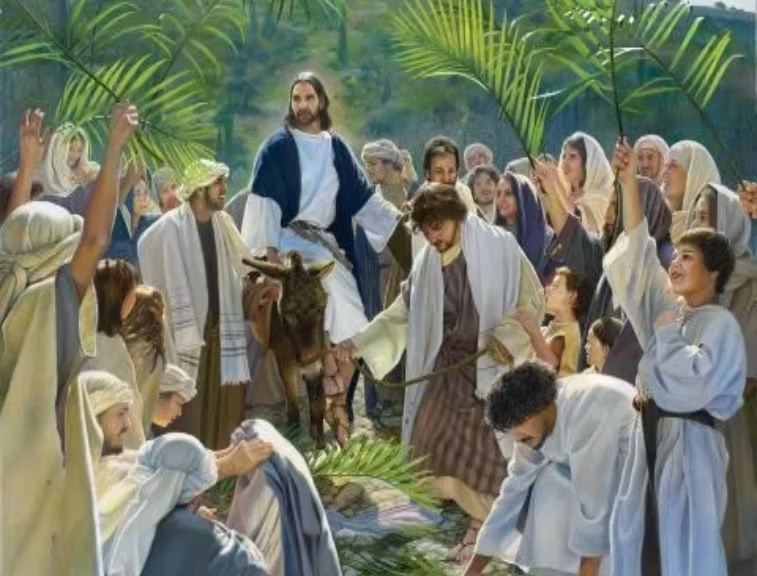
Luke 19:28-40 – Liturgy of the Palm, Year C

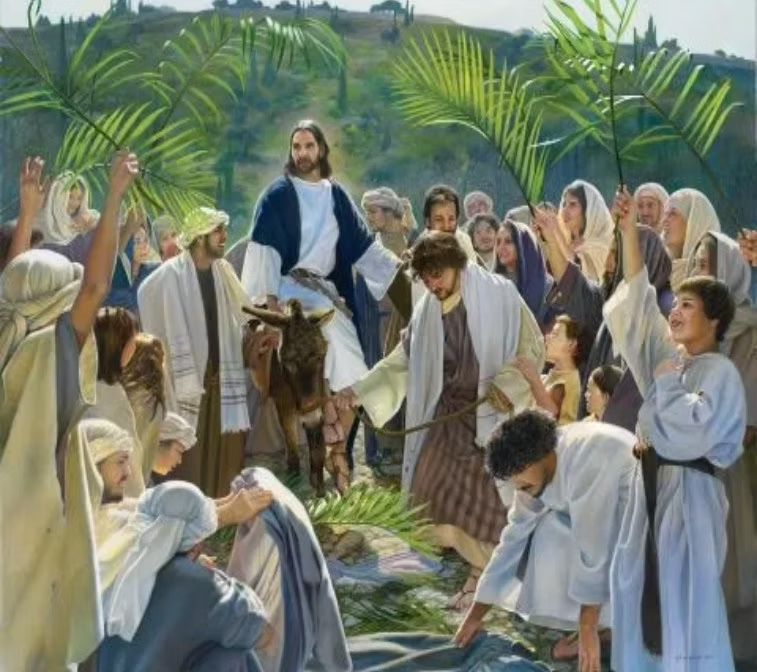
After telling a parable to the crowd at Jericho, Jesus went on ahead, going up to Jerusalem. When he had come near Bethphage and Bethany, at the place called the Mount of Olives, he sent two of the disciples, saying, “Go into the village ahead of you, and as you enter it you will find tied there a colt that has never been ridden. Untie it and bring it here. If anyone asks you, ‘Why are you untying it?’ just say this, ‘The Lord needs it.'” So those who were sent departed and found it as he had told them. As they were untying the colt, its owners asked them, “Why are you untying the colt?” They said, “The Lord needs it.” Then they brought it to Jesus; and after throwing their cloaks on the colt, they set Jesus on it. As he rode along, people kept spreading their cloaks on the road. As he was now approaching the path down from the Mount of Olives, the whole multitude of the disciples began to praise God joyfully with a loud voice for all the deeds of power that they had seen, saying,

“Blessed is the king who comes in the name of the Lord!

Peace in heaven, and glory in the highest heaven!”

Some of the Pharisees in the crowd said to him, “Teacher, order your disciples to stop.” He answered, “I tell you, if these were silent, the stones would shout out.”

——————–

This is the Gospel selection that will be read by a priest (usually outdoors), prior to the main service inside the nave on Palm Sunday, Year C, according to the lectionary for the Episcopal Church. This begins the “Liturgy of the Palms,” which will precede a singing aloud in unison of Psalm 118 verses, as there is a precession into the nave. In that song of praise David wrote, “I will give thanks to you, for you answered me and have become my salvation. The same stone which the builders rejected has become the chief cornerstone.”

In Year A the Gospel reading outside comes from Matthew 21:1-11. In Year B it comes from Mark 11:1-11. This reading from Luke offers some confusion, as to the timing of this event. That confusion can breed doubts of truth being told; so, it is important to explain away all doubts.

It is important to see that Luke tells the story of Mary the mother of Jesus, not the eyewitness accounts of the physician named Luke. The story told in Luke then shows that Mary the mother of Jesus was with him when he stayed in the safety zone that was Beyond the Jordan. Because Jesus was not safe returning to Capernaum, where his mother could be with him there, when Jesus and his disciples went in Perea, Mary went along. Thus, her story tells of the return from there, after Jesus was told of Lazarus being ill (which Mary did not witness, not tell about). That included the story of the blind man healed and the stay with Zacchaeus in Jericho. So, when verse twenty-eight says, “After telling a parable to the crowd at Jericho, Jesus went on ahead, going up to Jerusalem,” that one verse becomes a separation from those verses that follow.

Because Jesus returned with his disciples for the purpose of the Passover coming soon, he came back well prior to his entrance into Jerusalem. His disciples stayed in Bethphage (a house, not a town), while Jesus went into Bethany (a town, as well as a the house of Mary, Martha, and Lazarus), where he raised Lazarus from death. The disciples did not witness that event, so neither Matthew nor Mark wrote about that miracle. Luke also does not write about it; so, that means Mary must have met her brother-in-law Clopas (or Cleopas, brother of Joseph) and his wife Mary, who escorted Mother Mary from Jesus being with the disciples in Bethphage, to Emmaus. Jesus then left Bethphage to raise Lazarus; and, following that was a dinner given in Jesus’ honor at Simon the leper’s house, where Matthew, Mark and John told of Mary Magdalene pouring nard on Jesus’ feet, rubbing the perfume in with her hair. Mother Mary was not a witness to that event; so, Luke did not write about it.

This means that when Luke wrote in verse twenty-nine: “When he had come near Bethphage and Bethany, at the place called the Mount of Olives, he sent two of the disciples,” this is telling of a subsequent time, when Mother Mary (along with Cleopas and wife Mary had returned to meet up with Jesus again, in order to all enter Jerusalem as one large group (with a large group meaning it was safer for Jesus). It is imperative to realize that separation of time, supported by the other Gospel stories, so there is no confusion here, thinking Luke is telling contradictions to the other Gospels.

A while back, most likely when Palm Sunday was in Year B, where the entrance into Jerusalem story is told in Mark 11, I was not writing regular commentaries then; but I read the Liturgy of the Palms then and was moved to investigate that reading. I wrote and published on my WordPress blog this report on Mark 11:1-11. That report has been moved onto my Katrina Pearls website (R. T. Tippett), so it can be found only there. In it, I had a dawning of understanding, as to why archeologists cannot determine where a settlement named Bethphage was located. I realized it was not a town, but a house.

The Hebrew word “bayith,” which becomes transliterated as “bet” or “beth,” when combined with another word. As such, “Bethany” means “House Of Answer, Business, Affliction, Singing,” while “Bethphage” means “House Of Unripe Figs.” Because Bethany is known to be a town (and still is today, called Al-Eizariya – “Place of Lazarus”), but Bethphage is a mystery location, the name explains that it was one of the houses of the vicinity that was the town Bethany, but it was owned by a family who grew figs. This becomes a name of a place that becomes explanatory as to why the disciples would stay there (camp or lodge) and why Mother Mary, Cleopas and Mary would join other family there, before entering Jerusalem.

The dawning came to me that all fruit initially appears in an unripe state. No fruit stays in that state, as all fruit on trees ripens and falls to the ground, where it rots and turns to seed, unless the fruit is picked. Because the Passover festival begins a commanded counting of the gathered produce of the land, fifty days these offerings would be placed in a designated area of the Temple in Jerusalem, where a priest would oversee their maturity (fruits, grains, oils and wines), until declared fit for consumption on Pentecost. All “first fruits” would be gathered in an unripe state; so, there was one estate in Bethany that was known for its fig trees and being where unripe figs would be gathered in omer baskets and ceremoniously taken to the Temple in offering. That harvesting of the unripe figs would be what the disciples did for the time Mother Mary was in Emmaus; but she and her relatives would come to carry baskets of unripe figs to the Temple. Therefore, that explains why this entrance into Jerusalem was not unusual, other than the fact that Jesus knew this would be his final entrance there, before his death; meaning he was the sacrificial lamb being offered, with his disciples being the unripe fruit that would mature on Pentecost.

As for the other detail that Luke writes of, which are mirrored in the accounts of Matthew and Mark, I beg you to read the linked commentary of Mark 11, which is entitled “Understanding Bethphage, a donkey colt, and palm branches.” It is an informative read, one which I will not repeat, knowing this Gospel selection will only be read outside on Palm Sunday, where priests are known to do no sermons of explanation. Instead, I will make a couple of observations that have come to me since I posted my prior commentary.

The first new insight that comes to me is relative to Jesus sending two disciples to a village (on the other side of the peak of Mount Olivet from Bethany), where the Jericho Road split, going to both that village and to Bethany, before joining together again, going down the mount to the Kidron Valley crossing below Solomon’s Temple (the Portico above). Jesus told them to say, if asked why they were untying a colt (and they were asked, so they said what Jesus told them to say), “The Lord needs it.” [NRSV translation] That needs further discussion.

Because Luke’s Gospel (like the other three) is in Greek, there is a disconnect between the Hebrew statement of “Yahweh” and the English translation as “the Lord.” In Greek the word for “Lord” is “Kyrios,” where a slave would call his “master” the lower-case spelling: “kyrios.” This means the capitalization in the Greek scriptures always denotes a divine elevation in meaning, such that “Lord” [“Kyrios”] becomes confused. One is forced to hear Jesus give his disciples a command to say “the Lord needs it,” so it is easy to think “Lord” means Jesus was identifying himself as who needs the colt. Readers think Jesus told his disciples to tell some prearranged friends of Jesus – those who worked for him or followed his commands – “Jesus needs it.” That works until we reach the point of the reading where the people begin singing from Psalm 118 (the accompanying Psalm for this reading).
In an idyllic Christian world, where everyone lazes about on pillows, being fed grapes by cherubs, every word of Scripture is spoken by the Biblical characters in English paraphrases. Christians love how ancient Israelites sang songs in a yet invented language – the only one American Christians know. American Christians walk in precession from an outdoors setting, where pieces of palm leaves are passed out and everyone begins reciting Psalm 118 in English. In verse 26 they all recite: “Blessed is he who comes in the name of the Lord; we bless you from the house of the Lord.” American Christians then imagine themselves reenacting that scene in ancient Jerusalem, where everyone said “Lord.”

The reality is Jesus spoke Aramaic, as did all his disciples and family members. When they went down the hill and crossed over to the road that went along the eastern wall, a boundary for the City of David, the words sung by the Jews were in Hebrew, so “Yahweh” was sung, not “Kyrios.” The people all knew Psalm 118 and sang loudly, “bā·rūḵ hab·bā bə·šêm Yah·weh.” When that realization is made, Jesus then told his two disciples to go into the village and untie a colt that had never been ridden, and if anyone asked (and they did), tell them, “Yahweh needs it.” After all, that is the truth. Yahweh had spoken through the prophet Zechariah, which prophesied “your king comes to you … humble and riding on a donkey, on a colt, the foal of a donkey.” So, Jesus had nothing to do with needing a donkey colt. His Father needed it, so Jesus could fulfill prophesy.

In both Matthew and Mark (not Luke or John), after Jesus had entered Jerusalem and left to return home (to Bethany), we are told of Jesus going to a barren fig tree, cursing it, causing it to wither and die. It should bot be seen as disconnected from the meaning of Bethphage. The fig tree must be seen as one of that “House of Unripe Figs.” In the botany of fig trees, those which bear fruit only do so for thirty-five years. Before they mature so they can begin to bear fruit (those species that are fruit bearing), it usually takes five years before a new fig tree gives forth fruit. Knowing this, it should be seen that: a.) the fig tree was not one owned by anyone other than a family who knew Jesus well; b.) the fig tree was not new and should have produced at least one unripe fig that had not been picked for offering; and, 3.) the fig tree was barren, so it was wasting good soil that could be where a new fig tree would be planted.

As a Gospel reading given ‘air time’ in a limited capacity as the liturgy of the palm, it should be realized to bear the fruit of meaning that is still of Lenten value. That value is to realize Lent is not only a testing of self, because other selves are likewise being equally tested at the same time. The test of Lent is to understand passing does not make one king of the world. Instead, it makes one willingly display how humble and lowly one is, in service to Yahweh. When “some Pharisees asked Jesus to make the people stop singing,” it was because everyone knew Jesus was making a mockery of those who ruled over the people. The test of Lent is about one’s commitment to serve Yahweh; so, when comes and says, “Yahweh needs it,” you are tested to believe that is the truth.
Psalm 118:1-2, 19-29 – A round stone and flesh going up in smoke

1 Give thanks to Yahweh, for he is good; *

his mercy endures forever.

2 Let Israel now proclaim, *

“His mercy endures forever.”

—–

19 Open for me the gates of righteousness; *

I will enter them; I will offer thanks to Yah.

20 “This is the gate of Yahweh; *

he who is righteous may enter.”

21 I will give thanks to you, for you answered me *

and have become my salvation.

22 The same stone which the builders rejected *

has become the chief cornerstone.

23 This is Yahweh doing, *

and it is marvelous in our eyes.

24 On this day Yahweh has acted; *

we will rejoice and be glad in it.

25 Hosannah, Yahweh, hosannah! *

Yahweh, send us now success.

26 Blessed is he who comes in the name of Yahweh; *

we bless you from the house of Yahweh.

27 el is Yahweh; he has shined upon us; *

form a procession with branches up to the horns of the altar.

28 “You are eli, and I will thank you; *

you are my elohay, and I will exalt you.”

29 Give thanks to Yahweh, for he is good; *

his mercy endures forever.

——————–

On March 31, 2021 I posted an interpretation of this Psalm, which is read each Palm Sunday, in Years A, B, and C. I recommend reading that analysis by following this link here. I am reposting this with adjustments in the NRSV text, which I was not making in my earlier commentary. You will note that there are ten places where David wrote the proper name “Yahweh,” only to have some modern English translation service change that proper name to a generic “Lord.” Also, in verse nineteen, the word written by David is “Yah,” which is an abbreviated form of “Yahweh.” I have restored that written by David in bold type.

In verse twenty-seven is a use of the Hebrew word “el,” which is misleading to translate it as a capitalized “God.” It and the two forms of “el” that are “eli” and “elohay” (both translated as “my God”) are misleading in the way they were translated; so, I have restored the Hebrew text [transliterations] in italics. I will explain my reasons for this soon.

This song of praise is closely associated with the entrance of Jesus into Jerusalem, prior to his final Passover festival there. The whole of the theatrics of that “triumphal entrance” is anything but. In Zechariah’s prophecy, where verse nine says, “your king is coming to you , righteous and having salvation he , lowly and riding on a donkey , and upon a colt foal of a donkey .” That prophecy, which Jesus fulfilled, says everyone who thinks Yahweh is going to send some human hero to become another temporal David reborn is a fool. The prophecy say celebrate the fact there will never be anyone other than Jesus. Thus, that needs to be understood in this song of David.

In verses nineteen and twenty, David wrote of “the gates of righteousness” and “the gate of Yahweh.” This needs to be merged with Zechariah’s prophecy of “the king is coming to you.” Prior to Zechariah writing that, he called to the “daughters of Zion [meaning Dryness]” and the “daughters of Jerusalem [meaning “Teaching Peace],” with “daughters” needing to be seen as every soul living in a body of flesh. A body of flesh is a “daughter,” who is then the bridesmaid of Yahweh. The ”gate” is then the marriage pathway to a soul, penetrated by the divine. The “king” is then the new Lord over one’s flesh, which is the “righteousness” of “Yahweh.” The symbolism of Jesus riding a donkey colt into Jerusalem, through the Dung Gate, says one is sacrificing one’s soul to a most divine possession. Nothing in the material world will catch one’s eye, as all heads are bowed in total submission to Yahweh, because salvation is one’s only prayer being answered in holy matrimony.

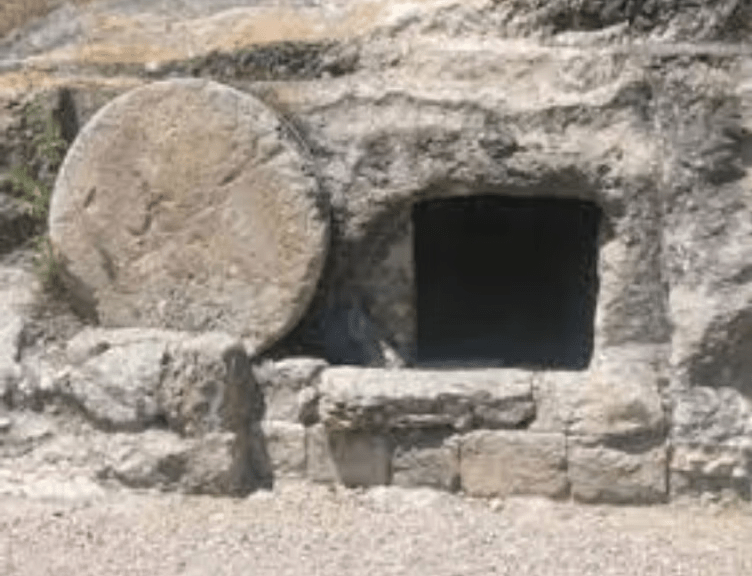
In the past several months (or so), I have come to an entirely new view of the meaning of verse twenty-two, which sings, “The same stone which the builders rejected has become the chief cornerstone.” When writing about the stone that sealed the tomb where Jesus’ body had been laid (the tomb of Joseph of Arimathea), it dawned on me how such a round stone was symbolic of how being reborn as Jesus places a movable stone, which allows a soul to escape a sealed in death, gaining eternal life. It makes no logical sense that any builder of merit would reject a solidly fashioned cube of stone as a cornerstone for a permanent building. However, they would reject a round stone all day long; and, that means one is not building materially (where mortals have no permanence), but spiritually.

The death one avoid by the round stone as one’s cornerstone is that of being a soul born into mortal flesh. Flesh is “mortal” because it will die. When the flesh dies, then the soul is released for Judgment. To be found sealed in a tomb with a squared stone sealing the entrance-exit, then death means coming back again into a body of flesh that is bound to die (repeated death). Only when one’s soul has been married to Yahweh and merged with the soul of His Son can one die of self, without physical dying. One becomes a changed person, as a Saint.

Verses twenty-three through twenty-six sing repeatedly (six times) about “Yahweh.” When we hear the song say, “This is Yahweh’s doing,” that is creating a Son that will be the stone rolled away after death, so one resurrects spiritual as Jesus did. We become Jesus because of Yahweh. This is divine marriage; so, when verse twenty-six sings, “Blessed is he who comes in the name of Yahweh,” the ”name of Yahweh” says one’s soul has taken on His name in marriage AND one has been born in the name of Jesus, as a Christ.

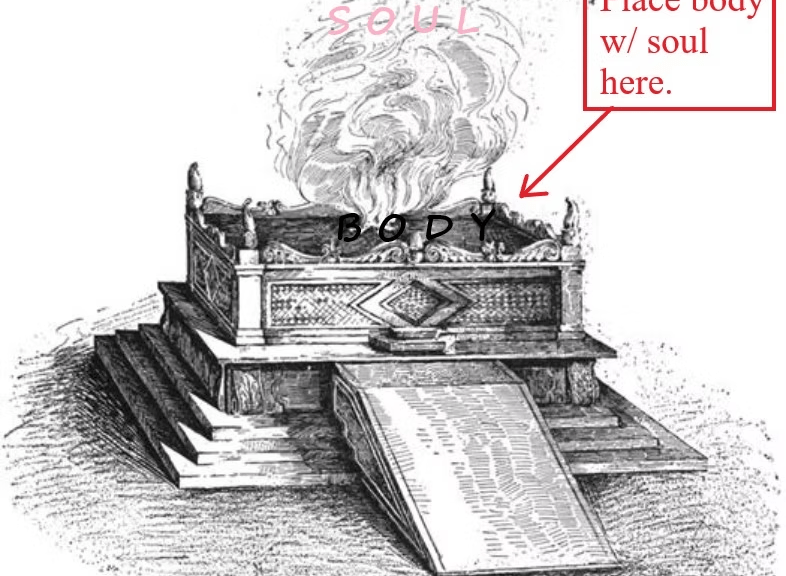
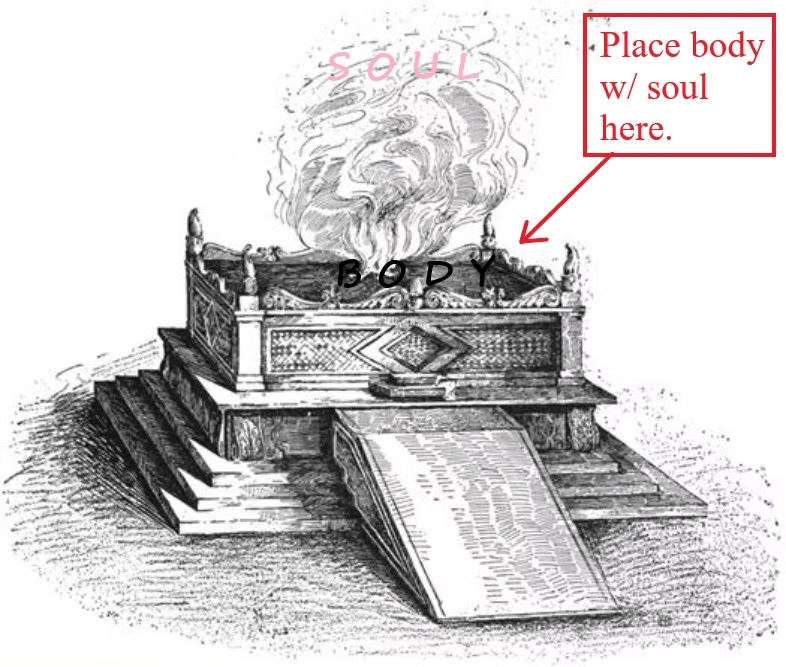
In verse twenty-seven, where David sang, “form a procession with branches up to the horns of the altar,” this sings of a wedding “procession.” The “horns of the altar” are features of the Temple (Tabernacle for David) altar of sacrifice. Thus, marriage to Yahweh means the sacrifice of one’s soul, so it no longer claims control over one’s born flesh. Self goes up in smoke, which is a delight to Yahweh.

When verses twenty-seven and twenty-eight then mention “el” and then “eli” and “elohay,” this sings of the ministry in the name of Jesus that comes. An “el” is an eternal presence, like an angel is. A soul is an eternal entity, but it is not an “el,” per se. An “el” is a spiritual possession within one’s soul-flesh. This can be a demonic spirit that possesses a soul, making it do evil deeds. However, when “el is Yahweh” is stated, that becomes a statement of a divine possession, by Yahweh’s Spirit. That then leads to David singing “my god” (“eli” and “elohay”), these come in quotation marks, as said to a soul by Yahweh. That means Yahweh has heard one’s cries of “thanks” and told those souls “You are mine, as Yahweh elohim.”

As a Psalm that will be sung outside a church, in a precession into a nave for the reading of so much scripture that none of it can be preached (in a twelve minute timeframe), that means the test of Lent is to do your own contemplation about what scripture means to your own soul. Everything in Scripture is valuable insight towards deep faith. Going to a church to have priests do nothing that teaches the meaning of the Word says the blind are leading the blind to a huge pit. One must have more than twelve minutes to devote to Yahweh a week; or, one must plan on repeating life all over again (if lucky).

Isaiah 50:4-9a – A Passion prerequisite that requires a Teacher of Yahweh to explain

[4] adonay Yahweh has given me

the tongue of a teacher,

that I may know how to sustain

the weary with a word.

Morning by morning he wakens–

wakens my ear

to listen as those who are taught.

[5] adonay Yahweh has opened my ear,

and I was not rebellious,

I did not turn backward.

[6] I gave my back to those who struck me,

and my cheeks to those who pulled out the beard;

I did not hide my face

from insult and spitting.

[7] wadonay Yahweh helps me;

therefore I have not been disgraced;

therefore I have set my face like flint,

and I know that I shall not be put to shame;

he who vindicates me is near.

[8] Who will contend with me?

Let us stand up together.

Who are my adversaries?

Let them confront me.

[9a] It is adonay Yahweh who helps me;

who will declare me guilty?

——————–

This song of Isaiah is read on every Passion Sunday (a.k.a. Palm Sunday), in Years A, B, and C.

September 2018 can be searched here. This is what my observations were, when this reading was part of the Proper 19 readings, for the seventeenth Sunday after Pentecost lessons.

March 2021 can also be searched here. This was what I wrote when this was part of the Passion Sunday Year B service.

August 2021 also in here to be searched. This was when the same reading is presented on the sixteenth Sunday after Pentecost [Proper 19], during Year B.

In my last commentary, I adjusted the text to show “adonay,” “wadonay,” and “Yahweh.” I pointed out how that does not mean “the Lord God.” The word “adon” is the singular number Hebrew word that says “lord” (not capitalized), with the two variations of “adonay” being the plural version, clearly saying “lords.” To then pair that with the fools who translate Hebrew into paraphrased English (besides their changing a plural word into the singular and capitalizing that as a singular “Lord”), they all of a sudden stop translating “Yahweh” as “the Lord,” making Him be a “God.” Of course, they could explain that by saying, “Oh! Our paraphrase switched the order of the words written, so we translated “Yahweh” as “the Lord,” making “adonay” become “God.”’ Still, that ignores the plural number and their lie needing to be translated as “the Lord of lords.” That would actually be more in line with the true meaning of “adonay.”

In the time that has passed since August of 2021 (six months), I have come to realize more clearly that “adonay” is similar to the Hebrew word “elohim,” but with a slightly higher connotation. One of the “elohim” (an “el”) is an ‘angel in the flesh,’ which means a soul in a body of flesh has become married to Yahweh, with His Son’s soul (that of Adam-Jesus) resurrected within that soul hosting flesh, becoming divinely possessed. That divine possession is an “elohim” (one being an “el”). One has to reach that state of existence to become a Saint, one in the name of Jesus, as a Christ. That is the basic statement of divine possession. However, becoming one of the “adonay” (or “adonai,” as an “adon”) is the purpose for Yahweh divinely possessing a soul animating flesh; and, that is to teach.

In verse four, this aspect of teaching (as a Saint) is explained as Isaiah singing, “adonay Yahweh has given me the tongue of a teacher, that I may know how to sustain the weary with a word. Morning by morning he wakens — wakens my ear to listen as those who are taught.” This becomes why the disciples called Jesus their “Teacher, Master, or Lord.” In John 13:13 (when Jesus had washed the feet of his disciples at the Seder meal in the upper room), he said, “you call me This Teacher kai this Lord , kai honorably you say , I am indeed .” This is the truth spoken by Jesus, because his soul in his flesh was not only as a Yahweh elohim (the Son of Yahweh reborn – Adam’s soul returning as one whose name says, “Yah[weh] Saves”), but also as the epitome of an “adon” or “lord,” as a “teacher” of those who sought the truth of Yahweh. Isaiah was another soul in human flesh that was an “elohim,” who was sent out to others, for the purpose of being “a teacher” of Yahweh’s truth.

Verse four states that clearly.

In the rest of these verses, which I have commented on prior (multiple times), it is important to see that an “adonay Yahweh” is a divine “teacher” of truth, where he listens to that told to his possessing soul (Adam-Jesus) by Yahweh [as Jesus said, “For I myself have not spoken, but this having sent me Father the same, me a commandment gave what I should say kai what I should speak.” – (John 12:49)]. These verses from Isaiah 50 reflect that same obedience, as a soul divinely possessed by the Father – Yahweh. Thus, it is important to see how the persecution of others, who direct their anger at anyone who acts righteously, to force them to stop pretending to be ‘holier than thus,’ because they do not believe such righteousness is truly possible. It is not only possible; but Isaiah (and Jesus too) sang how he could withstand the punishment, because he knew his ego had already been sacrificed for a much higher cause. Isaiah (and Jesus too) knew that punishment resulting in death would only release an “elohim” soul to eternal life, having already died as a lord over one’s flesh.

As an Old Testament song sung inside a nave, prior to the reciting of about two chapters of Luke (in Year C), no priest will have the balls – nor any parishioners have the guts – to spend a whole day explaining and listening to explanations (verse by verse), about everything that has been read aloud on what is called “Passion Sunday.” That is a reflection that no one is an “elohim,” no one is a Saint, no one is an “adon” of Yahweh, and (certainly) no one is Jesus reborn, as a Christ. It says Christianity has been reduced to some form of entertainment that is all about the pageantry of show, with no one ever able to become a teacher like Isaiah or Jesus. The only thing anyone gets out of this day is a blade of palm branch … and that is then given back to the church, so they can form them into crosses that will be passed out at another time, before collecting those to be burned for ashes to be added to oil (used on Ash Wednesday – more pageantry).

Aside Note:

In case this is difficult to grasp, it really is not. A soul in a body of flesh is the “lord” (“adon“) of its flesh … the flesh into which Yahweh breathed a soul at birth. As a child that grows, the fleshy brain (the seat of one’s “lord” or “adon“) is taught many things: from the environment, from parents, from friends, and from school teachers. A fleshy brain absorbs knowledge like a sponge (with not all knowledge the truth). When puberty kicks in, the body of flesh (extensions of the fleshy brain) begins to scream out, “Hey! What about me!” The body of flesh slowly becomes the “lord” over the brain, so the brain begins to justify the desires of the body of flesh. This is regardless of what one has been taught to guard against. Then, it takes an innocent soul and enslaves it to follow the whims of the flesh, which is what religion says are sins. While sins are natural, some become addictions. External things of the world … like drugs, sex, money … become influences (gods or elohim) that take total control over a soul and its body of flesh, making it not only sin, but do heinous acts that are criminal. In the Bible are stories of those demonically possessed; and, such demonic possessions are the presence of an evil soul within one’s birth soul. This becomes the “lord” or “adon” one was naturally born with being enslaved by a Satanic or Devilish soul that joins with one’s soul; and, that demonic presence becomes one’s “Lord.” This capitalized “Lord” is why a true Christian does not want to refer to Yahweh as something so general and non-specific. To have evil demons cast out, one needs to seek Yahweh’s help. That leads to an encounter with a Saint, who is a normal soul possessed by Yahweh’s Spirit, reborn with Jesus as his “Lord.” That presence initiates the Spirit, sent by Yahweh’s Son’s soul to enter one’s natural soul, casting out all bad demons. That is Baptism by the Spirit, which cleanses a natural soul, in the marriage of a soul to the Yahweh Spirit. The presence of Jesus’ soul within one’s soul (a good possession of spirit – the resurrection of Jesus within) makes his soul become one’s “Lord” or “Adon.” Jesus rules as “Lord” over one’s natural soul and its flesh. Rule over the natural soul ensures that soul a return to be one with Yahweh, when it leaves its body of flesh. If you would like to read more on this subject, look up Eudaimonia. The root word there is “daímōn,” which is where the word “demon” comes. It actually refers to a “spirit,” which is like a “soul.” One needs to realize there are bad spirits and there are good spirits. The capitalized “Spirit” (“Pneuma“) is the best Spirit to be possessed by. It is the challenge of a soul’s presence in matter. The soul must find the way back to Yahweh. Matter becomes the tomb, as well as the “Lord” to overcome. The antonym is “Disdemona” (from Greek “δυσ + δαίμων), which means “ill-fated, unfortunate.” Any spirit that takes over a body of flesh, enslaving a natural soul to serve it, is a “Lord.” A natural soul cannot defeat any “Lord.” Thus, a soul must surrender itself to Yahweh in divine union, which means His Son Jesus (“Yahweh Saves”) is one’s “Lord,” who defeats all others “gods” or “elohim.”

Psalm 31:9-16 – Begging for mercy when you don’t really think you need it

9 Have mercy on me, Yahweh, for I am in trouble; *

my eye is consumed with sorrow, and also my throat and my belly.

10 For my life is wasted with grief, and my years with sighing; *

my strength fails me because of affliction, and my bones are consumed.

11 I have become a reproach to all my enemies and even to my neighbors,

a dismay to those of my acquaintance; *

when they see me in the street they avoid me.

12 I am forgotten like a dead man, out of mind; *

I am as useless as a broken pot.

13 For I have heard the whispering of the crowd; fear is all around; *

they put their heads together against me; they plot to take my life.

14 But as for me, I have trusted in you, Yahweh. *

I have said, “You are elohay.

15 My times are in your hand; *

rescue me from the hand of my enemies, and from those who persecute me.

16 Make your face to shine upon your servant, *

and in your loving-kindness save me.”

——————–

This is the Psalm that will be read aloud in unison or sung by a cantor (inside the nave), after a congregation has met outside the inner sanctuary of a church, holding palm spears and reciting in precession verses from Psalm 118. Here is when they begin to go brain-numb from having reached their maximum normal Sunday allowance of readings, with still many more minutes of readings to come, before wondering, “Now I remember why I only go to church a couple of times a year!” They have shown up on Palm-Passion Sunday because there is no sermon; but, they show up having forgotten how dreadfully long the service is.

In March 2021 I posted this commentary on this selection from Psalm 31, which can be searched here by that name and number. That was when this same Psalm selection was part of the Year B schedule of readings. This Psalm selection is read every Passion Sunday, in Years A, B, and C. It is not read at any other time in the lectionary schedule; so, because no sermon will ever be preached on a Sunday when the Episcopalian ‘twelve minute rule’ has already been broken by reading aloud half the New Testament (well, almost two chapters of Luke in Year C), nobody’s brain is capable of focusing on religious thought. Like everything about finding true Salvation for a soul … it is best done alone, without allowing any church to get in the way, mucking everything up.

I have come to the conclusion that the reason Christians allow their English translation service to change “Yahweh” to “the Lord” and “elohay” to “our God” is because they do not want to ever accept a Jewish dedication to scriptural memorization. Christians would much rather learn five sets of verse and chorus from a popular song book: example being Silent Night or Old Time Religion (where scripture has been aborted by some songwriter that never understood any meaning to scripture), than to memorize one hundred fifty psalms, divinely inspired by David (and maybe others) – In Hebrew – because that would take away from so much party time in life (by whatever means one calls ‘partying’). So, even though most modern Jews know some Yiddish and pretend to be closer to God because of extensive early education in religious scripture, Christians want to be known for being dumb as stumps, while superior because the Jews rejected Jesus.

This Psalm selection is chosen to be sung aloud on Passion Sunday, because the Passion (a word meaning “suffering,” not sexual rubbing) never is about Jesus. It is repeated year after year because of all the new souls that need to be “Suffering” like David wrote of them all begging for forgiveness. Those who only show up at some Christian church to be entertained a few times a year will find their souls in this position one day … because ALL MORTALS DIE. Bodies of flesh do not beg for forgiveness. Souls do.

As a song of lament and begging for forgiveness (something David did later in life, but Jesus never did) to be read aloud on Passion Sunday, the point is to foresee your own worthless soul facing your inevitable death and have a ‘come to Jesus’ talk with Yahweh [learn his name you lazy sinner!]. Learn that when David sang, “I have said, “You are my gods,” that truly means Yahweh says to His ‘angels in the flesh’ – His elohim – “You trusted in Me, when you became extensions of Me on earth … as Yahweh elohim. An “elohim” is only going to receive the Salvation of eternal life. Party hardy you fools and find this truth out when you miserable end times come. Then prostrate your souls before Yahweh and explain to Him why you never had time to serve Him in life. Now is the time to practice being sincere with you future answer … in tears … knowing something bleak is going to be your Judgment.

Philippians 2:5-11 – This is important to understand

[5] Let the same mind be in you that was in Christ Jesus,

[6] who, though he was in the form of God,

did not regard equality with God

[7] as something to be exploited,

but emptied himself,

taking the form of a slave,

being born in human likeness.

[8] And being found in human form,

he humbled himself

and became obedient to the point of death–

even death on a cross.

[9] Therefore God also highly exalted him

and gave him the name

that is above every name,

[10] so that at the name of Jesus

every knee should bend,

in heaven and on earth and under the earth,

[11] and every tongue should confess

that Jesus Christ is Lord,

to the glory of God the Father.

——————–

This is the Epistle selection to be read aloud, along with two thousand, five hundred sixty three other words of scripture (Old Testament, Psalm and Gospel), on the day called “Passion Sunday.” This Word Count total does not include the “Palm Sunday” readings done outside a nave (a Gospel and processionary Psalm), while holding palm spears. Due to the excessive amount of readings collected for one day [Moses warned the children of Yahweh not to collect more manna than could be consumed in one day [unless it was a Friday, when two days’ worth could be gathered], it will turn to maggots and mush, being all pomp and circumstance – a ‘photo op.’ However, it is entertaining and the people do love a show. They come out from under their rocks for Sundays when they do not have to listen to some sinner pretend to know a thing or two about righteousness (at least the clothes the righteous wear).

In March 2021 I posted a commentary on Philippians 2 that can be searched here. I will let that stand for what I still believe should be found in these verses. However, as divine Scripture is so marvelous that it always has a way of shining new truths unseen before, I will add a couple of nuggets of insight for this posting (maybe new, maybe not, as it is hard to remember thirty minutes ago, much less three years back in time).

Do I just go home after a service with no sermon and do nothing? Or, do I take some responsibility to do something on my own, as I go forward?

The first verse of this selection from Paul’s letter to the true Christians he helped usher into that state of being says what must be grasped firmly, in order to have a true clue about what Paul meant … in any of his letters sent to true Christians everywhere [those able to read his words]. The Greek words he wrote are these: “Touto phroneite en hymin ho kai en Christō Iēsou”. In that are three capitalized words; and, all capitalized word in divine Greek Scripture bear an elevated state of meaning, relative to Yahweh. Then, there is one use of the word “kai,” which is a marker word that does not get read as “and,” but as a direction to look for importance to follow.

The capitalized word “Touto” takes it to an elevated state that is beyond a simple “this.” It is a word that points back to that which had just been said (written in verse four, but unread here), which the NRSV shows saying: “Let each of you look not to your own interests, but to the interests of others.” That means “This” is referring to self-sacrifice, such that in a Spiritual marriage of one’s soul to Yahweh, it is not simply (“this”) for one’s benefit alone. It is, instead (“This”) to be “to the interest of others,” so “you have understanding, think, judge, observe, and care for” [the meaning of “phroneite”]. “This” is not something natural to a normal human being of the selfish world, which takes great delight in “looking to your own self-interests.” As such, “This” is divinely elevated to have come “within your souls this,” which is read from the Greek words “en hymin ho.” There, “hymin” is normally translated simply as “your,” as the possessive pronoun written in the second-person plural; but when “This” is relative to Yahweh’s presence, which only deals with souls, “your” becomes “yourselves,” with a “self” understood to be a “soul.” Therefore, “This” divine ability to not be selfish means “your souls” have achieved “this,” when Yahweh’s Spirit is “within” one [not far, far away, externally, seeing heaven as in outer space].

Following the use of “kai,” Paul then explained what “within” means [from “en”]. He said “This” leading to “this” [from “Touto” and “ho”] is “within” [“en”] because one’s soul has been “Anointed” by Yahweh’s Spirit [the truth of “Christō”]. “This” is a most divine presence that comes upon one’s soul after that soul has submitted to Yahweh in holy union. The presence of Yahweh – becoming a ”Christ” – means all the selfishness of a sinful world has been washed away from one’s soul, so one’s filthy ass soul has become squeaky clean. That means the onset of a “Christ” [Yahweh’s “Anointment”] clears the way for one’s weak ass soul to be joined with His Son’s soul – two souls in one body of flesh. Once “Jesus” is resurrected “within” one’s soul, then his divine soul takes the place of one’s weak ass soul [the lord over its flesh, until the flesh has a revolt of lusts and turns a soul into its earthly slave] into flesh led by a most holy “Lord” [as seen in verse eleven].

The rest of this selection from Paul’s letter (presented as a song of praise) says oneself – one’s soul – steps to the rear and lets Jesus take over. The meaning of the name “Jesus” is “Yahweh Saves.” Without Jesus becoming one’s “Lord” of the flesh, one will always be sinning, because one’s soul is so weak and powerless to tell the flesh, “No!” The flesh bows down to the soul of Jesus, just as demon spirits would flee the bodies they possessed, when Jesus came near (during his physical ministry one earth). When one has been reborn as Jesus, then one can have the same effect on others; as long as one realizes that has nothing to do with glorifying one’s sorry ass. “This” divine possession is only so Yahweh can send His Son into a body of flesh to minister to others again.

As a selected Epistle reading on Passion Sunday, when nothing will ever be said about these important verses on that day. Fortunately, these same verses (within Philippians 2:1-13) will be read on the Proper 21 Sunday, in the Year A. So, at least there is a chance someone might pontificate some social politics and condemn his or her soul by using the name “Jesus Christ” as why social politics is so important. That is more maggot mush; so, please do not eat that crap. It is vital that one’s soul understand what Paul wrote. He wrote the same things over and over again, all truth, all meant for your soul to realize. The realization comes from taking more than one Sunday every year in devotion to Yahweh and becoming His Son reborn (regardless of what sex organ your body of flesh has).

Side Note: I had an elderly gentleman in a church Bible Studies class once ask the question, “Certainly nobody here thinks he or she is Jesus, do they?” This elderly man was a regular contributor to that church; so, being Jesus was never to be (in his mind). Going “to heaven” was all about sending money in regularly to that church and having a spot claimed in a pew, with pillows and tissues marking that spot as one’s.

The truth of this path to Yahweh is it is wrong. Upon the Judgment that comes from death, when a soul stands naked, colorless, moneyless, and wearing the face of self, not Jesus as one’s spiritual Lord, the cold realization is just how wrong it is to think “Certainly nobody here can be Jesus.” This is because, before Yahweh, He will say, “Nice try. The answer to your question is this: Every soul to be saved must be Jesus reborn. Now, this next life I will take away all your money, so you cannot buy pillows and boxes of tissues; so, you will know you must come back as My Son reborn. Sound good to you?”

This is when all shivering souls respond, “You know, Yahweh.”

Take this and realize the truth:

“They will come with weeping; they will pray as I bring them back. I will lead them beside streams of water on a level path where they will not stumble, because I am Israel’s father, and Ephraim is my firstborn son.” (Jeremiah 31:9, NIV)

The name “Ephraim” means: “Two-fold Increase; Doubly Fruitful.”

Ephraim was a son of Joseph. He was a twin born with Manasseh, where Manasseh was born first. Ephraim was blessed by Joseph, not Manasseh, in the same way Jacob was the second-born twin with Esau, whom Isaac blessed. For Joseph to name his son “Doubly Fruitful,” he realized that when a second baby popped out of Asenath’s womb. Therefore, for Yahweh to speak through Jeremiah and say, “I am Israel’s father, and Two-fold Increase is my firstborn son, it means this:

Adam was the firstborn Son of Yahweh. Adam is the soul that was returned by Yahweh into the baby Gabriel announced to Mary, whom he told, “You shall name the baby Jesus. “Jesus” means “YAH Saves” or “YAH Will Save.” This says the soul of Adam (called Yahweh elohim in Genesis 2) is the firstborn of Yahweh, who is the father of Israel.

The name “Israel” means “He Retains God” or “God Is Upright.” “Israel” was the name bestowed upon Jacob, after his sorry ass wrestled with his sinner soul all night long, finally telling his sinner soul, “Get behind me Satan!” For winning that wrestling match, Jacob became “Israel,” as his “Doubly Fruitful” name – his Spiritual name – for having been reborn with the soul of Yahweh’s “firstborn son” – Adam.

To be “Two-fold Increase,” one’s sinner soul must be washed pure by the Anointment of Yahweh (made “Christos“), at which time one’s once sinner soul is joined by the soul of Adam, who now goes by the name “Jesus,” because “YAH Has Saved” a soul, as being given a Lord within, who will not allow a cleansed soul to every become dirty again. This means one lives righteously or “Upright As God.”

This is then divine possession, or a “guiding spirit of good,” called eudaimonia by the Greeks, which means the call of lost souls it to become Jesus resurrected within one’s flesh, as the Son of Yahweh reborn. Anything short of that is not a soul “Saved by YAH.” (Not “Jesus”).

Passion Sunday Year C – Seventeen omers of manna to be spread out over two-plus weeks (Part I)

It is very important to preface this presentation by saying this: The indoors production of what is commonly called “The Passion Play” follows the outdoors production of that called “The Liturgy of the Palms.”

In Exodus 16:4 is read, “Then Yahweh said to Moses, “I am going to rain bread from heaven for you, and each day the people shall go out and gather enough for that day. In that way I will test them, whether they will follow my instruction or not.”

Because Palm-Passion Sunday is still in the testing period of Lent, this verse should be seen as Yahweh giving all who say they believe in Him and His Word through Scripture a clue that says, “Here is how I test faith.”

In Exodus 16:16-19 is written: “This is what Yahweh has commanded: ‘Gather as much of it [manna] as each of you needs, an omer to a person according to the number of persons, all providing for those in their own tents.’” The Israelites did so, some gathering more, some less. But when they measured it with an omer, those who gathered much had nothing over, and those who gathered little had no shortage; they gathered as much as each of them needed. And Moses said to them, “Let no one leave any of it over until morning.”

Aaahhh. But human beings are like children that do not listen. They love to fail tests. So, in Exodus 16:20-21 says this: “But they did not listen to Moses; some left part of it until morning, and it bred worms and became foul. And Moses was angry with them. Morning by morning they gathered it, as much as each needed; but when the sun grew hot, it melted.”

On the sixth day (Friday), the Israelites were allowed to collect two days’ worth, so they had to do no work on the Sabbath Day. Still, they only had one day’s worth of manna to consume; never having fifteen days’ worth.

On the fourth Sunday in Lent this Year C (three Sundays prior, or fourteen-fifteen days ago), the Old Testament reading was from Joshua 5, where we read: “The manna ceased on the day they ate the produce of the land, and the sons of Israel no longer had manna; they ate the crops of the land of Canaan that year.” (Joshua 5:12) The deeper meaning of that verse says manna from the sky ceased, but spiritual food became those who were truly “sons of Israel.” The source of spiritual food was within those who Joshua crossed over into the Promised Land [which is not physical land, but a marriage of a soul to Yahweh’s Spirit – a Yahweh elohim, divinely saved]. As such, that state of blissful marriage only lasted a year; and, then they began having children and not teaching them how to do as they had become, in order to be truly “sons of Israel.” They soon fell onto hard time, needing to receive their spiritual food from Judges, Samuel, David, and a series of Prophets. Still, those only passed out spiritual food in daily amounts, not half-month loads.

The land, once the “sons of Israel” diminished to a trickle of souls, split and fell into ruin, scattering the peoples around the known world. When a few ‘sons of Israel” led some people back to what was once their physical earth once owned, but since lost, a new series of “sons of Israel” began dispensing spiritual food. The Gospels, Acts, and the Epistles are their versions of ‘manna from the sky.’ Still, only a daily allotment will lead a soul to being Spiritually self-sufficient, able to become a Yahweh elohim – a “son of Israel” (regardless of human gender). Cutting off huge chunks and letting them go uneaten before the next day’s sunrise means that huge chunk melts in the next day’s sun, turning to maggots and stinking to high heaven. That makes Yahweh angry.

The moral of this story I have told is this: I am going to salvage the spiritual food carved from Luke’s Gospel, and place it into omer-sized baskets for one’s daily nourishment from ‘manna from the sky.’ Any church that presents over 2,500 words in one morning service cannot possibly spend the time necessary to explain that spiritual food, so it has the benefit intended. It is like offering an all-you-can-eat buffet of Christian religion, paying nothing to get this freely provided ‘manna,’ while expecting to receive twenty dollars a head for using it in pageantry, not caring if it all goes to waste. To eliminate the shame that comes from just a couple of morsels here, which have been served up as one huge Passion Sunday dinner, will ever be taken out again (like leftovers) and served at other times in a three-year cycle; I will address everything as an individual lesson that should be known.

As I have now completed this project (one that was well worthwhile), I will say that I began it on one day, completing it eleven days later. I want you to think about that.

In eleven days, I examined ever word of every verse; and, there are 113 verses. Having never been told any of the meaning to those 113 verses (with Palm Sunday’s Gospel reading adding another thirteen verses), people calling themselves ‘Christians’ will go a lifetime never fully understanding the powerful message that Yahweh had Luke write. AND … that is just one of the four Gospels that tell additional details to this “Passion Play!”

In the past eleven days, I have written almost in a trance, so at this point there are plenty of nits and burs (misspelled words and grammatical errors) that will run off all English teachers (I presume there is a special place in hell for them, for that reason). So, beware reading unedited texts. My email is available for any questions (like that would ever happen!); but I feel enough is clear enough to see how much is missed in the theatrics of a “Passion Play,” when the players have no true passion (pains of dying with Jesus within).

It is important to know that this story is not told so everyone remembers how Jesus sacrificed his life so others could be saved. It is told (one way or another) every year because those sitting in the pews are killing Jesus over and over again, never once stopping to think, “I wonder what true commitment like that feels like?”

Every true Christian needs to see just how much they play the role of Temple Jews … the Sanhedrin … screaming at Pontius Pilate, “Crucify him!” More people calling themselves ‘Christians’ show up for church on this Sunday and the following Easter Sunday; so, they must prefer killing Jesus, rather than killing themselves so they can be reborn as Jesus.

For all the lazies that only have an hour or two a year for church things, I have made it easy to read each little section, one at a time, as your lazy leisure. Just click on the links

Don’t thank me. Enjoy! Eat all seventeen meals (over seventeen days or a lifetime) and grow into a true “son of Israel.”

Here are the first nine.

Part I, Divisions A through I (Luke 22:14-71)

A: Luke 22:14-23

B: Luke 22:24-30 [verses 24-30 also read on Saint Bartholomew – a Wednesday in 2022]

C: Luke 22:31-34

D: Luke 22:35-38

E:Luke 22:39-46

F: Luke 22:47-53

G: Luke 22:54-62

H: Luke 22:63-65

I: Luke 22:66-71

Passion Sunday Year C, Seventeen omers of manna to be spread out over two-plus weeks (Part II)

The change of chapters has to be seen as significant, in the terms of timing. All of the readings from Luke’s twenty-second chapter begin after six o’clock in the evening. Everything must be seen in terms of a fixed number of days in the Passover festival recognition, which is eight days: It begins and it ends on the same day of the week – ALWAYS. In this case – Jesus’ final Passover festival, where he is the sacrificial lamb – The first day of the Passover was a Sabbath, which began at 6:00 PM on the Friday night prior (14 Nisan). Because there are two Passover Seder meals that the Jews recognized then (and still today), the first Passover Seder was in Bethany, at Simon the leper’s house. Because travel from Bethany to Jerusalem (the upper room in the Essene Quarter) would be beyond a ‘Sabbath’s day’s walk,’ Jesus and his disciples and all family members in Bethany would have not begun to go there, from Bethany, until after six in the evening (in the Evening Watch of night). That travel would have been on an official timing of Sunday, on 15 Nisan. Therefore, everything written in Luke 22 told of the events that spread from about 6:45-ish P.M. on Saturday night (officially Sunday) 15 Nisan and extended into the Morning of Day, before the Sanhedrin, on official first day of the week. The arrest followed Jesus’ second Seder meal for that Passover, therefore his “last supper” (as opposed to his first supper).

Realizing the story of Joseph and Mary, when Jesus was born (unexpectedly) in Bethlehem, the reason there was “no room at the inn” was all the surrounding villages and towns of Jerusalem were packed like sardines, due to the Passover. Pilgrim from all around the globe had traveled there for this event; and, they would remain there until the Shavuot Festival (the fiftieth day, or Pentecost). So, imagine the tourists in a city for a Super Bowl, or coastal citizens fleeing their homes to an inland city, when a major hurricane is forecast. Everywhere is packed with people. There are no idyllic, peaceful roads, where silence and solitude are easily found. Due to that hectic level of activity, the Roman soldiers in the garrison of Fort Antonia and surrounding forts and placements, were on high alert to make sure no riots were caused by Roman force. All non-Jews headed to, through, or by Jerusalem would have been halted and forced to camp or take another route. Only Jews would be allowed in Jerusalem; and, it would have been packed with Jews. Because of that heightened level of people, there would be a long list of citizens requesting an audience with public officials; and, there would be no city clerks leaning on the elbows with nothing to do. All would be working feverishly to keep up with heightened demands for attention. Therefore, anyone who thinks Jesus went from seeing the Sanhedrin, to seeing Pilate, to seeing Herod Antipas, to back to seeing Pilate in one day is an idiot, who does not realize what getting a day in court demands. Try calling the governor’s office for your state and tell them you demand to see the governor in two hours. You will find out you are an idiot and certainly unimportant.

This means the text of all the Gospels that tell of the same time period during Jesus’ sacrifice as the lamb of Yahweh are not written to denote a short timeframe between verses. The Passover Seder meal begins after six o’clock, but Jesus’ arrest was around one in the morning, some six hours (or so) later. When Matthew and Mark and Luke says Jesus bork bread and then blessed wine, there was real time that passed between the verses that act as stenographer notes, in between sips of wine and eating a ritual dinner. Thus, in the same way, one can see a day taking place between Jesus being told to send Jesus to Herod, because all Galileans were under his area of rule. Herod was a king (puppet to Rome as that title was), but at this time the puppet ruler of Canada is acting like a baby tyrant, threatening peaceful demonstrations; but the word out recently says his family is in hiding, due to threats on his baby tyrant life. So, some person name Jesus of Nazareth, who Josephus belittles as nobody significant, was not some mega rock star or Hollywood celebrity, who would demand any ‘cutting in line,’ just so Herod could see him a.s.a.p.

Because it is shown that Jesus’ dead body was taken down from the cross on a Friday, when there had to be special approval to take a criminal’s body down before death had occurred – a statement that crucifixion was not a speedy form of death – it is highly likely that the other two men crucified on the same day as Jesus were near death, but still alive. That led to Jesus being proved to be dead, which allowed for his body to be taken down on Friday, when three days had not yet passed. Because Jesus appeared before the Sanhedrin on a Sunday and was taken down from his cross on a Friday, five days had passed, with the last two being when Jesus hang dying and dead on the cross, before being taken down. This timing says Jesus appeared before Pilate on Sunday; and, then he appeared before Herod Antipas on Tuesday morning, before being brought back to Pilate on Tuesday afternoon. Tuesday after noon was when Barabbas was chosen to be freed; and, Tuesday evening Jesus was scourged, then kept in a cell overnight. Wednesday morning he was led to Golgotha, crucified and died by three o’clock in the afternoon. He had been dead forty-eight hours when speared and taken down on Friday. Thus, it was on his Father’s day – the Sabbath – that Jesus resurrected, at three o’clock in the afternoon. All of this must be seen as planned by Yahweh.

Each of these nine sections from Luke 23 will be discerned separately and posted separately. A link to each commentary will be created, so all are welcomed to understand the great depth that comes from Scripture; so, it is not misused as too much manna gathered for one day. Of course, the whole of the Passion Sunday reading could be justified IF everyone reading and hearing read were committed to stay for the whole day, discussing the meaning of this divine Word.

Divisions A through F (Luke 23:1-56)

A: Luke 23:1-7

B: Luke 23:8-12

C: Luke 23:13-25

D: Luke 23:26-43 [Verses 33-43 read also on Proper 29 A]

[Part A] Luke 23:26-32

[Part B] Luke 23:33-38

[Part C] Luke 23:39-43

E: Luke 23:44-49

F: Luke 23:50-56

Acts 10:34-43 – The truth without all the explaining

Peter began to speak to Cornelius and the other Gentiles: “I truly understand that God shows no partiality, but in every nation anyone who fears him and does what is right is acceptable to him. You know the message he sent to the people of Israel, preaching peace by Jesus Christ–he is Lord of all. That message spread throughout Judea, beginning in Galilee after the baptism that John announced: how God anointed Jesus of Nazareth with the Holy Spirit and with power; how he went about doing good and healing all who were oppressed by the devil, for God was with him. We are witnesses to all that he did both in Judea and in Jerusalem. They put him to death by hanging him on a tree; but God raised him on the third day and allowed him to appear, not to all the people but to us who were chosen by God as witnesses, and who ate and drank with him after he rose from the dead. He commanded us to preach to the people and to testify that he is the one ordained by God as judge of the living and the dead. All the prophets testify about him that everyone who believes in him receives forgiveness of sins through his name.”

——————–

This is a reading selection that appears each year on Easter Day (Years A, B, and C). It can assume the Old Testament position (as a “First Lesson”), or it can take the Epistle position (as a “New Testament” classification). As this analysis is relative to Easter Day, Year C, the Old Testament selection would be from Isaiah 65:17-25, where one verse sings, “The wolf and the lamb shall feed together, the lion shall eat straw like the ox; but the serpent– its food shall be dust!” The Epistle (if not this reading from Acts 10) will come from 1 Corinthians 15:19-26, which includes a verse that says, “If for this life only we have hoped in Christ, we are of all people most to be pitied.” Both of these readings (where only one will be read) are unique to Easter Day, Year C. One of them will accompany a singing of Psalm 118 (which is another choice for all three years on Easter Day), which sings, “I will give thanks to you, for you answered me and have become my salvation.” All will be read along with a Gospel story of the day Jesus is found risen, coming either from John 20:1-18 (possible to be chosen for reading all three years) or Luke 24:1-12 (only possible on Easter Day, Year C).

In 2018, I published a short analysis of this reading. It can be found by clicking on this link. Just last year, I published a more in-depth analysis, which can be read by clicking on this link. I am sure either would be good reads for today, as nothing has changed in the text written, which will be read aloud on Easter Sunday. Today I will take a simpler approach.

There are ten verses in this mandatory Easter Day reading selection. In my observations posted in 2021, I delved into the Greek text and made explanations that brought out the depth of meaning that is missed by paraphrasing into English. When I go to such depth of explanation, it becomes difficult for a casual reader to follow what I write. Once confused, a casual reader will click off the article and go on his or her merry way. A casual reader of Scripture is going down the right path (versus not doing any deeper investigation at all); but that rejection becomes like Jesus is shown to have said when he observed a Pharisee and a Publican in the Temple, where the Pharisee praised God for making him wealthy and important, while the Publican beat his chest and silently prayed for God to forgive him … but he just did not know how to stop sinning. When Jesus said the Publican was closer to the kingdom of God, many Christians are taught: “Begging God for forgiveness is the way to go.” However, always begging God for forgiveness means always continuing to sin; and, realizing that makes that lesson actually be as if Jesus said, “Trying to investigate Scripture (but giving up in frustration) is the way to go … BUT the way to go ain’t there yet.”

When I first began to understand how to read divine scripture, it was not by reading the text of the Holy Bible. It was by reading the quatrains of Nostradamus, followed by then learning to read two letters he wrote that explained his poems. Nostradamus was a prophet, in the same mold as this reading points out both Peter and Cornelius were. There are no known writings by Cornelius, like there are by Peter; but if there were, more people would jump on the boat that would plan and plot to sink Cornelius as some shyster who was led by demon spirits to write. This would be true if writings by Cornelius were discovered today, after so many Christians had been raised to only recognize the ones they had been taught to know. It is always easier to reject the new, without doing anything to test the new for proof of truth.

The proof is not in the man or woman writing, but in the way he or she writes. Nostradamus (I was divinely led to realize) was just like Peter explained in this reading. Nostradamus was a soul married to Yahweh, who had been given Jesus’ soul to be resurrected within his soul. The Nostradamus I was led to know makes every so-called Christian I have met (since I first began speaking the name “Nostradamus”) reveal himself or herself to be a vile representation of demonic possession … far from being Anointed by Yahweh as His Son reborn (the truth of being “Christian”). Nostradamus was a Saint in that manner. He then wrote what Yahweh told the Son within Nostradamus to write; and, Nostradamus did that, not once worrying about what people would think about him in the Twenty-first Century.

Because I was led to understand the writings of Nostradamus, I found the same syntactic systems (divine syntax) apply to all holy writings. The problem I had when I tried to explain to people what Nostradamus meant in his writings was people were easily confused when I went word by word, explaining how improper paraphrases had to be changed to a divine meaning. All that explanation led me to always be interrupted, with the impatient listener commanding me: “Tell me the simple version.” The simple version always led to people then asking, “How did you get that from that?!?!” To return to explaining what each word meant people would be giving up in frustration and walking away. The same thing happens when I explain the Biblical writings.

Because I have already written about this reading, somewhat in-depth, I will now simply tell you what each verse means, in a paraphrased way that is based on the truth of what was actually written. You can ask, “How did I get that from that?” and then click on a link to the 2021 interpretation. Or, you can walk away, closer to the kingdom of heaven, but still with no cigar.

Verse thirty-four:

Peter did not speak as someone who was very intelligent; as one who had figured some things out. None of the Apostles-Saints spoke for themselves. All were reborn as Jesus (his soul resurrected within many souls of followers, each individually), so all spoke as Jesus had in the flesh, saying, “I speak for the Father, as the Father is within me and I within the Father.” Peter admitted that without this divine presence of Jesus within him, he would know nothing of value. Based on what Jesus allowed Peter to know (at that point) was God (Yahweh) does not show favor or disfavor to anyone, neither because they are born of a specific religion (Judaism or Christianity) nor not so blood worthy. Therefore, Peter had been divinely led to walk away from his Judaic beliefs and meet with a Roman (Gentile) centurion … welcoming that encounter in Cornelius’ home.

Verse thirty-five

Peter said that all over the world (where Judaism, thus Christianity had not yet spread) anyone who feared losing his or her own soul and did the works of faith were good. Doing good deeds, knowing a Supreme entity was watching one’s actions in life, then impressed Yahweh (whether they knew Him by name or not). Thus, all acts of righteousness received favor from Yahweh. This is the same as James wrote: “Faith without works is dead” – an invaluable lesson to those whose claim to God’ assumed favor is in human bloodline or having been told as a child they are saved. Salvation demands the works of faith.

Verse thirty-six

Here, Peter referred to “the sons of Israel.” Peter lived in Galilee, but received divine insight that led him to meet Cornelius, while Peter was in Joppa (now called Jaffa). Cornelius was in Caesarea, which was about fifty-seven kilometers north of Jaffa, with both on the Mediterranean coast. This means Peter was in Judea and Cornelius was in Samaria, neither of which was in “Israel.” This means “the sons of Israel” is a statement of Apostles and Saints, who were all brothers (men and women), from having all been reborn as Jesus (a masculine spirit-soul – the Son), thereby made to act righteously, becoming those “Who Retained God” (as Yahweh elohim – the soul of Jesus within them). The name “Israel” means “He Retains God” or “God Is Upright.” With that title given to all souls in flesh (“the sons of Israel”) – not meaning Jews – Peter said the presence of Yahweh’s Son (el – “God”) within led all to announce the Good News (the “Gospel”), which was the message that eternal “peace” comes by being reborn as “Jesus,” from Yahweh’s “Anointment (being a “Christ”). Eternal “peace” meant the assurance of Salvation for one’s soul, in exchange for that soul’s total submission to Yahweh’s Spirit and surrendering that soul’s control over his or her body of flesh, so Jesus could lead him or her to righteousness. With that transformation made, then Jesus becomes the “Lord” over each and every (all) Apostle-Saint. As “Lord,” Jesus was the new soul controlling one’s body of flesh, to make it act as Yahweh Willed.

Verse thirty-seven

Peter then spoke assuredly of what all like souls knew, knowing all souls possessed by Yahweh (in divine marriage to their souls) and His Son Jesus (through his soul being reborn within, as the Son born through His wife-souls) were the living proof of what had first been preached in Judea, having begun in Galilee, by John the Baptist. That preaching was, “I baptize you with water, but there will be one who comes after me that baptizes with a Spirit Holy.” The presence of the Spirit within, from a divine union between souls and Yahweh, then brought forth the most holy soul of Jesus, with that presence being the fulfillment of the promise of “baptism by the Spirit Holy.” John preached that message, because he knew the “one after” was already within his being, having Spiritually Baptized John’s soul. So, John spoke as a witness to this personal experience. Peter and Cornelius (and all the Saints at that time) were proof that what John said, as they too had come to be so Baptized Spiritually.

Verse thirty-eight

Here, Peter turns the focus on Jesus, which is a name that means “Yah[weh] Will Save” or “Yah[weh] Saves.” Jesus was one who Peter said clearly was baptized by God, not John. John was baptized by God, and led to prophesy in the same way Peter and Cornelius and all Saints do. They did so once their souls had been washed clean of sins by divine union with Yahweh. His Spirit makes all souls Yahweh divinely possesses become “Holy.” Jesus was born baptized by Yahweh’s Spirit, thus he was “Holy” at birth. That state of being allowed Jesus to have the “power” of that Spirit at his disposal, by the Will of the Father. That Will meant giving Jesus the power to dispel the illness cast over souls in bodies of flesh, which was demonic possession, where the soul of the devil had possessed many, making them spiritually ill. Jesus did not do any miracles alone, as some god on earth. Jesus did the Will of Yahweh, as His instrument of spiritual healing, placed in the flesh of a human being. A body of flesh possessed by the soul of Jesus (the Yahweh elohim created in Adam) is always (and only) the extension of Yahweh’s hand on earth.

Verse thirty-nine

Here, Peter made a most important statement about Apostles and Saints being “witnesses” to what Jesus did, does and will do. Peter was a disciple of Jesus of Nazareth and walked the same dusty roads that Jesus walked. It is most likely that Cornelius was the centurion who came to Jesus about a sick Jewish slave and then called Jesus righteous as his body hung dead on the cross. Still, none of that was “witnessing.” To be a “witness” one must have personal experience of Jesus doing miracles. Watching that be done by an external Jesus (when he lived in his own flesh) is the equivalent of hearsay witnessing; and, that is not what Peter meant. Peter was saying he and the other Apostle-Saints “witnessed” Jesus perform miracles through their own flesh (not as Jesus of Nazareth, but as Jesus reborn in flesh). Their souls watched over the soul of Jesus’ shoulder, as he performed miracles in their flesh, which they watched as “witnesses.” While Jesus did plenty of miracles when he was alive, Peter pointed out that Jesus was crucified to death; so, Peter was “witnessing” Jesus still doing miracles (beyond death), but in the flesh of others, in whom Jesus had been resurrected.

Verse forty

In this, Peter said the soul of Jesus was raised up, where “the third day” needs to be understood as meaning more than the linear timeframe of seventy-two hours having been dead. While that is a true timing element, the “third” must be seen as how the soul of Jesus was “raised up” and placed into other souls. When a soul is one, its body of flesh is two, then the presence of the soul of Jesus is a “third” presence. That “third” is the “Spirit,” connecting the Father (Yahweh) and the “Son” (a soul in flesh reborn). Therefore, that “third” reflects upon the Trinity, which means Divine Possession. The element of “day” is then the light of truth and the awake state of eternal salvation, where there is no night (the symbol of death) to worry about. Thus, when Peter said “God made him manifest to be born” (the deeper meaning of the Greek word “genesthai”), that is Peter telling that Jesus was raised up by God to be reborn in Apostles and Saints. His “appearance” was known only to those souls who “witnessed” this rebirth.

Verse forty-one

The element of selectivity is then stated in this verse, where Peter said Jesus did not “manifest” (as “reborn within”) to everyone. Jesus was “witnessed” only by those souls in flesh that had married Yahweh and come into union with His Spirit, thereby becoming clean of all past sins, allowing for that resurrection to take place in their souls-bodies. When Peter said those who were reborn as Jesus “had been chosen beforehand” (“prokecheirotonēmenois”) “by God,” one must remember Peter’s earlier statement about God not showing favor to anyone. When that truth is factored in, “having been chosen beforehand” becomes a statement of a prior ‘engagement’ with Yahweh. A marriage proposal is made to divinely unite one’s soul with Yahweh’s Spirit; but that ‘engagement’ demands the works of faith that prove one’s commitment. Commitment is relative to the marriage contract – the Covenant – which is non-negotiable. Thus, well prior to Jesus being reborn within a soul, that soul has to prove to Yahweh its total subjection, before the marriage vows can be exchanged and all one’s past debts are erased by one’s new Holy Husband (Yahweh). That makes the element of “choosing” be a two-way street, where Peter and Cornelius had chosen to serve Yahweh, before they could ever entertain the aspect of being reborn as the Son of Yahweh. Therefore, for Peter to talk about eating and drinking with Jesus, after he had risen from death, that means the soul of Jesus entered all of his followers, transforming them into him reborn; so, everything they did (including eating and drinking) they did with Jesus’s soul being one with theirs. Because all souls alone in their bodies of flesh are mortal, they then are born of death; so, having the soul of Jesus be resurrected within that state of death means their souls likewise have been raised from death.

Verse forty-two

Here, Peter said that the presence of Jesus within, having become the Lord of one’s soul and flesh, does not simply offer suggestions and recommendations, as would reading a book do. Jesus within their souls then has him command their soul-bodies he divinely possesses to proclaim this truth of salvation – the only truth of salvation – as personal witnesses (those qualified to testify to the truth). They are to tell others that Jesus exists within them, on behalf of Yahweh – His gift to humanity (not an individual soul-body) – so others will know death means judgment by God. Only those possessed by Jesus (married to Yahweh’s Spirit) will be deemed able to be “living,” as souls eternally saved. All others (souls unmarried to the Spirit and not reborn as Jesus) will be considered to be “dead.” To be “dead” means the best a soul can hope for (when death eventually does come) is reincarnation. That would be when a soul is given another eighty years (estimated animation in a body of flesh) to choose to serve Yahweh (not self).

Verse forty-three

When Peter said, “All the prophets testify about him,” this means more that Jesus was foretold in Jewish Scripture (the Law, the Psalms, and the Prophets). All of the known “prophets” were able to “testify about him” because their souls had likewise been filled with Yahweh’s Spirit AND those long dead “prophets” were likewise reborn as Jesus (a name meaning “Yahweh Saves”), well before anyone ever knew Jesus of Nazareth, a man of flesh and blood. They wrote of Jesus returning (prophecy) as Jesus’ soul in flesh, long before (a reoccurring return). Because of that being the definition of a “prophet,” Peter was led by Jesus’ soul within his to say all the Apostles-Saints (like Peter, Cornelius, and others) were also “prophets,” who could “testify” as personal “witnesses” to Jesus being within. They were shown the meaning of past Scripture, wrote present Scripture, and knew future “prophets” would understand the truth of prophecy, through the continued resurrection of Jesus’ soul in human flesh. All of this is possible by a soul being married to Yahweh (taking on His name – “Israel”) and giving rebirth to His Son (taking on the name of “Jesus” – “Yahweh Saves”), again resurrected in human flesh. This presence then becomes the truth of “faith,” which goes well beyond “belief,” because “belief” is something external convincing one of the truth; but “faith” is experiencing truth, knowing that to be.

This reading being mandatory for Easter Day, when the truth about the risen Lord means more than Jesus walking away from his tomb, alive after death, is because it speaks of the soul of Jesus being resurrected within other souls. That is the truth of Easter Day … when Jesus is resurrected in another soul with a body of flesh. This is then Peter knowing the truth of Jesus’ soul having been reborn into his flesh; but Peter had been seeing prior to this chapter how the soul of Jesus is a Tree of Life, thinking it was only for Jews. Yahweh led him through a vision to see that Tree of Life, in which the soul of Jesus flowed throughout, within and unseen, not only grew fruit that was Jewish. It produced good fruit wherever souls were married to His Spirit. Peter was led to see ‘Jews for Jesus’ was only one branch of righteousness. Cornelius proved to be another branch (one of Gentiles), equally part of that Tree of Life. These ten verses spoken by Peter are then his realization that all fruit coming from the Tree (call it the True Vine) of Life is all who are made possible by being fruit born of Jesus’ blood. All born for this Vine of Life was righteous fruit; and, that fruit was only produced for those seeking Life to consume, becoming new shoots on that Tree.

Isaiah 65:17-25 – New heavens in new earth, where the wolf and the lamb feed together

[17] I am about to create new heavens and a new earth;

the former things shall not be remembered or come to mind.

[18] But be glad and rejoice forever in what I am creating;

for I am about to create Jerusalem as a joy, and its people as a delight.

[19] I will rejoice in Jerusalem, and delight in my people;

no more shall the sound of weeping be heard in it, or the cry of distress.

[20] No more shall there be in it an infant that lives but a few days, or an old person who does not live out a lifetime;

for one who dies at a hundred years will be considered a youth, and one who falls short of a hundred will be considered accursed.

[21] They shall build houses and inhabit them; they shall plant vineyards and eat their fruit.

[22] They shall not build and another inhabit; they shall not plant and another eat;

for like the days of a tree shall the days of my people be, and my chosen shall long enjoy the work of their hands.

[23] They shall not labor in vain, or bear children for calamity;

for they shall be offspring blessed by Yahweh–and their descendants as well.

[24] Before they call I will answer, while they are yet speaking I will hear.

[25] The wolf and the lamb shall feed together, the lion shall eat straw like the ox; but the serpent– its food shall be dust!

They shall not hurt or destroy on all my holy mountain, says Yahweh. ס

——————–

This is the “First Lesson” that will be read aloud on Easter Day (primary service), if the mandatory Acts reading does not take its place. If chosen for reading, it will precede a singing of selected verses from Psalm 118, one of which says, “The right hand of Yahweh has triumphed! the right hand of Yahweh is exalted! the right hand of Yahweh has triumphed!” If chosen, then the Acts selection will take the “New Testament” slot, where it is written: “Peter began to speak to Cornelius and the other Gentiles: “I truly understand that God shows no partiality, but in every nation anyone who fears him and does what is right is acceptable to him.”’ At this point the Gospel reading will either come from John 20, where the prophet wrote: “Mary stood weeping outside the tomb. As she wept, she bent over to look into the tomb; and she saw two angels in white, sitting where the body of Jesus had been lying, one at the head and the other at the feet.” If the Gospel selection comes from Luke, then this verse will be read aloud: “The women were terrified and bowed their faces to the ground, but the [two angels appearing as men] said to them, “Why do you look for the living among the dead? He is not here, but has risen.”’

This reading from Isaiah is optional to be read on Easter Day, but it will be read every Year C, as part of the Proper 29 (Ordinary after Pentecost) service. To be a possible reading for Easter Day, the theme of resurrection must be realized. The first verse of this reading is the seventeenth of the whole song of Isaiah. The heading given to the first sixteen verses (by BibleHub Interlinear) is “Judgments and Promises.” The NRSV translation lists the first half of this son as being “The Righteousness of God’s Judgment.” Beginning in verse seventeen is a change of heading, such that BibleHub says the rest of the song is about “New Heavens and Earth,” with the NRSV calling this last section “The Glorious New Creation.” It is most important to see the failures of promises, leading to the judgment of Yahweh that led to Judah’s defeat and exile, became the promise of a new way. That new way must be seen as why this section of Isaiah’s song is read aloud on Easter Day.

In verse seventeen, the plural number applied to “heavens” (from “šā·ma·yim”) needs to be seen as the addition of Spirit to a soul. The word “heaven” must be realized to be the eternal essence of the spiritual, from which a soul comes (from Yahweh). A soul is placed into “earth,” which is the metaphor for a body of flesh. Thus “heaven and earth” are joined by a soul being breathed into a baby at birth. This means “new heavens” (“shamayim” is singular or plural, it seems) means the marriage of a soul to Yahweh’s Spirit, so there is a transformation in this new presence within. The “earth” becomes “new” by no longer being led by worldly influences (acts of sin), instead being influenced by the divine spiritual presence, led to be “righteous” in the material plane. Therefore, “the former things not remembered or brought back to mind” are those of sin. This promises a Baptism by Spirit, bringing about new flesh, which is a reflection on rebirth or resurrection.

In verse eighteen, it is vital to realize that “I am creating” says Yahweh is the source of the “New heavens and new earth.” In the same way that Yahweh creates children in the womb, giving them the breath of life in a soul at birth, that creation is mortal and bound to die of flesh, releasing the soul back into the spiritual realm. Because a history of sin forbids that soul from remaining in the spiritual realm, instead being recycled by Yahweh in another creation of flesh (“earth”), the judgment (based on promises broken) will be forgotten when a soul married Yahweh and is then cleansed of past sins. It is this cleansing that brings “rejoicing,” which lasts “forever,” because that divine union brings about a permanent bond this is eternal life.

Certainly, when Isaiah lived in ancient times, when Jerusalem was the last stronghold to fall to the Babylonians, seeing the return of that city as reason for “joy” makes a song of Isaiah difficult to see as appropriate to modern Christians, none of whom ever experience that ancient city. This is where the meaning behind the name must be realized. The word “Jerusalem” means “Teaching Peace.” Therefore, the “joy” that comes is from Yahweh’s Spirit “Teaching Peace” within one’s soul-body; so, the elation is one’s flesh becoming that city, so one’s soul forever lives in a setting that is “Teaching Peace.” Together, all revitalized souls in a new bodies cleansed of sin represent the “people” of Yahweh. His creations are called “Yahweh elohim,” which is like an angel in the flesh, or Jesus reborn on earth.

Verse nineteen continues this element of “Teaching Peace,” while saying, “no more shall the sound of weeping be heard in it, or the cry of distress.” When one has married one’s soul to Yahweh, then all prayers have become answered. The motivation for sincere prayer is having reached the depths of sorrow and despair. When the Spirit is “Teaching Peace” to one’s soul, then all tears will cease, replaced by the watery eyes of joy.

Verse twenty this element of mortality and immortality is shown as “an infant” and “an old person” (“zaqen” means “old,” but implies a man). To see the death of a baby as sad, while seeing someone living to be one hundred years of age as a sign of one having lived a good life is to deny “an infant” is without sin. To die as an “infant” means to gain eternal life. To live a hundred years with sins having never been washed clean by Yahweh’s Spirit means judgment based on sins, not years lived in a sinful body. When one has been given a “new soul” (to go along with one’s birth soul), so one is reborn like “an infant” – pure – then eternal life has been secured. A “hundred years becomes accursed,” simply because that is nothing compared to eternal salvation.

In verse twenty-one, the mention of “Jerusalem” as an earthly place leads one to read about building houses and planting vineyards as a sign of material wealth and prosperity. This should only be seen as metaphor for one’s body of flesh being rebuilt as a temple unto Yahweh. The vineyard is then metaphor for the good fruit one will produce in the name of “Israel” – a word meaning “Who Retains God.” When one realizes that Isaiah knew the resurrection of Jesus in his soul (he just did not call it by that name), then Jesus can be seen as the vine that is planted within one’s new temple, where the spread of that vine reflects upon the ministry one has for Yahweh.

Verse twenty-two then makes it seem that Isaiah was saying the future would not be like the past, when the people of Judah and Jerusalem had built places and planted crops that were taken from them (by the invading Babylonians). That view is missing the point of the new houses and the new vineyards being within the “new spirit union” (married ”heavens”) and the “new flesh” (cleansed “earth”) will never be taken away from one. Where one goes, so goes all that new. No one else will take over your soul or flesh; and, that means the Babylonians are a reflection of demonic spirits that possess all that one had built, casting one into spiritual exile. The metaphor of a tree is it lives and produces fruits that continue the spiritual lineage of righteousness. Rather than a Tree of Israel, which was struck by lightning and split into Israel and Judah, with those two then dying and being reduced to a stump, Isaiah is speaking as Yahweh telling of the Tree of Life. The work of the hands that eat of that fruit and maintain that production live forever, free of sin.

The tree of life that was the intent of the children led by Moses into the wilderness, to the frontier of the Promised Land, was meant to be the Spiritual union with Yahweh’s Spirit forever. Moses did not lead children to possess material things and values, which they would then pass onto their children as the disease of sin. Those whose souls were led to marry Yahweh and be reborn – each as His Son (the name we know now to be Jesus) – meant being a Tree of Life that brought forth young, who would be led to only eat from the Tree of Life (not the tree of sin that brings death and spiritual banishment). Thus, for one’s children to be “blessed by Yahweh,” that says they will be souls raised so they are led to also marry Yahweh and find eternal life. Like a tree that lives forever, the fruit that is forever brought forth is the good fruit of eternal life.

Verse twenty-forth then sings as Jesus taught his disciples about prayer. When one’s soul can call Yahweh “Father,” because one’s soul has become “new heavens” in “new earth,” then Yahweh knows what one wants to ask before one can formulate a prayer or question. Then, as one is in the act of prayer, Yahweh hears everything said. This is the joy of parenthood, which is how one raises one’s children to be led to divine marriage. As one grows in the “Anointment” of Yahweh, one grows to become like the Father, as the Son who is one with the Father. This is the same as the tree of life, where all is one.

Verse twenty-five then sings of the paradoxes that so many see as a prophecy of a future still not realized. Everything written in this verse is a reflection of the old having become the new. One was the wolf, which preyed on the innocents of the world; but when the wolf sacrifices itself to Yahweh, then it lays down its life in the same way as does the lamb. Both then feed on spiritual food. The same is reflected in the lion (a predator) surrendering it pride of self (the ‘king of the jungle’), becoming a beast of burden, serving Yahweh with patience and courage.

This is then why the “serpent” is cast off. In Genesis we are told the “serpent” was the “craftiest of all the animals.” This must be seen as the sins that come from a Big Brain, where self-awareness (eating from the fruit of the tree of knowledge of good and evil) leads to intellectual acumen that blocks a soul (enslaves a soul) to do the bidding of the flesh. Thus, a “serpent” will lead a soul to sin; and, sin always leads to death, which it a guarantee to always eat “dust” – as death means the mortality of ashes to ashes and dust to dust.

To become “new heavens in new earth” one must sacrifice self-ego. When that is put to death, then no brain will interfere with the heart and the soul. When one is “Taught Peace,” then no “hurt or destruction” will be promoted. One becomes “a mountain” of Yahweh, which is the highest holy ground possible on earth, closest to the heavens. Here, it is vital to realize that Yahweh is not “holy,” as Yahweh means “I AM.” When one’s soul can identify with Yahweh, because He Is one with one’s soul, then it is that presence within a soul and body that becomes the definition of “holy.” Just as “righteousness” and “goodness” are impossible without the presence of Yahweh, it is only by the presence of His Spirit that a soul can become “holy.”

As a “First Lesson” that comes from the Prophet Isaiah on Easter Day, one must see how this song sings of the resurrection of Jesus within one’s soul. This is not some future event, one that few really believe will ever happen. Jesus’ soul returned and was resurrected in twelve-plus, less than twenty-four hours after it Ascended on the Mount of Olives. His soul was then transferred to about three thousand other souls that day, simply because seekers of truth opened their hearts and received his Spirit into theirs. The spread of true Christianity is all about the Tree of Life having taken root and brought forth “new heavens in new earth,” where old bodies became like infants, reborn as Jesus, each touched by Yahweh as His Christs. This is why this song is sung on Easter Day. Listen to the words and feed on them in your souls.

Psalm 118:1-2, 14-24 – Escaping the tomb of death through resurrection (Easter Day, Year C)

1 Give thanks to Yahweh, for he is good; his mercy endures forever.

2 Let Israel now proclaim, “His mercy endures forever.”

———-

14 Yahweh is my strength and my song, and he has become my salvation.

15 There is a sound of exultation and victory in the tents of the righteous:

16 “The right hand of Yahweh has triumphed! the right hand of Yahweh is exalted! the right hand of Yahweh has triumphed!”

17 I shall not die, but live, and declare the works of Yahweh.

18 Yahweh has punished me sorely, but he did not hand me over to death.

19 Open for me the gates of righteousness; I will enter them; I will offer thanks to Yahweh.

20 “This is the gate of Yahweh; he who is righteous may enter.”

21 I will give thanks to you, for you answered me and have become my salvation.

22 The same stone which the builders rejected has become the chief cornerstone.

23 This is Yahweh doing, and it is marvelous in our eyes.

24 On this day Yahweh has acted; we will rejoice and be glad in it.

——————–

This is the Psalm selection for Easter Day, which is sung every Easter Sunday in Years A, B, and C. This posting is for it being sung during a Year C service. It will follow either the mandatory Acts 10 selection as the “First Lesson,” or a Year C possibility of Isaiah 65. Luke wrote in Acts, of Peter telling Cornelius, “God raised him on the third day and allowed him to appear, not to all the people but to us who were chosen by God as witnesses.” Isaiah wrote, “No more shall there be in it an infant that lives but a few days, or an old person who does not live out a lifetime; for one who dies at a hundred years will be considered a youth, and one who falls short of a hundred will be considered accursed.” If the Acts reading is the “First Lesson,” then the “New Testament” selection will come from Paul’s first letter to the Corinthians, where he wrote, “in fact Christ has been raised from the dead, the first fruits of those who have died.” All will precede a Gospel reading that tells of the women rising early and going to the tomb on the first day of the week. Every Year John’s version can be read, where he wrote: “Then Peter and the other disciple set out and went toward the tomb. The two were running together, but the other disciple outran Peter and reached the tomb first.” However, only in Year C can Luke’s version be the option. Luke wrote this: “Now it was Mary Magdalene, Joanna, Mary the mother of James, and the other women with them who told this to the apostles. But these words seemed to them an idle tale, and they did not believe them.”

In 2021 I wrote about this Easter Psalm and posted a commentary, which can be read by searching this site for the reading name and number. At that time, I did not correct the text as I have done above, showing the eleven times (in these thirteen verses) that “Yahweh” (the proper name that is necessary to learn) was translated as “the Lord.” I welcome all to read that commentary, as it addresses each verse adequately. At this time, I will only add a few comments that bear repeating.

Easter Day (or Easter Sunday) is not a remembrance of how great Yahweh is, so He miraculously raised His Son Jesus from death. Easter is not about Jesus being dead and then coming back to life. Jesus was the seed placed on the earth to die – meaning the outer shell of his flesh fell away from his soul – so that a most holy soul could be raised in new fruit of that most divine vine. Thus, the tomb reflects every Tom, Dick and Harriet that walks on two feet and thinks it is a god by doing so, because no matter how smart one thinks one is … one is going to die.

The tomb reflects the mortality of a soul animating a body of flesh, which without a soul is nothing but dead matter. There is no life in matter. There is only life in the breath of a soul. It is as dead as rock, with the only life in a rock being when workers cut the stone away, making a tomb. When the workers leave, the rock remains … dead to life. There is no eternal life without that soul joining with Yahweh’s Spirit. Therefore, Easter is symbolic of those who seek eternal life to find the divine soul of Jesus raised within his or her sentenced to die soul, held captive in a dead body of flesh – one’s tomb.

When that realization has dawned upon one’s brain, then one can see why these verses from David’s Psalm 118 are sang each Easter Day. There can be no resurrection of Jesus within anyone (not even Jesus could resurrect himself), if it were not for Yahweh (a proper name, whereby knowing that name says one’s soul is at least engaged to be married to Him). David knew that, because his soul was married to Yahweh when Yahweh poured out His Spirit upon David’s soul, soon after Samuel poured some oil on his head. The Spirit of Yahweh Baptized David’s soul with eternal life. So, while David would sin and die, his soul would be risen, because David was a wife of Yahweh, his servant on earth. Therefore, David knew to “give thanks to Yahweh,” because the mortality of death had been removed from his soul. Yahweh’s “mercy endures forever” in the eternity of a soul married to Him.

A soul cannot marry Jesus and give Yahweh the shaft. Jesus is the plan of Yahweh – has been since the beginning – to be the soul of His Son raised within all the wives He takes in marriage. David was a wife of Yahweh and served him as His Son resurrected on the earth. All the amazing things David did, he did because he was Jesus reborn, before the name Jesus (a Greek name) became vogue. The name (rooted in “Yeshua” or “Joshua”) means “Yah[weh] Will Save.” Save means a soul becomes transformed from mortality, through the Baptism that brings on immortality for a soul. To become Jesus resurrected, one’s soul must first marry Yahweh (not some generic “Lord” your brain refuses to name).

When David sang three times in verse sixteen about the “right hand,” it needs to be recalled how Jesus sits at the “right hand” of Yahweh. When Jesus is resurrected within one’s soul (after a divine union of a soul to Yahweh’s Spirit), then one’s soul-flesh becomes the “right hand” of Yahweh, as Jesus reborn. When oneself is not in divine union with Yahweh (therefore not Jesus reborn), then one is the “left hand,” which means your flesh leads your soul to the ways of the world. The world is made of dead matter; so, the path of the “left hand” is mortal death (if lucky, then reincarnation). The path of the “right hand” is eternal life.

In verses nineteen and twenty, David sang of the “gates of righteousness” and the “gate of Yahweh.” The “gates of righteousness” are 1.) a soul marrying Yahweh’s Spirit, becoming Baptized so the path of the “left hand” has gone away; and, 2) a soul married to Yahweh gives resurrected birth to His Son (Adam, now called Jesus), which keeps the cleansed soul clean, via acts of “righteousness.” This means the “gate of Yahweh” is Jesus, who told us (in John’s Gospel), “I am the gate. Whoever enters by me will be saved.”

David sang loudly in this song of “salvation.” He said, “I shall not die, but live, and declare the works of Yahweh,” which means a soul has been saved. To be saved means Yahweh has saved, which is the name “Jesus.” It is of this salvation that David sang, “The same stone which the builders rejected has become the chief cornerstone.” In my 2021 commentary, I spoke of the rejected “cornerstone” being the round stone that seals a tomb, but can be rolled away. This means the “builders” are those souls who built a life towards an expected death, with entombment. A squared edge block of rock cannot be removed, once one’s death tomb has been sealed. Therefore, Jesus shows a soul how salvation comes after death, when the seal on one’s death tomb is removed, so a soul can ascend to Yahweh and the Spiritual realm.

This round stone that rolls away after death must become the cornerstone of the life one builds. Instead of building a life in service to self; one must build a life in service to Yahweh. That makes one submit to His Will and agree to all the terms of divine marriage (the Covenant), so one can then receive the resurrected soul of Jesus in one’s own soul (breath of life in dead matter. When that happens, it then reflects upon one’s personal Easter Day. That day occurs well before one’s physical death; but when that physical death comes, having built in a rounded stone as one’s cornerstone, the seal of death is rolled away, so a soul can be raised from death.

Of this, David sang, “This is Yahweh doing, and it is marvelous in our eyes.” We cannot do this without Yahweh. There is no soul salvation without Yahweh. Therefore, He is due thanks for allowing one who had been built of sin, to then be rebuilt in the image of His Son. No one can pretend to be Jesus reborn. Yahweh does this; Yahweh alone.

When David ended this song by singing, “On this day Yahweh has acted; we will rejoice and be glad in it,” “this day” is a soul’s personal Easter Day. It is when Jesus’ soul has been resurrected within one’s bound-for-death soul. The gladness that comes from that new and everlasting personal experience cannot be faked. It is not something that is contagious. No one else can know the overwhelming swell of presence that is Yahweh’s Spirit within and surrounding one’s being. No soul can ever forget the special feeling of giving birth to Yahweh’s Son. No words can express one’s personal gain. All words spoken, so others can come to know this same presence, is the truth. That presence of gladness leads one to willingly, lovingly and gladly preach the true meaning of Scripture, so that all eyes will see the marvel of the truth themselves.