Category Archives: Teaching

Revelations 5:11-14 – Living creatures reborn as the Lamb

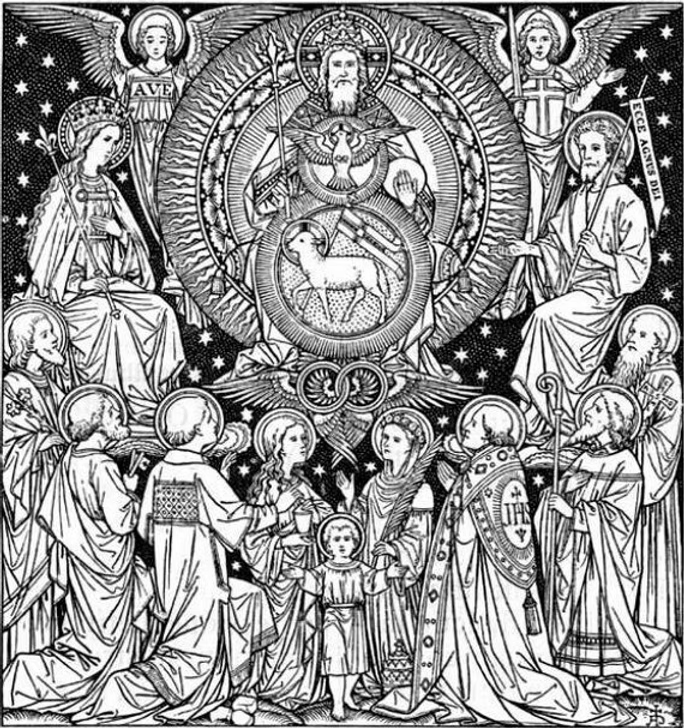
I looked, and I heard the voice of many angels surrounding the throne and the living creatures and the elders; they numbered myriads of myriads and thousands of thousands, singing with full voice,

“Worthy is the Lamb that was slaughtered to receive power and wealth and wisdom and might and honor and glory and blessing!”

Then I heard every creature in heaven and on earth and under the earth and in the sea, and all that is in them, singing,

“To the one seated on the throne and to the Lamb be blessing and honor and glory and might forever and ever!”

And the four living creatures said, “Amen!” And the elders fell down and worshiped.

——————–

This is the Epistle selection that will be read aloud on the third Sunday of Easter, Year C, according to the lectionary for the Episcopal Church. It will follow a “First Lesson” that is a mandatory reading from Acts. In Acts 9 we read, “Ananias answered, “Lord, I have heard from many about this man, how much evil he has done to your saints in Jerusalem; and here he has authority from the chief priests to bind all who invoke your name.” But the Lord said to him, “Go, for he is an instrument whom I have chosen to bring my name before Gentiles and kings and before the people of Israel;” That will be followed by a singing of Psalm 30, where David wrote, “Sing to the Lord, you servants of his; give thanks for the remembrance of his holiness.” All readings today will accompany the Gospel of John, which says: “Jesus said to them, “Come and have breakfast.” Now none of the disciples dared to ask him, “Who are you?” because they knew it was the Lord. Jesus came and took the bread and gave it to them, and did the same with the fish. This was now the third time that Jesus appeared to the disciples after he was raised from the dead.”

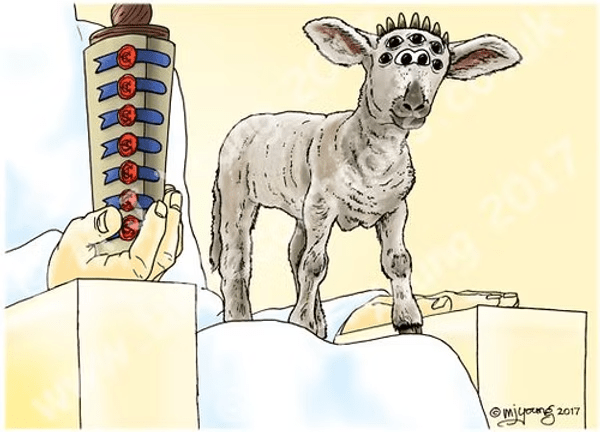
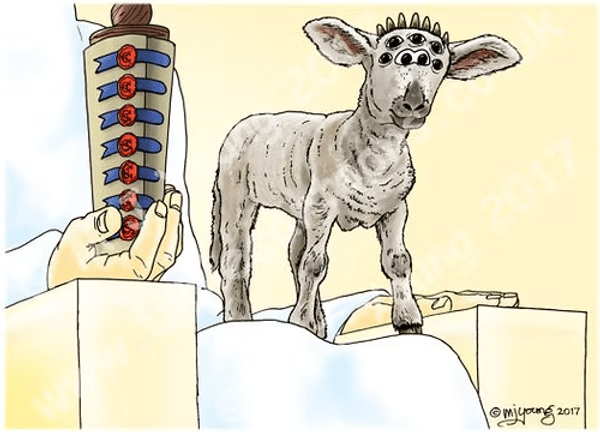
When Revelation is read, it is vital to understand it as a divine vision or dream. That which John wrote is not physical, but spiritual. It is the metaphor that must be understood. In the verses before these selected four verses, John wrote of the “seven seals” that kept the “scroll” from being read. The “Lamb” came to open the scroll and read it. This led all the “elders” (“twenty four”) to fall down before the Lamb and sing, “Worthy are you to take the scroll , kai to open the seals.” This means the ability of “completion” (metaphor for “seven”) is to understand Biblical Scripture (“scroll” is “biblion”) by breaking the “code” or “divine syntax” of Scripture, where “seals” (“sphragidas”) means “proofs.” The way one does that is by allowing the “throne” of Yahweh be in one’s heart (or soul), so the “Lamb” can be resurrected (His “right hand” extension into the world) in one’s soul-flesh. those are who fill the “golden bowls” with the “incense” of their “prayers” – “saints” in the name of the “Lamb.”
This becomes the Easter season theme of resurrection. John did not write some metaphor of the end of the world. He wrote explanations for Christianity that had taken place when he wrote; and, that past and present history would extend into the future, as long as the “Lamb” is to be reborn into “saints” (from “hagiōn”). This concept needs to be held when reading these four verses.

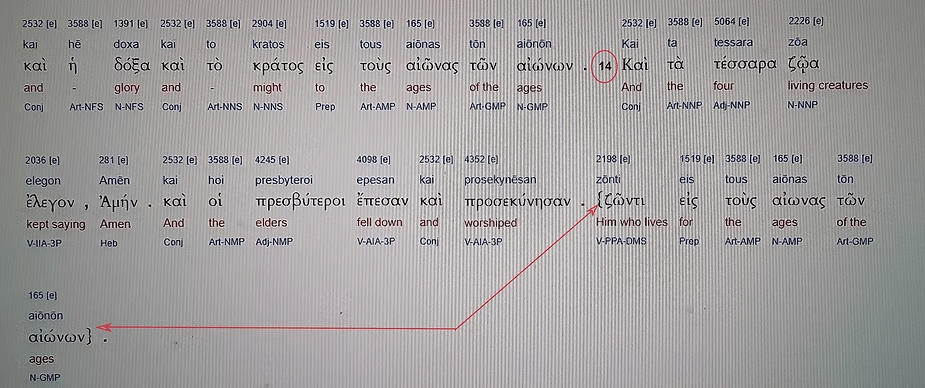
Verse eleven begins with a capitalized use of “Kai,” which is followed by a one-word statement: “eidon.” That is the first-person Aorist Indicative form of “horaó,” so the meaning says, “I saw, looked upon, experienced, perceived, discerned, or I was made aware.” HELPS Word-studies says of this word: “properly, see, often with metaphorical meaning: “to see with the mind” (i.e. spiritually see), i.e. perceive (with inward spiritual perception).” Because Revelation must be understood as a vison of metaphors, the best translation (made most important to grasp by a capitalized “Kai”) says, “I perceived” or “I discerned.”

That major importance of discernment or perception is then followed by five more uses of the word “kai” (in the lower case), where those denote important elements of this vision beheld by John. Those five are stated as this (with a semi-colon placed after the third segment, making the final two important elements be a separate but related part of this whole stated in verse eleven):

kai I heard sound of messengers [angels] of many encircled of this of throne ,

kai of these of living beings ,

kai of these of maturity in seasoned judgment [elders] ;

kai it existed this number of themselves myriads [ten thousands] of myriads ,

kai thousands of thousands .

From discerning “angels” as “messengers,” whose heart centers (their souls) are “encircled” (rather than “around”) “of this of throne,” the meaning is these “angels” are the “saints” of the earth. All of them have Yahweh within their souls; so, all of them are His “messengers” upon the earth. By not translating “zōōn” as “living creatures,” where that use of “creatures” takes away from the key meaning that is “alive” or “living” (as opposed to being “creatures” of death), the root meaning of “zoon” is “something alive.” This must be seen as a statement of those human beings that have earned eternal salvation, thus are made “alive” in the flesh (life animating matter that is dead). This gaining of “life” in the flesh means those “messengers” are “elders,” which means they have “matured in seasoned judgment,” which can be seen now as having “matured in Christ,” which is the “Anointment” of Yahweh, who sits on the “throne” that “surrounds” all of these “angel messengers.” Following the semi-colon, the two important statements say John “discerned” the number of these was (in essence) too many to put a fixed “number” on. This is a statement of the profound growth experienced by true Christianity, where all were “Anointed” by Yahweh. However, the second segment here is only one-tenth as much as the first segment, which shows a great decline in those “numbers.” That shows a rise, followed by a steep fall. That fall would be why Jesus spoke to John and had him have this divine vision.

Verse twelve then follows the “myriads” and “thousands” as creating a “sound” that “calls out” (“says”) “loudly”, “Worthy he exists this Lamb this having been slaughtered , to receive this power kai abundance kai insight kai strength kai honor kai renown kai blessing !” Within this are six uses of “kai,” with each one showing the importance of the soul of Jesus (the “Lamb”) having been placed (“he exists”) within the souls of those singing “loudly.” The capitalization of “Axion,” meaning “of Weight, of Worth, Worthy,” is a repeating of its use of “Axios”in verse nine (not read today), where the “Lamb” was deemed “Worthy” to take the “scroll” and “open the seven seals.” Now, this use says the “saints” have become “Worthy” from being the rebirth (“he exists”) of Jesus (“the Lamb”), making all “saints” have the traits importantly listed, which makes them sing loudly in praise.

Verse thirteen then also begins with a capitalized “Kai,” showing another major statement of importance to grasp. This that must be understood says, “every created thing which within this spiritual [heaven]”. Here, the word “ktisma” clearly states “creature,” furthering the use of “zōōn,” where focus was placed on “living creations.” The translation as “created things” removes the spectacle of a “creature” and makes it be stated as “created things,” which are all the creations of Yahweh. To then make it be most important to grasp this is relative to “heaven,” that should be read as the “spiritual” that is giving life to “creatures. This reference to “heaven” is then a major statement that all “things” with “life” “within” has a soul, given to it by Yahweh.

This powerful statement then follows with four internal uses of “kai” (in the lower-case), which makes important statements about all which possess souls. They are then stated as follows:

kai on the basis of of this earth ,

kai underneath of this of earth ,

kai on the basis of of this of sea < exists > ,

kai these within of themselves all ,

In the first two important segments, the use of “earth” must be read as “flesh.” This is the “earth” that is most able to animate as “living,” as opposed to dirt and rock. This means the first important segment is placing focus on the presence of “heaven” or a “soul” in “flesh.” The second segment than makes one be aware that the “soul” is not visible, as is the “flesh,” because it is “underneath” it. This becomes metaphor for a “soul” being the “underlying” source of “life,” which is unseen and undetected or provable by science. In the third segment, the use of “of sea” becomes metaphor for the flow of life that engulfs the “earth.” The “sea” (as a reference to water) becomes symbolic for the emotional states that come from “being” alive. When the word “estin” is found placed within angle brackets it is a silent statement that life “exists” as a “sea” that ebbs and flows. In David’s psalms that tell of the Leviathan, it existed in the “sea,” as metaphor for the Spirit that possesses humanity, either as a good entity or bad (either way an elohim). The angle brackets show this hidden nature of “elohim” in the “sea.”

It is then from this “sea,” which is metaphor for the “myriads” and “thousands,” who then were “heard” by John’s soul “calling out” the next song of praise. Following a colon mark, the following is said:

“To this dwelling on the basis of this throne , to this Lamb , this blessing kai this honor kai this renown kai this strength unto these ages of this of ages .

Here, the “saints” are singing praise for having Yahweh “seated” within their souls, where His “throne” makes Yahweh be the King of all. As such, the body of flesh becomes a temple, where the “throne” is the Ark of the Covenant, which represents the marriage vows sworn in divine union. With the body becoming a temple, Jesus (“this Lamb”) is given the role as High Priest, which makes him become “Lord” over one’s soul-body, who obeys his commands. This presence is the ”blessing,” which makes one created as “alive” by Yahweh be the “blessing” of sainthood. This is an “honor” given always to Yahweh, with the “renown” being in His name in marriage [“Israel”], while also in the name of Jesus Christ” [“Yahweh Save through Anointment”]. The “strength unto these ages of this of ages” is the promise of eternal life, through total submission of one’s soul to Yahweh.

Verse fourteen also begins with a capitalized “Kai,” making it be of major importance to grasp. Here, that great importance is placed on “the four living beings they kept saying”. Here, the number “four” (which was stated previously in verses six and eight [unread today]) must be seen as being symbolic of a solid foundation. This means Yahweh being seated within one’s soul, with His Son (“this Lamb”) the Lord of one’s flesh, that has made one be a “living creature” that is “alive in being,” so it is impossible for that union to ever be broken. Thus, those saved souls forever said, “Amen,” which means that spoke the “Truth.”

Following a period mark after “Amen,” John wrote another “kai” (in the lower-case), which shows importance needing to be read from “these matured men having seasoned judgment they fell prostrate kai worshiped .” The importance here says all who will become “alive” with eternal life, therefore being ministers of Yahweh, as His Son, they will project as “matured [in Christ] men [and women, all reborn as the Son] possessing seasoned judgment [Baptized by Yahweh’s Spirit].” This is so because they submitted their souls to Yahweh in totality, allowing themselves (a “self” is a “soul”) to be totally possessed by Him and resurrected as His Son’s soul in one’s soul. That is the meaning of them “falling prostrate,” because their self-will and self-egos all died – “fell down.” They “worshipped,” which means they gave all honor and praise to Yahweh for having saved their souls.

Unstated in the above text is an ‘aside,’ which is a final statement made in verse fourteen, which is enclosed in brackets. This segment of words translated into English as follows:

[ to the living upon these ages of these of ages . ]

This unstated aloud statement becomes insight that says these four verses will always state the truth about what frees a soul from the bondage to death that comes from being eternally recycled back into bodies of flesh [back to the “earth”] that will always die and start all over again. For as long as souls exist on the earth in “living creatures,” the “saints” will be sent to lead the lost to be found. One’s soul can only become a “living being” through sacrifice of self to Yahweh and totally submitting to Him in divine union. Only when “the Lamb” is resurrected within one’s soul, so the “scroll” can be taken and the “seals broken,” will the truth be exposed that gives one faith, along with the promise of eternal life.

As the Epistle reading during the third Sunday of Easter, when the theme of Jesus being raised from the dead has to be seen in each individual soul seeking eternal life [more than Jesus being saved alone], John’s Revelation must be seen as speaking of the truth of this meaning. Readings from Revelation are found in each of the six Sundays of Easter, in Year C. This says John did not write about some nebulous ‘End Times’ that can always be far away and never now. Everyone has an “end time” that is called death, which is known because a soul is placed in mortal flesh. These four verses, pulled from the fifth chapter of Revelation, says all must be married to Yahweh, with His “throne” within one’s heart and soul (love and marriage), which brings about “the Lamb,” who was “slaughtered” as a sacrificial Lamb, so his soul could be raised in the dead flesh of others. This will make one a “saint,” who will then be one of the “messengers” of Yahweh, spreading the Word known to be true by the Son. An inability to read these four verses as stating the truth above says one is not yet a “living creature.” One still needs to be raised from the dead.
John 21:1-19 – Prophesying future failures for Christianity

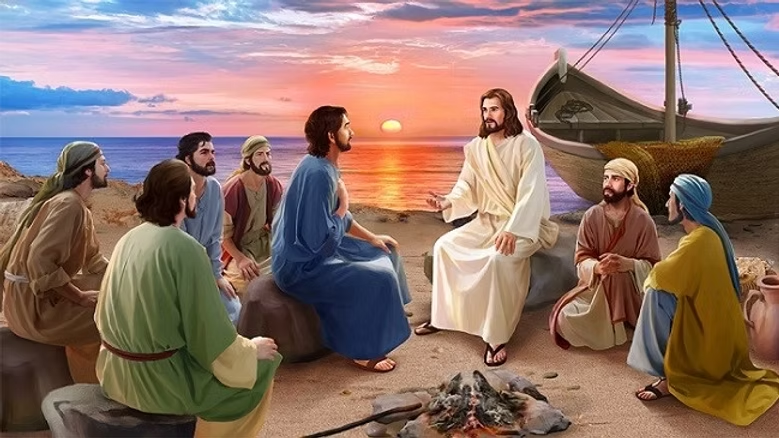
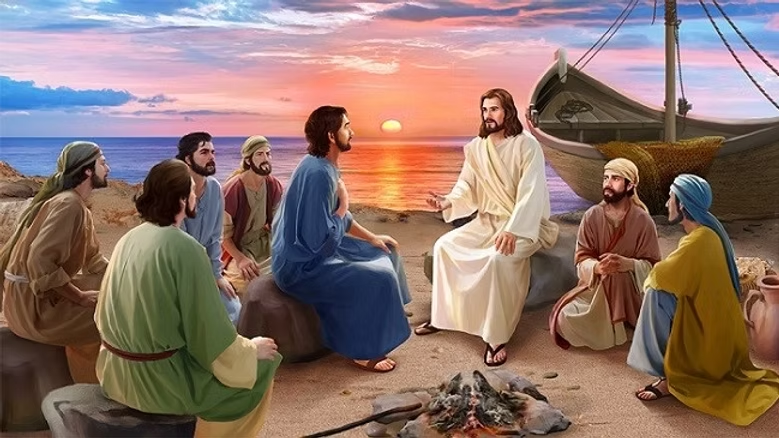
Jesus showed himself again to the disciples by the Sea of Tiberias; and he showed himself in this way. Gathered there together were Simon Peter, Thomas called the Twin, Nathanael of Cana in Galilee, the sons of Zebedee, and two others of his disciples. Simon Peter said to them, “I am going fishing.” They said to him, “We will go with you.” They went out and got into the boat, but that night they caught nothing.

Just after daybreak, Jesus stood on the beach; but the disciples did not know that it was Jesus. Jesus said to them, “Children, you have no fish, have you?” They answered him, “No.” He said to them, “Cast the net to the right side of the boat, and you will find some.” So they cast it, and now they were not able to haul it in because there were so many fish. That disciple whom Jesus loved said to Peter, “It is the Lord!” When Simon Peter heard that it was the Lord, he put on some clothes, for he was naked, and jumped into the sea. But the other disciples came in the boat, dragging the net full of fish, for they were not far from the land, only about a hundred yards off.

When they had gone ashore, they saw a charcoal fire there, with fish on it, and bread. Jesus said to them, “Bring some of the fish that you have just caught.” So Simon Peter went aboard and hauled the net ashore, full of large fish, a hundred fifty-three of them; and though there were so many, the net was not torn. Jesus said to them, “Come and have breakfast.” Now none of the disciples dared to ask him, “Who are you?” because they knew it was the Lord. Jesus came and took the bread and gave it to them, and did the same with the fish. This was now the third time that Jesus appeared to the disciples after he was raised from the dead.

When they had finished breakfast, Jesus said to Simon Peter, “Simon son of John, do you love me more than these?” He said to him, “Yes, Lord; you know that I love you.” Jesus said to him, “Feed my lambs.” A second time he said to him, “Simon son of John, do you love me?” He said to him, “Yes, Lord; you know that I love you.” Jesus said to him, “Tend my sheep.” He said to him the third time, “Simon son of John, do you love me?” Peter felt hurt because he said to him the third time, “Do you love me?” And he said to him, “Lord, you know everything; you know that I love you.” Jesus said to him, “Feed my sheep. Very truly, I tell you, when you were younger, you used to fasten your own belt and to go wherever you wished. But when you grow old, you will stretch out your hands, and someone else will fasten a belt around you and take you where you do not wish to go.” (He said this to indicate the kind of death by which he would glorify God.) After this he said to him, “Follow me.”

——————–

This is the Gospel selection that will be read aloud by a priest on the third Sunday of Easter, Year C, according to the lectionary for the Episcopal Church. This will follow a mandatory reading from Acts, where we are told of Saul being touched by the soul of Jesus, where we read: “The men who were traveling with him stood speechless because they heard the voice but saw no one. Saul got up from the ground, and though his eyes were open, he could see nothing; so they led him by the hand and brought him into Damascus. For three days he was without sight, and neither ate nor drank.” That will precede a singing of Psalm 30, where David wrote: “You have turned my wailing into dancing; you have put off my sack-cloth and clothed me with joy.” That will be followed by a reading from John’s Revelation, where his prophetic dream saw this: “many angels surrounding the throne and the living creatures and the elders; they numbered myriads of myriads and thousands of thousands, singing with full voice, “Worthy is the Lamb that was slaughtered to receive power and wealth and wisdom and might and honor and glory and blessing!”’

The whole of John’s twenty-first chapter is only twenty-five verses; so, this reading selection is almost a whole chapter. A whole chapter of Scripture demands a full commitment to desire to understand that read. Anything less than that is pretending to be a Christian; and, that becomes the meaning of Jesus teaching his disciples the parable of the sheep and the goats. The sheep are those who serve Yahweh totally, becoming raised from the dead as Jesus reborn. The goats are the pretenders that find out pretending finds no reward. In verbiage that John is known for, his use of the “antichrist” needs to be realized to mean what that word says: Being against (anti-) receiving the Anointment of Yahweh (“Christ”) and being reborn as His Son. Those who reject Scripture knowledge – which can only come through the divine presence of the Lamb within (seals hiding the truth of the scroll broken) – will never be led to a full commitment to Yahweh, rejecting his proposal of marriage, so the truth will not be revealed.

To even begin to understand John’s twenty-first chapter, one must realize that the last two verses of his twentieth chapter summed up his book, while saying Jesus did many signs in the presence of his disciples souls [his enclosing “autou” in brackets, in verse thirty]. He ended that chapter by writing this: “kai so that having faith in , life you may possess within this name of himself .” That importantly says Yahweh and His Son are available to possess those who seek to be saved. This means salvation comes from the faith that has personal experience of Yahweh and Jesus. With that faith, one then has eternal life (raised from the dead) through the possession of “Jesus,” whose “name” means “Yah Saves.” A soul cannot be saved without marrying Yahweh, receiving His Spirit, and having His Son’s soul resurrected within one’s own soul. Without that divine possession, one’s own soul is only capable of finding sin and reincarnation (at best).

So, with that stated in John’s chapter twenty, the first word in chapter twenty-one says “After,” from the Greek word “Meta.” That word being capitalized means a divine level of understanding must be discerned from this usage. Strong’s says “meta” translates into English as this: “(a) genitive: with, in company with, (b) accusative: (1) behind, beyond, after, of place, (2) after, of time, with nouns, neut. of adjectives.” Because the word following is in the Accusative, the usage here can be “After,” but I feel it would be better to see it as “Beyond.” This translation means this chapter of John’s becomes prophecy, as a dream or vision of the distant future, well after Christianity has begun. When the word (in the Accusative) is seen to be “these” (the plural word “tauta”), the names that follow (along with everything else) become metaphor that is everlasting … always capable of being applied “Beyond” the initial presence of Jesus’ soul within the souls of his followers.

In verse one, the words “thalassēs tēs Tiberiados” are written, which translates as “sea of this of Tiberius”. In that, the capitalization of “Tiberiados” must be read as divinely elevated in meaning. In John’s first verse in his sixth chapter, he wrote of “Jesus being on the other side of the sea of Galilee,” which he then added “tēs Tiberiados,” to denote the Sea of Galilee also had a Roman emperor’s name. By his exclusion of “Galilee” here, the divine elevation forces one to see a time and place “Beyond” where “these” reborn as Jesus have moved over a “sea” (the Mediterranean) to the city of “Tiberius,” who was emperor until his death in 37 A.D. (“After” the resurrection of Jesus in his disciples – 30 A.D.). The name “Tiberius” is rooted in the name of the river that flows through Rome – the Tiber River. Thus, a river god was named “Tiberis.” This should point focus on the expansion of Christianity to Rome, where Saint Peter would be given great attention (three hundred years “Beyond”).

In the naming of “Simon Peter,” these are two, separate capitalized words, both of which needs to be read as divinely elevated in meaning. More than stating a name of a man who died long before (from the perspective of a future prophecy), which limits how anyone today could gain from reading that name, the meaning behind the name has to be seen as the main purpose of this prophecy. That meaning says, “He Who Hears” and has become a “Rock.” When this is then seen as relative to “Tiberius,” this become the veneration of Saint Peter in the Vatican, where his name is the cornerstone (the “Rock”) of that Church.

Following those two capitalized names, John wrote of “Thomas,” who was also called “Didymos.” Both names mean the same: “Twin.” The first is based on the Hebrew word “to’am,” with the other being Greek, as a reduplication of the word “duo,” meaning “double” or “two-fold.” According to Abarim Publications: “The name Didymus means Twin, but it should be noted that it wasn’t commonly used as a name. The name Thomas, though later very popular, was also quite uncommon.” This means, just as “Simon” was called “Rock,” the same said about “Thomas” says that was not his real name, but a nickname. This would be because he acted like Jesus, or looked similar to Jesus, or both. The use of the Greek and Hebrew becomes a divinely elevated statement that Jews in the regions of former Greek control were where the “Duality” of Christianity spread.

In the segment that names “Nathanael,” this becomes divinely elevated as a statement that says “God Has Given.” When this is added to the name of the place “Cana,” that word means “Reeds,” with the name “Galilee” meaning “Rolling” or “Encircling.” When Christianity is seen as the focus of this “Beyond,” the use of “Reeds” for making baskets (like that baby Moses was found in, among the reeds), they become the spread of Saints that provide help to those grasping at ‘straws,’ in need of God’s help.

When the name “of Zebedee” is written, this means similar as “Nathanael,” as “Yah Has Given” or “Gift Of Yah.” This acts to confirm the “Reeds” that are “Surrounding” as the “Gift of Yahweh” that is His Son, to be resurrected within the souls of those seeking salvation.

Following all this naming of Saints, when only Thomas was named of all the disciples within the locked room, to have “He Who Hears” “Rock” tell the others he is going fishing, the capitalization of the Greek word “Hypagō” is divinely elevated to say “I” is the “Ego” or “Self-will” of the one claimed to be the first Bishop (or pope) of Rome. That Greek word is the first-person Present Indicative Active form of “I,” meaning “to lead or bring under, to lead on slowly, to depart.” This becomes an important declaration of a leader of a Church declaring, “I lead” a religion that plans on “fishing” for the souls of the lost. This personifies all good intentions from self-egos going to naught. The result of this expedition was “they caught nothing.”

When the timing of good fishing is seen as being at “night,” this symbolizes the darkness of death, when sleep symbolizes that state of being that surrounds a soul. To go fishing for souls at “night” then says oneself is dead, having not been raided to the light of truth. When one is mired in darkness, it is impossible to catch lost souls. Oneself is just as lost, because one is void of the soul of Jesus within. One has denied true Sainthood by rejecting divine union with Yahweh.

To realize that Matthew wrote in his final chapter (verse 16), “Then the eleven disciples went to Galilee, to the mountain where Jesus had told them to go,” the number “eleven” says prior to Pentecost. Not knowing where the “mountain” is makes it difficult to connect a “mountain” to fishing on the “sea.” However, after having Jesus enter into each of their souls when it was still the Sunday of his discovery to be out of his tomb, it seems highly unlikely that those specific souls in human flesh would return to their former profession, as fishermen. Thus, the “boat” needs to be seen as the shape of Christian churches, where the “nave” (from the Latin “navis,” meaning “ship”) is shaped to resemble a fishing boat. The “Barque of Saint Peter” is metaphor for the Church of Rome, where the Roman Catholic Church is the “barque” (small boat).

When verse four begins with the capitalized word “Prōias,” divinely elevating “(early) Morning” to a statement of the dawning of the “Light” of truth, the darkness of “night” has brought about a vision of Jesus. For eleven disciples having each experienced epiphanies of Yahweh sending the soul of Jesus to guide them, that inner presence means none of them would see Jesus external to themselves, other than knowing Jesus also possessed other saints, just as his soul possessed theirs. To have gone fishing and caught nothing says those on that boat are “Beyond” reflections of true Christian saints, as those trying to be what they are not; and, they cannot be without Yahweh and Jesus, when in darkness.

When Jesus called to those on the boat at morning, he called them “Children,” from John writing a capitalized “Paidia.” That form is the Vocative plural for “paidion” means “a young child,” implying “a little child, an infant, or a little one.” To call grown fishermen that name says they were not yet matured as fishers of men’s souls. They were ministers or priests in a barque, whose only training for such an occupation was from being read Bible stories in “Children’s” church. This ‘pet name’ says their intent was sincere – they wanted to save soul – but none of them had a clue how to really do that. They were “infants,” versus the depths of the sea of souls.

When Jesus knew they had caught nothing, his telling them to “Cast your nets on the right side of the boat” says they were “Casting” wrongly. The capitalized “Balete,” divinely elevates “you have Cast” (in the second person plural past tense) so it says they have not done now as they had done in the past. The root word “bállō” says it can be translated to say, “you Tumbled” or “you Fell.” This divinely elevates this statement by Jesus as saying they caught nothing because they sought to catch soul in the wrong way (where the implication of having “Cast” left says the Church used sinister means, which will never catch souls properly). This says the “Children” needed to find the “right side,” in order to be successful.

John is “the disciple whom Jesus loved.” John was the “Beloved” because he was the son of Jesus, born of Mary Magdalene. John was just a boy, therefore the true “Child” on the boat; and, John was “beloved” because he never lost faith or stopped being possessed by God and Jesus. Because he was a saint, he identified who was telling them where to “Cast” their “nets, as “This Lord.” Those two capitalized words say John placed tremendous guilt within the one professing to be the “Rock” of Rome. That guilt was because he had claimed to be a saint; but he did not recognize “This” most holy soul that justified the title saint, who was not the “Lord” of Simon’s soul. Thus, “He Who Heard” John speak the truth forced Simon to rip off his holy garments that identified him as a pope or bishop, jumping into the sea of sinner souls. He did that naked, to expose the truth for all to see. Simon wanted all to know he had served as a false shepherd.

When Simon bailed out of the barque, he left the other disciples to run the Vatican. Their leader had jumped ship. Having caught “a multitude of this fish,” they could not get them out of the water. By being “not far from land,” the “land” symbolizes the solid ground of salvation. It is where Jesus can be found. The Greek word “diakosiōn” means “two hundred,” where the number “two” always means the duality of soul and body, as well as soul with Spirit. By being “two hundred cubits” away from heaven, “dragging the net of fish,” none of those on the boat were “one hundred percent” submissive to Yahweh, reborn as His Son. While they could catch fish in a net, they did not know how to save their souls. They needed to replace their bodies (which includes a brain) with the Spirit of Yahweh.

When the disciples on the boat reached land, so they were truly possessed by the Spirit of Yahweh and they became Baptized souls, they saw the same food being prepared that was served the multitude in the plain by the sea (fish and bread). When Jesus said to bring the fish in, “He Who Heard” “the Rock” personally pulled the fish and the net onto land, bringing them to the Spirit of Yahweh. The number being “one hundred fifty three” (three separate words), those fish all had their souls Baptized (“one hundred percent Baptized by Spirit). They were halfway to being saints, reborn as Jesus (fifty percent). When the soul of Jesus would be resurrected within their cleansed souls, each would be a trinity (three) – Father, Son, Spirit.

The net not being broken says the presence of Jesus’ soul marks a soul for salvation. Once marked, the soul needs to be ‘processed’ by saints. Once saved, there can be no breaking that bond.

When John then wrote of the disciples being afraid to ask this strange man on the shore who he was, knowing it was their “Lord,” this speaks loudly that the same disciples that were filled with Jesus’ soul in the locked upper room would never be so unknowing once so possessed. This then speaks of those future saints, who are like those the soul of Jesus told the soul of Thomas, “Blessed are those who will come to faith without having seen Jesus of Nazareth.” The man offering them spiritual food was not someone they had ever seen before.

When John wrote, “this is the third time Jesus was revealed before his disciples,” this speaks loudly against the foolishness that preaches a “second coming.” Jesus appeared first as Jesus of Nazareth (born in Bethlehem). Jesus was revealed in those first saint-apostles on Easter, remaining with them until the eve of Pentecost. Jesus returned the second time on Pentecost Sunday; and, that rapidly spread to become the advent of Christianity. This “third time” is then Jesus being revealed to an entirely new generation of saints, none of whom had lived when Jesus lived. Thus, John wrote of this “having been raised from the dead,” which is how all saints are made. One’s soul must seek Yahweh in marriage, do the works that commit to the Covenant; and, then one’s soul must become where the soul of Jesus is resurrected. The “second coming” is at all times when a new saint is made.

In the verses that have Jesus asking “Simon of John” (barJonah) three times, Do you love me?” or literally “love you me?” The first two times, Jesus used the word “agapas,” with each time Simon answering “Yes,” but using the word “philō.” The third time Jesus asked, he used “phileis,” repeating that question with a capitalized “Phileis.” Simon answered again with “philō.” The difference is “agapas” asked Simon if his soul was in love with Yahweh, so his soul loved Jesus as a Son born to him. All times Simon answered that he loved Jesus like a brother, not like a mother to her son. That question asked if Simon was more in love with himself than with Yahweh. If he only saw Jesus as a brother, then he saw both of their souls as equals. That was explaining why someone would attempt to sail a boat to catch the souls of men and catch nothing, fishing in darkness. A fool makes the decisions necessary to be made by Yahweh, bringing failure upon himself or herself. Had that version of “He Who Hears” been in love with Yahweh and loved Jesus as a mother to her son, he would have not gone fishing for souls until he was prepared to make a catch every time.

Each time Simon failed to give the right answer to Jesus, Jesus told him a command. That says Jesus was the Lord of Simon. As his Lord, they were not equals. Jesus told Simon to “Feed these lambs of me,” where the capitalization of “Boske” means to “pasture the flock” by leading it to good pastures. Good pastures means feeding the lambs spiritual food. The second time, Jesus told Simon, “Shepherd these sheep of me.” There, the capitalization of “Poimaine” means to “Govern” the disciples, which is the meaning of an “adonay” – a “Lord, Master” or “Teacher.” The third time Jesus said, “Feed these sheep of me.” All of those “lambs” and “sheep” needed to be prepared to be sacrificed to Yahweh in marriage, which is the metaphor of being slaughtered and burnt on the altar as an offering. They would all be placed in the hands of Jesus, the High Priest. The role of Simon (and all saints) is to teach the truth, so the flock will desire to make the necessary sacrifice of self. The responses made by Simon indicated he was not prepared for such self-sacrifice. If not, then how could he properly shepherd sheep?

That led to Jesus saying (NRSV), “Very truly, I tell you, when you were younger, you used to fasten your own belt and to go wherever you wished. But when you grow old, you will stretch out your hands, and someone else will fasten a belt around you and take you where you do not wish to go.” That lesson says it was told because Simon needed to know it. Simon thought he could make decisions and have those decisions backed by God and Jesus; but that was making God and Jesus be commanded by Simon. It does not work that way. When Jesus said, “take you where you do not wish to go,” that says the his ego has not yet fully submitted unto Yahweh. It still wanted to do as it wanted, not what God commands. Thus, Jesus followed with the command, “Follow me.” That says, get rid of the ego-trip and do what I say from now on; and, “Follow” is a capitalized “Akolouthei,” which means it is divinely elevated to mean, “Be me reborn.”

This reading has to be seen as a prophecy that projects the failure of Christianity to be the same as the failure of Judaism, where the common people find it much easier to let a charismatic lead them. This reading from John has to be seen as the failures that would come from the Church of Rome, by letting men run that religion as a business, rather than fish for souls and show them how to get to heaven. It says there would come a time when the leaders would not recognize the voice of Jesus calling to them. Only someone who is still a saint can Baptize seekers and pass on Yahweh’s Spirit. Then, they can become the mothers of Jesus, as Christs. In a world that no longer listens to saints, because they are few and far between, the world now listens to pretenders wearing fancy clothes in a nave. The symbolism of feeding the priests spiritual food – bread and fish, Spirit and elohim – is the only way to find the souls needing to be saved and lead them to salvation properly. The only second coming is when one’s soul surrenders completely to Yahweh and gives rebirth to His Son in one’s soul.

Acts 9:36-43 – Raised from the dead to raise other souls from death

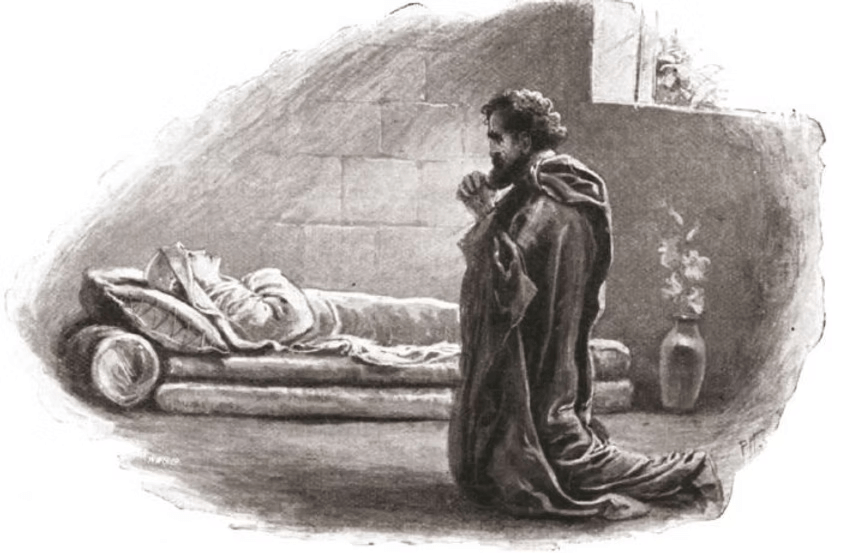
Now in Joppa there was a disciple whose name was Tabitha, which in Greek is Dorcas. She was devoted to good works and acts of charity. At that time she became ill and died. When they had washed her, they laid her in a room upstairs. Since Lydda was near Joppa, the disciples, who heard that Peter was there, sent two men to him with the request, “Please come to us without delay.” So Peter got up and went with them; and when he arrived, they took him to the room upstairs. All the widows stood beside him, weeping and showing tunics and other clothing that Dorcas had made while she was with them. Peter put all of them outside, and then he knelt down and prayed. He turned to the body and said, “Tabitha, get up.” Then she opened her eyes, and seeing Peter, she sat up. He gave her his hand and helped her up. Then calling the saints and widows, he showed her to be alive. This became known throughout Joppa, and many believed in the Lord. Meanwhile he stayed in Joppa for some time with a certain Simon, a tanner.

——————–

This is the mandatory reading selection from Acts to be read aloud on the fourth Sunday of Easter, Year C, according to the lectionary for the Episcopal Church. It will precede a singing of Psalm 23, which famously begins by saying, “Yahweh is my shepherd; I shall not be in want.” That will be followed by a reading from Revelation, where John wrote: “I looked, and there was a great multitude that no one could count, from every nation, from all tribes and peoples and languages, standing before the throne and before the Lamb, robed in white, with palm branches in their hands. They cried out in a loud voice, saying, “Salvation belongs to our God who is seated on the throne, and to the Lamb!”’ All will accompany the Gospel selection from John, where he told of Jesus telling the leaders of Jerusalem, “The works that I do in my Father’s name testify to me; but you do not believe, because you do not belong to my sheep. My sheep hear my voice. I know them, and they follow me. I give them eternal life, and they will never perish. No one will snatch them out of my hand.”

When one realizes the Easter season is about oneself being raised from the dead, as Jesus’ soul resurrected within one’s soul, it makes perfect sense that a reading from Acts would involve someone being raised from the dead, as is seen here in the story of Peter raising Dorcas. This must be seen, however, not as Peter raising Dorcas but Jesus. Because Jesus was raised within the soul of Peter, then Jesus was able to use the flesh of his Saints to continue his ministry that was the spread of salvation to the lost souls of the world.

It should be seen that this story is similar to that of Elijah, who raised the widow’s son in Zarephath of Sidon. In First Kings 17:21 we read, “Then [Elijah] stretched himself upon the child three times and cried to Yahweh, “Yahweh elohay, let this child’s soul come into him again.” That must now be compared to this story, where Peter “knelt down and prayed.”

It is also very similar to the story told in Mark’s Gospel, when Jesus went to the home of Jarius (a leader of a synagogue), because his daughter was sick. By the time Jesus and Jarius arrived at the house, the girl had died. Similarly, where we read here: “Peter put all of them outside,” Mark wrote, “After he put them all out, he took the child’s father and mother and the disciples who were with him, and went in where the child was.” (NIV)

In all cases, it must be understood that only Yahweh can return a soul to its body of flesh. When Jesus raised Lazarus from death in his tomb, Jesus had said prior, “He is only sleeping.” When Jesus arrived at the home of Jarius, after told the girl was dead, Jesus told them, “The child is not dead but asleep;” at which point those whom Jesus told laughed at him. They laughed because they knew the difference between sleep and death; and, the girl was indeed dead.

In the stories of Elijah’s miracle and Jesus healing a little girl from death, no names were listed. Here, we are told the name of “a disciple,” which is Tabitha. That name means either “Gazelle” or “Beauty.” Her name in Greek (Dorcas) means either “Deer” of “Seer.” Interestingly, when Jesus spoke to the dead body that was Jarius’ daughter, he spoke Aramaic, calling her “Talitha.” That word means “Little girl,” which Mark then said in Greek Jesus called her “Korasion.” The comparison that should be taken from that and placed upon this similar healing done by Peter (raised as Jesus) is a “Little girl” is as close to purity as a soul in a body of human flesh can be, when not in possession of the soul of Jesus, granted eternal life.

When we are told Tabitha-Dorcas “was devoted to good works and acts of charity,” as well as being a disciple of Jesus through his ministry in Apostles, Tabitha-Dorcas was in essence like a “Little girl.” Her death placed her soul before the judgment of Yahweh; and, that becomes why Peter (as Jesus reborn) was sent to say Tabitha-Dorcas would be raised from the dead.

It should be understood that death is a known event in a mortal existence. When we read that Tabitha-Dorcas “became ill and died,” this shows how anyone can die, basically at any time. There are no guarantees that one will die of old age. Accidents and illnesses are a part of life. Thus, “the disciples, who heard that Peter was” in nearby Joppa were not calling him to come raise Tabitha-Dorcas from death. They would want Peter to come pray for her soul to ascend to Yahweh. When Peter arrived, it was Jesus within his soul that knew the time for Tabitha-Dorcas’ ascension had not yet come. She still had more good works (the point of the Book of Acts) to achieve, now for Yahweh.

The lesson of this story is being raised from the dead is not to be seen as some parlor trick or magic act that atheists and those who bow down and worship at the temple of science, where many declare Tabitha-Dorcas was not actually dead, but in a catatonic state. Her return to life had nothing to do with Peter praying for her. While all those naysayers will loudly deny a miracle, none of them will demonstrate how such ‘natural’ acts are done, by having someone place them artificially in such a state of ‘fake death,’ so they can show how this is always a possibility. Their beliefs in science and logic betray them when it becomes time to ‘put up or shut up.’

Still, as with the lesson of Lazarus, who was known to have shown signs of physical decay (stinking badly), the purpose of being raised from the dead was not so Lazarus could go on tour with Jesus and show a living body to paying customers, expecting them to actually believe that living body was once a decomposing corpse. Being raised from the dead is not about self. It is about one’s soul having proved a love of Yahweh, so divine marriage can allow one to be raised as Jesus – a Christ. That makes the lesson be the unwritten story of Tabitha-Dorcas the Saint, who went forth into ministry (as had Peter). The spread of Christianity is about every soul touched by Jesus (those healed, like the story of Aeneas, told just before this story) becoming raised from the dead and sent into ministry as Jesus reborn. The lesson says, “You do not receive the touch of Jesus and not become forever indebted to Yahweh for His sending one’s soul Salvation.”

Psalm 23 – Yahweh is my shepherd

1 Yahweh is my shepherd; *

I shall not be in want.

2 He makes me lie down in green pastures *

and leads me beside still waters.

3 He revives my soul *

and guides me along right pathways for his Name’s sake.

4 Though I walk through the valley of the shadow of death, I shall fear no evil; *

for you are with me;

your rod and your staff, they comfort me.

5 You spread a table before me in the presence of those who trouble me; *

you have anointed my head with oil,

and my cup is running over.

6 Surely your goodness and mercy shall follow me all the days of my life, *

and I will dwell in the house of Yahweh forever.

——————–

This is the Psalm that will be read aloud in unison or sung by a cantor on every fourth Sunday of Easter, all Years, according to the lectionary for the Episcopal Church. This psalm is part of the “Good Shepherd Sunday” theme. It will follow a mandatory reading from the Book of Acts, which told of Peter healing Tabitha (or Dorcas), saying, “All the widows stood beside him, weeping and showing tunics and other clothing that Dorcas had made while she was with them. Peter put all of them outside, and then he knelt down and prayed. He turned to the body and said, “Tabitha, get up.” Then she opened her eyes, and seeing Peter, she sat up.” This pair of readings will be followed by a selection from John’s Revelation, where the prophet wrote, “Then one of the elders addressed me, saying, “Who are these, robed in white, and where have they come from?” I said to him, “Sir, you are the one that knows.” Then he said to me, “These are they who have come out of the great ordeal; they have washed their robes and made them white in the blood of the Lamb.” All will accompany the Gospel reading from John, where it is written: “The works that I do in my Father’s name testify to me; but you do not believe, because you do not belong to my sheep. My sheep hear my voice. I know them, and they follow me. I give them eternal life, and they will never perish.”

I wrote a commentary about this Psalm 23 in 2021 and published elsewhere. It can be accessed here by searching for that reading in Psalms. At that time, I did not change the two places where “the Lord” has been the translation so many have memorized to quote, as children. Now, I have restored the proper name written by David, which is “Yahweh.” My prior commentary is still valid and worth reading. However, now I will add some thoughts that make it clearer why there is a “Good Shepherd Sunday” every Easter season.

The symbolism for the Easter season must be realized to be one’s own self – one’s own soul – having been raised from the dead, because the soul of Jesus has been the possessing spirit that causes that rise to eternal life. The Easter season is all about attaining Salvation, so one is no longer worried about death. Death is conquered by having Jesus resurrect within one’s soul. So, all of the lesson read during the seven Sundays of Easter deal with reflections upon that personal change within. This must now be equated with the concept of shepherding.

In last Sunday’s Gospel reading from John, a divine vision of the future was shown him, with the names of saints used to show failures in the future to be truly raised from the dead. At the end of that lesson, Jesus told Simon, “Follow me.” That was not a suggestion. It was a command. Prior to that, Jesus had told Simon (after three failure of him to state his love of Jesus being because he had given birth to him, in his soul (he felt he only loved Jesus as a brother), Jesus gave commands to Simon that said, “Feed my lambs, Shepherd my sheep, and Feed my sheep.” All of those commands can only be done by following the command that says, “Follow me.” Jesus is the Good Shepherd, so the only way Simon (or anyone else) can tend the flocks of Jesus is to be raised from the dead, as Jesus reborn. That lesson must be securely grasped to understand David’s Psalm 23.
In John’s tenth chapter, Jesus spoke of being the “good shepherd.” Prior to saying he was that, he said, “I am the gate for the sheep.” He said the sheep knew the voice of their owner. When David begins his Psalm 23 by stating “Yahweh is my shepherd,” that says Yahweh is the owner. Jesus is then the doorway to Yahweh, where the sheepfold becomes synonymous with salvation, as heaven and eternal life. In order to reach that place of safety, one must enter through Jesus. One must be raised from the dead by having the soul of Jesus resurrected within one’s soul. When that is known to only be a result of having married one’s soul to Yahweh, receiving His Spirit, made sacred as a Christ (Hebrew “Messiah”), then the soul of Jesus can be reborn within that Virgin womb made sin free. Jesus is then the voice of the Father that leads the sheep to green pastures and beside still waters. That is the meaning of “feeding my sheep” with spiritual food and giving my sheep living waters to drink.

When David sang in verse three, “He restores my soul,” the Hebrew word for “restore” is “shub,” which means “to turn back, return.” One cannot sing those words and get some fantasy vision of Jesus making one’s soul feel rejuvenated and young again. The “restoration” is all about Yahweh cleaning all one’s past sins, so a soul headed for ruin and damnation does not get lost out in the pasture and eaten by a wolf. Jesus cannot enter into a filthy dirty soul. All souls must be possessed by the owner Yahweh; and put into his sheepfold of cleaned wife-souls. This cleaning comes by the Spirit of divine marriage to Yahweh.

Here is where Christianity is not a request or volunteer work, where only partial submission to Yahweh is done. This is where Jesus telling Simon, “Follow me,” where “Follow” was a capitalized “Akolouthei,” making it have divinely elevated significance as a command, not a friendly request. Your soul “Follows” through complete and total submission to Yahweh. This is seen in verse two saying, “he makes me lie down” (“yar·bî·ṣê·nî”) and “he leads me” (“yə·na·hă·lê·nî”). The repeating of “he leads me” in verse three (“yan·ḥê·nî”) says Yahweh (the owner) has sent His Son to shepherd His flock. The mindless sheep do not know how to stay out of danger. Therefore, they must have a soul in firm control of their safety, so he watches and the sheep does as he says. He leads and he makes the sheep go to “paths of righteousness.”

I have stated this prior, but it bears repeating that whenever we read in Scripture “for sake of his name” (or “in his name’s sake”), the meaning of “name” says a soul is married and no longer in the name one was before. A wife of Yahweh takes on the name “Israel,” which means one has taken on an elohim within one’s soul. That “el” is Jesus. Therefore, one in the name of Yahweh can equally be called “Jesus,” because that name means “Yahweh Saves.” David sang that having the same “el” that is the soul of Adam (aka Jesus) within his soul is what “led him in the paths of righteousness.” Like Jesus told Simon, no one choses a path of righteousness because they are brotherly friends of Jesus. To “Follow me” means to be “in my name,” so I will lead you to become righteous.

When verse four sings, “Though I walk through the valley of the shadow of death,” that sings about every soul in a body of flesh being mortal … born to die. The “shadow of death” (Hebrew “tsalmaveth”) can be read as the evil influences that are prevalent in the world, tempting one’s soul to sin and please the flesh, where those sins place a “shadow” on one’s soul (dirty filth) that will keep it from gaining eternal life in heaven upon Judgment. When one is like the failed souls of the future, who will be cions of saints, not true Saints, the “shadow of death” is always “feared.” One always “fears” being trapped by “evil,” even when one calls oneself a brother of Jesus. Only when one has become married to Yahweh, so His Son is always with one as it grazes, does it never think, so it never thinks to “fear evil.” The presence of Jesus within one’s soul always keeps “fear” and “evil” away from one’s tiny (sacrificed) brain.

When the tools of a shepherd are seen in “your rod and your staff,” that says a whack from a “rod” will get one’s attention to go in another direction. These ‘love taps’ are the necessary lessons one learns as one goes long in life. If one gets into some place where rescue is necessary, then the “staff” becomes the crook that can reach into tight places and pull one to safety. Still, the shepherd will primarily use those tools against any dangers, before they threaten one’s soul. Therefor, they become part of the imagery of one’s shepherd; so seeing them “comforts” one’s soul to know one is being diligently watched over. When Jesus told Simon to “Follow me,” that said to be the shepherd in whom Jesus held the “rod and the staff” that made him able to feed and care for flocks.

In verse five, the aspect of a “table” being “prepared” is meant to mean the Seder meal. When the Egyptians refused to allow Moses to use his staff and lead the flock (Yahweh’s children) out to pasture, the yearling lamb became the central focus of a prepared meal. Each soul is raised to be that lamb without blemish, who will willingly sacrifice itself in the “presence of one’s enemies.” The symbolic foods eaten at the Seder meal symbolize the self-sacrifices a soul must make to gain the Promised Land (metaphor for Heaven, not real estate in the Middle East). To sing “My cup runneth over” reflects the drinking until one passes out drunk, drinking cups of wine after the four of the Seder meal. One’s “head is anointed with oil” means self-sacrifice in marriage to Yahweh (becoming an Israel) means His Spirit has made one a Messiah (Greek a Christ). This verse then sings of the total commitment to serve Yahweh, through the commands of His Son. In this preparation to become served on the plate of self-sacrifice, one’s worst “enemies” are the sins one’s flesh has become addicted to (and the friends who like you filled with sins). One must sacrifice one’s soul to Yahweh so those “enemies” can be defeated.

The final verse then sing of the “goodness” that can only come from uniting with Yahweh. Jesus said, “Only God is good.” One cannot pretend to be “good,” as only the presence of Yahweh allows “goodness” to shine forth. When Jesus said, “I am the good shepherd,” his use of “good” says Jesus does only what Yahweh tells him to do. Therefore, he is a shepherd sent by Yahweh to do “goodness.” This presence can only come after a total cleansing of sins, which is the “mercy” shown by Yahweh to His wife-souls. When David sang, “shall follow me” (“yir·də·p̄ū·nî”), this sings of David doing as Jesus commanded Simon. He did not refer to “mercy following David,” he said “mercy” will come by David “following” as commanded. Those orders will be followed as long as David’s body of flesh held his soul. When released from that flesh, David’s soul would experience eternal life in heaven – “the house of Yahweh.” The experience would last for eternity.

As a standard Psalm to be sung on every fourth Sunday of Easter, it is vital to see the depth of meaning that comes from David’s divinely inspired words. While David did not know Jesus of Nazareth, his soul knew the same soul within his. It is the Yahweh elohim told in Genesis 2, when Yahweh created His Son Adam. Yahweh created Adam to become the eternal soul to be resurrected in the souls of Yahweh’s lambs. The Good Shepherd is Jesus reborn. Jesus told his disciples, prior to his final Passover week, the parable of the sheep and the goats. The goats are those like Simon, who thought being a brother of Jesus (his equal in the flesh) was enough. In Jesus’ parable, the goats were as worthless as branches that bore no fruit – they were thrown into the outer darkness. The Church elders knew the meaning of Easter; and, it is not to worship Jesus as some hero that did things nobody else can do. Easter is all about the sacrifice of self, so one can be raised from the shadow of death, as Jesus reborn. Oneself must rise from slaughtered lamb to be a new good shepherd.

Revelation 7:9-17 – Standing before the face of the throne, wearing the face of the Lamb

I looked, and there was a great multitude that no one could count, from every nation, from all tribes and peoples and languages, standing before the throne and before the Lamb, robed in white, with palm branches in their hands. They cried out in a loud voice, saying,

“Salvation belongs to our God who is seated on the throne, and to the Lamb!”

And all the angels stood around the throne and around the elders and the four living creatures, and they fell on their faces before the throne and worshiped God, singing,

“Amen! Blessing and glory and wisdom and thanksgiving and honor and power and might be to our God forever and ever! Amen.”

Then one of the elders addressed me, saying, “Who are these, robed in white, and where have they come from?” I said to him, “Sir, you are the one that knows.” Then he said to me, “These are they who have come out of the great ordeal; they have washed their robes and made them white in the blood of the Lamb.

For this reason they are before the throne of God,

and worship him day and night within his temple,

and the one who is seated on the throne will shelter them.

They will hunger no more, and thirst no more;

the sun will not strike them,

nor any scorching heat;

for the Lamb at the center of the throne will be their shepherd,

and he will guide them to springs of the water of life,

and God will wipe away every tear from their eyes.”

——————–

I wrote about this reading when it was a selection for All-Saints Day, in 2020. I went deeply into the meaning offered by this selection, pointing out how Revelation is a standard fare during the Easter season and All-Saints Day. I recommend readers view that commentary at this link here. I will take a different view of this reading from the Easter perspective at this time.

This reading from John’s Revelation needs to sound similar to the vision Isaiah wrote of, in Isaiah 6:1-8. In that vison, Isaiah saw “adonay” – “lords” – “above a throne” that was the vacated seat of Uzziah. Isaiah saw seraphim, who had covered their faces with two of their wings. While this angelic presence included all spirits who claimed allegiance to Yahweh, the question raised was who would take the throne of Judah and which angels would support that reign. Isaiah saw himself as a sinner; but one seraph touched his lips with a coal from the altar fire, purifying his soul. When the question was raised, “Who shall we send? “ Isaiah say, “Here I am. Send me.” He was then commissioned to advise the throne of Judah as a prophet.

While the two visions differ in details, they both must be seen as having immediate impact on the world, where John was not shown a vision that would hold off until the end of the world. There can be no ‘End Times’ nonsense applied to this reading. John saw souls that were totally committed to Yahweh, and thereby were one with the Lamb, who is the soul of Jesus. In verse nine, where the NRSV shows it saying, “with palm branches in their hands,” the reality of the Greek shows this is not a good translation.

The Greek written says: “kai phoinikes en tais chersin autōn .” The word “phoinikes” (“φοίνικες” and pronounced “phoenix”) says “palm trees,” which are fully living plants. The same word in Greek can be found to indicate Phoenicians, where the root of that name implies something to do with date palms (not dead branches cut from them). The name is also said to have a relationship with the color purple – a sign of royalty, thus valuable.

When this segment of words is seen to begin with the word “kai,” indicating it is important to firmly grasp the meaning and intent, to translate it as “palm trees within these hands themselves,” one can see within their souls (“themselves”) was a growing plant (like a vine), one that denoted a royal hue. This was “within” their beings. As such, each was a “hand” of Yahweh and the Lamb. To see imagery that has people holding palm branches must be seen as the danger this vision warned against. When a living growth becomes a severed (dead) branch, then no one has bowed down in submission to Yahweh, nor the Lamb.

When these living souls all cry out, “Salvation belongs to our God who is seated on the throne, and to the Lamb!” that says “Salvation” is the promise. However, the Greek text does not present the word “salvation” as a capitalized word (“sōtēria”). Instead, a capitalized “” preceded that word, which shows divinely elevated “This” as being that which delivers souls to this state of being saved. “This” is then Yahweh and His sending the Lamb to them.

When the translation above shows, “they fell on their faces before the throne,” the Greek text shows, “epesan enōpion tou thronou epi ta prosōpa autōn,” which literally translates to state: “they fell prostrate before the face of this of throne upon these faces of themselves”. It is vital to see this segment of words as stating absolute submission to Yahweh, where the first commandment (the marriage vows a soul must agree to) says, “You shall not wear the face of any lesser gods before my face.” That says the face of self is a face that must bow down and “fall prostrate before the face of of this of throne.” The Genitive (possessive) case then says, the bowing down of one’s own “face” then allows one to stand around the throne, wearing the face of Yahweh. This is the symbolism of marriage, when one’s own name and identity is forever given away. The face one wears to the world (as a wife) is that of one’s husband. When Yahweh is that Holy Husband, then one wears His face to the world. This is then the “face” of righteousness. When the face of Jesus (the Lamb) is part of that submission, that face leads one to wear the face of Yahweh. Again, “autōn” is a statement of “their souls” (“themselves”), where it is souls wearing this face, not physical bodies.

Just as the soul of Isaiah was taken into conversation with the divine, so too was John in his vision. When we read, “Then one of the elders addressed me, saying, “Who are these, robed in white, and where have they come from?” I said to him, “Sir, you are the one that knows.” This must be seen as the spiritual entity who questions each and every soul sent forth by Yahweh, asking, “Do you know how to sing praises about salvation?” When this spirit is identified as one of the “elders” (“presbyterōn”), which means that soul was “matured with seasoned judgment” – meaning “experienced” with the Spirit, wearing the face of Yahweh and the Lamb – this projects the need in the physical realm to have Apostles and Saints. While being filled with the Spirit makes one’s soul be guided by a Yahweh elohim, the question posed by the “elder” came from an “adonay” or “teacher.” This is the soul of Jesus speaking to the soul of John. Therefore, John responded by saying, “Kyrie mou,” or “Lord of me.” When he said that, the question came from within John’s soul, from Jesus’ soul being his “Lord.” All “elders” have been reborn as Jesus.

When this “elder” is then shown to tell John’s soul, “These are they who have come out of the great ordeal,” the Greek text written here says this: “Houtoi eisin hoi erchomenoi ek tēs thlipseōs tēs megalēs”. That literally translates to say, “These they exist those coming from out of of this of persecution of this of great”. In this, the Genitive (possessive) case must be applied to the last four words, where the possession has to be understood as divine. To see “of this” repeated (“tēs”), “this” is the possession by Yahweh that refers back to the capitalized “These” (“Houtoi”). “These” are all the souls surrounding the throne and the Lamb, who sing praises of salvation. Because the number of “These” is too many to count (from early in verse nine), that confirms a divine possession that is “of great” or “of exceedingly high” numbers. This leaves the words “erchomenoi ek” and “thlipseōs” – “coming from out of” “of persecution” – to be understood.

The word “coming” has to be seen as souls arriving before the throne for the first time. This word should be read as these souls having been raised from the dead, where death is the trap of a soul in a physical body of flesh, existing in the material realm. Just as Isaiah and John had visions of the spiritual realm, while still alive in their bodies of flesh, the word “coming” means “arrival” before the throne, after having sacrificed their self-will and self-ego to serve Yahweh and be reborn as the Lamb. By understanding that, the “persecution” has to be seen as the temptations to sin that bombard a soul while in the flesh. The same word (“thlipseōs”) can be translated as “tribulation,” which takes on some ‘End Times’ air that is difficult to grasp. The meaning of “tribulation” is (simply stated) “a trying experience.” This says a soul sent into a body of flesh has been placed into a realm where pain and suffering is commonplace. To escape from that worldly condition, a soul must marry Yahweh and be resurrected as His Son.

When the “elder” then said, “they have washed their robes and made them white in the blood of the Lamb,” the “robes” (“stolas”) becomes metaphor for their souls having led lives in sinful bodies of flesh. The use of “white” implies “purity,” which makes a body of flesh become virginal, becoming synonymous with a “chaste” state of being (a virgin). It is then into that washed clean (the Baptism of the Spirit) state of being that the “blood” relationship makes one both the mother and the brother of Jesus resurrected. To be the ”blood of the Lamb” is to be Jesus reborn in the flesh, his soul one with one’s own soul. That presence in one’s soul then allows that soul to be “coming” before the throne and the Lamb, saved and freed from the “tribulations” of worldly existence.

When we read, “For this reason they are before the throne of God,” here again is the word “enōpion” mean “before the face of,” where one’s soul can only come before the throne of Yahweh wearing His face.

When we read, “worship him day and night within his temple,” there is only the light of truth in the spiritual realm of Yahweh. Thus, “day and night” designates a worldly presence, with day being the light of truth that guides one during the darkness of a world that produces tribulations. The “temple” is one’s body of flesh, so one’s “worship” is obedience to the guidance of the soul of Jesus within.

When we read, “the one who is seated on the throne will shelter them,” the spiritual ‘place’ of the “throne” is within one’s heart center, which aligns with one’s soul. This is the meaning of the Arthurian saying, “the king and the kingdom are one.” Heaven is not some distant place to find outside of one’s being, because it is always within. To seek Yahweh is to seek within one’s soul. Thus, the “throne” is at a place within that needs total spiritual submission from everything physical, in order to be able to find. Once found, the “shelter” is the Spirit that surrounds one, making one be Anointed (a Christ) by Yahweh.

When we read, “They will hunger no more, and thirst no more,” this is an unending supply of spiritual food (manna from heaven) and ever-living waters that replenish one’s soul. The element of “thirst” is a desire for cleansing of past sins.

When we read, “the sun will not strike them,” this needs further examination. The Greek text written here is this: “oude mē pesē ep’ autous ho hēlios,” which literally states: “not lest they shall fall on the basis of their souls (“themselves”) this sunlight”. From having just said one’s soul will no longer find “hunger” for spiritual food or “thirst” for redemption, the continuation then says, “neither not they shall fall.” Here, “to fall” means to fail Yahweh or go against (alternate translation of “ep’”) the Lord of “their souls” – Jesus. Thus, this is a promise that “sunlight” will never be denied them. While the physical realm has night and day, the “sun” of Jesus’ truth will always be shining within.

To then have this followed by John writing, “nor any scorching heat,” this actually says, “nor any burning” (from “oude pan kauma”). This is then saying none will be dead limbs or unproductive vines that get trimmed away and cast into the fire. Salvation keeps all souls producing as the good fruit of the vine that is Jesus the Lamb and Yahweh on the throne.

When we then read, “for the Lamb at the center of the throne will be their shepherd,” this places the focus of this reading (on Good Shepherd Sunday) on David having sung, “Yahweh is my shepherd.” From marrying Yahweh one will become His possession, as one of His flock. Yahweh will then send His Son (just as Jesse sent David) to shepherd that flock. The Lamb does not sit on the throne. Yahweh does. Jesus is at the right hand, where souls become the living vines that become his hands. This is how the sheep know the voice of Jesus.

When John wrote, “he will guide them to springs of the water of life,” this is as David wrote, “he leads me beside still waters.” This is the ever-living waters of purity, which replenishes one’s soul forever.

When this reading ends with John writing, “God will wipe away every tear from their eyes,” it is important to realize “God” or Yahweh is the source of all goodness. There can be no “good” shepherd without Yahweh. Jesus is the Lamb, so the sheep will identify with him as the one sacrificed to save their souls from death. All tears come from realizing the mortality of life in a body of flesh. Those tears are wiped away when salvation has been gained. That promise of eternal life comes from the complete submission of one’s soul to Yahweh. Once saved, then the Lamb will be sent to protect Yahweh’s possession.

As a reading on Good Shepherd Sunday, it is vital to know Yahweh is one’s shepherd. Jesus is the Lamb sent by Yahweh to watch over His flock. Modern Christians read David’s Psalm 23 and see artist renderings of Jesus watching over a flock. Their minds soon think David claimed Jesus was his shepherd, when David never knew the inner soul of the Christ by that name. There can be nothing “good” without the presence of God within. A “Good Shepherd” comes from Yahweh’s love for His flock. As the Lamb, Jesus is possessed by Yahweh. Jesus is the soul of Adam, made by the hand of Yahweh – a Yahweh elohim – a creation to be the “Good Shepherd.” It is vital to know that the way it works is not being allowed to be a black sheep that always comes baaahing, “Forgive me,” so one can then resume being a sinful soul. One must fully submit one’s soul to Yahweh, before one can ever begin to expect Jesus to come watch over your soul. The reason John’s Revelation is feared is people know how much fun it is being a dirty little sheep, afraid to be found and then scrubbed clean spiritually. To be that means forevermore commitment. One must agree to the terms of marriage; and, the first rule is to always bow down before Yahweh, only standing before the throne when one wears His face. Selfish sheep refuse to do that. Thus, the ‘End Times’ are not pleasant to think about.

John 10:22-30 – Plain talk about being a sheep in Yahweh’s flock

At that time the festival of the Dedication took place in Jerusalem. It was winter, and Jesus was walking in the temple, in the portico of Solomon. So the Jews gathered around him and said to him, “How long will you keep us in suspense? If you are the Messiah, tell us plainly.” Jesus answered, “I have told you, and you do not believe. The works that I do in my Father’s name testify to me; but you do not believe, because you do not belong to my sheep. My sheep hear my voice. I know them, and they follow me. I give them eternal life, and they will never perish. No one will snatch them out of my hand. What my Father has given me is greater than all else, and no one can snatch it out of the Father’s hand. The Father and I are one.”

——————–

This is the Gospel selection that will be read aloud by a priest on the fourth Sunday of Easter, Year C, according to the lectionary for the Episcopal Church. It will follow a mandatory Easter reading from the Book of Acts, where Peter raised Tabitha (Dorcas) from death. We read there, “Peter put all of them outside, and then he knelt down and prayed. He turned to the body and said, “Tabitha, get up.” Then she opened her eyes, and seeing Peter, she sat up. He gave her his hand and helped her up. Then calling the saints and widows, he showed her to be alive.” That is followed by a singing of Psalm 23, which says, “Though I walk through the valley of the shadow of death, I shall fear no evil; for you are with me; your rod and your staff, they comfort me.” That will be followed by a reading from John’s Revelation, where in a vision he heard an elder say, “for the Lamb at the center of the throne will be their shepherd, and he will guide them to springs of the water of life.”

It is good to know that each of the three liturgical years the fourth Sunday of Easter is called “Good Shepherd Sunday,” according to the Episcopal Church (tradition has it be the third Sunday). The Gospel selection for each year comes from John 10, with Year A focusing on verses one through ten, Year B on verses eleven through eighteen, and Year C the verses listed above: twenty-two through thirty. In this, three verses are omitted: nineteen through twenty-one. It is worthwhile to know those verses are important to realize, in order to see these verses as being separate timing from these of the Year C lectionary.

John 10:19-21 state this:

“Again the Jews were divided because of these words. Many of them were saying, “He has a demon and is out of his mind. Why listen to him?” Others were saying, “These are not the words of one who has a demon. Can a demon open the eyes of the blind?”

(NRSV)

The ones who Jesus told he was the gate to the sheepfold and the good shepherd are not identified in the verses read in Years A and B. It is these omitted verses that we see it was generically stated to be “the Jews,” who were “divided” because Jesus used the shepherd-sheep analogy. The two questions posed state that Jesus spoke words that nobody understood; so, the use of shepherding and sheepfolds flew over everyone’s heads. The two question pose that people saw Jesus either as a threat or as a miraculous prophet, who spoke in ways people could not understand. The point made by these three is the shepherd-sheep theme was spoken regularly while Jesus was in Galilee. This division among the Jews was more prominently against Jesus in Jerusalem; and, this is where these nine verses selected to be read during Year C take place.

In the Greek of these three verses, verse nineteen begins by saying, “Schisma palin engeneto,” which translates as “Division again it came.” The capitalization of “Schisma” divinely elevates that word to be read as more than a common “split.” This “Division” must be read as the significance of “Two,” where that number always denotes a duality. When a divine elevation is applied to “Two,” this becomes a soul in a body of flesh. When the verb “engeneto” can be read as “it born,” the two question posed can be seen as metaphor for fertilization, where an egg is naturally resistant to outside influences and a sperm becomes those external influences. The two do not join naturally, as pregnancy is always guided by the hand of God. Thus, the egg symbolizes Judaism, made up of all the Jews that defended the Law, while not being complete with knowledge of what the Law meant; and, Jesus was the sperm that was sent to impregnate the egg with that knowledge, with the egg knowing it needs to receive and “Split” to grow, while rejecting all comers as a natural sense of protectivity.

Verse twenty-two begins with a capitalized “Egeneto,” which is a third-person singular Aorist Indicative form of “ginomai,” which means, “to come into being, to happen, to become.” The capitalization raises this word’s meaning to a divine level, where it means more than “it happened.” The word must be read as shining the implication of “it was Born,” where after three years of ministry this “division among the Jews” “Became” more than a fear of Jesus, but a sincere concept that Jesus must die. This “Birth” took place “at the time these” came to Jerusalem for the “Feast of Dedication.”

According to the Wikipedia article (“Dedication”), this is written: “The Feast of Dedication, today Hanukkah, once also called “Feast of the Maccabees,” is a Jewish festival observed for eight days from the 25th of Kislev (usually in December, but occasionally late November, due to the lunisolar calendar).” From this, John writing a non-capitalized “enkainia” says this festival was not divinely elevated, therefore not recognized by Yahweh. A “dedication” or “renewal (of religious values)” was not a “dedication” to Yahweh, but to a piece of property held dear to the returning exiles from Babylon. Their Second Temple gave them some sense of importance in the world, after having cheated on their Holy Husband until officially divorced. The “dedication” of the Jews in “Jerusalem” was to themselves being property owners again, having nothing to do with giving honor and praise to Yahweh (and Yahweh had never Commanded, “If I allow you to divorce me and take away your promised land, then if you ever get part of it back you must recognize that date every year for eternity.”)

The capitalization of “Hierosolymois,” the Greek form of the name “Jerusalem,” needs to be read as the meaning behind the name: “Teaching Peace.” This says that a “dedication” to a second temple (and not to Yahweh) taking place in the place where “Teaching Peace” (that of Yahweh’s presence within) should be projecting knowledge that taught how to find the inner “Peace” of Yahweh was not a ”rededication” to anything other than proclaiming self-worth. This is most important to realize, as this segment naming “Jerusalem” is followed by a complete sentence that says, “winter it existed” (from “cheimōn ēn”). Not only is “winter” when the days are shortest and the nights are longest, in the Middle East “winter” was synonymous with “storms” or “the rainy season.” Thus, the Jews chose a time to “dedicate” themselves to serving a second temple (rather than Yahweh), when sunlight was less and clouds routinely blocked what sunlight there was.

When John then wrote that Jesus was on the “porch of this of Solomon” (“stoa tou Solomōnos”), where “stoa” also means “portico” or “colonnade,” the capitalization of “Solomon” makes it become a divinely elevated statement about the temple the Jews “dedicated” their soul to. The name of “Solomon,” who first decided to build a fixed place in which to transfer the Ark of the Covenant, says the “Wisdom” his name stands for is what the Jews worshiped, more than the divine insight of Yahweh’s possession. When the Easter season is known to be a time when the souls of Yahweh’s flock are raised from the dead that is a lost sheep, the name “Solomon” becomes synonymous with the “Big Brain.” Big Brains are the great impetuous that keeps a soul from receiving the soul of Jesus (remember the egg and the sperm analogy). So, it was not coincidence that had Jesus “encircled” by those divided against him in a place named for a “Big Brain.”

When the NRSV shows those Jews asking Jesus, “How long will you keep us in suspense?” this is an over-simplification of the truth written by John. His Greek says: “Heōs pote tēn psychēn hēmōn aireis?” That literally translates to ask, “Until when this human soul of ourselves you raise us up?” Here, the capitalization of “Heōs” becomes a divinely elevated statement of “As far as” or “How long,” which states an inner soul demanding of Yahweh to answer their question of “when” the Jews will ever be “raised up” from their deaths as servants to their Roman overlords. It states a demand of Yahweh to speak to them, at their command, which is some self-perceived authority as keepers of a temple. The question is based on their “human souls” (“psychēn”), which were believe to be from “the breath of identity” given to them by Moses, as the ‘children of God.’

When John next wrote that the Jews said, “If you are the Messiah, tell us plainly,” they questioned (the “Division” of “Schisma”) within their “human souls,” where the conditional of “if” (written “ei,” not a capitalized word) said they did not know for sure. Before they killed Jesus, they wanted him to state in “plain” words, “I am the Messiah” (written “Christos”). Again, using the pregnancy metaphor of the egg and the sperm (where “Division” is the Yahweh-directed cell growth that leads to a body of flesh being born), this question would be like the egg asking the one sperm (out of who knows how many) to produce authorization papers from God, saying “Let this one into you.” That must be seen as a demand that lacked total and complete faith in Yahweh. It is like telling Yahweh, “I will believe in you after you do a trick for me … like make me rich.”

In verse twenty-five, Jesus basically spelled out what a total and complete lack of faith was. It was everything done prior, which led to that moment in time. Everything Jesus had said to them completely shut them up, letting them know that none of them had a clue about what the words of the Law they so diligently memorized meant. On top of all those “plainly” stated conversations held every time Jesus was in Jerusalem, and all the times they conversed in Galilee, Jesus had performed miracles that none of them could ever do. Jesus “plainly” stated everything he had done pointed to the answer they wanted; but they were to Big Brained to see the forest from the trees.

It was here that Jesus returned to the shepherd-sheep theme, which he had preached prior, which most probably they had heard (in some way or another). When Jesus said, “you do not have faith in what you have heard and witnessed external to your bodies of flesh (where Big Brains sit enthroned in a skull), because your souls do not exist from out of of sheep of this of myself” (from “este ek tōn probatōn tōn emōn”). There, the Genitive case in “of sheep, of this, of myself” shows possession. This is “plainly” telling each and every Jew standing around Jesus (“encircling”), “To have faith that I am the Messiah, your souls [“hymeis” as “yourselves,” where “selves” are “souls”] have to be possessed by my soul [from “emōn” as “mine”]. As my possessions [my “sheep”], you would have lost your Big Brains and realized your soul’s safety is in my hands. Big Brains lead you to find the wolves, which does not end well.” Again, using the egg-sperm analogy, the Jews thought they were better off sloughing out as wasted opportunity [death born], rather than receive the seed of Yahweh and be raised from the dead as “little sheep” for His Son to shepherd.

In verse twenty-seven, Jesus repeated what are the expectations of “these sheep,” which are “these of myself” or “of mine,” stating clear possession. This possession is spiritual, not physical ownership. This possession says the soul of Jesus has been raised with the souls of his sheep. Once that soul possesses his sheep’s souls, they hear his voice speaking to them spiritually. Because the soul of Jesus is one with the souls of his sheep, Jesus knows everything about those sheep. When the verse ends with Jesus saying importantly (use of “kai”) “they follow” (“akolouthousin”), this is what Jesus meant when he said, “Follow me” to his disciples. That does not mean walking behind a physical Jesus on a trail somewhere in the Middle East. It means the soul of Jesus has become the Lord soul over a soul and its body of flesh, so each individual sheep does as Jesus commands. When “they follow,” they are Jesus reborn; and, this is the Easter theme of being raised from the dead.
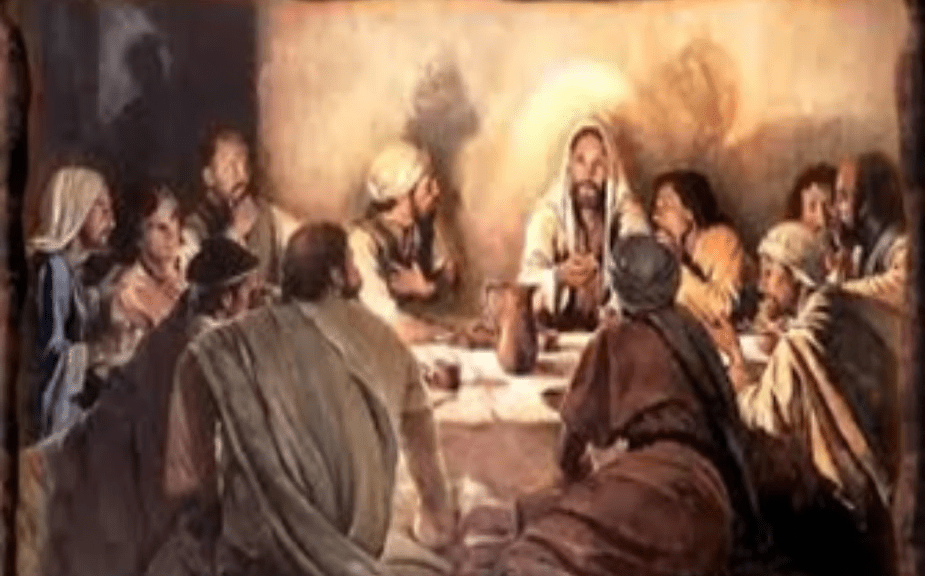
To confirm this is a spiritual possession, verse twenty-eight does that by Jesus saying, “I give them eternal life, and they will never perish. No one will snatch them out of my hand.” (NRSV) That is the permanence of “eternal life” (“zōēn aiōnion”), which last just a little bit longer than a mortal life in human flesh lasts. In order for a soul to be possessed by Jesus’ soul, it has to first submit totally and completely to Yahweh, being made pure by His Spirit. That allows for the soul of Jesus to resurrect within another soul (countless times – one of the abilities Yahweh has), which is permanent and forever and ever. Only souls last that long; but they get recycled into mortal bodies of flesh, if they do as the Jews decided to do.

This marriage to Yahweh coming first is confirmed in verse twenty-nine, where Jesus said, “What my Father has given me is greater than all else, and no one can snatch it out of the Father’s hand.” (NRSV) What is actually written in the Greek text is this: “ho Patēr mou ho dedōken moi”, which literally states, “this Father of myself this he has given to myself”. In that, the Genitive case says Yahweh (“Father”) is the owner of Jesus, so Jesus is His possession (as His Son). The meaning of “this he has given” is the flock’s souls (his sheep). Wherever “self” is possible to be translated (“of myself” and “to myself”), a “self” is a “soul,” as there is no human life on earth without a “soul.” A “soul” makes a “self” out of a corpse. When Jesus takes possession of one’s “soul-self,” then that ‘sheep’ has gained “eternal life,” compliments of marriage to the “Father.”

In verse thirty, Jesus said, “The Father and I are one.” (NRSV) This says “the Father” and the Son are one. When a sheep’s soul gets added to that combination, one is talking about a Trinity, where the possession of a soul by Yahweh comes by His Spirit in divine marriage. When the soul of Jesus is then resurrected within that wife-soul of Yahweh, one has the “Father,” Son and Spirit. When the Spirit is present in a human being, that is Baptism by the Spirit, which makes a soul in a body of flesh become Holy” (“Hagion”). Only such sheep can be “Holy,” because holiness, sainthood, and living righteously is only done by divine possession on planet earth.

As a Gospel reading for the Sunday deemed “Good Shepherd Sunday,” it is imperative to see that one identifying as a Christian, while not being a Saint, is really no different than the Jews of Galilee and Jerusalem, where half of them thought Jesus was possessed by demons, while the other half thought there was something special about anyone who can work miracles. If one does not hear the voice of Jesus tell one what to do, then Jesus is not one’s shepherd. The whole point of the Easter season is to die of self, because one realizes self will only lead a soul to ruin. One must submit to marriage to Yahweh (learning His name is a good ‘ice-breaker’), in order to be possessed as His flock. Once one is a sheep of Yahweh, then He will send His Son to be your Good Shepherd; and, Jesus said “only God is good.”

Acts 11:1-18 – What God has made clean, you must not call profane

Now the apostles and the believers who were in Judea heard that the Gentiles had also accepted the word of God. So when Peter went up to Jerusalem, the circumcised believers criticized him, saying, “Why did you go to uncircumcised men and eat with them?” Then Peter began to explain it to them, step by step, saying, “I was in the city of Joppa praying, and in a trance I saw a vision. There was something like a large sheet coming down from heaven, being lowered by its four corners; and it came close to me. As I looked at it closely I saw four-footed animals, beasts of prey, reptiles, and birds of the air. I also heard a voice saying to me, `Get up, Peter; kill and eat.’ But I replied, `By no means, Lord; for nothing profane or unclean has ever entered my mouth.’ But a second time the voice answered from heaven, `What God has made clean, you must not call profane.’ This happened three times; then everything was pulled up again to heaven. At that very moment three men, sent to me from Caesarea, arrived at the house where we were. The Spirit told me to go with them and not to make a distinction between them and us. These six brothers also accompanied me, and we entered the man’s house. He told us how he had seen the angel standing in his house and saying, `Send to Joppa and bring Simon, who is called Peter; he will give you a message by which you and your entire household will be saved.’ And as I began to speak, the Holy Spirit fell upon them just as it had upon us at the beginning. And I remembered the word of the Lord, how he had said, `John baptized with water, but you will be baptized with the Holy Spirit.’ If then God gave them the same gift that he gave us when we believed in the Lord Jesus Christ, who was I that I could hinder God?” When they heard this, they were silenced. And they praised God, saying, “Then God has given even to the Gentiles the repentance that leads to life.”

——————–

This is the mandatory selection from the Book of Acts that will be read aloud on the fifth Sunday of Easter, Year C, according to the lectionary for the Episcopal Church. It will precede a singing of Psalm 148, where David wrote, “Kings of the earth and all peoples, princes and all rulers of the world; Young men and maidens, old and young together. Let them praise the Name of Yahweh.” That pair will be followed by a reading from Revelation, where John’s vision saw, “a new heaven and a new earth; for the first heaven and the first earth had passed away, and the sea was no more.” All will accompany the Gospel reading from John, where it is written: “Little children, I am with you only a little longer. You will look for me; and as I said to the Jews so now I say to you, ‘Where I am going, you cannot come.’”

In verse one of this NRSV translation, the Greek word translated as “believers” is “adelphoi,” which clearly says “brothers.” In this case, rather than state the truth, because an illegitimate form of social justice has taken control over Scripture and changed “brothers” to a gender non-specific “believers., the truth of “brothers” is denied. Instead of using the modern standard replacement of “brothers” with the wordy “brothers and sisters,” the sneaky snakes of translation have taken the route of least resistance. If they cannot explain why “brothers” is written, then they equally cannot explain what a “believer” is.

The first verse in Greek is this: “Ēkousan de hoi apostoloi kai hoi adelphoi hoi ontes kata tēn Ioudaian hoti kai ta ethnē edexanto ton logon tou Theou .” This literally translates to state: “(they) Heard now those apostles kai those brothers those existing according to Jewish because kai these heathens they had welcomed this word of this of God .” In that, the capitalized first word (“Ēkousan”) must be seen as divinely elevated to a meaning that is higher than the worldly plane of existence. The spelling is the third-person past tense form of “akouó,” which means “to hear, listen.” According to HELPS Word-studies, this word figuratively means, “to hear God’s voice which prompts Him to birth faith within.” Thus, we are not talking about a bunch of ordinary people with ears that hear. We are talking about souls that are able to “Hear” a divinely elevated voice within their souls; and, that ability to “Hear” is the resurrection of Jesus within them, who speaks to them for the Father (as their good shepherd).

It is this presence of Jesus within that transforms “disciples” (or “students”) into “apostles” (or “messengers”). For a divine “messenger” to be sent on a mission for Yahweh, it is imperative that they have “Heard … this word of this of God.” Because each and every “apostle” (which is more than menfolk) is resurrected as Jesus, all Anointed by Yahweh (each a Christ) and all Baptized by His Spirit, each is a rebirth of the Son of God within their bodies of flesh. This makes each and every “apostle” (including women like all the Marys) be sons of the Father, all spiritual “brothers.” Because one must understand divine Scripture is meant to talk to one’s soul, not one’s physical brain, all souls are made of divinely masculine essence (“of this of God”), so all souls of “apostles” are, therefore, “brothers.” That is the explanation of this usage; and, it fits perfectly every time it is written in Scripture.

The message “Heard” divinely by all these “brothers” (including men and women human beings, those with saved souls) said, “these heathens (“Gentiles,” without the capitalization written) they had welcomed (or “received”) this word of this of God.” Because all of the “apostles” were still souls animating dead bodies of flesh, with part of that dead flesh being a brain that still functioned atop their necks, they would revert to a normal state of stupidity, akin to being pets allowed to play in the yard, within the fenced-in area of Jesus the good shepherd. They were allowed to act like sheep, as long as they did not stray into dangerous ground.

Now, the argument these “brothers” had was based on Jews being the ‘chosen people of Yahweh.’ In that selectivity, they were not allowed to mix and mingle with those who were not of that divinely chosen group. As Jews, they had been given a list of Laws and Commandments, along with songs of praise and a set of divine Prophets who spoke of the failures of the past, projecting to time of the future. These lesson were only given to Jews; so, all non-Jews were without that teaching. To refuse to intermingle with those who did not know the restrictions of a ’set of marriage vows to Yahweh’ (the Covenant) meant to expose oneself to the influences of sin, where establishing friendships with ‘heathens’ would force one to allow the acceptance of sin into one’s selected life, as a child of Yahweh.

There is absolutely nothing wrong with that concept. It is the reality that is addressed in Peter’s explanation to the Jewish Christians that must be gained here. In Acts 10, verses one through seven tell of Cornelius (a Roman centurion, thus a Gentile) had his own vision (like a vision Peter had subsequently), where “He distinctly saw an angel of God, who came to him.” We are told that Cornelius “and all his family were devout and God-fearing; he gave generously to those in need and prayed to God regularly.” Thus, by knowing this, the selectivity of Yahweh allows Him to choose anyone he pleases to be His “apostles.”

On the other hand, this story in Acts 11, the “apostles” that were “brothers” were different from those Jews (the “circumcised”) that were not ‘raised from the dead’ and resurrected as Jesus. Thus, the realization of this story must be seen not merely as the acceptance of Gentiles, as that pretends the Jews know what is best. It should equally be seen that the Jews who were not “messengers of this word of this of God” had become themselves “heathens,” not chosen by Yahweh as His sheep.

It is my opinion (and other might agree) that Cornelius is now named, with him being the centurion who came to Jesus telling him he had heard Jesus performed miracles for the Jewish God. His Jewish slave-servant-employee had become ill and most likely told Cornelius about Jesus. Cornelius did not ask Jesus (a Jew) to come to his Gentile home to heal his slave. He simply said, “Give the order and it will be done.” Jesus remarked that he had not seen such faith in all of Israel; so, the centurion’s slave was immediately healed. However, what is not said (but can be intuited from this story in Acts) is that Jesus’ soul did accompany Cornelius to his home and helped guide him to the state of faith he is now said to have. This makes Cornelius and his household be like Tabitha and her community-family, where all were the first true Christians.

In the NRSV translation that tells of Peter explaining his vision – “There was something like a large sheet coming down from heaven, being lowered by its four corners; and it came close to me. As I looked at it closely I saw four-footed animals, beasts of prey, reptiles, and birds of the air.” – the Greek words written (“skeuos” and “othonēn”), which are translated by the NRSV as “something like a sheet” can actually state, “descending a ship certain so that a sail great.” When that imagery is placed into this vision by Peter, “a ship certain” becomes the ark of Noah. When a “great sail” is the ark’s forty days on the sea, rather than a “sheet with four corners,” this “great sailing ship” is metaphor for Christianity. To then find “quadrupeds: wild beasts, creepy things and birds of the air,” this is every living creature on earth placed on the ark by Noah, by Yahweh’s orders. The “four corners” say the “great sailing ship” covers the entire known world; and, to be told “kill and eat,” that metaphor says lead those creatures to die of self-ego [ministry] and consume spiritual food that nourishes one’s soul [hunger for salvation].

When verse seventeen is shown by the NRSV to state: “If then God gave them the same gift that he gave us when we believed in the Lord Jesus Christ, who was I that I could hinder God?” this needs to be shown for what it really says. The Greek text here says: “ei oun tēn isēn edōken autois ho Theos hōs kai hēmin pisteusasin epi ton Kyrion Iēsoun Christon , egōtisēmēn dynatos kōlysai ton Theon ?” This literally says, “if therefore this identical gift it has been given to themselves this God like as kai to ourselves to having faith in on the basis of this Lord Jesus Christ , oneself who existed able to have hindered this God ?

In that, the uses of themselves” and “ourselves” and “oneself” all need to be read on a soul level, where this is not referencing the dead flesh animated by a soul. It equates “this identical gift” to “their souls” (“themselves”), identical with “our souls” (“ourselves”), which means all had equally been gifted by “God” (Yahweh). The word “pisteusasin” must be elevated beyond the level of “belief” that applies to the Jews who had no faith, “on the basis of this Lord Jesus,” and only being equally applied to those who “existed” in a “certain” state as “apostles” (from “tis ēmēn”), of “faith.” This says all were “identical” as those souls where Jesus’ soul had resurrected, as the ”Lord” of each. That resurrection could only come from the Baptism by the Spirit, which is the divine marriage between a soul and Yahweh, where the officiant (the High Priest Jesus, present in Peter and six others who went to the home of Cornelius) made the marriage official, making all each be a Christ. With that cleansing, the soul of “Jesus” could be raised in the dead again, granting eternal salvation to those divinely wed.

Verse eighteen begins with the capitalized Greek word “Akousantes,” which is a different form of the same root stated to begin verse one- “akouó.” Whereas this reading began with “(they) Heard,” we now read of “(them) Having Heard.” While Peter was speaking, Jesus within each “Listener Heard” the truth spoken to their souls. In response to the truth, “they were silent” or “they were still (within)” (from “hēsychasan”). There is no arguing the truth, so “silence” is obedience. This is the sheep finding the fence surrounding the yard as the known limits, where nothing can be done to go beyond the sheepfold. They were then importantly (from “kai”) moved to express “glory” for this truth known. They then said, (paraphrasing) “Yahweh has allowed repentance to non-Jews by also giving them eternal life.”

Returning to where Yahweh spoke to Peter, when he protested the possibility of eating something that was “common” (or “unwashed, dirty”) or “unclean” (and the Jews have a list of what is their ideas about such matters, based on the Law), because “nothing of that sort had ever entered his mouth,” this argument was what Peter would later write made him realize everything he thought made him special – as a Jew from birth – meant nothing, as a “loss.” When the “voice out of heaven” [meaning the voice within his soul, which was the voice of Jesus, his good shepherd) said, “What this God has cleansed , yourself not does call unholy .” that says the Big Brain of Peter (which without Jesus leading his thoughts was not very big) gave Jesus his opinions, he was resisting complete subjection to Yahweh. Once the soul of Jesus had raised Peter from that dead state he was in before – to eternal life, like those Romans of Cornelius’ house – Peter was led by the “Spirit to go with the messengers sent to him” by Cornelius. This is the story of Isaiah who heard the question, “Who shall we send,” so he automatically said, “Here I am. Send me.”

As a mandatory reading from Acts, during the Easter season when the resurrection of Jesus is the theme, that lesson is taught in the ‘Gentiles’ receiving the “same gift from God as that received by all who have faith through Jesus being his or her Lord.” This states the Easter theme; but it is so easy to think Jesus can only be Jesus, as there can only be one Jesus. This becomes the problem the Jews had, thinking they were special by ‘believing’ in God (Yahweh), when none of them (before Jesus was sent in a body of flesh) had ever considered marrying Him and being one with His Spirit (being “Israel,” rather than trying to rename some land that). The same idea – “There is only one God, so no one can ever be as good as God” – was what caused the Jews to take up stones to kill Jesus, because he claimed to be the “Son of God.” Christianity thinks it is special, in the same way the Jews thought they were special. However, the lesson of this reading selection says one must Act from faith, which can only come through divine marriage and the resurrection of the “Son of God” in other souls in human flesh – Jews or Gentile (Christian) is not the end all. What Yahweh has cleaned cannot be called unholy. Likewise, that which is unholy cannot be called cleansed by the Spirit of Yahweh, when Jesus has not been resurrected within.

Psalm 148 – Praise, praise, praise

1 Hallelujah! (Praise YAH!) Praise Yahweh from the heavens; *

praise him in the heights.

2 Praise him, all you angels of his; *

praise him, all his host.

3 Praise him, sun and moon; *

praise him, all you shining stars.

4 Praise him, heaven of heavens, *

and you waters above the heavens.

5 Let them praise the Name of Yahweh; *

for he commanded, and they were created.

6 He made them stand fast for ever and ever; *

he gave them a law which shall not pass away.

7 Praise Yahweh from the earth, *

you sea-monsters and all deeps;

8 Fire and hail, snow and fog, *

tempestuous wind, doing his will;

9 Mountains and all hills, *

fruit trees and all cedars;

10 Wild beasts and all cattle, *

creeping things and winged birds;

11 Kings of the earth and all peoples, *

princes and all rulers of the world;

12 Young men and maidens, *

old and young together.

13 Let them praise the Name of Yahweh, *

for his Name only is exalted, his splendor is over earth and heaven.

14 He has raised up strength for his people and praise for all his loyal servants, *

the children of Israel, a people who are near him. Hallelujah! (Praise YAH!)

——————–

This is the Psalm that will be read aloud in unison or sung by a cantor on the fifth Sunday of Easter, Year C, according to the lectionary for the Episcopal Church. It will follow the mandatory Acts selection, where Peter explained to the Jewish Christians of Jerusalem why he met with the Gentile Cornelius (and his house), saying, “The Spirit told me to go with them and not to make a distinction between them and us.” That pair will precede a reading from Revelation, where John wrote of a loud voice saying, “See, the home of God is among mortals. He will dwell with them as their God; they will be his peoples, and God himself will be with them.” All will accompany the Gospel choice from John, where it is written: “Jesus said, “Now the Son of Man has been glorified, and God has been glorified in him. If God has been glorified in him, God will also glorify him in himself and will glorify him at once.’”

You will note in the above translation that I have placed several words in bold type. Primarily, those are reinstatements of “Yahweh,” where the NRSV has translated “the Lord.” In addition to that, I have added the truth of the word “Hallelujah,” which is two separate Hebrew words: “hal·lū yāh.” Those words translate as saying, “praise YAH;” and I have placed that truth within parentheses, placing “YAH” in bold type.

This psalm will only be read on the fifth Sunday of Easter, in the Year C. It is the epitome of a “psalm of praise.” In the fourteen verses of this song are thirteen forms of “hal·lū” written. That word is written four times, counting the two translations of “Hallelujah!.” The word “hal·lū” is part of eight constructs, which are two forms: “hal·lū·hū” (meaning “praise him”) and “yə·hal·lū” (meaning “let him praise”). Another word is then added – “tə·hil·lāh” – which is a separate word [“tehillah”] meaning “the praise.” Only six verses in this song of praise do not contain a word stating “praise.”

Three times (once in verse five and twice in verse thirteen) are found references to “the name,” which is relative to the “praise” to be given. It should be noted that the “name” David wrote four times (“Yahweh”) and abbreviated two other times (“YAH”) states that “name.” To remove that “name” and replace it with a generic statement as “the Lord” is to not give praise to that “name.”

To fully understand why David would say to give praise to the “name,” one must grasp that is a statement of “name” change, which is what a wife takes on in marriage. Here, “name” is then that of her husband’s, where his “name” added to hers, becoming a statement of possession. A wife becomes the possession of her husband when she is given away by her father, making the “name” of the husband be responsible for the wellbeing of the wife. When this concept of marriage is understood to be on a soul level (not physical marriage on the material plane), then Yahweh marries a soul through the transfer of His Spirit (Pneuma, in Greek, ruach in Hebrew). Rather than take on the last “name” of “Yahweh,” like a human female takes on the surname of her husband, the “name” change is spiritual. Thus, the “name” one praises is “Israel,” which means “Who Retains God,” where “God” is actually one “el” of Yahweh’s elohim. Being a Yahweh elohim means taking on the name of His Son, who is now called Jesus – a name meaning “Yahweh Saves.” That “name” leads one’s soul to give praise to Yahweh, having been resurrected within one’s soul.

It has to be understood that normal human beings may like their religion and may love the people of the church which they attend, but once out in the real world there is not a lot of praise for Yahweh going on. While inside a church building, when the organist (or multi-piece band) begins playing music for the sing-along hymns, few people (outside of Pentecostal churches) will stand from their pew seat (arms raised to the sky), shouting out “Praise God!” because a priest said anything spiritually moving. Only when someone strikes it rich in the real world does one hear, “Praise God!” outside of a church. This failure to “praise YAH!” on a regular basis says David was not singing a song of praise to get people to ape beliefs, as some show of love that is not true. He was singing a song of praise because his soul was possessed by Yahweh; and, the words of his songs were whispered to him melodically by his inner voice – Jesus.

Verse one sings, “praise Yahweh from the heavens.” The Hebrew word “shamayim” can translate as “the sky,” which makes it read as “the heavens” project higher than “the sky,” as into outer space. Here, it is important to realize outer space is part of the physical universe; and, David was not singing physical praises. This means “heavens” must be equated with the “spiritual.” So, the continuation that says, “praise him in the heights” means the “heights” of one’s soul’s “spiritual elevation.” One does not offer “praise to Yahweh” because one feels drugged or because one gets rich. One offers “spiritual praises from the heights” that come from His Son being one with one’s soul. It cannot get any higher than that presence within.

In verse two, David included “angels” in the mix of who gives “praise to him.” Here, it is important to realize that the soul of Jesus resurrected within one’s soul is the same thing as an “angel.” The ‘“angels” in the flesh’ are Yahweh elohim, where the elohim are the gods that never die, which makes them “angels” or “spirits.” The word used here by David is “malak,” which equally translates as “messengers.” While there are “angels,” such as Gabriel, who appear as “messengers,” the implication by David is David was also a “messenger,” due to his being possessed by the divine Spirit of Yahweh. Thus, the last two words of verse two are surrounded by brackets and parentheses, which makes them silently present, while making praises to him, as His “hosts of hosts.” This is the vast army of “angels, messengers, and souls” in human bodies of flesh that serve Yahweh totally.

In verse three it appears the “hosts of hosts” are those lights in the sky in outer space; but, again, the physical is not the intent of the words sung. The metaphor of “sun and moon” are the lights in the sky that illuminate during both day and night. All light on earth exposes truth that cannot be seen in darkness. Thus, for “the sun and the moon to praise him,” this means all who are led by the light of truth that comes from within (Jesus reborn), praise is due Yahweh because without that illuminating truth one would be lost and fall into a pit. As for the “stars of light,” those are the flashes of insight that the Mind of Christ (call it of the Messiah within) speak to one and lead one divinely. Again, this must not be read as physical stars twinkling in the night sky [and the sun is a star that makes all life on earth be possible].

In verse four, David returned to the use of “heavens,” writing it now like he silently wrote “hosts of hosts.” Here, he wrote the “praise to him” comes from “heavens of heavens,” where the same metaphor is for “spirits of spirits.” This sings of a duality, where Yahweh is the premier Spirit and His Son is the soul of His making. The praise is then motivated by the soul of Jesus resurrected within a lost soul in human flesh. When David then sang of “the waters above the heavens,” this is the everlasting ‘waters” of Yahweh’s Spirit of Baptism, which elevates a normal soul “above,” to eternal life through salvation. That is the praise due Yahweh.

In verse five David’s first use of the “name of Yahweh” being “Praised,” which is the marriage of a soul to His Spirit. This marriage is then confirmed by his singing, “for he commanded and they were created.” The Hebrew word “tsavah” can be translated as “to give a commandment,” as it means an “order.” For one to take on the “name of Yahweh,” one then has to agree to the “commandments” made by Yahweh to all His wives. This means the wedding vows are the “Commandments” brought down the mountain by Moses. To say “I do” to those orders makes one become a true “Israel,” in the “name of Yahweh.”

Verse six then says these “commandments” last “forever.” They are the “decrees” made by Yahweh and they will “never pass away.” There will be no modifications to those agreements. In return, a soul gains eternal life from redemption of all past sins. For that promise, no one would dare break any of those “commandments.”

In verse seven, one must again force oneself to leave the illusion of the physical and ascend to the spiritual meanings that come from “earth” and “sea creatures.” When David wrote, “praise you Yahweh from the earth,” the “earth” must be seen as the “flesh” of a human body. This says the “praise” due “Yahweh” is not solely from angelic spirits that do not possess a soul on the earth. This says a divinely possessed soul has the Son of Yahweh resurrected within its soul, within one’s “flesh;” and, it is from that “earth”-center that “praise” comes.

As for the “serpents” (from the Hebrew “tannin”), which can also translate as “dragon” or “sea monster,” this becomes the Leviathan that is metaphor for the elohim that lurks in the “waters” of souls on the physical plane. A Leviathan can be an evil (demonic) possession, which preys on lost souls that refuse to marry Yahweh and agree to His “commandments.” When the Leviathan is a divine elohim that possesses a lost soul, it comes as the soul of Jesus resurrected. Either way, a lost soul fears being possessed; but, once possessed divinely, that divine presence will bring forth praises to Yahweh.

Verse eight then uses the metaphor of weather to show the changing states of human emotions: anger (“fire”); hurtful barbs (“hail”); cold-heartedness (“snow”); secrecy (“clouds”); self-ego (“wind”); and, arguments (“storms”). All of these fill the “sea” of souls filling the “earth.” These can become stable by the inner presence of a divine Spirit – the Yahweh elohim of Jesus – or, they can be aggravated by the presence of a malevolent spirit possessing one’s lost soul.

Verse nine sings of “mountains and all hills,” which are the challenges facing a soul in the flesh. The presence of Yahweh’s Spirit makes overcoming those challenges less tiresome. The “mountains” become reduced to “hills,” with each rise accomplished a lesson that increases one’s reason to give praise. As for the “trees,” all souls must become “fruitful” and produce good fruit. A “cedar” is a lasting hardwood which produces fragrance that is pleasing. This element of usefulness keeps these “trees” growing and not cut down and thrown into the fire.

Verse ten then is a statement that everything living on earth that breathes air (oxygen), including “beasts and all animals, creeping things (including insects and snakes), and fowl that flies” are given souls by Yahweh. A human soul that has not married Yahweh does not take on any greater importance in the totality of life on earth, just because it has a larger brain than most. Here, in the third of six verses that does not state the word “praise” (in any form) says Yahweh receives a natural form of praise by all life forms on earth. Mankind needs to see the only thing that separates them from these listed in verse ten is the brain allowing it to realize it must marry Yahweh or return to the worldly plane in reincarnation.

Verse eleven then leaps to that level of civilized mankind, who are groups of people led by “kings of the earth.” Here, again, “earth” should be read as “flesh.” Souls are not kings anywhere other than their own physical bodies of flesh. A “king” allowed to lead many people is still human and mortal. The “princes” are then those whose blood relationship is to a leader, who sets them up to be future “kings,” when they might not have the support (or forced capitulation) of the “people.” Those who act as “the judges of the earth” will be found to have no voice as judges over their souls, once they leave their beloved “earth.” Only when a soul leads the flesh to submit totally to the Will of Yahweh can a soul be judged favorably.

In verse twelve, the last of the six verses that does not say “praise” places focus on age, beginning with those young – “young men and virgins” – where there is a need to be taught the “commandments” of Yahweh. If left alone to figure things out on their own, they will become misused by those who know the young are impressionable and easily misled. In nature, the predators focus on those animals without the strength and knowledge of an adult. Human youths are no different. Likewise, in the hunt the aged are vulnerable as well. When one has lived a long life and not been led to find reason to sacrifice self and marry Yahweh, there is no favor given by Yahweh because a soul lasted a long time in a body of flesh. Age does not matter when judgement comes at death.

In verse thirteen David returned to using the word “let him praise,” saying “the name of Yahweh is exalted alone.” This says all the verses that told of the circumstances of life in the material realm, no one is “exalted” or “lifted up” without taking on His “name.” When David sang, “his splendor [or majesty] over the earth and the heaven,” this says taking on the “name of Yahweh” adds the divine elevation of marriage, with His Spirit making it possible for His Son to resurrect. It is with that “splendor” “above” or “over” (can you say Lord?) the flesh and the soul (“earth and heaven”) that brings “praise.”

In the final verse, David sang that Yahweh “has exalted the horn of his people praise to all his saints.” The “horn,” which (from “qeren”) is a symbol of strength, which brings forth “praise,” as well as making common souls become “pious” or “chaste” (from “chasid”). These “people” are the sheep of Yahweh, as His wives in marriage, who are led by the “horn” (as a ram) that is each of theirs individual Lord. Here, David sang the “name of Yahweh,” when he wrote the “sons of Israel” are those who are “saints.” Again, the “name Israel” means a soul (not a physical body of any kind) “Who Retains God,” with “god” and “el” of Yahweh’s elohim. All of these will keep Jesus “near,” so “near” his soul will be resurrected within each apostle’s soul. Then, all will “praise YAH!”

As a Psalm of David that is only read on this fifth Sunday of Easter, where the theme of the Easter season is about the resurrection of Jesus in the dead of lost souls, saving them for eternity, this message must be seen in this song of praise. All praise to Yahweh is due to this theme of salvation.

Revelation 21:1-6 – A new soul in a new body as a new place Teaching Peace

I saw a new heaven and a new earth; for the first heaven and the first earth had passed away, and the sea was no more. And I saw the holy city, the new Jerusalem, coming down out of heaven from God, prepared as a bride adorned for her husband. And I heard a loud voice from the throne saying,

“See, the home of God is among mortals.

He will dwell with them as their God;

they will be his peoples,

and God himself will be with them;

he will wipe every tear from their eyes.

Death will be no more;

mourning and crying and pain will be no more,

for the first things have passed away.”

And the one who was seated on the throne said, “See, I am making all things new.” Also he said, “Write this, for these words are trustworthy and true.” Then he said to me, “It is done! I am the Alpha and the Omega, the beginning and the end. To the thirsty I will give water as a gift from the spring of the water of life.”

——————–

This is the Epistle selection that will be read aloud on the fifth Sunday of Easter, Year C, according to the lectionary for the Episcopal Church. It will be preceded by a mandatory reading from Acts (during the Easter season), which tells of Peter explaining to other true Christians in Jerusalem why he went to a centurion’s house and stayed with him. We read, “They praised God, saying, “Then God has given even to the Gentiles the repentance that leads to life.” That will be followed by a singing of Psalm 148, which places strong focus on praising Yahweh, as David wrote: “Praise him, all you angels of his; praise him, all his host.” All readings will accompany the Gospel selection from John, where is written of Jesus telling his disciples: “Little children, I am with you only a little longer. You will look for me; and as I said to the Jews so now I say to you, ‘Where I am going, you cannot come.’ I give you a new commandment, that you love one another. Just as I have loved you, you also should love one another.”

The first word of this chapter is a capitalized “Kai,” which means most important information is about to be conveyed. That great importance then leads to the Greek word “eidon,” which is the first-person singular Aorist Active Indicative form of “horaó,” which means “to see, perceive, attend to,” implying in usage “I see, look upon, experience, perceive, discern, beware.” Because this verb is directly linked to a capitalized “Kai,” it should be read as itself capitalized, thereby divinely raised in meaning. Thus, we should read that John (the first-person) “Experienced” or “Perceived” a vision that was divinely inspired. This means what John “saw” was not with his physical eyes [John was ninety and blind], but “Perceived” through the Mind of Christ. This is most important to grasp.

When this is understood to be a spiritual vision seen by the ‘mind’s eye,’ it is like a dream, where nothing seen is real, in the physical sense. Daniel was known for his ability to interpret dreams, and the field of psychology employs people who study the symbolic meaning of things “Perceived” in dreams. This means John’s use of “heaven, earth, and sea” are not to be taken literally, but metaphorically. The metaphor of “heaven” is “spiritual life,” like angels and souls. The metaphor for “earth” is a physical body of “flesh,” but also an entity of life on the material plane. The metaphor for “sea” is the collection of all souls and spirits that inhabit human flesh in the worldly plane.

By seeing that symbolism, the element of “new” (“kainos”) is a statement relative to the use of “first” (“prótos”). The Greek word “kainos” means “fresh, new, unused, novel,” where this does not mean a separate “heaven” or “earth,” but a previous state of “heaven” and “earth” that existed before each was made “fresh.” This should be seen like a house needing a “fresh” coating of paint. The house is not torn down and a new one rebuilt (“new”), just because the old paint has faded or chipped. It is then this older version (which is still the same structure as before, only “renewed”) – the “first” – having been changed. When the suggestion of house painting is maintained, the “sea” importantly (from “kai”) becomes a statement that says all houses in the world are subject to having the paint fade and chip, being in need of “refreshment.” To see this “new” leads to “no more” being subject to this degraded state of being, the “new spirit , kai new body” (where the use of “kai” signals importance to the “body new”) is the presence of most divine Spirit that forever lifts one to a permanent higher state of being.

Verse two is introduced by another use of “kai,” showing importance needs to also be applied, to realize the truth of “this city this holy.” After that statement of importance, the capitalized “Jerusalem” is stated, which is said to also be “new.” Again, as a vision or dream, John is not detailing a physical “city of Jerusalem.” Following verse one saying an important “sea” will “exist no longer,” the importance of “this city” (from “tēn polin”) is better understood by seeing this a focus placed on the “inhabitants of a city,” who had previously been the “first soul kai first body” (metaphor of “ouranos” and “”) rising from a “sea” of souls. The “new souls kai new bodies” will elevate from that “sea” that is “no more” and become the “inhabitants of a city” that is “holy.” It is not a “sea” that disappears and exists “no more,” but the presence in that “sea” by those of “new spirit kai new flesh” that are “no more” part of that “sea.”

Again, as John’s vision is only dealing with those “souls new,” having become the soul of Jesus reborn into their bodies of “flesh,” the “city” becomes synonymous with Christianity, rather than some place on a world map. The capitalization of “Jerusalem” then divinely elevates that ‘name’ to represent the meaning behind the ‘name,’ which is “Teaching Peace.” Therefore, this “new” aspect of “Teaching Peace” becomes the purpose of Christianity; and, this is unlike the failure of the Jews, who worshipped their temple in a “city” by the name of “Jerusalem,” while never elevating their souls and bodies to serve Yahweh, teaching peace to the world. That “Jerusalem” and those souls of Jews remain part of the “sea,” as unchanged souls in unchanged bodies of flesh.”

After making that important series of statements, John then wrote more of his vision, where the rest of verse two can literally be translated into English saying (giving particular note to those words written in the Genitive case), “descending from out of of this of heaven away from of this of God , having been made ready like as a bride having been decorated this husband of herself .” In this, the element of “descending” or “coming down” must be seen as the soul bowing before the throne, which was read in John’s imagery the Sunday prior. This means all humanity (males and females) must submit their souls to Yahweh in complete and total sacrifice of self to Him in divine marriage. The aspect of “from out of of this of heaven” must be once again read as “heaven” equals the spiritual essence, which is the soul of all bowing down before Yahweh. Prior to this, all souls in bodies of flesh were self-important, as life breath given “away from of this of God.” One must “come down” from that almighty self position, “being prepared” or “made ready” to sacrifice self for a much higher reward (eternal life). Once one is ‘engaged’ to Yahweh, one’s lifestyle becomes “decorated” or “adorned” with the blessing of “this husband,” which is to be Yahweh. The use of “herself” must be read as “her soul,” which is how all souls trapped within human flesh take on the feminine essence (males and females); so, the marriage is not physical, but spiritual. All souls in the flesh uniting with Yahweh’s Spirit become His brides, thus all ‘her souls.’ This is the meaning of the metaphor that John “saw.”

Verse three then is another that begins with a capitalized “Kai,” which again denotes much importance needs to be grasped from that which follows. Here, the great importance comes from John “hearing,” as opposed to what he divinely “saw” in verses one and two. This auditory presence must also be understood as being heard by John’s soul, rather than his physical ears. John then identified it as “a voice great,” which was emanating “from out of of this of throne”. The “throne” (stated in the possessive case) is within John’s soul, so this “of throne” possessed John, allowing his soul to “hear a voice” speaking to him. This, of course, is the “voice” of Yahweh, who is enthroned within John’s soul. The “voice” of God then says (literally translated into English):

“Behold! , this tabernacle of this of God with this of mankind , kai he will dwell with themselves , kai themselves laity of himself will exist , kai himself this God with themselves he will exist [ of themselves god ] .

This is five segments of a statement “heard” by John’s soul. The first is a capitalized “Behold!” (“Idou”), which is a command from God to “Listen” and “See” the truth of His Word. The second segment then places focus on “this tabernacle,” which is the soul-body entity that was John (and all who hear the voice of Yahweh forevermore). Everyone who is “human” (a soul trapped in a body of flesh) that “Hears this great voice” has become “a dwelling place of God.” The third segment is introduced by the word “kai,” making it important to grasp. Here, Yahweh says “he will dwell,” where the third-person form of “skénoó” (meaning “tabernacle, tent, dwelling place”) says “he” is both Yahweh’s Spirit, but also His Son Jesus. Jesus will be sent into one’s soul-body “tabernacle” to become its High Priest. Yahweh remains the King on the “throne.” The fourth segment of words is also introduced by the word “kai,” showing importance must be grasped in Yahweh next saying, “all souls [“themselves”] where the Son of God is High Priest [the “tabernacle”] will then become the peoples [“laity”] of his soul’s resurrection [“himself”],” so those soul in the flesh “will exist” as Jesus reborn. The final segment of words is another begun with the word “kai,” showing importance to grasp in Yahweh saying, “Jesus [“himself”] is “this God,” as the extension of Yahweh sent onto the material plane; and, the extension of the Father in the Son will “exist with their souls” [“themselves”]. This means Jesus and Yahweh “will exist” in the world.

Where the final two words are enclosed in brackets [a silent statement, unseen but present], the lower case spelling of “theos” says “god,” which in Hebrew would be “el.” This then says “of their souls” [“themselves”] will be resurrected the Yahweh elohim that is Adam-Jesus, to be the Lord over each soul-body that is a wife to Yahweh.

In verse four, two uses of “kai” begin two segments, the first of which says this presence of Yahweh’s Spirit and His Son as High Priest will cease all forms of sadness, which comes from the guilt of sins. All “tears will be wiped from the eyes” of those who bemoan a sinful past, knowing it is impossible to gain eternal life with such a history. The “tears wiped” will come with the outpouring of Spirit that will wash one’s soul forever clean. That repentance will then lead to the second important element, which is no longer having to worry about “death.” When John wrote “all former things will pass away,” those former things are incarnations of a soul into dead matter that will always die again [being mortal] through reincarnation (unless Baptized by the Spirit). This is the importance of eternal salvation, following redemption of sins.

Verse five is another begun by a capitalized “Kai,” showing there is great importance to find in this verse, as that “said” by “this” voice that emanates from “sitting upon this throne” within the hearer (John’s soul and other souls like John’s). That “said” is again prefaced by a capitalized “Behold!,” stating one’s soul must perceive this. That to behold then says, “new I make all,” where we are returned to the use of “kainos” seen in verses one and two. This is most important to know, because this “new” state of being cannot exist without the presence of Yahweh.

At that point of this speaking, John inserted a comma mark and another use of “kai,” showing this following “said” is also separately important to understand. The “great voice said,” “(you have) Written,” which is a capitalized “Grapson,” meaning “Write, Writing, Written.” Because this is written in the second-person singular Aorist Imperative Active voice, it is less a command for John to “Write” and more an important statement that John is there before the throne of Yahweh, seeing visions and hearing a great voice, because of that which he personally (2nd person) had to lead him there – “Scripture.” Thus, Yahweh added, “because these [books of Scripture] these [souls] (are the) words (leading those) faithful”. Yahweh then stated importantly (from use of a “kai”), “(these words) true exist.” This says the words “Written” are from saints, like John, who “Hear the voice of Yahweh” and “Write” the “truth” for others to discern. Still, that “truth” is not fully revealed until a soul has married Yahweh and become reborn as His Son. Then the truth is known to a wife-saint, to take into ministry as Jesus reborn.

In verse six, the voice of Yahweh is then directed to John (and individually to all who “Hear”). The voice of Yahweh then says, “He is born!” This is a capitalized “Gegonan,” which is the third-person Perfect Indicative form of the word “ginomai,” meaning “to come into being, to happen, to become,” implying “to be born.” As a capitalized word of divine elevation in meaning, this speaks of one’s resurrection as Jesus, whose soul “Becomes” one with a host soul. This means John was told he was “Reborn” as Jesus.

Following that exclamation by Yahweh to John, the following was said, where the placement of brackets does not show in standard translations. The following Greek was written by John:

egō [ eimi ] to Alpha kaito Ō , hē archē kai to telos . egō tō dipsōntidōsō ek tēs pēgēs tou hydatos tēs zōēs dōrean .

These three segments (divided into five parts) literally translates to state:

“I [ exist ] this Alpha kai this ‘great Circle’ [symbol, not word] , this beginning kai this closure . I this to thirsting will give from out of of this of fountain of this of water of this of life as a gift .

In the beginning, where “egō” is separated from “eimi” by brackets, this says the “I” of self (one’s soul identity) will be submerged (the use of brackets), so the only “I” of importance that “exists” is Yahweh, through His Son Jesus (one’s Lord). This is then two joined as one, where the “egō” is Jesus – “this Alpha,” or “First” and “Foremost” Lord.

That addition makes two be joined as a “great Circle,” which is the meaning of the word “Omega” (which is not written, as only the symbol is marked by John). Without this addition of two in one, the symbol of capitalized omega in the Greek letting is not a completed circle, but an open at the bottom symbol (Ὦ). The English transliteration of this symbol makes the “Circle” be depicted fully enclosed” (“Ō“). This means the “kai” of importance is the completion of the “great Circle.” That is then restated as “this beginning kai this closure,” where the Greek word “telos” properly means, “consummation (the end-goal, purpose), such as closure with all its results.” (HELPS Word-studies)

Following a period mark, the final statement made by Yahweh to John (and all today who “Hear” His voice) says, “I (Yahweh) will give” this closure to the great Circle “to those thirsting” for the “truth” of “Scripture.” This means the presence of Jesus’ soul within will become a “fountain” of “living waters” of understanding, so the “truth” will overflow from one’s soul into the cups of other seekers of the “truth,” which will be the “gift” that leads one into ministry, in the name of Jesus – as a Christ reborn.

As Revelation is a standard book for the Year C season of Easter, when the message is Jesus’ resurrection so others can be raised from the dead, the Revelation is all about such divine marriage and resurrection within one’s soul. The lesson here is to be in a position of faith, from seeking the truth. When one is presented the “truth” that is “Written,” so that eye-opening “new” state of meaning leads one’s soul to search further, Yahweh will know one’s heart and make His “gifts” of truth available for the seekers. Here, one must realize that being raised from the dead is not as simple as thinking, “I think I will be raised from the dead by being a Christian today.” One has to become “adorned” with the lessons learned, taught by Yahweh’s Scripture, so one sacrifices self to become the bride of Yahweh. There can be no resurrection of Jesus’ soul before one’s filthy past has been washed clean by His Spirit. That comes in marriage, where one’s soul forevermore sacrifices self to serve Yahweh. That is the first lesson that has to be realized. Until one is sent Jesus within one’s soul, to shepherd your soul-body as one of Yahweh’s sheep (wife-souls), one is still a open-bottom omega, where sins of the past need to be erased, replaced by the soul of Jesus.

John 13:31-35 – Here is a new Commandment to go along with a new soul in new flesh

At the last supper, when Judas had gone out, Jesus said, “Now the Son of Man has been glorified, and God has been glorified in him. If God has been glorified in him, God will also glorify him in himself and will glorify him at once. Little children, I am with you only a little longer. You will look for me; and as I said to the Jews so now I say to you, ‘Where I am going, you cannot come.’ I give you a new commandment, that you love one another. Just as I have loved you, you also should love one another. By this everyone will know that you are my disciples, if you have love for one another.”

——————–

This is the Gospel selection that will be read aloud by a priest on the fifth Sunday of Easter, Year C, according to the lectionary for the Episcopal Church. It will be preceded by a mandatory Easter season reading from Acts, this time Peter telling the Christians of Jerusalem why he met a Gentile. He told them, “I was in the city of Joppa praying, and in a trance I saw a vision. There was something like a large sheet coming down from heaven, being lowered by its four corners; and it came close to me. As I looked at it closely I saw four-footed animals, beasts of prey, reptiles, and birds of the air. I also heard a voice saying to me, `Get up, Peter; kill and eat.’” That will be followed by a singing of Psalm 148, where David said to praise Yahweh, singing, “He made them stand fast for ever and ever; he gave them a law which shall not pass away.” That will be followed by a reading from John’s Revelation, where he heard the voice of Yahweh telling him, “See, I am making all things new.”

It should be realized that John did not write “At the last supper, when Judas had gone out.” The NRSV shows that written translating as, “When he had gone out.” Because this is verse thirty-one, John was writing with the expectation that the reader had read the prior thirty verses; and, verses twenty-two to thirty tell of Jesus announcing to the group that one in attendance would betray him. When Peter asked who that was, John told of Jesus saying, “He is the one whom I will dip the morsel and give it to.” He then gave the morsel to Judas Iscariot; and, he was instantly filled with the spirit of Satan. Jesus then told Judas to go and do what he would do, with the other disciples thinking Jesus was sending Judas out to buy something for the evening’s Seder (like more wine), because he was the money man. Thus, Judas got up and left; and, that is where verse thirty-one begins.

Relative to that “morsel dipped,” this is said by some to be the final bite of sacrificial lamb, which is the ending of the dinner part of the Seder meal. With that last morsel eaten (everyone has a charred bone of lamb on his or her plate), the women would get up and ‘clear the tables,’ with the free-flowing of wine to begin. This means the last bite would be when others would also get up from their reclining positions and begin moving about. This is why the disciples did not understand that Jesus had signaled who his betrayer was, but Judas getting up to leave did not seem like he had been pointed out as such. Everyone expected Judas to return, which means his wife and children would have remained in attendance, themselves unaware what was going on. If all the disciples were in attendance, so too would be their families.

It is important to know there are two Seder meals each Passover. One is on the evening (after 6:00 P.M.) of 14 Nisan (which is officially 15 Nisan) and another on the evening of 15 Nisan (officially 16 Nisan). The ‘first supper’ was held in Bethany, at the home of Simon the Leper. It was officially a Sabbath after nightfall (six o’clock P.M.) when that Seder was held. The next day was the Sabbath, so travel from Bethany, to the upper room in the Essene Quarter of Jerusalem would have been done after six, so that distance could be travelled. While that would technically be a Sunday, the first day of the week, the “last supper” room was prepared on the prior Friday (14 Nisan), so all the necessary arrangements (food, wine, plates, cups, pillows, etc.) would have been ready as soon as everyone arrived. Not all attendees would have come from Bethany; but all in attendance knew beforehand where this “last supper” would be held.

The missing element of verse thirty-one is the capitalized first word “Hote,” which means “When” or “At which time.” This makes the timing of when Judas Iscariot left the Seder event be divinely elevated in meaning. This capitalization cannot be taken as some ‘ho hum’ “next” word. Everything written afterwards in verse thirty-one is dependent on this divine timing of “When,” which is less about Judas and all about Jesus.

The words that follow “When” say (in English translation), “therefore he had come out.” The Greek word written (“exēlthen”) is the third-person singular Aorist Indicative Active form of “exerchomai,” which means “to go or come out of.” Following a divinely elevated word of timing, with the segment following this will be found to be stating the name “Jesus,” the “departure” of Judas meant the “coming out” of “Jesus.” In terms of someone rescued by drowning, to say “out with the bad air, in with the good,” the removal of Judas the betrayer from the midst of the Seder meal recognition (a Commanded event) meant Jesus was free to teach his disciples openly, without need to keep from making declarations that could be misused against him and his followers. His “coming out” was from his soul being expressed.

When “Jesus “ then spoke to his disciples, John capitalized the word “Nyn,” which divinely elevates the “Present,” as “Now.” With Judas was sent to do his betrayal (known by Jesus to bring forth his arrest quickly), “the Present” was then when Jesus said “(he) has been bestowed with esteem this Son of this of mankind”. This says the “honor” given by the Father to the “Son” was free to be expressed one last evening.

With that said, John then separated that statement from the next, while marking it with the word “kai,” which denotes importance that must be added to what Jesus said. Following the “kai,” Jesus said, “this God has been bestowed with esteem in his soul [“himself”].” This means that after Jesus said the “Son of this of mankind has been glorified,” where “Son” (capitalized only) implied Yahweh was his Father, the importance that was added stated the “Son” (“this”) was a relationship with “God” [Yahweh] that “has been glorified” in “Jesus’ soul (“himself”). The importance of that says Jesus of “mankind” (not a capitalized word, thereby a statement of Jesus being a commonly born physical “man”) was “glorified” or “bestowed esteem” in “his soul” (“himself”). He was not the physical son of God. He was the Spiritual Son of the Father, Yahweh, placed within human flesh (“man”).

With that statement about Jesus being the “Son” of the Father, what he then stated in verse thirty-two needs to be seen as a statement that extends beyond the physical body of Jesus having a “soul glorified,” to all who have souls in bodies of flesh. This is why verse thirty-two begins with the ‘conditional conjunction’ word “if.” According to HELPS Word-studies, the Greek word “ei” properly expresses “a condition, thought of as real, or to denote assumptions” (i.e. viewed as factual. for the sake of argument) (BAGD). Accordingly, 1487 (ei) should not be translated “since,” but rather always “if” – since the assumption may only be portrayed as valid (true, factual).” Thus, verse thirty-two is not a statement about Jesus, who was indeed the “Son,” one who “has been bestowed with esteem” by “God” in “his soul” (“himself”); it, therefore, is relative to his disciples that he stated this condition that had to be met.

The condition of fact that must be found is then said to be “this God he is honored within to one’s soul (“autō” as a generic form of “self,” thus a “soul”). While all of Jesus’ disciples were male, the word could equally translate as the word “autō” that John wrote Jesus said about “his soul” (“himself”), where “his soul” would apply to those male disciples. However, knowing the room was filled with both men and women followers of Jesus, the generic must be applied; as Jesus was placing the condition of fact before all there at that time.

Following that conditional statement, John wrote a comma mark of separation and began the next segment with the word “kai,” showing importance related to that conditional being true. Jesus said importantly, “this God (he) will honor [bestow esteem] of himself within to his own”. Here, the word “auton” (“himself”) has a double meaning, as “one’s soul” becoming the possession of Yahweh, and “Yahweh’s Spirit” (as “his soul,” from “himself”) doing the possessing of a soul. When this leads to Jesus saying “hautō,” in the third-person singular Dative Masculine, this states the possession of “his own.” The preposition “en,” as always should be read in Scripture, means “within,” which is where souls stay. Thus, the important addition stated by Jesus says, “God will enter one’s soul and make one His own” … if the conditions are met.

Here, John finished verse thirty-two by again placing a comma mark of separation, followed by another “kai” of importance. This importance says the possession of God will not take long, once the conditions have been met. In fact, they will “immediately, at once, or directly” find that “he will bestow esteem” … the same as God bestowed upon Jesus … “within … to one’s soul” (“himself or oneself”). This is an ‘all or nothing’ scenario. When the conditions have not been met, then there is no ‘calibration’ or ‘degrees’ of esteem earned by following Jesus (notice the Judas betrayal factor here). However, once one’s total submission to Yahweh is determined to be marriage worthy, then … bam! … one’s soul “immediately will be glorified” like Jesus.

Following a period mark at the end of verse thirty-two, verse thirty-three begins a new line of thought being stated by Jesus, where the first word is a capitalized “Teknia.” The capitalization shows a divine level of meaning applied to the typical word usage, which is “little children.” The root word, “teknion,” properly means “a little child,” but the figurative use implies “someone deeply loved (endeared).” The capitalization divinely raises this “endearment” to a spiritual level, where love is one of the conditions that must be met: love of God and His love returned. This love must be seen as Spiritual, which is well beyond the scope of love defined by human emotions and feelings. Thus, the capitalization of “Dearly Beloveds” must be read, so the following command to “love one another” is understood.

In this verse, the NRSV has mutated what Jesus next said, to make it appear he was giving them warning that he would be taken away from then shortly. That is not what Jesus said. Following the capitalized “Teknia,” John wrote a comma mark of separation, so Jesus next said, “in addition small in company with your souls [“yourselves”] I exist”. Here, the mistake made by the NRSV is to translate “eti” as being stated relative to time (as “still” or “yet”). However, when it is read relative to a degree, the same word means “even, further, more, in addition.” Here, one needs to know that all of the disciples had been sent into ‘intern’ ministry, where each was accompanied by the soul of Jesus – “a little in addition with their souls” – so they could get a taste of what being “bestowed esteem” by Yahweh meant. This means Jesus said “a little of his soul existed within them already,” but not yet ‘the full meal deal.’ That would come later.

It is from that ‘taste’ that John then placed another comma mark of separation, followed by his writing of Jesus telling his disciples, “you will seek my soul” [“mine” or ‘myself”]. That becomes a prophecy of the disciples being transformed into full-fledged Apostles after Jesus would raise them from the dead spiritually; but they all had to “seek Jesus’ soul,’ through submission to the Father Yahweh.

Following that prophetic statement, John placed a semi-colon mark of separation that begins a new line of relative thought, followed by a one-word statement that is “kai.” That increases the importance of that said next, which is an additional statement relative to the presence of Jesus’ soul within (just a little) and seeking his presence fully. That important second statement says, “according to the manner in which I said to those Jews because : In what place my soul [“I”] brings under , your souls [“you” or “yourselves”] not you have power to have gone [or “to have come”] , kai to your souls [“you” or “yourselves”] I say at this moment .

This importantly says that everyone Jesus has sent “a little” of “his soul” (up till then) had been “Jewish” or “Jews.” That is because Jesus was a divine soul sent only to the ‘children of Yahweh.’ So, “in the manner in which” Jesus touched the souls of “Jews,” he likewise touched the souls of his disciples. Jesus’ soul [“I”] became one with those Jews who were “brought under” his lead, making his physical body become a Lord or Master (or Teacher) that others bowed down before. Their soul were marked by Jesus as his, so the Father would receive them. Without that “little bit of Jesus’ soul within their souls,” none of them “has the power” to share their souls in that way. This was importantly stated by Jesus (physically) “at that moment,” but his words went deeper, speaking to “their souls.” None (other than John, perhaps) would recall these words before their souls had been raised from the dead, as Jesus reborn. Then their souls would remember these words.

The capitalization of “Jews” (“Ioudaiois”) is easily mistaken as a reference to the “Jews” of the temple in Jerusalem; but that denies the divine elevation in meaning a capitalized word takes on. The word “Jew” means “Praiser.” Thus, the plural refers to all who “Praise Yahweh” as having become one with their souls [read Psalm 148, which sings about “Praise YAH!”]. Since the temple elite (the Sanhedrin) praised nobody but themselves, they are not the intent of this that Jesus said. It is important to grasp that.

Verse thirty-four then begins with a capitalized “Entolēn,” which is Jesus stating “a Commandment.” Because the word is capitalized and taken to a divine level of meaning, it is not so much Jesus giving a “Commandment,” but Yahweh speaking one through His Son. This is a “new” commandment, which is not to be taken as a ‘never before been commanded’ “Commandment.” Here, the use of “kainēn” should be compared to its similar usage in Revelation 21 (the Epistle for this fifth Sunday of Easter). Just as John was shown a “spirit new” [“heaven”] and a “body new” [“earth”], the “Commandment” is an existing “Order” given, but one that needs to be seen in a divinely elevated “new” light of awareness. This “newness” is found because it is not “given” to your heads. Instead, Jesus said, “I give to your souls” [“you” or “yourselves”]. That “new” light shone on an old Commandment,” now understood within, saying, “your souls [2nd person plural “you”] should love one another.” The alternate view of “one another” (“allélón”) is as “themselves” or “yourselves,” so Jesus said this “new Commandment” is to love the souls of others with your soul.” That is not the same “love” as physical love of a body to another body. This “same self love” is just as Jesus did love, because the soul of Jesus will then be within the souls of his disciples. As Jesus reborn, they will all share the “love of Jesus” as Jesus.

Following John placing a semi-colon mark, making a separately relative statement be said, Jesus further “Commanded,” “according to the manner in which my soul [1st person “I”] has loved your souls [“you” or “yourselves”] , for the purpose that kai your souls [“you” or “yourselves”] should love the souls of others.” In the two subjunctive uses of “agapate” (“you should love”), this becomes indicative of the ‘conditional’ first stated by “if.” It says that in order to receive the soul of Jesus fully within one’s own soul, one must meet this condition of “soul love,” which (again) is well beyond all physical definitions of human “love.” The “love” of Jesus to his disciples, where he called them “Dearly Beloveds,” is him stating his divine “love” for those disciples (now that Judas had “departed”) was “a little of his soul merged with their souls.” That sharing of souls is what Jesus said here; and, it must be understood that Jesus waited until Judas had left to speak of this “love one another as I have loved you.” Not everyone in the world falls into this category of the conditional requirement of Yahweh’s love being shared.

This exclusivity is then stated clearly in verse thirty-five. The first word of this verse is not capitalized, but the use of “en” must always be read as meaning that “within,” which becomes an unseen source of brotherly “love” that is soul-related (not blood or physical). The whole of this verse literally translates into English as saying, “within this (he) will know all because to my soul [“mine” or “myself”] disciples you exist , if love your souls possesses within to other souls [“one another”].” This says “all” will be reborn as Jesus’ soul in their soul; and, that divine possession will bond all who are souls in this state as brothers (including females) in divine love. It is a statement that says all Christians will be souls possessed by Yahweh and Jesus, Father and the Son, therefore “all” will be Anointed by Yahweh’s Spirit as a Christ.” The conditional for being a Christian is possessing the love of Yahweh, as His Son reborn.

As the Gospel selection for the fifth Sunday of Easter, which is a season placing sincere focus on souls being raised from the dead by the resurrection of Jesus’ soul within theirs, the Commandment given by Jesus to his closest disciples (sans Judas Iscariot) says be Jesus reborn. This selection from John is only read during the Year C Easter season, which means it must be seen in this light of resurrection. The NRSV translation makes it harder to see the truth of what is stated; and, the common misjudgment of Jesus saying to love everybody in the world simply is not true. Jesus “Commanded” a “new” self be raised; and, that “new” self is Christian, as Jesus reborn. This makes a common bond of love exist between all souls that have been raised from the dead, which keeps one from ever returning to the dead state that does not sacrifice a soul to serve Yahweh, as His Son resurrected in the flesh (not his own). It is very important that these five verse of John’s Gospel be understood; or, one’s soul will remain lost.