Category Archives: Teaching

Jeremiah 2:4-13 – The Spiritual divorce decree

[4] Hear the word of Yahweh, O house of Jacob, and all the families of the house of Israel.

[5] Thus says Yahweh: What wrong did your ancestors find in me that they went far from me, and went after worthless things, and became worthless themselves?

[6] They did not say, “Where is Yahweh who brought us up from the land of Egypt, who led us in the wilderness, in a land of deserts and pits, in a land of drought and deep darkness, in a land that no one passes through, where no one lives?”

[7] I brought you into a plentiful land to eat its fruits and its good things. But when you entered you defiled my land, and made my heritage an abomination.

[8] The priests did not say, “Where is Yahweh?”

Those who handle the law did not know me; the rulers transgressed against me; the prophets prophesied by Baal, and went after things that do not profit.

[9] Therefore once more I accuse you, says Yahweh, and I accuse your children’s children.

[10] Cross to the coasts of Cyprus and look, send to Kedar and examine with care; see if there has ever been such a thing.

[11] Has a nation changed elohim, even though they are no elohim? But my people have changed their glory for something that does not profit.

[12] Be appalled, O heavens, at this, be shocked, be utterly desolate, says Yahweh,

[13] for my people have committed two evils: they have forsaken me, the fountain of living water, and dug out cisterns for themselves, cracked cisterns that can hold no water.

——————–

Not read today is verse two, which includes the words that translate to say, “the love of your betrothal, when you followed me into the wilderness”. This spoke of the “youth” of the children of Jacob, who had become true children of “Israel,” due to the love in their hearts and souls that led them to be married spiritually to Yahweh. This is Yahweh singing through His prophet Jeremiah about how that marriage has turned sour, due to the neglect of the children of that most divine union not following the ways of their prior descendants. This reading selection is, therefore, a divorce decree; and, it should be read as such, with all in history (including now) who parade around saying, “I am a child of God,” when they do nothing directed by Yahweh or His Law (the marriage Covenant). There is no marriage, nor any protection by Yahweh’s Spirit.

In verse four there are two proper names: Jacob and Israel. These should be read as the meaning behind the names, where “Jacob” means “Supplanter” and “Israel” means “Who Retains an el” of Yahweh – the soul of the Son. When this meaning is translated, the verse says, “hear word of Yahweh human supplanters ; and all the clans of human who retain the el of Yahweh .” The key word in this sequence is ”hear.” For all “who retain the el” of Yahweh, they will be prophets like Jeremiah (a name that can mean “Elevated Of Yah”) and be in direct communication with the God they profess to serve. If they depend of a select few to tell them what Yahweh wants (none of those being true prophets of Yahweh, but false shepherds and hired hands), then they cannot “hear the voice of Yahweh.” Those who maintain a marriage with Yahweh’s Spirit will know the meaning of the Law by hearing what to do Spiritually; and, they will do what Yahweh tells them (not what someone human says, attempting to “supplant” Yahweh as their lord.

In verse five, the key Hebrew word is “ha·he·ḇel,” which the NRSV has translated above as “worthless things.” The root word “habel” means “breath, vapor,” where the “worthless things” are reflective of “emptiness, futility, idols, uselessness, vanities and/or worthlessness.” This becomes the souls of those who are not divinely wed to Yahweh, in receipt of His Spirit and the resurrection of His Son’s soul within theirs; as a soul alone in a body of flesh becomes an “idol” of Yahweh, when it has connection whatsoever to the divine. Thus, to go “after worthless things idols, and became worthless vanities themselves” is the failures of the past, where Judge after Judge was sent to bring the wayward back onto the path of righteousness. When David became the answer to their prayer for a “king, to be like other nations,” no more Judges would be sent by Yahweh. Instead, He would send messengers (angelic prophets, like Jeremiah) to speak the Word of Yahweh to them. Nothing new would be said; as the Law never changes. Without the Law written on the walls of one’s heart (i.e.: in one’s soul by the presence of the Spirit and the Son), then one is always bound to find the failures of the past as the failures of the present.

In verse six is the proper name “Egypt,” which means “Married To Tragedy.” Seeing this, the verse says (viable translation into English), “Yahweh brought us up out of the flesh married to tragedy.” The “tragedy” all souls born into bodies of “flesh” (or “earth”) is death (being trapped within mortal bodies). To be “brought up out of” this “marriage to tragedy,” Yahweh offered those souls whose “love betrothed” them to Yahweh as His wives (bridesmaids proved worthy) the marriage to eternal life.

When the Hebrew word “eretz” – meaning “land, earth” – is read as metaphor for “flesh” – a soul breathed into a body of dust and clay – then the rest of verse six places focus on the “flesh of deserts, pits, droughts and the shadow of death.” That is the definition of a “marriage to tragedy.” When Jeremiah wrote “wə·lō- yā·šaḇ ’ā·ḏām šām,” the NRSV has translated this as “where no one lives,” the literal reality shows these words to say, “and none dwell Adam where.” The place where “Adam dwelt” was Eden, which is the spiritual realm of immortality, where only souls can live. Thus, the question posed is why would eternal souls trapped in bodies of dryness, sunk in the pit of the earthly realm (a body of flesh), and under the shadow of death ever seek to remain bound to repeat that future “life,” rather than choose to submit to Yahweh, receive his Son Adam’s soul and return to “dwell” eternally in Eden?

Verse seven then states the breaking of the marriage Covenant, which returns souls from the promise of eternal life, to the reality of a soul trapped in bodies in “the shadow of death.” The grounds for spiritual divorce are then said to be, “you defiled the flesh that was possessed by Yahweh in divine marriage. The “inheritance” of a promise for eternal life in Eden was turned into an “abomination.” One chose to serve self-ego rather than Yahweh, even while claiming His most Holy Name in marriage (as the children of Israel), when they spat upon that “possession” and yielded to the influences of the worldly realm and its governor Satan.

Verse eight then says the priests did not know Yahweh. Neither did the rulers over the people. The false prophets worshiped Baal and offered sacrifices of souls to a lesser god (a dead god, stripped of all power by Yahweh). Their false prophecies led the people to sin against Yahweh. This is spiritual adultery, punishable by death. Since all souls are eternal, a death sentence means the soul released from its flesh in death will be sent back into new flesh (a newborn, at some time in the future), to die again … and again … and again. This is the endless cycle of reincarnation, always ending in death.

In verse nine, Yahweh repeated through the true prophet Jeremiah, “I will bring charges.” The “charges” (from “’ā·rîḇ,” meaning “strive, contend”) are the grounds for divorce. When this is repeated as “against you” as also against “your children’s children,” this speaks of a permanent casting out of sinner souls forever. It will be their own souls condemned to death that will come back as their own “children” and then again as the “children’s children.” This is the permanence of the divorce “charges.”

In verse ten are the proper names “Cyprus” and “Kedar.” The word “Cyprus” means “Redeemed,” while the word “Kedar” reflects “Arabia,” as descendants of Ishmael. This becomes metaphor for the two types of souls in bodies of flesh. All have sinned, but only those of “Cyprus” have reached the coast of the sea of souls, to be replenished with everlasting waters. The opposite are those rejected as descendants of Abraham, sent into the wilderness to find eternal death in the dryness, pit, and shadow of death that is the worldly realm. This states the option is up to the individual soul. Yahweh invites all souls to submit to Him and serve Him as a wife-soul. However, some will be “redeemed,” but more will try to defile those true descendants of Abraham and be cast out.

In verse eleven Yahweh asked through Jeremiah about the inner “elohim” that possess the “people.” The NRSV has this ask, “Has a nation changed gods, even though they are no gods?” In posing that question that way, the NRSV recognizes the plural number of “elohim” and does not attempt to change it as a capitalized, singular “God.” The truth of the word “elohim” is it is an eternal spirit-soul-angel-demon that is not always the “Yahweh elohim” of Genesis 2 – the soul of Adam (a.k.a. Jesus). Thus, the repetition of “elohim” makes this question ask, “has changed people elohim . and they not gods ?” This asks how a “people” can reject an inner divine soul possession and decide to reject the Yahweh elohim that is the Son’s soul one with their souls, as their Lord, to instead accept a lesser elohim as their lord (a demon spirit possession)? The only way such a rejection could ever take place (sins divine possession last for eternity) is for the souls of the “people” to see themselves as “gods.” They then never submit to a divine union with Yahweh, choosing instead to be “gods” over their bodies of flesh; but that foolishness only leads those souls to be demonically possessed. Therefore, “it does not profit” any such souls.

Verse twelve then states of this loss of profit will be quite a shock, most especially when death and Judgment comes. The Hebrew word “shamayim” translates as “heavens,” but this should be read as metaphor for “spirits” or “souls.” It will then be those “souls astonished” by Judgment for their sins and rejecting marriage to Yahweh. They will find that Judgment to be quite “desolate” and a soul found full of “fears.” This is not the opinion of Jeremiah, but the truth stated by “Yahweh,” in Judgement.

Verse thirteen then sings that the divorced wives of Yahweh have committed two evils.” The first is they have “forsaken the fountain,” which is the everlasting waters that replenish the soul and keep it true to Yahweh as His servant. The ever-living waters” that flow from this “fountain” come from the soul of Jesus – the Son Adam resurrected, without end. The second evil is to have made themselves out to be “cisterns” that retain the “fountain” of eternal youth – the quest that Ponce de Leon sought when he landed a ship in Florida. To pretend to be a container of everlasting waters is the evil of lying. Those “cisterns are broken and cannot hold water” that gives everlasting life. Only the soul of Yahweh’s Son can be that cistern that joins with one’s soul to keep one’s soul from ever having to draw water from a well to stay alive. Eternal life is promised through divine marriage of a soul to Yahweh and being reborn as His Son, whose divine soul becomes one with a host soul, elevating it as its lord.


Psalm 81:1, 10-16 – Beware denying a marriage made in heaven

1 Sing with joy lelohim our strength *

and raise a loud shout to lelohe of Jacob.

—–

10 I am Yahweh eloheka, who brought you out of the land of Egypt and said, *

“Open your mouth wide, and I will fill it.”

11 And yet my people did not hear my voice, *

and Israel would not obey me.

12 So I gave them over to the stubbornness of their hearts, *

to follow their own devices.

13 Oh, that my people would listen to me! *

that Israel would walk in my ways!

14 I should soon subdue their enemies *

and turn my hand against their foes.

15 Those who hate Yahweh would cringe before him, *

and their punishment would last forever.

16 But Israel would I feed with the finest wheat *

and satisfy him with honey from the rock.

——————–

This is a Psalm of Asaph, which means a song of the gatherer. David was the gatherer of souls, who taught them the way to truly be “Israel” was to each marry their own souls to Yahweh and each receive His Son’s soul – the Yahweh elohim that is the soul of Adam (a.k.a. Jesus). This understanding would be taught by David, as there could be no king of a nation of people that would physically lead everyone to salvation through swinging a sword and defeating their enemies in war. Each soul had to be possessed by Yahweh, as His wife-soul; and, each soul had to be joined with the Son’s soul, the “elohim” of which David taught in verse one. The “strength” of “Israel” was “our elohim” within our souls – each possessed by the Son’s soul, who acted as the Lord of each. The use of the name “Jacob,” which means “Supplanter,” says to sing loudly about the “elohim” that “Supplants” each individual soul as the lord of its flesh, becoming the Lord that leads each to victory.

As a companion psalm to the Track 1 Old Testament reading selection from Jeremiah 2, which sings loudly as a divorce decree, verse one in Psalm 81 should be seen as singing the praises of divine union with Yahweh. In return from that most holy marriage, the birth of Yahweh’s Son (the true and only purpose for marriage) – the resurrection of the soul of Adam-Jesus in each and every true Israelite – David was divinely inspired by his personal “elohim” to sing of what all souls like him knew to praise. With verse one being the celebration of that Holy Matrimony, we skip forward to verse ten and hear David singing of what was known to have gone wrong in the pasts of the people, which was not pure divorce but a rejection of marriage, refusing to surrender individual souls to Yahweh, choosing instead to serve self.

Verse ten begins with the Hebrew word “’ā·nō·ḵî,” followed by a vertical bar of pause (“׀”). Because the word “anoki” is the first-person common singular pronoun meaning “I,” this must be read as Yahweh speaking as the owner and possessor of all who claim Him as their Lord and identify as “Israel.” The meaning of “I” can be read as “I AM,” which is what Yahweh told Moses He should be named for all His children in Egypt to know. Following the vertical bar of pause, David sang (divinely inspired to speak for Yahweh), “Yahweh eloheka ,” which says Yahweh is “your elohim,” meaning the Yahweh elohim of Genesis 2 (Adam) is now one with each soul divinely wed to Him. It was this divine inner presence that led the children of Israel out of Egypt (a name meaning “Married To Tragedy”). Moses was likewise filled with Yahweh’s elohim; but nobody crossed the parted sea or survived any of the trial of the wilderness without also being personally and individually “Yahweh your elohim.” Moses not being named says those infants with His Son’s soul were fed spiritual food by Yahweh and His Son’s soul within, not by any other human being (a soul trapped in a body of flesh, prone to sin and die). This says the only thing that keeps a soul from sinning and dying is knowing Yahweh as “I,” because one’s soul has become the resurrection of “Yahweh elohim,” individually as “yours.”

In verse eleven, David names “Israel,” which can be read as the nation of twelve tribes, each descended from a son of Jacob, but the truth to that name is “Who Retains el” of Yahweh. Jacob became “Israel” – an individual soul, not a nation, nor his children – because he wrestled with his demons possessing his soul and forced them away from him, so his soul could serve Yahweh and be forgiven for all his past sins. Jacob was giving the name “Israel” as the name of Yahweh, to whom Jacob’s soul married and the defeated demon spirit told Jacob (led by Yahweh his Creator) told Jacob, “You are now Israel.” In the rest of Genesis, Jacob is still referred to as Jacob, not “Israel.” “Israel” is a spiritual name attached to a soul married to Yahweh, taking on His name in submission and sacrifice.

In the verse eleven, Yahweh said through David, “my people would not heed my voice,” where the “voice” of Yahweh is His Son’s soul becoming the Lord over the soul-flesh of each of His wife-souls, so the fleshy brain is led to divine thoughts spoken by the soul of Adam-Jesus within – one with one’s host soul. By not hearing the “Yahweh elohim” within, “none of the people not hearing an inner Yahweh elohim were not married to Him. Those were the children of parents (like Jacob was Israel to ten of his sons who were not – selling Joseph after trying unsuccessfully to kill him). Each soul born into human flesh must be taught to sacrifice self and marry their souls to Yahweh, so Adam-Jesus can become Lord over their flesh and keep them from waywardness. But, the natural way of humanity is to learn to reject Yahweh, find sin, and then feel the guilt of sin from the teachings of their parents. This is nature’s way, because one must know sin to truly know Yahweh as “I Am” the way – as Jacob came to know Yahweh.

Verse twelve then sings of Yahweh allowing souls to reject marriage to them. He lets them go the way of their own counsel, which invariably leads to a life of sin, following the urges of the flesh. Their “own counsel” becomes demon spirits that possess their souls and lead their brains to follow urges, which are addictions to the worldly realm. Verse thirteen then concludes that this waywardness will take one further away from Yahweh. Here, David again was led to write the proper name “Israel,” which is taking on a false name, as that of a nation of people who believe they are special in the world, because God chose them over all other souls breathed into human forms. That is a lie and taught by false shepherds. The truth of “Israel” is sung by David as “in my ways that should walk.” The lesson of the history of people by that name was waywardness and self-indulgence, which always led to misery and oppression by their enemies (who saw them as just like them, only spewing off at the mouth about being chosen by God to steal land). Not walking righteously made stronger enemies form against them.

Verse fourteen then sings of that history, where the enemies of the people rose up and oppressed those squatting on their lands, while not truly being “Israel.” By living a lie – using the name of Yahweh in vain – Yahweh did not protect those liars from the attacks of their enemies. Rather than Yahweh giving the enemies great powers, the lack of Yahweh’s protection – over people who were ordinarily weak of body, while strong of brain – meant the illusion of an enemy with great powers (like the giant Goliath, who was just a large ordinary soul in human flesh).

In verse fifteen, David sang of “the haters of Yahweh would pretend submission to him,” which is the lie of thinking being born to some descendant of Jacob, who had horrific histories before they submitted their souls to Yahweh, when they knew their guilt of sin when they stood before Joseph, as a great leader of Egypt. To track physical lineage to a sinner makes one be the descendant of a sinner. That praise promotes one’s own acts of sin. All the while those sinners are claiming to be children of Yahweh, when His only Son must be resurrected within each and every soul that can truthfully make that claim. To lie and use the name of Yahweh in vain means those souls will know a “fate” of Judgment that will endure forever. That is the divorce decree of which Yahweh spoke through Jeremiah.

In verse sixteen, David was inspired to sing: “and he would have fed them with the finest wheat ; and from the rock , with honey I would have satisfied you .” This needs to be seen as the proposal of marriage that Yahweh offers all souls. First He promises to “feed” your soul with spiritual food – the “bread” of heaven, manna. This is done by being cleansed by His Spirit – made a Messiah or a Christ – so His Son’s soul can be joined with His wife’s soul and become its Lord. The voice of Yahweh then flows through the Yahweh elohim within. That is where the understanding of Scripture is, so the Law is written on the walls of one’s heart (soul). The soul of Adam-Jesus then becomes the “rock,” from which flows the never ceasing flow of spiritual water. This is the promise of eternal life and is spiritual nourishment that never needs replenishing. The “honey” is the love of Yahweh, which is His Son. The “satisfaction” of all marriages comes in the marriage tent – the tabernacle where a marriage is consecrated and His Son’s seed is sown in the wife-soul’s virgin womb. The Promised Land is a soul in its flesh being given Salvation and eternal life with Yahweh.

Sirach 10:12-18 – The pride of self-esteem is a deadly sin leading to abominations

[12] The beginning of human pride is to forsake the Lord;

the heart has withdrawn from its Maker.

[13] For the beginning of pride is sin,

and the one who clings to it pours out abominations.

Therefore the Lord brings upon them unheard-of calamities,

and destroys them completely.

[14] The Lord overthrows the thrones of rulers,

and enthrones the lowly in their place.

[15] The Lord plucks up the roots of the nations,

and plants the humble in their place.

[16] The Lord lays waste the lands of the nations,

and destroys them to the foundations of the earth.

[17] He removes some of them and destroys them,

and erases the memory of them from the earth.

[18] Pride was not created for human beings,

or violent anger for those born of women.

——————–

The Sirach reading selection is not part of the standard Old Testament. It is also called the “Wisdom of Ben Sira,” or “Ecclesiasticus.” It was originally written in Hebrew, but I have not found a website that produces that text, along with English translation possibilities. In the above English translation by the NASB, it can be assumed that “God” was written as “elohim” and “Yahweh” has been translated as “the Lord.” While the NASB translation shows only “the Lord,’ other translations (Douay-Rheims 1899 American Edition) show the same Hebrew word translated as “God.” Since this is a Wisdom, in the same vein as Solomon’s works, the concepts of both “the Lord” and “God,” when seen as written “elohim” (or other words not “Yahweh”), then the Wisdom is divine inspiration about lesser spirits possessing a soul in less than divine marriage. Regardless of these possibilities, the flow of the text above paints an ugly picture of souls in the flesh who do not have a Yahweh elohim (Adam-Jesus) leading them to hear the voice of Yahweh leading them.

The theme of these verses is clearly “human pride.” It is stated in verses twelve, thirteen and eighteen. It should be recalled that “pride” is one of the seven deadly sins (a RCC list), where the truth of “deadly” is “mortal,” where all bodies of flesh die, leaving souls that were sold for the “pride” of worldly position to return (via reincarnation) to a death state after Judgment … eternally. When the definition of “pride” is seen as: “An excessively high opinion of oneself; conceit,” where “self-esteem, egotism, and vanity” are all synonymous with the definition of “pride,” the element of self-esteem says one rejects union with Yahweh, because one sees “self” (a “soul”) as a god. As such, “pride” has a soul kneel down before the altar of marriage to the flesh, with Satan officiating that possession and one of his demon spirits coming to lord over that soul-flesh to ensure self-esteem is high. The problem with that is self-esteem is measured in things that remain in the material realm after the soul leaves its mortal flesh for Judgment. At that point, as self-esteem becomes the curse of eternal damnation.

When verse twelve says “the beginning of self pride is to forsake Yahweh,” it is then “the soul” (the heart of a soul-flesh entity) that has “withdrawn from its maker.” The maker of a soul (the breath of eternal life placed temporarily in a body of dead dirt, clay, and dust) is Yahweh and only Yahweh. Mankind (its god science-medicine-biology) cannot make a soul. It can only make machines that run on power sources, which always die and need to be replenished or replaced. Mankind can only make images of itself, which means it lives down to the axiom: The best laid plans of mice and men often go awry.

In verse thirteen, the defining of “pride” is called “abominations.” To take hold of self-pride means to sin. To sin means to break the Law, which is the Covenant of marriage a soul must make in submission to Yahweh. Agreement to those Laws means Yahweh’s Son must join with one’s soul and become the Lord over its flesh. This is the only way to ensure no further sins will take place by that soul-flesh. To begin “self-pride” means to open the flood gates of sin, which leads to worse and worse breakages of Law, all being deemed “abominations.” The punishment for such crimes is “unheard of calamities,” where the “destruction” is spiritual. A soul can live out its days in prideful flesh; but when those fleeting days are done, the eternal soul will be “destroyed” by eternal condemnation.

In verse fourteen, the overthrow of rulers says the self-esteem of position, where wealth and influence allow a body of flesh to stand upon the souls of others, demanding they pay homage to him or her, will only last so long. The lowly gravedigger will be the last one to walk upon their position, tamping down the loose dirt that symbolizes the end of their reigns.

Verse fifteen says those who claim rule over powerful nations – such as today the United States of America is believed to be a ‘superpower’ – to hear politicians (i.e.: Joe ‘Liar, Liar’ Biden) say, “the soul of our nation is threatened,” there is no land or place in the world that lives. All earth is dead; thus, no nation is capable of having a ‘soul.’ Only individuals, where many millions of individual souls live in one area considered a ‘nation,’ make up the many ‘souls of a nation.’ Those places called nations that have liars leading the people’s souls to ruin will be “plucked out,” meaning left leaderless from foreign attacks. Any lost “souls” allowing themselves to be led by liars will suffer the punishments of being held guilty of ignorance. When their leaders are destroyed, then the lowly humble will be put in their place, which means next in line to be held responsible for the sins of their forefathers.

All so called superpowers will be destroyed by their own means of destruction. All nations led by liars, atheists, and insane human beings with high self-esteem (due to holding the ignorant under their rule) will be destroyed. Their lands will be found lifeless, as all lost souls will be destroyed for allowing liars to lead them to ruin and destruction. The lands will be so toxic that nobody will be able to enter those places and continue to live. The absence of life in those destroyed lands will mean no one will grow up a patriot who bows down before liars and submits his or her soul to demons spirits that destroy souls.

Verse eighteen then returns to the theme of pride. It says “pride was not created for human beings,” which means that born to die has nothing to write home about as favorable. Being human means being a soul trapped in the prison that leads a soul to sin and turn away from Yahweh (the source Father) and turn to pride. Only those having earned eternal life, through marriage of their souls to Yahweh, fully in submission to His Will, can ever experience the true goodness of pride. It is a servant’s feeling from being promised eternal love and affection.

The flesh is meaningless in that promise. When the reference is to “those born of women” it is totally human, with only the breath of life animating flesh that is born to die. True pride can only be experienced by souls having married Yahweh and been cleansed of sins by His Spirit, making that soul become a virgin womb, in which Yahweh will penetrate with His holy seed. That seed is the soul of His only Son (Adam-Jesus); so, when that divine soul is born by a wife-soul made pure by the Spirit, that becomes the only “born of women” of significance. Then, “a woman” is every soul trapped in human flesh, who has become a bridesmaid of Yahweh. It is not a physical “woman” but the femininity of a soul that receives the Spirit of Yahweh and gives rebirth to His Son in their flesh.

Proverbs 25:6-7 – Stay within your means

Do not put yourself forward in the king’s presence

or stand in the place of the great;

for it is better to be told, “Come up here,”

than to be put lower in the presence of a noble.

——————–

These two verses are simple enough to understand. They can be summed up as the proverb that says, “Stay within your means.” Still, this simple translation is incomplete, as the last portion of verse seven is omitted. A literal translation into English shows this is written:

6 “not do exalt yourself (or honor yourself) in the presence of the king ; and in the place of the great , not do stand .

7 “for agreeable he to say to you , ascend hither than for you to be abased of the face inclined ; who has seen your eyes .

Remembering that the Proverbs were a collection of Solomon’s wisdom, gifted to him by Yahweh, which came upon Solomon as a possessing goddess of the worldly realm (Solomon’s spiritual wife and his lord), his reference to “king” literally means Solomon wrote this proverb for non-royals to learn and remember. It says Solomon – who was the epitome of a ‘king like other nations,’ and nothing like his father David – spoke poorly of all pretenders to the throne (his enemies) that sought to take advantage of Solomon’s youth (at first) and his waywardness (later in life). These two verses can then be heard as a threat to all who would attempt to usurp his position as King of Israel (which would happen after his death).

The truth of this wisdom expressed by the mind and pen of Solomon is his consort – Goddess Wisdom – was a creation of Yahweh, as an “elohim” assigned to assist mankind in its quest to find Yahweh and return to Him through submission to Him as King (a Holy Husband for all wife-souls). The spirit (or elohim) Wisdom then whispered the proverbs to Solomon as a double-edged sword that cut both materially (Solomon’s world) and spiritually (Yahweh’s expectations). Thus, while Solomon’s mind wrote “king” and saw that meaning clearly a reference to himself (his wayward soul), Wisdom used a generic word that equally referred to Yahweh. Thus, the spiritual message of these two verses instructs those who stand high upon altars, slaughtering animals and burning them to Yahweh, were “exalting themselves (their souls) in the presence of Yahweh,” such that the people saw them standing high – closer to God – in a position that honored them as high priests, who were Yahweh’s servants.

This was the great lie projected upon the people, in the same way that Solomon taught the lie to bow down before human figures of wealth and power, rather than David teaching the people to be true reflections of “Israel” – “Who Retain the el of Yahweh,” the Son resurrected within each of their souls. Those true Israelites could “stand in the place of the great,” because “the great” (Yahweh’s Spirit and the soul of His Son) was what raised them to an equal status of the King, as His Son reborn – a Prince of Peace.

In verse seven the mistranslated Hebrew construct is “lip̄·nê,” which the NASB translates as “the presence.” The construct is rooted in the Hebrew word “panim,” which is the plural form for “paneh,” meaning “faces.” This says the following Hebrew construct, “nā·ḏîḇ,” meaning “noble,” implying “prince,” is a statement of divine possession not seen and not projected in the text of this verse. All Old Testament uses of words that imply “faces” must be read as a spiritual restatement of the First Commandment, which truly says, “Thou shall wear the faces of no other gods (elohim) before My face.” This means the lesson of this proverb says, “If you do not wear the face of Yahweh, as His Son resurrected within your soul-flesh, so his face projects through your physical face, as the Lord over your soul-flesh for Yahweh, then you cannot invite yourself (your soul) to stand high and proclaim, “I am close to God!” Anyone doing that is committing heresy, by breaking the First Commandment as they mislead others to follow their lead as equals on earth to the King in heaven.

Where the literal translation states “for agreeable he to say to you , ascend hither,” the agreement is the Covenant, which state the spirituality of divine marriage vows. Yahweh sent those vows down with Moses, as a proposal of marriage that would unite each “agreeable” individual soul with His Spirit. After that Holy Matrimony, the consummation of that union would immediately bring about the resurrection of Yahweh’s Son’s soul (one with a host soul), who would become the Lord of that soul-flesh and project the face of Yahweh through the physical face of one saved and awarded eternal life. This is then Yahweh inviting souls to “ascend hither,” into the Spiritual realm.

To rise with a “debased face” – the face of self-ego or the face of a possessing demon spirit (even Solomon’s spiritual face of earthly Wisdom) – says those faces should be “inclined” towards the ground, where their true master (Satan) has been cast. As such, the truth is “seen in the eyes,” which are said to be the ‘windows to the soul.’ If one’s soul is “abased,” it is “inclined” to death, not everlasting life.

Psalm 112 – The benchmarks for eternal life

1 Hallelujah! Praise YAH! Happy are they who fear Yahweh *

and have great delight in his commandments!

2 Their descendants will be mighty in the land; *

the generation of the upright will be blessed.

3 Wealth and riches will be in their house, *

and their righteousness will last forever.

4 Light shines in the darkness for the upright; *

the righteous are merciful and full of compassion.

5 It is good for them to be generous in lending *

and to manage their affairs with justice.

6 For they will never be shaken; *

the righteous will be kept in everlasting remembrance.

7 They will not be afraid of any evil rumors; *

their heart is right; they put their trust in the Yahweh.

8 Their heart is established and will not shrink, *

until they see their desire upon their enemies.

9 They have given freely to the poor, *

and their righteousness stands fast for ever; they will hold up their head with honor.

10 The wicked will see it and be angry; they will gnash their teeth and pine away; *

the desires of the wicked will perish.

——————–

Verse one begins with the Hebrew words “hal·lū” and “yāh,” which translators of that language into English have created the word “hallelujah.” There is a perverse song (written by a Socialist Jew) named “Hallelujah,” with nary a mention of the true One God, named Yahweh. The Hebrew word “yah” (Hebrew has no capital letters) is defined as a “Proper Name,” and said to be the “name of the God of Israel.” (Strong’s) Well, the “name of the God of Israel” is Yahweh, which becomes abbreviated as “yah.” The Hebrew word “halal” means “to shine” (Strong’s), where “to shine” is a puzzling thing to say about “the God of Israel,” so they transform “to shine” into “praise.” In reality, David was divinely inspired to begin this song of praise by shouting out, “shine Yahweh.” The way one “shines Yahweh” is by being a soul married to His Spirit, so His Son’s soul (Adam-Jesus) has resurrected within one’s self-soul and that “shine” of “Yahweh” is a Saint who walks as Jesus reborn into flesh (even well before Jesus came and left in his flesh). To place emphasis on this shout of praise, David wrote a vertical bar after “yāh,” telling the singer to let that note ring long.

Where the translation in verse one sings “happy,” the Hebrew construct written is “’aš·rê” (from “esher”), meaning “happiness, blessedness.” (Strong’s) More often than not, this word is shown to mean “blessed,” which rings true loudly, after pausing to reflect on “shining Yahweh.” To “shine Yahweh” means one has become “blessed” by the presence of Yahweh’s Spirit and the resurrection of His Son’s soul. Certainly, that “blessed” state of being would lead to an accompanying state of “happiness,” but to say “happy are they who fear Yahweh” makes it seem possible to find “happiness” without the commitment of spiritual marriage of a soul to Yahweh.

Where it says “fear” of “Yahweh” is what leads to one’s soul being “blessed,” this means marriage to Yahweh is motivated by the command that one’s soul will “fear” only Yahweh. If one “fears” not having money or not being powerful or not having someone be attracted to one, then one will begin worshiping the demon spirits of the world, for “fear” of not being rich, influential, and sexually attractive. Those “fears” will turn one away from seeking Yahweh in divine union; so, one’s soul will not be “blessed,” meaning true “happiness” (from eternal life) will not be found.

When verse one ends by singing “delight in his commandments,” the “commandments” (construct of “mitsvah”) are the Covenant brought down the mountain by Moses. The Commandments are the terms of marriage that all individual souls must agree with. One Commandment is “Thou shall fear only Yahweh.” All other Commandments must be written on the walls of one’s heart (i.e.: soul), which is done by a wife-soul of Yahweh being joined (divine possession) by the soul of Adam-Jesus. That most holy soul leads one’s soul-body to obey ALL Commandments, without having to think about them. Thus, memorization of the Covenant is good practice and seen as attractive by Yahweh (so all Jews must memorize the Covenant as children), leading Him to propose Holy Matrimony to those souls proving sincerity and love. The “delight” is the when the wedding takes place and two are joined as one – the ‘all tingly with Spirit Baptism time.’

In verse two, the word translated as “land, earth” (“erets”) should be (always in Old Testament Scripture) read as “flesh.” This is because “flesh” is metaphorically made from dirt, dust and clay – all dead matter that become animated by the breath of life (an eternal soul) breathed into that worldly prison at birth. As such, verse two sings, “mighty in flesh will be his offspring ; dwelling in the upright will be blessed .” This is then a confirmation of the “blessed” state in verse one, now said to be from the presence of Yahweh’s Son (“the mighty”) returned to be “in flesh,” where Yahweh’s “offspring” are the multiplicity of Adam-Jesuses reborn “in flesh.” With the soul of Yahweh’s Son “dwelling in flesh,” then those wife-souls will be held “upright” in their actions (this “uprightness” is the truth to the meaning of “the cross of Jesus”), as the Son’s soul will stake their bodies of flesh “upright.” To then be righteous is to be “blessed.”

In verse three, this element of “righteousness” is stated, as coming from a “sufficiency of riches in this house.” Here, the “house” (like “earth”) is metaphor for the tabernacle that is one’s body of flesh. There will be no lack of sustenance (spiritual food and living waters) that a wife-soul (in male and female bodies of flesh) needs to feel “blessed.” This inner presence becomes the “riches” that extend eternally, not locked into only lasting in the material plane. A high priest’s soul within makes “this house” become the tabernacle that is the “house” of Yahweh. When David then sang, “this righteousness endures forever,” this says “righteousness” is only motivated through the spiritual presence of Yahweh’s eternal Son – His elohim Adam (a.k.a. Jesus). Only the spiritual can “endure forever,” which a soul is. However, trapped in a body of flesh makes a soul alone imprisoned to the death of the “earth.” Only the eternal soul of Adam-Jesus in possession of one’s wife-soul to Yahweh can free it from the realm of death, granting a soul eternal life through a return to be one with Yahweh.

Verse four sings that a soul alone exists in “darkness,” where an absence of “light” means no access to the truth of Yahweh’s Word. Divine possession by the Son’s soul brings in the “light” of truth, which begins to raise the fallen into an “upright” position, where good fruit can then be produced. This inner presence brings with his soul graciousness, compassion and righteous ways to live.

When verse five begins with the word meaning “good” (“towb”), one must remember how Jesus told the young, rich man who addressed Jesus as “good teacher,” “Only God is good.” The “goodness” of Yahweh is sewn into the fabric of His Son’s soul, so the presence of the Son makes the “good man” of Yahweh project His image. To worship the reflection is to turn away from Yahweh. The “good man” can never be “good” without Yahweh’s presence within. When David sang about this “good man deals graciously and joins,” this is the divine possession of his soul with a host soul, with the Son becoming the Lord of both host soul and its body of flesh. As the Lord of that soul-flesh, “he will guide the affairs with discretion,” which means as judged by Yahweh.

Verse six then sings of how marriage to Yahweh will be lasting, with no divorce ever desired. This sings that the union of a soul with Yahweh’s Spirit and the possession by His Son’s soul will never grow tiresome. It will always be sought. It will always be pleasing. A soul will never ‘retire’ from ministry or ‘take a leave of absence,’ in order to catch one’s breath. Only those who work too hard making up lies about their piety need such ‘time off.” Their souls never married Yahweh and they were never reborn as His Son; so, a true Saint is always looking for another assignment from Yahweh, in order to serve Him more and more.

In verse seven, one needs to recall the story of David when he was a boy and the entire army of Israel was trembling with fear. Even Sul, the king, was afraid to do battle with the giant, because they knew a loss would occur. This speaks loudly of the hearts of men who have not married Yahweh, received His cleansing Spirit and been reborn as His Son’s soul within their flesh. The element of “evil” can only exist in the world. It cannot join with the Spiritual realm of the divine. Saints are souls married to Yahweh and only fear losing that relationship. They are reborn as the Son in the flesh of the world for the purpose of confronting evil and defeating it, with no fears whatsoever that evil will triumph over the Son. To say they have the utmost “trust” in Yahweh’s protection says the truth of faith has come to them from personal experience of the Spirit and the Son. They do not enter battle having only read about the divine in books or told about beliefs to hold dear by others. They know the truth and have faith.

The strength of this faith comes from the presence of Yahweh’s Son’s soul “established in the heart” (i.e.: soul). The presence of Adam-Jesus within makes one a Saint in that name. The Son of Yahweh has the Mind of Christ (or Messiah), which is the Spirit of Yahweh making the Son the voice of Him. There is absolutely “no fear” of evil, as Yahweh knows all. The brains of the enemy will be known and revealed to the Son. This will lead the Son to command the flesh to act accordingly, to defeat the evil plots of one’s enemy.

Verse nine then sings about the ministry of Saints. They are “disbursed abroad,” so the do as Jesus commissioned his disciples, sent out in his name to spread the truth of Scripture. When we sing, “he has given to the poor,” this is not Jesus handing out promises to pay off the student loans of “the poor.” The meaning of “the poor” is all souls who are starved of spiritual food and living waters by false shepherds and hired hands, none of who have ever considered marrying their souls to Yahweh and becoming Saints in the name of His Son. Once a soul has been reborn as the Son, that “righteousness endures forever,” through the promise of eternal life after the dead body of flesh falls away. The “horns” that announce a soul’s return to be one with Yahweh will blare in “honor of an exalted” soul’s return.

Verse ten then sings of the opposite result, which will come from Judgement to all souls of the “wicked.” They will have happen to them as Jesus often said would happen to evil souls, where “the gnashing of teeth,” “grieving,” melting away” and “perishing” are all statements of the return of a soul into the physical realm – reincarnation. A soul has no “teeth to gnash,” so a return into an adult body that will find physical punishment for past sins the “gnashing of teeth” that denotes much anger (at self). The “grief” will be from recalling on Judgment day all the times that lost soul heard the truth of Yahweh spoken to him or her, but that soul refused to listen (often acting out with persecution of the innocent). The “melting away” will be the death of an old body of flesh, which might have secured large amounts of material possessions and great esteem as a ruler. However, all that will be lost in death, with Judgment meaning a return life in the flesh where the challenges of having too much will be replaced by the challenges of having too little. All challenges are agreed upon prior to reincarnation; so, the point of all challenges is to overcome them and submit to Yahweh in spiritual marriage. To “perish” then means to return, over and over again, into a body of flesh bound to die at some time, with the clock always ticking as a sign a soul must forego the entrapments of the material realm in order to be set free. The truth will set a soul free; but the truth can only come from personally joining with Yahweh – the source of all truth.

Hebrews 13:1-8, 15-16 – Sacrificing self to be in the name of God

Let mutual love continue. Do not neglect to show hospitality to strangers, for by doing that some have entertained angels without knowing it. Remember those who are in prison, as though you were in prison with them; those who are being tortured, as though you yourselves were being tortured. Let marriage be held in honor by all, and let the marriage bed be kept undefiled; for God will judge fornicators and adulterers. Keep your lives free from the love of money, and be content with what you have; for he has said, “I will never leave you or forsake you.” So we can say with confidence,

“The Lord is my helper; I will not be afraid. What can anyone do to me?”

Remember your leaders, those who spoke the word of God to you; consider the outcome of their way of life, and imitate their faith. Jesus Christ is the same yesterday and today and forever.

Through him, then, let us continually offer a sacrifice of praise to God, that is, the fruit of lips that confess his name. Do not neglect to do good and to share what you have, for such sacrifices are pleasing to God.

——————–

In verse one (which is possibly the shortest verse written by Paul), the NASB translation is playing politics by turning “philaelphia” – a word most adults know means “brotherly love” – into “mutual love,” as if all the women in churches of some Christian denomination would leave en masse (taking their wads of donation monies with them) if “brotherly” was not changed to accommodate human beings within penises. According to HELPS Word-studies, “philadelphia” is: “(from 5384 /phílos, “loving friend” and 80 /adelphós, “a brother”) – properly, affection for the brethren (fellow-believers).” Notice how “adelphós” does not mean ‘sister,’ as that word is “adelphé.” Still, the translation as “brotherly love” needs to be seen as having a spiritual meaning, not a physical one.

As I have explained many times in the past, a soul trapped in a body of flesh is feminine in essence. Although the soul is eternal – having been breathed out by Yahweh into a body of ‘earth, dust and clay’ that is dead and will return to that state when the soul leaves it – the flesh (and all of the worldly realm) is feminine in nature. Dead flesh receive the soul to have a semblance of life; so, it is feminine in essence. All human beings are souls trapped in bodies of flesh, thus all are potential bridesmaids to Yahweh, as feminine to His masculine. When a soul divinely marries Yahweh, receives His purifying Baptismal Spirit, so a soul becomes a virgin womb into which Yahweh can plant the seed of His Son (Adam-Jesus), the resurrection of that Son within a host soul (in its flesh) becomes a reproduction of the Son of man (where “man” means “mankind,” which includes male and female bodies of flesh). When each and every saved soul is reborn as the Son of Yahweh (Adam-Jesus once more alive in the flesh), then each and every saved soul is masculine spiritually; and, the relationship they all (males and females alike) share is they are “brothers,” because they are all the Son of Yahweh. Yahweh becomes the Father of each and every saved soul.

Now, when the aspect of “love” (the “philos” element of “philadelphia”) is considered, this is the intent and purpose for Yahweh hand-making His Son. The Son is called “Yahweh elohim” in Genesis 2 (eleven times) and that Son was made to save lost souls (the name “Jesus” means “YAH Saves” or “YAH Will Save”). Yahweh made this Savior as His personal “love” for the souls breathed into bodies of flesh, so they could be returned to be one with Yahweh (when they leave their prison of flesh). This means Adam-Jesus – the Son of Yahweh – who is reborn in lost souls, saving them, makes them all “brothers” because of the “love” of Yahweh. The “love” of Yahweh is then the soul of Adam-Jesus, which can only be known when it is resurrected within one’s soul; as it is not the same as physical (emotional) human ‘love.’ Thus, for Paul to write “This brotherly love let it remain” (or “continue”) is a statement that says the possession of a soul by the Son of Yahweh’s soul means eternal life – forever “remaining.”

The translation of verse two is equally mistaken, where “hospitality to strangers” is another politicization that fits hidden agendas of false priests. Two words include “strangers” in their translation into English meanings. The first is “philoxenias,” which means “love of strangers” (written in the Genitive case, translating wholly as “of this of love of strangers”). The second (a balancing word) is “xenisantes,” which means “to receive as a guest,” while implying in usage “I entertain a stranger.” When the whole of verse two is seen as stating, “of this of love of strangers not you forget ; on account of of this indeed , it is hidden [or to escape notice] certain ones having entertained strangers divine messengers .” That is Paul reminding Saints like him “not to forget they were once strangers who found the love of Yahweh.” They were not chosen to be special pets of Yahweh, but to be sent as ‘divine messengers” – each filled with the “angel” of Yahweh’s Son – “to entertain other strangers.” It is “on account of this” – being eternally saved by “brotherly love” – that they will be reborn as the Son so others can equally be saved souls.

In verse three, Paul was not making some statement that hired hands and false shepherds should enter into the dens of inequity that manmade brick-and-mortar prisons housed the most heinous breakers of law known to mankind and attempt to rescue them by delivering lame orations of misunderstanding of divine texts. Paul wrote while in a dungeon in Rome, but he was not pandering for visitors to come show him some love. Paul’s soul will united with Yahweh’s “love” – the Son Jesus resurrected within his soul – so he was not reminding Saints their mission included prison ministries.

That places a wholly material realm meaning onto these spiritual words. Paul was reminding all true Saints that they had once been souls entrapped in the prison of their own flesh; and, Yahweh had freed them from all the self-imposed “mistreatment” they caused to their soul through past sins. Yahweh freed them through Spiritual marriage and the resurrection of His Son within their lost souls, so they were promised eternal life. A Saint is sent out into ministry (not into prisons – keeping in mind Jesus never visited John while he was imprisoned in Herod’s lockup), where the teaching of the truth of Scripture is the key that unlocks the prisons of the flesh: “and the truth shall set you free.”

In verse four, Paul’s references to “marriage” are not about the physicality of a woman being betrothed to a man. They are all about “a wedding within” (from “gamos en”) that unites “all” (“pasin”) souls that are freed (saved eternally). When Paul wrote of “the marriage bed” being “undefiled” (“koitē amiantos”), this is about the cleansing of all past sins, so a soul in its flesh – reborn as Jesus in the flesh – can live the remainder of its life on earth sin free. The “marriage bed” was recently seen in parable, when Jesus told of a friend coming at midnight asking for bread to feed a visitor. Jesus was the soul awoken by the knock (“and the door will be opened”), who was sleeping with Yahweh’s children in the marriage bed with his soul. This means the mention of “adultery” – a Commandment of the divine marriage vows – says a soul saved will no longer ‘sleep around’ with demon spirits that lead a soul in its flesh to sin.

Verse five then begins with the capitalized Greek word “Aphilargyros,” which is the Nominative Masculine Singular form of “aphilarguros,” meaning “without love of money.” The capitalization elevates this word to a divine level of meaning, where the “love of Yahweh” is a true Spiritual “love,” with “money” being metaphor for the worldly realm and all the material possessions it can offer (on a temporary basis). When Paul then continued to say this Spiritual state of “love” was “this manner of life,” he was saying the “brotherly love” that always “remains” is purely Spiritual, from a soul married to Yahweh’s Spirit and the union of a possessing Lord-soul is nothing that can be seen by human eyes. This inner presence always makes a Saint “being satisfied with the present,” which is always “remaining,” never fleeting.

In the second half of verse five, we get the impression that Paul heard Jesus give a quote, when in reality Paul never physically met Jesus. Since there were no book stores selling copies of the New Testament back then, this quote can only be attributed to the truth being told to Paul’s soul, after his soul married Yahweh and became one with the soul of Jesus. The rest of verse five literally translates into English saying, “his soul indeed it has said : not lest you I will give up , neither not lest you I will desert .” When this is attributed to Paul having first stated that his soul has been sent as a statement of Yahweh’s “love,” which always makes a wife-soul married to His Spirit feel His presence in the “present,” the gift of His Son’s soul is the promise of eternal life, which “will never cease being one with one’s soul and never leave a soul-wife of Yahweh once given.”

From this promise of eternal divine assistance, verse six then speaks of the true faith that comes to a soul imprisoned in flesh, from personal experience of the soul of Jesus having been reborn into one’s soul-flesh. It is an affirmation that begins with the capitalized Greek word “Hōste,” which means “Therefore.” When raised to a divine level of meaning, this word must be understood to properly mean: “(a conjunction, derived from 5613 /hōs, “as” and 5037 /, “both-and”) – wherefore (with the result that both . . . ), connecting cause to necessary effect which emphasizes the result (the combined, end-accomplishment). The result involved then is the combination of both elements in the correlation, underscoring the inevitable effect of the paired elements.” (HELPS Word-studies) As a divine level of Yahweh means Spirituality has joined with a soul (with the second soul of His Son added), the “both and” makes “Therefore” be a divine statement of Spiritual union. Whereas a soul was once lost before, now it has been found forevermore.

The affirmation comes with the complete “confidence” that knows this presence is leading it away from past sins and onward to an eternal life of oneness with Yahweh, as His Son reborn. Thus, all Saints say: “Lord to my soul helper , [ kai ] not I will fear ; what will it do to my soul mankind ?” Here, the capitalization of “Kyrios” becomes a divinely elevated statement that the possessing soul of Jesus (the Son of Yahweh) – as two souls in one body of flesh – will be welcomed as the “Lord” over both the host soul and its flesh. As to Paul saying, “my soul helper,” this is not the soul of Jesus that is the “helper soul,” but the host soul being the “helper soul” to the “Lord” soul – Jesus. The brackets surround the Greek word “kai” means the importance that should be seen in this “Lord my soul helper” is it is unseen and within one’s physical body of flesh. It is then within one’s soul that safety and protection is strongly felt, leading all such souls to affirm, “I will not fear,” knowing this presence is with my soul. The question then asks, “What can mankind do to me?” where there is no persecution or punishment that will be more than a fleeting physical pain, to then be replaced with eternal bliss. There is no reason to fear suffering as a Saint sent out as a messenger of Yahweh, in the name of Jesus.

In verse seven, Paul begins with the capitalized Greek word “Mnēmoneuete,” which means “you Remember.” Following a verse of affirmation to the Spirit and to the Son (two-thirds of the Trinity within), the call to “Remember” is those false shepherds and hired hands who told lies, which were revealed when the soul led by Jesus can and exposed the truth of Scripture for the first time – “the word of God.” The comparison of the two – liars and Saints – is seen by “observing carefully this outcome of this of conduct [or “way of life”] and how each “imitates” [or “follows”] “this faith”. One way leads to the promotion and acceptance of sinful ways, where the leaders of the Temple and their aligned synagogue rabbis, promoted monetary profits at the expense of those seeking to hear the truth of “the word of God.” The other – the Saints – tell the truth and demonstrate how that truth motivates them to lead their lives righteously (with the help of Jesus as their Lord within).

Verse eight then begins with the two capitalized words “Iēsous Christos,” which comes off like a proper name, where Jesus is the Christian name and Christ is the surname. That is not the case, as each capitalized word must be read individually and separately as a divinely elevated meaning related to Yahweh, before the two can be joined together. The name “Jesus” means “Yahweh Saves” and the word “Christ” is the same as the Hebrew word “mashiach” (Hebrew has no capital letters), where both words mean “Anointed.” This, elevated to a divine level of meaning is a statement of Yahweh’s “Anointment,” where His Spirit is poured out upon a soul forever (as was David). Thus, the two words state that “Yahweh Saves” soul that have been “Anointed” by His Spirit. That “Christ” state is the Baptism by the Spirit that makes a soul “Saved by Yahweh” cleansed by all past sins. That virgin state of being makes a wife-soul then (like the Virgin Mary) prepared to receive the soul of His Son, which is sent to all souls “Saved by Yahweh.” Thus, “Jesus Christ” is a statement that says to be “Saved by Yahweh” a soul must be “Anointed” by His Spirit and prepared to become His Son’s place of resurrection – “Receive the Spirit.”

Paul then added that the receipt of this saving soul – which can only enter into one made a “Christ” – had come “yesterday” to all the Saints who would read Paul’s letter written in Hebrew, while he was in a Roman prison. Once a soul has been “Saved by Yahweh” and “Anointed” forever by His Spirit, then that salvation will exist “to the ages.”

In the leap forward to verse fifteen, it is most important to see Paul recommending to those souls not yet married to Yahweh to do like him and the other Saints created since Jesus walked the earth: “we should offer up as a sacrifice of praise because of all to this to God.” This is not a suggestion to throw some hotdogs on the grill and have a party celebrating God. Instead, it means “sacrificing” one’s “whole” self – soul and body – to Yahweh in divine marriage. A “sacrifice” means the total destruction of what once trapped an eternal soul within, such that the flesh has been willingly “offered up” to “this of God” to use as His. When Paul then wrote, “the fruit of the lips confessing this name of his soul,” that is the ministry in the name of Jesus that has his possessing soul lead a body of flesh out, to speak the truth to seekers.

Verse sixteen then says this sacrifice of self to allow the Son of Yahweh to again walk the earth in sin free flesh is what pleases God. When we read in the New Testament Gospels where God spoke and said, “in him I am well pleased,” this refers to those who made such sacrifices of self, because Jesus came to them as seekers and shared the truth to their souls. Yahweh “is pleased” with “all” souls who bow down before Him at the altar of divine marriage and sacrifice self. In return they take on the name of Yahweh (Israel) and they give rebirth to His Son, whose name they enter ministry “confessing” to be (in the name of Jesus).

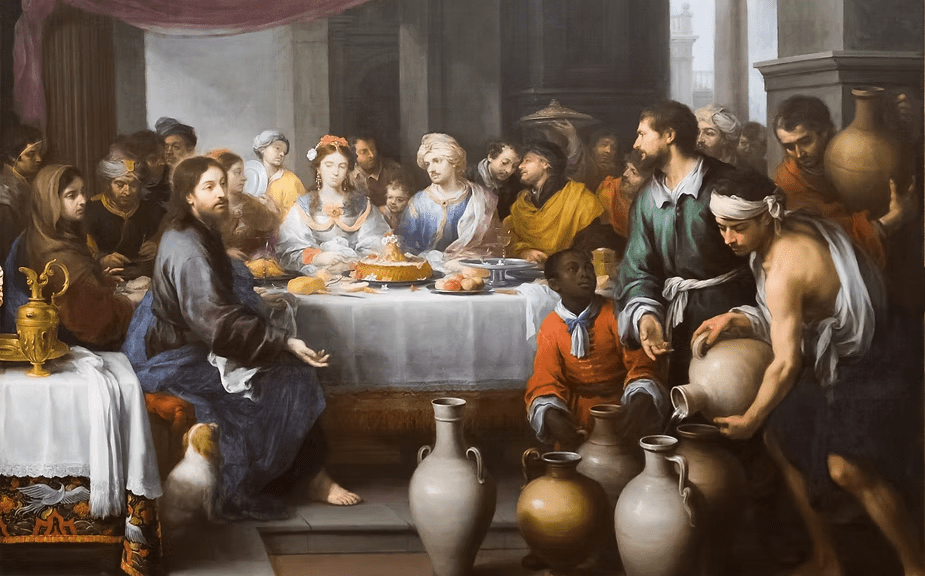
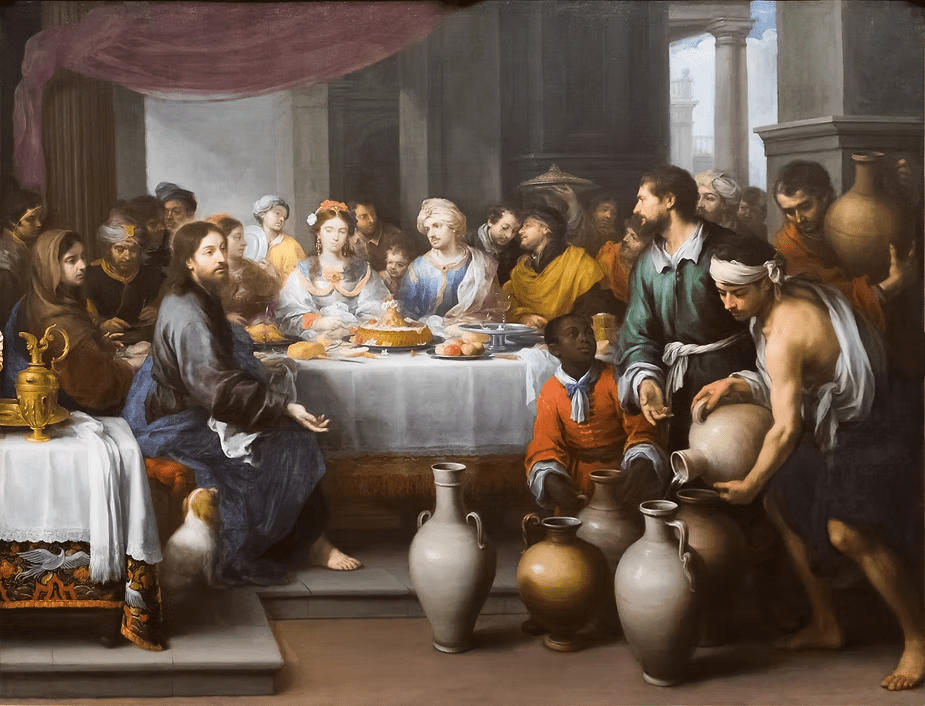
Luke 14:1, 7-14 – A sabbath luncheon and a parable of a wedding feast

On one occasion when Jesus was going to the house of a leader of the Pharisees to eat a meal on the sabbath, they were watching him closely.

When he noticed how the guests chose the places of honor, he told them a parable. “When you are invited by someone to a wedding banquet, do not sit down at the place of honor, in case someone more distinguished than you has been invited by your host; and the host who invited both of you may come and say to you, `Give this person your place,’ and then in disgrace you would start to take the lowest place. But when you are invited, go and sit down at the lowest place, so that when your host comes, he may say to you, `Friend, move up higher’; then you will be honored in the presence of all who sit at the table with you. For all who exalt themselves will be humbled, and those who humble themselves will be exalted.”

He said also to the one who had invited him, “When you give a luncheon or a dinner, do not invite your friends or your brothers or your relatives or rich neighbors, in case they may invite you in return, and you would be repaid. But when you give a banquet, invite the poor, the crippled, the lame, and the blind. And you will be blessed, because they cannot repay you, for you will be repaid at the resurrection of the righteous.”

——————–

Verse one is placed in this reading, while skipping over the following five verses. It is important to know that context, as it is directly pertinent to the information stated in verse one. The five omitted verses tell that “one of the rulers of the Pharisees” had invited a “certain man with dropsy” – a visible swelling in some part of the body, due to a build-up of fluids in the body – so “they were watching closely” Jesus, to see what he would do to this “known Jew” (the meaning of “certain one”). Upon seeing this “certain man,” Jesus asked the guests at the luncheon (“the lawyers kai Pharisees”), “Is it permitted by law to this to sabbath to cure or not ?” When they “were silent” and did not respond, Jesus then “healed his soul” (of the “certain one”) kai “set him free” from that demon spirit within that caused him to retain fluids. Jesus then asked the group, “Of Who of you with a son or an ox fall into a pit on the sabbath would not immediately pull him out ?” To that question they all had nothing they could say. It is then from that demonstration (which showed how poor the “ruler of the Pharisees,” the “lawyers kai Pharisees” were in claiming to serve Yahweh, when none did anything of value any day of the week … much less on the sabbath.

Without knowing the details of these five verses, which make is clear that all the “rulers” of the Temple in Jerusalem and the “Pharisees” who owed their wealth and position to making a profit off knowing nothing of value about the Law (as “lawyers”) says Jesus was then moved to tell a parable about that total incompetence in leadership for the Jews. This means what seems to be Jesus invited to dine where a table would be where seats of position were arranged made him watch the mad scramble to seat close to the head of the table and tell a story about waiting to sit, letting the host seat the guests. That has absolutely nothing to do with the deeper meaning that is in this parable, because everything was set to the environment of the present, but metaphor for being seated at Yahweh’s ‘table’ in the afterlife. Everyone who claimed to know the Law were speechless as to what Law says not to save your son, or even a possession like an ox, if it fell into a pit. While they knew nothing of value about the truth of Scripture, they all positioned themselves as if distinguished guests of Yahweh. Jesus pointed out they were the lowest of all invitees (Jews) and they should admit that lowliness, rather than have Yahweh Judge them as heretics defiling His Holy name.

When verse seven says Jesus then told a “parable,” the Greek word “parabolēn” comes from a root that is properly understood to be: “a teaching aid cast alongside the truth being taught. This casts additional light by using an arresting or familiar analogy, (which is often fictitious or metaphorical, but not necessarily).” (HELPS Word-studies) This means Jesus telling a story about a spiritual gathering, not a physical one, like that Jesus was attending. The spiritual aspect of this “parable” must be remembered to be a “teaching aid cast alongside of the truth being taught.” Jesus was not teaching how to line up at a luncheon and let the one inviting guests seat them one at a time, according to favorability. Jesus was teaching that everyone in that ruler of the Pharisees’ house acted like they were Yahweh’s favored guests in Jerusalem, when not one of them could heal a man with an illness, by being an outlet for Yahweh on earth.

In verse eight, Jesus spoke the equivalent to the Greek word “gamous,” which infers a “wedding feast.” This means the “parable” is not about the rich and powerful gathering to eat lunch on a sabbath, but about the table that is the earth plane being where Yahweh invites His chosen ones to partake of spiritual food (manna from heaven). This then says all those invited (the Jews were the remnant of the chosen ones brought to the Promised Land from Egypt, by Moses) were all bridesmaids awaiting the official union of their souls with the bridegroom – Yahweh’s Spirit. Those who would sit closest to the head of the table would be the Saints, such as Abraham, Isaac, Jacob, Moses, and Jesus – all the Saints who would officiate the union of wife-souls to Yahweh’s Spirit, with those bridesmaids still awaiting the time for divine marriage considered the least of those invited. This then says the ruler of the Pharisees and his lawyers were more like those bridesmaids whose lamps ran out of oil (the light of truth), at the time when the bridegroom came. They were deemed foolish and never joined with Yahweh as one. They become reflective of the goats that Yahweh and the souls of Jesus would say, “I do not know you,” as they will not be the sheep who sacrificed their worldly positions for the promise of eternal life in the spiritual realm, with Yahweh.

The ruler of the Pharisees and his invited guests (who watched Jesus closely) were those who would show up late at the wedding feast (another parable told by Jesus), not dressed for marriage to Yahweh. They would be kicked out of the wedding feast, in the way that Jesus said the one inviting guests (a proposal of divine marriage) would send out messengers announcing everyone is welcome; but the ones who show up for free food, with no intent of sacrificing their souls in marriage to Yahweh, would not be dressed for such a special occasion. The ruler of the Pharisees and his lawyer friends all had no intentions for marrying Yahweh and sacrificing their worldly gains. Thus, they would be cast out of any promise of eternal life.

As for the “ruler of the Pharisees” (who was just one of many), it makes sense that he would be Nicodemus. The “certain one” who suffered from dropsy would then most likely be Joseph of Arimathea, who when healed had his soul touched by Jesus, making him become wholly supportive of Jesus as the Son of Yahweh. Nicodemus and Joseph would have been secret disciples of Jesus, who were sent out as a pair with the other sixty-nine pairs. Most likely they did not risk being seen defending Jesus in any way, so they did not go tell anyone “the kingdom of God has come near.” The symbolism of a build up of fluids in Joseph means he felt the emotional ebb and flow of Jesus possessed by the Spirit of Yahweh, but he retained that within himself, afraid to let his faith be shown. When Jesus touched Joseph with his soul, freeing Joseph to fully express his love of God and his support of Jesus, not only did his dropsy go away, but he began to serve Yahweh as an extension of Jesus.

Jeremiah 18:1-11 – Being a perfect vessel on the potter’s wheel

[1] The word that came to Jeremiah from Yahweh: [2] “Come, go down to the potter’s house, and there I will let you hear my words.” [3] So I went down to the potter’s house, and there he was working at his wheel. [4] The vessel he was making of clay was spoiled in the potter’s hand, and he reworked it into another vessel, as seemed good to him. פ

[5] Then the word of Yahweh came to me: [6] Can I not do with you, O house of Israel, just as this potter has done? says Yahweh. Just like the clay in the potter’s hand, so are you in my hand, O house of Israel. ס

[7] At one moment I may declare concerning a nation or a kingdom, that I will pluck up and break down and destroy it, [8] but if that nation, concerning which I have spoken, turns from its evil, I will change my mind about the disaster that I intended to bring on it. ס

[9] And at another moment I may declare concerning a nation or a kingdom that I will build and plant it, [10] but if it does evil in my sight, not listening to my voice, then I will change my mind about the good that I had intended to do to it. ס

[11] Now, therefore, say to the people of Judah and the inhabitants of Jerusalem: Thus says Yahweh: Look, I am a potter shaping evil against you and devising a plan against you. Turn now, all of you from your evil way, and amend your ways and your doings.

——————–

When verse one says (literally translated into English), “the word which came to pass to Jeremiah from Yahweh saying,” this cannot be seen as Jeremiah sitting in a chair in his house, when Yahweh all of a sudden showed up at the door and said, “Hey Jere, meet me down at the potter’s house. I want to tell you something there.” This “word that came to pass to Jeremiah from Yahweh” was spiritual, where Yahweh spoke to Jeremiah’s soul; so, when Jeremiah heard the voice of Yahweh “speaking” to his soul, he immediately listened. Because ordinary Tom, Dick, and Harriets cannot hear the voice of Yahweh speak to he or he … ever … this ability of Jeremiah says his soul was married to Yahweh. As a wife-soul, his soul was obediently alert to hear the call of Yahweh and immediately respond as His loving servant.

In verse two, there is a missing element, which is the first word spoken by Yahweh to Jeremiah, which says, “arise” (“qūm”). This, again, is not Yahweh telling Jeremiah to get up out of his seat, but it is a spiritual direction that says, “Let your soul lift away from your flesh, so I can show you metaphor that is in the material world. After that word “arise,” Yahweh then said, “and descend” (“wə·yā·raḏ·tā”) “to house of the potter.” The “house” is a statement of the realm of the world where life is found; and, “of the potter” is better translated as “of the fashioner” or “of the former” (“hay·yō·w·ṣêr,” rooted in “yatsar”). This is then much less about taking the soul of Jeremiah down the road a bit to where some man made vases for the locals to buy and use and much more about Yahweh taking the soul of Jeremiah well back in time, to when Creation was in progress by the elohim created by Yahweh (in Genesis 1) did the work of a “fashioner” or “former.”

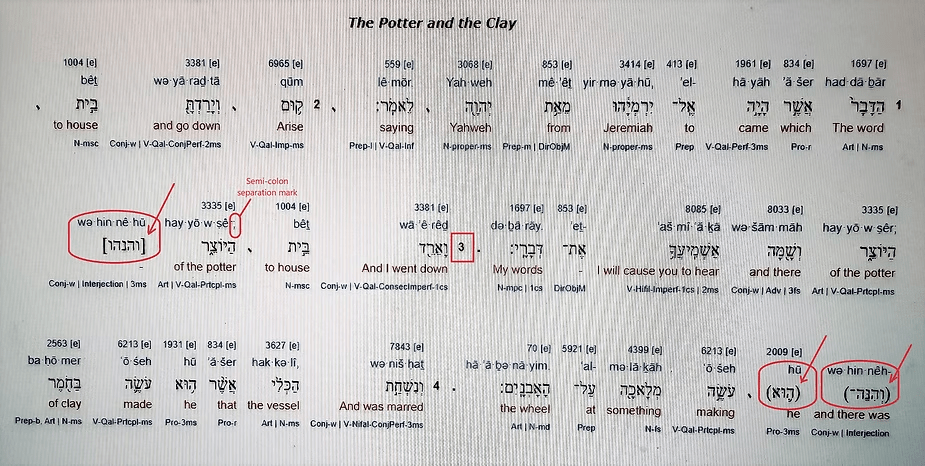
In verse three, the English translation above misses an important signal found in the text. Where we read, “and there he was,” the Hebrew text has this text presented: “[ wə·hin·nê·hū] ( wə·hin·nêh-) ( )” . The repeated word – “wə·hin·nê·hū” – speaks spiritually, rather than physically. Thus, when verse three begins by saying, “and when I descended to the realm of the fashioner,” a semi-colon mark separates that by the above text, which repeats: “and there was he and there was he,” where the brackets speak spiritually of the elohim “fashioner” of mankind in Creation AND there was Yahweh overseeing that work.

Genesis 1 includes the same Hebrew word “והנהו” written here, translated as “and there was he.” In Genesis 1:31 (the last verse), that word is written and translated as meaning “and indeed it was,” followed by the Hebrew word “towb,” meaning “good.” Thus, here the translation can be: “and indeed it was and indeed it was he”. Without understanding why Jeremiah would place certain words between brackets and parentheses means translation services throw that out as if unimportant and not worth figuring out. The unstated (as asides) are inferences to the spiritual; so, the soul of Jeremiah was taken to the time of Creation, when saw mankind being “fashioned.”

When verse four begins by stating, “and was gone to ruin the vessel,” when understanding the soul of Jeremiah has been transported to a time when mankind was being “formed” by the hand of the elohim “fashioner,” the aspect of a “ruined vessel” must be seen as when the elohim began hideous experiments with humanity, with the creation of grotesque monsters and giants. As “vessels,” each was designed (by Yahweh) to receive a soul that would animate the “vessel” to life. Because Yahweh’s plan did not allow the elohim the freedom to make horrendous changes in mankind (male and female they made them), the Great Flood would become the event that would be when “again he made it into vessel another , as good it seemed to the fashioner to make .” This was when all the monsters had been destroyed or driven underground, so the mankind stemming from Noah (descendant of Adam – the Son of Yahweh) would be Yahweh’s design that would be “good to make”.

Thus, the first four verses speak of the design of Yahweh, whose instructions were passed on to the “fashioner” or the “former.” This element of the “potter” must be seen as parallel of Genesis 1, where the “fashioner” were the elohim that were created by Yahweh to “form” the material plane. The “former’s house” is then the Earth which spins around the Sun on a flat plane orbit, as a spinning “wheel.” When Yahweh allowed Jeremiah to see the “ruin” of that being “made of flesh” (metaphor for “clay”), it was “reworked” or “again made.” This becomes parallel to the Great Flood that destroyed all that had been “formed,” but went wrong in formation. The Great Flood was followed by Noah and Shem begetting the royal line of souls that would become the spiritual descendants of Abram.

The placement of a “peh” (“פ”) at then end of verse four signals this important section is “open.” This says the four-verse presentation of Creation of mankind, with it becoming “marred” while still in a wet “clay” state ends with that story, while opening the following verses to “close” that perspective. The ending of verses six, eight and ten with a samekh (“ס”) means the open series is then “closed,” with three closures presented, with all relating to the Great Flood’s cleansing of the “ruined,” to be replaced with a new “formation.”

Verse five then repeats verse one, with Jeremiah replacing his name with “to me” (“’ê·lay”). The promise of Yahweh speaking to Jeremiah is then fulfilled, after his soul has seen the power of Yahweh to command changes to His creations. Here, Yahweh poses a question that implies Yahweh’s command of the elohim He created makes Him be the premier “former” of “fashioner,” whose hands hold the spirits that are the elohim, so they can be reshaped and remade when He seen “ruin” in their “formation.” This becomes an unstated question about the power of Yahweh to cast down into the earth the fallen angels who rebelled against Yahweh’s command to serve mankind. When they instead decided to make monsters of animal-man (male and female they were crossbred with the elohim (or “gods”), their “potter’s clay” was redone and they were forbid from ever touching the spinning wheel physically again.

When this deep concept is seen in this text, Yahweh then commanded Jeremiah to go “the house of Israel” and explain to them (again) what that house means. The word “Israel” means those people (not a nation) “Who Retain the el of Yahweh” – His elohim that is the Son. For all souls who do not marry their souls to Yahweh, so their souls can be cleansed of imperfections and made virginal to receive the soul of the Son within their souls, then those rejects will be smashed down onto the wheel, no longer the “ruined” work it had become. With that ‘return to Go’ done, everything the failed “house of Israel” would have become will be finished. This command to Jeremiah to know the power in the hands of Yahweh ends with a closure mark, showing Yahweh can ‘Great Flood’ the wicked calling themselves “Israel” falsely, so the world will be swept clean of their “ruined formation.”

In verse seven, Yahweh said, “the moment I speak , concerning a people and concerning a sovereignty ; to root out and to break down to perish .” This says the manner in which Yahweh “speaks” to “a people” who claim “sovereignty” due to having been “fashioned” by the hand of Yahweh, but are not perfectly made by His design, those words will be heard in the dismantling of all who falsely make such claims in Yahweh’s name as the “immediate” destruction of the “ruined vessel” they truly were.

In verse eight, those who hear that word of Yahweh spoken in the signs that lead to “perishing” as ”a people” and as “a sovereign” gathering in Yahweh’s name, so the “people” change their wicked way and repent, then Yahweh will save them. To see Yahweh saying “I will relent from disaster” as a statement that says, “I will save them from their self-made disaster,” the implication is the “people” themselves cannot keep themselves from heading towards “disaster.” Therefore, only “Yahweh Will Save,” which is a promise that says “I will console their souls from disaster” by sending their soul the soul of My Son to join with their souls. This leads to another mark of “closure,” related to the Creation story told prior. Yahweh created “a people sovereign as the truth of Israel,” all of whom received His Spirit and were each the resurrection of His Son’s soul. That addition to the “clay” of those “vessels” is the only way to avert “disaster.” Thus, Yahweh created His Son on the seventh day – the day made holy – for the sole purpose of saving mankind from “disaster.”

In verse nine, Yahweh spoke of the “moment His word decides to build and plant a people of His sovereignty.” This is then followed by verse ten, where once again there are spiritual statements of unstated physical words (as seen in verse three). The translation above that says, “but if it does evil in my sight” misses the point of Jeremiah writing “wə·‘ā·śāh [hā·rā·‘āh ] (hā·ra‘ ) bə·‘ê·nay,” where the non-bracketed and non-parenthesized translates into English saying, “and if it makes in my eye”. This becomes the inspection of a “vessel” by the “fashioner,” to “see” if any imperfections are showing. The unstated spiritual word repeated implies that “made” is “evil” or “bad.” As an unstated spiritual implication, this says that which is “evil” is demonic spirit possession. Such demons possess a soul in its flesh (or ‘clay”), “making” it commit sins that are known by Yahweh. The acts committed are the signs of “ruin,” but the “evil” is spiritual, thus invisible to the naked “eye.”

When Yahweh then said “if a people formed in the image of Yahweh make it known they are imperfect,” then they will make that “evil” known by “disobeying His voice.” That says everyone of those “people” should be exactly like Jeremiah, such that each awaits the call from Yahweh and immediately responds, “Here I am” when called. When Jeremiah becomes the exception to that rule, then the people have given an unspoken sign that “evil” has possessed their souls. At that time, everything promised as “good” for “a people” will be taken away (“I will relent”). This then is where the third sign of “closure” is placed, referring back to the open series about the Creation plan and the cleaning of the wheel with the Great Flood.

Verse eleven is then the command given by Yahweh to Jeremiah, to “speak now to the men of Judah (a name that means “Praiser”) and to the souls dwelling in Jerusalem (a name meaning “Teaching Peace”)” and tell them, “behold Yahweh is fashioning their disaster and devising a plan against them”. If they want to avert their self-made destruction, then they must “return now man from evil ways and make good your ways and your doings”. That says the imperfection seen by the “eye” of Yahweh is telling Him to destroy and start over. The only way to avoid that destruction is to marry their individual souls to Yahweh and give rebirth to His Son in each of their souls. Of course, knowing the end of that story, they rejected the messenger and the message.

The moral of this story applies to everyone, at all times. Disaster is manmade and assured to all mortals. The ways of salvation are the perfect plan set forth by Yahweh, through Moses. The Commandments can only be remembered and lived when the Son of Yahweh’s soul has become one’s inner Lord, controlling the soul and its flesh (“clay”). To reject that design is to be reworked after destruction.

Psalm 139:1-5, 12-17 – Fashioned by Yahweh as an embryo

1 Yahweh, you have searched me out and known me; *

[2] you know my sitting down and my rising up; you discern my thoughts from afar.

2 [3] You trace my journeys and my resting-places *

and are acquainted with all my ways.

3 [4] Indeed, there is not a word on my lips, *

but you, Yahweh, know it altogether.

4 [5] You press upon me behind and before *

and lay your hand upon me.

5 [6] Such knowledge is too wonderful for me; *

it is so high that I cannot attain to it.

—–

12 [13] For you yourself created my inmost parts; *

you knit me together in my mother’s womb.

13 [14] I will thank you because I am marvelously made; *

your works are wonderful, and I my soul know it well.

14 [15] My body was not hidden from you, *

while I was being made in secret and woven in the depths of the earth.

15 [16] Your eyes beheld my limbs, yet unfinished in the womb; all of them were written in your book; *

they were fashioned day by day, when as yet there was none of them.

16 [17] How deep I find your thoughts, el! *

how great is the sum of them!

17 [18] If I were to count them, they would be more in number than the sand; *

to count them all, my life span would need to be like yours.

——————–

Notice how the Episcopal Church (not their source translation service) has combined verses one and two into what they call verse one. That change at the beginning then offsets the rest of the verses in the psalm; so, all have to be renumbered to match the truth that all other sources of Psalm 139 offer. I have added the appropriate verse numbers in bold type, within brackets. Additionally, I have restored “Yahweh” in two places, where the translation is a generic “the Lord.” In verse seventeen (Episcopal Church 16), the Hebrew text of David shows “el,” which I have restored, from the translation of “God.” All forms of “el” [singular] and “elohim” [plural] are references to an inner presence that is the Son of Yahweh, His “Yahweh elohim” of Genesis 2. To deny that inner presence is to make mankind seem capable of godlike abilities, where man can save itself from personal ruin, simply by expressing belief in a generic “Lord” and nebulous “God.”

In the true verse one, David wrote simply: “Yahweh you have searched me , and know .” This does not imply that David was so young that he was like a needle in a haystack, so Yahweh had to “search” for David. It says Yahweh “searched” David’s soul, prior to him being born, when David’s soul last knelt before Yahweh in Judgment. David was found pure, which means David’s soul (departed from flesh that went by some other name) had previously been a true representation of “Israel” [“Who Retains the el of Yahweh” in his soul] and his Lord had become the soul of Adam-Jesus, leading his soul to that Judgment as a pure soul. Thus, Yahweh “knew” David’s soul before it was born again; and, for a Saint to be born again, it is with Yahweh’s intent to serve Him again, in a new incarnation.

In verse two (the Episcopal Church’s 1b), when David sings that Yahweh “knows his dwelling and its rising,” this sings of the Spirit of Yahweh having been outpoured upon David’s soul forever. That cleaning Baptism made it possible for the soul of Yahweh’s perfect Son to “dwell” (or “sit down”) within his soul, making sure that David’s soul “rose” to divine heights, as a Saint in His name. When David sings, “you discern my purpose at a distance,” this does not say Yahweh is not one with David’s soul. Instead, the word translating as “at a distance” (of “far off”) – “mê·rā·ḥō·wq” – means “in space and time.” Yahweh discerned David’s purpose well before he was born and knew he would lead His chosen people to adhere to His Covenant properly – through divine union of their souls with His Spirit, so all were true to the name “Israel.”

In verse three, where David sings, “my path and my lying down you winnow ; and all my roads are in your service .” this sings of David’s soul being like seed planted into the earth. His “lying down” is Yahweh “scattering” David’s soul in various furrows into which Yahweh “fans” or “blows” David. When he continues, “all my roads are in your service,” this speaks prophetically of David’s failure, near the end of his life. That “road” would “serve” Yahweh, as Yahweh did not make David King of the Jews, because Yahweh was their King. David’s perfect success had to be known as totally due to Yahweh; so, his failure spoke loudly that all souls trapped in human flesh are flawed and cannot find a Judgment as pure, without Yahweh’s help. David’s failure was akin to the designed failure of Adam (and wife), because they had to leave Eden to become the first priests of Yahweh in the world.

In verse four, David sang that he was like Jesus, who regularly said he did not speak for himself, but for the Father. For David to sing, “for not a word on my tongue”, that sings that David did not manufacture words that came from his mouth for self-satisfaction. When he then added, “behold Yahweh you know the whole,” this sings of every word from David was the word of the Father, spoken through David’s mouth and lips.

In verse five, David’s singing, “behind and in front you have confined me” is about the dual souls that are the soul of David united with the soul of the Son of Yahweh (Adam-Jesus). When this state of being ‘doubly fruitful’ occurs, one must follow, while the other leads. David’s soul is the one “behind,” while Jesus’ soul is the one “in front of” David’s soul, leading it to righteousness. This then “confines” of “binds” David’s soul, so it will not be influenced by worldly demon spirits. With that “confinement” desired, not forced, David wrote, “and set upon me your hand”. This means that Yahweh’s Spirit and Jesus being the Lord soul of David’s soul and flesh made David become the physical “hand” of God on earth.

In verse six (the Episcopal Church verse five), David begins this verse with the repeated Hebrew word “pili,” with two constructs of that placed within brackets and parentheses, as: [pil·’î·yāh] ( pə·lî·’āh) . The brackets and parentheses reflect unspoken words of spirituality, where “too wonderful too incomprehensible” are not truly words sung in this psalm. They are silent reflections of just how supernatural the “knowledge for me” or “knowledge coming from me” is. This sings of how impossible it is for any human being to possess the “knowledge” of Yahweh. As such, David then sang, “it is inaccessibly high,” stating not ever the greatest mind the planet would come to know [Solomon] could ever have the scope of “knowledge” that David would open his mouth and speak (without forethought). David then admitted, “cannot I attain” this intellect from a human flesh organ between the eyes and ears.

In the leap forward to verse thirteen (Episcopal Church verse twelve), David then sings, “for you formed my inward parts.” This can be seen as why this Psalm 139 is the companion song to the track one Old Testament reading selection from Jeremiah 18. In that reading, the word translated as “potter” actually means “fashioner” or “former.” Here, David sings of the “formation” of his “inner parts,” which is his “heart” and “soul” – spiritual in “form.” The Hebrew word translated as “inward parts” actually is the “kidney,” which is an organ of purification. Thus, the heart and soul are likewise purifying essence in the soul-flesh. When Yahweh “forms” a soul to be pure, then one has been Baptized by His Spirit and reborn as His Son as one’s Lord. Thus, when David sang this “formation” was continued “within his mother’s womb,” that says all of the physical features of David’s flesh (from Yahweh joining DNA from his mother and father purposefully) were designed by the hand of Yahweh. Yahweh guides the formation of every human being into which He breathes a soul giving life to the flesh He guided to be made in a mother’s womb.

In verse fourteen, where David wrote, “I will praise you upon for I am fearful,” the source of true “praise” is initiated by the soul of Adam-Jesus within. The soul-flesh follows that lead to “praise” Yahweh for His Salvation given. The element of “fearful” is following a Commandment written upon the walls of one’s soul – as the soul of Jesus being one’s Lord – which says, “fear only Yahweh.” The “fear” is knowing a personal relationship with the Spirit and the Son and then being afraid of losing that relationship as the wife-Son. This leads the soul-flesh to lovingly seek to please Yahweh, so the Son makes “marvelous works” come from the soul-flesh, as a Saint in the name of the Son. David’s “soul knew very well” that the source of those feats (all that David did and all that all Saints do) was Yahweh and His Spirit emanating from one’s soul.

Verse fifteen sings of “my hidden bones,” which is the framework that is the Son of Yahweh, made by His hand from dust and clay on the seventh day, the day He deemed holy. The aspect of “secret” is then the spiritual, as the ‘doubly fruitful’ soul that adjoined David’s soul … forever. In the use of the Hebrew construct “ruq·qam·tî,” which means “skillfully wrought” or “masterfully weaved,” this too related to the “fashioner” or “former” of Jeremiah 18. It says that David was made by the hand of Yahweh as perfection, which included the soul of His Son within “the lowest parts of the earth” or the dead matter that is void of life, until a soul animates it to life.

In verse sixteen, David sings, “my embryo saw with your eyes , and in your book the whole they will be writtenthe days you fashioned for me”. Here, again, is the word “fashion,” which is the same root word translated as “potter” (because “clay” is also written). This says the life of David is written into the future, which his unfolding life will confirm. When an “embryo sees with the eye of Yahweh,” it is reading the Commandments written on the walls of its heart and soul. It sees the expectations for that flesh which will receive a pure soul reincarnated. David knew his life would be in service of Yahweh, guided by his Lord Jesus; and, he had no qualms with facing any foe that was destined to cross his path of righteousness.

At the end of verse sixteen, David again repeated a word enclosed in brackets, followed by parentheses. This, again, is an unstated, silently experienced spiritual element that says, “[ wə·lō] ( wə·lōw) , means “when not when not”. With the last words saying aloud, “one of them,” the silent intent says the soul of David saw “fashioned” for him a life that was “not” like that or ordinary souls. Still, the repetition says that “when not” David’s soul would see the planned divine life written for him by Yahweh, his would “would not” be holy, as David would become as “one of them.” This states the planned life of David included his fall from grace, because that was a necessary evil to keep “one of them” to be seen as a god (a king over people), when only Yahweh is their King.

In verse seventeen we find the one time “el” is written (in this selection). David sings, “and to me how precious are your thoughts el”. This is not the same as Jeremiah (and other prophets hearing the voice of Yahweh coming to them), as Jeremiah named “Yahweh” as the source of that “word.” Since David has already stated (twice) the name “Yahweh,” his use of “el” speaks of his inner united soul – his Lord – which becomes “the thoughts” of Adam-Jesus that guided David’s actions as a Saint. David greatly appreciated that guidance from within; and, he then sings, “how great is the sum (of those thoughts).” The “sum of those thoughts” was the whole of Israel being led to be souls married to Yahweh, because David spoke the word of Yahweh, following the whispers of the Son merged with his soul.

In verse eighteen (the Episcopal Church’s verse seventeen), David sings, “I will relate them to the sand to be more in number”, which says the mind of David was interlinked to the Mind of Christ, where the Son of Yahweh was Lord. Every day, for every minute of every day, David’s brain heard the whispers of Jesus telling him insights from Yahweh. Those insights were more numerous than the grains of sand by a sea or river. David then sings “when I awaken,” which is his times getting up from sleep to write down a psalm inspired by Yahweh; but the greater meaning is the voice of Jesus, speaking for the Father, made the soul of David always be “alive” and “awake” as a soul saved. Thus, David sang, “I am still with you.” This says the voice of Jesus assures David that the love of Yahweh has not left him; so, he can still faithfully serve Yahweh as He sees fit.

Deuteronomy 30:15-20 – Entering the Promised Land where heaven and earth are one

Moses said to all Israel the words which the Lord commanded him, [15] “See, I have set before you today life and prosperity, death and adversity. [16] If you obey the commandments of Yahweh eloheka that I am commanding you today, by loving the Lord your God, walking in his ways, and observing his commandments, decrees, and ordinances, then you shall live and become numerous, and Yahweh eloheka will bless you in the land that you are entering to possess. [17] But if your heart turns away and you do not hear, but are led astray to bow down to other lelohim and serve them, [18] I declare to you today that you shall perish; you shall not live long in the land that you are crossing the Jordan to enter and possess. [19] I call heaven and earth to witness against you today that I have set before you life and death, blessings and curses. [20] Choose life so that you and your descendants may live, loving Yahweh eloheka, obeying him, and holding fast to him; for that means life to you and length of days, so that you may live in the land that Yahweh swore to give to your ancestors, to Abraham, to Isaac, and to Jacob. פ

——————–

Back on Proper 10, Year C (the fifth Sunday after Pentecost), the track two Old Testament reading selection was from Deuteronomy 30:9-14, which leads up to these verses. The same background applies to these verses, as Moses was giving the true Israelites their last warnings, before allowing them to move into their ‘Promised Land.’ If you want to combine the two readings, for a greater perspective, the other commentary can be read by clicking on this link: Deuteronomy 30:9-14 – Final notes on reaching the ultimate Promised Land – eternal salvation.

In the whole of Deuteronomy 30, there are fourteen times Moses stated the combined Hebrew words “Yahweh eloheka,” which has been translated by the translation service as saying, “the Lord your God.” A total of eighteen times Moses referred to “Yahweh,” with four times that name stood alone. That alone says “Yahweh” was the supreme deity of everyone who (spiritually) listened to Moses give these final instructions. The Hebrew word “eloheka” is a second person masculine singular that is constructed in the masculine plural. This means the masculine singular is “your,” which speaks as an individual relationship for everyone Moses spoke to, with the masculine plural being the fact that “elohim” is the masculine plural form of “el” (the masculine singular. For Moses to repeatedly tell the true Israelites “Yahweh” is the source of “your elohim” (which is inward and joined with one’s (the singular individuality) soul, the “elohim” is the “Yahweh elohim” stated eleven times in Genesis 2 – Adam, the Son of Yahweh, hand-made to be the savior of souls many times over, in many at the same time (the masculine plural). Thus, “Yahweh eloheka” is central to understand this chapter and these selected verses.

In verse fifteen, the duality stated by Moses is spiritual history. When we read the truth of that written, it says, “see I have set your face today.” In that, the Hebrew construct word “lə·p̄ā·ne·ḵā,” where the root word is “panim,” meaning “face.” This says everyone listening (spiritually) to what Moses said then wore “the face” of Yahweh – the First Commandment being secured. When one has “set your face today,” the voice speaking spiritually is not Moses, but coming directly from Yahweh. All true Israelites (always) wear His “face” and no other.

The duality that comes next – “this life and this good ; and the death and the evil” – must be seen as the ability to see the true Promised Land, which is Eden (not some dusty, rocky, place near the Mediterranean Sea in the Middle East). In Eden, Yahweh placed both the “tree of life,” which was “good,” and the tree of knowledge of good and evil,” which reflected the one fruit never to eat, unless one’s soul wanted to be banished from that true Promised Land. To have a Big Brain leading one’s actions means to wear one’s own “face” or the “face” of some lesser god … such as worshipping at the altar of money-grubbing Mammon (all you Hollywood movie moguls whose souls have been sold to “death and evil”). Thus, Yahweh said through Moses, when your souls are individually married to Me and they individually have receive My Spirit, each resurrected as my Son Adam (the “Yahweh elohim”), then you can “see” Eden is where your souls are promised, with the same prohibitions in place – only eat the fruit of the tree of “life” and have eternal “life.” To becomes self-aware means ejection from your ‘Promised Land,’ to suffer are mortals, bound to “death” all filthy from “evil” sins.

In verse sixteen, where Yahweh said through Moses, “that I am commanding you today you all to love Yahweh eloheka to walk in his manner , and preserve his commandments and statutes and his judgments ; that you may remain alive and become great , and will kneel you to Yahweh eloheka .” In this, the aspect of “you all to love” (“lə·’a·hă·ḇāh”) and “to walk in his manner” (“lā·le·ḵeṯ biḏ·rā·ḵāw”) are both statements of submission through holy matrimony of the highest Spiritual kind. This says to “preserve his commandments and statutes and judgments” can only happen when one’s soul is one with Yahweh, subjected totally to His Will. With that divine union, then one will always know eternal life, which is the intent behind “remain alive.” A soul in a mortal body of flesh can only “remain alive” when the flesh can maintain a soul. When the flesh dies, for the soul to “remain alive,” it must be free of all sin; and, that can only be guided by the Son’s soul one with each host soul – the Lord Adam-Jesus. To then “become great” means to cease being poor of spirit by becoming one with Yahweh, His Spirit and His Son (the Trinity). That means each soul must then “kneel” before the Lord of its soul-body and serve the Son of man as his subject in the flesh – following the path of righteousness in ministry to lead others to the same path.

In verse seventeen, Moses spoke as Yahweh warning: “if he or she will turn away your heart so not do you hear ; and are drawn away , and worship gods other and serve them .” Here, it is important to realize that once a soul has received the Baptism of Yahweh’s Spirit, purifying a soul so it can resurrect His Son’s soul within that virgin womb, that state of being lasts forever, with the gift of eternal life gained. This means this warning relates to the ministry of those to whom Moses spoke, as their yet unborn sons and daughters would be the focus of this verse. The “if” condition is relative to those new bodies of flesh being born and receiving souls, which are not yet married to Yahweh and granted eternal life. In those cases, the parents and relatives should teach their children to take the path to divine union; but it is up to each individual soul to choose one’s path in the flesh. Therefore, there will be those who “will turn away” from marrying their souls to Yahweh, so their “hearts do not hear” the guidance of His Son within. They “will be drawn away” towards worldly pursuits “and worship other gods and serve them,” not Yahweh. This is the danger that always exists in the world and why Moses kept the children of Israel in the wilderness for forty years; so, two generations of new bodies of flesh would show this natural rebelliousness and the way Yahweh rejects those rebels from His midst, as Moses and Aaron would execute His Commandments to punish those not worthy of the name Israel.

In verse eighteen, Yahweh makes the promise through Moses: “I make clear to you today , that [mentioned before in verse seventeen] to perish you shall perish ; not you will be long days over the land , which you pass over the Jordan , to go in there to take possession of .” The element that repeats “perish” is a statement of mortality. The flesh housing a soul that is unclean, from a soul serving other gods, will die and the soul will then be judged to repeat life in the flesh (reincarnation), so death is a repeated experience (not eternal life). The element of “days” relates to the light of truth that comes from being led by the Son of Yahweh, from within one’s soul, as the Lord over its flesh. Those “days not you will be long over one’s flesh (the land)” says one will be unclean and unmarried to Yahweh. The element of “passover the Jordan,” this would be when they would cross the Jordan by Joshua and the passover feast would be recognized. The meaning of “pass over” is to escape death and receive eternal life. So, to “pass over the Jordan” without being covered with the blood of the lamb (the soul of Jesus as Lord over one’s soul-flesh), then entrance into the ‘Promised Land’ will have the world “take possession” of one’s soul, because one has chosen death over eternal life.

In verse nineteen there is another set of dualities stated: “heaven and earth life and death.” This is the duality of mankind, where each is the union of “heaven and earth” as the soul and its flesh. The soul is “life” and the flesh is “death.” This truth is stated by Yahweh as “against you,” meaning either “heaven” or “earth” either “life” or “death” will be the path one takes, with each soul responsible for its choice. The choice will then bring either a “blessing” or a cursing,” with that duality reflecting the “blessing” if a soul chooses marriage to Yahweh and eternal “life.” The “cursing” comes if one chooses to serve its “flesh” and seek the pleasures of the world. Yahweh then strongly recommends “choose life , that both may live you and your descendants .” Here, the aspect of children becomes totally dependent on their parents having chosen “life,” in order to teach them the correct path to take.

Verse twenty then takes this recommendation, because all who are listening to Yahweh through Moses are souls married to Yahweh and reborn as His Son. As such, the verse reads: “that [following the recommendation] you may love Yahweh eloheka , that you may obey his voice that you may cling to him ; for he your life and the length of your days , that you may dwell in the land that swore Yahweh to your fathers , Abraham Isaac and Jacob to give them .” here, again, the aspect of “love Yahweh your elohim” is a statement of divine marriage, where the objective of all marriage is to give birth to new life. That new life from “love of Yahweh” is “your inner elohim” or the soul of Jesus as your soul’s Lord. To “obey his voice” means to be guided by the whispers of Adam-Jesus within (the Christ Mind); and, “to cling to him” means to be ‘doubly fruitful’ from the soul of Adam-Jesus joining with one’s host soul (two in one body of flesh). With this Son of Yahweh one with one’s soul, this determines one’s soul to be saved and granted eternal life, so one is always led by the light of truth (so the sun is always shining as bright as day). To “dwell in the land that swore Yahweh to your fathers” means “to live as a soul in flesh” that has no influence over that soul. Abraham, Isaac, and Jacob all surrendered their self-importance to serve Yahweh fully. That commitment was soul based and spiritually connected. It was not a bloodline of physical properties. Thus, Yahweh says one who is truly able to be called “Israel” – “Who Retains the el of Yahweh” within – can truly be called a descendant of those named.