Jesus said, [19] “There was a rich man who was dressed in purple and fine linen and who feasted sumptuously every day. [20] And at his gate lay a poor man named Lazarus, covered with sores, [21] who longed to satisfy his hunger with what fell from the rich man’s table; even the dogs would come and lick his sores. [22] The poor man died and was carried away by the angels to be with Abraham. The rich man also died and was buried. [23] In Hades, where he was being tormented, he looked up and saw Abraham far away with Lazarus by his side. [24] He called out, `Father Abraham, have mercy on me, and send Lazarus to dip the tip of his finger in water and cool my tongue; for I am in agony in these flames.’ [25] But Abraham said, `Child, remember that during your lifetime you received your good things, and Lazarus in like manner evil things; but now he is comforted here, and you are in agony. [26] Besides all this, between you and us a great chasm has been fixed, so that those who might want to pass from here to you cannot do so, and no one can cross from there to us.’ [27] He said, `Then, father, I beg you to send him to my father’s house—[28] for I have five brothers– that he may warn them, so that they will not also come into this place of torment.’ [29] Abraham replied, `They have Moses and the prophets; they should listen to them.’ [30] He said, `No, father Abraham; but if someone goes to them from the dead, they will repent.’ [31] He said to him, `If they do not listen to Moses and the prophets, neither will they be convinced even if someone rises from the dead.'”
——————–
This reading selection is led by Jesus being asked by Pharisees ridiculing Jesus about his parable of the unrighteous steward. This led Jesus to speak of the law and the prophets, which comes up as the conclusion of this story. In verse seventeen (not read aloud from above), Jesus said, “it is easier for heaven and earth to fall away, than to have one stroke of a letter of the law be dropped.” After that, Jesus said, “Anyone who divorces his wife and marries another commits adultery, and whoever marries a woman divorced from her husband commits adultery,” which was a law ignored by many Jews. This is comparable to what Jesus said in Matthew 5:31-32.
I wrote about this parable in a book I published (Explaining the Parables: From the Gospel of Luke). In that work, I realized the translation above paints a poor picture of what Jesus intended to be seen. I invite readers to buy that book and see the depth that I revealed, as I will not rewrite the entirety of that interpretation here.
First, it is important to see that the Greek written by Luke begins verse nineteen with a capitalized “Anthrōpos,” where the capitalization elevates “A Man” to a level of Yahweh, where this “Man” is related to Yahweh. When this is followed by Luke writing, “de tis ēn,” which translates to say in English, “now certain he was,” this means “A Man” was a Jew, so he was taught the Torah, Psalms, and Prophets. It is then this knowledge of Yahweh and the Law that made this “Man wealthy” (from “plousios”). This becomes a statement that the “wealth” possessed by the “Man” was relative to his knowing about Yahweh and the Word sent by Yahweh to His people.
When Luke then wrote a comma mark of separation, followed by the Greek word “kai,” denoting importance that must be found next, relative to the “wealthy Man,” was the “Man” was “clothed in robes colored purple kai fine linens.” This is what says the “Man” took his “wealth” of religious knowledge and then sold it to Jews, as if he were royalty because he had memorized the Hebraic scrolls. From the profit as a ‘lawyer,’ the “Man” ruled over the Jews as if he were connected to some line of David or another king of Israel or Judah. Luke then added in the last segment of verse nine that the “Man” lived every day in the lap of luxury, always cheerful for being rich and respected as powerful, with no one making his life miserable.
Now, from seeing that this “Man” is not just some ordinary Joe rich guy (like a Roman or other nationality that makes a living as a vendor of wares people love to spend their money on), it is important to see verse ten setting up a description of the opposite of the “Man” who profited from Yahweh’s Word. Here, Luke wrote of “a poor man now certain,“ where there is no capitalization that relates this Jew’s “poverty” to the level of Yahweh. This says the “man poor” was a Jew, whose lack was not from worldly possessions, but from being unable to find the spiritual wealth he sought. Whereas Luke did not bother to name the “Man now wealthy,” he wrote this “poor man now certain” was “name Lazarus.” Here, the repetition of “now” (from “de”) is a statement that both the “wealth” of the “Man” and the “poverty” of the “man” were relative to a temporary slice of time, which was then the present. The present does not forecast the future; so, one who is “wealthy” may not always be so, neither can a “poor man” always be projected to be “poor.” Thus, the name “Lazarus” means “God Has Helped” or “God Is My Helper.” That is an indication that the spiritual poverty of the “poor man” that was a Jew would be supplied with spiritual food, whereas there was nothing naming the “Man wealthy” as having such help to count on in his future.
Now, when the English translation says “at his gate lay a poor man named Lazarus, covered with sores,” this implies that Lazarus was either lazy and unwilling to stand, or he was crippled and could not stand on his own. This is not what was written. The Greek text literally translates into English saying, “[Lazarus] was cast (or thrown) advantageous for this porch (or gateway, vestibule) of him [the “Man wealthy”]. This does not say that Lazarus lay at the gate of some mansion owned and lived in by the “Man wealthy,” but it says the “Man wealthy” wore his fancy robes and clothing in the Temple of Jerusalem, where the “poor man” was an outcast, one who had to remain outside the steps where the Pharisees orated. He had to wait with the great ‘unwashed’ Jews, on Solomon’s Portico. The reason for this casting out of the Temple was the “poor man” “was full of ulcers, sores, or wounds,” which to Jews was an indication the “poor man” was a sinner.
With verses nineteen and twenty developing two different Jews, one welcomed into the Temple and one outcast, verse twenty-one then ties the two together in a relationship. This verse is led by Luke writing a “kai,” indicating importance needs to be understood from what is written next. Here, Luke wrote (literally translated into English): “desiring to be fed from of these of their fallings away from of this of dining table”, this says the “poor man” Jew was not simply interested in what the Temple ‘lawyers’ said Scripture meant, he was “desiring” or “lusting after” spiritual food from Scripture. His expectation was to be “fed from” the lessons and sermons “of these” who were all “wealthy” from knowing the Law to afford “purple robes kai fine linens” to wear, as ornate and haughty rulers. Instead, the ‘crumbs’ that were “their fallings away” were not dropping that fell on the floor, but indications “of these” who sold knowledge of Scripture had “fallen under” the condemnations of Yahweh. The “dining table” where the truth of Scripture would be shared by saints and true men in sacred standing with Yahweh was empty, with no spiritual food upon it.
Following a semi-colon, which says a new statement is made, relative to the prior statement where those of the Temple were worthless, empty of spiritual knowledge about Scripture, Luke then wrote: “on the other hand kai these dogs , coming , they were licking these wounds of him (the poor man)”. This has nothing to do with physical canine animals; and, it has nothing to do with physical lesions of the flesh, such as sores would be. The use of “dogs” must be seen as all of the outcast Jews who were just like this “poor man,” who were also “coming” to the Temple for spiritual nourishment. The “wounds” were the heartfelt sorrows that the “poor man” felt from not getting the answers he sought from the truth of Scripture. To the “Man wealthy,” all the outcast Jews were “dogs,” which means they were sinners. He, nor any of the Temple rulers like him, saw in value in “dogs,” as they had no money that could be taken and kept for their own “rich” tastes in material things. This lead all the “dogs” that were Jews and even though outcast were still “coming” to hear the Word of Yahweh spoken, so they could be forgiven for their sins. They commiserated with the “poor man,” which led him to be divinely inspired to begin preaching the Word of Yahweh, which made the “poor man” who “God Has Helped” become a saint like Jesus.
In verse twenty-two, we have statements that both the “poor man” and the “Man wealthy” die. This parallels the statements on verses nineteen and twenty, about the two different lives these Jews led. With the “poor man” death, we find he “was carried away by angels” and then taken “into the bosom of Abraham.” Here, it is vital that one has a grasp of the meaning of the name “Abraham” – “Their Shield.” The Jews believe they are the children of God because of the covenant Yahweh made with Abraham, about all of his descendants being more numerous than the stars in the heavens. The truth of that lineage is it is spiritual, not a promise made to a bloodline. Only those souls who marry Yahweh and become His Son reborn – as had Abram – are those descendant that shine the light of truth in the vast darkness of those souls lost in their flesh. Thus, to be taken “into the bosom of Abraham” says the “poor man’s” soul was indeed one reborn as Jesus, thus a shining star of Abraham’s spiritual line. It is also a big clue for this conclusion that the soul of the “poor man” was “carried away by angels” – Yahweh’s elohim.
When we read of the “Man wealthy” dying, Luke wrote, “within to this Hades,” where “within (from “en”) means the soul of the “Man wealthy, and “Hades” means “Underworld,” which is where valuable ores are mined. While the source of the “Man wealthy’s” riches were precious metals (coins), to have his soul go to the “Underworld,” which was the “Land of the dead,” the connection between that mined from underground and their material value is they both remain in the realm of the earth, which is where mortals come to die. It was in this place of death that the “Man wealthy” was placed when buried – death to be mined for more death.
When the once “wealthy” man sees Lazarus with Abraham, he calls out to Abraham as if his is part of his lineage, when he is not. Lazarus never responds to the calls from the man’s soul in Hades. This says the soul gone to Hades is actually amid a sea of other lost souls awaiting their Judgment, but none of them can see the others. In the same way, Lazarus can neither see not hear the calls from the soul of the “Man” who was once materially “wealthy,” falsely profiting from the name of Yahweh (and Abraham). The refusal of Abraham to do anything to assist the wants of the soul suffering in Hell says the soul was no longer a “Man certain,” as his soul was no longer a Jew, no longer associated in any way to Yahweh, His Law, or His Word. The responses of Abraham say to the lost soul, “Yahweh does not know you.” The element of the Law and the prophets can save the soul’s five brothers (who his soul was no longer related with, because of his physical death) says the “Man wealthy” had everything he needed to warn his physical brothers, when he was a ‘lawyer,’ but he chose to do like everyone in his physical family, which was cheat the poor and steal the wealth of Yahweh as their own worldly gain. To have in the material world means to have not in the spiritual world.
[1] How lonely sits the city that once was full of people!
How like a widow she has become, she that was great among the nations!
She that was a princess among the provinces has become a vassal. ס
[2] She weeps bitterly in the night, with tears on her cheeks;
among all her lovers she has no one to comfort her;
all her friends have dealt treacherously with her, they have become her enemies. ס
[3] Judah has gone into exile with suffering and hard servitude;
she lives now among the nations, and finds no resting place;
her pursuers have all overtaken her in the midst of her distress. ס
[4] The roads to Zion mourn, for no one comes to the festivals;
all her gates are desolate, her priests groan;
her young girls grieve, and her lot is bitter. ס
[5] Her foes have become the masters, her enemies prosper,
because Yahweh has made her suffer for the multitude of her transgressions;
her children have gone away, captives before the foe. ס
[6] From daughter Zion has departed all her majesty.
Her princes have become like stags that find no pasture;
they fled without strength before the pursuer. ס
——————–
Unseen in this English translation above is the use of a vertical bar ( ׀ ) and enclosure marks ( [ ] and ( ) ). The vertical bar indicates a sign of pause, telling the reader to take time and grasp the meaning of the word or words that are set off by that mark. The enclosure marks are also signals to the reader to understand the repetition of words enclosed are statements of their focus being internal – within one’s soul – and not a statement of physicality.
The vertical bar is placed after the first word in verse one, which asks “how?” The English translation above, by not making this mark of pause be known, makes “how” acts as some innocuous word of unknown value (left for the reader to figure out the precise amount) that says, “how lonely sits the city.” That makes it appear as if Jeremiah (the divinely inspired author of Lamentations) is saying “a city sits lonely in an amount of great magnitude that cannot be precisely measured.” In reality, the words following the mark of pause say simply, “it remains separation,” followed by a comma mark, indicating another pause of separation. Therefore, the question “how?” is projected on “he, she, or it” (the third-person) can “dwell” or “sit” or “remain” in a state of “separation” or “isolation.” This makes the question become: “how can it choose a state of separation as a way to dwell in this world?”
Following the comma mark, Jeremiah wrote “the excitement great with people.” Here, the word “excitement” (Hebrew construct “hā·‘îr”) is commonly translated as “the city,” such that a place where a “great many people” live in close proximity to one another means the ‘hustle and bustle’ of such a place keeps human life ‘busy, busy, busy’ with things to do and people to see. This is unlike the boredom of a rural setting, where only one’s family and close relatives are who one goes to see and do things with. This then contrasts the “separation” of “dwelling” as an alternative lifestyle to one that is filled with “the excitement great with people,” who are not of close blood relationship. Therefore, “how?” becomes a reflection on choosing non-family as the ‘spice to life,’ as asking “how can family not excite one to a love of commitment?”
To answer this question, the Hebrew word written after the comma mark is in the third-person feminine singular, where “she has come to pass” is compared to being “like a widow” (another feminine singular word). Here, the feminine has to be read as metaphor for a soul trapped in a body of flesh, where the earthly realm (dust, clay, ashes and bodies of dirt) is feminine, whereas the spiritual realm of Yahweh and His elohim-angels-spirits- souls is masculine. The feminine is thus always without life, while the spiritual is always with life. When an eternal soul is trapped in a body of inertness, this makes the soul be trapped within the restrictions of mortality, where death is surely “coming to pass.” Therefore, a “widow” becomes a soul that has died and lost its flesh that it was married to; but a soul should be married to Yahweh, in order to be rescued from the death of the flesh. This state of being “like a widow” is then relative to the question asking “how?” which then focuses on dwelling in separation” from Yahweh, choosing the “excitement of other people” as a marriage to the worldly realm and the pleasures of the flesh.
Following a semi-colon mark, Jeremiah then wrote a feminine singular adjective, which is then a reflection on this “she” who has “come to pass” and die, becoming “like a widow” to its body of flesh returned to inertness. Here, we find “she is great among the people.” In that, “the word translating as “among the people” is masculine, therefore a reference to the soul within the body that has died. The feminine says the body of flesh became a “greater” influence – a stronger love and desire for – that that of Yahweh, whose Spirit dwells “among the people” calling themselves His children. They (the ‘shes’) mourn the loss of a bag of dead dirt, more than they praise Yahweh for rescuing their souls and releasing them from their imprisonment in the flesh.
That sense of mourning is then explained in the words following a comma mark of separation, where the “greatness she knew before coming to pass” was that as a “princess.” Here, the feminine singular is again placing focus on a soul trapped in the femininity of the earthly realm; but that sense of royalty, as a “princess,” says “she” found “greatness among the nations” as a child of the One God, who was not the God of those other “people.”
As a “princess” the soul felt enabled to do as “she” pleased and gather as “many” riches as possible, due to being a feminine child of Yahweh. This mindset was owed “her” from all the “provinces” of the lands surrounding Judah. Thus, the whole world was to be subjected to “her” wishes; and, “she” was blinded to the threats coming upon “her” dream state, because “she” was not reborn as a prince, as the Son of Yahweh, who would protect the “people” by leading them to spread favorable knowledge about the One God to all the “provinces.” Instead, the “people” of Judah spread weakness in commitment to their “great” God, making them “come to pass” as a former “nation.”
This then led Jeremiah to follow a comma mark with a repeating of what “she has become” – previously as “like a widow” – such that “she has become a slave.” Collectively, when all of a fallen Judah is seen as a “feminine singular” that “has come to pass [become],” all “the people” of Judah have died as “princesses” and become a “body of forced laborers.” Because this is the first verse of the first chapter in Lamentations – a book of the captives in Babylon – the question originally asked – “how?” – asks, “why would you choose a separation from the great Yahweh, where one’s service could only be for Him, with His taskwork being to minister as saintly princes in His name [Israel], only to instead be driven away from your provinces into another nation and become forced laborers to a foreign people, who serve lesser gods?”
When this element of femininity is realized to be a statement of the marriage of a soul to the lusts of the material plane – where a soul is not only imprisoned in a body of matter, but is also married to the feminine spirits of the worldly realm [Satan-led] – The remainder of these selected verses refer to words that place names to this feminine state of being: Judah and Zion. The meaning behind those two words appearing as names are as such: “Judah” is a masculine singular noun, meaning “Praised, Let Him Be Praised;” while “Zion” is a feminine singular noun, meaning “Dry Place, Sign Post, Tradition,” or “Fortress.” These meaning should be read as the intent to be stated by Jeremiah.
In verse two, it is clear that the constructs stating “she weeps” and “her tears” are the nature of the lamentations that come after one has gone too far and is punished for one’s bad choices and actions. To find that “her lovers” and “her friends” have turned against her, becoming “her enemies,” this is a statement that says the weeping and crying of tears is based on the choices that made “her lovers” and “her friends” be wrong. The waywardness that is punished is due to marriage to false gods [self, money, power, knowledge, etc.] and hired hands [religious affiliations, philosophical groups, business companions, etc.] that led to a life of sins and wicked actions. Those actions will be held against one’s soul, bringing forth much sorrow, because the stench of who one laid down with will become the “enemies” that divine Judgment will focus upon.
In verse three, the history of a fallen Judah leading to the “captivity” in Babylon is a physical ramification of past sins. However, the spiritual Judgment that comes upon a soul says “captivity” is the Judgment that a soul return to the imprisonment of a body of flesh. This is a sentence of reincarnation. To find that reincarnation brings about “harsh affliction of servitude,” “dwelling among the people who find no rest,” “her persecutions overtaking her” says the likelihood of returning in another body of flesh born to wealthy Jewish parents is nil. Reincarnation becomes like picking up the Monopoly card that says, “Go to jail, Do not pass Go, Do not collect $200.” It means one is reborn into flesh that had a harder path towards finding eternal salvation, with the probability of many reincarnated lives ahead before that work successfully completed can bring about another shot at the ‘big prize’ of freedom.
In the word “Zion,” one needs to see oneself as being “A Dry Place,” where the flood of all material lusts is kept away from one’s reach. This is the meaning of the words written after the question “how?” is raised, which says “she remains in separation.” The “excitement from the people” is avoided, so there is nothing but arid conditions surrounding one’s soul. When a soul finds this “lonely” state hard to accept, “mourning” a lack of “feasts” being set before one, the “gates” opened for the people to come and bow before one are closed. When one’s inner “priests” are ”groaning” and the souls “virginal” state has become an “affliction,” then “bitterness” will keep a soul in “A Fortress” that is one’s place of imprisonment. The failure to seek a return to Yahweh and loving self-sacrifice to His Will means He will not pour out His Spirit upon one’s soul forevermore, keeping that soul set for future reincarnations into the same “Dry Place,” without a flood of living waters raining down upon one’s soul.
In verse five, this rejection of Yahweh is said to be maintained by those who persecute a wayward soul will be given divine powers to act as harsh ‘jailers’ in one’s reincarnated lives. It will be “her adversaries” that will become her “masters,” while “her enemies will prosper” in worldly gains. When Jeremiah wrote of “of the multitude of her transgression,” this “multitude” should be seen as a number of lives in the flesh to serve, under the yoke of “Yahweh’s” punishment. The projection of “her children have gone into captivity with the face of distress” says the “multitude of her transgressions” will be found to be “her children” reincarnated as “her,” time and again. Each return will wear the “face of distress” from past “transgressions.”
In verse six, the first word says, “and has departed” or “and has gone out of,” which must be seen as a statement of death, as the dead are called the ‘dearly departed.’ This is when the presence of enclosure marks repeat “[ from the daughter ] ( from the daughter )”. This must be seen as signals that it is the “soul departed from the daughter,” where (again) the word “daughter” (“bat”) is a statement of the feminine singular, making it a reference to “she” and “her,” who perceived a soul in a body of death to be a child of God, without ever doing anything to please Yahweh. The enclosure marks are indications that the soul has left its body of flesh, at death.
Following the repeating of “from the daughter” within enclosure marks, Jeremiah was divinely led to write “of A Dry Place all her honor.” This is a statement that a reincarnated life that “remains in separation from the excitement of the people” is an “honor” seen in that souls departed, by Yahweh. She has “come to pass [death] her princes,” which is a statement of the spiritual angels – her inner elohim – that were sent by Yahweh, after divine marriage of a soul to Him, having received His Spirit as the flood of living waters flowing within that soul, unseen in worldly lifestyle. The saved soul is “like deer having not found pasture,” which is a statement of the souls having sought spiritual nourishment, rather than material food. This experience of the spiritual realm being nourishing to the soul, then makes death be like “those fleeing without strength in the face of the pursuer.” This is a statement that the soul in its flesh refused to wear the “face” of lesser gods, in order to please those who would persecute that rejection, even to the point of death. This makes a soul rewarded with eternal life be a willing sacrifice in the physical realm, having faith that self-sacrifice to Yahweh will have greater reward in the realm beyond mortal death.
As a final note, each of these verse ends with the Hebrew letter samekh, which means each of these verses is “closed” or “blocked,” ending each as in separation from the others. This means each verse makes a statement that is profound alone; and, each should be read with that singularity of divine purpose.
[19] The thought of my affliction and my homelessness is wormwood and gall!
[20] My soul continually thinks of it and is bowed down within me.
[21] But this I call to mind, and therefore I have hope: ס
[22] The steadfast love of Yahweh never ceases, his mercies never come to an end;
[23] they are new every morning; great is your faithfulness.
[24] “Yahweh is my portion,” says my soul, “therefore I will hope in him.” ס
[25] Yahweh is good to those who wait for him, to the soul that seeks him.
[26] It is good that one should wait quietly for the salvation of Yahweh.
——————–
Verse twenty-seven (not read) completes the three verse section ending with a samekh, such that a nine-verse reading selection would not leave anything important out. However, the Episcopal Church has chosen to not include verse twenty-seven in this reciting of Jeremiah’s song of lament.
This is ‘option A’ as a companion psalm to the Track 1 Old Testament reading selection from Lamentations 1. It may be chosen for reading aloud in unison, over the ‘option B’ singing of Psalm 137.
In verse nineteen, every Hebrew word written is a construct of the masculine singular, with the two exceptions of “my afflictions” (“oniy”) and “wormwood” (“laanah”), which are a feminine singular possessive pronoun [“my” added to a masculine singular noun] noun and a feminine singular noun. The masculine focus says these words are spoken from an inner presence of an elohim, which is in control of Jeremiah’s soul in his flesh (the feminine state). Jeremiah writes as one like all the other saints who will be married to Yahweh, with his soul then possessed by the soul of the Son. All “will remember” individual past histories that include failures that lead to sins. Thus, the better way to translate this into English is as: “he will remember my affliction and straying bitter and poisonous .” This can be seen matching the verbiage used in Lamentations 1:4, where Jeremiah wrote: “the journey to a dry place [Zion] mourning , because no one come to the set feasts , all her gates are desolate , her priests groan , her virgins and she bitterness to .” The sins “remembered” here are of times when the soul served the flesh, bring on “my afflictions” that are the bitterness of “wormwood.”
In verse twenty, Jeremiah used enclosure marks to denote a spiritual “sinking” that is repeated. The use of brackets, followed by parentheses, both surrounding “and she will sink down” ( “[ wə·ṯā·šî·aḥ ] ( wə·ṯā·šō·w·aḥ )” ) follows “to remember she will remember,” which has the spiritual direction marks saying this memory of a sinful past will cause the feminine soul (that imprisoned within a body of flesh) will recall the bitterness and the poison of sins, so it will forevermore become ‘bowed down’ (the NRSV translation) in submission to the inner elohim sent by Yahweh to ensure these past memories are as close as a soul will come again to wickedness. Thus, Jeremiah finished the verse (following this spiritual sinking) by saying “within me my soul.” This is, again, the submission of the host soul to the elohim “within me,” which become the new Lord over “my soul.” This means “my soul” has been “sunken” into the role of follower to this Lord elohim, having learned it is incapable of leading its flesh away from temptations.
In verse twenty-one Jeremiah wrote, “this I recall to the heart [inner man] therefore I will await .” This takes the prior verses referring to “remembering” and place that memory within one’s “inner man, mind, will, heart” (from “leb”). This means the soul is reminded of the sins that have been a threat to its salvation, while the Baptism of Spirit from marriage to Yahweh has washed away those sins from Yahweh’s recall. The Hebrew word “yachal” (construct “’ō·w·ḥîl”) means “to wait, await,” implying “hope,” but the hidden intent is the “expectation” of service to Yahweh, as payment for being saved. This means ministry in the name of Yahweh – “Israel.”
In verse twenty-two, Jeremiah sings of “the mercies Yahweh” brings to a soul receiving His Spirit and His Son’s soul. In the Hebrew word translated as “mercy,” it is better read as “goodness” and/or “kindness.” This becomes a statement of the presence of Yahweh transforms a soul that has sinned in the past, to a new state that wears the face of Yahweh, which is the shine of “goodness.” Jeremiah then continued that this presence that leads one righteously is so “that not we are finished.” In that, the “we” (first-person common plural) are all souls that marry Yahweh and are cleansed of all past sins, via His Baptism of Spirit. The souls are “not finished” or “not completed” as those lost. Thus, “we are returned” and “we are completed in circuit” to the source of our origin. This is the desire of Yahweh that our souls “not fail” to return to His “compassions,” which leads our souls to His “goodness” as our “compassions,” via the inner elohim we follow.
In verse twenty-three the verse says, “these new to the dawning , much is your stability .” This is now singing of the wealth of insights that come to a servant-wife soul of Yahweh. There is no darkness, due to the outpouring of “new revelations of truth.” This comes from Yahweh to make sure the faithfulness of a wife-soul is forever “stabilized.” No questions go unanswered.
In verse twenty-four then sings, “my share Yahweh she says my soul , over thus I will wait on him .” Here, we find a repeat of the construct that says “to wait, await,” which ended verse twenty-one. Now, we are told that Jeremiah’s soul “shares Yahweh,” which comes from the presence of the “soul” of His Son [Adam-Jesus], at which point the feminine soul of Jeremiah (“my soul”) says it is possessed by that new soul’s presence, where “my” states that possession. This is a higher power soul – from “above” or “over” – that this states submission to that lower status. Again, “to wait” means to be led into ministry, now in the name of the Son (as Jesus, a name meaning “Yah Saves”).
In verse twenty-five we read, “good Yahweh to the soul waiting for him , to the soul who will seek him .” In this verse, a different root word is used, which translated as “to wait for” (“qavah”). This word implies a “gathering together,” which is not a word of inactivity, as waiting might seem. The word “good” does not apply only to “Yahweh,” as it means (as Jesus told the rich man who addressed Jesus as “good teacher”) no credit can be given to human beings for being “good.” The truth of that word means a soul in a body of flesh must be cleansed by Yahweh’s Spirit (the binding of divine marriage), so the Spirit projects the “good” of “Yahweh” because one then wears His face over one’s own. This “good Yahweh” is the halo that is the aura of a saint, which only comes to those possessed by the soul of the Son, Jesus. When one is then in the name of the Son, one enters ministry and is a “soul waiting for him.” This does not come to all souls, but only “to those souls who will seek him” in divine union. The proposal of divine marriage is spread by ministers in the name of Yahweh (Israel) and His Son (Jesus); but it is up to the soul to deny its flesh and accept the proposal as serious and a commitment necessary for salvation, so the soul seeks union with Yahweh out of love and spiritual desire.
In verse twenty-six we read, “good that to dance and silently , for the salvation Yahweh .” Here, the aspect of “dancing” should be seen as it is best done in pairs. The element of “silence” is metaphor for that within and unseen, rather than physical and visible. This “silent dance” is then done between two souls that are joined as one within one body of flesh. The lead position is that soul of the Son (Jesus), with the follower the soul married to Yahweh and the virgin mother [regardless of human gender] of the Son reborn. That means the host soul projects the “good” of Yahweh that comes through the Son, but the host soul is allowed to live and choose, just as it was when born of its mother. Because the host soul is subservient to Yahweh and allows the soul of the Son to be its Lord, it willingly and lovingly serves as a priest that projects the “goodness” of Yahweh so others will hear His proposal is for them too.
Again, the ending verse of this three-verse set is verse twenty-seven; but it is not read aloud today. I will present it in a literal English translation, leaving it up to the reader to complete the thought begun by Jeremiah. It says, “good for the man , to carry the yoke in their youth .”
1 By the waters of Babylon we sat down and wept, *
when we remembered you, O Zion.
2 As for our harps, we hung them up *
on the trees in the midst of that land.
3 For those who led us away captive asked us for a song, and our oppressors called for mirth: *
“Sing us one of the songs of Zion.”
4 How shall we sing Yahweh song *
upon an alien soil.
5 If I forget you, O Jerusalem, *
let my right hand forget its skill.
6 Let my tongue cleave to the roof of my mouth if I do not remember you, *
if I do not set Jerusalem above my highest joy.
7 Remember the day of Jerusalem, Yahweh, against the people of Edom, *
who said, “Down with it! down with it! even to the ground!”
8 O Daughter of Babylon, doomed to destruction, *
happy the one who pays you back for what you have done to us!
9 Happy shall he be who takes your little ones, *
and dashes them against the rock!
——————–
Verse 1: “above streams gate of God [Babel] , there we dwelt also we wept ; until we remember the dry place [Zion] .”
This is a profound statement of reincarnation. Our souls are sent to the earthly realm by Yahweh, as prisoners locked in that lower state of being until “we remember the dry place.” This “dry place” is a state of submission and commitment in divine marriage to Yahweh, where we self-sacrifice for a “higher” cause: “above streams” that flow from the Spirit in divine marriage and the coming of the soul of Yahweh’s Son to possess our souls in its flesh and become our Lord to salvation. When this state has not been “remembered,” then at death our soul is released for Judgment, where for a brief time (time does not exist in the spiritual realm) “we dwelt,” before “we wept” when our sins of the flesh bring forth a judgment of return to the prison of flesh that simulates life when a soul is present, but always is death animated, until it returns to its natural state. The “dry place” means each soul is called to be “Zion,” shunning the lures of a sinful world, while the hidden flow of Spirit within our souls keep us prepared to serve Yahweh and earn a return to eternal life in the spiritual realm.
Verse 2: “above the willows a trapped soul in the midst of ; imprisoned souls have been hung up , our harps .”
Here, the use of “willows” (“arabim”) is symbolic of the “hopes” of redemption and salvation that are infused within each soul, although that inner quest implanted to seek Yahweh is most easily forgotten. [Willow Place for Women] This means “the willows” are relative to the “remembering the dry place” of verse one. Each soul trapped in a body of flesh takes on a feminine essence, whereby “she” (the third-person feminine singular written in “bə·ṯō·w·ḵāh”) has been replaced as “a trapped soul.” The “midst” is the body of flesh, which is beneath the masculine realm of spirituality and Yahweh.
This is again repeated in “imprisoned souls,” where the first-person common plural written into “tā·lî·nū” is reference to the “she” prior (before the semi-colon mark). The aspect of being “hung up” is dual in nature, as it indicates a method of execution to death (by “hanging”), while also making a statement of “suspension” in the material realm, when a soul is natural to the spiritual realm. We are “hung up” souls by the lures of sins, which make us forget our inane quest to seek salvation. The element of “our harps” or “our lyres” is the tunes we play our life to. Either we will be like David and “suspend” his “harp” over his bed, so he can sing the praises inspired by Yahweh within (His Son’s soul), which become songs that lead other souls to divine marriage to Yahweh; or, we fiddle away our lives, plucking on the strings that please our selfish wants of material gains.
Verse 3: “for there he asked of us those being taken captive word songs and those wasting us mirth ; he sings to us in the songs of a dry place .”
This verse sings of the figurative “streams of the Negev,” which are not visible in that dry place, but underground. This states the forgotten request made by Yahweh to souls returning to the material realm, which asks them to remember. This is then the written “word” of Scripture, to which the children of Yahweh will be taught; but it is from these dry words that “songs” of praise come from. This has to be a direct relationship established by Yahweh and “those” souls, as teachers not so connected will be “wasting us” who depend on them for our souls to find “mirth.” They, instead, will find “happiness” in misleading soul, sending them away from Yahweh and keeping them from remembering their goal set before them. When an individual soul hears the “songs sung” by divine inspiration (as did David), then that soul will flow with the Baptismal Spirit and its ever living waters unseen, but streams within the soul.
Verse 4: “how we will sing the song of Yahweh ; above , land foreign .”
Here, it is important to be aware of the punctuation marks, as it is easy to discount them and rewrite that written in a paraphrase that leads away from the truth. The first segment sing praise that is made by the wife-souls “of Yahweh,” who will be the only ones hearing the lyrics of His “song” of inspiration. As ministers in the name of His Son, those saints “will sing” in the same manner as did David and all the prophets. The semicolon mark separates that from a new statement that is relative to these wife-souls “singing His sons,” which simply states “above” or “over.” This is a word (“‘al”) that denotes a higher realm as the source of these divinely led “songs.” This word is written four times in this Psalm 137, with it being the first word written in verses one and two. The comma mark of separation that follows “above” then says “land foreign,” which must be read metaphorically, such that “land” is the material realm, therefore representative of the flesh surrounding a soul. This then clarifies “above” as the spiritual source of the “songs sung,” with the fleshy brain having nothing to do with the origin. To mimic such songs would produce lies and false lessons, without divine inspiration being the origin. This means the spiritual meaning of the “sons sung” coming from Yahweh have “foreign” meaning to those who live only in the flesh, denying marriage to the Spiritual.
Verse 5: “if I will forget you teaching peace [Jerusalem] , she will forget her right hand .”
This verse must be read as an explanation of “land foreign” or “flesh alien” to Yahweh. The Hebrew word “im” means “if,” thereby presenting a scenario of choice, where options are available. This is a statement relative to verse one singing “until we remember,” where “forgetting” is part of the process that covers a soul in its flesh with sins. The meaning behind the name “Jerusalem” (“yə·rū·šā·lim”) is “teaching peace,” where the word “peace” (as spoken by the resurrected soul of Jesus to his disciples in hiding – “Peace be with you” – actually translates as “wholeness” [from “Eirēnē”]. This means “teaching peace” is the purpose of Scripture, understood by Yahweh singing songs of inspiration to a soul in its flesh, led by the soul of His Son. To “forget” these lessons that were prior to reincarnation, which leads to “weeping,” from “forgetting,” the “she” (third-person feminine singular construct “tiš·kaḥ”) “forgetting the right hand” is a statement about a soul’s failure to receive the Spirit and the resurrected soul of the Son, sent to be Yahweh’s “right hand” extended into the worldly plane. This is “forgetting” to become reborn in the name of the Son, and go forth into ministry in that name.
Verse 6: “she will keep close my tongue ׀ to the palate if you will not remember I if not I will ascend in teaching peace ; above head of my mirth .”
In this verse is placed a vertical bar, which is a signal to pause (as a musical direction), where reflection must be made on singing “she will keep close my tongue.” The third-person feminine singular makes the focus be on the soul within a body of flesh, which is of feminine essence, having forgotten to submit to Yahweh in divine marriage and let the eternal soul imprisoned on the earth to be released spiritually as a possession of Yahweh (the masculine essence). To have the ”tongue kept close” means to silence it, so it cannot speak the truth of Scripture as a minister in the name of the Son. This then leads to a focus on the “palate” or “the roof of the mouth,” which implies the spiritual has been silenced by “tastes” preferred from the world. Here, a double “if” scenario says “not remembering” the goal set for a soul by Yahweh (prior to rebirth in the flesh) will not only lead to a life where sins must be forgiven, but the scenario where known sins will be one’s worldly addictions, keeping one’s soul from “ascending” in divine union, with repentance cleaning away sins through Baptism of the Spirit, so the soul of the Son can lead one’s soul in ministry – “teaching peace” to other lost souls. The “if” scenarios say salvation is “above,” where Yahweh’s spiritual realm must be welcomed into one’s “head,” so the Son becomes one’s Lord. “If” not, the “head” is led by a fleshy brain that lusts after those illusions of the lower realm. The “if” determines the type of “mirth, joy, or happiness” one’s soul seeks.
Verse 7: “remember Yahweh ׀ not the sons of red [Edom] , the day teaching peace them saying they naked ׀ bare ; until , his foundation to her .”
In this verse are two uses of a vertical bar, forcing the reader to paus and reflect on that written prior. David began by saying “remember Yahweh,” where the pause needs to be seen as a reflection of the “if” scenario stated in verse six, where the opposite of “forgetting” (“not remembering”) is now explained as “remembering Yahweh” is a soul’s goal in an incarnated stated of being. Following the vertical bar, David stated the other “if” scenario as what “not” a soul does, when it “remembers Yahweh.” Here, David writing “not the sons of Edom,” where “Edom” is the nation of Esau, the brother of Jacob, who was given his name because his skin was ruddy, means “not” to remember “the sons” of the flesh, whose skin tone in the sun will turn “red.” This exposure to “daylight” is then said to “not” be for doing things of the flesh in the light of “day,” but to “remember Yahweh” means to have the truth of the light of “day” be the inspiration shining upon one’s soul, leading it to be “teaching peace,” not known for one’s physical attributes. The second vertical bar comes after one of two use of “arah” (construct “‘ā·rū”), which means “to be naked or bare.” The first use makes one pause and reflect on the physicality of being “naked” in the sun of “day,” where the repeated use of the same word means to “bare” one’s soul to Yahweh Spiritually. The use of a semi-colon says the same theme is continued (exposure to Yahweh’s Spirit), while going in a different direction. This says simply, “until,” which means there is no fixed timeframe for this exposure. A committed soul married to Yahweh will endure forever in His light of truth, with that truth coming in the resurrection of the Son’s soul adjoining one’s soul, becoming the “his foundation to her.” It is from this possessive “foundation” that a soul is then able to be “teaching peace.”
Verse 8: “daughter gate of God [Babel] , she having been ruined blessedness he will complete you ; it recompense , as she has dealt fully with us .”
In this, the femininity of a soul in a body of flesh is called a “daughter.” Then, we have a repeating of “Babel,” last read in verse one, meaning “gate of God.” Rather than read this “gate” as an entrance to “God,” like the gate forbidding souls from entering Eden, guarded by the cherub Uriel – “Uriel is often identified as a cherub and the angel of repentance. He “stands at the Gate of Eden with a fiery sword” (Wikipedia) – the “gate of God” should be seen as a forbidden point of entry, requiring an angelic escort to get into Yahweh’s presence. It is this “daughter” (the feminine essence of the material plane) that must be “destroyed” or “ruined,” before a soul can reach a state of “blessedness,” which is a soul’s marriage to Yahweh and the outpouring of His Spirit that cleanses a soul of the “daughter” (much like the laws of women needing to bathe clean after their periods, before be allowed into a sanctuary), so the soul (a masculine, thus eternal essence) can be released to pass the “gate of God.” When David sang, he will complete you,” this is like the aspect of “peace” meaning “wholeness.” When a soul is sent into the worldly realm, it becomes incomplete, as separated from Yahweh. The goal (we recall) is to “remember Yahweh.” To “remember Him” means to be made “complete.” The “recompense” is then the payment a soul must pay for being cleansed by the Spirit of Yahweh, allowing one beyond His gate. This making “amends” means service to Yahweh, in the name of His Son, in ministry leading others to hear the truth of Scripture. That becomes the meaning of “she has dealt fully with us,” as “she” (the second-person feminine singular) is a priest in the name of the Son, with “us” being those in need of salvation.
Verse 9: “blessedness ׀ he will take possession and he shatters her children , into the mountain .”
Here, a vertical bar follows a repeating of the word “blessedness” (“’aš·rê”), which was stated in verse eight. The signal to pause and reflect on this meaning, where many read “blessed” and “blessedness” as an attribute of Yahweh, it is only souls that find their ways to married Yahweh that become “blessed” by Baptism by Yahweh’s Spirit. In the Greek word meaning “blessed” (“Makarioi”) is repeated in the verses of Matthew 5 that are called ‘The Beatitudes’ (from the Latin “Beato,” which means “blessed, lucky”). The meaning of one who finds this “blessedness” of Yahweh is a saint in the name of His Son. Thus, when we read “he will take possession,” this is the dual possession of Yahweh owning His wife-soul, while also the possession of His Son’s soul over the host soul in its body of flesh. The word “olel,” meaning “a child,” should not be seen as physical “children,” but the judgment of future “infants” into which a soul will be reincarnated, if it remains a “daughter” of sins. For those “children” to be shattered” means Baptism by the Spirit will wash them all always. To then read “into the mountain,” this is the soul of Yahweh’s Son becoming the Lord over the soul-flesh he possesses. His strength is the “mountain” that “dashes” any future sins from being born to a soul saved.
[1] Paul, an apostle of Christ Jesus by the will of God, for the sake of the promise of life that is in Christ Jesus,
[2] To Timothy, my beloved child: Grace, mercy, and peace from God the Father and Christ Jesus our Lord.
[3] I am grateful to God– whom I worship with a clear conscience, as my ancestors did– when I remember you constantly in my prayers night and day. [4] Recalling your tears, I long to see you so that I may be filled with joy. [5] I am reminded of your sincere faith, a faith that lived first in your grandmother Lois and your mother Eunice and now, I am sure, lives in you. [6] For this reason I remind you to rekindle the gift of God that is within you through the laying on of my hands; [7] for God did not give us a spirit of cowardice, but rather a spirit of power and of love and of self-discipline.
[8] Do not be ashamed, then, of the testimony about our Lord or of me his prisoner, but join with me in suffering for the gospel, relying on the power of God, [9] who saved us and called us with a holy calling, not according to our works but according to his own purpose and grace. [10] This grace was given to us in Christ Jesus before the ages began, but it has now been revealed through the appearing of our Savior Christ Jesus, who abolished death and brought life and immortality to light through the gospel. [11] For this gospel I was appointed a herald and an apostle and a teacher, and [12] for this reason I suffer as I do. But I am not ashamed, for I know the one in whom I have put my trust, and I am sure that he is able to guard until that day what I have entrusted to him. [13] Hold to the standard of sound teaching that you have heard from me, in the faith and love that are in Christ Jesus. [14] Guard the good treasure entrusted to you, with the help of the Holy Spirit living in us.
——————–
This reading needs to be compared to the reading from 1 Timothy 1, read aloud on the nineteenth Sunday after Pentecost (three Sundays prior). In that the story was deepened by understanding the meaning behind the appearance of names. While there are less such ‘names’ in this reading, there are enough to make the deeper intent stand out. The first comes from seeing verse one beginning with “Paulus,” which is actually a Latin word, where the capitalization indicated a divine level of elevation in the meaning “Little” or “Small.” Here, it is important to remember the name given to Paul was Saul. It was after his soul was married to Yahweh, his past sins cleansed by Yahweh’s Spirit and his soul-body possessed by the soul of Jesus resurrected within his did the soul of Saul take on a “Small” presence, with the soul of Jesus becoming Saul’s Lord. The writing of “Paulus,” followed by a comma mark of separation speaks loudly that this ‘diminished self-ego’ is once again writing this epistle sent to his co-Apostle Timothy.
Verse one then follows this recall by stating in the Genitive case (the possessive), “an apostle of Anointment [Christ] of Yahweh’s Salvation [Jesus] on account of of an act of will of God”. In this the supposed ‘names’ “Christ Jesus” are mistranslated without the Genitive possession applied to the meaning behind each word: “Christou” means “of Anointment,” where the capitalization elevates this to the divine level of Spiritual Anointment; and, “Iēsou,” a name meaning “Yah Saves,” where the Genitive possession says the presence of the Son’s soul is due to “Yahweh’s Salvation.” This state of being “Small” in self-ego means being “Anointed” by Yahweh’s Spirit, so the soul of His Son can possess the soul of Yahweh’s wife-soul. Everything is “on account of” this dual possession that is “of an act of God.” This means to read Paul writing words that make worship of a man named “Jesus” as the one and only “Christ” takes all power away from Yahweh – “of God” – and places it in the hands of self-ego, spawned by translators of the truth into paraphrased English. It then becomes the English mistranslations that act as a god over the brains of Western Christians.
The remainder of verse one says, “according to a promise of life of this within to Anointment of Yahweh’s Salvation”. This says there is a set “promise” that is to a spiritual life (as a soul is an eternal spirit of Yahweh, placed in a mortal body of flesh), which exceeds the limits of a physical life on earth. This means the use of the Greek word “en” has its proper intent read into it, as “within,” which is a statement of the soul “within” its body of mortal flesh. Here, Paul repeated (in the same order, but one written the dative case) the words “Christō” and “Iēsou”. The same divine elevation of each word (separately) speaks as a Paul confirming that stated prior in the possessive case.
Verse two then begins with the capitalized ‘name’ “Timothy,” but is written in the dative case, which makes it be read as an address of Paul “to Timothy.” That is wrong, as it ignores the fact that verse one ended in a comma mark of separation, not a period mark of ending. The comma then connects Paul writing “according to a promise of life of this within to Anointment of Yahweh’s Salvation” as now being relative “to Timothy.” Rather than a letter being addressed to a man named Timothy, Paul is stating that the “Anointment of Yahweh’s Salvation” (being possessed in the name “of Jesus”) is divinely elevated “to honoring God,” as being possessed by “God’s Values” – the meaning of the name “Timothy.” This divinely elevated “Honoring of God” is then due to being one raised “to beloved” status, which means a soul married to Yahweh, due to shared “love.” Further, this “beloved” marriage then leads to a “child” being born to the one “Honoring God” as His “beloved,” where that Spiritual union brings forth a “child.” This “child” not only seals a soul’s love relationship to Yahweh, but it brings forth “Yahweh’s Salvation,” which is the “child” Son of Yahweh. When that “child” is reborn into the flesh of a wife-soul, then that soul-body becomes reborn as the Son, making the relationship expand from divine wife-soul to the Son reborn in flesh to share the same spiritual “Father.” This will be confirmed later in verse two.
Following a colon mark that clarifies this statement explaining “to Honoring God beloved child” Paul then wrote one word: “Charis,” typically translated as saying “Grace.” The proper intent of “Charis” is as “Favor.” The capitalization divinely elevates this “Favor” to the level of Yahweh, where this “Favor” is relative to the verse one statement of “a promise of life.” Such a “Favor” is not granted to every soul born into mortal flesh. It is only given to the “beloved” souls married to Yahweh. That “Favor” is then furthered by the resurrection of His Son’s soul in the wife-soul (consummating the marriage spiritually), so the “Favor” is to be the “child” of Yahweh (Adam-Jesus) reborn into mortal flesh.
Following the capitalized “Charis,” Paul next wrote another one-word statement, set alone by comma marks. That word translates into common English as “mercy.” The proper meaning is “mercy” as it is defined by loyalty to God’s covenant.” [HELPS Word-studies] To bring God’s covenant into this meaning says a soul has said “I do” at the altar of divine marriage, where the Commandments represent the terms of marriage agreed upon. When a soul in flesh has willingly and lovingly submitted one’s soul to Yahweh [become “Small”] then all past sins will be washed clean through divine Baptism of Spirit. This “mercy” can only come after one’s soul has sacrificed self-ego [no other gods before Yahweh’s face – 1st Commandment]. The marriage agreement is forever binding; and, this is why Yahweh sends His Son to merge with His wife-soul, because the Son will become the Lord that ensures the Commandments are written on the walls of one’s heart forevermore.
The rest of verse two is divided by the placement of the Greek word “kai,” which should not be read as the conjunction ‘and,’ but instead as a marker word that denotes importance that comes after its placement. The words written (translated into literal English) say: “peace away from of God of Father kai of Anointment of Yahweh’s Salvation of this of Lord of us .” Here, there are seven words written in the Genitive case, which (again) denotes possession. After writing the Genitive words that say “of God of Father,” the word “kai” says importance must be seen in this being “of Anointment [Christ] of Yahweh’s Salvation [Jesus] of this of Lord of us”. All of this follows the word “eirēnē,” meaning “peace,” but the proper intent of the word is to denote “wholeness.” This “wholeness” is stated as a way to say a soul in a body of flesh has been “away from” the possession “of God,” where His possession being returned makes the possession “of God” be as the “Father,” who possesses His Son. As all souls-spirits-angels are masculine in essence – in the realm of Yahweh the Father – all wife-souls who are where the resurrection of His Son’s soul come and joins, possessing that soul-body as its “Lord,” then those wife-souls (wives as souls trapped in flesh – the feminine essence) identify as Sons (regardless of human gender). Therefore, as stated prior, such a soul becomes Yahweh possession as “of Anointment” and possessed by the Son as “of Yahweh’s Salvation,” coming to possess as “this Lord of us.”
Verse 3: “Favor I possess to this to God , who I serve away from of ancestors within to upright joint-knowing , even as unceasing I possess this concerning of your soul remembrance within to these to prayers of my soul of night kai of day ,”
Here, Paul gives all credit to his divinely elevated “Favor” (Grace), which he stated as that coming from “Honoring God” through a marriage from “love,” which led to the “child” of God the Father being resurrected within one’s soul, by saying his soul “possesses this,” due “to God” and His “Favor” granted a wife-soul. The element of a soul – the spiritual trapped within an earthly [dead] body of flesh – is then stated to be the “service” that makes a soul be an “ancestor’ of the spiritual lineage promised Abram, where a soul trapped in flesh is “within” brought “to upright” purification of that soul, through the “joint-knowing” (as “conscience,” which properly means a state “which joins moral and spiritual consciousness as part of being created in the divine image” [HELPS Word-studies]) union with the soul of the Son, a soul’s new Lord within the flesh. Paul then stated that the same state in him exists in those reading this letter (“even as”), where all “possess” and are ”possessed” as identifying egos “remembrance” [“a bringing to mind, a mention (recollection); a personal remembrance recalling a particular aspect of a person” – HELPS Word-studies] of who brings a soul “Favor.” It is “unceasing” and the constant state of communication with the divine, through “prayers of my soul” (where “mou” means “myself” and a “self” equates to a “soul”), during times of darkness and doubts (“of night”). These “prayers” then importantly (“kai”) bring forth the light of inspiration from divine insight (“of day”), which comforts the soul and eliminates all doubts or fears.
Verse 4: “longing for your souls to experience , remembering of your souls of these of tears , in order that of joy I could have been made complete ,”
Here, the Greek word that translates as the participle “longing” is said: “This root (epipoth-) means “yearn affectionately,” having “a great affection for, to have a yearning love for,” i.e. to “long for, strain after, desire greatly” (Souter).” [HELPS Word-studies] This relates to the desire to marry Yahweh out of love and affection, where His proposal of divine union brings a soul to “remembering” the sins of the past and the guilt that leads to “teardrops.” To submit to Yahweh in spiritual marriage brings a soul the presence “of joy,” which is the love of Yahweh that is born through possession by His Son Jesus. When the soul of Yahweh’s Salvation comes to become one’s Lord, then a return to Yahweh brings the “wholeness” (peace) that “has been made complete” when a soul and Yahweh become one again.
Verse 5: “remembrance having taken hold of this within to your soul of sincere of faith , whosoever it dwelt in before within to this to grandmother of your soul , Without Husband (Lois) , kai to this to mother of your soul , Great Victory (Eunice) ; I have confidence now because kai within your soul .”
Here we find the appearance of women being named as “grandmother” and “mother,” giving the impression that Paul is mentioning women close to Timothy. It may or may not be that there was actually some man named Timothy, to whom Paul wrote letters (a dangerous thing to do, given the persecution against Christians at that time), as the spiritual truth of the intent of names is the meaning behind the names. As such, naming two women is pointless; but the meaning makes this cloaked verse expand, so a deeper message is conveyed, which not only applied in ancient Greece but throughout all times this letter is read, by all who see the truth rising from the words.
This verse begins with “remembrance,” which makes the verse be directed to explaining that written in verse four, about a “remembering of your souls of these of fears,” which are the sins all souls in flesh will have done. It is this “remembering” that motivates a soul to be “longing to experience” salvation and forgiveness. Here, Paul is saying this “longing” must be from “remembrance” that brings about deep, heartfelt regret, so a soul is “sincere of faith,” where “faith” is from the spiritual ”experience” coming to one’s soul, knowing Yahweh and Jesus, more than hearing people talk about the two. This is then the lineage of Abram, which is spiritual and soul-based, not a direct bloodline. Because all humanity is a neutered soul in a feminine essence body of flesh (earth is femininity), then the souls of the past that are linking to the present state of being means “grandmother” and “mother” are prior incarnations the soul has lived, which prepared the soul of the present life to be prepared to sacrifice totally to Yahweh (as did Abram, therefore all his spiritual descendants). The name “Lois” means “Without Husband” (“lo” = not, “is” = “ish” or man, as “no man”). Because this is capitalized to a divine level of meaning, equal to Yahweh, “Without Husband” says the “grandmother” had not married Yahweh. The name “Eunice” means “Great Victory” (“eu” = “good, great”, with “nice” as “nike” or “victory”), which says the past life prepared the present soul to marry Yahweh and become the “mother” of His Son Jesus, reborn in one’s flesh. The important connecter segment between the two names says, “to this to mother of your soul,” which says the present soul has come “to this” state of commitment to take a Husband and become a virgin “mother of your soul” as one cleansed of all past sins (those “remembered”).
An Unmarried Woman
When Paul then followed a semi-colon by writing a word in the first-person, his saying “I have confidence now because,” the “I” of “I have” is the submission of one’s self-ego to Yahweh, so Yahweh (I AM) is “now” one’s stronghold and source of all confidence. This is then importantly noted as being “within your soul,” which is where Yahweh’s Spirit outpours forever and where the soul of the Son resurrects.
Verse 6: “On Account Of this cause I call to your remembrance your soul to stir up the fire this gift of grace of this of God , which it exists within to your soul on account of of this of assault of these hands of my soul .”
This verse begins with a capitalized “Dia” (abbreviated as “Di’ ” or “Δι’ ”) , which becomes divinely elevated as a statement why Paul is sent to minister to the faithful, even while imprisoned in Rome. It is “On Account Of this cause I call,” where (again) Paul is “called to remind” the saints who serve Yahweh as His Son reborn” that selfishness is not a virtue. Each and every soul saved must “stir up a fire” or “be kindled afresh,” such that the “longing within” can turn to smoldering embers, as a soul that has lost touch with the “promise of life” the soul agreed to return to Yahweh and “complete” that “wholeness.” To “rekindle the fire” a soul needs to add the Spirit of the Father and the soul resurrected of the Son “within,” so the fire begins raging again. This is the strong desire and love of Yahweh that brings one the “gift of Grace” from Yahweh – the promise fulfilled to eternal life.
In the second segment of words written in this verse, it appear that Paul is reminding Timothy about his being saved by coming in contact with a physical man, who “laid hands upon” his body and soul. This is not the truth stated, as salvation does not come from human touch … like magic possessed by a magician. Paul wrote in the third-person that “it exists,” where “exists” means to be alive. This is the promise of “life” that cannot be seen physically, as “it exists within to your soul.” It is here that the Greek written is translated as saying, “through the laying on of my hands,” when that translation ignores truth of the Greek word “epithesis,” which has “laying on” be a strong and forceful “assault” of “attack.” When this one word is read as separate from those surrounding it, the word itself is stating the receipt of the “gift of life” becomes a powerful presence that is Yahweh’s possession (the Genitive case), where this “existence of life” is “of this of assault.” That means the Spirit does not calmly ooze around one’s soul, it is a powerful outpouring that rushes all demonic presences out of one’s body and soul, where it is those attackers of life that are “assaulted” and removed. It is this cleansing of a soul-body that makes them then be possessed (Genitive case) “of this of hands,” where each new saint becomes extensions of the “hand” of Yahweh on earth, as His Son reborn many times over. Each is then possessed in the same way as Paul, who ended the verse saying “of my soul.” This says Paul is also one of the “hands” of Yahweh. It is misread when it is thought to mean Paul could touch people and save their souls. ONLY YAHWEH can save a soul; and, that is why “Jesus” means “Yah Saves.”
Verse 7: “not indeed he has offered to our souls this God spirit of timidity , on the other hand of strength , kai of self-discipline .”
In this most important verse, one’s eyes must be adjusted to see the intent behind them as being the resurrection of the soul of Jesus within each soul that has married Yahweh and become saved by the force of His Spirit. The “strength” necessary is the presence of the Son’s soul in a newly cleansed soul and body. This is “indeed not” and “offering” or a useless “gift” to “our souls” (all individually and inclusive). Instead, “offered to our soul” from “this God,” where “this” is the “gift of grace” and the “strength” necessary to be the “hands of God,” where that rock is the “God spirit” that is the Yahweh elohim that is His Son – Adam-Jesus. To be without Yahweh’s Spirit is to be timid and weak. Therefore, Yahweh does “not offer this God spirit” to possess one “of timidity.” Paul wrote, “on the other hand” the divine marriage of Yahweh’s Spirit to a weakling and submissive wife-soul is to place His “strength” within that soul-body. In addition, it is important to know that the coming presence of the Jesus “spirit” is to be a possessor (Genitive case) “of self-discipline.” All the weaknesses of an unsaved soul in a body of flesh that influenced the soul to allow sins to take place are washed away in an “assault” led by “this God spirit” that is the new Lord over a soul and its flesh. The self-sacrifice made in submission at the altar of divine marriage to Yahweh is then replaced by the self-identity that is the name of Jesus, whose inner voice disciplines a soul-body to do Yahweh’s Will in ministry, while remaining pure forevermore.
Verse 8: “Not therefore you should be ashamed this witness of this of Lord of our souls , and not of my soul this bound of his soul ; on the other hand you will have suffered hardships together with to this to God’s good news , according to strength of God ,”
Here, Paul capitalized the Greek word “Mē,” which means “Not.” As a divinely elevated statement rising to the level of Yahweh, this refers back to the prior verse, where Paul was led to write “not indeed he has offered to our souls this God spirit of timidity,” using the lower-case spelling of “ou.” According to HELPS Word-studies, “(mḗ) negates “subjectively,” ruling out any implications (“suggestions”) that could be involved with what should (could, would) apply.” This is then a stand-alone statement (so to speak) that sums up the “existence” of Yahweh’s Spirit outpouring over a soul, so it is no longer liable to suffer human failures, from weaknesses of the flesh. With this statement made, Paul then wrote the conjunction “therefore,” which connects verse seven to what is next to be stated in verse eight.
That stated next deals with “shame,” which is a word reflecting a soul-body returning to a state of sin and the guilts they bring. When the “Not” condition surrounds a soul-body protectively, then one’s soul stands behind the leadership of its new Lord, as a “witness” that possesses “evidence” and “proof” of a divine presence, which is what creates true “faith,” making one capable of “testifying” in the name of Jesus. The soul of Jesus becomes in possession (the Genitive case) “of our souls,” as the “Lord” over each soul individually (not a group that experiences an external Jesus, like the disciples did when Jesu walked the earth as a man). In the second segment of words, Paul makes it clear that the soul of Jesus is “not of my soul” (so Paul cannot magically transform anyone else’s soul), but the soul of Paul (and all saints) is a “soul bound to his soul.” That is a powerful statement that two souls are “bound” or “prisoners” within a body of flesh together. This is a divine possession, similar to the ancient recognition of Eudaimonia (possession by a good spirit that brings happiness), as opposed to Desdemona (ill-fated or unfortunate, due to demonic possession). Paul then says the soul-body along with the soul of Jesus “bound together with” one’s soul will “experience hardships,” which are the trials of persecution that are Satan’s way of testing all saints. That test is to lead others away from the “Gospel,” which is the “good news” of salvation, through speaking the truth of Scripture, so other souls can be led individually to choose to love Yahweh and seek Him in divine union. All of this is led by “the strength of God,” which comes from His Son within.
Verse 9: “of this of having saved our souls , kai of having named to a calling to sacred , not according to these works of our souls , on the other hand according to one’s own predetermination kai favor , this having been offered to our souls within to Anointed [Christ] to Yahweh’s Salvation [Jesus] earlier of time of eternal ,”
This verse begins with two possessive words (Genitive case), where “of this” is the possession “of this of Lord of our souls” (verse 8), which is possession by Jesus’ soul. This possession is then “of having saved our souls,” where the name “Jesus” means “Yah Saves.” Realizing this said, Paul then separated that by a comma make, followed by the Greek word “kai,” which is a marker word denoting ‘importance to follow.’ That importance states the possessive “of having named to a calling to sacred,” which is sainthood in the “name” of Jesus (as a Christ – Anointed by Yahweh’s Spirit). When Paul then wrote this “calling” of divine “invitation” is “not according to these works of our souls,” this says the deeds done by a soul trapped in a body of flesh does “works” that are unholy and sacrilegious. Instead, the “calling” is a promise for eternal life made before a soul is placed into its newly born infant body, with that “remembrance” is forgotten once the body of flesh reaches puberty and begins urging the soul to allow sin after sin. That failure must be experienced, so the soul will then recall the proposal of marriage set forth by Yahweh (to all souls in need of salvation) to seek Him. This “predetermination,” “setting forth,” or “purpose” to seek Yahweh is importantly to receive the “favor” of Yahweh and be forgiven of one’s past sins, following sincere repentance and “works” of submission to Yahweh’s Law. This means each soul is predestined to accept the “offering” of divine marriage, so each submissive wife-soul can then be “Anointed” as a Christ of Yahweh and receive His Son “Jesus,” whose name means “Yah Saves.” This expectation is only known once experienced, when that experience will then release a soul’s “remembrance” of that promise for eternal life “earlier in time eternal.”
Verse 10: “having been made clear now the present on account of of this of manifestation of this of Savior of our souls , of Anointed [Christ] Yahweh’s Savior [Jesus] , of having rendered inoperative truly this death , of having made evident now life kai incorruptibility , on account of of this of God’s good news ,”
The key point to grasp in the first segment of words in verse ten is “of this of manifestation of this of Savior of our souls,” which is clearly stating the divine possession (five Genitive case words strung together) of Jesus. The word translated as Having been made clear” can also translate as “having been made visible,” where an alternate to “visible” is “made to manifest.” The point is the clarity that comes from knowing (not simply believing) a “Savior” has “manifest in one’s soul.” The Greek word “epiphaneia” is another word that can translate as “manifest,” but is more accurately meaning “appearance.” Thus, the “appearance of this of Savior of our souls” means a “glorious display,” and an “epiphany” takes place, which is the halo of a saint, when a soul within its body of flesh becomes reborn in the name of Jesus and Jesus’ soul is resurrected within new flesh, in which he walks the earth in ministry anew. This can only take place when a host soul has been “Anointed” by Yahweh’s Spirit (in divine marriage) and then (immediately) a soul joined with the soul of Jesus – the Son of Yahweh – THE Yahweh elohim – who brings eternal salvation to that soul. With Jesus in place as one’s Lord (a presence clearly manifest and known) then “renders spiritual death” as “inoperative” or “annulled, brought to naught, made idle, separated from (the body’s death), and having no effect” on one’s soul (unlike reincarnation for sins not forgiven). That “made evident is the promise of eternal life,” because importantly the soul in its flesh is no longer capable of being corrupted by evil influences, due to the guardianship of Jesus as one’s Lord. As Jesus reborn, one then enters ministry assured that the “good news of God’s” Scripture is presented to those souls still lost, so they can find their way to “remembrance” and begin their steps towards self-sacrifice to Yahweh and His Spirit’s redemption of sins.
Verse 11: “into which I was set my soul a preacher , kai a messenger , kai an instructor .”
With verse ten ending with Paul talking about spreading the “Gospel,” verse eleven then says this is not his brain calculating what to say, such that some generality is spoken, urging others to “believe in Jesus and be saved.” It is the “soul” of Jesus that possesses the “soul” of Paul, so two souls are “my soul,” and the “soul” of Jesus leads the “soul” of Paul to be a “preacher.” In that translation, the Greek word “kérux” means “a herald,” which implies “a preacher or proclaimer.” This infers one who gets the attention of others, so they will then listen further to the details of the “good news” “proclaimed.” This importantly is a saint in the name of Jesus passing on the “message” of Yahweh, through the Son, which is explaining the “message” of divine texts the Jews routinely read, but did not understand fully. This now includes the New Testament “message,” which is likewise misunderstood by Christians today (few actually read Scripture or memorize it, as did the Jews of Jesus and Paul days). This then has the “preacher” become importantly “an instructor,” where the Greek word “didaskalos” also implies “a teacher or a master.” That implication says a saint in the name of Jesus knows the meaning behind the words written in holy texts, so students can be led to see that truth with their own eyes, brains, and logic; so, each student learns the truth and can achieve faith from that.
Verse 12: “On Account Of that reason kai these I act upon in certain ways . on the other hand not I am ashamed ; I perceive indeed to whom I have faith in , kai I have confidence because able he exists this trust of my soul to guard towards that one there this day .”
This verse begins with a capitalized “Di’” (“Dia”), which means “through, on account of, because of.” The proper intent of the word is said to be this: “is commonly used as a prefix and lend the same idea (“thoroughly,” literally, “successfully” across to the other side).” (HELPS Word-studies) The capitalization then elevates this simple preposition to a higher level, where “Thoroughly” is a divine statement of Yahweh’s “Total possession” of one’s soul, which allows one to speak the truth so others can hear it. This then leads to Paul writing “that reason,” where “reason” is “a cause (as if asked for), i.e. (logical) reason (motive, matter), (legal) crime (alleged or proved) — accusation, case, cause, crime, fault, (wh-)ere(-fore).” (Strong’s Exhaustive Concordance) This is then the ability to explain the Law, so those devoted to belief in Yahweh and Mosaic Law can understand right from wrong. This “reason” is not explained by the legal minds of the Temple of Jerusalem, just as it is not explained by Christian leaders today. The explanations of “cause” are importantly explaining why all souls in flesh have come to become seekers of truth, because they all have felt the pains and guilt of sins, according to their understanding of the Law. They have “acted in certain ways,” either to justify sins or to force themselves not to sin, when they want to … thereby seeking “reasons” why sins are forbidden.
In the second segment of words, the use of “not” makes this become a double-edged statement that says: I am not ashamed because I have acted in certain ways; and, I am ashamed if I have not ceased acting in certain ways. Everybody influences its soul to sin, seeking “reason” to justify one’s actions. To “not” find the truth makes one “not ashamed” of sins. However, to seek and find the truth of Scripture, then one is “not” led by the ways one once acted, because one is “ashamed” of what one has done.
Following a semi-colon mark that separates to a new statement, but one relative to this about finding one’s way, Paul wrote that “reason” comes from one’s persona “perception” that is divinely inspired by the soul of Jesus within one’s soul, who becomes one’s source of true “faith.” Importantly, this “faith” becomes the “confidence” that leads one into ministry in his name. One’s soul-body is “empowered” by this inner “faith” and “confidence,” knowing that one’s life is protected by Yahweh, through His Son. This becomes the eternal light of the truth shining, which is the metaphor of “day.”
Verse 13: “An Outline you possess of sound condition of words , of whom by the side of of my soul you listen , within to faith kai to love to this within to Anointed [Christ] to Yahweh’s Salvation [Jesus] .”
This verse begins with the capitalized Greek word “Hypotypōsin,” which means “an outline, sketch, an example,” implying in usage “a pattern; a form, sample.” When this word is realized to be capitalized to a divine level of meaning, equating with Yahweh, this becomes a statement of the halo depicted in art that surrounds the head of saints. The word is a combination of “under” (hupo) and “typically” (tupos), where the whole leads one to see an “imitation” of an original. This is then a statement of the saint being an “Imitation” of Jesus, who walks in ministry in his name, doing the same feats of righteousness in another body of flesh. This condition is due to a soul being “you possessed,” thereby capable of speaking “words” that place “sound condition” onto misunderstood Scripture. It is then those words of truth that come from Jesus within – him “by the side of my soul” – to “whom you listen.”
In the last segment of words, the element of “faith” is repeated (from verse twelve), with an important addition to this being stated to be “to love to this within.” This says Jesus’ soul is the truth of Yahweh’s “love,” which is far beyond the comprehension of normal humans, where love is one of many changing emotions. This is Paul stating that the soul of Jesus is Yahweh’s “love” sent “within” one’s soul-body; so, that presence of “love” equates to Yahweh’s “Anointment” by His Spirit of cleansing, so one can become another “Imitation” of “Yahweh’s Salvation” in the flesh, in the name of “Jesus.”
Verse 14: “this as an outward sign of inner good committed to one’s trust you guard , on account of of Spirit of Sacred , of this of dwelling within our souls .”
In this verse, the Greek word “kalos” (written “kalēn”) means “beautiful, good,” implying “beautiful, as an outward sign of the inward good, noble, honorable character; good, worthy, honorable, noble, and seen to be so.” Here, the aspect of “good” must be realized to only come from Yahweh’s presence. Thus, the intent of the word’s usage is “as an outward sign of inner good,” which relates back to the capitalized “Imitation” or “An Outline” that is a halo of Spirit. Paul then says that this “inward good” is so “beautiful” to behold that one’s soul is “committed to one’s trust to guard.” This presence is so strongly sought to hold onto (to be held onto) that the soul submits totally unto the Will of Yahweh, spoken through His Son’s possession of a wife soul-flesh. This is then due to the Baptism of Yahweh’s “Spirit,” which then makes one’s soul flesh free of all impurities (sins and transgressions), so one’s soul is made “Sacred.” This is then ensured by the presence of the “love” of Yahweh, who brings His “goodness” into one’s soul-flesh, eternally living with that soul that has been saved.
[2] Yahweh, how long shall I cry for help, and you will not listen?
Or cry to you “Violence!” and you will not save?
[3] Why do you make me see wrong-doing and look at trouble?
Destruction and violence are before me; strife and contention arise.
[4] So the law becomes slack and justice never prevails.
The wicked surround the righteous– therefore judgment comes forth perverted.
—–
[2:1] I will stand at my watch post, and station myself on the rampart; I will keep watch to see what he will say to me, and what he will answer concerning my complaint.
[2:2] Then Yahweh answered me and said: Write the vision; make it plain on tablets, so that a runner may read it.
[2:3] For there is still a vision for the appointed time; it speaks of the end, and does not lie. If it seems to tarry, wait for it; it will surely come, it will not delay.
[2:4] Look at the proud! Their spirit is not right in them, but the righteous live by their faith.
——————–
The Hebrew word translated above as “the oracle” is “ham·maś·śā.” The root noun “massa’” means “a load, burden, lifting, bearing, tribute.” While it can imply “oracle,” it is better to understand that a “prophet” of Yahweh “bears” a responsibility to receive (“see”) insights that must be passed on to others.
Because verse two is separate from Habakkuk stating he bore the responsibility of a vision, it is not Habakkuk that should be seen as lamenting to Yahweh. The laments come from those who are crying out for help, but are not heard because they do not have a relationship with Yahweh, as does Habakkuk. When Yahweh does not hear a call for help (“you will not listen”), the reason is those crying out have turned their backs to Yahweh, which means they serve lesser gods (including self), while calling those gods by His name. In essence, they are calling to the demons they worship for help; but demon spirits are gods that cannot manifest in the material realm, although they can only influence souls there.
In verse three, the question about why those crying out for help were instead seeing “sorrows,” “troubles,” “devastating violence,” with “strife and contention” says Yahweh responded to their prayers in His name, by showing them themselves. It was they who had acted in ways that projected anger upon others, who were returning the face of their gods to them
In verse four the focus turns to a mishandling of the law, which renders the “law powerless.” The Hebrew word “tā·p̄ūḡ” (construct of “pug”) means “it grows numb,” which is a statement that the “law” no longer serves as the marriage vows between a soul and Yahweh. As such, the “law” is little more than empty words, lacking the true commitment that divine marriage demands, where spiritual love never grows “numb.” This then leads Habakkuk to add that a lack of commitment then keeps “judgment” from being based on a cleansed soul-flesh; so, those pretending to be married to Yahweh (as His chosen children, not His wives in divine marriage) will die and be found unworthy of heaven. This state is magnified when the “wicked surround the righteous,” so those who are married to Yahweh in soul-spirit are persecuted by “perverse judgment,” which demands their prophets declare sins legal.
When the transfer goes from chapter one to chapter two, we hear the voice of Habakkuk speaking his commitment to Yahweh in divine marriage. The last segment of words are poorly translated in the above NRSV translation, as it should be read as saying, “and what I will answer when I am corrected.” This makes the whole of verse one not be about Habakkuk keeping physical watch on some rampart of a city wall, but his spiritual vigilance that makes his soul-body be a fortress that is surrounded by the Spirit of Yahweh and the presence of His Son as His voice that speaks to Habakkuk. Thus, to “be corrected” is then the role of a prophet who goes to the wayward and speaks the truth, so the wayward can be “corrected” from their evil ways.
In verse two we again have a weak translation shown above. Instead of a “runner may read it,” the participle is stated in the Hebrew text, where the intent is for a courier to deliver “a vision” of Yahweh through a prophet, which those to whom the “runner” has been sent will be “reading” it. This message is clear in its statement from Yahweh, as the element of “making it plain on tablets” means the message is ‘carved in stone,’ which is a repeating of the Law that has been disobeyed.
In verse three, Yahweh had Habakkuk tell those that the “vision is for an appointed time,” which will definitely be found true, as the message conveyed in the “reading will not lie.” While it might seem the prophecy envisioned might have been ‘lost in the shuffle,’ it will come when it will come; so, it is best to forever “wait for it” to come true, than to think it is no longer prophesied. When it does come true, it will come like a powerful rush that nothing can stop.
In verse four, the prophecy sent as a “vision” ‘set in stone’ by Habakkuk will only overtake those whose egos “swell” with self-pride. They are the ones who think they are above the Law, simply because their blood is descended to some long gone Israelite. They will find that lineage by blood is meaningless, as only a lineage of “righteousness,” made possible by a soul’s divine marriage to Yahweh, will be spared the wrath of the “vision” to come. Only those “upright in his or her soul,” who have become “righteous by their faith will live.” Here, “life” means the eternal life of a soul beyond death.
5 Commit your way to Yahweh and put your trust in him, *
and he will bring it to pass.
6 He will make your righteousness as clear as the light *
and your just dealing as the noonday.
7 Be still before Yahweh *
and wait patiently for him.
8 [7] Do not fret yourself over the one who prospers, *
the one who succeeds in evil schemes.
9 [8] Refrain from anger, leave rage alone; *
do not fret yourself; it leads only to evil.
10 [9] For evildoers shall be cut off, *
but those who wait upon Yahweh shall possess the land.
——————–
In verse one, the word “not” (“’al-”) is attached to words twice, as a combined word statement of “not do fret” and “not be envious.” This separation and repetition should be read as a dual statement that tells the faithful to “not” be like those who are of no faith, who are those who are “angered because of evildoers” and are “envious of those acting unrighteous.” Thus, verse one states both what the faithful will do, in regards to those who customarily break Yahweh’s Law, while setting the example of a lack of faith as being that which “angers” and “makes envious” those forcing themselves to comply with the Law, when they do not understand how so many so-called Israelites can sin without punishment from Yahweh.
In verse two, David pointed out why one should “not” be like those who lack faith. His metaphor was they were “like the grass they shall be cut down soon,” as the “grass” is like “green herbs that wither.” This metaphor compares the faithless as those who are connected to the earth, where everything of the material realm is part of an endless cycle of birth, growth, withering and death, to be repeated. Those who have faith, on the other hand, have the consistency of eternal life on the spiritual plane, where death (reincarnation back into a body that will be born, grow, wither, and die) is assured. Those of true faith avoid this cyclic repetition.
In verse three, the concept of faith is repeated in David singing the words “trust” and “his steadfastness.” David here explains that those of faith “trust in Yahweh,” which means their souls are led spiritually to guide their bodies to “do good.” The truth of “doing good” (as Jesus reminded the rich man who called him “good Teacher”) is only possible by Yahweh, which manifests through His hands on the earthly plane. When it appears that David is saying the faithful “pasture on the land,” as the rewards of the “faithfulness” His presence brings, this is wrong to see. David said that the saved souls “of the land” will themselves become the nourishment (like lush green grass feeds the sheep) that those lacking faith shall “feed on,” so they can also find “his faithfulness.”
In verse four, it appears (again) that having faith in Yahweh is greatly rewarding, as the NRSV translation has David singing, “he shall give you your heart’s desire.” This also is the wrong way to view these lyrics. The verse begins with a statement that says, delight in your souls, where the meaning to “have delight self” is a statement that equates a ‘self” to a soul.” No body of flesh has a “self” without a “soul.” A body without a soul is a corpse and has no identity. This “soul-delight” comes because a soul has become elevated by the Spirit of “Yahweh above” that “soul,” bringing the soul “delight” in that presence. When this “delight” of presence is felt spiritually by the soul, then it is because “Yahweh has given you” the wedding gift of His Spirit. The “delight” is then the divine union between a soul and Yahweh. The “gift” fulfills the “desires” or “prayers” for redemption, through repentance that leads to the altar of divine marriage. Once a soul has knelt before this altar in complete submission to Yahweh – as His wife-soul – then this marriage will be “of your heart,” where the Hebrew word “leb” means “inner man, mind, will, heart.” The “heart” of all human beings is their souls; so, the “desires of their hearts” is eternal salvation for their souls.
In verse five, this concept of divine marriage is stated in David singing, “commit to Yahweh your path,” where commitment is the whole foundation of marriage. The Hebrew word translating as “commit” is “galal,” which actually means “to roll” or “roll away,” such that when connected to “dar·ke·ḵā” (from “derek”), meaning “your journey, road, path, way, manner, or distance,” the suggestion is to cease “rolling away” from Yahweh and turn “your path” into His. This is the commitment one takes in marriage, where two separate ways must be blended into one. As a soul being the wife and Yahweh the Husband, faith is then the “trust” that His “path” is the best for one’s soul. When this “commitment” is made, then “he will bring to pass” this new “way.” That is the “path” of righteousness.
This concept of “righteousness” is then sung of in verse six. Following David singing at the end of verse four, “he will bring it to pass,” he begins verse five by singing, “and he will bring forth” (from the construct “wə·hō·w·ṣî,” rooted in “yatsa”). This means the darkness of one’s past “path” or “way” will be exposed by “his bringing out the light,” which is symbolic for the “light of truth” that comes from His Son (Adam-Jesus), being “brought out” (reborn) in one’s soul, as its possessing Lord. This resurrection of the Son’s soul in a wife-soul will then lead one along the “path” of Yahweh, as the “path of righteousness,” only possible through His Son’s guidance, protection and revelations. This “path” led by the Son’s soul will then ensure a wife-soul’s “judgment” upon death, where the worthiness of a soul will be clearly seen in the “bright light of the noonday” sun. One’s soul will become the Son reborn, thereby perfected by his “light.”
In the Episcopal Church’s presentation of Psalm 37 (above), it is at verse seven that it is divided into two verses, creating a pseudo verse eight, which is not so. The rest of this analysis will then stay true to the written word and not veer onto the path set by the Episcopal Church, for whatever motivations they might have had to alter the divine test of David’s Psalm 37. It should be noted that the NRSV (supposedly the source for the Episcopal readings) does not divined verse seven as shown above.
Verse seven then begins by saying one word, before a vertical bar is placed, denoting a place to pause and reflect on that one word. David wrote, “dō·wm ׀,” where the root verb (“damam”) means “to be or grow dumb, silent or still.” This statement is then prompting a soul to see that self-will or self-ego must be completely surrendered in this state of marriage with Yahweh, where that union “brings forth the light” of His Son as one’s Lord. This means one’s soul must “be silent” and listen. Nothing of importance can ever come from a soul, whose fleshy brain is no match for the Mind of God. The soul of His Son (Adam-Jesus) speaks the Word of Yahweh to the soul, as the soul obeys the commandments given and listens to the truth being exposed in the “light.”
Following the vertical bar, David then sang, “in Yahweh and make bring forth for him not you are angered by those rushing onto his path”. Here, the element of “in Yahweh” must be read as verse four is the “delight in one’s soul” because the presence of “Yahweh” comes “over” or elevates one’s soul “above” the ordinary. Here, “in Yahweh” should be seen as a soul being “within” that protective envelopment of Spirit, as well as the divine possession surrounding one’s soul by His Son. This inner presence that is “in Yahweh” – Adam-Jesus – is then the influence that is the “not” of verse one. Here, one’s soul is “not angered” by those with no faith, who come “rushing” to Yahweh as His children, when the only children of Yahweh are those who have the resurrected soul of Adam-Jesus as their Lords. This pretense does “not raise ire” within a saved soul, because “only those rushing are doing their souls harm.”
This is then explained by David singing, “because the man who brings to pass wicked schemes,” which says a “man” is a soul not married to Yahweh (not His child reborn), and one “rushing onto the path of Yahweh’ (to prosper from such pretense) will not be led divinely by the Son. All a “man” is capable of “bringing to pass” is “wicked schemes,” which will be trespasses dirtying the soul.
Verse eight then repeats this warning that “anger causes harm.” David sings here, “relax from face,” where the root noun “aph” implies flaring “nostrils” and a “face” that is marked by hard lines along the brow, in “anger.” To ‘relax from (this) face,” one’s soul must not be influenced by the feelings submitted it by the flesh (especially a big brain). This “relaxation” then allows one to “release from rage” or “leave the heat” of troubling times. Then, again, David sang, “not you be angered,” as this “only causes harm.” The “harm” is not to one’s body of flesh, but to one’s soul, as determined when Judgment of a soul comes.
In verse nine (the last of this reading selection), David wrote, “for those doing evil will be cut off ; but those waiting on Yahweh they shall take possession of the earth.” This says that the souls of those who are sinning will not be facing Yahweh, so their pleas and prayers, supplications and requests will be unheard. They are those who wear the distorted “face” that does not reflect the presence of Yahweh within. This breaks the first vow of marriage stated in Mosaic Law – Thou shall not wear the face of another god before my face – which says a rejection of that first agreement in marriage disallows their souls to be granted ‘children of God’ status. When David says “waiting on Yahweh” (“wə·qō·wê Yah weh”), this is another word of dual meaning, where “waiting” is not only sitting silently and doing nothing until told, but it is also the actions that come after being told an order; so, a soul is ‘waiting on Yahweh” as a servant that is obedient to His Will. Those who enter ministry in the name of the Son will then be taking His orders and “waiting on Yahweh” as His priests on the earth.
In the final segment of words, which say “they shall take possession of the earth,” the use of “erets” or “earth, land” must be read as metaphor for one’s body of flesh (which is made of the matter of the “earth”). This segment of David’s Psalm 37 is then like Jesus saying in Matthew 5, “and the meek shall inherit the earth.” Those souls of “humble” submission to Yahweh will be “taken possession of” by the soul of Yahweh’s Son and become his ministers on earth, who “wait” on Him. This makes the plural “they” be less about those souls who submit to Yahweh in marriage and more to the Spirit of Yahweh that cleanses a soul-body of all past sins, so Yahweh and His Son (“they”) “will take possession of the flesh” of one’s soul.
Verses ten and eleven are not part of this reading, but the element stated in verse nine is furthered in the following verses not read aloud on this seventeenth Sunday after Pentecost (Proper 22), Year C.
The apostles said to the Lord, “Increase our faith!” The Lord replied, “If you had faith the size of a mustard seed, you could say to this mulberry tree, `Be uprooted and planted in the sea,’ and it would obey you.
“Who among you would say to your slave who has just come in from plowing or tending sheep in the field, `Come here at once and take your place at the table’? Would you not rather say to him, `Prepare supper for me, put on your apron and serve me while I eat and drink; later you may eat and drink’? Do you thank the slave for doing what was commanded? So you also, when you have done all that you were ordered to do, say, `We are worthless slaves; we have done only what we ought to have done!'”
——————–
In verse five, it is worthwhile to realize that in verse one Luke wrote (literal English translation), “He Said then to the disciples of him”. In that verse, the Greek word “Eipen” is capitalized, meaning (in the third-person) “he Commanded,” “he Brought Word,” of (simplified) “he Said,” where the capitalization elevated that word to a divine level of meaning, equating to the level of Yahweh, where Jesus “Commanded” Spiritually as a Master of Lord over his “students, disciples, learners. In verse five the verse begins with a capitalized “Kai,” which denotes importance to follow, which leads to the lower-case spelling of “eipan,” which bears the same translation as the word “Eipen,” but without the divine elevation in meaning. Then, that “importantly said” is to “those apostles” (“hoi apostoloi”), which is a word stating the “messengers” of Yahweh. This difference must be realized as a focus set upon only those who would carry the message of Jesus to the world (in his name), which did not include the “disciple” by the name of Judas Iscariot.
In verse five, the prior verses have Jesus warning his disciples that the stumbling blocks of life that cause a soul-flesh to sin are as bad as tying a millstone around one’s neck and jumping in the sea. That would most certainly cause death, which means the divine message being taught to his disciples was to not stumble, because stumbling meant walking a path that is unknown and dangerous. That path is wayward and the stumbling blocks are the influences of Satan to sin. To not stumble and fall (a death sentence for one soul, meaning reincarnation to try again with more dangers in one’s new path) means to be unmarried to Yahweh (He is not one’s Father then) and not possessed by the soul of His Son – Adam-Jesus.
This distinction made between disciples and “apostles” has to be seen in the capitalized word “Kyriō,” which is the dative singular noun that says, “to Lord” or “to Master.” Adding in the dative singular article “tō,” we find the “apostles” have become directed “to this to Lord.” That means the disciples were learning to get “to this” state of divine union, but the “apostles” had indeed come ‘to this,” where the soul of Jesus had joined with their souls, “to Lord” and “to Master” over them. The difference between a physical “lord” and a spiritual “Lord” is divine possession, coming first from a soul marrying Yahweh and being “Anointed” (be a “Christ”) by His Spirit. At that point of Baptismal cleansing of all past sins, then a soul transforms into a “messenger” of Yahweh, as His Son resurrected within new flesh. That means a soul-body has received a “Lord” to guide them as “messengers,” from having joined divinely with each of those wife-souls.
From this setup, we then hear the “apostles” demanding of their soul-flesh’s “Lord” or “Master” that Jesus was then, “Add to our souls faith !” The capitalized second-person singular Greek word “Prosthes” means “you to put to, add,” implying in usage “you place to” or “you do again,” is elevated to a divine level of meaning that equates with Yahweh. Thus, the “apostles” (“messengers”) were commanding Jesus to “Add” his soul to theirs, which is a demand for his divine possession of their soul-flesh. When the alternate meaning is read as, “you Do Again,” this is a divine statement of multiplicity that comes from a spiritual possession. One’s soul (of the “apostles”) is then joined with the soul of Jesus (“Added” to their souls), which IS the truth of his soul becoming the “Lord” over each of their souls. Jesus’ soul is no longer the “Master” of disciples, as the disciples have transformed spiritually to be the “messengers” of Yahweh. To carry His ”messages” to the world, each of their souls needs the soul of Jesus “Added” to theirs. Because verse five begins with a capitalized “Kai,” this demand is most important to those souls in bodies of flesh that are divine “messengers” of Yahweh; and, it is a necessary command that comes from Yahweh speaking through them.
In this command, the dative plural possessive pronoun “hēmin” is written, which typically translates as “to us.” This can equally translate as “to ourselves,” with the ‘selves” part of that pronoun restates as “soul,” as “our souls.” This transformation of a simple possessive pronoun makes this divine text of Luke be stating that the “souls” of the disciples is what changed, making them become “apostles,” or “messengers” of Yahweh. This is important to grasp, when the command ends with the word “pistin,” meaning the demand was to “Add” within “their souls faith” or “faithfulness.” This must then be seen as an admission of the souls in flesh that were disciples possessed no “faith,” although they were strong ‘believers’ in Jesus and Yahweh, as taught to them in their Jewish upbringing. However, to become the “messengers” of Yahweh, they knew the soul of Jesus within their souls (as “the Lord of their souls”) needed to instill within them “faith.” To understand this short reading, this spiritual growth and development of disciples into “apostles” needs to be seen as incomplete without the soul of Jesus as each “apostle’s Lord in their soul-flesh” becoming the source of the “faith” they never had possessed before.
In verse six, Luke began with a capitalized “Eipen,” which matches the spelling used to begin verse one. The same implication applies here, as this spelling stated a divinely elevated statement is coming; and, that divinity comes from Yahweh (through the Son), as a spiritual “Speaking” to souls, not human ears. This then leads to Luke adding, “now this Lord,” which says the inner voice of Yahweh is His Son’s soul having merged with the souls of “apostles” (not disciples). This is why Jesus said he did not speak for himself, but for the Father. This further explains that “this Lord” is not Jesus the man speaking to his followers, but a soul of Adam – the only Son of Yahweh, made by His hand – which is also the soul of Jesus. This says Jesus was also a soul born into a body of flesh, who was born with the soul of Adam already merged with his soul, whereas the disciples would know sin before they could become learners, led to become “messengers.” Only once in this entire chapter of Luke’s Gospel is the name “Jesus” written (when he healed ten lepers); so, the “Lord” over the soul of Jesus was the same spirit sent by Yahweh to join with his soul, as well as other – at the same time (that is well within the capabilities of Yahweh).
This then led the “Lord” within their souls to say, “If,” where the Greek word “Ei” is capitalized, thus raised to a divine level of meaning, equating with Yahweh. The word translates ordinarily as “forasmuch as, if, that,” mostly implying “if,” which becomes a divine scenario being stated about the souls of the disciples transformed into “apostles.” The big “IF” states that not all souls will be willing to submit totally to Yahweh in divine union, thereby becoming a souls resurrected with the soul of His Son, being reborn as Jesus in the flesh. This would explain to the souls of the “apostles” the reason why Judas Iscariot is still only a disciple. Still, the positive direction “If” takes is it identifies the power of “faith” that does come to “apostles, “ “If” they are to be the “messengers” of Yahweh.
When the “Lord” then “Said,” “your souls possess faith even as a seed of mustard,” this speaks of spiritual “possession,” not physical size as measured in such small things as “mustard seeds.” The Greek word “echete” is the second-person plural form of “echó,” meaning “to have, hold, possess.” The second-person is ordinarily implying “you,” but the plural number transforms this to “yourselves,” or “your souls.” This is important to grasp, as the “apostles” and the “Lord” are not physical entities (like are disciples and their Master), but spiritual, as the souls within their beings. The “possession” is then a spiritual “possession” by Yahweh, which is then compounded when the soul of His Son possesses a soul-body as its “Lord.” This makes the words “even as” state metaphor is the essence of “a seed of mustard.” This says a disciple (or any ordinary soul-body not married to Yahweh) does not possess even one iota of true “faith.” True “faith” can only come from Yahweh.
When this bif “If” is stated as the proof of one’s “faith,” the next series of words must then be seen as using more metaphor. It begins (following a comma mark of separation) with the second-person plural imperfect word “elegete,” meaning “your souls would have commanded.” This word is similar to “eipan,” used earlier in verse five, when the “commanded these apostles to this to Lord.” This now says, “instead of commanding the Lord to Add faith to your souls,” then “your souls would have commanded your soul to be to this to mulberry tree.” This demands one understand the symbolic meaning of a “mulberry tree.”
According to the website The Classroom, writer Samantha Belyeu wrote of the “Mulberry Tree Symbolism”:
“It has been the sign of nature, faith, growth and for some death. … Mulberries do not bud until all danger of frost is past, and so they symbolize calculated patience. When they do produce buds, it happens so quickly that it seems to occur overnight, displaying and thus symbolizing expediency and wisdom. For all these attributes, the ancient Greeks dedicated the plant to the goddess of wisdom, Athena (a.k.a. the Roman goddess Minerva).”
From this, it must be realized that the disciples had transformed into “apostles,” where their “last frost” of sin had passed. Their “calculated patience” was their time spent in the ‘School of Jesus,’ learning from his teachings. The “possession of one see of mustard worth of faith” is then the rapid transformation (“overnight” to a new dawning of light), where “wisdom” was now the result of them each “possessing faith.” This “faith” does not come from a goddess (as did Solomon’s trust in human wisdom), but from Yahweh, as governed by the “Lord” over each of their souls – Adam-Jesus. Therefore, the metaphor of “a mulberry tree” says “If you are a mulberry tree,” then your souls do not command the “Lord” to give “your souls faith,” as all souls married to Yahweh “possess faith” as each being “one seed” – “one iota” – of His Spiritual presence. A “messenger” of Yahweh does not “command this Lord” to do anything, as “this Lord commands” their soul-bodies to go into ministry.
Following a comma mark of separation, the “Lord” then “Commanded the apostles” “your soul must be uprooted,” which is a statement that sedentary lifestyles are a ting of the past. Here, again, the second-person singular must be converted to say “your soul,” rather than just “you” (a physical being). After Luke wrote the word “kai,” which denotes importance to follow, the importance of “being uprooted” is so “your soul must be planted.” This metaphor is relative to the theme of plants, such as a “mulberry tree,” but the symbolism is for “your soul to be set,” where the act of planting and setting is done by the ‘Gardener,’ which is Adam, who tended the Garden of Eden for Yahweh. When the place of this “planting” or “setting” is then seen as “the sea,” this too is metaphor, in the same way David wrote in his Psalms, where “the sea” is metaphor for the “sea” of souls that are lost in the physical world, in need of being led to the light of truth and a burning desire to marry Yahweh and receive His Son within. Thus, Luke had “the Lord” say “your soul must be planted within the sea,” where the Greek word “en” means a ministry that touches the hearts, minds, and souls of others (the part of us all that is “within”).
Following another comma mark of separation, Luke wrote another “kai,” which denotes more importance to follow. In this, “the Lord,” who was earlier “commanded” to “Add faith to their souls,” replied that “If their souls had one iota of faith [from Yahweh], then they would have instead “commanded their souls to enter ministry,” full of “faith.” Thus, their “uprooting” of their souls, so they could enter “within the sea” of lost souls seeking salvation, then (importantly) would have been a “command (that) would have been heard” by Yahweh. There would be no ‘obedience’ coming into play, beyond the obedience a wife-soul swears to Yahweh at the marriage altar. But, a wife-soul asking Yahweh, “send me to do your work among humanity” will find that request (prayer) “answered.”
It is very important to see this view of the reading selection, as verses five and six are the focal point of what Luke wrote next, in verses seven through ten. Everything hangs upon the exchanges that are “commands,” where the “apostles commanded to this to Lord,” which is the servant telling the “Master” what to do. The “Lord” then proposed the “If” scenario, which states a “Command” that would be listened to by Yahweh. The remaining verse then become an example of what was stated in verses five and six.
Verse seven begins with a capitalized “Tis,” which is an indefinite pronoun of the masculine singular. In the Greek of the New Testament, the masculine gender should be read as applying to souls, spirits, angels, and all that is of the spiritual realm. The feminine, likewise, denotes a human soul trapped in a body of flesh, as it is of the worldly realm. The word “tis” ordinarily asks a question, relative to “who, which, what, or why.” The capitalization here elevates the meaning to a level of Yahweh, so “Who?” becomes a confirmation word for the “If” who “have faith one seed of mustard.” Thus, verse seven begins by the “Lord” asking, “Who now from out of of your souls a servant possessing”. This question, like the “If” scenario, is asking those “apostles,” “Who of your souls now has come out from your soul-flesh as its self-master, becoming instead a servant of the Lord who possesses your souls?” The answer is all “apostles” are servants of Yahweh, led by the soul of His Son as their Lord.
Following a comma mark of separation, the Lord then gave examples of this servitude, saying “plowing or shepherding”. This is not to be taken as some ordinary jobs held by the disciples, or by the lowest of Jewish culture, where “a servant” or “slave” is sent to do menial tasks, such as working in the fields producing food or grazing sheep which are used for clothing and occasionally meat. The metaphor of these tasks is then relative to “a mulberry tree uprooted and planted in the sea” of lost souls that seek salvation. The act of “plowing” is then the hard work that loosens the earth (flesh), so it will be prepared to receive the “seeds of faith.” The job of “shepherding” is then the work involved in herding those souls that have been saved into Yahweh’s sheepfold, while seeking those who have become lost, so they will be found and returned to the fold. Both positions are necessary for “apostles” and this related to the “If you would have commanded” self-ministry (an act of faith), they Yahweh would have “listened” and responded favorably.
After these symbolic comparisons to the service provided by the “apostles,” “the Lord” then stated, “who to having entered from out of of this of field,” which says the souls of the “apostles” had “come in to this” service, “from out of this field,” which is a comparative metaphor for the “sea.” While “plowing or shepherding” are tasks done in the “fields” in a physical sense of the world, the spiritual element of souls had the “fields” be relative to the spiritual realm. Thus, the “Lord” said their transformation form disciple to “apostle” was a willing decision that each soul had made, regardless of what their social status had been prior, each soul left their ”field” of work and service to “enter into this field” of service to Yahweh, which included metaphorically “plowing or shepherding.”
Following another comma mark of separation, Luke shows “the Lord” telling the “apostles, “ “he will command to his soul,” with the Greek word “erei” being a third-person future word that continues the theme of “commands.” When the masculine singular possessive pronoun “autō” is seen not as the soul of the “apostle,” but the soul of Jesus – “the Lord” – who “will command to his souls” possessed. This needs to be firmly grasped, as to see the ‘poor, tired soul coming in from a hard day of “plowing or shepherding” and making demands’ is not the direction this reading selection is going.
With this understood, these two word are separated by a comma mark, leading the “Lord” to ask the souls he possesses, “Eutheōs parelthōn , anapese ?” The NRSV translation above has these three words shown as a question that asks, “Come here at once and take your place at the table?” which is confusing. The capitalized word “Eutheōs” is divinely elevated to a level of Yahweh that says, “At Once, Directly, Soon, Immediately.” When any of those are seen connecting to the prior statement that says, “who will command to his souls possessed,” this divine elevation must be seen as how “Recently” the souls of the “apostles” had transformed from disciple to servants of Yahweh. When the word “parelthōn” is then translated properly to “having passed by” or “having come to,” this (especially with the connection to a “pass over” being a spiritual transformation) their only “Soon having passed by,” so their time of service to Yahweh is not long. Thus, the last word of verse seven, the Greek word “aoulind,” is separated by a comma mark to show the true question being, “to fall back,” which is to return to the selfish state of being that keeps souls in flesh from committing to Yahweh through total and complete self-sacrifice to do His Will. This makes the question by “the Lord” to the “apostles” be, “Would you so soon return to being the ruler over your own soul and flesh, because you possess zero faith?”
After posing this question, verse eight begins with “the Lord” stating an exception, where the first segment of words says, “on the other hand not at all will he command his soul , you Prepare what I might have eaten”. Notice that this new ‘sentence’ following a question mark does not begin with a capitalized first word, proving that rule of normal syntax does not apply to divine texts. These two segments of words state “on the contrary” to “falling back” to a state of selfishness (where the Greek word “aoulind” can imply (when dining) a reclining position at a table, which is symbolic of belief (not faith) that one is royalty and is allowed to recline when eating. Certainly, after being a servant to Yahweh and doing the tasks of “plowing or shepherding” all day long, there are no promises made by Yahweh that being His servant comes with a palatial villa near Rome and hired slaves to do one’s bidding after a hard day at the office.
Thus, the way to read this “on the other hand” or the “exception” is to hear “the Lord” (the masculine singular of “eiri,” meaning “will he command”) giving an order to the soul of an “apostle” that is: “you Prepare what I might have eaten”. In that, the capitalized Greek word “Hetoimason” is the second-person singular aorist imperative form of “hetoimazó,” meaning “you make ready” or “you prepare.” As a divinely elevated word that rises to the level of Yahweh, this command from “the Lord” says to the “apostle, “you ready your soul to lead other souls to me, so I can eat their flesh away from controlling their souls and become their Lord also.” The ‘food’ of issue is not physical, as souls need no physical food to live, being eternal spirits. To be assured of eternal life beyond the death of the flesh, a soul must have married Yahweh and become possessed by His Son, who become “the Lord” over that wife-soul and its flesh, ensuring no sins of selfishness ever occur again.
Following a comma mark of separation, Luke then wrote the word “kai,” which denotes importance must be found in the one word that follows, before another comma mark: “perizōsamenos.” This is the masculine singular aorist participle of the word “perizónnumi,” meaning “to gird oneself.” This word can then be seen as implying “the Lord” saying importantly to a soul serving him, “having dressed in readiness,” as the NAS Exhaustive Concordance shows this word’s usage to state. By reading this important statement in this manner, it says the soul “has dressed in readiness” (the capitalized statement leading this verse: “Hetoimason”) by having put on the robes of righteousness provided by Yahweh’s Spirit of Baptism and the presence of His Son as “the Lord” governing one’s soul and flesh. Thus, an ”apostle” is marked by always “having been dressed in readiness” to serve more flesh to Yahweh, as the food of His Son.
Following the comma mark of separation, “the Lord” then tells the soul of the “apostles,” “you minister to my soul until I might eat kai I might drink”. This says the tasks of the “apostles” is “plowing or shepherding,” in the process of bringing souls in the flesh to find a love and devotion to Yahweh and marry Him, becoming where His Son’s soul resurrects and become their Lord. In this process the souls of the lost will do as John had Jesus explain in his sixth chapter, where Jesus was there for his flesh and blood to be eaten and drank. The presence of a “kai” denotes a greater importance coming from the “drinking” aspect, which is metaphor for being filled with the Spirit, preparing for the soul of Adam-Jesus to resurrect and become one with a soul and its flesh. This is the blood of an Anointed (a Christ) flowing through one’s body of flesh, as one with its host soul.
Following a semi-colon mark that denotes a separate statement relative to that just said follows. Here, Luke wrote another “kai,” denoting importance must be found in what “the Lord” said. Those words are: “in company with these your soul will eat kai you will drink your soul”. This becomes a statement that the soul of the “apostles” are each one with the soul of Adam-Jesus, as their “Lord.” This says that where they go to “minister” in his name (or where they go to “wait the table” in preparation of satisfying the needs “the Lord” has), then every time a lost soul is ministered to, in the name of Jesus, it will be “the Lord” eating the body and drinking the blood of a soul being saved, while each soul-body of an “apostle” will be “eating and drinking within their souls” also. This verse then ends with a question mark, which is “the Lord” asking, “Do you not also eat and drink with me?”
In verse nine, the confusion about this example of “faith” is compounded by thinking this is Jesus telling his disciples a parable about a field worker. When it is understood to be an example of “faith” in “apostles,” where “faith” in anything is impossible without direct personal knowledge and experience of that known to be true, the element of “faith” comes immediately once one’s soul-body is possessed by Yahweh in divine marriage and then possessed by the “apostle” being forever transformed by knowing the presence of Yahweh’s Son within one’s being. Thus, verse nine is “the Lord” asking the “apostles” about their having no need to command “Add to our souls faith,” by saying, “not he possesses favor to this to servant (or slave) because he acted these having been arranged ?” This asks, “is not your personal experience of these lost souls having been saved in your presence, in my name, a favor bestowed upon a servant of Yahweh that adds faith to your souls?”
Verse ten begins by “the Lord” saying, “in this way kai your souls,” which is a statement that says all “apostles” comes to be that “in the same way.” This is importantly not a favor of the flesh, but the grace of “faith” upon the soul of each “apostle.” Thus, “the Lord” then added, “whenever you might have acted all these having been arranged to your souls , you each speak because , Servants useless we exist”. These three segments string together to make the point that the “acts of the apostles” done were so “because” lost souls were in need of a saint in the name of “the Lord” to come answer their prayers to Yahweh. Everything spoken in those exchanges were words sent by Yahweh through His Son, into an “apostle’s” body and soul. Even Adam-Jesus is a “Servant” of Yahweh, just like all soul-bodies “the Lord” possesses, so each are in his name. Without being such “Slaves” or “Servants” of Yahweh, all are “useless existences” on earth. This means “useless” is a soul not redeemed and unmarried to Yahweh.
After a semi-colon mark denotes a new, relative statement is to be made, “the Lord” then said, “this we are indebted to do , we have acted .” In this, the “indebtedness” is one’s sins having been erased by the Baptism of Spirit, given as a wedding gift by Yahweh. While a gift of redemption, the repentance of all that has been removed must still be repaid in full. This makes a wife-soul become a “slave” possessed by His Son, who leads the souls of “apostles” into ministry in his name. That word assigned is then the “plowing or shepherding” each is commanded “to do.” To earn eternal salvation means all “apostles” perform the “acts” commanded by “the Lord.”
how wonderful he is in his doing toward all people. Selah.
5 [6] He turned the sea ׀ into dry land, so that they went through the water on foot, *
and there we rejoiced in him.
6 [7] In his might he rules ׀ forever; his eyes keep watch over the nations; *
let no rebel rise up ׀ against him Selah.
7 [8] Bless you peoples ׀elohenu; *
make the voice of his praise to be heard;
8 [9] Who holds our souls in life, *
and will not allow our feet to slip.
9 [10] For you, elohim, have proved us; *
you have tried us just as silver is tried.
10 [11] You brought us into the snare; *
you laid heavy burdens upon our backs.
11 [12] You let enemies ride over our heads; we went through fire and water; *
but you brought us out into a place of refreshment.
——————–
Psalm 66:1-8 was the reading selection for Proper 9 Year C; and, I posted my views on those verses in this commentary: Psalm 66: Following the commands of ourelohim. Feel free to read that and compare notes with this commentary today. Also, on the sixth Sunday of Easter (Year A) Psalm 66:7-18 is read aloud; and, I posted a commentary about those verses in 2021. The name of that is Psalm 66: 7-18 – Praise to what made Israel great under David and it can also be read by clicking on the link. By reading both one can see if there is any different views I have expressed today, in the following commentary.
Because I have written about Psalm 66 twice before, I will not compete with myself to rewrite what has already been written now. Instead, I will make this Psalm 66 fit the Old Testament reading (Jeremiah 29), to which it is paired. In that reading, Jeremiah 29:4 begins by saying, “Thus says Yahweh of hosts, elohe of Israel.” In that, the Hebrew word “elohe” is a plural noun, equal to the Hebrew word “elohim,” which must always be understood as the divine presence of an inner spirit that leads one (a soul in its flesh) to serve Yahweh (as His wife-soul). This makes every reference to “elohim” be relative to the Yahweh elohim in Genesis 2, which was Adam, the only Son of Yahweh. David was married to Yahweh when He poured out His Spirit upon David’s soul (a form of an “el,” as an eternal being) forevermore. That made David be a “Messiah” (meaning “Anointed one”), which allowed the soul of Yahweh’s Son to be resurrected alongside the soul of David, leading him as David’s Lord. David sang five time in these verses of Psalm 66 about this “elohim.”
In the directions given by Jeremiah to the captives of Jerusalem, telling them to do things that appear to be in the physical sense, that physical sense becomes metaphor for the true message, which is to grow spiritually while slaves of a foreign ruler. Thus, in verse one, David sings loudly, “make a joyful noise unto your elohim, all your flesh.” In that, “earth” is the physical reading, with the spiritual intent to refer to the “flesh” that houses the souls – oneself and one’s Lord soul. This inner presence means salvation, therefore a noise of praise must be heard by others who are lost and wanting to be found.
In verse two, David says to give full credit to one’s inner elohim, as his works are those done by the soul in the flesh, who submits to the elohim as his or her Lord. The great works are the effects of ministry in his name. That submission is then stated as evidence of the elohim being one’s Lord, while also being the submission of a wife to her Husband, where all humans are souls in flesh that equate to the feminine, therefore wives-to-be (males and females are all feminine essence in the flesh). The “enemies” overcome by the presence of an elohim are the sins that lead souls to become lost, taken into captivity by worldly powers. The Son of Yahweh defeats these influences and attackers of one’s beliefs, because the weak soul stand behind the strength of Yahweh, possessed by the Son.
In verse four there is the first of five vertical bars, which indicate places of rest. The rest is designed for one reading or singing to reflect on that said before the mark of note. In verse four that highlights “all the earth.” Again, the physical “earth” must be reflected upon as the intent to see the spiritual elohim within one’s “flesh,” as the earth has no soul, thus no life. A body of flesh is a corpse without a soul. This means to reflect on “all the flesh,” this relates back to the power the Son has over the “enemies” of sin, which are equal influencers over “all flesh” on earth, alive with a soul that is lost. Thus, verse four sings of the ministry that goes out to help lost souls become found, in the name of the inner elohim.
In verse five, David again sings praises to his elohim, calling those lost souls “sons of men.” They are called to “come and see the works of elohim,” and those who are true seekers will receive the proposal of marriage from Yahweh and then find their own elohim within their souls, transforming them into “sons of Adam.” Here, the Son of Yahweh is named as the elohim.
In verse six is the second of the vertical bars, where the pause of reflection is placed on “he overturned the sea.” Here, the metaphor of “the sea” is that of the souls covering the earth. This is the metaphor that makes a soul in its flesh become the fish of “the sea,” who would become the targets of saints made “fishers of men” by the inner presence of Jesus’ soul. To be “overturned” is to be taught the truth, so the influence of the world to sin is “turned away from.” This then leads to an outer dryness that rejects the ways of the world, while being nourished within by “streams” or “rivers” of life. This can be seen as the blood of Jesus flowing spiritually through one’s soul and flesh.
Verse seven then finds the third vertical bar of rest, which leads one to reflect on “he rules by his strength.” The strength of Jesus is Yahweh. This is why Jesus said to his disciples (and others) he spoke only what the Father told him to speak. This focus then leads to a second vertical bar in verse seven, which make the focus on “his strength” be powerful against the “rebellious.” The translation above does not make this second vertical bar fit into the poor translation; but the point (which is stated by enclosure marks over two words, making them reflect in the inner beings of the “rebellious,” which is to make them powerless against Yahweh’s strength. This predicts a failure of the “rebellious” to gain eternal life after physical death. Their only hope is to submit to the strength of Yahweh.
In verse eight is the fifth of the vertical bars of rest, pointing out the need to understand “oh kneel you peoples.” To “kneel” must be seen as a form of submission, whereby a soul “kneels” at the altar of marriage to Yahweh. This says the rebelliousness has been “overturned.” David then says the “elohim” comes after this divine marriage and submission to serve Yahweh as His wife-soul. As a wife in marriage, the birth of a new Son comes next. Once resurrected within a soul, his voice is heard; and, that voice leads one as one’s new Lord.
Verse nine sings, “he keeps the soul among the living,” which is the promise of eternal life. In verse ten, David sings his fifth recognition of his elohim, as the one who tests our souls as a refiner tests silver. This is the testing of one’s soul to follow the lead of one’s Lord, where this test must be made to ensure a soul is worthy of eternal life. In verse eleven, David sings that “you brought us in the net,” which again is the fishers of men promise of Jesus. This says all souls in flesh are wayward, before a minister in the name of Yahweh, as His Son reborn (as was Samuel) leads one to the truth. The testing of one’s metal is then the true value of salvation; and, that is what truly makes a soul “rich.”
[1] Naaman, commander of the army of the king of Aram, was a great man and in high favor with his master, because by him Yahweh had given victory to Aram. The man, though a mighty warrior, suffered from leprosy. [2] Now the Arameans on one of their raids had taken a young girl captive from the land of Israel, and she served Naaman’s wife. [3] She said to her mistress, “If only my lord were with the prophet who is in Samaria! He would cure him of his leprosy.”
—–
[7] When the king of Israel read the letter, he tore his clothes and said, “Am haelohim, to give death or life, that this man sends word to me to cure a man of his leprosy? Just look and see how he is trying to pick a quarrel with me.”
[8] But when Elisha the man haelohim heard that the king of Israel had torn his clothes, he sent a message to the king, “Why have you torn your clothes? Let him come to me, that he may learn that there is a prophet in Israel.” [9] So Naaman came with his horses and chariots, and halted at the entrance of Elisha’s house. [10] Elisha sent a messenger to him, saying, “Go, wash in the Jordan seven times, and your flesh shall be restored and you shall be clean.” [11] But Naaman became angry and went away, saying, “I thought that for me he would surely come out, and stand and call on the name of Yahweh elohaw, and would wave his hand over the spot, and cure the leprosy! [12] Are not Abana and Pharpar, the rivers of Damascus, better than all the waters of Israel? Could I not wash in them, and be clean?” He turned and went away in a rage. [13] But his servants approached and said to him, “Father, if the prophet had commanded you to do something difficult, would you not have done it? How much more, when all he said to you was, `Wash, and be clean’?” [14] So he went down and immersed himself seven times in the Jordan, according to the word of the man haelohim; his flesh was restored like the flesh of a young boy, and he was clean.
[15] Then he returned to the man haelohim, he and all his company; he came and stood before him and said, “Now I know that there is no elohim in all the earth except in Israel.”
——————–
I wrote about verses one through fourteen of this reading selection when it was the Track 1 Old Testament selection for the fourth Sunday after Pentecost (Proper 9), Year C. You can read those observations by clicking on this link: 2 Kings 5:1-14 – Letting our own acts of faith wash our sins away. Feel free to read that commentary, as it is now a Track 2 option, which means the lessons of this reading are important to expose in this Year C.
The name “Naaman” means “Pleasant, Pleasantness.”
The name “Aram” is often translated from the Hebrew into English as “Syria,” but the word means “Elevated, Citadel.”
The name “Israel” goes beyond being a name for the Northern Kingdom, as it is rooted in the spiritual identification of Jacob’s soul (and all who would become like his spiritual soul), meaning “He Retains the el of Yahweh.” That is an indication of a soul married to Yahweh and merged spiritually with the soul of His Son (Adam-Jesus), who is then the Lord of that host soul and its flesh.
The name “Elisha” means “God Is Salvation.”
When all this is known, one can look at verse one where it says, “by him [Naaman] Yahweh had given victory to Aram”. This says Naaman was recognized as an honorable commander of the army he led; such that the northern reaches of the Northern Kingdom were in some way violating the Laws Yahweh set forth for them, so Naaman was “given victory” as an arm of justice empowered by Yahweh. By seeing this, to then read verse one end, stating “and a man he became mighty strong striking leprosy,” this is less a statement that Naaman had leprosy and more of a statement that his “victory” was over the leprous [a figurative and literal assessment of the people of the Northern Kingdom causing a need to be raided]. It was therefore from these acts of valor and strength in confronting the leprous that Naaman himself became a leper.
When we read of the “girl from the land of Israel,” this can be read spiritually as saying “a girl of the flesh which retains the el of Yahweh.” When we read that she was a servant to the wife of Naaman, this must be seen as a parallel lesson as that of the Track 1 Old Testament reading selection from Jeremiah 29. When Jeremiah instructed the captives of Judah to not cease doing the things that honor Yahweh, this girl in this reading is demonstrating that resistance to thinking being a soul married to Yahweh could only be maintained in one physical place on earth. This means the girl was motivated by the Spirit of Yahweh and her inner elohim to guide Naaman (one assisted by Yahweh) to remove the blight that had come upon him.
In verses seven through fifteen there are six references that have been incorrectly translated in some ways as “God,” where there are two direct namings of “Yahweh,” which is the only way He can be identified. The Hebrew word “elohim” is the masculine plural form of “el” meaning “gods” in the lower-case. A “god” is then an eternal creation of Yahweh – as seen stated in “Yahweh elohaw” – being then a spiritual and eternal being, like an angel, a spirit, a demon (good or bad), a law of physics, and/or a soul. When this is then stated in the plural number, as “elohim,” this then states a condition within a human being where two “el” reside together. As such, Elisha is identified as a “man of elohim,” meaning the soul of Elisha was joined with the soul of the Son of Yahweh (“Yahweh elohim”), and thereby led by that divine inner soul having become the Lord of Elisha. The generality of “elohim” being plural then says Elisha was not the only human )one soul in one flesh) that could become where Yahweh would send His Son’s soul to reside and Lord over that being.
When verse seven tells us “the king of Israel read the letter” delivered to him from the King of Aram and “he tore his clothes,” this is a statement that the true nature of the king became exposed. His kingly robes may or may not have been “torn,” but the covering they provided, leading all who looked upon a man in fine robes think this man is royal of Yahweh and led by His elohim, was quickly revealed as not being so. Thus, when verse eight has Elisha ask, “Why have you done this?” (reveal your lack of faith in Yahweh), “Send the leper to me,” this says Elisha, as “a man haelohim” knew that a foreign military commander was sending a prayer (with gifts) to have Yahweh rid him of the leprosy he had (caused by repelling leprous people of the Northern Kingdom, with Yahweh’s spiritual support).
When verse eight has Elisha receiving word that the king has exposed he has no inner elohim leading him and Elisha sends word back, saying “Send him to me so he can see Yahweh does exist in a prophet of Israel,” the truth of “Israel” must be grasped as Elisha saying he Retained the el of Yahweh. For Yahweh there is nothing that cannot be done for those of faith. This means Elisha was told by his inner elohim that Naaman was a servant of Yahweh who deserved the cure he sought.
In verse nine, the translation above ignores the presence of a repeated word that is enclosed by parentheses and brackets. After we read, “and went Naaman,” the following is written: “[ bə·sū·sōw ] (bə·sū·sāw )”. The word repeated is translated above only once, as “horses.” This repeated word is rooted in the Hebrew “cuwc,” which means “swallow, swift (type of bird),” with one implication being a “crane” (another type of bird). The word can be read as “horse” or “chariot horse,” but that can only satisfy the physical intent of a reading; and, the enclosure marks (along with the repetition) is a statement of a spiritual travel, rather than one physically drawn by horses. The “winged creature” meaning must be then read spiritually as Naaman’s soul being transported to Elisha; and, this would have been while Naaman was in his “chariot,” outside the residence of the king. This spiritual transportation then had the soul of Naaman be found “standing at the door of the house of Elisha.” In that, the “door of the house” must be read spiritually as the “opening to the inner dwelling” of Elisha.
When this spiritual connection is understood, it is then easy to grasp how verse ten says, “and sent to him Elisha a messenger,” where the word translated as “messenger” is “malak,” which is a word translated 110 times in Scripture as “angel” or “angels.” The “messenger-angel” is then coming from the “door opening” to Elisha’s soul, where it is joined by the elohim of Yahweh. This “messenger” is then the soul of the Son of Yahweh speaking to Naaman, telling him what to do, in order to be restored to youthful flesh. Thus, it was a spiritual encounter occurring that has the soul of Naaman meet the soul of Elisha, where Elisha did indeed prove to Naaman that a “prophet of Israel” is exist. The proof was the voice of Yahweh coming from His Son’s soul that was the Lord over Elisha’s soul-flesh; so, the soul of Elisha met the elohim that possessed his being.
In verse eleven, the anger expressed by Naaman must be seen as how so-called Christians today have expectations set for them by those like the king, whose torn clothes exposed he had no power of Yahweh within him. Leaders preach to pray for forgiveness and pray for miracles and then sit back and wait for Jesus to deliver. When those miracles do not happen quickly, or if someone else prayed for dies, then one’s faith is easily lost.
This is because the soul of the so-called Christians are not Christian, because their souls reject the presence of Yahweh’s Son within them. To sacrifice self for service to Yahweh and the commands of His Son as one’s Lord means giving up all dependency of material things; and, people do not want to make that decision. They would instead prefer that someone come and “wave a hand” and make their problems go away. When the voice of Yahweh said through His Son the elohim of Elisha, “Go and wash,” this says, “You must act as commanded, if your request is to be fulfilled.” There are no miracles for lazy souls in selfish bodies of flesh that refuse to do as Yahweh commands.
The name “Jordan” means “descending” or ‘descender,” from a root infinitive “to descend.” This must be known, as Naaman was not so much told to go to a specific river and baptize his flesh with water than originated from the north, passing through Syria. Rather, his soul was told to take his body of flesh that influenced his soul and “descend” into self-sacrifice. This makes this command be equal to Jesus having to die on the cross and then “descend” into death for three days, before he could ascend resurrected. The number “seven” is then symbolic of the ”completion” that comes from the “seven” days of Creation. The soul of Naaman was then told to “descend” from the influence of his flesh, so he died of self, until his soul had returned to be one with Yahweh, where “completion” would manifest the soul of Yahweh’s Son within his soul, as his Lord and Savior (“Yah Saves” is the meaning of the name “Jesus”).
When Naaman’s rage is then said to be calmed by us reading, “and came near Yahweh’s servants (as angels speaking to the soul of Naaman, rather than physical slaves daring to talk to their master as if they knew better than he) and declared to Naaman, “my father [Yahweh] speaks great from the prophet [of Israel].” Then the angels asked, “Would you not do as told if Elisha had spoken those words to you?” This then becomes the aides of Yahweh to those who seek salvation, but are afraid to take the necessary steps of self-sacrifice. The voice of reason will continue to speak to servants who comply with the commands of Yahweh, leading them in their descent from self to saved soul.

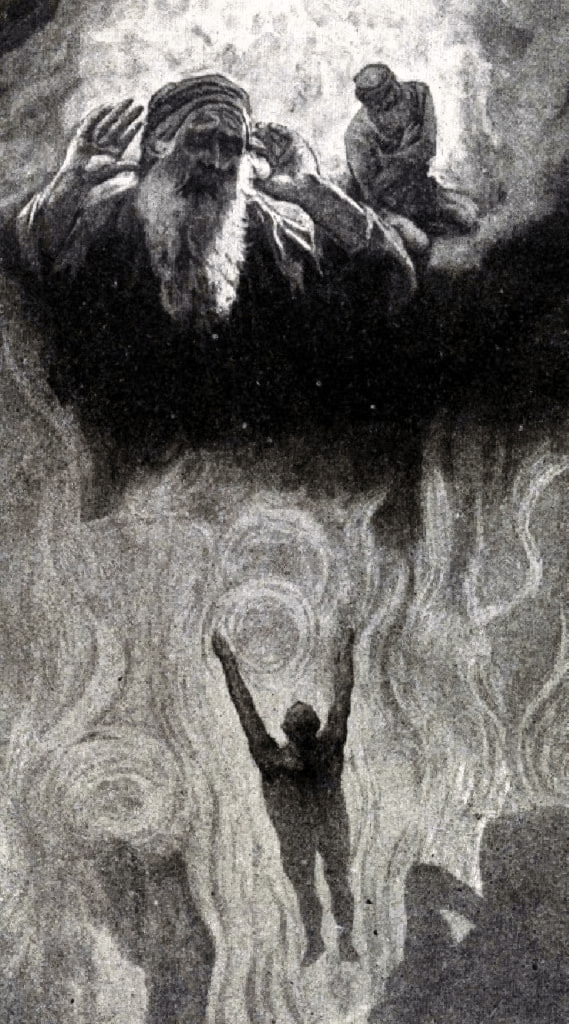








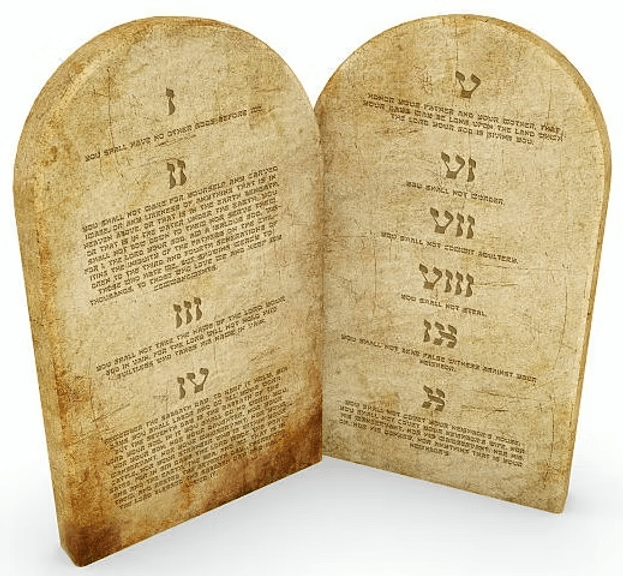



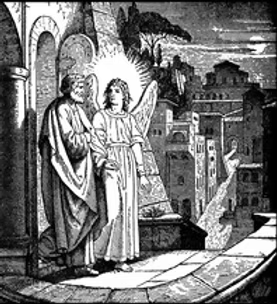
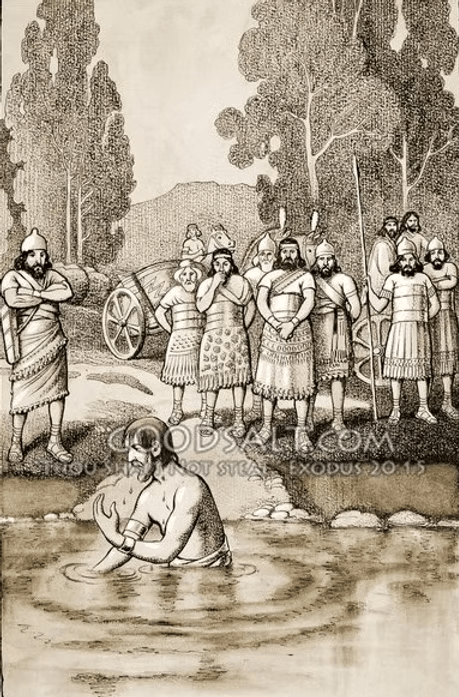
 Explaining the Readings