And he does not delight in the death of the living.
For he created all things so that they might exist;
the generative forces of the world are wholesome,
and there is no destructive poison in them,
and the dominion of Hades is not on earth.
For righteousness is immortal.
God created us for incorruption,
and made us in the image of his own eternity,
but through the devil’s envy death entered the world,
and those who belong to his company experience it.
——————————————————————————–
This is an optional Old Testament selection from the Episcopal Lectionary for the Sixth Sunday after Pentecost, Year B 2018. In the numbering system that lists each Sunday in an ordinal fashion, this Sunday is referred to as Proper 8. If chosen, this will next be read aloud in church by a reader on Sunday, July 1, 2018. It is important because it states the wisdom that human beings – souls in bodies – are born for eternal life. If not for the lures of sin, everyone on earth would personally know God.
It should be recognized that this reading selection comes from an Apocryphal book, which means it is a “Hidden” text that is not officially part of the Christian Bible. As a work that has been denied free access with those deemed most holy, without doubt, it has been scrutinized by scholars “after the fact,” searching for clues of authorship. As such, it has been determined that this is not a work written by King Solomon, and is not thought to have been written by only one human being. This focus on perceived flaws is not how one should address this book, and thus this reading.
The assumption that must be made is that Solomon, who as a child asked God for the gift of wisdom, was granted that wish by God; but Solomon was never the author of any wisdom he spoke.
All wisdom comes from God, flowing through one who is committed in their hearts to receive God’s thoughts. Therefore, the “Wisdom of Solomon” is from the same source, whether it flowed through a king of Israel, or a Prophet of the LORD before or after the fall of Israel and Judah, or an Apostle of Jesus Christ while being tested in the wilderness.
Wisdom exceeds the bounds of knowledge that humans can master, as it accepts the unknown readily, understanding what had been hidden from sight. Experience become the foresight of the future, from a clarity generated by hindsight.
When this view is understood, God is known to be the author. With God accepted as the author, the test of that authorship is the truth. Each line of prose or poetry must pass this test. Regardless of who wrote the words down on parchment, the truth they expose is the proof that God is the source of all wisdom and knowledge.
This selected reading consists of five verses, three from chapter one and two from chapter two. From two arcs on a circle one circuit of thought is connected. The first verse (verse 13) states (according to the King James Version): “For God made not death: neither hath he pleasure in the destruction of the living.” The presence of a colon (rather than a comma) makes the second half of this statement be supporting details to the initial statement that “God made not death.”
This points out that God is the Creator, not a destroyer.
God brought forth life into nothingness. Death is not an intention of Creation.
Transition is a state of change in life. The scientific-philosophical mind believes that since Creation there has been no new matter created and no original matter lost. All that was then is now and will be forever, with everything in between merely the natural states of change and transition. Therefore, the “death of the living” has nothing to do with the material universe, as it refers to souls.
In verse 14 we read, “For he created all things so that they might exist; the generative forces of the world are wholesome, and there is no destructive poison in them, and the dominion of Hades is not on earth.” This states that all things are designed to go through changes.
There are seasonal fluctuations, where growth and recession are natural. There are the global transitions, where tectonic plates move, volcanoes eject the inner earth onto the surface and sedimentary formations are from natural growth and rebirth cycles over ages. The temperature changes brings ice ages and global warming, where oceans rise and fall, and rivers, lakes, and streams go from dry to overflowing. All of this is normal life. What appears to be destructive is natural transformation.
The souls of human beings are given creation amid this flux, where changes from one body to the next are as natural as flowers blooming and then wilting away. Hell, which destroys souls, is not part of this world created by God.
When verse 15 then states, “For righteousness is immortal,” the purpose of life is to find righteousness. Righteousness is beyond wholesome. Righteousness is the creation of God within one who rejects the destructive poisons planted by Satan. Righteousness is the human soul’s choice to make, by choosing God over Satan. The reward of righteousness is everlasting life with God.
In the leap to the last two verses of chapter two, the King James Version shows “immortal” being the translation, rather than “incorruption.” As such, it is written in verse 23: “God created man to be immortal, and made him (man) to be an image of his own eternity.”
“Us” is “man,” such that it is written in Genesis, “Then God said, “Let us make mankind in our image, in our likeness,” (Genesis 1:26) where the LORD of lords (YHWH elohim), the God who made the gods (“In the beginning [YHWH] created gods [elohim] – Genesis 1:1) is the One God from which all Creation of souls (immortal souls and mortal with immortal souls) come.
More than being in the image of God by having a head, two arms and two legs – all attached to a trunk – the image of God (and gods) is that of the immortality of a soul. A soul cannot be corrupted by death. However, a body with a soul can be corrupted, leading the soul pay for that corruption.
In the final verse of chapter two, which says, “but through the devil’s envy death entered the world, and those who belong to his company experience it,” the corruption of a body with a soul is due to Satan’s envy of mankind. This verse tells of the division in Heaven between the “elohim” of the “gods.” Those of “his company” are the angels that rebelled against God’s command to serve mankind. These were cast within the earth, which makes them like Man, as eternal souls trapped in bodies. However, there is no release from those bodies as those souls are death.
Throw upon him hurled and pointed stones, covering him with darkness; There shall he remain for ever; cover his face, that he may not see the light. And in the great day of judgment let him be cast into the fire. (1 Enoch 7-9)
As an optional reading for the sixth Sunday after Pentecost, when one’s personal ministry should be underway, this wisdom speaks of the lure away from eternal life and towards the trapping of the devil. It is the envy of Satan, brought on because God made Man as wholesome and immortal, that makes Satan thrive on misleading humankind away from its promise. As long as Man’s soul remains uncorrupted, Satan will continue to whisper, “God will still take you in Heaven if you only do this sin. God is forgiving.”
That lure is heard because one has not sacrificed the self for the protection of Jesus Christ within one’s soul. A human soul is too wholesome to not be tricked without that care from the Holy Spirit, which can only come from a total commitment to God (marriage). This is the lesson from Genesis of Eve being deceived by the serpent and Adam following along. Their human forms with eternal souls were separate from God’s presence.
Ministry means having made that sacrifice, so one speaks from knowledge of faith and can guide others to the same protection and reward of eternal life with God. Ministry means opening the eyes and the ears of human bodies holding souls, so they can know the truth. Ministry means speaking the Wisdom of Solomon. Otherwise, the lies of Satan will lead soul after soul to corruption.
[2:22] and they did not know the secret purposes of יְיָ [HaShem],
nor hoped for the wages of holiness,
nor discerned the prize for blameless souls.
——————–
This is the “The First Lesson” that can be chosen over Psalm 1, as the companion reading for the Track 1 Old Testament reading from Proverbs 31 to be read aloud on the eighteenth Sunday after Pentecost [Proper 20], Year B (2018), according to the lectionary for the Episcopal Church. It will be a companion for Solomon writing, “[A capable wife’s] children rise up and call her happy; her husband too, and he praises her: “Many women have done excellently, but you surpass them all.”’ That pair will be presented before the Epistle from James, where the Apostle wrote, “You do not have, because you do not ask. You ask and do not receive, because you ask wrongly, in order to spend what you get on your pleasures.” All will accompany the Gospel reading from Mark, where is written: “Then [Jesus] took a little child and put it among them; and taking it in his arms, he said to them, “Whoever welcomes one such child in my name welcomes me, and whoever welcomes me welcomes not me but the one who sent me.”’
To repeat my prior disclaimer about the Wisdom of Solomon being Apocryphal and thus not in my standard reference for the Hebrew text, it is too difficult for me to do any more than a rudimentary translation, which is quite taxing and time consuming. What I have done is number the verses, based on a Bible.com English publication of this reading, confirmed by the NRSV translation, which the Episcopal Church has deemed unnecessary to number. In this you will also find three more uses of “יְיָ” or what one Hebrew source stated as “HASHEM,” which means a proper name for “God,” like “adonay,” but not. It also is not a standard abbreviation for “YHWH,” but is thought to be from the Hebrew word meaning “to be” [“haya”]. I also point out where one translation as “God” is actually the word “ha-elohim,” meaning “of elohim.”
In verse sixteen of chapter one, Solomon concluded a train of thought that dealt with soul marriage, although not one married to Yahweh. The words “ungodly,” “death,” and “covenant” all speak of a soul falling in love with the material plane and marrying that which disappears when “death” comes. Human being are mortals because “death” is the ‘god’ of the physical world. Satan is the “lord” that sways souls away from divine marriage to Yahweh, so their “covenant” can be seen as a ‘pact with the devil.’ Being “fit to belong to his company” means a soul denied eternal life in heaven; so, those souls get to rejoin the worldly plane they sold their souls for,
The transition from chapter one to chapter two should be seen as a change of theme [not running out of space on parchment]. Thus, verse one is stating the theme that changed from one of ‘righteous versus ungodly’ to one of knowledge, where Solomon begins by saying “poor thinking” [“For they reasoned unsoundly”] is the difference between having a happy, rewarding life on earth and going to Hell [“no one has been known to return from Hades”]. While chapter one [entitled “Exhortation to Uprightness,” with verse sixteen entitled “Life as the Ungodly See It”] is focused on the duality of good and evil [the wisdom Solomon prayed to receive], chapter two is no advancing the notion that wicked people are those who just don’t have good brains on their shoulders.
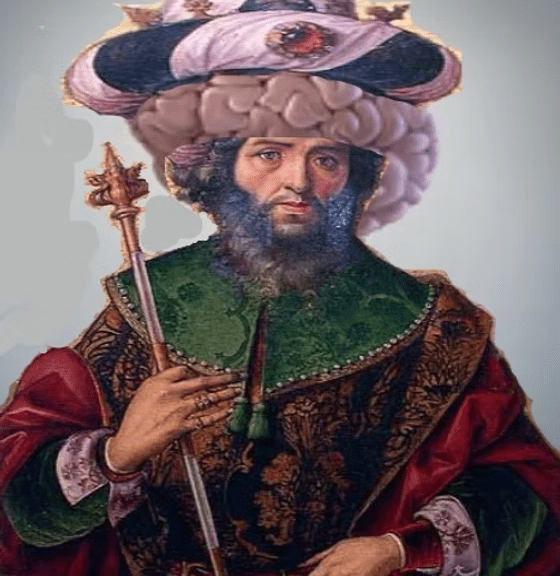
From one bad brain is another sown.
The limitations that must be seen in Solomon’s worship of his own big brain is seen when he conject there is no return from “Hades,” which is actually written “sheól” [“שְׁאוֹל”]. For Solomon to think he could tell whether the guy standing next to him was not the reincarnated soul of some past king [or queen] of a foreign nation, one that crashed and burned, or even the reincarnated soul of one of the wicked Israelites who died in the wilderness, due to not obeying the Commandments, shows how little he knew in reality. To even conject such an idea as wisdom is the same as science saying it is the only way to good judgment, when it is proved to be wrong many times, after declaring it was right.
The concept of Sheol was all souls went there. The thinkers that returned from Babylon captivity divided into two sects: One believe there was nothing after death; and, the other thought death was a ticket to something akin to Purgatory. Simply by being born a Jew [formerly Israelites], death mean that soul would be taken to heaven after the Messiah came. Of course, that mindset figured all Gentiles were like dogs and cats, with death meaning they went and roasted in Hell. That should be seen as who the wicked people Solomon was talking about, because (certainly) any right-minded Israelite of Solomon’s reign would see him as a god worthy of worship [smart as he was].
Skipping down from verse one of chapter two, to verse twelve, this is where Solomon is making himself out to be “a righteous dude,” as if Israel still had Gentile enemies they were worried about. Of course, David’s Israel was always at war with those who refused to accept their God Yahweh had giving them that place to live, with the Philistines being those who still retained land that was not Israel’s. They, however, were not an issue, since Solomon had married an Egyptian princess and had an ally that could put the squeeze on the Philistines. Still, verse twelve is Solomon’s self-worth as a hero of the righteous, he equates all who would challenge his authority as being wicked.
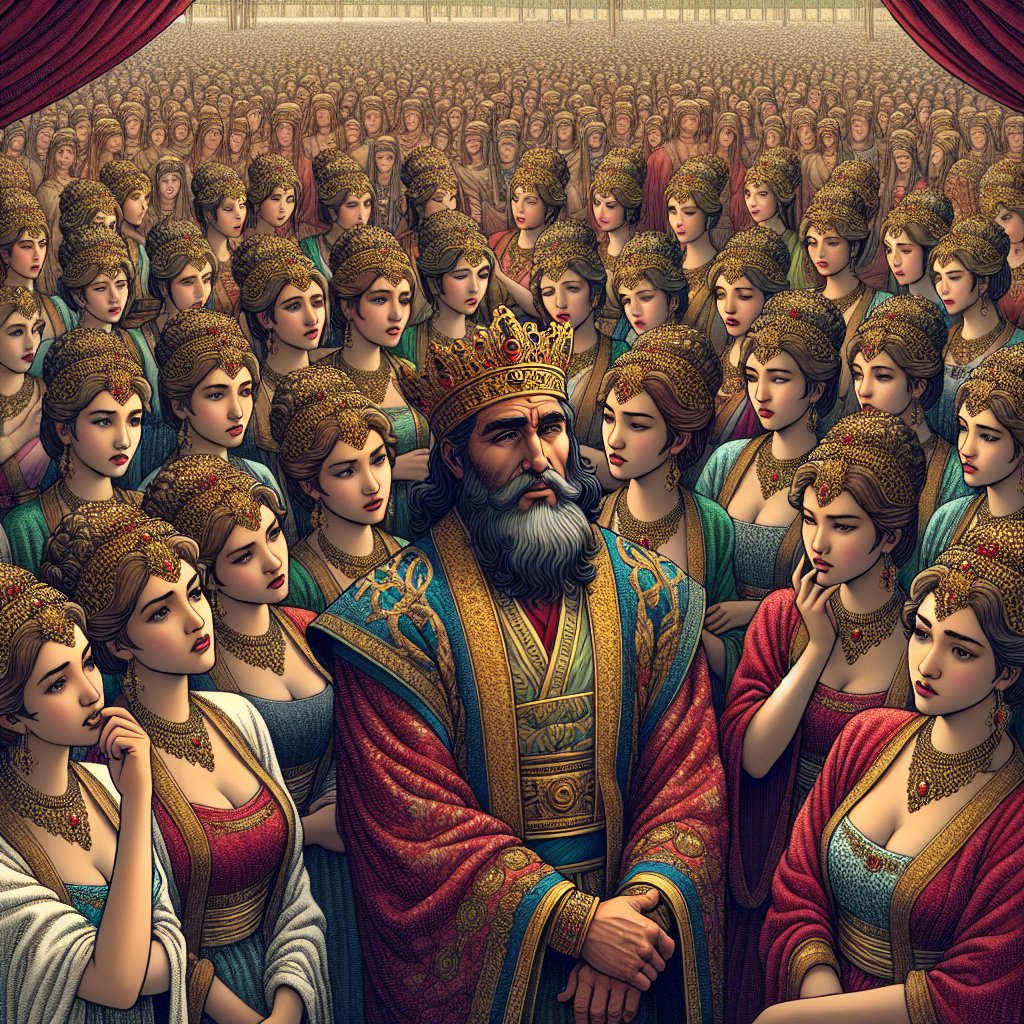
So many wives and concubines to please.
It is in verse thirteen that the truth of Solomon’s wickedness is exposed. In this verse there are two references to [NRSV translator] “God” and “the Lord.” The reality of what is written (as best as I can look up the Hebrew) is this [using the NRSV otherwise]: “He professes to have knowledge of יְיָ [HaShem], and calls himself a child ha-elohim.” In Solomon’s reign, the prophet Nathan was still actively advising the king. Others like Nathan were those who claimed “to have knowledge of” Yahweh. For Solomon to not write that name, but to instead write marks that are confusing, as to whom or what is being referenced [some say the letters are an abbreviated form of the verb translating as “to be”], says Solomon was not like his father David, nor the divine prophets who advised as the conduits of Yahweh. Solomon saw himself as a god, who was married to the goddess Wisdom, with Yahweh believed to be the servant god who served him: יְיָ [HaShem].
In the NRSV translation, the world “child” is footnoted, with the footnote saying the word written can equally translate as “servant.” For one to say he was “a servant of elohim,” that describes a prophet like Nathan to a T. The point of the Hebrew word “elohim” is not to state “God” [the error of all translators], but to state the reality of “gods” [in the plural number], which are those soul married to Yahweh and thus given His powers on earth, as His “servants” [His “children”]. Thus, in verse thirteen, Solomon is placing himself above that of true prophets, because of his big brain. This then equates his soul to a state of wickedness.
Verse fourteen then has Solomon scoff at the condemnations of the prophets, who say worldly wisdom is what condones evil ways. Verse fifteen is Solomon belittling the true holy priests of Israel as the ones who take all the fun out of life, reminding everyone of the laws that keep souls from infidelity to their marriage vows with Yahweh. Solomon is calling the restrictions placed on being a true priest of Yahweh as unnatural. That is true, when a nation of people are being led away from adherence to their Covenant and finding normalcy in the ways of other nations.
In verse sixteen, Solomon again references the “HaShem” that is almost used as if he knew he would bring some physical condemnation upon his flesh [leprosy maybe?] by using the name “Yahweh,” as his father David had done frequently in his songs. Here, Solomon belittles one who claims to be an “elohim” of Yahweh, because they make the claim that Yahweh is their “Father,” while also their Holy Husband. This becomes Solomon cursing Jesus, who routinely told his disciples [not the whole world, not all of Judaism] to address Yahweh as their “Father.” To call Yahweh “Father” means one must be His Son [all souls are masculine essence, especially when married to Yahweh’s Spirit … males and females in the flesh].
In verse seventeen, Solomon is beginning a series of verse that become the standard punishment governmentally set upon any who claim to be divine Sons of Yahweh. To make such claims means to be put to death. This concept would be viewed as holy wisdom, as Yahweh’s gift to Solomon, when in reality it was Satan’s serpent whispers [a marriage that made Solomon’s soul the demonic elohim of his demonic spiritual husband] that influenced all who would follow Solomon. The routine would be marry foreign wives, import foreign priests, and kill any priest who spoke out against that process. The culmination of this mindset of ‘wisdom’ was the execution of Jesus, the promised Messiah; but to believe in a promised Messiah, one has to first believe in Yahweh. Solomon taught them not to believe in being “He [Who] Retains God” [the meaning of “Israel”].
We are here to tell you all you need to know about God and Jesus (for a price).
In verse eighteen is a second use of “elohim,” which again must be seen as “gods,” specifically those whose souls have married Yahweh and become His hands on earth. At the time of Solomon’s reign, all true divine “elohim” were priests of the Ark of the Covenant [transferred from the Tabernacle of Zion to the Temple of Solomon] and the holy prophets [such as Nathan]. In this verse, Solomon laughs at those who make claims to be divine Sons of man, such that Solomon’s mindset was cast into the future at Golgotha, when someone yelled out, “If he is the Messiah, let him save himself.” Here, Solomon scoffs that the test of death will bring out the truth of being a “servant” [same use of “child”], by having Yahweh rescue that person.
Verses nineteen and twenty are Solomon giving the go ahead from that point in time onward to torture and insult the prophets of Yahweh. To claim to be “peaceful” means Solomon’s plan was to beat hatred and anger into those who make such claims. In today’s world, the destroyers of Christianity love to promote that Jesus is the Prince of Peace and would bend over and take it all day long, rather than strike anyone down in wrathful anger. They persecute the believers to the point of forcing them away from Yahweh, by punishing their will to serve. What those do not realize is the truth that every hateful strike they put forth against one of Yahweh’s children, the same return blows will come upon their souls, a hundred-fold.
The NRSV then places one of its titles or headers before verse twenty-on, saying the rest of chapter two focuses on “Error of the Wicked.” This is an assumption that “the wicked” are false prophets and not the true prophets of Yahweh. Solomon was the intellect of humanity, as one who worshiped ‘Sherlock Holmes-like’ abilities to discern physical clues and make logical deduction that result in the truth. None of that worldly wisdom is divine, thus far from all-knowing, as that given to Yahweh elohim. Thus the title would be better stated as “Error of the Intelligent.”
Verse twenty-one is then a perfect summation of Solomon’s views that have been written on parchment. By saying, “Thus they reasoned, but they were led astray, for their wickedness blinded them,” it is only the priests of logic and reason that deduce wrongly and are blinded by the science of the visible world. No true priest of Yahweh is reading the Law [the Torah] and coming away with clear-cut, black and white knowledge. Divine Scripture is written [according to Jesus] so the truth is hidden from the wise and intelligent, but exposed to the children [insert “servants” here]. The truth known by Yahweh elohim does not come from carefully crafted thought processes. However, once the truth has been shown, all those arts and crafts can find a truth fully justified and true. Thus, a simpleton [one of those Solomon belittled, when he prayed to his god “wisdom”] can be shown the truth of God, while all the big brains could not see the truth before their eyes.
Chance the simple gardener
In verse twenty-two [not the last verse, as chapter two has twenty-four verses], Solomon returned once again to displaying his fear of naming “Yahweh,” using his code-word called “HaShem” [יְיָ]. In this verse, Solomon sings that his lost soul never once considered self-sacrifice for the unseen rewards that are postmortem. The wise and intelligent cannot possibly see that which is “secret” and thus spiritual. They seek the material rewards that are the “wages” of being the elite, not the commoners. They never seek to restrict themselves from that which can be freely taken, for the seeming bargain of one’s soul [everything material for nothing spiritual]. They have no desires for holiness. They do not believe anything exists beyond death. Therefore, they have no need for thinking blamelessness is a virtue.
As the optional “First Lesson” to accompany Proverbs 31 on the seventeenth Sunday after Pentecost, when one’s own personal ministry for Yahweh should already be well underway, the lesson here is to see the trap of intellectualism. Solomon could not see how his words were condemning his own soul, all the while thinking he was making light of those who said they served Yahweh. Solomon did not believe Yahweh was anything more than a stepping stone to a mastery of life on earth. He did not believe in an afterlife; as there was no proof that anyone had ever returned from the depth of the ground. The lesson that must be taken from this is being a “child of elohim,” which means having one’s soul be married to Yahweh, with His Son Jesus resurrected within one’s soul-flesh. Having a big brain keeps one from having access to All Knowledge, readily available when needed. No planning necessary.
And he does not delight in the death of the living.
For he created all things so that they might exist;
the generative forces of the world are wholesome,
and there is no destructive poison in them,
and the dominion of Hades is not on earth.
For righteousness is immortal.
———-
[Yahweh] created us for incorruption,
and made us in the image of his own eternity,
but through the devil’s envy death entered the world,
and those who belong to his company experience it.
——————–
This is the Track 2 optional Old Testament selection that will be read aloud on the sixth Sunday after Pentecost [Proper 8], Year B, according to the lectionary for the Episcopal Church. It is important because it states the wisdom that says human beings – souls in bodies – are born for eternal life. If not for the lures of sin, everyone on earth would personally know Yahweh.
In the Hebrew text for this reading, a ‘double yod’ [or ‘two yuds’] is written [“י י”], which is said to be an abbreviated form of the name “Adonai,” also recognized as “HaShem.” The word “Adonay,” like “elohim,” is the plural number form of “adon,” such that the actual translation is as “lords.” As such, these words of wisdom can be questioned, as to whether or not they directly refer to Yahweh, or the lesser “lords” of the material world, who are under the control of His Spirit. By having this forewarning, one can read the following assessment with that extra insight. The following was originally posted for consumption [written by this author] in 2018. Only minor changes have been made to this, as everything written then still applies today.
It should be recognized that this reading selection comes from an Apocryphal book, which means it is a “Hidden” text that is not officially part of the Christian Bible. As a work that has been denied free access with those deemed most holy, without doubt, it has been scrutinized by scholars “after the fact,” searching for clues of authorship. As such, it has been determined that this is not a work written by King Solomon; and, it is not thought to have been written by only one human being. This focus on perceived flaws is not how one should address this book, and thus this reading.
The assumption that must be made is that Solomon, who as a child, loved Yahweh. Yahweh knew that Solomon had an “upright soul.” In a dream, before Solomon would assume control of the throne of Israel, Yahweh asked Solomon what assistance He could give this young man. Solomon asked for the gift of wisdom, in the sense that he wanted “understanding” and “discernment capabilities for good and evil,” so he could properly “judge” the way the Israelites should go, as they had been led by David. Solomon was granted that wish by Yahweh; but Solomon was never the author of any wisdom he spoke.
All true wisdom comes from Yahweh, flowing through one who is committed in their hearts to receive His thoughts. Therefore, the “Wisdom of Solomon” is from the same source, whether it flowed through a king of Israel, or a Prophet of YAHWEH, before or after the fall of Israel and Judah. It is the same flowing through Jesus and then the Apostles in his name, all as the Christs [Anointed ones] of Yahweh, who will always be tested in the wilderness.
Wisdom exceeds the bounds of knowledge that humans can master, as it accepts the unknown readily, understanding what had been hidden from sight. Experience becomes the foresight of the future, from a clarity generated by hindsight.
When this view is understood, Yahweh is known to be the author. With Him accepted as the author, the test of that authorship is the truth. Each line of prose or poetry must pass this test. Regardless of who wrote the words down on parchment, the truth they expose is the proof that the One God is the source of all wisdom and knowledge.
This selected reading consists of five verses, three from chapter one and two from chapter two. From two arcs on a circle, one circuit of thought is connected. The first verse (verse 13) states (literally): “that Adonai not tested death. not desire destruction of life.” The Episcopal Church shows, “God did not make death, And he does not delight in the death of the living.” The Hebrew text shows the presence of a period mark, making two separate, but relative statements. These boil down to: “Adonai does not test death” and “Adonai does not desire the destruction of life.”
This points out that God is the Creator, not a destroyer. God only makes “life” in the spiritual realm, with the material realm the opposite of “life,” as the absence of “life” is “death.” Neither a soul nor dead matter can ever be lost from Creation, although both can change states, simulating birth and death.
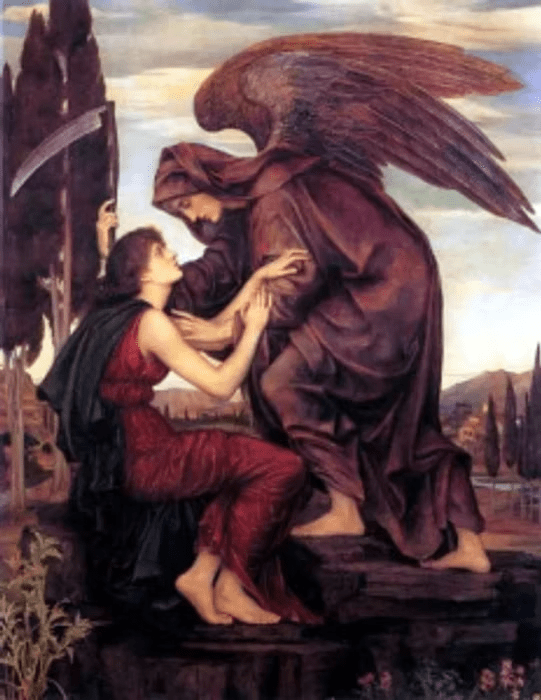
Samael, the Destroyer who sows destructive poison
God brought forth life into death, as a soul animating a body of flesh. Death is not the “destruction” of “life,” as a soul is eternal. However, the “test” of “death” is placed on the soul to be married to Yahweh and allow Him to be the “Lord” [“Adonai”] of “life” in “death,” so the soul can return to the realm of the living [Yahweh]. Thus a soul “not “ able to pass the “test” of the material realm, whose “lord” is self, influenced by Satan, will return to that realm after a body of flesh returns to matter, as “death.”
Transition is a state of change in life. The scientific-philosophical mind believes that since Creation there has been no new matter created and no original matter lost. All that was then is now and will be forever, with everything in between merely the natural states of change and transition. Therefore, the “death of the living” has nothing to do with the material universe, as it refers to souls.
In verse 14 we read, “For he created all things so that they might exist; the generative forces of the world are wholesome, and there is no destructive poison in them, and the dominion of Hades is not on earth.” This states that all things are designed to go through changes.
There are seasonal fluctuations, where growth and recession are natural. There are the global transitions, where tectonic plates move, volcanoes eject the inner earth onto the surface and sedimentary formations are from natural growth and rebirth cycles over ages. The temperature changes brings ice ages and global warming, where oceans rise and fall, and rivers, lakes, and streams go from dry to overflowing. All of this is normal life. What appears to be destructive is natural transformation.
The souls of human beings are given creation amid this flux, where changes from one body to the next are as natural as flowers blooming and then wilting away. Hell, which destroys souls, is not part of this world created by God.
When verse 15 then states, “For righteousness is immortal,” the purpose of life is to find righteousness. Righteousness is beyond wholesome. Righteousness is the creation of Yahweh’s Spirit within one who rejects the destructive poisons planted by Satan. Righteousness is the human soul’s choice to make, by choosing to serve Yahweh over Satan. The reward of righteousness is everlasting life in the Spiritual realm.
In the leap to the last two verses of chapter two, the King James Version shows “immortal” being the translation, rather than “incorruption.” As such, it is written in verse 23: “God created man to be immortal, and made him (man) to be an image of his own eternity.”
The plural pronoun “us” is “man,” such that it is written in Genesis, “Then God said, “Let us make mankind in our image, in our likeness,” (Genesis 1:26) where the LORD of lords (YHWH elohim), the God who made the gods (“In the beginning [YHWH] created gods [elohim] – Genesis 1:1) is the One God from which all Creation of souls (immortal souls and mortal with immortal souls) come.
More than being in the image of God by having a head, two arms and two legs – all attached to a trunk – the image of God (and gods) is that of the immortality of a soul. A soul cannot be corrupted by death. However, a body with a soul can be corrupted, leading the soul to pay for that corruption.
In the final verse of chapter two, which says, “but through the devil’s envy death entered the world, and those who belong to his company experience it,” the corruption of a body with a soul is due to Satan’s envy of mankind. This verse tells of the division in Heaven between the “elohim” of the “gods.” Those of “his company” are the angels that rebelled against God’s command to serve mankind. These were cast within the earth, which makes them like Man, as eternal souls trapped in bodies. However, there is no release from those bodies as those souls are death.
“Throw upon him hurled and pointed stones, covering him with darkness; There shall he remain forever; cover his face, that he may not see the light. And in the great day of judgment let him be cast into the fire.” (1 Enoch 7-9)
As an optional reading for the sixth Sunday after Pentecost, when one’s personal ministry should be underway, this wisdom speaks of the lure away from eternal life and towards the trappings of the devil. It is the envy of Satan, brought on because God made Man as wholesome and immortal, that makes Satan thrive on misleading humankind away from its promise. As long as Man’s soul remains uncorrupted, Satan will continue to whisper, “God will still take you in Heaven if you only do this sin. God is forgiving.”
That lure is heard because one has not sacrificed the self for the protection of Jesus Christ within one’s soul. A human soul is too wholesome to not be tricked without that care from the Holy Spirit, which can only come from a total commitment to God (marriage). This is the lesson from Genesis, of Eve being deceived by the serpent and Adam following along. Their human forms with eternal souls were separate from God’s presence.
Ministry means having made that sacrifice, so one speaks from knowledge of faith and can guide others to the same protection and reward of eternal life with God. Ministry means opening the eyes and the ears of human bodies holding souls, so they can know the truth. Ministry means speaking the Wisdom of Solomon. Otherwise, the lies of Satan will lead soul after soul to corruption.
———-
Note:
The Hebrew website Sefaria translates to English this reading as such:
13 For ye have not chosen death. And did not desire the loss of life:
14 To set them up for ever, and the peace of the people of the land is in their hand. The wrath of doom is not among them, and Saul is not in the dust of
his power:
15 For righteousness shall not die. And the wickedness of death:
23 For he created man to revive him eternal life. And he shall make it in his image after the likeness of it;
24 And in the envy of the devil death rose up in the world. And who in his destiny will be supported:
[7:26] For wisdom is a reflection of eternal light,
a spotless mirror of the working of el,
and an image of his goodness.
[7:27] Although she is but one, she can do all things,
and while remaining in herself, she renews all things;
in every generation she passes into holy souls
and makes them friends of יְיָ and prophets;
[7:28] for יְיָ loves nothing so much as the person who lives with wisdom.
[7:29] She is more beautiful than the sun,
and excels every constellation of the stars.
[7:30] Compared with the light she is found to be superior,
for it is succeeded by the night,
but against wisdom evil does not prevail.
[8:1] She reaches mightily from one end of the earth to the other,
and she orders all things well.
——————–
This is the second of two possible songs that are designated as companions with the Track 1 Old Testament from Proverbs 7 that can be read aloud in unison or sung by a cantor on the sixteenth Sunday after Pentecost [Proper 19], Year B, according to the lectionary for the Episcopal Church. If chosen, it will follow the words of Solomon that say, “Wisdom cries out in the street; in the squares she raises her voice.” The pair will be presented before the Epistle reading from James, where the Apostle wrote, “For all of us make many mistakes. Anyone who makes no mistakes in speaking is perfect, able to keep the whole body in check with a bridle.” All will accompany the Gospel reading from Mark, where Jesus asked his disciples who they thought he was, so we read, “Peter answered him, “You are the Messiah.” And [Jesus] sternly ordered them not to tell anyone about him.”
This optional reading is Apocryphal, meaning is is not accepted as Canon, although widely accepted as true. Because it is not Canon, my reference site [BibleHub Interlinear] does not offer the Hebrew of the Wisdom of Solomon. As such, I do not have access to the literal translations or have an easy reference to the definitions of Hebrew words that they provide. There are, however, Hebrew sites that offer semblances of that, although they are much harder for me to navigate and ascertain the deeper meaning. As such, I offer a most rudimentary interpretation of this song-poem of Solomon.
There are thirty-one verses in the seventh chapter. This reading is then the last six verses of that chapter and the first verse of chapter eight, making a total of seven verses. I have applied the verse numbers in bold type, within brackets, to assist in my analysis when referring to verses. Those numbers come from the NRSV translation, which the Episcopal Church claims to be their source. However, the Episcopal Church has modified that translation. In verses twenty-seven and twenty-eight there are two times that a Hebrew word has been translated as “God.” I have removed that translation and replaced it with the Hebrew written [“יְיָ”], sometimes called “HaShem.”
When this reading is seen as an optional selection to Psalm 19, Psalm 19 has one use of “el” that is translated as “God.” In many other Psalms, David wrote “elohim,” which commonly are erroneously translated as “God.” This is erroneous because the word is “el” is singular, so to be translated here are “God” means it is ludacris to pretend a word written in the plural number (“elohim“) is anything other than “gods” [not worthy of capitalization]. This means Solomon wrote something that amounts to an abbreviation [or something less], which makes it worthwhile to understand what “יְיָ” [“HaShem“] means.
According to the definition supplied by the Klein Dictionary, directed from the Sefaria.org website (where the Hebrew text of the Wisdom is found), this is the explanation:
יְיָ masculine noun: the proper name of God in the Bible, Tetragrammaton. [It prob. derives from הוה (= to be). The usual transliteration ‘Jehovah’ is based on the supposition that the Tetragrammaton is the imperfect Qal Hiph. of הוה and lit. means ‘the one who is, the existing’, respectively ‘who calls into existence’. In reality, however, the pronunciation and literal meaning of the Tetragrammaton is unknown. cp. יָהּ ᴵ.] (Klein Dictionary)
In verse twenty-six, the above translation that had Solomon writing, “For wisdom is a reflection of eternal light, a spotless mirror of the working of el, and an image of his goodness,” one very important word is left out. According to all Hebrew sites I could find that offered the Hebrew text, verse twenty-six begins with the word “הִיא” or “hiy,” which means “she.” The Roman Catholic translation of this verse states, “for she is a reflection,” not “wisdom.” The NRSV translation also includes that feminine third-person pronoun, which says the Episcopal Church wants to make it clear to the lambs in the pews that “she” means “wisdom,” without any questions asked. This should bring up the question, “Why is wisdom referred to as a “she”?”
In my writings posted here, I have regularly commented that the call of divine Scripture is for a soul to marry Yahweh; and, in that scenario of marriage, I have regularly stated that human souls are the brides or wives of Yahweh [both males and females], who is the bridegroom and Husband. This is because Yahweh is “the Father,” thus masculine. Anything of the physical universe (including flesh, bones, and blood) is of feminine essence. As such, those who believe in gods and goddesses see “Mother Earth” as a “she,” which makes all souls in human flesh be feminine in essence because their flesh is part of Mother Earth. This same analogy is stated by Solomon when he routinely referenced wisdom as feminine.
In a past Old Testament reading, when David died and Solomon encountered Yahweh in a dream, I wrote how Yahweh stepped aside and let Solomon converse with Satan, the elohim who had been cast into the depths of the earth. Satan’s reign is thus worldly, but as a demon of the earth his spirit manifests as feminine. When young Solomon asked for the knowledge of good and evil, he sought the forbidden fruit that keeps a soul from achieving heaven. This means it was Satan who granted a young boy king the greatest wisdom – a gift known well by the serpent of Eden – in addition to worldly riches. Yahweh does not tempt human souls with material things. Therefore, wisdom is a she because it is the external world connecting to the human brain, in metaphysical ways that are the gifts of intuition and psychic abilities that are deductions of mind, not the all-knowing instant wisdom of Yahweh.
For anyone who has studied metaphysical topics, such as astrology, one can readily see how a translation saying, “she is a reflection of eternal light, a spotless mirror of the working of el, and an image of his goodness” becomes a statement of the sun (the eternal source of light) and the moon (a reflective mirror of light). The goodness of the sun’s light gives life to earth, whereas that goodness of the moon is weak, beyond an effect on waters of the earth, so it can only provide dim light to the darkness. The moon’s reflection of goodness during daylight is nil. That means the sun reflects the light of life, while the moon reflects the light of death. Everything is metaphoric and symbolic; but just as the sun and the moon reflect heavenly lights, day and night, so too does goddess wisdom confirm that there is a stronger wisdom – that of Yahweh – which the goddess wisdom can only mimic in reflection. The pronoun “she” says the wisdom of Solomon is not and inner light of truth, but an ability to discern external variables through enhanced intelligence.
In the statement that includes “el” – “a spotless mirror of the working of el” – the use of “el” should not be seen as Yahweh per se, because Yahweh does not Himself shine in the material realm. As such, He is unable to be reflected, like is the sun. That makes the sun be metaphor for Jesus – the Son of man – who shines as an elohim [an el] of Yahweh. This makes Saints, as those who are reborn as Jesus, each be like a sun, as a Christ resurrected [the light of Christ]. Therefore, Solomon was saying the powers of brain (called the goddess wisdom) is the mirror image of a true Saint. A true Saint has all the knowledge of Yahweh readily available (as needed), whereas a false prophet has lots of tricks up his or her sleeves. [Remember how Moses was enabled divinely by Yahweh, when he did battle with the priests of Pharaoh, who performed reflective deeds of wisdom.]
When verse twenty-seven begins by stating, “ Although she is but one, she can do all things, and while remaining in herself, she renews all things,” the focus needs to be on the number stated – “one.” To know that Yahweh is the only true “one,” who is the Creator of all that is, including every elohim, including all the spiritual powers of the universe, wisdom can be nothing more than one of many, meaning wisdom was insignificant in the grand scheme of Creation. This means it can only be Solomon stating he was the “one” in whom wisdom reigned. As far as Solomon was concerned, he was the only “one” in whom such great powers of wisdom mattered. For as many as Solomon reigned over as king, he could never become outside of Solomon, so he could never experience more than the “one” that was himself, his own soul-flesh being.
This should be seen as a flaw, which can also be projected on the flaw of thinking Yahweh [like Solomon’s wisdom] can only be in “one.” This is the flaw found in the failing religion that is Christianity, as it is a parallel to Solomon initiating the failure of the concept of Israel as being all individuals who retained Yahweh, the One God. Solomon led the Israelites to worship lesser gods, marrying women who imported pagan religious ideas into the mindset of the people of Israel [the name of a nation]. The same worship of wisdom [intelligence] makes every man and woman a god, like Solomon saw himself as, such that Christians worship themselves [like gods], while seeing only “one Christ,” specifically named the “one Jesus Christ,” to whom they pray to be given great wisdom. All eyes are taken away from the inner soul’s need for Yahweh – the Creator of all souls – instead placing focus on icons of the world, turning all away from a proposal for all souls to marry Yahweh and become His Son resurrected within their souls.
The second half of verse twenty-seven then says, “in every generation she passes into holy souls and makes them friends of יְיָ and prophets.” Here, the first presentation of the unknown Hebrew ‘word’ is found. When Solomon said, “she passes into holy souls,” this should be read as a spiritual possession, where a “soul” has become overcome with a worship of intellectual being. A “holy soul” is one that is “generated” by Yahweh, and only Yahweh; but a soul in a body of flesh is set free, allowed to find its way back to Yahweh. In that process, all souls become possessed by this goddess that expands the brain. It is a necessary growth of the flesh that needs to learn discernment, as normal education. To then see how that “makes them friends,” this is coming to realize there are many deities to be recognized, many other than Yahweh. This means the writing of “יְיָ” becomes a reflection of polytheism, not simply Yahweh. Thus the addition of “prophets” says all “gods” [elohim] have those who worship them exclusively and benefit from such selling of their souls. Solomon’s wives brought in many ‘priests’ of foreign gods, beginning the downfall of Israel. [Remember how Elijah challenged the priests of Baal (450 in number), where those who failed were the “friends” of Ahab and Jezebel, as the “prophets” of a dead god, with “יְיָ” symbolizing Baal.]
For verse twenty-eight to then repeat the use of “יְיָ,” stating “for יְיָ loves nothing so much as the person who lives with wisdom,” this again takes one away from the concept of Yahweh, the Father [masculine essence], where “יְיָ” is “she” who “loves nothing so much.” The “nothing” is the reward of being such a servant or subject of wisdom. This then says the “nothing loved” is given to souls who “live with wisdom,” where “life” is the false appearance of the world [the realm of death] seeming full of “life.” That is only the illusion of an eternal soul animating dead matter. This says wisdom is only possible through material means; so, when the body dies and the soul is released, wisdom cannot be taken with a soul. Wisdom is therefore like material wealth, which gets left behind at death bringing about separation of a soul from all in that realm.
Verse twenty-nine then states “She is more beautiful than the sun, and excels every constellation of the stars.” In this, “beauty” must be seen as in the eyes of the beholder, such that what Solomon meant is this: You can look at the full moon and see imaginations possible; but if one stares at the full sun, one will go blind. By speaking about “every constellation of the stars,” the imaginary lines that connect the tiny dots of light that the stars are, turning separate points of light into a figure within one’s brain, this becomes a statement that says external facts [stars] can be read through reason, deduction, inference, and induction, such that wisdom is that ability to ‘connect the dots.’ That can sometimes lead to the truth, if the mathematics of true logic is applied; but often reason is flawed and the conclusions are (more often than not) invalid and false.
In verse thirty the translation says, “Compared with the light she is found to be superior, for it is succeeded by the night, but against wisdom evil does not prevail.” Here, the meaning of “superior” is akin to the heuristic that says, “the whole is greater than the sum of the parts.” [Gestalt theory] There is nothing greater or superior to Yahweh; and, the light of the Son [an Anointed soul in flesh] is the truth, at all times. Because nothing of mind can be superior to the truth, wisdom (“she”) can only shine in darkness, where ignorance is always inferior to knowledge. When Solomon said, “against wisdom evil does not prevail,” “evil” has no need to use ploys against a soul already committed in marriage to a demonic possession. The aspect of being “succeeded by the night” says wisdom is given to those who choose death [“night”] over life [“light”]. Overall, this verse speaks of the values of having knowledge of good and evil, which is the fruit that prevents a soul from attaining a return to be one with Yahweh.
Whenever the Episcopal Church chooses to combine the end of one song with the beginning of the next (as is done here, with the first verse of the eighth chapter next to be read), the impression given is all being on the same page. The reason for a separate chapter is not running out of parchment. The eighth chapter begins a new line of though, from a new set of core ideas. That needs to be understood when reading, “She reaches mightily from one end of the earth to the other, and she orders all things well.” This is less about specific comparisons of wisdom to natural phenomena and turning to address the way wisdom can direct one’s life.
In the titles given to sections of Scripture, to guide the thought processes of readers, the Catholic Bishops page says verses 23 to 30 of Chapter 7 can be expected to be about “Nature and Incomparable Dignity of Wisdom.” That, of course, is based on the meaning of the words found written in those verses by Solomon. In this regard, the NRSV also applies a header, one that says, “The Nature of Wisdom.” Relative to Chapter 8, the Bishops place a header before verse two, saying, “Wisdom, the Source of Blessings,” while the NRSV puts one in the same place, which states, “Solomon’s Love for Wisdom.” Both do not reflect upon verse 1 of the eighth chapter, as if it were some lost verse, stuck at the top of a random chapter. It should not be read as the leftover thoughts of “The Nature of Wisdom,” but the precursor of “Solomon’s Love of Wisdom.” In that regard, Solomon soon after [verse two] wrote of marrying wisdom, taking it as another of his many wives.
This means Solomon saw the appeal of wisdom, as an asset to behold, or a conquest to be obtained. This is nothing like a comparison of the light, as a reflection, which has to do with the enhancement of mental capacities. This is about the worldly lusts that wisdom can bring within one’s grasp. Thus, “from one end of the earth to the other” praises the vast array of “material things” that wisdom can reveal the secrets for obtaining them. When Solomon said, “she orders all things well,” this should be seen as a value ranking, such as that in which metal objects fall in line with. The rarest are the most valuable, while the most plentiful are the least valuable. The prettier are more valuable than the uglier. This has nothing to do with the truth, as it has only to do with the opinions of an individual. As a king, Solomon could lust for the rarest and the prettiest, so wisdom was his way to achieve all of his lustful desires.
I want to add that the Safaria.org website offers the Hebrew text, with some words searchable as to meaning and definition on their site, linking to the Klein Dictionary. Many Hebrew words are not found on that site, but can be found on other translation websites. In my rudimentary attempts to verify the translations of the NRSV, the Hebrew text presented by Safaria does not translate anywhere close to what the NRSV shows. While I could see how verse twenty-six is most likely correctly translated, verse twenty-seven went far off the rails. Here is what is listed above, compared to what I found:
“Although she is but one, she can do all things, and while remaining in herself, she renews all things” [from verse 26 above]
“by herself she could all turn work and reason all affairs. Appointed time fit in the minds worthy industry my love towards getting.” [My literal translation gleaned.]
In this, there is a very broad scope of leeway given to the translators, which makes everything become a paraphrase that fits snugly into whatever agenda the translator had to begin with. It says this “Wisdom of Solomon” can become more Satanic than it already appears, if one was to seriously dig deeply into what was written. I feel dirty from what I have done to this point; so, I do not care to go further.
As a potential accompaniment to the reading from Proverbs 7 on the sixteenth Sunday after Pentecost, when one’s own personal ministry for Yahweh should already be well underway, the lesson here is to be wary of wisdom. For Solomon to flaunt wisdom as a “she” or “her” is to pronounce his lust for worldly matters, not having any spiritual concerns of value. The focus of this translation says to be a light in the darkness for those who love the night, fearing their exposure in daylight. This makes the lesson to be wary of the dangers of evil that come dressed up in packages of intelligence. So many priests and pastors line the walls of their offices with sheets of paper that profess them to be full of wisdom. However, to have never married one’s soul to Yahweh, being reborn as His Son Jesus, none of the people who sit in the churches of those so-called religious leaders [the children of wisdom] will ever be able to ‘graduate’ and receive grandiose diplomas of wisdom from their church leaders. No souls will be made better, much less have themselves be able to go find a job in a church and have their own office, where they too can line the walls with trinkets of wisdom.
The lesson is then be Jesus, so one can touch the souls of others and have them too become Jesus reborn. That is far better than playing ‘Father Brainy, Mother Superior, or Lady Wisdom” in the eyes of Yahweh.
[1:16] The ungodly by their words and deeds summoned death;
considering him a friend, they pined away
and made a covenant with him,
because they are fit to belong to his company.
—–
[2:1] For they reasoned unsoundly, saying to themselves,
“Short and sorrowful is our life,
and there is no remedy when a life comes to its end,
and no one has been known to return from Hades.
—–
[2:12] Let us lie in wait for the righteous man,
because he is inconvenient to us and opposes our actions;
he reproaches us for sins against the law,
and accuses us of sins against our training.
[2:13] He professes to have knowledge of יְיָ [HaShem],
and calls himself a child ha-elohim.
[2:14] He became to us a reproof of our thoughts;
[2:15] the very sight of him is a burden to us,
because his manner of life is unlike that of others,
and his ways are strange.
[2:16] We are considered by him as something base,
and he avoids our ways as unclean;
he calls the last end of the righteous happy,
and boasts that יְיָ [HaShem] is his father.
[2:17] Let us see if his words are true,
and let us test what will happen at the end of his life;
[2:18] for if the righteous man is elohim child, he will help him,
and will deliver him from the hand of his adversaries.
[2:19] Let us test him with insult and torture,
so that we may find out how gentle he is,
and make trial of his forbearance.
[2:20] Let us condemn him to a shameful death,
for, according to what he says, he will be protected.”
[2:21] Thus they reasoned, but they were led astray,
for their wickedness blinded them,
[2:22] and they did not know the secret purposes of יְיָ [HaShem],
nor hoped for the wages of holiness,
nor discerned the prize for blameless souls.
——————–
This is the “The First Lesson” that can be chosen over Psalm 1, as the companion reading for the Track 1 Old Testament reading from Proverbs 31 to be read aloud on the seventeenth Sunday after Pentecost [Proper 20], Year B, according to the lectionary for the Episcopal Church. It will be a companion for Solomon writing, “[A capable wife’s] children rise up and call her happy; her husband too, and he praises her: “Many women have done excellently, but you surpass them all.”’ That pair will be presented before the Epistle from James, where the Apostle wrote, “You do not have, because you do not ask. You ask and do not receive, because you ask wrongly, in order to spend what you get on your pleasures.” All will accompany the Gospel reading from Mark, where is written: “Then [Jesus] took a little child and put it among them; and taking it in his arms, he said to them, “Whoever welcomes one such child in my name welcomes me, and whoever welcomes me welcomes not me but the one who sent me.”’
To repeat my prior disclaimer about the Wisdom of Solomon being Apocryphal and thus not in my standard reference for the Hebrew text, it is too difficult for me to do any more than a rudimentary translation, which is quite taxing and time consuming. What I have done is number the verses, based on a Bible.com English publication of this reading, confirmed by the NRSV translation, which the Episcopal Church has deemed unnecessary to number. In this you will also find three more uses of “יְיָ” or what one Hebrew source stated as “HASHEM,” which means a proper name for “God,” like “adonay,” but not. It also is not a standard abbreviation for “YHWH,” but is thought to be from the Hebrew word meaning “to be” [“haya”]. I also point out where two translations as “God” are actually the word “ha-elohim,” meaning “of elohim,” with another that is clearly “elohim.”
In verse sixteen of chapter one, Solomon concluded a train of thought that dealt with soul marriage, although not one married to Yahweh. The words “ungodly,” “death,” and “covenant” all speak of a soul falling in love with the material plane and marrying that which disappears when “death” comes. Human being are mortals because “death” is the ‘god’ of the physical world. Satan is the “lord” that sways souls away from divine marriage to Yahweh, so their “covenant” can be seen as a ‘pact with the devil.’ Being “fit to belong to his company” means a soul denied eternal life in heaven; so, those souls get to rejoin the worldly plane they sold their souls for.
The transition from chapter one to chapter two should be seen as a change of theme [not running out of space on parchment]. Thus, verse one is stating the theme that changed from one of ‘righteous versus ungodly’ to one of knowledge, where Solomon begins by saying “poor thinking” [“For they reasoned unsoundly”] is the difference between having a happy, rewarding life on earth and going to Hell [“no one has been known to return from Hades”]. While chapter one [entitled “Exhortation to Uprightness,” with verse sixteen entitled “Life as the Ungodly See It”] is focused on the duality of good and evil [the wisdom Solomon prayed to receive], chapter two is now advancing the notion that wicked people are those who just don’t have good brains on their shoulders.
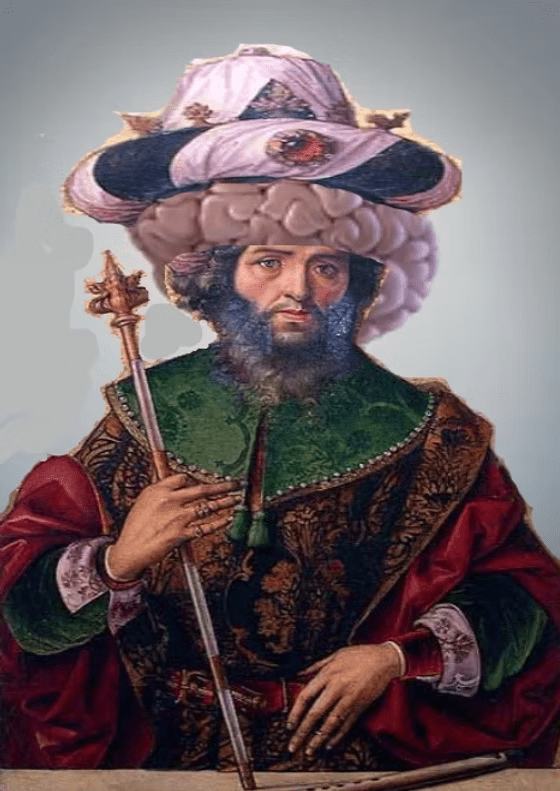
Solomon sings, “I’m too brainy for my head.”
The limitations that must be seen in Solomon’s worship of his own big brain is seen when he conjects that there is no return from “Hades,” which is actually written “sheól” [“שְׁאוֹל”]. For Solomon to think he could tell whether the guy standing next to him was not the reincarnated soul of some past king [or queen] of a foreign nation, one that crashed and burned, or even the reincarnated soul of one of the wicked Israelites who died in the wilderness, due to not obeying the Commandments, shows how little he knew in reality. To even surmise such an idea as wisdom is the same as science, saying it is the only way to good judgment when it is proved to be wrong many times (after declaring it was right), is idiocy.
The concept of Sheol [from the second Temple perspective] was all souls went there. The thinkers that returned from Babylon captivity divided into two main sects: One believe there was nothing after death [Sadducees]; and, the other thought death was a ticket to something akin to Purgatory [Pharisees]. By simply by being born a Jew [formerly Israelites], the Pharisees believed death meant that soul would be taken to heaven after the Messiah came. Of course, that mindset figured all Gentiles were either like dogs and cats [soulless], or they had evil souls, so death meant they went and roasted in Hell. That should be seen as who were the wicked people of whom Solomon was talking about, because (certainly) any right-minded Israelite of Solomon’s reign would see him as a god worthy of worship [smart as he was].
Skipping down from verse one of chapter two, to verse twelve, this is where Solomon is making himself out to be “a righteous dude,” as if Israel still had Gentile enemies they were worried about. Of course, David’s Israel was always at war with those who refused to accept their God Yahweh had given them that place to live, with the Philistines being those who still retained land that was not Israel’s. They, however, were not an issue, since Solomon had married an Egyptian princess and then had an ally that could put the squeeze on the Philistines, from the west. Still, verse twelve is Solomon’s self-worth as a hero of the righteous coming forth, as he equates all who would challenge his authority as being wicked.
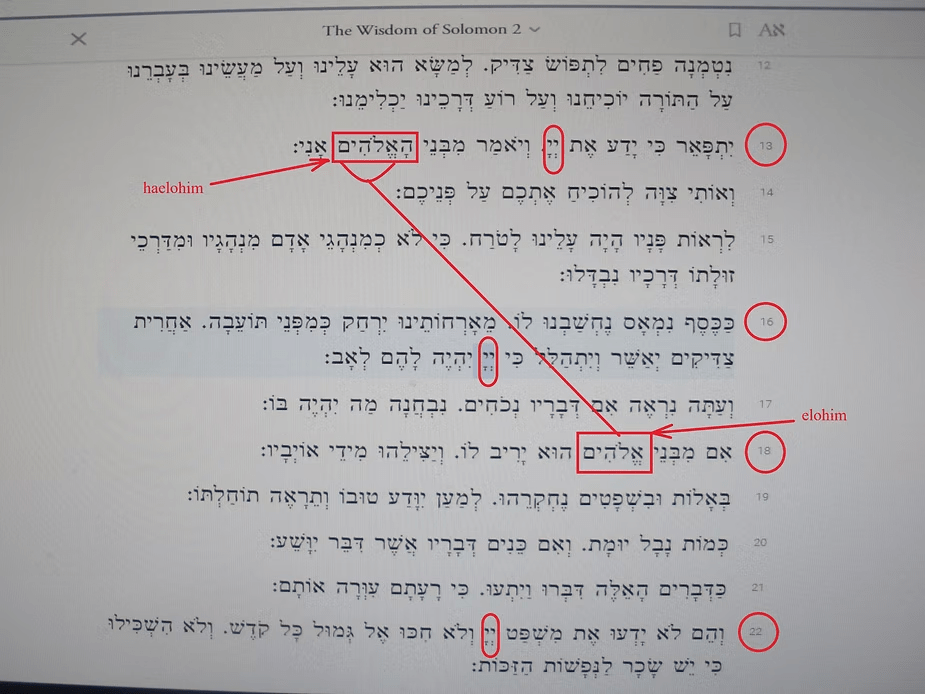
It is in verse thirteen that the truth of Solomon’s wickedness is exposed. In this verse there are two references to [NRSV translator] “God” and “the Lord.” The reality of what is written (as best as I can look up the Hebrew) is this [using the NRSV otherwise]: “He professes to have knowledge of יְיָ [HaShem], and calls himself a child ha-elohim.” In Solomon’s reign, the prophet Nathan was still actively advising the king. Others like Nathan were those who claimed “to have knowledge of” Yahweh. For Solomon to not write that name, but to instead write marks that are confusing, as to whom or what is being referenced [some say the letters are an abbreviated form of the verb translating as “to be”], this says Solomon was not like his father David, nor the divine prophets who advised as the conduits of Yahweh. Solomon saw himself as a god, who was married to the goddess Wisdom, with Yahweh was believed by Solomon to be the servant god who served him: יְיָ [HaShem].
Look closely at the Hebrew text and see the “HaShem” marks [ovals] and the words “haelohim” and “elohim,” in the verses circled.
In the NRSV translation, the world “child” is footnoted, with the footnote saying the word written can equally translate as “servant.” For one to say he was “a servant of elohim,” that describes a prophet like Nathan to a T. The point of the Hebrew word “elohim” is not to state “God” [the error of all translators], but to state the reality of “gods” [in the plural number], which are those souls married to Yahweh and thus given His powers on earth, as His “servants” [His “children”]. Thus, in verse thirteen, Solomon is placing himself above that of true prophets, because of his big brain. This then equates his soul to a state of wickedness.
Verse fourteen then has Solomon scoff at the condemnations of the prophets, who say worldly wisdom is what condones evil ways. Verse fifteen is then Solomon belittling the true holy priests of Israel as the ones who take all the fun out of life. IIt was the true priests and true prophets of Israel who were reminding everyone of the laws, reminding the leader [Solomon] that maintenance of those vows is what keeps souls from infidelity, or breaking their marriage agreement with Yahweh. Solomon was calling the restrictions placed on being a true priest of Yahweh as unnatural. That is true, when a nation of people are being led away from adherence to their Covenant and finding normalcy in the ways of other nations.
In verse sixteen, Solomon again references the “HaShem” in a way that makes it be used as if he knew he would bring some physical condemnation upon his flesh [leprosy maybe?] by using the name “Yahweh,” as his father David had done frequently in his songs. Solomon took purposeful steps away from his father, by refusing to write the proper name “Yahweh” [“יְהוָ֣ה”] Here, Solomon belittles one who claims to be an “elohim” of Yahweh, because they make the claim that Yahweh is their “Father,” while also implying He is their Holy Husband. This becomes Solomon cursing Jesus, who routinely told his disciples [not the whole world, not all of Judaism] to address Yahweh as their “Father.” To call Yahweh “Father” means one must be His Son [all souls are masculine essence, especially when married to Yahweh’s Spirit … males and females in the flesh].
In verse seventeen, Solomon is beginning a series of verses that become the standard punishment governmentally set upon any who claim to be divine Sons of Yahweh. To make such claims means to be put to death. This concept would be viewed as holy wisdom, as Yahweh’s gift to Solomon, when in reality it was Satan’s serpent whispers [a marriage that made Solomon’s soul become the demonic elohim of his evil spiritual husband] that influenced all who would follow Solomon. The routine Solomon established would be for kings to marry foreign wives, import foreign priests, and then kill any priest who spoke out against that process. The culmination of this mindset of ‘wisdom’ was how the elite of Jerusalem could even fathom it would be okay to plan the execution of Jesus, the promised Messiah; but to even believe in a promised Messiah, one has to first believe in Yahweh. Solomon taught them not to believe in being “He [Who] Retains God” [the meaning of “Israel”].
In verse eighteen is a second use of “elohim,” which again must be seen as “gods,” specifically those whose souls have married Yahweh and become His hands on earth. At the time of Solomon’s reign, all true divine “elohim” were priests of the Ark of the Covenant [transferred from the Tabernacle of Zion to the Temple of Solomon] and the holy prophets [such as Nathan]. In this verse, Solomon laughs at those who make claims to be divine Sons of man, such that Solomon’s mindset was cast into the future, executed at Golgotha, when someone yelled out to a dying Jesus, “If he is the Messiah, let him save himself.” Here, Solomon scoffs that the test of death will bring out the truth of being a “servant” [same use of “child”], by having Yahweh physically rescue such a servant.
Verses nineteen and twenty are Solomon giving the go ahead from that point in time onward to torture and insult the prophets of Yahweh. To claim to be “peaceful” means Solomon’s plan was to beat hatred and anger into those who made such claims. In today’s world, the destroyers of Christianity love to promote that Jesus is the Prince of Peace and would bend over and take insults and torture all day long, rather than strike anyone down in wrathful anger. They persecute the believers to the point of forcing them away from Yahweh, by punishing their will to serve. What those do not realize is the truth that every hateful strike brings them in return. When they put forth persecution against one of Yahweh’s children, the same return blows will come upon their souls, a hundred-fold.
The NRSV then places one of its titles or headers before verse twenty-one, saying the rest of chapter two focuses on the “Error of the Wicked.” This is an assumption that “the wicked” are false prophets [like Solomon’s wisdom] and not the true prophets of Yahweh. Solomon reflected the intellect of humanity, as one who worshiped ‘Sherlock Holmes-like’ abilities to discern physical clues and make logical deduction that result in the truth. None of that worldly wisdom is divine, thus far from all-knowing, as that given to Yahweh elohim. Thus the title would be better stated as “Error of the Intelligent.”
Verse twenty-one is then a perfect summation of all Solomon’s views that have been written on parchment. By saying, “Thus they reasoned, but they were led astray, for their wickedness blinded them,” this projects as truth upon the priests of logic and reason that deduce wrongly and are blinded by the science of the visible world. No true priest of Yahweh is reading the Law [the Torah] and coming away with clear-cut, black and white knowledge. Divine Scripture is written [according to Jesus] so the truth is hidden from the wise and intelligent, but exposed to the children [insert “servants” here]. The truth known by Yahweh elohim does not come from carefully crafted thought processes. However, once the truth has been shown, all those arts and crafts can find a truth fully justified and true. Thus, a simpleton [one of those Solomon belittled, when he prayed to his god “wisdom”] can be shown the truth of God, while all the big brains could not see the truth before their eyes.
In verse twenty-two [not the last verse, as chapter two has twenty-four verses], Solomon returned once again to displaying his fear of naming “Yahweh,” using his code-word called “HaShem” [יְיָ]. In this verse, Solomon sings that his lost soul never once considered self-sacrifice for the unseen rewards that are postmortem. The wise and intelligent cannot possibly see that which is “secret” and thus spiritual. They seek the material rewards that are the “wages” of being the elite, not the commoners. They never seek to restrict themselves from that which can be freely taken, for the seeming bargain of one’s soul [everything material for nothing spiritual]. They have no desires for holiness. They do not believe anything exists beyond death. Therefore, they have no need for thinking blamelessness is a virtue.
As the optional “First Lesson” to accompany Proverbs 31 on the seventeenth Sunday after Pentecost, when one’s own personal ministry for Yahweh should already be well underway, the lesson here is to see the trap of intellectualism. Solomon could not see how his words were condemning his own soul, all the while thinking he was making light of those who said they served Yahweh. Solomon did not believe Yahweh was anything more than a stepping stone to a mastery of life on earth. He did not believe in an afterlife; as there was no proof that anyone had ever returned from the depths of the ground. The lesson that must be taken from this is being a “child of elohim,” which means having one’s soul be married to Yahweh, with His Son Jesus resurrected within one’s soul-flesh. Having a big brain keeps one from having access to All Knowledge, readily available to the children of Yahweh, when needed. No planning necessary.









 Explaining the Readings