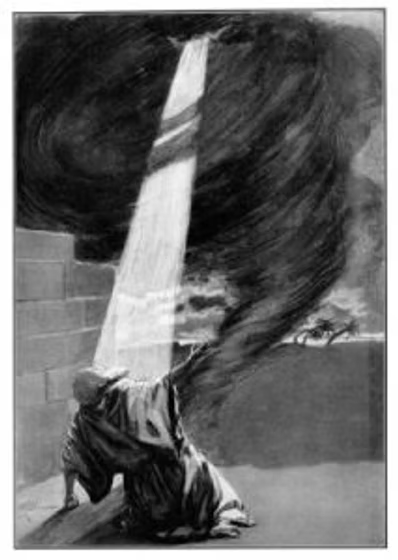
Genesis 3:8-15 – Naked and afraid because of Big Brains

They heard the sound of the Lord God walking in the garden at the time of the evening breeze, and the man and his wife hid themselves from the presence of the Lord God among the trees of the garden. But the Lord God called to the man, and said to him, “Where are you?” He said, “I heard the sound of you in the garden, and I was afraid, because I was naked; and I hid myself.” He said, “Who told you that you were naked? Have you eaten from the tree of which I commanded you not to eat?” The man said, “The woman whom you gave to be with me, she gave me fruit from the tree, and I ate.” Then the Lord God said to the woman, “What is this that you have done?” The woman said, “The serpent tricked me, and I ate.”

The Lord God said to the serpent, “Because you have done this, cursed are you among all animals and among all wild creatures; upon your belly you shall go, and dust you shall eat all the days of your life.

I will put enmity between you and the woman, and between your offspring and hers; he will strike your head, and you will strike his heel.”

——————————————————————————–

This is one of two optional Old Testament reading selections from the Episcopal Lectionary for the Third Sunday after Pentecost, Year B 2018. In the numbering system that lists each Sunday in an ordinal fashion, this Sunday is referred to as Proper 5. If chosen, this selection will next be read aloud in church by a reader on Sunday, June 10, 2018. It is important as it tells of God knowing all our sins, just as He knew that one of His holy children in Eden.  That judgment means banishment from Heaven for sin is unavoidable, such that complete absolution while on earth is the only way for a soul to return to be with God.  That absolution can only come through Jesus Christ.

———-

Preface: This short reading is known by most, but understood by few.  The first four chapters of Genesis are easy to read, but just as easy to misunderstand.  This sliver of Genesis 3 selected for the third Sunday after Pentecost requires one know all of Genesis 3.  To fully understand this reading also requires one know Genesis 1, 2, and 4.  For that reason, this interpretation will expand beyond these eight verses.  That expansion will require extra words of explanation.  Be forewarned.

———-

This selection from Genesis can be said to focus on the judgment placed upon both those who sin and the one who promotes sin. Here, we know “the man and his wife” (“hā·’ā·ḏām hā·’iš·šāh”) admitted to having sinned. They immediately blamed the serpent (“han·nā·ḥāš”) as the influence for their sin. Then, we read of God’s judgment against “the serpent,” which includes words linking “the serpent” to “the wife.” as a dual judgment. The punishment of “the man” comes after these words, which are not read today.

This story in Genesis 3 is commonly called The Fall from Grace. That title implies failure, due to “Adam and Eve” having committed the Original Sin, leading to their banishment from Eden. Because this story is set up somewhat like a fairy tale (allegory), where snakes talk and God walks in the garden in the cool of the evening, it is easy for our minds to capture the images as being similar to known life events. We project human qualities onto divine creatures (anthropomorphism), but that view blinds us from the truth told in this story.  For instance, we focus more on “Adam and Eve” being evicted from Heaven, but then lose sight of the snake also being cast out.

When we read this story from a human perspective, we see God as human, which He is not. Our personal experiences tell us how surprised we are when we find out someone has sinned. We can get the impression that God turns a blind eye from His creations, from time to time. Thus, we see God as being surprised in this story. However, God is All-Knowing and All-Seeing, so God is in on everything.
He has omniscience as well.

By realizing that given, one has to understand that God made Man as a heavenly being, giving “Adam” (a personalized name for the Son of God, from “hā·’ā·ḏām” – “the man”) immortality. Although God made Adam from clay or dust, he was an immortal entity – like an angel – which means “Adam” had absolutely no reason, nor innate drive to procreate. When God cast a deep sleep over Adam and took a rib to make “Adam’s” wife, it was for the purpose of sending “Adam” and wife to the earth God had created, where males and females in the image of the gods had been in existence since the sixth “day” of Creation (millions of years, if not more). Therefore, it was God’s plan to seed the earth with the first priest of the One God, who could “hear the voice of the LORD of gods” (“way·yiš·mə·‘ū ’êṯ qō·wl Yah-weh ’ĕ·lō·hîm”).

God knew there was a time when “the man and the wife” would be sent to earth to procreate.  God knew the whole story before it happened.  Still, the males and females of earth (sixth day creations that were being fruitful and multiplying, which was deemed good) did not know God.  Mortal human beings did not know right from wrong.  God planned to send them teachers.

When we read “Adam” explain to God (his Father), “I heard the sound of you in the garden, and I was afraid, because I was naked; and I hid myself,” the word “erom” (“naked”) meant Adam was aware of his body for the first time. Because “the wife” (“ishshah”) also hid, she too was aware of her body, which meant the fear (“I was afraid” – “wā·’î·rā”) was from also knowing arousal from becoming aware of each other’s nakedness.  They had always been unclothed and had never found reason to think (a mental exercise) that state of being was unusual.

That awareness of their physicality was something never known before by “the man and wife” BUT their fear was based on their realization how unnatural it was for immortal beings to become sexually aroused, when immortal beings have no need to procreate. Indeed, in the Spiritual realm none of the elohim (a plural number word meaning “gods”) or angels could produce other elohim or angels, as only God has the power to create new life. Therefore, “Adam” and wife were souls created by God, which were then placed in physical bodies for the purpose of procreating on earth, outside of Eden.

When the allegory is seen in this story, “Adam and Eve” were like children who had reached puberty. They changed into mature beings, no longer able to return to an innocence of youth. That change was by design; but as immortal beings, there can be no age of mortals applied to how long they had lived together. One can even assume that they were made in the same state of maturity, as growth and normal earthbound bodily needs would be unnecessary.  The only change that occurred was an awakening of physical attractions, for the purpose of procreation.  Because fruit is the offspring of a tree, they ate of the fruit that opened their minds to physicality, in a spiritual environment.

Simply because the man and the wife were made to beget new priests in a world of human animals, they were known by God to reach a point in their development where they could no longer live in a Spiritual realm, where procreation was impossible. Because both were made to reproduce, they had to be placed into the realm what that act was possible.  The timing of that event would be when they first experienced arousal for one another.

In this story the serpent plays the role of influencer. When one is immature, nakedness is not seen as anything more than normal. Eden is then the eternal realm where there is no need for maturation, as one is made whole. The mind is therefore immature, in the sense it is pure innocence. One knows all that God allows one to know and that is all one wants to know. The changes of maturity, for physical bodies designed to grow and reproduce, occur within the being, in the brain and chemistry. The serpent then represents the voice within that has one become fixated (lustful) on the physical, once the brain has awakened and this physical state of maturity has been reached.

This makes the tree that bore the forbidden fruit, which was in the “midst of the garden,” be representative of sexual organs. When God said, “You shall surely die” if that fruit was eaten, death was the change from immortal life to mortal life, where death presents a need for procreation. As the “fruit of the tree of knowledge of good and evil,” this was the genetic programming that was placed in “the man” when God made him.  As “Adam” was made on the seventh day, the day deemed holy, “the man” was made to be holy, as a replication of THE Father.  “The man” himself was designed to be “a father,” one who taught his children about THE Father.

This is why “the wife” is identified as such (“ishshah “), where “wife” denotes the sexual partner of a husband. Together, they would need to have children, who they would teach to recognize the difference between good and evil. The good would be their connection to God, who would counsel them in how to act. In a world that only knew the natural urges of genetics, with no knowledge of good [God] nor evil [the craftiness of the serpent], “the man and the wife” (the woman who shared the genetics of “the man,” from his X-chromosome “rib”) would be the first priests sent into the earth.
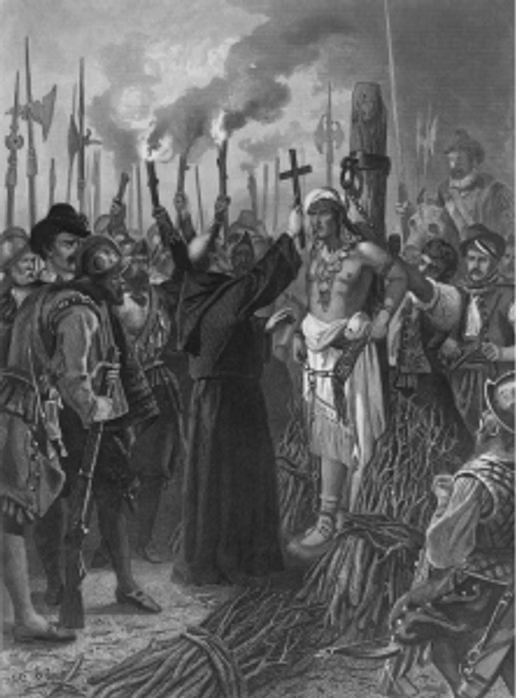
Rather than entering the “new world” with an army and being “in your face” about religion, Adam and Eve chose the “lead by example” method of ministry.

It then becomes important to realize that “the man and the wife” could not enter a world that knew no value judgments of any kind, without them being accompanied by “the serpent.” That character is described as, “more crafty than any beast of the field.” (Genesis 3:1) Without knowing the Hebrew words that translation comes from, “more crafty” or “more subtle” is a statement of the serpent possessing a big brain, which is always something that gets in one’s way of humans trying to find their way back to God.

The Hebrew, “ā·rūm mik·kāl ḥay·yaṯ haś·śā·ḏeh,” which has been translated as “more crafty than any beast of the field,” can literally state: “sensible man (arum) [of] all (kol) age [of man] (chay) soil (sadeh).” This can then be read as a statement of an entity that appeared to be more like “the man and the wife,” rather than one of the beasts named by “the man” [“Adam”].

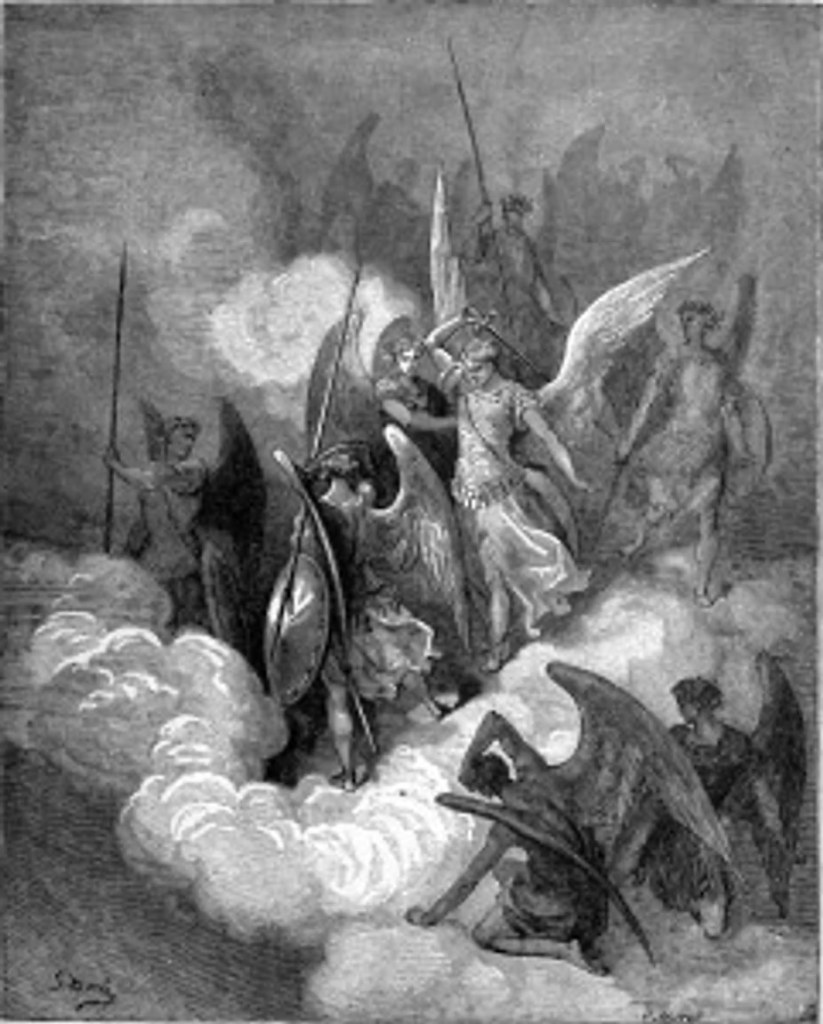
While this character is clearly identified as a “snake” or “serpent,” the anthropomorphic language causes one to see a talking snake confusing “the wife,” rather than someone who looked like “the man.” His sensibility would be mistaken for honesty to a naïve woman, thinking this being knew what he was talking about. This makes the serpent more representative of the parallel character who tried to tempt Jesus in the wilderness (Satan). He came looking trustworthy and helpful, not frightening and scary.  As “Lucifer,” whose name means “light-bearer,” the one who tricked “the wife” was shedding light onto why God forbid “the man and the wife” the fruit of one tree.  That would be the false light that will forever be offered by the fallen angel.

For anyone who has ever seen a snake, many are known for hiding under rocks and in crevices. Many have coloring that allows them to blend into their surroundings, which means the snake was the influence for “the man and the wife” after they had eaten the fruit, when they were afraid and hid from God. Before the pair encountered the snake, it is doubtful the two had ever experienced fear or any thought that they could be hidden from God’s all-seeing eyes. Thus, because the snake is punished along with “the man and the wife,” all three were hiding in the garden when God called for them.  Only the serpent was not afraid.  He was staying with his prey.

Again, the questions that followed are not to be read as if God was blind to what had happened. “Where are you? Who told you that you were naked? And Have you eaten from the tree of which I commanded you not to eat?” cannot be read as God not knowing all of the answers to those questions, before he asked them. Those questions are rhetorical, as God knew precisely where they were, that they were attempting to hide, that the snake tricked “the wife,” and that the pair had eaten from the forbidden tree’s fruit. God’s call and questioning was to solicit truthful responses from “the man.” “The man” responded to his Father, immediately offering the whole truth to God, because God had made him so he would tell only the truth.

The man and the wife admitted they had gone against God’s rule. The serpent was not questioned, which means God knew the truth had been told by the wife and the man. This is then when God issued His judgment upon all three. While this reading does not cover the judgment set upon the wife or the man directly, it does include those against the serpent that include the serpent’s relationship to the wife (commonly translated as “women”). It is this judgment that is difficult to understand.

We first read: “The Lord God said to the serpent, “Because you have done this, cursed are you among all animals and among all wild creatures.” This is a quick and easy translation that accurately states the words written. However, the addition of “among all animals and among all wild creatures” makes it easy to lose the impact of the serpent being “cursed.”

If the serpent is an animal, what is the curse of being curse by other animals?  This means the additional words add depth to the simple statement, “cursed are you.” To read the additional words, where “animals” or “beasts” are stated (“beasts” is the same word shown above that actually means “age [of man]”), this implies that “animals” and “beasts” are also cursed. That is not the case.

In Genesis 2:18-20, we read how “the man” [Adam] was given all the “animals” of the ground and the air, when “the man” named them all. This naming can be seen as a link between the mind of “the man” and the “animals,” such that the names were based on meaningful communication between the two. In other words, Adam talked to the animals and determined what they should be named (a truly anthropomorphic scenario). By understanding that communication between “the man” and the “animals,” the serpent was cursed “among all animals” by not being able to use his big brain to seduce those creatures to do his will. Despite being the “more crafty” of all the animals, his craftiness (or sensibility or shrewdness) could not have an effect on the lower creatures of earth, whose lives were totally programmed by God’s nature.

When we then read how the serpent is judged to “upon your belly you shall go, and dust you shall eat all the days of your life,” the confusion comes from realizing a snake or serpent always slithers on the ground.  It leads many to wonder, was the serpent complete with arms and legs in Eden? Did those arms and legs fly away from him when God punished the serpent?

The punishment can be clearly seen when one realizes “the serpent” was a nickname for a sly devil. Since he was called a “snake,” he would be sent to earth to metaphorically live like a snake.

Snake Plisskin. A character from a bad movie.

However, the description stated as punishment makes the future of the serpent to be more like a worm; and again this is the wrong way to read this metaphor.

The Hebrew word “gachon” (from “gə·ḥō·nə·ḵā”) means “belly” or “abdomen,” but the word becomes synonymous with “stomach” and “uterus” or “womb.” Since the serpent was a male entity, and since the sin committed by “the man and the wife” were from eating fruit, then the punishment was for the serpent to forevermore be driven by his internal urges that seek to devour. The metaphor of “belly” is then being a lowlife, as it travels the lay of the land, which takes it into gutters, hiding under rocks, and seeking the darkness of caves. When “belly” is readily read as the “stomach,” then it becomes a natural subsequent punishment for God to address what the serpent will “eat.”

The Hebrew word translated as “dust” (“aphar,” from “wə·‘ā·p̄ār”) has to be seen than more than “dirt, ground, and earth.” The same word, “aphar,” is found in Genesis 2:7 (“The Lord God formed man of dust of the earth.”) God told “the man” at the end of Genesis 3 (verse 19), “For you are dust, and to dust you shall return.”  The focus placed on “earth” means “the man” was a soul in flesh, as both material and spiritual eternally.  However, the serpent was just sentenced to forever being an eternal spirit that can only exist on earth.

This association of “dust” should then be read as a reference to mankind in general. As mortals are born to die (and repeat) it will be mankind that the serpent will feed on (as “dust”). In Genesis 1:27, we read, “Male and female elohim created them,” which were “hā·’ā·ḏām” as “mankind.” If the males and females on the physical plane are to be tricked by the serpent, as were “the man and the wife” in Eden, then the “belly” becomes the purpose of a “uterus” and “a wife,” which is to bear new children that God will breathe life into.

The redemption of “the man and the wife” will come more from their producing a holy lineage that will warn humanity against the temptations of the serpent, by teaching mankind how to know the difference between good and evil. However, once new members of mankind are born, the serpent will be attracted to them as innocent and pure, to tempt them to sin.  The serpent’s role will be to ensure that an earthbound cycle of souls born into flesh will remain intact.

It is then the last verse of this reading, where God passed judgment upon the serpent, relative to his tricking “the wife” with his craftiness. Genesis 3:15 seems clearly translated as, “I will put enmity between you and the woman, and between your offspring and hers; he will strike your head, and you will strike his heel.” However, this is the most enigmatic statements found in this story and it needs to be grasped properly.

Genesis 3:15 divides into four segments. When read together, one can get an image of a snake eating its tail, which is an icon for the “Ouroboros”.
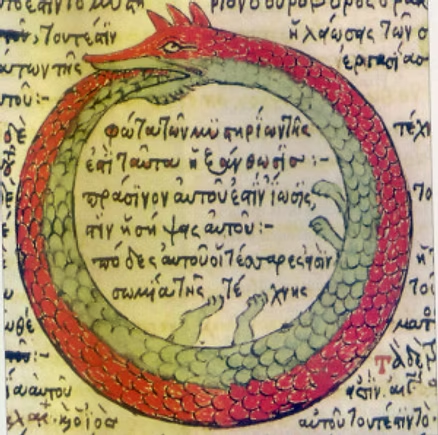
While this symbol is said to represent, “the perpetual cyclic renewal of life and infinity, the concept of eternity and the eternal return, and represents the cycle of life, death and rebirth, leading to immortality,” (Crystalinks.com) that imagery is secondary to the importance of the individual segments stated in Genesis 3:15.

In the first two segments, a variation of the word “bayin” is found written four times, two times in each segment. The word “bayin” means “between,” but also “above, among, forehead, midst, within, and the interval of.” The first segment is God linking the serpent to “the wife,” such that God said to the serpent, “And enmity I will put in the interval of within the wife.” The second segment then says separately, “In the interval of your children in the interval of her offspring.” Because of the repetition of “bayin” (as “bê·nə·ḵā, uben, uben, and uben”) in these two segments, both can be seen as the “hatred” and “personal hostility” that will be “between” the serpent and “the wife” is relative to “descendants.”

Here, it has to be grasped that the serpent is “cursed” by retaining his eternal state of being, where the heavenly creatures (like angels and elohim) have no sex organs because reproduction was unnecessary, thus impossible. God had created “the man and the wife” for the purpose of having worldly children, so they had been built to procreate, only never in the realm of the divine. This means the “offspring” of the serpent can only be those born of “the wife.”  It will be her offspring that will be led to do evil things, having been taught by “the wife,” becoming children knowing the difference “between” God and the “perpetual cyclic renewal of life” into the material plane, not a return to heaven (Eden).

The “enmity” that God will place “within the wife” is less a “personal hatred” in her (as that would be an emotion of evil, not good), but a knowledge of the “hatred” that the serpent has for those who seek to do only good. That will be taught to the children of “the wife,” so they will know to resist the temptations of one who hates them.

The “interval of her offspring” can immediately be seen in the difference in Spirit found “between” Cain and Abel. It can be seen in the 1 Samuel lessons of devoted priests to God not having sons who follow in their holy ways. It can even be seen in the repeated reports of difficulties with conception (barrenness) found in the wives of holy men, such as Abram (his wife Sarai), Manoah (father of Samson), Jacob (his wife Rachel), and Zacharias (his wife Elizabeth). The books of the Holy Bible follow the intervals of those who were taught to know of the hatred held by the serpent for their souls. Because we proclaim Jesus was born of a woman, this can be seen as “of the interval” when “the wife” produced holy offspring.

When God judged the serpent to forever be of the earth, that meant the spirit of the serpent would always locked into that realm. When God then spoke of the association of “the wife” to the serpent, once both were banished from the Spiritual realm of Eden, God was stating that the receptive spirit of females was indeed “of the earth.” Therefore, the joining of the serpent’s judgment with “the wife” is less a punishment of her and more a statement of the physical state that would become the prison for an immortal creature.

While there is no need for procreation in Heaven, procreativity is essential on the earth. Because “the man” was “dust” (physical matter) breathed into by God (the breath of life entering flesh as a spiritual soul), the body of “the man” is essentially feminine, in the sense that it received that breath of life. The sex of all human life is inconsequential in the spiritual realm, making every body of flesh be feminine and every soul be masculine in essence (of the Father). It is in this way that humans refer to God as the Father and the Earth as the Mother of all life, where all that has life needs both mother and father.

In the metaphysic study that is astrology, there is a negative “charge” assigned to the Moon and Venus, such that both orbs are called “feminine.” Conversely, the Sun and Mars are given a positive association, such that both are called masculine. As every human has all astrological planets present within their birth charts, all human beings have both masculine and feminine traits, which is normal. The psychologist Carl Jung called this the anima and the animus. Still, human beings grow into their innate sexuality (the majority do not resist this design), so boys grow up with attractions to masculine acts and girls grow up with attractions to feminine acts (regardless of the excessive weight now put onto cultural conditioning).

This becomes a modern female’s attraction to make-up and clothing, jewelry and homes, as well as family and children. Things become necessary for comfort and security, which the feminine mind is driven towards. This is how the serpent and the wife are both linked, as the serpent will use things to lure the offspring of the wife to make the same mistake the wife made in Eden. Certainly, males have their attraction to things, where sex is a temptation hard to resist; but all the delights of the world are lures to an innate drive of a feminine “body of flesh.”

In the final two segments, which plays on the intervals of good and evil in the offspring of “the wife,” we read, “He will strike your head, and you will strike his heel.” A more literal translation says, “This will bruise head, and you will bruise heel,” where the words of God are aimed at judgment to “the serpent.” When read this later way, the judgment ceases being a “him-her” scenario, or an action-reaction proposition, and becomes fully focused on “the serpent.” It states the results that can be expected, during the intervals of offspring choosing good and offspring choosing evil.

This now becomes a prophecy that says this interval will produce periods when the crafty big brain (“head”) of the snake will be rebuked by the good priests who will hear God’s voice and do good. Conversely, it says the influence of the serpent’s craftiness and temptations will bruise the thought processes of those taught to know better, leading them to sinful acts.  It also says that those who the serpent will influence to choose to do evil will be the dregs (“rear, last, or end”) of the lineage (something Jesus called “dead branches”).  However, those who will be holy, such as Jesus in the wilderness, they will strike at the serpent and tell them to get to the rear.  Together, this says the serpent has no powers to force a human being to do evil, so all power to walk away from the influence of evil is held by the offspring of “the man and the wife.”

As this whole series of events was totally planned by God, one has to see the powerless state of the serpent on earth is his inability to make matter move physically.  The only power of the serpent is intellectual, as a devil that sits on one’s shoulder whispering sinful things.

The presence of Satan on earth is as necessary as was the serpent in Eden.  The serpent initiated the order for “the man and the wife” to go to earth and begin a holy lineage of priests, who would teach mankind, with the Son of God being allowed to return as Jesus Christ.  On earth, Satan is necessary for those who seek to return to God to defeat.  The serpent becomes the test of sincerity for repentance.  To enter Heaven, one must totally resist evil; and that can only be done by completely devoting one’s soul to God, and letting ego die so eternal life may come through the union of God and “the wife” (Christians of all sexes), bringing about the rebirth of the Son, Jesus Christ.  To defeat Satan, one must be Jesus Christ reborn.

As a reading option from the Old Testament for the third Sunday after Pentecost, when one’s personal ministry should be underway, the focus placed here is on the extreme restrictions placed on what souls can be allowed back into Eden and again walk in the garden with God. One cannot allow oneself to fall prey to the tricks of the serpent; and one must communicate that warning to all who seek eternal life.

We have all fallen from grace because we all know the difference between good and evil; but we can all find redemption through God’s love in our hearts and the Christ Mind bruising the big brain of the serpent. We must minister to the “heel,” as that is where the dust of sin gathers in the world, such that Apostles must wash each other’s sins clean. That is done by fellowship, where ministry picks each soul up from the ground, so evil’s influence cannot rise against the righteous. Ministry supports others in Christ, in addition to spreading the Word to those who seek redemption.

As a choice to accompany the Gospel reading from Mark, where the people clamored outside the home Jesus and his disciples had sought solitude in, where Jesus said his family was those who believed as he believed, this relates to the offspring of good. You cannot stand outside and call upon Jesus, as did his mother and brothers. They called from fear, not from faith. If they had faith, they would have been with Jesus when he entered the house. Thus, it was the serpent that called for Jesus to come out, just as the serpent tricked “the wife” to become like God in knowledge.

The focus of this reading is the expressed judgment of God placed on the serpent.  As the offspring of “Adam,” as Christians, we are the target of the serpent’s enmity.  It is a sly grasp that his evil words of influence entwine us in.  Sometimes we cannot see the forest from the trees.  We think we are doing only good, when we should question just how blind we have become.  When ministry is only in our minds and not a reality, we need to realize we are hiding because of our nakedness.  We have sinned but don’t want to admit it.  We have sinned by hiding from God.

In a world of serpent-like influences, we need to ask God to help and be prepared to suffer His judgment as repentance.


2 Corinthians 4:13-18, 5:1 – So we do not lose heart

This reading includes 2 Corinthians 5:1

———-

Just as we have the same spirit of faith that is in accordance with scripture—“I believed, and so I spoke” —we also believe, and so we speak, because we know that the one who raised the Lord Jesus will raise us also with Jesus, and will bring us with you into his presence. Yes, everything is for your sake, so that grace, as it extends to more and more people, may increase thanksgiving, to the glory of God.

So we do not lose heart. Even though our outer nature is wasting away, our inner nature is being renewed day by day. For this slight momentary affliction is preparing us for an eternal weight of glory beyond all measure, because we look not at what can be seen but at what cannot be seen; for what can be seen is temporary, but what cannot be seen is eternal.

For we know that if the earthly tent we live in is destroyed, we have a building from God, a house not made with hands, eternal in the heavens.

——————————————————————————–

This is the Epistle selection from the Episcopal Lectionary for the Third Sunday after Pentecost, Year B 2018. In the numbering system that lists each Sunday in an ordinal fashion, this Sunday is referred to as Proper 5. It will next be read aloud in church by a reader on Sunday, June 10, 2018. It is important as Paul explained that the deterioration of the body is natural for all living beings, but death for Apostles of Christ will release a soul into a most holy, eternal dwelling.

When this selection begins by stating, “We have the same spirit of faith,” that should not be read as an “enthusiasm to believe.” The Greek word translated as “faith” is “pistis,” which can also translate as “belief, trust, confidence; fidelity, and faithfulness.” About “faith” (from “pistis”) Bible Hub HELPS Word-studies states: “[It] is always a gift from God, and never something that can be produced by people. In short, 4102/pistis (“faith”) for the believer is “God’s divine persuasion” – and therefore distinct from human belief (confidence), yet involving it.” Realizing that and then seeing how the word “pneuma” is used with “pistis,” as “spirit of faith,” this is stating that “spirit” comes from God.

The invisible gift that is designed to be re-gifted.

In regard to Paul making the assessment, “We have the same spirit,” knowing that “spirit” comes from God, this is the Holy Spirit, from which true faith comes. The presence of the Holy Spirit must then be within each and every Apostle, such that Paul can write to his brothers in Christ (men and women) knowing they possess the same Holy Spirit as does he, with all truly being Christian. They know the presence of Jesus Christ within them, which is the source of their “spirit of faith.” They do not simply “believe” in Jesus Christ, as they are all duplications of his spirit, being reborn as him.

The Scripture quoted by Paul: “I believed, and so I spoke,” comes from Psalm 116. The complete verse is 166:10, which says, “I believed, therefore spoken, “I am greatly afflicted.” In the NASB version of Psalm 116, posted by Bible Gateway, the song is given a title: “Thanksgiving for Deliverance from Death.” That title is seen as appropriate when one realizes all mortal human beings are born into temporary lives on earth, but the presence of the Holy Spirit comes from admission of personal “affliction” (sins), so one can cease living for self and begin speaking for God. The reward for that commitment, as David knew, is eternal life, thus “deliverance from death.”

Because Paul knew himself and the other Apostles in Corinth had so done this confession of being afflicted, he knew they had been saved from death by the Holy Spirit.  He could then truthfully write, “we also believe, and so we speak.” The Christians of Corinth, led by Paul, had all sacrificed self-ego for the “spirit” of Jesus Christ.  They all then spoke as ministers of Christ.

This is seen better when one reads, “Because we know that the one who raised the Lord Jesus will raise us also with Jesus.” The disciples of Jesus were with him when he ascended.  Jesus was raised by the power of God. Jesus was alone, as a holy individual who ascended that day.  Paul and the Christians of Corinth, however, were not on the Mount of Olives on the Sabbath of that occurrence.  They only knew the hearsay of that event, before they were baptized by God’s Holy Spirit and God’s knowledge was available to them.

This means that the truth of Paul’s words, “we know that the one who raised the Lord Jesus” is in the promised return of Christ. Paul could make that true statement, just as Jesus’ disciples could also, because all Apostles know they have had the risen Lord Jesus with them.  The Apostles of Jesus knew on Pentecost (the next day, when Jesus Christ returned).  Paul and the other Saints had the same elevation of their souls, the day their lives were forevermore change by God sending them His Son too.

The Greek word translated as “with” is “sun” (written “syn”). We read that as “the one who raised the Lord Jesus will raise us also with Jesus, and will bring us with you into his presence.” This word’s translation cannot be allowed to give the impression that Jesus Christ is in Heaven, and good living will allow one to go and be with him and God.  This is not the intent of that word’s use.

“Syn” (or “sun)” is not a simple preposition.  In this regard, Bible Hub HELPS Word-studies states: “[It is] (a primitive preposition, having no known etymology) – properly, identified with, joined close-together in tight identification; with (= closely identified together).” The translations for this word include, “accompanied, accompany, along, associates, besides, companions, including, and together.” This says that Paul was not promising a similar raising, as the disciples witnessed Jesus “raised” into Heaven (the Ascension), but when Jesus Christ is the Lord of oneself, having been “raised” within.  At that time, God will raise us also Jesus accompanied. Jesus will have become one with a Saint in his name, so that presence will bring us together in his presence.

The gift of God to the world is His Son, which is the total and complete source of faith. That gift was not for the glorification of Jesus of Nazareth alone, and Jesus promised his disciples they would do greater things than he. Thus, Jesus is the gift that keeps on giving for our benefit, so that grace (Greek “charis” = “a gift or blessing brought to man by Jesus Christ”) can be extended (Greek “pleonasasa” = “to super-abound, to make to abound, increasing, spreading, to be abundant) “through more and more people.”

This means that Paul said that there is no limit to how many times Jesus Christ can be reborn in human flesh, once a disciple (a student of Scripture) has proved him or herself to God as giving thanks, seeking to become an Apostle “to the glory of God.”  It is through the ministry of Apostles / Saints that “more and more people, may increase thanksgiving, to the glory of God.”  Jesus Christ touches “more and more people” by his being reborn into devoted disciples.

Isaiah 6:8

This connection to God comes through love, where one’s soul becomes married to Him. This marriage becomes the baptism of the Holy Spirit.  Indeed, in Psalm 116, where David sang praises to the LORD, as recalled by Paul, David later sang, “I shall lift up the cup of salvation And call upon the name of the Lord.” (Psalm 116:13) David then continued by singing, “O Lord, surely I am Your servant, I am Your servant, the son of Your handmaid, You have loosed my bonds. To You I shall offer a sacrifice of thanksgiving, And call upon the name of the Lord.” (Psalm 116:15-16)

Those are wedding vows, expressed through love.  David’s words sang of the obedience, subservience, and loving gratitude that comes from a devoted servant to his master.  David, as a male, spoke of God as would a wife to her husband. Thus, through this holy matrimony, where a bond is made until death, one’s heart is given unto the LORD, in the same way as had David’s been given to God.

That love of God is why Paul wrote, “So we do not lose heart.” Those words do not express a plan or plot, as Paul suggesting how not to lose heart.  It was a statement of known commitment, by an Apostle bride to his or her source of holy love.  Paul said flatly, “We do not lose heart,” because we know the beauty and joy of a relationship with God.

Once we give our hearts totally and completely to God, that love will never cease. God will not forsake His wives (meaning souls in mortal bodies); and, likewise, a soul knowing the love of God will never do anything to lose that love. This is why all selfish ego concerns must be discarded, willfully, as one’s dowry given away at the altar. It is why human wives give away their father’s name and take on the name of their husband. Christians give up themselves out of love of God, and take on the name of Jesus as one Anointed by the Father.

Priest: Who gives this woman to be married to this man?
Father of the bride: I do.

Paul then wrote, “Even though our outer nature is wasting away, our inner nature is being renewed day by day.” This is not simply a statement of one’s physical body growing older and weaker, which is the natural order of mortal beings. It also states how the attractions of worldly things – that which once defined our outer being – “is wasting away,” no longer having the lure or the glitter the material plane once had upon us. Instead, once we are filled with the Holy Spirit of God, reborn as His Son, Jesus Christ; so, the outer (material) world has less appeal, as “our inner nature is being renewed day by day,” giving us the strength to become oblivious to the lures of sin.

Those lures are then called by Paul, “slight momentary afflictions.” This says that the world is the illusion of time, where the past and the future are nothing more than a series of present moments. The weight of the past and the future is released by the presence of eternal life within, making feelings and memories of guilt and woe of what “coulda, woulda, shoulda” disappear with the cleansing of one’s soul by the Holy Spirit. We live forever more in the “lightness” of God in the present tense. None of the mental worries are retained, once the ego has been let go and allowed to die.  The ravages of a mortal body (natural or from persecution) are fleeting, when the Christ Mind comforts one from the temporal plane.

Paul explained this state of sainthood as being, “Because we look not at what can be seen but at what cannot be seen; for what can be seen is temporary, but what cannot be seen is eternal.” The eyes in our heads are connected to our brains, which then interprets the vibrations of sight. Our bodies also sense vibrations that are detected by ears (sound), skin (touch), tongues (taste), and noses (smell), with all sensations registered differently by different people. The organs of the body cannot sense God or the spiritual, but our souls can feel this presence and gain a higher awareness than a brain can generate from earthly sensations.

Human scientists cannot invent a machine that can see a soul, although they can relate the energy within a human body with heat and light. That only goes to show how faith in the worldly will eventually die, whereas true faith from the Holy Spirit is eternal, beyond mortal death.

The final verse in this reading comes from the beginning of chapter five, where Paul expanded on this concept of the temporal and the eternal. He wrote, “For we know that if the earthly tent we live in is destroyed, we have a building from God, a house not made with hands, eternal in the heavens.” The use of the Greek word “skēnous,” which is translated as “tent,” must be seen as used to denote a higher state of human life. The implication of “tent” is as a “tabernacle,” where the only ones allowed within were priests of the One God (the Levites).

This means the soul has been anointed by God and is the only one allowed within the holy domain, as God sits upon the heart throne and must be guarded by the righteous. Thus, the destruction of such a holy tabernacle means the physical death of one of God’s servants.  The Hindu people call death a transition, because the soul is eternal.  However, “a house not made with hands, eternal in the heavens” cannot be reincarnation back into the material plane.

The mention by Paul that “we have a building from God, a house not made with hands” is synonymous with Jesus saying, “In My Father’s house are many dwelling places; if it were not so, I would have told you; for I go to prepare a place for you.” (John 14:2) When Paul then added how this house not made by hands is, “eternal in the heavens,” this confirms Jesus having said, “If I go and prepare a place for you, I will come again and receive you to Myself, that where I am, there you may be also.” The eternal dwelling place that has been prepared for us, after our tents have been destroyed, is Jesus Christ.

As the Son of Man (Adam), the Son of God was formed from dust and breathed into by God.  Jesus Christ, as the returning soul of righteousness that was originally Adam, was not made by human hands. His Spirit is the temple of the LORD, build by His holy hand. When Jesus said, I am the alpha and the omega,” he said (in essence), “I am the eternal house you need to inhabit.” We live in that holy house when God lives within us, so it is as Jesus said, “Believe Me that I am in the Father and the Father is in Me.” (John 14:11a)

As the chosen Epistle reading for the third Sunday after Pentecost, when one’s personal ministry for God should be underway, we can see how the heart is the core element leading one in that direction. Paul was in ministry and his letters to the others he had led to be filled with the Holy Spirit were also in ministry for God, as Jesus Christ reborn. That rebirth can only come from a love between God and servant, where the “tent” is set up as a sanctuary for God upon a throne in one’s heart.

As an accompanying reading to the Gospel of Mark, where Jesus said, “Here are my mother and brothers,” the Corinthians were the relatives of Paul because all shared the same spiritual blood of Jesus Christ. The ministry of the Lord Jesus Christ cannot be a selfish claim, or a private and hidden state of piety, as it must be shared with others. Amid a world of madness that rejects all who claim to be righteous, expecting more and more proof through miracles, the ministers of the LORD who come through (“together with”) Jesus Christ need time to experience the present time together. The house Jesus and his disciples went into share food and rest, as an escape from the maddening crowd, was the symbolism of a tabernacle.  There they shared their righteousness alone, apart from the world. That is the true symbolism of a church; and it is from that inner renewal of peace that one is prepared to face the non-believers of the world.

Therefore, we see the lesson of a support network in one’s ministry. When one is in the name of Christ, one is together with the Lord Jesus Christ; and that strength is sufficient to enter the outer world without fear of being enticed to sin. Still, one needs to bring others to the same state of security, and then one needs to reconnect to those of like mind (the Christ Mind) to partake of the spiritual food of Christ’s body (the Word) and the wine of his blood (the Holy Spirit). Paul’s letters to the Christians of Corinth show how all true Christians need this support.

Mark 3:20-35 – In Jesus we stand, divided we fall

The crowd came together again, so that Jesus and his disciples could not even eat. When his family heard it, they went out to restrain him, for people were saying, “He has gone out of his mind.” And the scribes who came down from Jerusalem said, “He has Beelzebul, and by the ruler of the demons he casts out demons.” And he called them to him, and spoke to them in parables, “How can Satan cast out Satan? If a kingdom is divided against itself, that kingdom cannot stand. And if a house is divided against itself, that house will not be able to stand. And if Satan has risen up against himself and is divided, he cannot stand, but his end has come. But no one can enter a strong man’s house and plunder his property without first tying up the strong man; then indeed the house can be plundered.

“Truly I tell you, people will be forgiven for their sins and whatever blasphemies they utter; but whoever blasphemes against the Holy Spirit can never have forgiveness, but is guilty of an eternal sin”— for they had said, “He has an unclean spirit.”

Then his mother and his brothers came; and standing outside, they sent to him and called him. A crowd was sitting around him; and they said to him, “Your mother and your brothers and sisters are outside, asking for you.” And he replied, “Who are my mother and my brothers?” And looking at those who sat around him, he said, “Here are my mother and my brothers! Whoever does the will of God is my brother and sister and mother.”

——————————————————————————-

This is the Gospel selection from the Episcopal Lectionary for the Third Sunday after Pentecost, Year B 2018. In the numbering system that lists each Sunday in an ordinal fashion, this Sunday is referred to as Proper 5. It will next be read aloud in church by a priest on Sunday, June 10, 2018. This reading is important because Jesus makes it clear that one cannot serve God part of the time and then serve self the rest of the time, because that is a recipe for disaster. In that way, one is not born into God’s favor, as the Jews deemed themselves as God’s chosen people. God does not choose part-time priests.

In this translation, where we read, “When his family heard it, they went out to restrain him,” this (I feel) is incorrect. The Greek words translated as “his family” – “hoi pará” – more accurately state, “others alongside of.” The Greek words translated as “restrain him” – “kratēsai auton” – more accurately state, “to seize hold of him.” In my mind, this better describes those who had parallel reputations as rabbis or teachers of Judaic Scripture (Pharisees).

Equals beside with greater fears of competition.

I struggle with the concept that the family of Jesus (as stated much later in the text) would not be considered “alongside of” or “beside” him.  They would know their place was behind him.  Nor can I accept that relatives would be so bold as to “seize” Jesus, as they would know full well his ministry would rock the Jewish boat. It makes more sense that Jesus would have told his family to keep a distance and stay mute.  Therefore, I see Peter (through Mark) recounting the rabbis of the synagogues in Galilee and the Pharisees there were joining with the “scribes who came down from Jerusalem” (actually “scribes, from Jerusalem” – those coming up to Galilee, not down[1]) in placing pressures against Jesus, because he was drawing such attention from the locals and pilgrims.

[[1] The use of “having come down” (from “katabantes” = “descended”) means the high-ranking scribes of Jerusalem had removed their holy buttocks from their golden seats in the Temple and ventured out amongst the “great unwashed” of Galilee.]

When we read the scribes (as well as the Pharisees and rabbis) saying, “He has Beelzebul, and by the ruler of the demons he casts out demons,” this stems from the trap the Pharisees had set in the synagogue where Jesus had been asked to lead the Sabbath service, only to enter and find a man with a withered hand in the congregation. When Jesus asked for comments, from the question, “Is it better to do good or evil on a Sabbath?” he then simply told the man to “stretch out your hand,” which the man did – healed. That act was then being deemed the act of Satan, by high authorities, after testimony given by well-respected Pharisees.

When the scribes had declared Jesus possessed by Satan, we read how Jesus “spoke to them in parables.” This leads one astray, since we tend to interpret a “parable” as: “A simple story illustrating a moral or religious lesson.” (American Heritage Dictionary) In reality, the Greek word “parabolais” comes from the word “pará” (“close beside” or “alongside of”) combined with the word “bállō” (“to cast”), which makes it a companion word to the prior statement that relates to “those beside” Jesus (the Pharisees). Thus, the word actually states that Jesus offered those who condemned him a “comparison” for themselves to consider.

Just as Jesus has addressed the synagogue in Capernaum (Galilee) with a question that went unanswered, he spoke again in questions. He first asked, “How can Satan cast out Satan?”

The optional Genesis reading this week is about the serpent being cast out of Eden. How could the serpent cast out the serpent?

The scribes had just implied that Jesus was able to straighten out a lame hand supernaturally, which (in the opinion of the Jerusalem think-tank) could only have been caused by Beelzebul (Satan). They then concluded that by calling upon that “ruler of demons” to “cast out demons” (those determined to be within men with lame hands), Jesus had called upon Satan to cast Satan out of a man’s lame hand. Jesus asked then (in essence), “How is what you propose even possible?”

The “comparison” spoken by Jesus (“parabolais”) was that the scribes and Pharisees were Satan. Here they were attempting to cast out Jesus, because they thought he was Satan. Jesus had simply asked, “Which is lawful on the Sabbath: to do good or to do evil, to save life or to kill?” That was excellent discussion material, but none of the Jews in the synagogue (including the teacher Pharisees) responded. When Jesus asked the man with the withered hand to straighten it out, and he did, why would that be grounds for saying Jesus did anything more than ask the man to stretch out his hand? If his hand was healed, was that good or evil?  And, if good, would that not be the work of God?

By the scribes, who came to speak judgment against Jesus based on the Pharisees who reported what Jesus had done, calling Jesus evil, they were answering the question posed by Jesus in the synagogue. They were saying it was unlawful to do good on the Sabbath. That inverts to a decree that says it is lawful to do evil on the Sabbath. The only one who would be so bold as to say that evil was lawful – EVER – even worse on the Sabbath – would be Satan. Therefore, the scribes had just claimed to be – themselves, not Jesus – those who called upon the ruler of the demons (Beelzebul), attempting to cast out the one who would break their laws and do good on the Sabbath.

Jesus spoke truthfully, when he made the scribes’ decree become a reflection on them. Jesus then said, “If a kingdom is divided against itself, that kingdom cannot stand.” That was a statement of history.

The scribes and the Temple priests, with the Pharisees, had become the straw bosses of ancient Israel. Unfortunately (for them), ancient Israel had split into Israel and Judah, with both falling to foreign invaders. The Promised Land of Canaan had been given to those who had to serve the LORD (by official Covenant) in order to keep their land. Instead, they waxed and waned, rising in devotion and falling in neglect. Then, tired from all the hard work, they asked for a king so Israel could be a kingdom, to be like other nations. Then that plan did not work, so they split one kingdom into two. Things then went from bad to worse, and Jerusalem was then in Roman Judea (not Judah), with Galilee another Roman province (not Israel). It all collapsed because the people followed bad rulers.

Jesus then added, “And if a house is divided against itself, that house will not be able to stand.” The use of “oikia” (“house”) is a step down from a “sovereign nation” or the “realm of a king,” where it means “household,” while inferring “family.” The whole claim to fame of the Israelites – as God’s chosen people – was ALL about being a house of worship, as a family linked through priesthood (and interbreeding only between the Twelve Tribes, with marriage to Gentiles forbidden).

That means Jesus was saying that the Pharisees running to tattletale on Jesus, and the scribes running to condemn Jesus by hearsay, was evidence of Jewish scholars being divided against a Jewish newcomer who was working miracles and drawing large crowds of followers. This division was not something that could ever be fixed (Nicodemus had attempted to sway Jesus to join their ranks, and failed), so the fact that Temple rulers (straw bosses) were up in arms about good having been done on a Sabbath, well then … “the house of Judaism was doomed to fall down.”

And that after so much work and planning had brought the exilic Jews back from Babylon. And that after so many years of work having been done, especially in the remodeling and beautification of the Second … ooops …. Herod’s Temple. And that after all the lamenting and complaining to their Roman overseers had allowed Jerusalem near city state status (but not quite). By 70 A.D. very little of that house would still stand, while the new house of Christianity was rapidly taking off.

That assessment can then be seen in Jesus next saying, “And if Satan has risen up against himself and is divided, he cannot stand, but his end has come.” There was still an opportunity for these Satan-serving scribes to run back to Jerusalem and spread the word, “Hey guys, we have it all backwards. This Jesus fellow from Nazareth is the real deal. We need to stop serving ourselves and drop everything and follow him.” Unfortunately, knowing in hindsight that was a BIG IF that did not happen, Jesus then prophesied the end of the Jews.  As Jesus died on the cross, God left the inner chamber of the Temple in Jerusalem for the last time.  Thus, because Satan had overtaken the Temple, Satan was reaching out to divide and conquer the remnants of Judaism.

Those “comparisons” of ancient failures and current failures were then addressed by Jesus, where he offered the solution. Jesus stated the exception to that history, saying, “But no one can enter a strong man’s house and plunder his property without first tying up the strong man; then indeed the house can be plundered.”  A “strong man” had been known prior as individual Judges, Prophets, and (from time to time) Kings who ruled benevolently over the people.  John the Baptizer had shown strength, and Jesus was certainly a “strong man” with a house he protected.

The lion is a symbol for strength. It is called the king of the jungle. One with a lionheart is courageous and strong.

By stating “a strong man’s house” (literally, “into the house of a strong man”), Jesus was saying the course to or from failure is each one’s responsibility, such that “the house” of “a strong man” was the domain of each Jew’s body. Their strength was then dependent upon that individual’s commitment to serving God as His priest. The strong individual does not seek any king other than God, who then sits upon the throne of one’s heart and soul. God is the source of a man’s strength.

When that state of service is established, no one can “plunder his property” (where “property” is “goods” [“skeuē”], which are the “works” of that individual). Jesus was such a “strong man,” whose “house” was truly holy; so the efforts of the Pharisees and scribes could not stop Jesus from being a holy and righteous man.

Still, Jesus offered the caveat that IF one “first tied up the strong man; then indeed the house could be plundered.” That means plundering would then have to be the objective, such that the good deeds of the strong man were inconsequential. Such a judgment would be only be meted by evil-doers. In such a case, even the house of a strong man could be plundered, which would be the execution of the pure and innocent, at the hands of the wicked. That could only be prevented if the plunderers were to likewise become strong men, in holy houses, refusing to go against their dominant tyrant rulers. Jesus would eventually be the strong man tied up in arrest and trial, his being judged a criminal, and his being executed by crucifixion.

In this regard, Jesus had just prophesied his own eventual death, symbolically, at the hands of the elite of Jerusalem.  He then forecast their ends, when he said, “Truly I tell you, people will be forgiven for their sins and whatever blasphemies they utter; but whoever blasphemes against the Holy Spirit can never have forgiveness, but is guilty of an eternal sin.”  For all who stand in churches today and promise that Jesus offered forgiveness to all, are those pastors remembering these words or excusing blasphemers of the Holy Spirit?

The Greek words written by Mark actually state, “tois huiois tōn anthrōpōn,” which is translated above simply as “people,” but is better grasped as “the sons them of men.”  Those who will be forgiven for their evil actions will be those following the orders of their elders. Those who were expecting their religious leaders to properly guide them would be forgiven for their sinful acts against the pure, when their “blasphemies” were echoing what their brains remembered their revered scribes saying. That day the common Jews heard the scribes blaspheme Jesus by saying, “He has Beelzebul, and by the ruler of the demons he casts out demons.”  Are not “sons of men,” rather than “sons of God” (Saints and Apostles), the ones who find excuses for sinners, because they cannot lead anyone to the Holy Spirit?

A leader who tempts with forbidden fruit is a son of man.

Because that blasphemy was uttered due to a man with a withered hand being healed, where the affliction was deemed by blind men leading the blind people to believe physical infirmities were signs of the presence of sin (i.e.: Satan or Beelzebul planted demons), then the only logical explanation of healing could be God.

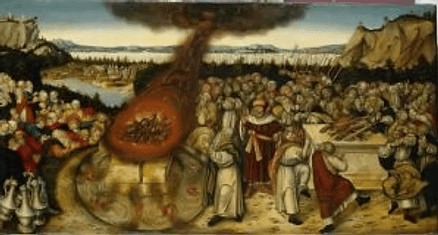
The scribes would have to remember the fire-starting contest that Elijah initiated (1 Kings 18), where four hundred fifty priests of Baal could not summon him to light dry wood, while Elijah soaked his wood pile with water and it was lit into a roaring flame by God’s Holy Spirit.

God is the power that makes the impossible possible. Therefore, those who would call God’s work that of someone calling upon Beelzebul were the utterers of a blasphemy of eternal proportions, unworthy of forgiveness.

Did the scribes think the four hundred fifty priests of Baal were forgiven after they called Elijah and his God names, accepting the challenge? Of course not.

Those evil priests, if one recalls, were priests imported by Jezebel into the Northern Kingdom, to guide Ahab and the common Israelites. They were the sons of men, not Sons of God.  Those priests of Jezebel all still burn in hell.

Jesus then said, “For they had said, “He has an unclean spirit.” I imagine there could have been a finger pointed when Jesus said “they said” (“elegon”), used in identifying the scribes and their Pharisees pals. “They said” the Holy Spirit of God, which makes crippled hands straight and strong, was the work of “an unclean spirit.”

I imagine Jesus pointed out “them” to the crowd that had been roused to a maddened state, murmuring that Jesus “had gone out of his mind.” I imagine Jesus silenced all of them as they pondered to themselves, “Did Jesus just say I am guilty of an eternal sin?”

Then, I imagine, Jesus went inside the house he and his disciples had been welcomed into, so they could sit peacefully and enjoy some lunch. As the door closed, the crowd was silently stunned … I imagine.

It is then that we read, “Then his mother and his brothers came.” This, again, was not an arrival based on fear for Jesus, as the implication can seem when reading, “When his family heard it, they went out to restrain him.” It might be that the Pharisees (“those beside” Jesus in responsibility, as teachers of Scripture) had stirred such a row that someone ran to tell Jesus’ mother that excitement was about. As this statement is actually separated into two segment (by a comma), it first says “and arrived the mother of him,” followed by a subsequent arrival, “and the brothers of him.” That would imply Mary told someone to go alert her other sons, so she left before them, with each Mary and the brothers arriving one right after the other, in the order of departure from where they were. One would then assume they came in support of Jesus, in case he was being threatened.

By reading, “and standing outside, they sent to him and called him,” they did not know the place where Jesus was with his disciples. Because it is not actually stated to be a home of someone, it could have been a public place, like an eatery. Their not entering could well have been due to the “crowd” that “was sitting around” Jesus was so many there was no room for them to wedge inside.

Good places to eat are not always big, so waits are common.

Thus, they sent word by asking strangers to tell Jesus who was outside. To ensure Jesus got the message, they hollered out Jesus’ name, in familiar voices he might recognize.

Then we read, “They said to him, “Your mother and your brothers and sisters are outside, asking for you.” The inclusion here of “sisters” should be read as the wives of Jesus’ brothers, as “sisters-in-law.” The point of Peter recalling “mother, brothers and sisters” is to make it a point that “the house” of Joseph, husband of Mary, and father of sons through at least two wives, they all had arrived to support their flesh and blood relative. They came to make a show that the “house of Jesus” was not divided, even though Jesus went and did his thing with his disciples, while the rest of the family did their things separately. They arrived to show solidarity of blood.

Jesus knew who was outside. God would have told him; but Jesus heard their cries and recognized them. Still, he did not want to make a show of how one family was strong in support of a common house; but he did want to demonstrate how one man had the strength to defend a holy house of righteousness. Thus, we read, “He replied, “Who are my mother and my brothers?”

Again, this is two segments, separated by a comma.  Jesus asked, “Who is the mother of me?” and then, “And [Who are] the brothers of me?”  Each separate focus questions not the identity of multiple people, but asked esoterically, “A I not an individual of responsibility?”

These questions were not directed at the physical people standing outside, as they are alluding to what makes a strong man. As a mother is the one who gives birth to a child, Jesus asked, “Who is it that gives birth to a strong man?” Is it one’s physical mommy? Or, is it God?

When Jesus then referred to other male siblings, he was then alluding to what makes a man truly strong. Does strength come in numbers of others who will come to one’s aid? Or, does true strength depend on the relationship that one has with the Holy Spirit?  Can one not find inner strength from knowing others like oneself have been made strong by God?

When we then read how Jesus looked “at those who sat around him, [and] said, “Here are my mother and my brothers! Whoever does the will of God is my brother and sister and mother,” that was not a claim of the present state of being.  It was prophetic. Certainly, Jesus did not see Mary, James, and his other brothers sitting around him. Instead, we see the twelve disciples that Mark had named earlier in chapter three. Even those twelve had nothing to do with what Jesus said.

Jesus actually did not say, “Here,” as that is a poor translation.  The Greek word he actually used was “Ide,” a form of “horaó.”  That word says, “Behold!” or “See!” or “Perceive!

Jesus was not pointing his finger at the human beings dining with him, or even tapping his finger forcefully on the table they were seated at.  Jesus probably had used his finger when he pointed to “those” outside who blasphemed the Holy Spirit. In my mind’s eye, at this point in the story, I “See!” Jesus lifting both arms high, inviting all who sat near to realize he held within him the mother of his faith and the lineage of all prior prophets of the LORD who were his brothers. Everyone sitting around him, and those outside calling out his name, would also be his own mother and brothers of Christ and all other Apostles, when they would become saints in the name of Jesus Anointed.

We realize that when Jesus then said, “Whoever does the will of God is my brother and sister and mother.” This is the recipe of a “strong man whose house cannot be plundered.” It is whoever does the will of God – not the will of Pharisees, not the will of scribes, not the will of friends who tell you someone might be in danger, and not the will of relatives who will defend one’s body without question.

The will of God is done by those who sacrifice their dependency on the outside world, so they only respond to the direction of the Holy Spirit. Of course, those all go by the same name – Jesus Anointed.

That name comes when one gives birth to a new you, after marriage to God in one’s heart (a holy house). You become the brother of Jesus of Nazareth, by being reborn as the Son of God. You become the sisters-in-law of Jesus, as human beings given away in marriage to the Father. The officiant of that sacrament is Holy Spirit, which washes away one’s sins, so God can take His throne.  A most holy matrimony through a most holy baptism, followed by a most holy christening [naming one as Jesus Anointed].

As the selected Gospel reading for the third Sunday after Pentecost, when one’s personal ministry for the LORD should be underway, Apostles are called to recognize they are either with Jesus, through the Holy Spirit – the mother and brother of Jesus the Anointed one – or they are standing outside, either calling out, “Sweet Jesus, come to me!” or “Cast out my demons, Jesus, if you are indeed holy!” or “Jesus was nothing more than another prophet who did some good things, but not the Messiah we still await.”  They are one or the other, not both.

A non-sacred cow.

The reality of today is there are crowds of people wanting a good show, in search of a dependable idol to worship. Few people are strong enough to keep themselves as a holy house worthy of God’s presence.

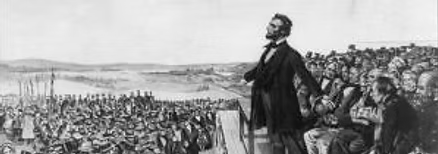
People remember how “Honest” Abe Lincoln quoted Scripture when he compared the divide between the slave states and the free states as a “house that cannot stand.” Few people realize that ordering the deaths of 620,000 Americans, through battles that would force the will of Abraham Lincoln (as the “king” of a nation divided) upon the people.  America has built a monument to Mr. Lincoln.  They immortalize some notes he scribbled on an envelops, while on a train to the battlefield where about 50,000 soldiers (both sides of battle) were killed, wounded, or went missing.  He wrote of forefathers, the ones who said states had rights, including the right to dissolve the union.  Abraham Lincoln rewrote the Constitution, as far as thirteen southern states were concerned.  The reality, as far as spirituality goes, is the United States of America fell in 1865, regardless of who claimed victory, simply because a son of man played god – calling upon Baal for all to worship.

Whoever hitches up their wagon to a country, or claims great pride in associations (political, racial, philosophical, or religious, et al) those people are bowing down before a master of lesser value that God Almighty. When Jesus said, “No one can serve two masters” (Matthew 6:24) the same lesson applies to the divisions that inevitably will arise in kingdoms and houses. Only a strong man in his own house, one of absolute devotion to God, stands a chance of surviving the destruction of his tabernacle (bodily temple).

The unnamed place that Jesus sat with his disciples, when he exclaimed, “Behold my mother and brothers!” is the epitome of a church. Jesus said, “Where two or three have gathered together in my name, I am there in their midst.” (Matthew 18:20) The church is not exclusively an elaborate brick and mortar building that is decorated with candlesticks, altar, crosses, stained glass windows and red carpeting between polished pews.

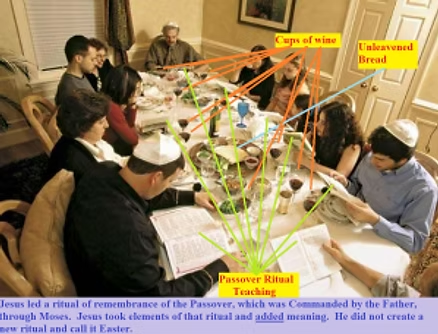
Jesus and his disciples might have gone into the equivalent of a pub or café, where he and his disciples shared a non-Passover loaf of bread and cups of wine. The disciples and the crowd were there because they wanted to be close to Jesus of Nazareth. When Jesus said there would be those who would later “gather in my name,” he meant Apostles in the name of Jesus Christ – as Jesus Christ reborn – the Holy Spirit and the Christ Mind would then be in their midst.

The sacrament of Communion is the gathering of Saints at a time when there is need to get away from the maddening crown that utters one blasphemy after another.  It has to do with sharing common experiences of body and blood, and very little to do with a wafer followed by a sip of wine from a fancy cup.  The disciples AND those who wanted to be near Jesus that day were in “communion” with Jesus of Nazareth, where that word is defined: “The sharing or exchanging of intimate thoughts and feelings, especially when the exchange is on a mental or spiritual level.”

The message of ministry is not to go out memorizing words found in various translations of the Holy Bible. The Pharisees did that and misled the people. The scribes of Jerusalem did that and misled the people. Ministry for the LORD can only be done by His Son, Jesus Christ.

Apostles and Saints have made that possible since the day of Pentecost, when Jesus returned in twelve disciples, and they in turn filled another three thousand who heard them speak with the power of the Holy Spirit. All 3012 found Jesus Christ within their midst. Ministry is thus about that baton passing. Ministry is all about doing the will of God, so one can be reborn as a brother of Christ.

America has become a nation of king worshippers, regardless of which philosophical persuasion one swings. We love the thought of strength, when the only thing that stands in the way of Americans being attacked and invaded is the fear our enemies have created within themselves. That fear is being tested more and more these days, with a little terrorism here and a little insanity there. We are living in the times when the world has gone out of its collective mind.

There are sects of religions that worship Beelzebul.  Their leaders are calling upon the ruler of their demons to cast out the demons they see in a “Christian West.” They call America the “Great Satan,” as a motivator for hatred.  Hatred is an emotion of Satan, not God. So, again we have the lunacy of Satan calling to cast out Satan.

In the houses of religion in America, which call themselves “Christian,” we have one preacher praising the works of Donald Trump and condemn the works of Barack Obama. Meanwhile, in another denomination, there is another priest denouncing the works of Donald Trump, while longing for a return of the days when Barack Obama ruled the “kingdom.” Just like when ole Abe ruled the roost, America is a divided kingdom that cannot stand. It has no strong men and women who defend their holy temples as Saints and Apostles in personal ministry. There is no central house of religious thought, so everything sits upon a precipice, about to slide into the oblivion of the Great Abyss.

People question why Christianity is decreasing in numbers. People want to know why “Millennials” are turning away from churches. This video shows the reason as it sings, “You cannot save me. You cannot even save yourself.” This perfectly shows why true ministry was necessary in Jesus’ day, and why true ministry is necessary today.  It shows how decadent our society has become.  It screams out a need for the truth of Christ to guide us out of our lunacy.

We can be saved, but not as oneself and not by external means.  Salvation comes within, through the power of God.  For that to happen, one has to fall in love with God and get rid of the ego.  Satan loves Americans with big egos and sons of man who go out casting false  judgment on the holy, while pretending to know the Law.  Ministry is being a real representative of Jesus Christ, leading by example.

Stabbing Westward: Save yourself

1 Samuel 16:1-13 – Anointed to serve God

This reading begins with 1 Samuel 15:34-35:

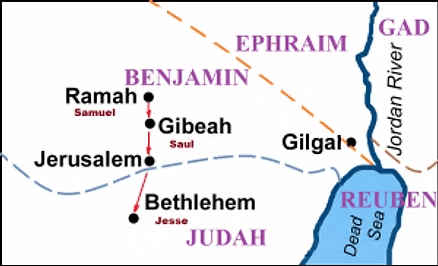
Samuel went to Ramah; and Saul went up to his house in Gibeah of Saul. Samuel did not see Saul again until the day of his death, but Samuel grieved over Saul. And the Lord was sorry that he had made Saul king over Israel.

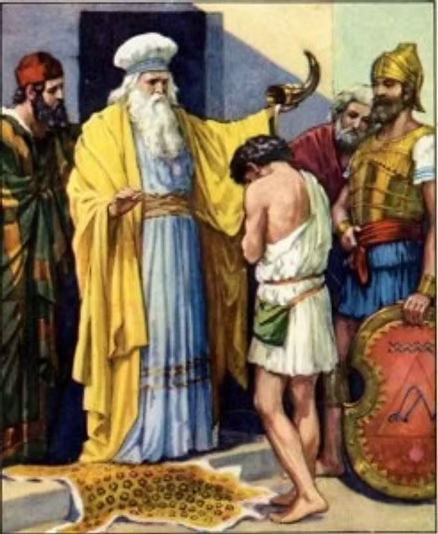
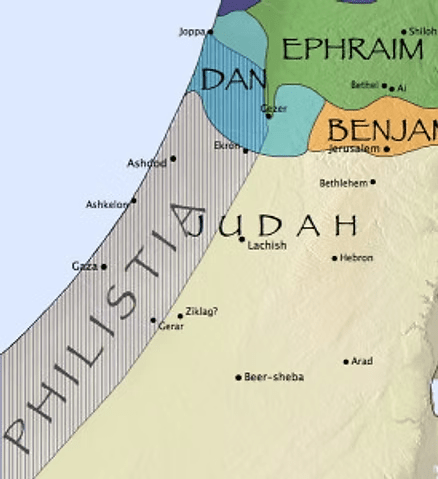
The Lord said to Samuel, “How long will you grieve over Saul? I have rejected him from being king over Israel. Fill your horn with oil and set out; I will send you to Jesse the Bethlehemite, for I have provided for myself a king among his sons.” Samuel said, “How can I go? If Saul hears of it, he will kill me.” And the Lord said, “Take a heifer with you, and say, ‘I have come to sacrifice to the Lord.’ Invite Jesse to the sacrifice, and I will show you what you shall do; and you shall anoint for me the one whom I name to you.” Samuel did what the Lord commanded, and came to Bethlehem. The elders of the city came to meet him trembling, and said, “Do you come peaceably?” He said, “Peaceably; I have come to sacrifice to the Lord; sanctify yourselves and come with me to the sacrifice.” And he sanctified Jesse and his sons and invited them to the sacrifice.

When they came, he looked on Eliab and thought, “Surely the Lord’s anointed is now before the Lord.” But the Lord said to Samuel, “Do not look on his appearance or on the height of his stature, because I have rejected him; for the Lord does not see as mortals see; they look on the outward appearance, but the Lord looks on the heart.” Then Jesse called Abinadab, and made him pass before Samuel. He said, “Neither has the Lord chosen this one.” Then Jesse made Shammah pass by. And he said, “Neither has the Lord chosen this one.” Jesse made seven of his sons pass before Samuel, and Samuel said to Jesse, “The Lord has not chosen any of these.” Samuel said to Jesse, “Are all your sons here?” And he said, “There remains yet the youngest, but he is keeping the sheep.” And Samuel said to Jesse, “Send and bring him; for we will not sit down until he comes here.” He sent and brought him in. Now he was ruddy, and had beautiful eyes, and was handsome. The Lord said, “Rise and anoint him; for this is the one.” Then Samuel took the horn of oil, and anointed him in the presence of his brothers; and the spirit of the Lord came mightily upon David from that day forward. Samuel then set out and went to Ramah.

——————————————————————————–

This is an optional selection from the Old Testament that is offered by the Episcopal Lectionary for the Fourth Sunday after Pentecost, Year B 2018. In the numbering system that lists each Sunday in an ordinal fashion, this Sunday is referred to as Proper 6. If chosen, it will next be read aloud in church by a reader on Sunday, June 17, 2018. It is important as it reflects how a true leader is anointed from within, due to one having been chosen by God to serve Him, because without that inner strength one will be influenced by the people to go against God’s will.

The fifteenth chapter of First Samuel tells the story of Saul as king of Israel, from his being the one anointed by Samuel to his failure to follow the instructions of the LORD, given to him by Samuel. Saul spared Agag, the King of the Amalekites, against the will of God. Saul also allowed his soldiers to keep the livestock of the Amalekites, against the will of God. Every living being was ordered to be destroyed.

When confronted by Samuel, Saul said, “The people took the spoils of livestock.” Wrong answer, as a king rules over the people, not vice versa. Saul had taken Agag as his spoil, rather than kill him as commanded. This failure by Saul caused Samuel to bring the captive Agag before him, to be slaughtered by Samuel’s hand and sword. Thus, when we read here, “Samuel grieved over Saul,” it was due to Samuel knowing that Saul would have to pay for his sins; and that is why Samuel would “not see Saul again until the day of his death.”  Saul was the proverbial “dead man walking.”

In the sixteenth chapter we read, “The Lord said to Samuel, “How long will you grieve over Saul? I have rejected him from being king over Israel. Fill your horn with oil and set out; I will send you to Jesse the Bethlehemite, for I have provided for myself a king among his sons.” This ability to communicate with God IS the true inner strength that a leader of people must have, otherwise one is no better a failure than was Saul. Samuel was able to hear God’s voice from a young apprentice priest, thus the elders of the Twelve Tribes called upon Samuel for guidance. Still, Samuel was then old and had no sons (literal or symbolic) who could fill his shoes and lead Israel as a judge.  This absence of an adult replacement made it necessary for God to provide for himself a king to serve His will over the Israelites.

When we read Samuel’s reaction to God telling him to go anoint a new king, his saying, “If Saul hears of it, he will kill me” was a reflection of how human beings in positions of power will react to threats against their power by striking first and asking questions later.  Samuel would not be the only prophet-priest afraid of crazed rulers, as Elijah would likewise run from Ahab.  Later in Samuel’s story we will see David hiding from Saul’s wrath.

Certainly, God was not asking Samuel to perform a second anointing of a King of Israel, when one was already serving in that capacity. Instead, Samuel would anoint the rightful heir to that throne, in a private ceremony, one between God and Samuel in Bethlehem.

Jesse (whose name means, “Yah[weh] Exists”) the Bethlehemite, was invited to a sacrificial rite that called for for all attendees to be sanctified (through ritual washing). Jesse was an elder in the tribe of Judah.  Other leaders of that town were also invited, along with their sons. In line with the ancient practice of the eldest son being given into priesthood, which had since been restricted to only those firstborn of the Levites, Samuel might have said he came to anoint a son known as special to God. Samuel might then have had several Israelite males of several fathers entering into a large tent, where he walked in front of them all.  Having gone by all, Samuel would then stop in front of Jesse, saying, “God chooses this father’s son.”

Whatever the truth that was told, when we read that the LORD told Samuel, “Take a heifer with you, and say, ‘I have come to sacrifice to the Lord,’” the heifer would have been one of those Saul took from the Amalekites. As can be seen in this map below, the path Samuel would have taken from Ramah to Bethlehem would have gone through Gibeah, where King Saul lived.  Saul would have been advised that Samuel was going south, through town, to anoint someone.

I imagine Samuel did not travel as a judge alone, instead traveling with an entourage of sorts, with priests and wagons that carried cloths and cups, et al, for a sacrifice and anointing.  Probably, there was a wagon for the heifer, to keep it ceremonially clean.  As a procession of vehicles moving through Gilbeah, he would have been stopped and questioned.  Taking a heifer would be key to unopposed passage.

By taking a sacrificial animal that Saul knew guilt over (Amalekite livestock that Saul was ordered to kill, not take as a spoil), and by also knowing how Saul had said that sin was a problem easily solved by sacrificing the forbidden livestock in holy ritual to the LORD, Saul had no reason to halt that caravan.  All Samuel had to say (if asked) would have been, “Just getting rid of some of the king’s falsely obtained animals.”

The truth would have been told in that way. We do know that Samuel would not see Saul “again until the day of his death.” Still, their paths crossed, without them meeting, in each carrying out their respective duties. That would include currier communications, as needed.

When we read, “The elders of [Bethlehem] came to meet [Samuel] trembling, and said, “Do you come peaceably?” one has to recall how we discussed the elders going to Samuel asking him to “appoint” them a “king, to be like other nations.” Besides the fact that over a long “career” as a truly holy man of God, even as an old judge of Israel he was to be taken seriously.  The Israelites knew that when Samuel came to town, they probably had done something wrong and God had sent Samuel to punish them.

In this specific instance, all of Israel would have known that Saul was in big trouble with the LORD (over the Amalekites thing).  Soldiers from every tribe had taken part in that war, and one or two (at least) Bethlehemites had brought back a stolen goat or cow.  The elders were shaking with fear for having told Samuel to anoint Saul, who then disobeyed the LORD and allowed his soldiers to do likewise.  The elders felt that guilt, plus anything else their guilt caused them to tremble over.

When Samuel looked upon Jesse’s eldest son, Eliab, his reaction can be explained by the birth rank and the name. The name Eliab means, “God Is Father,” where the Hebrew word for God is “El.” For Jesse to give that name to his firstborn son, it makes sense to conjecture that Jesse did not claim to be the father of a son given to the LORD. Thus, Eliab might have come wearing a priestly tallit, which could have prompted Samuel to say, “Surely the Lord’s anointed is now before the Lord.”

Eliab was rejected, as God told Samuel, “Do not look on his appearance or on the height of his stature, because I have rejected him; for the Lord does not see as mortals see; they look on the outward appearance, but the Lord looks on the heart.” The Hebrew words translated as “height of his stature” (rooted in “gaboah qomah”) can equally state, “lofty height,” where this is not simply seeing the physical attributes of someone, but seeing the physical dress applied to one’s body. It becomes the basis for the idiom, “clothes make the man.”  This outward appearance will bring personal benefit to those who project special presence (either true or contrived); but God sees the heart of the individual and knows if appearance is pretense or a reflection of the true core being.

Eliab was rejected, as was his brothers Abinadab (whose name means “My Father Is Nobel” – a reflection of Jesse’s elevation to a position of respect in Bethlehem) and Shammah (whose name means “Waste” or “Astonishing Desolation” – a reflection of times of trial in Jesse’s life). Samuel saw seven of Jesse’s sons and all were rejected by God. As Samuel had been told the one to be anointed was a son of Jesse, Samuel asked Jesse, “Are all your sons here?”  That deduction found Jesse had not followed orders.

Jesse had not bothered to bring his youngest son, which means he was still a boy, not yet aged into manhood. The Hebrew word translated as “the youngest” (rooted in “qatan“) actually says “the least.”  That becomes a value statement, based on Israelite culture.

Children were not considered to hold any level of importance in the Israelite social structure, as they were like apprentices to adults. Thus the phrase, “Children should be seen and not heard.”  In ancient writings, children were mentioned generally (seen), but not named (heard).  Jesse did not follow Samuel’s instruction, because he assumed only adult males were invited.  However, that assumption proved the lack of an anointed one; and that omission was another example of how simple instructions (such as what Samuel told Saul about killing ALL of the Amalekites, not just most of them) went into the heads of the elders of Israel, coming out with convoluted changes due to ignorance.

When Samuel said to Jesse, “Send and bring him; for we will not sit down until he comes here,” one has to imagine how at least an hour of time had to have passed after that. Everyone remained standing, as punishment for not having paid attention to the simple instruction, “Bring with you all of your sons.”

A shepherd takes his flock to different pastures, day by day, and one could assume Jesse owned a few good pasture lands. One would presume the second to the youngest of Jesse’s son was sent to run and find David, having been the shepherd before him, and then bring David back. Keep in mind that both the son sent and David would have to be sanctified by water and priestly blessing, before being allowed into the tent when the ceremony was taking place. All that time the honored guests of Samuel stood and did not sit, all because Jesse did the thinking, but did it wrong.

When David finally arrived and was inspected by Samuel, we read, “Now he was ruddy, and had beautiful eyes, and was handsome.” This is an outward appearance that was totally physical, which says the “least” of Jesse’s sons was good stock, as was the eldest, Eliab. Still, this was the appearance of a youth, of one who worked in the sunshine tending sheep. David most likely exercised as most young boys would, alone with his thoughts and imaginations, having no restrictions on how little to wear on a hot day.  So, he was red from sun, as well as fit and trim.

His “beautiful eyes” can be symbolic of his pure view of life, which had yet to become clouded with the pessimism and dissatisfaction of adulthood. As such, the LORD knew the heart of David was pure and devoted to his religious upbringing. That made David be the chosen one of God.

When we read, “Samuel took the horn of oil, and anointed him in the presence of his brothers; and the spirit of the Lord came mightily upon David from that day forward,” this says that the pure innocence of David, as a youth who delighted in knowing the stories of the Israelites and their Patriarchs, made him be chosen to serve the LORD. God knew the heart of Jesse’s youngest son before God came upon him.  Likewise, Samuel, as a youth given to Eli to be a priest, was pure innocence first, before being filled with the Holy Spirit and allowed to hear the voice of God.

The oil poured on the forehead of David was symbolic of his being likewise filled with the Holy Spirit. This is the meaning of “the spirit of the Lord came mightily upon David.” When one has this pure state of devotion first, then the next step is to be anointed with the Holy Spirit. It is not exclusive to Samuel and David.

It should be noted that David’s name was not mentioned until after he had been anointed by Samuel. As a youth, in ancient writing etiquette, women and children were not named directly, because they were not deemed as self-sufficient, thus irrelevant. The naming here, as David, should be seen as a God-given name, more than the name given by Jesse to his last-born son. The name “David” is said to mean “Beloved,” but there are many who see the Hebrew root (dwd) as having other potential meanings. Some historians have struggled finding proof of a King David, despite his prominence in Hebrew texts. This might be a statement that “David” is a symbolic name, rather than a literal name, because “Beloved” was the state of being that told of a relationship (a marriage) between God and His wife (a human being), because one’s heart was pure and completely devoted to obedience and servitude to the LORD.

As a potential selection for the fourth Sunday after Pentecost when one’s personal ministry to God should be underway, it should be recognized how those chosen to serve God are pure of heart. An Apostle – Saint is called to be the “Beloved” of the LORD, and one serves God because of love, connecting one to the divine. For as obvious as that might be seen, the reality is how rarly such an anointing takes place.

The symbolism of King Saul is today found in the political-philosophical leaders of the world. In the words of the Billy Crystal character Fernando, on SNL skits, “You look marvelous.”

Many people around the world get down on their knees and pray to demigods whose outward appearance says to them, “Surely the Lord’s anointed is now before the Lord.” The word “Lord” is then whatever power they serve, be it a philosophy like Communism, Socialism, or Capitalism, or a religion like Christianity, Judaism, Hinduism, or Islam. The “elders” are those who command large groups that direct their followers to choose flawed leaders.

Since Samuel could not see the hearts of others, depending on the inner voice of God to correct his poor vision, anyone who follows his or her sensory organs in a quest to find a king who serves some principle one holds dear will fail.  We have become societies of lambs being led to the slaughter of negligence, simply by being seen as the spoils of war between evil rulers.  Few of us still have the purity and innocence of a youthful spirit that yearns to please God.  Few act as good shepherds these days.

Each Apostle knows the kingdom one serves is one’s own physical body. That body becomes the temple of the LORD when one’s heart is devoted to God, and made pure and innocent by the Holy Spirit anointing one in marriage to God’s love. Anything short of that will result in the ultimate failure – the recycling of or the loss of one’s soul. Those who fall short will hear the simple instruction to sacrifice their egos and seek marriage to God, only to turn that into convoluted changes due to ignorance. They will keep the spoils as they see fit; and then they will tremble in fear when their judgment time has come.

Ministry to the Lord means never having to ask God, “Do you come peaceably?”

Ezekiel 17:22-24 – A sprig from the lofty top

[The presentation shown on the Episcopal Lectionary site has this selection produced in song verse format. I have reduced that to prose, while maintaining their translation.]

Thus says the Lord God, “I myself will take a sprig from the lofty top of the cedar; I will set it out; I will break off a tender one from the topmost of its young twigs; I myself will plant it on a high and lofty mountain. On the mountain height of Israel I will plant it, in order that it may produce boughs and bear fruit, and become a noble cedar. Under it every kind of bird will live; in the shade of its branches will nest winged creatures of every kind. All the trees of the field shall know that I am the Lord. I bring low the high tree, I make high the low tree; I dry up the green tree and make the dry tree flourish. I the Lord have spoken; I will accomplish it.”

——————————————————————————-

This is an optional Old Testament selection from the Episcopal Lectionary for the Fourth Sunday after Pentecost, Year B 2018. In the numbering system that lists each Sunday in an ordinal fashion, this Sunday is referred to as Proper 6. If chosen, it will next be read aloud in church by a reader on Sunday, June 17, 2018. It is important as a narrowed excerpt from Ezekiel as it shows the metaphor present in the accompanying Gospel reading selection from Mark, where servants of God are compared to plants of the earth and their benefit to the lands where they are found.

This portion of Ezekiel 17 represents the final three verses that in total was a chapter where God spoke to His prophet about the fall of Judah and Jerusalem. The king of Babylon captured Jerusalem and disposed the Judean king, appointing a younger sibling (Zedekiah) to be king, after he signed an agreement to serve Babylon. That young king then went against that agreement, causing Jerusalem to be recaptured by Babylonian soldiers; and that was when Solomon’s Temple was destroyed.

God pointed out to Ezekiel how He had a prior “agreement” with the Israelites (which included the tribes of Judah and Benjamin). Therefore, these last three verses are “riddle” and “parable” [instructions from God to Ezekiel in verse 2] that tell about the reseeding of the land with those who will not have a Covenant of stone, but the Law written on their hearts.

The process of transplanting a cutting of a plant becomes similar to the prophecy found in Isaiah 11:1, which states, “Then a shoot will spring from the stem of Jesse, And a branch from his roots will bear fruit.” The same forecast of a replacement of God’s “chosen people” is made in both Ezekiel’s and Isaiah’s examples of horticultural metaphor. This would not mean a return from exile of the people from Judah, in captivity in Babylon, although their transplanted tree would grow in Babylon and then grow again in what used to be Judah. However, the prophecy is foretelling of Jesus and those who would follow him as Christians.

This parallels the story in Mark’s Gospel, where Jesus spoke of growth stages of grains and that of a mustard seed.  The similarity of this metaphor spoken by God to Ezekiel, where we read, “Under it every kind of bird will live; in the shade of its branches will nest winged creatures of every kind,” is practically identical to Jesus telling how the mighty mustard tree protects birds.

Mustard tree.
Cedar tree of Lebanon.

I have a cedar tree in my backyard and it is the home for many different birds and squirrels and rabbit have been seen running under its branches for safety also. Still, the points made by Ezekiel and Jesus are about one specific “tree,” one that “All the trees of the field shall know that I am the Lord.”

This means that when God told Ezekiel, “On the mountain height of Israel I will plant it, in order that it may produce boughs and bear fruit, and become a noble cedar,” that “tree” would be the true “religion” – “philosophy” – in a world of many religions and philosophies – that IS Christianity.  Still, “religion” or “philosophy” belittles the truth that is “noble” in that “tree.”

This means one must be able to remove the glasses of mortal being that sees the imagery of this “riddle” and “parable” as plants and birds, and put on the glasses of prophecy. Mortals see bird of many kinds as though all are living equally well under the branches of all large, protective trees. While that may be true in mundane life, it misses the spiritual point made by God stating, “In the shade of its branches will nest winged creatures of every kind.”

Those “winged creatures” are angels of the LORD, which means the “tree of Christianity” will be filled with those who totally serve God, as eternal souls saved. No other “tree’ in the filed can truthfully make that claim.

Under the shade of holy branches.

Certainly, in a world of religions, they all make their claims of superiority. Sheer numbers of believers can catapult Christianity, Islam and Hinduism to the top, in that regard. In a world of many different philosophies, where each becomes the guiding principles of a nation (the DNA of countries), the world’s most numerous adherents of central philosophical beliefs (and the laws thereby generated) can indicate the most popular are Democratic Republics, Communist-Socialist Regimes, and Totalitarian Dictatorships. However, the truth of the United States’ declaration that demands a separation of Church and State is that “religion” acts as the ideal, while “government” becomes the reality.

That reality is that nations bow down before themselves, as self-serving egos that scream, “My philosophy is better than yours.”  Never  do governments bow down before the LORD, much less to the gods they profess allegiance to.

Comrades in arms at a U.N. get-together.

In the hidden “backstory” of Ezekiel 17, we read the ugliness of governments and their attempts to align with other governments, in pacts and treaties that seem mighty and strong. The adage, “The best laid plans of mice and men often go awry” is summed up now as, “I bring low the high tree, I make high the low tree; I dry up the green tree and make the dry tree flourish.”

The “high” trees that exist in the world now are the United States of America, Russia, and China. Others that seek equal status with those are Great Britain, France, Germany, Israel, Iran and others with nuclear capabilities. None of them consider themselves “high” because their total strength is based on their belief and devotion to the One God, but to the lesser god named “Nuclear weaponry.” All are exactly like the rebellious Judeans that God recalled to Ezekiel, who placed all their bets on the sharpness of their spears and the promised support of others who were paid to be in league with them.

Those plans went awry, as is the greatest flaw in humanity.  Alas, it is said, “Those who fail to learn from the mistakes of history are doomed to repeat them.”  And, the world does love reruns.

My two-lettered brother by another mother.

As history always will repeat (similarly) and one plus one will always equal two, the failures of Israel (a nation under one king), as also the failure of Israel and Judah (two nations under two kings), and also the failure of the resuscitated puppet that pretended to return to life – Hebraic Judea and Jerusalem of the Second Temple – those failures project the failures of the United States of America and the re-instituted State of Israel.  Any nation that proposed to have God on its side, but then acts as if there were no God that Saves, is doomed to fall by the hand of the godless.

It is a lesson that keeps on teaching.

That failure does not mean the “low” trees of other religions and governments will rise to the heights of being God’s newly chosen people. Instead, the meaning of “I make high the low tree” and “make the dry tree flourish” projects on individuals, those who refuse to follow the paths set for them by their government.  Governments will always come and go; but there will always remain those who love God so much they barely realize one dominating tyrant has been replaced by another.  Like seeds waiting for the right environment in which to begin new growth, they lay “low” until God commands them.

When this individual aspect is seen, the sprig from the “lofty top of the cedar,” which will be planted “on a high and lofty mountain,” that of “the mountain height of Israel,” IS Jesus of Nazareth.  God planted His Christ child to be the “low tree made high,” when disciples became true Christians – Apostles. Those Saints are the ones who has been truly filled with the Holy Spirit of God and reborn as Jesus Christ.

Each individual Apostle – Saint is then reborn in the name of Jesus Christ so he or she “may produce boughs and bear fruit, and become a noble cedar.” “In the shade of its branches will nest winged creatures of every kind,” which can now be realized as being the talents of the Holy Spirit – the powers of God given to His Son and his fruit.

Under the Tree of God an angel gets her wings.

As an optional selection from the Old Testament for the fourth Sunday after Pentecost, when one’s individual ministry for the LORD should be underway, Ezekiel offers the metaphor of song, as the projection of what one should become in service to God. When one sees the Covenant with God as a written legal document, Satan will send in the lawyers that will offer leeway interpretations about what sins are allowable and what sins are clearly forbidden. When one listens to outside influences, then one will become as uncertain of one’s commitment to God, as have all governments whose people call themselves “Christian.” Christianity is not a club one joins and pays membership dues to a specific institution.
Christianity is ministry to God, in the name of Jesus Christ.

Even as I write these words, I can see many sheep of the political left, those who hate fellow Americans because they feel their neighbors have sinned by allowing the evil creature that is Donald Trump into the White House. Evil creatures are those who are perfect to serve in the capacity of President of a False Prophet nation.  America fits the billing as a “high tree” of self-value that will be made into a “low tree” when one’s individual Judgment Day comes.

The end of the world is when a mortal dies and one’s soul faces judgment for its mortal sins. Hating one’s neighbors (regardless of one’s political persuasion) is not only a sin, as it is a bold statement that says, “I am not in the name of Jesus Christ, because I cannot love my neighbor as myself.”

Paid for by those who sponsors of death of Christianity. A little truth goes a long way towards covering a lie.

In the days of Paul and the other Apostles, ministry was to go out and tell all the scattered remnants of Israel (the Northern Kingdom and the original nation under David) that the Messiah had come. “Jesus was-is the Christ,” they all went out to tell.  God did not promise a Savior to all the other nations of the world.   Instead, God ended that Old agreement with the ancestors of the Jews.

He did not promise a Savior for the nation that was Israel (the Northern Kingdom and the original nation under David). God promised a Savior for the original premise that led to His choosing human beings [all as flawed as the next] to serve Him as His slaves … His ministers … His teachers of self-sufficiency through Jesus Christ.

The spread of Christianity occurred because of ministers going out into the world producing the same miracles as did Jesus of Nazareth, in Judea and Galilee (and beyond).  That spread was deterred when “religion” became a tool of militaristic institutions that sought to control nations by their influence.  That spread ceased when heathens were massacred in “the name of Jesus Christ,” and conversion or death were the options.

Today, especially in this world so devoted to the Internet and technology, there is no need to go out into the world “preaching the Gospel.” First of all, few have any real capability to “preach the truth of the Gospel,” as the world has become overrun with mimickers and false prophets that memorize a few tidbits of Gospel Scripture and sell it to the highest bidder.

“Money is evil. Give me your money and I will protect you from evil.”

Second, our nation presently has a pastor-missionary under arrest in Turkey, who has been charged with being a spy for the United States of America. The reality of that situation (regardless of the guilt or innocence of that specific “pastor-missionary”) is the United States government (and its evil agencies of intelligence) has used the aspect of “ministry” as a way to get into hard places and subvert foreign regimes.  It becomes reasonable to think that a Christian evangelizing in a Muslim nation is there for the purpose of subversion.

Canadian couple imprisoned in China for spying. Every time something like this happens, it spears the word “Christian” with the stench of government.

Ministry is no longer about telling a world that already has an opinion about what “Christianity” is (real or imagined), as ministry today is about an individual being filled with the Holy spirit and living accordingly. Heal yourself before trying to heal anyone else!

Ministry today is having the world come to an Apostle – Saint, asking, “Why are you smiling in a world of misery?”

Ministry is not about the theatrics of “evangelism” or the solemnity of “ritual.” Ministry is about marriage to God, so His Son can be reborn into a willing sacrifice of self-ego. Ministry does not require a “sheepskin” from a seminary.  It does not require a building that has stained-glass windows, spires, bells, and pews.  Ministry is not an organizational position, as it is an individual commitment to God.

Because Christianity is not one’s decision, but God’s decision based on His knowing the heart of an individual, the growth required for a “sprig” to grow into a “noble cedar” can take decades or minutes. For it to take place quickly, one should expect a traumatic event, such as a near-death-experience, where the limitations of linear time have been overcome by an out of body experience and the future beyond mortal life has been seen.  For it to take decades, this should be understood: A ministry cannot wait long before it is squandered and lost.

Remember, if Israel could fail, so can all moral human beings. Saying one “believes” is as worthless as a signed contract, when a lawyer is always there, willing to tell one how to opt out of a commitment, without lasting repercussions. “Belief” cannot be agreed upon as promise.  Belief can only come from personal experience.  Being Jesus Christ is the only way one can truly believe in him.

The point Ezekiel made was that each servant to the LORD must be the “lofty top of the cedar.”  That means being in direct connection to God, with no “go-betweens.” This is where those in ministry are set into the world by God, so others can find their light. In a dark place, a light can shine a great distance without ever moving.

2 Corinthians 5:6-10, [11-13], 14-17 – The love of Yahweh urges us on

We are always confident; even though we know that while we are at home in the body we are away from the Lord– for we walk by faith, not by sight. Yes, we do have confidence, and we would rather be away from the body and at home with the Lord. So whether we are at home or away, we make it our aim to please him. For all of us must appear before the judgment seat of Christ, so that each may receive recompense for what has been done in the body, whether good or evil.

Therefore, knowing the fear of the Lord, we try to persuade others; but we ourselves are well known to God, and I hope that we are also well known to your consciences. We are not commending ourselves to you again, but giving you an opportunity to boast about us, so that you may be able to answer those who boast in outward appearance and not in the heart. For if we are beside ourselves, it is for God; if we are in our right mind, it is for you. For the love of Christ urges us on, because we are convinced that one has died for all; therefore all have died. And he died for all, so that those who live might live no longer for themselves, but for him who died and was raised for them. From now on, therefore, we regard no one from a human point of view; even though we once knew Christ from a human point of view, we know him no longer in that way. So if anyone is in Christ, there is a new creation: everything old has passed away; see, everything has become new!

——————————————————————————–

This is the Epistle selection from Episcopal Lectionary for the Fourth Sunday after Pentecost, Year B 2018. In the numbering system that lists each Sunday in an ordinal fashion, this Sunday is referred to as Proper 6. This will next be read aloud in church by a reader on Sunday, June 17, 2018. This is important as Paul makes it clear that Apostles do not know Christ from a human perspective, but from a personal spiritual identification, which allows them to see false shepherds that boast outwardly, without truly knowing Christ.

Omitted from this reading is verse 5, which states, “Now He who prepared us for this very purpose is God, who gave to us the Spirit as a pledge.” The word translated as “pledge” is “arrabōna,” where “a pledge” is like “a down payment,” as is “earnest money.” It is given with the expectation of continued payments, for a continued benefit.

This then leads to Paul stating, “We are always confident,” where such confidence is based on having been given the Holy Spirit of God. The word read as “confident” is used in a context of “boldness” and “good courage” (from “tharreó”). This means God is seated in their hearts of His chosen ones, and it is from that source that “good courage” comes. It is not any form of intellectual “confidence” intended here.

The courage of a lion is heart-centered.

The translation above can seem quite confusing when one reads how Paul said, “we are at home in the body.” It forces one to ask, “How else can one feel about one’s life, other than ‘at home in one’s body’?”

The words actually written in verse 6 are telling of the present tense of being, which is relative to the presence of a soul (spirit) in a body (matter). The Greek word “Tharrountes” (a capitalized first word stating importance via capitalization) means, “Being confident,” more than “we are confident.” As a mate to this present state of being, the Greek word “endēmountes” means, “being at home.” This together (where two commas state the importance of knowing – “eidotes” – that link confidence made aware in a body), Paul is stating the Holy Spirit being at home in the body is where all that confidence comes from.

By Paul writing, “We are away from the Lord,” the meaning is human bodies are separate and apart from the spiritual realm. Still, the Lord is present through the Holy Spirit having become one with the soul that gives life to the body. Thus, “we walk by faith” (where “pisteōs” is another statement of “confidence”), “not by sight” (a sensory mode of the body in the physical realm).

When Paul then wrote, “we make it our aim to please him,” this cannot be seen as an intention of one’s brain, as the word “aim” might imply. That word of translation (“aim”) was not written. Paul simply stated that regardless of being – either in-body (soul baptized by the Holy Spirit) or out of body (soul freed to the heavenly realm, via prayer, meditation, or eventual soul release through death) – the presence of God within one means one’s willing subjection to the Lord. One lives to serve God.  That represents a complete sacrifice of one’s self-ego, as a servant-slave to God. In that sense, the only “aim” is forever to please the Lord.

The translation that says, “For all of us must appear before the judgment seat of Christ” has to be read as furthering this statement of subjection to the Lord. The key word of this statement is actually set apart by commas, where “phanerōthēnai” is read as “must appear,” when it more accurately states, “be revealed.” Rather than a call “to appear” or “show up” as a volunteer, “all” who Paul wrote to (and himself and his own) had to go through a state of transparency before God. This means “all” of the sins brought forth by a soul in a human body “must be revealed” before God, as both confession and plea of repentance. This is one’s appearance “before the judgment seat” of the Lord.

When we read, “the judgment seat of Christ,” it must be realized that God is our ultimate judge. When “Christ” is added, we can grasp in our minds that Jesus Christ sits at the right hand of God and through him all who will be saved must go. However, God sits upon the throne and only those who sit at His right hand are allowed into Heaven; and that means all Apostles-Saints are judged as worthy of becoming the Christ, when before God’s judgment seat in a human state of existence.

This means that the forgiveness of all sins transforms a flawed mortal with a dirty soul into a reproduction of Jesus Christ. To become Christ, one must have all sins expunged by God’s judgment, which is the baptism of the Holy Spirit. This in turn makes the “judgment seat” be one’s heart, where God sits upon the throne of His devoted subject, who is to be reborn as His Son Jesus Christ. This then says that Paul, all the Christians of Corinth, and any other Apostles and Saints forevermore have been and will be the same in spiritual character through God’s judgment; and this is “so that each may receive recompense for what has been done in the body, whether good or evil.”

When Paul then states how Apostles and Saints know “fear of the Lord,” the Greek word “phobon” can translate as “fear, terror, alarm,” but also “reverence” and “respect.” The use of “fear” is more the “sense of awe” that comes from knowing the presence of God within and never wanting that presence to cease.

This means that Paul saying, “we try to persuade others” is not in any way an attempt to talk someone into believing in God and Jesus Christ (through some intellectual attempt to persuade), but instead the Greek word “peithomen” states the “urge” within one to answer any question that others might have about God and Christ, so they can likewise come to know the confidence of an Apostle-Saint, on their own terms. In no way does “fear of the Lord” mean that a disciple should coerce someone to believe in God and/or Christ, by such means as predicting God’s judgment for evil deeds done that may go unforgiven.

God gave Man (males and females they made them) the gift of free will, prior to God sending a Savior to save Man from the sins that will come freely.  Man, therefore has the right to reject God, Christ, and good, as a decision made by the self.  Fear, as an emotion that can become used to enslave mankind by Satan, will never be present in Apostles and Saints as what led them to serve the Lord.  Once they have personally known God within, then a fear of losing that presence is a motivator to remain loyal to God.  Fear of the Lord is no longer a fear of punishment by God, but a fear of losing Salvation that has been gained.

In that regard, Paul wrote, “we ourselves are well known to God, and I hope that we are also well known to your consciences,” as a reminder that none of the Christians in Corinth, who became Apostles after having meeting Paul and his fellow Apostles, were told to be Christian “or else.” Instead of reading “pephanerōmetha” as “ourselves well known” [“to God” is prior in a statement ending with a period and not part of this statement], Paul simply pointed out “we have made ourselves clear.” That “clarity” is then hoped “to have been made clear” in the “consciences” (or “moral judgments”) of those true Christians in Corinth. While Paul and partner(s) did not make a “hard sell” of what to believe, they made sure all the questions the Corinthians had were satisfactorily answered, so those who were seeking the truth could make their own moral decisions regarding God and Jesus.

By Paul writing, “We are not commending ourselves to you again, but giving you an opportunity to boast about us,” he was saying his letter was not intended to make a “follow-up sell,” because Paul knew one who becomes a Saint will not backslide … because of a “fear” of losing redemption and the presence of God within. Instead, his epistle would serve to enhance the faith of those converted, while giving those who are disciples needing more answers an opportunity to hear from Paul, knowing the truth he tells matches the truth told by the Corinthian Christians. The word stating “boasting” (written “kauchēmatos“)is then used in the context of giving glory to God as exultation to be shared joyfully.

This ability to point out how to recognize one who is truly filled with the Holy Spirit, where one is worthy of boasting about, then serves the purpose of separating the truth from the lies. Paul added, “So that you may be able to answer those who boast in outward appearance and not in the heart,” which was a statement of false shepherds as well as those who want to say they are filled with the Holy Spirit but have not yet made a total commitment to God. That totality of commitment is made in the heart, which is the love center of the body. It means only those who have indeed felt the presence of the Lord within them, through marriage to His Holy Spirit, as one’s baptism of the soul, can give a seeker ALL the answers one is seeking to find. Those who have not yet become married to God, as His faithful subjects through self-ego sacrifice, are then unworthy of boasting about, because they can only offer Scripture as the answers, when Scripture becomes the source of the questions.

When Paul then wrote, “For if we are beside ourselves, it is for God,” “beside ourselves” (from the Greek root “existémi”) implies “astonishment.” Still, it has the connotation of “being out of one’s mind, mad” and “removed from a standing position.” In the written text, following the comma after “besides ourselves,” is simply the word “Theō,” which says, “to God.” This means the “astonishment” that comes from the presence of God within one comes from having sacrificed one’s self-ego and then taking a position that is “removed from expressing self concerns.” One becomes “amazed” by the way God leads one to act in ways that were previously unnatural to self (soul in a body of flesh in a world of temptation), because God has one act as His Son, Jesus Christ, absolutely free of sin.

The translation that has Paul offering, “If we are in our right mind, it is for you,” the translation of “sōphronoumen” as “right mind” means, “sober-minded” and “exercising self-control” (as well as “of sound mind”). This, then, becomes an extension of being “removed from a standing [typical human] position,” when Apostles and Saints must exercise self-control” by their marriage to God and the submission of self that demands.

As such, by saying “it is for you,” the only purpose for an Apostle or Saint is to serve others as God’s chosen ones. The can never be any self-glory or self-aggrandizement coming from being God’s chosen people, as all honor and glory is God’s alone, for having sent His Son into the world to save others from their sins. Salvation means the sacrifice of self, in complete and total service to the Lord, for the benefit of others. As Paul was writing to other Apostles and Saints, the purpose of all his epistles were for that purpose; and that is how his letters still serve the Lord today and beyond.

Paul next supported this by stating, “For the love of Christ urges us on, because we are convinced that one has died for all; therefore all have died.” The first part of that says that sacrificing a love of self has brought about the love of God, which is a consummated love that bring the Christ Spirit into one’s being. There is no love lost for having made that sacrifice, because Christ becomes the presence of love that is all motivating. This presence is not an act that convinces one (as the Greek root word “krinó” is better translated as “a good judgment,” whereby the presence of Christ’s Spirit is based on the merit of self-sacrifice, due to love of God), but a foregone “conclusion.” That conclusion is that Jesus Christ died so his spirit could be freed to be duplicated in ALL Apostles and Saints. For that rebirth to occur, ALL who will receive a “love of Christ” must likewise die of self. This is not a physical death, but the cleansing of one’s soul by the baptism of the Holy Spirit. Christ, as the Son of God, cannot be reborn into any selfish (thus sin retaining) soul.

Paul then reinforced this point as he addressed the true Christians of Corinth by saying, “therefore all have died.” Saul died and became Paul. Jacob died and became Israel.  Abram died and became Abraham.  Every Apostle and Saint has equally been changed the same, sacrificing their birth name for that of Christ. Apostles of Christ all understand the truth in those words because they all know the love of Christ. With that they all know the urge to have Jesus Christ be reborn in others, so they serve God in that capacity. Because they have all died of self, they have no one else to serve, nor do they seek to serve anyone other than God.

To advance this universality of dying in self, Paul added, “And he died for all, so that those who live might live no longer for themselves, but for him who died and was raised for them.” This says that all mortals are sinful souls born into temporal bodies, where that flesh will die. Without the soul being cleansed by the Holy Spirit, every soul is born to die and repeat, through reincarnation. God sent His Son into this world for the purpose of giving life (from the Greek word “zōntes”) to that which had previously faced mortal death. Those “who live” will be given life through becoming Jesus Christ (“no longer themselves”). That requires the baptism of the soul by the Holy Spirit and the surrender of the self-ego as the death that allows Jesus Christ “to rise again” (from the use of the Greek word “egerthenti” – “having been raised again”).

This sense of death is then why Paul wrote, “From now on, therefore, we regard no one from a human point of view.” The word translated as “human” is “sarka,” which means “human nature,” but also “flesh” and “body,” alluding to one’s sense of “personality.” This is a confirmation of self-ego, where the body of flesh acts as the “point of view” for the spiritual soul. When the soul has been freed from the limitations of its temporal body, it no longer is “near-sighted” in “regard” (from the Greek word used, “oidamen”) to that body.

This foundation is why Paul then stated, “Even though we once knew Christ from a human point of view, we know him no longer in that way.” The “human point of view” is that Jesus of Nazareth walked the earth of ancient Israel, as a human being, a man born of a woman. Those who followed him then told how he was killed by being hung on a cross, and then buried in a tomb, from which he rose and walked again among his disciples, until he ascended into heaven.

That story of Jesus of Nazareth cannot garner true believers that the man was in fact the Christ, simply because of the same reasons human beings discount ancient stories of gods and heroes. We call such stories mythology; and even though good ideas, principles, and concepts can be gleaned from myth, it still does nothing to lead human beings today to a belief that is based on personal experience.

Imagery of some Olympians. prior to the I.O.C. putting them in athletic shorts.)

In the Episcopal Church’s Eucharistic Prayer A, the celebrant leads the congregation with the words, “Therefore we proclaim the mystery of faith,” to which all recite, “Christ has died. Christ is risen. Christ will come again.” This has to be recognized as a statement of faith that is past (“has died”), present (“is risen”), and future (“will come again”). By stating faith in the present tense, “IS risen,” the present says ALL who proclaim that “mystery of faith” ARE the risen Christ. It is not a reflection back to the good ole days when witnesses said they saw dead Jesus of Nazareth walking around, letting disciples feel his wounds, while he ate broiled fish. That would be a proclamation of belief of a past event, as “was raised.”

The Apostles of Jesus Christ, as him reborn in the present time, can then know that “Christ will come again,” as there is no end to that resurrection.  As long as there are Saints with personal experience of “Christ being risen” around to answer all questions posed by seekers of the truth, Apostles and Saints are always present.  To confess “we await his coming in glory” (Episcopalian Eucharistic Prayer B), as if one is stating a belief that Jesus never has returned (not even in the first Apostles, or Paul, or any other Epistle writer), while we believe he is promised to return … some day … at an unknown time in the distant future … maybe … that is a complete misunderstanding of the return of Jesus Christ.  Christ returned at 9:00 AM the day after he Ascended (on Pentecost).  He has remained on earth, through Apostles and Saints, ever since.

When one has this personal experience of Jesus Christ, while one’s soul still resided in human flesh, then one can never return to a time when the historical figure known as Jesus of Nazareth is how one knows he was Jesus Christ. This is how true faith is not a lesson in rote memorization and saying what others have told one to say. Belief can only come from personal experience; and once one has experienced the Holy Spirit and God’s presence within, then one truly knows the resurrection of Jesus Christ.

Paul then stated, “So if anyone is in Christ, there is a new creation.” The words “en Christō” are correctly translated to state “in Christ.” This is a clear statement of the condition (“If”) that “anyone” who is a human being with a soul is “with Christ,” then that one’s soul has been cleansed of sins. That soul then becomes “in Christ,” as a statement of sacrifice and salvation. The old self has then become transformed into a “new creation.”

The use of the Greek word “ktisis,” meaning “creation,” brings out the divinity of all “creation,” as God’s work. Therefore, one is “in Christ” only through the grace of God, and not by self-will; and “in Christ” is the same as “in the name of Jesus Christ,” where Jesus is the human name and Christ is the divine presence that joins the material to the Spiritual … the body to the blood of Christ.

This selection from Paul’s letter then ends by his writing, “Everything old has passed away; see, everything has become new!” The use here of “Everything” is a paraphrase, where the actual text simply says “old things have passed away.” The Greek word “archaia” can be better stated as “the original,” or “the primitive,” which has to be seen less in light of “things” and more as the “old self” that has passed away. This then leads to “the original” having “emerged anew” (the text written – “gegonen kaina”), where the same old soul has been given new life by God’s love.

As a selection presented on the fourth Sunday after Pentecost, when one’s personal ministry to the Lord should be underway, the beauty of Paul’s words go deep into what brings about true ministry. It is the depth of meaning that comes from his words that fill the hearts of Apostles and Saints with the joy of realization: “Yes! Yes! That IS the way it is!”

Such amazement and astonishment can only mean that Paul the human being did not originate these words, but his hand was moved to write the precise words that God called upon him to write. Only one who is equally filled with the insight and wisdom of the Holy Spirit can grasp that beauty and understand completely what his words state.  A true seeker of truth will be called to investigate this depth.  A true Apostle will be called to help others look to see this depth.

This selection states how ministry in Christ is for the benefit of others. It is to provide answers to natural questions, which are more than surface quotes of Scripture. For one to come to the personal decision to forever let one’s self-ego die, to be in the name of Jesus Christ, one has to have the truth be told that will guide them to that decision.

When one who does not have God in one’s heart tries to lure the innocent to an addiction that demands one listen to a false shepherd for guidance, then one will eventually find reason to disbelieve.

That too comes by personal experience. This means an Apostle and Saint will always have God in their hearts, so the truth can be told.

The truth might be told in words that are difficult to make sense of immediately … while standing in front of the speaker; but the truth becomes planted like a seed that grows and grows. Paul’s epistles are then like the mustard seeds of which Jesus spoke in the Gospel of Mark (which this reading accompanies). Paul wrote in spiritual wording, where only tiny particles seem to make sense. However, when planted in fertile ground, his words take root and spreads within one’s flesh, as personal awareness that proves true to the self.  One then grows into a large tree, under whom others will find a home.  A home that has a heart that welcomes questions.

Mark 4:26-34 – Realizing the kingdom of God

Jesus said, “The kingdom of God is as if someone would scatter seed on the ground, and would sleep and rise night and day, and the seed would sprout and grow, he does not know how. The earth produces of itself, first the stalk, then the head, then the full grain in the head. But when the grain is ripe, at once he goes in with his sickle, because the harvest has come.”

He also said, “With what can we compare the kingdom of God, or what parable will we use for it? It is like a mustard seed, which, when sown upon the ground, is the smallest of all the seeds on earth; yet when it is sown it grows up and becomes the greatest of all shrubs, and puts forth large branches, so that the birds of the air can make nests in its shade.”

With many such parables he spoke the word to them, as they were able to hear it; he did not speak to them except in parables, but he explained everything in private to his disciples.

——————————————————————————–

This is the Gospel selection from the Episcopal Lectionary for the Fourth Sunday after Pentecost, Year B 2018. In the numbering system that lists each Sunday in an ordinal fashion, this Sunday is referred to as Proper 6. This will next be read aloud in church by a priest on Sunday, June 17, 2018. This is important because it presents a progression of analogies that use plant growth to explain the kingdom of God. Each of these becomes stages of development in human beings who become individual kingdoms of God, as was Jesus of Nazareth and are all Apostles and Saints.

It has become my belief that the parables told by Jesus were less random than they appear. To read chapters of Matthew and Mark (which both tell of the parable of the mustard seed) one could envision Jesus sitting calmly on a hill overlooking the Sea of Galilee, like a guru, and crowds of people would wander up, just to listen to Jesus speak in parables. The lack of clear verbiage that includes important timing elements (for example, “after a few days,” or “a week later”) causes the reader’s mind to think everything happened back-to-back-to-back, quickly, with little time between each parable told.  One’s sense of timing is thrown off.

As such, non-Jews read of the Seder meal ritual without a clue about that event.  The Seder ritual (actually on two night, back-to-back, beginning the Passover festival) lasts hours, beginning after 6:00 PM and ending when the men have passed out drunk on Seder wine, late into the night.  That fact being unbeknownst to Gentiles-turned-Christians makes them read the words of the Gospels and think Jesus offered bread and wine in rapid succession. That was not the case.

Matthew and Mark, being Jewish and writing their Gospels primarily for Jews (in their brains), did not have any notion of Gentile Christians drawing wild conclusions about their words of Spiritual inspiration.  Their words (in their brains) would easily be discerned by Jews who accepted Jesus as their Christ, having all experienced Passover Seder meals all their lives.  The assumption would be that time lapses as time lapses, but the words of inspiration focus only on the important parts.  In this way, all the Gospels are written as parables, where full understanding requires more than simply listening to a story being told.

That dawning within my mind then tells me that when we read in Mark 4:1, “Again Jesus began to teach by the lake. The crowd that gathered around him was so large that he got into a boat and sat in it out on the lake, while all the people were along the shore at the water’s edge,” this was on a Sabbath. Jesus (according to Matthew 13:1) was teaching, as a rabbi. By going beside the lake, he was speaking outside the synagogue, but he taught in the same manner. The crowds followed him because pilgrims were gathered (and increasing in numbers) and the synagogues might not have been large enough to accommodate them all. This would mean Jesus went out for the purpose of teaching on a Sabbath, which is why his disciples Matthew and Peter (his story told through Mark) were there to assist his ministry.

When I read one parable after another, the missing link is Scripture from the Torah that would bring about a question requiring a teaching answer.  That answer would be told by Jesus in parable form. To cover readings from different scrolls and different verses of Scripture (like we have the Episcopal Lectionary schedule of readings), then explaining them as a sermon or statement designed to elicit questions, Jesus spoke in confusing words that required deep thought and reflection.  Follow-up questions become automatic when teaching in parables.

Then why would Jesus take their minds away from the lesson just told by going into another riddle to solve? This is how many chapters in Matthew and Mark read – back-to-back parables.  The answer in my mind is to grasp how we are misreading because of a lost sense of timing.  Rather than read everything as happening on the same day, it is possible Jesus would go by the lake each day and teach the meaning of Scripture, which is the case in some chapters.  Still, it makes more sense that Jesus would let each parable settle in by giving a week for the devoted to ponder each lesson – Sabbath-to-Sabbath. Without that clearly stated by the Gospel writers, we are led to assume differently.

In reference to a potential reading (in a synagogue a scroll would be taken from a case of scrolls and read aloud), the holiness of Jesus meant he could recite the scrolls through the Mind of God. Exodus 19:5-6 is then quite possibly the reading recited. It states (verse 6, spoken by God to Moses at Mount Sinai) “’You will be for me a kingdom of priests and a holy nation.’ These are the words you are to speak to the Israelites.” This reading would be why Jesus would begin speaking as a rabbi to a gathering of Jews (Israelites), telling a parable about this “kingdom of God.”

On the Jewish Encyclopedia website, in an article posted by Kaufmann Kohler, entitled “Kingdom of God (Malkuta de-Adonai),” the author made the following comments:

“The Hebrew slave who declares his wish to be a slave for life has his ear pierced, because “he casts off the yoke of God’s Kingdom to bend to the yoke of another sovereignty” (ref.). The yoke of God’s Kingdom—the yoke of the Torah—grants freedom from other yokes (ref.). Especially was it the principle of one party of the Hasidæans, the Zealots, not to recognize as king any one except God (ref.)”

In another article on Jewish Encyclopedia, entitled “Hasidæans” (by two authors), the statement is found that says, “Grätz (ref.) supposes them to have developed out of the Nazarenes[a first century – post Jesus sect, believed to have been headed by the Apostle Paul]. After the Maccabean victories, according to Grätz, they retired into obscurity, being plainly dissatisfied with Judas Maccabeus, and appeared later as the order of the Essenes—a theory which is supported by the similarity in meaning between Ἐσσηνοά or Ἐσσαῖοι (= Syriac stat. absolute , stat. emphat. , “pious”) and “Ḥasidim” (“pious”), and which has as many advocates (refs.) as opponents (refs.).”

The Feast of Dedication or the Festival of Lights (a.k.a. Hanukkah) was due to the Maccabean revolt.

This points at Jesus (called a Nazarene), who led the Passover Seder with his disciples in the Essenes Quarter of Jerusalem, in an upper room. As Jesus was certainly “Pious” and of a separate sect from the Pharisees and Sadducees (and had a disciple known as Simon the Zealot), one can deduce that the typical Jews would have been very much in the dark about what the Kingdom of God meant, because the Pharisees, Sadducees and Second Temple hierarchy heavily influenced what would be taught in the synagogues. What they did not know, the people knew less about.  Because many questions went unsatisfactorily answered, many seekers were led to seek Jesus for guidance.

It was common to have individual Jews proclaim to have Messianic talents, based on possessing bravery and a willingness to lead a revolution that would overthrow foreign overlords and retake the kingdoms of Israel and Judah. The Jews had rebelled against oppressive rule from Roman emperors and surrogate kings and governors, including the Maccabean revolution. Jesus would then not be one to take a position that God’s “kingdom” would be ruled by anyone other than God, such as one leading a revolt against the Roman Empire, nor the elevation of the Temple’s elite as replacement rulers.

The conflict of being exiles who had returned to their old lands, without the strength of a national military at their disposal, and the history of having lost two lands under native kings who made poor decisions militarily and spiritually was causing seekers to ask, “What does God expect of us Jews in the kingdom of God told to Moses?”  The Israelites had thought Israel was that kingdom – a physical realm – but Moses never set foot in the Promised Land of Canaan.  “Where was the kingdom of God to Moses or what else could it mean if it wasn’t a nation ruled by a king devoted to God?” were a undoubtedly questions posed.

Knowing this background makes it easier to see how a “kingdom” can then be referred to as “seed on the ground.” This equates “the ground” to the Galilee and Judea, where Jews were the “seed” at the time of Jesus, sown amid Persian, Greek, and then Roman weeds.  As such, “the ground” acted as a “nation unto God,” in the sense that it was an area of land that made God the owner, having scattered seed believing in Him. God would certainly cultivate that “kingdom,” so the land will yield fruit and become a worthwhile investment. Otherwise it would be fallow.

In Exodus 19:5, God told Moses, “Now if you obey me fully and keep my covenant, then out of all nations you will be my treasured possession. Although the whole earth is mine.” The seed can then be seen as God’s chosen people, those who maintained the Covenant given to Moses. Since God possessed the whole earth, the most “treasured nation” would be where God’s seed was sown. As God owns all the earth, the treasured nation is anywhere He will spread “a kingdom of priests and a holy nation.”

This then became Jesus speaking of “seed on the ground” as being purposefully placed into the earth, at which point patience is required. This period of wait is then said to be, “sleep and rise night and day.” Again, because one understands that Jesus is speaking in parable (“a simple story used to illustrate a moral or spiritual lesson, synonymous with allegory”), “sleep and wake night and day” must be read as a symbolic statement, more that the simplicity that one plants seeds, then goes to sleep and wakes up to find a plant has sprouted. It immediately evokes a meaning of patience being required, which all farmers know.

Because the topic is the kingdom of God, and because the Covenant through Moses initiated that thought, Jesus was then discussing a lesson that dated back at least fifteen hundred years.  In that regard, “sleep and rise” should be seen as metaphor for reincarnation.

God spread the seeds on the earth that would experience periods of devotion, followed by periods of neglect. The number forty comes up a lot, as the “sleep” that would fall over the chosen people, until they would cry out to the Lord for help. That would be followed by forty years of “rise.”

Those periods can then be seen as times living in the darkness of death (“night”), followed by times of the light of truth guiding them to life (“day”). The symbolism can also reflect on the type of seeds planted, as some had lunar cycles and grow under the soil (root crops), while other seeds are planted to solar cycles, which grow above the soil (grains and vines). God’s nation of priests is then being inferred to be seed that is required to “rise” into the light of “day.”

This means when Jesus said, “the seed would sprout and grow,” that was the history of the Israelites, including the split into two nations, both their falls, the scattered remnants and the exiled Jews, which returned to the lands they had lost. All were the seed that had sprouted and grown, but the totality of that growth was still incomplete. The seed still had not grown fully into a “field” of priests.  The kingdom of God still had not been fulfilled.

When Jesus then said, “he does not know how,” this translation makes it difficult to grasp. As a run-on from “and the seed would sprout and grow,” it is difficult to understand the pronoun “he.” To think “he” is God, as the planter not knowing, it totally confusing because God knows everything.

The solution comes from realizing the Greek word “autos” (translated as “he”) should be read as “it,” referring to the “seed.” The planter sows the land and then patiently waits, which is God. The seed, however, sprouts and grows but does not know how its growth is supposed to be, or when it will reach fruition. The seed does not know if it should grow according to the moon or the sun. The seed does not know it has died and been reincarnated many times over, still little more than a sprout or a stalk.

This is then a statement that reflects on a lack self-ego in the seed of the Lord. Just as a seed does not first develop a brain, from which it plans and maps out its own future development.  It just grows; and so too will all of the seed of God’s kingdom.

In the masculine pronoun translation, “he” becomes the perfect reflection of the ultimate seed growth, which is matured as Jesus of Nazareth.  That seed did not know how, known by Jesus saying “he” did not speak for himself, but for the Father. We do not learn “how” to get to the kingdom of God by the intellect of Jesus; but we see the path “he” took in total sacrifice of will and subjection of self.  His path is the same as ours – where “we do not know how.”

When Jesus then said, “The earth produces of itself,” this is the agricultural truth that good soil makes for better plant growth. Jesus would tell a parable about hard, rocky earth and seeds falling into cracks, as well as weeds trying to choke out good seed; so, the metaphor of the earth is that it represents all that is on the material plane. Our bodies come from dust and our fetuses are growths in our mother’s wombs. Life for plants comes from the nutrients of the ground, the water made available, and the light (and warmth) provided. This means that a kingdom of the earth produces realms that know nothing of spiritual matters or the breath of life from God.

When Jesus then said the plants produced by the earth follow this pattern: “first the stalk, then the head [or ear], then the full grain in the head [or ear],” this says growth comes in phases. As far as the kingdom of God is concerned, the stalk is a commitment to the Law of Moses. It is the state of the student or disciple, where actions become the result of commands. A field of stalks can resemble the spears of soldiers standing in formation, awaiting orders.

This then leads to the development of heads, where the symbolism is the rabbis and other leaders who have memorized rules and procedures. An obedient soldier grows into a leader of other soldiers, while still needing higher commanders before acting. A disciple becomes a rabbi, which need not be more than teaching one’s children as one was taught by a father when a child.

The final stage is then the development of reason that begins to understand the order and structure of things. It becomes the “aha moment” of an epiphany, which then supplies nourishment to others, as well as new seed for new growth in another season. It is when the child asks a question that had always been asked before, but never answered, due to a lack of knowledge. Suddenly, a question causes words to fill one’s mouth with answers never thought possible. The disciple-turned-rabbi has become an Apostle of God.

Still, through these three developmental stages, the plant is not at liberty to remain for long in that ultimate state of existence. That requires death. This is when Jesus said, “When the grain is ripe, at once he [God] goes in with his sickle, because the harvest has come.”

This says how one enters into the kingdom of God. The state of being “ripe” is when a priest of God has evolved from rote memorization and compliance to rules into one who has full ownership of ministry. The sickle then represents the cutting away of the self and one’s dependency on ego for survival in a world that produces of itself, letting one’s soul become the harvest God intended originally and waited patiently for it to come into ripeness, as baptized by the Holy Spirit.  This can be seen as why Jesus commissioned his disciples to go tell the Israelites, “The kingdom of God has come near.” (Matthew 3:2; Matthew 4:17; Mark 1:15)  It was in Jesus, and through him it was in them.

When one sees this explanation of what the kingdom of God means, as being those who have been sown by God and developed into ripe grain (or fruit), the harvest is synonymous with those who may enter God’s kingdom. Even though Moses had been told by God to free the descendants of Israel from slavery in Egypt, so they could become His seed, simply being a seed does not automatically grant entrance for one. The parable leading to the fullness of purpose that the seed has within it – becoming ripe grain – is the harvest God is patient to receive. Stalks and immature heads [or ears] can experience drought, disease, pestilence, or be choked out by weeds and never reach that final state that is worthy of harvest.

While that analogy could be heard and understood as a large field of ripe grain (or a vineyard of grapes), where the harvest was bountiful and plenty, Jesus then quickly offered a comparison. The comparison of the kingdom of God was then not made to a large quantity of grain, but to one tiny mustard seed. The kingdom of God was then compared to the individual and not the collective.

By Jesus then explaining the mustard seed as, “When sown upon the ground, is the smallest of all the seeds on earth; yet when it is sown it grows up and becomes the greatest of all shrubs, and puts forth large branches, so that the birds of the air can make nests in its shade,” this becomes metaphor for himself. The “smallest of all the seeds on earth” is a statement about his lack of pretense and pedigree, in the sense that he was known as a Galilean (a rube, or country commoner), as a Nazarene (from a small town with no prophecies of greatness), and as the son of a carpenter (not a priest, scribe, or prophet of the Temple, and certainly not of royal birth). Still, as Jesus’ ministry was underway, he was producing miracles, teaching the meaning of Scripture as no other rabbis were, and he was drawing larger and larger crowds of Jews wanting his experience what Jesus offered.

When we read, “the birds of the air can make nests in its shade,” this was metaphor about the disciples – the twelve ranking disciples and all the family who knew Jesus and had been touched by his presence. These would be under the protective arms of Jesus the Christ. They would, as well as all who sought the safety of the Jesus branches, become Apostles, touched by the Holy Spirit. This then makes a statement about the difference between “birds of the air” and one mustard seed.

When Jesus compared one mustard seed to the kingdom of God, with his being as that mustard shrub fully grown, the state of Jesus Christ is then the comparison to the kingdom of God. It means that each individual is a seed planted by God on the earth, which is planted in good soil – that which will offer the growing seed the nourishment of teaching that will lead it to seek shelter in Jesus (Christian religious thought, through churches and education). That sprout-stalk will begin to develop an immature Spiritual mind (a human brain), seeking to absorb more knowledge (Bible studies, seminary enrollment, reading books explaining Scripture, etc.). That effort will be seen by God and the seed will develop into one ripe for God to enter into that one’s heart. The result of that marriage is the mustard shrub as become one with harvested fruit, so the kingdom of God is found within, not some distant place far, far away.

When reborn as a mustard shrub, one becomes just like Jesus Christ, as a place for refuge to others. Simply by being filled with the Holy Spirit, willing to welcome all who come to find the truth and to have an effect on the healing of others, Jesus Christ is then working through one’s being. One has sacrificed all selfish desires, as one is like the seed that sprouted but “does not know how.” One comes from a seed planted into the ground, designed to be good fruit; but being good fruit means being harvested (ego death and subservience through marriage to God). The mustard shrub comes by the Holy Spirit baptizing the soul and Jesus Christ replacing one’s outward being. Therefore, the mustard shrub (Jesus Christ) IS the comparison to the kingdom of God.

When this reading ends by stating, “With many such parables [Jesus] spoke the word to them, as they were able to hear it; he did not speak to them except in parables, but he explained everything in private to his disciples,” the pronoun “them” refers the Jews who were not disciples or family of Jesus. This says that Jesus was not sent to earth to spread the explanation of the “word” (“logon”), just as he was not the planter who spread the seeds of Judaism (all who were descendants of Abraham-Isaac-Jacob). Jesus was the good soil that nourished the seeds so they could mature and ripen for harvest.

Thus, Jesus provided the Jews who sought him out with the basic nutrients that had to be processed inwardly, so that complete growth could take place (“and the seed would sprout and grow, he does not know how”). Still, Jesus could not make the individual plants in the field become mature, as that is totally the responsibility of each individual.  This is seen repeatedly in the sick coming to Jesus for healing, only for him to say, “Go. Your faith has made you well.”  The individual acted out of faith to seek Jesus; and in return they had opened their hearts to the Lord and received the Holy Spirit.  As such, parables were attempts to draw the faith out of the people, so their own growth to maturity would be nourished.

When we see how the disciples and family of Jesus were treated differently (“but he explained everything in private to [those]”), this becomes parallel to Jesus the fully grown mustard shrub, where “his disciples” were those who sought shelter under his “large branches.” This makes the mustard shrub become synonymous with the religion of Christianity and all its branches, which would begin by the spread of “nests” made by the “birds of the air”– the Apostles. By Jesus going beyond the parable explanation, when “he explained everything,” this is synonymous with the “speaking in tongues” experienced by those in possession of the Christ Mind. It means that one who ponders the meaning of the parable, certain that it does hold truth, so the answer is still to be sought (like a common believer of the Torah and all that is called Judaism), that path of query will lead one under the mustard shrub of Christ.  There all the answers to the truth are told “in private” – from one’s God-centered heart to one’s Mind of Christ, with the big brain bowing in submission.

As the Gospel reading for the fourth Sunday after Pentecost, when one’s personal ministry should be underway, this Scripture tells you parables that explain the kingdom of God. To be a minister of the Lord, one has to know where that kingdom lies and what path one must take to reach it. It is not an answer that can be told with maps and diagrams, as parable is the only way the Spiritual can be explained.

A minister to God will have become the resurrection of the kingdom of God, as the mustard shrub of Christ that offers the security of Spiritual matters a seeker needs. Still, as that mystical plant, one that is rooted in God, radiating as Christ so that one becomes a beacon of truth for others to seek.  It becomes an order to go out and let the world encounter how “the kingdom of God has come near.”

If one has not yet found the commitment one needs to receive the Spirit and seek the truth, then one should see the stages of development that all Christians must take to reach that point of maturity and harvest. One needs to ask, “Am I a stalk? Do I simply go to church because my parents make me; or do I go because it increases my network base, from where business can be obtained?” Perhaps one is recovering from a tragedy in one’s personal life and religion has been said to be an outlet for hope. Maybe one has found need to hang with a tamer crowd?  In such cases as these, one has sprouted but knows nothing; and a stalk is far from fruition.


One can ask the self, “What is the meaning to the many elements of Christianity that seems to be contrary to one another?”  It is common to ask, “How can people believe blindly, without understanding?” It is more common to have peers who reject religion and will only associate with others of like minds of rejection.  In these cases, one can fall waste by rejecting a religion without reason, because God offers reasonable reasons to have faith and belief.

These are the plights that lay waste to fields of seed these days.  Christianity has so many common believers (just as Judaism had common Jews), when belief does not come from experience.  There are the blind still leading the blind, and false shepherds taking advantage of the weak.  Still, there is reason for the phrase, “Don’t throw the baby out with the bath water.”  Christianity did not grow over two thousand years because of tricks, smoke and mirrors.  It became ripe and was harvested.

A minister of the Lord does not call for the rejection of parables, because that is an admission of oneself denying there is truth. Jesus explained the truth to his disciples, but to others he spoke in parables.  A failure to solve a riddle does not prove the riddle cannot be solved.  If one continues to seek to grow into knowledge, then one has developed a head on one’s stalk.  That progress comes without knowing the truth, but the truth is still sensed as one’s ultimate purpose for growth.

When one stops asking questions, then one is capable of giving answers to others. The “aha moment” of the Holy Spirit is upon one and the Christ Mind answers all questions.  One has grown long enough, so a willing leap of faith is the next step.  This is when ministry is at hand. Still, for one to be freed to become a shrub of refuge, one must be harvested of self, so only the fruit remains. Once harvested, one had found the kingdom of God within; and no matter how one explains that to others, it can only be parable until another has experienced that development personally.

1 Samuel 17: 1-49 – The faith that slays evil

This reading actually covers verses 1a, 4-11, 19-23, and 32-49, with only 32-49 mandatory.

[The Philistines gathered their armies for battle. And there came out from the camp of the Philistines a champion named Goliath, of Gath, whose height was six cubits and a span. He had a helmet of bronze on his head, and he was armed with a coat of mail; the weight of the coat was five thousand shekels of bronze. He had greaves of bronze on his legs and a javelin of bronze slung between his shoulders. The shaft of his spear was like a weaver’s beam, and his spear’s head weighed six hundred shekels of iron; and his shield-bearer went before him. He stood and shouted to the ranks of Israel, “Why have you come out to draw up for battle? Am I not a Philistine, and are you not servants of Saul? Choose a man for yourselves, and let him come down to me. If he is able to fight with me and kill me, then we will be your servants; but if I prevail against him and kill him, then you shall be our servants and serve us.” And the Philistine said, “Today I defy the ranks of Israel! Give me a man, that we may fight together.” When Saul and all Israel heard these words of the Philistine, they were dismayed and greatly afraid.

Now Saul, and they, and all the men of Israel, were in the valley of Elah, fighting with the Philistines. David rose early in the morning, left the sheep with a keeper, took the provisions, and went as Jesse had commanded him. He came to the encampment as the army was going forth to the battle line, shouting the war cry. Israel and the Philistines drew up for battle, army against army. David left the things in charge of the keeper of the baggage, ran to the ranks, and went and greeted his brothers. As he talked with them, the champion, the Philistine of Gath, Goliath by name, came up out of the ranks of the Philistines, and spoke the same words as before. And David heard him.]

David said to Saul, “Let no one’s heart fail because of him; your servant will go and fight with this Philistine.” Saul said to David, “You are not able to go against this Philistine to fight with him; for you are just a boy, and he has been a warrior from his youth.” But David said to Saul, “Your servant used to keep sheep for his father; and whenever a lion or a bear came,

and took a lamb from the flock, I went after it and struck it down, rescuing the lamb from its mouth; and if it turned against me, I would catch it by the jaw, strike it down, and kill it. Your servant has killed both lions and bears; and this uncircumcised Philistine shall be like one of them, since he has defied the armies of the living God.” David said, “The Lord, who saved me from the paw of the lion and from the paw of the bear, will save me from the hand of this Philistine.” So Saul said to David, “Go, and may the Lord be with you!” Saul clothed David with his armor; he put a bronze helmet on his head and clothed him with a coat of mail.

David strapped Saul’s sword over the armor, and he tried in vain to walk, for he was not used to them. Then David said to Saul, “I cannot walk with these; for I am not used to them.” So David removed them. Then he took his staff in his hand, and chose five smooth stones from the wadi, and put them in his shepherd’s bag, in the pouch; his sling was in his hand, and he drew near to the Philistine.

The Philistine came on and drew near to David, with his shield-bearer in front of him. When the Philistine looked and saw David, he disdained him, for he was only a youth, ruddy and handsome in appearance. The Philistine said to David, “Am I a dog, that you come to me with sticks?” And the Philistine cursed David by his gods. The Philistine said to David, “Come to me, and I will give your flesh to the birds of the air and to the wild animals of the field.” But David said to the Philistine, “You come to me with sword and spear and javelin; but I come to you in the name of the Lord of hosts, the God of the armies of Israel, whom you have defied. This very day the Lord will deliver you into my hand, and I will strike you down and cut off your head; and I will give the dead bodies of the Philistine army this very day to the birds of the air and to the wild animals of the earth, so that all the earth may know that there is a God in Israel, and that all this assembly may know that the Lord does not save by sword and spear; for the battle is the Lord’s and he will give you into our hand.”

When the Philistine drew nearer to meet David, David ran quickly toward the battle line to meet the Philistine. David put his hand in his bag, took out a stone, slung it, and struck the Philistine on his forehead; the stone sank into his forehead, and he fell face down on the ground.

——————————————————————————–

This is an optional Old Testament selection from the Episcopal Lectionary for the Fifth Sunday after Pentecost, Year B 2018. In the numbering system that lists each Sunday in an ordinal fashion, this Sunday is referred to as Proper 7. If chosen, this will next be read aloud in church by a reader on Sunday, June 24, 2018. This is important as the story of David (and the Israelites) versus Goliath (and the Philistines) is more than history, as this shoe fits on all the nations of the world, where some are giants and powerful and some are small and weak in comparison.  This reading calls the individual to be like David.

All Christian adults know the story of David and Goliath, with most Sunday school children over the age of six also are knowledgeable of it. Certainly the details can be clouded over the years; and, some churches will opt out of reading verses 1a, 4-11, and 19-23 shown above in brackets. The details of Goliath’s size and the weights of his weaponry and armor are easily forgotten, as well how David left the sheep in the fields and ran to greet his brothers, who were camped in the valley of Elah preparing to fight.

It is easy to remember David having fought lions and bears to rescue lambs, how he could barely walk under the weight of Saul’s armor and weapons given to him, and how he faced Goliath with just a slingshot and five smooth stones from the wadi. Everyone knows the final scene recited here, where David slung a rock into Goliath’s forehead and he fell face down on the ground. We do not read today of David cutting Goliath’s head off, which was the coup degras and Goliath’s death.

While the story might be known, it is easy to get caught up in admiration of David, especially in this modern time when superheroes are all the rage. This turns David into a fictitious character, rather than an example of God’s servants. Perhaps, making superheroes out of real human beings helps children want to believe in God more?

The unfortunate aspect of teaching superheroes coming from God is it misses the point of a miracle that had David slay the giant Goliath. The name Goliath actually means “Exposer,” which is associated with circumcision. That name then reflects an aspect of the Philistines that the ancient Israelites obsessed over, where transforming their enemies into obedient co-inhaibiters of Canaan meant one having to expose one’s soul to Yahweh.

According to the Abarim Publications website, the name Goliath means “Exposer, and Israel’s occupation with the male foreskin and the mammalian reproductive cycle — with God as the rightful husband of His bridal humanity, see our article on כבד, kabad — certainly stimulates an association of Goliath with a sexual antagonist. The Creator is Israel’s true husband, but every now and then, a not-godly culture imposes its lustful will upon Israel.” The site then goes on to relate the beheading of Goliath as the figurative circumcision of the Philistine nation.

In this regard, this name meaning sheds light on the marriage the Israelite people had with God, as we read that the presence of Goliath exposed how weak this relationship was under Saul, after Goliath challenged Israel to send one man in single combat. The exposure states, “When Saul and all Israel heard these words of the Philistine, they were dismayed and greatly afraid.”

This is an exposure of the Israelites’ failure to live up to Moses’ decree, found in Deuteronomy 6:13. The Israelites were exposed as having failed God, because it is written, “Fear the Lord your God, serve him only and take your oaths in his name.” Twice in the book of 1 Samuel (prior to the battle with the Philistines and Goliath), the prophet told the Israelites, “If you are returning to the Lord with all your hearts, then rid yourselves of the foreign gods and the Ashtoreths and commit yourselves to the Lord and serve him only, and he will deliver you out of the hand of the Philistines.’” (1 Samuel 7:3) Samuel then followed this up later, stating: “But be sure to fear the Lord and serve him faithfully with all your heart; consider what great things he has done for you.” (1 Samuel 12:24)

Instead, the Israelites had demanded Samuel appoint them a king, with Saul their chosen “superhero.” Saul failed to comply with the instructions from God, through Samuel, and they then faced the Philistines with Goliath being so far turned away from God that “they were dismayed and greatly afraid.” The exposure was that a nation claimed to have the powers of God behind it, when that claim was as empty as those challenging that claim.

The Philistines claimed to have the power of some lesser god(s), who had given them a giant as their “judge.” Goliath was like a counter-balance to Samson; and, in superhero terms, the Philistines were archvillains or supervillains. Israel found itself without a faithful marriage to God, which made it as powerless as Superman in chains of kryptonite.

The story of Israel versus the Philistines becomes more lastingly important over time in seeing how it reflects the age-old repetition of nations parading their right to dominate the world (or large parts of it) through some self-proclaimed righteousness of purpose, as holy empires, as God’s chosen warriors. Their simple self-promotions always had the effect of motivating unholy competitors, those who were always set on encountering those who claim superiority, wishing to test the validity of those claims.

In that constant way history has been a steady flow of rulers, tyrants, dynasties and empires, such that the character Goliath becomes synonymous with the secret development of advanced weaponry that has enhanced the rise of nations. Saul then becomes a parallel to all of the kings of Israel (and Judah), as well as any leader of a nation professing to be either Christian or Jewish, where there was no true commitment to God before self or nation. It was the realization of a self-fulfilling prophecy, when the elders told Samuel they wanted “to be like other nations.”  Other nations were like Philistia.

The armor of Goliath represents the arms races of history, where secrecy has beget spying, with everyone always attempting to place shock and awe in an enemy, unveiling its newest giant on the battlefield. All of this development throughout history has done more to elicit the fear of the world’s citizens, while also divorcing believers from their marriage to God.  Who can fear only God when the USA and the USSR are building Doomsday weapons?

This view that applies one Biblical event to all events in history, where faith in God produces no fear of the worldly, can then make David be seen as a reflection of the individual who is totally devoted to serving God. No nation led by a king, president, prime minister, fuhrer, dictator, or political tyrant can ever be led by an individual who is totally devoted to serving only God.  When this perspective is realized, Goliath then becomes a reflection of all who serve Satan and thereby seeks to destroy anyone who claims to have more faith in God than faith in man.

In this way, one can grasp how the words of Goliath called out the Israelites – those who claimed to be God’s chosen people – by asking, “Are you not servants of Saul?” Saul was no more than a man, regardless of how strong he was in battle, or how ruthless he was when facing enemies. Saul, no matter what superhero title he had been bestowed, was no Samson, who slew a thousand Philistines with the jawbone of an ass.  Saul was not sent by God to save the Israelites.  He was as self-promoted as any politician is today.

Samson holding his donkey jawbone high.

When Goliath then said to the Israelites drawn for battle, “Choose a man for yourselves, and let him come down to me,” his call was for “ish” – “a man as an individual or a male person; a (good-, great, mighty) man,” as one “worthy.” (Strong’s Exhaustive Concordance)

Goliath called for two in single combat, challenging the Israelite’s faith (as individuals) in their God. Goliath then said, “If he is able to fight with me and kill me, then we will be your servants; but if I prevail against him and kill him, then you shall be our servants and serve us.”  That was testing the commitment to God the Israelites claimed. If they were indeed a nation of priests, then any true man would willingly accept that challenge, regardless of how superhuman Goliath was.  At that point, there should have formed a line of Israelites willing to prove the power of God to Goliath and the Philistines; but, instead, there were none lining up. They all stood there and trembled – including the brothers of David, the sons of Jesse.

David was still the youngest son of Jesse, given the task of tending the flock. David had to make arrangements for another child to watch his father’s sheep, as “Saul, and they, and all the men of Israel, were in the valley of Elah, fighting with the Philistines.” In this fractured reading, we read how David “went as Jesse had commanded him,” making it possible to think that Jesse saw some power in David, knowing Samuel had anointed him with oil as blessed. However, in some of the verses not read, it is written that Jesse sent David to the front line with loaves of bread and blocks of cheese, to give to his brothers and their commanders. Jesse wanted David to bring back word of how the battle was shaping up. This shows that not only were the men of war “dismayed and greatly afraid,” but the old men left behind were also dependent on the strength of their army, not the power of God.

The reader needs to be able to see the child that David was as reflective of their personal inner child, which is where the roots of faith take shape. David did as his father instructed him, as an obedient son. He did not go to the valley of Elah expecting to see a giant. When we read how David arrived and gave the food supplies to the men, “the champion, the Philistine of Gath, Goliath by name, came up out of the ranks of the Philistines, and spoke the same words as before. And David heard him.”

David heard evil speaking and responded as a child who had been taught never to fear evil, because only God Almighty should deserve one’s fear.  David responded as all the Israelites should have.

When we read, “David said to Saul, “Let no one’s heart fail because of him; your servant will go and fight with this Philistine,”’ this is very similar to what Jesus said to his disciples after his arrest in Gethsemane. Jesus told them, “Do not let your hearts be troubled. You believe in God; believe also in me.” (John 14:1)

What David said to Saul was the words of a boy of pure innocence and complete faith in what religious lessons he had been taught.  David was not a full-grown adult then, but he spoke as one who fully believed in God and whose heart was full of courage. David spoke as a child might today, after putting on a Halloween superhero costume … or even if a bath towel is penned to his shirt, like a cape, by his mother.  David did not see the world through the tired, worried eyes of adult men.

Saul, on the other hand, represented (and David sensed it) weakness of heart. Prior to David’s volunteering before Saul (unread in this selection), Saul had offered great wealth, honor, and his daughter’s hand in marriage to any man who would kill Goliath. Offering things to someone who can keep one still living and still king over a nation of people, people who all fear giants (evil), is a sign of one’s heart failing.

Saul the cowardly lion king

After David proved his capabilities to Saul, telling him how, as a shepherd, he had rescued lambs from the mouths of lions and bears, ripping their mouths apart if they resisted him.  Saul, seeing no other volunteers present, tried to convert this boy shepherd into a man soldier by placing his personal armor on the little boy that David was. For as brave as David was, and as physically fit his youth made him, his inability to walk under the weight of heavy armor shows that the human body surrounding young David’s soul was not an outward sign of the physical strength a soldier would need to have even a slim chance of defeating the giant Goliath.

By taking off the armor, David was refusing to be commanded by the King of Israel.  Not long before clothing David in his armor, Saul had told David, “You are not able to go against this Philistine to fight with him; for you are just a boy, and he has been a warrior from his youth.”  David then symbolically told Saul, “I will fight Goliath, but not on your terms.”

That removal of armor means David went to fight Goliath on the orders of God, not from a human king with a history of failing God and trembling with fear before a giant warrior. Seeing that inner call, realizing it was coming from the heart (and not a big brain), David went and gathered “five smooth stones from the wadi.” This is symbolism that should be noted, as no numbers appear in Scripture that is insignificant.

The translation of “wadi” can give the impression of dry gulch, one that is formed during the rainy season, but then becomes dry when the rains cease. This does depict a place where running water becomes the factor that makes stones smooth; but the Hebrew word written is “han-na-ḥal,” where the root word is “nachal,” meaning “brook.” By seeing a place that has constant water moving through it, whereby the stones are slowly rolled to smoothness, the symbolism of water becomes important to grasp.

I have written many times on these articles about the esoteric meaning of water, such that is relates to the emotions of human beings. Emotions are all heart-centered, running the full gamut of love, fear, hate, compassion, and all points felt in between. As such, for the Israelites who stood in fear of Goliath, a wadi makes good sense, as their emotions for God had run dry. However, for young David, whose faith never waned, he put his hands into the living waters of a brook, which states an experience that enhanced his faith (perhaps to superhero status?).

The number five has been analyzed by others, with the evidence of such analysis easily found in an Internet search for “five smooth stones of David.” One can be found here, published by the Grace in Torah website, which says, “Five is the number of strength and power as the fifth manifestation of the Holy Spirit. (Is. 11:2).” The author (K. Gallagher) also asks the question in that article, “Why did David choose five stones when it only took ONE stone to defeat the great giant?”

I do not believe that David was acting by any intellectual acumen that his short years of life had taught him (14 or 15?), as if five were the right amount of stones needed to kill a powerful enemy. While all thought as to the metaphor and symbolism of “Why five smooth stones?” can be argued and valid points made from many different angles, I sense the Ten Commandments plays a role in this case.

There were two tablets of stone brought down from the mountain by Moses. Five Commandments were on each tablet, which is again of symbolic meaning. Still, the holy tablets were to be placed within an ark, which was where God would reside and great power would be emitted. As a smooth stone has two smooth sides, the five stones taken by David represented ten sides (of smooth, flat, skip stones), which together acted as David placing the Covenant into his shepherd’s pouch, so that God would go before him into battle. None of the specific laws had any greater significance than the others; just as the Ark of the Covenant did not have high-energy powers because of the Laws written on tablets. The power came from the presence of God within the Ark.  As such, David’s symbolic act (without forethought or plan), means he went to the brook to affirm his commitment to the Covenant, and thereby take with him the simple truth of having no fear.  He went into battle with God by his side.

“The LORD is my shepherd; I shall not want.
He maketh me to lie down in green pastures: he leadeth me beside the still waters.
He restoreth my soul: he leadeth me in the paths of righteousness for his name’s sake.
Yea, though I walk through the valley of the shadow of death, I will fear no evil: for thou art with me; thy rod and thy staff they comfort me.
You prepare a table before me in the presence of my enemies; You have anointed my head with oil; My cup overflows.
Surely goodness and mercy shall follow me all the days of my life: and I will dwell in the house of the LORD for ever.” (Psalm 23, KJV)

This song of David sings the glory of his stooping beside the quiet waters, when his soul was restored through the Spiritual baptism of the Holy Spirit. His table was set by the collection of five smooth stones. Adherence to the Law became more than lip service to an unseen deity. David became a reproduction of the Ark of the Covenant because he believed wholeheartedly in the LORD.

When we read, “David put his hand in his bag, took out a stone, slung it, and struck the Philistine on his forehead; the stone sank into his forehead, and he fell face down on the ground,” there was no looking into the bag, as if he needed to get one specific stone from the five. Any stone would become the hand of God. The symbolism of slinging, it sinking into the forehead, and Goliath then going into a prostrate position must be grasped as more than the scene of battle between a little guy and a huge behemoth.

The lasting effect of this history (believed or disbelieved) can be seen in the logical arguments over belief in God. The atheists are the giants who roar with the power of science and observational “facts” that challenge the faith of the ignorant masses, who know less about the rules of logic than they do about the tenets of their religion that confesses faith in YAHWEH, the God of Abraham, Isaac and Jacob, the God of Israel. That big brained beast raises fear in those who are too lazy to have total faith in God; and, Goliath therefore represents the anti-religions that stand before the believers in the One God, seeking a one-on-one matchup that can prove Jesus was a better prophet than Mohammad (Islam versus Judeo-Christianity).

Goliath represents the monstrosity that is behind faith in a concept that God is not a deity that cares more for anyone, as it is simply a Universal Mind or a Superconsciousness, where reincarnation is a desired ideal, rather than an admission of failure. Goliath represents all forms of polytheism, where one needs a scorecard to calculate what are the characteristics of the Supreme Deity, versus the characteristics of those in subordinate positions.

Thus, the Valley of Elah is representative of where philosophical thoughts come to challenge those who say they believe in God and Jesus Christ.

The stone that then is slung is the argument that comes from the Christ Mind, through the Holy Spirit. While the story of David and Goliath tells of a physical encounter, where the least likely to win a battle wins, the symbolism is found repeated in the lessons of the Apostles, who slung stones of Scriptural meaning that sank into the foreheads of Jewish pilgrims in Jerusalem. Three thousand pilgrims became prostrate before the LORD on Pentecost, because the stones of truth sank into their foreheads.

It is the “superhero powers” of God that transforms disciples into Apostles and Saints.  It is the Christ Mind that makes Galilean rubes speak the truth of Scripture in the tongues of places never been, in foreign languages never heard before. The slingshot becomes the Holy Spirit, which has been placed in the hands of an empowered devotee.  The smooth stone slung are then the truth that is the wisdom of God, which comes complete with logical support that mutes the tongues of disbelievers. Words of truth sink into the foreheads of arguers, which is where conscious thought is seated.

When that truth has sunk into the big brains of giants who boldly boast of supremacy, with talk of destroying the people who claim to be chosen by God (the God of Israel), the bold talk immediately ceases. All offensive movement stops in its tracks. The truth dawns like the light at the end of the tunnel calling, “Come here you soul that challenges Me and let me show you more of this truth.”

The evil giants fall on their faces in fear of the One God, YAHWEH, in the same way that Muslims prostrate themselves before a lesser God, one who sends them out into the world to draw lines of battle and threaten to kill anyone who believes in the God of Israel. While standing erect they are embolden to speak against the Law that says, “Thou shall not kill [murder],” yet their leaders order the murders of many innocents, all because they fear a human being who wrote the word of Satan, while hidden in the darkness of a cave.  Even the Jews, who tried to kill Jesus the shepherd are Goliath reincarnated, when they deny God’s promised Messiah has been delivered.

This reading does not include the beheading of Goliath, where David took Goliath’s sword and removed his head [which some Jews see as the circumcising of the “Palestine National Schlong.”] His falling prostrate on the ground says Goliath was still alive, alone with his thoughts of the true God, while asking himself, “What evil have I done!”

Goliath exposed the presence of God in Israel, even if it was only found in one young shepherd that day, one who wore no armor into battle.  Instead of armor, he carried a man purse, while holding something like a bra.

David was like the rebirth of Gideon and his defeat of the Midianites, using an “army” of three hundred completely untrained men (Judges 6). That story also ended with the beheading of kings, which means the end of brains, whose thoughts leads humanity away from the truth of God. A beheading, after all, is only a temporary setback in the grand reincarnation scheme of things.

David is reflective of all the times when God has sent a Savior to the Israelites. David is a reflection of Jesus of Nazareth and all who have gone to the living waters and become the smooth stones of the LORD.

Twenty-two thousands soldiers were sent home because they were too many to defeat the Midianites. Three hundred were retained, who lapped the water of the brook like dogs.

As a reading selection on the fifth Sunday after Pentecost, when one’s personal ministry should be underway, the questions one should ask himself or herself are: “Am I filled with the fear of the Israelites? Or, am I afraid only of not serving God?”

Ministry is not about standing on the field of battle with a leader who has failed God. In modern terms of American life, there have been no Presidents of the United States of America that have not been exactly like Saul, in his lack of faith. Our founding fathers were more subservient to the philosophies of Freemasonry than to the LORD. The problems America faces today are due to the “rights” written into the U.S. Constitution in 1776, which have been twisted and turned to meet the needs of an ever-changing nation that has always been filled with fears – fears of religious controls, fears of being disarmed, fears of injustice, fears of cruel and unusual punishment, and all the fears added then and later. Therefore, a minister of the Lord does not preach politics of fear in a house dedicated to God.

The element of young David’s faith should tell us that true ministry begins in the home, where the parents both serve God, and thereby serve God as ministers to their own children. David did not learn what he deeply believed by osmosis. The flock did not teach him how to be a shepherd. Jesse instilled the values of Israel within David, where Jesse was a priest in a nation supposedly of priests. Thus ministry to children needs to be one of many acts of service to God.

When our children are seen to represent the future, with the parents the present, the lack of ministry to children is the explanation as to why the future of Christianity looks so bleak. The Goliaths of evil are leading everywhere, in enemy nations and in subversive elements pretending to be American. Ministry calls for standing up to evil, just as David did, regardless of how many stand with knees knocking in fear.

It is easy to see a problem that is too big for one man to tackle, because inaction requires no effort beyond fear. The difficulty is being able to see just how easy true faith makes standing up to evil.  It is as simple a matter as picking up the smooth stones of commitment and then running towards the evil with absolute faith that you are incapable of stopping the flow of God within you. Ministry is a leap of faith with eyes wide open and a smile generated by the awe of God working through you.

Blind eyes love to get lost in the fantasy of superheroes. They are the sleep of death that comes from being mortal, accepting one’s destiny of reincarnation, refusing to change that cycle and be reborn as Jesus Christ. This lesson cries, “Wake up!” It supports a Gospel reading that has Jesus ask his fearful disciples, “Why are you afraid? Have you still no faith?”

1 Samuel 17:57-18:5, 10-16 – Facing the challenges of ministry

On David’s return from killing the Philistine, Abner took him and brought him before Saul, with the head of the Philistine in his hand. Saul said to him, “Whose son are you, young man?” And David answered, “I am the son of your servant Jesse the Bethlehemite.”

When David had finished speaking to Saul, the soul of Jonathan was bound to the soul of David, and Jonathan loved him as his own soul. Saul took him that day and would not let him return to his father’s house. Then Jonathan made a covenant with David, because he loved him as his own soul. Jonathan stripped himself of the robe that he was wearing, and gave it to David, and his armor, and even his sword and his bow and his belt. David went out and was successful wherever Saul sent him; as a result, Saul set him over the army. And all the people, even the servants of Saul, approved.

The next day an evil spirit from God rushed upon Saul, and he raved within his house, while David was playing the lyre, as he did day by day. Saul had his spear in his hand; and Saul threw the spear, for he thought, “I will pin David to the wall.” But David eluded him twice.

Saul was afraid of David, because the Lord was with him but had departed from Saul. So Saul removed him from his presence, and made him a commander of a thousand; and David marched out and came in, leading the army. David had success in all his undertakings; for the Lord was with him. When Saul saw that he had great success, he stood in awe of him. But all Israel and Judah loved David; for it was he who marched out and came in leading them.

——————————————————————————-

This is an optional Old Testament selection from the Episcopal Lectionary for the Fifth Sunday after Pentecost, Year B 2018. In the numbering system that lists each Sunday in an ordinal fashion, this Sunday is referred to as Proper 7. If chosen, this will next be read aloud in church by a reader on Sunday, June 24, 2018. This is important because it shows the bond between Apostles and Saints are like the love between David and Jonathan.

This is the second of two optional reading selections that place focus on David.  This focus is after he defeated Goliath. It clearly portrays how the world loves a hero and David was the beloved hero of Israel.

This fractured reading skips over several elements of the story of young David, but tells how Saul became jealous of David’s popularity.  Due to initial enamor with David, the demeanor of Saul changed as David grew into manhood.  As such, Saul employed the philosophy that says, “Keep your friends close, but keep your enemies closer.” Saul knew God was with David, knowing God was no longer in his heart; so Saul sensed that David would try to usurp his throne from him, having already demonstrated the powers he had with God as his ally.

When we read that David told King Saul, “I am the son of your servant Jesse the Bethlehemite,” one skip in the story is how Saul refused to let David return to Jesse, keeping David in Jerusalem (1 Samuel 18:2). This means Saul took David as his son (a blood slave), which was one of the perks allowed a king, which Samuel had warned the Israelite elders about (1 Samuel 8:11). This royal “adoption” is then related to the statement, “the soul of Jonathan was bound to the soul of David, and Jonathan loved him as his own soul.” Rather than being blood-brothers, David and Jonathan became Spiritual brothers, where a deep level of love connected the two.

It is vital to see how “Jonathan stripped himself of the robe that he was wearing, and gave it to David, and his armor, and even his sword and his bow and his belt” was a statement of relationship on a brotherly love level. This should be grasped as the attraction the Holy Spirit brings to one who has married God in one’s heart. The love of God radiates outward and those who are seekers of the truth will automatically be drawn to that love, like moths to a flame.

As such, the love between David and Jonathan must be realized as the same love that came and surrounded all of the Apostles. That love was why the Epistles were written, as everything an Apostle has he or she gives freely to others in the name of Jesus Christ. This is then the relationship one has to the Church of Christ [not a denomination].  A Church is when all the souls of the members have been bound to Jesus Christ, baptized by the Holy Spirit.

More text is skipped over, so when we read, “The next day an evil spirit from God rushed upon Saul,” it might appear that Saul was made crazy by God. God, however, does not spread evil spirits around.  That is Satan’s job, which he does quite well.

In this case, I believe this is a poor translation, based on the order of Hebrew words written. The literal actually states, “And it came to pass on the next day came spirit of gods [elohim] that adversity on Saul.” The use of the plural number “elohim,” as “gods” [lower case, and not accompanied by a capitalized Adonai, meaning “Lord of gods”] says that Saul had lost his love of God, so his heart was opened to lesser influences.  Without God in Saul’s heart, doubts crept in; and those evil whispers brought adversity upon him, causing him to act in evil ways.

When we read, “he raved within his house,” the word translated as “he raved” (“way-yiṯ-nab-bê”) actually says Saul “prophesied” (from the root “naba”). The aspect of Saul “prophesying in his house” can be seen as Saul making predictions about his remaining time as king, where “his house” was the line of Saul, which then included David, his adopted son. To make those prophecies angry “ravings,” the implication has to be seen that Saul’s jealousies about David’s popularity were causing him to make self-fulfilling prophecies of his own demise.  This says that Saul’s heart was not filled with God’s love, but rather the evils of worldly feelings.

The use of a spear to “pin David to the wall” can be seen as Saul’s personal claim to fame, as he was a warrior king. All he knew was warfare and the greed that came from a dependency on accolades and praises. What is not read, due to omission of text, was the popular song the Israelites would sing, where they credited Saul with killing thousands, but David with killing tens of thousands.  Hearing that song of praise infuriated Saul.

To “pin David to the wall” would then be akin to killing David with a spear and mounting his head on the wall, as a trophy that would make the people sing about Saul killing the David of ten thousand kills. However, as David had God with him, he was able to avoid these attacks by Saul.

It is also important to see how the information, “David was playing the lyre, as he did day by day,” was a statement of David’s own abilities to prophesy. David, the writer of the Psalms [meaning Songs of Inspiration], would play his harp (lyre) as he composed songs of prophecy. While Saul “raved” due to the influence of lesser “gods,” David was truly inspired to write the Word of God in songs that the people would learn to sing and love. The Psalms of David passed on the love of God that he knew to the Israelites. The Psalms of David are the legacy of his ministry to the LORD.  The people wanted more of this guidance; but Saul was fed up with the abilities David possessed and daily made known.  For every note David played and every word sung from God, it only made Saul see how little ability to prophesy he had.  His attempts only condemned himself.

The element of “twice” is only one translation that “pa-‘ă-mā-yim” can offer. The root Hebrew word, “paam,” primarily means “times.”  Rather than “twice,” it can mean “annual, once, once more,” and “as usual.” While the symbolism of “two” shows the duality of Saul and David (where one was influenced by evil and the other was influenced by the divine Yahweh), it also says that David, due to God being with him, would always be “steps” ahead of anything Saul tried to do to harm him. Thus, this God-given ability for self-preservation David displayed would not be limited to “two times.”

And the spirits that made Saul rave in his house came to assist King Bush.

We then read, “So Saul removed him from his presence, and made him a commander of a thousand; and David marched out and came in, leading the army.” This says how Saul turned his attempts to kill David over to the enemies of Israel, where the Hebrew word “way·si·rê·hū” (root word “sur “) means “turned aside, departed” or “turned away.” Because Saul knew God was preventing him from harming David, he “removed” himself from that equation.  Saul then planned on the spears, swords and arrows of Israel’s enemies to be aimed at David.

By making David a captain of a regiment or battalion (the equivalent in today’s military as the rank of colonel or lieutenant colonel), David would march his soldiers out for training and patrols. If any uprisings needed to be quelled, David would successfully lead his men to victory.  The Israelites of Jerusalem and the countryside loved seeing David leading soldiers, because they felt safe, knowing God was with him. The people knew that from all the successes David had militarily.

Keep in mind that David, by this time, would have barely been eighteen years of age.  He was young, ruddy, and handsome; but he was the protector Israel needed.  How the world loves a hero.

As a reading selection for the fifth Sunday after Pentecost, when one’s personal ministry should be underway, the righteousness of David must be seen as a model for oneself. One must be able to love others on a soul level, where each identifies the other as baptized by the Holy Spirit. Because Jesus Christ is the Son of God, all who become reborn as Jesus Christ are brothers in his name [“Male and female he created them, and he blessed them and named them Man when they were created.” – Genesis 5:2 ESV].

This love for other Apostles and Saints cannot be absent from one’s personal ministry for the LORD. One must become Spiritually magnetic, so one will find others who will enjoy one’s presence as much as one loves the presence of God in one’s heart. This means whenever two or more gather in the name of Jesus Christ, Jesus will be there in person. One must become a walking Church of Christ, seeking others who want to be adopted into the family of Christ.

When Jesus said, “Blessed are you when people insult you, persecute you and falsely say all kinds of evil against you because of me” (Matthew 5:11), this is how David was able to avoid being mistreated by Saul. He was blessed by God’s presence within him.  When one has received the Holy Spirit and the Mind of Christ, one will be able to become invisible when enemies try to harm one. If falsely arrested and imprisoned, then angels will shake the foundations of the jail, make shackles fall from one’s body, and set one free. If one is stoned to death in the street, one will ask God to forgive those who do not know the beauty of God’s presence within. When one ministers for God, one ceases worrying about what might happen, as one welcomes whatever God sends one to encounter.

The symbolism of David being made a captain of one thousand soldiers, this is the spread of the Holy Spirit to others, through one’s paths taken. Ministry is outside the walls of Jerusalem, not safe and sound in one’s mind (the flesh of a brain). One has to be a deacon that advises seekers on spiritual matters and explains Scripture so the eyes and ears of others will lead their hearts to open to the LORD.

If one is unable to do this, then one’s heart has hardened to God and Christ does not yet walk in union within one. A commitment must be made to reach this level of higher knowledge that the Christ Mind brings, or one will fall under the influence of the lesser gods and be led astray, as was Saul.

Job 38:1-11 – Where were you when God was Creating?

The Lord answered Job out of the whirlwind:

“Who is this that darkens counsel by words without knowledge?

Gird up your loins like a man,

I will question you, and you shall declare to me.

“Where were you when I laid the foundation of the earth?

Tell me, if you have understanding.

Who determined its measurements—surely you know!

Or who stretched the line upon it?

On what were its bases sunk,

or who laid its cornerstone

when the morning stars sang together

and all the heavenly beings shouted for joy?

“Or who shut in the sea with doors

when it burst out from the womb?—

when I made the clouds its garment,

and thick darkness its swaddling band,

and prescribed bounds for it,

and set bars and doors,

and said, ‘Thus far shall you come, and no farther,

and here shall your proud waves be stopped’?”

——————————————————————————–

This is an optional Old Testament selection from the Episcopal Lectionary for the Fifth Sunday after Pentecost, Year B 2018. In the numbering system that lists each Sunday in an ordinal fashion, this Sunday is referred to as Proper 7. If chosen, this will next be read aloud in church by a reader on Sunday, June 24, 2018. This is important because it is God answering the moans and groans of a most righteous man, who had been afflicted by Satan without cause.  God allowed that to prove to Satan that Job would not turn away from God due to his sufferings.

This reading is the first eleven verses of a lengthy monologue in response to Job’s prayers to God for an explanation as to what Job had done wrong, to deserve the affliction that befell his body. Job had wracked his brain trying to remember how he could have dishonored God, but could not do more than guess what had caused his plight. At no time did Job make false claims that the LORD had wrongfully brought harm upon Job. Now, in chapter 38, God begins to answer Job, and God will continue to talk for all but two verses of four chapters (125 verses in all).

To select ten verses here makes one focus on the magnitude of the Creation, which only God could achieve. One human being then becomes infinitesimally small in comparison. Still, for God to speak to Job from a storm of high winds, one knows that God had not forsaken Job, and Job had never once turned away from God. The love of God never waned as God was one with Job, throughout all his misery.

As an option to be chosen from two readings from 1 Samuel 17, where David and Saul are the characters of focus, Job shows how little faith Saul had in God, and how David was a model of Job. In a Sunday schedule after Pentecost, where the Gospel reading from Mark focus on a storm that threatened the disciples of Jesus, while he slept on the boat, the disciples moaned and groaned like Job, while Jesus responded like God, asking, “Why are you afraid? Have you still no faith?” The lessons all center on the patience of faith, which is why the lesson of Job is the patience he had, always maintaining deep faith and love of God, despite the storm that came upon his flesh.

In this Pentecost season (Ordinary Time), when one’s personal ministry should be underway, it becomes important to see just how small and insignificant oneself is, in the grand scheme of God’s plan. This is why one must die of self-ego and sacrifice all concept of “I,” because “I” will always begin to tremble and shake at the first sign of enormous troubles. When the “I” is removed and God sits upon the throne of one’s heart, there is nothing to fear but that of losing the love of God. Without the “I” limitations, one becomes as great as God.

This means the lesson here is to realize that power is within one’s being, so no matter how hard one’s time on earth might become, it is always a test of one’s patience, knowing Satan is the cause and even if death occurs, the soul will have gained eternal life in Heaven with God. Thus, one can only do what God leads one to do, knowing that if persecution or hardships are along that path, then it is for making one better for the experience.

In ministry to the LORD, Satan will set traps in all the places one least expects to find trouble.

He does that as a test of one’s faith. If Satan will test Jesus, he most certainly will test one who is working towards gaining the love of God and baptism by the Holy Spirit. We are always tested before we gain the right to be in the name of Jesus Christ. The span of forty days demands patience. Becoming a most righteous man or woman is not a sprint, but an endurance race, with twists and turns and hurdles. Faith is what always wins that race and gains one marriage to God.

If God can create the universe and set the earth’s foundation among the morning stars, then God can transform a disciple into an Apostle. God has the ability to change a mortal being’s soul into everlasting happiness, by joining the spirit of Jesus Christ with one’s soul. It will not happen when “I” thinks it should. It will only happen through a test of one’s faith.

#Job38111 #PatienceofJob #trapsofSatan