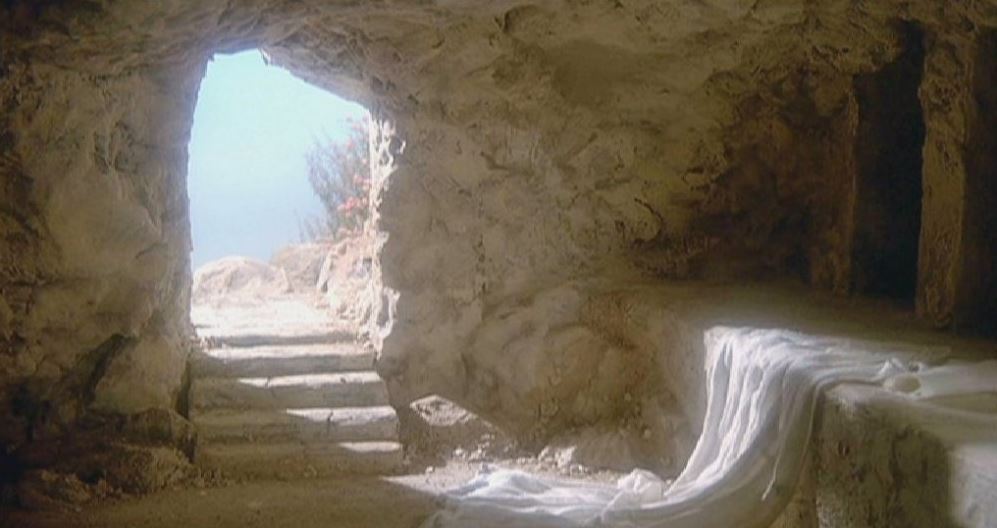
Easter Sunday Gospel Choices – Our Lord is Risen Indeed

Matthew 28:1-10 (This is the early service reading)

John 20:1-18 (This is an option for the principal service reading)

or

Mark 16:1-8 (This is an option for the principal service reading)

Luke 24:13-49 (This is the evening service reading)

——————————————————————————–

These are the readings that come from the four Gospels, all telling of the Sunday event Christians recognize as “Easter.” The same readings revolve over the three year cycle of the Episcopal Lectionary, Years A, B, and C. The order presented here is for Year B, 2018. These variations on the same theme [Luke’s reading is tailored for an evening service, focusing on that Sunday’s afternoon, rather than the morning’s discovery] will next be read aloud in a church by a priest on Easter Sunday, April 1, 2018. Certainly, all are important as they tell of the miracle of Jesus’ Resurrection from death, as witnessed by those close to Jesus of Nazareth. That return to life fulfilled the promise Jesus had made, which also fulfilled the prophecies of the Old Testament.

In two of these readings (Luke and John), the resurrection of Jesus is referred to as “the first day of the week.” In the other two, the day is identified as “after the sabbath” (Matthew) or “when the Sabbath was over” (Mark), with Matthew adding that it was “the first day of the week.” None of them identified that day as “Sunday,” as the Hebrew equivalent is “yom rishon” (“first day”).

Here is a blank calendar, typically used in English-speaking countries.  One can see how Sunday has been affixed into the position that reflects it as the first day of the week, making Saturday the seventh day (the Sabbath):

While Americans commonly call the combination of Saturday and Sunday a “weekend,” such that Monday feels like the first day of the week, that feeling likewise projects upon Sunday as the end of a week.  One can get a feel that Sunday is the seventh day, thus the Christian sabbath day. However, please note that concept is pagan, as it goes against how God told Moses to order the days, which corresponds with the seven days of Creation.

God never ordered anyone, other than the Israelites, to establish a calendar that denotes a Sabbath day as holy. Thus, if anyone wants to make a “week” longer than seven days, or start a “week” on any day one chooses, while calling a day by any name other than a number, that is one’s freedom … as a pagan. No one is commanded to have a calendar for each year, nor have any special dates marked for remembrance.  Still, it seems other civilized peoples (other than the Israelites) realized marking time was important.

They say Stonehenge is a pagan calendar that marked the movements of celestial bodies, such that “Sun day” is related to that orb of life-giving light, with “Moon day” the same recognition on another day [Monday].  Saturday is devoted to recognition for Saturn, whose pagan characteristics are like those of the Old Testament Yahweh.  Because there are seven astronomical orbs of lights (luminaries and planets), each was given a day of recognition, thus a seven-day week evolved.  Still, with that known, non-pagans (including Christians) will always recognize the seventh day as holy (the Sabbath); and Sunday, likewise, will always be the first day of the week.

By grasping that Jesus was realized risen on the first day of the week, one can realize the New Creation of God’s Covenant with human beings springing to life at that time. The first day of the week means rest is over and there is new work that needs to be done. God’s Covenant with Moses, which does nothing to change His Covenants with Noah and/or Abraham, is not an “Old Testament,” as if “old” translates as “outdated” and “undone.” Instead, the New Covenant is the expansion from the First Testament, as a New Amendment. The new requires more than birthright, as Gentiles are now permitted to play a role in God’s plan (Thanks be to God, from us Gentiles of America) for all mankind to serve God. That new amendment to serve God comes through Jesus Christ, who was first known as the Christ on a Sunday … the first day of the week.

In that vein of thought, serving God through Jesus Christ is demonstrated to be more than simply believing Jesus rose after being dead for three days. In John’s account, Mary Magdalene stood at the open tomb weeping, when the risen Jesus asked her why she was crying. Mary is said not to recognize the man she loved dearly, “supposing him to be the gardener.” That needs to be reflected upon.

If you have ever driven to a cemetery to pay your respects to a deceased loved one, you will notice there is a small staff that manages the grounds, cutting the grass, placing artificial flowers at gravestones, and making sure weeds and leaves are cleared away. One such groundskeeper could be termed a “gardener.” John wrote the word “kēpouros,” which translates as “gardener or garden-keeper,” which by itself implies this tomb site was lush and green; but a tomb carved into rock is not typically surrounded by such flourishing plant life. Supposing the intent of Mary, as told to John (who had already left the scene with Peter), was more than a simple mention of a man thought to be the groundskeeper.  One then needs to see that “Freudian slip,” associated with that failure to see Jesus as Jesus, as a purposeful statement of Jesus appearing as someone else … someone Jesus is like.

Pop Quiz question: Who is the most famous gardener in all the Holy Bible? You have one minute to think about your answer.

<Pause for one minute>

Time’s up. The answer is Adam. [You knew that!]

That reference is then a statement that Jesus had the same soul as the one God breathed into his Son; but the physical Jesus did not look like the physical Adam, from who’s physical DNA Jesus was descended, many times modified over the ages.[1]  That means that Jesus’ claim to be the Son of Man (where the Hebrew word “adam” means “man”) was based on him repeatedly saying, my soul has reincarnated several times since it fell to Earth in the form of Adam, the Son of God. Adam lived in the Garden of Eden, and because of his skills for tending to natural things, Adam was told to till the earth after his fall from Heaven (hint: there are more weeds on earth, than in Heaven).

So, regardless of the double entendre, where Mary literally though Jesus was a groundskeeper, John wrote “gardener” from being in possession of the Mind of Christ, writing the Word of God. As a “gardener,” Jesus was seen in the form of the first Son of God.  That means there are no mistakes and nothing written anywhere in Scripture that cannot become more that it first appears, as “kēpouros” [“gardener”] expands to become further explanation towards understanding the holiness of John’s text.

Of course, Jesus appearing as a gardener was not the only time he appeared in some other form. The optional reading for an evening Easter service comes from Luke, where those particular verses are typically called “The Road to Emmaus.” There, Luke wrote, “Jesus himself came near [to two of the disciples] and went with them, but their eyes were kept from recognizing him.”

The two disciples were not of the eleven principal disciples of Jesus, but followers of Jesus. The Greek written by Luke actually does not refer to “disciples,” but to “two of them.” When one is later named as being Cleopas, who is believed to have been the brother of Joseph, the husband of Mary, the human “father” of Jesus, this would make Cleopas the uncle of Jesus. Because John referred to “Mary of Clopas,” as one of the three Mary’s who stood at the cross of Jesus, this is believed to make her the wife (possibly daughter) of Cleopas. This would then identify the “two of them” as being relatives who knew Jesus very well, “but their eyes were kept from recognizing him.”

A couple of things need to be grasped about the seven miles to Emmaus (sixty furlongs). First, that was too far to walk on a Sabbath, due to the restrictions on how far one can walk on the day of rest. Cleopas and Mary had been in Jerusalem for the final prayer service of the eight-day Passover festival [a morning prayer, which on that particular ending day was done on a Sabbath morning], meaning they probably stayed in the upstairs room that had been secured for Jesus and his disciples until Sunday morning. While ordinary years would have allowed them to travel back and forth from home, during the week-long event, the arrest, trial, torture and execution of Jesus, followed by his temporary burial in the tomb of Joseph of Arimathea, would have kept them in Jerusalem all of the eight days. Now, with the Passover over, as well as the Sabbath, it was time for them to go home; but as they walked, they were “and talking with each other about all these things that had happened.”

Second, the road to Emmaus was the same road that cut through Jerusalem, with the eastern direction called the Jericho road, with Emmaus being due west.
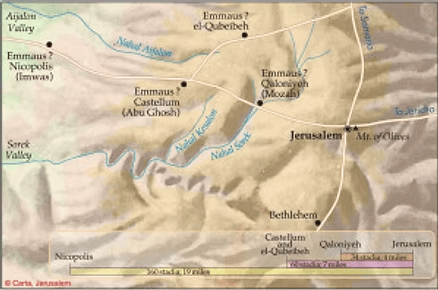
Cleopas and Mary would not have been the only ones walking this road, as many pilgrims from the west would have traveled the same road. The Roman road would have ended at the Mediterranean Sea, with a road leading to Joppa being a branch off that road headed more northerly. Joppa would have been a place for European pilgrims to find sea passage back home. Still, foreign travelers in Judea for the Passover would have planned to stay until Shavuot [Festival of Weeks, beginning at Pentecost], so the further away from Jerusalem pilgrims walked, the easier it would have been to find rooms for a two-month stay.  Thus, walking and talking with strangers would have been common, if not preferred, simply to find safety in numbers.
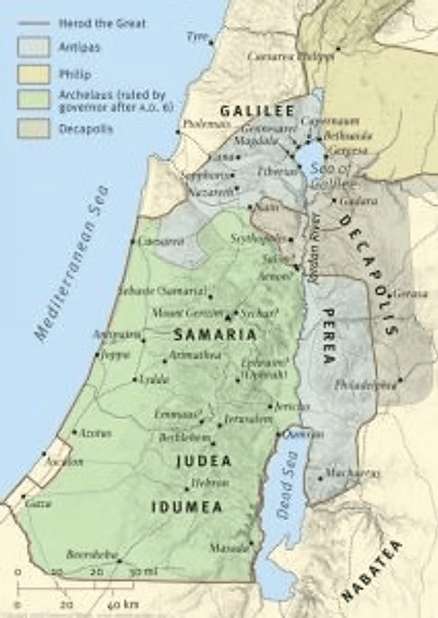
Jesus, appearing as some pilgrim headed home after the Passover, came upon Cleopas and Mary as they were discussing the past week and how it played out for their nephew. Jesus acted like he did not know who they were talking about, which led them to explain more. However, that led Jesus to tell his family members, “Oh, how foolish you are, and how slow of heart to believe all that the prophets have declared! Was it not necessary that the Messiah should suffer these things and then enter into his glory?”

Jesus knew he had foretold all that would happen, exactly as it went down, but he was speaking to deaf ears, blind eyes and closed minds. Cleopas and Mary had been there and heard those prophecies, but (like all the other disciples and followers of Jesus) they were slow to take his words to heart, the place in devoted humans where God resides. Thus, no one believed the truth of Jesus’ words, because they preferred to ignore the truth and believe what they wanted to believe (a common flaw in the faithful to this day).

We then read that after Jesus called his relatives “foolish,” “then, beginning with Moses and all the prophets, [Jesus] interpreted to them the things about himself in all the scriptures.” Seven miles they walked as Jesus talked the truth. All the while, the hearts of Cleopas and Mary were burning within them, as Jesus was “opening the scriptures” to them.

When Luke wrote the word “diēnoigen” (translated as “he was opening”), the root word means: Properly: “opening the ears and the eyes, such as to restore hearing and sight. Tropically: “to open the sense of the Scriptures, explain them; to open the mind of one, i. e. cause him to understand a thing; and to open one’s soul, i. e. to rouse in one the faculty of understanding or the desire of learning.”[2] (Thayer’s Greek Lexicon)  Therefore, Jesus (as a stranger to his aunt and uncle) spoke to them as one filled with the Holy Spirit and the gift of interpreting prophecy.  ALL who possess that holy talent speak in the name of Jesus Christ, whether they look like “picture book Jesus” or not.

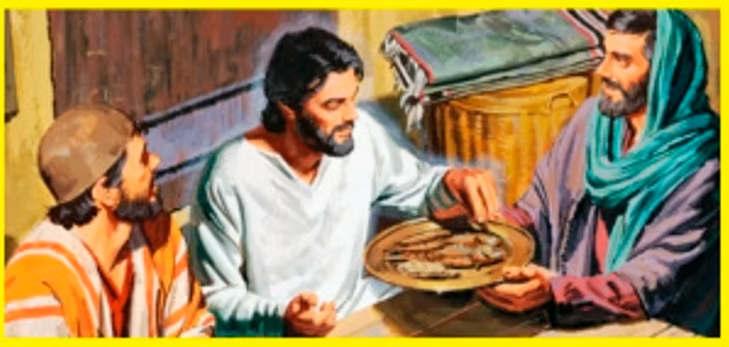
When Cleopas and Mary came to the place where their home was off the main road, they did not want to leave this stranger who had opened their eyes and hearts so widely.  From desire to know more, they invited unrecognizable Jesus to stay at their place overnight. We then read, “When he was at the table with them, he took bread, blessed and broke it, and gave it to them. Then their eyes were opened, and they recognized him.”

They recognized Jesus because Cleopas and Mary had been present at the Passover Seder meal ten evenings prior, when Jesus presided over the ritual dinner.  They had watched Jesus do the exact same thing then, as he had just done at their dining table.  They had not seen the power of those words then; but with their hearts alive with fire and passion for the the truth of God’s Word, they vividly flashed back to that Passover Seder message forgotten.

This is where bread has to be seen as symbolic of the written Scriptures, which Jesus had just enlightened Cleopas and Mary about: Moses and all the prophets wrote the texts that all Jews were fed from. That bread is unleavened, in the sense that Scripture is written in basic ingredients.  Those words do not give rise, as leavened, until consumed and swollen to full meaning by the “yeast” of the Holy Spirit.  Thus, that bread is blessed by God, as Holy Words, and those Holy Words are broken into books, chapters, verses and individual words – ALL of which have divine meaning the blind eye cannot see.
The man Cleopas and Mary had just walked seven miles with had just made them vividly recall that Passover Seder with Jesus, who was then known to be the Christ.  Before, he was just Mary’s special son, Jesus, a charismatic with a penchant for preaching and a knack for working miracles.  However, for the first time Jesus had opened the minds of his close relatives to Spiritual knowledge, which came by his breaking of the bread of Scripture and presenting it to them to digest.

Luke then wrote, “he vanished from their sight,” where the Greek word “aphantos” means, “disappearing, invisible, hidden.” This was not the first time that Jesus had eluded people, as John wrote about Jesus escaping the hands of his haters in his seventh and tenth chapters. This ability to become invisible or to disappear or to become hidden beyond view is a power from the divine.

This disappearance can be explained as a hallucination shared by Cleopas and Mary, where they actually did walk with a strange pilgrim, but the Holy Spirit made it appear that stranger was talking to them. The hallucination could have then come into their home, due to their heightened belief, while the actual strange pilgrim kept walking on the road to the west. Jesus disappeared simply because he was not in that Emmaus home as a strange pilgrim.  Jesus was there in Spirit, one that was invited by Cleopas and Mary to stay with them.  That presence symbolizes how all whose hearts burn to serve God must welcome God into their hearts.

It is this hallucinatory state that makes this account on the road to Emmaus become parallel to Mary Magdalene speaking with a gardener.  Mary never saw the gardener as Jesus in the flesh.  She heard his words and recognized it was Jesus, in the same way that Cleopas and Mary did.  The hallucinatory state reflects how each disciple of Jesus must seek him first.  Then, when Jesus appears in unrecognizable form to answer our call, a true Christian will recognize the presence of Jesus Christ, by understanding the messenger sent in his name.

Then, Luke tells of Cleopas and Mary hurrying back to Jerusalem and the upstairs room. It was still light outside, but technically night time, close to 8:00 PM by the time they were back in the upstairs room. Thomas, who had been out procuring dinner for the disciples and their companions when Jesus first appeared among them, was back then (he brought back some fish for them to broil). One could imagine the door was locked, due to the fear of the Temple being proud of murdering innocent Jews; but suddenly there was Jesus again standing among them.

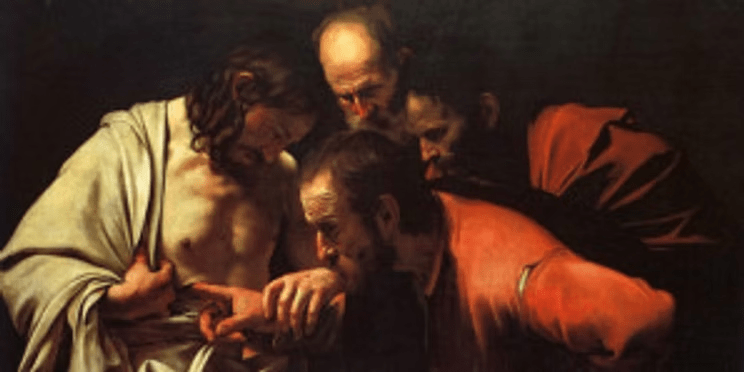
Then, as the time earlier, Jesus appeared in a recognizable form, complete with body wounds from having been flogged, crucified and speared. One would imagine Jesus was fully dressed, just as the gardener and the travelling pilgrim would have been, even though the burial preparation would not have clothed Jesus’ body in anything more than shroud, face linen, and prayer shawl (provided by family). This means Jesus wore heavenly clothing, despite appearing earthly natural. One would imagine Jesus opened his robe for Thomas to feel his spear wound.

Before anyone starts to think that Jesus was a hologram or beamed to earth by God, look at how Jesus said he was not a ghost.

Jesus was real, in the flesh, the same flesh that had been prepared for burial the past Friday. He asked for food, which he ate before them so they could see how real he was. He was real when he stood before Mary Magdalene. He was real when he walked with Cleopas and Mary; and he was real standing among his followers in the upstairs room in Jerusalem. However, the most important element of that reality is discerned from Jesus saying (according to Luke), “Thus it is written, that the Messiah is to suffer and to rise from the dead on the third day, and that repentance and forgiveness of sins is to be proclaimed in his name to all nations, beginning from Jerusalem. You are witnesses of these things. And see, I am sending upon you what my Father promised; so stay here in the city until you have been clothed with power from on high.”

The reality of Jesus was the fulfillment of the prophecies that foretold his coming, death, and resurrection. The imaginary of prophecy had become real. While Jesus told the pairs of eyes standing with him at that time, “You are witnesses of these things” … “You are witnesses to this realization of divine prophecy” … Jesus would not be able to produce any new human witnesses to him in the flesh … a real Jesus … after he would Ascend to Heaven. Therefore, when Jesus then said, “See, I am sending upon you what my Father promised” … the Holy Spirit … Jesus meant the Father promised a Messiah that would last an eternity (see Micah 5:2).  Therefore, Jesus would last a lot longer than 33 years, as he has not ever left, through the reality of the Holy Spirit.  That was why Jesus then instructed his followers to stay in Jerusalem “until they had been clothed with power from on high.”

Now, while I allow that last statement of Jesus sink in a little, let me point out that Jesus appearing to his followers in the upstairs room took place in the evening on technical Sunday; but because the Hebrew calendar recognizes that to be the evening of the next day, Jesus gave that command on a Monday. Monday would represent the ninth day in the Counting of the Omer. That means Jesus stayed with his followers and taught them for forty days – from Tuesday, the tenth day of that counting, until the Sabbath, the forty-ninth day.

This means Jesus Ascended on the Sabbath, but returned via the Holy Spirit on Pentecost, the fiftieth day of that count … another Sunday. This means the disciples spoke as Jesus had spoken, because the Holy Spirit clothed those followers with the power of Jesus Christ, from on high, on that day.

The missing day – Monday – is referred to in John’s Gospel, which was a dream rather than reality. The dream of John had the disciples fishing unsuccessfully on the Sea of Galilee, when Jesus had just told them all to stay in Jerusalem. The dream is confirmed to be that when one realizes that Capernaum was over 100 miles from Jerusalem (ref.), and it would have taken about five days to walk that far.

The symbolism of John’s dream can then be applied to the disciples’ state of mind, which was they were in shock. They had just watched Jesus be tried, tortured, crucified, buried, and then stand before them eating broiled fish, pointing out his still fresh wounds.  They had shook with fear that the Temple Jews would look to kill them next, with Lazarus already on their preferred hit list.  All that happened on Sunday had then left them dazed and confused.  Monday was then a day to take a deep breath and calm down, as basic training for receiving the Holy Spirit would begin the following day.
Still, with all of the readings that are representative of the proof that Jesus resurrected … proof that no Christian living today can swear to, no one can prove to another that resurrection.  No one today can say, “I have seen the risen Lord stand before me in a real human body.” All the witnesses of real Jesus have passed from this world; and that is the deepest meaning of Easter Sunday. Jesus has risen in unrecognizable forms, through the Holy Spirit.

While we all are still eight Sundays from celebrating Christian Pentecost (a wholly symbolic recognition of the Holy Spirit), Jesus suddenly appeared and disappeared on the first day of the week to foretell his coming within true Christians. A true Christian can only be defined as one who has been clothed within as Jesus, with all the power the Christ Mind bestows, from on high.

A true Christian, like Jesus, dies of self and is risen as Jesus Christ. A true Christian is dead to self-serving, as being Jesus Christ demands serving God, through going to help others in Spiritual need. Disciples of Jesus tremble in fear at the ghost of Jesus expecting them to leave the safety and security of a locked door to an upstairs room; but a true Christian hears Jesus say, “Why are you frightened, and why do doubts arise in your hearts?” Jesus reborn within one means “Peace if with me,” and when one can say that, then Jesus is walking the earth once again in unrecognizable form.

The Lord is risen indeed, when the Lord is alive in a true Christian. That is why Easter is much more than one man coming back to life after death. If that were the case, then Lazarus rising from death was an equally important event … one that no church recognizes on the level of Easter.
“Lazarus come out!” must speak to you. You must become Lazarus in order to become Jesus Christ reborn.

While one can say, “Jesus was the magician who was so special he commanded Lazarus to “Come out!” then who was it who commanded Jesus to do the same? The answer is not the power of the Son of Man but the power of God. God gave life back to Lazarus and God gave life back to Jesus. Therefore, Easter stands as the miracle of Moses crossing the Israelites through the Red Sea on dry ground, because God is the one with the power to part physical from spiritual, wet from dry, captivity from freedom … to separate mortal death from life everlasting.

Not much is written about Lazarus after he rose from death. John wrote that he and Jesus had a dinner in their honor on the evening of technical Sunday, prior to Jesus entering Jerusalem on a donkey colt for his final Passover festival. The Eastern Orthodox Church believes that Lazarus fled Judea to Cyprus, where “he was appointed by Paul and Barnabas as the first bishop of Kition (present-day Larnaka).” (Wikipedia)

The Western Church believes in the lore of the small town Saintes-Maries-de-la-Mer [Saints-Mary-of-the-Sea], on the Mediterranean coast of France.  There Lazarus arrived, along with three Mary’s (Mary Magdalene, Mary Salome, and Mary of Cleopas).
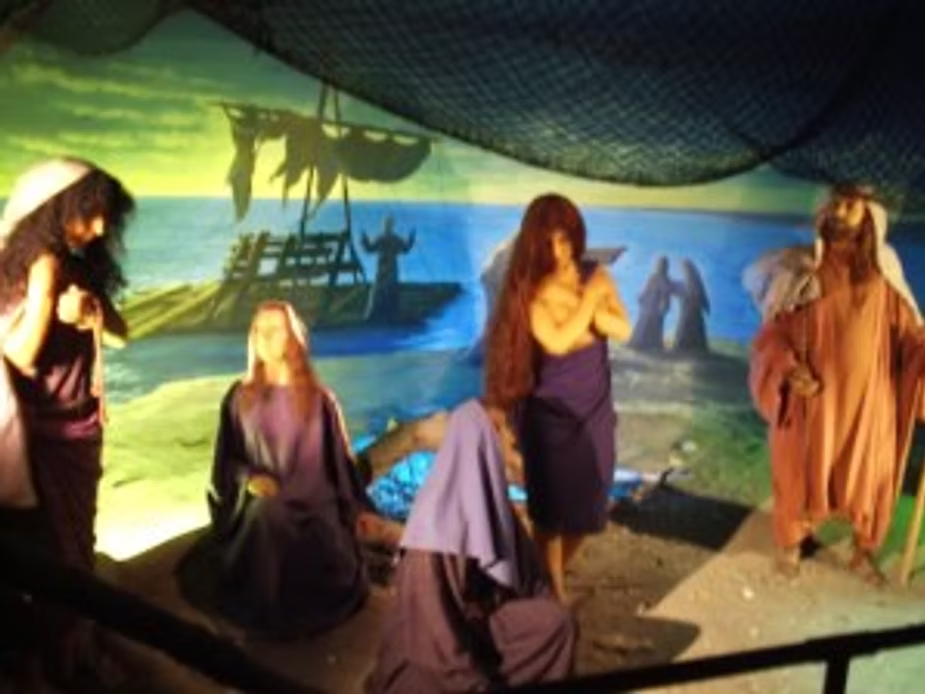
Wax figures depicting the event in a museum of Provence history.

Lazarus is said to have gone to Marseilles [nearby to the east], where he converted many local pagans to Christianity, being called the Bishop of Marseilles. (Wikipedia, same as above) Supposedly, Lazarus lived for thirty years after he was raised from the dead, never smiling because of having seen the misery of souls in Hades, while he was dead.

Lazarus and Jesus can be seen as a duality, with one human and one divine. Lazarus rose and continued living as a divinely changed man. Jesus rose, taught his disciples for forty days, Ascended, then returned as the divinity that led Lazarus to become like Jesus. Likewise, Jesus returned to be the divinity of Peter and the other ten lead disciples, plus all those companions who witnessed Jesus standing risen among them (Lazarus probably was one also there). Jesus was reborn in 3,000 pilgrims to whom the Apostles opened the Scriptures (in foreign tongues). This makes Easter become a duality with Pentecost, where Easter is human devotion and Pentecost is divine practice (faith and works).

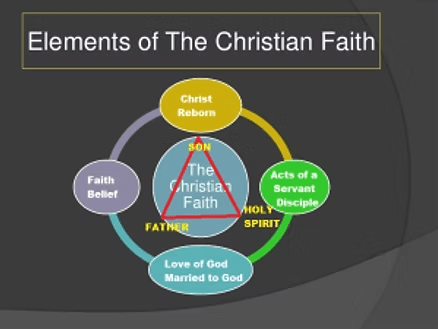
Jesus is the model by which ALL Christians are formed. Humans must conform to that model to receive the Holy Spirit and become divine.  Divinity comes by the love of God [burning hearts married to the LORD] and the birth of Christ in one’s mind. Moses built the model upon which Israel [and Judah] was formed, building human forms of devotion to the One God. Jesus was the duality to Moses, who built the model upon which the devoted received new life from the One God. Thus, one must be devoted to the One God first [the First Covenant] before one can evolve into a human that truly serves the LORD through Christ [the New Covenant].

Easter is the dawning [the Sunrise] of that necessary change.
One has to stop fearing one’s own death of self and give one’s heart and soul over to God’s Will. Easter is then the rebirth of one’s devotion, where one does not pray to an unseen, unfelt, and unknown God, but instead one feels burning in one’s heart, with love of the power of God, which one has seen and heard through opened Scriptures. Easter is then the desire to learn more, from the knowledge of God that comes from the presence of Jesus Christ teaching one the hidden truth that God’s Word holds. Easter is then the absorption of God’s knowledge for the purpose of spilling that knowledge out unto others of devotion [Pentecost Day].

This is how Easter is more than Jesus rising from death. Jesus has to be risen within all Christians for Jesus Christ to be alive in this world today. It is through true Christians that Jesus walks the road of life still, explaining the Scriptures to those who are saddened because they think Jesus is dead and there will not be another Jesus until the end of the world. Jesus is alive today though his gardeners, those who plant the seeds of insight into those who love Jesus, but previously had only wanted to dress, perfume, and decorate his body of death [hold the cross of crucifixion high, rather than the + of life in the Trinity: Father, You, Holy Spirit].

Easter is thus like Spring, when the death of Winter is replaced by the Rebirth the ever-living Vine, budding so that new fruit will come.

——————————————————————————

[1] In case anyone doubts this, I recommend reading Luke’s chapter 3.  The last verse state:, “The son of Enosh, the son of Seth, the son of Adam, the son of God” (Luke 3:38).

[2] Some might note – IF one’s heart is burning – that I write these “articles” in the same sense of “opening the Scriptures” for understanding, as well as to remove the plugs and blinders that have impeded one’s own ability to discern these things.

Acts 10:34-43 – For Easter Sunday

Peter began to speak to Cornelius and the other Gentiles: “I truly understand that God shows no partiality, but in every nation anyone who fears him and does what is right is acceptable to him. You know the message he sent to the people of Israel, preaching peace by Jesus Christ–he is Lord of all. That message spread throughout Judea, beginning in Galilee after the baptism that John announced: how God anointed Jesus of Nazareth with the Holy Spirit and with power; how he went about doing good and healing all who were oppressed by the devil, for God was with him. We are witnesses to all that he did both in Judea and in Jerusalem. They put him to death by hanging him on a tree; but God raised him on the third day and allowed him to appear, not to all the people but to us who were chosen by God as witnesses, and who ate and drank with him after he rose from the dead. He commanded us to preach to the people and to testify that he is the one ordained by God as judge of the living and the dead. All the prophets testify about him that everyone who believes in him receives forgiveness of sins through his name.”

——————————————————————————–

This is the reading from the Episcopal Lectionary for Easter Sunday, Year B 2018. It will next be read aloud in a church by a reader, as an Easter replacement for either the Old Testament or Epistle reading, on Easter Sunday, April 1, 2018. It is important as it tells of the ministry that will comes after the resurrection of our Lord in an Apostle.   Serving God would no longer be limited to one small sect of believers in the One God (Jews), as professed faith would no longer be the determining factor of devotion.

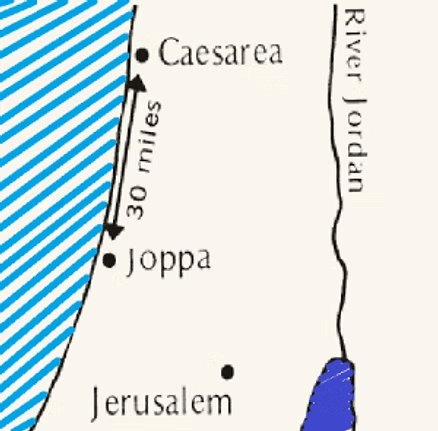
In this reading, Peter has been divinely called to meet with Cornelius, who was a Roman Centurion in Caesarea.  Cornelius had also been divinely called to send men to Joppa to request Peter’s presence.  Because of a spiritual dream, Peter went to meet with a Gentile who had found the God of the Jews worthy of praise.

When we read, “Peter began to speak,” the literal Greek says, “Having opened moreover Peter the [one] [his] mouth.” This should be seen as a statement of how Peter’s mouth was opened by the Holy Spirit, just as it was on the day of Pentecost.  As such, Peter’s mouth – lips and tongue – was moving, but the Word of the Holy Spirit was coming out.  Peter spoke, but he spoke from the same divine source that put Peter in the presence of Cornelius.

This means that when Peter’s mouth said, “anyone who fears [God] and does what is right is acceptable to [God],” that does not mean he set forth an expectation that God puts up with whatever anyone wants to do, as long as they do what is right. That leaves “what is right” up to one’s interpretation of “good” and “right.”  It makes human definitions of what God expects become a question of acceptability.  To get that implication makes the translation become misleading.

The Greek words actually written, “ergazomenos dikaiosynēn,” say “working righteousness,” rather than “does what is right.” This means that when one is working righteousness, then one is filled with the Holy Spirit, acting on God’s behalf. The qualifications have nothing to do with one’s Jewish heritage or lack thereof. Thus “acceptable” (“dektos”) means God has “received favorably” the heart and soul of one who prays devoutly for God’s guidance [as had Cornelius and Peter].  Such devotion in a person makes that person be “accepted” by God, and the Holy Spirit has been “accepted” by that person in return. That is how one acts from righteousness.

[Hint: This is why Easter has readings from the Acts of the Apostles.]

When Simon-Peter said, “He commanded us to preach to the people and to testify that [Jesus Christ] is the one ordained by God as judge of the living and the dead,” the element of “living” says “those who are alive via the Holy Spirit – as Jesus Christ reborn.”  Jesus is only possible to come into the living; and Jesus coming into one can only result in that one gaining eternal life.

Because all who have received the breath of life at birth [from exiting a mother’s womb], all human beings have been given mortal life, which in turn (eventually) leads to an end in mortal death. Therefore, Peter said [via the Holy Spirit] that being reborn as Jesus Christ brings the judgment of life, while not receiving that Spirit keeps one locked into the mortal judgment of death. The rebirth of Jesus Christ within a servant to the LORD is wholly “ordained by God,” and not up to the human being to cast judgment otherwise.  God, then, is the judge of who lives eternally (with Jesus Christ protecting that soul) and who is returned for reincarnation or soul punishment (without Jesus Christ protecting that soul).

When Peter ended this reading by stating, “Everyone who believes in him receives forgiveness of sins through his name,” one has to grasp that “through his nameONLY comes by being reborn AS Jesus Christ. One can ONLY receive forgiveness of sins by belief that reaches a level of faith that is pleasing to God [acceptability]. For one’s love of God and faith in Jesus as the Messiah, one is sent the Holy Spirit by God, so one begins ACTING RIGHTEOUSLY … just as did Jesus of Nazareth [all his life].

As a reading that accompanies the Easter Resurrection lessons, one must see that the Resurrection of Jesus was for a promise of eternally offered redemption to those who follow in the footsteps of Jesus (as Jesus’ soul reborn in flesh, one with a saved soul). After Jesus Christ ascended to Heaven on the forty-ninth day [the seven Sundays of Easter], his Spirit [thus his name] returned in those who had shown faith and devotion. In return, they were granted eternal life over mortal death, because they chose to sacrifice themselves to the will of God. From Pentecost that year and until their deaths, the Apostles (Saints) acted from righteousness, doing what was acceptable to God.

1 John 1:1-2:2 – God is Light and without darkness

We declare to you what was from the beginning, what we have heard, what we have seen with our eyes, what we have looked at and touched with our hands, concerning the word of life– this life was revealed, and we have seen it and testify to it, and declare to you the eternal life that was with the Father and was revealed to us– we declare to you what we have seen and heard so that you also may have fellowship with us; and truly our fellowship is with the Father and with his Son Jesus Christ. We are writing these things so that our joy may be complete.

This is the message we have heard from him and proclaim to you, that God is light and in him there is no darkness at all. If we say that we have fellowship with him while we are walking in darkness, we lie and do not do what is true; but if we walk in the light as he himself is in the light, we have fellowship with one another, and the blood of Jesus his Son cleanses us from all sin. If we say that we have no sin, we deceive ourselves, and the truth is not in us. If we confess our sins, he who is faithful and just will forgive us our sins and cleanse us from all unrighteousness. If we say that we have not sinned, we make him a liar, and his word is not in us.

My little children, I am writing these things to you so that you may not sin. But if anyone does sin, we have an advocate with the Father, Jesus Christ the righteous; and he is the atoning sacrifice for our sins, and not for ours only but also for the sins of the whole world.

——————–

This is the Epistle reading selection for the second Sunday of Easter, Year B, according to the lectionary for the Episcopal Church.  It will be preceded by the mandatory Acts reading chosen for this week, which says, “the whole group of those who believed were of one heart and soul.”  It will follow a reading from Psalm 133, which sings, “Oh, how good and pleasant it is, when brethren live together in unity!”  It will also be accompanied by the Gospel reading selection from John 20, where Jesus said, “Blessed are those who have not seen and yet have come to believe.”

——————–

A Lesson in Scripture Reading

In the NRSV translation above, I have placed in bold type every use of the word “and.”  In the first chapter of this letter by John there are ten verses.  In those are found twenty-two uses of the word “kai,” with one of those capitalized.  Eighteen are translated in the above’s first two blocks.  There are three more uses of “kai” found in the two verses read from chapter two [the third block above].  The translation above shows two of them.  In 307 words total [a Word ‘word count’], eight percent [8 out of 100] are the word “kai.” 

It needs to be realized that all uses of the word “kai” in the Greek texts of the New Testament need not be translated as “and,” as the word is not God commanding, “And another thing” through His prophets.  It is, instead, a signal for the reader to pay close attention to the important statement that follows.  That statement can be one word or a series of words.

In the total of twelve verses, there are 54 segments, where a segment is a clear separation by punctuation marks, or the presence of the word kai, or both together, where punctuation is immediately followed by the word “kai.”  There are no verses where the word “kai” is absent.  One verse [verse 4] is only one segment [nine words, excluding kai], but it is begun by the signal word that says that verse is important.

Each verse begins a new segment of words.  Once begun, a verse can be divided into separate segments, marked by punctuation marks.  In a segment of words separated by punctuation marks, there may be the appearance of the word “kai” internal to a segment.  While the word “kai” does not present a separate line of thought, it does break the segment it appears in into parts, where its presence denotes important parts of that segment’s statement [line of thought].  In some verses there is a separation by punctuation, immediately followed by the word “kai.”  Those separate into a new line of thought, where that new line importantly begins with a statement of power.

In this specific reading from John’s first letter, the breakdown of the twelve verses is as such:

Chapter 1:

          First verse has 6 segments [4 commas, 1 kai], ending in a dash.

          Second verse has 5 segments [2 comma – kai combos, 3 kai], ending in a dash.

          Third verse has 9 segments [3 commas, 1 comma – kai combo, 1 period – kai combo,3 kai], ending in a period.

          Fourth verse has 1 segment [begun by kai], ending in a period.

          Fifth verse has 5 segments [2 commas, 2 comma – kai combos, 1 Kai], ending in a period.

          Sixth verse has 4 segments [1 comma, 1 comma – kai combo, 1 kai], ending in a period.

          Seventh verse has 5 segments [3 commas, 1 comma – kai combo], ending in a period.

          Eighth verse has 3 segments [1 comma, 1 comma – kai combo], ending in a period.

          Ninth verse has 4 segments [2 commas, 1 comma – kai combo, 1 kai], ending in a period.

          Tenth verse has 3 segments [1 commas, 1 comma – kai combo], ending in a period.

Chapter 2:

          First verse has 5 segments [3 commas, 1 period – kai combo], ending in a period.

          Second verse has 4 segments [1 comma, 1 semi-colon, 2 kai], ending in a period.

To look at each of the places where the word “kai” is written, in order to grasp the fullness of importance, there should be no paraphrasing from translation allowed.  In addition, the various ways the Greeks write “the” and pronouns such as “I, we, us, our,” need to be carefully inspected so a general “he” [“he” who?] is not translated.  Here, look at where I have used “ours” or “of this” or “this.”  Such translations act more definitely, requiring one to look to the text to realize who or what “this” is.  Based only on the segments or parts of segments begun by the word “kai,” and the literal translations I provide, see how this forces one to see importance stated, rather than an “oh another thing” addition written.

   1:1 “kai  hai cheires hēmōn epsēlaphēsan”  –  “and  them hands of ours have touched”

   1:2 kai  hē zōē ephanerōthē”  –  “and  this one life was made known”

   1:2 “kai  heōrakamen”  –  “and  we have seen”

   1:2 “kai  martyroumen”  –  “and  bear witness”

   1:2 “kai  apangellomen hymin tēn zōēn tēn aiōnion hētis ēn pros ton Patera”  –  “and  we proclaim to you this life this eternal who were with this one Father”

   1:2 “kai  ephanerōthē hemin”  –  “and  was made clear to us”

   1:3 “kai  akēkoamen”  –  “and  have listened”

   1:3 “kai  hymin”  –  “and  to you”

   1:3 “kai  hymeis koinōnian echēte meth’ hēmōn”  –  “and  you personally spiritually fellowship may have in company with this one Son of his”

   1:3 “kai  hē koinonia de hē hēmetera meta tou Patros”  –  “and  this fellowship now this of ours in company with this one Father”

   1:3 “kai  meta tou Huiou autou”  –  “and  with this one Son same”

   1:4 “kai  tauta graphomen hēmeis hina hē chara hēmōn ē peplērōmenē”  –  “and these write we in order that this one source of joy of ours this fulfill”   

   1:5 “Kai  estinhautē hē angelia hēn akēkoamen ap’ autou”  –  “And  exists here this one message which we have comprehended from same”

   1:5 “kai  anangellomen hymin”  –  “and  we declare to you” 

   1:5 “kai  scotia en auto”  –  “and  spiritual darkness in self”

   1:6 “kai  en tō skotei peripatōmen”  –  “and  in this moral darkness would conduct life”

   1:6 “kai  ou poioumena tēn alētheian”  –  “and  not causes this truth”

   1:7 “kai  to haima Iēsou”  –  “and  this blood of Jesus”

   1:8 “kai  hē alētheia ouk estin en hemin”  –  “and  this truth not exists in us”

   1:9 “kai  dikaios”  –  “and  righteous”

   1:9 “kai  katharisē hēmas apo pasēs adikias”  –  “and  might cleanse us from every kind of unrighteousness”

   1:10”kai  ho logos autou ouk estin en hemin”  –  “and  this word of this not exists in us”

   2:1 “kai  ean tis hamartē”  –  “ and  if certain would have sinned”

   2:2 “kai  autos hilasmos estin peri tōn hamartiōn hēmōn”  –  “and  same appeasement to God exists concerning of them failures ours”

   2:2 “kai  peri holou tou kosmou”  –  “and  concerning complete of this world”

The only point I want to make from all this painstaking breakdown of what John wrote in his first epistle is this: There is much more than first meets the eye, when holy texts are concerned; and, they should be seen as translated into English as ‘primary school’ ways to learn the Word of Yahweh.

——————–

The Apostle John who wrote epistles, including The Apocalypse, was not John the brother of James, sons of Zebedee.  John must be seen as a common name, just as the name Mary.  The John who wrote epistles is the same John who wrote one of the four Gospels.  That John referred to himself in his Gospel as “the one who Jesus loved.”  He also wrote that about Mary Magdalene, as a sign of family relationship.  Therefore, John was related to Jesus and Mary Magdalene, as the son born between those two parents.

In John’s Gospel, as the last two verses, he wrote: “[John] is testifying to these things and has written them, and we know that his testimony is true. But there are also many other things that Jesus did; if every one of them were written down, I suppose that the world itself could not contain the books that would be written.” (John 21:24-25, NRSV)

In that simplified translation, John said everything he wrote, and therefore anything anyone wrote as direct testimony from one who has been reborn in the name of Jesus [as Yahweh’s Anointed One], everything is “true.”  That means every word is divinely inspired, simply because the Greek word written [“aléthés”] means: “unconcealed, true, true in fact, worthy of credit, truthful.”  The usage of “true” says, “what can’t be hidden,” and that “stresses undeniable reality when something is fully tested, i.e. it will ultimately be shown to be fact (authentic).” (HELPS Word-studies)  That definition of “true” is why I have displayed what John wrote in this letter as I have.  It is “truth” that has been concealed in simplistic language, the same whether one is reading with a Greek language brain or with an English language brain.  It is “truth” that stares one right in the face and cannot be seen, unless one takes the time to look for the unconcealed “truth.”

When John then wrote, “if every one of them were written down, I suppose that the world itself could not contain the books that would be written,” this must be seen as a reference to the knowledge Jesus passed onto his Apostles.  That goes well beyond the forty days the physically resurrected Jesus spent with them, before they became Apostles on Pentecost.  It speaks of the depth that Jesus pointed out to his disciples was written in the Hebrew texts.

The segment of words that the NRSV has translated as saying “if every one of them were written down” is written in Greek as this: “ean graphētai kath’ hen”.  That translates literally to say, “if scripture should stand written according to one.”  The word “one” needs to be seen as only “one” way for scriptures to be read, based on how they are written. If that were to be the case, then “the world itself could not contain the books that would be written.”  That means a lot is stated in a little, with there being [divinely placed] another way to read scripture.  That other way is what I call divine syntax; and that includes “kai” being a marker word.

——————–

In the translation of the NRSV above, there are 23 presentation of “we.”  Greek manufactures forms of words [verbs mostly] that mutate from the root word because of the third person plural being the intent, such that “we” becomes the translation into English.  This means that John wrote in the third person plural, such that everything he wrote was similarly done by other Apostles.  The use of “we” must be seen as an indication of the spread of Christianity, where many people were just like John, with all doing the same writings, so others could find the truth in their words.

From the simplicity of the NRSV translation, it becomes important to see how John first wrote about the presence of Jesus within his body of flesh, which is how he wrote about the spiritual contact with God, so he and the others were all reborn as Jesus resurrected in their flesh.  From that, the second block places focus on those who have not been so transformed, as they walk alone [their souls in their bodies of flesh], so the truth of the Word does not appear to them.  That lack of spiritual insight is stated as “darkness.”  The presence of Jesus within one’s being, from a soul having married Yahweh and been merged with His Holy Spirit, becomes the light of truth shining forth.  This contrast needs to be seen.

Finally, when the two verses from the second chapter are read, the focus is then placed on one’s need to cease sinning and become righteous in one’s life actions.  Righteousness is not something possible by those who walk in darkness and cannot see the truth of the Word.  This means one has to return to the first block and realize becoming righteous in one’s actions is totally controlled by one being filled with God’s Holy Spirit and made to be Jesus reborn. 

Here, John refers to “little children.”  This means those who cannot see the light of truth are those with childish brains and ‘children’s church’ mentality about spiritual matters.  The affection, as “children of John,” says Jesus was speaking through John to the readers of his letters, as the children of God in need of careful teaching.  To be one of the children of God, one must grow into a maturity of spiritual awareness and righteous ways.  This says the reader needs to admit a need to be taught, so one can receive the spirit of truth.

In the season of Easter, when one must grasp the time is set aside for being taught to enter ministry, it is important to realize there are few teachers of scriptural meaning.  Many offer reasoning and memorized opinions, which are then expressed as opinions dearly held.  The problem with that approach is it is children acting like ministers, when the maturity of Jesus Christ has yet been attained.  Therefore, the Easter season is about letting the old self die, so a new self can join with the Holy Spirit and the truth known by Jesus reborn will become the guiding light that leads one away from darkness and towards eternal salvation.  That state must be reached before one can entertain any ideas of ministry.

John 20:19-31 – Receive the Holy Spirit

When it was evening on that day, the first day of the week, and the doors of the house where the disciples had met were locked for fear of the Jews, Jesus came and stood among them and said, “Peace be with you.” After he said this, he showed them his hands and his side. Then the disciples rejoiced when they saw the Lord. Jesus said to them again, “Peace be with you. As the Father has sent me, so I send you.” When he had said this, he breathed on them and said to them, “Receive the Holy Spirit. If you forgive the sins of any, they are forgiven them; if you retain the sins of any, they are retained.”

But Thomas (who was called the Twin), one of the twelve, was not with them when Jesus came. So the other disciples told him, “We have seen the Lord.” But he said to them, “Unless I see the mark of the nails in his hands, and put my finger in the mark of the nails and my hand in his side, I will not believe.”

A week later his disciples were again in the house, and Thomas was with them. Although the doors were shut, Jesus came and stood among them and said, “Peace be with you.” Then he said to Thomas, “Put your finger here and see my hands. Reach out your hand and put it in my side. Do not doubt but believe.” Thomas answered him, “My Lord and my God!” Jesus said to him, “Have you believed because you have seen me? Blessed are those who have not seen and yet have come to believe.”

Now Jesus did many other signs in the presence of his disciples, which are not written in this book. But these are written so that you may come to believe that Jesus is the Messiah, the Son of God, and that through believing you may have life in his name.

——————————————————————————–

This is the Gospel reading from the Episcopal lectionary for the Second Sunday of Easter, Year B 2018. It will next be read aloud in church by a priest on Sunday, April 8, 2018. It is important as it sets forth the premise that personal contact with the physical body of a living Jesus cannot and will not be the measure from which true belief comes.

The statement of timing that begins this reading has to be understood in Jewish terminology, not the terminology of Gentiles. As such, when John wrote, “When it was evening on that day, the first day of the week,” that says it was after three or four p.m. but before six o’clock [when day became night and Sunday became Monday]. Because John clarified “evening” while confirming it was indeed “the first day of the week,” meaning to Westerners “Sunday,” it had not yet passed from Sunday to Monday.  The following day would technically begin after six o’clock p.m.

Confirmation of this is found in Thayer’s Greek Lexicon, where “opsias” is defined as: “evening: i. e. from our three to six o’clock p. m.”  This was different from the Evening Watch, which began at six o’clock p.m. and lasted until nine at night.  By understanding this timing factor, one can see that Thomas was not present with the other disciples because it was “evening” of day, and not the Evening Watch of night.

Since the upstairs room was like a rental room [an inn-like place], thus not a full home, there would have been no disciple-owned supplies that would be permanently kept there, such as food or cooking materials.  Probably, there would have been no means by which a fire could be controlled for cooking, as in a fireplace. As dinner would be normally consumed at “evening” in a home, the upstairs room presented a need for food to be secured elsewhere.  Sending one or two out to obtain food for dinner would have been preferred, rather than everyone going out into the public seeking something like a restaurant.

This can be assumed because the disciples feared risking being seen and identified as associates of the “criminal” recently executed – Jesus.  It would be best if one of them went out and secured food for the rest, so the majority could stay safely behind a locked door. By seeing this background scenario, one can then safely assume that Thomas was the one selected to get food for the group, which was why he was absent when Jesus first appeared there.  Thomas might have gone with a companion who was not “one of the twelve.”

[Please … feel free to comment if this seems unbelievable to you.]

Another thing to grasp is Luke wrote that Cleopas and Mary had invited the stranger that was Jesus into their home in Emmaus, saying, “Stay with us, for it is getting toward evening, and the day is now nearly over.” (Luke 24:29)  There, Luke wrote the Greek word “hesperan,” which means basically the same as John’s use of “opsias.” This, when seen as the same timing of the first day (as Luke said it was still the first day of the week that was not yet over), Jesus was appearing as a stranger, blessing and breaking bread in Emmaus at about the same time he appeared to his disciples (sans Thomas) in the upstairs room. The two groups saw Jesus at two different places at the same time.

[Please … feel free to comment if this seems unbelievable to you.]

This timing link continues, as Luke wrote, “They [Cleopas and Mary] got up that very hour and returned to Jerusalem, and found gathered together the eleven and those who were with them.” (Luke 24:33) With Emmaus seven miles from Jerusalem (sixty furlongs), and assuming the aunt and uncle of Jesus were easily in their fifties, it would have taken them about 30 minutes to enter the one of the gates of Jerusalem (which would have restricted access once night time came).  Once in Jerusalem, it might have taken them another five or ten minutes to reach the upstairs room.  Realizing a total of about 40 minutes had passed since “they got up that very hour and returned to Jerusalem,” one can see the time they traveled was the same time Thomas was not in the upstairs room, when Jesus first appeared there.. Cleopas and Mary entered that room after or at about the same time that Thomas had returned with broiled fish for dinner.  They came to tell their news, only to be told the news of their having seen Jesus alive too. The disciples excitedly said for all the returning disciples, “The Lord has really risen and has appeared to Simon(-Peter).” (Luke 24:34)

This means that at or about the same time that Jesus “took the bread and blessed it, and breaking it, He began giving it to [Cleopas and Mary in Emmaus]” (Luke 24:30), right before “he vanished from their sight” (Luke 24:31), Jesus just as suddenly “came and stood among [the disciples and their companions] and said, “Peace be with you.”’(John 20:19) Both events took place around 4:00 PM, with Jesus appearing in the upstairs room before Cleopas and Marry arrived, while Tomas was out.

We know that because Luke tells of Jesus appearing and asking for food (Luke 24:42-43), which was after Cleopas, Mary, and Thomas were all present. By John telling of Thomas being out at “evening of the first day of the week,” Jesus first appeared in the upstairs room well before Cleopas and Mary could have gotten back to Jerusalem, and as Thomas was out procuring food for dinner. This means the risen Jesus appeared in his mortally wounded body and appeared as a stranger, suddenly disappeared and then appeared without having a door opened for him (twice), and instantaneously travelling seven miles, all in one evening … within an hour’s time.

Where John is said to write, “A week later his disciples were again in the house, and Thomas was with them,” this again needs to be read from a Jewish perspective. What the Greek actually shows is “Kai meth’ hēmeras oktō palin ēsan esō hoi mathētai autou , kai Thōmas met’ autōn.” That literally translates to say, “And after days eight again were inside the disciples of him, and Thomas was with them.” This is not a statement of eight days further into the future, where one can translate “days eight” as meaning “a week later.”  That translation is quite misleading.

Instead, the “days” are a reference to the numbered “days” in the Counting of the Omer. The Sabbath (when Jesus actually rose from death – at 3:00 p.m.) represented “day seven” or “seven days,” which made “the first day of the week” be the eighth day in the countdown to fifty days (Pentecost means “Fiftieth day”). The Passover festival in Jerusalem always lasted eight days, with that particular year being the eight days from Shabbat to Shabbat.  The Counting of the Omer officially begins on the second day of the festival, which that year was Sunday.  Therefore, Sunday was “day eight” or “eight days” in a greater count to fifty.

This means the statement by John actually means, “Later that same day the disciples were again in the house [with the upstairs room], and Thomas was with them.” The use of “again” infers more information about that day, when time was dwindling away towards the next day, but was still “day eight.” This means Jesus appeared between three or four o’clock p.m. in two places, and then came back again to a bigger crowd, when his “disciples [were] together again.”  That use of “together again” means those who were not there during his prior visit – Cleopas, Mary, and Thomas – remembering how Luke referred to Cleopas and Mary as “disciples” of Jesus. At the second appearance, Jesus knew that food had arrived, via Thomas, so he asks if they have any. He is then given a piece of broiled fish, which he ate in front of them.

“Jesus, I bought this at the market around the corner.” “Thank you Thomas.”

With that timing established (as the same two to three hour period on Easter Sunday), look at what Jesus said to the disciples. Both times that he suddenly appeared inside the upstairs room, Jesus said, “Peace be with you.” Certainly, this has since become a phrase of greeting in the Episcopal Church, with the auto-response trained to be, “And also with you.” The Big Brain of hindsight can almost wonder why those fool disciples did not greet Jesus in return, the way an Episcopalian would. That, of course, misses the point of what Jesus said.

The Greek words that John wrote down twice, saying what Jesus told the disciples, was “Eirēnē hymin.” While that can be read as a greeting (demanding a response of greeting), it is instead a command. The literal translation that makes this clearer is, “Calm yourselves,” where “Peace” is meant to demand an “Undisturbed mind.”

The reason Jesus would make this command was the disciples and companions were already afraid the Temple police would arrest them and turn them over to the Romans for crucifixion.  As such, they were on edge; and this was denoted by the information of how the door to the room being locked. THEN, Jesus suddenly appeared with them, without a knock on the door or anyone opening it for him. Thus, the natural response to that sudden appearance would have been the terror of seeing a ghost appear.  So Jesus’ command had the divine effect of calming those fearful minds.

This was no different that when the angel of the LORD appeared to the shepherds on the evening Jesus was born. Luke said they were “terribly afraid,” but the angel said to them a command: “Fear not.” The same fear came upon Zacharias when Gabriel appeared before him, and again a command was given to not be afraid.  In all Biblical cases where fear of angels comes, commands have the divine effect of instantly calming that fear.  This is the power of the divine, where words have the ability to affect others mentally and physically, where understanding the words commanding “no fear” then acts to cause the brain to affect the body, placing it automatically in a relaxed state.

Jesus often displayed this power of “immediate suggestion” whenever he commanded one to “Go. Your faith has made you well.” Thus, when Jesus said “Peace be with you,” that was in no way meaningless words of greeting being spoken.  It says the minds of the disciples were instantly made “undisturbed.”

Once everyone was placed into a state of calm being, Jesus then gave them an instruction for the disciples to follow, saying, “As the Father has sent me, so I send you.” In this instruction, “Peace of the LORD” is a required state of Christianity. It is not a recommendation that one be “at ease,” like a military order, but a demand that their human brains (the root of the self-ego and the seat of all doubts and fears) step aside. The “control rooms” of their bodies [their minds] would no longer be allowed to sway with the winds of human emotion.  To serve God, through Christ, one cannot hold onto human fears.

This was the way of life that Jesus had known since birth (“As the Father has sent me”), and this would be the new way for each of the disciples (“so I send you”). That condition had nothing to do with the brain being allowed to ponder, “Do I want to serve the Father in this way?” Their brains had all previously led them to follow Jesus (self-will), such that their new commitment had brought them to the point of an ultimate sacrifice – each would die of self and be replaced by the Christ Mind. Just as they did not have to worry about how not to fear, they would not have to worry about how to suddenly begin acting righteous.

When one next reads, “[Jesus] breathed on them and said to them, “Receive the Holy Spirit,” this was like God giving the breath of life to newborn babies. The breath of life is the entrance of a soul into a human form. When Jesus “breathed on them,” God sent eternal salvation onto their God-given souls, through His Son. Just as Jesus gave a command to be calm, he then gave a command to be reborn in soul.

This is then what John the Baptizer meant when he said, “I baptize you with water, but he will baptize you with the Holy Spirit.” (Mark 1:8) John dunked bodies underwater to symbolically clean the sins from their physical lives, as repentance. The guilty came to John for outer cleaning, seeking to be washed clean of their sins.  Jesus “breathed on them” the cleansing of sins from their souls, as his saying, “Receive the Holy Spirit” meant to have their souls repent and be forever dunked into eternal righteousness, when sin cannot exist.  The disciples had likewise come to Jesus for that purpose, knowing what John the Baptist had said, but without understanding what that meant.

This is why Jesus next told the disciples and their companions, “If you forgive the sins of any, they are forgiven them; if you retain the sins of any, they are retained.” This weak translation gives the impression that any human being can possess the power of forgiveness. However, that is not the best translation of “aphēte” and “apheōntai” in this statement.

The root word, “aphiémi,” means “I send away, I release, I let go, and I permit to depart.” For it to mean “I forgive,” one has to see that use meaning, “I give over,” as a statement that the ONLY ONE a human being can “forgive” – is self.  The word “any” does not mean “others,” as one has no control over anyone but “self.”  One can only release (“forgive”) a desire for “any sins” or “retain” a desire for “any sins.” Thus, that command by Jesus does not mean sins have been approved as allowable, but cleaned away from repentance; but rather it means oneself has given away further association with sin.  Therefore, Jesus said, “If you send away the temptation of any sins, [then] those sins are forever gone away. [However], if you retain desires for any sins, [then] those sins will remain on you.”

To “Receive the Holy Spirit,” one must choose to repent the sins of one’s soul.

To clean his uniform, Superman would fly into earth’s sun. Since the soul is eternal, it is symbolized by Superman. As the cleaner of souls, Jesus is represented by the Sun.

The elements of John’s Gospel that deal with the absence and presence of Thomas (which is not noted in Luke’s Gospel) can be seen as a less than public display between Jesus and Thomas. John was witness because of his relationship to Jesus and his fondness of Thomas. While Thomas might have made a public display of sadness and anger over having been sent out to provide for the group, missing the first appearance of Jesus in the upstairs room, it was probably more discreet when Jesus spoke directly to Thomas. Matthew and Mark wrote vaguely of “some who doubted,” which would confirm Thomas having loudly said, “Unless I see the mark of the nails in his hands, and put my finger in the mark of the nails and my hand in his side, I will not believe.” Luke mentioned how Jesus “showed them His hands and His feet,” but did not mention anyone touching them, nor did he write of Jesus showing his spear wound.  However, when John remembered Jesus saying to Thomas, “Put your finger here and see my hands. Reach out your hand and put it in my side. Do not doubt but believe,” that would have been a private conversation, to which John was witness.

Seeing that exchange in that way makes the removal of doubts be less about public displays of emotion and more about the personal relationship each disciple of Christ must develop. For the others, having seen Jesus twice was proof enough to believe; but for Thomas, Jesus wanted his words to come true, so he offered his wounds for physical touch. Keep in mind how Jesus told Mary (while appearing as “the gardener”), “Do not touch me, as I have not yet ascended to the Father,” where hugs and kisses was deemed emotional clinging to the material; but Thomas was allowed an emotionally detached inspection, which later led to an emotional reaction – “My Lord and my God!”

Still, when Jesus said, “Have you believed because you have seen me? Blessed are those who have not seen and yet have come to believe,” he was not speaking solely to Thomas. That message was to everyone present. Therefore, it is a message directed towards every Christian at all times, as a personal question of one’s true belief.

Your faith cannot be dependent on physical senses. Seeing spiritually is believing.

This returns one to the statement Jesus made during his first appearance in the upstairs room, before Cleopas, Mary, and Thomas were there. When Jesus said, “As the Father has sent me, so I send you,” that was not a statement that implied, “Just as the Father has sent me for you to see, so I send you to tell others what you have seen.” All who would become Apostles were also “sent by the Father,” just as Jesus of Nazareth, born of a woman in Bethlehem had been sent – with a soul breathed into a human form. However, just as that Jesus had “received the Holy Spirit” from birth – as the Messiah – so too would “receive that same Spirit of Holiness” –becoming the Messiah reborn.

This is how the word written by John that is translated as “seen” means more than that.  The Greek word “heōrakas” is a form of the root word “horaó , which also means, “experience, perceive, discern, and beware.”  What Jesus asked his disciples, and thus all Christians, goes beyond the function of one’s eyesight and physical vision.  It goes to faith that is based on “experience, perception, discernment and caution” against misreading what the physical senses are limited to “see.”  It was a statement that goes to what the higher mind of God knows, where faith climbs to that level, allowing belief to come from personal enlightenment.

This means the power of the lesson from the Second Sunday of Easter (the 14th day in the Counting of the Fifty days) is to realize a personal need to sacrifice a human ego for the Christ Mind. Like Jesus died and was reborn as the Christ, seen as the Holy Ghost among his believers, so too do the disciples need to kill off their desires of sin so that the Christ Spirit can be reborn in true Christians. One cannot be led astray by fears and doubts, as all non-believers say, “I will not believe unless I see.”

Belief cannot come by the will power of a human brain. Belief cannot be deduced by human reason. One can only believe by personal experience of Jesus Christ being alive within one’s soul, instantaneously bringing one “Inner Peace.” The acts of the Apostles require that level of faith first, through the repentance of all sins and baptism of the Holy Spirit of Christ.

Acts 4:32-35 – Whatever happened to the “All in” Church?

Now the whole group of those who believed were of one heart and soul, and no one claimed private ownership of any possessions, but everything they owned was held in common. With great power the apostles gave their testimony to the resurrection of the Lord Jesus, and great grace was upon them all. There was not a needy person among them, for as many as owned lands or houses sold them and brought the proceeds of what was sold. They laid it at the apostles’ feet, and it was distributed to each as any had need.

——————————————————————————–

This is the Acts reading for the Second Sunday of Easter, Year B. It will next be read aloud by a reader on Sunday, April 8, 2018. During the seven Sundays of Easter, you will note that readings from the Acts of the Apostles replace those that would normally come from the Old Testament books. This reading, as all the others from the Book of Acts, is important because it shows that faith alone is not a guarantee to eternal life in Heaven. Works are required beyond faith; and here Christians are shown the importance of total commitment to those acts of faith.

The first part of verse 32, which is translated above to state, “Now the whole group of those who believed,” is an over-simplification of what was stated in the Greek. The Greek states, “Tou de plēthous tōn pisteusantōn.” Rather than saying “the whole group,” the implication is: “The [one] and the many the [one] having believed.”

This missing factor that identified each one of the many is how there is not some nebulous “group mentality” that generally guides belief.  Instead, the fact is stated that each one (“Tou”) is replicated “many” times over into a “multitude” (“plēthous”), where all have become the same in their histories of “having believed.” This means the “congregation,” or the “assemblage” of believers, was not simply many lambs of ignorance who followed a few Apostle rams, doing as told.  Thus, the “multitude having believed” must be firmly grasped as ALL “having believed” through personal experience causing that belief.

Belief comes from experience, such that one does not learn faith.  One learns the foundations upon which faith is built … like the dogma of religion is learned.  Knowledge then leads one to test the solidity and validity of those foundations learned.  The experience of testing what teachers have taught becomes what one truly believes.  Therefore, the “whole group of those who believed” had experienced the Resurrection of Jesus the Christ, which means all had gone far beyond being told the events of Easter Sunday.  Their experience of “having believed” was more than having been taught that Jesus was dead and returned to life after three days dead.

When we then read how the group “were heart and soul one” (which is a segment of words separated by commas, so they stand alone as a statement that is relative to their belief), the Greek word “kardia” is translated as “heart.”  “Heart” means more than a physical organ of the body.  It implies “mind, character, inner self, will, intention, and center.” Further, when the Greek word “psychē” is translated simply as “soul,” one misses how that word has a greater depth of meaning.  That meaning goes beyond: (a) “breath of life,” which is due to the presence in a body, or (b) “a human soul.”  The word “psyche” also is a statement of “(c) the soul as the seat of affections and will, (d) the self, (e) a human person, or an individual.” By realizing those alternative implications, one can see how the unification of “heart and soul” is a statement of God’s presence within the spiritual self, beyond the emotional reactions that a body has in response to life events.

Heart and soul become one after the marriage of God within one’s heart (a soul in love with God), such that the self-ego of a free soul has willfully decided to surrender its control over the body it has possessed.  The marriage of the heart to God brings the union of the spiritual divine, to be one with the spiritual life force that inhabits a physical body.  That marriage is then consummated through the offspring produced – Jesus reborn – such that the brain’s intellect becomes supplanted by the Christ Mind.  The human brain is still capable of thought; but from a chosen role of subservience, as an obedient servant [wife – regardless of human gender], the human brain only listens, learns, and obeys.

This is then reflective of the true presence of the Trinity, where Father is in union with the Son, through the Holy Spirit becoming one with the soul.  Heart and soul are one.  It was the state of being that Jesus of Nazareth lived; and it is the state of being all apostles have lived, are living, and will live in the future, because all apostles are Jesus Christ resurrected.  Every time God becomes one with a soul in a human body, the Trinity is present.  Regardless of human gender, humans will always become the Son.

This becomes a statement that Free Will creates the illusion of two beings, rather than one.  God union with a soul means Free Will dissolves, so the inner and the outer become one.  It replaces sole focus on the physical by adding knowledge from the spiritual. The world tricks humanity into maintaining a separation between science and philosophy, where this duality keeps Man from entertaining any reason for ever being God – as His wife unified as one through heart and soul. However, through the deepest level of true belief, the reality of One comes forth.

See this mirror image as the normal dividing of cells as life that leads to mortal death. The reverse becomes the joining of all into one again, as eternal life.

This has just become the definition of a “Church” of Christians. The “assemblage” of those of “same mind” (“psychē”) means all have the same relationship with God (“kardia”).  In the truest sense, a Church is the assembly of all God’s wives, married to Him through a deeply committed love. While there may be some who are “engaged” to marry God, whose lamps are lit but they are still awaiting the Holy Spirit to descend and unite their heart and soul to God, no one in a true Church of Christ is a casual bystander.  A true Church of Christ can have no members who are only seeking to profit from being associated with the true “multitude” of believers.  All must have true faith from personal commitment and experience with God and Christ.

This is then stated to be the “ALL IN” true Church of Christians. There are zero denominations that divide and subdivide this Church, where membership is ranked by how much one donates or gives.  Rank is based on length of service, such that children and young adults are always learning to find their experience of belief.  Leadership is not based on how much outside knowledge one has gained, in abundance over others.  Instead, leaders are those who seek to promote, maintain, and advance the presence of the Christ Mind in all believers.  It is expressly defined as a Church where “no one claimed private ownership of any possessions, but everything they owned was held in common.”

I once asked the leader of a Episcopalian church’s Sunday lectionary class, “Whatever happened to that “All In” Church?” That leader was a wealthy lawyer, and a man who donated much of his time and money to that Episcopalian church. He was a mentor for others who regularly attended that church. Needless to say, he was a respected member of that church’s congregation.  Yet, his response to my question was, “That didn’t work out too well.”

I do not see his answer as blasphemy. I see it as a reflection of just how little faith is present in the masses who claim to be Christian today.  Christianity long ago ceased being about “the whole group of those who believed they were of one heart and soul.”  Christianity stopped being about the resurrection of Jesus Christ and being about human things.  It has degraded to a point now that leaders of Christian churches think being Jesus Christ doesn’t work out very well.

Christianity (be it Baptist, Catholic, Pentecostal, Anglican, or whatever names that genre can go by) has become a club of exclusivity, where wealth is the determining factor as to how much God loves His Christians. This club then elects leaders, based on the religious philosophies of the majority contributors of an individual church, parish, abbey or temple.  A small group then becomes the dogma taught, with many in the United States regularly seeking to promote the welfare of everyone, everywhere, of every faith, while pointing fingers and speaking negatively about others supposedly Christians.  A Church where everything is owned in common can never work very well in modern times, as my Episcopalian friend said.

If it wasn’t for the poor always being poor, touring popes would have no one paying to see them. Sadly, an Argentine socialist as pope merely reflects the failure of a Church to pass the torch of Apostlehood onto others, simply because it takes a true Apostle to do that.

The leaders of organizations calling their institutions “Christian” and “religious,” act as if they alone have been touched by God to speak for Jesus, while doing none of the other miraculous deeds (the Acts or the Works) of that historical figure. No one is led to becoming Christ reborn, thus all are kept prisoners of ignorance.  Christians today are taught to idolize Jesus Christ, as a god equal to God, teaching that no man or woman  can be a god like Jesus.  Rather than millions of resurrected Jesus-Apostles, we worship cults of personality … human reproductions of gods to be worshipped like Jesus.  American Christians love a holy man to follow, rather than being holy themselves.

This state, where heart and soul are clearly not of one mind, is a sign of denial.  It is no different than seeing a mole on one’s skin change colors, signifying deeper issues of health that have been long ignored.  That “mole” symbolizes a Church that has denied God its heart, thereby it has summarily rejected Christ over some lesser philosophy of man.  Such a mole is a sign from God that death is surely coming … rather than eternal life.

Verse thirty-three begins with the separates segment that becomes a clear statement of those who claimed “all things are held commonly” (rather than proportionately accepted).  The verse states, “And [with] power great.” That means all true Christians have the power of God available to them. God does not send Apostles [reproductions of the Jesus Spirit] to save the world by social changes in civil laws, where governments dictate the common sharing of taxed wealth. Instead, God saves Christians individually, through their personal sacrifices of faith.  That commitment on an individual level is what leads God to give one the power to project his or her faith into the hearts and souls of others seeking salvation.

Every true Christian has no needs go unmet.  Thus, true Christians do not flock to churches because of need.  They congregate as those of unified hearts and souls, those of one Mind, as those who are at peace as they labor to bring others to their same state. True Apostles do this work with not one iota of monetary or material needs (they do not sell religion for profit), which means they do not offer such gains to others.  True Apostles do not live in mansions or castles, as those material things prevent the seekers from having access to an Apostle.  Their needs are easily met because the Christ Spirit has reduced their worldly expectations to only that which is truly a necessity.

True Christians all have the full support of all other Apostles, as they are all together in heart and soul, as One Church serving God in the name of Jesus Christ. This means they have all been reborn as Jesus Christ, and not simply tacked that name on a board nailed to a building.  Being reborn as Jesus Christ, each individually, is their great power … not some mysterious ability to solve poverty, persecution, or inequalities that are ever-present in a world influenced by evil.

By separating “And power great” from the following words that have been translated above to say, “the apostles gave their testimony to the resurrection of the Lord Jesus,” one is able to read those following words with a new perspective. First, it says all of the “assemblage” (i.e.: true Christians) are “Apostles” (“apostoloi”), which means they are “messengers, envoys, delegates,” or those “commissioned” by God, who is One within the hearts and souls of His believers. Second, one can see how those then “give testimony,” as messengers of faith.  Still, a third awareness is how that testimony is not that Jesus died and came back to life. Their message is they have each become “the resurrection,” speaking as “the Lord Jesus Christ,” who has been reborn (come to life in human form again) in each of them.

One has to see the complete trust and confidence that comes from absolute faith. Someone who says he or she believes in something, but then never fully acts upon that foundation of trust, is either lying (never had faith) or is too fearful to totally commit (faith without acts). In my mind, most who claim to be Christians are claiming that belief through misguided sincerity. Christians today are exactly like the Jews of Judea and Galilee were, when Jesus walked the land.  However, their failures to act as Apostles, being All In as this reading clearly states, are due to having never been presented with reason to believe, by having never encountered one who is clearly identified as the reborn Christ.

Only then can one fully understand how it was written: “There was not a needy person among them, for as many as owned lands or houses sold them and brought the proceeds of what was sold.”  My Episcopalian friend who saw change as the natural decay to be expected over two thousand years of trying to believe without a true union of heart and soul with God means “what didn’t work out very well” was that Christianity now equates to everyone is needy.

Today, “believers” are blinded to a communal existence, where Christians live together and support one another totally, as a light that draws the needy to them.  Rather than Christians offering the lesson that total commitment to God is the answer to all one’s needs, they now seek the right for personal possessions (inequalities of wealth), under governments that are expected to eliminate all the woes of the needy.  Many churches raise funds for the purpose of sending a select few thousands of mile to help strangers, while leaving behind thousands of poor neighbors.  It is a repeating of the blind leading the blind.

Brother can you spare a hundred bucks so I can buy lottery tickets for the Mega-Millions drawing?

Since land ownership is an ancient practice of humanity, where legal deeds have long been how one can rightfully claim a place to call home, it is important to grasp the depth of meaning that comes from verse thirty-four. In the Gospels, we know Joseph owned a home in Nazareth; but Joseph also had family who owned homes in Judea (such as the one Mary, Martha, and Lazarus lived in at Bethany, plus the one Cleopas had in Emmaus – all relatives of Joseph). The point of verse thirty-four is the consolidation of lands and houses, such that an Apostle was found “needing” the fellowship of other Apostles in Christ.  Because the first Christians lived scattered, here and there, in pockets amid Jews who did not believe in Jesus as the Christ, they needed to sell in order to buy elsewhere, so all could live together. Therefore, the sales of lands and houses, with the profits “laid it at the apostles’ feet,” was for those proceeds to be “distributed to each as any had need” in this manner.

That would have meant the purchase of large tracts of land, where new homes could be erected for all the true Christians of one geographic area to settle in. This would be meager homes, where tools and supplies for farming would provide for them.  This would also allow them to support evangelism to spread the Gospel, as well as welcome those seeking Christ into their midst.  This is a “need” for a community of Christians, which was similar to the necessity of Jews to live separately from Gentiles.

This was the model that existed prior to someone getting the ideal that the spread of Christianity, through true Apostles, was bringing in so much wealth that someone had to rise to an elite status who would oversee all that wealth. Rather than focusing on securing lands and building houses for concentrations of Apostles, the focus would shift to building large buildings (like castles and cathedrals), while all the common Apostles lived on the lands surrounding those large building (like models of Jerusalem and its Temple).  It then became necessary for some higher-ranking Apostles being needed to maintain the needs of the buildings.

The people worked to support one another, while the fortress surrounded the religious buildings, offering refuge at times of need.

From those changes popes and cardinals rose to prominence, as overlords of the bishops and the assembly of Apostles. After a few hundred years, the spread of true Apostles had slowed, with the new Church (as a model of the Temple) persecuting the true Apostles, even murdering them for challenging those changes that the new leaders imposed. This slow devolution has left us with too many denominations to count today, as protesters resisted decrees without divine explanation.  Sadly, with few true Apostles left to spread the truth of total commitment to God, the hierarchies of churches gained full power and control, to tend the flocks under them merely for the wool they produce.

A church in ruins.

All of this is the natural overgrowth that occurs wherever buildings cease to be alive with owners who care for them. The Church of Christ was never about buying lands and building large monuments of stone, where people would fight over ownership and who got to be employed to maintain them. It was and will always be about the unification of one’s heart and soul to God, which brings about the complete willingness to serve God (a marriage to Him) as His Apostles, ALL in the name of Jesus Christ (as Jesus Christ resurrected).

With that known, one only “needs” access to a Holy Bible (with the Greek text and a Strong’s Concordance), a devotion to prayer, and a willingness to become a new bride of God (human gender is meaningless).  If others are not leading you to total commitment in God, then open yourself up to guidance.  Find the Word and pray for understanding.  Find understanding and then give that to others.  The Holy Spirit will defend you as you defend what it tells you to tell others.  A big brain of limited intelligence becomes one with the Christ Mind and God’s knowledge.  That is the lost Holy Grail, which disciples should seek.  Then, the lost art of Apostlehood can be rekindled through the the same belief that led to the Acts of the Apostles.

That realization of “need” then relates this to the Second Sunday of Easter’s Gospel reading from John (John 20:19-31), where Jesus said to Thomas, “Blessed are those who have not seen and yet have come to believe.” A true Apostle is blessed by God with the ability to see the truth of Jesus as Christ, as a reproduction of Jesus Christ, such that belief does not come from placing one’s fingers in a freshly opened wound in our Savior’s body of flesh, but from having our Savior’s Spirit within our own bodies of flesh, where our opened wound is the loss of one’s ego and selfishness. That is the only way belief leads to total commitment and being All In.

Acts 3:12-19 – Walking in the name of Jesus the Anointed

Peter addressed the people, “You Israelites, why do you wonder at this, or why do you stare at us, as though by our own power or piety we had made him walk? The God of Abraham, the God of Isaac, and the God of Jacob, the God of our ancestors has glorified his servant Jesus, whom you handed over and rejected in the presence of Pilate, though he had decided to release him. But you rejected the Holy and Righteous One and asked to have a murderer given to you, and you killed the Author of life, whom God raised from the dead. To this we are witnesses. And by faith in his name, his name itself has made this man strong, whom you see and know; and the faith that is through Jesus has given him this perfect health in the presence of all of you.

“And now, friends, I know that you acted in ignorance, as did also your rulers. In this way God fulfilled what he had foretold through all the prophets, that his Messiah would suffer. Repent therefore, and turn to God so that your sins may be wiped out.”

——————————————————————————–

This is the reading selection from the Acts of the Apostles from the Episcopal Lectionary for the Third Sunday of Easter, Year B 2018. It will next be read aloud in church by a reader on Sunday, April 15, 2018. It is important as it is considered Peter’s second sermon given, following his sermon to the pilgrims in Jerusalem on the Day of Pentecost (the Fiftieth Day). Here, Peter called for the Israelites to recognize their sins against God and to repent so those sins can be erased.

In this excerpt from Acts 3, it is important to realize that Peter was preaching “at the so-called portico of Solomon,” after having healed a lame beggar who sat for years at the “Beautiful Gate of the temple.” (Acts 3:1-3)

Chapter three begins by stating “Peter and John were going up to the temple at the ninth hour, the hour of prayer.” The first thing to grasp from that setting is that one has to realize that John was John of Zebedee, and not John the Beloved (of the Gospel of John). The Apostles had begun to travel in pairs, with adult partners, which is why John is named as being with Peter.  Children (underage males) were not specifically named in text and neither were common women, even if their names were known. John of Zebedee was an adult, one of the eleven filled with the Holy Spirit of Pentecost.

Second, because each day a Jew (Israelite) is required to pray in the morning, noon and evening, an official rite of “morning prayer” would be held in all synagogues, as well as in the Temple of Jerusalem, in the morning hour of nine o’clock of all days. Thus, this identification could be any day. However, as chapter two dealt with the Day of Pentecost (a Sunday) – THE Day of Shavuot in Jerusalem, the next morning (Monday) would represent the last official event on the schedule that began with the Passover, seven weeks prior.  As such, morning prayer on that day would then officially send all pilgrims from foreign lands back home. Therefore, seeing this as the timing of Peter’s second sermon would mean he gathered a larger crowd of listeners, than he would on any typical day of morning prayer.

When verse eleven states, “While [the healed lame man] was clinging to Peter and John, all the people ran together to them at the so-called portico of Solomon, full of amazement,” one has to see this as happening after the morning prayer service was over, and after Peter, John and the healed lame man had left the priestly area and gone to the portico along the Temple wall. Thus, when verse twelve shows Paul state, “You Israelites, why do you wonder at this, or why do you stare at us,” the identification of “Israelites” means more than hometown Judeans were gathered there (a sign it was the end of a two-month pilgrimage).

When Peter continued in verse twelve to add, “as though by our own power or piety we had made him walk,” this relates back to verse six, where Peter said to the lame beggar, “I do not possess silver and gold, but what I do have I give to you: In the name of Jesus Christ the Nazarene—walk!” This makes verse twelve explanatory of “what I do have I give” and “In the name of Jesus Christ.” Thus, Peter told the Israelites it was not some special privilege that made Peter or John healers, it was the presence of Jesus Christ within them – as it truly was Jesus the Christ, Son of God, whose presence had made a man – lame from birth – walk.

When Peter then said, “by faith in his name, his name itself has made this man strong,” Peter said he had faith in God and faith that Jesus was His Son, has healed a cripple.  As such, the faith held by Peter allowed God to act through his physical body, as the resurrection of Jesus Christ.  Peter then pointed out that it was the same Jesus whom the Israelites had killed, who not only resurrected in wounded flesh (to which Peter witnessed), but Jesus Christ had then resurrected in Peter (and the other Apostles). These statements of Peter are then highlighting the CORE ELEMENTS of Christianity.

The power to heal and have one returned to perfect health, after a lifetime of being crippled by the circumstances that signal sin to others, this is the same power possible to all.  In a worldly environment, sin surrounds EVERYONE in the same crippling manner.  As mortals, humans are born with a life-long crippling condition that makes all beg for grace.  However, to be able to stand and walk, after sin’s disability, this can only come by sincere repentance, increased faith, and a willingness to sacrifice self needs for the needs of others.

The lame beggar represents more than just one person in Jerusalem whose sins were clearly marked by his inability to use his legs (thus not allowed to fulfill his commitments to prayer with the other Jews).  The lame beggar was then a reflection of ALL the Israelites who had just condemned Jesus to death.  Still, the lame beggar is a reflection of ALL Christians today, who reject not allowing Jesus to Resurrect in them.  The rejection of God in one’s heart and denial of Jesus Christ to baptize one’s soul with the Holy Spirit means it is easy to walk past the poor and downtrodden, tossing a coin of guilt on the ground, rather than stop and heal another.

Let’s look at what Peter said to those who were “amazed” at a lame beggar having been healed.  He said, “the God of our ancestors has glorified his servant Jesus, whom you handed over and rejected in the presence of Pilate, though he had decided to release him. But you rejected the Holy and Righteous One and asked to have a murderer given to you, and you killed the Author of life, whom God raised from the dead.”  Peter came down heavy on those Israelites, because he spoke the truth.  They chose to free Barabbas, and let Jesus be murdered.

By seeing the lame beggar as ourselves, we are then able to see how all the fortunate Israelites (not lame from birth) become a model for so many fortunate Americans and Westerners.  While many give credit to God and Christ for their fortune and good standing in their Church, is it not true that many Christians have also chosen to release a murderer, over “the Holy and Righteous One”?

Christians struggle with the mere concept of being Jesus Christ, as they see Jesus the Icon, an idol of worship.  That makes Jesus a statue or household idol, which is always kept far from one’s soul.  That distant relationship leaves one vulnerable to the influences of sin.  Therefore, anyone who has not become the Resurrection of Jesus Christ has chosen to release Satan, the one who murders souls.  As Peter said it was their ignorance and that of their rulers who killed Jesus (a must to fulfill prophecy), the same judgment can be used today.  Rejecting Jesus Christ his rightful Resurrection in a disciple is also an act of ignorance, which can only be overcome through sincere repentance that calls upon God for Spiritual guidance.

As a reading from the Acts of the Apostles during the Easter season – the equivalent of the Jewish Shavuot, the Festival of Weeks, and the celebration of Moses delivering the Law to the Israelites, as well as a celebration of the harvesting of the first fruits of the land – Easter as a Christian event symbolizes the Resurrection of Christ.  More than Moses bringing down the Law, Jesus Christ is offering to bring down the Holy Spirit of righteousness to the faithful.

This period of time beyond Easter Sunday and until the Fiftieth Day (called Pentecost Sunday by Christians) is symbolic of how Christ must find Apostles in whom he can Resurrect again … and again. Therefore, the lesson here, which links with the Easter lesson from Luke 24, when Jesus appeared before his disciples and their companions, is to be “witnesses of these things” (Luke 24:48) that foretold of the Messiah in Scripture. One can only be such a witness through the presence of the Holy Spirit and the knowledge of God that comes from the Christ Mind. To witness Christ, one must become Christ reborn.

Luke 24:36b-48 – Witnessing these things divinely

Jesus himself stood among the disciples and said to them, “Peace be with you.” They were startled and terrified, and thought that they were seeing a ghost. He said to them, “Why are you frightened, and why do doubts arise in your hearts? Look at my hands and my feet; see that it is I myself. Touch me and see; for a ghost does not have flesh and bones as you see that I have.” And when he had said this, he showed them his hands and his feet. While in their joy they were disbelieving and still wondering, he said to them, “Have you anything here to eat?” They gave him a piece of broiled fish, and he took it and ate in their presence.

Then he said to them, “These are my words that I spoke to you while I was still with you—that everything written about me in the law of Moses, the prophets, and the psalms must be fulfilled.” Then he opened their minds to understand the scriptures, and he said to them, “Thus it is written, that the Messiah is to suffer and to rise from the dead on the third day, and that repentance and forgiveness of sins is to be proclaimed in his name to all nations, beginning from Jerusalem. You are witnesses of these things.
——————————————————————————-

This is the Gospel selection from the Episcopal Lectionary for the Third Sunday of Easter, Year B 2018. It will next be read aloud in church by a priest on Sunday, April 15, 2018. This is important as it tells how Jesus appeared to his disciples in his recognizable body, as proof that death had not maintained its claim on him. More subtlety, Jesus told his disciples, then and now, how repentance and forgiveness of sins can only be proclaimed in his name, which means disciples must be baptized by the Holy Spirit, so proof comes through being a reproduction of the Messiah.

In this Easter season, I have already compared the information in this reading with the information that comes from the Gospel of John. I have pointed out how Jesus saying “Peace be with you” is more than a greeting, being rather a command to become centered in spirit and emotionally stable from being soul-centered. All of that analysis still applies; however, I want to project a new light upon this event that happened then and relate that to how Christians now (and for quite some time past) are in this pre-state of Christianity, being disciples who are scared, where that uneasy state is due to a separation from the Lord.

When one immediately reads, “Jesus himself stood among the disciples,” the circumstances established is that a separate body, known to be that of Jesus, physically stood with his disciples in the upstairs room in Jerusalem. This becomes a parallel comparison to the Churches of Christianity (all denominations, including Jewish Christian), where congregations come into buildings that are designated as safe houses dedicated to Jesus. That means the upstairs room in Jerusalem can be seen as synonymous with the focus on special buildings where assemblies of disciples can sit and remember Jesus, as if reproducing that event in Luke (and John) when “Jesus himself stood among the disciples.”

It would not take much imagination to think that if an Episcopal priest were to be calling Jesus to come put his Spirit into some wafers and wine at the altar (or communion table) and if then a full-bodied Jesus were to suddenly appear beside that priest, he or she, the chalice bearer, the organist, the choir, and the rest of the assembly in that church would be “startled and terrified, [thinking] they were seeing a ghost.” The reason is that Jesus would have just appeared from out of nothing.

You called? I am here.

Additional information for the setting in the upstairs room is that Jesus had (not long before this) appeared (incognito) to Mary Magdalene early that Sunday morning, had appeared (incognito) to two disciples on the road to Emmaus, and had appeared (as himself) already once prior to the disciples and their companions in the upstairs room (when Cleopas, Mary of Cleopas, and Thomas were not there).  That scenario of prior appearances was more normal (incognito) than shocking; but his first appearance to the disciples (as himself) says terror comes as easily as someone jumping out and yelling, “Boo!”

That natural shock can then be related to my present day imaginary appearance, as an example of people just not comfortable with people suddenly appearing in such a surprising manner.  Even though today’s Christian believe he did that before, long ago, there is no expectation of Jesus re-appearing before the end of the world.  Therefore, if Jesus were to likewise appear today, and stand among of people who profess belief in the piety of that Son of Man, it would be natural for Jesus to ask the members of this imaginary church, “Why are you frightened, and why do doubts arise in your hearts?”

Jesus would most certainly ask the same questions if he appeared before any Christian congregation in that way in the year 2018. People would cry. People would scream. People would faint; and I imagine some would wet themselves, with a few children squealing with glee (if any still go to adult church services).  Hopefully, God would block all cell phone use, so no pictures, texts, or tweets could act as proof for their claims of witness.

After all, in 2018 we have hologram technology, where many would think the priest planned some hoax to frighten everyone.  Pictures can be doctored to make it appear Jesus was there (my insert as evidence).  This means seeing is not belief worthy.  Things are not always the way they appear.  This means the truth of Jesus’ question about doubting hearts is valid, because it is the same in all doubters (such as Thomas the disciple).  “No way I am believing that!”

If a pollster had been stationed outside this imaginary church on Sunday (or any other gathering day of the week), asking everyone entering, “Do you believe Jesus will appear here today, in full-body form, able to be poked and touched as proof he has resurrected?” The truthful answer would be “No!” No one would truthfully answer, “Yes” (save a few young children, perhaps, those who are known to have imaginary friends). Therefore, Christians today are just like the disciples were then, because without Jesus Christ alive and physically with them, they have doubts in their hearts.

Because Jesus asked his disciples to “Look at my hands and my feet” and then told them, “Touch me and see; for a ghost does not have flesh and bones as you see that I have,” he knew they did not trust their eyes. That means belief is not reliant on seeing.

The disciples had to experience the body of Jesus, which they did with touch. They felt his wounds, maybe even smelt his divine presence was surrounded by a sweet, flowery scent. Perhaps they could hear Jesus chewing the broiled fish he ate before them, hearing him swallowing. The combination of physical senses led them to come to a personal conclusion that Jesus was indeed alive and present with them, even after having been known dead, prepared for burial and entombed. Because the sights of that death seemed vivid and real, they doubted if they could trust their eyesight ever again.  However, the reality of touching Jesus’ body increased their faith to a solid level of belief.

The comparison that must be made is that the level of belief increased once the disciples were able to become one with Jesus physically.  Even though that oneness came from the sensations of his external body of flesh and bones, it is like how lovers feel they are one while entwined in a partner’s embrace. When two souls become so close, oneness is felt on a spiritual level … a soul level.  The symbolism then extends beyond Jesus being a separate and distant being, such that this “hands on” level of belief came from Jesus being one with each of the disciples, collectively and individually.

This is how Peter (in the accompanying Acts reading for Easter Three) explained that he was in the name of Jesus Christ when the lame beggar was healed outside the temple. Peter, as a separate disciple who knew Jesus of Nazareth, admitted he had no powers of healing in the name of Simon bar Jonah (Simon the son of John) … his human birth name. Therefore, the Resurrection of Jesus Christ, as demonstrated by Peter, gains power from on high anytime the Holy Spirit of God has become ONE with flesh and bone … recreating the Father’s Son.

It is vital to see this union of one’s soul with the Holy Spirit, as that presence makes one capable of higher knowledge. When Luke then wrote, “Then [Jesus Christ] said to them, “These are my words that I spoke to you while I was still with you—that everything written about me in the law of Moses, the prophets, and the psalms must be fulfilled,” that statement by Jesus accompanied vivid remembrances that each disciple had personally experienced with Jesus. “These are my words that I spoke to you” goes beyond the collective, to the heart of each disciple’s relationship with Jesus.  As Jesus spoke then, it was as if all of his disciples were reliving everything Jesus ever taught them, which they had heard but not grasped.

That was the same synopsis of what Jesus (as a stranger) had presented to Cleopas and Mary over a forty-minute walk along the road to Emmaus. That synopsis of everyone present having their lives with Jesus relived as he spoke can be grasped by realizing the commitment the disciples all had.  Their initial commitment was to God, as His chosen people, as they believed the prophets foretold of a Messiah.  Still, it was due to their devotion as Jews that led them to follow Jesus of Nazareth as the Messiah, more than them being less by Jesus claiming that.  They were led to follow Jesus (become his disciples) more from higher knowledge guiding them, recognizing their faith.  Their devotion to God led them to find Jesus (and vice versa).

This is where the religious practices of Jews have merit, as learning Scripture becomes the first basic step towards a union with the divine. The Israelite peoples raise their children to learn what it is they have been chosen by God to do: Serve Him by learning the laws of Moses, learning the prophecies of the prophets, and learning the wisdom of the psalms written by unified Israel’s two kings. This devotion to learning their religion continues into adulthood, so parents teach their children the same things, from generation to generation.

This level of rehearsed memory of Scripture makes the base knowledge of Christians pale in comparison. Finding more than ten percent of a congregation that has time for adult religious studies is unfounded.  Most Christians would fail a serious test that would be based on the writings in the Old Testament (Laws of Moses, psalms, prophets) … miserably.  Christian church services are not conducive for discussion about the deeper meaning of the readings presented, as one speaks and others listen (depending on whether or not they like the sermon).  A thirst for learning has been replaced by an arrogance of not needing reason to learn more than children’s church lessons.

Comparatively, the disciples of Jesus (which included all their companions, his family and followers) represented a minuscule number of all the sects of Israelites. For all who studied the Scriptures of the Jews, only a tiny sliver had been in touch with Jesus of Nazareth – Jesus the promised Messiah prophesied. Just as Jesus spoke and reminded about thirty disciples, “I have spoken about this being written in Scripture,” that went over as well as asking someone from a Christian church as he or she was leaving church, “What three points of the sermon were significantly enlightening to you today?”

The vast majority would stammer and walk on, not remembering anything when asked.  The same state of having short attention spans was present in Jesus’ disciples.  It is human nature to let one’s mind drift during boring lectures.  This means there is a sense of pleasure that comes from “basking in the glory of a religious talker,” such that the disciples of Jesus felt the power of his speech, even if they did not understand the depth of what he was saying.

This tendency to get in line behind someone who sounds wise means human beings commonly allow others to lead them.  Jesus was not the only Messiah “game in town” in his day, as the people were so much looking for the prophecy of the Messiah to come true, many jumped up to claim the right to pull that sword out of the stone.  Following someone else means “sheeple” will always follow charismatic leaders, in any time or age; thus the warnings about “false prophets” and “bad shepherds.”

This means the disciples of Jesus were converted to Christians in this meeting of the risen Lord.  The conversion of Jews (which all the first disciples were) to Christianity meant they had to actually hear the words, remember the past, and long for the future’s responsibility.  That level of commitment required being in touch with Jesus Christ as a basic requirement.  The same requirement is in place today.

It doesn’t hurt when I poke you there?

For all who have spent time studying and memorizing Scripture, the number who experience total enlightenment as to the meaning of the words of Scripture is comparable to the number of disciples who personally knew and lived with Jesus of Nazareth. It was a very small percentage; but that is always a number that is relative to the depth of one’s devotion. The more one devotes time to learning God’s Word, the more one will gain from that effort. When one understands that a “church” is the gathering of two or more in the name of Jesus Christ , that gathering is so two can compare spiritual notes and support the holy presence of Christ within each other.  This is the ultimate purpose of a church.

That state of knowledge did not exist in the synagogues or the Temple of Jerusalem.  It began small and spread, when Apostles allowed many to be in touch with Jesus Christ.  In Jesus’ day, the Jews were lost spiritually, in spite of their varying levels of devotion to discerning meaning; but many sought proof that the Messiah had come. The meaning of Jesus of Nazareth could not be seen by Jews who never knew Jesus personally; but being lost led many to beg for answers.  This is why Luke writing, “Then he opened their minds to understand the scriptures” is so important to grasp.  All the answers to their questions became known then.

Unless one’s mind is opened to understanding by the Holy Spirit (as written of in Acts 2, on the day of Pentecost), one has not become One with God (love and marriage through heart), bringing on the Christ Mind. The opening of human brains to the Christ Mind is the meaning of this verse. It is much more than a crack in the doorway of knowledge opening, as the Christ Mind allows all of God’s Knowledge to be at one’s disposal.

To fully “understand the scriptures,” one has to relive the writing of the scriptures. This means the “opening of the mind” is God’s ability to place a present day human brain in an ancient figure’s body of flesh and bones. For example, to know the meaning of David’s psalms is to become one with David’s mind. One must feel the flesh and bones of David, as if one has been reborn as David. This is the power of the Holy Spirit; and it was that power that Jesus knew his entire lifetime. That power was not born in a manger in Bethlehem and it did not die on a cross in Jerusalem. That power has always lived and will always live, through the Christ Mind in God-loving Apostles.

By having one’s mind opened to that understanding, one can then read Luke’s verses that state, “Thus it is written, that the Messiah is to suffer and to rise from the dead on the third day, and that repentance and forgiveness of sins is to be proclaimed in his name to all nations, beginning from Jerusalem. You are witnesses of these things,” and gain an entirely new perspective. Just as easily as one who is in possession of the Christ Mind knows the experience of writing prophecies that tell of the sufferings of the Christ, for the  forgiveness of sins, one can then know the sufferings of Jesus Christ personally, when one is One with Christ, in the name of Jesus Christ.

This is how Jesus could say, “You are witnesses of these things,” because you have become all the divine personalities of Scripture. To know Adam is to know God.  To know Noah is to know God.  To know Abraham, Isaac, Jacob, Moses, Samuel, David and all the other holy Apostles is to know the love of God. One becomes Jesus of Nazareth reborn when one’s mind is opened to seeing through His eyes.  One is Resurrected as Jesus Christ when one’s eyes see through an understanding brought on by the Christ Mind.

The spread of Christianity could never have expanded beyond the scope of Jews who knew the scriptures of the Israelites, had it not been for the ability of Gentiles to become the Israelites of Scripture, knowing the meaning of Scripture, by becoming Jesus Christ reborn, full of the knowledge of the Christ Mind. If anything can be called “a religious experience,” it is that. One does not come to a level of belief that one would sacrifice one’s life in a Roman arena, simply by being told about a man named Jesus, a Jew who lived in Nazareth of Galilee, who others witnessed dying and resurrecting, so they were confident that Jesus was the Savior that an Israelite God promised to send to his people.

Hearsay is rejected by rational minds.  Proof is required for belief.  No one can reach a reasonable, beyond all doubts level of belief by being told about Jesus or reading about him in a book.  Belief in Jesus as the Messiah can only come from being One with Jesus Christ and having one’s mind opened by the Mind of Christ.

This knowledge is then understood by all Apostles of Christ as meaning they too will be called upon “to suffer and to rise from the dead.” Early Christians did suffer physical death (most of the first Apostles, who knew Jesus of Nazareth), so their “rise from the dead” was as Saints venerated by their followers. Saints are worthy of special recognition because they have proven to have been the embodiment of Jesus Christ.  Still, the majority of true Christians are called upon to “suffer the death” of their devotion to self, where they prefer to be separate, worshipping in churches or synagogues, all the while being frightened and terrified of actually sacrificing themselves for the glory of God or His Son.

One has to die of self to become One with God and take on the Christ Mind. Only by that sacrifice can repentance be sincere and can one’s sins be forgiven by God. The sacrifice of self ego means one’s dependencies on selfish goals are self-forgiven … where “forgiven” means “forever given away,” never to be a distraction again.

From all of this, one needs to see how the Christ Mind has led whoever it has been who organizes the lectionary readings into groupings by season. Each Sunday readings and psalms are selected with deeper meaning, from a higher mind.  Thus, as the Third Sunday of Easter Gospel lesson, amid a season that places focus on the Resurrection of our Lord Jesus Christ, we must take firm hold of this lesson.  The Resurrection of Christ does the world no good if no one else is ever also Resurrected to become Jesus Christ … his Holy Spirit reborn in true Christians.  To wait for Jesus to suddenly appear from a cloud, at the end of the world, means to prophesy the end of a world that never knew Jesus Christ.

While that meaning has been lost from plain view, like so many other meanings of Scripture have been lost, we must see ourselves as devoted followers of the man named Jesus. Until he suddenly appears in our flesh and bones, placing each one of us in touch with Jesus Christ, we are full of doubts, which leave us full of terror at what might be … all natural fears when separated from the divine.

Thus, we must calm our souls – “Peace be with you.” We must prove to ourselves individually that Jesus has risen – “Touch me and see; for a ghost does not have flesh and bones as you see that I have.” Then, we must let our brains be opened to the Christ Mind so we can understand this Scripture as a direct lesson for us to know personally.

Acts 4:5-12 – Retrial for rebirths

The rulers, elders, and scribes assembled in Jerusalem, with Annas the high priest, Caiaphas, John, and Alexander, and all who were of the high-priestly family. When they had made the prisoners stand in their midst, they inquired, “By what power or by what name did you do this?” Then Peter, filled with the Holy Spirit, said to them, “Rulers of the people and elders, if we are questioned today because of a good deed done to someone who was sick and are asked how this man has been healed, let it be known to all of you, and to all the people of Israel, that this man is standing before you in good health by the name of Jesus Christ of Nazareth, whom you crucified, whom God raised from the dead. This Jesus is

“the stone that was rejected by you, the builders;
it has become the cornerstone.’

There is salvation in no one else, for there is no other name under heaven given among mortals by which we must be saved.”

——————————————————————————–

This is the Acts selection from the Episcopal Lectionary for the Fourth Sunday of Easter, Year B 2018. It will next be read aloud in a church by a reader on Sunday, April 22, 2018. This is important as it identifies a hierarchy of devotees to religious practices and dogma, which can equally be applied to all organizations, branches and sects in the Judeo-Christian category, with only Jesus Christ being the bearer of salvation.

In this reading, Peter and John had been arrested for having healed the lame beggar at the gate of the Temple, bringing him walking into the morning prayer service with them. Following that service, Peter gave a sermon to the pilgrims still in Jerusalem, along the breezeway known as Solomon’s Portico (or Porch). The crowd must have discussed that miracle healing for hours, talking with them and the healed man, as the arrest occurred late in the afternoon, in the evening of day. Because of the lateness of the arrest, Peter and John were placed in the temple jail overnight, with them appearing before the Sanhedrin the next morning. That is the setting leading to this reading scene.

Standing before the high-priestly family.

Whenever Christians today read or hear read aloud the stories of the Holy Bible, it should not be done as if looking back from a perspective that seems superior. By knowing the story and its ending, such separation in time makes one feel that he or she identifies solely with the “heroes” of the story, and never the “goats”. This is what I mean when I refer to the Big Brain Syndrome, as Christians tend to identify totally with Peter and John (the Apostles) in this reading, and never as “the rulers, elders, and scribes assembled in Jerusalem, with Annas the high priest, Caiaphas, John, and Alexander, and all who were of the high-priestly family.” The purpose of all Biblical readings is to see oneself in that darkness, before one can ever begin to shine with the light of a Saint.

In this reading, the basic characters are: the falsely accused; the accuser judges; and the onlookers (including court employees).  The onlookers are invisible, as they have nothing to add to the scene; but we know justice requires a general audience. That invisibility is a sign of the public’s weakness, as commoners are not wealthy or influential enough to be in the class defined as “rulers, elders, and scribes,” much less be born into the “high-priestly family.”

The onlookers have no control over who is accused and who accuses. The judges then were those who are allowable extensions of the Roman Empire, set in place to control the population without military force.  The Jews were policed by the laws of Moses, with the rule of Rome a distant second.  This means the equality that connects all of the characters of this scene is religion, which makes all devoted to the One God. Thus the court is one of religious law.

Christians are likewise divided today, where (relatively speaking) only an elite few rule the hierarchies of the multitude of churches naming Jesus Christ as their Lord. Popes, Cardinals, Bishops, preachers, pastors, ministers and priests are all parts of the “high-priestly family” that is Christianity. Some Christians proclaim to be Prophets, which sets them apart from the ordinary and the elite, just as Peter and John were set apart.  The laws of our nation have superseded Church laws, so people claiming to be Apostles are rarely arrested and tried by congregations. Today, as in ancient times, most people who want to believe in the One God are still the bewildered onlookers who obediently follow those who would be their leaders, with politicians often given honorary “high-priestly” status.

How many resurrections of Jesus Christ are in this picture?

The rarity these days are the Apostles who heal lame beggars, while rulers and onlookers alike all know they themselves are that lame beggar … just too afraid to let that side of themselves be shown. More often than not, the ones proclaiming to work miracles are later found to be disgraced, like the Jim Joneses, the David Koreshes, and the Jimmy Swaggerts of the world. These “Prophets” proclaim to be divine leaders, making them be like the “rulers, elders, and scribes,” rather than be like Peter, who proclaimed, “this man is standing before you in good health by the name of Jesus Christ of Nazareth.” The missing element these days is we have no Apostles who heal and give full credit to Jesus Christ, pointing out how the man (like the one named Peter) had nothing to do with the miracle.

This means that when these verses from the Book of Acts are read, the same can be said of today’s churches claiming to be “in the name of Jesus Christ.” Jesus Christ cannot be resurrected in a building, any more than he cannot be resurrected in a tree, or an automobile, or even in a wafer taken from a box of purposefully manufactured religious wafers, placed nicely on a silver platter. Jesus Christ can only be resurrected in Apostles, like Peter and John of Zebedee … human devotees.

Unfortunately, since no modern churches have the ability to proclaim ALL ITS MEMBERS are the resurrection of Jesus Christ … as TRUE CHRISTIANS … then what we call Christianity is little more than cults of personality.  The personalities are popes, cardinals, bishops, preachers, pastors, ministers, and priests.  In other words, modern churches are also led by “rulers, elders, and scribes assembled” who judge against anyone who should dare to do as Peter did in Jerusalem, outside the temple.

What is the difference in having the man named Jesus, of Nazareth in Galilee, sentenced to death, as Peter said the rulers of the Temple of Jerusalem had done, and having the Spirit of Jesus Christ sentenced to death by not teaching how the whole point of Christianity is to die of self ego and be resurrected by the Holy Spirit as the Christ returned?

There is no difference.  One denies the Messiah has indeed come.  The other denies the Christ that has come can come again … many times over.

I accuse you of being ironclad in denial.

Just as Peter recalled Psalm 118:22 (“The stone the builders rejected has become the cornerstone”), the cornerstone of Christianity can be none other than Jesus Christ of Nazareth. Jesus was rejected by the “rulers, elders, and scribes,” along with “Annas the high priest, Caiaphas, John, and Alexander, and all who were of the high-priestly family.” There was no denying that Jesus had lived.  Everyone in Jerusalem knew that, as his execution was still fresh on their minds.  Everyone in Jerusalem knew Jesus of Nazareth had done some miraculous things, prior to his death, much like Peter did, by healing a lame beggar at the Beautiful Gate. Peter stood there in front of his accusers and said Jesus Christ had healed the lame beggar, because Jesus Christ was back IN PETER.

Do you think all history would have changed if Annas and Caiaphas had listened to Peter and then proclaimed as their judgment, “Okay guys, Peter is right. God has sent our Messiah. All hail Jesus as the Christ!”?

If the Sanhedrin had reached that end, it would have been written into Law – “Jesus is God’s promised Messiah.”  However, if the Sanhedrin had endorsed belief of a prophesied Messiah by lip-service acceptance, agreeing to say Jesus of Nazareth was then and forevermore to be the Christ of the Jews, would the spread of Christianity have still moved across the world?

Probably not.  There would be no Christians in that case, as God would have proved He was happy with just Jews and scattered Israelites (even though it is hard to tell them apart from Jews) honoring Him.  All Jews would be for Jesus.  Of course, Judaism might be the religion of choice today … had the Sanhedrin just got on board way back when … and if God made Jews the rulers of the world’s governments afterwards.  Belief in Jesus might be commanded by Law, which would have made Judaic judges be very important in that alternate universe.

The reality is, however, that the spread of Christianity is more than professed belief. It is more than a command to believe like everyone else, without good explanation.  Christianity has to involve Jews and Gentiles, but it has to be founded on a relationship of love.  The religion grew exponentially from each and every true Christian having been reborn as Jesus Christ of Nazareth, possessing the Mind of Christ and having the power of God to perform miracles … in the name of Jesus Christ.  Christianity was spread by Apostles, to wherever they traveled.

That growth was severely stunted by a bunch of “rulers, elders, scribes, and high-priestly families” trying to hoard God and Christ for themselves, beginning around the time the Roman Emperor figured out it would be better to be the Roman Pope.  A Sanhedrin-like hierarchy that used its influence as force then left the onlookers silently following those leaders.  Churches began splitting at the seams over what was happening long ago.  New sects and branches began sprouting like weeds in the Garden of Eden, with no gardener around to pull them out and throw them into the fire.

Therefore, we stand today as disciples of the One God who are still waiting for Jesus Christ to come back and bring Heaven to earth.  That wait is no different than the Jews, who are still looking for his first arrival.

When Peter said, “There is salvation in no one else, for there is no other name under heaven given among mortals by which we must be saved,” he said (in effect), “You better be already in the name of Jesus Christ when mean Jesus comes down from the clouds, à la The Revelation of John, because that returning spirit will be spitting a double-edged sword of justice from his mouth.

Only by becoming Jesus Christ in a mortal body (resurrected or reborn) can one’s soul find salvation, “as no other name under heaven given among mortals” earns an exemption to eternal damnation.  Titles are names, so what Peter said (as the words of Jesus Christ through an Apostle) includes such titles as: pope, cardinal, bishop, preacher, pastor, minister or priest.  None of those names will be able to produce the miracle of soul salvation, by edict, sermon, proclamation, or televised prayer services.  No titles can wave a wand, cast water from a sprinkler, or feed one a cracker, washed down with a sip of  fruit juice, and claim their position of piety has saved one from evil.  Jesus Christ is not controlled, like electricity, made to jump out on command, because one holds a “high-priestly” title.  Therefore, the Rapture can only apply to Saints on earth, yet to ascend to Heaven, and not those mortals who are full of fear, having done nothing to earn salvation … having never asked God to send him or her His Son to become one with him or her.

Peter and John stayed in a jail cell overnight and were paraded before all the big brains the next day, simply because the presence of Jesus Christ within them flowed out to one in need, healing him in the name of Jesus Christ. For breaking the status quo, where there was an order of family or chain of command that had not duly been recognized, some display of hierarchy had to be made as punishment. The question asked by the judges to Peter (“By what power or by what name did you do this?”) expected the accused to produce some certificate of authorization for working miracles, just like a vendor would need a license to sell wares. If Peter lied, the truth would be known, so he would have just committed a more serious crime.  If Peter had admitted he had no authority to heal lame beggars, then there would be reason to find Peter and John guilty of breaking the law, for having caused a social disturbance. However, Peter gave them a name … the name of the one the Sanhedrin had condemned to death … Jesus the Messiah had risen in Peter and John!  Jesus Christ of Nazareth gave them the authority!

Jesus Christ again stood before his murderers, but now in duplicates. Not only was Jesus Christ in Peter and John, but Jesus Christ had been resurrected in the lame beggar, who then stood alongside Peter and John, before the Sanhedrin. The lame beggar knew the presence of the Holy Spirit within him was what allowed him to walk for the first time in his life. Where there were two in the name of Jesus Christ, then there were three; and the judges knew the power of that name and feared the consequences (just as they did before killing Jesus). The silent majority watched and waited to see how the judges would act.

As a lesson from the book that teaches us that Apostles Act from their faith, having become resurrections of Jesus Christ, thereby following the theme of the Easter season, this falls in line with the Gospel reading from John, about the good shepherd. Lost, like a sheep in this story, the lame beggar becomes the one who has been given a new outlook on life. Jesus, the good shepherd, reached out to a lost sheep who knew his name and the lame beggar responded to his master’s call.

As Christians who have long been led by “rulers, elders, and scribes” that tell us Jesus sits with the Father in Heaven, only to come again at the end of the world to smite all the evil ones, we have been told there will be no miracles in our lives. We are to believe what we are told to believe, or be judged as boat rockers and dissidents. Those who feel there must be more to religion than that, they sit outside the mainstream, begging for assistance, only to get little in return. We, today, act like lame beggars with our hands out, with no expectations of ever being able to stand on our own two feet and walk … with no hopes of ever being able to help others to walk too.

Easter is when our Lord rises in us to transform us from cripples into Apostles. We must then stand before all judges to proclaim Jesus Christ is a name possible for all believers. We cannot make that proclamation from hearsay. It can only be made by Jesus Christ within us, making our mouths speak his words.

John 10:11-18 – The goodness of shepherding

Jesus said, “I am the good shepherd. The good shepherd lays down his life for the sheep. The hired hand, who is not the shepherd and does not own the sheep, sees the wolf coming and leaves the sheep and runs away—and the wolf snatches them and scatters them. The hired hand runs away because a hired hand does not care for the sheep. I am the good shepherd. I know my own and my own know me, just as the Father knows me and I know the Father. And I lay down my life for the sheep. I have other sheep that do not belong to this fold. I must bring them also, and they will listen to my voice. So there will be one flock, one shepherd. For this reason the Father loves me, because I lay down my life in order to take it up again. No one takes it from me, but I lay it down of my own accord. I have power to lay it down, and I have power to take it up again. I have received this command from my Father.”

——————————————————————————-

This is the Gospel selection from the Episcopal Lectionary for the Fourth Sunday of Easter, Year B 2018. It will next be read aloud in church by a priest on Sunday, April 22, 2018. It is important as it tells of Jesus being the good shepherd, with all pretenders being hired hands. In this message, Jesus spoke of the power to lay down a life in order to take it up again, which becomes a prophecy of the Good Shepherd’s resurrection in Apostles.

The tenth chapter of John’s Gospel begins with Jesus telling the preceding parts of this well-known metaphor of the Good Shepherd. Prior to this reading, Jesus had explained how sheep recognize the voice of their shepherd, with the sheep’s shepherds calling the sheep from the gate of the sheepfold. False shepherds hop the fence or wall of the sheepfold, with the intent of stealing them. The sheepfold is implied to be a place of safe keeping, such that Jesus said he was the gate through which the sheep (flocks of all true shepherds) enter. As an entrance point into a place of safekeeping, the whole sheepfold represents salvation; and as the gate, salvation can only come through Jesus.

In this part of the reading, John quoted Jesus as saying, “I am the good shepherd,” where Jesus then went on to explain that a good shepherd will be willing to die to protect his flock. Jesus pointed out the difference between a true shepherd – one who leads his or her flock of sheep to the sheep fold as evening draws near – and a good shepherd.  That difference can be seen as WHY one is a shepherd in the first place.

There are sheep; but sheep will become wild (led by dominant male rams) if unattended by humans. As valuable possessions, for milk products (goats = sheep), wool, and meat, they can be domesticated (led by shepherds).  Domestication, through ownership, requires constant care: letting them out to graze, rounding them up for nightfall, milking them, sacrificing them for food, and shearing their wool.  That work makes one earn payment for their care. This means domesticated sheep need to be watched by shepherds, to protect one’s investment flock from wild predators, such as wolves.

This means shepherds can be hired to fill that position as “hired hands,” if the owner profits enough from his flock.  Such a paid employee is not one who typically cares more about the well being of the flock, than oneself’s well-being. Shepherd work is a lowly position, such that a rancher usually assigns his younger children to watch his flock. When one’s children are grown, however, it will force a rancher to hire other young children to do that work.

When faced with the danger of a predator, where the predator could easily turn on a child shepherd that is paid to watch a flock owned by someone else, such a threat will always force one into a point of decision: Do I risk harm protecting someone else’s sheep? Or, do I sacrifice someone else’s sheep for my own safety? A “hired hand” will always choose to save oneself, at the expense of the safety of the sheep.

When Jesus then said, “I know my own and my own know me, just as the Father knows me and I know the Father,” this touches on the element of family that produces a good shepherd. Just as shepherds were typically the young sons that tended the flocks owned by their fathers, they knew the responsibilities of their job included laying down their lives in protection of their extended family. Just as their father would lay down his life protecting his children, the children would honor their fathers by doing the same for the livestock own by their fathers. This means a “hired hand” also knew the responsibilities of a son (or daughter) to their father; but when wolves were threatening someone else’s flock, the offering up of one’s life for someone else’s family became the deeper issue that caused a paid outside employee to turn away.

By seeing that issue of family, one can better grasp how Jesus then said, “I have other sheep that do not belong to this fold. I must bring them also, and they will listen to my voice.” Jesus was saying that all sheep not having a shepherd that is totally committed to protecting the flocks of another family, Jesus will be the one who will take on that responsibility of laying down his life to protect them. Of course, “other sheep that do not belong to this fold” (the one of which Jesus then tended) was relative to father Moses (ie.: the Jews sheepfold).  The “other sheep” are then Gentile sheep.

When Jesus said, “I must bring them also, and they will listen to my voice,” he was prophesying the spread of Christianity, where the voice of Jesus would flow from the mouths of Good Shepherds that were Apostles in the name of Jesus Christ. Those sheep would hear the voice of the family of God the Father, sounded by His Son the Good Shepherd.

When Jesus then said, “For this reason the Father loves me, because I lay down my life in order to take it up again,” that can be seen as a prophecy of Jesus saying he would be killed by the predators that were attacking the flocks of Judaism. Jesus was the Good Shepherd tending to that scattered group of sheep, where the Roman wolves had been left to devour the ones left unprotected by the “hired hands” that were the Sanhedrin.

Those elitist “rulers, elders, scribes, and all who were of high-priestly descent” in Jerusalem (from the accompanying Acts 4:5-6 reading) were not related to the Father. They were only in their positions for the money, fame and glory, not the sacrifice of lives protecting lowly sheep. The Sanhedrin, Pharisees, and Sadducees did “not care for the sheep” of Israel.  It would be their negligence that would cause Jesus of Nazareth to be thrown to the wolves, losing his life, “in order to take it up again” in apostles who would go out seeking all the lost flocks of the Father (which included Jewish flocks, Samaritan flocks, scattered Israelite flocks, and Gentile flocks).

When Jesus said, “The Father loves me, because I lay down my life,” he was repeating what he had said to the Sanhedrin representative Nicodemus, as Jesus had begun his ministry. John wrote how Jesus said, “For God so loved the world, that He gave His only begotten Son, that whoever believes in Him shall not perish, but have eternal life.” That sacrificed Son (spoken to Nicodemus) is now called the Good Shepherd (spoken to Jews of the Temple). The rescue of Jesus, so those who believed in him would not die, would be to to collect the lost sheep for eternal life. They would be raised up again as the lambs of God, each reborn as the Good Shepherd.

Look at this picture as one’s sacrificed ego becoming as meek as the lamb, while one’s human form covers the Christ risen within.

When John then wrote how Jesus said, “No one takes it from me, but I lay it down of my own accord,” this was his choice, which was taken completely from a love for his Father as a willing sacrifice for a higher good. It is the lesson learned from the Father’s love of the Son. It is how the Good Shepherd sees the flock as his willing responsibility, because of the love shared between the Father and the Son.  This is how all Apostles must first be adopted by the Father, through marriage that makes one’s heart become the seat of the LORD.

This means the Sanhedrin “hired hands” and the Roman “wolves” were known to exist, but they would not be given the ability to control “good” through fear. The love of God surrounds one like a sheepfold, with Jesus the gate.  Jesus knew neither the Sanhedrin nor the Romans held any lasting power. They knew better than try to jump the fence or wall and be caught stealing (a Commandment).  Therefore, Jesus would knowingly walk into the trap set by those who did not care for anyone and lay down his life.  He would make that sacrifice as a “witness” to the power of God. The Greek word for “witness” is “martus,” the root for “martyr,” as “martys.”

This is why Jesus then said, “I have power to lay it down, and I have power to take it up again. I have received this command from my Father.” This is the power of Resurrection, which was the “spiritual matter” Jesus tried to tell Nicodemus about, only Nicodemus’ big brain blocked him from grasping the concept of rebirth (a common flaw of thinking to this day). Jesus proved he had been given the power to lay down his own life and take it up again with his Resurrection from death. However, “the command from [the] Father” extended well beyond the limits of one man’s life on earth, as Jesus would lay down his life so it could be reborn in all those who believed, who laid down their egos to be raised up as the Son, again and again and again.

This is clearly the Easter lesson that is to be grasped by Christians on the Fourth Sunday of Easter. Everything John recalled said by Jesus has to be seen in personal terms, where this reading is intended to make those listening to hear themselves being called, “Wolf!” Christians are to ask themselves, “Why do I attack, scatter, and devour Christians who are lost and cannot defend their religion?”  “Why do I attack anyone and use Jesus Christ as my excuse?”

Are you of one denomination or branch of Christianity that possesses the “Us vs. Them” mentality, where no other flocks are worthy of God’s protection? Do you see your denomination superior to others?  Do you seek to kill first and ask questions later, because you see eternal salvation as a war against flawed dogmatic philosophies (blind to the flaws you believe), where only the righteous will survive?

Then you need to ask yourselves, “Why do I run away, when I see wolves attacking the innocent?”

Why are you not a “hired hand” of Christianity, if you cannot truthfully look towards heaven and swear to God, “I am you Son, here to do Your work!”?

The Easter lesson of the Good Shepherd is more than the simpleton belief that Jesus died so we could all run and play in fields of green pastures and lie down beside crystal clear, cool, still waters, having all our needs met. We must stop seeing ourselves as little lambs of innocence, when the reality is we always get in trouble (sin, sin, sin), so Jesus is always running to our rescue.

As long as we walk the face of the earth, we are always walking through the valley of the shadow of death, because the earth is where evil calls home. Satan lords over the earthly domain; and he lures human beings with things that call them away from the flock, to where innocent sheep can be ripped to shreds and torn apart, limb from limb. Because the laws of nature explain that as “survival of the fittest,” we think nothing of another weak sheep lost.  Still, we fear that end is always a heartbeat away from being our demise.

This means the lesson of the Good Shepherd is we each must be free of fearing evil. We must know, “I fear no evil; for Jesus is with me.”  We must be able to claim: “Jesus restoreth my soul: he leadeth me in the paths of righteousness for his name’s sake.” Christians become the “namesakes” of Jesus Christ when they have been Resurrected as him.

Only then, as Jesus reborn, can we see ourselves as protectors of the flocks. Only as Apostles, seeking to protect lost sheep, can Christians see a reflection of the good this story tells in themselves.

Acts 8:26-40 – Willing sacrifices for the greater good

An angel of the Lord said to Philip, “Get up and go toward the south to the road that goes down from Jerusalem to Gaza.” (This is a wilderness road.) So he got up and went. Now there was an Ethiopian eunuch, a court official of the Candace, queen of the Ethiopians, in charge of her entire treasury. He had come to Jerusalem to worship and was returning home; seated in his chariot, he was reading the prophet Isaiah. Then the Spirit said to Philip, “Go over to this chariot and join it.” So Philip ran up to it and heard him reading the prophet Isaiah. He asked, “Do you understand what you are reading?” He replied, “How can I, unless someone guides me?” And he invited Philip to get in and sit beside him. Now the passage of the scripture that he was reading was this:

“Like a sheep he was led to the slaughter,
and like a lamb silent before its shearer,
so he does not open his mouth.

In his humiliation justice was denied him.
Who can describe his generation?
For his life is taken away from the earth.”

The eunuch asked Philip, “About whom, may I ask you, does the prophet say this, about himself or about someone else?” Then Philip began to speak, and starting with this scripture, he proclaimed to him the good news about Jesus. As they were going along the road, they came to some water; and the eunuch said, “Look, here is water! What is to prevent me from being baptized?” He commanded the chariot to stop, and both of them, Philip and the eunuch, went down into the water, and Philip baptized him. When they came up out of the water, the Spirit of the Lord snatched Philip away; the eunuch saw him no more, and went on his way rejoicing. But Philip found himself at Azotus, and as he was passing through the region, he proclaimed the good news to all the towns until he came to Caesarea.

——————————————————————————-

This is the Acts selection for the Easter season, coming from the Episcopal Lectionary for the Fifth Sunday of Easter, Year B 2018. It will next be read aloud in church by a reader on Sunday, April 29, 2018. It is important because it tells of an Apostle following in the path of Jesus (fulfilling his “Follow me” instruction), as Philip was led into his own wilderness experience. The Ethiopian eunuch then epitomizes the mission of Apostles as reaching out to Gentiles and not being limited to Jews.

This selection begins by stating, “An angel of the Lord said to Philip, “Get up and go toward the south to the road that goes down from Jerusalem to Gaza.” (This is a wilderness road.) So he got up and went.”

It is easy to assume that Philip was the disciple from Bethsaida who chose to follow Jesus, as reported in the Gospel of John (John 1:43-48). That Philip was one of the eleven who were filled with the Holy Spirit on Pentecost Sunday (the first day of the week), who was equal to Simon-Peter and John of Zebedee, and other Apostles who were prepared for ministry during the forty days Jesus spent teaching them, prior to his Ascension and the subsequent Fiftieth day. This means a holy call to the wilderness would not be required of Saint Philip; however, there is another Philip to consider.

In chapter six of the Acts of the Apostles, we are told of the need to choose “good men” from among the Hellenistic Jews and Hebrew descendants, who would attend to the needs of the widows that were being overlooked. Two of the seven named “good men” were Stephen and Philip. Although Stephen was said to be “a man full of faith and of the Holy Spirit,” the others were growing in their faith, so the Apostles could continue to devote themselves “to prayer and to the ministry of the word.” (All from Acts 6:1-7)

It would make perfect sense to see the Philip named in chapter 8 of Acts as referencing this newly ordained priest named Philip. Therefore, when “an angel of the Lord said to Philip … go toward the south … to Gaza (on a wilderness road),” it was another Philip’s divine call to have the metal of his goodness tested.

When the reader is presented the translation, “So he got up and went,” it produces an image of Philip getting up off the sofa of his home and taking off, in order to do as told. That misses the point of Philip having just encountered “an angel of the Lord,” and it is a poor translation.  This is reminiscent of Peter standing up on the day of Pentecost, where Acts 2:14 says he “raised his voice,” giving the connotation of Peter speaking loudly.  The deep meaning says Peter’s voice was “lifted up” (“epēren“) spiritually.

The text shows pause (by comma or implied) in the words, “kai anastas , eporeuthē.” That pause says there was space between Philip “having been risen up” (“anastas”) and his “going on a journey” (“eporeuthē”) for the Lord. Because he was told to “Rise up” (“Anastēthi”) by the angel, that meant more than “stand up from a seated position,” as it spoke volumes as a command to become “Elevated” or “Raised” in Spirit. By seeing this language in this way, one can then see Philip was called to a test of his “Raised” Spirit, just as all Saints are called by God and Christ to prove themselves.

When the translation then transitions to say, “Now there was an Ethiopian eunuch,” importance is lost in the absence of pause, where the actual text says, “kai idou , anēr Aithiops,” or “and behold , a man an Ethiopian.” By understanding a pause, so one fully grasps “Behold,” one can then realize this is a one-word statement that can also translate as “Discern, Perceive” or “Experience.” That focus allows one to see how the information presented in Holy text says Philip went to be tested and “Experience” that test, before meeting a man who was an Ethiopian. Such a translation as “Now there was” [instead of “Behold”] can then be realized as a stand alone statement that Philip had been in the wilderness being tested for close to forty days. Then he came upon [following the pause of a comma]  “a man an Ethiopian,” after Philip’s testing had prepared him to impact a traveler in the wilderness.

In the Greek text, the “Ethiopian man” is identified as that, with commas offsetting the additional information that he was a “eunuch.” That was another stand alone statement, which was then followed by an explanation, such that his impotency was relative to the man being “a court official [a potentate or ruler] of the Candace.” That information is offering insight into the Ethiopian man’s character, more than some unnecessary words being written.

When the translation says, “the Candace,” that says a person’s name was not being stated, but a proper title. That title is more properly spelled as “Kandake,” which states how the “Ethiopian man” worked as an emissary of a Nubian or Kushite “Great woman,” who was then identified as a “queen of Ethiopians.” By use of the Greek word “dynastēs” [“a ruler, potentate, member of the court”] with control of “all her treasure,” this “man an Ethiopian” might well have been “a eunuch” (“eunouchos”) by choice (rather than by forced castration), choosing to “abstain from marital sex,” due to knowing the treasury could not be entrusted to one not having complete control of a rational (business only) mind.

Kush was where Sudan is now.

The southern edge of Kush came close to where modern Ethiopia is, with Meroë the place of the Kandake.

With that background established, it is important to catch that this man was important because he was “in charge of her entire treasury.” The history of the Kingdom of Kush (as a nation led by powerful women), it is believed Kush had been conquered by the Roman Empire (around 100 BC), and by the time of Nero’s rule (after Jesus’ crucifixion), Kush had become a “client state.” That would have made Kush like the Herodian kingdom, which included Judea and Galilee and other regions.

The Herodian “client states.”

Rather than jump to a conclusion that this Ethiopian man was in some way Judaic, it would be better to see him as a traveler to Jerusalem so he could do business with the Romans there. The modern Ethiopian connection to Judaism was still hundreds of years its onset, although this man might have descended from the Makeda of Ethiopia (Queen of Sheba).  For the Ethiopian man to have a scroll of Hebrew text, from a land that did not commonly read, that says he was of royal status and thus educated; however, he did not understand the meaning of the text, which would indicate that scripture was being read for the first time.

The “passage from scripture” that he was reading aloud was from Isaiah 53:7b-8b. The verse-plus that leads into those two verses quoted in Acts says, “All of us like sheep have gone astray, each of us has turned to his own way; but the LORD has caused the iniquity of us all to fall on Him. He was oppressed and afflicted, yet he did not open his mouth.” (Isaiah 53:6-7a, NASB) The last segment of the total three-verse selection (Isaiah 53:6-8, NASB) adds, “For the transgression of my people he was punished.” Because all of that was not read aloud, the Ethiopian man was touched by words that made sense personally to him, as he knew the silent sacrifice, humiliation and justice denied him, even though he was “of the court of the Kandake.”

This view then takes one back to the statement (separated by commas, so it stands alone as important) that the “man an Ethiopian” was a “eunuch.” This becomes the sacrifice that had been made by the Ethiopian ruler, whom Philip met. The removal of his lusts and desires of the flesh – by whatever means necessary – ensured his subservience to “the Kandake,” so the valuables of the kingdom would be in safe hands.  This says that it was because the Ethiopian man was a eunuch that he understood the scripture of Isaiah as his own self-allowed humiliation for the better good. The Ethiopian man had given up his life (as it normally would have been otherwise) on earth, in the same way the writer of the scroll had prophesied the Messiah of God would.

Now, twice we read the word “chariot” (from “harmatos” and “harmati”) and can get the impression of a warrior’s vehicle, as depicted in the old movie Ben Hur.

The word can equally translate as “vehicle,” and the image one should get is more like a “stagecoach,” where the Ethiopian man rode comfortably inside a horse-drawn carriage, driven by attendants. Inside this “vehicle” is space for a scroll to be unrolled and read, without getting in the way of any other passengers.

The reading of scripture can then be seen as a standard pastime of long-distance travelers, where one goes to the airport newsstand and buys a book to read before a flight. Probably, this scroll was just one of the choices he had to read during a long ride back to Egypt, before taking a boat to Kush (going south along the Nile).  The Book of Isaiah might have been one of several that seemed interesting. Perhaps one of the high priests in the Temple of Jerusalem had an extra scroll for sale in the book store there?

We then read, “Then the Spirit said to Philip, “Go over to this chariot and join it.” So Philip ran up to it and heard him reading the prophet Isaiah.” The word “Spirit” is capitalized, as “Pneuma,” which can also translate as “Wind” or “Breath,” meaning it was a divine “Whisper” within the mind of Philip. This can be seen as the Mind of Christ that spoke to Philip as he was in the wilderness; and it not only told him to approach the vehicle and enter it.  As Philip was running to reach the carriage, the Mind of Christ was telling him what was being read inside, by the Ethiopian man. Thus, more than Philip asking the man inside the carriage if he understood the meaning of what he was reading, it was the knowledge of Jesus Christ that was pouring from Philip’s lips, to one known to be thirsting for insight.

It is important to see how the Ethiopian man asked Philip about the meaning of the scripture he was reading, rather than expect “someone to guide” his knowledge. For Philip to ask, “Do you understand what you are reading?” was like the thoughts the Ethiopian man was having.  Because he could not possibly understand without guidance, his response was to ask, “About whom, may I ask you, does the prophet say this, about himself or about someone else?”

His asking becomes an example of “Ask and you will receive.” Because the Ethiopian man felt a personal connection to the scripture he was reading, even though he did not understand it, he wanted to know more. The scripture was touching him to cause him to want to know more.  His asking was then like a prayer, with Philip’s appearance being the answer to that prayer.

In this reading selection, the Ethiopian man is called “the eunuch” four times, after having first been identified as “a eunuch.” He was not identified as a man, or as an Ethiopian, or as a potentate, ruler, or court official. The fact that this man traveled in a vehicle of luxury, with a driver and attendants he commanded, as a man of power who controlled the entire treasury of a nation means little in this story. At the core of this man’s identity was the fact that he was a man who voluntarily abstained from marriage, such that he was not led by his innate drives to procreate, regardless of whether or not he had been willingly castrated to physically prevent that or if he somehow used extreme powers of will to quell all dangerous emotions that might overcome him.

The aspect of the Ethiopian man and Philip (driver, et al) coming upon a body of water on the wilderness road to Gaza means they came upon a wadi where rain had collected. The knowledge Philip had imparted a thirsting man led them to water for cleansing. The baptism Philip performed was symbolic with physical water, but because the Holy Spirit was upon him at that time, the Holy Spirit also came upon the Ethiopian man, cleansing his soul.

A human being whose emotions had been sacrificed to serve a queen were suddenly overwhelming, as he “went on his way rejoicing” knowing he now willingly served the Father and the Son. Philip, however, did much as Jesus was known to occasionally do, which was suddenly disappear.  When we read that “Philip found himself at Azotus,” his wilderness journey might well have led him physically there, instead of along the road the Ethiopian man’s carriage took.  Thus, when Philip reappear in Azotus, it was after he had spiritually left his body, so the Lord could show him the power of the Holy Spirit to find seekers, wherever that may be.  This is the element of synchronicity.

As I have stated previously, reading scripture should have the effect of placing the reader in the scenes depicted, where the one of least value is who the reader must identify with first. One must ask oneself, “How do I have the same flaws of character?”

In this reading, it becomes too easy to identify with Philip, as if one is a truly devout disciple of Christ, who is married to God in one’s heart, so one can hear “an angel of the Lord” speak. Few are able to make that claim, as such people would be explaining scripture to the world of Gentiles (and Jews) who read it, but do not know how to understand, “unless someone guides me.”  On the contrary, most Christians shun study of the Holy Bible, leaving that “head trip” to the professionals.

This means the vast majority of readers ARE “The eunuch.” That symbolism can bring with it elements of being intelligent, yet pagan controllers of wealth. It can mean one spends more time at work than with family – always on the road for another dollar bill. It can strongly suggest that one is most sacrificing of the emotions of the world, because one is more driven to acquire the things offered by the earth. However, the biggest element of being a eunuch is to see oneself as barren, thus unable to reproduce baby Jesus within.  It is the absence of sperm or egg, where being fruitful and multiplying … for the purpose of supplanting one’s religious values into those personally brought forth into this world … has been lost.

From the Game of Thrones comes a prototypical eunuch, who may parallel the heart of the Ethiopian man met by Philip.

The lesson of this reading, which is presented during the Easter season of personal Resurrection of Jesus Christ in Apostles, is to rejoice in knowing that one’s ill-advised life decisions have not kept one from redemption and everlasting life. Just as children brought into the world maintain a lineage of physical genetics, spreading the Gospel of the Holy Spirit maintains the lineage of Jesus Christ, allowing one’s soul to become one with God as a truly Spiritual being. Just as Philip was a good man who was chosen to serve, he was then then called by the angel of the Lord to be proved by fire.  Philip responded and was made a reproduction of Jesus Christ, so that body could then pass that Spirit onto a Ethiopian man, who felt a need for redemption and a new life purpose.

Because a eunuch acts as a statement of a lack of desire to join with a partner, for the purpose of sexual release, that is rejecting the basic notion of joining oneself with another self, so a child can result.  It represents the epitome of selfishness. This lack of physical emotions (either forced upon or willingly chosen) makes one’s heart cold and hardened.

That symbolism is then one’s inability to love God with all one’s heart, either because one feels forced to doubt (from flimsy explanations or “in your face” examples) or one willingly chooses not to believe in the unseen (from peer pressures and philosophical teachings). Being a eunuch is then what keeps one from understanding Scripture, because one’s own personal troubles keep one from seeing the truth that has already been rejected.  Without a personal wilderness experience that tests you as potentially being the weak link to God, the purpose in waiting for redemption is seemingly never worthwhile.  One cuts off any chance of knowing God, choosing impotency over fruitfulness, from big brains that are blind to the truth.

When the Mind of Christ led Philip to join with the Ethiopian man, that Mind knew the Gentile had just read a passage that opened a wound, causing the heart to pump extra blood of emotion. The eunuch saw himself in the sacrifice of Jesus, as prophesied by Isaiah. Such and opening sent the Holy Spirit to the man, in the form of Philip, so the Ethiopian eunuch could feel the Scripture totally being about him.  That truth came to him when he became one with Jesus Christ. His sterility would be undone by being reborn as Jesus Christ – his guide to Scripture meaning within – so he could then have new children in Christ, just as Philip could then claim a relationship with the Ethiopian man.  They were then brothers in Christ.

When we then read that Philip immediately was no longer seen by the eunuch, but “the Spirit of the Lord snatched Philip away,” so he “found himself at Azotus,” this is the life purpose of a Saint. Paul wrote frequently about the dependencies adult human being have with sexual relationships. It is how some say that men are led more by their little brain than their big brain, which means sexual drives make many human beings forget about spiritual purpose when physical emotions control their bodies.

When one is led by sexual appetite, one can break any number of religious rules. Doing that too often makes one less able to sense the error of those ways, so that people defend themselves with excuses that prevent their hearts from receiving the Holy Spirit – opening up their hearts for God with love. A Saint is ready to receive God and Christ, when one has made the sacrifice to become a eunuch, where the castration is not the removal of sexual organs, but the removal of an ego that can be misled by sexual urges.

That is what Paul wrote of. It is how Jesus said, “These [strangers] are my mother and brothers,” because family is less about physical bloodlines, and all about being a productive “living vine” of Christ. Thus, being called to proclaim the good news in all the towns means one is always going home to family, wherever one goes in ministry and evangelism.  Those we are led to by the Holy Spirit will be those who we will be related to, through being Jesus Christ.

———————————————————————————————————

Note: The cover art depicts The Hanged Man Tarot card, specifically from the Mythic Tarot deck.  The character from Greek mythology that is used to depict the “willing sacrifice for a higher good” symbolism of The Hanged Man is Prometheus, who gave fire to humanity against the orders of Zeus.  In the spirit of the Easter season, it would be worthwhile to read about Prometheus, whose name in Greek means “Foresight.”  Since the Resurrection of Jesus Christ within a Saint requires a willing sacrifice be done first, reading this mythology can help enlighten one as to the impact the reading from Isaiah had on the Ethiopian eunuch.