Tag Archives: 1 John 5:1-6

1 John 5:1-6 – Believing in the present tense

Everyone who believes that Jesus is the Christ has been born of God, and everyone who loves the parent loves the child. By this we know that we love the children of God, when we love God and obey his commandments. For the love of God is this, that we obey his commandments. And his commandments are not burdensome, for whatever is born of God conquers the world. And this is the victory that conquers the world, our faith. Who is it that conquers the world but the one who believes that Jesus is the Son of God?

This is the one who came by water and blood, Jesus Christ, not with the water only but with the water and the blood. And the Spirit is the one that testifies, for the Spirit is the truth.

——————————————————————————-

This is the Epistle selection from the Episcopal Lectionary for the Sixth Sunday of Easter, Year B 2018. It will next be read aloud in a church by a reader on Sunday, May 6, 2018. It is important as it clearly sets a “love” theme for this day in the Easter season, accompanying the Gospel reading where Jesus instructed his disciples to love one another. Here, John wrote of the love of God, which allows one to obey such commandments.

In this relatively short passage, some form of the word “agapé” is found five times: agapōn, agapa, agapōmen (2), and agapē. All are found in the first three verses.  This is John again addressing a state of love that goes well beyond the human emotions that create a range of temporary feelings, from passion, joy, and happiness, to sympathy, empathy, and sorrow for a loved one.  John used “agapé” rather than “philos,” as reflecting a motivation to do as God prefers, not as self desires. (John went deep into this in 1 John 4:7-21 – the Epistle reading for the Fifth Sunday of Easter)

Surrounding these references to love (“loving”, “loves”, “we love” (2), and “love”) is the word “pisteuōn,” from the root “pisteuó,” which means, “I believe, have faith in, and trust in.” That Greek repeated word has been translated above as “believes,” but in reality it states “believing.”  There is a difference and this difference needs to be understood, just as one needs to know the difference between human love and God’s love.

By adding an “–ing” ending, a verb becomes a present participle form.  That states an action that is presently ongoing, versus an act past or one yet to come. Still, it can (in certain cases) change a verb into a noun (a gerund), which is something defined by its intended actions. By translating this verb as though the writer’s intent was to demonstrate a different verb usage, through the third-person plural form of “believe,” one misses the purpose of John’s letter being intended for one specifically (the reader) to be “believing.” By reading “Everyone who believes,” the implied intent is seen as having less to do with the reader presently “believing,” allowing one to imagine oneself among a generic group of individuals who “believe.”

When this individual aspect is realized in the present participle state, the first verse becomes more powerful.  When one sees oneself as the measure by which “everyone” like one is “believing Jesus is the Christ,” that then urges each individual reader to ponder, “Do I truly believe?” and “Am I believing this very moment?”  “Everyone believing Jesus” is then “believing” as “the Messiah.”  That is much more than belief proposed or assumed.

The answer that truly matters comes when one can truly identify with Jesus, because one knows personally (a soul’s knowledge) that Jesus is my Savior. It forces one to realize how true belief can only come through direct experience that proves beyond a personal shadow of doubt or question of belief, due to a lack of personal knowledge.  That is unlike a presumption of belief, due to being told something that one’s brain has deemed valid and reliable, because nothing has yet rejected the premise for belief.

From this beginning point of “believing,” one can then understand how belief is “born of God.” It has not been an idea brought forth by some other human being. It is because of the love relationship that has been established, thus experienced, between the Father and the child … the one who is believing.

When the Son of God is known to be born of the Father, that duplication is then present in all the children of God, in the same way that “Everyone is believing” and “everyone is loving.”  “Everyone” is not the whole world who believes that Jesus was the Christ, but “Everyone” who has been reborn as Jesus Christ – a very select group.  It means one gains the same personal knowledge as Jesus Christ had. Therefore, believing and loving is through the resurrection of Jesus Christ in each individual, so that all who are born of the Father, become mirror images of the Son reborn.

I read the English translations and am often moved to examine the Greek parallel versions.  That helps me see more.  It helps me see what can easily be missed in one translation from the original text.  Perhaps, reading a literal translation of the Greek will be helpful to you, especially as a way to see the actual segment break points.
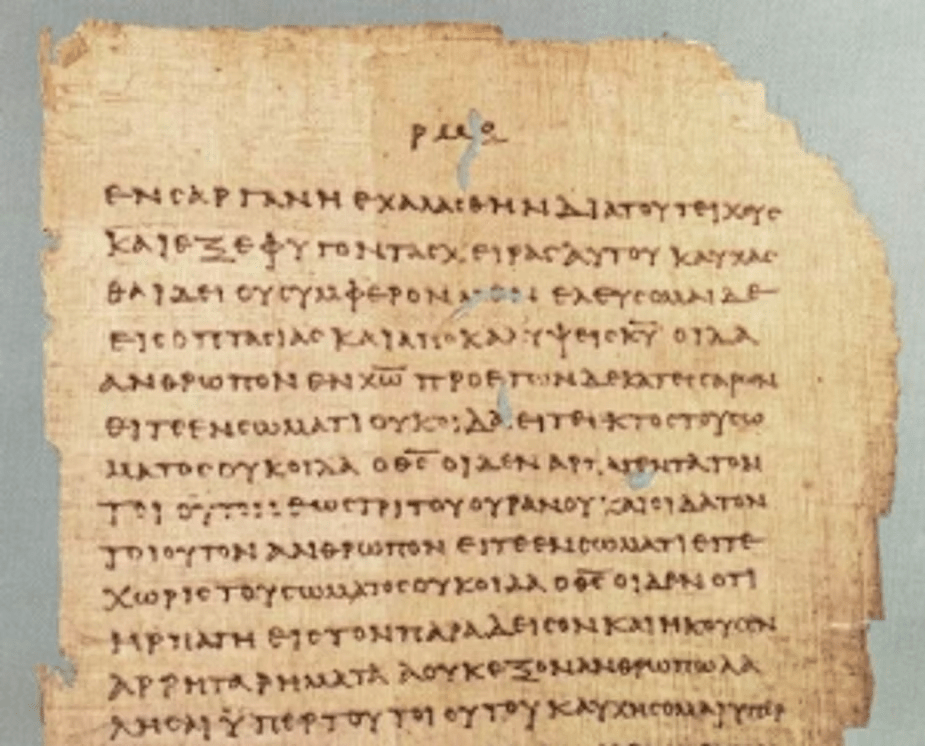
Punctuation is a relatively modern invention, but one must give some credit to Apostles knowing where pauses should be read.

John (like most Apostolic writings) is purposefully written in a way that takes its meaning well beyond what the surface translation implies. In the translation of 1 John 5:1-6, one will note how often the Greek article “the” (in various forms) is often translated as “the [One]” or regularly omitted, in order to accommodate a translation in English. That implies the Greek language unnecessarily adds words.  I prefer to see how “the [one]” adds to understanding.  Still, the break points (marked by commas and semi-colons) are important signals to contemplate what has been said, as if John placed a mark to let one know to stop and contemplate what he said before adding that to the next segment.

Here is 1 John 5:1-6 literally translated:

[Note: Not stated in 2018, but most important to realize, is the Greek word “kai” should be read as a marker of importance to follow, rather than a simple conjunction “and.”  I am changing all places where “and” was written to bold type, so the reader can contemplate where statements of importance are written.  I have also underlined the capitalized presence of “Kai,” as the capitalization acts as greater importance added to one word.]

“Everyone [the one] believing [present participle verb – not a gerund] Jesus is the Messiah  , [comma]  of the [one] God has been born , and everyone loving the [one] having begotten [him]  ,  loves also the [one] having been begotten from him.”

“By this we know we love the children the [one] of God   when the [one] God we love  ,  and the commandments of him keep.”

“This indeed is the love the [one] of God  that the commandments of him we should keep  ; [semi-colon] and the commandments of him burdensome are not.”

“For all the [one] having been born of the [one] God  overcomes the world  ;  and this is the victory the [one] having overcome the world   [double dash] the faith of us.”

“Who now is the one overcoming the world  ,  if not the one believing that Jesus is the Son the [one] of God?”

“This is the [one] having come by water and blood  ,  Jesus Christ  not by the water only  ,  but by the water and the blood. And the Spirit is the [one] testifying  ,  because the Spirit is the truth.”

From that literal translation, added to the transition from believing and loving coming from God, we see how John explained how the love of God is what allows one to keep His commandments.  This becomes much more than learning the laws on a mental level and using personal will-power to not venture beyond those rules. The reason Catholic-based religions have a “confession of sins” as part of their liturgy is because human will-power ultimately fails, due to the overwhelming influences of a world filled with temptations to break the rules of God.

This means the love of God is the presence of an all-controlling desire to live a life within the Law, because nothing of the world can then be a distraction from that goal. Personal will-power no longer comes into play, as the ego has surrendered to God, and the soul has become one with the Holy Spirit. When that happens within a human form, the result is the resurrection of Jesus Christ.

This is the ONLY WAY to overcome the world and find that obedience to God’s Law is not a burden. The Jews of Jesus’ day memorized Mosaic Law but found it difficult complying with it.  Disease was seen as a failure of sin, and being a tax collector was seen as going beyond the boundaries of legal permits.  When the translation above states, “And this is the victory that conquers the world, our faith,” the definition of “faith” has to go beyond written laws.  It must be read as relative to believing. True “faith” is relative to the personal proof that leads one to truly “believe.”

The Greek word for both “faith” and “believe” is “pistis,” meaning there is no difference in meaning between the two translations. The problem is when an English word, such as “faith,” is transformed into a noun, such that the translation then takes on the limitations of dogma that is applied to a particular “faith” (a regular occurrence in Scriptural interpretations). However, as a noun in New Testament usage, “faith” and “belief” are completely intended to be understood as oneness with God, as an ongoing experience where the proof is within.

The present participle of believing can be seen as a leap of faith, always being mid-leap.

In no way can “believing” be dependent on the human brain’s power to discern a multitude of external thoughts that ponders the issue of “faith”.  It is the same relationship as that where “breathing” defines “life.”  The two are synonymous, without any need to consciously ponder if “life” causes “breathing,” or vice versa.  Faith is believing and that is naturally known. just as is love mutually known between the Father and His children.

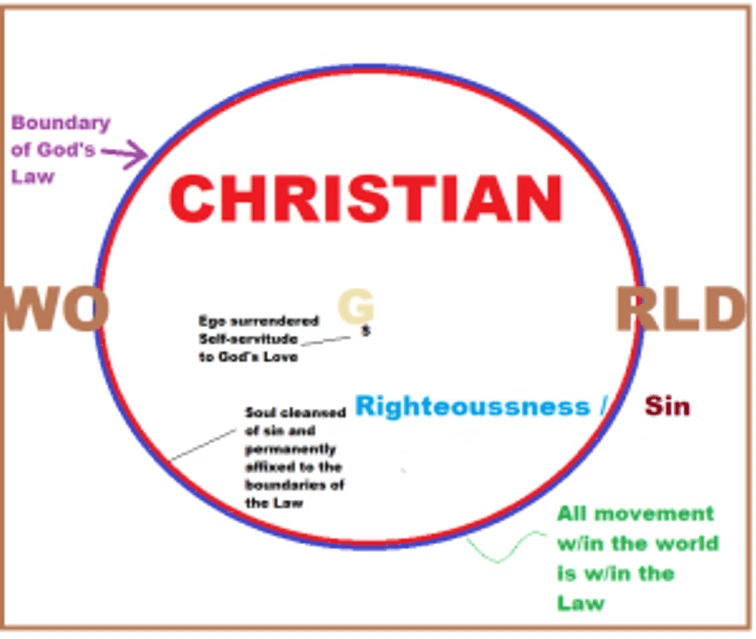
Reading this passage in 1 John and pondering this relationship between God’s love and an individual’s believing as synonymous with faith, it led me to create these diagrams.  They show how the same words can have two meanings: one externally driven and the other internally driven.  Perhaps, these will help the reader to grasp the direction my thoughts have gone.
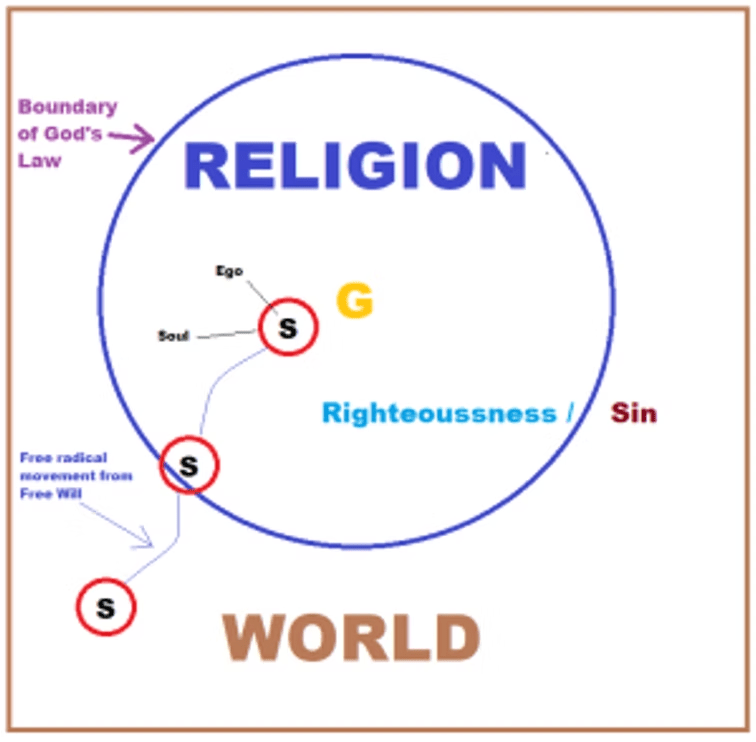
The Law of God externalized.
The Law of God internalized.

To me, this demonstrates what John meant by, “when we love God and obey his commandments.”  Love has gone beyond a human emotion for God, as generated by the self and the ego of one’s soul.  It demonstrates how John said, “For the love of God is this, that we obey his commandments.”  In the first diagram, moving outside of the Law would imply one ceases to “love” God, instead “loving” the world.  However, the second diagram shows how the love of God makes one subservient to God’s Will, thus always obedient no matter what the world surrounds one with.

When John wrote, ” Whatever is born of God conquers the world,” the second diagram displays this as the submission of self-ego to God, where one becomes married to God through God’s love.  This then expands the soul so that it becomes one with the boundaries of God’s Law.  It is that soul change that is born of God.  It is the transformation from mere human to the rebirth of Jesus Christ.

When John added, “And this is the victory that conquers the world, our faith,” this is a statement that faith is identical with believing, where one is transformed from wandering human to Saint affixed to the Will of God.  Whereas the Judaic “faith” produced many wanderers (free radicals), only true faith cleanses one’s soul of sin.  One is then believing in the name of Jesus Christ, as that name has become one’s own.

In verse 6, where John posed the existence of a duality in “water and blood,” the diagrams above make it possible to see the difference between “water and blood.”  Such words in the same sentence is reminiscent of the saying, “blood is thicker than water,” where “blood” bears the connotation of relationship.  That makes “water” more casual in nature; but water is necessary for life on earth.  This can then be easy to misunderstand, as a conundrum that asks, “Which is better: blood or water?”

Water is an esoteric element that symbolizes emotions, where one’s feelings flow like water, always changing states (like liquid, solid, gas), rates of speed (like rapids, falls, streams, and rivers) and exploring a range of depths (like ponds, lakes, seas, and oceans). Still, water is a physical element, one which is a basic solvent and cleaner. We bathe dirt from things with water.  The human body is up to 60% water; thus life is dependent on water.  The body must consume water regularly, because that which is stores is quickly used.

Blood, on the other hand is esoteric as an indication of relationship, where every race in the world has different genetic characteristics that can be examined in one’s blood.  There are different blood types, inherent diseases, and types of blood cells found in human blood.  Blood is a physical necessity for life, because it is internal to the body.  Blood is the most vital element in a system controlled by the heart, where every cell in the human body is strengthened by its blood supply.  Loss of blood is life threatening.
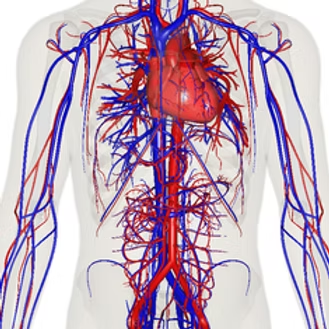
All of these esoteric and physical characteristics of water and blood can be seen reflective in the diagrams.  The first diagram represents the physical aspects of water and blood, such that the boundaries of God’s Law act as a pool of water that is necessary for life.  The world incorporates God’s Law into civil laws.  Without that water, life would die of higher purpose.  For individual human beings, religions become the blood that leads to the responsibilities of adherence to the Law of God and civil laws.  Just as blood is oxygen enriched, by the lungs and the heart, sent out red in arteries, but exhausted of oxygen in the return to the heart in veins, human being act as individual blood cells.

This then allows the second diagram to reflect the internalization of the principles of water and blood.  The two become Spiritual in nature.  The joining of the self to God, at the death of the ego, becomes the water of God’s love that washes over one cleansing the soul of sins.  The expansion of the soul to the boundaries of God’s Law is then the blood of Christ that fills one’s heart and mind.

Religion can then be seen as the water of baptism, which proposes remission of sins and absolution.  Christianity is then the baptism by the Holy Spirit, done by the Messiah.  Religion is the life blood that teaches acts of goodness and self-constraint to a higher cause.  God’s marriage to one’s heart is then the true blood that relates all Christians as the Sons of God (regardless of human gender).  Jesus came as water in the physical sense that he lived on earth as a man.  However, that water was only available to those living around him.  The living water of Jesus is then his being reborn as the blood of Christ.

In the first diagram (Religion – World), it does not matter what the religion is. It can be any that places emphasis on a god, which certainly includes the “big three” that claim the same God: Judaism, Islam, and Christianity. All of those can then be subdivided into sects, branches, and denominations, still falling under the heading of “Religion.” Every different division has its own distinguishing dogma, ethics, and rites that followers of a system of faith or belief (the misnomer of “faith” and “belief”) are expected to follow.  Those “laws” then govern the people within a religion, as the determining factors as to who is to be held in high standing within each respective segment of people.

The role of each individual is then denoted by the red circle (a soul) with a black “S” within (the ego of the self), which denotes how each human being is contained within the boundaries of one’s soul. Individuals learn the differences between righteousness and sin, in the schools of the world, which include religions.  As such, God’s gift of “Free Will” allows the individual to migrate (become a “free radical”) between those two realms that exist in the world.

Human beings are then free do move away from religion, go back to religion, or straddle the boundaries of religion. To maintain interest (again, a diluted definition of “faith” and “belief”), the religions offer absolution and penitence on a regular basis. This does nothing to lessen the validity of “righteousness,” based on the parameters of “God’s Law,” as it also states it is ultimately the responsibility of the individual to strive for a lifestyle that pleases God.

This becomes reflective of the “water” element of which John wrote. The various churches act as the holy water that bathes the sin from the individuals that are members. It creates a body of emotions that are soothing and dissolving, in which members can soak. Still, such external water is not enough to bring about true faith and belief.

The right diagram replaces an institution (“Religion”) with God, such that the ego has surrendered to God’s Will, no longer able to pick and choose what influence he or she will follow at this instance. The close relationship between God and oneself is one of Father to Son (regardless of human gender), so the soul (the red circle) is cleansed (by the Holy Spirit) and expanded to the perimeter of God’s Law. Rather than an institution (a lifeless entity without individual human beings) acting as a place of refuge in the world, each one who is in a personal relationship with God can freely go anywhere in the world, remaining always within the boundary of God’s Law.

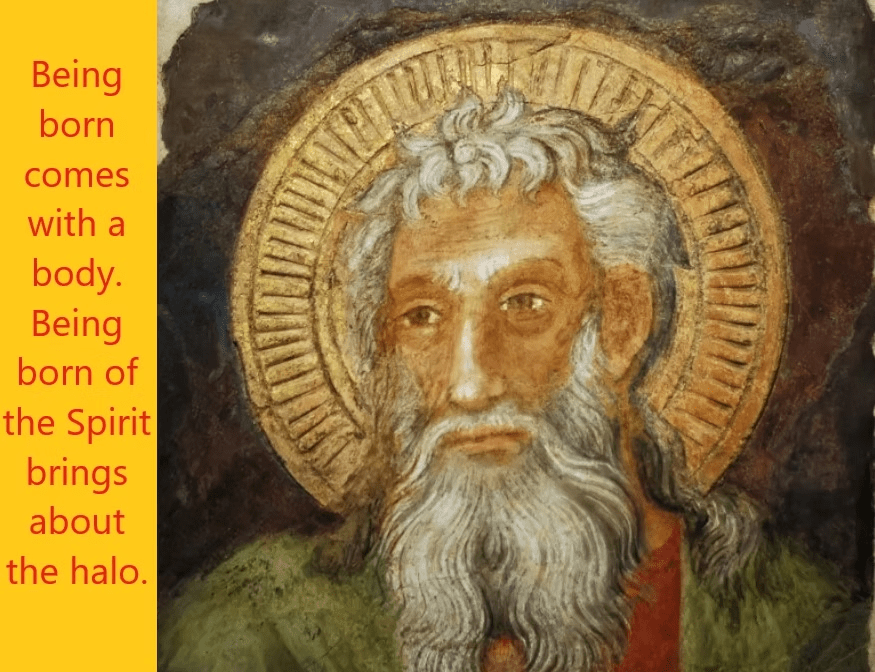
One is then only influenced by God’s Will and the world is only a place for one’s faith and beliefs to be shared. The individual is a temple unto the Lord, thus projecting to the world as the light of Christ. From that God-centered state of being (the present participle), the burden of the world (the guilt of sinning) is removed.

This becomes reflective of the “blood,” where it is the circulation of God’s Holy Spirit within one’s being that is the meaning of the blood of Christ. It is the baptism of the soul, which expands its heartfelt desires to fit God’s Will. Christ has become one with the soul, just as God has become one with the heart. Because the heart is the engine of the blood, there is a Spiritual uplifting that exceeds any human emotional capability. This Spiritual elation is brought on by God’s love.

This explanation (I hope) makes it possible to grasp the meaning of John writing, “The Spirit is the one that testifies, for the Spirit is the truth.” That says that the sacrifice of the ego has allowed the Holy Spirit to be the impetus for everything a human of faith and belief says. Nothing is kept private and secret, as the world needs to know the truth of God’s word (i.e.: Holy Scripture). The truth was spoken by Jesus of Nazareth; and, by his death, resurrection, and ascension – to be used by God (the Father) over and over again (as His right-hand “man”) – one who receives God’s love becomes as pure and clean as was Jesus, speaking the truth through the Christ Mind. The truth continues to be told, always present.  The Holy Spirit is sent by God, the Father, to the Son, via the Holy Spirit, so all servants of God can only speak the truth of God (as Jesus of Nazareth always did).

As a lesson in this sixth Sunday in the Easter season of personal resurrection and rebirth as Jesus Christ, one needs to see the importance of personal responsibility. A true Christian is born of God, not anyone or anything that is less than the Father above. A Christian does not recite words written on pages as the source of one’s faith and as that in which one believes, when one cannot explain the meaning of those words with truth and conviction. One has to elevate to a state where the world can be conquered and self-driven will power cannot reach that height and remain in that state eternally in the present.

This lesson flows into the Gospel reading in John, where Jesus told his disciples to love one another. That lesson is easily heard and yet constantly found too difficult to do. This lesson shows how “whatever is born of God conquers the world,” with that only attainable through true faith.

That is the answer to the question, “Who is it that conquers the world but the one who [has faith] that Jesus is the Son of God?”  The answer should be you.

———-

[Note: When I see someone has viewed something I have written, I re-read it to see if I made errors that need correcting (my normal grammar is bad).  As I re-read this article, I added a note above.  Still, I feel it necessary to add an explanation about the “free radicals” of the diagram above.  For that soul-ego to be placed within the influence of a religion, this becomes primarily how a child is raised within a church and taught to believe in Bible Stories.  As the child grows and is more influenced by the world, the natural movement is away from religion and towards the world.  That experience is necessary for one to return to God (not a religion) later in life.  The sad thing about this is modern parents are missing that childhood development within religion, so their children are mostly born of the world, without religion’s influence.  This is the danger we presently face: few believing.

#1John516 #beliefversusbelieving
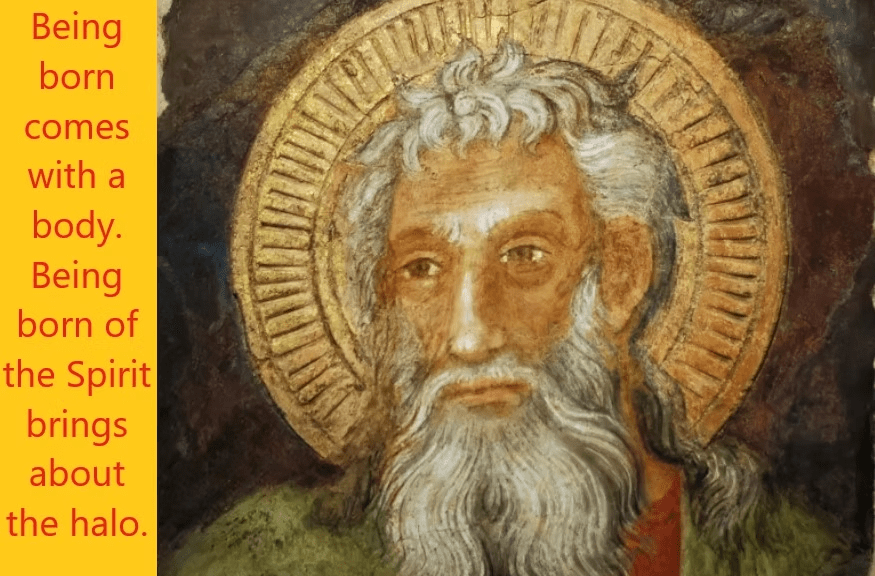
1 John 5:1-6 – Conquering the world requires faith from the Spirit

Everyone who believes that Jesus is the Christ has been born of God, and everyone who loves the parent loves the child. By this we know that we love the children of God, when we love God and obey his commandments. For the love of God is this, that we obey his commandments. And his commandments are not burdensome, for whatever is born of God conquers the world. And this is the victory that conquers the world, our faith. Who is it that conquers the world but the one who believes that Jesus is the Son of God?

This is the one who came by water and blood, Jesus Christ, not with the water only but with the water and the blood. And the Spirit is the one that testifies, for the Spirit is the truth.

——————–

This is the Epistle selection to be read aloud on the sixth Sunday of Easter, Year B, according to the lectionary of the Episcopal Church. It will follow the mandatory reading from the Acts of the Apostles (chapter 10 today), which states, “While Peter was still speaking, the Holy Spirit fell upon all who heard the word.” That will be followed by the singing of Psalm 98, with the lyric that praises, “With trumpets and the sound of the horn shout with joy before the King, the Lord.” Then, a reading from John’s Gospel will tell of Jesus saying, “I have called you friends, because I have made known to you everything that I have heard from my Father.”

The problem with reading all Epistles in the New Testament is they all are written in divine language, as the Word of Yahweh. Divine language is not how mere mortals read words on paper [or parchment]. In whatever languages human beings read [and this Epistle was not written in English], they always read in human syntax, missing the divinity that stares them in the face, but their brains simply will not allow them to see it. A perfect example of this is in verse 1, where reading “Everyone who believes that Jesus is the Christ” makes all Christians run out the doors of the church proclaiming, “I believe Jesus is the Christ!” That is not the intent of what John wrote.

The Greek text written says, “Pas ho pisteuōn hoti Iēsous estin ho Christos”. In that segment of eight words [ended with a comma mark] there are three capitalized words. ALL capitalized words bear divine essence, which raises them well above the human plane of understanding.

For example, a human plane of understanding “Iēsous” thinks, “Wow! That is the name of “Jesus”!” That does not take into consideration that “Iēsous” is the name Yahweh sent Gabriel to tell Mary, “This will be his name,” with the reason being the name is purposefully chosen by God, intended on leading one to understand, “He will be great and will be called the Son of the Most High.” (Luke 1:32) The name “Jesus” means “Yah[weh] Will Save” or “Yah[weh] Saves.” It is rooted in the Hebrew word “yeshuah,” meaning “salvation.” Human brains simply cannot [and will not] read “Jesus” and interpret that as a statement saying, “Yahweh Saves.”

With that said, the first word is a capitalized “Pas,” which elevates the meaning of the lower case “pas,” which simply means “all, every, the whole, every kind of.” In a segment of words that are seen to include “Iēsous “and “Christos,” the elevation to a divine level of meaning must equate “All” or “Every” to those who are reborn as “Jesus,” thereby “Saved by Yahweh,” having become the “Christ,” meaning another “Anointed one” of God. By seeing that divine link between capitalized words set together in one group of words, one is seeing a divine principle being stated, as a Holy Law that effects “All” equally.

Now, the operative word that links to “Every” and “All” is “pisteuōn,” which Strong’s defines as the participle of “pisteuó,” meaning “believing, having faith in, or trusting in.” Because “Pas” is divinely elevated, one should choose the higher meaning of the choices available, such that faith is greater than belief or trust [although all are valued]. When “ho” is translated as “that,” then “Pas ho pisteuōn” says, “All that having faith in.”

That initial assessment then places focus on the word “hoti,” which means “that” or “because.” That word then connects to the word “Iēsous,” which is clearly seen as the name of Yahweh’s Son, whose name means “Yahweh Saves,” meaning “that” is a weak translation connecting “having faith in” and “Jesus.” The better choice would be to give reason to “having faith in” Yahweh, such that “because” is an elevation of meaning that connects the divine “All” to the divine “Yah[weh] Saves.” Realizing that makes the segment now say, “All that having faith in because Jesus.” That means Jesus is the cause of faith, not the direction of where one’s belief is placed.

It is most important to realize that prophecy given to Mary about her pregnancy, where Jesus was foretold to be “the Son of the Most High.” In that, Luke wrote the two capitalized words “Huios Hypsistou,” which translates as “Son of the Highest” or “Most High.” He who is “Highest” is Yahweh, meaning “Jesus” would be called the “Son” of God. To put one’s faith in anything lower than the “Highest” is a travesty, as a rejection of the name that means “Yah[weh] Will Save.” If one claims to put one’s belief in Jesus, then one has wiped clean all faith in Yahweh. Thus, the meaning of what is written by John here states, “All that having faith in [YAHWEH] because Jesus” is a profession of true faith, where faith in Yahweh is based on the Son who saves.

This is where the most important connector word comes in – “estin” – as that word is the “third-person singular present active indicative unstressed enclitic of εἰμί (eimí)” [Wiktionary], which is a clear statement of “existence” or “being.” It is at the root of the weasel Bill Clinton making famous the answer to a legal question, “It depends on what the definition of “is” is.” By being a snake in the grass, one reads this word as linking “Iēsous” only to “Christos.” That ignores the fact that faith can only be a statement about one’s own being, such that “estin” connects to “Pas“ and “Iēsous,” meaning “All that having faith in because Jesus is.” One’s elevation of belief to faith means one IS Jesus; and, that is how one knows “Yahweh Saves,” “because” one has been reborn as His Son.

When one “Jesus is,” “that” [from “ho”] state of “being” is what also designates one as the “Christ,” as an “Anointed one” of Yahweh. While it is also true that “Jesus is the Christ,” it is impossible to do more than profess belief in something that is impossible to know for oneself. Belief is thinking something happens to others as one has personally experienced something to happen to oneself. Faith, however, is knowing oneself; so when one knows oneself is Jesus reborn, then one also knows being reborn as Jesus makes one equally an “Anointed one” by Yahweh. Being that one [“Jesus”] brings about that other [“Christ”].

That segment of words is separated from the rest of verse 1 by a comma mark, which is not shown in the NRSV translation. They make it a run-on that says, “has been born of God, and everyone who loves the parent loves the child.” That gives the impression that “Jesus Christ” [not a proper name] “has been born of God.” While it is true that Jesus was the creation of Yahweh in the human woman Mary, that further misleads “All” who would likewise be “born of God,” making mere human beings be incapable of anything more than believing “Jesus Christ has been born of God.”

In reality, the second, third, and fourth segments of words in verse 1 say, “ek tou Theou gegennētai , kai pas ho agapōn ton gennēsanta , agapa <kai> ton gegennēmenon ex autou” . These translate to state: “from out of who of God has been born , kai all that loving this having been born , loves <kai> having been born from out of oneself”. By seeing this literal translation, there is nothing that directly states “parent” and there is nothing that directly states “child.” That is paraphrase for the repetition that states, “has been born [of God],” “having been born [indirectly implying of God]”, and “[oneself] having been born [again indirectly implying of God].”

The only ‘parent’ can then only be “God,” and the only “child” is “all” “from out of who of God has been born” … “kai loving this” birth.” This means verse 1 states first “All” who have been reborn as “Jesus,” as a duplication as the “Christ,” they “all” have been also “born of God.” This birth brings a state of “love” that encompasses them “all,” which is relative to “having been born” as Sons of God [all human genders the same].

When verse 2 is then translated to say, “By this we know that we love the children of God, when we love God and obey his commandments,” here the word “tekna” does state “children,” which is now a statement of those “born of God,” as “Jesus,” as the Christ,” from which true faith comes. The words “en toutō ginōskomen” [“in this we know”] says that “all” who are “in” Yahweh and Yahweh “in” them – “from birth of God” – they receive the knowledge “of God,” from which “love” flows [from “agapōmen” meaning “we love”]. Therefore, “love of God” is what relates “all” as His “children.”

The aspect of “when we love God” actually means, “when this of God we love,” which says “love” is not a touchy-feeling emotion built from physical limits, but “God’s love.” That was explained by John in the fourth chapter of his first epistle. Thus, after a comma mark and the presence of the word “kai,” the importance that comes from God’s love is “the commandments of him are kept.”

There is nothing stating obedience, as if an external projection of a human being displays love of God by complying with an external written Law [Mosaic “Commandments”]. Instead, this says when one [or “All”] are born of God and filled with His love, then one loves to do whatever Yahweh suggests. So, whatever He orders [from “entolas”] one gladly does.

In verse 3, the NRSV translates: “For the love of God is this, that we obey his commandments. And his commandments are not burdensome.” This gives a false impression of that which is written. The verse simply repeats that one’s “love of God,” which is the presence of God’s love” within, is so overwhelmingly powerful that one will do nothing to love that state of being. Doing what Yahweh says to do is then easily done, out of “love” and fear of loving “God’s love.”

When the verse then adds [following a semi-colon and a “kia”] importance is noted as this: doing what Yahweh asks one to do is not a burden. There, the Greek word “barus” means “heavy, weighty, burdensome,” implying “oppressive.” John says none of that is present when Yahweh is married to one’s soul and Jesus is living within, as a new body of flesh that has been Anointed by God.

Verse 4 is then where John stated, “for whatever is born of God conquers the world. And this is the victory that conquers the world, our faith.” Again, the separating of that into one and a half sentences makes what John wrote more difficult to fully grasp.

The translation that says “whatever” is completely wrong, as it demonstrates a laziness to express the truth told. The Greek text says, “hoti pan to gegennēmenon ek to Theou nika ton kosmon”. That literally states: “because all this having been born from out of that them of God overcomes this world”. To reduce “all this [stated prior in verses 1-3] having been born from out of that them” as “whatever” is an abject failure to serve Scripture well.

To say those “born of God conquers the world,” this must be recognized as a statement that the sins of “the world” will be “overcome.” That sense of victory is then relative to one’s having let Yahweh lead their lives, as Jesus reborn, also Anointed ones. The lures and entrapments of “the world” cease having an effect on the lives of saved souls.

After a semi-colon and another “kai” is importantly stated, “hautē estin hē nikē hē nikēsasa ton kosmon : hē pistis hēmōn”. In that, the word “estin” should again be read as a state of “being” or “existence,” which is relative to “here,” where human beings live – in “the world” that is the material plane. It is then that spiritual “being that victory” is found, as “this [state of “is”]” is that “having overcome this world.”

That then makes the whole of this segment of words be leading to exemplify that “existence,” by the presence of a colon then found. The clarification of “here is” is then stated to be “that faith of us.” That state of being is what elevates a soul from simple belief to knowing Yahweh directly, as His children, which brings on true faith.

Verse 5 then follows that direct statement of “faith” [NRSV translating “our faith”] by then reverting back to the watered down translation of “pisteuōn” as “believing.” They have verse 5 translated as asking the question, “Who is it that conquers the world but the one who believes that Jesus is the Son of God?” This becomes a flashback to verse 1, where the mistranslation proclaimed “believing Jesus Christ has been born of God” will do anything towards one being capable of “overcoming the world.” That weak translation is yet another that demands one look at the Greek text written.

First of all, the word beginning verse 5 is capitalized, showing it must be read with a divine elevation. The word capitalized is “Tis,” which has been translated as “Who.” This refers one back to the capitalized first word in verse 1, which was “Pas.” The divine essence of “All” being relative to the capitalization of “Jesus” and to “Christ” means “All” is only relative to those married to Yahweh. Likewise, the word “Tis” must be seen in the same light, as any and all “Who” are also married Spiritually to God’s Spirit. With that understood, the Greek text of verse 5 is as follows:

Tis de estin ho nikōn ton kosmon , ei mē ho pisteuōn hoti Iēsous estin ho Huios tou Theou ?” In those two segments of words are two uses of “estin,” which once more must be read as a statement of “being” or “existence,” not simply as a Bill Clinton “is.” The question raised is “Who now exists that overcoming the world , forasmuch as not that having faith in because Jesus exists that Son who of God ?

The same statement as in verse 1 is repeated by John as a question asking “Who without faith born as one new Jesus existing as a new Son of God?” John is not asking if belief that Jesus was the Son of God can overcome the lures of Satan in the world. If it were that simple, Satan would have left the building and presidents like Bill Clinton would never rise in power in the world.

The NRSV then translates verse 6 as saying, “This is the one who came by water and blood, Jesus Christ, not with the water only but with the water and the blood. And the Spirit is the one that testifies, for the Spirit is the truth.” Because they make it fairly simple-minded to follow their train of thought, that belief that Jesus was the Son of God, it is now quite easy to see Jesus as being “the one who came by water and blood,” presumably with the first and last names “Jesus Christ.”

Well, by golly, guess what? That is yet another terrible translation that forces one to yet again review the Greek text.

In verse 6, John wrote the Greek that states: “houtos estin ho elthōn di’ hydatos kai haimatos , Iēsous Christos ; ouk en tō hydati monon ¸ all’ en tō hydati kai en tō haimati . kai to Pneuma estin to martyroun , hoti to Pneuma estin hē alētheia .” That is six segments of words, not the five shown by the NRSV translation. Included are three more uses of the word “estin,” where again all must be read as a personal statement of “being” [if one is one of those with faith “having been born of God”]. Additionally, there are three uses of “kai,” with two between the words translating as “water” and “blood” and the last introducing the next to last segment where it and the one to follow speak of “Pneuma” or “Spirit.” Those two capitalized spellings of “Pneuma” are half of the capitalized words in this complex verse, with the other two found together in one two-word segment, as “Iēsous Christos.”

Each of the six segments needs to be discussed individually:

houtos estin ho elthōn di’ hydatos kaihaimatos” translate literally to say, “this existence that having come through then water kai blood”.

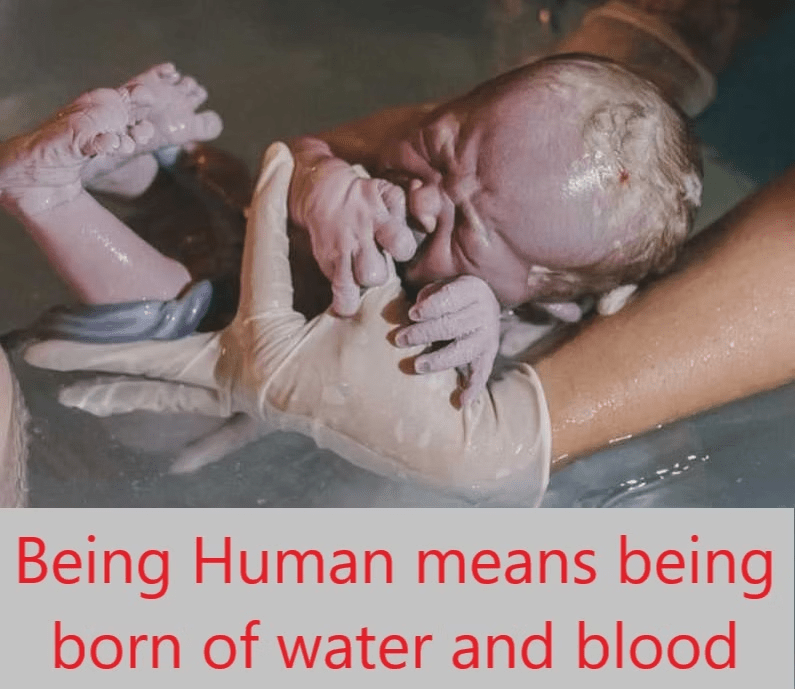
Because verse 5 asked “Who has the faith to overcome the world?” verse six beginning with words that say “this existence” or “this state of being Who” is “that having come” of the world. It is that which is “through then water.” Here, “water” can be seen as metaphor for childbirth, where a mother is ready to deliver her baby after her “water” breaks. That makes “water” become one of the four element of “the world” [along with fire, air, and earth], which reflects the flow of changing states of being. That becomes symbolic of the emotions of one’s “being.” Therefore, the metaphor of John says one of faith is born of the ups and downs of “the world,” its highs and lows, which are usually unpredictable and uncontrollable. Therefore, belief is led by the waters that change, according to what “the world” dictates.

These words must be seen as John stating the truth of mortal existence, where even Jesus was born of a woman and had physical emotions that made it difficult for him to control. When John then inserted the word “kai” after “water,” before “blood,” this brings out the importance of understanding the metaphor of “blood” separately.

Here, “blood” must be seen as that within a human body that flows “life” throughout, as the internal fluids [like and made up of “water”] that replenishes all branches of one’s flesh. Water is necessary for life, but without blood one’s life cannot continue. Symbolically, “blood” becomes a statement of relationship, such that all Jews were deemed to be of the same “blood.” The two together, as “water and blood,” then speak of what humans must have to remain alive on the earthly plane.

When this first segment is read as what cannot possibly make a mortal being have true “faith,” because being born a human makes one born to die. The “water” dries up and the “blood” becomes weak. That realization then leads to the two capitalized words together in one segment, “Iēsous Christos.”

While this appears to make “water and blood” be some statement about baptism and sipping wine at a church rail, the first capitalized word must be read separately. It says “Jesus,” where as a word alone means the man of Nazareth, who was born of a woman, sent to “the world” by Yahweh as a mortal. Then, after that word is understood, the fact that “Christos” is capitalized says Yahweh sent “Salvation” to the world through His Son whose name means “Yah[weh] Saves,” such that Jesus was an “Anointed one” of Yahweh. While he was born mortal and known to die, that soul would become the “water and blood” that would forever “Anoint” others in his name.

The third segment of words literally states, “not in that water only,” where this says emotions are not the whole way to faith. While there are Christians denominations that place great value on “trusting” God [snake handlers immediately come to mind], where “emotions” are artificially raised out of fear of death, such belief systems are fueled by the fluidity of human emotions. Faith is greater than that, although emotions in a physical body cannot help but be affected by the presence of Yahweh, after having been born as His Son. Being able to call Yahweh Father, as His Son, means there is a “blood” link to God. The soul of Jesus merged with one’s soul puts his “blood” throughout one’s body of flesh, just like human “blood” does physically. Therefore, the “Christ state of being” [“Christos”] is not obtainable simply from emotions “alone.”

The fourth segment of words say, “on the other hand in that water kai in that blood” . This then states that both “water and blood” must be spiritually part of one’s “being,” where “in that water” means one must be baptized by the Spirit of Yahweh AND that puts “in” one’s soul the “blood” of relationship with Yahweh, which makes one a Son of God. Having both “the water and the blood in one’s being” makes one become “Jesus” reborn. Having both within means one is an “Anointed one,” just as was “Jesus.”

The fifth segment of words then importantly says [introduced by the word “kai”], “that Spirit state of existence that witnessing.” Here, the root Greek word “martureó” becomes a statement of one personally experiencing Yahweh, which can only come from marrying one’s soul with His “Spirit.”

The simple meaning of the word is “I witness, bear witness, give evidence, testify, give a good report,” such that the NRSV translates it as “one that testifies.” The only way one can “testify” as to the “Spirit” and to “faith” is from knowing it firsthand. While belief can come from hearsay evidence and not personally experienced, the Greek word “matureo” is at the root of the English word “martyr,” where sacrifice is implied for a higher good. That sacrifice comes from marriage to Yahweh and submission of one’s soul to His “Spirit,” so one will gladly do what He commands, out of true faith.

Finally, the sixth segment of words say, “because that Spirit state of being this truth.” Here, the last word is “alētheia,” which means “truth, but not merely truth as spoken; truth of idea, reality, sincerity, truth in the moral sphere, divine truth revealed to man, straightforwardness.” (Strong’s Usage) Rather than being a nebulous statement that leads people, like Pontius Pilate who asked Jesus, “What is truth?” [like someone like Bill Clinton would ask], the word stated by John means being a “witness” to the “Spirit” is the “truth,” not some made up lie. The whole basis of faith is summed up as knowing Yahweh’s “Spirit” personally, deeply, and totally, so everything that comes out of one’s mouth [just like Jesus] is the “truth,” because it all comes from God “being” one with one’s soul.

As an Epistle reading selection for the sixth Sunday of Easter, a season when one should be preparing for ministry by practicing being Jesus reborn, it is clear that John says an Apostle must be “born of God.” An Apostle must be “Jesus having been born of God” within one’s flesh. Everything about the Easter season is about Jesus rising within Saints, who Yahweh then sends out into ministry. The NRSV did not do anyone any favors in translating these six verses; but the reason an Epistle reading is selected each week is it is the voice of God speaking through a Saint, which is what “All” true believers are made from. Being able to understand divine text is one of the important talents one must be practicing during this time.