
If we receive human testimony, the testimony of God is greater; for this is the testimony of God that he has testified to his Son. Those who believe in the Son of God have the testimony in their hearts. Those who do not believe in God have made him a liar by not believing in the testimony that God has given concerning his Son. And this is the testimony: God gave us eternal life, and this life is in his Son. Whoever has the Son has life; whoever does not have the Son of God does not have life.
I write these things to you who believe in the name of the Son of God, so that you may know that you have eternal life.
——————————————————————————–
This is the Epistle reading selection from the Episcopal Lectionary for the Seventh Sunday of Easter, Year B 2018. It will next be read aloud in church by a reader on Sunday, May 13, 2018. This reading is important as John clearly says eternal life requires one be a reproduction of God’s Son, more than taking a position that believes the words of those who lived alongside Jesus of Nazareth.
There are five verses in this reading. All are taking what is stated in the first verse (verse 9) and supporting that on deeper levels. The translation of verse 9, as shown above, is acceptable as stated, other than verse nine is two complete sentences. Each sentence is then broken into two segments by commas, which the above translation does not show. When one reads verse 9 slowly and contemplates the meaning of each segment, through two segmented sentences, a profound message comes clear, which is easy to miss otherwise.
It says first, “If we receive human testimony.” That sets forth a conditional situation, based on faith and belief. It applies not only to religions (of all kinds) but to all philosophies of mankind. It is stating the confusion that is pervasive in American society today, where “human testimony” is constantly in all forms of media … all of which is sent out for the masses to receive. This first segment of words is then saying that hearing people’s claims of what is belief-worthy, reading books written by the latest craze authors, or simply making life decisions based on personal experiences, can become what “we accept” as the truth.
As such, Christians read these words and automatically hear John talking about the divinity of Jesus (as the Christ). John was a human being and the author of this letter. As Christians, we identify with John, because we are human beings that also say we believe in Jesus as the Christ. We go to church to hear these words read aloud and we read them at home in our Holy Bibles. Still, the conditional word – “IF” – is asking us if we believe and have faith because we believe what what our brains hear, and not what we can personally testify to.
This beginning segment of words is then stating the condition that faith and belief requires instruction, given by someone who knows, as the proverbial person who has – “Been there, done that.” We can sense the conviction in someone’s words, so that someone’s words have a mesmerizing effect on us, coming from charisma that can be projected from human testimony. The Greek word “martyrian” means, “witnessing, evidence, testimony, or reputation,” so public words about Jesus Christ is called “witnessing.” Thus, the acceptance (or “receipt”) of testimony acts as one’s confirmation of the truth being spoken; and the power of someone else’s witnessing publicly should motivate us to seek more truth, through a teacher-student arrangement that fills us with the same conviction found in another.

That was the state of Judaism when God sent Jesus into the world. There were many who spoke of God and His promises to obedient servants. So, there were many who believed it was the truth they heard. As such, many followed what they heard said in human testimony. This is following the leader, more than following the Will of God.
The prophets of Israel and Judah had promised the people a Messiah; and the people of Israel believed that human testimony. The ruling elite of the Temple in Jerusalem preached the Law of Moses to the Jews, and the Jews of Galilee and Judea believed in the Law. Still, the teacher-student relationships that were established could not extend beyond the written words of Scripture, so no one was receiving the meaning of them. Much less, neither teacher or student understood how to apply the laws of Moses in a changing world that more often than not forced them to go against the Law for survival.
When Jesus came, he offered more human testimony, as he was born of a woman. Some received his words as truth, but some rejected them (mainly for selfish reasons). Rather than heed what Jesus the rabbi said, even though he only spoke the truth of God, it was the truth no other rabbis knew. To silence him and the questioning he aroused in the people, it was easier to kill him than listen and learn from him. Death, they hoped, would return the world to its former status quo. No more human testimony from Jesus of Nazareth.
After Jesus rose from death, he taught his disciples for another forty days, in human form. That body then ascended to Heaven before his witnesses. Ever since then (more fittingly, ever since the Apostles began telling the story of Jesus Christ in texts), the world has had access to “human testimony,” from which a new faith arose.
The state of Christianity today is largely belief in the four Gospels and the Epistles of the New Testament. Belief from that alone is blind faith, based on humanity having lost touch with the human teacher that Jesus of Nazareth was, whom the Jews of Galilee and Judea personally experienced. Instead of Jesus in the flesh, Christians today love their “rock star” church idols (which come in all denominations, in all forms), who use their charismatic ways of preaching to make human testimony feel like the truth. They tell the world that Jesus will come again … someday … soon … when the end of the world is nigh.
Many preachers learn to act sincere at seminaries, which are schools that teach the theatrics of charisma. Many human beings who want to increase their faith and beliefs go to schools that teach them the written words, the opinions about those words, and the history of changing opinions. Still, some schools focus on teaching students the tricks of a trade that intends to draw people in, without leading anyone to obtaining the true Holy Spirit. They preach enthusiasm, by doing little more than putting on a good show of faith.
Priests, pastors, ministers, and preachers all believe the Word is truth. Those listening to them do too. By standing in front of other human beings of faith and beliefs, many believe all they have to do it use those words of truth and others will absorb holiness. It is easier to give the impression that one actually knows the truth, than it is to pass that torch of insight and knowledge onto others.
Keep in mind the warning given by Jesus of “false prophets.” He said, “Beware of the false prophets, who come to you in sheep’s clothing, but inwardly are ravenous wolves.” (Matthew 7:15) When Jesus said a false prophet comes wearing “sheep’s clothing,” that means they put on an act that makes them appear to be preachers of the truth. This does not mean all false prophets intend to mislead, but that is the result. Still, if false prophets all wore red devil suits, carrying pitchforks, then who would fall for their tricks?

No one would.
If you go online, there is some site that advertises “7 Traits of False Teachers.” That is itself a “ravenous wolf in sheep’s clothing,” simply because that title presumes to know that all false prophets are limited to seven warning signs that are stated in Scripture. I presume (having not read the article) that they have stitched together a frightful image of the Big Bad Wolf that waits for innocent little lambs. Their purpose seems to be: Memorize these seven “traits” and you will be safe.
I imagine there is the potential for that page to add: Please, don’t forget to send money so we can help others be afraid.
Maybe they added that, maybe not. Regardless, my interest to see what human testimony they have to offer would depend on if I am willing to accept or receive their human testimony as the gospel. Human testimony is what it is – an opinion about what one believes is true; but that should always be tested first, before believing hook. line and sinker.
We realize that need for deeper examination of human testimony when John then wrote his second segment of verse 9, where he said “the testimony of God is greater.” That statement says how one does not need to memorize the seven characteristics of wolves trying to steal lambs. Looking at a list of traits, scribbled on a piece of paper, will not save one from the attacks of such wolves. Ravenous prophets steal innocent lambs by sweet talking them to come closer, telling them things the lambs want to hear, such as, “Believe in Jesus.” They say, “Come closer dearie and I’ll tell you the story of baby Jesus in a manger.”
Chomp!

Once you have heard human testimony that feeds you the truth, the next step is not “Repeat step one,” but listen to God. God is invisible and cannot be seen. God is Spiritual, not human. God speaks in mental whispers that become the voice of one’s personal teacher within. God speaks so one will hear a lesson. God speaks to answer the questions we ask. God speaks so that we – as individuals – go as far towards faith and belief as our individual hearts’ desire. God is the inner voice that exposes false prophets and approves all Apostles.
When John then began a new sentence in verse 9 (following a period mark), he said, “For this is the testimony of God.” That is where another pause of a comma gets inserted, making one reflect on the meaning of that statement.
The word “this” means the epistle that John wrote. It means “this” verse in that letter, the next verses, and all others verses and letters that John had and would write. “This” means the words he, John the Beloved, had just written was the Word of God. That says “this” is the “testimony of God” because John gave God the credit for leading his hand to write a letter. It says, indirectly, “I, John, am a prophet of God.” Therefore, “If you receive (or accept as truth) this human testimony as being from God,” then you should know that this testimony of God is greater than someone who says or writes testimony, supposedly of God, while claiming he or she as the author.
Prophets of the LORD are not meant to be celebrities elevated onto pedestal status. Prophets of the LORD make it clear that God filled their lips with human testimony. Prophets of the LORD make it clear that other human beings should not do as I say, but listen to God; then stand beside me and prophesy.
To clarify that concept, John then finished his second sentence in verse 9 by stating, “That he has testified to his Son.” The word “that” referred to John’s claim (prior to the comma) that “this letter is the testimony of God.” John then said the truth of that statement can be realized by understanding that God did not tell the human being John what to write (as that would be mere human testimony), but that God told “his Son” Jesus Christ to write it.
That means Jesus Christ heard the whispers from the Father while he was one with the human being named John. That means the presence of Jesus Christ was within John, which is the proof (the truth of testimony) that John was a prophet who wrote the testimony of God. To be a prophet of God (not a false prophet), John had to have the Mind of Christ within him; and that made John the Beloved be reborn as Jesus Christ, the Son of God.
As you can see, one verse says a mouthful. From that verse, the other four following verses then hang.
The translation of verse 10 – “Those who believe in the Son of God have the testimony in their hearts” – is true, while the actual Greek says, “The one believing,” which places belief on an individual level of responsibility, which then is multiplied in all who likewise are perpetually believing in union with (the Greek word “eis” means “into,” more than “in,” but infers a result, as “union,” as “upon”) the Son of God. “Those” are then all who are like John the Beloved, as true prophets that speak what God tells them to speak, speaking as Jesus Christ having been reborn.
The translation that says, “in their hearts” is also a paraphrase of truth, where John wrote in the first-person singular, rather than the plural. The verse does not refer to “hearts,” but “himself” (Greek “hautō“). It can then be assumed that “believing” is relative to the proof within one’s being, as one’s personal experience of the Holy Spirit, by its having brought about the resurrection of Jesus the Aointed.

The use of “hearts” can then be justified as the Spiritual core of “those believing,” as the heart is the throne of God, to be set aside for His presence by each individual of true faith. God then sits upon that throne after one has become married to God, as His subservient wife [regardless of human gender], leading to the Holy Spirit giving rebirth to His Son into a human form. The Son of God is then he who sits at the Father’s right hand as the Mind of Christ, leading one’s soul within one’s human body.
Now, verse 10 is divided by a semi-colon, which makes it read similar to the two sentences in verse 9. Following the semi-colon (which is implied, as has been passed on by the divine testimony of subsequent translators), John wrote a segment of words that says, “the [one] not believing the [one] God,” with the words that follow separated by a comma. This makes this segment of words be complimentary to the previous statement (which began verse 10), with the difference being the first segment focused on “one believing in union with the Son of God.” Now, the reference is simply to “not believing the [one] God.” The comma forces one to pick up on that difference.
John had then just said that there are two kinds of people. The first is he or she who is believing by the presence of the Son of God upon him or herself. If one has been reborn as Jesus Christ, then one has to believe in God, as one cannot believe in the Son without believing in the Father. The other type of person is anyone who does not believe in the Son of God, because he or she does not believe in God. Therefore, all the Jews of Galilee and Judea who said they believed in God did not live up to that lip-service.
Following the comma, John then explained, “A liar has made them.” This means God is considered a liar by anyone who says God promised a Messiah – the prophecy received by the human testimony of Israel’s and Judah’s Prophets – but then deny that Jesus of Nazareth was the fulfillment of that promise. The Jews denied that even when they later heard the Apostles give holy testimony of the resurrection of Jesus Christ, as Jesus Christ resurrected in them. Indirectly, the Jews in general were led to disbelief by false prophets, who did not believe in God – the Temple leaders. The influence that “a liar made them” was Satan, not God.

The Jews who clung to their position of favor, rather than welcome a position of servitude, where God would have them sent to preach amid Gentiles, they fervently refused to receive that human testimony. They had no connection to the God they used for their benefit, as a name that made them special in the world. To this day, people say Jews and Muslims pray to the same God (called either Yahweh or Allah), but no one can be truthful in a profession to believe in the true One God, when one does not believe in Jesus Christ. By calling God a liar, they become liars. Only Christians truly believe in God, because they are in union with His Son.
That is the meaning of the remainder of verse 10, where the translation above is fair in saying the reason this backfires is because Jews were still, “not believing in the testimony that God has given concerning his Son.” The prophets foretold of the Messiah coming, just as Jesus of Nazareth came. The Scriptures of the Torah had been fulfilled by the known history of Jesus of Nazareth. To say none of that is true means to say God lied through His Prophets. One cannot have any love in one’s heart for God if one calls God a liar.
It is like God (through John) using the children’s taunt: “I am rubber, you are glue. What comes from your lips bounces off Me and sticks on you.” Or, “Liar, liar pants on fire nose is long as a telephone wire.” The denouncers of Jesus “a liar has made them.” In reality, they denounce themselves from God’s love.
In verse 11, John begins by stating, “And this is the testimony.” That refers back to verse 9, where one needs to receive human testimony with a grain of salt, especially when someone says, “My testimony comes from God.” Rather than believing the human, one has to make one’s own contact with God and verify that the testimony being spoken is indeed the truth. That comes by God being in one’s heart, because one loves God. Thus, John is now restating, “This is the testimony of God” … in case you still think God is a liar.
Through John, a human Prophet of God, God then said (and I paraphrase a little), “God gives eternal life to those believing in my Son.” (And I add further …) “I do not give land as gifts anymore. I do not give worldly riches that are to be wasted on ornate temples, where the elite-minded can rule as oppressors over My people. And I certainly do not give My blessings to anyone who calls Me a liar.” The literal Greek-to-English translation here states: “That life eternal has given the [one] God,” with me adding a little extra to that.
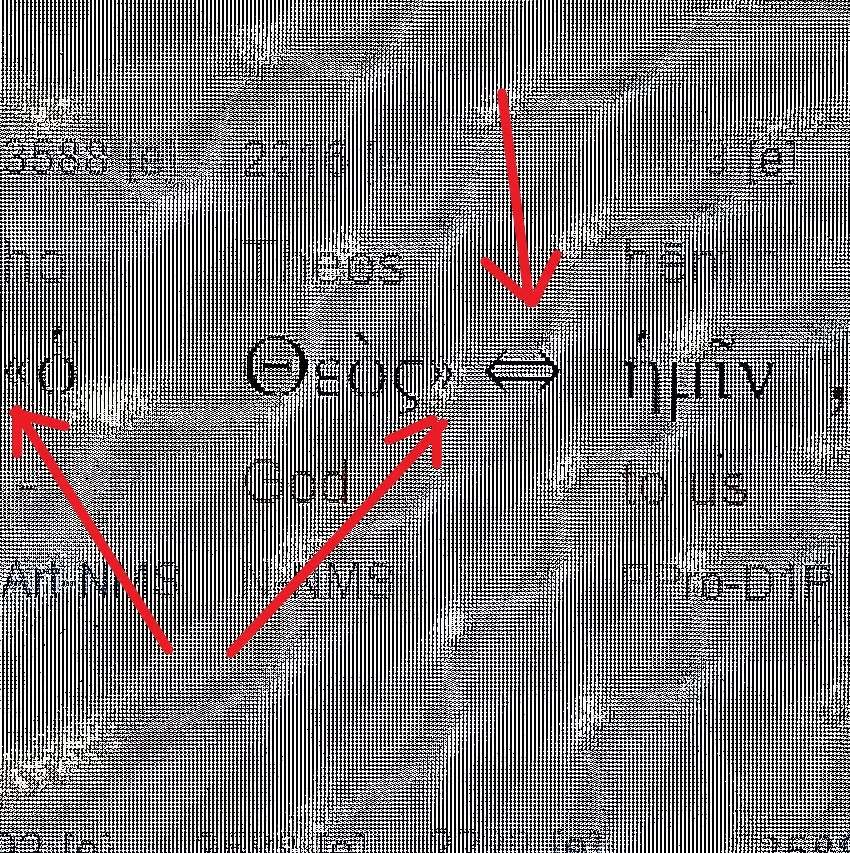
As an extra added by John, he then wrote (literal translation), “To us and this the life in the Son his is.” That means, to John and all other Saints (Apostles), eternal life (“this”) comes in the form of Jesus Christ (“the Son”) in each of them. In the Son of God IS eternal life, which IS the being of ALL Saints. The part of one’s being that is unquestionably eternal is one’s soul, but for the soul to maintain eternal life outside of Jesus Christ, it must reincarnate into a new body over and over again. Eternal life is then always starting over, always repeating, always failing to return to God. It is eternal life interrupted.
It means that IF one likes to imagine life in Heaven, such that we think it is where granddaddy, mom, old dog Spot and our long lost friends are all running around having a good ole time, then that is not quite grasping the big picture. Heaven is set aside for one type of people – those believing in the Son of God. It is for those who believe because the Son of God is in union with them, so they believe knowing the truth as Jesus Christ born into new souls. Therefore, Heaven is for God and a whole bunch of Saints whose souls were saved by Jesus Christ. Rather than running around aimlessly, they sing songs of praise to God eternally.
Just in case someone misunderstands my interpretation here, John then wrote, “Whoever has the Son has life; whoever does not have the Son of God does not have life.” The key verb here is “echo” (root to “echōn”), which is translated as “has,” as a possessive form of the infinitive verb “to have.” It also means “holds” or “possesses.” One cannot “have, hold, or possess” the Son by human testimony. One cannot “have, hold, or possess” Jesus Christ by not being “in union with” that divinity of the Holy Spirit, thus not knowing Scripture has been fulfilled by knowledge coming from the Mind of Christ.
Eternal life is the reward of complete servitude to God, through love.

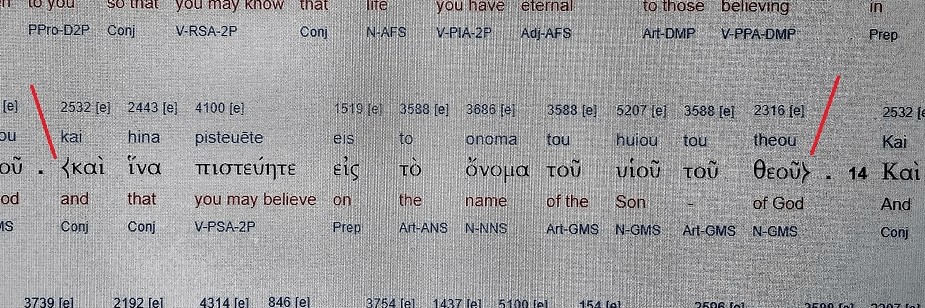
John then began concluding his epistle by writing, “I write these things to you who believe in the name of the Son of God, so that you may know that you have eternal life.” A long time ago, when the ink was still wet on the parchment upon which John wrote this letter, it was to be sent to Saints John knew. All of them had assumed the title “Christ,” because they had been awarded the presence of the Son, by the Father. Today, we read this letter roughly two millennia later, with our eyes intended to ponder these words. We can be the Saint unto whom John wrote. Or, we can deny that God sent this prophecy to us, for us to fulfill it by making a full commitment to God, so we can come to personally know Jesus Christ as Jesus Christ reborn.
As a lesson in the Easter season, those who love God, but have still not yet said “Yes” to His proposal of marriage, the call is to make that commitment now. That union is what brings about the Resurrection of Jesus Christ within one who is subservient to God’s love. One has to move beyond receipt of human testimony and know the truth that is God’s testimony, which comes from the Mind of Christ overseeing one’s human brain. This commitment was made by John and all the many others who have spread true Christianity to the world. Thus, the call is to join that lineage of Saints, who serve the LORD as His Prophets – the lights of truth that shine in the darkness of the world.
The message here is there are only two types of Christians, as Christianity has not remained true to its origin in only Saints. It has been diluted, just as the Israelites lost their way after Moses delivered them to the Promised Land and their faith slipped. Their failures to God were due to them wanting to be like the people of other nations, who praised leaders instead of God. Christians today are just as distracted by the things the world offers, which makes them moan and groan about having to be personally devoted to God’s Will. Like a child who has been told “No” by the father, the next step is to go ask mom and have her change that edict.
This childish behavior is repeated in human adults, as the influence that leads humans to follow leaders that will become surrogates to our selfish desires. The leaders we choose to lead us will always be liars – false prophets – who will tell the people what they want to hear. They always say God wants his children to be special, as wealthier, smarter, and healthier than other mere mortals. To gain those benefits, all one has to do is say, “I believe in Jesus Christ as the Son of God.”
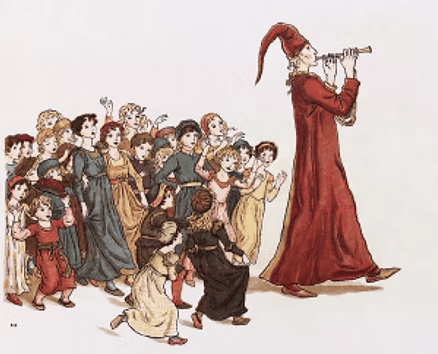
The Pied Piper of Hamlin leading the children to their ruin, all over again.
The message here is God only offers eternal life as a reward of faith and belief. That only comes by one’s soul being one with the Holy Spirit of Jesus Christ. The rewards of a mortal life are hard, honest work, and the persecution for one’s true beliefs, as Satan surrounds believers with evil and difficulty. He tempts them first with material gifts that are mirages, compared to eternity.
To say one is Christian and then not know Jesus Christ personally … to not speak the Word of God so that others can be led to the truth … is to call God a liar. Satan loves to have souls call God that. Rejecting that holy presence says one believes Jesus Christ will not be sent by God again until the world is ended … after I have grabbed as many comfortable things as I can … regardless of who suffers so I can find favor.
This Easter lesson poses the question: From where did your beliefs come? Did you receive human testimony and place total belief in the words of another human being, without asking God to prove those words were true and worthy of belief?
All Easter season we have been asked to discern the difference from “believing” (in the present tense) and “belief,” where so many lambs follow the leader, too frightened to test what they believe as truth. This lesson wants you to know all about that which you profess as belief.


 Explaining the Readings