Tag Archives: 1 Kings 19:4-8

1 Kings 19:4-8 – Asleep under a broom tree

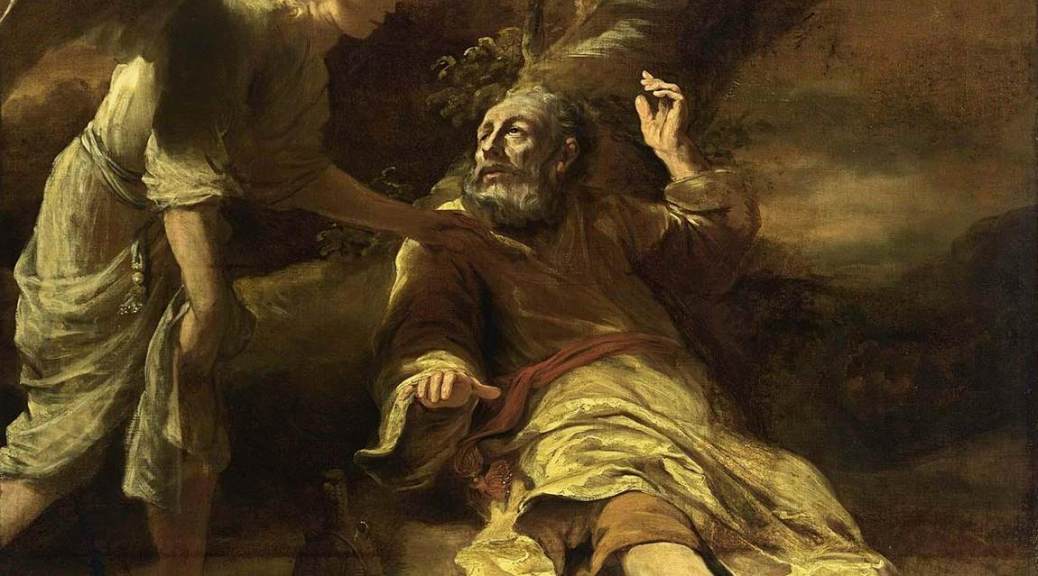
Elijah went a day’s journey into the wilderness, and came and sat down under a solitary broom tree. He asked that he might die: “It is enough; now, O Lord, take away my life, for I am no better than my ancestors.” Then he lay down under the broom tree and fell asleep. Suddenly an angel touched him and said to him, “Get up and eat.” He looked, and there at his head was a cake baked on hot stones, and a jar of water. He ate and drank, and lay down again. The angel of the Lord came a second time, touched him, and said, “Get up and eat, otherwise the journey will be too much for you.” He got up, and ate and drank; then he went in the strength of that food forty days and forty nights to Horeb the mount of God.

——————————————————————————–

This is an optional Old Testament selection from the Episcopal Lectionary for the Twelfth Sunday after Pentecost, Year B 2018. In the numbering system that lists each Sunday in an ordinal fashion, this Sunday is referred to as Proper 14. If chosen, it will next be read aloud in an Episcopal church by a reader on Sunday August 12, 2018. It is important because it tells of the power of spiritual food that comes from sacrifice for God.

This selection seems odd, when viewed in the context of the chapters surrounding it. It reminds me of the vision Abraham had of Lot in Sodom and Gomorrah, where angels visited Lot’s family and the native people there were so evil that God had the cities destroyed. I say that because both that story from Genesis does not match the mundane story told of Abraham rescuing Lot from the kings of the five cities on the plain.  This story in 1 Kings 19 also seems to be dream sequence, rather than actual events, simply because the before and after do not match.

I say this because 1 King 18 tells of Elijah’s ‘sacrificial calf cook off’ against 450 priests of Ba’al.  Jezebel’s prophets lost both the challenge to have their god light their altar wood and their lives.  Even after letting the Baal priests have a head-start, while dousing his wood and sacrificial animal with water, Elijah won.  Yahweh lit his altar’s fire.
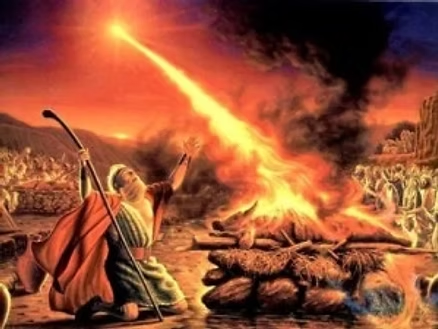
After the contest was over, Elijah had all 450 prophets of Ba’al killed in the Kishon Valley (1 Kings 18:40). Ahab witnessed this and the people of Israel’s response , who saw Elijah’s fire be lit by God.  We read, “they fell prostrate and cried, “Yahweh—he elohim! Yahweh—he elohim!” (1 Kings 18:39)

They said, “Yahweh hū elohim,” not “Ba’al.”  The people, including Ahab, recognized the God of Israel was the only supreme deity.  They recognized Elijah as a prophet of that Almighty God.  Thus, they would be fools to go against that God and His prophet.

Additionally, prior to that contest, Elijah had met with Obadiah, who had hidden one hundred prophets of Israel in two caves (fifty prophets in each cave), and there was nothing that says either Ahab or Jezebel knew where those prophets were. In 1 Kings 19, prior to these verses read above, Ahab told Jezebel that her prophets had been killed and she threatened to have Elijah killed that day. While nothing said she planned to kill or had killed in response all the prophets of Israel, in 19:10, Elijah told God he was the only prophet left, which could only be true if he was seeing the future in a dream.

It is also important to see the symbolism of sleep and death, which coincides with Elijah’s statement to God, “It is enough; now, O Lord, take away my life, for I am no better than my ancestors.”
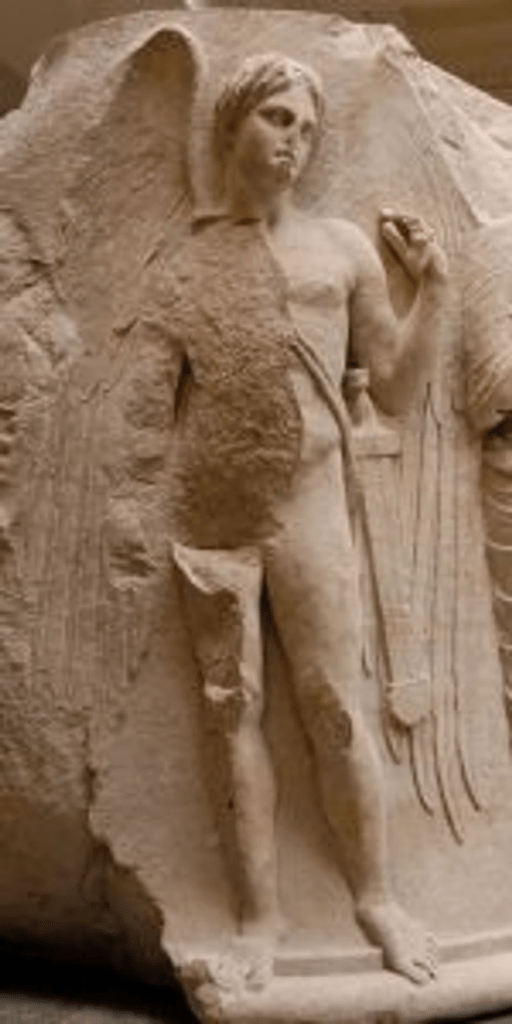
Thanatos
The Greek poet Hesiod established in his Theogony that Thánatos is a son of Nyx (Night) and Erebos (Darkness) and twin of Hypnos (Sleep).

Following that surrender of his self, Elijah then went to sleep. The angel’s presence, twice, can then be seen as similar to the angels that were present in the tomb of Jesus. This possibility of a death dream sequence makes Elijah’s seeming ascension without death become more like the ascension of Jesus, following his death and resurrection, aided by angels.

The bread and water provided by the angel is like Jesus being attended by angels while he was in the wilderness, after he encountered Satan.  The angels also fed Jesus the spiritual food that allowed him to last forty days and nights in the wilderness.  This is then the same as the manna and water from the rock that nourished the Israelites spiritually during forty years of wandering

This means this chapter is Elijah’s talk with God after his symbolic death, but before his taking Elisha to be his replacement. He could have actually died and been reborn by the angel’s touch, replenished by the food and water from heaven.  This transformation also acts to explain the unnamed prophet of 1 Kings 20, who asked other prophets to strike him with a sword, as a resurrected Elijah would be appearing as someone other than himself, just as Jesus did when he resurrected.

The forty days and forty nights spent in the wilderness without food or drink is then a parallel to Moses on Mount Horeb, as well as Jesus in the wilderness prior to beginning his ministry. It then is parallel to the Transfiguration of Jesus on the high mountain, when Peter, James and John (of Zebedee) saw Jesus talking with Moses and Elijah. These comparisons make Moses, Elijah and Jesus like souls as they all submitted fully to the will of God. They are then the models of whom all followers should become, where sleep and death are symbolic of one’s sacrifice of self-ego.

When we read that Elijah ended one day in the wilderness by sitting “under a solitary broom tree,” we need to realize the timing of night, when sleep normally takes place. If the temperatures turned cooler at night, it is possible that this tree supplied wood to burn for warmth. If so, it is good to know that a broom tree is also a juniper tree, as the Hebrew word “rō·ṯem” implies.
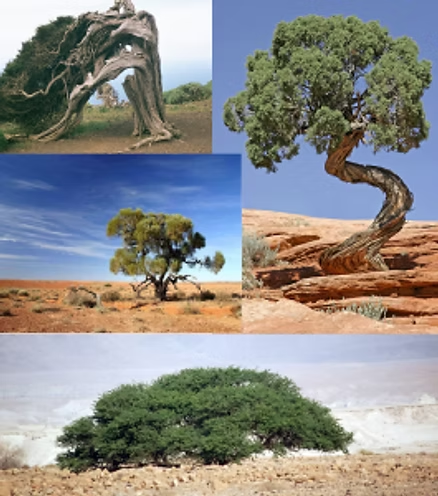
According to the symbolic nature of a juniper tree is its wood is not good for fast burning, but for slow burning and the release of aromatic scents. According to one site, the smoke of juniper wood, “was used for the ritual purification of temples. The smoke was said to aid clairvoyance, and continued to be burned for purification and to stimulate contact with the Otherworld.” This aspect can then be seen as why Elijah “asked that he might die.”

As a dream sequence, more than an actual event, the wilderness represents Elijah embarking on a journey where he has had all the prophets of Jezebel killed and is aware of her threat to have him killed in response. Rather than risk death at the hands of an evil queen, the symbolism is Elijah praying for the LORD to take his soul, regardless of what physical punishment Jezebel can cause. The response of that prayer is the presence of a guardian angel sent by God to nourish one with spiritual food and living water, thus enabling one to withstand any persecution that may arise.
As an alternate reading selection for the twelfth Sunday after Pentecost, when one’s personal ministry for the LORD should be underway – one is on a journey into uncharted waters, no longer following the desires of personal ego – the message of Elijah is willing sacrifice. It is up to each individual to ask God that he or she might die of self-importance, so an angel of the LORD can be sent to assist one on one’s journey. That angel can be understood as being God’s Holy Spirit.

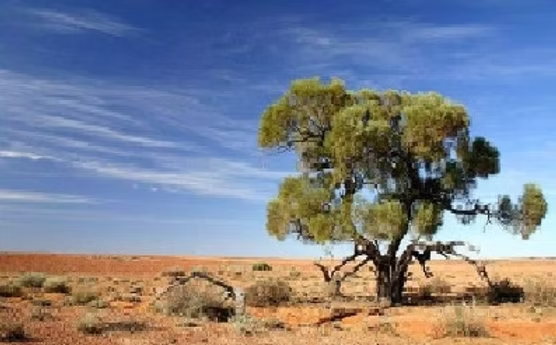
Again, it is most important when reading Scripture not to get caught up in the antiquity and seeing no comparison in a modern world. While our mind’s eye might see a desertscape in southern Judah, in a place so barren that only one prickly shrub is around, this wilderness is no different than a life in the world today that is void of true commitment to Yahweh – the LORD elohim (God of gods). One has to be willing to place oneself in the sandals of Elijah and feel the fear of living in a place that scorns prophets of the One God. One has to be able to see the solitary broom tree as one’s own soul amid a barren setting, where survival is impossible alone. One needs God’s help; and the first step towards that grace is realizing a big brain cannot lead a soul to eternal happiness.
The setting in which one finds Elijah is void of any external source of support. This says that no matter how many people, institutions, or holy places one puts trust and value in, when death comes and one’s soul is separated from one’s flesh, there will be only God and His reckoning of one’s soul. One will become accountable for all of one’s misgivings in a life. However, if one seeks this redemption prior to one’s physical death, one can die of self and then be resurrected to serve God’s needs in the world of flesh.

A minister of the LORD has made this sacrifice and knows the value that the presence of God within brings. One becomes a presence among those who have yet to show their trust in God, much less give up their self-importance for the unseen and intangible. Much of this can be a ministry of spreading the truth of Scripture in a way that makes it both profoundly believable and personally enlightening. Anyone who teaches, ministers, preaches, and prophesies can only make a doorway become available for a seeker to open and enter. That threshold is the wilderness and entering into service of the LORD requires one sit under that broom tree and request God to accept one’s soul as His servant.
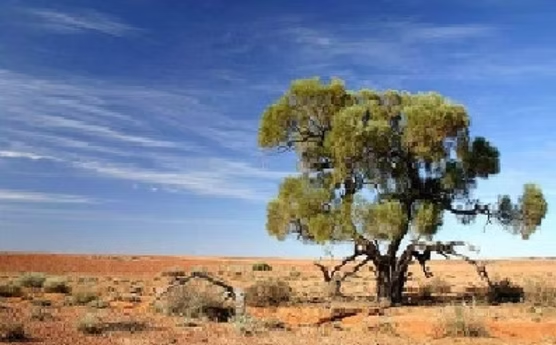
1 Kings 19:4-8 – Death under a Juniper tree

Elijah went a day’s journey into the wilderness, and came and sat down under a solitary broom tree. He asked that he might die: “It is enough; now, Yahweh, take away my life, for I am no better than my ancestors.” Then he lay down under the broom tree and fell asleep. Suddenly an angel touched him and said to him, “Get up and eat.” He looked, and there at his head was a cake baked on hot stones, and a jar of water. He ate and drank, and lay down again. The angel of Yahweh came a second time, touched him, and said, “Get up and eat, otherwise the journey will be too much for you.” He got up, and ate and drank; then he went in the strength of that food forty days and forty nights to Horeb the mount ha-elohim.

——————–

This is the Track 2 optional Old Testament reading for the eleventh Sunday after Pentecost [Proper 14], Year B, according to the lectionary for the Episcopal Church. If chosen, it will be paired with a selection of Psalm 34, which sings, “The angel of Yahweh encompasses those who fear him, and he will deliver them.” That set will be presented prior to the Epistle reading from Ephesians, where Paul wrote, “do not grieve the Holy Spirit of God, with which you were marked with a seal for the day of redemption.” All will accompany the Gospel reading from John, where Jesus said to the crowd, “Whoever eats of this bread will live forever; and the bread that I will give for the life of the world is my flesh.”

I wrote about this reading and published those thoughts back in 2018, the last time it came up in the reading cycle. I welcome all to view that commentary by searching this site. I include some background details that place these five verses in historical context; and, what I wrote then is still valid conclusions today. I offered that I saw this reading as symbolic, perhaps a dream; but I will now offer new insights, which do more to highlight why the ‘elders’ chose these verses as an option to the other Old Testament reading from Second Samuel.

The clear connection between a reading about the death of Absalom and this episode of Elijah telling Yahweh to “take away my life” is a tree setting. Absalom’s troops of Israel were routed in the forest [“bə·ya·‘ar” – also “thickets, woods”] of Ephraim, but he himself became entangled in one of the “tenrebinth” [“ḇā·’ê·lāh” – “elah”] or “turpentine trees.”. This becomes the similarity here, as Elijah “sat down under a solitary broom tree” [“rō·ṯem”], which means a “juniper tree.” While the differences in tree species can lend additional symbolism to each story, the commonality of “tree” is it is a trunk coming from roots, with a myriad of branches that make both trees uninviting to human presence. Thus, the tree symbolism in both cases needs to be seen as metaphor for the history of Israel being planted into the Promised Land.

Broom tree or Juniper.

In both stories the ‘victims’ found under a tree were running away from danger. Absalom’s army had lost twenty thousand men, many to the branches of the turpentine trees that created a thicket that was difficult to navigate swiftly. Those who did not slow down when they reached the thicket in Ephraim were killed by swords, arrows and spears. Those who attempted to rush through the branches were beheaded or pierced by tree limbs. Absalom’s hair became entangled in a branch, which left him hanging (still alive) “between heaven and earth.” Isaiah was likewise running away from the threat upon his life, ordered by Ahab and Jezebel. As Elijah sat down under a “broom tree,” he too was suspended between heaven and earth in a figurative way.

In the case of Absalom (the verses selected to be read), he was hanging still alive, after Joab had come upon him and [not read], “(Joab) took three spears in his hand, and thrust them into the heart of Absalom.” For this not to have killed Absalom, the fact that Joab had “armor bearers” with him says Absalom most likely also wore armor which kept the act by Joab from killing him. The “three spears” can be seen as one spear with three points – a trident. The “heart” can then be read as the chest of Absalom, where there was enough penetration to strike at the “will” [alternate translation of “bə·lêḇ”], so Absalom was still alive, but unconscious and utterly defenseless. He had been reduced to the state of incapacitation that ten children could then strike his body and kill him.

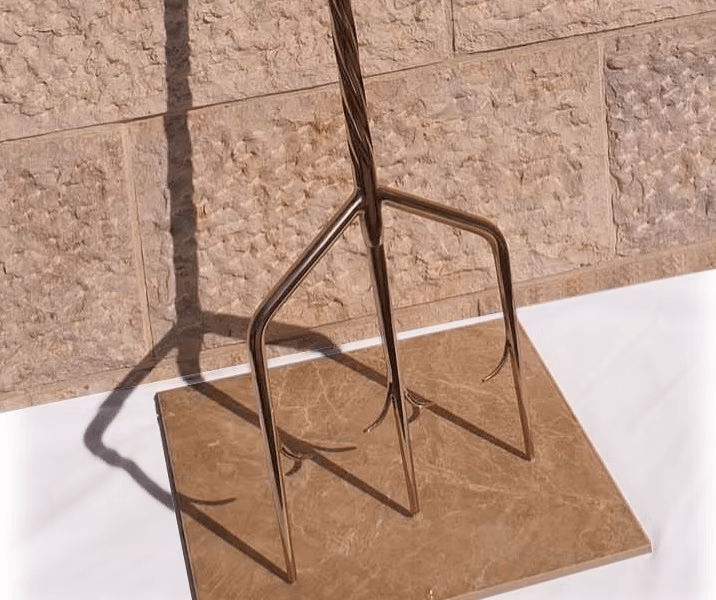
This is a three-pronged fork [mazleg], which was used as an altar tool for uplifting and turning large portions of sacrificial meat. If Joab took one into battle with him, it would be for symbolically using it on enemies representing sacrificial beasts.

In that story [mostly unread aloud in church], Joab represented Ahab and Jezebel (the evil influence behind the king), with Absalom being seen the same way Elijah was seen by his pursuers. Absalom had risen to become a king of Israel and Judah; so, his head became one worthy of being transcribed in the history books [like First Kings is], which David ordered the Song of the Bow be written into the Book of Jasher [the history of leaders the Philistines remembered]. Absalom was just another human being who rose to be a king, but then fell back to the earth, in the arc and trajectory of self-importance. He lived by the sword and he died by the sword. The end.

Elijah, on the other hand, sat down under a tree of branches, of his own free will. Instead of his head being caught up in self-importance he welcomed death. He invited Yahweh to take his life. When the NRSV translation says, “ He asked that he might die,” it must be realized that Elijah was “asking” this of Yahweh, so the Hebrew word “way·yiš·’al” [“shaal”] can be read as “he prayed.” One can imagine that Absalom’s ego had him trying to free himself the whole time he hung on the branch, trying to free himself to live another day as a threat to his father. Elijah, on the other hand, represents a willing sacrifice to Yahweh, praying: “It is enough; now, Yahweh, take away my life, for I am no better than my ancestors.”

In that translation, the Hebrew word “mê·’ă·ḇō·ṯāy” is translated generically as “ancestors.” The core word in that [“ab”] means “fathers.” This relates Elijah to a lineage of prophets, where the “fathers” – Abraham, Isaac, and Jacob – were not to be confused with the masses that ascribed blood relationships, but only those whose souls were related through marriage to Yahweh. The prayer then meant with his being condemned to death by Ahab, Elijah’s acts proving the divinity of Yahweh as the God of Israel was over. There was nothing more Elijah could do, after he had Yahweh ignite his altar wood and burn his sacrificial cow, which then led to the slaughter of four hundred fifty priests of Ba’al. Rather than try to save himself from being killed by Ahab, Elijah was offering his soul into Yahweh’s hands.

Now, the reason a “broom tree” is called that is because the branches grow straight, with prickly small leaves at the end. They are said to be capable of providing shade for one person, with little room for covering more. All of that becomes metaphor for Elijah being a singular prophet of note in the history of the “fathers” of those peoples. The symbolism of a Juniper tree is as a protector of evil spirits. [Ref.] That acts as how the divine “ancestors” of Yahweh protected the laws [the marriage vows] of Moses from corruption. Thus, Elijah was one broom of Yahweh, which was sent to sweep out the evil presence [the grime and filth] that had dirtied the Northern Kingdom.

The aspect of Elijah going to sleep must be seen as his death. Minimally, his soul left his body of flesh, which means Yahweh granted his prayer; but, unlike the death of Absalom, where children came to hack his body to pieces, Elijah was attended to by an angel. More than a dream Elijah had while asleep, the angel bringing bead and water must be seen as his soul being cared for, protecting Elijah from evil. If one sees Elijah physically dying under a tree, just as Absalom died under a tree, one can begin to equate everything written about his subsequent life as the equivalent of Jesus’ resurrection from death, whereby no second physical death would be necessary before his ascension to heaven before witnesses [divine replacements].

When this physical death is seen, to read “there at his head was a cake baked on hot stones, and a jar of water,” the aspect of “by his head” [“mə·ra·’ă·šō·ṯāw,” rooted in “meraashoth”] needs to be seen as parallel to Absalom’s head being “suspended between heaven and earth.” The presence of bread and water by Elijah’s “head” says his ego was replaced with spiritual food [bread cooked on coals] and everlasting water [a jar of water]. Because Elijah was “touched by an angel,” his soul had become joined divinely. When death is seen at the point of that touch, being told “Get up and eat” – the actual command is “arise” [from “qūm”], meaning leave the body of flesh and enter the heavenly realm – Elijah was commanded to partake of the offerings of Yahweh.

When we then read that Elijah “ate and drank, and lay down again,” rather than see Elijah as being very tired [after only a day’s journey], one needs to see the duality of two. When one means death, two means the resurrection, as “again” returning to life in the body of flesh. This then means the soul of Elijah “lay down again” in the body of flesh that was dead. When we then read, “The angel of Yahweh came a second time, touched him, and said, “Get up and eat, otherwise the journey will be too much for you,”’ this becomes Elijah being resurrected from death. In the same way that Jesus told Jarius “give her [his risen daughter] something to eat” there is a need for spiritual food to feed the soul returned to the body of flesh. This is not a need for physical food, as resurrection from death is not about the physical flesh but for the soul to be strengthened.

We then read, “He got up, and ate and drank; then he went in the strength of that food forty days and forty nights to Horeb the mount ha-elohim,” where I have corrected the translation to show the Hebrew “ha-elohim.” The plural number that says “of the gods” [rather than “of God”] becomes a statement that Elijah’s eternal soul had been joined with the “angel of Yahweh” [“mal·’aḵ Yah-weh”], which clearly is a non-human, spiritual entity of eternal life. Simply from two eternal entities joining as one, the result is an “elohim.” This is not to say that Elijah was not also an “elohim” while a living prophet, as the fact that he was a prophet who called upon Yahweh says Elijah was a soul married to Yahweh’s Spirit [another “angel” – “malak”]. The distinction now says the resurrected body of flesh that was Elijah is no longer necessary for Elijah to carry around. Thus, “the forty days and forty nights to Horeb” was impossible in a physical body of flesh.

In my 2018 commentary, I speak of the similarity of Moses, Elijah and Jesus spending forty days in the wilderness, where that was s link that had them all appear together in the Transfiguration. More than that being a statement of time [although it can be that too], the purpose here is to say that Elijah was in a state of being that no longer required a physical body. When Mount Horeb is seen as a place of union with Yahweh, so Elijah did not need to travel to a distant land and climb up a mountain, Elijah was divinely elevated to a state of being that parallels Moses and Jesus. The cave in which Elijah would go [another Sunday’s reading] is his tomb, which makes that parallel to the tomb in which Jesus’ body was placed after his death from crucifixion. No longer needing a physical body, as his body could be seen as an angel can be seen, the second helping of bread and water was to feed this presence.

Again, returning to the comparison of the Absalom head caught in a turpentine tree branch, where he was incapable of avoiding his pending death, Elijah becomes the precursor of Jesus, in the sense that he willingly sacrificed his body of flesh so his soul could be resurrected as an angel walking the face of the land. Absalom would be mutilated and disgraced, which became a reflection of the kingship that David had used to lead the Israelites to serve Yahweh as their king. Absalom’s death ended all thought of the mangled tree of Israel ever producing a worthy king. Elijah was not sent to be a prophet of Israel for the purpose of overthrowing a king. He sacrificed his body of flesh so that an “elohim of Yahweh” could be preserved.

As an optional reading for the eleventh Sunday after Pentecost, when one’s own personal ministry for Yahweh should already be well underway, the lesson of this reading is to see the fear of death as a selfish quest for power that can never be obtained. One must sacrifice one’s life through marriage to Yahweh. One must die and then be reborn by the marriage that sends an angel to be one with one’s soul. Today, Christians know that angel by the name of Jesus – a name that means Yahweh Will Save. To have one’s soul saved by Yahweh, one must die of self-ego and self-will and be resurrected as Jesus, the Son of man reborn.

Jesus then becomes the bread baked on coals and the jar of water that nourishes one’s soul. This makes this reading option fit the Gospel reading from John, where it is repeated that Jesus said, “I am the bread of life.” The bread of life is set by one’s head, when one’s head has been emptied of self-ego. Otherwise, one hangs suspended between heaven and earth, trying to figure a way to save one’s life, when that is an impossibility. Elijah shows us the true quest should be to save one’s soul; and, that means telling Yahweh, “This is enough. Take my life.”