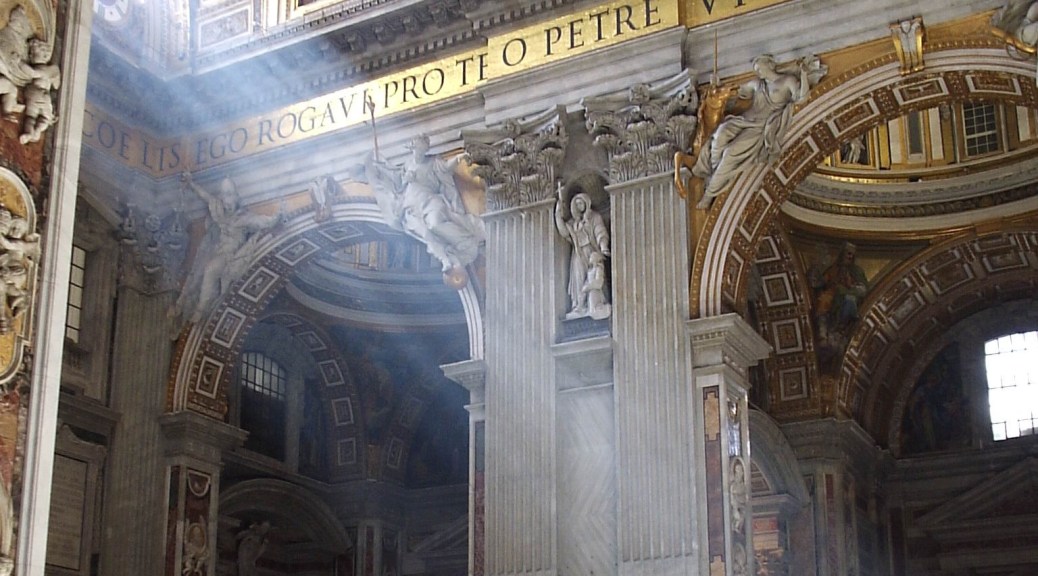
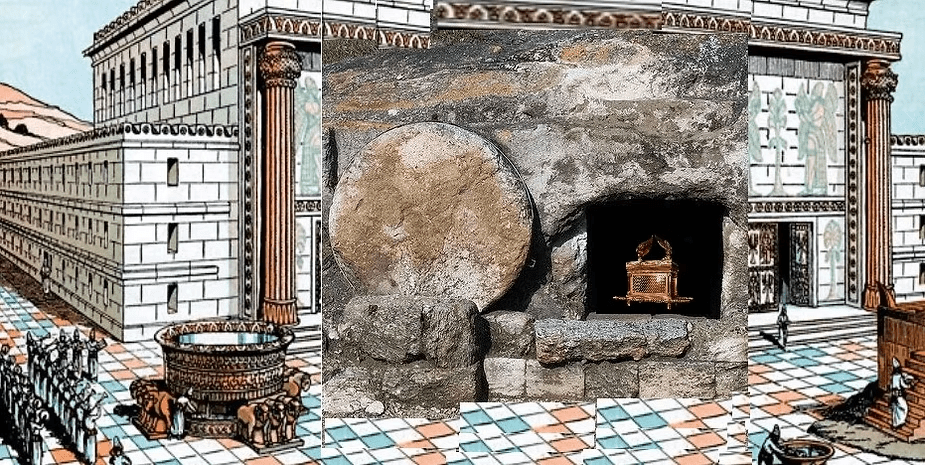
[Solomon assembled the elders of Israel and all the heads of the tribes, the leaders of the ancestral houses of the Israelites, before King Solomon in Jerusalem, to bring up the ark of the covenant of the Lord out of the city of David, which is Zion. Then the priests brought the ark of the covenant of the Lord to its place, in the inner sanctuary of the house, in the most holy place, underneath the wings of the cherubim. And when the priests came out of the holy place, a cloud filled the house of the Lord, so that the priests could not stand to minister because of the cloud; for the glory of the Lord filled the house of the Lord.]
Then Solomon stood before the altar of the Lord in the presence of all the assembly of Israel, and spread out his hands to heaven. He said, “O Lord, God of Israel, there is no God like you in heaven above or on earth beneath, keeping covenant and steadfast love for your servants who walk before you with all their heart, the covenant that you kept for your servant my father David as you declared to him; you promised with your mouth and have this day fulfilled with your hand. Therefore, O Lord, God of Israel, keep for your servant my father David that which you promised him, saying, ‘There shall never fail you a successor before me to sit on the throne of Israel, if only your children look to their way, to walk before me as you have walked before me.’ Therefore, O God of Israel, let your word be confirmed, which you promised to your servant my father David.
“But will God indeed dwell on the earth? Even heaven and the highest heaven cannot contain you, much less this house that I have built! Regard your servant’s prayer and his plea, O Lord my God, heeding the cry and the prayer that your servant prays to you today; that your eyes may be open night and day toward this house, the place of which you said, ‘My name shall be there,’ that you may heed the prayer that your servant prays toward this place. Hear the plea of your servant and of your people Israel when they pray toward this place; O hear in heaven your dwelling place; heed and forgive.
“Likewise when a foreigner, who is not of your people Israel, comes from a distant land because of your name —for they shall hear of your great name, your mighty hand, and your outstretched arm—when a foreigner comes and prays toward this house, then hear in heaven your dwelling place, and do according to all that the foreigner calls to you, so that all the peoples of the earth may know your name and fear you, as do your people Israel, and so that they may know that your name has been invoked on this house that I have built.
———————————————————————————————————-
This is an optional Old Testament selection from the Episcopal Lectionary for the Fourteenth Sunday after Pentecost, Year B 2018. In the numbering system that lists each Sunday in an ordinal fashion, this Sunday is referred to as Proper 16. If chosen, it will next be read aloud in an Episcopal church by a reader on Sunday August 26, 2018. It is important because Solomon has followed in the steps of his father and moved the Ark of the Covenant from the place it had rested for years, to a new house built for it and God.
The whole of 1 Kings’ chapter eight is 66 long verses that tell of the moving of the Ark of the Covenant from the City of David to the new temple built by Solomon and his prayer and dedication of all of that. It was scheduled to be incorporated into the God-commanded feast of Sukkot (the Festival of Booths), so it happened on 15 Ethanim (aka Tishri), which was the equivalent of a modern September or October. As such, the dedication of Solomon’s Temple was during the seven-day harvest festival (Feast of the Ingathering – from Genesis), when the Jews also recognized the dependence of the people of Israel on God (Feast of Tabernacles – from Exodus).
So, while this reading is parsed down to just a fraction of that whole, it still reads (to me) like a state fair event, held in a capital city in early fall, when all the deep-fried butter on sticks, cotton candy, grilled corn on sticks, foot-long corn dogs, powdered sugar dusted funnel cakes, caramel apples and a wide assortment of carnival amusement rides are all waiting on the other side of the entrance gate that is blocked by a big blue ribbon and a bunch of dignitaries in suits holding a giant pair of scissors.

Solomon sounds like the governor that has come, bringing with him a posse of political party advisors and a gaggle of news reporters and photographers, to the dedication of the newest and biggest ride the fair has ever known. Of course, that would have never happened if the governor hadn’t used his sway with powerful connections; so, pats on the back for many are publicly made, so all to get some glory … and more votes. It reads like there was a lot of pomp and circumstance surrounding the opening of the fair, more than usual. However, the smells of the foods and the sounds of the carnival music make all the sweat from waiting for the speeches to end, on a warm day, is worth waiting for.
The people of Israel saw more animal sacrifices than could be counted. The altar was ablaze and the air was filled with barbecue smoke. The harvest was plentiful, as always while Solomon was king; so a fun time was had by all.
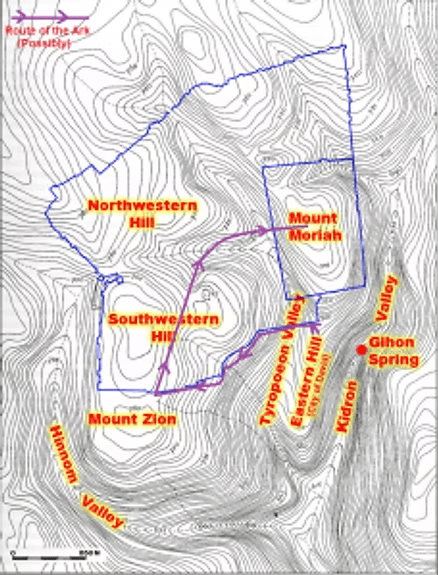
Still, the movement of the Ark from its tabernacle in the City of David, up the path less steep on Mount Zion, across the old city of Jerusalem to the height of Mount Moriah, was made in a more dignified manner than was when it was moved from the house of Abinadab to Jerusalem by David. Nothing says Solomon was skimpily dressed and dancing wildly before the Ark. I imagine Micah, daughter of Saul, would have been glad that a King of Israel acted stately and dignified.
This is how I see Solomon treating God – like a side-show to his great accomplishment, the temple named after him. If you read the words of this reading selection carefully, Solomon talks to the Israelites and elders as if God had made a covenant to make sure Israel was always the greatest nation on earth. He even told God to take care of the foreigners who had come to Jerusalem, so the world knew how great Israel’s God was. Set the hoops up and let the tamer’s whip begin snapping!
P. T. Barnum would have been glad.

However, this is where one needs to be reminded of the past.
Solomon was officially king at age thirteen. The temple construction began when he was seventeen, in his fourth year as king. The temple was completed for the transfer of the Ark when Solomon was twenty-four, seven years later; but, Solomon’s Temple would be a work that lasted his entire reign. This history says that the dedication of Solomon’s Temple was made by a young adult king. While Solomon was highly intellectual (presumably Mensa genius level), he still was confronted with life situations that he had no personal experience to prepare him for, having to problem solve on the go. At the age of twenty-four, he still depended on prophets and priests to advise him on history, religion, and government issues.
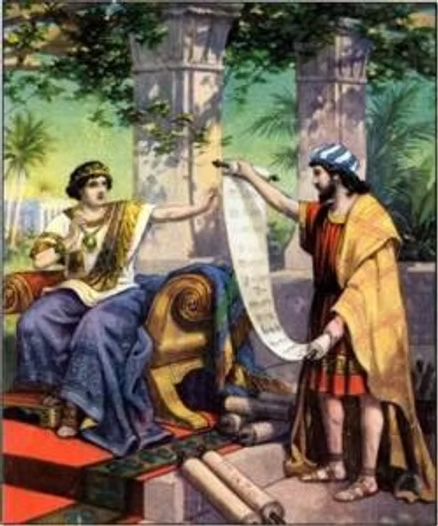
In reference to his father’s history, Solomon had to have been told of father David’s plan to build a house of cedar for the Ark, so God would no longer have to live in a tent. Nathan the prophet agreed with David, knowing David’s thoughts were in line with God’s. However, God visited Nathan in a dream and told him what to say to David. This relates to the building of a permanent house for the Lord:
2 Samuel 7:12-16 – “When your days are over and you rest with your ancestors, I will raise up your offspring to succeed you, your own flesh and blood, and I will establish his kingdom. He is the one who will build a house for my Name, and I will establish the throne of his kingdom forever. I will be his father, and he will be my son. When he does wrong, I will punish him with a rod wielded by men, with floggings inflicted by human hands. But my love will never be taken away from him, as I took it away from Saul, whom I removed from before you. Your house and your kingdom will endure forever before me; your throne will be established forever.’”
Nathan was the prophet who advised David. He was still around to anoint Solomon as king and help with the elimination of David’s old enemies. It may or may not be that Nathan advised Solomon of Yahweh’s prophecy sent to David; but it is likely that Solomon, as the approved offspring that ascended to the throne of Israel, would be told it was his place to build a house for God. In a part not read today from 1 Kings 8, Solomon announced that he was fulfilling that prophecy delivered by God to Nathan, repeated to King David.
But … was that true?
For all of Solomon’s wisdom, he missed the point of who God would “raise up.” He overlooked the prospect of a kingdom lasting forever. He regularly made references to his father, David, and not to God as his father. The house that Solomon built, while new then was not a house that will last forever. Solomon knew that.
According to Jewish Encyclopedia and their article on Solomon, they say Solomon ordered secret underground rooms to be carved into the rock below the temple, in which the Ark could be placed at a later date.
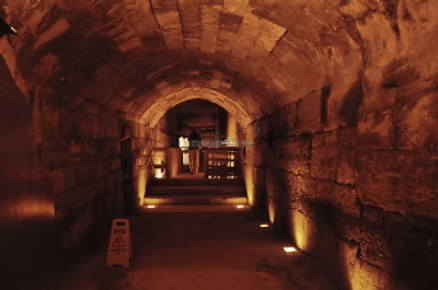
Their article writes that this was because Solomon knew the temple would eventually fall into enemy hands (the wisdom of knowing that, strategically, Jerusalem was indefensible). When it did fall to the Babylonians, Solomon’s Temple was destroyed. After the Persians allowed the Jews to rebuild their lost temple, and the long beautification project begun by King Herod, the Romans would destroy that temple. The eventual eviction of Jews from the Middle East meant Mount Moriah became the home of a Muslim mosque on that mount. Therefore, history allows one to surmise that Solomon’s Temple was not what God had told Nathan an offspring of David would build.
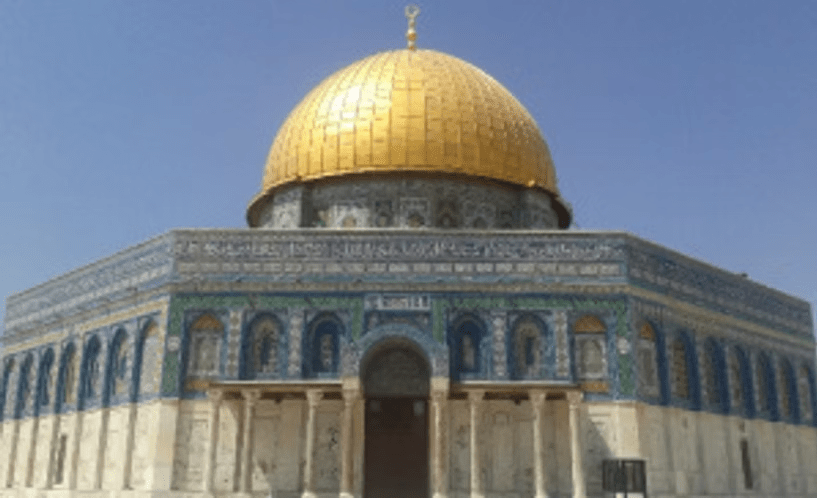
The Temple in Jerusalem that was ordered built by Solomon was little more than an upscale version of David’s plan for a cedar house. When God told Nathan to tell David, “The Lord declares to you that the Lord himself will establish a house for you” (2 Samuel 7:11), God made it clear that He did not want any immobile, physical structure to ever be built for the Ark that held the Covenant within it, over which God presided.
When Solomon said, “Even heaven and the highest heaven cannot contain you, much less this house that I have built!” he was smart enough to realize God did not reside in the Ark, or a tabernacle, or a temple of stone. Solomon should have figured out that God never asked for him specifically to build an everlasting house, when Solomon was part of the House of David God made. Solomon was a brick in that house built by God; but bricks have a way of crumbling to dust over time.
Solomon’s wisdom allowed him to see how dangerous it was to have the Ark placed on low ground, covered only by canvass. Anyone who became an enemy of Israel could easily take it into their possession; so higher ground made more logical sense. However, could it have been that David placed it where others could readily see it, knowing that God would protect the Ark, and Israel and its king, as long as all served the Lord with all their hearts?
That is the difference between having complete faith in God and having a Big Brain, greater than anyone anywhere at any time.
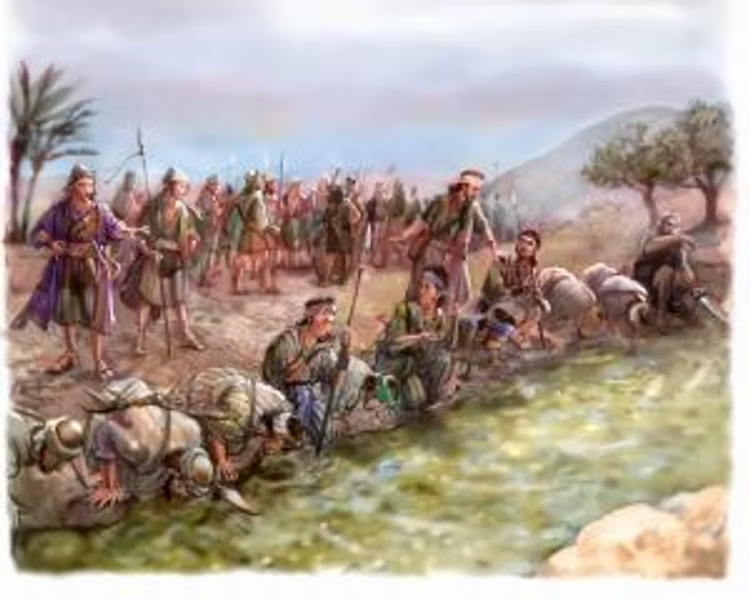
Of course, as Christians two thousand years removed from Jesus Christ, we know that the “offspring to succeed David,” of his bloodline, coming in the flesh, who would “establish his kingdom” was Jesus Christ. He was the offspring of David God told Nathan about. As such, we have a bigger brain than Solomon, in that one sense of understanding Scripture. Therefore, we are not Solomonists.
We are Christians.
Jesus has built the “house in the name of God,” which is the name an Apostle-Saint takes: Jesus Christ. Each true Christian is reborn as Jesus Christ and becomes a living temple of the LORD, in the house of that name. Apostles and Saints can then call God their Father, as they have all (regardless of human gender) become God’s Son, resurrected in the flesh. An Apostle is all about faith in God and absolutely nothing about strategizing.
The dedication of Solomon’s Temple and the prayer he said needs to be more closely examined. The reader says Solomon orated:
“O Lord, God of Israel, there is no God like you in heaven above or on earth beneath, keeping covenant and steadfast love for your servants who walk before you with all their heart, the covenant that you kept for your servant my father David as you declared to him; you promised with your mouth and have this day fulfilled with your hand. Therefore, O Lord, God of Israel, keep for your servant my father David that which you promised him, saying, ‘There shall never fail you a successor before me to sit on the throne of Israel, if only your children look to their way, to walk before me as you have walked before me.’ Therefore, O God of Israel, let your word be confirmed, which you promised to your servant my father David.”
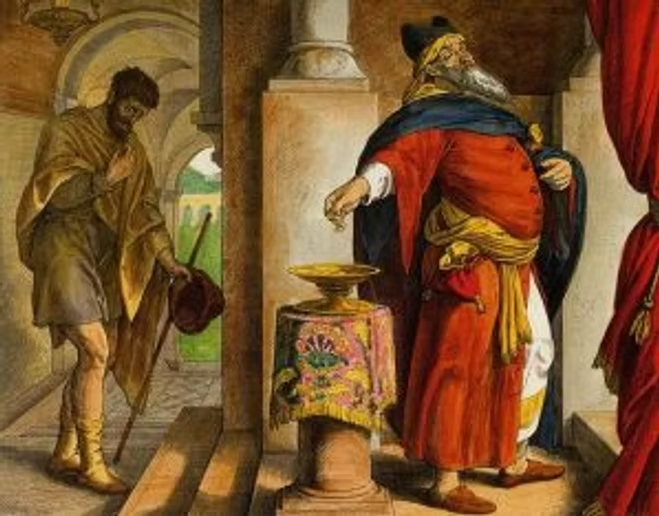
That prayer was for God to live up to his promises to David, Solomon, and Israel. There was little there that says the Israelites have to do anything more than walk before a magnificent building … three times a year … to earn their side of the bargain made between the Israelites of Moses and God. Solomon spoke those words on a day during the festival of Sukkot, which is reminiscent of how the Israelites were placed in booths (tabernacles, tents, or dwellings) in the wilderness … as a sign that they owed everything to their God. The bounty of the harvest coincides with that dedication and devotion. However, Solomon spoke as if an eternal house of David had been established, so the rest was up to God to ensure.
After David brought the Israelites closer to God than they had ever been before, David’s sins with Bathsheba and against Uriah cut them loose and began their drift away from God. Solomon, as the offspring of that sin-born relationship, was given a Big Brain by which to steer the course of Israel to ruin. He asked for it and got his wish granted by God. Building a grandiose temple was one of many steps away from God that Solomon began taking, as his magnificent temple tried to imprison God in a man-made structure, enslaving God to do the will of Israel’s kings.
The House of David will last forever, but not because of Solomon’s Temple. Jesus Christ would build the house in the name of God. The Christ (Greek for Messiah) is the name given by God to His Son Jesus, born of a woman and raised in Nazareth. Jesus took the name of God by being the Christ. Jesus is then the cornerstone of the house in the name of God that will live forever. It lives forever through countless human beings losing their ego-driven sense of self-importance, and being reborn as Jesus Christ, servants of God. The true Temple of the LORD is then Christianity.
As the primary Old Testament option for reading on the fourteenth Sunday after Pentecost, when one’s own personal ministry for the LORD should be underway – one has cut the ribbon and opened the park to the public, in thanks for God’s blessing of a harvest – the message here is to dedicate one’s personal heart and soul to God. There is no building made of stone that God looks upon lovingly.
The Ark of the Covenant has been lost to the world. That physical case for stone tablets, robes, staffs, or whatever other holy material objects might have been placed inside it have been replaced by Jesus Christ. The Gospel theme the entire month of August (2018), from John 6, has been Jesus saying “eat my flesh and drink my blood,” which is (in essence) saying Christians must build the only temple that Yahweh will reside within. That must be built around their souls, using only the materials of Jesus Christ. The Ark is one’s heart and the Law that binds one to God and God to one is then written on that heart by God.
A “church” of Christians is not a physical place of building. It is wherever two or more people that possess the flesh and blood of Jesus Christ have come together. It is a gathering of those having become Jesus Christ reborn. It is the place where two or more come together in the name of Jesus Christ, Jesus Christ will be there, as will the Father. Therefore, a church of Christ is a house built of true Christians.
We read how Paul wrote letters to the churches of Greece (when Turkey was Greek) and the tendency is to think in terms of houses of worship. We see the Ephesians, the Philippians, and the Corinthians as being like a Christian church is today – filled with people who believe in Jesus as Christ, but none who will state, “I am Jesus Christ resurrected.”
I imagine that reading “church” and thinking “building” began when the Roman Emperor assumed control of Western Christianity. Over time, building cathedrals and basilicas became more important than building Saints. Basking in the glory of a huge building became more important than regular home study of Scripture and living a life of righteousness.
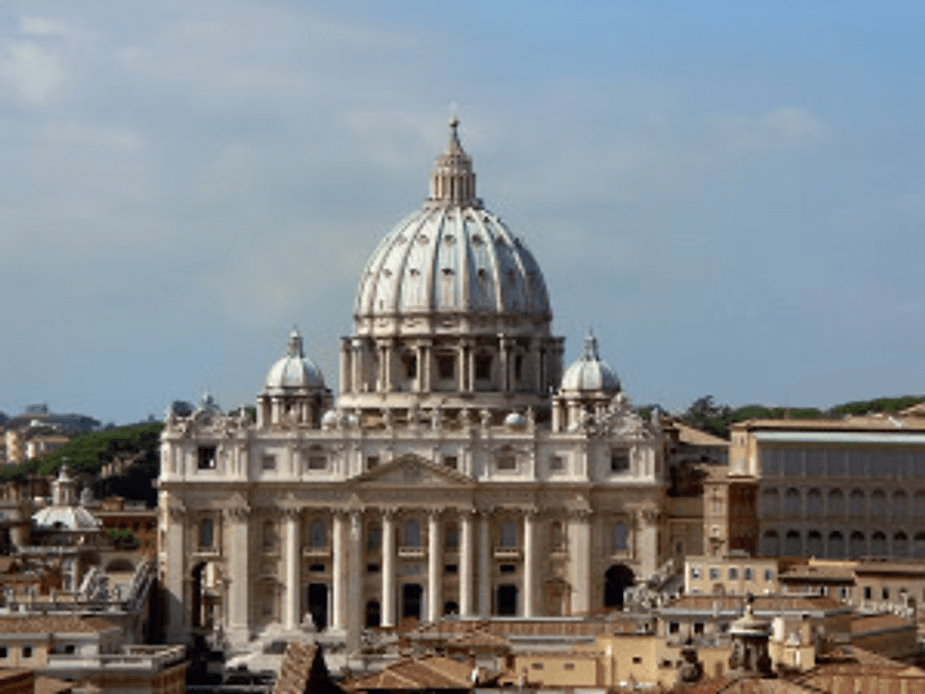
There is probably a parallel between the rise of grandiose Christian churches and the decline of Apostles and Saints. Perhaps, this is due to reading about Solomon’s Temple and assuming that was a good thing to do. Putting God in a box that cost a lot of wealth and time was the easiest way to show one’s love of God. It was hard work, of course; but it was easier to do than give up sin.
A minister for the LORD is a mobile church, always on the move and in search of members to join that church. He or she is unlike a church building that is run by volunteers and a small handful of paid clergy [employees of an organization or institution]. They offer newcomers baskets of trinkets and free coffee with a possible snack – all designed to get one to come back. Their friendliness is built on a desire to have others help with their work; but it is an endless task that loses its sincerity over time. After all, a building gets old and begins to deteriorate, just like those who are sworn to maintain it.
A minister for the LORD is not seeking fellowship and human companionship through an organization that enslaves God by expecting Him to do organizational chores, while hanging Jesus on the cross over the altar. A building called a church that does not create true Christians is really only a building; and a church that creates true Christians usually will only have need for two or three chairs, because most members of that body of Christ will also be mobile churches, always on the move in search of members to join Christ with him or her. As long as the vine is alive and growing, the fruit that comes and goes with the seasons has served a purpose.
Still, remembering the words of the philosopher and storyteller Joseph Campbell, he told Bill Moyer in his interviews that there was something special about being inside a great cathedral. This is a feeling one experiences, usually the strongest when the building is empty. The hugeness of the building becomes like the greatness of God. In that case, a building promotes a sense of reverence.
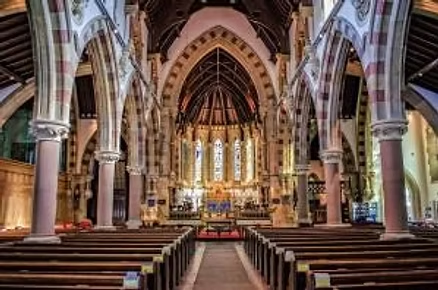
That presence felt says that God watches over His Temples, His Cathedrals and His Basilicas, because they are part of the house of Christianity; and, God watches over those who seek Him. Therefore a building can be where God can be found; but as Solomon said, “But will God really dwell on earth? The heavens, even the highest heaven, cannot contain you. How much less this temple I have built!” – God cannot be placed inside a box.
God is everywhere. He watches the seekers, many of which enter buildings called churches. He gets to know those seekers who make themselves a church for the LORD. As Jesus said, “Ask and you shall receive.” Asking for God’s help can be done anywhere.
Just remember to ask God what you can do for Him and leave the asking what God can do for Israel to Solomon’s prayer.
#John6 #2Samuel71216 #1Kings8 #2Samuel711 #dedicationtoSolomonsTemple
 Explaining the Readings