
On the day when Elkanah sacrificed, he would give portions to his wife Peninnah and to all her sons and daughters; but to Hannah he gave a double portion, because he loved her, though the Lord had closed her womb. Her rival used to provoke her severely, to irritate her, because the Lord had closed her womb. So it went on year by year; as often as she went up to the house of the Lord, she used to provoke her. Therefore Hannah wept and would not eat. Her husband Elkanah said to her, “Hannah, why do you weep? Why do you not eat? Why is your heart sad? Am I not more to you than ten sons?”
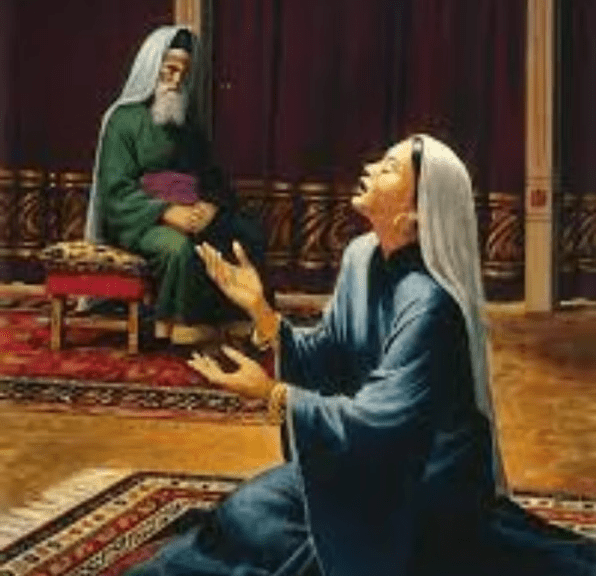
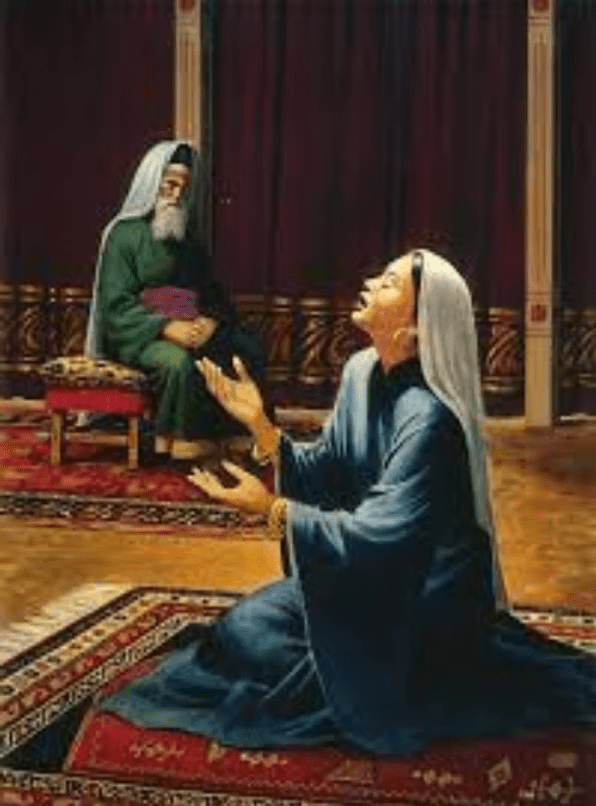
After they had eaten and drunk at Shiloh, Hannah rose and presented herself before the Lord. Now Eli the priest was sitting on the seat beside the doorpost of the temple of the Lord. She was deeply distressed and prayed to the Lord, and wept bitterly. She made this vow: “O Lord of hosts, if only you will look on the misery of your servant, and remember me, and not forget your servant, but will give to your servant a male child, then I will set him before you as a nazirite until the day of his death. He shall drink neither wine nor intoxicants, and no razor shall touch his head.”
As she continued praying before the Lord, Eli observed her mouth. Hannah was praying silently; only her lips moved, but her voice was not heard; therefore Eli thought she was drunk. So Eli said to her, “How long will you make a drunken spectacle of yourself? Put away your wine.” But Hannah answered, “No, my lord, I am a woman deeply troubled; I have drunk neither wine nor strong drink, but I have been pouring out my soul before the Lord. Do not regard your servant as a worthless woman, for I have been speaking out of my great anxiety and vexation all this time.” Then Eli answered, “Go in peace; the God of Israel grant the petition you have made to him.” And she said, “Let your servant find favor in your sight.” Then the woman went to her quarters, ate and drank with her husband, and her countenance was sad no longer.
They rose early in the morning and worshiped before the Lord; then they went back to their house at Ramah. Elkanah knew his wife Hannah, and the Lord remembered her. In due time Hannah conceived and bore a son. She named him Samuel, for she said, “I have asked him of the Lord.”
———————————————————————————————————-
This is an optional Old Testament selection from the Episcopal Lectionary for the Twenty-sixth Sunday after Pentecost, Year B 2018. In the numbering system that lists each Sunday in an ordinal fashion, this Sunday is referred to as Proper 28. If chosen, it will next be read aloud in an Episcopal church by a reader on Sunday November 18, 2018. It is important because the story of Samuel’s birth to a barren mother, as the answer to prayers to God, shows that Salvation is possible to all who swear devotion to God.
When we read, “On the day when Elkanah sacrificed, he would give portions to his wife Peninnah and to all her sons and daughters; but to Hannah he gave a double portion,” the “portions” given are animals sacrificed. The sacrifices were made yearly in Shiloh, where a Levite priest would perform the ritual of sin offerings. This implies that all had sinned, but because Hannah was barren, her sins were worth double portions being sacrificed. Elkanah was willing to offer those extra animals “because he loved [Hannah].”
When we read, “she used to provoke her,” this was Peninnah pointing out to Hannah that her sins, which caused her barrenness, were why their husband Elkanah had to sacrifice more than customary. Peninnah had given birth to multiple “sons and daughters,” which she would point out to Hannah as proof that she was viewed by God as the better wife. These bitter words “provoked [Hannah] severely.” Thus, as time went on, Elkanah came to find Hannah weeping, not eating, and with a heart full of sorrow.
When we read, “After they had eaten and drunk at Shiloh,” several deductions can be made here, with some important information missing from verses one through three being omitted from this reading.
One is the family traveled to Shiloh yearly. The Passover was not commanded to be observed at any specific location, but the eating and drinking could be an indication of that timing of travel. Even though 2 Kings 23:22 states, “Neither in the days of the judges who led Israel nor in the days of the kings of Israel and the kings of Judah had any such Passover been observed,” that truth leaves open the possibility of Levites honoring it yearly, while reminding the local Israelites to do so, family-by-family. It was not a pilgrimage event to a Temple of brick and mortar, but a private observance in each home. Still, Levite priests might have originated that concept informally.
Second, verse nineteen says “to their house at Ramah,” but verse one states this clearly as being Ramathaim Zophim. This is a distance of roughly twelve miles west of Shiloh, or about a day’s journey [with lambs]. Both places were in the area set aside for the tribe of Ephraim.
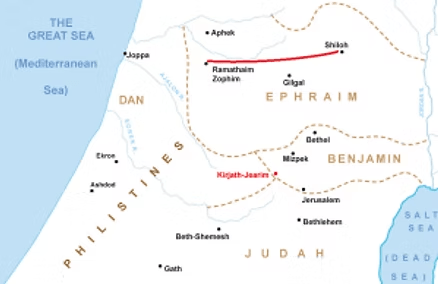
Third, it can seem as if Elkanah did the sacrificing. He was a prominent Levite of Ephraim, thus a priest who was capable of offering sacrifices; but verse three says that the sons of Eli – Hophni and Phinehas – made the offerings to God that Elkanah brought. Eli and his sons were priests of the tabernacle in Shiloh, where the Ark of the Covenant was kept, and all were Aaronites [Levites directly descended from Aaron]. Eli was both the judge of Israel [following Samson] and the high priest of the tabernacle.
Eli’s sons would later be exposed as bad priests, who kept the best portions for themselves, meaning what Elkanah’s family ate and drank quite possibly was part of the of their sacrificed lambs. This would have been eaten with wine, which might not have been the ceremonial Seder cups later established, but the act of getting drunk on wine into the evening could be what led Eli to think Hannah was drunk.
Seeing the depth of reality that this reading places one amidst, we then read that after eating and drinking, “Hannah rose and presented herself before the Lord.” She went to the tabernacle to pray to the Lord, because “she was deeply distressed.” Eli was sitting outside the entrance to the tabernacle, in a seat next to a support pole for the tent of meeting. In the dark, Hannah must not have seen Eli, but Eli saw her come up, as she would have been lit into visibility by the fire still glowing from the altar of burnt offerings.
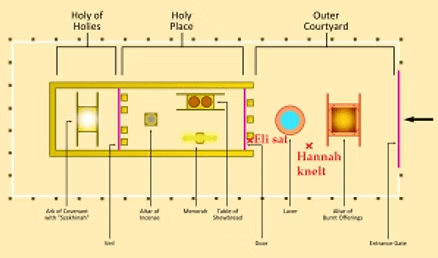
We are told the prayer of Hannah, which was silently communicated as she “wept bitterly.” In the vow Hannah made to God, she asked God to “remember me, and not forget your servant.” In the Epistle reading from Hebrews 10, Paul quoted Jeremiah 31:34, such that Yahweh said the time would come when “I will remember their sins no more.” That echoes back to the times of Hannah and Eli, when God remembered the sins of His people, expecting them to remember the connection a judge had with the Lord. The high priest made sin offerings to God, in remembrance of past sins. This method of atonement pleased God, so His judges were anointed to lead the people.
Seeing this expectation each Israelite shared, Hannah knew she had lived a life of devotion – to her husband, to her family [which included her husband’s other wife and children], and to her God. She should then be seen in the light of Job, who also was without sin and punished unjustly. Just as Job cried as he tried to get God to rescue him from a punishment he did not deserve, Hannah cried [silently], “O Lord of hosts, if only you will look on the misery of your servant, and remember me, and not forget your servant, but will give to your servant a male child, then I will set him before you as a nazirite until the day of his death.”
A “nazarite” is defined as, “An Israelite consecrated to the service of God, under vows to abstain from alcohol, let the hair grow, and avoid defilement by contact with corpses (Num. 6).” This was Hannah then saying her greatest sorrow was not from the hurtful things people thought, which her sister wife Peninnah said openly, but that she had failed God as a Levite wife. It was the duty of a Levite’s wife to give birth to a firstborn son, who would be dedicated to a lifetime of service in the temple – a nazarite. Because Peninnah was not Elkanah’s first wife, her firstborn son was probably exempt from that rule. Therefore, Hannah could not reward the love Elkanah showered upon his first wife by honoring his love with the redemption of the firstborn son [Pidyon haben], as commanded by God [Exodus 13:2].
Seeing Hannah’s lips moving as she wept bitterly, Eli’s first thought was she had drunk too much wine. When Eli said to Hannah, “How long will you make a drunken spectacle of yourself? Put away your wine,” he was quite possibly making reference to ritual red wine being consumed as symbolic of sacrificial blood. Remembering God passing over the Israelites because the blood of firstborn male lambs was painted one the thresholds of their homes, would then have been done with wine. Consumed, it would mark them within as those who served the Lord as His priests. That event of memory would then explain why she cried to God, “remember me, and not forget your servant.”

We then read Hannah’s response to Eli presuming her to be drunk on wine, saying: “No, my lord, I am a woman deeply troubled; I have drunk neither wine nor strong drink, but I have been pouring out my soul before the Lord.” She did not pour out red wine that would artificially intoxicate her and separate her from her grief. Instead, she poured out her soul. Her soul was the blood of the innocent that was painted over her flesh for the Angel of Death to see.
When Hannah then said to Eli, “Do not regard your servant as a worthless woman, for I have been speaking out of my great anxiety and vexation all this time,” Eli immediately knew in his heart that the Angel of Death, sent by God to judge the worthless and spare the innocent, had spared Hannah. Hannah had been passed over. Because Eli was a judge and high priest of Israel, he was able to discern God’s Will. It was then from that holy connection that Eli did not speak for himself, but for God, when he said to Hannah, “Go in peace; the God of Israel grant the petition you have made to him.”
For as holy a man as Eli was, his brain made errors of deduction. His faulty abilities to think what was going on, proved he was in no way capable to know what Hannah meant when she said to him [a stranger, basically], “I have been speaking out of my great anxiety and vexation all this time.” Eli did not have permission to speak blessings for God, as if he felt being judge and high priest made him a powerful dude. Eli was, however, sacrificed of self so the Lord had total permission to use Eli’s voice to speak His Will through him. Whereas a high priest had specific rules and regulations to follow, in order to maintain the dignity of the tabernacle, a judge had the freedom to speak without dogmatic procedure being a hindrance.
We do not read that Hanna jumped with joy after she heard Eli’s promise that God had granted her prayer and vow. We read she said, “Let your servant find favor in your sight.” She was not a servant of Eli, which means she was responding to God, recognizing it was His voice that came from His servant Eli – a nameless figure in robes, sitting on a holy throne of the temple. Eli served the Lord as a judge. Hannah then thanked God by asking Him to show her thanks for Eli, for the role he played as medium to her petition.
The joy that Hannah felt was then stated as, “Then the woman went to her quarters, ate and drank with her husband, and her countenance was sad no longer.” Hannah was a changed person after having been assured her prayer would be answered. She was not praying for a baby, but a son who would be given to God out of devotion. She knew she could live a loved life without children of her own to raise. However, her heart was raised by knowing she could fulfill her role in maintaining the lineage of God’s servants in His tabernacle.

The real happy ending to this story is then stated as: “They rose early in the morning and worshiped before the Lord; then they went back to their house at Ramah. Elkanah knew his wife Hannah, and the Lord remembered her. In due time Hannah conceived and bore a son. She named him Samuel, for she said, “I have asked him of the Lord.” That happiness came from the rise of a new day, when the glory of the Lord shone brightly on Shiloh AND “they worshipped before the Lord.”
The naming of the baby Samuel says, “Heard Of God.” He was the fulfillment of a prayer that was heard by God. The name Elkanah was then lived up to: “God Has Redeemed” through a firstborn son kohen (priest). The redemption of Pidyon haben had occurred. The truth spoke by God through Eli was the fulfillment of his name: “God Is Me.” Eli did not grant a prayer would be answered; it was God. Hannah had been blessed as she prayed to be, living up to her name: “Gratuitous Gift.” Her gift of a nazarite was God’s gift to her, as both gifts were of “Graciousness.” Yahweh remembers His people for their service, more than for their sins.
As a final note, the Passover is always recognized on the 15th of Nisan, which is the first full moon of spring, with spring being when the Sun reaches the Vernal Equinox [a Northern Hemisphere event of rebirth]. Supposing Elkanan and Hannah went home to Ramathaim Zophim and “knew” each other on 17 Nisan, then the birth of Samuel would have been around 17 Tevet (nine months later, in the tenth month of the Hebrew calendar). That would have been around January 9th (Julian calendar), or the dead of winter. That would be symbolic of Samuel being a seed planted in Israel, to sprout, grow, and become a mighty oak tree in Israel’s history, when the judges would be replaced by kings.
As an Old Testament reading selection for the twenty-sixth Sunday after Pentecost, when one’s own personal ministry for the LORD should be underway – one should have made a vow to God of self-sacrifice and service if God will allow one to give birth to Jesus Christ, the high priest “Heard Of God” – the message here is to feel the distress and “great anxiety and vexation” for not having yet delivered one’s soul into God’s hands. One needs to pour out one’s soul before the Lord.
The aspect of Elkanah giving twice as many animals to sacrifice for the sins of his wife Hannah has to be seen as him doing his priestly duty to bring a woman he loved dearly into favor with God. While it is not stated as why God answered Hannah’s prayer that specific time, knowing that verse three said this was a yearly time of sacrifice, Elkanah had sacrificed double portions each year. This has to be seen as the value of prayer for loved ones. All we can do is love one another and pray for the best for those we love, leaving everything in God’s hands and trusting He knows best.
The aspect of Eli sitting on a seat of honor outside the doorway to the tent of meeting makes him seem to be guarding the doorway, as only approved priests were allowed inside. That exclusion of common Israelites from the holy place, while positioned to watch anyone who entered the outer walls of canvas, into the outer courtyard, projects Eli as the Christian Church of today. He reflects all priests (ministers, pastors, or preachers), including bishops and others of hierarchical ranking, as he was the high priest of Israel.

The Church welcomes visitors (as Hannah was to Eli), but there is a line drawn that separates how far a priest can venture beyond the rules and bylaws of the Church, and how close the laity can get to a priest. Eli was an Aaronite, which means he was directly descended from Aaron and dedicated as a priest (even high priest) by birth. Such family connection to the institution of the tabernacle (the same with the Church) makes a high priest seem to be too high to associate with the commoners. As such, neither the tabernacle nor the Church [both holy buildings that attract God’s children to Him] can offer those institutions as substitutes to God. They are not allowed to be anything more than a place to offer sacrifices and prayers to the Lord. A building cannot replace each heart’s need to connect to God directly.
It should be understood that the Israelites officially offered prayers three times a day: Morning; Afternoon; and Evening. Because Hannah showed up later than the evening prayer time, Eli thought a strange woman was not following normal visiting hours. Again, if drinking wine was a ritual practice during the ritual recognition of the Passover, as I have already stated, then Eli was led to think that a devoted Israelite had consumed her limit of wine, so he advised her: “Put away your wine.” Wine acted as a false link to spirituality, which would have been the motivation Eli saw in a strange woman coming at a strange time to pray at the alter of burnt offerings.
That is how a Church that is not linked directly to God, through the Holy Spirit, makes poor decisions. It cannot know every woman’s heart that comes in crying and moving her lips. Instead, an institution becomes protective of its procedures, rules, and behaviors … because the public does not fully understand all that its own has to learn and comply thereof.
Without the ability to cross the line that trusts only God and sees common humanity in more of a negative light (for self-preservation reasons), Eli was probably worried that a drunk woman might do some damage to herself or the altar of burnt offerings. That failure of a Church to hold every one of its members equally, as all being priests with full access to an order of brothers and sisters, will always (invariably) reject well-meaning people. Some of the people are written off as the casualties of doing business for God.

That was the high priest Eli. However, Eli was also a judge. He had replaced Samson. The role of a judge of Israel was different than a high priest. It was not a position determined by birth or heredity. A judge was one within Israel who was anointed by God.
Samson, for example, was from the Tribe of Dan, close to where Israel bordered Philistia. Samson was also a nazirite, such that when Hannah promised God, “He shall drink neither wine nor intoxicants, and no razor shall touch his head,” Samson’s downfall was due to losing his strength from Delilah cutting his hair. Still, a judge was told by an angel of the Lord, “You’re it!” and they all had an ability to speak to God and know they were heard.
When the judge Eli spoke to Hannah it was not the same as the high priest Eli. He spoke to her as God having heard her vow, he was Eli the judge. Eli the high priest could only see her lips moving.
This has to be seen in terms of Elkanah double portion sacrificed. The reward sent by God was a double portion of Eli. If there had only been one portion set aside for Hannah’s need for fulfillment, Eli would have run her off as just another drunk woman that wandered into the tabernacle’s outer courtyard. A single portion Eli would sacrifice one lamb to God and give an edible portion to Elkanah. No more would be expected in return. A double portion of Eli would be to call upon him as the judge. The double portion was returned by the voice of the Lord being heard.
This reading should be seen by the reader as a test of one’s character. One does not get to choose only one of the characters that is closest to how one ordinarily acts or wants to be though of by others. Instead, one should see how all of the characters fit oneself. Do we set aside double portions of sacrifices for the special people in our lives? Do we cause anger in those who are less fortunate than us? Do we have anguish because we fail to serve God as much as we wish, feeling we are not giving as much as we should? Do we see strangers and think they are having a breakdown, when they are merely praying to God for help?
The most important characteristic we all should pray for is to speak the truth of the Lord as a judge. When that happens, we get a double portion of a priest and a judge. Jesus is the high priest that guards the tabernacle in our hearts. Jesus Christ is the voice of God that speaks through our lips. Jesus Christ is the firstborn son we want born into us, so we can dedicate ourselves into God’s service forevermore.
That is when the Church and the people become equal and love flows eternal.
#1Samuel1420 #2Kings2322 #Exodus132 #Jeremiah3134
 Explaining the Readings