
Tag Archives: 1 Samuel 18:10-16

1 Samuel 17:57-18:5, 10-16 – Facing the challenges of ministry

On David’s return from killing the Philistine, Abner took him and brought him before Saul, with the head of the Philistine in his hand. Saul said to him, “Whose son are you, young man?” And David answered, “I am the son of your servant Jesse the Bethlehemite.”

When David had finished speaking to Saul, the soul of Jonathan was bound to the soul of David, and Jonathan loved him as his own soul. Saul took him that day and would not let him return to his father’s house. Then Jonathan made a covenant with David, because he loved him as his own soul. Jonathan stripped himself of the robe that he was wearing, and gave it to David, and his armor, and even his sword and his bow and his belt. David went out and was successful wherever Saul sent him; as a result, Saul set him over the army. And all the people, even the servants of Saul, approved.

The next day an evil spirit from God rushed upon Saul, and he raved within his house, while David was playing the lyre, as he did day by day. Saul had his spear in his hand; and Saul threw the spear, for he thought, “I will pin David to the wall.” But David eluded him twice.

Saul was afraid of David, because the Lord was with him but had departed from Saul. So Saul removed him from his presence, and made him a commander of a thousand; and David marched out and came in, leading the army. David had success in all his undertakings; for the Lord was with him. When Saul saw that he had great success, he stood in awe of him. But all Israel and Judah loved David; for it was he who marched out and came in leading them.

——————————————————————————-

This is an optional Old Testament selection from the Episcopal Lectionary for the Fifth Sunday after Pentecost, Year B 2018. In the numbering system that lists each Sunday in an ordinal fashion, this Sunday is referred to as Proper 7. If chosen, this will next be read aloud in church by a reader on Sunday, June 24, 2018. This is important because it shows the bond between Apostles and Saints are like the love between David and Jonathan.

This is the second of two optional reading selections that place focus on David.  This focus is after he defeated Goliath. It clearly portrays how the world loves a hero and David was the beloved hero of Israel.

This fractured reading skips over several elements of the story of young David, but tells how Saul became jealous of David’s popularity.  Due to initial enamor with David, the demeanor of Saul changed as David grew into manhood.  As such, Saul employed the philosophy that says, “Keep your friends close, but keep your enemies closer.” Saul knew God was with David, knowing God was no longer in his heart; so Saul sensed that David would try to usurp his throne from him, having already demonstrated the powers he had with God as his ally.

When we read that David told King Saul, “I am the son of your servant Jesse the Bethlehemite,” one skip in the story is how Saul refused to let David return to Jesse, keeping David in Jerusalem (1 Samuel 18:2). This means Saul took David as his son (a blood slave), which was one of the perks allowed a king, which Samuel had warned the Israelite elders about (1 Samuel 8:11). This royal “adoption” is then related to the statement, “the soul of Jonathan was bound to the soul of David, and Jonathan loved him as his own soul.” Rather than being blood-brothers, David and Jonathan became Spiritual brothers, where a deep level of love connected the two.

It is vital to see how “Jonathan stripped himself of the robe that he was wearing, and gave it to David, and his armor, and even his sword and his bow and his belt” was a statement of relationship on a brotherly love level. This should be grasped as the attraction the Holy Spirit brings to one who has married God in one’s heart. The love of God radiates outward and those who are seekers of the truth will automatically be drawn to that love, like moths to a flame.

As such, the love between David and Jonathan must be realized as the same love that came and surrounded all of the Apostles. That love was why the Epistles were written, as everything an Apostle has he or she gives freely to others in the name of Jesus Christ. This is then the relationship one has to the Church of Christ [not a denomination].  A Church is when all the souls of the members have been bound to Jesus Christ, baptized by the Holy Spirit.

More text is skipped over, so when we read, “The next day an evil spirit from God rushed upon Saul,” it might appear that Saul was made crazy by God. God, however, does not spread evil spirits around.  That is Satan’s job, which he does quite well.

In this case, I believe this is a poor translation, based on the order of Hebrew words written. The literal actually states, “And it came to pass on the next day came spirit of gods [elohim] that adversity on Saul.” The use of the plural number “elohim,” as “gods” [lower case, and not accompanied by a capitalized Adonai, meaning “Lord of gods”] says that Saul had lost his love of God, so his heart was opened to lesser influences.  Without God in Saul’s heart, doubts crept in; and those evil whispers brought adversity upon him, causing him to act in evil ways.

When we read, “he raved within his house,” the word translated as “he raved” (“way-yiṯ-nab-bê”) actually says Saul “prophesied” (from the root “naba”). The aspect of Saul “prophesying in his house” can be seen as Saul making predictions about his remaining time as king, where “his house” was the line of Saul, which then included David, his adopted son. To make those prophecies angry “ravings,” the implication has to be seen that Saul’s jealousies about David’s popularity were causing him to make self-fulfilling prophecies of his own demise.  This says that Saul’s heart was not filled with God’s love, but rather the evils of worldly feelings.

The use of a spear to “pin David to the wall” can be seen as Saul’s personal claim to fame, as he was a warrior king. All he knew was warfare and the greed that came from a dependency on accolades and praises. What is not read, due to omission of text, was the popular song the Israelites would sing, where they credited Saul with killing thousands, but David with killing tens of thousands.  Hearing that song of praise infuriated Saul.

To “pin David to the wall” would then be akin to killing David with a spear and mounting his head on the wall, as a trophy that would make the people sing about Saul killing the David of ten thousand kills. However, as David had God with him, he was able to avoid these attacks by Saul.

It is also important to see how the information, “David was playing the lyre, as he did day by day,” was a statement of David’s own abilities to prophesy. David, the writer of the Psalms [meaning Songs of Inspiration], would play his harp (lyre) as he composed songs of prophecy. While Saul “raved” due to the influence of lesser “gods,” David was truly inspired to write the Word of God in songs that the people would learn to sing and love. The Psalms of David passed on the love of God that he knew to the Israelites. The Psalms of David are the legacy of his ministry to the LORD.  The people wanted more of this guidance; but Saul was fed up with the abilities David possessed and daily made known.  For every note David played and every word sung from God, it only made Saul see how little ability to prophesy he had.  His attempts only condemned himself.

The element of “twice” is only one translation that “pa-‘ă-mā-yim” can offer. The root Hebrew word, “paam,” primarily means “times.”  Rather than “twice,” it can mean “annual, once, once more,” and “as usual.” While the symbolism of “two” shows the duality of Saul and David (where one was influenced by evil and the other was influenced by the divine Yahweh), it also says that David, due to God being with him, would always be “steps” ahead of anything Saul tried to do to harm him. Thus, this God-given ability for self-preservation David displayed would not be limited to “two times.”

And the spirits that made Saul rave in his house came to assist King Bush.

We then read, “So Saul removed him from his presence, and made him a commander of a thousand; and David marched out and came in, leading the army.” This says how Saul turned his attempts to kill David over to the enemies of Israel, where the Hebrew word “way·si·rê·hū” (root word “sur “) means “turned aside, departed” or “turned away.” Because Saul knew God was preventing him from harming David, he “removed” himself from that equation.  Saul then planned on the spears, swords and arrows of Israel’s enemies to be aimed at David.

By making David a captain of a regiment or battalion (the equivalent in today’s military as the rank of colonel or lieutenant colonel), David would march his soldiers out for training and patrols. If any uprisings needed to be quelled, David would successfully lead his men to victory.  The Israelites of Jerusalem and the countryside loved seeing David leading soldiers, because they felt safe, knowing God was with him. The people knew that from all the successes David had militarily.

Keep in mind that David, by this time, would have barely been eighteen years of age.  He was young, ruddy, and handsome; but he was the protector Israel needed.  How the world loves a hero.

As a reading selection for the fifth Sunday after Pentecost, when one’s personal ministry should be underway, the righteousness of David must be seen as a model for oneself. One must be able to love others on a soul level, where each identifies the other as baptized by the Holy Spirit. Because Jesus Christ is the Son of God, all who become reborn as Jesus Christ are brothers in his name [“Male and female he created them, and he blessed them and named them Man when they were created.” – Genesis 5:2 ESV].

This love for other Apostles and Saints cannot be absent from one’s personal ministry for the LORD. One must become Spiritually magnetic, so one will find others who will enjoy one’s presence as much as one loves the presence of God in one’s heart. This means whenever two or more gather in the name of Jesus Christ, Jesus will be there in person. One must become a walking Church of Christ, seeking others who want to be adopted into the family of Christ.

When Jesus said, “Blessed are you when people insult you, persecute you and falsely say all kinds of evil against you because of me” (Matthew 5:11), this is how David was able to avoid being mistreated by Saul. He was blessed by God’s presence within him.  When one has received the Holy Spirit and the Mind of Christ, one will be able to become invisible when enemies try to harm one. If falsely arrested and imprisoned, then angels will shake the foundations of the jail, make shackles fall from one’s body, and set one free. If one is stoned to death in the street, one will ask God to forgive those who do not know the beauty of God’s presence within. When one ministers for God, one ceases worrying about what might happen, as one welcomes whatever God sends one to encounter.

The symbolism of David being made a captain of one thousand soldiers, this is the spread of the Holy Spirit to others, through one’s paths taken. Ministry is outside the walls of Jerusalem, not safe and sound in one’s mind (the flesh of a brain). One has to be a deacon that advises seekers on spiritual matters and explains Scripture so the eyes and ears of others will lead their hearts to open to the LORD.

If one is unable to do this, then one’s heart has hardened to God and Christ does not yet walk in union within one. A commitment must be made to reach this level of higher knowledge that the Christ Mind brings, or one will fall under the influence of the lesser gods and be led astray, as was Saul.

1 Samuel 17:57-18:5, 10-16 – The brotherly love of souls and the demonic possession of a king

On David’s return from killing the Philistine, Abner took him and brought him before Saul, with the head of the Philistine in his hand. Saul said to him, “Whose son are you, young man?” And David answered, “I am the son of your servant Jesse the Bethlehemite.”

When David had finished speaking to Saul, the soul of Jonathan was bound to the soul of David, and Jonathan loved him as his own soul. Saul took him that day and would not let him return to his father’s house. Then Jonathan made a covenant with David, because he loved him as his own soul. Jonathan stripped himself of the robe that he was wearing, and gave it to David, and his armor, and even his sword and his bow and his belt. David went out and was successful wherever Saul sent him; as a result, Saul set him over the army. And all the people, even the servants of Saul, approved.

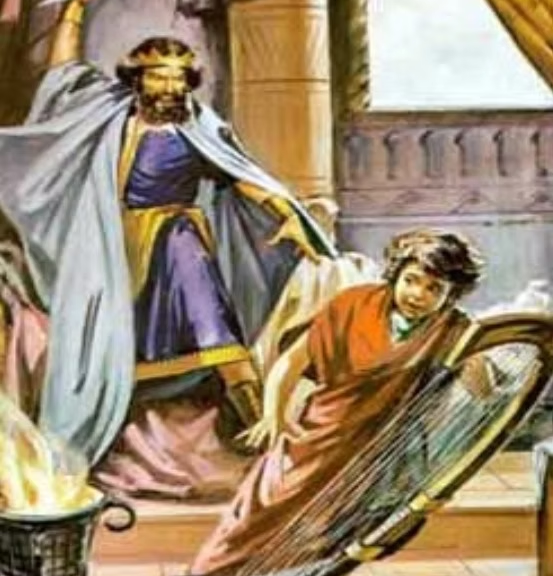
The next day an evil spirit from God rushed upon Saul, and he raved within his house, while David was playing the lyre, as he did day by day. Saul had his spear in his hand; and Saul threw the spear, for he thought, “I will pin David to the wall.” But David eluded him twice.

Saul was afraid of David, because the Lord was with him but had departed from Saul. So Saul removed him from his presence, and made him a commander of a thousand; and David marched out and came in, leading the army. David had success in all his undertakings; for the Lord was with him. When Saul saw that he had great success, he stood in awe of him. But all Israel and Judah loved David; for it was he who marched out and came in leading them.

——————–

This is the track 1b optional Old Testament reading for the fourth Sunday after Pentecost, Year B, according to the lectionary for the Episcopal Church. If chosen it will be accompanied by a reading from Psalm 133, where David sang, “Oh, how good and pleasant it is, when brethren live together in unity!” The Epistle reading to follow will come from Paul’s second letter to the Corinthians, where he wrote: “We are putting no obstacle in anyone’s way, so that no fault may be found with our ministry, but as servants of God we have commended ourselves in every way.” That will precede the Gospel reading from Mark, where Jesus asked his disciples, “Why are you afraid? Have you still no faith?”

The first part of this reading is at the end of chapter seventeen, after David had killed Goliath. The omitted verses tell that Goliath moved towards David without his sword drawn. In verse 7 we read that Goliath had a javelin across his shoulders, which means he took it into battle as an extra weapon, not one of first choice in individual combat. This says Goliath approached David as if he planned to tear him to pieces with his bare hands, seeing David as an unworthy opponent, not being armed with more than a “stick” [his “staff” or “rod” of shepherding]. We are also told in the unread verses that it was the stone David slung that killed Goliath; so, when David came up to the corpse, he unsheathed Goliath’s sword and used it to cut off his head. That symbolism needs to be fully grasped.

The tradition of death [regardless of what Muslims might make people think about the necessity of immediate interment for the dead] is that a body is not officially dead until after seventy-two hours [three days dead]. The Jews assign [and pay] watchers to be with a dead body until that time passes, as there is some history of people thought to be dead coming back to life. This makes Jesus raising Lazarus from death a miracle, because he had been dead four days. A beheading, however, ended all need to wait and see if Goliath was ‘only sleeping.’ [Unless you are Saint Denis.] The severed head of Goliath immediately let the Philistines know their champion was dead and not coming back to life. Thus, they ran in fear and the emboldened army of Saul took advantage of their fear and chased after then, wounding many and taking the spoils the Philistines left behind in their hasty retreat.

This means [also unread] when David took the head of Goliath [plus his armor, which David kept as a souvenir] to Jerusalem it was to display the truth of the defeat of the Philistines, without any doubt. With Goliath having been nearly ten feet tall, his head would have been likewise huge and much larger than a normal head, easily known to be that of a giant. Goliath’s head would have been quite heavy too [brain still intact] and look larger in David’s childish hand. Thus, David carrying the head of his quest – “in the name of Yahweh elohim” assisted – let all the people of Jerusalem know this boy of ten years of age was their champion; and, that would have included Saul, his uncle [the leader of Saul’s army] Abner, and Saul’s son, Jonathan. Therefore, the head of Goliath was a sign for all to take notice of this boy who held it.

As I wrote about the defeat of Goliath by David in another commentary, I summarized that Goliath needs to be seen as metaphor for one’s own ego, such that all human beings awaken daily to face an evil champion that strikes fear in one’s soul. The body of flesh has natural desires and it is the brain that must learn right from wrong [eat from the tree of knowledge of good and evil], which comes from whatever religion one is raised to learn – whatever god or God one chooses to serve. When Goliath said to the fearful Israelites, “Surrender and become our slaves,” that is the same demand our bodies of flesh make upon our souls.

The soul trembles in fear, worrying about what would happen if one went out to challenge such an oppressive and seeming insurmountable foe. Souls routinely do surrender to the will of sin and submit themselves to Satan, rather than stand with Yahweh [married soul with Spirit divine] and fight, as did David. Until we hold the head of our egos in our hands, having cut it off with its own sword [a sheathed demon], we become the slaves of a world ruled by Satan [the banished serpent]. Thus, it is important to see this scene of David with the head of Goliath in his hand as the symbolism that tells all readers what one should do to one’s own “head,” that which leads a monstrous beast [a weak soul] that fears the punishment of death’s judgment by God.

In that regard, of self defeating the “elohim” that is the demonic possession of a soul that Goliath represents, the reason individuals tremble in fear and hide at a distance [not boldly come with the knowledge of a soul married to Yahweh, thereby being an “elohim in Israel”] is the ‘safety in numbers’ that is reflected in the influences that always say, “They do it. What makes you better than them?”

This is reflected in the eldest brother of David, Eliab, as well as all the fearful soldiers David spoke to after he arrived at the camp; but more importantly, the characters Abner and Saul surface when the troubles have been overcome. They are who then see David as a potential threat to their control, rather than celebrate a victory by Yahweh that saved Israel. This reflects upon the influence of family, friends, and those who are in leadership positions, as all others who are not souls married to Yahweh become the arms of Satan that come to persecute the righteous who walk with Yahweh.

When the reading turns the page to chapter eighteen, one finds the text speaking of “souls.” Verse 1 is translated by the NRSV to say, “the soul of Jonathan was bound to the soul of David, and Jonathan loved him as his own soul.” This must be understood metaphysically.

The Hebrew word translated as “was bound” is “niq·šə·rāh,” rooted in “qashar.” That root word means, “to bind, league together, conspire,” with the passive participle meaning “to knit together.” (Strong’s) According to Strong’s Exhaustive Concordance, the word describes this intent: “bind up, make a conspiracy join together, knit, stronger, work treason.” While this speaks of the relationship David and Jonathan would have, as two sons of different mothers [and fathers] joining in league to assist one another under Saul’s familial roof, that “bond” goes far beyond their first meeting ever, written of in chapter 18. The use of “soul” [twice] cannot be read as some physical emotion emanating from Jonathan towards David, or vice versa.

The Hebrew word translated as “soul” is “nephesh” [written as “wə·ne·p̄eš” and “bə·ne·p̄eš”], which Strong’s says means “a soul, living being, life, self, person, desire, passion, appetite, emotion.” Here, my assessment that “self” equals “soul” is confirmed; however, one needs to realize that a “soul” is from Yahweh, thus eternal, never dying. It enters a body at birth and then exits the body at death, never ending. To read that the first ever meeting between Jonathan [the princely son of Saul] and David [the common son of Saul’s servant Jesse the Bethlehemite] found their two “souls knit together” speaks loudly of reincarnation. This needs to be fully understood.

There are Goliaths in this world who read of this “love” between Jonathan and David and wallow sinfully by trying to make this “love” be homosexual in nature. Homosexuality is a Goliathan head of self-ego that needs to be chopped off, as it leads a body to sin, while the soul trembles in fear, unwilling and unable to say no to that monster’s bellows. When the NRSV translation states, “and Jonathan loved him as his own soul,” this is stating the two souls instantly knew one another from a past life. It was a prior life where both loved one another; a love that never ceased to be. This bring out the truth of reincarnation, which is also can explain [weakly] the motivation for homosexuality in human beings, as being a brain-body falsely identifying a present incarnation with one past, when one’s gender changes.

As David’s soul was anointed by Yahweh, with Yahweh seeing the “heart” [“soul”] of David to know he was the one for Samuel to pour oil on, that says Yahweh knew the “soul” of David as a “soul” reincarnated from a past life. Yahweh then knew the soul of David when that “soul” had served Yahweh faithfully, as some other name. When “Israel” is seen stated when David told Goliath he was an “elohim in Israel,” that can be seen as a hint that David’s “soul” was the same “soul” of Jacob, as it having reincarnated as David. In the story in Genesis of Jacob, he saw Rachel and fell in love with her beauty, working for Laban for fourteen years to marry her. The two would bring Joseph [and Benjamin] into the world. This means, if David’s soul was the soul of Jacob, then the soul of Rachel was the soul of Jonathan.

It must be realized that in a past incarnation of two souls, who were “soul mates” in the truest sense of that term, the two were then of opposite sex. Now, with Jonathan and David, the two have the same sex later. Because souls are eternal, their only need to reproduce comes when nature demands offspring to provide new bodies for returning souls. When a soul has married with Yahweh, becoming one of His elohim, then a neuter gender soul has become a masculine essence elohim. In those cases, the soul-flesh has no control of the elohim possession, so those souls do not feel immediate love for the purpose of having sex together.

Jacob and Rachel struggled having a child, as it was said Rachel was barren. In the same way, Abram and Sarai were two souls who loved one another deeply, with Sarai likewise barren. Certainly, in both those examples both partners souls were married to Yahweh, as His servants, with that duty coming first and far exceeding any natural call to reproduce and have children. The barrenness of the females is then an indication of the sterility of two of the same gender essence [two masculine elohim]. In a way, the lack of a need to have children says the two souls will forever have one another; but to have a child meant Yahweh would have to act to make that happen.

The souls of David and Jonathan can then be seen as also barren, simply because both their souls knew one another from a prior reincarnation, where both returned with the freedom to stay with Yahweh in heaven. They had not reincarnated because of a failure to marry Yahweh. They reincarnated willingly, to continue serving Him on earth. The two souls then recognized one another instantly, on a soul level [not physical]; and, the impossibility of two of the same sex making babies – the sterility that is the truth of homosexuality – was not close to entering their minds, as they were still elohim.

Because David had been anointed by Yahweh, knowing only what to do by the voice of Yahweh within, he would not entertain any sexual desires for Jonathan. He was only ten years old and would not know the natural calls to reproduce that a body of mature flesh makes upon a soul. Thus, the soul-mate love of two eternal souls simply states an automatic bond where all past, present and future meetings were felt, as shared by two souls always together; and, just as David, Jacob, and Abram were all filled with Yahweh’s Spirit, so too would be their mates in “love.” So, Jonathan was refilled by Yahweh’s Spirit when he first met David. The bond they shared together – called “love” – was God’s “love” in both their souls.

This is then stated in the NRSV translation of verse 3, which shows: “Then Jonathan made a covenant with David, because he loved him as his own soul.” In that, the word “covenant” must be read in the same way that Moses came down with the Covenant that was the marriage agreement between Yahweh and the children of Israel. Moses did not ask if they all agreed to Yahweh’s terms, and when they said, “Yes. We do.” he then said, “Great! Let’s all have sex together because of a covenant!” This verse says Yahweh’s Spirit married the two souls of “Jonathan and David,” through a “covenant” that had both share the same spiritual Father, as divine brothers. Therefore, the “love” shared between Jonathan and David was the same NON-SEXUAL “love” that Jesus shared with his disciples, who would become apostles in his name. Tag, You’re it!

When we next read, “Jonathan stripped himself of the robe that he was wearing, and gave it to David, and his armor, and even his sword and his bow and his belt,” this must be seen in the context that Saul had made the decision “not [to] let [David] return to his father’s house.” That decision made David become the adoptee of the king, as an honored servant in Saul’s household. This says Jonathan saw the dress of a shepherd on David; and, to remain in the king’s house meant wearing nicer clothes.

Jonathan is believed to have been older than David, so the armor given to David would be like hand-me-downs, sized for Jonathan when he was younger and smaller. Seeing how David was only ten and Saul had only been king for three years, Jonathan was most likely fifteen, having been fit for armor when he was just about to reach his growth spurt at puberty. The same can be said for the other clothes and weapons, as David would have been not fully grown at that point and would need smaller sizes to look appropriately dressed.

The element of David playing the lyre [or harp] and singing daily might mean his becoming a guest of Saul afforded him a harp to learn to play. He could have learned at home, and Jesse might have had the harp David played delivered to David, at Saul’s house. The point here is musical talent is a sign of a higher octave thought processes, where David most probably found a certain knack for playing stringed instruments, as his songs were divine insights that began flowing through him after the spirit of Yahweh came upon him. This mention of David being musical says he never ceased giving all honor and praise to Yahweh, even after he was taken in by the King of Israel. ‘Fame and fortune’ never went to David’s head.

The reading selection then skips forward in time. Properly attired as a warrior of princely status, before Saul assigned David to a command, which would not have been when he was ten, David would have entered a military training program. In that, he would come to know the soldiers in the ranks of the army, learning the ways of military life, as well as being seen in Jerusalem by the people, who knew he had brought peace by singlehandedly killing Goliath. While not a true prince of Saul’s blood, David was adopted as a sign of Saul wanting to be seen as showing favor to a son of the people. Thus later, when David began to lead the troops out and lead them back in, he was elevated in rank from a shepherd over a flock of animals, to being a commander over a flock of soldiers [a thousand men]. All of those soldiers would come to know his voice and depend on his presence for safety and protection.

When verse ten then begins by saying, “The next day an evil spirit from God rushed upon Saul,” the use of “mim·mā·ḥo·rāṯ” as “the next day” should not be read as so immediate. The better way to translate this is as “and it came to past another day,” where “morrow” bears the capability of some time in the future. Thus, after Saul had taken David into his house, allowing David to develop a friendship with Saul’s son, them becoming like brothers, allowing David to begin to have authority over men much older than he, with adoration seen by all the common folk, a change came over Saul.

The words that say, “an evil spirit from God rushed upon Saul, and he raved within his house,” need to be more closely inspected. The Hebrew written is this: “rū·aḥ ’ĕ·lō·hîm rā·‘āh ’el- šā·’ūl , way·yiṯ·nab·bê ḇə·ṯō·wḵ- hab·ba·yiṯ,” which literally translates to say, “spirit gods evil possessed Saul , and it prophesied amid that dwelling.” This is telling that Saul’s soul became opened to demonic possession because of his jealousies over the Israelites’ adoration over David. The “morrow” is based on when Saul saw what he had allowed to come to pass, such that “the next day” this “evil spirit” adhered itself to Saul’s soul, making Saul an “elohim” controlled by a seraph. Rather than his “raving,” Saul heard voices “within” his being, such that his brain began to be led by the silent whispers that told him what was going to happen, with all that taking place “amid” his brain’s thoughts.

One must be able to see that Saul was far from being like David, whose soul was married to Yahweh, as an “elohim in Israel,” which was a divine possession. Saul was quite the opposite, such that the “prophesying” was telling Saul that David was the anointed one who would take his place. It was then the voice of Satan in his mind that told him to “smite” David [the meaning of “nakah,” which is translated as “pin”]. The thought that Saul could “pin David to a wall with a spear” would be like having a bug collection, where David would then be some prize addition to place on the wall. Thus, it was this evil influence that caused Saul to attempt to spear David to death.

Reading that “David eluded him twice” does not mean that David was stupid enough to stay around a demonically possessed Saul, long enough to let him throw another spear at him or write off one spear thrown at him as some accident, so he hung around and wrote the first spear off as “He must not have seen me.” David was led by the Mind of Christ [as an Anointed one of Yahweh], so “twice” speaks of David’s spiritual possession.

The Hebrew translated as “David eluded him twice” is this: “way·yis·sōḇ dā·wiḏ mip·pā·nāw pa·‘ă·mā·yim.” That literally says, “but turn about David two faces,” where “panim” is the “face” of Yahweh that was worn along with the “face” of David, due to the marriage of David’s soul to Yahweh’s Spirit. Wearing the face of Yahweh is actually the First Commandment in the marriage agreement read by Moses. In the same way that David defeated Goliath through his strong faith, David had Yahweh watching his back [one face forward, one face to the rear]. So, when Saul threw the spear, David’s soul knew when to move immediately, making the spear miss its target. There would only be one spear thrown, as that action proved Saul was led by an evil spirit.

That is summed up in the statement: “Saul was afraid of David, because the Lord was with him but had departed from Saul.” This is when Saul made David leave his presence, assigning him a thousand soldiers to command. That is when David began to mature with age and show more success, as one led by Yahweh. That was what led Saul to hate and fear David, more than he feared Goliath.

As an optional Old Testament reading selection for the fourth Sunday after Pentecost, the season of ministry should be reflected in these words. The duality of Jonathan and David must be seen as why Jesus sent out the seventy in pairs and why the same paring is found in Peter and John of Zebedee and Paul and Silas, where a pair represents a source of spiritual reinforcement in the physical, which reflects the divine truth of a church – when two come together in Jesus’ name. It says ministry is greatly assisted by a partner also Anointed by Yahweh.

This reading then strongly confirms how ministry requires a divine possession, which can only come when a soul voluntarily seeks marriage with Yahweh, submitting one’s self-will to become a servant of Divine Will. On the opposite end of this spectrum of spiritual possession, Saul becomes a reflection of those who try to ‘go it alone,’ rejecting Yahweh’s marriage proposal. Doing that leads one’s soul to become weak and tired, so the winds can blow in an evil seed of thought, which takes root and grows to overcome one’s soul, possessing the body demonically. This becomes the warning Yahweh made to Cain, whose face became low to the ground [aka dead Goliath becoming face unto the ground], saying “Sin crouches at your door.” Saul let sin come into him, just as did Cain.