
Tag Archives: 1 Timothy 6:10

Mark 12:38-44 – The poor widow gave everything she had

As Jesus taught, he said, “Beware of the scribes, who like to walk around in long robes, and to be greeted with respect in the marketplaces, and to have the best seats in the synagogues and places of honor at banquets! They devour widows’ houses and for the sake of appearance say long prayers. They will receive the greater condemnation.”

He sat down opposite the treasury, and watched the crowd putting money into the treasury. Many rich people put in large sums. A poor widow came and put in two small copper coins, which are worth a penny. Then he called his disciples and said to them, “Truly I tell you, this poor widow has put in more than all those who are contributing to the treasury. For all of them have contributed out of their abundance; but she out of her poverty has put in everything she had, all she had to live on.”

———————————————————————————————————-

This is the Gospel selection from the Episcopal Lectionary for the Twenty-fifth Sunday after Pentecost, Year B 2018. In the numbering system that lists each Sunday in an ordinal fashion, this Sunday is referred to as Proper 27. It will next be read aloud in an Episcopal church by a priest on Sunday November 11, 2018. It is important because Jesus pointed out the disparity between those who wear church robes and the laity, as well as the wealthy of the church compared to the poor. Jesus said to beware of incorrect assumptions of piety because of collars and donations to the church treasury.

On the heels of the Gospel lesson from Mark that was delivered the prior Sunday[1], where Jesus made a spiritual connection with “one of the scribes,” we now read of Jesus saying, “Beware of the scribes.” This follows the encounter with a scribe, but after Jesus was again teaching [being inspected for blemishes] in the Temple. As part of that day’s discussion, Jesus had pointed out the error that the scribes had used in stating their conclusion that the Messiah will be the “son of David.” Jesus used logic to defeat the logic of the scribes, who spent more time than ordinary Jews coming up with answers to the questions the people had, such as, “Who will the Messiah be?”

Following that answer to the crowd [of which those trying to find error in Jesus’ words were present], Jesus then gave this warning about the scribes, giving his assessment of the privilege the scribes took advantage of, even when they knew less than they put on that they knew. To fully grasp what Jesus said next, it is important to realize that the scribes were the equivalent of modern scholastic researchers of holy texts [Judeo-Christian], with most then being like those now – far removed from life as a practicing Jew or Christian. As scholars they considered themselves to be part of the elite.

When we read that the scribes were those “who like to walk around in long robes,” this paraphrase misses the point of the word “thelontōn,” which means “desiring.” While “desire” can be reduced to “wanting, wishing, intending, and designing,” the “liking to walk around” is based on personal “will,” and not some mandatory rule that says a scribe must always wear a robe ‘in the work place AND in public’. Even if there were a ‘scribe dress code’, they would have written it and made it a point of mandating what they liked to wear.

When Peter recalled Jesus adding that the scribes did this “to be greeted with respect in the marketplaces, and to have the best seats in the synagogues and places of honor at banquets,” this is stating that the wearing of robes ‘off campus’ was to gain personal profit from being a scholar. The robes worn within the Temple’s library and as theological professors on the steps of the Temple were that of academia. The robes of a scribe let those within the Temple walls know who was a scribe, without needing to ask. It would be like a military officer wearing his or her uniform, which displayed a rank that others on a base must immediately recognize, as a matter of maintaining a service hierarchy. However, ‘off base’ or outside the Temple walls, where common people displayed no rank or privilege, dressing like normal folk was allowed.

By Jesus pointing out how the scribes were always found wearing their finest uniforms in public, he was saying they purposefully intended to play the role of elite rank, in order to gain favors that were not required of the poor and common people to give. They got discounted food and at-cost dry goods from vendors. The synagogues would give them front row seats and make others stand, placing them close to the speakers, while others might not hear as clearly in the back. The seats of favor would intimidate the rabbis, influencing them to say what they knew the scribes had taught, rather than speak from a connection to the Godhead. The places of honor at the banquets were near the head of the table, where the host sat. There, they would reap royal service and the choicest meats and drinks.

Imagine how skinny I would be without this frock!

Not only do the scribes profit from good deals and free lunches, they visit widows and make demands on their property, which a widowed woman without sons could do little to prevent. Jesus said they were “devouring” (from “katesthiontes,” meaning “eating up, eating until it is finished, squandering, and injuring”) what little a widow could have. They did this by placing guilt on them and making threats of laws being broken, forcing the Temple to make them outcast. The scribes did this for personal gain.  For old Jewish women, being one of God’s chosen people was all they had.

Then after going out to rob old women of their last jar of meal and oil [an allusion to an optional accompanying Old Testament reading], leaving them to starve to death, the scribes would recite their scholastic dissertations as if they were prayers to God. They would pretend to pray for the contributions of the dead, when such prayers of thanks never came when they were alive.  Therefore, the scribes offered up prayers for self-recognition, as if lengthy prayers were the only prayers they thought God appreciated.
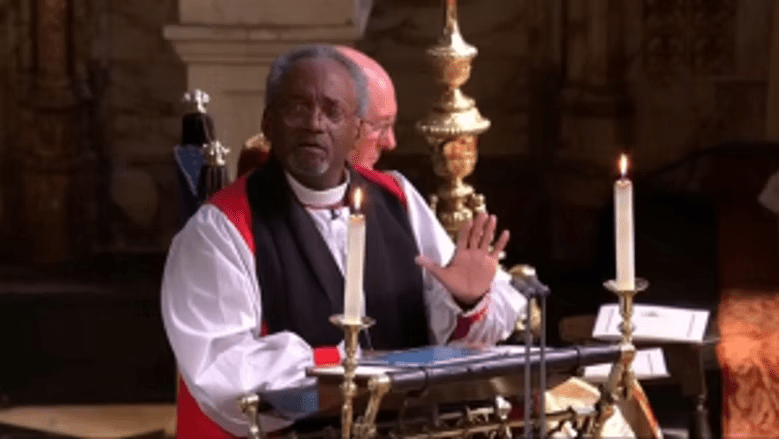
As we remember our dear departed donor, on whose land our new cathedral will be built, let me now offer this prayer of thanksgiving.

Of this corruption Jesus had witnessed [and had inside information via the Christ Mind to know], he said, “They will receive the greater condemnation.”

The word translated as ‘condemnation” is “krima.” That is a legal term that means “judgment; a verdict; sometimes implying an adverse verdict,” as “a condemnation.” It bears the essence of “a lawsuit, as a case at law,” which was what the scribes specialized in studying and teaching.

The word translated as “greater” is “perissoteron,” which implies an abundance of, leaning towards “excessive,” “vehemently” administered. That says the judgment of God, towards those who the scribes condemn publicly and privately, will pale in comparison to the verdict that will be handed down in their cases, for the misdeeds of the scribes.

But I used to pretend to be a fine, upstanding doctor and respected citizen on TV.

It is important to see how the Law was given to the children of Israel for each to memorize and live by them. The “rabbi” for each family was the father. Each tribe of Israel had elders, who were connected to Moses physically, but should have been connected to God spiritually. The high priest (Aaron) offered sacrifices for the sins of the whole (and himself individually). A “scribe” was a useless position in that initial organization, as his only job was to record the Law on scrolls, not interpret them.

The elevation of scribes to being scholarly teacher and interpreters of the Law came after all of Judah had been lost. It was lost because few knew the details of the Law, and fewer followed them. A scribe then became one judge amid the returning Jews to Judea and Galilee, to whom the common people were told to turn to, so failure would not happen again.

The problem was the scribes did more misinterpreting of the Word of God than they showed competence, through divine guidance. Their failing to tell the people, “I really don’t know what it means, other than what the words appear to say, because I, like you, am not that much smarter than you are,” meant falsely representing themselves as those approved by God to speak for Him.

God did not give His approval. That was what Jesus was telling the people to “Beware” (with a capital “B”).

The Greek word written is “Blepete,” which is rooted in “blepó.” It better says to “Look, See, Perceive, or Discern,” with the implication being to “Be careful” and “Take heed.” This says to be vigilant and aware when one hears a scribe teaching, because one must question them as to how they draw their conclusions.

In other words, Jesus called the scribes (largely) liars, which meant the long robes they wore made them false shepherds. Because they avowed to speak the language of God (from the scrolls) they were self-proclaimed prophets. However, due to their lies about the meaning of the Word, they were not true prophets but false prophets.

This leads one to the warnings of God, through Moses, in Deuteronomy 18:20. There is written: “The prophet who dares to speak a message in My name that I have not commanded him to speak, or who speaks in the name of other gods—that prophet must die.” While a physical execution could certainly be read into that commandment, one must realize that “death” is metaphor for not gaining the reward of eternal life.  That was (and still is) the purpose of being God’s chosen people. Therefore, when Jesus said the scribes faced “greater condemnation,” that judgment would be banishment from Heaven.

Unfortunately, the realm of Christianity today has become top-heavy with false prophets, many who proclaim to speak for Jesus Christ, the external (yet ethereal) divine presence at the right hand of God. Simply by pretending to know what Jesus would do, they are breaking the same commandment the scribes broke; and, it is known to be a lie, because the right hand of God is an Apostle, who has been reborn in the name of Jesus Christ.

It is impossible to speak for Jesus Christ when one is supposed to be Jesus Christ AND when one is reborn as Jesus Christ, then one does not enter the realm of politics.  Is that not what “Give unto Caesar what is Caesar’s” mean?  Does not “Render unto God what is God’s” a statement that spirituality is the only goal of God’s people?
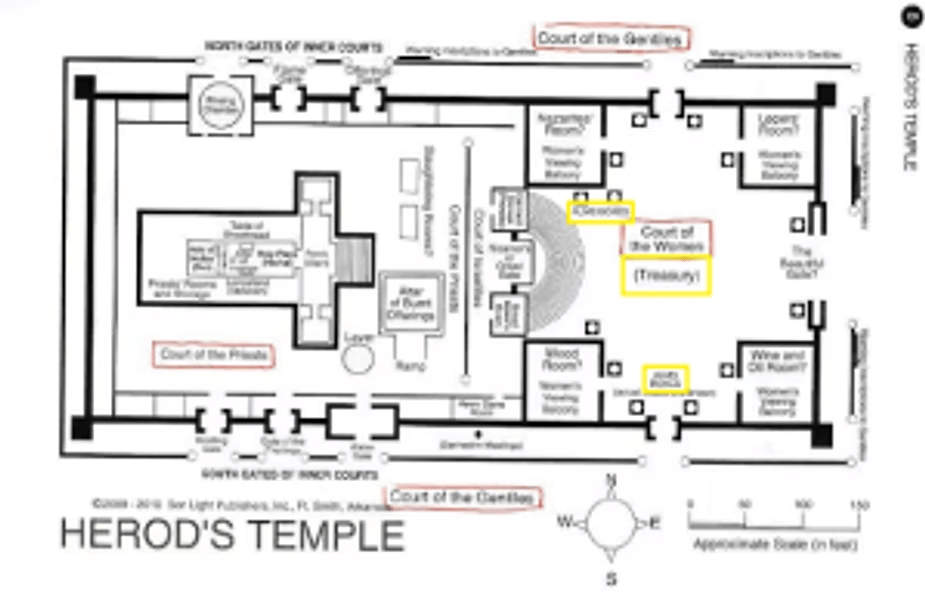
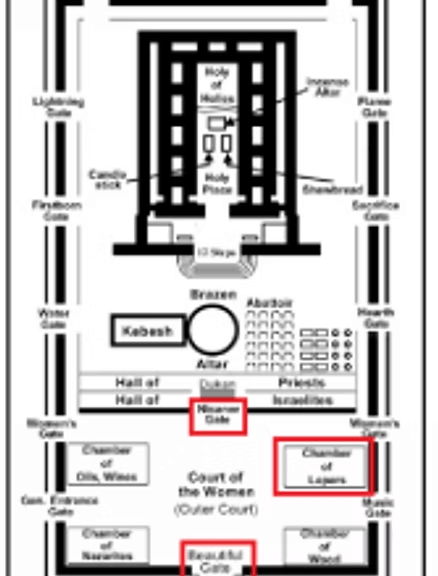
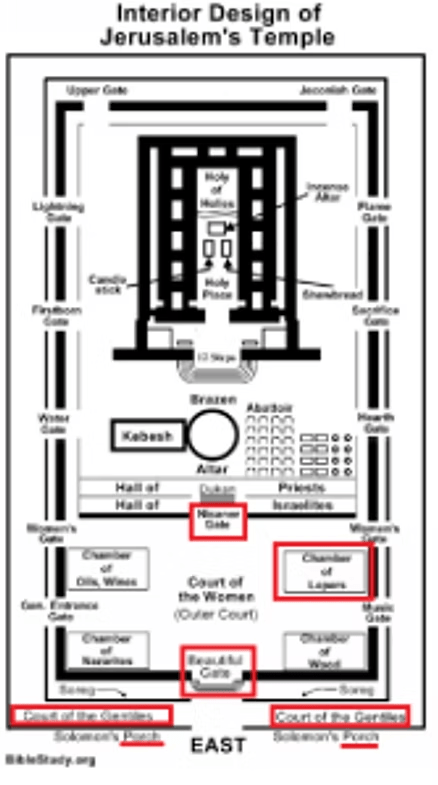
Jesus would have been talking to pilgrims on the Temple steps, outside the Nicanor Gate. Those steps rose from the Court of the Women, from which the Treasury alcoves were located. While it is not known how many alms boxes were arranged in those opposing rooms, it would have been near that court area that Jesus and his disciples “sat down opposite the treasury, and watched the crowd putting money into the treasury” (or “collection boxes”).
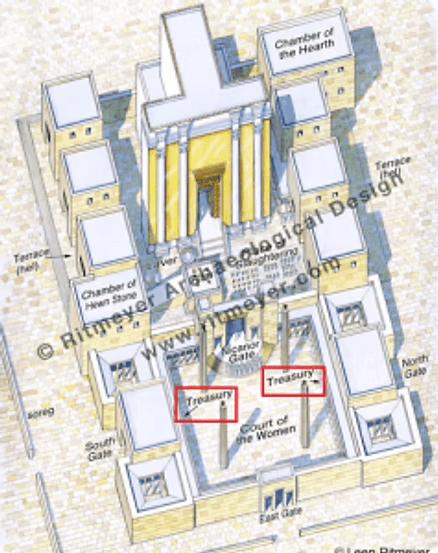
Having just recently answered someone’s question on the steps to the Nicanor Gate (about why that Jewish someone had heard a scribe explain a law differently than Jesus had taught), Jesus’ warning about the scribes using their position within the Temple to profit from both rich and poor, led him to point out to his disciples what he meant.  As he sat and watched the treasury activity, he knew the treasury would bring forth an example of what he had said to be wary of.

Jesus made his disciples learn by seeing for themselves how: “Many rich people put in large sums.” The disciples were from humble roots and had never known the wealth possessed by the rich. They had not yet faced any temptations to turn their backs to God for thirty pieces of silver [not copper].  One can imagine they were impressed by the amount of money they saw being dropped into the collection boxes [especially Judas Iscariot].

Jesus would have known the disciples would have wide eyes over such large donations being made, so he sat quietly and let the “many rich” that were present make their ritual commitments, so the Temple business of dealing with the poor could be funded. Then, after “a poor widow came and put in two small copper coins, which are worth a penny,” Jesus called their attention to that donation.

Jesus said, “Truly I tell you, this poor widow has put in more than all those who are contributing to the treasury. For all of them have contributed out of their abundance; but she out of her poverty has put in everything she had, all she had to live on.”

Don’t think the widow was unhappy about only being able to give two pennies. See her with a smile on her face, because she gave her all.

That meant that the “poor widow” only had “two small copper coins” to her name (called “kodrantés” in Greek, but “quadrans” in Latin), which were the smallest Roman coins minted. She put “everything she had” into the collection box.

For as little as she had, the rich gave about that little of their wealth, even though the amounts given seemed large and generous. When the donation ratio is 100% [poor widow] to 1% [many rich] (a 100:1 ratio), the rich were certainly not giving as much as they could.

Now, while this ratio is a figment of my imagination, it is likewise a figment of the imagination of those who pretend to speak for Jesus Christ as they stand on soapboxes with megaphones and lead protests against the players on Wall Street.  The wealthy have recently been targeted [within the last decade] as being those who are said to be “the one percent.”  Someone has come up with the number that says one percent of all people own ninety-nine percent of the world’s wealth.

Holy protesters who demand the wealth of the world be shared equally?

Jesus did not point out the law that said the land owners (the rich) had to leave the outer ten percent of their crops for the poor, such that this reading was meant to make a statement that the rich were not putting in ten percent of their wealth.  At that time, when the Roman’s owned all the land, but Jews were allowed to buy deeds for parcels of land and pay taxes to Rome, Jesus was not proposing that an uprising should take place.  Jesus was not teaching his disciples that it was necessary to force the rich to support the poor (something alms were for), such that the laws of Moses should be amended and new laws written, which would force the rich to become poor.

Jesus was not saying that future Christian churches should establish a heuristic of ten percent tithing … not to support the poor, but to support the organizations called churches.  In short, Jesus was not concerned with the money element of this lesson.

He was driving home a point about the scribes. This “poor widow” was just like the other poor widows whom the scribes “devoured widows’ houses.” They were said to “eat it up until finished,” by misusing the Law when they visited old ladies with houses of value. Wealthy Jews could pay higher rent in such properties. Rather than the poor widow being left with two cents to by food to eat (again, this ties in to an optional Old Testament reading that can accompany this Gospel reading), this devoted Jewish widow gave one hundred percent to those who pretended to be her shepherds.

She was “all-in,” even though she barely had two pennies to rub together. She gave “everything she had” because she trusted the false shepherds.

In Ezekiel 34:16, God said through His prophet (about false shepherds and the flocks they were prophesied to bring harm to): “I will seek the lost and bring back the strays; I will bandage the injured and strengthen the sick, but the fat and the strong I will destroy. I will feed them—with judgment!”
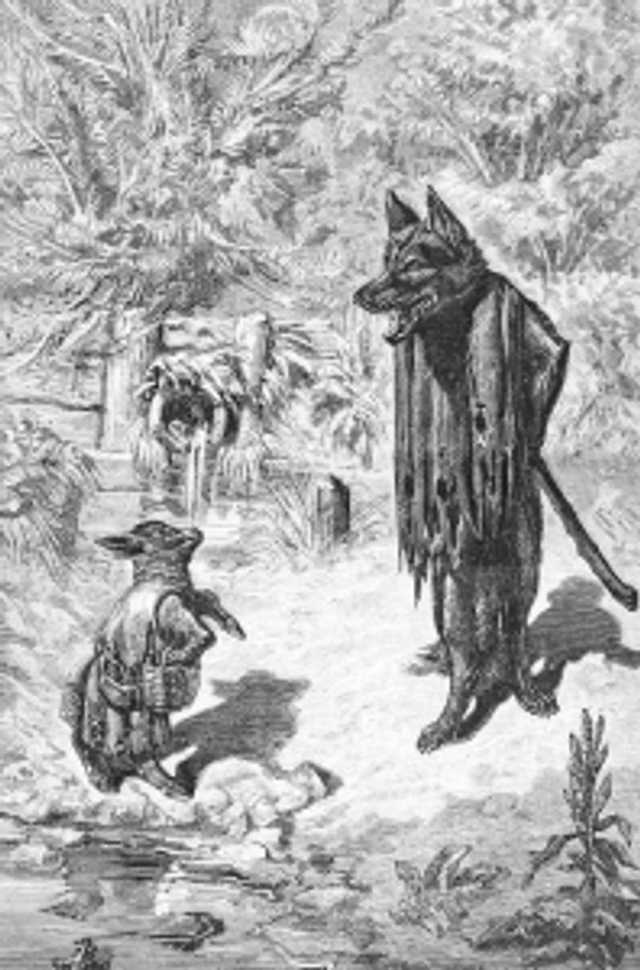
Hey little lamb, you lost? I can show you the way, if you would like me to.

Jesus was using the example of a poor widow woman being injured by the lies of scribes. The poor widow was probably old and feeble. Giving all the money she had would play into the hands of the scribes, who wanted to inherit her rights to a house. She had no heirs, as her son would have assumed her debts as being his own. She was poor because she was unable to provide for herself and she was soon to die because of the injury done by the men of law.

Their verdict was to kill her, using her love of the law and wanting to remain in good standing as a Jew.

God’s verdict, however, would be to grant the poor widow eternal life for her devotion, while the scribes would face a greater judgment … one they would not be expecting.

As the Gospel reading for the twenty-fifth Sunday after Pentecost, when one’s own personal ministry for the LORD should be underway – one should have been made aware of the false teachings of those saying they know what Jesus would do if he were alive today – the message here is to see the verdict that comes from God’s Judgment, for having lived a life under the pretense of religion, rather than having loved God with all one’s heart, soul, and strength, is one that just might be an unexpected shock that a soul is unprepared to hear.

In the Book of the Acts of the Apostles, there is the story of Ananias and his wife Sapphira (Acts 5:1-10).

They wanted to become members of the new church of Jews that Peter and the other Apostles were forming. That church was not for people pretending to believe in Jesus as the Messiah. Disbelievers still had the Jewish synagogues.  The new church was only for those who had been filled with the Holy Spirit, due to an immediate opening of their hearts and love pouring out to God. They were all those who had been reborn as Jesus Christ, through the Holy Spirit and the Christ Mind.

Membership in that new church required the sacrifice of self-ego, such that wealth was not something individually held. Wealth was held in common (a treasury) for the good of the whole church (all Apostles[2]). In that way, no one was poor, no one was rich, all needs were met and all served the Lord as a most holy and righteous priests (i.e.: Christians).

In verses one and two we see how Ananias and his wife sold a piece of property, and then agreed to hold back a portion of the proceeds for themselves. Think of this as a situation of wanting to be Christians, but they were lying about having received the Holy Spirit.  They were “desiring” just like the scribes.  They so wanted to get in on this new church venture (for whatever self-motivations they saw) that they sold one piece of property (possibly of many they owned). Still, because they were not totally committed to God (perhaps they had some reservations about losing everything they had) they held back some of the cash. One can assume they kept it hidden somewhere secret that only they knew: how much that was and where it was stashed. The remainder Ananias took and lay at Peter’s feet (as it was coins in a bag).[3]

In verses three, four and five we read, “Then Peter said, “Ananias, how is it that Satan has so filled your heart that you have lied to the Holy Spirit and have kept for yourself some of the money you received for the land? Didn’t it belong to you before it was sold? And after it was sold, wasn’t the money at your disposal? What made you think of doing such a thing? You have not lied just to human beings but to God.” When Ananias heard this, he fell down and died. And great fear seized all who heard what had happened.”

Peter’s questions asked were statements that said, “Nobody told you to give anything up.  God certainly did not tell to lie as a way to gain His favor.”
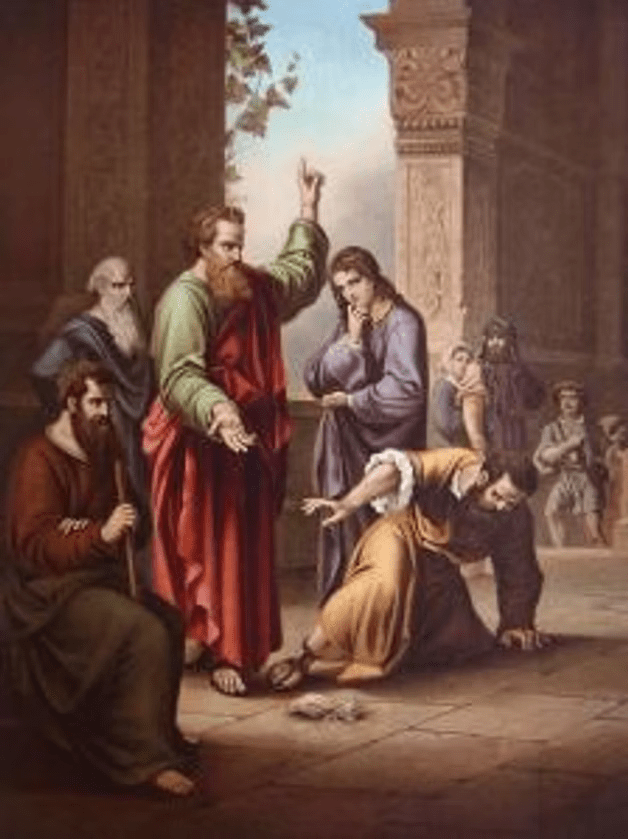
Some texts say he “gave up the ghost.” Death is the release of a soul, but Ananias gave up his chance for the Holy Ghost by lying to it.

When that reading was discussed in a church lectionary class that I attended (years ago), the discussion ended as it was about time for the next church service to begin. As the leader of that lectionary class hurried off to get settled into his favorite seat in the church (possibly a favored seat?), I hurried to ask him, “Whatever happened to that all-in church?”

He barely turned his head my way as he said with a smile, “That didn’t work out very well.” Then he kept hurrying to his seat.

Just by coincidence, the man was a wealthy lawyer. He contributed large sums of money to that church, and he was involved with leading discussion groups and being deeply involved with more in-depth study programs. He was what I consider a very nice man … a Christian man … in today’s partially-in church.

I can only imagine that he saw the two pennies the poor widow woman gave, in this lesson today, as a good example of how the poor widows today are better off, due to taxing the rich more. The welfare state cares for poor widows, unlike the Jewish leaders of Herod’s Temple. It took Christianity to appoint bishops to correct that problem.

Not long ago, the lesson was Jesus telling his disciples, “It is harder to get a rich man into heaven, than it is to get a camel through the eye of the needle.” There also was the parable of the talents, which so many today see as a lesson on signing up for church stewardship pledges, reminding the people how much they can afford to give. One cannot forget that there also was the parable about the poor beggar Lazarus and the rich man.   All [so many] have a theme of money.

Then there is the saying, “The love of money is the root of all kinds of evil.” (1 Timothy 6:10)
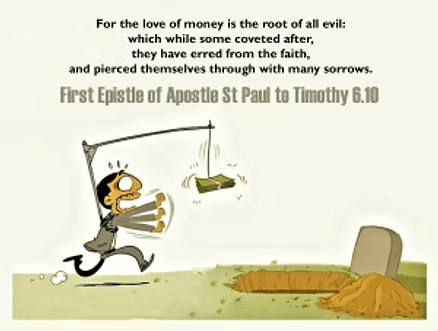
None of those lessons say anyone has to give any money, to anyone, at any time.  Money only has value in the earthly realm.

Being Christian is not about joining a club, such as Ananias and Sapphira thought. There are no monetary dues for being a Christian. The love of God cannot be placed on a scale and measured by ounces and pounds. The only portion of love of God that can make one a Christian is one hundred percent (“Love God with all your heart, with all your soul, and with all your strength.”) Therefore, it never worked out very well for a church of All Saints to be anything less than All Saints.

We are supposed to be all-in.  That “membership fee” is not based on one’s material wealth.  It is based on faith.

When everything one has is given to assure that God’s work is done (knowing God does not seek to feed the world or allow anyone capable of walking a thousand miles to be given some amount of free wealth, but God wants Saints to pass on the Holy Spirit to those who seek to know God), then God will make sure that the money jar you just emptied, so a fellow Saint could have a coat, is now full again (this related to that optional Old Testament reading that associates with this Gospel reading).  Money becomes nothing more than a tool that must be used, so positive growth can result (parable of the talents).  Positive results are measured in faith given and faith returned.

When one is all-in for God, then there is no need to worry about someone wearing a collar coming to visit, suggesting that it is time to remember the church when you pass away.  That promise of eternal happiness can only be promised to those who held back most of what they owned, having never given God any love.

When one has submitted to God completely, any physical property left over when one dies will go to surviving family.  Material inheritance will have been set up for a church of people, not an organization with buildings to maintain and employees to pay.  A church of people is usually sons and daughters and close friends who have had the Holy Spirit passed onto them, keeping worldly wealth at the feet of Saints.

In the end, it will not matter what physical possessions are left behind.  After all, you can’t take it with you.  What you do take is your soul and physical death needs to become the entrance into the eternal kingdom.  This is how this reading in Mark ends; it states, “all she had to live on,” or literally from the Greek, “all the life of her.”

When Jesus pointed out to his disciples, “she out of her poverty has put in everything she had,” everything she had was eternal “life.”  The time to suffer through physical life [mortal existence], for a promise of eternal life, is long before one is set upon one’s death bed.  That is not when one wants to ask God to forgive a lifetime that kept total commitment held back.

Eternal life does not come at discounted rates.  This lesson says to always give all you have, with love of God being the only currency that ultimately matters.

———-

[1] The Proper 26 readings were probably rejected in lieu of the All Saints readings that normally fell on Thursday, November 1, 2018.  Because few went to a mid-week church service [too lazy], many churches will feel it customary to toss out the Proper 26 readings and give a [usually] poor assessment of what All Saints represents.

Actually, this Gospel reading that warns of such berobed changes, in order to meet the lazy needs of high roller contributors [who never attend church on any day other than Sunday morning], is why the Episcopal Lectionary says, “All Saints may be celebrated” instead of the readings set up for Proper 26.  I add this just in case you went to church and heard nothing that came from Mark 12, Hebrews 9, and Ruth 1.

[2] It is important to return to the element of All Saints day, as this can now be seen not as a tribute to all the dead Saints that have been officially recognized by one or more Christian churches, but a recognition that all members of a church should be Saints.  If it is not All Saints, then the church becomes a chain of weak links, which ultimately leads to a weak chain that breaks apart.  Think about that and ask yourself, “When was the last time I saw a real, true Saint?”

[3] While not stated in this story in Acts 5, the bag of money laid at Peter’s feet would have been returned to the heirs of Ananias and Sapphira, not kept as an unholy offering.
Luke 16:19-31: The Rich Man and Lazarus

Luke 16:19-31

19 “There was a rich man who was dressed in purple and fine linen and lived in luxury every day. 20 At his gate was laid a beggar named Lazarus, covered with sores 21 and longing to eat what fell from the rich man’s table. Even the dogs came and licked his sores.

22 “The time came when the beggar died and the angels carried him to Abraham’s side. The rich man also died and was buried. 23 In Hades, where he was in torment, he looked up and saw Abraham far away, with Lazarus by his side. 24 So he called to him, ‘Father Abraham, have pity on me and send Lazarus to dip the tip of his finger in water and cool my tongue, because I am in agony in this fire.’

25 “But Abraham replied, ‘Son, remember that in your lifetime you received your good things, while Lazarus received bad things, but now he is comforted here and you are in agony. 26 And besides all this, between us and you a great chasm has been set in place, so that those who want to go from here to you cannot, nor can anyone cross over from there to us.’

27 “He answered, ‘Then I beg you, father, send Lazarus to my family, 28 for I have five brothers. Let him warn them, so that they will not also come to this place of torment.’

29 “Abraham replied, ‘They have Moses and the Prophets; let them listen to them.’

30 “‘No, father Abraham,’ he said, ‘but if someone from the dead goes to them, they will repent.’

31 “He said to him, ‘If they do not listen to Moses and the Prophets, they will not be convinced even if someone rises from the dead.’”

———————————————————

FOREWORD: This is a rather long explanation of a well-known Biblical story.  It is a rather simple (seeming to be) story of a repeated lesson that warns the wealthy believers in Yahweh, while giving solace to the poor of faith.  It is so seemingly simple to grasp that it is easy to ‘ho-hum’ it and just yawn.  I was led to look at it deeper than I had before and was surprised to see what is sweetly hidden in the verbiage that makes this lesson told by Jesus take on a fresh appearance.

Recently, my writing on a book had me researching the mythology behind the names of the planets.  What I learned about Pluto was very interesting, which is most befitting the discovery of that orb (since downgraded to a dwarf planet or planetoid).  Pluto was discovered in 1930, with the element plutonium discovered in 1934, and produced and isolated in 1940, named as an honor to the discovery of a new planet.  Pluto became the symbolic dawning of the nuclear age.  The same Greek word from which “Pluto” comes is the same word from which comes “rich man” in this reading (and others of similar focus).

One important thing I found in this reading is relative to each of the characters being named, when it appears only Lazarus stands out.  The name Lazarus is representative of a class of people, making the “rich man” also be representative of the same.  Therefore, we are all today either one or the other.  As such, I write this in-depth explanation for all who might want to know this.  Still, it is less for the Christians that sit in pews and more for the ones who will stand before the pewples.  My hope is they will give this lesson the proper attention it deserves.

————————————————————-

The Greek text of this lesson taught by Jesus, recounted by Mother Mary to the doctor Luke, begins with a statement about each of two men. Both are identified as “certain,” from the Greek word “tis.” This identifies each man as known individually, while identifying two who were associated with many like them. Their “certainty” is what bonds two of opposite status levels together in this story.  As a lesson taught by Jesus to the Jews of Galilee, that use of “certain” then spoke of specific members from their religious group. Therefore, the two men identified in verses nineteen and twenty were not people of uncertain religious beliefs, as each adhered to the principles of Mosaic Law.  Being Jewish was “certain” of both men.

The second man is identified as “certain,” with this further specified as “named Lazarus,” from the Greek words “onomati Lazaros.” The mistake that is made in reading those two words that way comes from thinking one man was named Lazarus, which eliminates other symbolic meaning. That not only ignores the meaning behind the name, but it disconnects all later students from relating to the characters of this story.  Reading that there was a “man named Lazarus” into a teaching by Jesus leads all who read these words or hear them read aloud in a church and think, “Well this is about somebody long ago, “named Lazarus,” who I have no affinity with.”  The mistake comes from not seeing oneself as “Lazarus.”

The truth that Jesus spoke to a Jewish audience bears deep meaning to all Christians also.  Christians are supposed to be founded in the principles of Mosaic Law … at least those commonly termed “the Ten Commandments” … but are truly supposed to be seeking to be reborn as Jesus Christ. When one reading this lesson realizes that Jesus spoke in metaphor about Christians today (those who are supposed to be “in the name of Jesus Christ”), then understanding the meaning behind that name “Lazarus” is most important.

The name “Lazarus” (Greek spelling “Lazaros”) is “the Hellenized version of the Hebrew name אלעזר, Eleazar.” (Abarim Publications) The name is then like “El-azarus.” The Hebrew meaning of the root name is then “God Has Helped” or “Helped Of God.” (same Abarim Publications source)

The capitalization should then not be read as simply stating a proper name (a syntactical rule of the English language that misleads, taking one away from the importance of the meaning behind a name), but a significantly important word of meaning, which identifies more than one human being.  “Lazarus” is intended to be one character of parable that reflects upon a whole class of faithful that are like “Lazarus.”

This means the capitalized word “Lazaros” is making two statements.  First, it is stating the importance of the One God (El) in all who believe in Yahweh.  Second, it is stating the importance of all who are “named” as “certain,” being relative to a specific religious set of beliefs commanded by El. That name is then a statement of all who see the value of the Laws of God, through Moses, as worthy of complete commitment and submission.  Therefore, “Lazarus” is not naming one person but naming all Jews and Christians who “God Has Helped.”

When one has become comfortable overcoming that limitation of the word “Lazaros” and understand how the capitalization makes this lesson be pointed at every Jew and Christian who believes in Yahweh, the question should be, “Then why is Lazarus (one who God Has Helped) identified in the translation as a “beggar”?

It is important to read these verses (or have them read aloud in one’s presence) and question, “I feel like I have been helped by God, because I am a successful person; so why is one Helped Of God laid at a gate as a beggar?”

One needs to ponder, “If I am truly helped by the One God, how am I reflective of one who is covered in sores?”

The reasoning should be to find out who oneself identifies with in this teaching, as Jesus was not only speaking to a group of Jews in Galilee when he gave this lesson.  The reasoning should be to see Jesus speaking to everyone who will read his words forevermore.  The reasoning should be to understand what one has overlooked in the past, as a student called again to listen to a lesson with a more mature mind.

First of all, verse twenty begins by stating the Greek word “ptōchos,” a word that is not capitalized. English syntax calls for the first word in a sentence be capitalized, but Biblical Greek text is following divine syntactical rules. The word “ptōchos” translates as “poor, destitute, spiritually poor, either in a good sense (humble devout persons) or bad.” (Strong’s) The lack of capitalization says (silently) that poverty is not an important issue.  The lack of material wealth is not an issue for any whom God Has Helped. As this story (eventually) tells of “Lazarus” going to Heaven, one should assume the identification is to one who is “a humble devout person,” whose “poor” status does not deter God from having his needs met, as a devoted servant. The result of one “Helped Of God” is one is “poor” due to a lack of material needs.

HELPS Word-studies states, relative to Jesus’ usage of “ptōchos,” the word’s usage acts as an assumption of a reduction in physical stature, which leaves one a beggar.  They state: “ptōxós (from ptōssō, [meaning] “to crouch or cower like a beggar”) – properly [means], bent over; (figuratively) deeply destitute, completely lacking resources (earthly wealth) – i.e. helpless as a beggar. (ptōxós) relates to “the pauper rather than the mere peasant, the extreme opposite of the rich.”’

This word’s usage has led translators to paraphrase what Jesus said, making his words be twisted, creating a misleading visual by saying Lazarus “was laid a beggar.”  In reality, those who belong to the class of people “God Has Helped” are “bent over” to Yahweh, subservient to His Will.  They are “lacking earthly wealth” that simply keeps them from identifying with the materially “rich.”  IF there are any sores visible on their bodies, the sores signify the admission of their sins, which places them prostrate before the gate of Heaven, begging for forgiveness from God.

Knowing this about the identification of one “God Has Helped” makes not seeing Lazarus as a beggar easier to fathom. The descriptive term that makes this lesson of Jesus more powerful says that the person identified as Lazarus was the “extreme opposite of [one who was deemed] rich.” [HELPS Word-studies]  Seeing a lame beggar covered in sores as helpless, reduced to seeking crumbs (metaphor for alms for the poor) for survival, makes it quite difficult to grasp the evil of a “rich man.”  It almost excuses being rich today, while caring little about how many poor people there are in the world, as if with the attitude, “They should pray to God more.”

Understanding that verse twenty is Jesus setting up a lesson where the one “Helped Of God” is the “extreme opposite of the rich” means looking closer at verse nineteen is important. The literal translation of that verse states, “A man now certain existed rich  , and he was clothed in purple  and  fine linen  ,  making good cheer every day in splendor.” This verse has three segments of words, set off by the presence of comma marks.  It is important not to erase this punctuation (whether it is imagined or real), as it keeps one from paraphrasing what was written.  Paraphrase is a trick of human language, but it is the application of syntax not spoken by Jesus.

I have found that wherever the Greek word “kai” (typically translated as “and”) appears it should be read as a statement of importance to come (that which is stated next), rather than as simply stating “and.” English syntax frowns on placing “and” and a comma mark together, so when we see “, and” above this concept that “kai” is written-spoken as a mark of importance to come is supported.  Strong’s Concordance states that “kai” is written in the New Testament 9079 times.  That repetition should be viewed as more significant than simply being a sttutering use of “and,” like “oh yeah, add this.”

The comma mark separates like a conjunctive word (“and”), while the word “kai” acts as a signal of importance to follow. This non-translation of “kai” as a conjunction (which finds many are deleted from translation, due to redundancy) also means that where it is written “purple and fine linen” there are two statements made.  By simply stating “and” (the trick of syntax again), the mind quickly computes “fine purple linen,” missing the importance of “purple.”  The word translated as “fine linen” is a separately important description that follows the symbolism of the word translated as “purple.”  The word “kai” says, “See the separate elements, “purple” followed by “fine linen.”

When one read verse twenty previously and found that “certain” was followed by “named Lazarus,” where “Lazaros” was less about the name of a specific person but an identification of all devout believers in the One God (and all to come), the parallel should be seen in verse nineteen. There, the word “certain” is followed by the Greek word “plousios,” which has been translated as “rich man.” This should be seen as a parallel ‘name’, just as is “Lazarus.”

The word “plousios” is defined as meaning, “rich, abounding in, wealthy; subst: a rich man.” (Strong’s)  This says that the translation as “rich man” is a substitute for the true meaning.  Realizing that means “plousios” is how this “certain man” is ‘named’, which separates him from all uncertain wealthy people, misses that he, like “Lazaros,” is named “Plousios,” without the importance of capitalization.

HELPS Word-studies adds to this understanding of usage as such: “ploúsios (an adjective, derived from 4149 /ploútos, “abundance”) – properly, fully resourced; rich (filled), by having God’s “muchness” – i.e. His abundance that comes from receiving His provisions (material and spiritual riches) through faith (4102 /pístis).” This is another way that seemingly justifies seeing value in the “rich man,” as his wealth is assumed to be due to his “faith.” That assumption allows one to wrongfully think, “rich duds on the outside correlates to a wealth of inner goodness.”

This later assumption of “God’s muchness,” which includes “material riches” must be seen as not fitting the set-up that is opposite the lack of material concerns sought by one “God Has Helped.” Yahweh, as the One God, does not help His believers become materially “rich,” making this lesson demand seeing that truth.  Despite the mega-churches that have ‘slick Willy’ preachers in thousand dollar suits that only preach, “Jesus wants you to be rich,” that is a lie that does not match what this lesson by Jesus teaches.

It is better to remember what Jesus said to his disciples later in his ministry.  Then he said, “Truly I tell you, it is hard for someone who is rich [“plousios“] to enter the kingdom of heaven. Again I tell you, it is easier for a camel to go through the eye of a needle than for someone who is rich [‘plousion‘] to enter the kingdom of God.” (Matthew 19:23-24)  Jesus said that after he told a young man [one who owned lots of possessions] how to be assured of going to heaven.  The young man walked away sadly, after being told following the Law was (of course) required, but the key to getting to heaven was this: “If you want to be perfect, go, sell your possessions and [“kai“] give to the poor [“ptōchois“] ,  and [“kai] you will have treasure in heaven. Then [“kai” translated as a capitalized “Then”] come, follow me.” (Matthew 19:21)

It becomes important to see how the “certain man” of verse nineteen is then given the name of “plusious” (lower-case of insignificance), just as the “certain man” of verse twenty was “named Lazarus.” The lack of capitalization is then a statement of the lack of importance that Jesus gave to all believers who (exactly like the rich men of Jerusalem and Galilee when he taught) place wealth as a statement of their piety. This makes the substitute translation of “rich man” realize another substitute implication, as an identifying name – both for an individual and a group of Jews [and Christians].

The Romans named their god of the underworld Pluto, because Pluto was a form of “plusious.”  Pluto’s etymology, according to the Wikipedia article “Pluto (mythology)” is: “Plūtō (genitive Plūtōnis) is the Latinized form of the Greek Plouton. Pluto’s Roman equivalent is Dis Pater, whose name is most often taken to mean “Rich Father” and is perhaps a direct translation of Plouton.” The Romans revered that lesser god as the god of abundance (and with abundance comes power and influence). The equivalent Greek god was named Hades, who was not revered in any way by the Greeks. However, the Romans saw the underworld as where the riches of the world came from, as mineral rich ores that were mined from under the earth’s surface.

By seeing this in verse nineteen, Jesus gave the rich man the extreme opposite name to “God Has Helped,” as being one specifically who the god of the underworld has helped.  Verse nineteen can be read as naming an individual Jew named Pluto (or Shepha or Mamónas), if there is only one man named Lazarus.  The two men, or those Jews and Christians who are just like one of those two men, claim to be believers in Yahweh, but the verse nineteen group prays to two gods, while those of the second group pray to One God.

This awareness means that it was abundance that enabled the “certain man” of verse nineteen to be “clothed with purple.” The Greek word “porphyran” is a color that represents “power or wealth.” (Strong’s) Purple is the color of the robes of kings, because they wield the power and wealth of nations of people, whose “certainty” is a nationality, more than religious beliefs. To wear that color was a statement of royal status.  More importantly, it was a Self-assumed state of power and influence, as no Jews in Galilee or Judea were truly of royalty.

At the time that Jesus taught this lesson, the “certain” Jews of Jerusalem had the power and wealth of the Second Temple that allowed them to pretend to be royalty.  The fall of Israel and Judah was due to having followed their human kings to ruin.  The were no kings in Jerusalem after Herod the Great died, and Herod owed his royal dynasty to his Roman masters that placed him in power.  As the Roman Emperor sought to pacify the Jews of Jerusalem, by letting them think they ran a city state within the province of Judea, that region was placed under a governor from Rome, after Herod the Great died.  After their return from exile in Babylon, the ruling class Jews of the Temple had forgotten that God should be their King.

This means the use of “enedidysketo porphyrin” (“he was clothed in purple”) is a statement that one who claimed to be a Jew (today a Christian or believer in Jesus Christ) was “putting on airs.” He (and all like him) “was clothed in” the invisible robes of Self-importance, based solely on how much wealth one had amassed (at the expense of others). The extreme opposite view that fits this segment of words is “putting on the clothes of righteousness.” Righteous is not the view one should have, when reading what Jesus said identifying the one as “rich” (“pluto“).

Evidence in this regard comes from the Apocalypse of John, who wrote of righteous clothing in two verses. He wrote, “But you have a few people in Sardis who have not soiled their garments; and they will walk with me in white [not purple], for they are worthy.” (Revelations 3:4) John also wrote, “It was given to her to clothe herself in fine linen, bright and clean; for the fine linen is [metaphor for] the righteous acts of the saints.” (Revelations 19:8) Isaiah also wrote of righteous clothing (Isaiah 11:5; 59:17; 61:10; and 64:6), and Zechariah 3:4 also spoke of this. David wrote, “Let your priests be clothed with righteousness, And let your godly ones sing for joy” (Psalm 132:9).  That was a statement that those of “certain” faith, who served in the Tabernacle.  Those priests would wear the sacred garments of the servants of Yahweh, not the garments of kings.

The use of “kai” says that simply dying common clothing the color “purple” was not all the abundant ones did.  They enhanced that signal of royalty greatly by adding that color to “fine linen,” which could have been “purple” or any other color when purchased. The Greek word used by Jesus is “bysson,” which [according to HELPS Word-studies] means, “fine linen, i.e. a very expensive (sought-after) form of linen – “a specific species of Egyptian flax or linen made from it that is very costly, delicate.” (J. Thayer).”

This means that in addition to putting on the clothes of self-glorification, rather than the clothes of righteousness, the people who were like this “certain man” always made sure people could tell their status by the clothes they wore, knowing their fabric was imported. This is like men and women today that wear expensive suits that clearly say, “I am powerful.” It reflects an inner drive that forces one to selfishly live up to the English saying: “You have to spend money to make money.”  More money must be reinvested in self-appearances and airs.

The comma then leads to the final segment of words that add detail to this acting like royalty that separates oneself from the common class of people by dressing in finery, all because one is of a “certain” faith. The Greek states “euphrainomenos kath’ hēmeran lamprōs,” which literally translates as “making good cheer every day in splendor.” This says, basically, the abundance of one’s position of wealth has made them “feast” (“euphrainomenos “) twenty-four-seven (“kath’ hēmeran“) on the finest of everything (“lamprōs“).

This makes the sum of verse nineteen be about one’s opulence, which is a sign of one’s decadence caused by wealth.  That means that if Yahweh has initially given one abundance, then it was as a test of faith.  Jesus told the young rich Pharisee how to pass that test and be “perfect.”  However, he walked away sad, reflecting how most rich Jews (and Christians today ) fail to deal with “abundance” properly.  The projection of self-worth, while ignoring the “poor,” is an imperfect state of being that keeps one from heaven.

When one has a firm grasp of verse nineteen being about everyone of Judaic-Christian values (who believe in Jesus Christ’s lessons), it points to those who misjudge wealth as God’s blessing for them to rule the world. When one can see how “Lazaros” is a powerful statement of true Christians that have been filled with God’s Holy Spirit and been reborn as Jesus Christ (bearing his name as “God Has Helped”), then it is easy to see how verse twenty needs some translation adjustments, so that those who are the extreme opposites of the rich are not seen as crippled beggars.

Verse twenty’s Greek states two segments, separated by one comma mark: “ebeblēto pros ton pylōna autos  ,  heilkōmenos.” That can literally say about “God Has Helped” that one of His faithful “was thrown to outsiders porch same  ,  being full of sores.”  This is because “ebeblēto” (from the root “balló“) means, “to throw, cast,” in a stronger sense than “laid” implies (somewhat) “with care” or “gently.”  The Greek word “pylōna” refers to “a large gate; a gateway, porch, vestibule,” meaning something more significant than a private gate to a country villa on a dirt road.  It implies an entrance to a palace, which fits the royal motif.

When “pylōna,” is realized to translate as “a large gate; a gateway, porch, vestibule,” then this word should be seen as representing Herod’s Temple – a fixture of Jerusalem.  It then is a statement that this “certain poor man” of Jewish faith was denied access to the inner courts, deemed too poor to gather along with well-to-do Jews.

The Greek word “ton” simply translates as “the,” but NASB (New American Standard Bible) lists three times it translates as “outsiders,” and four times as “others.” The implication is then creating the imagery of one being “cast” or “thrown” outside the Temple proper, to the Court of the Gentiles, which was beyond the Beautiful Gate and near Solomon’s Porch.

Following the separation from a comma mark, the Greek word “heilkōmenos” states the one exception to this general banishment. If one was “covered in sores,” then one could gain access to the Court of Lepers, in the general area of the Women’s Court, not far from the Nicanor Gate.  Still, it would be better to stand outside the temple with “outsiders,” even if the rich and powerful saw that association with Gentiles as sores covering one’s body.

When verse twenty-one begins by stating “kai,” this is again signaling a level of importance that is relative to “longing.” The Greek word “epithymōn” means “desiring,” usually in a negative sense of lustful wanting or longing; but it also means “setting one’s heart on,” where the heart is the seat of the soul. As one “named God Has Helped,” one can make the assumption that that soul’s heart is pure, in this case. Therefore, “to be fed” (from “chortasthēnai“) is less a reference to physical food, and more a statement of needing one’s heart be fed with spiritual food.

The Greek word “chortasthēnai” bears the meaning, “to be satisfied, filled,” where there is an emptiness that needs filling or satisfaction, but that does not necessarily mean in one’s belly.  To desire such nourishment “to fall from the table of the rich man” is a statement of lack from the “rich man,” rather than plenty that is shared.  Since no one places a “table” (“trapezēs“) in one’s ‘driveway’ by a “gate,” Lazarus was never able to see the “table” of the wealthy.  That Greek word, when associated with money, implies a “money-changing or business” “table,” from which Lazarus was denied.

This means that those who pretend to be holy (based on abundance of wealth) and wear fancy clothes rather than priestly robes rarely (if ever) produce morsels of insight that nourish the souls of the faithful.  Still, the sequence of words actually states (from the Greek), “from that falling from the table away from the table of the rich man,” where the Greek word “piptontōn” equally states, “falling under (as under condemnation)” and “falling prostrate.”  This is then not waiting for food to fall from a dinner table, but “falling down” from having been outcast (“falling under” the decrees of royal priests) and praying to God (“falling prostrate”) outside the Temple gate.

The translation that has verse twenty-one concluding with the statement, “Even the dogs came and licked his sores,” needs refining. The new sentence is confusing, as the word for “dogs” (“kynes“) implies “scavenging canines,” who ran wild and were disdained by the citizens.  For Lazarus to be portrayed as a lame beggar that was hungry for crumbs to keep him alive, one would assume a stray dog would likewise compete with him for any crumbs.  To lick his wounds, after stealing his crumbs, would be like adding insult to injury.  However, this segment of words is poorly translated.

Following a semi-colon mark (absent in the translation above) is the word of exception “alla.” That means “but” or “however,” such that there is a caveat being stated by Jesus, one that is relative to this “falling from the table of the wealthy.”  After notice of an exception comes the Greek word “kai” again, which prepares one for an important statement to follow. That statement comes in three segments, which literally can say: “but kai outsiders dogs  ,  coming  ,  were licking clean this wounds the same.”

The exception is then pointing to the importance of “ta kynes,” or “the dogs.” It is the presence of “kai” that alerts the reader to look for meaning that is greater than a simple article (a, an, or the).  In this regard, the word “ta” is another that typically translates as “the,” but the NASB lists the same translation options as “outsiders” or “others” (seen for the Greek word “ton“).  This way of seeing that translation working here, where “ta” is identified as important, means that “outsiders” become the Gentiles that were also barred from the tables inside the Temple.  This makes “dogs,” the literal translation of “kynes,” refer to the figurative translation of the word, so “dogs” is a statement (importantly) of the way the elite Jews viewed Gentiles.

The one-word statement next, following a comma mark, is “coming.”  This is then relative to those who were not Jews, but came to the Temple just to stand outside.  This would have been Samaritans and Greeks, or any of the scattered Israelites who had become mixed blood, while still believing in the God of their ancestors who were Israelites. It would be outside the Temple that teachers (like Jesus, and later his Apostles) would offer insight about Scripture. The Gentiles came for those morsels falling from the table, rather than hoping to get inside where nothing of importance was ever said. Thus, being among those who were seeking to find God, whether Jew or Gentile, all “were licking the wound” of banishment, exile, and rejection for past sins unforgiven.  That is especially true for those of great faith, as not being able to join with those of “the same” stated religious beliefs (the “certain”) is hurtful.

The aspect of “covered in sores” and dogs licking “sores” is what makes it seem that some man named Lazarus was a leper and a poor beggar (perhaps lame too). In the times of Jesus, people like that would have been banned from holy spaces and blamed for their physical plights.  “Sores” were seen as outward projections of imperfections stemming from one’s inner being, which were then deemed as evidence of sins.

The Greek root word “helkos” means “a wound, a sore, an ulcer,” often used to denote a “(festering) sore.” (Strong’s) Still, the one-word statement that assumes one person was “full of sores” can also allow for the assumption that one was treated like a leper, when the only ‘sores’ that covered his body were from the honest wear and tear a poor man of values earns from hard labors.

When invisible “sores” are angers that fester within one’s soul, due to unfair treatment at the hands of the rich and powerful (with no recourse other than suck it up and bear it), there is no doubt a faithful follower of Yahweh would be falling prostrate before God asking for forgiveness and strength to continue.  Job was an upright man who suffered mightily from sores he did not deserve.  Job fell prostrate before the Lord, as he blamed himself for not knowing what sins he did to bring about his plight.  Never was Job found blaming God for his plight (although others advised him to do so).

It is very important to see this lesson of Jesus from the perspective of two who have been placed on God’s scales of judgment. God would judge both men (just as God judges all human beings), based on each individual’s faith as “certain men” who claimed to serve Yahweh.  They would not be judged by how much wealth and abundance one had or who had physical maladies that others saw as evidence of sins.  God’s judgment is based on souls that have no flesh to drape with finery and no flesh to ooze from sores.

This becomes quite evident after both have died. God’s judgment found the one who professed faith in Him (a “certain man”), but lived only to satisfy himself and deny others, as being worthy of entering an eternity of suffering. The one who served God (a “certain man”) and was identified as “God Has Helped” (“Lazarus”) was “carried away by the angels,” taken to the embrace of Abraham in the spiritual realm. The one who most pew-sitting Christians today would root for (as many see themselves in that man), would be the one to go to a burning place.

This is where one must understand that Jesus was not teaching about two imaginary individual characters.  He was speaking instead with metaphor, of all who were identified as Jews, which has evolved today to the present state where it includes all who identify as Christians.  Jesus told of the fate of everyone who claims to be devoted to Yahweh.  His lesson says: Be rewarded in the material world by the joy of fleeting riches, and know the soul will suffer in the afterlife; or, be assured that the soul will be rewarded in the spiritual world by eternal bliss, after momentary suffering in a world that is careless.

This lesson is no different than when Jesus said, “No one can serve two masters. Either you will hate the one and love the other, or you will be devoted to the one and despise the other. You cannot serve both God and money.” (Matthew 6:24)  The word for “money” is “mamónas,” which many have translated as the personified deity Mammon.  The lower case can make that statement, as Mammon was a lesser god, not close to earning  the distinction of personification, where capitalization states important.  Still, so many worship “money” as their god, when that “love of money” means a hatred of Yahweh (regardless of what their tongues say).

[“For the love of money is a root of all kinds of evil. Some people, eager for money, have wandered from the faith and pierced themselves with many griefs.” (1 Timothy 6:10)]

It is again at this point of death that the ‘rich man’ is identified by the Greek word “plusios,” as Jesus said, “Died next  kai this plusios  kai  was buried.” The same words identify what appears to be an unnamed entity that bears the same name as everyone who serves the god of abundance, who the Romans called Pluto. It becomes important to read “plusios ” as one would read “mamónas,‘ where the lower case reflects the inferiority of the god they are named after.  Thus, Jesus said, “Died next  *  this servant of abundance  *  was buried (i.e.: placed in the ground and covered with earth).”

This is then a powerful statement about the god of the underworld. Hades, according to the Greeks, hated those who attempted to escape the eternity of his unseen realm.  Hades would find those who escaped to the surface and bring them back.  The god of the Underworld is why it is so poetically stated, “ashes to ashes, dust to dust,” during funeral rites.  The human body is said to now be worth one U.S. dollar, based on the breakdown of elements it contains.  As little as that is worth in currency, you still cannot take anything you own with you when you die.

The Greek name of the god of the underworld is Hades, whose name means “the Unseen.” The Greeks paid as little attention as possible on this god, whom they loathed. Their ignorance, countered by the Roman’s adoration of Pluto as a god of abundance from within the earth (i.e.: iron, salt, gold, silver, copper, tin, etc.), left the name Hades relegated to being the name of the realm he ruled. The Underworld became synonymous with Hades.

[Although there is no Hebrew or Israelite mythology, the equivalent master of the Underworld would be the fallen angel that was cast within the Earth for going against God.  There is the name Azazel, one of the fallen angels written of by Enoch, but Christians prefer the name Lucifer or Satan.  Some Hebrews spoke of Beelzebub.  They all share common threads with Hades and Pluto.]

By understanding this mythological ‘history’, then see how Jesus said one who worshipped Pluto in life died and was promptly placed back into the earth (interment underground, either in a tomb hewn into rock, or a six foot deep hole dug into soil), as the rightful property of his god. Jesus said next (in verse 23), “kai en tō hadē,” which very capably states, “kai in the realm of the one Hades.”

[Notice how “hadē” is written in the lower case, but loves to be capitalized in translation?]

Neither “plusios” nor “hadē” is given the respect of capitalization, because those ‘proper names’ are worthy of lower case identification (as lesser gods); but the lesson of Jesus here is: All who worship Pluto (the god of abundance, wealth, riches, and opulence) will find their souls going to Hell (Pluto’s realm), where their god Hades reigns. This is regardless of what came out of their mouths when in the flesh, which made them “certain” as believers in Yahweh.

When the one identified as Lazarus died, his body of flesh was not carried by angles to the bosom of Abraham. His flesh was returned to the earth (give unto Pluto what is Pluto’s).  The burial of his flesh is inconsequential, as his flesh had no value to him, nor anyone God Has Helped.  It was the soul of one whom God Has Helped that spiritual messengers lifted away. The implication is that Lazarus lived in the spiritual real while trapped in his body, having sacrificed his life in the flesh to serve God [like an Apostle or Saint].  This makes Lazarus like the Lazarus Jesus raised (his brother-in-law), who was then another soul living in the spiritual realm within a body of flesh that had been sacrificed to serve the Lord.  When Jesus was resurrected, he too was a living Spirit in a dead and worthless body of flesh.

That identifies all who serve Yahweh in the flesh and suffer momentarily (twenty to sixty human years are like a split second in eternity) from the disrespect of the souls whose worship of Pluto (a.k.a. Mammon), who are treated as ‘second class’ or ‘lepers’ of society, as being “named Lazarus.” All who earn that name, especially those reborn in the name of Jesus Christ, are quite capable of withstanding the suffering of a material world, where the lures of riches no longer are appealing to them. They abstain from taking any more than is necessary to serve Yahweh with strength, meaning they refuse to sell their souls for temporary comfort.

[Joseph of Arimathea was a “rich man,” but he used his wealth to support God’s ministry in Jesus.  He did not love money; he loved Yahweh.  God rewarded him with money to use supporting God’s Apostles.  Had he given all his wealth to those in the name of Jesus Christ, then God would know to trust him with renewed wealth, as an eternal flow of living waters flowing from the earth.  This would be as opposed to the efforts required to dig riches from the Underworld.]

The soul of the “rich man” is immediately found unable to withstand an existence that has discomfort, to the point of torment. Fresh from a life in the flesh, where those like Lazarus saw his pretense of royalty and felt the finery of his imported clothing, that soul called out for his fellow “certain man” to serve him with a drop of water placed on the tip of his burning tongue. His soul was so used to living a life of decadence to the max, once removed from a physical body it screamed out for pity, when his former ears ignored the pleas for help that other living beings made to him daily. The karmic reward is shown as being that souls who worship lesser gods in the flesh will find no relief for their souls once removed from that flesh.

Finding that hard lesson too late, the soul that was the property of Hades begged that the one who God Has Helped show mercy on the wealthy brothers he left behind (who probably were even wealthier then, after their brother had died). He wanted Lazarus to go appear as a ghost to warn them of the fate that awaited them. However, Abraham said there would be no ghosts sent to those who serve the god of wealth and abundance; they have Moses and the prophets to guide them, because they profess to be “certain men.”  Faith is based on a promise of future gains, not gains realized in the present. They would have to earn their way to the good place, as had “Lazarus.”

The lesson is one that speaks of everything one needs to serve the Lord.  That need is Spiritual, not material.  This is repeatedly written in the Holy texts. This lesson by Jesus is another in a long line of lessons that repeatedly say, “Love the Lord with all your heart, all you soul, and all your mind.” There is even a Charles Dickens novel that tells the rich to be warned against selfishness.

The problem now is, as it has always been, the souls who pray to “god” for wealth and get it will always make the mistake of thinking the “god” they prayed to was Yahweh.  The sad reality is they are praying to Pluto; and Pluto will pay any price in material goods, knowing nothing material will ever be lost from this world. Hades is a hateful god that has claims on every soul in the flesh; and the only way to escape his realm is through Jesus Christ. Then one’s soul will be carried away to eternal bliss by angels.