
Tag Archives: 2 Corinthians 5:11-13

2 Corinthians 5:6-10, [11-13], 14-17 – The love of Yahweh urges us on

We are always confident; even though we know that while we are at home in the body we are away from the Lord– for we walk by faith, not by sight. Yes, we do have confidence, and we would rather be away from the body and at home with the Lord. So whether we are at home or away, we make it our aim to please him. For all of us must appear before the judgment seat of Christ, so that each may receive recompense for what has been done in the body, whether good or evil.

Therefore, knowing the fear of the Lord, we try to persuade others; but we ourselves are well known to God, and I hope that we are also well known to your consciences. We are not commending ourselves to you again, but giving you an opportunity to boast about us, so that you may be able to answer those who boast in outward appearance and not in the heart. For if we are beside ourselves, it is for God; if we are in our right mind, it is for you. For the love of Christ urges us on, because we are convinced that one has died for all; therefore all have died. And he died for all, so that those who live might live no longer for themselves, but for him who died and was raised for them. From now on, therefore, we regard no one from a human point of view; even though we once knew Christ from a human point of view, we know him no longer in that way. So if anyone is in Christ, there is a new creation: everything old has passed away; see, everything has become new!

——————————————————————————–

This is the Epistle selection from Episcopal Lectionary for the Fourth Sunday after Pentecost, Year B 2018. In the numbering system that lists each Sunday in an ordinal fashion, this Sunday is referred to as Proper 6. This will next be read aloud in church by a reader on Sunday, June 17, 2018. This is important as Paul makes it clear that Apostles do not know Christ from a human perspective, but from a personal spiritual identification, which allows them to see false shepherds that boast outwardly, without truly knowing Christ.

Omitted from this reading is verse 5, which states, “Now He who prepared us for this very purpose is God, who gave to us the Spirit as a pledge.” The word translated as “pledge” is “arrabōna,” where “a pledge” is like “a down payment,” as is “earnest money.” It is given with the expectation of continued payments, for a continued benefit.

This then leads to Paul stating, “We are always confident,” where such confidence is based on having been given the Holy Spirit of God. The word read as “confident” is used in a context of “boldness” and “good courage” (from “tharreó”). This means God is seated in their hearts of His chosen ones, and it is from that source that “good courage” comes. It is not any form of intellectual “confidence” intended here.

The courage of a lion is heart-centered.

The translation above can seem quite confusing when one reads how Paul said, “we are at home in the body.” It forces one to ask, “How else can one feel about one’s life, other than ‘at home in one’s body’?”

The words actually written in verse 6 are telling of the present tense of being, which is relative to the presence of a soul (spirit) in a body (matter). The Greek word “Tharrountes” (a capitalized first word stating importance via capitalization) means, “Being confident,” more than “we are confident.” As a mate to this present state of being, the Greek word “endēmountes” means, “being at home.” This together (where two commas state the importance of knowing – “eidotes” – that link confidence made aware in a body), Paul is stating the Holy Spirit being at home in the body is where all that confidence comes from.

By Paul writing, “We are away from the Lord,” the meaning is human bodies are separate and apart from the spiritual realm. Still, the Lord is present through the Holy Spirit having become one with the soul that gives life to the body. Thus, “we walk by faith” (where “pisteōs” is another statement of “confidence”), “not by sight” (a sensory mode of the body in the physical realm).

When Paul then wrote, “we make it our aim to please him,” this cannot be seen as an intention of one’s brain, as the word “aim” might imply. That word of translation (“aim”) was not written. Paul simply stated that regardless of being – either in-body (soul baptized by the Holy Spirit) or out of body (soul freed to the heavenly realm, via prayer, meditation, or eventual soul release through death) – the presence of God within one means one’s willing subjection to the Lord. One lives to serve God.  That represents a complete sacrifice of one’s self-ego, as a servant-slave to God. In that sense, the only “aim” is forever to please the Lord.

The translation that says, “For all of us must appear before the judgment seat of Christ” has to be read as furthering this statement of subjection to the Lord. The key word of this statement is actually set apart by commas, where “phanerōthēnai” is read as “must appear,” when it more accurately states, “be revealed.” Rather than a call “to appear” or “show up” as a volunteer, “all” who Paul wrote to (and himself and his own) had to go through a state of transparency before God. This means “all” of the sins brought forth by a soul in a human body “must be revealed” before God, as both confession and plea of repentance. This is one’s appearance “before the judgment seat” of the Lord.

When we read, “the judgment seat of Christ,” it must be realized that God is our ultimate judge. When “Christ” is added, we can grasp in our minds that Jesus Christ sits at the right hand of God and through him all who will be saved must go. However, God sits upon the throne and only those who sit at His right hand are allowed into Heaven; and that means all Apostles-Saints are judged as worthy of becoming the Christ, when before God’s judgment seat in a human state of existence.
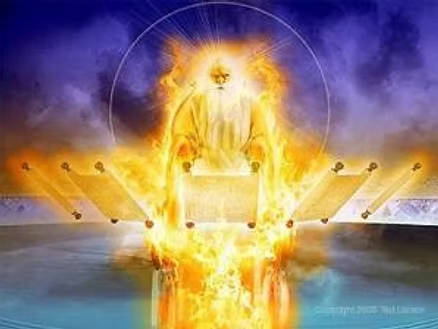
This means that the forgiveness of all sins transforms a flawed mortal with a dirty soul into a reproduction of Jesus Christ. To become Christ, one must have all sins expunged by God’s judgment, which is the baptism of the Holy Spirit. This in turn makes the “judgment seat” be one’s heart, where God sits upon the throne of His devoted subject, who is to be reborn as His Son Jesus Christ. This then says that Paul, all the Christians of Corinth, and any other Apostles and Saints forevermore have been and will be the same in spiritual character through God’s judgment; and this is “so that each may receive recompense for what has been done in the body, whether good or evil.”

When Paul then states how Apostles and Saints know “fear of the Lord,” the Greek word “phobon” can translate as “fear, terror, alarm,” but also “reverence” and “respect.” The use of “fear” is more the “sense of awe” that comes from knowing the presence of God within and never wanting that presence to cease.

This means that Paul saying, “we try to persuade others” is not in any way an attempt to talk someone into believing in God and Jesus Christ (through some intellectual attempt to persuade), but instead the Greek word “peithomen” states the “urge” within one to answer any question that others might have about God and Christ, so they can likewise come to know the confidence of an Apostle-Saint, on their own terms. In no way does “fear of the Lord” mean that a disciple should coerce someone to believe in God and/or Christ, by such means as predicting God’s judgment for evil deeds done that may go unforgiven.

God gave Man (males and females they made them) the gift of free will, prior to God sending a Savior to save Man from the sins that will come freely.  Man, therefore has the right to reject God, Christ, and good, as a decision made by the self.  Fear, as an emotion that can become used to enslave mankind by Satan, will never be present in Apostles and Saints as what led them to serve the Lord.  Once they have personally known God within, then a fear of losing that presence is a motivator to remain loyal to God.  Fear of the Lord is no longer a fear of punishment by God, but a fear of losing Salvation that has been gained.

In that regard, Paul wrote, “we ourselves are well known to God, and I hope that we are also well known to your consciences,” as a reminder that none of the Christians in Corinth, who became Apostles after having meeting Paul and his fellow Apostles, were told to be Christian “or else.” Instead of reading “pephanerōmetha” as “ourselves well known” [“to God” is prior in a statement ending with a period and not part of this statement], Paul simply pointed out “we have made ourselves clear.” That “clarity” is then hoped “to have been made clear” in the “consciences” (or “moral judgments”) of those true Christians in Corinth. While Paul and partner(s) did not make a “hard sell” of what to believe, they made sure all the questions the Corinthians had were satisfactorily answered, so those who were seeking the truth could make their own moral decisions regarding God and Jesus.

By Paul writing, “We are not commending ourselves to you again, but giving you an opportunity to boast about us,” he was saying his letter was not intended to make a “follow-up sell,” because Paul knew one who becomes a Saint will not backslide … because of a “fear” of losing redemption and the presence of God within. Instead, his epistle would serve to enhance the faith of those converted, while giving those who are disciples needing more answers an opportunity to hear from Paul, knowing the truth he tells matches the truth told by the Corinthian Christians. The word stating “boasting” (written “kauchēmatos“)is then used in the context of giving glory to God as exultation to be shared joyfully.

This ability to point out how to recognize one who is truly filled with the Holy Spirit, where one is worthy of boasting about, then serves the purpose of separating the truth from the lies. Paul added, “So that you may be able to answer those who boast in outward appearance and not in the heart,” which was a statement of false shepherds as well as those who want to say they are filled with the Holy Spirit but have not yet made a total commitment to God. That totality of commitment is made in the heart, which is the love center of the body. It means only those who have indeed felt the presence of the Lord within them, through marriage to His Holy Spirit, as one’s baptism of the soul, can give a seeker ALL the answers one is seeking to find. Those who have not yet become married to God, as His faithful subjects through self-ego sacrifice, are then unworthy of boasting about, because they can only offer Scripture as the answers, when Scripture becomes the source of the questions.

When Paul then wrote, “For if we are beside ourselves, it is for God,” “beside ourselves” (from the Greek root “existémi”) implies “astonishment.” Still, it has the connotation of “being out of one’s mind, mad” and “removed from a standing position.” In the written text, following the comma after “besides ourselves,” is simply the word “Theō,” which says, “to God.” This means the “astonishment” that comes from the presence of God within one comes from having sacrificed one’s self-ego and then taking a position that is “removed from expressing self concerns.” One becomes “amazed” by the way God leads one to act in ways that were previously unnatural to self (soul in a body of flesh in a world of temptation), because God has one act as His Son, Jesus Christ, absolutely free of sin.

The translation that has Paul offering, “If we are in our right mind, it is for you,” the translation of “sōphronoumen” as “right mind” means, “sober-minded” and “exercising self-control” (as well as “of sound mind”). This, then, becomes an extension of being “removed from a standing [typical human] position,” when Apostles and Saints must exercise self-control” by their marriage to God and the submission of self that demands.

As such, by saying “it is for you,” the only purpose for an Apostle or Saint is to serve others as God’s chosen ones. The can never be any self-glory or self-aggrandizement coming from being God’s chosen people, as all honor and glory is God’s alone, for having sent His Son into the world to save others from their sins. Salvation means the sacrifice of self, in complete and total service to the Lord, for the benefit of others. As Paul was writing to other Apostles and Saints, the purpose of all his epistles were for that purpose; and that is how his letters still serve the Lord today and beyond.

Paul next supported this by stating, “For the love of Christ urges us on, because we are convinced that one has died for all; therefore all have died.” The first part of that says that sacrificing a love of self has brought about the love of God, which is a consummated love that bring the Christ Spirit into one’s being. There is no love lost for having made that sacrifice, because Christ becomes the presence of love that is all motivating. This presence is not an act that convinces one (as the Greek root word “krinó” is better translated as “a good judgment,” whereby the presence of Christ’s Spirit is based on the merit of self-sacrifice, due to love of God), but a foregone “conclusion.” That conclusion is that Jesus Christ died so his spirit could be freed to be duplicated in ALL Apostles and Saints. For that rebirth to occur, ALL who will receive a “love of Christ” must likewise die of self. This is not a physical death, but the cleansing of one’s soul by the baptism of the Holy Spirit. Christ, as the Son of God, cannot be reborn into any selfish (thus sin retaining) soul.

Paul then reinforced this point as he addressed the true Christians of Corinth by saying, “therefore all have died.” Saul died and became Paul. Jacob died and became Israel.  Abram died and became Abraham.  Every Apostle and Saint has equally been changed the same, sacrificing their birth name for that of Christ. Apostles of Christ all understand the truth in those words because they all know the love of Christ. With that they all know the urge to have Jesus Christ be reborn in others, so they serve God in that capacity. Because they have all died of self, they have no one else to serve, nor do they seek to serve anyone other than God.

To advance this universality of dying in self, Paul added, “And he died for all, so that those who live might live no longer for themselves, but for him who died and was raised for them.” This says that all mortals are sinful souls born into temporal bodies, where that flesh will die. Without the soul being cleansed by the Holy Spirit, every soul is born to die and repeat, through reincarnation. God sent His Son into this world for the purpose of giving life (from the Greek word “zōntes”) to that which had previously faced mortal death. Those “who live” will be given life through becoming Jesus Christ (“no longer themselves”). That requires the baptism of the soul by the Holy Spirit and the surrender of the self-ego as the death that allows Jesus Christ “to rise again” (from the use of the Greek word “egerthenti” – “having been raised again”).

This sense of death is then why Paul wrote, “From now on, therefore, we regard no one from a human point of view.” The word translated as “human” is “sarka,” which means “human nature,” but also “flesh” and “body,” alluding to one’s sense of “personality.” This is a confirmation of self-ego, where the body of flesh acts as the “point of view” for the spiritual soul. When the soul has been freed from the limitations of its temporal body, it no longer is “near-sighted” in “regard” (from the Greek word used, “oidamen”) to that body.

This foundation is why Paul then stated, “Even though we once knew Christ from a human point of view, we know him no longer in that way.” The “human point of view” is that Jesus of Nazareth walked the earth of ancient Israel, as a human being, a man born of a woman. Those who followed him then told how he was killed by being hung on a cross, and then buried in a tomb, from which he rose and walked again among his disciples, until he ascended into heaven.

That story of Jesus of Nazareth cannot garner true believers that the man was in fact the Christ, simply because of the same reasons human beings discount ancient stories of gods and heroes. We call such stories mythology; and even though good ideas, principles, and concepts can be gleaned from myth, it still does nothing to lead human beings today to a belief that is based on personal experience.
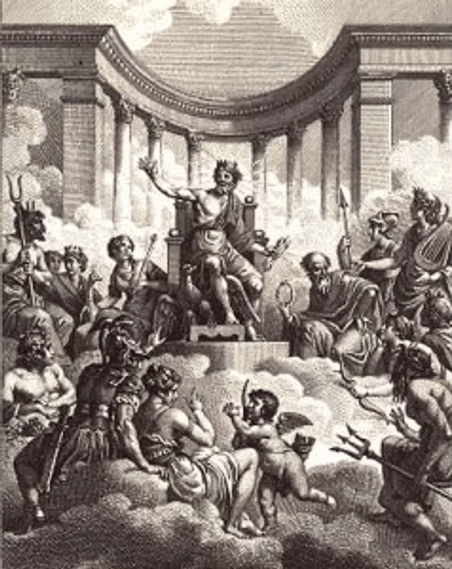
Imagery of some Olympians. prior to the I.O.C. putting them in athletic shorts.)

In the Episcopal Church’s Eucharistic Prayer A, the celebrant leads the congregation with the words, “Therefore we proclaim the mystery of faith,” to which all recite, “Christ has died. Christ is risen. Christ will come again.” This has to be recognized as a statement of faith that is past (“has died”), present (“is risen”), and future (“will come again”). By stating faith in the present tense, “IS risen,” the present says ALL who proclaim that “mystery of faith” ARE the risen Christ. It is not a reflection back to the good ole days when witnesses said they saw dead Jesus of Nazareth walking around, letting disciples feel his wounds, while he ate broiled fish. That would be a proclamation of belief of a past event, as “was raised.”

The Apostles of Jesus Christ, as him reborn in the present time, can then know that “Christ will come again,” as there is no end to that resurrection.  As long as there are Saints with personal experience of “Christ being risen” around to answer all questions posed by seekers of the truth, Apostles and Saints are always present.  To confess “we await his coming in glory” (Episcopalian Eucharistic Prayer B), as if one is stating a belief that Jesus never has returned (not even in the first Apostles, or Paul, or any other Epistle writer), while we believe he is promised to return … some day … at an unknown time in the distant future … maybe … that is a complete misunderstanding of the return of Jesus Christ.  Christ returned at 9:00 AM the day after he Ascended (on Pentecost).  He has remained on earth, through Apostles and Saints, ever since.

When one has this personal experience of Jesus Christ, while one’s soul still resided in human flesh, then one can never return to a time when the historical figure known as Jesus of Nazareth is how one knows he was Jesus Christ. This is how true faith is not a lesson in rote memorization and saying what others have told one to say. Belief can only come from personal experience; and once one has experienced the Holy Spirit and God’s presence within, then one truly knows the resurrection of Jesus Christ.

Paul then stated, “So if anyone is in Christ, there is a new creation.” The words “en Christō” are correctly translated to state “in Christ.” This is a clear statement of the condition (“If”) that “anyone” who is a human being with a soul is “with Christ,” then that one’s soul has been cleansed of sins. That soul then becomes “in Christ,” as a statement of sacrifice and salvation. The old self has then become transformed into a “new creation.”

The use of the Greek word “ktisis,” meaning “creation,” brings out the divinity of all “creation,” as God’s work. Therefore, one is “in Christ” only through the grace of God, and not by self-will; and “in Christ” is the same as “in the name of Jesus Christ,” where Jesus is the human name and Christ is the divine presence that joins the material to the Spiritual … the body to the blood of Christ.

This selection from Paul’s letter then ends by his writing, “Everything old has passed away; see, everything has become new!” The use here of “Everything” is a paraphrase, where the actual text simply says “old things have passed away.” The Greek word “archaia” can be better stated as “the original,” or “the primitive,” which has to be seen less in light of “things” and more as the “old self” that has passed away. This then leads to “the original” having “emerged anew” (the text written – “gegonen kaina”), where the same old soul has been given new life by God’s love.

As a selection presented on the fourth Sunday after Pentecost, when one’s personal ministry to the Lord should be underway, the beauty of Paul’s words go deep into what brings about true ministry. It is the depth of meaning that comes from his words that fill the hearts of Apostles and Saints with the joy of realization: “Yes! Yes! That IS the way it is!”

Such amazement and astonishment can only mean that Paul the human being did not originate these words, but his hand was moved to write the precise words that God called upon him to write. Only one who is equally filled with the insight and wisdom of the Holy Spirit can grasp that beauty and understand completely what his words state.  A true seeker of truth will be called to investigate this depth.  A true Apostle will be called to help others look to see this depth.

This selection states how ministry in Christ is for the benefit of others. It is to provide answers to natural questions, which are more than surface quotes of Scripture. For one to come to the personal decision to forever let one’s self-ego die, to be in the name of Jesus Christ, one has to have the truth be told that will guide them to that decision.

When one who does not have God in one’s heart tries to lure the innocent to an addiction that demands one listen to a false shepherd for guidance, then one will eventually find reason to disbelieve.

That too comes by personal experience. This means an Apostle and Saint will always have God in their hearts, so the truth can be told.

The truth might be told in words that are difficult to make sense of immediately … while standing in front of the speaker; but the truth becomes planted like a seed that grows and grows. Paul’s epistles are then like the mustard seeds of which Jesus spoke in the Gospel of Mark (which this reading accompanies). Paul wrote in spiritual wording, where only tiny particles seem to make sense. However, when planted in fertile ground, his words take root and spreads within one’s flesh, as personal awareness that proves true to the self.  One then grows into a large tree, under whom others will find a home.  A home that has a heart that welcomes questions.

2 Corinthians 5:6-10,[11-13],14-17 – Opening the door to oneself, so the Lord can enter

We are always confident; even though we know that while we are at home in the body we are away from the Lord– for we walk by faith, not by sight. Yes, we do have confidence, and we would rather be away from the body and at home with the Lord. So whether we are at home or away, we make it our aim to please him. For all of us must appear before the judgment seat of Christ, so that each may receive recompense for what has been done in the body, whether good or evil.

[Therefore, knowing the fear of the Lord, we try to persuade others; but we ourselves are well known to God, and I hope that we are also well known to your consciences. We are not commending ourselves to you again, but giving you an opportunity to boast about us, so that you may be able to answer those who boast in outward appearance and not in the heart. For if we are beside ourselves, it is for God; if we are in our right mind, it is for you.] For the love of Christ urges us on, because we are convinced that one has died for all; therefore all have died. And he died for all, so that those who live might live no longer for themselves, but for him who died and was raised for them. From now on, therefore, we regard no one from a human point of view; even though we once knew Christ from a human point of view, we know him no longer in that way. So if anyone is in Christ, there is a new creation: everything old has passed away; see, everything has become new!

——————–

This is the Epistle reading that will be read aloud on the third Sunday after Pentecost [Proper 6], Year B, according to the lectionary for the Episcopal Church. This reading will follow either a track 1 or track 2 pairing of readings; such that if track 1 is chosen, a reading from 1 Samuel will say, “Samuel did not see Saul again until the day of his death, but Samuel grieved over Saul.” That reading will be paired with Psalm 20, which sings, “They collapse and fall down, but we will arise and stand upright.” If track 2 is chosen, then the Old Testament reading will come from Ezekiel, who wrote, “On the mountain height of Israel I will plant it, in order that it may produce boughs and bear fruit, and become a noble cedar.” That will be paired with Psalm 92, which sings, “They shall still bear fruit in old age; they shall be green and succulent.” All will accompany the Gospel reading from Mark, where Jesus said, “With what can we compare the kingdom of God, or what parable will we use for it? It is like a mustard seed, which, when sown upon the ground, is the smallest of all the seeds on earth; yet when it is sown it grows up and becomes the greatest of all shrubs, and puts forth large branches, so that the birds of the air can make nests in its shade.”

These selected verse begin by saying, “We are always confident; even though we know that while we are at home in the body we are away from the Lord– for we walk by faith, not by sight.” That is so much of a mouthful that it becomes difficult to follow what is said. It forces questions that are not answered, as the reader drones on, adding more to the complexity. What does “confident” mean? What does “at home in the body” mean? What does “away from the Lord” mean?

This confusion comes because Yahweh does not speak in ‘speed reading capable’ language. If the sole purpose of reading things aloud is to practice one’s public speaking skills, then a church is not the appropriate environment. If reading something as fast as possible is only to get a service over sooner, without any in-depth discussion [allowing hands to be raised with questions to ask], then there really is no point in reading anything in church. Just come in, wave some wands, pass out some human-deified material things [water, wafers, wine], adjourn and go home; and, then act like something good happened, when nothing happened to change anything from the way it was before.

What I just presented from the reading is ‘the first sentence’ that will be read by a reader. It is, in reality, two verses of text. Those two verses have pause marks, breaking them into five segments. Each word in those verses could become a sentence or more. Certainly, running on without pause makes it very difficult to understand any Epistle reading, Each verse needs to be understood, before one can go into the next verse. For that reason, here is what was stated in that first ‘sentence.’

Verse 6 begins with a capitalized “Tharrountes,” which divinely elevate the meaning to a Spiritual state of “Being” that brings about “Confidence, Courage, Happiness.” That first word states an Apostle is a soul married to Yahweh and thus in possession of an assurance that cannot be matched by a soul alone. It divinely indicates strength that surrounds one’s state of being, as a present participle level of “Confidence.”

A lion is a good symbol of strength and courage.

That one word leads to Paul saying that state of “Being” is not temporary, as it is “always and knowing” that state of being will always be. In that, a “kai” is written between “always” and “knowing,” signaling the importance of knowledge from personal experience, thus no doubts can diminish that state.

This then leads to a comma mark, indicating ‘take a breath of pause’ before going to the word “endēmountes,” which is another word in the present participle [“Being”]. That state is where “Confidence” is relative to “being at home” or “being in a place to live.” That “place” is then stated to be “in the body,” where “sōmati” can equally translate as “flesh.” From realizing the first word of this ‘sentence’ is capitalized, meaning a marriage with the Holy Spirit, one can then be aware that the Spirit has merged with one’s soul and is “known” to be “at home in the body of flesh.”

The third segment of words in verse 6 then begins with the word “ekdēmoumen,” which has been translated as “we are away.” The word means, “to be away from home, absent,” which shows the relationship to the home, which is one’s body of flesh. When this segment ends with the capitalized word “Kyriou,” one needs to see the divine elevation that comes from seeing that word as being the Spiritual “Lord” over one’s flesh. This represents a union of self [soul] and Spirit, where the self [soul] is “absent,” while still present, subservient to the presence of the “Lord.”

In the accompanying reading from Ezekiel [track 2 option], he wrote “adonay Yahweh,” where I explained the intent is to say the “lord” of Ezekiel was “Yahweh. That “lord” was God’s “Spirit,” so the same needs to be read here as “Lord.” When one’s soul is [present active indicative] “away from the Lord,” this needs to be seen as Paul indicating submission in marriage, as one’s soul has stepped aside, so Yahweh’s Spirit has becomes the “Lord” over one’s body of flesh.

While this can be read [equally right, which is the nature of divine language] to speak of the state of sin that humans always find themselves in, such that “to be away from the Lord,” while being “at home in the body,” says one is led by the desires of the flesh. That says one has turned away from the Lord and the soul has been sold into slavery, then possessed by the wants and desires of the body of flesh. The “flesh” becomes the “Lord” then. This way of reading says it is very easy to enslave oneself [self = soul] to a weakness, where no courage or confidence exists. In a world that panders to influencing souls to step away from self-controls that, in essence, makes Satan [or the Devil] become one’s “Lord” of the body. However, simply by seeing the first word of this three segment verse beginning with a capitalized word meaning a divine state of “Being” that brings “Confidence” and “Courage,” that says the present state is known from having married one’s soul to Yahweh. One has turned away from Satan, facing Yahweh.

Verse 7 then explains this transformation that comes from this Spiritual marriage, where the soul now lets Yahweh’s Spirit be the body’s “Lord.” Paul first wrote, “for we walk by faith,” where the literal Greek translates as “on account of faith indeed we walk.” Strong’s explains this usage of “walking” as meaning the way one conducts one’s life. HELPS Word-studies adds to the deeper meaning: “walk around, i.e. in a complete circuit (going “full circle”).” In that, one can see how a soul comes from Yahweh, as His “ruach” or “breath of spirit,” allowed to be free to do as one pleases; but after marriage to Yahweh’s Spirit, one then has returned to be with God.

Here, it is important to see the word “pisteōs” has been translated as “faith,” not simply “belief,” because the way one conducts one’s life – the true path one walks – always becomes a case of “do as I say, not as I do” contradiction, when the soul walks alone in the flesh. The translation of “faith” speaks of personal knowledge of Spiritual marriage and the presence of a higher “Lord” leading the direction in life one takes. Therefore, “we walk by faith” becomes a statement of the ministry true Apostles will always be found “walking.”

Verse 7 then adds a second segment of words that have been translated as “not by sight.” This element of “sight” must be seen as contrary to “faith,” as “seeing is believing,” while “faith” is trust in that which is physical unknown and unseen. A translation as “not by sight” is also what others see when one walks. That often becomes a failure to live up to beliefs, as what one sees cannot be expected to be the same as what one does.

In this, the Greek word “eidous” [translated as “sight”] truly means “appearance, fashion, shape, sight” (Strong’s Definition), and “visible form, shape, appearance, outward show, kind, species, class.” This makes it clearer to see that “faith” is not shown by what one wears: fancy robes, collars, crosses, high hats, fine suits, etc. This means one does not put on a display that becomes a statement of one’s “beliefs.” If one goes about in ministry feeling a need to announce by the clothes one wears, “Hey, look at me! I am holy and righteous!”

That becomes a projected false power that overcomes people, leading them to “believe” one wearing certain clothes is going to do all the work for them. Seen as having a special relationship with God says others should trust a priest knows what God wants lost souls to do. True “faith” walks the walk and talks the talk privately and without fanfare. This is because the power of ministry is a “Lord” that cannot be “seen” and one does not want to take credit for what that “Lord” does, while one has “stepped away” from the controls of one’s body of flesh.

By slowing down the reading process, incorporating a desire to understand divine text, rather than sit in a pew and dream about what one will do after the service is [predictably soon], one can see great depth arise from what is totally missed by the NRSV translation above. Two verses, broken into five segments of words, brings forth the value of divine insight.

All of the letters of Paul [and the other Apostles] are written in this way; and, all have greater depth of meaning than an English translation read aloud in a church can ever convey. All demand an accompanying explanation by one divinely married, like Paul [and the other Apostles]. The sole purpose of a priest is to provide that explanation, because a priest is like Paul just stated! The purpose of reading Scripture aloud [a practice adopted from the Jewish synagogue reading of the scrolls] is to discuss the meaning, so afterwards everyone “walks” as a priest in ministry – unseen as such to the eyes of others.

Verse 8 is translated above to state, “Yes, we do have confidence, and we would rather be away from the body and at home with the Lord,” which clearly repeats all that had been stated prior. This, however, is also begun by the capitalized word “Tharroumen,” which is the same root word as began verse 6, only now stated in the present active form. This capitalization becomes the same divinely elevated state of “Being” that says [collectively] “We are Confident” and “We are Courageous.”

What is missing from this translation is a second segment, introduced by the word “kai,” which places importance on one word, “eudokoumen,” which adds “kai we are pleased.” This is strongly stating that Paul knew all true Christians were “well-pleased, thought it good, were resolved” in that state of submission. That says their marriage was not forced upon them, but lovingly welcomed. Thus, by Paul saying, “we would rather be away from the body and at home with the Lord,” they had all found much preference from that submission to a divine “Lord.”

In verse 9, Paul is shown to have written: “So whether we are at home or away, we make it our aim to please him.” In reality, this misses another segment that begins with the world “kai.” That marker word is followed by “philotimoumetha,” which means “we love or seek after honor,” implying “ambition” or “self-motivation.” The root word implies [in usage], “I am zealous, strive eagerly, desire very strongly.” (Strong’s Usage) This strong drive to please, based on love intending to honor” their “Lord,” is not translated into the bland way the NRSV states this preference.

The “aim to please” [actually “well-pleasing”] is importantly based on this inner feeling the presence of the “Lord” brings; and, this presence is always present, whether it is giving commands or allowing the soul the freedom to retain and exercise some degree of control of the body it now coinhabits. The element of “pleasing” must be seen as sharing oneself through divine possession, like one would do “pleasing” things to make a guest feel welcome. It shows one is happy with the presence; and, one does not want that visitor to ever leave.

When verse 10 is then translated to say: “For all of us must appear before the judgment seat of Christ, so that each may receive recompense for what has been done in the body, whether good or evil,” this gives the erroneous impression that “Christ” is Yahweh. Most people professing to be Christian will read the word “Christ” and think it is the last name of Jesus; so, they will think Jesus Christ is the one who sits on a throne judging souls, not Yahweh. In reality, the Greek literally translates to state the following:

“these indeed all ourselves to be made known it is necessary before the face of that throne of judgment that of Anointed one , in order that might receive what had belonged to myself but had been lost each these because of that flesh , according to what done , whether good whether evil .

While the NRSV translation can be seen as a simplified version of what was written, the truth is exposed that Paul was making a statement [led by the “Lord” within his flesh to write] that says the souls of true Christians [where “ourselves” – “us” – means “our souls”] have found a gift from divine possession; and, they go into ministry because of that found, which is the promise of Salvation [“walking not by sight”]. Only a saved soul can stand before Yahweh, who sits high on a throne of judgment, as a saved soul come wearing the face of His Son. Only a saved soul stands before Yahweh as Anointed, one of His “Christs.”

Paul and the other true Christians went [and still are expected to go] into ministry with that message: Marry Yahweh and become a “Christ” – an “Anointed one” by the Spirit – so the soul of Jesus is resurrected within one’s flesh, becoming one’s “Lord.” Otherwise, play your time in the flesh all you please, and then suffer the consequences of one’s life. All souls will be held responsible to their life’s past acts of good and evil. Only those souls who “leave their body to the Lord” will wear the face of a Christ and be allowed into heaven.

Write that down and put the note in your wallet or purse; and, then read it each day. Going to church, believing in Jesus Christ [as one name], and trying to limit how many times one secretly does evil, while praying for forgiveness each time, will not allow one’s soul to enter heaven after death of one’s flesh. That is selfishness; and, marriage to Yahweh means the work of selflessness, in return for washing away the past sins. The only way to be redeemed is to marry Yahweh and become His Son reborn, which means getting off the pew and entering ministry, without any of the fancy clothing. Live that or live again [and again] as ‘go back and start over’ reincarnated souls.

This reasoning for ministry is explained by Paul in the bracketed verses, which many see as “whew, optional, let’s strike those out, thank god.” I will forego explaining them here, simply because so many verses of an Epistle reading becomes a dissertation too long for casual Christians to ever finish reading. It would be good practice to look at the text here [BibleHub Interlinear] and do your own work trying to see the truth for oneself.

That then leaps us to verse 14, which says literally: “this indeed that of love of Anointed one held fast ourselves , having decided this , because one on behalf of all has died .” Here, the word ”agape” is written, which means “love which centers in moral preference.” (HELPS Word-studies) That means not “love” based on a human state of emotions or feelings. It is a statement of the love that joins Yahweh’s Spirit to a soul, which comes from a moral desire, not any tinglings felt by the flesh.

Such mutual “love” marries a soul to Yahweh, who in turn “Anoints one” [makes one a “Christ”] out of “love.” This anointment is not temporary, as it “holds fast” to all “souls” [from “selves”] Yahweh merges within. Again, this is not forced, as the “decision” to enter this divine union is totally upon the soul to choose. The “one” who “on behalf of all has died” is Jesus of Nazareth. His human life in the flesh previewed the way all saved soul-flesh should “conduct a life,” with Jesus’ death planned. Only from his soul’s release from one body of flesh could it then be free to be resurrected alongside those souls married to Yahweh. The presence of the divine Spirit brings about this birth within, so Jesus brings one the Anointment that he had in the flesh, returning into a new body of flesh, as the “Lord” one’s soul steps aside for.

Verse 15 then literally says, “kai for the sake of all he died , in order that those living , no more to themselves should live , on the other hand then behalf of themselves having died kai having been raised again .” As can be seen, there are two uses of the word “kai,” which marks importance that must be noted.

First, Paul emphasized the importance of understanding the reason Jesus died, “for the sake of all.” The reason was not so everyone thereafter could sin and still go to heaven. Such a lifestyle means one is not “living,” but instead animating dead matter, heading to the dead end road of life that says, “repeat and try again.” The soul of Jesus is what makes one a “Christ,” which is the only way to become truly “living.”

When Paul then followed that statement by adding, “no more to themselves should live,” this states it is up to the soul to decide to marry Yahweh and be reborn as His Son. As such, “no more should live” is stating one’s own death of control over one’s flesh – dying of one’s ego and self-will. That is when a soul steps away from control of the body and allows the soul of Jesus to become “Lord” of the flesh. This is then stating “”having died,” with the great importance [“kai“] being “having been reborn.”

Verse 16 then literally states, “Therefore ourselves away from that of now nothing regard by way of flesh . forasmuch as kai we have regarded according to flesh Anointed one , but now no longer come to know .” Here, the capitalized word “Hōste” brings divine elevation to the meaning of “Therefore.” That stated prior referred to the conditional [shoulda, woulda, coulda] of making a decision. Paul is now beginning with the heavenly decision for marriage to Yahweh having been made. “Therefore our souls” have stepped “away from” control of one’s body of flesh.

This brings about an eternal “present” or “now,” where “nothing by way of the flesh” has any control over the soul. This is not a state of death, as the soul still occupies the flesh; but the flesh no longer influences the soul. The reason is the souls have allowed their flesh to be controlled by the “Anointed one,” or the “Christ,” which is the soul of Jesus.

The last segment of words can be confusing, but when read slowly they clearly say, “the exception that comes from the now and present is our souls are no longer dominant [instead submissive]. This says our souls have come to know Yahweh up close and personal, through marriage; and, the resurrection of His Son’s soul in one is known to be one’s “Lord.”

Finally [for this reading selection], verse 17 literally translates to state: “therefore if a certain one in Christ , new creation . that original have past away ; behold! , has come into being new .” Again, Paul repeated the word “therefore,” this time without capitalization. It simply states a reflection on that “come to be known.” While the Greek word “tis” can translate as “somebody” or “anybody,” in New Testament writings it refers to “a certain one,” which implies one who is known. While “anyone” [all souls] are invited to become wives of Yahweh [be known by Him], few will make that decision. This means Paul’s use of “tis” speaks only of those “certain” in the name of Yahweh [His Sons].

These will all be “Anointed ones” by the hand of Yahweh. All will become “new,” as having all past deeds of sin wiped clean. That past will “create” a “new” self or soul. The exclamation to be seen [“behold!”] is Jesus Christ has come again in a “fresh” body of flesh.

In this selected Epistle reading to be read aloud on the third Sunday after Pentecost, when each true Christian should have begun a personal ministry as Christ reborn, the true meaning of what Paul wrote is rarely addressed. This says those preaching the sermons either do not care or they do not themselves understand, meaning they have false ministries as false shepherds or wolves in sheep’s clothing. The truth of this reading selection clearly states what has to happen for Salvation to be gained. The totality of ministry is getting that message out, so everyone who hears the message can commit to marriage of their souls to Yahweh. Each has to wear the face of Yahweh, as His Anointed. Each has to have the soul of Jesus resurrected within him or her – all Sons of man – who leads one’s path of righteousness, while the self-soul stands aside to that “Lord.”