As we work together with Christ, we urge you also not to accept the grace of God in vain. For he says,
“At an acceptable time I have listened to you, and on a day of salvation I have helped you.”
See, now is the acceptable time; see, now is the day of salvation! We are putting no obstacle in anyone’s way, so that no fault may be found with our ministry, but as servants of God we have commended ourselves in every way: through great endurance, in afflictions, hardships, calamities, beatings, imprisonments, riots, labors, sleepless nights, hunger; by purity, knowledge, patience, kindness, holiness of spirit, genuine love, truthful speech, and the power of God; with the weapons of righteousness for the right hand and for the left; in honor and dishonor, in ill repute and good repute. We are treated as impostors, and yet are true; as unknown, and yet are well known; as dying, and see– we are alive; as punished, and yet not killed; as sorrowful, yet always rejoicing; as poor, yet making many rich; as having nothing, and yet possessing everything.
We have spoken frankly to you Corinthians; our heart is wide open to you. There is no restriction in our affections, but only in yours. In return– I speak as to children– open wide your hearts also.
——————————————————————————–
This is the Epistle selection from the Episcopal Lectionary for the Fifth Sunday after Pentecost, Year B 2018. In the numbering system that lists each Sunday in an ordinal fashion, this Sunday is referred to as Proper 7. This will next be read aloud in church by a reader on Sunday, June 24, 2018. This is important because Paul stated salvation comes when one has been filled with the Holy Spirit of God, becoming one with Christ.
When Paul begins this sixth chapter of his second epistle to the Christians of Corinth by stating, “not to accept the grace of God in vain,” this is after he concluded chapter five by saying Christians were the “ambassadors of God, through Christ.” This means the word “kenon,” translated as “vain,” means not to be Christian in “empty, foolish, false, pretentious, and hollow” ways. That means Paul was telling the Christians of Corinth that they were not graced by the presence of God, through Christ, for self-promotional reasons. The word “kenon,” therefore, means not to be fruitless. An Apostle of Christ, as Jesus Christ reborn, is a continuation of the living vine, for the purpose of bringing forth new fruit for God, through Christ.
As a way of supporting that urgent message, Paul then quoted the prophet Isaiah, who said, “In the time of my favor I will answer you, and in the day of salvation I will help you.” (Isaiah 49:8, NIV) This different translation makes it more readily seen that “At an acceptable time” is when God finds one’s actions are “favorable” to Him. It should not be thought that this means when one is ready for God’s help, such that “at that acceptable time” all one needs to do is snap one’s fingers and God is there to serve, like some genie in a magic lamp. It is when God find favor in a servant, such as what makes one a prophet or saint. Thus, “I have listened to you” says one has said “favorable” things to the LORD in prayer.
The part of Isaiah’s prophetic verse that says, “on a day of salvation I have helped you,” then led Paul to proclaim, “now is the acceptable time” and “now is the day of salvation!” Both of those declarations were led by Paul saying, “idou” (form of “horaó”), or “Behold!” One cannot “see” the “time” or the “day of salvation,” but one has to be able to “discern” it and “perceive” it spiritually. One is capable of seeing in that manner when one has received the Christ Mind.
It is also to read “in a day” (“ū-ḇə-yō-wm”), where the article identifies “a day,” in the singular number. This singularity, as “a day” differs from “the day,” as that singularity implies only one day of all days. Because salvation is relevant at all times, not just some nebulous day somewhere in the future, “a day” represents many days when individuals are saved. That become “a day” when God has “helped you,” where the individuality becomes specific of all Christians, but more importantly to the individual “you,” the reader.
One must realize this “day of salvation” is that time when one switches from being a human with a soul carrying the guilt of sin through life to being an Apostle or Saint, whose soul has been cleansed by God’s Holy Spirit. This is how salvation occurs. It occurs “in a day” when life gains new meaning and not when one has reached the darkness of death (night). One cannot be saved without God’s breath of life (a soul) sacrificing the self (ego) for the Mind of Christ (Jesus Christ reborn). This can only be done during one’s human life, not after death.
This is then a reference to the seventh day of Creation, which God deemed holy and created the first priest to be sent to mankind, His Son of Man (Hebrew adam). The soul breathed into that bodily form was the same that would be within the Son of God (His only Son soul), Jesus Christ.
The seventh day of Creation was not followed by any other numbered says.
Because the first six days of Creation lasted the equivalent of billions of years (or more … however many human years science guestimates and more), the human sense of time means we are still in the seventh day of Creation at this moment. We are in the day that God sent religion to the world, which was quickly mutated into a multitude of false religions, which do nothing to lead one to a personal day of salvation. The seventh day represented the day religion was born into the world. However, only the One God (YWHW), the God of Abraham, Isaac, and Jacob, the Father of Jesus Christ, can offer mankind redemption. Salvation is then when one receives the Holy Spirit and transforms into the resurrection of Jesus Christ.
In respect to this arrival of one’s soul “in the day” made holy by God (not Sunday or some 24-hour period), one becomes the servant of God for the remainder of one’s life. This is not an easy road to travel without the presence of God and Christ. When Paul wrote, “We are putting no obstacle in anyone’s way, so that no fault may be found with our ministry,” a Saint does not ever try to block the sunlight of God from shining on His servants. The truth will always enlighten and enhance one’s commitment to God, with no Apostles ever casting shadows of doubt onto the faith of all.
The role of an Apostle, which has to be realized by all who have the reward of salvation, is then described by Paul. Here he wrote, “as servants of God we have commended ourselves in every way: through great endurance, in afflictions, hardships, calamities, beatings, imprisonments, riots, labors, sleepless nights, hunger; by purity, knowledge, patience, kindness, holiness of spirit, genuine love, truthful speech, and the power of God; with the weapons of righteousness for the right hand and for the left; in honor and dishonor, in ill repute and good repute.” All of these rays of light shone forth to the people of Creation, those still lurking in the sixth day without salvation, will be drawn to the goodness a Saint shows. Still, none of these accomplishments listed by Paul can be achieved by self-will or ego-driven desire to proclaim righteousness. One must be saved to display these characteristics of commitment, married to serve God.
For all that goodness shown, the world mostly rejects light exposing the sins of darkness. Thus, Paul wrote, “We are treated as impostors, and yet are true; as unknown, and yet are well known; as dying, and see– we are alive; as punished, and yet not killed; as sorrowful, yet always rejoicing; as poor, yet making many rich; as having nothing, and yet possessing everything.”
This level of persecution will break human will, making one grovel under the tortures and punishments of being righteous in an evil world. Being righteous is not for one to be rewarded with material comforts in this temporal life, but to receive everlasting life beyond this world. To reach that goal, again, shows the need for the Holy Spirit within one, so one can accept the punishment or escape, as God sees fit for one’s soul.
When we read that Paul wrote, “We have spoken frankly to you Corinthians; our heart is wide open to you,” this translation misses a double statement of “opening.” The literal Greek says, “The mouth of us has been opened to you, Corinthians; the heart of us has been expanded (or “opened wider”). This more clearly states that Paul and his companions did not visit Corinth and begin speaking from a big fleshy brain inside their skulls. The opening of the mouths, just as the opening of their hearts, means God spoke through them, sending God’s love from Saints to seekers. More than the power of words spoken by humans, the Corinthian Jews and Gentiles had their hearts and minds opened to receive holy words of explanation to questions posed.
When Paul then stated, “There is no restriction in our affections, but only in yours,” this says the individuals do not always feel the need to have their day of salvation and reject deep feelings unfamiliar. Some will not desire salvation because the lack expectation. Paul, as all Apostles of Christ, can only answer the questions of seekers. They can only open their hearts and emit the truth and love of God. It is then up to the individual as to whether or not they will receive that Spirit of Christ.
To conclude this selected reading, Paul wrote, “In return– I speak as to children– open wide your hearts also.” This says Paul spoke (“mouth opened”) as the Father. All humanity represents the children of God; but, like Cain, all have the right to be the prodigal son and go his or her own way. An Apostle does not condemn rejection, but instead leaves the door to one’s heart open, for when the world has driven a lost soul back, in search of the seventh day. A seeker needs to desire to be made holy by the presence of God within one, because that soul-changing experience will last forevermore.
As an epistle selection for the fifth Sunday after Pentecost, when one’s personal ministry should be underway, Paul offers us a view of how the day of salvation was “now” then and is “now” today. It will be the seventh day of Creation for all times now and onward. Those who fall in love with God and become His brides, will be those whose lamps are faithfully kept lit, even the darkest hour of night.
Paul and his companions in Christ urged the Corinthians just as all readers subsequent, “[that] you also not to accept the grace of God in vain.” There were Jews in Corinth who knew God promised a Messiah, through the prophets, but they were wary to accept one, due to a preponderance of humans claiming to be the Savior. Paul urged them not to believe in Jesus as the Messiah vainly, as a false pretense of lip service belief.
The same urgent message applies today, where the religion of Christianity is in vain when led by false shepherds. Christianity today has become a mirror image of Israel, who sought not to be a nation of priests, led by God, but a nation of self-motivated souls hungering for the freedom to be like the slaves they were when in Egypt. American Christians want to be a nation of human souls likewise free to be slaves to sin, under leaders to say what the people want to hear. America is not a nation of priest who serve God, whose king is the rebirth of Jesus Christ within.
Christianity leads the same false life whenever it is not completely a collection of Saints, all in the name of Jesus Christ. A Church is whenever two or more gather in his name, because whenever that gathering takes place he will be there. Christians do not need fancy buildings, intricate organizations, or political agendas to serve God as His Son. Jesus Christ makes one a Christian because he becomes one’s Savior on one’s personal day of salvation.
The lesson today says true Christians cannot offer the day of salvation to anyone. They could only do the work that proved to God the deepest sincerity from within one’s heart and mind, to want to know God personally. That level of commitment, as shown in the work of Jacob for his true love Rachel, must be repeated so that God will respond like Laban to us, seeing the seeker’s work is acceptable and worthy of being given one’s day of salvation. As such, all Apostles must do the continued work that becomes fruitful, and produces new growth. This is how one speaks to seekers as children, opening one’s mouth by an expanded heart so others can receive the nutrients of righteousness that spurs their own personal shoot of growth.
Ministry to the LORD is all about placing one’s being as an example of goodness before others. Goodness will attract those who are seeking to be good, just as it will cause those who reject goodness (evil ones) to attack and persecute. These acts of persecution are what frighten away seekers, so a Saint has to depend on God and Christ to open one’s mouth so the truth will expose the evildoers for what they are. Even evildoers can discern the truth and feel an open heart can melt their anger away. A “fence-sitter” looks to the righteous to win battles of logic against those who boast how wayward Christianity has become. One cannot have that effect by pointing a finger of condemnation back as an evildoer, because that is a reflection of evil in oneself.
In ministry it is important to find those who have also entered in the day of salvation, just as Paul wrote letters to fellow Christians in cities he had visited. A Church has to be a gathering of Saints to support one another. It cannot be a clandestine effort, where one believes no one in the world is filled with the Holy Spirit. A Christian is not a spy sent out by God. There is not reason to keep the truth secret. By entering into ministry, God will lead one to other Saints and make one find the external support one needs to continue in service to God. If one ministers to one’s family, then the Church is that unit of faith.
As we work together with Christ, we urge you also not to accept the grace of God in vain. For he says,
“At an acceptable time I have listened to you,
and on a day of salvation I have helped you.”
See, now is the acceptable time; see, now is the day of salvation! We are putting no obstacle in anyone’s way, so that no fault may be found with our ministry, but as servants of God we have commended ourselves in every way: through great endurance, in afflictions, hardships, calamities, beatings, imprisonments, riots, labors, sleepless nights, hunger; by purity, knowledge, patience, kindness, holiness of spirit, genuine love, truthful speech, and the power of God; with the weapons of righteousness for the right hand and for the left; in honor and dishonor, in ill repute and good repute. We are treated as impostors, and yet are true; as unknown, and yet are well known; as dying, and see– we are alive; as punished, and yet not killed; as sorrowful, yet always rejoicing; as poor, yet making many rich; as having nothing, and yet possessing everything.
We have spoken frankly to you Corinthians; our heart is wide open to you. There is no restriction in our affections, but only in yours. In return– I speak as to children– open wide your hearts also.
——————–
This is the Epistle reading for the fourth Sunday after Pentecost, Year B, according to the lectionary for the Episcopal Church. It will follow one of the three optional choices for the Old Testament and Psalm readings, which are too numerous to quote from each here now. This reading will precede the accompanying Gospel selection for this Sunday, which comes from Mark and says, “When evening had come, Jesus said to his disciples, “Let us go across to the other side.”’
This reading begins innocuous enough by saying Paul wrote, “As we work together with Christ, we urge you also not to accept the grace of God in vain.” It gives the impression of a group of Paul buds “working together” in some modern Christian concept of “Christ” being the last name of Jesus, the only one who could ever be the “Christ.” It then goes on to seem to be Paul urging the Corinthians to believe firmly in “Christ,” because the “grace of God” that comes from simple belief that Jesus Christ died for the sins of every swinging dick in the world should not be taken lightly. Everything about that is false, beginning with Paul not once writing the word “Christos” or “Christ” in this verse.
The Greek of what Paul wrote to begin his sixth chapter to the true Christians of Corinth says, “Synergountes de kaiparakaloumen mē eis kenon tēn charin tou Theou dexasthai hymen.” This literally translates to say, “Working together now kaiwe invite not towards pretentious who favor that of God to accept yourselves.”
In that, the capitalization of “Synergountes” must be seen as spiritually elevating the meaning beyond the ordinary, to the extraordinary of the divine. This means Paul was not attempting to say he and anyone else was “working together,” like in a partnership, like a club or organization. Instead, the capitalization was Paul saying his soul was “Working together” with the Spirit of Yahweh, as a spiritual marriage that placed two spirits in one body of flesh. That experience of Paul was – and must be seen as always – a statement that ALL TRUE CHRISTians had entered into the same state of being, through holy matrimony – two “Working together” as one.
The presence of the marker word “kai” says this “now” state of being is importantly announcing “we invite,” with “we” being the dual soul-Spirit of one true Christian and the “we” of all true Christians alike. It was through ministry that Paul “proposed” to all of belief in Yahweh [“God”] to likewise marry their souls to His Spirit. It is in that invitation they all present – the marriage proposal of Yahweh to those who want to save their souls from judgment of sins – that it must be clear the invitation is not for the pretentious, who have no true beliefs in God and never plan on giving up control of their human bodies of flesh to a divine possession in Spiritual marriage.
In the words that say “favor that of God to accept yourselves,” the NRSV translation as “grace” is too easily taken as some birthright, where nothing needs be done to earn acceptance. The Jews most certainly had such beliefs, which was the pretention that being born a Jew meant all the favor of God was theirs – automatically. In that sense, “grace” just fell in their laps, free of costs.
Christians today fall into the same pretentious trap, as all they think needs to happen to be saved is say, “I believe in Jesus Christ and God; and, I have been baptized by water.” The invitation to divinely marry a soul to Yahweh’s Spirit does not invite such expectations of “favor.” Yahweh will “accept your souls” [a viable substitute in meaning for “yourselves”], but not accept your souls without a total commitment of marriage, which means the submission of “self-will” and “self-ego,” without exception. The marriage agreement is what Moses brought down from Mount Sinai [the Covenant]; and, the first thing in that vow says [paraphrasing a little], “Thou shalt not possess an ego.” Therefore, the condition of “Working together” means Yahweh says “Jump,” and one jumps without question.
It is at this point of understanding that Paul quoted Isaiah 49:8, where the first person singular “I” must be understood as Yahweh speaking. Verse eight begins with the Hebrew, “kōh ’ā·mar Yah-weh,” or “thus says Yahweh.” Paul then quoted what Yahweh said, as “At an acceptable time I have listened to you, and on a day of salvation I have helped you.”
In this, the Greek word “dektō” is written and translated as “acceptable.” The word bears the intent of meaning “what is received favorably (acceptable), describing what is welcomed because pleasing.” The Hebrew word written by Isaiah [“ratson”] means, “goodwill, favor, acceptance, will.” This says the “timing” that brings about Yahweh listening to a soul’s needs are not based on Yahweh granting material or spiritual “favors” to souls first. Instead, everything is based on the timing when a soul has brought upon itself [from actions] the “favor” of Yahweh listening. That day is when salvation comes; and, salvation is only available for the wives of Yahweh; so, the acceptable time is when a soul has submitted itself unto Yahweh in marriage.
When Paul exclaimed, “behold!” [twice], he was saying, “see that the acceptable time of favor” is when one’s soul has become married to Yahweh. He continued by saying, “see that salvation has been granted” through that holy matrimony. The “favor” or “grace” can be thought of as a wedding gift, at that point, akin to a band of gold that forever binds two “together.”
Continuing with the bastardization of Paul’s letter by the NRSV, they say Paul wrote, “We are putting no obstacle in anyone’s way, so that no fault may be found with our ministry.” This gives the impression that Paul and his pals in ministry were in no way trying to make anyone feel guilty for a life of sins. That version goes over very well in the “we forgive all sins in our church” degradation of Christianity to a social club [dues required]. In reality, Paul wrote in Greek: “Mēdemian en mēdeni diodontes proskopēn,hina mē mōmēthē hē diakonia.” This literally translates to say, “Nothing with no one giving a stumbling , in order that not should be slandering this ministry .”
In these two segments of words, where a comma between them separates the two and forces pause, so one can see two separate statements are made; the first begins with the capitalized word “Mēdemian,” which says “Nothing” on a divine level of meaning. To see this more clearly, notice that the third word is a repetition, in a lower-case spelling, as : “Nothing” and “no one” [or “nothing”]. The capitalized word states what one gives to Yahweh, which is “Nothing.” When a soul is “Not one” or “Not even one” that is “with” Yahweh, then “nothing giving” or “no one giving” [thus “no one receives in return”] is the result. There is “nothing” constituting a relationship that is “Working together.” It is then this lack of “giving” one’s soul to Yahweh [who receives “Nothing” of “favor”] that becomes a huge “stumbling block” in one’s path to redemption and salvation.
Following the comma mark, a new statement is made that is relative to that state of “Nothing” being exchanged as vows of marriage. It says “Nothing” relative to the Spirit of Yahweh, nor anything related to explaining Scripture, healing the sick, or casting out demons will be “given” by Yahweh to one undeserving, “in order that” the “ministry” of Apostles, which is a “service” unto God [not for self-embellishment]. This lack of Yahweh giving for “Nothing” is because to “pretend” to be a minister, claiming to be “in the name of Jesus Christ,” one would not be “slandering” Yahweh, but “slandering” one’s own soul. Thus, Yahweh will “find no fault” for the failures of soul to hear the proposal passed on by true priests in divine “ministry,” but woe be it to a liar’s soul that claims a relationship, when there is none. As far as salvation goes, those liars can expect “Nothing,” seen as “no one” in the eyes of Yahweh.
When verse four then states an exception, as “but as servants of God we have commended ourselves in every way, through great endurance, in afflictions, hardships, calamities,” this seems to be Paul trying to convince the recipients of his letter of all the positives of his ministry. Instead, the truth has Paul literally countering his statements about the failures of souls to marry Yahweh, adding the true expectations a wife of God can look forward to. This is stated as: “on the other hand , with all , we are standing together our souls when God’s ministers , with endurance much , with persecution , with necessity , with difficulty”.
This says when Yahweh is married to “all” who are His wives, then this common bond means “all” will be “with” His Spirit and sent out as His “servants” or “ministers.” The aspect of “standing together” then relates back to the capitalized “Working together,” where all are “upright” as righteous, thereby “all are standing together” in the same name of holiness [the name “Israel”]. It is not the flesh that makes this claim, as it can only be “souls” [from “ourselves”] married to Yahweh. It is those souls that have been transformed into “elohim” [David said “elohim in Israel”], as “God’s servants.”
The repetition of the Greek preposition “en” must then be read as “with,” where “all are standing together” as “with God.” As such, when “with God,” a ministry brings about the expectation of it coming “with much endurance,” as the marriage is forever, not temporary. One must then expect the proposal of marriage to others will bring about “persecution,” both by those resisting the message of marriage and those converting, commencing a time “with persecution.” This must be seen as a test of one’s “endurance.” That says the next expectation that comes from “persecution” is such acts come “with necessity,” so one learns to trust Yahweh’s Spirit in all times of trouble. Then, the next expectation says “difficulty” is why one must be married to Yahweh, because times of trouble demand one’s faith be strong. Faith can only be strong through the personal experience of marriage to Yahweh.
Verses five, six and seven then continue this list of expectations, where all still begin with “en,” meaning “with Yahweh,” because withstanding these elements cannot be done alone. To see the word translated as “in,” one must see that also as “in” the name of Yahweh, which is the soul-Spirit marriage. As Paul was writing to those souls who had become just like his soul – married to Yahweh – then, on a secondary level, “with” extends to the other true Christians, who are likewise “with God” and “in the Christ [Anointed by God]” state of being, as His Son Jesus reborn [resurrected “in” them all]. As such, each and every “minister” [“servant-slave”] of Yahweh is His wife [males and females alike], whether or not they ever come together to meet-and-greet and drink coffee and eat little cakes. Ministry to Yahweh is not about ‘going to church,’ as it is about being a traveling tabernacle of Yahweh.
The literal translation of verse five then says, “with wounds , with watchings , with disturbances , with troubles , with sleeplessness , with atoning”. The NRSV makes this list include: “beatings, imprisonments, riots, labors, sleepless nights, and hunger,” which sounds like Paul is dissuading the Corinthians from ever making the career decision to serve Yahweh. This list, as collected in a new verse [there never was a limit to how much Paul could write in one verse], says the expectations of verse four still apply, as one alone with Yahweh. This list is now pointing out the places a minister of Yahweh will be sent, leading a minister to find others to be “with.”
In that regard, these true Christians will encounter those who have been beaten and have wounds, who need healing. While they might also be beaten and receive wounds, that falls under the headings of verse three that were “persecution” and “difficulties.” Thus, they will know of or hear of true Christians being “imprisoned” or being “watched” or “guarded,” and their ministries will take them to assist them in their confinements. Like Paul, there might be times when they are imprisoned as well, which is when their ministry is there.
As for “riots” or “disturbances,” this will be the occasions when oppression of the Jews [as well as Christians] will have overlords, like the Romans, forcing them to comply with pagan rules. A minister of Yahweh will help bring peace and calm to such conditions. As for “labors” and “troubles,” this would be the people they care for being forced to do “works” of slavery. Ministers like Paul will offer them the peace of Yahweh as the strength they need to withstand that pressure.
The aspect of “sleepless nights” is a sign of worries and mental anguish that keep one awake. Still, the metaphor says “sleepless” means always being awake, in the light of day that comes from always being led to the light. By spreading the message of divine marriage to God, all who have worries will cease. Lastly, in this category, the element of “fasting” is for “atonement,” not to satiate “hunger.” The ministers of God will show the hungry how to feed of the manna from heaven and atone for past sins through holy matrimony.
Verse six, according to the NRSV, shows the continuation as: “by purity, knowledge, patience, kindness, holiness of spirit, genuine love”. All of these translations are accurate, but each must be understood to be accompanied by the word “en,” meaning “with.” The impression given by a weaker translation is that the acts done that withstand all the negatives of ministry allow one to call himself or herself all these qualities. The reality is no one can be pure, all-knowing, able to withstand “long-suffering,” or be truly kind, without being “with Yahweh.”
That is where the NRSV errs greatly in its translation, as they write “holiness of spirit,” when what Paul wrote [in Greek] is “en Pneumati Hagiō,” where two capitalized words state, “with Spirit Holy.” That states the marriage of a soul to Yahweh’s “Spirit,” such that the subsequent affect of that union says then one’s being will be made “Holy, Sacred, Set apart by God,” by His “Spirit” being present. That is being an “elohim in Israel” [as David termed it]; and, that is the only way any human being can ever “know love genuinely.”
This last element of “genuine love” makes verse six tell of a minister going into the world to propose marriage to Yahweh and likewise becoming His wife, which is a marriage based on “true love.” It is how one faces all the challenges of ministry happily, as one’s heart [meaning “inner man,” or “soul”] will be filled with joy. One cannot face the Goliath of the world without the inner peace of knowing Yahweh is “with” one; and, no matter how large and seemingly formidable an enemy might seem, it is always miniscule compared to Yahweh. One having “Holiness” on one’s side makes all the odds of failure go away.
Verse seven then is shown to state: “truthful speech, and the power of God; with the weapons of righteousness for the right hand and for the left.” In this, a better translation for “truthful speech” is more accurately stated as “with word of truth.” This must be seen as being that which is then restated as “with power of God,” such that no one will ever be able to convince themselves [their souls] to marry Yahweh and serve Him as His wife, without the Word that is Scripture. No minister of Yahweh is going to sow the seeds of opinion into the world and have them take root. Such words might bring in lots of donation dollars, mailed in by the shut-ins who love being told what they want to hear; but the “word of truth” means explaining Scripture so the truth of intent and meaning shines forth.
One who reads Scripture with a new set of eyes, having been taught how to read the truth for oneself, by a minister of Yahweh, will then see for himself or herself how to discern the truth, as deeper and deeper levels of truth are revealed to one personally – not simply told what to believe truth is there. This exposure of the “truth” is then known to be only possible from “the power of God,” because no human ever known to mankind can be smart enough to build in such truth alone. Exposing how to read Scripture becomes the “power of God” that makes one commit to marrying Yahweh divinely.
It is at this point in verse seven that a semi-colon is placed, which signals a separate statement is then begun, which has the same theme of the “power of God.” Here, this is now focusing on the “weapons of righteousness for the right hand kai left”. This shows the word “kai” between the word “right hand” and the word “left.” The separation says the two are not simply both hands on one body of flesh. The importance of “left” becomes why one needs “weapons of righteousness.”
The simple grasp that “righteousness” means “with approval from God,” with that meaning God lets one know what is “right.” The metaphor and symbolism of “left” is then “evil,” as the opposite of “right.” It is the truth of two trees in a garden, where one offered fruit that allowed one to know what was “good” and what was “evil.” That means what is “right,” so “left” reflects what is “wrong.” In Latin, the word “sinister” bears the meanings: “left , on the left hand; wrong, perverse; unfavorable, adverse.” Therefore, the ability to be “righteous” in a world that loves sin [the “left”] means one needs the “weapons” or “tools” that defeat evil. One uses those weapons as the “right hand” of Yahweh on earth.
Verse eight then lists some opposites that reflect the “right hand” and the “left.” The NRSV displays these as: “in honor and dishonor, in ill repute and good repute. We are treated as impostors, and yet are true”. Here in this verse, the continuing word “en” is replaced by “dia,” meaning “through” or “for the sake of,” to then be replaced by “hos,” meaning “as” or “like as.” Therefore, a literal translation shows Paul writing: “for the sake of honor kai disgrace , for the sake of using evil words kai praise ; as deceivers kai truthful”.
These opposites show the options a soul has, whether it has married Yahweh or not. As one of religious beliefs, a soul alone in a world with a body of flesh that is made from the same materials, is constantly pulled to decide: Do I follow the ways of what my religions says is right? or, Do I do what feels right, when I know it is wrong? This is the constant problem when one rejects Yahweh’s guidance, in order to keep one’s self-ego, thinking it is in control and knows what is best. Sometimes, a soul will do what is honorable, but then at other times a body will lead a soul to do something disgraceful. Sometimes a soul will spread gossip and tell lies about someone else; and, then turn around and tell the person talked about how well one appreciates that person’s life. Sometimes a soul will be deceitful to itself and others, while at other times the soul will know the truth of itself, because others will call out a lie when one has been exposed.
The problem with these opposite extremes is they all mean a soul has failed to only do good. The aspect of facing the truth becomes a time of epiphany, when one realizes its soul cannot go on like a yo-yo. This is then continued by Paul in another separate but relative verse, following another semi-colon. The NRSV, however, shows it as a new sentence that says, “We are treated as impostors, and yet are true; as unknown, and yet are well known; as dying, and see– we are alive; as punished, and yet not killed.” In reality, this is the literal translation of what was written: “like as being ignorant ,kai being perceptive ; like as dying ,kai behold! , we live ; like as being trained children ,kai not put to death”.
From being exposed to the “truth” of one’s wayward ways, to accept Yahweh’s proposal and marry with His “Spirit,” becoming steadfast in “righteousness” so one is “Sacred” on earth as God’s “right hand,” Paul then listed what that seems to be “like.” He did that in a series of opposites.
When Paul said being filled with the Spirit of Yahweh is “like being ignorant,” that says one’s brain has stopped leading one’s soul, such that everything one thought before was why one was spinning like a yo-yo, going up and going down, uncontrollably. Being ignorant is then the release of self-knowledge, so one can then receive the divine insights sent by Yahweh. This becomes the “perception” that exposes the truth that had been hidden before. To release one’s self-knowledge, one has to figuratively “die” of self-ego, which is “like as dying.” The aspect of a human body being a place of death for a soul [it is a corpse without a soul] says the illusion of life is animated flesh, when flesh is always destined to return to dust. Thus, when Paul said, “behold! We live,” this speaks of a soul having earned eternal life, beyond the time in the flesh [no reincarnation].
This then led Paul to write [in Greek], “paideuomenoi,” which the NRSV has translated as “punished.” The word’s root [“paideuó”] means, “to train children, to chasten, correct” (Strong’s Definition), while the intent says, “(a) I discipline, educate, train, (b) more severely: I chastise.” (Strong’s Usage) HELPS Word-studies says the proper intent says, “to train up a child, which includes punishment.” This exclusion of being trained to do good or right by punishment, as a training of children [not adults] means it is harder to see how “punishment” can lead to an opposite that says, “yet not killed.” The truth of what Paul wrote can be seen as a child of God being trained to only do good, so one’s soul will not be put to death when the body of flesh ceases to support a soul within it. Learning to do right leads to salvation; and, that means sins bring about the punishment of no eternal life. Only good escapes death; and, only good is possible through a soul’s marriage to Yahweh.
The NRSV then translates verse ten to state: “as sorrowful, yet always rejoicing; as poor, yet making many rich; as having nothing, and yet possessing everything.” In this, the verse transition denotes the changes known after marriage with Yahweh’s Spirit, having received the promise of eternal life. Here, the opposites are stated to be the remembrance of the causes of “sorrow” from past sins done, while also knowing the joy of having been forgiven for past deeds, with a commitment to forevermore do good. It was that past self that was “impoverished” spiritually, due to the debts of sins never being less than whatever profits one made in the material world. The promise of redemption says all past debts have been paid, because one’s soul has become rich from faith. That faith is so plentiful that it can and must be shared with other souls. This says that everything owned in the material world can never be taken into the spiritual world, so the selling of a soul for material gains leaves a soul with nothing [not even its own soul]. However, as Paul wrote “kaipanta katechontes,” meaning “kai everything possessing,” this states a divine “possession” by the “Spirit” of Yahweh, making one a “Saint.” That then makes “everything” under God one’s own, through marriage.
Verse eleven is then said to say, “We have spoken frankly to you Corinthians; our heart is wide open to you.” This is wrong, as the first word here is a capitalized “Τὸ,” which means “This,” which must be read as stated in a divinely elevated way. “This” reflects back on the statements in verse ten, which are the transformations that take place in all Apostles and Saints. When “This” is realized in that manner, as Paul saying, “This” is the only way to prevent the punishment of a soul after death, he then literally wrote, “mouth of our souls has spoken freely towards your souls , Corinthians ; this inner self of ours has been broadened”.
In that, the physical elements of “mouth” and “heart” have been raised spiritually, so the “mouth opened” is the voice of Yahweh coming forth. It comes from “souls” married to Yahweh, communicating with other “souls” that have been led to that same arrangement. That which has been “spoken” is the truth of Scripture and the proposal of marriage, agreeing to the Covenant.
The separation by commas and the capitalization of “Corinthians,” gives the impression [the separation is omitted from the NRSV translation] of a group of recipients of a letter in Corinth. The separation and capitalization makes this name have a divine elevation in meaning, more than a plural number of people in the place named Corinth. While there is nothing clearly stated as to what Corinth was named for [its meaning], the prefix, “kar-,” is said to mean “point,” or “peak.” [source]
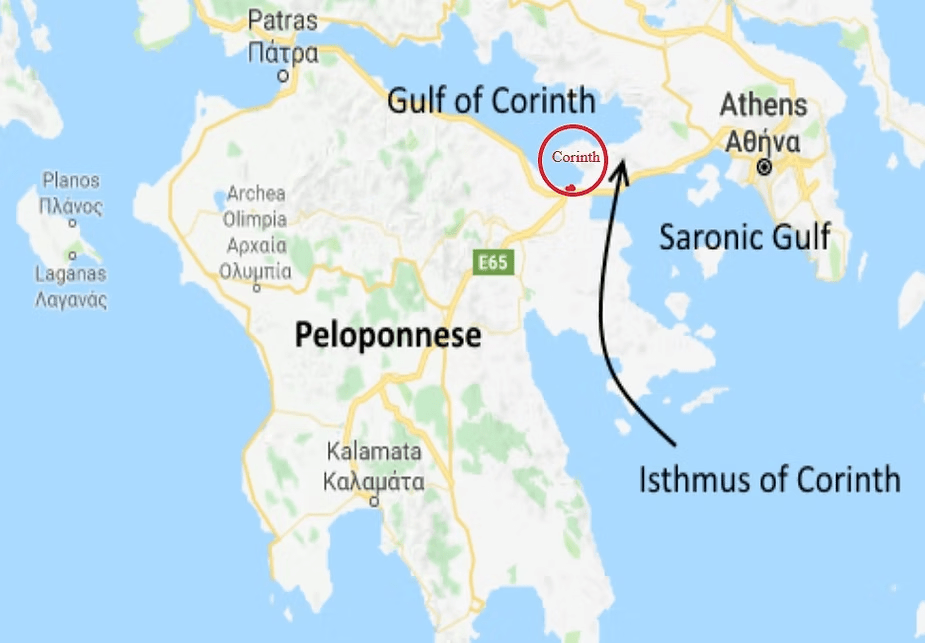
Due to the position of the place being where the Isthmus of Corinth joins Peloponnese, that geographical aspect means the divine statement says a “Corinthian” is at the “Peak” or the lead “Point” for a collection of souls marrying Yahweh. This is then the model of a community of Christians, indicating there were many who were ‘converted” when Paul went there in his ministry.
That conjecture is then assisted by the following segment of words that refer to the “heart,” where “kardia” means “inner self” or “soul.” This says the ‘lifeblood’ of Christianity pumped through such places, where souls willingly accepted news of a marriage proposal made by Yahweh. This makes Corinth be symbolic of the “heart” of the Church that would truly be “Christian,” as all members were of a like mind – all the wives of Yahweh, all in divine ministry together.
Verse twelve then literally states, “not you are compressed by our souls ; you are made narrow on the other hand with these inner affections of your souls”. In a way, these opposite uses of the Greek word “stenochōreisthe” can be seen as the pumping rhythm of a heart muscle, where it compresses or contracts and then releases, pushing red blood out [arteries], as it draws blue blood in [veins]. Paul was saying their presence that touched those Christians with Yahweh’s love were not owed anything in return. However, once touched, those true Christians knew it was vital to continue ‘beating’ so Christianity thrived and grew. That growth would demand a free flow of Yahweh’s love for others to feel.
The final verse in this reading selection then has Paul writing: “that now the soul reward , like as to children say , loving growth kai your soul.” In this translation, the Greek words “autēn” and “hymeis” have been translated as “soul.” The word “autēn” is rooted in “autos,” which means “self, same.” The word “hymeis” is rooted in “su,” as the second person plural form of “you,” or “yourselves.” Wherever these words are written, the intent is to read a “self” as a soul. Thus, saving a “soul” is the “reward” or “recompense” of service [ministry] to Yahweh. Along that path after divine spiritual marriage, one is renewed, “like to children” being restored, who say what comes into their minds. It is a marriage based on “loving growth” to Yahweh, one’s Husband [regardless of human gender], and that is all important [“kai”] to one’s “soul” or “self.”
As the Epistle selection for the fourth Sunday after Pentecost, when ministry to Yahweh should be underway, this lesson from Paul speaks loudly of what it takes to become a minister and what one should expect afterwards. The whole New Testament, after the four Gospels, is about the “Acts of the Apostles,” such that touching souls to marry Yahweh is the mission one is sent out to do. Writing letters of fellowship and encouragement is continuing part of that ministry. This loudly screams, “BEING A PRIEST IS NOT SOME ALL HOLY JOB THAT KEEPS YOU FROM GOING TO SEE PEOPLE IN NEED, INCLUDING COMMUNICATING WITH ALL YOU HAVE CONVERTED!!!” The problem that exists these days is nobody is pumping the blood of Christianity. It has been hooked up to artificial pumps, meaning it is on life support.







 Explaining the Readings