
In the spring of the year, the time when kings go out to battle, David sent Joab with his officers and all Israel with him; they ravaged the Ammonites, and besieged Rabbah. But David remained at Jerusalem.
It happened, late one afternoon, when David rose from his couch and was walking about on the roof of the king’s house, that he saw from the roof a woman bathing; the woman was very beautiful. David sent someone to inquire about the woman. It was reported, “This is Bathsheba daughter of Eliam, the wife of Uriah the Hittite.” So David sent messengers to get her, and she came to him, and he lay with her. (Now she was purifying herself after her period.) Then she returned to her house. The woman conceived; and she sent and told David, “I am pregnant.”
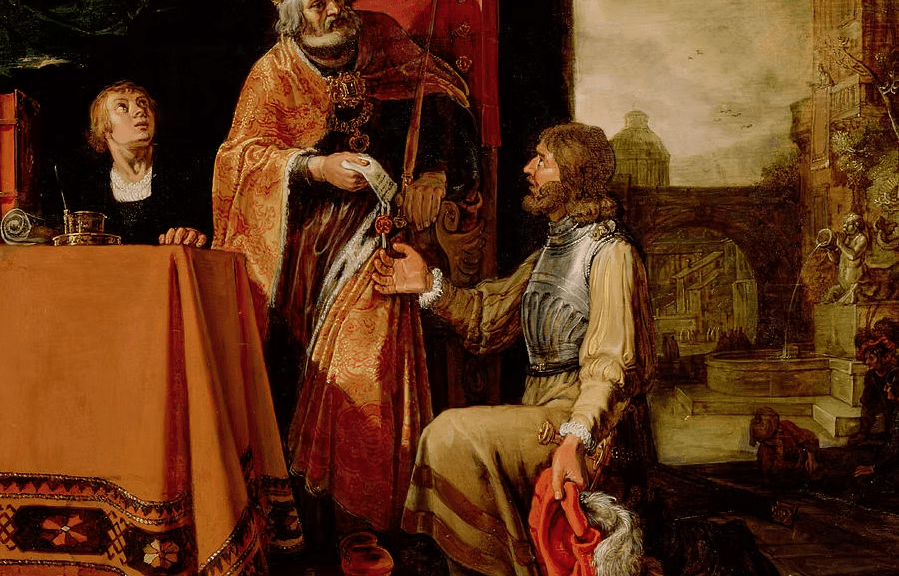
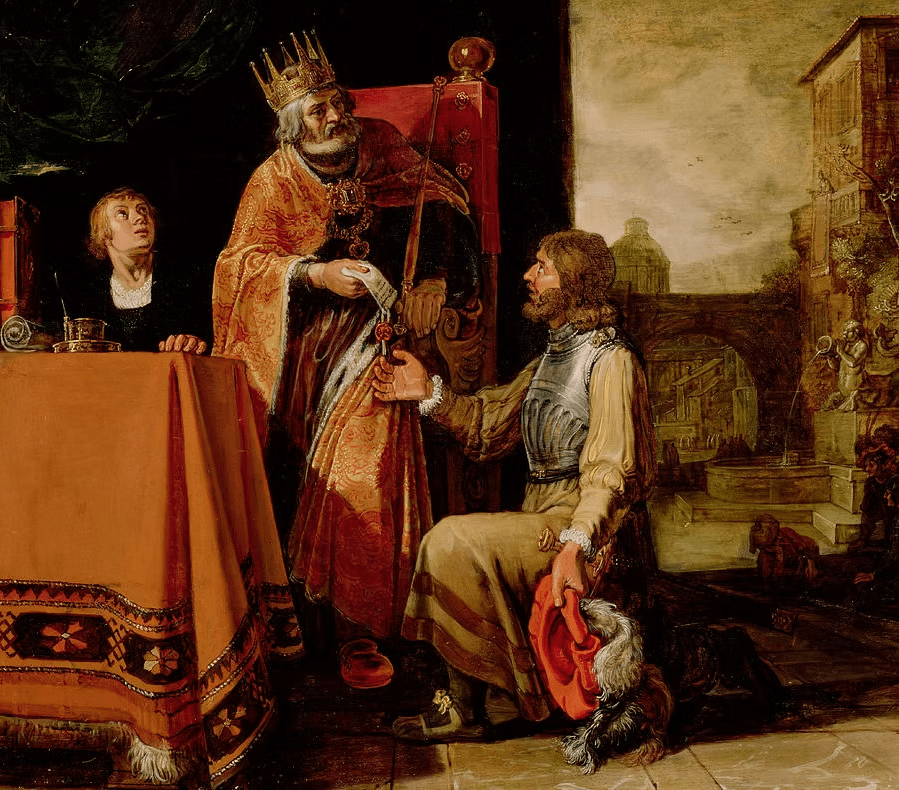
So David sent word to Joab, “Send me Uriah the Hittite.” And Joab sent Uriah to David. When Uriah came to him, David asked how Joab and the people fared, and how the war was going. Then David said to Uriah, “Go down to your house, and wash your feet.” Uriah went out of the king’s house, and there followed him a present from the king. But Uriah slept at the entrance of the king’s house with all the servants of his lord, and did not go down to his house. When they told David, “Uriah did not go down to his house,” David said to Uriah, “You have just come from a journey. Why did you not go down to your house?” Uriah said to David, “The ark and Israel and Judah remain in booths; and my lord Joab and the servants of my lord are camping in the open field; shall I then go to my house, to eat and to drink, and to lie with my wife? As you live, and as your soul lives, I will not do such a thing.” Then David said to Uriah, “Remain here today also, and tomorrow I will send you back.” So Uriah remained in Jerusalem that day. On the next day, David invited him to eat and drink in his presence and made him drunk; and in the evening he went out to lie on his couch with the servants of his lord, but he did not go down to his house.
In the morning David wrote a letter to Joab, and sent it by the hand of Uriah. In the letter he wrote, “Set Uriah in the forefront of the hardest fighting, and then draw back from him, so that he may be struck down and die.”
——————————————————————————–
This is an optional Old Testament selection from the Episcopal Lectionary for the Tenth Sunday after Pentecost, Year B 2018. In the numbering system that lists each Sunday in an ordinal fashion, this Sunday is referred to as Proper 12. It will next be read aloud in an Episcopal church by a reader on Sunday July 29, 2018. It is important because it is an example of how those who have God with them are still able to stray from the path of righteousness. This can serve to remind one how the destructive powers of the world can only be overcome by the presence of God within.
When the Israelites went to Samuel and demanded they be given a king, Samuel talked with God about how to respond. Of the things God told Samuel to make sure the Israelites understood, one was: “This is what the king who will reign over you will claim as his rights: He will take your sons and make them serve with his chariots and horses, and they will run in front of his chariots.” (1 Samuel 8:11) God then had Samuel say, “He will take your daughters to be perfumers and cooks and bakers.” (1 Samuel 8:13) Another added, “Your male and female servants and the best of your cattle and donkeys he will take for his own use.” (1 Samuel 8:16) Samuel concluding by telling the Israelite elders, “When that day comes, you will cry out for relief from the king you have chosen, but the Lord will not answer you in that day.”
Being reminded of this broad stroke of power ceded to a king, David did not exceed the powers of his position. Surely, there have been many kings and leaders of nations, both before and after David, who did the same or worse. Having absolute power at one’s disposal can lead to decisions that mere mortals question. David, as the King of Israel, had no human laws that bound him, so everything he did was legal. Still, as an Israelite king, David owed his sovereignty to Yahweh; so the people of Israel had to be led to follow the Laws of Moses, under a king anointed by God’s blessing. Therefore, the dilemma in this story comes from David serving his personal desires while maintaining his responsibilities to the Israelites – a godly nation.

This is the problem with allowing self to have absolute rule over one’s body is it challenges one’s promise to allow God to have absolute rule over one’s soul. The body must submit to the will of a king, but the soul must submit to the Will of God. David had broken several Laws as a priest to God (as an Israelite), but, as king, David was the only one of flesh who could find him at fault. David then becomes a reflection of the dilemma that is set upon each individual, as each body is its own kingdom where the only controls placed upon self are based on one’s subjection to God above, and one’s obedience in following His rules of righteousness.
In the first verse, we read, “In the spring of the year, the time when kings go out to battle.” This states the animal instincts within human beings, where a soul falls under the influence of the physical plane. The cycle of the seasons reflects changes worldly beings go through. Spring is the time of Aries – when the sun shines light amid the sign of the Ram – symbolizing the rebirth of the land from the dead of winter.
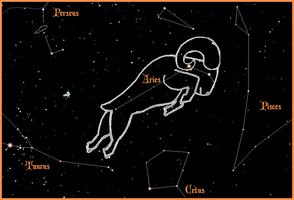
As such, reading how spring is “the time when kings go out to battle,” an innate desire to show dominance and power comes forth. The newness drive brings a fresh drive to change into activity from dormancy.
This natural drive is where the rights of parentage come, in a world that depends on survival of the fittest. The winners of wars become the ones who then love with abandon, so the winner’s seed is not wasted. This is how the saying, “All is fair in love and war,” comes into being, as all are equally able to compete, but to the winners go the spoils. Thus, this story of David’s lust for Bathsheba stems from this influence of nature.
From this statement of the time when battles are fought, we then read, “David remained at Jerusalem,” rather than go to battle. This is a sign of age setting in. While the year had turned to spring, David had turned to the downside of life. Long gone were the vigorous days of his youth, when he led the troops out and back in, evaded Saul and his soldiers, and when he danced wildly before the Ark of the Covenant. David had already married six women and had children by them; and he may have had concubines, as was his right as king. Those came when he took pleasure going out to do battle with the enemies of Israel. However, now he stayed in Jerusalem, showing the thrill of being a young man was gone.
There are those who have tried to figure out how old David was when he became enthralled with Bathsheba; and while David’s age then is uncertain, it is assured that David was significantly older than she. Some have estimated that David had reached the midpoint of his forty-year reign, making him fifty years of age. However, I feel David was closer to sixty, beyond the ‘mid-life crisis’ period, and no longer interested in the accolades of battles won. The the youth of Solomon (the second born between David and Bathsheba) when he became king (at age ten?) is the determining factor; so if David was fifty-eight when he impregnated Bathsheba, fifty-nine when that baby was born and died, then Solomon’s birth would have been when David was sixty years of age.
Seeing David as being closer to the end of his reign, rather than at the apex of his time of rule, we are then better able to see the contrast that comes when we are introduced to Uriah the Hittite, who was the husband of Bathsheba. One should be able to see his youthful exuberance as closely relating to young men fresh out of high school who joined the military and quickly discovered sex, marrying equally young women. Uriah shows how he was filled with a love of God, country, and family – taught all the right things to serve, in the right order. Uriah was why patriotic Americans say to veterans, “Thank you for your service.”
The name Uriah cannot be overlooked, as it means, “Flame of Yahweh” or “Light of Yahweh.” When David called for Uriah to come from the field of battle to Jerusalem, where he was wined and dined by the king, David was in essence confronting himself in Uriah. That young Israelite man reflected the dedication and devotion to “the Ark of Israel and Judah” that David once had. While David was living with the Philistines in Gath and Ziklag (the symbolism of Uriah being identified as a Hittite), his wife Michal had been given by Saul to another man. Uriah was like David was, as both were too young and too poor to afford the dowry required to marry; but both could afford wives through their dedication to their military service. Thus, Uriah was that light of the past shining before an aging David. Uriah represented the eternal flame of devotion to the LORD. David had let that fire dwindle down to embers.
The name Bathsheba means “Daughter of Seven” or “Daughter of an Oath,” depending on the vowel sound inserted (sheba or shaba). As the representation of a daughter of seven, where seven reflects the day the Lord made holy, Bathsheba was holiness. She would become David’s seventh known wife and eventually give birth to David’s successor, Solomon. Still, as the representation of a daughter of an oath, Bathsheba was dedicated at birth to serve the One God. When called to serve her king, who was anointed by God, she was not displaying youthful promiscuity, but devotion as a servant.
When Bathsheba is identified as the daughter of Eliam, whose name means, “God of the People” or “God is Kinsman,” Bathsheba then reflects Israel, to which David was king. As such, David did not simply happen to see Bathsheba naked, as she ritually bathed to cleanse herself, as God sent Bathsheba to David “in the spring of the year” for a divine purpose. David needed to be tested by God and that test was presented in Bathsheba.

That purpose would bring forth the next heir to the throne of Israel, as God knew the sons of David by other wives were wayward and unworthy of His blessing. When we read, “The woman conceived; and she sent and told David, “I am pregnant,” we know by that news that more than a month had passed since that one sexual encounter. One should not assume an adulterous relationship developed between a young Israelite woman and King David, as only one encounter is stated. When we read that Bathsheba sent word to David to inform him of the pregnancy, that says she did not tell David while in his embrace.
When David received that information, his immediate reaction was to make it seem that Uriah, the husband, was the father of the child that was expected. Before Bathsheba began to show evidence of her pregnancy, David tried to make it possible for Uriah to be the father of Bathsheba’s illegitimate child, by bringing Uriah home, away from battle. Once home, he would be reunited with his wife. That plan shows David did not seek to take Bathsheba from her rightful husband, meaning David felt guilt for his actions. It was only after Uriah would not go to his home, which made his having sex with Bathsheba an impossibility, that David gave orders to let Uriah be killed in action. With that death, David could ‘make Bathsheba an honest woman’ by marrying her as a widow.
This story becoming an example of how the best laid plans of mice and men often go awry then shows how an emotionally stimulated sin goes from bad to worse, when one begins adding lies to the mix. Once David knew Bathsheba was the wife of Uriah the Hittite, he should have walked away from his covetous thoughts. He should have realized he was forcing Bathsheba to commit adultery when she was escorted to David’s house. David should have admitted his sin to Uriah and offered his servant the opportunity to decide the outcome of the pregnancy. Had David done all that, David would have proved his heart still was on fire for the LORD; but David did as the story says because David needed that fire stoked by David coming to know sin for the first time.
As for Uriah, one needs to see him as a template for the sacrificial lamb, whose blood saved the Israelites from the angel of death in Egypt. When Uriah was let out of the king’s house and told to go home, Uriah slept at the king’s doorway, like a lost sheep. When Uriah would not make David’s trickery work, he even gladly carried his own death sentence to Joab, like a lamb being led to its slaughter. Uriah then was a flame of Yahweh that would also be present in Jesus centuries later; but Uriah was the flame of innocence.

While not read, this episode in David’s life would be condemned by God, told to David by the prophet Nathan (2 Samuel 12). Nathan would even use a parable of a poor man who only had a ewe lamb as his worldly possession, which was taken by a rich man with many sheep, who then ordered the ewe lamb killed to serve as food for the rich man’s guest. David was aghast at the audacity of such a thief, leading Nathan to proclaim, “You are that man!”
We read beyond this story that David would be forgiven by God, but David would still face the death of his love child with Bathsheba. That baby would die on its seventh day of life, giving insight into Bathsheba being the Daughter of Seven. That firstborn child would be the ewe lamb taken and sacrificed so that David’s soul would not die for his sins of coveting, adultery, and murder (by the sword of his enemy).
As the selected Old Testament reading for the tenth Sunday after Pentecost, when one’s personal ministry for the LORD should be underway, the lesson that should be gained from this story about David, Bathsheba, and Uriah the Hittite is one of responsibility. We are all human beings born into a world that has natural cycles and inherent drives, some of which overcome us like an ocean wave crashing down upon driftwood. At times, we fail to see the errors of our ways (as did David). At times, we submit to the will of others out of a sense of obligation (as did Bathsheba). At times we sacrifice for the higher good, even though we do not know what sacrifice entails (as did Uriah). Still, at all times it is our souls that are the buoyancy that brings us back to the surface, so we can be reoriented to our service to God.
The physical plane is not heaven. It can be as volatile as it can be peaceful. Sin is at home in the material world. David represents a child of God that has never known sin; and like God’s Son Adam, knowing sin was necessary to help others. To find one’s way back to God, one needs to know the pleasures of the worldly environment are a test that block that return. Only with God’s help can one’s soul return to God, and only by knowing sin can one seek that divine assistance.

A minister to the LORD thus knows sin personally. It is the power of personal knowledge that is the strong foundation of faith. More than believing sin is dangerously addictive, because one read a warning pamphlet about drug use, or one telling of sexually transmitted diseases, or one telling how all work and no play makes Jack a dull, but rich boy cannot convey the power of actually being trapped in an addictive spiral. In the same way that knowing sin leads one to find faith in God, the true power of faith comes from personally experiencing God’s presence … not reading about it in books.
One should never be so bold as to think one is anointed by God, as was David, so one feels empowered to guide human laws and societal standards to meet personal ideas and visions or right and wrong. The laws of the land are always due to the will of the land’s rulers, regardless of how many or how few those rulers are. A minister needs to be reminded how the legislative struggles of government are like “the spring of the year, the time when kings go out to battle.” Youthful exuberance leads the righteous to seek out evil and slay it in the name of God.
While there is a time for the good fight, the success of those fights require the ark of God be within those doing battle. Still, there comes a time when the constancy of war gets old and tiresome. The thrill of beating one’s chest after another victory is no longer satisfying. After all, sin lives freely in this world; so, there comes a time when one decides not to join a war to save the world as before. Defeating sin becomes a tiresome burden to bear, which makes leading others away from sin, based on experience, the better way to proceed.

Sometimes it is time to set the status quo aside and let God lead one to a test. Adam and wife were tested in Eden, when God knew the result would be failure (a sin). Job was tested when he did nothing wrong; but God allowed Job to suffer miserably, because Satan wanted Job’s faith pushed to the max. David was tested because the flame of Yahweh had been reduced to a pilot light. David, like Adam and wife, knew only the experience of serving God, before they came to know sin. God has His ways of shaking things up within His faithful, just to renew the convictions that were what once proved faith. Sins can then be wake-up calls that are necessary for one’s soul.
It is a test to read the words of this optional lesson and see David cast into the light as a sinner of the greatest magnitude and not think that God has a separate set of rules for His favorite human beings. That is not the case, according to Scripture. David was punished for his sins, which he freely admitted he deserved punishment for; but the punishment David received was like Job’s, in the sense that David’s punishment caused harm to others, more than David. That suffering led David to know deep and lingering pains that could never disappear. Throughout the rest of David’s life, God stayed by his side, although David had a completely different perspective about how the other half lived.
This is the responsibility of ministry. Apostles and Saints have to freely admit all of their individual sins committed; and, they have to accept punishment for those sins in this lifetime, in order to free their souls for eternal life. Still, there are no bonus points for doing that publicly, as the whole of Israel would have been in danger of collapse (as a priestly nation), had David told everyone he was stepping down as king and sentencing himself to prison for breaking the Laws set by God. More innocent people would have been hurt had that happened. Therefore, David privately repented, earnestly prayed for others, and continued to stand strong for the children of God, all while watching his own family crumble under the pressures of God’s punishments.
This means the message carried by ministers to the LORD steers away from lament and tears of what woulda, coulda, shoulda. Life is filled with ups and down, in and outs, and highs and lows. Keeping one’s eyes on the prize – the sin free soul’s release to heaven – means to be the optimist to others, knowing that with God’s help anything is possible. Therefore, the message shown in King David’s greatest sins is to fight through it by seeing the positive of growth and a learning experience, rather than lose faith and turn away from God. When one is committed to serve God wholly, then there is no time to wallow in self-misery. That does nobody any good.
 Explaining the Readings