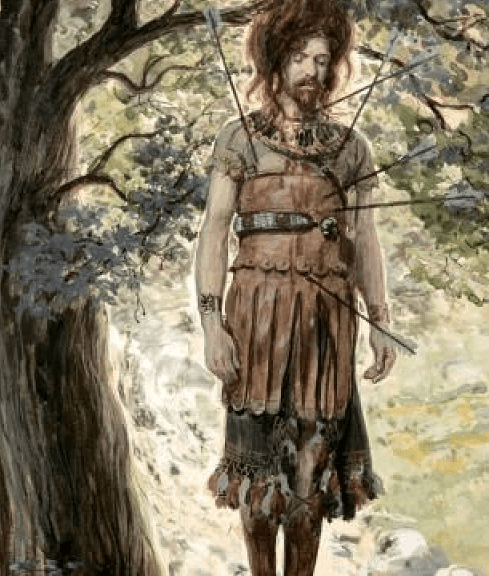
The king, David, ordered Joab and Abishai and Ittai, saying, “Deal gently for my sake with the young man Absalom.” And all the people heard when the king gave orders to all the commanders concerning Absalom. So the army went out into the field against Israel; and the battle was fought in the forest of Ephraim. The men of Israel were defeated there by the servants of David, and the slaughter there was great on that day, twenty thousand men. The battle spread over the face of all the country; and the forest claimed more victims that day than the sword. Absalom happened to meet the servants of David.
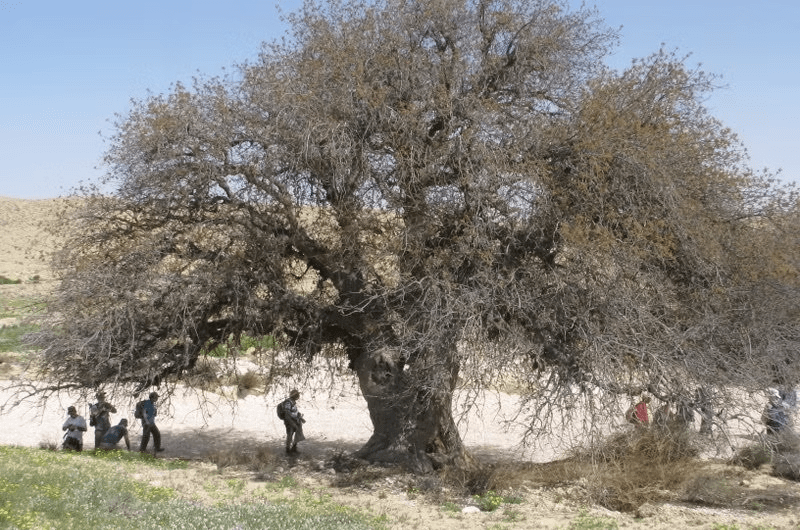
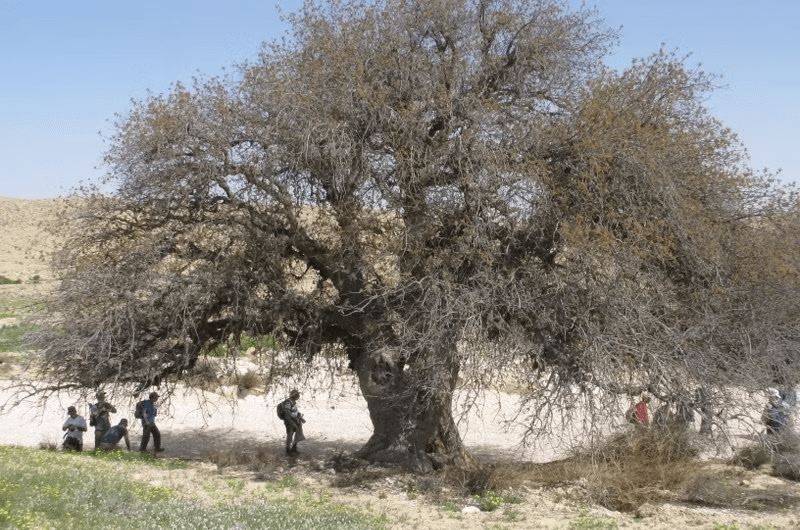
Absalom was riding on his mule, and the mule went under the thick branches of a great oak. His head caught fast in the oak, and he was left hanging between heaven and earth, while the mule that was under him went on.
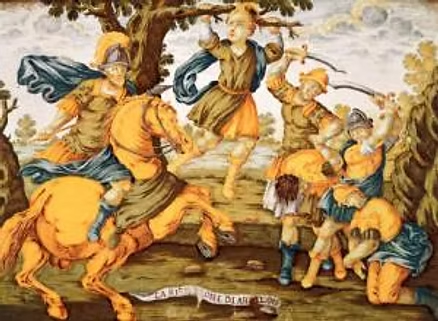
And ten young men, Joab’s armor-bearers, surrounded Absalom and struck him, and killed him.
Then the Cushite came; and the Cushite said, “Good tidings for my lord the king! For the Lord has vindicated you this day, delivering you from the power of all who rose up against you.” The king said to the Cushite, “Is it well with the young man Absalom?” The Cushite answered, “May the enemies of my lord the king, and all who rise up to do you harm, be like that young man.”
The king was deeply moved, and went up to the chamber over the gate, and wept; and as he went, he said, “O my son Absalom, my son, my son Absalom! Would I had died instead of you, O Absalom, my son, my son!”
——————————————————————————–
This is an optional Old Testament selection from the Episcopal Lectionary for the Twelfth Sunday after Pentecost, Year B 2018. In the numbering system that lists each Sunday in an ordinal fashion, this Sunday is referred to as Proper 14. It will next be read aloud in an Episcopal church by a reader on Sunday August 12, 2018. It is important because it tells that the hardest fights ever fought are against loved ones, but the fights supported by God must be fought.
One should notice this reading selection is missing some verses. In the first verse, where is read, “The king, David, ordered Joab and Abishai and Ittai,” these are the allies of David, with Joab and Abishai being brothers that were nephews of David. Ittai was a Gittite (a Philistine from Gath) who remained loyal to David. These men led what can be considered to be the “elite guard” of the king, as military leaders who were committed to following David’s orders into battle.
The verse that states, “And ten young men, Joab’s armor-bearers, surrounded Absalom and struck him, and killed him,” is out of context. This is read, while omitting the previous verses that say Joab found Absalom hanging by his hair in an oak tree limb. Joab was accompanied by ten boys (under the age of twelve). The conjunction “And” says it follows as an additional statement. It says ten young boys killed Absalom after Joab threw three javelins into Absalom’s chest (or his heart area).
Ten boys did not kill a defenseless Absalom by themselves. Rather than have Absalom bleed to death, Joab ordered his armor bearers to finish Absalom off. This is important information omitted, as David had personally told Joab, “Deal gently for my sake with the young man Absalom.”
When the reader is introduced to “the Cushite,” it should be realized that a Cushite is from the Kingdom of Kush, in Africa, south of Egypt. It is generally known today as Ethiopia, but more accurately called Nubia then. The one who delivered the message of Absalom’s death to David was one selected by Joab, presumably because of his ability to run fast. Still, the presence of a Gittite and a Cushite in the numbers of “servants” that supported David and defended him and Jerusalem, should not be seen as slaves taken by David in foreign wars.
Ittai had been exiled by his people, but he was welcomed by David. David told him to leave him and return to his land, because defending David would be most dangerous. Ittai refused to leave David and this should be recognized as a Gentile who had become accepted as a follower of Yahweh. He is like Uriah (who David had killed in battle so he could take his wife), who was a Hittite, or from the area now known as Turkey-Syria. By Uriah marrying an Israelite woman, he had been cleared for that through conversion.
The same can be said of the Cushite, because he addressed David as “my lord the king” twice. After Saul tried to fall on his sword and die before the Philistines would torture him, an Amalekite (an Arabian) came and helped Saul by killing him. When the Amalekite went to tell David, much in the same way as did the Cushite about Absalom’s death, David ordered the Amalekite killed for having admitted he killed Saul (because Saul begged him to do so). David, still pure as a servant to God, ordered the Amalekite killed for having killed a king anointed by God. The Amalekite was a “Gentile” who was an enemy of those who served Yahweh.
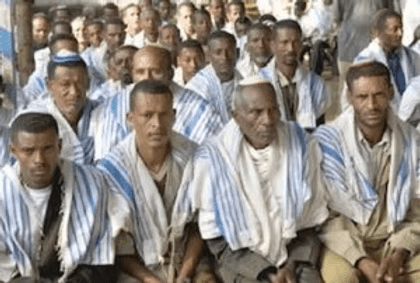
When the Cushite praised the death of Absalom, David did not judge him like he had the Amalekite years earlier. It was not because David had grown old and soft. It was because the Cushite had converted to belief in the One God. He was not an enemy, but a servant to God, one who saw David as anointed by Yahweh. That Cushite can be seen as a precursor of Solomon’s relationship with the Queen of Sheba (southern Arabia) and the presence of Judaism in Ethiopia.
This acceptance of others by David shows the holiness of God in him. When Saul was trying to kill David, David was given refuge in Gath, the town where Goliath was from. The king of Gath gave David wives and the town Ziklag, out of respect for David being without sin and one with his God. While the Philistines respected David as a powerful man of God, their respect did not lead them to convert to David’s God. However, one can assume that every foreign wife taken by David, and every Israelite under David who did likewise, made sure their spouse became a convert to the Laws of Moses and all the ritual demands.

This says Gentiles were not denied acceptance into Israel. Only those who challenged the right of the Israelites to worship Yahweh as the true One God were fiercely rejected as enemies.
The slow decline of faith, following David’s sins, would be due to the acceptance of people of other beliefs, while forcing out the priests of Yahweh. Not warring against those who worshiped lesser gods brought about the destruction of the Northern and Southern kingdoms, with the exile of the Judeans to Babylon. The exilic Jews determined it was this foreign influence that was the cause of all their problems (refusing to admit not being led by a holy king made each Israelite personally responsible), so the return to Jerusalem brought a stronger adherence to separation from those of other religions.
That new dogma meant it was to be forbidden for Jews to have any contact with Gentiles (which included the remnants of the Northern Kingdom – the Samaritans). Further, any Jew who had a physical deformity or illness was branded a sinner to be rejected. None of this was the truth of David’s Israel.
This reading reflects that future, as it was the beginning of the fulfillment of God’s punishment set upon David, which He said through Nathan, “Out of your own household I am going to bring calamity on you. Before your very eyes I will take your wives and give them to one who is close to you, and he will sleep with your wives in broad daylight. You did it in secret, but I will do this thing in broad daylight before all Israel.’” (2 Samuel 12:11-12) Thus, the problem that befell David’s Israel was not from outsiders, as much as it was from in-fighting.
We read the lament of David as told: “The king was deeply moved, and went up to the chamber over the gate, and wept; and as he went, he said, “O my son Absalom, my son, my son Absalom! Would I had died instead of you, O Absalom, my son, my son!” The Israelites would become known for their lamentations. The Jews have continued them over the centuries since, because they are still being punished for David’s sins. They are punished because they cannot see their fault.
Just as the returning Jews thought (a power of a brain reasoning) they could show repentance to the LORD by rejecting the voices of evil, even seeing their sick as being punished by God, the Israel led by Absalom thought it was ridding itself of an admitted sinner in David. None of them (especially Absalom) saw their own sins as a reflection of themselves upon their king, making them responsible too.
David knew his fault and accepted full blame; and the LORD stayed with David. Still, the house that David built would never be the same. The Israelites never realized how rejecting God as their King (each individual as a responsible priest) meant they had failed to show responsibility (individually and collectively) through complete devotion to David (or his heir by natural death, anointed by a prophet of the LORD).
The flaw of Israel can be seen to stand out in the verse that says, “The men of Israel were defeated there by the servants of David.” The Hebrew word “am” is used to denote the “men” or “folk, nation, people, or followers.” That word speaks loudly as stating the Israel of Absalom (their elected judge) was made up of ordinary citizens – not priests of Yahweh . However, the word “ebed” is used to denote the “servants” or “slaves, subjects, or attendants” of David, such that David (as the anointed king of God) was defended by those who served God, through David.

It was this devotion by all who called David “my lord the king” that had made the nation of Israel great. A servant of God, who serves Him as his (or her) King, is elevated above the common folk status of follower. The responsibility of a subject is unconditional surrender of oneself to His (or Her) Highness (a statement of God’s presence in one). Submission is then for the best of the whole. The oneness with God rewards all equally. However, to follow a human king who has no favor from the LORD God, as shown in this story’s “slaughter of twenty thousand men,” leads common folk and so-called kings to flee for their lives through the forest that is one’s inner self.
To see Absalom caught in a low branch of a mighty oak tree, his long hair wrapped around limbs and leaves – unable to pull himself free – is a sight that should be seen as if he was being held by the arm of justice (the Law?), suspended before the judgment that was surely pending. Being “between heaven and between earth,” Absalom awaited his fate.
While it can be assumed his hair was caught in the branch (which would have been long, because Israelite men only cut their hair once a year – due it becoming too heavy when too long), the Hebrew word written says “head” (“rosh”). This means it was the Big Brain of Absalom that put him in this predicament of judgment – for having declared himself to be a judge of Israel, one that was not sent by God to save the Israelites.
The branch also symbolizes that any would-be kings of Israel that would follow David – those not one with God (like David was, repentant sinner that he had become) would mean a dead branch – branch of death – was their prophecy. Israel was meant to reflect “One nation under one king,” where the union of God with all is within IS the oneness a nation under God. The split between Absalom and David, between Israel and her king, is symbolic of the doubt within oneself, as to one’s relationship to God. Splitting Israel into two separate nations was then a magnification of this split.

The over-arching theme seen in this battle between David and his own flesh and blood is it is a perfect example of how Jesus said, “If a kingdom is divided against itself, that kingdom cannot stand. If a house is divided against itself, that house cannot stand.” (Mark 3:24-25) Jesus said this in response to the Pharisees who said Jesus was possessed by Beelzebub, making him able to cast out demons. Jesus asked them, “How can Satan drive out Satan?” (Mark 3:23) before telling them about divisions within a nation or house.
Absalom was what Jesus saw in the Pharisees. He, like them, would attack the one human being on earth that was one with God. David’s sin had been made public; but he repented to save his marriage to a nation. Jesus was attacked by the teachers of the Jews, finding fault with a Jew without sin.
As an Old Testament reading option for the twelfth Sunday after Pentecost, when one’s personal ministry for the LORD should be underway – not hanging by one’s head awaiting Judgment Day – the message is to unite, rather than divide. An “in-house” rebellion must be quelled, like a cancer must be purged, so one body can become whole again. Thus, the servants of God, who are Jesus Christ reborn, must stand and fight those calling themselves Christians, who are attempting to divide that Sacred Branch unjustly.
The story of David and his son Absalom is one that should be known. I recommend serious Christians research this more for themselves, to find the details of that story. I suggest looking at the parallels to modern life. Still, it is also good to know that the name, “Absalom,” given by David to his third son, means “The Father Of Peace” or “My Father Is Peace.”

That name represented the internal peace that the nation Israel experienced under David, when David was pure. David intended Israel be at peace with the LORD, as a strong and healthy body of God’s priest on earth. David also named Solomon, such that the word “shalem” and “shalom” are his wish for Israel, reflected in his son. Not only was “peace of the father” the wish (“shalom“) but so too was for Israel to be “unbroken” and “whole” (“shalem”).
Absalom broke that inner peace by revenge; but David did not address the sin that led to the revenge or the sin in response properly. Absalom broke that inner peach that oneness brings by splitting Israel and turning the common people against their holy father and king. David’s desire for peace and the favor of a father to a son spoiled Absalom, causing Absalom to lose respect for David.
It is, thus, a story that says, “Give them an inch and they will take a mile.”
The whole world of Christianity lives surrounded by enemies, just as David’s Israel had enemies on all sides of it. The whole time Saul was king (one who lost the favor of God), the Israelites warred with their neighbors, most notably the Philistines. The same need to do battle with the enemies of Israel lasted through David’s reign, but the victories were plentiful and at little cost. That was because God was with David and Israel saw David as God’s anointed king.
America was once proud of promoting itself as a Christian nation that preferred peace to war. In the twentieth century, America twice entered foreign wars and experienced the glory of being victorious. Americans gave credit to God and Christ. However, since Korea and Vietnam, America has struggled with wars, much like Saul’s struggles, and the peace at home has been derisive.
Those military struggles have gone hand-in-hand with the weakening of Judeo-Christian values that a once victorious nation now feels shame in the population at home. The peace at home has spoiled the child, so the child has grown insolent and disrespectful. America has welcomed foreigners into its land, but it has not expected any conversions to its religious beliefs.
America has given rise to many presidents that have sought peace, even in the face of sinful acts against its values, preferring not to go to war. They have given inch after inch to appease foreigners. The more this fear of facing a necessary battle grows, the enemies are emboldened and the more audacious will be the acts against America and its Christian allies. I point out the increased murders of police officers and the shooting being committed in public places as only two such examples; but the West faces many threats and breakdowns.
The evidence shows that the enemy has entered the lands of Christianity and that enemy is preparing to do the insults that Absalom did against David. It is less a threat from foreigners, than it is a threat from the common folk who feel the urges to accept foreign influences, while rejecting the oneness that was once a devotion to the One God and His Son Jesus Christ. The biggest enemy is the disease that has befallen Christianity. It can no longer lead strongly, just as David became weak from sins. The threat is from Christians that are misled.
The point of this reading is it told of an inner battle then, which means there is another such battle upcoming, as an unavoidable showdown that will settle a feud that has been brewing for some time. It will be another bloodbath in the “forest of Ephraim,” whatever place that may be symbolic of in America and/or the Christian world. It will not involve the overt enemies of Christianity – the wolves that love to feast on sheep – but between the various factions of Christianity, where bad shepherds have set themselves up as judges.

David and his servants of God won that battle fought on this day in the Scripture reading; but the question now has become, “Who does God support; and who is truly a servant to the One God?”
The answer to these questions is that God supports all who have placed His holy throne in their hearts. For God to be the King of a human being – His servant or subject – one has taken on the power of Jesus Christ. This means becoming the equivalent of an army that was David and his servants. Today, that must be a collection of Apostles-Saints, who are the servants of Christ the King, who is One with God. That army is a Church in its truest sense.
Those who follow Absalom are the divisions of organized Christianity that split it in two. The many barren and low-hanging branches of Christianity represent the Twelve Tribes of Israel that united behind David’s son, Absalom. They try to claim the right to judge Christianity-America-Western civilization as if government worship [Socialism or worse] is the path to heaven. The battle that is brewing will determine the future of all religions on earth.
In this reading, the element of Joab, one of David’s “generals,” having actually killed Absalom – casting three darts through his heart – has been skipped over. Instead, we read, “And ten young men, Joab’s armor-bearers, surrounded Absalom and struck him, and killed him.”
It is important now to know that an “armor-bearer” is a “lad’s” job, meaning a young male that is not yet an adult (between the ages of ten and twelve). This makes Joab a teacher of children, just as a lioness has to teach young lions how to kill the prey. This verse is then set apart to show the importance of adults teaching lessons and instilling values in their children. Teaching the values of the adults is so the children will grow to carry those lessons on. Therefore, the children of Christianity must be taught by their adult leaders how to defeat an enemy within, so the children can do the same when they grow up.
The enemy within Christians today is doubt. Those who believe but doubt those beliefs have little faith. It is doubt that reduces one from a subject of God to common folk that follows anyone showing strength as a leader. It was doubt that filled David after Nathan told him God’s punishments for his sins. It is doubt that has leaders today screaming, “I know what Jesus said to do! Don’t you?”
This reading of Absalom’s death shows the abject sorrow David felt for losing his own flesh and blood. David, as the King of Israel, anointed by God, should have taught his son the ways of righteousness, so such sorrow would have been avoided. David, instead, had been reduced to the same fate as Eli and as Samuel, such that as holy as those prophets were, the failures of their children to follow in their footsteps shows that holiness does not easily pass down to one’s children. Young lions raised in captivity never know how to kill prey, so they starve if someone does not feed them. This is then the deepest meaning of “spare the rod, spoil the child.”
The actual source of that lesson says, “He who withholds his rod hates his son, But he who loves him disciplines him diligently.” (Proverbs 13:24, NASB) The word translated as “rod” is “shebet,” more aptly means “staff,” such as the prod a shepherd uses to keep his flock in line. This means a “rod” is not used primarily as a device for corporal punishment, but as a sign or signal that must be followed. Rather than an implement for punishment, it is a necessary tool that is used often, to keep the sheep from getting lost. The absence of such direction (where an occasional slap on the butt is required to get one’s attention) translates as “hate.” Use of direction is a sign of “love.” It is what determines if one a good shepherd or one leading lambs to the slaughter.
This is how a battle should be waged to save Christianity from internal division and eventual collapse. True Christians must stand up against those who are like Absalom was to David. The fight is not for the pleasure of defeating evil, but as a sign for the future direction that Christianity will take. Until that fight is fought, Christianity hangs suspended between heaven and between earth.
 Explaining the Readings