Tag Archives: 2 Samuel 5:1-5

2 Samuel 5:1-5, 9-10 – Becoming the King of Israel

All the tribes of Israel came to David at Hebron, and said, “Look, we are your bone and flesh. For some time, while Saul was king over us, it was you who led out Israel and brought it in. The Lord said to you: It is you who shall be shepherd of my people Israel, you who shall be ruler over Israel.” So all the elders of Israel came to the king at Hebron; and King David made a covenant with them at Hebron before the Lord, and they anointed David king over Israel. David was thirty years old when he began to reign, and he reigned forty years. At Hebron he reigned over Judah seven years and six months; and at Jerusalem he reigned over all Israel and Judah thirty-three years.

David occupied the stronghold, and named it the city of David. David built the city all around from the Millo inwards. And David became greater and greater, for the Lord, the God of hosts, was with him.

——————————————————————————–

This is an optional Old Testament selection from the Episcopal Lectionary for the Seventh Sunday after Pentecost, Year B 2018. In the numbering system that lists each Sunday in an ordinal fashion, this Sunday is referred to as Proper 9. If chosen, it will next be read aloud in a church by a reader, on Sunday July 8, 2018. It is important as it points out how the Israelites admitted their mistake in choosing a king that was not anointed by God, beginning a new forty-year period under a recognized a true judge.

In this reading, the most significant statement it contains is: “David was thirty years old when he began to reign, and he reigned forty years.” This is significant because this is the only statement that says anything about David’s age.

While we read on the fourth Sunday after Pentecost, “Samuel said to Jesse, “Are all your sons here?” And he said, “There remains yet the youngest, but he is keeping the sheep,” we know David was the youngest son of Jesse.  On the fifth Sunday after Pentecost [optional selection] we read, “Saul said to David, “You are not able to go against this Philistine to fight with him; for you are just a boy,” we can be confused when some translations change “young boy” into “young man.”  An Internet search of “How old was David when he killed Goliath?” returns a common sense that he was “about sixteen.”

In reality, we do not know how old David was when he was anointed by Samuel.  Thus, we do not know how old he was when he slew Goliath. There is nothing written in 1 Samuel that states how much time elapsed between David’s anointment by Samuel and when he was sent by Jesse to take food to his brothers, who were sent to fight against the Philistines and Goliath.  David could have been anointed at age ten (a Numerological 1 [1 + 0 = 1]).  The number one indicates new beginnings.  David could have killed Goliath when he was twelve (a Numerological 3 [1 + 2 = 3]).  The number three is symbolic of a significant initial completion.

Last Sunday [the sixth Sunday after Pentecost], we read [optional selection] of David being told of Saul’s and Jonathan’s deaths, to which he wrote a song and had it placed in the Book of Jashar. At that time, David was in Ziklag. No indication was made that David was a king then; but now we read, “All the tribes of Israel came to David at Hebron,” and “All the elders of Israel came to the king at Hebron.” Here is a map of those locations:
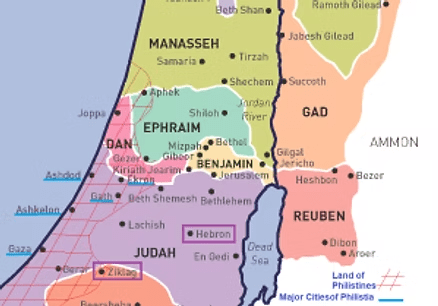
In my interpretation of the sixth Sunday after Pentecost reading option, I mentioned that Saul and three of his sons were killed at the battle of Mount Gilboa, with their mutilated bodies disgracefully hung at a holy place in Beth Shan. Allies of Saul, from Jabesh Gilead, reacted to that desecration and recovered the bodies, burned them, and then buried the remains properly. At the time of that defeat of Saul, David was avenging the sack of Ziklag by the Amakelites (Arabian nomads), who took all of the wives there.  The King of Gath had given David Ziklag, but the Amakelites  destroyed the city while David and his men were making raids.  As the spoils, the Amakelites took all the women of Ziklag, which were the wives of David and his six hundred soldiers (Judeans). This implies that David might have been treated like the King of Judah, only not based in Hebron, but he was not made King of Judah until after Saul’s death.  Judah remained loyal to David, rather than be ruled by Saul’s heir, Ish-Bosheth.

The statement that “David was thirty years old when he began to reign” allows one to be able to time this change with the reign of Saul and his son Ish-Bosheth. Saul reigned for 42 years; and after his death, Ish- Bosheth reigned for two years, before he was murdered. Because the three other sons of Saul died along with him at the battle of Mount Gilboa, the murder of Ish-Bosheth ended the line of Saul. Since there were no other issue to whom the reign of Israel could be given, the elders of Israel sought David.

When one knows that from the time the elders went to Samuel and asked for a king, “to be like other nations,” forty-four years elapsed and David was only thirty years of age. This means that Saul reigned over Israel fourteen years before David was born. Because we are told that Ish-Bosheth was forty years of age when he took over rule of Israel following his father’s death (2 Samuel 2:10), one can assume that he was Saul’s first-born male heir (born in the second year of Saul’s reign), with Jonathan his last born son. Jonathan would then have been born three or four years before David’s birth, which would have made him fifteen or sixteen when David was ‘adopted’ by Saul, assuming David killed Goliath when he was age twelve. That closeness in age would explain the bond that took place between Jonathan and David. Jonathan saw David as his younger brother, whom he had to protect.

When we read the Hebrew word “na-‘ar” in 1 Samuel 17:33, which was when David said he would respond to the challenge of Goliath, but Saul refused, saying, “For you are but a youth while he has been a warrior from his youth,” the meaning is “boy, lad, youth, or child.” The implication is that David was not a mature male.  He was biologically incapable of reproduction. While the word means “male child,” one that has not yet reached a level of maturity that would change his status from boy to young man, this says that David was under the age of thirteen when he faced Goliath.  The teen years generally signify when boys physically change from innocent males to fertile young men.  A Jewish bar mitzvah is when a male turns thirteen.

In 1 Samuel 18:2 we read, “Saul took him that day and did not let him return to his father’s house,” which occurred when the souls of David and Jonathan bonded as brothers. Between that ‘adoption’ at age twelve, until we read, “So it came about at the time when Merab, Saul’s daughter, should have been given to David” (1 Samuel 18:19), four years’ time had passed and David had turned sixteen. With this sense of timing, when we later read, “So Saul gave him Michal his daughter for a wife,” (1 Samuel 18:27c) David was probably seventeen by then, having led men into battle to kill two hundred Philistines in order to pay the dowry (100 foreskins of Philistines).

It was at this age that David was banished from Saul’s house, causing him to go into exile. From the age of seventeen to twenty-eight (eleven – twelve years), David eluded Saul, fought for the Philistine king in Gath, spared Saul’s life twice, and was given the ‘border town’ Ziklag (between Philistia and Judah), because he had assisted the Philistines so they could war with Saul. Saul died when David was twenty-eight and David heard that news in Ziklag.

When this reading selection says, “At Hebron [David] reigned over Judah seven years and six months,” the six months were prior to Ish-Bosheth being murdered. That means David was named the King of Judah a year and a half after Saul died. This is stated at the beginning of 2 Samuel, where verse one says, “Then it came about afterwards that David inquired of the Lord, saying, “Shall I go up to one of the cities of Judah?” And the Lord said to him, “Go up.” So David said, “Where shall I go up?” And He said, “To Hebron.” That means David was twenty-nine and a half years of age when he first became King of Judah, and when he became King of all Israel he was thirty.
When we then see this timing element, it is understandable to see that David reigned as king in Hebron after the elders visited his and asked him to be the King of Israel – all the twelve tribes. He remained in Hebron as King of Israel for seven more years, before he moved to Jerusalem. That move required David lead soldiers to defeat the Jebusites of Jebus, whose stronghold had existed since the days of Genesis, when the place was called Salem. Joshua could not overthrow that stronghold, so they lived among the Benjaminites. David, however, “captured the stronghold of Zion, that is the city of David,” (2 Samuel 5:7) which was held by Jebusites (2 Samuel 5:6). David renamed the fortress the City of David and then built the city of Jerusalem around it.
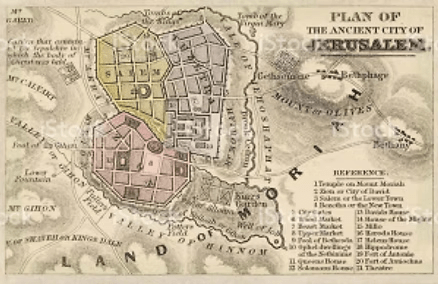
When we read, “David built the city all around from the Millo inwards,” the Hebrew word “ham-mil-lō-w” is given proper name status in translation as “Millo.” The lower-case spelling, as “millo,” refers to “earthwork, mound, rampart or terrace,” with the website Abarim Publications stating the name meaning of “Millo” comes from the verb, “to be full or be filled.” Still, no one is sure what the word truly means, making its presence in this verse confusing.

In my mind, as a reason why Joshua could not defeat the Jebusites was there was more than a stronghold carved into the natural rock slope of Mount Zion. The elevations of Jerusalem are generally lower than the heights of the surrounding mountains (Mount Scopus – 2,710’, Mount Olivet – 2,710’, and the Mount of Corruption – 2,451’).   Because Mount Zion (place of the City of David) has an elevation of 2,510’ and Mount Moriah (where Solomon would build his temple) is at 2,520’, a fortress built on lower ground is strategically difficult to defend. The Romans would later demonstrate the advantage of controlling higher ground, as Jerusalem’s walls were easily overcome by catapults situated on the surrounding higher mountains (Mount Scorpus in particular).  This military weakness makes the millo a significant asset that David would discover and utilize.

One way of reading “millo” is as a “natural rock formation,” which was then further enhanced by man-made construction that built what was natural into a purposeful fortress or stronghold. Still, that rock wall has to be realized as an outward barrier that poses problems to those unwanted. The “inward” (“wā-ḇā-yə-ṯāh.“) building is then not what buildings were raised behind that enhanced natural barrier, but those within the rock itself.  The Hebrew word bayith” means “beneath,  below, armory, tomb, and turned inwards, as well as indicating “a shelter for animals” (where stables were usually natural caves).

This means the digging out of natural caves, which created man-made tunnels within the rock. It is well known that an ancient tunnel acted as an aqueduct, where water was a necessity for soldiers defending a citadel.  As a “millo” is sometimes read as “a storage place,” such as an armory, tunnels could be used to “fill” them, so tunnels could store food, arms, and people.  With the entrances sealed or covered, attacking enemies could not find those in hiding. The tunnels could also provide escape passages, as well as traps for those not familiar with their design and purpose.
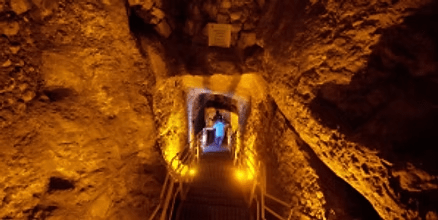
This was a pre-existing asset in Jebus, which David discovered when he and his men conquered Jubus.  Once discovered, David utilized the engineering of the Jebusites in the building of Jerusalem; and Solomon would further utilize tunnels in the building of the Temple of Solomon. This means “Millo” is stated as an important characteristic of Jerusalem, both ancient and still today.

As a reading option for the seventh Sunday after Pentecost, when one’s personal ministry to the LORD should be underway, one should see this reading personally. The elders of Israel should be seen as one’s body (“Look, we are your bone and flesh.”) being in need to be ruled divinely. The reign of Saul means a body ruled by all the fears and anxieties of trying to stand strong in a world that is a never-ending challenge, offering one battle after another.
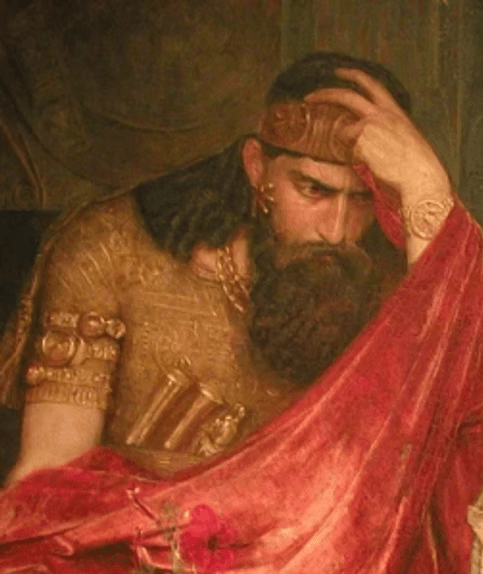
Saul overcome by evil gods.

The death of Saul means oneself has reached a point of decision, where the ego (the elders) has surrendered to God. When you want God to become your King, then you become Jesus Christ, as the root from Jesse that was David.

To reach that state of commitment, one has to have done some things good and been rewarded. The self has “led out [one’s body] and brought it in” to the cheers and admiration of others. One knows what is right and good, but one has bowed down to the gods of evil (“elohim rū·aḥ”) on many occasions, because they say, “Serve self, not God,” which is so much easier to do. Leading a parade of warriors, like David, or leading a band of disciples, like Jesus, is so hard to do, as it requires special talents. It is the talent Saul lacked, which is what all righteous leaders have. One has to commit to marriage to God, so He sits on the throne of one’s heart, commanding the brain that sits at the head of the body.

The palace of self is where one has ruled and is where one has become comfortable, but God will call the self to seek Jerusalem within, the City of Jesus Christ. Hebron can be seen as one’s church, where one becomes active as a leader, but one needs to conquer the Holy City of Jebus and make oneself a fortress that serves the One God above. In that development, one will take the natural formations that exist and strengthen them inwardly. New paths will open before oneself, which one needs to fortify and dig deeper to explore where God wants one to develop.

Three times ten represents the potential for a higher level of basic three: God’s love, devotion to righteousness, and spiritual union.

Both David and Jesus began their official ministry at the age of thirty, but that is not the physical age requirement for ministry to the LORD. Thirty is three times ten, which is a higher level three Numerologically (as 3 + 0 = 3), the number of the Trinity. The symbolism says that one has to be more than a son (or daughter) of a man (a basic 3). One needs to become King of Self (a third ten) as Jesus Christ the King reborn.  As Christ resurrected within a body, the Son is resurrected, with the soul cleansed by the Holy Spirit, while the presence of God is in one’s heart. When that perfection is complete, then one has turned a “holy thirty.”

Ministry to the LORD means one develops as David reborn on earth, as Jesus Christ resurrected. It means being the Good Shepherd for the people in one’s life.  When that reign begins, “Oneself becomes greater and greater, for the Lord, the God of hosts.” That greatness is because the same God that “was with [David]” is with one married to the LORD.
2 Samuel 5:1-5, 9-10 – Realizing why David decided to make Jerusalem his city

All the tribes of Israel came to David at Hebron, and said, “Look, we are your bone and flesh. For some time, while Saul was king over us, it was you who led out Israel and brought it in. The Lord said to you: It is you who shall be shepherd of my people Israel, you who shall be ruler over Israel.” So all the elders of Israel came to the king at Hebron; and King David made a covenant with them at Hebron before Yahweh, and they anointed David king over Israel. David was thirty years old when he began to reign, and he reigned forty years. At Hebron he reigned over Judah seven years and six months; and at Jerusalem he reigned over all Israel and Judah thirty-three years.

David occupied the stronghold, and named it the city of David. David built the city all around from the Millo inwards. And David became greater and greater, for the Lord, the God of hosts, was with him.

——————–

This is the Track 1 optional Old Testament reading choice for the sixth Sunday after Pentecost [Proper 9], Year B, according to the lectionary for the Episcopal Church. If chosen, it will be accompanied by a reading from Psalm 48, where David sang: “Let Mount Zion be glad and the cities of Judah rejoice, because of your judgments. Make the circuit of Zion; walk round about her; count the number of her towers.” These will precede the Epistle reading from Second Corinthians, where Paul wrote: “to keep me from being too elated, a thorn was given me in the flesh, a messenger of Satan to torment me, to keep me from being too elated.” All will accompany a reading from Mark’s Gospel, where Jesus said, “Prophets are not without honor, except in their hometown, and among their own kin, and in their own house.”

These seven verses make a rather simple statement that David became King of Israel. The complexity of what is stated before, which culminates in this coronation is assumed to be known; but few take the time to ponder what happened in the first thirty years of David’s life that led to this crowning. There is duality stated in this reading that goes over most heads: the thirty years prior; and, the forty years after. Few pick up on the repeated number found in the Old Testament, which is “forty years.” Forty years was the time of wandering in the wilderness under Moses’ lead. Forty years was the times of good that came from Yahweh answering the prayers of the people for help, after having suffered for forty years from having fallen away from Yahweh. David’s reign says he was like a judge sent to right an Israelite wrong once more.

Another duality is David ruling as king in two places: Hebron and Jerusalem. That too goes well over the heads of those sitting [or standing] in Episcopal churches when this reading is selected for reading. Few know where Hebron is, in relationship to Jerusalem. Fewer know the name Hebron means “Place Of Joining, Alliance.” Fewer still know the name Jerusalem means “In Awe Of Peace, Teaching Peace.”

Because verses six, seven and eight have been omitted from this reading, no one is taught that Jerusalem was not the first place of David’s rule because that place was still possessed by the Jebusites. In the whole time of the Israelites coming into Canaan as their “Promised Land,” they had to fight and defeat peoples who resisted that possession of land that had been theirs [or no one’s] prior to the coming of the Israelites. This constant battle was why the number “forty years” is so significant in the history of Israel. Still, in that possession the Jebusites had never been defeated and Jerusalem was their fortress city. The omitted verses tell confusingly of a confrontation between the Jebusites and David, prior to his “occupation of the stronghold and naming it the city of David.” We read the confusion that says, “David built the city all around from the Millo inwards,” but nobody really knows what a “Millo” is.

This becomes my focus now, as I want to present the three omitted verses and bring this element of transition from Hebron to Jerusalem into the picture. I feel the reason we read “David was thirty years old when he began to reign, and he reigned forty years” is very strongly related to knowing the history of the Jebusites and their fortress that was Jerusalem. This history then is still in play today.

Verses 6-8 are translated by the NRSV as this:

“The king and his men marched to Jerusalem against the Jebusites, the inhabitants of the land, who said to David, “You will not come in here, even the blind and the lame will turn you back”—thinking, “David cannot come in here.”

Nevertheless David took the stronghold of Zion, which is now the city of David.

David had said on that day, “Whoever would strike down the Jebusites, let him get up the water shaft to attack the lame and the blind, those whom David hates. ”Therefore it is said, “The blind and the lame shall not come into the house.”

Twice in these three verses is mentioned “the blind and the lame” [from “ha·‘iw·rîm wə·hap·pis·ḥîm,” rooted in “ivver” and “pacach”]. This seems to be some taunt that has been seen as the Jebusites telling David that their fortress could be defended by “the blind and the lame” and still beat back all challengers. That is not the case, and Hebraic scholars have said that was references to Isaac [blind in his old age] and Jacob [who walked with a limp after wrestling with himself, before being named “Israel”].

In this history that goes back to Genesis, it is said that Joshua defeated all the peoples of Canaan, except the Jebusites. That has led scholars to say everything about the Book of Joshua never happened; or, if it did happen, it was later history and not truly relative to the judge Joshua, who took the Israelites into Canaan. In last Sunday’s lesson, the Book of Jasher was said to only be named in Joshua and 1 Samuel, with no record of that book in Hebrew libraries. If that book is false, then so too is the Song of the Bow. This inability to prove what is considered canon Scripture should be seen as an argument for “believers,” which makes a defense for those of “faith;” and, that is the truth of why the Jebusites were never defeated in battle, not even by David.

The Wikipedia article “Jebusite” states the following:

“rabbinical sources also argued that as part of the price of Abraham’s purchase of the Cave of the Patriarchs (Cave of Machpelah), which lay in the territory of the Jebusites, the Jebusites made Abraham grant them a covenant that his descendants would not take control of Jebus against the will of the Jebusites, and then the Jebusites engraved the covenant into bronze; the sources state that the presence of the bronze statues are why the Israelites were not able to conquer the city during Joshua’s campaign.”

The article then goes on to add:

“The rabbis of the classical era go on to state that King David was prevented from entering the city of Jebus for the same reason, and so he promised the reward of captaincy to anyone who destroyed the bronzes – Joab performing the task and so gaining the prize.”

“nevertheless David (according to the rabbis) paid the Jebusites the full value of the city, collecting the money from among all the Israelite tribes, so that the city became their common property.”

While all of this is one scholarly debate opposed to others of scholastic mind, all representative of doubters, little of true faith, this misses the Jebusites telling David, “Whoever would strike down the Jebusites, let him get up the water shaft to attack the lame and the blind, those whom David hates.” That seems to be David giving instructions to raise a champion to defeat the Jebusites, which is then named as Joab. Joab, whose name means “Yah Is Father, Whose Father Is Yah,” was the nephew of David and far from being a champion of Israel, especially since David was named king because he was their champion.

The point of the Hebrew text stating: “śə·nōw śə·nu·’ê ne·p̄eš,” which translates as “hated hate the soul,” the depiction of Isaac as one “blind” and Jacob as one “lame” says those two patriarchs represented the weakness of the soul that leads the flesh to make all the wrong decision. Blind Isaac chose the deception of Jacob as the one to bless in error, while the “limp” of Jacob reflects how many mistakes he regretted from his past, before his soul was saved through marriage to Yahweh. As such, “souls hated from hate” was the curse of defeating the Jebusites, as the agreement made with Abraham – cast in bronze – said the caves possessed by the Jebusites was where the soul of Israel [a name that means “He Retains God; God Is Upright”] hides unseen. To defeat that soul was to be led by a soul that made mistakes – sinned.

It cannot be forgotten that Abram was visited by Melchizedek, the king of the Jebusites who never died [he ascended to heaven], and blessed.

“Blessed be Abram by God Most High, Creator of heaven and earth. And praise be to God Most High, who delivered your enemies into your hand.”

In this blessing, Melchizedek said [in Hebrew] “bā·rūḵ ’aḇ·rām lə·’êl ‘el·yō·wn , qō·nêh šā·ma·yim wā·’ā·reṣ .” This literally translates to say, “blessed be Abram god most high , possessed of heaven and earth .” That means Melchizedek had the power to touch Abram with the Spirit of Yahweh, so Abram’s soul became a “god most high,” which is akin to being one of the “elohim” of Yahweh, such that Abram “possessed” a “Lord” over his soul in the flesh [“heaven and earth”] that was akin to one of the “adonay.” In short, Melchizedek made Abram be forever recognized as a Saint; and, it is from that anointing [in the same manner Samuel anointed David] that Jesus was deemed to be “a priest in the order of Melchizedek.”

This means Melchizedek was the Spirit of Yahweh in the form of a human being on earth.

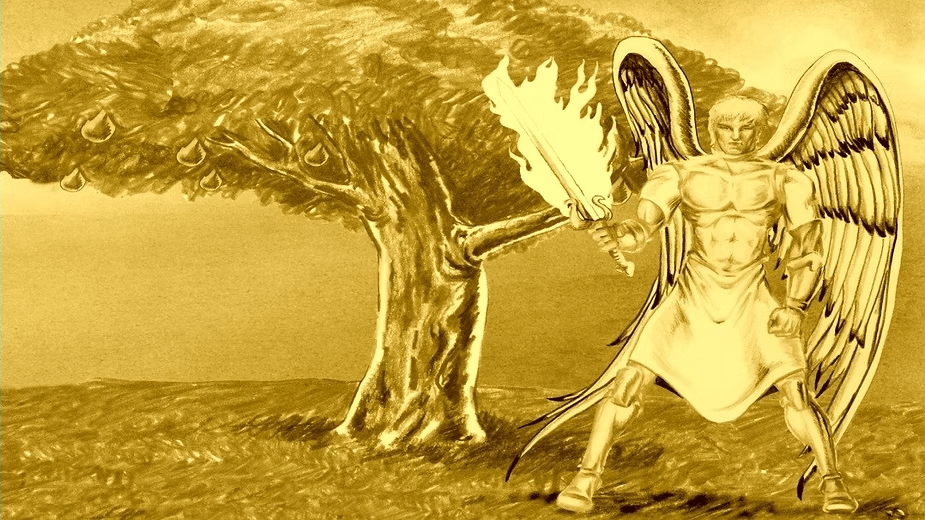
When one realizes Genesis 3:24 states, “After [Yahweh] drove [Adam and Eve on the serpent] out, he placed in front of the Garden of Eden cherubim and a flaming sword flashing back and forth to guard the way to the tree of life,” the “cherubim” can be seen as the Jebusites. According to the etymology of the word “cherub” is “likely borrowed from a derived form of Akkadian: karābu “to bless” such as kāribu “one who blesses.” [Wikipedia “Cherub”] In that, Melchizedek gave a blessing to Abram.

Abraham is said to have bought the “Cave of the Patriarchs” or the “Cave of Machpelah” to be his place of entombment for Sarah. Abraham would also be buried there, along with Isaac and Rebekah, and later Jacob. The location of that cave was in Hebron. The word “Machpelah” means “doubled”, “multiplied” or “twofold,” where the cave purchased by Abraham was multiple underground tunnels. In the recent news is the elaborate tunnel system under the earth of Gaza. There are also elaborate underground tunnels under Mount Zion and Mount Ophel. In was in a stable cave in Bethlehem that Jesus was born. It was in a cave when God passed by a hiding Elijah. All of this makes it likely that the Jebusites were the rulers of the underground, with David finding out the Cave of Machpelah had an extension that reached seventeen and a half miles north, joining with the caves of Jerusalem.

The rabbinical scholars saying that Abraham was forced to make a covenant with them, because the cave Abraham purchased [made from a Hittite] was in the territory of the Jebusites, the field paid for [four hundred shekels of silver] must have been Hittite land, on which the cave opened. Since Abraham did not pay any Jebusite for the field, the underground network of caves would then be the territory of the Jebusites. That meant Abraham would have to reach two agreements for the same land: one for the field on the surface; and, one for the caves underground. This says the Jebusites (in essence) ruled the underworld, which becomes metaphor for the “front” to the “Garden of Eden,” where the “tree of life” represents eternal life in heaven.

When this reading states, “At Hebron [David] reigned over Judah seven years and six months; and at Jerusalem he reigned over all Israel and Judah thirty-three years,” this says David was already the King of Judah when the Israelite elders approached him to be the king who would replace Saul’s heir Ish-Bosheth, who reigned after his father’s death, for two years. Thus, Israel had already been separated from Judah, because Judah broke from Israel to make David their king, prior to Saul’s death. Because Saul wanted to kill David, Judah broke free of his rule and let David rule them instead. Therefore, after Israel had been left with no king and no heirs, they sought to unite with Judah, so all the land of the Twelve Tribes would again be under one king.

It is that duality that was Judah and Israel being joined as one nation that makes me see a parallel to the naming of the Cave of Machpelah, where a “twofold cave” becomes symbolic of two souls leading one nation – one body of flesh. Because Hebron was where one cave entrance led to the soul of Judah, Jerusalem must have been where the soul of Israel was entered. The ‘capitol’ of Israel under Saul was Gibeah, which was three miles north of Jerusalem.

The element of “hate” that was in the conversation between David and the Jebusites, especially relative to his “soul,” can only be Satan, or any demonic spirit that would possess human beings. Saul would have been such possessed, as was read in the 1 Samuel 18:10a [the fourth Sunday after Pentecost Track 2 option], “The next day an evil spirit from elohim rushed upon Saul, and he prophesied within his dwelling.” That says Saul was possessed by the hated hate soul that was demonic. It reduced a king of Israel to being blind and lame. Thus, there was no taunt that said even the blind and lame could defend Mount Zion [under which was a labyrinth of tunnels from which one’s soul would be judged as either worthy or unworthy]; it was a promise that even David [anointed by Samuel and filled with the Spirit of Yahweh] could not enter the Garden of Eden before death.

This says the motivation for David to move his ‘capital’ in Judah to a place that was not possessed by Israel was pointless, which makes no sense at all. The unstated purpose for that move was a symbolic statement that said Israel was to be known as the “front of the Garden of Eden,” which demanded it forever be divinely possessed by Yahweh or it would become a land defended by the blind and the lame. The ‘siege of Jebus’ [a name that implicates a “Threshing-Floor,” meaning “Trodden Underfoot, He Will Trample Down”] was not a battle, but a simple relocation … as long as the Jebusite realm underground was kept separate from the city of David that would be built above ground.

In support of this motivation, Abram told the King of Sodom, after Melchizedek had blessed him, “hă·rî·mō·ṯî yā·ḏî ’el-Yah·weh ’êl ‘el·yō·wn , qō·nêh šā·mā·yim wā·’ā·reṣ,” which says, “I have raised my hand to Yahweh god most high , possession of heaven and earth .” In that, “raised” means spiritually elevated, with “hand” means become “a hand of Yahweh,” as an “elohim,” so his soul was “possessed spiritually and physically” to serve Yahweh only. David was possessed in the same way, so his move to the land of Benjamin, away from Judah, to the tomb where Israel would live or die as divine or blind and lame, such that Jerusalem would be where Israel and Judah would thrive together as one, or split apart as two.

When verse 7 [omitted from the reading] says, “Nevertheless David took the stronghold of Zion, which is now the city of David,” the “stronghold of Zion” [“mə·ṣu·ḏaṯ ṣî·yō·wn”] can equally say, “the snare of tradition.” The Hebrew word that has been translated as saying, “and nevertheless took” [“way·yil·kōḏ,” rooted in “lakad”] actually is used figuratively as meaning “entrapping men.” By seeing entrapment is consistent with the use of a snare, such that “Zion” means “Tradition” [in one sense], David placed Israel in a siege by locating his capital in Jerusalem, setting the trap for all future Israelites to come, which said, “Live the tradition of giving your souls to Yahweh in marriage, or suffer the defeat of being caught in your own wrongdoings.”

When we read, “David built the city all around from the Millo inwards,” the Hebrew word “ham-mil-lō-w” is given proper name status in translation as “Millo.” The lower-case spelling, as “millo,” refers to “earthwork, mound, rampart or terrace,” with the website Abarim Publications stating the name meaning of “Millo” comes from the verb, “to be full or be filled.” Still, no one is sure what the word truly means, making its presence in this verse confusing. It forces one to ask, “Why is this written?”

By looking more closely at the Hebrew written, a literal possibility emerges that says, “and dwelt David in the net [snare] , and proclaimed it excitement of David ; and built David on every side , from filled in household .” While it certainly can be realized that the place known as “the City of David” is a walled in small portion of Jerusalem, which can be where David had a house of cedar and had steps set into the steep rock incline of Mount Zion, that pales in comparison to how David moving his capital to such a precarious place, where not even Saul had considered attempting, that David did so with an attitude of “excitement,” which he “proclaimed” by his sheer confidence as a Son of Yahweh, so “on every side” of Jerusalem would all the Twelve Tribes be built united as one, with one sole purpose as servants of Yahweh. Thus, the “Millo” is not a rampart and not something built of stone, but the hearts of every Israelite “filled in” with a Spirit of commitment, as a “household” of Yahweh.

When one looks at the miniscule area of Jerusalem that is determined to be the “City of David,” even in its height of newness and works of architecture as a fortress or stronghold, there is nothing about it that would justify the Hebrew that follows, saying “And David went on and became great, Yahweh elohe tsaba [gods angels] fellowship.” There is absolutely nothing “great” that the stronghold that became the City of David, as the only thing “great” was Yahweh and His angel souls whose fellowship with David and all Israel made them “great.”

Strategically, the height of Mount Zion is the lowest of all the hills of Jerusalem. The Romans would later demonstrate the advantage of controlling higher ground, as Jerusalem’s walls were easily overcome by catapults situated on the surrounding higher mountains (Mount Scopus in particular). This military weakness makes the millo inconsequential as some form of a “natural rock formation.” The height of Mount Olivet makes it a simple task to look down on both Mount Zion and Mount Ophel; and David was no military fool; so, for him to choose the lowest hill as a place to defend he was listening to the Jebusites. Without having Yahweh’s blessing, going to the highest mountain would not stop an empire from overtaking everything, when those defending were blind and lame. Going to the lowest height meant always please Yahweh or get ready to lose it all.

As a reading option for the sixth Sunday after Pentecost, when one’s personal ministry to Yahweh should be underway, one should see this reading personally. The elders of Israel should be seen as one’s body (“Look, we are your bone and flesh.”) being in need to be ruled divinely. The reign of Saul means a body that had been ruled by all the fears and anxieties that come from trying to stand strong in a world that is a never-ending challenge, offering one battle after another.

The death of Saul means oneself has reached a point of decision, where the ego (the elders) has surrendered to God. When you want God to become your King, then you become Jesus resurrected. David was the ‘prototype’ of Jesus within one human body, as he was one soul leading a nation of souls to be like him – married to Yahweh. Jesus is the ‘David’ of Christianity.

To reach that state of commitment, one has to have done some things good and been rewarded. The self has “led out [one’s body] and brought it in” to the cheers and admiration of others. One knows what is right and good, but one has bowed down to the gods of evil (“elohim rū·aḥ”) on many occasions, because they say, “Serve self, not God,” which is so much easier to do. Leading a parade of warriors, like David, or leading a band of disciples, like Jesus, is hard to do without special talents provided by Yahweh. It is the talent Saul lacked, which is what all righteous leaders have. One needs to be blessed, as was Abram by Melchizedek. One has to commit to marriage to God, so He sits on the throne of one’s soul [a heart], commanding the brain that sits at the head of the body.

The palace of self is where one has ruled and it is where one has become comfortable; but God will call the self to seek Jerusalem within, the City of Jesus Christ. Hebron can be seen as one’s church, where one becomes active as a leader; but one needs to conquer the Holy City of Jebus and make oneself a fortress that serves the One God above. In that development, one will take the natural formations that exist and strengthen them inwardly. New paths will open before oneself, which one needs to fortify and dig deeper to explore where God wants one to develop.