Tag Archives: 2 Samuel 6:12b-19

2 Samuel 6:1-5 and 12b-19 – Placing God where He wants to be

David again gathered all the chosen men of Israel, thirty thousand. David and all the people with him set out and went from Baale-judah, to bring up from there the ark of God, which is called by the name of the Lord of hosts who is enthroned on the cherubim. They carried the ark of God on a new cart, and brought it out of the house of Abinadab, which was on the hill. Uzzah and Ahio, the sons of Abinadab, were driving the new cart with the ark of God; and Ahio went in front of the ark. David and all the house of Israel were dancing before the Lord with all their might, with songs and lyres and harps and tambourines and castanets and cymbals.

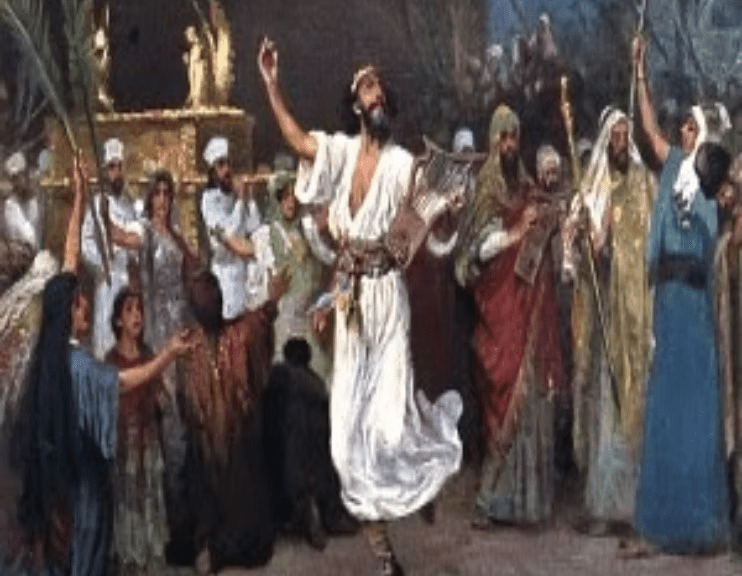
So David went and brought up the ark of God from the house of Obed-edom to the city of David with rejoicing; and when those who bore the ark of the Lord had gone six paces, he sacrificed an ox and a fatling. David danced before the Lord with all his might; David was girded with a linen ephod. So David and all the house of Israel brought up the ark of the Lord with shouting, and with the sound of the trumpet.

As the ark of the Lord came into the city of David, Michal daughter of Saul looked out of the window, and saw King David leaping and dancing before the Lord; and she despised him in her heart.

They brought in the ark of the Lord, and set it in its place, inside the tent that David had pitched for it; and David offered burnt offerings and offerings of well-being before the Lord. When David had finished offering the burnt offerings and the offerings of well-being, he blessed the people in the name of the Lord of hosts, and distributed food among all the people, the whole multitude of Israel, both men and women, to each a cake of bread, a portion of meat, and a cake of raisins. Then all the people went back to their homes.

——————————————————————————–

This is an optional Old Testament selection from Episcopal Lectionary for the Eighth Sunday after Pentecost, Year B 2018. In the numbering system that lists each Sunday in an ordinal fashion, this Sunday is referred to as Proper 10. It will next be read aloud in a church by a reader on Sunday July 15, 2018. This is important it shows the ark’s presence in Israel is symbolic of God’s presence in one’s heart, thus worthy of celebration by songs, dance, and sharing the blessings that come from offerings to the LORD.

In this reading it is important to realize that David has been King of Israel for over seven years. He has taken the stronghold of Jebus from the Jebusites and renamed it Jerusalem, with his area called the City of David. He has then made arrangements for this stronghold to be the home of the ark. One can presume some time took place preparing a location for the ark to rest, as well as preparations for moving the ark (a new cart, minimally), so at least six months has passed since Jebus fell.

The ark was under the control of Levites in the “house of Abinadab,” as well as in Gibeon. While the ark was in Kiriath Jearim, the ancient tabernacle was kept in Gibeon. The Levites would have overseen the consecration of all priests who would attend to the ark. Uzzah and Ahio are called “sons of Abinadab, but “sons” (“bə·nê”) were “descendants” of that “house” (“mib·bêṯ” as “family”).

The ark had been moved there after the prophet Eli’s death, as Samuel became the judge of Israel and shortly before the elders of Israel asked Samuel for a king.
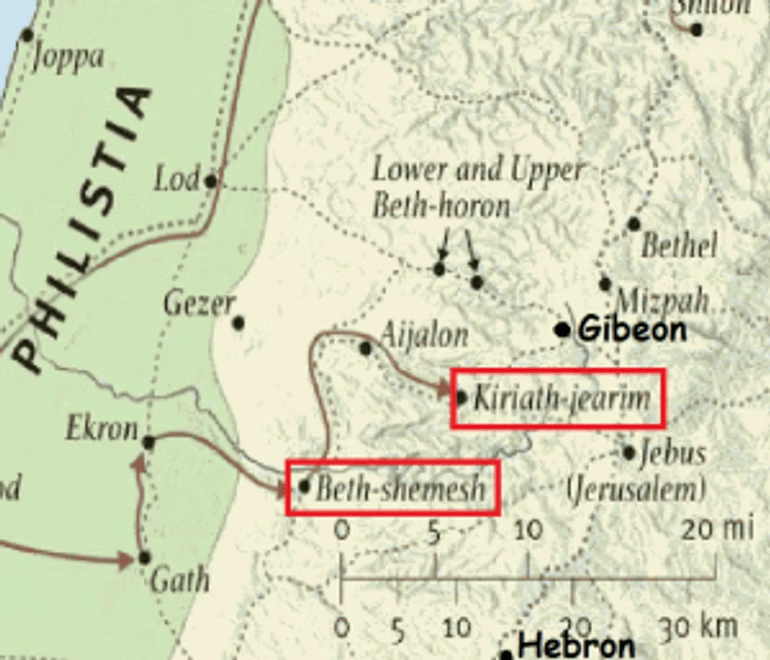
After seven months, the Philistines had been punished enough for having the ark and they left it on a rock in Beth-Shemesh so it was up to the Israelites to deal with. It caused 50,070 to die there, so they asked for it to be removed. It was then taken to Kiriath jearim.

The ark stayed in Kiriath Jearim for twenty years (1 Samuel 7:2), when Saul ordered the ark moved, without permission (1 Samuel 14:18). One can then presume the ark was returned, after God stopped answering Saul, in an attempt to make amends. By the time David went to move it to the City of David, the ark had been back in Kiriath Jearim around thirty additional years (fifty in all).

When the translation says, “gathered all the chosen men of Israel,” the operative Hebrew word is “bā·ḥūr,” which leans one to “young men,” even “vigorous young men.” Thirty thousand is a symbolic number that states the importance David saw in this move. The youth factor was so all those accompanying the ark would be energetic and enjoying the festivities surrounding God being moved.

The name Uzzah means “Strength,” while the name Ahio means “Brotherly,” or “Brother/Friend of the LORD.” The place named as the “house of Obed-edom,” can also be read as a family residence named for a “Servant of the Red One,” or “Servant of Edom,” where Edom was a kingdom south of Judah. This can equally be read as “Servant of Strength,” where it held the strategic advantage of height on a hill. It is believed the path of the ark was forced to shift to an easier path downhill.
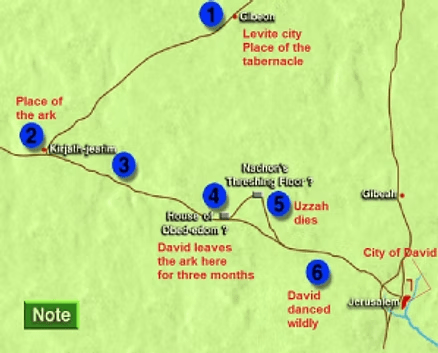
The omitted verses address the near fall of the ark from the cart. Uzzah attempted to stop its slide and was killed. The symbolism there could be no human strength can force its will upon the power of the LORD. Because of the death of Uzzah, David turned the cart around and returned to the “house of Obed-edom and left it there for three months. During that time, the family at Obed-edom was blessed by the presence of the ark, so David returned to continue the move of the ark to his city.

[Back to the reading]

When we read, “he sacrificed an ox and a fatling,” this was a priestly act performed by David. After the ark was returned to Israel by the Philistines, Samuel had become elevated to the judge of Israel and he made burnt offerings to the LORD also. This says David was more than the King of Israel, as he was also the one who could perform holy ritual. By doing this after the ark carriers had walked six steps into his city; he sacrificed an ox and fatling as the head of the family that was the house of David. This is then repeated when we read, “They brought in the ark of the Lord, and set it in its place, inside the tent that David had pitched for it; and David offered burnt offerings and offerings of well-being before the Lord.” Finally, David “blessed the people in the name of the Lord of hosts,” which was a priestly act.

David danced and rejoiced mightily as a sign of his complete devotion to God. His displays, as well as those of the Israelites, were to show their happiness to have the LORD welcomed with fervor into their midst. That celebration was followed by more ceremonial burnt offering, which had to have been enough for thousands of Israelites. We know this because we read how David, “distributed food among all the people, the whole multitude of Israel, both men and women, to each a cake of bread, a portion of meat, and a cake of raisins.” This act of blessing and feeding a multitude would much later be seen by Jesus.

To myself, the element of this reading that sticks out and stays in my mind is when I read, “As the ark of the Lord came into the city of David, Michal daughter of Saul looked out of the window, and saw King David leaping and dancing before the Lord; and she despised him in her heart.” When David and Michal were younger, when David was living as an adopted member of Saul’s royal family, “Michal loved David,” and Saul “was pleased” to hear that news. Saul planned to use that love to get David killed by Philistines. Because David was poor, Saul set the dowry as “a hundred foreskins of the Philistines.” David brought back two hundred and was given Michal as his wife. However, soon after, Saul forced David into exile, trying to kill him.

David and Michal were then separated for many years. After Saul was dead and his son Ish-Bosheth was King of Israel, David sent a demand to send his wife Michal to him in Hebron (he was then King of Judah). Ish-Bosheth forced Michal from her husband to go to David, while David had taken on other wives while in exile and they bore him children. Still, this story tells how Michal “despised [David] in her heart” because he acted in an unroyal manner before the ark. Her “contempt” shows how she had been coddled as a princess and seeing David playing the fool before God disgusted her.

As a reading option for the eighth Sunday after Pentecost, when one’s personal ministry to the LORD should be underway, the lesson is to fear the LORD and only Him. That was the commandment stated in Deuteronomy 6:13 and it was restated in 1 Samuel 7:3, after the ark was returned by the Philistines. The fear of the ark was the fear of God, and the lesson of this reading is delight in that power.

The ark had remained in one house on a hill for the most part of half a century. It was not in the tabernacle Moses had the Israelites construct, which could be taken down and moved in their travels. David prepared a tent for the ark in the City of David. The entire time Saul ruled over Israel, the LORD did not have a proper place to rest; and, in return, Israel did not benefit from the power of the LORD. This story is about how David returned that power to a proper home.

The symbolism is the struggle that one of faith has in mistaking a fear of the LORD as the fear one has to find a proper home for God. A minister to the LORD has prepared a place for God to reign, which is the tabernacle-tent covering one’s heart. Many people have difficulty making the sacrifice that makes one appear publicly foolish, as that has the effect of bringing contempt and disdain from those who see the rewards of the world come freer and more frequently when they act in ways that attract wealth. This means Michal, whose name means “What’s God Like?” questioned how God could bless anyone as wildly foolish as David. A minister to the LORD is no longer worried about how the self is seen by other human beings, as the only eyes that matter are God’s.

It can take many years of one’s life to dare to move the ark of God from some external resting place (like a church building, a religious denomination, or a surrogate minister) into one’s heart.
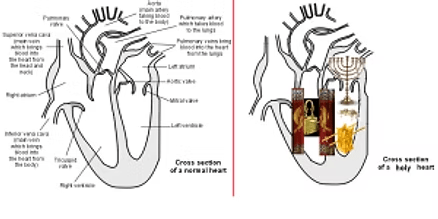
There may be setbacks, like the death of Uzzah and the testing of the presence of God in another (like David leaving the ark at Obed-edom), but one needs to see how God being kept external does not save one’s soul in the end.

The marriage of David to Micah, when David was too poor to pay a dowry, symbolizes one’s marriage to the world and the inheritance of worldly goods. When Micah saw David had chosen God, she saw him as returning to earthly poverty, even though he was the king of all Israel. Her love of a young, self-assured David, who had so much potential for capturing the booty and spoils of war, dissipated to nothing, once she saw his Spiritual choice. So too does the world reject a high priest, a holy judge, and a servant to God. Just as did Michal turn on David, a minister can expect to find the same rejection of past friends and business partners. Simply by changing from self-promoting, soul-selling, run-of-the-mill typical people, those people who one was just like feel disdain being around someone so changed. When one has fallen in love with God and married into His house, then there can be no turning back – because one sees the true love of God and the false love of those too weak to sacrifice immediate gratification for eternal peace.

The lesson in this optional Old Testament reading is ministry requires one become a Brother of Jesus Christ, just as Ahio led the ark in its return. To be a Brother is to become a reproduction (a rebirth) of the Son of God. A Brother comes in both male and female human bodies. As Christians, who profess to have the Strength of the LORD at their beck and call (the spirit of Uzzah), that consecration as a high priest of the ark leads one to think you can control God. One’s lineage and pedigree makes one thing one can reach out and touch the LORD whenever one pleases. While omitted from today’s reading, we find that Uzzah’s attempt to keep the ark from coming off the cart was not seen by God in his favor. Instead, we read, “The Lord’s anger burned against Uzzah because of his irreverent act; therefore God struck him down, and he died there beside the ark of God.” (2 Samuel 6:7)

That lesson says to be careful that one does not think God obeys one’s commands. That is irreverent and causes God to burn such selfish souls from anger. One has to fear the power of the LORD and bow down before that magnificence. Bowing down might be seen as foolish and weak; but foolish and weak is much better than fried to a crisp, having God raised God’s ire.
2 Samuel 6:1-5, 12b-19 – Bringing the Groom to the bride

David again gathered all the chosen men of Israel, thirty thousand. David and all the people with him set out and went from Baale-judah, to bring up from there the ark of God, which is called by the name of Yahweh of hosts who is enthroned on the cherubim. They carried the ark haelohim on a new cart, and brought it out of the house of Abinadab, which was on the hill. Uzzah and Ahio, the sons of Abinadab, were driving the new cart with the ark haelohim; and Ahio went in front of the ark. David and all the house of Israel were dancing before Yahweh with all their might, with songs and lyres and harps and tambourines and castanets and cymbals.

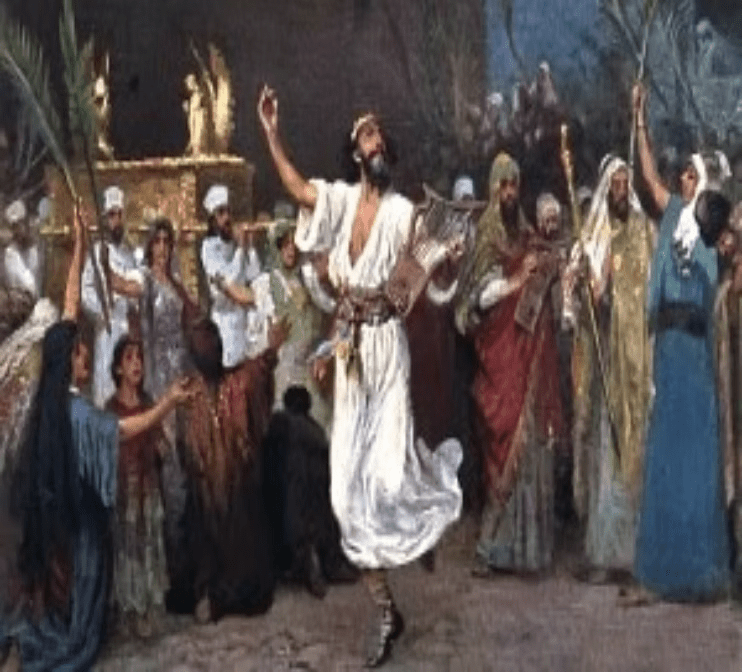
So David went and brought up the ark haelohim from the house of Obed-edom to the city of David with rejoicing; and when those who bore the ark Yahweh had gone six paces, he sacrificed an ox and a fatling. David danced before Yahweh with all his might; David was girded with a linen ephod. So David and all the house of Israel brought up the ark Yahweh with shouting, and with the sound of the trumpet.

As the ark Yahweh came into the city of David, Michal daughter of Saul looked out of the window, and saw King David leaping and dancing before Yahweh; and she despised him in her heart.

They brought in the ark of Yahweh, and set it in its place, inside the tent that David had pitched for it; and David offered burnt offerings and offerings of well-being before Yahweh. When David had finished offering the burnt offerings and the offerings of well-being, he blessed the people in the name of Yahweh of hosts, and distributed food among all the people, the whole multitude of Israel, both men and women, to each a cake of bread, a portion of meat, and a cake of raisins. Then all the people went back to their homes.

——————–

This is the track 1 option for the Old Testament reading for the seventh Sunday after Pentecost [Proper 10], Year B, according to the lectionary for the Episcopal Church. If chosen, it will be paired with Psalm 24, which sings: “Who can ascend the hill of the Lord? and who can stand in his holy place?” That will precede a reading from Paul’s letter to the Ephesians, where he wrote: “In [Jesus reborn within] we have redemption through his blood, the forgiveness of our trespasses, according to the riches of [Yahweh’s] grace that he lavished on us.” Those will all accompany the Gospel reading from Mark, where is written: “When Herod heard of [Jesus], he said, “John, whom I beheaded, has been raised.”

In the above translation of the Hebrew text into English [said to be from the New Revised Standard Version], it should be noted that I have replaced all words translated as “the Lord” [in bold type] with the actual name written – “Yahweh.” In addition, all words translated as “the ark of God” have been returned to that written [in italics], as “the ark haelohim.” These changes force one to understand that this is “the ark of gods,” where the plural refers to the two Cherubim atop the ark. The Cherubim need to be recognized as the protectors of the ark. Thus, the ark represents both the presence of Yahweh and the presence of those divine eternal creations who forever guard where Yahweh is present.

I have written prior my interpretations of this reading, specifically back in 2018. Those views are still valid and I welcome all to read what I wrote then. You may search this site to find that article. I welcome comments and questions always.

The back story to this reading is the Ark of the Covenant had been lost in battle between the Israelites and the Philistines. This happened prior to Samuel becoming the judge of Israel. Eli was the prophet who tutored Samuel, and Eli’s sons died in the battle in which the Israelites were defeated and the ark taken. News of the loss caused Eli to die, which raised Samuel to become judge.

The ark was then moved by the Philistines from city to city, where they lived. Each move brought greater and greater plagues against them. After seven months they returned the ark to Beth Shemesh, where seventy Israelites died from looking at the ark. In 1 Samuel 7:1-2 this is written:

“So the men of Kiriath Jearim came and took up the ark of Yahweh. They brought it to Abinadab’s house on the hill and consecrated Eleazar his son to guard the ark of Yahweh. The ark remained at Kiriath Jearim a long time—twenty years in all.”

The statement about twenty years is then the time that elapsed before the Israelite elders demanded a king from Samuel. That says Samuel did not move the ark after it was set at Abinadab’s house in Kiriath Jearim; but after Saul was made king, it was moved for use in battle, then returned to the same place after use. A stone had been set there by Levite priests, for the purpose of setting the ark on it. One can then assume they also oversaw the construction and maintenance of a tabernacle to cover it while it was there. As Saul was king for twenty-two years and his heir Ish-Bosheth was king for two more years after Saul’s death, the ark had actually been at that site for roughly forty-five years before David became king at age thirty. It is more likely that the ark had been in Kiriath Jearim for fifty years, with the City of David refined and made ready to receive the ark properly.

The point of the ark being moved to Jerusalem must then be seen as another step that David was led to take, following the instructions of Yahweh. The change would have been relative to the removal of external protections of the land of Israel, forcing all Israelites to submit their souls in marriage to Yahweh. Because the ark had been in the same place for so long, with Gibeon being the official place of the Tabernacle, with Levitical caretakers in place for a long time there, there would be no reason to move it without the direction of Yahweh. That move then relates to David’s move to Jerusalem, when there was no need to leave Hebron and displace the Jebusites. Both moves were directed by Yahweh.

According to the website Abarim Publications:

“The name Kiriath-jearim obviously consists of two elements. The first part is the same as the name Kiriath, which is identical to an older variant of the Biblical noun קריה (qiryah), meaning city. It derives of the verb קרה (qara), meaning to meet or get together.”

“The second part of our name is a regular plural form of the noun יער (ya’ar), meaning forest, from the unused root יער: The verb יער (ya’ar) isn’t used in the Bible and it’s a complete mystery what it might have meant. Noun יער (ya’ar) is the common word for forest or thicket, and the identical noun יער (ya’ar) means honeycomb. It is, of course, perfectly possibly that these two nouns are not two but one, describing something general like a thing that consists of many elements, which contain energetic nutrients (either fruits or honey), and which are patrolled by ferocious animals. The latter noun also occurs as the variant יערה (ya’ra), honeycomb.”

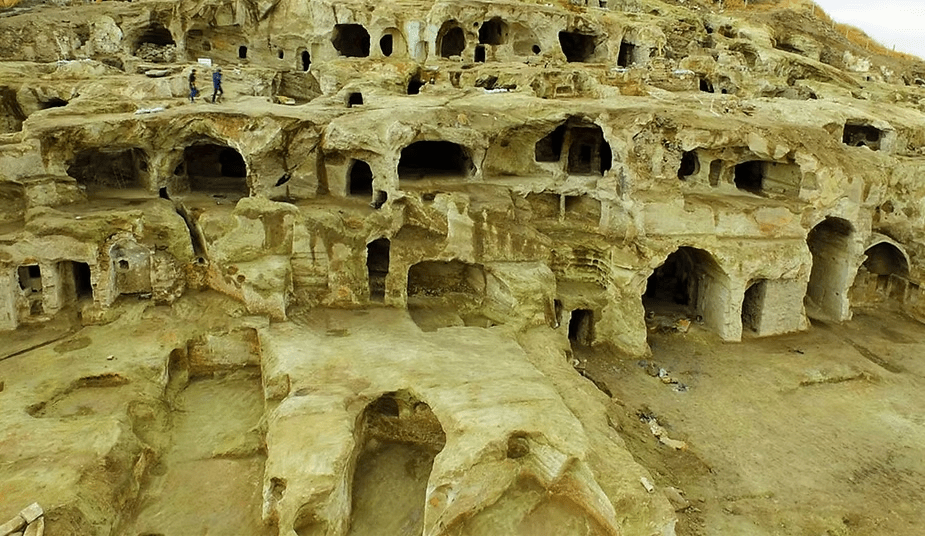
Since it is less likely that a city would be placed in a forest, I am certain the place where the ark was kept was named the “City of Honeycombs.” That name would mean an underground system of caves that was where many lived. The history of Kiriath-jearim is that it was a Gibeonite city, who were a people much like the Jebusites. When Joshua was defeating all the peoples in the Promised Land, he encountered the Gibeonites, who said they were foreigners, which kept Joshua’s army from going to battle with them. Then, it was found that the ‘foreign’ place they were from was right in the middle of Canaan, so they were made the slaves of the Israelites and forced to serve in the tabernacles. It then becomes likely that the Gibeonites were indeed “foreigners” as “elohim.” The honeycomb city they dwelled in was underground, which became a sanctuary for the ark, as they had sworn themselves into service for the Israelite people, as maintainers of their holy place and ark. In the same way the Jebusites were allowed to keep Jebus [or Salem / Jerusalem], because they lived underground guarding the path to the tree of life, the Gibeonites were the keepers of the ark.

From this perspective, it makes it easy for me to read the three references to “ark haelohim” and see that as not only a statement about the ark having golden Cherubim on the top of the ark, but that the ark was so powerful it could not be entrusted to mere mortals to protect it. It had to be watched by “elohim,” who were the Gibeonites. As “elohim” created by Yahweh, being divine “foreigners” set in that most holy land, the movement of the ark demanded both the assistance of Yahweh and His “elohim.”

From this realization, one can more closely examine the Hebrew text that says, “‘ō·wḏ dā·wiḏ ’eṯ- kāl- bā·ḥūr bə·yiś·rā·’êl šə·lō·šîm ’ā·lep̄”, which literally translates as “again David with all chosen of Israel thirty thousand” (with no internal punctuation marks). While this assumes David personally chose all the young soldiers of Israel to accompany him for this mission, that number seems excessively high. After all, the ark was loaded on a cart pulled by animals, so it would seem ordering so many men to go with him for the trip would have meant they would get in the way, more than help. The Philistines had no desire to come near the ark, so the men would not be needed for battle. This means it would be a stronger translation to see those “chosen of Israel” were not Israelites but Gibeonites, who lived in the City of Honeycombs and whose ancestors had been chosen by Joshua to guard and maintain the Tabernacle, which for the past fifty years housed the Ark of the Covenant.

Those Gibeonites numbered thirty thousand.

Verse two actually supports this concept totally. The NRSV translation [with my restorations] says: “David and all the people with him set out and went from Baale-judah, to bring up from there the ark haelohim, which is called by the name of Yahweh of hosts who is enthroned on the cherubim.” The literal breakdown shows: “and went David , and all with the people , from Baale Judah , to ascend from there , the ark of elohim , who are called , name by name Yahweh of host who dwell the Cherubim over .” When this verse is read like the NRSV translates it, it comes off as storytelling, which becomes a pointless waste of words. Because nothing in divine Scripture is pointless or a waste, the literal breakdown shows a series of statements being made, about the “people” who went with David and the ark.

They were “from Baale Judah,” which was where the ark had been for fifty years. The ‘name’ means, “Lord Of Let Him Be Praised.” Because Kiriath-jearim and Gibeon were in Benjamin [as well as Jerusalem-Jebus], there was nothing about the land designated as relative to Judah. Thus, the people who left with David and the ark were those who praised the presence of Yahweh in the ark. Since the foothills of Benjamin were a series of one hill after another, with valleys in between, they were not “bringing up” the ark, as a directional indication. The ark was a place of ascent, from which Yahweh rose as an unseen power of divine elevation. Thus, the ark consisted of divine gods [non-humans in form], while needed to be attended by divine gods [those in human form]. All of them were called by Yahweh into that service to Him; and, all were individually souls joined with the Spirit of Yahweh, so they were a name with a name, where the ‘last name’ was Yahweh. They were some of “the hosts of Yahweh,” as his ‘angels on earth’ and descendants of His Cherubim.

Because of the omission of verses that tell of Uzzah, a son of the house of Abinadab, being killed because he touched the ark, thinking it was going to fall off the wagon, the story resumes after the ark has been left by David at “the house of Obed-edom.” That was where a winepress was located, not far from where the accident took place. That name, “Obed-edom,” means “Servant Of The Red One,” which [when wine is seen] could be an indication of vineyards producing red grapes for red wine. The information given, that the house was a “obed-edom gittite,” the word “gittite” must be seen as meaning “winepress,” not a woman inhabitant of Gath [a Philistine city]. David left the ark there for three months, which would not be a problem during the summer, when vineyards are not busy, letting the grapes grow.

The symbolism of leaving the ark at a place where wine was made, again realizing that David was able to ask Yahweh for direction [and he had prayed for advice after Uzzah died], the ark was back-tracked to the winepress location for a purpose. The symbolism of wine must then be seen as how the ark was representative of the Spirit that revitalized the soul. The three months the ark was left there is then symbolic for when new wine would be produced and fermented. Therefore, before the ark could be moved into Jerusalem the ark had to ‘age.’

When verse twelve says, “So David went and brought up the ark haelohim from the house of Obed-edom to the city of David with rejoicing,” the word translated as “rejoicing” [“bə·śim·ḥāh”] is better seen as saying “mirth from festivity.” If it was indeed the time of wine to be delivered [at a festival such as Sukkot], the dancing before the parade of the ark into Jerusalem would be seen as an act of one “drunken from the wine of celebration.”

The “dance” would be symbolic of an after marriage celebration. David wearing a “linen ephod,” which is a priestly garment, such as a mantle like worn by Elijah, says he was the officiant of the wedding celebration that bringing the ark into Jerusalem meant. Thus, everything about David and the ark’s entrance into Jerusalem was symbolic of a new marriage, where the ‘husband and wife’ were the Ark of the Covenant [the marriage vows of Yahweh the Husband] being joined with the new bride that was Jerusalem [the new home the Husband would enter]. David, as the one who arranged this marriage, was the priest who brought the two lovers together in holy matrimony.

Verse sixteen then says, “As the ark Yahweh came into the city of David, Michal daughter of Saul looked out of the window, and saw King David leaping and dancing before Yahweh; and she despised him in her heart.” This verse becomes another that simply seems to be giving useless information. However, when one realizes that Michal was the wife of David, the marriage theme shine bright. Michal was projected as an unhappy wife.

This verse paints Michal as “daughter of Saul,” rather than the queen of Israel and Judah. She resides in the place named after her husband, but she sees herself as above the status held by David. Her father was dead, having been a disgrace to Israel; and, while she was initially attracted to David as a young girl, she is now looking down on David [from an upstairs window] and her “heart” [meaning her soul] saw David with “contempt.” She saw her husband as if he was “despicable” and worthless to her. A daughter given away in marriage became the property and responsibility of her husband; but because Saul began a quest to kill David after David married his daughter and became an heir to the throne [a lowly son of a Benjaminite], his marriage to Michal was without child. She had helped David escape Saul; but she was later given by Saul to another husband. She was returned to David [angering her second husband] as a term of truce between David and Saul’s successor, Ish-Bosheth.

Because Michal is such an insignificant character in the history of David, her mention here must be seen as symbolizing the grand scope of where the Israelites’ true “heart” was. While David was anointed by Yahweh and the Spirit of Yahweh was forever one with his soul, the commitment the Israelites would be found to have is always be looking down on anyone who promoted sacrifice of self-ego and self-will, in order to have one’s soul be ‘given away’ in marriage to Yahweh. Being filled with the Holy Spirit and wildly celebrating Yahweh’s presence was not what the elite of Israel sought, nor wanted. After David fell from grace as a king and his sons turned against him, only to be killed, his death left (in essence) a bastard son to take his place. Solomon, for all he did to bring wealth to Israel, was seen by the elders of the Northern Kingdom-to-be as “despicable” and unworthy of ruling over them. They would break apart the marriage between Israel and Judah and tear up the Covenant as the marriage agreement with Yahweh. In this way, Michal becomes a reflection of just how minor all the subsequent kings of those two nations would become, as none of them would become a soul married to Yahweh like was David’s.

The remaining verses of this reading tell of the celebration of the people in the city of David, who came, ate and drank, celebrated the new ark in the tent David had pitched, where a tent [a chuppah] was typically where a new husband took his bride to consummate the wedding.

When the last verse says, “Then all the people went back to their homes,” the reality of the literal translation has it say, “so departed all the people each to his house.” Here, the “house” must be seen as that of David, as Israelites living under his rule. The celebration of the marriage between the ark and Jerusalem – in the City of David – was what they all departed with. By eating the food – the bread, meat, and fruit – of marriage, they all went home engaged to Yahweh.

As an Old Testament reading possibility for the seventh Sunday after Pentecost, when one’s personal ministry to Yahweh should be underway, this says one must find the Spirit of Yahweh and invite it into one’s heart [meaning soul]. The omitted verses say one’s soul has no say in what that marriage will bring. Before the ark can become one with one’s soul, the Spirit of engagement must be received. One must feel elated with the proposal and look forward to serving God with all one’s might, with nothing held back. Marriage of a soul to Yahweh is the only way to save one’s soul.

This reading also shines light one the sense of superiority human beings think they deserve to possess. The reflection of Michal is she represents everyone who proclaims to be someone special, who is allowed to look down on others with contempt. So many Christians become a reflection of Michal as they look upon others calling themselves Christians, but with differing views. All are wrong, thinking each is superior to the other, all while the enemy lurks, waiting for the time to pounce and kill all Christians [false or hired hands]. Everyone loves a wedding banquet, but few want to give up themselves as a “daughter in marriage,” when they see their fathers as better than Yahweh.

——————–

After writing this, I turned on the television and the History Channel had a show that featured this recent discovery in Turkey. This make my point of naming a place “City of Honeycombs.”