
Tag Archives: 2 Samuel 7:1-14a

2 Samuel 7:1-14a – Letting the spiritual heart lead the Christ Mind

When the king was settled in his house, and the Lord had given him rest from all his enemies around him, the king said to the prophet Nathan, “See now, I am living in a house of cedar, but the ark of God stays in a tent.” Nathan said to the king, “Go, do all that you have in mind; for the Lord is with you.”

But that same night the word of the Lord came to Nathan: Go and tell my servant David: Thus says the Lord: Are you the one to build me a house to live in? I have not lived in a house since the day I brought up the people of Israel from Egypt to this day, but I have been moving about in a tent and a tabernacle. Wherever I have moved about among all the people of Israel, did I ever speak a word with any of the tribal leaders of Israel, whom I commanded to shepherd my people Israel, saying, “Why have you not built me a house of cedar?” Now therefore thus you shall say to my servant David: Thus says the Lord of hosts: I took you from the pasture, from following the sheep to be prince over my people Israel; and I have been with you wherever you went, and have cut off all your enemies from before you; and I will make for you a great name, like the name of the great ones of the earth. And I will appoint a place for my people Israel and will plant them, so that they may live in their own place, and be disturbed no more; and evildoers shall afflict them no more, as formerly, from the time that I appointed judges over my people Israel; and I will give you rest from all your enemies. Moreover the Lord declares to you that the Lord will make you a house. When your days are fulfilled and you lie down with your ancestors, I will raise up your offspring after you, who shall come forth from your body, and I will establish his kingdom. He shall build a house for my name, and I will establish the throne of his kingdom forever. I will be a father to him, and he shall be a son to me.

——————————————————————————–

This is an optional Old Testament selection from the Episcopal Lectionary for the ninth Sunday after Pentecost, Year B 2018. In the numbering system that lists each Sunday in an ordinal fashion, this Sunday is referred to as Proper 11. If chosen, it will next be read aloud in a church by a reader on Sunday July 22, 2018. It is important because it tells how the LORD is not concerned with buildings made of worldly materials, for He is looking for buildings of flesh who will become His servants.

In the first verse where we read, “When the king was settled in his house, and the Lord had given him rest from all his enemies around him,” one can look at this as David and the kingdom of Israel having reached a symbolic Sabbath.
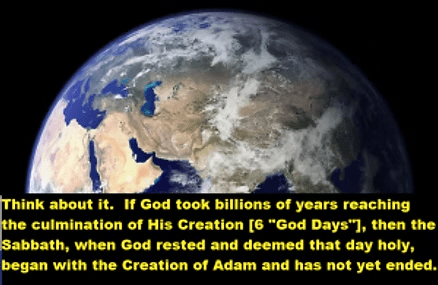
David is now settled into the role of King of Israel. He has overcome all the threats to the safety and security of a nation. He has built a house of cedar in the City of David. All the work of that creation is complete. At that point, “the Lord had given him rest,” which, as the Sabbath was deemed by God to be holy, the “rest” means a focus turned inward, because the outward work is finished.

Seeing that symbolism, look at how David turned to his prophet Nathan, who would be like the court of David’s high priest. One could imagine that the bringing of the ark into Jerusalem called for one to be the man in charge of the tabernacle.  Nathan had that position; thus David called upon Nathan to talk about building a permanent house for the LORD for that purpose.

After decades of Saul having to fiercely fight Philistines, Edomites, Amalekites, Ammonites, Moabites, and the kings of Zobah, a time of peace and tranquility had come by David’s rise as King of Israel.  This became the final phase of hostilities and the beginning of the establishment of the House of David.  That ‘Sabbath time of rest’ can then be seen as holy. David was surely holy, as Nathan said: “The Lord is with you.”

The name “Nathan” means, “Gift, He Will Give, or Given,” which can be hinting at Nathan having the gift of the Holy Spirit, which allowed him to be a prophet. Thus, David speaking with Nathan symbolizes the true nature of a Church of Christ, where two had gathered that the Holy Spirit possessed; and they supported one another as committed to serve God.
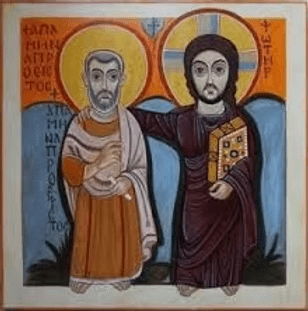
With Nathan speaking from the Holy Spirit about David’s relationship with God (he was not simply being a “Yes man” to get in good with the king), we then see how Nathan spoke with God (unsolicited) that night, in a prophetic dream. God told Nathan to remind David that He is a mobile God. Since God freed the Israelites from Egyptian oppression, He had continuously moved with them wherever they had gone. A tent or a tabernacle (a large tent) for which the Ark of the Covenant had been stored meant God was always with the Israelites and not in some place that made moving it quite difficult.

What would happen to God is someone was to overrun Jerusalem and take possession of the city, along with the fixed house of cedar, with the ark inside?

God told Nathan to pass this along to David (paraphrasing): “If you keep Me in a tent or tabernacle, then I will protect Israel just like it was when Joshua and Sampson were sent to judge the people.”  Judges are sent when the people recognize they have sinned against God and thus repented their sins, praying for guidance.  When a judge of God is in place, the people know to obeyed God’s commands, through that judge. David would be enabled to lead the Israelites to righteous ways of living and thus prosperous times.

That would be known as the House of David, which would always be known as a holy nation under the One God.  By the LORD being with David, his Kingdom of Israel would become etched in history as the greatest.  The Star of David would become Israel’s shield of identity.

What can be confusing in what God told Nathan is when we read, “When your days are fulfilled and you lie down with your ancestors, I will raise up your offspring after you, who shall come forth from your body, and I will establish his kingdom. He shall build a house for my name, and I will establish the throne of his kingdom forever.”

This can be mistaken for King Solomon, who was an offspring of David, who did build a house” for God, called Solomon’s Temple However, God was not prophesying to Nathan about that young son of David, who was still decades away from birth, but who David would name, through Nathan, to be his successor.

If God came to Nathan to tell him that He did not want a fixed structure to be placed in, which would be like a prison that locked God from the Israelites, then God wanted to be forever free to move with the people as needed. A fixed house would be like the pagan idols other people worshipped, those of other nations, made to be sold and set upon shelves in various house rooms. A permanent temple would be like the statues and monuments to the many gods, like those Paul saw while in Greece. The Greek and Roman temples to their gods have long fallen into ruin, those gods now related with myth.  Building a place of brick and mortar for God would be like erecting Him a tomb or mausoleum, meaning God would be seen as dead to the Israelites. Only the memory of God would then be kept alive in a building of stone.

Solomon would begin to lay God to rest in the fourth year of his reign, when he laid the foundation for his Temple for God. Seven years later that tomb would be complete.
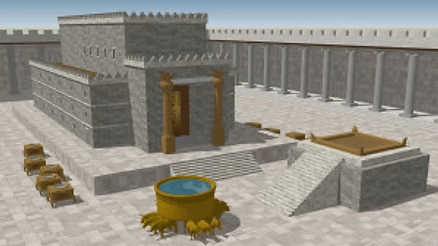
That temple would not be “the throne of his kingdom forever,” as Solomon’s death meant the split of Israel into two kingdoms, with the northern kingdom erecting a duplicate temple in Bethel. That temple would be destroyed by the priests of Baal, while the Temple in Jerusalem would be destroyed by the conquering Babylonians, centuries later.

The ruins of Jeroboam’s temple built in Bethel.

Because of that history, the truth of God’s prophecy to Nathan is He foretold of an “offspring after” David (“from the root of Jesse” – Isaiah 11:01 & 11:10, repeated by Paul in Romans 15:12), which was Jesus of Nazareth (born in Bethlehem). As a descendant of the Tribe of Benjamin, as having a heritage from Bethlehem, and in the line of David, Jesus came “forth from that body.” Jesus Christ would establish “his kingdom” (Christ the King”) on earth and “build a house for God’s name” (Christianity), sent by God to “establish the throne of his kingdom forever.”

The Persians would rebuild a Second Temple in Jerusalem. The Herodians would spend many decades beautifying that building (Herod’s Temple). Then the Romans would destroy that physical building and once again a building made of stone and mortar would prove to be temporary, at best, far from one lasting forever.

Jesus Christ would be killed, buried in a tomb, then resurrected so he could teach his disciples to become him reborn. After Jesus ascended to heaven, to sit at the right hand of God, Jesus Christ was sent back to the earthly realm the next day, being reborn into a new house of God that can never be destroyed. The Holy Spirit breathed the Ark of the Covenant into new tabernacles, who were mobile Apostles.  That spread of the House of God into Apostles has not yet ceased.  This is the truth of what God told Nathan.

Jesus was the temple of the LORD. The Ark of the Covenant, which held the Law of Moses, being placed within an Apostle then fulfills how Jesus said God writes His laws on the hearts of His faithful.  That lost ark no longer sits in a tent, tabernacle, or cedar house, as God rests between the cherubim in the hearts of true Christians. This makes every Apostle-Saint, who have all been reborn as Jesus Christ, be the throne of God that sits inside the covering that is the Holy Spirit, as the everlasting house of God.

As an optional Old Testament selection to be read on the ninth Sunday after Pentecost, when one’s personal ministry should be underway, the message is to be the place where God is enthroned. A true Christian is called to realize that Jesus is not in heaven waiting for all hell to break loose on earth, before he swoops down on a white horse, with fire in his eyes and a double-edged sword to smite all evil coming from his mouth. A true Christian IS JESUS CHRIST, reborn on the earth to serve God, just as Jesus of Nazareth did two thousand years ago. A minister is thus the House of God, not some fixed building on Main Street (a building that is vacant more than it is filled).
A minister reads how Nathan said to David, “Go, do all that you have in mind; for the Lord is with you,” and realizes the “mind” of David was greater than the brain of a smart human being. Long before God sent His Son to be born as Jesus, giving him the Mind of the Christ, God sent the same Mind to all those who judged Israel by setting the standard of righteousness in the land. David had the same Mind of Christ leading his actions, because God was in his heart.

In fact, the Hebrew that has been translated as, “do what you have in mind, because the Lord is with you,” actually says “heart,” rather than “mind.” The Hebrew segment of words, “kōlă·šer bil·ḇā·ḇə·ḵā,” actually state, “all that [is] in your heart.” As the heart goes, the mind will follow.

The brain acts naturally, needing the heart simply for a supply of blood, but the brain acts without any need for emotions. The inner works of the human body are naturally controlled by the base brain lobe (the medulla).  Still, man has a bigger brain that those of animals.  When the spiritual heart controls the brain’s functions, then the mind of the soul amends natural acts. When God is within one’s heart, then the Holy Spirit has joined with one’s soul, meaning the Christ Mind leads one to reject natural acts that are not righteous.

David and Nathan had the same mind, although they were in different physical bodies. God was in both of their hearts, so their brains did not lead their actions. They sacrificed self to the Will of the LORD. Jesus was the same and so were his Apostles, who each were reborn as their Savior.

This is a lesson learned by those who become ministers of the LORD; and it is the lesson taught to seekers of truth. When God is housed in a mobile minister, then the problem of getting the seeker to come to a church is solved. The ark is in the tent of the Holy Spirit, moving as directed by God, so the temple of the LORD can go to the seekers.

#HouseoftheLord #Isaiah1110 #KingdomofGod #Houseofcedar #2Samuel7114 #Isaiah1101 #NathanandDavid #Romans1512


2 Samuel 7:1-14a – Becoming a house of worship

When the king was settled in his house, and Yahweh had given him rest from all his enemies around him, the king said to the prophet Nathan, “See now, I am living in a house of cedar, but the ark ha-elohim stays in a tent.” Nathan said to the king, “Go, do all that you have in mind; for Yahweh is with you.”

But that same night the word of Yahweh came to Nathan: Go and tell my servant David: Thus says Yahweh: Are you the one to build me a house to live in? I have not lived in a house since the day I brought up the people of Israel from Egypt to this day, but I have been moving about in a tent and a tabernacle. Wherever I have moved about among all the people of Israel, did I ever speak a word with any of the tribal leaders of Israel, whom I commanded to shepherd my people Israel, saying, “Why have you not built me a house of cedar?” Now therefore thus you shall say to my servant David: Thus says Yahweh of hosts: I took you from the pasture, from following the sheep to be prince over my people Israel; and I have been with you wherever you went, and have cut off all your enemies from before you; and I will make for you a great name, like the name of the great ones of the earth. And I will appoint a place for my people Israel and will plant them, so that they may live in their own place, and be disturbed no more; and evildoers shall afflict them no more, as formerly, from the time that I appointed judges over my people Israel; and I will give you rest from all your enemies. Moreover Yahweh declares to you that Yahweh will make you a house. When your days are fulfilled and you lie down with your ancestors, I will raise up your offspring after you, who shall come forth from your body, and I will establish his kingdom. He shall build a house for my name, and I will establish the throne of his kingdom forever. I will be a father to him, and he shall be a son to me.

——————–

This is the Track 1 Old Testament option for reading aloud on the eighth Sunday after Pentecost [Proper 11], Year B, according to the lectionary for the Episcopal Church. If chosen, it will be accompanied by a partial singing of Psalm 89, where is written: “I will establish his line for ever and his throne as the days of heaven.” Those will precede an Epistle reading from Ephesians, where Paul wrote: “So he came and proclaimed peace to you who were far off and peace to those who were near; for through him both of us have access in one Spirit to the Father.” All will accompany the Gospel reading from Mark, where it is written, “[Jesus] saw a great crowd; and he had compassion for them, because they were like sheep without a shepherd; and he began to teach them many things.”

In the first verse, where the NRSV translation shows, “When the king was settled in his house,” the meaning of “house” should not be limited to a physical structure. The statement says the “house” was also that of his reign as king over a united Israel and Judah. The verb translated as “settled” can also be used to mean “sat enthroned” or even “married.” [NAS Exhaustive Concordance] This then says time had elapsed since David moved the Ark of the Covenant into the City of David; and, during this time “a house of cedar” had been constructed and furnished.

In these selected verses, the name “Yahweh” was written seven times, with all translated benignly by the NRSV to say “the Lord.” The name of the God of Moses is Yahweh; and, that specific name being uttered in writing says Yahweh was married to the writer and all characters to whom Yahweh communicated. The general meaning of a capitalized “Lord” says an eternal presence that inhabits a body of flesh and possesses the soul of that flesh. Satan is such a “Lord,” as well as all demonic possessions or evil spirits that would cause a soul to lead a life of sin. Rejecting Yahweh, by name, means one is inclined towards an evil spirit coming to the threshold of one’s soul, wanting to come in and be one’s “Lord.” David and Nathan were both possessed by their souls having married Yahweh, specifically; thus, that specific God is named. All true Christians should feel comfortable naming Yahweh as their Husband.

When we then read that “Yahweh had given [David] rest from all his enemies around him,” this says the conflicts that had faced Saul’s Israel had ceased. In 2 Samuel 6:17-25, after David was made King of Israel and Judah, he led an attack against Philistines who challenged his new reign over that expanse of a kingdom, defeating them. In verse 25 is written: “David did just as Yahweh had commanded him; and he struck down the Philistines from Geba all the way to Gezer.” In that, it must be understood that David was possessed by Yahweh, so that possession made him as powerful as he had been when he faced Goliath. With that possession, there was no need to call for the Ark to be brought out, where the Ark was a know place where Yahweh sat enthroned between two Cherubim. David being possessed by Yahweh [not some generic “Lord”] was the embodiment of the Ark; therefore, Israel was given “peace” [synonym of “rest”] when David became King of Israel and Judah.

With peace at hand and the Ark resting on Mount Zion in the place where David had prepared, David saw his new cedar house having been completed as a sign to make a permanent structure for the Ark to be properly housed. The motivation of this thinking must be realized as David being one with Yahweh, just as Yahweh was one with the Ark. If David deserved a cedar house for him to reside in, as a soul married to Yahweh, then so too should the Ark deserve the same, rather than a canvass Tabernacle. This should be seen as the logic of a human brain being used to think for God; and, David is now shown how human logic is flawed, when applied to Yahweh. When Nathan told David, “Go, do all that you have in mind; for Yahweh is with you,” that recognized David’s “soul” [“bil·ḇā·ḇə·ḵā” was written, meaning “in your heart,” with a “heart” meaning “inner man” or “soul”] was possessed by marriage to Yahweh. Therefore, David’s thought was assumed to be the Word of Yahweh telling David what to do, such as he took Jebus and moved the Ark [and probably ordered his own cedar house to be built too] because of that inner voice.

When we next read, “But that same night the word of Yahweh came to Nathan,” that says Nathan’s soul had likewise married Yahweh, so he was a true prophet. As a true prophet, Nathan’s only goal in life was to please Yahweh. Knowing David was also married to Yahweh, Nathan knew David was the same way in his desire to please their God. When Nathan told David, “Because your heart and soul are married to Yahweh, go where your heart tells you to go,” that was based on the same human state of being that David used to think logically, rather than pray to Yahweh for guidance. This exchange between Nathan and David says they conversed as would wives of Yahweh, discussing ways to please Him without being told what to do. This says a soul married to Yahweh still has the freedom to think independently, as Yahweh is not a micromanager of the lives of His souls possessed.

To sum up what Yahweh told Nathan, He spoke to the eternal soul of Nathan, which was not limited to only that current incarnation as the prophet of Israel. By Yahweh saying, “I have not lived in a house since the day I brought up the people of Israel from Egypt to this day,” that goes beyond the written texts of the Torah and speaks the truth that was known by Yahweh and the soul of Nathan. In the text, neither the Ark nor the Covenant existed when the children of Israel were led my Moses out of Egypt. There was a pillar of cloud that went before them by day, and stood behind them by night. The Tabernacle of canvass was requested for housing the Ark afterwards, so that became a tent of meeting between the soul of Moses and Yahweh. Anything permanent was both unnecessary and unwanted.

In the translation of the NRSV that says, “I have moved about among all the people of Israel,” the actual Hebrew states: “hiṯ·hal·laḵ·tî bə·ḵāl bə·nê yiś·rā·’êl.” That literally translates to say, “I have moved about with all the sons of Israel.” This says Yahweh was married with many souls of the Israelites, spread through all the tribes, possessing all the elders, as well as most of the others. This says the marriage vows were not only written in stone and kept in a special box, protected by elohim [ark ha-elohim], but also in the hearts of all who served Yahweh. Wherever those souls took their flesh, they also took Yahweh with them. That widespread marriage between the Israelite people and Yahweh had been broken many times over their history, but repaired through repentance. During those times of breakage, the presence of Yahweh married to the Ark meant their prayers would be heard and a judge would be sent to bring the hearts of the people back to Yahweh. However, when the elders chose to have a king, that was the last break allowed; and, David was the last ‘Mr. Fix-it’ that would ever be sent to the Israelites, meaning David was the messenger [an elohim Israel] sent to keep Yahweh readily available to all those souls under David.

The reason “sons of Israel” should not be generalized as “people of Israel” is it reduces the meaning in the same way that reducing “Yahweh” to “the Lord” does. The masculinity of “sons” [Hebrew “benê”] is stating the spiritual ‘gender,’ not human gender. While men certainly ruled the day back when in the wilderness, up till well after David’s reign came and went, all souls in human flesh are deemed neuter gender, with them taking on the essence of the flesh, which is feminine. Therefore, a “son of Israel” means a soul [neuter, of feminine flesh] married to Yahweh [masculine Spirit] has taken on the ‘masculinity’ of a “son,” regardless if in the feminine flesh of males or females.

The word “yiś·rā·’êl” must then be seen as a statement of this masculine Spiritual presence, such that the word means “He Retains God” or “God Is Upright.” This was what the soul of Jacob was told he could identify with, after his elohim wrestling match. All of the children of Jacob had to be taught to become children who were “Israel,” as “sons” [males and females, husbands and wives] whose souls were married to Yahweh. Thus, David was being reminded, through Nathan, that he had become a “Messiah” – an Anointed one of Yahweh – to shepherd the people to return to the sheepfold where all knew they needed to each be “sons” of Yahweh, “Israel” in being.

By realizing the importance of “yiś·rā·’êl,” as it is repeated five times in this reading selection, one can see Yahweh speaking to the soul of Nathan refers to the divine level of meaning, much more than the mundane name of a wayward people who had demanded they no longer be led by Yahweh, but by some human king. Thus, when Yahweh said this to Nathan: “I will appoint a place for my people Israel and will plant them, so that they may live in their own place, and be disturbed no more; and evildoers shall afflict them no more, as formerly, from the time that I appointed judges over my people Israel; and I will give you rest from all your enemies,” that speaks loudly of each soul under David – his flock of priests for Yahweh – would no longer be rescued by an Ark that sat in a cave, guarded by elohim, which meant the people thought they were free to break all their marriage vows and still claim to be “He Retains God.” Therefore, there would never be a time when Yahweh should ever again be seen as a god that was no longer needed, so He could be kept in a house or a fixed place.

At this point, Yahweh tells Nathan to say to David, “Moreover Yahweh declares to you that Yahweh will make you a house.” In that, the literal translation says more clearly, “you Yahweh , that house will make you Yahweh.” This says that David is where Yahweh resides, so the ‘House of David’ will become synonymous with a ‘house of servants’ who will be the “ark of elohim.” Each individual born into that house will then be like David, as all their souls will be individually married to Yahweh. Because the name David means “Beloved,” all of the ‘house of David’ will be wives of God.

When this understanding of “a house” is seen, where there was no promise made for God to physically allow a box for Him to be stowed away in, the following states, “When your days are fulfilled and you lie down with your ancestors, I will raise up your offspring after you, who shall come forth from your body, and I will establish his kingdom.” While the history of Israel makes this appear to be Yahweh prophesizing the coming of Solomon and his kingdom, that is not the deeper truth revealed to Nathan. The “offspring” [from “zar·‘ă·ḵā,” meaning “sowing”] are not any of the sons of David. They are the “sons of Israel” that will follow the spiritual ‘house of David,’ being all the prophets whose souls would marry Yahweh and become the voices of God speaking to all the wayward kings, queens, and false prophets that would come. These would all be like David, as physical bodies whose souls were led by Yahweh’s Spirit. This would be the true “kingdom” Yahweh intended, where all of His children would have Yahweh as their king, each individually.

Where the NRSV has translated, “He shall build a house for my name, and I will establish the throne of his kingdom forever,” this again is wrong to think Yahweh was so nearsighted that he would only look forward to Solomon, as Solomon would lead the union of Israel and Judah to the ruin of divorce. The Temple built took on the name of its builder, not Yahweh. This means the “house for my name” is “Jesus,” whose name means “Yah[weh] Will Save.” The soul of Jesus will become the king of a ‘house of Yahweh,” where each ‘house’ will be an Apostle-Saint. Those ‘kingdoms’ will last “forever,” through those souls having gained eternal life. That prophecy given to Nathan then extends throughout the duration of all Christianity, where “Christ” becomes a “house built for my name,” as a house of those Anointed by God as holy.

Again, Solomon was not the intent, although he was the heir to David’s physical throne. When this reading ends with Yahweh telling Nathan, “I will be a father to him, and he shall be a son to me,” this speaks of Jesus, but also all who will be reborn in his name, through the marriage of their souls to Yahweh. Here, again, is the element of “sons of Israel” being foretold to be continued through all who would be Anointed by Yahweh, as was David, as were the Prophets, as was Jesus, and were all the Apostles and Saints to this day. All are the “sons” of Yahweh, with Him the “Father” of all.

As the Old Testament optional reading for the eighth Sunday after Pentecost, when one’s personal ministry to Yahweh should be well underway, this speaks of one’s own body of flesh needing to become a “house” of Yahweh. That can only come from one’s soul marrying Yahweh and receiving His Spirit. It also says one must become Anointed, as a new Christ, which means the Spirit has allowed one’s soul to be possessed by the resurrected soul of Jesus. One becomes a “house in the name of Yahweh” by being reborn as His Son Jesus. Because Yahweh told Nathan to tell David He did not want, had never wanted, nor would ever want a fixed structure of materials made for him to be housed in, this not only rejected a house of cedar and a temple of stone, it also rejects a church, cathedral, and/or any house said to be a place of God. The only place where Yahweh resides is human flesh, where the soul within has solemnly married Yahweh.