
Tag Archives: Acts 1:15-17

Acts 1:15-17, 21-26 – Casting lots for leaders Anointed as Jesus reborn

In those days Peter stood up among the believers (together the crowd numbered about one hundred twenty persons) and said, “Friends, the scripture had to be fulfilled, which the Holy Spirit through David foretold concerning Judas, who became a guide for those who arrested Jesus– for he was numbered among us and was allotted his share in this ministry. So one of the men who have accompanied us during all the time that the Lord Jesus went in and out among us, beginning from the baptism of John until the day when he was taken up from us– one of these must become a witness with us to his resurrection.” So they proposed two, Joseph called Barsabbas, who was also known as Justus, and Matthias. Then they prayed and said, “Lord, you know everyone’s heart. Show us which one of these two you have chosen to take the place in this ministry and apostleship from which Judas turned aside to go to his own place.” And they cast lots for them, and the lot fell on Matthias; and he was added to the eleven apostles.

——————————————————————————–

This is the reading selection from the Episcopal Lectionary, from the Acts of the Apostles, for the Seventh Sunday of Easter, Year B 2018. It will next be read aloud in church by a reader on Sunday, May 13, 2018. This reading is important as it addresses the replacement of Judas Iscariot among the Apostles of Christ.

In this selected passage, it is worthwhile to look at the first verse (Acts 1:15), based on the Greek and pause points (punctuation). The Greek states, “Kai en tais hēmerais tautais  ,  anastas Petros en mesō tōn adelphōn  ,  eipen , ēn te echlos onomatōn epi to auto  ,  hōsei hekaton eikosi  ,” which is broken into five segments, not two (where one segment is set apart by rounded brackets – parenthesis). This means the literal English translation states, “And in the days these  having stood up Peter in midst of the brothers  said  ,  was moreover number of names the same  ,  about a hundred twenty  ,” which is more profound than the translation read aloud in church.

In the first segment’s statement, the plural pronoun “these” refers back to the verses prior, where the disciples had watched Jesus ascend into Heaven from the Mount of Olives and then returned to the upstairs room. There they rejoined the larger group of followers of Jesus, who were his family and friends, including “Mary the mother of Jesus, and … his brothers.” (Acts 1:14) This took place on the Sabbath, which was the “Sixth Shabbat” after Jesus was found risen (Easter Sunday). It was the Seventh Sabbath, counting his Resurrection on a Sabbath and his Ascension also on a Sabbath.  Thus “the days” had numbered 41 since Jesus appeared to his disciples – in resurrected body.  It was also the 49th of “the days” in the Counting of the Omer.  That means “these” can be seen as a plural pronoun referencing the times since the relationship between Jesus and his followers had forever changed.

In the second segment, which names Peter, it is vital to see how the word “anastas” (a variation of the verb “anistémi” – as “having stood up”) is a name in Greek, as “Anastas,” that means “Resurrection.” This should not be overlooked, as the use of this word is intended for the reader to realize how Peter did more than just stand up from a seated position and begin to talk to a room full of people.  It says that Peter became elevated by the Holy Spirit while among the others who followed Jesus.
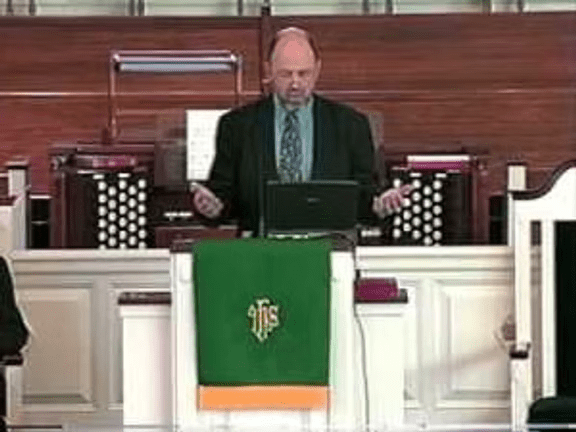
Notice how priests stand to present a sermon?

This uplifting of Peter can then be seen as the Resurrection of Jesus within him.  Whereas Jesus had previously been “in the middle” of “these” people who were in the upstairs room, as their leader and the “center” of their attention and devotion, Peter then took that position. It is then also vital to grasp that this was on the Sabbath, and the day before Pentecost (the “Fiftieth Day”), when the Holy Spirit came upon all of the disciples.  Peter then spoke as a rabbi, before his synagogue family.

The separation of the Greek word “eipen” (the past tense of “legó”), which translates as “said,” is then placing important emphasis on the act of speaking that Peter commenced doing. This acts then as a precursor to the writing in chapter 2, when on the day of Pentecost we read, “Then Peter stood up with the Eleven, raised his voice and addressed the crowd.” (Acts 2:14) The same elevation of Peter’s spirit took place then, so that he spoke the Word of God (as “uplifted voice”), rather than simply standing up and yelling at a crowd of people. While it can also be assumed his voice was loudly heard, the greatest importance is intended to be on the message that came forth. Thus, the segregation of this one word in chapter 1 places the same focus on the Word being “said” by Peter.

When a separate segment of words translates to say, “Was moreover number of names the same,” this raises the intent of “auto,” being at the end of a “number of names,” to a higher level.  The translation of “te” as “moreover” can be misleading, as it makes this segment clearer when translated as “both.” This then is saying that “both” Peter and the “number” (or “crowd” of “people in common,” from “ochlos”) of those he stood in the middle of were “the same” in “having stood up,” where (again) that means they had all become resurrected in spirit. It says they understood what Peter “said,” because all of them then shared the “same name,” as their “names” had become one (“the same”) with Christ.

That is significant to grasp, because in this scene Peter acts like a priest in a church, amid a congregation. Because he spoke, it is easy for modern Christians to see Peter as special or more filled with the Holy Spirit than the others. However, that is not the case and should not be taken as such, then or now.

Because “the number of names was the same,” Peter “said” what everyone else would have “said,” as it was also “said” within “them” (alternate translation of “auto”). Those to who Peter spoke were just like Peter, “both” (“auto”) human and divine, because Jesus Christ had entered “them.”  Regardless of what “names” their parents had given them, they were all resurrections of Jesus Christ. That is why those (or “these”) Jews were also Christians (“both” and “the same”). Therefore, none of them were lost intellectually as Peter spoke; and none left the upstairs room saying, “I had no clue what Peter was talking about.”

Not on the same mental wavelength?

When the final segment of verse 15 says, “about a hundred twenty,” this can be misleading too.  It can seem as if the number was not clear, as an estimate, where the number could be more or less. That is not the way to read the meaning of the Greek word “hōsei.”

The “number of names” totaled exactly one hundred twenty – no more, no less. This means the word “hōsei” is better translated as “like” or “as it were.” This then makes the word become a direct link to the previous segment, where being “the same” is then being “alike.”  As such, it conveys the message: “the number of names [of those] like” Jesus Christ was “one hundred twenty.”

This number is then a factor of ten, which yields twelve. According to Wikipedia, under the heading “Tithe,” Mosaic Law established ten percent as the amount of one’s produce reaped at harvest, which is owed to the Levites (who owned no land and grew nothing to harvest.  Thus, the Israelites were required to supply their priests with the bounty of the land (the Counting of the Omer is a ritual associated with that first harvest).

The article states: “The first tithe is giving of one tenth of agricultural produce (after the giving of the standard terumah) to the Levite (or Aaronic priests).”

Since Jesus was of Levitical descent and himself a Temple of the LORD, he too would set aside ten percent of his fruit harvested, as that dedicated to doing God’s work. This would now be reflected in those numbering one hundred twenty, who served God through Jesus.  That would have been a number fixed during Jesus’ ministry – after he had gathered together his own. He chose twelve disciples as a ten percent tithing to God.  Therefore, the speech given by Peter, which was well understood by the others, was saying that Jesus Christ required ten percent of his followers to become dedicated leaders of his Church. Without Judas, that number was unfulfilled and in need of replenishment.

In addition, this made the selection of twelve also be symbolic as the “elders” of the Twelve Tribes of Israel, where each leader was like the father (patriarch) of a family (women and children), while being brothers to the other elders. Because Judas Iscariot had been selected to represent one group of Jesus’ disciples, he acted as the father to that group of followers (a priestly term).  Judas’ death meant it was necessary to elevate a new follower of devotion into his vacated slot.

While not stated (just as Matthias and Joseph called Barsabbas, known as Justus were unheard of prior, and never mentioned directly again in Scripture), it may be that those two names were selected from those who were of the “family group” headed by Judas Iscariot. The meaning of the name Joseph implies an “Addition,” where “Barsabba” is not of Hebrew origin, believed to mean “Son of War.”  Because Justus means “Just,” it implies a Roman name, which could be stating that Judas Iscariot recruited a former Roman soldier (a Jew) to follow Jesus.  As for Matthias, his name meaning is “Gift of Yah[weh],” which could indicate one who was a financial contributor the Jesus’ needs.  If so, Matthais would have been introduced to Judas because he was the holder of the money for the family of Jesus.  That could mean that Judas Iscariot, in all sincerity, opened Matthias to becoming a devotee to Jesus, in the group fathered by Judas.  This analysis makes these lone appearances of the names here have hidden meaning be exposed, which adds to the depth of the meaning that is otherwise missed.

By seeing the death of Judas as a need to promote one of his own recruits to the position of respect that Judas once had (as one of the twelve), that makes the words of Peter speak the truth.  When he said that Judas was, “one of the men who [had] accompanied us during all the time that the Lord Jesus went in and out among us, beginning from the baptism of John until the day when he was taken up from us,” Peter pronounced that Judas was a good disciple until he fell from grace.  Even then, he fell from grace with purpose, as a necessary sacrificial lamb, one who fulfilled the prophecies of David (in psalms).  Therefore, the selection of Matthias (by casting lots) would then mean that the guilt of one evil disciple would not transfer to others (guilt by association), as the devotion to Jesus, by those who had liked Judas and come to Jesus because of him, had not wavered by Judas’ betrayal of Jesus.

To further this possibility, one should look to the Psalms quoted by Peter (omitted from this reading). The first quote comes from Psalm 69, verse 25, where David wrote, “May their place be deserted; let there be no one to dwell in their tents.”  That says the traitor Judas had no blood family that followed Jesus. Thus, there was no one who would stand by Judas, in support of his betrayal.  While it would have been natural (possibly even a requirement) that the disciples of Jesus would have previously fulfilled their roles as married fathers (respectful Jews in the eyes of God), it was not a requirement that the families of the disciples also follow Jesus. For example, James and John of Zebedee left their father behind, so those two would be replaced by hired hands. This means Judas had led other people to follow Jesus, not his own blood relatives.

As such, Psalm 109, verses 8 through 10 states:

May his days be few; may another take his place of leadership.

May his children be fatherless and his wife a widow.

May his children be wandering beggars; may they be driven from their ruined homes.

That says Judas’ time as a disciple was limited, but another would rise from his ashes to take his place. Instead of a blood relative, it would be a spiritual brother who was devoted to Jesus, one who was in the church of his followers, due to Judas. The implication (in my view) is that Matthias and Justus were nominated by the family group that was in Christ because of Judas Iscariot.  That group chose two men from among their group of ten people, with those choices then approved by the whole church (all 120). After that process was concluded, the two chosen “cast lots,” which could mean they chose from straws cut to various lengths [or maybe they tossed smoothed stones at a wall].  The one who pulled the straw of the desired length [or tossed the stone closest to the wall] was then selected the leader of a family group, as the twelfth disciple.  While Matthias was chosen, Justus would have remained a devoted disciple.

This is how the selection of any church leader should be, from vestry members to bishops to popes.  The selection process demands that the whole body be: A.) Capable of being chosen as a representative for a family group; B.) Filled with the Holy Spirit, as a true resurrection of Jesus Christ; and C.) Led by the Mind of Christ, thus in access of full knowledge of God’s Word.  If all in the Church meet these requirements, then all votes to place a member at the table of twelve should be unanimous.

As a lesson set forth in the final week of the Easter season, the grasping of a personal  need to have the Resurrection of Jesus Christ be within is realizing one’s need to “stand up within the midst” of oneself.  In one’s own heart one must be Anastas, a name meaning Resurrection.  One must be reborn of “brother” Jesus, whether one is a male or a female human being.. One needs to be added to the long list that is the “number of names” that have all shared “the same” Holy Spirit as Jesus Anointed in those reborn.

It is important to see how oneself must speak in the name of Jesus Christ, led by the Holy Spirit to speak of Scripture powerfully, so others can feel drawn to know the same truth. A Christian is then defined as a “friend” in a church of family, where all are “allotted [each] his [and her] share in this ministry” of God’s Word. To stand up and speak is to be true to Jesus Christ; but to sit silently (or to speak against Scripture, literally and figuratively) is to betray the Lord, as did Judas Iscariot.

It is a valid point to see Gentile converts to Christianity (Americans who are not Jewish by birth) as the family gathered by Judas, led to the truth by the truth.  Regardless of the flaws within he who initially showed that light of truth to others, true Christians are devoted to God, not His servants. The stigma of being Christian comes when one has been told there is nothing more to do, once one professes belief that Jesus was the Son of God.  People who preach that message are only looking for their own thirty pieces of silver, betraying God and Christ by misleading souls.

The Temple leaders knew their payment to Judas was blood money, once he threw it back at them.  The money was cursed to them, so they used it to purchase Potter’s Field, where the earth was red clay.  That name has become synonymous with graveyard for paupers and wayward souls.
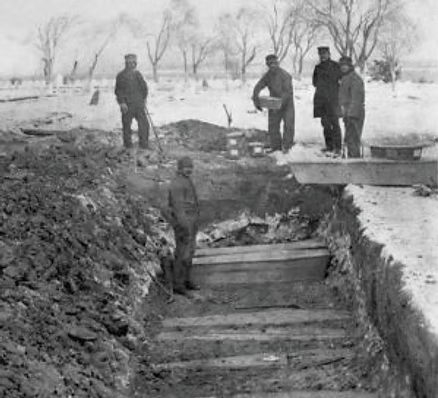
Mass graves with no last rites?

One who follows the lead of a Judas then find his same end, which leaves one standing on the “field of blood,” like the one where Judas was destroyed.  The omitted verses in the middle of this reading has Peter telling the story of that tragedy, which comes when one cannot stand and speak the Word:

“With the payment he received for his wickedness, Judas bought a field; there he fell headlong, his body burst open and all his intestines spilled out. Everyone in Jerusalem heard about this, so they called that field in their language Akeldama, that is, Field of Blood.” (Acts 1:18-19).

The Easter message is to be filled with the blood of Christ. One needs to be Resurrected in his name for that relationship to commence.  The sacrifice of ego, for a higher self, brings that about, while the sacrifice of servitude to God brings about the weakness of Judas.


Acts 1:15-17, 21-26 – Making an even dozen

In those days Peter stood up among the believers (together the crowd numbered about one hundred twenty persons) and said, “Friends, the scripture had to be fulfilled, which the Holy Spirit through David foretold concerning Judas, who became a guide for those who arrested Jesus– for he was numbered among us and was allotted his share in this ministry. So one of the men who have accompanied us during all the time that the Lord Jesus went in and out among us, beginning from the baptism of John until the day when he was taken up from us– one of these must become a witness with us to his resurrection.” So they proposed two, Joseph called Barsabbas, who was also known as Justus, and Matthias. Then they prayed and said, “Lord, you know everyone’s heart. Show us which one of these two you have chosen to take the place in this ministry and apostleship from which Judas turned aside to go to his own place.” And they cast lots for them, and the lot fell on Matthias; and he was added to the eleven apostles.

——————–

This is the mandatory reading from the Acts of the Apostles for the seventh Sunday of Easter, Year B, according to the lectionary for the Episcopal Church. This will be followed by a reading of Psalm 1, which sings, “They are like trees planted by streams of water, bearing fruit in due season, with leaves that do not wither; everything they do shall prosper.” An Epistle reading from First John will then follow, which states: “Whoever has the Son has life; whoever does not have the Son of God does not have life.” Finally, a reading from John’s Gospel will be presented, where Jesus said, “And now I am no longer in the world, but they are in the world, and I am coming to you. Holy Father, protect them in your name that you have given me, so that they may be one, as we are one.”

To begin to understand this reading, one must know the setting. That setting is this: The risen Jesus had appeared to his disciples on the seventh day in the Counting of the Omer, and then again after 6:00 PM when it became the eighth day officially (Monday). Beginning on Tuesday, the ninth day in that count, Jesus entered each of his followers, family, and disciples, where he stayed with them for forty days – the same number of days that Moses stayed with Yahweh on the mountain top. On the forty-ninth day in the Counting of the Omer – a Sabbath – Jesus ascended to heaven and the disciples were left alone to themselves, still not yet filled with the Spirit that would return Jesus’ soul to each of them [a Pentecost happening]. Because “Pentecost” means “Fiftieth, there was only the time between 11:00 AM on the Sabbath and 9:00 AM on Pentecost Sunday for them to hold this election to replace Judas Iscariot. That means the timing of this event told of here took place later on the same day as Jesus’ Ascension.

By realizing this timing, it makes no sense to begin verse 15 [and this reading selection] with the phrase “In those days.” The only “days” possible to consider would be all the forty “days” that Jesus spent within each disciple, because not one day has passed since Jesus appeared to ascend from them. From that realization [and looking at the Greek text], one sees verse 15 begins with a segment of words that leads to a comma mark of separation, with the first word being a capitalized “Kai.” That means it is most important to understand the words that follow.

The beginning segment of verse 15 states this: “Kai en tais hēmerais tautais ,” which importantly states, “in them days these”. The spiritual elevation in meaning cannot possibly be talking about time passed, as the capitalized “Kai” is directly pointing to what has Spiritually occurred “in them,” who are the family, followers, and disciples gathered together after Jesus ascended. What is “in them” is the equivalent of “days,” where “hēmerais” is relative to the plural number of “them,” where within them has come “the period from sunrise to sunset” [Strong’s definition of “hémera”]. That makes “day” be their souls having been given eternal life, as they only are led by the “light of day,” with no darkness again to set within “these.” The word “tautais” then reflects the souls of “them,” who have been promised eternal life after physical death, so “these” souls no longer have doubts or fears, as Yahweh has enlightened “them.”

Following the comma mark that sets that important aspect that must be know is written this: “anastas Petros en mesō tōn adelphōn”. That has been translated above as “Peter stood up among the believers.” In this, “stood up” is a physical statement that takes the liberty to transform a word that means “to raise up, to rise” [Strong’s definition of “anistémi”], with accepted usage implying “I set up; I rise from among (the) dead; I arise, appear” [Strong’s Usage], to give the impression that everyone was lazily sitting about, until Peter decided to stand up and talk. This is not what is being stated.

Whenever such words like “raised” are used, because it is used in holy text describing a character of Yahweh, the meaning must be seen as a statement of Spiritual elevation. As such, Peter’s soul had become “raised,” so if one wants to use the term “stood up,” then that must be seen as secondary in importance. This then leads to this place of “rising” being “in, on, at, by,” and/or “with” [from “en”] all who are present, with all being “in” tune with Peter, “among these” likewise having been with Jesus for forty days. That then leads one to “midst” [from “mesō”], where being “in the middle” of a crowd of people is less important to see than everyone interconnected to the center of Peter’s being [i.e.: his soul].

That makes more sense when the last two words of this segment says “tōn adelphōn” which says “of those brothers.” Here, “of those” [the genitive masculine plural of “ho”] says the souls of all were one “with” Peter’s soul, such that all were equally “raised” like Peter, as he reflected the “midst of those” also. This unity of souls then identifies them as being “brothers,” when that cannot be seen as all having the same father. This is known as a fact, due to verse 13 identifying the male disciples, with James and Judas stated to have been the sons of two different fathers. Therefore, “brothers” needs to be understood.

Last Sunday, in John’s Gospel, Jesus referred to his then calling his disciples “friends.” They were no longer students or pupils and he was no longer the master or rabbi, because the disciples never knew where the next lesson would take them. As “friends,” rooted in the Greek word “philos,” they had become elevated in status. That statement by Jesus has to be seen as a Spiritually uplifted level of being, where Jesus was addressing the souls of his disciples as being where he would return to be joined with them permanently. Because verse 14 mentioned “with women , kai Mary this mother that of Jesus , together with the brothers of him,” this says all were “brothers” Spiritually – men and women. Therefore, verse 15 must be seen as a divinely “raised” soul of Peter becoming the voice for all joined together Spiritually – all as “brothers.”

Following a comma mark separating that “raising” of Peter, the word “eipen” is written, as a one-word statement that leads to a long dash [“—“], which the NRSV has shown as text enclosed in parentheses. The one word says, “brought word.” Following the elevation of Peter’s soul among all who were “brothers” of Jesus [including the women followers], Peter is then clarified as being the voice, as who would “bring word” or “speak” as the leader of the group.

When the NRSV translates the words between two long dashes as saying, “together the crowd numbered about one hundred twenty persons,” this misses some important clues that need more careful observation. The Greek text states, “ēn te ochlos onomatōn epi to auto hōsei hekaton eikosi,” which literally translates to say: “existed also multitude of names on the basis of that same as it were one hundred twenty.”

In this, the verb “ēn” and the personal pronoun “auto” need to be read so this aside has divine importance and is not just unnecessary ‘stuff’ taking up space on paper. The word “ēn” is the “first/third-person singular imperfect indicative of εἰμί (eimí)” [Wiktionary], where “eimí” is a state of being, “I am, I exist.” Whereas the normal translation of this word is as “was,” one gains more depth of meaning by seeing the state of being in the souls of the disciples, now voiced by Peter, is the same state of being that also “existed” in each of the one hundred twenty others. Then, the word “auto,” which translates as “self, he-she-it, the same,” needs to be realized as stating a reflection that these other “selves” [i.e.: souls], saying they were in “the same” state of being as were the disciples. Because of that, they could choose equally from the others, such that the “twelve” number is simply a reflection of one-tenth of the whole that were all “brothers” who had spent forty days with Jesus.

With that understood, following the second long dash is a one-word statement that is the capitalized Greek word “Andres.” That translates as “Men.” The NRSV, in an attempt by the Episcopal Church to show favor that was not written, refuses to define this word as such, preferring to change it completely and state “Friends.” All of that misses the point of capitalization bringing forth divine meaning to the word. Both men and women must be seen as included in Peter’s address, as that includes them in the 120 who were all “the same” in soul state of being. Thus, the divine essence comes when “Andres” is translated as “Human beings,” where the masculine hint says they are all beings of flesh holding a masculine Spirit within.

Following the comma mark, another one-word statement is made, which confirms that needing to be read into “Andres.” That word is “adelphoi,” which means “brothers – a word the Episcopal Church refuses to acknowledge whatsoever. The prior use of “brothers” was translated in verse 15 as “believers.” Again, their intent is to patronize women in the church [they put more into the coffers], rather than understand the truth that “brothers” holds. The term is not meant to reflect upon a male-dominated world of inequality. Instead, “brothers” is meant to be read as all souls [both in male and female bodies of flesh] having a Spiritual bond together, such that all have spent forty days as the home of Jesus’ soul. That makes them all Sons of Yahweh, “brothers” of Jesus, regardless of one’s human gender. Therefore, Peter speaking for the whole group of men and women has just identified they are Spiritual homes for Yahweh, as “Human beings” with saved souls, so they were all [males and females] “brothers” in relationship to Jesus.

Peter then announced: “the scripture had to be fulfilled, which the Holy Spirit through David foretold concerning Judas.” Just the mention of the words “Spirit” and “Holy” says this is not Peter speaking, but the Father speaking through him. Yahweh knows why prophecy was written and which needed to be fulfilled, not Peter the man. Thus, the soul of Peter was “raised” to speak the Word of Yahweh, as it pertained to the group. As such, the whole group knew the truth of what was said.

The literal translation of the Greek text has this spoken: “it was inevitable to have completed that scripture which foretold this Spirit this Holy through eloquence of speech of David concerning Judas.” That is less a remarkable insight Peter had, because he was so smart, and more a common knowledge address that was brought upon them all. It came through the Spirit that made them all be “Set apart by God” [“Hagion”].

The part where David’s psalms were quoted have been skipped over in this reading selection. That means it is not important for the seventh Sunday of Easter to delve deeply into specific prophecy that was fulfilled by Judas’ acts. What is more important is the necessity to replace Judas, after he had removed himself from the group by his actions that had Jesus arrested and then his own self-punishment that kept him from ever returning to the group, forgiven. Thus, Yahweh spoke through Peter’s flesh, telling the group that it was important to maintain a 1:10 ratio, of leaders who served the needs of the whole and the whole who had been “allotted a share in this ministry.”

Verse 21 is then translated by the NRSV as saying, “So one of the men who have accompanied us during all the time that the Lord Jesus went in and out among us”. This translation seems to have been modified to make up for missing verses, as it misses the truth of what is written. Verse 21 begins with the capitalized word “Dei,” which gives it divine elevation in meaning. The lower case definition is “it is necessary,” but a less frequent acceptable use is: “it is a duty, what is proper.” Thus, realizing Yahweh is speaking through Peter to all who are likewise in tune with Him, the reminder about prophecy matching recent events says “Duty calls.”

The Greek text of verse 21 then fully states: “Dia oun tōn synelthontōn hemin andrōn , en panti chrono hō eisēlthen kai exēlthen eph’ hēmas ho Kyrios Iēsous”. That literally translates to state [in two segments of words]: “Duty therefore of this having accompanied us men , among all time that came in kai went out on the basis of us that Lord Jesus”. This says the divine sense of “Duty” has always been the driving force within those following Jesus [including Judas], as over “time” disciples were added that “came in” their ranks, one of which was Judas Iscariot. However, the important point to remember is those who “went out” in internship, through the commissions that served the Lord Yahweh, as trainees that were the embodiment of Jesus’ soul in other flesh, sent into ministry. This is then so much more than simply needing to replace a traitor, as it is the “Duty” to maintain the same balance Jesus had orchestrated, through the Mind of Yahweh within him.

Verse 22 then is translated by the NRSV to state: “beginning from the baptism of John until the day when he was taken up from us– one of these must become a witness with us to his resurrection.” This is an accurate translation, other than the fact there is not a long dash, but a comma mark separating the last segment of words. In that, it is important to see the word translated as “witness” as coming from the Greek word “martyra.” Because this is still Yahweh speaking through Peter, one needs to see how the “Duty” does not require one who has seen Jesus resurrected with physical eyes, but one who has seen as Jesus resurrected within one’s being. Thus, the requirement that must be met in order to be on the ‘board of disciples’ is one has to have sacrificed self-will and self-ego, so one has been reborn as Jesus.

That is most important to grasp, because there could never be another true bishop [if that is the term to use] in all of Christianity, because no one has seen the resurrected Jesus with physical eyes. Paul would see someone and hear a voice that called his name, who identified himself as Jesus; but if having laid eyes on the resurrected Jesus was a requirement to serve a true Church of Christians [all reborn in the name of Jesus Christ], Christianity would have died a long, long time ago. Being a “witness,” therefore, means being reborn as Jesus; and, that is the definition of a Saint. Christianity was built by Saints, not people who wanted to be in a club or social group.

Verse 23 then says, “So they proposed two, Joseph called Barsabbas, who was also known as Justus, and Matthias.” This translation is lacking, as it does not show this verse beginning with the capitalized word “Kai,” showing great importance in the two-word statement “estēsan dyo.” The word “estēsan” simply means “they appointed,” but the root word [“histémi”] means, “to make to stand, to stand,” with implied usage meaning “trans: (a) I make to stand, place, set up, establish, appoint; mid: I place myself, stand, (b) I set in balance, weigh; intrans: (c) I stand, stand by, stand still; met: I stand ready, stand firm, am steadfast.” (Strong’s Definition & Usage) This needs to then be read in the same way “raised” did not means Peter “stood up.” It needs to be seen with the great importance that those “two” nominated to replace Judas “stood out” as the ones to consider.

Since the voice of Yahweh mentioned “from the baptism of John,” that must be understood as the official beginning of Jesus’ ministry. When he met Simon bar Jonah, Jesus told him his name would be “Cephas,” which was Aramaic for “Petros” or “Peter.” This renaming by Jesus must be seen as Yahweh speaking through Jesus, so Simon bar Jonah [Simon son of John] would be known within the group as “the Sone” or “the Rock.” That history needs to be recalled before addressing a similar potential in the naming of “two” who quite importantly “stood out.”

Because we read the first name stated as “Joseph called Barsabbas,” the “Barsabbas” name means “son of Sabbas.” The meaning of that name is “Son Of An Oath.” It is a masculine opposite of the female name Bathsheba, which means “Daughter Of An Oath.” The name “Joseph” means “Increaser” or “He May Add,” but all of those names are stating the disciple before he became a student of Jesus. Most likely, Jesus told him, “You will be called Justus,” a name that means “Just.”

There is no such development of the other name that “stood out,” which was Matthias. That name means “Gift of Yah[weh].” It might be assumed that the lack of name changes says Matthias came with the name his father gave him; and, he was known by Jesus to live up to that name given. In any case, both men must be seen as exemplary in their nominations, with either worthy of a position of responsibility. There was no other meaning behind naming such leaders, as no one of the whole had greater or lesser abilities, as all were souls married to Yahweh.

Verse 24 and 25 becomes a NRSV run-on, where the verse 24 part says, “Then they prayed and said, “Lord, you know everyone’s heart. Show us which one of these two.” In this, the verse actually begins with the word “kai,” showing the importance of the one word that states, “having prayed.” That makes this not some procedural matter, where it did not matter who was chosen. The “kai” points out the value they placed on one taking on a position of responsibility.

Following that one-word statement, a comma mark leads one to read another one-word statement that says, “they said.” Here, again, is use of the Greek word “eipan,” which was seen before Peter began to speak. This is again a statement of Yahweh coming to them, as a result of prayer, such that just as Peter spoke what they all heard from within, the same “word brought” or divine “command” spoke.

This spoken first is two capitalized words, “Sy Kyrie,” which translates as “You Lord.” This gives the impression of the disciples praying those words, but the capitalization of “Sy” gives a divine elevation to the pronoun “You” that needs to be seen as Yahweh speaking to those who “having prayed” are now “brought word” that identifies them in the second person, a recognition that says the disciples were known by Yahweh. The capitalization of “Kyrie” then says they all have Jesus as their “Lord.”

This then leads to the word “kardiognōsta,” which is a statement of one who knows hearts. In modern terms, we would call this a “cardiologist,” but the symbolism must make a “heart” be relative to a soul. With this word following “Lord,” which means Jesus as the soul who then led their souls and their bodies of flesh, Jesus knew their hearts by coexisting with their souls. The word “pantōn” following says “all,” who were there and were those able to make that claim.

After a comma, the next segment of words states, “proclaim which you have chosen from out of these those two”. This says Yahweh has put it in their hands to decide correctly which of two should take the twelfth position of leadership. Because they [“You”] are all led by Jesus [their “Lord”], they will make the right choice. That is then the final one-word statement, following a comma mark, which says “one.”

The continuation of the NRSV run-on then says, “you have chosen to take the place in this ministry and apostleship from which Judas turned aside to go to his own place.” In this, the use of “kai” needs to be placed before the one-word statement that is “apostleship.” The Greek word “apostolēs” is written, which becomes a statement of importance that is above being a simple disciple.

Again, last Sunday the Gospel reading had Jesus calling his “disciples” his “friends.” In Acts the term “disciples” disappears, as they had all changed into “apostles.” The truth of the word written is less about a title and more about the truth of the word, which states “one sent on a mission” or “one dispatched.” This word then relates one back to the “kai’ introducing the “time” during Jesus’ ministry when the “disciples” were “sent out.” Thus, Judas was one “sent out” with Jesus-given talents; but he chose a selfish end [“go to his own place”] rather than a selfless end that becomes the truth of “apostleship.”

Verse 26 then says, “And they cast lots for them, and the lot fell on Matthias; and he was added to the eleven apostles.” While this translation catches the intent of what Luke wrote, it gives the impression that some sort of tool was used tot make this decision, such as rolling dice, bones, or even using a deck of Tarot cards [or some other mystical system].

What should be seen is 120 strips of papyrus given to each person in the upper room; and, then with each having in essence a ballot, a marker of some kind could be passed around, where each one wrote a “I” or a “II” [possibly an “X”] on the ballot, and then folded it an “cast” that into a bowl of some kind. The Greek word “klērous” translates as “lots,” does not need to mean more than saying, “each was allotted an equal vote of one.” In this sense, the response of Yahweh said he was not going to control who the twelfth apostle would be, as any one of the 120 would serve God well, as His Son resurrected. So, a popular vote would suffice.

As a mandatory reading from the Acts of the Apostles during the seventh Sunday of Easter, the message that should be found here is twofold. First, being married to Yahweh and being reborn as His Son, being oneself elevated into Yahweh’s family as an Anointed one, is something that must be seen as a privilege and not something to misuse or mistreat. To be entrusted with a mission from Jesus and sent out with the tools of divinity at one’s use, to betray that trust [faith] means self-ruin. Second, to be married to Yahweh and being reborn as His Son means equality, such that all “Christians” are one church, where all members are equally Jesus reborn and all Sons of Yahweh [regardless of human gender].

In the Easter season, when one has been determined to be married to Yahweh and proved to be His Son reborn, the forty days spent with Jesus – one with one’s soul – is the time to feel comfortable letting Jesus lead your body to do God’s Will. When one ‘comes down from the mountain’ after forty days with Yahweh, it is time to be sent on a mission that does not come to an end. There is no ‘retirement’ from this ministry; and one will love doing the work of Yahweh as long as one has breath left in one’s flesh.