Tag Archives: Acts 2:1-21

Acts 2:1-21 – The Feast of Fifty Days

When the day of Pentecost had come, the disciples were all together in one place. And suddenly from heaven there came a sound like the rush of a violent wind, and it filled the entire house where they were sitting. Divided tongues, as of fire, appeared among them, and a tongue rested on each of them. All of them were filled with the Holy Spirit and began to speak in other languages, as the Spirit gave them ability.

Now there were devout Jews from every nation under heaven living in Jerusalem. And at this sound the crowd gathered and was bewildered, because each one heard them speaking in the native language of each. Amazed and astonished, they asked, “Are not all these who are speaking Galileans? And how is it that we hear, each of us, in our own native language? Parthians, Medes, Elamites, and residents of Mesopotamia, Judea and Cappadocia, Pontus and Asia, Phrygia and Pamphylia, Egypt and the parts of Libya belonging to Cyrene, and visitors from Rome, both Jews and proselytes, Cretans and Arabs– in our own languages we hear them speaking about God’s deeds of power.” All were amazed and perplexed, saying to one another, “What does this mean?” But others sneered and said, “They are filled with new wine.”

But Peter, standing with the eleven, raised his voice and addressed them, “Men of Judea and all who live in Jerusalem, let this be known to you, and listen to what I say. Indeed, these are not drunk, as you suppose, for it is only nine o’clock in the morning. No, this is what was spoken through the prophet Joel:

`In the last days it will be, God declares,

that I will pour out my Spirit upon all flesh,

and your sons and your daughters shall prophesy,

and your young men shall see visions,

and your old men shall dream dreams.

Even upon my slaves, both men and women,

in those days I will pour out my Spirit;

and they shall prophesy.

And I will show portents in the heaven above

and signs on the earth below,

blood, and fire, and smoky mist.

The sun shall be turned to darkness

and the moon to blood,

before the coming of the Lord’s great and glorious day.

Then everyone who calls on the name of the Lord shall be saved.’ ”

——————————————————————————–

This is the fairly fixed reading that can be chosen as either the Old Testament selection or the Epistle selection for Pentecost Sunday, Year B 2018. The full reading is optional in Year A and Year C, making it a fixture reading for Pentecost Sunday.  Either way it may be selected, it would next be read aloud in church by a reader on Sunday, May 20, 2018. It is important as it tells of the disciples’ transformation into Apostles and Saints, when the Holy Spirit flowed strongly through each of them on the first day of the week that was Pentecost (the Fiftieth Day), marking the Festival of Weeks (Shavuot). It is important because it tells how the Saints of Christ do not speak of their own accord, but by the Will of God. The truth spoken by an Apostle is then fulfilled by the prophecy made by Joel, where that prophecy needs closer examination.

I was raised (from nursery cradle to fifteen) in an Assemblies of God church. That denomination is under the general umbrella of Christianity that is called “Pentecostal.” I was into my fifties when I learned that “Pentecost” is Greek, meaning “Fiftieth Day.” My assumption prior to that (as I do not recall ever having “Pentecostal” defined to me) was that “Pentecost” meant “speaking in tongues,” as that was a tenet of the Pentecostal branches of Christianity.

Now, I see my assumption (from being told “Pentecostal” means the belief in “speaking in tongues”) was somewhat of an oxymoron.  It must be, since one of the tongues not spoken appears, quite obviously, to be Greek. Otherwise, that branch of Christianity would be better named if there was no inference to being “Fiftieth Day related,” from “Pentecost-al.”  A more suitable name would be “Glossaipyros-al” (from the Greek “glōssaiand “pyros“), meaning “Tongues of fire related.”

The very first verse in this reading states, “When the day of Pentecost had come.” That demands one understand what the “day of Pentecost” is, as its mere mention states it was a significant day. It demands that one know the Israelites were commanded to forever observe three holy days with feasts (festivals). The three are: Pesach (Passover), Shavuot (Weeks [a.k.a. Pentecost]), and Sukkot (Booths). Each festival attaches a number of days of recognition to each of those specified days.

The Hebrew word “Shavuot” means “Weeks,” such that there were seven full weeks that took place after the Israelites escaped Pharaoh, until Moses came down with the sacred tablets. Forty of those days were spent encamped at the base of Mount Horeb, while Moses was on the mount with God.  The Covenant was then made on the fiftieth day (7X7=49, 49+1=50), after Moses came down with the sacred Tablets.

The festival that denoted the end of that counting of weeks was probably named Pentecost because of Greek rule over Jerusalem (following the Persians, prior to the Romans), as a translation of the statement of “fifty days” in Leviticus 23:16. If not, the Greek came after the Apostles spread into Greece and began writing Gospels and Epistles, where that became the translation for the Aramaic that spoke of the Feast of Fifty Days. Regardless of the etymology of “Pentecost,” there was nothing at all that would have predicted to Peter or the other eleven, “Pentecost is tomorrow, so get ready to start speaking in tongues guys.”

Realizing that, when we next read, “the disciples were all together in one place,” the only certainty of where that “place” was located was in Jerusalem, as stated in verse five (“eis Ierousalēm katoikountes” – “in Jerusalem dwelling”). We can assume that the specific place where they were all together was the same “upper room,” where they had shared the Passover Seder meal with Jesus.

This assumption comes from Acts 1:13, where the disciples had returned after the ascension of Jesus Christ. We read there, (“eisēlthon eis to hyperōon”) “they had entered into the upper room,” which is a statement of the same “upper room” prior.   Due to the influx of pilgrims seeking rooms in and around Jerusalem, for Jesus (after his resurrection) to remain in the Essenes Quarter with his disciples for forty days (most likely in unrecognizable form), the room could be retained and he could teach his disciples the meaning of the future that was coming.  As his Ascension was on a Sabbath, on the hill with olive trees (Mount Olivet) just outside the Essenes Gate, the disciples were within the limits on their walking distance (a Sabbath’s day walk – which is roughly a half-mile outside the city walls).  That evidence implies the disciples went back in the same “house” (from Greek “oikon” in verse two) they had remained in for forty-nine days, then preparing for the Temple ceremony for Shavuot.

When we read, “Now there were devout Jews from every nation under heaven living in Jerusalem” (literally translated as, “in Jerusalem dwelling”), this is a statement of the importance of Shavuot. As a commanded event that was fifty days later than the Passover events (an eight day festival), those pilgrims in Jerusalem were not coming from the airport, having just flown into town. The distances stated by the naming of places the pilgrims had come from says they all came for the Passover and stayed some place near Jerusalem for about two months. After that stay, they could return home.
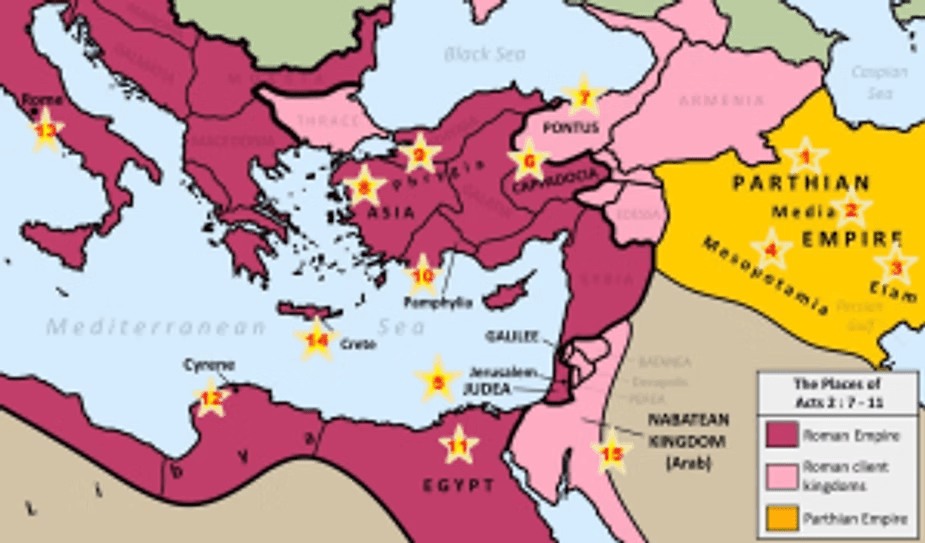
Fourteen places are named, but with twelve Apostles it is probable that a couple of nations shared a common language.

That distance means a traveler would have secured a place to stay (a “dwelling”) while near Jerusalem for two months. This could be “living” with relatives who still lived there, or it could mean staying in inns, or it could mean staying in “travel parks,” where groups of travelers all pitched tents and roped off donkeys and camels, within a reasonable distance from Jerusalem.

Keep in mind that Jesus fed a multitude of five thousand adult males (meaning perhaps a total of as many as eleven thousand, including men, women, and children).  Those were largely pilgrims who were preparing for the Passover Festival (John 6:4 – “The Jewish Passover Festival was near.”). Matthew wrote of Jesus feeding the same five thousand (Matthew 14:13-21), but then wrote of Jesus later feeding four thousand (Matthew 15:29-39).  The implication is the timing of the second miracle was prior to the Pentecost Festival.  That means those “living in Jerusalem” were many, all of whom had been there since prior to the Passover; and this swell of people there took place every year (maybe not with the exact same people), because it was a commanded observance.

It is worthwhile to note that the ritual observances demanded by God, through Moses, as stated in the Torah (Exodus, Leviticus, Deuteronomy, and Numbers), were not maintained over the centuries. Once the Kingdom of Israel divided, the people were not led to understand the reasoning behind their Covenant, such that the fall of Israel and Judah was seen as rooted in this noncompliance. There was not always a Temple with priests to offer sacrifices, and some see the efforts begun while in captivity in Babylon was an attempt by the captive Jews to relearning what rituals had been forgotten.  Because the Law had been forgotten, the exilic Jews (the Levitical priestly descendants) saw adherence to the Law as all important; and that included observing the commanded festivals.

In the reverse view, after the destruction of the Second Temple and the scattering of the Israelite people around the world (mirroring the spread of Christianity), there has again come a disconnect by Jews and Christians, relative to understanding the reasoning behind the Covenant and the new Covenant with Jesus Christ. Jews go through the motions of rituals without realizing the Messiah has come; and Christians have no grasp of the rituals that bring them into a Covenant with God. Everyone has changed the rules to fit their personal needs, rather than feeling the purpose of God demanding ritual feasts forever be maintained by ALL His chosen priests (thus a “New Covenant” that has been added to THE Covenant).

This lost sense of knowing why God wanted His people to observe the Passover and then fifty days later a festival of farmers taking their marked (with reeds) first fruits (grains) of harvest to the Temple for blessing, amid throngs of cheering Jews was the background setting to the story of Acts 2:1-21 (and 22-41). The people from all the nations listed were milling about during the morning of Pentecost, waiting for someone to finish a prayer and a rite, announcing the close of festivities so everyone could go home … finally.

Their devotion had led them there, seeking more; but so many Jews were looking for some greater reward, more than simply being God’s chosen people.  They prayed for something to happen that would make their devotion be more than routine obligation.  The scene of Acts 2 opens with that ripeness for receiving the Spirit.  Rather than grains and fruits (and cheese blintzes) being the reward of the First Fruits, the pilgrims themselves were about to be blessed as a good harvest.

Knowing this setting, all of the streets in Jerusalem would have been packed. All the pilgrims would have flowed in through every gate, as their customary way of ceremoniously renewing their vows to serve Yahweh.  Then, suddenly, “Came a sound like the rush of a violent wind.”

Imagine how people interviewed on the news after a trailer park has been destroyed by a tornado say, “It sounded like a freight train coming.” If they had freight trains back in ancient days, then maybe we would read here, “Came the sound like a freight train.” Not only did the ancients not have freight trains, but they had no machines that made loud noises that would be similar to any man-made noise. It must have sounded like a tornado, but those weather events are rare in the Middle East, including Israel.  Such a loud noise was totally unexpected, because even rain is scarce in the area during May and June each year (the time between Passover and Pentecost).

Still, this was so loud it filled the entire house and the noise spread outside.  It was so noticeable that it made the people in the streets stop and take notice. They all looked at the house where the disciples of Jesus were staying.

“What in the name of God could that loud noise be?” the pilgrims all asked.

Then, once they had stopped in their path, they looked hard and listened intently. They heard many men speaking loudly in many foreign languages (the real meaning of “speaking in tongues”); and everyone in the street heard some strange man speaking his own native language.

Then the men inside the house came outside.  Some might have gone into the street, while some might have gone out on a rooftop-terrace.  Once the men were seen – still speaking fluently in many different languages – they looked like Galileans.  That means they looked somewhat foreign to the big city, as they probably were not in refined dress, not looking dapper.  They might have had on funny hats or had their hair wild and un-braided.  Whatever the case, they certainly were seen as not being men of the world and high culture.

Still, that source of sound coming from the least of Jews was not reason for the pilgrims to return to the din of street movement.  We read that the pilgrims were all “Amazed and astonished.”

It is most important to realize that these foreign visitors to Jerusalem were not “amazed and astonished” because they heard rubes from Galilee saying things like, “Hello. Can you tell me where the hotel is? This is beautiful weather we are having, do you not agree?” as if they were automatically filled with the ability to speak a conversational language learned from Babble, Rosetta Stone, or The Idiot’s Guide to Mastering Foreign Languages.
The new Apostles were not babbling incoherently, using distinguishable languages recognized by the pilgrim Jews. They were preaching the meaning of Scripture (Torah, Psalms, and Prophets), which were lessons heard for the first time, leading the pilgrims to be “amazed and astonished.”  The fact that each pilgrim heard those lessons in his native tongue means there was no language barrier to overcome – no struggles with Hebrew, no need for translation, no idioms, sayings, or slang terms to overcome – as the multinational visitors heard clearly what no rabbi or high priest had ever told them before.

And that was coming from Galileans!

When we read how some said, “In our own languages we hear them speaking about God’s deeds of power,” that speaks of the power of God flowing from the mouths of His servants, explaining the hidden meaning that had never been exposed. That is why they “all were amazed.”  Still, they were also “perplexed.”

That state of wonder (amazement), followed by confusion and doubt (perplexity) means their hearts and minds had opened a crack, towards belief in the Apostles; but then their natural brain-driven reaction was to slam shut a protective shell of disbelief over the chance of human vulnerability.  Something wasn’t right!  They had to slam a harness around those hearts and minds.

We read how they began “saying to one another, ‘What does this mean?’”

Their brains began whirring, thinking about how Galilean fishermen, small town lawyers, former tax collectors, and general riff-raff Jews could be bedazzling and filling those international globetrotters with sudden wonder, speaking the truth so clearly … in foreign languages?

Then we read, “But others sneered and said, ‘They are filled with new wine.’”

This has to be seen as an explanation offered from the crowd, about how simple Jews could be speaking such deep levels of interpretation of Scripture. Being “filled with new wine” meant there were known past examples of how a drunken state could remove inhibitions in the brain, allowing people to utter thoughts freely, with surprising insight. The intent of such an explanation would be akin to thinking they might be speaking good ideas now, but wait until the influence of alcohol wears off and they return to being bumpkins, not remembering what they said while drunk.

Still, to have someone shout out, “They are filled with new wine” is the Holy Spirit already circulating around the crowd, influencing them to receive the messages spoken by Apostles.

Just fifty days earlier, Jesus had offered a prayer of thanks over the third ceremonious cup of Seder wine (the Redemption Cup), saying, “Drink from this, all of you. This is my blood of the covenant, which is poured out for many for the forgiveness of sins.” (Matthew 26:27-28) When Jesus then added, “I tell you, I will not drink from this fruit of the vine from now on until that day when I drink it new with you in my Father’s kingdom,” Jesus spoke prophecy that was then coming true.  It was that day. Jesus Christ had been reborn within his disciples, so they spoke as if “drunk with the new wine” of the Holy Spirit and Jesus was there with them … in the kingdom of Sainthood.

In this regard, Peter did not deny that he and his eleven brothers in Christ were drunk. Instead, he said, “Indeed, these are not drunk, as you suppose.” They were drunk, but in a way that was not imagined by the pilgrims.  They were drunk with the holy blood of Jesus Christ, through HOLY SPIRITS.

New wine (Greek “Gleukous”) is also called sweet wine, which is unfermented grape juice. It is a non-alcoholic beverage in that case, which might have been consumed by the disciples for breakfast. It would be a drink for the whole family to consume, and for adults to drink at any other time, when drinking spirits would be inappropriate. However, new wine can ferment unexpectedly and become alcoholic, causing one to drink it and unexpectedly get drunk. This is why Peter explained, “not … these are drunkards” (“methyousin”), where the denial was they were “not … intoxicated by wine.”

This was then spoken to the crowd by Peter, with the translation reading: “Peter, standing with the eleven, raised his voice and addressed them.” The better translation says, “Peter with the eleven  , lifted up the voice of him and spoke forth to them.”  This says more than Peter just began speaking in a loud voice, as the loud sound that attracted the crowd had come from the wind-like roar of the Apostles speaking loudly in foreign languages.

The Greek word “epēren,” which is translated as “raised” or “lifted up,” should be seen on a deeper level.  Peter and all the other Apostles were speaking loud enough to be clearly heard at some distance, but more importantly their voices were “exalted,” having been “raised” spiritually, as their words were “lifted up” divinely. This means that they all spoke from the Holy Spirit.  With “raised voice” Peter and the other eleven were having the Spirit of the LORD poured out through them. Thus Peter used the example of prophecy, coming from Joel 2:28-32.

It is so important to see how Peter was not simply explaining intellectually, using words that explained what he and the other Apostles were doing. Peter was not speaking from his brain when he implied that he and the gang were fulfilling the prophecy of Joel. That would not be “with raised voice,” but human words of reason.

Instead, Peter quoted Joel because the Father spoke those words for him to recite. It was not rote memorization being accessed within his country-bumpkin brain that Peter (et al) was speaking. Everything Peter and the eleven spoke came from the Mind of Christ, brought upon them by the Holy Spirit, which included the quote from the Prophet Joel.

When Joel was led by the Holy Spirit to write, “In the last days it will be, God declares,” it must be realized that the Greek word “eschatais” (from the root word “eschatos”) means “last, at the last, till the end, and finally.” This is the root word for the theological word “eschatology,” which places focus on “the end of the world or of humankind.” As such, some can read Joel and project what he prophesied is still to come, at that fearsome, grizzly end of the world that always seems just around the corner of present time.

However, as Peter was quoting then, well into the future of Joel’s prophecy, as Peter spoke it was the last days, and God was declaring through ordinary folk.

God then spoke the words of Joel, through Peter: “I will pour out my Spirit upon all flesh, and your sons and your daughters shall prophesy, and your young men shall see visions, and your old men shall dream dreams. Even upon my slaves, both men and women, in those days I will pour out my Spirit; and they shall prophesy.”

Peter and the other eleven Apostles were sons prophesying. They were seeing the truth of Scripture – the visions of Joseph, Solomon, and Daniel, the dreams of Ezekiel and Isaiah, and the slaves that were Ruth and Ester and Amos and Joel. The prophecies of old stories had been fulfilled in the man known as Jesus of Nazareth. The Old Testament’s prophecies were at last revealed. They were exposed as clearly as the light of the day time hours makes seeing possible.

When God then proclaimed through Peter, “And I will show portents in the heaven above and signs on the earth below, blood, and fire, and smoky mist. The sun shall be turned to darkness and the moon to blood, before the coming of the Lord’s great and glorious day,” had not all that just recently been witnessed by those pilgrim who had been in and around Jerusalem, since the Passover Festival that began seven Sabbaths prior?

Had not Jesus produced “portends,” which means “miracles” and “wonders” for the Jews (and others) to witness?

Had the people not questioned if he had been sent from heaven as the Messiah?

Had Jesus not made clear that he had been sent only to the “blood” that was the remnant of the Israelites known as the Jews?

Had Jesus not set a fire under the Jews that both followed him and saw him as a threat?

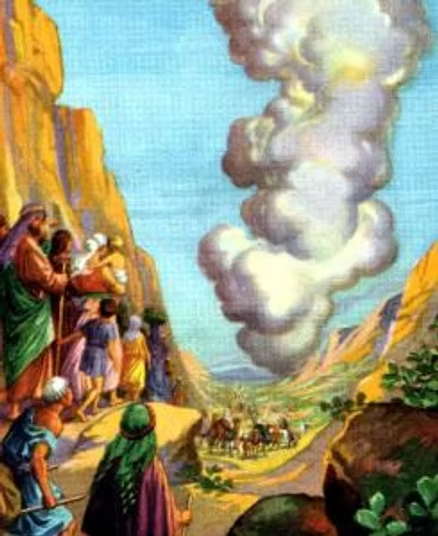
Did Jesus not appear to be the human equivalent to the daytime pillar of smoke that guided the Israelites through the wilderness of the Sinai?
Was not Jesus the proclaimed Son of Man, as the representation of the sun – the light of truth; and had that light not been darkened by his crucifixion? Did the sky not go dark in the middle of the day for three hours, as Jesus of Nazareth hung on a cross dying? Did the ever waxing and waning moon – symbolic of emotions overrunning one’s personality – not stand before Pilate, screaming, “Crucify him” to bloodcurdling levels?

Peter reciting Joel’s line, “Before the coming of the Lord’s great and glorious day,” was God’s way of announcing, “Today is the Lord’s great and glorious day!” God was announcing the return of His Son, Jesus Christ, returned the day after his ascension in all of his followers.

For all who look for the End of the World, as far as Christian theology is concerned, it was delayed coming by the presence of Saints in the name of Jesus Christ on that day of Pentecost. It continues to be averted as long as Jesus Christ exists in the world, via Saints filled with God’s Holy Spirit.

As far as this reading selection goes, Peter ended the prophecy of Joel by God pouring out of his mouth, “Then everyone who calls on the name of the Lord shall be saved.” On a city of Jerusalem street that was filled mostly with Jews, but Roman converts (proselytes) and Arabs as well, the use of the word “everyone” (Greek “pas”) must be seen as the first sign that Saints were called to serve “all,” as messengers of Salvation.

Peter himself did not know he should welcome Gentiles until later; but in the reading that continues (but not read aloud today), we learn that three thousand souls were baptized by the Holy Spirit that Pentecost.  Three thousand souls were then added to the number of Saints in the name of Jesus Christ. Those three thousand would return to their nations and begin a worldwide spread of Christianity.  While not stated, all of the fourteen named nations of peoples had converts that day, all filled with the Holy Spirit, each calling upon the name Yahweh, as Jesus Christ reborn.

As the one reading in the Christian liturgy that is consistently read on Pentecost Sunday, it is vital to have one’s eyes opened to the realization that none of the twelve men speaking in foreign languages that day had any lessons or experiences in learning those languages prior.  Likewise, Ezekiel had no prior experience prophesying to dried bones; but he did as God commanded.  Thus, speaking in tongues, as a miracle of foreign languages, is not the lesson presented in Acts 2.  Neither is the end of the world the lesson to be taken from Joel 2, as if babbling fools can point to some future date as when Jesus will return with vengeance.  The lesson is God speaking universally so all can hear and understand.

There is absolutely no one who is going to have his or her soul baptized by the Holy Spirit and be saved, given eternal life, because they hear someone speaking nonsense, uttering noises that no one can understand. Salvation does not come by learning to fake speaking in foreign tongues or pretending to know what gibberish means.  The brain plays no role in salvation, as it can only hinder that goal.
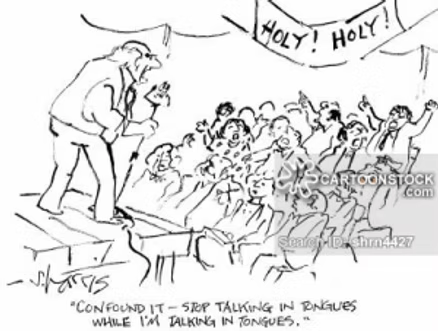
The miracle of Pentecost was speaking from the Spirit of truth, which Jesus prophesied in the Gospel reading from John 15-16.

The lesson of Pentecost is twofold. One, it is to hear the truth of the texts of the Holy Bible and understand them. Understanding comes from the Holy Spirit, not a book read, a course taken, or someone else’s interpretation that one is incapable of personally owning and defending. Two, it is the beginning of the end times of the old you. The selfish days of ignorance are over – ended forever.

Pentecost represents the end times of the release from bondage, when the Covenant with God is agreed on. It is when time spent learning has reached the point of teaching, such that one can only sit in a pew for so long, before realizing the Lord’s great and glorious day has dawned within oneself. Then it is time to go preach – prophesy to the breath – so that other can have the same chance for a personal experience with Salvation.

The lesson of Joel’s prophecy is not limited to the fulfillment that occurred the day after Jesus ascended into heaven.  The experiences of Peter and brothers in Christ was the beginning of this prophecy’s fulfillment.  It is fulfilled every time a disciple makes this transition.  All of the trials and tribulations from one’s own denial of God, Christ, and the Holy Spirit within oneself points to a new last days, as the end of a sinner’s ways and the beginning of a Saint’s service to God, as Jesus Christ reborn.

In this way Peter was speaking to the readers who would eternally be called to God’s Word.  Just as Joel wrote of all the coming sons and daughters of God, the spirit will always be poured out upon desiring flesh.  Just as Peter passed along the flow of the Spirit of truth, so do all God’s Saints.

#FestivalofWeeks #Matthew141321 #Shavuot #Lordsgreatandgloriousday #tonguesoffire #newwine #pillarofsmoke #Acts2121 #fiftiethday #speakingintongues #Acts113 #Acts22241 #Joel22832 #Matthew152939 #John64
In-Depth Pentecost Sunday Reading Explanations – Part 4 of 5 (John 20:19-23)

The two options for Gospel readings both come from John. One is John 20:19-23 and the other is John 7:37-39. The John 20 reading is also read every year in the three-year cycle on the Second Sunday of Easter, but those readings extend to verse 31 (an additional eight verses). The point of reading these five verses again is to see them in a new light, following forty days of preparation with the risen Jesus. The John 7 reading (only three verses) is important, if for no other reason that these three verses are the only verses scheduled to be read from this chapter, and it is only scheduled for reading on Pentecost Sunday.

Beginning with the first Gospel reading listed (John 20), it is important to realize fear is again an issue. The first verse (19) begins by stating it is “evening,” which means after 3:00 PM, but before 6:00 PM when night’s “evening” begins. For fear to have set in during the sun’s time overhead speaks of how little faith in God the disciples had. Rather than only fear God, we are told they locked the doors “for fear of the Jews.”

For all you self-righteous pseudo-Christians out there in the world, none of whom spent one second with the pre-death Jesus of Nazareth, much less the risen Lord Christ, see yourselves in the fear of being behind a locked door.  That upper room reflects your safe room, your sphere of influence.  More than a protection against others coming into your world – ones you hate and despise with all your heart – you lock the door to keep from having to extend beyond the self-comfort zone.  You are afraid of letting anyone like God make you submit to His Will.

Me thinks thou doth pout too much.

This element of fear was present in the Numbers reading. In the Acts 2 reading about Pentecost Sunday, when Peter told of Joel’s prophecy being fulfilled at that time, verse 31 sings, “The sun shall be turned to darkness and the moon to blood, before the coming of the Lord’s great and glorious day.”

As it was evening of day, here in John’s Gospel reading, “the sun had turned towards nightfall.” As the “moon” is a symbolic statement of “emotions,” “fear” was running through the veins of the followers of Jesus. So, this verse certainly can be joined to that Pentecost reading.

In the Greek of Peter, when he quotes from Joel, “the coming of the Lord’s great and glorious day,” that is divided into two segments of words. Peter spoke (as was recorded by Luke): “formerly that coming day of Lord,” before adding, “this great  and (“kai”)  glorious.”

This means the Prophecy of Joel foresaw the coming of the Messiah – the Christ – who would be called “the Lord.” The Lord would come with the light (“day”) of illumination, and that was what Peter and the eleven were sharing with the Jewish pilgrims on Pentecost morning.

The Hebrew of Joel uses “Yahweh” as the one who comes, which is the truth of “the Lord.” It was God who descended in a mist at the tabernacle. It was God’s Holy Spirit that illuminated seventy elders. It was God who flowed through the Apostles and spoke a new light that shone in the hearts of three thousand pilgrims. Still, in Paul’s epistle, he made it clear that “Jesus is Lord,” only via God’s Holy Spirit, with God being the Holy Spirit that returns JESUS into human flesh. Thus, the “Lord” of one’s flesh is named Jesus Christ, but JESUS comes from Yahweh, just like the cloud of mist that descended on the tabernacle and made seventy elder be illuminated by the light of the “Lord.”

When John wrote that “Jesus came and stood among them,” this is literally two statements: “came this Jesus” “and” (“kai”) “placed himself among the middle.” This indicates Jesus suddenly appeared in between his disciples and others who were in hiding. It does not explain that Jesus, as a ghost, came through a wall or a closed door and stood just inside the room. He suddenly materialized in “the midst” of men and women who knew him as “this Jesus.”

Imagine this event.

Place yourself in any event of gathering you can remember best. The room is crowded with people (perhaps twenty).

Maybe you are holding a conversation with one other person, or a group of three or four. You might even be sitting in a chair, perhaps next to your wife or husband. The mood is somber, like that of a wake, because of a recent death, but the earlier news about women seeing Jesus alive (although he did not look like Jesus) is the focus, simply trying to ward off the fear of being in a locked room. Then, someone is standing beside you, but in a crowded room that is not something to cause you to be alerted. Jesus became one of those milling about, unrecognized once again, but unrecognized because everyone’s fear kept them from focusing on anyone other than themselves, for the most part.

This is when Jesus said, “Peace to you” (“Eirēnē hymin”).

This was an attention getter, but it was more than a greeting. It certainly was not an Episcopalian catch phrase, to be used so often it becomes as meaningless as an old Hippie flashing two fingers and saying, “Peace!”

Meaningless words do nothing of value. They are just words. When Jesus said “Peace, Quietness, Rest” (all translations of “Eirēnē”) the capitalization written by Luke says Jesus’ word immediately gave all in the room “Peace of mind.” With that “Quietness,” fear was dispatched elsewhere.

With that fear gone, the disciples were then able to ponder a body of flesh they had seen (from afar), dead on a cross just two days before (Friday). They had heard it was prepared for burial, which meant men who could tell a live body from a corpse knew Jesus was dead. Now, rather than fear they would be next, they examined Jesus’ body of flesh, which still had the wounds of having been nailed and pierced, along with a crown of thorns scratching his forehead and whip marks on his back. With all that evidence able to be seen by the followers of Jesus, they “Rejoiced” greatly (from the word “Echarēsan” being capitalized in Luke’s writing).

John separated that statement of Happiness and Gladness with another segment of words, which state, “having seen the Lord.” The words “idontes ton Kryion” also say the disciples and others “perceived” or “experienced” their “Master,” who was God incarnate.

This says the disciples were not just real happy that Jesus was not dead, but alive. They were filled with great emotions that sensed God was in their presence. This is like how the sixty-eight elders must have felt when they saw a cloud descending from the sky, surrounding the tabernacle … before they began to prophesy.

Realizing this awareness of God in their midst, in the form of a body that had been dead, known as Jesus, this was their true epiphany.

While words had been spoken previously, when Jesus asked them, “Who do you believe I am?” The response that came divinely from Peter’s mouth, “You are the Messiah, the Son of God” was just that – God speaking through men without big brains of intelligence.

Now, for the first time, having perceived God as the only way a dead body could be standing before them, the disciples and others “Rejoiced,”  Then, Jesus told them once more, “Peace to you.”

Again, this is nothing like an Episcopalian greeting, where one says, “Peace of the Lord” during the break time, when (pre-coronavirus fears) everyone got up and milled about the aisles of a church, shaking hands, smiling, and hugging, before sitting back down (called “the peace”). The repetition here in John’s Gospel means a new form of “Peace” was unfolding.

First, “Peace” calmed the nerves of everyone in the room, but that “Peace to you” was external. When Jesus had let everyone examine his body as that of a dead man, with no earthly reason it could stand and talk, Jesus then said “Peace within you.” That equates true “Peace” as being the presence of God eternally with one’s soul, which is much better than feeling pretty sure God is real and somewhere else.

We realize this is the meaning intended, when John then quoted Jesus’ next statements: “As the Father has sent me, so I send you.” This too needs to be examined more closely.

The Greek text states, “kathōs apestalken me ho Patēr  ,  kagō pempō hymas  .” This literally translates to fully say, “according to the manner in which having been a messenger myself of the Father  ,  I also am permitted to go as you  .

The key root word is relative to “apestalken,” which is “apostelló.” That says Jesus was an Apostle of God the Father, such that the “messenger” (the meaning of “apostle”) of Yahweh is the Son Jesus. The word “kagō” is a combine form word that joins “kai” (“and”) and “egō” (“I”).  That usage means Jesus foretold (importantly) that his disciples would be joined with his “ego,” when they were to become Apostles (“messengers of God,” who would then truly be their Father).

You and me are one pardner, but I’ll do the thinning around here Baba Looey.

That says what Paul was stating in his epistle to the true Christians of Corinth, when he said you condemn your soul if you go around saying you are JESUS, when you are not. A true Christian is one who has surrendered self-ego, to take on the ego of the Christ Mind, thus becoming Jesus Christ reborn … in the name of Jesus Christ. This then becomes the antithesis of the Numbers reading, where the presence of God made seventy His Sons, so they could become His messengers; it was only for that one time. When one is reborn as Jesus Christ, it is the eternal living water that Paul said many members would drink.

When John then wrote the one-word statement – “enephysēsen” – it shows the importance of this one act: “he breathed upon.”

After having just spoke about the disciples going out to do the Father’s Will, just as Jesus of Nazareth had done, all of the disciples and followers had God’s life breath (i.e.: a soul) and it was that which kept their bodies of flesh from being dead. Jesus stood in their midst as dead body of flesh that had been resurrected, meaning his life breath (his soul) had returned to be one with God. However, the dead body of flesh that had been Jesus of Nazareth (born in Bethlehem) stood not because of the breath of life given by God, but by the Holy Spirit. Thus, Jesus had a ‘mind-meld’ with the followers, which is the meaning of “he breathed upon [them]”.

With the disciples knowing the Mind of Christ, just for that moment, they understood that by Jesus saying “Receive the Spirit Holy” it was God speaking to them through His Son.  God was offering, through His Son’s body, for them to have the same powers over mortal death. The capitalization of “Labete” (“Receive”) states the importance of letting go of their self-egos, so their hearts and minds and souls would sacrifice control over mortal flesh and welcome God in with love.

That would be a proposal of marriage; but as a proposal, the disciples had the free will to accept or reject God’s offer of a new Covenant.

This then leads to the final verse in this reading, which is read aloud as: “If you forgive the sins of any, they are forgiven them; if you retain the sins of any, they are retained.”

This is an enigmatic verse that is easily misunderstood. Therefore, it needs to be dissected, according to punctuation and analyzed carefully.

The segments of words written by John are as follows:

an tinōn  ,
aphēte tas hamartias  ,
apheōntai autois  ;
an tinōn kratēte  ,
kekratēntai  .

Without knowing any Greek, careful inspection should allow one to find that the words “an tinōn” are repeated.  Repetition in Scripture is a statement of importance. This means understanding “an tinōn” is an important first step, which is not insignificant.

The Greek word “an” is said by Strong’s to be “usually untranslatable, but generally denoting supposition, wish, possibility or uncertainty.” It is because of that “supposition or uncertainty” that “an” is translated as “if.”  The Greek word “ean” does translate as “if,” but the missing “e” means an unstated proposition made demands a decision.

This means a word of “possibility” should be read in the context of Jesus having repeated his command for “Peace to you,” with the addition of “Receive the Spirit” that makes one of the material world be “Holy” is a marriage proposal. The possibilities are for one to say “yes” or one to say “no.” This must be seen as the purpose behind the conditional word “if” being the translation.

The Greek word “tinōn” is the genitive plural form of “tis,” meaning “of or about some people.” To translate this as “any” misleads as “if” Jesus stood speaking as God speaking to everyone in the whole wide world. He was not. He was speaking to a select group of people who had followed Jesus for at least three years. Therefore, the statement is directed only  to those people, and should be read as: “if any of you here now.”

This translates to our modern times (and all times after John’s gospel was canonized) to “any” of those people who have the Spirit of Jesus Christ in their midst, making the same marriage proposal from God. The possibility is just as valid now as it was then. However, the proposition has absolutely nothing to do with “any” being “all in the world,” as it only is a proposal to those who “might become” the brides of God.  All are welcome, but for a proposal to come, there has to be some dating and flirting and atheists have no room in their hearts for any god but self.

With that grasped, the next segment of words states, “aphēte tas hamartias,” which has been translated as saying “forgive the sins of any,” when “of any” has already been stated separately, prior.

The literal translation states, “you might forgive [a conditional word] the sins.”

The Greek word “aphēte” is the second person subjunctive form of the verb “aphiémi,” which means “to send away, leave alone, permit.” Therefore, the second person subjunctive asks if “you might send away.” It implies one choosing the condition where one is “to let go, release, or to depart,” where “forgive” bears the same meaning of oneself “letting go, releasing, or quitting.”  The word “tas” is the plural feminine of “to,” meaning “the” of “this,” such that “hamartias” is the object one is asked – “sins” – as the question, “will you let go – the sins?”

The Greek word “hamartias” also means “failures, faults, and guilts,” that are part of one’s being, as the excuses one uses as the reasons [big brain talk] one does not walk a righteous path and serve God.  One’s failures are then from not going beyond the ‘dating’ stage, always keeping Him as an external ‘lover’ not a Husband.

This condition states that God knows all His ‘brides-to-be’ come with pasts that are sinful. No one can ‘forgive’ sins other than God, as true “sins” are only known by the faithful, who know the written laws that establish right from wrong. One who does not believe in Yahweh will do the same acts that a Jew calls a “sin,” but they will do it without any sense of guilt or failure.

No human being has ever been able to “forgive the sins of any,” but the Pharisees and Sadducees made a good living wage casting out proclamations of “sinner!” Even if one is filled with God’s Holy Spirit and is Jesus Christ resurrected in the flesh, Jesus Christ is not able to forgive any sins. Only God has that power.

With that rhetorical question stated (a hypothetical “if”), John recalled Jesus saying, “apheōntai autois,” which states, “they will be sent away” or “they will be let go and forgiven.”

Again, this is relative to God’s marriage proposal, sent through His Holy messenger, Jesus resurrected. “If” one of the disciples chose to say, “Yes. I will Receive God as my Husband. Please take my sins away from me,” then the answer is, “Okay. Your sins will be forgiven by God.”

Following a semi-colon, the alternative is stated by Jesus as, “If some [here now among us] wish (the conditional of “an”) to say, No.” then your wish will be granted. The key word here is “kratēte,” the second person subjective form of the verb “krateó,” which means, “to be strong, rule.” (Strong’s definition)

The implication of the usage says “If you should think “I am strong, mighty, hence: I rule, am master, prevail; I obtain, take hold of; I hold, hold fast,” then, by all means, do not marry God and give up a life that enjoys sins. If you choose option two, then “kekratēntai” – “knock yourself out.”  The last word, a one-word statement of importance, says, “You will be retained as you, with no changes made by God.”

Certainly, in the Numbers reading, when Joshua complained about elders (who he probably knew were not as holy as they pretended to be, but they acted the part so they could have all the adulation of their camps) being given the gift of God to speak prophecy, so the common Israelites might be swayed to think they were gods (elohim), Joshua saw that as crazy.  Joshua saw people as always sinners, who needed a strong hand to lead them to be righteous (if only pretending to be so).  Moses laughed it off.

Basically, Moses said, “People will be people. If only they could always speak the truth of God, as wives of the Most Holy Husband. Wouldn’t that be nice Joshua?”

Moses knew the world is the only place where sin can thrive.  Satan thrives on stolen souls of human beings.  God will marry everyone who meets his criteria of marriage (The Covenant).  The reality is then knowing sin will always be the common denominator for ALL WHO REFUSE TO MARRY GOD.

Yahweh does not play games with marriage. He will never appear on an episode of The Bachelor.

In that locked upper room, I doubt there were any takers of option two. I am confident that all of them said yes to the proposal and accepted the conditions of the New Testament offered by Jesus Christ. Unfortunately, two thousand years later, when there are people thinking they can go around saying, “I am a mighty big Christian because I forgive someone’s sins,” the reality is many have said “No” to God.  They do so because it is just so damn gratifying to pretend to be the ruler of Self, the Master of one’s domain, and the Holder of the Biggest Brain humans can claim.

The moral of this story is, “If you want to be a big shot for eighty years [or so] and then suffer for the rest of eternity, then choose you. However, if you are prepared to sacrifice self-ego to do the Will of God the rest of your mortal life, choosing to marry God, then the reward is Heaven forevermore.”

Remember, human beings are ALL feminine, as dust and clay, so God will be the Husband and everyone with a soul of life breath becomes the ‘little woman’, but not the ‘better half’.

Next is Part V.

In-Depth Pentecost Sunday Reading Explanations – Part 2 of 5 (Numbers 11 & 1 Corinthians 12)

The optional readings are the following:

Numbers 11:24-30

Moses went out and told the people the words of the Lord; and he gathered seventy elders of the people, and placed them all around the tent. Then the Lord came down in the cloud and spoke to him, and took some of the spirit that was on him and put it on the seventy elders; and when the spirit rested upon them, they prophesied. But they did not do so again.

Two men remained in the camp, one named Eldad, and the other named Medad, and the spirit rested on them; they were among those registered, but they had not gone out to the tent, and so they prophesied in the camp. And a young man ran and told Moses, “Eldad and Medad are prophesying in the camp.” And Joshua son of Nun, the assistant of Moses, one of his chosen men, said, “My lord Moses, stop them!” But Moses said to him, “Are you jealous for my sake? Would that all the Lord’s people were prophets, and that the Lord would put his spirit on them!” And Moses and the elders of Israel returned to the camp.

And:

1 Corinthians 12:3b-13

No one can say “Jesus is Lord” except by the Holy Spirit. Now there are varieties of gifts, but the same Spirit; and there are varieties of services, but the same Lord; and there are varieties of activities, but it is the same God who activates all of them in everyone. To each is given the manifestation of the Spirit for the common good. To one is given through the Spirit the utterance of wisdom, and to another the utterance of knowledge according to the same Spirit, to another faith by the same Spirit, to another gifts of healing by the one Spirit, to another the working of miracles, to another prophecy, to another the discernment of spirits, to another various kinds of tongues, to another the interpretation of tongues. All these are activated by one and the same Spirit, who allots to each one individually just as the Spirit chooses.

For just as the body is one and has many members, and all the members of the body, though many, are one body, so it is with Christ. For in the one Spirit we were all baptized into one body– Jews or Greeks, slaves or free– and we were all made to drink of one Spirit.

In reality, the Hebrew word for “words” and “told” is of the same root (“dabar”). This means the verse states that “Moses came out and the words of the Lord were spoken to the people.” This is the exact same circumstances as Peter and the others “coming out of the upper room and speaking the words of Yahweh to the pilgrims.” This assumes that the connection Moses had with God is the same as the connection Jesus had, in the sense that both men readily could “speak” for God.

When one reads, “Then the Lord came down in the cloud,” the root Hebrew word translated as “came down” is “yarad.” That word means “to descend,” but because the reference is to Yahweh (“the Lord”), the meaning is altered to a “divine manifestation” form of descent.

In this regard, the word also has a meaning that is relative to water, being “to sink,” which makes this easier to see how God baptized with the Holy Spirit. (Brown-Driver-Briggs) The Greek word for “baptize” is “baptizó,” which means “to dip, sink.” (Strong’s) Thus, the Hebrew word for “a cloud” (“anan”) can also mean “a heavy mist,” where God cannot be limited to some physical “cloud,” as God is much greater that anything as limiting as a physical anything. This means the verse can be read as saying, “The Lord manifested a baptism of His Holy Spirit, which is cloaked in invisibility.” This is then similar in the onset of the Holy Spirit in the upper room of Acts 2.

When God had Moses choose seventy elder and have them surround the tabernacle, the multiplicity of that number is relative to the multiplicity of twelve-plus in the Acts 2 story of Pentecost. The two (Eldad and Medad, whose names both are related to “love”) are similar to the three thousand who received the Holy Spirit from those in the upper room. The Holy Spirit was not in some small, tabernacle-sized cloud, but everywhere.  God knew where those chosen to receive the Spirit were located.

The fear of Eldad and Medad prophesying in the camps was akin to the fear the Temple elite would have had about Jewish pilgrims prophesying on their own, separate from their influence.  It is like the fear of a COVID19 pandemic, broadcast 24/7 on the news.

We are told that the seventy elders prophesied, but they “did not do so again.” This reflects the same limitation that had been set upon Jesus’ disciples (the twelve and the seventy-two), who were sent out in ministry with similar limited talents. They got a taste for what God offered to his devoted priests; but devotion requires absolute self-sacrifice in order to serve God completely.

When Joshua pleaded with Moses, “My lord Moses, stop them!” only for Moses to say, “Would that all the Lord’s people were prophets, and that the Lord would put his spirit on them!” This says that all true priests are given the Holy Spirit permanently when Jesus is resurrected as the Christ within a body of flesh and its soul.

When the Holy Spirit is present within, there is no need for Moses to have to act like a parent of countless children that always bellyache and cry. This story in Numbers is vital for today’s Christians to see they are living like the Israelites, the majority of who did not get this taste of the Holy Spirit and knowing the truth momentarily.  The flocks (tribes or camps) depended on their elders to come back and prophesy to them. This means understanding the writings of the Holy Bible as being prophecies that need the Holy Spirit of God to discover the hidden truth they hold.

This reading has modern applications that need to be openly discussed. As Christians following a leader into the wilderness, where trust is less the option of survival (Salvation) than the option of being ‘left behind’ in the place we were before (lives of sin that we want gone), Christians today are camped well away from the tabernacle. Christians are divided into “camps” called “denominations,” rather than “tribes.” The elders chosen to get a taste of God are our would-be spiritual leaders: priests, ministers, pastors, preachers, bishops, and even cardinals and popes. Christians hear how those “elders” were called to go get special training from Moses (i.e.: Jesus), but the only time in their lives when they truly prophesied was around the tabernacle, in the presence of God, which means they could never duplicate that experience of knowing the truth when back in their home camps. This says back then, just as today, and just as when the Pharisees, Sadducees and temple scribes ran the business of religion, the people never have a leader (“elder”) surround them with the invisible mist of a spiritual baptism, like what happened on Pentecost Sunday.

The name “Eldad” means “God Has Loved” and “Medad” simply means “Beloved.” They are named because they represent God’s LOVE that comes from those who speak for God, just as Jesus spoke what the Father told him to say. Eldad and Medad were Apostles or Saints, like Peter and the twelve, like those Saints who have been known to walk among the people speaking the truth of Holy Scripture. The fear that existed then is just as real today, and anyone who speaks the truth of God WITHOUT A DIPLOMA ON THE WALL AND A PAYSTUB FROM SOME OFFICIAL ORGANIZATION THAT IS A DENOMINATION IN THE BUSINESS OF CHRISTIANITY makes the people cry out like babies, “Make him or her stop!”

When Moses told Joshua son of Nun (whose name means “Yah is Salvation – son of Fish”), “If only ALL would be like Eldad and Medad,” the same failure existed when Jesus walked the planet.  The same failure exists today. God’s wish is that believers stop professing belief and start prophesying the truth. When Christians gather in mindless herds, more to be fed than to listen to a shepherd speak, none are filled with God’s Holy Spirit and none are ACTING like Jesus or ACTING like Jesus reborn in Saints. Because no one is hearing the truth being told, no one is marveling at the presence of God in the written Word. Everyone is happy doing nothing, which is a deadly sin in itself.

In Hebrew, the root word that states “to prophesy” is “naba.” According to Brown-Driver-Briggs, the word primarily means: “prophesy under influence of divine spirit: a. in the ecstatic state, with song.”

This means David wrote his songs while in a state of prophecy. It means all of the Torah was written with the same “influence of divine spirit,” where the truth is the presence of God within, allowing one to see through the Christ Mind.

Every one of those seventy elders were God incarnate, for as long as God allowed them the taste of the truth. It is not good enough to listen to lame sermons about political agendas or sales pitches for a church, when the need for the truth is the ONLY REASON FOR RELIGION.

When Jesus said, “A prophet is not a prophet in his home town,” that was God speaking the truth about how much easier it is to kill the messenger, than it is to listen and believe, where believing leads one to likewise become a messenger of God’s truth.

That is what Paul wrote. If you want to be pagan, be pagan; but, know that it is a curse set upon oneself to claim JESUS is with one, when that is not the truth.

When that is understood, then one can complete the verse with knowledge, realizing importantly [from “kai”] that “no one can say, “Lord JESUS,” if not made HOLY by God’s Spirit of Jesus Christ.

That, my friends, is Paul writing about the sad state that Christianity is in today. The VAST MAJORITY of ‘Christians’ are blasphemers, simply because they do not love God with ALL THEIR HEARTS, SOULS, and MINDS, thereby being only in their names (selfishness), not that of Jesus Christ.

In the Acts reading, Peter ended that reading by stating (from Joel 2:32), “Then everyone who calls on the name of the Lord shall be saved.” Peter spoke (one could imagine) Hebrew or Aramaic Yiddish, which was then translated (divinely) by Luke, so all the multi-national Jewish pilgrims would understand what Joel said and what Peter meant.

In the Hebrew text is written (transliterated), “kōl ’ă·šer- yiq·rā bə·šêm Yah·weh yim·mā·lêṭ,” where “bə·šêm Yah·weh” translates as “on the name Yahweh.” The root word of “bə·šêm” is “shem,” which means “a name.” Still, the Word of God goes beyond simple meaning, where simple minds cannot go.

One is an “Anathema JESUS” claimer when one thinks “calling upon the name Yahweh” is read like saying, “calling upon the name of a pet.” To think “I can call God and/or Jesus Christ, like they are my pets and I am their master” is insanity!  One has cursed oneself by thinking he, she, or it can call upon God or His Son, simply by speaking words.

The Hebrew word “shem” does mean “name,” but there is more to that, which means usage needs to be understood. According to Brown-Driver-Briggs, the word “shem” refers to a “reputation.” They state it also means, “especially as giving a man kind of posthumous life, especially in his sons.” They then add that the word means “name, as designation of God,” which means not a designation of someone lesser than God. They then state, “hence, of place of worship.” All of this usage says ANYTIME SOMEONE SAYS “the name of (in the context of Holy Scripture), it means one has been reborn as a Son of God, bearing His Holy name JESUS, as designated by God the Father, such that the presence of His Son within a human body of flesh makes that body of flesh a temple unto the Lord.”

It must be realized that Paul wrote a letter because of a COMMON MISCONCEPTION about what “in the name of Jesus Christ” means. Paul was clearing this matter up; but, as can be seen today, two thousand years later, that point has not been preached.

The reason is the preachers are hired hands and do not take the time to talk to God, while pondering Scripture. They are too busy watching CNN and preparing their next politically satisfying Sunday oration, cursing themselves for pretending to be gods on earth.

In the rest of the reading from Paul’s letter addresses his statements in verses four through six: “Now there are varieties of gifts, but the same Spirit; and there are varieties of services, but the same Lord; and there are varieties of activities, but it is the same God who activates all of them in everyone.”

This says that all of the “gifts” of the Holy Spirit come from God. In the Hebrew of Joel, where the translation is “Lord,” the word written is “Yahweh,” which is God (not “elohim”). The Greek word for “Lord” is “Kyrios,” which means, “Lord” and/or “Master.” The word can be seen and read as an indication of a “King.”

Knowing God (Yahweh) was the King of Israel and knowing Jesus said his kingdom is not of this world, God is the “Lord” and “JESUS” (Paul wrote all-caps) is the “name of Yahweh” in the flesh, as His Son. The Holy Spirit is the realm of the “spiritual” (Paul’s 12:1a), where the Spirit has brought a body of flesh from the realm of the material (the unholy) and made it Holy.  This is different from the breath of life (a soul spirit), which makes human being walk and talk and think they are almighty … BUT NOT HOLY.

This means the “gifts” of the Spirit, the Lord, and God are all from the same source – the spiritual – as the Trinity manifested on the earth. The body of flesh is where all spiritual gifts emanate, as the Son is the ONLY part that contains physical matter. Still, for that matter to house God, the Holy Spirit, and be the Son, it must be made HOLY.

Holy is (from the Greek word “Hagiō”) that which makes one be “set apart by God,” meaning it is part of the world made “sacred,” being different in the world. The test of human bodies of flesh sitting in pews or preaching from podiums is if they ANY of the “gifts” of which Paul wrote.

Since most score a zero in this regard, they are simply of the world, not set apart by God as sacred. Since God neither owns, operates, or endorses any seminaries “in the world,” none of them have been “set apart as holy by God.”  So, God is not a commodity given as gifts to paying students.

The Greek words “charismatōn” and “charismata” are both translated as “gifts.”  They come from the root “charisma,” which means, “a gift of grace, a free gift” (Strong’s definition) and “an undeserved favor” (Strong’s usage).

This means “gifts” are not “presents, bonuses, or boons” (the meaning of the Greek word “dóra”), but special talents given by God as a “gift of God’s goodwill,” which is spiritual.

The list created by Paul (divinely inspired) is this:

1. “logos sophias” – divine utterance of insight.
2. “logos gnōseōs” – divine utterance of knowledge.
3. “pistis” – faith.
4. “charismata iamatōn” – gifts of healing.
5. “energēmata dynameōn” – effecting miracles.
6. “prophēteia” – prophecy.
7. “diakriseis pneumatōn” – judging spirits.
8. “gené glōssōn” – family languages.
9. “hermēneia glōssōn” – interpreting languages.

When each of these “talents” are analyzed, ask yourself, “How did any or all of these talents (“gifts of grace”) get displayed by Peter and the eleven on Pentecost Sunday?”

I say all of them were displayed.

You just have to know how to read between the lines, as if you were a Jew in Jerusalem on that day.

You have to be a witness to what flowed like God coming down in a mist and surrounding the tabernacle that was the Essene Quarter of Jerusalem.

You have to know the feel of God’s hand touching you – a feeling that is largely absent in today’s watered down version of Christianity.

You have to realize that about three thousand souls were baptized by the presence of God and His Son that day, with that maybe not being only a portion of all who witnessed the event.

[Next is Part III]

In-Depth Pentecost Sunday Reading Explanations – Part I of 5 (Episcopal Lectionary & Acts 2:1-21)

I was raised in a religion that is “Pentecostal.” I stopped going to the church of my mother at the age of fifteen, not having a clue what “Pentecostal” meant. I did know that my religion believed in “speaking in tongues,” and I had been trained (minimally) to become tongue-tied to the point of making unintelligible noises, which was viewed by “elders” as “speaking in tongues.” I still had no idea that “Pentecostal” and “speaking in tongues” were related.

Given that background, I became an Episcopalian after the age of fifty, due to that being the church of my wife. For the majority of my time being Episcopalian, and especially after I began writing “sermons” based on my interpretations of the lectionary, I assumed Pentecost Sunday was the beginning of the season that has every Sunday between it and Advent listed as “after Pentecost.” It was only recently (when publishing the book Easter Sermons) that I realized Pentecost Sunday is the last Sunday of the Easter season. That shows how little I know, I guess.

It does make sense, now that I have learned that nuisance, because Pentecost is really neither Easter nor Ordinary (the name of the long season “after Pentecost”). It can be seen as a gate in a wall, as the dividing line between student and professional, apprentice and master, or disciple and rabbi. The seven Sundays of the Easter season are also separate from the wall with a gate that is Easter Sunday. Easter Sunday is neither Lent nor Easter, as Easter Sunday represents a passed entrance exam or accepted application for the seven-week School of Jesus. In order to get into that program of study, one has to first die of self-ego and be told by Jesus to “Come out!” Without the ego getting in the way, one is able to learn what Jesus teaches his disciples.

In the past Fourth Sunday of Easter (only in Year A) was read from John’s tenth chapter, of Jesus saying, “I am the gate; whoever enters through me will be saved. They will come in and go out, and find pasture.” (John 10:9) Pentecost Sunday is the gate Jesus was talking about. To go beyond Pentecost (into the “after Pentecost” season of “Ordinary Time”) one has to have graduated from the forty-day basic training course for egoless plebes, becoming Jesus resurrected via the Holy Spirit – the story of Acts 2:1-21.

The point I want to make about Pentecost Sunday being a gateway to being ordained as a priest of Yahweh [even if “Ordinary” also speaks of a “numbered order” of weeks], is the field changes on Pentecost Sunday.

Ordinary time means time for green to come out. It is like time to lead the sheep to green pastures.

Unlike the field of readings chosen for each of the Sundays of Easter (and before), Pentecost Sunday comes with options, called “Tracks.” Not only does Acts replace the Old Testament selection for the seven weeks prior, as a mandatory reading during the Easter season, but it remains mandatory on Pentecost, with a caveat. It can dislodge an Old Testament reading (option 1) or it can dislodge an Epistle reading (Option 2). This means Pentecost has the possibility of four readings (plus a Psalm), rather than three. [Plus the Gospel reading.]

Once the gateway is passed and one enters the Ordinary season (numbered Sundays “after Pentecost” when priests are ordained into ministry), then the choices become paired: Track 1, being an Old Testament reading with an accompanying Psalm; or, Track 2, another Old Testament reading with its accompanying Psalm. Of this choice option, the Episcopal Lectionary states the following:

“During the long green season after Pentecost, there are two tracks (or strands) each week for Old Testament readings. Within each track, there is a Psalm chosen to accompany the particular lesson. The Revised Common Lectionary allows us to make use of either of these tracks, but once a track has been selected, it should be followed through to the end of the Pentecost season, rather than jumping back and forth between the two strands. The first track of Old Testament readings (“Track 1”) follows major stories and themes, read mostly continuously from week to week. In Year A we begin with Genesis, in Year B we hear some of the great monarchy narratives, and in Year C we read from the later prophets.
A second track of readings (“Track 2”) follows the Roman Catholic tradition of thematically pairing the Old Testament reading with the Gospel reading, often typologically—a sort of foretelling of Jesus Christ’s life and ministry, if you will. This second track is almost identical to our previous Book of Common Prayer lectionary. Within each track there may be additional readings, complementary to the standard reading; these may be used with the standard reading, or in place of it.


(Credit to The Rev Dr. J. Barrington Bates and his bold font)”

This is another thing I have only recently learned. I still have so much to learn. However, in my past days of writing notes and sermons for a three-year lectionary cycle, I chose “all of the above” and made notes on everything, as well as including everything in the sermons I would write.

As far as I am concerned, if the shoe fits wear it. If Scripture fits a theme, why not read something that adheres to the theme. When Track 1 and 2 are only chosen to appear as optional selections on only one Sunday out of a three-year cycle, tell me when one reading will ever be read and/or discussed, if it is always the one not chosen? I say read them all. Preach about them all.

But then, there is the mindset I heard of from one parishioner in my wife’s church who confided in me, “I used to be a different religion, but Sunday was an all-day thing to them. Three hour services of singing and sermons AND then they wanted to do lunch on the grounds until three in the afternoon.” Then he told me why he was Episcopalian: “When I heard a twelve-minute sermon and gone by noon, I said this is the religion for me!”

Now that man was being honest and there can be no blaming him for being the only one with this reason to prefer the Episcopal Church as his Sunday affiliation. I know many who will go to the early church service on Sunday, simply because there is no music or songs sung, so the service (including sermon) is usually no more than forty minutes long. Since I do not sing well or read music, making it worse for me to try and sing along to songs I have never heard before, I will occasionally go to the early service also. However, as far as twelve-minute sermons go, some sermons I have heard are so bad (political or fluff) that twelve minutes is too long.

One of the Facebook memes I saw today said, “God is in our hearts, not a building. We are the church, so there is no need to rush back to a building before it is safe.”

The problem with that is this: No. You are not a church. A “church” is whenever two or three are gathered in the name of Jesus Christ.

If God was in your hearts, then you would be reborn in the name of His Son. Because you do not say, “and Christ is reborn within us,” then you are barren as a lover of God, like a mistress, not a wife. The churches of 2020 are barren because the thought processes of the leaders say, “Our egos are gods to us and we will not submit our self-importance to anyone unseen.”

Today, I watched a bishop of a “Church” speak on a Facebook live video, where he explained “The Holy Eucharist cannot be done by anyone other than a priest, because a priest has the power to consecrate the bread and wine.” That speaks of self-importance, as if a diploma and a job in a “Church” makes one able to make anything “sacred.”

As leaders, you are nothing more than hired hand watching [lording] over flocks. The flocks are do-nothing Episcopalians that cheer “likes” and “hearts” as a bishop talks about why priests [supposed to be Saints] are afraid of catching the COVID19 virus, when Jesus Christ only fears God. That means there is no church other than that which is the collection of buildings called “churches” that are owned by businesses, which pays people called priests to run those businesses.

Each true Christian is a temple unto the Lord and a nation under His Son the King. Thus, there is no need to rush back to a building, to hear crappy twelve-minute orations be given by hired hands wearing masks.

As for the readings for Pentecost Sunday, in addition to the choice between an Old Testament reading (Numbers 11:24-30) or an Epistle reading (1 Corinthians 12:3b-13), there are two Gospel readings to choose from. Both come from John’s Gospel, where one can be either John 20:19-23 (I assume Track 1?) or John 7:37-39 (Track 2?). In my mind, all should be preached, but therein lies the problem.

Episcopalians do not have time for readings or sermons. They come to sing songs and then eat a wafer and wash it down with a sip of wine. They then feel elevated in physical emotion to run out and sin for six days (almost seven full), before they are ready to repeat that special feeling once again. The answer is simple.

The answer comes from Acts 2. Peter and the other eleven (and other followers of Jesus) were in the upper room in the Essene quarter of Jerusalem. They were not in an ‘official synagogue’ (as far as we know), so they certainly were not in any recognized Episcopal church. Because the twelve all stood and spoke while filled with the Holy Spirit, they were all in the name of Jesus Christ, so they were a church [twelve plus satisfies the two or more minimum requirement]. The people who the twelve preached to were pilgrims of many different languages, who heard Galilean rubes [not graduates of some seminary] preach fluently in their languages, so they heard the messages loud and clear … without singing songs and without the promise of wafers and wine passed out later. That means the reading says: Do away with the Churches

Churches only keep paying customers paying hired hands, since none of the attendees of a Church ever stand up and go out with “raised voice” and preach the truth so others can likewise be “raised” or “lifted up.” The ones in the pews do not want to be the wives of God. They don’t want to be the mothers of Jesus reborn. And they don’t want to be filled with the Holy Spirit and take on the responsibility of serving God with all their hearts, all their souls, and all their minds – led by the Jesus Christ Mind. Churches don’t have the time to discuss the Word, which is the foundation of their beliefs. The cornerstone of the Word has been rejected by the builders of those churches, because taking the time to discuss the Word fully will make the paying sheep jump the fence and run away.

Baah, baah, baah.

Overlooked in the Acts 2 reading, which tells of the most important Pentecost in history (the only Pentecost known to Christian churches), is the sermon given. The sermon is this:

“Men of Judea and all who live in Jerusalem, let this be known to you, and listen to what I say. Indeed, these are not drunk, as you suppose, for it is only nine o’clock in the morning. No, this is what was spoken through the prophet Joel:

`In the last days it will be, God declares,
that I will pour out my Spirit upon all flesh,
and your sons and your daughters shall prophesy,
and your young men shall see visions,
and your old men shall dream dreams.
Even upon my slaves, both men and women,
in those days I will pour out my Spirit;
and they shall prophesy.
And I will show portents in the heaven above
and signs on the earth below,
blood, and fire, and smoky mist.
The sun shall be turned to darkness
and the moon to blood,
before the coming of the Lord’s great and glorious day.
Then everyone who calls on the name of the Lord shall be saved.’ “

The sermon was not simply a reading from the Prophet Joel, Joel 2:28-32, but an explanation.

In verse 28, Joel’s words begin by stating, “And it will come to pass afterwards” or literally, “It will come to pass following thus.”  Peter said, “And [from a capitalized “Kai”] it will be in the last days.”

For Jews who had memorized Joel and discussed his prophecy, the concept of the unknown made it impossible to know when “come to pass afterwards” would be. Peter said it means now! “In the last days of the Counting of the Omer, God says it will be.” Pentecost was the Fiftieth and last day of those “days” counted.

How did Peter then prove that was the meaning? He and the other eleven, along with the women and children followers of Jesus who were also ablaze with tongues afire by the Holy Spirit, they were the proof.  Peter must have made a sweeping gesture with his arms, saying symbolically “Look here at these!” He would have done that as his mouth said, “I will pour out the Spirit of me upon all flesh;  and  will prophesy your sons;  and  your daughters;  and  your young men will have visions;  and  your elders will dream dreams.”

That was not simply Peter reciting from memory a quote from Joel, but a statement that all ears who heard his spiritually raised voice took to heart. God’s Holy Spirit had been poured out upon the flesh of Galileans who should know nothing of value; but the twelve had all become Sons of God. That was not only the menfolk but the women as well – the daughters were also Sons of God. They all stood prophesying to the truth of Joel.

Those who listened that were young Jewish males; their eyes began to see the meaning of Joel’s prophecy being fulfilled right before their very eyes. All the elders suddenly had their dreams of living to see this day “come to pass” were able to see their role as God’s servants become their dream of their future.

As Peter continued, he said, “ and  even upon my [male] servants;  and  upon my handmaidens; in the [light of] days those I will pour out my Spirit;  and  they will prophesy.”

That was an allusion to the “slaves” forced to bend to the whims of the Temple elite, who kept everyone in the dark with fear of their legal judgments and banishments. They became useless once the truth was known by those to whom God’s Holy Spirit rested upon. The greatest need in a lost religion was truth; and the truth had long been missing from the former inhabitants of Israel. The truth was then made possible by the most common of Jewish pilgrims.  The truth set the slaves free.

Peter then continued to quote Joel, saying, “ and  I will grant marvels by the spiritual heavens once beyond one’s reach [heavens above];  and  signs upon the inhabitants of regions less [God’s touch];  blood and fire  and  vapors of smoke.”

The pilgrims had all come to Jerusalem for ritual bloodletting – the slaughter of sacrificial animals – who would then be set upon altars of fire, producing the aroma of smoke.  However, those signs would be marking the least among them, as God would be giving the gifts of the Holy Spirit to His new priests.

Of those priests Peter continued what Joel had written, saying, “This sunlight will be turned to darkness;  and  that moon phase into bloodshed;  formerly or coming day of the Lord, the great  and  manifest.”

That spoke loudly this message to the crowd of pilgrims: “The temple elite’s day in the sun has ended. They no longer worship Yahweh but the goddess of the earth and all its riches. They will only cling to heritage, as a bloodline of God. All of their worship of former prophets of God coming to save them with a Messiah, that day has come. That day is today and it is great. The Messiah has been produced in us via the Holy spirit.

As the crowd was praising Yahweh as Peter spoke and they understood, Peter quoted one last line from Joel’s prophecy: “  and  it shall be,  everyone who chooses to call upon the name of the Lord will be saved.”

The promise is made to ALL who will marry God and be reborn as His Son, taking on the name of holiness – Jesus Christ.

Tell me, “When did you last time you heard a sermon like that in an Episcopal church?” While not read today (it was mentioned in the Acts reading of the Third Sunday of Easter), we know that “about three thousand were added to their number [Saints or Apostles] that day” of Shavuot [a.k.a. Pentecost]. (Acts 2:41) Just from reciting a variation of a prophetic reading (Scripture), three thousand (there about) were moved to spend the rest of their lives being led by the Holy Spirit of Jesus Christ!

Why does that not happen today?

Of course, it would be easy to say that these days a sermon like that wouldn’t work out so well, given how high and mighty Christians are these days. Some might even insinuate that Christians already have the Holy Spirit in them and the world has already been saved, so Joel’s prophecy is history, come and gone, finito, or cōnsummātum if you like Latin (from John 19:30 – “It is finished”).  Well, that makes now “the last days” of Christianity.  Perhaps ….

We think again. I am sure that Episcopal priests will see the “last days” as an eerie warning about the COVID19 scare, making us tremble as we listen to their twelve-minute (or less) Facebook presentations. Certainly, they will use every misdirection ploy in their “Homiletics” playbook to avoid anyone getting the expectation that he, she, or it is a son, daughter, young man, elder, male slave or handmaiden who is supposed to be saved by calling upon the name of the Lord. After all, a priest has been given special powers by some educational institution to “call for Jesus” and have him enter the “host,” so all the flock will get their bellies tickled for another week (or less, depending on how often the “sacraments” are served).

I call upon you Jesus Christ … I command you to GET in that box of wafers and bottle of wine … NOW!!!

How often have you heard a sermon that even talked about Peter being in the name of the Lord, along with all the other Epistle writers. I heard a church “elder” ask during Bible Studies one Sunday morning, “Nobody here believes they are Jesus, do they?”

That old timer had been to plenty of Sunday sermons and he is living proof that he had not been told the true meaning of Pentecost Sunday.

Tell me, “When was the last time any priest, minister, pastor or preacher inspired you with words that made you receive the Holy Spirit and accept a lifetime’s commitment to serve God as His wife, giving birth to His Son, so you knew the Lord was in you and you in the Lord, inspired to immediately go into ministry?”

It was probably the last time you heard a priest say, “Damn the Tracks! Today we are going to forego the music and pageantry and discuss the meaning of six readings (including the Psalm)!”

You and I both know when that was.

As I have reached a limit, as far as what simple minds and people with short attention spans can accommodate from a “blog,” I will post this as is. I will then add the “Part II” part of the sermon, where I address all of the readings chosen for Pentecost Sunday, Year A, 2020.

Thus, there will be Parts II, III, IV, and V for your enjoyment.

1 Corinthians 12:3b-13 – A small homily for that overlooked

After I published a nearly 4200-word homily about Pentecost 2020, I realized I forgot to make comments about the optional reading from Paul’s first letter to the Christians of Corinth. I didn’t want to leave that out because it certainly fits the theme of Pentecost. It needs to be openly taught, not set aside as if ‘not the pick of the liter.’

For that reason and remembering my youth, when my mother took me to church every Sunday morning AND Sunday evening, we’ll pretend this is the evening service sermon. Lord knows Episcopalians (and members of denominations like them) are near the bottom of the list of God’s favorite religions, because of the misguided belief that a wafer and sip of wine takes the place of Pentecostal preaching that hits the hearts and changes the Minds of followers.  After all, God sees a religion as a school for ministry and not a day care for elderly people. Therefore, three-hour a week ‘believers’ are not expected to read this; and, not feel any less loved by God by not going beyond the minimal requirements set forth by their hired hands.

In my other sermon, I told the story of a man who said he saw Jesus, who told him his terminal illness was cured.  The man said Jesus looked exactly like his pictures.  It was relative to that mystical appearance that I had planned to write about what Paul said to the Corinthian Christians. 

The fact that Jesus appeared as Jesus to his disciples in the upper room, but then disappeared from their view on the forty-ninth day in the Counting of the Omer [a Shabbat], after spending forty days preparing them to “Receive Spirit Holy,” says the appearance of Jesus as Jesus is significant, most especially after his death.  That is because, from the next day (Pentecost Sunday) onward, Jesus has appeared in many, many, many bodies of flesh, none of which “looked like his picture.” 

Keep in mind that Jesus appeared to Mary Magdalene and Cleopas with his wife Mary, neither time looking recognizable; so, for some man to say Jesus looked like Jesus and stood by his bed, saying “You are cured,” demands some explanation to make that story even resemble the truth.  I mean, wouldn’t the man be more believable if he had said, “He looked like my doctor”?  Then we could assume that was Jesus in disguise.

Paul wrote, “No one can say ‘Jesus is Lord’ except by the Spirit Holy.”  You will notice I reversed the order of words at the end, as the common reading is “Holy Spirit.”  All I will say about that now is, “You should have come for the ‘morning homily’ because I explained that then.”  However, by realizing that Paul said, “No one can say ‘Jesus rules over my body of mortal flesh’ [‘Jesus is Lord of me’] except [unless] by the Spirit [God’s touch of eternal life that makes one be] Holy.”  That is what Paul meant and that is what the Apostles in Corinth understood.

With the “Spirit” within, art likes to project “Holy” as the halo without.

Certainly, the letter written by Paul was sent as a ‘heads up’ to those who Paul had met and personally knew were: a.) filled with God’s Spirit; b.) made truly Holy by that eternal change within their souls; and, c.) had sacrificed their self-ego so God’s Spirit would make them do the deeds of Jesus, possessing the Christ Mind.  Paul wrote to his “brothers in Christ” to let them know what he had been led to discover: There are those out there who are ‘wannabes’ and they will say “I love Jesus so he is my Lord,” just so they can tag along with true Saints, never once attempting to go into ministry like Paul and Silas had.  Paul wrote so the Apostles in Corinth would not likewise becomes ‘churches’ filled with a bunch of ‘do-nothings’ who were always asking, “Hey, are we going to do that wafer and wine ritual again soon?”

Now, knowing that intent and meaning, Paul was writing a letter that would last for perpetuity.  Because Paul was filled with the Spirit and consecrated as a Saint [Holy], who truly said Jesus is my Lord, God dictated to Paul as he wrote.  Thus, Paul let God guide his pen, even while Paul’s ego might have been looking over Paul’s shoulder and thinking, “Everyone knows that!” [about who can say “Jesus is Lord”] when nearly two thousand years later the response from God to Paul was, “Maybe now Son, but wait until the second millennium rolls around.  Then Saints will be like unicorns [which even back then were considered mythical].”

Because Paul listed the talents [“gifts” also known as “charismata“] made possible by the “Spirit” [“Pneuma“], the “Lord” [“Kyrios”], and God [“Theos”], without any mention of “Holy” [“Hagiō“], the natural assumption would be, “Well yeah, nobody could have any of those talents without having been made “Holy.”  Paul wrote of one talent that expressly stated, “charismata iamatōn en tō heni Pneumati” or “gifts of healing (curing, remedy) within the one Spirit.”  That statement of a power of a Saint says anyone meeting that criteria, set by Paul [thus God], would be able to cure a man of terminal illness without looking like Jesus

Hey! That guy doesn’t look anything like Jesus!

That is, unless there were so few Saints like Paul and the Apostles in Corinth that the “Spirit” would have to make ‘house calls’ looking like Jesus raised again from the dead.  That says, if the man being interviewed by NPR [National Public Radio] was telling the truth, then it was a warning greater than Paul’s [“No one can say ‘Jesus is Lord’ except by the Spirit (being) Holy”].  The warning is a world without Saints is a world headed to a terrible end.

When Paul wrote, “For just as the body is one and has many members, and all the members of the body, though many, are one body, so it is with Christ,” the same applies to the man who was bedridden and terminally ill.  One member of his body was so rotten to the core [not “Holy”] that it, being one member failing to live up to the promise of keeping the whole body healthy, was causing the man’s whole body to face death.  Without any priests or pastors being able to truly say “Jesus is Lord,” there was nobody to call who could work a miracle. 

The man, probably, was so full of sin and without any knowledge of Christianity or religion that his soul was destined to be recycled back into more dust in the future, so what would be the big deal is God resurrected His Son and said, “Go and make that one member shine with holiness, so the rest of his body will suddenly be whole again.”  I mean, healing an atheist is a bigger miracle than healing someone the world adores.

Perhaps, after he lived to tell the story, that man wrote a new book and sold millions of copies, telling the world about his seeing Jesus and being cured.  Maybe someone read his words and was like one of those nearly three thousand who heard the words of Peter talking about the prophecy of Joel being fulfilled that Pentecost Sunday.  Hopefully, that man is driven to tell his story over and over again to this day, just like Eldad, Medad, and the other sixty-eight elders who were given one touch of God’s Spirit.

I heard his message.  I thought nothing of it at the time; but, I remember it still.  If Jesus is having to do what Apostles should be doing, that man’s story is parallel to the story of Peter fleeing Rome, to avoid crucifixion.  As he was walking away from Rome he saw Jesus walking to Rome.  Peter called out, “Lord, where are you going?”  Jesus said, “I am going to go die in your place, since you are to afraid to do it yourself.”  We have to feel that story like a cold, hard slap across the face, if we really think we have the right to say “Jesus is Lord,” while doing all the wrong things.

Pentecost is a yearly recognition commanded by God.  The omer of first fruits have been sitting in the temple for fifty days, and Pentecost is when they are then ready to be put to the test: Are they signs of a good crop this year?  Or, are we in for a harvest of bad fruit?

Christians are those who say they follow Jesus Christ.  They are those who say they are the fruit of that most Holy vine.  The body of Jesus Christ is the fruit that grows from that most righteous vine.  It is not a small, circular wafer.  The blood of Christ is the living waters that flow through the veins of that righteous vine, filling the fruit, making them good.  It is not a sip of red wine from an ornate chalice.

Passover is when the fruit is cut from the vine.  The Easter season is when the fruit is prepared for testing.  Pentecost is when the fruit is determined to be good – as new priests of God commissioned into the world with God-given talents; or bad – useless figures that take up pew space, year after year, decade after decade.  Bad fruit, as Paul warned, goes around falsely claiming, “Jesus is Lord.”

This makes Pentecost the test of a church.  An institution is like a fruit tree, whose sole purpose is to produce good fruit for people to consume and find life sustained.  When Jesus found a fig tree that was barren and without fruit, he cursed it. 

What denomination does that one look like?

Earlier today I quoted from John’s Revelation, where Jesus told the ‘church of Laodicea’, “I know your deeds, that you are neither cold nor hot. I wish you were either one or the other! So, because you are lukewarm—neither hot nor cold—I am about to spit you out of my mouth.”  The church of Laodicea reflects ALL churches that are barren and produce no good fruit.

Pentecost is the graduation day for ordination into God’s priesthood.  It is not a time for pretense, when unprepared boys and girls are sent out to ‘play church’ with the souls of humanity.  Pentecost Sunday is when the test of preparedness comes full cycle. 

Pentecost Sunday is when the Spirit must flow forth as living waters from Apostles in the name of Jesus Christ so lost souls can be found and saved.  Pentecost Sunday is when the truth of Scripture is told so hearts burn to know more … not a time to promote public service announcement, in support of the fact that fears will always exist in the world, when the world does not know God or Christ.

It is time to live up to the claims “Jesus is Lord” or forever be damned. 

I’m sure, if NPR was broadcast to wherever the soul of Mother Teresa was in 2006-2007, she rolled over a few times, hearing that Jesus would go heal one author in the United States, while she never once saw even one true Apostle come heal the sores of the poor in India.  She died in 1997, knowing only prayer, as she was no true Saint.  She certainly had the talent of persistence, but … she confessed there were times she blamed God for not doing more to help the poor. 

The lesson should be known by all: YOU are expected to become the Son of God and save the world, or die trying. Stop protecting Self and expecting a miracle to happen when nobody does anything “Holy”!

So, if you are laying on the deathbed that all mortal flesh is, waiting for Jesus to appear and say, “You are cured, go out and live a good life,” then you have failed God and Christ. 

Acts 2:1-21 – A refresher about what Pentecost means

When the day of Pentecost had come, the disciples were all together in one place. And suddenly from heaven there came a sound like the rush of a violent wind, and it filled the entire house where they were sitting. Divided tongues, as of fire, appeared among them, and a tongue rested on each of them. All of them were filled with the Holy Spirit and began to speak in other languages, as the Spirit gave them ability.

Now there were devout Jews from every nation under heaven living in Jerusalem. And at this sound the crowd gathered and was bewildered, because each one heard them speaking in the native language of each. Amazed and astonished, they asked, “Are not all these who are speaking Galileans? And how is it that we hear, each of us, in our own native language? Parthians, Medes, Elamites, and residents of Mesopotamia, Judea and Cappadocia, Pontus and Asia, Phrygia and Pamphylia, Egypt and the parts of Libya belonging to Cyrene, and visitors from Rome, both Jews and proselytes, Cretans and Arabs– in our own languages we hear them speaking about God’s deeds of power.” All were amazed and perplexed, saying to one another, “What does this mean?” But others sneered and said, “They are filled with new wine.”

But Peter, standing with the eleven, raised his voice and addressed them, “Men of Judea and all who live in Jerusalem, let this be known to you, and listen to what I say. Indeed, these are not drunk, as you suppose, for it is only nine o’clock in the morning. No, this is what was spoken through the prophet Joel:

`In the last days it will be, God declares, that I will pour out my Spirit upon all flesh, and your sons and your daughters shall prophesy, and your young men shall see visions, and your old men shall dream dreams.

Even upon my slaves, both men and women, in those days I will pour out my Spirit; and they shall prophesy.

And I will show portents in the heaven above and signs on the earth below, blood, and fire, and smoky mist. The sun shall be turned to darkness and the moon to blood, before the coming of the Lord’s great and glorious day.

Then everyone who calls on the name of the Lord shall be saved.’ “

——————–

This is the final mandatory reading from Acts for the Easter season, Year B, according to the lectionary for the Episcopal Church. This reading can be chosen as either the First Lesson or the New Testament selection for this Sunday. If chosen as the New Testament reading, then it will be accompanied by a reading from Ezekiel, as the First Lesson. There is written: “Then he said to me, “Prophesy to these bones, and say to them: O dry bones, hear the word of the Lord.'” Following that will be a portion of Psalm 104, which sings, “You send forth your Spirit, and they are created; and so you renew the face of the earth.” If this reading from Acts is chosen to be the First Lesson, the the New Testament selection will come from Romans, where it says, “we ourselves, who have the first fruits of the Spirit, groan inwardly while we wait for adoption, the redemption of our bodies. ” Finally, all will accompany the Gospel reading from John, where Jesus said: “When the Advocate comes, whom I will send to you from the Father, the Spirit of truth who comes from the Father, he will testify on my behalf.”

I wrote a [rather snarky] synopsis of this reading last year, when the churches were shut down by the government, afraid fake Christians gathering in churches would endanger the world [more than the fake Christians] by spreading COVID19. Search this site to read it. In 2018, I wrote more seriously about this reading, under the title Acts 2:1-21 – The feast of fifty days. I offer both to be read by searching this site, as this reading is a standard for Pentecost Sunday every year; and, the same assessments I have made in the past still apply today.

The wonder of Scripture is it can offer new insights every time the same readings are read. As I have evolved over the years to see the seasons set apart during the year, according to the Roman Catholic – Episcopal/Anglican – Lutheran and all others of the universal catholic church mindset, I see each season plays specific roles in the development of a soul towards true Christianity, I have relatively recently come to see the season of Easter as the time when one, whose soul has married Yahweh AND been reborn as His Son [Jesus resurrected within], must come to terms with new talents that are the gifts of this presence. In the 2021 Easter season, in particular, I have developed a view of this time being preparatory for ministry, learning how to use Jesus’ Spirit resurrected within one’s flesh. Ministry begins after Pentecost Sunday [or on this Sunday], so one’s soul must step aside and allow God’s Spirit – the resurrection as His Son, a Christ – to operate in one’s flesh, as a reproduction of Jesus in ministry.

From that perspective, I want to offer some new insights that I have been shown recently. One comes from the realization that the recording of the events of that day, by Luke, cannot be limited to only that day. Scripture is not primarily for historical documentation. It is a living document that truthfully applies at all times. In that regard, the translation that says “the disciples were all together in one place” is misleading, as the Greek word that would translate as “disciples” was not written. That means this reading applies to the one hundred twenty then [who voted to have Matthias to replace Judas]; and, it applies to “all” who forever will be “together on the basis of this self.”

The second segment of words in verse 1 states: “ēsan pantes homou epi to auto,” which literally translates to say: “they existed all together on the basis of this self.” The word “homou” can translate as “together” or “at the same place at the same time.” The word “ēsan” is a form of the verb “eimi,” which states, “I am, exist.” As a word stating the “being” or “existence” of “all at the same place at the same time,” the third-person plural imperfect active indicative says “all” had been in this state of being with one soul presence for some time prior. They were prepared for what was about to happen, even if they had no idea what would take place.

This timeframe of “existence” is then set at fifty days, as that is the meaning of the Greek word “Pentēkostēs.” While the capitalization of that word easily implies a proper noun name, the reality that divinely elevates something as benign as “fiftieth” – implying an important day that numbers fifty – is it reflects on the time Moses demanded Pharaoh release the Israelites from bondage, until Moses brought down the Covenant from Mount Sinai. That took fifty days. The capitalization then reflects on a holy number of days required to pass, in preparation for the time one enters into an eternal commitment to Yahweh [Holy Matrimony]. That number needs closer examination.

The Christian concept of “Pentecost” is distorted. Pentecostals seem to believe that “speaking in tongues” is what the name means, when the name clearly means “Fiftieth.” The Episcopal Church [and others of the universal catholic dogma] have created a new idea of fifty days being after Jesus was risen. In this concept, Easter Sunday represents day one, such that seven Sundays later [the eighth Sunday in a fifty day range], Pentecost Sunday fits nicely into this manufactured notion. All of this ‘Christianization’ represents a man-made new covenant that replaces the old, changing the meaning of Pentecost and shifting the sabbath from Saturday to Sunday.

Praise the “human testimony” that came up with that idea!

[See 1 John 5, search for those who make God out to be “a liar,” as if God-commanded days of recognition can’t be changed on a whim. Obviously … they can!!!]

The Greek word “pentékosté” is not Jewish. The Jewish name for the day Yahweh commanded be forever observed is called Shavuot, a Hebrew word meaning “Weeks.” It is capitalized because it is a divine day of recognition, as seven weeks [seven days each] totals forty-nine days. The days of the seven weeks are counted daily, with the count officially ending the day before Shavuot, the “fiftieth day. the Greeks called “pentékosté.” To understand this count, one must return to the opposite end of the time span, to that which is the Passover feast [called the Seder] and the festival of the Unleavened Bread [eight days total].

Because Yahweh commanded the Israelites to maintain a calendar, which began on 1 Nisan [a lunar based time of new moon], the timing was the first new moon of spring. Yahweh then commanded a festival of remembrance of the Passover, to take place on 14 Nisan [the full moon]. To commemorate the Israelites being the first fruits produced by the Yahweh line of high priests [Moses the first of this], the first fruits of spring [grains, olives, figs, grapes, etc.] would be picked when still green and placed in the Temple [or Tabernacle], after the Israelites had been prepared in the wilderness for forty years.

Those first fruits would have a feast [feast of the First Fruits, in Hebrew “Bikkurim”], which would be held one evening during the seven days of the festival of the Unleavened Bread. The day of that feast might or might not coincide with the beginning of an official counting towards the forty-nine days [Weeks]. Because the gathering of first fruits was ordered to be in omers [dry measure], the counting of the weeks is referred to as the ”Counting of the Omer.” Each evening a prayer is recited and each day in the counting is recognized. The first day in this count is 16 Nisan [after 6:30 PM when 15 Nisan ends]. Because there are 15 days in Nisan [a 30-day month] and then 29 days in the second month, Iyar, the fiftieth day is always 6 Sivan [the third month in the Hebrew calendar].

No longer a Bethphage [House of green figs] omer of fruit, but ripe and ready to serve.

Whether or not the order given by Yahweh, through Moses, about this element of the first fruits beginning after the Israelites would enter the Promised Land and always maintained thereafter, the symbolism must be recognized as having a Passover connection. The Passover meant the death of all firstborn males, unless they were protected from death by the sacrificial lamb: blood on doorposts, lamb cooked and eaten – the Passover Seder meal. Those who complied with the orders given Moses by Yahweh, and lived, would become the first fruits of Israel. Those first fruits would then marry Yahweh when Moses brought down the marriage vows [the Covenant]; so, the symbolism of green fruit maturing to ripeness and edibility was a reflection on the green sons of Israel who would mature into servants of Yahweh [His priests]. This was at first the dedication of the firstborn male in a family to Yahweh, as His priest. Later, this was reduced to just the firstborn sons of Levite descent; but then that too was amended where one could pay to have a son released from such duty.

This is where it is important to realize that Moses did not enter the Promised Land. Moses served Yahweh by preparing the Israelites to carry the torch he lit upon them. Joshua became the first torchbearer, by name, with all the rest [the common people] also expected to maintain the flame of Yahweh within them [His wives]. Likewise, Jesus would play the role of preparing the Christians to carry the torch he lit for them. Peter would take a role similar to Joshua, along with the other Apostles named, but all the rest [the common people] were expected to have the same Spirit within them. In the same way, Elijah was in the same classification, leading to Elisha and the Northern Kingdom overthrowing bad kings and queens. These three should not be seen as appearing with Jesus [the Transfiguration] by accident, as that divine vision was a statement about that category of divine leader for Yahweh. Besides, neither Peter, James, nor John knew what Moses or Elijah looked like. Their presence was divinely led to be known, then and when the apostles later told of that event.

This has to be seen as the deeper meaning of “Pentecost,” as Shavuot means the receipt of an assignment by Yahweh, after having been prepared [or “matured”]. In all of the examples above, the Israelites can be seen as entering the Promised Land with the Spirit of Moses joined with their souls. The same can be said for Elisha, as he requested and received “a double share” of Elijah’s Spirit. It is impossible for a soul alone in the flesh to fully commit to Yahweh and act as His Son. Thus, the “double share” of Jesus’ Spirit is described in Acts 2 as “coming suddenly” and “filling all.” The account of it happening on Shavuot does not and cannot limit how, when, where, who or why Yahweh places His Spirit upon His wives [those of true faith].

The languages miraculously given to “all” who had been married to Yahweh were not simply a sudden talent to speak one of the languages spoken fluently by the visiting pilgrims. That list today adds French, Italian, German, Spanish, and English [and all other languages the Holy Bible has been translated into]. While sudden fluency in a foreign language [not brought about by a computer program] would be amazing in terms of “human testimony” [from John’s first epistle], the “testimony of God is greater.” Therefore, that is what went along with being able to speak a foreign language.

The “greater testimony” is “all” of the one hundred twenty Apostles [common people variety, minus the twelve] filled the streets of the Essene Quarter and explained the meaning of Hebrew Scripture. As they did that, Peter and the eleven shouted out explanations in all the languages listed. What they told them was that which all pilgrims knew written, but none grasped what it meant [recall the Ethiopian eunuch]. Thus, it was not just Peter and the eleven speaking with “raised voices,” but “all” who had received a “double share” of Yahweh’s Spirit – reborn as Jesus, His Son also [regardless of human gender].

That is what the Easter season’ practice is all about. Reading Scripture and letting the Spirit of Jesus open one’s eyes [and Mind] to understanding. Then, once one is confident understanding everything says the same thing, feeling confident that one can enter ministry just like the one hundred twenty. Their acts cause nearly three thousand to also marry Yahweh. [See the story of the Ethiopian eunuch again.]

The only language that Yahweh wants anyone to know is His divine language, from which ALL HOLY SCRIPTURE has been written. The remarkable feat that one hundred twenty wives of Yahweh did – ALL REBORN AS JESUS – was they explained what everyone in Jerusalem for the Passover had memorized all their lives, but never could explain themselves. That same remarkable feat still exists today, through true Christian priests [Anointed ones of Yahweh, with Jesus resurrected within their flesh, joined with their souls].

That is why priests ministering to others is their ACTS OF APOSTLES. Anyone running around in some alb and robe, telling people “I believe in Jesus Christ and I believe you should too” is nothing more than a hired hand. Telling cute anecdotes or quoting names once used in a seminary term paper [for an A grade!] is not speaking the “testimony of God.” All the ‘human testimony” a seminary graduate has is worthless, if one’s soul has not married Yahweh and Jesus been resurrected within. True Christianity demands priests of Yahweh who are Anointed ones that understand the truth of Scripture; especially now that so many churches are led by wolves in sheep’s clothing and false shepherds.

Note:

For anyone keeping up with the reality of those last fifty days of Jesus, here is the breakdown (CoO = Counting of the Omer):

14 Nisan [after 6:30 = 15 Nisan] – First Seder at the home of Simon the leper. [Sabbath]

15 Nisan [after 6:30 = 16 Nisan] – Second Seder (aka – Last Supper) in upper room – 1st day counting the omer [Sunday]

16 Nisan – Jesus before Caiaphas, Peter’s denials – 2nd day in the CoO [Monday]

17 Nisan – Jesus before Pilate and then Herod Antipas then back to Pilate: offered with Barabbas & flogging & ridicule – 3rd day in the CoO [Tuesday]

18 Nisan – Jesus crucified, dead at 3:00 PM – 4th day in the CoO [Wednesday]

19 Nisan – Jesus left dead on cross @ 3:00 PM = 24 hrs. – 5th day in the CoO [Thursday]

20 Nisan – Jesus left dead on cross until speared in side and Pilate allowed Joseph of Arimathea to take the body and prepare it for entombment @ 3:00 PM = 48 hrs. – 6th day in the CoO [Friday]

21 Nisan – Jesus in tomb @ 3:00 PM = 72 hrs. / Jesus risen – 7th day in the CoO [Sabbath]

22 Nisan – Jesus found out of open tomb, guards fled, mystical appearances at tomb, on road to Emmaus, and with disciples & followers [2x – 3:00 PM & 6:30 PM] – 8th day in the CoO [after 6:30 PM, Sunday]

23 Nisan – Disciples travel date to be filled with the Spirit of Jesus – 9th day in the CoO [Monday]

24 Nisan to 29 Nisan – [Monday – Sabbath] 10th to 14th day in CoO [end on Sabbath]

30 Nisan, 1 – 6 Iyar – [Sunday – Sabbath] 15th to 21st day in CoO [end on Sabbath]

7 – 13 Iyar – [Sunday – Sabbath] 22nd to 28th day in CoO [end on Sabbath]

14 – 20 Iyar – [Sunday – Sabbath] 29th to 35th day in CoO [end on Sabbath]

21 – 27 Iyar – [Sunday – Sabbath] 36th to 42nd day in CoO [end on Sabbath]

28 – 29 Iyar, 1 – 5 Sivan – [Sunday to Sabbath] 43rd to 49th day in CoO [Ascension on Sabbath] – Forty days between 24 Nisan and 5 Sivan

6 Sivan – Shavuot [Sunday] 50th day in the CoO

Acts 2:1-21- In the last days it will be, God declares

When the day of Pentecost had come, the disciples were all together in one place. And suddenly from heaven there came a sound like the rush of a violent wind, and it filled the entire house where they were sitting. Divided tongues, as of fire, appeared among them, and a tongue rested on each of them. All of them were filled with the Holy Spirit and began to speak in other languages, as the Spirit gave them ability.

Now there were devout Jews from every nation under heaven living in Jerusalem. And at this sound the crowd gathered and was bewildered, because each one heard them speaking in the native language of each. Amazed and astonished, they asked, “Are not all these who are speaking Galileans? And how is it that we hear, each of us, in our own native language? Parthians, Medes, Elamites, and residents of Mesopotamia, Judea and Cappadocia, Pontus and Asia, Phrygia and Pamphylia, Egypt and the parts of Libya belonging to Cyrene, and visitors from Rome, both Jews and proselytes, Cretans and Arabs– in our own languages we hear them speaking about God’s deeds of power.” All were amazed and perplexed, saying to one another, “What does this mean?” But others sneered and said, “They are filled with new wine.”

But Peter, standing with the eleven, raised his voice and addressed them, “Men of Judea and all who live in Jerusalem, let this be known to you, and listen to what I say. Indeed, these are not drunk, as you suppose, for it is only nine o’clock in the morning. No, this is what was spoken through the prophet Joel:

`In the last days it will be, God declares,

that I will pour out my Spirit upon all flesh,

and your sons and your daughters shall prophesy,

and your young men shall see visions,

and your old men shall dream dreams.

Even upon my slaves, both men and women,

in those days I will pour out my Spirit;

and they shall prophesy.

And I will show portents in the heaven above

and signs on the earth below,

blood, and fire, and smoky mist.

The sun shall be turned to darkness

and the moon to blood,

before the coming Yahweh great and glorious day.

Then everyone who calls on the name Yahweh shall be saved.’ “

——————–

This is the mandatory reading from the Acts of the Apostles that will be read on Pentecost Sunday, Year C (and every Year), according to the lectionary for the Episcopal Church. It will be read aloud as either as a First Lesson or as a New Testament selection. If as the First Lesson, it will precede a singing of verses from Psalm 104, where David wrote: “There move the ships, and there is that Leviathan, which you have made for the sport of it.” If as the New Testament selection, its place will be filled by a reading from Genesis 11, which tells of the Tower of Babel. There is written: “Yahweh said, “Look, they are one people, and they have all one language; and this is only the beginning of what they will do; nothing that they propose to do will now be impossible for them. Come, let us go down, and confuse their language there, so that they will not understand one another’s speech.” In that scenario, if the Acts reading comes as the First Lesson, then the New Testament selection will be from Paul’s letter to the Christians of Rome, where he wrote: “All who are led by the Spirit of God are children of God.” Everything will accompany the Gospel selection from John, where he wrote, “Jesus said to [Philip], “Have I been with you all this time, Philip, and you still do not know me? Whoever has seen me has seen the Father. How can you say, `Show us the Father’? Do you not believe that I am in the Father and the Father is in me?

I have written about this standard Pentecost Sunday reading on several occasions. Here are links to commentaries I have published prior, which can be searched under these titles: A refresher about what Pentecost means (2021); Pentecost Sunday 2020 – Part I (Episcopal Lectionary & Acts 2:1-21); and, The Feast of Fifty Days (2018). There is not much I can add to the same verses; but, as this is the first time I have written about this during Year C, I will make references to this reading that align with the Year C reading selections [Genesis 11:1-9; Romans 8:14-17, and, John 14:8-17,(25-27)].

First, when we read the NRSV translation that says, “suddenly from heaven there came a sound,” the Greek needs closer inspection. Luke wrote, “aphnō ek tou ouranou ēchos,” which literally translates to mean, “suddenly from within out of this spirit roaring.” This says that nothing flew in the window and nothing came mysteriously through the wall, as if “heaven” is some mystical place that is somewhere not within. This becomes a statement that the soul of Jesus had entered his disciples and remained with their souls – within their beings – for forty days prior. Now, after his appearance of a physical body ascended – meaning Jesus would never again look physically like Jesus the man in a body of flesh [sorry Hollywood Jewish movie moguls] – the soul of Jesus (the seed implanted within the souls of his good fruit) came suddenly roaring out. That has to be seen and understood.

The Greek word that follows this “roaring” (“ēchos”) is “hósper,” which means “just as, even as.” The NRSV translates that as “like.” This key word says “not a violent wind,” but metaphorically “just as” that. Not too long ago, I heard a Baptist preacher bend over and look at his audience and say Jesus cried tears of blood in Gethsemane [only told in Luke’s Gospel]. He failed to understand the metaphor stated in that verse, which says “hōsei thromboi haimatos,” or “just as clots of blood” or “even as large drops of blood.” Jesus was not bleeding out from his eyes. He was sweating profusely, and the large drops of sweat were symbolic of a sacrificial lamb before the slaughter. Such errors of intellect lead the weak-minded to follow the lead of imbecilic preachers, all happily prancing together towards the great pit of ruin. Thus, Acts 2:2 speaks metaphorically of “violent wind,” not literally.

Following this revelation, when we read the NRSV translate: “it filled the entire house where they were sitting,” that makes it seem like a room in a house was filled with the ‘Holy Spirit.’ Rooms and houses are inanimate objects, all made of dead matter, possessing no soul. The Greek written says, “kai eplērōsen holon ton oikon hou ēsan kathēmenoi”. That literally translates to say, “importantly he made complete the whole this dwelling in what place they existed enthroned”. In that, two third-person verbs are found, one singular (“he”) and one plural (“they”). This references the soul of Jesus being in “the whole this dwelling,” as that soul dwelt within everyone in that room. This is important to grasp (from the use of “kai” leading this statement). The disciples were not “sitting.” The soul of Jesus and the throne of Yahweh was “enthroned” (viable translation of “kathēmenoi”) within everyone’s soul (men and women followers of Jesus). The Greek word “eplērōsen” is the third-person singular (“he”) attached to “pléroó,” meaning “to make full, to complete,” properly meaning “fill to individual capacity.” This is like how the soul of Jesus (an angel or elohim) told John’s soul about the symbol of omega (“Ὦ”), where the open allowing in sin needs to be “complete,” as the “closure” of Jesus, making the “Great O” be a “complete” circle (“Ō”).

In verse three, the Greek word “ōphthēsan” is translated by the NRSV as “appeared,” which is correct. Still, the truth of the word “horaó” says, “to see, perceive, attend to,” implying “I see, look upon, experience, perceive, discern, beware.” HELPS Word-studies says the metaphorical meaning of this word is: “to see with the mind” (i.e. spiritually see), i.e. perceive (with inward spiritual perception).” This must be understood, as there were no visible tongues of any physical type flying into the mouths of the disciples. The word should be read as the disciple each “perceived” within their bodies of flesh a “tongue” that was “divided” from their natural tongue (learned language), coming not from their brains (not subliminally taught and forgot), but from the “spirit of Yahweh within their souls.”

Now, the “dividing tongues” (from “diamerizomenai glōssai”) become a reference to the reading from Genesis 11, where the story tells of Yahweh seeing mankind building a tower and everyone being one, with the same language. When Yahweh saw this would lead mankind away from seeking a Spiritual return to Yahweh, seeing human greatness as a more pleasing god to worship, Yahweh ordered His elohim (angels) to “divine their tongues,” to confuse their brains. Now, in Acts, the “Spirit” within, which was not the soul, but the “Spirit” that elevated a soul in a body of flesh to “Sacredness,” as one “Set Apart by God” [made “Holy”], the “dividing tongues” was the ability to understand everyone in a telepathic way, where physical words were not necessary. In fact, physical words only make it harder to understand what someone is attempting to say. The “Spirit” within gave all within the upper room an ability to think as Jesus, so others of different languages could hear Jesus speaking in their “tongues.”

This multiplicity is seen in the long list of languages spoken by the pilgrim in Jerusalem for the Passover-Shavuot festivals. That multiplicity says everyone there heard “magnificence of this of God” communicated to them, which was mot likely whatever Scriptural questions each had within, which no one had ever fully addressed, to further enhance his or her faith in Yahweh. Before we read specific words spoken by Peter, coming from the prophet Joel, everyone’s attention was drawn by many different enlightening words heard by their souls (seeming as if only one voice was being shouted from an upstairs room), when thousands each heard a voice speaking his or her specific language, fluently, revealing the truth of Scripture. That amazing happening froze the faithful in their places, drawing all focus and attention of some rubes, obviously from the rural setting of Galilee.

In the Greek translations of Peter quoting John 2:28-32, it should be realized that Peter was a rube Galilean, so it was not him speaking Scripture in every different language mentioned prior. Peter spoke one language, which was Hebrew. In the Hebrew of Joel’s prophecy, he wrote “Yahweh” four times in the last two verses. That is where you will find I have restored that name, replacing the poor translation that says “of the Lord” (from the Greek “Kyriou”). Every pilgrim in that area of Jerusalem [the Essene Quarter] would have known “Yahweh” to be the name of their God. They would have all memorized those Hebrew words of Joel; and, they all would know the truth of those words spoken in prophecy was being fulfilled in their presence at that time … the truth of what Joel prophesied having come true in their souls.

Each of those pilgrims, whose hearts and souls were opened because of their faith, then received the Spirit, just as Joel said. This is how Paul wrote in Romans, “you did not receive a spirit of slavery to fall back into fear, but you have received a spirit of adoption. When we cry, “Abba! Father!” it is that very Spirit bearing witness with our spirit that we are children of God, and if children, then heirs, heirs of God and joint heirs with Christ.” Paul was not one of those filled with the “Spirit” and made a “Saint” on that Pentecost Sunday. His completing the Great O would come later; but the way he explained it as he was close to his execution by the Romans who imprisoned him, he knew the soul within his soul – Jesus – made him able to call Yahweh his “Father” – “Abba” – in the same way each of those Pentecost Sunday pilgrims knew they were able to also replace “Yahweh” with “Father.” As their “Pater,” they had all (men and women alike) become Sons of Yahweh, brothers each, all because they became Jesus reborn.

It is this element of “Fatherhood” that is central in the reading from John, when a drunken Philip asked Jesus to tell them where his “Father” lived. He told them the “Father dwells in me.” He repeated, “the Father is in me.” When he then said, “I am going to the Father, I will do whatever you ask in my name, so that the Father may be glorified in the Son. If in my name you ask me for anything, I will do it.” When the prophecy of Joel came true, the soul of Jesus entered into every soul of welcoming pilgrims, so all were able to ask the Father for anything, in the name of Jesus. Whatever they asked in that new name, it would be done.

As the mandatory reading for every Pentecost Sunday, it is important to realize this is the final day of the Easter season. It is the end of one’s internship bearing only a portion of Jesus’ soul, through extension. This prophecy of Joel says the time of preparation of the green fruit has taken place. The festival of Shavuot (the Fiftieth Day announcement that the first fruits are ready to be served to the faithful) is when those prepared to be good fruit (not rot and wasted) will be fed to those desiring the bread from heaven and thirsting for ever-living waters of eternal salvation. Those pilgrim who heard Peter and the eleven (and any others whose souls were ready to ‘speak in tongues’ in the upper room) were not listening with human ears. Their souls heard the Spirit of the Son speaking to them, pouring out the love of Yahweh, just as it had been poured out into the Son in Eden, when the seventh day began. Pentecost Sunday becomes a reflection when one is deemed good fruit to be served to the faithful. If one has not been prepared for this word to be heard, then one’s soul is not good fruit. One’s soul is turning to rot and spoiling everything surrounding that soul.