Tag Archives: Acts 2:14

Exodus 33:12-23 – Being Jesus reborn is finding favor by Yahweh [Twentieth Sunay after Pentecost]

Moses said to the Lord, “See, you have said to me, ‘Bring up this people’; but you have not let me know whom you will send with me. Yet you have said, ‘I know you by name, and you have also found favor in my sight.’ Now if I have found favor in your sight, show me your ways, so that I may know you and find favor in your sight. Consider too that this nation is your people.” He said, “My presence will go with you, and I will give you rest.” And he said to him, “If your presence will not go, do not carry us up from here. For how shall it be known that I have found favor in your sight, I and your people, unless you go with us? In this way, we shall be distinct, I and your people, from every people on the face of the earth.”

The Lord said to Moses, “I will do the very thing that you have asked; for you have found favor in my sight, and I know you by name.” Moses said, “Show me your glory, I pray.” And he said, “I will make all my goodness pass before you, and will proclaim before you the name, ‘The Lord’; and I will be gracious to whom I will be gracious, and will show mercy on whom I will show mercy. But,” he said, “you cannot see my face; for no one shall see me and live.” And the Lord continued, “See, there is a place by me where you shall stand on the rock; and while my glory passes by I will put you in a cleft of the rock, and I will cover you with my hand until I have passed by; then I will take away my hand, and you shall see my back; but my face shall not be seen.”

———————————————————————————————————-

This is the Old Testament selection from the Episcopal Lectionary for Year A, Proper 24, the twentieth Sunday after Pentecost. It will next be read aloud in church on Sunday, October 22, 2017. It is important as God tells Moses His presence will go with Moses, with Moses able to be shown the way of the LORD to God’s chosen people. The glory of the LORD will rest on Moses.

This reading continues the dream sequence that Exodus 31 presented, about the golden calf. In between that dream and this selection are other elements that are best seen as prophecy.  We find that YHWH directed Moses to record a second version of the Covenant,  after getting so angry he smashed the first tablets of stone, which can then be seen as prophesying the coming of Jesus and the New Covenant. Rather than the stone tablets being broken in anger by Moses, it was the Israelites (over a millennia) who broke the Law and lost their lands.  The second story is then pertinent to the second phase of the agreement to abide by the Law, while the Jews were in Babylon.
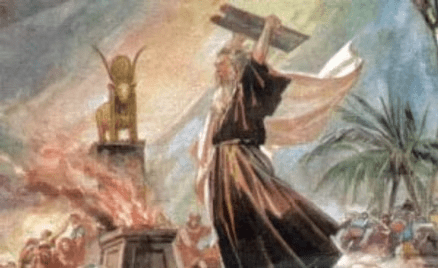
I am fed up with you people continually dragging my name through the mud for centuries.

I recommend every Christian re-read Exodus and Deuteronomy, paying close attention to the stories told that are repeated, but told differently.  Simply be aware of the possibility that the differences are due to a prophetic dream being the purpose, which would later be fulfilled, well into the future from then.  See the purpose of two versions of the tablet story and the agreements made, and the other duplicate stories that complete Exodus (and repeat in Deuteronomy), as God looking to see who pauses and begins to look deeper, looking for truth, rather than excuse to disbelieve.

In regards to this reading, the text above suffers greatly from the Hebrew text.  The reality of the Hebrew exposes more insight into the dream powers that Moses possessed. This makes the prophecy of Joel worth remembering, when he prophesied as the voice of God:

“And afterward, I will pour out my Spirit on all people. Your sons and daughters will prophesy, your old men will dream dreams, your young men will see visions.” (Joel 2:28)

One needs to see Moses as an “old man,” since he was neither young nor a child when on Mount Horeb.  We regularly read of Moses going to have a talk with God; but the question now becomes, “Just how did Moses have those conversations?”
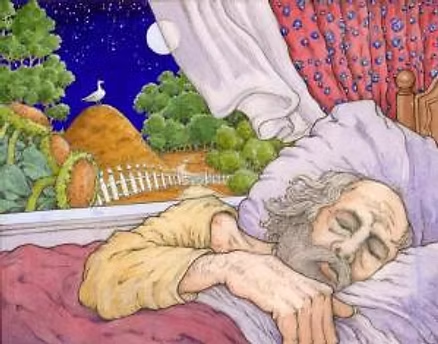
In the Tent of Meeting?
“Your old men shall dream dreams.” Joel 2:28

That prophecy written by Joel, which Peter quoted to the pilgrims in Jerusalem on Pentecost, was fulfilled on that Pentecost morning; but it was not the only fulfillment.  Prophecy by the pouring out of Spirit is repeatedly seen fulfilled every time God’s Spirit comes upon men of God. Moses was one of those men who spoke to YHWH in a dream state. Samuel answered the call of God as a child when asleep. Joseph interpreted the dreams of Pharaoh, and Daniel did the same for Nebuchadnezzar. Therefore, the tent of meeting might well have been the place where Moses went to find solitude (outside the camp of Israelites), so that there he could drift into a prophetic dream state.

To grasp this Exodus 33 reading, I recommend the readers here visit this Interlinear page on BibleHub.com. It shows the Hebrew text for all of Exodus 33, so scroll down to verse 12; and the remainder of the page is this reading.  The page lists the Hebrew root word and an English translation. The written words have links to a page that offers examples of other uses and their translations, with the root word (above the actual text word) having a link to a page that details the root meaning and translations, based on their possible usage. The English translation is then literal, as it maintains the order of the written text.  Reading literally is a great way to realize the Hebrew text before it becomes mutated in English translation.

When the literal is compared to the English translation that will be read in churches (the New International Version), it is eye-opening how much meaning is lost. Seeing the words that were actually written, thus representative of the language of the LORD, means one is freed (somewhat) of translations that act as paraphrases of what God told a prophet to write.  Looking at the root language is a good beginning, from which God will see an effort made to learn.  Understanding the words of Scripture (at all times) requires the Holy Spirit’s  assistance, so one can be fluent in that holy tongue.

The word count for the selected reading is 319 words. Beginning where the first verse says, “See,” the focus is strongly placed on vision. We have “my sight,” “your sight,” “show me,” “show mercy,” and “see” written multiple (14) times. Additionally, we find “the face” and “my face” three more times, with “face” an omitted part (in English translation) of the First Commandment, and the “face” is where the eyes are located.  This is not coincidence, as this reading (entitled “Moses and the Glory of God” on some translation sites) is about Moses seeing, in a special way, as one filled with God’s Holy Spirit. Therefore, everything is metaphor for being led by the Mind of Christ.

Yahweh: “Samuel!”
All like Samuel: “Here I am!”

Here are some notes I made, from looking at the Hebrew translated into literal English translations.  If you open a separate window by clicking the link to BibleHub.com, you can see what I am taking notes from, as well as check the links to word meanings.

“See” = “rə·’êh” = “Vision, View, Understanding.” The meaning is to have access to visions of prophecy and hearing what YHWH wants a prophet to “See.”

“Bring up” = “ha·‘al” = “Ascend, Raise.” This indicates that it was Moses’ role, as the leader of the Israelites and who was in touch with YHWH, to elevate the Israelites Spiritually. That helps explain 40 years in the wilderness – they were slow learners?

“you have not let me know whom you will send with me.” This means that Moses has not yet seen (through dream insight) what powers of elevation God will send to him, which can then be passed on to the Israelite followers.

“I may know you by name” = “yə·ḏa‘·tî·ḵā bə·šêm” = “I know you by name.” By Moses having the presence of YHWH, he knows what YHWH knows, as if Moses were YHWH. This does not mean God knew Moses was named Moses. It means a union of God and Moses, so Moses can know what needs to be known “in the name” of God.

“in My sight” = “bə·‘ê·nāy” = “in My eyes.” God has shown favor to Moses, where “favor” means with God’s blessing. Moses was “accepted” [translation possibility for “favor”] by God, known by His showing Moses visions to guide him. The word for “favor” (“ḥên”) also means “grace.”

“Consider” = “ū·rə·’êh” = same as “See” [see above – “rə·’êh”]. Moses was shown that the Israelites (“‘am·me·ḵā” – “your people”) are a “nation” or “community of people.” They too are to be “this,” or the “same,” as was Moses … able to “See.”

“My presence” = “pā·nāy” = “My face.” This means that Moses will wear the face of YHWH, as the presence of God within him.

“I will give rest” = “wa·hă·ni·ḥō·ṯî”. “I will give calm or rest” means God will allow Moses to have daydreams and night dreams of prophecy and guidance.

“If your presence will not go, do not carry us up from here.”  This means that without the presence of YHWH on Moses, the Israelites will not be raised or elevated.  They cannot progress as servants of the LORD without that spiritual elevation.

“For how shall it” = “ū·ḇam·meh” = “Wherein” or “How many?” This asks the question “How many will know the grace of God’s Sight, [besides] I [Moses] and your people [the Israelites].” The question then applies to all who will be allowed the Sight of YHWH. If they ever become separated from that presence [face of YHWH], then they will go nowhere, nor will anyone else in the world. The “face of the world” will not be that of God, if the Israelites and Moses are separated from the “face of God.” Separated mean wearing “the face of the world.” This is a statement of importance placed on Moses and the Israelites. It is a prophecy that the world is that which needs to be saved by “the people” (of God), so they must not be separated from that service to the LORD.

“show me your glory” = “har·’ê·nî nā , ’êṯ kə·ḇō·ḏe·ḵā” = “show me now” or “show me I beg, pray, saying please” [pause of separation comma implied] “your abundance, riches, honor, glory” This says Moses asked God to give him the gifts of the Holy Spirit, so he could See for the LORD, recognizing that “glory” was not his own, but that only of God.

“I will make all my goodness pass before you” = “’ă·nî ’a·‘ă·ḇîr kāl- ṭū·ḇî ‘al- pā·ne·ḵā” = “I will pass over all My goodness over your face.” This says Moses was to shine with the face of the LORD upon him.

“and will proclaim before you the name, ‘The Lord’” = “I will proclaim the name of Yahweh on your face [which projects before your head].” This says the people will know Moses has the face of the LORD, because of the glow on his face.”

“and I will be gracious to whom I will be gracious, and will show mercy on whom I will show mercy.” = “and will show blessing to whom I favor, and will show compassion to whom I am compassionate.” This means God’s face will shine upon only those who, like Moses, are compassionate for the LORD [compassionate means, “from suffering,” meaning drawn to the LORD through suffering AND willing to suffer to serve the LORD].

“you cannot see my face” = “lō tū·ḵal lir·’ō·wṯ pā·nāy” = “not are you able to See my face [upon your face].” This means one with the Holy Spirit upon him or her will See what the LORD allows to be seen, but will still look like the human being they are [look like themselves].

“for no one shall see me and live” = “for not can See me [“hā·’ā·ḏām , wā·ḥay”] man , and be alive [live].” This means to know the image of God is impossible for human bodies of flesh, as YHWH is unfathomable to such little brains. Only through death, when the soul is released from the narrowmindedness of a physical brain, can the soul See God as He is.

“See, there is a place by me where you shall stand on the rock” = “the LORD behold! , wherever [a space, any physical place] near me a pillar over of strength [or a cliff, a rock].” This says that wherever one Sees through the face of God, that person will stand like a pillar of strength for others.

“while my glory passes by I will put you in a cleft of the rock” = “And it will come to pass over , the pass over of my favor [glory] , and you will be set [or placed, or granted] in a cleft [or fissure, or cavern] of my strength [that rock].” This means that one filled with the Holy Spirit of God is within an encasement of the LORD’s covering.

“I will cover you with my hand until I have passed by” = “I will cover you with my power [or my branches] , will cover through the pass over.” This means the powers of the Holy Spirit, and all talents given by the LORD, surround the one wearing the face of God, for as long as God’s presence is within one.

“then I will take away my hand, and you shall see my back” = “And will turn aside with my power [my branches] , and you shall Know my back side [or hind part].” This means that the result of God’s power will be all that is Seen, as none of the power will be explainable. This is how Jesus routinely said, “Go. Your faith has healed you.” He did nothing that could be Seen, but the result (“the back side”) was the power of the LORD.

“but my face shall not be seen.” This means the face of God cannot be seen as the one who wears the face of God. One cannot say, “I am the Son of God. See? I look just like Him.”

When Jesus made insinuations, proclamations or affirmations that his Father was God, Jesus only looked like a man. Thus, Jesus did not appear to have the face of God. God’s face shall not be seen, but it is present in all who become reproductions of His Son, shining through inner powers of strength.

Hopefully, these notes will make my point clear, which is this story of Moses talking to God was a prophecy that says all who are chosen to follow God need to be elevated spiritually. If you look closely at the Greek text of Acts 2:14, where a standard translation states:

“Then Peter stood up with the Eleven, raised his voice and addressed the crowd: “Fellow Jews and all of you who live in Jerusalem, let me explain this to you; listen carefully to what I say,”

You will see that what is written more importantly says that Peter spoke, “with an elevated voice.” Maybe he yelled, or maybe elevated voices carry to ears without screaming?  The meaning is that after having been given the gift of speaking in foreign languages (without formal training or education), his voice was elevated to speak interpretation of Scripture. All Apostles were, are, and will always be elevated spiritually.

Christians today are called to become Moses in this prophecy. We are to converse with God, asking Him to guide us as we take on the task of “bringing up these people” that look at us for spiritual guidance. We need to be able to wear the face of God, so He knows us by name … Jesus Christ reborn.

Peter became Christ Peter when he stood in a cleft of rock and let the Holy Spirit send words out of his mouth. He certainly lived up to his nickname (given by Jesus), as Peter the Rock of Jesus Christ.  Peter was encased by the strength and power of God’s Holy Spirit.

Three thousand pilgrims did as Peter instructed that day and listened carefully to what he and the other Apostles said. Those listening also were filled by the Holy Spirit, from being told the meaning of Scripture in ways they had never been taught. That was the pass over of God; but no one saw His face. Only the back side of God was seen in the conversion of Jews, to faith in Jesus as their true Messiah.

This reading prophesied that event, and all other conversions since and still to come.

#Exodus331223 #Joel228 #twentiethSundayafterPentecost #Proper24YearA #Acts214
Acts 8:26-40 – Willing sacrifices for the greater good

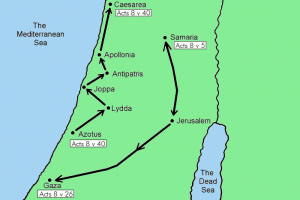
An angel of the Lord said to Philip, “Get up and go toward the south to the road that goes down from Jerusalem to Gaza.” (This is a wilderness road.) So he got up and went. Now there was an Ethiopian eunuch, a court official of the Candace, queen of the Ethiopians, in charge of her entire treasury. He had come to Jerusalem to worship and was returning home; seated in his chariot, he was reading the prophet Isaiah. Then the Spirit said to Philip, “Go over to this chariot and join it.” So Philip ran up to it and heard him reading the prophet Isaiah. He asked, “Do you understand what you are reading?” He replied, “How can I, unless someone guides me?” And he invited Philip to get in and sit beside him. Now the passage of the scripture that he was reading was this:

“Like a sheep he was led to the slaughter,
and like a lamb silent before its shearer,
so he does not open his mouth.

In his humiliation justice was denied him.
Who can describe his generation?
For his life is taken away from the earth.”

The eunuch asked Philip, “About whom, may I ask you, does the prophet say this, about himself or about someone else?” Then Philip began to speak, and starting with this scripture, he proclaimed to him the good news about Jesus. As they were going along the road, they came to some water; and the eunuch said, “Look, here is water! What is to prevent me from being baptized?” He commanded the chariot to stop, and both of them, Philip and the eunuch, went down into the water, and Philip baptized him. When they came up out of the water, the Spirit of the Lord snatched Philip away; the eunuch saw him no more, and went on his way rejoicing. But Philip found himself at Azotus, and as he was passing through the region, he proclaimed the good news to all the towns until he came to Caesarea.

——————————————————————————-

This is the Acts selection for the Easter season, coming from the Episcopal Lectionary for the Fifth Sunday of Easter, Year B 2018. It will next be read aloud in church by a reader on Sunday, April 29, 2018. It is important because it tells of an Apostle following in the path of Jesus (fulfilling his “Follow me” instruction), as Philip was led into his own wilderness experience. The Ethiopian eunuch then epitomizes the mission of Apostles as reaching out to Gentiles and not being limited to Jews.

This selection begins by stating, “An angel of the Lord said to Philip, “Get up and go toward the south to the road that goes down from Jerusalem to Gaza.” (This is a wilderness road.) So he got up and went.”

It is easy to assume that Philip was the disciple from Bethsaida who chose to follow Jesus, as reported in the Gospel of John (John 1:43-48). That Philip was one of the eleven who were filled with the Holy Spirit on Pentecost Sunday (the first day of the week), who was equal to Simon-Peter and John of Zebedee, and other Apostles who were prepared for ministry during the forty days Jesus spent teaching them, prior to his Ascension and the subsequent Fiftieth day. This means a holy call to the wilderness would not be required of Saint Philip; however, there is another Philip to consider.

In chapter six of the Acts of the Apostles, we are told of the need to choose “good men” from among the Hellenistic Jews and Hebrew descendants, who would attend to the needs of the widows that were being overlooked. Two of the seven named “good men” were Stephen and Philip. Although Stephen was said to be “a man full of faith and of the Holy Spirit,” the others were growing in their faith, so the Apostles could continue to devote themselves “to prayer and to the ministry of the word.” (All from Acts 6:1-7)

It would make perfect sense to see the Philip named in chapter 8 of Acts as referencing this newly ordained priest named Philip. Therefore, when “an angel of the Lord said to Philip … go toward the south … to Gaza (on a wilderness road),” it was another Philip’s divine call to have the metal of his goodness tested.

When the reader is presented the translation, “So he got up and went,” it produces an image of Philip getting up off the sofa of his home and taking off, in order to do as told. That misses the point of Philip having just encountered “an angel of the Lord,” and it is a poor translation.  This is reminiscent of Peter standing up on the day of Pentecost, where Acts 2:14 says he “raised his voice,” giving the connotation of Peter speaking loudly.  The deep meaning says Peter’s voice was “lifted up” (“epēren“) spiritually.

The text shows pause (by comma or implied) in the words, “kai anastas , eporeuthē.” That pause says there was space between Philip “having been risen up” (“anastas”) and his “going on a journey” (“eporeuthē”) for the Lord. Because he was told to “Rise up” (“Anastēthi”) by the angel, that meant more than “stand up from a seated position,” as it spoke volumes as a command to become “Elevated” or “Raised” in Spirit. By seeing this language in this way, one can then see Philip was called to a test of his “Raised” Spirit, just as all Saints are called by God and Christ to prove themselves.

When the translation then transitions to say, “Now there was an Ethiopian eunuch,” importance is lost in the absence of pause, where the actual text says, “kai idou , anēr Aithiops,” or “and behold , a man an Ethiopian.” By understanding a pause, so one fully grasps “Behold,” one can then realize this is a one-word statement that can also translate as “Discern, Perceive” or “Experience.” That focus allows one to see how the information presented in Holy text says Philip went to be tested and “Experience” that test, before meeting a man who was an Ethiopian. Such a translation as “Now there was” [instead of “Behold”] can then be realized as a stand alone statement that Philip had been in the wilderness being tested for close to forty days. Then he came upon [following the pause of a comma]  “a man an Ethiopian,” after Philip’s testing had prepared him to impact a traveler in the wilderness.

In the Greek text, the “Ethiopian man” is identified as that, with commas offsetting the additional information that he was a “eunuch.” That was another stand alone statement, which was then followed by an explanation, such that his impotency was relative to the man being “a court official [a potentate or ruler] of the Candace.” That information is offering insight into the Ethiopian man’s character, more than some unnecessary words being written.

When the translation says, “the Candace,” that says a person’s name was not being stated, but a proper title. That title is more properly spelled as “Kandake,” which states how the “Ethiopian man” worked as an emissary of a Nubian or Kushite “Great woman,” who was then identified as a “queen of Ethiopians.” By use of the Greek word “dynastēs” [“a ruler, potentate, member of the court”] with control of “all her treasure,” this “man an Ethiopian” might well have been “a eunuch” (“eunouchos”) by choice (rather than by forced castration), choosing to “abstain from marital sex,” due to knowing the treasury could not be entrusted to one not having complete control of a rational (business only) mind.

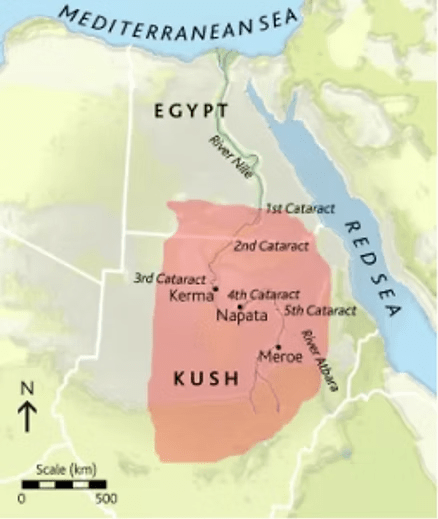
Kush was where Sudan is now.

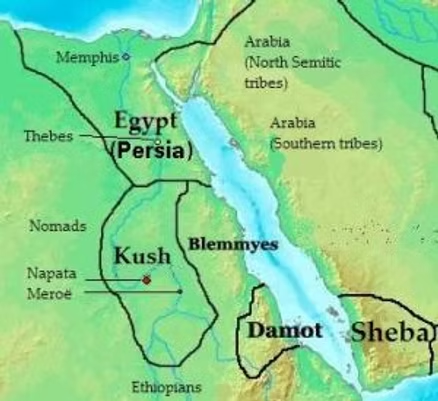
The southern edge of Kush came close to where modern Ethiopia is, with Meroë the place of the Kandake.

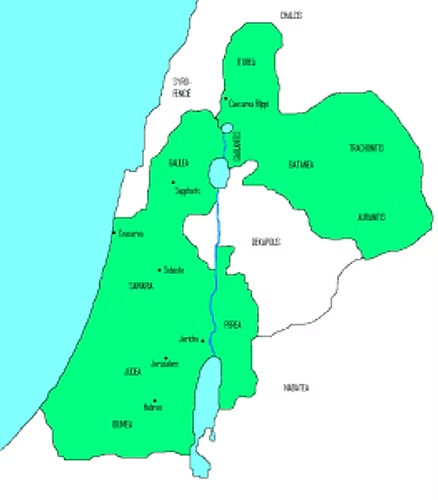
With that background established, it is important to catch that this man was important because he was “in charge of her entire treasury.” The history of the Kingdom of Kush (as a nation led by powerful women), it is believed Kush had been conquered by the Roman Empire (around 100 BC), and by the time of Nero’s rule (after Jesus’ crucifixion), Kush had become a “client state.” That would have made Kush like the Herodian kingdom, which included Judea and Galilee and other regions.

The Herodian “client states.”

Rather than jump to a conclusion that this Ethiopian man was in some way Judaic, it would be better to see him as a traveler to Jerusalem so he could do business with the Romans there. The modern Ethiopian connection to Judaism was still hundreds of years its onset, although this man might have descended from the Makeda of Ethiopia (Queen of Sheba).  For the Ethiopian man to have a scroll of Hebrew text, from a land that did not commonly read, that says he was of royal status and thus educated; however, he did not understand the meaning of the text, which would indicate that scripture was being read for the first time.

The “passage from scripture” that he was reading aloud was from Isaiah 53:7b-8b. The verse-plus that leads into those two verses quoted in Acts says, “All of us like sheep have gone astray, each of us has turned to his own way; but the LORD has caused the iniquity of us all to fall on Him. He was oppressed and afflicted, yet he did not open his mouth.” (Isaiah 53:6-7a, NASB) The last segment of the total three-verse selection (Isaiah 53:6-8, NASB) adds, “For the transgression of my people he was punished.” Because all of that was not read aloud, the Ethiopian man was touched by words that made sense personally to him, as he knew the silent sacrifice, humiliation and justice denied him, even though he was “of the court of the Kandake.”

This view then takes one back to the statement (separated by commas, so it stands alone as important) that the “man an Ethiopian” was a “eunuch.” This becomes the sacrifice that had been made by the Ethiopian ruler, whom Philip met. The removal of his lusts and desires of the flesh – by whatever means necessary – ensured his subservience to “the Kandake,” so the valuables of the kingdom would be in safe hands.  This says that it was because the Ethiopian man was a eunuch that he understood the scripture of Isaiah as his own self-allowed humiliation for the better good. The Ethiopian man had given up his life (as it normally would have been otherwise) on earth, in the same way the writer of the scroll had prophesied the Messiah of God would.

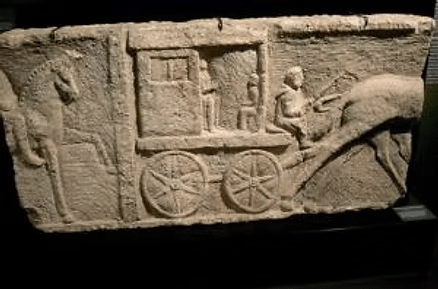
Now, twice we read the word “chariot” (from “harmatos” and “harmati”) and can get the impression of a warrior’s vehicle, as depicted in the old movie Ben Hur.

The word can equally translate as “vehicle,” and the image one should get is more like a “stagecoach,” where the Ethiopian man rode comfortably inside a horse-drawn carriage, driven by attendants. Inside this “vehicle” is space for a scroll to be unrolled and read, without getting in the way of any other passengers.

The reading of scripture can then be seen as a standard pastime of long-distance travelers, where one goes to the airport newsstand and buys a book to read before a flight. Probably, this scroll was just one of the choices he had to read during a long ride back to Egypt, before taking a boat to Kush (going south along the Nile).  The Book of Isaiah might have been one of several that seemed interesting. Perhaps one of the high priests in the Temple of Jerusalem had an extra scroll for sale in the book store there?

We then read, “Then the Spirit said to Philip, “Go over to this chariot and join it.” So Philip ran up to it and heard him reading the prophet Isaiah.” The word “Spirit” is capitalized, as “Pneuma,” which can also translate as “Wind” or “Breath,” meaning it was a divine “Whisper” within the mind of Philip. This can be seen as the Mind of Christ that spoke to Philip as he was in the wilderness; and it not only told him to approach the vehicle and enter it.  As Philip was running to reach the carriage, the Mind of Christ was telling him what was being read inside, by the Ethiopian man. Thus, more than Philip asking the man inside the carriage if he understood the meaning of what he was reading, it was the knowledge of Jesus Christ that was pouring from Philip’s lips, to one known to be thirsting for insight.

It is important to see how the Ethiopian man asked Philip about the meaning of the scripture he was reading, rather than expect “someone to guide” his knowledge. For Philip to ask, “Do you understand what you are reading?” was like the thoughts the Ethiopian man was having.  Because he could not possibly understand without guidance, his response was to ask, “About whom, may I ask you, does the prophet say this, about himself or about someone else?”

His asking becomes an example of “Ask and you will receive.” Because the Ethiopian man felt a personal connection to the scripture he was reading, even though he did not understand it, he wanted to know more. The scripture was touching him to cause him to want to know more.  His asking was then like a prayer, with Philip’s appearance being the answer to that prayer.

In this reading selection, the Ethiopian man is called “the eunuch” four times, after having first been identified as “a eunuch.” He was not identified as a man, or as an Ethiopian, or as a potentate, ruler, or court official. The fact that this man traveled in a vehicle of luxury, with a driver and attendants he commanded, as a man of power who controlled the entire treasury of a nation means little in this story. At the core of this man’s identity was the fact that he was a man who voluntarily abstained from marriage, such that he was not led by his innate drives to procreate, regardless of whether or not he had been willingly castrated to physically prevent that or if he somehow used extreme powers of will to quell all dangerous emotions that might overcome him.

The aspect of the Ethiopian man and Philip (driver, et al) coming upon a body of water on the wilderness road to Gaza means they came upon a wadi where rain had collected. The knowledge Philip had imparted a thirsting man led them to water for cleansing. The baptism Philip performed was symbolic with physical water, but because the Holy Spirit was upon him at that time, the Holy Spirit also came upon the Ethiopian man, cleansing his soul.

A human being whose emotions had been sacrificed to serve a queen were suddenly overwhelming, as he “went on his way rejoicing” knowing he now willingly served the Father and the Son. Philip, however, did much as Jesus was known to occasionally do, which was suddenly disappear.  When we read that “Philip found himself at Azotus,” his wilderness journey might well have led him physically there, instead of along the road the Ethiopian man’s carriage took.  Thus, when Philip reappear in Azotus, it was after he had spiritually left his body, so the Lord could show him the power of the Holy Spirit to find seekers, wherever that may be.  This is the element of synchronicity.

As I have stated previously, reading scripture should have the effect of placing the reader in the scenes depicted, where the one of least value is who the reader must identify with first. One must ask oneself, “How do I have the same flaws of character?”

In this reading, it becomes too easy to identify with Philip, as if one is a truly devout disciple of Christ, who is married to God in one’s heart, so one can hear “an angel of the Lord” speak. Few are able to make that claim, as such people would be explaining scripture to the world of Gentiles (and Jews) who read it, but do not know how to understand, “unless someone guides me.”  On the contrary, most Christians shun study of the Holy Bible, leaving that “head trip” to the professionals.

This means the vast majority of readers ARE “The eunuch.” That symbolism can bring with it elements of being intelligent, yet pagan controllers of wealth. It can mean one spends more time at work than with family – always on the road for another dollar bill. It can strongly suggest that one is most sacrificing of the emotions of the world, because one is more driven to acquire the things offered by the earth. However, the biggest element of being a eunuch is to see oneself as barren, thus unable to reproduce baby Jesus within.  It is the absence of sperm or egg, where being fruitful and multiplying … for the purpose of supplanting one’s religious values into those personally brought forth into this world … has been lost.

From the Game of Thrones comes a prototypical eunuch, who may parallel the heart of the Ethiopian man met by Philip.

The lesson of this reading, which is presented during the Easter season of personal Resurrection of Jesus Christ in Apostles, is to rejoice in knowing that one’s ill-advised life decisions have not kept one from redemption and everlasting life. Just as children brought into the world maintain a lineage of physical genetics, spreading the Gospel of the Holy Spirit maintains the lineage of Jesus Christ, allowing one’s soul to become one with God as a truly Spiritual being. Just as Philip was a good man who was chosen to serve, he was then then called by the angel of the Lord to be proved by fire.  Philip responded and was made a reproduction of Jesus Christ, so that body could then pass that Spirit onto a Ethiopian man, who felt a need for redemption and a new life purpose.

Because a eunuch acts as a statement of a lack of desire to join with a partner, for the purpose of sexual release, that is rejecting the basic notion of joining oneself with another self, so a child can result.  It represents the epitome of selfishness. This lack of physical emotions (either forced upon or willingly chosen) makes one’s heart cold and hardened.

That symbolism is then one’s inability to love God with all one’s heart, either because one feels forced to doubt (from flimsy explanations or “in your face” examples) or one willingly chooses not to believe in the unseen (from peer pressures and philosophical teachings). Being a eunuch is then what keeps one from understanding Scripture, because one’s own personal troubles keep one from seeing the truth that has already been rejected.  Without a personal wilderness experience that tests you as potentially being the weak link to God, the purpose in waiting for redemption is seemingly never worthwhile.  One cuts off any chance of knowing God, choosing impotency over fruitfulness, from big brains that are blind to the truth.

When the Mind of Christ led Philip to join with the Ethiopian man, that Mind knew the Gentile had just read a passage that opened a wound, causing the heart to pump extra blood of emotion. The eunuch saw himself in the sacrifice of Jesus, as prophesied by Isaiah. Such and opening sent the Holy Spirit to the man, in the form of Philip, so the Ethiopian eunuch could feel the Scripture totally being about him.  That truth came to him when he became one with Jesus Christ. His sterility would be undone by being reborn as Jesus Christ – his guide to Scripture meaning within – so he could then have new children in Christ, just as Philip could then claim a relationship with the Ethiopian man.  They were then brothers in Christ.

When we then read that Philip immediately was no longer seen by the eunuch, but “the Spirit of the Lord snatched Philip away,” so he “found himself at Azotus,” this is the life purpose of a Saint. Paul wrote frequently about the dependencies adult human being have with sexual relationships. It is how some say that men are led more by their little brain than their big brain, which means sexual drives make many human beings forget about spiritual purpose when physical emotions control their bodies.

When one is led by sexual appetite, one can break any number of religious rules. Doing that too often makes one less able to sense the error of those ways, so that people defend themselves with excuses that prevent their hearts from receiving the Holy Spirit – opening up their hearts for God with love. A Saint is ready to receive God and Christ, when one has made the sacrifice to become a eunuch, where the castration is not the removal of sexual organs, but the removal of an ego that can be misled by sexual urges.

That is what Paul wrote of. It is how Jesus said, “These [strangers] are my mother and brothers,” because family is less about physical bloodlines, and all about being a productive “living vine” of Christ. Thus, being called to proclaim the good news in all the towns means one is always going home to family, wherever one goes in ministry and evangelism.  Those we are led to by the Holy Spirit will be those who we will be related to, through being Jesus Christ.

———————————————————————————————————

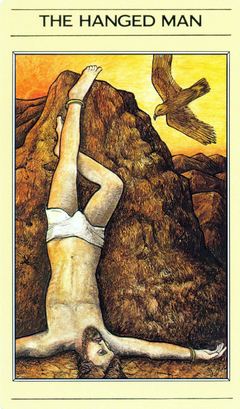
Note: The cover art depicts The Hanged Man Tarot card, specifically from the Mythic Tarot deck.  The character from Greek mythology that is used to depict the “willing sacrifice for a higher good” symbolism of The Hanged Man is Prometheus, who gave fire to humanity against the orders of Zeus.  In the spirit of the Easter season, it would be worthwhile to read about Prometheus, whose name in Greek means “Foresight.”  Since the Resurrection of Jesus Christ within a Saint requires a willing sacrifice be done first, reading this mythology can help enlighten one as to the impact the reading from Isaiah had on the Ethiopian eunuch.

Psalm 116:1-3, 10-17: Proposing marriage on the Third Sunday of Easter (Year A)

The Third Sunday of Easter, like all Sundays inside the confines of Episcopalian churches in America, finds a Psalm of David read aloud.  Usually the congregation reads aloud, either by half or alternating whole verses, although some fancy churches will have a chanter sing the Psalm (which means “song”).  The production made over the Psalm is unlike the production made over the other readings, where only one person reads aloud (not singing aloud) and all the rest just listen.

Think back to when you were in elementary school.  Think back to your high school and college days.  No teachers sang any lessons to the class.  While some classes would read something from a book out loud, going from desk to desk, that was more to practice being bold enough to talk to a group, more than an exercise in learning what a book said by having people read only a portion aloud.  If anyone else is like me, then you will agree that it is hard to focus on what is said by someone else out loud, when I am trying to keep track of when I will have to read aloud.  Thus, no matter how powerful a Psalm of David is, it is only an exercise in “togetherness” – “See, we all read aloud together.  Aren’t we special?”

The problem with this approach is no priest will then walk into the aisle, announce a reading from a Gospel, read that aloud, and then rise above the masses at a podium saying, “I want to talk to you today about that Psalm we read.”  Nope.  Never happens.  However, it should today.

In the Gospel reading from Luke is read the story of Jesus appearing in unrecognizable form as Cleopas and wife (“two of Jesus’ disciples”) walked to their home in Emmaus.  That reading comes up Wednesday of Easter Week, Easter evening in Year C, and here on the Third Sunday of the Easter season, Year A.  So, regular church attendees regularly hear a sermon about that story from Luke’s Gospel.  The repetition might force a priest to put a new slant on an old topic, so his or her words don’t conjure up feelings of déjà vu.

In the Easter season there is always a reading from the Book of the Acts of the Apostles, and today we read about Peter speaking with a raised voice and how three thousand Jewish pilgrims would “save themselves from that corrupt generation” by being baptized in the name of Jesus Christ that day … instantly.  That is another reading that comes up multiple times during the Easter season.  Certainly, a sermon or two will have been focused on that story, so you remember that reading.

This year (A), during the Easter season, is the only time we read from 1 Peter.  So, if you did not listen carefully today, there is a good chance you will have forgotten all about what Peter wrote in his first epistle.  It is fairly short and says things that can easily be incorporated into any sermon, simply because the epistles tend to state the “catch phrases” that most adult Christians know.  Today Peter wrote, “live in reverent fear,” “you were ransomed,” “with the precious blood of Christ,” “your faith and hope are set on God,” and “you have genuine mutual love.” 

The Epistles do not get much deep attention in the Episcopal Church, simply because Episcopalians have short attention spans and a priest is limited to twelve minute sermons.  Those two traits are not conducive of deep understanding of anything; so it is best to just stick with the catch phrases found in the letters and maybe give the Apostle a quote credit (or not).

Parts of Psalm 116 are read on three different Sundays over the three-year cycle, and on two other week days.  It is read on Maundy Thursday – the foot washing service few people attend – so its words might ring a bell, but probably not.  Because we need to realize that David was led by God to write songs of praise and lament, his words are recorded to speak to us in the same way God led the other writers of Scripture to record God’s conversations as though directed to each of us, individually.

The people who organized the lectionary were also led by God to choose readings that link everything together, so divine purpose is in play here today and every Sunday.  The readings are not randomly picked, and they are not based on what a priest wants to talk about.  Certainly, they are not the product of some people in a smoke-filled room saying, “Okay what snippet do we have next to add here and there?”  By having that understanding – that everything read today is part of a whole with purpose – we are able to read the words of Psalm 116 and know they deeply relate with the words written by Peter and Luke.

Knowing that the divine purpose is to teach, not to attempt to twist words into some self-serving political message or current event words of encouragement, a sermon has to be a model of the Acts reading, where “Peter, standing with the eleven, raised his voice and addressed the crowd.” 

Were his words uplifted by the Holy Spirit; or did he scream like a maniac to get everyone’s attention?

The Greek word translated as “raised” is “epēren,” a form of “epairó,” meaning “to lift up” are “to exalt.”  Rather than “raised his voice” giving the impression of twelve Apostles screaming at the tops of their lungs, so three thousand Jewish pilgrims were scared into signing a petition to join the new Church of Jesus Christ, it is more sacred to read “with lifted voice.”  That way, it is easier for us to understand the Apostles spoke divinely.  Therefore, their words “testified with many other arguments and exhorted them.” 

That means God was speaking through the mouths of the Apostles, who not long before were still nervous about public anything.  Surely, before the Holy Spirit hit them, they were not longing to have some rabbi to tell them, “Today class we will read Psalm 116 out loud, with each disciple reading one verse.  Andrew, why don’t you start us off.”  God then spoke through the Apostles just as God had spoken through the mouth of Jesus.  We must agree that it was God coming out of Peter that encouraged seekers to be filled with the love of God in their hearts.

Therefore, the first verse read from Psalm 116 sings out with the same exalted voice of God.  There, David began by stating, “I love the Lord, because he has heard the voice of my supplication, because he has inclined his ear to me whenever I called upon him.”

Three thousand pilgrims in Jerusalem “welcomed [Peter’s] message [and] were baptized” because they were Jews seeking a closer relationship with their God.

David then sang, “The cords of death entangled me; the grip of the grave took hold of me; I came to grief and sorrow.  Then I called upon the Name of the Lord: “O Lord, I pray you, save my life.”

Peter told those whose ears heard his words, “Repent … so that your sins may be forgiven … saying, “Save yourselves from this corrupt generation.” 

The Greek actually written (“geneas tēs skolias tautēs”) says, “generation the perverse this,” where geneas means “race, family, and birth.”  One cannot presume Peter was only talking about those who just watched the Romans crucify Jesus, but all who think they are added to the family that calls Yahweh their God – at all times between then and today.  Thus, as Christians today, WE live in the perversion that has been allowed to be born around us – the generation of perverseness or a degenerate state.  It exists now, just like it existed prior to Jesus, when David cried out in fear.

Every Jew in Jerusalem who heard Peter (and the other eleven Apostles) felt the cords of death – MORTALITY – strangling them, not knowing how to ensure God would not punish them because they all had unforgiven sins.  They, like us and like David, called upon the name of the Lord to be saved.

You have to see yourself in that light of failure, or you do not call upon the name of the Lord for salvation.  If you are okay with your life of sin and say, “Its okay.  I’m good,” then you certainly are not getting God’s attention, whether you want it or not.  God does not compete with lesser gods – like oneself – so you are free to be part of the definition of a “corrupt generation.”  After all, we are each the center of our own universe, which goes whichever way we direct our universe to go.

Seekers, on the other hand, feel guilt and want to stop living lives that cannot cease wallowing in lusts and self-pity.  Like the hated tax collector Jesus saw, seekers silently beat their chests and bemoan there is no way to stop.  Sure, the money is great, but it all makes me feel dirty inside.

If only sin wasn’t so damn rewarding.  Then, like the Pharisee Jesus saw, one can be led to thank God for material things.  That’s when one prays, “How shall I repay the Lord for all the good things he has done for me?  I will lift up the cup of salvation and call upon the Name of the Lord.”

Everyone here today has many reasons to thank the Lord, more than for a good career, a nice house, or a fancy car.  God does more for you than give you the latest gadgets of technology to play with.  God has given you health, or children, or a sense of redemption.  Whatever your personal rewards, God gave them to you without you having to do anything in return.  Many Christians just take God for granted, like they deserve all that is good, simply because their parents let a priest drip some holy water on their little foreheads.  Not to mention them not complaining too loudly after being forced to learn all those Bible stories in children’s church.

Typical Christians today are just like the typical Jews of Jesus’ days – wallowing in self-gratifying sins with the pretense of being special because they were descended of the people chosen by God.  One corrupt and perverse generation after another.  The world is a place where perversion is easily handed out, asking nothing in return.  Christians do not even know what “the cup of salvation” is.

In the Episcopalian Church, where the Eucharist flows like welfare checks to the poor, freely given at the rail, asking nothing in return, it is easy to think the cup of salvation is the chalice that comes before one, with the altar server saying, “The blood of Christ the cup of salvation.”  That is not what David had in mind when he wrote those words.

THE cup of salvation is the second cup of wine poured out at the Jewish Seder meal.  That IS called “the cup of salvation,” which is poured out to commemorate the freedom from bondage in Egypt.  Whether David’s Israel practiced the Passover exactly the same as do Jews today is immaterial.  The “cup of salvation” was the marriage of the children of Israel to God.  A cup of wine is then symbolically drank to commemorate that eternal bond.  It is like a toast to the covenant, where marriage is a covenant.  One MUST marry with God, meaning He is the husband and everyone else is the wife.

With that understood, David then sang, “I will fulfill my vows to the Lord in the presence of all his people.”

The “vows” are the Laws Moses brought down to the Israelites.  Everyone had to announce their agreement to the covenant, in order to enter into a bond of commitment.  The wife submits to the will of the husband and the husband guarantees the wife will always be protected.  A marriage is therefore a public event of celebration.

Still, when David then sang, “Precious in the sight of the Lord is the death of his servants,” one needs to see how marriage means the death of the old self.  Commitment demands sacrifice.  In order to receive salvation, one must die of one’s old ways.  God does not take delight in the physical deaths of human beings, simply because death is nothing more than a stage of life.  Death is like the old 45-rpm records played on a phonograph – when the needle hits the space at the end, it rose and waited for it to be placed back down on that record again.  The soul is like the etched meaning in the grooves of the record, which is why it was made.

In the Hebrew of David’s Psalm 116, the word translated above as “servants” is “lahasidaw,” which is a statement from the root word “chasid,” meaning “kind, pious.”  The statement better says, “of his saints” or “of his godly ones.”  That means the death of God’s “servants” is the end of their life of sins, committed to fulfill a purpose of holy priesthood.  In a marriage ceremony, rather than drinking wine to celebrate a new partnership or union, a desired death is then like how the Jews symbolically break a glass wrapped in a napkin when a couple gets married.  The death of the old can never cut the marriage asunder.  The fragility of a sinful life is shattered, so it can no longer ruin a soul.

Marriage to God must be recognized as what that commitment truly means.  David sang, “O Lord, I am your servant; I am your servant and the child of your handmaid; you have freed me from my bonds.” 

Here, the repetition of “servant” is accurate, from the Hebrew “abdika,” from the root “ebed,”  meaning “servant, slave.”  To rise from the lowest of the low, which the state of being a “child of a maidservant” indicates, means one must feel deeply indebted to God for that favor granted.  The only thing one so low can ever be expected to repay is one’s complete devotion.  Devotion to God means serving His every need as His priest.

David then sang, “I will offer you the sacrifice of thanksgiving and call upon the Name of the Lord.”  This does not say that “thanksgiving” is a “sacrifice,” as if one begrudgingly has to suffer through repayment with lip-service, like: “Oh okay.  Thank you God.”  THE sacrifice is the death of your self-ego, which you do in the most sincere “thanksgiving” to God.  No words are necessary, as God knows each and every heart of His wives (i.e.: saints).  Still, when David sang, “call upon the name of the Lord,” that is equally not some “catch phrase” that is meaningless.  That needs complete understanding.

The literal Hebrew there says, “ubesim Yahweh eqra,” which means “upon the name Yahweh will proclaim.”  This is where one grasps that the wife in a marriage takes on the name of the husband.  Regardless of modern perversions of the human institution of marriage, “in the name of” means, “I am now known as.”  To take “upon the name of Yahweh” one has become married to God, becoming a saint in His service, so one can “call” or “proclaim” just like we read Peter spoke “with raised voice.”

This is important stuff, becuase just as David used “the name of” so too did Peter.  In Acts Peter said to the pilgrims, “Repent, and be baptized every one of you in the name of Jesus Christ so that your sins may be forgiven; and you will receive the gift of the Holy Spirit.”  That says one IS JESUS reborn.  God is the one who forgives sins through the “cup of salvation,” thus when one has married God then one’s sins are forgiven and one receives the wedding gift of God’s Holy Spirit.  The Holy Spirit is what baptizes one so one becomes Jesus resurrected in the flesh.

In Peter’s epistle he wrote, “with the precious blood of Christ,” [the sacrificial lamb] “you have come to trust in God, who raised him from the dead and gave him glory” [as THE WIFE OF GOD].  Peter then added, “You have purified your souls by your obedience to the truth so that you have genuine mutual love, love one another deeply from the heart.”  That is a statement about marriage and commitment.

From that, Peter was led to write, “You have been born anew, not of perishable but of imperishable seed, through the living and enduring word of God.”  To be “born anew,” one must first experience death, where David wrote, “Precious in the sight of the Lord is the death of his saints.”  Marriage to God means the death of the sinner and the rebirth of the Saint in the name of Jesus Christ.

David then sang again the words, “I will fulfill my vows to the Lord in the presence of all his people,” but this is not the same as the marriage vows first taken.  Those vows are taken publicly; but the life of a Saint is not for one’s personal enjoyment. 

A Saint lives to BE the resurrection of Jesus on earth, as God incarnate.  This is not so one can boast, “Look at me!  I am married to God!”  Instead, one becomes like “the child of [God’s] handmaiden,” a servant to the Word of God.  A slave whose only role is to offer the cup of salvation to seekers of the truth.  The vows of marriage to God are the realities of being a priest of God, using the gifts of the Holy Spirit in the midst of the public eye.

That is then the meaning in David’s last verse, where he sang, “In the courts of the Lord’s house, in the midst of you, O Jerusalem.  Hallelujah!”  That says the Saint, as the reborn Jesus Christ, is the house of God.  God resides within one’s heart center. 

Jesus is the High Priest who rules over one’s brain, as the Christ Mind.  Every area of life one comes into becomes the courts where divine judgment will keep one from wandering into the worldly traps of sin.  When David wrote “in the midst of you,” he was not focusing on a place on the earth, but his being one with God.  It has the same meaning as Jesus saying, “I am in the Father as the Father is in me.”  The word “Jerusalem” then bears the eternal meaning of “foundation of peace.”  Jesus Christ is the perfect cornerstone from which the foundation of eternal peace in heaven is built.

By seeing this coming from Psalm 116, it is easy to set one’s eyes on the affect an unrecognizable Jesus had on two disciples who had known him all his life.  Cleopas looked at his wife, Mary, and said, “Were not our hearts burning within us while he was talking to us on the road, while he was opening the scriptures to us?”  Those two were just like the three thousand who listened to Peter offer “arguments” as explanations of Scripture.  They all received an invitation of marriage to God, carried by God’s messenger Saints, and they all happily said, “Yes!”

On this Third Sunday of the Easter season, when the counting of fifty days marks when Moses came down with the marriage proposal of God to his Israelite brides AND also when Jesus returned from heaven and wrote the marriage Covenant on the hearts of those who said “Yes,” it is time to make your choice about God’s proposal to you.

Do you say, “I love the Lord, because he has heard the voice of my supplication, because he has inclined his ear to me whenever I called upon him”?  Do you love God because he feels like your sugar daddy, giving you everything you want?

Or, do you say, “The cords of death entangled me; the grip of the grave took hold of me; I came to grief and sorrow,” so you pray to God for forgiveness of your sins?

David sang a song about your life.  You just need to understand what the lyrics mean.  Ignoring them will do you no good.

A serious proposal has been made.  It is up to you to determine your outcome.