Now the whole group of those who believed were of one heart and soul, and no one claimed private ownership of any possessions, but everything they owned was held in common. With great power the apostles gave their testimony to the resurrection of the Lord Jesus, and great grace was upon them all. There was not a needy person among them, for as many as owned lands or houses sold them and brought the proceeds of what was sold. They laid it at the apostles’ feet, and it was distributed to each as any had need.
——————————————————————————–
This is the Acts reading for the Second Sunday of Easter, Year B. It will next be read aloud by a reader on Sunday, April 8, 2018. During the seven Sundays of Easter, you will note that readings from the Acts of the Apostles replace those that would normally come from the Old Testament books. This reading, as all the others from the Book of Acts, is important because it shows that faith alone is not a guarantee to eternal life in Heaven. Works are required beyond faith; and here Christians are shown the importance of total commitment to those acts of faith.
The first part of verse 32, which is translated above to state, “Now the whole group of those who believed,” is an over-simplification of what was stated in the Greek. The Greek states, “Tou de plēthous tōn pisteusantōn.” Rather than saying “the whole group,” the implication is: “The [one] and the many the [one] having believed.”
This missing factor that identified each one of the many is how there is not some nebulous “group mentality” that generally guides belief. Instead, the fact is stated that each one (“Tou”) is replicated “many” times over into a “multitude” (“plēthous”), where all have become the same in their histories of “having believed.” This means the “congregation,” or the “assemblage” of believers, was not simply many lambs of ignorance who followed a few Apostle rams, doing as told. Thus, the “multitude having believed” must be firmly grasped as ALL “having believed” through personal experience causing that belief.
Belief comes from experience, such that one does not learn faith. One learns the foundations upon which faith is built … like the dogma of religion is learned. Knowledge then leads one to test the solidity and validity of those foundations learned. The experience of testing what teachers have taught becomes what one truly believes. Therefore, the “whole group of those who believed” had experienced the Resurrection of Jesus the Christ, which means all had gone far beyond being told the events of Easter Sunday. Their experience of “having believed” was more than having been taught that Jesus was dead and returned to life after three days dead.
When we then read how the group “were heart and soul one” (which is a segment of words separated by commas, so they stand alone as a statement that is relative to their belief), the Greek word “kardia” is translated as “heart.” “Heart” means more than a physical organ of the body. It implies “mind, character, inner self, will, intention, and center.” Further, when the Greek word “psychē” is translated simply as “soul,” one misses how that word has a greater depth of meaning. That meaning goes beyond: (a) “breath of life,” which is due to the presence in a body, or (b) “a human soul.” The word “psyche” also is a statement of “(c) the soul as the seat of affections and will, (d) the self, (e) a human person, or an individual.” By realizing those alternative implications, one can see how the unification of “heart and soul” is a statement of God’s presence within the spiritual self, beyond the emotional reactions that a body has in response to life events.
Heart and soul become one after the marriage of God within one’s heart (a soul in love with God), such that the self-ego of a free soul has willfully decided to surrender its control over the body it has possessed. The marriage of the heart to God brings the union of the spiritual divine, to be one with the spiritual life force that inhabits a physical body. That marriage is then consummated through the offspring produced – Jesus reborn – such that the brain’s intellect becomes supplanted by the Christ Mind. The human brain is still capable of thought; but from a chosen role of subservience, as an obedient servant [wife – regardless of human gender], the human brain only listens, learns, and obeys.
This is then reflective of the true presence of the Trinity, where Father is in union with the Son, through the Holy Spirit becoming one with the soul. Heart and soul are one. It was the state of being that Jesus of Nazareth lived; and it is the state of being all apostles have lived, are living, and will live in the future, because all apostles are Jesus Christ resurrected. Every time God becomes one with a soul in a human body, the Trinity is present. Regardless of human gender, humans will always become the Son.
This becomes a statement that Free Will creates the illusion of two beings, rather than one. God union with a soul means Free Will dissolves, so the inner and the outer become one. It replaces sole focus on the physical by adding knowledge from the spiritual. The world tricks humanity into maintaining a separation between science and philosophy, where this duality keeps Man from entertaining any reason for ever being God – as His wife unified as one through heart and soul. However, through the deepest level of true belief, the reality of One comes forth.
See this mirror image as the normal dividing of cells as life that leads to mortal death. The reverse becomes the joining of all into one again, as eternal life.
This has just become the definition of a “Church” of Christians. The “assemblage” of those of “same mind” (“psychē”) means all have the same relationship with God (“kardia”). In the truest sense, a Church is the assembly of all God’s wives, married to Him through a deeply committed love. While there may be some who are “engaged” to marry God, whose lamps are lit but they are still awaiting the Holy Spirit to descend and unite their heart and soul to God, no one in a true Church of Christ is a casual bystander. A true Church of Christ can have no members who are only seeking to profit from being associated with the true “multitude” of believers. All must have true faith from personal commitment and experience with God and Christ.
This is then stated to be the “ALL IN” true Church of Christians. There are zero denominations that divide and subdivide this Church, where membership is ranked by how much one donates or gives. Rank is based on length of service, such that children and young adults are always learning to find their experience of belief. Leadership is not based on how much outside knowledge one has gained, in abundance over others. Instead, leaders are those who seek to promote, maintain, and advance the presence of the Christ Mind in all believers. It is expressly defined as a Church where “no one claimed private ownership of any possessions, but everything they owned was held in common.”
I once asked the leader of a Episcopalian church’s Sunday lectionary class, “Whatever happened to that “All In” Church?” That leader was a wealthy lawyer, and a man who donated much of his time and money to that Episcopalian church. He was a mentor for others who regularly attended that church. Needless to say, he was a respected member of that church’s congregation. Yet, his response to my question was, “That didn’t work out too well.”
I do not see his answer as blasphemy. I see it as a reflection of just how little faith is present in the masses who claim to be Christian today. Christianity long ago ceased being about “the whole group of those who believed they were of one heart and soul.” Christianity stopped being about the resurrection of Jesus Christ and being about human things. It has degraded to a point now that leaders of Christian churches think being Jesus Christ doesn’t work out very well.
Christianity (be it Baptist, Catholic, Pentecostal, Anglican, or whatever names that genre can go by) has become a club of exclusivity, where wealth is the determining factor as to how much God loves His Christians. This club then elects leaders, based on the religious philosophies of the majority contributors of an individual church, parish, abbey or temple. A small group then becomes the dogma taught, with many in the United States regularly seeking to promote the welfare of everyone, everywhere, of every faith, while pointing fingers and speaking negatively about others supposedly Christians. A Church where everything is owned in common can never work very well in modern times, as my Episcopalian friend said.
If it wasn’t for the poor always being poor, touring popes would have no one paying to see them. Sadly, an Argentine socialist as pope merely reflects the failure of a Church to pass the torch of Apostlehood onto others, simply because it takes a true Apostle to do that.
The leaders of organizations calling their institutions “Christian” and “religious,” act as if they alone have been touched by God to speak for Jesus, while doing none of the other miraculous deeds (the Acts or the Works) of that historical figure. No one is led to becoming Christ reborn, thus all are kept prisoners of ignorance. Christians today are taught to idolize Jesus Christ, as a god equal to God, teaching that no man or woman can be a god like Jesus. Rather than millions of resurrected Jesus-Apostles, we worship cults of personality … human reproductions of gods to be worshipped like Jesus. American Christians love a holy man to follow, rather than being holy themselves.
This state, where heart and soul are clearly not of one mind, is a sign of denial. It is no different than seeing a mole on one’s skin change colors, signifying deeper issues of health that have been long ignored. That “mole” symbolizes a Church that has denied God its heart, thereby it has summarily rejected Christ over some lesser philosophy of man. Such a mole is a sign from God that death is surely coming … rather than eternal life.
Verse thirty-three begins with the separates segment that becomes a clear statement of those who claimed “all things are held commonly” (rather than proportionately accepted). The verse states, “And [with] power great.” That means all true Christians have the power of God available to them. God does not send Apostles [reproductions of the Jesus Spirit] to save the world by social changes in civil laws, where governments dictate the common sharing of taxed wealth. Instead, God saves Christians individually, through their personal sacrifices of faith. That commitment on an individual level is what leads God to give one the power to project his or her faith into the hearts and souls of others seeking salvation.
Every true Christianhasno needs go unmet. Thus, true Christians do not flock to churches because of need. They congregate as those of unified hearts and souls, those of one Mind, as those who are at peace as they labor to bring others to their same state. True Apostles do this work with not one iota of monetary or material needs (they do not sell religion for profit), which means they do not offer such gains to others. True Apostles do not live in mansions or castles, as those material things prevent the seekers from having access to an Apostle. Their needs are easily met because the Christ Spirit has reduced their worldly expectations to only that which is truly a necessity.
True Christians all have the full support of all other Apostles, as they are all together in heart and soul, as One Church serving God in the name of Jesus Christ. This means they have all been reborn as Jesus Christ, and not simply tacked that name on a board nailed to a building. Being reborn as Jesus Christ, each individually, is their great power … not some mysterious ability to solve poverty, persecution, or inequalities that are ever-present in a world influenced by evil.
By separating “And power great” from the following words that have been translated above to say, “the apostles gave their testimony to the resurrection of the Lord Jesus,” one is able to read those following words with a new perspective. First, it says all of the “assemblage” (i.e.: true Christians) are “Apostles” (“apostoloi”), which means they are “messengers, envoys, delegates,” or those “commissioned” by God, who is One within the hearts and souls of His believers. Second, one can see how those then “give testimony,” as messengers of faith. Still, a third awareness is how that testimony is not that Jesus died and came back to life. Their message is they have each become “the resurrection,” speaking as “the Lord Jesus Christ,” who has been reborn (come to life in human form again) in each of them.
One has to see the complete trust and confidence that comes from absolute faith. Someone who says he or she believes in something, but then never fully acts upon that foundation of trust, is either lying (never had faith) or is too fearful to totally commit (faith without acts). In my mind, most who claim to be Christians are claiming that belief through misguided sincerity. Christians today are exactly like the Jews of Judea and Galilee were, when Jesus walked the land. However, their failures to act as Apostles, being All In as this reading clearly states, are due to having never been presented with reason to believe, by having never encountered one who is clearly identified as the reborn Christ.
Only then can one fully understand how it was written: “There was not a needy person among them, for as many as owned lands or houses sold them and brought the proceeds of what was sold.” My Episcopalian friend who saw change as the natural decay to be expected over two thousand years of trying to believe without a true union of heart and soul with God means “what didn’t work out very well” was that Christianity now equates to everyone is needy.
Today, “believers” are blinded to a communal existence, where Christians live together and support one another totally, as a light that draws the needy to them. Rather than Christians offering the lesson that total commitment to God is the answer to all one’s needs, they now seek the right for personal possessions (inequalities of wealth), under governments that are expected to eliminate all the woes of the needy. Many churches raise funds for the purpose of sending a select few thousands of mile to help strangers, while leaving behind thousands of poor neighbors. It is a repeating of the blind leading the blind.
Brother can you spare a hundred bucks so I can buy lottery tickets for the Mega-Millions drawing?
Since land ownership is an ancient practice of humanity, where legal deeds have long been how one can rightfully claim a place to call home, it is important to grasp the depth of meaning that comes from verse thirty-four. In the Gospels, we know Joseph owned a home in Nazareth; but Joseph also had family who owned homes in Judea (such as the one Mary, Martha, and Lazarus lived in at Bethany, plus the one Cleopas had in Emmaus – all relatives of Joseph). The point of verse thirty-four is the consolidation of lands and houses, such that an Apostle was found “needing” the fellowship of other Apostles in Christ. Because the first Christians lived scattered, here and there, in pockets amid Jews who did not believe in Jesus as the Christ, they needed to sell in order to buy elsewhere, so all could live together. Therefore, the sales of lands and houses, with the profits “laid it at the apostles’ feet,” was for those proceeds to be “distributed to each as any had need” in this manner.
That would have meant the purchase of large tracts of land, where new homes could be erected for all the true Christians of one geographic area to settle in. This would be meager homes, where tools and supplies for farming would provide for them. This would also allow them to support evangelism to spread the Gospel, as well as welcome those seeking Christ into their midst. This is a “need” for a community of Christians, which was similar to the necessity of Jews to live separately from Gentiles.
This was the model that existed prior to someone getting the ideal that the spread of Christianity, through true Apostles, was bringing in so much wealth that someone had to rise to an elite status who would oversee all that wealth. Rather than focusing on securing lands and building houses for concentrations of Apostles, the focus would shift to building large buildings (like castles and cathedrals), while all the common Apostles lived on the lands surrounding those large building (like models of Jerusalem and its Temple). It then became necessary for some higher-ranking Apostles being needed to maintain the needs of the buildings.
The people worked to support one another, while the fortress surrounded the religious buildings, offering refuge at times of need.
From those changes popes and cardinals rose to prominence, as overlords of the bishops and the assembly of Apostles. After a few hundred years, the spread of true Apostles had slowed, with the new Church (as a model of the Temple) persecuting the true Apostles, even murdering them for challenging those changes that the new leaders imposed. This slow devolution has left us with too many denominations to count today, as protesters resisted decrees without divine explanation. Sadly, with few true Apostles left to spread the truth of total commitment to God, the hierarchies of churches gained full power and control, to tend the flocks under them merely for the wool they produce.
A church in ruins.
All of this is the natural overgrowth that occurs wherever buildings cease to be alive with owners who care for them. The Church of Christ was never about buying lands and building large monuments of stone, where people would fight over ownership and who got to be employed to maintain them. It was and will always be about the unification of one’s heart and soul to God, which brings about the complete willingness to serve God (a marriage to Him) as His Apostles, ALL in the name of Jesus Christ (as Jesus Christ resurrected).
With that known, one only “needs” access to a Holy Bible (with the Greek text and a Strong’s Concordance), a devotion to prayer, and a willingness to become a new bride of God (human gender is meaningless). If others are not leading you to total commitment in God, then open yourself up to guidance. Find the Word and pray for understanding. Find understanding and then give that to others. The Holy Spirit will defend you as you defend what it tells you to tell others. A big brain of limited intelligence becomes one with the Christ Mind and God’s knowledge. That is the lost Holy Grail, which disciples should seek. Then, the lost art of Apostlehood can be rekindled through the the same belief that led to the Acts of the Apostles.
That realization of “need” then relates this to the Second Sunday of Easter’s Gospel reading from John (John 20:19-31), where Jesus said to Thomas, “Blessed are those who have not seen and yet have come to believe.” A true Apostle is blessed by God with the ability to see the truth of Jesus as Christ, as a reproduction of Jesus Christ, such that belief does not come from placing one’s fingers in a freshly opened wound in our Savior’s body of flesh, but from having our Savior’s Spirit within our own bodies of flesh, where our opened wound is the loss of one’s ego and selfishness. That is the only way belief leads to total commitment and being All In.
Now the whole group of those who believed were of one heart and soul, and no one claimed private ownership of any possessions, but everything they owned was held in common. With great power the apostles gave their testimony to the resurrection of the Lord Jesus, and great grace was upon them all. There was not a needy person among them, for as many as owned lands or houses sold them and brought the proceeds of what was sold. They laid it at the apostles’ feet, and it was distributed to each as any had need.
——————–
This is the First Lesson reading selection for the second Sunday of Easter, Year B, according to the lectionary for the Episcopal Church. It is the mandatory reading from the Book of the Acts of the Apostles and it is only read as the First Lesson because there is no alternative Old Testament choice available for this Sunday. As such, this reading is not optional as the New Testament reading, with only a reading from the first Epistle of John taking that position. There, John wrote, “we declare to you what we have seen and heard so that you also may have fellowship with us.” In between is a reading from Psalm 133, which sings, “Oh, how good and pleasant it is, when brethren live together in unity!” This then accompanies the only Gospel selection, which comes from John’s twentieth chapter, saying, “Jesus did many other signs in the presence of his disciples.”
It is necessary for me to now point out that my presumption of the Easter season being to introduction of Tracks 1 and 2, although I noted that is a function the Episcopal Church designates for the Ordinary period after Pentecost, I presumed wrongly. In my check of multiple reading choices during the Easter season, I only checked Easter Sunday and Pentecost Sunday, the two bookends to the season. While both of those Sundays do offer reading choices [without a known system as to what choices must or can be made], none of the ‘interior’ Sundays have that flexibility. Each of the six Sundays, from the second to the seventh, have only four designated readings [First Lesson – the Acts reading, Psalm, Epistle, and Gospel] and no alternates. The Epistle is called that, not “New Testament.” I apologize for my presumptions made erroneously. While I am an Episcopalian [someone who has papers in that regard … somewhere], I do not write here as someone who acts in an official capacity for that church. I never have. I do, however, see the value of having a set lectionary to follow, as where I can go to discern Biblical reading selections methodically. I just have to also discern the meaning of that schedule, from time to time.
In this reading choice, it is worthwhile to see the typical headings that lead these verses [Acts 4:32-37, wholly], as a translator’s summary of the meaning of these verses. The BibleHub Interlinear shows them as headed “Sharing among Believers.” The New Revised Standard Version (NRSV) shows a heading that announces, “The Believers Share Their Possessions,” which is the same heading used by the New International Version (NIV). This makes these verses explain what I call the “All-In Church” model; and, this concept needs to be very closely analyzed to be understood. For that reason [and the fact that this is only four verses to analyze deeply], I will present the Greek text and a literal translation in English that will change what the NRSV shows above. The changes will be significant.
Please be advised, this is a lengthy explanation of a mere four verses. The surface meaning, as translated by the NRSV above, seems fairly easy to analyze. Easy analysis leads to easily misconstrued beliefs and a weakness in defense of those beliefs, from what amounts to a ‘children’s church mentality’ about Scripture. Many professional clerics [they are paid to do what they do] have absolutely no greater knowledge than this, as teaching the truth about Scripture is not done in seminaries. The purpose of this lesson is to expose the underlying truth, which the simple translations always miss. To do this, divine systems of language are consistently applied. Therefore, defense of the truth from logical analysis will always overcome all challengers. This commentary then reads like a graduate level Bible Studies course [of which there are no such animals to be found, other than here].
Verse 32:
“Tou de plēthous tōn pisteusantōn ēn kardia kaipsyche mia kaioude heis te tōn hyparchontōn auto , elegen idiom einai,all’ ēn autoia panta koina.”
In this one verse, before any translations are presented, it is important to see where the word “kai” appears [in my presentation of bold text]. There are two. It is also important to see where the punctuation marks are placed [in my presentation of extra spacing and bold type], as these segments of words need to be seen as separate statements. There are two in the middle and a period at the end. As such, verse 32 breaks down into three segments of words, all making separate statements, with the first segment of words being broken at two internal places by the word “kai.” That word always signals importance that needs to be found following that marker word. As a marker word, it need not be translated. In that regard, the first segment of words breaks down into three parts, in five sections. I will now present translations based on that sectioning.
“Of this now assemblage of them having faith were mind “
In this segment of words, the first word is capitalized, which must not be seen as a function of Greek syntax, but of divine syntax. In that, all capitalized words have a higher meaning intended to be seen, with higher meaning of a divine quality. The word capitalized is “Tou,” which is not translated into English by the NRSV, making the word seem to be a meaningless waste of ink on parchment. In divine text, all words have meaning and purpose.
The word is the genitive singular form of “ho,” which generally translates as “of the” or simply “of.” Because the first word is possessive [genitive] it must be seen as reflecting back on that previous stated, where verse 31 says [NRSV], “After they prayed, the place where they were meeting was shaken. And they were all filled with the Holy Spirit and spoke the word of God boldly.” Therefore, this first word speaks “Of this,” which is the possession of God’s Holy Spirit and the same ability the Apostles had on Pentecost, which is they all “spoke the word of God boldly.” “Tou” says the presence of Yahweh is the divine state “Of.”
With the first word seen as a divine statement of transformation, the word following sates “now.” That timing is relative to a present state of existence that denotes a changed state “Of” being. That timing is then applicable “Of” “an assemblage,” more commonly referred to as a crowd, group, great number or a multitude. Because the scene has not changed away from the place where Peter and John had returned from being held by the leaders of the Temple, this “assemblage” must be seen as a “gathering” of followers of Jesus, of whom Peter and John [of Zebedee] were related. The use of “pléthos,” rather than “the twelve,” means a much larger number of followers of Jesus are included.
Another possessive article, this one in the plural number, is translated by the NRSV as “of those,” but the word relates to those who were gathered together in that “assemblage,” therefore not anyone else. This makes the word be better translated as “of them,” where the genitive is again stating the possessive case. This then connects to the present [active] participle in the recent past tense [aorist], which says “they” had [in verse 31] been transformed by “having faith.” It is important to get used to the depth “faith” brings into Scripture, as it means more than simply stating, “those who believed.”
The root Greek word, “pisteuó,” means “I believe, have faith in, trust in” or “I am entrusted with,” such that when the Holy Spirit of Yahweh is within them all, this becomes the truth of faith having been received. When one recalls verse 31 said they “spoke the word of God,” the meaning of that says they knew the truth of Scripture, which others did not know, because divine text demands a divine presence to understand. Therefore, the difference between “belief” and “faith” is knowing what is true, from personal experience.
While it is not easily seen, such that the word “were” is a past tense statement of being, as the third person plural of “I exist” [“eimi”], it becomes most important to see this word as strongly reflecting the individual presence of the Holy Spirit. As such, in the recent past everyone in the “group” was a believer in Jesus, but still needed more to have them reach a state of faith. That recent event of the near past came through the Holy Spirit entering them [they were shaken], so they all became Jesus reborn in their core “beings.” This is most important to be seen in the use of “were.”
This state of being which they “were” then in is connected to the Greek word “kardia,” which most commonly translates as “heart.” The NRSV translates this as “one heart,” where the use of “one” can only be a reflection back on the individuality of “were,” as “heart” cannot be seen in a physical sense. There was no “one heart” that all had life from. Because “one heart” is difficult for many people to grasp [“What does one heart mean?”], it is important to realize the word “kardia’ also was used to denote: mind, character, inner self, will, intention, center. (Strong’s Usage) The word is never used in Scripture as a statement of a physical organ that pumps blood, so it is best to read it as stating “our “desire-decisions” that establish who we really are.” (HELPS Word-studies) This then becomes a statement that all of the new [and old] Apostles were alike in “character, mind, and intention,” because each of their “inner selves” had become married to Yahweh.
“kai soul one “
In the NRSV translation, the words “one heart and soul” roll off the tongue like a poet speaking metaphorically about love, or something similar. In their liberty taken, to remove the word “one” from after “soul” and place it before “heart,” the meaning then becomes one combination of “heart and soul.” That is like a vanilla swirl ice-cream cone [it seems]. The presence of the word “kai” [besides being fixed solidly in its place in a ‘sentence’] announces great importance that needs to be seen. Immediately after speaking of “heart” or an “inner self,” the word “kai” now equates [“and” as a joiner of equivalents] “inner self” with one’s “soul.” That importantly states an “inner self” is indeed the eternal life source within the flesh.
When that importance of one’s “soul” is seen, knowing that every individual in the gathered “assemblage” has a “soul” and an “inner self,” the number “one” becomes applicable only to the “soul.” The “inner self” [or figurative “heart”] is one’s identity in a body of flesh. The “soul” and the flesh become “one” entity that lasts a lifetime, but in that sense the “inner self” is more akin to having the “breath” of life, given to all newborns at birth. The addition of “one” [“kai psychē mia“], which is relative to the “soul” [not simply the “breath”] is God. That is stated in verse 31 as “they were filled all of this Holy Spirit.” Therefore, the important meaning of “one,” relative to “soul,” is a “soul” [in each “one” filled] became “one” with Yahweh, through a divine marriage with Him and their individual “souls.”
“kai not one certain of them they possessed same ,”
In case anybody is questioning this meaning, the NRSV has miraculously created a comma mark in translation, which is not present in the Greek text. They place the comma before the word “and” [a poor usage of grammar], as if there is now a new statement being put forth, rather than a continuation of the central theme of the verse. That transition then allows them to put forth the concept that states: “and no one claimed private ownership of any possessions.” This is clearly not what was written.
By recognizing the presence of “kai” as a marker that forces the reader to look for an important addition that clarified the concept of the “soul” being “one” with Yahweh, the following “kai” announces the importance that “one” is “not” something that can be seen or observed. By seeing “not” as an important statement all by itself, the word states “one” is “not one,” which means the “soul” has been made “one” by the addition of another “one,” which is so powerful that the new “one” makes the old “one not” be the impetus of one’s “inner self.” The new “one” that comes from the old “one not” being in control means submission through marriage to the “one certain,” who is God Almighty.
The Greek word “ti” is a form of the root “tis,” which often appears in the Gospels as a statement of “a certain person.” That designation means the person is known, due to being of the same Jewish blood. The word “tis” is said to mean “any one, some one, a certain one or thing.” (Strong’s Usage) The NRSV has translated this [weakly] as “any,” which misleads one to think the “soul” of “one” is “not anything,” which then leads down the rabbit hole of private possessions and things owned. When read correctly as a statement of “one certain,” as “one known” who is “not one” that anyone can point to with certainty, saying “That is the Holy Spirit of God!” “one certain” is a statement that “one’s soul be certain it is one with Yahweh.” The important realization is that what was is no longer, because a new “one” has emerged.
Here the plural possessive form of “the” is used, which translated best as “of them.” All of the “ones” filled with the Holy Spirit in the “assemblage” that “now” freely speaks the word of God is “of them possessed.” The root word here [“huparchó”] means “I begin, am, exist, am in possession” (Strong’s Usage), which relates it to the word “eimi,” which means “I am, I exist.” This the speaks loudly of the new “one” that is not the old “one,” because they have all individually “begun anew,” by having been divinely “in possession” of a “certain one.”
The word “hyparchontōn,” in the NRSV’s desire to make this reading all about things, has been translated not as the present active participle genitive plural the word is, but instead as “possessions.” The translator then attaches this presence to the past tense, as having “claimed private ownership,” which is nowhere to be found stated. None of this translation is worthy of remembering, as the truth states, “of them being possessions” [a genitive statement].
When this is known to be relative to “inner selves” and “souls,” where “one” becomes “not one” but one with a “certain one” unseen [Yahweh’s Holy Spirit], this states a divine possession has taken place. It is a divine possession that is individually applied to everyone of those in the “assemblage.” It is another ‘mass divine possession’ that parallels the nearly three thousand Jewish pilgrims in Jerusalem on Pentecost who likewise were divinely transformed. Here, I recommend everyone read this Wikipedia article Eudaemon, rather than write more here about this element of divine possession.
The last word written in this segment is “autō,” which implies the masculine “him,” but needs to be read as “same.” The root word “autos” bears the definitions: “(1) self (emphatic) (2) he, she, it (used for the third person pronoun) (3) the same.” Here, again, is a return to the “inner self” stated before the first use of “kai,” relative to “karia” or “heart.” The meaning must be seen as all of the individuals were “the same” in the changes each “self” experienced.
“except were they same the whole common .”
In this segment, which is separated by a comma mark, making it become like a new sentence, the first word is “alla.” That is a statement of an exception becoming the focus. As a word that can be seen as stating “otherwise, on the other hand, but” (Strong’s Definition), this follows the prior statement that ended by stating they were “all the same,” where the similarity was in the “self” they possessed as Yahweh’s brides [an asexual spiritual statement]. This becomes both a condition that is the exception to that, while also being an addition to that condition.
This says then “except were,” where again is the word “ēn,” the same statement of being or existence last used before the word “kardia.” In the past tense, as “were,” the addition “on the contrary” now clarifies how a change had come over them all, such that before they “were inner self” souls, so all were individuals that were only “the same” in them being souls controlled by bodies of flesh. The “exception” now, as it “were,” is all are “the same,” as “they [are the] same.”
The word “autois” is written in the masculine dative plural, where the meaning as “(1) self (emphatic) (2) he, she, it (used for the third person pronoun) (3) the same” becoming the indirect of that past state of being [“were”]. As such, that says there was nothing obviously changed “to them” as “them same,” other than becoming a collective of “them same,” as a “whole” or “all” together as “them same” as “one assemblage” where no one differed spiritually.
The last two words of this verse – “panta koina” – separately state “all common.” The reading of things into “all” is misleading. The totality is relative to the “apostles” and nothing else. This then becomes a statement that the similarity of each “self” is they “all” shared “the same” marriage of a “soul” to Yahweh. The one thing [if one is hellbent on looking to drag things into the interpretation] “all” shared” in “common” was their individual marriages to Yahweh, as each filled with the Holy Spirit, all able to speak the word of God. The thing they all shared in common was they were “all” Saints.
Verse 33:
“kai dymanei megalē,apedidoun to martyrion hoi apostoloi«tou Kyriou Iēsou»⇔«tēs anastaseōs»;charis te megalē ēn epi pantas autous.”
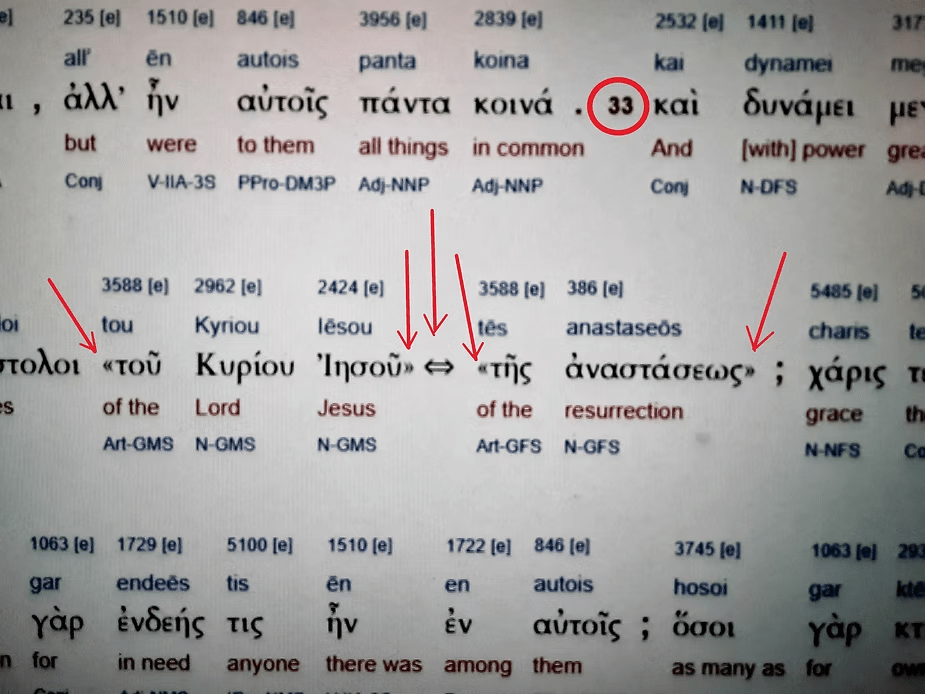
Here, I want everyone to look very closely at what is written and see the appearance of marks that do not translate. These marks are rooted in mathematics, from which philosophy and logic reside. They become unread ‘asides’ that must be realized. They are double angle marks [left and right] and a left right arrow. I highly recommend looking these up independently and getting a hang of what they mean.
“kai power great ,“
Here, the word “kai” begins a new verse, after following a period mark. Because it is written in the lower case and not capitalized, this supports what I said initially about the capitalization of “Tou.” Divine language does not capitalize word without them needing divine elevation. The word “kai” begins this verse by marking the need to see importance in “power great.” There is nothing that says anyone was “with power great, as the word “dynamei” is itself a statement about that which was commonly shared among the apostles. That “power great” is God, whose “power” is so “great” that nothing on earth can match that.
“were giving this proof them messengers”
This segment is translated as part of a paraphrase that says, “the apostles gave their testimony.” The first word in the segment places the focus on the act of “giving,” where the imperfect tense becomes a statement of the recent past moving into the present. This usage can be seen as bearing a dual meaning, where the past being is “were” and the present act of “giving” is both the disciples being given the gift of the Holy Spirit, which having been given then cause them to keep “giving” the same to others. The use of the word “to” then says “this” they “were giving” is “this” having been given them by a “power great.” What they “were giving” was then “the proof” of a “power great,” which made “them” become willing “messengers” of the word of God they spoke. That ability is [as Paul declared] a talent, which can only come to “them” by the “power great” that is the Holy Spirit.
“« of this Lord Jesus » ⇔ « of this resurrection » ; “
This series of marks and words is all part of the previous segment, but must be realized as untranslatable, such that the NRSV run-on mistranslation shows, “the apostles gave their testimony to the resurrection of the Lord Jesus,” shown to be one statement [added to “with power great”]. These marks are indicators of much information that needs to be realized. Individually, the double angle marks, left and right, become statements of greater than and lesser than statements. When combined to surround a segment of words [one left and one right], they act as angles that set certain words apart. The doubling acts as its own ‘capitalization’ that means a divine essence needs to be applied to that greater and that lesser. In between, where a left right arrow is found, this is a mathematical statement that says: If this then that; or conversely, If not this then not that. All of this needs to be grasped as Luke placing marks instead of words, as indications necessary to understand for this verse to make perfect sense.
As the first mark meaning a lesser than signal, the double left angle following “messengers” [“apostoloi”] says the “messengers” are not as great as is one “of this Lord Jesus.” The divine implication says they were “of this Lord Jesus,” as his “messengers.” When “of this Lord Jesus” is seen within double angle marks, the “messengers” are themselves conveyors of this presence, while not being able to outwardly show “of this Lord Jesus.”
The word “tou” is again a statement of “of this,” where the first capitalized word of verse 32 made that relative to possession of the Holy Spirit and an ability to speak the word of God. As such, “of this” means that presence of the Holy Spirit [“of this”] is what makes one a “messenger” or “apostle,” because within “one not one” is the “Lord” unseen, which makes all “messengers of this Yahweh” become the resurrection of Jesus. Thus, when the left right arrow points from this distinction, the initial assumption must be: “If of this Lord Jesus” is true, then the following angled off statement, “of this resurrection” is also true. The state of being a representation of “this resurrection” is then a lesser than state of actually being the return of Jesus of Nazareth into the world. Still, “of this resurrection” becomes the increase [greater than double angles] that is known widely as Christianity.
favor both great were on all them .
By seeing the great than double angles pointing to the semi-colon mark, it is still possible to see the state of having become the resurrection of Jesus is a ‘favor” bestowed upon “one.” The root word “charis” is defined as “grace” or “kindness,” but relative to “the resurrection” within “one” this is a weak translation, simply because it is so vague it is hard for people to grasp the deeper meaning. The usage is shown as: “(a) grace, as a gift or blessing brought to man by Jesus Christ, (b) favor, (c) gratitude, thanks, (d) a favor, kindness.” (Strong’s Definition and Usage) The aspect of “a blessing brought to man by Jesus Christ” still demands that one recognize such a presence is not by the soul of Jesus floating around, holding a magic wand, which he touches people here and there with. That fantasy is wrong, as there is no external Jesus spirit waiting for some soul in a body of flesh to command that spirit to bring one’s wishes into fulfillment. Jesus reborn is the reality of a soul merging with God’s Holy Spirit, meaning “Jesus” can only be found in flesh devoted to God. Yahweh is the one granting all “favor,” such that the “power great” that becomes “of this Lord Jesus” – “of this resurrection” comes solely from God.
This is where the word “te” must be understood to mean “both” or “and both,” where the word places focus on a duality present. This is the “one not one” being explained and the “soul” of one being joined with the Holy Spirit of God, so the presence of “both” becomes the “grace” of Yahweh bestowed. That brings about the repeat of the word “great” [“megalē”], which is the “power” that is a soul being “both” a human body of flesh and a Son of man, reborn as Jesus. The name “Jesus” means “Yahweh Saves,” so when a “messenger” of Yahweh is married to His Holy Spirit, that wife’s “Lord” is the Holy Spirit of God, named “Jesus.”
Here, again is written the word “ēn,” which has been used twice before, as “were,” a statement of the being in the past tense, plural number. This is another statement of changes coming upon those who devote their souls to Yahweh, to become His wives, so those past tense beings have been made new as both the old “one” with the new “one,” bringing about the rebirth of Jesus. It is this state of new being that is “on all them.
Verse 34:
“Oude gar endeēs tis ēn en autois;hosoi gar ktētores chorion ē oikiōn hypērchon pōlountes,epheron tas timas tōn pipraskomenōn,”
“Neither for poor certain were among them ;“
Here, the first word is capitalized and that word that must be seen as bearing elevation of meaning to a divine level. As the first word of a new verse, this needs to then be reflected back on that stated just before. There, the last segment of words placed focus on “favor great on all of them, so now “Neither” brings about the aspect of none being the recipient of greater favor that another. The aspect of “not” also becomes elevated, such that the “not” preceded by a “kai” is reflected in this “Not” here. “Not” becomes a statement of divine presence that now keeps “one” from expressing its old behaviors.
From that grasping of a capitalized “Oude,” that leads to “for need,” where the word “endeēs” can also denote a state of “destitution.” This implies the state prior was one where the soul [the “inner self”] was impoverished by not being married to Yahweh. By having married their souls through union with His Holy Spirit, “Neither” would ever want to give up that state of being “for” the “poverty” of a “soul” that does “not” possess salvation and eternal life. The importance of a divine “Not” now says no “one” married to Yahweh will ever be “in need.”
Next, we encounter the word “tis,” which I mentioned is used to denote “a certain” entity known. This then takes the aspect of being “poor” or “needy” and relates it to that “certain” state existing before marriage to Yahweh, when they “were” [that word “ēn” again] “poor” souls. This explains “need” as the necessity of Yahweh for a soul to be saved from death [its repetition through reincarnation]. All “Not one” with God, “Not one” whose “Lord is Jesus” within is thereby a “poor” soul.
This then leads to the words “en autois,” where the directional preposition, “in,” is another reference to their “inner self” [“kardia”]. This ending as a reflection on “them” and what “were in them,” becomes the motivation held by all, never to go back to being “destitute” spiritually again.
“as much as for owners of properties or dwelling exchanging has possessed , “
The first word in this segment makes a comparative statement, “as much as” or “how much, how great, how many” or “as much.” When this is related to the previous segment talking about how little one wants to return to an impoverished soul state, this segment directs the focus to a comparison. As souls possessing bodies of flesh, the point now is made to being “owners of property.” The specific comparisons are made to “pieces of land” and “dwellings,” which would include anything from parcels of land to portions of fields, and extra homes or even inns for rentals. The aspect of “being in possession of” these material things did not mean they had to be sold, but ownership allowed one the freedom for “selling, exchanging, or bartering” that which one possessed.
When one realizes that the souls where the room was shaken and they immediately were filled with the Holy Spirit and began to speak the word of God, those souls who own bodies, those bodies of flesh have been given away in marriage. Those bodies of the “apostles” or “messengers” have become “the possessions” of Yahweh. As the one who holds the deeds and titles, the “properties” of Yahweh are his to use as He sees fit. Here, it becomes vital to see oneself as a commodity of righteousness, renovated by God, to be ‘put on the market’ to do God’s Will.
“were publicly making known this prices of them of this sold , “
The Greek word “epheron” is translated by the NRSV as “brought.” The spelling is the imperfect active indicative, so the past tense application is better translated as an act of doing, as “were bringing.” The root word “pheró” means “I carry, bear, bring; I conduct, lead; perhaps: I make publicly known.” (Strong’s Usage) In the focus of this segment going towards “prices,” coming from having the ability to sell themselves [like material commodities], the meaning implies these “apostles” or “messengers “bore” a responsibility of making anything sold be known within the “assemblage.” Still, this becomes a focus on material things and not the truth of spiritual matters.
When one’s eyes open to the reality this segment of words does not say property has been sold and the price land or houses were sold for need to be exposed, it amazingly says the “price” of one’s soul is that body’s remaining lifetime being devoted to serving Yahweh. The “price” of salvation is complete submission, which is the truth of a marriage that is holy matrimony. When the spirituality of this state of being is realized first, one can then be lowered back into the material realm and see everything on earth is rated by its value. Everything has a “price.” Thus, as servants of the Lord, His messengers can sell themselves as laborers, earning a wage that needs to be let known.
Because the world demands ownership and values, it is impossible to exist in that earthly realm without having material needs. When one suddenly becomes married to Yahweh, completely submissive to His Will, God knows the world comes with prices that must be paid. As a wife of Yahweh, those needs will be met divinely. For an “assemblage” to suddenly find themselves in a total commitment state, God will be the one who leads their minds to organize the realities of life on earth: who owns land, who grows crops, who has houses, who needs to be laborers, etc., etc., etc. Thus, the divinity of that stated in this segment says, “Ask and you shall receive.” Make the world’s price known and Yahweh will meet one’s needs.
The word “timas” [plural form of “timé”] means “accord honor, pay respect,” or “properly, perceived value; worth (literally, “price”) especially as perceived honor.” (HELPS Word-studies) When this segment of words is seen as separate from that before it [comma usage], a statement saying “were bringing them respect” or “were publicly making known them honor,” then the tone shifts away from a comparison of self-ownership to material ownership and what rights one holds as an owner, to a statement of what a union of one’s soul to God’s Holy Spirit “brought to them in perceived value.”
When that flow of words is realized, the Greek word “pipraskomenōn” needs to be seen as coming from the root “pipraskó,” so it not only means “I sell,” but also means in a passive sense, “I am a slave to, am devoted to.” (Strong’s Usage) While the element of “sold” can be seen, it must be applied to spiritual matters, not the selling of lands and houses. That “sold” becomes the “souls” of other Jews and Gentiles that had been “sold” into slavery to the world. To demonstrate their “worth” as the wives of Yahweh, the meaning of this segment says they “were bringing this value of” receipt of the Holy Spirit to “them” who had been “sold” into slavery.
Verse 35:
“kai etithoun para tous podas tōn apostolōn;diedideto de hekastō kathoti an tis chreian eichen.”
“kai were establishing in the presence of those feet of them messengers ; “
Again one finds a verse beginning with a lower-case “kai,” showing importance is about to unfold that should be recognized. As a separate segment of words in a new verse, the focus is in addition to those who “were bringing value to those sold,” who then “were establishing” in “those sold” changes that made others become “side by side” or “alongside” those who had married Yahweh. Here, the root word “tithémi” says, “I put, place, lay, set, fix, establish,” such that the simple act of “laying” has to be seen in spiritual terms. This says it is better to use a word that denotes reparations, as a form of repentance, which those sold “were fixing” in themselves.
The element of “posas” meaning “feet” can then be seen as metaphor, rather than physical body parts. According to the idiom “to lay at the feet” that means, “To make or hold someone responsible for something.” (The Free Dictionary by Farlex) By seeing that meaning, the purpose of “apostles” [or “messengers”] going into ministry was to help those sold, into slavery to a world of sin, be “fixing” themselves so they can join with the “assemblage” and stand “side by side” as true Christians. However, all responsibility for that transformation “lay at the feet” of those hearing the truth of the Word spoken by God’s wives.
“redistributed now to each in proportion to as certain need had .”
In this final segment of words, the first word is “diedideto,” which is rooted in the word “diadidómi,” meaning “I offer here and there, distribute, divide, hand over.” As the Imperfect Passive Indicative 3rd Person Singular, this word is said to translate as “distribution was made,” although some align the word to “redistribution.” When one’s eyes have become set to see “things,” where “prices” equate to monies, it is easy to think of “redistribution” as the way money flows from the hands of those earning it and into the hands of those needing a handout. However, the purpose of these verses is not in the physical sense but the spiritual; so, any “distribution made” or “redistribution” has to do with the Holy Spirit, sent by Yahweh.
This makes the focus of “redistribution” be more in line with redemption than a question asking, “How much do you need to tide you over for the month?” Since “each” individual “soul” has differing sins of the past to atone for, redemption is then made by Yahweh “in proportion to” that confessed sincerely, “as certain” known deeds of failure, serving self not God.
——————–
Certainly, there are two ways to read these verses and both are true, with the way the NRSV shows this stated in human terms, not spiritual commitments. This says the element of money never ceased being a necessity in a human world, where everything has a price and everything costs something, rather than being free for the taking. Still, it is not this flawed existence that Yahweh began through sending His Son to the world. Christianity is the story told in Acts, which needs to be seen clearly during this season of Easter.
It is important to see how the ministry of Jesus demanded others provide for him, as well as for all of his followers and lead disciples. We are told multiple time that Judas Iscariot was the keeper of the purse, which made him the equivalent to a CFO in some church organization today. As evil as Judas was made out to be, by freely taking from the purse for personal gains, he held that position because then (as now) nothing is free.
When the rich young ruler asked Jesus how he could get to heaven, it is a misconception to hear Jesus tell him to sell everything he owns and give it to the poor, then become a disciple of mine. Jesus did not have a ministry that had no material values; so, he could never tell anyone to “sell everything and give it away.” If one is rich and another is poor, to transfer one’s wealth to the other maintains the same system of inequality. Jesus never preached that, because that would indicate owning possessions was evil. Why would Jesus tell anyone to give evil away to those who have none? He didn’t say that.
The material essence of this lesson says all true Apostles cannot be limited by needing to work for pay, when God has blessed them with the ability to speak His Word fluently. God awarded His Apostles with those gifts or talents for the purpose of ministry. To have one’s needs be met in ministry does not mean turning religion into a cash cow. That is a reflection of why God sent Jesus to Judaism … to fix that which had gone totally wrong. Therefore, for those who must go out into ministry [as did Jesus, as did Paul and others], they need financial supporters; but that support cannot be seen as one buying favor from Yahweh, by giving to the poor “messengers.” God’s Judgment is on souls, not how much one leaves behind in bank accounts. Whatever way God leads one to serve Him – investor, backer, minister – all must be wholly committed to Yahweh, as His wives.
As I discerned these four verses as I wrote this, my mind returned to thoughts of the Cathars, who were Gnostic Christians who suddenly appeared in southern France in the twelfth century. They were all known as “Good men” [“bon hommes”], with “Cathar” derived from the word “katharsis,” meaning “pure” or “purged.” They did not name themselves, as others did so by witnessing their commitment to serving Yahweh. They were known as hard workers, who were weavers by trade. They had a system of making and producing things, which were of such high quality that people bought them. Over the century the Cathars thrived in France, southern France was an economic paradise – business was booming. After the Roman Catholic Church had almost all Cathar people executed for not converting to Roman Catholicism, southern France became and has remained ever since economically poor. I have been led to recall that history because it is foolish to read these verses and only think true Christians would sell everything and become evangelists begging for handouts. God expects hard work in this world, with few frills; but the rewards after this life are great.
In this Easter season, when mandatory readings from the Acts of the Apostles are read, the reasoning needs to be remembered as this: The lessons are teaching us to become ministers of the Word. These readings become Jesus spending time teaching us to take his place, after he ascends. The lessons in the Book of Acts cannot be found to be about how wonderful Jesus was [boohoo he’s gone]. Instead, he must be seen as news worthy of rejoicing, because Jesus is still here, in his apostles.



 Explaining the Readings