Tag Archives: Acts 4:5-12

Acts 4:5-12 – Retrial for rebirths

The rulers, elders, and scribes assembled in Jerusalem, with Annas the high priest, Caiaphas, John, and Alexander, and all who were of the high-priestly family. When they had made the prisoners stand in their midst, they inquired, “By what power or by what name did you do this?” Then Peter, filled with the Holy Spirit, said to them, “Rulers of the people and elders, if we are questioned today because of a good deed done to someone who was sick and are asked how this man has been healed, let it be known to all of you, and to all the people of Israel, that this man is standing before you in good health by the name of Jesus Christ of Nazareth, whom you crucified, whom God raised from the dead. This Jesus is

“the stone that was rejected by you, the builders;
it has become the cornerstone.’

There is salvation in no one else, for there is no other name under heaven given among mortals by which we must be saved.”

——————————————————————————–

This is the Acts selection from the Episcopal Lectionary for the Fourth Sunday of Easter, Year B 2018. It will next be read aloud in a church by a reader on Sunday, April 22, 2018. This is important as it identifies a hierarchy of devotees to religious practices and dogma, which can equally be applied to all organizations, branches and sects in the Judeo-Christian category, with only Jesus Christ being the bearer of salvation.

In this reading, Peter and John had been arrested for having healed the lame beggar at the gate of the Temple, bringing him walking into the morning prayer service with them. Following that service, Peter gave a sermon to the pilgrims still in Jerusalem, along the breezeway known as Solomon’s Portico (or Porch). The crowd must have discussed that miracle healing for hours, talking with them and the healed man, as the arrest occurred late in the afternoon, in the evening of day. Because of the lateness of the arrest, Peter and John were placed in the temple jail overnight, with them appearing before the Sanhedrin the next morning. That is the setting leading to this reading scene.
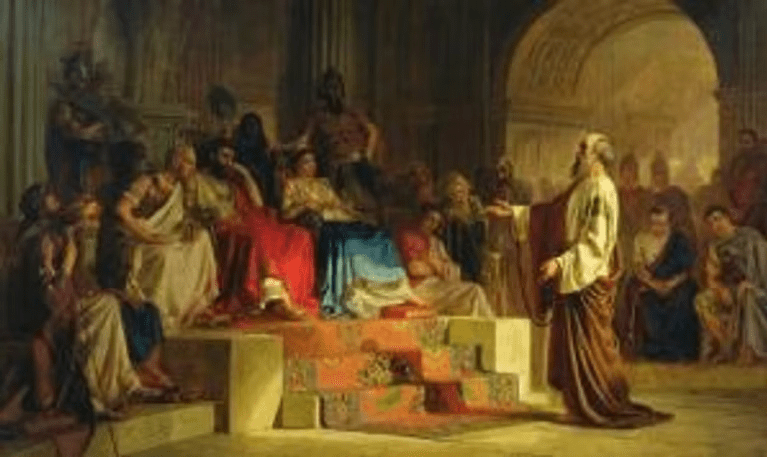
Standing before the high-priestly family.

Whenever Christians today read or hear read aloud the stories of the Holy Bible, it should not be done as if looking back from a perspective that seems superior. By knowing the story and its ending, such separation in time makes one feel that he or she identifies solely with the “heroes” of the story, and never the “goats”. This is what I mean when I refer to the Big Brain Syndrome, as Christians tend to identify totally with Peter and John (the Apostles) in this reading, and never as “the rulers, elders, and scribes assembled in Jerusalem, with Annas the high priest, Caiaphas, John, and Alexander, and all who were of the high-priestly family.” The purpose of all Biblical readings is to see oneself in that darkness, before one can ever begin to shine with the light of a Saint.

In this reading, the basic characters are: the falsely accused; the accuser judges; and the onlookers (including court employees).  The onlookers are invisible, as they have nothing to add to the scene; but we know justice requires a general audience. That invisibility is a sign of the public’s weakness, as commoners are not wealthy or influential enough to be in the class defined as “rulers, elders, and scribes,” much less be born into the “high-priestly family.”

The onlookers have no control over who is accused and who accuses. The judges then were those who are allowable extensions of the Roman Empire, set in place to control the population without military force.  The Jews were policed by the laws of Moses, with the rule of Rome a distant second.  This means the equality that connects all of the characters of this scene is religion, which makes all devoted to the One God. Thus the court is one of religious law.

Christians are likewise divided today, where (relatively speaking) only an elite few rule the hierarchies of the multitude of churches naming Jesus Christ as their Lord. Popes, Cardinals, Bishops, preachers, pastors, ministers and priests are all parts of the “high-priestly family” that is Christianity. Some Christians proclaim to be Prophets, which sets them apart from the ordinary and the elite, just as Peter and John were set apart.  The laws of our nation have superseded Church laws, so people claiming to be Apostles are rarely arrested and tried by congregations. Today, as in ancient times, most people who want to believe in the One God are still the bewildered onlookers who obediently follow those who would be their leaders, with politicians often given honorary “high-priestly” status.

How many resurrections of Jesus Christ are in this picture?

The rarity these days are the Apostles who heal lame beggars, while rulers and onlookers alike all know they themselves are that lame beggar … just too afraid to let that side of themselves be shown. More often than not, the ones proclaiming to work miracles are later found to be disgraced, like the Jim Joneses, the David Koreshes, and the Jimmy Swaggerts of the world. These “Prophets” proclaim to be divine leaders, making them be like the “rulers, elders, and scribes,” rather than be like Peter, who proclaimed, “this man is standing before you in good health by the name of Jesus Christ of Nazareth.” The missing element these days is we have no Apostles who heal and give full credit to Jesus Christ, pointing out how the man (like the one named Peter) had nothing to do with the miracle.

This means that when these verses from the Book of Acts are read, the same can be said of today’s churches claiming to be “in the name of Jesus Christ.” Jesus Christ cannot be resurrected in a building, any more than he cannot be resurrected in a tree, or an automobile, or even in a wafer taken from a box of purposefully manufactured religious wafers, placed nicely on a silver platter. Jesus Christ can only be resurrected in Apostles, like Peter and John of Zebedee … human devotees.

Unfortunately, since no modern churches have the ability to proclaim ALL ITS MEMBERS are the resurrection of Jesus Christ … as TRUE CHRISTIANS … then what we call Christianity is little more than cults of personality.  The personalities are popes, cardinals, bishops, preachers, pastors, ministers, and priests.  In other words, modern churches are also led by “rulers, elders, and scribes assembled” who judge against anyone who should dare to do as Peter did in Jerusalem, outside the temple.

What is the difference in having the man named Jesus, of Nazareth in Galilee, sentenced to death, as Peter said the rulers of the Temple of Jerusalem had done, and having the Spirit of Jesus Christ sentenced to death by not teaching how the whole point of Christianity is to die of self ego and be resurrected by the Holy Spirit as the Christ returned?

There is no difference.  One denies the Messiah has indeed come.  The other denies the Christ that has come can come again … many times over.

I accuse you of being ironclad in denial.

Just as Peter recalled Psalm 118:22 (“The stone the builders rejected has become the cornerstone”), the cornerstone of Christianity can be none other than Jesus Christ of Nazareth. Jesus was rejected by the “rulers, elders, and scribes,” along with “Annas the high priest, Caiaphas, John, and Alexander, and all who were of the high-priestly family.” There was no denying that Jesus had lived.  Everyone in Jerusalem knew that, as his execution was still fresh on their minds.  Everyone in Jerusalem knew Jesus of Nazareth had done some miraculous things, prior to his death, much like Peter did, by healing a lame beggar at the Beautiful Gate. Peter stood there in front of his accusers and said Jesus Christ had healed the lame beggar, because Jesus Christ was back IN PETER.

Do you think all history would have changed if Annas and Caiaphas had listened to Peter and then proclaimed as their judgment, “Okay guys, Peter is right. God has sent our Messiah. All hail Jesus as the Christ!”?

If the Sanhedrin had reached that end, it would have been written into Law – “Jesus is God’s promised Messiah.”  However, if the Sanhedrin had endorsed belief of a prophesied Messiah by lip-service acceptance, agreeing to say Jesus of Nazareth was then and forevermore to be the Christ of the Jews, would the spread of Christianity have still moved across the world?

Probably not.  There would be no Christians in that case, as God would have proved He was happy with just Jews and scattered Israelites (even though it is hard to tell them apart from Jews) honoring Him.  All Jews would be for Jesus.  Of course, Judaism might be the religion of choice today … had the Sanhedrin just got on board way back when … and if God made Jews the rulers of the world’s governments afterwards.  Belief in Jesus might be commanded by Law, which would have made Judaic judges be very important in that alternate universe.

The reality is, however, that the spread of Christianity is more than professed belief. It is more than a command to believe like everyone else, without good explanation.  Christianity has to involve Jews and Gentiles, but it has to be founded on a relationship of love.  The religion grew exponentially from each and every true Christian having been reborn as Jesus Christ of Nazareth, possessing the Mind of Christ and having the power of God to perform miracles … in the name of Jesus Christ.  Christianity was spread by Apostles, to wherever they traveled.

That growth was severely stunted by a bunch of “rulers, elders, scribes, and high-priestly families” trying to hoard God and Christ for themselves, beginning around the time the Roman Emperor figured out it would be better to be the Roman Pope.  A Sanhedrin-like hierarchy that used its influence as force then left the onlookers silently following those leaders.  Churches began splitting at the seams over what was happening long ago.  New sects and branches began sprouting like weeds in the Garden of Eden, with no gardener around to pull them out and throw them into the fire.

Therefore, we stand today as disciples of the One God who are still waiting for Jesus Christ to come back and bring Heaven to earth.  That wait is no different than the Jews, who are still looking for his first arrival.

When Peter said, “There is salvation in no one else, for there is no other name under heaven given among mortals by which we must be saved,” he said (in effect), “You better be already in the name of Jesus Christ when mean Jesus comes down from the clouds, à la The Revelation of John, because that returning spirit will be spitting a double-edged sword of justice from his mouth.

Only by becoming Jesus Christ in a mortal body (resurrected or reborn) can one’s soul find salvation, “as no other name under heaven given among mortals” earns an exemption to eternal damnation.  Titles are names, so what Peter said (as the words of Jesus Christ through an Apostle) includes such titles as: pope, cardinal, bishop, preacher, pastor, minister or priest.  None of those names will be able to produce the miracle of soul salvation, by edict, sermon, proclamation, or televised prayer services.  No titles can wave a wand, cast water from a sprinkler, or feed one a cracker, washed down with a sip of  fruit juice, and claim their position of piety has saved one from evil.  Jesus Christ is not controlled, like electricity, made to jump out on command, because one holds a “high-priestly” title.  Therefore, the Rapture can only apply to Saints on earth, yet to ascend to Heaven, and not those mortals who are full of fear, having done nothing to earn salvation … having never asked God to send him or her His Son to become one with him or her.

Peter and John stayed in a jail cell overnight and were paraded before all the big brains the next day, simply because the presence of Jesus Christ within them flowed out to one in need, healing him in the name of Jesus Christ. For breaking the status quo, where there was an order of family or chain of command that had not duly been recognized, some display of hierarchy had to be made as punishment. The question asked by the judges to Peter (“By what power or by what name did you do this?”) expected the accused to produce some certificate of authorization for working miracles, just like a vendor would need a license to sell wares. If Peter lied, the truth would be known, so he would have just committed a more serious crime.  If Peter had admitted he had no authority to heal lame beggars, then there would be reason to find Peter and John guilty of breaking the law, for having caused a social disturbance. However, Peter gave them a name … the name of the one the Sanhedrin had condemned to death … Jesus the Messiah had risen in Peter and John!  Jesus Christ of Nazareth gave them the authority!

Jesus Christ again stood before his murderers, but now in duplicates. Not only was Jesus Christ in Peter and John, but Jesus Christ had been resurrected in the lame beggar, who then stood alongside Peter and John, before the Sanhedrin. The lame beggar knew the presence of the Holy Spirit within him was what allowed him to walk for the first time in his life. Where there were two in the name of Jesus Christ, then there were three; and the judges knew the power of that name and feared the consequences (just as they did before killing Jesus). The silent majority watched and waited to see how the judges would act.
As a lesson from the book that teaches us that Apostles Act from their faith, having become resurrections of Jesus Christ, thereby following the theme of the Easter season, this falls in line with the Gospel reading from John, about the good shepherd. Lost, like a sheep in this story, the lame beggar becomes the one who has been given a new outlook on life. Jesus, the good shepherd, reached out to a lost sheep who knew his name and the lame beggar responded to his master’s call.

As Christians who have long been led by “rulers, elders, and scribes” that tell us Jesus sits with the Father in Heaven, only to come again at the end of the world to smite all the evil ones, we have been told there will be no miracles in our lives. We are to believe what we are told to believe, or be judged as boat rockers and dissidents. Those who feel there must be more to religion than that, they sit outside the mainstream, begging for assistance, only to get little in return. We, today, act like lame beggars with our hands out, with no expectations of ever being able to stand on our own two feet and walk … with no hopes of ever being able to help others to walk too.

Easter is when our Lord rises in us to transform us from cripples into Apostles. We must then stand before all judges to proclaim Jesus Christ is a name possible for all believers. We cannot make that proclamation from hearsay. It can only be made by Jesus Christ within us, making our mouths speak his words.


John 10:11-18 – The goodness of shepherding

Jesus said, “I am the good shepherd. The good shepherd lays down his life for the sheep. The hired hand, who is not the shepherd and does not own the sheep, sees the wolf coming and leaves the sheep and runs away—and the wolf snatches them and scatters them. The hired hand runs away because a hired hand does not care for the sheep. I am the good shepherd. I know my own and my own know me, just as the Father knows me and I know the Father. And I lay down my life for the sheep. I have other sheep that do not belong to this fold. I must bring them also, and they will listen to my voice. So there will be one flock, one shepherd. For this reason the Father loves me, because I lay down my life in order to take it up again. No one takes it from me, but I lay it down of my own accord. I have power to lay it down, and I have power to take it up again. I have received this command from my Father.”

——————————————————————————-

This is the Gospel selection from the Episcopal Lectionary for the Fourth Sunday of Easter, Year B 2018. It will next be read aloud in church by a priest on Sunday, April 22, 2018. It is important as it tells of Jesus being the good shepherd, with all pretenders being hired hands. In this message, Jesus spoke of the power to lay down a life in order to take it up again, which becomes a prophecy of the Good Shepherd’s resurrection in Apostles.

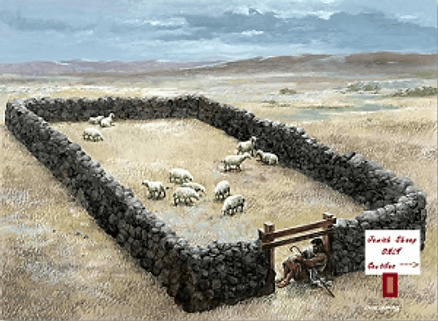
The tenth chapter of John’s Gospel begins with Jesus telling the preceding parts of this well-known metaphor of the Good Shepherd. Prior to this reading, Jesus had explained how sheep recognize the voice of their shepherd, with the sheep’s shepherds calling the sheep from the gate of the sheepfold. False shepherds hop the fence or wall of the sheepfold, with the intent of stealing them. The sheepfold is implied to be a place of safe keeping, such that Jesus said he was the gate through which the sheep (flocks of all true shepherds) enter. As an entrance point into a place of safekeeping, the whole sheepfold represents salvation; and as the gate, salvation can only come through Jesus.

In this part of the reading, John quoted Jesus as saying, “I am the good shepherd,” where Jesus then went on to explain that a good shepherd will be willing to die to protect his flock. Jesus pointed out the difference between a true shepherd – one who leads his or her flock of sheep to the sheep fold as evening draws near – and a good shepherd.  That difference can be seen as WHY one is a shepherd in the first place.

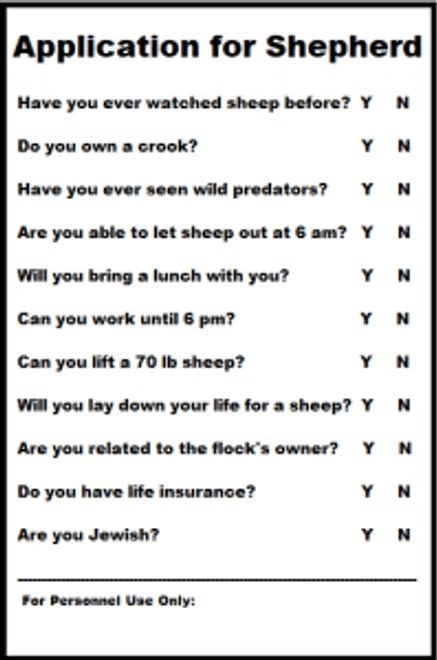
There are sheep; but sheep will become wild (led by dominant male rams) if unattended by humans. As valuable possessions, for milk products (goats = sheep), wool, and meat, they can be domesticated (led by shepherds).  Domestication, through ownership, requires constant care: letting them out to graze, rounding them up for nightfall, milking them, sacrificing them for food, and shearing their wool.  That work makes one earn payment for their care. This means domesticated sheep need to be watched by shepherds, to protect one’s investment flock from wild predators, such as wolves.

This means shepherds can be hired to fill that position as “hired hands,” if the owner profits enough from his flock.  Such a paid employee is not one who typically cares more about the well being of the flock, than oneself’s well-being. Shepherd work is a lowly position, such that a rancher usually assigns his younger children to watch his flock. When one’s children are grown, however, it will force a rancher to hire other young children to do that work.

When faced with the danger of a predator, where the predator could easily turn on a child shepherd that is paid to watch a flock owned by someone else, such a threat will always force one into a point of decision: Do I risk harm protecting someone else’s sheep? Or, do I sacrifice someone else’s sheep for my own safety? A “hired hand” will always choose to save oneself, at the expense of the safety of the sheep.

When Jesus then said, “I know my own and my own know me, just as the Father knows me and I know the Father,” this touches on the element of family that produces a good shepherd. Just as shepherds were typically the young sons that tended the flocks owned by their fathers, they knew the responsibilities of their job included laying down their lives in protection of their extended family. Just as their father would lay down his life protecting his children, the children would honor their fathers by doing the same for the livestock own by their fathers. This means a “hired hand” also knew the responsibilities of a son (or daughter) to their father; but when wolves were threatening someone else’s flock, the offering up of one’s life for someone else’s family became the deeper issue that caused a paid outside employee to turn away.

By seeing that issue of family, one can better grasp how Jesus then said, “I have other sheep that do not belong to this fold. I must bring them also, and they will listen to my voice.” Jesus was saying that all sheep not having a shepherd that is totally committed to protecting the flocks of another family, Jesus will be the one who will take on that responsibility of laying down his life to protect them. Of course, “other sheep that do not belong to this fold” (the one of which Jesus then tended) was relative to father Moses (ie.: the Jews sheepfold).  The “other sheep” are then Gentile sheep.

When Jesus said, “I must bring them also, and they will listen to my voice,” he was prophesying the spread of Christianity, where the voice of Jesus would flow from the mouths of Good Shepherds that were Apostles in the name of Jesus Christ. Those sheep would hear the voice of the family of God the Father, sounded by His Son the Good Shepherd.

When Jesus then said, “For this reason the Father loves me, because I lay down my life in order to take it up again,” that can be seen as a prophecy of Jesus saying he would be killed by the predators that were attacking the flocks of Judaism. Jesus was the Good Shepherd tending to that scattered group of sheep, where the Roman wolves had been left to devour the ones left unprotected by the “hired hands” that were the Sanhedrin.

Those elitist “rulers, elders, scribes, and all who were of high-priestly descent” in Jerusalem (from the accompanying Acts 4:5-6 reading) were not related to the Father. They were only in their positions for the money, fame and glory, not the sacrifice of lives protecting lowly sheep. The Sanhedrin, Pharisees, and Sadducees did “not care for the sheep” of Israel.  It would be their negligence that would cause Jesus of Nazareth to be thrown to the wolves, losing his life, “in order to take it up again” in apostles who would go out seeking all the lost flocks of the Father (which included Jewish flocks, Samaritan flocks, scattered Israelite flocks, and Gentile flocks).

When Jesus said, “The Father loves me, because I lay down my life,” he was repeating what he had said to the Sanhedrin representative Nicodemus, as Jesus had begun his ministry. John wrote how Jesus said, “For God so loved the world, that He gave His only begotten Son, that whoever believes in Him shall not perish, but have eternal life.” That sacrificed Son (spoken to Nicodemus) is now called the Good Shepherd (spoken to Jews of the Temple). The rescue of Jesus, so those who believed in him would not die, would be to to collect the lost sheep for eternal life. They would be raised up again as the lambs of God, each reborn as the Good Shepherd.

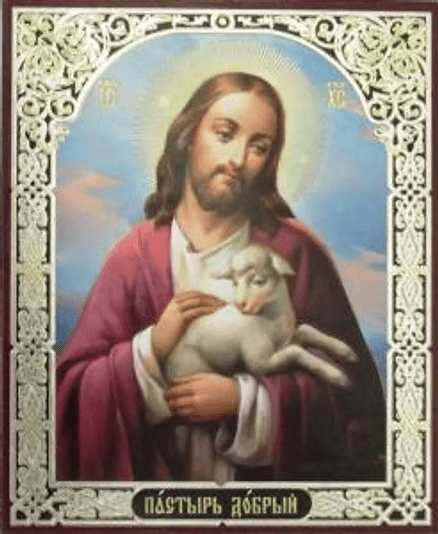
Look at this picture as one’s sacrificed ego becoming as meek as the lamb, while one’s human form covers the Christ risen within.

When John then wrote how Jesus said, “No one takes it from me, but I lay it down of my own accord,” this was his choice, which was taken completely from a love for his Father as a willing sacrifice for a higher good. It is the lesson learned from the Father’s love of the Son. It is how the Good Shepherd sees the flock as his willing responsibility, because of the love shared between the Father and the Son.  This is how all Apostles must first be adopted by the Father, through marriage that makes one’s heart become the seat of the LORD.

This means the Sanhedrin “hired hands” and the Roman “wolves” were known to exist, but they would not be given the ability to control “good” through fear. The love of God surrounds one like a sheepfold, with Jesus the gate.  Jesus knew neither the Sanhedrin nor the Romans held any lasting power. They knew better than try to jump the fence or wall and be caught stealing (a Commandment).  Therefore, Jesus would knowingly walk into the trap set by those who did not care for anyone and lay down his life.  He would make that sacrifice as a “witness” to the power of God. The Greek word for “witness” is “martus,” the root for “martyr,” as “martys.”

This is why Jesus then said, “I have power to lay it down, and I have power to take it up again. I have received this command from my Father.” This is the power of Resurrection, which was the “spiritual matter” Jesus tried to tell Nicodemus about, only Nicodemus’ big brain blocked him from grasping the concept of rebirth (a common flaw of thinking to this day). Jesus proved he had been given the power to lay down his own life and take it up again with his Resurrection from death. However, “the command from [the] Father” extended well beyond the limits of one man’s life on earth, as Jesus would lay down his life so it could be reborn in all those who believed, who laid down their egos to be raised up as the Son, again and again and again.

This is clearly the Easter lesson that is to be grasped by Christians on the Fourth Sunday of Easter. Everything John recalled said by Jesus has to be seen in personal terms, where this reading is intended to make those listening to hear themselves being called, “Wolf!” Christians are to ask themselves, “Why do I attack, scatter, and devour Christians who are lost and cannot defend their religion?”  “Why do I attack anyone and use Jesus Christ as my excuse?”

Are you of one denomination or branch of Christianity that possesses the “Us vs. Them” mentality, where no other flocks are worthy of God’s protection? Do you see your denomination superior to others?  Do you seek to kill first and ask questions later, because you see eternal salvation as a war against flawed dogmatic philosophies (blind to the flaws you believe), where only the righteous will survive?

Then you need to ask yourselves, “Why do I run away, when I see wolves attacking the innocent?”

Why are you not a “hired hand” of Christianity, if you cannot truthfully look towards heaven and swear to God, “I am you Son, here to do Your work!”?

The Easter lesson of the Good Shepherd is more than the simpleton belief that Jesus died so we could all run and play in fields of green pastures and lie down beside crystal clear, cool, still waters, having all our needs met. We must stop seeing ourselves as little lambs of innocence, when the reality is we always get in trouble (sin, sin, sin), so Jesus is always running to our rescue.

As long as we walk the face of the earth, we are always walking through the valley of the shadow of death, because the earth is where evil calls home. Satan lords over the earthly domain; and he lures human beings with things that call them away from the flock, to where innocent sheep can be ripped to shreds and torn apart, limb from limb. Because the laws of nature explain that as “survival of the fittest,” we think nothing of another weak sheep lost.  Still, we fear that end is always a heartbeat away from being our demise.

This means the lesson of the Good Shepherd is we each must be free of fearing evil. We must know, “I fear no evil; for Jesus is with me.”  We must be able to claim: “Jesus restoreth my soul: he leadeth me in the paths of righteousness for his name’s sake.” Christians become the “namesakes” of Jesus Christ when they have been Resurrected as him.

Only then, as Jesus reborn, can we see ourselves as protectors of the flocks. Only as Apostles, seeking to protect lost sheep, can Christians see a reflection of the good this story tells in themselves.

Acts 4:5-12 – Shepherding the Rulers

The rulers, elders, and scribes assembled in Jerusalem, with Annas the high priest, Caiaphas, John, and Alexander, and all who were of the high-priestly family. When they had made the prisoners stand in their midst, they inquired, “By what power or by what name did you do this?” Then Peter, filled with the Holy Spirit, said to them, “Rulers of the people and elders, if we are questioned today because of a good deed done to someone who was sick and are asked how this man has been healed, let it be known to all of you, and to all the people of Israel, that this man is standing before you in good health by the name of Jesus Christ of Nazareth, whom you crucified, whom God raised from the dead. This Jesus is

`the stone that was rejected by you, the builders;

it has become the cornerstone.’

There is salvation in no one else, for there is no other name under heaven given among mortals by which we must be saved.”

——————–

This is the mandatory reading from the Acts of the Apostles for the fourth Sunday of Easter, Year B, according to the lectionary for the Episcopal Church. It will be read aloud before Psalm 23 is sung, which is the familiar verses begun “The Lord is my shepherd; I shall not be in want.” That will be followed by a reading from John’s First Epistle, where he wrote, “He laid down his life for us– and we ought to lay down our lives for one another” The readings will conclude with a lesson from John’s Gospel, which recalls Jesus saying, “I am the good shepherd. The good shepherd lays down his life for the sheep.” Due to these readings, this Sunday is commonly termed “Good Shepherd Sunday.”

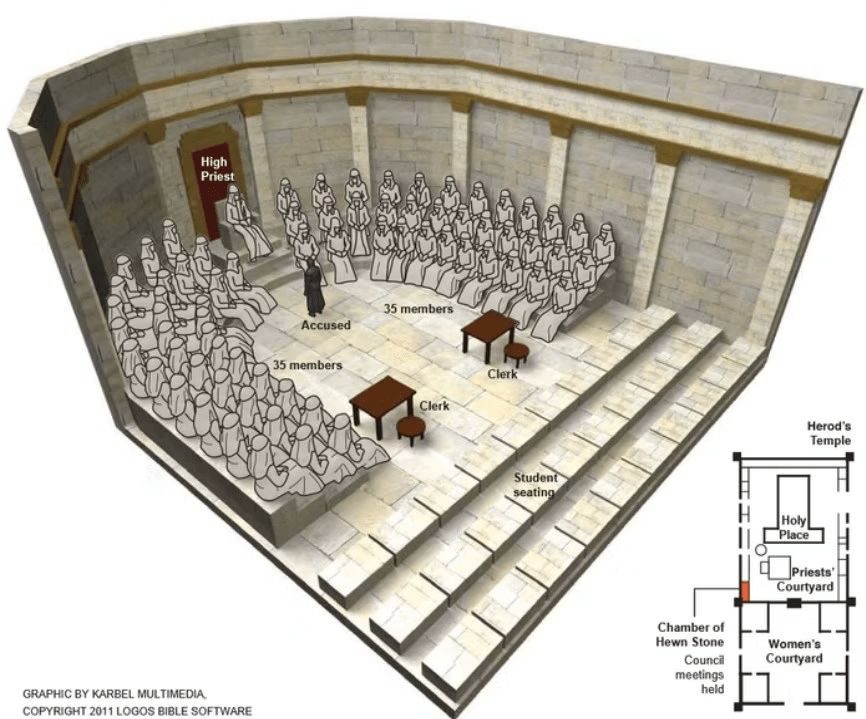
After last Sunday’s reading from Acts 3, where Peter addressed pilgrims [he called them “Israelites”] at Solomon’s colonnade, due to a lame beggar having been healed, Acts 4 addresses the arrest and holding of Peter and John overnight, so they could appear before the Great Sanhedrin [a meeting of 71, more than the 23 of the Lesser Sanhedrin]. The listing of the specific heads of that assembly indicates the Great Sanhedrin was a normal gathering in Jerusalem, which met daily in Jerusalem.

According the Wikipedia article entitled “Sanhedrin,” the following is stated:

“In the Second Temple period, the Great Sanhedrin met in the Temple in Jerusalem, in a building called the Hall of Hewn Stones. The Great Sanhedrin convened every day except festivals and the sabbath day (Shabbat).”

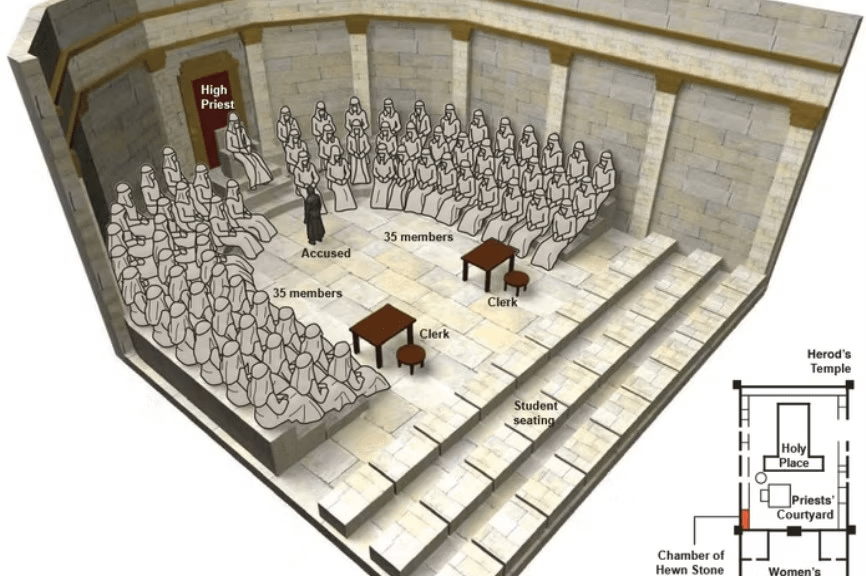
Notice the red rectangle, denoting where the Chamber of Hewn Stone was. Think of that as being the “cornerstone” of the Temple, as the “secret place” set aside for “Rulers.”

It needs to be readily assumed that the presence of Peter and John in Jerusalem was not because they had taken up residence there. Because they had been in Jerusalem on Pentecost, the feast of Weeks [Shavuot] is only one day, on a Sunday [the first day of the week]. Being Galileans with families, they would have gone back to their homes, from where they would have begun ministries as resurrections of Jesus, each designated as Yahweh’s Anointed ones [Christs, therefore the root of the movement called “Christianity”].

This assumption says they had returned to Jerusalem for another festival. That can be assumed because Acts 4:4 says, “But many of those who heard the word believed; and they numbered about five thousand.” That number came after the healing of the lame man as Peter and John were going to the temple for morning prayer, when those presents were pilgrims [Israelites, not Jews], who would have also come for a festival. The festival that would have happened next, after Pentecost [Shavuot], would have been Sukkot or the festival of Booths [Tabernacles]. That festival ends with the Eighth Day, following a week-long festival.

Because the Sanhedrin did not convene during a festival, they would have re-gathered on the day after the Eighth Day. During an eight day festival, it is possible that Peter and John healed the lame man on an early day of the festival, most likely not a Sabbath, with the remainder of the festival leading to news of the healing spreading, such that Peter and John were sought out over a day or two afterwards, during which the number of “about five thousand” would have equally been touched by the Holy spirit, as was the lame man. Because Peter and John were known Galileans and expected to leave town after the Eighth Day, they would have been arrested and held overnight, until the normal gathering of the Sanhedrin convened. It should not be seen like that powerful group of Jews feared Peter or John, as the news of their ministries was not like that of Jesus, which was well-known prior.

Evidence for this conclusion can be found in the capitalization of the Greek word “Egeneto,” which is the 3rd person singular aorist middle indicative form of the root “gínomai,” meaning “to take place” [as an event]. This important word says simply, “as normally scheduled” or “as usual,” meaning it was not a special calling of important leaders of Jerusalem together for the intent purpose of addressing complaints that two men were talking publicly about the dead having been raised. The importance on a divine level of awareness, however, says that Yahweh knew this group would gather after the festival was over and He wanted to take advantage of this scheduled meeting, in order for Him to say a few things to those running Judaism. Those words would be spoken by His Son, the man those leaders had killed, whose soul was then resurrected in Peter (and John). That means God had His servants be detained for the purpose of using this event that was known to come, when “It came to pass.”

Not read today is the background that explains why Peter began speaking what we read. In verses 1 and 2 is stated, “the priests, the captain of the temple, and the Sadducees came to [Peter and John], much annoyed because they were teaching the people and proclaiming that in Jesus there is the resurrection of the dead.” [NRSV] From that, one can imagine some clerk read aloud the charges brought against Peter and John, which would have been the first time most of those V.I.P.s had heard why they [Peter and John] were there [just like a judge in any courtroom today]. That led them to hear the charges and then ask, “ By what power or by what name did you do this?”

The Greek written by Luke uses the terms “dynamei” and “onomati,” which have been translated above as “power” and “name.” The intent of their question must be understood as then asking (according to viable alternate translations), “By what ability to perform or by what authority [such as a license approved by Pilate to speak publicly] did you this [listed charges]?”

Here, it is worthwhile to recall how Jesus was asked the same type of question, after he overturned the vendors’ tables in his first trip to Jerusalem as a rabbi in ministry. Then they asked, “What sign can you show us for doing this?” (John 2:18) There, the word translated as “sign” can mean a signed document or a “marque,” such that the same standard line of questioning is a mandatory first thing to ask anybody showing up in court. [“You have been charged with (fill in the blank.) How do you plead?]

In Luke’s account of this event unfolding, he wrote, “Then Peter, filled with the Holy Spirit” [NRSV], which is accurately translated in the aorist passive participle of “pimpláō,” “having been filled with Spirit Holy.” That demands some more clarification.

While “filled with the Holy Spirit” bears the same meaning, this paraphrase becomes weaker than that actually written. A weak translation can make it appear that Peter was just a guy that was wondering why he was in court, when out of the blue [ala like Pentecost morning] another blast of the Holy Spirit made him then [a capitalized word stated prior, albeit separated by a comma mark from the following statement] “filled with the Holy Spirit.” What needs to be realized is “having been filled” dates back in the past to Pentecost (actually before), such that once “filled” always “filled.”

He was “filled with the Spirit,” such that the capitalized word “Pneumatos” states what Peter “had been filled with.” That capitalization gives that single word divine elevation as the “Spirit” of Yahweh. Jesus “breathed upon his disciples and said “receive the Spirit.” That was when their souls married Yahweh and became joined with His Spirit. It is unnecessary to say “God is Holy,” because Yahweh is the source of all on earth who can possibly be “Holy.” Therefore, “having been filled with the Spirit” of Yahweh, the prior Easter Sunday evening, Peter had been “Holy” as Jesus reborn into ministry for some time, at that point. He became “Holy” because of that prior filling, not something immediate or sporadic.

When this precondition is established, one should then see the first word out of Peter’s “Holy” mouth, after asked a simple question by the Sanhedrin [in their brains], was “Archontes” or “Rulers.” Here, the capitalization takes the meaning of what Peter said to a much higher level than the Sanhedrin hearing Peter verbally acknowledge that each one of them was “a commander with authority (influence) over people in a particular jurisdiction.” (HELPS Word-studies) That word [“Rulers”] is Yahweh pointing out to those who supposedly held the pretense before all Jews, as being the ones closest to Yahweh and thereby His designated authorities for Him on earth. This becomes Jesus speaking through Peter’s mouth, calling them the “kings” so wished for by the Israelites, demanded of Samuel, and their “Promised Land” had reduced Israel to a bunch of straw bosses inside a temple that acted as their puppet city state.

[This can equally be seen as metaphor for someone standing before a Roman Pope, with seventy Cardinals surrounding him, where a true Christian (Jesus reborn into flesh) can equally allow God can have a little chat with the Great Pretenders of religion.]

Jesus had been called to answer to a similar gathering of authorities (the Jews), after he had been seen healing a lame man by the pool of Bethesda on a Sabbath. (John 5) Then Jesus told them, “I do not receive honor from men; I know you, that you do not have the love of God in you.” (John 5:41-42) Most probably, some of those men who heard Jesus speak were there that day when Peter then said, “if we are questioned today because of a good deed done to someone who was sick and are asked how this man has been healed, let it be known to all of you, and to all the people of Israel, that this man is standing before you in good health by the name of Jesus Christ of Nazareth, whom you crucified, whom God raised from the dead.” (Acts 4:9-10) Those who heard Jesus speak like that prior must have felt a gulp in their throats as they heard Peter say those words.

The Pharisees of Jerusalem had questioned the man born blind and his parents “because of a good deed done to someone who was sick.” That man answered the people who saw he was healed, saying “The man called Jesus made mud, spread it on my eyes, and said to me, ‘Go to Siloam and wash.’ Then I went and washed and received my sight.”’ (John 9:11) The Jews questioned his parents, but John wrote, “His parents said this because they were afraid of the Jews; for the Jews had already agreed that anyone who confessed he [Jesus] to be the Christ would be put out of the synagogue.” (John 9:22) Thus, when Peter said, “this man is standing before you in good health by the name of Jesus Christ of Nazareth, whom you crucified, whom God raised from the dead,” it was Peter saying, “The truth and proof of what I say is here now, “standing before you in good health,” because I am in “the name of Jesus Christ of Nazareth.” In case some of you forgot, you “crucified” him to “dead,” but look and see it is me again, “whom God raised.”

In verse 3 of this chapter there is nothing indicating that anyone other than Peter and John were detained. If he was not present before this gathering, as one of those “made the prisoners stand in their midst,” then the only one Peter could be referring to would be himself. The lack of the healed man’s presence would mean Peter was “this man – standing before you in good health by the name of Jesus Christ of Nazareth.” If the healed man was also there, as a Jew presumably living in Jerusalem and voluntarily appearing, no one was stopping Peter and saying, “Let the healed man speak as to who healed him.” In either case, all standing “in their midst” were those “having been filled by the Spirit,” so all were “Holy,” just like Peter, all healed by God, all reborn as Jesus Christ.

Peter then quoted a verse from Psalm 118 [the Easter Sunday Psalm], which every member of the Sanhedrin would have instantly known to be verse 22, which says:

“the stone that was rejected by you, the builders; it has become the cornerstone.”

While Peter added that “this Jesus” was the one of whom David sang, the members of the Sanhedrin would have been completing that song’s lyrics in their heads, which say:

“This is the Lord’s doing, and it is marvelous in our eyes.

On this day the Lord has acted; we will rejoice and be glad in it.” (Psalm 118:23-24)

[That perfectly relives the moment the lame man first stood and leaped, while praising Yahweh and walking around … healed. It was a miracle beheld by many witnesses. The lame man proclaimed Yahweh had acted, while rejoicing loudly. However, it remains a sealed document, as to what detailed the Sanhedrin knew, which accompanied the charges of speaking of the dead risen.]

That song of praise, which all the Sanhedrin had memorized, sang out prior to the verse recalled by Peter, praising how Yahweh [the actual name translated as “Lord”] would provide His people “a gate of righteousness,” through which “the righteous may enter.” (Psalm 118:19-20) That “gate” would be “this Jesus,” but the members of the Sanhedrin had “rejected that stone,” because it was rounded and not “cornered.”

There, the word translated as “cornerstone” is actually “gōnias,” which means, “an angle, a corner,” while metaphorically meaning “a secret place.” What God spoke, through Jesus in Peter’s flesh said this: “The stone rejected by you, the builders of this fancy temple where you pretend to be rulers and kings; it has become your head stone.” In that, “kephalēn gōnias” is written by Luke, which translates as “head corner[stone]”.

[That becomes metaphor for a tombstone that reads: Here lies the Rulers of death. God told them to wake up, but they still wanted to sleep.]

When this reading ends with Jesus saying (as Peter), “There is salvation in no one else, for there is no other name under heaven given among mortals by which we must be saved,” that too needs closer inspection. This verse begins with a capitalized “Kai,” which makes it divinely important to realize, especially what the first segment of words state. The first segment of words written literally translate into English as: “Kai not exists with another no one that salvation.” This importantly states that the only way to find a soul saved is the same way Peter, John and the healed man (et al) found it: through being themselves the resurrections of Jesus Christ of Nazareth.

The meaning of the segment of words that is translated by the NRSV saying, “for there is no other name under heaven given among mortals by which we must be saved” is this: being reborn as Jesus brings one that name. The name “Jesus” means “Yahweh Will Save.” Mother Mary was told to give that name to God’s Son by Gabriel, the second she became immaculately impregnated. The only way to become “in that name” is to marry Yahweh – a soul merged with His Spirit [one then made “Holy”] – so that when one finds one’s flesh “having been filled” with God’s presence, then one has become God’s Son reborn, another Anointed one named Jesus.

As the mandatory Acts reading for the fourth Sunday of Easter, during the season when one should be preparing to act like Peter and stand in the midst of accusers and let Jesus speak through one’s flesh, it is important to realize that this reading does not speak directly of being a good shepherd. On a Sunday called “Good Shepherd” one must see that role is not passive or delegated to others. The Rulers were not god, nor shepherds. They were nothing more than hired hands, with many false shepherds.

Jesus is the only Good Shepherd, such that Peter stood and talked as the Good Shepherd resurrected. Jesus did not speak through Peter to defend Peter being ‘blamed’ for healing a lame man and then giving credit to a ghost raised from death. Peter spoke as Jesus addressing the lost sheep that were those making up the Sanhedrin. They saw themselves as the passive delegators of Mosaic Law, as self-proclaimed gifts by God to the Jews and diaspora, who then had the authority to judge souls for Yahweh. Peter stood to tell them they were lost and in need of salvation. Peter spoke as Jesus speaking for Yahweh, telling them the only one who saves souls, the only name that can save you all, you killed and buried. Still, you can repent and likewise be saved.

It is in this way that the Easter season has to be seen as when one stops being a predator that feeds on the lambs of God and starts being one who stands up against such egotists. The role as shepherd has to be seen as one of the lowest rungs on the Jewish ladder of success, having the least degree of power, wealth, and influence. A shepherd is not concerned with self, or a shepherd would find some other line of work. Jesus said, “A good shepherd will lay down his life for the flock,” unlike a hired hand. Laying down one’s life is all about the Easter season. It is when one’s life has been sacrificed to Yahweh and from that ceremonial death of self, one has been saved, in the name of Jesus Christ.