Tag Archives: Acts 8:26-40

Acts 8:26-40 – Willing sacrifices for the greater good

An angel of the Lord said to Philip, “Get up and go toward the south to the road that goes down from Jerusalem to Gaza.” (This is a wilderness road.) So he got up and went. Now there was an Ethiopian eunuch, a court official of the Candace, queen of the Ethiopians, in charge of her entire treasury. He had come to Jerusalem to worship and was returning home; seated in his chariot, he was reading the prophet Isaiah. Then the Spirit said to Philip, “Go over to this chariot and join it.” So Philip ran up to it and heard him reading the prophet Isaiah. He asked, “Do you understand what you are reading?” He replied, “How can I, unless someone guides me?” And he invited Philip to get in and sit beside him. Now the passage of the scripture that he was reading was this:

“Like a sheep he was led to the slaughter,
and like a lamb silent before its shearer,
so he does not open his mouth.

In his humiliation justice was denied him.
Who can describe his generation?
For his life is taken away from the earth.”

The eunuch asked Philip, “About whom, may I ask you, does the prophet say this, about himself or about someone else?” Then Philip began to speak, and starting with this scripture, he proclaimed to him the good news about Jesus. As they were going along the road, they came to some water; and the eunuch said, “Look, here is water! What is to prevent me from being baptized?” He commanded the chariot to stop, and both of them, Philip and the eunuch, went down into the water, and Philip baptized him. When they came up out of the water, the Spirit of the Lord snatched Philip away; the eunuch saw him no more, and went on his way rejoicing. But Philip found himself at Azotus, and as he was passing through the region, he proclaimed the good news to all the towns until he came to Caesarea.

——————————————————————————-

This is the Acts selection for the Easter season, coming from the Episcopal Lectionary for the Fifth Sunday of Easter, Year B 2018. It will next be read aloud in church by a reader on Sunday, April 29, 2018. It is important because it tells of an Apostle following in the path of Jesus (fulfilling his “Follow me” instruction), as Philip was led into his own wilderness experience. The Ethiopian eunuch then epitomizes the mission of Apostles as reaching out to Gentiles and not being limited to Jews.

This selection begins by stating, “An angel of the Lord said to Philip, “Get up and go toward the south to the road that goes down from Jerusalem to Gaza.” (This is a wilderness road.) So he got up and went.”

It is easy to assume that Philip was the disciple from Bethsaida who chose to follow Jesus, as reported in the Gospel of John (John 1:43-48). That Philip was one of the eleven who were filled with the Holy Spirit on Pentecost Sunday (the first day of the week), who was equal to Simon-Peter and John of Zebedee, and other Apostles who were prepared for ministry during the forty days Jesus spent teaching them, prior to his Ascension and the subsequent Fiftieth day. This means a holy call to the wilderness would not be required of Saint Philip; however, there is another Philip to consider.

In chapter six of the Acts of the Apostles, we are told of the need to choose “good men” from among the Hellenistic Jews and Hebrew descendants, who would attend to the needs of the widows that were being overlooked. Two of the seven named “good men” were Stephen and Philip. Although Stephen was said to be “a man full of faith and of the Holy Spirit,” the others were growing in their faith, so the Apostles could continue to devote themselves “to prayer and to the ministry of the word.” (All from Acts 6:1-7)

It would make perfect sense to see the Philip named in chapter 8 of Acts as referencing this newly ordained priest named Philip. Therefore, when “an angel of the Lord said to Philip … go toward the south … to Gaza (on a wilderness road),” it was another Philip’s divine call to have the metal of his goodness tested.

When the reader is presented the translation, “So he got up and went,” it produces an image of Philip getting up off the sofa of his home and taking off, in order to do as told. That misses the point of Philip having just encountered “an angel of the Lord,” and it is a poor translation.  This is reminiscent of Peter standing up on the day of Pentecost, where Acts 2:14 says he “raised his voice,” giving the connotation of Peter speaking loudly.  The deep meaning says Peter’s voice was “lifted up” (“epēren“) spiritually.

The text shows pause (by comma or implied) in the words, “kai anastas , eporeuthē.” That pause says there was space between Philip “having been risen up” (“anastas”) and his “going on a journey” (“eporeuthē”) for the Lord. Because he was told to “Rise up” (“Anastēthi”) by the angel, that meant more than “stand up from a seated position,” as it spoke volumes as a command to become “Elevated” or “Raised” in Spirit. By seeing this language in this way, one can then see Philip was called to a test of his “Raised” Spirit, just as all Saints are called by God and Christ to prove themselves.

When the translation then transitions to say, “Now there was an Ethiopian eunuch,” importance is lost in the absence of pause, where the actual text says, “kai idou , anēr Aithiops,” or “and behold , a man an Ethiopian.” By understanding a pause, so one fully grasps “Behold,” one can then realize this is a one-word statement that can also translate as “Discern, Perceive” or “Experience.” That focus allows one to see how the information presented in Holy text says Philip went to be tested and “Experience” that test, before meeting a man who was an Ethiopian. Such a translation as “Now there was” [instead of “Behold”] can then be realized as a stand alone statement that Philip had been in the wilderness being tested for close to forty days. Then he came upon [following the pause of a comma]  “a man an Ethiopian,” after Philip’s testing had prepared him to impact a traveler in the wilderness.

In the Greek text, the “Ethiopian man” is identified as that, with commas offsetting the additional information that he was a “eunuch.” That was another stand alone statement, which was then followed by an explanation, such that his impotency was relative to the man being “a court official [a potentate or ruler] of the Candace.” That information is offering insight into the Ethiopian man’s character, more than some unnecessary words being written.

When the translation says, “the Candace,” that says a person’s name was not being stated, but a proper title. That title is more properly spelled as “Kandake,” which states how the “Ethiopian man” worked as an emissary of a Nubian or Kushite “Great woman,” who was then identified as a “queen of Ethiopians.” By use of the Greek word “dynastēs” [“a ruler, potentate, member of the court”] with control of “all her treasure,” this “man an Ethiopian” might well have been “a eunuch” (“eunouchos”) by choice (rather than by forced castration), choosing to “abstain from marital sex,” due to knowing the treasury could not be entrusted to one not having complete control of a rational (business only) mind.
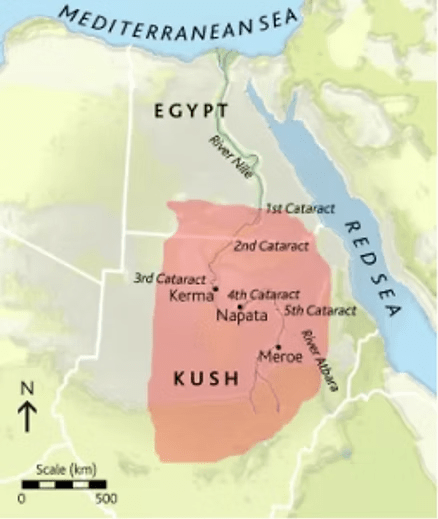
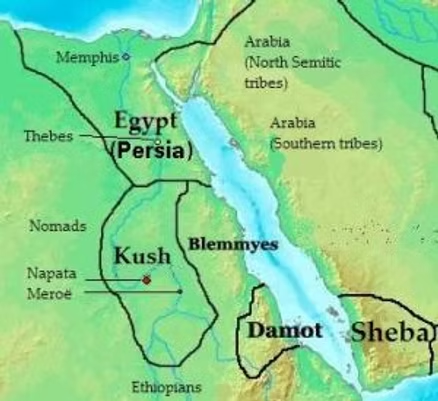
Kush was where Sudan is now.

The southern edge of Kush came close to where modern Ethiopia is, with Meroë the place of the Kandake.

With that background established, it is important to catch that this man was important because he was “in charge of her entire treasury.” The history of the Kingdom of Kush (as a nation led by powerful women), it is believed Kush had been conquered by the Roman Empire (around 100 BC), and by the time of Nero’s rule (after Jesus’ crucifixion), Kush had become a “client state.” That would have made Kush like the Herodian kingdom, which included Judea and Galilee and other regions.
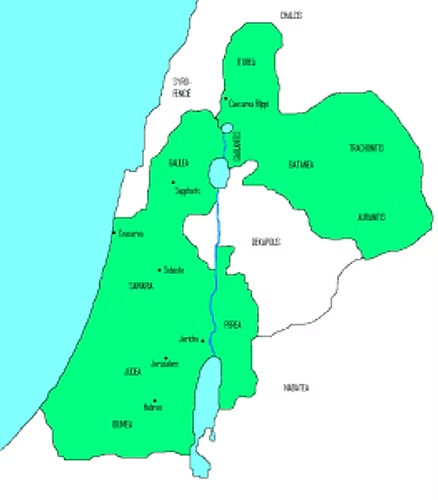
The Herodian “client states.”

Rather than jump to a conclusion that this Ethiopian man was in some way Judaic, it would be better to see him as a traveler to Jerusalem so he could do business with the Romans there. The modern Ethiopian connection to Judaism was still hundreds of years its onset, although this man might have descended from the Makeda of Ethiopia (Queen of Sheba).  For the Ethiopian man to have a scroll of Hebrew text, from a land that did not commonly read, that says he was of royal status and thus educated; however, he did not understand the meaning of the text, which would indicate that scripture was being read for the first time.

The “passage from scripture” that he was reading aloud was from Isaiah 53:7b-8b. The verse-plus that leads into those two verses quoted in Acts says, “All of us like sheep have gone astray, each of us has turned to his own way; but the LORD has caused the iniquity of us all to fall on Him. He was oppressed and afflicted, yet he did not open his mouth.” (Isaiah 53:6-7a, NASB) The last segment of the total three-verse selection (Isaiah 53:6-8, NASB) adds, “For the transgression of my people he was punished.” Because all of that was not read aloud, the Ethiopian man was touched by words that made sense personally to him, as he knew the silent sacrifice, humiliation and justice denied him, even though he was “of the court of the Kandake.”

This view then takes one back to the statement (separated by commas, so it stands alone as important) that the “man an Ethiopian” was a “eunuch.” This becomes the sacrifice that had been made by the Ethiopian ruler, whom Philip met. The removal of his lusts and desires of the flesh – by whatever means necessary – ensured his subservience to “the Kandake,” so the valuables of the kingdom would be in safe hands.  This says that it was because the Ethiopian man was a eunuch that he understood the scripture of Isaiah as his own self-allowed humiliation for the better good. The Ethiopian man had given up his life (as it normally would have been otherwise) on earth, in the same way the writer of the scroll had prophesied the Messiah of God would.

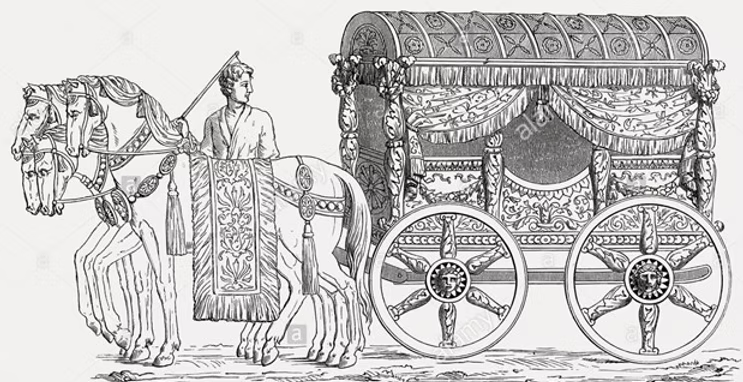
Now, twice we read the word “chariot” (from “harmatos” and “harmati”) and can get the impression of a warrior’s vehicle, as depicted in the old movie Ben Hur.

The word can equally translate as “vehicle,” and the image one should get is more like a “stagecoach,” where the Ethiopian man rode comfortably inside a horse-drawn carriage, driven by attendants. Inside this “vehicle” is space for a scroll to be unrolled and read, without getting in the way of any other passengers.
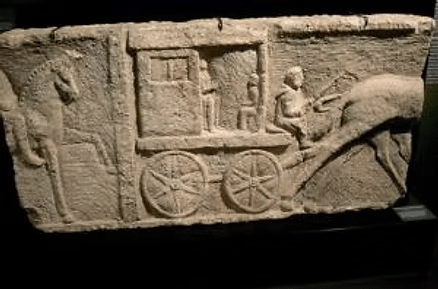
The reading of scripture can then be seen as a standard pastime of long-distance travelers, where one goes to the airport newsstand and buys a book to read before a flight. Probably, this scroll was just one of the choices he had to read during a long ride back to Egypt, before taking a boat to Kush (going south along the Nile).  The Book of Isaiah might have been one of several that seemed interesting. Perhaps one of the high priests in the Temple of Jerusalem had an extra scroll for sale in the book store there?

We then read, “Then the Spirit said to Philip, “Go over to this chariot and join it.” So Philip ran up to it and heard him reading the prophet Isaiah.” The word “Spirit” is capitalized, as “Pneuma,” which can also translate as “Wind” or “Breath,” meaning it was a divine “Whisper” within the mind of Philip. This can be seen as the Mind of Christ that spoke to Philip as he was in the wilderness; and it not only told him to approach the vehicle and enter it.  As Philip was running to reach the carriage, the Mind of Christ was telling him what was being read inside, by the Ethiopian man. Thus, more than Philip asking the man inside the carriage if he understood the meaning of what he was reading, it was the knowledge of Jesus Christ that was pouring from Philip’s lips, to one known to be thirsting for insight.

It is important to see how the Ethiopian man asked Philip about the meaning of the scripture he was reading, rather than expect “someone to guide” his knowledge. For Philip to ask, “Do you understand what you are reading?” was like the thoughts the Ethiopian man was having.  Because he could not possibly understand without guidance, his response was to ask, “About whom, may I ask you, does the prophet say this, about himself or about someone else?”

His asking becomes an example of “Ask and you will receive.” Because the Ethiopian man felt a personal connection to the scripture he was reading, even though he did not understand it, he wanted to know more. The scripture was touching him to cause him to want to know more.  His asking was then like a prayer, with Philip’s appearance being the answer to that prayer.

In this reading selection, the Ethiopian man is called “the eunuch” four times, after having first been identified as “a eunuch.” He was not identified as a man, or as an Ethiopian, or as a potentate, ruler, or court official. The fact that this man traveled in a vehicle of luxury, with a driver and attendants he commanded, as a man of power who controlled the entire treasury of a nation means little in this story. At the core of this man’s identity was the fact that he was a man who voluntarily abstained from marriage, such that he was not led by his innate drives to procreate, regardless of whether or not he had been willingly castrated to physically prevent that or if he somehow used extreme powers of will to quell all dangerous emotions that might overcome him.

The aspect of the Ethiopian man and Philip (driver, et al) coming upon a body of water on the wilderness road to Gaza means they came upon a wadi where rain had collected. The knowledge Philip had imparted a thirsting man led them to water for cleansing. The baptism Philip performed was symbolic with physical water, but because the Holy Spirit was upon him at that time, the Holy Spirit also came upon the Ethiopian man, cleansing his soul.

A human being whose emotions had been sacrificed to serve a queen were suddenly overwhelming, as he “went on his way rejoicing” knowing he now willingly served the Father and the Son. Philip, however, did much as Jesus was known to occasionally do, which was suddenly disappear.  When we read that “Philip found himself at Azotus,” his wilderness journey might well have led him physically there, instead of along the road the Ethiopian man’s carriage took.  Thus, when Philip reappear in Azotus, it was after he had spiritually left his body, so the Lord could show him the power of the Holy Spirit to find seekers, wherever that may be.  This is the element of synchronicity.
As I have stated previously, reading scripture should have the effect of placing the reader in the scenes depicted, where the one of least value is who the reader must identify with first. One must ask oneself, “How do I have the same flaws of character?”

In this reading, it becomes too easy to identify with Philip, as if one is a truly devout disciple of Christ, who is married to God in one’s heart, so one can hear “an angel of the Lord” speak. Few are able to make that claim, as such people would be explaining scripture to the world of Gentiles (and Jews) who read it, but do not know how to understand, “unless someone guides me.”  On the contrary, most Christians shun study of the Holy Bible, leaving that “head trip” to the professionals.

This means the vast majority of readers ARE “The eunuch.” That symbolism can bring with it elements of being intelligent, yet pagan controllers of wealth. It can mean one spends more time at work than with family – always on the road for another dollar bill. It can strongly suggest that one is most sacrificing of the emotions of the world, because one is more driven to acquire the things offered by the earth. However, the biggest element of being a eunuch is to see oneself as barren, thus unable to reproduce baby Jesus within.  It is the absence of sperm or egg, where being fruitful and multiplying … for the purpose of supplanting one’s religious values into those personally brought forth into this world … has been lost.

From the Game of Thrones comes a prototypical eunuch, who may parallel the heart of the Ethiopian man met by Philip.

The lesson of this reading, which is presented during the Easter season of personal Resurrection of Jesus Christ in Apostles, is to rejoice in knowing that one’s ill-advised life decisions have not kept one from redemption and everlasting life. Just as children brought into the world maintain a lineage of physical genetics, spreading the Gospel of the Holy Spirit maintains the lineage of Jesus Christ, allowing one’s soul to become one with God as a truly Spiritual being. Just as Philip was a good man who was chosen to serve, he was then then called by the angel of the Lord to be proved by fire.  Philip responded and was made a reproduction of Jesus Christ, so that body could then pass that Spirit onto a Ethiopian man, who felt a need for redemption and a new life purpose.

Because a eunuch acts as a statement of a lack of desire to join with a partner, for the purpose of sexual release, that is rejecting the basic notion of joining oneself with another self, so a child can result.  It represents the epitome of selfishness. This lack of physical emotions (either forced upon or willingly chosen) makes one’s heart cold and hardened.

That symbolism is then one’s inability to love God with all one’s heart, either because one feels forced to doubt (from flimsy explanations or “in your face” examples) or one willingly chooses not to believe in the unseen (from peer pressures and philosophical teachings). Being a eunuch is then what keeps one from understanding Scripture, because one’s own personal troubles keep one from seeing the truth that has already been rejected.  Without a personal wilderness experience that tests you as potentially being the weak link to God, the purpose in waiting for redemption is seemingly never worthwhile.  One cuts off any chance of knowing God, choosing impotency over fruitfulness, from big brains that are blind to the truth.

When the Mind of Christ led Philip to join with the Ethiopian man, that Mind knew the Gentile had just read a passage that opened a wound, causing the heart to pump extra blood of emotion. The eunuch saw himself in the sacrifice of Jesus, as prophesied by Isaiah. Such and opening sent the Holy Spirit to the man, in the form of Philip, so the Ethiopian eunuch could feel the Scripture totally being about him.  That truth came to him when he became one with Jesus Christ. His sterility would be undone by being reborn as Jesus Christ – his guide to Scripture meaning within – so he could then have new children in Christ, just as Philip could then claim a relationship with the Ethiopian man.  They were then brothers in Christ.

When we then read that Philip immediately was no longer seen by the eunuch, but “the Spirit of the Lord snatched Philip away,” so he “found himself at Azotus,” this is the life purpose of a Saint. Paul wrote frequently about the dependencies adult human being have with sexual relationships. It is how some say that men are led more by their little brain than their big brain, which means sexual drives make many human beings forget about spiritual purpose when physical emotions control their bodies.

When one is led by sexual appetite, one can break any number of religious rules. Doing that too often makes one less able to sense the error of those ways, so that people defend themselves with excuses that prevent their hearts from receiving the Holy Spirit – opening up their hearts for God with love. A Saint is ready to receive God and Christ, when one has made the sacrifice to become a eunuch, where the castration is not the removal of sexual organs, but the removal of an ego that can be misled by sexual urges.

That is what Paul wrote of. It is how Jesus said, “These [strangers] are my mother and brothers,” because family is less about physical bloodlines, and all about being a productive “living vine” of Christ. Thus, being called to proclaim the good news in all the towns means one is always going home to family, wherever one goes in ministry and evangelism.  Those we are led to by the Holy Spirit will be those who we will be related to, through being Jesus Christ.

———————————————————————————————————

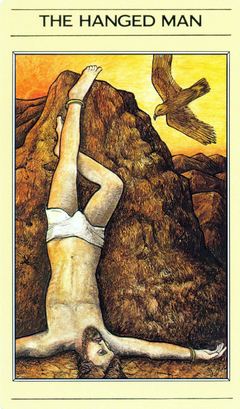
Note: The cover art depicts The Hanged Man Tarot card, specifically from the Mythic Tarot deck.  The character from Greek mythology that is used to depict the “willing sacrifice for a higher good” symbolism of The Hanged Man is Prometheus, who gave fire to humanity against the orders of Zeus.  In the spirit of the Easter season, it would be worthwhile to read about Prometheus, whose name in Greek means “Foresight.”  Since the Resurrection of Jesus Christ within a Saint requires a willing sacrifice be done first, reading this mythology can help enlighten one as to the impact the reading from Isaiah had on the Ethiopian eunuch.
Acts 8:26-40 – Even a eunuch can bring fruit through the Holy Spirit

An angel of the Lord said to Philip, “Get up and go toward the south to the road that goes down from Jerusalem to Gaza.” (This is a wilderness road.) So he got up and went. Now there was an Ethiopian eunuch, a court official of the Candace, queen of the Ethiopians, in charge of her entire treasury. He had come to Jerusalem to worship and was returning home; seated in his chariot, he was reading the prophet Isaiah. Then the Spirit said to Philip, “Go over to this chariot and join it.” So Philip ran up to it and heard him reading the prophet Isaiah. He asked, “Do you understand what you are reading?” He replied, “How can I, unless someone guides me?” And he invited Philip to get in and sit beside him. Now the passage of the scripture that he was reading was this:

“Like a sheep he was led to the slaughter,

and like a lamb silent before its shearer,

so he does not open his mouth.

In his humiliation justice was denied him.

Who can describe his generation?

For his life is taken away from the earth.”

The eunuch asked Philip, “About whom, may I ask you, does the prophet say this, about himself or about someone else?” Then Philip began to speak, and starting with this scripture, he proclaimed to him the good news about Jesus. As they were going along the road, they came to some water; and the eunuch said, “Look, here is water! What is to prevent me from being baptized?” He commanded the chariot to stop, and both of them, Philip and the eunuch, went down into the water, and Philip baptized him. When they came up out of the water, the Spirit of the Lord snatched Philip away; the eunuch saw him no more, and went on his way rejoicing. But Philip found himself at Azotus, and as he was passing through the region, he proclaimed the good news to all the towns until he came to Caesarea.

——————–

This is the mandatory reading from the Acts of the Apostles that will be read aloud on the fifth Sunday of Easter, Year B, according to the lectionary schedule of the Episcopal Church. It will precede the singing a portion of Psalm 22, which includes the verse that says, “The poor shall eat and be satisfied, and those who seek the Lord shall praise him: “May your heart live for ever!”’ That song will be followed by a reading from the first Epistle of John, which says, “God is love, and those who abide in love abide in God, and God abides in them.” Lastly, this Sunday will feature a reading from John’s Gospel, where Jesus said, “I am the vine, you are the branches.”

The first word of verse 26 is capitalized. The word is “Angelos” and it means “[an] Angel.” This is how it has been translated, only the NRSV [and others] ignore the capitalization that makes this word have divine importance. The same word can also translate as “Messenger,” and that is how it should be grasped, in order to deeply understand this reading selection.

In the verses that lead up to this selection [which are not read aloud], Philip had gone to Samaria where he encountered a magician named Simon. Simon was misleading the Samaritans, while Philip was baptizing them with the Holy Spirit. Philip sent for Peter and John to come; and, after they arrived Simon offered silver coins to them, in order to be taught the magic of the Holy Spirit. He was told by Peter to repent; then, Peter and John went back to Jerusalem, while Philip continued ministering in Samaria. That tells of some acts of Apostles, which then leads to the word “Angelos.”

The Greek word “apostolos,” which is translated into English as “apostle,” actually bears the meaning as “a messenger, one sent on a mission.” This means an Apostle [when capitalized to a divine state of meaning] is an “Angel,” where that does not mean ghostlike or invisible spirit, but a “Messenger” of Yahweh in the flesh. This is how verse 26 should be seen beginning, as it becomes a divine statement about Philip having spiritually transformed into one of God’s “Angels” [a.k.a. an Apostle].

The Greek text that has been translated as stating, “An angel of the Lord said to Philip” is this: “Angelos de Kyriou elalēsen pros Philippon.” Those words literally translate as, “Messenger now of the Lord spoke with this Philip.” In this segment of words there are three that are capitalized, such that all are elevated to a divine level of meaning. Having already discussed “Angelos,” the word “Kyriou” is a godly state of “Master, Sir, or Lord,” where the genitive says the “Messenger” is “of Master,” where “Lord” is both Yahweh and His Son risen spiritually, Jesus. The word “Philippon” is a name meaning “Horse loving,” which was the name given to one of Jesus’ disciples – “this Philip.” To simply translate “Philip,” the word would have been written “Philippos,” such that “Philippon” is indicating “this one named Philip.”

The capitalization leads one to look at the “Horse Loving” aspect of the name, where there is a military aspect that relates to a cavalry [He Who Leans On His Military Complex]. With it doubtful that Philip ever owned a horse or had any military experience, that essence of his name can be seen as why Philip was chosen to be the “Messenger” for this event. Due to a cavalry being a speedy movement of troops, albeit much smaller than an army, it is that element of speed that can be seen as the divine elevation intended here. Philip was chosen for this task because he was more prepared spiritually to respond quickly to a need.

The one verb connecting the three capitalized words together is “elalēsen,” the aorist active indicative 3rd person singular form of “laleó,” meaning “he-she-it talked, spoke, or said.” The two other words, “de” and “pros,” state first a timing that is “now” (“de”), which is relative to both when Philip had become a “Messenger” and when he received the Word “of God” (“Lord”). Second, the word “pros” is directional, as “to, towards, with,” but the word properly means, “motion towards to “interface with” (literally, moving toward a goal or destination).” (HELPS Word-studies) Thus, the segment becomes a statement that says: Philip is now a Messenger of the Lord; and, now of the Lord spoke with this Philip. That says as an “Angel of the Lord, Philip now spoke with the Master.” That becomes a major statement that says Philip is like Jesus [“the Lord”], who spoke what the Father had him say and routinely talked with Yahweh.

This needs to be seen as a divine relationship established between Yahweh and Philip, where Philip has become the ‘wife’ of God and is “now” one of His “elohim.” By seeing that union “with this Philip,” not separate from the Holy Spirit, there is no need for Yahweh to send in “an Angel” to bring a message, because Philip speaks freely with Yahweh. More evidence to this arrangement comes in the following two one-word segments, which state “legōn , Anastēthi,” which translates as “commanding , Appear”.

These two words have been translated simply by the NRSV, as “Get up,” where the quotation mark is the only indication Luke wrote the word “legōn.” The word stems from “legó,” which Strong’s defines thusly: “(denoting speech in progress), (a) I say, speak; I mean, mention, tell, (b) I call, name, especially in the passive, (c) I tell, command.” When the word “Kyriou” is understood to be one’s “Master,” the active present participle of a “Lord” makes more sense translated [not ignored] as stating, “commanding.” When one is a divine “Messenger of the Lord,” one waits to be given orders to deliver a message. The Calvary stand ready to move on command.

The word “Anastēthi” is capitalized, giving it divine importance. Simply translated, the word is written in the aorist active imperative, 2nd person singular, as a command saying, “arise, raise up, or set up.” The simple translation implies one is resting, even sleeping, such that the imperative is to quickly get moving and stop lollygagging around. However, when capitalized to a divine level of meaning, this is Yahweh telling a soul to elevate spiritually, to a non-human state of being. In other words, Yahweh commanded Philip to transcendentally leave his body of flesh.

Because this state of being needs to be seen here, in this reading, it helps to recall the visions of strangers on Easter Sunday. The young man seen “enthroned at the right hand,” who was “robed in dazzling white,” that imagery was of an angel. He gave a message to the women who arrived at the opened tomb. Later, Mary Magdalene saw a man whom she thought was the gardener, but was recognized by voice to be Jesus who told her she could not embrace him. I explained the reason was he was not solid, as he was a projection, like an angel with a message he gave to her. Finally, Cleopas and his wife Mary had walked with a stranger who fed them messages of meaning they did not realize; but when they invited him to stay with them for diner, he prayed and they recognized his voice as Jesus, then he disappeared. The one they invited into their home was likewise a transcendental image of Jesus’ soul, with that image appearing at the same time the risen Jesus first appeared to his disciples, showing how two can be in more than one place at the same time; and, that is the same scenario established by Philip being commanded to “Arise.”

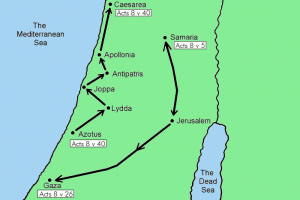
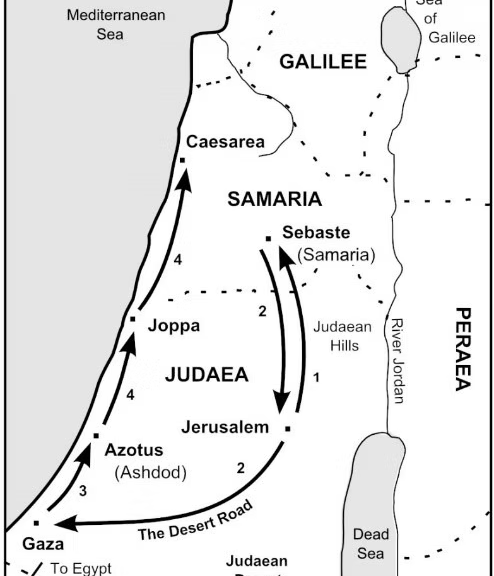
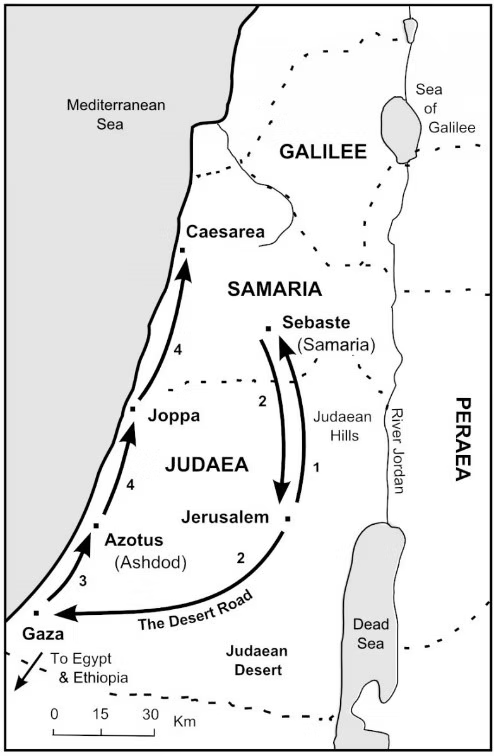
All of the logistics are implying that Philip got out of bed, packed a bag and began a journey to the south, to the desert road leading from Jerusalem to Gaza. From Samaria (the town in the region of Samaria, also called Sebaste) to Jerusalem is 42 miles. From Jerusalem to Gaza is 50 miles. From Gaza to Azotus is roughly 24 miles, due north. If Philip was a trained traveler (by foot), it would take him two days to somehow find an Ethiopian eunuch on a chariot, none of which is explained. The logistics are stated simply to let the reader know where the soul of Philip was sent, as a “Messenger of the Lord,” because Yahweh knew a seeker was ripe for conversion through the Holy Spirit.

When we are told the eunuch was in Jerusalem to worship, he should be seen as a Jew, where the reason for him traveling all the way to Jerusalem to worship would be a commanded festival. Most likely, he had traveled to Jerusalem for the Passover and remained there until Pentecost, or even Sukkot. Most likely, he was one who lived so far away from Jerusalem that he made a once in a lifetime pilgrimage there; so, he then began a lengthy trip back. He must be seen in the light of those pilgrims who Peter and the eleven spoke to on Pentecost Sunday, who were seekers of the truth. They were transformed spiritually that morning, by hearing the truth spoken. This man’s heart was opened to receive the Spirit; so, he just needed one filled with the Spirit to come to him.

When the NRSV translates the Greek to show it saying, “Now there was an Ethiopian eunuch, a court official of the Candace, queen of the Ethiopians, in charge of her entire treasury,” this gives the impression that this man was a high-ranking official of royal standing. This is not what was stated in the Greek text.

Luke wrote, “anēr Aithiops , eunouchos , dynastēs Kandakēs basilissēs Aithiopōn , hos ēn epi pasēs tēs gazes autēs , hos elēlythei proskynēsōn eis Ierousalēm .” This is five segments of words, which literally translate to say the following:

“man Ethiopian ,

“eunuch ,

“ruler Candace queen of the Ethiopians ,

“who existed on the basis of every kind of treasury of her ,

“who had gone to be worshiping in Jerusalem .

This states first the lowliness of this man, as he was simply an Ethiopian. His lowliness makes a one-word statement that highlights his being a castrated male, which was ordinarily done to slaves or servants, especially those males who worked in service around females of a royal family. He could have been a warrior who was wounded in the groin, making him unable to sire children; but the implication is he was a servant. He was a servant in the house of Candace the Queen of Ethiopia, where it was her who had the sole power over her wealth (as “ruler”), not some lower man. The comma separating “eunuch” from “ruler” or “potentate” makes that word be a statement about Candace the Queen.

The following segment then states that everything that financed this trip to Jerusalem was at the expense of the queen. That becomes a statement of her generosity, while also being a statement that the man was a devoted servant to her. This makes the man similar to the Old Testament figure Esther. The man’s devotion to the queen, while also being devoted to his religion, made it possible for this man to earn a free round-trip visit to Jerusalem, all expenses paid by the Queen of Ethiopia.

To further exhibit the devotion this man had, as he rode in a “chariot,” which should not be seen as some Ben Hur battle chariot, but as a state carriage, with four wheels, drawn by a team of horses, much like a stage coach. As he was going on a long trip home, like anyone knowing there is a lengthy trip ahead, so that would be an opportune time to catch up on some reading, this man had a supply of scrolls of holy texts to read. It might have been based on an order from the queen, commanding him to return to Ethiopia with divine texts for her to read. In this regard, it is important to know that Ethiopian Jews [a.k.a. Beta Israel] did not begin until 325 C.E., so this story in Acts can be seen as told because Philip sowed this seed for Yahweh.

The NRSV translation above says, matter of factly, “he was reading the prophet Isaiah.” The Greek text introduces that with the word “kai,” which means it is important to know what “he was reading.” By knowing it was a scroll of “the prophet Isaiah,” that says it is important to know he was reading prophecy and (as will be evident later) he was reading a prophecy specific to Jesus.

Verse 29 then begins with the capitalized word “Eipen,” which brings divine elevation to that “Commanded.” In the lower case spelling, the word means “answer, bid, bring word, command” (Strong’s Usage), but capitalized returns us to the use of “legōn” as a one-word statement, where a “Master” would give orders to a servant. Here, that “Commanded” is “now this Spirit,” where the capitalized “Pneuma” is written. The “Command” of the “Spirit” is to “Philip” (the Calvary to the rescue).

This needs to be realized as Philip “has been raised” spiritually [importantly stated in verse 27, as “kai anastas,” or “having raised up”], so the “Command now this Spirit that Philip,” says Philip is in the state of being that is the “Spirit.” He is not truly in the flesh at this time “now” [from “de”]. He is riding the ‘horse’ of Yahweh, faster than any war horse could ever gallop.

The “Command” then makes a capitalized one-word statement, which is “Proselthe,” meaning “Approach” or “Go [or Come] near.” The capitalization means this “Command” is to make the “Spirit” “Available” to one Yahweh knows is seeking enlightenment. Thus, that one word is a “Call to Come,” which is made from the chariot; so, the one word is followed by the word “kai,” showing the importance of “uniting the soul of Philip [“glue yourself”] thereupon this chariot.” That must be seen as Yahweh telling the soul of Philip to appear by the chariot in the same way that the stranger came up to Cleopas and Mary and became united with them [and the other examples stated prior].

Verse 30 then begins with the capitalized word “Prosdramōn,” which adds divine essence to the illusion that says, “Having run up.” Knowing that a carriage rolling on a road, drawn by horses, is noisy; and, the physical act of running makes one breathe heavy, while hearing the sound of one’s own feet hitting the ground adds to the noise. Knowing what one reading inside a chariot would be difficult to hear outside, given the physical elements written.

To add to the confusion of “hearing him reading the prophet Isaiah,” the only way to hear that would be for the eunuch to be reading aloud; but why would he be doing that becomes the question. By seeing the “Spirit” of “Philip Approaching and uniting” with the “chariot,” the word “Having run up” is a divine statement about the quickness that Philip’s soul joined with the Ethiopian eunuch’s brain and knew his thoughts. The word is actually the aorist active participle 2nd person, so it importantly states Philip “Ran there.” The divine element added is how quickly Philip reached his destination.

It is at this point that one must visualize the Spirit of Philip being joined with the Ethiopian eunuch, such that the voice of Philip is heard in the eunuch’s mind as he reads to himself. The eunuch is reading words in Hebrew that he understands, but cannot decipher what message he is supposed to get from reading them. When Philip asks him, “Do you understand what you are reading?” that question is not suddenly coming from a stranger that was out for a jog in the wilderness and hopped into the chariot uninvited. That question is posed to the seeker by Yahweh, through the Holy Spirit taking the form of Philip’s soul. The eunuch is moved to ask himself that question [it seems to him], such that he responds to himself, “How can I, unless someone guides me?” This must be seen as the same response every seeker, in every age, has to Scripture, as the words can be easily understood, but the truth of the meaning demands guidance from a higher source.

This is when the Spirit of Philip appears as a rabbi – as Jesus appearing in the form of Philip – who just happened to be walking the road the chariot was traveling on. One can imagine that the body of Philip appeared ahead of the chariot, as a rabbi traveling alone. The eunuch would have been alerted by the driver of the chariot, so the eunuch would have looked out the window to see. Seeing a rabbi, identified by his tallit and kittle (robes), the eunuch would order the coach to stop. He could have even said to Philip, “You know, I was just asking myself a question about Scripture, and who better to ask than a rabbi? Glad you happened along!”

That is when an external figure appears and is invited to get in the chariot and sit beside the eunuch, to explain the meaning of Isaiah to him. The verses that Spirit was asked about were prophetic of Jesus. Just as Cleopas and Mary were sad because of what happened during Passover week in Jerusalem and as difficult as it was for them to understand why everything happened, the Spirit of Jesus appeared [looking like a stranger] who enlightened them to so much. They saw things they had not noticed and they had read Scripture all their lives. Still, they had not connected what they had read to what had happened. Perhaps, Cleopas and Mary had Isaiah pointed out to them by Jesus, just as the Ethiopian eunuch just read.

Skipping forward, explaining only that the eunuch was enlightened into the truth of prophecy leading one to realize the necessity of being reborn as Jesus, through marriage to Yahweh and merging one’s soul with the Holy Spirit, that divine baptism was explained by the Spirit possessing Philip’s soul. That teaching led the eunuch to exclaim, “Behold water! What keeps me from being baptized?”

Since the Gospels had not yet been published, there were no scrolls in the chariot that told of John the Baptist saying, “I baptize with water, but they will be one who will come after me that will baptize with the Holy Spirit.” Baptism by the Holy Spirit had to have been something told to the eunuch by Philip’s Spirit. However, the element of “water” [“hydōr”] must always be read metaphorically as inner emotions, which ebb and flow like physical water does. The Jews routinely used water for ritual cleansing purposes, so water was a figurative way to remove sins from one’s flesh. Therefore, the eunuch should be seen as exclaiming, “Behold [me, for I am] emotional!”

The element of physical water in the desert [verse 26 made a point of writing a complete sentence at the end that said, “hautē estin erēmos” – “this is desert,” relative to the road to Gaza] cannot be possible. The Scripture from Isaiah spoke of a sacrificial lamb, whose spiritual existence [“zōē” – “life”] was removed from the earth. Philip had explained that was Jesus, who sacrificed so others could be filled with his “spiritual existence.” Thus, the eunuch exclaimed that he was ready to sacrifice his life to Yahweh. His question was then, “What prevents me from being filled with the Holy Spirit?”

Verse 37 is not translated by the NRSV, with the reason being the entire verse is placed in beginning and ending brackets. That bracketed verse is then explained by a footnote that says:

“Other ancient authorities add all or most of verse 37, And Philip said, “If you believe with all your heart, you may.” And he replied, “I believe that Jesus Christ is the Son of God.”

By reading that missing verse, one can understand that the eunuch told Philip that he indeed did believe wholeheartedly that “Jesus Christ is the Son of God.” The error in that NRSV translation of someone else’s translation is that the word “son” is not capitalized [as “huion”]. That means the soul of Philip explained that he was like the eunuch, who believed in Jesus, by saying, “I believe this son [Philip] who is of God to be this Jesus Anointed one.” In the same words, it becomes a confession that says, “I believe this son [the eunuch] who is of God [a lover in marriage to Yahweh] to exist who Yahweh Saves [the meaning of the name “Jesus”] a new Anointed one.” In that, the missed element is the capitalization of “Pisteuō,” which become divinely elevated from simple “belief,” to deep faith.

The same opportunity exists today. The element of self-sacrifice must be desired, as a love of God that is total – all one’s heart, mind, and soul. It is a prerequisite that takes one beyond simple belief in Jesus Christ and takes one’s soul to a divine union where one knows Yahweh as both Husband and Father. That level of pure faith is demanded for Philip to say to you, “Okay. Let’s stop this bus and get you married to Yahweh!”

Again, the verses that speak of coming to the water and baptism and coming up out of the water must be read as metaphor. When the translation says, “When they came up out of the water,” the Greek word “anebēsan” has been translated simply as “they came up.” The word needs to be read as “they ascended,” just like all New Testament inferences to rising, awakening, standing up, et al. Such uses have divine meanings attached to them. Thus, “when they ascended,” then “Spirit of the Lord carried away this Philip.” The eunuch then kept going, rejoicing, which was like the healed born-lame man did, when he “stood up.”

At that point, Philip is said to be “found in Azotus,” which is twenty-five miles north of Gaza, but nothing was stated about Philip and the eunuch having reached Gaza. From the desert road, between Jerusalem and Gaza, the shortest distance (maybe only ten miles) would be to fly there direct, over mountains, where there were no roads. However, when one is in the Spirit, then one does not have to abide by physical laws. So, when Philip was “passing through” and when he was “proclaiming the Gospel to all the towns up to Caesarea,” his physical body was probably still back in Samaria, doing the same. Physically, Philip never left Sebaste.

As the mandatory Acts reading during the Easter season, it is important to tie this story to those told before, as only the names change, while the song remains the same. The Holy Spirit of Yahweh, married with the souls of those who love Him completely, become reborn as His Son, all doing the same things Jesus did, as Jesus merged with different souls. Here, this shows that being transcendentally elevated, while in the Holy Spirit, can bring about the salvation of others that seek to know God. The gifts of the Holy Sprit are clearly associated with understanding what Scripture says. Few have a clue what this reading says, on a deep, Spiritual level, so fewer will be led like the Ethiopian eunuch was.

The Easter season is a time or preparing for ministry, by ACTING as Jesus, also an Anointed one of Yahweh. This reading began by declaring Philip to be an “Angel” or a “Messenger of the Lord.” The Acts of Apostles mean carrying the message of Yahweh to the world, which is the truth told by Jesus. To practice knowing the truth, one has to be married to Yahweh and reborn as the Son. That demands faith.