Tag Archives: Advent 2 Year C

Baruch 5:1-9 – A messenger of Jeremiah to the fallen

[1] Take off the garment of your sorrow and affliction, O Jerusalem,

and put on forever the beauty of the glory from God (θεοῦ).

[2] Put on the robe of the righteousness that comes from God (θεοῦ);

put on your head the diadem of the glory of the Everlasting;

[3] for God (θεὸς) will show your splendor everywhere under heaven.

[4] For God (θεοῦ) will give you evermore the name,

“Righteous Peace, Godly Glory (θεοσεβείας – meaning religious service).”

[5] Arise, O Jerusalem, stand upon the height;

look toward the east,

and see your children gathered from west and east

at the word of the Holy One,

rejoicing that God (θεοῦ) has remembered them.

[6] For they went out from you on foot,

led away by their enemies;

but God (θεὸς) will bring them back to you,

carried in glory, as on a royal throne.

[7] For God (θεὸς) has ordered that every high mountain and the everlasting hills be made low

and the valleys filled up, to make level ground,

so that Israel may walk safely in the glory of God (θεοῦ).

[8] The woods and every fragrant tree

have shaded Israel at God’s (θεοῦ) command.

[9] For God (θεὸς) will lead Israel with joy,

in the light of his glory,

with the mercy and righteousness that come from him.

——————–

This is an optional First Reading offering that might be read aloud on the second Sunday of Advent, Year C, according to the lectionary for the Episcopal Church. If chosen for reading, then the Response will come from Canticle 16 (The Song of Zechariah, found in Luke 1), which sings: “Through his holy prophets he promised of old, that he would save us from our enemies, from the hands of all who hate us.” That pair will precede a reading from Philippians 1, where Paul wrote, “God is my witness, how I long for all of you with the compassion of Christ Jesus.” All will accompany a reading from Luke, where it is written: “In the fifteenth year … the word of God came to John son of Zechariah in the wilderness; so, he went into all the region around the Jordan, proclaiming a baptism of repentance for the forgiveness of sins.”

The Book of Baruch is not readily available in Hebrew, as it is found either in Greek (one of the Septuagint) or Latin (one of the Vulgate), as translations freely made of the Hebrew, which would have been its original language. This book is not considered canonical, in the sense it is omitted from the Old Testament, although it is placed between Jeremiah and Lamentations, in the section of “Prophets.”

Baruch is said to be the secretary of Jeremiah, who fled to Egypt and wrote messages for Baruch to deliver to the captives in Babylon. This reading is said to be that which led the wayward Judeans to repent their sins against Yahweh and return to a commitment to being His wives. Thus, the theme of this lesson is repentance; and, repentance is necessary before a soul can marry Yahweh, become His wife, and give birth to His Son – the theme of Advent.

You will note the bold type above, where I have made “God” stand out. I have followed those translations into English with the Greek written, translated as “God.” In the Greek text, six times the word “θεοῦ” is written and another four times is found “θεὸς,” [both transliterated as “Theos”] meaning “God.” One can assume, based on the regularity of Jeremiah writing “יְהוָ֛ה” [transliterated as “Yah-weh”], twenty times in Jeremiah 33 alone, that the Greek translation to “Theos” would be from “Yahweh,” meaning that would degenerate that specificity written to the simplicity of “God.” However, in the world of demonic scholarship calling itself religious [the reason for the exile to Babylon], that is only an assumption made on my part. Take it or leave it.

I have also numbered the verses, where the Episcopal Church sees no need to keep up with such matters. From looking at Baruch only in Greek and my rudimentary translations of that shown, it is easy to see this English translation as a paraphrase. As it is with paraphrases of Scripture, the basic truth shines forth, but the hidden truth remains hidden. Thus, this offering on the second Sunday of Advent acts like a reflection of a pregnancy, where something is going on within, but not much is yet visible on the outside.

The first verse, as translated, is a recommendation to change. From the “garment of sorrow and affliction” – the sins of the world – one is told to be clothed in the “beauty of the glory from Yahweh.” In terms of souls changing, the recommendation says wearing the old ways will not remove “sorrow and affliction.” Only Yahweh’s presence [His presence as one’s clothing] will do this.

Verse two is then the promise that changing to serve Yahweh will cause one soul to “put on the robe of the righteousness that comes” from Him. This signifies a change from sinner to saint, which can only come from Yahweh’s presence, through a marriage that vows to keep His Commandments.

When Baruch wrote, “for God will show your splendor everywhere under heaven,” a different way to read these words would be slowly, bit by bit. This then says that “God will show,” where this equates to the halo or glow that a soul – having become pregnant with Yahweh’s love – will “sparkle,” as His “splendor” within. As the soul of one’s body of flesh reaches all extremities of the body, “everywhere” says Yahweh’s Spirit envelops the soul totally. This is not visible for others to see, as it is “under.” It is not a physical presence that can be seen. It is spiritual, or of “heaven.”

Verse four then sings, “For Yahweh will give you evermore the name, “Righteous Peace,” which echoes the words of Yahweh through Jeremiah (last Sunday’s Old Testament reading), where many believe Yahweh prophesied a name coming that would be “Yahweh our righteousness” [“tsidkenu”]. Here, the name is Yahweh also, such that being married and taking on His name makes a soul find “righteous peace.”

The names “Jerusalem” and “Israel” need to be read as their root meanings, rather than places. The “children” had been forced to travel from “west” to the “east,” which is where they then needed to look for Yahweh. Yahweh is not locked into a place on the map. Wherever His children go, His “word” will be there. Baruch delivered them that “word.” They had been led to Babylon by themselves, who were their true “enemies.” To overthrow themselves and again become a “throne” for Yahweh to possess, the Judeans had to take their own souls off their thrones of self and welcome Yahweh to be seated there.

The mountains and valleys are the changing nature of human life on earth. By marrying a soul to Yahweh, those who Retain Yahweh as His elohim [Israel] will be able to walk safely; and, the highs and lows of a sinful world will no longer threaten them.

In the end, the true children of Yahweh will become trees of fragrance that produce good fruit. Those children will be true Christians, who will shade Israel in all times to come. They will all be reborn in the name of Yahweh’s Son, walking righteously as His saints.

In a season of renewal, when one’s soul is expected to see the folly of one’s waywardness and repent, bringing Yahweh to find the sincerity of those confessions, the purpose is to have reached the depths of despair so Yahweh becomes one’s hope. This is not a helping hand to return to Jerusalem and try to resist another siege. It is a submissive stance that commits fully to slavery to Yahweh, rather than slavery to a world in the flesh. Either way, one admits one cannot change the world alone. To find the joy of salvation, one must find love in one’s heart for Yahweh and swear to always serve Him totally.
Malachi 3:1-4 – Messengers sent by Yahweh

See, I am sending my messenger to prepare the way before me, and ha-adown whom you seek will suddenly come to his temple. — indeed, he is coming, says Yahweh of hosts. But who can endure the day of his coming, and who can stand when he appears?

For he is like a refiner’s fire and like fullers’ soap; he will sit as a refiner and purifier of silver, and he will purify the descendants of Levi and refine them like gold and silver, until they present offerings to Yahweh in righteousness. Then the offering of Judah and Jerusalem will be pleasing to Yahweh as in the days of old and as in former years.

——————–

This is an alternate Frist Reading to be read aloud on the second Sunday of Advent, Year C, according to the lectionary for the Episcopal Church. If chosen, this will be read prior to Canticle 16 (The Song of Zechariah, from Luke 1:68-79), which sings in part: “You, my child, shall be called the prophet of the Most High, for you will go before the Lord to prepare his way, To give his people knowledge of salvation by the forgiveness of their sins.” That pair will precede a reading from Philippians, where Paul wrote, “And this is my prayer, that your love may overflow more and more with knowledge and full insight to help you to determine what is best, so that in the day of Christ you may be pure and blameless, having produced the harvest of righteousness that comes through Jesus Christ for the glory and praise of God.” All will accompany the reading from Luke’s Gospel, where the words of the prophet Isaiah were recited: “Prepare the way of Yahweh, make his paths straight. Every valley shall be filled, and every mountain and hill shall be made low, and the crooked shall be made straight, and the rough ways made smooth.”

As a reading selected to fit a theme of pregnancy, where the future holds the realization of spiritual change coming, which is now strongly sensed, the theme here focuses on what that change can be expected to be. As an alternative to the Baruch reading, which is difficult to grasp without the original Hebrew text making clear that references to “God” were Greek replacements for “Yahweh,” Malachi returns one to that reality of specificity. While the Baruch reading sang clearly of repentance being the requirement for redemption and salvation – a change within the soul – the wording makes it difficult to see the individuality of Jerusalem and Israel as being relative to souls. While Baruch was a plea, sent by Jeremiah through his ‘secretary,’ to change their path to destruction by submitting their souls to Yahweh in marriage, the words of Malachi are now making the promise about what will be born from such a divine union.

The first word in this reading is [transliterated] “hin·nî,” from “hen,” meaning “behold!, lo!” A translation as “see,” while possible, is weak and diluting the feeling that comes to a pregnant woman, once changes begin to be noticed within her body. Those changes will eventually be capable of being physically seen by others, when symptoms are displayed and her body increases in size, due to a fetus within. However, the pregnancy of change must be something “beheld!” by each individual that has become spiritually pregnant with the Son of Yahweh, after a soul’s marriage to His Spirit.

In verse one is twice presented forms of the word “malak” [transliterated as “mal·’ā·ḵî” and “ū·mal·’aḵ”], which have been translated by the NRSV as “messenger.” While this is the meaning of the word “malak,” the reality is this word is translated in Scripture more times as “angel, angels,” than it is as “messenger, messengers.” When one realizes Yahweh is the one speaking [He is named when Malachi wrote, “says Yahweh of hosts”], then one must also realize that Yahweh is not going to send a hotel bellhop with a message on a silver platter for one to read. Yahweh is going to “send His angel” to His wives; and, this is the truth of the words “Yahweh elohim,” stated eleven times in Genesis 2.

In that naming of Yahweh, as one “of hosts,” the Hebrew word “tsaba” means “army, war, warfare,” where “host” means “a large number of,” in this case “angels.” When one understands that Yahweh is the source of all souls, one can also see how He is the creator of all angels, which are eternal beings just like souls, only not placed in a prison of flesh, retained on the earthly realm. This is the meaning of “elohim,” as that was the “angels” created by Yahweh to exercise His plan for Creation. Part of that plan (which demanded a “host” of workers) came after six ‘days,’ when Yahweh told the “elohim” to rest. He then declared that point of cessation to be the seventh day; and, that was when a soul of one man (and one woman later) would be merged with an “angel” of Yahweh’s devotees, creating not just another “elohim,” but a “Yahweh elohim.” Thus, from the beginning of the seventh day (and we are still in the seventh day now), souls who will be saved from the prison of the material realm will need to receive His Spirit, from which a possessing “angel” will be “sent.” That is what one “beholds!” when one’s soul is ‘with child’ and the Son of Yahweh is to come – Jesus.

It is clear to most Christians who hear the words of Malachi read aloud to them, as they sit in pews and listen, that the metaphor is of Jesus Christ. To hear of “my messenger to prepare the way before me” and “the messenger of the covenant in whom you delight” is heard as Jesus; but those ears hear that coming as having already come and gone, through Mary, wife of Joseph. They sense that because they all know Advent is the four Sundays when lights on a wreath are lit, until Christmas Day comes and baby Jesus is once again found in a manger. The problem with that is none of those listeners are hearing Malachi speaking as Yahweh’s prophet to each individual sitting in pews, all of whom are souls placed into dead matter by His hand, none of whom have married Him, received His Spirit, and been sent Jesus to be reborn as them, in their souls, possessing their bodies of flesh.

In verse one, the Hebrew states [transliterated], “ū·p̄in·nāh-ḏe·reḵ lə·p̄ā·nāy”. Those words are marked off between a comma mark and a semi-colon, setting them apart as a segment of words that need to be understood separately. Those words literally translate into English as, “he will turn the manner to face me,” while the NRSV shows this as “to prepare the way before me.” This must be seen as relative to the following statement about the “angel-messenger,” who will be that of the “covenant.” The “covenant” is the marriage vows committed to by a soul, which then brings an “angel” that will change one’s soul from wearing the “face” of self, to “turn the manner” of being, so one’s soul then wears the “face” of Yahweh. The First Commandment says this, when known to say, “Thou shall not wear the face of any other gods [such as self] before My face.” This is a change that must come; and, it is one sensed by a wife [soul] submitted unto Yahweh.

Here, you will take note of how the NRSV’s translation saying, “and the Lord whom you seek will suddenly come to his temple,” has been changed to denote the Hebrew written, which is [transliterated] “hā·’ā·ḏō·wn,” a form of “adon.” This is a singular designation as “the lord,” in the lower-case, as a reflection of the plural word “adonay,” meaning “lords.” The plural is elevated to capitalized status, while translated in the singular, which “adon” is [not “adonay”]. In both cases, a soul is “the lord” over its body of flesh; but a soul is not considered to be an “adon,” nor one of Yahweh’s “adonay.” This makes the meaning of “the adon whom you seek” become a statement of Yahweh knowing a soul “seeks” to be led divinely, because one’s soul has proved incapable of being such a “lord.” In most cases, a soul will submit itself to demonic spirits, who will then “lord” over such a soul, causing it to submit to the weaknesses of the flesh, becoming a sinner with great regrets. That will be the soul’s motivation for seeking redemption and salvation, thereby “seeking a divine lord” that will rescue them.

This divine change – the pregnancy with Jesus theme of Advent – will transform a body of flesh (along with its soul) into a temple in need of a high priest. This is the meaning of Jesus telling his disciples that Yahweh would send them an Advocate, which would be his soul, after his soul had been released from his body of flesh; so, the soul of Jesus could return to being an “elohim” (angel) that could be sent back into the souls of Yahweh’s wives.

Verse two has Yahweh ask two questions through His prophet Malachi: “Who can endure the day of his coming?” and, “Who can stand when he appears?” These are not questions of who is great enough to receive the Spirit of Yahweh and give birth to His Son. Instead, they are stated rhetorically, as no soul is capable of retaining itself [a “self” equates to a “soul”] as the “lord” of itself or the body of flesh it is imprisoned within. None can “stand,” as all must bow down their heads and kneel at the feet of Yahweh AND His Son – one’s new “Lord.”

The metaphor that then follows, “like a refiner’s fire” and “like fullers’ soap,” is then answering the questions as to the only way that a soul can “endure” [a statement of eternal life] and “stand” is through a complete and thorough cleansing or purification. All souls, prior to divine marriage to Yahweh, are filthy dirty from sins, making them incapable of experiencing eternal life or standing before Yahweh as a soul in judgment (when death comes knocking). Not one impurity and not one speck of filth can be present in one’s soul, for it to be deemed a “temple” prepared to seat Yahweh’s Son.

The aspect of Levi must be realized as one whose sins of murder kept his descendants from receiving any land holdings in Canaan [look them up]. The Levites were granted placement within all of the tabernacles spread throughout the Promised Land, as the servants who maintained those holy places. They became the priests who physically cut the throats of sacrificial animals and burned them as sacrifices to Yahweh, on the sacred altar. Then they had to clean everything up. Thus, when Yahweh had Malachi write, “until they present offerings to Yahweh in righteousness,” that has zero to do with animal deaths caused by Levi and everything to do with the sacrifice of one’s soul to Yahweh, upon the altar of oneself, as an “offering to Yahweh” so one’s soul can be cleansed in receipt by His Spirit. This is the submission a soul makes in marriage to Yahweh at the altar, where one kneels before Yahweh as an offering to forever do as He commands. One’s soul is then the sinner Levi, maintaining the temple of one’s soul-body entity, sacrificing self-will and self-ego to Yahweh, in exchange for His blessing.

The names of Judah and Jerusalem are then necessary to understand the root meanings of “yə·hū·ḏāh wî·rū·šā·lim” [from “yehudah” and “yerushalaim”]. “Judah” means “Let Him Be Praised” and “Jerusalem” means “In Awe Of Peace.” To then be cleansed of sins and promised eternal life – freedom from the entrapment of reincarnation in the material realm – one’s soul must become like an “angel” and forevermore “Praise” Yahweh. In return, that redeemed soul will feel the presence of Yahweh and the pregnancy of His Son within, being “In Awe Of Peace,” with Jesus bringing that to bear into the world, in one’s flesh.

In the second Sunday of Advent, when one should be halfway into one’s expected delivery of Jesus reborn into the flesh, the Gospel reading from Luke, when John the Baptist was the beacon of Good News coming, the prophet Isaiah was said to prophesy: “all flesh shall see the salvation of God.” When “God” [from the Greek “Theos”] is understood to be “Yahweh,” then “salvation of Yahweh” translates as “Jesus” – “Yah[weh] Saves.” Thus, the Advent of “the offering of Judah and Jerusalem will be pleasing to Yahweh,” because “Praise” and “Peace” comes in the name “Jesus.”

Canticle 16 – The Song of Zechariah (Luke 1:68-79)

[68] Blessed be the Lord, the God of Israel; *

he has come to his people and set them free.

[69] He has raised up for us a mighty savior, *

born of the house of his servant David.

[70] Through his holy prophets he promised of old,

[71] that he would save us from our enemies, *

from the hands of all who hate us.

[72] He promised to show mercy to our fathers *

and to remember his holy covenant.

[73] This was the oath he swore to our father Abraham, *

to set us free from the hands of our enemies,

[74] Free to worship him without fear, *

[75] holy and righteous in his sight

all the days of our life.

[76] You, my child, shall be called the prophet of the Most High, *

for you will go before the Lord to prepare his way,

[77] To give his people knowledge of salvation *

by the forgiveness of their sins.

[78] In the tender compassion of our God *

the dawn from on high shall break upon us,

[79] To shine on those who dwell in darkness and the shadow of death, *

and to guide our feet into the way of peace.

———-

Glory to the Father, and to the Son, and to the Holy Spirit: *

as it was in the beginning, is now, and will be forever. Amen.

——————–

This is the Response offered for delivery aloud on the second Sunday of Advent, Year C, according to the lectionary for the Episcopal Church. Instead of a Psalm of David, this song of Zechariah (from Luke 1:68-79) is offered as a Prayer Book Canticle, which includes the standard prayer at the end, giving recognition that this son was divinely inspired by Yahweh. It is then a response to either a reading from Baruch or Malachi. There, Baruch is said to have written, “Take off the garment of your sorrow and affliction, O Jerusalem, and put on forever the beauty of the glory from God.” Malachi wrote the question from Yahweh, asking “Who can endure the day of his coming, and who can stand when he appears?” These orations will precede one from Paul’s letter to the Philippians, where he wrote, “This is my prayer, that your love may overflow more and more with knowledge and full insight to help you to determine what is best.” All will accompany the Gospel reading from Luke, where it was said of John the Baptist: “He went into all the region around the Jordan, proclaiming a baptism of repentance for the forgiveness of sins, as it is written in the book of the words of the prophet Isaiah.”

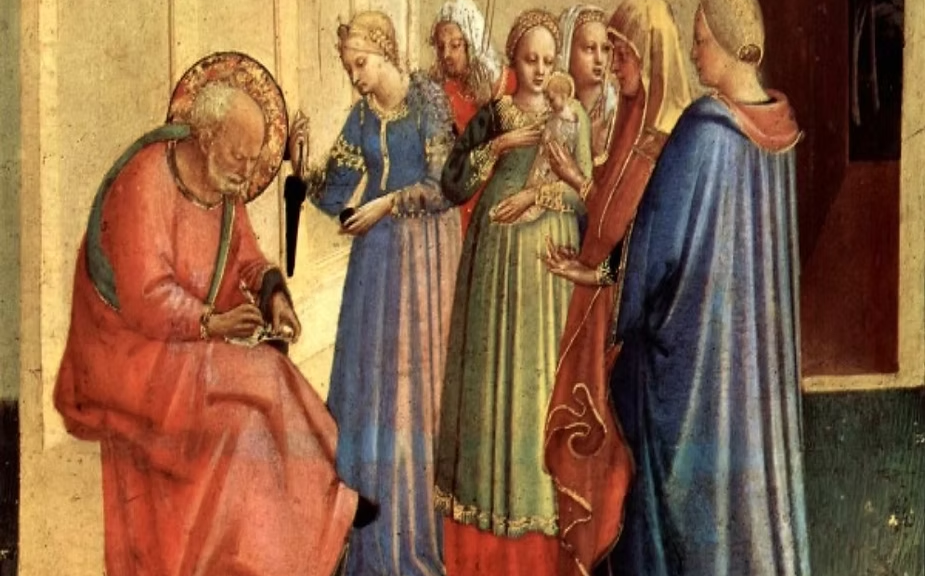
It must be known that Zechariah [also spelled “Zacharias”] was the father of John, born of Elizabeth. For the first eight days, John was referred to as “barzechariah” [“son of Zechariah”], and the leader who performed the cutting and official naming was told by Elizabeth, “His name will be John” [“Iōannēs”]. Because Zechariah had laughed when Gabriel came to him prophesying his barren wife would bring forth a son, Gabriel struck him mute. When Elizabeth said his name will be John, they asked the mute Zechariah what name he chose. Zechariah asked for paper and a pen, at which point he wrote “John.” The name “Zechariah” means “Yah[way] Remembers” and the name “John” means “Yah[weh] Is Gracious.” After the naming was official, Zechariah’s muteness was lifted and he sang this song of praise.

Here, it becomes important to see Luke as Greek, which means he was writing his Gospel as one who had access to the family of Jesus [Mother Mary], who told him her story, which he wrote in his native language. I believe his role as a physician also plays a role in his relationship with the family of Jesus, as he was of Israelite [Jewish] heritage, regardless of where he was born and what languages he understood. What is vital to realize when reading these words of Zechariah is the words of this song were told to Luke in Hebrew [Aramaic or Yiddish], which he understood. His text in Greek was then divinely inspired [led by Yahweh and the soul of Jesus within his soul] to be representative of the original language of this story; but Zechariah saying, “Blessed be the Lord, the God of Israel” would have been stated as “bā·rūḵ Yah-weh ’ĕ·lō·hîm ’ĕ·lō·hê yiś·rā·’êl,” just as David sang in Psalm 72:18.

In verse 68 the NRSV begins a mini-theme of freedom, where the word “free” is found in the translations of verses 68, 73, and 74. There is nothing in the Greek text of Luke that says “free.” Instead, the Greek words “lytrōsin” (“redemption”), “dounai” (“grant”), and “rhysthentas” (“having been rescued”) are written, with “lytrōsin” having an acceptable translation into English as “liberation.” Still, a theme of “freedom” is misleading, because the birth of John the Baptist would not offer the Jews “freedom” from Roman domination (to whom they were powerless to resist, thus to Rome their lives were submitted) but a slavery of their souls, through complete submission to Yahweh. Again, that is the truth of the statement of “blessing,” which does not come from free will to do as one pleases, but the choice to serve Yahweh as Israel, an elohim of Yahweh.

Verse 70 is a prophecy that John would speak the same spoken by the prophets of Israel, all of who were Yahweh elohim. This then says John was also a prophet, who would become a herald of what is required for souls to gain “salvation.” His voice would be a herald to who “has raised up a horn of salvation for us in the house of David.” (Verse 69 literal translation of the Greek) This becomes how some would say that John was thought to be Elijah having returned. Both spoke prophetically from being souls married to Yahweh, speaking the Word of Yahweh for the people to follow.

Verse 71 sings of “mercy” from the “enemies” of “ourselves” [from “hēmōn”], where all “selves” are individual “souls.” To read the word “enemies” and project that onto the Babylonians, the Romans, or anyone other than “self” is denial. It is one’s soul denying marriage to Yahweh that made all the fallen souls of Judah be their own worst “enemy.” Therefore, John would announce redemption of sins, brought on by a love affair with Satan and his demons of material worth, whose sole purpose was “hatred” of Yahweh’s people.

Verse 72 then reminds those singing these word of prophecy that the only reason the Jews were considered to be children of God is “our fathers,” through a “holy covenant.” The promise made to Abraham was not freedom but “to offer” [“dounai”] the descendants of Abraham-Isaac-Jacob the path to righteousness, through divine union with Yahweh’s Spirit. It would be that holy marriage, based on each soul’s agreement to live up to the covenant of marriage that would cleanse the old self – the enemy within – and make a soul the wife of Yahweh – Anointed as His children.

The importance of verse 74 is the absence of “fear.” Since humanity has known about Yahweh and religion – the Advent of Adam and Eve – the birth of Cain and the propagation of his seed has brought forth countless false religions, all of which are intended to mislead human souls away from the truth. The lineage of Abraham (which split with Ishmael) led to Moses leading the children of Jacob, who had learned to love and serve Yahweh (not lesser gods), to the founding of a priesthood that would be prepared to serve Yahweh to the world. It was never meant to be some special favor to one man (Abraham) or one race of people. The Jews were born from being birthed from their womb that was the Promised Land in Canaan. They needed to have a history of self-failure, so when Jesus would come (to be announced by John) that priesthood would ignite. This is souls who only “fear” losing Yahweh in their lives, which means once possessed divinely they will forever “serve him.” Verse 75 says this service will be as “righteousness,” which will not be for anything less than “all the days of their lives.”

Verse 76 is then Yahweh speaking through His servant Zechariah, singing a prophecy to his infant son John. This prophecy comes by singing, “You, my child, shall be called the prophet of the Most High [from “Hypsistou” – of the Highest”], for you will go before the Lord to prepare his way.” This verse is begun by a capitalized “Kai,” which says it is the most important verse in this song. That notification then leads to the capitalization of “Hypsistou,” which ranks this word’s meaning to that of the proper names “David, Abraham, and God,” equating it with “Blessed, Lord, God, and Israel” in verse 68. The distinction of this verse being begun with a capitalized “Kai” places it as more important than verse 69, which begins with a lower-case “kai.” All of this is Yahweh’s blessing placed on the birth of John, through the singing of Zechariah, which is the truth that John would prepare the way of Jesus, when his time came.

Verses 77 through 79 then repeat the theme of “salvation,” through “forgiveness of sins.” That says all by then will have sinned, thus all will need to repent. It was their sins that kept them from realizing their heritage, meant to be the priests of Yahweh. It was their “afflictions” that kept them from feeling “compassion of Yahweh” (translated in Greek as “of God” – “Theou”), which led their souls away from marriage to His Spirit. John’s baptisms and preaching would cleanse their bodies of flesh and open their hearts through confession of sins, placing their souls “on high” (from “hypsous”). The Jews would need that elevation of spirit to be prepared to receive the presence of Yahweh in His Son, Jesus. John’s opening of their hearts and minds would allow Jesus “to shine” the light of truth into the “darkness” of their souls, where “death” held their souls captive. It would be that light that would direct the Jews to walk the “path” intended, as servant wives of Yahweh.

As a song that prophesies the life of John, without Zechariah knowing anything of Jesus (still in Mary’s womb), symbolizes how knowing the future holds Jesus in one’s life is the message of the Advent season. The birth of John is then the symbolism of the birth of awareness that one’s life must be cleansed of sins, in preparation for baby Jesus to be resurrected within one’s soul. The birth of John is the inkling that changes must be made in one’s life. It symbolizes when one’s own sins and failures come to the forefront of one’s thought processes, when one’s soul makes a commitment to serve Yahweh forever.

Philippians 1:3-11 – Capitalized importance

I thank my God every time I remember you, constantly praying with joy in every one of my prayers for all of you, because of your sharing in the gospel from the first day until now. I am confident of this, that the one who began a good work among you will bring it to completion by the day of Jesus Christ [of Jesus]. [Just as] It it is right for me to think this way about all of you, because you hold me in your heart, for all of you share in God’s grace with me, both in my imprisonment and in the defense and confirmation of the gospel. For God is my witness, how I long for all of you with the compassion of Christ [of] Jesus. And this is my prayer, that your love may overflow more and more with knowledge and full insight to help you to determine what is best, so that in the day of Christ you may be pure and blameless, having produced the harvest of righteousness that comes through [of] Jesus [of] Christ for the glory and praise of God.

——————–

This is the Epistle selection to be read aloud on the second Sunday of Advent, Year C, according to the lectionary for the Episcopal Church. This reading will follow two of three other possible readings: Baruch 5 or Malachi 3; and, Canticle 16. Those readings will include these quotes: “see your children gathered from west and east at the word of the Holy One, rejoicing that God has remembered them;” “he is like a refiner’s fire and like fullers’ soap; he will sit as a refiner and purifier of silver, and he will purify the descendants of Levi and refine them like gold and silver, until they present offerings to Yahweh in righteousness;” and “In the tender compassion of our God the dawn from on high shall break upon us, To shine on those who dwell in darkness and the shadow of death.” All will accompany the Gospel selection from Luke, where it is written: “The word of God came to John son of Zechariah in the wilderness. He went into all the region around the Jordan, proclaiming a baptism of repentance for the forgiveness of sins.”

At first glance, these nine verses of Paul’s letter to the Christians of Philippi is little more than the initial greeting of someone who passed through town some time back, wanting to have everyone know how much Paul missed being around them. It is far from that; but the art of translating Greek to English makes it harder to discern the truth contained in the Greek, because the letter was written in the divine language of Yahweh, using Greek as His tool. In these nine verses are five period marks, which make it appear to be five long-winded sentences. In reality it is twenty series of word segments, each of which becomes its own ‘sentence,’ according to the Word of Yahweh. Those segments are broken apart by commas, periods, verse transition, and a semi-colon, with one ‘sentence’ being one capitalized word … a word the NRSV ignored completely in translation.

In the above NRSV translation, it should be noted where some words were not translated [the genitive forms of names, which mean “of” must be added]. I have placed the omitted words in brackets. The omitted word has verse seven begin erroneously with “It is right,” when the capitalization of “it” is wrong. I have amended that to show the truth of that written. Also, in verse six, the NRSV has changed the order of “of Christ of Jesus” to show “of Jesus Christ.” That is wrong, so I have stricken out the misplaced “Jesus” and replaced it in the proper position, in brackets.

As I did recently for another seemingly benign Epistle reading of Paul’s, one where I had done an in-depth dissection of the reading three years prior, I added a new slant on the reading, where I only addressed the capitalized words written in those verses. That showed the divinity of what Paul wrote, as it is obvious that Yahweh led Paul with foresight, so what Paul wrote made deep sense, while what Paul wrote in capitalized words equally made profound sense. It would be too time consuming for Paul to write letters and try to accomplish that feat alone. The message sent in capitalized words is Yahweh speaking doubly through one of His prophets. The bold type above denotes the capitalized words in this text, which I will next present as the interpretation of this reading.

In addition to this to follow, one of the capitalized words is “Kai,” which is a marker word. The NRSV translation above denotes this word simply as a capitalized “And,” which begins a new ‘sentence’ [it follows a period mark]. It is my strong opinion that the word “kai,” in all its presentations, does not need translation at all. It should simply be seen as a place where Yahweh had His prophet signal “importance to follow this word “kai.”’ This means a capitalized “Kai” denotes great importance to follow. Because these nine verses present the word “kai” seven times, including the one capitalized version, I will then add interpretation of the five segments of words that are either begun or include the word “kai.”

There are thirteen capitalized words in the nine verses of this this reading. Ten of those words are forms of “God [Theos], Christ [Christos], and Jesus [Iésous]. The other three capitalized words include “Kai” and two other words that begin ‘sentences,’ each following a period mark. While this can seem to be the simplicity of syntax, where the first word of a sentence is always capitalized, verse seven ends with a period mark, but verse eight begins with the lower-case word “martys” [“μάρτυς”], which shows that normal syntax is not the same as divine syntax – the language of Yahweh.

Each capitalized word is listed by the verse it appears written in, with the verse numbers in bold type. Please note that there are no capitalized words found in verses 4 and 5. Also note the groupings of three: Three singular words set apart from three words stated multiple times. Of those three stated multiple times, “Christou [Χριστοῦ]” is found four times and “Iēsou [Ἰησοῦ]” three times, all presented with exactly the same spelling. The word for “God,” however, is stated three ways, as “Theō [Θεῷ],” “Theos [Θεός],” and “Theou [Θεοῦ],” each differently.

One can see this presence of the number three being repeated in words as mere coincidence; or, one can see this as another sign of divine inspiration being present. The symbolism of three, as far as Christianity is concerned, is the Trinity. The Trinity, simply stated, means the union of Father, Son, and Holy Spirit. This can now be seen as “God [Theos],” “Jesus [Iésous],” and “Christ [Christos].” That becomes significant, as most Christians today refer to “Jesus Christ” as if that were his first and last names. People commonly refer to “Christ,” when their minds are picturing Jesus. When they call Jesus “Christ,” that gives the impression that Jesus is the only “Christ,” when the word is Greek [christos] for “anointed one.” When capitalized, it takes on a divine level of mean, where the “Anointment” comes from Yahweh. Yahweh can “Anoint” as many as He pleases, with David being a prime example of one who was “Anointed” [a “Christ”].

Here is the list of thirteen capitalized words:

3. Eucharistō [Εὐχαριστῶ] – I Thank

Theō [Θεῷ] – God

6. Christou [Χριστοῦ] – of Christ, of Anointed

Iēsou [Ἰησοῦ] – of Jesus

7. Kathōs [Καθώς] – Just as, Seeing as, According as

8. Theos [Θεός] – God

Christou [Χριστοῦ] – of Christ, of Anointed

Iēsou [Ἰησοῦ] – of Jesus

9. Kai [Καὶ] – [Importantly]

10. Christou [Χριστοῦ] – of Christ, of Anointed

11. Iēsou [Ἰησοῦ]– of Jesus

Christou [Χριστοῦ] – of Christ, of Anointed

Theou [Θεοῦ] – of God

As I did previously, these words can be set in an order as a series of statement, such as: “I Thank God of Anointed of Jesus Just as God of Anointed of Jesus Kai of Anointed of Jesus of Anointed of God.” These can then be ‘punctuated’ by the numbering of the verses they appear in, such as: “I Thank God – – – – of Anointed of Jesus – – Just as – – God of Anointed of Jesus – – Kai – – of Anointed – – of Jesus of Anointed of God.”

By removing the influence to think of “Christ” as another name for Jesus, listing all translations for “Christou” as “of Anointed,” one is free to see how oneself can then become that soul “Anointed.” When oneself is seen as Yahweh speaking through him or her (as would the true Christians of Philippi), the first person singular “I” of “Eucharistō” has oneself saying, “I Thank God.” When the word “Eucharistō” is realized to come from “eucharistos” (“thankful, grateful”), from which the term “Eucharist” comes, these thirteen capitalized words becomes the truth of Holy Communion stated. That means by saying these words one has eaten the bread [Scripture] and drank from the cup [Received the Spirit in divine marriage]. Then, a soul can truly say, “I Thank God … as being one of His Anointed from my soul receiving the resurrection of Jesus with it … According to … the same God who makes all disciples be also of Anointed of Jesus … this Most Importantly … makes me of those Anointed in kind … all alike are the truth of the Trinity – of Jesus of Anointed of God.”

Again, it is easy to decline to accept this as being the overview of the intent from Paul in these nine verses. This certainly is not taught in churches or seminaries. Therefore, it can be taken or left alone. I offer it as my observation to the reader here.

As for the seven placements of “kai” in this reading selection, those segments containing that marker of importance can then be pieced together as a capsule of the important elements to be taken from this reading. Listed below are the seven, coming from four verses. Each verse is divided into sections, based on the presence of punctuation marks within a verse, with the first section listed as “a” and all subsequent sections having the next letter applied to the verse number. This is the Greek text parsed as such:

7e kai en tē apologia kai bebaiōsei tou euangeliou ,

9a Kai touto proseuchomai ,

9c eti mallon kai mallon perisseuē en epignōsei kai pasē aisthēsei ,

10b hina ēte epignōsei kai aproskopoi eis hēmeran Christou ,

11b eis doxan kai epainon Theou .

This then translates to say:

7e importantly in this thought-out response importantly validated of anyone good news ,

9a Most importantly here I pray ,

9c remain more importantly more to overflow in discernment importantly every kind of

understanding ,

10b in order that you might exist pure importantly not causing to stumble towards time of

Anointed ,

11b towards renown importantly approval of God .

When everything is seen to be that important to be known from this portion of Paul’s letter to the Philippians, each “kai” can be removed and dashes shown. The verse changes can then be read as comma marks. This means Paul wrote this to be importantly known: “in this thought-out response – validated of anyone good news, here I pray – remain more – more to overflow in discernment – every kind of understanding, in order that you might exist pure – not causing to stumble towards time of Anointed, towards renown – approval of God.”

Likewise, this is how divine Scripture can be seen as divine, because no human being has the ability to create writings that has this flexibility of meaning built in. Only Yahweh could lead a prophet to write on this level of profoundness. Still, I leave it up to the readers to accept it or reject it.

As a reading selection chosen for the second Sunday of Advent, when one’s soul is beginning to feel the kick inside that says one is close to a divine presence that no one else can experience in the same way, the outward appearance of Paul’s words to the Philippians is, “Ho hum.” It is like someone telling you, “I’m pregnant,” and you understand what that means, but cannot fully relate to all the inner sensations that fill one with joy. For one to have that experience as know what Paul meant, one has to be there with Paul. One needs to be divinely raised [the capitalized statements] and one needs to feel how important that is.

Luke 3:1-6 – The timing of John’s ministry speaks of the timing of Jesus’

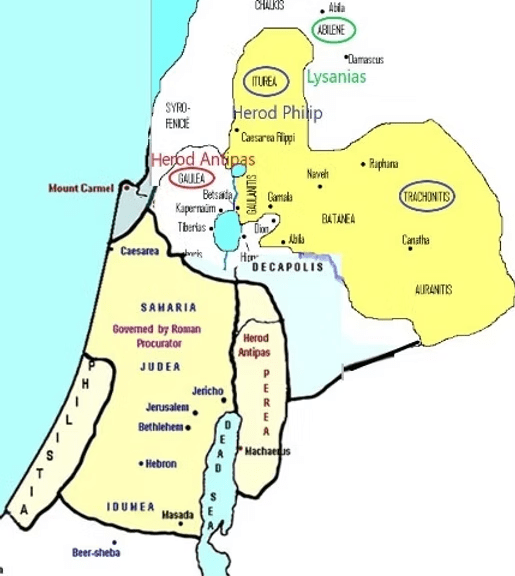
In the fifteenth year of the reign of Emperor Tiberius, when Pontius Pilate was governor of Judea, and Herod was ruler of Galilee, and his brother Philip ruler of the region of Ituraea and Trachonitis, and Lysanias ruler of Abilene, during the high priesthood of Annas and Caiaphas, the word of God came to John son of Zechariah in the wilderness. He went into all the region around the Jordan, proclaiming a baptism of repentance for the forgiveness of sins, as it is written in the book of the words of the prophet Isaiah,

“The voice of one crying out in the wilderness:

‘Prepare the way of the Lord, make his paths straight.

Every valley shall be filled, and every mountain and hill shall be made low,

and the crooked shall be made straight, and the rough ways made smooth;

and all flesh shall see the salvation of God.'”

——————–

This is the Gospel reading to be read aloud by a priest on the second Sunday of Advent, Year C, according to the lectionary for the Episcopal Church. It will follow either a reading from Baruch 5 or Malachi 3, which say respectively, “[the captives to Babylon] went out from you on foot, led away by their enemies; but God will bring them back to you, carried in glory, as on a royal throne;” and, “See, I am sending my messenger to prepare the way before me, and Yahweh whom you seek will suddenly come to his temple.” One of those two will be followed by Canticle 16, which sings, “for you [John the Baptist] will go before the Lord to prepare his way, To give his people knowledge of salvation by the forgiveness of their sins.” Those will then be followed by a reading from Paul’s letter to the Philippians, where he wrote, “For God is my witness, how I long for all of you with the compassion of Christ Jesus.”

The first verse of this reading selection sets important historical timing that not only states when John the Baptist was in ministry, but it also establishes when Jesus was born. This is because John was only six months older than Jesus. So, understanding how to read this is important towards reaching that end – determining when Jesus was born.

In divine language, punctuation sets a chronology that must be seen as pointing out separation in the order of events in time. This means one event, followed by a comma mark, separates the former in time from the latter. This also places great importance in translating each word of a segment where it is not matching one’s personal agenda, so it reveals the underlying truth. This means verse one of this reading breaks down as stating this:

In year now fifteenth of this prince’s of Tiberius of Caesar ,

of being governor of Pontius of Pilate of this of Judea ,

importantly of being tetrarch of this of Galilee of Herod ,

of Philip now of this of brother of same of being tetrarch of this of Ituraea importantly of Trachonitis of homeland ,

importantly of Lysanias of this of Abilene of being tetrarch ,

In this series of five segments, five different names are stated. These segments are less about the five rulers (emperor, governor, and tetrarchs) all being named at the same time and more about the division of Herod the Great’s kingdom. This can be seen in the three uses of “kai” – a marker word alerting the reader to importance to follow – where Antipas is not named as such, instead being called “of Herod.” That is important to grasp as a timing element. This then leads one to understand the five named, which is:

Tiberius: “the second Roman emperor. He reigned from AD 14 until 37.” [Wikipedia]

Pontius Pilate: “was the fifth governor of the Roman province of Judaea, serving under Emperor Tiberius from the year 26/27 to 36/37 AD.” [Wikipedia]

Herod Antipas: “After the death of Herod the Great in 4 BC, Augustus confirmed the testament of the dead king by making Antipas tetrarch of Galilee and Perea, a region he would rule for the next forty-two years.” [Wikipedia]

Philip: “ruled over the northeast part of his father’s kingdom from 4 BCE until his death in 34 CE.” [Wikipedia]

Lysanias: This is a questionable reference, believed to be the son of Lysanias I.

“Therefore, the Lysanias in Luke (28–29) is a younger Lysanias, tetrarch of Abilene only.”

The mistake made by scholars in translating this verse as questionable historical evidence is they read the Greek as the NRSV translates [and other like them]. The whole is written in the genitive case, which is stating possession. This means every word needs the word “of” added to it. Each word is then its own statement of possession; but normal syntax (of Greek and English) accept the genitive word spellings to simply be something that is ignored in translation into English. Thus, the scholars believe the base fact stated (which scholars question as accurate) is: “In the fifteenth year of the reign of Emperor Tiberius.” That is not written. The order of capitalized Greek words says “of Tiberius of Caesar,” where “Caesar” is read as meaning “of Emperor.” While the word does not expressly denote a human deity, as a demigod, the capitalization of the name here (along with that “of Tiberius”) must be read as “a ruler” who proclaimed himself to be “of godlike status,” over vast holdings of land and peoples.

The translation that I provided above, in the separation of verse one into five segments, says, “In year now fifteenth of this prince’s of Tiberius of Caesar .” In that, the genitive case first appears in the words “tēs hēgemonias,” which translate to “of this prince’s” or “of this of prince.” When that possessive case is applied to “In year now fifteenth,” the title stated as “of rule, of authority, of sovereignty; of a reign” [Strong’s], acceptable to be read as the noun “prince” [Wiktionary], makes it necessary to read that not as defining “the rule of Tiberius of Caesar,” but as defining John’s time in relationship to Jesus, the “prince” of peace. This takes understanding “year fifteenth” into a whole new light.

To grasp this, one must be aware that the Greek word “En” [“Ἐν”] is capitalized. While the word does begin a ‘sentence’ – the first segment of words in verse one – it is not capitalized for that syntactical reason. The capitalization of all New Testament Scripture [Hebrew has no capital letters] is for the purpose of alerting the observant reader to that word needing to be read with divine elevation in meaning. As a common preposition, meaning “in, on, among” [Strong’s], as well as “at” or [relative to time] “during the time of” [Wiktionary], the divine elevation becomes a statement of time as recognized by Yahweh, whose Spirit guided the text written by the Saint Luke. Because Tiberius claimed to be a god in human flesh (the meaning “of Caesar”), Luke was not writing about his time.

The Roman historian Josephus would refer to dates as “in the fifteenth year of Tiberius;” but Josephus wrote no books that have been canonized. Luke was writing his Gospel in “roughly the year 85 C.E. (± five to ten years)” [Todd Berzon, Department of Religion, Columbia College], which was well before the invention of a Westernized calendar that would begin to declare years as Anno Domini (Year of Our Lord). Still, Yahweh is All Knowing (Omniscient) and would have known in 85 C.E. that 15 C.E. (or A.D.) was the divinely elevated meaning that applied to “In year fifteenth of this prince’s.” While the Josephus timing would have been “year fifteenth of this of Tiberius of Emperor.” this is not a book written as a historical document relative to a Roman emperor.

This presents a range of years, where a decade would have been spent by John in ministry, while Valerius Gratus was the Perfect of Judea, before the change of the guard that brought in Pontius Pilate. That means the timing of the second segment of words began in the twelfth year of Tiberius’ reign, after John had been in ministry for some time. The advent of Pontius Pilate as the Governor of Judea was a change of the guard that took place at the time Jesus began his ministry. It was about that same time that John the Baptist was beheaded by the orders of Antipas, because of the complaints made against him by John, before the arrival of Pilate. Thus, the third segment of words places focus on the important time of the rift between Antipas and John.

In the fourth segment of words, where Philip’s area of rule is stated, the importance of “Trachonitis” should be seen as a capitalized word that requires one to understand the meaning of the name. That meaning is “a rugged stony tract,” which can now be seen as the wilderness in which John found safety. The region known as “Trachonitis” is the easternmost area under Philip’s rule. It is doubtful that Philip was born there (he was from a different mother than that of Antipas), as his mother is said to be Cleopatra of Jerusalem. So, this can be an important place that John sought to be the wild man he was pictured as. Still, the use of “kai” between “Ituraea kai Trachonitis” can be a silent way to place focus on the unnamed region under Philip, which was Gualanitus. Gualanitus was east of the Jordan, as it flowed into the Sea of Galilee, and included the place where Jesus regularly preached by that sea. Therefore, the importance becomes the area between Ituraea and Trachonitis. That could possibly be the “rugged stony tract” that overlooked the sea.

The mention in the fifth segment of Lysanias and Abilene is most confusing to scholars; but the use of “kai” marking this as important says that this was another region where John could go safely. The area where “Abilene” is located is east of Mount Hermon, which is where Jesus went to be Transfigured. The capitalization of the place means “Land of Streams” (or “Meadows”), with “Lysanias” meaning “Ending Sorrow, The End Of Grief.” More than pointing to one obscure character in history, in a strange place (each ‘name’ only found in this reading in Scripture), it could mean John also trekked up Mount Hermon to get close to Yahweh, after having spent time in the wilderness preparing for his acts of ministry.

The name of “Annas” becomes a statement of the high priest of the Temple, who officially served in that capacity between the years six and sixteen A.D. His son Eleazar next served, between sixteen and seventeen A.D. Caiaphas followed between eighteen and thirty-six A.D, which took him well beyond the time of John’s death. Thus, verse two is adding to the timing that John’s time in ministry in Jerusalem was between 16 A.D., until his arrest and death, while Caiaphas was high priest. It was during those years that John received his messages to deliver, from Yahweh.

Verse three states that message as being to repent and seek forgiveness. While he would be known as the “baptizer,” a word that means “submerging,” usually implying with water, the use of “kēryssōn baptisma” [“preaching a submerging”] says it was his words, more than the waters of the streams or rivers [by the meadows], that flowed over the sinful who sought cleansing. Therefore, the words spoken by John echoed those quoted from Isaiah.

In the quoting of Isaiah, the Hebrew text of Isaiah must be realized as the source of the words then written in Greek, as translations. The missing element is “the Lord” was stated as “Yahweh” by Isaiah. When the translation says, “make his paths straight,” the reality is Isaiah said, “make straight in the desert , a highway for us elohim .” Isaiah wrote “lelohenu” [“לֵאלֹהֵֽינוּ”], which says Yahweh does not need a path to go straight, His servants need to become His elohim, in order to walk straight or righteously. That was the message John “baptized” the repentant Jews with, so they would be prepared to receive Jesus, when his ministry began later.

It should be noted that the age difference between John and Jesus was only six months; but John began his ministry in the lands once governed by Herod the Great well before Jesus began his there. Jesus was not simply hanging around doing nothing, as he had left the regions of Herod the Great to enter ‘foreign ministry.’ Jesus would return from those journeys, which John knew little about (if anything); so the two cousins probably spent time together in Galilee as children, but grew apart when they became old enough to be considered men.

As the Gospel reading to be read aloud on the second Sunday of Advent, the story of John is preparing the way for Jesus to be born, as the news of his coming before he arrives. This is the point of the season called Advent. It is a time to look forward to a birth that is growing within oneself, knowing the time will come when one has to begin being Jesus reborn. Thus John is speaking on your behalf, as long as your soul has married Yahweh and become ‘with child” from that union.