Tag Archives: Advent 4 Year C

Micah 5:2-5a – The prophecy of the King of the Jews

[2] You, O Bethlehem of Ephrathah,

who are one of the little clans of Judah,

from you shall come forth for me

one who is to rule in Israel,

whose origin is from of old,

from ancient days.

[3] Therefore he shall give them up until the time

when she who is in labor has brought forth;

then the rest of his kindred shall return

to the people of Israel.

[4] And he shall stand and feed his flock in the strength of Yahweh,

in the majesty of the name of Yahweh elohaw.

And they shall live secure, for now he shall be great

to the ends of the earth;

[5a] and he shall be the one of peace.

——————–

This is the Old Testament selection to be read aloud on the fourth Sunday of Advent, Year C, according to the lectionary for the Episcopal Church. It will precede either Canticle 15 (“Mary’s song” – from Luke 1) or Psalm 80. Mary’s song includes her singing, “From this day all generations will call me blessed: the Almighty has done great things for me, and holy is his Name.” Psalm 80 includes this verse: “Restore us, elohim of hosts; show the light of your countenance, and we shall be saved.” Either will precede a reading from Hebrews, where Paul wrote: “When Christ came into the world, he said, “Sacrifices and offerings you have not desired, but a body you have prepared for me.” All will accompany the Gospel choice from Luke, where Elizabeth told Mary, “For as soon as I heard the sound of your greeting, the child in my womb leaped for joy.”

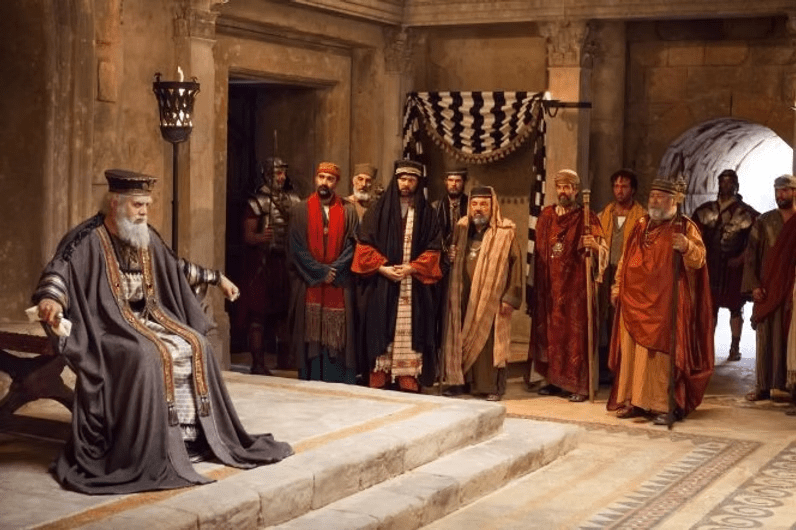
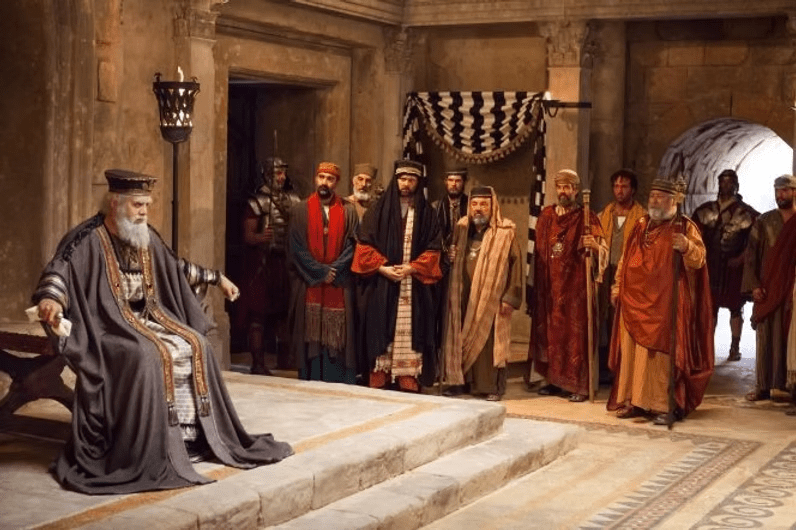
In Matthew 2, where the story of the Magi is told, they went to meet with Herod the Great, because he was the King of Judea. One can assume they had come seeking the newborn “King of the Jews” [“basileus tōn Ioudaiōn”], asking Herod to see his new baby. Since Herod had no new issue, the Magi then asked, “Where is it prophesied that he will be born?” Herod did not know; so, he ordered his court scribes (scholars in Judaism) to come give this answer. When they arrived, they quoted Micah 5:2-3, which says it was scholarly opinion that the Messiah would be born in Bethlehem.
This becomes the reason this reading is read on this Sunday of Advent, because this reading from Micah is Yahweh speaking the truth of what will come … not only once, when Jesus was born, but at all times [this can also be a reverse prophecy of David]. The confusion that comes (and a good reason why no scribes advised Herod the Great to stake out Bethlehem and look for competition being born) is that found in the name “Ephrathah.” There are actually two places named “Bethlehem” in what was once a whole Israel, with one north of Jerusalem (not in Judah) and one south of Jerusalem (in Judah). All of this confusion says reading words as the names of places is wrong.

The word “bethlehem” means “House Of Bread.”

The word “ephrathah” is a woman’s name, meaning “Fruitful.”

The word “judah” means “Praised” or “Let Him Be Praised.”

The word “israel” means “Who Retains Yahweh as His elohim.”

When this is realized, verse two says (literally translated from the actual Hebrew written), “but you house of bread fruitful , little you are among the thousands who let him be praised , out of you I shall come forth , the one to be ruler of those who retain Yahweh as one of His elohim ; and who going forth from former day forever .

This does not speak in a restricted and limited way, although the double-edge of divine words still allow for that specificity to shine forth as truth. However, the broad stoke meaning says those who will provide spiritual food for others, who will be fruitful as servants of Yahweh, they will be the Saints among the masses who allow Yahweh to speak through their mouths. It says the Spirit of Yahweh will reign over their souls and bodies of flesh; and, once that marriage has taken place, then [like Jacob] they will take on the name of Yahweh in marriage [Israel]. That will mean a forever transformation will take their souls from their former enslavements in flesh and shine the light of truth upon them eternally.

In verse three is reference to the mother of this divine Son born. While this becomes a specific prophecy of the Virgin Mary (without naming who “she” is), the broad stroke intent (which makes it apply to everyone, at all times, thereby be completely a prophetic truth) is to call all humanity feminine (males and females), because a soul in a body of flesh takes on the polarity of matter, which is feminine-negative-receptive. By seeing this, the literal translation of verse three is as such:

“thus he shall give them , up to time she will bring forth to bear ; and the remainder of brothers , shall return to sons of those who retain Yahweh as His elohim .

This implies that Yahweh will “give up on them” [NRSV: “he shall give them up”], which is not the case. The Hebrew root word written is “nathan,” which means “to give, put, set,” implying a “gift,” rather than a punishment “given.” This says the presence of Yahweh is indeed “a gift” by Yahweh to His wife-souls. That “gift” will be the pregnancy of His Son, where “up to time she will bring forth” is relative to the season we call Advent. The Hebrew word “yalad” means “to bear, bring forth, beget,” implying “to give birth,” but the essence of “bearing” means one “bears” the responsibility that comes with being both a wife and mother. Again, all human beings are souls in dead bodies of flesh, so human gender is not factored into a wife of Yahweh. All are feminine to His being the masculine progenitor (meaning we call Him “Father”). Thus, all souls married to Yahweh will “bear” the presence of His Son in their souls.

Following a semicolon, which denotes a new and separate statement that is relative to that statement just presented, one birth of Yahweh’s Son is not all. Jesus is not the only one who can make this prophecy of Micah be the full truth. Many others will also be born, with all Sons, therefore all will be “brothers.” This is again stating the masculinity of Yahweh’s presence, which transforms a feminine human being’s soul (males and females according to their flesh) into a Son, so all the “remainder, preeminence, others likewise with this superiority” [from “yether”] will therefore be “brothers” (even human males and females mixed together – in the name of Israel – all will be soul brothers). This says there will be no “sisters” born as Sons of Yahweh; so, no “sisters” will have anything to do with true Christianity. Because a “sister” equates to a soul alone in its body of flesh (whatever gender), Micah was prophesying about all being divinely elevated Sons – brothers alike – both males and females whose souls have married Yahweh and brought forth His Son.

This is then confirmed in the final segment of words in verse three, where the use of “sons” [from “bene”] is written. The use of “shall return” [from “shub”] is a statement about one’s soul, which is “given” by Yahweh at birth (into bodies of flesh He determines to be either male, female or it), such that a “return” or “turn back” means a wayward soul has been placed back into the fold of righteousness. All who become righteous will be reborn as “sons” (it is okay to capitalize that and let it mean Jesuses). All of those “sons” will be transformed as was Jacob, when his soul “returned” and he became in the name of Yahweh, as “Israel” – meaning “Who Retains Yahweh as His elohim.”

In this use of “Israel,” it is worthwhile to realize that Micah was a prophet of Judah. His time as a prophet was when the Northern Kingdom had yet to be overrun; but Yahweh was not speaking through him to make it seem that Judeans were to be mistaken as Israelites up north. The naming of “Israel” twice [“יִשְׂרָאֵֽל” or “yiś·rā·’êl”] needs to be seen as the meaning behind the name, which did still apply to Judeans, just as it applies to all before [Jacob] and after [all true Christians], including Micah and Jesus.

When I translate “yiś·rā·’êl” so it includes the words Yahweh and elohim, the name ordinarily translates as “He Who Retains God,” with “el” seen as meaning “God.” One needs to understand “God” means “Yahweh,” but the word “el” is short [singular] for “elohim” [plural], where the “elohim” are “angels,” which are non-physical entities, servants of Yahweh [His creations who did the work of the Creation]. Thus, the truth of the name is how I state it, so each divinely created “el” is one of the many “elohim,” such that in human flesh a soul becomes a “Yahweh elohim,” as one of the “sons” of Yahweh.

This is then confirmed in verse four, where the Hebrew is literally translated as this: “and he shall take a stance , and pasture in the strength of Yahweh , in the redemptive name Yahweh elohaw ; and they shall endure when now he shall become great to a ceasing of the land .

This speaks of those “Sons,” as the third-person “he,” who will “stand” as representatives of Yahweh on earth. It will be them who will become the “pasture” that will “feed” the lost sheep of Yahweh [the seekers who need help finding their way to righteousness]; and, as themselves becoming spiritual food in a famine situation, they will offer others “the strength of Yahweh,” which they possess as His wives and Sons.

That then leads to Micah stating clearly that those “Sons” of Yahweh will all be “in the redemptive name” that had been termed “Israel,” but now is equated to “Yahweh elohaw,” where “elohaw” translates as “his elohim.” There is no need to mistranslate this as “his God,” as that redundancy becomes meaningless. When one realizes the “elohim” are the “angels” of Yahweh, which He created, a “Yahweh elohim” is “his” “angels in the flesh” – His “Sons” reborn.

In the final segment of words, where “to a ceasing of the land” is the translation [from “‘aḏ-’ap̄·sê- ’ā·reṣ”], the meaning is twofold. First, it says one no longer serves the body of flesh [the “land, earth” reflecting upon the dead matter a soul animates], so the flesh can no longer lead a soul to sin. This says sin has “ceased” being an influence over one’s soul. Second, it speaks of a soul’s “redemption,” by having married Yahweh and given rebirth to His Son, so that soul is promised eternal life. Therefore, that soul will “cease” returning to the “earth,” meaning no more reincarnations for failing to serve Yahweh, choosing to serve self instead.

Verse five-a is then three Hebrew words, which translate as saying, “and shall be this peace.” This is the theme of “peace” overcoming a soul reborn as a Son of Yahweh. This fits the pre-Christmas theme of “goodwill and peace on earth” or “to man.” Without understanding this “peace” as being that which comes from knowing one’s soul has been promised eternal life, from marriage to Yahweh, giving birth to His Son AND then serving Him as one who feeds His flock, people fall into the sinful illusion of hippie “peace man” or the Episcopal catchphrase, “peace be with you,” when nobody knows what “peace” means. The Hebrew word written is “shalom,” which means “completeness, soundness, welfare, peace.” That only comes when a soul has returned to its source, having been transformed into a Yahweh elohim that serves Yahweh with all one’s heart, soul, and mind.

As an Old Testament reading to be read aloud on the last Sunday of Advent, prior to one’s symbolic rebirth as a Son of Yahweh (males and females alike), one needs to realize Christmas is not about worshiping baby Jesus. It is all about being baby Jesus reborn in one’s soul, so a new you can go forth and serve Yahweh totally, as His Son Jesus resurrected in your flesh. Each true Christian is to be the Virgin Mary, having never before been impregnated with Yahweh’s Spirit, having never before been promised eternal life. This message is all about the “gift” that awaits one’s soul, through submission of self to Yahweh, swearing agreement to His Covenant (the marriage vows) and then becoming one with His Spirit, cleansed so His Son can arise in one’s flesh. That is what puts the “merry” in Christmas.
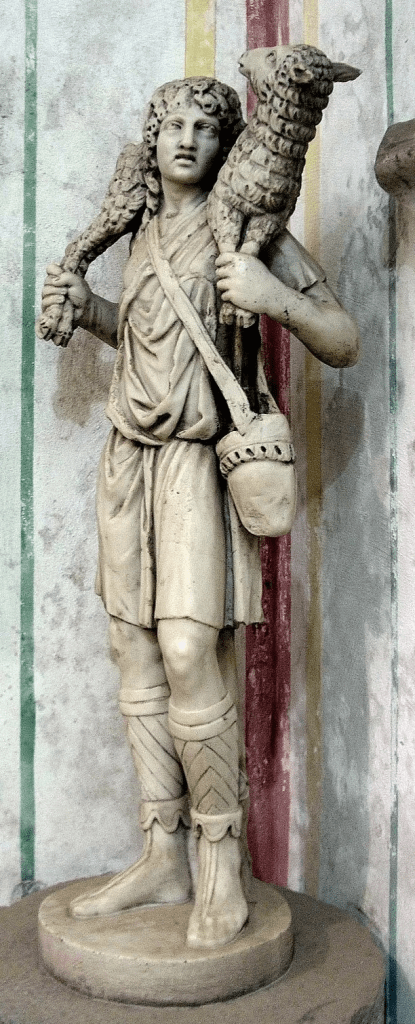
Psalm 80:1-7 – Born to be a shepherd

1 Hear, O Shepherd of Israel, leading Joseph like a flock; *

shine forth, you that are enthroned upon the cherubim.

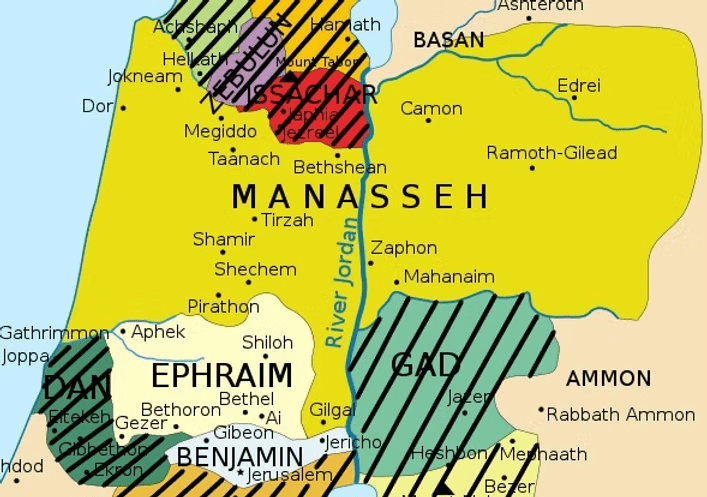
2 In the presence of Ephraim, Benjamin, and Manasseh, *

stir up your strength and come to help us.

3 Restore us, elohim of hosts; *

show the light of your countenance, and we shall be saved.

4 Yahweh elohim of hosts, *

how long will you be angered

despite the prayers of your people?

5 You have fed them with the bread of tears; *

you have given them bowls of tears to drink.

6 You have made us the derision of our neighbors, *

and our enemies laugh us to scorn.

7 Restore us, elohim of hosts; *

show the light of your countenance, and we shall be saved.

——————–

This is the song that will be the Response to the Old Testament reading from Micah on the fourth Sunday of Advent, Year C, according to the lectionary for the Episcopal Church. It will be read aloud in unison or sung by a cantor, if the verses from Luke 1 (called Canticle 15) are read as part of the Gospel reading. The Micah reading says, in part, “And he shall stand and feed his flock in the strength of Yahweh, in the majesty of the name of Yahweh elohaw.” This pair will precede a reading from Hebrews, where Paul wrote of Jesus saying, “You have neither desired nor taken pleasure in sacrifices and offerings and burnt offerings and sin offerings … See, I have come to do your will.” All will accompany the reading from Luke 1, where it is written: “In those days Mary set out and went with haste to a Judean town in the hill country, where she entered the house of Zechariah and greeted Elizabeth. [She sang]: His mercy is for those who fear him from generation to generation.”

This psalm is nineteen verses in length, meaning less than half are chosen to be sung on this Sunday. It is identified as “testimony of Asaph,” where the Hebrew word “asaph” means “gatherer” or “collector.” It is believed that a person named “Asaph” wrote this son, along with others that mention his name. However, when the theme then turns to a “Shepherd of Israel,” the words should be considered as David’s way of writing a “psalm of gathering.” To think otherwise lessens the divine intent of writing it down. David was inspired to write by Yahweh, leading him to use this identifying word.

Because David was a shepherd when he was Anointed by Yahweh Spiritually, as well as by Samuel physically, he became elevated to the position of “shepherd of Israel,” with the name “Israel” understood to mean those “Who Retain Yahweh as His elohim.” When the NRSV states “Hear” as the first word of verse one, the truth is the literal translation into English is as this:

“pastor of Israel listen , you who lead like a flock Joseph ; you who establish the cherubim shine forth .

In the naming of “Joseph” (“yō·w·sêp̄,” from “yoseph”) means “Increaser” or “May He Add.” This says anyone who pastors as one who retains Yahweh as His elohim is then a leader of a flock with the purpose to increase the number of sheep in the fold. Therefore, by understanding the “elohim” of “Israel” as a reflection of a soul merged with Yahweh becoming an “angel” in the flesh, that is explained as “you who establish the cherubim” within one’s soul. The Hebrew word “yō·šêḇ,” from “yashab,” means “to sit, remain, dwell,” with “establish a valid substitution. Whereas the NRSV translates this as a paraphrased that says “enthroned upon the cherubim,” the reality is the pastor-shepherd-increaser is a soul whose body of flesh has “set” within (not upon) the presence of Yahweh, which then “shines forth” as a “pastor Who Retains Yahweh.”

In the naming of “Ephraim, Benjamin and Manasseh,” three brothers of Joseph make it seem as if this Psalm is speaking of the flocks of Jacob, after the twelve tribes had been delivered into Canaan by Joshua. Again, to see the deeper truth, the meaning of the names needs to be realized.

Logistically, the three tribes representative of those sons of Jacob filled the middle regions of the Promised Land. It included the most sacred places in the history of the Patriarchs, which included the stronghold taken by David (Jerusalem, as the City of David), but not where David reigned as the King of Judah, nor his birth place, Bethlehem. Since David was a “shepherd of Israel” that was greater than these three regions, one needs to look at the name meaning, which are this:

The name “Ephraim” means “Two-fold Increase, Doubly Fruitful.” The name Benjamin” means “Son Of The Right Hand, Son Of The South.” The name “Manasseh” means “Forgetting, Evaporating.” When this is seen, the deeper meaning of verse two literally translates as saying: “the face doubly fruitful and sons of the right hand and forgetting , awaken as your strength ; and come save us .

Here, seeing “Ephraim” as meaning “doubly fruitful” this points out how one lets shine forth the “cherubim” within one’s soul. That “increase” makes one the “right hand” of Yahweh, as His “son.” The old self is then that which is found “evaporating,” with all past sins “forgotten.” This then lead to the Hebrew word “‘ō·wr·rāh” (from “ur”), where “arousing” or “awakening” means leaving the state of sleep that symbolizes the death of a soul alone in its flesh. To be “awakened” is the “strength” of the promise of eternal life. That promise is then what “comes to save us,” with the root of “save” (“yeshuah”) being in the name “Jesus.”

Verse three then confirms the “cherubim” as being the “angels within,” as David proceeds to write “elohim” three times in the next five verses, twice pairing this word with “of hosts.” In verse two, a seemingly innocent use of “the face” (“lip̄·nê,” from “paneh”), regularly translated as “before,” is found confirmed as meaning “face,” as here the clear word “paneka” is found. The NRSV translates this as “countenance,” but it is relative to the First Commandment, where Yahweh’s wives only wear His “face” before Him, having taken on that “face” (Hi name) in marriage and the submission of a soul to Him and only Him.

Verse three literally states this: “elohim return us ; and cause to shine your face , and we shall be saved .” In this, “elohim” is following the end of verse two, which stated “and come save us.” That which Yahweh sends for this purpose is His Spirit, which transforms a soul in a body of flesh to one of the Yahweh elohim He creates, for the purpose of “returning” a soul to His fold. This is then the “establishment of cherubim [plural angels, as is elohim] whose presence within one’s soul causes it to “shine forth. This can be depicted in art as a halo surrounding one’s “face” or head. That presence within then assures one that all such souls who are the “elohim” of Yahweh “are saved.”

This is then confirmed in verse four, where David sang “Yahweh elohim” (not “the Lord God”). The combination of words – “Yahweh elohim” – is found written eleven times in Genesis 2, after the seventh day has been announced with the creation of Adam. Adam was the first “Yahweh elohim,” whose soul was merged with an “angel” of Yahweh, making Adam be immortal, as a demigod.

The whole of verse four then literally translates into English as saying: “Yahweh elohim of hosts ; as far as when you will burn , against prayer of your people ?” Because this ends with a question mark, the words meaning “as far as when” (“ad-mathay”) are translated by the NRSV as “how long”. The Hebrew word translated as “be angry” (“a-san-ta,” from “ashan”) also means “smoke,” which means, “where there is smoke there is fire.”

Here, it is important to realize Yahweh appeared as a pillar of “fire” or “smoke,” to watch the Israelites by night. Thus, the question should be seen as “How long will Yahweh watch over His people, when their “prayers” are against marriage to His Spirit?” When a “prayer” is seen to say, “Save me,” the “burn” must be when one’s soul sacrifices self unto Yahweh, so one’s flesh becomes “smoke” that no longer leads a soul astray. To then say “against prayers” in one word (“biṯ·p̄il·laṯ”) becomes a statement that “prayers” are for having broken the marriage agreement – the Covenant.

When this song is about the “gatherer” [“Asaph”], a “shepherd” or “pastor” can only call to the sheep to come, but it is up to the sheep to hear the voice and go. To pray against being saved is to play the fool, which is how many Christians go through life. The call Jesus their Good Shepherd, but they never take the steps necessary to become Jesus reborn and become the “gatherer” of lost souls. Thus, verse five sings of what “against prayers” bring into the lives of perpetually ‘lost sheep.’

The literal translation of verse five is as such: “you have fed them the bread of tears ; and you have given them drink tears a third .” In this, the last word written in Hebrew is “šā·lîš,” from “shaliysh,” This means “a third,” where the assumption is one of three parts. The repeating of “tears” twice is then the choice made by those who call themselves ‘believers,’ while they refuse to go towards true faith, by merging their souls with Yahweh. Yahweh offers them His “bread” of Scripture, but they refuse to see the deeper truth. Therefore, they focus only on the “tears” that come forth. As for the “drink” offered by Yahweh – the blood of His Son, in relationship – they again refuse to marry Yahweh and become both His wife and the mother of His Son. They then refuse to form the Sacred Trinity, denying themselves the most important “third” of the Trinity. This places them into the category of fallen angels, where “a third” went “against” Yahweh’s command to serve mankind.

David then sang about the constant state of turmoil that surrounds transplants into Canaan, where they were never meant to remain there forever. The seed of Jacob was deposited into the womb that was the Promised Land. However, that placement of seed was to grow into a baby that would be born into the world, for the purpose of saving the souls of others – as themselves being shepherds. This makes verse six be pointing to the childbirth a true Christian is expecting during Advent.

This means the literal translation of verse six says this: “you have made us a contention to our neighbors ; and our enemies , laugh among themselves .” Here, the element of being “made” must be seen as meaning the purpose of Yahweh planting His people in a place where others already lived. The “contention” or the “strife” is what eventually will be labor pains that expel the fetus from the womb, leaving only the natural organs and tissues (“the neighbors”) as they were before. They are meant to be “enemies,” because a new human being cannot exist within another human being. Such mergers of two into one can only be done spiritually, as a soul becoming filled with Yahweh’s Spirit, and a soul giving birth of His Son’s soul as the new Lord-Shepherd within. The element of “laughing” comes when the baby has been birthed and new life is in the world.

Verse seven is then a repeat of verse three, where “elohim of hosts restore us , and cause to shine your face , and we shall be saved .” This says the new birth os Saints does not and cannot end with one. David was not an end. Jesus also was not an end. There is no end to childbearing responsibility. The point of this Psalm 80 is to see the Spiritual aspect of bringing new life into this world. It is our souls that must become the brides of Yahweh and the mother of Jesus, over and over and over again.

As a Response to the Old Testament reading from Micah, where childbirth is stated as: “she who is in labor has brought forth,” the purpose of this song of shepherding or gathering has to be seen from that perspective. Christians are placed in a state of pregnancy by a profession that says, “I am a child of Yahweh who believes in Jesus.” The bread and the wine given by Scripture and the deeper meaning it exposes cannot be turned to the “tears” of “against prayers.” The womb can only hold a fetus for so long. It must become a live birth or stillborn. This song sings of becoming a “Yahweh elohim,” one of “the hosts” who have served Yahweh as His wives and His Sons reborn. The call is to be expecting that end to come, where salvation is known.

Hebrews 10:5-10 – Your soul in the scroll of the book

When Christ came into the world, he said,

“Sacrifices and offerings you have not desired,

but a body you have prepared for me;

in burnt offerings and sin offerings

you have taken no pleasure.

Then I said, ‘See, God, I have come to do your will, O God’

(in the scroll of the book it is written of me).”

When he said above, “You have neither desired nor taken pleasure in sacrifices and offerings and burnt offerings and sin offerings” (these are offered according to the law), then he added, “See, I have come to do your will.” He abolishes the first in order to establish the second. And it is by God’s will that we have been sanctified through the offering of the body of Jesus Christ once for all.

——————–

This is the Epistle reading that will be read aloud on the fourth Sunday of Advent, Year C, according to the lectionary for the Episcopal Church. This will follow an Old Testament reading from Micah, where the prophet wrote, “And he shall stand and feed his flock in the strength of Yahweh, in the majesty of the name of the Yahweh elohaw.” A Response will most likely come from Psalm 80, where David wrote: “Yahweh elohim of hosts, how long will you be angered despite the prayers of your people?” A possible Response can come from Canticle 15, which is the Song of Mary, which will most likely be read in the Gospel selection, from which is comes. Either place, Mary sang: “He [Yahweh] has filled the hungry with good things, and the rich he has sent away empty.” All will accompany the Gospel selection from Luke 1, which also says, “When Elizabeth heard Mary’s greeting, the child leaped in her womb. And Elizabeth was filled with the Holy Spirit.”

In the NRSV presentation above, there is nothing written by Paul that says “Christ” (as “Christos”). Thus, it is an assumption made that replaces the name of the soul that is-was-will always be “Jesus” with his ‘last name,’ thought by the ignorant to be “Christ.” The only thing written by Paul is the third-person “λέγει” or “legei,” which says “he says.” This is then followed by Paul writing the first-person “εἶπον” or “eipon,” which translates as “I said” or “I spoke.” This makes one intuit a conversation held spiritually, where Paul writing “eiserchomenos eis ton kosmon,” or “entering into [in union] this ordered system” is speaking of Jesus having been a man of human flesh (born of a woman); but that concept misses the fact that Jesus of Nazareth (whom Paul never met physically … in the “world”) had come and gone, well before Paul sat chained in a Roman prison. Thus, the great importance of this spiritual conversation is it took place within Paul, so Jesus spoke of his “coming in union with the soul-flesh of Paul in the world,” leading Paul to then speak as Jesus reborn (“I said” as Jesus within).

In the “I said” aspect, Paul was quoting David’s Psalm 40, verses 6 and 7, which literally say: “Sacrifice and offering not you did desire , my ears you have opened to ; burnt offerings and sin offerings , not you did require. then I said behold I come ; in the scroll of the book , written of me .” These words were written by David, which were divinely inspired by Yahweh, who he named several times before making these proclamations. David said he was raised up by Yahweh and all who are likewise so raised are blessed by Yahweh. For Paul to know this Psalm of David and say Jesus said this (he did not write “Christ” or Jesus”), Paul could have only known anything of what Jesus said by having become one raised up, as David prophesied, so Paul was Anointed by Yahweh (a “Christ”) and reborn as Jesus. So, Paul wrote as Jesus, quoting David. This needs to be understood.

Because the translation services that take Greek Scripture and transform it into English paraphrases, which fit their preconceptions of what Paul was trying to say [refusing to accept it as divine Word], this translation misses the truth of capitalized words and the usage of “kai” as a marker word that denotes importance should be placed on that following that word’s placement. By taking capitalized words and diminishing their divine elevation intended to be read and blending everything together, eliminating comma marks to accommodate “kai” as a simple (therefore meaningless) “and” dilutes this translation to a state where truth is covered by misconceptions.

As I have said before, the writings in all the Epistles are so deep that it is quite difficult to get the whole truth from reading English translations. The truth is reduced to a warm breeze that wafts past one’s face, while a reader hurriedly tries to stumble through an Epistle reading. The translations become such long run-on statements that ordinary brains cannot follow, according to the rules of syntax they have been raised with, by which they learn to hear spoken words. All Epistle reading must be divided by punctuation marks, with all “kai” usage noted as that (not “and”), with the order of words maintained and all capitalization left intact. Because that never happens (anywhere but here), I will take the simple approach to discerning what Paul meant in these six verses, which means only telling you now the capitalized words written.

The capitalized words (by verse) are as such:

Verse 5: “Dio”, “Thysian”, and “Sōma”.

Verse 6: “Holokautōmata” and “Ouk”.

Verse 7: “Tote”, “Idou”, “En, ,“Tou” and “Theos”.

Verse 8: “Anōteron” and “Thysias”.

Verse 9: “Idou”.

Verse 10: “Iēsou” and “Christou”.

That is fifteen capitalized words. In addition to these are five presentations of “kai,” with three of them following a comma mark (a grammatical error, as implying “and and”), each of those three in verse eight, in segments following the capitalized “Thysias”. Those five uses of “kai” reflect this:

Verse 5 (following the word “Thysian”): “kai prosphoran ouk ēthelēsas ,” (leading to the capitalized word “Sōma”).

Verse 6 (following the word “Holokautōmata”): “kai peri hamartias Ouk eudokēsas .” (including the capitalized word “Ouk”).

Verse 8 (following the word “Thysias” and a comma mark): “kai prosphoras , kai holokautōmata , kai peri hamartias ,

When the capitalized words and the segments following the word “kai” are put together in the order written (adding a dash to denote verse breaks), this is the result:

Dio Thysian kai prosphoran ouk ēthelēsas , Sōma – Holokautōmata kai peri hamartias Oukeudokēsas – Tote Idou En Tou Theos – Anōteron Thysias kai prosphoras , kai holokautōmata , kai peri hamartias – Idou – Iēsou Christou”.

Without knowing anything relative to an English translation at this point, a viable English translation can be seen as most high and important to know. That English translation is this:

“Therefore Sacrifice [importantly] offering not you have desired , Flesh – Wholly-Burnt-Offering [importantly] all-around sins-of-self Not you-have-thought-it-good – At-That-Time Behold! Within Of-This God – Higher Sacrifice [importantly] of offering , [importantly] extermination , [importantly] concerning of sin – Behold! – Of-Jesus Of-Christ”.

In this, the first capitalized word is “Dio,” which can be seen as “Therefore.” To realize this as a divinely elevated meaning applied to “dio,” one needs to know this about the word: It is a conjunction delivered from “dià” and “hos.” Those two words combine to mean “which across to the other side.” As such, “Therefore” becomes a word that looks to the future, rather than looking to the past (stated as “because”). Thus, “Therefore” is divinely elevated as a prophecy of what can be, based on leaving the past causes behind and going instead towards that which lies before. That can then be seen reflected in the words of Paul telling others to repent and become the rebirth of Jesus of Christ.

To go to that future demands “Sacrifice.” Here, the word “kai” says the offering made to Yahweh must be a rejection (“not”) of that which one has lived a lifetime desiring. This means one has not previously desired to marry Yahweh. Instead, one’s desires have been self-motivated. This means the word “not” places focus on self-sacrifice, as one is willing to give up self, in order to serve Yahweh. This is the sacrifice a bride makes to her husband, when she totally submits herself to the will of the one herself has been sold to. To become a wife of Yahweh, one must agree to His Covenant (the marriage vows) and serve Yahweh completely, which means complete self-sacrifice and all that one seeks to please oneself.

This then says the motivations for selfishness is the “Flesh.” As a soul animating a “Body” that otherwise is dead matter, waiting to return to the earth and be dead again (releasing the soul), the soul becomes entrapped in the desires of the “Flesh.” This can then be seen as what Satan knows about all souls in “Bodies,” as where that “Flesh” leads the mind follows. The more one’s desires are met, the more one wants to desire and seek self-pleasures. These then become addictions, which are sins of the “Flesh.”

This means one must totally submit oneself (a “self” equates to a “soul”) in “Sacrifice,” so one’s “Flesh” is not just partially singed, but a “Wholly Burnt Offering,” placed upon the altar of sacrifice to Yahweh. This total burn importantly means everything surrounding oneself (soul), including means mental longings for sins of the flesh. This means a willingness to sacrifice and no longer seek the gratifications of sin (“Not”), all of which one once thought was good. One must “Not” see any good in sin anymore.

Once one has come to this point of complete “Sacrifice” on an altar of fire that purifies the soul, “At that time” one is able to “See!” One is no longer a soul married to one’s “Flesh,” because one is now on “Of This” that is “God.” Instead of being oneself alone in the “Body,” one has become a Son of “God,” as one “Of This God,” one’s Husband and one’s Father. One’s soul has become a possession of “God.”

When Yahweh (“God”) becomes one’s Father, then one has been made “Higher” in a divine presence. This is the elevation of His Spirit, but also the pregnancy of His Son’s soul within one’s own soul. This is the Advent message of being pregnant with Jesus. The presence of Jesus then reflects one becoming a “Higher Sacrifice,” because Jesus was a “Higher Sacrifice” so his soul could be resurrected in each and every soul of Yahweh’s wife-souls. The death of Jesus on the cross importantly becomes the “offering” that allowed his soul to be free to be reborn within one’s own soul. That death on the cross and release of Jesus’ soul means the ”extermination” of his flesh, so his soul could enter and become Lord over countless other souls animating flesh. Jesus on the cross reflects the lamb offered upon the altar fire, to become a wholly burnt offering for the sins of others. Each sinful soul must also sacrifice of self as did Jesus, but Jesus sacrificed himself (at the will of the Father), so his freed soul could enter the souls of past sinners and cleanse away their past sins, while keeping those souls from forever returning to sin again. Thus, the importance of Jesus dying on the cross is concerning others no longer sinning, because of his soul born into them.

When this happens, then “Behold!” A new self has been born. It is the resurrection of the Son of God in a new body of flesh. It is then this rebirth that makes one’s soul be “Of Jesus,” because the soul of Jesus possesses one’s soul. Jesus in possession of that soul-flesh makes one become the Son of God reborn on earth, in different flesh than he animated before. This presence is due to the outpouring of Yahweh’s Spirit into the soul of His wife-souls, so each is equally Anointed by God, thereby a Christ or Messiah. When one’s soul is “Of Jesus,” then one’s soul is also “Of Yahweh’s Anointment,” another “Christ” possessed by God.

After seeing this coming simply from the capitalized words and the segments begun by the word “kai,” go back now and reread this NRSV translation and see if it says this. This is what Paul intended true Christians (those who were fluent in Hebrew) to see. In this reading, twice is found the capitalized word “Idou,” which means “See!” or “Behold!” The NRSV is not a mechanism designed to have that ability to see. It is only souls that can “Behold!” the truth. “See!” for yourself if you can “Behold!” the truth.

As a reading set aside for the fourth Sunday of Advent, when Jesus is supposed to be reborn in the wife-souls of Yahweh, the question is now: Are you one of those wife-souls? The point of Christmas is not to celebrate the one-time birth of Jesus of Nazareth, born of a young woman in the little town of Bethlehem, over two thousand years ago. The purpose of recognizing December 25th each year – when the darkness of winter and the shortness of daylight is recognized (Northern Hemisphere), the point of that date makes Christmas all about oneself. It asks the question, “Have you reached your depths of despair, enough to sacrifice the old you, to be reborn as Jesus?” Christmas is all about you becoming Jesus reborn. Anything less is all about self and running to show your friends all the delights you wished for in the material world have become yours. Was anything under the tree a promissory note that said your soul was saved?

Luke 1:39-45(46-55) – Singing praise to a holy pregnancy

In those days Mary set out and went with haste to a Judean town in the hill country, where she entered the house of Zechariah and greeted Elizabeth.

When Elizabeth heard Mary’s greeting, the child leaped in her womb. And Elizabeth was filled with the Holy Spirit and exclaimed with a loud cry, “Blessed are you among women, and blessed is the fruit of your womb. And why has this happened to me, that the mother of my Lord comes to me? For as soon as I heard the sound of your greeting, the child in my womb leaped for joy. And blessed is she who believed that there would be a fulfillment of what was spoken to her by the Lord.”

[And Mary said,

“My soul magnifies the Lord,

and my spirit rejoices in God my Savior,

for he has looked with favor on the lowliness of his servant.

Surely, from now on all generations will call me blessed;

for the Mighty One has done great things for me,

and holy is his name.

His mercy is for those who fear him

from generation to generation.

He has shown strength with his arm;

he has scattered the proud in the thoughts of their hearts.

He has brought down the powerful from their thrones,

and lifted up the lowly;

he has filled the hungry with good things,

and sent the rich away empty.

He has helped his servant Israel,

in remembrance of his mercy,

according to the promise he made to our ancestors,

to Abraham and to his descendants forever.”]

——————–

This is the Gospel selection that will be read aloud by a priest on the fourth Sunday of Advent, Year C, according to the lectionary for the Episcopal Church. If the whole reading is read, including the Song of Mary, it will follow an Old Testament reading from Micah, where the prophet wrote: “from you shall come forth for me one who is to rule in Israel, whose origin is from of old, from ancient days.” That will be followed by a singing of Psalm 80, which includes this verse: “Restore us, O God of hosts; show the light of your countenance, and we shall be saved.” That will be followed by a reading from Hebrews, where Paul wrote: “Then I said, ‘See, God, I have come to do your will, O God’ (in the scroll of the book it is written of me).”

In this selection, it is vital to know that the verses leading up to these verses tell of the angel Gabriel coming to Mary and telling her that she would deliver the “Son of God” (“Huios Theou”), while also telling her that her barren aunt (“relative” or “syngenis”) was already pregnant six months. This information was told divinely to Mary “Within now this month this sixth” (from “En de tō mēni tō hektō,” from verse 1:26a). That becomes an important timing statement – the sixth month.

This would refer to the liturgical calendar of the Jews, not the civil calendar, which matched the Roman calendar that began in January. The first month of the Hebrew year is always Nisan [March-April]. Because Gabriel told Mary “in the sixth month” that Elizabeth was “six months pregnant,” the angel visited her and Zechariah in the month of Nisan. Because the word “En” is capitalized, divinely elevating that word that means “Within” to a meaning related to Yahweh, “Within” Nisan could mean 7 Nisan, when the Israelites were inspecting their yearling lambs for sacrifice.

The sixth month, according to Nisan being the first month, is Elul, which is the equivalent in the Roman calendar to when the Sun is in the astrological sign of Virgo [Latin meaning “Virgin”]. If Gabriel came to Mary near the end of Elul, such that Elizabeth was in the sixth month of her pregnancy (but not yet a full six months, say155 days), then that says John would be full term in the middle of the tenth month [Tivet or Tebet], the equivalent to the tenth Roman month of December-January [“December” means “Tenth month”]. That becomes a hidden statement about the timing of the winter solstice, being when John the Baptist was born [not Jesus].

Missing from the NRSV translation is the capitalized first word of verse 39, which is “Anastasa” (“Ἀναστᾶσα”), which ordinarily translates as “having risen up” [aorist active participle, nominative singular feminine]. When capitalized the word takes on a divine level of meaning, where the word goes beyond saying, “Mary got our of bed” and says, “Mary’s soul was now elevated to the level of saint.” It says she no longer was ‘normal,’ as she was one truly chosen by Yahweh to receive His Spirit. The NRSV (and others) deny this word was written.

When the NRSV begins by saying, “In those days,” the truth of that written is this: “Anastasa de Mariam en tais hēmerais tautais”. This literally translates to say, “Having risen up now Mary inwardly these days those here”. By seeing the first word speaks of being divinely uplifted, the element of “days” should be seen as the inner presence of the light of truth within her body. The repeating of different words that could equally translate as “these” [“tais” and “tautais”] should be seen as reflecting on both Mary and Elizabeth, such that not only Mary felt this divine elevation within her body and soul, she also knew Elizabeth felt the same. While “days” can certainly be indications of the “days” a fetus takes to grow to delivery, and refer to two divine pregnancies at the same time, the light aspect must be read as inner truth now guiding Mary’s life.

When one realizes the appearance of Gabriel to Zechariah was not clearly stated to be in the Temple of Jerusalem, the least known sect of Israelite Jews was that of the Essenes; and, the temple they maintained was on Mount Carmel, which was beyond Galilee in the coastal hills that extend eastward and then southward through Samaria and Judea. Mount Carmel was a stronghold of the Essenes and closely related to Nazareth, where Mary would have lived. Rather than think a sixteen year old young woman took off in haste to go two day’s travel to Jerusalem, it makes more sense to see how she traveled less than ten miles, crossing a river that separated the valley from the hills.

When we read that Mary entered the house of Zechariah and greeted Elizabeth, it is worthwhile to recall that Zechariah had laughed at Gabriel for telling him his barren ‘old lady’ was pregnant with a son. For that laugh, Gabriel made Zechariah mute, unable to speak; so, unless he was gabby on a chalkboard or something, Elizabeth knew she was pregnant; but she knew nothing about Mary (still a girl, an engaged virgin) being pregnant. So, when we read that Elizabeth was moved to say to Mary, “Blessed are you among women , kai blessed is the fruit of your womb .” This must be read as Elizabeth having a spiritual experience, where Yahweh’s Spirit moved Elizabeth to speak of things she knew nothing about. That was signaled by John (yet to be named) leaping in Elizabeth’s womb, where Yahweh was at work making John grow and develop.

Elizabeth said that when she heard the voice of Mary call her name, the fetus leaped within her. Gabriel had told Mary she was in possession of the Spirit; so, when she spoke the fetus of John (also blessed by the Spirit) heard the Spirit speaking. Then, the Spirit in John spoke to the soul of Elizabeth and had her immediately know that Mary was pregnant with a divine child, more divine that her baby. In essence, although Mary had just become pregnant [“Having risen up”], the two women brought two extensions of Yahweh’s Spirit together [two Yahweh elohim], so the Spirits began to converse. This is what overcame Zechariah when his voice returned, after John was born, circumcised and named.

What Mary heard Elizabeth say confirmed that her once barren aunt [“relative”] was indeed pregnant and clearly showing. For Mary being so young and unknowing of what pregnancy feels like, the voice of the Spirit within Elizabeth also confirmed that Mary was indeed pregnant. When Gabriel told her Elizabeth was pregnant with a son, she was happier for her aunt, than she was for herself. The haste in going to see Elizabeth was to both confirm her pregnancy and congratulate her, because Mary knew being barren was an onus Elizabeth had been forced to deal with a long time. Still, when the Spirit in Elizabeth spoke to Mary, in the same was Zechariah was moved to speak in song divinely, so too was Mary.

In the “Song of Mary,” also called Canticle 15 by the Episcopal Church [a.k.a. Mary Magnificat], it begins with the capitalized word “Megalynei,” which means “He Magnifies” or “He Increases” [in the third person singular]. This must be seen as related to the capitalized word written earlier by Luke: “Anastasa”. The two say “He Magnifies” my state of being, my “Having been uplifted Spiritually.” This aspect of “Spiritually” is then sung by Mary as “my soul.” The “He” is then identified as “this Lord,” where the capitalized word “Kyrion” cannot be mistaken for “Theos,” as Mary’s soul has become led by the soul of Jesus within her womb, so that divine soul was then leading Mary’s soul, as her “Lord.”

In verse 47 Mary then says her “spirit rejoices in God” (“Theō”), saying it has been God that delivered her the “Lord,” who is “the Savior of me” [a capitalized “Sōtēri”].

In verse 48, she thanks God for having done the same for Elizabeth, singing, “he las looked upon the humiliation of the handmaiden of him,” where it was Elizabeth’s “humiliation” [“tapeinōsin”] to have been barren. Mary then spoke for herself, singing praise that her son to be born would not only save her, but “all generations.”

Verse 49 then sings that all who take on the name of Yahweh [Israel, or Jesus] in divine marriage will also be made “holy” [“hagion”]. Verse 50 sings of all the “generations” to come, with their attraction to Yahweh in marriage will be how much they “fear” not having that source of comfort within their souls.

In verse 51, Mary sings about one’s soul becoming the “arm” of God, as she and Elizabeth had become. All “pride” had been sacrificed through marriage to Him, receiving His Spirit. The marriage of a soul to Spirit is why the soul is deemed as the “heart” [“kardias”]. That word in Greek also means “inner self, mind, character, and intention.”

Verse 52 sings that marriage to God is a demand of all souls, in order to be redeemed at death. Those who are “rulers” must lower their self-will to themselves becoming subjects of a much greater power – the King. Those who do humble themselves (as did David), letting Yahweh become the face they wear to the word (self-denial), they are raised spiritually. Mary “Having been raised” was just a humble teenager; but by submitting her soul to Yahweh, she then was the mother of Jesus.

The benefits of service to Yahweh are then sung about in verses 53 and 54. When she sang of “being filled with good things,” there are no “things” involved, as the word “agathos” means “good nature, intrinsically good.” As such, the presence of Yahweh brings “goodness” to one’s being, as one’s soul seeks to please God. The “fear” is losing that presence; and, that motivates continued love and worship. Those to seek to surround themselves with thing – “the rich” – their souls are left “empty” and unfulfilled.

In verse 54 when Mary sang of “Israel,” this is the name one takes as a wife of Yahweh. The name means: “One Who Retains Yahweh as His elohim.” Those are the souls being “helped,” because they are submitted to union with Yahweh, as His “servants.” They serve Him, not self. This love and devotion leading to a divine marriage will then forgive a soul-body for past mistakes and sins. Yahweh will no longer “remember” those deeds past, and the soul-wives will no longer “remember” any desires for self-pleasures.

Verse 55 then sings that this is nothing new, as Yahweh has married souls in the past, including the soul of Abraham and his “descendants” known in Holy Scripture. They are the models for those souls present; and, the souls present are the models to project forward into “all ages.”

After this song was completed, verse 56 says that Mary lived with Zechariah and Elizabeth for “about three months.” This timing would say Mary stayed to help Elizabeth deliver John. When six is added to three one gets nine, which is the term of a pregnancy. This means “about three months” would take the two women into the early days of the tenth month, with still a majority of days left in the sixth month. After Mary stayed to assist Elizabeth (she would have helped a midwife with experience), she returned to her home in Nazareth.

Clearly, as the Gospel reading to be read aloud on the fourth Sunday of Advent, with Christmas coming in a week or less, the call is to make hast to serve Yahweh as His wife, with His Son coming soon within one’s soul-flesh. The call is to sing praise to that presence. All it takes is self-sacrifice to be raised Spiritually.