Tag Archives: bread of life

John 6:24-35 – Becoming the bread of life

The next day, when the people who remained after the feeding of the five thousand saw that neither Jesus nor his disciples were there, they themselves got into the boats and went to Capernaum looking for Jesus.

When they found him on the other side of the sea, they said to him, “Rabbi, when did you come here?” Jesus answered them, “Very truly, I tell you, you are looking for me, not because you saw signs, but because you ate your fill of the loaves. Do not work for the food that perishes, but for the food that endures for eternal life, which the Son of Man will give you. For it is on him that God the Father has set his seal.” Then they said to him, “What must we do to perform the works of God?” Jesus answered them, “This is the work of God, that you believe in him whom he has sent.” So they said to him, “What sign are you going to give us then, so that we may see it and believe you? What work are you performing? Our ancestors ate the manna in the wilderness; as it is written, ‘He gave them bread from heaven to eat.’” Then Jesus said to them, “Very truly, I tell you, it was not Moses who gave you the bread from heaven, but it is my Father who gives you the true bread from heaven. For the bread of God is that which comes down from heaven and gives life to the world.” They said to him, “Sir, give us this bread always.”

Jesus said to them, “I am the bread of life. Whoever comes to me will never be hungry, and whoever believes in me will never be thirsty.”

——————————————————————————–

This is the Gospel selection from the Episcopal Lectionary for the Eleventh Sunday after Pentecost, Year B 2018. In the numbering system that lists each Sunday in an ordinal fashion, this Sunday is referred to as Proper 13. It will next be read aloud in an Episcopal church by a priest on Sunday August 5, 2018. It is important because Jesus scolds the pilgrims for being idol worshipers, rather than being him.

In this translation above, we read, “The next day, when the people who remained after the feeding of the five thousand saw that neither Jesus nor his disciples were there,” this is an incorrect paraphrase that acts to misdirect the reader from what was really stated. The Interlinear Bible for John 6:24 shows:

“when therefore saw the crowd that Jesus not is there  ,  nor the disciples of him  ,  they entered themselves into the boats  ,  and came to Capernaum  ,  seeking the [one] Jesus  .

From the real words written (maintaining the ordering and segmenting of them), one can see that “The next day” is an addition that was stated in verse 22, for the purpose of separating this reading selection and letting the reader know when this story is focused, relative to the event of feeding five thousand. Verse 24 does not state this setting, as it should be understood from the overall context. However, following that setting, the grouping of “neither Jesus nor his disciples” as one collective view of scope makes it appear that those pilgrims still in the area were looking for some theater troupe, whose act had moved to another town.
By seeing the segments as written and knowing that the punctuation of the Interlinear shows where one should pause and absorb a segment of words, before attempting to join other segments into one’s understanding process, reading, “therefore saw the crowd that Jesus not is there” has significant impact. That is a statement that a fraction of the five thousand awoke and found “Jesus is not there” in them. Then, seeing that meaning be revealed, “nor the disciples of him” can be read differently (using the same words written) as, “not the disciples of him.”  The focus is not placed on some of the five thousand men, who had not been reborn as Jesus Christ, so they were not his disciples sent out into the world.

There were still some who took part in the miracle of spiritual food being dispensed that had not been transformed into Apostles. Again, referring to the word written in the unread verse 22, the word translated as “crowd” is the Greek word “ochlos.” That word does mean “crowd,” which bears the most common meaning that says, “A large number of persons gathered together; a throng.” When one sees that translation in context with “the feeding of the five thousand,” one is misled to envision the vast majority of that number getting “into the boats.”

The number can be seen as much fewer when the word “ochlos” can simply mean “the common people,” which is an acceptable definition coming from the word “crowd.” Thus, “the people who remained” were “the common people,” those whose “perception” of the world was “not [that of] a disciple of Jesus,” because “Jesus was not there” within them (… like he was there in the disciples who handed out bread and fish).

Simply by being able to focus one’s sight on that absence of Jesus Christ in a handful of those who were reborn as him by the Holy Spirit, from being fed spiritual food, one is not confused by the question and answer that follows. The question: “Rabbi, when did you come here?” is actually a statement that says, “Because we have not been reborn as you, not knowing where the external Jesus is at all times, we have come to see another one of your miracle shows.” Jesus’ answer then addresses their lack of faith, while seeing their belief as reason to want to be near to Jesus, but not make the sacrifices necessary to be Jesus reborn.

Jesus saying, “Very truly, I tell you, you are looking for me, not because you saw signs, but because you ate your fill of the loaves. Do not work for the food that perishes, but for the food that endures for eternal life, which the Son of Man will give you,” says he understood not everyone would receive the Spirit. Those folk were too much into their intellect, and too little into opening their hearts.

They loved the sermon Jesus gave to the five thousand. They wanted to hear more. They had eaten their fill of physical bread; but even though the hearts and minds of most of the five thousand immediately opened wide to the divinity that just a small morsel contained, these common people missed that boat. All of the pilgrims that came to Judah and Galilee for the coming Passover obligation were looking for their Messiah. Most of the five thousand (plus family that were women and children) found that Jesus was the Christ that became them. The miracle of five loaves and two fish was unknown to them, thus signs did not transform them into the earliest Christians. Most of the five thousand had become the Son of Man, still feeding on the “food that endures for eternal life.” A small “crowd” of them (maybe those served by Judas Iscariot … or one-twelfth of them [5000/12=417]) wanted Jesus to repeat what he had done the day before.

Before any more analysis can be presented on this reading, I want you to think about the prophecy of this exchange between those Jews-Israelites and Jesus. They wanted to come sit on the grass on a regular basis and listen to Jesus teach some encouraging things about Scripture. Then, they wanted to be given some tiny morsel of physical food, which would last them until the next time visiting Jesus.

Can you not see this foretelling of the lackadaisical state of Judaism and Christianity, where no one is ever filled with the Holy Spirit, thus transformed into an active minister of the LORD as Jesus Christ reborn?  Both Christians and Jews just sit there and enjoy the signs of pageantry that expresses to their brains, “Aren’t I special?” However, they keep their hearts closed to God and their minds heavily guarding the almighty self-ego and all the physical ‘bread’ that common spirit brings.
Back again?

It becomes important to grasp that most of the pilgrims who received the spiritual food that was passed out by disciples, who were themselves the projections of Jesus Christ [the essence of a true Apostle-Priest-Saint], were not jumping on boats and setting sail to Capernaum. They were out passing on what Jesus had given to them, even if that meant they were just as poorly received as was Jesus. It was the rejects that kept following Jesus around, where “rejects” is defined as: “Those who reject becoming Jesus Christ, via marriage to the One God – the Father – and baptized of sin by the Holy Spirit.”

With that said, look how those rejects then questioned Jesus, asking: “What must we do to perform the works of God?” This question, which was asked in the conditional voice – “that we might perform” – is on the level of intellect. It is like those who want to know the conditions of this “new agreement” Jesus was proposing, when the Jews and Israelites had spent a lot of time memorizing (intellectualizing) the Covenant made between God and Moses. This question wanted to know how many more external, written rules were necessary to confess belief in, in order to be able to say they were doing the works of God. After all, were not Jews doing the works of God just by being Jews?

Let that concept settle into the reader’s mind now.

Ask oneself if Christians are not similarly asking Jesus for the steps to righteousness. Is it not enough to be doing the works of God simply by going to church, paying tithes, donating to charities, voting for political candidates that say they believe in God, and doing (of course) the Ten Commandments … for the most part?

Can you see how this question implies asking, “If I score a 75% on the Christian test, then that means I go to heaven, right?”  How would you feel if you hired a lawyer with those credentials?  Or, a doctor that graduated last in his or her class?

Jesus responded to that question by saying, “This is the work of God, that you believe in him whom he has sent.”

That brings up the “belief” word, which is misleading. It is like when the young rich Pharisee (probably Nicodemus) went to Jesus and asked how he could be assured of going to heaven. Jesus said, “Well there is the Law,” to which the rich man said, “Every day I uphold the Law!” Then Jesus said, “Okay. Now sell what you have, give it to the poor, and become me.” “Belief” means more than just following some steps written on a piece of paper (that is always locked away in a box).

The Greek word that is translated as “believe” is “pisteuó.” In the response by Jesus, John wrote “pisteuēte,” which stated the conditional, “you should believe.” Still, the word has more meaning when translated as, “you should have faith,” such that faith implies a stronger level of “belief,” just as one being assured of going to heaven requires a stronger path in obedience to God than those stated in Law. That faith is only possible when it come from being “in whom [God] has sent.” That means faith is becoming Jesus Christ reborn, because that is the only way to do the work of God.
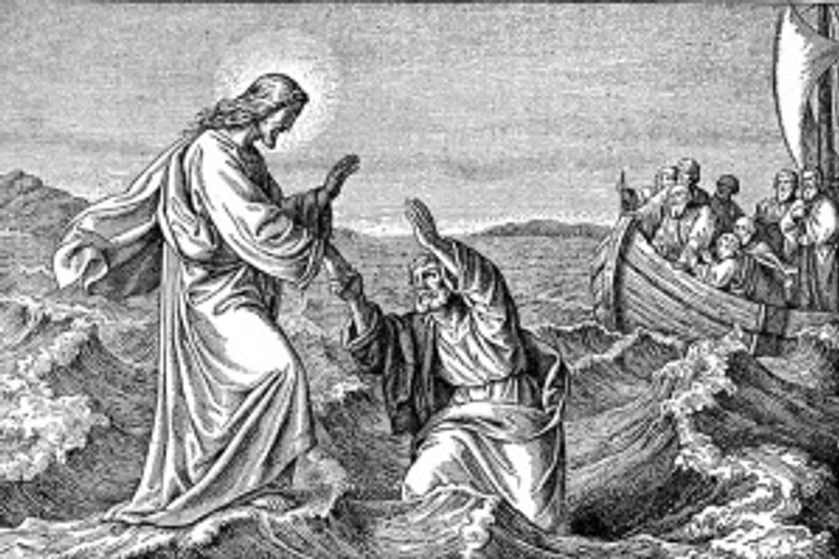
Maybe Jesus was on a pier and Peter could not see that in the dark, filled with fear?

[Reminder: Every time the disciples cried out in fear, they believed in Jesus; but Jesus would say, “Oh you of little faith.”]

The rejects (obviously) did not understand what Jesus just said to them, which is the same reaction most Christians have when they read this selection as well. They heard the words, but they flew way over their heads … because Jesus was not there in them. So, in an argumentative spirit they said, “What sign are you going to give us then, so that we may see it and believe you? What work are you performing? Our ancestors ate the manna in the wilderness; as it is written, ‘He gave them bread from heaven to eat.’”

The word translated as “sign” is “sēmeion,” which also means, “miracle, indication, mark, and token.” These rejects asked for a sign worthy of belief, after the great majority of the five thousand were given the “mark of Christ” when they were fed spiritual food. Those immediately acted from the faith of personal experience with the Holy Spirit and God, just as Jesus of Nazareth was then doing in Capernaum.

Still, by seeing the feeding of a multitude with five loaves and two fish as a miracle, there were some common people who believed that was a magic trick. Because it could have been good theatrics, they needed to get more than an “all you can eat” buffet of physical bread. After all, Moses did work a miracle of God that lasted forty years in the wilderness … which none of them witnessed personally, but they believed. Jesus, a relative unknown, needed to do a verifiable miracle before their eyes, or those common rejects were not about to stay his fans much longer.

Jesus responded to their challenge by saying, “Very truly, I tell you, it was not Moses who gave you the bread from heaven, but it is my Father who gives you the true bread from heaven. For the bread of God is that which comes down from heaven and gives life to the world.”

Jesus straightened out the facts of the Exodus story of the manna, saying God rained bread from heaven, such that Moses only told the Israelites what to expect from God. Still, the manna was spiritual food, which afforded the Israelites life in a wilderness that had little life to offer human beings. Still, when Jesus said, “It is my Father who gives you the true bread from heaven,” Jesus just restated, “The work of God” is “life to the world,” and, that when “you believe in him whom [my Father] has sent,” then you become “the true bread of heaven” that never stops feeding the soul.  Eternity is a greater feat than forty years.

*Cue the sounds of a flock of ducks flying overhead, because the rejects heard “bread” and could only think in physical terms.*

I don’t get it.

They said to Jesus, “Sir, give us this bread always.”’

They were still expecting everything to be handed to them, without any work of God performed. Just like some Masoretic scholars believe about God’s gift of manna – that some Israelites lazily laid on the ground outside their tent and caught the manna as it drifted down to earth from heaven – they wanted Jesus to make it rain bread. They said this to Jesus as if the only way he could prove he was sent from their God, was to hand out free bread for the rest of their lives, like God did when they complained to Moses.  They wanted to be given that gift then, on the spot.

Tongue in cheek, perhaps.  I think they expected Jesus to actually deliver on that demand, about as much as hurricane disaster victims actually expects FEMA to give out $100 Walmart gift cards forever.

First come, first served. Only 500 available.

Since Jesus was fully able to read the hearts and brains of the reject doubters, being always filled with the Holy Spirit and the Mind of Christ, he made this statement: “I am the bread of life.”’ Jesus affirmed that he was the manna sent from God, but this time the “bread” was “of life,” not simply for staying alive in a wilderness. Life meant staying awake and vigilant, as an escape of mortal death and the reincarnation that follows a soul’s sleep state. It meant the hands, lips, teeth, esophagus, stomach, and intestines had nothing to do with consumption of Jesus bread. Only the heart could take in God’s gift of love.

When Jesus said, “Whoever comes to me will never be hungry, and whoever believes in me will never be thirsty,” the same problem with having a low expectation of the meaning stated in “come to me” and “belief in me” is why Christians go to church on Sundays, but would never ever dare to tell someone, “I think I am Jesus Christ reborn.” Humans are always hungry and thirsty; but souls hunger for hope and salvation and thirst for redemption and promise. As such, “come to me” means being reborn as Jesus Christ, so one can perform the same miracles of faith that are only possible in Jesus Christ.

As the Gospel selection for the eleventh Sunday after Pentecost, when one’s personal ministry for the LORD should be underway – filled with the bread of life – the message is to face up to the rejection of doubters. Just as the young rich Pharisee walked away from Jesus when told, “Oh, there is much more than external rules to learn. You have to become the resurrection of Jesus Christ, which means self-sacrifice and works!” … many do not want to hear that message because they know they are too weak to do that.

A minister of the LORD knows the sacrifices demanded. The vast majority of those who are cleansed by the Holy Spirit and adopted by the Father as His Son (regardless of human gender), reached the bottom, in one way or another, and cried out for God’s help. Hope becomes the beginning of a spiritual rise from that depth, with hope the inspiration that comes as the spiritual food one needs to find life in service to God. A minister to the LORD knows this path to salvation and is ready to assist one who seeks to find the value of that service’s reward of heaven and eternal life.

Paul wrote about hope and said anyone who hopes for what one already knows, then that is not true hope. People know worldly riches and goals, whether or not they have achieved them. True hope is desiring that which cannot be seen in this world. The common people who could not see themselves as Jesus, who followed Jesus to Capernaum, they could not understand that proof of Jesus being the bread of life is impossible in a worldly state. Only within one’s heart and mind can one prove that to oneself. Only from one’s soul can one know this truth.  Therefore, no minister of the LORD can prove what only faith can prove … not simply belief.

If one studies the Gospels just a little, one finds that Jesus answered more questions with other questions, rather than state concrete answers that can be judged as true or false, based on the powers of observation and physical measurements. When one hears Jesus ask a question, in response to a personal question, the Holy Spirit is whispering guidance. Those who test that guidance find their own answers, and that personal experience changes belief into faith that is personally proved. A minister of the LORD can treat seekers as disciples, and give more explanation, just as Jesus privately told his devoted students. Still, it is ultimately up to the student to prove to him or herself what it is the teacher is teaching.

When the pilgrim rejects said to Jesus, ‘Sir, give us this bread always,” this is like kneeling by one’s bed as a child and praying, “Lord, please let me be a doctor when I grow up.” (Or lawyer, or professional actor, or movie star, or some wealthy professional.)

God does answer those prayers. He says one must learn that science, craft, or art until one has ownership of it (mastered it completely). The problems come when people who pray for such dreams are not willing to listen to advice and do what it takes.

Some advice now: It is easier to get what you want in the physical world than it is to get what you want spiritually … if you do everything alone and without help. Some people are actually self-made millionaires (breaking many laws along that journey). However, no one has ever reached heaven by selfish means.


John 6:35, 41-51 – The bread of life

Jesus said, “I am the bread of life. Whoever comes to me will never be hungry, and whoever believes in me will never be thirsty.”

Then the Jews began to complain about him because he said, “I am the bread that came down from heaven.” They were saying, “Is not this Jesus, the son of Joseph, whose father and mother we know? How can he now say, ‘I have come down from heaven’?” Jesus answered them, “Do not complain among yourselves. No one can come to me unless drawn by the Father who sent me; and I will raise that person up on the last day. It is written in the prophets, ‘And they shall all be taught by God.’ Everyone who has heard and learned from the Father comes to me. Not that anyone has seen the Father except the one who is from God; he has seen the Father. Very truly, I tell you, whoever believes has eternal life. I am the bread of life. Your ancestors ate the manna in the wilderness, and they died. This is the bread that comes down from heaven, so that one may eat of it and not die. I am the living bread that came down from heaven. Whoever eats of this bread will live forever; and the bread that I will give for the life of the world is my flesh.”

——————————————————————————–

This is the Gospel selection from the Episcopal Lectionary for the Twelfth Sunday after Pentecost, Year B 2018. In the numbering system that lists each Sunday in an ordinal fashion, this Sunday is referred to as Proper 14. It will next be read aloud in an Episcopal church by a priest on Sunday August 12, 2018. It is important because Jesus speaks of “living bread,” adding to the living water that means one “will never be thirsty.”  It is vital to understand the “bread” meaning in this selection.

I posted an article that explained how to understand John’s chapter six (March 6, 2015). An atheist can read the exchanges between the pilgrims in Capernaum, who were part of the five thousand fed miraculously by Jesus and his disciples, and claim Jesus preached cannibalism. That was not the case at all; and, I stand by those opinions of three years ago.
But now the cycle again turns to Jesus saying, “I am the bread of life” and “I am the living bread that came down from heaven.”

The frightening part that some people shudder to even think about is the meaning that comes from Jesus having said, “Whoever eats of this bread will live forever; and the bread that I will give for the life of the world is my flesh.”

Rather than becoming confident in what this means, well enough to explain it to others and alleviate their fears and uncertainties, many Christians choose to walk away from the difficult passages and return their heads to the warm sands of ignorance.

Hopefully, everyone who reads John’s chapter six in his Gospel realizes that Jesus stood before the Jews as a human being, made of flesh, bones, organs, and blood. Since he was not a loaf of bread and knowing that he was not a glass of water either, one has to realize that Jesus spoke metaphorically.

In the Gospel reading selection for the eleventh Sunday after Pentecost (the past Sunday), Jesus encountered those Jews who were not filled with the Holy Spirit in the gathering on the flood plain of Bethsaida. Jesus told them they sought food that perishes, when they should be seeking “food that endures for eternal life,” which Jesus offered. For many of the five thousand (with women and children adding to that figure), they were fed the Holy Spirit by Jesus. Those did not follow Jesus to Capernaum, seeking more “signs” involving physical bread and dried fish.

When Jesus said, “I am the bread that came down from heaven,” the Jews imagined manna falling like rain from the sky. The Greek word written by John, “ouranos,” can be interpreted as “the visible heavens: the atmosphere, the sky,” and even “the starry heavens,” but Jesus meant “the spiritual heavens.” A “spiritual” anything is invisible and not of the “physical” world. Thus, while manna was a physical manifestation of tiny flakes of “what is it?” (the meaning of the Hebrew word “manna”), which formed somehow in the atmosphere in the wilderness of the Sinai, Jesus was not that kind of bread.

God had “been there, done that” and was not repeating the bread falling from the sky. Instead of “manna” what God sent was “umee-zoh” – “who is this?”  The Jews confronting Jesus in Capernaum were asking that under their breath.

The English word “bread” has these acceptable definitions (among others) listed for it: “Food in general, regarded as necessary for sustaining life; and, something that nourishes; sustenance.” (American Heritage Dictionary of the English Language) This means the metaphor has to be applied in these ways, such that Jesus is necessary for sustaining life, as one who nourishes. “Nourish” means Jesus is necessary for life and growth, as one who fosters the development of those who “eat of this bread” he represents.

When Jesus said, “I am the bread that came down from heaven,” this supported his having said, “Whoever comes to me will never be hungry, and whoever believes in me will never be thirsty.” The word “never” (Greek “ou”) means that hunger and thirst will not be a problem for anyone nourished by the bread Jesus represents. A physical body demands food and water for life to be sustained. However, a soul, which is eternal, never requires anything physical to continue its immortal designation.

Neither government officials nor minister can hand out the bread of life freely. It is God’s to give through Jesus.

The middle of this selection has Jesus making reference to the Father. This clarified that he had come down from the spiritual heaven of God, not the physical atmosphere: like rain, a meteorite, or manna. It is worthwhile to note that the Jews asked, “Is not this Jesus, the son of Joseph, whose father and mother we know?” That is opposed to the insult of Jesus preaching in Nazareth, where he was referred to as “the son of Mary,” his mother (in Matthew 13:55 and Mark 6:3), not dignifying him as the son of Joseph (although Luke 4:22 referred to him in that manner). That reference in Capernaum led Jesus to explain his having been sent by God, while stating indirectly that Joseph was not his biological father. His reference to “the Father” was heard in human terms, not heavenly ones.

Jesus referred to “the Father” four times, saying “by God” one other time, as he told the Jews: “No one can come to me unless drawn by the Father who sent me; and I will raise that person up on the last day. It is written in the prophets, ‘And they shall all be taught by God.’ Everyone who has heard and learned from the Father comes to me. Not that anyone has seen the Father except the one who is from God; he has seen the Father.”

This is important to follow.

First, the translation, “No one can come to me unless drawn by the Father,” is not quite that simple. It is a series of segments that say: “No one is able to come to me,” followed by “if not the Father,” followed by “the [one] having sent me,” followed by “draws him.” The use of the Greek word “helkysē,” which translates as “draws,” means, “to draw by inward power, lead, impel.” [HELPS Word-studies] Rather than “to come to me,” the Greek can translate to say “to enter with me.”

This means “if not the Father” says only those who can call God “the Father,” like Jesus, are those who will also be Jesus, in union “with” him. The Greek word “pempsas,” which is translated as “having sent,” can also say “permitting to go,” where “the Father” determines who will be “with” Jesus, as His Son reborn (able to call God “the Father” too). All of this combines to state that the only ones who can become Jesus are those whose inner spirit leads them to be like Jesus.

By being able to see how Jesus meant that with his statement, look how the conclusion makes more sense. Jesus added, “I will raise that person up on the last day.” By stating the first person future conditional form of the verb “anistémi,” “I will raise up” says Jesus will elevate another, by “standing with” that one. This is a spiritual elevation that is allowed by “the Father” in heaven. At that time, one will experience their “last day” as an ego driven, selfish soul, where darkness abounds, as the light of “day” will forever shine for those servants of the LORD, who are then “in the name of Jesus Christ.”

With halo = raised up.

Jesus then said, “It is written in the prophets, ‘And they shall all be taught by God.’” This is quoting from Isaiah 54, where the prophet wrote:

“All your children will be taught by Yahweh, and great will be their peace.”

“In righteousness you will be established: Tyranny will be far from you; you will have nothing to fear.  Terror will be far removed; it will not come near you.”

“If anyone does attack you, it will not be my doing; whoever attacks you will surrender to you.” [Isaiah 54:13-15]

Isaiah told of the future glory of Zion, which has to be seen as heaven. When Jesus said “they shall be taught by God,” this is the Christ Mind that comes to all who are reborn as Jesus Christ. When one is “entered with” Jesus, and “raised up” spiritually by a soul cleansed of sin, one is then “taught” the will of Yahweh. Everything known by God is available to His servants, just as it was available to Jesus of Nazareth, coming at the time of need. This is the spiritual depth of meaning [the wine] that must accompany the bread of Scripture.

Realizing that source of teaching is the Christ Mind, one can then see how Jesus saying, “Everyone who has heard and learned from the Father comes to me,” means one has become one “with” Jesus. One hears the insight of holy wisdom. One learns the meaning of the Word, from God’s whispers of thought. It is repeating the previous statement, confirming this state of hearing and knowing means one has “entered with” Jesus.

This segment of statements about “the Father,” said by Jesus to the Jews, concludes with his saying: “Not that anyone has seen the Father except the one who is from God; he has seen the Father.” This is a statement that is again segmented, with the first segment stating, “Not that the Father has seen anyone,” which means “no one has seen the Father,” but also broadens to say “the Father” only has one Son [Adam], which is “the one who is from God.”  As such, the Greek word “heōraken” [“has seen”] actually refers to a spiritual “knowing,” and God has only “known” one that has “seen the Father,” again in the “knowing” sense.

When Jesus then seemingly changed course abruptly, saying, “Very truly, I tell you, whoever believes has eternal life,” this is relative to seeing God. The saying goes, “Seeing is believing,” but another saying is “The hand is quicker than the eye.” The Greek word “pisteuōn” translates as “believing,” but is best read as “having faith in.” There is a significant difference between belief and faith, such that Jesus regularly asked his disciples, “Oh you of little faith, why did you doubt?”

Doubts come from “seeing,” but faith-based belief comes from “knowing,” which is the depth of commitment that comes from personal experience, not second-hand rumor. Therefore, “faith” leads to becoming Jesus reborn, which is the promise of eternal life.

When Jesus repeated, “I am the bread of life,” and then said to the Jews, “Your ancestors ate the manna in the wilderness, and they died. This is the bread that comes down from heaven, so that one may eat of it and not die,” this demands one understand the manna from heaven.

Manna had physical qualities that were like Jesus in the flesh; but once the physical was gone (when the manna stopped falling, when the Israelites entered the Promised Land; and, when Jesus was executed by crucifixion) the spiritual qualities must take over.  Manna had no lasting effect, in eternal terms.  Jesus offered everlasting life, avoiding the shortfall of death.

I have written in these posting from time to time about the symbolism of Jesus at his last Seder meal (the Last Supper). The unleavened bread and the four cups of wine are ritual symbols for all Israelite descendants: of freedom from bondage [bound to a temporal world] and the spiritual uplifting that transforms a normal human being into a priest of Yahweh [intoxicated by the Holy Spirit – the reason alcoholic drinks are called “spirits”]. The Jews to whom Jesus spoke [including the disciples who would later partake of Jesus’ last Seder meal] could not see beyond the memorization of ritual that thanked God for making them a separate people – special people in God’s eye, as a race linked by blood that He created.

Christians today have reverted to this same repetition of symbolism, using Jesus as their gift of specialty and favor.   Unfortunately, most Christians do not feel the first Covenant, which demanded three periods of recognition each year, for eternity, which the Israelites (Jews) honor, is required of Gentile converts.  Without knowing the presentation of matzo and wine are a fixed part of the ritual Jesus followed (as a devout Jew), the Christian substitutions of wafers and wine [or grape juice] are being offered metaphorically as Jesus’ body and blood, without realizing the deeper meaning.  One purposefully comes before the other, as a natural progression towards eternal salvation; but Christians believe Jesus has been called down from heaven to become one with the wafer that goes on their tongue, washed down by a sip of wine [fermented or not].

The bread symbolizing the body of Christ is the same as the manna that fell from the sky was that fed the Israelites spiritually. The wine symbolizing the blood of Christ is the same as the living water from the rock that kept the Israelite alive, as they interbred into a race of holy priests. The bread (the body of Christ) is then the holy writings (the Law, the psalms, and the prophets) that foretold of the coming Christ. The wine (the blood of Christ) is then the continuation of the Christ (the legacy of lineage), as those who are the fruits of the living vine.

In a recent posting about the manna falling to the Israelites, I mentioned that this spiritual bread (in physical form) was not to keep the bodies of flesh alive. The Israelites took with them livestock and probably grew crops from the water Moses struck from the rock with his staff. The manna fed their will to serve God for forty years – three generations of the children of Israel’s growth as priests serving the One God.

Think about those forty years spent in the wilderness. Those words of timing slide right over one’s head without the slightest realization of how long that time is. What was one to do in a wilderness environment, beyond gathering manna, caring for the children born, caring for the beasts of burden, the preparation of food to eat, the washing and mending clothes, the milking goats and cattle, and all the mundane things of a normal life? There were no I-phones; there was no Internet, no television, no sports, no concerts, no movie theaters, and no places to go and spend one’s idle time. What does one do over forty years to pass the time and make wilderness living gratifying and rewarding?

There were no radios to tap out with when the Israelites were in the wilderness.

The Sabbath was a day of rest – ALL DAY LONG – but that did not mean walking to a synagogue for a couple of hours of dutiful attendance, with others of the same religious practices. There was time spent praying to Yahweh. In their spare time the Israelites learned the Laws passed down to them by Moses. They memorized the history of the world, up to that point (Genesis). That activity was their entertainment, as they looked forward to living up to their commitment to God. The manna from heaven nourished their desire to do that. Likewise, Jesus, as the bread of life, has to have the same effect on Christians.

When Jesus said, “Your ancestors ate the manna in the wilderness, and they died,” this is another use of symbolism, where “they died” is not meant in physical terms. All mortals die. Mortals do not live for a thousand years; so, it was natural for ancient ancestors to have died in the flesh. Therefore, their only having eaten manna in the wilderness, but not in the Promised Land, says the land of Canaan, which became Israel (and its split into Israel and Judah), could not guarantee eternal life.

Once in the land that had been given to them, and because they stopped being spiritually motivated to keep alive the traditional Word, the Israelites died of commitment to the Father.  The Israelites broke their covenant with God by finding sustenance only from the land. The Law as their bread from heaven became only a physical document (scrolls) and not their motivation to find union with God, so the Law never could pump through their bodies spiritually. The land became the bread of Israel, of which they ate under kings that were not Yahweh. That bread was unable to sustain an inner desire to serve Yahweh, so the land, the Israelites, and their covenant with the One God died.

The same error is found in every place on earth where country or nation is seen as of the utmost importance. The laws of all nations, regardless of what holy documents they may or may not be based upon, are nothing more than the bread that leads to mortal death. The leaders of all nations are merely human beings, incapable of offering eternal life, simply because humans are mortal and all things coming from humans are short-lived. Just as human beings are born to die, so too are nations, as neither the lands nor its kings can lead human beings to serve God. That can only be done individually, spiritually, between a soul and the Father.

When Jesus then said, “I am the living bread that came down from heaven. Whoever eats of this bread will live forever,” he restated “I am the bread of life” a third time. This means Jesus is the incarnation of God on earth. “Whoever eats of this bread” actually states the conditional, in a segment that reads: “if anyone shall have eaten of this the [one] bread.”

This means Jesus is only for those who “consume the divine provisions” that Jesus brings from God. Those divine provisions have been recorded in the Gospels and the Epistles of the Saints. Those divine provisions point out how the Torah, the Psalms, and the Prophets spoke the Word of God prophesying Jesus, who came as the truth answered. To have faith in the truth that is Jesus Christ, one has to eat those holy words and digest them into one’s spiritual being.

The promise of eternal life is then assured by Jesus stating, “The bread that I will give for the life of the world is my flesh.” The physical being that was Jesus was the fulfillment of Scripture; but that fulfillment did not end when Jesus died, was buried, resurrected, and/or ascended. The promise means that once Jesus was sent as the bread of life, Jesus would forever more be resurrected in the flesh of his followers. They would be followers because they would be reborn as Jesus returning into the world, as a Holy Soul united with a cleansed soul in human flesh.

To see “the bread” in light of “my flesh” one has to see these as surface elements. A body without life is a corpse; but a body freshly dead will give the appearance of flesh that is only sleeping.

That look can make one think life still inhabits the body, when it in fact does not. This is symbolic of unleavened bread. There are only the basic ingredients used, which makes bread that is flat. Without the life of yeast within bread’s crust, giving rise to much more desirable bread, unleavened bread simply keeps one alive from day to day. This is the difference between the manna and the bread of life.

Jesus must be mixed within the ingredients of one’s being, so his Spirit gives rise to a human being that is more than a mortal born to die. Jesus must be consumed within one’s being, so his presence can elevate one to eternal life. Just as one cannot tear apart a loaf of fresh hot bread and point to the yeast that gave it rise, one cannot tear apart a Saint and point to Jesus within. Still, Jesus is present in all Saints because they have become one with Jesus Christ in the flesh.

As a Gospel selection for the twelfth Sunday after Pentecost, when one’s personal ministry for Yahweh should be underway, the message is to reproduce the bread of heaven so Christ can feed the seekers called by God today. One needs to be filled with the “yeast” that is the Holy Spirit, being reborn as the Son of God.

The “bread of heaven” is the insight found in Scripture. Feeding the truth of Scripture to the hungry nourishes them in a spiritual manner. The “bread comes down from heaven” because the deep meaning to the Word comes from the whispers of God. The “bread of life” is the elevated way an Apostle follows in the holy footsteps of Jesus, led by the Mind of Christ. Those who consume the meaning then spread that way of living to those seeking to know God and Christ, giving them the opportunity to be blessed with eternal life.

A minister of Yahweh knows the difference in the symbolism of bread in ritual practices, designed to remind one of God’s sending of priests into the world. Whereas the Israelites died when the manna ceased, God sent His Son as the spiritual food that gives rise to the matzo of the Seder meal. Christians, Jews, and Gentiles are all unleavened until they receive the Holy Spirit and are reborn as Jesus Christ. Once they become the flesh of the Son of man, the blood of Christ fills their bodies.  Thus, a minister of the LORD teaches we remember Jesus as the bread of life by finding delight in the breaking of the afikoman and we remember his Holy Spirit – as the Christ – when his blood has become one with ours.