Grace to you and peace from him who is and who was and who is to come, and from the seven spirits who are before his throne, and from Jesus Christ, the faithful witness, the firstborn of the dead, and the ruler of the kings of the earth.
To him who loves us and freed us from our sins by his blood, and made us to be a kingdom, priests serving his God and Father, to him be glory and dominion forever and ever. Amen.
Look! He is coming with the clouds; every eye will see him,
even those who pierced him; and on his account all the tribes of the earth will wail.
So it is to be. Amen.
“I am the Alpha and the Omega,” says the Lord God, who is and who was and who is to come, the Almighty.
This is the Epistle selection to be read aloud on the twenty-sixth Sunday after Pentecost, also called the Last Sunday or Christ the King Sunday [Proper 29], Year B, according to the lectionary for the Episcopal Church. It will follow one of two parings of Old Testament and Psalms, either a Track 1 or Track 2 set, depending on the predetermined path an individual church has set upon. The Track 1 course offers a reading from Second Samuel, which is David’s last song. There he wrote, “The el of Israel has spoken, the rock of Israel has said to me: One who rules over people justly, ruling in the fear of elohim”. That will be accompanied by Psalm 132, where he sang, “Yahweh has sworn an oath to David; in truth, he will not break it: “A son, the fruit of your body will I set upon your throne.” The Track 2 pair will present a reading from Daniel, where his vision said, “I saw one like a human being coming with the clouds of heaven. And he came to the Ancient One and was presented before him.” That will be accompanied by a singing of Psalm 93, which sings, “Ever since the world began, your throne has been established; you are from everlasting.” All will accompany the Gospel reading from John, where Jesus told Pilate, “You say that I am a king. For this I was born, and for this I came into the world, to testify to the truth. Everyone who belongs to the truth listens to my voice.”
I have written quite deeply about this reading. I give a basic explanation as how I came to be able to read Scripture and see the truth of that written. I welcome everyone to read my background there, which I will not go into now. That commentary can be found at this link. Because I have discerned these five verses most deeply – segment by segment – I will not repeat those observations at this time. Instead, I will place a broader focus on this selection and show how it fits in with the other readings presented on the last Sunday after Pentecost, the ‘end times’ for Year B’s ordinary season.
One thing that I must point out is the translation that reads “Jesus Christ.” The Greek written is “Iēsou Christou,” which should not be translated as if John wrote the first and last name of Jesus. The Greek form that would say “Christ” is “Christos.” The form “Christou” is the genitive form of Christos, with the genitive case expressing possession. This means John wrote, “Jesus of Christ.” That is a statement that Jesus was possessed by Yahweh, as one “Anointed” divinely. The Greek word “christos” means: “anointed; messiah,” where “messiah” is an English variation of the Hebrew word “mashiach,” which means the exact same thing: “anointed.” The capitalization must then be seen as a divine level of importance placed on “Anointment,” which means by Yahweh. The man named “Jesus” was then “one of” all those souls who had likewise been “Anointed” by Yahweh; and, David was one who was so “Anointed.”
It is also important to point out that the word translated as “spirits” [“seven spirits”] is written “Pneumatōn,” where the capitalization has been erased in translation. Again, the capitalization must be seen and understood as a divinely elevated state of “spirit,” which makes it be the spiritual oil of Anointment, as Yahweh’s “Spirit.” The number “seven” (as I wrote about last week) has to do with the “completion, perfection, and rest” of a cycle. Thus, when the “perfection Spirit” is before the throne of Yahweh, it is importantly [use of “kai”] that which is displayed in Jesus, who was “of the Anointment” by that “perfect Spirit.”
The plural number of “Spirits” must be seen as all who appear before the throne of Yahweh in Judgement. It those are truly reflecting the “completion Spirits,” of those souls united as one with Yahweh, as “perfected Spirits,” those cleansed of all past sins through submission in divine marriage; and those “Spirits able to rest” knowing their service to Yahweh had been done, they all become the souls of the “faithful,” or those who have displayed the “obedience” of union and the “loyalty” of servitude [all uses of “pistos”]. This is because those souls, formerly in bodies of flesh, prior to death, are “witnesses” [from “martys”], where that denotes a personal experience as Jesus reborn within their souls, with all having that presence as the “Christs of” Yahweh.
This then reverts back to the segment that says, “kai from Jesus of the Anointed,” such that the “perfected Spirits” will all have been resurrection of “Jesus” [a name that means “Yah[weh] Will Save”], where that soul possessing one’s own soul [two souls in one body of flesh] is what makes all be “of Anointment” from Yahweh. This presence of the soul of Jesus, in union with one’s own soul [like twins] then makes belief to transform into true “faith,” which obediently allows the soul of Jesus to rule over one’s body of flesh [divine possession], all of which is personally witnessed by the host soul, experiences through the eyes and ears of its flesh.
When John wrote “firstborn of the dead” [“prōtotokos tōn nekrōn”], the use of “firstborn” must be seen as the Passover demands, which Moses said would bring Yahweh as the angel of death, so all firstborn males of families not marked by the blood of the sacrificial lamb would die. The “firstborn” would also be the demand of those so marked, where their firstborn male children were to be dedicated to serve Yahweh as a priest [Samuel is an example of this sacrifice of the “firstborn”]. The element of “dead” must be seen as what a soul in a body of flesh is marked by, as the body of flesh is like the doorway to the soul within. When that body of flesh dies, then the soul is released for Judgement, where it then stands before the throne of Yahweh. To be the “firstborn of the dead,” then one is covered in the blood of Jesus – the sacrificial lamb – so one’s soul is spared the repeat of death, which is Judgment of reincarnation [or worse].
The point I want to make now is the beginning what says, “him who is and who was and who is to come” and the end that says, “who is and who was and who is to come” repeats the eternal way of Judgment. All souls stand before the throne of Yahweh after release from their bodies of flesh. All will be judged as to whether or not those souls married Yahweh, received His Spirit and gave birth to His Son Jesus. The only way to secure Salvation is to follow this path; as it has been this way from the beginning, and will be that way until the end. To see John’s Revelation as a future thing to worry about is wrong. The future is always one’s own pending death and whether or not one has sought Yahweh in marriage, to become Jesus reborn and live a righteous life that earns Salvation.
When this reading is paired with David’s last song before his death, one needs to see that theme of a soul being released for Judgment. In the verse of his song [2 Samuel 23:3] that is translated to say “the rock of Israel,” the “rock” needs to be read as the “cornerstone” that becomes set in place, which ensures “Israel” means one “Who Retains Yahweh,” as one of His elohim. To be a Yahweh elohim is to be a soul married to Yahweh’s Spirit; and, to have the “rock” that makes this stay put, that is being resurrected as Jesus.
In David’s last three verses [5-7], his focus is on those who reject marriage to Yahweh, so their souls have become the “firstborn” who do not escape the Judgment of Yahweh, so they will be made to die again. David’s metaphor for them was “thorns,” which choke the desire to become saved by righteousness out of them and others surrounding them. This echoes the words of John, who wrote, “even those who pierced him; and on his account all the tribes of the earth will wail.”
In the Daniel reading, the first two verses speak of the Judgment Yahweh made against the evil spirits, who were not “seven Spirits,” but instead the elohim of the first six days of Creation. I see those verses as the Judgment against Satan [or Lucifer, or Azael], who was the beast that antagonized mankind, despite the commands of Yahweh. While Satan was cast into the inner darkness of the earth, the other three beasts were stripped of their abilities to attack humanity; but they could lure human souls to desire worldly things, possessing them demonically as being what those souls sought. This, again, matches the piercing and wailing of which John wrote.
As for the last two verses of Daniel, which are clear metaphor of the coming of Jesus, John’s metaphor matches well with this being all souls who stand before the throne of Judgment, after having welcomed the soul of Jesus coming from heaven, becoming a human being again in the flesh of another. It is that new body of flesh that becomes the kingdom of Jesus, the soul of a high priest merged with one obedient to Yahweh’s Will.
When John wrote in his Gospel of Jesus telling Pilate, “My kingdom is not from this world,” that means Jesus is not a king of matter or as a soul itself in a body of flesh. Jesus would die, so his soul stood before the throne of Yahweh and was judged as pure. With that Judgment, the soul of Jesus would be the soul sent to all souls who would receive Salvation, from the beginning to the times of Judgement, to the End Times, with all deaths of humans in flesh being the same repeatedly.
As the Epistle reading to be read aloud on the last Sunday after Pentecost, when one’s own personal ministry for Yahweh should already be well underway, the lesson is to let Jesus be one’s King, which means one’s soul must submit to Yahweh in loving marriage, so Jesus can come into one’s soul, as the Anointment of Yahweh upon His beloved. This is not only a guarantee of Salvation at Judgement, but the day one begins to serve Yahweh as His Son resurrected in the flesh. Ministry is how others are led to Salvation; and, one’s actions in life will be known when one’s soul stands before Yahweh to be judged.
9 Let your priests be clothed with righteousness; *
let your faithful people sing with joy.
10 For your servant David’s sake, *
do not turn away the face of your Anointed [mesiheka].
11 Yahweh has sworn an oath to David; *
in truth, he will not break it:
12 [11] “A son, the fruit of your body *
will I set upon your throne.
13 12 If your children keep my covenant
and my testimonies that I shall teach them, *
their children will sit upon your throne for evermore.”
14 13 [For Yahweh has chosen Zion; *
he has desired her for his habitation:
15 14 “This shall be my resting-place forever; *
here will I dwell, for I delight in her.
16 15 I will surely bless her provisions, *
and satisfy her poor with bread.
17 16 I will clothe her priests with salvation, *
and her faithful people will rejoice and sing.
18 17 There will I make the horn of David flourish; *
I have prepared a lamp for my Anointed [lim·šî·ḥî]
19 18 As for his enemies, I will clothe them with shame; *
but as for him, his crown will shine.”]
——————–
This is the accompanying Psalm for the Track 1 Old Testament reading from 2 Samuel 23 (David’s last song). If this path has been predetermined for an individual church, then it will be read aloud in unison or sung by a cantor on the last Sunday after Pentecost, also called Christ the King Sunday [Proper 29], Year B, according to the lectionary for the Episcopal Church. The last song of David includes this verse: “Is not my house like this with God? For he has made with me an everlasting covenant, ordered in all things and secure.” That pair will precede a reading from Revelation, where John wrote: “Grace to you and peace from him who is and who was and who is to come, and from the seven spirits who are before his throne, and from Jesus Christ, the faithful witness.” All will accompany a reading from the Gospel of John, where we read of Jesus before Pilate being asked, “Are you the King of the Jews?” Jesus answered, “Do you ask this on your own, or did others tell you about me?”’
This Psalm announces in the introduction of verse one that it is a song of ascents. As such, this Psalm would have been commonly sung by all Israelites proceeding up the steps of Mount Ophel, rising about the City of David, to where the Tabernacle had been placed, with the Ark of the Covenant within. This means all the Israelites would sing these words of David as their own words, confessing their commitment to Yahweh in marriage, their souls one with His Spirit. Thus, those who sang these words were truly those “Who Retain Yahweh as His elohim” [the meaning of “Israel”].
For some reason, the Episcopal Church has changed the numbering of this song of praise, dividing verse eleven in two, creating a verse twelve that is actually still verse eleven. This then offsets the remainder of the verse numbers, making an eighteen-verse psalm appear to be nineteen. The source for the non-psalms used by the Episcopal Church [the NRSV] shows Psalm 132 as having eighteen verses, not nineteen. The actual source is the Book of Common Prayers, which I imagine the Episcopal Church owns the copyrights for, implying that organization is the owner. Regardless, I have restored the correct verse numbers in bold type, within brackets.
In two places [verses 10 and 17] the NRSV has translated forms of “mashiach” as “your Anointed” and “my Anointed,” where the added capitalization [Hebrew has no capital letters] makes this a recognition of “your Christ” and my Christ,” when Greek is applied to state “Christ.” I have restored the Hebrew transliteration and placed as a replacement word “messiah.” That is the typical translation of the Hebrew into English; and, it is important to realize this means being “Anointed,” not with physical oil but with the Spirit of Yahweh, which come from a soul’s marriage to Him. David knew of that anointment, as would all who truly sang these words while ascending the steps to sacrifice before Yahweh.
The Episcopal Church has allowed church rectors to make the decision to save time by making verses fourteen through nineteen [actually verses thirteen through eighteen] as optional reading. This is why they have applied brackets before the first word in verse 14 [13] and after the last word in verse 19 [18]. Here, it is important to see the pronoun focus changing in verse eleven, from David singing for himself and other Israelites, to Yahweh singing in return. The first person use of “I” must be understood as a statement or “I Am,” which is not David, but Yahweh within him. To not read verses thirteen to eighteen would mean to cut Yahweh off, as if His words to us are unimportant.
Finally, at six places in these eighteen verses, David wrote the proper name “Yahweh.” I have restored each of those with bold text. The NRSV has translated them as some variation as “Lord.” This is incorrect and misleading, as Yahweh is Yahweh. One either knows His name from marriage to Him, so one takes on His name as one of His elohim; or, one does not truly know Him. Marriage to Yahweh brings on His influence over one’s soul, causing one to please Him in a loving relationship. Yahweh is one’s Husband, but one’s soul is the “lord” of one’s body of flesh. That is until one’s soul gives rebirth to the Son of Yahweh, which is the soul of Jesus, unknown as a proper name to David and the Israelites. The name Jesus means “Yah[weh] Will Save,” which says the divine soul sent by the Husband to possess the wife becomes one’s true “Lord.” As a song of praise sung on Christ the King Sunday, when David and Yahweh sing praise to the “Anointment,” that outpouring of Spirit is the soul of Jesus taking a position as the high priest and the king of the flesh, all through the divine union of a soul to Yahweh’s Spirit. Therefore, it is incorrect to call Yahweh one’s “Lord,” as that diminishes His greatness and erases the value of Jesus’ soul being resurrected in all Yahweh’s wives.
It is always important to realize Scripture was written in languages that are more complex than English. All English translations become paraphrases, even when literally translated, so the order of the words originally written become important and should not be changed. The application of syntax differences make the beloved translations that people who only speak English know and memorize become little more than a concept derived by a translator, who asks himself or herself (or itself), “Now, how would someone speaking English say this?” The truth is always closest to the exact written word, with the complexities of the original languages [Hebrew and Greek] making one selected word in English be a guess, with other possibilities always still applicable and viable. This means divine Scripture is written by souls married to Yahweh, speaking in divine tongues, which require those who understand to likewise speak in the language of Yahweh, through union with His Spirit. Those who memorize English and put their trust in translators, putting zero time in investigating the truth, to elevate their faith, are those who are more consumed with serving self, than serving Yahweh.
In my effort to eliminate as much of the paraphrase as possible, I have translated all eighteen verses into literal English. This song of ascents can now be read as stating the following, with my comments stated after each verse:
1. “remember Yahweh David , along with all his afflictions .”
The element of “remembrance” needs to be seen as relative to “mind.” This is then applicable as a statement to love Yahweh with all one’s mind. When all one’s mind is in love with Yahweh, then one’s mind is merged with the Mind of Yahweh, so all thoughts one has from Yahweh are instantly known. These divine thoughts will “accompany” those which are temptations to do evil. The word translated as “afflictions” means “to be bowed down to,” such as one’s submission. When one “remembers Yahweh,” then one’s submission is to do the Will of Yahweh, not one’s self-will.
2. “who he swore Yahweh ; vowed , to the strength of Jacob .”
This verse sings of the marriage vows between the soul of David and Yahweh. When a minister reads questions as to one’s commitment to another, when one says, “I do,” that is swearing an oath of forever commitment in marriage. For the marriage of a soul to Yahweh, the “vows” are those of the Covenant or Mosaic Law. It is the marriage of a soul that defeats evil influences, as Jacob [the Supplanter] knew, when he defeated his demons and became known as Israel. The “strength of Jacob” is the union of Yahweh’s Spirit forevermore upon his soul.
3. “if I will come into the tent of my house ; if ascend , upon the couch of my bed .”
The element of a “tent” or “chamber of my house,” where one would find a “bed” or “couch,” indicates the body of flesh, in which the soul resides. Twice in this verse the Hebrew word “im” is used, which states “if.” That means David sang of it being a choice that must be made, where the first person “I will come” is not a forced union, but one willingly made. The “if” is then stating this is only true when the decision made by David is also done by others. It is a hypothetical, in that sense.
When “chamber” and “couch” is written, the symbolism acts in two ways. First, marriage means a physical union, where two join to make a third – a child. This means the “bedroom” is where a marriage is consummated. Second, the symbolism of sleep, which is done in a “bedroom,” is death. The “if” is then whether or not one’s soul commits to the symbolic death of self, just as a wife submits her self-will to please her husband. In order to make a third, one must first die of self-will and receive the seed of the Husband. That consummation will bring forth the Son of Yahweh in the form of a man – the child of Yahweh.
4. “if I will give sleep to my eyes ; to my eyelids slumber .”
Here, the metaphor of self-sacrifice is shown in “sleep,” which symbolizes “death.” The way one saw oneself has died. Divine marriage brings forth a new way of seeing, which is through the eyes linked to the Mind of Yahweh. The “eyelids” symbolize the daily recycling of life and death, through a wake state and a sleep state. By not having the eyelids cover and uncover one’s sight, this is a statement of vigilance, which is the presence of Jesus within one’s soul, who always keeps watch.
5. “until I find standing Yahweh ; a tabernacle , for the strength of Jacob .”
In this, the word I have translated as “standing” is “maqom,” which better means “a standing place.” Here, the element of “standing” must be seen as raised, not fallen. The symbolism of “standing” is then a divinely placed “Yahweh.” By finding that within one’s being, one’s body of flesh then is transformed into “a tabernacle,” as a “dwelling place” [from “mishkan”] within – soul in body. It is this internal presence (not something left outside) that becomes a reflection of “the strength of Jacob” – earning the name of Yahweh [“Israel”].
6. “behold! we heard of it in Ephrathah ; we attained it , in the fields of the forest .”
Here, the name Ephrathah means “Fruitful” and is associated in Old Testament writing as a place near Bethel, also Bethlehem in Judah, and here the scholarly thought makes it be Zion or Jerusalem. This confusion means the base meaning of Fruitful must be the way to read this verse. Seeing that, “behold! is the realization of the “strength of Jacob” being his encounter with his own soul (which he defeated), which took place in Bethel [Hosea 12:4], with Bethel meaning “House Of God.” Bethlehem is where Ruth married Boaz and brought forth the fruit that would be Samuel. Thus, it is not important as one place, but wherever a soul will become “Fruitful” as a wife of Yahweh. David then proclaimed he and others like him (“we attained it”) had achieved the same “strength of Jacob,” thus were “Fruitful” wives of Yahweh. This included the places where fruit became food – “fields” and “trees” – such that Israel was a place of spiritual food.
7. “let us come to be his dwelling place ; let us bow down , footstool for his feet .”
In this verse, the tendency is to translate “nā·ḇō·w·’āh” as “let us go,” rather than its viable alternative: “let us come.” To use “god” leads to the thought of a fixed external structure, which one can enter. This misdirects a marriage as something one witnesses, not engages. The better way to read this says, “let us come to be his dwelling place,” which makes oneself be the building which Yahweh enters. In order to do that, one must submit one’s soul to Yahweh, such that one lowers one’s ego (head) and “worships” His holy presence. By “bowing one’s head” to Yahweh, one’s eyes only see His feet, which makes on kneel to be His “footstool.”
8. “stand up Yahweh in your resting place ; you , and the ark of your might .”
Here, again, is a word saying “stand up, arise, make a stand,” all of when must be understood as spiritual directions, not physically getting up from a laying or sitting position. It means to “elevate” one’s soul, in order to allow for the presence of Yahweh within. Again, the use of “resting place” becomes metaphor for “sleep,” which symbolizes the death of self-will. It means for one’s soul to “take a stance for Yahweh,” one has to lie down before Him. This symbolizes death and rebirth, in a reverse order of statement. Here, a new “you” becomes the sole focus, as “you” are no longer who one was, but who one has become – in the name of Yahweh. That new “you” is with Yahweh seated on His throne within one’s soul, as King, placing all His powers symbolized by the “ark” at one’s disposal, as He commands.
9. “your priests let be clothed in righteousness ; and your saints let shout for joy .”
In this, the use of “priests” [from “kohen”] is reference to what all whose souls marry Yahweh become. This is not a Levitical designation by David. All tabernacles require a priest to maintain it, so that is the role played by a soul. The clothes of righteousness are not physical garments, such as those worn by Aaron and the Levites, but the presence of Yahweh’s Spirit. Therefore, a “kohen” becomes a “chasid,” which is a “saint, godly or pious person.” This means the influences of the worldly realm cease to affect a soul married to Yahweh, so all past sins are wiped clean and no new ones will ever replace them. The shouting for joy is both the exuberance of the presence of Yahweh known, as well as the promise of eternal salvation also known.
10. “so that David your servant ; not do turn away , face of your anointed [messiah] .”
Here, the Hebrew word “ba-abur” is translated as “so that,” but it can equally say “for the sake of, on account of.” This means that the focus is on all being like David, “so that” all will be equally “servants” of Yahweh, shouting for joy, clothed in the righteousness of Yahweh’s Spirit. That means commitment, so a soul cannot “turn away,” due to deep, spiritual love. Whenever the Hebrew word “paneh” [“face”] is found, one must see this as a confirmation of the First Commandment, where “face” is a requirement relative to how one approaches Yahweh. One’s “face” must be the face of Yahweh, and Yahweh alone, as no other “faces” are to be seen by Him. Yahweh “will turn away” if the “face” of any other gods [including oneself worshiping “self” as a god] are worn. Only those who wear the “face” of Yahweh will become His “Anointed” or a “Messiah.”
11. “has sworn Yahweh to David ; faithfulness not he will turn from it of the fruit your body , I will set upon throne yours .”
Again, the use of “sworn” [repeated from verse 2] must be seen as the marriage vows, which are the Commandments, with only wearing the “face” of Yahweh being the first “sworn.” To then say “Yahweh to David” means the agreement is between Yahweh and a soul in the flesh. The name “David” means “Beloved,” so that “sworn” is an act of love, thereby marriage. The Hebrew word translated as “faithfulness” is “emeth,” which also means “truth” and “firmness.” This says “faithfulness” comes from knowing the “truth” and the “firmness” that is the presence of Yahweh’s Spirit. One will not ever attempt to wear any face other than that of Yahweh; and, in turn one’s body will become the “fruit” that walks in ministry as Jesus reborn, after Jesus becomes the “face” of one’s soul, in one’s body of flesh.
It is at this point that the Episcopal Church adds a new verse, subdividing verse eleven in two. The aspect of the “fruit of your body,” added to “will I set upon your throne” [NRSV], needs to be set apart because this reading selection is to be read on Christ the King Sunday. To be Jesus reborn means the soul of Jesus comes to one “Anointed” [thus a “Christ”], where Jesus is set by Yahweh upon the “throne” of one’s soul-flesh, becoming one’s “King.” The separation is due to the elders of the Church wanting to set this segment of verse eleven as separate and worthy of note for this day.
12. “if will keep your sons my covenant and my witness this ; I shall teach them their sons forevermore forevermore .”
Here is where the voice of Yahweh speaks. Because we know that Yahweh has now set His Son within one like David, upon a throne as king, this is when Jesus begins to speak as “I,” having been given that right for the Son to speak for the Father. In that, the plural number of “your sons” [“ḇā·ne·ḵā”] is Yahweh speaking of all who will become Jesus resurrected within their souls. Each [regardless of human gender] will be “sons” brought about by the Covenant of marriage. As His “sons” reborn through marriage, all will “witness” or see the truth of Yahweh through the Mind of Jesus, where this vision is spiritual insight. It is, therefore, Yahweh who will teach all His “sons” that become Jesus reborn in the same way, over and over, eternally being the same resurrection of the Jesus soul in the multitude of souls that will marry Yahweh.
13. “when has chosen Yahweh zion [a dry place] ; he has desired , for dwelling place his .”
In this verse, the meaning of “zion” must be understood as not being a mythical place, or a physical place such as Jerusalem or Israel. The name means “Dry Place, Sign Post, Tradition; or, Fortress.” While all can find merit in translation, I see the word root that means “Dry Place” as symbolizing a soul being no longer overrun with the ebbs and flows of emotions, from which fears, despairs, sensual urges, and hungers satiates bring excitement and pleasures. When a soul has turned off that flow of ‘weather’ related rainfall, the soul can seek spiritual nourishment from a higher source. Thus, “when one has chosen Yahweh [and He has chosen one in return], the soul becomes arid of desires – other than a desire for Yahweh. This leads to the segment that focuses on that. It becomes the truth of how one is not led by physical desires, only those of the soul. When Yahweh is married to a soul, the “dwelling place” is purely spiritual, with the time left in a body of flesh being fleeting, in the long run.
14. “hereby in my resting place forever forever ; here I remain , when I have desired it .”
This is the promise of eternal life. The use of “I” is Yahweh speaking through a soul that has become possessed by the Son Jesus. Once merged with the soul of Jesus, a soul becomes a Yahweh elohim and will always serve Yahweh as an angel, in whatever need that may bring (forever and forever is a long time). All of this is due to the love and “desire” of servitude to Yahweh.
15. “her game abundantly to bless I will kneel ; her in want , I will satisfy with bread .”
In this verse, the pronoun usage turns to the feminine, as “her game” and “her in want.” This becomes the voice of Yahweh (spoken through the Jesus Mind) that relates the soul He is married to as a wife. This “her” is a reflection on all souls, regardless of what sex organs their bodies of flesh might have. A soul in a body of flesh is feminine essence, due to the femininity of matter [death] clinging to that soul [neuter gender, when in the flesh]. This means “her game,” which is a hunting reference that makes one’s body of flesh be seen as sacrificial, like a slaughtered lamb. It is then through that sacrifice of the flesh that abundance will be allowed spiritually, due to the presence of Jesus causing the flesh to “kneel” in service to Yahweh. The Hebrew word transliterated as “’eḇ·yō·w·ne·hā” means “her poor, her needy, her in want,” which is a stand-alone statement of the desires of the flesh, which do require needs being met. This says the presence of Jesus within will bring forth the spiritual food to sustain a soul in a body of flesh, where “bread” or “food” is how Jesus said, “I am the bread of life. Whoever comes to me will never go hungry, and whoever believes in me will never be thirsty.” [John 6:35]
16. “and her priests I will clothe with deliverance ; and her saints , aloud shall shout for joy .”
Here, Yahweh is speaking through Jesus, repeating that said by David in verse nine. Again, the pronoun usage is feminine. Once more, this has nothing to do with human genitalia. A “her” is a soul born into human flesh – all genders. When those souls have married Yahweh, they then become His “priests,” which makes them become His “saints,” after the soul of Jesus possesses their souls. Being now “clothes with deliverance” says the clothes of “righteousness” – the covering of Yahweh’s Spirit – are now the clothes of souls reborn as Jesus – the name that says “Yah[weh] Saves.” The “clothes of deliverance” says one has been reborn as Jesus, the Son of man again in the flesh. The “shouts for joy” are then the ministry that attracts seekers to hear the Word of truth, as told by Jesus.
17. “there I will make sprout the horn of David ; I will prepare a lamp , for my anointed [messiah] .”
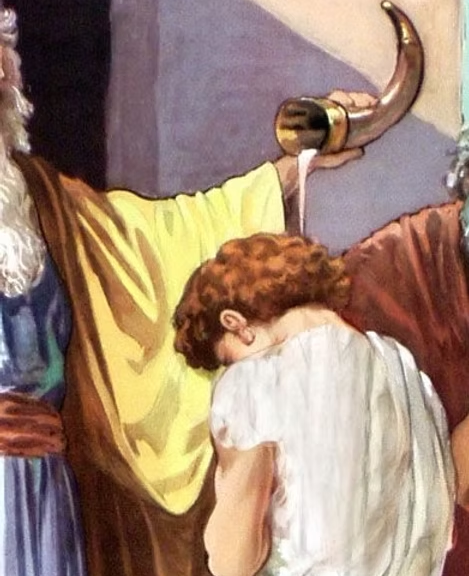
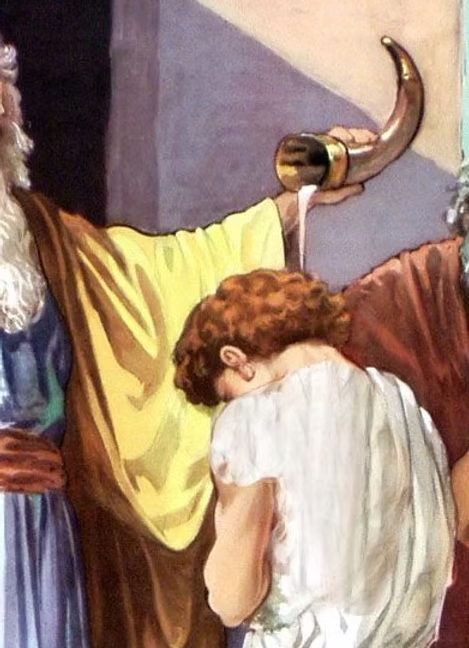
Following verses where the feminine pronoun has been incorporated into the lyrics, that needs to be seen here as a parallel to the parable told by Jesus, that of the ten bridesmaids or ten virgins. The “horn of David” is the “horn” carried by Samuel to Bethlehem, to anoint one of Jesse’s sons with the oil the “horn” contained. In this way a “lamp” prepared becomes the light kept lit by a seeker who is engaged to be married to Yahweh, where the oil of those “prepared lamps” is the love to know more. The light that shines keeps a lover’s heart open and awaiting more revelations of Yahweh’s truth. Those who will hold those “lamps” in good working order [full of oil, with a wick that is lit and a flame that is shining brightly] will then have the oil from the “horn of David” poured out upon their souls, when the day of spiritual marriage comes and the bridegroom has arrived for those prepared. When “anointed,” those souls all become Messiahs or Christs, and the presence of the soul of Jesus justifies that title.
18. “his enemies I will clothe with shame ; but above himself , shall sparkle his crown .”
Again using the metaphor of the parable of the ten virgins, the “enemies” [from “oyeb”] will be those who claim to be servants of Yahweh, when most could not pass a one-question test that asked, “What is the name of your God?” So many Christians claim to worship Jesus, while doing little more than lip service to Yahweh [calling Him “Lord”]. Their “prepared lamps” have no oil in them; and, they do not care to go down to the marketplace and buy some books that are somebody else’s opinion on religious matters, to put on their bookshelves at home. They are “enemies” of Yahweh because they do nothing to promote marriage to Yahweh in their children, family, or neighbors. They will be left behind, which is the meaning of the “shame” their souls will know on Judgment Day [it comes for everyone, one at a time]. This then leads to the exception [“but”], which are those souls who are joined with the possessing soul of Jesus, who becomes the soul “above himself” [a “self” equals a “soul”]. It is this ‘twin condition’ that is what has then been depicted in religious art, where a halo is the “crown” worn by Saints. This is the soul of Jesus emanating from the flesh of a soul married to Yahweh, which says “Christ the King” walks the earth again.
As the Psalm to be sung in accompaniment to the reading of David’s last song, on the last Sunday after Pentecost, when one’s own personal ministry for Yahweh should already be well underway, the lesson is clear. David sang, as did his one Jesus within, saying one’s soul must submit to marriage to Yahweh, so Jesus can be resurrected and lead those wives of Yahweh to eternal life. That does not mean running around showing all your friends how big the engagement ring you received is, as divine marriage is not about how good you look or how wonderful you might be in bed, or how rich you will become and how easy life will be. Marriage in these modern times has degenerated into arrangements not expected to last more than a few years, with agreements about who gets what, for nothing. Marriage means wearing the face of Yahweh and tossing your own face away, forever. It means love is what joins a soul to Yahweh. It says love is what leads that soul to be like Jesus and enter ministry, teaching others how to fall in love with Yahweh and become His bride.
3 [1] Ever since the world began, [2] your throne has been established; *
you are from everlasting.
4 [3] The waters have lifted up, Yahweh,
the waters have lifted up their voice; *
the waters have lifted up their pounding waves.
5 [4] Mightier than the sound of many waters,
mightier than the breakers of the sea, *
mightier is Yahweh who dwells on high.
6 [5] Your testimonies are very sure, *
and holiness adorns your house, Yahweh,
forever and for evermore.
——————–
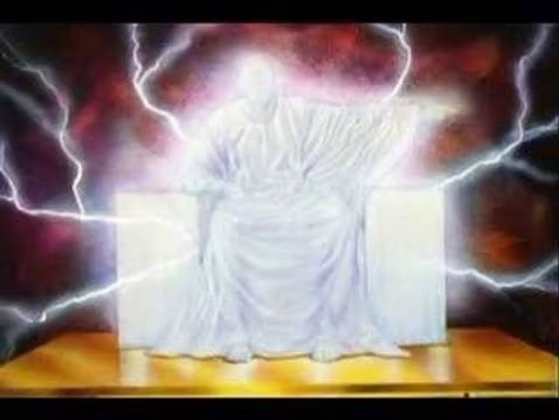
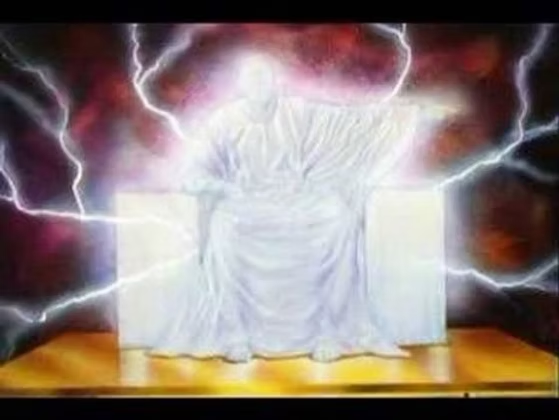
This is the accompanying psalm to the Track 2 Old Testament selection from Daniel 7, which will be read aloud in unison or sung by a cantor on the last Sunday after Pentecost, also called Christ the King Sunday [Proper 29], Year B, according to the lectionary for the Episcopal Church. If an individual church has predetermined to be on this path, this it will follow verses that include: “As I watched, thrones were set in place, and an Ancient One took his throne.” That pair of readings will precede one from Revelation, where John wrote, “To him who loves us and freed us from our sins by his blood, and made us to be a kingdom, priests serving his God and Father, to him be glory and dominion forever and ever. Amen.” All will accompany the Gospel reading from John, where Jesus told Pilate, “My kingdom is not from this world. If my kingdom were from this world, my followers would be fighting to keep me from being handed over to the Jews. But as it is, my kingdom is not from here.”
This is a five verse song of praise to Yahweh, not six. The Episcopal Church has split the first verse into two full verses and part of verse three. Verse two is the second half of what they show as verse three. That adds a number that is not present in the NRSV source they use. I have adjusted the numbering by placing the appropriate numbers in bold type, within brackets.
Also, according to the BibleHub Interlinear page for Psalm 93, they add the title to this psalm that says, “The Lord Reigns!” The NRSV places this title before Psalm 93: “The Majesty of God’s Rule.” These uses of “Lord” and “God” are paraphrases, as nowhere in this psalm are “lord” of “god” written. Five times, in five verses, David wrote the specific name “Yahweh.” That must be any presumed title for this song of praise: Yahweh Reigns!
This title comes from the first two words written by David [“יְהוָ֣ה מָלָךְ֮”], which transliterate as “Yah·weh mā·lāḵ.” Those words translate into English as stating (literally), “Yahweh reigns.” Because Yahweh is known to be the Father, as the supreme god, He is masculine essence; so, a substitution for “reigns” would be “in king.” In the word written by David that specifically names the one who reigns, as king, it lessen this specific naming to refer to Yahweh as a “lord” or “god.” That is because it says the translator: 1.) Does not personally know Yahweh; and, the translator lumps Yahweh in with all the lesser elohim, who are eternal angels, a.k.a. gods. Yahweh made all the elohim, so He is the Creator; and, that elevates Him to greater than god status. Plus, when Moses asks, “Who should I say sent me?” the answer was not tell them a lower “lord” or one of the many “gods.” He specified “Yahweh” [“יְהוָ֣ה”] and throughout Old Testament Scripture that specific name is written (as seen here in Psalm 93).
Because the NRSV translation is weak and absent of any specific naming of Yahweh, I will now present a literal translation of these five verses. Following each verse, I will then add commentary as to what David meant.
1. “Yahweh reigns is clothed is clothed Yahweh strength encompassing ; also set firm the world , not so it be shaken .”
After beginning “Yahweh reigns” or “Yahweh is king,” the word (transliterated) “lā·ḇêš” is repeated, meaning “is clothed is clothed.” Here, one needs to be cognizant that Yahweh can only be understood in human terms, where humans have forms (bodies of flesh), which are so weak (compared to animals) they cannot exist in the climates of the world without wearing clothes (they have no hides, pelts, or fur to speak of). This repetition following a statement about “reign” means “is clothed” first becomes the cloak of presence that human souls who serve Him as king wear. The repetition a second time means this “clothing” is not only relative to the servant, but the master is denoted “king” by those He allows to wear Him. This says “is clothed is clothed” reflects the union of two joined as one (divine marriage). This then is the presence of “Yahweh” on earth, which is the “strength” of His kingdom, while also being the “strength” within each subject that makes up that kingdom. This presence of “Yahweh” is “strength encompassing” all.
Following a semi-colon mark, a separate but aligned to this theme of “reign” makes it clear where Yahweh’s kingdom is. It is “set firm in the world.” In that, “the world” must be seen as where souls fill dead matter that is flesh. The elements of a human body are all from the “earth,” thus physical and material. While “the world” is one of the elements of the Creation, which Yahweh ordered His elohim to make; and, all created in ‘six days’ would become “set firmly” in place, one aspect of His Creation was for “the world” to be where souls (eternal entities) would be released to enjoy “the world,” until death returned the souls to Yahweh for judgment as to where the souls would go next.
The final segment of words in this first verse then says this element of Creation would be “set firm,” “not so it would be shaken.” While that becomes a set-up of life on earth, where souls would be released and returned to “the world” through reincarnation, the advent of religion was a creation of Yahweh, when He made the first man and woman (Adam and Eve) who would be priests, set to teach “the world” about the “reign” of “Yahweh.” Once the seventh day began, Yahweh became the king of a kingdom of two souls in the flesh, which would grow greatly over time. They taught other souls in the flesh how “to be clothed” and how to “clothe others” in the presence of Yahweh as their king; so, the kingdom of Yahweh grew greater and greater. Once a soul marries with Yahweh’s Spirit, that union “not so it would be broken.”
2. “set firm your throne at that time ; from antiquity you .”
In this verse the repetition of “set firm” [“tik·kō·wn” in verse 1] is continued in verse two [as “nā·ḵō·wn”]. Now the focus has moved from “the world” to “the throne.” One must realize that “a throne” is where a king sits, thus from where “Yahweh reigns.” The use of “at that time” [“mê·’āz”] is not only when Yahweh ordered His Creation, but when the seventh day was when He personally made man and woman to be where His “reign” would reside. Therefore, “from antiquity” [where Daniel named Yahweh “Ancient of Days”] means from the beginning of religion teaching a soul to serve Yahweh as king, to “you,” who sits reading these words. “You” would know nothing of Yahweh had He not “set firm” His “throne” in souls walking the earth in human flesh.
3. “have carried the rivers Yahweh have lifted the streams their voice ; take up the canals their pounding waves .”
In this verse there are three uses of “nə·hā·rō·wṯ, from “nahar,” which means “a stream, river” or alternatively “canal, current,” implying “a flood.” Also repeated three times is “nā·śə·’ū” [once as “yiś·’ū,” all from “nasah”], which means “to lift, carry, take,” while implying “accept, advance, arise, able to, armor, suffer to bearer, up, bring forth.” The use of “voice, sound” [from “kol”] and “pounding waves” all tie together to show the fluidity of Yahweh’s presence, where the outpouring of His Spirit follows the course of His subject, who then become the voice of Yahweh that waters the land and makes it fertile with the knowledge of Yahweh. The “pounding waves” becomes metaphor for the heartbeat that denotes love for Yahweh, by a soul that seeks divine marriage.
4. “from the sound of waters many , more majestic the breakers of the sea ; great height Yahweh .”
The element of “voice, sound” [from “qō·w·lām” in verse 3] is then made the focus of verse four [as “miq·qō·lō·wṯ”]. This says the “sound” for Yahweh sings out His name, just as David’s psalms sing praises to Yahweh. This is from the “waters” [“mayim”] that make up the bodies of flesh on the earth. This “sound” then comes from “many.” At the time of David, the “many” were the true Israelites. The meaning of that name [“He Who Retains Yahweh as His elohim”] is then compared in metaphor to the “breaker waves of the sea.” Here, the use of “waves” connect this verse to verse three, where were “lifted up the canals their pounding waves.” The rhythm of Yahweh’s presence is “more magnificent” than even tsunami waves caused by earthquakes under the Mediterranean Sea. As tall as those crashing waves might be raised, they are miniscule in comparison to the heartfelt “waves” of Yahweh’s Spirit upon one’s soul.
5. “your witnesses do confirm abundance , your house befits sacredness ; Yahweh length of day .”
In this verse, all the “voice” and “sound” of verses three and four are stated as “your witness,” which can equally be translated as “your testimony.” In that, the pronoun “your” can be seen both from the perspective of Yahweh within His wives and those through from whom Yahweh speaks, from that marriage. The use of “witness” means a personal experience is the source of “testimony,” not hearsay. All who speak of the presence of Yahweh within “confirm” the truth of Him and all the “abundance” that comes with marriage to His Spirit. Therefore, all who give such “testimony” are where Yahweh resides, each a “house of the holy,” as Saints born onto the earth. The final segment of words then becomes a statement both of the eternity of those souls in submission to Yahweh, but also to the fact that His presence become the “length of day,” when only the light of truth shines forever. “Yahweh length of day” says the darkness of death has been overcome, through the promise of salvation; and, it says the remainder of one’s life will be to shed the light of truth to seekers, in ministry to His name.
In this song of praise that accompanies the Daniel reading that tells of the meeting of the elohim, who were all seated on thrones surrounding Yahweh, where judgment would be cast upon Satan and his wayward angels [at the end of the sixth day], this Psalm 93 message places focus on the seventh day, when Yahweh reigns as the king of one’s soul. This makes it important to see the name of this Sunday – Christ the King – as not being a direct reference to Jesus. Just as when Samuel spoke to Yahweh and told him the elders of Israel sought a king (to be like other nations), Yahweh told Samuel, “I am their king.” As such all who sing this song of praise truthfully are confessing to be each a Christ [Anointed by Yahweh’s Spirit], in whose soul Yahweh is their king. In turn, this brings about the resurrection within one’s soul of Yahweh’s elohim who saves each soul – Jesus. The soul of Jesus becomes one’s high priest, within the soul-body that has become the “house of Yahweh,” through divine marriage.
As a song to be sung loudly on the last Sunday after Pentecost, when one’s own personal ministry for Yahweh should already be well underway, the lesson to gain is submission of one’s soul to Yahweh, so one can receive His Spirit and let His presence reign over one’s soul. This is the only way for salvation, with redemption coming through self-sacrifice to His Will. One must serve Yahweh as a minister on earth, bringing other seekers into His realm.


 Explaining the Readings