[8] See, I am going to bring them from the land of the north,
and gather them from the farthest parts of the earth,
among them the blind and the lame, those with child and
those in labor, together;
a great company, they shall return here.
[9] With weeping they shall come,
and with consolations I will lead them back,
I will let them walk by brooks of water,
in a straight path in which they shall not stumble;
for I have become a father to Israel,
and Ephraim is my firstborn.
[10] Hear the word of Yahweh, O nations,
and declare it in the coastlands far away;
say, “He who scattered Israel will gather him,
and will keep him as a shepherd a flock.”
[11] For Yahweh has ransomed Jacob,
and has redeemed him from hands too strong for him.
[12] They shall come and sing aloud on the height of Zion,
and they shall be radiant over the goodness of Yahweh
over the grain, the wine, and the oil,
and over the young of the flock and the herd;
their life shall become like a watered garden,
and they shall never languish again.
[13] Then shall the young women rejoice in the dance,
and the young men and the old shall be merry.
I will turn their mourning into joy,
I will comfort them, and give them gladness for sorrow.
[14] I will give the priests their fill of fatness,
and my people shall be satisfied with my bounty,
says Yahweh.
——————–
This is the Old Testament selection to be read aloud on the second Sunday after Christmas, Year C, according to the lectionary for the Episcopal Church. This will preceded a singing of Psalm 84, where David sang: “Happy are they who dwell in your house! they will always be praising you.” This pair will be followed by a reading from Paul’s letter to the Christians of Ephesus, where he wrote: “I have heard of your faith in the Lord Jesus and your love toward all the saints, and for this reason I do not cease to give thanks for you as I remember you in my prayers.” All will accompany a Gospel reading from one of three made possible for this day, coming from “Matthew 2 or Luke 2. That read can then include these statements:
“When Herod died, an angel of the Lord suddenly appeared in a dream to Joseph in Egypt and said, “Get up, take the child and his mother, and go to the land of for those who were seeking the child’s life are dead.”
“[Jesus] said to [his parents], “Why were you searching for me? Did you not know that I must be in my Father’s house?’”
“When [the Magi] had heard the king [tell them the prophets said the Messiah would be born in Bethlehem], they set out; and there, ahead of them, went the star that they had seen at its rising, until it stopped over the place where the child was.”
Not too long ago, in the twenty-fifth Sunday after Pentecost, verses seven through nine from this selection were read aloud. The focus of that ends with Jeremiah saying, “Ephraim is my firstborn.” I have written about those three verses and posted commentaries on my website (one from 2018 and one in 2021), which can be opened by searching this site by name and number of the reading. Please feel invited to read those and then return to this interpretation.
The whole of Jeremiah’s thirty-first chapter is forty verses. These eight verses constitute twenty percent of the whole. These eight are only read on this Sunday (all three years); but other verses of the whole (not all) will be read on various other dates in the lectionary calendar. Because these eight are read every year on the second Sunday after Christmas, there should be found significance to the rebirth of Jesus within one’s soul. This is then a message for all to know about that purpose of resurrection of Jesus’ soul in one’s soul.
In these eight verses there are five places where Jeremiah specifically named “Yahweh.” In the whole (forty verses), Jeremiah named “Yahweh” specifically thirty-five times (three times in verse thirty-eight alone). In all of the five places in the reading shown above, you will note that I have changed the NRSV (and others do exactly the same) translation of “Yahweh” as “the Lord,” back to “Yahweh.” I have placed His name in bold type. A “lord” is a lesser ruler. A capitalized “Lord” can be a demonic possessor. In Christianity, after one has married one’s soul to Yahweh and given birth to His Son (the point of ‘after Christmas’), it is the soul of Jesus who becomes “the Lord” of one’s flesh, while the original “lord” (one’s soul) steps aside and submits to that Spiritual possession. Because most readers of Christian literature (the Holy Bible) are not souls married to Yahweh and not reborn as Jesus (each soul-body’s individual “Lord”), it is best to stick to the basics and not go confusing the ignorant masses, who have erroneously been taught, “Do nothing and Jesus will save you, because he died on a cross.” Jesus did not die for any soul refusing to marry Yahweh, refusing to utter His name.
Looking at the BibleHub Interlinear translations, which follow the order of words written in Hebrew by Jeremiah, it is quite obvious many liberties have been taken through paraphrasing what Jeremiah was divinely inspired to write. The beauty of Scripture is it always smells like a rose, even when the death of a translation service has been heaped all over it. The truth still makes crap be known to be divine. For this reason, I will not interpret each verse as translated above. I will offer a translation that matches the order of the words written, according to viable translations of the Hebrew into English. That will be what I then interpret.
In the hit and miss custom established by the Episcopal Church, the above selected verses are only known by the ‘intro,’ which says: “Jeremiah 31:7-14.” They then lazily drop the ‘numbering ball’ and leave it up to all listeners to figure out where verse number transition take place. Because I am not a lazy Christian, I have taken the time to figure out where the verses begin; and, I have inserted the appropriate verse numbers in bold type, placed within brackets. That makes it easy for the checkers to see where my comments are directed and check my translations.
7. that here says Yahweh — give a ringing cry for supplanter [Jacob] with gladness , and cry shrilly with the head of the people ; be heard to praise and speak , save Yahweh the people , the remainder who retains Yahweh as His elohim [Israel] .
8. Behold! will enter them of the flesh [land, earth] unknown [north] , and gather them from extremes of flesh [earth, land] them blind and lame , pregnant those bringing forth unitedly ; an assembly shall return hither .
9. weeping they will come , and with supplications of favorI will lead them I will have them walk into the torrents of water , in a way right , not they will stumble because I come to pass to those who retain Yahweh as His elohim [Israel] the Father , and doubly fruitful [Ephraim] my firstborn he .
10. hear word Yahweh people , and be conspicuous in regions distant ; and speak , he who winnows those who retain Yahweh as His elohim [Israel] will gather together him , and preserve him as a pastor his flock .
11. for has ransomed Yahweh the supplanter [Jacob] ; and redeemed him from the hand of the one stronger than he .
12. therefore they will come and give a ringing cry in the heights of a dry place [Zion] and flowing the goodness Yahweh above grain and above new wine and above fresh oil , and upon sons flock and herd , and will become their souls like a garden well-watered , and not shall they be joined to be faint again .
13. then shall rejoice virgin in the dance , and the young men and the old together ; for I will overturn their mourning into exultation and will console them , and make them glad rather than sorry .
14. and I will saturate the soul of the priest with blessing ; and my people in my goodness will be satisfied say Yahweh . ס
In the translations that I have just supplied, you will note that the name meanings for “Jacob,” “Israel,” “Ephraim” and “Zion” have been replaced by the name meanings. Additionally, in two places where the word translating ordinarily as “land, earth” [“erets”] is found, I have translated that as “flesh.” In that regard, one needs to realize that Yahweh does not care about saving any “land” or “earth,” only that which is animated by souls. Therefore, where the word commonly translated as “nation” is written, I have translated it as “people.” Without the “people,” there are no “nations.”
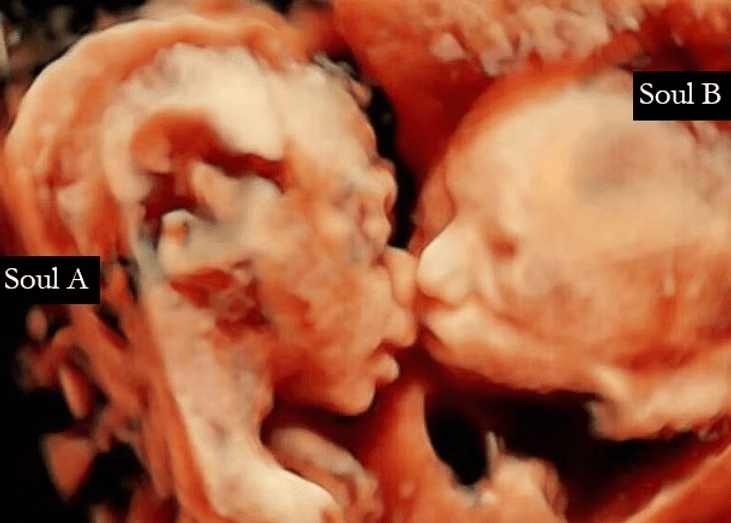
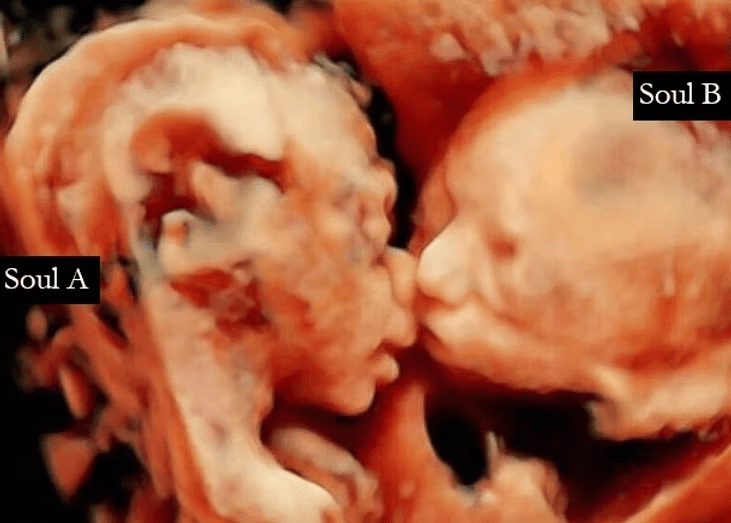
When these eight verses are known to be hand-selected to be read on the second Sunday of Christmas, the theme of childbirth must be realized. In verse eight there are words that translate as, “pregnant those bringing forth unitedly.” The use of the Hebrew “harah” [transliterated as “hā·rāh”] means “Pregnant,” but has been translated these ways in other Old Testament texts: “child (5), conceive (2), pregnant (3), pregnant woman (1), pregnant women (1), woman with child (1), women (1), women who were with child (1), women with child (1).” [NASB Translations] The use of “unitedly” [from “yaḥ·dāw,” from “yachad,” meaning “unitedness”] then leads to verse nine concluding with the words that say, “and doubly fruitful [Ephraim] my firstborn he.” The “doubly fruitful” aspect of the name Ephraim says this “unitedness” will produce “two in one,” where one will be the ”firstborn” of Yahweh, which is “he” known as Adam. The soul of Adam reborn into the soul of another becomes “Jesus,” a name meaning “Yahweh Saves.”
When verse thirteen begins by saying, “then shall rejoice virgin in the dance,” this means a soul that has never married Yahweh and received His Spirit is a “virgin,” having never been divinely penetrated. The “rejoicing” and “dancing” comes from such penetration, which is the presence of Yahweh’s Spirit and the pregnancy of His Son to be born anew in one’s flesh. When that segment leads to Jeremiah adding: “and the young men and the old together,” here the word “yaḥ·dāw” is repeated, with the “unitedness” translated as “together.” The “virgin” soul has become “young” in its time saved, because it has “united” with the “old” soul that is Adam-Jesus. All souls are of masculine essence at this time, when freed from the negativity-femininity of the limits of a body of flesh [“earth”]. This means they are “men,” who will become “sons flock and herd.” (From verse twelve)
The “saturation” of the “soul” [from “wə·riw·wê·ṯî ne·p̄eš,” rooted in “ravah” and “nephesh”] is then a statement of the overwhelming presence of Yahweh’s Spirit, with His Son resurrected within one’s soul. This leaves no room for self-awareness or self-ego to take control of one’s being. All is willingly submitted to Yahweh, welcoming His presence through love. It is this birth of Yahweh’s Son, making one also His Son, with Him becoming the Father (as well as the Husband), so as Jesus reborn one becomes “a priest.” That designation means the remainder of one’s life in the flesh will be spent ministering the Word, so others will also be led to marry their souls to Yahweh and become Jesus reborn.
The only questionable part of these eight verses is the word “north” [“ṣā·p̄ō·wn,” from “tsaphon”]. When this word is connected to “the land” [“erets”], also following that translated into English as “Israel,” this makes one think Jeremiah was writing a warning to the Northern Kingdom, which was already overrun by the Assyrians, with the Israelites scattered to the four corners of the known world. The truth comes when the word “north” is seen as a directional word that means “upright.” Brown-Driver-Briggs writes of the Hebrew word “tsaphon” – “hidden, dark.” Strong’s Exhaustive Concordance list “northern side, dark, gloomy” as proper translations, adding: “tsaphon {tsaw-fone’}; from tsaphan; properly, hidden, i.e. Dark; used only of the north as a quarter (gloomy and unknown) — north(-ern, side, -ward, wind).” This means verse eight saying: “Behold! will enter them of the flesh [land, earth] unknown [north]” is a statement of the invisibility of the ”return of Jesus,” as he will not return in the flesh he ascended in – to save the world – he will return as the “unknown” soul resurrected within one’s own soul, all within the flesh of that soul.
As a reading chosen with purpose, to be read aloud on the second Sunday after Christmas, the purpose here is to see the need to become two souls merged within one body of flesh. That being the only point of Christmas, the primary soul will then be Yahweh’s “firstborn” Son, who we Christians call “Jesus.” We must be “saturated” with the Spirit, as a Christ of Yahweh’s Anointment, so our “virgin” souls can become His “priests” in ministry, as the “sons” who will “gather” the “flock and herd” to Him. This means Christmas is when we are reborn as Jesus; and, that becomes the beginning of the rest of one’s life, where “life” means “eternal,” thus extending well beyond the remainder of one’s life on “earth” (in the “flesh”).
1 How dear to me is your dwelling, Yahweh of hosts! *
[2] My soul has a desire and longing for the courts of Yahweh;
my heart and my flesh rejoice in the living el.
2 [3] The sparrow has found her a house
and the swallow a nest where she may lay her young; *
by the side of your altars, Yahweh of hosts,
my King and welohay.
3 [4] Happy are they who dwell in your house! *
they will always be praising you. Selah
4 [5] Happy are the people whose strength is in you! *
whose hearts are set on the pilgrims’ way.
5 [6] Those who go through the desolate valley will find it a place of springs, *
for the early rains have covered it with pools of water.
6 [7] They will climb from height to height, *
and el-elohim will reveal himself in Zion.
7 [8] Yahweh elohim of hosts, hear my prayer; *
hearken, elohim of Jacob. Selah
8 [9] Behold our defender, elohim; *
and look upon the face of your Anointed.
[9 [10] For one day in your courts is better than a thousand in my own room, *
and to stand at the threshold of the house of elohay
than to dwell in the tents of the wicked.
10 [11] For Yahweh elohim is both sun and shield; *
he will give grace and glory;
11 [11] No good thing will Yahweh withhold *
from those who walk with integrity.
12 Yahweh of hosts, *
happy are they who put their trust in you!]
——————–
This is the Psalm that will be read aloud in unison or sung by a cantor on the second Sunday after Christmas, Year C, according to the lectionary for the Episcopal Church. It will follow the Old Testament reading selected from Jeremiah, which says, “those with child and those in labor, together; a great company, they shall return here. With weeping they shall come, and with consolations I will lead them back.” A reading from Ephesians will follow this pair, where Paul wrote, “[Yahweh-God] destined us for adoption as his children through Jesus Christ, according to the good pleasure of his will, to the praise of his glorious grace that he freely bestowed on us in the Beloved.” All will accompany one of three Gospel choices, two from Matthew and one from Luke. Those include the following quotes:
[Yahweh-God] appeared to Joseph in a dream and said, “Get up, take the child and his mother, and flee to Egypt, and remain there until I tell you; for Herod is about to search for the child, to destroy him.”
When the festival was ended and they started to return, the boy Jesus stayed behind in Jerusalem, but his parents did not know it. Assuming that he was in the group of travelers, they went a day’s journey. Then they started to look for him among their relatives and friends. When they did not find him, they returned to Jerusalem to search for him.
In the time of King Herod, after Jesus was born in Bethlehem of Judea, wise men from the East came to Jerusalem, asking, “Where is the child who has been born king of the Jews? For we observed his star at its rising, and have come to pay him homage.”
I wrote about this Psalm and posted my commentary in July 2021, when it was the Track 1 Psalm on the thirteenth Sunday after Pentecost (Proper 16, Year B). I entitled that observation “Being a house of God” and it can be read by searching this website. In my prior commentary, I presented all the changes that I had made to the text presented by the Episcopal Church. Those same changes are duplicated in the above translation. Due to my having written about this before, I will not repeat that already said. Instead, I will now address this reading from the perspective of the two-Sunday Christmas ‘season,’ when all true Christians should have a history of having died of self-will and been reborn as Jesus, led by the Spirit of Yahweh into ministry. Christmas is the time when there is newness and excitement about having one’s soul be first promised eternal life, free of reincarnations (or worse).
Four times in these twelve verses the word translating as “of hosts” [“ṣə·ḇā·’ō·wṯ,” from “tsaba”] is found written four times [verses 1, 3, 8, and 12]. Each time that word is preceded by the specific name “Yahweh” [not “the Lord”]. It is important to realize how the Christmas theme relates a “host” as being “heavenly” and “angels.” The proof of this comes from Luke 2:13-14, where the saint wrote: “And suddenly there was with the angel a multitude of the heavenly host, praising God and saying, “Glory to God in the highest heaven, and on earth peace among those whom he favors!” This is then followed by Luke writing, “When the angels had left [the shepherds] and gone into heaven.” Thus, reading now “Yahweh of hosts” must be understood to be an “army of angels who serve Yahweh.”
The plurality present in “of hosts” must then be read into the repetition of the word “elohim” [written four times], “elohe” [once], “elohay” [once], and “welohay” [once], as all are forms of “elohim,” which is the plural number to the singular “el” [written one time in this Psalm 84], all meaning “gods” [including the variants: “of gods” / “gods of” and “my gods” / “gods mine”]. Only the one word written – “el” – can be translated as “god,” but not in a capitalized for. This is because Hebrew has no capitalized words; and, Yahweh is named specifically as such a capitalized recognition of “God.” Thus, the seven references to “elohim” [multiple “gods”] must be seen as statements relative to “of hosts,” where the “elohim” are “angels of Yahweh.”
Because the specific combination of “Yahweh elohim” is found written twice here (verses 8 and 11), this must be seen as duplications of the combination stated eleven times in Genesis 2, when Yahweh was making Adam. Yahweh was assisted by the “elohim” He created to do the works of the Creation, as “elohim” is stated thirty-two times in Genesis 1 and three more times in Genesis 2:1-3. This says “Yahweh elohim” is a special creation by the hand of Yahweh-God, where His divine Son would not only be given a soul allotted to human beings, but also one of the spirits that was an “el,” from the “elohim.” Thus, whenever one reads “Yahweh elohim,” this is a human form of “angels” – “angels in the flesh” – which are equally part of the “hosts of Yahweh.”
When verse one is translated by the NRSV to say, “How dear to me is your dwelling, Yahweh of hosts!”, the Hebrew word translated as “dwelling” is “miš·kə·nō·w·ṯe·ḵā,” from “mishkan,” meaning “dwelling place, tabernacle.” In fact (according to the NASB Translations list), this word is translated 109 times as “tabernacle,” with less than thirty times something indicating “dwelling.” This means verse one is not happy about some new church down the block, where God has moved in, but directly a statement that says, “to me is your tabernacle Yahweh of hosts!” Still, the actual Hebrew written says, “how beautiful [my] tabernacle [now] yours Yahweh of hosts!”
Simply by the plurality of “hosts,” there can be no one “tabernacle” that Yahweh can “dwell” in. Because everything is Yahweh’s Creation, everything is His. Because Yahweh does not hear praises coming to Him from mountains, oceans, earth or skies, a “tabernacle” can only be where a soul exists in bodies of flesh. This means David’s first verse is the exclamation of joy he personally knew on the equivalent of Christmas morning, when he realized his soul had become the tabernacle of Yahweh; and, it was that presence that was pure beauty. David became one of the many whose souls had been promised eternal life, because David had welcomed Yahweh into his soul.
In verse two, when David sang, “My soul has a desire and longing for the courts of Yahweh; my heart and my flesh rejoice in the living el,” the one use of “el” has to be understood as David recognizing his “soul” [“nap̄·šî”] and his “inner self” [“lib·bî”] had a love of Yahweh, leading to a “longing and desire” [“niḵ·sə·p̄āh wə·ḡam-kā·lə·ṯāh”], which brought about the marriage of David’s soul to Yahweh’s Spirit [David’s divine “Anointment” by the outpouring of Yahweh’s Spirit]. From that deep spiritual love came a most holy union.
When the NRSV translates David’s third verse to sing, “The sparrow has found her a house and the swallow a nest where she may lay her young,” the concept of divine marriage is now shown metaphorically to be for the natural purpose of making offspring. The tree branches provide protection for a nest, in the same way that a woman’s womb provides a safe haven for a fetus to develop. The metaphor of birds – which have wings and fly – is then that of angels (as human minds see them in their imaginations). To “lay her young” [“šā·ṯāh ’ep̄·rō·ḥe·hā”] is then a statement that a soul in flesh is feminine in essence, thereby a wife and mother, with the “young” or “chicks” being all the souls who bring forth the resurrection of the soul of Jesus, born anew many times, into many new “tabernacles.”
When verse three follows the birth of Jesus anew [as “young”] with “Yahweh of hosts” and then statements that say, “my king , my gods” this says two things. First, the individual soul has submitted to Yahweh in marriage, but then also the soul becomes a subject to the soul reborn into it (Jesus), who is then the “king” of that soul-flesh entity. This is why Jesus is “the Lord” that rules over one body of flesh at a time, while many at the same time. The soul of Jesus could not exist in a body of flesh that has already been given a soul to govern itself, if not for the Will of Yahweh. Thus the possession is Yahweh’s, so “my king” says, I am the possession of the king – the “king of me” – which is both Yahweh (the King of the soul) and Jesus (the king of the flesh). Second, “my gods” (where “elohim” is written as “welohay”) must be seen in the same light of possession, where Yahweh has made one soul join into His “hosts” of “angels,” so one’s soul can claim Yahweh possesses me in the same way He possesses all “His angels in the flesh.”
When verse four is shown to sing, “Happy are they who dwell in your house!”, the better way to read this is as “Happy are those who dwell as you house!” That matches verse one’s “beauty as a tabernacle for Yahweh.” To read “your house” [“ḇê·ṯe·ḵā,” from “bayith”] means to think Yahweh-God has some “house” one can visit once a week, on the Sabbath, and be made “happy” [better said as “blessed” – from “esher”]. This leads the moneymakers of religion to build more and more “houses” that hired hands can be placed in to manage, with every new “house” demanding a mortgage (and, of course, mortgage payers). Thus, when verse four concludes by singing, “still they will be praising you,” this “continued praising” [from “od”] means Yahweh abides in one’s soul, which animates flesh; but the soul is the “house” where Yahweh lives.
From verse five onward, the birth (from verse three) has become settled within one’s being, so ministry becomes the focus. The “pilgrimage” is the making oneself available for seekers to find. The name “Baca” (or “Baka”) means “weeping,” so verse six is focus on the seekers being those who have suffered greatly as souls in flesh that do not have marriage to Yahweh. The purpose of ministry is to give “strength” to those who are weak. The metaphor of “strength” is Jesus resurrected within one’s soul, where his soul has been called “the mighty one” by David before.
It is the presence of Jesus reborn that brings a “shield” for the soul-flesh. Jesus reborn protects a soul from returning to sinful ways. When Jesus has been resurrected within one’s soul, one then wears the “face” of Yahweh and becomes His Christ [as an “Anointed one” – “mə·šî·ḥe·ḵā,” from “mashiach”].
When verse ten sings, “I would rather be the doorkeeper in the house that is one of the elohim of Yahweh,” this should cause one to recall John’s Gospel telling of Jesus saying he was the gate to the sheepfold, and no one enters except through him. This is what David was singing here. He was taking delight in having chosen to let the Son of Yahweh be the guard that stands at the “doorway” to David’s soul, keeping all evil influences away.
The final two verses then sing praise that David was not expected to fight evil alone. He knew evil can only be defeated by the divine presence of Yahweh within, which includes His sending His Son to be one’s “shield.” This presence within is what makes one truly “praise Yahweh,” completely upheld by “faith” that comes from personal experience. That experience comes from being the tabernacle in which Yahweh dwells. To have Yahweh with one’s soul, one’s soul must have fallen in love with him and married Him in Holy Matrimony. The only reason Yahweh merges His Spirit with a soul in flesh is to resurrect the soul of His Son in that soul, reborn into that flesh. That is worthy of praise.
As a reading chosen for the second Sunday after Christmas, this Psalm sings of the birth that is “doubly fruitful” (from “Ephraim”). There can be no individual rights or freedom, as far as eternal salvation is concerned. All souls have the right and freedom to reject a marriage proposal from Yahweh, because to accept His proposal means utter and complete subjection to His Will – a Will that is stated in the Covenant (the marriage vows). Understanding those vows comes when Yahweh enters one’s soul-heart and writes the Law upon the ‘walls’ of one’s being. The high priest that will interpret those laws is Jesus. That makes one’s soul be a lowly Levite-like priest, whose only duty is to maintain the “tabernacle” for that Holy presence. David sings here about how “blessed” that role is.
Blessed be the God and Father of our Lord Jesus Christ, who has blessed us in Christ with every spiritual blessing in the heavenly places, just as he chose us in Christ before the foundation of the world to be holy and blameless before him in love. He destined us for adoption as his children through Jesus Christ, according to the good pleasure of his will, to the praise of his glorious grace that he freely bestowed on us in the Beloved.
I have heard of your faith in the Lord Jesus and your love toward all the saints, and for this reason I do not cease to give thanks for you as I remember you in my prayers. I pray that the God of our Lord Jesus Christ, the Father of glory, may give you a spirit of wisdom and revelation as you come to know him, so that, with the eyes of your heart enlightened, you may know what is the hope to which he has called you, what are the riches of his glorious inheritance among the saints, and what is the immeasurable greatness of his power for us who believe.
——————–
This is the Epistle selection to be read aloud on the second Sunday after Christmas, Year C, according to the lectionary for the Episcopal Church. It will follow an Old Testament reading from Jeremiah, where the prophet wrote: “I will give the priests their fill of fatness, and my people shall be satisfied with my bounty, says Yahweh.” That will lead to a singing of Psalm 84, where one verse says: “Happy are they who dwell in your house! they will always be praising you.” All will accompany the Gospel read, which will be one of three options, two from Matthew 2 and one from Luke 2. Samples of those readings include the following:
· When Herod died, an angel of the Lord suddenly appeared in a dream to Joseph in Egypt and said, “Get up, take the child and his mother, and go to the land of Israel, for those who were seeking the child’s life are dead.”
· When they did not find him, they returned to Jerusalem to search for him. After three days they found him in the temple, sitting among the teachers, listening to them and asking them questions. And all who heard him were amazed at his understanding and his answers.
· Then Herod secretly called for the wise men and learned from them the exact time when the star had appeared. Then he sent them to Bethlehem, saying, “Go and search diligently for the child; and when you have found him, bring me word so that I may also go and pay him homage.”
I wrote about Ephesians 1:15-23, when that selection was the reading choice for Christ the King Sunday in 2017 (Year A, Proper 29). I wrote about Ephesians 1:3-14, when it was the selection for the eighth Sunday after Pentecost in 2018 (Year B, Proper 10); and, I again wrote about the same verse selection this past year, when it came up as the seventh Sunday after Pentecost. This last time I entitled the commentary “Dearly Beloved we are gathered here today …” and it has be read several times since. Therefore, I have posted my comments about all of the verses selected for today; but I have not yet addressed them as ‘cherry picked’ verses that were chosen for the purpose of presenting them together on this second Sunday after Christmas.
I will now make my views clear on this reading being relative to one’s soul having been reborn as Jesus Christ, which the Church recognizes on December 25th each year. We are not called to remember a baby Jesus in a manger for any other reason than seeing one’s soul-body as a trough for feeding livestock, unworthy of being anywhere special, other than in a cave shelter for stabling beasts of burden. To have the Son of Yahweh placed in that lowly place must be seen as how little oneself matters, if Jesus has not been born, so his soul can be laid upon your soul to bring forth righteousness in an otherwise sinful form.
To begin with, verse three’s first segment of words contains six capitalized words. Every capitalized word of the New Testament texts must be read with a divine elevation in meaning. Clearly, Christians immediately recognize this in “God, Father, Lord, Jesus and Christ.” There is less clarity that comes from a capitalized “Eulogētos,” which comes from the root Greek word from which the English “eulogy” comes. To translate this as “Blessed” is even more confusing, because few can answer the question correctly, which asks, “What does “Blessed” mean?”
Beyond that, the translation services (such as the NRSV) do nothing to recognize the word “kai” as something important to see; and, not some ‘stuttering John’ word of no significant meaning, as if Yahweh were pausing to clear His Mind, before continuing to dictate His Word to a prophet. The word “kai” must always be read as a symbol that lets the reader know: Importance to follow! Finally, there are five words written in a row, which includes the last three capitalized words in this segment, all of which are written in the Genitive case, which denotes the possessive. Almost none of that is indicated in the above translation. I will make this segment vividly clear in a moment.
Second, verse four ends with the word that says “love” (“agapē”). This cannot be seen as some The Beatles crap, where “All you need is love, love, love, love” is like singing, “All you need is to be blessed, blessed, blessed, blessed.” The meaning Paul wrote, using “love,” is he was making note of the Spiritual bond that leads to divine marriage between a soul and Yahweh. As far as the modern Episcopal Church can define “love,” its carnal definition bantered carelessly among same sexes, who would likely lead that satanic church to be like the Temple of Jerusalem once did and have naked blood sacrifices on the altars of their churches, with all in attendance required to join in an orgy. For selected verses on the second Sunday after Christmas, when the soul of Jesus can only be born after a divine marriage between Yahweh and wife-soul, “love” must be recognized as significant.
The first segment of words of verse three states this: “Blessed this God [meaning Yahweh] kai Father of this of Lord of us of Jesus of Christ”. This segment is then broken into two sections, based on the use of the word “kai.” This means the primary focus of this segment is that which is God’s Blessing. This is the same divine elevation (capitalization of “Eulogētos”) that was found when Elizabeth was divinely inspired to tell Mary, “Blessed are you among women.” It is the same divine elevation that was found when Zechariah broke into divinely inspired song about his son John: “Blessed be the Lord God of Israel.” This means verse three’s primary intent is to state what a divine “Blessing by God” means to the ordinary Joe or Sally in Ephesus. From that, the same can be said of the ordinary Joe and Sally everywhere, at all times.
That “Blessing” is then when Yahweh becomes one’s “Father.” It is the word “Patēr” that follows the word “kai” and is not written in the possessive case (Genitive). This makes “Father” become a statement of the one who possesses, with possession based on a familial relationship, where that possessed came because of the “Father.”
In this regard, look at the two examples of Zechariah and Elizabeth, both of whom saw a divine “Blessing” being due to Yahweh generating sons in two (basically) virgins (one old and barren). This means the “Blessed this God” says “this” (use of “ho”) refers backwards in the text, to the greetings of Paul to the true Christians of Ephesus, all of whom had become related to Yahweh, knowing Him as “Father.” Therefore, Paul acknowledged those many transformations were not self-made or self-caused or in any way due to things people did that happened to be right and well-figured out, because a true “Blessing” like “this” known is only possible through “God.”
That brought about by “God,” as the “Father,” is then possession of a soul that Yahweh [“God”] has divinely married, such that Yahweh has become possessor “of this” soul, as its “Lord,” which means the relationship to the “Father” is relative to being “of Yahweh the Lord” over that soul.
From a soul being “of Lord” Yahweh, such that the soul has completely subjected itself (a “self” is a “soul”) to Him in divine marriage, it then becomes a family relationship that is not singular. Yahweh has many wives, all for the purpose of Him becoming fully possessive of those wife-souls, to also become the “Father” of all. This is why the Genitive possessive plural pronoun says “of us.” Paul was writing to the many in Ephesus, which prophesies to the many forevermore. The use of “hēmōn” says the same must be applied to all wife-souls of Yahweh, as they will all call Him “Father,” as their “Lord.”
This is then furthered by the capitalized name “Jesus,” written in the Genitive case. This says that “of us,” who are all whose souls have married Yahweh, becoming His possessions as subjects, “of His Lordship,” where that direct control of Yahweh is now said to be “of Jesus.” This is the name Gabriel told Mary to give to the divine child she was “Blessed” to hold in her womb. The name given means “Yah[weh] Will Save.” Thus, when Yahweh becomes the “Father” of a soul He possesses, each and every one(“of us”) takes on Yahweh’s control through the soul He created for the purpose of saving souls, making “of us” be “of Jesus.”
This is not a collection of souls (the many – “of us”) that only has one Jesus to see as his or her “Lord,” as the only singularity is Yahweh, as the “Father.” He is the “Father” of all, the “Lord” of all, with all being individually reborn “of Jesus,” as a possessing soul added by Yahweh (the “Father”) to a submissive soul-wife.
With this understood, where all souls married to Yahweh become His wife-souls, all submitting themselves (self-soul) to Him as their “Lord,” He will then “Father” His Son into each and every wife-soul His Son, as the soul of Jesus resurrected many times over, forever and ever, everyone of them becoming Jesus reborn. Because they have all become “of Jesus,” each possessing his soul with theirs, all wife-souls are then “Anointed ones” of Yahweh, where His Spirit has poured out upon their souls in the name of His Son Jesus reborn, so allare then equally a “Christ” – a word in Greek that means “anointed with oil or water,” but when capitalized it becomes divinely elevated as an act of “God-Yahweh.
This must be seen as key information to discern as a reading chosen for the second Sunday after Christmas, when Christmas is recognized as being the birth of Jesus within a soul, more than being the actual birthdate of Jesus (John the Baptists would be the one to be born at this time of year). The wealth of information that then follows in the rest of verse three and then in verses four, five and six all supports this basic information.
Verse three continues to says the “blessing of us is spiritual,” which means non-physical, so there will be no follow-up rebirths of a baby Jesus, or a full-bodies return of a man in flesh, as “spiritual blessing” has no material claim. The “spiritual” is “heavenly realms in Christ,” where (again) “Christ” is not some physical entity, but a “spirituality” that is an outpouring upon a soul by Yahweh. Nothing short of Yahweh can (capitalized) “Anoint” a soul, which is far greater than someone physically smearing oil on a forehead.
Verse four adds that such souls have to be “chosen,” which (again) is the doings of Yahweh. Yahweh chooses which souls He will marry and He chooses which souls He will Anoint from those marriages. The use of the Greek word “autō” needs to be read as meaning “same,” rather than simply “him,” because to become a “Christ” a soul must become “the same” as Jesus, which is pure and without sin. That is the meaning of “before foundation of world.” That says the “foundation” that is “the same” is when one shows the face of Yahweh “before” oneself, through submission in marriage and taking on His name [Israel]. To be in “the world” and return to Yahweh afterwards, one must be cleansed of all the worldly impurities. Those are removed through marriage and the outpouring of Yahweh’s Spirit, which comes (again) from “love.
Verse five then adds that this then “predestines” all souls to be “adopted sons.” In this, “sons” is an assumption of the reality of ancient Greece, as no females were ever “adopted.” That was called marriage. Still, “adopted sons” is another spiritual designation, as the soul-flesh entity that marries Yahweh is feminine essence, thus a soul-wife. The “adopted sons” become the infusion of a male son into one’s soul. That makes Yahweh become the Father, with the “adopted sons” all being Jesus resurrected in each soul-wife. The result is all are both (again) “of Jesus” and “of Christ,” where the two are separate, but come together. Once a soul has become an “adopted Jesus,” then that soul is also adopted as a “Christ,” with Yahweh the new “Father.”
Verse six then ends with the capitalized Greek word “Ēgapēmenō,” which translates as a divinely elevated “Beloved.” This is (again) repeating the “love” theme that goes beyond marriage, to the purpose of marriage – being to make a baby. Here, the capitalization makes the soul-wife become the “Beloved,” as the wife and mother, while also being the “Beloved” as Jesus reborn. This designation is ”of the same” (from “autou”), such that one and the other become one, as the “same.” This is a “gift” from Yahweh to the soul. Thus, when Gabriel visited Mary, she was told she was, “favored with grace” and “blessed among women.” Such “favor” and “blessing” must be seen as that “being freely given [by Yahweh] us in this Beloved.”
These selected verses must be seen as everything that came true on Christmas morning. Everything was expected. Everything was a gift from Yahweh to His brides. Everything is the truth of Christianity, where the soul of Jesus returned the day after it ascended, on Pentecost Sunday morning; and, it is what all saints are made of – the rebirth of the soul of Jesus in those who are likewise Anointed as Christs.
The reading then leaps forward to verse fifteen, which the NRSV calls “Paul’s Prayer.” In these verses can be found two uses of “saints” [“hagious” in verses 15 and 18] and two references to “faith” [“pistin” in verse 15 and “pisteuontas” in verse 19a]. It must be understood that Paul was a “saint,” and the plural number he wrote refers to all who were like Paul; and, that means a soul in the flesh married to Yahweh and reborn as His Son Jesus is each a Christ as designated by Yahweh. This personal infusing of Spirit then creates knowledge of divine matters, not intelligence of such things never personally experienced, but said to have been by others. This is the difference between true “faith” and simple “belief.” Paul’s prayer was “giving thanks” [“eucharistōn”] to Yahweh for his having been led in divine ministry (as Jesus reborn) to pass on the Spirit to other souls-in-flesh, so they too would submit themselves (self-soul) in the same way.
It should be realized that Paul was not “praying” that Yahweh would hear his “prayers” and grant Paul his wish to do something to make Paul seem like some stand-up dude. Prayers should be made to Yahweh for personal strength as His servant. Paul mentioning his “prayers” in a letter should have no purpose other than Yahweh passing on to true Christians in Ephesus that Paul hopes they are doing the same for each other, “giving thanks” to Yahweh for all He has done for them. One does not “pray” to become a saint or have faith. One does whatever Yahweh leads one to do, with Him as one’s “Lord,” sent to one as the soul of “Jesus” resurrected, as one who is an “adopted son” as a “Christ.” Then, with all that “having been given” to oneself (self-soul), then it is only natural that all “prayers” are “giving thanks” to Yahweh for that having been done.
This means prayer has to be as Jesus explained, as a direct communication between one’s soul and Yahweh. When Jesus taught his disciples to pray, he told them to address Yahweh as “Father.” To truthfully call Yahweh “Father” means to be truly reborn as His Son Jesus, the only Son of Yahweh [Adam’s soul reborn]. A prayer that calls out to the “Father,” when one selfishly worships self and not Yahweh, having no concept whatsoever of ever being the resurrection of Jesus’ soul within one’s own soul, means one slanders Yahweh and Jesus. Prayer is for giving thanks or begging for forgiveness for all the sins one’s soul is mired in. Until one has reached the depths of despair that one finally cuts loose of self-worship and fully submits to the Will of Yahweh, one has no one to thank but oneself. Your prayers then are your acts and deeds that do as one pleases.
As a reading hand-picked to be read aloud on the second Sunday after Christmas, one needs to see the message here is to have one’s soul be married to Yahweh and receive His Spirit as a Blessing, an Anointment. Then one needs to prepare for a new you to arrive, as promised. That new you will be the gift of Yahweh, which is adoption as His Son, so one’s soul is now led by the soul of Jesus. That brings about tremendous feelings that make one praise Yahweh. In that praise, one thanks Yahweh for his gift of Christmas. That then leads to the ministry of faith, where one becomes like Jesus (and like Paul), leading others to also become saints. One does not forget those whose souls touched in brotherhood (all as adopted sons of Yahweh), as one writes them notes that say, “I have not forgotten you.” That is the act of a “Beloved.”
In the time of King Herod, after Jesus was born in Bethlehem of Judea, wise men from the East came to Jerusalem, asking, “Where is the child who has been born king of the Jews? For we observed his star at its rising, and have come to pay him homage.” When King Herod heard this, he was frightened, and all Jerusalem with him; and calling together all the chief priests and scribes of the people, he inquired of them where the Messiah was to be born. They told him, “In Bethlehem of Judea; for so it has been written by the prophet:
`And you, Bethlehem, in the land of Judah, are by no means least among the rulers of Judah;
for from you shall come a ruler who is to shepherd my people Israel.'”
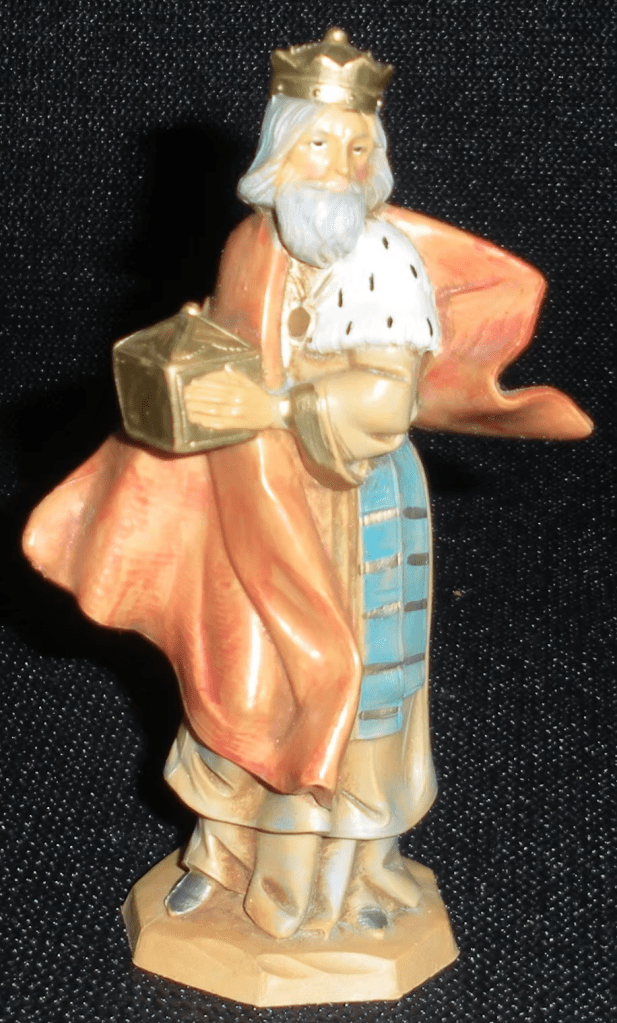
Then Herod secretly called for the wise men and learned from them the exact time when the star had appeared. Then he sent them to Bethlehem, saying, “Go and search diligently for the child; and when you have found him, bring me word so that I may also go and pay him homage.” When they had heard the king, they set out; and there, ahead of them, went the star that they had seen at its rising, until it stopped over the place where the child was. When they saw that the star had stopped, they were overwhelmed with joy. On entering the house, they saw the child with Mary his mother; and they knelt down and paid him homage. Then, opening their treasure chests, they offered him gifts of gold, frankincense, and myrrh. And having been warned in a dream not to return to Herod, they left for their own country by another road.
——————–
This is the third of the three optional Gospel readings that can be read aloud by a priest on the second Sunday after Christmas, Year C, according to the lectionary for the Episcopal Church. If chosen, it will follow an Old Testament reading from Jeremiah, where the prophet wrote: “I will turn their mourning into joy, I will comfort them, and give them gladness for sorrow. I will give the priests their fill of fatness, and my people shall be satisfied with my bounty”. That will be followed by a singing of Psalm 84, where David wrote: “The sparrow has found her a house and the swallow a nest where she may lay her young; by the side of your altars, Yahweh of hosts, my King and welohay.” That pair will precede a reading from Ephesians, where Paul wrote, “Blessed be the God and Father of our Lord Jesus Christ, who has blessed us in Christ with every spiritual blessing in the heavenly places, just as he chose us in Christ before the foundation of the world to be holy and blameless before him in love.”
I imagine the only reason this reading is optional on the second Sunday after Christmas is smaller churches that cannot afford a full-time priest will not be having an Epiphany service, which comes up on Thursday in 2022 (always January 6th). Because this Gospel selection is the only one for the Epiphany service, it can be read in advance. Still, in the quote here, stated after the words “written by the prophet,” they come from Micah, which was the Old Testament reading choice for the fourth Sunday of Advent, two Sundays prior. So, a little before and a little after and voilà – Matthew 2:1-12 is read today.
It was this specific reading that opened my eyes (divinely inspired to “behold!”) to the truth that is the Christmas story. It is my personal history that I was led to learn astrology in my younger years, to the point of being qualified to work professionally as an astrologer [something I never did, nor desired to do]. With that personal knowledge, I can understand what chickenshits and fraidy-cats run away from, peeing themselves while making a cross (those of Catholicism only), while praying, “Save me God from this evil.”
By knowing astrology, I was finally allowed to see the “star” [a word that appears in the singular number four times here in Matthew 2, five times in John’s Apocalypse, and twice in 1 Corinthians] as the “sun” – the only “star” in our “solar” system. The word “Magi” [written only in the lower-case, as “magoi, magous, magōn (2x), magon, and magos – the first two in this story, the next two in the story of Herod slaughtering the innocents of Bethlehem, and the last two in Acts, where the word is translated as “magician”] must be read [in the lower-case] as “astrologers.” It was in late November 2016 that it finally dawned on me (having long known this story and having long been knowledgeable in astrology) to connect the two. Doing that allowing me to see the truth. It led to me (eventually, in September 2019) publishing a book entitled The Star of Bethlehem: The Timing of the Life of Jesus.
When the two are put together this reading simply says astrologers from the east [Persia] had used the sun as the central point in their routine of producing forecasting charts, which they would have done in order to advise the King of Persia about coming trends, based on the known placements of the planets [at that time only the visible: two luminaries, five planets] and how astrologers would read those future placements. For divine “magi” [lower-case spelling] or holy “astrologers” to travel west to Jerusalem, they would have had to have received approval by the Persian king. That says their caravan would have been rather large, with an accompaniment of security, orderlies, animal caretakers, and the astrologers. That trip would have only been approved because of the phenomenal display [the alignment of the celestial orbs] made on an astrological chart.
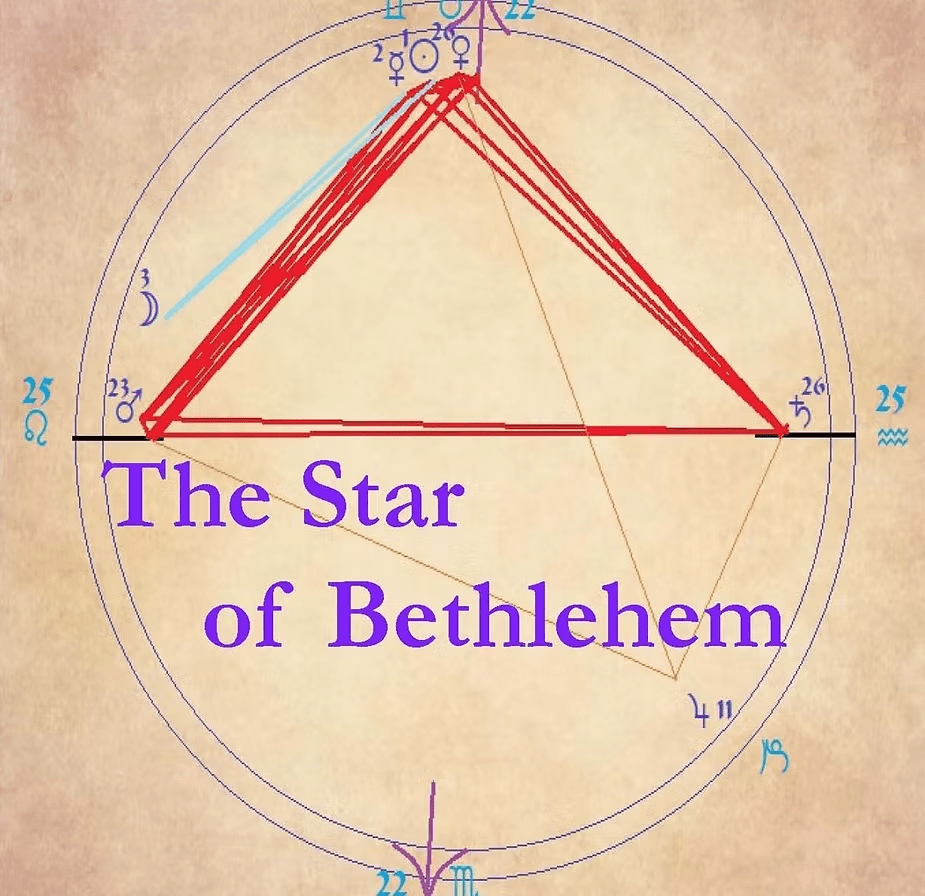
From the cover of my book. The red triangle actually forms a cross, upside down, but looks like a tabernacle this way.
Add to that the “magi” had some knowledge of a prophesied birth of a “Messiah” – the “king of the Jews” – one can grasp how they would have been part of the Jewish remnant freed from Babylon, who remained to assist their Persian liberators. That would make them all be priests, as Jews – call them early Kabbalists – who were not kept outside of the divine ‘loop,’ meaning they most likely would have bee assisted by angelic guidance, which informed them the chart they saw [well in advance of the time when it would appear in the heavens] was of a most holy birth. They would not arrive in Jerusalem (after traveling a month or so), get an audience with Herod and ask to see the newborn child that was the king of the Jews, simply because they followed some light in the night sky that was a one-time thing [that does not sway atheists to believe the story]. The Magi knew well in advance when a most fabulous birth would occur.
One must realize Herod did not know these people from squat. They, therefore, received no preferential treatment, as to when they could see Herod; but it would be essential that strangers arrive carrying with them some form of a ‘letter or marque,’ explaining, “I, the King of Persia, have sent these priestly ambassadors to see you with my approval. Please show them your highest respect.”
In verse two, the capitalized word “Pou” becomes a divinely elevated word of question that asks “Where” or “In what place,” leading this divine place to be relative to “the one being” or “the one existing” (from “estin” – third-person singular of “I am”), who is “this having been born.” This says the divine elevation makes it most important for these holy men from the east travel to be “Where” a newborn “is,” knowing that the birth was so special he was known beforehand to be coming as “the ruler” or “the king” of all known to be “Jewish.” By asking about one “having been born,” the “astrologers” had cast an event chart that was then seen as a “natal chart,” meaning a ”birth chart” of such an important child.
Here, it should be realized that “magi,” who were descended from Jewish ancestry and customs, arrived in Jerusalem with an expectation that King Herod also employed astrologers. Those would have then also foreseen this miraculous celestial arrangement in advance; and, the magi would have expected Herod to have known of this birth coming beforehand, just as they knew. This means they arrived with expectations that such a birth would have been praised and most welcome.
Following their question, we then read the magi having been received as I am these days, when I tell a stranger, “The star of Bethlehem is the sun.” Obviously, Herod was busy reading the letter or marque and listening to the magi, until he looked up and asked, “What makes you fellows think this?” To that the astrologers would have then explained, “for we observed his star at its rising.”
The literal translation of the Greek here says, “we perceived [from “eidomen”] indeed of him this star in the east.” In that, the “perception” that those astrologers “saw,” that “indeed” was “of him” – a newborn ruler of the Jewish people. That was based on “this” (which they might have then held out to Herod), with “this” (from “ton”) being a natal chart cast. A natal chart tells an astrologer the basic character traits expected to be found in the native [with the same alignments also able to be projected upon an event, which is called an electional chart]. A natal chart depends on the time of birth, the place of birth, and the date of birth; and, by knowing that basic data a chart can be cast, based on the sun’s position, with all the other orbs then plotted in relationship to the sun … on that specific day, place, and time. All originates because the daily motion of the sun – it moves about one degree each day, so a year can be forecast daily – with the “star” or “sun” being the anchor to which all the other orbs are aligned. This is what is basically called “sun sign astrology” today, where all people are designated to be the astrological sign that is relative to where the sun was on the day they were born.
When they explained they saw the star “in the east,” that simply means they cast the chart in Persia; but they would have seen the same basic arrangement of planets and luminaries with basic coordinates for a central location in Persia [even Babylon]. From that first-run chart, they then recognized [divinely assisted to see] the chart was not forecasting an event for Persia, but a global event coming. Seeing the alignments as those more pertinent to a natal chart, they would have deduced the alignments predicted a birth of a most special child. Persia having no prophecies of divine births expected made Judea a good bet, since the same alignments were also the same there [time of birth adjusted accordingly].
Again with divine inspiration helping them, they would have then set the coordinates for Jerusalem [central for Judea]. The planetary-luminary positions would remain the same, as long as the time was adjusted to a place further west. That updated chart, based on Jerusalem as the place of birth, would have been what they held out for Herod to see. That work producing the chart would have been all done “in the east.”
They did not follow a star by night, as absolutely nothing is written that says that. Shear stupidity would lead one to believe anyone traveled by night, when that is when people fall into pits and die. When verse nine says the magi left the king and saw [“behold!”] “the star they saw in the east,” well golly gee, it was daytime, so they saw the sun. They saw the sun in the same elevated position they had forecast the natal chart to be, when the sun was high overhead.
We then read in verse three how Herod reacted, after hearing who the magi had come visiting to see, with Luke writing “he was troubled” (from “etarachthē”). This means that he had read a letter signed by a real king – Xerxes I – who was not a puppet king of a Roman emperor, but an emperor himself. Xerxes, as a king, was a smart dude, with lots of other smart dudes advising him. An idiot would not finance a caravan to Jerusalem (800 miles, 1600 round-trip traveling requires lots of supplies and advance planning). The magi had been approved by Xerxes to venture to Jerusalem for the purpose of “worshiping” or “giving reverence to” [from “proskynēsai”] a holy birth. The expectation was [divinely assisted] then that the chart they had seen was of the one who had been prophesied to come, quite some time before (seven hundred years). That was the huge gulp that appeared in Herod’s throat; and, that was “troubling” for Herod to hear holy men saying to him, “The time has arrived.”
When the translation by the NRSV says “When King Herod heard this, he was frightened, and all Jerusalem with him,” this is confusing. It makes readers ask, “How would all Jerusalem know about a private audience between some foreign dignitaries and the King of Judea? How could that meeting be news that could possible spread so fast? Did some herald go to a tower and proclaim, “The Messiah has been born … news at 11:00”?
No.
This means “Jerusalem” has to be read as the meaning behind the name, with the capitalization divinely elevating the meaning to a level of Yahweh. When the name is known to mean “Teaching Peace,” what is said is this: Not only did the king show visible signs of being “troubled,” but in addition to his showing signs of not knowing what to say (stammering, sweating profusely, coughing, etc.), the ”whole” of Herod’s soul – that which “Teaches Peace” inwardly, keeping true kings from ever being shaken, knowing God is on their side – that soul presence was whispering to Herod, “This is not good for those who are false shepherds of My people, Herod ole boy.”
Because the astrologers had asked Herod “Where” or “In what place” they could visit the one who was symbolized by the natal chart they had cast (probably a year prior), the nervousness of Herod kept him from openly admitting he was a false shepherd, so he refused to say, “Gee, guys, I have no clue where that would be. Are you sure it is relative to Jewish prophecy?”
Instead, Herod called for his scribes (meaning he had no court astrologers to rely on … much like every branch of denominations associated with the Western Christian Church today). When the scholars arrived, smart as scribes are (because they memorize so well), Herod asked them to remind him “Where” the Messiah was prophesied to be born. They [maybe having been given a ‘heads up,’ so they checked some notes beforehand] immediately quoted Micah 5:2.
After they came and made that announcement, the magi most likely asked, “How do we get there from here? Our caravan is camped just down the road.” With directions given, Herod then emptied the room. A public meeting, with recorders and other state representatives present, such as historians normally assigned to be present for all meeting held in the palace of Jerusalem, the room was cleared for a “private” or “secret” continuation of this meeting. It was then that Herod asked, “What time did you use to calculate this birth chart?”
In the Greek text written, the word “ēkribōsen” is rooted in the word “akriboo,” which means “exact, precise,” implying “I learn carefully, inquire with exactness.” (Strong’s) From that, the word “ascertain” can be used, where the point of secrecy is now Herod knowing that the “exact time” of a natal chart is key to duplicating such a chart, so one with less expertise than a divine astrologer could mishandle the symbolic meaning seen in an astrological chart.
In this light, one must realize that Yahweh created astrology – per Enoch – so it is a tool to be used by divine priests. Just as a hammer is designed to be used in construction, the same tool can be misused as an implement of destruction. Evil is as evil does. In the same way, Yahweh created Adam to become the minister of truth on earth; but, because Adam and Eve gave birth to Cain, who would beget every evil form of religion known to mankind (after being banished), fearing astrology would be akin to fearing religion because of Cain. It is not the tool, but the divinity of the tool user [and that demands angelic guidance]. All of this means the secret question by Herod would not be something shared by the magi, because such information would make it possible for one untrained in divine tools to harm a native – at any time in that native’s life.
In verse eight, where we read Herod sent the magi to Bethlehem, there is nothing that says they gave him the birth time. In modern times, that information is deemed client-astrologer privilege, thus confidentiality is the expectation and Jesus was not yet anointed by the magi, so he was still not a public figure. I doubt they would have told Herod anything more than, “Bring us your court astrologers and we will let them look at the chart.” That would have been when Herod admitted, “Dang! We had cutbacks recently and did away with the astrologers.” Thus, divine astrologers did not divulge anything more than necessary.
When Herod told the astrologers to go find the Messiah in Bethlehem and then come back and tell him where he can be found … so he could go pay his respects too … this says two things. First, it says Herod was not fully believing this story told to him by strangers, despite the cold chill that ran down his spine when he lost his cool and became frightened with news of a divine king having been born. Had Herod fully believed the magi, he would have made immediate arrangements to accompany the magi to Bethlehem, where his presence would garner immediate attention and force the locals to point to any newborns there. Second, Herod was trying to make it seem to the magi that this kind of stuff happened all the time around there. There were plenty of zealots running around Judea claiming to be the Messiah, none newborns. To believe them all would mean Judea would be led by insanity. That would make Herod poopoo the power of astrology, which he would have used to sew the seed into the minds of the magi that suggested to them, “We need to prove to this Roman puppet that we know what we’re talking about.” Herod would use that lack of concern as motivation to have them running back to Herod, after they actually found a newborn who fit their natal chart expectations, telling him, “I told you so!”
Because the trip from Jerusalem to Bethlehem is going south, the east would have been to their left side. When we read, “went the star that they had seen at its rising, until it stopped over the place where the child was,” that means it was still morning; so, as they traveled south “the sun” slowly rose higher in the sky. By the time they reached Bethlehem, it would have been high overhead.
In verse ten, where it is written: “When they saw that the star had stopped, they were overwhelmed with joy,” the reality is nothing says “stopped.” The sun [a fixed star] always appears to be moving because the earth is always turning. However, if the astrologers reached Bethlehem and then recast a chart for that specific event of arrival, such that they “stopped the sun” for the purpose of casting an on-the-spot electional chart, they would have found that the changes made to the birth chart would make the adjusted chart more remarkable. Knowing they had arrived late – after the birthdate – the adjusted chart would say if they were still good on the timing or too late. Therefore, the new astrological revelation would have led them to have “rejoiced joyfully greatly and exceedingly.” In other words, they would not only be saying, “Wow!” they would have been dancing wildly in the street, just as when David led the Ark of the Covenant into his city. This new emotional outlet says they were even more convinced that they were at the right place, at the right time.
This is where there needs to be a pause in the story, so one can reflect on everything that led to this point of great celebration. There is reason for the magi recasting an electional chart.
1. The date of the natal chart had already passed. The magi knew a specific birth date and would have arrived to Jerusalem in time for that date; but they had not planned for it being festival time there. Due to Jerusalem being overwhelmed with pilgrims, all the places they could find a room were overflowing. So, non-Jews from the east would have been stopped by Roman guards, telling them the city was too packed for state visits, causing them to wait outside the city, until the festival was over and the pilgrims had left town.
2. Joseph and Mary were in Bethlehem only because Joseph had to register for the demanded census ordered by Rome. When they arrived (Mary riding on a donkey), Joseph stabled the donkey and off they went to the registration place. After registering (no child yet born) Mary’s water broke. Because of the influx of pilgrims, there were no rooms available for Mary to give birth in, privately. Because Joseph had paid to stable his donkey, that became their place to stay, so Mary would not deliver a baby out in the open. Midwives would have been called to attend to Mary, with Joseph standing outside the cave where the stable was, telling local menfolk, “My brother lives in Emmaus. His name is Cleopas. If he comes looking for us, tell him where we are.”
3. This means the festival was Shavuot, which is the Fiftieth Day [Pentecost] in the counting of the Omer, which began the second day of the Passover festival. After the morning of Shavuot, everything would be over and the pilgrims would clear out. After the linens were changed, Mary and Jesus would have been appropriately moved from the cave stable, into a nearby room that was now freed up. This means Jesus was born on the day before Shavuot, which would later be the day he ascended (after death and resurrection). [Jesus was born and ascended on the same day of the year! Only Yahweh would make a long-range plan like that!!!] The magi would have arrived during the height of the festival gathering, thus kept out of Jerusalem until the day after Shavuot.
4. This means the magi recast a chart for two days after their original cast date. While the sun had moved two degrees, with Mercury and Venus moving about the same, the Moon would have moved about twenty-four degrees. It was the Moon’s movement that made it become conjunct with Mars and the Ascendant [rising sign] that would have greatly excited them. The Moon reflects the Mother; and, Mars reflects the Son. The delay meant they arrived at a time that symbolized the Son and the Mother as one, all part of the grander configuration that led them to seek a holy birth in the first place.
When this element of the magi finding Jesus two days after he was born is realized, the concept of Epiphany being after twelve days – the Twelve Days of Christmas – with their arrival being thirteen days later is accurate only as a statement that the magi arrived after the birth of Jesus. Astrologically, thirteen days is almost half a month [symbolizing the time it takes a new moon to change into a full moon]; and, there would be greater movement of planets during that length of time, with the Moon making half a revolution through the signs of the zodiac in that timeframe. So, a recast chart would not be anything to cheer about at that late date. Two days after was still quite significant.
This is further realized when one knows Joseph and Mary were not permanent residents of Bethlehem. The move to a room in a “house” would be soon after one became available, and only necessary for about a day. In that amount of time, Joseph’s relatives would have arrived to assist with a cart (if necessary) or other transportation needs, in order to get Joseph, Mary and baby Jesus back where they belonged. Had the magi been held up longer [Yahweh would not have allowed that to happen], then their coming to Jerusalem would have been for naught. That tight window of opportunity would play into Herod waiting a year before ordering all two-year olds killed; because, if the magi had arrived well after the birth time, then they might have given up and left town, not coming back to see Herod and admit, “We missed him.”
The purpose of the magi coming was to anoint Jesus as Yahweh’s promised Son. This would not be as a “king,” but as a high priest to the Tabernacle. Just as “gold,” “frankincense” and “myrrh” were elements involved in the ceremonial garb of a high priest, the magi’s gifts would have been more probably a tiny crown and a little robe, with incense burned and oils besmeared on his forehead. The magi were then sent by Yahweh [just like Gabriel made his announcements to many], for that purpose of officially letting it be known that Jesus was indeed His Son.
When the last verse tells of the magi being warned in a dream, not to go back to Jerusalem and tell Herod anything, this divine warning needs to be seen as either collectively [all magi – and no number states how many there were, although the plural number is clear], or individually [where one who was shown a divine warning, who then told the others], this is another clarification that the magi were not hippy-dippy astrologers, like those found on the Internet today. They were priests first and foremost, who served Yahweh first and foremost; and, from that divine connection they were able to utilize a tool created by Yahweh, to lead others divinely. Therefore, they were not without prior experience in receiving divine dreams; so, they left Bethlehem via another route.
Relative to this departure and the story of Luke that tells of the slaughter of the innocent children in Bethlehem [a deed that was not recorded historically as documented proof to Scripture], that murder was selective and most likely secretly incorporated. Because there was no urgency for Joseph to take his family to Egypt, allowing for the bris for Jesus (circumcision and official naming) and the dedication in the Temple in Jerusalem after forty days, it was not like Herod was breathlessly waiting for the magi to return and report on their findings. As an important [and ego-driven] man, with lots to be in charge of as king, it is likely that a year passed before Herod realized the magi might have found what they were seeking [or not] and then purposefully did not return to tell him. A year later, perhaps, some court recorder could have reminded Herod procedurally: “On this date last year you met with astrologers from Persia …” and then Herod would have recalled the meeting. That would be well after Joseph had moved his wife and child to Egypt, to begin his training as a carpenter.
Here, it should be seen that Joseph is identified as a “righteous man,” which means he should be seen as an Essene priest. Mary’s uncle [a relative of some kind], Zechariah, was also an Essene priest. As such, their responsibilities were to the temple on Mount Carmel, not the Temple of Jerusalem [Herod’s Temple]. With the birth of John later bringing attention to him by the sons of Herod the Great, it is likely his birthdate and registration would have been checked, to see if a decree from Herod would cover someone like John (thought to be the Messiah). Because John was not born when the magi appeared before Herod and not in Bethlehem, he was spared that judgment. Jesus, however, could have been targeted as the son of an Essene priest, who had indeed registered in Bethlehem at the time covered by Herod’s order. By Joseph going to Egypt to learn a craft [he wasn’t a very good carpenter], and going yearly to Jerusalem for the Passover [not something Essene priests did], his change of ‘profession’ made it less likely to see Jesus as people saw John.
The report of the magi having not returned to report to Herod, as privately agreed, coming a year later would then be why Herod ordered the murder of two-year old males. It means a reminder led him to send his ‘secret police’ to investigate how many children were born in Bethlehem that were two years of age. Registration records reporting new births could have assisted their search. That means Herod did not get the time of Jesus’ birth from the magi; so, Herod was quickly figuring how old a Messiah could be, based on a year before the magi arriving, until then when he remembered. Not knowing when the magi first saw the star means he could have ‘covered all the bases’ by thinking they might have arrived to worship a one-year old male child. To reduce the number murdered (and keep locals from mounting a campaign against him) Herod would have ordered the deaths [some forms of accidents?] for all two-year old males in Bethlehem specifically; again, relying on census records [which says Joseph registered before Mary gave birth to Jesus, so at the time of registration it was just him and wife]. Because Mary had not delivered Jesus before Joseph registered for the census, Joseph was not listed as the father of a baby born there, at that time. This also plays into how old Jesus was when he began his ministry.
When Mary, the mother of Jesus told Luke that Jesus was “about thirty” when his ministry began, the Greek word translated as “about” is “hōsei.” That word translates as “as it were” or “as though,” which is a truthful way of saying Jesus was not actually thirty, but he was officially “about thirty.” No mother will forget her child’ birthdate. Mary knew how old Jesus was; but her information to Luke was the truth, just not the total truth. This would mean that after Joseph was told to return to Nazareth, he then later registered Jesus as his son [adopted legally], perhaps in a follow-up census [the one Mary recalled who was in charge of what, at that time]. When asked the age of Jesus, the person might have guessed Joseph had a new child at that time of registration, or he would have come registered Jesus sooner. Thus, a clerical misunderstanding could have made the records state that Jesus was almost thirty, when in reality he was years older [up to four].
All of this is explained in my book The Star of Bethlehem: The Timing of the Life of Jesus.” All of this is possible to see when the cataracts that keep Scripture from being clearly understood are removed. The Christmas stories, as repeatedly told on television and other media, which are then echoed by morons that know nothing about the Word … but [like the scribes] they can memorize the hell out of Scripture … means a fairy tale is celebrated [not the truth]. The true and deep meaning always falls to the wayside. It is like astrology being thrown out because Christians fear everything, when they should only fear Yahweh.




 Explaining the Readings