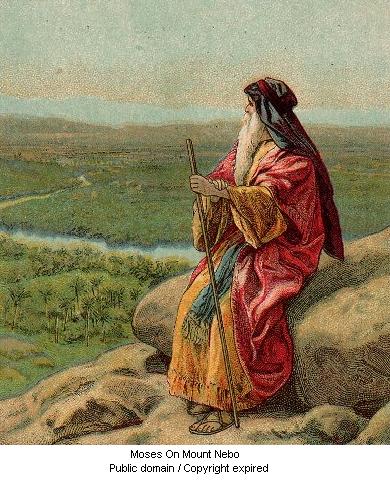
Moses said, “See, I have set before you today life and prosperity, death and adversity. If you obey the commandments of the Lord your God that I am commanding you today, by loving the Lord your God, walking in his ways, and observing his commandments, decrees, and ordinances, then you shall live and become numerous, and the Lord your God will bless you in the land that you are entering to possess. But if your heart turns away and you do not hear, but are led astray to bow down to other gods and serve them, I declare to you today that you shall perish; you shall not live long in the land that you are crossing the Jordan to enter and possess. I call heaven and earth to witness against you today that I have set before you life and death, blessings and curses. Choose life so that you and your descendants may live, loving the Lord your God, obeying him, and holding fast to him; for that means life to you and length of days, so that you may live in the land that the Lord swore to give to your ancestors, to Abraham, to Isaac, and to Jacob.”
______________________________________________________________
In this reading, understand how Moses said, “See, I have set before you today life and prosperity” – and then followed that up with details.
The details come in his saying: “If you obey the commandments of the Lord your God that I am commanding you today, by loving the Lord your God, walking in his ways, and observing his commandments, decrees, and ordinances, then you shall live and become numerous, and the Lord your God will bless you in the land that you are entering to possess.”
To support that, Moses then stated: “I call heaven and earth to witness against you today that I have set before you life,” from which to choose. This is then stated to be a “blessing,” as from “life” comes “prosperity.”
That “blessing” becomes a reward for the choice to serve God. Thus, Moses then said: “Choose life so that you and your descendants may live, loving the Lord your God, obeying him, and holding fast to him; for that means life to you and length of days, so that you may live in the land that the Lord swore to give to your ancestors, to Abraham, to Isaac, and to Jacob.”
When Moses spoke of the alternate choice – “death and adversity” – he implied that was a natural end, from a failure to choose “life.”
This was then detailed in his saying: “But if your heart turns away and you do not hear, but are led astray to bow down to other gods and serve them, I declare to you today that you shall perish; you shall not live long in the land that you are crossing the Jordan to enter and possess.” It is natural to serve what your heart seeks. It requires a seeker to choose “life” through God, as opposed to natural “death” as a mortal.
Moses then said he had warned about choosing “death” and the “curses” that choice brings.
This reading from Deuteronomy … about the choice between life and death … has to be understood in greater terms that physical life in a body of flesh (“life”) and the release of an eternal soul upon the end of usability in that material form (“death”). The meaning of “life” in this reading is as eternal life, in the presence of God, which is a spiritual “life.” This means that “death” is the opposite of that spiritual “life,” as the presence of an eternal soul in a body of flesh that is limited in its ability to support “life.” Thus, a soul born into a human form is bound to “death” through the simple fact of mortality.
The result of “death” is reincarnation. An eternal soul that has proved to be unworthy of spiritual “life” – to remain one with God – is returned to the plane of that soul’s choice. As such, a material “life” can be assured of another bodily “death,” unless that soul is led to “life” as a reborn Christ. Moses was pointing this out, albeit in “between the lines” form.
When one then analyzes the requirements of choosing “life,” the acts of obedience, love, following a path set by God (not self), the chosen “life” follows steadfast rules. Thus, the reward is said to be: “then you shall live and become numerous.” This reward has nothing to do with physical lineage, although it is easy to become distracted by the promise made by God to the Israelites – the direct descendants of Abraham, Isaac and Jacob.
The reward has wholly to do with the presence of the Holy Spirit, which is the only way one can fulfill all the aforementioned requirements. When one is filled with the Holy Spirit, then one has “life” “to live” and one “becomes numerous” through the lineage of passing on the Holy Spirit to others. One filled with God’s Holy Spirit is for the purpose of exponential increase of God’s presence in others. Therefore, “living in the land” sworn to those named Biblical patriarchs is much more than being a land on the other side of the Jordan, where Canaan (to be named Israel) was, but heaven.
It is so important to realize that Abraham, Isaac, and Jacob were not typical human beings, whose power, wealth, and influence came from being acute businessmen. True. They profited greatly in the world; but they were, above all other titles held, High Priests who recognized and served the One God – YAHWEH. Abraham begat Isaac, and Isaac begat Jacob; but Abraham also begat Ishmael and Isaac also begat Esau, neither of whom were descendants who walked the path of the LORD.
Likewise, Adam begat Cain and Abel [Abel was the soul that became Seth], where one was true to Adam’s priestly heritage of serving the One God, while the other served as a priest to a lesser god. All those forgotten characters of lineage were human beings who served worldly gods and matter not in the thread of Holy Spirit that is the Holy Bible. Therefore, physical heritage has nothing to do with the promise of Moses, as the only lineage of merit is that of being a descendant of God [a Son of God], through the presence of God’s Holy Spirit.
In this same sense of physical heritage, Jacob begat twelve sons, with Joseph being the only true priestly follower of Isaac. Joseph was hated by his brothers and sold into slavery in Egypt. Joseph’s “life” as a High Priest, filled by the Holy Spirit, was shown in his abilities to prophesy. He rose to advise the Pharaoh in a position of importance. Like Elisha’s request of Elijah: “Give me a double portion of your spirit,” Joseph would receive a double share of the land of Canaan, through his sons Manasseh and Ephraim who were adopted by Jacob. Still, Jacob would give the blessing of his right hand to the younger Ephraim, instead of the elder Manasseh, because Jacob (Israel) saw Ephraim becoming greater than his older brother. This greatness must be seen as in priestly measure.
Because of the choices Moses offered the Israelites – the descendants of Jacob [Israel] – the “life” or “death” options can be seen as paralleled to the “captivity” in Egypt and the “freedom” of a Promised Land. The “bondage” is not to a land or a ruler, but to the worldly domain, where many gods demand our obedience and allegiance. This means the “freedom” found in a new land – where the Israelites continuously rebelled and complained about the restrictions of their Covenant – has little to do with ownership of property in this world offering “freedom.” The offer of “freedom” is from the “death” that is associated with a mortal life, such that “freedom” can only be the immortality of a soul allowed to retain spiritual oneness with God.
The harsh environment that Egypt had become for the Israelites symbolizes the harshness of human conditions: the loss of childhood dreams to adult realities, the slavery to work in order to pay the price for life on earth, and the ravages of old age on a body. There is no “freedom” from life on earth – no Emancipation Proclamation that can ever be mandated in writing – that can free human beings from the slavery that one finds in a human body of flesh … one that is always demanding servitude to mortal needs. It is the realization of the idiom: Death and Taxes. This projects the certainties of mortal existence.
It is important, above all other points of perspective, to see that the Israelites never lost their lusts for human ways. They longed for the pleasures of a worldly existence, which were hoped for as islands of respite in an environment of punishment and persecution. The benefits of “life” in Egypt, just like the perceived benefits of “life” in Canaan, were seen as better to enjoy when physical “life” on earth was the same as the “life” in other nations. This is the fault of Esau, who sold his birthright for a bowl of savory stew.
Moses never promised the rewards of heaven to any soul that would sacrifice eternal “life” for a pause in the pains of human suffering. Thus, the chosen ones were not simply human beings, but those who heard the words spoken by Moses and knew his promise of true “life” meant a lifelong servitude to God – the “death” of a dependency on “death.” Just like “death” and taxes, heaven cannot be gained without hard labors.
This is why the Jews (as a race) have no claim to being God’s Chosen People. The rejection of Jesus of Nazareth as the promised Messiah, by those who call themselves non-Christian Jews, means they chose “death” and a return to mortality. They chose not God, preferring to serve lesser gods than YAHWEH: Mammon, Baal, Satan; gods of war, philosophies, and politics, who relish in their misguided servants’ zeal for sins like the theft of lands, the misuse of mortal powers of influence, and the hoarding of material wealth. Those not filled with the true Holy Spirit serve material ways and human rewards, all which are represented by the many gods of “death,” who are as dead as the religions they pretend to represent.
It is not for God to choose people, but for people to choose God. This is the stipulation of the Covenant that all human beings find as the promise made to them equally: “Obey the commandments of the Lord your God that I am commanding you today, by loving the Lord your God, walking in his ways, and observing his commandments, decrees, and ordinances.” All who make the Lord their only God, so they can call upon Him as “My Lord,” they are the ones who can be seen as God’s chosen people, because those people choose obedience to God, as servants only to their God.
These commitments can only be met by the power of God in one’s heart, through a marriage to God, from deep love. This means more than observing the mentality of words. It means the sacrifice of self to a husband, where God is that husband. The child of that union then becomes the Mind of Christ, where one becomes “dead” as a self-ego of human mortality and reborn as a new Jesus in the world. All who are without Christ refuse to make this commitment, as self is more important than sacrifice and servitude.
Only when one experiences the “death” of mortal life, which is “life” defined by “death,” can one begin to see the benefit of eternal “life” in the new Promised Land. With the marriage to God resulting in the rebirth of Jesus Christ, “then you shall live and become numerous, and the Lord your God will bless you in the land that you are entering to possess.” “Life” never grows old and always rejoices in the vitality of birth. With God in one’s heart, the soul leaps with joy within its worldly body, like a fetus growing to maturity in the womb.
In that regard where Moses spoke, “entering the land to be possessed,” the mortal body becomes that land. In Biblical history, a wildly flowing Jordan River would be made stopped and dry by the Ark of the Covenant, carried by the priests of the twelve tribes (following the death of Moses, led by Joshua). This is how the Holy Spirit’s presence reverses the flow of worldly mortality. The changes in that crossing also symbolizes the baptism of Jesus, as the water of the Jordan could not wash away sin from purified people. Physical water backed away as the dove of the Holy Spirit descended upon him, so Jesus entered the realm of God and God entered into Jesus, via His Holy Spirit. Thus, the Lord says to all His High Priests, “This is my Son in whom I am well pleased.”
Moses directed his words to the Israelites before they purified themselves and crossed over. God put those words in Moses’ mouth for your eyes to read and your heart to hear. God is well pleased by a new bride who sacrifices “death” for eternal “life.”
 Explaining the Readings