Tag Archives: Deuteronomy 34:1-12

Deuteronomy 34:1-12 – Moses saw the whole land of his seed from spiritual heights [Twenty-first Sunday after Pentecost]

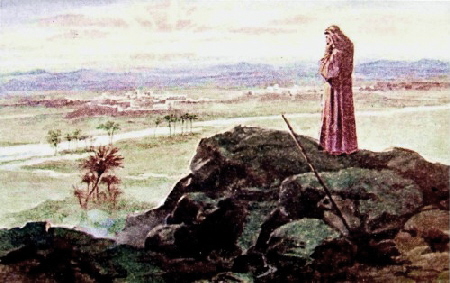
Moses went up from the plains of Moab to Mount Nebo, to the top of Pisgah, which is opposite Jericho, and the Lord showed him the whole land: Gilead as far as Dan, all Naphtali, the land of Ephraim and Manasseh, all the land of Judah as far as the Western Sea, the Negeb, and the Plain—that is, the valley of Jericho, the city of palm trees—as far as Zoar. The Lord said to him, “This is the land of which I swore to Abraham, to Isaac, and to Jacob, saying, ‘I will give it to your descendants’; I have let you see it with your eyes, but you shall not cross over there.” Then Moses, the servant of the Lord, died there in the land of Moab, at the Lord’s command. He was buried in a valley in the land of Moab, opposite Beth-peor, but no one knows his burial place to this day. Moses was one hundred twenty years old when he died; his sight was unimpaired and his vigor had not abated. The Israelites wept for Moses in the plains of Moab thirty days; then the period of mourning for Moses was ended.

Joshua son of Nun was full of the spirit of wisdom, because Moses had laid his hands on him; and the Israelites obeyed him, doing as the Lord had commanded Moses.

Never since has there arisen a prophet in Israel like Moses, whom the Lord knew face to face. He was unequaled for all the signs and wonders that the Lord sent him to perform in the land of Egypt, against Pharaoh and all his servants and his entire land, and for all the mighty deeds and all the terrifying displays of power that Moses performed in the sight of all Israel.

———————————————————————————————————-

This is the Old Testament selection from the Episcopal Lectionary for Year A, Proper 25, the twenty-first Sunday after Pentecost. It will next be read aloud in church on Sunday, October 29, 2017. This is important because it tells of the death of Moses and his legacy among the Israelites.

This reading becomes a confirmation of the dream state analysis I presented for the readings from Exodus 31 and Exodus 33. It also speaks about the use of “face,” which has been omitted from English translations of the First Commandment. The proper translation should state: “Thou shall have no other gods before me to face.” Because we are told here, “Moses, whom the Lord knew face to face,” that element (meaning one cannot even wear his or her own face before God, as that acts as another god before God) is key to grasping the depth of this whole reading.

The thirty-fourth chapter of Deuteronomy begins by stating, “Moses went up from the plains of Moab to Mount Nebo, to the top of Pisgah, which is opposite Jericho, and the Lord showed him the whole land: Gilead as far as Dan.” Simply from the imagery that comes from those segments, creating one statement, one can easily hear or read those words and think Moses went to some high elevation and God opened his eyes to see long distance. Without knowing how high Mount Nebo is (it is 817 meters, or 2,680 feet above sea level), one can think this is similar to going atop Lookout Mountain (see Rock City, elevation 2,389 feet), where one can see U. S. seven states. However, this is not how to read verse one.

To get the big picture, one has to focus on the word “Pisgah.” This is not a proper place, although some may offer conjecture that this is the name of another mountain in Moab, presumably beyond Mount Nebo. The word “pisgah” means “cleft,” in Hebrew. This means Moses did not go to the “top” of a specific ridge on Mount Nebo, but he went into a cleft at the top of Mount Nebo.  Any capitalization then written or implied acts to show this was not an ordinary “cleft,” but a most important one.

This is then a reference to Exodus 33:22, where the LORD told Moses, “See, there is a place by me where you shall stand on the rock; and while my glory passes by I will put you in a cleft of the rock, and I will cover you with my hand until I have passed by.” The Hebrew word used there is “bə·niq·raṯ” (root “neqarah”), which means, “a hole or crevice,” implying a “cavern or cleft.”

As I explained (hypothesized) in my interpretation of that Old Testament reading for Proper 24, Moses became one with God when in that cleft, as his body became encased in the “rock” that was God surrounding him. Thus, being in a “cleft” of the LORD implies being in that holy dream state, where prophetic visions make one see through the face of God. It is only after coming out of that state, when the results of the Holy Spirit’s presence can be seen, such that that becomes identified as the “back side of the LORD.”  This same meaning should be inferred in Deuteronomy 34:1, upon “Pisgah.”

By realizing that, one can now look at the map below and see the breadth of vision that was allowed Moses, while in a holy dream state atop Mount Nebo. Due east of Mount Nebo is Bethlehem, 35 miles away. The “sea” was twice that distance, 70 miles away. It was 80 miles, north and slightly west, to Bethsaida, at the northern shore of the Sea of Galilee, the southern edge of Naphtali. It was roughly 58 miles to the southwest where Zoar was located. The purple circle that I have added to the map then represents a panoramic view with a radius of 80 miles.  That distance captures all of the places mentioned in the first three verses of Deuteronomy 34.
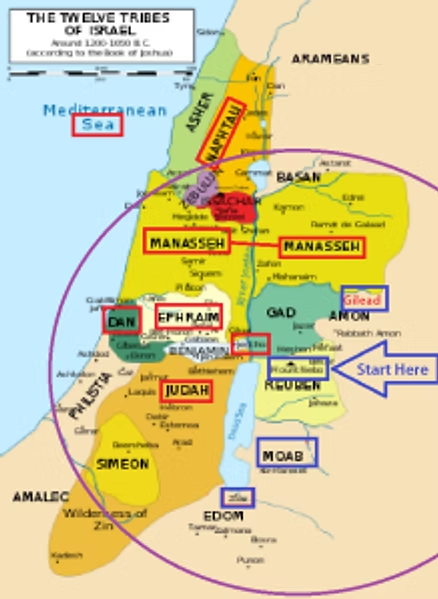
It might be possible to see the distant tops of mountains that border the valley of the Jordan River (and Gilead was a mountain range east of the Jordan River, between Manasseh and Gad); but was Moses limited to such a pedestrian view? If “Pisgah” does indeed mean “cleft,” then one can realize how God showed Moses much more than a vista of the Promised Land.

When we then read the LORD telling Moses, “This is the land of which I swore to Abraham, to Isaac, and to Jacob, saying, ‘I will give it to your descendants’; I have let you see it with your eyes, but you shall not cross over there,” we are returned to the element of “Seeing,” which began Exodus 33 and was the theme of that reading.

The translation, “I have let you see it with your eyes,” comes from the Hebrew “’et·tə·nen·nāh her·’î·ṯî·ḵā ḇə·‘ê·ne·ḵā,” which (as variations of three words) is more like three statements being made: “I will give” (“nathan: to give, put, set”), “I have caused you to see [it]” (“raah: to see”), and “with your eyes” (“ayin: an eye”). The allowance of God is a gift of the Holy Spirit, which then becomes the cause of a vision (acceptable variation allowed from “raah: to see”).  This “sight” was then seen by Moses in his mind’s eye.

When it then shows (by the English translation above) an exception to this “gift” of “sight” by God, as “but you shall not cross over there,” it gives the impression that God was teasing Moses. He was showing him all the bounty of the Promised Land, but then saying, “You can’t go there.” That is the wrong impression.

The Hebrew actually says, “wə·šām·māh lō ṯa·‘ă·ḇōr,” which is better translated as “and there not do cross over.” If anyone remembers the TV show Crossing Over with John Edwards, then one should be familiar with the term “crossing over” as it is relative to death.

A viable use of “abar” (the root of “ṯa·‘ă·ḇōr”) is “pass on” or “pass away.” Since the next verse states, “Then Moses, the servant of the Lord, died there in the land of Moab,” the meaning of “and you shall not pass away there, at the Lord’s command,” says God told Moses, while in a prophetic vision state, “You will die before setting foot on this land I am showing you.”

Because the verse that follows states, “Moses then died,” the assumption is that Moses died as soon as God told him that. However, the end of a verse with a period (mark of “complete stop”) and the beginning of a new verse with a capitalized first word (new thought) does not mean take a deep breath and then immediately continue.  To see how considerable time can pass between such transition points, I recommend looking at the Last Supper verses.  That evening took at least six hours of time.

Because of this realization, there is the distinct possibility that Moses awoke from that dream state atop Mount Nebo, knowing his future; and he was then able to make a few arrangements about his burial and inform key personnel about the coming change. According to lore, Nostradamus told his assistant (Chavigny) he would be found dead in the morning, and he was.  If you recall, Jesus made a few preparatory comments to his disciples, prior to his dying.  Therefore, it is reasonable to think God would not suddenly take the life of Moses away from him.

When we are then told, “Moses was one hundred twenty years old when he died; his sight was unimpaired and his vigor had not abated,” this firmly states that Moses and God were still of One-being, until the day Moses “gave up the ghost.” Moses was filled with the strength and longevity that the Holy Spirit brings. He was fully capable of seeing as a prophet of the LORD, and he was fully capable of acting on every command the LORD gave. In this case, the LORD commanded it was time for the physical presence of Moses among the Israelites to leave them.

The death of Moses, in this light, has to be seen in direct comparison to Jesus of Nazareth. Moses lived 120 years, which is a numerological 3 (1+2+0=12 > 1+2=3). The number three is symbolic of the Trinity, as well as “initial completion.” The children of Israel had reached a stage of training, where their most holy teacher had to let them graduate and take forth what they had been taught to the next level. Jesus lived 33 years, which is a numerological 3 elevated to the spiritual status of an 11 (3 x 11=33).  This means Jesus was on a higher plane spiritually than an ordinary 6 (3 + 3 = 6).

Additionally, Jesus was transfigured on the high mountain and Moses appeared beside him. Both Moses and Jesus were representatives of the Trinity (Father, Son, and Holy Spirit in one being).  Both obeyed the commands of the Father. Both were able to talk with God with “unimpaired vision” of what was before them. Both were doing the work of the LORD, without any weakness of Spirit.

When this reading from Deuteronomy 34 goes on to state, “Joshua son of Nun was full of the spirit of wisdom, because Moses had laid his hands on him,” the same way that Moses touched Joshua spiritually is then comparable to Peter standing (with the other ten Apostles), as Jesus had “laid hands upon him” similarly. Where as Moses touched one (Joshua), a Trinity led to a Trinity.  An an elevated Trinity, Jesus touched eleven, leading to eleven Trinities.  All who were touched became filled with the “spirit of wisdom.”

By adding, “the Israelites obeyed [Joshua], doing as the Lord had commanded Moses,” this says the disciples of Moses became the disciples of Joshua.  Joshua taught and the Israelites learned and believed.  This is also how the Jews converted to becoming Christians, with everyone doing as the LORD commanded, via the Holy Spirit. As was Moses, so was Joshua, and as were the Israelites. As was Jesus, so were the Apostles, and as are, and always will be Christians.

It is so easy for Christians today to see Jesus Christ as the Son of God, seated at the right hand of the LORD, and think less of those holy men who came before Jesus. However, to read, “Never since has there arisen a prophet in Israel like Moses, whom the Lord knew face to face,” one has to see Moses as the equivalent to Jesus, with this truth stated about Moses being tied to Israel, prior to their fall.

Jesus can have the same truth stated about him, as “Never since has there arisen a prophet in the world like Jesus, whom the LORD knew face to face.”

The element stated as “face to face” is in Hebrew “panim el- panim.” The “el” word is read as a prepositional prefix added to the first “panim,” but the noun “el” means “god,” which can be ignored or read as a clue about how to read this three-word statement. As a preposition, “el-” means, “to,” but also “into” and “towards,” with the implication being “against.” As such, the statement says the LORD knew Moses because Moses allowed his “face” to change “into” the “face of God.” His “face” was “towards” God, as subservient, to the point of being pressed “against” the “face” of God, so his own “face” was lost.  What the LORD’s Mind needed to be transferred, as the knowledge of Moses, it entered that person so Moses’ “face” shone like the sun. Jesus was known by God in the same way, but less physically obvious.  Still, Jesus is said to be the “light,” as he shines the “face” of God so all can see the truth.

I will leave it up to the reader to draw comparisons to the statement that Moses was “unequaled for all the signs and wonders that the Lord sent him to perform.” It should not be hard to do that now.
Matthew 22:34-46 – Whose son is the Christ?

When the Pharisees heard that Jesus had silenced the Sadducees, they gathered together, and one of them, a lawyer, asked him a question to test him. “Teacher, which commandment in the law is the greatest?” He said to him, “’You shall love the Lord your God with all your heart, and with all your soul, and with all your mind.’ This is the greatest and first commandment. And a second is like it: ‘You shall love your neighbor as yourself.’ On these two commandments hang all the law and the prophets.”

Now while the Pharisees were gathered together, Jesus asked them this question: “What do you think of the Messiah? Whose son is he?” They said to him, “The son of David.” He said to them, “How is it then that David by the Spirit calls him Lord, saying,

‘The Lord said to my Lord,
“Sit at my right hand,
until I put your enemies under your feet”’?

If David thus calls him Lord, how can he be his son?” No one was able to give him an answer, nor from that day did anyone dare to ask him any more questions.

——————–

This is the Gospel reading from the Episcopal Lectionary that is scheduled for public reading on Proper 25, Year A.  It will next be read aloud by a priest on Sunday, October 25, 2020.  In the numbering of the Ordinary selections, this reading will take place on the Twenty-first Sunday after Pentecost.  It was last read aloud in church on Sunday, October 29, 2017.

I offered an opinion on this reading, which I published on this site now, from back on October 10, 2017.  I stand behind those observations and welcome all to read that article.  What I want to do now is connect what Jesus told the Pharisees, in this inspection for blemishes (as the sacrificial lamb on display), with the Old Testament readings.  I have just recently published my views on Leviticus 19 (the Track 2 reading option), but the reading from Deuteronomy 34 (the death of Moses) also supports this Gospel selection well.

This means one must begin discerning Matthew 22:34-46 by understanding both of those readings.  For the Leviticus 19 reading (which, as a Track 2 offering, might never be chosen to read), one must firmly grasp how God told Moses to tell His people, “You must be holy, because I am holy.”  The only way to be holy is to be one with God, as was Moses and as was Jesus (and others like them).  Then, one must realize that God showed Moses all the land the Israelites would settle in (from east of Jericho), where the only way to see the whole nation of Israel [before it was a nation] was to be one with God.  From that understanding, to read that Joshua “was full of the spirit of wisdom, because Moses had laid his hands on him,” that was the ‘tag, you’re it’ passing on of God’s Holy Spirit, so Joshua was also one with God.

This has to be firmly grasped – AT ALL TIMES – because Christianity has fallen into the malaise of thinking it is not proper to think anyone other than Jesus can be the Christ, so everyone squats and laments all the evils in the world, while doing nothing but wait for Jesus to return.  Had God let Moses die and not allow him to pass the torch onto Joshua, then the Israelites would have stormed into Canaan demanding their land, only to be outright slaughtered for being idiots.  Likewise, if God had let Jesus die and not have allowed him to prepare the disciples to carry on his torch, nobody would be reading this article now or caring about anything divine as Christianity would have never been.

So, with that understood, let’s look at what Matthew 22:34-46 says.

This reading begins by stating, “When the Pharisees heard that Jesus had silenced the Sadducees.”  Over the past few Sundays, Matthew 22 has been read and probably preached, beginning with the parable of the wedding banquet (1-14), followed by the tax to Caesar (15-22), to now this encounter with the Pharisees (34-46); but nothing has been said about the confrontation with the Sadducees.  Here’s why:

From the Episcopal Lectionary Reverse Lectionary search of Matthew.

The Episcopal Lectionary does not ever address this confrontation, as told by Matthew.  It is, however, addressed from Luke’s perspective (Luke 20:27-38), during the Ordinary after Pentecost season in Year C (Proper 27).  That means it should at least be mentioned here, so one does not start off lost, dazed and confused about what happened between Jesus and the Sadducees.

The Sadducees presented Jesus with a wild scenario about a woman who was married to seven Jewish men (one at a time), all brothers [a legal thing], with none ever having sired a male heir.  They wanted Jesus to fall into a trap about the afterlife (which they did not believe existed), asking him which man would be the husband of the wife in heaven.  Jesus sent them away whimpering, tails between their legs, by his saying, “God rules over the living, not the dead.”  Besides that being a question about heavenly marriage, it is important to know the zinger about God and truly being alive.  Knowing that helps when looking at this reading for Proper 25A.

So, when we see the Pharisees coming to Jesus to ask him what the most important law is he knew they also were up to no good.  Thus, when they asked their question, God spoke through Jesus, saying “You shall love the Lord your God with all your heart, and with all your soul, and with all your mind.”  That is not a law of Moses, but a reminder from God that states one’s expected way of life.  It says, “Let God tell you what is most important.”  (If you are living!)

Think about that for a moment, knowing the Sadducees had just muttered themselves back into their Temple lair after having asked some male-dominated question about who gets to claim a wife in heaven.  Imagine them asking Jesus, “Do wives even get to go to heaven, if they do nothing I tell them to do, the way I tell them to do it, here on earth?”  The audacity of thinking women must possess souls that will never go on ego trips and power quests!

In the same way Jesus told them how God is the God of the living, not of the dead, those idiots could not even feel the cold wet slap of reality hit them in the faces that said, “You are dead to God.  Wake up and live while you still have that chance!”  Waking up demands all the Jews (Sadducees and Pharisees especially) marry God.  It is best to marry one you love with all your heart, all your soul, and all you mind!

Marrying God, like the concept of marriage the Jews had, meant making all the necessary sacrifices of a bride.  To be God’s wives, they would have to accept they were as worthless as Jewish men saw women in ancient Jerusalem [a mindset that still prevails everywhere today].  Back then, a daughter had no say in who her father gave her to.  Love was never a factor in the process of engagement.  Marriage was the reality of commitment, with a wife committed to serving her husband (and vice versa); offspring were a natural expectation.  However, marrying God was such a foreign concept to the leaders of the Jews back then, the Pharisees were still planning on ruling heaven as they ruled Jerusalem.

If they wanted to get to heaven, they needed to accept the invitation to the wedding banquet, where they would marry God.  Their earthbound egos would give their souls away, where they would become the new daughter of God the Father. 

The debt their souls owed was to God, not some emperor.  To return a soul to God meant to marry Him and become His wife.  Marriage to God then meant being alive with the Holy Spirit, not dead (like was a soul sinning in a body of flesh). 

All of that meant the most important thing Jews had to do was stop thinking they were gods (that male-dominated ego speaking) and start realizing they were totally insignificant in the grand scheme of things.  To reach that point of awareness, the Jews had to “love God with all their hearts, minds, and souls.”

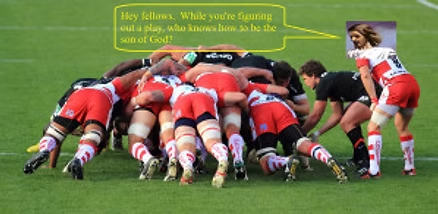
Now, when the reading states “the Pharisees were gathered together,” this has to be seen like some sporting match – a contest of strengths and skills, a battle of the big brains – where the last play failed miserably and it was time to regroup.  Like in a football game, they all huddled together to draw up another play in the dirt. 

That becomes a statement that yells, “Stop thinking!”  Just like you cannot know what the greatest commandment is, because as soon as you say one, you realize, “No!  Wait!  Try this one!” your Big Brain is smaller than a mustard seed, when compared to God’s omniscience.  Stop trying to outsmart God!  Gain access to the Godhead through marrying God’s Holy Spirit.

God then had Jesus ask those great brains of Jerusalem, “What do you think of the Messiah? Whose son is he?”  They immediately fell into his trap, simply because they thought they were so smart and Jesus was just a dumb rube from Nazareth.  They forgot all the times before their mouse trap plans failed, with them instead being snapped tight.  With a thud they fell into God’s snare, when they answered, “The son of David.”

They immediately gave that answer because they did not worship God.  They worshiped human power.  They had just showed Jesus a denarius with Julius Caesar’s image engraved on it, so they could have said, “The son of Caesar” and more honestly expressed their wish.  He was the ruler du jour; but they wanted to name a king that would give them the right to claim to be heirs of a kingdom.  In their pea-brains, they imagined the Kingdom of Judaism to be grander than the kingdom of heaven.  However, Jesus pointed out how flawed that idea was.

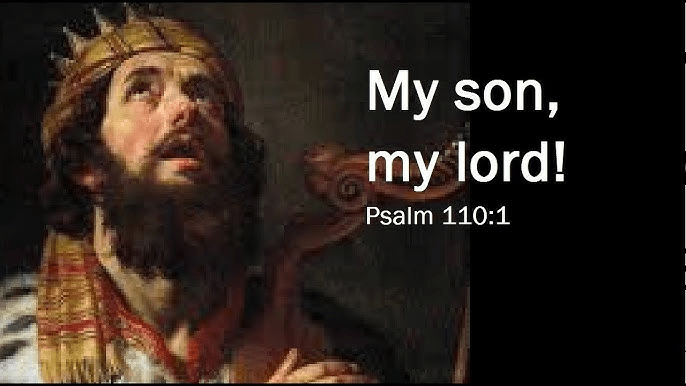
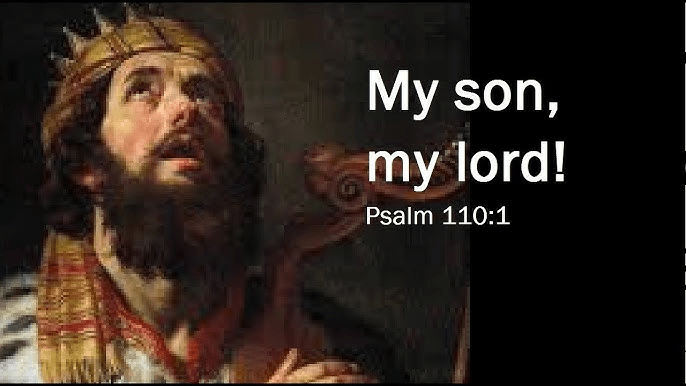
When Jesus asked them, “How is it then that David by the Spirit calls him Lord?”  The key term there is the capitalized word (in Greek) “Pneumati,” which is a statement of importance beyond normal “breath” or the “spirit” of kingly power (like a form of energy).  The capitalization says Matthew knew Jesus was speaking of the Holy Spirit being in David when he wrote psalms.  As such, Jesus said David was one with God, when he addressed God as “Lord.”

The element of “Lord” must be realized from the Hebrew of Psalm 110, verse 1, which Jesus quoted.  After introducing a new song written by David (in the “Spirit”), he wrote “Yahweh ladonai,” which personalizes “LORD of lords” [Yahweh adonai] to say “LORD of my lords.”  The point Jesus was making (as God speaking through him) was, “If the Messiah is expected to be the descendant of David, then why did David refer to Yahweh as LORD, and not Father?”  After all, David was the son of Jesse (not a king) and Solomon was the son of David’s sins, who reigned as his somewhat illegitimate heir (after Absalom was basically murdered by David’s general’s order).  That family tree had been reduced to a stump of rulers by the Babylonians.

Jesus [a descendant of David, by the way] then pointed out that for a son of David to be the expected Messiah, then David would himself have to be a son of God.  That totally befuddled the Pharisees, which proved their big brains were really just the brains of simpletons.  They walked away tight-lipped.

What is totally missed here is there is an answer to give.  When Jesus asked, “If David thus calls him Lord, how can he be his son?” the answer is: “If David sacrificed his self-ego, giving up his title and position as king to serve God, as his Father, then he would be a son of God.”  The Pharisees never could fathom anyone ever doing that.  What would be the point of ruling the world, if you could not become worldly rich in that process – even have great domineering powers, as men, over all women?  So, they walked away muttering like the Sadducees before them, looking for their place in darkness to hide.

The answer to Jesus’ question is found in the Deuteronomy reading, after Moses died.  We read that Joshua was the son of Nun.  That statement as to Joshua’s father is the only place in the Holy Bible where the name Nun is mentioned.  The name means “Fish” [“I will make you Nunneries of men?”].  That father named his son a name that means “Yahweh Is Salvation” (Joshua).  The name Jesus means “Yahweh Will Save.”  Still, Joshua being named as a son that was not Moses says God is the Father of all who will be the Messiah that brings Salvation to the people.

The Deuteronomy reading states, “Joshua was full of the spirit of wisdom, because Moses had laid his hands on him; and the Israelites obeyed him, doing as the Lord had commanded Moses.”  That says the Christ (Messiah) would never be the son of a human being, but the Son of God, which happens when someone with God within him or her touches another so the hands of God are laid upon him or her too.  That Messiah (Christ) is then (like Jesus) God incarnate in the flesh.  David was the son of God, when Israel regularly battled the evil presence surrounding them; but David failed God as a son when he let his power overtake his soul.  The nation then reflected both the times of righteousness and the times of sins shown by David and all their subsequent kings [and prior judges].

Of course, we Christians all know that Jesus asked that question knowing he was the Christ of God.  We giggle as the Pharisee walked away silent [flash back to the one not wearing a wedding gown being silent when the king asked him how he got in the banquet]; but Christians end this reading with silence, just like the Pharisees.  Christians are equally befuddled, because they all think the son of God can only be Jesus, forgetting all about Joshua being filled with God’s Holy Spirit, in the same way Moses was filled with it AND in the same way Jesus was filled with it AND in the same way ALL the Apostles were filled with it AND in the same way ALL true Saints recognized by Christianity have been filled with it.

Moses was reborn as Jesus Christ before God made holy flesh named Jesus.  Moses passed Jesus Christ onto Joshua.  David was the resurrection of Jesus Christ when he was a boy shepherd.  Jesus is the model for ALL flesh that is living, made so by marriage to God.  The Christ is the Mind of God leading anyone who bows down before God totally – submitting heart, brain and soul completely to Him, through love.

God cannot be limited.  Big Brains cannot tell God how many times Jesus Christ can be resurrected in another body of flesh that has married its soul to God.  The Pharisees and Sadducees were so narrowminded they thought God worked for them, kind of like the lazy workers that showed up to the pick grapes of the landowner, but then laid in the shade all day long, still expecting to be paid wages for doing nothing.

The ones who walk away from Jesus silently just cannot fathom the entire world can be sons of God, if God so chooses.  It all depends on God finding the recipients of His Holy Spirit and His Christ Mind as worthy brides to marry (like all the above named people – Moses, Joshua, David, Jesus – plus many more unnamed).  The question asked by Jesus goes to ALL Christians today: How can anyone be the son of God, if one calls God his or her Lord?

Come out of the darkness of your lairs.  You know the answer.  The answer is SACRIFICE OF SELF-EGO.

The answer is ACCEPT GOD’S INVITATION TO MARRY HIM.

The answer is STOP THINKING YOU KNOW MORE THAN GOD AND LET GOD LEAD YOU THROUGH LIFE.

Be the wife of God (regardless of human gender).  Love God with all your heart, soul, and mind.  Be submissive to the Will of your most holy Husband.  Give birth to His Son in your flesh, becoming the Son of God resurrected.  Call your Lord and Master by His relationship title – Father.  Touch others with your holiness, a righteous state that can only come from God.

As far as short memory spans go, it was just two Sundays prior that Jesus ended a parable by saying, “For many are called, but few are chosen.”  Those conditions fit the ancient scenario of Jerusalem, just as well as they fit the scenario today of a religion calling itself in the name of Christ, when there are so few of true Christians around.  Everybody is too busy taking care of self to let their egos give their flesh over to God in marriage; but that simply means they are dead of soul.  So, God is not their God.  He’s only the God of the living.