Tag Archives: Deuteronomy 6:1-9

Deuteronomy 6:1-9 – God commands for the purpose of fearing God will not be your god

Moses said: Now this is the commandment–the statutes and the ordinances–that the Lord your God charged me to teach you to observe in the land that you are about to cross into and occupy, so that you and your children and your children’s children, may fear the Lord your God all the days of your life, and keep all his decrees and his commandments that I am commanding you, so that your days may be long. Hear therefore, O Israel, and observe them diligently, so that it may go well with you, and so that you may multiply greatly in a land flowing with milk and honey, as the Lord, the God of your ancestors, has promised you.

Hear, O Israel: The Lord is our God, the Lord alone. You shall love the Lord your God with all your heart, and with all your soul, and with all your might. Keep these words that I am commanding you today in your heart. Recite them to your children and talk about them when you are at home and when you are away, when you lie down and when you rise. Bind them as a sign on your hand, fix them as an emblem on your forehead, and write them on the doorposts of your house and on your gates.

———————————————————————————————————-

This is an optional Old Testament selection from the Episcopal Lectionary for the Twenty-fourth Sunday after Pentecost, Year B 2018. In the numbering system that lists each Sunday in an ordinal fashion, this Sunday is referred to as Proper 26. If chosen, it will next be read aloud in an Episcopal church by a reader on Sunday November 4, 2018. It is important because it is identified by Jesus as the first of all commandments, when one of the Temple scribes asked him to answer that question. As the part A of a two-part answer, from which all of the other commandments stem, the faithful will love God with all their hearts, all their souls, and all their strength. That love of God is then what brings God’s love upon one in return, via the Holy Spirit.

This alternate Old Testament reading choice is based on the Gospel reading from Mark 12. I have prepared an analysis of Mark 12:28-34, which offers an opinion on verses four through nine here. I recommend reading that article, as I will not take time to rehash that in this writing. I will offer some opinions on the first three verses.

In verse one, where we read, “Now this is the commandment–the statutes and the ordinances–that the Lord your God charged me to teach you to observe in the land that you are about to cross into and occupy,” there are two important aspects to grasp. One, Deuteronomy 5 restates the Ten Commandments and tells of Moses speaking for God to the Israelites. As such, verse one refers back to the prior chapter, of instructions that God had commanded through Moses. Second, the singular number spoken – “the commandment” [from “ham·miṣ·wāh”] – is both all that was spoken in chapter 5 AND that about to follow, as the singular Word of God. Everything Moses spoke (and thus recorded in writing) “—the statutes and the ordinances—“ was God’s commandment.

Verse two beings by stating [appearing later in the above paraphrase], “Purpose you may fear Yahweh your god,” where “Yahweheloheka” is written.  The “purpose” for God’s commandment is to fear Yahweh, who must be “your god” (from “elohim,” meaning “gods”), collectively and individually.
This is a commandment that the LORD IS GOD, the only God of Israel, and He has given Commandments, statutes and ordinances that demand compliance or all will be lost. Fear of breaking the commandment should then make each and every Israelite make the LORD become your gods. Anyone who does not have this fear of God will not comply with “the commandment –the statutes and the ordinances” and will start walking around wearing a Big Head, thinking one is him or herself a god.

Moses, then speaking for God and himself said, “I command you” to keep all the statutes and commandments, not only alone, but to teach one’s children (“son”) and grandchildren (“grandson”) to keep them. This was based on oneself having a fear of God; but to teach one’s family was not motivated by a fear of God. It was motivated by love of God, such that the greatest fear of God was not from Him punishing those who broke His commandments, but from losing God in one’s life. One’s greatest fear was that one’s actions would disallow one from God’s love.

This aspect of one’s love of God is then that of a devoted wife (regardless of human gender), who has loved God and been loved by God in return. There has been a commitment made between the two. The commitment is spelled out in the marriage contract that is the commandments of God. Still, that loving relationship has led to offspring (“ū·ḇin·ḵā” – “your son”) and [after forty years in the wilderness, a second generation] then further offspring (“ū·ḇen- bin·ḵā” – “your grandson”).

This is then the marriage contract taught within family, out of love of God and bloodline being born of God’s love. It is the wife also becoming one with the Father, so that parents [both wives of the Lord] love their children in a Father–Son manner, with a commandment being for all to “honor your father and mother,” where “honor” means to continue the bloodline and the love of God.

This is why verse three says “that it may be well with you that you may multiply greatly.” The word stating, “it may be well” is “yî·ṭaḇ,” which is rooted in “yatab,” meaning, “to be good, well, glad, or pleasing.” This then states the power of love in the production of offspring.

These three verses are then stating that living up to the commandments of God demand love. That love puts one in touch with God individually and deeply, so each of the Israelites felt the love of God born in them. Through the teachings of the commandments, carried on by loving parents and grandparents, each soul felt the wonders and powers of their God.

That love from God was so special, no one ever wanted to not love God completely. Still, the thought of losing God’s love – as a divorce that was justified by cheating on God, through serving another [even self] –was the fear of God each had to rely on, should any doubts or trials enter into one’s mundane life.

As an optional Old Testament reading selection for the twenty-fourth Sunday after Pentecost, when one’s own personal ministry for the LORD should be underway – one fears God and fears losing God’s love – the message here is to follow the most important commandment(s) – love God completely and then love your neighbors [extended families, all related by blood with the Father] as yourself. Love of God is what places God’s love in one’s heart, where all the commandments are written.

This modern world (which began developing long ago [see Ruth 1]) has ceased being led by hearts that love God. The brain has become “your gods” that keep all from loving God totally.  This pretense of self as god then prevents most from being able to recognize our “neighbors,” so we can love them too.

We have become followers of dogma, with empty souls standing among us who preach, “Jesus would love foreigners (or sinners, or non-family, or those who have never loved God totally),” as if they have been given a piece of sheepskin that proclaims “Authority on Jesus Christ.” They have no fear of losing God’s love, because they think the way to God’s heart is through His Son. As such, they love the ideal of Jesus Christ, but always speak of him in the third person, never as the Son having been reborn.
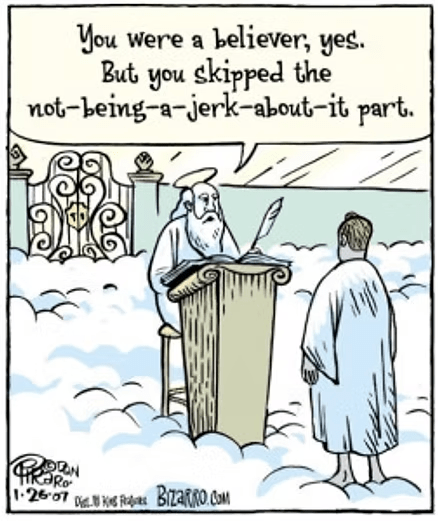
If they did, they would preach, “I love all foreigners,” speaking as one filled with God’s Holy Spirit, as Apostle-Saint reborn to the world as Jesus Christ.  Since Jesus only spoke the truth of the Father, such bold claims would be known to be lies.  Jesus of Nazareth never promoted all Jews love all Romans and welcome them into the land once known as the Promise Land.  Jesus actually said, “I come only for the children of Israel,” which rejected those who were not commanded to love God totally, loving others of the same God as themselves (who loved God totally).

Instead, those reborn as Jesus Christ today should open their mouths only when teaching their family the Law. Rather than venom being spewed on people – fellow Christians who also say they love Jesus Christ, but do not love foreigners or those Christians that speak lies – one reborn as Jesus Christ would say, “Bring me the children.”

Priests of Yahweh would stand with smiles on their faces, saying, “I love God.  I teach you to love God with everything within you, because losing the love of God turns one into a worshiper of self-ego.”  They would then add, “Loving God with all your heart, with all your soul, and with all your strength means wherever one is then so too is God.  There is no need to roam the world for a nice place to love God.”

There is a silent movement in the United States to mix the blood of a Christian [albeit misled] society with those of different blood, different ideologies, and different gods [if any]. This long-term plan has been promoted through the propaganda of network television and national advertisements (and still is).

The more people watch such false familial projections, the more [especially in the children] they begin to think “I should be like that.”

That program’s success is based on the breakdown of the historic family units, where love is the common bond, so it can be replaced by confusion about how a modern family should act. It will not be taught to obey the commandments of God and to love Him completely.

The concept of love in today’s world has been reduced to physical delights and material pleasures.

The wellness, the goodness, the gladness, and the pleasing nature of oneness with God, so it spreads to one’s family and to one’s neighbors, who are all married to Yahweh has been perverted. Love has been changed into a physical lust of the brain, in unnatural ways that the heart cannot bear. The love of God becomes a desire for worldly things and relationships are from Big Brain planning, which demands a hardened heart to accept. There is no longer a fear of God because all sense of love towards God has been mutated, if not stripped bare.

Last night I watched a clip of an interview between a cable news talking head and a comedian and his producer. They were promoting an upcoming movie that questioned, “When did America lose its sense of humor?” The comedian was saying that comedy has always been left of center, but it had been presented in a way that could easily be laughed at.

Chevy Chase mocking President Ford in 1975.

He said that now, comedy has become propaganda of hatred. It is not funny. It is an outright attack on those of conservative values, such that one has to immediately defend oneself (needlessly), saying why one is not a racist, one is not a homophobe, one is not a terrorist, or one is not an abuser of women, simply because the left [liberals against conservative and retaining standard social values] has caricatured values that have always been based on love as now being evil.

The producer friend of the comedian said (I paraphrase), “I am a religious man. I was raised to be religious and to fear only God. However, I have told friends that there is significantly more fear of the extreme left in this country, than there is fear of God.”

Amen to that brother.

Fear of God means to love God with one’s whole being. It means to know God in one’s heart. One’s mind will then be led by God’s love in one’s heart. When that love is present, then all the blurred parameters of who one should love and who one should hate disappear.

Just as God is love, He is the absence of hate. When one is in union with God, then one becomes God’s love.

In a world that is filled with hatred, one must be led by God’s love to avoid direct conflict with those who serve other gods and are filled with hate. One loves one’s enemy by letting that enemy hate him or her, without that hatred getting in the way of God’s love. [“Get behind me Satan.”]

The love of God is then between those in one’s bloodline family that also loves God completely, and those other families [neighbors] whose blood is also born of the love of God.  God said (through Moses), “[Maintaining the commandment of God is] so that you may multiply greatly in a land flowing with milk and honey, as the Lord, the God of your ancestors, has promised you.”  That meant, when one land is divided into twelve parts, each part will be neighbors, just as the parts of one’s body makes a whole.  To love one’s neighbors as oneself is then akin to saying, “Love your hand as you love your foot, because all parts are connected to one who loves God, and who God loves in return.”

One fears God by refusing to vouch for those whose criminal acts [against God’s commandments] are defended by non-believers who blaspheme the Son of God as a lover of evil. One has to fear losing God’s love more than one fears being outcast and persecuted for not getting with the blended family program.


Deuteronomy 6:1-9 – A Spiritual commitment with Yahweh as one’s only love

Moses said: Now this is the commandment–the statutes and the ordinances–that Yahweh elohekem your gods charged me to teach you to observe in the land that you are about to cross into and occupy, so that you and your children and your children’s children, may fear Yahweh eloheka your gods all the days of your life, and keep all his decrees and his commandments that I am commanding you, so that your days may be long. Hear therefore, O Israel, and observe them diligently, so that it may go well with you, and so that you may multiply greatly in a land flowing with milk and honey, as Yahweh elohe the gods of your ancestors, has promised you.

Hear, O Israel: Yahweh elohenu our gods, Yahweh alone. You shall love Yahweh eloheka your gods with all your heart, and with all your soul, and with all your might. Keep these words that I am commanding you today in your heart. Recite them to your children and talk about them when you are at home and when you are away, when you lie down and when you rise. Bind them as a sign on your hand, fix them as an emblem on your forehead, and write them on the doorposts of your house and on your gates.

——————–

This is the Track 2 Old Testament reading that will be read aloud in churches following that path on the twenty-third Sunday after Pentecost [Proper 26], Year B, according to the lectionary for the Episcopal Church. If a church is set for Track 2 during the Ordinary after Pentecost season, then this reading will be accompanied by verses from Psalm 119, one of which sings, “I will thank you with an unfeigned heart, when I have learned your righteous judgments.” That pair will precede a reading from Hebrews, where Paul wrote, “When Christ came as a high priest of the good things that have come, then through the greater and perfect tent (not made with hands, that is, not of this creation), he entered once for all into the Holy Place.” All will accompany the Gospel reading from Mark, where Jesus told some Sadducees, “The first is, ‘Hear, O Israel: the Lord our God, the Lord is one; you shall love the Lord your God with all your heart, and with all your soul, and with all your mind, and with all your strength.’ The second is this, ‘You shall love your neighbor as yourself.’ There is no other commandment greater than these.”

In 2018, the last time this reading came up in the lectionary cycle, I wrote a commentary that did not expressly focus on the verses that Jesus quoted from the Mark 12 reading that this can accompany. Instead, I referred the readers then to read a commentary on Mark 12 I had written, which I linked into that article. Because I am not as pleased with what I wrote in 2018, even though there is merit in what I wrote, I will not ask the readers now to read that commentary. It can be found by searching this website’s blog; but I will leave that up to the true seekers who just can’t get enough of Scriptural opinion to satisfy their needs.

First of all, there is nothing written that says, “Moses said.” That is manufactured by the Episcopal Church. The NRSV does not show that text. Certainly, chapter five was Yahweh speaking to the Israelites, followed by Moses then clarifying what the Covenant means to each individual Israelite, as a people in whole; so, this same aspect of Moses speaking can be seen in chapter six. However, if anything is to be made up, it should be this: “Moses continued speaking as the intercessor of Yahweh to the Israelites.” Anything less than that can give the false impression that Moses was creating thoughts from his own brain, which is the problem all the left-wing, liberal priests of the Episcopal Church have, as that is something they routinely do every day. As the saying goes: Opinions are like asshole – everybody has one. Thus, the importance to convey here is Moses spoke through divine inspiration; and, that must be the intent conveyed to the readers.

In the first five verses of what Moses spoke for the Father, as the foremost Israelite who was a soul married to Yahweh, thereby able to speak divinely, six times he uttered the proper name of Yahweh, with five times following that name up with some form of the plural word “elohim,” which means “gods.” This says the Commandments – “the statues and the ordinances” – are only an agreement between two – Yahweh and His angels in the flesh. The Covenant listed in chapter five is not for Egyptians. It is not even for Joacobites, or descendants of Jacob like those who wanted to build a golden calf idol to worship, instead of Yahweh. It is Moses making clear (through divine whispers leading his words) that an “Israelite” is “One Who Retains Yahweh, as one of His elohim.” This means the union of each of their souls to His Spirit. Thus, the Covenant is an agreement of marriage, where each one “Who Retains Yahweh” within his or her soul, is His wife, fully submissive to His Will.

In the five combinations that state “Yahweh elohim,” the forms “elohekem” and “eloheka” are translated by the NRSV as in the third-person plural possessive state, as “your God,” which would then be adjusted to reality as “your gods.” This does not read well as “your gods,” thus the gleefulness to transform the plural into the singular (with the kick of capitalization) as “you God.” When that translation is made, it becomes a statement of one possessing Yahweh, with the many each having the same possession of “the Lord” (not a named Yahweh). That is wrong, as none of the Israelites sent Moses up the mountain to tell Yahweh their terms of marriage. In fact, they followed Moses out of Egypt, after watching Moses command miracle after miracle, as the hand of Yahweh (along with Aaron), so they agreed to follow Moses anywhere Yahweh saw fit for them to go. Thus, the possession is of Yahweh, as He owns the souls of all the Israelites who agreed to marry Him, becoming His “gods” on earth in the flesh (call them His “angels”). So, the better translations of “elohekem” and “eloheka” should be as “you gods of His.”

In the statement that says “Yahweh elohe,” which is translated as “Yahweh the gods,” the same understanding must be seen. Yahweh is the One God, who created not only the Universe, but also created the “gods” that carried out His plan of Creation. In Genesis 1 there are thirty-two references to “elohim,” with none to Yahweh. Genesis 1:1 begins by stating, “in the beginning created elohim,” where the plural number (as “gods”) infers the creation of “elohim in the beginning” was done by Yahweh. In Genesis 2, when Adam is hand-crafted by Yahweh, there are eleven times “Yahweh elohim” is written. This means Adam was the first of the “ancestors” that Moses now referred to as “Yahweh elohe.” This is the list of the Patriarchs who led to the Covenant in the wilderness, with Moses. It should be realized that Adam, his descendants who all lived many hundreds of year, including Noah, then Abram-Abraham, Isaac and Jacob were all Yahweh elohe, meaning their souls were married to Yahweh, as His wives. Jacob transformed to the name Israel because of his divine marriage to Yahweh, after he wrestled with his own soul and its addiction to self. So, when Jacob finally submitted to divine marriage, his name was elevated to that of an angel possessed by Yahweh.

When Moses then said Yahweh is “our gods” (from “Yahweh elohenu”), this is again stating the collective possession by all, as Yahweh’s wives. This says they all have become elevated as Israelites, where all are the “gods of Yahweh all alike.” As wives of Yahweh they have all submitted their souls to Him alone. Because of this Covenant of marriage, none are allowed to worship or serve any other “gods,” which is stated clearly as the first Commandment, forbidding such infidelity. Therefore, because this marriage commitment is an eternally lasting agreement [a soul is eternal], it must be based wholly on “love.”

When verse four is translated to state: “Hear, O Israel: Yahweh elohenu [us gods of Yahweh], Yahweh alone,” the words “shama Israel” must be read as a proclamation that says “hear your new name being assigned: Israel.” It is the same voice heard by Jacob when his name changed to Israel. To be “Israel” one must commit to being one of Yahweh’s elohim, committing forevermore to be committed to “Yahweh alone.” This says each and every soul animating a body of flesh that heard Moses speak these words – no matter how far away from Moses he or she was at the time – they all clearly “heard Israel” be spoken as their individual names. One and collectively, they were spiritually named Israel; and, that is a statement of name change through marriage. The “el” part of Israel says each individual is an el of Yahweh, who gives them His name as “Yahweh elohim

Verse five then becomes what Jesus said was the most important Law, as here it is written: “and you shall love Yahweh as gods in His name ; with all your heart and with all your soul and with all your strength of abundance .” In the second series of words, “heart, soul, and strength” [from “lebab,” “nephesh,” and “meod”] speak of “inner being” [both “heart” and “mind”], which is the “soul” and the “muchness, might, and strength” that comes from being more than a soul animating a body of death [flesh is a corpse without a soul]. The “might” is that of Yahweh’s Spirit merged with one’s soul; and, this is what transforms a mere soul into one of the Yahweh elohim, so that “abundance” comes from being a hand of Yahweh on earth. All of this presence must be earned from total love and commitment, in order to receive the same love and commitment in return.

When verse six then says, “and shall be words these , which I command you today in your heart .” In this, the word “I” (from “anoki”) is not to be overlooked. It is a statement that the soul being in submission to Yahweh, as His wives (each and every one), they all will cease possession of their own self-ego or self-will. Verse six is like the “I do” part of marriage vows, when the question asked is, “Do you agree to allow only the words of Yahweh to be spoken by you, because He is One with your inner being?” The “I” becomes like how Jesus always said, “I speak for the Father, because the Father is within me.” The repetition of “lebab” says one’s life will forevermore be led by the Word of Yahweh through one’s “heart, mind, will, inner being;” and, that Word will be one’s life in ministry for Him.

The remainder of this reading has been interpreted by Jews [the failed Israelites, whose ancestors broke every agreement, leading to their demise] as: A.) a relationship with Yahweh is exclusive from anyone else in the world, as only those born of our blood can be taught that Yahweh is the God of Israel; B.) Jews will wear bands on their arms and little boxes on their head, to prove they are the special descendants of people long ago who loved Yahweh; and, C.) Jews will live in apartments, condos and subdivision homes that are marked by little prayer icons that are screwed into the wall, outside the front door. All of that is bull dung and not what Yahweh had Moses tell them to teach their children and their children’s children.

In the Hebrew that the NRSV translates as “Bind them as a sign on your hand, fix them as an emblem on your forehead, and write them on the doorposts of your house and on your gates,” all are symbols that state marriage. To “bind them as a sign on your hand” means to wear a wedding band on one’s finger, but in a figurative sense. It says let one’s hand do the works of Yahweh, as His wife on earth.

None of this means anything to Yahweh, unless one’s soul is married to His Spirit.

To have “emblems on your foreheads,” the Hebrew actually says to have “bands between your eyes.” This can be seen as a Hindu practice of wearing a ruby on one’s forehead, where a jewel represents the “third eye,” or the pineal gland that is centrally located in the brain. This is a statement of always having a line of communication with Yahweh, so one always speaks His Word.

To then “write them on the doorposts of your house and your gate,” this is the sign of the blood of the lamb that spares one death. To be spared death, a soul has been granted eternal life, as a wife of Yahweh, as a Yahweh elohim. The doorpost or the gate post is the soul’s entrance into a body of flesh, with the house being that flesh as a tabernacle unto Yahweh. The writings are then the Scripture that Moses commanded be memorized until written, such that the history of one’s Covenant with Yahweh will be an official pact in writing that devotes each soul in a body of flesh as His and His alone, forever.

It must be realized that nothing is written here that says the words Jesus spoke, which command “Love your neighbor as yourself.” Those words can be found in Leviticus 19:18, but they are not written here. It must be realized that the Book of Leviticus were special rules for those who would maintain the Tabernacle and the movements of the Ark and the Covenant. It also must be understood that the Levites were considered the least of the whole; so, the whole would all qualify to maintain the Tabernacle, as Yahweh elohim; but the Levites were designated that role due to the sins of Levi. Still, the commandment to “love your neighbor as yourself” is missing the key addition, which says, “I Yahweh.” While this can easily be sloughed off as meaningless dribble, when Yahweh felt the need to say, “I command this, so it will be!” the reality is it states the “neighbor” is not without, but within. This restates the total love demanded in the marriage commitment to Yahweh, so the “neighbor” within is “I Yahweh.” That is the Yahweh elohim ego that replaces self-ego and self-will. I will advance this notion when I write about the Mark 12 reading, as the Greek spoken by Jesus [recorded by Mark in Greek] makes “neighbor” mean “near.”

In the Hebrew of Leviticus 19:18, the word “rea” is used [transliterated as “lə·rê·‘ă·ḵā” or “your neighbor”]. The word “rea” translates as “friend, companion, fellow” (Strong’s), but is used ninety-one times in Scripture as some form of “neighbor.” Thirty-nine times it is used to denote “another” or “other,” with a few times translating as “husband, lover(s), and mate.” Thus, it needs to be seen that the one closest to a soul in the flesh is the Husband – “I Yahweh” – and that refers one back to the Deuteronomy reading, where love of Yahweh must be total and all encompassing.

As a optional Old Testament reading that can be read on the twenty-third Sunday after Pentecost, when one’s own personal ministry for Yahweh should already be well underway, the lesson here is loving Yahweh and submitting one’s soul to Him from that love. In today’s world of Christianity, there is so much spoken about love of Jesus or love of Christ, when none of that can be possible without a soul being married to Yahweh. All the English translation services lead souls away from even knowing the name of Yahweh, which Moses repeated many times in this short reading selection. One must love Yahweh with all one’s heart, all one’s soul and with all one’s strength. Otherwise, one is just a pagan praying to icons and idols, completely head-over-heels in love you self, nothing else.