Tag Archives: Easter 4 Year B

Acts 4:5-12 – Retrial for rebirths

The rulers, elders, and scribes assembled in Jerusalem, with Annas the high priest, Caiaphas, John, and Alexander, and all who were of the high-priestly family. When they had made the prisoners stand in their midst, they inquired, “By what power or by what name did you do this?” Then Peter, filled with the Holy Spirit, said to them, “Rulers of the people and elders, if we are questioned today because of a good deed done to someone who was sick and are asked how this man has been healed, let it be known to all of you, and to all the people of Israel, that this man is standing before you in good health by the name of Jesus Christ of Nazareth, whom you crucified, whom God raised from the dead. This Jesus is

“the stone that was rejected by you, the builders;
it has become the cornerstone.’

There is salvation in no one else, for there is no other name under heaven given among mortals by which we must be saved.”

——————————————————————————–

This is the Acts selection from the Episcopal Lectionary for the Fourth Sunday of Easter, Year B 2018. It will next be read aloud in a church by a reader on Sunday, April 22, 2018. This is important as it identifies a hierarchy of devotees to religious practices and dogma, which can equally be applied to all organizations, branches and sects in the Judeo-Christian category, with only Jesus Christ being the bearer of salvation.

In this reading, Peter and John had been arrested for having healed the lame beggar at the gate of the Temple, bringing him walking into the morning prayer service with them. Following that service, Peter gave a sermon to the pilgrims still in Jerusalem, along the breezeway known as Solomon’s Portico (or Porch). The crowd must have discussed that miracle healing for hours, talking with them and the healed man, as the arrest occurred late in the afternoon, in the evening of day. Because of the lateness of the arrest, Peter and John were placed in the temple jail overnight, with them appearing before the Sanhedrin the next morning. That is the setting leading to this reading scene.
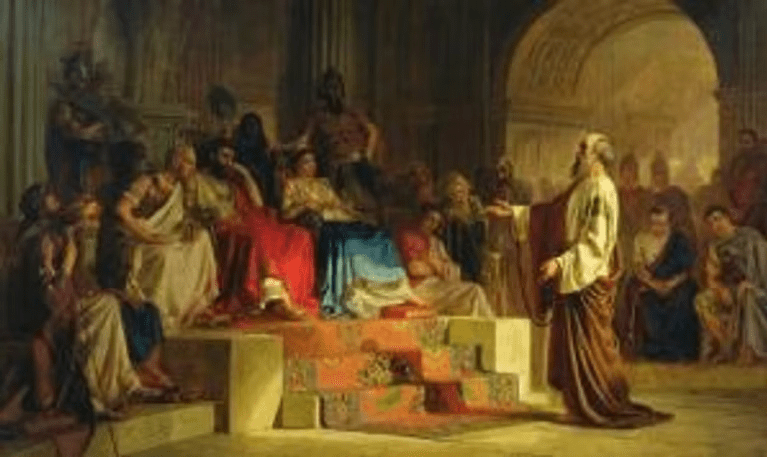
Standing before the high-priestly family.

Whenever Christians today read or hear read aloud the stories of the Holy Bible, it should not be done as if looking back from a perspective that seems superior. By knowing the story and its ending, such separation in time makes one feel that he or she identifies solely with the “heroes” of the story, and never the “goats”. This is what I mean when I refer to the Big Brain Syndrome, as Christians tend to identify totally with Peter and John (the Apostles) in this reading, and never as “the rulers, elders, and scribes assembled in Jerusalem, with Annas the high priest, Caiaphas, John, and Alexander, and all who were of the high-priestly family.” The purpose of all Biblical readings is to see oneself in that darkness, before one can ever begin to shine with the light of a Saint.

In this reading, the basic characters are: the falsely accused; the accuser judges; and the onlookers (including court employees).  The onlookers are invisible, as they have nothing to add to the scene; but we know justice requires a general audience. That invisibility is a sign of the public’s weakness, as commoners are not wealthy or influential enough to be in the class defined as “rulers, elders, and scribes,” much less be born into the “high-priestly family.”

The onlookers have no control over who is accused and who accuses. The judges then were those who are allowable extensions of the Roman Empire, set in place to control the population without military force.  The Jews were policed by the laws of Moses, with the rule of Rome a distant second.  This means the equality that connects all of the characters of this scene is religion, which makes all devoted to the One God. Thus the court is one of religious law.

Christians are likewise divided today, where (relatively speaking) only an elite few rule the hierarchies of the multitude of churches naming Jesus Christ as their Lord. Popes, Cardinals, Bishops, preachers, pastors, ministers and priests are all parts of the “high-priestly family” that is Christianity. Some Christians proclaim to be Prophets, which sets them apart from the ordinary and the elite, just as Peter and John were set apart.  The laws of our nation have superseded Church laws, so people claiming to be Apostles are rarely arrested and tried by congregations. Today, as in ancient times, most people who want to believe in the One God are still the bewildered onlookers who obediently follow those who would be their leaders, with politicians often given honorary “high-priestly” status.

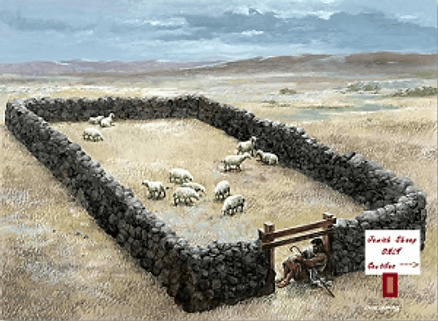
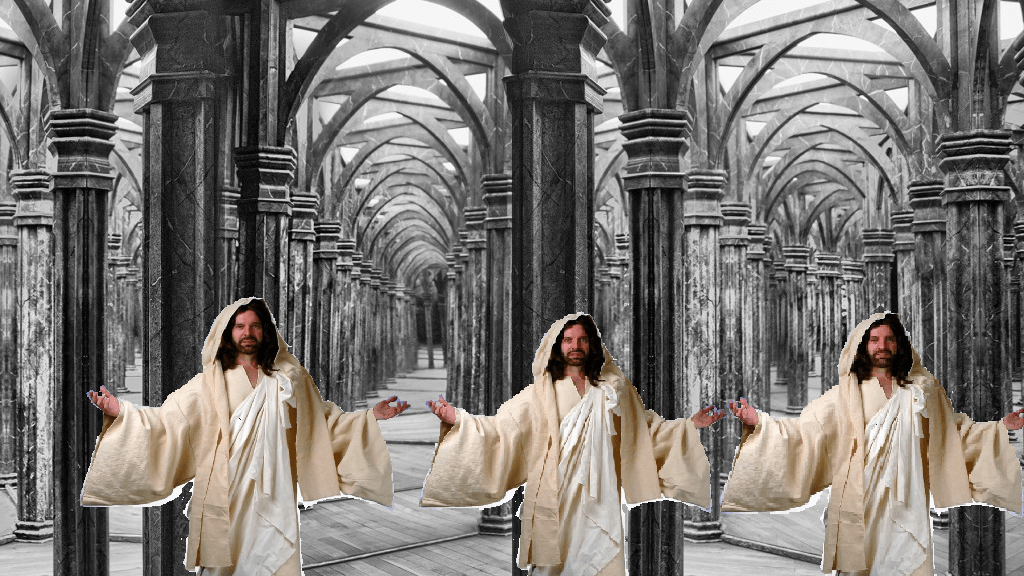
How many resurrections of Jesus Christ are in this picture?

The rarity these days are the Apostles who heal lame beggars, while rulers and onlookers alike all know they themselves are that lame beggar … just too afraid to let that side of themselves be shown. More often than not, the ones proclaiming to work miracles are later found to be disgraced, like the Jim Joneses, the David Koreshes, and the Jimmy Swaggerts of the world. These “Prophets” proclaim to be divine leaders, making them be like the “rulers, elders, and scribes,” rather than be like Peter, who proclaimed, “this man is standing before you in good health by the name of Jesus Christ of Nazareth.” The missing element these days is we have no Apostles who heal and give full credit to Jesus Christ, pointing out how the man (like the one named Peter) had nothing to do with the miracle.

This means that when these verses from the Book of Acts are read, the same can be said of today’s churches claiming to be “in the name of Jesus Christ.” Jesus Christ cannot be resurrected in a building, any more than he cannot be resurrected in a tree, or an automobile, or even in a wafer taken from a box of purposefully manufactured religious wafers, placed nicely on a silver platter. Jesus Christ can only be resurrected in Apostles, like Peter and John of Zebedee … human devotees.

Unfortunately, since no modern churches have the ability to proclaim ALL ITS MEMBERS are the resurrection of Jesus Christ … as TRUE CHRISTIANS … then what we call Christianity is little more than cults of personality.  The personalities are popes, cardinals, bishops, preachers, pastors, ministers, and priests.  In other words, modern churches are also led by “rulers, elders, and scribes assembled” who judge against anyone who should dare to do as Peter did in Jerusalem, outside the temple.

What is the difference in having the man named Jesus, of Nazareth in Galilee, sentenced to death, as Peter said the rulers of the Temple of Jerusalem had done, and having the Spirit of Jesus Christ sentenced to death by not teaching how the whole point of Christianity is to die of self ego and be resurrected by the Holy Spirit as the Christ returned?

There is no difference.  One denies the Messiah has indeed come.  The other denies the Christ that has come can come again … many times over.

I accuse you of being ironclad in denial.

Just as Peter recalled Psalm 118:22 (“The stone the builders rejected has become the cornerstone”), the cornerstone of Christianity can be none other than Jesus Christ of Nazareth. Jesus was rejected by the “rulers, elders, and scribes,” along with “Annas the high priest, Caiaphas, John, and Alexander, and all who were of the high-priestly family.” There was no denying that Jesus had lived.  Everyone in Jerusalem knew that, as his execution was still fresh on their minds.  Everyone in Jerusalem knew Jesus of Nazareth had done some miraculous things, prior to his death, much like Peter did, by healing a lame beggar at the Beautiful Gate. Peter stood there in front of his accusers and said Jesus Christ had healed the lame beggar, because Jesus Christ was back IN PETER.

Do you think all history would have changed if Annas and Caiaphas had listened to Peter and then proclaimed as their judgment, “Okay guys, Peter is right. God has sent our Messiah. All hail Jesus as the Christ!”?

If the Sanhedrin had reached that end, it would have been written into Law – “Jesus is God’s promised Messiah.”  However, if the Sanhedrin had endorsed belief of a prophesied Messiah by lip-service acceptance, agreeing to say Jesus of Nazareth was then and forevermore to be the Christ of the Jews, would the spread of Christianity have still moved across the world?

Probably not.  There would be no Christians in that case, as God would have proved He was happy with just Jews and scattered Israelites (even though it is hard to tell them apart from Jews) honoring Him.  All Jews would be for Jesus.  Of course, Judaism might be the religion of choice today … had the Sanhedrin just got on board way back when … and if God made Jews the rulers of the world’s governments afterwards.  Belief in Jesus might be commanded by Law, which would have made Judaic judges be very important in that alternate universe.

The reality is, however, that the spread of Christianity is more than professed belief. It is more than a command to believe like everyone else, without good explanation.  Christianity has to involve Jews and Gentiles, but it has to be founded on a relationship of love.  The religion grew exponentially from each and every true Christian having been reborn as Jesus Christ of Nazareth, possessing the Mind of Christ and having the power of God to perform miracles … in the name of Jesus Christ.  Christianity was spread by Apostles, to wherever they traveled.

That growth was severely stunted by a bunch of “rulers, elders, scribes, and high-priestly families” trying to hoard God and Christ for themselves, beginning around the time the Roman Emperor figured out it would be better to be the Roman Pope.  A Sanhedrin-like hierarchy that used its influence as force then left the onlookers silently following those leaders.  Churches began splitting at the seams over what was happening long ago.  New sects and branches began sprouting like weeds in the Garden of Eden, with no gardener around to pull them out and throw them into the fire.

Therefore, we stand today as disciples of the One God who are still waiting for Jesus Christ to come back and bring Heaven to earth.  That wait is no different than the Jews, who are still looking for his first arrival.

When Peter said, “There is salvation in no one else, for there is no other name under heaven given among mortals by which we must be saved,” he said (in effect), “You better be already in the name of Jesus Christ when mean Jesus comes down from the clouds, à la The Revelation of John, because that returning spirit will be spitting a double-edged sword of justice from his mouth.

Only by becoming Jesus Christ in a mortal body (resurrected or reborn) can one’s soul find salvation, “as no other name under heaven given among mortals” earns an exemption to eternal damnation.  Titles are names, so what Peter said (as the words of Jesus Christ through an Apostle) includes such titles as: pope, cardinal, bishop, preacher, pastor, minister or priest.  None of those names will be able to produce the miracle of soul salvation, by edict, sermon, proclamation, or televised prayer services.  No titles can wave a wand, cast water from a sprinkler, or feed one a cracker, washed down with a sip of  fruit juice, and claim their position of piety has saved one from evil.  Jesus Christ is not controlled, like electricity, made to jump out on command, because one holds a “high-priestly” title.  Therefore, the Rapture can only apply to Saints on earth, yet to ascend to Heaven, and not those mortals who are full of fear, having done nothing to earn salvation … having never asked God to send him or her His Son to become one with him or her.

Peter and John stayed in a jail cell overnight and were paraded before all the big brains the next day, simply because the presence of Jesus Christ within them flowed out to one in need, healing him in the name of Jesus Christ. For breaking the status quo, where there was an order of family or chain of command that had not duly been recognized, some display of hierarchy had to be made as punishment. The question asked by the judges to Peter (“By what power or by what name did you do this?”) expected the accused to produce some certificate of authorization for working miracles, just like a vendor would need a license to sell wares. If Peter lied, the truth would be known, so he would have just committed a more serious crime.  If Peter had admitted he had no authority to heal lame beggars, then there would be reason to find Peter and John guilty of breaking the law, for having caused a social disturbance. However, Peter gave them a name … the name of the one the Sanhedrin had condemned to death … Jesus the Messiah had risen in Peter and John!  Jesus Christ of Nazareth gave them the authority!

Jesus Christ again stood before his murderers, but now in duplicates. Not only was Jesus Christ in Peter and John, but Jesus Christ had been resurrected in the lame beggar, who then stood alongside Peter and John, before the Sanhedrin. The lame beggar knew the presence of the Holy Spirit within him was what allowed him to walk for the first time in his life. Where there were two in the name of Jesus Christ, then there were three; and the judges knew the power of that name and feared the consequences (just as they did before killing Jesus). The silent majority watched and waited to see how the judges would act.

As a lesson from the book that teaches us that Apostles Act from their faith, having become resurrections of Jesus Christ, thereby following the theme of the Easter season, this falls in line with the Gospel reading from John, about the good shepherd. Lost, like a sheep in this story, the lame beggar becomes the one who has been given a new outlook on life. Jesus, the good shepherd, reached out to a lost sheep who knew his name and the lame beggar responded to his master’s call.

As Christians who have long been led by “rulers, elders, and scribes” that tell us Jesus sits with the Father in Heaven, only to come again at the end of the world to smite all the evil ones, we have been told there will be no miracles in our lives. We are to believe what we are told to believe, or be judged as boat rockers and dissidents. Those who feel there must be more to religion than that, they sit outside the mainstream, begging for assistance, only to get little in return. We, today, act like lame beggars with our hands out, with no expectations of ever being able to stand on our own two feet and walk … with no hopes of ever being able to help others to walk too.

Easter is when our Lord rises in us to transform us from cripples into Apostles. We must then stand before all judges to proclaim Jesus Christ is a name possible for all believers. We cannot make that proclamation from hearsay. It can only be made by Jesus Christ within us, making our mouths speak his words.


John 10:11-18 – The goodness of shepherding

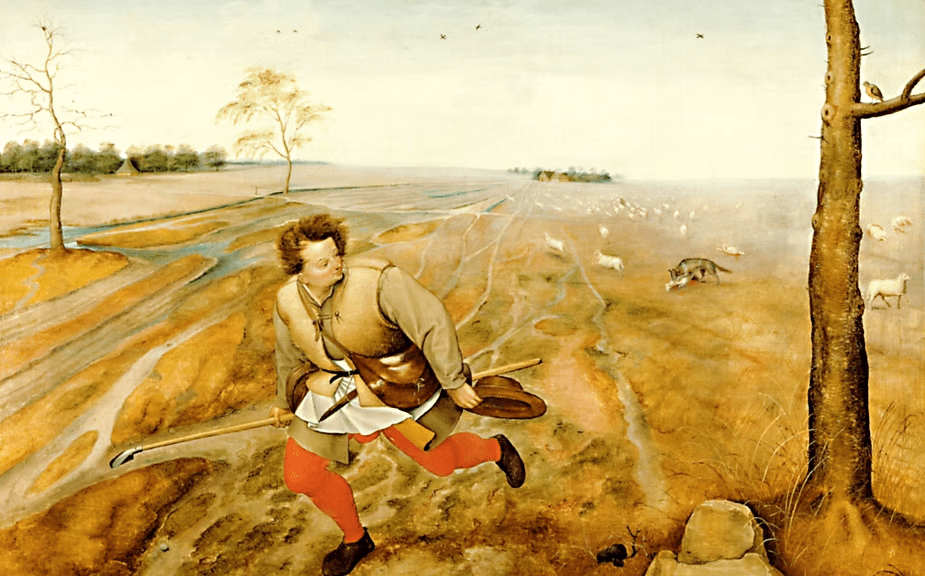
Jesus said, “I am the good shepherd. The good shepherd lays down his life for the sheep. The hired hand, who is not the shepherd and does not own the sheep, sees the wolf coming and leaves the sheep and runs away—and the wolf snatches them and scatters them. The hired hand runs away because a hired hand does not care for the sheep. I am the good shepherd. I know my own and my own know me, just as the Father knows me and I know the Father. And I lay down my life for the sheep. I have other sheep that do not belong to this fold. I must bring them also, and they will listen to my voice. So there will be one flock, one shepherd. For this reason the Father loves me, because I lay down my life in order to take it up again. No one takes it from me, but I lay it down of my own accord. I have power to lay it down, and I have power to take it up again. I have received this command from my Father.”

——————————————————————————-

This is the Gospel selection from the Episcopal Lectionary for the Fourth Sunday of Easter, Year B 2018. It will next be read aloud in church by a priest on Sunday, April 22, 2018. It is important as it tells of Jesus being the good shepherd, with all pretenders being hired hands. In this message, Jesus spoke of the power to lay down a life in order to take it up again, which becomes a prophecy of the Good Shepherd’s resurrection in Apostles.

The tenth chapter of John’s Gospel begins with Jesus telling the preceding parts of this well-known metaphor of the Good Shepherd. Prior to this reading, Jesus had explained how sheep recognize the voice of their shepherd, with the sheep’s shepherds calling the sheep from the gate of the sheepfold. False shepherds hop the fence or wall of the sheepfold, with the intent of stealing them. The sheepfold is implied to be a place of safe keeping, such that Jesus said he was the gate through which the sheep (flocks of all true shepherds) enter. As an entrance point into a place of safekeeping, the whole sheepfold represents salvation; and as the gate, salvation can only come through Jesus.

In this part of the reading, John quoted Jesus as saying, “I am the good shepherd,” where Jesus then went on to explain that a good shepherd will be willing to die to protect his flock. Jesus pointed out the difference between a true shepherd – one who leads his or her flock of sheep to the sheep fold as evening draws near – and a good shepherd.  That difference can be seen as WHY one is a shepherd in the first place.

There are sheep; but sheep will become wild (led by dominant male rams) if unattended by humans. As valuable possessions, for milk products (goats = sheep), wool, and meat, they can be domesticated (led by shepherds).  Domestication, through ownership, requires constant care: letting them out to graze, rounding them up for nightfall, milking them, sacrificing them for food, and shearing their wool.  That work makes one earn payment for their care. This means domesticated sheep need to be watched by shepherds, to protect one’s investment flock from wild predators, such as wolves.

This means shepherds can be hired to fill that position as “hired hands,” if the owner profits enough from his flock.  Such a paid employee is not one who typically cares more about the well being of the flock, than oneself’s well-being. Shepherd work is a lowly position, such that a rancher usually assigns his younger children to watch his flock. When one’s children are grown, however, it will force a rancher to hire other young children to do that work.

When faced with the danger of a predator, where the predator could easily turn on a child shepherd that is paid to watch a flock owned by someone else, such a threat will always force one into a point of decision: Do I risk harm protecting someone else’s sheep? Or, do I sacrifice someone else’s sheep for my own safety? A “hired hand” will always choose to save oneself, at the expense of the safety of the sheep.

When Jesus then said, “I know my own and my own know me, just as the Father knows me and I know the Father,” this touches on the element of family that produces a good shepherd. Just as shepherds were typically the young sons that tended the flocks owned by their fathers, they knew the responsibilities of their job included laying down their lives in protection of their extended family. Just as their father would lay down his life protecting his children, the children would honor their fathers by doing the same for the livestock own by their fathers. This means a “hired hand” also knew the responsibilities of a son (or daughter) to their father; but when wolves were threatening someone else’s flock, the offering up of one’s life for someone else’s family became the deeper issue that caused a paid outside employee to turn away.

By seeing that issue of family, one can better grasp how Jesus then said, “I have other sheep that do not belong to this fold. I must bring them also, and they will listen to my voice.” Jesus was saying that all sheep not having a shepherd that is totally committed to protecting the flocks of another family, Jesus will be the one who will take on that responsibility of laying down his life to protect them. Of course, “other sheep that do not belong to this fold” (the one of which Jesus then tended) was relative to father Moses (ie.: the Jews sheepfold).  The “other sheep” are then Gentile sheep.

When Jesus said, “I must bring them also, and they will listen to my voice,” he was prophesying the spread of Christianity, where the voice of Jesus would flow from the mouths of Good Shepherds that were Apostles in the name of Jesus Christ. Those sheep would hear the voice of the family of God the Father, sounded by His Son the Good Shepherd.

When Jesus then said, “For this reason the Father loves me, because I lay down my life in order to take it up again,” that can be seen as a prophecy of Jesus saying he would be killed by the predators that were attacking the flocks of Judaism. Jesus was the Good Shepherd tending to that scattered group of sheep, where the Roman wolves had been left to devour the ones left unprotected by the “hired hands” that were the Sanhedrin.

Those elitist “rulers, elders, scribes, and all who were of high-priestly descent” in Jerusalem (from the accompanying Acts 4:5-6 reading) were not related to the Father. They were only in their positions for the money, fame and glory, not the sacrifice of lives protecting lowly sheep. The Sanhedrin, Pharisees, and Sadducees did “not care for the sheep” of Israel.  It would be their negligence that would cause Jesus of Nazareth to be thrown to the wolves, losing his life, “in order to take it up again” in apostles who would go out seeking all the lost flocks of the Father (which included Jewish flocks, Samaritan flocks, scattered Israelite flocks, and Gentile flocks).

When Jesus said, “The Father loves me, because I lay down my life,” he was repeating what he had said to the Sanhedrin representative Nicodemus, as Jesus had begun his ministry. John wrote how Jesus said, “For God so loved the world, that He gave His only begotten Son, that whoever believes in Him shall not perish, but have eternal life.” That sacrificed Son (spoken to Nicodemus) is now called the Good Shepherd (spoken to Jews of the Temple). The rescue of Jesus, so those who believed in him would not die, would be to to collect the lost sheep for eternal life. They would be raised up again as the lambs of God, each reborn as the Good Shepherd.

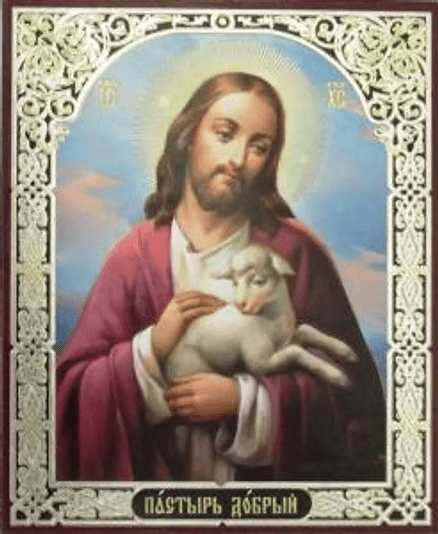
Look at this picture as one’s sacrificed ego becoming as meek as the lamb, while one’s human form covers the Christ risen within.

When John then wrote how Jesus said, “No one takes it from me, but I lay it down of my own accord,” this was his choice, which was taken completely from a love for his Father as a willing sacrifice for a higher good. It is the lesson learned from the Father’s love of the Son. It is how the Good Shepherd sees the flock as his willing responsibility, because of the love shared between the Father and the Son.  This is how all Apostles must first be adopted by the Father, through marriage that makes one’s heart become the seat of the LORD.

This means the Sanhedrin “hired hands” and the Roman “wolves” were known to exist, but they would not be given the ability to control “good” through fear. The love of God surrounds one like a sheepfold, with Jesus the gate.  Jesus knew neither the Sanhedrin nor the Romans held any lasting power. They knew better than try to jump the fence or wall and be caught stealing (a Commandment).  Therefore, Jesus would knowingly walk into the trap set by those who did not care for anyone and lay down his life.  He would make that sacrifice as a “witness” to the power of God. The Greek word for “witness” is “martus,” the root for “martyr,” as “martys.”

This is why Jesus then said, “I have power to lay it down, and I have power to take it up again. I have received this command from my Father.” This is the power of Resurrection, which was the “spiritual matter” Jesus tried to tell Nicodemus about, only Nicodemus’ big brain blocked him from grasping the concept of rebirth (a common flaw of thinking to this day). Jesus proved he had been given the power to lay down his own life and take it up again with his Resurrection from death. However, “the command from [the] Father” extended well beyond the limits of one man’s life on earth, as Jesus would lay down his life so it could be reborn in all those who believed, who laid down their egos to be raised up as the Son, again and again and again.

This is clearly the Easter lesson that is to be grasped by Christians on the Fourth Sunday of Easter. Everything John recalled said by Jesus has to be seen in personal terms, where this reading is intended to make those listening to hear themselves being called, “Wolf!” Christians are to ask themselves, “Why do I attack, scatter, and devour Christians who are lost and cannot defend their religion?”  “Why do I attack anyone and use Jesus Christ as my excuse?”

Are you of one denomination or branch of Christianity that possesses the “Us vs. Them” mentality, where no other flocks are worthy of God’s protection? Do you see your denomination superior to others?  Do you seek to kill first and ask questions later, because you see eternal salvation as a war against flawed dogmatic philosophies (blind to the flaws you believe), where only the righteous will survive?

Then you need to ask yourselves, “Why do I run away, when I see wolves attacking the innocent?”

Why are you not a “hired hand” of Christianity, if you cannot truthfully look towards heaven and swear to God, “I am you Son, here to do Your work!”?

The Easter lesson of the Good Shepherd is more than the simpleton belief that Jesus died so we could all run and play in fields of green pastures and lie down beside crystal clear, cool, still waters, having all our needs met. We must stop seeing ourselves as little lambs of innocence, when the reality is we always get in trouble (sin, sin, sin), so Jesus is always running to our rescue.

As long as we walk the face of the earth, we are always walking through the valley of the shadow of death, because the earth is where evil calls home. Satan lords over the earthly domain; and he lures human beings with things that call them away from the flock, to where innocent sheep can be ripped to shreds and torn apart, limb from limb. Because the laws of nature explain that as “survival of the fittest,” we think nothing of another weak sheep lost.  Still, we fear that end is always a heartbeat away from being our demise.

This means the lesson of the Good Shepherd is we each must be free of fearing evil. We must know, “I fear no evil; for Jesus is with me.”  We must be able to claim: “Jesus restoreth my soul: he leadeth me in the paths of righteousness for his name’s sake.” Christians become the “namesakes” of Jesus Christ when they have been Resurrected as him.

Only then, as Jesus reborn, can we see ourselves as protectors of the flocks. Only as Apostles, seeking to protect lost sheep, can Christians see a reflection of the good this story tells in themselves.

Acts 4:5-12 – Shepherding the Rulers

The rulers, elders, and scribes assembled in Jerusalem, with Annas the high priest, Caiaphas, John, and Alexander, and all who were of the high-priestly family. When they had made the prisoners stand in their midst, they inquired, “By what power or by what name did you do this?” Then Peter, filled with the Holy Spirit, said to them, “Rulers of the people and elders, if we are questioned today because of a good deed done to someone who was sick and are asked how this man has been healed, let it be known to all of you, and to all the people of Israel, that this man is standing before you in good health by the name of Jesus Christ of Nazareth, whom you crucified, whom God raised from the dead. This Jesus is

`the stone that was rejected by you, the builders;

it has become the cornerstone.’

There is salvation in no one else, for there is no other name under heaven given among mortals by which we must be saved.”

——————–

This is the mandatory reading from the Acts of the Apostles for the fourth Sunday of Easter, Year B, according to the lectionary for the Episcopal Church. It will be read aloud before Psalm 23 is sung, which is the familiar verses begun “The Lord is my shepherd; I shall not be in want.” That will be followed by a reading from John’s First Epistle, where he wrote, “He laid down his life for us– and we ought to lay down our lives for one another” The readings will conclude with a lesson from John’s Gospel, which recalls Jesus saying, “I am the good shepherd. The good shepherd lays down his life for the sheep.” Due to these readings, this Sunday is commonly termed “Good Shepherd Sunday.”

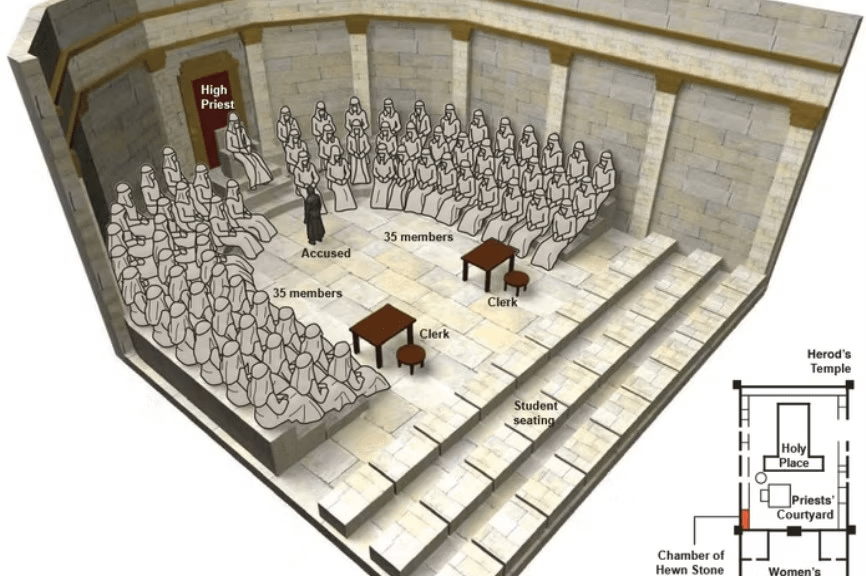
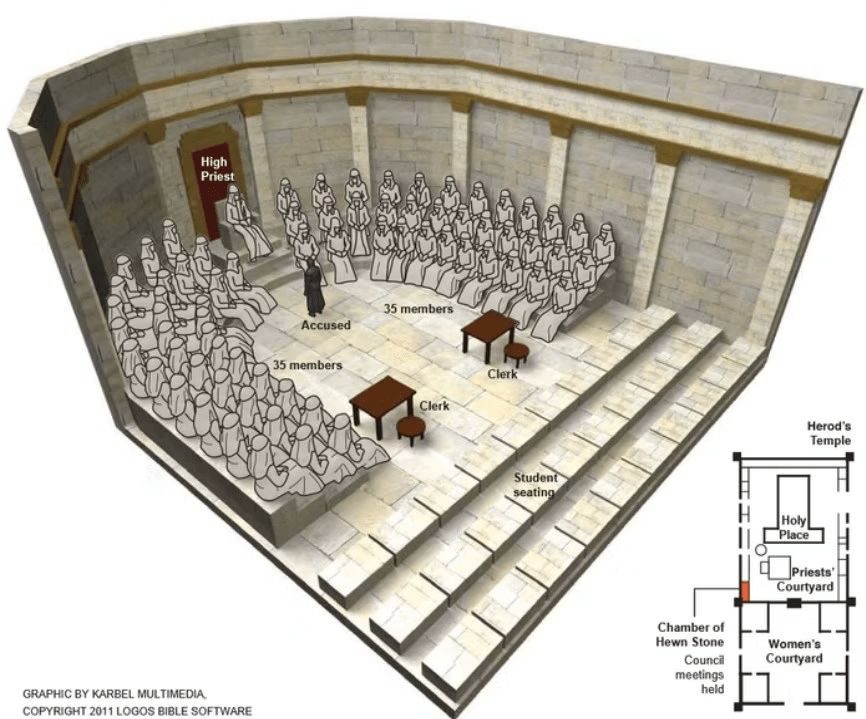
After last Sunday’s reading from Acts 3, where Peter addressed pilgrims [he called them “Israelites”] at Solomon’s colonnade, due to a lame beggar having been healed, Acts 4 addresses the arrest and holding of Peter and John overnight, so they could appear before the Great Sanhedrin [a meeting of 71, more than the 23 of the Lesser Sanhedrin]. The listing of the specific heads of that assembly indicates the Great Sanhedrin was a normal gathering in Jerusalem, which met daily in Jerusalem.

According the Wikipedia article entitled “Sanhedrin,” the following is stated:

“In the Second Temple period, the Great Sanhedrin met in the Temple in Jerusalem, in a building called the Hall of Hewn Stones. The Great Sanhedrin convened every day except festivals and the sabbath day (Shabbat).”

Notice the red rectangle, denoting where the Chamber of Hewn Stone was. Think of that as being the “cornerstone” of the Temple, as the “secret place” set aside for “Rulers.”

It needs to be readily assumed that the presence of Peter and John in Jerusalem was not because they had taken up residence there. Because they had been in Jerusalem on Pentecost, the feast of Weeks [Shavuot] is only one day, on a Sunday [the first day of the week]. Being Galileans with families, they would have gone back to their homes, from where they would have begun ministries as resurrections of Jesus, each designated as Yahweh’s Anointed ones [Christs, therefore the root of the movement called “Christianity”].

This assumption says they had returned to Jerusalem for another festival. That can be assumed because Acts 4:4 says, “But many of those who heard the word believed; and they numbered about five thousand.” That number came after the healing of the lame man as Peter and John were going to the temple for morning prayer, when those presents were pilgrims [Israelites, not Jews], who would have also come for a festival. The festival that would have happened next, after Pentecost [Shavuot], would have been Sukkot or the festival of Booths [Tabernacles]. That festival ends with the Eighth Day, following a week-long festival.

Because the Sanhedrin did not convene during a festival, they would have re-gathered on the day after the Eighth Day. During an eight day festival, it is possible that Peter and John healed the lame man on an early day of the festival, most likely not a Sabbath, with the remainder of the festival leading to news of the healing spreading, such that Peter and John were sought out over a day or two afterwards, during which the number of “about five thousand” would have equally been touched by the Holy spirit, as was the lame man. Because Peter and John were known Galileans and expected to leave town after the Eighth Day, they would have been arrested and held overnight, until the normal gathering of the Sanhedrin convened. It should not be seen like that powerful group of Jews feared Peter or John, as the news of their ministries was not like that of Jesus, which was well-known prior.

Evidence for this conclusion can be found in the capitalization of the Greek word “Egeneto,” which is the 3rd person singular aorist middle indicative form of the root “gínomai,” meaning “to take place” [as an event]. This important word says simply, “as normally scheduled” or “as usual,” meaning it was not a special calling of important leaders of Jerusalem together for the intent purpose of addressing complaints that two men were talking publicly about the dead having been raised. The importance on a divine level of awareness, however, says that Yahweh knew this group would gather after the festival was over and He wanted to take advantage of this scheduled meeting, in order for Him to say a few things to those running Judaism. Those words would be spoken by His Son, the man those leaders had killed, whose soul was then resurrected in Peter (and John). That means God had His servants be detained for the purpose of using this event that was known to come, when “It came to pass.”

Not read today is the background that explains why Peter began speaking what we read. In verses 1 and 2 is stated, “the priests, the captain of the temple, and the Sadducees came to [Peter and John], much annoyed because they were teaching the people and proclaiming that in Jesus there is the resurrection of the dead.” [NRSV] From that, one can imagine some clerk read aloud the charges brought against Peter and John, which would have been the first time most of those V.I.P.s had heard why they [Peter and John] were there [just like a judge in any courtroom today]. That led them to hear the charges and then ask, “ By what power or by what name did you do this?”

The Greek written by Luke uses the terms “dynamei” and “onomati,” which have been translated above as “power” and “name.” The intent of their question must be understood as then asking (according to viable alternate translations), “By what ability to perform or by what authority [such as a license approved by Pilate to speak publicly] did you this [listed charges]?”

Here, it is worthwhile to recall how Jesus was asked the same type of question, after he overturned the vendors’ tables in his first trip to Jerusalem as a rabbi in ministry. Then they asked, “What sign can you show us for doing this?” (John 2:18) There, the word translated as “sign” can mean a signed document or a “marque,” such that the same standard line of questioning is a mandatory first thing to ask anybody showing up in court. [“You have been charged with (fill in the blank.) How do you plead?]

In Luke’s account of this event unfolding, he wrote, “Then Peter, filled with the Holy Spirit” [NRSV], which is accurately translated in the aorist passive participle of “pimpláō,” “having been filled with Spirit Holy.” That demands some more clarification.

While “filled with the Holy Spirit” bears the same meaning, this paraphrase becomes weaker than that actually written. A weak translation can make it appear that Peter was just a guy that was wondering why he was in court, when out of the blue [ala like Pentecost morning] another blast of the Holy Spirit made him then [a capitalized word stated prior, albeit separated by a comma mark from the following statement] “filled with the Holy Spirit.” What needs to be realized is “having been filled” dates back in the past to Pentecost (actually before), such that once “filled” always “filled.”

He was “filled with the Spirit,” such that the capitalized word “Pneumatos” states what Peter “had been filled with.” That capitalization gives that single word divine elevation as the “Spirit” of Yahweh. Jesus “breathed upon his disciples and said “receive the Spirit.” That was when their souls married Yahweh and became joined with His Spirit. It is unnecessary to say “God is Holy,” because Yahweh is the source of all on earth who can possibly be “Holy.” Therefore, “having been filled with the Spirit” of Yahweh, the prior Easter Sunday evening, Peter had been “Holy” as Jesus reborn into ministry for some time, at that point. He became “Holy” because of that prior filling, not something immediate or sporadic.

When this precondition is established, one should then see the first word out of Peter’s “Holy” mouth, after asked a simple question by the Sanhedrin [in their brains], was “Archontes” or “Rulers.” Here, the capitalization takes the meaning of what Peter said to a much higher level than the Sanhedrin hearing Peter verbally acknowledge that each one of them was “a commander with authority (influence) over people in a particular jurisdiction.” (HELPS Word-studies) That word [“Rulers”] is Yahweh pointing out to those who supposedly held the pretense before all Jews, as being the ones closest to Yahweh and thereby His designated authorities for Him on earth. This becomes Jesus speaking through Peter’s mouth, calling them the “kings” so wished for by the Israelites, demanded of Samuel, and their “Promised Land” had reduced Israel to a bunch of straw bosses inside a temple that acted as their puppet city state.

[This can equally be seen as metaphor for someone standing before a Roman Pope, with seventy Cardinals surrounding him, where a true Christian (Jesus reborn into flesh) can equally allow God can have a little chat with the Great Pretenders of religion.]

Jesus had been called to answer to a similar gathering of authorities (the Jews), after he had been seen healing a lame man by the pool of Bethesda on a Sabbath. (John 5) Then Jesus told them, “I do not receive honor from men; I know you, that you do not have the love of God in you.” (John 5:41-42) Most probably, some of those men who heard Jesus speak were there that day when Peter then said, “if we are questioned today because of a good deed done to someone who was sick and are asked how this man has been healed, let it be known to all of you, and to all the people of Israel, that this man is standing before you in good health by the name of Jesus Christ of Nazareth, whom you crucified, whom God raised from the dead.” (Acts 4:9-10) Those who heard Jesus speak like that prior must have felt a gulp in their throats as they heard Peter say those words.

The Pharisees of Jerusalem had questioned the man born blind and his parents “because of a good deed done to someone who was sick.” That man answered the people who saw he was healed, saying “The man called Jesus made mud, spread it on my eyes, and said to me, ‘Go to Siloam and wash.’ Then I went and washed and received my sight.”’ (John 9:11) The Jews questioned his parents, but John wrote, “His parents said this because they were afraid of the Jews; for the Jews had already agreed that anyone who confessed he [Jesus] to be the Christ would be put out of the synagogue.” (John 9:22) Thus, when Peter said, “this man is standing before you in good health by the name of Jesus Christ of Nazareth, whom you crucified, whom God raised from the dead,” it was Peter saying, “The truth and proof of what I say is here now, “standing before you in good health,” because I am in “the name of Jesus Christ of Nazareth.” In case some of you forgot, you “crucified” him to “dead,” but look and see it is me again, “whom God raised.”

In verse 3 of this chapter there is nothing indicating that anyone other than Peter and John were detained. If he was not present before this gathering, as one of those “made the prisoners stand in their midst,” then the only one Peter could be referring to would be himself. The lack of the healed man’s presence would mean Peter was “this man – standing before you in good health by the name of Jesus Christ of Nazareth.” If the healed man was also there, as a Jew presumably living in Jerusalem and voluntarily appearing, no one was stopping Peter and saying, “Let the healed man speak as to who healed him.” In either case, all standing “in their midst” were those “having been filled by the Spirit,” so all were “Holy,” just like Peter, all healed by God, all reborn as Jesus Christ.

Peter then quoted a verse from Psalm 118 [the Easter Sunday Psalm], which every member of the Sanhedrin would have instantly known to be verse 22, which says:

“the stone that was rejected by you, the builders; it has become the cornerstone.”

While Peter added that “this Jesus” was the one of whom David sang, the members of the Sanhedrin would have been completing that song’s lyrics in their heads, which say:

“This is the Lord’s doing, and it is marvelous in our eyes.

On this day the Lord has acted; we will rejoice and be glad in it.” (Psalm 118:23-24)

[That perfectly relives the moment the lame man first stood and leaped, while praising Yahweh and walking around … healed. It was a miracle beheld by many witnesses. The lame man proclaimed Yahweh had acted, while rejoicing loudly. However, it remains a sealed document, as to what detailed the Sanhedrin knew, which accompanied the charges of speaking of the dead risen.]

That song of praise, which all the Sanhedrin had memorized, sang out prior to the verse recalled by Peter, praising how Yahweh [the actual name translated as “Lord”] would provide His people “a gate of righteousness,” through which “the righteous may enter.” (Psalm 118:19-20) That “gate” would be “this Jesus,” but the members of the Sanhedrin had “rejected that stone,” because it was rounded and not “cornered.”

There, the word translated as “cornerstone” is actually “gōnias,” which means, “an angle, a corner,” while metaphorically meaning “a secret place.” What God spoke, through Jesus in Peter’s flesh said this: “The stone rejected by you, the builders of this fancy temple where you pretend to be rulers and kings; it has become your head stone.” In that, “kephalēn gōnias” is written by Luke, which translates as “head corner[stone]”.

[That becomes metaphor for a tombstone that reads: Here lies the Rulers of death. God told them to wake up, but they still wanted to sleep.]

When this reading ends with Jesus saying (as Peter), “There is salvation in no one else, for there is no other name under heaven given among mortals by which we must be saved,” that too needs closer inspection. This verse begins with a capitalized “Kai,” which makes it divinely important to realize, especially what the first segment of words state. The first segment of words written literally translate into English as: “Kai not exists with another no one that salvation.” This importantly states that the only way to find a soul saved is the same way Peter, John and the healed man (et al) found it: through being themselves the resurrections of Jesus Christ of Nazareth.

The meaning of the segment of words that is translated by the NRSV saying, “for there is no other name under heaven given among mortals by which we must be saved” is this: being reborn as Jesus brings one that name. The name “Jesus” means “Yahweh Will Save.” Mother Mary was told to give that name to God’s Son by Gabriel, the second she became immaculately impregnated. The only way to become “in that name” is to marry Yahweh – a soul merged with His Spirit [one then made “Holy”] – so that when one finds one’s flesh “having been filled” with God’s presence, then one has become God’s Son reborn, another Anointed one named Jesus.

As the mandatory Acts reading for the fourth Sunday of Easter, during the season when one should be preparing to act like Peter and stand in the midst of accusers and let Jesus speak through one’s flesh, it is important to realize that this reading does not speak directly of being a good shepherd. On a Sunday called “Good Shepherd” one must see that role is not passive or delegated to others. The Rulers were not god, nor shepherds. They were nothing more than hired hands, with many false shepherds.

Jesus is the only Good Shepherd, such that Peter stood and talked as the Good Shepherd resurrected. Jesus did not speak through Peter to defend Peter being ‘blamed’ for healing a lame man and then giving credit to a ghost raised from death. Peter spoke as Jesus addressing the lost sheep that were those making up the Sanhedrin. They saw themselves as the passive delegators of Mosaic Law, as self-proclaimed gifts by God to the Jews and diaspora, who then had the authority to judge souls for Yahweh. Peter stood to tell them they were lost and in need of salvation. Peter spoke as Jesus speaking for Yahweh, telling them the only one who saves souls, the only name that can save you all, you killed and buried. Still, you can repent and likewise be saved.

It is in this way that the Easter season has to be seen as when one stops being a predator that feeds on the lambs of God and starts being one who stands up against such egotists. The role as shepherd has to be seen as one of the lowest rungs on the Jewish ladder of success, having the least degree of power, wealth, and influence. A shepherd is not concerned with self, or a shepherd would find some other line of work. Jesus said, “A good shepherd will lay down his life for the flock,” unlike a hired hand. Laying down one’s life is all about the Easter season. It is when one’s life has been sacrificed to Yahweh and from that ceremonial death of self, one has been saved, in the name of Jesus Christ.

1 John 3:16-24 – Inner self finding sincerity a necessary possession

We know love by this, that he laid down his life for us– and we ought to lay down our lives for one another. How does God’s love abide in anyone who has the world’s goods and sees a brother or sister in need and yet refuses help?

Little children, let us love, not in word or speech, but in truth and action. And by this we will know that we are from the truth and will reassure our hearts before him whenever our hearts condemn us; for God is greater than our hearts, and he knows everything. Beloved, if our hearts do not condemn us, we have boldness before God; and we receive from him whatever we ask, because we obey his commandments and do what pleases him.

And this is his commandment, that we should believe in the name of his Son Jesus Christ and love one another, just as he has commanded us. All who obey his commandments abide in him, and he abides in them. And by this we know that he abides in us, by the Spirit that he has given us.

——————–

This is the Epistle selection for the fourth Sunday of Easter, Year B, according to the lectionary for the Episcopal Church. It will be read aloud after the mandatory Acts reading for the Easter season [Acts 4 this Sunday], which states, “this man is standing before you in good health by the name of Jesus Christ of Nazareth.” That will be followed by the singing of Psalm 23, which sings, “He revives my soul and guides me along right pathways for his Name’s sake.” All will accompany the Gospel reading from John, where Jesus is recalled to have said, “there will be one flock, one shepherd.” Because of the theme told in Jesus’ metaphor, this is referred to as Good Shepherd Sunday.

Many times, especially as I read the Epistles, I see where long ‘sentences’ make it difficult for the reader to grasp what has been put into text. This means reading divine scripture should be done slowly and with the assistance of the divine within. I also often point out that nothing of divine scripture [found within the Holy Bible] was written in the English language [only Hebrew and Greek]. For Americans to read and memorize translations that have been put into English [in multiple versions], they are putting all their faith in some paraphrase of the truth – which can be true, half-true, or false [a false translation was presented in the Gospel reading from John 20, which stated “after a week,” when the truth said “after the day eighth”].

One thing that also stands out in the Epistles is the use of language that is nebulous. By that, I mean words are read and left to the reader to figure out just exactly what that nebulous word means. In this reading selection from First John, multiple times are written the words “love,” “heart,” “truth,” and “commandments.” While all those words bring about warm and fuzzy feelings of nicety and pleasantness the question is, “How many readers are thinking the same thing when they read those words?” Even the uses of “life,” as in “laying down a life,” or “abides” should bring up questions as to what that means.

In the past, I have painstakingly rewritten a reading from an Epistle, just to place emphasis on these points I have made. One must be forced to read divine scripture as one would read poetry. After all, we do not read novels of prose by going from verse to verse. We have to see all divine scripture as Yahweh [God], in His All-Knowing Mind, knowing I and you will read this Epistle, so it was written from the Mind of God with the intention being for us individually to read what is written. If one is too busy with one’s life to care about what God said to one, through a prophet, then that one is lost and pretending to be found.

In an effort now, I will make the above English translations appear in a completely new view, using words that come directly from a Greek resource as to the various words in English translation that can be used, based on the written text. I ask that one take the time to compare the two – the one above [NRSV] and this one I have created below.

Everything I present is verifiable, but it should be noticed that I do not translate the word “kai,” as that is a marker for importance to follow. I also break every ‘sentence’ into segments of words, which are ended by some form of punctuation. In verse 21, notice how the written text shows double angle brackets, single angle brackets and a left right arrow, which are directional marks [like the word “kai”] that cannot be properly translated, so they are ignored. The marks – everything about divine text – have meaning; with this divine syntax including the order of words. Thus, my English translations are literal, following the order of the Greek words written.

Please, take the time to compare these two versions of what was written in Greek, and then translated into English. Please note that my English translations are based on my selecting the one word in English that I feel has the best chance of conveying the truth intended. In that selection process, many possible translation options have been discarded. This means there is still more that could be stated below.

16

In this we have come to know that goodwill ,

because that one on behalf of us that human soul same self placed ;

kai we are obligated on behalf of these brothers ,

those human souls to place .

17

who now may possess this manner of life of this world ,

kai might notice this brother of him necessity possessing ,

kai might shut those emotions there away from of him ,

by what means that this which of God waits in him ?

18

Little children not we should take pleasure in word ,

nor that language ,

on the other hand in action kai sincerity .

19

kai in this we will come to know because from out of this sincere we are ,

kai before the face of him we will have confidence this inner self ours ,

20

because if should condemn ours that inner self ,

because in the widest sense exists this God of this inner self ours ,

kai he knows all .

21

Beloved ,

if that inner self < ours > « not should condemn » ,

confidence we possess with this God ,

22

kai which if we might ask ,

we receive from him ,

because those commandments of him we keep ,

kai they pleasing before the face of him we act .

23

kai this exists that commandment of him ,

in order that we should believe then name this Son of him ,

Jesus Anointed one ,

kai we should love each other ,

according to the manner in which he gave commandment to us .

24

kai this guarding those commandments of him ,

with him stays ,

kai he with him .

kai with this we have come to know that he remains with us ,

from out of this Spirit which to us he has given .

——————–

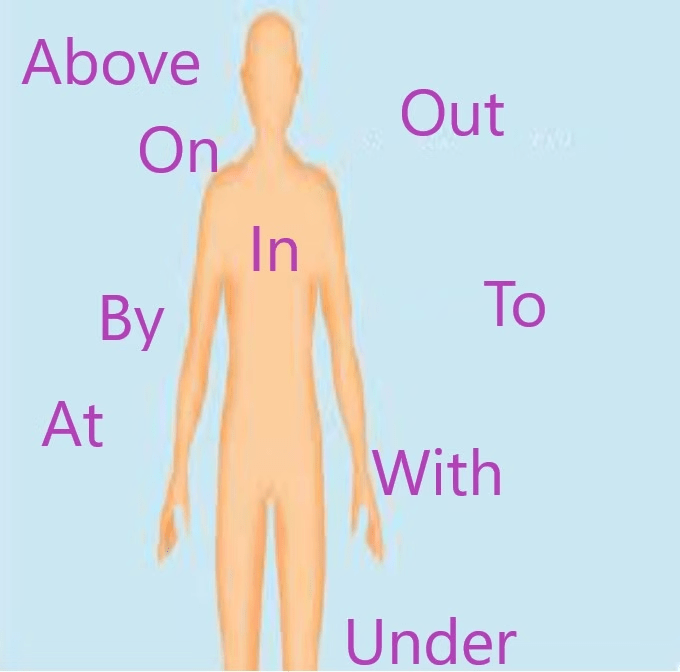
In this selection of nine verses, there are only ten capitalized words. When “God,” “Son,” “Jesus,” “Anointed one,” and “Spirit” are removed, there are only three that need understanding: “Beloved,” “Little children,” and “In.” The first word in these (roughly) two hundred words is a capitalized “En,” which simply translates as a preposition saying “in, on, at, by, or with.” However, by realizing capitalization elevates a word to a divine level of meaning that makes “In” be a powerful statement of Yahweh being “in, on, at, by, or with” a soul married to His Holy Spirit.

Simply by realizing how a little word like “En” can speak of spiritual depth unseen by normal eyes, it is easier to see “Beloved” and “Little children” as divine statements of relationship with Yahweh. One is in His family as “Beloved.” One is one of His “Children.” That then leads one to see “Son” not only as Jesus, but also every soul married to Yahweh, who becomes in the name of “Jesus,” as another “Anointed one” by Yahweh. This reading has to be seen in this light of personal relationship with Yahweh [“God”], which is more than simply saying, “I believe in God,” as a relationship says “I am born of God; thus I know Yahweh within my soul.”

There are thirty-three segments of words in these nine verses. Thirteen of those segments are begun by the word “kai,” marking them marked as important statements. Within verse 18 is a segment that includes the word “kai” in the middle, making the last word be shown as important. All of these marks of importance say John was not just writing a letter of vague things that he thought would make people feel good. John did not write generalities that can be read as affirmations of faith, because the only affirmation of faith is shown by acts – the purpose of the Easter season: to learn how to act as Jesus, by having become Jesus reborn.

In verse 16 are found the Greek words “psychēn” and “psychas,” which have been translated as “life” and “lives.” Associated with both words are “ethēken” and “theinai,” which mean “laid down” and “to lay down.” All of this that seems to speak of “life” and “death” relates back to the first word in the first segment of words that states “In.” Following that directional preposition of divine essence is “agapēn,” translated as “love.” In my corresponding translations, one can see how this verse takes on higher meaning.

When Yahweh is “In” one’s being, that union must be seen as a step taken out of “love,” which is marriage involving one’s “soul” [the truth of “life”], in a spiritual union. This union [“In”] is then one receiving “benevolence” or “goodwill,” which are the deeper meanings of “agapēn,” and less nebulous than “love.” For one to receive that “goodwill” from Yahweh, one must equally “lay down” one’s self-ego, where “self” reflects upon the “life” of a “soul” in a human body of flesh. The sacrifice of self [“life laid down”] for the “goodwill” of Yahweh is not for oneself, but for others. One then becomes the resurrection of Jesus, so one has become the Son, in a relationship with others likewise married to Yahweh, also reborn as Jesus [males and females]. Therefore, an obligation is created that bonds with others like oneself, so all become “brothers” [Christianity]. That must be seen in verse 16.

When one realizes a segment of words is begun by a “kai,” which says, “we are obligated on behalf of these brothers.” That becomes a commitment to serve Yahweh as one collective body of “brothers,” which is the intent behind true Christianity. It is not an exclusive group, as the purpose of Yahweh being “benevolent” to one wife, like all wives, is to send them out into ministry to draw others into a commitment of marriage to God, like themselves. In that way, more “brothers” are added, all in the masculine name “Jesus,” so both men and women human beings become related to Yahweh as Sons of man, all resurrections of the Jesus spirit.

Verse 17 uses words that speak of “possessions,” where being in possession of things [the “world”] means one’s soul is in “need” of spiritual possession. When Yahweh “abides” in one’s flesh, merged with one’s soul, that divine presence allows one to feel the “necessity” of showing others the way to true “possession” [eudamonia – divine possession] Then, the “world” no longer leads one to ruin. The essence of John’s question is, “How could one turn away from someone in such spiritual need?”

This means verse 17 then focuses importance on being able to determine who is obviously in spiritual need, as those needing to be touched by one who has married Yahweh and is the resurrection of Jesus in the flesh, having the power of God and Christ to both notice spiritual lack AND having the ability to pass that divine spirit on. It is equally important to realize that making a determination of spiritual need in another and not acting to pass the spirit on is impossible, as only the one to receive rejecting it keeps that from happening.

Verse 18 then addresses those who Yahweh sends out as His shepherds and those who have become lost sheep. This can be seen in the capitalization of “Teknia,” or “Little children.” In that a form of the word typically translated as “love” appears, where “agapōmen” better applies as meaning “we should take pleasure.” The aspect of “not” preceding this word says real “love” does not “take pleasure in” the suffering of others, or thinking one is better than another. Being a shepherd is a duty not born out of physical love, meaning pleasure is not a reward of that work done [tending sheep]. Therefore, one should not voice salvation as something one “loves,” as that causes others to react negatively. One should not entice with loving talk, nor use something written as the reason one is there, searching for those who are lost.

Verse 19 is then two important statements about how a shepherd goes about serving Yahweh. First, one must be sincere. Second, one must wear the face of God, which means displaying a confidence that become reassuring to others. In these two important qualities, the NRSV has used the words “truth and “heart.”

The Greek word “alētheias” can translate as “truth,” but just as we read that translation as what Jesus said to Pilate, prompting him to ask, “What is truth?” the same nebulosity exists here. The word better bears fruit when known to mean “reality, sincerity, and straightforwardness.”

The Greek words “kardian” and “kardia” can translate as “heart,” but the same word bears more impact in reality as “mind, character, inner self, will, and intention.” As such, it becomes most important that one act with sincerity, from an inner confidence that comes from knowing Yahweh is with one, just like He was with Jesus. It is not one’s emotions that lead one to serve Yahweh. It is Yahweh merged with one’s “inner self” [“heart”] that has one act.

Verse 20 then makes more sense when the nebulosity of “heart” is replaced by one’s “inner self.” This is the same core of all human beings, as a soul. Before one becomes reborn as Jesus, through marriage of a soul to Yahweh’s Holy Spirit, one was also a simple “inner soul” in search of higher meaning. When the NRSV translates “God is greater than our hearts,” this needs to be read as the concept that all life has a soul breathed into flesh by God. However, God being greater means a soul alone is in need of rejoining with Yahweh; and, that is the purpose of Him sending His Son, to be merged within us, so all who are lost can be found.

The presence of a “kai” before “God knows all things” says there is more to that than saying something everyone knows [all who believe in God]. The importance marked is saying that a soul alone knows nothing. This refers back to taking no pleasure in word or tongue, which means quoting Scripture as some weak form of evangelism. A soul alone is lost and knows little of importance. Therefore, one must marry Yahweh and become Jesus reborn, in order for the truth to be revealed to His servants.

Verse 21 then begins with the capitalized “Beloved,” which must be seen as one who has been found, as one who has married Yahweh and been reborn in the name of Jesus [family]. That one then has the knowledge of Yahweh at one’s disposal.

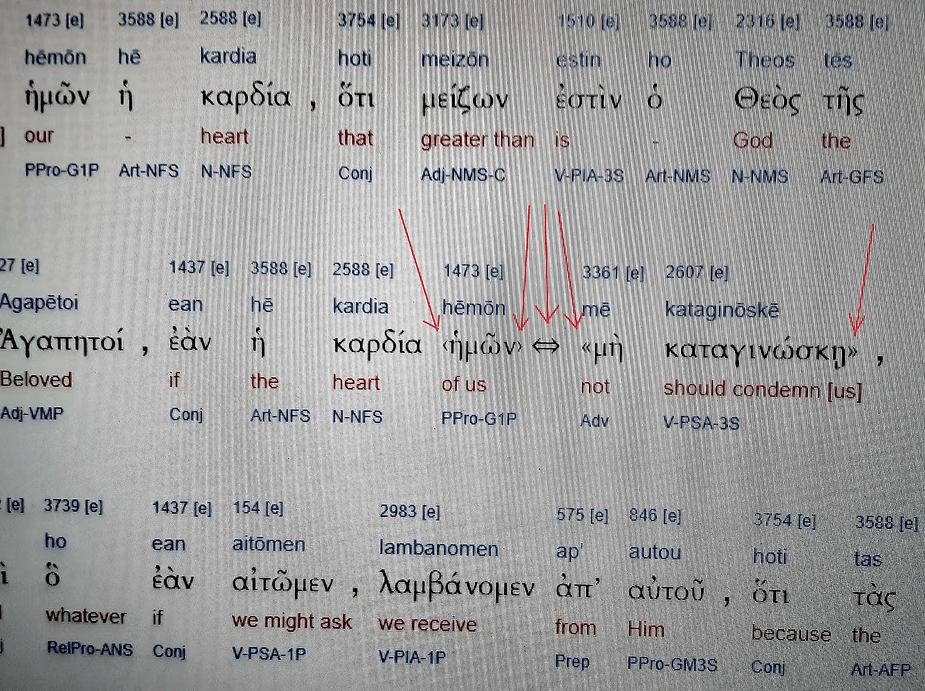
This then brings up the segment of words that is complete with extra marks that do not show up in translations. The NRSV translates it to say, “if our hearts do not condemn us,” but when seeing “hearts” [written in the singular, as “heart ours”] as “inner self” [i.e.: a soul alone] the equation mark needs to be grasped.

The left right arrow says, “If one is true, then the other is true.” Thus, what is stated [without reading the bracket marks] says, “if that [one all knowing by God’s presence] is “ours” [a union of two, both possessing the same flesh from within], being a true statement, then one must see another in the same way one was prior to marriage to Yahweh, because oneself was not condemned for lack of that divine union. It is the confidence that comes from a divine possession within that leads one to find others in the same need as one once was.

The single left bracket indicates “inner self” [a soul] is “less than” a union – “of us” or “ours”. The brackets surrounding “ours” is that marriage between soul and God’s Holy Spirit. The double left angle brackets show that [if true married to Yahweh] another not married is doubly less than. That lesser state does not condemn one for being a lost soul, but the double right brackets indicate the spreading of the Holy Spirit to one who opened his or her inner self to receive the Spirit. Coming from marks, not words, none of this can ever be stated in translation.

Verse 22 then says, “we receive from him whatever we ask, because we obey his commandments and do what pleases him.” [NRSV] This is a conditional statement, rather than some blanket blessing of unlimited wealth, power, and influence [as “whatever” implies]. It says when one filled with the Holy Spirit asks to help another, then Yahweh will supply help one as needed. This condition is then based on one’s commitment to Yahweh and obeying His Commands. It must be clearly understood that us human beings always act as the servant and Yahweh is always the Master, with Jesus one’s Lord. A soul in submission to Yahweh asks Him for “whatever” Jesus says to ask for. God is never the servant of those not His wives.

Verse 23 then confirms that by saying [NRSV], “And this is his commandment, that we should believe in the name of his Son Jesus Christ and love one another, just as he has commanded us.” Here, the verse is begun by the word “kai,” so it is important to realize Jesus said the greatest commandment was “to love God with all our heart, minds and souls.” When that “love” of Yahweh has become enforced by the Law [one’s marriage vows], then one becomes “in the name of God,” where “Jesus” means “Yahweh Will Save” [or “Yah(weh) Saves”].

Once in that name, then Jesus has commanded “brothers” in his name [true Christians] “to love one another.” That must be realized as being a commandment Jesus gave to his disciples and other family and followers of his [including Judas Iscariot] AND NOT TO THE WHOLE WIDE WORLD [most of which is sinners refusing to be found]. When Jesus said that to them, they had proved their devotion in service to him [thereby Yahweh], so they were the bridesmaids whose lamps were always kept full of oil.

This reality is then stated in verse 24, as “All who obey his commandments abide in him, and he abides in them.” That is three segments of words, two of which are begun by the word “kai.” Rather than writing “all,” John wrote “this one guarding the commandments of him,” where it is up to the individual, not some collective where there can be found safety in numbers. Each one must obey the commandments, which Yahweh writes on each one’s “inner self” [“heart”].

The element of “abiding” says Yahweh “reside” within one’s flesh, not out in outer space or some nebulous place like heaven. Heaven is where the “heart” is, with the “inner self” [a soul] being where God lives, merged with His Holy Spirit. Thus, the second “kai” importantly says, “Yahweh resides in those who keep his commandments.” That importance says it is impossible to keep Yahweh’s commandments without being married to Him.

When verse 24 concludes by stating [NRSV], “And by this we know that he abides in us, by the Spirit that he has given us,” here the segment of words leading up to the comma mark begins with a “kai.” That places importance on how one knows Yahweh dwells within one’s body of flesh. It is important knowledge that comes from one’s personal experience with God’s presence, knowing that presence leads one automatically to act like Jesus reborn. This is not some wishy-washy feeling or some weak brain-led thought; as, it is knowing Yahweh, knowing Jesus. That is then explained as being due to the presence of “Spirit” [a capitalized “Pneumtos”], which must be known to be God’s Spirit that makes one Holy, like Jesus, therefore a Saint.

As an Epistle reading for a Sunday known for the Good Shepherd, it is difficult to see the connection readily apparent in the reading as translated by the NRSV. After slowing down the reading process and carefully analyzing the text and the translation possibilities [along with the systems necessary to realize to understand divine texts], the reason the elders chose this proves appropriate. This becomes John speaking about what needs to happen to become a Good Shepherd.

As a reading selection for a Sunday in the Easter season, when all seekers of truth are being prepared to be sent out into ministry for Yahweh, this repeats the necessity to become Jesus reborn. It is impossible to go into ministry as an only “inner self” [having physical “heart”], without divine assistance. Salvation cannot be gained by doing nothing or only doing that which brings self-pleasure and self-satisfaction. Being a shepherd is hard work and it comes with little respect from those who are happy with lives of sin. Being a shepherd means ministry is a set expectation. Therefore, one needs to be tested in how one rejects the lures of sacrificing God for personal gains and learn to depend [faith-trust] on angels meeting one’s needs.

John 10:11-18 – Becoming the Good Shepherd in spite of hired servants

Jesus said, “I am the good shepherd. The good shepherd lays down his life for the sheep. The hired hand, who is not the shepherd and does not own the sheep, sees the wolf coming and leaves the sheep and runs away—and the wolf snatches them and scatters them. The hired hand runs away because a hired hand does not care for the sheep. I am the good shepherd. I know my own and my own know me, just as the Father knows me and I know the Father. And I lay down my life for the sheep. I have other sheep that do not belong to this fold. I must bring them also, and they will listen to my voice. So there will be one flock, one shepherd. For this reason the Father loves me, because I lay down my life in order to take it up again. No one takes it from me, but I lay it down of my own accord. I have power to lay it down, and I have power to take it up again. I have received this command from my Father.”

——————–

This is the Gospel selection for the fourth Sunday of Easter, Year B, according to the lectionary for the Episcopal Church. A mandatory reading from the Acts of the Apostles [Acts 4] will begin the readings, where Peter is shown stating, “This Jesus is `the stone that was rejected by you, the builders; it has become the cornerstone.’” That is followed by Psalm 23, which sings, “Though I walk through the valley of the shadow of death, I shall fear no evil; for you are with me; your rod and your staff, they comfort me.” Then, the First Epistle of John is read, where he wrote, “We know love by this, that he laid down his life for us– and we ought to lay down our lives for one another.” Because of the theme clearly established in the Gospel and Psalm, this Sunday is referred to as Good Shepherd Sunday.

This first thirty verses of this chapter of John deals with elements of shepherding. The fourth Sunday of Easter is set aside as Good Shepherd Sunday, so those thirty verses will be divided up into the three years of the lectionary cycle, such that Year B is when the middle verses are read aloud. This middle portion places focus on the difference between a “good shepherd” and a “hired hand.”

There is nothing written in the Greek of verse 11 that says, “Jesus said.” Because the Episcopal Church has divided this chapter up, so the first ten verses are missing, they are referring back to verses six and seven, where this is written [NRSV]: “Jesus used this figure of speech, but the Pharisees did not understand what he was telling them. Therefore Jesus said.” In that translation, John only referenced “them” as who Jesus was speaking to, so the assumption has been made [by the NRSV people] that “them” were “Pharisees.” Because no such specific designation is written, it can just as easily mean “everyone” who heard Jesus speak then, which included Pharisees and disciples. Today, it must be understood that “Jesus said” this to the reader, now and always.

The greatest failure I see in Christians today is seeing Jesus as a god and worshipping him, rather than seeing Jesus as the Son of God, who repeatedly said [paraphrased], “I do not speak for myself, but what the Father tells me to speak.” This means that every time Jesus is quoted in the Gospels, it is the voice of Yahweh speaking through the Son. That is very important to remember here.

In the verse not read today, which refers to what Jesus was saying, John wrote, “Tautēn tēn paroimian eipen autos ho Iēsous.” That literally says, “This that figurative discourse spoken to them this Jesus.” In that, the word “paroimian” is translated as “figurative discourse,” where the definition says, “a byword, a parable, an allegory.” (Strong’s) The usage of the word can mean what I translated, as well as “a proverb or a cryptic saying,” (Strong’s Usage) also “a maxim.” Because the reading selection above repeatedly says, “I,” the “allegory” must be seen as Yahweh speaking in the first person, as the “shepherd,” with all human beings then compared to “sheep,” “wolves,” and “hired hands.”

In this regard, verse 11 actually begins by stating, “Egō eimi,” where the capitalization of “Egō” takes “I” to a divine level of meaning. “Egō” is Yahweh. When the second word [“eimi”] is seen to be another statement of “being,” as “I am, I exist,” the two words state “I am,” which is the name Yahweh told Moses to tell the Israelites who sent him: “I AM THAT I AM.” [YHWH]

Seeing that identification as stated, look then to the word “kalos,” which is translated as “good.” In Matthew 19:16-17 is found an exchange between Jesus and a rich man, who asked Jesus what “good” he must do, in order to gain eternal life. Jesus replied, “Why do you ask me about what is good? There is only one who is good.” In that reference, the Greek word “agathos” is the word translated [correctly] as “good.” This means a closer inspection of “kalos” is necessary.

The word “kalos” translates as “beautiful, good” (Strong’s Definition), while implying “beautiful, as an outward sign of the inward good, noble, honorable character; good, worthy, honorable, noble, and seen to be so” in usage. This means the statement spoken by Jesus, “Egō eimi ho poimēn ho kalos” says first “I am this shepherd this good.” That says Yahweh is the shepherd, who is not simply “intrinsically good” [the definition of “agathos”], but is the inner source that makes a human being be “noble, honorable and worthy.” Therefore, the difference here is Yahweh saying He is the shepherd that emanates from within certain human beings, who are then recognized by others as being godlike or good [“agathos”] – Saints who wear auras or halos.

In the Greek text, that initial segment of words is separated from the next segment of words, which then repeat “ho poimēn ho kalos,” separated by another comma. While this repetition is seen in the NRSV translation as Jesus making a statement about what he was, then repeating that what he was is defined by putting his life on the line for sheep, that is not the truth. By repeating, “this shepherd this good,” Yahweh has first said, “I am this shepherd this good,” followed by Yahweh saying Jesus is “this shepherd this good,” in whom Yahweh is the source. This is an important repetition to take note of.

The next segment of words is then where Yahweh is still speaking through the lips of Jesus, saying “the life of him lays down for the sheep.” In that, “psychēn” is translated as “life,” when it must be read as “soul.” The use of “tithēsin” as “lays down” is then better read as “establishes.” Finally, the word “probatōn,” translated as “of sheep,” must be seen as the metaphor for “humanity.” Thus, what is said is this: “the soul of him establishes for the sake of those of humanity,” which means the soul of Jesus has allowed the Holy Spirit of Yahweh to become established in his body of flesh, for the benefit [goodness] of humanity.

With that seen, verse 12 then addresses “this hired servant” or “hireling,” implying a “hired hand.” Here, the Greek word “misthōtos” must be understood as a separate statement [a comma sets it apart as a single point of focus] that addresses one who is paid for services rendered. If the metaphor of a shepherd and sheep is seen in the context of religion [part of the allegory or cryptic speech John noted], the element of someone hired were then the people of the Temple, who made a nice living off knowing the Law. From that expertise, they all became very wealthy, powerful, and influential. In the same metaphorical sense, the word applies nicely to all who are paid for service rendered in religions today [complete with income tax allowances especially created only for clergy members]. This separate statement about “this hired servant” says nothing [yet] about one’s ability to act “good” [of the “agathos” variety], or lack thereof.

That somewhat comes in the next segment of words, which is begun by the word “kai.” That word indicates an important announcement is now being made, relative to a “hired servant.” That importance points a laser light beam on “not,” as “a hired servant” is “not” one whose soul [his or her “being” or “existence”] is that of a “shepherd.” In that, the use of “ōn,” which is the present participle form of “eimi” [seen prior as “Egō eimi”], has a higher purpose than simply stating “is.” It is comparative, as to what is not one identified as “I am this shepherd,” such that within a “hired servant exists not shepherd.” Jesus [and all like him] become those identified as “this shepherd this good,” descended from God. That implies being a “hired hand” is not filled with all that is “good” of Yahweh.

In the following segment of words, which the NRSV translates as “does not own the sheep,” here the word “does” is another that conveys “existence” [as “estin” of “eimi”]. The literal translation says, “of him [or her] not exists to the sheep one’s own.” The Greek word “idia” must then be seen as being less about ownership of sheep and more about a “hired servant” being an “outsider.” While ownership could be tied up in the payments made by someone, to one hired to keep watch over an investment, the implication is the owner does not use a ‘promote from within’ policy when it comes to employing watchdogs. That analogy means a “dog” is not one of the “sheep.”

The next segment places focus on the dangers of the world, where “sees the wolf coming” is metaphor for perceptions known of the destructive nature of the world. Again, returning one’s eyes to the “cryptic language” being used by Jesus, where the metaphor is relative to religion, the “wolf” is anything that can carry one of the flock away from Yahweh, as the traps of sin. For the lawyers of the temple, and for the memorizers of scripture today, the purpose of religion is to keep souls from being destroyed by the sins of the world. Therefore, all know what “wolves” exist and why; but knowing what is a danger and preventing a danger from happening are two different things.

After a comma of separation, the next segment begins with the word “kai,” which places important focus on the act of “leaving.” Here, the Greek word “aphiēsin” [properly as “leaves”] is not something simple, such as being reassigned to another parish or synagogue, as a step up the ladder of success. While congregations have become accustomed to here a priest, then “leaves” a priest … usually for greener pastures [can you say elected to bishop even?], the reason for “leaves” can be varied.

The “kai” says this is an act of abandonment, at the first sign of danger. Still, the same word can be seen as a statement that “a hired servant” was never for the flock, but only a pretense that always “leaves the sheep” without anyone capable of defending the flock, nor teaching the flock how to defend themselves. Everyone is “left” alone, in that regard.

To add to this cold reality, the comma then leads one to another “kai,” which importantly marks one word only: “pheugei” or “flees.” This Greek word can also translate as “escapes” or “shuns,” which places emphasis on one sent to protect, who fears for his or her own safety. In addition to abandonment, the “hired servant” fears everything in the world, because he or she is not married to Yahweh; when so merged, then one’s soul only fears Yahweh. The importance placed on this word even allows one to see how a “hired servant” can be an agent of evil, whose self-worth is so diminished that he or she fears being exposed as worthless. Those fears then create a distance between the “hired hand” and the flock, such that rather than embracing them, he or she runs away from close contact with them.

Following a long dash [“—“] as a separator mark, the next segment again begins with the word “kai,” where importance immediately falls upon the “wolf” once more. John wrote that Jesus used the word “harpazei,” which translates as “snatches.” The word can equally mean “seizes, catches, or obtains by robbery.” All translations apply, when the “wolf” is seen as metaphor for an evil world. Here, the generic word “them” [from “auta”] means the “hired servant” is included, as neither he nor she is fast enough to outrun evils that are feared. Still, on a deeper level of meaning, “auta” becomes a statement of “selves,” which is another way of saying “souls.” Without a guardian who fears only Yahweh to watch over the souls of the “sheep,” all souls will be “snatched” away from their own control.

The last word in verse 13 is another preceded by the word “kai,” being “skorpizei” or “scatters.” Here, the importance must be seen as relative to the remnants of Israel and Judah, who are known as those who were “scattered” to the four corners of the earth. (Ezekiel, Jeremiah and Isaiah) The importance places emphasis on this being a natural outcome that is the result of placing “hired servants” in positions of authority over the masses. They will not have divine protection. Therefore, all flocks will become just as lost as were those of Israel and Judah, having lost all claims to worldly possessions, “scattered” to the winds.

Here, another long dash is found, which sets the last two segments begun by “kai” together as one long statement standing out importantly, stating “— and the wolf snatches souls and scatters —“. When the totality of this ‘inset’ is seen, “scatters” implies a state of “souls” not totally devoured by the evils of the world.

The element of Judaism that still remains [in the scattering since their land was lost to invaders] is they flock together in neighborhoods, so there is safety in numbers. Those souls who are considered Gentiles by Jews include the scattered remnants of Israel, many of who stopped living set apart, in communities that promoted one faith only. They blended with others, so they took on the distinction of being Gentiles. The element that “scatters” means “souls” mix with other “souls” that have been torn apart by the wolves of the world, so the only safety possible is to act like one has also been torn to shreds. The hope then is that one’s soul is still free to marry Yahweh. That is then speaking of the lost souls being mixed with the sold souls.

This state of danger then leads one to the first segment of verse 13, which states, “because a hired servant is.” Here, again, we find the Greek word “estin” written, which is a word stating “existence” or “being.” The “cause” of being “snatched and scattered” is relative to a “hired hand” having authority over “the sheep.”

This is further explained in the next segment of words, which also begins with the word “kai.” Here the importance is placed on “concern” or “care,” such that a “hired hand” is “not” worried about the welfare of “the sheep.” This is “because himself is concerned of him.” That becomes a statement of selfishness, where it must always be seen that “self” refers to one’s soul [“life breath”], which has never been married to Yahweh.

At this point, where failure is said to be a lack of commitment to Yahweh, verse 14 then repeats what was stated in verse 12: “Egō eimi ho poimēn ho kalos”. The same meaning applies, as Yahweh speaking through the mouth of Jesus, saying “I AM.” That is then followed up as a statement of why souls are lost, by saying, “Yahweh is here, the shepherd that saves souls. Yahweh is good.”

After that is a semi-colon, which then introduces a relative statement that is begun by the word “kai.” The importance conveyed is then focused on the “knowledge” of Yahweh, such that “I know my own” [from “ginōskō ta ema”] is a powerful statement about relationship with Yahweh. Here, the ‘Biblical’ meaning of “to know” [a personal experience that explained the intimacy of a marriage consummation act] means Yahweh has married souls, merged them with His Holy Spirit, so through that “knowledge” those souls have become spiritually possessed by Yahweh. The become his “own” through marital relationship, where the flesh becomes reborn as His Son [the one speaking these words of the Father].

Following a comma mark, another use of “kai” introduces the statement, “am known I those mine.” While it becomes easy to fall to the urge to paraphrase that as “I am known by mine” or “my own know me,” the literal actually is the best statement for truth to come forth. The Greek word “ginōskousi” is the third person plural active indicative, so the statement importantly begins with focus on what “they know.” The use of “me” is a form of “eḡo,” as “me, I, my,” but the same Greek word “με” can translate as a preposition, being “by, with, or on.” The last two words state, “these mine” [from “ta ema”], such that the words written can just as well say, “they know with these mine.” That becomes an important statement of marriage, when “with” acts as a statement of union, such that through marriage what “they know” is knowledge that is “mine.” That becomes a statement of marriage bringing about the Christ Mind, which is what spoke through the mouth of Jesus.

Relative to that condition being “with” Jesus, verse 15 then states two segments of words that are commonly heard spoken by Jesus. The NRSV translates these two segments as: “just as the Father knows me and I know the Father.” In that, the second segment is introduced by the word “kai,” saying that what Jesus “knows” is that sent to him by the Father, which is the Christ Mind Jesus possessed. Whatever the Father wanted to say, the Son said it. When the NRSV translates in the middle, “and I,” that comes from the Greek word “kagō,” which is like a contraction of “kai eḡo.” That word then makes that same importance be implied, while stating what Jesus knew [“I know”] what the Father knows.”

With that now made clear by Jesus [albeit well over the heads of those hearing his words], a semi-colon sets those two segments apart, so a relative statement can ensue. Yet again another segment is begun by the word “kai.” Here, the importance is placed on “the soul of me” [from “psychēn mou”], where “soul” is vital to be seen as replacing the translation of “life.” By seeing that replacement word, the “soul” of Jesus is what “establishes” opportunity for all who would later become Christians. Rather than “the life of me I lay down” being read as Jesus predicting his death, the reality says Jesus knew the Mind of the Father, such that his “soul” had been “established” by Yahweh [knowing “tithēmi” means “put, place, lay, set, fix, establish”] “on behalf of” [from “hyper”] “these sheep” [or humans still in possession of their souls, only lost in the world].

With that most important statement realized, verse 16 then begins with another “kai,” placing importance on “other sheep.” Here, the Greek word “alla” can mean “other, another, or different,” where the greatest impact comes from reading this as “different sheep.” Knowing that Jesus is speaking in Jerusalem, near if not during the Festival of Lights [Feast of the Dedication], the importance says Jesus is announcing [metaphorically] that Yahweh has sent His Son’s soul as an established source of salvation for Gentiles, who are the “different sheep” that Yahweh “possesses” or “holds” [from “echō”] those souls from the teeth of the wolves of the world.

Following a comma mark, those “different sheep” are then said to be those “that do not belong to this fold.” [NRSV] In that translation, the Greek word “aulēs” is translated as “fold,” largely due to one’s mind having been set upon sheep. The word can imply that, but the standard definition is as “a courtyard, a court.” (Strong’s) HELPS Word-studies says of this word: “a building with an interior courtyard; an uncovered, walled area that is enclosed but without a roof; an open-air (interior) courtyard of a mansion or palace.” That says Yahweh just said through Jesus’ lips that He had “different sheep” that were not allowed entrance into the Temple of Jerusalem [where “sheep” means humans still in possession of their souls].

Following a semi-colon, a relative statement says of those “different sheep,” “that over there is necessary me to lead.” In this literal translation of the Greek, the word “dei” is used as an indicator of that which must happen. It states what is necessary and inevitable, while also stating what is proper to do, as a duty and an obligation. When that simple little words is read deeply, it is Yahweh saying through His Son, “Well I sent Moses to teach you to go out and save the world, but you wasted everything by thinking I sent him to make you special, selfishly squandering everything I gave you; until you lost everything. So, since you won’t save the world, I will have Christians do it.”

That powerful statement is then followed by a separate segment of words, also begun by the word “kai.” The importance now shines on the “voice” of Yahweh, speaking through His prophets. It says there will be human beings with lost souls that seek to be found. When a Saint or Apostle is led to where seekers are lost, they will hear the Gospel [i.e.: the Truth], which will speak loudly to their souls. Thus, “they will hear” the Word that had previously been denied them, because they were “different.”

Following a semi-colon, another segment of words begins with the word “kai,” importantly stating, “there will be one flock.” In that, the Greek word “genēsontai” is shown with an asterisk. The word itself is the third-person singular future middle indicative form of “gígnomai,” meaning “they will be born.” Without the asterisk [which is undefined, so I wing this completely now], the meaning could be reduced to simply stating, “they will happen, they will become, or they will come into being,” which is the simpleton concept of Christianity being some social club one can join, which is only slightly harder than becoming a convert to Judaism [for males already circumcised]. The asterisk then forces one to stay focused on the aspect of birth, where all future members of a flock established to be merged with the soul of Jesus must be reborn in that name, spiritually married to Yahweh [nothing less]. That unifying factor will then be how there will be “one flock.”

Verse 16 then ends with the segment that says, “one shepherd.” While there is no indicator mark of importance, it is worthwhile to recall how twice has been stated, “I am this shepherd,” where the capitalization of “Egō” makes the “shepherd” be Yahweh. While there was the repetition in verse 11 that said “this shepherd this good,” which was Jesus, one must see how Jesus was the shepherd good because he was married to the Father and the Father was the shepherd in him. Therefore, there can only be “one shepherd,” with that only possible as God, although whoever’s soul marries Yahweh’s Holy Spirit will be reborn as Jesus, so Yahweh will become the one shepherd as Jesus in all of His one flock.

Verse 17 then begins with the capitalized word “Dia,” which says, “On account of,” “Because of,” or “Through,” which reflects back on “one shepherd,” while also projection upon “this” [“touto”]. “This” is then Yahweh being the “shepherd,” which will always manifest in the flesh of souls He marries as His Son reborn – Jesus.

The next segment of words identified this as saying “me this Father loves,” where the use of “me” can once again be a preposition saying, “with this Father loves.” In both cases, the point made is marriage between a soul and the “Father” makes one the wife out of “love” [“with”], while also meaning that soul has been reborn as Jesus [“me”] out of God’s “love.”

This possibility of being Jesus reborn is then restated as “because I establish this soul of me,” where “egō” is the identify of the name Jesus. Again, “tithēmi” is not a reference to dying [laying down dead], but the “placing, setting, establishing” that entity, through the “life” [where “psychēn” is “life” and “soul”] that inhabited flesh that was [like all flesh] temporal and bound to die, releasing the “soul,” so it could be reproduced in countless marriages between Yahweh and “other sheep.”

This realization then leads to the next segment of words that say, “in order that again I might take it,” where “it” implies reborn “life.” In this, the Greek word “labō” is the aorist active subjunctive form of a root verb meaning “take, receive, obtain.” The word translated as “it” is “autēn,” which properly means “-self” of “same.” This means “it” is another “life” in a body of flesh [a “soul”], where the condition [“I might receive”] says that soul must marry Yahweh first, for that rebirth to take place. The subjunctive conditional established her becomes the reason the asterisk appeared on the word stating “will be born.”

Verse 18 then begins with a segment of words that state, “no one takes self [soul] away from me.” This must be seen as being stated to confirm the conditional, with the Greek word “airei” not only meaning “takes,” but also means “raises” or “lifts up.” Those words designating an elevation of a soul to a higher plane of existence are better choices of translation, in order for one to see that one cannot simply say, “I love Jesus, so I am a Christian” and become righteous and a soul married to Yahweh, reborn in the name of Jesus Christ.

This is then further explained by Jesus, as he said, “on the other hand I establish soul from myself.” Here, the repeated word “tithēmi” says the “same” will be “set” upon the soul [“-self”] of one who has sacrificed itself to be reborn as Jesus.

After a period mark, a new line of thought is begun by Jesus saying, “power to act” or “authority” is given to Jesus after he has taken “possession” of the flesh, whose soul has married the Father [from “echo” meaning “I have, I possess”]. Once Jesus “has authority” from the Father, then he “establishes self” [from “tithēmi autēn”] in that flesh.

This then leads to a segment of words that begin with the word “kai,” stating the importance of “authority I have again to obtain self.” Here, the same words are repeated, as found in the segment, with the addition of “again” [from “palin”] becoming a statement that the “self taken” has been born “again.” This makes the rebirth of Jesus be the importance, as Yahweh grants His Son the authority to possess a soul divinely.

The last segment of words in verse 18, and thus the end of this reading selection, then states, “this that direction I received by the side of this Father of me.” In that translation, the Greek word “para” translates as “from beside, by the side of, and beside,” while also bearing the meaning “in the presence of.” This distinction needs to be seen as two souls merged together as one, with Jesus the controlling soul and the other that submissive wife married to the Father. The translation as “by the side of” then allows one to see this union, two as one, such that both take on the identity of the “Son,” both becoming reborn in the name of Jesus.

This selection as the core reading for Good Shepherd Sunday then says that Yahweh is the shepherd, such that only Yahweh bring about that ability to be deemed “good.” That identity then goes beyond the person in the flesh that was Jesus and brings Jesus to Christians, who are those who were “different sheep” in the “one flock” known by Yahweh to be His souls. The purpose of this reading, along with the others that direct oneself to be filled with God’s Holy Spirit and resurrections of Jesus, all Anointed ones of Yahweh, we now see how we must be reborn as Jesus, in order for our flesh to guide others to the Lord.

As a reading during the Easter season, when one is expected to have already become in submission to Yahweh and reborn as His Son [regardless of human gender], this period is when one ripens with a new soul presence leading us to act. In order to do that, a soul in the possession of Yahweh must practice allowing Jesus to come forth and develop a deep sense of faith and trust.

Psalm 23 – Yahweh is my Good Shepherd

1 The Lord is my shepherd; *

I shall not be in want.

2 He makes me lie down in green pastures *

and leads me beside still waters.

3 He revives my soul *

and guides me along right pathways for his Name’s sake.

4 Though I walk through the valley of the shadow of death,

I shall fear no evil; *

for you are with me;

your rod and your staff, they comfort me.

5 You spread a table before me in the presence of those who trouble me; *

you have anointed my head with oil,

and my cup is running over.

6 Surely your goodness and mercy shall follow me all the days of my life, *

and I will dwell in the house of the Lord for ever.

——————–

This is the Psalm chosen to be read aloud in unison or sung by a cantor on the fourth Sunday of Easter, Year B, according to the lectionary for the Episcopal Church. This song of praise will follow the mandatory reading from the Acts of the Apostles, where Peter and John were asked, “By what power or by what name did you do this?” This will precede the Epistle reading from First John, which says, “God is greater than our hearts, and he knows everything.” This will also accompany the Gospel reading from John 10, where Jesus said, “So there will be one flock, one shepherd.” Because of the theme in this Psalm and the Gospel selection, today is called Good Shepherd Sunday.

This Psalm is commonly taught to children to memorize. Most Christians can recite Psalm 23 by heart because of that teaching. Everyone recognizes the verse that begins it: The Lord is my shepherd; I shall not want.” Still, the word written in Hebrew, which is translated as “Lord” in the first and last verses is “Yahweh.”

While it may or may not be understood that saying, “The Lord is my shepherd” means Yahweh, the One God of Israel, that is the intent. It is possible that confusion arises when this Psalm is paired with a Gospel reading that has Jesus say, “I am the good shepherd.” It becomes imperative that no confusion exist, because Jesus made the same claim about Yahweh being his shepherd. That understanding becoming clear makes this song of praise be at the core of Jesus’ words.

In the Hebrew that is translated as “shepherd” [“rō·‘î,” rooted in “ra’ah”], the basic meaning is “to pasture, tend, graze.” (Strong’s) It is from reading this word figuratively that it takes on the meaning “of ruler, and teacher, of people, as flock.” The etymology of the English word “pastor” comes from the Latin word that means “shepherd,” “from pastus, past participle of pascere “to lead to pasture, set to grazing, cause to eat.”’ [Online Etymology Dictionary] Thus, because human beings are not farm animals, needing humans who “tend” to them, Yahweh is the one who sends our souls out into the world for others to find spiritual food to “graze” on.

The element of “I shall not want” comes from the Hebrew “lō ’eḥ·sār,” where the key word is rooted in “chaser,” meaning “to lack, need, be lacking, decrease.” This then says that Yahweh will not keep a soul from finding spiritual food. Plenty will be available; but, as with grazing animals, finding it requires moving from place to place. When Yahweh is indeed one’s shepherd, one has become the spiritual food for others, such that one is never in need or lack of spiritual food, sending it out as a ‘field of spiritual food,’ so those without and searching can find one of bountiful spirit.

In verse two, it is important to see how David wrote, “yar·bî·ṣê·nî,” meaning “he makes me to lie down.” That must be equated to Jesus saying, “lays down” or “to lay down.” The figurative speech means to set one’s own desires aside. Thus, when Yahweh “makes me to lie down in pastures green,” this says oneself has set self-motivation aside to become “green pastures” for others to graze upon. It says one has been made lush with spiritual food to become a pasture for others.

By David writing, “yə·na·hă·lê·nî,” stating “he leads me,” this is again relative to oneself having laid down in submission to the Will of God. When one is led by Yahweh, then one feels no anxieties or fears that are distresses of the soul. The symbolism of “waters” are the gamut of emotions that fill a body of flesh, when the soul is restless. When one’s emotions are “stilled,” then one is at peace and has no fears of anything the world brings. This state of calm radiates outward to others, so they are drawn into a safe place to fill their spiritual needs.

In verse three, the use of “nap̄·šî,” or “my soul,” should be compared to Jesus making references to “my life.” The root meaning of “life” is a “soul,” which is God’s breath of animation to all forms of worldly existences. Since all human beings possess a soul, the aspect of “reviving,” which comes from “yə·šō·w·ḇêḇ,” as “he restores,” this must be seen as a lost soul [one without union with Yahweh] being saved by Yahweh. As such, the root Hebrew verb, “shub” means “to turn back, return.” This means “reviving” and “restoring” is the “return” of a soul to its source – Yahweh.

David then said this “restoration of his soul” meant David was no longer in control of his actions. Instead of David doing what David wanted to do – whether good or evil – he had sacrificed himself [his soul] in that soul’s “return” to God. Thus, his soul was “led by Yahweh” and that meant David then “walked the path of righteousness.” Because Jesus did the same, this can only mean that Yahweh will always lead one’s soul to act righteously in the flesh, whenever a soul has been restored to Yahweh.

When David wrote, “lə·ma·‘an šə·mōw,” or “for his name’s sake” this means becoming a Son of Yahweh. The root Hebrew word “maan,” translated as “sake,” means “for the intent” or “for the purpose” that is Yahweh’s plan for all souls returned to Him. This means “of his name” [rooted in “shem”] means taking on the responsibility that comes from joining the family of Yahweh. This “intent” or “purpose” that is relative to “his name” has to be seen as a marriage, where all human beings [male and female] are to be seen by Yahweh as His wives. Thus, through marriage a wife takes on the name of her husband; so, David [and Jesus, et al] have taken on the name of God, as Sons of God [regardless of human gender].

When Yahweh is leading one to walk a path of righteousness, then wherever Yahweh sends one’s soul-flesh feels safe and secure. The presence of God within one’s being (through spiritual marriage – soul united with the Holy Spirit) is felt, no matter how dangerous a path shall be. There is no fear possible when merged with the Holy Spirit. This includes a fear of death, as all human beings walk under the darkness that is known death coming, as mere mortals. The “valley” represents the lowness of mortal existence, which is always overshadowed by the mountains of the world that creates those deep recesses. The mountains are the evils of the world that must be surmounted, in order to get out of the valley. The valley becomes metaphor for reincarnation, such that the challenge of a mortal existence is to rise from that depth. Overcoming the mountains means achieving the heights of heaven, which a soul is guaranteed after marriage to Yahweh.

When David wrote, “I will fear no evil,” this is because a soul led by Yahweh can do no evil. That means the temptations and lures to sin are of no consequence to a soul led by Yahweh. This speaks of the wilderness test that must be faced, in order to enter ministry for God. For Jews [Israelites during David’s reign], the Law set boundaries that one could not go beyond, or one would be deemed a sinner. That created a fear of boundaries and at the same time made those boundaries enticing to test, to go beyond and then come back. That was testing God, as to what punishments sin would bring. When Yahweh is with one’s soul, then the Law is written within one’s heart, so the boundaries of the Law are always beyond wherever one is, so there can be no fear of sinning, as long as Yahweh tells one what to do.

In this regard, David wrote, “your rod and your staff they comfort me.” Here, the word “rod” [Hebrew root “shebet”] is the same word used by David and Isaiah, as a “rod of iron,” only Yahweh’s “rod” is His voice that corrects one’s actions. It is a shepherd’s tool that keeps the sheep in the flock, so they will not stray. Doing something that is beyond the boundary of Yahweh will mean Yahweh will tap one with His “rod” of correction, so the comfort that comes from divine correction is knowing why something done should not be repeated. The “rod” teaches, without harm. The “staff” is then a multi-use tool that assists along one’s path [as a walking stick], while being a high marker that the flock can see from afar, and be a crook that can reach into difficult places and bring back those lost and stuck. The “staff” of Yahweh must be seen like the “staff” of Moses, such that it is comforting to know the power of Yahweh is at one’s disposal, when it comes to saving others.

In verse 5, where David sang, “You prepare a table before me” or “You spread a table before me,” the element of “a table” [ Hebrew “shulchan”] should be recognized as the tool [piece of furniture] used when one eats and drinks. Spiritual nourishment is placed on “a table before” one by Yahweh, so that all the strength one needs is available to a soul of Yahweh whenever one is “in the presence of one’s enemies.” Here, the Hebrew word “tsarar” is translated as “enemies,” while bearing a meaning as that which “binds, ties up, restricts, narrows or cramps.” This, again, becomes reflective of the strength made available by Yahweh, when one enters a wilderness test, before entering ministry.

When Jesus said to his disciples, “love your enemies and pray for those who persecute you” (Matthew 5:4), this went beyond the teachings of Mosaic Law. When others test one by attempting to bind and restrict them, then one offers one’s enemies that which always sets one free – the truth. The table prepared before one is where Yahweh serves His wife the truth that no enemy can deny. The truth comes from the Christ Mind, which is given to all Yahweh’s wives’ human brains. By planting seeds of truth within the brains of one’s enemies, one is then showing them an act of love, which can afterwards take root within them and transform them into one’s friends. Still, love for one’s enemies means never force-feeding them anything; it only means sharing with those who seek the truth.

When David then sang, “you anoint my head with oil,” it is most important to realize that Yahweh told Samuel to anoint David, when David was a young son of Jesse, who was left to tend the flocks, while Jesse took his older sons to be inspected by Samuel [and Yahweh]. David was brought, chosen, and anointed with oil, but in a private ceremony that had no immediate effect. As such, David would spend years as a boy servant to Israel, before he would be king. This being known makes one realize that the words “Messiah” and “Christ” both mean “Anointed one,” where the anointment is designated by Yahweh. Rather than oil, Yahweh anoints with the Holy Spirit. Rather than water, Yahweh baptizes with the Holy Spirit, where cleansing and anointment come through the same union.

In the Hebrew text, the words stating “you anoint with oil” are separated from the word “head,” by a long dash [“—“]. That separation means the figurative anointing in not physical, with oil, but spiritual, such that the “head” is where the brain lives. The human “head” controls the body, but the marriage between a soul and Yahweh make Him take control of the “head.” When one becomes the “Anointed one,” then the “head” is no longer the soul-brain but the Holy Spirit-Christ Mind that controls one’s actions. The meaning of “the Messiah” and “the Christ” is not about one’s physical presence, as a leader like David or Jesus, but about one admitting one’s physical weaknesses and surrendering one’s self-ego and self-will in service to Yahweh. Being His wife means bowing down one’s “head” in service to the Lord. That subservience then makes one the Christ, where one’s brain will act like those possessed by David and Jesus.

Here, David added, “my cup runs over.” This becomes the fluidity of emotions, most commonly seen as “love.” When one’s cup is filled beyond the brim, it flows out, beyond the boundaries set by the cup. This means that when one’s head has become the Christ Mind, the flow of Yahweh’s love cannot be ceased, so it flows out from one’s being [the “cup”] onto others. This must be seen in the context of having one’s table prepared before one, in the presence of one’s enemies, because one has been anointed by Yahweh to become an overflowing source of truth and love, by which others can be nourished.

In the final verse of this song of praise, David began with the word “’aḵ,” which becomes a statement of certainty [“surely”]. That word says that there can be no question that being filled with Yahweh’s Holy Spirit will mean “goodness and mercy shall follow me all the days of my life.” Here, the use of “ṭō·wḇ” [“goodness”] must be seen in the reading from John, where Jesus spoke of the “shepherd” that is “good.” Only Yahweh is “good” [said Jesus], so the certainty is that Yahweh’s “goodness” will be with His wives.

The aspect of “mercy,” where the Hebrew root “checed” says, “goodness, kindness,” such that the repetition is David speaking of Yahweh having forgiven David of his sins, to the degree that Yahweh’s “mercy” in that regard is enough to keep David forever doing everything Yahweh desires of David. Mercy becomes the motivation, so David will never dare losing that “goodness” that is the presence of Yahweh within him. Thus, “shall follow me” becomes a statement that David will “pursue” or “chase after” whatever Yahweh sends him to do, as his motivations for the remainder of his life are to please Yahweh.

In the use of the Hebrew word “chay,” which is translated as “life,” this means one has been redeemed or had one’s soul saved from the promise of mortal death. A soul alone in a body of flesh is condemned to repeat the imprisonment of an eternal soul in a temporal body of flesh, until the time when it marries Yahweh and is freed to experience eternal life with Yahweh, following the release of a soul upon physical death. Thus, the motivation to maintain the “goodness” of Yahweh is the promise of eternal life in heaven.

Therefore, the final segment of words in this song of praise says that reward is known to be gained. By singing, “and I shall dwell in the house of Yahweh forever,” that means a soul will no longer be trapped in the physical realm. The aspect of reincarnation is how an eternal soul returns to the earthly plane, again and again, given the opportunity by Yahweh to find its way home [“to have a soul revived”]. Each new physical life means a soul must start over from scratch, having lost all that one thought had been gained in a past life. To know that promise has been gained, then one must go into the world as Yahweh’s servant, spreading love and truth to all.

Yahweh does not marry selfish souls, who think they are just so pretty that marriage alone will be a gift for Yahweh, so the flesh can just sit back and continue doing as it pleases self. The reward of the spiritual realm forever demands devoted work in the physical realm, in order to escape it. Reincarnation becomes self-punishment, brought on by a soul’s laziness.

As a Psalm for the fourth Sunday of Easter, it perfectly fits the Good Shepherd theme. By studying the language of David, who pre-dated Jesus by hundreds of years, one can see that Yahweh is the shepherd, who is good, so any other good shepherds must become extensions of Yahweh. It is important to see Yahweh in that light, as it was Yahweh who created Jesus, who raised Jesus from death, and who planned the soul of Jesus to be the perfection in human flesh that will be raised again, and again, and again ….

In this Easter season, when the weeks are being counted towards the time when ministry will begin, it must be realized that ministry cannot take place before marriage to Yahweh. Marriage to Yahweh involves a true, deep, spiritual connection and a desire to please the One God. It demands one be reborn in the name of Jesus Christ, being reborn as the Anointed one of Yahweh. One should be preparing now to become the Good Shepherd by practicing what all that entails now. The Easter season is like internship in a most holy seminary, where Yahweh is the dean and Jesus is your professor. Ministry means loading up that school and taking it with you into the world.