Tag Archives: Easter 5 Year C

Acts 11:1-18 – What God has made clean, you must not call profane

Now the apostles and the believers who were in Judea heard that the Gentiles had also accepted the word of God. So when Peter went up to Jerusalem, the circumcised believers criticized him, saying, “Why did you go to uncircumcised men and eat with them?” Then Peter began to explain it to them, step by step, saying, “I was in the city of Joppa praying, and in a trance I saw a vision. There was something like a large sheet coming down from heaven, being lowered by its four corners; and it came close to me. As I looked at it closely I saw four-footed animals, beasts of prey, reptiles, and birds of the air. I also heard a voice saying to me, `Get up, Peter; kill and eat.’ But I replied, `By no means, Lord; for nothing profane or unclean has ever entered my mouth.’ But a second time the voice answered from heaven, `What God has made clean, you must not call profane.’ This happened three times; then everything was pulled up again to heaven. At that very moment three men, sent to me from Caesarea, arrived at the house where we were. The Spirit told me to go with them and not to make a distinction between them and us. These six brothers also accompanied me, and we entered the man’s house. He told us how he had seen the angel standing in his house and saying, `Send to Joppa and bring Simon, who is called Peter; he will give you a message by which you and your entire household will be saved.’ And as I began to speak, the Holy Spirit fell upon them just as it had upon us at the beginning. And I remembered the word of the Lord, how he had said, `John baptized with water, but you will be baptized with the Holy Spirit.’ If then God gave them the same gift that he gave us when we believed in the Lord Jesus Christ, who was I that I could hinder God?” When they heard this, they were silenced. And they praised God, saying, “Then God has given even to the Gentiles the repentance that leads to life.”

——————–

This is the mandatory selection from the Book of Acts that will be read aloud on the fifth Sunday of Easter, Year C, according to the lectionary for the Episcopal Church. It will precede a singing of Psalm 148, where David wrote, “Kings of the earth and all peoples, princes and all rulers of the world; Young men and maidens, old and young together. Let them praise the Name of Yahweh.” That pair will be followed by a reading from Revelation, where John’s vision saw, “a new heaven and a new earth; for the first heaven and the first earth had passed away, and the sea was no more.” All will accompany the Gospel reading from John, where it is written: “Little children, I am with you only a little longer. You will look for me; and as I said to the Jews so now I say to you, ‘Where I am going, you cannot come.’”

In verse one of this NRSV translation, the Greek word translated as “believers” is “adelphoi,” which clearly says “brothers.” In this case, rather than state the truth, because an illegitimate form of social justice has taken control over Scripture and changed “brothers” to a gender non-specific “believers., the truth of “brothers” is denied. Instead of using the modern standard replacement of “brothers” with the wordy “brothers and sisters,” the sneaky snakes of translation have taken the route of least resistance. If they cannot explain why “brothers” is written, then they equally cannot explain what a “believer” is.

The first verse in Greek is this: “Ēkousan de hoi apostoloi kai hoi adelphoi hoi ontes kata tēn Ioudaian hoti kai ta ethnē edexanto ton logon tou Theou .” This literally translates to state: “(they) Heard now those apostles kai those brothers those existing according to Jewish because kai these heathens they had welcomed this word of this of God .” In that, the capitalized first word (“Ēkousan”) must be seen as divinely elevated to a meaning that is higher than the worldly plane of existence. The spelling is the third-person past tense form of “akouó,” which means “to hear, listen.” According to HELPS Word-studies, this word figuratively means, “to hear God’s voice which prompts Him to birth faith within.” Thus, we are not talking about a bunch of ordinary people with ears that hear. We are talking about souls that are able to “Hear” a divinely elevated voice within their souls; and, that ability to “Hear” is the resurrection of Jesus within them, who speaks to them for the Father (as their good shepherd).

It is this presence of Jesus within that transforms “disciples” (or “students”) into “apostles” (or “messengers”). For a divine “messenger” to be sent on a mission for Yahweh, it is imperative that they have “Heard … this word of this of God.” Because each and every “apostle” (which is more than menfolk) is resurrected as Jesus, all Anointed by Yahweh (each a Christ) and all Baptized by His Spirit, each is a rebirth of the Son of God within their bodies of flesh. This makes each and every “apostle” (including women like all the Marys) be sons of the Father, all spiritual “brothers.” Because one must understand divine Scripture is meant to talk to one’s soul, not one’s physical brain, all souls are made of divinely masculine essence (“of this of God”), so all souls of “apostles” are, therefore, “brothers.” That is the explanation of this usage; and, it fits perfectly every time it is written in Scripture.

The message “Heard” divinely by all these “brothers” (including men and women human beings, those with saved souls) said, “these heathens (“Gentiles,” without the capitalization written) they had welcomed (or “received”) this word of this of God.” Because all of the “apostles” were still souls animating dead bodies of flesh, with part of that dead flesh being a brain that still functioned atop their necks, they would revert to a normal state of stupidity, akin to being pets allowed to play in the yard, within the fenced-in area of Jesus the good shepherd. They were allowed to act like sheep, as long as they did not stray into dangerous ground.

Now, the argument these “brothers” had was based on Jews being the ‘chosen people of Yahweh.’ In that selectivity, they were not allowed to mix and mingle with those who were not of that divinely chosen group. As Jews, they had been given a list of Laws and Commandments, along with songs of praise and a set of divine Prophets who spoke of the failures of the past, projecting to time of the future. These lesson were only given to Jews; so, all non-Jews were without that teaching. To refuse to intermingle with those who did not know the restrictions of a ’set of marriage vows to Yahweh’ (the Covenant) meant to expose oneself to the influences of sin, where establishing friendships with ‘heathens’ would force one to allow the acceptance of sin into one’s selected life, as a child of Yahweh.

There is absolutely nothing wrong with that concept. It is the reality that is addressed in Peter’s explanation to the Jewish Christians that must be gained here. In Acts 10, verses one through seven tell of Cornelius (a Roman centurion, thus a Gentile) had his own vision (like a vision Peter had subsequently), where “He distinctly saw an angel of God, who came to him.” We are told that Cornelius “and all his family were devout and God-fearing; he gave generously to those in need and prayed to God regularly.” Thus, by knowing this, the selectivity of Yahweh allows Him to choose anyone he pleases to be His “apostles.”

On the other hand, this story in Acts 11, the “apostles” that were “brothers” were different from those Jews (the “circumcised”) that were not ‘raised from the dead’ and resurrected as Jesus. Thus, the realization of this story must be seen not merely as the acceptance of Gentiles, as that pretends the Jews know what is best. It should equally be seen that the Jews who were not “messengers of this word of this of God” had become themselves “heathens,” not chosen by Yahweh as His sheep.

It is my opinion (and other might agree) that Cornelius is now named, with him being the centurion who came to Jesus telling him he had heard Jesus performed miracles for the Jewish God. His Jewish slave-servant-employee had become ill and most likely told Cornelius about Jesus. Cornelius did not ask Jesus (a Jew) to come to his Gentile home to heal his slave. He simply said, “Give the order and it will be done.” Jesus remarked that he had not seen such faith in all of Israel; so, the centurion’s slave was immediately healed. However, what is not said (but can be intuited from this story in Acts) is that Jesus’ soul did accompany Cornelius to his home and helped guide him to the state of faith he is now said to have. This makes Cornelius and his household be like Tabitha and her community-family, where all were the first true Christians.

In the NRSV translation that tells of Peter explaining his vision – “There was something like a large sheet coming down from heaven, being lowered by its four corners; and it came close to me. As I looked at it closely I saw four-footed animals, beasts of prey, reptiles, and birds of the air.” – the Greek words written (“skeuos” and “othonēn”), which are translated by the NRSV as “something like a sheet” can actually state, “descending a ship certain so that a sail great.” When that imagery is placed into this vision by Peter, “a ship certain” becomes the ark of Noah. When a “great sail” is the ark’s forty days on the sea, rather than a “sheet with four corners,” this “great sailing ship” is metaphor for Christianity. To then find “quadrupeds: wild beasts, creepy things and birds of the air,” this is every living creature on earth placed on the ark by Noah, by Yahweh’s orders. The “four corners” say the “great sailing ship” covers the entire known world; and, to be told “kill and eat,” that metaphor says lead those creatures to die of self-ego [ministry] and consume spiritual food that nourishes one’s soul [hunger for salvation].

When verse seventeen is shown by the NRSV to state: “If then God gave them the same gift that he gave us when we believed in the Lord Jesus Christ, who was I that I could hinder God?” this needs to be shown for what it really says. The Greek text here says: “ei oun tēn isēn edōken autois ho Theos hōs kai hēmin pisteusasin epi ton Kyrion Iēsoun Christon , egōtisēmēn dynatos kōlysai ton Theon ?” This literally says, “if therefore this identical gift it has been given to themselves this God like as kai to ourselves to having faith in on the basis of this Lord Jesus Christ , oneself who existed able to have hindered this God ?

In that, the uses of themselves” and “ourselves” and “oneself” all need to be read on a soul level, where this is not referencing the dead flesh animated by a soul. It equates “this identical gift” to “their souls” (“themselves”), identical with “our souls” (“ourselves”), which means all had equally been gifted by “God” (Yahweh). The word “pisteusasin” must be elevated beyond the level of “belief” that applies to the Jews who had no faith, “on the basis of this Lord Jesus,” and only being equally applied to those who “existed” in a “certain” state as “apostles” (from “tis ēmēn”), of “faith.” This says all were “identical” as those souls where Jesus’ soul had resurrected, as the ”Lord” of each. That resurrection could only come from the Baptism by the Spirit, which is the divine marriage between a soul and Yahweh, where the officiant (the High Priest Jesus, present in Peter and six others who went to the home of Cornelius) made the marriage official, making all each be a Christ. With that cleansing, the soul of “Jesus” could be raised in the dead again, granting eternal salvation to those divinely wed.

Verse eighteen begins with the capitalized Greek word “Akousantes,” which is a different form of the same root stated to begin verse one- “akouó.” Whereas this reading began with “(they) Heard,” we now read of “(them) Having Heard.” While Peter was speaking, Jesus within each “Listener Heard” the truth spoken to their souls. In response to the truth, “they were silent” or “they were still (within)” (from “hēsychasan”). There is no arguing the truth, so “silence” is obedience. This is the sheep finding the fence surrounding the yard as the known limits, where nothing can be done to go beyond the sheepfold. They were then importantly (from “kai”) moved to express “glory” for this truth known. They then said, (paraphrasing) “Yahweh has allowed repentance to non-Jews by also giving them eternal life.”

Returning to where Yahweh spoke to Peter, when he protested the possibility of eating something that was “common” (or “unwashed, dirty”) or “unclean” (and the Jews have a list of what is their ideas about such matters, based on the Law), because “nothing of that sort had ever entered his mouth,” this argument was what Peter would later write made him realize everything he thought made him special – as a Jew from birth – meant nothing, as a “loss.” When the “voice out of heaven” [meaning the voice within his soul, which was the voice of Jesus, his good shepherd) said, “What this God has cleansed , yourself not does call unholy .” that says the Big Brain of Peter (which without Jesus leading his thoughts was not very big) gave Jesus his opinions, he was resisting complete subjection to Yahweh. Once the soul of Jesus had raised Peter from that dead state he was in before – to eternal life, like those Romans of Cornelius’ house – Peter was led by the “Spirit to go with the messengers sent to him” by Cornelius. This is the story of Isaiah who heard the question, “Who shall we send,” so he automatically said, “Here I am. Send me.”

As a mandatory reading from Acts, during the Easter season when the resurrection of Jesus is the theme, that lesson is taught in the ‘Gentiles’ receiving the “same gift from God as that received by all who have faith through Jesus being his or her Lord.” This states the Easter theme; but it is so easy to think Jesus can only be Jesus, as there can only be one Jesus. This becomes the problem the Jews had, thinking they were special by ‘believing’ in God (Yahweh), when none of them (before Jesus was sent in a body of flesh) had ever considered marrying Him and being one with His Spirit (being “Israel,” rather than trying to rename some land that). The same idea – “There is only one God, so no one can ever be as good as God” – was what caused the Jews to take up stones to kill Jesus, because he claimed to be the “Son of God.” Christianity thinks it is special, in the same way the Jews thought they were special. However, the lesson of this reading selection says one must Act from faith, which can only come through divine marriage and the resurrection of the “Son of God” in other souls in human flesh – Jews or Gentile (Christian) is not the end all. What Yahweh has cleaned cannot be called unholy. Likewise, that which is unholy cannot be called cleansed by the Spirit of Yahweh, when Jesus has not been resurrected within.


Psalm 148 – Praise, praise, praise

1 Hallelujah! (Praise YAH!) Praise Yahweh from the heavens; *

praise him in the heights.

2 Praise him, all you angels of his; *

praise him, all his host.

3 Praise him, sun and moon; *

praise him, all you shining stars.

4 Praise him, heaven of heavens, *

and you waters above the heavens.

5 Let them praise the Name of Yahweh; *

for he commanded, and they were created.

6 He made them stand fast for ever and ever; *

he gave them a law which shall not pass away.

7 Praise Yahweh from the earth, *

you sea-monsters and all deeps;

8 Fire and hail, snow and fog, *

tempestuous wind, doing his will;

9 Mountains and all hills, *

fruit trees and all cedars;

10 Wild beasts and all cattle, *

creeping things and winged birds;

11 Kings of the earth and all peoples, *

princes and all rulers of the world;

12 Young men and maidens, *

old and young together.

13 Let them praise the Name of Yahweh, *

for his Name only is exalted, his splendor is over earth and heaven.

14 He has raised up strength for his people and praise for all his loyal servants, *

the children of Israel, a people who are near him. Hallelujah! (Praise YAH!)

——————–

This is the Psalm that will be read aloud in unison or sung by a cantor on the fifth Sunday of Easter, Year C, according to the lectionary for the Episcopal Church. It will follow the mandatory Acts selection, where Peter explained to the Jewish Christians of Jerusalem why he met with the Gentile Cornelius (and his house), saying, “The Spirit told me to go with them and not to make a distinction between them and us.” That pair will precede a reading from Revelation, where John wrote of a loud voice saying, “See, the home of God is among mortals. He will dwell with them as their God; they will be his peoples, and God himself will be with them.” All will accompany the Gospel choice from John, where it is written: “Jesus said, “Now the Son of Man has been glorified, and God has been glorified in him. If God has been glorified in him, God will also glorify him in himself and will glorify him at once.’”

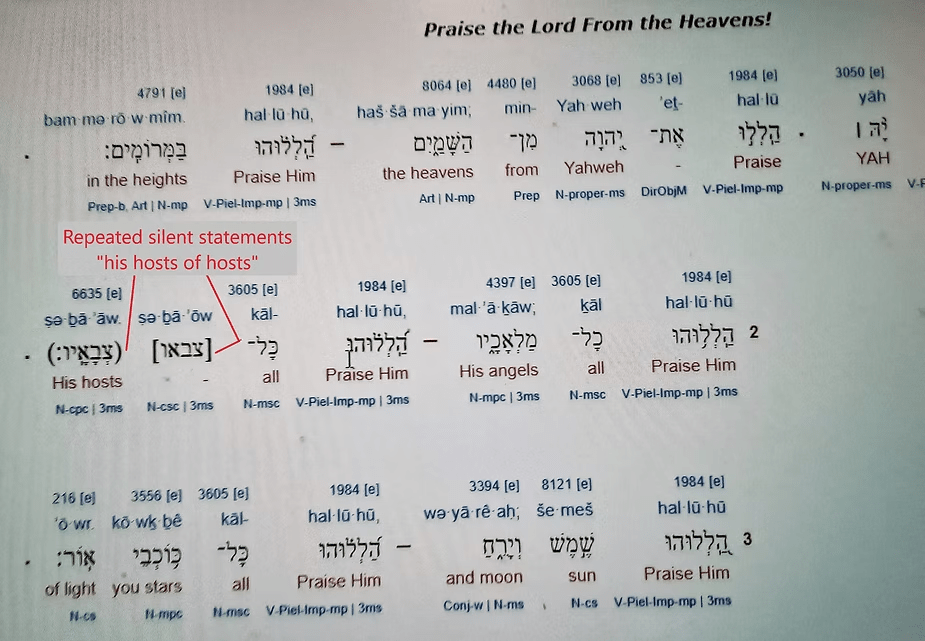
You will note in the above translation that I have placed several words in bold type. Primarily, those are reinstatements of “Yahweh,” where the NRSV has translated “the Lord.” In addition to that, I have added the truth of the word “Hallelujah,” which is two separate Hebrew words: “hal·lū yāh.” Those words translate as saying, “praise YAH;” and I have placed that truth within parentheses, placing “YAH” in bold type.

This psalm will only be read on the fifth Sunday of Easter, in the Year C. It is the epitome of a “psalm of praise.” In the fourteen verses of this song are thirteen forms of “hal·lū” written. That word is written four times, counting the two translations of “Hallelujah!.” The word “hal·lū” is part of eight constructs, which are two forms: “hal·lū·hū” (meaning “praise him”) and “yə·hal·lū” (meaning “let him praise”). Another word is then added – “tə·hil·lāh” – which is a separate word [“tehillah”] meaning “the praise.” Only six verses in this song of praise do not contain a word stating “praise.”

Three times (once in verse five and twice in verse thirteen) are found references to “the name,” which is relative to the “praise” to be given. It should be noted that the “name” David wrote four times (“Yahweh”) and abbreviated two other times (“YAH”) states that “name.” To remove that “name” and replace it with a generic statement as “the Lord” is to not give praise to that “name.”

To fully understand why David would say to give praise to the “name,” one must grasp that is a statement of “name” change, which is what a wife takes on in marriage. Here, “name” is then that of her husband’s, where his “name” added to hers, becoming a statement of possession. A wife becomes the possession of her husband when she is given away by her father, making the “name” of the husband be responsible for the wellbeing of the wife. When this concept of marriage is understood to be on a soul level (not physical marriage on the material plane), then Yahweh marries a soul through the transfer of His Spirit (Pneuma, in Greek, ruach in Hebrew). Rather than take on the last “name” of “Yahweh,” like a human female takes on the surname of her husband, the “name” change is spiritual. Thus, the “name” one praises is “Israel,” which means “Who Retains God,” where “God” is actually one “el” of Yahweh’s elohim. Being a Yahweh elohim means taking on the name of His Son, who is now called Jesus – a name meaning “Yahweh Saves.” That “name” leads one’s soul to give praise to Yahweh, having been resurrected within one’s soul.

It has to be understood that normal human beings may like their religion and may love the people of the church which they attend, but once out in the real world there is not a lot of praise for Yahweh going on. While inside a church building, when the organist (or multi-piece band) begins playing music for the sing-along hymns, few people (outside of Pentecostal churches) will stand from their pew seat (arms raised to the sky), shouting out “Praise God!” because a priest said anything spiritually moving. Only when someone strikes it rich in the real world does one hear, “Praise God!” outside of a church. This failure to “praise YAH!” on a regular basis says David was not singing a song of praise to get people to ape beliefs, as some show of love that is not true. He was singing a song of praise because his soul was possessed by Yahweh; and, the words of his songs were whispered to him melodically by his inner voice – Jesus.

Verse one sings, “praise Yahweh from the heavens.” The Hebrew word “shamayim” can translate as “the sky,” which makes it read as “the heavens” project higher than “the sky,” as into outer space. Here, it is important to realize outer space is part of the physical universe; and, David was not singing physical praises. This means “heavens” must be equated with the “spiritual.” So, the continuation that says, “praise him in the heights” means the “heights” of one’s soul’s “spiritual elevation.” One does not offer “praise to Yahweh” because one feels drugged or because one gets rich. One offers “spiritual praises from the heights” that come from His Son being one with one’s soul. It cannot get any higher than that presence within.

In verse two, David included “angels” in the mix of who gives “praise to him.” Here, it is important to realize that the soul of Jesus resurrected within one’s soul is the same thing as an “angel.” The ‘“angels” in the flesh’ are Yahweh elohim, where the elohim are the gods that never die, which makes them “angels” or “spirits.” The word used here by David is “malak,” which equally translates as “messengers.” While there are “angels,” such as Gabriel, who appear as “messengers,” the implication by David is David was also a “messenger,” due to his being possessed by the divine Spirit of Yahweh. Thus, the last two words of verse two are surrounded by brackets and parentheses, which makes them silently present, while making praises to him, as His “hosts of hosts.” This is the vast army of “angels, messengers, and souls” in human bodies of flesh that serve Yahweh totally.

In verse three it appears the “hosts of hosts” are those lights in the sky in outer space; but, again, the physical is not the intent of the words sung. The metaphor of “sun and moon” are the lights in the sky that illuminate during both day and night. All light on earth exposes truth that cannot be seen in darkness. Thus, for “the sun and the moon to praise him,” this means all who are led by the light of truth that comes from within (Jesus reborn), praise is due Yahweh because without that illuminating truth one would be lost and fall into a pit. As for the “stars of light,” those are the flashes of insight that the Mind of Christ (call it of the Messiah within) speak to one and lead one divinely. Again, this must not be read as physical stars twinkling in the night sky [and the sun is a star that makes all life on earth be possible].

In verse four, David returned to the use of “heavens,” writing it now like he silently wrote “hosts of hosts.” Here, he wrote the “praise to him” comes from “heavens of heavens,” where the same metaphor is for “spirits of spirits.” This sings of a duality, where Yahweh is the premier Spirit and His Son is the soul of His making. The praise is then motivated by the soul of Jesus resurrected within a lost soul in human flesh. When David then sang of “the waters above the heavens,” this is the everlasting ‘waters” of Yahweh’s Spirit of Baptism, which elevates a normal soul “above,” to eternal life through salvation. That is the praise due Yahweh.

In verse five David’s first use of the “name of Yahweh” being “Praised,” which is the marriage of a soul to His Spirit. This marriage is then confirmed by his singing, “for he commanded and they were created.” The Hebrew word “tsavah” can be translated as “to give a commandment,” as it means an “order.” For one to take on the “name of Yahweh,” one then has to agree to the “commandments” made by Yahweh to all His wives. This means the wedding vows are the “Commandments” brought down the mountain by Moses. To say “I do” to those orders makes one become a true “Israel,” in the “name of Yahweh.”

Verse six then says these “commandments” last “forever.” They are the “decrees” made by Yahweh and they will “never pass away.” There will be no modifications to those agreements. In return, a soul gains eternal life from redemption of all past sins. For that promise, no one would dare break any of those “commandments.”

In verse seven, one must again force oneself to leave the illusion of the physical and ascend to the spiritual meanings that come from “earth” and “sea creatures.” When David wrote, “praise you Yahweh from the earth,” the “earth” must be seen as the “flesh” of a human body. This says the “praise” due “Yahweh” is not solely from angelic spirits that do not possess a soul on the earth. This says a divinely possessed soul has the Son of Yahweh resurrected within its soul, within one’s “flesh;” and, it is from that “earth”-center that “praise” comes.

As for the “serpents” (from the Hebrew “tannin”), which can also translate as “dragon” or “sea monster,” this becomes the Leviathan that is metaphor for the elohim that lurks in the “waters” of souls on the physical plane. A Leviathan can be an evil (demonic) possession, which preys on lost souls that refuse to marry Yahweh and agree to His “commandments.” When the Leviathan is a divine elohim that possesses a lost soul, it comes as the soul of Jesus resurrected. Either way, a lost soul fears being possessed; but, once possessed divinely, that divine presence will bring forth praises to Yahweh.

Verse eight then uses the metaphor of weather to show the changing states of human emotions: anger (“fire”); hurtful barbs (“hail”); cold-heartedness (“snow”); secrecy (“clouds”); self-ego (“wind”); and, arguments (“storms”). All of these fill the “sea” of souls filling the “earth.” These can become stable by the inner presence of a divine Spirit – the Yahweh elohim of Jesus – or, they can be aggravated by the presence of a malevolent spirit possessing one’s lost soul.

Verse nine sings of “mountains and all hills,” which are the challenges facing a soul in the flesh. The presence of Yahweh’s Spirit makes overcoming those challenges less tiresome. The “mountains” become reduced to “hills,” with each rise accomplished a lesson that increases one’s reason to give praise. As for the “trees,” all souls must become “fruitful” and produce good fruit. A “cedar” is a lasting hardwood which produces fragrance that is pleasing. This element of usefulness keeps these “trees” growing and not cut down and thrown into the fire.

Verse ten then is a statement that everything living on earth that breathes air (oxygen), including “beasts and all animals, creeping things (including insects and snakes), and fowl that flies” are given souls by Yahweh. A human soul that has not married Yahweh does not take on any greater importance in the totality of life on earth, just because it has a larger brain than most. Here, in the third of six verses that does not state the word “praise” (in any form) says Yahweh receives a natural form of praise by all life forms on earth. Mankind needs to see the only thing that separates them from these listed in verse ten is the brain allowing it to realize it must marry Yahweh or return to the worldly plane in reincarnation.

Verse eleven then leaps to that level of civilized mankind, who are groups of people led by “kings of the earth.” Here, again, “earth” should be read as “flesh.” Souls are not kings anywhere other than their own physical bodies of flesh. A “king” allowed to lead many people is still human and mortal. The “princes” are then those whose blood relationship is to a leader, who sets them up to be future “kings,” when they might not have the support (or forced capitulation) of the “people.” Those who act as “the judges of the earth” will be found to have no voice as judges over their souls, once they leave their beloved “earth.” Only when a soul leads the flesh to submit totally to the Will of Yahweh can a soul be judged favorably.

In verse twelve, the last of the six verses that does not say “praise” places focus on age, beginning with those young – “young men and virgins” – where there is a need to be taught the “commandments” of Yahweh. If left alone to figure things out on their own, they will become misused by those who know the young are impressionable and easily misled. In nature, the predators focus on those animals without the strength and knowledge of an adult. Human youths are no different. Likewise, in the hunt the aged are vulnerable as well. When one has lived a long life and not been led to find reason to sacrifice self and marry Yahweh, there is no favor given by Yahweh because a soul lasted a long time in a body of flesh. Age does not matter when judgement comes at death.

In verse thirteen David returned to using the word “let him praise,” saying “the name of Yahweh is exalted alone.” This says all the verses that told of the circumstances of life in the material realm, no one is “exalted” or “lifted up” without taking on His “name.” When David sang, “his splendor [or majesty] over the earth and the heaven,” this says taking on the “name of Yahweh” adds the divine elevation of marriage, with His Spirit making it possible for His Son to resurrect. It is with that “splendor” “above” or “over” (can you say Lord?) the flesh and the soul (“earth and heaven”) that brings “praise.”

In the final verse, David sang that Yahweh “has exalted the horn of his people praise to all his saints.” The “horn,” which (from “qeren”) is a symbol of strength, which brings forth “praise,” as well as making common souls become “pious” or “chaste” (from “chasid”). These “people” are the sheep of Yahweh, as His wives in marriage, who are led by the “horn” (as a ram) that is each of theirs individual Lord. Here, David sang the “name of Yahweh,” when he wrote the “sons of Israel” are those who are “saints.” Again, the “name Israel” means a soul (not a physical body of any kind) “Who Retains God,” with “god” and “el” of Yahweh’s elohim. All of these will keep Jesus “near,” so “near” his soul will be resurrected within each apostle’s soul. Then, all will “praise YAH!”

As a Psalm of David that is only read on this fifth Sunday of Easter, where the theme of the Easter season is about the resurrection of Jesus in the dead of lost souls, saving them for eternity, this message must be seen in this song of praise. All praise to Yahweh is due to this theme of salvation.

John 13:31-35 – Here is a new Commandment to go along with a new soul in new flesh

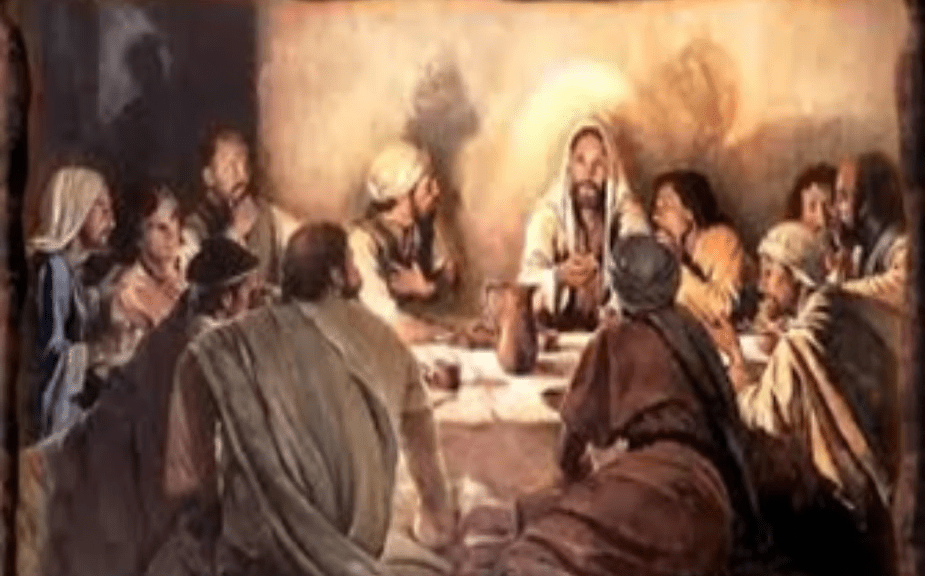
At the last supper, when Judas had gone out, Jesus said, “Now the Son of Man has been glorified, and God has been glorified in him. If God has been glorified in him, God will also glorify him in himself and will glorify him at once. Little children, I am with you only a little longer. You will look for me; and as I said to the Jews so now I say to you, ‘Where I am going, you cannot come.’ I give you a new commandment, that you love one another. Just as I have loved you, you also should love one another. By this everyone will know that you are my disciples, if you have love for one another.”

——————–

This is the Gospel selection that will be read aloud by a priest on the fifth Sunday of Easter, Year C, according to the lectionary for the Episcopal Church. It will be preceded by a mandatory Easter season reading from Acts, this time Peter telling the Christians of Jerusalem why he met a Gentile. He told them, “I was in the city of Joppa praying, and in a trance I saw a vision. There was something like a large sheet coming down from heaven, being lowered by its four corners; and it came close to me. As I looked at it closely I saw four-footed animals, beasts of prey, reptiles, and birds of the air. I also heard a voice saying to me, `Get up, Peter; kill and eat.’” That will be followed by a singing of Psalm 148, where David said to praise Yahweh, singing, “He made them stand fast for ever and ever; he gave them a law which shall not pass away.” That will be followed by a reading from John’s Revelation, where he heard the voice of Yahweh telling him, “See, I am making all things new.”

It should be realized that John did not write “At the last supper, when Judas had gone out.” The NRSV shows that written translating as, “When he had gone out.” Because this is verse thirty-one, John was writing with the expectation that the reader had read the prior thirty verses; and, verses twenty-two to thirty tell of Jesus announcing to the group that one in attendance would betray him. When Peter asked who that was, John told of Jesus saying, “He is the one whom I will dip the morsel and give it to.” He then gave the morsel to Judas Iscariot; and, he was instantly filled with the spirit of Satan. Jesus then told Judas to go and do what he would do, with the other disciples thinking Jesus was sending Judas out to buy something for the evening’s Seder (like more wine), because he was the money man. Thus, Judas got up and left; and, that is where verse thirty-one begins.

Relative to that “morsel dipped,” this is said by some to be the final bite of sacrificial lamb, which is the ending of the dinner part of the Seder meal. With that last morsel eaten (everyone has a charred bone of lamb on his or her plate), the women would get up and ‘clear the tables,’ with the free-flowing of wine to begin. This means the last bite would be when others would also get up from their reclining positions and begin moving about. This is why the disciples did not understand that Jesus had signaled who his betrayer was, but Judas getting up to leave did not seem like he had been pointed out as such. Everyone expected Judas to return, which means his wife and children would have remained in attendance, themselves unaware what was going on. If all the disciples were in attendance, so too would be their families.

It is important to know there are two Seder meals each Passover. One is on the evening (after 6:00 P.M.) of 14 Nisan (which is officially 15 Nisan) and another on the evening of 15 Nisan (officially 16 Nisan). The ‘first supper’ was held in Bethany, at the home of Simon the Leper. It was officially a Sabbath after nightfall (six o’clock P.M.) when that Seder was held. The next day was the Sabbath, so travel from Bethany, to the upper room in the Essene Quarter of Jerusalem would have been done after six, so that distance could be travelled. While that would technically be a Sunday, the first day of the week, the “last supper” room was prepared on the prior Friday (14 Nisan), so all the necessary arrangements (food, wine, plates, cups, pillows, etc.) would have been ready as soon as everyone arrived. Not all attendees would have come from Bethany; but all in attendance knew beforehand where this “last supper” would be held.

The missing element of verse thirty-one is the capitalized first word “Hote,” which means “When” or “At which time.” This makes the timing of when Judas Iscariot left the Seder event be divinely elevated in meaning. This capitalization cannot be taken as some ‘ho hum’ “next” word. Everything written afterwards in verse thirty-one is dependent on this divine timing of “When,” which is less about Judas and all about Jesus.

The words that follow “When” say (in English translation), “therefore he had come out.” The Greek word written (“exēlthen”) is the third-person singular Aorist Indicative Active form of “exerchomai,” which means “to go or come out of.” Following a divinely elevated word of timing, with the segment following this will be found to be stating the name “Jesus,” the “departure” of Judas meant the “coming out” of “Jesus.” In terms of someone rescued by drowning, to say “out with the bad air, in with the good,” the removal of Judas the betrayer from the midst of the Seder meal recognition (a Commanded event) meant Jesus was free to teach his disciples openly, without need to keep from making declarations that could be misused against him and his followers. His “coming out” was from his soul being expressed.

When “Jesus “ then spoke to his disciples, John capitalized the word “Nyn,” which divinely elevates the “Present,” as “Now.” With Judas was sent to do his betrayal (known by Jesus to bring forth his arrest quickly), “the Present” was then when Jesus said “(he) has been bestowed with esteem this Son of this of mankind”. This says the “honor” given by the Father to the “Son” was free to be expressed one last evening.

With that said, John then separated that statement from the next, while marking it with the word “kai,” which denotes importance that must be added to what Jesus said. Following the “kai,” Jesus said, “this God has been bestowed with esteem in his soul [“himself”].” This means that after Jesus said the “Son of this of mankind has been glorified,” where “Son” (capitalized only) implied Yahweh was his Father, the importance that was added stated the “Son” (“this”) was a relationship with “God” [Yahweh] that “has been glorified” in “Jesus’ soul (“himself”). The importance of that says Jesus of “mankind” (not a capitalized word, thereby a statement of Jesus being a commonly born physical “man”) was “glorified” or “bestowed esteem” in “his soul” (“himself”). He was not the physical son of God. He was the Spiritual Son of the Father, Yahweh, placed within human flesh (“man”).

With that statement about Jesus being the “Son” of the Father, what he then stated in verse thirty-two needs to be seen as a statement that extends beyond the physical body of Jesus having a “soul glorified,” to all who have souls in bodies of flesh. This is why verse thirty-two begins with the ‘conditional conjunction’ word “if.” According to HELPS Word-studies, the Greek word “ei” properly expresses “a condition, thought of as real, or to denote assumptions” (i.e. viewed as factual. for the sake of argument) (BAGD). Accordingly, 1487 (ei) should not be translated “since,” but rather always “if” – since the assumption may only be portrayed as valid (true, factual).” Thus, verse thirty-two is not a statement about Jesus, who was indeed the “Son,” one who “has been bestowed with esteem” by “God” in “his soul” (“himself”); it, therefore, is relative to his disciples that he stated this condition that had to be met.

The condition of fact that must be found is then said to be “this God he is honored within to one’s soul (“autō” as a generic form of “self,” thus a “soul”). While all of Jesus’ disciples were male, the word could equally translate as the word “autō” that John wrote Jesus said about “his soul” (“himself”), where “his soul” would apply to those male disciples. However, knowing the room was filled with both men and women followers of Jesus, the generic must be applied; as Jesus was placing the condition of fact before all there at that time.

Following that conditional statement, John wrote a comma mark of separation and began the next segment with the word “kai,” showing importance related to that conditional being true. Jesus said importantly, “this God (he) will honor [bestow esteem] of himself within to his own”. Here, the word “auton” (“himself”) has a double meaning, as “one’s soul” becoming the possession of Yahweh, and “Yahweh’s Spirit” (as “his soul,” from “himself”) doing the possessing of a soul. When this leads to Jesus saying “hautō,” in the third-person singular Dative Masculine, this states the possession of “his own.” The preposition “en,” as always should be read in Scripture, means “within,” which is where souls stay. Thus, the important addition stated by Jesus says, “God will enter one’s soul and make one His own” … if the conditions are met.

Here, John finished verse thirty-two by again placing a comma mark of separation, followed by another “kai” of importance. This importance says the possession of God will not take long, once the conditions have been met. In fact, they will “immediately, at once, or directly” find that “he will bestow esteem” … the same as God bestowed upon Jesus … “within … to one’s soul” (“himself or oneself”). This is an ‘all or nothing’ scenario. When the conditions have not been met, then there is no ‘calibration’ or ‘degrees’ of esteem earned by following Jesus (notice the Judas betrayal factor here). However, once one’s total submission to Yahweh is determined to be marriage worthy, then … bam! … one’s soul “immediately will be glorified” like Jesus.

Following a period mark at the end of verse thirty-two, verse thirty-three begins a new line of thought being stated by Jesus, where the first word is a capitalized “Teknia.” The capitalization shows a divine level of meaning applied to the typical word usage, which is “little children.” The root word, “teknion,” properly means “a little child,” but the figurative use implies “someone deeply loved (endeared).” The capitalization divinely raises this “endearment” to a spiritual level, where love is one of the conditions that must be met: love of God and His love returned. This love must be seen as Spiritual, which is well beyond the scope of love defined by human emotions and feelings. Thus, the capitalization of “Dearly Beloveds” must be read, so the following command to “love one another” is understood.

In this verse, the NRSV has mutated what Jesus next said, to make it appear he was giving them warning that he would be taken away from then shortly. That is not what Jesus said. Following the capitalized “Teknia,” John wrote a comma mark of separation, so Jesus next said, “in addition small in company with your souls [“yourselves”] I exist”. Here, the mistake made by the NRSV is to translate “eti” as being stated relative to time (as “still” or “yet”). However, when it is read relative to a degree, the same word means “even, further, more, in addition.” Here, one needs to know that all of the disciples had been sent into ‘intern’ ministry, where each was accompanied by the soul of Jesus – “a little in addition with their souls” – so they could get a taste of what being “bestowed esteem” by Yahweh meant. This means Jesus said “a little of his soul existed within them already,” but not yet ‘the full meal deal.’ That would come later.

It is from that ‘taste’ that John then placed another comma mark of separation, followed by his writing of Jesus telling his disciples, “you will seek my soul” [“mine” or ‘myself”]. That becomes a prophecy of the disciples being transformed into full-fledged Apostles after Jesus would raise them from the dead spiritually; but they all had to “seek Jesus’ soul,’ through submission to the Father Yahweh.

Following that prophetic statement, John placed a semi-colon mark of separation that begins a new line of relative thought, followed by a one-word statement that is “kai.” That increases the importance of that said next, which is an additional statement relative to the presence of Jesus’ soul within (just a little) and seeking his presence fully. That important second statement says, “according to the manner in which I said to those Jews because : In what place my soul [“I”] brings under , your souls [“you” or “yourselves”] not you have power to have gone [or “to have come”] , kai to your souls [“you” or “yourselves”] I say at this moment .

This importantly says that everyone Jesus has sent “a little” of “his soul” (up till then) had been “Jewish” or “Jews.” That is because Jesus was a divine soul sent only to the ‘children of Yahweh.’ So, “in the manner in which” Jesus touched the souls of “Jews,” he likewise touched the souls of his disciples. Jesus’ soul [“I”] became one with those Jews who were “brought under” his lead, making his physical body become a Lord or Master (or Teacher) that others bowed down before. Their soul were marked by Jesus as his, so the Father would receive them. Without that “little bit of Jesus’ soul within their souls,” none of them “has the power” to share their souls in that way. This was importantly stated by Jesus (physically) “at that moment,” but his words went deeper, speaking to “their souls.” None (other than John, perhaps) would recall these words before their souls had been raised from the dead, as Jesus reborn. Then their souls would remember these words.

The capitalization of “Jews” (“Ioudaiois”) is easily mistaken as a reference to the “Jews” of the temple in Jerusalem; but that denies the divine elevation in meaning a capitalized word takes on. The word “Jew” means “Praiser.” Thus, the plural refers to all who “Praise Yahweh” as having become one with their souls [read Psalm 148, which sings about “Praise YAH!”]. Since the temple elite (the Sanhedrin) praised nobody but themselves, they are not the intent of this that Jesus said. It is important to grasp that.

Verse thirty-four then begins with a capitalized “Entolēn,” which is Jesus stating “a Commandment.” Because the word is capitalized and taken to a divine level of meaning, it is not so much Jesus giving a “Commandment,” but Yahweh speaking one through His Son. This is a “new” commandment, which is not to be taken as a ‘never before been commanded’ “Commandment.” Here, the use of “kainēn” should be compared to its similar usage in Revelation 21 (the Epistle for this fifth Sunday of Easter). Just as John was shown a “spirit new” [“heaven”] and a “body new” [“earth”], the “Commandment” is an existing “Order” given, but one that needs to be seen in a divinely elevated “new” light of awareness. This “newness” is found because it is not “given” to your heads. Instead, Jesus said, “I give to your souls” [“you” or “yourselves”]. That “new” light shone on an old Commandment,” now understood within, saying, “your souls [2nd person plural “you”] should love one another.” The alternate view of “one another” (“allélón”) is as “themselves” or “yourselves,” so Jesus said this “new Commandment” is to love the souls of others with your soul.” That is not the same “love” as physical love of a body to another body. This “same self love” is just as Jesus did love, because the soul of Jesus will then be within the souls of his disciples. As Jesus reborn, they will all share the “love of Jesus” as Jesus.

Following John placing a semi-colon mark, making a separately relative statement be said, Jesus further “Commanded,” “according to the manner in which my soul [1st person “I”] has loved your souls [“you” or “yourselves”] , for the purpose that kai your souls [“you” or “yourselves”] should love the souls of others.” In the two subjunctive uses of “agapate” (“you should love”), this becomes indicative of the ‘conditional’ first stated by “if.” It says that in order to receive the soul of Jesus fully within one’s own soul, one must meet this condition of “soul love,” which (again) is well beyond all physical definitions of human “love.” The “love” of Jesus to his disciples, where he called them “Dearly Beloveds,” is him stating his divine “love” for those disciples (now that Judas had “departed”) was “a little of his soul merged with their souls.” That sharing of souls is what Jesus said here; and, it must be understood that Jesus waited until Judas had left to speak of this “love one another as I have loved you.” Not everyone in the world falls into this category of the conditional requirement of Yahweh’s love being shared.

This exclusivity is then stated clearly in verse thirty-five. The first word of this verse is not capitalized, but the use of “en” must always be read as meaning that “within,” which becomes an unseen source of brotherly “love” that is soul-related (not blood or physical). The whole of this verse literally translates into English as saying, “within this (he) will know all because to my soul [“mine” or “myself”] disciples you exist , if love your souls possesses within to other souls [“one another”].” This says “all” will be reborn as Jesus’ soul in their soul; and, that divine possession will bond all who are souls in this state as brothers (including females) in divine love. It is a statement that says all Christians will be souls possessed by Yahweh and Jesus, Father and the Son, therefore “all” will be Anointed by Yahweh’s Spirit as a Christ.” The conditional for being a Christian is possessing the love of Yahweh, as His Son reborn.

As the Gospel selection for the fifth Sunday of Easter, which is a season placing sincere focus on souls being raised from the dead by the resurrection of Jesus’ soul within theirs, the Commandment given by Jesus to his closest disciples (sans Judas Iscariot) says be Jesus reborn. This selection from John is only read during the Year C Easter season, which means it must be seen in this light of resurrection. The NRSV translation makes it harder to see the truth of what is stated; and, the common misjudgment of Jesus saying to love everybody in the world simply is not true. Jesus “Commanded” a “new” self be raised; and, that “new” self is Christian, as Jesus reborn. This makes a common bond of love exist between all souls that have been raised from the dead, which keeps one from ever returning to the dead state that does not sacrifice a soul to serve Yahweh, as His Son resurrected in the flesh (not his own). It is very important that these five verse of John’s Gospel be understood; or, one’s soul will remain lost.