Tag Archives: Easter 6 Year A

Acts 17:22-31 – To an unknown god

Christianity has grown cataracts over its eyes.  Christians are blind to the fact that they have transformed into the Jews that killed Jesus, believing they are God’s chosen people because they believe Jesus was His Son [i.e.: the Messiah – from a Hebrew word (“māšîaḥ“) meaning “savior”].  Christians who do not live lives that prove they are Jesus reborn are then only comparable to Israelites who professed belief in God and did not live up to the promises of the Covenant. 

Still, Christians are blind to the fact that they are just like the pagan Greeks, who Paul spoke to in this reading from Acts.  Christians are proud of a heritage that believes all human beings have a place in their Christian world, with all their gods welcomed.  Christians today, like the Greeks Paul knew, build “objects of worship” and altars to everything believed to be ‘all-powerful’.

Read this Acts 17:22-31 so you will be ‘up to date’.  It saves space here and it proves if you really want to study Christianity, not just pretend to be ‘Christian’. 

I can only speak for American Christians, as one living with and witnessing those who call themselves Christian, as they bow down before the altar of Jesus Christ.  American Christian leaders (priests, ministers, pastors, and preachers) all say, “Jesus is God and God is Jesus.  We know God by knowing Jesus.”  In reality they know neither.

We do not read Acts 17:22-31 during the Easter season so Christians can glorify themselves as pure and holy people, who imaginarily stand behind Paul as he speaks to the Athenians of the Areopagus.  In reality it is to us American Christians (and all others like us, including Jews) that Paul spoke.  All Scripture is read aloud in churches for the same purpose: To address the reader and listener, not some long dead figure of an ancient text.  It is intended to be read to the ones who still sit and stand in churches, because they are those who know no other way to be.

Lost sheep need to be found; and, then they need to be led to the path that definitely takes them to God.

An American Christian church is an “object of worship,” just as Paul identified in Athens.  I can only imagine all Christian churches around the world are the same.  People calling themselves devout Christians go to these churches and leave tokens of their worship – usually some form of monetary donation to that building, where the altar they kneel before is housed.  If those people actually KNEW God or Jesus, they would be like Paul.  Paul “looked carefully at the objects of [their] worship” and found a Christian church (as an example of ALL that exist) being an altar “To an unknown god.”

To know God is to be one with God.  To see God in cartoons, or to ‘feel’ God in nature, or to believe God from reading about Him in holy texts is not the same.

The problem with Christianity today is it cannot see how long ago Christianity stopped being a movement of Apostles [i.e.: SAINTS] and regressed to being split between Jewish synagogues that continued to practice Jewish ritual, while amending the scrolls to be pointing to historical Jesus, and pagan gatherings that celebrate all the natural phenomena of our planet (gods) and loosely connect that to the ‘god’ Jesus.  Christians cannot see themselves as being the same as the Greeks that Paul walked among. 

American Christians and Jews-for-Jesus see Jesus Christ as a promise to come, just as he was promised to come before he came.  They cannot fathom how Paul was indeed Jesus Christ walking among the Greeks, reborn as such by God, via the Holy Spirit.  American Christians cannot fathom how they should also be like Paul, another Jesus Christ reborn into the world, in order to truly call themselves “Christian.”

For too many centuries the Church of Rome spread its empirical arms around the world, in the same manner as did the Roman Empire.  The only difference was the ‘Holy’ Roman Empire followed its swordsmen with cross-bearers, who wore white robes and dangled chains and crosses of gold around their necks.  They claimed to be ‘spreading the Gospel’ to the world, where the ‘Gospel’ was the “Good News” about the Messiah having come.

A comedy group I loved to listen to during my teens was The Firesign Theatre.  One skit they did was about the colonization of the Americas, by the Spanish.  They acted as if two of them where a Conquistador that met a Native American; and, the two had the following conversation (paraphrased from clouded memory):

  1. Conquistador (holding up a gold cross):  Got any of this?
  2. Native American: A cross?  The quartering of the universe into positive and negative principles?
  3. Conquistador: No!  What the cross is made of – GOLD!  Got any?

As funny as they made history seem, it was not funny.  Just to make sure the devil wasn’t keeping any gold from the Spaniards, they used their swords and raped their holy treasures for the King and Queen of Spain.  They did that “in the name of Christ.”  They called themselves “Christians,” but they were no such thing.

Paul never set an example of forceful conversion of anyone to a religion.  Paul never sought to get wealthy from evangelism.  Paul did not go to Greece and speak to polytheists about adding the name “Jesus’ to a shrine or “object of worship.”  Paul spoke to the Greeks as Jesus Christ reborn, telling them about the One God – Yahweh – who “does not live in shrines made by human hands, nor is he served by human hands, as though he needed anything.” 

Does that not clearly state, “God does not dwell in houses?”  God dwells in people, like Adam, Noah, Abraham, Moses, David, and Jesus (to name a few).  Remember last Sunday, when priests mistakenly said, “Don’t do anything.  Jesus went to reserve us a room in the Father’s Hotel Heaven.”  Every church or cathedral on earth was “made by human hands.”

How many Christian churches promote being like Paul?  How many ministers ask their congregations, “Why are you still here?  Go! Save the world like Paul!”  How many denominations of Christianity promote teaching the world the ‘Gospel’ of God, where that bears the meaning Paul stated (quoting the  Greek poet Aratus): “In him we live and move and have our being”?

None that I have seen.

Christianity in the United States of America, based simply on the history of the United States, has a record so atrocious that comedy groups have made fun of the lust for cash shown by Christian churches and leaders for many decades.  Once the sword of totalitarian control was laid down, the louder the laughs of mockery became.  Now, the sword has been picked up by those laughing and it is raised and held over the head of American Christianity, by those who hate the oppression that people calling themselves ‘Christian’ have caused to others.  American Christianity is like all empires who rule by the sword, becoming just as Jesus told Peter: “Put your sword back into its place; for all those who take up the sword shall perish by the sword.” (Matthew 26:52, NASB)

The Execution of Louis XVI in the Place de la Revolution on 21 January 1793.

What goes around comes around.

The sword of death to true Christianity fell when royalty was beheaded in the names of Independence, Revolution, and Freedom.  Killing the Church of Rome meant the sprouting (like mushrooms) of Republics, with Constitutions and mandated separation of Church and State.  The sword’s edge ushered in the Mind of Satan, where all ‘citizens’ and ‘comrades’ began to bow down and pray to Philosophies touting Democracy, Equality, Liberty and Justice for all, under the guise of Enlightenment, Reason, and Science. 

 A brain is a terrible path to righteousness.

All the old was tossed, with new statues and monuments being erected to show Humanity as a god.

Think about all the ‘temples’ of worship American Christians now build and go to pray.  Here are just a few the Greeks would be proud of:

While there has not yet been a monument built in its honor, one of two options are certainly in the works for the following:

Paul saw the efforts of the Greeks as somewhat commendable, about as commendable as are the prayers to God from those lost and desperate.  When he wrote: “[God] allotted the times of [our ancestor’s] existence and the boundaries of the places where they would live, so that they would search for God and perhaps grope for him and find him—though indeed he is not far from each one of us,” that can go down as “Give them an A for effort.  Still, it is really little more than like the saying goes, “Even a blind squirrel finds a nut once in a while.” 

God hears the prayers and knows every heart.  He answers prayers so people will learn to have faith and stop being afraid of everything the world has that proves dangerous.  Faith requires trust and trust demands knowledge.  Still, God the Father knows that babies need to fall so they will learn to walk on their own.  But for all God’s help, why do Americans remove their altar to their “Unknown God.”

Rather than remove the non-Christians, its easier to remove the God.

Paul used logic, which the Greeks knew well, when he reasoned, “Since we are God’s offspring, we ought not to think that the deity is like gold, or silver, or stone, an image formed by the art and imagination of mortals.”  American Christianity is all about the things of humanity.  God’s grace is imagined to be reflected in the wealth, power, and influence one has.  After all, don’t nations become successful empires by killing, raping, and pillaging in the name of God, with His approval to keep the spoils of war?

The war against evil begins to be successful when these who leaped into the sheepfold, wearing lamb’s wool, are exposed and banished. Still, the sheep love a good song and dance.

The lesson of this reading from Acts is at the end, when Paul said, “While God has overlooked the times of human ignorance, now he commands all people everywhere to repent, because he has fixed a day on which he will have the world judged in righteousness.”   

The times of human ignorance is why God sent His Son into the world.  Human brains are inherently incapable of leading human beings down a path of righteousness.  They naturally ignore the inner call to do good, when the outer lure to not do good is so tantalizingly tangible.  Human brains become adept at trickery and deceit.

Continuous trips and falls, wallowing in the filth of a sinful earth, requires one be cleaned for any chance of being Heaven-bound can appear.  The fixed day in EVERYONE’S LIFE when the righteousness of a human being will be judged is their deathday (the opposite of one’s birthday).  Without a brain that is capable of making oneself righteous, God sent His Son to be His gate to Heaven.

That is evident when Paul said repentance and judgement as worthy of Heaven would come “by a man whom he has appointed, and of this he has given assurance to all by raising him from the dead.”  This appears to say one thing, when one is using a human brain. 

It appears to say (to all the really smart human beings of the eighteenth, nineteenth, twentieth and twenty-first centuries, when human beings somehow think they grew a better brain than all the human beings prior) that Paul was evangelizing the Gospel, telling a group of Greeks, “Hey guys, Jesus was raised from death by God, so we can all go to Heaven now!”

Episcopalians all jumped up and said, “Praise be to God!”

The reality of what Paul said is this:

  1. “because he set a day in which he is about to judge the world in righteousness  ,
  2. “by a man whom he appointed  ,
  3.  “a guarantee provided to all  ,
  4. “having raised self out of subject to death  .

The first point states that every mortal will die, at which point every soul will be judged by God, in respect of how righteous that soul led its body of flesh to act.  [Important Note: You are reading this from the book that tells of the ACTS of the APOSTLES.]

The second point is multifaceted.  This is due to the use of the Greek word “andri.”  Typically this translates to say “a man,” which makes a brain leap up and down, exclaiming, “He’s talking about Jesus!”  That alone is too limiting for God talk, and God was talking through Paul, just as God spoke through Jesus. 

The word “andri” can also be more generic, as a statement of “a male.”  Yes, Jesus was a male and a man, but when Paul was evangelizing, Paul used to be Saul, when Saul encountered the Spirit that was Jesus Christ.  Jesus was no longer on earth as “a man,” but Christianity was well underway, through others reborn as Jesus Christ.  This means “a male” as the translation points to a gender statement about “the Son.”  That is opposed to “a woman” or “a female,” as “a daughter.” 

Still further, the Greek word “andri” can mean “a husband.”  This is a usage that flies well over the heads of American Christians and needs to be understood deeper.

By sounding out the English words that come from the Greek statement “en andri hō hōrisen ,” one can see these words separated by marks of pause [commas] force one to contemplate how God is going to judge the world in righteousness.  This will come “by [with, in, on, at, among] a man [a male, a husband] he appointed [he designated, he determined, he separated, he marked off by boundaries]”.  This becomes truth on multiple levels.

  1. God will judge “by a man he appointed,” who was the Son of Man, Jesus of Nazareth.  However, that “man” is no longer in the world as “a man.”
  2. God will judge “in a male he designated,” who is the Son of God reborn “in” a human being.  Because the Son of God [and even GOD Himself] is a masculine entity [earthlings are feminine entities, regardless of human gender], then when God judges souls they best be “in the Son [male form]” AND that “male” will then be “he marked off by boundaries,” meaning one who only lives within the boundary of righteousness.
  3. God will judge when he is “with” a human being that has submitted his or her self-ego and self-will to that of “the husband” that is God.  As one who becomes the wife of God (human gender is meaningless when speaking in spiritual terms of soul and God), then “he [God] separates” the life breath soul from having any control over the body of flesh it once owned.

I recommend the reader play with these words more, as more can come from them.  Keep in mind that God talk is not limited to human brain capabilities of translation (following normal syntax).  Just know that judgment leads to this element of being reborn as the Son of God, which then means point three is “a guarantee” of eternal life. 

The soul having been saved from the judgment of damnation [return as another baby born of a woman in a sinful world, to repeat the same grade of life and the same challenges: to stop being selfish and stop thinking you do not have to do anything to go to Heaven] means being reborn as Jesus Christ [his Holy Spirit in your flesh along with your submissive soul] makes him truly the Savior.  He saves you by not letting you destroy yourself anymore. 

When point three says, “provided to all,” this is why Paul [a Jew of Roman citizenship] was preaching to pagan Greeks.  It is why Paul’s story is retold to pagan American Christians and everyone else who has ears that want to hear.

The fourth point, after one has seen that Paul was not speaking about believing Jesus was raised from the dead, means it is YOU who is one of “all” who can be saved.  YOU are certainly going to die, so YOUR appointed time of judgment will come.  However, by removing yourself out of control of your body of flesh, allowing God to Father His Son in you, you become “raised from death” – your own end in this world.  Your soul will be saved by letting Jesus Christ become YOU.

To rephrase that, YOU must die of self, prior to your mortal death that is appointed.  To earn salvation (just like anything) means work must be done.  God the Husband expects His wives to serve Him as Saints.  For a flawed mortal to meet that requirement, the Son of God has to be reborn within each wife (again, do not let that word trick a human brain, as souls have no human gender, only human bodies that sense sexual urges.

Now, let me assure you that there will be no ministers preaching what I have written.  Why would they? 

If you believe this and become reborn as Jesus Christ, then you certainly will not be a ‘paying customer’ in some local church.  If you do that, then you will be out like was Paul, telling everyone “You are going the wrong way.”

Priests, pastors, ministers, and preachers are one of two things, if he or she is not being like Paul [or any and all Saints].  First and at best, they are hired hands. 

As adults, think of your employment.  Being a hired hand does not mean doing a bad job.  Most people want to do the best job they can, but as the saying goes: Don’t rock the boat.  One learns his or her job and does it to the best of one’s capability … until a better offer comes along or you do so good they give you a promotion.  A church is an employer and the hired hands are limited to what they can do and how.  Some ministers can feel chained to a contract with a church, not allowed to mingle with the “great unwashed.”

I mean, just look at the American Christian churches today.  They have all cowered down to fear of a virus, because a.) paying customers might die and stop paying, or b.) the government might arrest a priest for opening a church and fine the organization that owns the church and employs the priest. 

Like Jesus said, “When [the hired hand] sees the wolf [or viral threat of death] coming, he [or she] abandons the sheep [or parishioners averaging age 70 or older] and runs away.”

This is what the meaning of Acts 17:22-31 is.  Everyone has an appointed judgment day in the future.  The question is: Do you want to die of self and suffer the birth pains of being reborn as Jesus Christ? [Hint: Read this for insight about what that means.]

Or, Do you want to wait it out and hope it is all make believe: You want to hope there is no God. [Look: Something like this, but change the chant.]
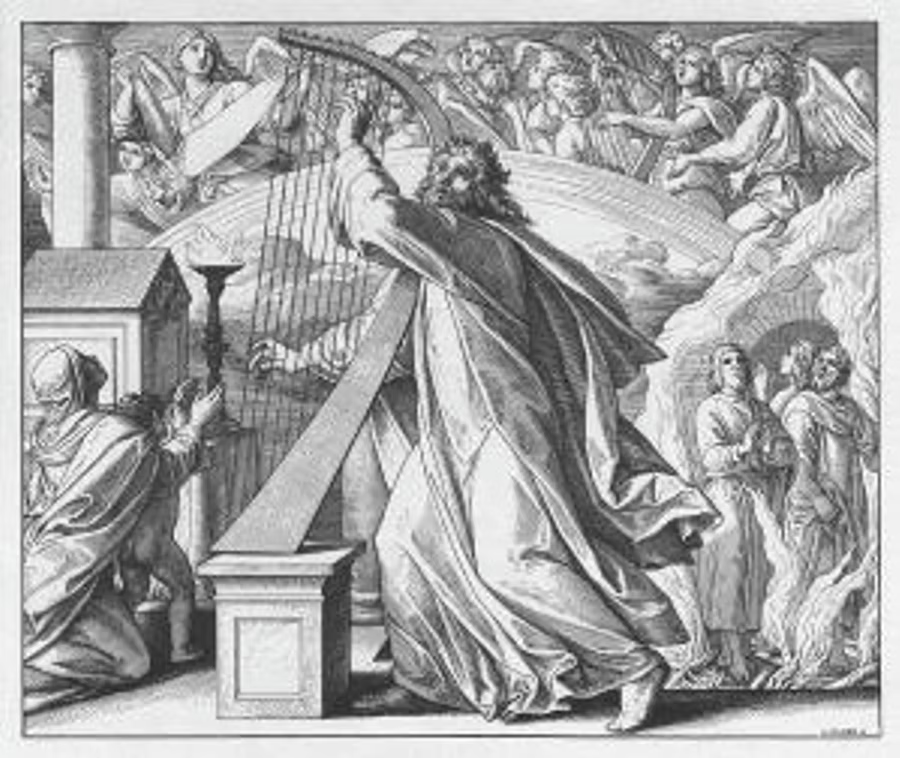
Psalm 66: 7-18 – Praise to what made Israel great under David

This song of praise is selected to be sung loudly in Episcopal churches on the Sixth Sunday of Easter.

The Easter season is when all of true faith answer the call – “Come out!” – and die of Self, experience the lowest of the low, and then rise as the resurrection of Jesus Christ, married to God Almighty, going out into the world in ministry [the purpose of an Ordinary season that follows Pentecost Sunday, the end of the Easter season] leading others to God, through Christ.

This song of David follows a reading from the Acts of the Apostles, where focus was placed on the Greek adoration of gods, including one whose name no one knew, as shown through idols, altars, shrines, temples, and statues.  David sang a song that points out where the Greeks had gone wrong, which is why this Psalm was selected to be sung on this day.  The elders who made this choice understood this connection; and the point of ministry is to amaze the disciples of Jesus with explanations that open their hearts wide and make them burn with desire to know more, falling in love with the Lord.  [Note: We read about this in the story of the road to Emmaus, during the readings on the Third Sunday of Easter.]

The Israelites learned these psalms like girls today learn pop tunes.

The English translation of Psalm 66, as read or sung aloud in church, comes from the Book of Common Prayer (pages 674-675).  This translation is not an exact match for the New International Version (NIV) or the New American Standard Bible (NASB), which the other readings are from (with modifications).  It is important to realize that the English translations, including the one found in the Book of Common Prayer, are misleading paraphrases.  They mislead by making this song of praise become as useless as a Greek statue to a Greek god.

As a human being that thirsted for open discussion about Scriptural matters, which I was not having quenched through listening to inane sermons Sunday after Sunday, I began a search for another human being who was seeing the same truths that I saw, so I could be confirmed that I was not mistaken.  My attendance at Bible Study classes on Wednesdays and lectionary study classes before church on Sundays found it was the blind leading the blind, falling into one hole after another.

This led me to leap at the chance to join the program offered by larger Episcopalian churches (large enough to field twelve enrollees per year) called Education for Ministry (EfM).  The program is designed to be four years long, with each year having about thirty-nine meetings (two hours each), once per week.  I enrolled in a class of twelve that was for the first year students.

The first year of the EfM program focuses on the Old Testament.  Right off the bat, as we were reading the course paperwork that came with the admission fee and the Book of Genesis, we were asked to believe the hypothesis of multiple writers of Hebrew Scripture.  Rather than think Isaiah wrote every one of the books under his name, scholars had determined Isaiah was like Shakespeare and anyone could have written a book under that name.  Those same scholars had determined the Hebrew text has four basic writers, with one of them called “the E writer,” where the “E” represents the Hebrew word “elohim” (“אֱלֹ֘הִ֥ים”).

The Hebrew word “elohim” is said by Strong’s to be “(plural) 1a. rulers, judges; 1b. divine ones; 1c. angels; 1d. gods.”  While being a plural form of the word “el” (“אֵל”), Strong’s adds, “(plural intensive singular meaning) 2a. god, goddess; 2b. godlike one; 2c. works or special processions of God; 2d. the (true) God; 2e. God.”  As a plural word that quickly implies “gods,” the E-writer was someone who liked writing in the plural number, while meaning the singular.  

Now, as a first year student in a course asking me to believeelohim” means “el” (and their reasoning was not “because Strong’s said so”), the course paperwork explained that belief should come because of a theory by scholars.  That theory (admittedly, in the course paperwork) could not be proved, but it needed to be accepted so the students would be able to continue reading their course paperwork, which assumed everyone believed that ‘ghost writers’ hypothesis. 

My question was, “Why would a writer choose to scribble four letters, when the intent meant only two were necessary?”  Besides the obvious confusion such a stunt would cause, I asked my ‘mentor’ (the class leader), “What is wrong with reading “gods” every time “elohim” is written?”  After all, I thought, God created everything, why not helpers?

I became a bad boy student, with thirty-eight (or so) more weeks to go.

I tell this story because the Book of Common Prayer, under the heading “Concerning the Psalter” states this:

“Three terms are used in the Psalms with reference to God: Elohim (“God”), Adonai (“Lord”) and the personal name YHWH.” (page 583)

It is with this understanding that one realizes five times in Psalm 66:7-18 (the numbering of verses differs in other publications) “God” is sung or spoken aloud, with each of those translations coming from the Hebrew word “elohim,” which means “gods.”  Once, in verse 16 (some publications list this as verse 18), the word “Lord” is read, which comes from the Hebrew word “adonai.”

Here is an article on Wikipedia that lists the various names for God in Hebrew. In that article one learns that “adonai” is the plural of the singular word “adon,” which means “lord.” Amazingly (to me), the Jews also adhere to the plural versions being acceptable to read in the singular, depending on the context surrounding each use (some plural uses do means “gods”).  So, a combination like “adonai elohim” is read as “Lord God,” not “lord of gods” or “lord of lords.”

With all this said, one comes to a point of decision.  A choice has to be made.  There are only two options: 1.) David wrote Psalm 66; or 2.) The E writer wrote Psalm 66. 

The choice is yours.  Now that you have been officially educated in scholastic reason (after the fact), do you build a temple to “E” and worship his word, or do you sing the song of David as if your own heart sings of “gods” and “lords”?

All of Genesis 1 says, “elohim” did this and “elohim” did that, only to have it translated so it reads “God” did this or “God” did that.*  My EfM mentor refused to allow discussion about my proposition, “Why was God incapable of having lesser gods [which God would have created] do the work He commanded?”  I asked, “Why couldn’t Creation be the work of God through His gods?

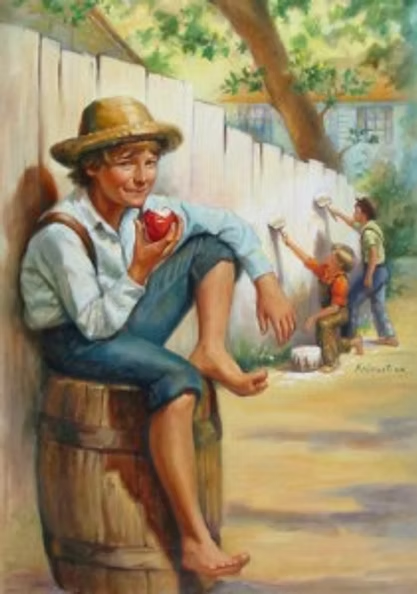
I believe God is smarter than ole Tom Sawyer. If he could get others to do his work, I’m sure God could do better.

I was told, “There is only One God, so shut up.” [I paraphrase.]

To understand “elohim” as “gods,” one has to understand Paul speaking to the Greeks as one of the “elohim” who had been filled with the Holy Spirit, reborn as God’s Son, and as such God was creating Christianity through “elohim” (then called Apostles).  If one can grasp that concept, then back up the calendar to the days of David.  David was also filled with God’s Holy Spirit, reborn as God’s Son, and creating a holy Israel.

The scholars who worship the E writer theory cannot even confirm that David existed.  They think (but cannot prove) David was a mythical creation of the Jews, something akin to King Arthur.  They will not come right out and say that, but there are few true Christians (like Paul) these days, and there are no more King Davids leading anyone anywhere in 2020.

There are no longer any Israelite “elohim” around, of whom David sang.  The collapse of Israel was due to the people not wanting to become sons of God (“elohim“).  They had asked Samuel to tell God to give us a King, so the Israelites could be like the Greeks and Egyptians, and build monuments to the “gods,” rather than having to make the commitment to be “gods” that did all the work of creation God commanded.

Again, the English translation of Psalm 66 hides the truth that underlies.  You can follow along with this Interlinear list of Hebrew and English.  If feeling a little lazy, just keep reading and ignore the link.  Here are some literal translations that do not ignore the plural number words:

Verse 7 is read aloud so it says, “Bless our God, you peoples; make the voice of his praise to be heard.” It literally can translate this way [keeping in mind that Hebrew has no capital letters]: “kneel you peoples  you gods –  and make be heard  –  the voice of his song of praise”.

Now, can that be read as if David was calling the Israelites the children of God, using “elohim” as a way of their Covenant meaning all “people” of Israel had to be married to God, reborn as His servants [i.e.: holy priests]?  You tell me.

Verse 8 then says, “who places our soul among the living  –  and does not allow out feet to be shaken.”

This is reference (“who”) to the one “voice of his song of praise,” who has the power to give souls away – Yahweh.  Still, it says the ‘one soul’ of Israel has been granted eternal life (“among the living,” versus being among the mortal dead).  That grant to Israel was to place His priestly servants among the world of peoples, to stand tall because of the faith of elohim, unable to be shaken from its solid foundation that is oneness with God.  Christian Saints have that solidity through the perfect cornerstone that is Jesus Christ.

Verse 9 says, “for you have tested us gods (elohim) –  you have refined us as is refined silver.” 

This says the test of faith means no impure hearts will ever be united in marriage to YHWH.  The merger of God with a soul means one is refined and all impurities have been burned away.  Having passed that test, the Israelites became “gods” who served the One God.

Verse 10 then says, “you brought us into the net  –  you laid afflictions around our loins”. 

This says that God was the suitor in the relationship with the Israelites.  The testing of their merits came from all the attacks they had to face, against the indigenous peoples of Canaan.  They had to pass the test of commitment through the times of the judges, when the people cried out to God in anguish.  They were not free to interbreed with others.

Verse 11 follows that by saying, “you have caused to mount mankind over our heads  –  we went through fire and through water  –  but you brought us out to abundance”. 

Following “afflictions around our loins,” where the Israelites were seen as responsible for the plagues of Egypt, is was “through fire” of anger that Pharaoh pursued the Israelites, forcing them to pass “through water” parted by Moses.  By God being married to Moses (an “elohim“), God took the Israelites to the Promised Land, the Land of Milk and Honey (“abundance”), with the rest of “mankind” seeking to destroy the Israelites for not being like ‘normal people’.

Verse 12 then says, “I will go into your dwelling places with burnt offerings  –  I will pay you my vows  which have uttered  –  and I have declared  –  in accordance I was narrowed”. 

Remembering the Fifth Sunday of Easter, when the reading from John 14 had Jesus telling his disciples about there being many dwelling places in his Father’s household, David spoke of each Israelite as models of himself, where the “I” of his ego was a “burnt offering” so God could dwell within his flesh.  That became a marriage, based on the “vows” of the Covenant being “paid” by living up to that commitment.  As in a marriage ceremony, two exchange “vows,” therefore God “uttered” and David (Israel) also “declared.”  With the bond set, David was then “distressed” or “narrowed,” in the sense that he became the servant of his Lord, without the freedom to do as he so pleased – the Covenant became Law.

And the ring symbolizes eternity.

Verse 13 then follows, saying “burnt sacrifices of fat animals  –  I will offer you with the sweet aroma of rams  –  I will offer bulls with goats  –   selah [lifted up]”. 

Certainly, this speaks of the Israelite-Jewish ceremonial rites of altar sacrifices, which are parts of the Covenant.  Because the first person singular is used, meaning David spoke of his marriage to God, this speaks on a broader sense of the ministry of the “elohim,” as the act of marriage is only the first step of many in submission to God’s Will.  Thus, “fat animals,” “rams,” and “bulls with goats” speaks of the role of a Son of God – to “lift up” others who will give up their self-egos and serve the Lord.

Verse 14 then says, “come hear  –  and I will declare [to] all you who fear gods (elohim) –  what he has done for my soul”. 

This fully supports verse 13 being about ministry, because this is what David preached to those who “come hear.”  He would speak to Israelites, but also the leaders of any other nations who met him [remember David was kept safe from angry Saul by the leader of the Philistines and welcomed to live among them].  The aspect of “fear” [from the Hebrew “yare“] is perfectly suited for all times, as fearing giving up one’s self-ego and self-identity to serve God is the same fear girls have before being given away in marriage.  When David sang about “what [God] has done for my soul,” he was speaking words of encouragement – “Everything will be more than okay.  It will be great!”  By saying “soul” [from the Hebrew “nephesh“] the marriage is Spiritual, as is being one of the elohim.

 Verse 15 then says, “to him with my language  –  I proclaimed and he was praised by my tongue”. 

This says that David was like Jesus, who did not speak for himself but for the Father, because the Father was with him.  This says being the voice of God is the role of the elohim.

And the voice of God came like tongues of fire.

Verse 16 says, “if wickedness I ponder in my inner mind  –  not will hear the Lord [adonai]”. 

More than stating God will turn His back from the wicked, it says that one who lets wickedness rule over one [remember Cain] then one will refuse to hear God speaking words that say, “You are going the wrong way.”  Human beings destroy themselves by refusing to let God into their hearts, through relinquishing their self-importance.

Verse 17 then says, “surely has heard gods (elohim) he has inclined the voice of my prayers”. 

Again, this is not David singing about God hearing someone, but that one who has become married to God, as one of His elohim, they have heard the voice of God coming through their prayers.  Prayer is a two-way street, such that God listens to and answers the prayers of His wives (human beings).

Finally, Verse 18 says, “kneel gods (elohim)  –  who not has turned away my prayer  –  nor his goodness to me”. 

Here, David repeated the word “barak,” which is translated both times as “blessed.”  The word means “kneel” also, like when a King of England would knight someone who would kneel before him.  That imagery is a comparison of one of the elohim being likewise touched by the sword of God’s power.  David sang that the elohim are those who pray to God and have their prayers answered, which comes in the way of “goodness,” which is also “mercy” given to their souls.

With all this said about the meaning, which centers on the concept of elohim not just being God, but being the plurality of God with another’s soul – as an Apostle or Saint – few people these days hear this song in this way.  Sermons are not written about the Psalms; but then sermons are not written that tell the people not to fear submitting their egos to serve God wholeheartedly.  Everyone sits in pews of the sheepfold or leans on the sheepfold fence wearing a robe of piety, becoming unsacrificed fat animals, foul smelling rams, and bull-headed ornery goats, all going nowhere beyond their mortal destructions.

Waiting for the sermon at the petting zoo?

The imagery of David’s Psalms needs to be modernized and taken to heart today, before it is too late.  As a side note, in Psalm 23, read on the Fourth Sunday of Easter, which is commonly referred to as Good Shepherd Sunday, the first verse says, “The Lord is my shepherd; I shall not be in want.”  David did not write “adonai” where the translation is “Lord.”  He wrote, “Yahweh” (or YHWH or yhwh – “יְהוָ֥ה”).  No need for the E writer to be called in for that one.

———-

Footnote:

– When Genesis 2 rolls around, “elohim” is found in verses 2 and 3, but then changes to “Yahweh elohim” (“יְהוָ֥ה אֱלֹהִ֖ים”), written in verses 4, 5, 7, 8, 9, 15, 16, 18, 19, 21, and 22.  Because that clearly states “God of gods,” the EfM course paperwork said, “Oh, by the way, the E writer ended Genesis 1 with the end of that chapter being verses 1-3 of Genesis 2 really being Genesis 1.  The scholars believe Moses called “Break Time!” and the E writer walked off leaving three verses at the top of a piece of parchment, but then the Genesis 2 writer came and sat at the scrib’s table and forgot to give those verses to “E.”

“Oh, what a tangled web we weave, when first we practice to deceive!”

1 Peter 3:13-22 – The fear of suffering

The Epistle reading for the Sixth Sunday of Easter comes from the first letter of Peter, his third chapter.

In Peter’s first epistle, chapter three (which is not read) begins sounding like a woman’s high school Home Economics teacher [look it up youngsters], talking about good wives and husbands.

Typical Home Ec classroom

That is not what Peter was writing about, as the voice of God on paper. All human beings are of the earth [i.e.: of dust and clay] and all souls given life on earth in a human body are spirit [i.e.: ethereal]. This is the duality of life in humanity on earth.

I actually heard a priest on one of these Facebook ‘need to keep the paying customers connected to church by pretending to hold church on streaming video’ productions say, “God is the Father, but [since it was Mother’s Day] some people like to call God the Mother, which is okay.” No, it is not okay.  There is no duality to God – YHWH – Yahweh.  

The word “God” is a masculine gender noun. The word “Goddess” is a feminine gender noun. Those two words were created so no one could ever justify saying, “Well God means goddess.”  God is the Father because “God” is a masculine gender noun and “Father” is a masculine gender noun. Has anyone ever heard the term “Mother Earth”?

Meet Gaea – Earth Mother of the Titans.

Well, “Mother” is a feminine gender noun that complements the “Father.” God is masculine and Earth is feminine. Gaea and all her kin are (by the way) elohim.  This is the duality of Creation: God + that not God.

Because everything came from God, God is the Father of everything, including Earth. Because humanity is creatures made of dust and clay (and to dust shall they return), we are born of feminine matter (Mother Earth). Thus humanity is feminine, regardless of what sex organs God has given a human being in His womb works. Thus, when Peter seemed to be giving advice to girls to be good wives he was writing to all true Christians (men and women), reminding them of a wifely duty [expectations] to their Husband [God].  So men … don’t start thinking you are gods, when you have not married God yet.

Being a wife to God means having ‘spiritual intercourse’, which means the masculine [God the Father] penetrates the feminine [a human being of either human gender]. This is called the “consummation” of a marriage. This is not an act of sex, because God penetrates the soul, which is masculine spirit and masculine deity … the stuff elohim are made of.  The earth of one’s flesh just lies there, as God injects the Holy Spirit, which envelops the soul. There is no physical pleasure or physical climax that comes from the penetration, but there is a continuous sensation of warmth and joy that remains within the soul and surrounding the wife, which is unlike human natural emotional sensations.

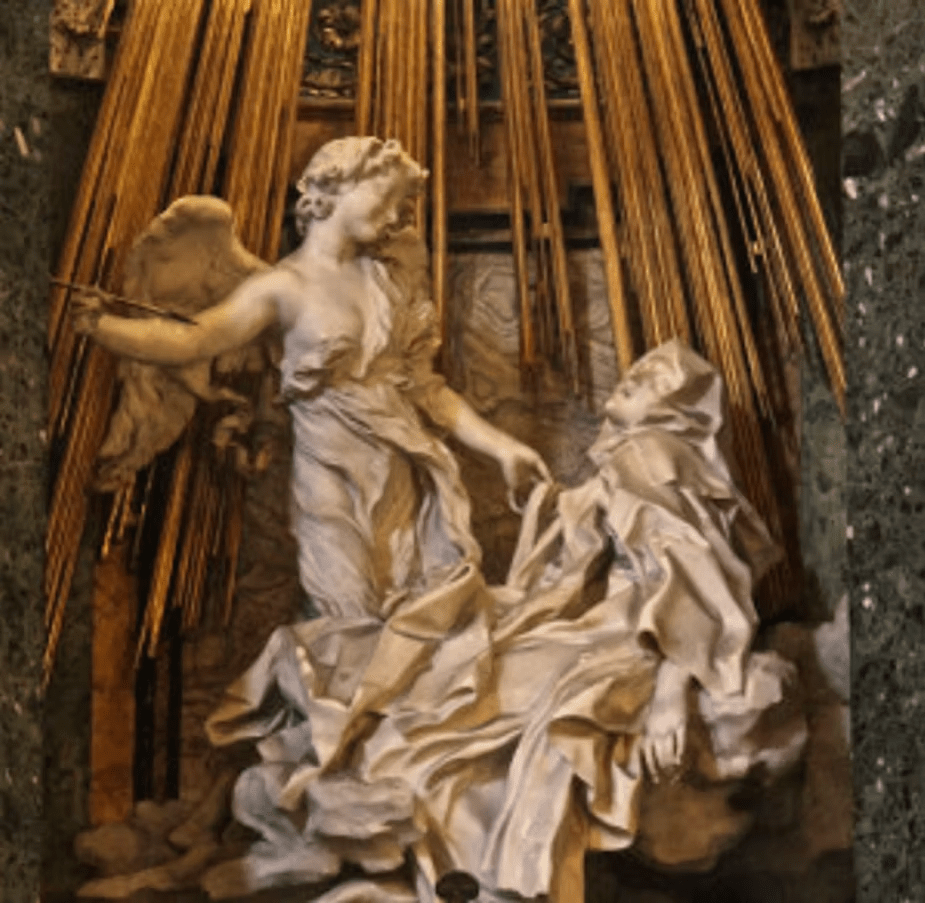
Ask Saint Teresa about the feeling.

The soul still exists, but it is then within an ‘egg shell’ of righteousness and holiness. God’s Son goes by the name Jesus, which means “Yah Will Save.” This is a male name because Jesus is the Son of God [and no, just like it is not alright to call God a goddess, it is not alright to call female a Saint a “daughter” or a “mother,” since male priests like being called “father”].

The birth of Jesus in God’s wife brings with it the Mind of God. The Mind of God then communicates with the Son Jesus, who has enveloped the soul of life breath that is within a body of flesh.  When that transformation takes place it represents a repeat of Jesus saying, “I am in the Father as the Father is in me.” At that point, Jesus the Son of God has complete control over the thoughts and actions of the body of flesh, which leads that body to living righteously [NO MORE SIN]. This path of righteousness grants a soul an eternity in Heaven after mortal death, thus Salvation. Therefore, the Mind of God, through the Son of God, becomes the Mind of the Messiah (Savior), also called Jesus Christ.

The makes the wife of God become the Son of God, which is a statement about the masculinity of the spiritual within the feminine of the earthly. Think of the dualities you recognize: life and death; awake and sleeping; and, mortal and immortal. The presence of the Son of God masculinity represents the “living waters” Jesus spoke of.  Thus, when a human male is reborn as Jesus, that human male is a wife of God and the Son of God reborn. Likewise, when a human female is reborn as Jesus, she too a wife of God and the Son of God reborn. This means every Apostle-Saint, regardless of human gender, IS a Christian and a brother in the name of Jesus.

This context of Peter’s letter must be realized in order to grasp the meaning of his question that begins the reading: “Now who will harm you if you are eager to do what is good?”

This question (which is actually two statements plus a question at the end) is relative to not becoming a wife of God, as opposed to being Jesus Christ reborn and being enabled to withstand the temptations of evil. It is Satan who will bring great harm to one’s soul, without the protection of God as one’s Husband. Therefore, the question is more than being “eager to do what is good,” but being driven (Peter used the word “zēlōtai,” meaning “zealot”) to do good.  Being driven – being a zealot – requires extra help within one’s normal drive mechanisms.

As easy as it is to say, “Oh, just sacrifice your self-ego, marry God, and be reborn as Jesus Christ,” the reality of that plan is harder to find.

In the past, when true Christianity was just taking off and spreading rapidly, the grand life of having plenty (thus more to give up) was not as prevalent. Today, especially during this “shelter in place” fear that has government ruling over the citizens, wealth and prosperity is an expectation of many in the world. People are so comfortable with the lures of sin that being forced to do nothing (thereby doing nothing bad, forced to do nothing in the name of Mammon) means many in the world are clamoring for financial handouts and gifts for staying at home.

The meeting Jesus had with the rich, young ruler (a Temple Pharisee), where he was then in the vast minority is gone.  He (I believe he was Nicodemus) was too young, too rich, and too influential to give that up. Most normal Jews had little extra to give away, after taxes to the Romans, the Temple, and the synagogue. Today, most people in the civilized world consider themselves to be too rich to quit being rich or too in debt to stop going further into debt.

The want to do good deeds is not enough to become righteous in one’s lifestyle; but it is a start. One has to do what Jesus told the rich, young ruler and 1. Obey the Law; 2. Give up lust for wealth, by spreading the Word to those poor in spirit; and 3. Become Jesus Christ reborn.

The problems here are: 1.) Most people do not read the Holy Bible more than ten seconds a week, so they do not have a clue about the Law. 2.) Without knowing the Law, it is impossible to quit work and become an evangelist and count on God miraculously leading one to understand His Word. 3.) Giving up one’s self-ego is like death, and everyone fears death too much to want to die (they fear taxes second most).

That is where Peter asking, “If you want to do good, then shouldn’t you be zealous about that desire?” That can only come from becoming the wife of God and giving birth to His Son.  Doing a “Lent” trial run every year might be good practice; but, you will probably need to reach rock bottom first, one way or another, and you have few other choices than trust God.

Peter then spoke about fear. He wrote about “suffering for doing what is right.” People fear suffering. It is fear of suffering that keeps so many quarantined in their homes – when physically well, not sick – and to keep that fear motivating people to keep staying at home, all the propaganda networks broadcast, “Death, death, death! Look at the numbers of dead!”

This is more than a ‘catch phrase’ to be thrown about lightly. To “sanctify Christ as Lord in your hearts” means a Holy Matrimony between God (the Holy) and a soul (through the heart). It means the Mind of God has brought His Son to be the Savior (Christ), as the Master of one’s flesh (Jesus is Lord). This does not happen as a matter of self-will. This does not happen because someone in a robe holding a large cracker says, “in your hearts sanctify Christ as Lord.”

This does not happen because words have no lasting power.  As soon as one returns to normal life, after kneeling and taking sacraments, the sins start all over again; and, the fears come back.

We know this does not happen when one kneels at a pew, Sunday after Sunday, saying,

“Most merciful God, we confess that we have sinned against you in thought, word, and deed, by what we have done, and by what we have left undone. Etcetra

Keep in mind the first step in going to heaven is obedience to the Law.

Here, it is worthwhile to make a comparison to what Peter said and what David sang in Psalm 66. There we hear his words singing:

“Come and listen, all you who fear God, and I will tell you what he has done for me.
I called out to him with my mouth, and his praise was on my tongue.
If I had found evil in my heart, the Lord would not have heard me;
But in truth God has heard me; he has attended to the voice of my prayer.”

That is what Peter meant by “in your hearts sanctify Christ as Lord.”

Still, think back to what Paul was recorded to have said in the Acts reading:

In him we live and move and have our being’; as even some of your own poets have said, ‘For we too are his offspring.’ Since we are God’s offspring, we ought not to think that the deity is like gold, or silver, or stone, an image formed by the art and imagination of mortals. While God has overlooked the times of human ignorance, now he commands all people everywhere to repent.”

Peter was saying become the bride of God by letting Him “in your hearts,” whereby Paul said, “In him we live and move and have our being.” We become “the offspring” of God as the Son reborn; but none of that is possible if our hearts are filthy from the sins of self-importance and self-lusts.

We fear the suffering that comes by killing off self-will, fearing the suffering that comes from giving up everything we sold our souls to get. We fear the unknown, just like a virgin girl fears being given away to some man, with expectations she knows nothing about. All the fears of suffering are imaginary and self-induced.

Get outta my face!

The path of righteousness cannot be traveled alone. God knows that. Still, like a baby needs to fall in order to learn to stand and walk – without the aid of a parent – falling down, suffering, crying, and pains are all part of the growth required to prove to God you are not just ‘flirting’ with Him.

His hand is outreached to you, as a proposal of marriage; but it is up to you to show God you desire being His bride. You have to become (regardless of human gender) a bridesmaid who lamp is always filled with the oil of devotion to good, produced by the sacrifice of self.  Men cannot use the excuse, “Well, I have to go to work to support a family and going to work means sinning with the boy to keep a job.”  There is a way, guys.

That typically means years of service, just like we read in the story of Jacob and his bargain with Laban for Rachel’s hand in marriage. That story reflects: It is not up to you to determine when God deems your heart clean enough for His Holy presence in it. You might think you are ready, you might think you are due a reward, but it is not up to you. God will come when He Knows you are ready and not before. In the meantime, you keep doing the work you promised to do and you keep your lamp filled with the oil of self-sacrifice.

In that respect, Peter said, “Always be ready to make your defense to anyone who demands from you an accounting for the hope that is in you; yet do it with gentleness and reverence.”

Sometimes we have to break off old relationships that always have a tendency to pull us towards sin. Sometimes, our new commitment to doing good will bring about insults and ridicule from people who no longer serve a purpose in our future lives. Sometimes, we are called to look at how much our souls are being sold into a slavery to sin, to the point that we reach a time to decide that major life changes are in order and need to be taken.

Keep you head up, thus the saying “head in the clouds.”

Leaps of faith are not insurable and do not come attached to ‘golden parachutes’. Thus, Peter wrote:

“Keep your conscience clear, so that, when you are maligned, those who abuse you for your good conduct in Christ may be put to shame. For it is better to suffer for doing good, if suffering should be God’s will, than to suffer for doing evil.”

Suffering is not avoidable in this world. As the old saying from the eighties goes: “Sh*t happens.” When married to God and reborn as His Son, you can have faith that you will always come up smelling like roses.

When Peter then said, “For Christ also suffered for sins once for all, the righteous for the unrighteous, in order to bring you to God. He was put to death in the flesh, but made alive in the spirit, in which also he went and made a proclamation to the spirits in prison,” this can be misconstrued as the catch phrase “Christ died for your sins so you can be saved.” Therefore, it needs to be clarified.

This is what Peter wrote [literal translation]:

1. kai [a signal to take note of importance coming] The Anointed One [Jesus] once for all around sins suffered  ,

2. innocent on behalf of unjust  ,

3. so that you he might bring to God  ,

4. having been put to death indeed in flesh  ,

5. having been made alive on the other hand in spirit  ,

6. in which also by among prison spirits  ,

7. having died he preached  .

This says:

1. God sent His Son as one seed from which all who live in a world of sins can be saved from suffering. Importantly to realize – There will be no more Messiahs sent, no more Saviors to come, as Jesus was “The Anointed One” who was sent to likewise suffer in this world.

2. Jesus was innocent of all charges from which persecution came. Persecution comes from all who love sin and will unjustly try to destroy those who walk paths of righteousness and teach others how to do likewise.

3. Jesus was sent by the Father to teach human beings how to get to Heaven.

4. In order to reach the vastness of humanity, well beyond the one time Jesus the man walked the earth, Jesus (as the one seed) had to die so the seed could take root and grow into a vine of righteousness that would stretch to the end of the age.

5. The death of Jesus the man gave rise to Jesus the Christ, as the Holy Spirit, the right hand of God the Father.

6. The Holy Spirit of Jesus Christ would be joined with the souls [from “pneumasin” – the breath of life souls from God] of those which were imprisoned in the mortal flesh that were his disciples (including those followers well into the future).

7. From those disciples dying of self-will and self-ego, Jesus Christ would be resurrected in Apostles and Saints, who would continue the teachings of Jesus, the one Son of God in a brotherhood of Sons of God.

Peter then went into talking about how “God waited patiently in the days of Noah,” which is a statement about God having patience with sinners, whose souls (the breaths of life given by God at birth) life after life [reincarnation] love to wallow in sin so they cannot return and be with God. God flooded the world to remove much of that sin through mortal deaths by drowning, causing those souls to be released, to be later placed back into the world at God’s decision when. Only the eight from Noah’s family were allowed to keep their lives. That means the Great Flood was a cleansing of the earth, which (like the Son of God) will be a ‘one time thing’ and never again.

Water is a great cleansing agent. Water also symbolizes the emotional state of human beings, which is always ebbing and flowing, changing with the latest news or events of life. Water can wash away the dirt of dust and clay; but water cannot wash a soul clean from sins. Thus, Jesus Christ was “prefigured” as the “baptism that now saves you.”

Jesus Christ is the new Great Flood that will drown all the souls of sinners in their own sins, while only saving those who are led to the ark. When Noah took pairs of animals, realize how the Apostles traveled in pairs. Take notice of how David sang, “I will offer you sacrifices of fat beasts with the smoke of rams; I will give you oxen and goats.” They reflect all the ones who will sacrifice themselves in order to get booked on the ark of Jesus Christ.

To get one of those tickets, one has to do as Peter wrote: “appeal to God for a good conscience, through the resurrection of Jesus Christ, who has gone into heaven and is at the right hand of God, with angels, authorities, and powers made subject to him.”

This is a statement about a series of life changes to come, which begin with sincere prayers for survival, confessing a willingness to change and do good works and to prove one is committed to serving God … to the point of making life-changing sacrifices.

God will hear those prayers and God will know the hearts of those praying. Prayers are a first step, but a housecleaning is the follow-up second step.

This reading comes in the Sixth Sunday of Easter. Easter must be realized as being a season of waiting for the Lord to come. It represents when the Israelites camped at the base of the mountain, waiting for Moses to return and tell them what God said. Moses would return with the marriage contract offer, but the Israelites became fearful that Moses was dead; and, they built an idol of a golden calf and began praying to it for help. Their fear almost called off the wedding; but God has patience. 

All of that is mirrored in Jesus’ death causing his disciples to hide in fear.  They had all been feeling good about the future, having thoughts of being married to Jesus as they had been for three years.  Then the leaders had Jesus killed and they feared just like the Israelites had.   Jesus resurrected just like Moses came down with the Covenant.  The wedding was back on.

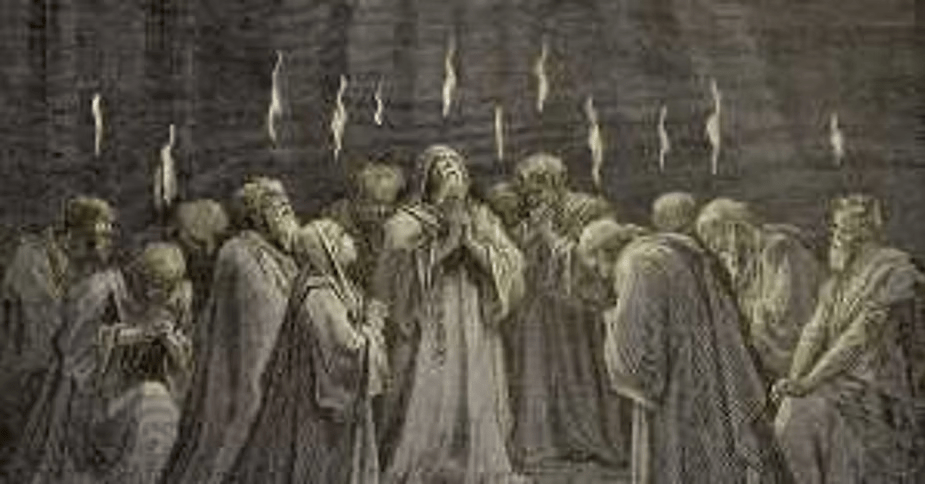
Still, the Easter season represents when Jesus whispered to his disciples encouragement to do good deeds and follow the Law. Jesus prepared his disciples to marry God and give him the body he would need to be reborn into.  When Pentecost came, God entered a new breath into the twelve and Jesus returned in the flesh of his newborn Apostles.

The Easter season means lessons to lead lost sheep into the sheepfold of the Good Shepherd.  The readings are his voice calling out to you.  You call yourself “Christian” so you recognize his voice.  Being lost seems to be not too bad, as long as the pastures are green and the waters are cool and clear.  However, Satan is the wolf that is always watching lost sheep, waiting to pounce when the time is right.  Mortal death is when Satan always feasts, when the sheep have not gone into the sheepfold and found salvation.

Each Christian has a different birth of Jesus within (a personal Christmas).  Each Christian has his or her own epiphany, when the realization that change must take place within them occurs.  Every Christian has a different time come that demands sacrifice of self (a personal Lent).  Every Christian finds a different point when death and rebirth come (a personal Easter); and once reborn as Jesus Christ, each true Christian finds a different time when ministry becomes the answer to God’s call (Ordinary time after Pentecost).

For every year that a Christian seasonal cycle comes and goes, with nothing to show but a well-worn pew seat, with none of those markers reached, the less time there is in a mortal’s lifespan to prove to God one’s sincerity and commitment.  The proposal has been made and God is patient, but one cannot let fear cause one’s epitaph to be “Here lies another fool.” 

The age old question is, “When we going to make it work?”

Advice for the Young at Heart

John 14:15-21 – In love with God

This is the Gospel reading for the Sixth Sunday of Easter. It will next be read aloud in many Christian churches on Sunday, May 17, 2020.

John’s fourteenth chapter is split between two Sundays in Easter. Verses 1-14 were read last week, on the Fifth Sunday of Easter. Back on the Second Sunday the Gospel reading was from John 20, then the Fourth Sunday it was from John 10. Next Sunday it will be from John 17 and Pentecost (the final Sunday of the Easter season) there are two option from John: chapter 7 or chapter 20 again.

The focus on John is not just a Year A choice, as his Gospel is central to all three years of the lectionary cycle. John is a central to the theme of Easter season, because John wrote of the Jesus that was more personal than teacher and miracle worker. The Easter theme, beyond the Easter day miracle of the resurrection (believe it or not), is to comfort you and ease your fears.

Last Sunday Jesus began by saying to his disciples, “Do not let your hearts be troubled.” Previously he said, “Peace be with you” and then he said, “I am the gate” … “Whoever enters by me will be saved.” That shows the care and concern Jesus had for his followers and because Christians are the followers of Jesus at all times, the Easter season is when words of comfort and ease are spoken to us so the world gains newly reborn Jesuses.

The Easter season is all about our development, from followers to leaders, where leaders of Christianity are expected [by God] to be Apostles and Saints. The day of Pentecost is not about remembering how Peter stood with the eleven and began preaching the Word, but about our achieving the same goal. We have to overcome natural fears; so we need words of encouragement to help us “Receive the Spirit.”

Today we read more of John’s fourteenth chapter. Half the chapter is read over two Sundays. None of the other readings from John incorporate that many verses [21]. However, chapter fourteen was Jesus speaking words of promise to his disciples, at a time when they were all unwinding after the Seder meal, drinking the ritual Seder after-dinner wine.

Because we are all just like the disciples of Jesus, we need to place ourselves [figuratively] on the reclining pillows of the upper room. The alcohol of fermented grapes needs to be seen as having lifted our natural inhibitions, so our brain’s control over not letting anyone get too close loosens.  There is no need to fear that someone might trick us into spilling our most kept secrets. Judas, the betrayer, has already left, so his lips won’t slip and have him start telling what his plan with the Sanhedrin is. Everyone left in this imaginary room is laid back and relaxed, just like freshly tilled soil, open to receive seeds of thought, which Jesus is going to plant.

This was discussed in the lyrics of Psalm 66 and in the 1 Peter reading. The Acts reading, where Paul pointed out the Greeks had an altar dedicated to “the unknown god” becomes the reason Jesus used the word “If.” If one does not marry God, then God is “unknown” in the Biblical sense’ of “knowing.”

The cloud that keeps this from being seen as Jesus talking about his disciples marrying God, with the love of submission to a higher power – a Husband God – is the translation that follows, which appears to be Jesus saying, “And I will ask the Father, and he will give you another Advocate, to be with you forever.” Certainly, this is a valid translation, but it is a translation that is blind to the context.

Verse sixteen, in Greek, says: “Kagō erōtēsō ton Patera  , kai  allon Paraklēton dōsei hymin  ,  hina ē   « meth’ hymōn eis ton aiōna »  .

In this form that I have presented, notice how the statement made by Jesus (as written by John) is divided by two comma marks plus a symbol called a “left-right arrow,” which is a basic logic symbol.[1]  Following that symbol, the remaining words are placed in quotation mark symbols. Three words are capitalized, which makes them have greater value than the same word written in the lower-case. There is also usage of the word “kai,” which I believe is a statement of importance to follow. Based on these words written, a literal translation makes them state the following:

I also question the Father  ,
and  a different Paraclete (legal Advisor) he will give you  ,
that should be me    “  in company with you to the ages  ”  .

From seeing what John wrote in this new light, Jesus said he also needed assistance knowing how to live up to the Commandments, so he was a human being like the disciples that had to question the Father for guidance. Prayer is how Jesus made these connections, and David also sang about this in Psalm 66.

The use of kai then marks the following is important to grasp: God the Father was the ‘legal Advisor’ for Jesus,  but  a different Paraclete[2] will be given by God to the followers of Jesus.

Jesus then named himself (“ē” is the second-person singular aorist middle subjunctive of “eimi” – “I am, I exist”), with the inference being the disciples would be like his relationship with the Father, while like their relationship with him. Therefore, Jesus would be their “legal Advisor,” just as God was his. Jesus becomes the ‘middleman’ in the future equation.

The use of the left-right symbol, along with the subjunctive use of “ē” is then a direct explanation of the “If” condition stated prior. This will be the case “If” A and B are true, and the disciples love God as Jesus loves God.

When the quotation marks set off the words “in company with you to the ages,” this has a two-fold meaning. First, the souls of the disciples will be saved through their love of God in marriage. The reward is an eternity married to God. Second, the same condition applies to all future disciples (followers) of Jesus, with the same reward of eternal life.

With that understood, Jesus then said, “This is the Spirit of truth, whom the world cannot receive, because it neither sees him nor knows him.” Here, John capitalized the Greek word “Pneuma,” which translates as “Spirit,” but the capitalization is clearly identified by Christian scholars as meaning the “Holy Spirit.” When one reads the definition of “Paraclete,” one sees that this has a Christian understanding as “the Holy Spirit.” Because Jesus so frequently began statements with “Truly I say,” he was identifying his words not about to come from his brain, but from his heart, through his “Spirit of truth” that guided all of his actions.

Jesus told the rabbi, “Love the Lord your God with all your heart and with all your soul and with all your mind.’ This is the first and greatest commandment. And the second is like it: ‘Love your neighbor as yourself.’ All the Law and the Prophets hang on these two commandments.” This is what Jesus told his disciples when he said, “If you love me, you will keep my commandments.”

The same words are said to all followers of Jesus, until the end of the ages. Christians have to stop thinking they love God, when they barely speak a nice word to others they despise, even when they know the ones they hate are also professed Christians. To love God does not mean on your terms. Human beings are the submissive wives in this Covenant, with males just as wifely as females. The only way one can love God with ALL ONE’S HEART is to stop selfishly holding onto it, to do with as you please.

When Jesus said, “The world cannot receive the Spirit of truth because it neither see it nor knows it” means human brides-to-be cannot tell if another human being is filled with the Holy Spirit and already God’s wife. Those who run about bragging about loving God and being filled with the Holy Spirit should probably be checked for fleeces that hide their evil wolf-like hearts underneath.

Being married to God means the love of God is like Zen meditation. Say, “I do,” then shut up and let God do all the rest with His Son. Anything more only keeps one from experiencing nirvana.

Amen

—————————

[1] It means “material equivalence, such that A ⇔ B is true if both A and B are false, or both A and B are true.

[2] The word parakletos is a verbal adjective, often used of one called to help in a lawcourt. In the Jewish tradition the word was transcribed with Hebrew letters and used for angels, prophets, and the just as advocates before God’s court. The word also acquired the meaning of ‘one who consoles’ (cf. Job 16:2, Theodotion’s and Aquila’s translations; the LXX has the correct word parakletores). It is probably wrong to explain the Johannine parakletos on the basis of only one religious background. The word is filled with a complex meaning: the Spirit replaces Jesus, is an advocate and a witness, but also consoles the disciples. [Wikipedia]