Tag Archives: Easter 6 Year C

Acts 16:9-15 – Having the faith to be led to where help is needed

During the night Paul had a vision: there stood a man of Macedonia pleading with him and saying, “Come over to Macedonia and help us.” When he had seen the vision, we immediately tried to cross over to Macedonia, being convinced that God had called us to proclaim the good news to them.

We set sail from Troas and took a straight course to Samothrace, the following day to Neapolis, and from there to Philippi, which is a leading city of the district of Macedonia and a Roman colony. We remained in this city for some days. On the sabbath day we went outside the gate by the river, where we supposed there was a place of prayer; and we sat down and spoke to the women who had gathered there. A certain woman named Lydia, a worshiper of God, was listening to us; she was from the city of Thyatira and a dealer in purple cloth. The Lord opened her heart to listen eagerly to what was said by Paul. When she and her household were baptized, she urged us, saying, “If you have judged me to be faithful to the Lord, come and stay at my home.” And she prevailed upon us.

——————–

This is the mandatory reading from the Book of Acts, which will be read aloud on the sixth Sunday of Easter, Year C, according to the lectionary for the Episcopal Church. It will precede a singing of Psalm 67, where David wrote: “Let your ways be known upon earth, your saving health among all nations.” That song of praise will be followed by a reading from Revelation, where John wrote: “In the spirit the angel carried me away to a great, high mountain and showed me the holy city Jerusalem coming down out of heaven from God.” All will accompany one of two possible Gospel selections. The first is from John’s fourteenth chapter, where he wrote: “Jesus said to Judas (not Iscariot), “Those who love me will keep my word, and my Father will love them, and we will come to them and make our home with them.” If not that, then a reading will come from John’s fifth chapter, where it is written: “Jesus said to [an invalid by the pool of Bethesda], “Stand up, take your mat and walk.” At once the man was made well, and he took up his mat and began to walk. Now that day was a sabbath.”

To begin to understand this selection from Acts, one must know what is written in the previous three verses. The NRSV presents those as saying this:

“They went through the region of Phrygia and Galatia, having been forbidden by the Holy Spirit to speak the word in Asia. When they had come opposite Mysia, they attempted to go into Bithynia, but the Spirit of Jesus did not allow them; so, passing by Mysia, they went down to Troas.”

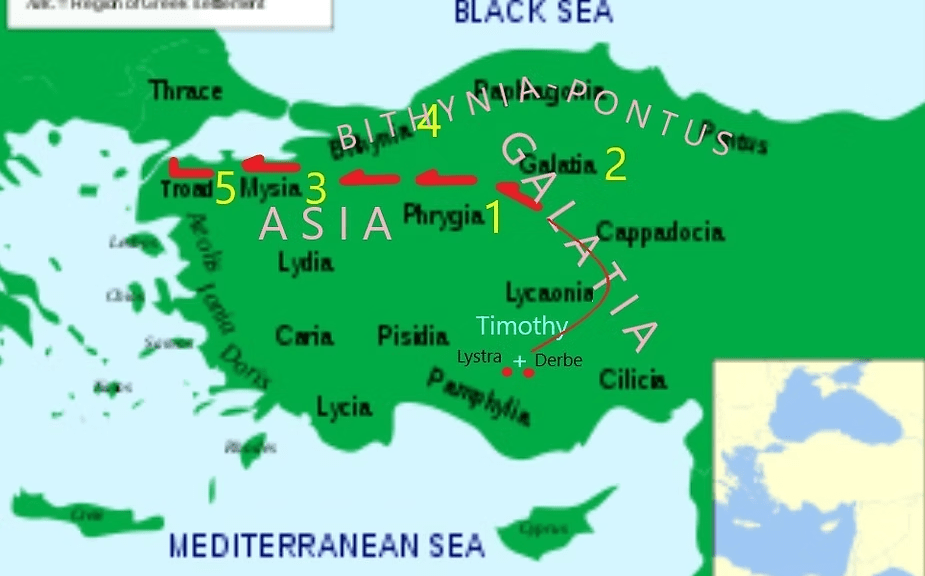
Here is a map of those travels. It follows a straight line:
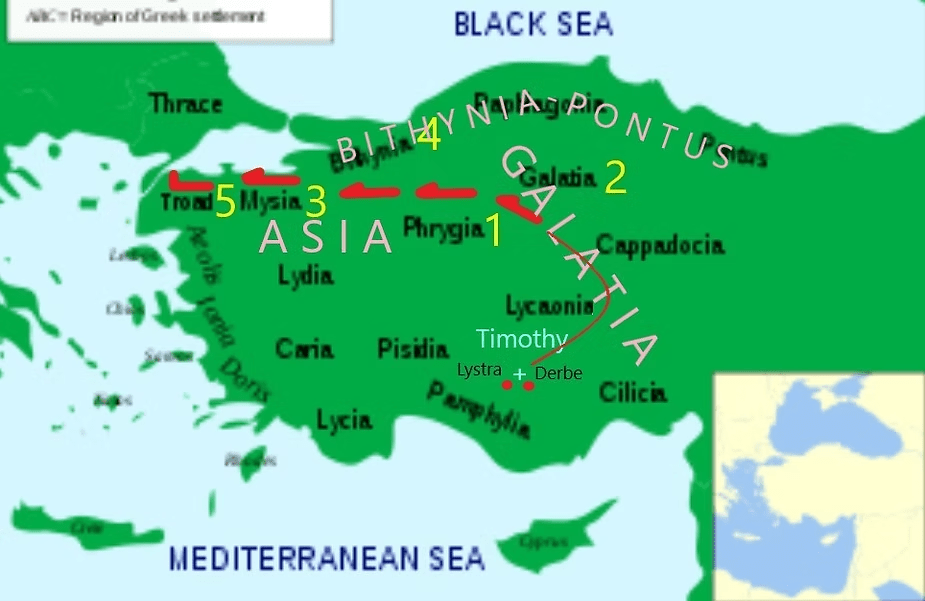
Following the addition of Timothy with Paul and Silas, between Derbe and Lystra, the three then made their way north through Galatia (a region), before turning west. It was when they entered the region of Asia that the three were “hindered” or “prevented” (not the translated “forbidden”) from “speaking the word.” This being stated “by the Holy Spirit,” the Greek word “hypo” (translated as “by”) is properly translated as “under.” In this regard, HELPS Word-studies says of “hypo,” “under, often meaning “under authority” of someone working directly as a subordinate (under someone/something else). Since the three apostles were “under the authority to speak the word by the “Holy Spirit,” this says they were unable to “speak the word” divinely in Asia.

This means when they entered the region of Asia, having left Galatia, they were at a loss for what to say, as far as teaching Hebrew Scripture. As they would go from Jewish settlement to Jewish settlement, each Sabbath they would enter a synagogue and hear the selected readings for that day. Because the texts read as “Sacred” of “Holy,” none of the three was led by the “Spirit” that possessed their souls to add anything that would further explain that which was “Holy” in writing. This says they got as far as Mysia and were not moved to preach; so, they considered going north, into Bithynia, but the presence of Jesus within each of their souls said, “No.”

This is where it should be understood that all three were filled with Yahweh’s “Spirit,” which brought forth the resurrection of the soul of Jesus in each, so all were Jesus reborn. When verse six stated “hypo tou Hagiou Pneumatos,” which is in the Genitive (possessive) case, as: “under the authority of this of Sacred of Spirit,” that is no different than verse seven says “to Pneuma Iēsou.” That states “Iēsou” in the Genitive, saying “this Spirit of Jesus.” This means the “of Sacred of Spirit” was the “authority they were under,” which was the divine possession “of Jesus.” Therefore, “Jesus” did not raise his soul within them to “speak the word,” so the three knew from that lack of inspiration they should go another direction.

By realizing this stated in the prior three verses, with the three having reached “Troas,” verse nine begins with a capitalized “Kai,” which states great importance is to follow and one should pay close attention to that stated. Following that marker word, we read, “a vision on account of [of this],” where there are brackets placed around the word Genitive article “tēs,” which translates as “of this.” The brackets become a statement about “this” inability to “speak the word,” which the three had faced prior.
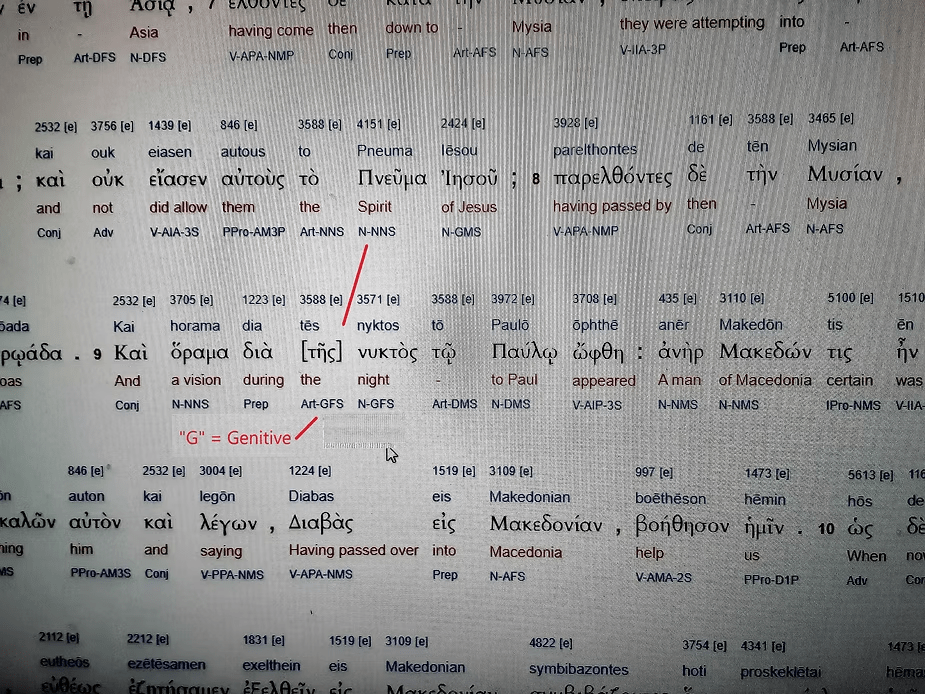
When the following word is also in the Genitive, connecting it to the bracketed “of this,” the word says “of night,” which leads the NRSV to read the whole (sans the bracketed “tēs”) as saying, “During the night Paul had a vision.” While it could be at a time between six P.M and six A.M, which is when “night” occurs in the Hebrew timing of days and “nights,” the Genitive links as a metaphoric statement that says “of darkness,” which means the inability to be led to speak the word by Jesus is an absence of light, which is synonymous with “of night.” Thus, the great importance (of the “Kai”) says Jesus returned to show Paul a sign (which could have been during the day) that was Jesus speaking to him, as to where to go next.

In the vision, we are told that Paul was shown “a man certain,” which means the “man” was understood to be a Jew, but perhaps also someone Paul had previously encountered in his ministry, where he was led to bring Jesus’ presence to the “man,” so he could also be married to Yahweh and reborn as Jesus. Not too long ago, the reading that told of Philip going to Samaria to pass the Spirit onto Samaritans led to a call to Jerusalem, where Peter and John of Zebedee were ‘called’ to come help. In that observation, I mentioned there was no telephones or Internet, and said the distance was too far for smoke signals. This vision had by Paul, where a “man certain stood and called for help” would explain how the Christians in Jerusalem knew Philip (a certain man to them) needed help. This says that everywhere a soul existed that was one with the soul of Jesus that became the ‘communication system,’ such that visions were ‘incoming calls.’

Verse ten then is shown by the NRSV to state: “When he had seen the vision, we immediately tried to cross over to Macedonia, being convinced that God had called us to proclaim the good news to them.” A better translation of the last segment of words is, “joining together in reasoning because (we) had been called our souls [ourselves] this God to preach good news to their souls [themselves].” This says each of the three were able to hear an inner voice speaking to their souls, telling each that this was the voice of Jesus speaking to them as “a man certain in Macedonia.”

It should be understood that the route taken to reach Macedonia was the fastest, so when they reached a Roman “colony” there, they stayed for enough “days” to include two “Sabbaths.” When we then read, “we went outside the gate by the river, where we supposed there was a place of prayer,” the meaning is Jews were indicated to go to “the river” for a gathering place or assembly point for morning “prayers.” Without a leader of a synagogue or an official house of meeting there, Jews would gather and sit in reverence. On this morning, Paul, Silas and Timothy found only “women” there.

The importance of only “women” says they were Jews, but married to Greeks or Romans, with no male to teach them Scripture. Paul began to preach about Scripture to the women; and, some of then had their hearts opened (metaphor for souls receiving the Spirit). When we read that “a certain woman named Lydia” was there, she was one whose heart was so opened. In this, she was so moved she begged the three apostles to stay with her, with her household also becoming Christians. This means there was no “man” waiting for them in Macedonia, as the “vision” had “appeared to Paul.” Both that “man” and Lydia were deemed “certain,” so the “man” in the vision was the soul of Lydia calling out.

When one sees how all human beings are souls in bodies of flesh, we are all feminine essence until our souls are married to Yahweh and we receive the resurrected soul of Jesus in our souls, making us be reborn as the Son, all brothers in Christ (not a last name of Jesus). This says the soul of Lydia had been marked by Yahweh as one of His flock and Jesus (the Good Shepherd) was told where Lydia could be found. After Paul, Silas and Timothy came and baptized the women as Yahweh’s, each reborn as Jesus – true Christians – those “women” became Sons of Yahweh, each Jesus reborn.

As the mandatory reading from the Acts of the Apostles that takes place during each Easter season, it is important to see that the works of faith (the “Acts”) are not an education that makes one smart enough to pretend to know what Jesus would do (if he were alive today). The unread verses set this reading up; and, it is vital to know that a Saint has no powers other than those given to him or her by the possessing soul of Jesus, gifts sent by the Father. Paul and his fellow Christians could not “speak the word” when Jesus was not leading them to do so. They had the faith to know not to attempt to preach as laymen, letting patience lead them to wait for a sign. Once they received their sing, they immediately went to where they were led. This says Easter is a time to reflect on the Acts that are led by the soul of Jesus being within one’s own soul. To have the soul of Jesus resurrected within one’s own soul means one who was dead (all dead are unable to “speak the word”) is raised by that divine possessing Spirit. Pretending to know how to live righteously and lead others to do so as well only leads souls to ruin.


Psalm 67 – The praise that comes from possession by an angel of Yahweh

1 May elohim be merciful to us and bless us, *

show us the light of his countenance and come to us. selah

2 Let your ways be known upon earth, *

your saving health among all nations.

3 Let the peoples praise you, elohim; *

let all the peoples praise you.

4 Let the nations be glad and sing for joy, *

for you judge the peoples with equity and guide all the nations upon earth. selah

5 Let the peoples praise you, elohim; *

let all the peoples praise you.

6 The earth has brought forth her increase; *

may elohim, elohenu, give us his blessing.

7 May elohim give us his blessing, *

and may all the ends of the earth stand in awe of him.

——————–

This is the Psalm to be read aloud in unison or sung by a cantor on the sixth Sunday of Easter, Year C, according to the lectionary for the Episcopal Church. It will be sung following the mandatory Acts reading, where Paul, Silas and Timothy were unable to speak the word. We read, “We set sail from Troas and took a straight course to Samothrace, the following day to Neapolis, and from there to Philippi, which is a leading city of the district of Macedonia and a Roman colony. We remained in this city for some days.” Those will be followed by a reading from John’s Revelation, where he wrote: “Then the angel showed me the river of the water of life, bright as crystal, flowing from the throne of God and of the Lamb through the middle of the street of the city. On either side of the river is the tree of life with its twelve kinds of fruit, producing its fruit each month; and the leaves of the tree are for the healing of the nations.” All will accompany a Gospel reading, which will either come from John 14 or John 5. The first choice will offer Jesus saying to his disciples, “I have said these things to you while I am still with you. But the Advocate, the Holy Spirit, whom the Father will send in my name, will teach you everything, and remind you of all that I have said to you.” The John 5 offering we read of Jesus asking a lame man if he wanted to be healed, then, “The sick man answered him, “Sir, I have no one to put me into the pool when the water is stirred up; and while I am making my way, someone else steps down ahead of me.” Jesus said to him, “Stand up, take your mat and walk.”’

In this seven-verse song of praise, you will note how I have restored the five times David sang “elohim,” and the one time he wrote “elohenu.” I have placed them in italic type, because that is a Hebrew word. In all cases the words written as “elohim” are nouns in the masculine plural, with “elohenu” a noun in the masculine plural construct, a first-person common plural. In all cases the translation has been as “God” (“elohim”) or “our own God.” The word “God” qualifies as a masculine singular noun; so, it is wrong. Because it is wrong, it is not what David intended (he understood the language he wrote in and knew the difference between Yahweh and one of His “elohim”); and, I have restored the word so the intent can be seen.

In addition to those obvious changes, I have also added the word “selah,” in two places. The NRSV shows both clearly; but the Episcopal Church has decided to remove them. The word “selah” means “to life up, exalt,” which can be seen by some as a musical direction, to the “chief musician on stringed instruments,” as named in verse one (not translated) for this reading. Again, the NRSV states that in a pseudo-title to this psalm, seeing it as instructional, not lyrics. As a note to the chief musician on stringed instruments, “selah” might be read by some as a place for a ‘harp solo,’ to “exalt” one’s soul through some heavy strumming. I see it as soul directional, not a direction to ignore; so, I have restored that too in italics.

I believe the English translations lack the necessary insight that needs to be realized, in order to understand that the use of “elohim” means a possessing Spirit that comes from David having been Anointed by an outpouring of Yahweh’s Spirit. While we read of Samuel “way·yim·šaḥ” (a construct of “mashach” – “messiah”) and can understand a physical “anointment” with oil poured from a “horn,” but it is difficult to understand the following text, which says, “and came the spirit of Yahweh upon David from that day forward.” (1 Samuel 16:13) That is a capitalized “Mashach,” meaning David received the Spirit of Anointment by Yahweh – in Greek, David became a Christ. That cleanses the soul for possession by the divine soul of Yahweh’s Son; and, today we call that the soul of Jesus (a name that means “Yahweh Saves”).

For this reason, I will list each verse as they literally translate into English. No paraphrasing is allowed, as that has been done under the misguided idea that the plural word which would translate as “gods” is (for whatever reason) changed wrongly to “God.” In David’s psalms, “God” is written “Yahweh.” All of the “elohim” are the creations of Yahweh, as His “gods” or “angels,” with a soul also an eternal spirit, like an “elohim,” but set free at birth into flesh. A soul is returned to Yahweh by divine possession, which must first be cleansed of all past sins (the “Mashach” of “Spirit.” Therefore, in this psalm of praise, David was singing of praise to the “elohim” possessing his soul and flesh, which was sent to his being by Yahweh.

Verse one then literally states: “elohim will be merciful to us and bless us ; will cause to shine his face together with ours exalted .” When “elohim” is understood to be a possessing Spirit within one’s soul (the resurrection of the soul of Adam-Jesus), then it is easy to see that this presence bestowed upon a soul in the flesh is “merciful” (the cleansing of past sins) and a “blessing” (an inner feeling that drops one to his or her “knees” in thanks to Yahweh). It is the same for all souls so divinely possessed. When David then sang, “will cause his face together with ours” says the First Commandment is forever upheld by this presence of an “elohim.” That possessing Spirit places the face of Yahweh “upon” each “face,” so all are then “exalted” or “lifted up” (from “selah”) to a state of righteousness by this inner presence.

Verse two then literally states: “that will be known on earth your pathway ; among all peoples , your deliverance .” Here, the use of “erets” or “earth” (“bā·’ā·reṣ”) should be seen as the elements of the material realm that are the bodies of flesh that house a soul. The “face” of Yahweh has no reason to “shine” on mountains, or deserts, or oceans, as none of that possesses a soul. So, the verse says the “ways” of righteousness will be known by “bodies of flesh” that are animated by souls. This then leads to the large collection of “bodies of flesh” that are the “people,” from which “nations” cover the “earth.” By Yahweh’s “face together with ours,” then the “ways” of Yahweh will be demonstrated by those possessed by “elohim.” It is then that divine possession that “delivers” a soul back to Yahweh upon death in the flesh, which means “salvation” given by Yahweh to His servants (wives).

Verse three then literally states: “will praise you the peoples elohim ; will praise you the peoples all .” In this, it must be realized that “the peoples” have no true ability to “praise” Yahweh. In the fifth Sunday of Easter (Year C), when Psalm 147 was sung, which sings “praise YAH, praise Yahweh’ and praise him” thirteen times, I mentioned that it was the presence of a possessing Spirit (the inner soul of Jesus resurrected) that brings forth “praise.” One cannot know the true depth of divine “praise” without a possessing soul within. Here, in Psalm 67, David is naming that inner source of “praise” as the “elohim,” which possesses “the peoples.” This “praise” is not from a personal perspective that sings out, “Look what God gave to me!” That is not divine “praise.” Divine “praise” is the “elohim” source within, which takes that “praise” of Yahweh to “all the peoples,” so all whose souls are lost can be found.

Verse four then literally sings: “oh will be glad and sing joyfully , the peoples because you will govern the peoples righteously ; and the people on earth will be led exalted .” Following a verse that sang of the inner “praise” for Yahweh emanating from the possessing “elohim,” the soul in a body of flesh will feel the divine elevation that “praise” will bring through their beings. Their happiness will cause them to “sing joyfully” or put to melodic words what is beyond verbal expressions. This will be from the promise of salvation leading “the peoples” to live “righteous” lives, led by the “elohim” within. Here, again, “the earth” must be seen as the flesh inhabited by a soul divinely possessed, as dead soil cannot be “exalted” (from “selah”).

Verse five then literally translated into English saying: “will praise you the peoples elohim ; will praise you the peoples all .” This is a repeating of that sung in verse three. The same divine presence within – the possessing “elohim” – is the source of all “praise” in “the peoples.” Wherever one takes this “praise” and others accept it – marrying their souls to Yahweh [ala David] – then “all the peoples” will know the same “gladness and urge to sing” aloud to Yahweh.

Verse six then literally states: “the earth it will yield her increase ; will bless us , elohim elohenu .” In this, once more, the use of “erets” must not be read as the dead matter that does not contain a soul. The use of “earth” means a body of flesh, so just as “the people” reflect the “land,” “she will yield her increase” (using the feminine gender application to the transliterations “nā·ṯə·nāh yə·ḇū·lāh”) is applying femininity to “the earth.” This says “all the peoples” are souls in flesh as ‘brides-to-be,” so the “yield” of divine pregnancy is the resurrection of the “elohim” within a ‘womb soul.’ This says the “blessing” that comes from the “yield” is the birth of a new Spirit in that which became the wife of Yahweh (“she” and “her”).

A divine pregnancy is not so noticeable outwardly.

This ‘child’ reborn is then stated clearly as an “elohim,” but the addition of “elohim” in construct, saying, “our own elohim,” the plural number says all will have given birth to the Son of Yahweh, within their souls. All “the peoples” will have the same “elohim” within each (a divine duplication in multitude), so the same “elohim” will be “our own.” That states a possession, but it is not the soul that possesses this “elohim” Spirit. Instead, it is the “elohim” Spirit that possesses the soul.

Verse seven then literally sings: “will bless us elohim ; and will fear him , all the ends of the earth .” Once more the use of “the earth” must be read as “bodies of flesh” made alive by a soul given by Yahweh. Following the ‘birth’ or “the yield of the flesh,” that birth is now called “a blessing” (as all children born are). The ‘child’ is again identified as an “elohim.” The element of “fear” is not that Yahweh scares “the peoples” to serve Him. Instead, the “fear” comes from knowing the presence of the inner “elohim,” such that a soul “fears” ever being without that divine possession. This is the truth of “fear nothing but Yahweh,” where the “fear” is of losing that divine protection. This presence within will last an eternity, which is the metaphor of “the ends of the flesh,” which is death. One’s soul is assured of salvation beyond the death of the “flesh” that holds captive a soul. The “fear” of not being saved keeps one serving Yahweh the rest of one’s life “on earth.”

This Psalm 67 being chosen to be sung on a Sunday of Easter, following a Sunday where “praise Yahweh” was repeated, today’s use of “elohim” connects this psalm with Psalm 147, explaining it is the “elohim” within a soul that brings forth divine “praise.” Both psalms say it is impossible to truly offer “praise” to Yahweh without personally coming to know His inner presence. The purpose of the Easter season is to be resurrected from the dead. Here, the repetition of “earth,” rather than stating a human being or one of mankind, forces one to see that a body of flesh is only alive temporarily, when only animated by a soul from birth (first breath). A body of flesh alone is death. A body of flesh, whose soul has been resurrected with the Son of Yahweh (His elohim) means one has been raised from the dead. This is when one wears the face of Yahweh and lives righteously, as directed by that inner “elohim.” It is vital to realize this song of praise as it is intended to be sung. No songs sung by a soul unmarried to Yahweh will truly “sing joyfully” the “praise” Yahweh deserves.

John 14:23-29 – Those who love me will keep my word

Jesus said to Judas (not Iscariot), “Those who love me will keep my word, and my Father will love them, and we will come to them and make our home with them. Whoever does not love me does not keep my words; and the word that you hear is not mine, but is from the Father who sent me.

“I have said these things to you while I am still with you. But the Advocate, the Holy Spirit, whom the Father will send in my name, will teach you everything, and remind you of all that I have said to you. Peace I leave with you; my peace I give to you. I do not give to you as the world gives. Do not let your hearts be troubled, and do not let them be afraid. You heard me say to you, `I am going away, and I am coming to you.’ If you loved me, you would rejoice that I am going to the Father, because the Father is greater than I. And now I have told you this before it occurs, so that when it does occur, you may believe.”

——————–

This is one of two Gospel choice to be read aloud by a priest on the sixth Sunday of Easter, Year C, according to the lectionary for the Episcopal Church. If chosen, it will follow a mandatory reading from Acts, where Paul, Silas and new Apostle Timothy searched to where to go. We read, “During the night Paul had a vision: there stood a man of Macedonia pleading with him and saying, “Come over to Macedonia and help us.” That will precede a singing of Psalm 67, where David used the word “elohim” several times, saying, “Let the peoples praise you elohim; let all the peoples praise you.” That pair of readings will be followed by a Year C standard from Revelation, which has John saying, “I saw no temple in the city, for its temple is the Lord God the Almighty and the Lamb.”

Missing from this reading are key verses that make this reading selection make more sense. The first is verse nineteen and the second is verse twenty-two. Verse nineteen has Jesus saying to his disciples, “yet short kai this world myself no longer beholds , yourselves now behold myself ; because I exist , yourselves will exist .” In verse twenty-two, we then read, “Calls to himself Judas , not this Iscariot , Lord , kai what has happened because to ourselves you are about to appear yourself , kai not at all to this world ?

Knowing of these two verses written prior, those reading the above selected verses can understand what Judas asked Jesus, based on what Jesus had said; and, these verses make it clear to see what was written prior helps one see the truth of what these above selected verses say.

In verse nineteen, which led Judas to call upon Jesus for an explanation, Judas heard what the NRSV translate: “In a little while the world will no longer see me, but you will see me; because I live, you also will live.” Because Judas heard Jesus say that (keeping in mind that the post-Seder experience demanded each adult keep drinking wine until they passed out drunk; so, Judas – like the other adult disciples – was not able to keep up with much said), Judas wanted to know how the disciples could see Jesus, when the rest of the world could not. His question was akin to him asking, “Will you give up magic glasses to see your ghost, when you will be invisible to everyone else?”

What Jesus actually said in verse nineteen, based on the literal translation, was a “short” or “small” synopsis of what the future would hold. While those two Greek words were heard as “in a little while” or “soon to come,” Jesus actually told his disciples they were “still little,” in comparison to what they would become.

Jesus then stated an important (due to “kai” usage) statement about “this world.” Here, the Greek word “kosmos” means “order, the world,” but it implies in usage (other than that), “worldly affairs; the inhabitants of the world; adornment.” According to HELPS Word-studies, the proper meaning is “an “ordered system” (like the universe, creation).” It is a word that is the root word for “cosmetics,” where that implies “the order [“ensemble”] used of treating the face as the whole.” In other words, Jesus forecast the “order” of his soul in one body of flesh [“myself,” where ‘self’ equates to a ‘soul’] will “no longer” be possible to “behold.” The Greek word there – “theōrei” – is the root word in the English word “theater.” This is because the root word is “where people concentrate on the meaning of an action (performance).” Therefore, “no longer” would people in the “ordered” world be able “to look at” or “gaze upon” the physical body of Jesus, “to see, experience, discern” or “partake of” him as a soul possessing the body of flesh he was in at that moment in time.

After Jesus said that, a comma marks a separation point in his words, where he next said, “your souls [“yourselves”] now perceive my soul [“myself”].” This was a statement that the soul of Jesus, by the grace of Yahweh the Father, had allowed – “yet small” – a part of Jesus’ soul to be one with the souls of each disciple that was there (“not the Iscariot”). This was how they could enter intern ministry and perform small miracles in the name of Jesus. This “small” portion they “beheld” would later become the ‘full deal,’ when each disciple would become an apostle and “see the world” as Jesus reborn into their souls.

In verse twenty-two, the capitalization of “Legei” divinely elevates the meaning of this usage, more than it simply stating “says,” as a matter of fact statement that someone spoke. The divine elevation says that “Judas” – a capitalized name that means “Praised” or “Let Him Be Praised” – was moved by the presence of “yet little” of Jesus’ soul within his soul to “Calls” out to Jesus from a soul-centered “Praise” of Yahweh. The use of “autō,” which means “to self,” as well as “to himself,” where all references to “self” is a hidden statement about a “soul.” Thus, Jesus having said he was with his disciples (“yet short”), that presence within “Judas” was the same presence in all the disciples, so “Judas” spoke for everyone [drunk as they were at that time], because Jesus wanted this question asked.

When we are told by John that “Judas” was “not this Iscariot,” that identifies “Judas” as another disciple with that name who was among Jesus’ disciples. Still, the capitalization of “Iscariot” needs to be read as a divinely elevated statement, based on the word’s meaning. As such, the question asked by “Judas,” which was the same question on all the minds of the disciples still capable of listening and understanding on some level of awareness, the name “Iscariot” means more than simply a statement of one born is the city of “Kerioth” (in southern Judah, where the other Judas was born). The word equally means “Man Of The City,” which would be deemed by country folk as a “City Slicker.” Judas Iscariot was one who lived up to that name because he acted smarter than the other country rubes from Galilee. Thus, John writing, “not this Man Of The City” says a lot flew over the heads of Jesus’ disciples; so, Jesus was often led to make one or more blurt out questions, when they would bite their tongues, rather than appear to be slow minded.

When Judas then identified Jesus as his “Lord,” that capitalized word (“Kyrie”) was a divinely elevated statement about what moved “Judas” to “Call” out a question. While this was a typical address by a student to a teacher, as a statement that Jesus was a “Master” of the teachings of Judaism – and the disciples were learning to become teachers in his mold – the written word being capitalized always becomes divinely elevated as an address motivated by Yahweh to one of His servants, to recognize Jesus as His Son (even if the one making the address had not clue his or her inner self was speaking that.

When John then used the marker word for importance (“kai”), that which Judas asked can be seen to be Jesus speaking the truth of what was soon to happen. While the NRSV states that said by Judas as: “how is it that you will reveal yourself to us,” the importance of what was truly asked is this: “what has happened because to ourselves you are about to appear yourself”. This first asked, “Where will you be going?” Remembering the Seder ritual is to get as drunk as one can before passing out (a test of will power, which will always show it to be powerless in the long run), Jesus was telling his disciple about the future after his coming execution by the Sanhedrin. None of the disciples were sober enough to recall that. Second, Judas wanted to know how it would be possible for Jesus’ soul to appear in their souls.” Without knowing what he just asked, Judas said what would happen in the upper room on the first day of the week, after Jesus was found to be nowhere. When he would be “seen” (a way of stating divine perception, not physical vision) within each of those present, all “appearing themselves as the self of Jesus [“yourself”].”

When John the separated that question by a comma mark, followed by another use of “kai” [English teacher frown upon students writing “, and,” as a comma reflects where the word “and” is present but unstated]. There, importance is found in Judas saying, “not at all to this world.” In that, the Greek word “ouchi” should be understood to mean “not, not at all,” implying in usage “by no means.” When a simple “not” is not the translation, but “not at all” is read, this says that Jesus “appearing to their souls [“themselves,” as “ourselves”] was “not at all to this world.” That was Judas saying his soul knew the future would mean his own soul having the soul of Jesus “appear in his soul,” so he realized he was Jesus, but nothing about that self-knowledge could be confirmed by “this world,” which cannot see souls. While that can be also read as Jesus would “not appear at all to this world” of heathen disbelievers, that does little to help one realize the truth of these words posed by a drunken Judas, recorded by a most sober [child, son of Jesus] John. John would write his Gospel at a mature age, divinely inspired to write each word, so each word should be read by souls equally divinely inspired.

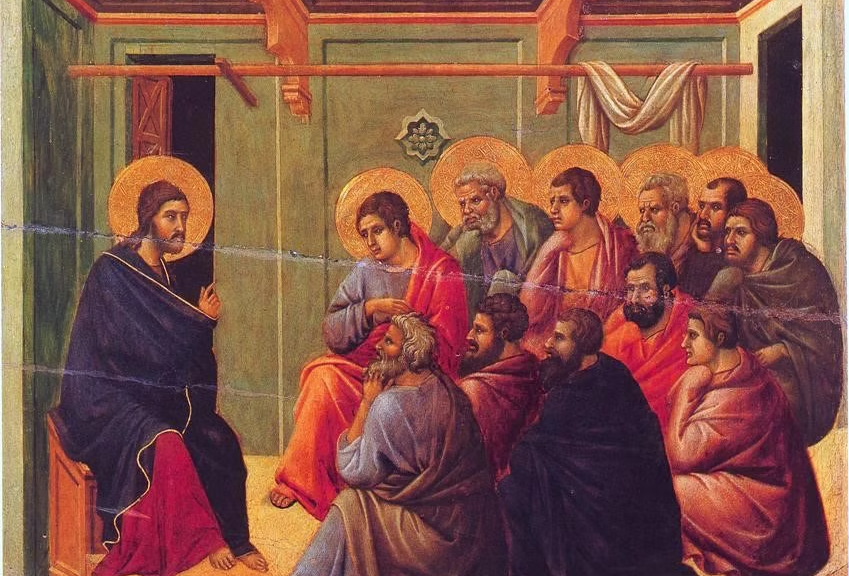
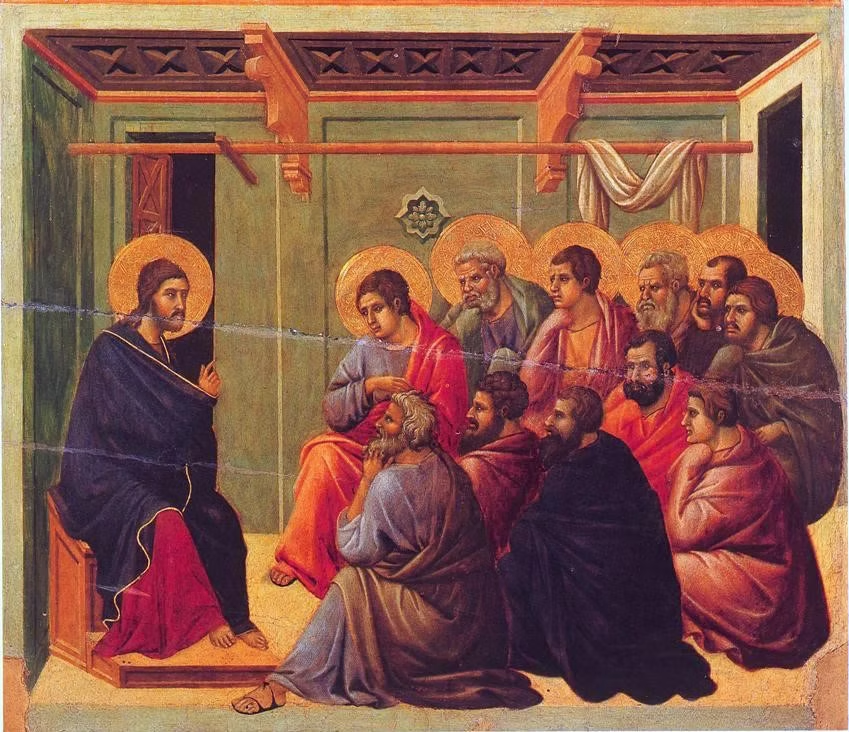
Notice how medieval art censors refused to depict saints as drunken Jews on a Seder.

From knowing this said prior (in two separate verses), it lets one be ‘up to date’ on seeing that “Answered Jesus,” where those two capitalized words are divinely elevated to say that Yahweh spoke through His Son. That “said to himself” (the soul of Jesus in Judas and each of the other “selves) was, “IF [a Big “If”] someone loves me , this word of me he will observe , kai this Father of me will love [“someone”] the same , kai advantageous to the same [“someone” and “this Father”] we will come ¸ kai a dwelling place alongside of to [“someone”] the same will act .” As can be seen, this “Answer” made by “Jesus” says nothing directly about the “cause” that would make Jesus be gone, then “appear” in his disciples, unseen by the rest of the “world.” Instead, a condition is set that is the “cause” of what Jesus had said prior. “If someone … anyone … loves Yahweh [the speaker through Jesus], then just as Yahweh spoke what Yahweh said through his lips, “the same” will take place in Yahweh’s ‘lover.’ When it is importantly stated, “If love,” then “this Father of me will love the same [relative to the someone-anyone],” that is a statement of divine marriage. Divine marriage is between a soul and Yahweh’s Spirit, neither is visible to naked eyes (not physically perceived). This “Answered” the “cause of appearance in a disciple.”

When John then had Yahweh say through Jesus, beginning with another “kai,” “advantageous to the same [someone anyone] we will come.” Here, the third-person plural Future says each “someone-anyone” will no longer be alone, but part of a Trinity: Father, Son Jesus, and soul married with Spirit. This divine union will be only for those who meet the conditions of the “If.” That is “advantageous” for the ministry of Jesus to continue in a body (many times over) of flesh, while Yahweh leads saints to find His lost souls [His sheep], and the soul destined to die and be recycled (or worse) get the advantage of knowing one’s soul has been saved for eternity. The “Answer” to the “not at all this world” will know this “appearance” of Jesus (after he is raised from the dead) is it will not meet the “love” conditions that bring about salvation.

In verse twenty-four, Jesus then continued by saying the other aspect of the conditional, which placed focus on what “not at all this world” meant. Here, Jesus said, “this not loving me , these words of me not they will observe ; kai this word that you listen to , not is mine , but of this of having been sent myself of Father .” This confirms that what Jesus said came from Yahweh speaking through him. Jesus saying what Yahweh told him was a sign of his love for the Father. The words of the Father were His Law, which Jesus lived, simply due to his willingly allowing Yahweh to lead his every path in life. The “If” condition meant one’s soul must likewise desire to “listen” to the Word of Yahweh and live accordingly to His Will. The meaning of “not at all this world” says there are few souls who will bow down and submit “self” to anyone else … even Yahweh.

In verse twenty-five, Jesus said, “These I have said to your souls [“you” or “yourselves”] , alongside of to your souls [“you” or “yourselves”] abiding .” The capitalized “Tauta” gives divine elevation to the plural pronoun “these,” which are the words of prophecy Yahweh just spoke through His Son. This confirms that “yet small” was a statement about the “little” part of Jesus’ soul that was “abiding” in the souls of his disciples. Yahweh knew each of the disciples was doing Judaic duty by getting drunk as skunks, so speaking to those foggy brains would be futile. Instead, He spoke to their souls [seeing all places where a “self” is implied as meaning a “soul”]. Because the soul of Jesus had been allowed by Yahweh to “abide” in his disciples, Yahweh could speak to those souls, sounding just like Jesus to their brains.

In verse twenty-six, Jesus then said, “this now Helper , this Spirit this Sacred , this he will send this Father within this name of myself , that one your souls [“you” or “yourselves”] will direct all kai will remind your souls [“you” or “yourselves”] all that have said to your souls [“you” or “yourselves”] I .” In this, the capitalized word “Paraklētos” is written, which means it is a divinely elevated “advocate, intercessor, consoler or comforter.” This is direction spoken “to your souls , alongside of your souls abiding,” which is the presence of all that is necessary to live righteously, having submitted one’s self-will to that of the Father and His Son. This is not some extra link in the Trinity chain. It is how one becomes a soul saved, through love of Yahweh and His Word. One’s own soul alone is handicapped and unable to walk a straight path, without falling down over and over. The “Helper” makes sure one’s little brain no longer has to figure things out. Thus, it is “this Spirit” that comes when one is Anointed by Yahweh in marriage (made one of His Christs … He can have as many as He wishes). That presence of Yahweh’s “Spirit” then leads one to walk righteously, which thereby makes oneself become “Holy, Sacred, Consecrated by Yahweh.”

When the “Spirit” comes in divine marriage, then the reason for marriage becomes evident – having a baby together. This is then where Jesus’ soul being resurrected comes in. It is raised within one’s soul, which was previously dead. The presence of Jesus means a soul has been saved. Thus, the name “Jesus” means “Yahweh Saves.” That “sent by the Father” is His seed, which comes in the “name” Jesus. Once the soul of Jesus has been reborn is each apostle’s soul, then Jesus “will direct” them, as their Lord. Everything written in divine Scripture will then be understood, as the soul of Jesus “will remind your souls” of the circumstances in which divine Scripture was written, having been there and done that, as the soul of Adam-Jesus – the Son of Yahweh. When the word “egō” is written, this becomes the identity of each soul, where “I” states Jesus as each soul’s Lord, while also knowing “I AM” is the source of all “I’s,” because all souls (including that of Jesus) bows in submission to Yahweh.

Verse twenty-seven then says, “Peace I permit to your souls [“you” or “yourselves”] , this of my soul [“mine” or “of myself”] I place to your souls [“you” or “yourselves”] ; not according as this world gives , I give to your souls [“you” or “yourselves”] . not let it be troubled of your souls [“you” or “yourselves”] this heart , not even let it fear .” To begin this verse, John wrote the capitalized “ Eirēnēn,” which is a divinely elevated translation that says “Peace.” The common usage of this word has it translate as “one, peace, quietness, rest,” where divine elevation to a level of Yahweh’s Spirit says “One” is the command Jesus would give to his disciples in the upper room [the Episcopalian catch phrase, “Peace to you “], where Jesus said we are “One” now. The divine elevation to mean “Rest” says the symbolism of the seventh day – a time of “Completion” and “Rest” has come to their souls. All the “yous” and “mine” are statements relative to this capitalized “Peace,” as it has no meaning in the physical sense. That is confirmed when Jesus said, “not according as this world gives [rest, peace, oneness].” The element of “heart” is where the throne of Yahweh is seated with the Lamb (the Revelation element). Thus, a soul is no longer “troubled” when it is forgiven its past sins of the flesh and has received “Peace.” The only “fear” that then comes is the “fear” of losing Yahweh and Jesus in one’s soul.

In verse twenty-eight, Jesus then said, “you listened because I spoke to your souls [“you” or “yourselves”] , I am departing kai I am going towards your souls [“you” or “yourselves”] . if you loved me , you have had rejoiced in that I am traveling advantageous for this Father , because this Father greater than myself exists .” Here, Jesus had told his disciples three times of his death and resurrection. Their brains could not fathom what that meant; but Jesus poke those words to their souls. He told them he would “depart” in death, but his soul would be “going towards their souls.” With the conditional having been set about loving Yahweh and loving to obey the commands of Jesus, then their souls would realize (later, rather than sooner) it is “advantageous for this Father” to have twelve Apostles each with the soul of Jesus teaching His Word than only have one Jesus in the flesh. Yahweh can have many millions of saints, all resurrections of His Son Jesus, because Yahweh is the Father that is “greater than” one man with a holy soul in the flesh. For all to be Jesus [“myself exists”] reborn, the world becomes a better place for all.

Verse twenty-nine then says, “kai now I have told your souls [“you” or “yourselves”] before this has been born , in order that whenever it shall have been born , your souls shall believe [2nd person implied “you” or “yourselves”] .” This verse importantly states (use of “kai”) the drunken brains of those disciples will not remember anything of that said that Seder night, especially after the coming arrest and the ensuing fear that would envelope most of them (especially the male disciples). Thus, one should see “your souls” as the translation of “I have told you.” The two uses of “erchomai,” which can truly translate as “to be born,” as well as “to come” or “to happen,” becomes a clear statement that each soul told by Jesus would be reborn in his name. This planting of a seed of thought in their souls would make them all realize everything said to them by Jesus – at all times – including this important night when he was saying his, “Goodbye for now, but I will return as you.”

As one of two Gospel selections that will only receive the ‘light of day’ in an Episcopal church on this sixth Sunday of Easter, it is vital to be told the meaning of what Jesus told his disciples on the nights that he would be taken away from them … forever in the flesh. The Easter season is when readings will be presented that all place focus on souls being raised from the dead, with none of those souls being Jesus. Lazarus was raised from the dead with a decomposing body returned to full life; and, Lazarus would travel in ministry – AS JESUS REBORN – to southern France (along with others), following the orders his soul received from Jesus within. Jesus would not be raised in his own physical flesh. He would be raised in the physical flesh of his Apostles-Saints-Prophets that carried on that ministry for the past two thousand years. To not hear Jesus speaking to one’s soul in this reading selection is to become one of “this world” that does “not love Yahweh” (not married divinely in Spirit) and does “not love Jesus” as one’s inner Lord. Now is the time to grasp that meaning.

John 5:1-9 – If only someone would help me get in the water first

[1] After Jesus healed the son of the official in Capernaum, there was a festival of the Jews, and Jesus went up to Jerusalem.

[2] Now in Jerusalem by the Sheep Gate there is a pool, called in Hebrew Beth-zatha, which has five porticoes. [3] In these lay many invalids– blind, lame, and paralyzed. [5] One man was there who had been ill for thirty-eight years. [6] When Jesus saw him lying there and knew that he had been there a long time, he said to him, “Do you want to be made well?” [7] The sick man answered him, “Sir, I have no one to put me into the pool when the water is stirred up; and while I am making my way, someone else steps down ahead of me.” [8] Jesus said to him, “Stand up, take your mat and walk.” [9] At once the man was made well, and he took up his mat and began to walk. Now that day was a sabbath.

——————–

This is the alternate Gospel selection that can be chosen for a priest to read aloud on the sixth Sunday of Easter, Year C, according to the lectionary for the Episcopal Church. If chosen, it will follow a mandatory Easter reading from the Book of Acts, this Sunday telling of Paul being called by a vision to Macedonia, where we then read: “A certain woman named Lydia, a worshiper of God, was listening to us; she was from the city of Thyatira and a dealer in purple cloth. The Lord opened her heart to listen eagerly to what was said by Paul.” That will precede a singing of Psalm 67, where David wrote: “May elohim give us his blessing, and may all the ends of the earth stand in awe of him.” That pair will lead to the Year C Epistle reading from Revelation, where John was shown: “the assembly of inhabitants has no need of sun or moon to shine on it, for the glory of God is its light, and its lamp is the Lamb. The peoples will walk by its light, and the rulers of the flesh will bring their glory into it.”

Verse one of this fifth chapter does not say, “After Jesus healed the son of the official in Capernaum.” Chapter four ended with such a healing; but chapter five begins with the Greek words “Meta tauta,” where “tauta” is the Accusative Neuter Plural form of “touto,” meaning “these.” As a plural designation, John ended chapter four by saying the healing of the official’s son in Capernaum was, “once more the second sign done by Jesus.” Chapter four tells of different things Jesus accomplished in ministry; so, to limit “these” to a single event is wrong. The NRSV begins chapter five as saying, “After this,” so the Episcopal Church has once again been found attempting to rewrite Scripture, to keep the blind from being able to see the truth. As to the capitalization of the word “Meta,” this is a divine elevation that says Yahweh had used Jesus to make changes in Jewish souls, which included his disciples sent out into ministry as an extension of his soul. Therefore, “In accompany with these” works of Yahweh done by Jesus up to this point, it became time for the Sukkot festival in Jerusalem; and, Jesus went there in his ministry for Yahweh.

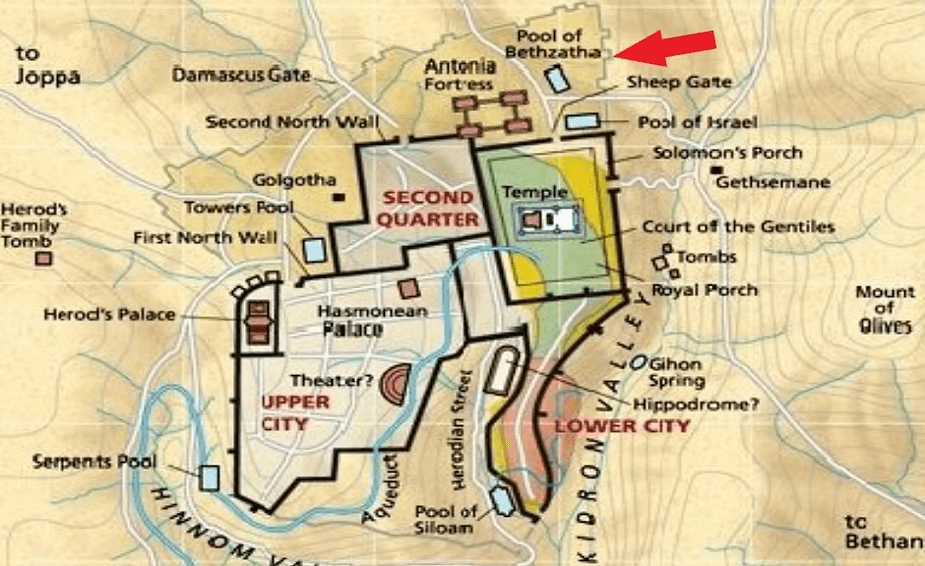
In verse two, John sets up this event by telling us where it happened. The Sheep Gate and the Pool of Bethzatha were close together, in the northeastern corner of the city. It was outside the Fortress of Antonia, thus outside the walls of Jerusalem. Here is a picture that shows its location.

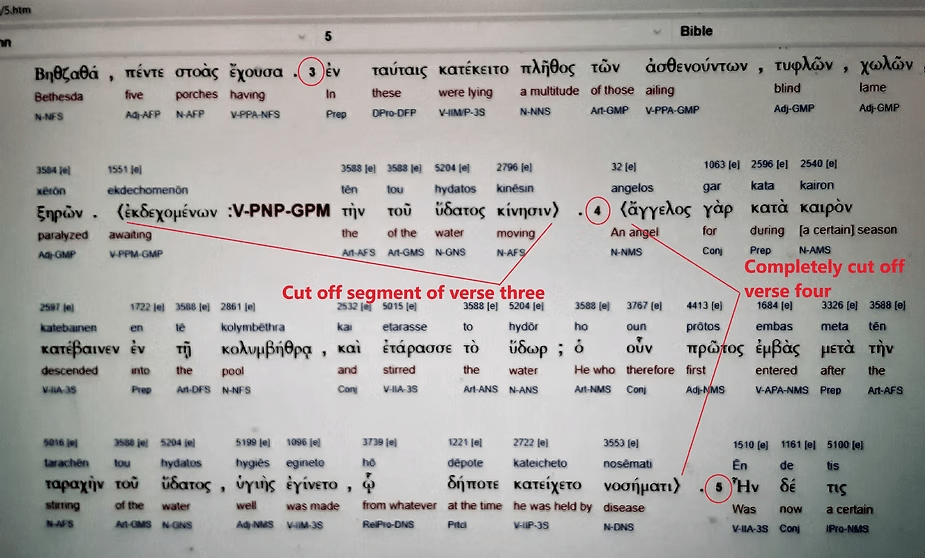
In the above selection of verses, I have placed the verse numbers in bold type, within brackets. If you carefully observe these numbers, you will find that there is no verse four. In fact, the last segment of verse three has been omitted. In the NRSV presentation of John’s fifth chapter, at the last word translated in verse three they add a footnote that says: “Other ancient authorities add, wholly or in part, waiting for the stirring of the water; 4 for an angel of the Lord went down at certain seasons into the pool, and stirred up the water; whoever stepped in first after the stirring of the water was made well from whatever disease that person had.” Here is a picture of how Bible Hub presents the italicized text – as written within angle brackets, thus becoming like an aside or whisper, unworthy of telling anyone about.

When verse three is shown to state “these lay” beside the pool, the missing content is a new sentence (in whisper), explaining “[they lay] awaiting this of this water stirring.” This says the “blind, lame and paralyzed” had been led to that pool and laid on mats, by relatives who believed this pool had healing qualities. Whenever the “waters stirred,” those seeking to be healed needed to be the first into those “waters stirred.” To further explain why the “waters stirred,” verse four was John stating that, still as a whisper, because it does not add to the miracle of Jesus and the lame man; but it shows how faith in miracles of “stirred waters” led those in need of a miracle to await faithfully for a miracle to come in their presence. Thus, verse four says, “an angel indeed according to opportunity descended within this pool , kai stirred this water ; this then first stepped into after this stirring of this water , sound was born , to this even at that time he had been possessed to sickness .

In this verse four, the use of “angelos” and “katebainen” can also be read as “a messenger [of God]” and “went down.” When an “angel [of God]” is understood to be an “elohim” [in Hebrew], one must realize that Jesus possessed the soul of the “Yahweh elohim” (as stated repeatedly in Genesis 2) that Yahweh placed within the “earth” He formed to be who we call Adam. That says Jesus was also “an angel [of God].” In verse one, John wrote, “Jesus went up to Jerusalem,” where the verb “anabainó” was used and means, “to ascend.” When John used the word “kairon,” which has been translated as “season,” the same word means “opportunity,” but “season” leads one to associate the festival of the Jews as a “season.” The difference that must be seen from this unpublished ‘aside’ written by John, is the healing “angel” that “descended” is more in line with a demon (as a ‘fallen angel’), whereas Jesus was a true “messenger of Yahweh.” Thus, the “opportunity” to heal … only the “first who stepped into the stirred waters” … was not a miracle sent by Yahweh, but one sent by Satan. Those not able to get into the pool first … if many times faithfully gone to the pool, only to miss out, that would lead to weakened faith and even blame of Yahweh being not caring for those most invalid.

In verse five, John’s writing “Ēn de tisanthrōpos ekei” (“Existed now a certain man there”), his use of “tis” – as a writing after the fact – says this “man” was “certain,” meaning his name was known afterwards. The use of “tis” should be read generally as a statement of a Jew known, but more specifically as an individual Jew known. The “certainty” says this “man,” once healed, would become a devoted follower of Jesus. Therefore, John and others who followed Jesus would come to know his name.

[Aside: In the story of three women Christians named Mary landing at the French place now called Saintes-Maries-de-la-Mer, two men accompanied them, named Maximin and Sidon. Sidon was the man who was born blind that was healed by Jesus at the Pool of Siloam. Maximin was said to have been one of the seventy commissioned into intern ministry by Jesus. Both became servants at the house of Mary, Martha and Lazarus. By seeing that a man had been lame for thirty-eight years (which means he could have been at least forty-to-forty-five years of age at that time of healing), it makes sense that his devotion to Jesus would make him possibly the man healed from being lame, having no learned trade to then turn to. As a servant to the family of Jesus, near Jerusalem (in Bethany), this would make Maximin be “the certain man.”]

In verse six, where John says Jesus saw the man and knew (importantly, from the use of “kai”) how long the man had been there faithfully, this following a statement by John that he had been there “thirty-eight years” says this information was made available to Jesus by the Father. This divine knowledge led Jesus to ask the man (according to the NRSV translation), “Do you want to be made well.” That is a poor translation of the question John wrote of Jesus posing.

The Greek text of the question is this: “Theleis hygiēs genesthai ?” In that, the capitalized “Theleis” divinely elevates this word to a higher question that “want.” The word means, “to will, to wish,” implying in usage: “desire, willingness, intention, and design.” To place this divinely, Jesus asked if the man “Desired.” This then needs to cause one to see “hygiēs” as meaning more than healthy, well, or sound. When the question is about divine “Desire,” that is to cease being a failure in the eyes of Jews, as for some reason shunned by Yahweh, due to being incomplete. Thus, this focus is placed on being “whole.” Then, the verb “genesthai” has little to do with a simply “happening” or “coming” or “being,” but one of being “born anew.” Therefore, what John recorded Jesus asking the lame man is, “Desire you to be born again whole?”

The man then responded to Jesus saying, “Lord , a man not I possess , in order that whenever has been stirred this water , he might rush me into this pool , within which now am coming I , another before of myself goes down .” Here, the man’s reasoning was not a question of “Desire,” but ability. He had nobody who would stay with him, after carrying him to his place by the pool each morning, then carrying him away at the end of the day. Thus, by the time he saw “stirring water,” his attempts to drag his lame body to the pool was too slow to beat someone who had help. The man’s answer said he had thirty-eight years of “Desire,” but he had no “man” who would assist him in having his “Desires” met.

In verse eight, John wrote “Legei autō ho Iēsous,” where two capitalized words bring divine elevation to the NRSV translation: “Jesus said to him.” The capitalization of “Says” is divinely elevated as Yahweh “Speaking” through the Son. It is not simple words being conveyed, but a divine command being “Uttered.” The pronoun “autō” then goes beyond a simple “to him” and “Speaks to his soul” [“himself” => “his soul”] The name “Jesus” means “Yahweh Saves,” so it is through the lips of “Jesus” that the lame man would be “Saved by Yahweh.”

Jesus at first gave a one-word command: “Egeire,” which is a capitalized word that is also divinely elevated in meaning. It is the second-person Imperative Active form of the word saying “to raise up.” More than being a command to stand on your feet, it was Yahweh speaking to the soul of the lame man, telling his soul to be made whole and “Rise” as a servant to Him. After that command, Yahweh then spoke through Jesus, saying “remove this mattress of the poor of your soul [“you” of “yourself”] , kai conduct your life [or “live”] .” A “mattress of the poor” was also considered a “camp-bed,” which was for sleeping on when in a tent, while traveling. Beggars would stay in one place so long they would need such a quilted mattress to lay upon, while begging for alms. That becomes a symbolic statement of one being dead to life, due to always being on a bed. The Greek word “aron” is similar to the word “Egeire,” as it too means “to raise, take up, lift,” where the divine essence is to grow to a higher state of being. To “raise up one’s mattress of the poor” is to be the Easter message that says be “raised from the dead.” Thus, when the Greek word “peripatei” is translated as “walk,” the meaning is to begin a path of righteousness;” and, therefore, this is being raised to “life,” from having been dead.

Verse nine is begun by a capitalized “Kai,” which says the information to follow is most important to discern. John then wrote: “immediately was born whole this man”. The great importance to grasp is the words “egeneto hygiēs” are forms of the same words used prior, asking the man if he “Desired to be born whole” of if he “wanted to be well.” Certainly, the same immediacy made the man well, but for a man who had never experienced true “life” before that moment in time, the divine statement of truth says he “was born whole” … and that means body and soul united with Yahweh.

Following a comma mark of separation, with John writing another “kai,” the importance that followed was the man “raised up this mattress of the poor of his soul [“him” or “himself”] kai began to walk [which also means “to live”] ,” The importance noted here is less about a man carrying away the mat he had been laid on, as much as it places important focus on the symbolic crutches in life that human sinners use as an excuse to be dead. By “lifting up his mat” the man ceased being enslaved to the ways of the world. Instead, he began to live righteously, as a soul whole with Yahweh.

Following the period mark that ended that important statement, John then added, “Existed now sabbath within that this day .” Here, it will be the following verses that will make an issue of Jesus having healed a lame man on the Sabbath; but that is not the point to be gained from this sentence being still part of verse nine. The capitalized “Ēn,” which is the third-person Indicative form of “eimi,” means “I am, I exist. It is the same word used to begin verse five, where the man was first introduced, as “Existed a certain man.” As the ending to verse nine, where this certain man has now been healed, to write “Existed now sabbath” says the state of “completeness” had come to this “certain man.” His life have become “whole,” so his soul being joined with Yahweh meant he was at “rest” and at “peace,” no longer lame. This means the use of “hēmera,” which translates as “day,” is less about the “day” of the week,” but more about the “light of day” that Yahweh had brought into his soul, which is the “daylight” of eternal salvation. This sentence ending verse nine says the man’s darkness of mortal death had been born anew as the light of one walking the path of righteousness.

As the alternate Gospel possibility for this sixth Sunday of Easter (which is only made available to be read this one time each three-year cycle), it is important to see the Easter theme of raised from the dead alive and well in this event in Jesus’ ministry. The metaphor is all of us should identify with the lame man, who is always looking for a miracle to come into his life. When he responded to Jesus about his “Desire to be born whole,” he put more energy into explaining, “I would be happy if someone would help me with my faith, because my Desire has never wavered.”

Yahweh sent His son to be his assistant; but instead of throwing him into the pool first, as soon at the water stirred, Jesus was sent to tell him, “You faith has made you whole. Get up, take away your crutch and live your new life for Yahweh.” This is why I strongly believe the lame man remained a servant to Jesus, as the axiom goes: “Scratch my back and I’ll scratch yours.” Jesus put it as, “Do unto others as you would have them do unto you.” The lame man was not like the past ‘pool lottery winners,’ who were healed and then ran away thanking some water stirring angel … once and never again. The lame man is like the way we are supposed to model. Faith personified, through all the crap the world keeps heaping on everyone. We only need someone to help us make it through all the failures. When Yahweh sends us His Son, then we become souls raised from the dead, as well as becoming Yahweh’s helpers in return.